

IIA4: Open Source and the Enterprise
Jeffrey Hammond, Vice President &
Principal Analyst | @jhammond
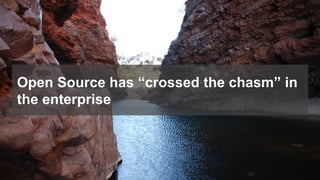
Open Source has “crossed the chasm” in
the enterprise
Remember back to 2009?
© 2016 Forrester Research, Inc. Reproduction Prohibited 5
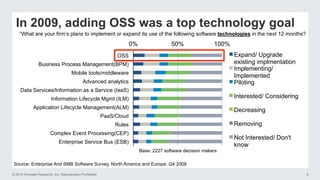
In 2009, adding OSS was a top technology goal
0% 50% 100%
OSS
Business Process Management(BPM)
Mobile tools/middleware
Advanced analytics
Data Services/Information as a Service (IaaS)
Information Lifecycle Mgmt (ILM)
Application Lifecycle Management(ALM)
PaaS/Cloud
Rules
Complex Event Processing(CEP)
Enterprise Service Bus (ESB)
Expand/ Upgrade
existing implmentation
Implementing/
Implemented
Piloting
Interested/ Considering
Decreasing
Removing
Not Interested/ Don't
know
“What are your firm’s plans to implement or expand its use of the following software technologies in the next 12 months?
Source: Enterprise And SMB Software Survey, North America and Europe, Q4 2008
Base: 2227 software decision makers
© 2016 Forrester Research, Inc. Reproduction Prohibited 6
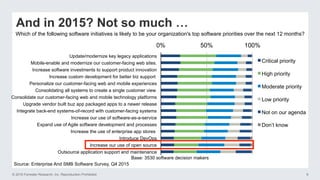
And in 2015? Not so much …
0% 50% 100%
Update/modernize key legacy applications
Mobile-enable and modernize our customer-facing web sites.
Increase software investments to support product innovation
Increase custom development for better biz support
Personalize our customer-facing web and mobile experiences
Consolidating all systems to create a single customer view
Consolidate our customer-facing web and mobile technology platforms
Upgrade vendor built buz app packaged apps to a newer release
Integrate back-end systems-of-record with customer-facing systems
Increase our use of software-as-a-service
Expand use of Agile software development and processes
Increase the use of enterprise app stores
Introduce DevOps
Increase our use of open source
Outsource application support and maintenance
Critical priority
High priority
Moderate priority
Low priority
Not on our agenda
Don’t know
Which of the following software initiatives is likely to be your organization's top software priorities over the next 12 months?
Source: Enterprise And SMB Software Survey, Q4 2015
Base: 3530 software decision makers
© 2016 Forrester Research, Inc. Reproduction Prohibited 8
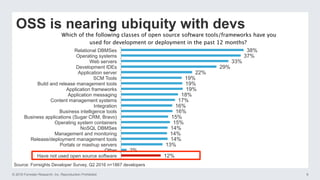
OSS is nearing ubiquity with devs
Which of the following classes of open source software tools/frameworks have you
used for development or deployment in the past 12 months?
38%
37%
33%
29%
22%
19%
19%
19%
18%
17%
16%
16%
15%
15%
14%
14%
14%
13%
2%
12%
Relational DBMSes
Operating systems
Web servers
Development IDEs
Application server
SCM Tools
Build and release management tools
Application frameworks
Application messaging
Content management systems
Integration
Business intelligence tools
Business applications (Sugar CRM, Bravo)
Operating system containers
NoSQL DBMSes
Management and monitoring
Release/deployment management tools
Portals or mashup servers
Other
Have not used open source software
Source: Forrsights Developer Survey, Q2 2016 n=1867 developers
© 2016 Forrester Research, Inc. Reproduction Prohibited 9
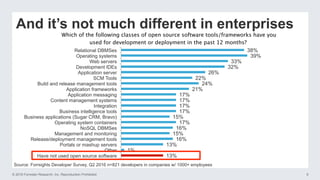
And it’s not much different in enterprises
Which of the following classes of open source software tools/frameworks have you
used for development or deployment in the past 12 months?
38%
39%
33%
32%
26%
22%
24%
21%
17%
17%
17%
17%
15%
17%
16%
15%
16%
13%
1%
13%
Relational DBMSes
Operating systems
Web servers
Development IDEs
Application server
SCM Tools
Build and release management tools
Application frameworks
Application messaging
Content management systems
Integration
Business intelligence tools
Business applications (Sugar CRM, Bravo)
Operating system containers
NoSQL DBMSes
Management and monitoring
Release/deployment management tools
Portals or mashup servers
Other
Have not used open source software
Source: Forrsights Developer Survey, Q2 2016 n=821 developers in companies w/ 1000+ employees
© 2016 Forrester Research, Inc. Reproduction Prohibited 10
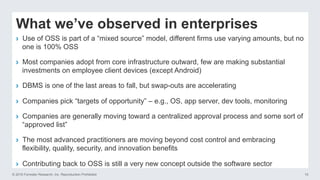
What we’ve observed in enterprises
›  Use of OSS is part of a “mixed source” model, different firms use varying amounts, but no
one is 100% OSS
›  Most companies adopt from core infrastructure outward, few are making substantial
investments on employee client devices (except Android)
›  DBMS is one of the last areas to fall, but swap-outs are accelerating
›  Companies pick “targets of opportunity” – e.g., OS, app server, dev tools, monitoring
›  Companies are generally moving toward a centralized approval process and some sort of
“approved list”
›  The most advanced practitioners are moving beyond cost control and embracing
flexibility, quality, security, and innovation benefits
›  Contributing back to OSS is still a very new concept outside the software sector
© 2016 Forrester Research, Inc. Reproduction Prohibited 11
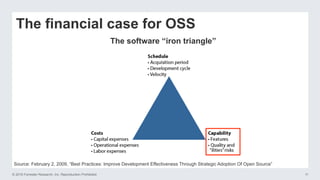
The financial case for OSS
Source: February 2, 2009, “Best Practices: Improve Development Effectiveness Through Strategic Adoption Of Open Source”
The software “iron triangle”
© 2016 Forrester Research, Inc. Reproduction Prohibited 12
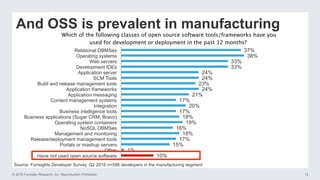
And OSS is prevalent in manufacturing
Which of the following classes of open source software tools/frameworks have you
used for development or deployment in the past 12 months?
37%
38%
33%
33%
24%
24%
23%
24%
21%
17%
20%
17%
18%
19%
16%
18%
17%
15%
1%
10%
Relational DBMSes
Operating systems
Web servers
Development IDEs
Application server
SCM Tools
Build and release management tools
Application frameworks
Application messaging
Content management systems
Integration
Business intelligence tools
Business applications (Sugar CRM, Bravo)
Operating system containers
NoSQL DBMSes
Management and monitoring
Release/deployment management tools
Portals or mashup servers
Other
Have not used open source software
Source: Forrsights Developer Survey, Q2 2016 n=598 developers in the manufacturing segment
© 2016 Forrester Research, Inc. Reproduction Prohibited 13
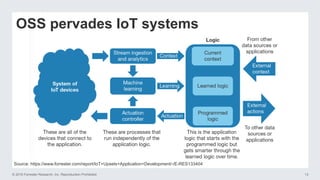
OSS pervades IoT systems
Source: https://www.forrester.com/report/IoT+Upsets+Application+Development/-/E-RES133404
© 2016 Forrester Research, Inc. Reproduction Prohibited 14
IoT and open community projects
›  Hardware: Arduino(s), BeagleBoard, Galileo, Raspberry Pi, Tessel
›  Operating systems: Contiki, mbed, Raspian, Snappy, Zephyr
›  Protocols: AllJoyn, CoAP, ETSI SmartM2M, MQTT, OMA Lightweight
M2M, Thread, XMPP
›  Infrastructure: Docker, Cloud Foundry, Node, OpenStack
›  Data/analytics: Cassandra, Druid, Elasticsearch, Flink, Hadoop, Kafka,
MongoDB, Spark, Storm (and many others)
© 2016 Forrester Research, Inc. Reproduction Prohibited 15
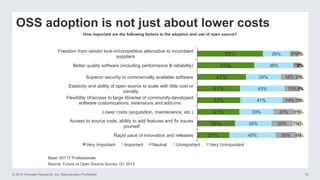
OSS adoption is not just about lower costs
Source: Future of Open Source Survey: Q1 2013
How important are the following factors to the adoption and use of open source?
31%
36%
41%
42%
41%
47%
55%
63%
45%
35%
33%
41%
43%
34%
38%
26%
20%
20%
20%
14%
15%
16%
7%
9%
4%
7%
6%
3%
1%
2%
0%
1%
1%
1%
1%
0%
0%
1%
0%
1%
Rapid pace of innovation and releases
Access to source code, ability to add features and fix issues
yourself
Lower costs (acquisition, maintenance, etc.)
Flexibility of/access to large libraries of community-developed
software customizations, extensions and add-ons
Elasticity and ability of open source to scale with little cost or
penalty
Superior security to commercially available software
Better quality software (including performance & reliability)
Freedom from vendor lock-in/competitive alternative to incumbent
suppliers
Very Important Important Neutral Unimportant Very Unimportant
Base: 657 IT Professionals
© 2016 Forrester Research, Inc. Reproduction Prohibited 16
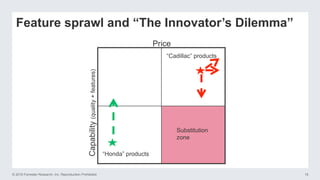
Price
Capability(quality+features)
Substitution
zone
“Cadillac” products
“Honda” products
Feature sprawl and “The Innovator’s Dilemma”
© 2016 Forrester Research, Inc. Reproduction Prohibited 17
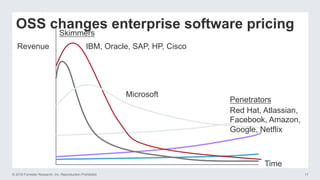
OSS changes enterprise software pricing
Time
Revenue IBM, Oracle, SAP, HP, Cisco
Red Hat, Atlassian,
Facebook, Amazon,
Google, Netflix
Skimmers
Penetrators
Microsoft
© 2016 Forrester Research, Inc. Reproduction Prohibited 18
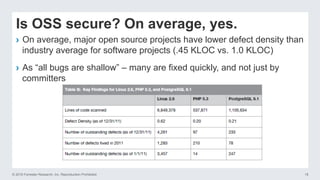
Is OSS secure? On average, yes.
›  On average, major open source projects have lower defect density than
industry average for software projects (.45 KLOC vs. 1.0 KLOC)
›  As “all bugs are shallow” – many are fixed quickly, and not just by
committers
© 2016 Forrester Research, Inc. Reproduction Prohibited 19
Gaps that challenge OSS success
›  No formal OSS policy in place
›  OSS viewed as monolithic as opposed to something that should be
adopted on a gradual, case-by-case basis
›  Reactive approach to component specification makes it likely that OSS
will leak into the organization
›  Lack of OSS experience means externalizing support in the short term
›  No defined contribution policy
© 2016 Forrester Research, Inc. Reproduction Prohibited 20
Building operational capability
›  Appoint an OSS steward
›  Create a comprehensible policy
›  Require project leaders to identify OSS dependencies
›  Use architects to regulate exploitation and maintenance
›  Trust teams - but verify with code-scanning utilities
›  Maintain a repository of preapproved OSS components
›  Don't dwell on development processes; focus on outcomes
›  Don't expect perfection, and plan for remediation
© 2016 Forrester Research, Inc. Reproduction Prohibited 21
Getting the most from OSS
›  Look to projects with strong committer communities
›  Prioritize projects with commercial support or dual-use options
›  Start at the base of the application platform and move up
›  Be realistic about support for alternative commercial products
›  Trust your people … but verify their actions
›  Move from acceptance to active exploitation
›  Think about how OSS community practices can improve your own
organization
forrester.com
Thank you
Jeffrey Hammond
+1 617-613-6164
jhammond@forrester.com
General Electric reserves the right to make changes in specifications and features, or discontinue the product or service described at any time, without notice or obligation. These materials do
not constitute a representation, warranty or documentation regarding the product or service featured. Illustrations are provided for informational purposes, and your configuration may differ. This
information does not constitute legal, financial, coding, or regulatory advice in connection with your use of the product or service. Please consult your professional advisors for any such advice.
GE, Predix and the GE Monogram are trademarks of General Electric Company. ©2016 General Electric Company – All rights reserved.

IIA4: Open Source and the Enterprise ( Predix Transform 2016)

  • 1.
    IIA4: Open Sourceand the Enterprise Jeffrey Hammond, Vice President & Principal Analyst | @jhammond
  • 3.
    Open Source has“crossed the chasm” in the enterprise
  • 4.
  • 5.
    © 2016 ForresterResearch, Inc. Reproduction Prohibited 5 In 2009, adding OSS was a top technology goal 0% 50% 100% OSS Business Process Management(BPM) Mobile tools/middleware Advanced analytics Data Services/Information as a Service (IaaS) Information Lifecycle Mgmt (ILM) Application Lifecycle Management(ALM) PaaS/Cloud Rules Complex Event Processing(CEP) Enterprise Service Bus (ESB) Expand/ Upgrade existing implmentation Implementing/ Implemented Piloting Interested/ Considering Decreasing Removing Not Interested/ Don't know “What are your firm’s plans to implement or expand its use of the following software technologies in the next 12 months? Source: Enterprise And SMB Software Survey, North America and Europe, Q4 2008 Base: 2227 software decision makers
  • 6.
    © 2016 ForresterResearch, Inc. Reproduction Prohibited 6 And in 2015? Not so much … 0% 50% 100% Update/modernize key legacy applications Mobile-enable and modernize our customer-facing web sites. Increase software investments to support product innovation Increase custom development for better biz support Personalize our customer-facing web and mobile experiences Consolidating all systems to create a single customer view Consolidate our customer-facing web and mobile technology platforms Upgrade vendor built buz app packaged apps to a newer release Integrate back-end systems-of-record with customer-facing systems Increase our use of software-as-a-service Expand use of Agile software development and processes Increase the use of enterprise app stores Introduce DevOps Increase our use of open source Outsource application support and maintenance Critical priority High priority Moderate priority Low priority Not on our agenda Don’t know Which of the following software initiatives is likely to be your organization's top software priorities over the next 12 months? Source: Enterprise And SMB Software Survey, Q4 2015 Base: 3530 software decision makers
  • 8.
    © 2016 ForresterResearch, Inc. Reproduction Prohibited 8 OSS is nearing ubiquity with devs Which of the following classes of open source software tools/frameworks have you used for development or deployment in the past 12 months? 38% 37% 33% 29% 22% 19% 19% 19% 18% 17% 16% 16% 15% 15% 14% 14% 14% 13% 2% 12% Relational DBMSes Operating systems Web servers Development IDEs Application server SCM Tools Build and release management tools Application frameworks Application messaging Content management systems Integration Business intelligence tools Business applications (Sugar CRM, Bravo) Operating system containers NoSQL DBMSes Management and monitoring Release/deployment management tools Portals or mashup servers Other Have not used open source software Source: Forrsights Developer Survey, Q2 2016 n=1867 developers
  • 9.
    © 2016 ForresterResearch, Inc. Reproduction Prohibited 9 And it’s not much different in enterprises Which of the following classes of open source software tools/frameworks have you used for development or deployment in the past 12 months? 38% 39% 33% 32% 26% 22% 24% 21% 17% 17% 17% 17% 15% 17% 16% 15% 16% 13% 1% 13% Relational DBMSes Operating systems Web servers Development IDEs Application server SCM Tools Build and release management tools Application frameworks Application messaging Content management systems Integration Business intelligence tools Business applications (Sugar CRM, Bravo) Operating system containers NoSQL DBMSes Management and monitoring Release/deployment management tools Portals or mashup servers Other Have not used open source software Source: Forrsights Developer Survey, Q2 2016 n=821 developers in companies w/ 1000+ employees
  • 10.
    © 2016 ForresterResearch, Inc. Reproduction Prohibited 10 What we’ve observed in enterprises ›  Use of OSS is part of a “mixed source” model, different firms use varying amounts, but no one is 100% OSS ›  Most companies adopt from core infrastructure outward, few are making substantial investments on employee client devices (except Android) ›  DBMS is one of the last areas to fall, but swap-outs are accelerating ›  Companies pick “targets of opportunity” – e.g., OS, app server, dev tools, monitoring ›  Companies are generally moving toward a centralized approval process and some sort of “approved list” ›  The most advanced practitioners are moving beyond cost control and embracing flexibility, quality, security, and innovation benefits ›  Contributing back to OSS is still a very new concept outside the software sector
  • 11.
    © 2016 ForresterResearch, Inc. Reproduction Prohibited 11 The financial case for OSS Source: February 2, 2009, “Best Practices: Improve Development Effectiveness Through Strategic Adoption Of Open Source” The software “iron triangle”
  • 12.
    © 2016 ForresterResearch, Inc. Reproduction Prohibited 12 And OSS is prevalent in manufacturing Which of the following classes of open source software tools/frameworks have you used for development or deployment in the past 12 months? 37% 38% 33% 33% 24% 24% 23% 24% 21% 17% 20% 17% 18% 19% 16% 18% 17% 15% 1% 10% Relational DBMSes Operating systems Web servers Development IDEs Application server SCM Tools Build and release management tools Application frameworks Application messaging Content management systems Integration Business intelligence tools Business applications (Sugar CRM, Bravo) Operating system containers NoSQL DBMSes Management and monitoring Release/deployment management tools Portals or mashup servers Other Have not used open source software Source: Forrsights Developer Survey, Q2 2016 n=598 developers in the manufacturing segment
  • 13.
    © 2016 ForresterResearch, Inc. Reproduction Prohibited 13 OSS pervades IoT systems Source: https://www.forrester.com/report/IoT+Upsets+Application+Development/-/E-RES133404
  • 14.
    © 2016 ForresterResearch, Inc. Reproduction Prohibited 14 IoT and open community projects ›  Hardware: Arduino(s), BeagleBoard, Galileo, Raspberry Pi, Tessel ›  Operating systems: Contiki, mbed, Raspian, Snappy, Zephyr ›  Protocols: AllJoyn, CoAP, ETSI SmartM2M, MQTT, OMA Lightweight M2M, Thread, XMPP ›  Infrastructure: Docker, Cloud Foundry, Node, OpenStack ›  Data/analytics: Cassandra, Druid, Elasticsearch, Flink, Hadoop, Kafka, MongoDB, Spark, Storm (and many others)
  • 15.
    © 2016 ForresterResearch, Inc. Reproduction Prohibited 15 OSS adoption is not just about lower costs Source: Future of Open Source Survey: Q1 2013 How important are the following factors to the adoption and use of open source? 31% 36% 41% 42% 41% 47% 55% 63% 45% 35% 33% 41% 43% 34% 38% 26% 20% 20% 20% 14% 15% 16% 7% 9% 4% 7% 6% 3% 1% 2% 0% 1% 1% 1% 1% 0% 0% 1% 0% 1% Rapid pace of innovation and releases Access to source code, ability to add features and fix issues yourself Lower costs (acquisition, maintenance, etc.) Flexibility of/access to large libraries of community-developed software customizations, extensions and add-ons Elasticity and ability of open source to scale with little cost or penalty Superior security to commercially available software Better quality software (including performance & reliability) Freedom from vendor lock-in/competitive alternative to incumbent suppliers Very Important Important Neutral Unimportant Very Unimportant Base: 657 IT Professionals
  • 16.
    © 2016 ForresterResearch, Inc. Reproduction Prohibited 16 Price Capability(quality+features) Substitution zone “Cadillac” products “Honda” products Feature sprawl and “The Innovator’s Dilemma”
  • 17.
    © 2016 ForresterResearch, Inc. Reproduction Prohibited 17 OSS changes enterprise software pricing Time Revenue IBM, Oracle, SAP, HP, Cisco Red Hat, Atlassian, Facebook, Amazon, Google, Netflix Skimmers Penetrators Microsoft
  • 18.
    © 2016 ForresterResearch, Inc. Reproduction Prohibited 18 Is OSS secure? On average, yes. ›  On average, major open source projects have lower defect density than industry average for software projects (.45 KLOC vs. 1.0 KLOC) ›  As “all bugs are shallow” – many are fixed quickly, and not just by committers
  • 19.
    © 2016 ForresterResearch, Inc. Reproduction Prohibited 19 Gaps that challenge OSS success ›  No formal OSS policy in place ›  OSS viewed as monolithic as opposed to something that should be adopted on a gradual, case-by-case basis ›  Reactive approach to component specification makes it likely that OSS will leak into the organization ›  Lack of OSS experience means externalizing support in the short term ›  No defined contribution policy
  • 20.
    © 2016 ForresterResearch, Inc. Reproduction Prohibited 20 Building operational capability ›  Appoint an OSS steward ›  Create a comprehensible policy ›  Require project leaders to identify OSS dependencies ›  Use architects to regulate exploitation and maintenance ›  Trust teams - but verify with code-scanning utilities ›  Maintain a repository of preapproved OSS components ›  Don't dwell on development processes; focus on outcomes ›  Don't expect perfection, and plan for remediation
  • 21.
    © 2016 ForresterResearch, Inc. Reproduction Prohibited 21 Getting the most from OSS ›  Look to projects with strong committer communities ›  Prioritize projects with commercial support or dual-use options ›  Start at the base of the application platform and move up ›  Be realistic about support for alternative commercial products ›  Trust your people … but verify their actions ›  Move from acceptance to active exploitation ›  Think about how OSS community practices can improve your own organization
  • 22.
    forrester.com Thank you Jeffrey Hammond +1617-613-6164 jhammond@forrester.com
  • 23.
    General Electric reservesthe right to make changes in specifications and features, or discontinue the product or service described at any time, without notice or obligation. These materials do not constitute a representation, warranty or documentation regarding the product or service featured. Illustrations are provided for informational purposes, and your configuration may differ. This information does not constitute legal, financial, coding, or regulatory advice in connection with your use of the product or service. Please consult your professional advisors for any such advice. GE, Predix and the GE Monogram are trademarks of General Electric Company. ©2016 General Electric Company – All rights reserved.