Why make learning games?
Immune Defense. Blood. Death. Strategy. Protein.
www.MolecularJig.com
Molecular Jig Games
Melanie Stegman, Ph.D.
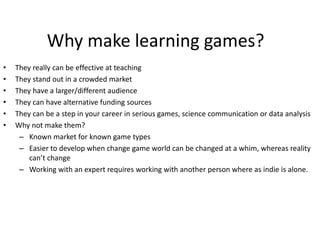
• They really can be effective at teaching
• They stand out in a crowded market
• They have a larger/different audience
• They can have alternative funding sources
• They can be a step in your career in serious games, science communication or data analysis
• Why not make them?
– Known market for known game types
– Easier to develop when change game world can be changed at a whim, whereas reality
can’t change
– Working with an expert requires working with another person where as indie is alone.
Why make learning games?
Learning games can be very effective
• Players remember names of proteins and
cells.
• Players gain confidence with the material.
All 0 hours/week 1 to 5
hours/week
6+
hours/week
Immune Attack Control
Control
0
5
10
15
20
All Girls Boys
Students learned molecular biology by
playing a 3rd person shooter
about cells and proteins.
Biology Game players N = 180 Control game players N = 160
All Girls Boys 0 1-5 6+
Hours video games
played/week
0
5
10
15
20
Averagenumberofcorrectanswers
Standard deviations, measure of variance not error, are shown.
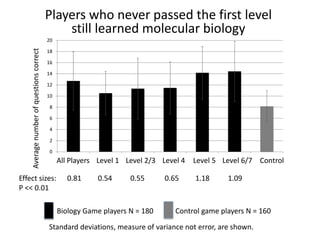
Players who never passed the first level
still learned molecular biologyAveragenumberofquestionscorrect
0
2
4
6
8
10
12
14
16
18
20
Immune Attack Level 1 Levels 2 and 3 Level 4 Level 5 Levels 6 and 7 Control
All Players Level 1 Level 2/3 Level 4 Level 5 Level 6/7 Control
Biology Game players N = 180 Control game players N = 160
Standard deviations, measure of variance not error, are shown.
Effect sizes: 0.81 0.54 0.55 0.65 1.18 1.09
P << 0.01
Something that will
damage your ship.
An amino acid A protein that stops Monocytes.
A wiggly thing that is the
wrong target.
A lipid A protein that makes Monocytes
exit the blood vessel.
An object you need to
avoid.
A complex
carbohydrate
A protein that does not interact with
Monocytes.
A wiggly thing you need to
shoot to win.
A protein A protein that causes the Monocyte
to slow down.
75% 50% 51%
75% 52% 54%
74% 49% 50%
What is the arrow pointing to?
All
Girls
Boys
Students remember objects and their role in the game.
Measuring confidence
Nature Reviews Immunology, 2007. 7:678.
1.
2.
3.
4.
5.
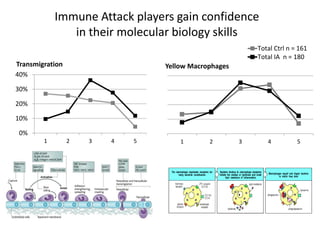
Immune Attack players gain confidence
in their molecular biology skills
0%
10%
20%
30%
40%
1 2 3 4 5
Transmigration
1 2 3 4 5
Yellow Macrophages
Total Ctrl n = 161
Total IA n = 180
Immune Attack players gain confidence with
related images.
I would be able to understand this diagram
if I read it and thought about it.
0%
10%
20%
30%
40%
1 2 3 4 5
DATA All IA Players n = 180
Percentoftotalstudents
Disagree -------------- Agree
• They really can be effective at teaching
• They stand out in a crowded market
• They have a larger/different audience
• They can have alternative funding sources
• They can be a step in your career in serious games, science communication or data analysis
• Why not make them?
– Known market for known game types
– Easier to develop when change game world can be changed at a whim, whereas reality
can’t change
– Working with an expert requires working with another person where as indie is alone.
Why make learning games?
Starting out as an indie game developer…
The casual game market is full…
• iOS getting featured is required for big big sales…
• ~800 games submitted to the iTunes App Store daily. High quality game, that is updated
often and is exceptional.
• OneSkyApp.com/blog/app-store-feature
• www.nativex.com/blog/uncovering-mystery-behind-app-store-editors-choice
• www.pocketgamer.biz/metrics/app-store/submissions/
• A Dark Room:
www.reddit.com/r/startups/comments/4f74dv/quit_my_full_time_corporate_job_buil
t_an_ios_game
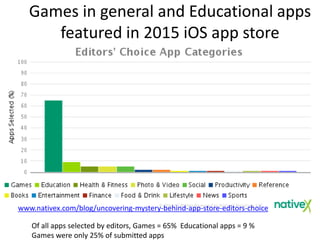
Games in general and Educational apps
featured in 2015 iOS app store
www.nativex.com/blog/uncovering-mystery-behind-app-store-editors-choice
Of all apps selected by editors, Games = 65% Educational apps = 9 %
Games were only 25% of submitted apps
Niche audiences for your reality game
Just like for any game, it’s not easy to find support for a
reality game…
however you can find individuals, associations,
universities or companies that might support you.
Support might be cash, advertisement, giving you space
to demo at their events
Games for Change
American Society for Microbiology
AAAS
Extra Credits on Steam
ScienceGameCenter.org
A science game development team
Academic
Sponsors
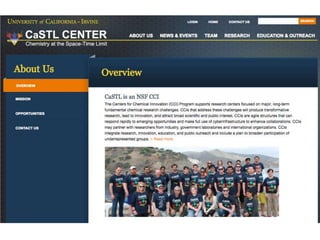
Castl
Test Tube Games
http://www.testtubegames.com/bondbreaker.html
http://www.castl.uci.edu/games/bondbreaker_lessons
Federal Funding
Non-Profit Research Projects “Research Grants”
1 million dollars to study learning
For Profit Small Businesses “SBIR”
150,000 and perhaps 1 million dollars to
prove learning and build the game.
Grants require a larger team,
because research
Evaluation
Team
1/3 of the funding
Subject Matter
experts
= co-game
designers
Game
development
team
Grants to non-profit research
companies and to for profit game
companies
Who offers grants to fund games?
To commercial companies, SBIRs for games:
National Institutes of Health (NIH)
National Science Foundation (NSF)
Institute for Education Science (IES)
National Oceanic Atmosophere Administration (NOAA)
To researchers at non-profits
NIH, NSF, IES
Evaluation
Team
1/3 of the funding
Subject Matter
experts
= co-game
designers
Game
development
team
However a grant application is created, talking to the
“Program Officer” in person on the phone 6 months
in advance of the deadline is a minimum
requirement.
*Professor at
non-profit is
leader of a
research grant
*Indie Game
company is
leader of an SBIR
grant
Indie game company could lead the grant application or play a role on a research grant
A very successful, indie lead
SBIR grant project
Eco
Argue with your friends about how to save the world
Eco by StrangeLoop Games
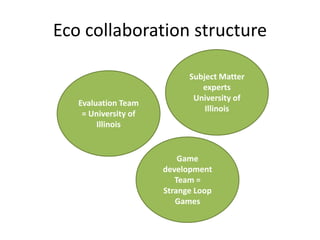
Eco collaboration structure
Evaluation Team
= University of
Illinois
Subject Matter
experts
University of
Illinois
Game
development
Team =
Strange Loop
Games
Federal Funding plus….
www.strangeloopgames.com/eco/
Immune Defense. Blood. Death. Strategy. Protein.
www.MolecularJig.com
Molecular Jig Games
Melanie Stegman, Ph.D.
Immune Defense
Join the Oldest Battle on Earth
1. Kids 12-18 learn molecular biology by playing molecular biology video games
a. Engagement helps learning
b. Complexity does not inhibit learning or confidence
2. How to make an engaging game about biochemistry?
How to make an engaging game about an actually, truly foreign world?
3. George Fan method of game design: Use familiar and easy to understand objects
so their purpose is easy to explain, and you tutorial is easier to design.
4. Melanie Stegman method: Let player easily and continuously conduct
experiments: GMES: Get data, Make hypothesis, Experiment and See results.
5. Immune Defense
a. Players regulate surface proteins on neutrophils in level 1
b. 75% of players move onto the second level.
Immune Defense. Blood. Death. Strategy. Protein.
www.MolecularJig.com
Molecular Jig Games
Melanie Stegman, Ph.D.
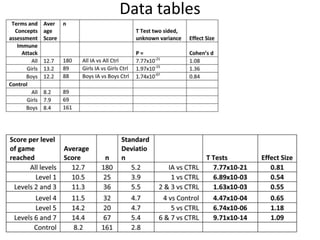
Data tables

IgdaDC edu games

  • 1.
    Why make learninggames? Immune Defense. Blood. Death. Strategy. Protein. www.MolecularJig.com Molecular Jig Games Melanie Stegman, Ph.D.
  • 2.
    • They reallycan be effective at teaching • They stand out in a crowded market • They have a larger/different audience • They can have alternative funding sources • They can be a step in your career in serious games, science communication or data analysis • Why not make them? – Known market for known game types – Easier to develop when change game world can be changed at a whim, whereas reality can’t change – Working with an expert requires working with another person where as indie is alone. Why make learning games?
  • 3.
    Learning games canbe very effective • Players remember names of proteins and cells. • Players gain confidence with the material.
  • 4.
    All 0 hours/week1 to 5 hours/week 6+ hours/week Immune Attack Control Control 0 5 10 15 20 All Girls Boys Students learned molecular biology by playing a 3rd person shooter about cells and proteins. Biology Game players N = 180 Control game players N = 160 All Girls Boys 0 1-5 6+ Hours video games played/week 0 5 10 15 20 Averagenumberofcorrectanswers Standard deviations, measure of variance not error, are shown.
  • 5.
    Players who neverpassed the first level still learned molecular biologyAveragenumberofquestionscorrect 0 2 4 6 8 10 12 14 16 18 20 Immune Attack Level 1 Levels 2 and 3 Level 4 Level 5 Levels 6 and 7 Control All Players Level 1 Level 2/3 Level 4 Level 5 Level 6/7 Control Biology Game players N = 180 Control game players N = 160 Standard deviations, measure of variance not error, are shown. Effect sizes: 0.81 0.54 0.55 0.65 1.18 1.09 P << 0.01
  • 6.
    Something that will damageyour ship. An amino acid A protein that stops Monocytes. A wiggly thing that is the wrong target. A lipid A protein that makes Monocytes exit the blood vessel. An object you need to avoid. A complex carbohydrate A protein that does not interact with Monocytes. A wiggly thing you need to shoot to win. A protein A protein that causes the Monocyte to slow down. 75% 50% 51% 75% 52% 54% 74% 49% 50% What is the arrow pointing to? All Girls Boys Students remember objects and their role in the game.
  • 7.
    Measuring confidence Nature ReviewsImmunology, 2007. 7:678. 1. 2. 3. 4. 5.
  • 8.
    Immune Attack playersgain confidence in their molecular biology skills 0% 10% 20% 30% 40% 1 2 3 4 5 Transmigration 1 2 3 4 5 Yellow Macrophages Total Ctrl n = 161 Total IA n = 180
  • 9.
    Immune Attack playersgain confidence with related images. I would be able to understand this diagram if I read it and thought about it. 0% 10% 20% 30% 40% 1 2 3 4 5 DATA All IA Players n = 180 Percentoftotalstudents Disagree -------------- Agree
  • 10.
    • They reallycan be effective at teaching • They stand out in a crowded market • They have a larger/different audience • They can have alternative funding sources • They can be a step in your career in serious games, science communication or data analysis • Why not make them? – Known market for known game types – Easier to develop when change game world can be changed at a whim, whereas reality can’t change – Working with an expert requires working with another person where as indie is alone. Why make learning games?
  • 11.
    Starting out asan indie game developer… The casual game market is full… • iOS getting featured is required for big big sales… • ~800 games submitted to the iTunes App Store daily. High quality game, that is updated often and is exceptional. • OneSkyApp.com/blog/app-store-feature • www.nativex.com/blog/uncovering-mystery-behind-app-store-editors-choice • www.pocketgamer.biz/metrics/app-store/submissions/ • A Dark Room: www.reddit.com/r/startups/comments/4f74dv/quit_my_full_time_corporate_job_buil t_an_ios_game
  • 12.
    Games in generaland Educational apps featured in 2015 iOS app store www.nativex.com/blog/uncovering-mystery-behind-app-store-editors-choice Of all apps selected by editors, Games = 65% Educational apps = 9 % Games were only 25% of submitted apps
  • 13.
    Niche audiences foryour reality game Just like for any game, it’s not easy to find support for a reality game… however you can find individuals, associations, universities or companies that might support you. Support might be cash, advertisement, giving you space to demo at their events Games for Change American Society for Microbiology AAAS Extra Credits on Steam
  • 14.
  • 17.
    A science gamedevelopment team Academic Sponsors Castl Test Tube Games http://www.testtubegames.com/bondbreaker.html http://www.castl.uci.edu/games/bondbreaker_lessons
  • 18.
    Federal Funding Non-Profit ResearchProjects “Research Grants” 1 million dollars to study learning For Profit Small Businesses “SBIR” 150,000 and perhaps 1 million dollars to prove learning and build the game.
  • 19.
    Grants require alarger team, because research Evaluation Team 1/3 of the funding Subject Matter experts = co-game designers Game development team Grants to non-profit research companies and to for profit game companies
  • 20.
    Who offers grantsto fund games? To commercial companies, SBIRs for games: National Institutes of Health (NIH) National Science Foundation (NSF) Institute for Education Science (IES) National Oceanic Atmosophere Administration (NOAA) To researchers at non-profits NIH, NSF, IES
  • 21.
    Evaluation Team 1/3 of thefunding Subject Matter experts = co-game designers Game development team However a grant application is created, talking to the “Program Officer” in person on the phone 6 months in advance of the deadline is a minimum requirement. *Professor at non-profit is leader of a research grant *Indie Game company is leader of an SBIR grant Indie game company could lead the grant application or play a role on a research grant
  • 22.
    A very successful,indie lead SBIR grant project
  • 23.
    Eco Argue with yourfriends about how to save the world
  • 24.
  • 25.
    Eco collaboration structure EvaluationTeam = University of Illinois Subject Matter experts University of Illinois Game development Team = Strange Loop Games
  • 26.
  • 27.
    Immune Defense. Blood.Death. Strategy. Protein. www.MolecularJig.com Molecular Jig Games Melanie Stegman, Ph.D.
  • 28.
    Immune Defense Join theOldest Battle on Earth
  • 29.
    1. Kids 12-18learn molecular biology by playing molecular biology video games a. Engagement helps learning b. Complexity does not inhibit learning or confidence 2. How to make an engaging game about biochemistry? How to make an engaging game about an actually, truly foreign world? 3. George Fan method of game design: Use familiar and easy to understand objects so their purpose is easy to explain, and you tutorial is easier to design. 4. Melanie Stegman method: Let player easily and continuously conduct experiments: GMES: Get data, Make hypothesis, Experiment and See results. 5. Immune Defense a. Players regulate surface proteins on neutrophils in level 1 b. 75% of players move onto the second level. Immune Defense. Blood. Death. Strategy. Protein. www.MolecularJig.com Molecular Jig Games Melanie Stegman, Ph.D.
  • 30.