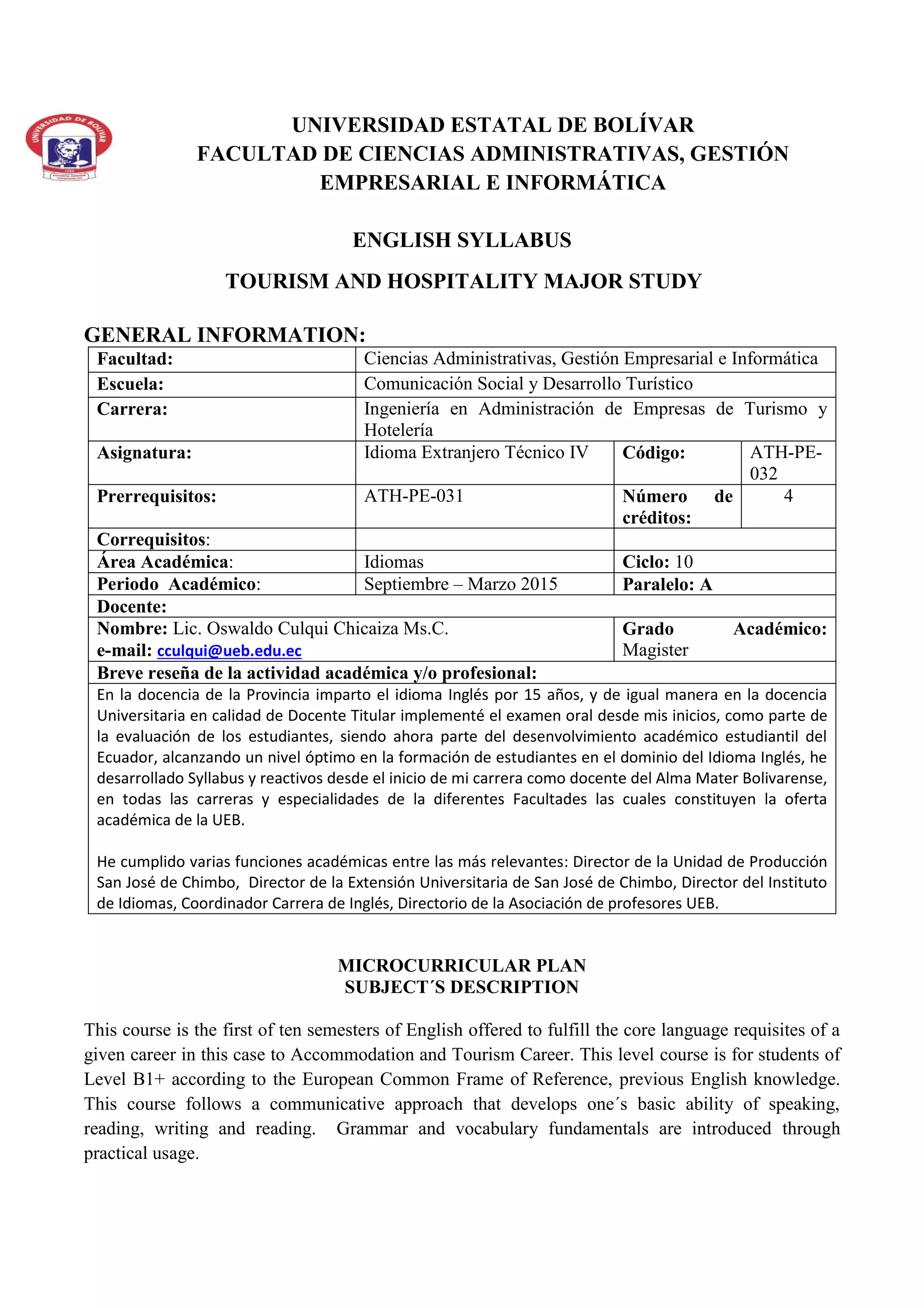
UNIVERSIDAD ESTATAL DE BOLÍVAR 
FACULTAD DE CIENCIAS ADMINISTRATIVAS, GESTIÓN EMPRESARIAL E INFORMÁTICA 
ENGLISH SYLLABUS 
TOURISM AND HOSPITALITY MAJOR STUDY 
GENERAL INFORMATION: 
Facultad: 
Ciencias Administrativas, Gestión Empresarial e Informática 
Escuela: 
Comunicación Social y Desarrollo Turístico 
Carrera: 
Ingeniería en Administración de Empresas de Turismo y Hotelería 
Asignatura: 
Idioma Extranjero Técnico IV 
Código: 
ATH-PE- 032 
Prerrequisitos: 
ATH-PE-031 
Número de créditos: 
4 
Correquisitos: 
Área Académica: 
Idiomas 
Ciclo: 10 
Periodo Académico: 
Septiembre – Marzo 2015 
Paralelo: A 
Docente: 
Nombre: Lic. Oswaldo Culqui Chicaiza Ms.C. 
e-mail: cculqui@ueb.edu.ec 
Grado Académico: Magister 
Breve reseña de la actividad académica y/o profesional: 
En la docencia de la Provincia imparto el idioma Inglés por 15 años, y de igual manera en la docencia Universitaria en calidad de Docente Titular implementé el examen oral desde mis inicios, como parte de la evaluación de los estudiantes, siendo ahora parte del desenvolvimiento académico estudiantil del Ecuador, alcanzando un nivel óptimo en la formación de estudiantes en el dominio del Idioma Inglés, he desarrollado Syllabus y reactivos desde el inicio de mi carrera como docente del Alma Mater Bolivarense, en todas las carreras y especialidades de la diferentes Facultades las cuales constituyen la oferta académica de la UEB. 
He cumplido varias funciones académicas entre las más relevantes: Director de la Unidad de Producción San José de Chimbo, Director de la Extensión Universitaria de San José de Chimbo, Director del Instituto de Idiomas, Coordinador Carrera de Inglés, Directorio de la Asociación de profesores UEB. 
MICROCURRICULAR PLAN 
SUBJECT´S DESCRIPTION 
This course is the first of ten semesters of English offered to fulfill the core language requisites of a given career in this case to Accommodation and Tourism Career. This level course is for students of Level B1+ according to the European Common Frame of Reference, previous English knowledge. This course follows a communicative approach that develops one´s basic ability of speaking, reading, writing and reading. Grammar and vocabulary fundamentals are introduced through practical usage.
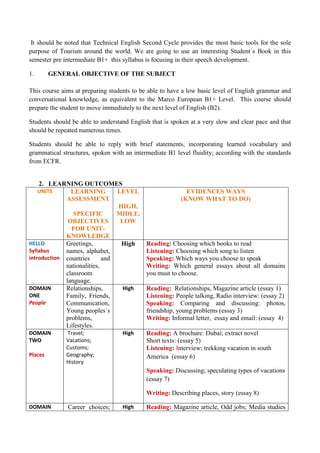
It should be noted that Technical English Second Cycle provides the most basic tools for the sole purpose of Tourism around the world. We are going to use an interesting Student´s Book in this semester pre intermediate B1+ this syllabus is focusing in their speech development. 
1. GENERAL OBJECTIVE OF THE SUBJECT 
This course aims at preparing students to be able to have a low basic level of English grammar and conversational knowledge, as equivalent to the Marco European B1+ Level. This course should prepare the student to move immediately to the next level of English (B2). 
Students should be able to understand English that is spoken at a very slow and clear pace and that should be repeated numerous times. 
Students should be able to reply with brief statements, incorporating learned vocabulary and grammatical structures, spoken with an intermediate B1 level fluidity; according with the standards from ECFR. 
2. LEARNING OUTCOMES 
UNITS 
LEARNING ASSESSMENT 
SPECIFIC OBJECTIVES FOR UNIT- KNOWLEDGE 
LEVEL 
HIGH, MIDLE, LOW 
EVIDENCES WAYS 
(KNOW WHAT TO DO) 
HELLO 
Syllabus introduction 
Greetings, names, alphabet, countries and nationalities, classroom language. 
High 
Reading: Choosing which books to read 
Listening: Choosing which song to listen 
Speaking: Which ways you choose to speak 
Writing: Which general essays about all domains you must to choose. 
DOMAIN ONE 
People 
Relationships, Family, Friends, Communication, Young peoples´s problems, Lifestyles. 
High 
Reading: Relationships, Magazine article (essay 1) 
Listening: People talking, Radio interview: (essay 2) 
Speaking: Comparing and discussing: photos, friendship, young problems (essay 3) 
Writing: Informal letter, essay and email: (essay 4) 
DOMAIN TWO 
Places 
Travel; Vacations; Customs; Geography; History 
High 
Reading: A brochure: Dubai; extract novel 
Short texts: (essay 5) 
Listening: Interview; trekking vacation in south America (essay 6) 
Speaking: Discussing; speculating types of vacations (essay 7) 
Writing: Describing places, story (essay 8) 
DOMAIN 
Career choices; 
High 
Reading: Magazine article, Odd jobs; Media studies
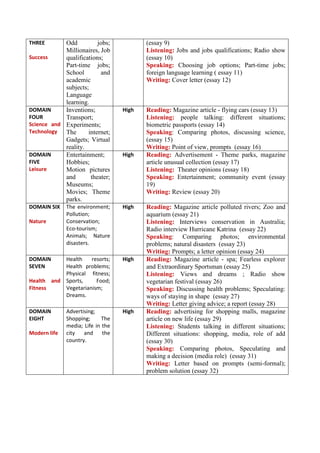
THREE 
Success 
Odd jobs; Millionaires, Job qualifications; Part-time jobs; School and academic subjects; Language learning. 
(essay 9) 
Listening: Jobs and jobs qualifications; Radio show (essay 10) 
Speaking: Choosing job options; Part-time jobs; foreign language learning ( essay 11) 
Writing: Cover letter (essay 12) 
DOMAIN FOUR 
Science and Technology 
Inventions; Transport; Experiments; The internet; Gadgets; Virtual reality. 
High 
Reading: Magazine article - flying cars (essay 13) 
Listening: people talking: different situations; biometric passports (essay 14) 
Speaking: Comparing photos, discussing science, (essay 15) 
Writing: Point of view, prompts (essay 16) 
DOMAIN FIVE 
Leisure 
Entertainment; Hobbies; Motion pictures and theater; Museums; Movies; Theme parks. 
High 
Reading: Advertisement - Theme parks, magazine article unusual collection (essay 17) 
Listening: Theater opinions (essay 18) 
Speaking: Entertainment; community event (essay 19) 
Writing: Review (essay 20) 
DOMAIN SIX 
Nature 
The environment; Pollution; Conservation; Eco-tourism; Animals; Nature disasters. 
High 
Reading: Magazine article polluted rivers; Zoo and aquarium (essay 21) 
Listening: Interviews conservation in Australia; Radio interview Hurricane Katrina (essay 22) 
Speaking: Comparing photos; environmental problems; natural disasters (essay 23) 
Writing: Prompts; a letter opinion (essay 24) 
DOMAIN SEVEN 
Health and Fitness 
Health resorts; Health problems; Physical fitness; Sports, Food; Vegetarianism; Dreams. 
High 
Reading: Magazine article - spa; Fearless explorer and Extraordinary Sportsman (essay 25) 
Listening: Views and dreams ; Radio show vegetarian festival (essay 26) 
Speaking: Discussing health problems; Speculating: ways of staying in shape (essay 27) 
Writing: Letter giving advice; a report (essay 28) 
DOMAIN EIGHT 
Modern life 
Advertising; Shopping; The media; Life in the city and the country. 
High 
Reading: advertising for shopping malls, magazine article on new life (essay 29) 
Listening: Students talking in different situations; Different situations: shopping, media, role of add (essay 30) 
Speaking: Comparing photos, Speculating and making a decision (media role) (essay 31) 
Writing: Letter based on prompts (semi-formal); problem solution (essay 32)
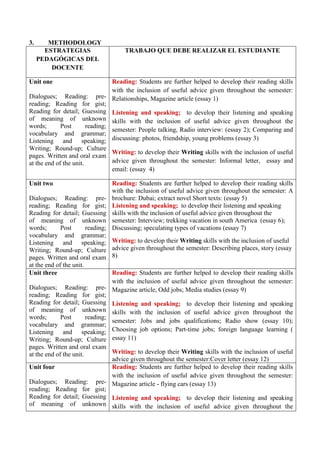
3. METHODOLOGY 
ESTRATEGIAS PEDAGÓGICAS DEL DOCENTE 
TRABAJO QUE DEBE REALIZAR EL ESTUDIANTE 
Unit one 
Dialogues; Reading: pre- reading; Reading for gist; Reading for detail; Guessing of meaning of unknown words; Post reading; vocabulary and grammar; Listening and speaking; Writing; Round-up; Culture pages. Written and oral exam at the end of the unit. 
Reading: Students are further helped to develop their reading skills with the inclusion of useful advice given throughout the semester: Relationships, Magazine article (essay 1) 
Listening and speaking; to develop their listening and speaking skills with the inclusion of useful advice given throughout the semester: People talking, Radio interview: (essay 2); Comparing and discussing: photos, friendship, young problems (essay 3) 
Writing: to develop their Writing skills with the inclusion of useful advice given throughout the semester: Informal letter, essay and email: (essay 4) 
Unit two 
Dialogues; Reading: pre- reading; Reading for gist; Reading for detail; Guessing of meaning of unknown words; Post reading; vocabulary and grammar; Listening and speaking; Writing; Round-up; Culture pages. Written and oral exam at the end of the unit. 
Reading: Students are further helped to develop their reading skills with the inclusion of useful advice given throughout the semester: A brochure: Dubai; extract novel Short texts: (essay 5) 
Listening and speaking; to develop their listening and speaking skills with the inclusion of useful advice given throughout the semester: Interview; trekking vacation in south America (essay 6); Discussing; speculating types of vacations (essay 7) 
Writing: to develop their Writing skills with the inclusion of useful advice given throughout the semester: Describing places, story (essay 8) 
Unit three 
Dialogues; Reading: pre- reading; Reading for gist; Reading for detail; Guessing of meaning of unknown words; Post reading; vocabulary and grammar; Listening and speaking; Writing; Round-up; Culture pages. Written and oral exam at the end of the unit. 
Reading: Students are further helped to develop their reading skills with the inclusion of useful advice given throughout the semester: Magazine article, Odd jobs; Media studies (essay 9) 
Listening and speaking; to develop their listening and speaking skills with the inclusion of useful advice given throughout the semester: Jobs and jobs qualifications; Radio show (essay 10); Choosing job options; Part-time jobs; foreign language learning ( essay 11) 
Writing: to develop their Writing skills with the inclusion of useful advice given throughout the semester:Cover letter (essay 12) 
Unit four 
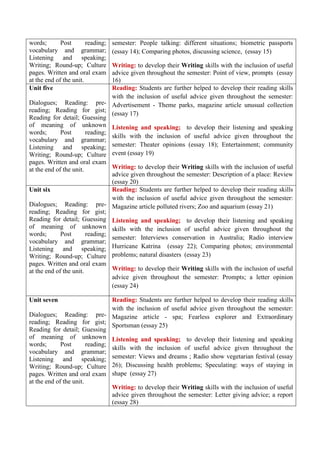
Dialogues; Reading: pre- reading; Reading for gist; Reading for detail; Guessing of meaning of unknown 
Reading: Students are further helped to develop their reading skills with the inclusion of useful advice given throughout the semester: Magazine article - flying cars (essay 13) 
Listening and speaking; to develop their listening and speaking skills with the inclusion of useful advice given throughout the
words; Post reading; vocabulary and grammar; Listening and speaking; Writing; Round-up; Culture pages. Written and oral exam at the end of the unit. 
semester: People talking: different situations; biometric passports (essay 14); Comparing photos, discussing science, (essay 15) 
Writing: to develop their Writing skills with the inclusion of useful advice given throughout the semester: Point of view, prompts (essay 16) 
Unit five 
Dialogues; Reading: pre- reading; Reading for gist; Reading for detail; Guessing of meaning of unknown words; Post reading; vocabulary and grammar; Listening and speaking; Writing; Round-up; Culture pages. Written and oral exam at the end of the unit. 
Reading: Students are further helped to develop their reading skills with the inclusion of useful advice given throughout the semester: Advertisement - Theme parks, magazine article unusual collection (essay 17) 
Listening and speaking; to develop their listening and speaking skills with the inclusion of useful advice given throughout the semester: Theater opinions (essay 18); Entertainment; community event (essay 19) 
Writing: to develop their Writing skills with the inclusion of useful advice given throughout the semester: Description of a place: Review (essay 20) 
Unit six 
Dialogues; Reading: pre- reading; Reading for gist; Reading for detail; Guessing of meaning of unknown words; Post reading; vocabulary and grammar; Listening and speaking; Writing; Round-up; Culture pages. Written and oral exam at the end of the unit. 
Reading: Students are further helped to develop their reading skills with the inclusion of useful advice given throughout the semester: Magazine article polluted rivers; Zoo and aquarium (essay 21) 
Listening and speaking; to develop their listening and speaking skills with the inclusion of useful advice given throughout the semester: Interviews conservation in Australia; Radio interview Hurricane Katrina (essay 22); Comparing photos; environmental problems; natural disasters (essay 23) 
Writing: to develop their Writing skills with the inclusion of useful advice given throughout the semester: Prompts; a letter opinion (essay 24) 
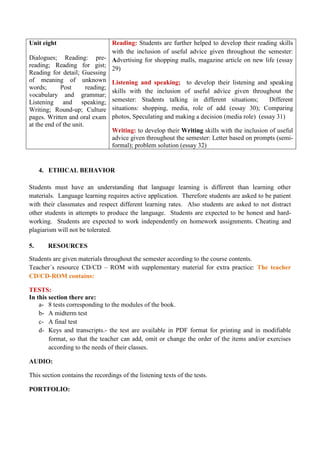
Unit seven 
Dialogues; Reading: pre- reading; Reading for gist; Reading for detail; Guessing of meaning of unknown words; Post reading; vocabulary and grammar; Listening and speaking; Writing; Round-up; Culture pages. Written and oral exam at the end of the unit. 
Reading: Students are further helped to develop their reading skills with the inclusion of useful advice given throughout the semester: Magazine article - spa; Fearless explorer and Extraordinary Sportsman (essay 25) 
Listening and speaking; to develop their listening and speaking skills with the inclusion of useful advice given throughout the semester: Views and dreams ; Radio show vegetarian festival (essay 26); Discussing health problems; Speculating: ways of staying in shape (essay 27) 
Writing: to develop their Writing skills with the inclusion of useful advice given throughout the semester: Letter giving advice; a report (essay 28)
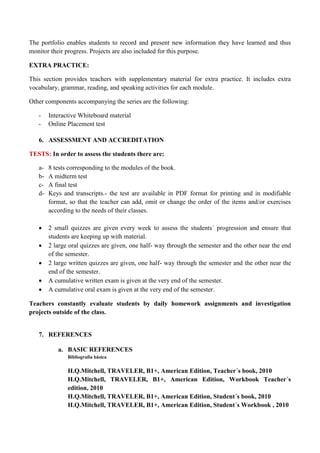
Unit eight 
Dialogues; Reading: pre- reading; Reading for gist; Reading for detail; Guessing of meaning of unknown words; Post reading; vocabulary and grammar; Listening and speaking; Writing; Round-up; Culture pages. Written and oral exam at the end of the unit. 
Reading: Students are further helped to develop their reading skills with the inclusion of useful advice given throughout the semester: Advertising for shopping malls, magazine article on new life (essay 29) 
Listening and speaking; to develop their listening and speaking skills with the inclusion of useful advice given throughout the semester: Students talking in different situations; Different situations: shopping, media, role of add (essay 30); Comparing photos, Speculating and making a decision (media role) (essay 31) 
Writing: to develop their Writing skills with the inclusion of useful advice given throughout the semester: Letter based on prompts (semi- formal); problem solution (essay 32) 
4. ETHICAL BEHAVIOR 
Students must have an understanding that language learning is different than learning other materials. Language learning requires active application. Therefore students are asked to be patient with their classmates and respect different learning rates. Also students are asked to not distract other students in attempts to produce the language. Students are expected to be honest and hard- working. Students are expected to work independently on homework assignments. Cheating and plagiarism will not be tolerated. 
5. RESOURCES 
Students are given materials throughout the semester according to the course contents. 
Teacher´s resource CD/CD – ROM with supplementary material for extra practice: The teacher CD/CD-ROM contains: 
TESTS: 
In this section there are: 
a- 8 tests corresponding to the modules of the book. 
b- A midterm test 
c- A final test 
d- Keys and transcripts.- the test are available in PDF format for printing and in modifiable format, so that the teacher can add, omit or change the order of the items and/or exercises according to the needs of their classes. 
AUDIO: 
This section contains the recordings of the listening texts of the tests. 
PORTFOLIO:
The portfolio enables students to record and present new information they have learned and thus monitor their progress. Projects are also included for this purpose. 
EXTRA PRACTICE: 
This section provides teachers with supplementary material for extra practice. It includes extra vocabulary, grammar, reading, and speaking activities for each module. 
Other components accompanying the series are the following: 
- Interactive Whiteboard material 
- Online Placement test 
6. ASSESSMENT AND ACCREDITATION 
TESTS: In order to assess the students there are: 
a- 8 tests corresponding to the modules of the book. 
b- A midterm test 
c- A final test 
d- Keys and transcripts.- the test are available in PDF format for printing and in modifiable format, so that the teacher can add, omit or change the order of the items and/or exercises according to the needs of their classes. 
 2 small quizzes are given every week to assess the students´ progression and ensure that students are keeping up with material. 
 2 large oral quizzes are given, one half- way through the semester and the other near the end of the semester. 
 2 large written quizzes are given, one half- way through the semester and the other near the end of the semester. 
 A cumulative written exam is given at the very end of the semester. 
 A cumulative oral exam is given at the very end of the semester. 
Teachers constantly evaluate students by daily homework assignments and investigation projects outside of the class. 
7. REFERENCES 
a. BASIC REFERENCES 
Bibliografía básica 
H.Q.Mitchell, TRAVELER, B1+, American Edition, Teacher´s book, 2010 
H.Q.Mitchell, TRAVELER, B1+, American Edition, Workbook Teacher´s edition, 2010 
H.Q.Mitchell, TRAVELER, B1+, American Edition, Student´s book, 2010 
H.Q.Mitchell, TRAVELER, B1+, American Edition, Student´s Workbook , 2010
b. BIBLIOGRAFÍA RECOMENDADA 
- OSWALDO CULQUI, Didactics Guide, Student´s Book, Universidad Estatal de Bolívar, 2012 
- ROBIN WALKER AND KEITH HARDING, Tourism 1, Provision, Student´s book, Oxford English For Careers, 2012. 
- ROBIN WALKER AND KEITH HARDING, Tourism 1, Encounters, Student´s book, Oxford English For Careers, 2012. 
- ROBIN WALKER AND KEITH HARDING, Tourism 1, Management, Student´s book, Oxford English For Careers, 2012. 
- IWONNA DUBICKA AND MARGARET O´KEEFFE, English for International Tourism, Pre-intermediate Student´s Book, Longman, 2011. 
- PETER STRUTT, English for International Tourism, Intermediate Student´s Book, Longman, 2011. 
- HANS MOL, English for Tourism and Hospitality, In Higher Education Studies, Garnet Education, 2008. 
- MICHAEL SWAN, Practical English Usage, second edition, Oxford University Press, 2010. 
LECTURAS COMPLEMENTARIAS 
- Reading Book: You must choose some of them at the UEB general Library; there are a lot of about classical literature around the world writers. 
8. PROGRAMA 
Syllabus explanation 
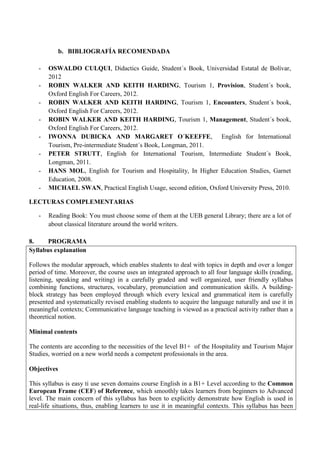
Follows the modular approach, which enables students to deal with topics in depth and over a longer period of time. Moreover, the course uses an integrated approach to all four language skills (reading, listening, speaking and writing) in a carefully graded and well organized, user friendly syllabus combining functions, structures, vocabulary, pronunciation and communication skills. A building- block strategy has been employed through which every lexical and grammatical item is carefully presented and systematically revised enabling students to acquire the language naturally and use it in meaningful contexts; Communicative language teaching is viewed as a practical activity rather than a theoretical notion. 
Minimal contents 
The contents are according to the necessities of the level B1+ of the Hospitality and Tourism Major Studies, worried on a new world needs a competent professionals in the area. 
Objectives 
This syllabus is easy ti use seven domains course English in a B1+ Level according to the Common European Frame (CEF) of Reference, which smoothly takes learners from beginners to Advanced level. The main concern of this syllabus has been to explicitly demonstrate how English is used in real-life situations, thus, enabling learners to use it in meaningful contexts. This syllabus has been
meticulously designed to build up the learners´ ability to communicate their ideas fluently, accurately and confidently. 
- Communicative 
- Socio- cultural 
- Learning how to learn 
- Language and cultural awareness 
- Effective preparation for all exams 
- Intercultural awareness 
- Learner autonomy 
- Critical thinking. 
Methodology 
Each Domain is divided in to two parts a and b. in both parts, the target language such as: vocabulary, grammar, functions, are presented and practiced extensively, while at the same time the four basic skills (Reading, Listening, Speaking and Writing) and micro-skills are developed. Lastly, the round- up pages at the end of each module thoroughly revise the grammar and vocabulary that have been taught in the syllabus, provide additional practice with examination type tasks and offer a unique opportunity for self-evaluation. 
- Dialogues 
- Reading 
- Pre-reading 
- Reading for gist 
- Reading for detail 
- Guessing for the meaning of unknown words 
- Post-reading 
- Vocabulary and grammar 
- Listening and speaking 
- Writing 
- Round-up 
- Culture pages 
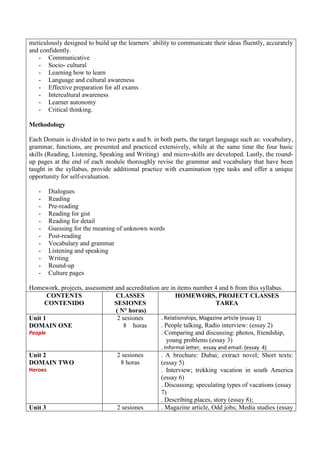
Homework, projects, assessment and accreditation are in items number 4 and 6 from this syllabus. 
CONTENTS 
CONTENIDO 
CLASSES 
SESIONES 
( N° horas) 
HOMEWORS, PROJECT CLASSES 
TAREA 
Unit 1 
DOMAIN ONE 
People 
2 sesiones 
8 horas 
. Relationships, Magazine article (essay 1) 
. People talking, Radio interview: (essay 2) 
. Comparing and discussing: photos, friendship, 
young problems (essay 3) 
. Informal letter, essay and email: (essay 4) 
Unit 2 
DOMAIN TWO 
Heroes 
2 sesiones 
8 horas 
. A brochure: Dubai; extract novel; Short texts: (essay 5) 
. Interview; trekking vacation in south America (essay 6) 
. Discussing; speculating types of vacations (essay 7) 
. Describing places, story (essay 8); 
Unit 3 
2 sesiones 
. Magazine article, Odd jobs; Media studies (essay
DOMAIN THREE 
Work and leisure 
8 horas 
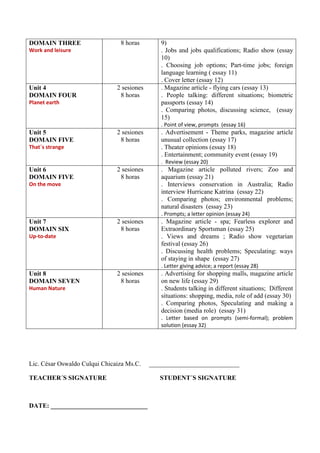
9) 
. Jobs and jobs qualifications; Radio show (essay 10) 
. Choosing job options; Part-time jobs; foreign language learning ( essay 11) 
. Cover letter (essay 12) 
Unit 4 
DOMAIN FOUR 
Planet earth 
2 sesiones 
8 horas 
. Magazine article - flying cars (essay 13) 
. People talking: different situations; biometric passports (essay 14) 
. Comparing photos, discussing science, (essay 15) 
. Point of view, prompts (essay 16) 
Unit 5 
DOMAIN FIVE 
That´s strange 
2 sesiones 
8 horas 
. Advertisement - Theme parks, magazine article unusual collection (essay 17) 
. Theater opinions (essay 18) 
. Entertainment; community event (essay 19) 
. Review (essay 20) 
Unit 6 
DOMAIN FIVE 
On the move 
2 sesiones 
8 horas 
. Magazine article polluted rivers; Zoo and aquarium (essay 21) 
. Interviews conservation in Australia; Radio interview Hurricane Katrina (essay 22) 
. Comparing photos; environmental problems; natural disasters (essay 23) 
. Prompts; a letter opinion (essay 24) 
Unit 7 
DOMAIN SIX 
Up-to-date 
2 sesiones 
8 horas 
. Magazine article - spa; Fearless explorer and Extraordinary Sportsman (essay 25) 
. Views and dreams ; Radio show vegetarian festival (essay 26) 
. Discussing health problems; Speculating: ways of staying in shape (essay 27) 
. Letter giving advice; a report (essay 28) 
Unit 8 
DOMAIN SEVEN 
Human Nature 
2 sesiones 
8 horas 
. Advertising for shopping malls, magazine article on new life (essay 29) 
. Students talking in different situations; Different situations: shopping, media, role of add (essay 30) 
. Comparing photos, Speculating and making a decision (media role) (essay 31) 
. Letter based on prompts (semi-formal); problem solution (essay 32) 
Lic. César Oswaldo Culqui Chicaiza Ms.C. ____________________________ 
TEACHER´S SIGNATURE STUDENT´S SIGNATURE 
DATE: ______________________________

Syllabus Idioma Extranjero Técnico IV

  • 1.
    UNIVERSIDAD ESTATAL DEBOLÍVAR FACULTAD DE CIENCIAS ADMINISTRATIVAS, GESTIÓN EMPRESARIAL E INFORMÁTICA ENGLISH SYLLABUS TOURISM AND HOSPITALITY MAJOR STUDY GENERAL INFORMATION: Facultad: Ciencias Administrativas, Gestión Empresarial e Informática Escuela: Comunicación Social y Desarrollo Turístico Carrera: Ingeniería en Administración de Empresas de Turismo y Hotelería Asignatura: Idioma Extranjero Técnico IV Código: ATH-PE- 032 Prerrequisitos: ATH-PE-031 Número de créditos: 4 Correquisitos: Área Académica: Idiomas Ciclo: 10 Periodo Académico: Septiembre – Marzo 2015 Paralelo: A Docente: Nombre: Lic. Oswaldo Culqui Chicaiza Ms.C. e-mail: cculqui@ueb.edu.ec Grado Académico: Magister Breve reseña de la actividad académica y/o profesional: En la docencia de la Provincia imparto el idioma Inglés por 15 años, y de igual manera en la docencia Universitaria en calidad de Docente Titular implementé el examen oral desde mis inicios, como parte de la evaluación de los estudiantes, siendo ahora parte del desenvolvimiento académico estudiantil del Ecuador, alcanzando un nivel óptimo en la formación de estudiantes en el dominio del Idioma Inglés, he desarrollado Syllabus y reactivos desde el inicio de mi carrera como docente del Alma Mater Bolivarense, en todas las carreras y especialidades de la diferentes Facultades las cuales constituyen la oferta académica de la UEB. He cumplido varias funciones académicas entre las más relevantes: Director de la Unidad de Producción San José de Chimbo, Director de la Extensión Universitaria de San José de Chimbo, Director del Instituto de Idiomas, Coordinador Carrera de Inglés, Directorio de la Asociación de profesores UEB. MICROCURRICULAR PLAN SUBJECT´S DESCRIPTION This course is the first of ten semesters of English offered to fulfill the core language requisites of a given career in this case to Accommodation and Tourism Career. This level course is for students of Level B1+ according to the European Common Frame of Reference, previous English knowledge. This course follows a communicative approach that develops one´s basic ability of speaking, reading, writing and reading. Grammar and vocabulary fundamentals are introduced through practical usage.
  • 2.
    It should benoted that Technical English Second Cycle provides the most basic tools for the sole purpose of Tourism around the world. We are going to use an interesting Student´s Book in this semester pre intermediate B1+ this syllabus is focusing in their speech development. 1. GENERAL OBJECTIVE OF THE SUBJECT This course aims at preparing students to be able to have a low basic level of English grammar and conversational knowledge, as equivalent to the Marco European B1+ Level. This course should prepare the student to move immediately to the next level of English (B2). Students should be able to understand English that is spoken at a very slow and clear pace and that should be repeated numerous times. Students should be able to reply with brief statements, incorporating learned vocabulary and grammatical structures, spoken with an intermediate B1 level fluidity; according with the standards from ECFR. 2. LEARNING OUTCOMES UNITS LEARNING ASSESSMENT SPECIFIC OBJECTIVES FOR UNIT- KNOWLEDGE LEVEL HIGH, MIDLE, LOW EVIDENCES WAYS (KNOW WHAT TO DO) HELLO Syllabus introduction Greetings, names, alphabet, countries and nationalities, classroom language. High Reading: Choosing which books to read Listening: Choosing which song to listen Speaking: Which ways you choose to speak Writing: Which general essays about all domains you must to choose. DOMAIN ONE People Relationships, Family, Friends, Communication, Young peoples´s problems, Lifestyles. High Reading: Relationships, Magazine article (essay 1) Listening: People talking, Radio interview: (essay 2) Speaking: Comparing and discussing: photos, friendship, young problems (essay 3) Writing: Informal letter, essay and email: (essay 4) DOMAIN TWO Places Travel; Vacations; Customs; Geography; History High Reading: A brochure: Dubai; extract novel Short texts: (essay 5) Listening: Interview; trekking vacation in south America (essay 6) Speaking: Discussing; speculating types of vacations (essay 7) Writing: Describing places, story (essay 8) DOMAIN Career choices; High Reading: Magazine article, Odd jobs; Media studies
  • 3.
    THREE Success Oddjobs; Millionaires, Job qualifications; Part-time jobs; School and academic subjects; Language learning. (essay 9) Listening: Jobs and jobs qualifications; Radio show (essay 10) Speaking: Choosing job options; Part-time jobs; foreign language learning ( essay 11) Writing: Cover letter (essay 12) DOMAIN FOUR Science and Technology Inventions; Transport; Experiments; The internet; Gadgets; Virtual reality. High Reading: Magazine article - flying cars (essay 13) Listening: people talking: different situations; biometric passports (essay 14) Speaking: Comparing photos, discussing science, (essay 15) Writing: Point of view, prompts (essay 16) DOMAIN FIVE Leisure Entertainment; Hobbies; Motion pictures and theater; Museums; Movies; Theme parks. High Reading: Advertisement - Theme parks, magazine article unusual collection (essay 17) Listening: Theater opinions (essay 18) Speaking: Entertainment; community event (essay 19) Writing: Review (essay 20) DOMAIN SIX Nature The environment; Pollution; Conservation; Eco-tourism; Animals; Nature disasters. High Reading: Magazine article polluted rivers; Zoo and aquarium (essay 21) Listening: Interviews conservation in Australia; Radio interview Hurricane Katrina (essay 22) Speaking: Comparing photos; environmental problems; natural disasters (essay 23) Writing: Prompts; a letter opinion (essay 24) DOMAIN SEVEN Health and Fitness Health resorts; Health problems; Physical fitness; Sports, Food; Vegetarianism; Dreams. High Reading: Magazine article - spa; Fearless explorer and Extraordinary Sportsman (essay 25) Listening: Views and dreams ; Radio show vegetarian festival (essay 26) Speaking: Discussing health problems; Speculating: ways of staying in shape (essay 27) Writing: Letter giving advice; a report (essay 28) DOMAIN EIGHT Modern life Advertising; Shopping; The media; Life in the city and the country. High Reading: advertising for shopping malls, magazine article on new life (essay 29) Listening: Students talking in different situations; Different situations: shopping, media, role of add (essay 30) Speaking: Comparing photos, Speculating and making a decision (media role) (essay 31) Writing: Letter based on prompts (semi-formal); problem solution (essay 32)
  • 4.
    3. METHODOLOGY ESTRATEGIASPEDAGÓGICAS DEL DOCENTE TRABAJO QUE DEBE REALIZAR EL ESTUDIANTE Unit one Dialogues; Reading: pre- reading; Reading for gist; Reading for detail; Guessing of meaning of unknown words; Post reading; vocabulary and grammar; Listening and speaking; Writing; Round-up; Culture pages. Written and oral exam at the end of the unit. Reading: Students are further helped to develop their reading skills with the inclusion of useful advice given throughout the semester: Relationships, Magazine article (essay 1) Listening and speaking; to develop their listening and speaking skills with the inclusion of useful advice given throughout the semester: People talking, Radio interview: (essay 2); Comparing and discussing: photos, friendship, young problems (essay 3) Writing: to develop their Writing skills with the inclusion of useful advice given throughout the semester: Informal letter, essay and email: (essay 4) Unit two Dialogues; Reading: pre- reading; Reading for gist; Reading for detail; Guessing of meaning of unknown words; Post reading; vocabulary and grammar; Listening and speaking; Writing; Round-up; Culture pages. Written and oral exam at the end of the unit. Reading: Students are further helped to develop their reading skills with the inclusion of useful advice given throughout the semester: A brochure: Dubai; extract novel Short texts: (essay 5) Listening and speaking; to develop their listening and speaking skills with the inclusion of useful advice given throughout the semester: Interview; trekking vacation in south America (essay 6); Discussing; speculating types of vacations (essay 7) Writing: to develop their Writing skills with the inclusion of useful advice given throughout the semester: Describing places, story (essay 8) Unit three Dialogues; Reading: pre- reading; Reading for gist; Reading for detail; Guessing of meaning of unknown words; Post reading; vocabulary and grammar; Listening and speaking; Writing; Round-up; Culture pages. Written and oral exam at the end of the unit. Reading: Students are further helped to develop their reading skills with the inclusion of useful advice given throughout the semester: Magazine article, Odd jobs; Media studies (essay 9) Listening and speaking; to develop their listening and speaking skills with the inclusion of useful advice given throughout the semester: Jobs and jobs qualifications; Radio show (essay 10); Choosing job options; Part-time jobs; foreign language learning ( essay 11) Writing: to develop their Writing skills with the inclusion of useful advice given throughout the semester:Cover letter (essay 12) Unit four Dialogues; Reading: pre- reading; Reading for gist; Reading for detail; Guessing of meaning of unknown Reading: Students are further helped to develop their reading skills with the inclusion of useful advice given throughout the semester: Magazine article - flying cars (essay 13) Listening and speaking; to develop their listening and speaking skills with the inclusion of useful advice given throughout the
  • 5.
    words; Post reading;vocabulary and grammar; Listening and speaking; Writing; Round-up; Culture pages. Written and oral exam at the end of the unit. semester: People talking: different situations; biometric passports (essay 14); Comparing photos, discussing science, (essay 15) Writing: to develop their Writing skills with the inclusion of useful advice given throughout the semester: Point of view, prompts (essay 16) Unit five Dialogues; Reading: pre- reading; Reading for gist; Reading for detail; Guessing of meaning of unknown words; Post reading; vocabulary and grammar; Listening and speaking; Writing; Round-up; Culture pages. Written and oral exam at the end of the unit. Reading: Students are further helped to develop their reading skills with the inclusion of useful advice given throughout the semester: Advertisement - Theme parks, magazine article unusual collection (essay 17) Listening and speaking; to develop their listening and speaking skills with the inclusion of useful advice given throughout the semester: Theater opinions (essay 18); Entertainment; community event (essay 19) Writing: to develop their Writing skills with the inclusion of useful advice given throughout the semester: Description of a place: Review (essay 20) Unit six Dialogues; Reading: pre- reading; Reading for gist; Reading for detail; Guessing of meaning of unknown words; Post reading; vocabulary and grammar; Listening and speaking; Writing; Round-up; Culture pages. Written and oral exam at the end of the unit. Reading: Students are further helped to develop their reading skills with the inclusion of useful advice given throughout the semester: Magazine article polluted rivers; Zoo and aquarium (essay 21) Listening and speaking; to develop their listening and speaking skills with the inclusion of useful advice given throughout the semester: Interviews conservation in Australia; Radio interview Hurricane Katrina (essay 22); Comparing photos; environmental problems; natural disasters (essay 23) Writing: to develop their Writing skills with the inclusion of useful advice given throughout the semester: Prompts; a letter opinion (essay 24) Unit seven Dialogues; Reading: pre- reading; Reading for gist; Reading for detail; Guessing of meaning of unknown words; Post reading; vocabulary and grammar; Listening and speaking; Writing; Round-up; Culture pages. Written and oral exam at the end of the unit. Reading: Students are further helped to develop their reading skills with the inclusion of useful advice given throughout the semester: Magazine article - spa; Fearless explorer and Extraordinary Sportsman (essay 25) Listening and speaking; to develop their listening and speaking skills with the inclusion of useful advice given throughout the semester: Views and dreams ; Radio show vegetarian festival (essay 26); Discussing health problems; Speculating: ways of staying in shape (essay 27) Writing: to develop their Writing skills with the inclusion of useful advice given throughout the semester: Letter giving advice; a report (essay 28)
  • 6.
    Unit eight Dialogues;Reading: pre- reading; Reading for gist; Reading for detail; Guessing of meaning of unknown words; Post reading; vocabulary and grammar; Listening and speaking; Writing; Round-up; Culture pages. Written and oral exam at the end of the unit. Reading: Students are further helped to develop their reading skills with the inclusion of useful advice given throughout the semester: Advertising for shopping malls, magazine article on new life (essay 29) Listening and speaking; to develop their listening and speaking skills with the inclusion of useful advice given throughout the semester: Students talking in different situations; Different situations: shopping, media, role of add (essay 30); Comparing photos, Speculating and making a decision (media role) (essay 31) Writing: to develop their Writing skills with the inclusion of useful advice given throughout the semester: Letter based on prompts (semi- formal); problem solution (essay 32) 4. ETHICAL BEHAVIOR Students must have an understanding that language learning is different than learning other materials. Language learning requires active application. Therefore students are asked to be patient with their classmates and respect different learning rates. Also students are asked to not distract other students in attempts to produce the language. Students are expected to be honest and hard- working. Students are expected to work independently on homework assignments. Cheating and plagiarism will not be tolerated. 5. RESOURCES Students are given materials throughout the semester according to the course contents. Teacher´s resource CD/CD – ROM with supplementary material for extra practice: The teacher CD/CD-ROM contains: TESTS: In this section there are: a- 8 tests corresponding to the modules of the book. b- A midterm test c- A final test d- Keys and transcripts.- the test are available in PDF format for printing and in modifiable format, so that the teacher can add, omit or change the order of the items and/or exercises according to the needs of their classes. AUDIO: This section contains the recordings of the listening texts of the tests. PORTFOLIO:
  • 7.
    The portfolio enablesstudents to record and present new information they have learned and thus monitor their progress. Projects are also included for this purpose. EXTRA PRACTICE: This section provides teachers with supplementary material for extra practice. It includes extra vocabulary, grammar, reading, and speaking activities for each module. Other components accompanying the series are the following: - Interactive Whiteboard material - Online Placement test 6. ASSESSMENT AND ACCREDITATION TESTS: In order to assess the students there are: a- 8 tests corresponding to the modules of the book. b- A midterm test c- A final test d- Keys and transcripts.- the test are available in PDF format for printing and in modifiable format, so that the teacher can add, omit or change the order of the items and/or exercises according to the needs of their classes.  2 small quizzes are given every week to assess the students´ progression and ensure that students are keeping up with material.  2 large oral quizzes are given, one half- way through the semester and the other near the end of the semester.  2 large written quizzes are given, one half- way through the semester and the other near the end of the semester.  A cumulative written exam is given at the very end of the semester.  A cumulative oral exam is given at the very end of the semester. Teachers constantly evaluate students by daily homework assignments and investigation projects outside of the class. 7. REFERENCES a. BASIC REFERENCES Bibliografía básica H.Q.Mitchell, TRAVELER, B1+, American Edition, Teacher´s book, 2010 H.Q.Mitchell, TRAVELER, B1+, American Edition, Workbook Teacher´s edition, 2010 H.Q.Mitchell, TRAVELER, B1+, American Edition, Student´s book, 2010 H.Q.Mitchell, TRAVELER, B1+, American Edition, Student´s Workbook , 2010
  • 8.
    b. BIBLIOGRAFÍA RECOMENDADA - OSWALDO CULQUI, Didactics Guide, Student´s Book, Universidad Estatal de Bolívar, 2012 - ROBIN WALKER AND KEITH HARDING, Tourism 1, Provision, Student´s book, Oxford English For Careers, 2012. - ROBIN WALKER AND KEITH HARDING, Tourism 1, Encounters, Student´s book, Oxford English For Careers, 2012. - ROBIN WALKER AND KEITH HARDING, Tourism 1, Management, Student´s book, Oxford English For Careers, 2012. - IWONNA DUBICKA AND MARGARET O´KEEFFE, English for International Tourism, Pre-intermediate Student´s Book, Longman, 2011. - PETER STRUTT, English for International Tourism, Intermediate Student´s Book, Longman, 2011. - HANS MOL, English for Tourism and Hospitality, In Higher Education Studies, Garnet Education, 2008. - MICHAEL SWAN, Practical English Usage, second edition, Oxford University Press, 2010. LECTURAS COMPLEMENTARIAS - Reading Book: You must choose some of them at the UEB general Library; there are a lot of about classical literature around the world writers. 8. PROGRAMA Syllabus explanation Follows the modular approach, which enables students to deal with topics in depth and over a longer period of time. Moreover, the course uses an integrated approach to all four language skills (reading, listening, speaking and writing) in a carefully graded and well organized, user friendly syllabus combining functions, structures, vocabulary, pronunciation and communication skills. A building- block strategy has been employed through which every lexical and grammatical item is carefully presented and systematically revised enabling students to acquire the language naturally and use it in meaningful contexts; Communicative language teaching is viewed as a practical activity rather than a theoretical notion. Minimal contents The contents are according to the necessities of the level B1+ of the Hospitality and Tourism Major Studies, worried on a new world needs a competent professionals in the area. Objectives This syllabus is easy ti use seven domains course English in a B1+ Level according to the Common European Frame (CEF) of Reference, which smoothly takes learners from beginners to Advanced level. The main concern of this syllabus has been to explicitly demonstrate how English is used in real-life situations, thus, enabling learners to use it in meaningful contexts. This syllabus has been
  • 9.
    meticulously designed tobuild up the learners´ ability to communicate their ideas fluently, accurately and confidently. - Communicative - Socio- cultural - Learning how to learn - Language and cultural awareness - Effective preparation for all exams - Intercultural awareness - Learner autonomy - Critical thinking. Methodology Each Domain is divided in to two parts a and b. in both parts, the target language such as: vocabulary, grammar, functions, are presented and practiced extensively, while at the same time the four basic skills (Reading, Listening, Speaking and Writing) and micro-skills are developed. Lastly, the round- up pages at the end of each module thoroughly revise the grammar and vocabulary that have been taught in the syllabus, provide additional practice with examination type tasks and offer a unique opportunity for self-evaluation. - Dialogues - Reading - Pre-reading - Reading for gist - Reading for detail - Guessing for the meaning of unknown words - Post-reading - Vocabulary and grammar - Listening and speaking - Writing - Round-up - Culture pages Homework, projects, assessment and accreditation are in items number 4 and 6 from this syllabus. CONTENTS CONTENIDO CLASSES SESIONES ( N° horas) HOMEWORS, PROJECT CLASSES TAREA Unit 1 DOMAIN ONE People 2 sesiones 8 horas . Relationships, Magazine article (essay 1) . People talking, Radio interview: (essay 2) . Comparing and discussing: photos, friendship, young problems (essay 3) . Informal letter, essay and email: (essay 4) Unit 2 DOMAIN TWO Heroes 2 sesiones 8 horas . A brochure: Dubai; extract novel; Short texts: (essay 5) . Interview; trekking vacation in south America (essay 6) . Discussing; speculating types of vacations (essay 7) . Describing places, story (essay 8); Unit 3 2 sesiones . Magazine article, Odd jobs; Media studies (essay
  • 10.
    DOMAIN THREE Workand leisure 8 horas 9) . Jobs and jobs qualifications; Radio show (essay 10) . Choosing job options; Part-time jobs; foreign language learning ( essay 11) . Cover letter (essay 12) Unit 4 DOMAIN FOUR Planet earth 2 sesiones 8 horas . Magazine article - flying cars (essay 13) . People talking: different situations; biometric passports (essay 14) . Comparing photos, discussing science, (essay 15) . Point of view, prompts (essay 16) Unit 5 DOMAIN FIVE That´s strange 2 sesiones 8 horas . Advertisement - Theme parks, magazine article unusual collection (essay 17) . Theater opinions (essay 18) . Entertainment; community event (essay 19) . Review (essay 20) Unit 6 DOMAIN FIVE On the move 2 sesiones 8 horas . Magazine article polluted rivers; Zoo and aquarium (essay 21) . Interviews conservation in Australia; Radio interview Hurricane Katrina (essay 22) . Comparing photos; environmental problems; natural disasters (essay 23) . Prompts; a letter opinion (essay 24) Unit 7 DOMAIN SIX Up-to-date 2 sesiones 8 horas . Magazine article - spa; Fearless explorer and Extraordinary Sportsman (essay 25) . Views and dreams ; Radio show vegetarian festival (essay 26) . Discussing health problems; Speculating: ways of staying in shape (essay 27) . Letter giving advice; a report (essay 28) Unit 8 DOMAIN SEVEN Human Nature 2 sesiones 8 horas . Advertising for shopping malls, magazine article on new life (essay 29) . Students talking in different situations; Different situations: shopping, media, role of add (essay 30) . Comparing photos, Speculating and making a decision (media role) (essay 31) . Letter based on prompts (semi-formal); problem solution (essay 32) Lic. César Oswaldo Culqui Chicaiza Ms.C. ____________________________ TEACHER´S SIGNATURE STUDENT´S SIGNATURE DATE: ______________________________