Advanced IELTS SpeakingPractice
Master the IELTS Speaking Test
This comprehensive guide will help you:
Understand the structure and format Learn the assessment criteria
Practice with real test questions Develop effective strategies
2.
IELTS Speaking TestOverview
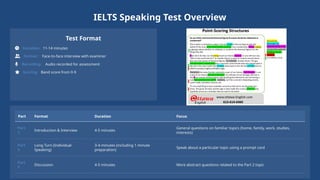
Test Format
Duration: 11-14 minutes
Format: Face-to-face interview with examiner
Recording: Audio recorded for assessment
Scoring: Band score from 0-9
Part Format Duration Focus
Part
1
Introduction & Interview 4-5 minutes
General questions on familiar topics (home, family, work, studies,
interests)
Part
2
Long Turn (Individual
Speaking)
3-4 minutes (including 1 minute
preparation)
Speak about a particular topic using a prompt card
Part
3
Discussion 4-5 minutes More abstract questions related to the Part 2 topic
3.
Speaking Assessment Criteria
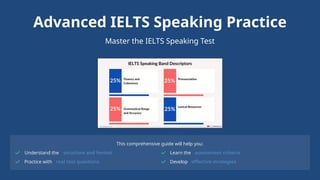
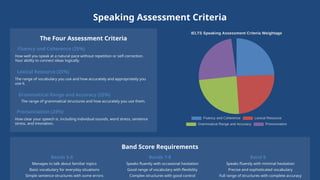
TheFour Assessment Criteria
Fluency and Coherence (25%)
How well you speak at a natural pace without repetition or self-correction.
Your ability to connect ideas logically.
Lexical Resource (25%)
The range of vocabulary you use and how accurately and appropriately you
use it.
Grammatical Range and Accuracy (25%)
The range of grammatical structures and how accurately you use them.
Pronunciation (25%)
How clear your speech is, including individual sounds, word stress, sentence
stress, and intonation.
Band Score Requirements
Bands 5-6
Manages to talk about familiar topics
Basic vocabulary for everyday situations
Simple sentence structures with some errors
Bands 7-8
Speaks fluently with occasional hesitation
Good range of vocabulary with flexibility
Complex structures with good control
Band 9
Speaks fluently with minimal hesitation
Precise and sophisticated vocabulary
Full range of structures with complete accuracy
4.
Part 1: Introduction& Interview
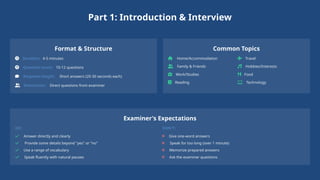
Format & Structure
Duration: 4-5 minutes
Question count: 10-12 questions
Response length: Short answers (20-30 seconds each)
Interaction: Direct questions from examiner
Common Topics
Home/Accommodation
Family & Friends
Work/Studies
Reading
Travel
Hobbies/Interests
Food
Technology
Examiner's Expectations
DO:
Answer directly and clearly
Provide some details beyond "yes" or "no"
Use a range of vocabulary
Speak fluently with natural pauses
DON'T:
Give one-word answers
Speak for too long (over 1 minute)
Memorize prepared answers
Ask the examiner questions
5.
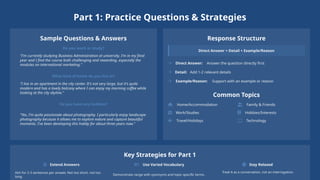
Part 1: PracticeQuestions & Strategies
Sample Questions & Answers
Do you work or study?
"I'm currently studying Business Administration at university. I'm in my final
year and I find the course both challenging and rewarding, especially the
modules on international marketing."
What kind of home do you live in?
"I live in an apartment in the city center. It's not very large, but it's quite
modern and has a lovely balcony where I can enjoy my morning coffee while
looking at the city skyline."
Do you have any hobbies?
"Yes, I'm quite passionate about photography. I particularly enjoy landscape
photography because it allows me to explore nature and capture beautiful
moments. I've been developing this hobby for about three years now."
Response Structure
Direct Answer + Detail + Example/Reason
Direct Answer: Answer the question directly first
Detail: Add 1-2 relevant details
Example/Reason: Support with an example or reason
Common Topics
Home/Accommodation Family & Friends
Work/Studies Hobbies/Interests
Travel/Holidays Technology
Key Strategies for Part 1
Extend Answers
Aim for 2-3 sentences per answer. Not too short, not too
long.
Use Varied Vocabulary
Demonstrate range with synonyms and topic-specific terms.
Stay Relaxed
Treat it as a conversation, not an interrogation.
6.
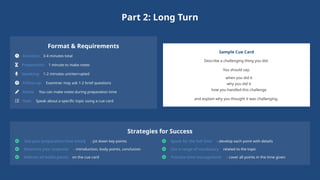
Part 2: LongTurn
Format & Requirements
Duration: 3-4 minutes total
Preparation: 1 minute to make notes
Speaking: 1-2 minutes uninterrupted
Follow-up: Examiner may ask 1-2 brief questions
Notes: You can make notes during preparation time
Task: Speak about a specific topic using a cue card
Sample Cue Card
Describe a challenging thing you did.
You should say:
when you did it
why you did it
how you handled this challenge
and explain why you thought it was challenging.
Strategies for Success
Use your preparation time wisely - jot down key points
Structure your response - introduction, body points, conclusion
Address all bullet points on the cue card
Speak for the full time - develop each point with details
Use a range of vocabulary related to the topic
Practice time management - cover all points in the time given
7.
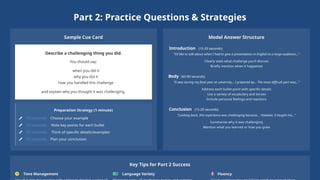
Part 2: PracticeQuestions & Strategies
Sample Cue Card
Describe a challenging thing you did.
You should say:
when you did it
why you did it
how you handled this challenge
and explain why you thought it was challenging.
Preparation Strategy (1 minute)
15 seconds: Choose your example
15 seconds: Note key points for each bullet
15 seconds: Think of specific details/examples
15 seconds: Plan your conclusion
Model Answer Structure
Introduction (15-20 seconds)
"I'd like to talk about when I had to give a presentation in English to a large audience..."
Clearly state what challenge you'll discuss
Briefly mention when it happened
Body (60-80 seconds)
"It was during my final year at university... I prepared by... The most difficult part was..."
Address each bullet point with specific details
Use a variety of vocabulary and tenses
Include personal feelings and reactions
Conclusion (15-20 seconds)
"Looking back, this experience was challenging because... However, it taught me..."
Summarize why it was challenging
Mention what you learned or how you grew
Key Tips for Part 2 Success
Time Management Language Variety Fluency
8.
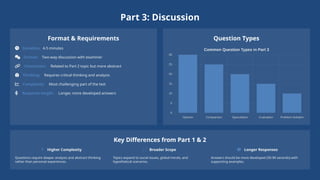
Part 3: Discussion
Format& Requirements
Duration: 4-5 minutes
Format: Two-way discussion with examiner
Connection: Related to Part 2 topic but more abstract
Thinking: Requires critical thinking and analysis
Complexity: Most challenging part of the test
Response length: Longer, more developed answers
Question Types
Key Differences from Part 1 & 2
Higher Complexity
Questions require deeper analysis and abstract thinking
rather than personal experiences.
Broader Scope
Topics expand to social issues, global trends, and
hypothetical scenarios.
Longer Responses
Answers should be more developed (30-90 seconds) with
supporting examples.
9.
Part 3: PracticeQuestions & Strategies
Sample Questions & Answers
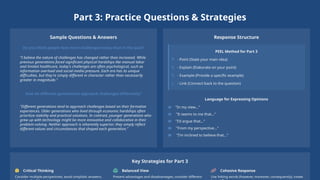
Do you think people face more challenges today than in the past?
"I believe the nature of challenges has changed rather than increased. While
previous generations faced significant physical hardships like manual labor
and limited healthcare, today's challenges are often psychological, such as
information overload and social media pressure. Each era has its unique
difficulties, but they're simply different in character rather than necessarily
greater in magnitude."
How do different generations approach challenges differently?
"Different generations tend to approach challenges based on their formative
experiences. Older generations who lived through economic hardships often
prioritize stability and practical solutions. In contrast, younger generations who
grew up with technology might be more innovative and collaborative in their
problem-solving. Neither approach is inherently superior; they simply reflect
different values and circumstances that shaped each generation."
Response Structure
PEEL Method for Part 3
P - Point (State your main idea)
E - Explain (Elaborate on your point)
E - Example (Provide a specific example)
L - Link (Connect back to the question)
Language for Expressing Opinions
"In my view..."
"It seems to me that..."
"I'd argue that..."
"From my perspective..."
"I'm inclined to believe that..."
Key Strategies for Part 3
Critical Thinking
Consider multiple perspectives; avoid simplistic answers;
Balanced View
Present advantages and disadvantages; consider different
Cohesive Response
Use linking words (however, moreover, consequently); create
10.
Advanced Vocabulary forSpeaking
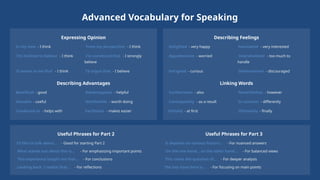
Expressing Opinion
In my view - I think From my perspective - I think
I'm inclined to believe - I think I'm convinced that - I strongly
believe
It seems to me that - I think I'd argue that - I believe
Describing Advantages
Beneficial - good Advantageous - helpful
Valuable - useful Worthwhile - worth doing
Conducive to - helps with Facilitates - makes easier
Describing Feelings
Delighted - very happy Fascinated - very interested
Apprehensive - worried Overwhelmed - too much to
handle
Intrigued - curious Disheartened - discouraged
Linking Words
Furthermore - also Nevertheless - however
Consequently - as a result In contrast - differently
Initially - at first Ultimately - finally
Useful Phrases for Part 2
I'd like to talk about... - Good for starting Part 2
What stands out about this is... - For emphasizing important points
This experience taught me that... - For conclusions
Looking back, I realize that... - For reflections
Useful Phrases for Part 3
It depends on various factors... - For nuanced answers
On the one hand... on the other hand... - For balanced views
This raises the question of... - For deeper analysis
The key issue here is... - For focusing on main points
11.
Common Mistakes toAvoid
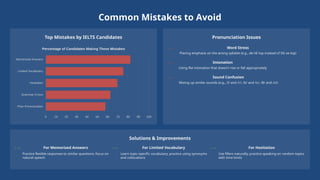
Top Mistakes by IELTS Candidates Pronunciation Issues
Word Stress
Placing emphasis on the wrong syllable (e.g., de-VE-lop instead of DE-ve-lop)
Intonation
Using flat intonation that doesn't rise or fall appropriately
Sound Confusion
Mixing up similar sounds (e.g., /l/ and /r/, /b/ and /v/, /θ/ and /s/)
Solutions & Improvements
For Memorized Answers
Practice flexible responses to similar questions; focus on
natural speech
For Limited Vocabulary
Learn topic-specific vocabulary; practice using synonyms
and collocations
For Hesitation
Use fillers naturally; practice speaking on random topics
with time limits
12.
Practice Tips &Summary
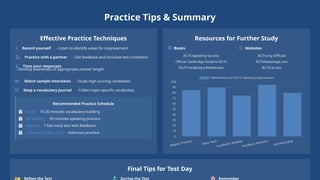
Effective Practice Techniques
Record yourself - Listen to identify areas for improvement
Practice with a partner - Get feedback and simulate test conditions
Time your responses
- Develop awareness of appropriate answer length
Watch sample interviews - Study high-scoring candidates
Keep a vocabulary journal - Collect topic-specific vocabulary
Recommended Practice Schedule
Daily: 15-20 minutes vocabulary building
3x Weekly: 30 minutes speaking practice
Weekly: 1 full mock test with feedback
2 Weeks Before Test: Intensive practice
Resources for Further Study
Books
IELTS Speaking Success
Official Cambridge Guide to IELTS
IELTS Vocabulary Masterclass
Websites
IELTS.org (Official)
IELTSAdvantage.com
IELTSLiz.com
Final Tips for Test Day
Before the Test During the Test Remember