HOW DO YOU IMAGINE SOCIAL INTERACTION WITHIN 10 YEARS, TAKING
INTO CONSIDERATION THE IMPACT OF TECHNOLOGY ON HUMAN
RELATIONS?
Alejandro Silva
Master in Advanced Finance
April 2017 Application
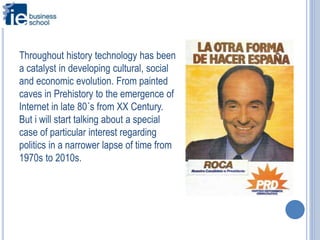
Throughout history technology has been
a catalyst in developing cultural, social
and economic evolution. From painted
caves in Prehistory to the emergence of
Internet in late 80´s from XX Century.
But i will start talking about a special
case of particular interest regarding
politics in a narrower lapse of time from
1970s to 2010s.
3
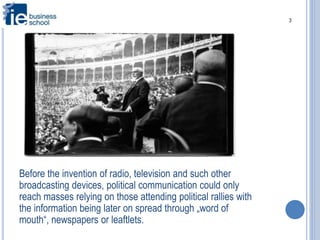
Before the invention of radio, television and such other
broadcasting devices, political communication could only
reach masses relying on those attending political rallies with
the information being later on spread through „word of
mouth“, newspapers or leaftlets.
This information could led to misleadings, manipulations, lower
transparency, inneficiencies, minor speed in changing the status quo
and greater reaction time in the facing of adversities and
countertimes.
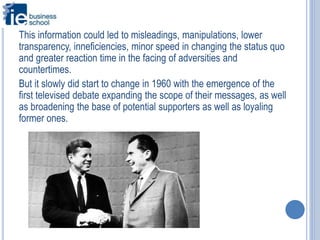
But it slowly did start to change in 1960 with the emergence of the
first televised debate expanding the scope of their messages, as well
as broadening the base of potential supporters as well as loyaling
former ones.
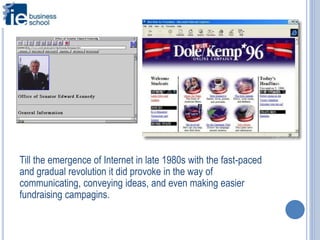
Till the emergence of Internet in late 1980s with the fast-paced
and gradual revolution it did provoke in the way of
communicating, conveying ideas, and even making easier
fundraising campagins.
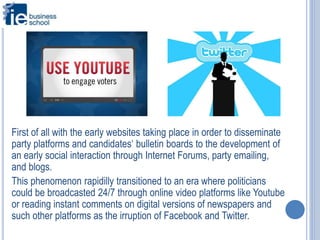
First of all with the early websites taking place in order to disseminate
party platforms and candidates‘ bulletin boards to the development of
an early social interaction through Internet Forums, party emailing,
and blogs.
This phenomenon rapidilly transitioned to an era where politicians
could be broadcasted 24/7 through online video platforms like Youtube
or reading instant comments on digital versions of newspapers and
such other platforms as the irruption of Facebook and Twitter.
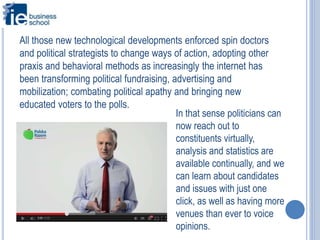
All those new technological developments enforced spin doctors
and political strategists to change ways of action, adopting other
praxis and behavioral methods as increasingly the internet has
been transforming political fundraising, advertising and
mobilization; combating political apathy and bringing new
educated voters to the polls.
In that sense politicians can
now reach out to
constituents virtually,
analysis and statistics are
available continually, and we
can learn about candidates
and issues with just one
click, as well as having more
venues than ever to voice
opinions.
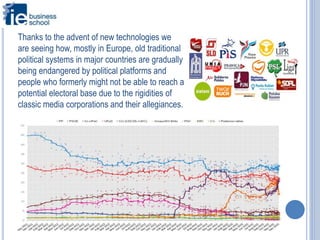
Thanks to the advent of new technologies we
are seeing how, mostly in Europe, old traditional
political systems in major countries are gradually
being endangered by political platforms and
people who formerly might not be able to reach a
potential electoral base due to the rigidities of
classic media corporations and their allegiances.
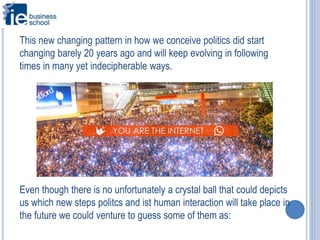
This new changing pattern in how we conceive politics did start
changing barely 20 years ago and will keep evolving in following
times in many yet indecipherable ways.
Even though there is no unfortunately a crystal ball that could depicts
us which new steps politcs and ist human interaction will take place in
the future we could venture to guess some of them as:
1) Google-bombing to frame debates.
2) Video emails from candidates that inoculate them against
embarrassing YouTube moments.
3) Citizen mashups that weave database material, home videos,
podcasts, and broadcast snippets into new forms of activism.
4) 3D Holograms and smart Siri-like technology become widespread.
5) Metadata analytics to target most potential voters base with the aim
at saving public spending and donors contributions..
Thank you for
your attention!

IE Business School Application

  • 1.
    HOW DO YOUIMAGINE SOCIAL INTERACTION WITHIN 10 YEARS, TAKING INTO CONSIDERATION THE IMPACT OF TECHNOLOGY ON HUMAN RELATIONS? Alejandro Silva Master in Advanced Finance April 2017 Application
  • 2.
    Throughout history technologyhas been a catalyst in developing cultural, social and economic evolution. From painted caves in Prehistory to the emergence of Internet in late 80´s from XX Century. But i will start talking about a special case of particular interest regarding politics in a narrower lapse of time from 1970s to 2010s.
  • 3.
    3 Before the inventionof radio, television and such other broadcasting devices, political communication could only reach masses relying on those attending political rallies with the information being later on spread through „word of mouth“, newspapers or leaftlets.
  • 4.
    This information couldled to misleadings, manipulations, lower transparency, inneficiencies, minor speed in changing the status quo and greater reaction time in the facing of adversities and countertimes. But it slowly did start to change in 1960 with the emergence of the first televised debate expanding the scope of their messages, as well as broadening the base of potential supporters as well as loyaling former ones.
  • 5.
    Till the emergenceof Internet in late 1980s with the fast-paced and gradual revolution it did provoke in the way of communicating, conveying ideas, and even making easier fundraising campagins.
  • 6.
    First of allwith the early websites taking place in order to disseminate party platforms and candidates‘ bulletin boards to the development of an early social interaction through Internet Forums, party emailing, and blogs. This phenomenon rapidilly transitioned to an era where politicians could be broadcasted 24/7 through online video platforms like Youtube or reading instant comments on digital versions of newspapers and such other platforms as the irruption of Facebook and Twitter.
  • 7.
    All those newtechnological developments enforced spin doctors and political strategists to change ways of action, adopting other praxis and behavioral methods as increasingly the internet has been transforming political fundraising, advertising and mobilization; combating political apathy and bringing new educated voters to the polls. In that sense politicians can now reach out to constituents virtually, analysis and statistics are available continually, and we can learn about candidates and issues with just one click, as well as having more venues than ever to voice opinions.
  • 8.
    Thanks to theadvent of new technologies we are seeing how, mostly in Europe, old traditional political systems in major countries are gradually being endangered by political platforms and people who formerly might not be able to reach a potential electoral base due to the rigidities of classic media corporations and their allegiances.
  • 9.
    This new changingpattern in how we conceive politics did start changing barely 20 years ago and will keep evolving in following times in many yet indecipherable ways. Even though there is no unfortunately a crystal ball that could depicts us which new steps politcs and ist human interaction will take place in the future we could venture to guess some of them as:
  • 10.
    1) Google-bombing toframe debates. 2) Video emails from candidates that inoculate them against embarrassing YouTube moments. 3) Citizen mashups that weave database material, home videos, podcasts, and broadcast snippets into new forms of activism. 4) 3D Holograms and smart Siri-like technology become widespread. 5) Metadata analytics to target most potential voters base with the aim at saving public spending and donors contributions..
  • 11.