vs KPIs
OKRs
A Guide to Using OKRs with
Jira
marketplace.atlassian.com
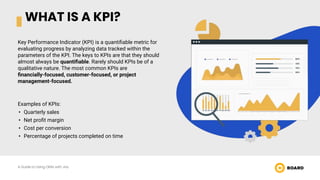
Key Performance Indicator (KPI) is a quantifiable metric for
evaluating progress by analyzing data tracked within the
parameters of the KPI. The keys to KPIs are that they should
almost always be quantifiable. Rarely should KPIs be of a
qualitative nature. The most common KPIs are
financially-focused, customer-focused, or project
management-focused.
Examples of KPIs:
• Quarterly sales
• Net profit margin
• Cost per conversion
• Percentage of projects completed on time
WHAT IS A KPI?
A Guide to Using OKRs with Jira
“Managing with the use of KPIs includes setting targets
(the desired level of performance) and tracking
progress against that target.” (kpi.org)
KPI = what you are going to measure
KPIs ≠ how goals will be achieved
A Guide to Using OKRs with Jira
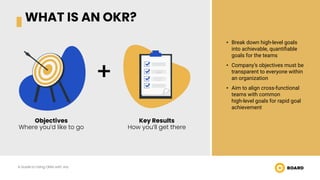
WHAT IS AN OKR?
Objectives
Where you’d like to go
Key Results
How you’ll get there
+
• Break down high-level goals
into achievable, quantifiable
goals for the teams
• Company’s objectives must be
transparent to everyone within
an organization
• Aim to align cross-functional
teams with common
high-level goals for rapid goal
achievement
A Guide to Using OKRs with Jira
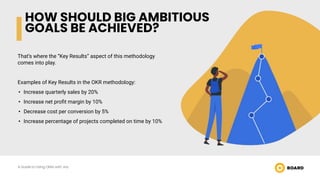
HOW SHOULD BIG AMBITIOUS
GOALS BE ACHIEVED?
That’s where the “Key Results” aspect of this methodology
comes into play.
Examples of Key Results in the OKR methodology:
• Increase quarterly sales by 20%
• Increase net profit margin by 10%
• Decrease cost per conversion by 5%
• Increase percentage of projects completed on time by 10%
A Guide to Using OKRs with Jira
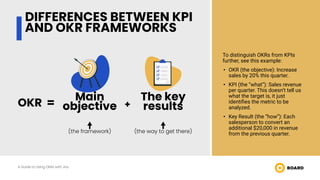
The key
results
A Guide to Using OKRs with Jira
(the framework) (the way to get there)
+
DIFFERENCES BETWEEN KPI
AND OKR FRAMEWORKS
OKR =
Main
objective
To distinguish OKRs from KPIs
further, see this example:
• OKR (the objective): Increase
sales by 20% this quarter.
• KPI (the “what”): Sales revenue
per quarter. This doesn’t tell us
what the target is, it just
identifies the metric to be
analyzed. 
• Key Result (the “how”): Each
salesperson to convert an
additional $20,000 in revenue
from the previous quarter. 
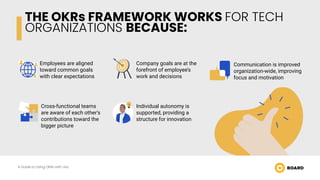
Employees are aligned
toward common goals
with clear expectations
THE OKRs FRAMEWORK WORKS FOR TECH
ORGANIZATIONS BECAUSE:
A Guide to Using OKRs with Jira
Company goals are at the
forefront of employee’s
work and decisions
Communication is improved
organization-wide, improving
focus and motivation
Cross-functional teams
are aware of each other’s
contributions toward the
bigger picture
Individual autonomy is
supported, providing a
structure for innovation
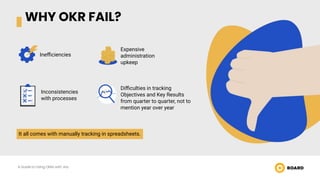
WHY OKR FAIL?
A Guide to Using OKRs with Jira
Inefficiencies
Expensive
administration
upkeep
Inconsistencies
with processes
Difficulties in tracking
Objectives and Key Results
from quarter to quarter, not to
mention year over year
It all comes with manually tracking in spreadsheets.
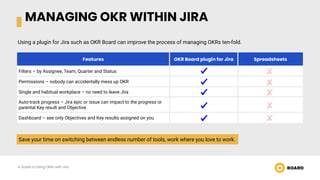
MANAGING OKR WITHIN JIRA
A Guide to Using OKRs with Jira
Using a plugin for Jira such as OKR Board can improve the process of managing OKRs ten-fold.
Features OKR Board plugin for Jira Spreadsheets
Filters – by Assignee, Team, Quarter and Status
Permissions – nobody can accidentally mess up OKR
Single and habitual workplace – no need to leave Jira
Auto-track progress – Jira epic or issue can impact to the progress or
parental Key result and Objective
Dashboard – see only Objectives and Key results assigned on you
Save your time on switching between endless number of tools, work where you love to work.
OKR + JIRA =
marketplace.atlassian.com oboard.io support@oboard.io
A Guide to Using OKRs with Jira

OKRs vs KPIs

  • 1.
    vs KPIs OKRs A Guideto Using OKRs with Jira marketplace.atlassian.com
  • 2.
    Key Performance Indicator(KPI) is a quantifiable metric for evaluating progress by analyzing data tracked within the parameters of the KPI. The keys to KPIs are that they should almost always be quantifiable. Rarely should KPIs be of a qualitative nature. The most common KPIs are financially-focused, customer-focused, or project management-focused. Examples of KPIs: • Quarterly sales • Net profit margin • Cost per conversion • Percentage of projects completed on time WHAT IS A KPI? A Guide to Using OKRs with Jira
  • 3.
    “Managing with theuse of KPIs includes setting targets (the desired level of performance) and tracking progress against that target.” (kpi.org) KPI = what you are going to measure KPIs ≠ how goals will be achieved A Guide to Using OKRs with Jira
  • 4.
    WHAT IS ANOKR? Objectives Where you’d like to go Key Results How you’ll get there + • Break down high-level goals into achievable, quantifiable goals for the teams • Company’s objectives must be transparent to everyone within an organization • Aim to align cross-functional teams with common high-level goals for rapid goal achievement A Guide to Using OKRs with Jira
  • 5.
    HOW SHOULD BIGAMBITIOUS GOALS BE ACHIEVED? That’s where the “Key Results” aspect of this methodology comes into play. Examples of Key Results in the OKR methodology: • Increase quarterly sales by 20% • Increase net profit margin by 10% • Decrease cost per conversion by 5% • Increase percentage of projects completed on time by 10% A Guide to Using OKRs with Jira
  • 6.
    The key results A Guideto Using OKRs with Jira (the framework) (the way to get there) + DIFFERENCES BETWEEN KPI AND OKR FRAMEWORKS OKR = Main objective To distinguish OKRs from KPIs further, see this example: • OKR (the objective): Increase sales by 20% this quarter. • KPI (the “what”): Sales revenue per quarter. This doesn’t tell us what the target is, it just identifies the metric to be analyzed.  • Key Result (the “how”): Each salesperson to convert an additional $20,000 in revenue from the previous quarter. 
  • 7.
    Employees are aligned towardcommon goals with clear expectations THE OKRs FRAMEWORK WORKS FOR TECH ORGANIZATIONS BECAUSE: A Guide to Using OKRs with Jira Company goals are at the forefront of employee’s work and decisions Communication is improved organization-wide, improving focus and motivation Cross-functional teams are aware of each other’s contributions toward the bigger picture Individual autonomy is supported, providing a structure for innovation
  • 8.
    WHY OKR FAIL? AGuide to Using OKRs with Jira Inefficiencies Expensive administration upkeep Inconsistencies with processes Difficulties in tracking Objectives and Key Results from quarter to quarter, not to mention year over year It all comes with manually tracking in spreadsheets.
  • 9.
    MANAGING OKR WITHINJIRA A Guide to Using OKRs with Jira Using a plugin for Jira such as OKR Board can improve the process of managing OKRs ten-fold. Features OKR Board plugin for Jira Spreadsheets Filters – by Assignee, Team, Quarter and Status Permissions – nobody can accidentally mess up OKR Single and habitual workplace – no need to leave Jira Auto-track progress – Jira epic or issue can impact to the progress or parental Key result and Objective Dashboard – see only Objectives and Key results assigned on you Save your time on switching between endless number of tools, work where you love to work.
  • 10.
    OKR + JIRA= marketplace.atlassian.com oboard.io support@oboard.io A Guide to Using OKRs with Jira