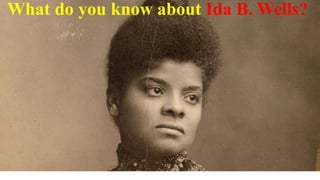


















What do you know about Ida B. Wells?
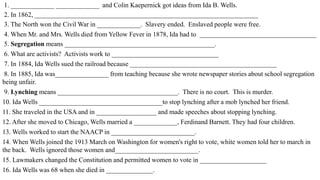
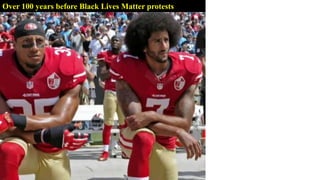
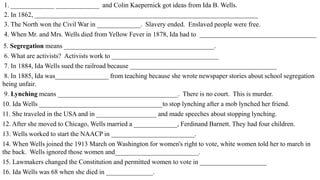
1. _____________ _____________ and Colin Kaepernick got ideas from Ida B. Wells.
2. In 1862, ___________________________________________________________________
3. The North won the Civil War in _____________. Slavery ended. Enslaved people were free.
4. When Mr. and Mrs. Wells died from Yellow Fever in 1878, Ida had to ___________________________________
5. Segregation means _____________________________________________.
6. What are activists? Activists work to ________________________________
7. In 1884, Ida Wells sued the railroad because ____________________________________________
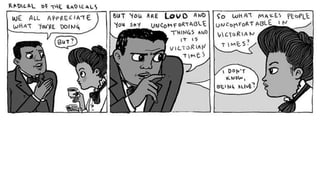
8. In 1885, Ida was________________ from teaching because she wrote newspaper stories about school segregation
being unfair.
9. Lynching means ____________________________________. There is no court. This is murder.
10. Ida Wells _____________________________________to stop lynching after a mob lynched her friend.
11. She traveled in the USA and in __________________ and made speeches about stopping lynching.
12. After she moved to Chicago, Wells married a _____________, Ferdinand Barnett. They had four children.
13. Wells worked to start the NAACP in _________________________.
14. When Wells joined the 1913 March on Washington for women's right to vote, white women told her to march in
the back. Wells ignored those women and_________________________.
15. Lawmakers changed the Constitution and permitted women to vote in ____________________
16. Ida Wells was 68 when she died in ______________.
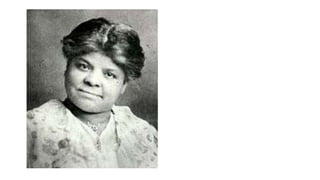
Over 100 years before Black Lives Matter protests
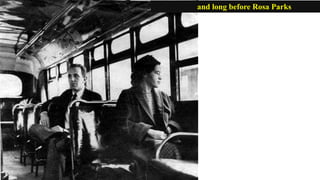
and long before Rosa Parks
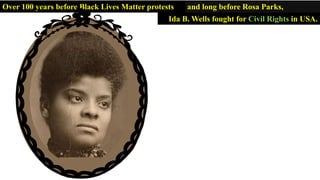
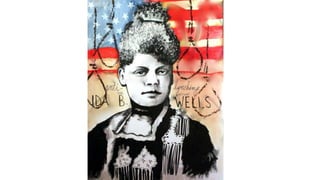
Ida B. Wells fought for Civil Rights in USA.
and long before Rosa Parks,Over 100 years before Black Lives Matter protests
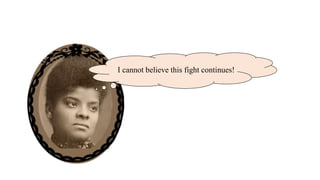
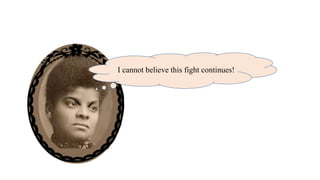
I cannot believe this fight continues!
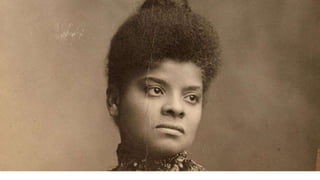
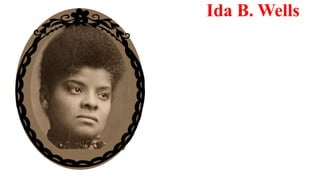
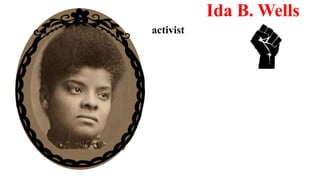
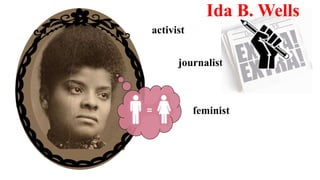
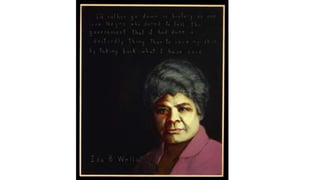
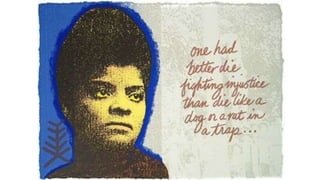
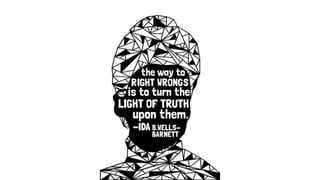
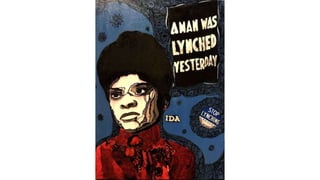
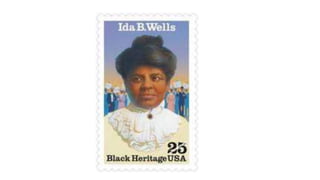
Ida B. Wells
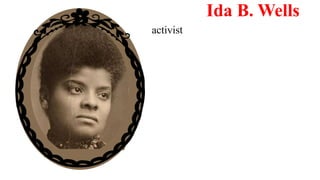
activist
Ida B. Wells
activist
Ida B. Wells
activist
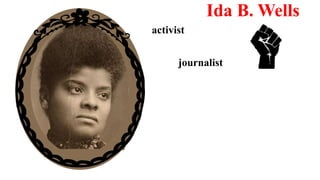
Ida B. Wells
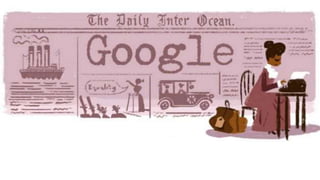
journalist
activist
journalist
Ida B. Wells
activist
journalist
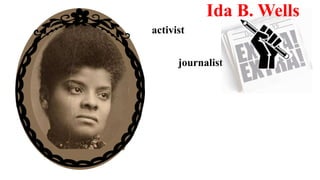
Ida B. Wells
feminist
activist
journalist
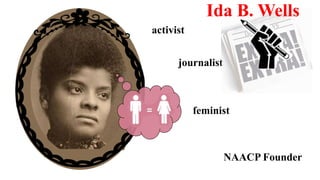
Ida B. Wells
feminist
activist
journalist
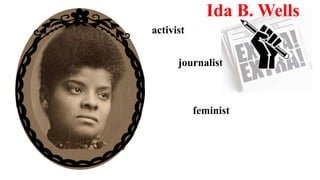
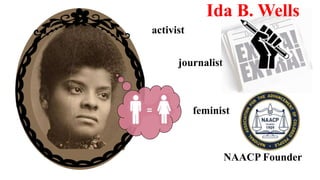
Ida B. Wells
feminist
NAACP Founder
activist
journalist
Ida B. Wells
feminist
NAACP Founder
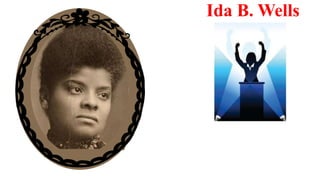
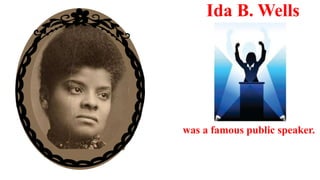
Ida B. Wells
was a famous public speaker.
Ida B. Wells
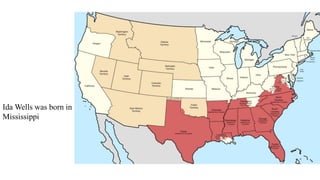
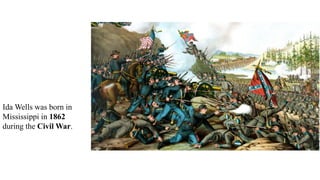
Ida Wells was born in
Mississippi
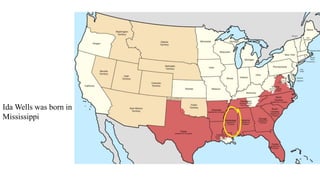
Ida Wells was born in
Mississippi
Ida Wells was born in
Mississippi in 1862
during the Civil War.
Ida Wells was born in
Mississippi in 1862
during the Civil War.
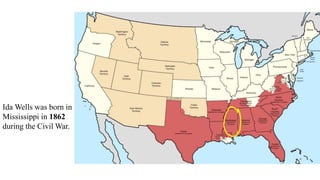
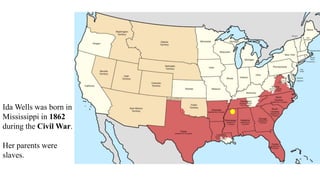
Ida Wells was born in
Mississippi in 1862
during the Civil War.
Her parents were
slaves.
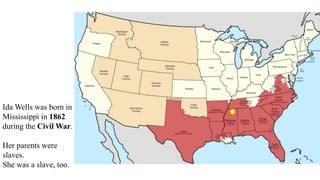
Ida Wells was born in
Mississippi in 1862
during the Civil War.
Her parents were
slaves.
She was a slave, too.
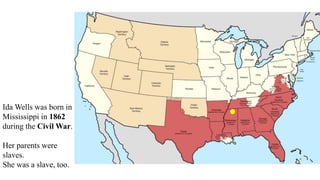
Ida Wells was born in
Mississippi in 1862
during the Civil War.
Her parents were
slaves.
She was a slave, too.
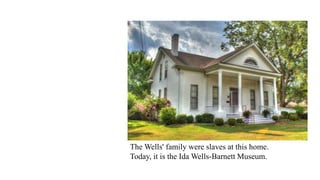
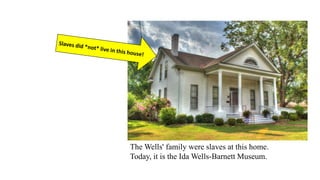
The Wells' family were slaves at this home.
Today, it is the Ida Wells-Barnett Museum.
The Wells' family were slaves at this home.
Today, it is the Ida Wells-Barnett Museum.
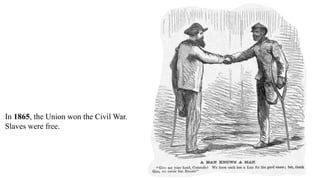
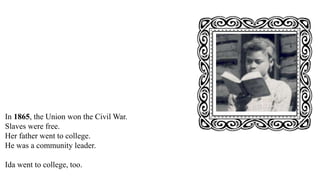
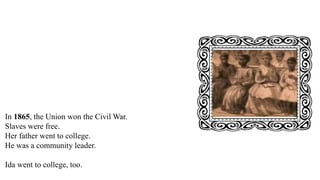
In 1865, the Union won the Civil War.
Slaves were free.
Her father went to college.
Ida went to college, too.
In 1865, the Union won the Civil War.
Slaves were free.
Her father went to college.
Ida went to college, too.
In 1865, the Union won the Civil War.
Slaves were free.
Her father went to college.
Ida went to college, too.
In 1865, the Union won the Civil War.
Slaves were free.
Her father went to college.
He was a community leader.
Her father went to college.
Ida went to college, too.
In 1865, the Union won the Civil War.
Slaves were free.
Her father went to college.
He was a community leader.
Ida went to college, too.
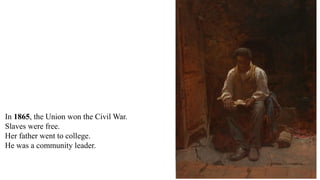
In 1865, the Union won the Civil War.
Slaves were free.
Her father went to college.
He was a community leader.
Ida went to college, too.
Ida Wells was born in Mississippi in 1863.
Her parents were slaves.
After the war, her father went to college.
Ida went to college, too.
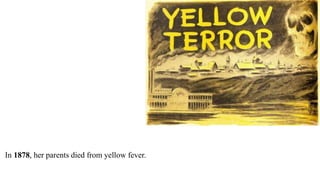
In 1878, her parents died from yellow fever.
Ida Wells was born in Mississippi in 1863.
Her parents were slaves.
After the war, her father went to college.
Ida went to college, too.
In 1878, her parents died from yellow fever.
Ida had to take care of her brothers and sisters, so she quit college.
Ida Wells was born in Mississippi in 1863.
Her parents were slaves.
After the war, her father went to college.
Ida went to college, too.
In 1878, her parents died from yellow fever.
Ida had to take care of her brothers and sisters, so she quit college.
She became a teacher. She was 16.
Ida Wells was born in Mississippi in 1863.
Her parents were slaves.
After the war, her father went to college.
Ida went to college, too.
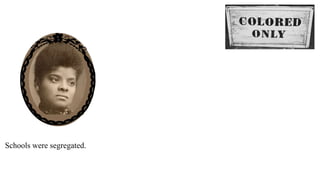
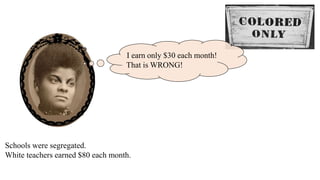
Schools were segregated.
Ida Wells was born in Mississippi in 1863.
Her parents were slaves.
After the war, her father went to college.
Ida went to college, too.
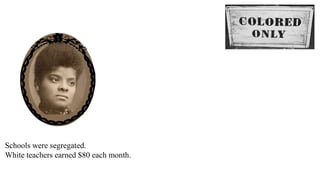
Schools were segregated.
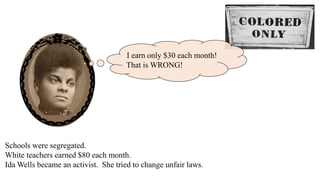
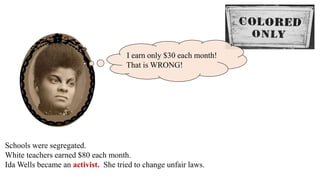
White teachers earned $80 each month.
Ida Wells was born in Mississippi in 1863.
Her parents were slaves.
After the war, her father went to college.
Ida went to college, too.
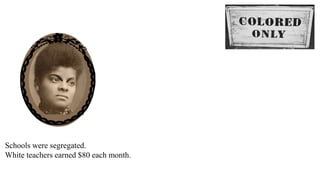
Schools were segregated.
White teachers earned $80 each month.
I
Schools were segregated.
White teachers earned $80 each month.
I
Schools were segregated.
White teachers earned $80 each month.
I earn only $30 each month!
That is WRONG!
I
Schools were segregated.
White teachers earned $80 each month.
Ida Wells became an activist. She tried to change unfair laws.
I earn only $30 each month!
That is WRONG!
I
Schools were segregated.
White teachers earned $80 each month.
Ida Wells became an activist. She tried to change unfair laws.
I earn only $30 each month!
That is WRONG!
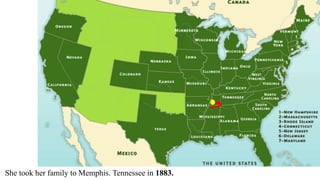
She took her family to Memphis. Tennessee in 1883.
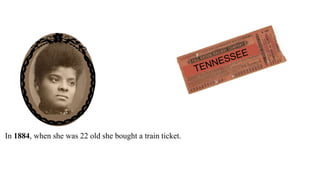
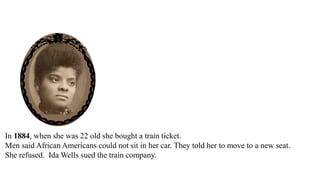
In 1884, when she was 22 old she bought a train ticket.
She sued the train company.
The city court said she won.
The city court ordered the train company to pay Ida Wells $500.
In 1884, when she was 22 old she bought a train ticket.
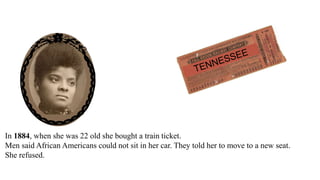
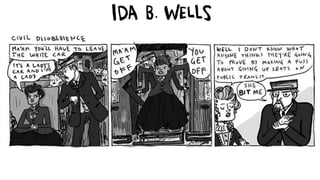
Men said African Americans could not sit in her car. They told her to move to a new seat.
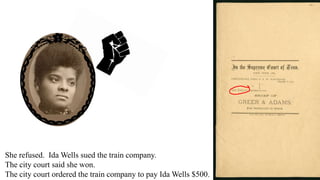
She refused. She sued the train company.
The city court said she won.
The city court ordered the train company to pay Ida Wells $500.
In 1884, when she was 22 old she bought a train ticket.
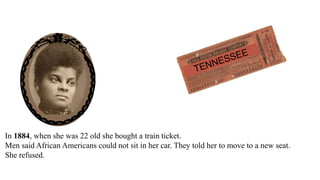
Men said African Americans could not sit in her car. They told her to move to a new seat.
She refused.
In 1884, when she was 22 old she bought a train ticket.
Men said African Americans could not sit in her car. They told her to move to a new seat.
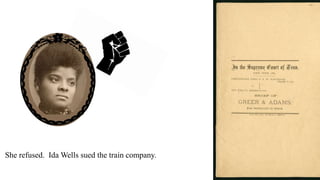
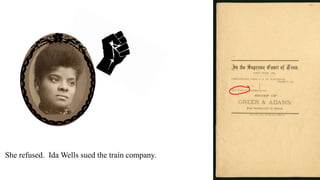
She refused. Ida Wells sued the train company.
The city court said she won.
The city court ordered the train company to pay Ida Wells $500.
In 1884, when she was 22 old she bought a train ticket.
Men said African Americans could not sit in her car. They told her to move to a new seat.
She refused. Ida Wells sued the train company.
The city court said she won.
The city court ordered the train company to pay Ida Wells $500.
In 1884, when she was 22 old she bought a train ticket.
Men said African Americans could not sit in her car. They told her to move to a new seat.
She refused. Ida Wells sued the train company.
The city court said she won.
The city court ordered the train company to pay Ida Wells $500.
In 1884, when she was 22 old she bought a train ticket.
Men said African Americans could not sit in her car. They told her to move to a new seat.
She refused. Ida Wells sued the train company.
The city court said she won.
The city court ordered the train company to pay Ida Wells $500.
In 1884, when she was 22 old she bought a train ticket.
Men said African Americans could not sit in her car. They told her to move to a new seat.
She refused. Ida Wells sued the train company.
The city court said she won.
The city court ordered the train company to pay Ida Wells $500.
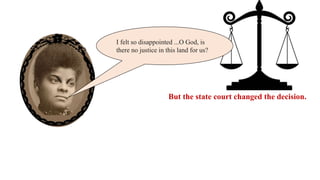
But the state court changed the decision.
I felt so disappointed ...O God, is
there no justice in this land for us?
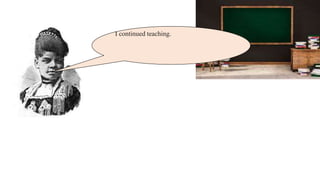
I continued teaching.
I also began writing for a newspaper.
I wrote that USA's laws
needed to be fair.
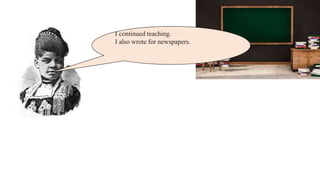
I continued teaching.
I also wrote for newspapers.
I wrote that USA's laws need
ed to be fair.
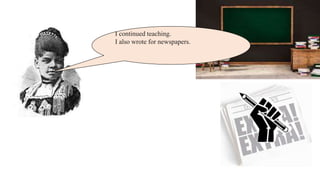
I continued teaching.
I also wrote for newspapers.
I wrote that USA's laws neede
d to be fair.
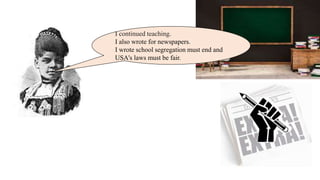
I continued teaching.
I also wrote for newspapers.
I wrote school segregation must end and
USA's laws must be fair.
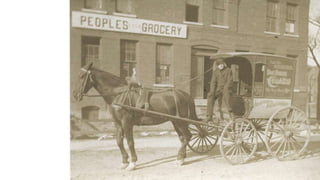
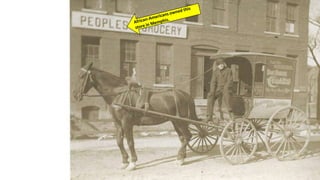
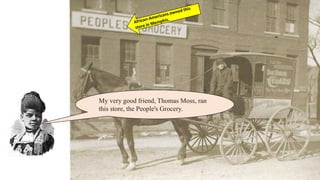
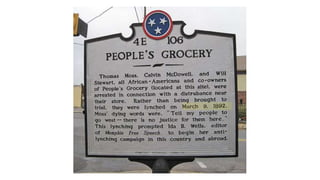
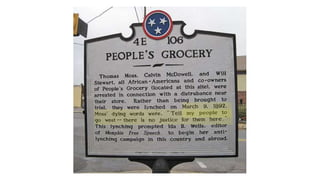
My very good friend, Thomas Moss, ran
this store, the People's Grocery.
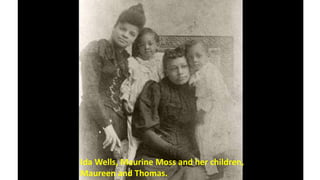
Ida Wells, Maurine Moss and her children,
Maureen and Thomas.
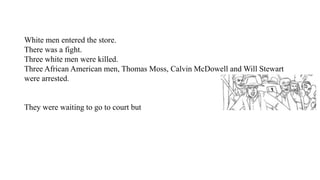
White men entered the store.
There was a fight.
White men entered the store.
There was a fight.
Historians think the fight happened because white people
were jealous.
The black owners of the People's Grocery earned more
money than they did.
White men entered the store.
There was a fight.
Historians think the fight happened because white people
were jealous.
The black owners of the People's Grocery earned more
money than they did.
White men entered the store.
There was a fight.
Historians think the fight happened because white people
were jealous.
The black owners of the People's Grocery earned more
money than they did.
White men entered the store.
There was a fight.
Three white men were killed.
White men entered the store.
There was a fight.
Three white men were killed.
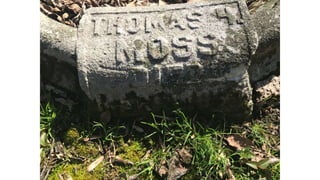
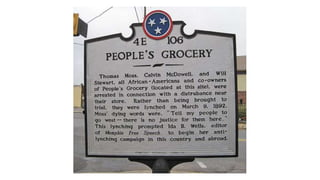
Three African American men, Thomas Moss, Calvin McDowell and Will Stewart
were arrested.
White men entered the store.
There was a fight.
Three white men were killed.
Three African American men, Thomas Moss, Calvin McDowell and Will Stewart
were arrested.
They were waiting to go to court
White men entered the store.
There was a fight.
Three white men were killed.
Three African American men, Thomas Moss, Calvin McDowell and Will Stewart
were arrested.
They were waiting to go to court but
White men entered the store.
There was a fight.
Three white men were killed.
Three African American men, Thomas Moss, Calvin McDowell and Will Stewart
were arrested.
They were waiting to go to court but
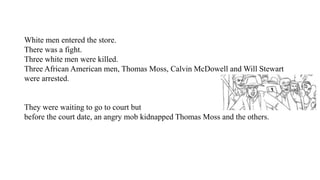
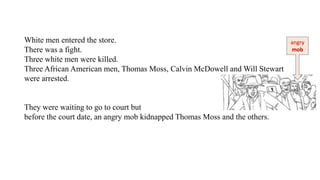
before the court date, an angry mob kidnapped Thomas Moss and the others.
White men entered the store.
There was a fight.
Three white men were killed.
Three African American men, Thomas Moss, Calvin McDowell and Will Stewart
were arrested.
They were waiting to go to court but
before the court date, an angry mob kidnapped Thomas Moss and the others.
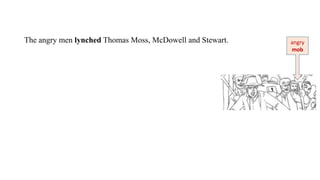
angry
mob
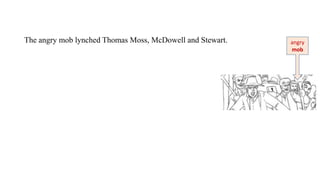
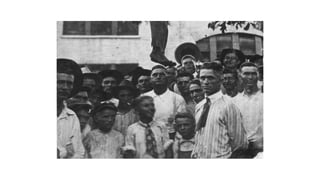
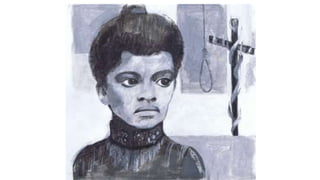
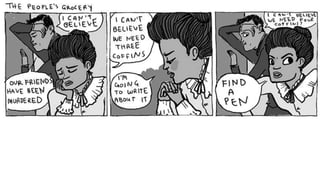
The angry mob lynched Thomas Moss, McDowell and Stewart. angry
mob
The angry men lynched Thomas Moss, McDowell and Stewart. angry
mob
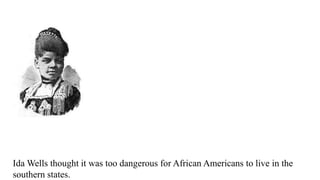
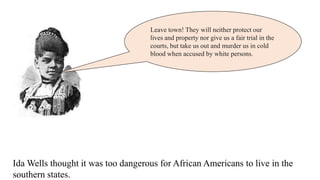
Ida Wells thought it was too dangerous for African Americans to live in the
southern states.
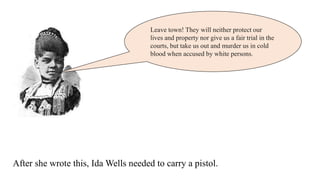
Leave town! They will neither protect our
lives and property nor give us a fair trial in the
courts, but take us out and murder us in cold
blood when accused by white persons.
Ida Wells thought it was too dangerous for African Americans to live in the
southern states.
Leave town! They will neither protect our
lives and property nor give us a fair trial in the
courts, but take us out and murder us in cold
blood when accused by white persons.
After she wrote this, Ida Wells needed to carry a pistol.
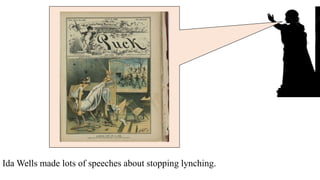
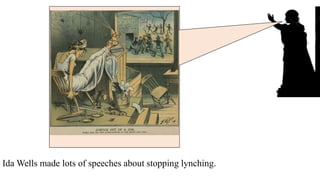
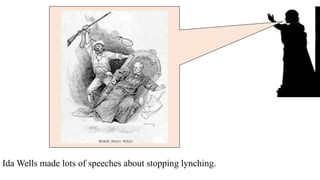
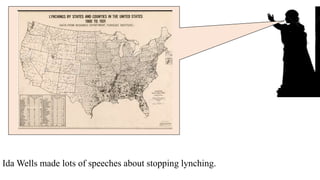
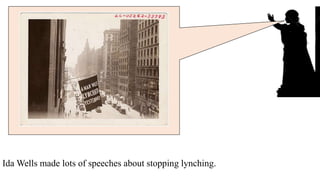
Ida Wells made lots of speeches about stopping lynching.
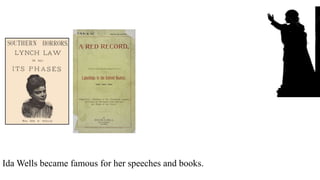
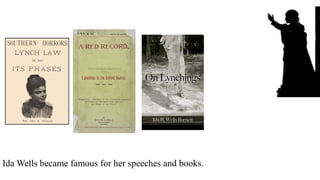
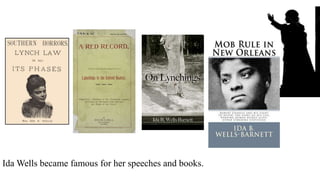
and wrote a lot of books.
Ida Wells made lots of speeches about stopping lynching.
and wrote a lot of books.
Ida Wells made lots of speeches about stopping lynching.
and wrote a lot of books.
Ida Wells made lots of speeches about stopping lynching.
and wrote a lot of books.
Ida Wells made lots of speeches about stopping lynching.
and wrote a lot of books.
Ida Wells made lots of speeches about stopping lynching.
and wrote a lot of books.
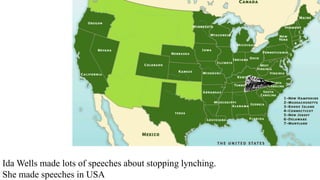
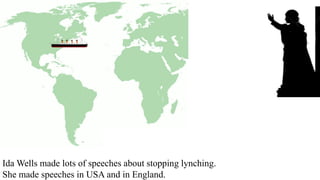
Ida Wells made lots of speeches about stopping lynching.
She made speeches in USA
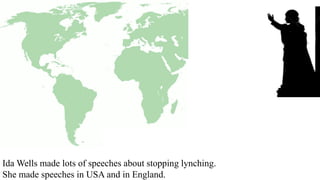
Ida Wells made lots of speeches about stopping lynching.
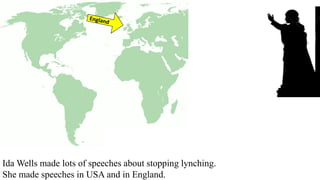
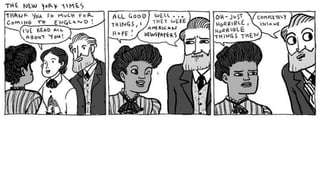
She made speeches in USA and in England.
Ida Wells made lots of speeches about stopping lynching.
She made speeches in USA and in England.
Ida Wells made lots of speeches about stopping lynching.
She made speeches in USA and in England.
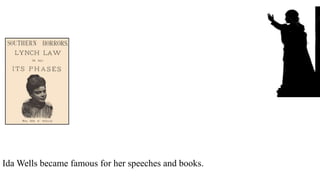
Ida Wells became famous for her speeches and books.
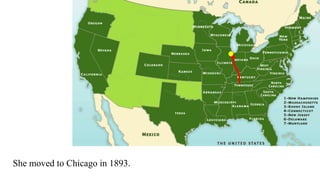
She moved to Chicago in 1893.
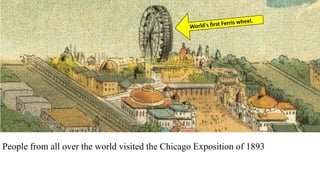
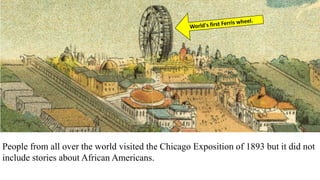
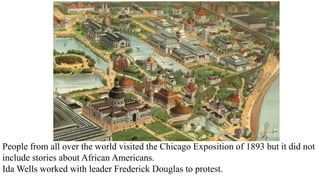
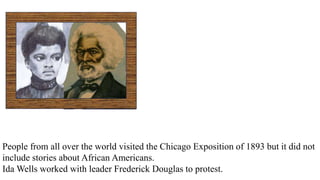
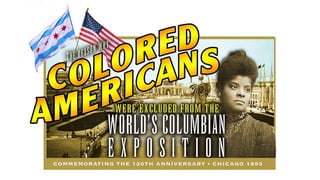
People from all over the world visited the Chicago Exposition of 1893 but it did not
include stories about African Americans. Ida Wells worked with leader Frederick
Douglas to protest.
People from all over the world visited the Chicago Exposition of 1893 but it did not
include stories about African Americans. Ida Wells worked with leader Frederick
Douglas to protest.
People from all over the world visited the Chicago Exposition of 1893 but it did not
include stories about African Americans.
Ida Wells worked with leader Frederick Douglas to protest.
People from all over the world visited the Chicago Exposition of 1893 but it did not
include stories about African Americans.
Ida Wells worked with leader Frederick Douglas to protest.
People from all over the world visited the Chicago Exposition of 1893 but it did not
include stories about African Americans.
Ida Wells worked with leader Frederick Douglas to protest.
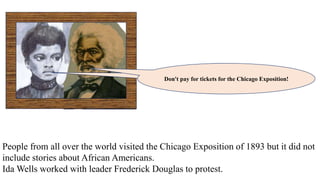
Don't pay for tickets for the Chicago Exposition!
People from all over the world visited the Chicago Exposition of 1893 but it did not
include stories about African Americans.
Ida Wells worked with leader Frederick Douglas to protest.
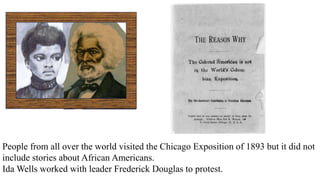
People from all over the world visited the Chicago Exposition of 1893 but it did not
include stories about African Americans.
Ida Wells worked with leader Frederick Douglas to protest.
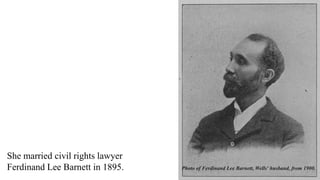
Photo of Ferdinand Lee Barnett, Wells' husband, from 1900.
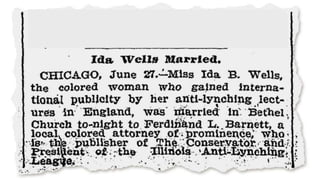
She married civil rights lawyer
Ferdinand Lee Barnett in 1895.
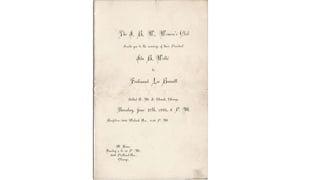
An invitation to her wedding. UNIVERSITY OF CHICAGO
LIBRARY, SPECIAL COLLECTIONS RESEARCH CENTER
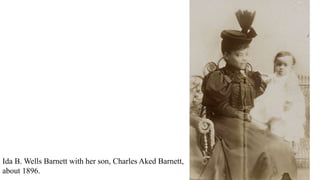
Ida B. Wells Barnett with her son, Charles Aked Barnett,
about 1896.
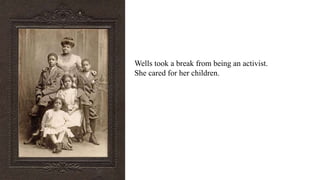
Wells took a break from being an activist.
She cared for her children.
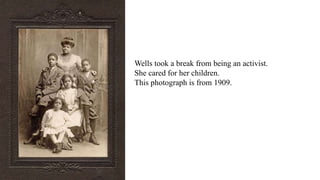
Wells took a break from being an activist.
She cared for her children.
This photograph is from 1909.
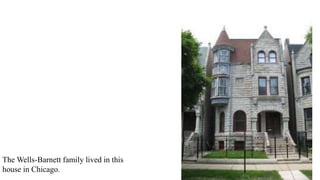
The Wells-Barnett family lived in this
house in Chicago.
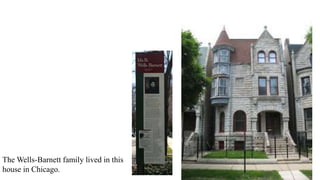
The Wells-Barnett family lived in this
house in Chicago.
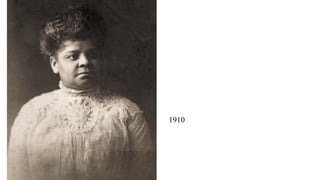
1910
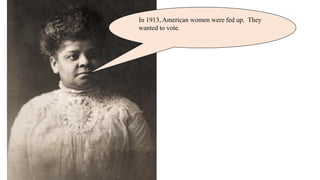
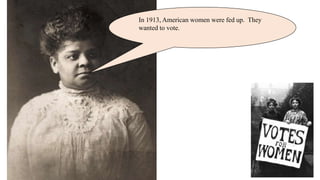
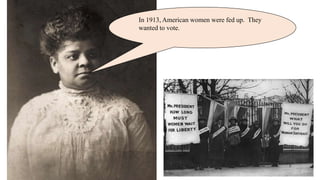
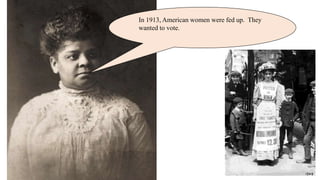
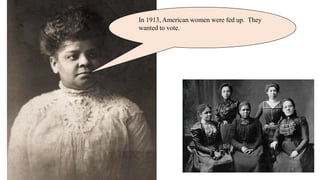
In 1913, American women were fed up. They
wanted to vote.
In 1913, American women were fed up. They
wanted to vote.
In 1913, American women were fed up. They
wanted to vote.
In 1913, American women were fed up. They
wanted to vote.
In 1913, American women were fed up. They
wanted to vote.
In 1913, American women were fed up. They
wanted to vote.
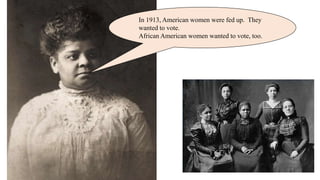
African American women wanted to vote, too.
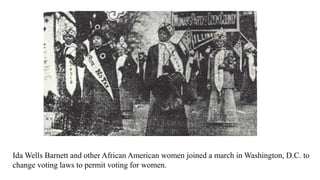
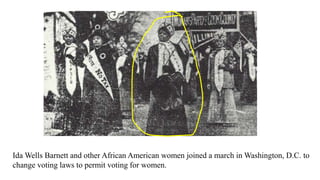
Ida Wells Barnett and other African American women joined a march in Washington, D.C. to
change voting laws to permit voting for women.
Ida Wells Barnett and other African American women joined a march in Washington, D.C. to
change voting laws to permit voting for women.
Ida Wells Barnett and other African American women joined a march in Washington, D.C. to
change voting laws to permit voting for women.
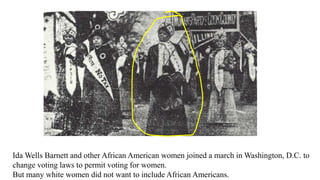
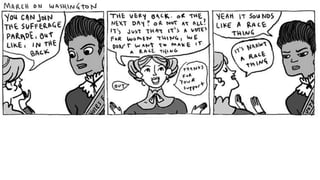
But many white women did not want to include African Americans.
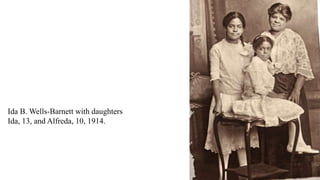
Ida B. Wells-Barnett with daughters
Ida, 13, and Alfreda, 10, 1914.
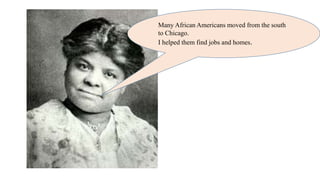
Many African Americans moved from the south
to Chicago.
I helped them find jobs and homes.
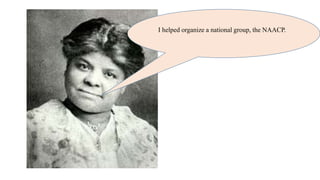
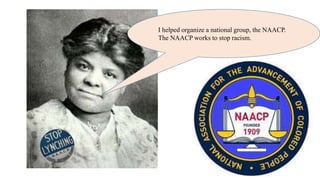
I helped organize a national group, the NAACP.
The NAACP worked to stop segregation.
I helped organize a national group, the NAACP.
The NAACP worked to stop segregation.
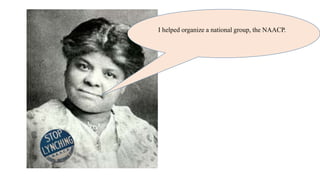
I helped organize a national group, the NAACP.
The NAACP works to stop racism.
I helped organize a national group, the NAACP.
The NAACP works to stop racism
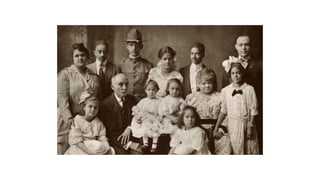
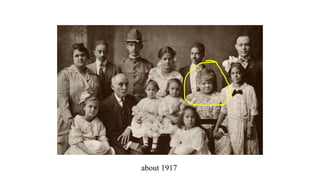
about 1917
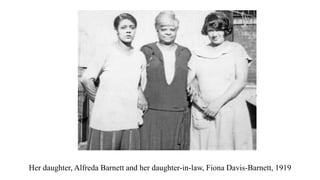
Her daughter, Alfreda Barnett and her daughter-in-law, Fiona Davis-Barnett, 1919
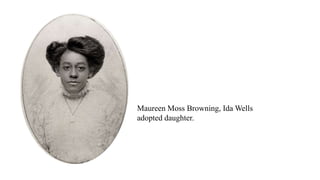
Maureen Moss Browning, Ida Wells
adopted daughter.
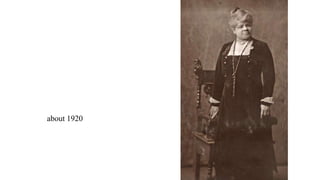
about 1920
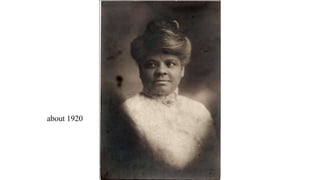
about 1920
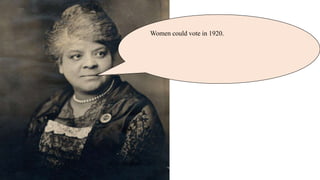
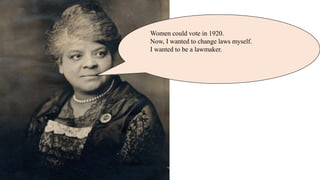
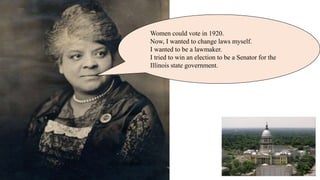
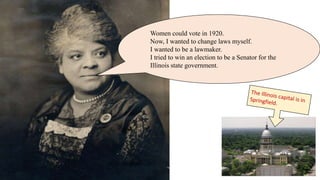
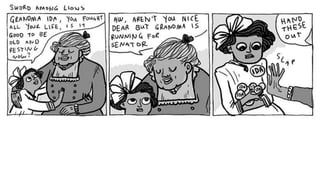
Women could vote in 1920.
Now, I wanted to change laws myself.
I wanted to be a lawmaker.
I tried to win an election to be a Senator for the
Illinois state gvernment.
Women could vote in 1920.
Now, I wanted to change laws myself.
I wanted to be a lawmaker.
I tried to win an election to be a Senator for the
Illinois state gvernment.
Women could vote in 1920.
Now, I wanted to change laws myself.
I wanted to be a lawmaker.
I tried to win an election to be a Senator for the
Illinois state government.
Women could vote in 1920.
Now, I wanted to change laws myself.
I wanted to be a lawmaker.
I tried to win an election to be a Senator for the
Illinois state government.
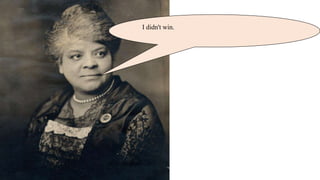
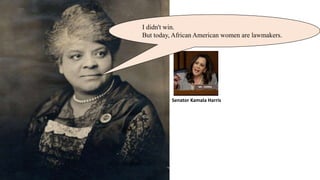
I didn't win.
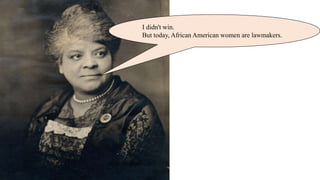
But today, African American women are lawmakers.
I didn't win.
But today, African American women are lawmakers.
Senator Kamala Harris
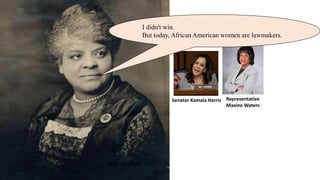
I didn't win.
But today, African American women are lawmakers.
Representative
Maxine Waters
Senator Kamala Harris
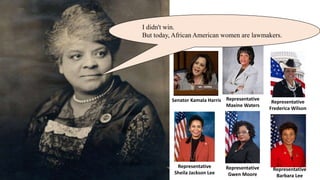
I didn't win.
But today, African American women are lawmakers.
Representative
Maxine Waters
Representative
Frederica Wilson
Representative
Sheila Jackson Lee
Representative
Barbara Lee
Representative
Gwen Moore
Senator Kamala Harris
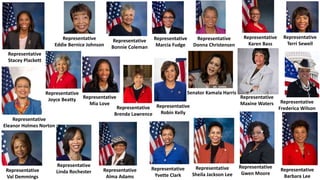
I didn't win.
But today, African American women are lawmakers.
Representative
Maxine Waters Representative
Frederica Wilson
Representative
Barbara Lee
Representative
Gwen Moore
Representative
Terri Sewell
Representative
Stacey Plackett
Representative
Eddie Bernice Johnson
Representative
Bonnie Coleman
Representative
Yvette Clark
Representative
Mia Love
Representative
Alma Adams
Representative
Eleanor Holmes Norton
Representative
Donna Christensen
Representative
Val Demmings
Representative
Sheila Jackson Lee
Representative
Brenda Lawrence
Representative
Marcia Fudge
Senator Kamala Harris
Representative
Robin Kelly
Representative
Joyce Beatty
Representative
Linda Rochester
Representative
Karen Bass
1. _____________ _____________ and Colin Kaepernick got ideas from Ida B. Wells.
2. In 1862, ___________________________________________________________________
3. The North won the Civil War in _____________. Slavery ended. Enslaved people were free.
4. When Mr. and Mrs. Wells died from Yellow Fever in 1878, Ida had to ___________________________________
5. Segregation means _____________________________________________.
6. What are activists? Activists work to ________________________________
7. In 1884, Ida Wells sued the railroad because ____________________________________________
8. In 1885, Ida was________________ from teaching because she wrote newspaper stories about school segregation
being unfair.
9. Lynching means ____________________________________. There is no court. This is murder.
10. Ida Wells _____________________________________to stop lynching after a mob lynched her friend.
11. She traveled in the USA and in __________________ and made speeches about stopping lynching.
12. After she moved to Chicago, Wells married a _____________, Ferdinand Barnett. They had four children.
13. Wells worked to start the NAACP in _________________________.
14. When Wells joined the 1913 March on Washington for women's right to vote, white women told her to march in
the back. Wells ignored those women and_________________________.
15. Lawmakers changed the Constitution and permitted women to vote in ____________________
16. Ida Wells was 68 when she died in ______________.
name:
date:
What Do You Know about Ida B. Wells?
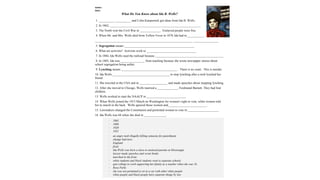
1. __________ __________ and Colin Kaepernick got ideas from Ida B. Wells.
2. In 1862, __________________________________________________________
3. The North won the Civil War in _____________. Enslaved people were free.
4. When Mr. and Mrs. Wells died from Yellow Fever in 1878, Ida had to___________
_______________________________________________________________ ________________
5. Segregation means _____________________________________________.
6. What are activists? Activists work to ________________________________
7. In 1884, Ida Wells sued the railroad because ____________________________________________
8. In 1885, Ida was________________ from teaching because she wrote newspaper stories about
school segregation being unfair.
9. Lynching means ____________________________________ . There is no court. This is murder.
10. Ida Wells _____________________________________ to stop lynching after a mob lynched her
friend.
11. She traveled in the USA and in __________________ and made speeches about stopping lynching.
12. After she moved to Chicago, Wells married a _____________, Ferdinand Barnett. They had four
children.
13. Wells worked to start the NAACP in _________________________.
14. When Wells joined the 1913 March on Washington for women's right to vote, white women told
her to march in the back. Wells ignored those women and_________________________.
15. Lawmakers changed the Constitution and permitted women to vote in ____________________
16. Ida Wells was 68 when she died in ______________.
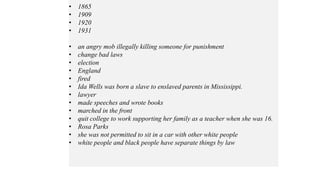
· 1865
· 1909
· 1920
· 1931
· an angry mob illegally killing someone for punishment
· change bad laws
· England
· fired
· Ida Wells was born a slave to enslaved parents in Mississippi.
· lawyer made speeches and wrote books
· marched in the front
· white students and black students went to separate schools.
· quit college to work supporting her family as a teacher when she was 16.
· Rosa Parks
· she was not permitted to sit in a car with other white people
· white people and black people have separate things by law
• 1865
• 1909
• 1920
• 1931
• an angry mob illegally killing someone for punishment
• change bad laws
• election
• England
• fired
• Ida Wells was born a slave to enslaved parents in Mississippi.
• lawyer
• made speeches and wrote books
• marched in the front
• quit college to work supporting her family as a teacher when she was 16.
• Rosa Parks
• she was not permitted to sit in a car with other white people
• white people and black people have separate things by law

Ida Wells

  • 3.
    What do youknow about Ida B. Wells?
  • 4.
    1. _____________ _____________and Colin Kaepernick got ideas from Ida B. Wells. 2. In 1862, ___________________________________________________________________ 3. The North won the Civil War in _____________. Slavery ended. Enslaved people were free. 4. When Mr. and Mrs. Wells died from Yellow Fever in 1878, Ida had to ___________________________________ 5. Segregation means _____________________________________________. 6. What are activists? Activists work to ________________________________ 7. In 1884, Ida Wells sued the railroad because ____________________________________________ 8. In 1885, Ida was________________ from teaching because she wrote newspaper stories about school segregation being unfair. 9. Lynching means ____________________________________. There is no court. This is murder. 10. Ida Wells _____________________________________to stop lynching after a mob lynched her friend. 11. She traveled in the USA and in __________________ and made speeches about stopping lynching. 12. After she moved to Chicago, Wells married a _____________, Ferdinand Barnett. They had four children. 13. Wells worked to start the NAACP in _________________________. 14. When Wells joined the 1913 March on Washington for women's right to vote, white women told her to march in the back. Wells ignored those women and_________________________. 15. Lawmakers changed the Constitution and permitted women to vote in ____________________ 16. Ida Wells was 68 when she died in ______________.
  • 5.
    Over 100 yearsbefore Black Lives Matter protests
  • 6.
    Over 100 yearsbefore Black Lives Matter protests
  • 7.
    and long beforeRosa Parks
  • 8.
    Ida B. Wellsfought for Civil Rights in USA. and long before Rosa Parks,Over 100 years before Black Lives Matter protests
  • 9.
    I cannot believethis fight continues!
  • 10.
    I cannot believethis fight continues!
  • 12.
  • 13.
  • 14.
  • 15.
  • 16.
  • 17.
  • 18.
  • 19.
  • 20.
  • 21.
  • 22.
    was a famouspublic speaker. Ida B. Wells
  • 23.
    Ida Wells wasborn in Mississippi
  • 24.
    Ida Wells wasborn in Mississippi
  • 25.
    Ida Wells wasborn in Mississippi in 1862 during the Civil War.
  • 26.
    Ida Wells wasborn in Mississippi in 1862 during the Civil War.
  • 27.
    Ida Wells wasborn in Mississippi in 1862 during the Civil War. Her parents were slaves.
  • 28.
    Ida Wells wasborn in Mississippi in 1862 during the Civil War. Her parents were slaves. She was a slave, too.
  • 29.
    Ida Wells wasborn in Mississippi in 1862 during the Civil War. Her parents were slaves. She was a slave, too.
  • 30.
    The Wells' familywere slaves at this home. Today, it is the Ida Wells-Barnett Museum.
  • 31.
    The Wells' familywere slaves at this home. Today, it is the Ida Wells-Barnett Museum.
  • 32.
    In 1865, theUnion won the Civil War. Slaves were free. Her father went to college. Ida went to college, too.
  • 33.
    In 1865, theUnion won the Civil War. Slaves were free. Her father went to college. Ida went to college, too.
  • 34.
    In 1865, theUnion won the Civil War. Slaves were free. Her father went to college. Her father went to college. Ida went to college, too.
  • 35.
    In 1865, theUnion won the Civil War. Slaves were free. Her father went to college. He was a community leader. Her father went to college. Ida went to college, too.
  • 36.
    In 1865, theUnion won the Civil War. Slaves were free. Her father went to college. He was a community leader. Ida went to college, too.
  • 37.
    In 1865, theUnion won the Civil War. Slaves were free. Her father went to college. He was a community leader. Ida went to college, too.
  • 39.
    Ida Wells wasborn in Mississippi in 1863. Her parents were slaves. After the war, her father went to college. Ida went to college, too. In 1878, her parents died from yellow fever.
  • 40.
    Ida Wells wasborn in Mississippi in 1863. Her parents were slaves. After the war, her father went to college. Ida went to college, too. In 1878, her parents died from yellow fever. Ida had to take care of her brothers and sisters, so she quit college.
  • 41.
    Ida Wells wasborn in Mississippi in 1863. Her parents were slaves. After the war, her father went to college. Ida went to college, too. In 1878, her parents died from yellow fever. Ida had to take care of her brothers and sisters, so she quit college. She became a teacher. She was 16.
  • 42.
    Ida Wells wasborn in Mississippi in 1863. Her parents were slaves. After the war, her father went to college. Ida went to college, too. Schools were segregated.
  • 43.
    Ida Wells wasborn in Mississippi in 1863. Her parents were slaves. After the war, her father went to college. Ida went to college, too. Schools were segregated. White teachers earned $80 each month.
  • 44.
    Ida Wells wasborn in Mississippi in 1863. Her parents were slaves. After the war, her father went to college. Ida went to college, too. Schools were segregated. White teachers earned $80 each month.
  • 45.
    I Schools were segregated. Whiteteachers earned $80 each month.
  • 46.
    I Schools were segregated. Whiteteachers earned $80 each month. I earn only $30 each month! That is WRONG!
  • 47.
    I Schools were segregated. Whiteteachers earned $80 each month. Ida Wells became an activist. She tried to change unfair laws. I earn only $30 each month! That is WRONG!
  • 48.
    I Schools were segregated. Whiteteachers earned $80 each month. Ida Wells became an activist. She tried to change unfair laws. I earn only $30 each month! That is WRONG!
  • 49.
    She took herfamily to Memphis. Tennessee in 1883.
  • 50.
    In 1884, whenshe was 22 old she bought a train ticket. She sued the train company. The city court said she won. The city court ordered the train company to pay Ida Wells $500.
  • 51.
    In 1884, whenshe was 22 old she bought a train ticket. Men said African Americans could not sit in her car. They told her to move to a new seat. She refused. She sued the train company. The city court said she won. The city court ordered the train company to pay Ida Wells $500.
  • 52.
    In 1884, whenshe was 22 old she bought a train ticket. Men said African Americans could not sit in her car. They told her to move to a new seat. She refused.
  • 54.
    In 1884, whenshe was 22 old she bought a train ticket. Men said African Americans could not sit in her car. They told her to move to a new seat. She refused. Ida Wells sued the train company. The city court said she won. The city court ordered the train company to pay Ida Wells $500.
  • 55.
    In 1884, whenshe was 22 old she bought a train ticket. Men said African Americans could not sit in her car. They told her to move to a new seat. She refused. Ida Wells sued the train company. The city court said she won. The city court ordered the train company to pay Ida Wells $500.
  • 56.
    In 1884, whenshe was 22 old she bought a train ticket. Men said African Americans could not sit in her car. They told her to move to a new seat. She refused. Ida Wells sued the train company. The city court said she won. The city court ordered the train company to pay Ida Wells $500.
  • 57.
    In 1884, whenshe was 22 old she bought a train ticket. Men said African Americans could not sit in her car. They told her to move to a new seat. She refused. Ida Wells sued the train company. The city court said she won. The city court ordered the train company to pay Ida Wells $500.
  • 58.
    In 1884, whenshe was 22 old she bought a train ticket. Men said African Americans could not sit in her car. They told her to move to a new seat. She refused. Ida Wells sued the train company. The city court said she won. The city court ordered the train company to pay Ida Wells $500.
  • 59.
    The city courtordered the train company to pay Ida Wells $500. But the state court changed the decision.
  • 60.
    But the statecourt changed the decision.
  • 61.
    But the statecourt changed the decision. I felt so disappointed ...O God, is there no justice in this land for us?
  • 62.
    I continued teaching. Ialso began writing for a newspaper. I wrote that USA's laws needed to be fair.
  • 63.
    I continued teaching. Ialso wrote for newspapers. I wrote that USA's laws need ed to be fair.
  • 64.
    I continued teaching. Ialso wrote for newspapers. I wrote that USA's laws neede d to be fair.
  • 65.
    I continued teaching. Ialso wrote for newspapers. I wrote school segregation must end and USA's laws must be fair.
  • 71.
    My very goodfriend, Thomas Moss, ran this store, the People's Grocery.
  • 72.
    Ida Wells, MaurineMoss and her children, Maureen and Thomas.
  • 73.
    White men enteredthe store. There was a fight.
  • 74.
    White men enteredthe store. There was a fight. Historians think the fight happened because white people were jealous. The black owners of the People's Grocery earned more money than they did.
  • 75.
    White men enteredthe store. There was a fight. Historians think the fight happened because white people were jealous. The black owners of the People's Grocery earned more money than they did.
  • 76.
    White men enteredthe store. There was a fight. Historians think the fight happened because white people were jealous. The black owners of the People's Grocery earned more money than they did.
  • 77.
    White men enteredthe store. There was a fight. Three white men were killed.
  • 78.
    White men enteredthe store. There was a fight. Three white men were killed. Three African American men, Thomas Moss, Calvin McDowell and Will Stewart were arrested.
  • 79.
    White men enteredthe store. There was a fight. Three white men were killed. Three African American men, Thomas Moss, Calvin McDowell and Will Stewart were arrested. They were waiting to go to court
  • 80.
    White men enteredthe store. There was a fight. Three white men were killed. Three African American men, Thomas Moss, Calvin McDowell and Will Stewart were arrested. They were waiting to go to court but
  • 81.
    White men enteredthe store. There was a fight. Three white men were killed. Three African American men, Thomas Moss, Calvin McDowell and Will Stewart were arrested. They were waiting to go to court but before the court date, an angry mob kidnapped Thomas Moss and the others.
  • 82.
    White men enteredthe store. There was a fight. Three white men were killed. Three African American men, Thomas Moss, Calvin McDowell and Will Stewart were arrested. They were waiting to go to court but before the court date, an angry mob kidnapped Thomas Moss and the others. angry mob
  • 83.
    The angry moblynched Thomas Moss, McDowell and Stewart. angry mob
  • 84.
    The angry menlynched Thomas Moss, McDowell and Stewart. angry mob
  • 94.
    Ida Wells thoughtit was too dangerous for African Americans to live in the southern states.
  • 95.
    Leave town! Theywill neither protect our lives and property nor give us a fair trial in the courts, but take us out and murder us in cold blood when accused by white persons. Ida Wells thought it was too dangerous for African Americans to live in the southern states.
  • 96.
    Leave town! Theywill neither protect our lives and property nor give us a fair trial in the courts, but take us out and murder us in cold blood when accused by white persons. After she wrote this, Ida Wells needed to carry a pistol.
  • 97.
    Ida Wells madelots of speeches about stopping lynching. and wrote a lot of books.
  • 98.
    Ida Wells madelots of speeches about stopping lynching. and wrote a lot of books.
  • 99.
    Ida Wells madelots of speeches about stopping lynching. and wrote a lot of books.
  • 100.
    Ida Wells madelots of speeches about stopping lynching. and wrote a lot of books.
  • 101.
    Ida Wells madelots of speeches about stopping lynching. and wrote a lot of books.
  • 102.
    Ida Wells madelots of speeches about stopping lynching. and wrote a lot of books.
  • 103.
    Ida Wells madelots of speeches about stopping lynching. She made speeches in USA
  • 104.
    Ida Wells madelots of speeches about stopping lynching. She made speeches in USA and in England.
  • 105.
    Ida Wells madelots of speeches about stopping lynching. She made speeches in USA and in England.
  • 106.
    Ida Wells madelots of speeches about stopping lynching. She made speeches in USA and in England.
  • 108.
    Ida Wells becamefamous for her speeches and books.
  • 109.
    Ida Wells becamefamous for her speeches and books.
  • 110.
    Ida Wells becamefamous for her speeches and books.
  • 111.
    Ida Wells becamefamous for her speeches and books.
  • 112.
    Ida Wells becamefamous for her speeches and books.
  • 113.
    She moved toChicago in 1893.
  • 115.
    People from allover the world visited the Chicago Exposition of 1893 but it did not include stories about African Americans. Ida Wells worked with leader Frederick Douglas to protest.
  • 116.
    People from allover the world visited the Chicago Exposition of 1893 but it did not include stories about African Americans. Ida Wells worked with leader Frederick Douglas to protest.
  • 117.
    People from allover the world visited the Chicago Exposition of 1893 but it did not include stories about African Americans. Ida Wells worked with leader Frederick Douglas to protest.
  • 118.
    People from allover the world visited the Chicago Exposition of 1893 but it did not include stories about African Americans. Ida Wells worked with leader Frederick Douglas to protest.
  • 119.
    People from allover the world visited the Chicago Exposition of 1893 but it did not include stories about African Americans. Ida Wells worked with leader Frederick Douglas to protest.
  • 120.
    Don't pay fortickets for the Chicago Exposition! People from all over the world visited the Chicago Exposition of 1893 but it did not include stories about African Americans. Ida Wells worked with leader Frederick Douglas to protest.
  • 121.
    People from allover the world visited the Chicago Exposition of 1893 but it did not include stories about African Americans. Ida Wells worked with leader Frederick Douglas to protest.
  • 123.
    Photo of FerdinandLee Barnett, Wells' husband, from 1900. She married civil rights lawyer Ferdinand Lee Barnett in 1895.
  • 125.
    An invitation toher wedding. UNIVERSITY OF CHICAGO LIBRARY, SPECIAL COLLECTIONS RESEARCH CENTER
  • 126.
    Ida B. WellsBarnett with her son, Charles Aked Barnett, about 1896.
  • 127.
    Wells took abreak from being an activist. She cared for her children.
  • 128.
    Wells took abreak from being an activist. She cared for her children. This photograph is from 1909.
  • 129.
    The Wells-Barnett familylived in this house in Chicago.
  • 130.
    The Wells-Barnett familylived in this house in Chicago.
  • 131.
  • 132.
    In 1913, Americanwomen were fed up. They wanted to vote.
  • 133.
    In 1913, Americanwomen were fed up. They wanted to vote.
  • 134.
    In 1913, Americanwomen were fed up. They wanted to vote.
  • 135.
    In 1913, Americanwomen were fed up. They wanted to vote.
  • 136.
    In 1913, Americanwomen were fed up. They wanted to vote.
  • 137.
    In 1913, Americanwomen were fed up. They wanted to vote. African American women wanted to vote, too.
  • 138.
    Ida Wells Barnettand other African American women joined a march in Washington, D.C. to change voting laws to permit voting for women.
  • 139.
    Ida Wells Barnettand other African American women joined a march in Washington, D.C. to change voting laws to permit voting for women.
  • 140.
    Ida Wells Barnettand other African American women joined a march in Washington, D.C. to change voting laws to permit voting for women. But many white women did not want to include African Americans.
  • 144.
    Ida B. Wells-Barnettwith daughters Ida, 13, and Alfreda, 10, 1914.
  • 146.
    Many African Americansmoved from the south to Chicago. I helped them find jobs and homes.
  • 147.
    I helped organizea national group, the NAACP. The NAACP worked to stop segregation.
  • 148.
    I helped organizea national group, the NAACP. The NAACP worked to stop segregation.
  • 149.
    I helped organizea national group, the NAACP. The NAACP works to stop racism.
  • 150.
    I helped organizea national group, the NAACP. The NAACP works to stop racism
  • 152.
  • 153.
    Her daughter, AlfredaBarnett and her daughter-in-law, Fiona Davis-Barnett, 1919
  • 154.
    Maureen Moss Browning,Ida Wells adopted daughter.
  • 155.
  • 156.
  • 158.
    Women could votein 1920. Now, I wanted to change laws myself. I wanted to be a lawmaker. I tried to win an election to be a Senator for the Illinois state gvernment.
  • 159.
    Women could votein 1920. Now, I wanted to change laws myself. I wanted to be a lawmaker. I tried to win an election to be a Senator for the Illinois state gvernment.
  • 160.
    Women could votein 1920. Now, I wanted to change laws myself. I wanted to be a lawmaker. I tried to win an election to be a Senator for the Illinois state government.
  • 161.
    Women could votein 1920. Now, I wanted to change laws myself. I wanted to be a lawmaker. I tried to win an election to be a Senator for the Illinois state government.
  • 163.
    I didn't win. Buttoday, African American women are lawmakers.
  • 164.
    I didn't win. Buttoday, African American women are lawmakers.
  • 165.
    Senator Kamala Harris Ididn't win. But today, African American women are lawmakers.
  • 166.
    Representative Maxine Waters Senator KamalaHarris I didn't win. But today, African American women are lawmakers.
  • 167.
    Representative Maxine Waters Representative Frederica Wilson Representative SheilaJackson Lee Representative Barbara Lee Representative Gwen Moore Senator Kamala Harris I didn't win. But today, African American women are lawmakers.
  • 168.
    Representative Maxine Waters Representative FredericaWilson Representative Barbara Lee Representative Gwen Moore Representative Terri Sewell Representative Stacey Plackett Representative Eddie Bernice Johnson Representative Bonnie Coleman Representative Yvette Clark Representative Mia Love Representative Alma Adams Representative Eleanor Holmes Norton Representative Donna Christensen Representative Val Demmings Representative Sheila Jackson Lee Representative Brenda Lawrence Representative Marcia Fudge Senator Kamala Harris Representative Robin Kelly Representative Joyce Beatty Representative Linda Rochester Representative Karen Bass
  • 181.
    1. _____________ _____________and Colin Kaepernick got ideas from Ida B. Wells. 2. In 1862, ___________________________________________________________________ 3. The North won the Civil War in _____________. Slavery ended. Enslaved people were free. 4. When Mr. and Mrs. Wells died from Yellow Fever in 1878, Ida had to ___________________________________ 5. Segregation means _____________________________________________. 6. What are activists? Activists work to ________________________________ 7. In 1884, Ida Wells sued the railroad because ____________________________________________ 8. In 1885, Ida was________________ from teaching because she wrote newspaper stories about school segregation being unfair. 9. Lynching means ____________________________________. There is no court. This is murder. 10. Ida Wells _____________________________________to stop lynching after a mob lynched her friend. 11. She traveled in the USA and in __________________ and made speeches about stopping lynching. 12. After she moved to Chicago, Wells married a _____________, Ferdinand Barnett. They had four children. 13. Wells worked to start the NAACP in _________________________. 14. When Wells joined the 1913 March on Washington for women's right to vote, white women told her to march in the back. Wells ignored those women and_________________________. 15. Lawmakers changed the Constitution and permitted women to vote in ____________________ 16. Ida Wells was 68 when she died in ______________.
  • 182.
    name: date: What Do YouKnow about Ida B. Wells? 1. __________ __________ and Colin Kaepernick got ideas from Ida B. Wells. 2. In 1862, __________________________________________________________ 3. The North won the Civil War in _____________. Enslaved people were free. 4. When Mr. and Mrs. Wells died from Yellow Fever in 1878, Ida had to___________ _______________________________________________________________ ________________ 5. Segregation means _____________________________________________. 6. What are activists? Activists work to ________________________________ 7. In 1884, Ida Wells sued the railroad because ____________________________________________ 8. In 1885, Ida was________________ from teaching because she wrote newspaper stories about school segregation being unfair. 9. Lynching means ____________________________________ . There is no court. This is murder. 10. Ida Wells _____________________________________ to stop lynching after a mob lynched her friend. 11. She traveled in the USA and in __________________ and made speeches about stopping lynching. 12. After she moved to Chicago, Wells married a _____________, Ferdinand Barnett. They had four children. 13. Wells worked to start the NAACP in _________________________. 14. When Wells joined the 1913 March on Washington for women's right to vote, white women told her to march in the back. Wells ignored those women and_________________________. 15. Lawmakers changed the Constitution and permitted women to vote in ____________________ 16. Ida Wells was 68 when she died in ______________. · 1865 · 1909 · 1920 · 1931 · an angry mob illegally killing someone for punishment · change bad laws · England · fired · Ida Wells was born a slave to enslaved parents in Mississippi. · lawyer made speeches and wrote books · marched in the front · white students and black students went to separate schools. · quit college to work supporting her family as a teacher when she was 16. · Rosa Parks · she was not permitted to sit in a car with other white people · white people and black people have separate things by law
  • 183.
    • 1865 • 1909 •1920 • 1931 • an angry mob illegally killing someone for punishment • change bad laws • election • England • fired • Ida Wells was born a slave to enslaved parents in Mississippi. • lawyer • made speeches and wrote books • marched in the front • quit college to work supporting her family as a teacher when she was 16. • Rosa Parks • she was not permitted to sit in a car with other white people • white people and black people have separate things by law

Editor's Notes

  • #73 Ida Wells with the family of Thomas Moss.
  • #130 Ida Wells Barnett home in Chicago.
  • #131 Ida Wells Barnett home in Chicago.