Maintaining a Dynamic View of Semantic Web Services Representing Factory Automation Systems 
•Date: July, 2013 
•Linked to: RTD at FAST 
Contact information Tampere University of Technology, FAST Laboratory, P.O. Box 600, FIN-33101 Tampere, Finland Email: fast@tut.fi www.tut.fi/fast 
Conference: ICWS 2013 IEEE 20th International Conference on Web Services Title of the paper: Maintaining a Dynamic View of Semantic Web Services Representing Factory Automation Systems Authors: Juha Puttonen Andrei Lobov, Dr.Sc. Prof. Jose L. Martinez Lastra, Dr.Sc. If you would like to receive a reprint of the original paper, please contact us
Maintaining a Dynamic View of Semantic Web Services Representing Factory Automation Systems 
ICWS 2013 
IEEE 20th International Conference on Web Services 
Juha Puttonen 
Andrei Lobov 
Jose L. Martinez Lastra 
www.tut.fi/fast 
http://www.youtube.com/user/fastlaboratory
Outline 
•Problem domain 
•Research goal summary 
•Dynamic domain model update approach 
•Application Example 
•Conclusions 
1.7.2013 
ICWS 2013 
3
Problem Domain 
1.7.2013 
ICWS 2013 
4 
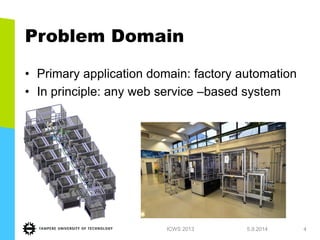
•Primary application domain: factory automation 
•In principle: any web service –based system
Research Goal Summary 
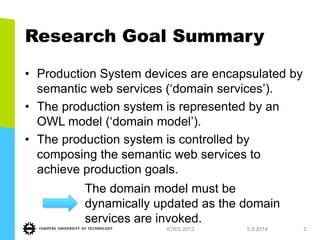
•Production System devices are encapsulated by semantic web services (‘domain services’). 
•The production system is represented by an OWL model (‘domain model’). 
•The production system is controlled by composing the semantic web services to achieve production goals. 
1.7.2013 
ICWS 2013 
5 
The domain model must be dynamically updated as the domain services are invoked.
General Event-based Domain Model Update Pattern 
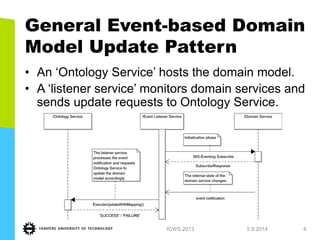
•An ‘Ontology Service’ hosts the domain model. 
•A ‘listener service’ monitors domain services and sends update requests to Ontology Service. 
1.7.2013 
ICWS 2013 
6
Dynamic Domain Model Update Approaches 
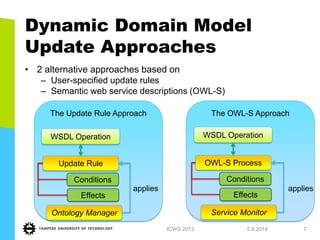
•2 alternative approaches based on 
–User-specified update rules 
–Semantic web service descriptions (OWL-S) 
1.7.2013 
ICWS 2013 
7 
The Update Rule Approach 
The OWL-S Approach 
OWL-S Process 
Conditions 
Effects 
WSDL Operation 
WSDL Operation 
Update Rule 
Conditions 
Effects 
Ontology Manager 
Service Monitor 
applies 
applies
Application Example Domain 
1.7.2013 
ICWS 2013 
8 
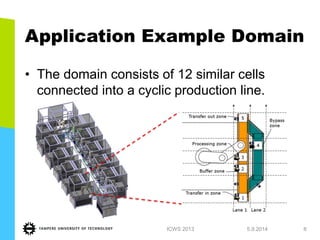
•The domain consists of 12 similar cells connected into a cyclic production line.
Application Example Web Services 
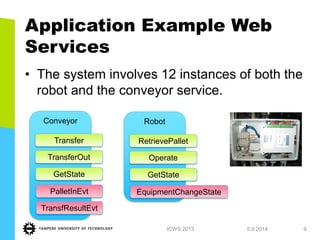
•The system involves 12 instances of both the robot and the conveyor service. 
1.7.2013 
ICWS 2013 
9 
Conveyor 
Transfer 
TransferOut 
GetState 
PalletInEvt 
TransfResultEvt 
Robot 
RetrievePallet 
Operate 
GetState 
EquipmentChangeState
Application Example, Service Invocation Scenario 
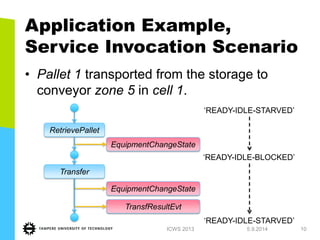
•Pallet 1 transported from the storage to conveyor zone 5 in cell 1. 
1.7.2013 
ICWS 2013 
10 
RetrievePallet 
Transfer 
EquipmentChangeState 
TransfResultEvt 
‘READY-IDLE-STARVED’ 
‘READY-IDLE-BLOCKED’ 
‘READY-IDLE-STARVED’
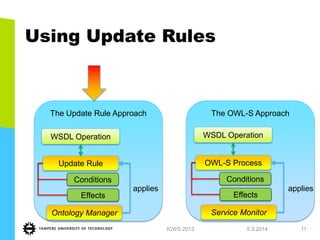
Using Update Rules 
1.7.2013 
ICWS 2013 
11 
The Update Rule Approach 
The OWL-S Approach 
OWL-S Process 
Conditions 
Effects 
WSDL Operation 
WSDL Operation 
Update Rule 
Conditions 
Effects 
Ontology Manager 
Service Monitor 
applies 
applies
Application Example, Using Update Rules 
1.7.2013 
ICWS 2013 
12 
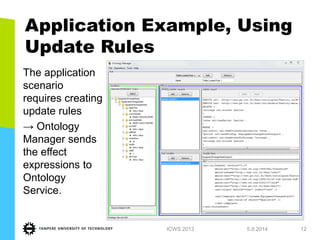
The application scenario requires creating update rules 
→ Ontology Manager sends the effect expressions to Ontology Service.
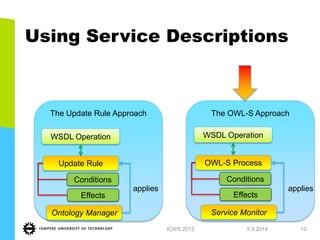
Using Service Descriptions 
1.7.2013 
ICWS 2013 
13 
The Update Rule Approach 
The OWL-S Approach 
OWL-S Process 
Conditions 
Effects 
WSDL Operation 
WSDL Operation 
Update Rule 
Conditions 
Effects 
Ontology Manager 
Service Monitor 
applies 
applies
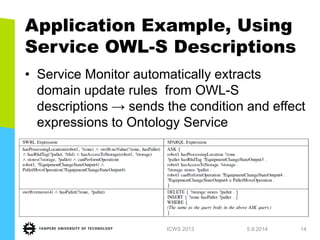
Application Example, Using Service OWL-S Descriptions 
•Service Monitor automatically extracts domain update rules from OWL-S descriptions → sends the condition and effect expressions to Ontology Service 
1.7.2013 
ICWS 2013 
14
Recap 
1.7.2013 
ICWS 2013 
15 
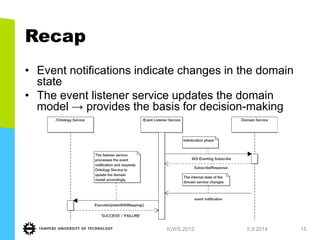
•Event notifications indicate changes in the domain state 
•The event listener service updates the domain model → provides the basis for decision-making
Conclusions 
•User-specified rules are 
–Laborious to specify but 
–Domain-independent 
•Using semantic web service descriptions 
–Is domain-dependent but 
–Can be fully automated 
•Further research challenges: 
–Semantic integration 
–Security and timing issues 
–Observing the initial domain state 
1.7.2013 
ICWS 2013 
16
Thank you! 
FAST @ YouTube FAST @ Facebook FAST @ Slideshare

Maintaining a Dynamic View of Semantic Web Services Representing Factory Automation Systems

  • 1.
    Maintaining a DynamicView of Semantic Web Services Representing Factory Automation Systems •Date: July, 2013 •Linked to: RTD at FAST Contact information Tampere University of Technology, FAST Laboratory, P.O. Box 600, FIN-33101 Tampere, Finland Email: fast@tut.fi www.tut.fi/fast Conference: ICWS 2013 IEEE 20th International Conference on Web Services Title of the paper: Maintaining a Dynamic View of Semantic Web Services Representing Factory Automation Systems Authors: Juha Puttonen Andrei Lobov, Dr.Sc. Prof. Jose L. Martinez Lastra, Dr.Sc. If you would like to receive a reprint of the original paper, please contact us
  • 2.
    Maintaining a DynamicView of Semantic Web Services Representing Factory Automation Systems ICWS 2013 IEEE 20th International Conference on Web Services Juha Puttonen Andrei Lobov Jose L. Martinez Lastra www.tut.fi/fast http://www.youtube.com/user/fastlaboratory
  • 3.
    Outline •Problem domain •Research goal summary •Dynamic domain model update approach •Application Example •Conclusions 1.7.2013 ICWS 2013 3
  • 4.
    Problem Domain 1.7.2013 ICWS 2013 4 •Primary application domain: factory automation •In principle: any web service –based system
  • 5.
    Research Goal Summary •Production System devices are encapsulated by semantic web services (‘domain services’). •The production system is represented by an OWL model (‘domain model’). •The production system is controlled by composing the semantic web services to achieve production goals. 1.7.2013 ICWS 2013 5 The domain model must be dynamically updated as the domain services are invoked.
  • 6.
    General Event-based DomainModel Update Pattern •An ‘Ontology Service’ hosts the domain model. •A ‘listener service’ monitors domain services and sends update requests to Ontology Service. 1.7.2013 ICWS 2013 6
  • 7.
    Dynamic Domain ModelUpdate Approaches •2 alternative approaches based on –User-specified update rules –Semantic web service descriptions (OWL-S) 1.7.2013 ICWS 2013 7 The Update Rule Approach The OWL-S Approach OWL-S Process Conditions Effects WSDL Operation WSDL Operation Update Rule Conditions Effects Ontology Manager Service Monitor applies applies
  • 8.
    Application Example Domain 1.7.2013 ICWS 2013 8 •The domain consists of 12 similar cells connected into a cyclic production line.
  • 9.
    Application Example WebServices •The system involves 12 instances of both the robot and the conveyor service. 1.7.2013 ICWS 2013 9 Conveyor Transfer TransferOut GetState PalletInEvt TransfResultEvt Robot RetrievePallet Operate GetState EquipmentChangeState
  • 10.
    Application Example, ServiceInvocation Scenario •Pallet 1 transported from the storage to conveyor zone 5 in cell 1. 1.7.2013 ICWS 2013 10 RetrievePallet Transfer EquipmentChangeState EquipmentChangeState TransfResultEvt ‘READY-IDLE-STARVED’ ‘READY-IDLE-BLOCKED’ ‘READY-IDLE-STARVED’
  • 11.
    Using Update Rules 1.7.2013 ICWS 2013 11 The Update Rule Approach The OWL-S Approach OWL-S Process Conditions Effects WSDL Operation WSDL Operation Update Rule Conditions Effects Ontology Manager Service Monitor applies applies
  • 12.
    Application Example, UsingUpdate Rules 1.7.2013 ICWS 2013 12 The application scenario requires creating update rules → Ontology Manager sends the effect expressions to Ontology Service.
  • 13.
    Using Service Descriptions 1.7.2013 ICWS 2013 13 The Update Rule Approach The OWL-S Approach OWL-S Process Conditions Effects WSDL Operation WSDL Operation Update Rule Conditions Effects Ontology Manager Service Monitor applies applies
  • 14.
    Application Example, UsingService OWL-S Descriptions •Service Monitor automatically extracts domain update rules from OWL-S descriptions → sends the condition and effect expressions to Ontology Service 1.7.2013 ICWS 2013 14
  • 15.
    Recap 1.7.2013 ICWS2013 15 •Event notifications indicate changes in the domain state •The event listener service updates the domain model → provides the basis for decision-making
  • 16.
    Conclusions •User-specified rulesare –Laborious to specify but –Domain-independent •Using semantic web service descriptions –Is domain-dependent but –Can be fully automated •Further research challenges: –Semantic integration –Security and timing issues –Observing the initial domain state 1.7.2013 ICWS 2013 16
  • 17.
    Thank you! FAST@ YouTube FAST @ Facebook FAST @ Slideshare