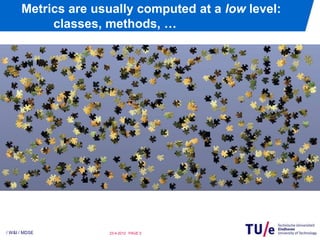
Metrics are usually computed at a low level:
           classes, methods, …


/ W&I / MDSE        23-4-2012 PAGE 0
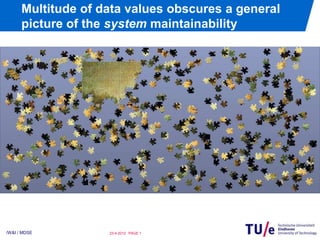
Multitude of data values obscures a general
      picture of the system maintainability


/W&I / MDSE         23-4-2012 PAGE 1
That we are actually interested in!


/W&I / MDSE          23-4-2012 PAGE 2
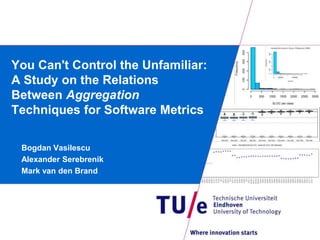
You Can't Control the Unfamiliar:
A Study on the Relations
Between Aggregation
Techniques for Software Metrics

 Bogdan Vasilescu
 Alexander Serebrenik
 Mark van den Brand
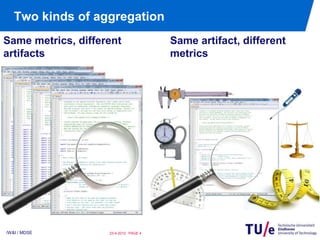
Two kinds of aggregation
Same metrics, different                Same artifact, different
artifacts                              metrics


/W&I / MDSE         23-4-2012 PAGE 4
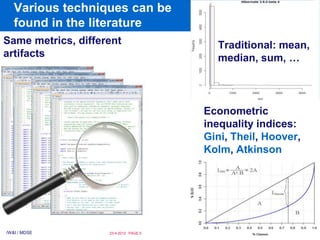
Various techniques can be
   found in the literature
Same metrics, different                  Traditional: mean,
artifacts                                median, sum, …


                                       Econometric
                                       inequality indices:
                                       Gini, Theil, Hoover,
                                       Kolm, Atkinson


/W&I / MDSE         23-4-2012 PAGE 5
Various techniques can be
   found in the literature
Same metrics, different                  Traditional: mean,
artifacts                                median, sum, …

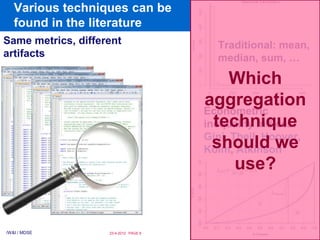
                                            Which
                                       aggregation
                                       Econometric
                                         technique
                                       inequality indices:
                                       Gini, Theil, Hoover,
                                         should we
                                       Kolm, Atkinson
                                              use?


/W&I / MDSE         23-4-2012 PAGE 6
Questions

      1. Which and to what extent do the different
         aggregation techniques agree?

      2. What is the nature of the relation between the
         various aggregation techniques?

      3. How does the correlation coefficient change as the
         systems evolve?


/W&I / MDSE            23-4-2012 PAGE 7
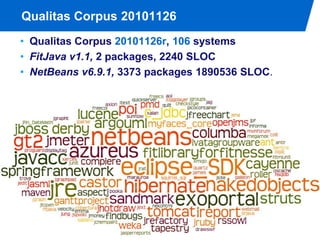
Qualitas Corpus 20101126
     • Qualitas Corpus 20101126r, 106 systems
     • FitJava v1.1, 2 packages, 2240 SLOC
     • NetBeans v6.9.1, 3373 packages 1890536 SLOC.


/W&I / MDSE          23-4-2012 PAGE 8
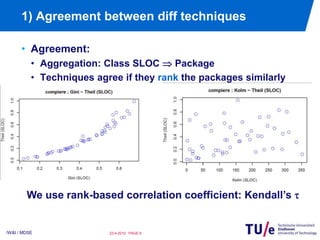
1) Agreement between diff techniques

      • Agreement:
          • Aggregation: Class SLOC  Package
          • Techniques agree if they rank the packages similarly


        We use rank-based correlation coefficient: Kendall’s 


/W&I / MDSE               23-4-2012 PAGE 9
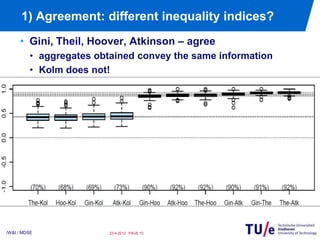
1) Agreement: different inequality indices?
     • Gini, Theil, Hoover, Atkinson – agree
         • aggregates obtained convey the same information
         • Kolm does not!


/W&I / MDSE              23-4-2012 PAGE 10
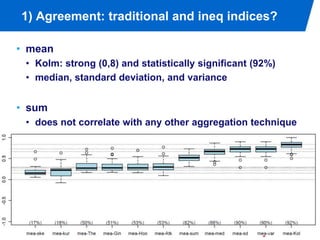
1) Agreement: traditional and ineq indices?

    • mean
        • Kolm: strong (0,8) and statistically significant (92%)
        • median, standard deviation, and variance


    • sum
        • does not correlate with any other aggregation technique


/W&I / MDSE               23-4-2012 PAGE 11
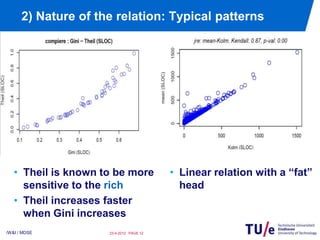
2) Nature of the relation: Typical patterns


   • Theil is known to be more           • Linear relation with a “fat”
     sensitive to the rich                 head
   • Theil increases faster
     when Gini increases
/W&I / MDSE          23-4-2012 PAGE 12
Which aggregation technique? (1)

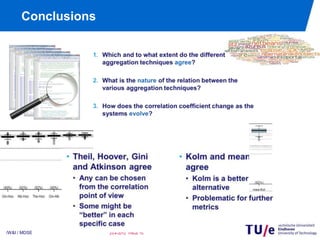
      • Theil, Hoover, Gini and Atkinson agree
          • Any can be chosen from the correlation point of view


      • Some might be “better” in each specific case
          • easy to interpret: Gini  [0,1]
          • provide additional insights: Theil (explanation)
          • negative values: Gini, Hoover
               − affects the domain!
          • sensitive for high values: Theil, Atkinson
          • deviations from uniformity: Gini, Hoover


/ W&I / MDSE                  23-4-2012 PAGE 13
Which aggregation technique? (2)

      • Kolm and mean agree
          • Kolm is reliable for skewed distributions
            − better alternative (“by no means”)
          • Not in the paper:
            − agreement observed for NOC
            − but not for DIT!


/ W&I / MDSE               23-4-2012 PAGE 14
Conclusions


/W&I / MDSE         23-4-2012 PAGE 15

ICSM 2011

  • 1.
    Metrics are usuallycomputed at a low level: classes, methods, … / W&I / MDSE 23-4-2012 PAGE 0
  • 2.
    Multitude of datavalues obscures a general picture of the system maintainability /W&I / MDSE 23-4-2012 PAGE 1
  • 3.
    That we areactually interested in! /W&I / MDSE 23-4-2012 PAGE 2
  • 4.
    You Can't Controlthe Unfamiliar: A Study on the Relations Between Aggregation Techniques for Software Metrics Bogdan Vasilescu Alexander Serebrenik Mark van den Brand
  • 5.
    Two kinds ofaggregation Same metrics, different Same artifact, different artifacts metrics /W&I / MDSE 23-4-2012 PAGE 4
  • 6.
    Various techniques canbe found in the literature Same metrics, different Traditional: mean, artifacts median, sum, … Econometric inequality indices: Gini, Theil, Hoover, Kolm, Atkinson /W&I / MDSE 23-4-2012 PAGE 5
  • 7.
    Various techniques canbe found in the literature Same metrics, different Traditional: mean, artifacts median, sum, … Which aggregation Econometric technique inequality indices: Gini, Theil, Hoover, should we Kolm, Atkinson use? /W&I / MDSE 23-4-2012 PAGE 6
  • 8.
    Questions 1. Which and to what extent do the different aggregation techniques agree? 2. What is the nature of the relation between the various aggregation techniques? 3. How does the correlation coefficient change as the systems evolve? /W&I / MDSE 23-4-2012 PAGE 7
  • 9.
    Qualitas Corpus 20101126 • Qualitas Corpus 20101126r, 106 systems • FitJava v1.1, 2 packages, 2240 SLOC • NetBeans v6.9.1, 3373 packages 1890536 SLOC. /W&I / MDSE 23-4-2012 PAGE 8
  • 10.
    1) Agreement betweendiff techniques • Agreement: • Aggregation: Class SLOC  Package • Techniques agree if they rank the packages similarly We use rank-based correlation coefficient: Kendall’s  /W&I / MDSE 23-4-2012 PAGE 9
  • 11.
    1) Agreement: differentinequality indices? • Gini, Theil, Hoover, Atkinson – agree • aggregates obtained convey the same information • Kolm does not! /W&I / MDSE 23-4-2012 PAGE 10
  • 12.
    1) Agreement: traditionaland ineq indices? • mean • Kolm: strong (0,8) and statistically significant (92%) • median, standard deviation, and variance • sum • does not correlate with any other aggregation technique /W&I / MDSE 23-4-2012 PAGE 11
  • 13.
    2) Nature ofthe relation: Typical patterns • Theil is known to be more • Linear relation with a “fat” sensitive to the rich head • Theil increases faster when Gini increases /W&I / MDSE 23-4-2012 PAGE 12
  • 14.
    Which aggregation technique?(1) • Theil, Hoover, Gini and Atkinson agree • Any can be chosen from the correlation point of view • Some might be “better” in each specific case • easy to interpret: Gini  [0,1] • provide additional insights: Theil (explanation) • negative values: Gini, Hoover − affects the domain! • sensitive for high values: Theil, Atkinson • deviations from uniformity: Gini, Hoover / W&I / MDSE 23-4-2012 PAGE 13
  • 15.
    Which aggregation technique?(2) • Kolm and mean agree • Kolm is reliable for skewed distributions − better alternative (“by no means”) • Not in the paper: − agreement observed for NOC − but not for DIT! / W&I / MDSE 23-4-2012 PAGE 14
  • 16.
    Conclusions /W&I / MDSE 23-4-2012 PAGE 15

Editor's Notes

  • #6 Red line – mean, blue line – medianFurther approaches: distribution fitting, quality models (SIG, SQUALE)
  • #7 Red line – mean, blue line – medianFurther approaches: distribution fitting, quality models (SIG, SQUALE)
  • #11 % of the systems with statistically significant correlation between the corresponding indices at the 0.05 levelKendall correlation (rank based)