Implantation of sapphire by Zr and Zr plus O:
threshold fluence for amorphization and optical properties
   Younes Sina a, Peter D. Townsend b, Carl J. McHargue a,c, Edvardo Jorge da Costa Alves d


(a) Materials Science and Engineering Department, University of Tennessee, Knoxville, TN 37996
(b) University of Sussex, Brighton, BN1 9QH, United Kingdom
(c) Center for Materials Processing, University of Tennessee, Knoxville, TN 37996-0750
(d) Instituto Tecnológico e Nuclear (ITN) Ion Beam Laboratory, Sacavém, Portugal
Background

Important factors for amorphization during ion implantation:

 Sample temperature
 Ion mass
 Ion energy
 Fluence
 Ionicity degree
 Chemical effect
 Thermodynamic stability
 Topology of the atomic scale structure
 Physical properties
 Ease of glass formation
Background
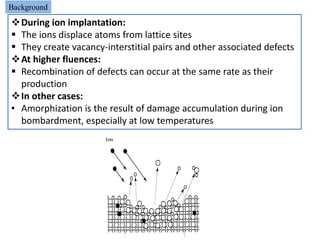
During ion implantation:
 The ions displace atoms from lattice sites
 They create vacancy-interstitial pairs and other associated defects
At higher fluences:
 Recombination of defects can occur at the same rate as their
  production
In other cases:
• Amorphization is the result of damage accumulation during ion
  bombardment, especially at low temperatures
Background


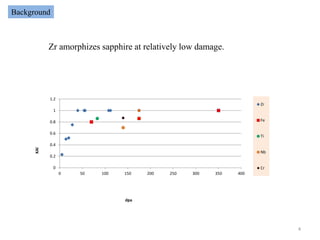
            Zr amorphizes sapphire at relatively low damage.


            1.2
                                                                     Zr
             1

            0.8                                                      Fe

            0.6
                                                                     Ti
            0.4
      ΧAl


                                                                     Nb
            0.2

             0                                                       Cr
                  0   50   100   150   200   250   300   350   400


                                 dpa


                                                                          4
Buried amorphous layer suggest
                                            concentration of Zr may be
                                            controlling factor


                                            E= 175 keV
                                            Φ= 4E16 Zr+/cm2
      120                                                          9
                                                                   8
      100
                                                                   7
                                                                   6
      80
                                                                   5
dpa   60                                                           4    Zr%
                                                                   3
      40
                                                                   2
                                                                   1
      20
                                                                   0
       0                                                           -1
            0   500   1000        1500   2000       2500       3000

                                                                        5
                      Depth [Å]
I. Sample Preparation
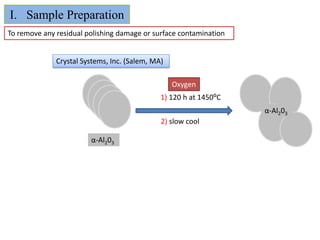
To remove any residual polishing damage or surface contamination


              Crystal Systems, Inc. (Salem, MA)

                                                  Oxygen
                                              1) 120 h at 1450⁰C
                                                                   α-Al203
                                              2) slow cool

                        α-Al203
I.   Sample Irradiation
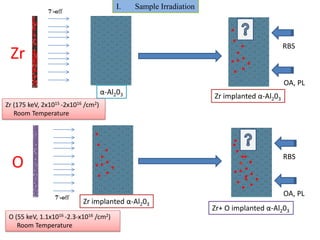
             7◦-off


                                                                                         RBS
 Zr
                                                                                         OA, PL
                                   α-Al203
                                                                  Zr implanted α-Al203
          2x10¹⁵ -2x10¹⁶
Zr (175 keV,               /cm2)
   Room Temperature


                                                                                         RBS
 O
               7◦-off
                                                                                         OA, PL
                           Zr implanted α-Al203
                                                                  Zr+ O implanted α-Al203
O (55 keV,1.1x1016 -2.3-x1016   /cm2)
   Room Temperature
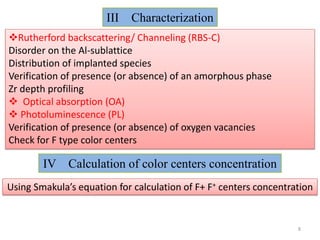
III   Characterization
Rutherford backscattering/ Channeling (RBS-C)
Disorder on the Al-sublattice
Distribution of implanted species
Verification of presence (or absence) of an amorphous phase
Zr depth profiling
 Optical absorption (OA)
 Photoluminescence (PL)
Verification of presence (or absence) of oxygen vacancies
Check for F type color centers

        IV Calculation of color centers concentration
Using Smakula’s equation for calculation of F+ F+ centers concentration


                                                                   8
Results and discussion

1) Threshold fluence of amorphization
2) Effect of oxygen implantation on pre-Zr- implanted samples
3) Optical properties of the irradiated samples with Zr and Zr+ O
4) Calculating of true absorption coefficient of the induced bands
5) Concentration of F centres using Smakula’s equation
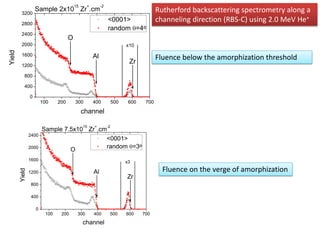
15     +        -2
                    Sample 2x10 Zr .cm                                                 Rutherford backscattering spectrometry along a
         3200

         2800
                                                              <0001>                   channeling direction (RBS-C) using 2.0 MeV He+
                                                              random =4º
         2400
                                     O
         2000                                                            x10
Yield


         1600                                       Al                                 Fluence below the amorphization threshold
                                                                          Zr
         1200

           800

           400

                0
                        100    200       300        400            500    600    700

                                              channel

                                              15    +         -2
                        Sample 7.5x10 Zr .cm
                2400
                                                              <0001>
                2000                                          random =3º
                                      O
                1600                                                     x3
                                                                                         Fluence on the verge of amorphization
        Yield


                1200                                Al
                                                                         Zr
                800

                400

                    0
                         100    200       300       400        500       600    700

                                              channel
16
               Sample 1.5x10 Zr .cm
                                      +     -2                           Rutherford backscattering spectrometry along a
        2000
                                                                         channeling direction (RBS-C) using 2.0 MeV He+
                                                       <0001>
        1600
                            O                          random

        1200
                                      Al
Yield


                                                                         Zr fluence just above amorphization threshold
        800                                             Zr

        400


          0
                100   200       300   400        500    600     700
                                 channel                                                                    175 keV
                                                                    45                                                                3.5

                                                                    40                                 Φ=1.5×10¹⁶                     3
                                                                    35
                                                                                                        dpa @ E=175keV,               2.5
                                                                    30                                  Φ=1.5E16
                                                   40 dpa
                                                                    25                                                                2
                                                              dpa


                                                                                                                                            Zr%
                                                                    20                                                                1.5
                                                                    15
                                                                                                                                      1
                                                                    10
                                                                                                                                      0.5
                                                                     5

                                                                     0                                                                0
                                                                         0     50       100           150       200       250   300
                                                                                              Depth [nm]

                                                                                    40 nm
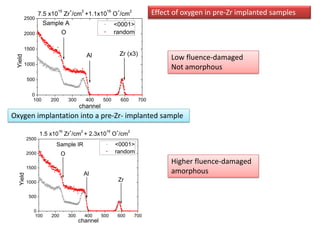
15      +      2
                 7.5 x10 Zr /cm +1.1x10 O /cm
                                                  16    +         2
                                                                             Effect of oxygen in pre-Zr implanted samples
         2500
                  Sample A                             <0001>
         2000          O                               random

         1500
                                          Al               Zr (x3)
                                                                                   Low fluence-damaged
 Yield


         1000
                                                                                   Not amorphous
          500


            0
            100     200        300        400   500         600        700
                                     channel
Oxygen implantation into a pre-Zr- implanted sample
                       16      +     2            16   +      2
                 1.5 x10 Zr /cm + 2.3x10 O /cm
          2500
                      Sample IR                        <0001>
          2000             O                           random
                                                                                   Higher fluence-damaged
          1500
                                         Al                                        amorphous
  Yield


          1000                                          Zr

          500


            0
            100      200       300        400   500     600           700
                                     channel
1800
        1600                         2E15 Aligned

        1400                         7.5E15 Aligned
        1200
                                     1.5E16 Zr+/cm2 Aligned
        1000
Yield


         800
         600
         400
         200
                                                                       By increasing Zr fluence damage in Al and
           0                                                           O- sublattices increase
               300   800 Energy [keV] 1300                    1800


        1800

        1600         ----     1.5E16 Zr+/cm2 & 2.3E16 O+/cm2 Aligned

        1400

        1200
                     ----     7.5E15 Zr+/cm@ & 1.1E16 O+/cm2 Aligned


        1000
Yield


        800
                                                                       By implantation of O in pre-implanted Zr
        600
                                                                       samples, damage in Al sublattice
        400
                                                                       increases and in O sublattice decreases
        200

          0
               300    800                  1300                1800
                            Energy [keV]
Zr distribution              2) Effect of oxygen implantation on pre-Zr- implanted samples

                       400
                                                                     7.5E15 Zr+/cm2 Random
                                               b
                       350                                           1.5E16 Zr+/cm2 Random

                                                                     7.5E15 Zr+/cm2 & 1.1E16 O+/cm2 Random
                       300

                                                                     1.5E16 Zr+/cm2 & 2.3 E16 O+/cm2 Random
                       250
               Yield


                       200
                                                   a
                       150


                       100


                        50


                         0
                          1500   1550   1600       1650       1700   1750    1800
                                               Energy [keV]


   Zirconium profiles in sapphire implanted with oxygen subsequent to implantation with
   Zr: (a) below and (b) at the threshold for amorphization.

   The subsequent implantation of oxygen produces a slight broadening of the zirconium
   distribution, probably due to collisional mixing
Optical properties of the irradiated samples with Zr and Zr+ O

                                                                F+F+
                                     1
                                                                           1.5E16 Zr+/cm2 & 2.3E16 O+/cm2 , RT
                                    0.9
                                                                           2E16 Zr+/cm2 , RT
                                    0.8
          Intensity [Arbit. Unit]


                                    0.7                                    1.5E16 Zr+/cm2 ,RT

                                    0.6
                                                  F+                       7.5E15 Zr+/cm2 & 1.1E16 O+/cm2 , RT

                                    0.5                                    2E16 Zr+/cm2 & 4E16 O+/cm2 , RT
                                    0.4
                                                                           7.5E15 Zr+/cm2 , RT
                                    0.3

                                    0.2

                                    0.1

                                     0
                                          3   4        5         6     7
                                                  Energy [eV]


Optical absorption spectra with the absorption from a virgin crystal subtracted
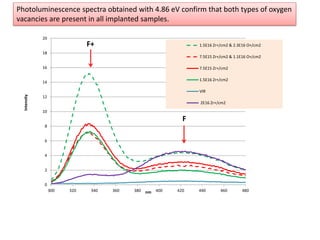
Photoluminescence spectra obtained with 4.86 eV confirm that both types of oxygen
vacancies are present in all implanted samples.

              20
                               F+                                1.5E16 Zr+/cm2 & 2.3E16 O+/cm2
              18
                                                                 7.5E15 Zr+/cm2 & 1.1E16 O+/cm2

              16                                                 7.5E15 Zr+/cm2

                                                                 1.5E16 Zr+/cm2
              14

                                                                 VIR
  Intensity


              12
                                                                 2E16 Zr+/cm2
              10
                                                             F
               8


               6


               4


               2


               0
                   300   320    340   360   380 nm   400   420   440       460       480
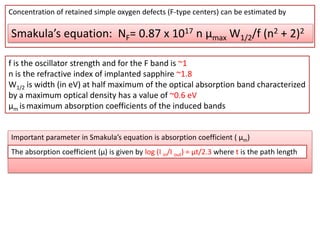
Concentration of retained simple oxygen defects (F-type centers) can be estimated by

Smakula’s equation: NF= 0.87 x 10¹⁷ n µmax W1/2/f (n2 + 2)2

f is the oscillator strength and for the F band is ~1
n is the refractive index of implanted sapphire ~1.8
W1/2 is width (in eV) at half maximum of the optical absorption band characterized
by a maximum optical density has a value of ~0.6 eV
µm is maximum absorption coefficients of the induced bands


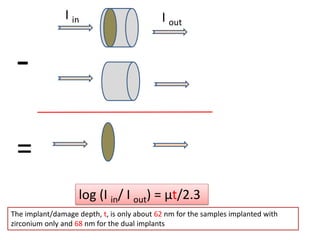
Important parameter in Smakula’s equation is absorption coefficient ( µm)
The absorption coefficient (µ) is given by log (I in/I out) = µt/2.3 where t is the path length
Calculated oxygen vacancy profiles produced by Zr and O irradiation in sapphire
                                 1.2

                                                        7.5E15 Zr
                                  1                     1.1E16 O
         Number/(Angstrom-Ion)
                                 0.8


                                                             O Vacancies after Zr
                                 0.6

                                                             O Vacancies after O
                                 0.4


                                 0.2


                                  0
                                       0   500   1000           1500           2000   2500


                                                 Depth [A]


The implant/damage depth, t, is only about 62 nm for the samples implanted with
zirconium only and 68 nm for the dual implants
      Number of O vacancies/Cm3 = [Number/Å × Ions].[Ions]. [Å/Cm3]
I in                        I out


 -
 =
                    log (I in/ I out) = µt/2.3
The implant/damage depth, t, is only about 62 nm for the samples implanted with
zirconium only and 68 nm for the dual implants
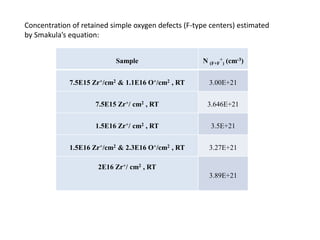
Concentration of retained simple oxygen defects (F-type centers) estimated
by Smakula’s equation:


                           Sample                    N (F+F+) (cm-3)


             7.5E15 Zr+/cm2 & 1.1E16 O+/cm2 , RT       3.00E+21


                     7.5E15 Zr+/ cm2 , RT              3.646E+21


                     1.5E16 Zr+/ cm2 , RT               3.5E+21


             1.5E16 Zr+/cm2 & 2.3E16 O+/cm2 , RT       3.27E+21

                      2E16 Zr+/ cm2 , RT
                                                       3.89E+21
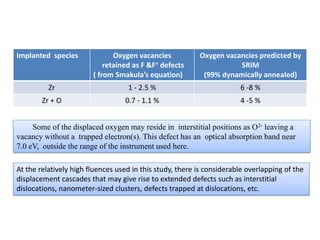
Implanted species              Oxygen vacancies           Oxygen vacancies predicted by
                            retained as F &F+ defects                SRIM
                        ( from Smakula’s equation)         (99% dynamically annealed)
          Zr                       1 - 2.5 %                           6 -8 %
        Zr + O                    0.7 - 1.1 %                          4 -5 %


     Some of the displaced oxygen may reside in interstitial positions as O2- leaving a
vacancy without a trapped electron(s). This defect has an optical absorption band near
7.0 eV, outside the range of the instrument used here.

At the relatively high fluences used in this study, there is considerable overlapping of the
displacement cascades that may give rise to extended defects such as interstitial
dislocations, nanometer-sized clusters, defects trapped at dislocations, etc.
Conclusion

1. Threshold fluence of 175 keV Zr is approximately 1.5×10¹⁶
   Zr+/cm2.

2. Subsequent implantation of oxygen produces slight
   broadening of damage region of low fluence and no
   apparent effect at fluence above amorphization threshold.

3. Number of oxygen vacancies retained as F and F+ centers is
   very low.

4. Implantation of oxygen in pre implanted samples reduced
   the number of F and F+ centers.
Thank you
These slides were prepared for an oral presentation for ICDIM 2012 Santa Fe, NM ( June 24-29/2012)
http://icdim.newmexicoconsortium.org/conference-agenda-clickable

ICDIM 2012 presentation

  • 1.
    Implantation of sapphireby Zr and Zr plus O: threshold fluence for amorphization and optical properties Younes Sina a, Peter D. Townsend b, Carl J. McHargue a,c, Edvardo Jorge da Costa Alves d (a) Materials Science and Engineering Department, University of Tennessee, Knoxville, TN 37996 (b) University of Sussex, Brighton, BN1 9QH, United Kingdom (c) Center for Materials Processing, University of Tennessee, Knoxville, TN 37996-0750 (d) Instituto Tecnológico e Nuclear (ITN) Ion Beam Laboratory, Sacavém, Portugal
  • 2.
    Background Important factors foramorphization during ion implantation:  Sample temperature  Ion mass  Ion energy  Fluence  Ionicity degree  Chemical effect  Thermodynamic stability  Topology of the atomic scale structure  Physical properties  Ease of glass formation
  • 3.
    Background During ion implantation: The ions displace atoms from lattice sites  They create vacancy-interstitial pairs and other associated defects At higher fluences:  Recombination of defects can occur at the same rate as their production In other cases: • Amorphization is the result of damage accumulation during ion bombardment, especially at low temperatures
  • 4.
    Background Zr amorphizes sapphire at relatively low damage. 1.2 Zr 1 0.8 Fe 0.6 Ti 0.4 ΧAl Nb 0.2 0 Cr 0 50 100 150 200 250 300 350 400 dpa 4
  • 5.
    Buried amorphous layersuggest concentration of Zr may be controlling factor E= 175 keV Φ= 4E16 Zr+/cm2 120 9 8 100 7 6 80 5 dpa 60 4 Zr% 3 40 2 1 20 0 0 -1 0 500 1000 1500 2000 2500 3000 5 Depth [Å]
  • 6.
    I. Sample Preparation Toremove any residual polishing damage or surface contamination Crystal Systems, Inc. (Salem, MA) Oxygen 1) 120 h at 1450⁰C α-Al203 2) slow cool α-Al203
  • 7.
    I. Sample Irradiation 7◦-off RBS Zr OA, PL α-Al203 Zr implanted α-Al203 2x10¹⁵ -2x10¹⁶ Zr (175 keV, /cm2) Room Temperature RBS O 7◦-off OA, PL Zr implanted α-Al203 Zr+ O implanted α-Al203 O (55 keV,1.1x1016 -2.3-x1016 /cm2) Room Temperature
  • 8.
    III Characterization Rutherford backscattering/ Channeling (RBS-C) Disorder on the Al-sublattice Distribution of implanted species Verification of presence (or absence) of an amorphous phase Zr depth profiling  Optical absorption (OA)  Photoluminescence (PL) Verification of presence (or absence) of oxygen vacancies Check for F type color centers IV Calculation of color centers concentration Using Smakula’s equation for calculation of F+ F+ centers concentration 8
  • 9.
    Results and discussion 1)Threshold fluence of amorphization 2) Effect of oxygen implantation on pre-Zr- implanted samples 3) Optical properties of the irradiated samples with Zr and Zr+ O 4) Calculating of true absorption coefficient of the induced bands 5) Concentration of F centres using Smakula’s equation
  • 10.
    15 + -2 Sample 2x10 Zr .cm Rutherford backscattering spectrometry along a 3200 2800 <0001> channeling direction (RBS-C) using 2.0 MeV He+ random =4º 2400 O 2000 x10 Yield 1600 Al Fluence below the amorphization threshold Zr 1200 800 400 0 100 200 300 400 500 600 700 channel 15 + -2 Sample 7.5x10 Zr .cm 2400 <0001> 2000 random =3º O 1600 x3 Fluence on the verge of amorphization Yield 1200 Al Zr 800 400 0 100 200 300 400 500 600 700 channel
  • 11.
    16 Sample 1.5x10 Zr .cm + -2 Rutherford backscattering spectrometry along a 2000 channeling direction (RBS-C) using 2.0 MeV He+ <0001> 1600 O random 1200 Al Yield Zr fluence just above amorphization threshold 800 Zr 400 0 100 200 300 400 500 600 700 channel 175 keV 45 3.5 40 Φ=1.5×10¹⁶ 3 35 dpa @ E=175keV, 2.5 30 Φ=1.5E16 40 dpa 25 2 dpa Zr% 20 1.5 15 1 10 0.5 5 0 0 0 50 100 150 200 250 300 Depth [nm] 40 nm
  • 12.
    15 + 2 7.5 x10 Zr /cm +1.1x10 O /cm 16 + 2 Effect of oxygen in pre-Zr implanted samples 2500 Sample A <0001> 2000 O random 1500 Al Zr (x3) Low fluence-damaged Yield 1000 Not amorphous 500 0 100 200 300 400 500 600 700 channel Oxygen implantation into a pre-Zr- implanted sample 16 + 2 16 + 2 1.5 x10 Zr /cm + 2.3x10 O /cm 2500 Sample IR <0001> 2000 O random Higher fluence-damaged 1500 Al amorphous Yield 1000 Zr 500 0 100 200 300 400 500 600 700 channel
  • 13.
    1800 1600 2E15 Aligned 1400 7.5E15 Aligned 1200 1.5E16 Zr+/cm2 Aligned 1000 Yield 800 600 400 200 By increasing Zr fluence damage in Al and 0 O- sublattices increase 300 800 Energy [keV] 1300 1800 1800 1600 ---- 1.5E16 Zr+/cm2 & 2.3E16 O+/cm2 Aligned 1400 1200 ---- 7.5E15 Zr+/cm@ & 1.1E16 O+/cm2 Aligned 1000 Yield 800 By implantation of O in pre-implanted Zr 600 samples, damage in Al sublattice 400 increases and in O sublattice decreases 200 0 300 800 1300 1800 Energy [keV]
  • 14.
    Zr distribution 2) Effect of oxygen implantation on pre-Zr- implanted samples 400 7.5E15 Zr+/cm2 Random b 350 1.5E16 Zr+/cm2 Random 7.5E15 Zr+/cm2 & 1.1E16 O+/cm2 Random 300 1.5E16 Zr+/cm2 & 2.3 E16 O+/cm2 Random 250 Yield 200 a 150 100 50 0 1500 1550 1600 1650 1700 1750 1800 Energy [keV] Zirconium profiles in sapphire implanted with oxygen subsequent to implantation with Zr: (a) below and (b) at the threshold for amorphization. The subsequent implantation of oxygen produces a slight broadening of the zirconium distribution, probably due to collisional mixing
  • 15.
    Optical properties ofthe irradiated samples with Zr and Zr+ O F+F+ 1 1.5E16 Zr+/cm2 & 2.3E16 O+/cm2 , RT 0.9 2E16 Zr+/cm2 , RT 0.8 Intensity [Arbit. Unit] 0.7 1.5E16 Zr+/cm2 ,RT 0.6 F+ 7.5E15 Zr+/cm2 & 1.1E16 O+/cm2 , RT 0.5 2E16 Zr+/cm2 & 4E16 O+/cm2 , RT 0.4 7.5E15 Zr+/cm2 , RT 0.3 0.2 0.1 0 3 4 5 6 7 Energy [eV] Optical absorption spectra with the absorption from a virgin crystal subtracted
  • 16.
    Photoluminescence spectra obtainedwith 4.86 eV confirm that both types of oxygen vacancies are present in all implanted samples. 20 F+ 1.5E16 Zr+/cm2 & 2.3E16 O+/cm2 18 7.5E15 Zr+/cm2 & 1.1E16 O+/cm2 16 7.5E15 Zr+/cm2 1.5E16 Zr+/cm2 14 VIR Intensity 12 2E16 Zr+/cm2 10 F 8 6 4 2 0 300 320 340 360 380 nm 400 420 440 460 480
  • 17.
    Concentration of retainedsimple oxygen defects (F-type centers) can be estimated by Smakula’s equation: NF= 0.87 x 10¹⁷ n µmax W1/2/f (n2 + 2)2 f is the oscillator strength and for the F band is ~1 n is the refractive index of implanted sapphire ~1.8 W1/2 is width (in eV) at half maximum of the optical absorption band characterized by a maximum optical density has a value of ~0.6 eV µm is maximum absorption coefficients of the induced bands Important parameter in Smakula’s equation is absorption coefficient ( µm) The absorption coefficient (µ) is given by log (I in/I out) = µt/2.3 where t is the path length
  • 18.
    Calculated oxygen vacancyprofiles produced by Zr and O irradiation in sapphire 1.2 7.5E15 Zr 1 1.1E16 O Number/(Angstrom-Ion) 0.8 O Vacancies after Zr 0.6 O Vacancies after O 0.4 0.2 0 0 500 1000 1500 2000 2500 Depth [A] The implant/damage depth, t, is only about 62 nm for the samples implanted with zirconium only and 68 nm for the dual implants Number of O vacancies/Cm3 = [Number/Å × Ions].[Ions]. [Å/Cm3]
  • 19.
    I in I out - = log (I in/ I out) = µt/2.3 The implant/damage depth, t, is only about 62 nm for the samples implanted with zirconium only and 68 nm for the dual implants
  • 20.
    Concentration of retainedsimple oxygen defects (F-type centers) estimated by Smakula’s equation: Sample N (F+F+) (cm-3) 7.5E15 Zr+/cm2 & 1.1E16 O+/cm2 , RT 3.00E+21 7.5E15 Zr+/ cm2 , RT 3.646E+21 1.5E16 Zr+/ cm2 , RT 3.5E+21 1.5E16 Zr+/cm2 & 2.3E16 O+/cm2 , RT 3.27E+21 2E16 Zr+/ cm2 , RT 3.89E+21
  • 21.
    Implanted species Oxygen vacancies Oxygen vacancies predicted by retained as F &F+ defects SRIM ( from Smakula’s equation) (99% dynamically annealed) Zr 1 - 2.5 % 6 -8 % Zr + O 0.7 - 1.1 % 4 -5 % Some of the displaced oxygen may reside in interstitial positions as O2- leaving a vacancy without a trapped electron(s). This defect has an optical absorption band near 7.0 eV, outside the range of the instrument used here. At the relatively high fluences used in this study, there is considerable overlapping of the displacement cascades that may give rise to extended defects such as interstitial dislocations, nanometer-sized clusters, defects trapped at dislocations, etc.
  • 22.
    Conclusion 1. Threshold fluenceof 175 keV Zr is approximately 1.5×10¹⁶ Zr+/cm2. 2. Subsequent implantation of oxygen produces slight broadening of damage region of low fluence and no apparent effect at fluence above amorphization threshold. 3. Number of oxygen vacancies retained as F and F+ centers is very low. 4. Implantation of oxygen in pre implanted samples reduced the number of F and F+ centers.
  • 23.
    Thank you These slideswere prepared for an oral presentation for ICDIM 2012 Santa Fe, NM ( June 24-29/2012)
  • 24.