Engaging building users in energy reduction: the challenge of behaviour changeDr Richard BullInstitute of Energy & Sustainable Development
De Monfort UniversityWorld-class university situated in Leicester, with more than 18,000 students and 3,000 staff, five faculties offering around 400 courses and an annual turnover in the region: £132.5 millionInstitute of Energy and Sustainable DevelopmentLeading research institute conducting innovative and groundbreaking research into renewable energy, sustainable development and public engagement. Also run 3 MSc courses.
Three challengesThe visibility of energyWhose behaviour are we trying to change?The challenge of public engagement in the workplace
The visibility of energy
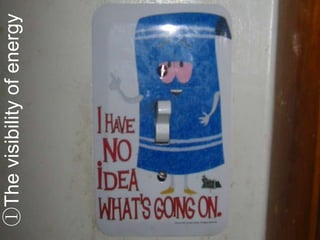
By its nature, ‘energy’ is an abstract and invisible force that is conceptualised or commonly defined in a number of different ways, for example as a commodity, as a social necessity, as an ecological resource, or as a strategic material.**Burgess & Nye (2008), Re-materialising energy use through transparent monitoring systems, Energy Policy
(2)Whose behaviour are we trying to change?
Cyber DisplayEnergy Cities represents more than 1000 local authorities from 30 countries, mainly municipalitiesThe Display Campaign is a voluntary scheme municipalities can adopt to demonstrate a commitment to reducing energy consumption of public buildings.A key part of the rationale for developing the energy display label was to motivate decision makers towards a common approach for European certification for energy performance of non-residential buildings, and engage municipal energy managers and the general public around the subject of energy and buildings. As a project partner, DMU was responsible for evaluating the success of the campaign
Display communication activitiesEducation/Training programmesCommunication ActivitiesInternal CommunicationLocal Energy CYBER Display DaysSchools ProgrammeLocal Press Articles and Media Relations;Local Communication MaterialsStaff Training Workshops
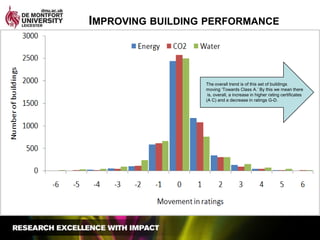
Improving building performanceThe overall trend is of this set of buildingsmoving ‘Towards Class A.’ By this we mean there is, overall, a increase in higher rating certificates(A C) and a decrease in ratings G-D.
Findings from Display®Display® lead to demonstrable increases in building performance and energy awareness. But . . . There is no one single measure or ‘quick-fix’ for moving buildings ‘Towards Class A’. The importance and success of Display® is in recognizing that the poster is merely a beginning of the journey ‘Towards Class A’.Buildings in Display® that improve . . . Invest in multiple refurbishments especially lighting controls and boiler replacement and avoid using air conditioning; Invest in new types of building controls especially heating controls; Have a full time energy manager and voluntary environmental champion;Organized local media campaigns and used creative promotional materials;Attended local and national networking events such as 'national users club event'
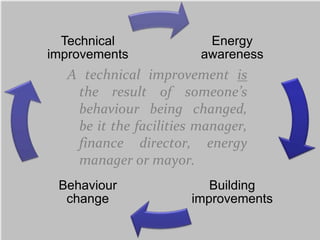
A technical improvement is the result of someone’s behaviour being changed, be it the facilities manager, finance director, energy manager or mayor.
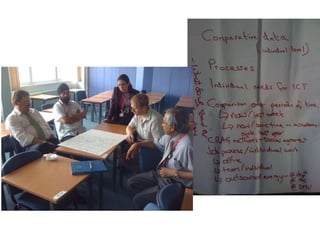
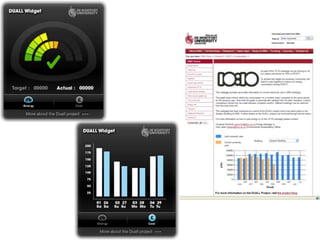
The challenge of public engagement in the workplace    the aim? To understand the role of ICT in reducing energy consumption of a large scale public building through the design of an ICT interface connecting building users to their electricity consumption.DUALL
Beyond information provisionThere is a need for a different approach recognising the complexity of user perceptions and understandings (Niemeyer, Petts et al. 2005);
Combining a bottom-up and top-down approach in order to minimise mixed messages (Owens 2000);
 The value of public engagement (Burgess and Clark 2009; Ockwell, Whitmarsh et al. 2009).
The importance of context.

Ibe presentation sept 2011

  • 1.
    Engaging building usersin energy reduction: the challenge of behaviour changeDr Richard BullInstitute of Energy & Sustainable Development
  • 2.
    De Monfort UniversityWorld-classuniversity situated in Leicester, with more than 18,000 students and 3,000 staff, five faculties offering around 400 courses and an annual turnover in the region: £132.5 millionInstitute of Energy and Sustainable DevelopmentLeading research institute conducting innovative and groundbreaking research into renewable energy, sustainable development and public engagement. Also run 3 MSc courses.
  • 3.
    Three challengesThe visibilityof energyWhose behaviour are we trying to change?The challenge of public engagement in the workplace
  • 4.
  • 5.
    By its nature,‘energy’ is an abstract and invisible force that is conceptualised or commonly defined in a number of different ways, for example as a commodity, as a social necessity, as an ecological resource, or as a strategic material.**Burgess & Nye (2008), Re-materialising energy use through transparent monitoring systems, Energy Policy
  • 7.
    (2)Whose behaviour arewe trying to change?
  • 8.
    Cyber DisplayEnergy Citiesrepresents more than 1000 local authorities from 30 countries, mainly municipalitiesThe Display Campaign is a voluntary scheme municipalities can adopt to demonstrate a commitment to reducing energy consumption of public buildings.A key part of the rationale for developing the energy display label was to motivate decision makers towards a common approach for European certification for energy performance of non-residential buildings, and engage municipal energy managers and the general public around the subject of energy and buildings. As a project partner, DMU was responsible for evaluating the success of the campaign
  • 9.
    Display communication activitiesEducation/TrainingprogrammesCommunication ActivitiesInternal CommunicationLocal Energy CYBER Display DaysSchools ProgrammeLocal Press Articles and Media Relations;Local Communication MaterialsStaff Training Workshops
  • 10.
    Improving building performanceTheoverall trend is of this set of buildingsmoving ‘Towards Class A.’ By this we mean there is, overall, a increase in higher rating certificates(A C) and a decrease in ratings G-D.
  • 11.
    Findings from Display®Display®lead to demonstrable increases in building performance and energy awareness. But . . . There is no one single measure or ‘quick-fix’ for moving buildings ‘Towards Class A’. The importance and success of Display® is in recognizing that the poster is merely a beginning of the journey ‘Towards Class A’.Buildings in Display® that improve . . . Invest in multiple refurbishments especially lighting controls and boiler replacement and avoid using air conditioning; Invest in new types of building controls especially heating controls; Have a full time energy manager and voluntary environmental champion;Organized local media campaigns and used creative promotional materials;Attended local and national networking events such as 'national users club event'
  • 12.
    A technical improvementis the result of someone’s behaviour being changed, be it the facilities manager, finance director, energy manager or mayor.
  • 13.
    The challenge ofpublic engagement in the workplace the aim? To understand the role of ICT in reducing energy consumption of a large scale public building through the design of an ICT interface connecting building users to their electricity consumption.DUALL
  • 14.
    Beyond information provisionThereis a need for a different approach recognising the complexity of user perceptions and understandings (Niemeyer, Petts et al. 2005);
  • 15.
    Combining a bottom-upand top-down approach in order to minimise mixed messages (Owens 2000);
  • 16.
    The valueof public engagement (Burgess and Clark 2009; Ockwell, Whitmarsh et al. 2009).
  • 17.

Editor's Notes

  • #2 Findings from three research projects (well 2,!)
  • #6 People don’t use energy, they see lighting, heating and the services ‘it’ provides.
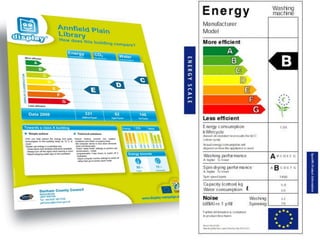
  • #7 Visualising energy is exactly what these certificates attempt to – both on white goods and buildingsBut is there a difference in audience?
  • #8 Whose behaviour are you trying to change?CitizensCouncillorsOfficersBusiness peopleChildrenBuilders
  • #10 Education/Training programmes - with building managers and administrators;Communication Activities - for at least three general events per year;Internal Communication – use of newsletters, intranet, CYBER Display ambassadors for the buildings, etc.;Local Energy CYBER Display Days - Organising a specific Local Energy CYBER Display Day per year – different activities, high media exposure;Schools Programme - detailed programme for education of teachers and learners;Local Press Articles and Media Relations;Local Communication Materials - Conception/production of local communication materials e.g. flyers, leaflets, banners, posters, stickers, etc.;Staff Training Workshops - Conception/production of local communication materials e.g. flyers, leaflets, banners, posters, stickers, etc.LINK BACK TO THEORY – engagement – participation - complexity
  • #11 Central to our analysis is whether or not buildings have improved their performance as a result of their involvement in the DISPLAY campaign. The hope of the campaign has always been that as a result of displaying the Display certificate, and through undertaking communication with building users, that building performance improves and energy consumption decreases. Figure 4 shows the results of our analysis of European municipal buildings over the last eight years using a simple formula. Ratings on the certificate have been given a numerical value so it is possible to subtract the earliest and latest certificate rating available to gain a meaningful picture of a buildings performance over time. If the earliest certificate is of higher rating e.g. “A” (numeric value 7) in year 2001 and latest rating is in year 2008 and is “E” (numeric value 3). The movement in rating calculated will be -4 (latest-earliest) and if the case is vice versa it will be +4.
  • #12 Detailed building surveys 751 buildings are selected from 5586 buildings 383 responsesFinal ‘cleaned’ data: 286Pre & post communication surveys:
  • #13 Mention bens work
  • #15 Central to the notion of publicly displaying a building’s energy performance though is the idea that the provision of information will change the behaviour of those managing and using the building. Hence the proviso that the building is rated and displayed in a poster format that can be displayed in a public part of the building so it is visible, for example the entrance hall. Yet within the public engagement literature it is widely accepted that mere information-provision is inadequate for behaviour change (Blake 1999), and yet ‘top-down’ communication campaigns both predominate (for example the UK government’s ‘Act on CO2' campaign) and are advised by those involved in ‘social marketing (Collins, Thomas et al. 2003).’ However, this rarely manifests itself through measurable behaviour change (Lorenzoni, Nicholson-Cole et al. 2007). As a result, academics have identified the need for a different approach recognising the complexity of user perceptions and understandings (Niemeyer, Petts et al. 2005); the importance of combining a bottom-up and top-down approach in order to minimise mixed messages (Owens 2000); and the value of public engagement (Burgess and Clark 2009; Ockwell, Whitmarsh et al. 2009). It is these three perspectives – recognizing complexity of user-perceptions; a bottom up/top down approach (often manifested through partnership working) and public engagement, that to which we shall return when we consider the role of the municipalities. Of course whilst the EPBD may just require a DEC in an entrance hall, DISPLAY Campaign is different – issue of audience again.
  • #18 Procurement issues, efficiency of machines, People paid to work etc . . . .