De-mystifying OAIS
compliance
Benefits and challenges of
mapping the OAIS reference
model to the GESIS Data Archive
Natascha Schumann, Astrid Recker
OAIS* in a (very small) nutshell
• *Reference Model for an Open Archival
Information System
• Most recent version: CCSDS 2012 (ISO
14721:2012)
• Highly influential and ground-breaking, but
also frequently misunderstood
CCSDS (2012). Reference Model for an Open Archival Information System (OAIS).
Recommended Practice. http://public.ccsds.org/publications/archive/650x0m2.pdf
What people say
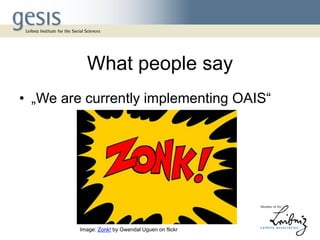
• „We are currently implementing OAIS“
Image: Zonk! by Gwendal Uguen on flickr
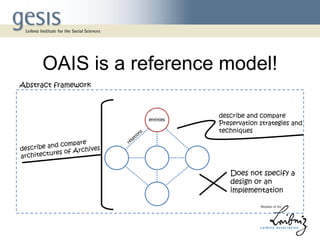
OAIS is a reference model!
Abstract framework
describe and compare
Preservation strategies and
techniques
Does not specify a
design or an
implementation
entities
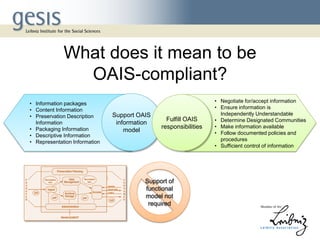
• Information packages
• Content Information
• Preservation Description
Information
• Packaging Information
• Descriptive Information
• Representation Information
• Negotiate for/accept information
• Ensure information is
Independently Understandable
• Determine Designated Communities
• Make information available
• Follow documented policies and
procedures
• Sufficient control of information
What does it mean to be
OAIS-compliant?
Support OAIS
information
model
Fulfill OAIS
responsibilities
Support of
functional
model not
required
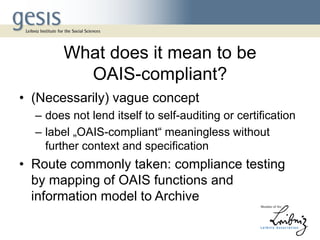
What does it mean to be
OAIS-compliant?
• (Necessarily) vague concept
– does not lend itself to self-auditing or certification
– label „OAIS-compliant“ meaningless without
further context and specification
• Route commonly taken: compliance testing
by mapping of OAIS functions and
information model to Archive
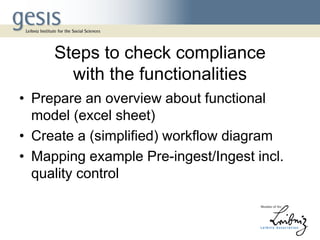
Steps to check compliance
with the functionalities
• Prepare an overview about functional
model (excel sheet)
• Create a (simplified) workflow diagram
• Mapping example Pre-ingest/Ingest incl.
quality control
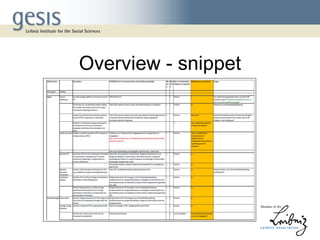
Overview - snippet
Archiving Workflow
Acquisition and deposit Ingest and processing Archival storage Dissemination and access
Temporary
storage
Archival
storage
Dissemination
server
Quality
control
Build data and
document set
Create
metadata
Metadata
database
Deposit study
and context
material
Access to
study and
metadata
Preservation
action
Data curation
Negotiate
Submission
Agreement
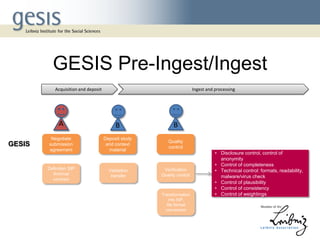
GESIS Pre-Ingest/Ingest
Negotiate
submission
agreement
Deposit study
and context
material
Quality
control
Definition SIP
Archival
contract
Validation
transfer
Verification
Quality control
Transformation
into AIP,
file format
conversion
• Disclosure control, control of
anonymity
• Control of completeness
• Technical control: formats, readability,
malware/virus check
• Control of plausibility
• Control of consistency
• Control of weightings
A B B
Acquisition and deposit Ingest and processing
GESIS
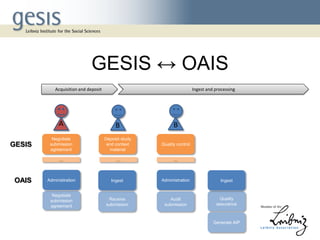
GESIS ↔ OAIS
Negotiate
submission
agreement
Deposit study
and context
material
Quality control
A B B
Negotiate
submission
agreement
Receive
submission
Audit
submission
Quality
assurance
Generate AIP
Administration AdministrationIngest Ingest
Acquisition and deposit Ingest and processing
GESIS
OAIS
… ……
Some findings
• At GESIS Data Archive pre-ingest and ingest
including quality control are central aspects
 important for all following steps
• No reference in OAIS to extensive quality control
• OAIS does not accommodate this in a single
function
 parts of it are located in different functions
• One colleague is responsible for most steps of this
part and acts like playing Twister :-)
Image “Four Storms and a Twister” by JD Hancock on flickr
Lessons learned: Benefits
• Terminology
Supports internal and external communication
• Self-reflection
Helps getting a clearer sense of what, as an
established Archive, one has already been doing
• Process evaluation
Helps spotting gaps and setting an agenda for
further development
Lessons learned: Challenges
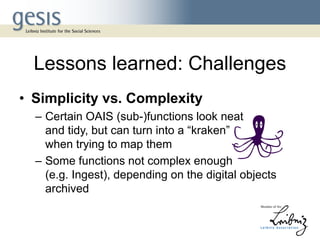
• Simplicity vs. Complexity
– Certain OAIS (sub-)functions look neat
and tidy, but can turn into a “kraken”
when trying to map them
– Some functions not complex enough
(e.g. Ingest), depending on the digital objects
archived
Lessons learned: Challenges
• Formalism vs. Pragmatism
– In some places, OAIS describes highly
formalized processes which in reality are
carried out much more pragmatically
– Archives have to decide where more
formalism is needed and where pragmatism is
tenable or even beneficial
( risk assessment)
So what does it really mean to be
OAIS-compliant?
• Notion of OAIS-compliance is only
significant if extended to functional model
• Compliance comes in degrees: conscious
decisions for and against compliance
• Context counts!
Thank you for your attention!
Natascha Schumann | Dr. Astrid Recker
GESIS – Leibniz Institute for the Social Sciences, Data Archive
natascha.schumann@gesis.org | astrid.recker@gesis.org
www.gesis.org
Slides: http://www.slideshare.net/GESIS_Leibniz_Institut

De-mystifying OAIS compliance Benefits and challenges of mapping the OAIS reference model to the GESIS Data Archive

  • 1.
    De-mystifying OAIS compliance Benefits andchallenges of mapping the OAIS reference model to the GESIS Data Archive Natascha Schumann, Astrid Recker
  • 2.
    OAIS* in a(very small) nutshell • *Reference Model for an Open Archival Information System • Most recent version: CCSDS 2012 (ISO 14721:2012) • Highly influential and ground-breaking, but also frequently misunderstood CCSDS (2012). Reference Model for an Open Archival Information System (OAIS). Recommended Practice. http://public.ccsds.org/publications/archive/650x0m2.pdf
  • 3.
    What people say •„We are currently implementing OAIS“ Image: Zonk! by Gwendal Uguen on flickr
  • 4.
    OAIS is areference model! Abstract framework describe and compare Preservation strategies and techniques Does not specify a design or an implementation entities
  • 5.
    • Information packages •Content Information • Preservation Description Information • Packaging Information • Descriptive Information • Representation Information • Negotiate for/accept information • Ensure information is Independently Understandable • Determine Designated Communities • Make information available • Follow documented policies and procedures • Sufficient control of information What does it mean to be OAIS-compliant? Support OAIS information model Fulfill OAIS responsibilities Support of functional model not required
  • 6.
    What does itmean to be OAIS-compliant? • (Necessarily) vague concept – does not lend itself to self-auditing or certification – label „OAIS-compliant“ meaningless without further context and specification • Route commonly taken: compliance testing by mapping of OAIS functions and information model to Archive
  • 7.
    Steps to checkcompliance with the functionalities • Prepare an overview about functional model (excel sheet) • Create a (simplified) workflow diagram • Mapping example Pre-ingest/Ingest incl. quality control
  • 8.
  • 9.
    Archiving Workflow Acquisition anddeposit Ingest and processing Archival storage Dissemination and access Temporary storage Archival storage Dissemination server Quality control Build data and document set Create metadata Metadata database Deposit study and context material Access to study and metadata Preservation action Data curation Negotiate Submission Agreement
  • 10.
    GESIS Pre-Ingest/Ingest Negotiate submission agreement Deposit study andcontext material Quality control Definition SIP Archival contract Validation transfer Verification Quality control Transformation into AIP, file format conversion • Disclosure control, control of anonymity • Control of completeness • Technical control: formats, readability, malware/virus check • Control of plausibility • Control of consistency • Control of weightings A B B Acquisition and deposit Ingest and processing GESIS
  • 11.
    GESIS ↔ OAIS Negotiate submission agreement Depositstudy and context material Quality control A B B Negotiate submission agreement Receive submission Audit submission Quality assurance Generate AIP Administration AdministrationIngest Ingest Acquisition and deposit Ingest and processing GESIS OAIS … ……
  • 12.
    Some findings • AtGESIS Data Archive pre-ingest and ingest including quality control are central aspects  important for all following steps • No reference in OAIS to extensive quality control • OAIS does not accommodate this in a single function  parts of it are located in different functions • One colleague is responsible for most steps of this part and acts like playing Twister :-)
  • 13.
    Image “Four Stormsand a Twister” by JD Hancock on flickr
  • 14.
    Lessons learned: Benefits •Terminology Supports internal and external communication • Self-reflection Helps getting a clearer sense of what, as an established Archive, one has already been doing • Process evaluation Helps spotting gaps and setting an agenda for further development
  • 15.
    Lessons learned: Challenges •Simplicity vs. Complexity – Certain OAIS (sub-)functions look neat and tidy, but can turn into a “kraken” when trying to map them – Some functions not complex enough (e.g. Ingest), depending on the digital objects archived
  • 16.
    Lessons learned: Challenges •Formalism vs. Pragmatism – In some places, OAIS describes highly formalized processes which in reality are carried out much more pragmatically – Archives have to decide where more formalism is needed and where pragmatism is tenable or even beneficial ( risk assessment)
  • 17.
    So what doesit really mean to be OAIS-compliant? • Notion of OAIS-compliance is only significant if extended to functional model • Compliance comes in degrees: conscious decisions for and against compliance • Context counts!
  • 18.
    Thank you foryour attention! Natascha Schumann | Dr. Astrid Recker GESIS – Leibniz Institute for the Social Sciences, Data Archive natascha.schumann@gesis.org | astrid.recker@gesis.org www.gesis.org Slides: http://www.slideshare.net/GESIS_Leibniz_Institut