Asteroids
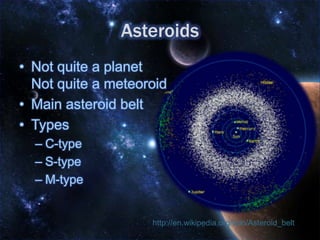
• Not quite a planet
Not quite a meteoroid
• Main asteroid belt
• Types
– C-type
– S-type
– M-type

http://en.wikipedia.org/wiki/Asteroid_belt
NEOs (Near Earth Objects)
•
•
•
•

What is an NEO?
How close to be considered an NEO?
What is considered to be an NEO?
Why is it important?

http://pages.sbcglobal.net/dbak/images/public/science/asteroid
_2004_mn4_near.jpg
International Astronomical Search
Collaboration (IASC)
A public education outreach program
IASC Staff & Contributors
– Patrick Miller (Hardin-Simmons) IASC Director
– Robert Holmes (Astronomical Research Institute) ARI
Director
– Leonid Elenin(Russian Academy of Science) IASC
Astronomer
What We Do
Order of Operation

1. Obtain telescope images
a) Astronomical Research Institute (ARI)
b) NASA WISE satellite

2. Use Astrometrica to observe/collect data
3. Compile findings in MPC report
4. Send to Patrick Miller
NASA Wide-Field Infrared Survey
Explorer (WISE)
• Launched December 2009
• New generation Infrared technology
• Mission:
– Asteroids
-Comets
– N.E.O.
-Detailed look at Milky Way
– Dim stars
-Size Distribution
– Ultra-luminous Infrared Galaxies
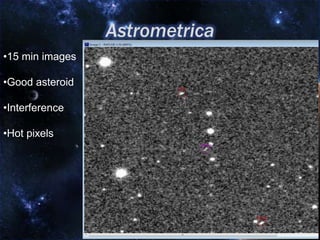
Astrometrica
•15 min images

•Good asteroid
•Interference

•Hot pixels
Astrometrica
•Graph
-Distribution
-Broad peak

•Magnitude
MPC Report
• Minor Planet Center
• Data of the marked asteroid includes;
• Position
- Right ascension
- Declination

• Name of the object
• Limiting Magnitude
N E O Follow Ups
• NEO Confirmations
-Refining the calculations of unknown NEO
orbits.

• NEO Observations
-Further data calculations of known NEO.
Results
•

Discovered asteroid 2010 CK12 on (02/12/2010)

• Made N.E.O. follow up’s :
– 2009 WL1
– 2010 CC19
– 2004 XD50
– W008WVT
– 2009 XC2
– C/2010 D4 (Comet)

02/08/2010
02/17/2010
03/06/2010
03/06/2010
03/07/2010
03/06/2010
Conclusion
• Participated in IASC campaign (Feb March)
• Used Astrometrica and telescope/WISE
images to find Asteroids and NEO’s
• UT Austin (Physics Joint Meeting)
• For future students: persistence
Special Thanks To…
•
•
•
•
•

IASC Staff
Professor Michael Broyles
Professor Greg Sherman
Collin College
UT Austin

IASC Asteroid Discovery: CK12

  • 2.
    Asteroids • Not quitea planet Not quite a meteoroid • Main asteroid belt • Types – C-type – S-type – M-type http://en.wikipedia.org/wiki/Asteroid_belt
  • 3.
    NEOs (Near EarthObjects) • • • • What is an NEO? How close to be considered an NEO? What is considered to be an NEO? Why is it important? http://pages.sbcglobal.net/dbak/images/public/science/asteroid _2004_mn4_near.jpg
  • 4.
    International Astronomical Search Collaboration(IASC) A public education outreach program IASC Staff & Contributors – Patrick Miller (Hardin-Simmons) IASC Director – Robert Holmes (Astronomical Research Institute) ARI Director – Leonid Elenin(Russian Academy of Science) IASC Astronomer
  • 5.
    What We Do Orderof Operation 1. Obtain telescope images a) Astronomical Research Institute (ARI) b) NASA WISE satellite 2. Use Astrometrica to observe/collect data 3. Compile findings in MPC report 4. Send to Patrick Miller
  • 6.
    NASA Wide-Field InfraredSurvey Explorer (WISE) • Launched December 2009 • New generation Infrared technology • Mission: – Asteroids -Comets – N.E.O. -Detailed look at Milky Way – Dim stars -Size Distribution – Ultra-luminous Infrared Galaxies
  • 7.
    Astrometrica •15 min images •Goodasteroid •Interference •Hot pixels
  • 8.
  • 9.
    MPC Report • MinorPlanet Center • Data of the marked asteroid includes; • Position - Right ascension - Declination • Name of the object • Limiting Magnitude
  • 10.
    N E OFollow Ups • NEO Confirmations -Refining the calculations of unknown NEO orbits. • NEO Observations -Further data calculations of known NEO.
  • 11.
    Results • Discovered asteroid 2010CK12 on (02/12/2010) • Made N.E.O. follow up’s : – 2009 WL1 – 2010 CC19 – 2004 XD50 – W008WVT – 2009 XC2 – C/2010 D4 (Comet) 02/08/2010 02/17/2010 03/06/2010 03/06/2010 03/07/2010 03/06/2010
  • 12.
    Conclusion • Participated inIASC campaign (Feb March) • Used Astrometrica and telescope/WISE images to find Asteroids and NEO’s • UT Austin (Physics Joint Meeting) • For future students: persistence
  • 13.
    Special Thanks To… • • • • • IASCStaff Professor Michael Broyles Professor Greg Sherman Collin College UT Austin