ACT Science coffee presentation about asteroid collision probability computation
1.
1
ESA UNCLASSIFIED –For ESA Official Use Only
Monitoring impacts of asteroids: the Aegis system
of the ESA NEO Coordination Centre
Marco Fenucci, Laura Faggioli, Francesco Gianotto, et al.
ESA NEO Coordination Centre
ESA Advanced Concepts Team Science Coffee
23/05/2025
2.
2
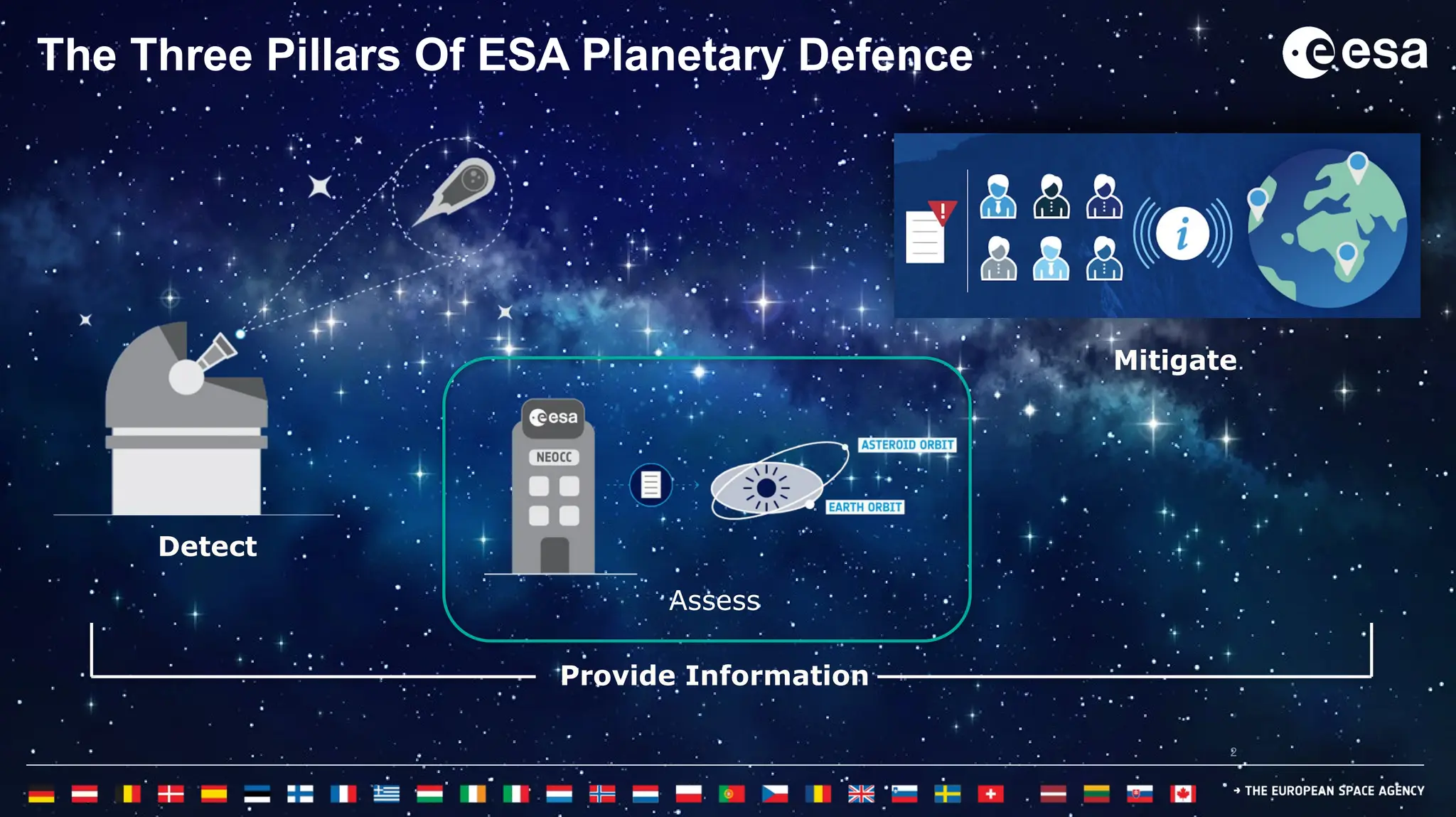
The Three PillarsOf ESA Planetary Defence
Detect
Assess
Mitigate
Provide Information
3.
3
The ESA NEOCoordination Centre
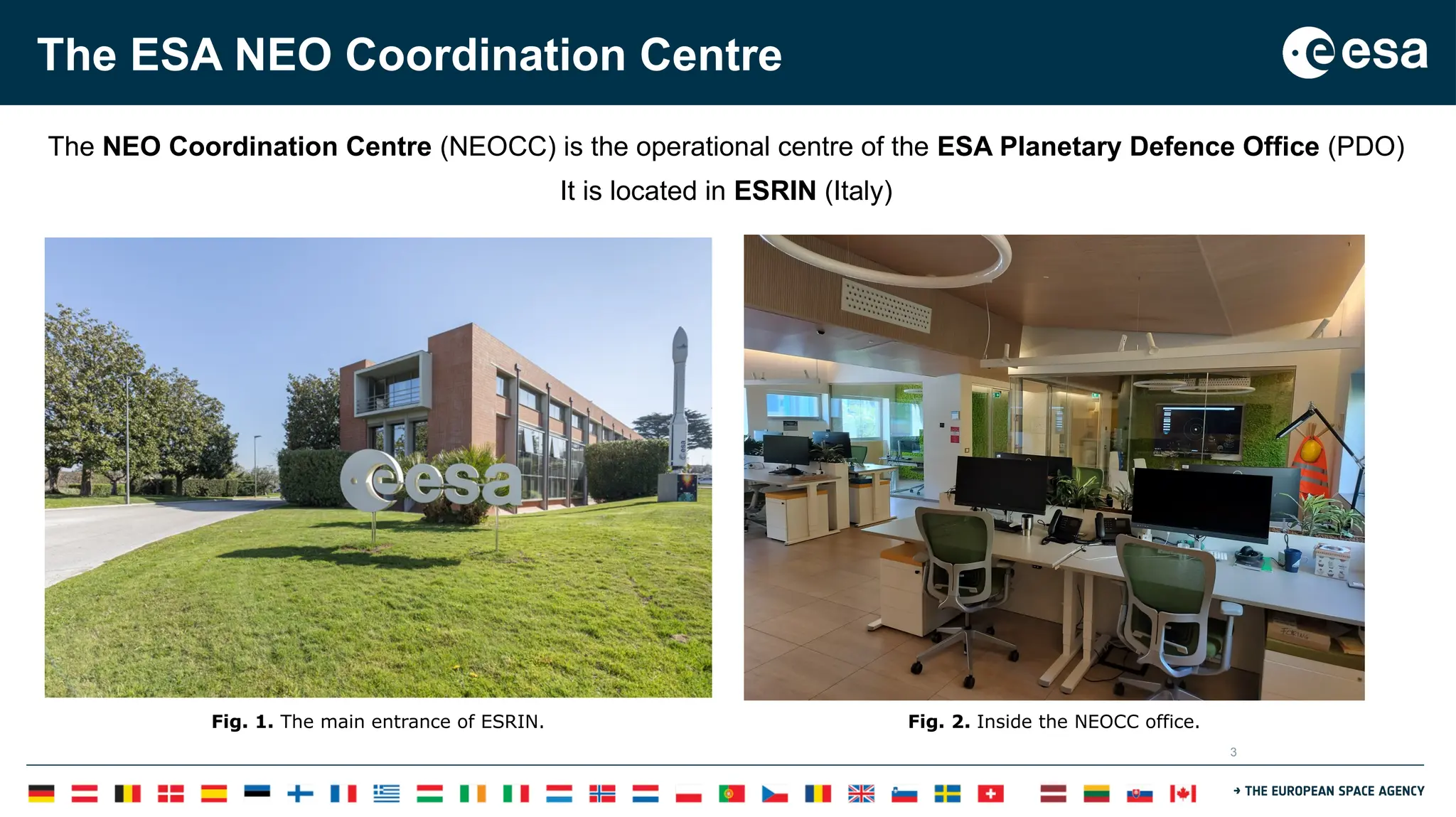
The NEO Coordination Centre (NEOCC) is the operational centre of the ESA Planetary Defence Office (PDO)
It is located in ESRIN (Italy)
Fig. 1. The main entrance of ESRIN. Fig. 2. Inside the NEOCC office.
4.
4
The Risk AssessmentPillar
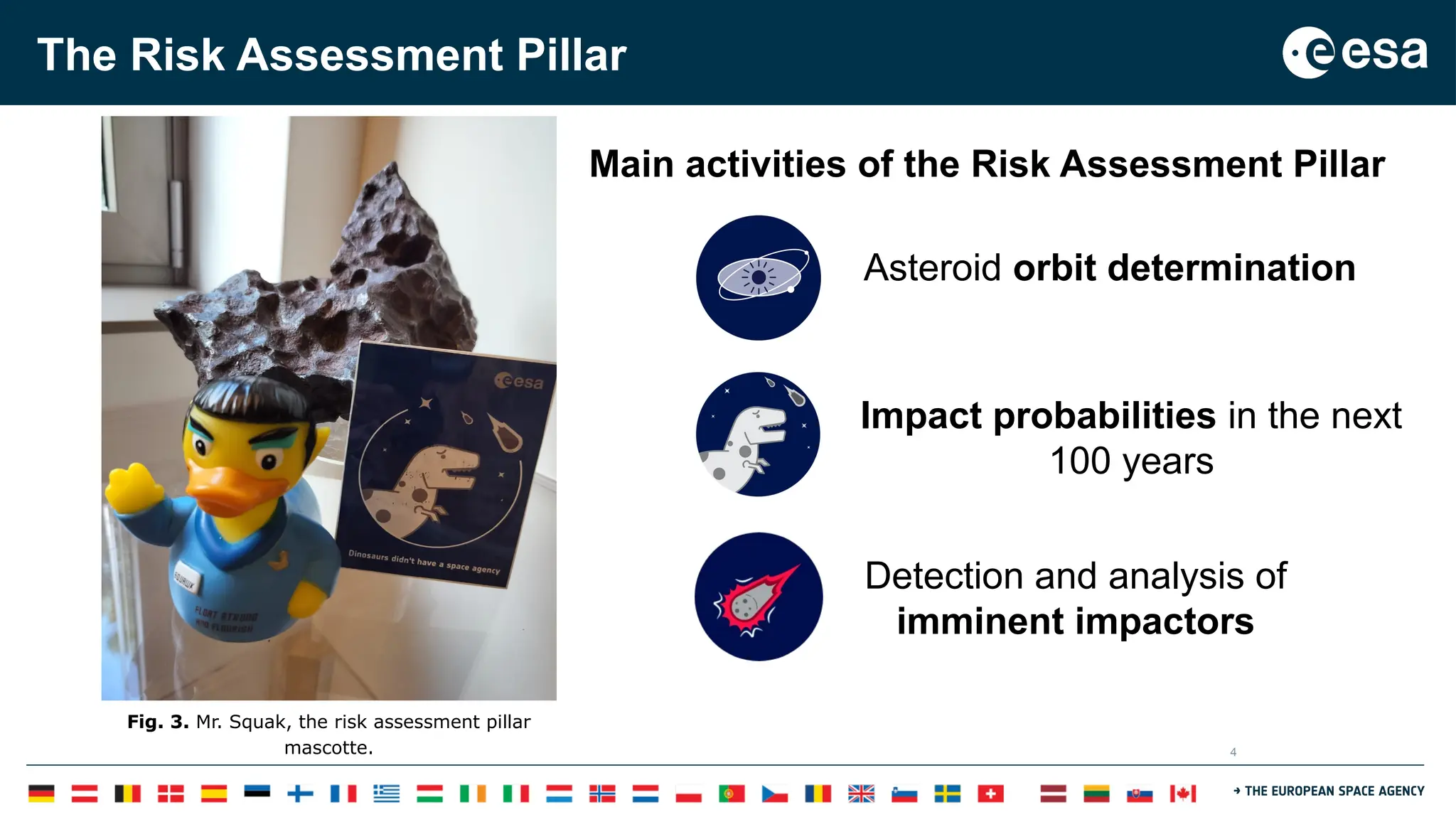
Main activities of the Risk Assessment Pillar
Fig. 3. Mr. Squak, the risk assessment pillar
mascotte.
Asteroid orbit determination
Impact probabilities in the next
100 years
Detection and analysis of
imminent impactors
5.
5
The Aegis software
Aegis[1]
Asteroids Orbit Determination and Impact Monitoring
In Greek mythology Aegis is the shield used by Zeus. The Aegis
was said to be imbued with divine power and was depicted as a
shield adorned with the head of a Gorgon, Medusa.
[1] Fenucci et al. (2024). The Aegis orbit determination and impact monitoring system and services of the ESA NEOCC web portal, CMDA 136:58
Development Operations Evolution
6.
6
Orbit Determination
Observations: rii = 1, ..., m
Prediction function:
Residuals:
Target function:
Dynamical model:
Gravitational attractions
General Relativity
Earth and Sun J2
Non-gravitational effects
[2] Milani & Gronchi (2009). Theory of Orbit Determination
[3] Veres et al. (2017). Statistical analysis of astrometric errors for the most productive asteroid surveys, Icarus 296
[4] Farnocchia et al. (2015). Star catalog position and proper motion corrections in asteroid astrometry, Icarus 245
[5] Carpino et al. (2003). Error statistics of asteroid optical astrometric observations, Icarus 166
Fig. 4. Massive main belt asteroids included in the dynamical model.
7.
7
The NEOCC OrbitalCatalogue
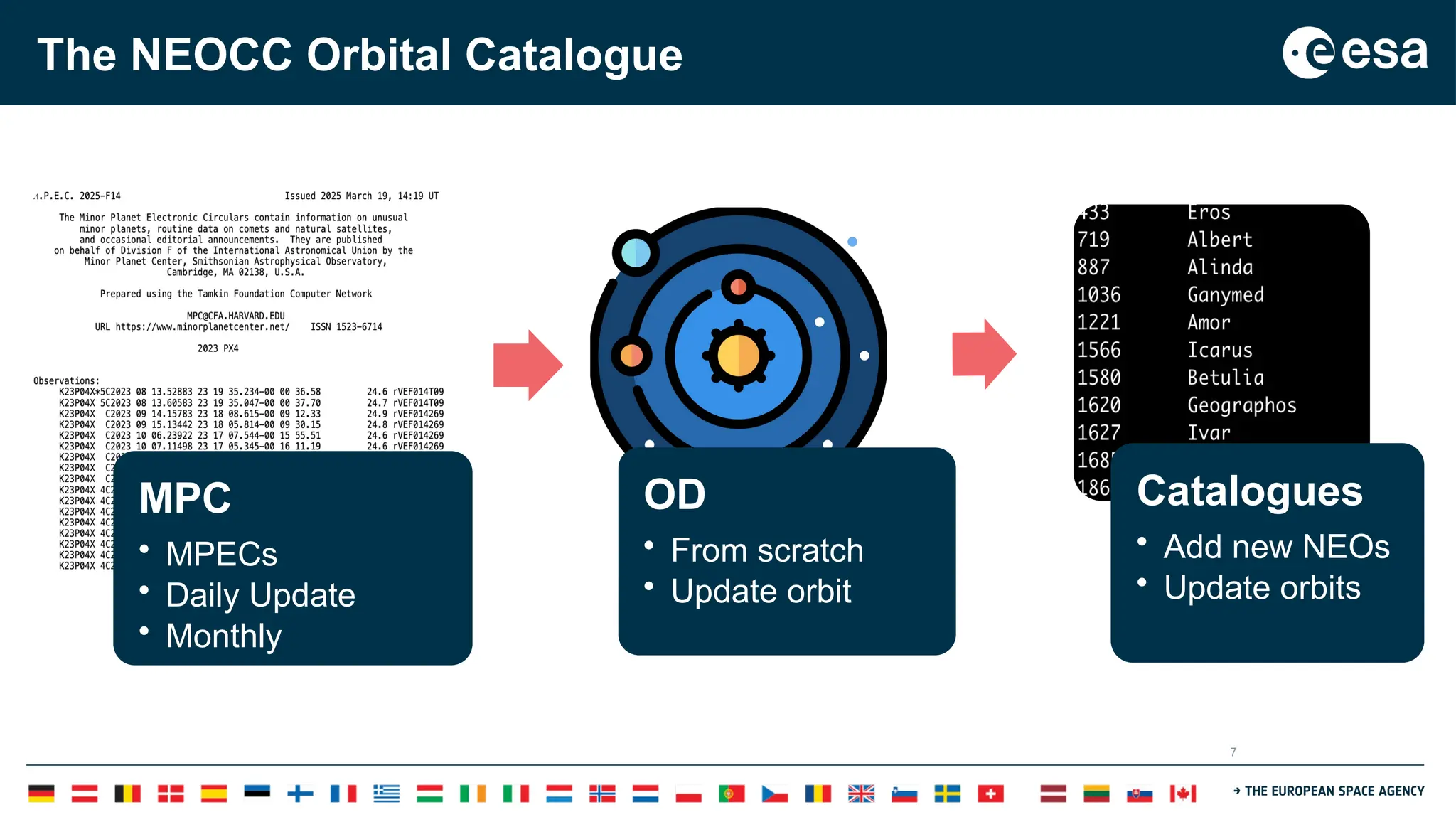
MPC
• MPECs
• Daily Update
• Monthly
OD
• From scratch
• Update orbit
Catalogues
• Add new NEOs
• Update orbits
8.
8
The NEOCC OrbitalCatalogue
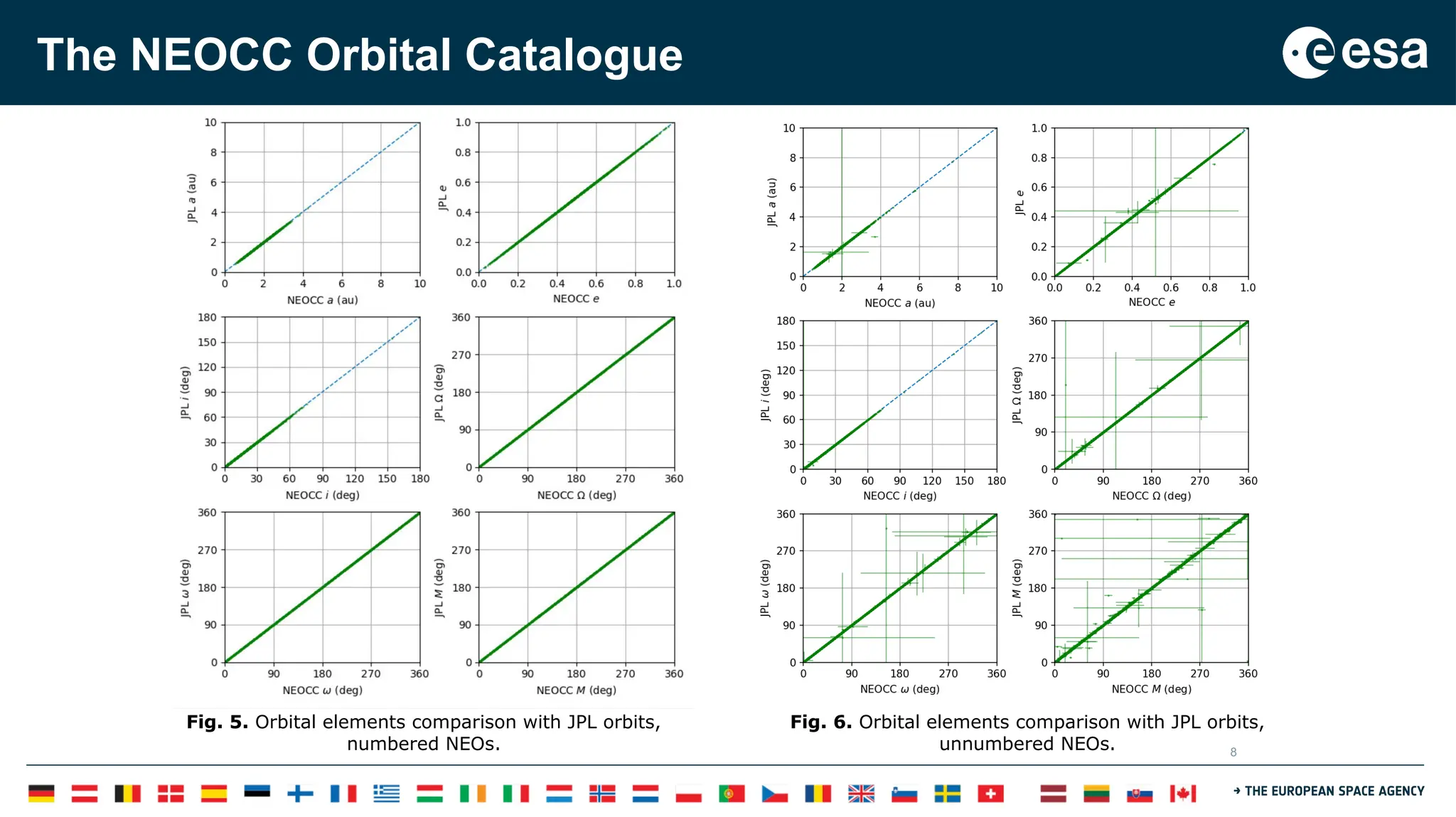
Fig. 5. Orbital elements comparison with JPL orbits,
numbered NEOs.
Fig. 6. Orbital elements comparison with JPL orbits,
unnumbered NEOs.
9.
9
Impact Monitoring
Summary ofthe algorithm [6]:
Line of Variations (LOV) sampling of the uncertainty
region
LOV propagation for 100 years
Analysis of returns on the Target Plane (TP)
Virtual Impactors (VI) search
Impact probability (IP) computation
Completeness limit: IP ~ 10-7
Fig. 7. Schematic representation of the target plane [7].
[6] Milani et al. (2005). Nonlinear impact monitoring: line of variation searches for impactors, Icarus 173
[7] Farnocchia el al. (2019). Planetary encounter analysis on the B-plane: a comprehensive formulation, CMDA 131
10.
10
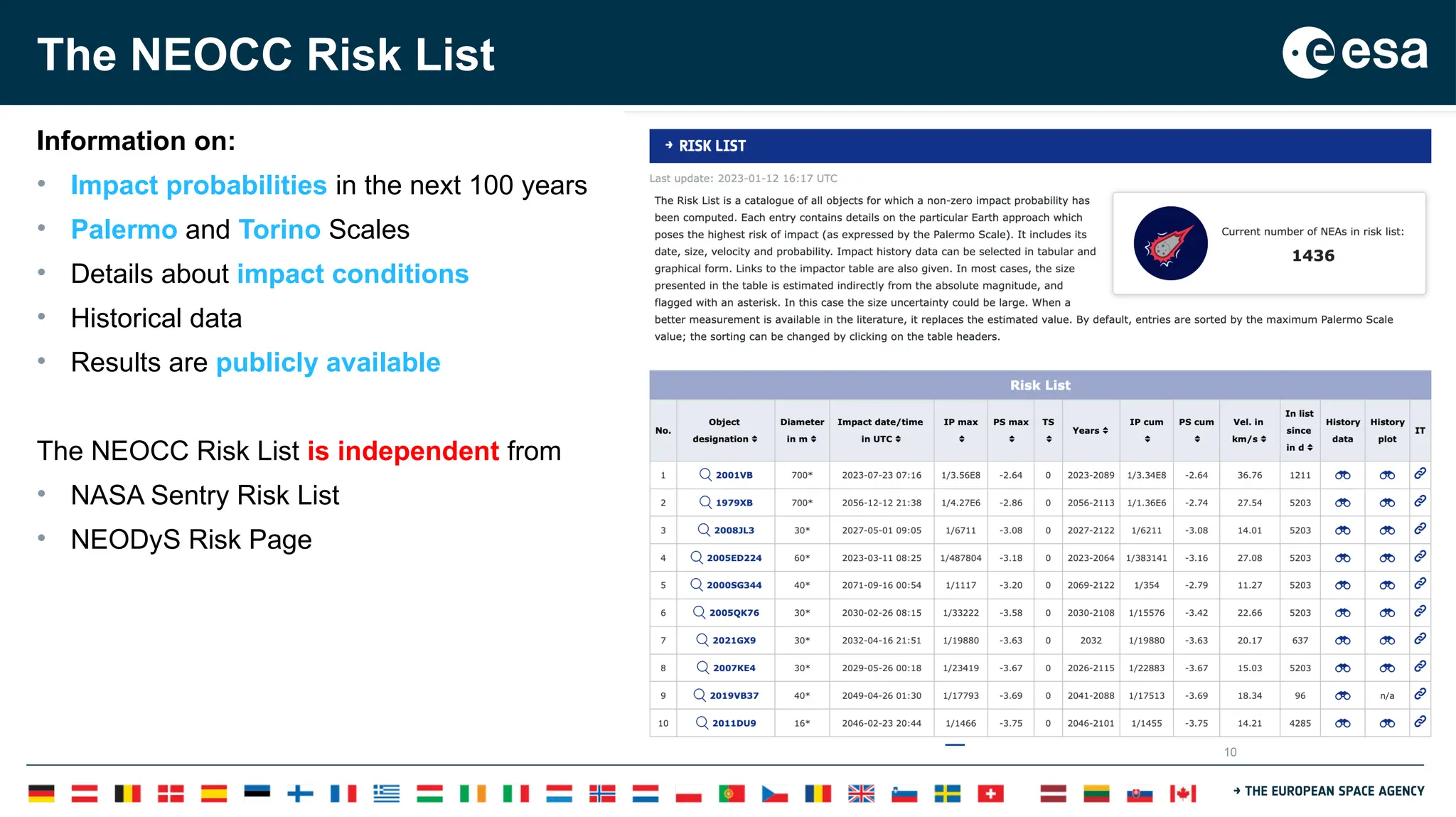
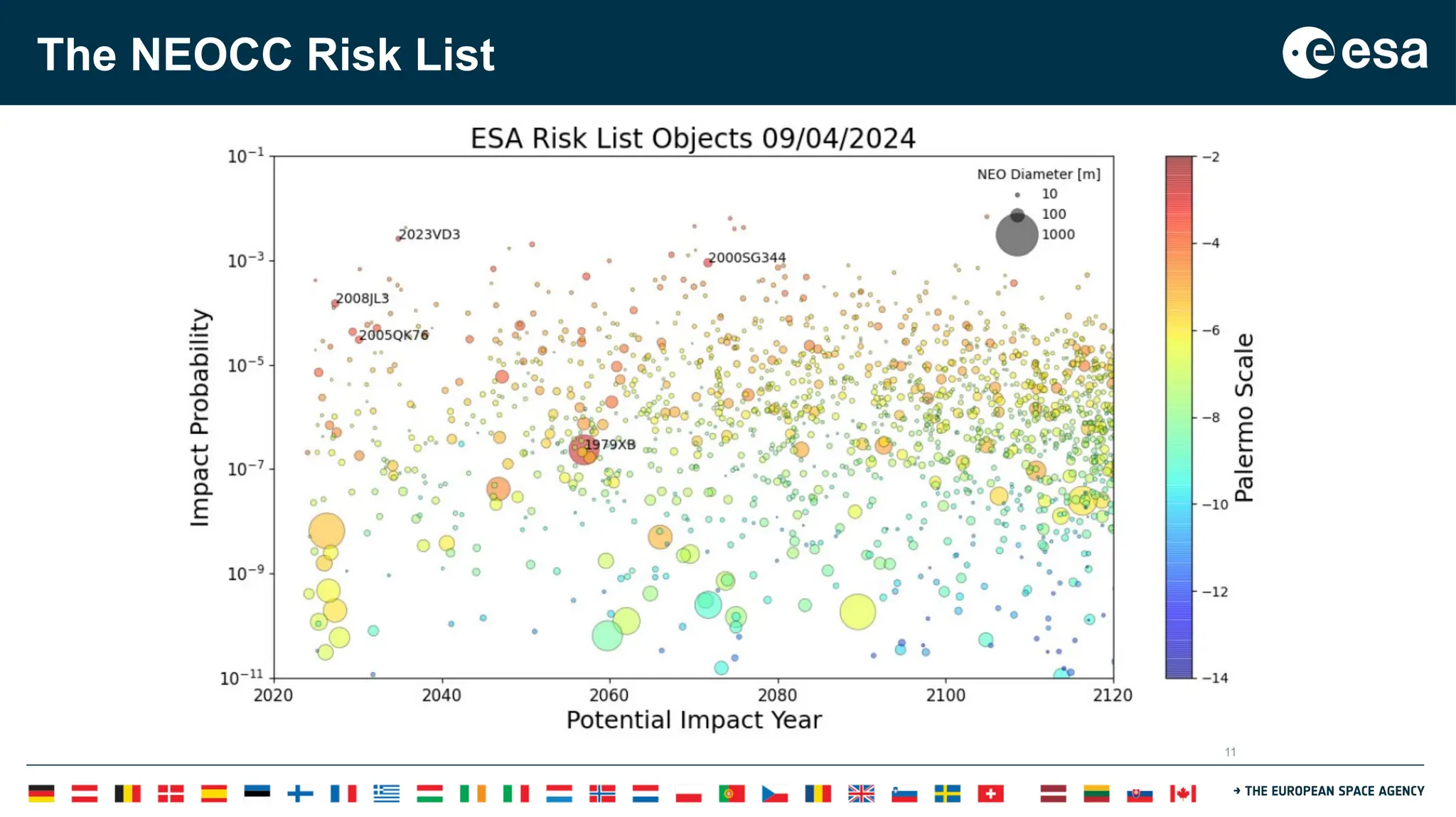
The NEOCC RiskList
Information on:
• Impact probabilities in the next 100 years
• Palermo and Torino Scales
• Details about impact conditions
• Historical data
• Results are publicly available
The NEOCC Risk List is independent from
• NASA Sentry Risk List
• NEODyS Risk Page
12
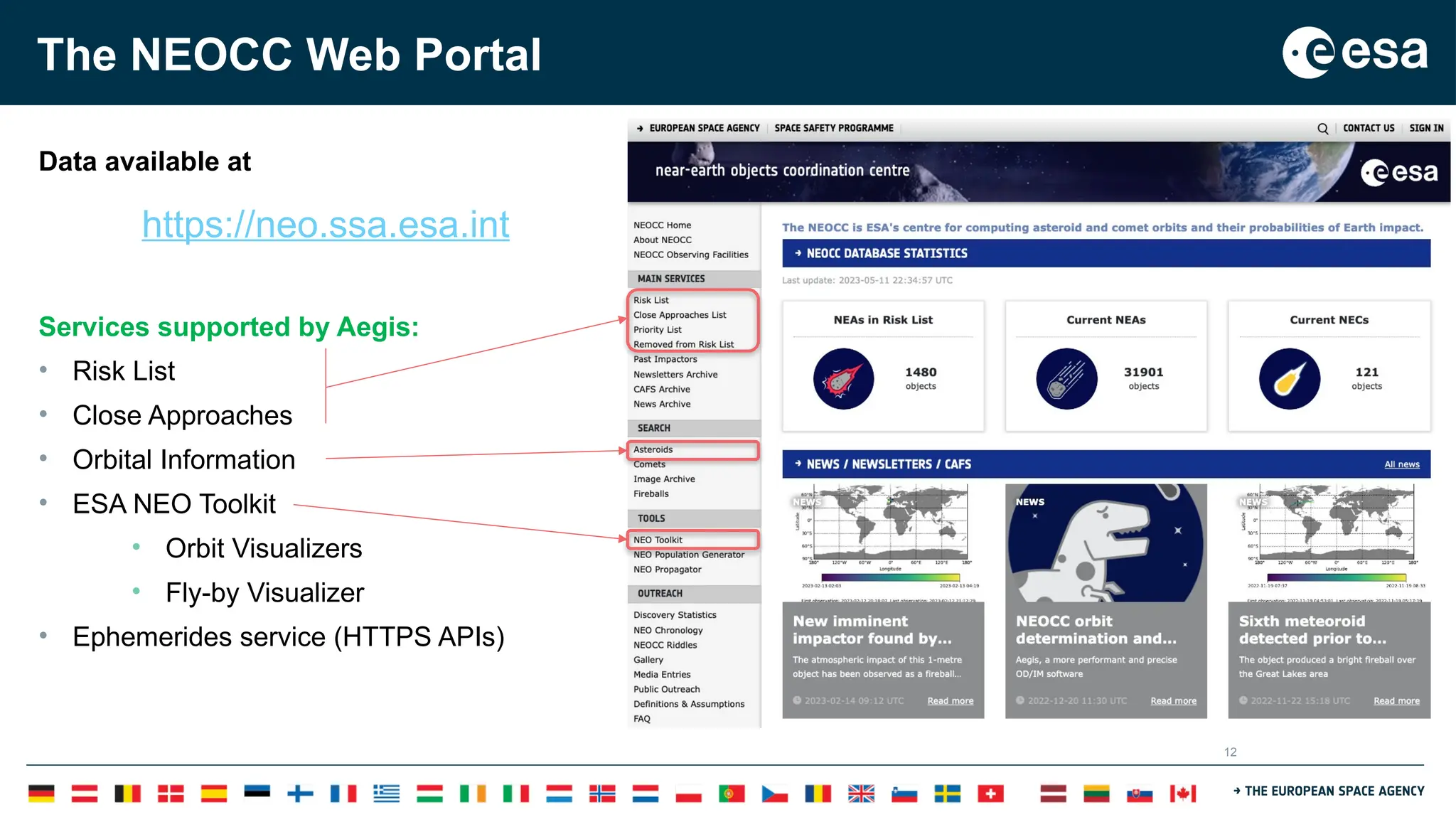
The NEOCC WebPortal
Data available at
https://neo.ssa.esa.int
Services supported by Aegis:
• Risk List
• Close Approaches
• Orbital Information
• ESA NEO Toolkit
• Orbit Visualizers
• Fly-by Visualizer
• Ephemerides service (HTTPS APIs)
13.
13
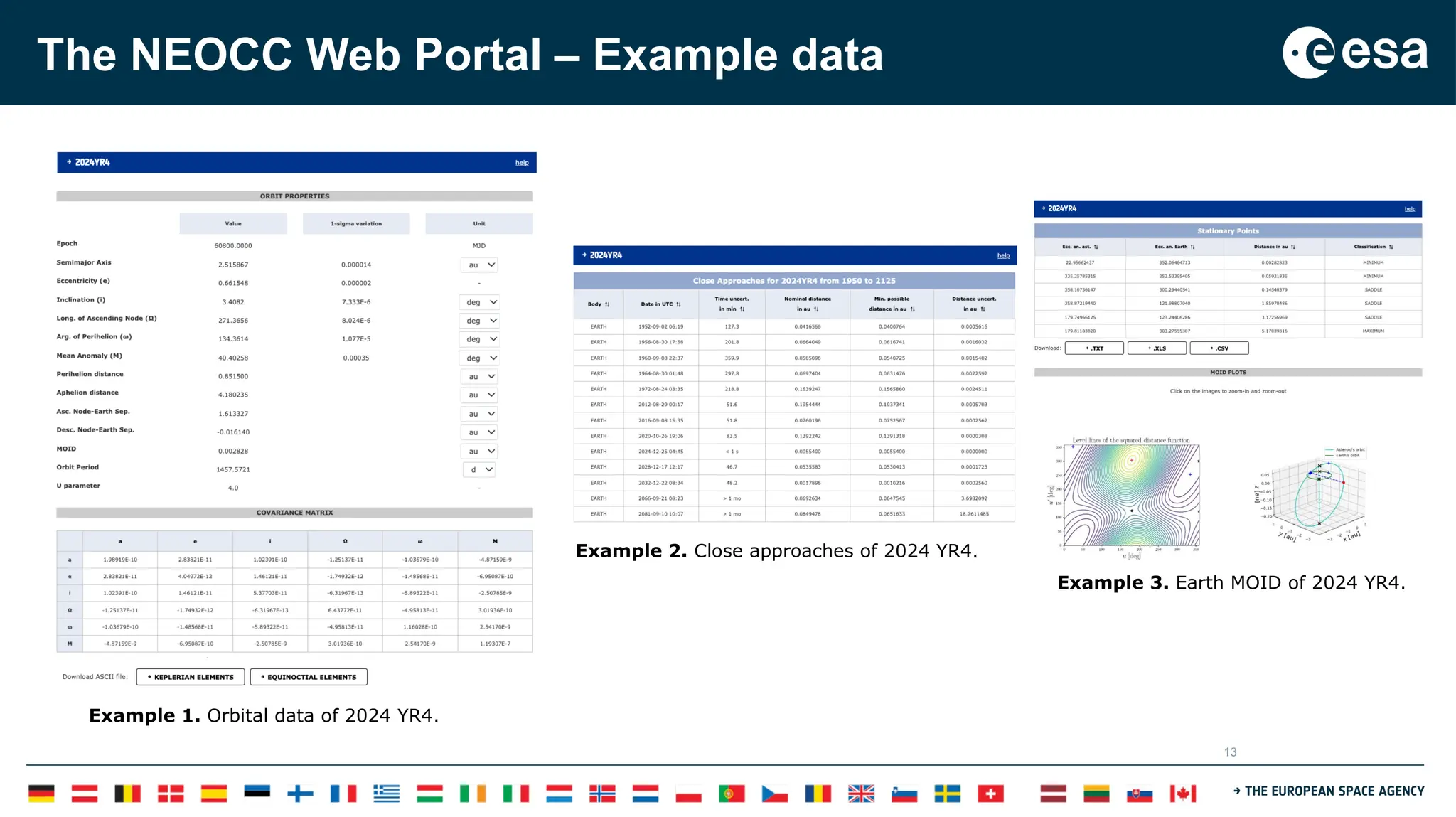
The NEOCC WebPortal – Example data
Example 1. Orbital data of 2024 YR4.
Example 2. Close approaches of 2024 YR4.
Example 3. Earth MOID of 2024 YR4.
14.
14
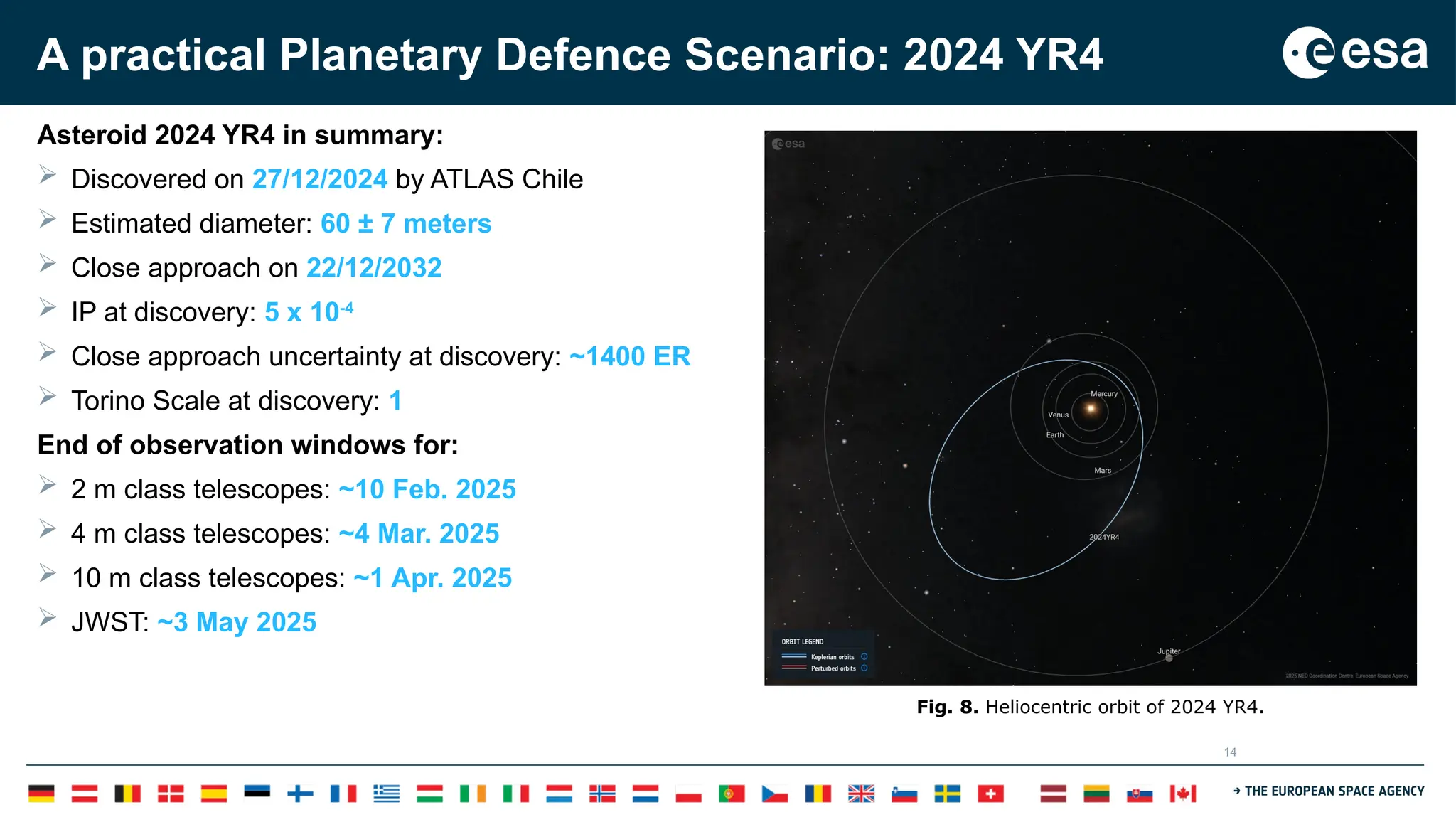
A practical PlanetaryDefence Scenario: 2024 YR4
Asteroid 2024 YR4 in summary:
Discovered on 27/12/2024 by ATLAS Chile
Estimated diameter: 60 ± 7 meters
Close approach on 22/12/2032
IP at discovery: 5 x 10⁻⁴
Close approach uncertainty at discovery: ~1400 ER
Torino Scale at discovery: 1
End of observation windows for:
2 m class telescopes: ~10 Feb. 2025
4 m class telescopes: ~4 Mar. 2025
10 m class telescopes: ~1 Apr. 2025
JWST: ~3 May 2025
Fig. 8. Heliocentric orbit of 2024 YR4.
15.
15
A practical PlanetaryDefence Scenario: 2024 YR4
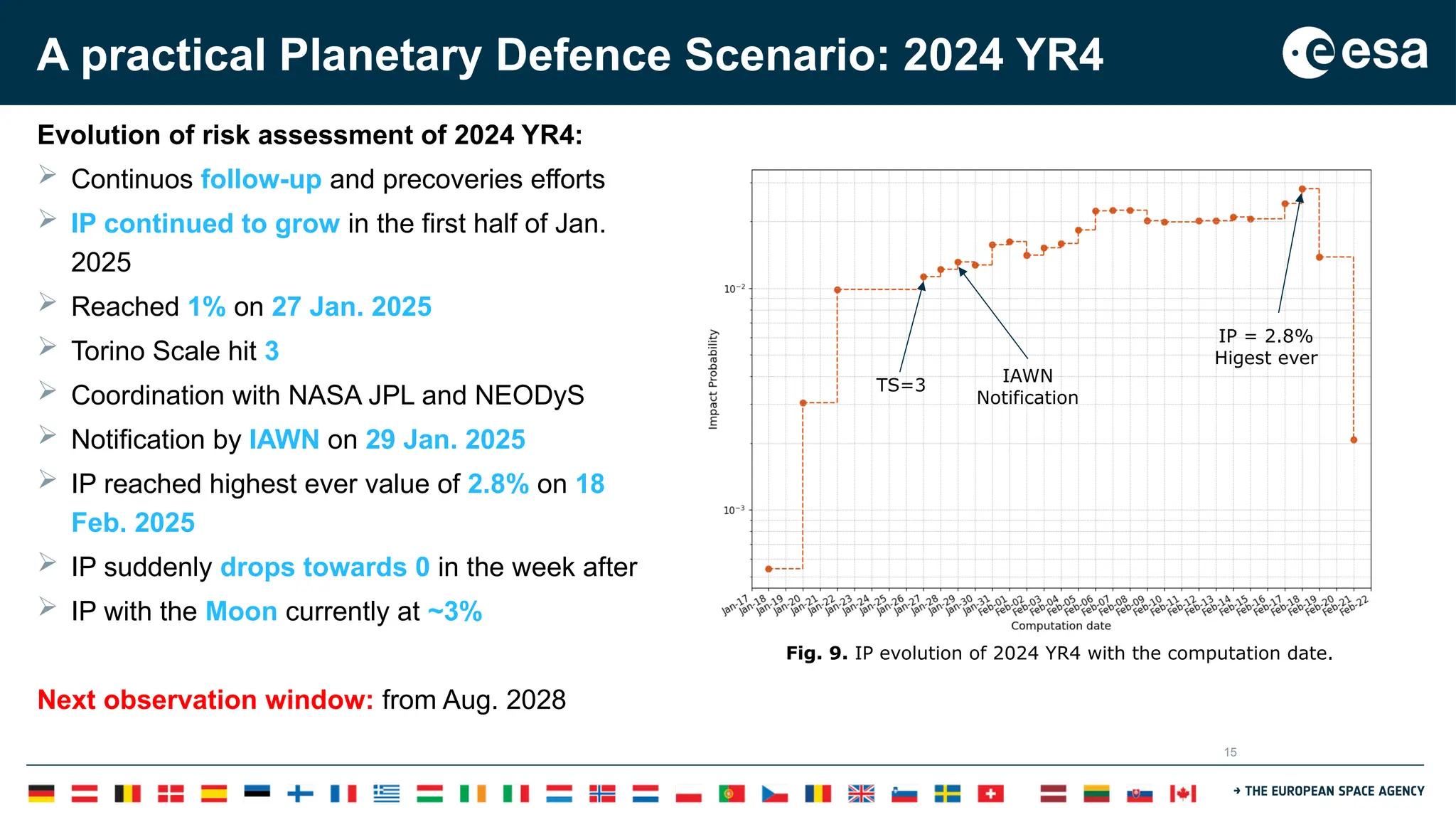
Evolution of risk assessment of 2024 YR4:
Continuos follow-up and precoveries efforts
IP continued to grow in the first half of Jan.
2025
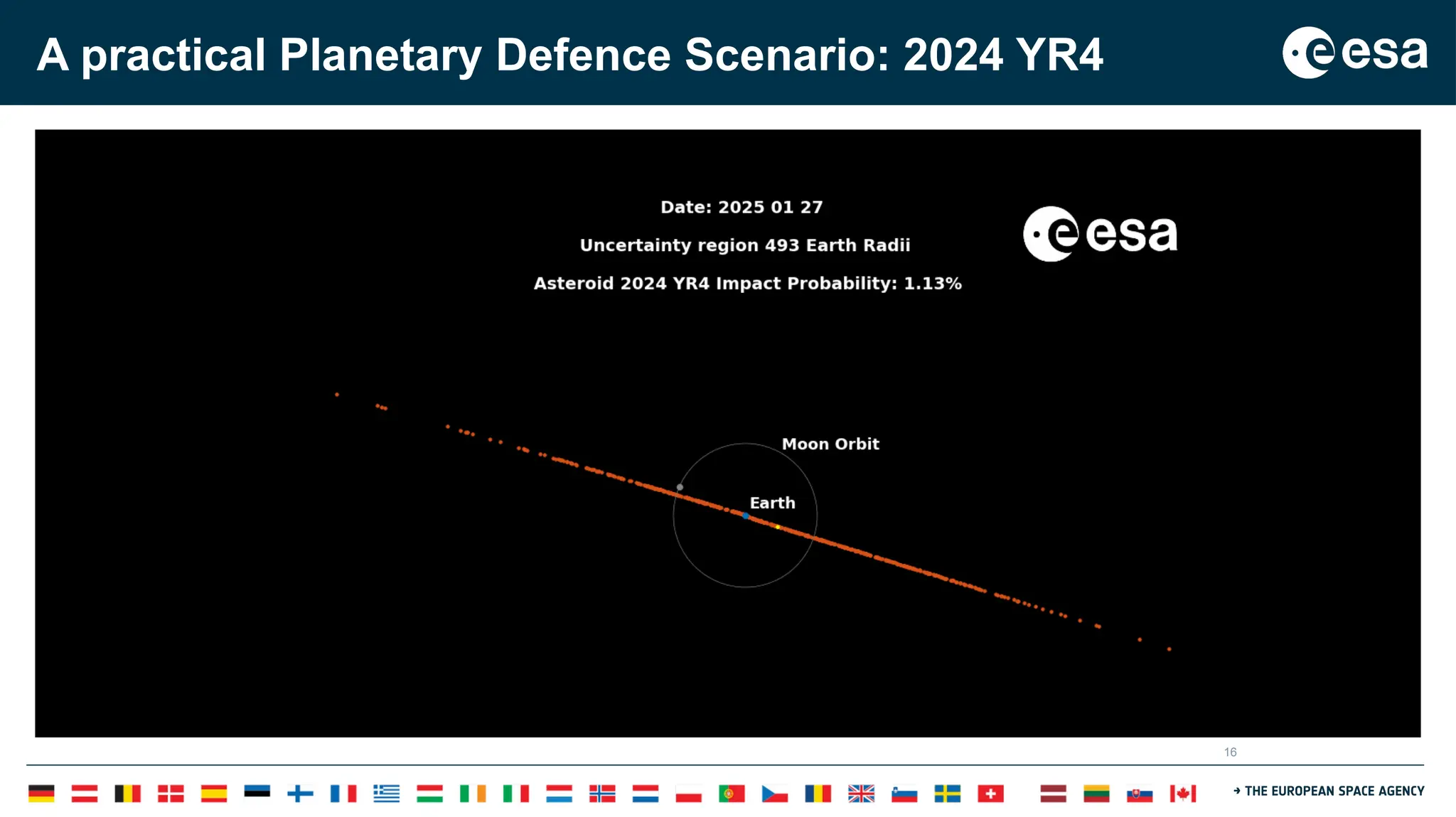
Reached 1% on 27 Jan. 2025
Torino Scale hit 3
Coordination with NASA JPL and NEODyS
Notification by IAWN on 29 Jan. 2025
IP reached highest ever value of 2.8% on 18
Feb. 2025
IP suddenly drops towards 0 in the week after
IP with the Moon currently at ~3%
Next observation window: from Aug. 2028
Fig. 9. IP evolution of 2024 YR4 with the computation date.
TS=3
IAWN
Notification
IP = 2.8%
Higest ever
18
Recent research worksupported by Aegis
Automated Yarkovsky effect detection [8]
• da/dt predicted by physical model
• da/dt computed by orbit determination
• Outlier identification:
• Statistical test with prediction
• Dependency on isolated tracklets
• 368 positive detections
• Data on NEOCC portal
[8] Fenucci et al. (2024). An automated procedure for the detection of the Yarkovsky effect and results from the ESA NEO Coordination Centre, A&A 682, A29
Fig. 10. Distribution of Yarkovsky effect detections
as a function of the diameter [X], with outliers.
19.
19
Recent research worksupported by Aegis
[9] Fenucci et al. (2025). Astrometry, orbit determination, and thermal inertia of the Tianwen-2 target asteroid (469219) Kamo`oalewa, A&A
[10] Novaković and Fenucci (2024). ASTERIA – Asteroid thermal inertia analyzer, Icarus 421
Kamo`oalewa, target of the Tianwen-2 mission [9]
• New observations from Loiano and Calar Alto (2024)
• Yarkovsky effect detection with SNR ~ 14
• Estimation of thermal inertia through ASTERIA [10]
• Regolith grain size extrapolation
Fig. 11. Conductivity (left) and thermal inertia (right) distribution of Kamo`oalewa obtained with ASTERIA.
Loiano
20.
20
Recent research worksupported by Aegis
Ab initio strewn fields [11]
• Entry point at 100 km altitude
• Single fragmentation model through atmosphere
• Drag force and wind modeling
• Reproduced cases of 2008 TC3, 2023 CX1 and 2024 BX1
The fall of 2024 XA1 [12]
• Impact predicted by ESA Meerkat [13]
• Impact point uncertainties at 100 km altitude
• Almost-live and final ab initio strewn field
[11] Carbognani et al. (2025). Ab initio strewn field for small asteroid impacts, Icarus 425
[12] Gianotto et al. (2025). The fall of asteroid 2024 XA and the location of possible meteorites, Icarus 433
[13] Gianotto et al. (2024). Meerkat asteroid guard–ESA’s imminent impactor warning service, 2nd NEO and Debris Detection Conference
Fig. 12. Entry of 2024 XA1 (top) into the
atmosphere and predicted strewn field (bottom).
21.
21
Recent research worksupported by Aegis
[14] Cano et al. (2025). Asteroid detection polar equation calculation and graphical representation, A&A 693, A183
Detection polar equation [14]
• Level surfaces for visual magnitude
• Helps in analyzing observability
• Nice visualization in the NEO Toolkit
Synodic Orbit Visualization Tool (SOVT)
• Catalogued and custom objects
Fig. 13. Detection polar (yellow) and orbit of Kamo`oalewa (red).
22.
22
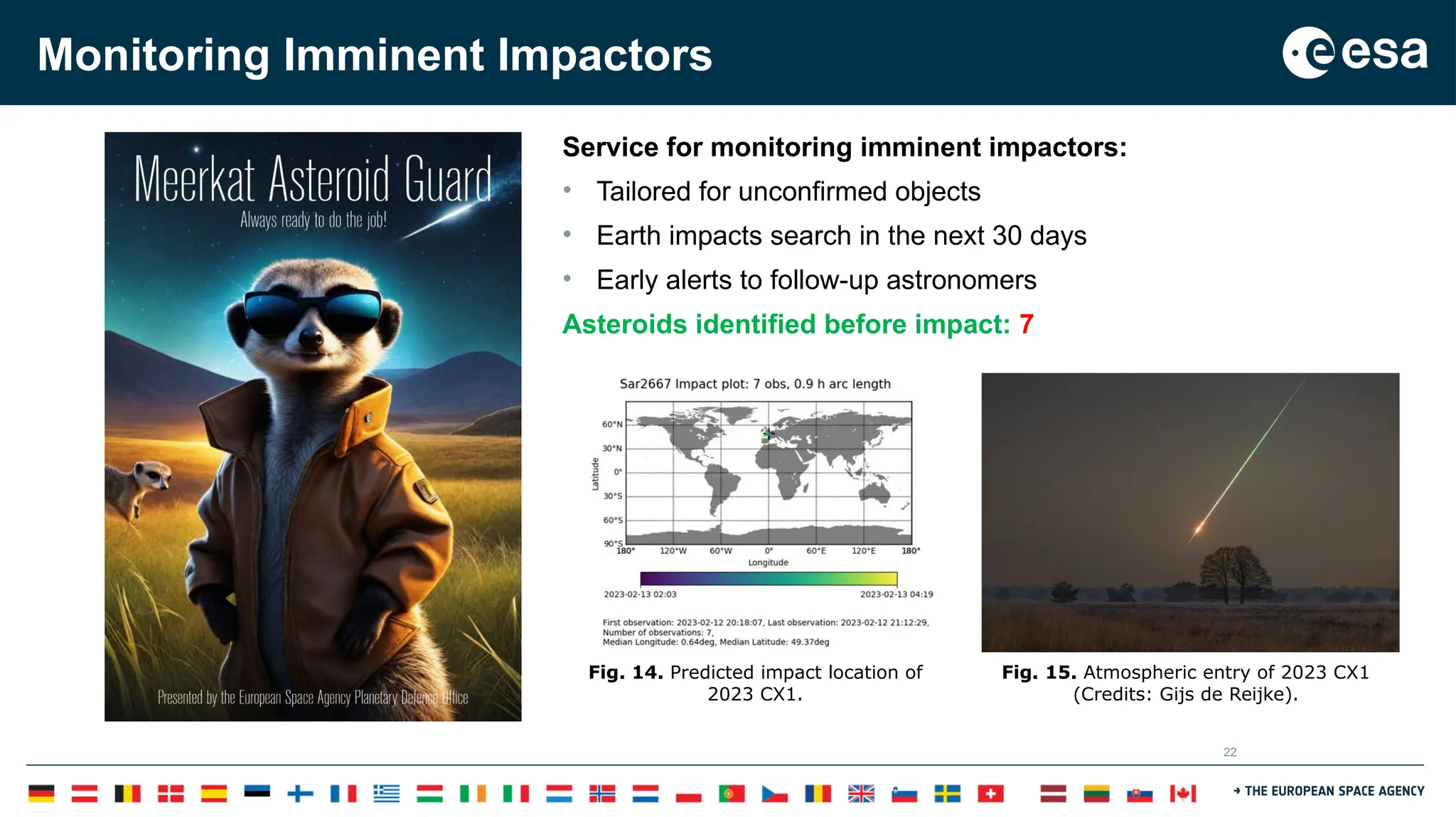
Monitoring Imminent Impactors
Servicefor monitoring imminent impactors:
• Tailored for unconfirmed objects
• Earth impacts search in the next 30 days
• Early alerts to follow-up astronomers
Asteroids identified before impact: 7
Fig. 14. Predicted impact location of
2023 CX1.
Fig. 15. Atmospheric entry of 2023 CX1
(Credits: Gijs de Reijke).
![5
The Aegis software
Aegis [1]
Asteroids Orbit Determination and Impact Monitoring
In Greek mythology Aegis is the shield used by Zeus. The Aegis
was said to be imbued with divine power and was depicted as a
shield adorned with the head of a Gorgon, Medusa.
[1] Fenucci et al. (2024). The Aegis orbit determination and impact monitoring system and services of the ESA NEOCC web portal, CMDA 136:58
Development Operations Evolution](https://image.slidesharecdn.com/aegispresentation2-250527083700-537c2a13/75/ACT-Science-coffee-presentation-about-asteroid-collision-probability-computation-5-2048.jpg)
![6
Orbit Determination
Observations: ri i = 1, ..., m
Prediction function:
Residuals:
Target function:
Dynamical model:
Gravitational attractions
General Relativity
Earth and Sun J2
Non-gravitational effects
[2] Milani & Gronchi (2009). Theory of Orbit Determination
[3] Veres et al. (2017). Statistical analysis of astrometric errors for the most productive asteroid surveys, Icarus 296
[4] Farnocchia et al. (2015). Star catalog position and proper motion corrections in asteroid astrometry, Icarus 245
[5] Carpino et al. (2003). Error statistics of asteroid optical astrometric observations, Icarus 166
Fig. 4. Massive main belt asteroids included in the dynamical model.](https://image.slidesharecdn.com/aegispresentation2-250527083700-537c2a13/75/ACT-Science-coffee-presentation-about-asteroid-collision-probability-computation-6-2048.jpg)
![9
Impact Monitoring
Summary of the algorithm [6]:
Line of Variations (LOV) sampling of the uncertainty
region
LOV propagation for 100 years
Analysis of returns on the Target Plane (TP)
Virtual Impactors (VI) search
Impact probability (IP) computation
Completeness limit: IP ~ 10-7
Fig. 7. Schematic representation of the target plane [7].
[6] Milani et al. (2005). Nonlinear impact monitoring: line of variation searches for impactors, Icarus 173
[7] Farnocchia el al. (2019). Planetary encounter analysis on the B-plane: a comprehensive formulation, CMDA 131](https://image.slidesharecdn.com/aegispresentation2-250527083700-537c2a13/75/ACT-Science-coffee-presentation-about-asteroid-collision-probability-computation-9-2048.jpg)
![18
Recent research work supported by Aegis
Automated Yarkovsky effect detection [8]
• da/dt predicted by physical model
• da/dt computed by orbit determination
• Outlier identification:
• Statistical test with prediction
• Dependency on isolated tracklets
• 368 positive detections
• Data on NEOCC portal
[8] Fenucci et al. (2024). An automated procedure for the detection of the Yarkovsky effect and results from the ESA NEO Coordination Centre, A&A 682, A29
Fig. 10. Distribution of Yarkovsky effect detections
as a function of the diameter [X], with outliers.](https://image.slidesharecdn.com/aegispresentation2-250527083700-537c2a13/75/ACT-Science-coffee-presentation-about-asteroid-collision-probability-computation-18-2048.jpg)
![19
Recent research work supported by Aegis
[9] Fenucci et al. (2025). Astrometry, orbit determination, and thermal inertia of the Tianwen-2 target asteroid (469219) Kamo`oalewa, A&A
[10] Novaković and Fenucci (2024). ASTERIA – Asteroid thermal inertia analyzer, Icarus 421
Kamo`oalewa, target of the Tianwen-2 mission [9]
• New observations from Loiano and Calar Alto (2024)
• Yarkovsky effect detection with SNR ~ 14
• Estimation of thermal inertia through ASTERIA [10]
• Regolith grain size extrapolation
Fig. 11. Conductivity (left) and thermal inertia (right) distribution of Kamo`oalewa obtained with ASTERIA.
Loiano](https://image.slidesharecdn.com/aegispresentation2-250527083700-537c2a13/75/ACT-Science-coffee-presentation-about-asteroid-collision-probability-computation-19-2048.jpg)
![20
Recent research work supported by Aegis
Ab initio strewn fields [11]
• Entry point at 100 km altitude
• Single fragmentation model through atmosphere
• Drag force and wind modeling
• Reproduced cases of 2008 TC3, 2023 CX1 and 2024 BX1
The fall of 2024 XA1 [12]
• Impact predicted by ESA Meerkat [13]
• Impact point uncertainties at 100 km altitude
• Almost-live and final ab initio strewn field
[11] Carbognani et al. (2025). Ab initio strewn field for small asteroid impacts, Icarus 425
[12] Gianotto et al. (2025). The fall of asteroid 2024 XA and the location of possible meteorites, Icarus 433
[13] Gianotto et al. (2024). Meerkat asteroid guard–ESA’s imminent impactor warning service, 2nd NEO and Debris Detection Conference
Fig. 12. Entry of 2024 XA1 (top) into the
atmosphere and predicted strewn field (bottom).](https://image.slidesharecdn.com/aegispresentation2-250527083700-537c2a13/75/ACT-Science-coffee-presentation-about-asteroid-collision-probability-computation-20-2048.jpg)
![21
Recent research work supported by Aegis
[14] Cano et al. (2025). Asteroid detection polar equation calculation and graphical representation, A&A 693, A183
Detection polar equation [14]
• Level surfaces for visual magnitude
• Helps in analyzing observability
• Nice visualization in the NEO Toolkit
Synodic Orbit Visualization Tool (SOVT)
• Catalogued and custom objects
Fig. 13. Detection polar (yellow) and orbit of Kamo`oalewa (red).](https://image.slidesharecdn.com/aegispresentation2-250527083700-537c2a13/75/ACT-Science-coffee-presentation-about-asteroid-collision-probability-computation-21-2048.jpg)