Using Regression and Anova for analysis
Independent variable
Dependent variable
Is number of carbon or molecular weight a good predictor
Independent variable
Dependent
variable
Data b/p from CRC. Click here
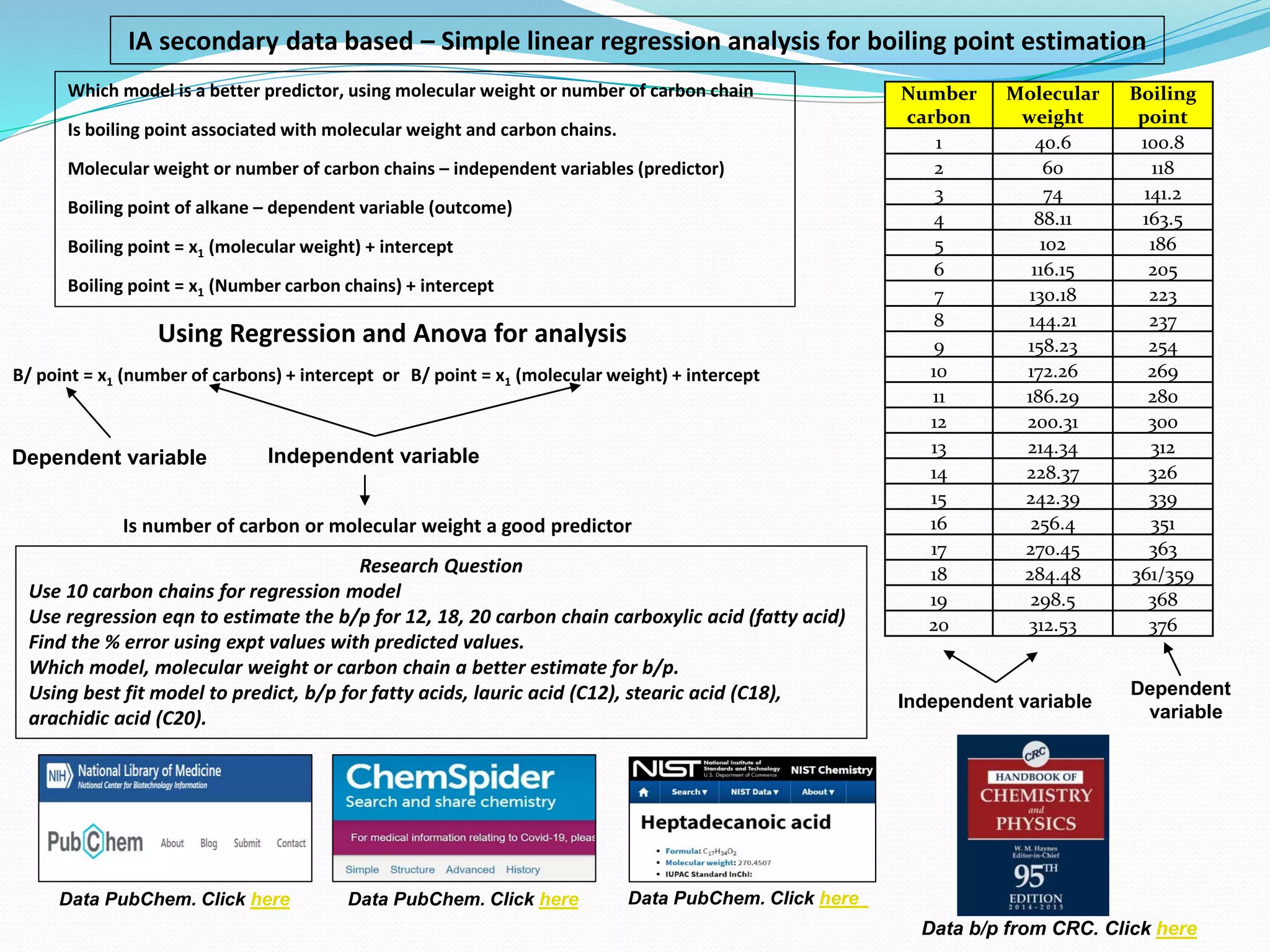
B/ point = x1 (number of carbons) + intercept or
IA secondary data based – Simple linear regression analysis for boiling point estimation
B/ point = x1 (molecular weight) + intercept
Research Question
Use 10 carbon chains for regression model
Use regression eqn to estimate the b/p for 12, 18, 20 carbon chain carboxylic acid (fatty acid)
Find the % error using expt values with predicted values.
Which model, molecular weight or carbon chain a better estimate for b/p.
Using best fit model to predict, b/p for fatty acids, lauric acid (C12), stearic acid (C18),
arachidic acid (C20).
Data PubChem. Click here Data PubChem. Click here Data PubChem. Click here
Number
carbon
Molecular
weight
Boiling
point
1 40.6 100.8
2 60 118
3 74 141.2
4 88.11 163.5
5 102 186
6 116.15 205
7 130.18 223
8 144.21 237
9 158.23 254
10 172.26 269
11 186.29 280
12 200.31 300
13 214.34 312
14 228.37 326
15 242.39 339
16 256.4 351
17 270.45 363
18 284.48 361/359
19 298.5 368
20 312.53 376
Which model is a better predictor, using molecular weight or number of carbon chain
Is boiling point associated with molecular weight and carbon chains.
Molecular weight or number of carbon chains – independent variables (predictor)
Boiling point of alkane – dependent variable (outcome)
Boiling point = x1 (molecular weight) + intercept
Boiling point = x1 (Number carbon chains) + intercept
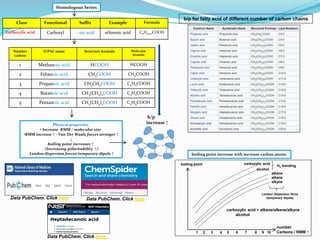
Homologous Series
Physical properties
• Increase RMM / molecular size
•RMM increase ↑ - Van Der Waals forces stronger ↑
↓
boiling point increases ↑
(Increasing polarisability ↑)
London dispersion forces/temporary dipole ↑
b/p
increase ↑
number
Carbons / RMM ↑
1 2 3 4 5 6 7 8 9 10
boiling point
boiling point increase with increase carbon atoms
alcohol
alkane
alkene
alkyne
London dispersion force
(temporary dipole)
H2 bonding
carboxylic acid > alkane/alkene/alkyne
alcohol
carboxylic acid
Number
carbon
IUPAC name Structure formula Molecular
formula
1 Methanoic acid HCOOH HCOOH
2 Ethanoic acid CH3COOH CH3COOH
3 Propanoic acid CH3CH2COOH C2H5COOH
4 Butanoic acid CH3(CH2)2COOH C3H7COOH
5 Pentanoic acid CH3(CH2)3COOH C4H9COOH
Class Functional Suffix Example Formula
Carboxylic acid Carboxyl - oic acid ethanoic acid CnH2n+1COOH
Data PubChem. Click here Data PubChem. Click here
Data PubChem. Click here
b/p for fatty acid of different number of carbon chains
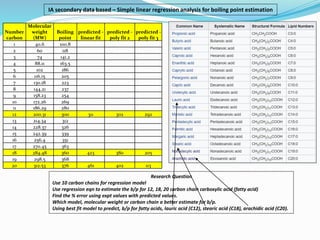
IA secondary data based – Simple linear regression analysis for boiling point estimation
Number
carbon
Molecular
weight
(MW)
Boiling
point
predicted -
linear fit
predicted -
poly fit 2
predicted -
poly fit 3
1 40.6 100.8
2 60 118
3 74 141.2
4 88.11 163.5
5 102 186
6 116.15 205
7 130.18 223
8 144.21 237
9 158.23 254
10 172.26 269
11 186.29 280
12 200.31 300 311 302 292
13 214.34 312
14 228.37 326
15 242.39 339
16 256.4 351
17 270.45 363
18 284.48 360 423 380 205
19 298.5 368
20 312.53 376 461 402 113
Research Question
Use 10 carbon chains for regression model
Use regression eqn to estimate the b/p for 12, 18, 20 carbon chain carboxylic acid (fatty acid)
Find the % error using expt values with predicted values.
Which model, molecular weight or carbon chain a better estimate for b/p.
Using best fit model to predict, b/p for fatty acids, lauric acid (C12), stearic acid (C18), arachidic acid (C20).
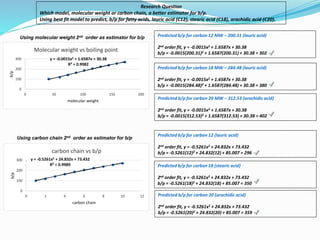
Predicted b/p for carbon 20 MW – 312.53 (arachidic acid)
2nd order fit, y = -0.0015x2 + 1.6587x + 30.38
b/p = -0.0015(312.53)2 + 1.6587(312.53) + 30.38 = 402
Predicted b/p for carbon 18 MW – 284.48 (lauric acid)
2nd order fit, y = -0.0015x2 + 1.6587x + 30.38
b/p = -0.0015(284.48)2 + 1.6587(284.48) + 30.38 = 380
Predicted b/p for carbon 12 MW – 200.31 (lauric acid)
2nd order fit, y = -0.0015x2 + 1.6587x + 30.38
b/p = -0.0015(200.31)2 + 1.6587(200.31) + 30.38 = 302
Research Question
Which model, molecular weight or carbon chain, a better estimator for b/p.
Using best fit model to predict, b/p for fatty acids, lauric acid (C12), stearic acid (C18), arachidic acid (C20).
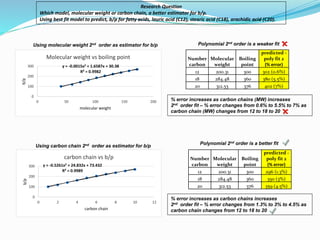
y = -0.0015x2 + 1.6587x + 30.38
R² = 0.9982
0
100
200
300
0 50 100 150 200
b/p
molecular weight
Molecular weight vs boiling point
Using molecular weight 2nd order as estimator for b/p
Using carbon chain 2nd order as estimator for b/p
Predicted b/p for carbon 12 (lauric acid)
2nd order fit, y = -0.5261x2 + 24.832x + 73.432
b/p = -0.5261(12)2 + 24.832(12) + 85.007 = 296
Predicted b/p for carbon 18 (stearic acid)
2nd order fit, y = -0.5261x2 + 24.832x + 73.432
b/p = -0.5261(18)2 + 24.832(18) + 85.007 = 350
Predicted b/p for carbon 20 (arachidic acid)
2nd order fit, y = -0.5261x2 + 24.832x + 73.432
b/p = -0.5261(20)2 + 24.832(20) + 85.007 = 359
y = -0.5261x2 + 24.832x + 73.432
R² = 0.9989
0
100
200
300
0 2 4 6 8 10 12
b/p
carbon chain
carbon chain vs b/p
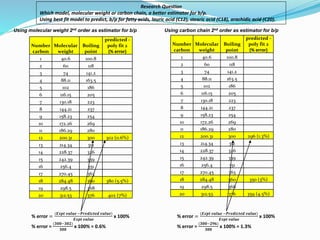
% error =
(𝑬𝒙𝒑𝒕 𝒗𝒂𝒍𝒖𝒆 −𝑷𝒓𝒆𝒅𝒊𝒄𝒕𝒆𝒅 𝒗𝒂𝒍𝒖𝒆)
𝑬𝒙𝒑𝒕 𝒗𝒂𝒍𝒖𝒆
x 100%
% error =
(𝟑𝟎𝟎−𝟐𝟗𝟔)
𝟑𝟎𝟎
x 100% = 1.3%
% error =
(𝑬𝒙𝒑𝒕 𝒗𝒂𝒍𝒖𝒆 −𝑷𝒓𝒆𝒅𝒊𝒄𝒕𝒆𝒅 𝒗𝒂𝒍𝒖𝒆)
𝑬𝒙𝒑𝒕 𝒗𝒂𝒍𝒖𝒆
x 100%
% error =
(𝟑𝟎𝟎−𝟑𝟎𝟐)
𝟑𝟎𝟎
x 100% = 0.6%
Using molecular weight 2nd order as estimator for b/p Using carbon chain 2nd order as estimator for b/p
Research Question
Which model, molecular weight or carbon chain, a better estimator for b/p.
Using best fit model to predict, b/p for fatty acids, lauric acid (C12), stearic acid (C18), arachidic acid (C20).
Number
carbon
Molecular
weight
Boiling
point
predicted -
poly fit 2
(% error)
1 40.6 100.8
2 60 118
3 74 141.2
4 88.11 163.5
5 102 186
6 116.15 205
7 130.18 223
8 144.21 237
9 158.23 254
10 172.26 269
11 186.29 280
12 200.31 300 302 (0.6%)
13 214.34 312
14 228.37 326
15 242.39 339
16 256.4 351
17 270.45 363
18 284.48 360 380 (5.5%)
19 298.5 368
20 312.53 376 402 (7%)
Number
carbon
Molecular
weight
Boiling
point
predicted -
poly fit 2
(% error)
1 40.6 100.8
2 60 118
3 74 141.2
4 88.11 163.5
5 102 186
6 116.15 205
7 130.18 223
8 144.21 237
9 158.23 254
10 172.26 269
11 186.29 280
12 200.31 300 296 (1.3%)
13 214.34 312
14 228.37 326
15 242.39 339
16 256.4 351
17 270.45 363
18 284.48 360 350 (3%)
19 298.5 368
20 312.53 376 359 (4.5%)
Polynomial 2nd order is a weaker fit
% error increases as carbon chains (MW) increases
2nd order fit – % error changes from 0.6% to 5.5% to 7% as
carbon chain (MW) changes from 12 to 18 to 20
Research Question
Which model, molecular weight or carbon chain, a better estimator for b/p.
Using best fit model to predict, b/p for fatty acids, lauric acid (C12), stearic acid (C18), arachidic acid (C20).
y = -0.0015x2 + 1.6587x + 30.38
R² = 0.9982
0
100
200
300
0 50 100 150 200
b/p
molecular weight
Molecular weight vs boiling point Number
carbon
Molecular
weight
Boiling
point
predicted -
poly fit 2
(% error)
12 200.31 300 302 (0.6%)
18 284.48 360 380 (5.5%)
20 312.53 376 402 (7%)
y = -0.5261x2 + 24.832x + 73.432
R² = 0.9989
0
100
200
300
0 2 4 6 8 10 12
b/p
carbon chain
carbon chain vs b/p Number
carbon
Molecular
weight
Boiling
point
predicted -
poly fit 2
(% error)
12 200.31 300 296 (1.3%)
18 284.48 360 350 (3%)
20 312.53 376 359 (4.5%)
Polynomial 2nd order is a better fit
Using carbon chain 2nd order as estimator for b/p
Using molecular weight 2nd order as estimator for b/p
% error increases as carbon chains increases
2nd order fit – % error changes from 1.3% to 3% to 4.5% as
carbon chain changes from 12 to 18 to 20

IA data based, boiling point estimation fatty acids using carbon chain and molecular weight

  • 1.
    Using Regression andAnova for analysis Independent variable Dependent variable Is number of carbon or molecular weight a good predictor Independent variable Dependent variable Data b/p from CRC. Click here B/ point = x1 (number of carbons) + intercept or IA secondary data based – Simple linear regression analysis for boiling point estimation B/ point = x1 (molecular weight) + intercept Research Question Use 10 carbon chains for regression model Use regression eqn to estimate the b/p for 12, 18, 20 carbon chain carboxylic acid (fatty acid) Find the % error using expt values with predicted values. Which model, molecular weight or carbon chain a better estimate for b/p. Using best fit model to predict, b/p for fatty acids, lauric acid (C12), stearic acid (C18), arachidic acid (C20). Data PubChem. Click here Data PubChem. Click here Data PubChem. Click here Number carbon Molecular weight Boiling point 1 40.6 100.8 2 60 118 3 74 141.2 4 88.11 163.5 5 102 186 6 116.15 205 7 130.18 223 8 144.21 237 9 158.23 254 10 172.26 269 11 186.29 280 12 200.31 300 13 214.34 312 14 228.37 326 15 242.39 339 16 256.4 351 17 270.45 363 18 284.48 361/359 19 298.5 368 20 312.53 376 Which model is a better predictor, using molecular weight or number of carbon chain Is boiling point associated with molecular weight and carbon chains. Molecular weight or number of carbon chains – independent variables (predictor) Boiling point of alkane – dependent variable (outcome) Boiling point = x1 (molecular weight) + intercept Boiling point = x1 (Number carbon chains) + intercept
  • 2.
    Homologous Series Physical properties •Increase RMM / molecular size •RMM increase ↑ - Van Der Waals forces stronger ↑ ↓ boiling point increases ↑ (Increasing polarisability ↑) London dispersion forces/temporary dipole ↑ b/p increase ↑ number Carbons / RMM ↑ 1 2 3 4 5 6 7 8 9 10 boiling point boiling point increase with increase carbon atoms alcohol alkane alkene alkyne London dispersion force (temporary dipole) H2 bonding carboxylic acid > alkane/alkene/alkyne alcohol carboxylic acid Number carbon IUPAC name Structure formula Molecular formula 1 Methanoic acid HCOOH HCOOH 2 Ethanoic acid CH3COOH CH3COOH 3 Propanoic acid CH3CH2COOH C2H5COOH 4 Butanoic acid CH3(CH2)2COOH C3H7COOH 5 Pentanoic acid CH3(CH2)3COOH C4H9COOH Class Functional Suffix Example Formula Carboxylic acid Carboxyl - oic acid ethanoic acid CnH2n+1COOH Data PubChem. Click here Data PubChem. Click here Data PubChem. Click here b/p for fatty acid of different number of carbon chains
  • 3.
    IA secondary databased – Simple linear regression analysis for boiling point estimation Number carbon Molecular weight (MW) Boiling point predicted - linear fit predicted - poly fit 2 predicted - poly fit 3 1 40.6 100.8 2 60 118 3 74 141.2 4 88.11 163.5 5 102 186 6 116.15 205 7 130.18 223 8 144.21 237 9 158.23 254 10 172.26 269 11 186.29 280 12 200.31 300 311 302 292 13 214.34 312 14 228.37 326 15 242.39 339 16 256.4 351 17 270.45 363 18 284.48 360 423 380 205 19 298.5 368 20 312.53 376 461 402 113 Research Question Use 10 carbon chains for regression model Use regression eqn to estimate the b/p for 12, 18, 20 carbon chain carboxylic acid (fatty acid) Find the % error using expt values with predicted values. Which model, molecular weight or carbon chain a better estimate for b/p. Using best fit model to predict, b/p for fatty acids, lauric acid (C12), stearic acid (C18), arachidic acid (C20).
  • 4.
    Predicted b/p forcarbon 20 MW – 312.53 (arachidic acid) 2nd order fit, y = -0.0015x2 + 1.6587x + 30.38 b/p = -0.0015(312.53)2 + 1.6587(312.53) + 30.38 = 402 Predicted b/p for carbon 18 MW – 284.48 (lauric acid) 2nd order fit, y = -0.0015x2 + 1.6587x + 30.38 b/p = -0.0015(284.48)2 + 1.6587(284.48) + 30.38 = 380 Predicted b/p for carbon 12 MW – 200.31 (lauric acid) 2nd order fit, y = -0.0015x2 + 1.6587x + 30.38 b/p = -0.0015(200.31)2 + 1.6587(200.31) + 30.38 = 302 Research Question Which model, molecular weight or carbon chain, a better estimator for b/p. Using best fit model to predict, b/p for fatty acids, lauric acid (C12), stearic acid (C18), arachidic acid (C20). y = -0.0015x2 + 1.6587x + 30.38 R² = 0.9982 0 100 200 300 0 50 100 150 200 b/p molecular weight Molecular weight vs boiling point Using molecular weight 2nd order as estimator for b/p Using carbon chain 2nd order as estimator for b/p Predicted b/p for carbon 12 (lauric acid) 2nd order fit, y = -0.5261x2 + 24.832x + 73.432 b/p = -0.5261(12)2 + 24.832(12) + 85.007 = 296 Predicted b/p for carbon 18 (stearic acid) 2nd order fit, y = -0.5261x2 + 24.832x + 73.432 b/p = -0.5261(18)2 + 24.832(18) + 85.007 = 350 Predicted b/p for carbon 20 (arachidic acid) 2nd order fit, y = -0.5261x2 + 24.832x + 73.432 b/p = -0.5261(20)2 + 24.832(20) + 85.007 = 359 y = -0.5261x2 + 24.832x + 73.432 R² = 0.9989 0 100 200 300 0 2 4 6 8 10 12 b/p carbon chain carbon chain vs b/p
  • 5.
    % error = (𝑬𝒙𝒑𝒕𝒗𝒂𝒍𝒖𝒆 −𝑷𝒓𝒆𝒅𝒊𝒄𝒕𝒆𝒅 𝒗𝒂𝒍𝒖𝒆) 𝑬𝒙𝒑𝒕 𝒗𝒂𝒍𝒖𝒆 x 100% % error = (𝟑𝟎𝟎−𝟐𝟗𝟔) 𝟑𝟎𝟎 x 100% = 1.3% % error = (𝑬𝒙𝒑𝒕 𝒗𝒂𝒍𝒖𝒆 −𝑷𝒓𝒆𝒅𝒊𝒄𝒕𝒆𝒅 𝒗𝒂𝒍𝒖𝒆) 𝑬𝒙𝒑𝒕 𝒗𝒂𝒍𝒖𝒆 x 100% % error = (𝟑𝟎𝟎−𝟑𝟎𝟐) 𝟑𝟎𝟎 x 100% = 0.6% Using molecular weight 2nd order as estimator for b/p Using carbon chain 2nd order as estimator for b/p Research Question Which model, molecular weight or carbon chain, a better estimator for b/p. Using best fit model to predict, b/p for fatty acids, lauric acid (C12), stearic acid (C18), arachidic acid (C20). Number carbon Molecular weight Boiling point predicted - poly fit 2 (% error) 1 40.6 100.8 2 60 118 3 74 141.2 4 88.11 163.5 5 102 186 6 116.15 205 7 130.18 223 8 144.21 237 9 158.23 254 10 172.26 269 11 186.29 280 12 200.31 300 302 (0.6%) 13 214.34 312 14 228.37 326 15 242.39 339 16 256.4 351 17 270.45 363 18 284.48 360 380 (5.5%) 19 298.5 368 20 312.53 376 402 (7%) Number carbon Molecular weight Boiling point predicted - poly fit 2 (% error) 1 40.6 100.8 2 60 118 3 74 141.2 4 88.11 163.5 5 102 186 6 116.15 205 7 130.18 223 8 144.21 237 9 158.23 254 10 172.26 269 11 186.29 280 12 200.31 300 296 (1.3%) 13 214.34 312 14 228.37 326 15 242.39 339 16 256.4 351 17 270.45 363 18 284.48 360 350 (3%) 19 298.5 368 20 312.53 376 359 (4.5%)
  • 6.
    Polynomial 2nd orderis a weaker fit % error increases as carbon chains (MW) increases 2nd order fit – % error changes from 0.6% to 5.5% to 7% as carbon chain (MW) changes from 12 to 18 to 20 Research Question Which model, molecular weight or carbon chain, a better estimator for b/p. Using best fit model to predict, b/p for fatty acids, lauric acid (C12), stearic acid (C18), arachidic acid (C20). y = -0.0015x2 + 1.6587x + 30.38 R² = 0.9982 0 100 200 300 0 50 100 150 200 b/p molecular weight Molecular weight vs boiling point Number carbon Molecular weight Boiling point predicted - poly fit 2 (% error) 12 200.31 300 302 (0.6%) 18 284.48 360 380 (5.5%) 20 312.53 376 402 (7%) y = -0.5261x2 + 24.832x + 73.432 R² = 0.9989 0 100 200 300 0 2 4 6 8 10 12 b/p carbon chain carbon chain vs b/p Number carbon Molecular weight Boiling point predicted - poly fit 2 (% error) 12 200.31 300 296 (1.3%) 18 284.48 360 350 (3%) 20 312.53 376 359 (4.5%) Polynomial 2nd order is a better fit Using carbon chain 2nd order as estimator for b/p Using molecular weight 2nd order as estimator for b/p % error increases as carbon chains increases 2nd order fit – % error changes from 1.3% to 3% to 4.5% as carbon chain changes from 12 to 18 to 20