Hyphenation when using two words to describe a third one
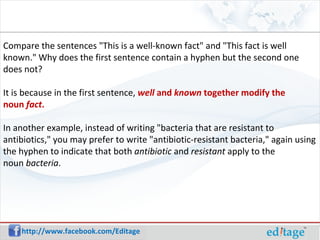
Compare the sentences "This is a well-known fact" and "This fact is well known." Why does the first sentence contain a hyphen but the second one does not?  It is because in the first sentence,   well  and  known  together modify the noun  fact .   In another example, instead of writing "bacteria that are resistant to antibiotics," you may prefer to write "antibiotic-resistant bacteria," again using the hyphen to indicate that both  antibiotic  and  resistant  apply to the noun  bacteria .
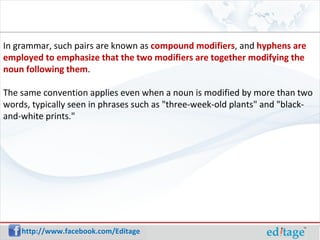
In grammar, such pairs are known as  compound modifiers , and  hyphens are employed to emphasize that the two modifiers are together modifying the noun following them .  The same convention applies even when a noun is modified by more than two words, typically seen in phrases such as "three-week-old plants" and "black-and-white prints."
Sometimes, you may wish to use two compound modifiers with a single noun, as in "two- and three-step processes" and "inter- and intra-specific competition." Such hyphens are referred to as "suspended," "hanging," or "dangling" hyphens. Note that adverbs ending in  ly  are never followed by a hyphen, as in "a practically impossible idea" and "a negatively charged ion." Reference: [1] The Mineralogical Record www.minrec.org/editing.asp
Connect with us on: http://www.facebook.com/Editage http://www.twitter.com/Editage http://www.linkedin.com/company/cactus-communications Connect http://blog.editage.com

Hyphenation when using two words to describe a third one

  • 1.
    Hyphenation when usingtwo words to describe a third one
  • 2.
    Compare the sentences"This is a well-known fact" and "This fact is well known." Why does the first sentence contain a hyphen but the second one does not? It is because in the first sentence,   well  and  known  together modify the noun  fact . In another example, instead of writing "bacteria that are resistant to antibiotics," you may prefer to write "antibiotic-resistant bacteria," again using the hyphen to indicate that both  antibiotic  and resistant  apply to the noun  bacteria .
  • 3.
    In grammar, suchpairs are known as compound modifiers , and hyphens are employed to emphasize that the two modifiers are together modifying the noun following them . The same convention applies even when a noun is modified by more than two words, typically seen in phrases such as "three-week-old plants" and "black-and-white prints."
  • 4.
    Sometimes, you maywish to use two compound modifiers with a single noun, as in "two- and three-step processes" and "inter- and intra-specific competition." Such hyphens are referred to as "suspended," "hanging," or "dangling" hyphens. Note that adverbs ending in  ly  are never followed by a hyphen, as in "a practically impossible idea" and "a negatively charged ion." Reference: [1] The Mineralogical Record www.minrec.org/editing.asp
  • 5.
    Connect with uson: http://www.facebook.com/Editage http://www.twitter.com/Editage http://www.linkedin.com/company/cactus-communications Connect http://blog.editage.com