Hypertensive Disorders in
       Pregnancy


         www.freelivedoctor.com
Classification
• Pre-existing (chronic) hypertension:
• Pregnancy-induced hypertension (PIH)
• Superimposed pre-eclampsia or eclampsia:


                  www.freelivedoctor.com
Pre-existing (chronic) hypertension:
a.essential hypertension,

b. secondary to chronic renal disorders e.g.
pyelonephritis and renal artery stenosis,

c. coarctation of the aorta, systemic lupus
   erythematosus and pheochromocytoma.

                    www.freelivedoctor.com
Pregnancy-induced hypertension
               (PIH):
a. Transient hypertension:Late onset
   hypertension, without proteinuria or
   pathologic oedema
b. Pre-eclampsia:Hypertension with proteinuria
   and / or oedema after 20 weeks of
   pregnancy, but may be earlier in vesicular
   mole.
c. Eclampsia: Pre-eclampsia + convulsions.

                  www.freelivedoctor.com
Superimposed pre-eclampsia or
             eclampsia

• Development of pre-eclampsia or eclampsia in
  pre-existing hypertension detected by a
  further increase of 30 mmHg or more in
  systolic blood pressure or 15 mmHg or more
  in diastolic blood pressure.


                  www.freelivedoctor.com
Aetiology

• Although eclampsia had been described since
  200 years, no definite aetiology is found for
  PIH and it is still a disease of theories.


                   www.freelivedoctor.com
• Predisposing factors
a. Primigravidae more than multigravidae.
b. Pre-existing hypertension.
c. Previous pre-eclampsia.
d. Family history of pre-eclampsia.
e. Hyperplacentosis i.e. excessive chorionic
    tissue as in hydatidiform mole, multiple
    pregnancy, uncontrolled diabetes mellitus and
    foetal haemolytic diseases.
 f. Obesity.
 g. Climatic variations.
                    www.freelivedoctor.com
Theories
•   The uteroplacental bed
•   Immunological factor
•   Genetic factor
•   Renin- angiotensin system
•   Atrial natriuretic peptide (ANP)
•   Prostaglandins
•   Neutrophils

                      www.freelivedoctor.com
The uteroplacental bed: theory
• In early pregnancy, the cytotrophoblasts
  invade the decidual arteries making their
  musculature more flaccid and dilated. During
  the second trimester of normal pregnancy, a
  second wave of invasion occurs into the
  myometrial segments of the spiral arteries. If
  the second invasion does not occur pre-
  eclampsia develops.

                    www.freelivedoctor.com
Immunological factor: theory
• Stimulation of the maternal immune system
  by the early conceptus is essential for
  production of the blocking factors that
  prevent rejection of the foetus and placenta.
  Hypoimmune response results in damage of
  the placenta and subsequent pre-eclampsia.


                   www.freelivedoctor.com
Genetic factor: theory
• A maternal autosomal recessive gene or a
  foetal genetic component could be
  responsible. An increase in HLA-DR4
  (subtypeof human leucocyte antigen) has
  been noted in pre-eclamptic women, their
  babies and their sisters who developed PIH.


                   www.freelivedoctor.com
Renin- angiotensin system:theory
• It was found that the vascular sensitivity to
  angiotensin II is reduced in normal pregnancy
  while it increases in PIH.
• Angiotensin II-binding sites on platelets
  increase in women with PIH in comparison
  with normal pregnancy. This can identify the
  women in risk of developing PIH and hence
  prophylaxis against it can be achieved by anti-
  platelets as aspirin.

                    www.freelivedoctor.com
Atrial natriuretic peptide (ANP):theory
• It’s release is stimulated by volume expansion
  and increase in atrial pressure. It is increased
  in normal pregnancy to ameliorate the effect
  of the increased angiotensin II. Actually, there
  is no evidence that there is decrease in ANP in
  PIH, but in contrast, it may be increased as a
  response to increased blood pressure.


                     www.freelivedoctor.com
Prostaglandins:theory
• Prostacyclin is a vasodilator and an inhibitor
  forplatelets aggregation while thromboxane is
  a vasoconstrictor and platelets aggregator. In
  PIH, there is imbalance towards an increase in
  thromboxane production.


                   www.freelivedoctor.com
Neutrophils:theory
• Neutrophils activation causes damage and
  dysfunction of the vascular endothelium
  leading to platelets aggregation, coagulation
  activation, hypertension and proteinuria.


                    www.freelivedoctor.com
Pathological Changes
• Vasospasm
• Coagulation status
• Sodium and water retention


                  www.freelivedoctor.com
Pathological Changes>Vasospasm
• The vascular changes and local hypoxia of the
  surrounding tissues lead to
  haemorrhage, necrosis and other pathological
  changes.


                   www.freelivedoctor.com
Pathological Changes>Vasospasm
1.Central nervous system:
2. Liver
3. Endocrine glands
4. Heart and lungs
5. Kidney
6. Placenta
7.Retina

                   www.freelivedoctor.com
Pathological ChangesVasospasm
1.Central nervous system:
   ischaemia, haemorrhages and oedema.
2. Liver: subcapsular haemorrhage, periportal
   necrosis and infarctions.
3. Endocrine glands: necrosis and haemorrhage in
   pituitary, pancreas and adrenal glands.
4. Heart and lungs: myocardial and endocardial
   haemorrhage and necrosis. Lungs show
   haemorrhage and secondary bronchopneumonia.
                   www.freelivedoctor.com
Pathological Changes>Vasospasm
5. Kidney: decrease in renal blood flow ? glomerular
   damage (glomerular endotheliosis) leading to:
  a. decrease glomerular filtration rate by about
   50%,
  b. loss of protein in urine (albuminuria),
 c. elevated serum levels of uric acid, urea and
   creatinine.
   Serum uric acid level is diagnostic and prognostic
   for severe pre-eclampsia.

                     www.freelivedoctor.com
Pathological Changes>Vasospasm
6. Placenta:
      a. Reduced utero-placental blood flow
  leading to intrauterine growth retardation
  (IUGR) and even death.
      b. Placental thrombosis, infarction and
  abruptio placentae.
7. Retina: Vascular
  spasm, haemorrhage, exudate and rarely
  retinal detachment in severe cases.
                    www.freelivedoctor.com
Pathological Changes> Coagulation status

1. Fibrin production is increased.
2. Fibrinolytic activity is decreased.
3. Factor VII, factor VIII- related antigen and
  fibrin/ fibrinogen degradation products (FDP)
  concentrations in the plasma are all increased.
4. Fibrin and platelet deposition is increased
  particularly in the placental arteries.


                    www.freelivedoctor.com
Pathological Changes>Coagulation status

5. Thrombocytopenia.
6. Platelets are activated in the microcirculation
  of the placenta, kidney and liver, release their
  products as 5-hydroxytryptamine and re-enter
  the circulation in an exhausted state, unable
  to respond normally to aggregating agents
  and having lower level of 5-
  hydroxytryptamine.

                    www.freelivedoctor.com
Pathological Changes>Coagulation status

• The end result of these changes is
  hypercoagulability and disseminated
  intravascular coagulation in severe
   pre-eclampsia and eclampsia.


                  www.freelivedoctor.com
Pathological Changes>Sodium and water
                   retention
• There is haemoconcentration with fluid shift
  from the intravascular to the extravascular
  compartment.
• N.B. HELLP syndrome is described in PIH which
  consists of: H = Haemolysis, EL= Elevated Liver
  enzymes, LP= Low Platelet count.


                   www.freelivedoctor.com
Diagnosis
• Signs
1.Hypertension:Blood pressure of 140/90 mmHg
  or more or an increase of 30 mmHg in systolic
  and/or 15 mmHg in diastolic blood pressure
  over the pre- or early pregnancy level.


                   www.freelivedoctor.com
Diagnosis
2. Proteinuria (albuminuria):
a.It is urinary protein greater than 0.3gm/L in 24
   hours collection or greater than 1gm/L in two
   random samples obtained at least 6 hours apart.
b.It indicates glomerular damage and almost always
   occurs after hypertension.
c. Proteinuria is usually in the range of 1-3 gm
   daily, of which 50-60% is albumin but in severe
   cases it may exceed 15gm.
                    www.freelivedoctor.com
Diagnosis
3. Oedema:
a. It is weight gain of more than 1 kg in any one
  week or 2.25 kg in any one month.
b. Clinical oedema is present in about two-
  thirds of patients with PIH. However, two-
  thirds of pregnant women with clinical
  oedema do not develop hypertension.


                    www.freelivedoctor.com
Diagnosis
• Symptoms:These are usually manifestations of
  severe pre-eclampsia.
1. Headache: usually frontal but may be
  occipital. It is due to cerebral oedema and
  hypertension.
2. Visual disturbances: blurring of vision, flashes
  of light or blindness.


                    www.freelivedoctor.com
Diagnosis
3. Epigastric or right upper quadrant pain: due
  to enlargement and subcapsular haemorrhage
  of the liver.
4. Nausea and vomiting: due to congestion of
  gastric mucosa and/ or cerebral oedema.
5. Oliguria or anuria: due to kidney pathology.


                   www.freelivedoctor.com
Diagnosis> Investigations
1. Complete urine examination: for
  proteinuria, pus cells, RBCs, casts, specific
  gravity, culture and sensitivity.
2. Kidney function tests: serum uric acid > 6 mg
  % is abnormal during pregnancy. It is more
  specific for pre-eclampsia than creatinine.
3. Coagulation status: Platelet count, fibrinogen
  and FDP as DIC may develop.

                    www.freelivedoctor.com
Diagnosis> Investigations
4. Eye fundus examination.
5. Tests for foetal well being: as
   a. ultrasound,
   b. daily foetal movement count,
   c. non-stress test,
   d. oxytocin challenge test (if needed).


                    www.freelivedoctor.com
Screening for PIH
• These are tests to predict the development of
  pre-eclampsia.
A. Tests depend on blood pressure
  measurement
B. Urinary assays
C. Blood tests
D. Angiotensin II sensitivity


                   www.freelivedoctor.com
Tests depend on blood pressure
               measurement
• 1.Roll-over test:
  After resting in the left lateral position turning
  to a supine position induces a rise in diastolic
  pressure of 20 mmHg or more is indicative of
  tendency to develop pre-eclampsia.
  Subsequent reports have indicated that the
  test is less satisfactory.


                     www.freelivedoctor.com
Tests depend on blood pressure
             measurement
• 2.Mid-trimester mean blood pressure:

 If the mean arterial blood pressure (the
 diastolic pressure +1/3 the pulse pressure) is
 more than 90 mmHg, the risk of developing
 PIH increases by over four folds.


                   www.freelivedoctor.com
Tests depend on blood pressure
             measurement
• 3.Hand-grip test:Isometric (sustained) contraction
  of striated muscles is known to cause general
  sympathetic activation and hence increase
  systemic arterial pressure in healthy adults. The
  patient compresses an inflated
  sphygmomanometer cuff for a 3-minutes period
  at maximal and then at 50% of maximal voluntary
  contraction. An increase in diastolic pressure >20
  mmHg at 28-32 weeks’ gestation is associated
  with an increased incidence of PIH.
                     www.freelivedoctor.com
Tests depend on blood pressure
             measurement
• 4.Forearm venous tone:
• There is an increase in forearm venous tone
  (veno-constriction) at least 6 weeks before the
  diagnosis of PIH. It requires a sophisticated
  equipment.


                   www.freelivedoctor.com
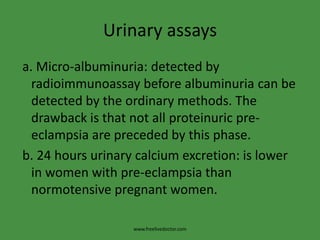
Urinary assays
a. Micro-albuminuria: detected by
  radioimmunoassay before albuminuria can be
  detected by the ordinary methods. The
  drawback is that not all proteinuric pre-
  eclampsia are preceded by this phase.
b. 24 hours urinary calcium excretion: is lower
  in women with pre-eclampsia than
  normotensive pregnant women.

                   www.freelivedoctor.com
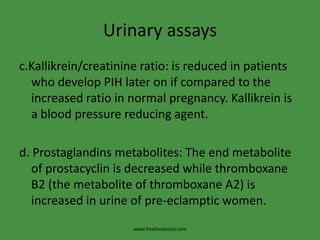
Urinary assays
c.Kallikrein/creatinine ratio: is reduced in patients
  who develop PIH later on if compared to the
  increased ratio in normal pregnancy. Kallikrein is
  a blood pressure reducing agent.

d. Prostaglandins metabolites: The end metabolite
   of prostacyclin is decreased while thromboxane
   B2 (the metabolite of thromboxane A2) is
   increased in urine of pre-eclamptic women.
                      www.freelivedoctor.com
Blood tests
• a. Plasma urate: serial increase is a warning of
  PIH before appearance of other clinical
  features.
• b.Platelet count: a reduction occurs early in
  pre-eclampsia.
• c. Anti-thrombin - III activity: begin to decline
  as much as 13 weeks prior to the
  development of clinical manifestations of pre-
  eclampsia.

                    www.freelivedoctor.com
Angiotensin II sensitivity
a. Sensitivity to infused angiotensin II: is
   increased may be due to alteration in
   vascular smooth muscle A II receptors.
b. b.Platelet AII binding: is increased before
   development of PIH.


                    www.freelivedoctor.com
Types > pre-eclampsia
a.Mild pre-eclampsia: blood pressure ³ 140/90
mmHg ± oedema.
b.Severe pre-eclampsia:
   > blood pressure >140/90 mmHg +
proteinuria ± oedema or
   > diastolic blood pressure >110 mmHg or
   > cerebral or visual disturbances.


                 www.freelivedoctor.com
Imminent eclampsia
• It is a state in which the patient is about to
   develop eclampsia. Usually there are:
a. blood pressure much higher than 160 /110
   mmHg,
b. heavy proteinuria (+++or ++++),
c. hyperreflexia,
d. severe continuous headache,
e. blurring of vision,
f.epigastric pain.

                      www.freelivedoctor.com
Fulminating pre-eclampsia
• a rapidly deteriorating pre-eclampsia to be
  imminent eclampsia.


                   www.freelivedoctor.com
Differential Diagnosis


        www.freelivedoctor.com
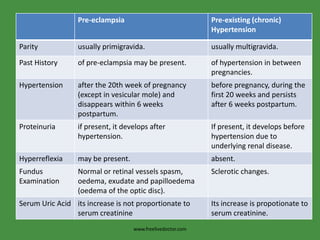
Pre-eclampsia                              Pre-existing (chronic)
                                                            Hypertension

Parity           usually primigravida.                      usually multigravida.

Past History     of pre-eclampsia may be present.           of hypertension in between
                                                            pregnancies.
Hypertension     after the 20th week of pregnancy           before pregnancy, during the
                 (except in vesicular mole) and             first 20 weeks and persists
                 disappears within 6 weeks                  after 6 weeks postpartum.
                 postpartum.
Proteinuria      if present, it develops after              If present, it develops before
                 hypertension.                              hypertension due to
                                                            underlying renal disease.
Hyperreflexia    may be present.                            absent.
Fundus           Normal or retinal vessels spasm,           Sclerotic changes.
Examination      oedema, exudate and papilloedema
                 (oedema of the optic disc).
Serum Uric Acid its increase is not proportionate to        Its increase is propotionate to
                serum creatinine                            serum creatinine.
                                   www.freelivedoctor.com
Other Causes of proteinuria
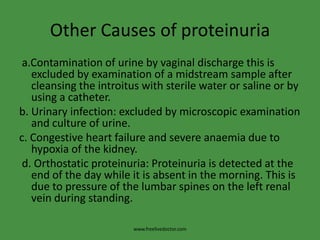
 a.Contamination of urine by vaginal discharge this is
   excluded by examination of a midstream sample after
   cleansing the introitus with sterile water or saline or by
   using a catheter.
b. Urinary infection: excluded by microscopic examination
   and culture of urine.
c. Congestive heart failure and severe anaemia due to
   hypoxia of the kidney.
 d. Orthostatic proteinuria: Proteinuria is detected at the
   end of the day while it is absent in the morning. This is
   due to pressure of the lumbar spines on the left renal
   vein during standing.

                        www.freelivedoctor.com
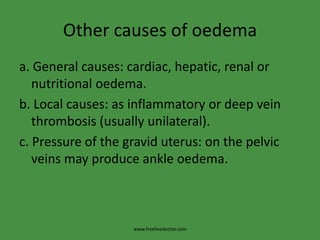
Other causes of oedema
a. General causes: cardiac, hepatic, renal or
   nutritional oedema.
b. Local causes: as inflammatory or deep vein
   thrombosis (usually unilateral).
c. Pressure of the gravid uterus: on the pelvic
   veins may produce ankle oedema.


                    www.freelivedoctor.com
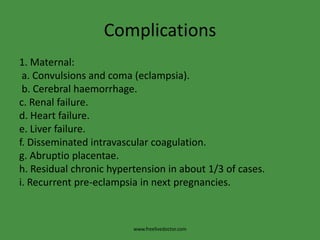
Complications
1. Maternal:
 a. Convulsions and coma (eclampsia).
 b. Cerebral haemorrhage.
c. Renal failure.
d. Heart failure.
e. Liver failure.
f. Disseminated intravascular coagulation.
g. Abruptio placentae.
h. Residual chronic hypertension in about 1/3 of cases.
i. Recurrent pre-eclampsia in next pregnancies.


                         www.freelivedoctor.com
Complications
2.Foetal:
a. Intrauterine growth retardation (IUGR).
b. Intrauterine foetal death.
c. Prematurity and its complications.


                   www.freelivedoctor.com
Treatment > Prophylactic
1. Proper antenatal care:
a. To detect the high risk patients who may
  develop PIH through the screening tests.
b. Early detection of cases who are already
  developed PIH and examine them more
  frequently.


                   www.freelivedoctor.com
Treatment > Prophylactic
2.Low dose aspirin:
a. It inhibits thromboxane production from the
   platelets and the AII binding sites on platelets.
b. A low dose (60 mg daily) selectively inhibits
   thromboxane due to higher concentration of such
   a low dose in the portal circulation than systemic
   affecting the platelets when pass through the
   portal circulation. The prostacyclin production
   form the systemic vessels will not be affected.
                     www.freelivedoctor.com
Treatment > Curative
Delivery of the foetus and placenta is the only
real treatment of pre-eclampsia. As the
conditions are not always suitable for this, the
treatment aims to prevent or minimise the
maternal and foetal complications (see
before) till reasonable maturation of the
foetus.


                  www.freelivedoctor.com
Treatment> General measures
1. Hospitalisation: with complete bed rest more
  in left lateral position to prevent compression
  of the inferior vena cava. This lowers the
  blood pressure, induces diuresis, reduces
  oedema and increases renal and placental
  blood flow.
2. High protein, low sodium diet.


                    www.freelivedoctor.com
Treatment> General measures
3. Observation:
A. Maternal:
  > blood pressure twice daily.
  > urine volume and proteinuria daily,
  > oedema daily,
  > body weight twice weekly,
  > fundus oculi once weekly,
  > blood picture including platelet count, liver and
   renal functions particularly serum uric acid on
   admission.
                      www.freelivedoctor.com
Treatment> General measures
B. Foetal:
> daily foetal movement count,
> serial sonography,
> non-stress and stress test if needed.


                   www.freelivedoctor.com
Medical treatment:
•   Sedatives
•   Antihypertensives
•   Diuretics
•   Other drugs


                    www.freelivedoctor.com
Medical treatment>Sedatives
• as diazepam 2-5 mg every 8-12 hours.


                  www.freelivedoctor.com
Medical treatment>Antihypertensives
a. Alpha-methyl-dopa (Aldomet)
b. Hydralazine (Apresoline)
c. Calcium channel blockers (Nifedipine)
d. Adreno-receptor blockers
e. Angiotensin converting enzyme inhibitors
f. Diazoxide (Hyperstat)


                   www.freelivedoctor.com
Medical treatment>Diuretics
a."Loop" diuretics: > Furosemide (Lasix): 20-40
  mg IV repeated at intervals of 2-4 hours
  >Thiazides: better to be avoided in pregnancy.

b.Osmotic diuretics: as mannitol or glucose 25%


                   www.freelivedoctor.com
Medical treatment>Other drugs
a. Dexamethasone
b. Heparin
c. Salt-free albumin or plasma protein fraction
     (PPF)
d. Antibiotics
e. Anticonvulsant therapy
 f. Digitalisation

                    www.freelivedoctor.com
Treatment> Obstetric measures
Timing of delivery:
  Severe pre-eclampsia is usually treated
  conservatively till the end of the 36th week to
  ensure reasonable maturation of the foetus.


                   www.freelivedoctor.com
Treatment> Obstetric measures
• Indications of termination before 36th week
  include:
• Foetal
• Maternal


                   www.freelivedoctor.com
Treatment> Obstetric measures
• Foetal: deteriorating placental function as
   judged by
a. intrauterine growth retardation,
b. oligohydramnios,
c. reduced foetal movements,
d. abnormal foetal heart patterns, or
e. failing biochemical results.

                    www.freelivedoctor.com
Treatment> Obstetric measures
• Maternal: deteriorating maternal condition as
   judged by
 a. blood pressure is sustained or exceeds
   180/110 mmHg,
b. urine proteinuria > 5 gm/24 hours,
c. oliguria,
d. evidence of DIC, or
e. imminent or already developed eclampsia.
                   www.freelivedoctor.com
Method of delivery
• Vaginal delivery
• Caesarean section


                  www.freelivedoctor.com
Method of delivery
• Vaginal delivery may be commenced in vertex
   presentation by:
 > amniotomy + oxytocin if the cervix is
   favourable.
 > prostaglandin vaginal tablet (PGE2) if the
   cervix is not favourable.


                  www.freelivedoctor.com
Method of delivery
• Caesarean section is indicated in
 > Foetal distress.
 > Late deceleration occurs with oxytocin
  challenge test.
 >Failure of induction of labour.
 > Other indications as contracted pelvis, and
  malpresentations.


                    www.freelivedoctor.com
Intrapartum care
a. Close monitoring of the foetus is indicated.

b. Proper sedation and analgesia to the mother.
 Hypotensives may be given if needed.

c. 2nd stage of labour may be shortened by
   forceps.


                   www.freelivedoctor.com
Postpartum care
a. Methergin is better avoided as it may
  increase the blood pressure
b.Continue observation of the mother for 48
  hours.he blood pressure
c. Sedatives and hypotensive drugs are
  continued in a decreasing dose for 48 hours.


                   www.freelivedoctor.com
Treatment> N.B. Mild pre-eclampsia
can be treated as an outpatient with sedatives
± hypotensive drugs with frequent follow up.
Pregnancy can be allowed to pass to full term
but not after. Delivery is usually vaginal unless
there is other indication for caesarean section.


                  www.freelivedoctor.com
ECLAMPSIA


  www.freelivedoctor.com
ECLAMPSIA
• Definition>It is the development of
  convulsions in a pre-existing pre-eclampsia.

• Incidence>About 1/1000 pregnancies.


                    www.freelivedoctor.com
ECLAMPSIA>Aetiology

• The exact cause is unknown but cerebral
  ischaemia and oedema were suggested.


                   www.freelivedoctor.com
ECLAMPSIA>Clinical Picture
• a. Premonitory stage: the eyes are rolled up with twitches
  of the face and hands. It lasts for about ½ min.
• b. Tonic stage: generalised tonic contraction of the whole
  body muscles with opisthotonus and cyanosis. It lasts for
  about ½ min.
• c. Clonic stage: convulsions occur where there is
  alternative contraction and relaxation of the body muscles.
  The face is congested, tongue may be bitten, blood-stained
  frothy saliva appears on the mouth, breathing is
  stertorous, urine and stool may pass
  involuntarily, temperature rises due to increased muscular
  activity patient is unconscious. This lasts for about 1 min.
• d. Coma: it may last for few hours.

                         www.freelivedoctor.com
ECLAMPSIA>Types
1. Antepartum eclampsia 50%.
2. Intrapartum eclampsia 25%.
3. Postpartum eclampsia 25% occurs within 48
  hours of delivery. It is usually the most
  dangerous one.


                  www.freelivedoctor.com
Severity of Eclampsia

• Eclampsia is considered severe if one or more of
  the following is present (Eden’s criteria):
1. Coma of 6 or more hours.
2. Temperature 390C or more.
3. Pulse over 120/min.
4. Systolic blood pressure over 200 mmHg.
5. Respiratory rate over 40/min.
6. More than 10 convulsions.


                     www.freelivedoctor.com
ECLAMPSIA>Differential Diagnosis
>Epilepsy.
>Intracranial haemorrhage.
> Hysteria.
> Meningitis.
>Brain tumours.
> Strychnine poisoning.


                  www.freelivedoctor.com
ECLAMPSIA>Management
• General measures
• Medical measures
• Obstetric measures


                   www.freelivedoctor.com
ECLAMPSIA>Management
General measures:
• Hospitalisation
• Efficient nursing
• After sedation, a self-retained Foley’s catheter
  is applied.
• Care for respiratory system
• The tongue is protected from biting by a
  plastic mouth gauge.
• Observation for: Maternal vitals& FHS
                    www.freelivedoctor.com
ECLAMPSIA>Management
Medical measures:
1. Sedation:
2. Antihypertensives:
3. Anticonvulsant therapy:
4. Diuretics


                   www.freelivedoctor.com
Sedation:
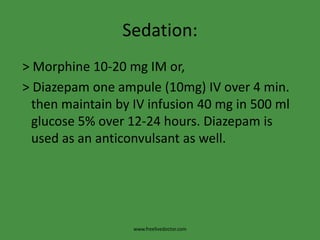
> Morphine 10-20 mg IM or,
> Diazepam one ampule (10mg) IV over 4 min.
  then maintain by IV infusion 40 mg in 500 ml
  glucose 5% over 12-24 hours. Diazepam is
  used as an anticonvulsant as well.


                   www.freelivedoctor.com
Antihypertensives
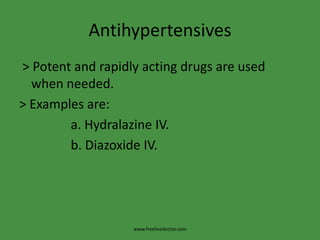
> Potent and rapidly acting drugs are used
  when needed.
> Examples are:
        a. Hydralazine IV.
        b. Diazoxide IV.


                   www.freelivedoctor.com
Anticonvulsant therapy
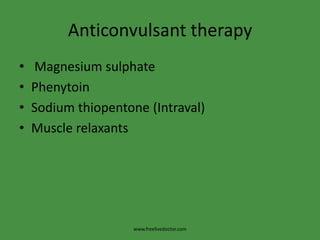
•   Magnesium sulphate
•   Phenytoin
•   Sodium thiopentone (Intraval)
•   Muscle relaxants


                     www.freelivedoctor.com
Diuretics
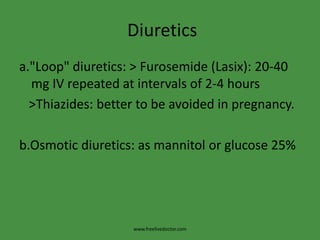
a."Loop" diuretics: > Furosemide (Lasix): 20-40
  mg IV repeated at intervals of 2-4 hours
  >Thiazides: better to be avoided in pregnancy.

b.Osmotic diuretics: as mannitol or glucose 25%


                   www.freelivedoctor.com
ECLAMPSIA>Management
• Obstetric measures
 The policy is that there is no conservative treatment in
  eclampsia and the patient should be delivered but
  convulsions should be controlled first.
 Spontaneous labour usually commences within 6
  hours. If not induce labour by oxytocin as long as there
  is no other indication for caesarean section and vaginal
  delivery is anticipated within 8-12 hours.
  Otherwise, caesarean section is indicated but never
  give general anaesthesia before control of convulsions
  or if the patient is in coma.

                       www.freelivedoctor.com
PRE-EXISTING (CHRONIC)
    HYPERTENSION


        www.freelivedoctor.com
PRE-EXISTING (CHRONIC)
         HYPERTENSION>Causes
• 1.Essential hypertension:of unknown
  aetiology.


                  www.freelivedoctor.com
PRE-EXISTING (CHRONIC)
         HYPERTENSION>Causes
2. Secondary to chronic renal disorder: e.g.
      > Glomerulonephritis.
      > Hydronephrosis.
      > Pyelonephritis.
      > Renal artery stenosis.


                    www.freelivedoctor.com
PRE-EXISTING (CHRONIC)
         HYPERTENSION>Causes
3. Secondary to cardiovascular disease: e.g.
      > Coarctation of the aorta.
      > Polyartheritis nodosa.
      > Systemic lupus erythematosus.


                      www.freelivedoctor.com
PRE-EXISTING (CHRONIC)
         HYPERTENSION>Causes
4.Secondary to endocrine disorders: e.g.
     > Primary aldosteronism.
     > Phaeochromocytoma.
     > Adrenocortical tumours.
     > Diabetes mellitus.


                   www.freelivedoctor.com
Effect of Pregnancy on Chronic
               Hypertension
>Blood pressure falls by the second trimester in
  most of cases, but rises during the third
  trimester to a level some what above that in
  early pregnancy.
>Deterioration of the underlying disease.


                    www.freelivedoctor.com
Effect of Chronic Hypertension on
               Pregnancy
Maternal:
> superimposed pre-eclampsia/ eclampsia in 15-
  20% of cases.
Foetal:
>Intrauterine growth retardation.
>Intrauterine foetal death.


                  www.freelivedoctor.com
Treatment
General and medical treatment
> Rest,
> Sedatives,
> Antihypertensives,
> Diuretics,
> Observation.


                  www.freelivedoctor.com
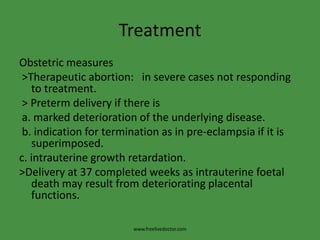
Treatment
Obstetric measures
 >Therapeutic abortion: in severe cases not responding
   to treatment.
 > Preterm delivery if there is
 a. marked deterioration of the underlying disease.
 b. indication for termination as in pre-eclampsia if it is
   superimposed.
c. intrauterine growth retardation.
>Delivery at 37 completed weeks as intrauterine foetal
   death may result from deteriorating placental
   functions.

                        www.freelivedoctor.com

Hypertensivedisordersinpregnancy 100515015806-phpapp01

  • 1.
    Hypertensive Disorders in Pregnancy www.freelivedoctor.com
  • 2.
    Classification • Pre-existing (chronic)hypertension: • Pregnancy-induced hypertension (PIH) • Superimposed pre-eclampsia or eclampsia: www.freelivedoctor.com
  • 3.
    Pre-existing (chronic) hypertension: a.essentialhypertension, b. secondary to chronic renal disorders e.g. pyelonephritis and renal artery stenosis, c. coarctation of the aorta, systemic lupus erythematosus and pheochromocytoma. www.freelivedoctor.com
  • 4.
    Pregnancy-induced hypertension (PIH): a. Transient hypertension:Late onset hypertension, without proteinuria or pathologic oedema b. Pre-eclampsia:Hypertension with proteinuria and / or oedema after 20 weeks of pregnancy, but may be earlier in vesicular mole. c. Eclampsia: Pre-eclampsia + convulsions. www.freelivedoctor.com
  • 5.
    Superimposed pre-eclampsia or eclampsia • Development of pre-eclampsia or eclampsia in pre-existing hypertension detected by a further increase of 30 mmHg or more in systolic blood pressure or 15 mmHg or more in diastolic blood pressure. www.freelivedoctor.com
  • 6.
    Aetiology • Although eclampsiahad been described since 200 years, no definite aetiology is found for PIH and it is still a disease of theories. www.freelivedoctor.com
  • 7.
    • Predisposing factors a.Primigravidae more than multigravidae. b. Pre-existing hypertension. c. Previous pre-eclampsia. d. Family history of pre-eclampsia. e. Hyperplacentosis i.e. excessive chorionic tissue as in hydatidiform mole, multiple pregnancy, uncontrolled diabetes mellitus and foetal haemolytic diseases. f. Obesity. g. Climatic variations. www.freelivedoctor.com
  • 8.
    Theories • The uteroplacental bed • Immunological factor • Genetic factor • Renin- angiotensin system • Atrial natriuretic peptide (ANP) • Prostaglandins • Neutrophils www.freelivedoctor.com
  • 9.
    The uteroplacental bed:theory • In early pregnancy, the cytotrophoblasts invade the decidual arteries making their musculature more flaccid and dilated. During the second trimester of normal pregnancy, a second wave of invasion occurs into the myometrial segments of the spiral arteries. If the second invasion does not occur pre- eclampsia develops. www.freelivedoctor.com
  • 10.
    Immunological factor: theory •Stimulation of the maternal immune system by the early conceptus is essential for production of the blocking factors that prevent rejection of the foetus and placenta. Hypoimmune response results in damage of the placenta and subsequent pre-eclampsia. www.freelivedoctor.com
  • 11.
    Genetic factor: theory •A maternal autosomal recessive gene or a foetal genetic component could be responsible. An increase in HLA-DR4 (subtypeof human leucocyte antigen) has been noted in pre-eclamptic women, their babies and their sisters who developed PIH. www.freelivedoctor.com
  • 12.
    Renin- angiotensin system:theory •It was found that the vascular sensitivity to angiotensin II is reduced in normal pregnancy while it increases in PIH. • Angiotensin II-binding sites on platelets increase in women with PIH in comparison with normal pregnancy. This can identify the women in risk of developing PIH and hence prophylaxis against it can be achieved by anti- platelets as aspirin. www.freelivedoctor.com
  • 13.
    Atrial natriuretic peptide(ANP):theory • It’s release is stimulated by volume expansion and increase in atrial pressure. It is increased in normal pregnancy to ameliorate the effect of the increased angiotensin II. Actually, there is no evidence that there is decrease in ANP in PIH, but in contrast, it may be increased as a response to increased blood pressure. www.freelivedoctor.com
  • 14.
    Prostaglandins:theory • Prostacyclin isa vasodilator and an inhibitor forplatelets aggregation while thromboxane is a vasoconstrictor and platelets aggregator. In PIH, there is imbalance towards an increase in thromboxane production. www.freelivedoctor.com
  • 15.
    Neutrophils:theory • Neutrophils activationcauses damage and dysfunction of the vascular endothelium leading to platelets aggregation, coagulation activation, hypertension and proteinuria. www.freelivedoctor.com
  • 16.
    Pathological Changes • Vasospasm •Coagulation status • Sodium and water retention www.freelivedoctor.com
  • 17.
    Pathological Changes>Vasospasm • Thevascular changes and local hypoxia of the surrounding tissues lead to haemorrhage, necrosis and other pathological changes. www.freelivedoctor.com
  • 18.
    Pathological Changes>Vasospasm 1.Central nervoussystem: 2. Liver 3. Endocrine glands 4. Heart and lungs 5. Kidney 6. Placenta 7.Retina www.freelivedoctor.com
  • 19.
    Pathological ChangesVasospasm 1.Central nervoussystem: ischaemia, haemorrhages and oedema. 2. Liver: subcapsular haemorrhage, periportal necrosis and infarctions. 3. Endocrine glands: necrosis and haemorrhage in pituitary, pancreas and adrenal glands. 4. Heart and lungs: myocardial and endocardial haemorrhage and necrosis. Lungs show haemorrhage and secondary bronchopneumonia. www.freelivedoctor.com
  • 20.
    Pathological Changes>Vasospasm 5. Kidney:decrease in renal blood flow ? glomerular damage (glomerular endotheliosis) leading to: a. decrease glomerular filtration rate by about 50%, b. loss of protein in urine (albuminuria), c. elevated serum levels of uric acid, urea and creatinine. Serum uric acid level is diagnostic and prognostic for severe pre-eclampsia. www.freelivedoctor.com
  • 21.
    Pathological Changes>Vasospasm 6. Placenta: a. Reduced utero-placental blood flow leading to intrauterine growth retardation (IUGR) and even death. b. Placental thrombosis, infarction and abruptio placentae. 7. Retina: Vascular spasm, haemorrhage, exudate and rarely retinal detachment in severe cases. www.freelivedoctor.com
  • 22.
    Pathological Changes> Coagulationstatus 1. Fibrin production is increased. 2. Fibrinolytic activity is decreased. 3. Factor VII, factor VIII- related antigen and fibrin/ fibrinogen degradation products (FDP) concentrations in the plasma are all increased. 4. Fibrin and platelet deposition is increased particularly in the placental arteries. www.freelivedoctor.com
  • 23.
    Pathological Changes>Coagulation status 5.Thrombocytopenia. 6. Platelets are activated in the microcirculation of the placenta, kidney and liver, release their products as 5-hydroxytryptamine and re-enter the circulation in an exhausted state, unable to respond normally to aggregating agents and having lower level of 5- hydroxytryptamine. www.freelivedoctor.com
  • 24.
    Pathological Changes>Coagulation status •The end result of these changes is hypercoagulability and disseminated intravascular coagulation in severe pre-eclampsia and eclampsia. www.freelivedoctor.com
  • 25.
    Pathological Changes>Sodium andwater retention • There is haemoconcentration with fluid shift from the intravascular to the extravascular compartment. • N.B. HELLP syndrome is described in PIH which consists of: H = Haemolysis, EL= Elevated Liver enzymes, LP= Low Platelet count. www.freelivedoctor.com
  • 26.
    Diagnosis • Signs 1.Hypertension:Blood pressureof 140/90 mmHg or more or an increase of 30 mmHg in systolic and/or 15 mmHg in diastolic blood pressure over the pre- or early pregnancy level. www.freelivedoctor.com
  • 27.
    Diagnosis 2. Proteinuria (albuminuria): a.Itis urinary protein greater than 0.3gm/L in 24 hours collection or greater than 1gm/L in two random samples obtained at least 6 hours apart. b.It indicates glomerular damage and almost always occurs after hypertension. c. Proteinuria is usually in the range of 1-3 gm daily, of which 50-60% is albumin but in severe cases it may exceed 15gm. www.freelivedoctor.com
  • 28.
    Diagnosis 3. Oedema: a. Itis weight gain of more than 1 kg in any one week or 2.25 kg in any one month. b. Clinical oedema is present in about two- thirds of patients with PIH. However, two- thirds of pregnant women with clinical oedema do not develop hypertension. www.freelivedoctor.com
  • 29.
    Diagnosis • Symptoms:These areusually manifestations of severe pre-eclampsia. 1. Headache: usually frontal but may be occipital. It is due to cerebral oedema and hypertension. 2. Visual disturbances: blurring of vision, flashes of light or blindness. www.freelivedoctor.com
  • 30.
    Diagnosis 3. Epigastric orright upper quadrant pain: due to enlargement and subcapsular haemorrhage of the liver. 4. Nausea and vomiting: due to congestion of gastric mucosa and/ or cerebral oedema. 5. Oliguria or anuria: due to kidney pathology. www.freelivedoctor.com
  • 31.
    Diagnosis> Investigations 1. Completeurine examination: for proteinuria, pus cells, RBCs, casts, specific gravity, culture and sensitivity. 2. Kidney function tests: serum uric acid > 6 mg % is abnormal during pregnancy. It is more specific for pre-eclampsia than creatinine. 3. Coagulation status: Platelet count, fibrinogen and FDP as DIC may develop. www.freelivedoctor.com
  • 32.
    Diagnosis> Investigations 4. Eyefundus examination. 5. Tests for foetal well being: as a. ultrasound, b. daily foetal movement count, c. non-stress test, d. oxytocin challenge test (if needed). www.freelivedoctor.com
  • 33.
    Screening for PIH •These are tests to predict the development of pre-eclampsia. A. Tests depend on blood pressure measurement B. Urinary assays C. Blood tests D. Angiotensin II sensitivity www.freelivedoctor.com
  • 34.
    Tests depend onblood pressure measurement • 1.Roll-over test: After resting in the left lateral position turning to a supine position induces a rise in diastolic pressure of 20 mmHg or more is indicative of tendency to develop pre-eclampsia. Subsequent reports have indicated that the test is less satisfactory. www.freelivedoctor.com
  • 35.
    Tests depend onblood pressure measurement • 2.Mid-trimester mean blood pressure: If the mean arterial blood pressure (the diastolic pressure +1/3 the pulse pressure) is more than 90 mmHg, the risk of developing PIH increases by over four folds. www.freelivedoctor.com
  • 36.
    Tests depend onblood pressure measurement • 3.Hand-grip test:Isometric (sustained) contraction of striated muscles is known to cause general sympathetic activation and hence increase systemic arterial pressure in healthy adults. The patient compresses an inflated sphygmomanometer cuff for a 3-minutes period at maximal and then at 50% of maximal voluntary contraction. An increase in diastolic pressure >20 mmHg at 28-32 weeks’ gestation is associated with an increased incidence of PIH. www.freelivedoctor.com
  • 37.
    Tests depend onblood pressure measurement • 4.Forearm venous tone: • There is an increase in forearm venous tone (veno-constriction) at least 6 weeks before the diagnosis of PIH. It requires a sophisticated equipment. www.freelivedoctor.com
  • 38.
    Urinary assays a. Micro-albuminuria:detected by radioimmunoassay before albuminuria can be detected by the ordinary methods. The drawback is that not all proteinuric pre- eclampsia are preceded by this phase. b. 24 hours urinary calcium excretion: is lower in women with pre-eclampsia than normotensive pregnant women. www.freelivedoctor.com
  • 39.
    Urinary assays c.Kallikrein/creatinine ratio:is reduced in patients who develop PIH later on if compared to the increased ratio in normal pregnancy. Kallikrein is a blood pressure reducing agent. d. Prostaglandins metabolites: The end metabolite of prostacyclin is decreased while thromboxane B2 (the metabolite of thromboxane A2) is increased in urine of pre-eclamptic women. www.freelivedoctor.com
  • 40.
    Blood tests • a.Plasma urate: serial increase is a warning of PIH before appearance of other clinical features. • b.Platelet count: a reduction occurs early in pre-eclampsia. • c. Anti-thrombin - III activity: begin to decline as much as 13 weeks prior to the development of clinical manifestations of pre- eclampsia. www.freelivedoctor.com
  • 41.
    Angiotensin II sensitivity a.Sensitivity to infused angiotensin II: is increased may be due to alteration in vascular smooth muscle A II receptors. b. b.Platelet AII binding: is increased before development of PIH. www.freelivedoctor.com
  • 42.
    Types > pre-eclampsia a.Mildpre-eclampsia: blood pressure ³ 140/90 mmHg ± oedema. b.Severe pre-eclampsia: > blood pressure >140/90 mmHg + proteinuria ± oedema or > diastolic blood pressure >110 mmHg or > cerebral or visual disturbances. www.freelivedoctor.com
  • 43.
    Imminent eclampsia • Itis a state in which the patient is about to develop eclampsia. Usually there are: a. blood pressure much higher than 160 /110 mmHg, b. heavy proteinuria (+++or ++++), c. hyperreflexia, d. severe continuous headache, e. blurring of vision, f.epigastric pain. www.freelivedoctor.com
  • 44.
    Fulminating pre-eclampsia • arapidly deteriorating pre-eclampsia to be imminent eclampsia. www.freelivedoctor.com
  • 45.
    Differential Diagnosis www.freelivedoctor.com
  • 46.
    Pre-eclampsia Pre-existing (chronic) Hypertension Parity usually primigravida. usually multigravida. Past History of pre-eclampsia may be present. of hypertension in between pregnancies. Hypertension after the 20th week of pregnancy before pregnancy, during the (except in vesicular mole) and first 20 weeks and persists disappears within 6 weeks after 6 weeks postpartum. postpartum. Proteinuria if present, it develops after If present, it develops before hypertension. hypertension due to underlying renal disease. Hyperreflexia may be present. absent. Fundus Normal or retinal vessels spasm, Sclerotic changes. Examination oedema, exudate and papilloedema (oedema of the optic disc). Serum Uric Acid its increase is not proportionate to Its increase is propotionate to serum creatinine serum creatinine. www.freelivedoctor.com
  • 47.
    Other Causes ofproteinuria a.Contamination of urine by vaginal discharge this is excluded by examination of a midstream sample after cleansing the introitus with sterile water or saline or by using a catheter. b. Urinary infection: excluded by microscopic examination and culture of urine. c. Congestive heart failure and severe anaemia due to hypoxia of the kidney. d. Orthostatic proteinuria: Proteinuria is detected at the end of the day while it is absent in the morning. This is due to pressure of the lumbar spines on the left renal vein during standing. www.freelivedoctor.com
  • 48.
    Other causes ofoedema a. General causes: cardiac, hepatic, renal or nutritional oedema. b. Local causes: as inflammatory or deep vein thrombosis (usually unilateral). c. Pressure of the gravid uterus: on the pelvic veins may produce ankle oedema. www.freelivedoctor.com
  • 49.
    Complications 1. Maternal: a.Convulsions and coma (eclampsia). b. Cerebral haemorrhage. c. Renal failure. d. Heart failure. e. Liver failure. f. Disseminated intravascular coagulation. g. Abruptio placentae. h. Residual chronic hypertension in about 1/3 of cases. i. Recurrent pre-eclampsia in next pregnancies. www.freelivedoctor.com
  • 50.
    Complications 2.Foetal: a. Intrauterine growthretardation (IUGR). b. Intrauterine foetal death. c. Prematurity and its complications. www.freelivedoctor.com
  • 51.
    Treatment > Prophylactic 1.Proper antenatal care: a. To detect the high risk patients who may develop PIH through the screening tests. b. Early detection of cases who are already developed PIH and examine them more frequently. www.freelivedoctor.com
  • 52.
    Treatment > Prophylactic 2.Lowdose aspirin: a. It inhibits thromboxane production from the platelets and the AII binding sites on platelets. b. A low dose (60 mg daily) selectively inhibits thromboxane due to higher concentration of such a low dose in the portal circulation than systemic affecting the platelets when pass through the portal circulation. The prostacyclin production form the systemic vessels will not be affected. www.freelivedoctor.com
  • 53.
    Treatment > Curative Deliveryof the foetus and placenta is the only real treatment of pre-eclampsia. As the conditions are not always suitable for this, the treatment aims to prevent or minimise the maternal and foetal complications (see before) till reasonable maturation of the foetus. www.freelivedoctor.com
  • 54.
    Treatment> General measures 1.Hospitalisation: with complete bed rest more in left lateral position to prevent compression of the inferior vena cava. This lowers the blood pressure, induces diuresis, reduces oedema and increases renal and placental blood flow. 2. High protein, low sodium diet. www.freelivedoctor.com
  • 55.
    Treatment> General measures 3.Observation: A. Maternal: > blood pressure twice daily. > urine volume and proteinuria daily, > oedema daily, > body weight twice weekly, > fundus oculi once weekly, > blood picture including platelet count, liver and renal functions particularly serum uric acid on admission. www.freelivedoctor.com
  • 56.
    Treatment> General measures B.Foetal: > daily foetal movement count, > serial sonography, > non-stress and stress test if needed. www.freelivedoctor.com
  • 57.
    Medical treatment: • Sedatives • Antihypertensives • Diuretics • Other drugs www.freelivedoctor.com
  • 58.
    Medical treatment>Sedatives • asdiazepam 2-5 mg every 8-12 hours. www.freelivedoctor.com
  • 59.
    Medical treatment>Antihypertensives a. Alpha-methyl-dopa(Aldomet) b. Hydralazine (Apresoline) c. Calcium channel blockers (Nifedipine) d. Adreno-receptor blockers e. Angiotensin converting enzyme inhibitors f. Diazoxide (Hyperstat) www.freelivedoctor.com
  • 60.
    Medical treatment>Diuretics a."Loop" diuretics:> Furosemide (Lasix): 20-40 mg IV repeated at intervals of 2-4 hours >Thiazides: better to be avoided in pregnancy. b.Osmotic diuretics: as mannitol or glucose 25% www.freelivedoctor.com
  • 61.
    Medical treatment>Other drugs a.Dexamethasone b. Heparin c. Salt-free albumin or plasma protein fraction (PPF) d. Antibiotics e. Anticonvulsant therapy f. Digitalisation www.freelivedoctor.com
  • 62.
    Treatment> Obstetric measures Timingof delivery: Severe pre-eclampsia is usually treated conservatively till the end of the 36th week to ensure reasonable maturation of the foetus. www.freelivedoctor.com
  • 63.
    Treatment> Obstetric measures •Indications of termination before 36th week include: • Foetal • Maternal www.freelivedoctor.com
  • 64.
    Treatment> Obstetric measures •Foetal: deteriorating placental function as judged by a. intrauterine growth retardation, b. oligohydramnios, c. reduced foetal movements, d. abnormal foetal heart patterns, or e. failing biochemical results. www.freelivedoctor.com
  • 65.
    Treatment> Obstetric measures •Maternal: deteriorating maternal condition as judged by a. blood pressure is sustained or exceeds 180/110 mmHg, b. urine proteinuria > 5 gm/24 hours, c. oliguria, d. evidence of DIC, or e. imminent or already developed eclampsia. www.freelivedoctor.com
  • 66.
    Method of delivery •Vaginal delivery • Caesarean section www.freelivedoctor.com
  • 67.
    Method of delivery •Vaginal delivery may be commenced in vertex presentation by: > amniotomy + oxytocin if the cervix is favourable. > prostaglandin vaginal tablet (PGE2) if the cervix is not favourable. www.freelivedoctor.com
  • 68.
    Method of delivery •Caesarean section is indicated in > Foetal distress. > Late deceleration occurs with oxytocin challenge test. >Failure of induction of labour. > Other indications as contracted pelvis, and malpresentations. www.freelivedoctor.com
  • 69.
    Intrapartum care a. Closemonitoring of the foetus is indicated. b. Proper sedation and analgesia to the mother. Hypotensives may be given if needed. c. 2nd stage of labour may be shortened by forceps. www.freelivedoctor.com
  • 70.
    Postpartum care a. Metherginis better avoided as it may increase the blood pressure b.Continue observation of the mother for 48 hours.he blood pressure c. Sedatives and hypotensive drugs are continued in a decreasing dose for 48 hours. www.freelivedoctor.com
  • 71.
    Treatment> N.B. Mildpre-eclampsia can be treated as an outpatient with sedatives ± hypotensive drugs with frequent follow up. Pregnancy can be allowed to pass to full term but not after. Delivery is usually vaginal unless there is other indication for caesarean section. www.freelivedoctor.com
  • 72.
  • 73.
    ECLAMPSIA • Definition>It isthe development of convulsions in a pre-existing pre-eclampsia. • Incidence>About 1/1000 pregnancies. www.freelivedoctor.com
  • 74.
    ECLAMPSIA>Aetiology • The exactcause is unknown but cerebral ischaemia and oedema were suggested. www.freelivedoctor.com
  • 75.
    ECLAMPSIA>Clinical Picture • a.Premonitory stage: the eyes are rolled up with twitches of the face and hands. It lasts for about ½ min. • b. Tonic stage: generalised tonic contraction of the whole body muscles with opisthotonus and cyanosis. It lasts for about ½ min. • c. Clonic stage: convulsions occur where there is alternative contraction and relaxation of the body muscles. The face is congested, tongue may be bitten, blood-stained frothy saliva appears on the mouth, breathing is stertorous, urine and stool may pass involuntarily, temperature rises due to increased muscular activity patient is unconscious. This lasts for about 1 min. • d. Coma: it may last for few hours. www.freelivedoctor.com
  • 76.
    ECLAMPSIA>Types 1. Antepartum eclampsia50%. 2. Intrapartum eclampsia 25%. 3. Postpartum eclampsia 25% occurs within 48 hours of delivery. It is usually the most dangerous one. www.freelivedoctor.com
  • 77.
    Severity of Eclampsia •Eclampsia is considered severe if one or more of the following is present (Eden’s criteria): 1. Coma of 6 or more hours. 2. Temperature 390C or more. 3. Pulse over 120/min. 4. Systolic blood pressure over 200 mmHg. 5. Respiratory rate over 40/min. 6. More than 10 convulsions. www.freelivedoctor.com
  • 78.
    ECLAMPSIA>Differential Diagnosis >Epilepsy. >Intracranial haemorrhage. >Hysteria. > Meningitis. >Brain tumours. > Strychnine poisoning. www.freelivedoctor.com
  • 79.
    ECLAMPSIA>Management • General measures •Medical measures • Obstetric measures www.freelivedoctor.com
  • 80.
    ECLAMPSIA>Management General measures: • Hospitalisation •Efficient nursing • After sedation, a self-retained Foley’s catheter is applied. • Care for respiratory system • The tongue is protected from biting by a plastic mouth gauge. • Observation for: Maternal vitals& FHS www.freelivedoctor.com
  • 81.
    ECLAMPSIA>Management Medical measures: 1. Sedation: 2.Antihypertensives: 3. Anticonvulsant therapy: 4. Diuretics www.freelivedoctor.com
  • 82.
    Sedation: > Morphine 10-20mg IM or, > Diazepam one ampule (10mg) IV over 4 min. then maintain by IV infusion 40 mg in 500 ml glucose 5% over 12-24 hours. Diazepam is used as an anticonvulsant as well. www.freelivedoctor.com
  • 83.
    Antihypertensives > Potent andrapidly acting drugs are used when needed. > Examples are: a. Hydralazine IV. b. Diazoxide IV. www.freelivedoctor.com
  • 84.
    Anticonvulsant therapy • Magnesium sulphate • Phenytoin • Sodium thiopentone (Intraval) • Muscle relaxants www.freelivedoctor.com
  • 85.
    Diuretics a."Loop" diuretics: >Furosemide (Lasix): 20-40 mg IV repeated at intervals of 2-4 hours >Thiazides: better to be avoided in pregnancy. b.Osmotic diuretics: as mannitol or glucose 25% www.freelivedoctor.com
  • 86.
    ECLAMPSIA>Management • Obstetric measures The policy is that there is no conservative treatment in eclampsia and the patient should be delivered but convulsions should be controlled first.  Spontaneous labour usually commences within 6 hours. If not induce labour by oxytocin as long as there is no other indication for caesarean section and vaginal delivery is anticipated within 8-12 hours. Otherwise, caesarean section is indicated but never give general anaesthesia before control of convulsions or if the patient is in coma. www.freelivedoctor.com
  • 87.
    PRE-EXISTING (CHRONIC) HYPERTENSION www.freelivedoctor.com
  • 88.
    PRE-EXISTING (CHRONIC) HYPERTENSION>Causes • 1.Essential hypertension:of unknown aetiology. www.freelivedoctor.com
  • 89.
    PRE-EXISTING (CHRONIC) HYPERTENSION>Causes 2. Secondary to chronic renal disorder: e.g. > Glomerulonephritis. > Hydronephrosis. > Pyelonephritis. > Renal artery stenosis. www.freelivedoctor.com
  • 90.
    PRE-EXISTING (CHRONIC) HYPERTENSION>Causes 3. Secondary to cardiovascular disease: e.g. > Coarctation of the aorta. > Polyartheritis nodosa. > Systemic lupus erythematosus. www.freelivedoctor.com
  • 91.
    PRE-EXISTING (CHRONIC) HYPERTENSION>Causes 4.Secondary to endocrine disorders: e.g. > Primary aldosteronism. > Phaeochromocytoma. > Adrenocortical tumours. > Diabetes mellitus. www.freelivedoctor.com
  • 92.
    Effect of Pregnancyon Chronic Hypertension >Blood pressure falls by the second trimester in most of cases, but rises during the third trimester to a level some what above that in early pregnancy. >Deterioration of the underlying disease. www.freelivedoctor.com
  • 93.
    Effect of ChronicHypertension on Pregnancy Maternal: > superimposed pre-eclampsia/ eclampsia in 15- 20% of cases. Foetal: >Intrauterine growth retardation. >Intrauterine foetal death. www.freelivedoctor.com
  • 94.
    Treatment General and medicaltreatment > Rest, > Sedatives, > Antihypertensives, > Diuretics, > Observation. www.freelivedoctor.com
  • 95.
    Treatment Obstetric measures >Therapeuticabortion: in severe cases not responding to treatment. > Preterm delivery if there is a. marked deterioration of the underlying disease. b. indication for termination as in pre-eclampsia if it is superimposed. c. intrauterine growth retardation. >Delivery at 37 completed weeks as intrauterine foetal death may result from deteriorating placental functions. www.freelivedoctor.com