CAREER POST GRADUATE INSTITUTE OF DENTAL
SCIENCES AND HOSPITAL
DEPARTMENT OF ORAL MEDICINE & RADIOLOGY
Seminar Topic:
" HYPERTENSION"" HYPERTENSION"
Under the guidance of :
Dr. Nitin Agarwal (H.O.D)Dr. Nitin Agarwal (H.O.D)
Dr. Payal TripathiDr. Payal Tripathi
Dr. Arti SachdevDr. Arti Sachdev
Dr. Vasu SiddharthaDr. Vasu Siddhartha
Dr. Sudheer ShuklaDr. Sudheer Shukla
Presented by :
AanshikaAanshika
TiwariTiwari
JR-1
1
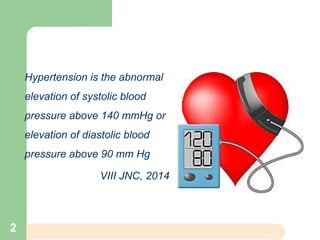
Hypertension is the abnormal
elevation of systolic blood
pressure above 140 mmHg or
elevation of diastolic blood
pressure above 90 mm Hg
VIII JNC, 2014
2
3
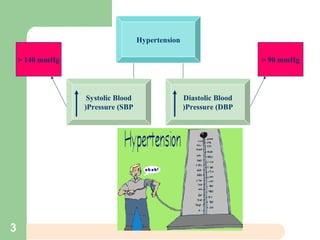
Hypertension
Systolic Blood
Pressure (SBP(
Diastolic Blood
Pressure (DBP(
> 140 mmHg > 90 mmHg
Types of hypertensionTypes of hypertension
• Essential hypertension
– 90%
– No underlying cause
• Secondary hypertension
– Underlying cause
4
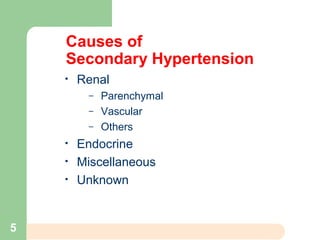
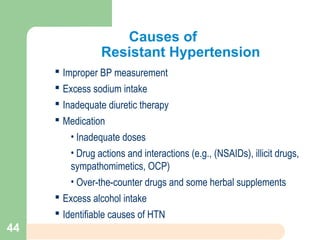
Causes of
Secondary Hypertension
• Renal
– Parenchymal
– Vascular
– Others
• Endocrine
• Miscellaneous
• Unknown
5
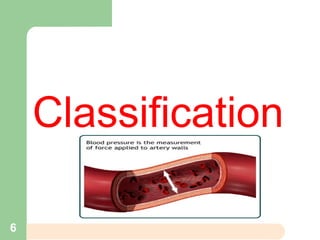
Classification
6
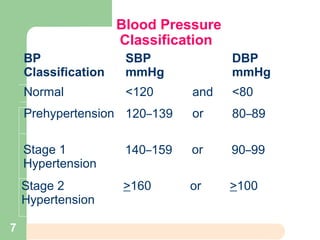
Blood Pressure
Classification
Normal <120 and <80
Prehypertension 120–139 or 80–89
Stage 1
Hypertension
140–159 or 90–99
Stage 2
Hypertension
>160 or >100
BP
Classification
SBP
mmHg
DBP
mmHg
7
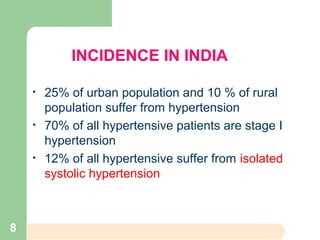
INCIDENCE IN INDIA
• 25% of urban population and 10 % of rural
population suffer from hypertension
• 70% of all hypertensive patients are stage I
hypertension
• 12% of all hypertensive suffer from isolated
systolic hypertension
8
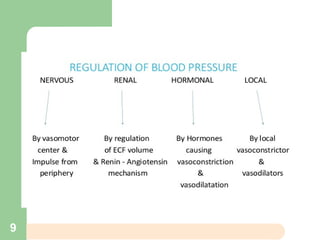
9
WHO ARE AT
RISK ?
10
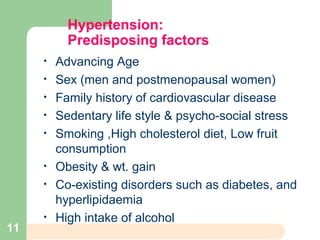
Hypertension:
Predisposing factors
• Advancing Age
• Sex (men and postmenopausal women)
• Family history of cardiovascular disease
• Sedentary life style & psycho-social stress
• Smoking ,High cholesterol diet, Low fruit
consumption
• Obesity & wt. gain
• Co-existing disorders such as diabetes, and
hyperlipidaemia
• High intake of alcohol
11
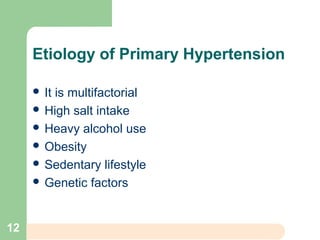
Etiology of Primary Hypertension
 It is multifactorial
 High salt intake
 Heavy alcohol use
 Obesity
 Sedentary lifestyle
 Genetic factors
12
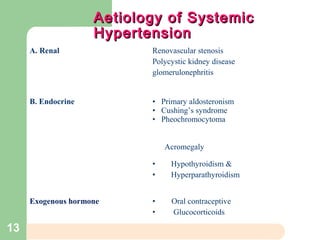
Aetiology of SystemicAetiology of Systemic
HypertensionHypertension
A. Renal Renovascular stenosis
Polycystic kidney disease
glomerulonephritis
B. Endocrine • Primary aldosteronism
• Cushing’s syndrome
• Pheochromocytoma
Acromegaly
• Hypothyroidism &
• Hyperparathyroidism
Exogenous hormone • Oral contraceptive
• Glucocorticoids
13
Others
– Coarctation of the aorta
– Pregnancy Induced HTN (Pre-eclampsia)
– Sleep Apnea Syndrome.
Aetiology ofAetiology of
SystemicSystemic
HypertensionHypertension
14
Clinical manifestationsClinical manifestations
 SYMPTOMS DUE TO HYPERTENSION-
 Headache
 Dizziness-in morning hours.
 SYMPTOMS DUE TO TARGET ORGAN
DAMAGE-
• 1)CVS-
• Dyspnea
• Palpitation
• Chest pain
15
2) KIDNEY-Polyuria,Hematuria,Nocturia
3) CNS- Stroke,Hypertensive encephalopathy,
Dizziness
4) Retina- blurred vision
16
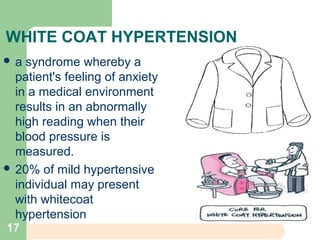
WHITE COAT HYPERTENSION
 a syndrome whereby a
patient's feeling of anxiety
in a medical environment
results in an abnormally
high reading when their
blood pressure is
measured.
 20% of mild hypertensive
individual may present
with whitecoat
hypertension
17
Why to treat ?
18
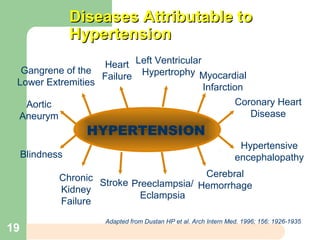
Diseases Attributable toDiseases Attributable to
HypertensionHypertension
HYPERTENSION
Gangrene of the
Lower Extremities
Heart
Failure
Left Ventricular
Hypertrophy Myocardial
Infarction
Coronary Heart
Disease
Aortic
Aneurym
Blindness
Chronic
Kidney
Failure
Stroke Preeclampsia/
Eclampsia
Cerebral
Hemorrhage
Hypertensive
encephalopathy
Adapted from Dustan HP et al. Arch Intern Med. 1996; 156: 1926-1935
19
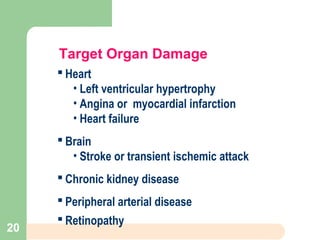
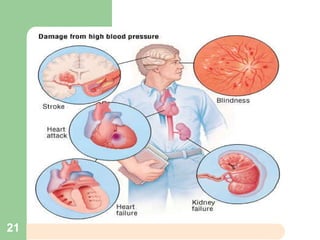
Target Organ Damage
 Heart
• Left ventricular hypertrophy
• Angina or myocardial infarction
• Heart failure
 Brain
• Stroke or transient ischemic attack
 Chronic kidney disease
 Peripheral arterial disease
 Retinopathy
20
21
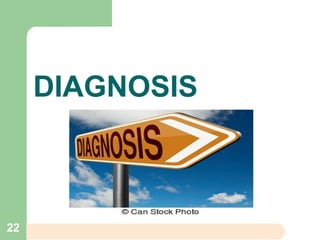
DIAGNOSIS
22
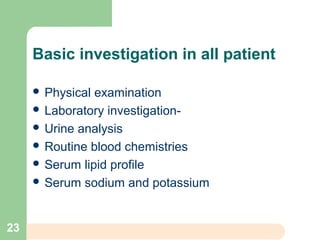
Basic investigation in all patient
 Physical examination
 Laboratory investigation-
 Urine analysis
 Routine blood chemistries
 Serum lipid profile
 Serum sodium and potassium
23
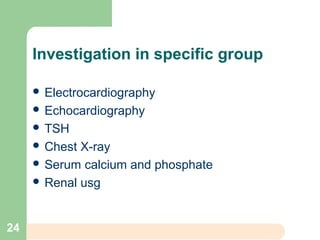
Investigation in specific group
 Electrocardiography
 Echocardiography
 TSH
 Chest X-ray
 Serum calcium and phosphate
 Renal usg
24
How to treat ?
25
Treatment OverviewTreatment Overview
Goals of therapy
Lifestyle modification
Pharmacologic treatment
Follow up and monitoring
26
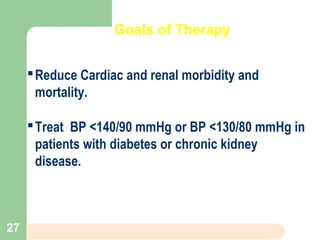
Goals of Therapy
Reduce Cardiac and renal morbidity and
mortality.
Treat BP <140/90 mmHg or BP <130/80 mmHg in
patients with diabetes or chronic kidney
disease.
27
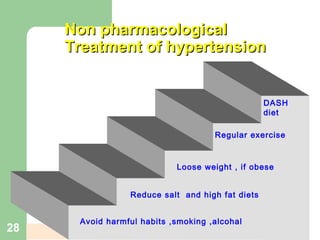
Non pharmacologicalNon pharmacological
Treatment of hypertensionTreatment of hypertension
Avoid harmful habits ,smoking ,alcohal
Reduce salt and high fat diets
Loose weight , if obese
Regular exercise
DASH
diet
28
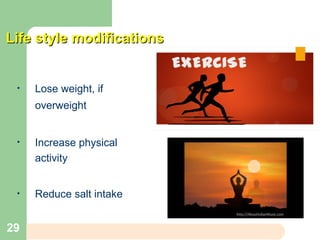
Life style modificationsLife style modifications
• Lose weight, if
overweight
• Increase physical
activity
• Reduce salt intake
29
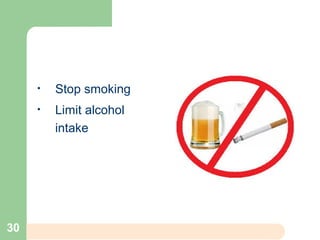
• Stop smoking
• Limit alcohol
intake
30
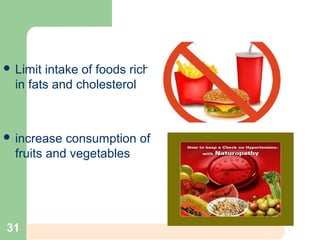
 Limit intake of foods rich
in fats and cholesterol
 increase consumption of
fruits and vegetables
31
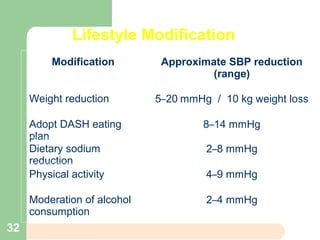
Lifestyle Modification
Modification Approximate SBP reduction
(range)
Weight reduction 5–20 mmHg / 10 kg weight loss
Adopt DASH eating
plan
8–14 mmHg
Dietary sodium
reduction
2–8 mmHg
Physical activity 4–9 mmHg
Moderation of alcohol
consumption
2–4 mmHg
32
DRUG THERAPY
33
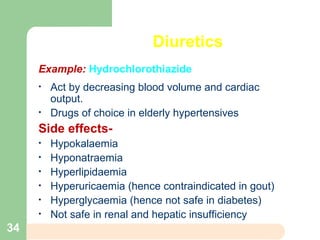
Diuretics
Example: Hydrochlorothiazide
• Act by decreasing blood volume and cardiac
output.
• Drugs of choice in elderly hypertensives
Side effects-
• Hypokalaemia
• Hyponatraemia
• Hyperlipidaemia
• Hyperuricaemia (hence contraindicated in gout)
• Hyperglycaemia (hence not safe in diabetes)
• Not safe in renal and hepatic insufficiency
34
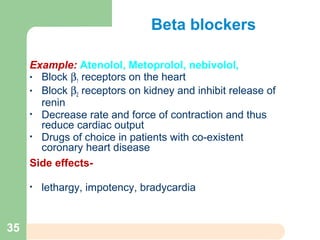
Beta blockers
Example: Atenolol, Metoprolol, nebivolol,
• Block β1 receptors on the heart
• Block β2 receptors on kidney and inhibit release of
renin
• Decrease rate and force of contraction and thus
reduce cardiac output
• Drugs of choice in patients with co-existent
coronary heart disease
Side effects-
• lethargy, impotency, bradycardia
35
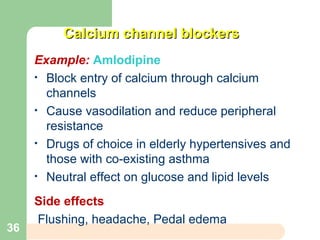
Calcium channel blockersCalcium channel blockers
Example: Amlodipine
• Block entry of calcium through calcium
channels
• Cause vasodilation and reduce peripheral
resistance
• Drugs of choice in elderly hypertensives and
those with co-existing asthma
• Neutral effect on glucose and lipid levels
Side effects
Flushing, headache, Pedal edema
36
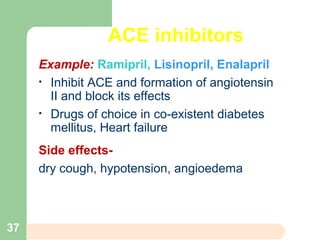
ACE inhibitors
Example: Ramipril, Lisinopril, Enalapril
• Inhibit ACE and formation of angiotensin
II and block its effects
• Drugs of choice in co-existent diabetes
mellitus, Heart failure
Side effects-
dry cough, hypotension, angioedema
37
Angiotensin II receptor
blockers
Example: Losartan
• Block the angiotensin II receptor
and inhibit effects of angiotensin II
• Drugs of choice in patients with co-
existing diabetes mellitus
Side effects-
safer than ACEI, hypotension,
38
Alpha blockers
Example: prazosin
• Block α-1 receptors and cause vasodilation
• Reduce peripheral resistance and venous return
Side effects-
Postural hypotension,
39
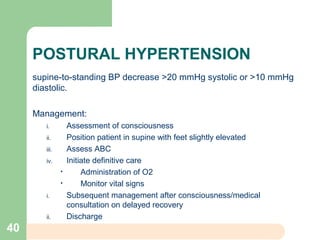
POSTURAL HYPERTENSION
supine-to-standing BP decrease >20 mmHg systolic or >10 mmHg
diastolic.
Management:
i. Assessment of consciousness
ii. Position patient in supine with feet slightly elevated
iii. Assess ABC
iv. Initiate definitive care
• Administration of O2
• Monitor vital signs
i. Subsequent management after consciousness/medical
consultation on delayed recovery
ii. Discharge
40
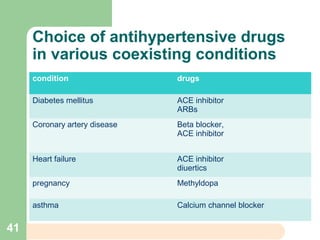
Choice of antihypertensive drugs
in various coexisting conditions
condition drugs
Diabetes mellitus ACE inhibitor
ARBs
Coronary artery disease Beta blocker,
ACE inhibitor
Heart failure ACE inhibitor
diuertics
pregnancy Methyldopa
asthma Calcium channel blocker
41
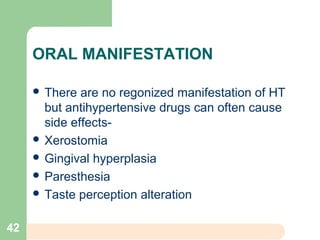
ORAL MANIFESTATION
 There are no regonized manifestation of HT
but antihypertensive drugs can often cause
side effects-
 Xerostomia
 Gingival hyperplasia
 Paresthesia
 Taste perception alteration
42
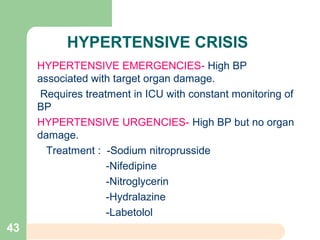
HYPERTENSIVE CRISIS
HYPERTENSIVE EMERGENCIES- High BP
associated with target organ damage.
Requires treatment in ICU with constant monitoring of
BP
HYPERTENSIVE URGENCIES- High BP but no organ
damage.
Treatment : -Sodium nitroprusside
-Nifedipine
-Nitroglycerin
-Hydralazine
-Labetolol
43
Causes of
Resistant Hypertension
 Improper BP measurement
 Excess sodium intake
 Inadequate diuretic therapy
 Medication
• Inadequate doses
• Drug actions and interactions (e.g., (NSAIDs), illicit drugs,
sympathomimetics, OCP)
• Over-the-counter drugs and some herbal supplements
 Excess alcohol intake
 Identifiable causes of HTN
44
HYPERTENSION MANAGEMENT
IN DENTISTRY
45
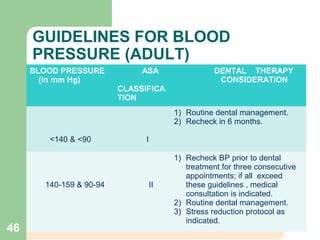
GUIDELINES FOR BLOOD
PRESSURE (ADULT)
BLOOD PRESSURE
(in mm Hg)
ASA
CLASSIFICA
TION
DENTAL THERAPY
CONSIDERATION
<140 & <90 I
1) Routine dental management.
2) Recheck in 6 months.
140-159 & 90-94 II
1) Recheck BP prior to dental
treatment for three consecutive
appointments; if all exceed
these guidelines , medical
consultation is indicated.
2) Routine dental management.
3) Stress reduction protocol as
indicated.
46
47
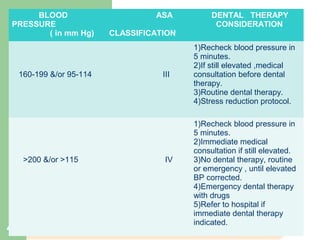
BLOOD
PRESSURE
( in mm Hg)
ASA
CLASSIFICATION
DENTAL THERAPY
CONSIDERATION
160-199 &/or 95-114 III
1)Recheck blood pressure in
5 minutes.
2)If still elevated ,medical
consultation before dental
therapy.
3)Routine dental therapy.
4)Stress reduction protocol.
>200 &/or >115 IV
1)Recheck blood pressure in
5 minutes.
2)Immediate medical
consultation if still elevated.
3)No dental therapy, routine
or emergency , until elevated
BP corrected.
4)Emergency dental therapy
with drugs
5)Refer to hospital if
immediate dental therapy
indicated.
PRE OPERATIVE MEDICATION &
MANAGEMENT
 Patient BP should be monitored & controlled
within normal.
 To antihypertensive patient morning dose
of medication prior to surgery must be given.
48
INTRA AND POST OPERATIVE
MANAGEMANT
1) Blood pressure should be monitored
continuously.
2)Patient cardiac status also monitored.
3) Antihypertensive must be continued.
4) If the procedure is performed under local
anesthesia , the local anesthetic without
adrenaline is to be used.
49
CONCLUSION
• Hypertension is a major cause of morbidity and mortality, and
needs to be treated
• It is an extremely common condition; however it is still under-
diagnosed and undertreated
• Hypertension is easy to diagnose and easy to treat
• Aim of the management is to save the target organ from the
deleterious effect
• Besides pharmacology we have other choices and one has
to be acquainted with that choice
• Life style modification should always be encouraged in all
Hypertensive patients
50
THANK YOU!
51

Hypertension final

  • 1.
    CAREER POST GRADUATEINSTITUTE OF DENTAL SCIENCES AND HOSPITAL DEPARTMENT OF ORAL MEDICINE & RADIOLOGY Seminar Topic: " HYPERTENSION"" HYPERTENSION" Under the guidance of : Dr. Nitin Agarwal (H.O.D)Dr. Nitin Agarwal (H.O.D) Dr. Payal TripathiDr. Payal Tripathi Dr. Arti SachdevDr. Arti Sachdev Dr. Vasu SiddharthaDr. Vasu Siddhartha Dr. Sudheer ShuklaDr. Sudheer Shukla Presented by : AanshikaAanshika TiwariTiwari JR-1 1
  • 2.
    Hypertension is theabnormal elevation of systolic blood pressure above 140 mmHg or elevation of diastolic blood pressure above 90 mm Hg VIII JNC, 2014 2
  • 3.
    3 Hypertension Systolic Blood Pressure (SBP( DiastolicBlood Pressure (DBP( > 140 mmHg > 90 mmHg
  • 4.
    Types of hypertensionTypesof hypertension • Essential hypertension – 90% – No underlying cause • Secondary hypertension – Underlying cause 4
  • 5.
    Causes of Secondary Hypertension •Renal – Parenchymal – Vascular – Others • Endocrine • Miscellaneous • Unknown 5
  • 6.
  • 7.
    Blood Pressure Classification Normal <120and <80 Prehypertension 120–139 or 80–89 Stage 1 Hypertension 140–159 or 90–99 Stage 2 Hypertension >160 or >100 BP Classification SBP mmHg DBP mmHg 7
  • 8.
    INCIDENCE IN INDIA •25% of urban population and 10 % of rural population suffer from hypertension • 70% of all hypertensive patients are stage I hypertension • 12% of all hypertensive suffer from isolated systolic hypertension 8
  • 9.
  • 10.
  • 11.
    Hypertension: Predisposing factors • AdvancingAge • Sex (men and postmenopausal women) • Family history of cardiovascular disease • Sedentary life style & psycho-social stress • Smoking ,High cholesterol diet, Low fruit consumption • Obesity & wt. gain • Co-existing disorders such as diabetes, and hyperlipidaemia • High intake of alcohol 11
  • 12.
    Etiology of PrimaryHypertension  It is multifactorial  High salt intake  Heavy alcohol use  Obesity  Sedentary lifestyle  Genetic factors 12
  • 13.
    Aetiology of SystemicAetiologyof Systemic HypertensionHypertension A. Renal Renovascular stenosis Polycystic kidney disease glomerulonephritis B. Endocrine • Primary aldosteronism • Cushing’s syndrome • Pheochromocytoma Acromegaly • Hypothyroidism & • Hyperparathyroidism Exogenous hormone • Oral contraceptive • Glucocorticoids 13
  • 14.
    Others – Coarctation ofthe aorta – Pregnancy Induced HTN (Pre-eclampsia) – Sleep Apnea Syndrome. Aetiology ofAetiology of SystemicSystemic HypertensionHypertension 14
  • 15.
    Clinical manifestationsClinical manifestations SYMPTOMS DUE TO HYPERTENSION-  Headache  Dizziness-in morning hours.  SYMPTOMS DUE TO TARGET ORGAN DAMAGE- • 1)CVS- • Dyspnea • Palpitation • Chest pain 15
  • 16.
    2) KIDNEY-Polyuria,Hematuria,Nocturia 3) CNS-Stroke,Hypertensive encephalopathy, Dizziness 4) Retina- blurred vision 16
  • 17.
    WHITE COAT HYPERTENSION a syndrome whereby a patient's feeling of anxiety in a medical environment results in an abnormally high reading when their blood pressure is measured.  20% of mild hypertensive individual may present with whitecoat hypertension 17
  • 18.
  • 19.
    Diseases Attributable toDiseasesAttributable to HypertensionHypertension HYPERTENSION Gangrene of the Lower Extremities Heart Failure Left Ventricular Hypertrophy Myocardial Infarction Coronary Heart Disease Aortic Aneurym Blindness Chronic Kidney Failure Stroke Preeclampsia/ Eclampsia Cerebral Hemorrhage Hypertensive encephalopathy Adapted from Dustan HP et al. Arch Intern Med. 1996; 156: 1926-1935 19
  • 20.
    Target Organ Damage Heart • Left ventricular hypertrophy • Angina or myocardial infarction • Heart failure  Brain • Stroke or transient ischemic attack  Chronic kidney disease  Peripheral arterial disease  Retinopathy 20
  • 21.
  • 22.
  • 23.
    Basic investigation inall patient  Physical examination  Laboratory investigation-  Urine analysis  Routine blood chemistries  Serum lipid profile  Serum sodium and potassium 23
  • 24.
    Investigation in specificgroup  Electrocardiography  Echocardiography  TSH  Chest X-ray  Serum calcium and phosphate  Renal usg 24
  • 25.
  • 26.
    Treatment OverviewTreatment Overview Goalsof therapy Lifestyle modification Pharmacologic treatment Follow up and monitoring 26
  • 27.
    Goals of Therapy ReduceCardiac and renal morbidity and mortality. Treat BP <140/90 mmHg or BP <130/80 mmHg in patients with diabetes or chronic kidney disease. 27
  • 28.
    Non pharmacologicalNon pharmacological Treatmentof hypertensionTreatment of hypertension Avoid harmful habits ,smoking ,alcohal Reduce salt and high fat diets Loose weight , if obese Regular exercise DASH diet 28
  • 29.
    Life style modificationsLifestyle modifications • Lose weight, if overweight • Increase physical activity • Reduce salt intake 29
  • 30.
    • Stop smoking •Limit alcohol intake 30
  • 31.
     Limit intakeof foods rich in fats and cholesterol  increase consumption of fruits and vegetables 31
  • 32.
    Lifestyle Modification Modification ApproximateSBP reduction (range) Weight reduction 5–20 mmHg / 10 kg weight loss Adopt DASH eating plan 8–14 mmHg Dietary sodium reduction 2–8 mmHg Physical activity 4–9 mmHg Moderation of alcohol consumption 2–4 mmHg 32
  • 33.
  • 34.
    Diuretics Example: Hydrochlorothiazide • Actby decreasing blood volume and cardiac output. • Drugs of choice in elderly hypertensives Side effects- • Hypokalaemia • Hyponatraemia • Hyperlipidaemia • Hyperuricaemia (hence contraindicated in gout) • Hyperglycaemia (hence not safe in diabetes) • Not safe in renal and hepatic insufficiency 34
  • 35.
    Beta blockers Example: Atenolol,Metoprolol, nebivolol, • Block β1 receptors on the heart • Block β2 receptors on kidney and inhibit release of renin • Decrease rate and force of contraction and thus reduce cardiac output • Drugs of choice in patients with co-existent coronary heart disease Side effects- • lethargy, impotency, bradycardia 35
  • 36.
    Calcium channel blockersCalciumchannel blockers Example: Amlodipine • Block entry of calcium through calcium channels • Cause vasodilation and reduce peripheral resistance • Drugs of choice in elderly hypertensives and those with co-existing asthma • Neutral effect on glucose and lipid levels Side effects Flushing, headache, Pedal edema 36
  • 37.
    ACE inhibitors Example: Ramipril,Lisinopril, Enalapril • Inhibit ACE and formation of angiotensin II and block its effects • Drugs of choice in co-existent diabetes mellitus, Heart failure Side effects- dry cough, hypotension, angioedema 37
  • 38.
    Angiotensin II receptor blockers Example:Losartan • Block the angiotensin II receptor and inhibit effects of angiotensin II • Drugs of choice in patients with co- existing diabetes mellitus Side effects- safer than ACEI, hypotension, 38
  • 39.
    Alpha blockers Example: prazosin •Block α-1 receptors and cause vasodilation • Reduce peripheral resistance and venous return Side effects- Postural hypotension, 39
  • 40.
    POSTURAL HYPERTENSION supine-to-standing BPdecrease >20 mmHg systolic or >10 mmHg diastolic. Management: i. Assessment of consciousness ii. Position patient in supine with feet slightly elevated iii. Assess ABC iv. Initiate definitive care • Administration of O2 • Monitor vital signs i. Subsequent management after consciousness/medical consultation on delayed recovery ii. Discharge 40
  • 41.
    Choice of antihypertensivedrugs in various coexisting conditions condition drugs Diabetes mellitus ACE inhibitor ARBs Coronary artery disease Beta blocker, ACE inhibitor Heart failure ACE inhibitor diuertics pregnancy Methyldopa asthma Calcium channel blocker 41
  • 42.
    ORAL MANIFESTATION  Thereare no regonized manifestation of HT but antihypertensive drugs can often cause side effects-  Xerostomia  Gingival hyperplasia  Paresthesia  Taste perception alteration 42
  • 43.
    HYPERTENSIVE CRISIS HYPERTENSIVE EMERGENCIES-High BP associated with target organ damage. Requires treatment in ICU with constant monitoring of BP HYPERTENSIVE URGENCIES- High BP but no organ damage. Treatment : -Sodium nitroprusside -Nifedipine -Nitroglycerin -Hydralazine -Labetolol 43
  • 44.
    Causes of Resistant Hypertension Improper BP measurement  Excess sodium intake  Inadequate diuretic therapy  Medication • Inadequate doses • Drug actions and interactions (e.g., (NSAIDs), illicit drugs, sympathomimetics, OCP) • Over-the-counter drugs and some herbal supplements  Excess alcohol intake  Identifiable causes of HTN 44
  • 45.
  • 46.
    GUIDELINES FOR BLOOD PRESSURE(ADULT) BLOOD PRESSURE (in mm Hg) ASA CLASSIFICA TION DENTAL THERAPY CONSIDERATION <140 & <90 I 1) Routine dental management. 2) Recheck in 6 months. 140-159 & 90-94 II 1) Recheck BP prior to dental treatment for three consecutive appointments; if all exceed these guidelines , medical consultation is indicated. 2) Routine dental management. 3) Stress reduction protocol as indicated. 46
  • 47.
    47 BLOOD PRESSURE ( in mmHg) ASA CLASSIFICATION DENTAL THERAPY CONSIDERATION 160-199 &/or 95-114 III 1)Recheck blood pressure in 5 minutes. 2)If still elevated ,medical consultation before dental therapy. 3)Routine dental therapy. 4)Stress reduction protocol. >200 &/or >115 IV 1)Recheck blood pressure in 5 minutes. 2)Immediate medical consultation if still elevated. 3)No dental therapy, routine or emergency , until elevated BP corrected. 4)Emergency dental therapy with drugs 5)Refer to hospital if immediate dental therapy indicated.
  • 48.
    PRE OPERATIVE MEDICATION& MANAGEMENT  Patient BP should be monitored & controlled within normal.  To antihypertensive patient morning dose of medication prior to surgery must be given. 48
  • 49.
    INTRA AND POSTOPERATIVE MANAGEMANT 1) Blood pressure should be monitored continuously. 2)Patient cardiac status also monitored. 3) Antihypertensive must be continued. 4) If the procedure is performed under local anesthesia , the local anesthetic without adrenaline is to be used. 49
  • 50.
    CONCLUSION • Hypertension isa major cause of morbidity and mortality, and needs to be treated • It is an extremely common condition; however it is still under- diagnosed and undertreated • Hypertension is easy to diagnose and easy to treat • Aim of the management is to save the target organ from the deleterious effect • Besides pharmacology we have other choices and one has to be acquainted with that choice • Life style modification should always be encouraged in all Hypertensive patients 50
  • 51.

Editor's Notes

  • #29 It is hard for any of us to not have some risk factors for osteoporosis besides being female. The more risk factors you have, the more important it is you take care of your bones. The best advice for you is to follow these 5 steps to strong bones so you do not end up with weakened bones or frac