Clinical Guidance on Diabetes
Management at COVID 19
Patient Management Facility
Article by : Ministry of Health & Family Welfare
Dated : 26th August , 2020
Presenter
DR. SUKRATI MAHESHWARI
Moderator
DR. S.B. GAWARIKAR
DR. VIPIN PORWAL
• Screen every patient at the admission for hyperglycemia with at least
two capillary blood glucose levels (1 pre-meal and 1 post-meal value)
by a glucometer.
• Every patient with Diabetes should be started on diabetic diet. Kindly
ensure that the patient strictly adheres to the timing and quantity
advised in the diet chart.
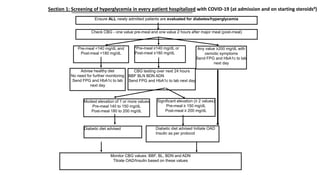
Ensure ALL newly admitted patients are evaluated for diabetes/hyperglycemia
Any value ≥200 mg/dL with
osmotic symptoms
Send FPG and HbA1c to lab
next day
*Pre-meal ≥140 mg/dL or
Post-meal ≥180 mg/dL
Pre-meal <140 mg/dL and
Post-meal <180 mg/dL
Check CBG - one value pre-meal and one value 2 hours after major meal (post-meal)
Significant elevation (≥ 2 values)
Pre-meal ≥ 150 mg/dL
Post-meal ≥ 200 mg/dL
Modest elevation of 1 or more values
Pre-meal 140 to 150 mg/dL
Post-meal 180 to 200 mg/dL
CBG testing over next 24 hours
BBF BLN BDN ADN
Send FPG and HbA1c to lab next day
Advise healthy diet
No need for further monitoring
Send FPG and HbA1c to lab
next day
Monitor CBG values: BBF, BL, BDN and ADN
Titrate OAD/Insulin based on these values
Diabetic diet advised Diabetic diet advised Initiate OAD
Insulin as per protocol
Section 1: Screening of hyperglycemia in every patient hospitalized with COVID-19 (at admission and on starting steroids#)
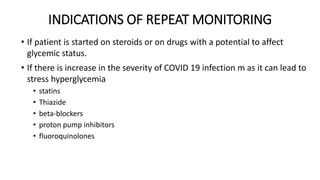
INDICATIONS OF REPEAT MONITORING
• If patient is started on steroids or on drugs with a potential to affect
glycemic status.
• If there is increase in the severity of COVID 19 infection m as it can lead to
stress hyperglycemia
• statins
• Thiazide
• beta-blockers
• proton pump inhibitors
• fluoroquinolones
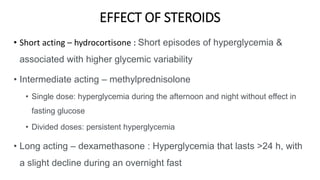
EFFECT OF STEROIDS
• Short acting – hydrocortisone : Short episodes of hyperglycemia &
associated with higher glycemic variability
• Intermediate acting – methylprednisolone
• Single dose: hyperglycemia during the afternoon and night without effect in
fasting glucose
• Divided doses: persistent hyperglycemia
• Long acting – dexamethasone : Hyperglycemia that lasts >24 h, with
a slight decline during an overnight fast
Known Diabetic who are on
OAD at admission
CONDITION 1
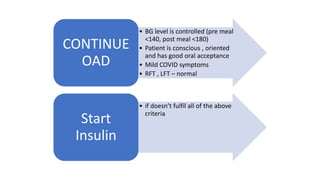
• BG level is controlled (pre meal
<140, post meal <180)
• Patient is conscious , oriented
and has good oral acceptance
• Mild COVID symptoms
• RFT , LFT – normal
CONTINUE
OAD
• if doesn’t fulfil all of the above
criteria
Start
Insulin
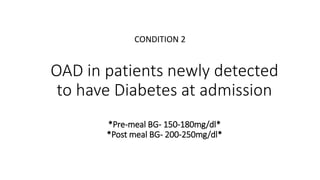
OAD in patients newly detected
to have Diabetes at admission
*Pre-meal BG- 150-180mg/dl*
*Post meal BG- 200-250mg/dl*
CONDITION 2
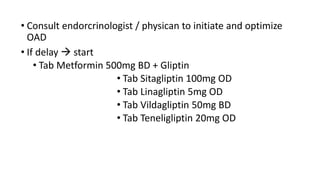
• Consult endorcrinologist / physican to initiate and optimize
OAD
• If delay  start
• Tab Metformin 500mg BD + Gliptin
• Tab Sitagliptin 100mg OD
• Tab Linagliptin 5mg OD
• Tab Vildagliptin 50mg BD
• Tab Teneligliptin 20mg OD
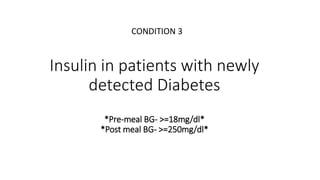
Insulin in patients with newly
detected Diabetes
*Pre-meal BG- >=18mg/dl*
*Post meal BG- >=250mg/dl*
CONDITION 3
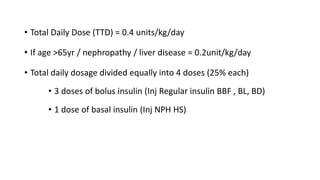
• Total Daily Dose (TTD) = 0.4 units/kg/day
• If age >65yr / nephropathy / liver disease = 0.2unit/kg/day
• Total daily dosage divided equally into 4 doses (25% each)
• 3 doses of bolus insulin (Inj Regular insulin BBF , BL, BD)
• 1 dose of basal insulin (Inj NPH HS)
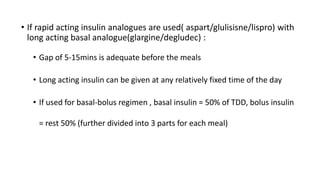
• If rapid acting insulin analogues are used( aspart/glulisisne/lispro) with
long acting basal analogue(glargine/degludec) :
• Gap of 5-15mins is adequate before the meals
• Long acting insulin can be given at any relatively fixed time of the day
• If used for basal-bolus regimen , basal insulin = 50% of TDD, bolus insulin
= rest 50% (further divided into 3 parts for each meal)
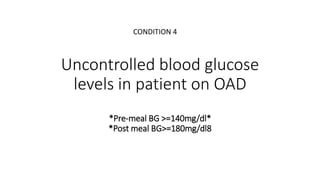
Uncontrolled blood glucose
levels in patient on OAD
*Pre-meal BG >=140mg/dl*
*Post meal BG>=180mg/dl8
CONDITION 4
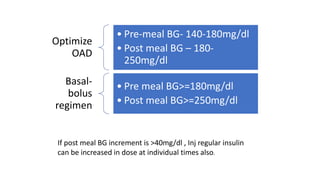
Optimize
OAD
• Pre-meal BG- 140-180mg/dl
• Post meal BG – 180-
250mg/dl
Basal-
bolus
regimen
• Pre meal BG>=180mg/dl
• Post meal BG>=250mg/dl
If post meal BG increment is >40mg/dl , Inj regular insulin
can be increased in dose at individual times also.
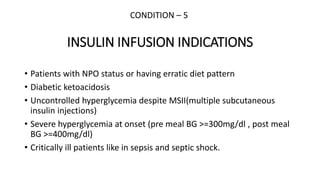
INSULIN INFUSION INDICATIONS
• Patients with NPO status or having erratic diet pattern
• Diabetic ketoacidosis
• Uncontrolled hyperglycemia despite MSII(multiple subcutaneous
insulin injections)
• Severe hyperglycemia at onset (pre meal BG >=300mg/dl , post meal
BG >=400mg/dl)
• Critically ill patients like in sepsis and septic shock.
CONDITION – 5
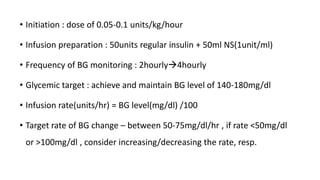
• Initiation : dose of 0.05-0.1 units/kg/hour
• Infusion preparation : 50units regular insulin + 50ml NS(1unit/ml)
• Frequency of BG monitoring : 2hourly4hourly
• Glycemic target : achieve and maintain BG level of 140-180mg/dl
• Infusion rate(units/hr) = BG level(mg/dl) /100
• Target rate of BG change – between 50-75mg/dl/hr , if rate <50mg/dl
or >100mg/dl , consider increasing/decreasing the rate, resp.
• For prandial coverage , increase infusion rate by 2-4units/hour over and
above the basal rate , just before taking the major meal and continue
the increased rate for next 2 hours.
• Therefore , IV insulin to be given in 2 components :
• Basal coverage provided by the maintenance rate of IV insulin
• Prandial coverage provided by an increment in the maintenance rate for 2 hours
around a meal.
• S. potassium should be monitored every 6 hourly in NPO patients and
every 12 hourly in those who are accepting orally.
Switch to basal-bolus insulin
regimen from insulin infusion
CONDITION - 6
• Calculate total daily dose(TDD) based on insulin infusion requirement
for last 24 hours
• TDD= 80% of total insulin requirement on IV infusion in last 24 hours.
• Divide according to basal-bolus regimen(25% each)
• Switch only when :
• BG levels are controlled on insulin infusion
• Patient is accepting orally or on Rtfeeds
• Hemodynamically stable patient
• Insulin infusion has to be overlapped with basal-bolus regimen for 60-
120mins before stopping (insulin infusion should not be interrupted
abruptly)
Patient on RT feeds
• Divided into 3 major and 3 minor feeds.
• Major and minor feeds are defined by calories/quantity of feeds
(300/150)
• Timing of major feeds : 9am , 1:20pm , 7pm
• Timing of minor feeds : 11am , 4:30pm, 10pm
• Bolus insulin – before every major feed , basal insulin at 10pm
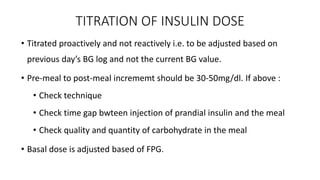
TITRATION OF INSULIN DOSE
• Titrated proactively and not reactively i.e. to be adjusted based on
previous day’s BG log and not the current BG value.
• Pre-meal to post-meal incrememt should be 30-50mg/dl. If above :
• Check technique
• Check time gap bwteen injection of prandial insulin and the meal
• Check quality and quantity of carbohydrate in the meal
• Basal dose is adjusted based of FPG.
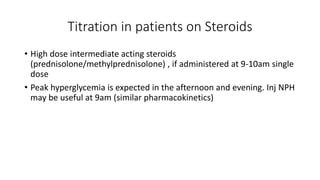
Titration in patients on Steroids
• High dose intermediate acting steroids
(prednisolone/methylprednisolone) , if administered at 9-10am single
dose
• Peak hyperglycemia is expected in the afternoon and evening. Inj NPH
may be useful at 9am (similar pharmacokinetics)
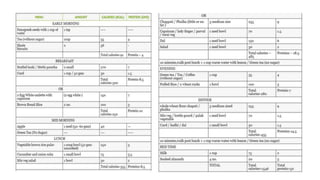
DIABETIC DIET
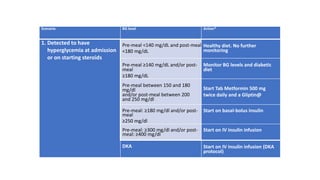
Scenario BG level Action*
1. Detected to have
hyperglycemia at admission
or on starting steroids
Pre-meal <140 mg/dL and post-meal
<180 mg/dL
Healthy diet. No further
monitoring
Pre-meal ≥140 mg/dL and/or post-
meal
≥180 mg/dL
Monitor BG levels and diabetic
diet
Pre-meal between 150 and 180
mg/dl
and/or post-meal between 200
and 250 mg/dl
Start Tab Metformin 500 mg
twice daily and a Gliptin@
Pre-meal: ≥180 mg/dl and/or post-
meal
≥250 mg/dl
Start on basal-bolus insulin
Pre-meal: ≥300 mg/dl and/or post-
meal: ≥400 mg/dl
Start on IV insulin infusion
DKA Start on IV insulin infusion (DKA
protocol)
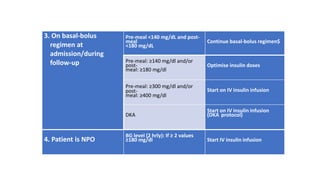
3. On basal-bolus
regimen at
admission/during
follow-up
Pre-meal <140 mg/dL and post-
meal
<180 mg/dL
Continue basal-bolus regimen$
Pre-meal: ≥140 mg/dl and/or
post-
meal: ≥180 mg/dl
Optimise insulin doses
Pre-meal: ≥300 mg/dl and/or
post-
meal: ≥400 mg/dl
Start on IV insulin infusion
DKA
Start on IV insulin infusion
(DKA protocol)
4. Patient is NPO
BG level (2 hrly): If ≥ 2 values
≥180 mg/dl Start IV insulin infusion
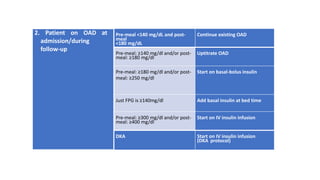
2. Patient on OAD at
admission/during
follow-up
Pre-meal <140 mg/dL and post-
meal
<180 mg/dL
Continue existing OAD
Pre-meal: ≥140 mg/dl and/or post-
meal: ≥180 mg/dl
Uptitrate OAD
Pre-meal: ≥180 mg/dl and/or post-
meal: ≥250 mg/dl
Start on basal-bolus insulin
Just FPG is ≥140mg/dl Add basal insulin at bed time
Pre-meal: ≥300 mg/dl and/or post-
meal: ≥400 mg/dl
Start on IV insulin infusion
DKA Start on IV insulin infusion
(DKA protocol)
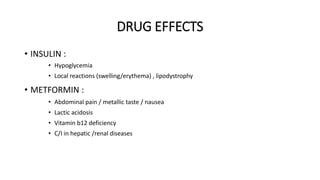
DRUG EFFECTS
• INSULIN :
• Hypoglycemia
• Local reactions (swelling/erythema) , lipodystrophy
• METFORMIN :
• Abdominal pain / metallic taste / nausea
• Lactic acidosis
• Vitamin b12 deficiency
• C/I in hepatic /renal diseases

Hyperglycemia in icu patients[9243]

  • 1.
    Clinical Guidance onDiabetes Management at COVID 19 Patient Management Facility Article by : Ministry of Health & Family Welfare Dated : 26th August , 2020 Presenter DR. SUKRATI MAHESHWARI Moderator DR. S.B. GAWARIKAR DR. VIPIN PORWAL
  • 2.
    • Screen everypatient at the admission for hyperglycemia with at least two capillary blood glucose levels (1 pre-meal and 1 post-meal value) by a glucometer. • Every patient with Diabetes should be started on diabetic diet. Kindly ensure that the patient strictly adheres to the timing and quantity advised in the diet chart.
  • 3.
    Ensure ALL newlyadmitted patients are evaluated for diabetes/hyperglycemia Any value ≥200 mg/dL with osmotic symptoms Send FPG and HbA1c to lab next day *Pre-meal ≥140 mg/dL or Post-meal ≥180 mg/dL Pre-meal <140 mg/dL and Post-meal <180 mg/dL Check CBG - one value pre-meal and one value 2 hours after major meal (post-meal) Significant elevation (≥ 2 values) Pre-meal ≥ 150 mg/dL Post-meal ≥ 200 mg/dL Modest elevation of 1 or more values Pre-meal 140 to 150 mg/dL Post-meal 180 to 200 mg/dL CBG testing over next 24 hours BBF BLN BDN ADN Send FPG and HbA1c to lab next day Advise healthy diet No need for further monitoring Send FPG and HbA1c to lab next day Monitor CBG values: BBF, BL, BDN and ADN Titrate OAD/Insulin based on these values Diabetic diet advised Diabetic diet advised Initiate OAD Insulin as per protocol Section 1: Screening of hyperglycemia in every patient hospitalized with COVID-19 (at admission and on starting steroids#)
  • 4.
    INDICATIONS OF REPEATMONITORING • If patient is started on steroids or on drugs with a potential to affect glycemic status. • If there is increase in the severity of COVID 19 infection m as it can lead to stress hyperglycemia • statins • Thiazide • beta-blockers • proton pump inhibitors • fluoroquinolones
  • 5.
    EFFECT OF STEROIDS •Short acting – hydrocortisone : Short episodes of hyperglycemia & associated with higher glycemic variability • Intermediate acting – methylprednisolone • Single dose: hyperglycemia during the afternoon and night without effect in fasting glucose • Divided doses: persistent hyperglycemia • Long acting – dexamethasone : Hyperglycemia that lasts >24 h, with a slight decline during an overnight fast
  • 6.
    Known Diabetic whoare on OAD at admission CONDITION 1
  • 7.
    • BG levelis controlled (pre meal <140, post meal <180) • Patient is conscious , oriented and has good oral acceptance • Mild COVID symptoms • RFT , LFT – normal CONTINUE OAD • if doesn’t fulfil all of the above criteria Start Insulin
  • 8.
    OAD in patientsnewly detected to have Diabetes at admission *Pre-meal BG- 150-180mg/dl* *Post meal BG- 200-250mg/dl* CONDITION 2
  • 9.
    • Consult endorcrinologist/ physican to initiate and optimize OAD • If delay  start • Tab Metformin 500mg BD + Gliptin • Tab Sitagliptin 100mg OD • Tab Linagliptin 5mg OD • Tab Vildagliptin 50mg BD • Tab Teneligliptin 20mg OD
  • 10.
    Insulin in patientswith newly detected Diabetes *Pre-meal BG- >=18mg/dl* *Post meal BG- >=250mg/dl* CONDITION 3
  • 11.
    • Total DailyDose (TTD) = 0.4 units/kg/day • If age >65yr / nephropathy / liver disease = 0.2unit/kg/day • Total daily dosage divided equally into 4 doses (25% each) • 3 doses of bolus insulin (Inj Regular insulin BBF , BL, BD) • 1 dose of basal insulin (Inj NPH HS)
  • 12.
    • If rapidacting insulin analogues are used( aspart/glulisisne/lispro) with long acting basal analogue(glargine/degludec) : • Gap of 5-15mins is adequate before the meals • Long acting insulin can be given at any relatively fixed time of the day • If used for basal-bolus regimen , basal insulin = 50% of TDD, bolus insulin = rest 50% (further divided into 3 parts for each meal)
  • 13.
    Uncontrolled blood glucose levelsin patient on OAD *Pre-meal BG >=140mg/dl* *Post meal BG>=180mg/dl8 CONDITION 4
  • 14.
    Optimize OAD • Pre-meal BG-140-180mg/dl • Post meal BG – 180- 250mg/dl Basal- bolus regimen • Pre meal BG>=180mg/dl • Post meal BG>=250mg/dl If post meal BG increment is >40mg/dl , Inj regular insulin can be increased in dose at individual times also.
  • 15.
    INSULIN INFUSION INDICATIONS •Patients with NPO status or having erratic diet pattern • Diabetic ketoacidosis • Uncontrolled hyperglycemia despite MSII(multiple subcutaneous insulin injections) • Severe hyperglycemia at onset (pre meal BG >=300mg/dl , post meal BG >=400mg/dl) • Critically ill patients like in sepsis and septic shock. CONDITION – 5
  • 16.
    • Initiation :dose of 0.05-0.1 units/kg/hour • Infusion preparation : 50units regular insulin + 50ml NS(1unit/ml) • Frequency of BG monitoring : 2hourly4hourly • Glycemic target : achieve and maintain BG level of 140-180mg/dl • Infusion rate(units/hr) = BG level(mg/dl) /100 • Target rate of BG change – between 50-75mg/dl/hr , if rate <50mg/dl or >100mg/dl , consider increasing/decreasing the rate, resp.
  • 17.
    • For prandialcoverage , increase infusion rate by 2-4units/hour over and above the basal rate , just before taking the major meal and continue the increased rate for next 2 hours. • Therefore , IV insulin to be given in 2 components : • Basal coverage provided by the maintenance rate of IV insulin • Prandial coverage provided by an increment in the maintenance rate for 2 hours around a meal. • S. potassium should be monitored every 6 hourly in NPO patients and every 12 hourly in those who are accepting orally.
  • 18.
    Switch to basal-bolusinsulin regimen from insulin infusion CONDITION - 6
  • 19.
    • Calculate totaldaily dose(TDD) based on insulin infusion requirement for last 24 hours • TDD= 80% of total insulin requirement on IV infusion in last 24 hours. • Divide according to basal-bolus regimen(25% each) • Switch only when : • BG levels are controlled on insulin infusion • Patient is accepting orally or on Rtfeeds • Hemodynamically stable patient • Insulin infusion has to be overlapped with basal-bolus regimen for 60- 120mins before stopping (insulin infusion should not be interrupted abruptly)
  • 20.
    Patient on RTfeeds • Divided into 3 major and 3 minor feeds. • Major and minor feeds are defined by calories/quantity of feeds (300/150) • Timing of major feeds : 9am , 1:20pm , 7pm • Timing of minor feeds : 11am , 4:30pm, 10pm • Bolus insulin – before every major feed , basal insulin at 10pm
  • 21.
    TITRATION OF INSULINDOSE • Titrated proactively and not reactively i.e. to be adjusted based on previous day’s BG log and not the current BG value. • Pre-meal to post-meal incrememt should be 30-50mg/dl. If above : • Check technique • Check time gap bwteen injection of prandial insulin and the meal • Check quality and quantity of carbohydrate in the meal • Basal dose is adjusted based of FPG.
  • 22.
    Titration in patientson Steroids • High dose intermediate acting steroids (prednisolone/methylprednisolone) , if administered at 9-10am single dose • Peak hyperglycemia is expected in the afternoon and evening. Inj NPH may be useful at 9am (similar pharmacokinetics)
  • 23.
  • 25.
    Scenario BG levelAction* 1. Detected to have hyperglycemia at admission or on starting steroids Pre-meal <140 mg/dL and post-meal <180 mg/dL Healthy diet. No further monitoring Pre-meal ≥140 mg/dL and/or post- meal ≥180 mg/dL Monitor BG levels and diabetic diet Pre-meal between 150 and 180 mg/dl and/or post-meal between 200 and 250 mg/dl Start Tab Metformin 500 mg twice daily and a Gliptin@ Pre-meal: ≥180 mg/dl and/or post- meal ≥250 mg/dl Start on basal-bolus insulin Pre-meal: ≥300 mg/dl and/or post- meal: ≥400 mg/dl Start on IV insulin infusion DKA Start on IV insulin infusion (DKA protocol)
  • 26.
    3. On basal-bolus regimenat admission/during follow-up Pre-meal <140 mg/dL and post- meal <180 mg/dL Continue basal-bolus regimen$ Pre-meal: ≥140 mg/dl and/or post- meal: ≥180 mg/dl Optimise insulin doses Pre-meal: ≥300 mg/dl and/or post- meal: ≥400 mg/dl Start on IV insulin infusion DKA Start on IV insulin infusion (DKA protocol) 4. Patient is NPO BG level (2 hrly): If ≥ 2 values ≥180 mg/dl Start IV insulin infusion
  • 27.
    2. Patient onOAD at admission/during follow-up Pre-meal <140 mg/dL and post- meal <180 mg/dL Continue existing OAD Pre-meal: ≥140 mg/dl and/or post- meal: ≥180 mg/dl Uptitrate OAD Pre-meal: ≥180 mg/dl and/or post- meal: ≥250 mg/dl Start on basal-bolus insulin Just FPG is ≥140mg/dl Add basal insulin at bed time Pre-meal: ≥300 mg/dl and/or post- meal: ≥400 mg/dl Start on IV insulin infusion DKA Start on IV insulin infusion (DKA protocol)
  • 28.
    DRUG EFFECTS • INSULIN: • Hypoglycemia • Local reactions (swelling/erythema) , lipodystrophy • METFORMIN : • Abdominal pain / metallic taste / nausea • Lactic acidosis • Vitamin b12 deficiency • C/I in hepatic /renal diseases