Audio Rendering Based on Multiple Impulse Responses
Proposed algorithm
Experimental Results
Conclusion

Hybrid Reverberator Using Multiple Impulse
Responses for Audio Rendering Improvement
Andrea Primavera1 , Stefania Cecchi1 , Francesco Piazza1 , Junfeng Li2 , and
Yonghong Yan2

1

A3lab - DII - Universit` Politecnica delle Marche a
Ancona - ITALY

2

Institute of Acoustics, Chinese Academy of
Sciences - Beijing - CHINA

IIHMSP, October 2013, Beijing, China.
Andrea Primavera

Hybrid Reverberator Using Multiple Impulse Responses for Audio Rendering Improvement

1/22
Audio Rendering Based on Multiple Impulse Responses
Proposed algorithm
Experimental Results
Conclusion

1

Audio Rendering Based on Multiple Impulse Responses
Introduction
State of the art
Proposed algorithm

2

Proposed algorithm
Analysis of reverberation tail
Synthesis of the reverberation effect
Real-time Reproduction of Moving Listener Position

3

Experimental Results
Experimental Setup
Reverberation Time
Clarity Index
Subjective Analysis

4

Conclusion
Conclusion
Questions
Bibliography

Andrea Primavera

Hybrid Reverberator Using Multiple Impulse Responses for Audio Rendering Improvement

2/22
Audio Rendering Based on Multiple Impulse Responses
Proposed algorithm
Experimental Results
Conclusion

Introduction
State of the art
Proposed algorithm

Linear convolution is a widely used operation typically employed for audio
rendering purpose aiming to reproduce the reverberation effect generated
when a sound is produced within an enclosed space.
One of the main problems
LINEAR
CONVOLUTION

STATIC
PROCEDURE

It allows to reproduce only the acoustic effect produced taking into
account a specific sound source with the relative receiver position.
Solution
• Time varying convolution to simulate the moving receiver

positions performing IRs interpolation [1].
• A large impulse response (IR) database is needed.

Andrea Primavera

Hybrid Reverberator Using Multiple Impulse Responses for Audio Rendering Improvement

3/22
Audio Rendering Based on Multiple Impulse Responses
Proposed algorithm
Experimental Results
Conclusion

Introduction
State of the art
Proposed algorithm

Linear convolution is a widely used operation typically employed for audio
rendering purpose aiming to reproduce the reverberation effect generated
when a sound is produced within an enclosed space.
One of the main problems
LINEAR
CONVOLUTION

STATIC
PROCEDURE

It allows to reproduce only the acoustic effect produced taking into
account a specific sound source with the relative receiver position.
Solution
• Time varying convolution to simulate the moving receiver

positions performing IRs interpolation [1].
• A large impulse response (IR) database is needed.

Andrea Primavera

Hybrid Reverberator Using Multiple Impulse Responses for Audio Rendering Improvement

3/22
Audio Rendering Based on Multiple Impulse Responses
Proposed algorithm
Experimental Results
Conclusion

Introduction
State of the art
Proposed algorithm

Linear convolution is a widely used operation typically employed for audio
rendering purpose aiming to reproduce the reverberation effect generated
when a sound is produced within an enclosed space.
One of the main problems
LINEAR
CONVOLUTION

STATIC
PROCEDURE

It allows to reproduce only the acoustic effect produced taking into
account a specific sound source with the relative receiver position.
Solution
• Time varying convolution to simulate the moving receiver

positions performing IRs interpolation [1].
• A large impulse response (IR) database is needed.

Andrea Primavera

Hybrid Reverberator Using Multiple Impulse Responses for Audio Rendering Improvement

3/22
Audio Rendering Based on Multiple Impulse Responses
Proposed algorithm
Experimental Results
Conclusion

Introduction
State of the art
Proposed algorithm

PROBLEM: Large impulse responses database required high memory
usage.

In [2] a database reduction procedure for auralization purpose with moving
listener position has been proposed:
Consideration
• Early reflections contain most of the information regarding the

location of the sound source and receiver.
• Late reflections gives more information about room properties

(e.g., size, geometry, materials) [3].
• The information in the late reverberation tail is largely

redundant across multiple impulse responses recorded in the
same space.

Andrea Primavera

Hybrid Reverberator Using Multiple Impulse Responses for Audio Rendering Improvement

4/22
Audio Rendering Based on Multiple Impulse Responses
Proposed algorithm
Experimental Results
Conclusion

Introduction
State of the art
Proposed algorithm

PROBLEM: Large impulse responses database required high memory
usage.

In [2] a database reduction procedure for auralization purpose with moving
listener position has been proposed:
Metodology
• Mixing time evaluation to discriminate late from early

reflections.
• Approximation of the reverberation tail of the whole IR

database as stochastic process (i.e., white noise).

Andrea Primavera

Hybrid Reverberator Using Multiple Impulse Responses for Audio Rendering Improvement

5/22
Audio Rendering Based on Multiple Impulse Responses
Proposed algorithm
Experimental Results
Conclusion

Introduction
State of the art
Proposed algorithm

PROBLEM: Large impulse responses database required high memory
usage.

Proposed Solution
Taking into account the procedure described in [2] a novel methodology has been proposed considering the advantages introduced by
hybrid reveberation structure [4] [5].
• It is possible to approximate the convolution operation using

recursive structure (i.e., IIR filters).
• This procedure allows to further reduce the database dimension

with respect to [2].
• The employed structures permits to decrease the computational

load required to perform the real-time auralization.

Andrea Primavera

Hybrid Reverberator Using Multiple Impulse Responses for Audio Rendering Improvement

6/22
Audio Rendering Based on Multiple Impulse Responses
Proposed algorithm
Experimental Results
Conclusion

Analysis of reverberation tail
Synthesis of the reverberation effect
Real-time Reproduction of Moving Listener Position

Three are the main phases of the approach presented for the reproduction
of moving listener position exploiting a hybrid reverberator structure:
1

2

3

Andrea Primavera

Analysis of reverberation tail:
Generate a prototype representing the database average reveberation
tail.
Synthesis of the reverberation effect:
Approximate the reverberation tail prototype exploiting an hybrid
reverberation algorithm [4] [5].
Real-time reproduction of moving listener position:
Reverberation effect reproduction using the hybrid reverberation
structure (mixed FIR/IIR filter network).

Hybrid Reverberator Using Multiple Impulse Responses for Audio Rendering Improvement

7/22
Audio Rendering Based on Multiple Impulse Responses
Proposed algorithm
Experimental Results
Conclusion

1

Analysis of reverberation tail
Synthesis of the reverberation effect
Real-time Reproduction of Moving Listener Position

Analysis of reverberation tail:
• Mixing time analysis:

The partitioning of early from late reflections has been performed
exploiting gaussianity [4] [6] and phase evolution estimators [7].
• Prototype evaluation:
The reverberation tail prototype is computed as a mean of the IRs
database after the maximum mixing time tm .
htail =

1
N

Lm

hn (t)

(1)

hn : database IRs

t=tm

• Scaling operation:

In order to simulate the distance among the source and the different
listereners position a scaling factor is evaluated.

Sm

Andrea Primavera

RMS(hs )
=
=
RMS(hm )

1
Lm

1
Lm

Lm
t=tm
Lm
t=tm

2
hs (t)

(2)

hs : synthesized IR
hm : original IR

2
hm (t)

Hybrid Reverberator Using Multiple Impulse Responses for Audio Rendering Improvement

8/22
Audio Rendering Based on Multiple Impulse Responses
Proposed algorithm
Experimental Results
Conclusion

2

Analysis of reverberation tail
Synthesis of the reverberation effect
Real-time Reproduction of Moving Listener Position

Synthesis of the reverberation effect:
gain
x[n]

EARLY
REFLECTIONS
DEVICE

LATE
REFLECTIONS
DEVICE

+

×

DELAY

y[n]

Hybrid reverberator block diagram for the single channel case.

Early reflections device
Based on the convolution with a
real IR for the reproduction of the
early echoes.

A
+

LBCF
+

LBCF
y[n]

x[n]

Late reflections device

+
+

LBCF
+

Based on IIR filters network (e.g.,
comb and/or all-pass) and a FDN
matrix [8] for the simulation of the
reverberation tail.
Andrea Primavera

AP

AP

+

NAP filters

LBCF

NLBCF filters

Late reflections device block diagram
for the single channel case.

Hybrid Reverberator Using Multiple Impulse Responses for Audio Rendering Improvement

9/22
Audio Rendering Based on Multiple Impulse Responses
Proposed algorithm
Experimental Results
Conclusion

2

Analysis of reverberation tail
Synthesis of the reverberation effect
Real-time Reproduction of Moving Listener Position

Synthesis of the reverberation effect:
gain
x[n]

EARLY
REFLECTIONS
DEVICE

LATE
REFLECTIONS
DEVICE

+

×

DELAY

y[n]

Hybrid reverberator block diagram for the single channel case.

Autotuning procedure
An automatic procedure allows to
set the parameters of hybrid reverberator in order to emulate a
real environment starting from its
impulse.

A
+

LBCF
+

LBCF
y[n]

x[n]

+
+

LBCF
+

AP

AP

+

NAP filters

LBCF

NLBCF filters

FIR TO IIR APPROXIMATION

Andrea Primavera

Late reflections device block diagram
for the single channel case.

Hybrid Reverberator Using Multiple Impulse Responses for Audio Rendering Improvement

10/22
Audio Rendering Based on Multiple Impulse Responses
Proposed algorithm
Experimental Results
Conclusion

2

Analysis of reverberation tail
Synthesis of the reverberation effect
Real-time Reproduction of Moving Listener Position

Synthesis of the reverberation effect:

Two are the main phases of the autotuning procedure:
Late Reflections Analysis
Early Reflections Partitioning
Evaluation of the mixing time to set the
early reflection device:

•

•

Andrea Primavera

Gaussianity estimators:
Similarities between IR behavior
and gaussian noise can be found
in late reflections.
Kurtosis and MAD/SD ratio
have been used.
Phase distortion evaluation:
The unwrapped phase of the IR
tends to become not linear with
late reflections evolution.

An offline adaptation procedure, based on SPSA [9], has been used to
iteratively find the IIR parameters.
A single loss function computed in cepstral domain [10] has been adopted in
the minimization procedure.
L = max







max








[Tr (i, j) − Ta (i, j)]2


i=1 j=1
K

M

where:
• Tr is a matrix representing the
MFCC derived from the real IR.

•

Ta is the MFCC obtained by the
artificial IR.

Hybrid Reverberator Using Multiple Impulse Responses for Audio Rendering Improvement

11/22
Audio Rendering Based on Multiple Impulse Responses
Proposed algorithm
Experimental Results
Conclusion

3

Analysis of reverberation tail
Synthesis of the reverberation effect
Real-time Reproduction of Moving Listener Position

Real-time reproduction of moving listener position:

The movement reproduction is generate changing the reverberator parameters as a function of the listener position:
• Early reflection device: The filter coefficientsare obtained as a

linear or bilinear interpolation of the impulse response, with relation
to the number of the involved IR.
• Late reflection device: The coefficients are fixed reproducing the

same reverberation tail for all the different positions.

Andrea Primavera

Hybrid Reverberator Using Multiple Impulse Responses for Audio Rendering Improvement

12/22
Audio Rendering Based on Multiple Impulse Responses
Proposed algorithm
Experimental Results
Conclusion

Experimental Setup
Reverberation Time
Clarity Index
Subjective Analysis

The effectiveness of the presented technique has been proved taking into
account account the IR database of a real environment (i.e., St. Margarets
Church in York [11]).

As reported in [11], a total of 18
IRs has been derived using:
• A logarithmic sweep signal
excitation (20 Hz - 22 kHz).
• Sample rate of 96kHz.
• A Soundfield SPS422B
microphone.
• A Genelec S30D loudspeaker.

Andrea Primavera

Hybrid Reverberator Using Multiple Impulse Responses for Audio Rendering Improvement

13/22
Audio Rendering Based on Multiple Impulse Responses
Proposed algorithm
Experimental Results
Conclusion

Experimental Setup
Reverberation Time
Clarity Index
Subjective Analysis

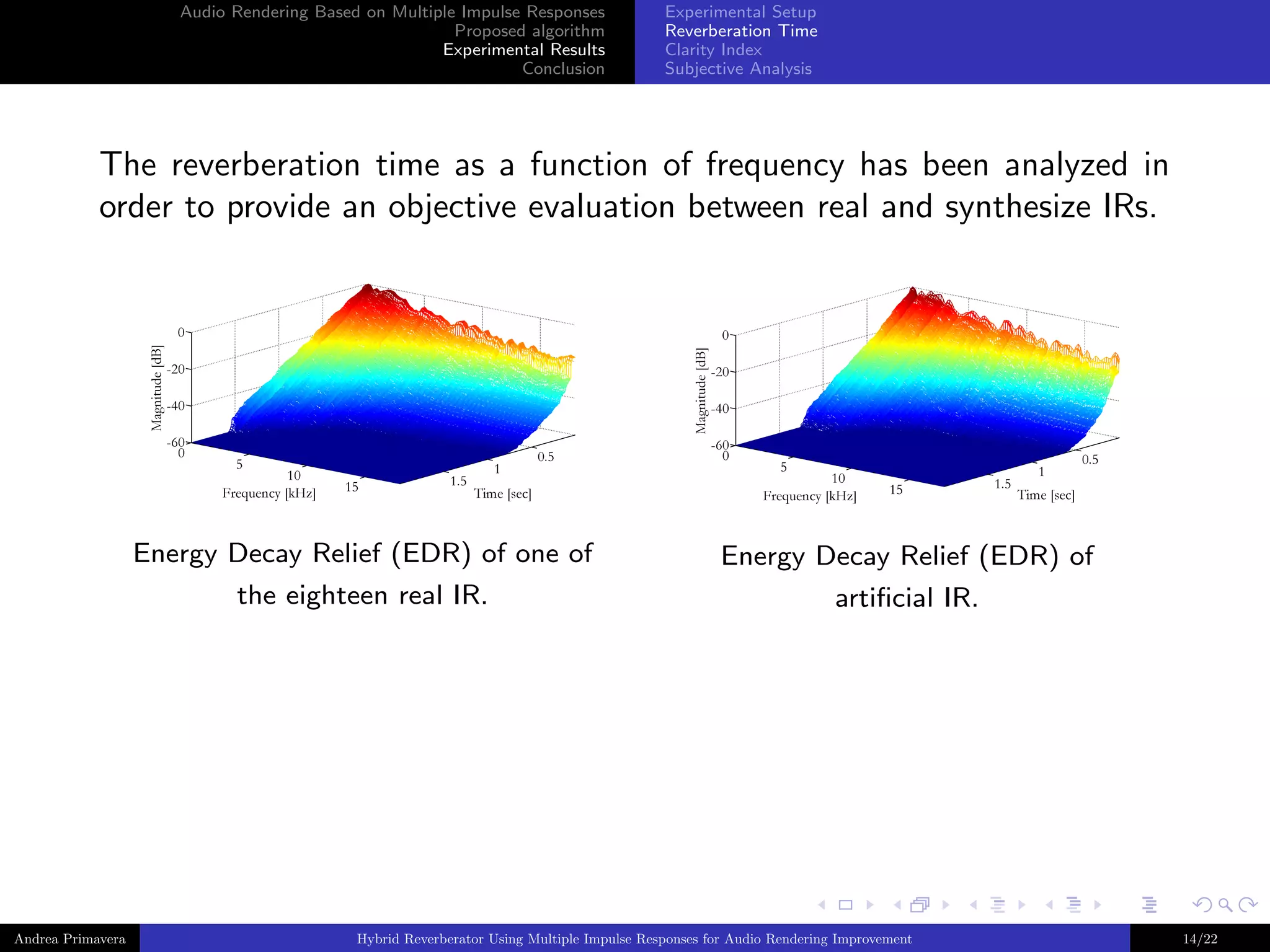
The reverberation time as a function of frequency has been analyzed in
order to provide an objective evaluation between real and synthesize IRs.

Energy Decay Relief (EDR) of one of
the eighteen real IR.

Andrea Primavera

Energy Decay Relief (EDR) of
artificial IR.

Hybrid Reverberator Using Multiple Impulse Responses for Audio Rendering Improvement

14/22
Audio Rendering Based on Multiple Impulse Responses
Proposed algorithm
Experimental Results
Conclusion

Experimental Setup
Reverberation Time
Clarity Index
Subjective Analysis

The reverberation time as a function of frequency has been analyzed in
order to provide an objective evaluation between real and synthesize IRs.

Mean difference in reverberation time between the measured and synthesized IRs
exploiting (a) the proposed approach and (b) the technique described in [2].

Since the obtained errors are comparable, the effectiveness of the proposed
technique in time frequency behaviors reproduction is confirmed.

Andrea Primavera

Hybrid Reverberator Using Multiple Impulse Responses for Audio Rendering Improvement

15/22
Audio Rendering Based on Multiple Impulse Responses
Proposed algorithm
Experimental Results
Conclusion

Experimental Setup
Reverberation Time
Clarity Index
Subjective Analysis

Another parameter employed in objective analysis is clarity (C50 and C80):

Proposed approach
Approach presented in [2]

Mean real
1.75
1.75

Proposed approach
Approach presented in [2]

4.23
4.23

C50
Mean synth
2.28
0.10
C80
5.49
3.41

Mean err
0.52
1.65

Std err
1.09
1.97

1.26
0.81

1.06
1.29

Clarity measures: mean and the standard deviation (STD) error computed as
difference in corresponding receiver positions of the synthesized and measured IRs
exploiting the proposed approach and the one described in [2].

The similar values obtained as mean and standard deviation evaluation
confirms the validity of the approach.

Andrea Primavera

Hybrid Reverberator Using Multiple Impulse Responses for Audio Rendering Improvement

16/22
Audio Rendering Based on Multiple Impulse Responses
Proposed algorithm
Experimental Results
Conclusion

Experimental Setup
Reverberation Time
Clarity Index
Subjective Analysis

Informal listening tests have been performed:
• The movement of the listener position along one dimension has been

simulated.
• The effectiveness of the approach has been confirmed since listeners

are not able to hear any difference between the presented approach
and the one described in [2].

Andrea Primavera

Hybrid Reverberator Using Multiple Impulse Responses for Audio Rendering Improvement

17/22
Audio Rendering Based on Multiple Impulse Responses
Proposed algorithm
Experimental Results
Conclusion

Conclusion
Questions
Bibliography

In conclusion:
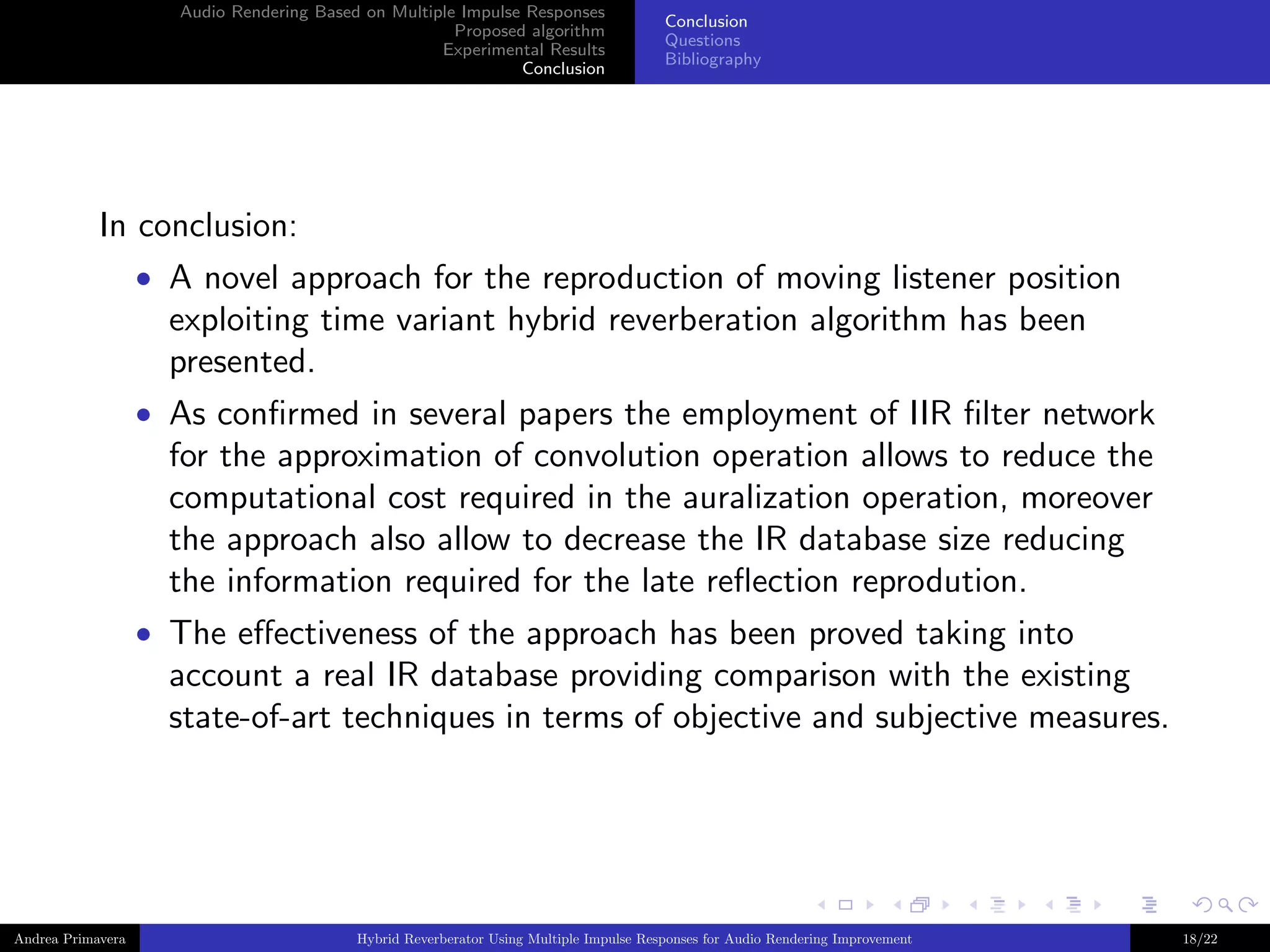
• A novel approach for the reproduction of moving listener position

exploiting time variant hybrid reverberation algorithm has been
presented.
• As confirmed in several papers the employment of IIR filter network

for the approximation of convolution operation allows to reduce the
computational cost required in the auralization operation, moreover
the approach also allow to decrease the IR database size reducing
the information required for the late reflection reprodution.
• The effectiveness of the approach has been proved taking into

account a real IR database providing comparison with the existing
state-of-art techniques in terms of objective and subjective measures.

Andrea Primavera

Hybrid Reverberator Using Multiple Impulse Responses for Audio Rendering Improvement

18/22
Audio Rendering Based on Multiple Impulse Responses
Proposed algorithm
Experimental Results
Conclusion

Conclusion
Questions
Bibliography

QUESTIONS?

Andrea Primavera

Hybrid Reverberator Using Multiple Impulse Responses for Audio Rendering Improvement

19/22
Audio Rendering Based on Multiple Impulse Responses
Proposed algorithm
Experimental Results
Conclusion

Conclusion
Questions
Bibliography

B. Dalenback and M. Stromberg, “Real time walk-through
auralization - the first year,” in Proc. Institute of Acoustics,
Amsterdam, NL, Mar. 2006.
R. Stewart and M. Sandler, “Generating a spatial average
reverberation tail across multiple impulse responses,” in Proc. 35th
Audio Engineering Society Conference, London, UK, Dec. 2009.
B. Blesser, “An interdisciplinary synthesis of reverberation
viewpoints,” J. Audio Eng. Soc., vol. 49, no. 10, pp. 867–903, Oct.
2001.
A. Primavera, S. Cecchi, P. Peretti, L. Romoli, and F. Piazza, “An
Advanced Implementation of a Digital Artificial Reverberator,” in
Proc. 130th Audio Engineering Society Convention, London,UK,
May 2011.
A. Primavera, M. Gasparini, S. Cecchi, L. Romoli, and F. Piazza,
“Hybrid Reverberation Algorithm: a Practical Approach,” in
AIA-DAGA Conference, Merano, Italy, Mar. 2013.
Andrea Primavera

Hybrid Reverberator Using Multiple Impulse Responses for Audio Rendering Improvement

20/22
Audio Rendering Based on Multiple Impulse Responses
Proposed algorithm
Experimental Results
Conclusion

Conclusion
Questions
Bibliography

R. Stewart and M. Sandler, “Statisical measures of early reections of
room impulse responses,” in in DAFX 07), Bordeaux, France, Sep.
2007.
G. Defrance and J. Polack, “Measuring the mixing time in
auditoria,” in Proc. 155th Meeting of the Acoustical Society of
America), vol. 49, Jun 2001, pp. 867–903.
J. Jot, “Digital Delay Networks for designing artificial reverberators,”
in Proc. 90th Audio Engineering Society Convention, Paris, Feb
1991.
J. Spall, “Implementation of the Simultaneous Perturbation
Algorithm for Stochastic Optimization,” in IEEE Transactions on
Aerospace and Electronic Systems, vol. 34, 1998, pp. 817–823.
S. Heise, M. Hlatky, and J. Loviscach, “Automatic Adjustment of
Off-the-Shelf Reverberation Effects,” in Proc. 126th Audio
Engineering Society Convention, Munich, Germany, May 2009.

Andrea Primavera

Hybrid Reverberator Using Multiple Impulse Responses for Audio Rendering Improvement

21/22
Audio Rendering Based on Multiple Impulse Responses
Proposed algorithm
Experimental Results
Conclusion

Conclusion
Questions
Bibliography

“OpenAIR, Audiolab, University of York.” [Online]. Available:
http://www.openairlib.net/

Andrea Primavera

Hybrid Reverberator Using Multiple Impulse Responses for Audio Rendering Improvement

22/22

Hybrid Reverberator Using Multiple Impulse Responses for Audio Rendering Improvement

  • 1.
    Audio Rendering Basedon Multiple Impulse Responses Proposed algorithm Experimental Results Conclusion Hybrid Reverberator Using Multiple Impulse Responses for Audio Rendering Improvement Andrea Primavera1 , Stefania Cecchi1 , Francesco Piazza1 , Junfeng Li2 , and Yonghong Yan2 1 A3lab - DII - Universit` Politecnica delle Marche a Ancona - ITALY 2 Institute of Acoustics, Chinese Academy of Sciences - Beijing - CHINA IIHMSP, October 2013, Beijing, China. Andrea Primavera Hybrid Reverberator Using Multiple Impulse Responses for Audio Rendering Improvement 1/22
  • 2.
    Audio Rendering Basedon Multiple Impulse Responses Proposed algorithm Experimental Results Conclusion 1 Audio Rendering Based on Multiple Impulse Responses Introduction State of the art Proposed algorithm 2 Proposed algorithm Analysis of reverberation tail Synthesis of the reverberation effect Real-time Reproduction of Moving Listener Position 3 Experimental Results Experimental Setup Reverberation Time Clarity Index Subjective Analysis 4 Conclusion Conclusion Questions Bibliography Andrea Primavera Hybrid Reverberator Using Multiple Impulse Responses for Audio Rendering Improvement 2/22
  • 3.
    Audio Rendering Basedon Multiple Impulse Responses Proposed algorithm Experimental Results Conclusion Introduction State of the art Proposed algorithm Linear convolution is a widely used operation typically employed for audio rendering purpose aiming to reproduce the reverberation effect generated when a sound is produced within an enclosed space. One of the main problems LINEAR CONVOLUTION STATIC PROCEDURE It allows to reproduce only the acoustic effect produced taking into account a specific sound source with the relative receiver position. Solution • Time varying convolution to simulate the moving receiver positions performing IRs interpolation [1]. • A large impulse response (IR) database is needed. Andrea Primavera Hybrid Reverberator Using Multiple Impulse Responses for Audio Rendering Improvement 3/22
  • 4.
    Audio Rendering Basedon Multiple Impulse Responses Proposed algorithm Experimental Results Conclusion Introduction State of the art Proposed algorithm Linear convolution is a widely used operation typically employed for audio rendering purpose aiming to reproduce the reverberation effect generated when a sound is produced within an enclosed space. One of the main problems LINEAR CONVOLUTION STATIC PROCEDURE It allows to reproduce only the acoustic effect produced taking into account a specific sound source with the relative receiver position. Solution • Time varying convolution to simulate the moving receiver positions performing IRs interpolation [1]. • A large impulse response (IR) database is needed. Andrea Primavera Hybrid Reverberator Using Multiple Impulse Responses for Audio Rendering Improvement 3/22
  • 5.
    Audio Rendering Basedon Multiple Impulse Responses Proposed algorithm Experimental Results Conclusion Introduction State of the art Proposed algorithm Linear convolution is a widely used operation typically employed for audio rendering purpose aiming to reproduce the reverberation effect generated when a sound is produced within an enclosed space. One of the main problems LINEAR CONVOLUTION STATIC PROCEDURE It allows to reproduce only the acoustic effect produced taking into account a specific sound source with the relative receiver position. Solution • Time varying convolution to simulate the moving receiver positions performing IRs interpolation [1]. • A large impulse response (IR) database is needed. Andrea Primavera Hybrid Reverberator Using Multiple Impulse Responses for Audio Rendering Improvement 3/22
  • 6.
    Audio Rendering Basedon Multiple Impulse Responses Proposed algorithm Experimental Results Conclusion Introduction State of the art Proposed algorithm PROBLEM: Large impulse responses database required high memory usage. In [2] a database reduction procedure for auralization purpose with moving listener position has been proposed: Consideration • Early reflections contain most of the information regarding the location of the sound source and receiver. • Late reflections gives more information about room properties (e.g., size, geometry, materials) [3]. • The information in the late reverberation tail is largely redundant across multiple impulse responses recorded in the same space. Andrea Primavera Hybrid Reverberator Using Multiple Impulse Responses for Audio Rendering Improvement 4/22
  • 7.
    Audio Rendering Basedon Multiple Impulse Responses Proposed algorithm Experimental Results Conclusion Introduction State of the art Proposed algorithm PROBLEM: Large impulse responses database required high memory usage. In [2] a database reduction procedure for auralization purpose with moving listener position has been proposed: Metodology • Mixing time evaluation to discriminate late from early reflections. • Approximation of the reverberation tail of the whole IR database as stochastic process (i.e., white noise). Andrea Primavera Hybrid Reverberator Using Multiple Impulse Responses for Audio Rendering Improvement 5/22
  • 8.
    Audio Rendering Basedon Multiple Impulse Responses Proposed algorithm Experimental Results Conclusion Introduction State of the art Proposed algorithm PROBLEM: Large impulse responses database required high memory usage. Proposed Solution Taking into account the procedure described in [2] a novel methodology has been proposed considering the advantages introduced by hybrid reveberation structure [4] [5]. • It is possible to approximate the convolution operation using recursive structure (i.e., IIR filters). • This procedure allows to further reduce the database dimension with respect to [2]. • The employed structures permits to decrease the computational load required to perform the real-time auralization. Andrea Primavera Hybrid Reverberator Using Multiple Impulse Responses for Audio Rendering Improvement 6/22
  • 9.
    Audio Rendering Basedon Multiple Impulse Responses Proposed algorithm Experimental Results Conclusion Analysis of reverberation tail Synthesis of the reverberation effect Real-time Reproduction of Moving Listener Position Three are the main phases of the approach presented for the reproduction of moving listener position exploiting a hybrid reverberator structure: 1 2 3 Andrea Primavera Analysis of reverberation tail: Generate a prototype representing the database average reveberation tail. Synthesis of the reverberation effect: Approximate the reverberation tail prototype exploiting an hybrid reverberation algorithm [4] [5]. Real-time reproduction of moving listener position: Reverberation effect reproduction using the hybrid reverberation structure (mixed FIR/IIR filter network). Hybrid Reverberator Using Multiple Impulse Responses for Audio Rendering Improvement 7/22
  • 10.
    Audio Rendering Basedon Multiple Impulse Responses Proposed algorithm Experimental Results Conclusion 1 Analysis of reverberation tail Synthesis of the reverberation effect Real-time Reproduction of Moving Listener Position Analysis of reverberation tail: • Mixing time analysis: The partitioning of early from late reflections has been performed exploiting gaussianity [4] [6] and phase evolution estimators [7]. • Prototype evaluation: The reverberation tail prototype is computed as a mean of the IRs database after the maximum mixing time tm . htail = 1 N Lm hn (t) (1) hn : database IRs t=tm • Scaling operation: In order to simulate the distance among the source and the different listereners position a scaling factor is evaluated. Sm Andrea Primavera RMS(hs ) = = RMS(hm ) 1 Lm 1 Lm Lm t=tm Lm t=tm 2 hs (t) (2) hs : synthesized IR hm : original IR 2 hm (t) Hybrid Reverberator Using Multiple Impulse Responses for Audio Rendering Improvement 8/22
  • 11.
    Audio Rendering Basedon Multiple Impulse Responses Proposed algorithm Experimental Results Conclusion 2 Analysis of reverberation tail Synthesis of the reverberation effect Real-time Reproduction of Moving Listener Position Synthesis of the reverberation effect: gain x[n] EARLY REFLECTIONS DEVICE LATE REFLECTIONS DEVICE + × DELAY y[n] Hybrid reverberator block diagram for the single channel case. Early reflections device Based on the convolution with a real IR for the reproduction of the early echoes. A + LBCF + LBCF y[n] x[n] Late reflections device + + LBCF + Based on IIR filters network (e.g., comb and/or all-pass) and a FDN matrix [8] for the simulation of the reverberation tail. Andrea Primavera AP AP + NAP filters LBCF NLBCF filters Late reflections device block diagram for the single channel case. Hybrid Reverberator Using Multiple Impulse Responses for Audio Rendering Improvement 9/22
  • 12.
    Audio Rendering Basedon Multiple Impulse Responses Proposed algorithm Experimental Results Conclusion 2 Analysis of reverberation tail Synthesis of the reverberation effect Real-time Reproduction of Moving Listener Position Synthesis of the reverberation effect: gain x[n] EARLY REFLECTIONS DEVICE LATE REFLECTIONS DEVICE + × DELAY y[n] Hybrid reverberator block diagram for the single channel case. Autotuning procedure An automatic procedure allows to set the parameters of hybrid reverberator in order to emulate a real environment starting from its impulse. A + LBCF + LBCF y[n] x[n] + + LBCF + AP AP + NAP filters LBCF NLBCF filters FIR TO IIR APPROXIMATION Andrea Primavera Late reflections device block diagram for the single channel case. Hybrid Reverberator Using Multiple Impulse Responses for Audio Rendering Improvement 10/22
  • 13.
    Audio Rendering Basedon Multiple Impulse Responses Proposed algorithm Experimental Results Conclusion 2 Analysis of reverberation tail Synthesis of the reverberation effect Real-time Reproduction of Moving Listener Position Synthesis of the reverberation effect: Two are the main phases of the autotuning procedure: Late Reflections Analysis Early Reflections Partitioning Evaluation of the mixing time to set the early reflection device: • • Andrea Primavera Gaussianity estimators: Similarities between IR behavior and gaussian noise can be found in late reflections. Kurtosis and MAD/SD ratio have been used. Phase distortion evaluation: The unwrapped phase of the IR tends to become not linear with late reflections evolution. An offline adaptation procedure, based on SPSA [9], has been used to iteratively find the IIR parameters. A single loss function computed in cepstral domain [10] has been adopted in the minimization procedure. L = max       max        [Tr (i, j) − Ta (i, j)]2   i=1 j=1 K M where: • Tr is a matrix representing the MFCC derived from the real IR. • Ta is the MFCC obtained by the artificial IR. Hybrid Reverberator Using Multiple Impulse Responses for Audio Rendering Improvement 11/22
  • 14.
    Audio Rendering Basedon Multiple Impulse Responses Proposed algorithm Experimental Results Conclusion 3 Analysis of reverberation tail Synthesis of the reverberation effect Real-time Reproduction of Moving Listener Position Real-time reproduction of moving listener position: The movement reproduction is generate changing the reverberator parameters as a function of the listener position: • Early reflection device: The filter coefficientsare obtained as a linear or bilinear interpolation of the impulse response, with relation to the number of the involved IR. • Late reflection device: The coefficients are fixed reproducing the same reverberation tail for all the different positions. Andrea Primavera Hybrid Reverberator Using Multiple Impulse Responses for Audio Rendering Improvement 12/22
  • 15.
    Audio Rendering Basedon Multiple Impulse Responses Proposed algorithm Experimental Results Conclusion Experimental Setup Reverberation Time Clarity Index Subjective Analysis The effectiveness of the presented technique has been proved taking into account account the IR database of a real environment (i.e., St. Margarets Church in York [11]). As reported in [11], a total of 18 IRs has been derived using: • A logarithmic sweep signal excitation (20 Hz - 22 kHz). • Sample rate of 96kHz. • A Soundfield SPS422B microphone. • A Genelec S30D loudspeaker. Andrea Primavera Hybrid Reverberator Using Multiple Impulse Responses for Audio Rendering Improvement 13/22
  • 16.
    Audio Rendering Basedon Multiple Impulse Responses Proposed algorithm Experimental Results Conclusion Experimental Setup Reverberation Time Clarity Index Subjective Analysis The reverberation time as a function of frequency has been analyzed in order to provide an objective evaluation between real and synthesize IRs. Energy Decay Relief (EDR) of one of the eighteen real IR. Andrea Primavera Energy Decay Relief (EDR) of artificial IR. Hybrid Reverberator Using Multiple Impulse Responses for Audio Rendering Improvement 14/22
  • 17.
    Audio Rendering Basedon Multiple Impulse Responses Proposed algorithm Experimental Results Conclusion Experimental Setup Reverberation Time Clarity Index Subjective Analysis The reverberation time as a function of frequency has been analyzed in order to provide an objective evaluation between real and synthesize IRs. Mean difference in reverberation time between the measured and synthesized IRs exploiting (a) the proposed approach and (b) the technique described in [2]. Since the obtained errors are comparable, the effectiveness of the proposed technique in time frequency behaviors reproduction is confirmed. Andrea Primavera Hybrid Reverberator Using Multiple Impulse Responses for Audio Rendering Improvement 15/22
  • 18.
    Audio Rendering Basedon Multiple Impulse Responses Proposed algorithm Experimental Results Conclusion Experimental Setup Reverberation Time Clarity Index Subjective Analysis Another parameter employed in objective analysis is clarity (C50 and C80): Proposed approach Approach presented in [2] Mean real 1.75 1.75 Proposed approach Approach presented in [2] 4.23 4.23 C50 Mean synth 2.28 0.10 C80 5.49 3.41 Mean err 0.52 1.65 Std err 1.09 1.97 1.26 0.81 1.06 1.29 Clarity measures: mean and the standard deviation (STD) error computed as difference in corresponding receiver positions of the synthesized and measured IRs exploiting the proposed approach and the one described in [2]. The similar values obtained as mean and standard deviation evaluation confirms the validity of the approach. Andrea Primavera Hybrid Reverberator Using Multiple Impulse Responses for Audio Rendering Improvement 16/22
  • 19.
    Audio Rendering Basedon Multiple Impulse Responses Proposed algorithm Experimental Results Conclusion Experimental Setup Reverberation Time Clarity Index Subjective Analysis Informal listening tests have been performed: • The movement of the listener position along one dimension has been simulated. • The effectiveness of the approach has been confirmed since listeners are not able to hear any difference between the presented approach and the one described in [2]. Andrea Primavera Hybrid Reverberator Using Multiple Impulse Responses for Audio Rendering Improvement 17/22
  • 20.
    Audio Rendering Basedon Multiple Impulse Responses Proposed algorithm Experimental Results Conclusion Conclusion Questions Bibliography In conclusion: • A novel approach for the reproduction of moving listener position exploiting time variant hybrid reverberation algorithm has been presented. • As confirmed in several papers the employment of IIR filter network for the approximation of convolution operation allows to reduce the computational cost required in the auralization operation, moreover the approach also allow to decrease the IR database size reducing the information required for the late reflection reprodution. • The effectiveness of the approach has been proved taking into account a real IR database providing comparison with the existing state-of-art techniques in terms of objective and subjective measures. Andrea Primavera Hybrid Reverberator Using Multiple Impulse Responses for Audio Rendering Improvement 18/22
  • 21.
    Audio Rendering Basedon Multiple Impulse Responses Proposed algorithm Experimental Results Conclusion Conclusion Questions Bibliography QUESTIONS? Andrea Primavera Hybrid Reverberator Using Multiple Impulse Responses for Audio Rendering Improvement 19/22
  • 22.
    Audio Rendering Basedon Multiple Impulse Responses Proposed algorithm Experimental Results Conclusion Conclusion Questions Bibliography B. Dalenback and M. Stromberg, “Real time walk-through auralization - the first year,” in Proc. Institute of Acoustics, Amsterdam, NL, Mar. 2006. R. Stewart and M. Sandler, “Generating a spatial average reverberation tail across multiple impulse responses,” in Proc. 35th Audio Engineering Society Conference, London, UK, Dec. 2009. B. Blesser, “An interdisciplinary synthesis of reverberation viewpoints,” J. Audio Eng. Soc., vol. 49, no. 10, pp. 867–903, Oct. 2001. A. Primavera, S. Cecchi, P. Peretti, L. Romoli, and F. Piazza, “An Advanced Implementation of a Digital Artificial Reverberator,” in Proc. 130th Audio Engineering Society Convention, London,UK, May 2011. A. Primavera, M. Gasparini, S. Cecchi, L. Romoli, and F. Piazza, “Hybrid Reverberation Algorithm: a Practical Approach,” in AIA-DAGA Conference, Merano, Italy, Mar. 2013. Andrea Primavera Hybrid Reverberator Using Multiple Impulse Responses for Audio Rendering Improvement 20/22
  • 23.
    Audio Rendering Basedon Multiple Impulse Responses Proposed algorithm Experimental Results Conclusion Conclusion Questions Bibliography R. Stewart and M. Sandler, “Statisical measures of early reections of room impulse responses,” in in DAFX 07), Bordeaux, France, Sep. 2007. G. Defrance and J. Polack, “Measuring the mixing time in auditoria,” in Proc. 155th Meeting of the Acoustical Society of America), vol. 49, Jun 2001, pp. 867–903. J. Jot, “Digital Delay Networks for designing artificial reverberators,” in Proc. 90th Audio Engineering Society Convention, Paris, Feb 1991. J. Spall, “Implementation of the Simultaneous Perturbation Algorithm for Stochastic Optimization,” in IEEE Transactions on Aerospace and Electronic Systems, vol. 34, 1998, pp. 817–823. S. Heise, M. Hlatky, and J. Loviscach, “Automatic Adjustment of Off-the-Shelf Reverberation Effects,” in Proc. 126th Audio Engineering Society Convention, Munich, Germany, May 2009. Andrea Primavera Hybrid Reverberator Using Multiple Impulse Responses for Audio Rendering Improvement 21/22
  • 24.
    Audio Rendering Basedon Multiple Impulse Responses Proposed algorithm Experimental Results Conclusion Conclusion Questions Bibliography “OpenAIR, Audiolab, University of York.” [Online]. Available: http://www.openairlib.net/ Andrea Primavera Hybrid Reverberator Using Multiple Impulse Responses for Audio Rendering Improvement 22/22