How Empathy Drives
Data Products
Farid Jamshidian, PhD
Helping Patients Choose
Care with Confidence
Amino's mission is to connect everyone to the best health
care possible. We're committed to creating the clearest
picture of American health care so everyone can choose care
with confidence.
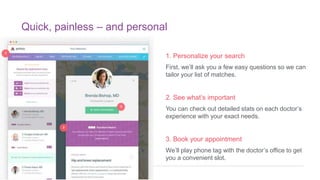
Quick, painless – and personal
1. Personalize your search
First, we’ll ask you a few easy questions so we can
tailor your list of matches.
2. See what’s important
You can check out detailed stats on each doctor’s
experience with your exact needs.
3. Book your appointment
We’ll play phone tag with the doctor’s office to get
you a convenient slot.
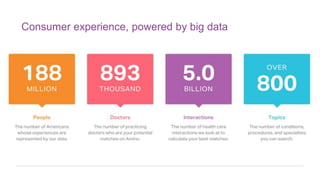
Consumer experience, powered by big data
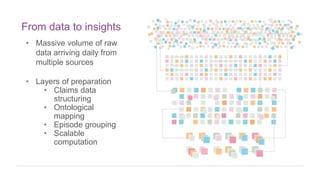
From data to insights
• Massive volume of raw
data arriving daily from
multiple sources
• Layers of preparation
• Claims data
structuring
• Ontological
mapping
• Episode grouping
• Scalable
computation
It’s hard to find a doctor who actually has experience with
your condition or the procedure you’re planning
Problem #1
Solution: Care Match
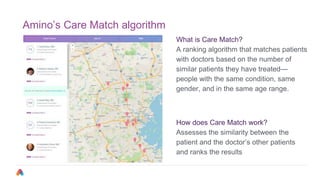
Amino’s Care Match algorithm
What is Care Match?
A ranking algorithm that matches patients
with doctors based on the number of
similar patients they have treated—
people with the same condition, same
gender, and in the same age range.
How does Care Match work?
Assesses the similarity between the
patient and the doctor’s other patients
and ranks the results
Problem #2
There’s no such thing as a board-certified “pancreas” expert.
Solution: Focus Areas
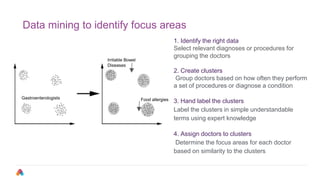
Data mining to identify focus areas
Gastroenterologists
Irritable Bowel
Diseases
Food allergies
1. Identify the right data
Select relevant diagnoses or procedures for
grouping the doctors
2. Create clusters
Group doctors based on how often they perform
a set of procedures or diagnose a condition
3. Hand label the clusters
Label the clusters in simple understandable
terms using expert knowledge
4. Assign doctors to clusters
Determine the focus areas for each doctor
based on similarity to the clusters
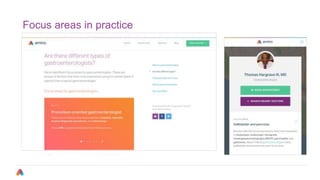
Focus areas in practice
How do you know what actually goes on in a doctor’s office –
the procedures, patient outcomes, quality of care?
Problem #3
Solution: Risk Adjusted Decision Factors
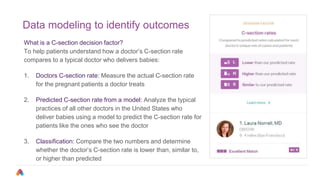
What is a C-section decision factor?
To help patients understand how a doctor’s C-section rate
compares to a typical doctor who delivers babies:
1. Doctors C-section rate: Measure the actual C-section rate
for the pregnant patients a doctor treats
2. Predicted C-section rate from a model: Analyze the typical
practices of all other doctors in the United States who
deliver babies using a model to predict the C-section rate for
patients like the ones who see the doctor
3. Classification: Compare the two numbers and determine
whether the doctor’s C-section rate is lower than, similar to,
or higher than predicted
Data modeling to identify outcomes
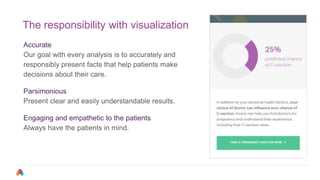
The responsibility with visualization
Accurate
Our goal with every analysis is to accurately and
responsibly present facts that help patients make
decisions about their care.
Parsimonious
Present clear and easily understandable results.
Engaging and empathetic to the patients
Always have the patients in mind.
Final Thoughts
It’s all about the patients!
All of our efforts are to engage and empower
patients. Data, modeling, and visualization are
all means to helping patients make better
decisions.
Healthcare in the age of Big Data.
We live in the age of Big Data and the
possibilities are endless. Big data will bring
detailed information on all aspects of healthcare
to patients and influence their choices.
Choose care with confidence.

HXR 2016: Data Insights: Mining, Modeling, and Visualizations- Farid Jamshidian

  • 1.
    How Empathy Drives DataProducts Farid Jamshidian, PhD Helping Patients Choose Care with Confidence
  • 2.
    Amino's mission isto connect everyone to the best health care possible. We're committed to creating the clearest picture of American health care so everyone can choose care with confidence.
  • 3.
    Quick, painless –and personal 1. Personalize your search First, we’ll ask you a few easy questions so we can tailor your list of matches. 2. See what’s important You can check out detailed stats on each doctor’s experience with your exact needs. 3. Book your appointment We’ll play phone tag with the doctor’s office to get you a convenient slot.
  • 4.
  • 5.
    From data toinsights • Massive volume of raw data arriving daily from multiple sources • Layers of preparation • Claims data structuring • Ontological mapping • Episode grouping • Scalable computation
  • 6.
    It’s hard tofind a doctor who actually has experience with your condition or the procedure you’re planning Problem #1
  • 7.
  • 8.
    Amino’s Care Matchalgorithm What is Care Match? A ranking algorithm that matches patients with doctors based on the number of similar patients they have treated— people with the same condition, same gender, and in the same age range. How does Care Match work? Assesses the similarity between the patient and the doctor’s other patients and ranks the results
  • 9.
    Problem #2 There’s nosuch thing as a board-certified “pancreas” expert.
  • 10.
  • 11.
    Data mining toidentify focus areas Gastroenterologists Irritable Bowel Diseases Food allergies 1. Identify the right data Select relevant diagnoses or procedures for grouping the doctors 2. Create clusters Group doctors based on how often they perform a set of procedures or diagnose a condition 3. Hand label the clusters Label the clusters in simple understandable terms using expert knowledge 4. Assign doctors to clusters Determine the focus areas for each doctor based on similarity to the clusters
  • 12.
  • 13.
    How do youknow what actually goes on in a doctor’s office – the procedures, patient outcomes, quality of care? Problem #3
  • 14.
    Solution: Risk AdjustedDecision Factors
  • 15.
    What is aC-section decision factor? To help patients understand how a doctor’s C-section rate compares to a typical doctor who delivers babies: 1. Doctors C-section rate: Measure the actual C-section rate for the pregnant patients a doctor treats 2. Predicted C-section rate from a model: Analyze the typical practices of all other doctors in the United States who deliver babies using a model to predict the C-section rate for patients like the ones who see the doctor 3. Classification: Compare the two numbers and determine whether the doctor’s C-section rate is lower than, similar to, or higher than predicted Data modeling to identify outcomes
  • 16.
    The responsibility withvisualization Accurate Our goal with every analysis is to accurately and responsibly present facts that help patients make decisions about their care. Parsimonious Present clear and easily understandable results. Engaging and empathetic to the patients Always have the patients in mind.
  • 18.
    Final Thoughts It’s allabout the patients! All of our efforts are to engage and empower patients. Data, modeling, and visualization are all means to helping patients make better decisions. Healthcare in the age of Big Data. We live in the age of Big Data and the possibilities are endless. Big data will bring detailed information on all aspects of healthcare to patients and influence their choices.
  • 19.
    Choose care withconfidence.