CASE STUDY-REPORT
NAME – AVISHKAR KOTWAL
ROOL NO.-22014 SUB-BS III
STUDIO-22
TOPIC ;Underfloor Air
Distribution (UFAD) System-
 HVAC Technology Overview
1. About the Technology/System
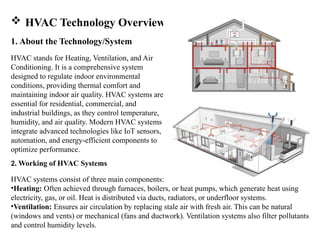
HVAC stands for Heating, Ventilation, and Air
Conditioning. It is a comprehensive system
designed to regulate indoor environmental
conditions, providing thermal comfort and
maintaining indoor air quality. HVAC systems are
essential for residential, commercial, and
industrial buildings, as they control temperature,
humidity, and air quality. Modern HVAC systems
integrate advanced technologies like IoT sensors,
automation, and energy-efficient components to
optimize performance.
2. Working of HVAC Systems
HVAC systems consist of three main components:
•Heating: Often achieved through furnaces, boilers, or heat pumps, which generate heat using
electricity, gas, or oil. Heat is distributed via ducts, radiators, or underfloor systems.
•Ventilation: Ensures air circulation by replacing stale air with fresh air. This can be natural
(windows and vents) or mechanical (fans and ductwork). Ventilation systems also filter pollutants
and control humidity levels.
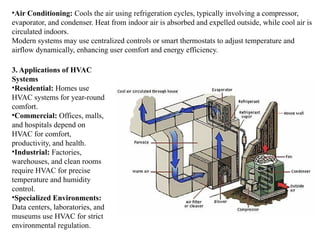
•Air Conditioning: Cools the air using refrigeration cycles, typically involving a compressor,
evaporator, and condenser. Heat from indoor air is absorbed and expelled outside, while cool air is
circulated indoors.
Modern systems may use centralized controls or smart thermostats to adjust temperature and
airflow dynamically, enhancing user comfort and energy efficiency.
3. Applications of HVAC
Systems
•Residential: Homes use
HVAC systems for year-round
comfort.
•Commercial: Offices, malls,
and hospitals depend on
HVAC for comfort,
productivity, and health.
•Industrial: Factories,
warehouses, and clean rooms
require HVAC for precise
temperature and humidity
control.
•Specialized Environments:
Data centers, laboratories, and
museums use HVAC for strict
environmental regulation.
4. Cost-Effectiveness, Space Requirements, and Energy Efficiency
a. Cost Effectiveness Over Conventional Systems:
•Initial Costs: Modern HVAC systems may have higher upfront costs due to advanced components
and installation complexity.
•Operating Costs: They are more efficient than conventional systems, reducing energy bills over
time.
b. Space Requirements:
•Conventional HVAC systems with bulky ductwork require more space. Newer ductless mini-splits or
VRF (Variable Refrigerant Flow) systems need less space and offer flexible installations.
c. Energy Efficiency:
•Energy efficiency has improved significantly with features like inverter technology, smart
thermostats, and zone-specific controls. HVAC systems with high SEER (Seasonal Energy Efficiency
Ratio) and EER (Energy Efficiency Ratio) ratings consume less energy compared to traditional setups.
d. Environmental Impact:
•Modern systems utilize eco-friendly refrigerants and energy-saving designs, reducing carbon
footprints and complying with green building standards.
By balancing installation costs with long-term savings in energy and maintenance, HVAC systems
have become increasingly attractive compared to older heating and cooling methods. Their space
efficiency and ability to integrate with renewable energy sources (e.g., solar panels) further enhance
their value in modern buildings.
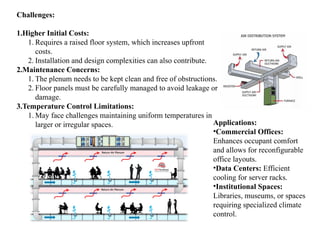
Underfloor Air Distribution (UFAD) System-
An Underfloor Air Distribution (UFAD) system is a method of distributing conditioned air
through an underfloor plenum, delivering it into the occupied zone via diffusers embedded in the
raised floor. This system offers a range of advantages, including energy efficiency, improved
indoor air quality, and flexibility in layout design. Here's a detailed overview:
1.Overview of UFAD System
 Structure:
UFAD systems consist of a raised floor system above a structural slab. The space underneath
acts as an air plenum for conditioned air.
 Components:
• Air Handling Units (AHUs): Supply conditioned air.
• Underfloor Plenum: Distributes air throughout the building.
• Diffusers: Embedded in the floor for localized air distribution.
• Controls: Thermostats and sensors manage airflow and temperature.
2. Working Principle
• Airflow Dynamics: Cool air is delivered at low pressure into the underfloor plenum.Air
rises naturally due to thermal stratification, maintaining comfort in the occupied zone (up to
~6 feet).Warmer air accumulates near the ceiling and is returned to the HVAC system for
reconditioning.
• Zoning: UFAD allows for localized control by dividing the space into multiple zones, each
with adjustable diffusers.
Challenges:
1.Higher Initial Costs:
1. Requires a raised floor system, which increases upfront
costs.
2. Installation and design complexities can also contribute.
2.Maintenance Concerns:
1. The plenum needs to be kept clean and free of obstructions.
2. Floor panels must be carefully managed to avoid leakage or
damage.
3.Temperature Control Limitations:
1. May face challenges maintaining uniform temperatures in
larger or irregular spaces. Applications:
•Commercial Offices:
Enhances occupant comfort
and allows for reconfigurable
office layouts.
•Data Centers: Efficient
cooling for server racks.
•Institutional Spaces:
Libraries, museums, or spaces
requiring specialized climate
control.
MARKET SURVEY
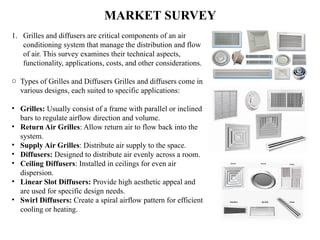
1. Grilles and diffusers are critical components of an air
conditioning system that manage the distribution and flow
of air. This survey examines their technical aspects,
functionality, applications, costs, and other considerations.
o Types of Grilles and Diffusers Grilles and diffusers come in
various designs, each suited to specific applications:
• Grilles: Usually consist of a frame with parallel or inclined
bars to regulate airflow direction and volume.
• Return Air Grilles: Allow return air to flow back into the
system.
• Supply Air Grilles: Distribute air supply to the space.
• Diffusers: Designed to distribute air evenly across a room.
• Ceiling Diffusers: Installed in ceilings for even air
dispersion.
• Linear Slot Diffusers: Provide high aesthetic appeal and
are used for specific design needs.
• Swirl Diffusers: Create a spiral airflow pattern for efficient
cooling or heating.
2. Technical Specifications-
Key specifications for grilles and diffusers
include:
•Material: Common materials are aluminum,
stainless steel, or plastic (PVC). Aluminum is
lightweight and corrosion-resistant, while
steel is more robust.
•Airflow (CFM): Rated in cubic feet per
minute (CFM) for handling specific air
volumes.
•Blades/Slots: Adjustable or fixed blades to
control airflow direction and velocity.
•Noise Level: Measured in decibels (dB);
quieter options are ideal for residential and
office use.
•Finish: Coatings like powder-coated or
anodized finishes provide durability and
aesthetic appeal.
•Standards: Compliance with ASHRAE,
ISO, or similar air distribution standards.
3. Working-
•Grilles: Act as barriers, directing or diffusing airflow while allowing partial control of air velocity
and direction.
•Diffusers: Use slots or perforations to distribute conditioned air across a space uniformly,
preventing hot or cold spots. Adjustable designs allow users to modify airflow patterns.
4. Applications-
•Residential: Linear grilles and ceiling diffusers are common for aesthetics and quiet operation.
•Commercial: Swirl and slot diffusers for offices and malls where air distribution efficiency is
critical.
•Industrial: Heavy-duty grilles for areas with high air movement and robust conditions.
•Healthcare: Specialized diffusers with HEPA filters for controlled environments.
•Auditoriums/Conference Rooms: Noise-dampened diffusers for sound-sensitive areas.
5. Costing-
•Basic Aluminum Grilles: RS.1600–RS.4300per unit (depending on size).
•Decorative Grilles/Diffusers: RS.4300–RS.12720 per unit (with customized finishes).
•Specialized Diffusers (e.g., Swirl, HEPA-compatible):RS.12720–RS.42370or more,
depending on specifications.
•Bulk Pricing: Discounts are often available for large orders, especially in commercial
projects.
6. Other Considerations-
•Aesthetic Integration: Modern grilles and diffusers come in a variety of designs to match
interiors.
•Ease of Maintenance: Snap-fit designs or easily removable parts simplify cleaning.
•Advanced Features: Smart diffusers with motorized blades, airflow sensors, and app
controls are increasingly popular.
•Sustainability: Products made from recycled materials or those that improve energy
efficiency align with green building standards.
•Vendor Availability: Market leaders include companies like TROX, Price Industries,
Krueger, and others, offering a range of products for specific needs.

hvac technology overview and bulding services

  • 1.
    CASE STUDY-REPORT NAME –AVISHKAR KOTWAL ROOL NO.-22014 SUB-BS III STUDIO-22 TOPIC ;Underfloor Air Distribution (UFAD) System-
  • 2.
     HVAC TechnologyOverview 1. About the Technology/System HVAC stands for Heating, Ventilation, and Air Conditioning. It is a comprehensive system designed to regulate indoor environmental conditions, providing thermal comfort and maintaining indoor air quality. HVAC systems are essential for residential, commercial, and industrial buildings, as they control temperature, humidity, and air quality. Modern HVAC systems integrate advanced technologies like IoT sensors, automation, and energy-efficient components to optimize performance. 2. Working of HVAC Systems HVAC systems consist of three main components: •Heating: Often achieved through furnaces, boilers, or heat pumps, which generate heat using electricity, gas, or oil. Heat is distributed via ducts, radiators, or underfloor systems. •Ventilation: Ensures air circulation by replacing stale air with fresh air. This can be natural (windows and vents) or mechanical (fans and ductwork). Ventilation systems also filter pollutants and control humidity levels.
  • 3.
    •Air Conditioning: Coolsthe air using refrigeration cycles, typically involving a compressor, evaporator, and condenser. Heat from indoor air is absorbed and expelled outside, while cool air is circulated indoors. Modern systems may use centralized controls or smart thermostats to adjust temperature and airflow dynamically, enhancing user comfort and energy efficiency. 3. Applications of HVAC Systems •Residential: Homes use HVAC systems for year-round comfort. •Commercial: Offices, malls, and hospitals depend on HVAC for comfort, productivity, and health. •Industrial: Factories, warehouses, and clean rooms require HVAC for precise temperature and humidity control. •Specialized Environments: Data centers, laboratories, and museums use HVAC for strict environmental regulation.
  • 4.
    4. Cost-Effectiveness, SpaceRequirements, and Energy Efficiency a. Cost Effectiveness Over Conventional Systems: •Initial Costs: Modern HVAC systems may have higher upfront costs due to advanced components and installation complexity. •Operating Costs: They are more efficient than conventional systems, reducing energy bills over time. b. Space Requirements: •Conventional HVAC systems with bulky ductwork require more space. Newer ductless mini-splits or VRF (Variable Refrigerant Flow) systems need less space and offer flexible installations. c. Energy Efficiency: •Energy efficiency has improved significantly with features like inverter technology, smart thermostats, and zone-specific controls. HVAC systems with high SEER (Seasonal Energy Efficiency Ratio) and EER (Energy Efficiency Ratio) ratings consume less energy compared to traditional setups. d. Environmental Impact: •Modern systems utilize eco-friendly refrigerants and energy-saving designs, reducing carbon footprints and complying with green building standards. By balancing installation costs with long-term savings in energy and maintenance, HVAC systems have become increasingly attractive compared to older heating and cooling methods. Their space efficiency and ability to integrate with renewable energy sources (e.g., solar panels) further enhance their value in modern buildings.
  • 5.
    Underfloor Air Distribution(UFAD) System- An Underfloor Air Distribution (UFAD) system is a method of distributing conditioned air through an underfloor plenum, delivering it into the occupied zone via diffusers embedded in the raised floor. This system offers a range of advantages, including energy efficiency, improved indoor air quality, and flexibility in layout design. Here's a detailed overview: 1.Overview of UFAD System  Structure: UFAD systems consist of a raised floor system above a structural slab. The space underneath acts as an air plenum for conditioned air.  Components: • Air Handling Units (AHUs): Supply conditioned air. • Underfloor Plenum: Distributes air throughout the building. • Diffusers: Embedded in the floor for localized air distribution. • Controls: Thermostats and sensors manage airflow and temperature. 2. Working Principle • Airflow Dynamics: Cool air is delivered at low pressure into the underfloor plenum.Air rises naturally due to thermal stratification, maintaining comfort in the occupied zone (up to ~6 feet).Warmer air accumulates near the ceiling and is returned to the HVAC system for reconditioning. • Zoning: UFAD allows for localized control by dividing the space into multiple zones, each with adjustable diffusers.
  • 6.
    Challenges: 1.Higher Initial Costs: 1.Requires a raised floor system, which increases upfront costs. 2. Installation and design complexities can also contribute. 2.Maintenance Concerns: 1. The plenum needs to be kept clean and free of obstructions. 2. Floor panels must be carefully managed to avoid leakage or damage. 3.Temperature Control Limitations: 1. May face challenges maintaining uniform temperatures in larger or irregular spaces. Applications: •Commercial Offices: Enhances occupant comfort and allows for reconfigurable office layouts. •Data Centers: Efficient cooling for server racks. •Institutional Spaces: Libraries, museums, or spaces requiring specialized climate control.
  • 7.
    MARKET SURVEY 1. Grillesand diffusers are critical components of an air conditioning system that manage the distribution and flow of air. This survey examines their technical aspects, functionality, applications, costs, and other considerations. o Types of Grilles and Diffusers Grilles and diffusers come in various designs, each suited to specific applications: • Grilles: Usually consist of a frame with parallel or inclined bars to regulate airflow direction and volume. • Return Air Grilles: Allow return air to flow back into the system. • Supply Air Grilles: Distribute air supply to the space. • Diffusers: Designed to distribute air evenly across a room. • Ceiling Diffusers: Installed in ceilings for even air dispersion. • Linear Slot Diffusers: Provide high aesthetic appeal and are used for specific design needs. • Swirl Diffusers: Create a spiral airflow pattern for efficient cooling or heating.
  • 8.
    2. Technical Specifications- Keyspecifications for grilles and diffusers include: •Material: Common materials are aluminum, stainless steel, or plastic (PVC). Aluminum is lightweight and corrosion-resistant, while steel is more robust. •Airflow (CFM): Rated in cubic feet per minute (CFM) for handling specific air volumes. •Blades/Slots: Adjustable or fixed blades to control airflow direction and velocity. •Noise Level: Measured in decibels (dB); quieter options are ideal for residential and office use. •Finish: Coatings like powder-coated or anodized finishes provide durability and aesthetic appeal. •Standards: Compliance with ASHRAE, ISO, or similar air distribution standards.
  • 9.
    3. Working- •Grilles: Actas barriers, directing or diffusing airflow while allowing partial control of air velocity and direction. •Diffusers: Use slots or perforations to distribute conditioned air across a space uniformly, preventing hot or cold spots. Adjustable designs allow users to modify airflow patterns. 4. Applications- •Residential: Linear grilles and ceiling diffusers are common for aesthetics and quiet operation. •Commercial: Swirl and slot diffusers for offices and malls where air distribution efficiency is critical. •Industrial: Heavy-duty grilles for areas with high air movement and robust conditions. •Healthcare: Specialized diffusers with HEPA filters for controlled environments. •Auditoriums/Conference Rooms: Noise-dampened diffusers for sound-sensitive areas.
  • 10.
    5. Costing- •Basic AluminumGrilles: RS.1600–RS.4300per unit (depending on size). •Decorative Grilles/Diffusers: RS.4300–RS.12720 per unit (with customized finishes). •Specialized Diffusers (e.g., Swirl, HEPA-compatible):RS.12720–RS.42370or more, depending on specifications. •Bulk Pricing: Discounts are often available for large orders, especially in commercial projects. 6. Other Considerations- •Aesthetic Integration: Modern grilles and diffusers come in a variety of designs to match interiors. •Ease of Maintenance: Snap-fit designs or easily removable parts simplify cleaning. •Advanced Features: Smart diffusers with motorized blades, airflow sensors, and app controls are increasingly popular. •Sustainability: Products made from recycled materials or those that improve energy efficiency align with green building standards. •Vendor Availability: Market leaders include companies like TROX, Price Industries, Krueger, and others, offering a range of products for specific needs.