Hunting Bugs While Sleeping
Property-Based Testing with Continuous Integration
Paul Amazona
Developer
@whatevergeek
Property-Based Testing with
Hypothesis
https://tinyurl.com/hypothesis-prezo
Property-Based Testing
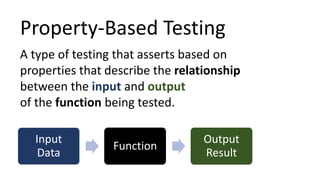
A type of testing that asserts based on
properties that describe the relationship
between the input and output
of the function being tested.
Input
Data
Function
Output
Result
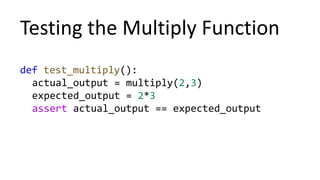
Testing the Multiply Function
def test_multiply():
actual_output = multiply(2,3)
expected_output = 2*3
assert actual_output == expected_output
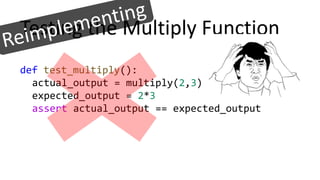
Testing the Multiply Function
def test_multiply():
actual_output = multiply(2,3)
expected_output = 2*3
assert actual_output == expected_output
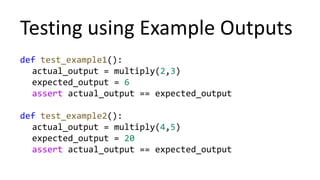
Testing using Example Outputs
def test_example1():
actual_output = multiply(2,3)
expected_output = 6
assert actual_output == expected_output
def test_example2():
actual_output = multiply(4,5)
expected_output = 20
assert actual_output == expected_output
Parameterized Tests
@pytest.mark.parametrize("factor1, factor2, expected_output", [
(2, 3, 6),
(4, 5, 20),
])
def test_example2and3(factor1, factor2, expected_output):
actual_output = multiply(factor1,factor2)
assert actual_output == expected_output
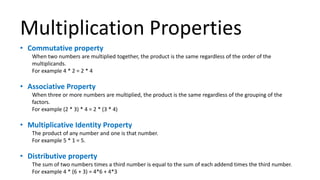
Multiplication Properties
• Commutative property
When two numbers are multiplied together, the product is the same regardless of the order of the
multiplicands.
For example 4 * 2 = 2 * 4
• Associative Property
When three or more numbers are multiplied, the product is the same regardless of the grouping of the
factors.
For example (2 * 3) * 4 = 2 * (3 * 4)
• Multiplicative Identity Property
The product of any number and one is that number.
For example 5 * 1 = 5.
• Distributive property
The sum of two numbers times a third number is equal to the sum of each addend times the third number.
For example 4 * (6 + 3) = 4*6 + 4*3
Property-Based Tests (PBT)
with Predetermined Inputs
@pytest.mark.parametrize("factor1, factor2", [
(2, 3),
(4, 5),
])
def test_commutative_property(factor1, factor2):
assert multiply(factor1,factor2) == multiply(factor2,factor1)
Property-Based Tests (PBT)
with Predetermined Inputs
@pytest.mark.parametrize("factor1", [2,4])
def test_identity_property(factor1):
assert multiply(factor1,1) == factor1
@pytest.mark.parametrize("num1, num2, num3", [
(2, 3, 4),
(4, 5, 6),
])
def test_distributive_property(num1, num2, num3):
assert multiply(num1,(num2 + num3)) == multiply(num1,num2) + multiply(num1,num3)
Property-Based Tests (PBT)
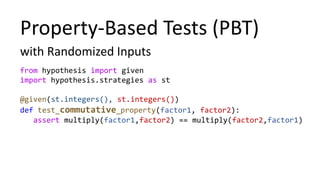
with Randomized Inputs
from hypothesis import given
import hypothesis.strategies as st
@given(st.integers(), st.integers())
def test_commutative_property(factor1, factor2):
assert multiply(factor1,factor2) == multiply(factor2,factor1)
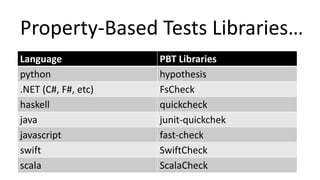
Property-Based Tests Libraries…
Language PBT Libraries
python hypothesis
.NET (C#, F#, etc) FsCheck
haskell quickcheck
java junit-quickchek
javascript fast-check
swift SwiftCheck
scala ScalaCheck
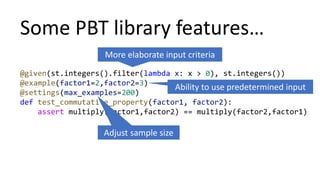
Some PBT library features…
@given(st.integers().filter(lambda x: x > 0), st.integers())
@example(factor1=2,factor2=3)
@settings(max_examples=200)
def test_commutative_property(factor1, factor2):
assert multiply(factor1,factor2) == multiply(factor2,factor1)
More elaborate input criteria
Adjust sample size
Ability to use predetermined input
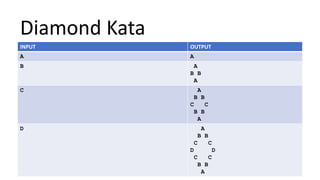
Diamond Kata
INPUT OUTPUT
A A
B A
B B
A
C A
B B
C C
B B
A
D A
B B
C C
D D
C C
B B
A
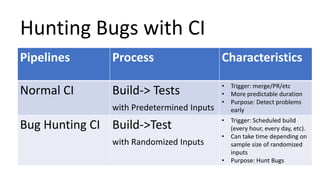
Hunting Bugs with CI
Pipelines Process Characteristics
Normal CI Build-> Tests
with Predetermined Inputs
• Trigger: merge/PR/etc
• More predictable duration
• Purpose: Detect problems
early
Bug Hunting CI Build->Test
with Randomized Inputs
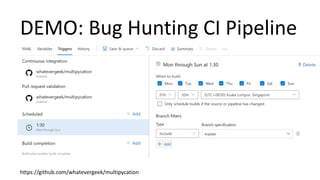
• Trigger: Scheduled build
(every hour, every day, etc).
• Can take time depending on
sample size of randomized
inputs
• Purpose: Hunt Bugs
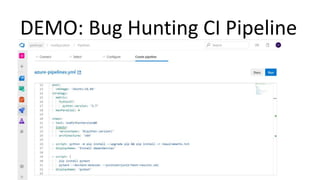
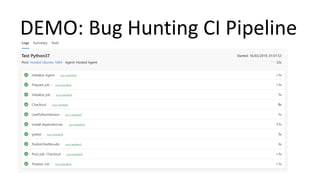
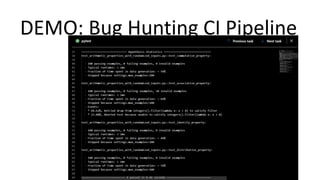
DEMO: Bug Hunting CI Pipeline
https://github.com/whatevergeek/multipycation
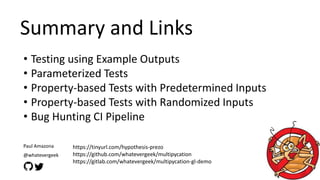
Summary and Links
• Testing using Example Outputs
• Parameterized Tests
• Property-based Tests with Predetermined Inputs
• Property-based Tests with Randomized Inputs
• Bug Hunting CI Pipeline
https://tinyurl.com/hypothesis-prezo
https://github.com/whatevergeek/multipycation
https://gitlab.com/whatevergeek/multipycation-gl-demo
Paul Amazona
@whatevergeek

Hunting Bugs While Sleeping: Property-Based Testing with Continuous Integration

  • 1.
    Hunting Bugs WhileSleeping Property-Based Testing with Continuous Integration Paul Amazona Developer @whatevergeek
  • 4.
  • 5.
    Property-Based Testing A typeof testing that asserts based on properties that describe the relationship between the input and output of the function being tested. Input Data Function Output Result
  • 6.
    Testing the MultiplyFunction def test_multiply(): actual_output = multiply(2,3) expected_output = 2*3 assert actual_output == expected_output
  • 7.
    Testing the MultiplyFunction def test_multiply(): actual_output = multiply(2,3) expected_output = 2*3 assert actual_output == expected_output
  • 8.
    Testing using ExampleOutputs def test_example1(): actual_output = multiply(2,3) expected_output = 6 assert actual_output == expected_output def test_example2(): actual_output = multiply(4,5) expected_output = 20 assert actual_output == expected_output
  • 9.
    Parameterized Tests @pytest.mark.parametrize("factor1, factor2,expected_output", [ (2, 3, 6), (4, 5, 20), ]) def test_example2and3(factor1, factor2, expected_output): actual_output = multiply(factor1,factor2) assert actual_output == expected_output
  • 10.
    Multiplication Properties • Commutativeproperty When two numbers are multiplied together, the product is the same regardless of the order of the multiplicands. For example 4 * 2 = 2 * 4 • Associative Property When three or more numbers are multiplied, the product is the same regardless of the grouping of the factors. For example (2 * 3) * 4 = 2 * (3 * 4) • Multiplicative Identity Property The product of any number and one is that number. For example 5 * 1 = 5. • Distributive property The sum of two numbers times a third number is equal to the sum of each addend times the third number. For example 4 * (6 + 3) = 4*6 + 4*3
  • 11.
    Property-Based Tests (PBT) withPredetermined Inputs @pytest.mark.parametrize("factor1, factor2", [ (2, 3), (4, 5), ]) def test_commutative_property(factor1, factor2): assert multiply(factor1,factor2) == multiply(factor2,factor1)
  • 12.
    Property-Based Tests (PBT) withPredetermined Inputs @pytest.mark.parametrize("factor1", [2,4]) def test_identity_property(factor1): assert multiply(factor1,1) == factor1 @pytest.mark.parametrize("num1, num2, num3", [ (2, 3, 4), (4, 5, 6), ]) def test_distributive_property(num1, num2, num3): assert multiply(num1,(num2 + num3)) == multiply(num1,num2) + multiply(num1,num3)
  • 13.
    Property-Based Tests (PBT) withRandomized Inputs from hypothesis import given import hypothesis.strategies as st @given(st.integers(), st.integers()) def test_commutative_property(factor1, factor2): assert multiply(factor1,factor2) == multiply(factor2,factor1)
  • 14.
    Property-Based Tests Libraries… LanguagePBT Libraries python hypothesis .NET (C#, F#, etc) FsCheck haskell quickcheck java junit-quickchek javascript fast-check swift SwiftCheck scala ScalaCheck
  • 15.
    Some PBT libraryfeatures… @given(st.integers().filter(lambda x: x > 0), st.integers()) @example(factor1=2,factor2=3) @settings(max_examples=200) def test_commutative_property(factor1, factor2): assert multiply(factor1,factor2) == multiply(factor2,factor1) More elaborate input criteria Adjust sample size Ability to use predetermined input
  • 16.
    Diamond Kata INPUT OUTPUT AA B A B B A C A B B C C B B A D A B B C C D D C C B B A
  • 18.
    Hunting Bugs withCI Pipelines Process Characteristics Normal CI Build-> Tests with Predetermined Inputs • Trigger: merge/PR/etc • More predictable duration • Purpose: Detect problems early Bug Hunting CI Build->Test with Randomized Inputs • Trigger: Scheduled build (every hour, every day, etc). • Can take time depending on sample size of randomized inputs • Purpose: Hunt Bugs
  • 19.
    DEMO: Bug HuntingCI Pipeline
  • 20.
    DEMO: Bug HuntingCI Pipeline
  • 21.
    DEMO: Bug HuntingCI Pipeline
  • 22.
    DEMO: Bug HuntingCI Pipeline https://github.com/whatevergeek/multipycation
  • 23.
    Summary and Links •Testing using Example Outputs • Parameterized Tests • Property-based Tests with Predetermined Inputs • Property-based Tests with Randomized Inputs • Bug Hunting CI Pipeline https://tinyurl.com/hypothesis-prezo https://github.com/whatevergeek/multipycation https://gitlab.com/whatevergeek/multipycation-gl-demo Paul Amazona @whatevergeek

Editor's Notes

  • #2 I develop end-to-end .NET solutions as part of my work.
  • #3 Outside work, I volunteer in these two awesome non-profit organizations. In DataKind, we use data science to help non-profits get insights from their data to serve their communities better. In BigDataX, we aim to improve the data engineering literacy here in Singapore and surrounding regions. In line with this, we organize free workshops and events for this goal. If you’re keen to know about such organizations, feel free to talk to me during the break periods.
  • #4 I came to know about property-based testing when I attended Pycon AU last year.
  • #5 I was so delighted by the library that I also shared it in the local Python community when I came back here in Singapore.
  • #6 Today, I just want to focus on the essentials of Property-Based Testing and how to use it in CI later to hunt for bugs.