Thinking in Properties
And Beyond (Testing)
Susan Potter
2020-08-01
Intro
Intro
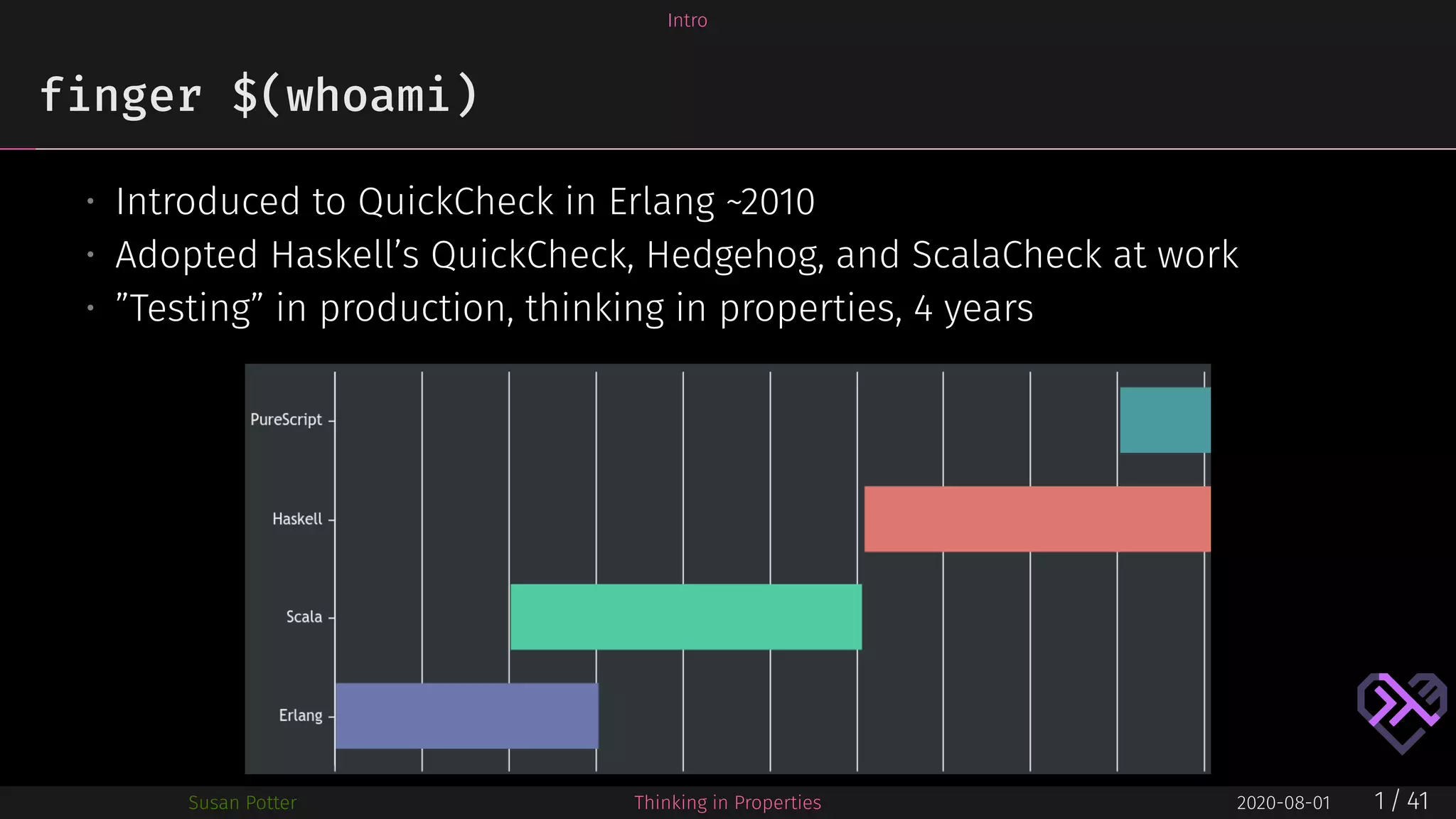
finger $(whoami)
• Introduced to QuickCheck in Erlang ~2010
• Adopted Haskell’s QuickCheck, Hedgehog, and ScalaCheck at work
• ”Testing” in production, thinking in properties, 4 years
Susan Potter Thinking in Properties 2020-08-01 1 / 41
Intro
Agenda
• An Origin Story (with code)
• Mental Models (above the code)
• Beyond Testing (illustrations)
Susan Potter Thinking in Properties 2020-08-01 2 / 41
An Origin Story
An Origin Story Discovering Superpowers
Susan Potter Thinking in Properties 2020-08-01 3 / 41
An Origin Story Discovering Superpowers
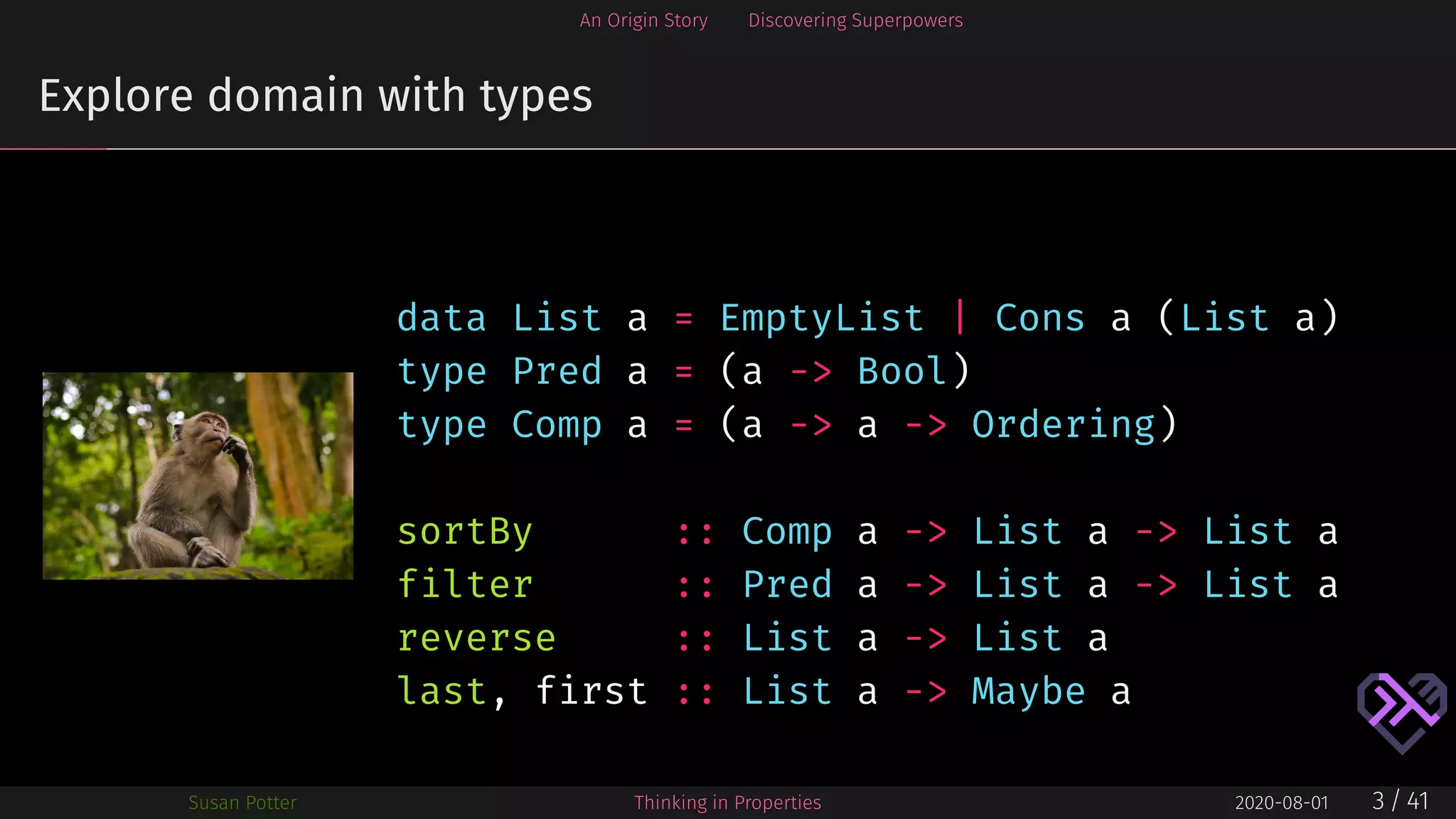
Explore domain with types
data List a = EmptyList | Cons a (List a)
type Pred a = (a -> Bool)
type Comp a = (a -> a -> Ordering)
sortBy :: Comp a -> List a -> List a
filter :: Pred a -> List a -> List a
reverse :: List a -> List a
last, first :: List a -> Maybe a
Susan Potter Thinking in Properties 2020-08-01 3 / 41
An Origin Story Discovering Superpowers
Explore domain with usage examples
-- | Reverse the elements of a list
-- >>> reverse (Cons 1 (Cons 2 (Cons 3
EmptyList)))→
-- Cons 3 (Cons 2 (Cons 1 EmptyList))
--
-- >>> reverse EmptyList
-- EmptyList
reverse :: List a -> List a
Susan Potter Thinking in Properties 2020-08-01 4 / 41
An Origin Story Discovering Superpowers
Encode examples as re-runnable tests
describe "Lib.reverse" $ do
it "returns [5,4,3,2,1] given [1,2,3,4,5]" $ do
reverse [1,2,3,4,5] `shouldBe` [5,4,3,2,1]
it "returns empty list given empty list" $ do
reverse [] `shouldBe` []
Susan Potter Thinking in Properties 2020-08-01 5 / 41
An Origin Story Discovering Superpowers
Rinse & Repeat
Susan Potter Thinking in Properties 2020-08-01 6 / 41
An Origin Story Discovering Superpowers
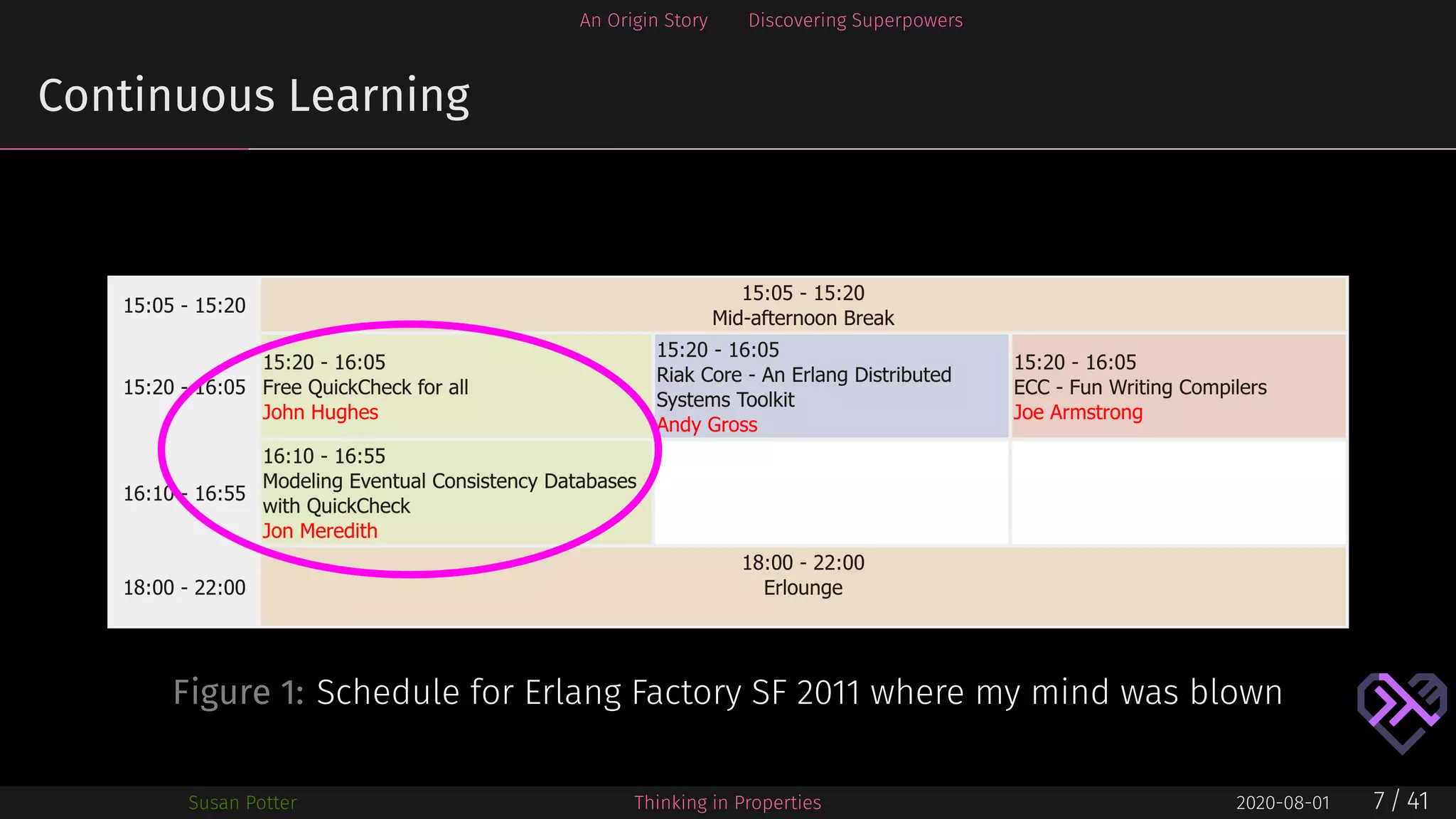
Continuous Learning
Figure 1: Schedule for Erlang Factory SF 2011 where my mind was blown
Susan Potter Thinking in Properties 2020-08-01 7 / 41
An Origin Story Harnessing Newly Found Superpowers
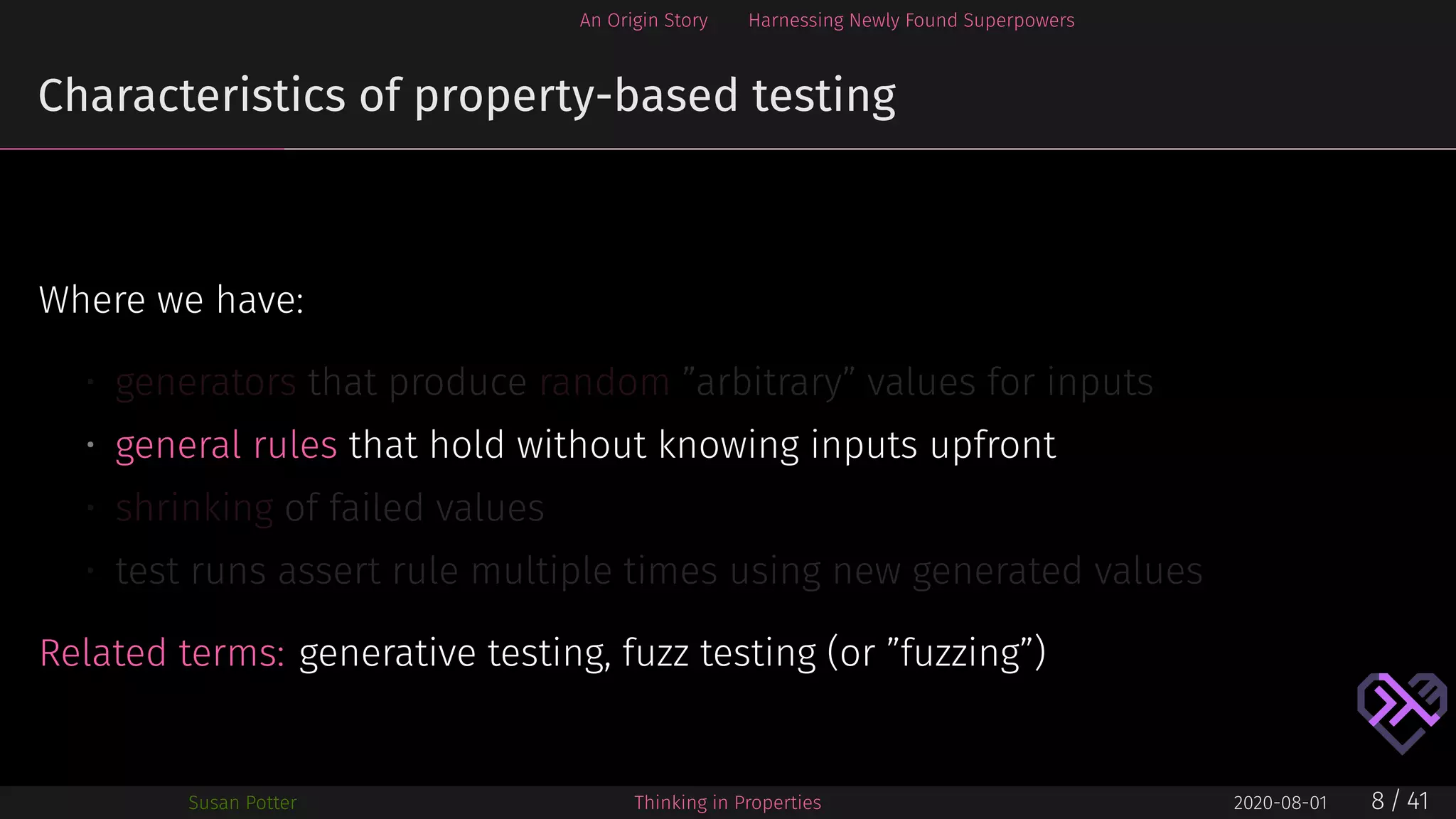
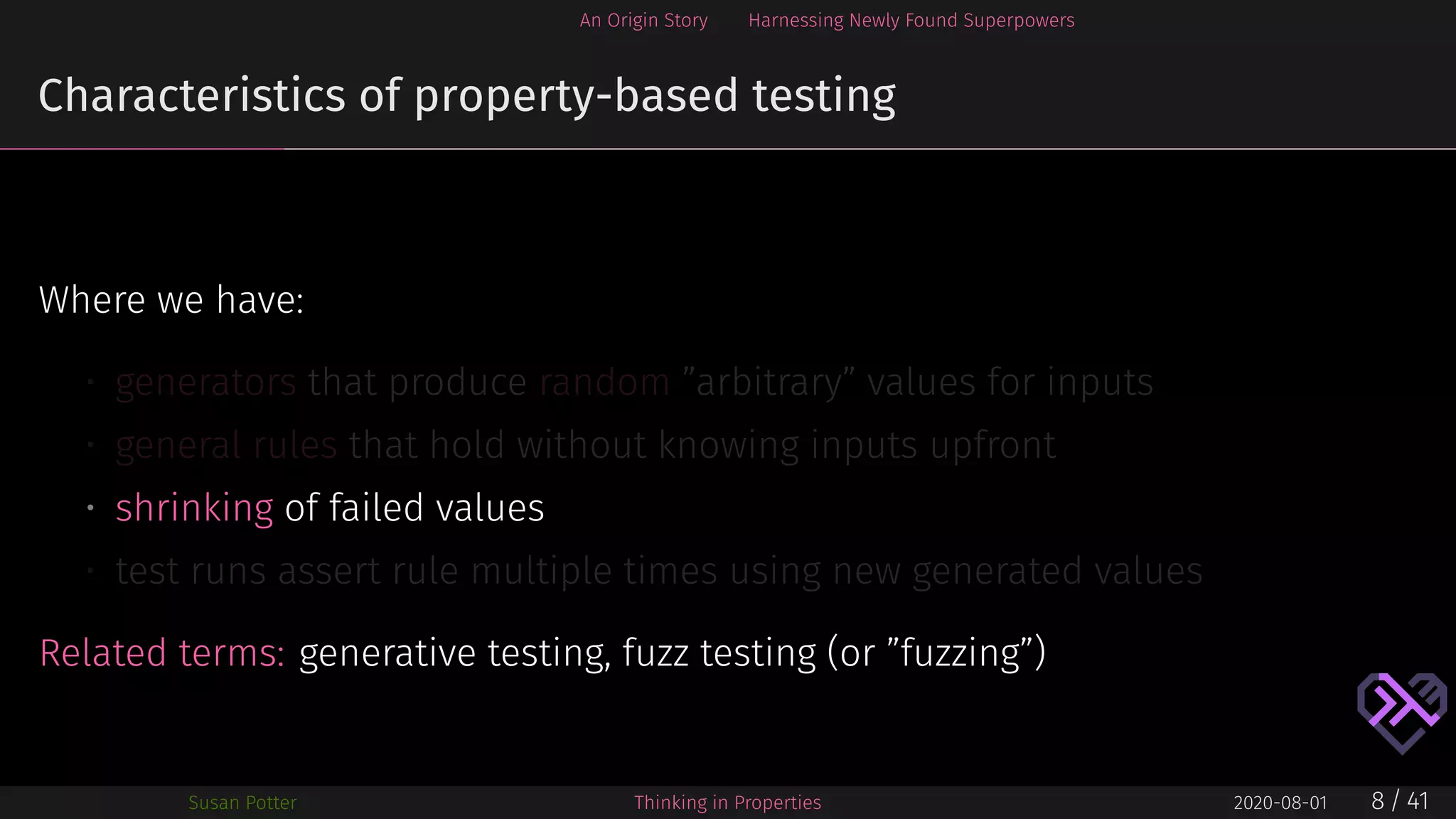
Characteristics of property-based testing
Where we have:
• generators that produce random ”arbitrary” values for inputs
• general rules that hold without knowing inputs upfront
• shrinking of failed values
• test runs assert rule multiple times using new generated values
Related terms: generative testing, fuzz testing (or ”fuzzing”)
Susan Potter Thinking in Properties 2020-08-01 8 / 41
An Origin Story Harnessing Newly Found Superpowers
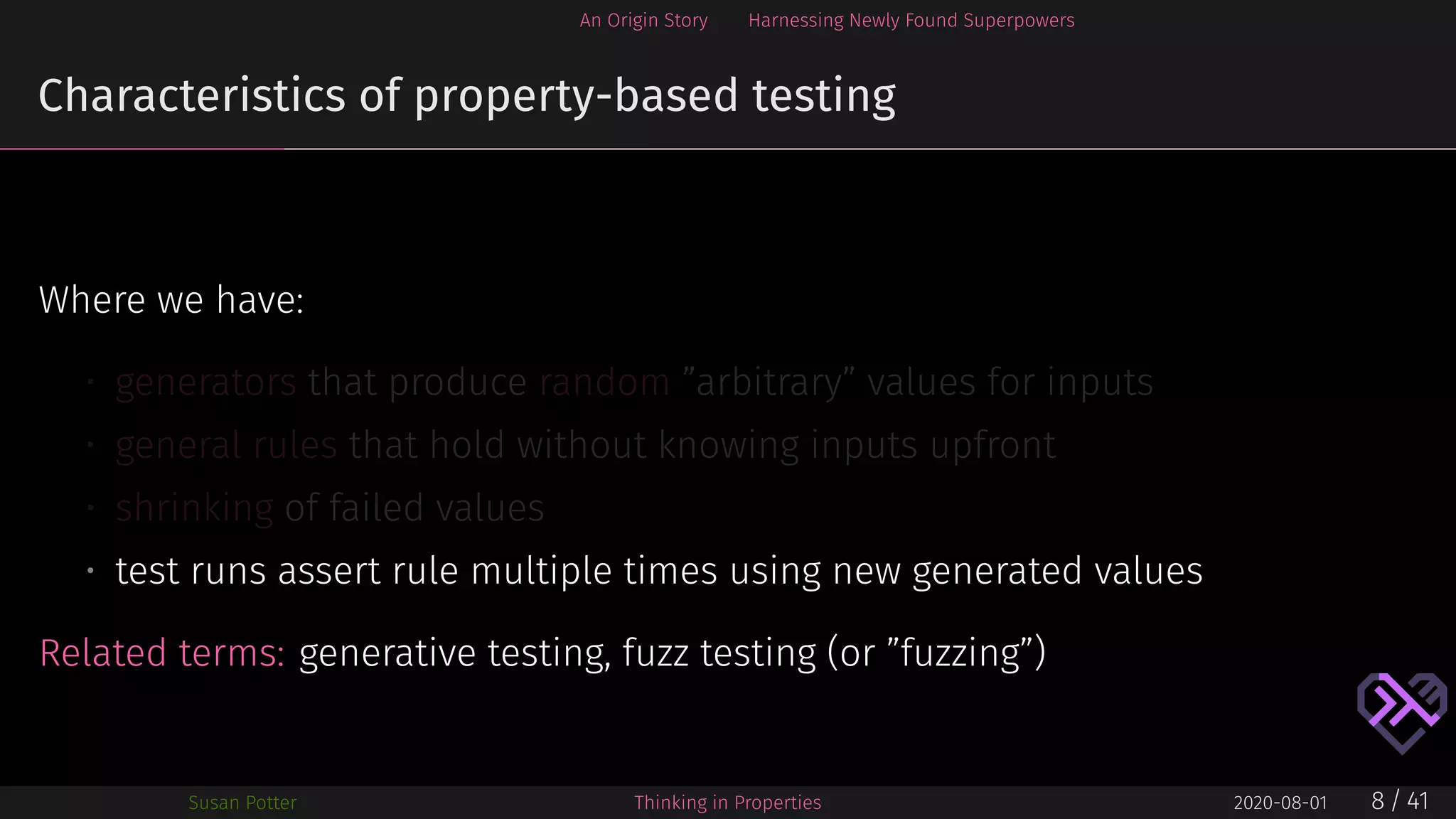
Characteristics of property-based testing
Where we have:
• generators that produce random ”arbitrary” values for inputs
• general rules that hold without knowing inputs upfront
• shrinking of failed values
• test runs assert rule multiple times using new generated values
Related terms: generative testing, fuzz testing (or ”fuzzing”)
Susan Potter Thinking in Properties 2020-08-01 8 / 41
An Origin Story Harnessing Newly Found Superpowers
Characteristics of property-based testing
Where we have:
• generators that produce random ”arbitrary” values for inputs
• general rules that hold without knowing inputs upfront
• shrinking of failed values
• test runs assert rule multiple times using new generated values
Related terms: generative testing, fuzz testing (or ”fuzzing”)
Susan Potter Thinking in Properties 2020-08-01 8 / 41
An Origin Story Harnessing Newly Found Superpowers
Characteristics of property-based testing
Where we have:
• generators that produce random ”arbitrary” values for inputs
• general rules that hold without knowing inputs upfront
• shrinking of failed values
• test runs assert rule multiple times using new generated values
Related terms: generative testing, fuzz testing (or ”fuzzing”)
Susan Potter Thinking in Properties 2020-08-01 8 / 41
An Origin Story Harnessing Newly Found Superpowers
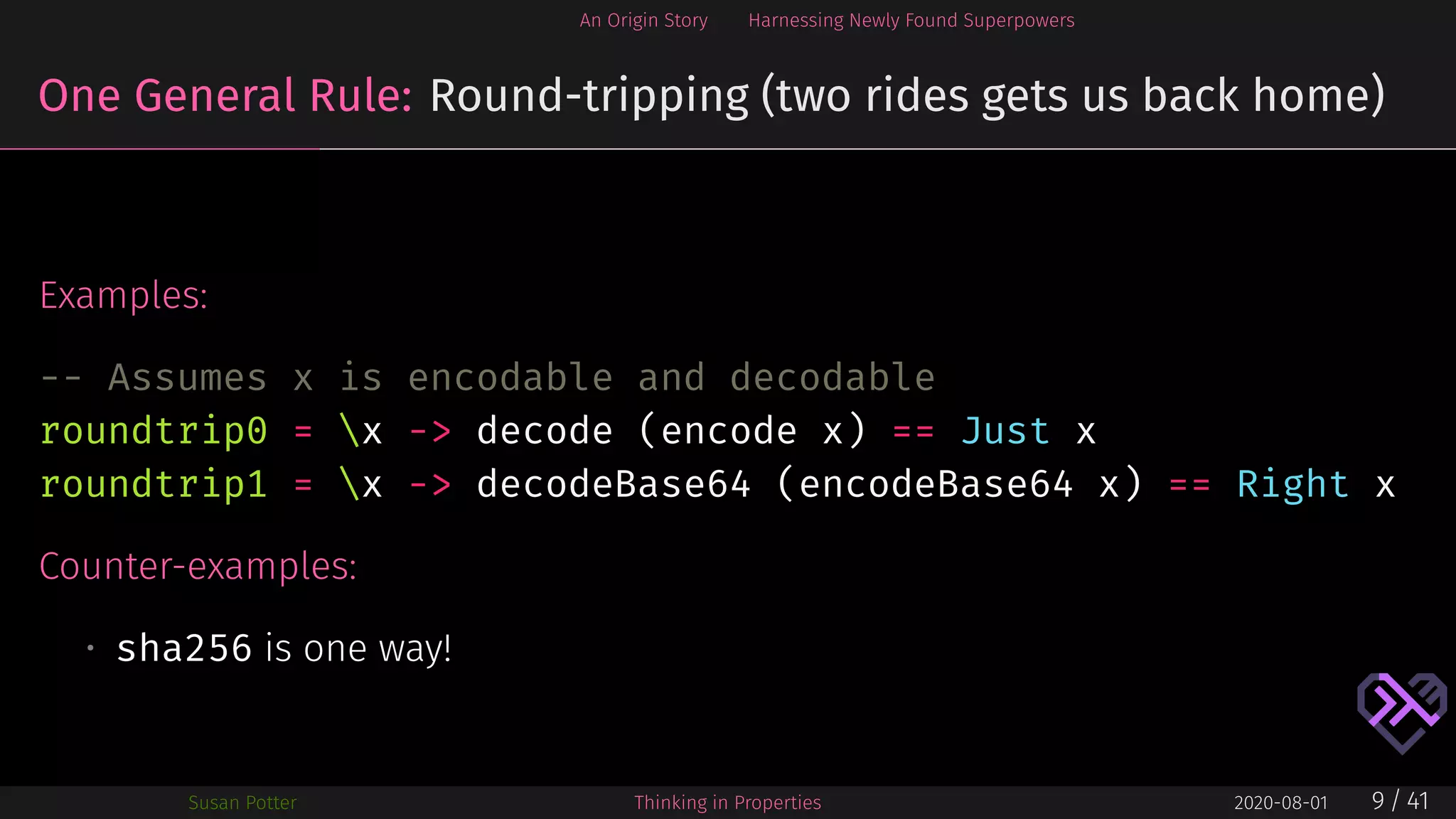
One General Rule: Round-tripping (two rides gets us back home)
Examples:
-- Assumes x is encodable and decodable
roundtrip0 = x -> decode (encode x) == Just x
roundtrip1 = x -> decodeBase64 (encodeBase64 x) == Right x
Counter-examples:
• sha256 is one way!
Susan Potter Thinking in Properties 2020-08-01 9 / 41
An Origin Story Harnessing Newly Found Superpowers
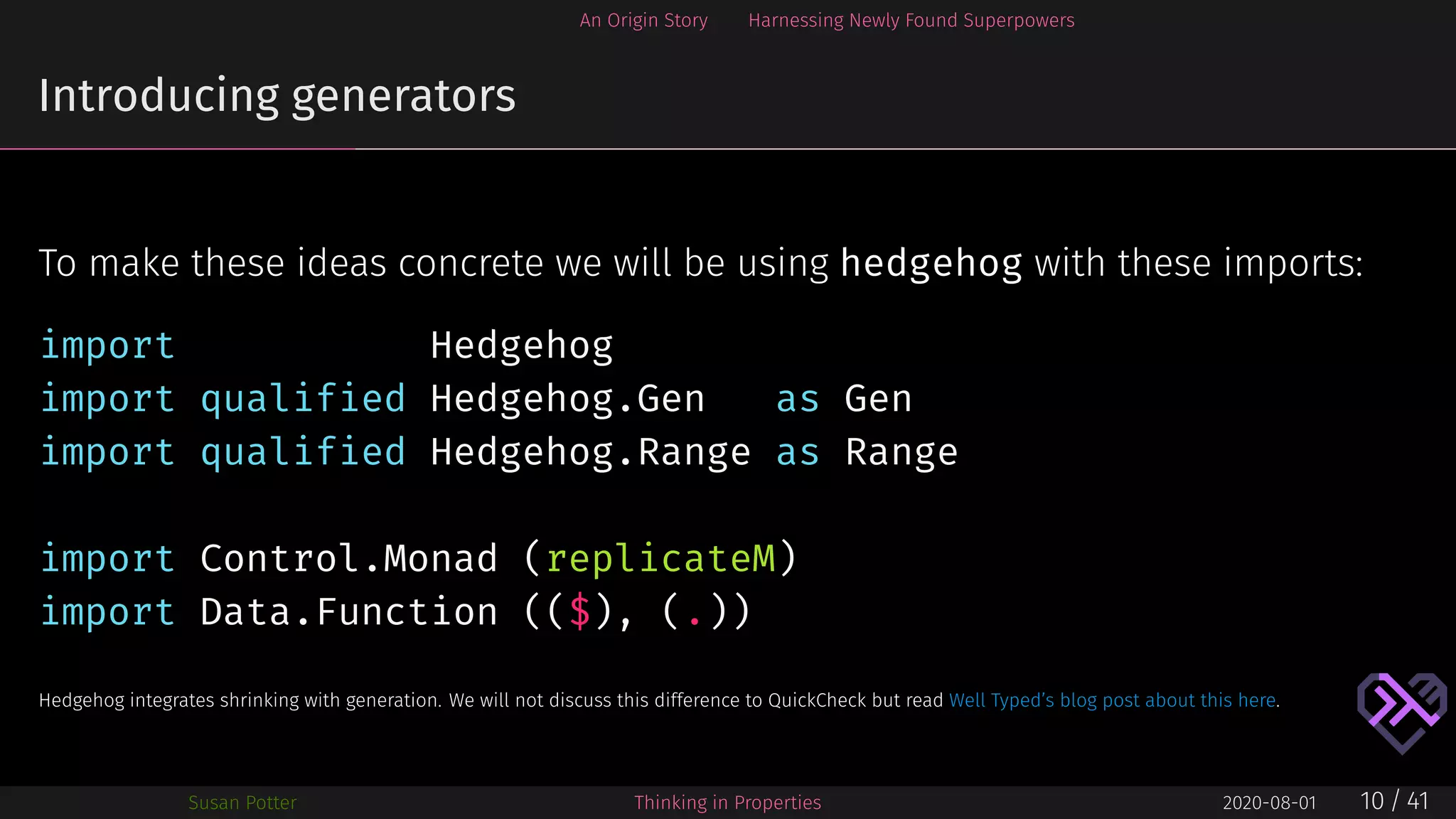
Introducing generators
To make these ideas concrete we will be using hedgehog with these imports:
import Hedgehog
import qualified Hedgehog.Gen as Gen
import qualified Hedgehog.Range as Range
import Control.Monad (replicateM)
import Data.Function (($), (.))
Hedgehog integrates shrinking with generation. We will not discuss this difference to QuickCheck but read Well Typed’s blog post about this here.
Susan Potter Thinking in Properties 2020-08-01 10 / 41
An Origin Story Harnessing Newly Found Superpowers
Primitive generators by example
>>> replicateM 25 $ Gen.sample Gen.lower
"okohcpxrkfunkmwnqujnnhxkg"
>>> let currencies = [ "USD", "JPY", "EUR", "CHF", "CNY" ]
>>> replicateM 5 $ Gen.sample $ Gen.element currencies
["USD","CNY","USD","JPY","USD"]
>>> replicateM 5 $ Gen.sample $ Gen.choice [ Gen.ascii,
Gen.unicode ]→
['f', 'c', 'j', '1068213', '<']
Susan Potter Thinking in Properties 2020-08-01 11 / 41
An Origin Story Harnessing Newly Found Superpowers
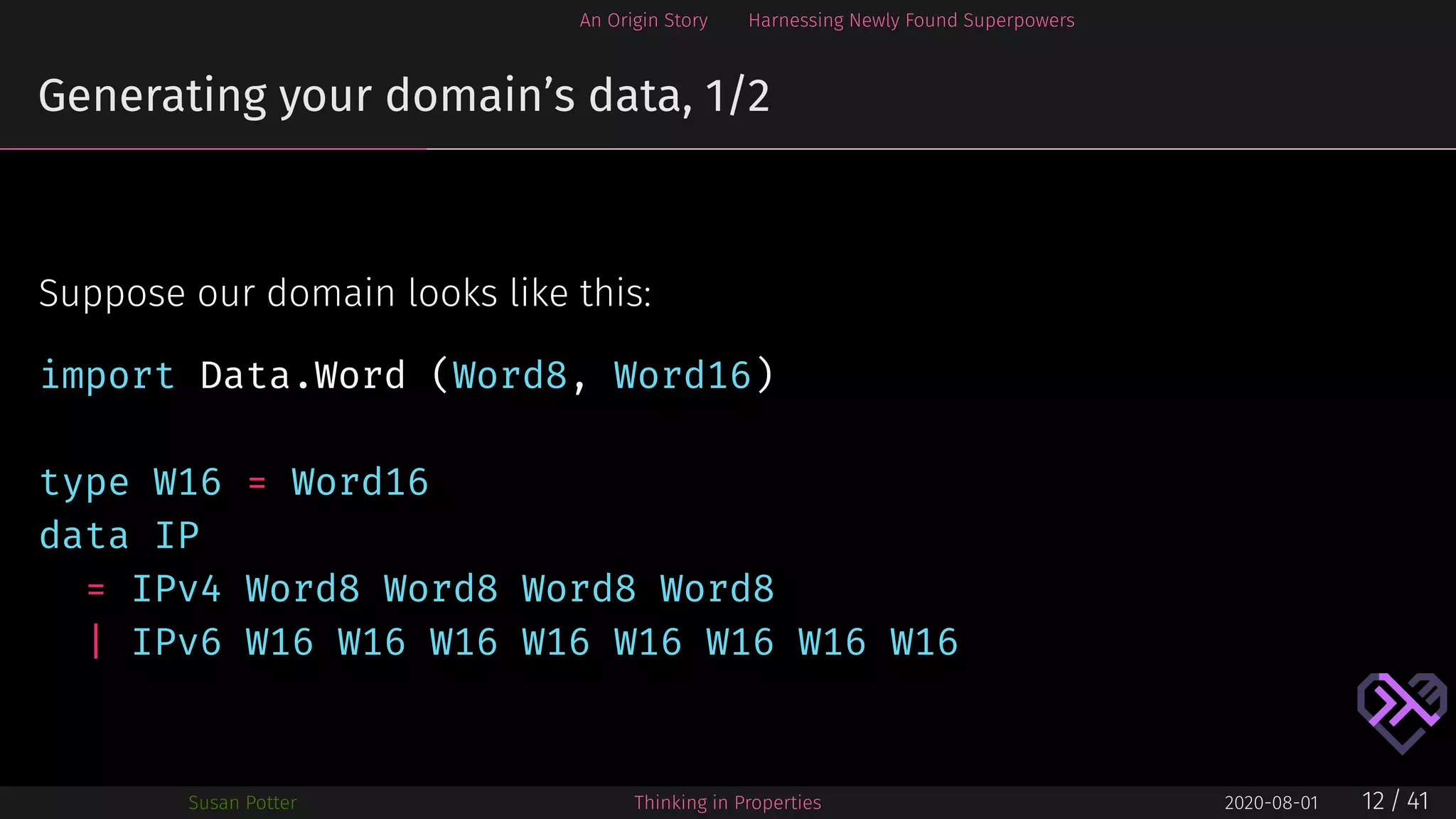
Generating your domain’s data, 1/2
Suppose our domain looks like this:
import Data.Word (Word8, Word16)
type W16 = Word16
data IP
= IPv4 Word8 Word8 Word8 Word8
| IPv6 W16 W16 W16 W16 W16 W16 W16 W16
Susan Potter Thinking in Properties 2020-08-01 12 / 41
An Origin Story Harnessing Newly Found Superpowers
Generating your domain’s data, 2/2
genW8 = Gen.word8 Range.constantBounded
genW16 = Gen.word16 Range.constantBounded
genIPv4 = IPv4 <$> genW8 <*> genW8 <*> genW8 <*> genW8
genIPv6 = IPv6 <$> genW16 <*> genW16 <*> genW16 <*> genW16
<*> genW16 <*> genW16 <*> genW16 <*> genW16
genAnyIP = Gen.choice [ genIPv4, genIPv6 ]
sampleIPs n = replicateM n (Gen.sample genAnyIP)
Susan Potter Thinking in Properties 2020-08-01 13 / 41
An Origin Story Harnessing Newly Found Superpowers
Sampling generated domain data
>>> sampleIPs 3
[ "136.59.149.200"
, "338d:2397:f612:e036:b27c:2298:4db8:b933"
, "5.38.65.204" ]
Susan Potter Thinking in Properties 2020-08-01 14 / 41
An Origin Story Harnessing Newly Found Superpowers
Writing Our First Property!
genList :: MonadGen m => m a -> m [a]
genList = Gen.list (Range.linear 0 1000)
genInt = Gen.int (Range.linear 0 100000)
-- "round-tripping" property
prop_reverse_reverse = property $ do
xs <- forAll $ genList genInt
Lib.reverse (Lib.reverse xs) === xs
Susan Potter Thinking in Properties 2020-08-01 15 / 41
An Origin Story Harnessing Newly Found Superpowers
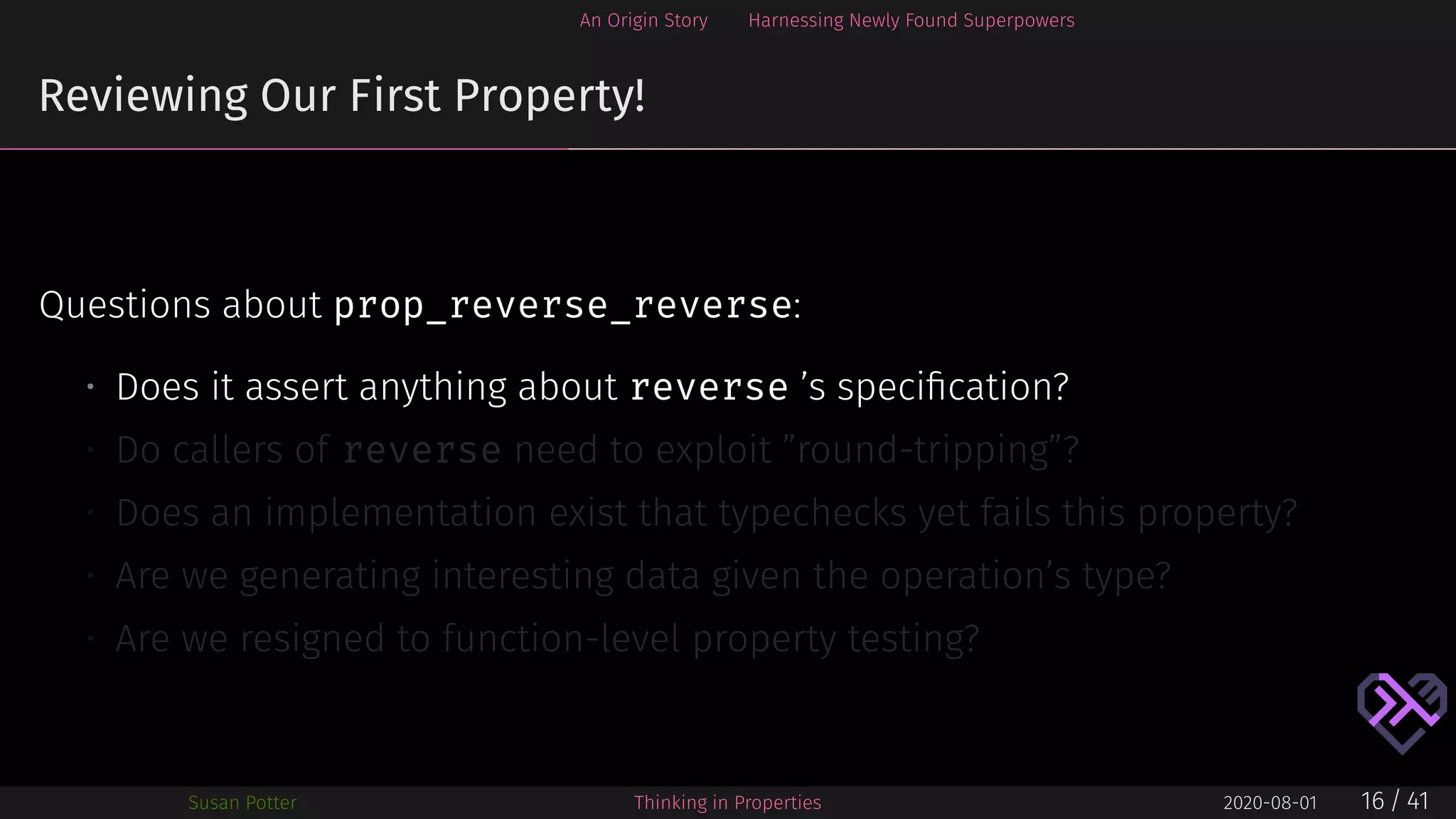
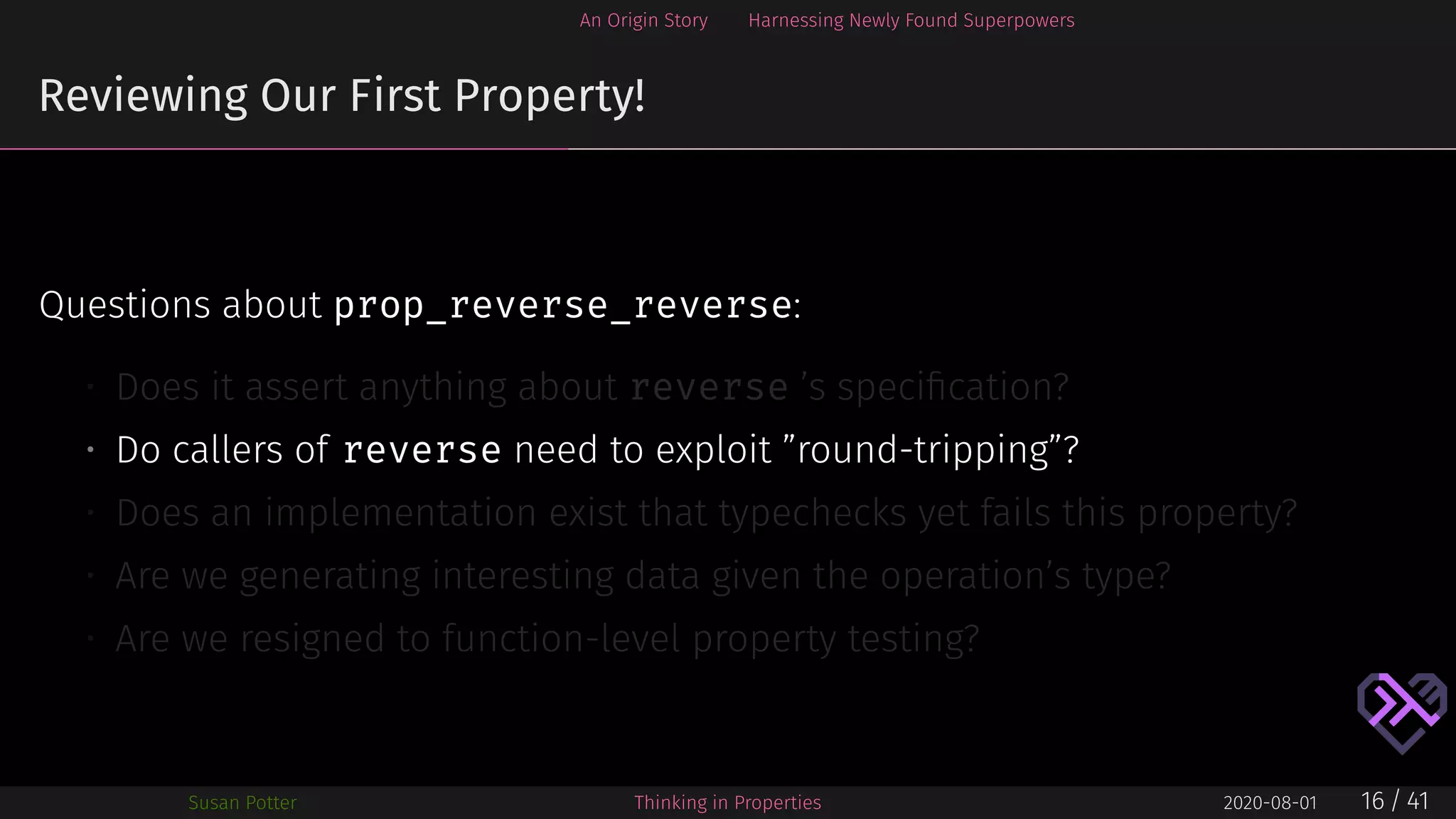
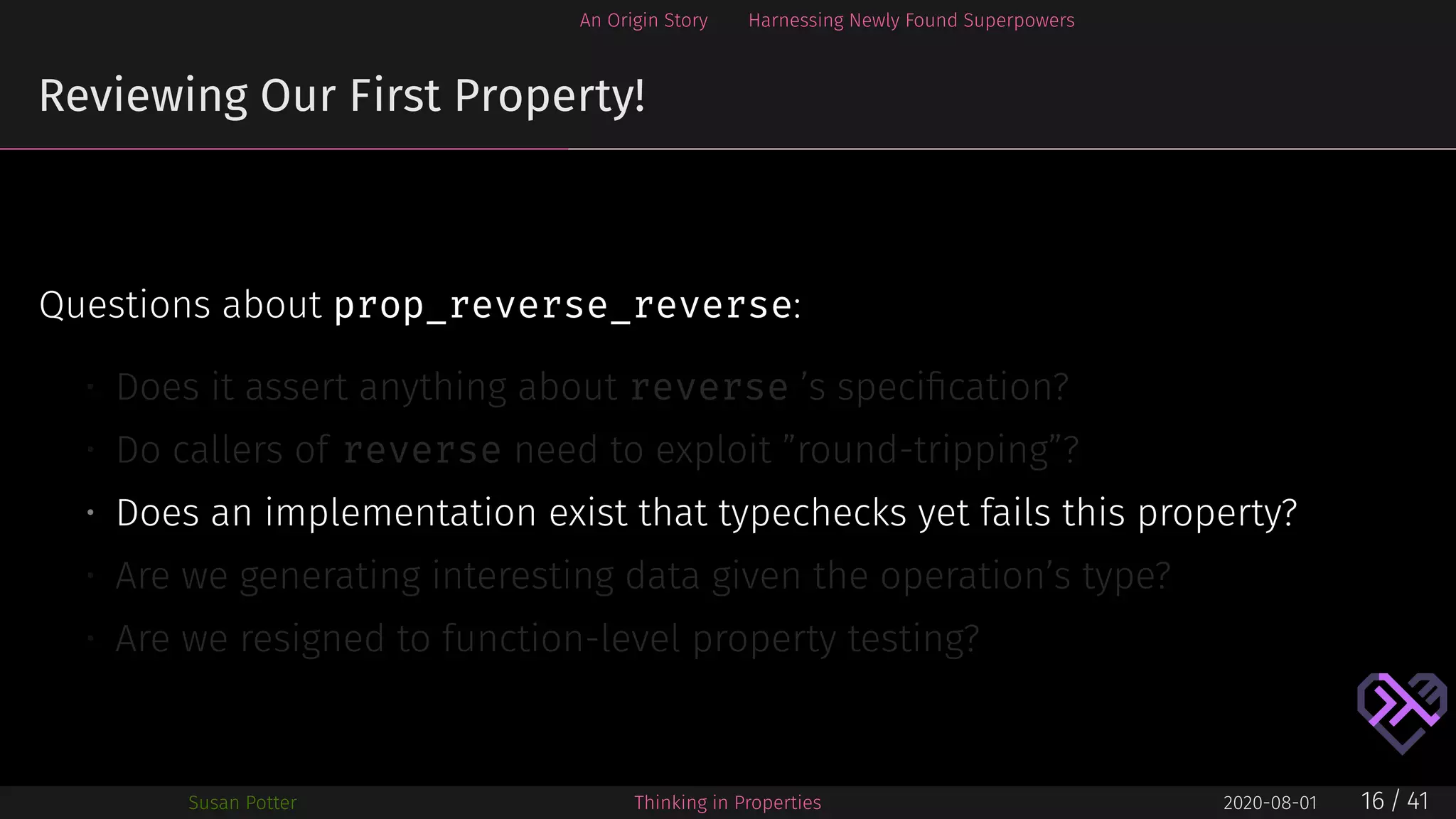
Reviewing Our First Property!
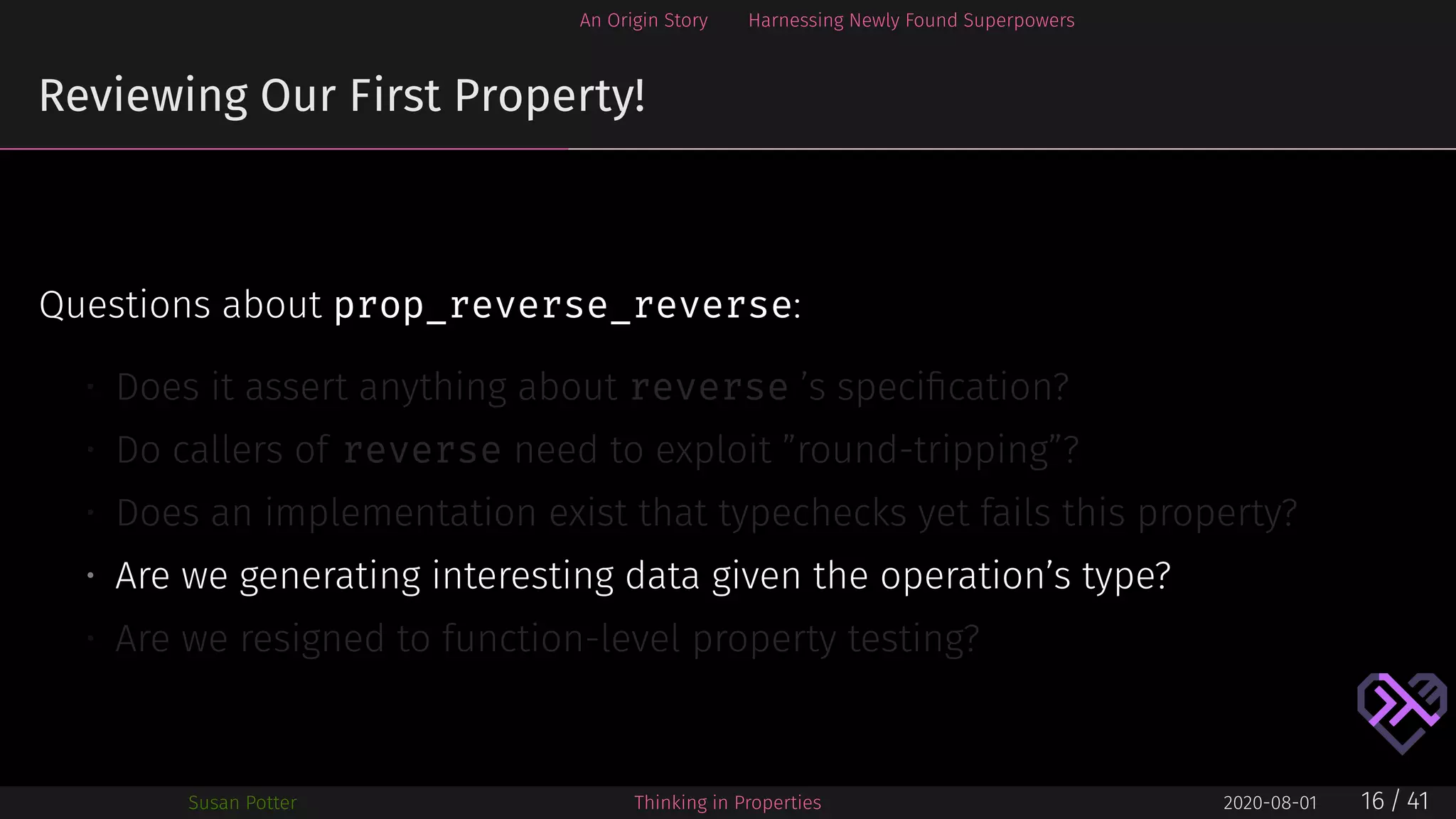
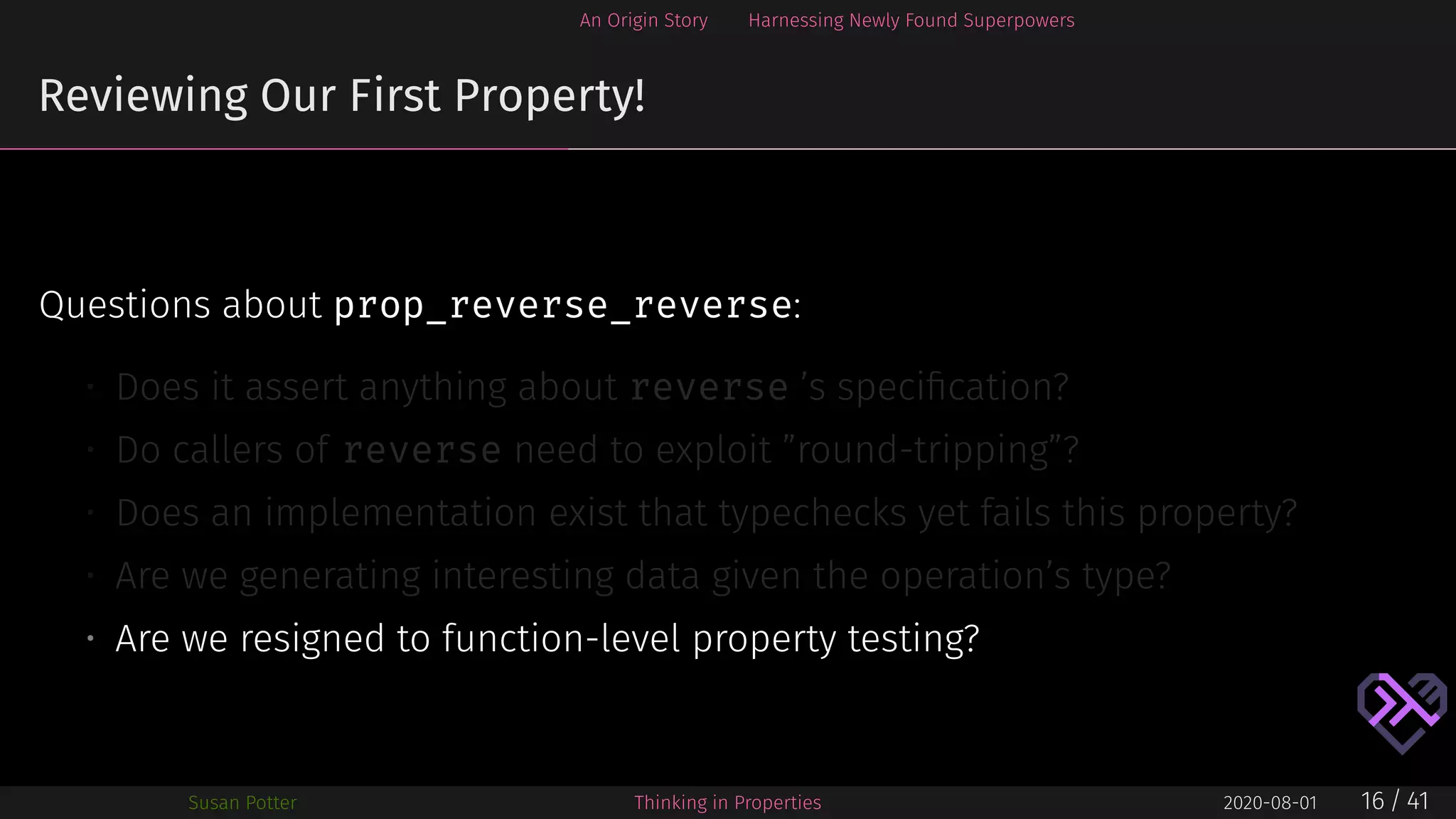
Questions about prop_reverse_reverse:
• Does it assert anything about reverse ’s specification?
• Do callers of reverse need to exploit ”round-tripping”?
• Does an implementation exist that typechecks yet fails this property?
• Are we generating interesting data given the operation’s type?
• Are we resigned to function-level property testing?
Susan Potter Thinking in Properties 2020-08-01 16 / 41
An Origin Story Harnessing Newly Found Superpowers
Reviewing Our First Property!
Questions about prop_reverse_reverse:
• Does it assert anything about reverse ’s specification?
• Do callers of reverse need to exploit ”round-tripping”?
• Does an implementation exist that typechecks yet fails this property?
• Are we generating interesting data given the operation’s type?
• Are we resigned to function-level property testing?
Susan Potter Thinking in Properties 2020-08-01 16 / 41
An Origin Story Harnessing Newly Found Superpowers
Reviewing Our First Property!
Questions about prop_reverse_reverse:
• Does it assert anything about reverse ’s specification?
• Do callers of reverse need to exploit ”round-tripping”?
• Does an implementation exist that typechecks yet fails this property?
• Are we generating interesting data given the operation’s type?
• Are we resigned to function-level property testing?
Susan Potter Thinking in Properties 2020-08-01 16 / 41
An Origin Story Harnessing Newly Found Superpowers
Reviewing Our First Property!
Questions about prop_reverse_reverse:
• Does it assert anything about reverse ’s specification?
• Do callers of reverse need to exploit ”round-tripping”?
• Does an implementation exist that typechecks yet fails this property?
• Are we generating interesting data given the operation’s type?
• Are we resigned to function-level property testing?
Susan Potter Thinking in Properties 2020-08-01 16 / 41
An Origin Story Harnessing Newly Found Superpowers
Reviewing Our First Property!
Questions about prop_reverse_reverse:
• Does it assert anything about reverse ’s specification?
• Do callers of reverse need to exploit ”round-tripping”?
• Does an implementation exist that typechecks yet fails this property?
• Are we generating interesting data given the operation’s type?
• Are we resigned to function-level property testing?
Susan Potter Thinking in Properties 2020-08-01 16 / 41
An Origin Story Harnessing Newly Found Superpowers
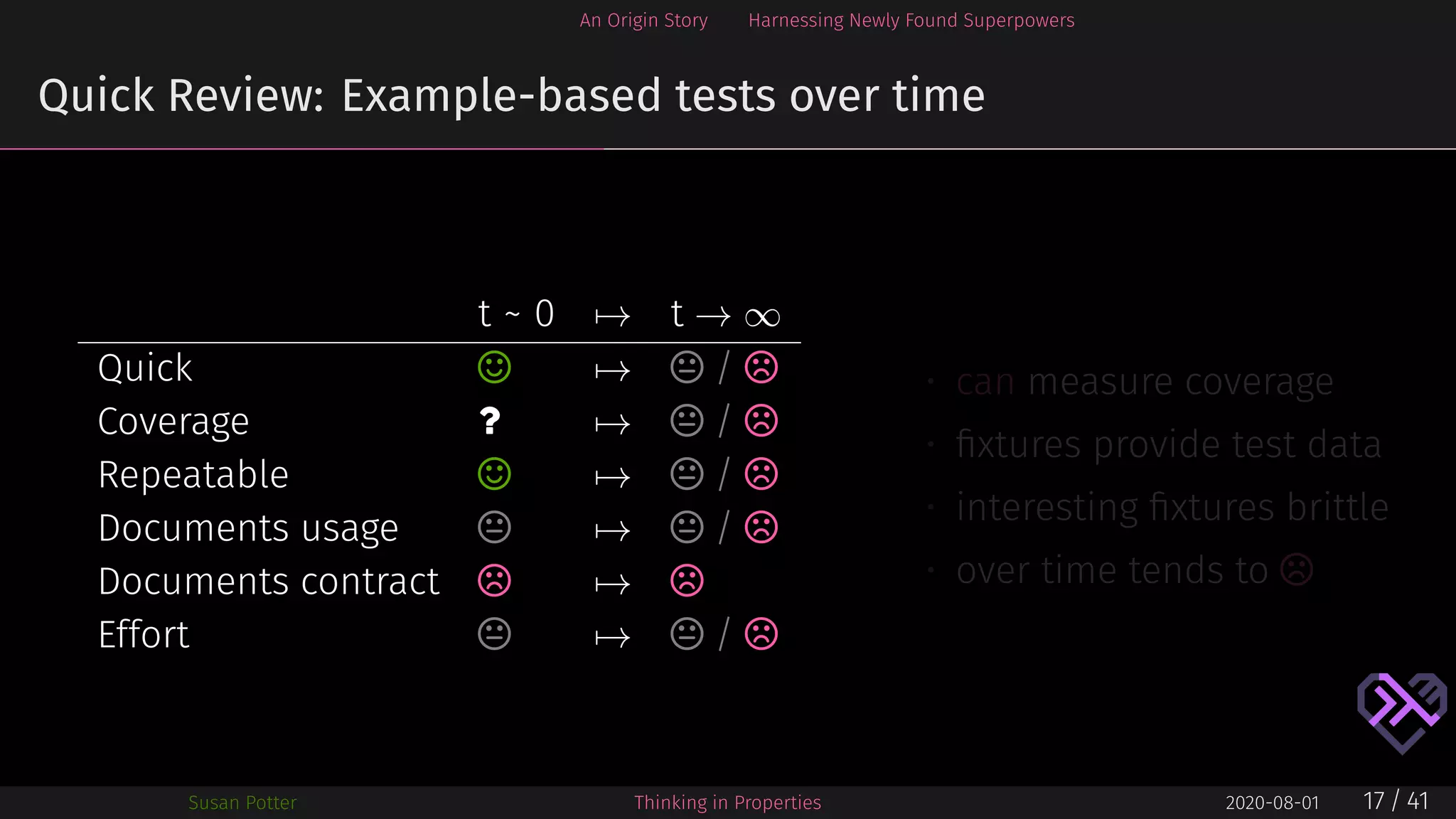
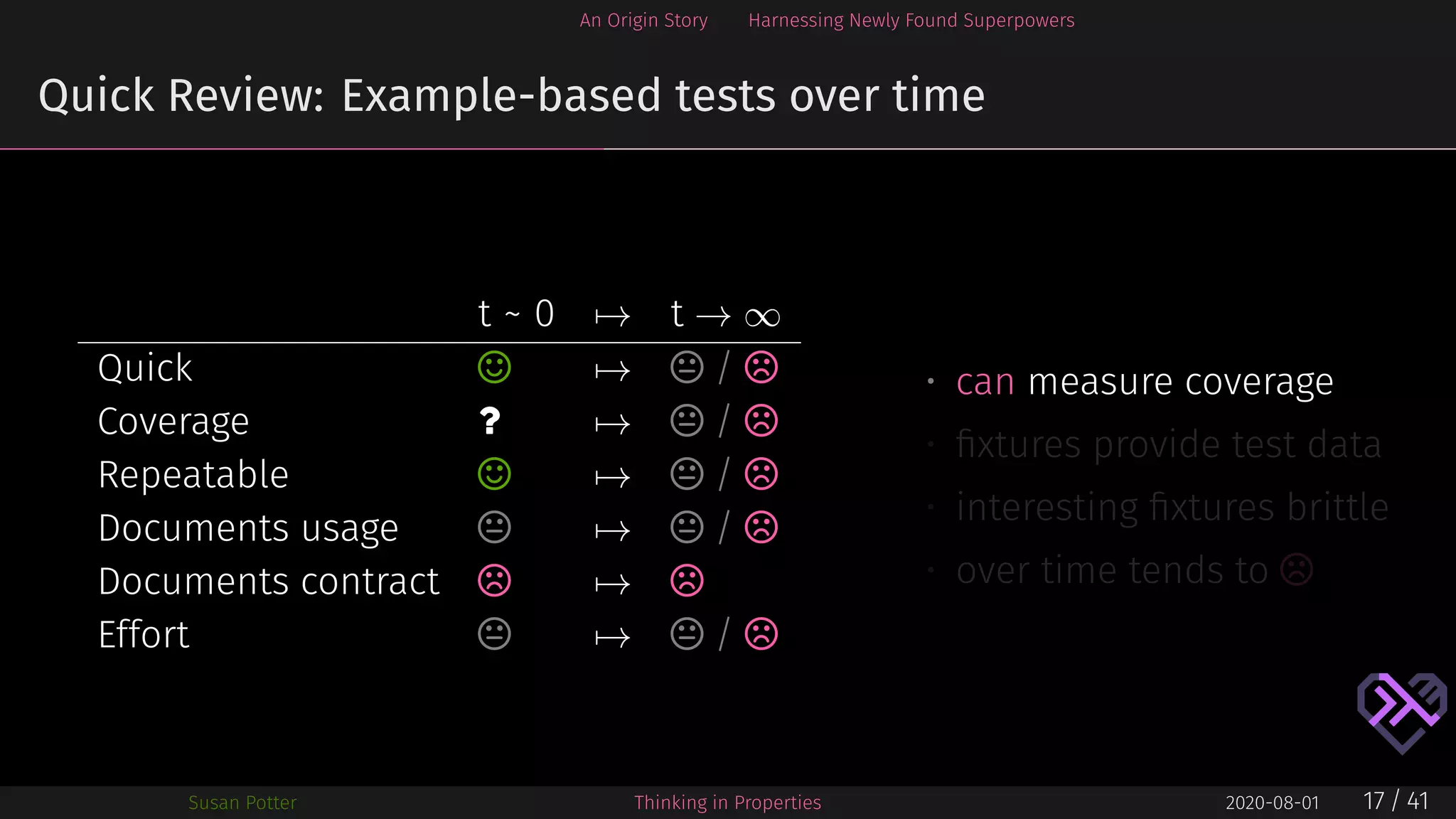
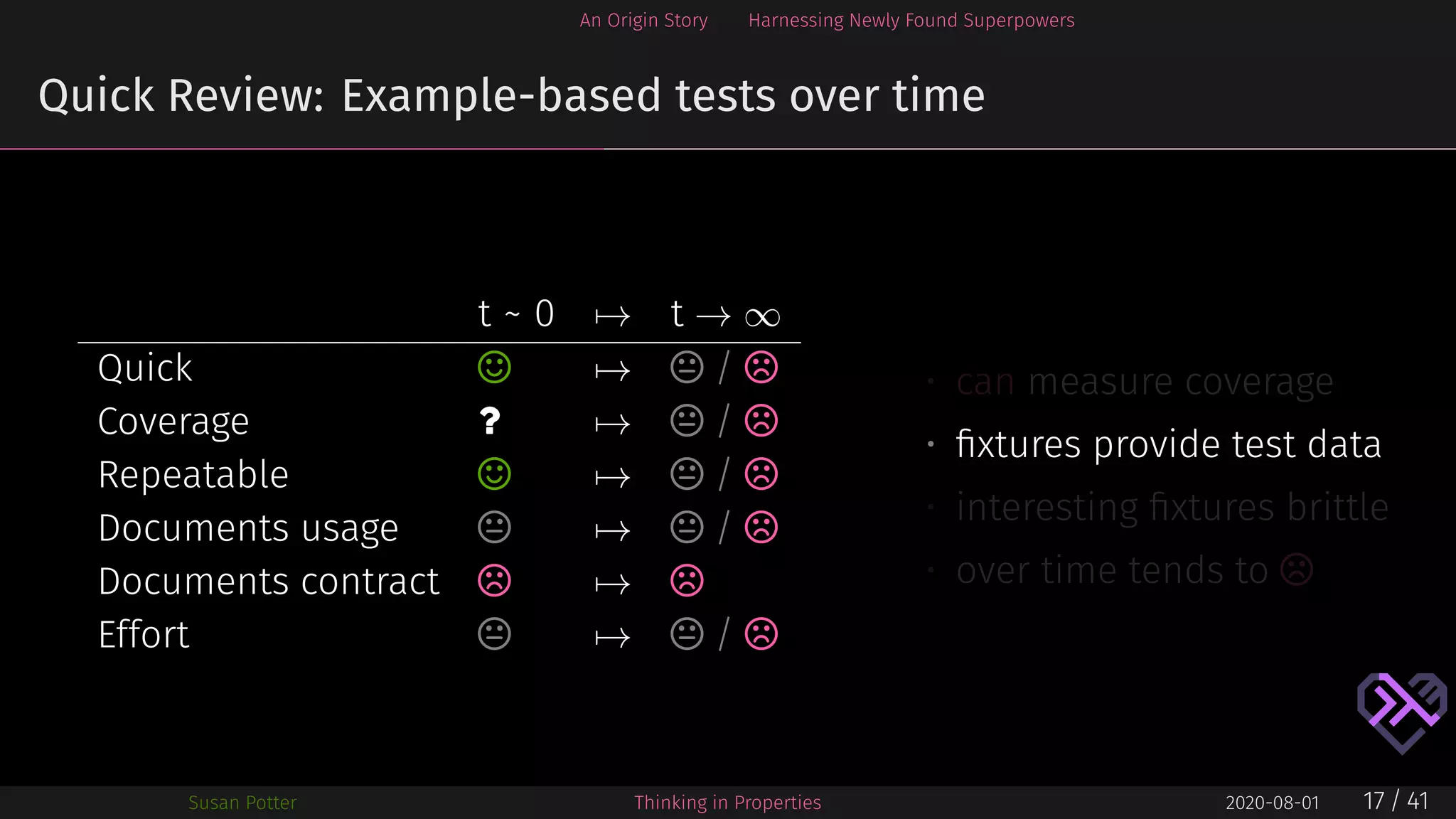
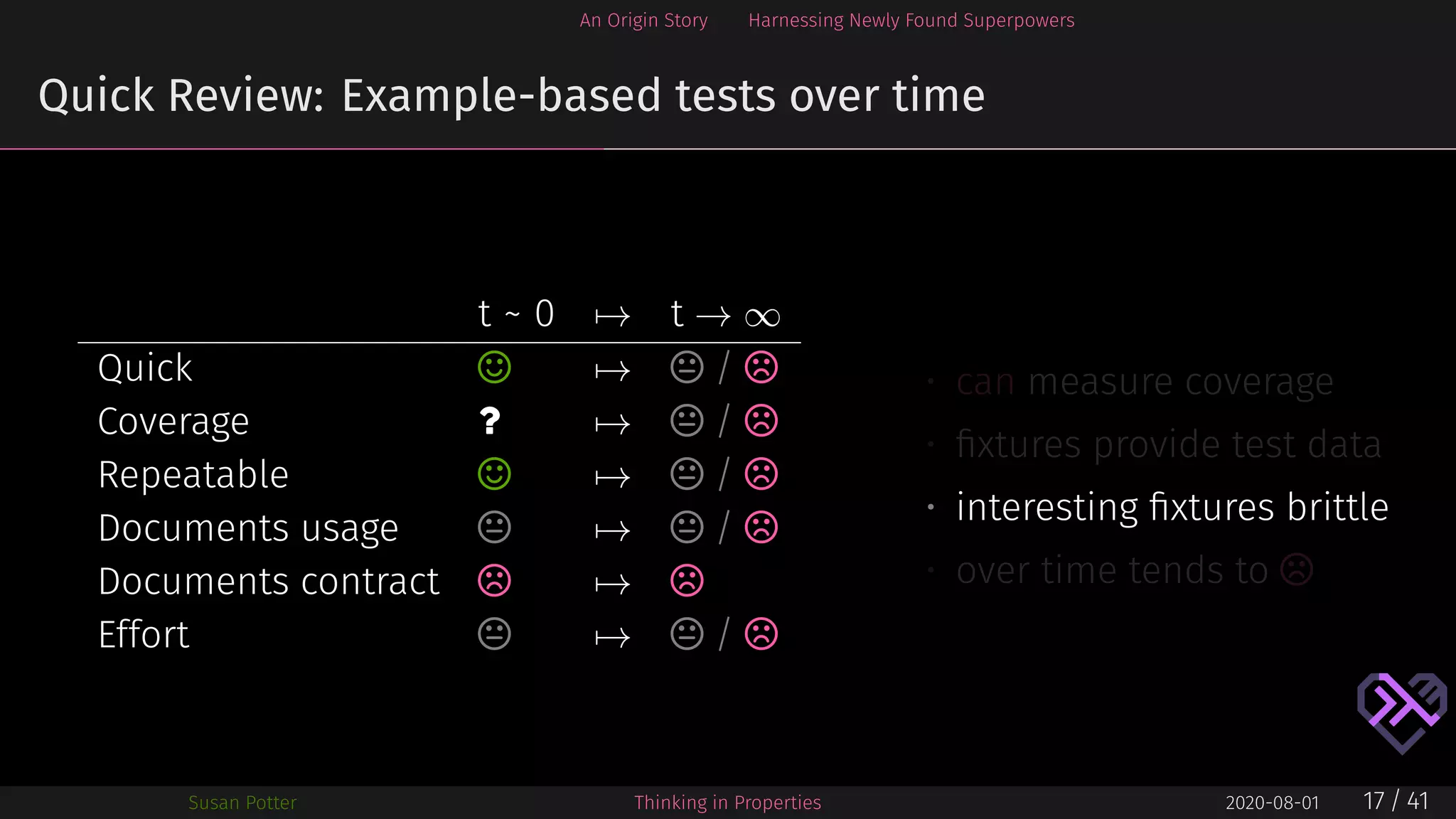
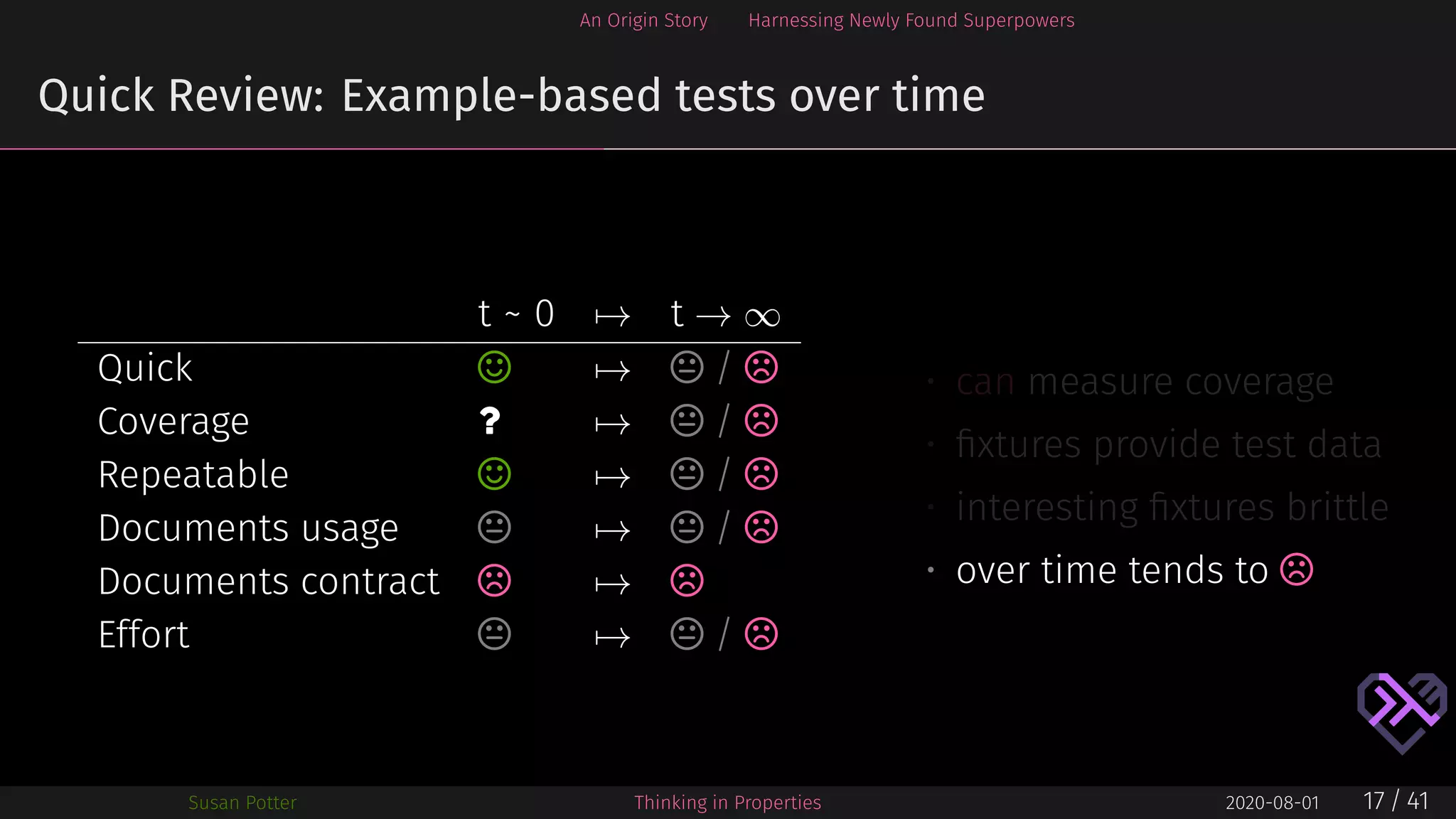
Quick Review: Example-based tests over time
t ~ 0 → t → ∞
Quick ⌣ →  / ⌢
Coverage ? →  / ⌢
Repeatable ⌣ →  / ⌢
Documents usage  →  / ⌢
Documents contract ⌢ → ⌢
Effort  →  / ⌢
• can measure coverage
• fixtures provide test data
• interesting fixtures brittle
• over time tends to ⌢
Susan Potter Thinking in Properties 2020-08-01 17 / 41
An Origin Story Harnessing Newly Found Superpowers
Quick Review: Example-based tests over time
t ~ 0 → t → ∞
Quick ⌣ →  / ⌢
Coverage ? →  / ⌢
Repeatable ⌣ →  / ⌢
Documents usage  →  / ⌢
Documents contract ⌢ → ⌢
Effort  →  / ⌢
• can measure coverage
• fixtures provide test data
• interesting fixtures brittle
• over time tends to ⌢
Susan Potter Thinking in Properties 2020-08-01 17 / 41
An Origin Story Harnessing Newly Found Superpowers
Quick Review: Example-based tests over time
t ~ 0 → t → ∞
Quick ⌣ →  / ⌢
Coverage ? →  / ⌢
Repeatable ⌣ →  / ⌢
Documents usage  →  / ⌢
Documents contract ⌢ → ⌢
Effort  →  / ⌢
• can measure coverage
• fixtures provide test data
• interesting fixtures brittle
• over time tends to ⌢
Susan Potter Thinking in Properties 2020-08-01 17 / 41
An Origin Story Harnessing Newly Found Superpowers
Quick Review: Example-based tests over time
t ~ 0 → t → ∞
Quick ⌣ →  / ⌢
Coverage ? →  / ⌢
Repeatable ⌣ →  / ⌢
Documents usage  →  / ⌢
Documents contract ⌢ → ⌢
Effort  →  / ⌢
• can measure coverage
• fixtures provide test data
• interesting fixtures brittle
• over time tends to ⌢
Susan Potter Thinking in Properties 2020-08-01 17 / 41
An Origin Story Harnessing Newly Found Superpowers
Quick Review: Example-based tests over time
t ~ 0 → t → ∞
Quick ⌣ →  / ⌢
Coverage ? →  / ⌢
Repeatable ⌣ →  / ⌢
Documents usage  →  / ⌢
Documents contract ⌢ → ⌢
Effort  →  / ⌢
• can measure coverage
• fixtures provide test data
• interesting fixtures brittle
• over time tends to ⌢
Susan Potter Thinking in Properties 2020-08-01 17 / 41
An Origin Story Harnessing Newly Found Superpowers
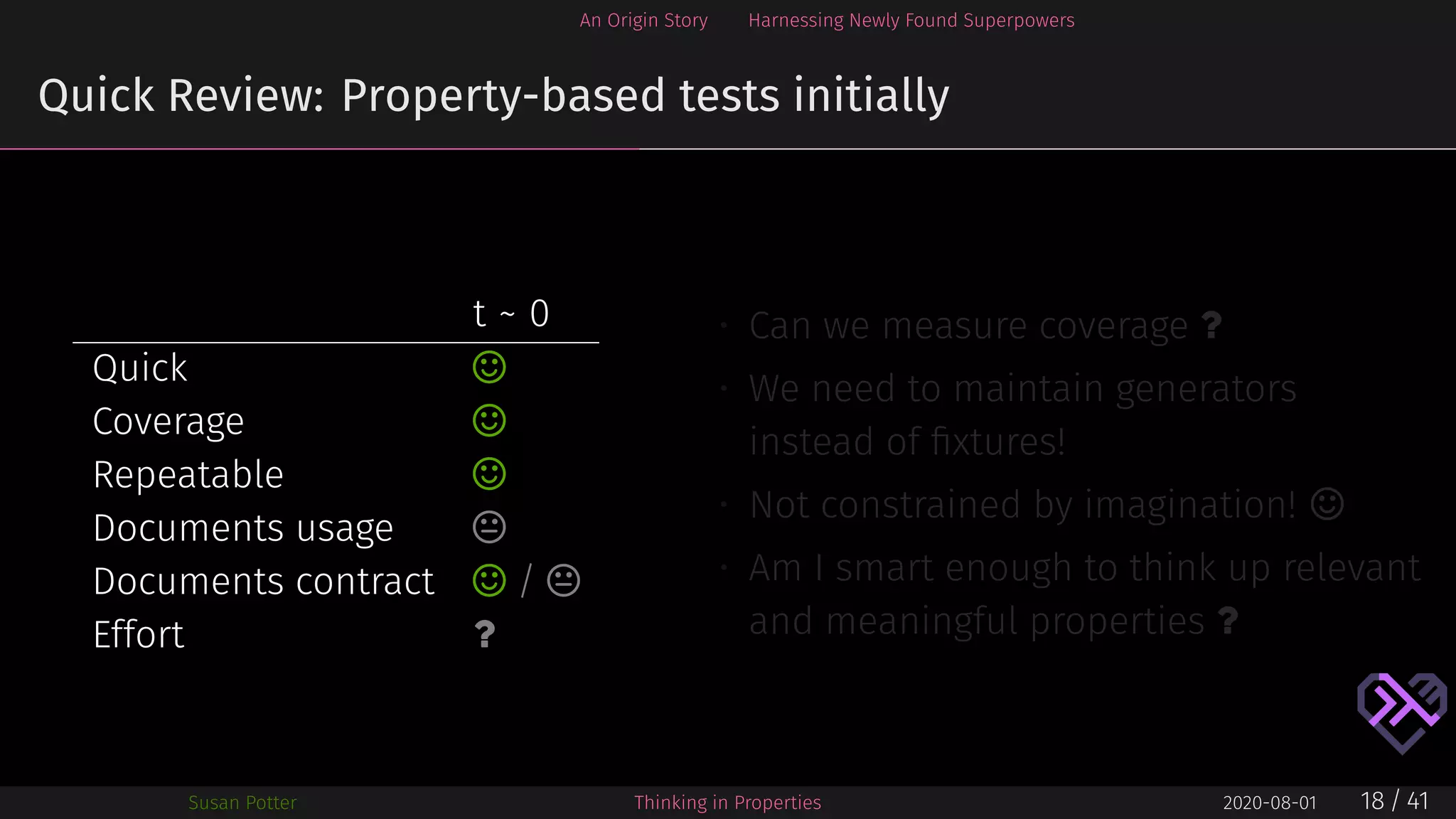
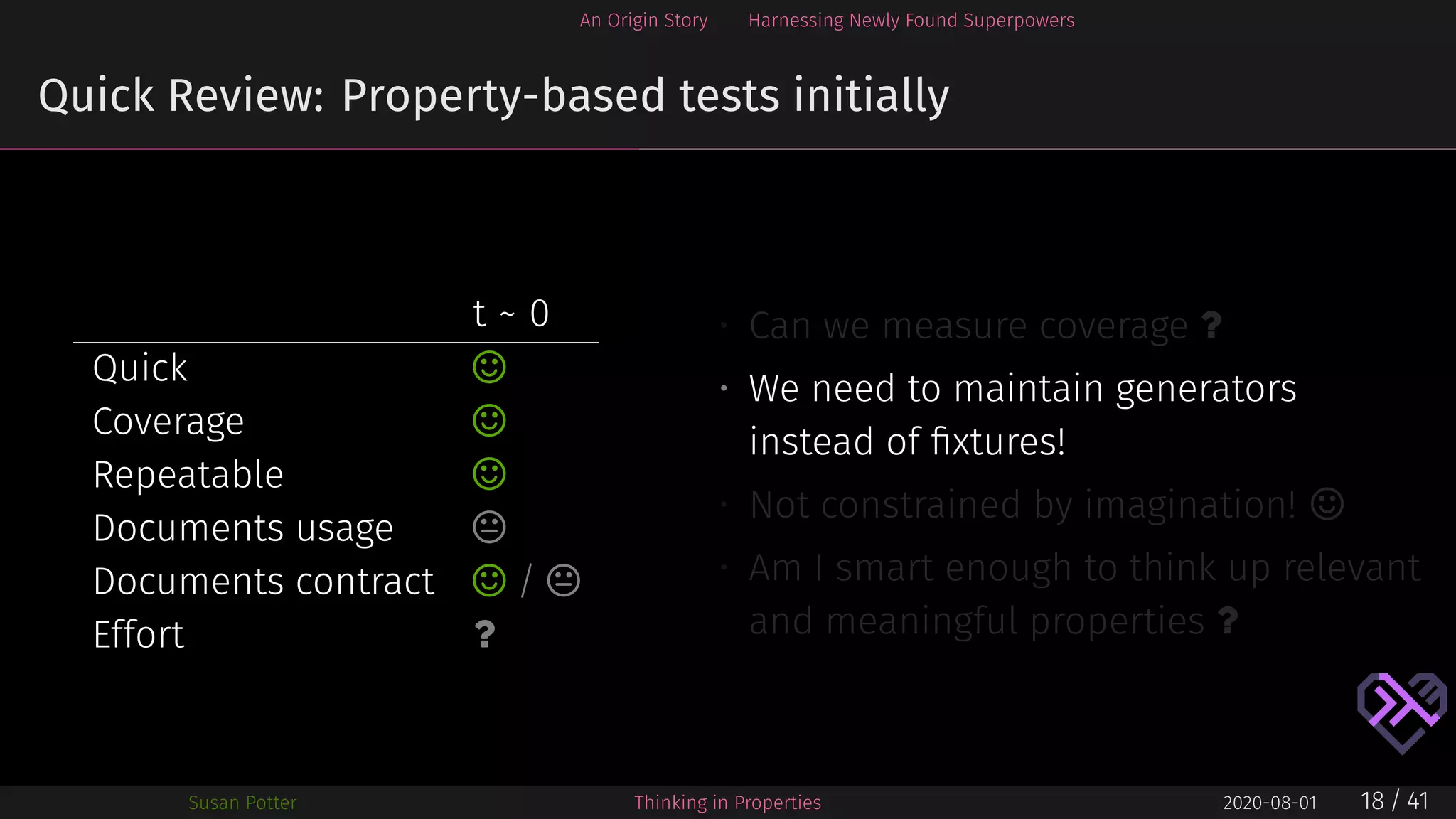
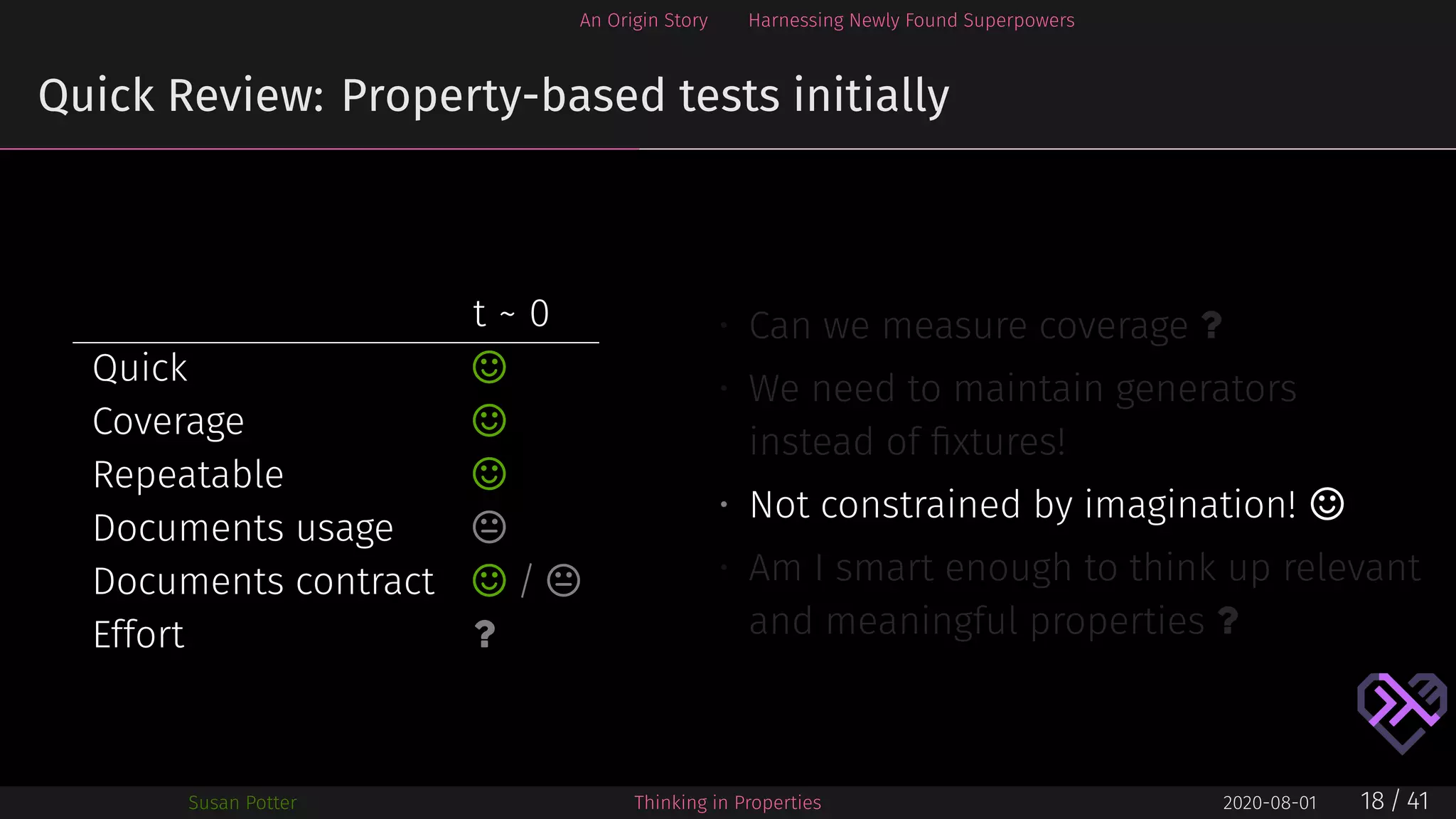
Quick Review: Property-based tests initially
t ~ 0
Quick ⌣
Coverage ⌣
Repeatable ⌣
Documents usage 
Documents contract ⌣ / 
Effort ?
• Can we measure coverage ?
• We need to maintain generators
instead of fixtures!
• Not constrained by imagination! ⌣
• Am I smart enough to think up relevant
and meaningful properties ?
Susan Potter Thinking in Properties 2020-08-01 18 / 41
An Origin Story Harnessing Newly Found Superpowers
Quick Review: Property-based tests initially
t ~ 0
Quick ⌣
Coverage ⌣
Repeatable ⌣
Documents usage 
Documents contract ⌣ / 
Effort ?
• Can we measure coverage ?
• We need to maintain generators
instead of fixtures!
• Not constrained by imagination! ⌣
• Am I smart enough to think up relevant
and meaningful properties ?
Susan Potter Thinking in Properties 2020-08-01 18 / 41
An Origin Story Harnessing Newly Found Superpowers
Quick Review: Property-based tests initially
t ~ 0
Quick ⌣
Coverage ⌣
Repeatable ⌣
Documents usage 
Documents contract ⌣ / 
Effort ?
• Can we measure coverage ?
• We need to maintain generators
instead of fixtures!
• Not constrained by imagination! ⌣
• Am I smart enough to think up relevant
and meaningful properties ?
Susan Potter Thinking in Properties 2020-08-01 18 / 41
An Origin Story Harnessing Newly Found Superpowers
Quick Review: Property-based tests initially
t ~ 0
Quick ⌣
Coverage ⌣
Repeatable ⌣
Documents usage 
Documents contract ⌣ / 
Effort ?
• Can we measure coverage ?
• We need to maintain generators
instead of fixtures!
• Not constrained by imagination! ⌣
• Am I smart enough to think up relevant
and meaningful properties ?
Susan Potter Thinking in Properties 2020-08-01 18 / 41
An Origin Story Harnessing Newly Found Superpowers
Quick Review: Property-based tests initially
t ~ 0
Quick ⌣
Coverage ⌣
Repeatable ⌣
Documents usage 
Documents contract ⌣ / 
Effort ?
• Can we measure coverage ?
• We need to maintain generators
instead of fixtures!
• Not constrained by imagination! ⌣
• Am I smart enough to think up relevant
and meaningful properties ?
Susan Potter Thinking in Properties 2020-08-01 18 / 41
Mental Models
Mental Models
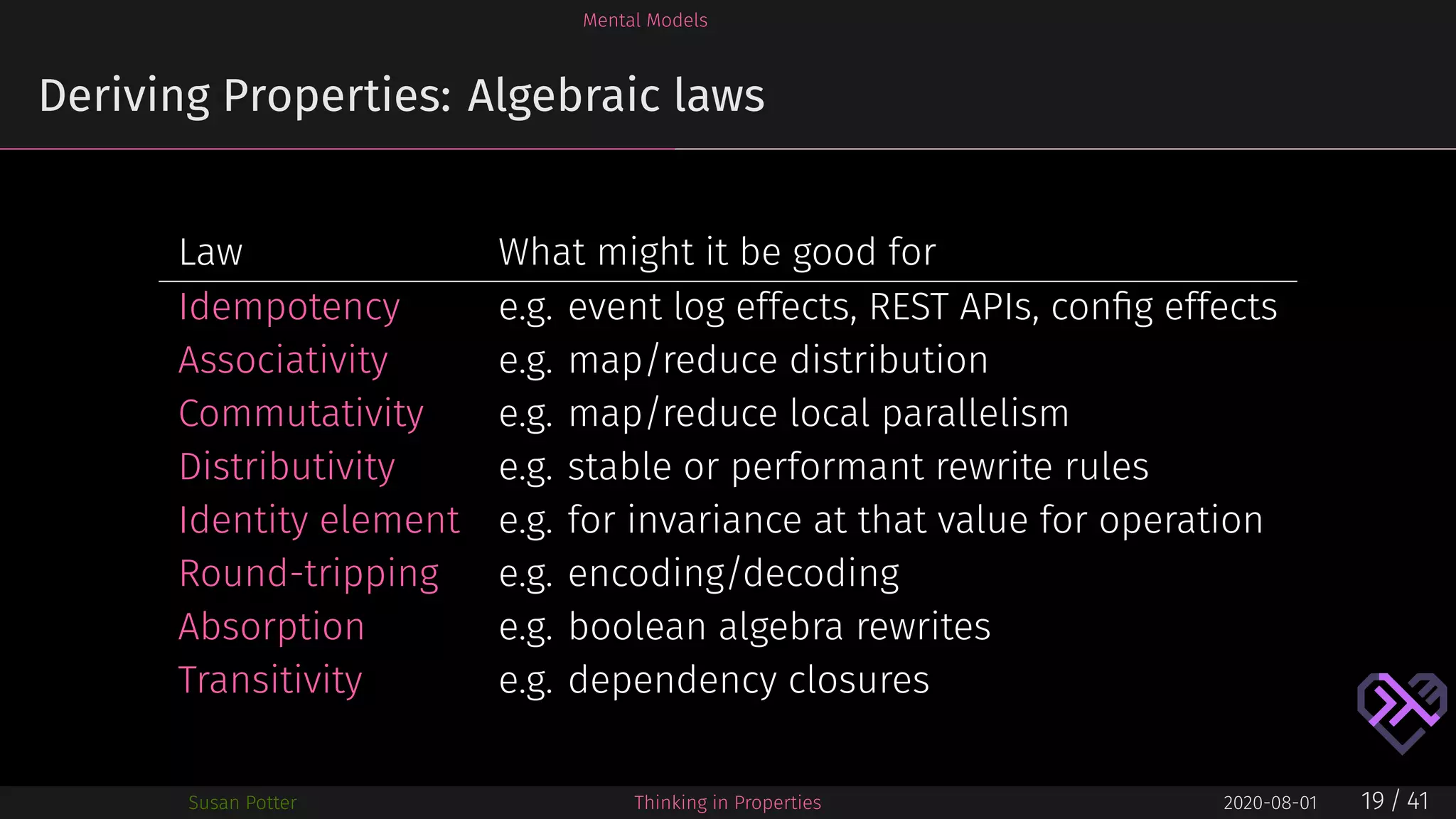
Deriving Properties: Algebraic laws
Law What might it be good for
Idempotency e.g. event log effects, REST APIs, config effects
Associativity e.g. map/reduce distribution
Commutativity e.g. map/reduce local parallelism
Distributivity e.g. stable or performant rewrite rules
Identity element e.g. for invariance at that value for operation
Round-tripping e.g. encoding/decoding
Absorption e.g. boolean algebra rewrites
Transitivity e.g. dependency closures
Susan Potter Thinking in Properties 2020-08-01 19 / 41
Mental Models
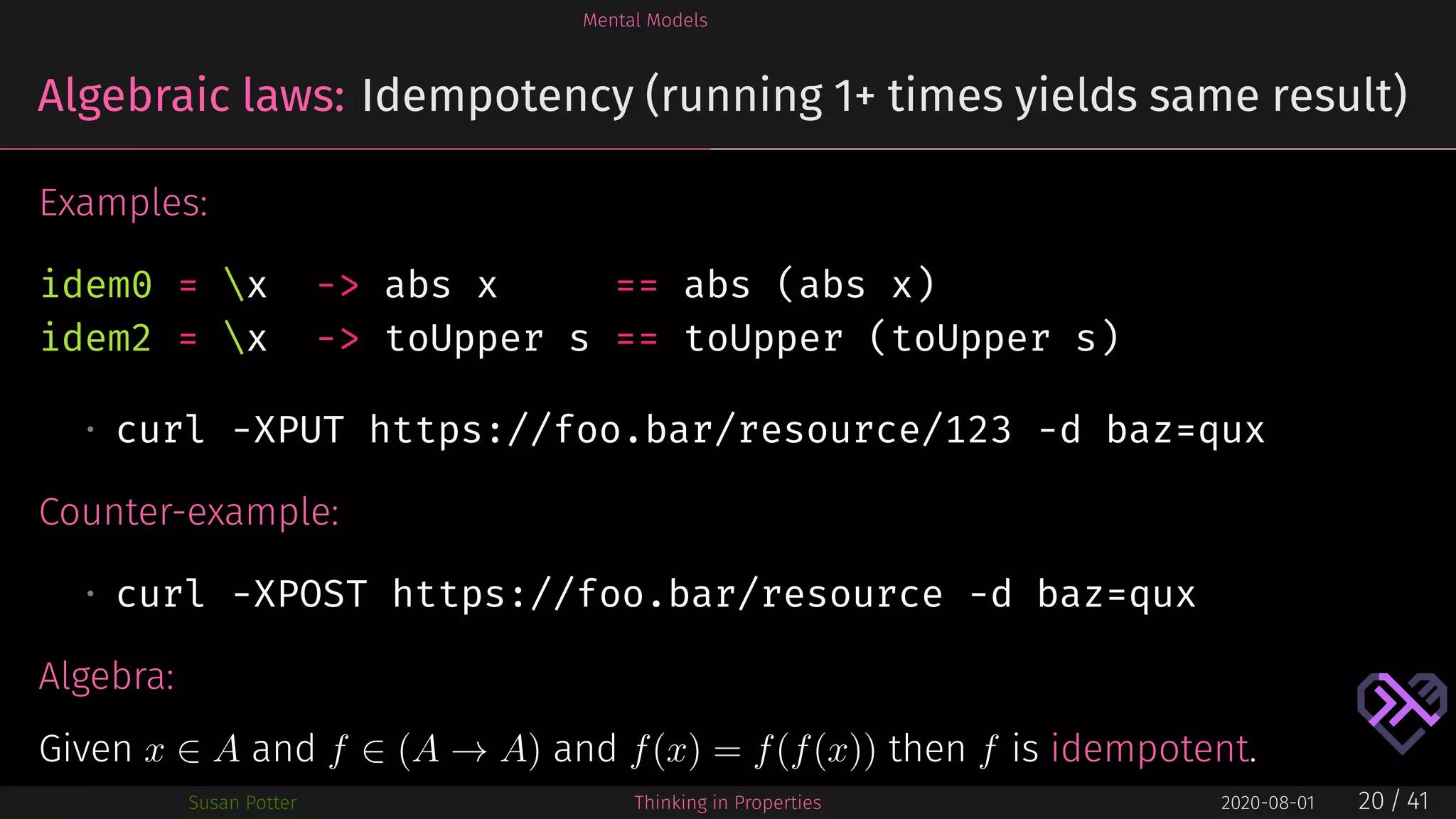
Algebraic laws: Idempotency (running 1+ times yields same result)
Examples:
idem0 = x -> abs x == abs (abs x)
idem2 = x -> toUpper s == toUpper (toUpper s)
• curl -XPUT https://foo.bar/resource/123 -d baz=qux
Counter-example:
• curl -XPOST https://foo.bar/resource -d baz=qux
Algebra:
Given x ∈ A and f ∈ (A → A) and f(x) = f(f(x)) then f is idempotent.
Susan Potter Thinking in Properties 2020-08-01 20 / 41
Mental Models
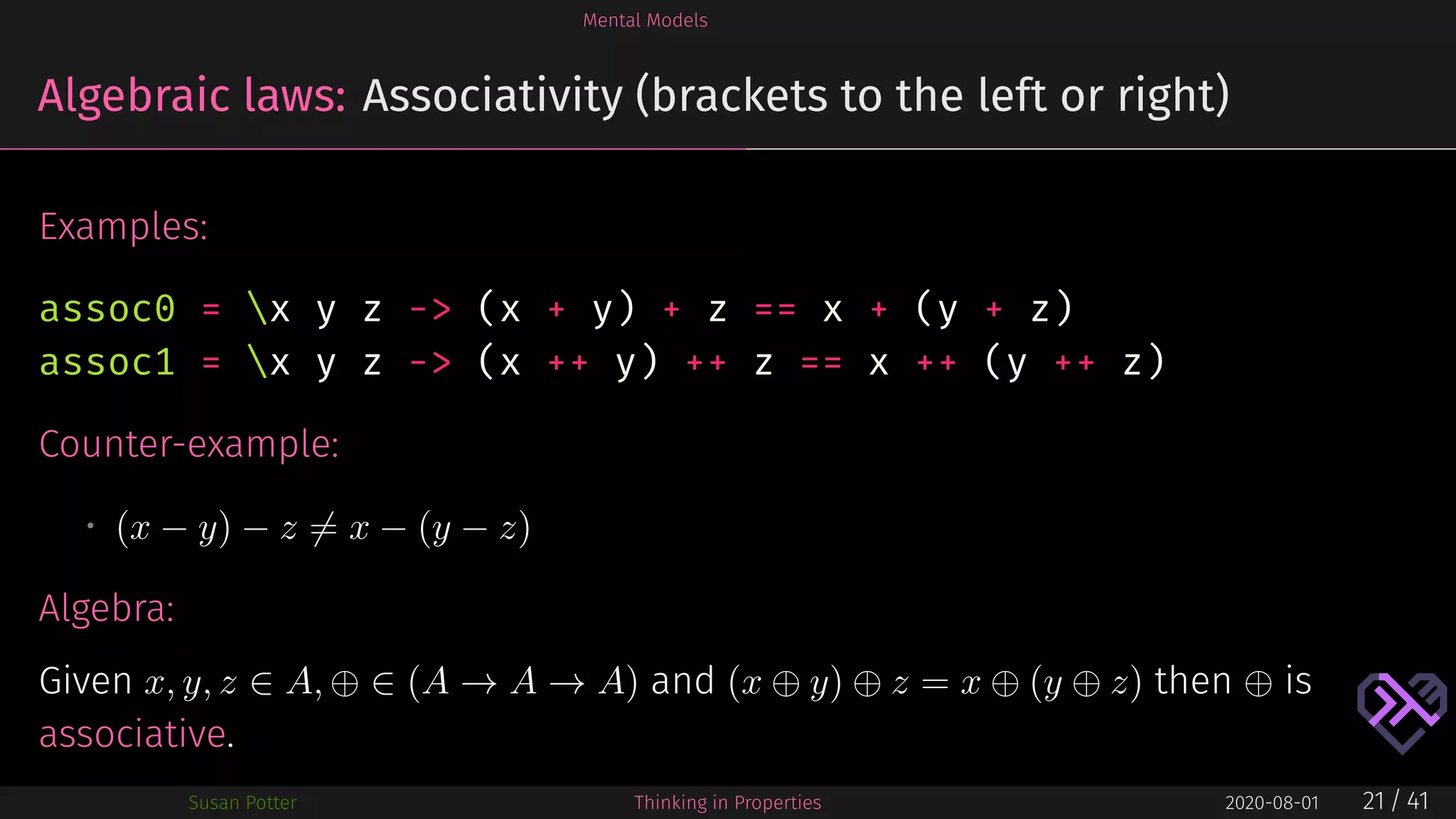
Algebraic laws: Associativity (brackets to the left or right)
Examples:
assoc0 = x y z -> (x + y) + z == x + (y + z)
assoc1 = x y z -> (x ++ y) ++ z == x ++ (y ++ z)
Counter-example:
• (x − y) − z = x − (y − z)
Algebra:
Given x, y, z ∈ A, ⊕ ∈ (A → A → A) and (x ⊕ y) ⊕ z = x ⊕ (y ⊕ z) then ⊕ is
associative.
Susan Potter Thinking in Properties 2020-08-01 21 / 41
Mental Models
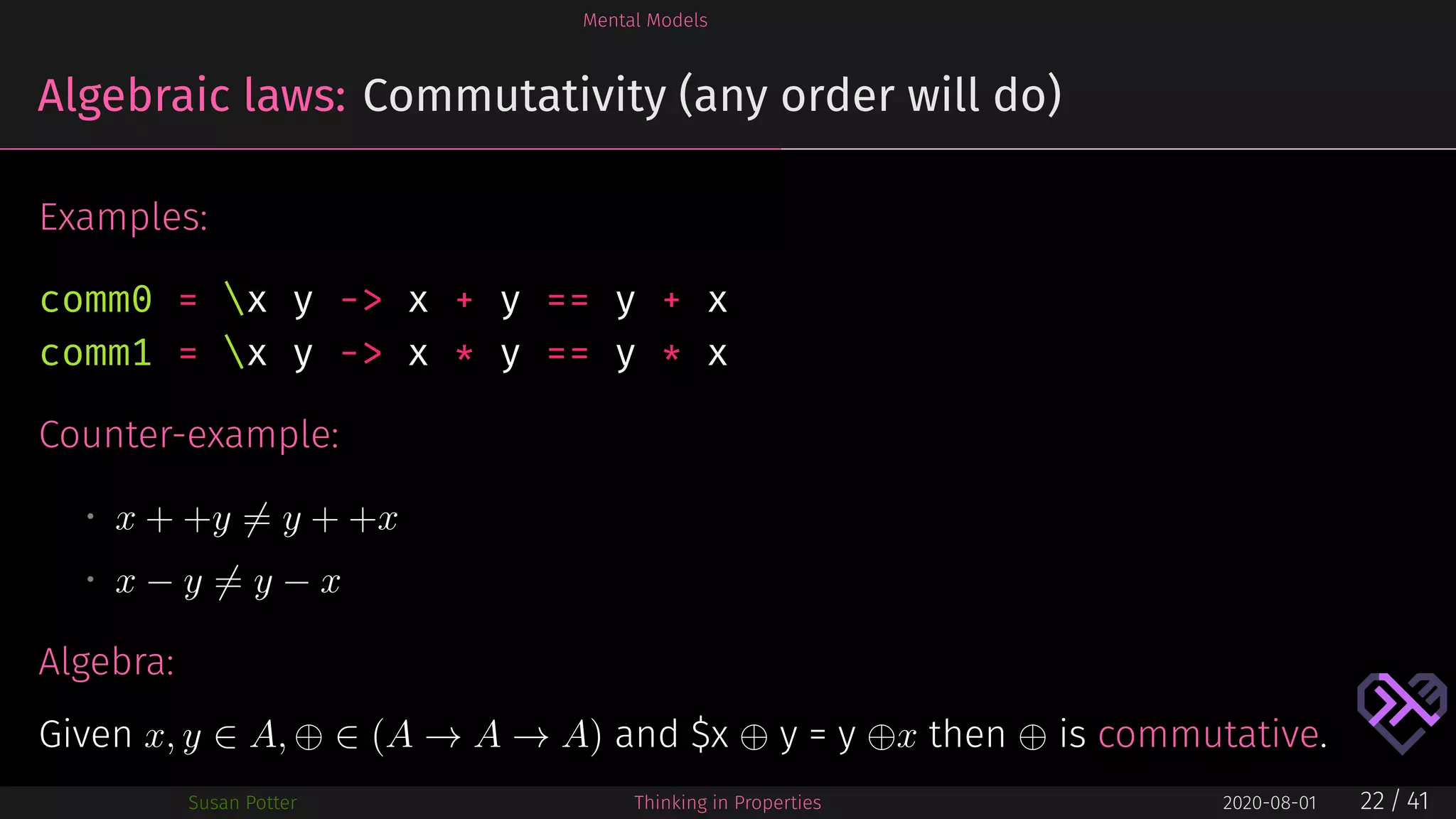
Algebraic laws: Commutativity (any order will do)
Examples:
comm0 = x y -> x + y == y + x
comm1 = x y -> x * y == y * x
Counter-example:
• x + +y = y + +x
• x − y = y − x
Algebra:
Given x, y ∈ A, ⊕ ∈ (A → A → A) and $x ⊕ y = y ⊕x then ⊕ is commutative.
Susan Potter Thinking in Properties 2020-08-01 22 / 41
Mental Models
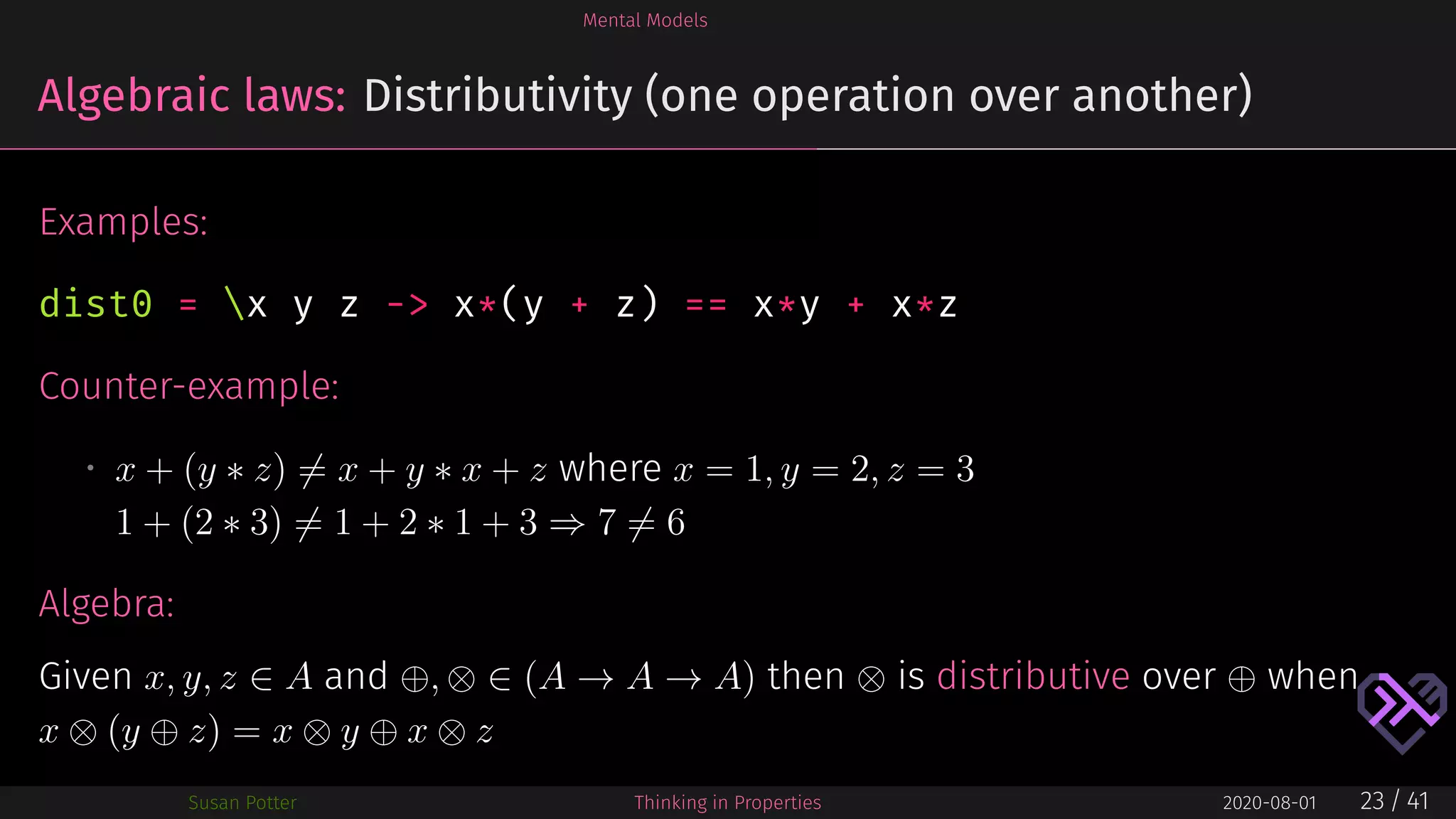
Algebraic laws: Distributivity (one operation over another)
Examples:
dist0 = x y z -> x*(y + z) == x*y + x*z
Counter-example:
• x + (y ∗ z) = x + y ∗ x + z where x = 1, y = 2, z = 3
1 + (2 ∗ 3) = 1 + 2 ∗ 1 + 3 ⇒ 7 = 6
Algebra:
Given x, y, z ∈ A and ⊕, ⊗ ∈ (A → A → A) then ⊗ is distributive over ⊕ when
x ⊗ (y ⊕ z) = x ⊗ y ⊕ x ⊗ z
Susan Potter Thinking in Properties 2020-08-01 23 / 41
Mental Models
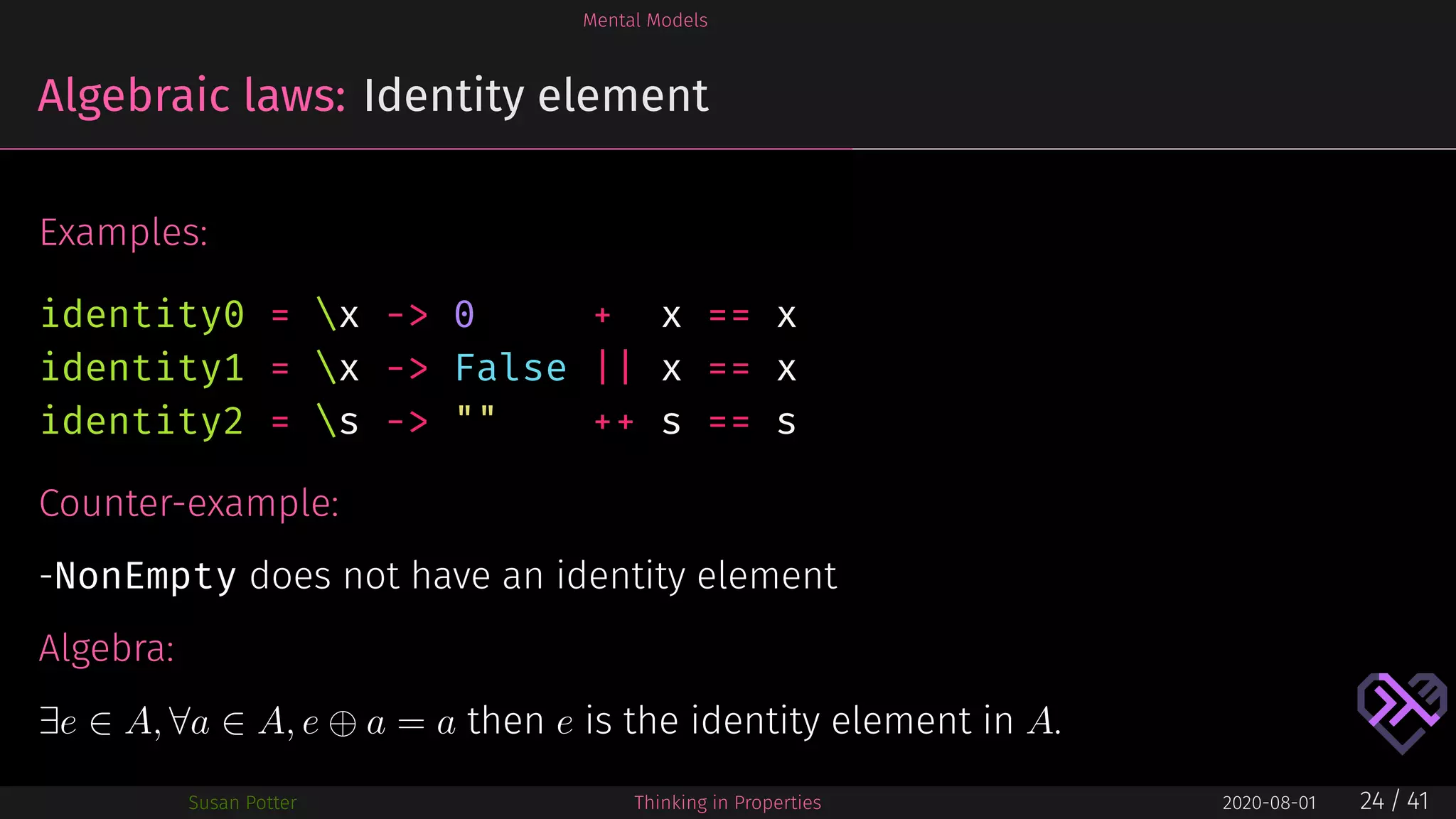
Algebraic laws: Identity element
Examples:
identity0 = x -> 0 + x == x
identity1 = x -> False || x == x
identity2 = s -> "" ++ s == s
Counter-example:
-NonEmpty does not have an identity element
Algebra:
∃e ∈ A, ∀a ∈ A, e ⊕ a = a then e is the identity element in A.
Susan Potter Thinking in Properties 2020-08-01 24 / 41
Mental Models
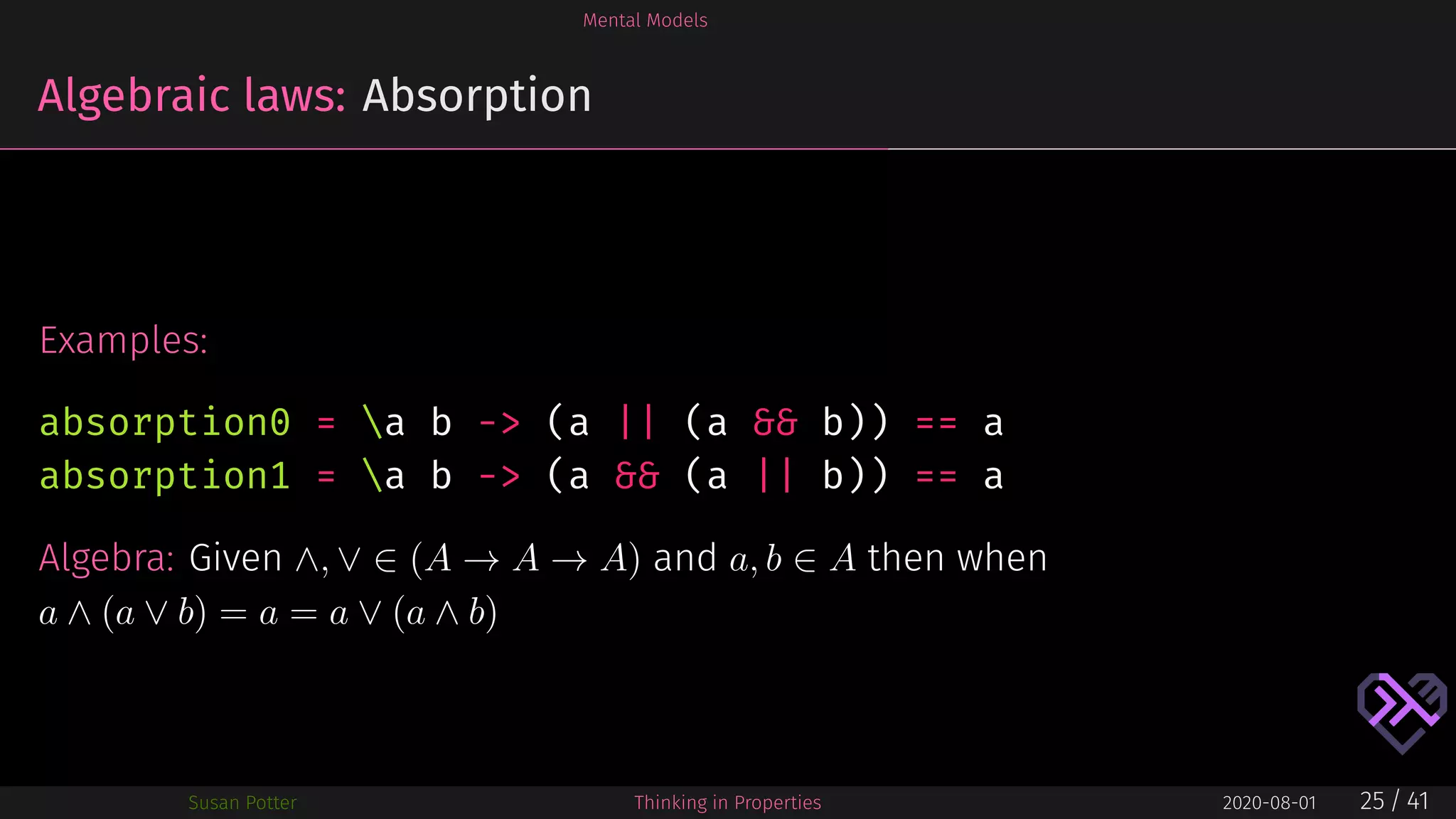
Algebraic laws: Absorption
Examples:
absorption0 = a b -> (a || (a && b)) == a
absorption1 = a b -> (a && (a || b)) == a
Algebra: Given ∧, ∨ ∈ (A → A → A) and a, b ∈ A then when
a ∧ (a ∨ b) = a = a ∨ (a ∧ b)
Susan Potter Thinking in Properties 2020-08-01 25 / 41
Mental Models
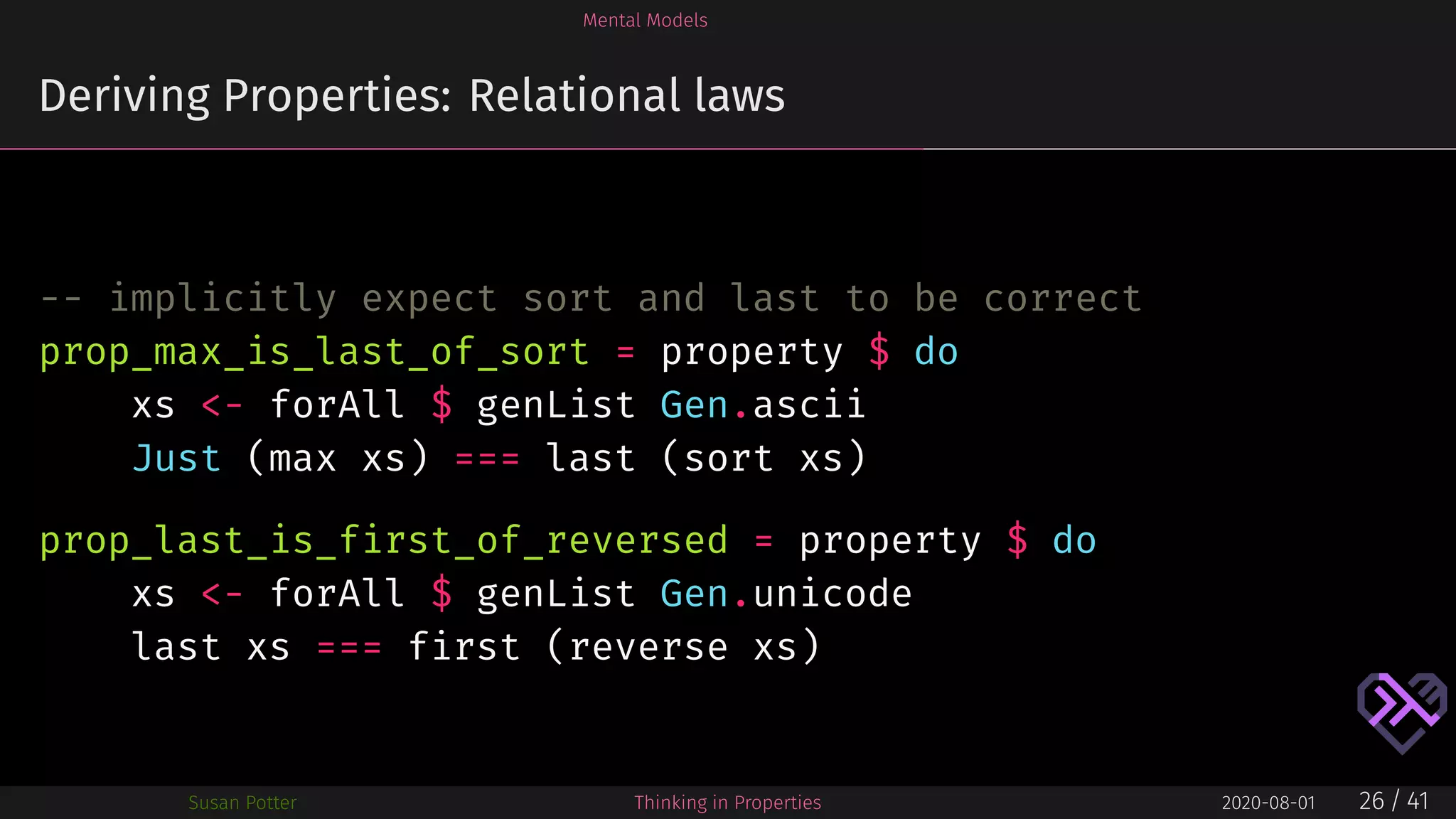
Deriving Properties: Relational laws
-- implicitly expect sort and last to be correct
prop_max_is_last_of_sort = property $ do
xs <- forAll $ genList Gen.ascii
Just (max xs) === last (sort xs)
prop_last_is_first_of_reversed = property $ do
xs <- forAll $ genList Gen.unicode
last xs === first (reverse xs)
Susan Potter Thinking in Properties 2020-08-01 26 / 41
Mental Models
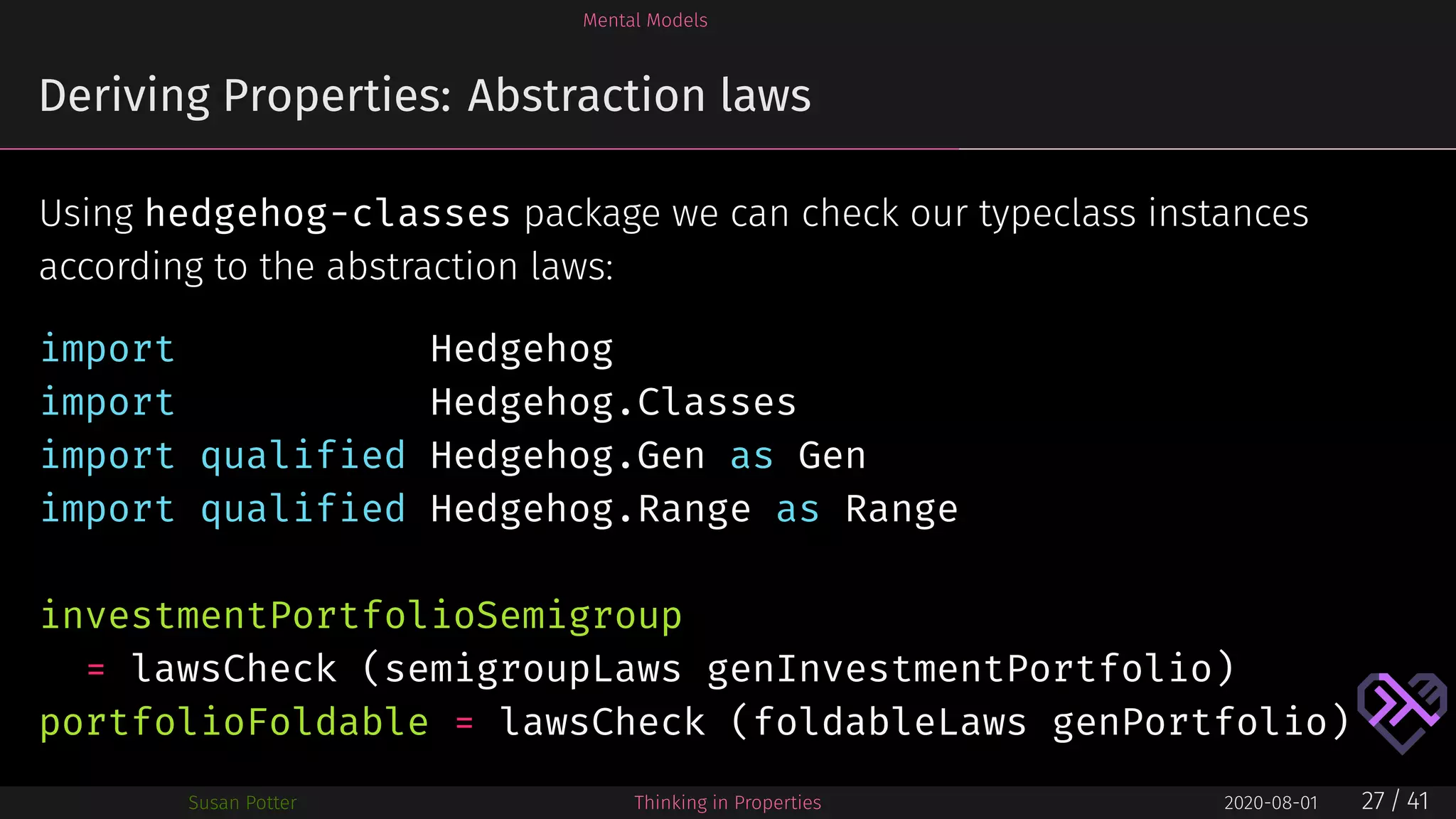
Deriving Properties: Abstraction laws
Using hedgehog-classes package we can check our typeclass instances
according to the abstraction laws:
import Hedgehog
import Hedgehog.Classes
import qualified Hedgehog.Gen as Gen
import qualified Hedgehog.Range as Range
investmentPortfolioSemigroup
= lawsCheck (semigroupLaws genInvestmentPortfolio)
portfolioFoldable = lawsCheck (foldableLaws genPortfolio)
Susan Potter Thinking in Properties 2020-08-01 27 / 41
Mental Models
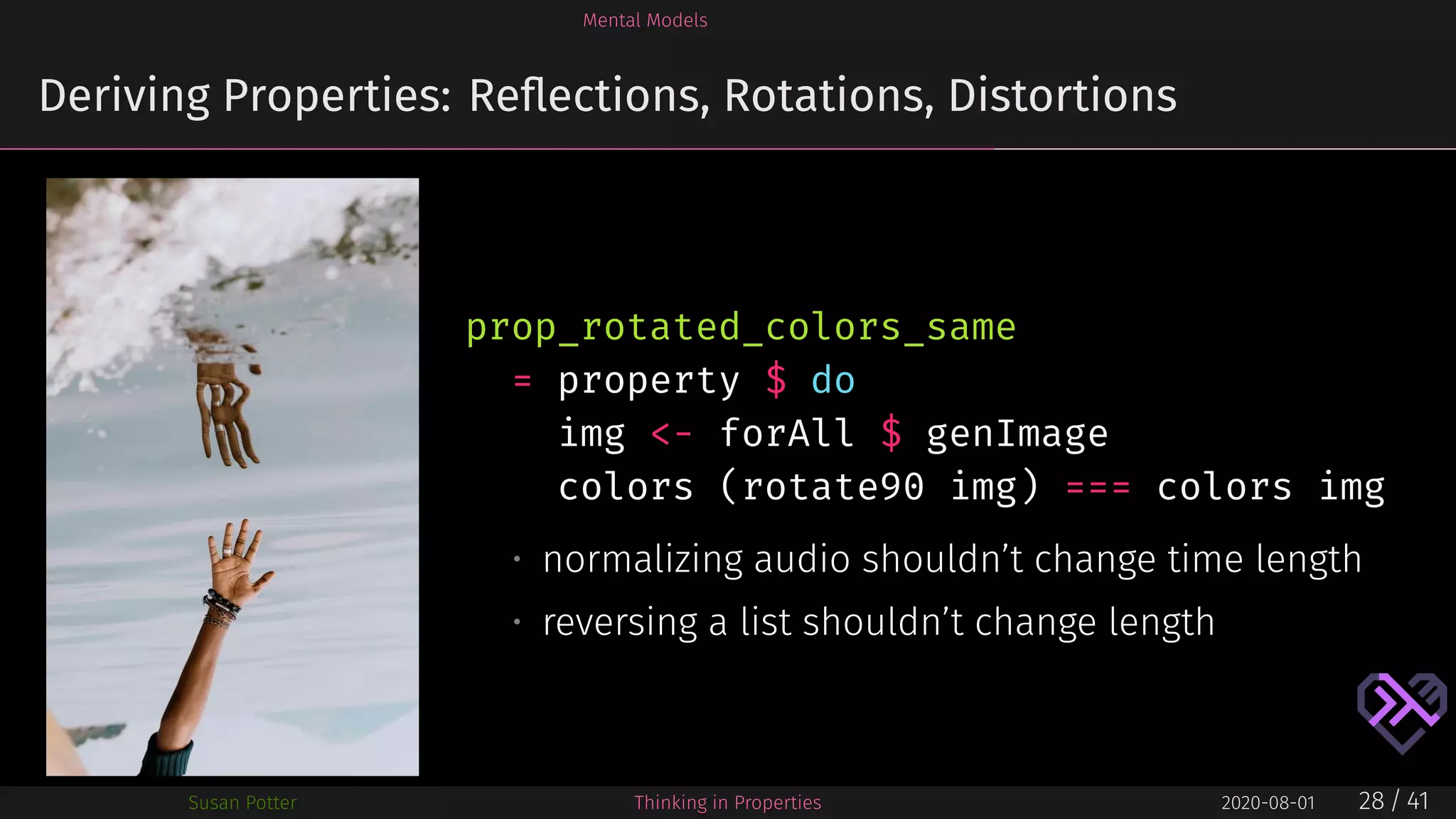
Deriving Properties: Reflections, Rotations, Distortions
prop_rotated_colors_same
= property $ do
img <- forAll $ genImage
colors (rotate90 img) === colors img
• normalizing audio shouldn’t change time length
• reversing a list shouldn’t change length
Susan Potter Thinking in Properties 2020-08-01 28 / 41
Mental Models
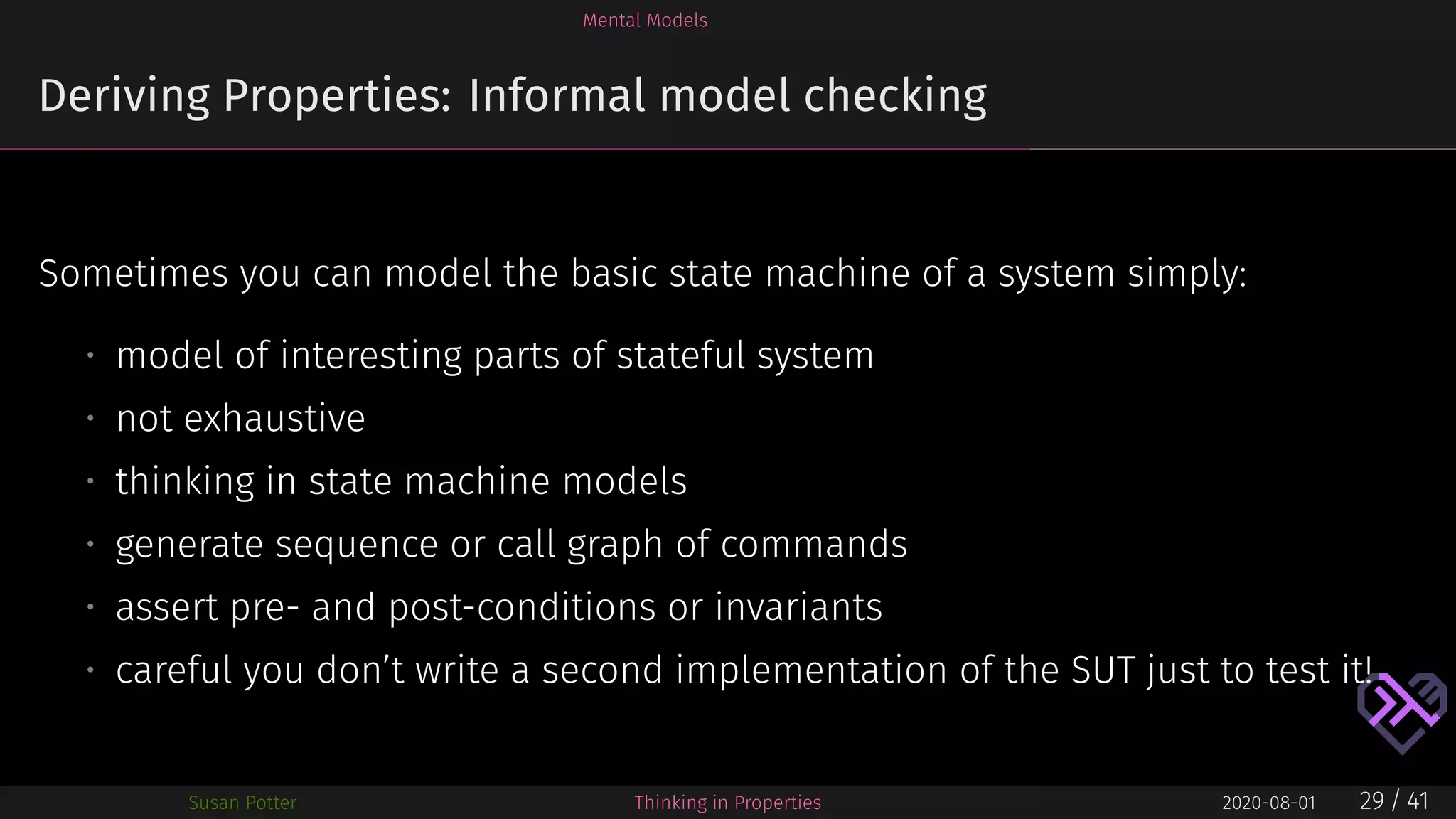
Deriving Properties: Informal model checking
Sometimes you can model the basic state machine of a system simply:
• model of interesting parts of stateful system
• not exhaustive
• thinking in state machine models
• generate sequence or call graph of commands
• assert pre- and post-conditions or invariants
• careful you don’t write a second implementation of the SUT just to test it!
Susan Potter Thinking in Properties 2020-08-01 29 / 41
Mental Models
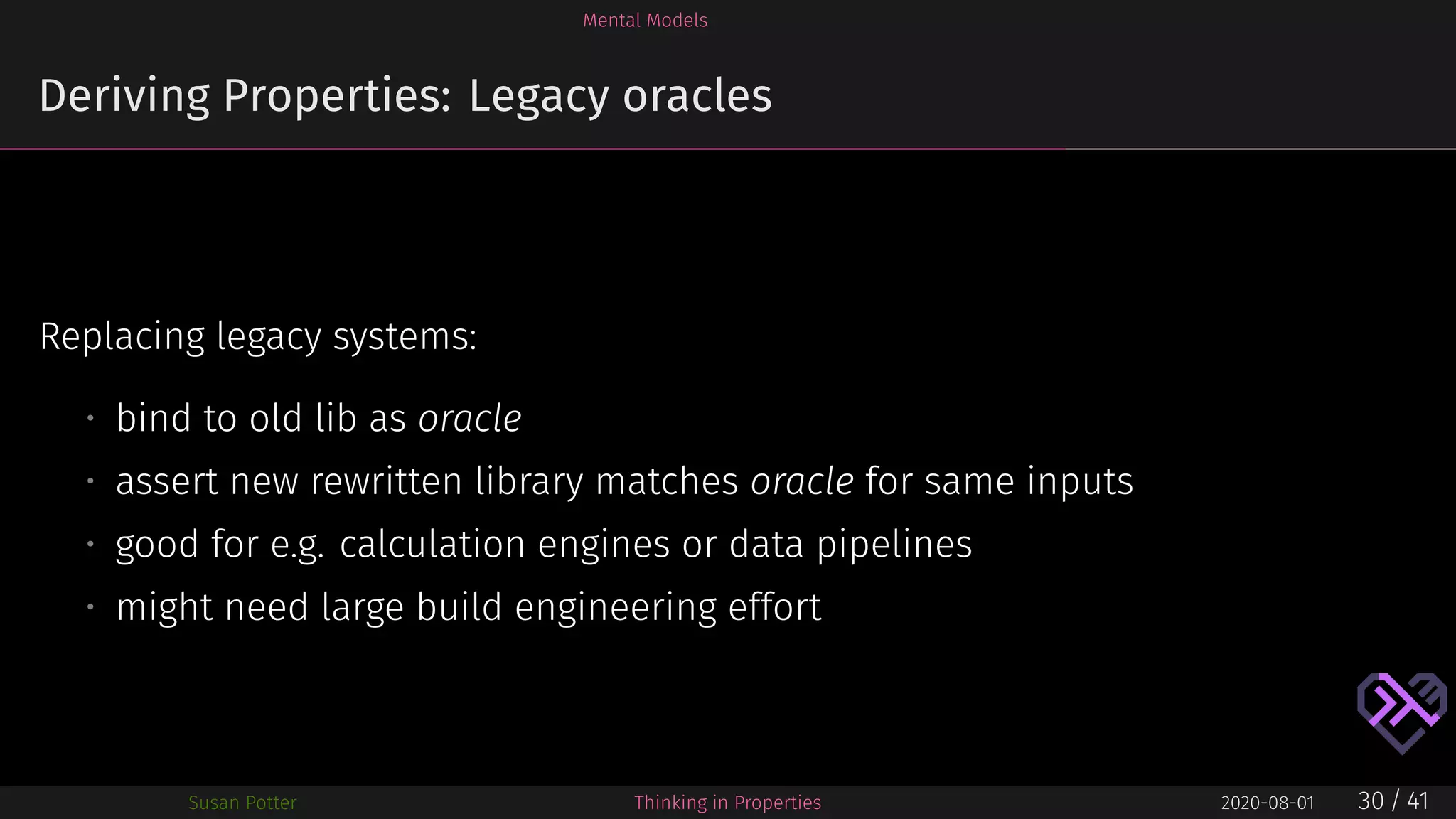
Deriving Properties: Legacy oracles
Replacing legacy systems:
• bind to old lib as oracle
• assert new rewritten library matches oracle for same inputs
• good for e.g. calculation engines or data pipelines
• might need large build engineering effort
Susan Potter Thinking in Properties 2020-08-01 30 / 41
Mental Models
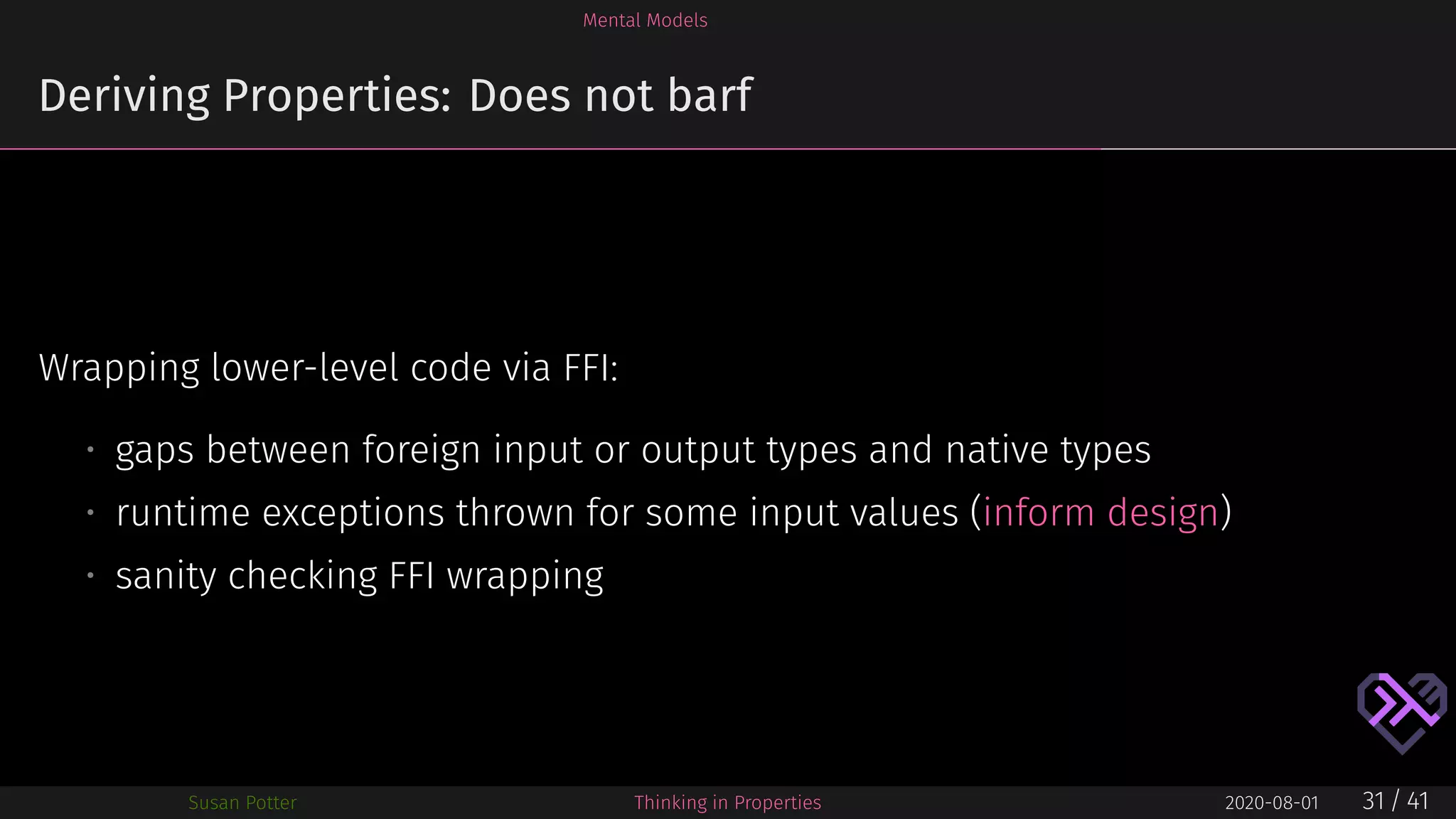
Deriving Properties: Does not barf
Wrapping lower-level code via FFI:
• gaps between foreign input or output types and native types
• runtime exceptions thrown for some input values (inform design)
• sanity checking FFI wrapping
Susan Potter Thinking in Properties 2020-08-01 31 / 41
Mental Models
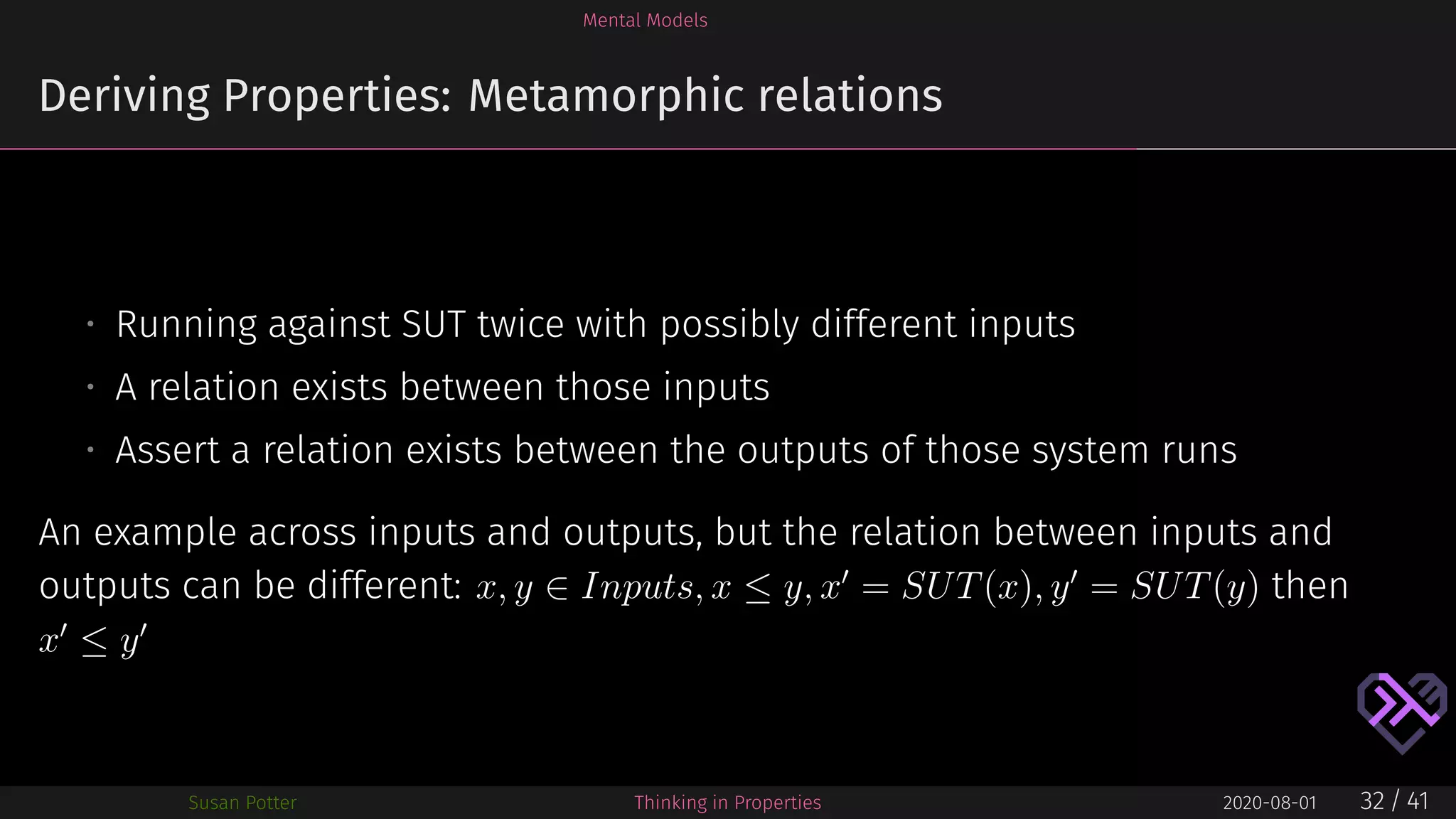
Deriving Properties: Metamorphic relations
• Running against SUT twice with possibly different inputs
• A relation exists between those inputs
• Assert a relation exists between the outputs of those system runs
An example across inputs and outputs, but the relation between inputs and
outputs can be different: x, y ∈ Inputs, x ≤ y, x′
= SUT(x), y′
= SUT(y) then
x′
≤ y′
Susan Potter Thinking in Properties 2020-08-01 32 / 41
Mental Models
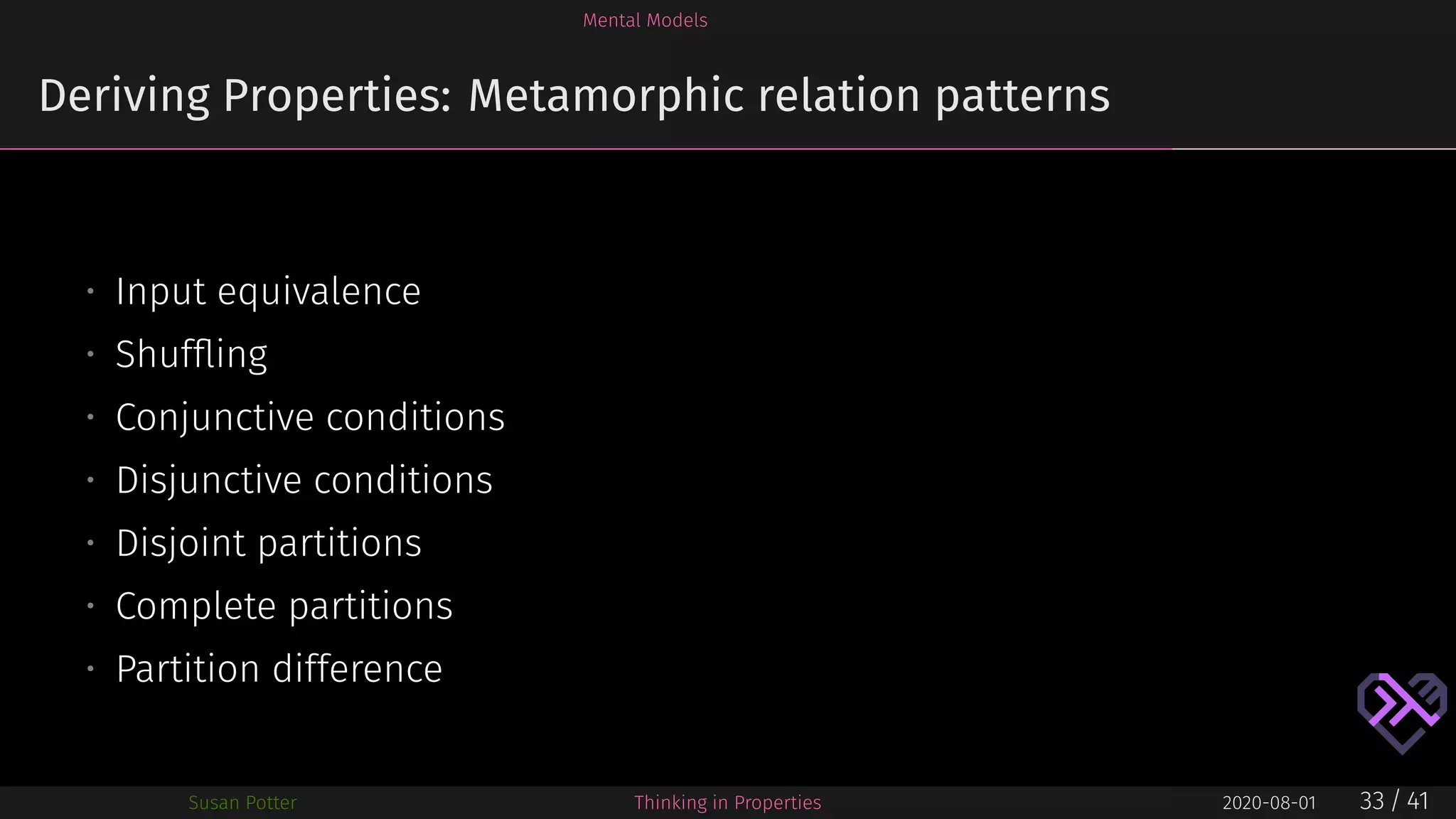
Deriving Properties: Metamorphic relation patterns
• Input equivalence
• Shuffling
• Conjunctive conditions
• Disjunctive conditions
• Disjoint partitions
• Complete partitions
• Partition difference
Susan Potter Thinking in Properties 2020-08-01 33 / 41
Mental Models
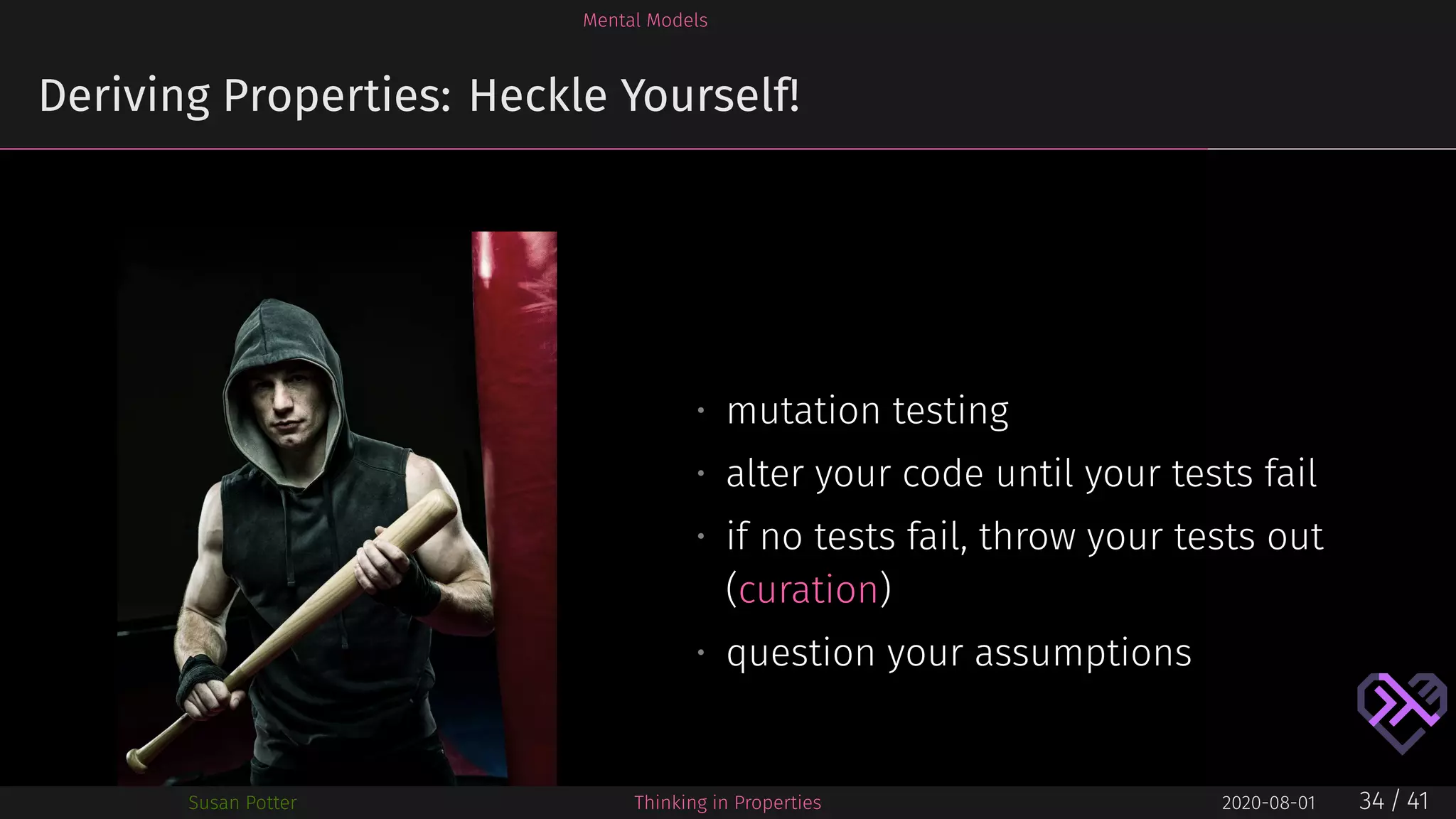
Deriving Properties: Heckle Yourself!
• mutation testing
• alter your code until your tests fail
• if no tests fail, throw your tests out
(curation)
• question your assumptions
Susan Potter Thinking in Properties 2020-08-01 34 / 41
Beyond testing
Beyond testing
Properties of Delivery Pipelines
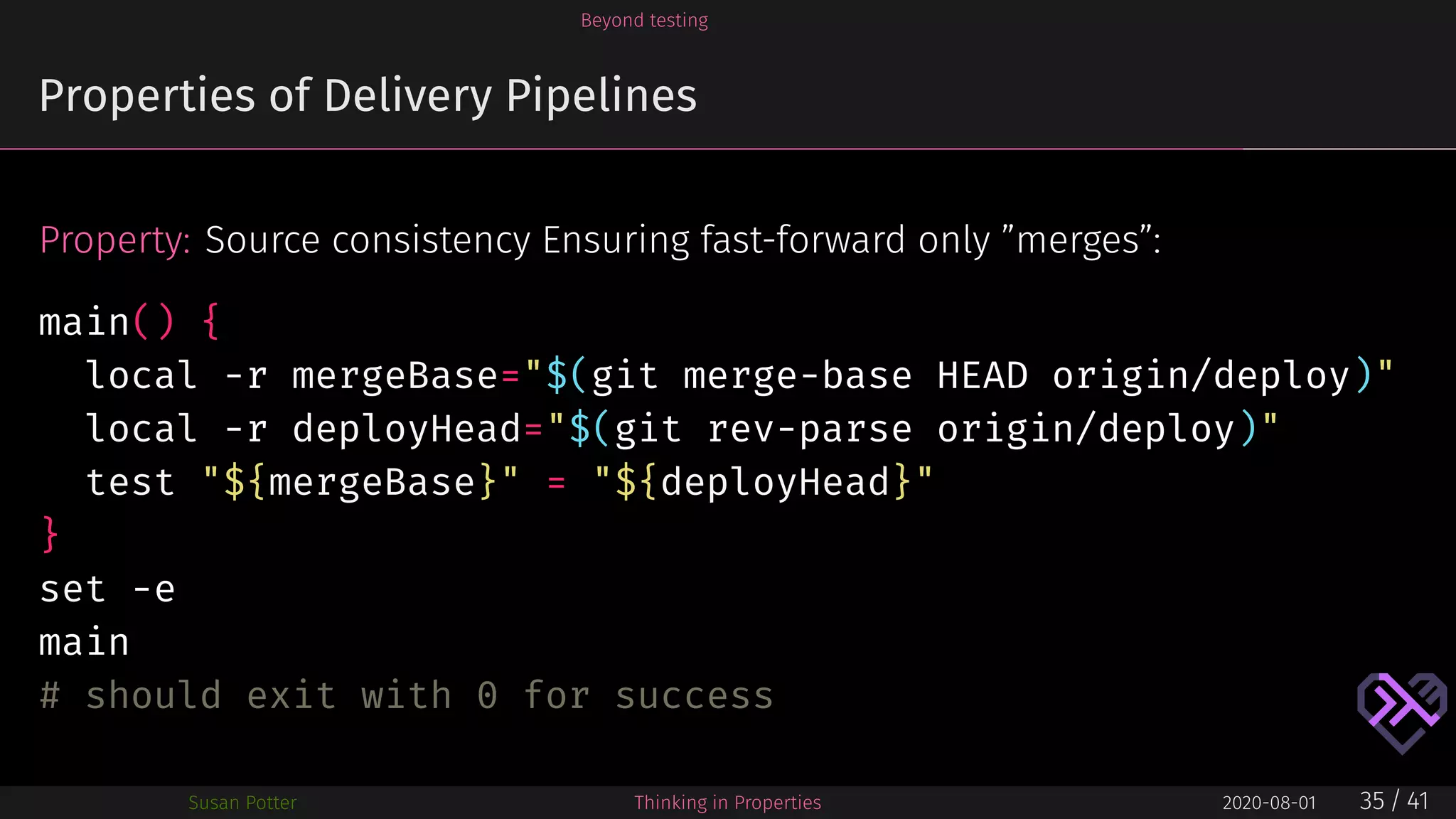
Property: Source consistency Ensuring fast-forward only ”merges”:
main() {
local -r mergeBase="$(git merge-base HEAD origin/deploy)"
local -r deployHead="$(git rev-parse origin/deploy)"
test "${mergeBase}" = "${deployHead}"
}
set -e
main
# should exit with 0 for success
Susan Potter Thinking in Properties 2020-08-01 35 / 41
Beyond testing
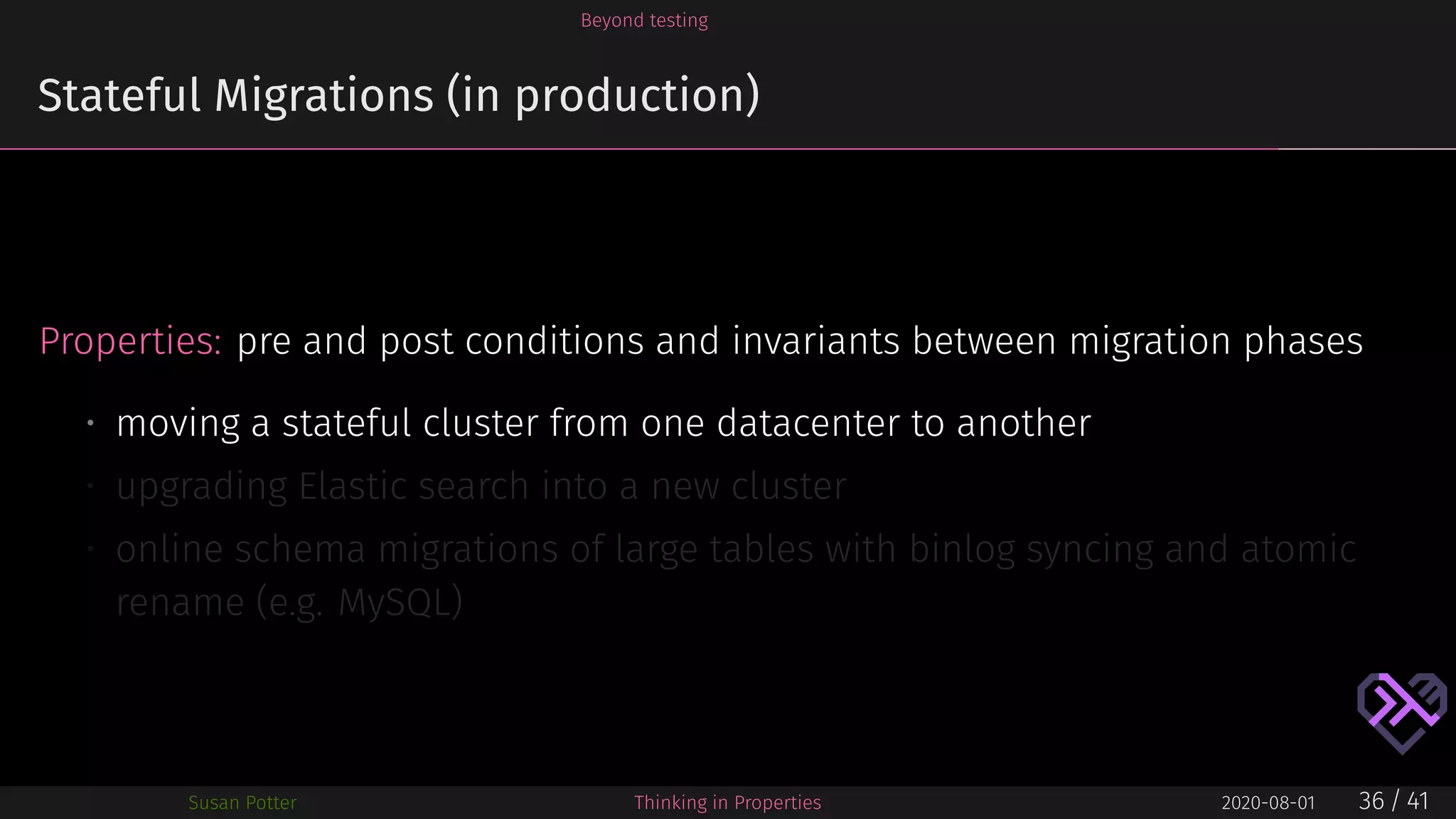
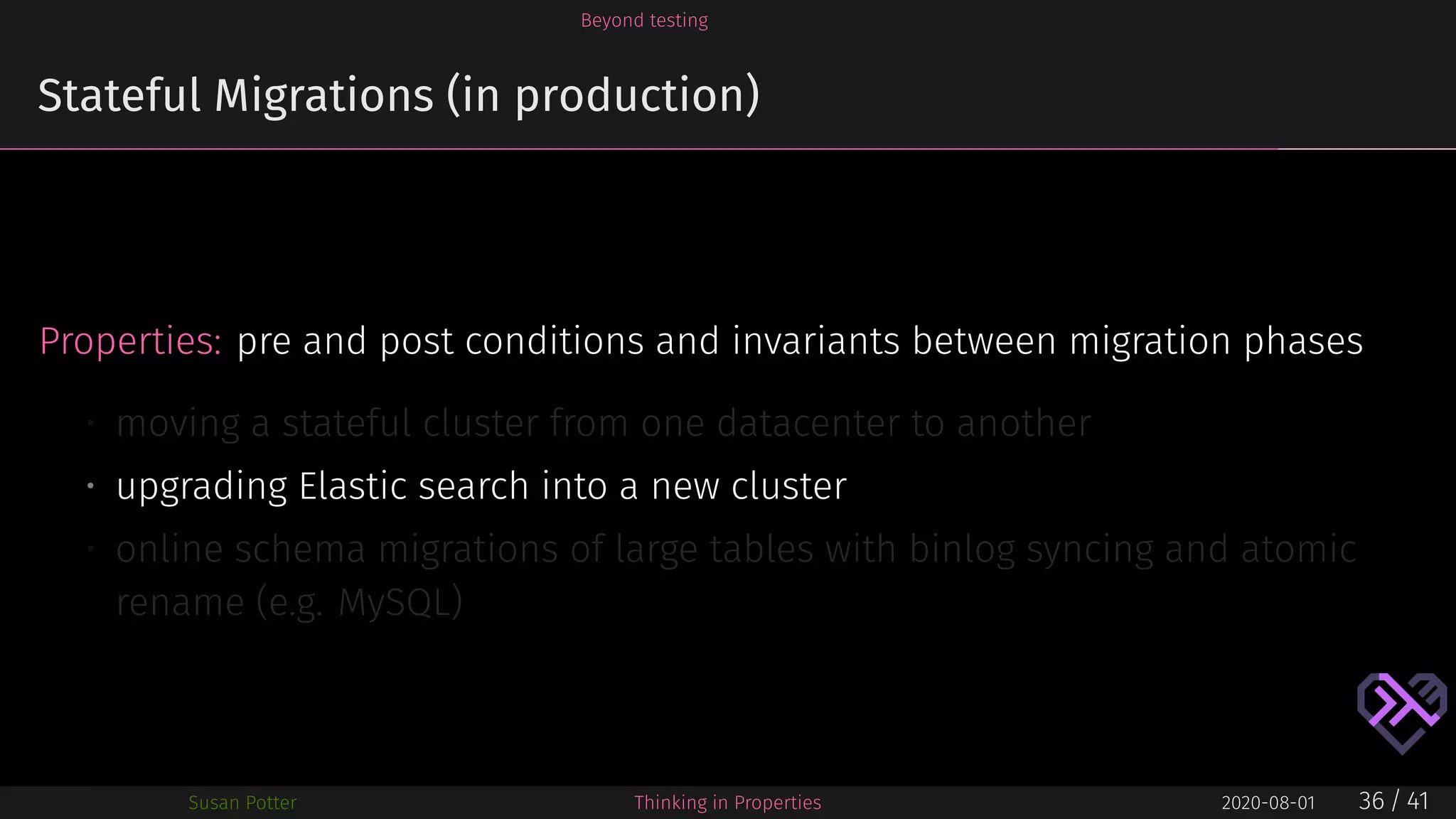
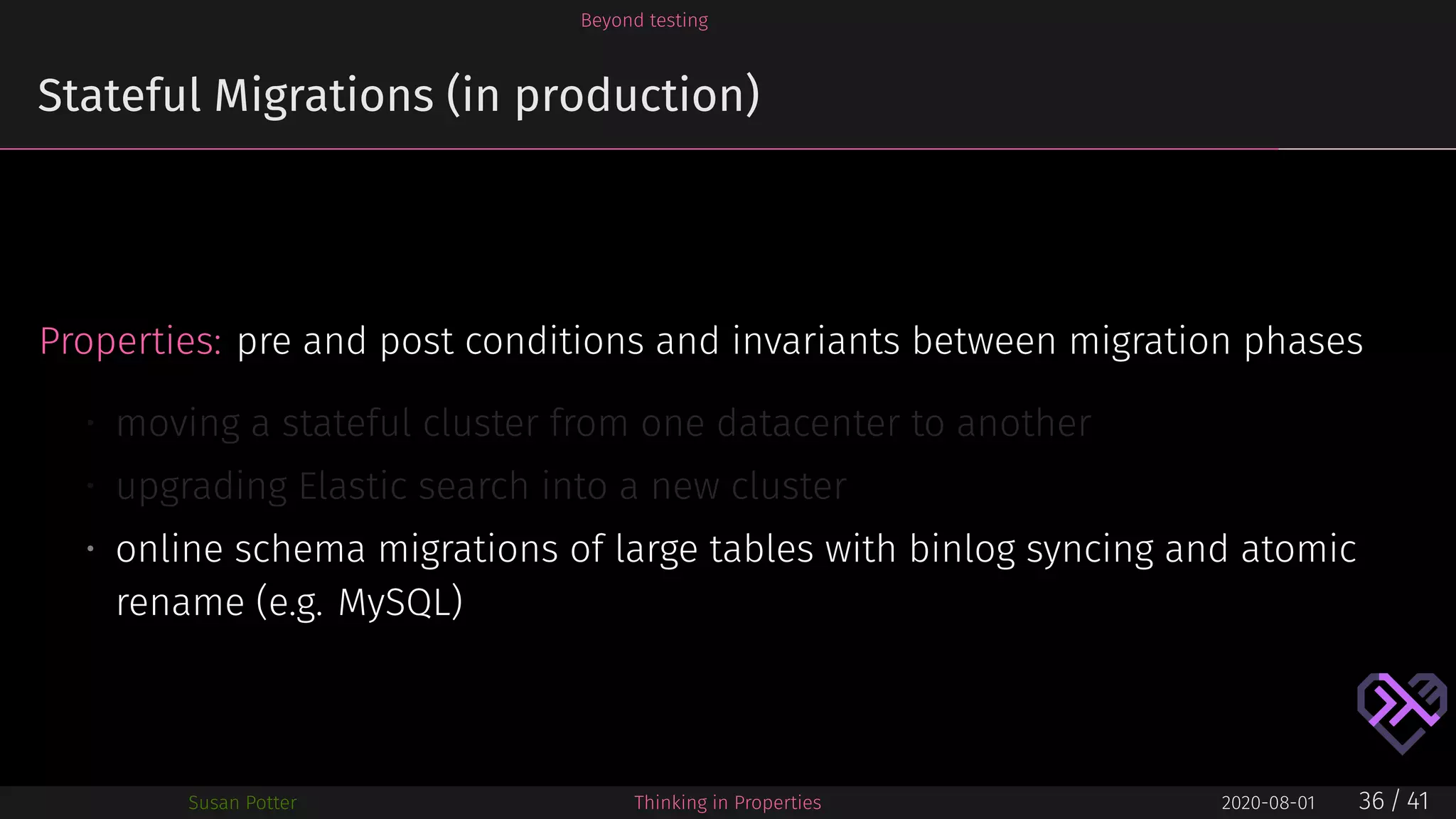
Stateful Migrations (in production)
Properties: pre and post conditions and invariants between migration phases
• moving a stateful cluster from one datacenter to another
• upgrading Elastic search into a new cluster
• online schema migrations of large tables with binlog syncing and atomic
rename (e.g. MySQL)
Susan Potter Thinking in Properties 2020-08-01 36 / 41
Beyond testing
Stateful Migrations (in production)
Properties: pre and post conditions and invariants between migration phases
• moving a stateful cluster from one datacenter to another
• upgrading Elastic search into a new cluster
• online schema migrations of large tables with binlog syncing and atomic
rename (e.g. MySQL)
Susan Potter Thinking in Properties 2020-08-01 36 / 41
Beyond testing
Stateful Migrations (in production)
Properties: pre and post conditions and invariants between migration phases
• moving a stateful cluster from one datacenter to another
• upgrading Elastic search into a new cluster
• online schema migrations of large tables with binlog syncing and atomic
rename (e.g. MySQL)
Susan Potter Thinking in Properties 2020-08-01 36 / 41
Beyond testing
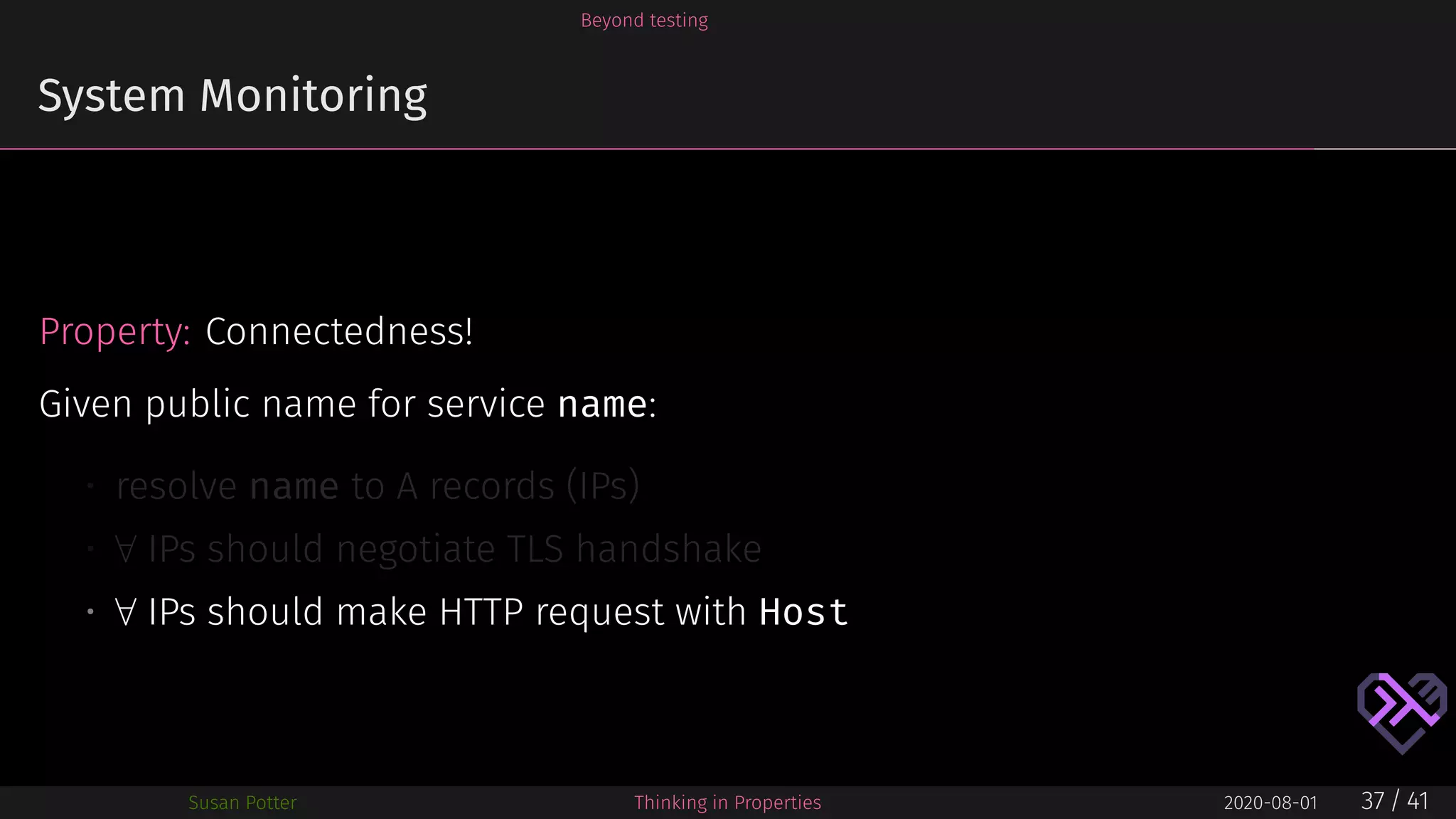
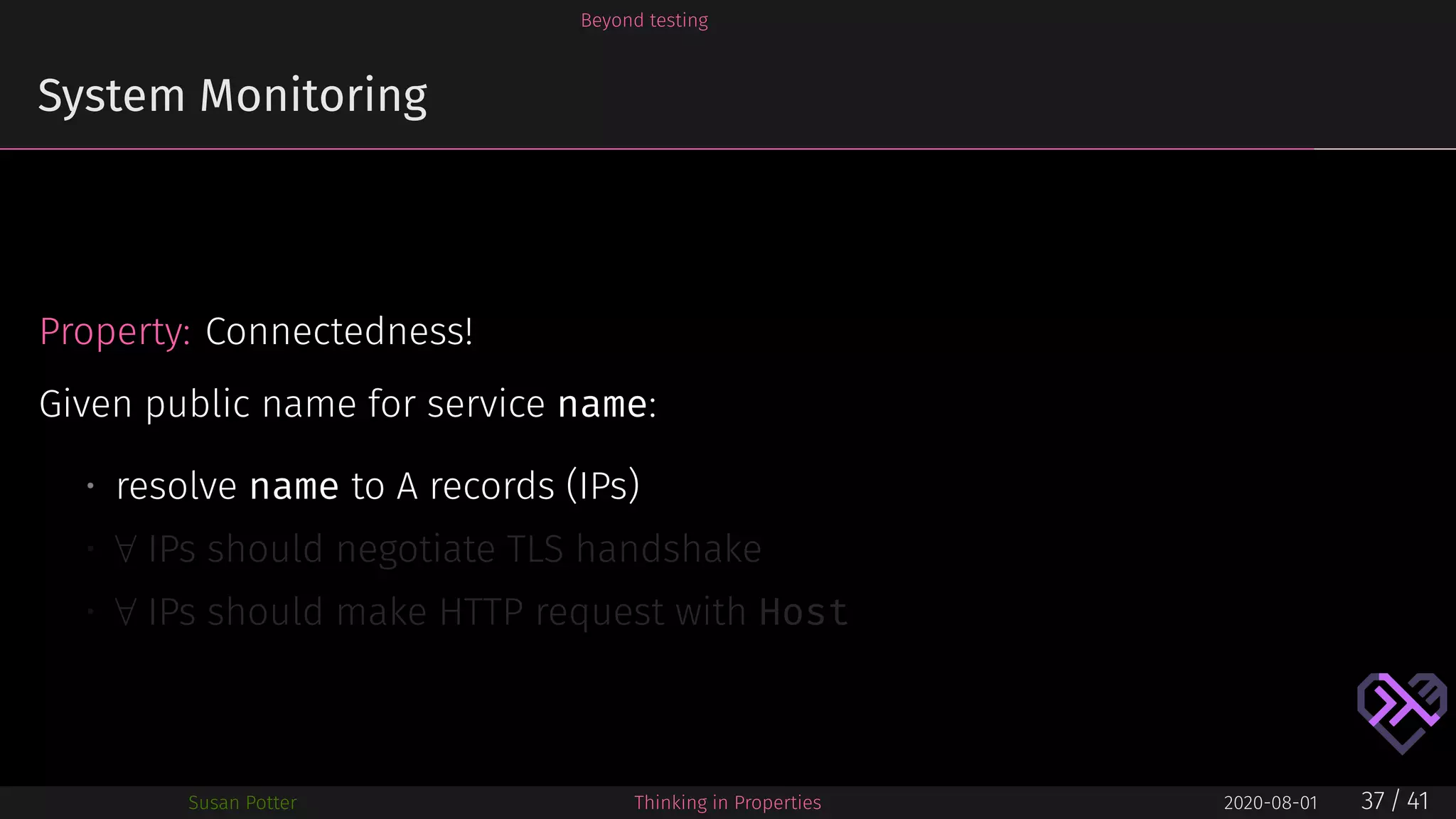
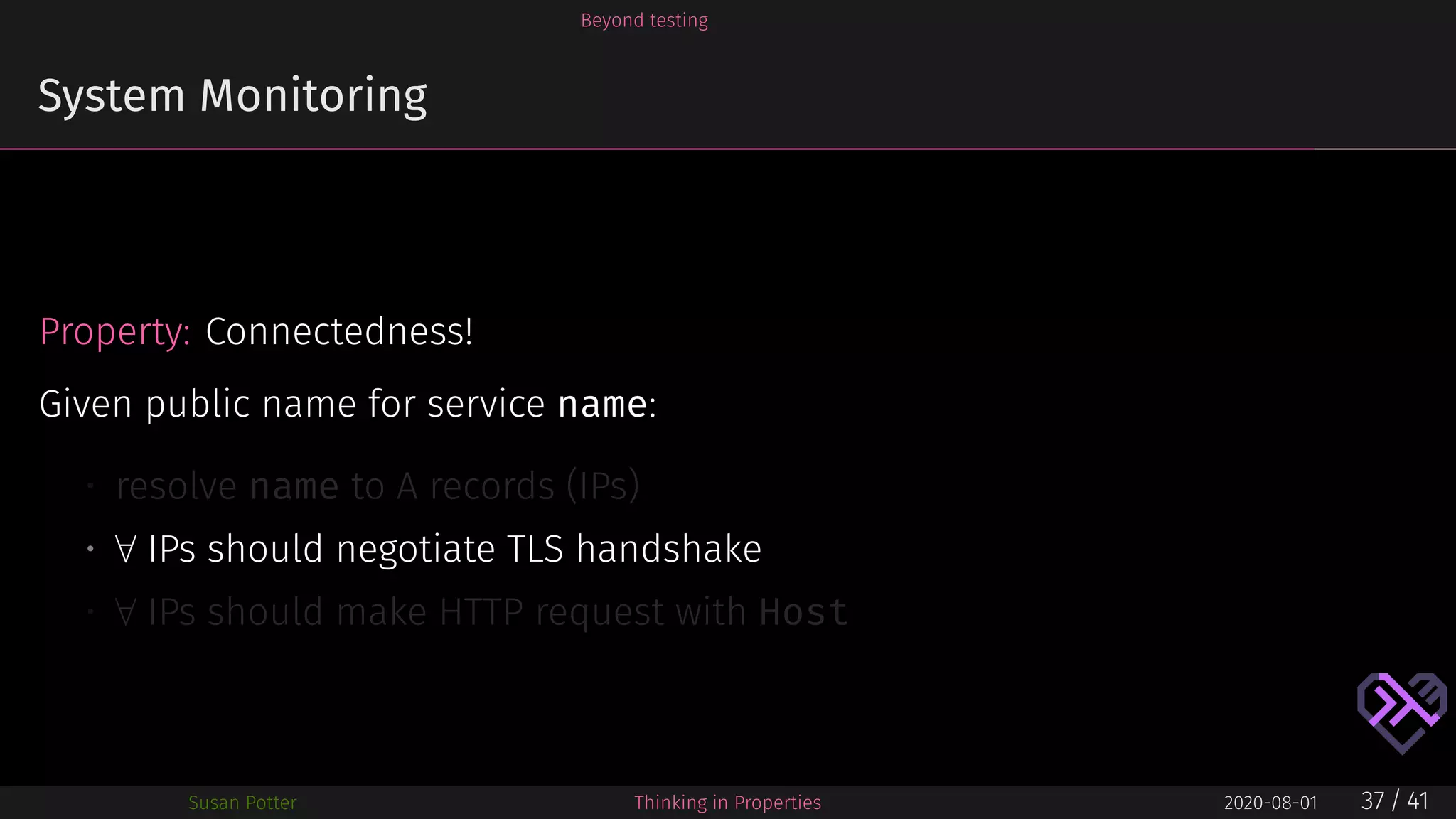
System Monitoring
Property: Connectedness!
Given public name for service name:
• resolve name to A records (IPs)
• ∀ IPs should negotiate TLS handshake
• ∀ IPs should make HTTP request with Host
Susan Potter Thinking in Properties 2020-08-01 37 / 41
Beyond testing
System Monitoring
Property: Connectedness!
Given public name for service name:
• resolve name to A records (IPs)
• ∀ IPs should negotiate TLS handshake
• ∀ IPs should make HTTP request with Host
Susan Potter Thinking in Properties 2020-08-01 37 / 41
Beyond testing
System Monitoring
Property: Connectedness!
Given public name for service name:
• resolve name to A records (IPs)
• ∀ IPs should negotiate TLS handshake
• ∀ IPs should make HTTP request with Host
Susan Potter Thinking in Properties 2020-08-01 37 / 41
Beyond testing
Production Data Checks
Sometimes your generators don’t generate data you see in production!
Legacy systems exist with no property-based testing toolchain!
• Structured logging can record inputs and results; validate OOB
• Run property checks against production inputs and outputs in Haskell :)
Susan Potter Thinking in Properties 2020-08-01 38 / 41
Wrapping Up
Wrapping Up
In Closing
• Not all properties are useful
• Initially hard to think up useful properties
genMentalModels = Gen.choice [
genAlgebraicLaws, genRelationalLaws,
genAbstrationLaws, genStateMachines,
genMetamorphicRelations,
genHeckleYourCode,
genTestingInProduction
]
Susan Potter Thinking in Properties 2020-08-01 39 / 41
Wrapping Up
In Closing
• Not all properties are useful
• Initially hard to think up useful properties
genMentalModels = Gen.choice [
genAlgebraicLaws, genRelationalLaws,
genAbstrationLaws, genStateMachines,
genMetamorphicRelations,
genHeckleYourCode,
genTestingInProduction
]
Susan Potter Thinking in Properties 2020-08-01 39 / 41
Wrapping Up
Questions?
GitHub @mbbx6spp
LinkedIn /in/susanpotter
Twitter @SusanPotter
Web Personal site
Consulting
Training
Thank you for listening!
Susan Potter Thinking in Properties 2020-08-01 40 / 41
Wrapping Up
Credits
• Photo by Elias Castillo on Unsplash
• Photo by Juan Rumimpunu on Unsplash
• Photo by LinkedIn Sales Navigator on Unsplash
• Photo by Leonardo Sanches on Unsplash
• Photo by Mélissa Jeanty on Unsplash
• Photo by Chris Liverani on Unsplash
• Photo by <a href=”https:
//unsplash.com/@spanic?utm_source=unsplash&amp;utm_medium=referral&amp;utm_content=creditCopyText”>Damir Spanic</a>
on <a href=”https://unsplash.com/s/photos/baseball-bat?utm_source=unsplash&amp;utm_medium=referral&amp;utm_content=
creditCopyText”>Unsplash</a></span>
• Photo by <a href=”https:
//unsplash.com/@serrah?utm_source=unsplash&amp;utm_medium=referral&amp;utm_content=creditCopyText”>Serrah Galos</a>
on <a href=”https://unsplash.com/s/photos/reflection?utm_source=unsplash&amp;utm_medium=referral&amp;utm_content=
creditCopyText”>Unsplash</a></span>
• Photo by Sergey Zolkin on Unsplash
• Photo by Roman Mager on Unsplash
• Photo by Miguel Ibáñez on Unsplash
• Photo by Science in HD on Unsplash
• Photo by Steve Douglas on Unsplash
• Photo by Natalie Parham on Unsplash
Susan Potter Thinking in Properties 2020-08-01 41 / 41

Thinking in Properties

  • 1.
    Thinking in Properties AndBeyond (Testing) Susan Potter 2020-08-01
  • 2.
  • 3.
    Intro finger $(whoami) • Introducedto QuickCheck in Erlang ~2010 • Adopted Haskell’s QuickCheck, Hedgehog, and ScalaCheck at work • ”Testing” in production, thinking in properties, 4 years Susan Potter Thinking in Properties 2020-08-01 1 / 41
  • 4.
    Intro Agenda • An OriginStory (with code) • Mental Models (above the code) • Beyond Testing (illustrations) Susan Potter Thinking in Properties 2020-08-01 2 / 41
  • 5.
  • 6.
    An Origin StoryDiscovering Superpowers Susan Potter Thinking in Properties 2020-08-01 3 / 41
  • 7.
    An Origin StoryDiscovering Superpowers Explore domain with types data List a = EmptyList | Cons a (List a) type Pred a = (a -> Bool) type Comp a = (a -> a -> Ordering) sortBy :: Comp a -> List a -> List a filter :: Pred a -> List a -> List a reverse :: List a -> List a last, first :: List a -> Maybe a Susan Potter Thinking in Properties 2020-08-01 3 / 41
  • 8.
    An Origin StoryDiscovering Superpowers Explore domain with usage examples -- | Reverse the elements of a list -- >>> reverse (Cons 1 (Cons 2 (Cons 3 EmptyList)))→ -- Cons 3 (Cons 2 (Cons 1 EmptyList)) -- -- >>> reverse EmptyList -- EmptyList reverse :: List a -> List a Susan Potter Thinking in Properties 2020-08-01 4 / 41
  • 9.
    An Origin StoryDiscovering Superpowers Encode examples as re-runnable tests describe "Lib.reverse" $ do it "returns [5,4,3,2,1] given [1,2,3,4,5]" $ do reverse [1,2,3,4,5] `shouldBe` [5,4,3,2,1] it "returns empty list given empty list" $ do reverse [] `shouldBe` [] Susan Potter Thinking in Properties 2020-08-01 5 / 41
  • 10.
    An Origin StoryDiscovering Superpowers Rinse & Repeat Susan Potter Thinking in Properties 2020-08-01 6 / 41
  • 11.
    An Origin StoryDiscovering Superpowers Continuous Learning Figure 1: Schedule for Erlang Factory SF 2011 where my mind was blown Susan Potter Thinking in Properties 2020-08-01 7 / 41
  • 12.
    An Origin StoryHarnessing Newly Found Superpowers Characteristics of property-based testing Where we have: • generators that produce random ”arbitrary” values for inputs • general rules that hold without knowing inputs upfront • shrinking of failed values • test runs assert rule multiple times using new generated values Related terms: generative testing, fuzz testing (or ”fuzzing”) Susan Potter Thinking in Properties 2020-08-01 8 / 41
  • 13.
    An Origin StoryHarnessing Newly Found Superpowers Characteristics of property-based testing Where we have: • generators that produce random ”arbitrary” values for inputs • general rules that hold without knowing inputs upfront • shrinking of failed values • test runs assert rule multiple times using new generated values Related terms: generative testing, fuzz testing (or ”fuzzing”) Susan Potter Thinking in Properties 2020-08-01 8 / 41
  • 14.
    An Origin StoryHarnessing Newly Found Superpowers Characteristics of property-based testing Where we have: • generators that produce random ”arbitrary” values for inputs • general rules that hold without knowing inputs upfront • shrinking of failed values • test runs assert rule multiple times using new generated values Related terms: generative testing, fuzz testing (or ”fuzzing”) Susan Potter Thinking in Properties 2020-08-01 8 / 41
  • 15.
    An Origin StoryHarnessing Newly Found Superpowers Characteristics of property-based testing Where we have: • generators that produce random ”arbitrary” values for inputs • general rules that hold without knowing inputs upfront • shrinking of failed values • test runs assert rule multiple times using new generated values Related terms: generative testing, fuzz testing (or ”fuzzing”) Susan Potter Thinking in Properties 2020-08-01 8 / 41
  • 16.
    An Origin StoryHarnessing Newly Found Superpowers One General Rule: Round-tripping (two rides gets us back home) Examples: -- Assumes x is encodable and decodable roundtrip0 = x -> decode (encode x) == Just x roundtrip1 = x -> decodeBase64 (encodeBase64 x) == Right x Counter-examples: • sha256 is one way! Susan Potter Thinking in Properties 2020-08-01 9 / 41
  • 17.
    An Origin StoryHarnessing Newly Found Superpowers Introducing generators To make these ideas concrete we will be using hedgehog with these imports: import Hedgehog import qualified Hedgehog.Gen as Gen import qualified Hedgehog.Range as Range import Control.Monad (replicateM) import Data.Function (($), (.)) Hedgehog integrates shrinking with generation. We will not discuss this difference to QuickCheck but read Well Typed’s blog post about this here. Susan Potter Thinking in Properties 2020-08-01 10 / 41
  • 18.
    An Origin StoryHarnessing Newly Found Superpowers Primitive generators by example >>> replicateM 25 $ Gen.sample Gen.lower "okohcpxrkfunkmwnqujnnhxkg" >>> let currencies = [ "USD", "JPY", "EUR", "CHF", "CNY" ] >>> replicateM 5 $ Gen.sample $ Gen.element currencies ["USD","CNY","USD","JPY","USD"] >>> replicateM 5 $ Gen.sample $ Gen.choice [ Gen.ascii, Gen.unicode ]→ ['f', 'c', 'j', '1068213', '<'] Susan Potter Thinking in Properties 2020-08-01 11 / 41
  • 19.
    An Origin StoryHarnessing Newly Found Superpowers Generating your domain’s data, 1/2 Suppose our domain looks like this: import Data.Word (Word8, Word16) type W16 = Word16 data IP = IPv4 Word8 Word8 Word8 Word8 | IPv6 W16 W16 W16 W16 W16 W16 W16 W16 Susan Potter Thinking in Properties 2020-08-01 12 / 41
  • 20.
    An Origin StoryHarnessing Newly Found Superpowers Generating your domain’s data, 2/2 genW8 = Gen.word8 Range.constantBounded genW16 = Gen.word16 Range.constantBounded genIPv4 = IPv4 <$> genW8 <*> genW8 <*> genW8 <*> genW8 genIPv6 = IPv6 <$> genW16 <*> genW16 <*> genW16 <*> genW16 <*> genW16 <*> genW16 <*> genW16 <*> genW16 genAnyIP = Gen.choice [ genIPv4, genIPv6 ] sampleIPs n = replicateM n (Gen.sample genAnyIP) Susan Potter Thinking in Properties 2020-08-01 13 / 41
  • 21.
    An Origin StoryHarnessing Newly Found Superpowers Sampling generated domain data >>> sampleIPs 3 [ "136.59.149.200" , "338d:2397:f612:e036:b27c:2298:4db8:b933" , "5.38.65.204" ] Susan Potter Thinking in Properties 2020-08-01 14 / 41
  • 22.
    An Origin StoryHarnessing Newly Found Superpowers Writing Our First Property! genList :: MonadGen m => m a -> m [a] genList = Gen.list (Range.linear 0 1000) genInt = Gen.int (Range.linear 0 100000) -- "round-tripping" property prop_reverse_reverse = property $ do xs <- forAll $ genList genInt Lib.reverse (Lib.reverse xs) === xs Susan Potter Thinking in Properties 2020-08-01 15 / 41
  • 23.
    An Origin StoryHarnessing Newly Found Superpowers Reviewing Our First Property! Questions about prop_reverse_reverse: • Does it assert anything about reverse ’s specification? • Do callers of reverse need to exploit ”round-tripping”? • Does an implementation exist that typechecks yet fails this property? • Are we generating interesting data given the operation’s type? • Are we resigned to function-level property testing? Susan Potter Thinking in Properties 2020-08-01 16 / 41
  • 24.
    An Origin StoryHarnessing Newly Found Superpowers Reviewing Our First Property! Questions about prop_reverse_reverse: • Does it assert anything about reverse ’s specification? • Do callers of reverse need to exploit ”round-tripping”? • Does an implementation exist that typechecks yet fails this property? • Are we generating interesting data given the operation’s type? • Are we resigned to function-level property testing? Susan Potter Thinking in Properties 2020-08-01 16 / 41
  • 25.
    An Origin StoryHarnessing Newly Found Superpowers Reviewing Our First Property! Questions about prop_reverse_reverse: • Does it assert anything about reverse ’s specification? • Do callers of reverse need to exploit ”round-tripping”? • Does an implementation exist that typechecks yet fails this property? • Are we generating interesting data given the operation’s type? • Are we resigned to function-level property testing? Susan Potter Thinking in Properties 2020-08-01 16 / 41
  • 26.
    An Origin StoryHarnessing Newly Found Superpowers Reviewing Our First Property! Questions about prop_reverse_reverse: • Does it assert anything about reverse ’s specification? • Do callers of reverse need to exploit ”round-tripping”? • Does an implementation exist that typechecks yet fails this property? • Are we generating interesting data given the operation’s type? • Are we resigned to function-level property testing? Susan Potter Thinking in Properties 2020-08-01 16 / 41
  • 27.
    An Origin StoryHarnessing Newly Found Superpowers Reviewing Our First Property! Questions about prop_reverse_reverse: • Does it assert anything about reverse ’s specification? • Do callers of reverse need to exploit ”round-tripping”? • Does an implementation exist that typechecks yet fails this property? • Are we generating interesting data given the operation’s type? • Are we resigned to function-level property testing? Susan Potter Thinking in Properties 2020-08-01 16 / 41
  • 28.
    An Origin StoryHarnessing Newly Found Superpowers Quick Review: Example-based tests over time t ~ 0 → t → ∞ Quick ⌣ →  / ⌢ Coverage ? →  / ⌢ Repeatable ⌣ →  / ⌢ Documents usage  →  / ⌢ Documents contract ⌢ → ⌢ Effort  →  / ⌢ • can measure coverage • fixtures provide test data • interesting fixtures brittle • over time tends to ⌢ Susan Potter Thinking in Properties 2020-08-01 17 / 41
  • 29.
    An Origin StoryHarnessing Newly Found Superpowers Quick Review: Example-based tests over time t ~ 0 → t → ∞ Quick ⌣ →  / ⌢ Coverage ? →  / ⌢ Repeatable ⌣ →  / ⌢ Documents usage  →  / ⌢ Documents contract ⌢ → ⌢ Effort  →  / ⌢ • can measure coverage • fixtures provide test data • interesting fixtures brittle • over time tends to ⌢ Susan Potter Thinking in Properties 2020-08-01 17 / 41
  • 30.
    An Origin StoryHarnessing Newly Found Superpowers Quick Review: Example-based tests over time t ~ 0 → t → ∞ Quick ⌣ →  / ⌢ Coverage ? →  / ⌢ Repeatable ⌣ →  / ⌢ Documents usage  →  / ⌢ Documents contract ⌢ → ⌢ Effort  →  / ⌢ • can measure coverage • fixtures provide test data • interesting fixtures brittle • over time tends to ⌢ Susan Potter Thinking in Properties 2020-08-01 17 / 41
  • 31.
    An Origin StoryHarnessing Newly Found Superpowers Quick Review: Example-based tests over time t ~ 0 → t → ∞ Quick ⌣ →  / ⌢ Coverage ? →  / ⌢ Repeatable ⌣ →  / ⌢ Documents usage  →  / ⌢ Documents contract ⌢ → ⌢ Effort  →  / ⌢ • can measure coverage • fixtures provide test data • interesting fixtures brittle • over time tends to ⌢ Susan Potter Thinking in Properties 2020-08-01 17 / 41
  • 32.
    An Origin StoryHarnessing Newly Found Superpowers Quick Review: Example-based tests over time t ~ 0 → t → ∞ Quick ⌣ →  / ⌢ Coverage ? →  / ⌢ Repeatable ⌣ →  / ⌢ Documents usage  →  / ⌢ Documents contract ⌢ → ⌢ Effort  →  / ⌢ • can measure coverage • fixtures provide test data • interesting fixtures brittle • over time tends to ⌢ Susan Potter Thinking in Properties 2020-08-01 17 / 41
  • 33.
    An Origin StoryHarnessing Newly Found Superpowers Quick Review: Property-based tests initially t ~ 0 Quick ⌣ Coverage ⌣ Repeatable ⌣ Documents usage  Documents contract ⌣ /  Effort ? • Can we measure coverage ? • We need to maintain generators instead of fixtures! • Not constrained by imagination! ⌣ • Am I smart enough to think up relevant and meaningful properties ? Susan Potter Thinking in Properties 2020-08-01 18 / 41
  • 34.
    An Origin StoryHarnessing Newly Found Superpowers Quick Review: Property-based tests initially t ~ 0 Quick ⌣ Coverage ⌣ Repeatable ⌣ Documents usage  Documents contract ⌣ /  Effort ? • Can we measure coverage ? • We need to maintain generators instead of fixtures! • Not constrained by imagination! ⌣ • Am I smart enough to think up relevant and meaningful properties ? Susan Potter Thinking in Properties 2020-08-01 18 / 41
  • 35.
    An Origin StoryHarnessing Newly Found Superpowers Quick Review: Property-based tests initially t ~ 0 Quick ⌣ Coverage ⌣ Repeatable ⌣ Documents usage  Documents contract ⌣ /  Effort ? • Can we measure coverage ? • We need to maintain generators instead of fixtures! • Not constrained by imagination! ⌣ • Am I smart enough to think up relevant and meaningful properties ? Susan Potter Thinking in Properties 2020-08-01 18 / 41
  • 36.
    An Origin StoryHarnessing Newly Found Superpowers Quick Review: Property-based tests initially t ~ 0 Quick ⌣ Coverage ⌣ Repeatable ⌣ Documents usage  Documents contract ⌣ /  Effort ? • Can we measure coverage ? • We need to maintain generators instead of fixtures! • Not constrained by imagination! ⌣ • Am I smart enough to think up relevant and meaningful properties ? Susan Potter Thinking in Properties 2020-08-01 18 / 41
  • 37.
    An Origin StoryHarnessing Newly Found Superpowers Quick Review: Property-based tests initially t ~ 0 Quick ⌣ Coverage ⌣ Repeatable ⌣ Documents usage  Documents contract ⌣ /  Effort ? • Can we measure coverage ? • We need to maintain generators instead of fixtures! • Not constrained by imagination! ⌣ • Am I smart enough to think up relevant and meaningful properties ? Susan Potter Thinking in Properties 2020-08-01 18 / 41
  • 38.
  • 39.
    Mental Models Deriving Properties:Algebraic laws Law What might it be good for Idempotency e.g. event log effects, REST APIs, config effects Associativity e.g. map/reduce distribution Commutativity e.g. map/reduce local parallelism Distributivity e.g. stable or performant rewrite rules Identity element e.g. for invariance at that value for operation Round-tripping e.g. encoding/decoding Absorption e.g. boolean algebra rewrites Transitivity e.g. dependency closures Susan Potter Thinking in Properties 2020-08-01 19 / 41
  • 40.
    Mental Models Algebraic laws:Idempotency (running 1+ times yields same result) Examples: idem0 = x -> abs x == abs (abs x) idem2 = x -> toUpper s == toUpper (toUpper s) • curl -XPUT https://foo.bar/resource/123 -d baz=qux Counter-example: • curl -XPOST https://foo.bar/resource -d baz=qux Algebra: Given x ∈ A and f ∈ (A → A) and f(x) = f(f(x)) then f is idempotent. Susan Potter Thinking in Properties 2020-08-01 20 / 41
  • 41.
    Mental Models Algebraic laws:Associativity (brackets to the left or right) Examples: assoc0 = x y z -> (x + y) + z == x + (y + z) assoc1 = x y z -> (x ++ y) ++ z == x ++ (y ++ z) Counter-example: • (x − y) − z = x − (y − z) Algebra: Given x, y, z ∈ A, ⊕ ∈ (A → A → A) and (x ⊕ y) ⊕ z = x ⊕ (y ⊕ z) then ⊕ is associative. Susan Potter Thinking in Properties 2020-08-01 21 / 41
  • 42.
    Mental Models Algebraic laws:Commutativity (any order will do) Examples: comm0 = x y -> x + y == y + x comm1 = x y -> x * y == y * x Counter-example: • x + +y = y + +x • x − y = y − x Algebra: Given x, y ∈ A, ⊕ ∈ (A → A → A) and $x ⊕ y = y ⊕x then ⊕ is commutative. Susan Potter Thinking in Properties 2020-08-01 22 / 41
  • 43.
    Mental Models Algebraic laws:Distributivity (one operation over another) Examples: dist0 = x y z -> x*(y + z) == x*y + x*z Counter-example: • x + (y ∗ z) = x + y ∗ x + z where x = 1, y = 2, z = 3 1 + (2 ∗ 3) = 1 + 2 ∗ 1 + 3 ⇒ 7 = 6 Algebra: Given x, y, z ∈ A and ⊕, ⊗ ∈ (A → A → A) then ⊗ is distributive over ⊕ when x ⊗ (y ⊕ z) = x ⊗ y ⊕ x ⊗ z Susan Potter Thinking in Properties 2020-08-01 23 / 41
  • 44.
    Mental Models Algebraic laws:Identity element Examples: identity0 = x -> 0 + x == x identity1 = x -> False || x == x identity2 = s -> "" ++ s == s Counter-example: -NonEmpty does not have an identity element Algebra: ∃e ∈ A, ∀a ∈ A, e ⊕ a = a then e is the identity element in A. Susan Potter Thinking in Properties 2020-08-01 24 / 41
  • 45.
    Mental Models Algebraic laws:Absorption Examples: absorption0 = a b -> (a || (a && b)) == a absorption1 = a b -> (a && (a || b)) == a Algebra: Given ∧, ∨ ∈ (A → A → A) and a, b ∈ A then when a ∧ (a ∨ b) = a = a ∨ (a ∧ b) Susan Potter Thinking in Properties 2020-08-01 25 / 41
  • 46.
    Mental Models Deriving Properties:Relational laws -- implicitly expect sort and last to be correct prop_max_is_last_of_sort = property $ do xs <- forAll $ genList Gen.ascii Just (max xs) === last (sort xs) prop_last_is_first_of_reversed = property $ do xs <- forAll $ genList Gen.unicode last xs === first (reverse xs) Susan Potter Thinking in Properties 2020-08-01 26 / 41
  • 47.
    Mental Models Deriving Properties:Abstraction laws Using hedgehog-classes package we can check our typeclass instances according to the abstraction laws: import Hedgehog import Hedgehog.Classes import qualified Hedgehog.Gen as Gen import qualified Hedgehog.Range as Range investmentPortfolioSemigroup = lawsCheck (semigroupLaws genInvestmentPortfolio) portfolioFoldable = lawsCheck (foldableLaws genPortfolio) Susan Potter Thinking in Properties 2020-08-01 27 / 41
  • 48.
    Mental Models Deriving Properties:Reflections, Rotations, Distortions prop_rotated_colors_same = property $ do img <- forAll $ genImage colors (rotate90 img) === colors img • normalizing audio shouldn’t change time length • reversing a list shouldn’t change length Susan Potter Thinking in Properties 2020-08-01 28 / 41
  • 49.
    Mental Models Deriving Properties:Informal model checking Sometimes you can model the basic state machine of a system simply: • model of interesting parts of stateful system • not exhaustive • thinking in state machine models • generate sequence or call graph of commands • assert pre- and post-conditions or invariants • careful you don’t write a second implementation of the SUT just to test it! Susan Potter Thinking in Properties 2020-08-01 29 / 41
  • 50.
    Mental Models Deriving Properties:Legacy oracles Replacing legacy systems: • bind to old lib as oracle • assert new rewritten library matches oracle for same inputs • good for e.g. calculation engines or data pipelines • might need large build engineering effort Susan Potter Thinking in Properties 2020-08-01 30 / 41
  • 51.
    Mental Models Deriving Properties:Does not barf Wrapping lower-level code via FFI: • gaps between foreign input or output types and native types • runtime exceptions thrown for some input values (inform design) • sanity checking FFI wrapping Susan Potter Thinking in Properties 2020-08-01 31 / 41
  • 52.
    Mental Models Deriving Properties:Metamorphic relations • Running against SUT twice with possibly different inputs • A relation exists between those inputs • Assert a relation exists between the outputs of those system runs An example across inputs and outputs, but the relation between inputs and outputs can be different: x, y ∈ Inputs, x ≤ y, x′ = SUT(x), y′ = SUT(y) then x′ ≤ y′ Susan Potter Thinking in Properties 2020-08-01 32 / 41
  • 53.
    Mental Models Deriving Properties:Metamorphic relation patterns • Input equivalence • Shuffling • Conjunctive conditions • Disjunctive conditions • Disjoint partitions • Complete partitions • Partition difference Susan Potter Thinking in Properties 2020-08-01 33 / 41
  • 54.
    Mental Models Deriving Properties:Heckle Yourself! • mutation testing • alter your code until your tests fail • if no tests fail, throw your tests out (curation) • question your assumptions Susan Potter Thinking in Properties 2020-08-01 34 / 41
  • 55.
  • 56.
    Beyond testing Properties ofDelivery Pipelines Property: Source consistency Ensuring fast-forward only ”merges”: main() { local -r mergeBase="$(git merge-base HEAD origin/deploy)" local -r deployHead="$(git rev-parse origin/deploy)" test "${mergeBase}" = "${deployHead}" } set -e main # should exit with 0 for success Susan Potter Thinking in Properties 2020-08-01 35 / 41
  • 57.
    Beyond testing Stateful Migrations(in production) Properties: pre and post conditions and invariants between migration phases • moving a stateful cluster from one datacenter to another • upgrading Elastic search into a new cluster • online schema migrations of large tables with binlog syncing and atomic rename (e.g. MySQL) Susan Potter Thinking in Properties 2020-08-01 36 / 41
  • 58.
    Beyond testing Stateful Migrations(in production) Properties: pre and post conditions and invariants between migration phases • moving a stateful cluster from one datacenter to another • upgrading Elastic search into a new cluster • online schema migrations of large tables with binlog syncing and atomic rename (e.g. MySQL) Susan Potter Thinking in Properties 2020-08-01 36 / 41
  • 59.
    Beyond testing Stateful Migrations(in production) Properties: pre and post conditions and invariants between migration phases • moving a stateful cluster from one datacenter to another • upgrading Elastic search into a new cluster • online schema migrations of large tables with binlog syncing and atomic rename (e.g. MySQL) Susan Potter Thinking in Properties 2020-08-01 36 / 41
  • 60.
    Beyond testing System Monitoring Property:Connectedness! Given public name for service name: • resolve name to A records (IPs) • ∀ IPs should negotiate TLS handshake • ∀ IPs should make HTTP request with Host Susan Potter Thinking in Properties 2020-08-01 37 / 41
  • 61.
    Beyond testing System Monitoring Property:Connectedness! Given public name for service name: • resolve name to A records (IPs) • ∀ IPs should negotiate TLS handshake • ∀ IPs should make HTTP request with Host Susan Potter Thinking in Properties 2020-08-01 37 / 41
  • 62.
    Beyond testing System Monitoring Property:Connectedness! Given public name for service name: • resolve name to A records (IPs) • ∀ IPs should negotiate TLS handshake • ∀ IPs should make HTTP request with Host Susan Potter Thinking in Properties 2020-08-01 37 / 41
  • 63.
    Beyond testing Production DataChecks Sometimes your generators don’t generate data you see in production! Legacy systems exist with no property-based testing toolchain! • Structured logging can record inputs and results; validate OOB • Run property checks against production inputs and outputs in Haskell :) Susan Potter Thinking in Properties 2020-08-01 38 / 41
  • 64.
  • 65.
    Wrapping Up In Closing •Not all properties are useful • Initially hard to think up useful properties genMentalModels = Gen.choice [ genAlgebraicLaws, genRelationalLaws, genAbstrationLaws, genStateMachines, genMetamorphicRelations, genHeckleYourCode, genTestingInProduction ] Susan Potter Thinking in Properties 2020-08-01 39 / 41
  • 66.
    Wrapping Up In Closing •Not all properties are useful • Initially hard to think up useful properties genMentalModels = Gen.choice [ genAlgebraicLaws, genRelationalLaws, genAbstrationLaws, genStateMachines, genMetamorphicRelations, genHeckleYourCode, genTestingInProduction ] Susan Potter Thinking in Properties 2020-08-01 39 / 41
  • 67.
    Wrapping Up Questions? GitHub @mbbx6spp LinkedIn/in/susanpotter Twitter @SusanPotter Web Personal site Consulting Training Thank you for listening! Susan Potter Thinking in Properties 2020-08-01 40 / 41
  • 68.
    Wrapping Up Credits • Photoby Elias Castillo on Unsplash • Photo by Juan Rumimpunu on Unsplash • Photo by LinkedIn Sales Navigator on Unsplash • Photo by Leonardo Sanches on Unsplash • Photo by Mélissa Jeanty on Unsplash • Photo by Chris Liverani on Unsplash • Photo by <a href=”https: //unsplash.com/@spanic?utm_source=unsplash&amp;utm_medium=referral&amp;utm_content=creditCopyText”>Damir Spanic</a> on <a href=”https://unsplash.com/s/photos/baseball-bat?utm_source=unsplash&amp;utm_medium=referral&amp;utm_content= creditCopyText”>Unsplash</a></span> • Photo by <a href=”https: //unsplash.com/@serrah?utm_source=unsplash&amp;utm_medium=referral&amp;utm_content=creditCopyText”>Serrah Galos</a> on <a href=”https://unsplash.com/s/photos/reflection?utm_source=unsplash&amp;utm_medium=referral&amp;utm_content= creditCopyText”>Unsplash</a></span> • Photo by Sergey Zolkin on Unsplash • Photo by Roman Mager on Unsplash • Photo by Miguel Ibáñez on Unsplash • Photo by Science in HD on Unsplash • Photo by Steve Douglas on Unsplash • Photo by Natalie Parham on Unsplash Susan Potter Thinking in Properties 2020-08-01 41 / 41