Humor in Pedagogy: How Ha-Ha Can Lead to Aha!
Author(s): R. L. Garner
Source: College Teaching, Vol. 54, No. 1 (Winter, 2006), pp.
177-180
Published by: Taylor & Francis, Ltd.
Stable URL: http://www.jstor.org/stable/27559255 .
Accessed: 18/11/2014 09:59
Your use of the JSTOR archive indicates your acceptance of the
Terms & Conditions of Use, available at .
http://www.jstor.org/page/info/about/policies/terms.jsp
.
JSTOR is a not-for-profit service that helps scholars,
researchers, and students discover, use, and build upon a wide
range of
content in a trusted digital archive. We use information
technology and tools to increase productivity and facilitate new
forms
of scholarship. For more information about JSTOR, please
contact [email protected]
.
Taylor & Francis, Ltd. is collaborating with JSTOR to digitize,
preserve and extend access to College
Teaching.
http://www.jstor.org
This content downloaded from 63.138.247.2 on Tue, 18 Nov
2014 09:59:24 AM
All use subject to JSTOR Terms and Conditions
http://www.jstor.org/action/showPublisher?publisherCode=taylo
rfrancis
http://www.jstor.org/stable/27559255?origin=JSTOR-pdf
http://www.jstor.org/page/info/about/policies/terms.jsp
HUMOR IN PEDAGOGY
HOW HA-HA CAN LEAD TO AHA!
R. L. Garner
Abstract. Several studies have examined the peda
gogical implications and cautions concerning the use
of humor in teaching. Humor has been associated with
a host of positive physiological and psychological
effects. Researchers have identified that educators who
use humor in their instruction are more positively rated
by their peers and their students; others have suggested
that humor may enhance learning. Although much of
this evidence has been anecdotal, the present study
assesses the impact of curriculum-specific humor on
retention and recall, as well as student evaluations of
the course and the instructor. The appropriate use of
humor in a classroom setting is discussed and cautions
against tendentious humor are addressed.
A
number of articles have alluded to
the benefits of humor in teaching
(Berk 1998; Glenn 2002; Hill 1988; Pollio
and Humphreys 1996). The pedagogical
use of humor has been shown to have both
psychological and physiological effects on
learners. Psychologically, the effects of
humor and laughter have been shown to
reduce anxiety, decrease stress, enhance
self-esteem, and increase self-motivation
R. L. Garner is the associate dean of the College of
Criminal Justice at Sam Houston State University in
Huntsville, Texas.
Copyright ? 2006 Heldref Publications
(Berk 1998). Glenn (2002) suggests that
humor can help an individual engage the
learning process by creating a positive
emotional and social environment in
which defenses are lowered and students
are better able to focus and attend to the
information being presented. Addition
ally, humor can serve as a bridge between
educators and students by demonstrating a
shared understanding and a common psy
chological bond.
Physiologically, humor and laughter can
aid learning through improved respiration
and circulation, lower pulse and blood
pressure, exercise of the chest muscles,
greater oxyg?nation of blood, and the
release of endorphins into the bloodstream
(Berk 1998). In his book, Anatomy of an
Illness as Perceived by the Patient, Nor
man Cousins (1991) strongly touts the
healing effects of laughter and suggests
that humor can reduce anxiety, help relieve
stress, and increase mental sharpness?all
desirable things in pedagogical settings.
Civikly (1986) concludes that there is
a growing body of research relating the
use of humor and its positive effect on
teaching and learning. Students indicate
that humor can increase their interest in
learning, and research has demonstrated
that students who have teachers with a
strong orientation to humor tend to learn
more. According to Dodge and Rossett
(1982), humor as a pedagogical tool can
initiate and sustain student interest and
provide a means to engage in divergent
thinking. Ziv (1983, 1988) found that a
humorous atmosphere in the classroom
positively impacted student scores on
divergent thinking exercises, and
Korobkin (1989) indicated that college
students report that learning is enhanced
by the inclusion of instructionally-appro
priate humor. Hill (1988) suggests that
students will often have better recall of a
message if it is presented with humor.
Several studies (see Berk 1996; Brown
and Tomlin 1996; Bryant, Comisky, and
Zillman 1997; Bryant et al. 1980; Pollio
and Humphreys 1996) and my own
observation as chair of a University
Excellence in Teaching committee find
that students appreciate and enjoy the use
Vol. 54/No. 1 177
This content downloaded from 63.138.247.2 on Tue, 18 Nov
2014 09:59:24 AM
All use subject to JSTOR Terms and Conditions
http://www.jstor.org/page/info/about/policies/terms.jsp
of humor in the classroom. A review of
the teaching portfolios of highly-rated
college faculty and faculty Web pages on
the Internet frequently finds the use of
humor listed as an important component
of their teaching philosophy. College stu
dents asked to describe the positive attrib
utes of good teachers frequently mention
"sense of humor" (Brown and Tomlin
1996; Kelly and Kelly 1982).
Pollio and Humphreys (1996) found
that the connection established between
the instructor and the student was key to
effective teaching. Lowman (1994)
reported that effective college teachers
were most often described as "enthusias
tic," and a strong sense of humor plays a
major role in developing a positive learn
ing environment. Kher, Molstad, and
Donahue (1999) suggest that teaching
effectiveness is enhanced by the use of
appropriate humor that fosters mutual
respect, and humor increases student
receptivity to material by reducing anxi
ety in dealing with difficult material and
has a positive effect on test performance
(Bryant et al. 1980). The positive envi
ronment of a humor-enriched lecture has
even been shown to increase attendance
in class (Devadoss and Foltz 1996;
Romer 1993; White 1992).
Humor should be used cautiously,
however, as it can be a potent medium for
communication or a social impediment in
pedagogical settings (Garner 2003). The
use of humor can be complicated because
it may be highly personal, subjective, and
contextual and we cannot always predict
the way it will be received. Things that
one person might find humorous, ironic,
or funny may be viewed by others as
trite. Everyone has a unique perception
as to what is humorous, so prudence
should be the guiding principle. We iden
tify what we call a "sense of humor" and
like other senses, such as the sense of
taste or smell, people have many differ
ent preferences (Garner 2003). Further,
the effective use of humor is not akin to
mere joke telling. Rhem (1998) found
that some instructors with only average
student evaluations used twice as much
humor as those faculty members who
were more highly rated. For humor to be
most effective in an academic setting, it
must be specific, targeted, and appropri
ate to the subject matter.
Given this background, the present
study will explore the link between humor
and learning. Much of the reported litera
ture in this area suffers from a number of
problems such as: (1) a limited number of
participants; (2) a weak methodology; (3)
primarily limited to elementary-aged chil
dren; or (4) is anecdotal in nature. This
study will address some of these concerns
by more carefully examining the relation
ship of humor as a pedagogical tool and its
impact on learning and retention of infor
mation in a university setting. Measures of
information recall, as well as satisfaction
with the course, the instructor, and the
delivery mechanism, will be assessed.
Specifically, it is predicted that those in the
humor group, as compared to the control
group, will report higher general satisfac
tion ratings with the course and will retain
more information over time.
Method
Participants
Participants were 117 undergraduate
students at a four-year university who vol
unteered to review three one-hour lectures
presented in a distance-education
format.
Materials/Instrumentation
A series of three 40-minute lectures on
the topic of research methods and statis
tics were recorded via Sony digital video
equipment. The topic of statistics was
chosen as students have often identified
this as one of the "dreaded" courses in
college. Researchers considered that if
humor was an effective tool, it could find
a strong alliance here. At the conclusion
of each session, participants were asked
to complete a brief survey to provide their
assessment of the asynchronous video
course delivery. (Asynchronous
courses
are designed so that students can
cover
the material at varying times and speeds,
rather than synchronous delivery, which
occurs at the same time for all class mem
bers.) Questions were presented in a 7
point Likert-type format and addressed
topics relevant to the evaluation of the
material (such as, what was your overall
opinion of this lesson? How well do you
believe it communicated the important
information? What was your impression
of the instructor? Compared to in-class
instruction, how did you like the asyn
chronous video delivery?). This proce
dure was consistent with the purported
purpose of the study. At the conclusion of
the three lectures, all participants were
asked to again rate their assessment of the
asynchronous course delivery, and there
was an additional exercise that required
students to recall content that had been
delivered over the three viewings.
Design and Procedure
To preserve the main objective of the
study, all participants were told only that
they would be reviewing three hour-long
sample lectures presented in an asynchro
nous distance education format. The par
ticipants were told that the university was
considering implementing a new educa
tional format for certain courses on cam
pus, and they would be assisting in this
process. Students were asked to review
the material and were told that they
would be asked to evaluate the delivery
mode and the information presented at
the conclusion of each session.
The participants
were randomly
assigned to one of two groups. Both
groups saw the same digitally video
recorded information on the topic of
research methods and statistics presented
by the same instructor. The humor group,
however, saw a version of the lecture in
which a humorous story, example, or
metaphor had been inserted at the begin
ning of the lecture and at points approxi
mately fifteen and thirty-five minutes into
the lecture, depending on the content.
(This was accomplished thanks to the
media service technicians who produced a
seamless video by "cutting" the humor
segments into the control lecture videos.)
As mentioned above, humor can be very
subjective, so great care
was exercised in
the selection of the humorous material.
The humor material was assessed by a
group of academic judges to insure that
the inset could be considered reasonably
humorous, was appropriate in content, and
was related to the material being covered.
For example, in a segment
on the report
ing of research findings, the metaphorical
joke about a planned escape by one of two
prisoners in a desert jail
was used. The
story finds one prisoner trying to escape
after unsuccessfully persuading the other
to go with him, only learning?after
breaking out?that escape was futile as
there was sand in every direction for hun
178 COLLEGE TEACHING
This content downloaded from 63.138.247.2 on Tue, 18 Nov
2014 09:59:24 AM
All use subject to JSTOR Terms and Conditions
http://www.jstor.org/page/info/about/policies/terms.jsp
dreds of miles. After capture and return to
the cell, the prisoner relates his story of the
failed attempted escape. The other prison
er shares that he knew about the desert as
he had also tried to escape a few years
earlier. Incredulous, the first prisoner
exclaimed, "You knew! Why didn't you
tell me?" whereupon the other remarks,
"Silly man, you should know that no one
reports negative results." Although a bit
"corny," the message makes the point and
was well received by the student audience.
The inserts varied from less than a
minute to approximately two minutes. As
a result, the humor group's video presen
tation was slightly longer than the stan
dard lecture group. Participants were
allowed to sign up to view all three ses
sions over the period of fourteen days.
This allowed inclusion of the greatest
number of participants and provided the
greatest latitude to participant's sched
ules. The final viewing included the eval
uation and recall assessment exercise.
After the conclusion of the experiment
and after all participants had completed
the process of viewing and assessing the
materials, subjects were debriefed via e
mail as to the additional purpose of the
study and the preliminary results
obtained.
Results
Of the 117 subjects who originally
agreed to be involved in the study, ninety
four participated to conclusion. This
resulted in a sample of fifty-three females
and forty-one males who were randomly
assigned to condition. Only participants
who completed all three sessions were
included in the analysis. As a result, there
were forty-two participants in the humor
condition (from the originally assigned
fifty-eight) and fifty-two participants in
the control (from the originally assigned
fifty-nine). There were no significant dif
ferences based on race or gender between
groups. Analysis of variance revealed sig
nificant difference between the two
groups with the humor condition having
higher ratings for overall opinion of the
lesson, F (1, 92) = 21.02, p < .001; how
well the lesson communicated the infor
mation, F (1, 92) = 54.86, p < .001; and
rating of the instructor, F (1, 92) = 43.33,
p < .001. Most important to this research
effort, subjects in the humor group signif
icantly recalled and retained more infor
mation regarding the topic F (1, 92)
=
73.81, p < .001. There was not a statis
tically significant difference in the rating
of the video delivery mode as both groups
rated it positively F (I, 92) = 3.72, p <
.06. Descriptive statistics for all condi
tions can be found in table 1. The first
four items found in the table address the
7-point Likert questions and the final
item is the retention score based on a
maximum value of 100.
Discussion
As indicated above, the topic of
research methods and statistics was cho
sen because students have identified this
as one of the dreaded courses in college
and a class in which humor could be a
strong pedagogical tool. The results sup
port the notion that humor can have a
positive impact on content retention
among a sample of college students.
Although the use of the asynchronous
video delivery might seem somewhat
contrived, this approach was utilized for
two reasons. First, more universities are
moving to distance education and asyn
chronous modes of instructional delivery.
As a result, the format was appropriate,
especially given the explanation to the
participants that this was an evaluation of
this delivery design. Second, and more
important, this approach allowed us to
control for a myriad of subtle and not so
subtle differences that could have been
introduced by the lecturer?despite the
best effort to do otherwise?if the presen
tations were live. This procedure insured
a more consistent presentation and
enhanced methodological rigor across
experimental conditions.
Although a content assessment after
each session was possible, pilot testing
determined that this might jeopardize the
actual focus of the study and, because of
the relatively small timeframe between
viewing the first and third videos, multi
ple assessments of content could intro
duce unwanted bias (such as testing
effects). Further, the end-of-video sur
veys presented at the conclusion of seg
ments one and two were intentionally
kept brief for this same reason.
The present study suggests that humor
can have a positive effect on student
enjoyment and content retention. The use
of appropriate humor can facilitate a more
relaxed atmosphere and provide a cogni
tive break that allows the student to assim
ilate the information (Korobkin 1989).
The use of suitable, content-specific
humorous examples may provide a stu
dent with a new perspective on the mater
ial that may lead to a novel cognitive
insight (Ziv 1988).
Unfortunately, some educators believe
their role or their topic is too serious to
engage humor or view humor as merely a
disruption. However, the use of appropri
ate humor in this study has been shown to
enhance the learning environment and
has a significantly positive impact on
retention of educational materials in a
real-world academic setting. Follow-up
interviews with a random selection of
participants reinforced the notion that the
content-focused humor was helpful in
comprehension of the material, made for
a more enjoyable educational experience,
TABLE 1. Descriptive Statistics
Group N
LESSON Humor 42
Control 52
COMUCATE Humor 42
Control 52
INSTRUCT Humor 42
Control 52
DELJVIETH Humor 42
Control 52
RECALL Humor 42
Control 52
Group statistics
M SD SEM
5.7976 0.65388 0.10090
4.8846 1.14881 0.15931
6.1667 0.85302 0.13162
4.7115 1.01627 0.14093
6.2381 0.65554 0.10115
5.0000 1.06642 0.14789
6.1905 0.70670 0.10905
5.8846 0.80814 0.11207
88.4286 4.57001 0.70517
77.2692 7.34344 1.01835
Vol. 54/No. 1 179
This content downloaded from 63.138.247.2 on Tue, 18 Nov
2014 09:59:24 AM
All use subject to JSTOR Terms and Conditions
http://www.jstor.org/page/info/about/policies/terms.jsp
and created the impression that the
instructor took the extra effort to get the
message across. When properly used,
humor can be an effective tool to make a
class more enjoyable, reduce anxiety, and
improve the learning setting. The "ha-ha"
of humor in the classroom may indeed
contribute to the "aha!" of learning from
the student.
Key words: humor, pedagogy, research
REFERENCES
Berk, R. 1996. Student ratings often strategies
for using humor in college teaching. Jour
nal on Excellence in College Teaching 1
(3): 71-92.
-. 1998. Professors are from Mars, stu
dents are from Snickers. Madison, WI:
Mendota.
Brown, W, and J. Tomlin. 1996. Best and
worst university teachers: The opinion of
undergraduate students. College Student
Journal 30(1): 431-34.
Bryant, J., P. Comisky, and D. Zillman. 1997.
Teachers' humor in the college classroom.
Communication Education 28 (2): 110-18.
Bryant, J., P. Comisky, J. Crane, and D. Zill
man. 1980. Relationship between college
teachers' use of humor in the classroom and
students' evaluations of their teachers. Jour
nal of Educational Psychology 72 (4):
511-19.
Civikly, J. 1986. Humor and the enjoyment of
college teaching. In Communicating in col
lege classrooms. New directions for teach
ing and learning, vol. 26, ed. J. M. Civikly,
61-70. San Francisco: Jossey-Bass.
Cousins, N. 1991. Anatomy of an illness as
perceived by the patient. New York: Ban
tam.
Devadoss, S., and J. Foltz. 1996. Evaluation of
factors influencing class attendance and
performance. American Journal of Agricul
tural Economics, no. 78:499-507.
Dodge, B., and A. Rossett. 1982. Heuristic for
humor in instruction. NSPI Journal, no.
5:11-14.
Garner, R. 2003. Which came first, the chick
en or the egg? A foul metaphor for teaching.
Radical Pedagogy 5 (2). http://radicalpeda
gogy.icaap.org/content/issue5_2/04_garner.
html (accessed May 2003).
Glenn, R. 2002. Brain research: Practical
applications for the classroom. Teaching for
Excellence 21 (6): 1-2.
Hill, D. 1988. Humor in the classroom: A
handbook for teachers. Springfield, IL:
Charles C. Thomas.
Kelly, N., and B. Kelly. 1982. Backgrounds,
education and teaching styles of teaching
award winning professors. ERIC, ED
230080.
Kher, N., S. Molstad, and R. Donahue. 1999.
Using humor in the college classroom to
enhance teaching effectiveness in "dread
courses." College Student Journal 33 (3):
400-06.
Korobkin, D. 1989. Humor in the classroom:
Considerations and strategies. College
Teaching 36 (4): 154-58.
Lowman, J. 1994. Professors as performers
and motivators. College Teaching 42 (4):
137-41.
Pollio, H, and W. Humphreys. 1996. What
award-wining lecturers say about their
teaching: It's all about connection. College
Teaching 44 (3): 101-6.
Rhem, J. 1998. Humor in the classroom.
National Teaching and Learning Forum 1
(6): 10-12.
Romer, D. 1993. Do students go to class?
Should they? Journal of Economic Perspec
tives 1 (3): 167-74.
White, F. 1992. Enhancing class attendance.
National Association of Colleges and
Teachers in Agriculture Journal, no.
36:113-15.
Ziv, A. 1983. The influence of humorous
atmosphere on divergent thinking. Contem
porary Educational Psychology, no.
8:68-75.
-. 1988. Teaching and learning with
humor: Experiment and replications. Jour
nal of Experimental Education 6 (1):
37-44.
180 COLLEGE TEACHING
This content downloaded from 63.138.247.2 on Tue, 18 Nov
2014 09:59:24 AM
All use subject to JSTOR Terms and Conditions
http://www.jstor.org/page/info/about/policies/terms.jspArticle
Contentsp. 177p. 178p. 179p. 180Issue Table of
ContentsCollege Teaching, Vol. 54, No. 1 (Winter, 2006), pp.
171-208Front MatterUnderstanding Student Cheating and What
Educators Can Do about It [pp. 171-176]Humor in Pedagogy:
How Ha-Ha Can Lead to Aha! [pp. 177-180]Quick Fix:
Productively Waiting for Latecomers [pp. 181-181]Online
EducationPreparing Our Teachers for Distance Education [pp.
183-184]The Learning Styles, Expectations, and Needs of
Online Students [pp. 185-189]Strategies for Enhancing Student
Interactivity in an Online Environment [pp. 190-193]The
Investigation of Study Strategies That Maximize Learning for
Underprepared Students [pp. 194-197]An Analysis of
Instructor-Created Crossword Puzzles for Student Review [pp.
198-201]Creating a Space to Learn: A Classroom of Fun,
Interaction, and Trust [pp. 202-206]Commentary: Teaching
Students to Dream [pp. 208-208]Back Matter
Getting a Laugh: Gender, Status, and Humor in Task
Discussions
Author(s): Dawn T. Robinson and Lynn Smith-Lovin
Source: Social Forces, Vol. 80, No. 1 (Sep., 2001), pp. 123-158
Published by: Oxford University Press
Stable URL: http://www.jstor.org/stable/2675534 .
Accessed: 18/11/2014 10:00
Your use of the JSTOR archive indicates your acceptance of the
Terms & Conditions of Use, available at .
http://www.jstor.org/page/info/about/policies/terms.jsp
.
JSTOR is a not-for-profit service that helps scholars,
researchers, and students discover, use, and build upon a wide
range of
content in a trusted digital archive. We use information
technology and tools to increase productivity and facilitate new
forms
of scholarship. For more information about JSTOR, please
contact [email protected]
.
Oxford University Press is collaborating with JSTOR to
digitize, preserve and extend access to Social Forces.
http://www.jstor.org
This content downloaded from 63.138.247.2 on Tue, 18 Nov
2014 10:00:29 AM
All use subject to JSTOR Terms and Conditions
http://www.jstor.org/action/showPublisher?publisherCode=oup
http://www.jstor.org/stable/2675534?origin=JSTOR-pdf
http://www.jstor.org/page/info/about/policies/terms.jsp
Getting A Laugh: Gender, Status, and Humor
in Task Discussions*
DAWN T. ROBINSON, University of Iowa
LYNN SMITH-LOVIN, University of Arizona
Abstract
Humor is a quintessentially social phenomenon, since every
joke requires both a teller
and an audience. Here we ask how humor operates in task-
oriented group discussions.
We use theories about the functions of humor to generate
hypotheses about who jokes,
when and in what situations. Then we use event history
techniques to analyze humor
attempts and successes in six-person groups. Our results
combine to suggest an image of
joking as a status-related activity, with men, high participators,
frequent interrupters,
and those who are frequently interrupted all showing status-
related patterns of humor
use. Wefind substantial time dependence in humor use, in which
humor may serve to
form a status hierarchy early in a group's development and to
dissipate task-related
tension later in the discussion. We use these results, in
conjunction with core insights on
status and emotion from the group processes literature, to
develop a new theory of humor
use in task-oriented groups. The new theory generates
predictions about the content of
humor episodes, which we examine with additional data from
our group discussions.
Consistent with the theory, we find that a higher proportion of
men's humor is
differentiating, while a higher proportion of women's humor is
cohesion-building. We
find the same general pattern with our other status variable,
participation.
Humor is a social phenomenon, since it requires both a producer
and an audience.
But why do people joke? And what determines whether or not
their attempts at
humor are appreciated? Unfortunately, any attempt to analyze
humor risks taking
* The authors thank Charlotte Hudson for laboratory assistance
in the original data collection,
Arthur Williams for creating the transcripts of the videotaped
group discussions, Annette Lee, Brian
Roitman, Suzanne Ryan, and Michelle Wunderlich for help in
coding the humorous events and
Linda D. Molm, Katherine Dindia, Miller McPherson, and two
anonymous reviewers for helpful
comments on earlier versions of this manuscript. An earlier
version of this paper was presented at
the annual meetings of the Southern Sociological Society.
Preparation of this article was supported
by National Science Foundation grants SES 9008951 and SBR
9411157 to the second author.
Direct correspondence to Dawn T Robinson, Department of
Sociology, W140 Seashore Hall,
University of Iowa, Iowa City, LA 52242.
?) The University of North Carolina Press Social Forces,
September 2001, 80(1):123-158
This content downloaded from 63.138.247.2 on Tue, 18 Nov
2014 10:00:29 AM
All use subject to JSTOR Terms and Conditions
http://www.jstor.org/page/info/about/policies/terms.jsp
124 I Social Forces 80:1, September 2001
all of the fun out of the subject. Accepting that risk, we follow
up on a long-dormant
thread in the literature on small group interaction that discusses
when and how
humor is important in task-group discussions (Bales & Slater
1955). We begin by
reviewing the wide-ranging literature that has developed on
humor. Then we discuss
the implications of this literature for group interaction, deriving
predictions about
the actual distribution of humor use among group participants
and the timing of
joke-telling during a task-oriented conversation between
strangers. We test these
predictions by examining the actual distribution and timing of
humorous episodes
during conversations in 29 task-oriented groups. We use our
findings to develop
a new theory about the relationship between status, affect and
humor. Finally, we
take a deeper look at our data to look for patterns that support
or contradict our
new theoretical predictions.
Definitions of Humor
To study the production and appreciation of humor in task
groups, we need to be
able to identify humor events. Unfortunately, humor is a
puzzling phenomenon.
Like beauty, most people believe that they know it when they
see it, yet find it difficult
to define (see literature reviews on attempts to define humor in
McGhee 1979;
Mulkay 1988; Strean 1993; Wilson 1979). In general, theories
about what
constitutes humor are based inductively on examination of
known instances of
humor. Most of these theoretical accounts incorporate some
notion of incongruity
as a necessary component. Humor researchers define verbal
humor as text
composed of at least two overlapping "scripts" or
interpretations (Raskin 1985;
Ruch, Attardo & Raskin 1993; Wilson 1979). Unfortunately, as
Wilson (1979)
points out, this duality of interpretation is a necessary but not
sufficient component
of humor. Effectively, this finding means that content-based
definitions of humor
are not sufficient to identify humorous episodes effectively
when they are embedded
in a larger sample of humorous and non-humorous speech..
Sociologists of humor (e.g., Davis 1979, 1993; Fine 1983,1984)
often rely on
interactional rather than content-based definitions; they often
use either actor's
intent or audience response to identify humor. Fine (1983,
1984), for example,
defines humorous communication as remarks that have as their
intent the creation
of amusement (Fine 1984:84). Therefore, he excludes
unintended humor and
includes failed humor, better allowing for examination of
production of humor
than of its outcome. Following Fine (1984), we will study
humor in the context of
ongoing interaction, and consider humor to be all remarks that
are (apparently)
intended to elicit amusement and/or that have that result.
This content downloaded from 63.138.247.2 on Tue, 18 Nov
2014 10:00:29 AM
All use subject to JSTOR Terms and Conditions
http://www.jstor.org/page/info/about/policies/terms.jsp
Gender, Status, and Humor in Task Discussions / 125
Theories about the Social Functions of Humor
Much of what is written about humor in sociology, psychology,
philosophy,
communications, and medicine involves descriptions of its
functions for either
the individual or the social group (Coser 1959, 1960; Fine 1984;
Mulkay 1988;
Stephenson 1951). So, to understand who uses humor in group
discussions and
under what conditions, we will start by considering the
dominant perspectives on
the social functions of humor. Having a theory about the why
people engage in
humor should allow us to predict who will do so and in what
circumstances.
MEANING-MAKING
One proposal about the function of humor is that it is a
mechanism for defining
reality. Flaherty (1984, 1990) suggests humor serves as "reality
play" by teasing or
toying with reality in such a way that it generates situation-
defining reality
maintenance. Similarly, Fine (1984) proposes that individuals
engage in jocular
interaction in order to define themselves, their interaction
partners and the
interaction situation. Katz (1996) also notes that humor must be
socially
constructed by developing the presumption of intersubjectivity
(in Katz's case,
the shared perspective on the person's reflection in a Parisian
fun house mirror).
Wilson (1979:228) argues that the reality defined by most
humor is fiercely
conservative. According to this view, amusement helps us to
affirm our
conventional views of the world. Analyzing jokes concerning
social and economic
differences, Stephenson (1951) concludes that they function as
control mechanisms,
expressing the common value system and minimizing the notion
of class or status
conflict and consciousness. Murray Davis (Davis 1979, 1993)
argues that, beyond
serving to construct or preserve social meanings, humor
deconstructs social
meaning, thus allowing us better insight into otherwise invisible
structures.
According to Davis "humor separates the joints of the seemingly
seamless social
structure, making them visible" (Davis 1993:313).
HIERARCHY BUILDING
A compatible, but more narrow, version of the meaning-making
function of humor
is the proposal that joking serves to help structure local
interaction hierarchies.
Several theories of humor propose the idea that joking creates
status differentiation
among interacting individuals. Most of these perspectives view
joking as a socially
acceptable form of aggression. Freud (1905) claims that the
entertaining veneer of
the joke compensated for its hostile content.' In a study of
humor among colleagues
in psychiatric staff meetings, Coser (1959, 1960) found support
for the use of
ridicule as social punishment.
One of the most frequently cited theories of humorous
interaction is superiority
theory (LaFave 1972; LaFave et al. 1973). The use of humor
here turns on the
This content downloaded from 63.138.247.2 on Tue, 18 Nov
2014 10:00:29 AM
All use subject to JSTOR Terms and Conditions
http://www.jstor.org/page/info/about/policies/terms.jsp
126 / Social Forces 80:1, September 2001
content of the humor itself. The essence of the theory is that an
individual will use
and appreciate humor when the objects of the humor are in
categories to which
the individual does not belong. This theory is further developed
by Zillman and
Cantor (1976) to suggest that people enjoy humor that targets
members of groups
with whom they do not empathize. Humor typically has a target
or butt, and jokes
tend to be funnier when the good guys win and the bad guys
lose (LaFave 1972).
COHESION BUILDING
In contrast to the view of humor as a form of status
differentiation and veiled
aggression is the argument that humor is a mechanism for
developing social
cohesion. Francis (1994) argues that humor can be seen as an
interpersonal emotion
management technique used to strengthen bonds to the group. In
support of this
idea, after spending seven weeks as a participant observer in a
small organization,
Vinton (1989) concludes that humor was used to create bonds,
rather than do
violence to them. In the context of her field study, she finds that
humor is used as
an equalizer and a harmonizer rather than as a dominance
mechanism.
Seckman and Couch (1989) separate the concepts of jocularity
and sarcasm,
arguing that jocularity is used to invite and affirm solidary
relationships, while
sarcasm can be used for building either solidary or authoritarian
relationships.
According to Seckman and Couch, humor per se is a means of
defining shared
group identities and fostering positive relations. Couch (1992),
like Fine (1984),
stresses the relational nature of humor. Couch defines an
evocative transaction is a
behavioral exchange between actors that elicits an affective
response. He then argues
that humor should be studied as an inherently social
phenomenon, with the unit
of observation being not the individual but rather the evocative
transaction.
TENSION RELIEF
Humor's stress-reducing benefits are widely recognized
(Dienstbier 1995; Lefcourt
& Martin 1986; Martin & Lefcourt 1983; Schacter & Wheeler
1962; White &
Winzelberg 1992). While empirical findings about the precise
relationship between
humor and stress remain complicated (e.g., Kuiper & Martin
1998) and
controversial (see review in White & Winzelberg 1992),
evidence does suggest that
when aroused, individuals laugh more (Schacter & Wheeler
1962) and interpret
humorous stimuli as more funny (Cantor, Bryant & Zillman
1974; Prerost &
Brewer 1977). Laughing appears to reduce psychological stress
(White & Winzelberg
1992).
Bales and Slater (1955) relate the tension-reduction functions of
laughter to
the process of task-group interaction. According to Bales and
Slater, interaction
within most face-to-face task-oriented groups has two important
functions: (1) to
accomplish group goals, and (2) to maintain smooth relations.
Humor helps task-
group members maintain smooth relations by serving as a stress
reducer when the
This content downloaded from 63.138.247.2 on Tue, 18 Nov
2014 10:00:29 AM
All use subject to JSTOR Terms and Conditions
http://www.jstor.org/page/info/about/policies/terms.jsp
Gender, Status, and Humor in Task Discussions / 127
pressures of task accomplishment begin to build. As the
intensity of the task-related
interaction climbs, so does the interpersonal stress within the
group. Thus,
periodically a member of the group will momentarily leave the
task and make some
remark that brings laughter and relief to the other group
members; then the group
will return to task refreshed and refocused. Sacks (1974) calls
these departures from
task activity "side sequences," and notes that humor often takes
this form in a task
discussion. Recent experimental research supports Bales's and
Slaters's ideas,
finding that exposure to humor increases energy, leads to more
positive appraisal
of tasks, and generates greater willingness to perform effortful
tasks, although does
not necessarily increase performance (Dienstbier 1995).
These functional theories of humor have implications for our
central questions:
who will use humor in task groups, with what success, and when
will these
humorous episodes occur? In addition, there is an empirical
literature that looks
at how individual characteristics shape humor production and
appreciation. Since,
as sociologists, we know that individual characteristics often
relate to behavior
because of the social positions that they signal, we turn now to
this literature for
additional insights about our research questions.
Evidence about Participation in Humor
WHO JOKES?
According to the hierarchy-building theories of humor described
above, individuals
higher (or aspiring to be higher) in the local hierarchy should
employ more humor
than those of lesser status or power. Unfortunately, there is
little research on
spontaneous joking that relates status difference to the
production of humor. This
is one of the gaps that we hope to fill in the literature. In an
exhaustive review of
the humor research literature, McGhee (1971) noted that less
than 10 percent of
humor studies dealt with humor creation or production. In our
review of the
literature since 1971, we see little departure from this general
pattern. One
exception is the study of gender.
A frequent claim is that men tell more jokes than women
(McGhee 1979). In
describing feminine speech style, Robin Lakoff suggests that
women "have no sense
of humor" (1975:56); they neither effectively tell nor "get"
jokes. McGhee (1976)
reports that children begin exhibiting these gender differences
in joke telling around
age six. More recent studies give some reason for qualifying
these older patterns,
however. Some researchers point out that both much of the
research on gender
differences in humor production and appreciation has been
based on a male mode
of humor- jokes that are often hostile or sexual in content (see
reviews by
Crawford 1995; and Lundell 1993). If so, researchers are not the
only ones guilty
of this bias. In self-report questionnaires, Crawford (1995)
found that men
This content downloaded from 63.138.247.2 on Tue, 18 Nov
2014 10:00:29 AM
All use subject to JSTOR Terms and Conditions
http://www.jstor.org/page/info/about/policies/terms.jsp
128 / Social Forces 80:1, September 2001
evaluated their own sense of humor more positively than women
evaluated theirs.
She also found that when asked to write about someone who has
an excellent sense
of humor both men and women chose more often to write about
a male (although
men chose men by 5:1 and women chose men by only 2:1).
WHO LAUGHS?
For someone to be funny, another must be amused (Sacks 1974;
Fine 1984). Just
as attention is a necessary requisite of power (Derber 1979),
supportive or
unsupportive responses also make or break attempts at humor.
In this sense, the
act of laughing (or not), then, is a potentially powerful one. For
example, Derks,
Kallard and Etgen (1995) report that a joker that does not "get a
laugh" is
subsequently rated more negatively and is considered to be
more aggressive.
Superiority theory (La Fave 1972) predicts that we are more
likely to appreciate
humor when it enhances, rather than denigrates, our own
position relative to others.
However, if laughing is a social response, we might expect
laughter from those who
support (wish to enhance the position of) the joke teller.
Consequently, we will
attempt to describe separately research concerning who
appreciates humor and who
laughs (see more extensive reviews of literature on humor
appreciation in LaFave
1972; Lakoff 1975; Zilmann & Cantor 1976).
Findings about humor appreciation are far from consistent.
Again, gender has
been a favorite topic. Some research suggests that women
generally undervalue
humor, as compared to men (Chupchick & Leventhal 1974;
McGhee 1971, 1979),
while more recent studies suggest that women are generally
more appreciative
(Lundell 1993). Recent research also suggests that men and
women may appreciate
different kinds of humor (Crawford 1995; Lundell 1993;
Mundorf et al. 1988).
Mundorf et al. (1988) assess men's and women's reactions to
hostile, nonsensical,
and sexual humor; they find that men have a higher appreciation
for humor overall,
and interaction effects show that men particularly enjoy sexual
humor more than
women. Women only enjoy hostile humor when men are the
victims.2 Yet other
studies find no gender differences, however. In a study of
humor use as a coping
mechanism, Lefcourt and Martin (1986) find no gender
differences in reported
liking for humor or in the stress reducing effects of humor.
Other than gender there has been little attention to who enjoys
humor. Stress
researchers suggest a relationship between amusement and
reduced stress (Lefcourt
& Martin 1986; Martin & Lefcourt 1983), increased sociability
and healthier self-
concepts (Kuiper & Martin 1993). However, this research
confounds production
and appreciation of humor into a generalized of "sense of
humor."
Notably, none of the previously described research on humor
appreciation
focuses on conversational humor. However, several studies
point out systematic
differences in the patterns of laughter during conversational
interactions. In a
comparison of humorous interaction between dyads and groups
of larger than two,
Glen (1989) notes that when a member of a dyad jokes, he or
she is the first to
This content downloaded from 63.138.247.2 on Tue, 18 Nov
2014 10:00:29 AM
All use subject to JSTOR Terms and Conditions
http://www.jstor.org/page/info/about/policies/terms.jsp
Gender, Status, and Humor in Task Discussions / 129
laugh. The typical pattern is for the partner to then join in the
laughter, sharing the
humor and showing support for the speaker. However, in groups
larger than two,
the typical pattern is for a group member other than the speaker
to be the first to
laugh, and then for the speaker and remaining group members to
join in the mirth.
In fact, Glen finds that when a speaker in a group of larger than
two laughs at his
or her own joke first, it actually decreases the probability that
the joke will be
perceived as funny by the group.
Women laugh more than men in group conversations (Dovidio et
al. 1988,
Dovidio & Ellyson 1982) as well as display lower levels of
nonverbal dominance.
Laughter and smiling appear to be highly supportive
conversational behaviors in a
small group setting. Interestingly, the issue of what is being
supported is seldom
examined in these studies of group conversation. That, of
course, would require
attention to timing and sequences of actions. We now turn to the
limited literature
on these topics.
The Timing of Humor
Timing is everything. The notion that effective delivery of a
joke often hinges on
timing is so accepted that humor researchers state it as truth,
rather than examining
it empirically. Timing issues related to sequencing have
received a little more
empirical attention. Conversational analysts identify a tendency
to "joke-first" or
give a humorous response before responding seriously to
another's utterance (Sacks
1974; Norrick 1993). Others note the importance of seriality
and joke order in the
appreciation of humor (e.g., Forabosco 1994). Because so little
humor research
examines its spontaneous occurrence (Norrick 1993), there is
little systematic
evidence about its placement within conversation or its
contagious effects. In this
study, we consider the importance of the timing of jocular
interactions through
the course of ongoing conversations and with respect to other
jocular interactions.
Our analyses of timing are exploratory in large measure, since
so little theoretical
work has been done. With regard to other variables available in
our data set, we
can specify patterns that would be implied by, or consistent
with, the theoretical
orientations toward the functions of humor.
A Summary of Predictions from Previous Literature
GENDER
If humor use is status or power related (as in the hierarchy-
building perspective),
we would expect that men would joke more than women in
mixed sex
conversations, and would be more likely to have their jokes
appreciated by the other
This content downloaded from 63.138.247.2 on Tue, 18 Nov
2014 10:00:29 AM
All use subject to JSTOR Terms and Conditions
http://www.jstor.org/page/info/about/policies/terms.jsp
130/ Social Forces 80:1, September 2001
members of the group.' The other perspectives on the functions
of humor provide
us with no obvious expectations about the relationship between
gender and joking.
GENDER COMPOSITION
Both the hierarchy building and the meaning-making
perspectives would lead us
to predict that humor use should be more prevalent in single-
gender groups. It is
these groups that require the most work in terms of defining the
situation, since
there is less the status differentiation among group members.
Conversely, both the
cohesion-building and the tension-relief accounts of humor use
would suggest
that rates of joking would be higher in mixed-gender groups.
These groups begin
with more of a hierarchical structure in place and might be
expected to have a
greater need for both solidarity-building and tension-relieving
activities.
PARTICIPATION HISTORY
Higher status group members contribute more frequently to
group discussions
(see a recent review in Skvoretz & Fararo 1996). If humor is a
way of establishing
and enacting hierarchical relations, then we would expect that
high participators
will joke at a higher rate, and that they will also be more
successful at eliciting
laughter from others. The other perspectives suggest no clear
predictions for the
effects of participation on rates humor use.
INTERRUPTION HISTORY
Researchers often interpret interruptions as a sign of status or
power (Kollock et
al. 1985, Smith-Lovin & Brody 1989; Johnson 1994).
Correspondingly, if humor
use is hierarchical in nature, we would expect those who get
interrupted frequently
to make fewer jokes than those who are not interrupted. We also
would expect that
those who interrupt others more frequently might be more likely
to joke as well.
Again, the cohesion-building, meaning-making, and tension-
relief perspectives
make no clear predictions relating individual status cues and the
use of humor.
TIMING IN CONVERSATION
Theories that rely on the notion of humor as a meaning-defining
mechanism, a
hierarchy-building strategy, or a means of increasing group
solidarity, would all
predict that humor use would be highest at the beginning stages
of a task discussion
among strangers. It is at this stage of the conversation that there
is more relationship
defining work to be done. In contrast, the conception of humor
as a pressure valve
to reduce built-up tensions, suggests that the highest rates of
humor should be
during the latter part of the conversation when task activity is
heated up and time
constraints are more salient.
This content downloaded from 63.138.247.2 on Tue, 18 Nov
2014 10:00:29 AM
All use subject to JSTOR Terms and Conditions
http://www.jstor.org/page/info/about/policies/terms.jsp
Gender, Status, and Humor in Task Discussions / 131
CONTAGION
The notion that humor is contagious is a pervasive and
intuitively appealing one.
It is consistent with any of the theoretical perspectives
discussed here, but is not
directly predicted by any of them. Because our intuitions lead
us to expect that
humor use will be contagious, we will use methods that allow us
to model and
control for this possibility.
Data
We analyze incidence of humor during conversations in 29 six-
person discussion
groups. The data were originally collected in the early 1980s at
the University of
South Carolina (see a filll description of the data collection and
transcripts in Smith-
Lovin 1990b). The participants are Anglo undergraduates
between the ages of 17
and 25 enrolled in introductory sociology.2 There are
approximately four groups
in each of seven gender-composition conditions (all female, one
to six men).
Group members are seated randomly around a round table while
a gender-neutral,
collectively-oriented task stimulates group discussion. The task
is to generate a
new problem for another task group to solve. The new problem
must meet a
number of criteria, which were originally developed by Fisek
(1974). We use
transcripts created from two videotapes that were made of each
group discussion,
which include notations of group and individual laughter. Many
other researchers
analyze these task-oriented group discussions (see review in
Skvoretz & Fararo
1996), focusing primarily on the status-organizing processes
that shape participation
and interruption. We differ from earlier analyses by focusing on
the speech turn
as the unit of analysis, by using dynamic models to examine the
relational character
of the conversational events, and, of course, by our focus on the
role of humor in
the conversations.
MEASUREMENT
Following Couch's (1992) admonition, our unit of analysis is
the "evocative
transaction" - in this case, the offering of a joke and its
reception by others. Our
observations consist of speaker turns, with our focus on
humorous speaker turns.
Each observation includes information about the group setting,
the speaker, the
conversational history of the speaker and of the group, the
humorous nature of the
turn (humorous versus non-humorous), the response to the
humor, etc. In this
way, our unit of analysis is truly an interaction, rather than an
individual.
We code three types of humorous events: (1) speaker turns that
produced group
laughter immediately afterward; (2) speaker turns followed by
laughter of the
speaker, but not the group; and (3) speaker turns that contained
other obvious
instances of exaggerated, incongruous, or sarcastic statements
intended by the
This content downloaded from 63.138.247.2 on Tue, 18 Nov
2014 10:00:29 AM
All use subject to JSTOR Terms and Conditions
http://www.jstor.org/page/info/about/policies/terms.jsp
132 I Social Forces 80:1, September 2001
speaker to be humorous. In the final data, turns like type (3)
above are only
considered humorous when four undergraduate coders
unanimously agree that
the turn was intended to be humorous.3 Humor attempts include
all three
categories of events: remarks that lead to group laughter,
remarks that are followed
by speaker laughter, and remarks that all four coders agreed
were humor attempts
but which did not lead to laughter. We consider only remarks
that produced laughter
by group members other than the speaker to be successful
humor.4 Humor attempts
that evoke either no laughter or laughter only by the speaker are
coded as failed
humor attempts. All utterances that were not humor attempts
and did not lead to
laughter are coded as non-humor.
To measure the length of spells, we first count the number of
words spoken
between each speaker transition. When trying to understand the
dynamics of these
task-oriented discussions, the amount of speech that occurs
during any given period
(word-time) is a more substantively appealing measure of time
than the number
of seconds that elapse during that period (clock-time). Use of
clock-time to measure
interactional dynamics results in inflated participation measures
for those who
speak slowly. Previous research suggests that high status
members actually talk faster
(Rashotte & Smith-Lovin 1997). We believe that speakers
accumulate local histories
through the quantity and character of participation, rather than
through literal floor
time. For these reasons, we believe that the dynamics of
contagion and group phases
can best be revealed by looking at the number of words spoken
in a turn.
We construct two dependent variables: (1) conversation
duration - the
number of words between the beginning of the conversation and
each humorous
event and (2) spell duration - the number of words between each
humorous event.
In addition, we constructed a state variable that could take on
one of three values
(1) failed humor attempts, (2) successful humor attempts, and
(3) nonhumorous
remarks. The conversation duration variable allows us to
examine the timing of
humor use across the course of the conversation. The spell
duration variable allows
us to examine the relationships among humor events within the
conversation
(e.g., whether one humor attempt leads to others). The state
space variable allows
us to examine the effects of covariates on the rate of humor use
in the conversations.
Methods and Results
We use continuous-time event history methods to analyze the
data. These methods
model the effects of covariates on the rate of transitions
between states (Tuma &
Hannan 1984). In all, there are 5640 speaker turns, consisting of
5265
nonhumorous turns and 375 humor attempts in the 29
conversations. Almost half
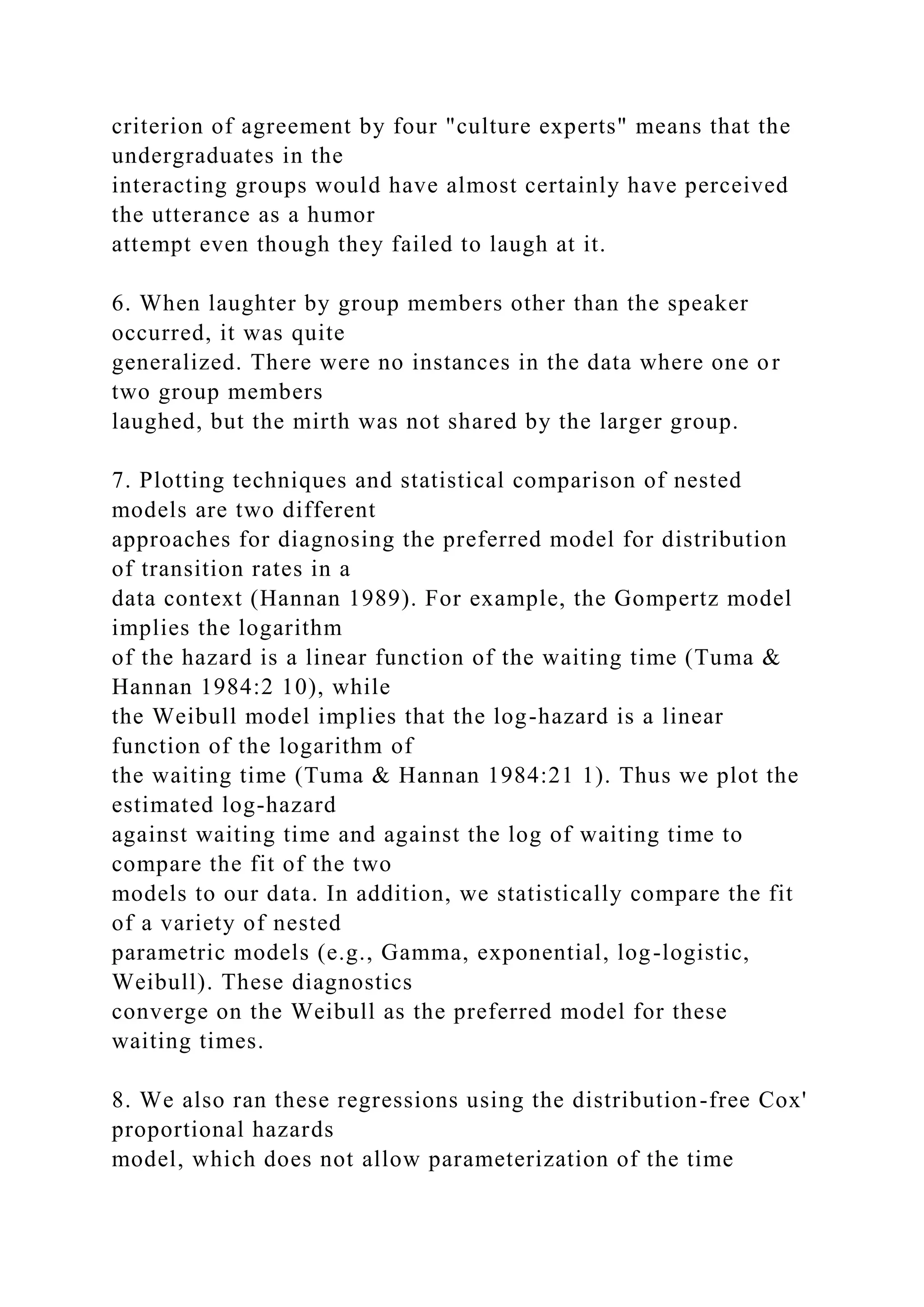
of the humor attempts are successes, by our criterion of group
laughter. The average
number of humorous turns per conversation is about 13 and the
average per speaker
is about two.
This content downloaded from 63.138.247.2 on Tue, 18 Nov
2014 10:00:29 AM
All use subject to JSTOR Terms and Conditions
http://www.jstor.org/page/info/about/policies/terms.jsp
Gender, Status, and Humor in Task Discussions / 133
We denote the state-space as a variable Y(t) which can take on
three values
indicating the state being occupied by a conversing group at a
given time t. To
model the rate of transition between these states, we estimate
the hazard of humor
attempts and successes, which can be described as the
probability of a transition
from state j to state k during an interval t + dt, given the
occupation of state j during
time t. This rate has the following form:
h(t) = limPr[Y(t+At) = k I Y(t) = f]
At->O
where h(t) is the hazard of an event at time t, Y(t) indexes the
state of the
conversation at time t, and k and j are values of Y(t).
We investigate the possibility of time dependence across the
course of the
conversation with a variety of plotting techniques (Hannan
1989) and model fitting
strategies (Allison 1995). We begin by using non-parametric
Kaplan-Meier hazard
rate estimates to look descriptively at the use of humor over the
course of the
conversation and at humor contagion. The two forms of our
dependent variable
- duration of nonhumorous group conversation and duration of a
non-humorous
spell of talk by a speaker - allow us to examine the two separate
types of dynamic
processes in these interactions. By looking at the rate of humor
across the duration
of the conversation, we can examine the humor trends over
time. By looking at
the time dependence of the spell duration we can look the
inhibiting or contagious
effects of a joke on subsequent humor.
Humor across the Conversation
The average group discussion is approximately 2000 words
long. Figure 1 displays
the estimated hazard rates for humor across the course of the
conversation. These
hazard estimates control for the actual number of speaker-turns
during each of
these periods and generate an assessment of the risk of a given
remark being
humorous at different points in the discussion. As seen in
Figure 1, the risk of
joking seems to increase steadily across the conversation, after
a brief flurry of jokes
at the beginning. Plots of the estimated log-hazards against the
logarithm of
conversation duration reveal an approximate linear pattern,
suggesting a Weibull-
distributed time dependence.1 Consequently, we used Weibull
models for the
regressions reported in this article.2
The Weibull model specifies that the rate of transitions is a
power function of
the waiting time (Tuma & Hannan 1984:21 1). A generalized
Weibull model allows
for the regression of a vector of measured covariates, a on the
log of the waiting
time:
log T =-BAx + oW
where o is a scale factor, and W is the extreme-value
distribution (Kalbfleisch &
Prentice 1980: 31-2). The scale factor o is inversely related to
time dependence ii
(Hannan 1989). fi tells us about the character of the time
dependence in the data.
This content downloaded from 63.138.247.2 on Tue, 18 Nov
2014 10:00:29 AM
All use subject to JSTOR Terms and Conditions
http://www.jstor.org/page/info/about/policies/terms.jsp
134/ Social Forces 80:1, September 2001
FIGURE 1: Risk of Humor Across the Conversation
0.0005 -
0.0004
03
0.0003 -
. 4
a0.0002 -
(1-0.0001
0 I~
20 200 500 1100 1700 2300
0 50 350 800 1400 2000
Words Between Humorous Remarks
If A < 1 then the rate is a monotonic decreasing function of the
waiting time; if
A = 1 then the rate is independent of waiting time, and if n > 1
then the rate is a
monotonic increasing function of the waiting time.
Contagion
We also examine the possibility of spell duration dependence,
or humorous
contagion, with the same plotting and regression techniques. In
these analyses, we
model time dependence within spells, rather than over the
duration of the
conversation. Like the models of duration of conversation, the
Weibull model seems
to be the best fit for the dynamics of humor rates in these
conversations. In contrast
to the timing over the entire course of the conversation, the rate
of humorous
remarks appears to be a decreasing function of spell duration
(scale factor 3.33,
duration dependence estimate 1/3.33 = 0.30). In other words,
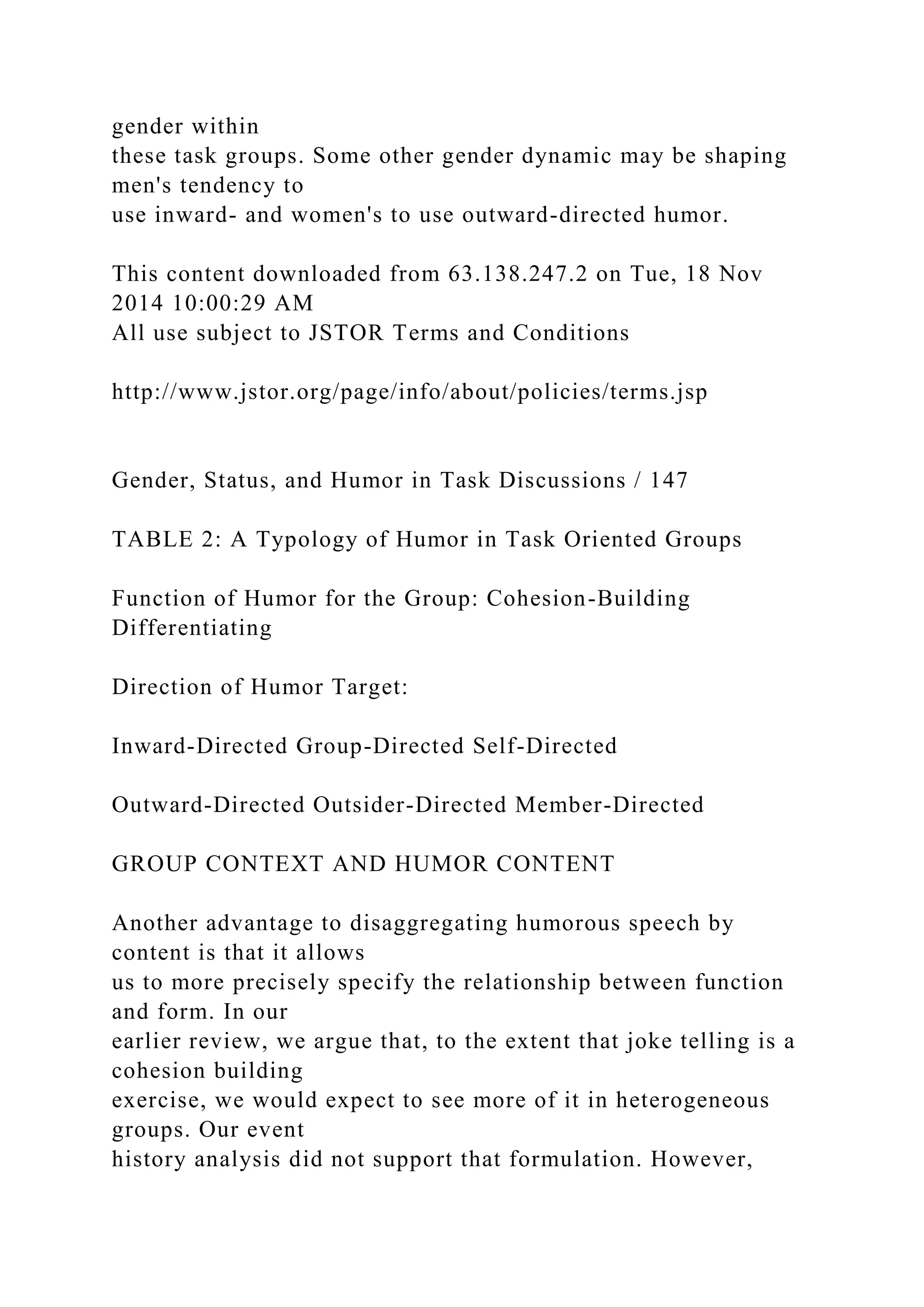
there is a strong
contagion effect of humorous remarks; a humorous remark
increases the probability
of another humorous remark in the near future. Figure 2
illustrates the form of
this contagion effect by plotting the Kaplan-Mayer hazard rate
estimates over the
course of a spell. The risk of a joke is clearly highest within a
few words of the
beginning of another joke, with the risk peaking at about eight
words past the
beginning of the previous prior joke and falling off rapidly after
20-25 words. Given
that the average turn length is about 10 words, we conclude that
the highest risk of
humor is in the next turn after a humorous utterance.
This content downloaded from 63.138.247.2 on Tue, 18 Nov
2014 10:00:29 AM
All use subject to JSTOR Terms and Conditions
http://www.jstor.org/page/info/about/policies/terms.jsp
Gender, Status, and Humor in Task Discussions /135
FIGURE 2: Contagion of Humorous Remarks
0.005 -
0.004 -
03
* 0 .0 0 3 - _ _ _ _ _ _ _ _ _ _ _ _ _ _ _ _ _ _ _
*0.002 -
7~
co
N c 0.001
0 10 15 20 25 30 35 40 50 60 70 80
Words Between Humorous Remarks
Effects on Rates of Humor
In addition to assessing the time dependence on the rate of
transitions between
states, event history methods allow estimation of the effects of
covariates on the
timing of the events. Because our spell duration clearly
indicates that there is time
dependence in these results, we use a Weibull model to estimate
the effects of our
covariates on the rates of humor use. In these models, the spells
of interest are
conversational turns of any type and (1) nonhumorous remarks,
(2) humorous
remarks, and (3) successfully humorous remarks are each
regarded as censored in
any model where they were not the focal events (Hannan 1989).
This creates a
competing-risks model where successful humor, failed humor,
and nonhumorous
turns are modeled as independent, competing states (Kalbfleisch
& Prentice
1980:168-72; Tuma & Hannan 1984:68). In this way, we can
assess how the
independent variables influence the risks of humor occurrence.
We estimate
regression models with the LIFEREG procedure in SAS. This
program estimates
the effects of the coefficients on the waiting time between
humorous remarks.
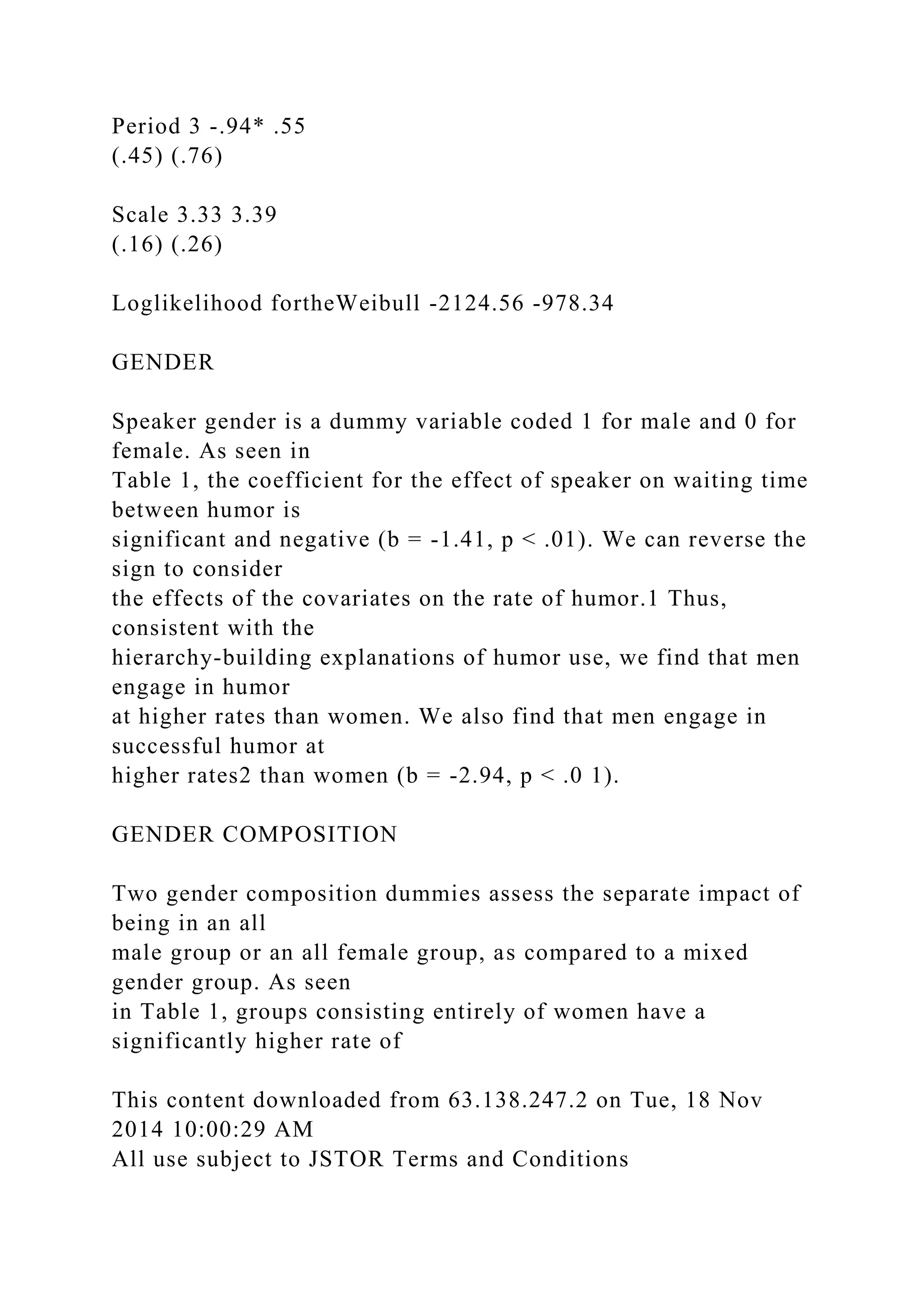
Table 1 reports the covariates' influence on the waiting times
between humor
attempts and the waiting times between successful humor
episodes. In addition to
the covariates of interest, we include period variables to control
for the influence
of timing over the course of conversation we describe in Figure
1.
This content downloaded from 63.138.247.2 on Tue, 18 Nov
2014 10:00:29 AM
All use subject to JSTOR Terms and Conditions
http://www.jstor.org/page/info/about/policies/terms.jsp
136/ Social Forces 80:1, September 2001
TABLE 1: The Effects of Timing and Group and Speaker
Characteristics on the
Rate of Humor in Small Task Group Conversations
All Successfil
Independent Variables Humor Humor
Intercept 15.49** 19.39**
(.65) (1.32)
Ai male .73 .31
(.54) (.88)
All female -1.90** -3.76**
(.59) (.95)
Participation -.01 -.06*
(.01) (.03)
History of being interrupted .13* .02
(.06) (.10)
Speaker gender -1.41 ** -2.94**
(.43) (.79)
History of interrupting -.04 -.35**
(.07) (.11)
Period 1 -1.14* -1.03
(.57) (.86)
Period 3 -.94* .55
(.45) (.76)
Scale 3.33 3.39
(.16) (.26)
Loglikelihood fortheWeibull -2124.56 -978.34
GENDER
Speaker gender is a dummy variable coded 1 for male and 0 for
female. As seen in
Table 1, the coefficient for the effect of speaker on waiting time
between humor is
significant and negative (b = -1.41, p < .01). We can reverse the
sign to consider
the effects of the covariates on the rate of humor.1 Thus,
consistent with the
hierarchy-building explanations of humor use, we find that men
engage in humor
at higher rates than women. We also find that men engage in
successful humor at
higher rates2 than women (b = -2.94, p < .0 1).
GENDER COMPOSITION
Two gender composition dummies assess the separate impact of
being in an all
male group or an all female group, as compared to a mixed
gender group. As seen
in Table 1, groups consisting entirely of women have a
significantly higher rate of
This content downloaded from 63.138.247.2 on Tue, 18 Nov
2014 10:00:29 AM
All use subject to JSTOR Terms and Conditions
http://www.jstor.org/page/info/about/policies/terms.jsp
Gender, Status, and Humor in Task Discussions / 137
humor (b = -1.90, p < .0 1). Compared to mixed gender groups,
all male groups
did not joke more frequently (b = .73, n.s.) - at least not when
controlling for
the influence of speaker gender). Likewise, the rates of
successful humor are higher
among all female groups (b -3.76, p < .05), but not all male
groups (b = .31,
n.s.).
Recall that the hierarchy building and meaning-making
perspectives lead us to
expect a higher rate of humor in homogeneous (single gender)
groups. The tension-
relief and cohesion-building perspectives predict the opposite.
Since a distinctly
different pattern occurs in all female and all male groups, we
are left with no firm
conclusions. One could use gender culture arguments (e.g.,
Maltz & Borker 1982;
Tannen 1990) to suggest that all male groups have a more
hierarchical, competitive
atmosphere, and therefore it is only the all female groups who
need hierarchy-
building. This explanation is clearly post-hoc, however, and
does not seem
supported by the merry, relaxed nature of the talk in the
women's groups. It seems
just as likely that the differences between all male and all
female groups are based
on some other gendered behavior pattern, and not related
directly to the hierarchical
or cohesive processes in the groups.
PARTICIPATION
A participation variable assesses the frequency of each group
member's participation
in the earlier parts of the group discussion. This variable is a
counter, cumulating
the number of contributions speakers make throughout the
conversation. As seen
in Table 1, higher participators are not any more likely to joke
than those who
participated less (b= -0.01, n.s.). However, they are more likely
to engage in
successful humor than low participators (b = -.06, p < .05).
Since high participators
are high status in these groups (Smith-Lovin et al. 1986;
Skvoretz & Fararo 1996),
this result supports the ideas about humor as hierarchy-building.
INTERRUPTION HISTORY
Two variables assess the impact of a speaker's interruption
history on his or her
humorous activity. History of Interrupting is a counter variable
that keeps a
cumulative record of the number of times a speaker has
interrupted other speakers.
Similarly, History of Being Interrupted keeps count of how
many times a speaker
has been interrupted by someone else in the past.
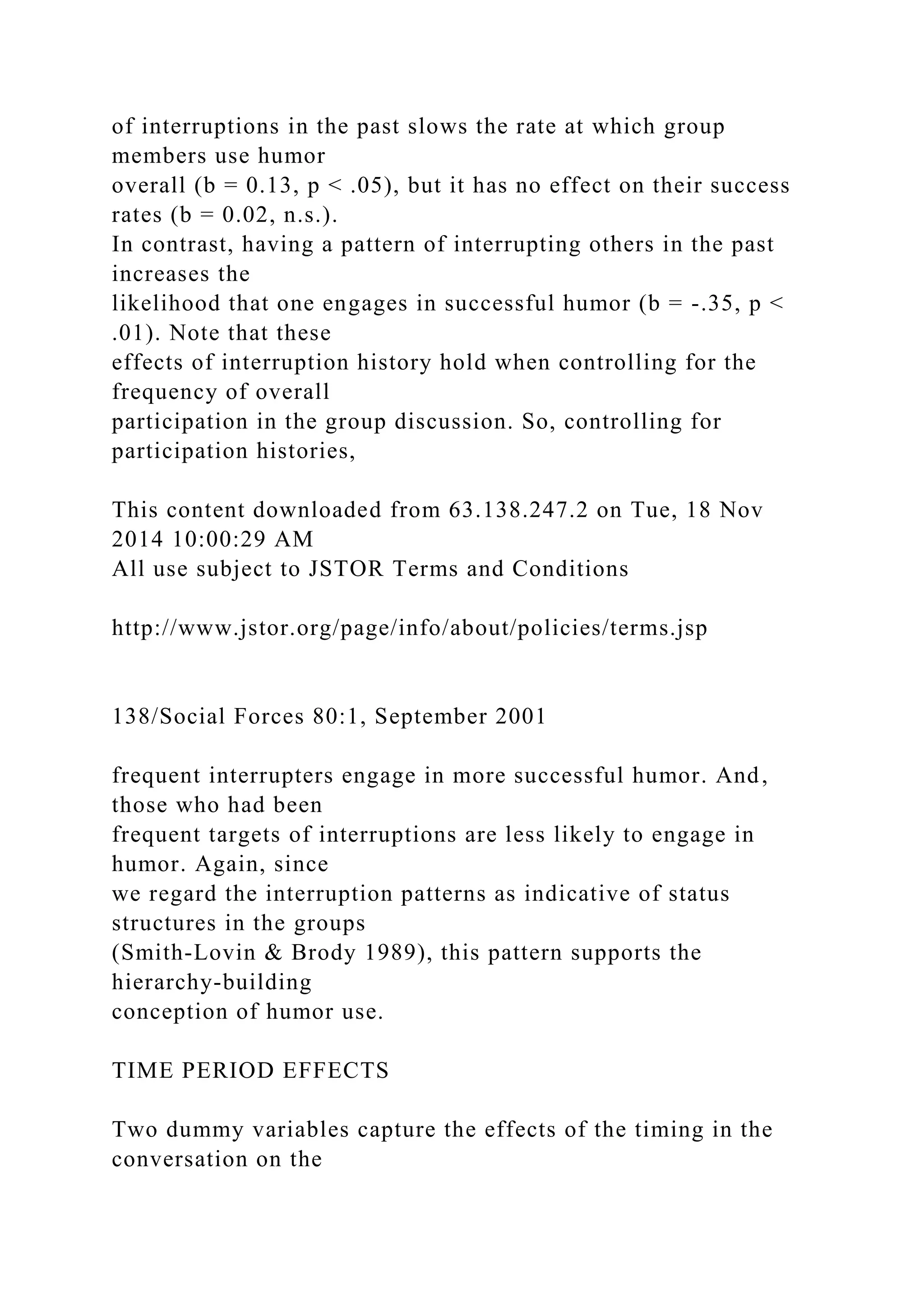
The coefficient estimates in Table 1 indicate that having been a
frequent target
of interruptions in the past slows the rate at which group
members use humor
overall (b = 0.13, p < .05), but it has no effect on their success
rates (b = 0.02, n.s.).
In contrast, having a pattern of interrupting others in the past
increases the
likelihood that one engages in successful humor (b = -.35, p <
.01). Note that these
effects of interruption history hold when controlling for the
frequency of overall
participation in the group discussion. So, controlling for
participation histories,
This content downloaded from 63.138.247.2 on Tue, 18 Nov
2014 10:00:29 AM
All use subject to JSTOR Terms and Conditions
http://www.jstor.org/page/info/about/policies/terms.jsp
138/Social Forces 80:1, September 2001
frequent interrupters engage in more successful humor. And,
those who had been
frequent targets of interruptions are less likely to engage in
humor. Again, since
we regard the interruption patterns as indicative of status
structures in the groups
(Smith-Lovin & Brody 1989), this pattern supports the
hierarchy-building
conception of humor use.
TIME PERIOD EFFECTS
Two dummy variables capture the effects of the timing in the
conversation on the
rates of humor. Period 1 refers to the first 400 words of the
conversation. Period 2
(the omitted category) refers to the middle portion of the
conversation (400-1400
words). And, Period 3 refers to the latter portion of the
conversation (greater than
1400 words). As seen in Table 1, compared to the middle
portion of the discussions,
there is a significantly higher rate of humorous remarks at the
beginning (b = -1.14,
p < .05) and end (b = -.94, p < .05) of the conversations, when
controlling for the
other variables. 1 This effect did not extend to successful
humor.
The small flurry of humor attempts at the beginning of the
group conversation
is consistent with the hierarchy-building and meaning-making
ideas from the
humor literature. The fact that less of this humor is successful
may indicate the
lack of a common culture at this point in the groups'
development. On the other
hand, these initial attempts at humor may indicate the tension of
beginning a new,
relatively undefined task with a group of strangers. The tension
relief perspective
also would be consistent with the rise of humor over the course
of the conversation
(after the first brief flurry of jokes).
CONTAGION
As described above, the scale factors translate into duration
dependence coefficients
less than one, indicating a decreasing effect of spell time on the
probability of
humor. In the successful humor model, we find a scale factor of
3.39, which
translates into a time dependence coefficient of 1/3.39 = .29,
suggesting a decreasing
effect of spell time on the rate of successful humor. In other
words, the occurrence
of humor immediately increases the likelihood of future
successful humor, with
the accelerated risk dropping off as time passes since the last
joke. Both overall and
successful instances of humor are highly contagious.
Summary of Findings
Our results do not overwhelmingly support any single
understanding of the
function of humor. However, the generalities that do appear in
these data are
intriguing. For example, if the timing effects demonstrated by
the estimated period
coefficients in Table 1 can be strongly interpreted, this pattern
in the rates of humor
This content downloaded from 63.138.247.2 on Tue, 18 Nov
2014 10:00:29 AM
All use subject to JSTOR Terms and Conditions
http://www.jstor.org/page/info/about/policies/terms.jsp
Gender, Status, and Humor in Task Discussions / 139
use over time may support both the meaning construction and
the tension-release
explanations of the role of humor in these types of
conversations. The humor
dynamics in these groups suggest that there is a short spurt of
humor early in the
conversation, and then a lull, followed by a renewal of
humorous interaction during
the latter part of these task group discussions.
Men tell more jokes and tell more successful jokes. However,
women joke
much more when no men are present, even more so than men in
all male groups.
Evidently, women only joke when men are not around.2 Being
the object of repeated
interruptions makes speakers less likely to volunteer a
humorous remark. And,
being a frequent participator and interrupter made one more
likely to engage in
successful humor. Putting all of these patterns together, there is
fairly consistent
support for the proposition that joking is a behavior in which
high status people
engage (at least in status differentiated group contexts).
Overall, our results seem somewhat more supportive of the use
of humor as a
hierarchy-building mechanism than as a cohesion-building
mechanism, at least in
these task-oriented group discussions among strangers. We
began this article by
noting a lack of formal theoretical work on conversational
humor, especially about
its role in the dynamics of task group interaction. Based on our
reading of the
related literature, the event history regressions presented here,
and our own
examination of the humorous episodes in the transcripts, we
think it is likely that
jocular interaction serves multiple purposes in these task
groups. Most notably,
humorous speech does seem to be related to status in ways that
resemble other,
better understood, status-related task behaviors. In addition, it
seems to
communicate interpersonal affect in ways that seem related to
recent developments
in the area of emotions and group process. Consequently, we
now turn our
attention to these theoretical ideas to develop a more formal
treatment of how
humor may be invoked in status-organizing processes in task
group discussions.
A Provisional Theory of Humor and Group Processes
Drawing from the patterns we observed in the above analysis of
conversational
humor, along with key ideas from theories of group processes
more generally, we
now develop a set of more formal propositions about the role of
humor in task
group interactions. We offer these propositions as a provisional
theory of humor
and status in goal-oriented conversations. We restrict the scope3
of this provisional
theory to the following settings: (1) Group members are relative
strangers;
(2) Group members are interacting face-to-face; (3) Group
members have a
collective goal; (4) The setting has a relatively unstructured,
conversational focus;
(5) The duration of the interaction is expected to be limited and
brief.
If we consider the relationship between humor and emotion, we
can begin to
make the link between humor and existing theories about social
interaction in
groups. Recent research in sociological social psychology
elaborates the relationship
This content downloaded from 63.138.247.2 on Tue, 18 Nov
2014 10:00:29 AM
All use subject to JSTOR Terms and Conditions
http://www.jstor.org/page/info/about/policies/terms.jsp
140 / Social Forces 80:1, September 2001
between actors' social positions in groups and their typical
emotional experiences
(see review in Smith-Lovin 1995). According to several
different theoretical
traditions, high status group members experience more positive,
empowering
emotion than those with lower status. This proposition exists as
a derivation from
affect control theory (e.g., Heise 1989; Smith-Lovin 1990a),
Kemper's social
relational theory of emotions (Kemper 1978), and recent
extensions of status
characteristics theory (Lovaglia & Houser 1997). The basic idea
is that people who
are high on the status (evaluation) and power (potency)
dimensions will, under
normal circumstances, produce actions that maintain these
positions and reflect
the positive interactional environment that accrues to them as a
result of their
positions. Therefore, group leaders or those who have high
standing within the group
because of some status characteristic imported from the larger
social structure
should be more likely to engage in the usually positive and
always powerful acts of
humor production.4
In addition to reflecting social positions, affective processes
may in turn
influence an actor's position in a group. In a study of
interpersonal sentiment and
face-to-face interaction, Shelley (1993) found that group
members who were liked
are given more opportunities to speak and their input is more
positively evaluated
by other group members. Affect control theory also suggests
this dynamic, since
people who engage in positive, powerful, lively behaviors are
likely to be seen as
occupying identities with that character (Robinson & Smith-
Lovin 1999). In an
ambiguous situation like a task group interaction among
strangers, task cues and
other behaviors are used to establish the relevant identities of
participants and a
status structure for accomplishing the task (Rashotte & Smith-
Lovin 1997).
If we assume that (1) humor production more often expresses
positive, powerful
feelings than negative, powerless feelings (at least within the
context of collectively
oriented task groups); and (2) individuals who amuse others
with their humor are
subsequently evaluated as more positive and powerful; then we
can derive the
following propositions from the theories reviewed above.
Proposition 1: High status group members will use more humor
than low status
group members.
Proposition 2: High status group members will use more
successful humor (elicit
more expressed appreciation) than low status group members.
Proposition 3: A group member will receive more opportunities
to speak after a
successful joke.
Proposition 4: A group member will receive more positive
evaluations of task input
after a successful joke.
Propositions 1 and 2 are, of course, the patterns that we found
in our event history
analyses. Propositions 3 and 4 will require data on the content
of all turns
(humorous and nonhumorous) in a dynamic study of task group
processes. Those
analyses will have to await further studies.
This content downloaded from 63.138.247.2 on Tue, 18 Nov
2014 10:00:29 AM
All use subject to JSTOR Terms and Conditions
http://www.jstor.org/page/info/about/policies/terms.jsp
Gender, Status, and Humor in Task Discussions / 141
The notion that humor could serve to build group cohesion and
solidarity is
consistent with several recent theoretical developments
concerning the relationship
between positive emotion and group cohesion. Lawler and his
colleagues (1992;
Lawler & Yoon 1993, 1996) argue that positive emotion leads to
increased
commitment to the group. Drawing from Kemper's work on
integrating and
differentiating emotions, Lovaglia and Houser (1997) argue that
positive emotion
(especially when experienced by high status individuals)5
decreases resistance to
influence and works to equalize status relations. Similarly,
other social
psychological research reveals that people in a good mood are
more compliant and
engage in more benevolent behaviors (see review in Isen 1987).
Thus, if we assume
that humor serves to, among other things, increase positive
emotion, we might expect
joking to be used as a strategy for increasing members' affective
ties to the group.
Proposition 5: Humorous interactions in goal-oriented groups
will strengthen
members' affective ties to the group.
Exploring this proposition will require data on affective
commitment to groups
and/or strength of group identities after the task-oriented
conversation has occurred.
Ideally, we would want to manipulate the humor production, so
that alternative
hypotheses about the character of the group members (e.g., their
good nature) could
be eliminated.6
Propositions 1 through 5 beg the question of who will be the
most likely to
engage in strategies that strengthen group bonds. High status
people and those who
would seek influence in a group would be the most interested in
decreasing
resistance to influence. On the other hand, those who would be
disadvantaged by
an exacerbation of status differences might be interested in the
status equalizing
effects of positive affect. In order to better disentangle these
more complex patterns
we need to consider the content of the humor. In our event
history analyses here,
we elected to forego coding the content of these humorous
interchanges to study,
content-free, the dynamic patterning of humorous interaction in
the 29 groups.7
However, the loose arguments we drew from the humor
literature, the logic of some
of the better developed theories of humor (e.g., superiority
theory), as well as the
implications we draw from the sociological social psychology
literature all hinge
in part on the content of the jokes themselves.
We propose that types of humor can be categorized in terms of
their function
for the group. Specifically, we argue that it varies in its
cohesiveness. We consider
humor to be cohesion building in nature when it treats the group
as a collective
unit. This can happen when the joke refers to the group itself, or
when the joke
pokes fun at outside individuals or categories to which none of
the group members
belong. For example, jokes can appeal to feelings of group-ness
directly by referring
to the group as a unit (e.g., students joking about student
poverty, humorous
referents to the group's creativity - or lack thereof). However,
jokes can also
serve to strengthen feelings of group-ness by satirizing outside
groups or individuals
(e.g., ethnic and religious jokes directed at categories not
present in the group, or
This content downloaded from 63.138.247.2 on Tue, 18 Nov
2014 10:00:29 AM
All use subject to JSTOR Terms and Conditions
http://www.jstor.org/page/info/about/policies/terms.jsp
142 / Social Forces 80:1, September 2001
students joking about professors). In contrast, differentiating
humor calls attention
to the separate group members as when a speaker jokes about
him- or herself, or
when a speaker teases another group member, or subset of other
group members.
These types of jokes may be more likely to be used in hierarchy
building. At any
rate, they break down the sense that "we're all in this together"
and point out
distinctions among group members.
Considering these types of humor separately also allows us to
make sense of
our argument that low status members might benefit more from
the status-
equalizing effects of cohesive humor. Because cohesive humor
appeals to feelings
of group-ness we might expect it to operate like the other
expressions of group
identification in similar settings. Ridgeway (1982) found that
women could
effectively act as leaders only when they expressed appropriate
levels of group-
oriented motivation. So, based on our argument that low status
members will benefit
from the status-equalizing effects of cohesive humor, along with
Ridgeway's
argument that lower status members can more effectively
influence others when
they appeal to group-identification, we predict the following:
Proposition 6: Cohesion-building humor will be a larger
proportion of low status
members' humor attempts than of higher status members' humor
attempts.
In a necessary corollary to Proposition 6, we expect that the
hierarchy building
nature of differentiating humor will be used less often by those
likely to be
disadvantaged by the hierarchy.
Proposition 7: Differentiating humor will be a larger proportion
of high status
members' humor attempts than of low status members' humor
attempts.8
We can provide a preliminary examination of these propositions
by looking
back at the transcripts analyzed above. We code each humor
episode as either
(1) cohesive, (2) differentiating, or (3) other/unidentifiable.9
We operationalize
status in two ways: gender and participation.
We predict that low status people (women and low
participators) will use
proportionally more cohesion-building humor (proposition 6)
while high status
people (men and high participators) will use proportionally
more differentiating
humor (proposition 7).10 Men show higher absolute levels of
both cohesive and
differentiating humor than women (X2 = 4.07, p < .05)"1 (see
Figure 3). Of course,
this pattern is not surprising since we know from our event
history analyses that
men have a higher rate of humor overall than women. While
cohesive humor is
the most common type of joking for both men and women, we
can see from the
relative height of the bars that differentiating humor makes up a
larger proportion
of men's than women's humor productions. Figure 4, which
displays proportions
of all humor attempts that are cohesive or differentiating, makes
this pattern much
clearer. Over 35% of men's humor productions are
differentiating, compared with
26% of women's (X2 = 3.72, p < .05), providing support for
proposition 7. A slightly
higher proportion of women's humor is cohesive in nature (56%,
as opposed to
50% for men) in the direction predicted by proposition 6, but
this difference is
This content downloaded from 63.138.247.2 on Tue, 18 Nov
2014 10:00:29 AM
All use subject to JSTOR Terms and Conditions
http://www.jstor.org/page/info/about/policies/terms.jsp
Gender, Status, and Humor in Task Discussions I 143
FIGURE 3: Cohesion and Differentiation in Women's and Men's
Humor
4
3.5
3
>2.5
m1 . 5
~1.
0.5
0
Women's Humor Men's Humor
I Cohesive DLx fre r n ti at g
not significant. Although not predicted by our theory, this
gender pattern is even
stronger in same-gender groups. Women in all female groups
spend much more
time engaged in cohesive humor and less time engaged in
differentiating humor
than men in male groups (see Figure 5).
Since participation levels are another indicator of status (in
some ways, a more
direct one), we can examine the same propositions with this
alternative measure.
Figure 6 shows the use of cohesive and differentiating humor by
high- and low-
participators. Low participators use cohesion-building in 59.6%
of their humor
attempts, while high participators build cohesion in 51.39% of
theirs, but this is a
nonsignificant difference (Chi-square = 1.21, n.s.). High
participators are more
likely to use differentiating humor than are low participators:
33.13 as opposed to
21.15%, consistent with our status arguments (Chi-square =
2.98, p < .05).
THE TARGET OF HUMOR
One of the tough aspects of being in a task group is trying to
deliver criticism
without arousing anger and demoralizing the team. Research in
status
characteristics theory suggests that high status members
disagree with others more
often and provide more critical feedback than lower status
members (Berger et al.
1977; Ridgeway & Johnson 1990). On the other hand, the high
status members
presumably want to avoid damaging their own reputations and
the good will of the
group in the process. "Criticizing" is a negative behavior, and
will lead to negative
impressions of the one who enacts it (Smith-Lovin 1990a). A
positive identity as a
This content downloaded from 63.138.247.2 on Tue, 18 Nov
2014 10:00:29 AM
All use subject to JSTOR Terms and Conditions
http://www.jstor.org/page/info/about/policies/terms.jsp
144 / Social Forces 80:1, September 2001
FIGURE 4: Cohesion and Differentiation in Women's and Men's
Humor
60 -
50
F40-
3 I
220
1 0
0
Women's Humor Men's Humor
E Cohesive Difftrentiatig
leader can be more easily maintained if the directive is
transformed into a joking,
lighthearted behavior. Some humor researchers argue that
humor protects us from
typical sanctions we might expect from the same behaviors
delivered in non-
humorous form (e.g., Ford 1997). In support of this, we observe
in our group
transcripts that humor is often used as a way of "softening"
directives and critical
remarks.
Explaining this kind of humor requires us to make a distinction
between
differentiating humor that is directed at self versus
differentiating humor that is
directed at other group members. We conceptualize direction as
a two-category
distinction between jokes that are directed inward (including
oneself as an
individual as well as a group with which one identifies), or
other (including other
individuals and other groups). Combined with the
cohesive/differentiating
distinction this yields four distinct types of jokes: (1) cohesive,
inward-directed
jokes directed at the present group, (2) cohesive, outward-
directed - jokes directed
at groups or individuals outside the present group, (3)
differentiating, inward-
directed - jokes directed at the humorist him- or herself, and (4)
differentiating,
outward-directed - jokes directed at another member (or subset
of members) of
the group. Table 2 displays this typology and the labels that we
will use to refer to
the four categories of humor that it produces.
Under this scheme, jocular criticism of group members, or
disagreements
delivered with a laugh will be considered differentiating, other-
directed. Thus we
can state our claims about the relationship between status and
this kind of humor:
This content downloaded from 63.138.247.2 on Tue, 18 Nov
2014 10:00:29 AM
All use subject to JSTOR Terms and Conditions
http://www.jstor.org/page/info/about/policies/terms.jsp
Gender, Status, and Humor in Task Discussions / 145
FIGURE 5: Gender and Cohesive Humor In Mixed and Same
Gender Groups
7 0 _ -
60
640 X 1
0
Women in Mixed Groups Men in Male groups
Women in Female Groups Men in Mixed Groups
[ CohWomve inMixednrop M ng
E Other
Proposition 8: High status members will use more outward-
directed
differentiating (member-directed) humor than will lower status
members.
On the other hand, Ridgeway and Johnson (1990) argue that
only high status
members can express negative feelings; lower status members
must suppress
negative feelings even if they experience them. One way of
suppressing expression
of the negative might be through joking. Based on past research
of task group
interactions, especially status characteristics theory (Berger et
al. 1977), we expect
that low status members will more rarely offer disagreements
and negative
evaluations. However, when they do, it might well be
accompanied by laughter or
attempts at amusement. This leads us to qualify our propositions
even further:
Proposition 9: Disagreements and negative evaluations of other
group members
will be more likely to be expressed with differentiating,
outward-directed humor
(member-directed) when delivered by low status members than
when delivered
by high status members.
Proposition 9 requires data that we do not have: coding of all
the speech turns in
terms of their task content. However, we can make a
preliminary assessment of
Proposition 8. Here, we again look at gender differences and
differences between
high and low participators. Figure 7 shows a comparison
between men and women
on the four types of humor content described in Table 2, again
expressed as a
percentage of all of their humor attempts. The type of humor
that differentiates the
group by commenting on other groups members is "member-
directed" humor.
As with all other types of humor, men used higher rates of
member-directed humor
This content downloaded from 63.138.247.2 on Tue, 18 Nov
2014 10:00:29 AM
All use subject to JSTOR Terms and Conditions
http://www.jstor.org/page/info/about/policies/terms.jsp
146 /Social Forces 80:1, September 2001
FIGURE 6: Cohesive and Differentiating Humor Among High
and Low
Participators
50
540
`30
0
Low Participators High Participators
E Cohesive Diffeirentlfng
than did women. However, the member-directed humor did not
make up a
significantly higher proportion of men's humor in mixed sex
groups. Indeed, it was
the least frequent category of humor for men, while women use
self-directed humor
the least. As anonymous reviewer to this paper pointed out, the
meaning of self-
directed humor may well differ by the status of the speaker.
High status members
may be able to afford to make jokes at their own expense, and
even seem a little
more secure in the bargain (e.g., a famous statistician joking
about being "bad with
numbers"). While lower status members may only serve to
denigrate themselves
with self-directed jokes. This suggests that future dynamic work
might consider
the possibility of an interaction between status and self-directed
humor on status
gain and loss in a conversation.
When we examine Proposition 8 using level of participation as
our status
variable, we again find little support for it. In Figure 8, there is
a very slight tendency
for high participators to use more member-directed humor, but
it is not significant
(15.79 versus 9.62 percent, Chi-square= 1.34, n.s.).
Furthermore, we don't see any
notable tendency for high participators to use more inward-
directed humor than
low participators. In fact, the low participators are quite likely
to use group-directed
humor when they joke. Therefore, we have little confidence that
the interesting
patterns that we saw in Figure 7 are due to a status difference in
gender within
these task groups. Some other gender dynamic may be shaping
men's tendency to
use inward- and women's to use outward-directed humor.
This content downloaded from 63.138.247.2 on Tue, 18 Nov
2014 10:00:29 AM
All use subject to JSTOR Terms and Conditions
http://www.jstor.org/page/info/about/policies/terms.jsp
Gender, Status, and Humor in Task Discussions / 147
TABLE 2: A Typology of Humor in Task Oriented Groups
Function of Humor for the Group: Cohesion-Building
Differentiating
Direction of Humor Target:
Inward-Directed Group-Directed Self-Directed
Outward-Directed Outsider-Directed Member-Directed
GROUP CONTEXT AND HUMOR CONTENT
Another advantage to disaggregating humorous speech by
content is that it allows
us to more precisely specify the relationship between function
and form. In our
earlier review, we argue that, to the extent that joke telling is a
cohesion building
exercise, we would expect to see more of it in heterogeneous
groups. Our event
history analysis did not support that formulation. However,
within our new content-
sensitive framework we argue that the most direct way to
increase group solidarity
is to use outsider-directed humor. Accordingly, we propose the
following:
Proposition 10: Group heterogeneity will increase outsider-
directed humor.
Figure 9 provides some preliminary support for this idea.
Outsider-directed humor
is in fact a higher percentage of humor in mixed-gender groups
than in either all-
male or all-female groups (20.7% as opposed to 14.58 and 7.14
percent respectively,
Chi-square = 4.19,p < .05).
TIMING AND HUMOR CONTENT
Earlier in this paper we note the scarcity of dynamic theories of
interaction. Our
event history analyses of these data suggest that the pattern of
humor use
systematically varies across the course of these conversations,
with humor showing
a slight spurt at the very beginning of the conversations,
dropping to lower rates,
and then steadily increasing across the course of the
discussions. Drawing on the
theories about the functions of humor, along with knowledge
about the actual
timing of humor in these groups, we make several proposals
about the content of
the humor in these stages of task group discussion. First, we
anticipate that humor
with a self-referent will be used during the "meaning-making"
stages of the group
conversation as group members jokingly volunteer information
about self and
begin to develop and assert a collective identity. Second, we
expect that group
members will use differentiating humor to establish a status
order to organize
their task activity. Third, we expect that cohesion-oriented
humor will be used
primarily in service of the emerging group identity.
Consequently, we make the
following predictions about the timing of humor in task groups:
This content downloaded from 63.138.247.2 on Tue, 18 Nov
2014 10:00:29 AM
All use subject to JSTOR Terms and Conditions
http://www.jstor.org/page/info/about/policies/terms.jsp
148 / Social Forces 80:1, September 2001
FIGURE 7: Types of Humor Use Among Men and Women in
Mixed Gender
Groups
25
2 0
~15
0
Women's Humor Men's Humor
L naup=Directed L utoide=Dietedt
E Self-Directed * Member-Directed
Proposition 11: Humor offered early in the discussion will be
proportionately
more self-directed than other-directed.
Proposition 12: Differentiating humor will be used with
decreasing frequency across
the course of the conversation, as the structure of the group
becomes better
defined.
Proposition 13: Cohesive humor will be used with increasing
frequency across the
course of the conversation as group members develop a sense of
collective identity
and affective attachment to the group.
Finally, we consider the contagious effects of humor. If, as we
expect,
differentiating humor often comes in the form of masked
criticism or self-
deprecation, then we think it is less likely to be contagious than
cohesive humor.
However, when humor is contagious, it will be more likely to be
contagious within
form - with self-deprecation begetting self-deprecation, outsider
jokes begetting
outsider jokes, etcetera, as groups develop a local culture and
begin to learn the
accepted/successful strategies for amusing each other.
Proposition 14: Cohesion-building humor will be more
contagious than
differentiating humor.
Proposition 15: Humor contagion will be form-specific,
resulting in clustered
episodes of humor within a similar form (e.g., cohesive/other-
directed).
Unfortunately, the number of humor events in each of our four
types are small
enough to make dynamic analyses of the sort specified by
Propositions 11-15
This content downloaded from 63.138.247.2 on Tue, 18 Nov
2014 10:00:29 AM
All use subject to JSTOR Terms and Conditions
http://www.jstor.org/page/info/about/policies/terms.jsp
Gender, Status, and Humor in Task Discussions 1149
FIGURE 8: Types of Humor Used by High and Low
Participators
35
3 0 --
5 __2_
2 0
15
0
Low Participators High Participators
E Self-Directed U Member-Directed
unfeasible with our 29 group discussions. Exploring these ideas
will have to await
the coding of larger corpuses of task oriented group discussion.
Now, we turn to a
brief discussion of what we know from the analyses that are
possible with our current
data.
Discussion
Mulkay (1988) describes humor as a social action arising out of
a real or imagined
dialogue. Yet, there are few systematic studies of the
spontaneous use of humor
within social dialogue. Fine (1984) points out that a teller and
audience are required
component of humorous discourse. The present analyses look at
the relation
between these components by examining attempts at inspiring
amusement. Our
unit of analysis was an "evocative transaction" - an exchange of
humorous bids
and supportive (or unsupportive) responses. Because event
history regressions allow
us to analyze events as the unit of analysis, they are ideal for
developing models
that truly describe situated interpersonal transactions, rather
than persons or groups.
In the present paper we took the opportunity to study the
dynamic occurrence
of humor during group conversations. We found strong evidence
for taking into
account the timing of humorous interaction. Future work in this
area should also
be concerned with such dynamics and time dependence. This
poses a problem
because with elaborated content coding of what are already rare
events (humorous
remarks, in a task group setting), even a reasonable size data set
gets quickly
This content downloaded from 63.138.247.2 on Tue, 18 Nov
2014 10:00:29 AM
All use subject to JSTOR Terms and Conditions
http://www.jstor.org/page/info/about/policies/terms.jsp
150 I Social Forces 80:1, September 2001
FIGURE 9: Types of Humor Use in Same and Mixed Gender
Groups
40 -
35-
0
_25 X|
Female Groups Mixed Groups Male Groups
U Self-Directed U Member-Directed
attenuated. We hope that the theoretical framework here will
provide guidance to
usefullly limit the potential state space and create a starting
point for fulture dynamic
analyses of humor.
For while statistical methods now allow us to focus on the
correct unit of
analysis, we find that theory lags behind. There is a rapidly
growing body of research
in the social science of humor, but we find the current humor
literature to be of
limited use in developing a detailed understanding of humor in
conversational
interaction. Nonetheless, when we combine key ideas from the
literature on the
social functions of humor with the more developed theoretical
ideas in the
sociological social psychology literature on status and emotion,
we are able to
develop a more general set of propositions about the role of
humor in the status
dynamics of task group interaction.
We propose that humor serves as a mechanism used by both
high and low status
group members in a group to establish and maintain
relationships during the course
of group problem solving. The types of humor used varies by
position of the speaker,
by group context and over time. A more detailed content coding
of the 375 humor
episodes analyzed here provides tentative support for some of
the propositions in
our proposed theory. We hope that future work will further
refine and provide
independent empirical tests of these ideas.
Finally, we point to an interesting puzzle: there are substantial
gender
differences in the content of humor that is used in these task
groups, especially
within all male and all female groups. These differences do not
seem obviously
status related, but signal a fairly different pattern of interaction
for men and
This content downloaded from 63.138.247.2 on Tue, 18 Nov
2014 10:00:29 AM
All use subject to JSTOR Terms and Conditions
http://www.jstor.org/page/info/about/policies/terms.jsp
Gender, Status, and Humor in Task Discussions / 151
women, especially in the single-gender groups. In particular,
women's frequent
use of group-directed humor when in all-female groups, which
shifts to a higher
use of outsider-directed humor in mixed gender groups is an
intriguing pattern.
While we have no ready explanation for it at this time, it seems
an interesting
avenue of exploration for those who's central interest is the
production and
appreciation of humor itself.
Notes
1. For this reason, Freud (1905) speculates that joking is
particularly suitable for attacks
on high status and powerful-those who are otherwise protected
from direct
confrontation. In contrast, Wilson (1979) claims that less
powerful people are not free
to ridicule their superiors face-to-face. Rather, they must
reserve their mockery for
contexts in which the objects of their derision are not present.
This latter view is more
consistent with most current theories of humor as aggression.
These theories usually
view aggressive joking as a mechanism through which the
powerful keep underlings in
their place.
2. This finding is somewhat inconsistent in the empirical
literature. The inconsistencies
may indicate shifts in gender related behavior over time. For
example, Cantor (1976)
finds that in a laboratory study of reactions to humorous
stimuli, both men and women
have greater appreciation for humor that disparages women.
3. Gender is not a status characteristic in all settings, and may
be losing its hierarchical
meaning in modern undergraduate populations (see review in
Ridgeway & Smith-Lovin
1999). However, the data that we will use were collected in
South Carolina in the early
1980s; many analyses of these data conclude that gender does
act as a status characteristic
within this population and this setting (Smith-Lovin et al 1986;
Smith-Lovin & Brody
1989; see review in Skvoretz & Fararo 1996).
4. Subjects are from a subject pool that included any students in
sociology classes who
submitted a card expressing their interest in volunteering for
research. Subjects from the
pool received no course credit or subject payments in exchange
for participation. Since
the subjects indicated age, race and gender on their cards, it was
possible to minimize
variation in characteristics other than gender, and to create
groups in which gender
composition systematically varied.
5. Overall inter-coder reliability is fairly low among humor
judgments of our four coders
(one male and three female), with inter-coder agreement rates in
the range of .50 to .60.
The male coder did not have lower agreement rates with the
three female coders than
they had with each other, revealing no observable gender
differences in the perceptions
of these admittedly mundane forms of humor. In previous
research (reviewed above),
the largest gender differences are found in the appreciation of
sexual and gender based
humor, neither of which was particularly likely in these groups
of strangers who knew
they were being videotaped. The modest inter-coder reliability
in the difficult task of
identifying unsuccessful but intended humor is the reason that
we adopted the conservative
procedure of requiring agreement from all four coders. We
argue that this conservative
This content downloaded from 63.138.247.2 on Tue, 18 Nov
2014 10:00:29 AM
All use subject to JSTOR Terms and Conditions
http://www.jstor.org/page/info/about/policies/terms.jsp
152 I Social Forces 80:1, September 2001
criterion of agreement by four "culture experts" means that the
undergraduates in the
interacting groups would have almost certainly have perceived
the utterance as a humor
attempt even though they failed to laugh at it.
6. When laughter by group members other than the speaker
occurred, it was quite
generalized. There were no instances in the data where one or
two group members
laughed, but the mirth was not shared by the larger group.
7. Plotting techniques and statistical comparison of nested
models are two different
approaches for diagnosing the preferred model for distribution
of transition rates in a
data context (Hannan 1989). For example, the Gompertz model
implies the logarithm
of the hazard is a linear function of the waiting time (Tuma &
Hannan 1984:2 10), while
the Weibull model implies that the log-hazard is a linear
function of the logarithm of
the waiting time (Tuma & Hannan 1984:21 1). Thus we plot the
estimated log-hazard
against waiting time and against the log of waiting time to
compare the fit of the two
models to our data. In addition, we statistically compare the fit
of a variety of nested
parametric models (e.g., Gamma, exponential, log-logistic,
Weibull). These diagnostics
converge on the Weibull as the preferred model for these
waiting times.
8. We also ran these regressions using the distribution-free Cox'
proportional hazards
model, which does not allow parameterization of the time
dependence. The results of
these regressions are consistent with our other analyses, but
Cox models limit what we
can say about the dynamics of this process. Accordingly, we
chose to report the Weibull
models in order to characterize the timing of humor in a
systematic way.
9. For the sake of discussion clarity, we interpret the
coefficients in terms of their influence
on the rates of humorous remarks. A variable that increases the
length of time between
jokes simultaneously decreases the hazard rate of humor. Thus,
the signs of the
coefficients in Table 1 can be reversed when considering their
impacts on the risk of
humor.
10. Additional analyses also show that men's humor is more
likely to be successful than
women's humor. However, that is not directly tested in Table 1.
11. Some of the control variables, of course, deal with the
history of the conversational
roles as they develop. These variables have little or no variance
during the early part of
the conversation.
12. Nancy Walker (1988) reaches a similar conclusion from an
entirely different
disciplinary field. Based on a critical analysis of women's
humor in American culture,
Walker (1988) argues that women's humor, like minority humor
is expressed only within
group - never in mixed company.
13. These scope conditions may be more properly considered
initial conditions of the
theory, rather than scope limitations (see a discussion of this
distinction in Webster 1999).
They are not required to support the logic of our argument as
are scope conditions
traditionally, but follow instead from the empirical context that
provided the basis for
much of the present generalizations. We consider these
limitations appropriate, given
the conditions of the empirical observations from which the
propositions are developed.
We also note that most of the more general theory from which
we draw does depend
logically on more or more of these conditions. However, we
also consider them to be
This content downloaded from 63.138.247.2 on Tue, 18 Nov
2014 10:00:29 AM
All use subject to JSTOR Terms and Conditions
http://www.jstor.org/page/info/about/policies/terms.jsp
Gender, Status, and Humor in Task Discussions / 153
preliminary, and subject to future investigation to determine
whether they are, indeed,
necessary for the operation of the proposed processes.
14. Affect control theory has the most precise statement of the
affective meaning of humor
production. Social acts like "amuse" and "laugh" are high on
evaluation (good/bad),
potency (powerful/powerless) and activity (lively/quiet). Jokes
that are more pointed
("laugh at") are more negative on evaluation, but still very
powerful and active and are
therefore still predicted behaviors for those in leadership roles,
especially as a social control
mechanism.
15. More precisely, Lovaglia and Houser (1997) argue that high
status individuals who
experience positive emotion will be more open to influence
from low-status others, while
low status members experience negative emotion that makes
them more resistant to
influence from high-status others. The operations of these two
effects combines to reduce
status differences in influence. We assume that in collectively
oriented face-to-face groups
the emotional experience of group members will be linked such
that strong positive
emotions among a subset of members are unlikely to coexist
with strong negative
emotions with others. Therefore, we assume that most status
equalizing will come from
the positive emotion of the high status members.
16. Perhaps instructions encouraging or discouraging humor
could be used to create the
relevant conditions. Alternatively, the presence of a confederate
who interjected humor
might prime the humor pump, given the contagious nature of
humor that we observe
in our naturally occurring conversations.
17. To be a bit more honest, we attempted to develop codes for
humor content at an
earlier stage of this project (prior to the event history analysis),
and were never able to
achieve an acceptably reliable measurement protocol. After
considering the results of the
event history analyses and drawing on the literature on status
and emotion, we are able
to develop a theoretically based content coding system that can
be reliably assessed (see
footnote 19).
18. Propositions 6 and 7 would be definitionally linked, were it
not for a third category
of "other" humor.
19. Two coders actually rate each of the humorous episodes on
two categorical
dimensions: the function of humor for the group: (1) cohesion-
building,
(2) differentiating or (3) other/unidentifiable, and the direction
of the humor target:
(1) inward-directed or (2) outward directed (see Table 2 below
for the full typology).
For reliability of nominal scale content coding, t he most
appropriate reliability measure
is Scott's (1955) inter-coder agreement index, 6, which is based
on the distance of the
obtained coding from what would be expected by chance (and
does not allow inflated
estimates of reliability due to skewed distributions into
categories). We calculate a reliability
rating of 6=.7 1 based on our two ratings of the entire sample.
After the reliability check,
the discrepancies were resolved by discussion until consensus
was reached.
20. During the course of observing and coding the humorous
episodes in the transcripts,
we note recurring patterns of joke-making across the groups that
seem to reflect of the
status-organizing processes we describe in our theory.
Consequently, the theory of humor
we develop here derives from the logic of the theories that we
discuss in this section,
along with patterns we inductively observe in the data
themselves. Accordingly, the
This content downloaded from 63.138.247.2 on Tue, 18 Nov
2014 10:00:29 AM
All use subject to JSTOR Terms and Conditions
http://www.jstor.org/page/info/about/policies/terms.jsp
154 / Social Forces 80:1, September 2001
analyses presented in this section cannot be seen as tests of the
theory, rather as illustrative
of the process we argue takes place when humor operates in
goal-oriented group
interactions. A true test of our new ideas must await further
data.
21. In the context of these discovered comparisons, one could
argue that tests of statistical
significance are not meaningful. We present them here for
heuristic use only, to give
some rough additional information about the size of the
differences.
References
Allison Paul. 1995. Survival Analysis using the SAS System: A
Practical Guide. SAs Institute.
Bales, Robert F., and P.E. Slater. 1955. "Role Differentiation in
Small Decision-Making Groups."
Pp. 259-306 in Family Socialization and Interaction Process.
Free Press.
Berger, Joseph., M. Hamit Fisek, Robert Z. Norman, and Morris
P. Zelditch Jr. 1977. Status
Characteristics in Social Interaction: An Expectation States
Approach. Elsevier-North Holland
Blumer, Herbert. 1969. Symbolic Interactionism: Perspective
and Method. Prentice-Hall.
Butland, Mark J., and D.K Ivy. 1990. "The Effects of Biological
Sex and Egalitarianism on Humor
Appreciation: Replication and Extension." Journal of Social
Behavior and Personality 5:353-
66.
Cantor, Joanne R. 1976. "What is Funny to Whom." Journal of
Communication 26:164-72.
Cantor, Joanne R, J. Bryant, and Dolf Zillmann. 1974.
"Enhancement of Humor Appreciation
by Excitation Transfer." Journal of Personality and Social
Psychology 30:812-31.
Carroll, Glenn. 1983. "Dynamic Analysis of Discrete Dependent
Variables: A Didactic Essay."
Quality and Quantity 17:425-60.
Chupchick, Gerald C., and Howard Leventhal. 1974.
"Consistency between Expressive Behavior
and the Evaluation of Humorous Stimuli: The Role of Sex and
Self-Observation." Journal
of Personality and Social Psychology 30:429-42.
Coser, Rose. 1959. "Some Social Functions of Laughter: A
Study of Humor in a Hospital Setting."
Human Relations 12:171-82.
.1960. "Laughter among Colleagues: A Study of the Social
Functions of Humor among
the Staff of a Mental Hospital." Psychiatry 23:81-95.
Couch, Carl J. 1992. "Evocative Transactions and Social
Relationships." Studies in Symbolic
Interaction 13:141-54.
Crawford, Mary. 1995. Talking Difference: On Gender and
Language. Sage Publications.
Davis, Murray S. 1979. "Sociology through Humor." Symbolic
Interaction 2:105- 10.
. 1993. What's So Funny? Chicago: University of Chicago Press.
Derber, Charles. 1979. The Pursuit of Attention: Power and
Individualism in Every Day Life.
Derks, Peter, Steve Kalland, and Mike Etgen. 1995. "The Effect
of Joke Type and Audience
Response on the Reaction to a Joker: Replication and
Extension." Humor 8:327-37.
Dovidio, John F., Clifford E. Brown, K. Heltman, Steve L.
Ellyson, and C.B. Keating. 1988.
"Power Displays Between Women and Men in Discussion of
Gender-Linked Topics:
A Multi-channel Study." Journal of Personality and Social
Psychology 55:580-87.
This content downloaded from 63.138.247.2 on Tue, 18 Nov
2014 10:00:29 AM
All use subject to JSTOR Terms and Conditions
http://www.jstor.org/page/info/about/policies/terms.jsp
Gender, Status, and Humor in Task Discussions / 155
Dovidio, John F. and Steve L. Ellyson. 1982. "Decoding Visual
Dominance: Attributions of
Power Based on Relative Percentages of Looking While
Speaking and Looking While
Listening." Social Psychology Quarterly 45:106-13.
Dienstbier, Richard A. 1995. "The Impact of Humor on Energy,
Tension, Task Choices, and
Attributions: Exploring Hypotheses from Toughness Theory."
Motivation and Emotion
19:255-67.
Fine, Gary Alan. 1983. "Sociological Approaches to the Study
of Humor." Pp. 159-81 in Handbook
of Humor Research, Vol 1: Basic Issues, edited by Paul E.
McGhee and Jeffrey H. Goldstein.
Springer.
Fine, Gary Alan. 1984. "Humorous Interaction and the Social
Construction of Meaning: Making
Sense in a Jocular Vein." Studies in Symbolic Interaction 5:83-
104.
Fisek, M. Hamit. 1974. "A Model for the Evaluation of Status
Structures in Task-Oriented
Groups." In Expectation States Theory: A Theoretical Research
Program, edited by J. Berger,
T. L. Conner, and M. H. Fisek. Winthrop Publishers.
Flaherty, Michael G. 1990. "Two Conceptions of the Social
Situation: Some Implications of
Humor." Sociological Quarterly 31:93-106.
.1984. "A Formal Approach to the Study of Amusement in
Social Interaction." Studies
in Symbolic Interaction 5:71-82.
Francis, Linda E. 1994. "Laughter, the Best Mediation: Humor
as Emotion Management in
Interaction." Symbolic Interaction 17:147-63.
Forabosco, Giovannantonio. 1994. "'Seriality' and the
Appreciation of Jokes." Humor 7:351-75.
Ford, Thomas E. 1997. "Effects of Stereotypical Television
Portrayals of African-Americans on
Person Perception." Social Psychology Quarterly 6:266-78.
Freud, Sigmund. 1966 [1905]. Jokes and Their Relation to the
Unconscious. London: Routlege &
Kegan Paul.
Glen, Phillip J. 1989. "Initiating Shared Laughter in Multi-party
Conversations." Western Journal
of Speech Communication 53:127-49.
Goffman, Erving. 1961. Encounters. Bobbs-Merrill.
Hannan, Michael T. 1989. "Macro-sociological Applications of
Event History Analysis: State
Transitions and Event Recurrences." Quality and Quantity.
Heise, David R. 1989 "Effects of Emotion Displays on Social
Identification." Social Psychology
Quarterly
Isen Alice M. 1987. "Positive Affect, Cognitive Processes and
Social Behavior." Advances in
Experimental Social Psychology 20:203-53.
Johnson, Cathryn. 1994. "Gender, Legitimate Authority, and
Leader-Subordinate Conversations."
American Sociological Review 59:122-35.
Kalbfleisch, J.D., and Prentice, R.L. 1980. The Statistical
Analysis of Failure Time Data. Wiley.
Katz, Jack. 1996. "Families and Funny Mirrors: A Study of the
Social Construction and Personal
Embodiment of Humor." American Journal of Sociology
101:1194-1237.
Kemper, Theodore D. 1978. A Social Interactional Theory of
Emotions. Wiley.
Kollock, Peter, Phillip Blumstein, and Pepper Schwartz. 1985.
"Sex and Power in Interaction."
American Sociological Review 50:34-47.
Kuiper, Nicholas A., and Rod A. Martin. 1993. "Humor and
Self-concept." Humor 6:251-70.
Lakoff, Robin. 1975. Language and Woman's Place. Harper &
Row.
This content downloaded from 63.138.247.2 on Tue, 18 Nov
2014 10:00:29 AM
All use subject to JSTOR Terms and Conditions
http://www.jstor.org/page/info/about/policies/terms.jsp
156 / Social Forces 80:1, September 2001
LaFave, Lawrence. 1972. "Humor Judgments as a Function of
Reference Groups and Identification
Classes." Pp. 195-210 in The Psychology of Humor: Theoretical
Perspectives and Empirical
Issues. Academic Press.
LaFave, Lawrence, Jay Haddad, and Nancy Marshall. 1973.
"Humour Judgements as a Function
of Identification Classes." Sociology and Social Research
53:184-94.
Lawler, Edward J. 1992 "Affective Attachments to Nested
Groups: A Choice-Process Theory."
American Sociological Review 57:327-39.
Lawler, Edward J., and Yoon Jeongkoo. 1993. "Power and the
Emergence of Commitment
Behavior." American Sociological Review 58:465-8 1.
.1998. "Network Structure and Emotion in Exchange Relations."
American Sociological
Review 63:871-94.
Lefcourt, Herbert M., and Rod A. Martin. 1986. Humor and Life
Stress: Antidote to Adversity.
Springer/Verlag.
Lovaglia Michael, and Houser Jeffery 1997. "Emotional
Reactions, Status Characteristics and
Social Interaction." American Sociological Review 61:867-83.
Lundell, Torborg. 1993. "An Experiential Exploration of Why
Men and Women Laugh." Humor
6:299-317.
Martin, Rod A., and Herbert M. Lefcourt. 1983. "Sense of
Humor as a Moderator of the Relation
between Stressors and Moods." Journal of Personality and
Social Psychology 45:1313-24.
McGhee, Paul E. 1971. "The Development of the Humor
Response: A Review of the Literature.
Psychological Bulletin 76:308-348.
McGhee, Paul E. 1976. "Sex Differences in Children's Humor.
"Journal of Communication 26:176-
89.
.1979. Humor: Its Origin and Development. W.H. Freeman.
MacKinnon, Neil J. 1994, Symbolic Interactionism as Affect
Control. SUNY Press.
Maltz, Daniel N. and Ruth A. Borker. 1982. "A Cultural
Approach to Male-Female
Miscommunication." Pp. 197-216 in Language and Social
Identity, edited by J.J. Gumperz.
Cambridge University Press.
Morreall, John. 1983. Taking Laughter Seriously. SUNY Press.
Mulkay, Michael. 1988. On Humor: Its Nature and Its Place in
Modernity Society. Polity Press.
Mundorf, Norbert, Azna Bhatia, Dolf Zillman, Paul Lester, and
Susan Robertson. 1988. "Gender
Differences in Humor Appreciation." Humor 1:231-43.
Norrick, Neal R. 1993. Conversational Joking: Humor in
Everyday Talk. Indiana University Press.
Prerost, F.J. and R.E. Brewer. 1977. "Humor Content
Preferences and the Relief of Experimentally
Aroused Aggression." Journal of Social Psychology 103:225-
231.
Rashotte, Lisa S., and Lynn Smith-Lovin 1997. "Who Benefits
from Being Bold: The Interactive
Effects of Task Cues and Status Characteristics on Influence in
Mock Jury Groups" Advances
in Group Processes, Vol. 14. JAI Press.
Raskin, Victor. 1985. Semantic Mechanisms of Humor.
Dordrecht: Reidel.
Ridgeway, Cecilia L. 1982 "Status in Groups: The Importance
of Motivation." American Sociological
Review 47:76-88.
This content downloaded from 63.138.247.2 on Tue, 18 Nov
2014 10:00:29 AM
All use subject to JSTOR Terms and Conditions
http://www.jstor.org/page/info/about/policies/terms.jsp
Gender, Status, and Humor in Task Discussions / 157
Ridgeway, Cecilia L. and Cathryn Johnson 1990. "What Is the
Relationship between
Socioemotional Behavior and Status in Task Groups." American
Journal of Sociology 95:1189-
212.
Ridgeway, Cecilia L., and Lynn Smith-Lovin. 1994. "Structure,
Culture and Interaction:
A Comparison of Affect Control Theory and Expectations States
Theory." Advances in Group
Processes, Vol. 2, JAI Press.
. 1999. "Interaction in the Gender System: Theory and
Research." Annual Review of
Sociology 25:191-216.
Robinson, Dawn T. and Lynn Smith-Lovin. 1990. "Timing of
Interruptions in Group Discussions."
Advances in Group Processes 7:45-73.
. 1991. "An Affect Control Model of Turn-Taking Dynamics."
Paper presented to the
annual meetings of the American Sociological Association.
.1999. "Emotion Display as a Strategy for Identity Negotiation."
Motivation and Emotion
23:1999.
Ruch, Willibald, Salvatore Attardo and Victor Raskin. 1993.
"Toward an Empirical Verification
of the General Theory of Humor." Humor 6:123-36.
Sacks, Harvey. 1974. "An Analyses of the Course of a Joke's
Telling in Conversation." Pp. 337-
53 in Explorations in the Ethnography of Speaking, edited by R.
Bauman and J. Sherzer.
Cambridge University Press.
Scott, William A. 1955. "Reliability of Content Analysis: The
Case of Nominal Scale Coding."
Public Opinion Quarterly 19:321-25.
Seckman, Mark A. and Carl J. Couch. 1989. "Jocularity,
Sarcasm, and Social Relationships."
Journal of Contemporary Ethnography 18:327-44.
Schachter, Stanley, and Ladd Wheeler. 1962. "Epinephrine,
Clorpromazine, and Amusement."
Journal of Abnormal and Social Psychology 65:121-28.
Shelly, Robert 1993. "How Sentiments Organize Interaction"
Advances in Group Processes
10:113-32.
Shurcliff, A. 1968. "Judged Humor, Arousal and the Relief
Theory." Journal of Personality and
Social Psychology 8:360-63.
Skvoretz , John V., and Thomas J. Fararo. 1996. "Status and
Participation in Task Groups."
American Journal of Sociology 5:1366-1414.
Smith-Lovin, Lynn. 1990a."Emotion as Confirmation and
Disconfirmation of Identity: An
Affect Control Model." Pp. 238-70 in Research Agendas in
Emotions, edited by Theodore
D. Kemper. SUNY Press.
. 1990b. "Transcripts of Six-Person Task Oriented Groups:
Small Group Discussions."
Technical Reort 90-9. Department of Sociology, Cornell
University.
Smith-Lovin, Lynn. 1995. "The Sociology of Affect and
Emotion." Pp. 118-48 in Sociological
Perspectives on Social Psychology, edited by Karen Cook, Gary
Fine and James House. Allyn
& Bacon.
Smith-Lovin, Lynn, and Charles J. Brody.1989. "Interruptions
in Group Discussions: The Effects
of Gender and Group Composition." American Sociological
Review 54:424-35.
Smith-Lovin, Lynn, Charlotte Hudson and John Skvoretz.
1986."Status and Participation in
Six-person Groups: A Test of Skvoretz' Comparative Status
Model." Social Forces 64:992-
1005.
This content downloaded from 63.138.247.2 on Tue, 18 Nov
2014 10:00:29 AM
All use subject to JSTOR Terms and Conditions
http://www.jstor.org/page/info/about/policies/terms.jsp
158 / Social Forces 80:1, September 2001
Smith-Lovin, Lynn, and Dawn T. Robinson. 1990. "The Timing
of Interruptions in Group
Discussions" Advances in Group Processes 7:45-74.
Smith-Lovin, Lynn, and Dawn T. Robinson. 1992. "Gender and
Conversation Dynamics:" Pp. 122-
56 in Gender, Interaction and Inequality, edited by Cecilia L.
Ridgeway. Springer-Verlag.
Stephenson, Richard M. 1951. "Conflict and Control Functions
of Humor." American Journal
of Sociology 56:569-74.
Strean, Herbert S. 1993. Jokes: Their Meaning and Purpose.
Jason Aronson.
Tannen, Deborah. 1990. "Gender Differences in Conversational
Coherence: Physical Alignment
and Topical Cohesion." Pp. 167-206 in Conversational
Organization and Its Development,
edited by B. Dorval. Ablex.
Tuma, Nancy B. and Michael T. Hannan. 1984. Social
Dynamics. Academic Press.
Vinton, Karen L. 1989. "Humor in the Workplace." Small Group
Behavior 20:151-66.
Webster, Murray Jr. 1999. "Operational Indicators of
Theoretical Concepts." Paper presented at
the Southern Sociological Society meetings, Nashville, Tenn.
White, Sabina and Andrew Winzelberg. 1992. "Laughter and
Stress." Humor 5:343-55.
Wilson, Christopher P. 1979. Jokes: Form, Content, Use and
Function. Academic Press.
Zillman, Dolf and Joanne. Cantor. 1976. "A Dispositional
Theory of Humour and Mirth."
In Humour and Laughter: Theory, Research and Applications.
Wiley.
Zimmerman, Don H., and Candace West. 1975. "Sex Roles,
Interruptions and Silences in
Conversations." Pp. 105-29 in Language and Sex: Difference
and Dominance, edited by
Barrie Thorne and Nancy Henley. Newbury House.
This content downloaded from 63.138.247.2 on Tue, 18 Nov
2014 10:00:29 AM
All use subject to JSTOR Terms and Conditions
http://www.jstor.org/page/info/about/policies/terms.jspArticle
Contentsp. [123]p. 124p. 125p. 126p. 127p. 128p. 129p. 130p.
131p. 132p. 133p. 134p. 135p. 136p. 137p. 138p. 139p. 140p.
141p. 142p. 143p. 144p. 145p. 146p. 147p. 148p. 149p. 150p.
151p. 152p. 153p. 154p. 155p. 156p. 157p. 158Issue Table of
ContentsSocial Forces, Vol. 80, No. 1 (Sep., 2001), pp. 1-
379Front Matter [pp. 90 - 348]Social Change and the
Persistence of Sex Typing: 1974-1997 [pp. 1 - 36]Party
Formation, Political Power, and the Capacity for Reform:
Comparing Left Parties in Kerala and West Bengal, India [pp.
37 - 60]The Politics of Punishment across Time and Space: A
Pooled Time-Series Analysis of Imprisonment Rates [pp. 61 -
89]Racial Politics and Redistribution: Isolating the Contingent
Influence of Civil Rights, Riots, and Crime on Tax
Progressivity [pp. 91 - 121]Getting a Laugh: Gender, Status,
and Humor in Task Discussions [pp. 123 - 158]The Value of
Exchange [pp. 159 - 184]Lines of Power in Exchange Networks
[pp. 185 - 214]Religious Involvement, Stress, and Mental
Health: Findings from the 1995 Detroit Area Study [pp. 215 -
249]Age Patterns of Suicide and Homicide Mortality Rates in
High-Income Nations [pp. 251 - 282]Social Capital and
Homicide [pp. 283 - 310]Scale of Agricultural Production,
Civic Engagement, and Community Welfare [pp. 311 -
327]Explaining Monogamy and Polygyny in Human Societies:
Comment on Kanazawa and Still [pp. 329 - 335]A Bit of Logic
Goes a Long Way: A Reply to Sanderson [pp. 337 -
341]Theoretical Pluralism and Historical Complexity in the
Development and Maintenance of Socially Imposed Monogamy:
A Comment on Kanazawa and Still [pp. 343 - 347]Science vs.
History: A Reply to MacDonald [pp. 349 - 352]Book
Reviewsuntitled [pp. 353 - 354]untitled [pp. 354 - 356]untitled
[pp. 356 - 357]untitled [pp. 358 - 359]untitled [pp. 359 -
360]untitled [pp. 361 - 362]untitled [pp. 362 - 364]untitled
[pp. 364 - 365]untitled [p. 366]untitled [pp. 367 - 368]untitled
[pp. 368 - 370]untitled [pp. 370 - 371]untitled [pp. 371 -
373]untitled [pp. 373 - 375]untitled [pp. 375 - 377]untitled
[pp. 377 - 379]Back Matter
Humor and Competence in School-Aged Children
Author(s): Ann S. Masten
Source: Child Development, Vol. 57, No. 2 (Apr., 1986), pp.
461-473
Published by: Wiley on behalf of the Society for Research in
Child Development
Stable URL: http://www.jstor.org/stable/1130601 .
Accessed: 18/11/2014 10:00
Your use of the JSTOR archive indicates your acceptance of the
Terms & Conditions of Use, available at .
http://www.jstor.org/page/info/about/policies/terms.jsp
.
JSTOR is a not-for-profit service that helps scholars,
researchers, and students discover, use, and build upon a wide
range of
content in a trusted digital archive. We use information
technology and tools to increase productivity and facilitate new
forms
of scholarship. For more information about JSTOR, please
contact [email protected]
.
Wiley and Society for Research in Child Development are
collaborating with JSTOR to digitize, preserve and
extend access to Child Development.
http://www.jstor.org
This content downloaded from 63.138.247.2 on Tue, 18 Nov
2014 10:00:43 AM
All use subject to JSTOR Terms and Conditions
http://www.jstor.org/action/showPublisher?publisherCode=blac
k
http://www.jstor.org/action/showPublisher?publisherCode=srcd
http://www.jstor.org/stable/1130601?origin=JSTOR-pdf
http://www.jstor.org/page/info/about/policies/terms.jsp
Humor and Competence in School-aged
Children
Ann S. Masten
University of Minnesota
MASTEN, ANN S. Humor and Competence in School-aged
Children. CHILD DEVELOPMENT, 1986, 57,
461-473. Multiple aspects of humor were evaluated in children
between the ages of 10 and 14 and
related to several areas of competence manifested at school.
Humor measures assessed appreciation
(including mirth, subjective ratings, and response sets),
comprehension, and production, while
competence measures included teacher ratings of classroom
behavior, peer reputation, and achieve-
ment. Humor was related to competence in several ways
consistent with previous theory and
research: (1) through the manifestation of intellectual ability
both in humor behaviors and in compe-
tent functioning; (2) through the role of mastery motivation
enhancing both types of functioning; and
(3) through peer relations, resulting from the effects of humor
on peer acceptance or the effects of
peer relations on humor behaviors. Ideas for further research
relating humor to social competence,
social cognition, and mastery motivation are discussed.
The appreciation and creation of humor
have been credited with many adaptive func-
tions (Goldstein & McGhee, 1972; Ziv, 1984).
Social functions include the enhancement of
interpersonal relations and group cohe-
siveness as well as the expression of sexual
or aggressive feelings. Physiological functions
include arousal reduction or relaxation pro-
duced by laughter. Defensive functions in-
clude the avoidance or alleviation of fears and
anxiety. Cognitive functions ascribed to
humor center on the process of "pleasure
in mastery," referring to enjoyment derived
from successfully meeting the intellectual
challenge involved in understanding or creat-
ing humor (McGhee, 1974). This concept was
based on White's (1959) theory of competence
(or mastery) motivation, although Freud and
Piaget each observed the process (Keith-
Spiegel, 1972). Humor is thought to satisfy
the competence motive and thereby to en-
courage subsequent mastery efforts.
Given the multiple adaptive functions at-
tributed to humor, it is not surprising that a
good "sense of humor" is often theoretically
associated with adjustment in terms of matu-
rity, health, or effective coping (Martin & Lef-
court, 1983). These theoretical perspectives
suggest that humor would be positively re-
lated to competence, a primary characteristic
of adjustment referring to the capacity for
effective functioning in the environment
(White, 1959; Yarrow et al., 1983). Up to now,
however, this relation rarely has been exam-
ined empirically, except with respect to intel-
lectual ability as measured by IQ, a relatively
narrow approach to competence (McClelland,
1973).
Research on children's humor apprecia-
tion, comprehension, and production pro-
vides evidence of the cognitive, social, defen-
sive, and concomitant physiological functions
of humor (McGhee & Chapman, 1980). First,
children prefer humor they can understand
and appear to derive considerable enjoyment
from figuring out jokes. It has also been dem-
onstrated, although not consistently, that op-
timal cognitive challenges can enhance hu-
mor appreciation (McGhee, 1976; Zigler,
Levine, & Gould, 1966, 1967). Second, stud-
ies of infants and older children illustrate the
social and physiological functions of humor.
This paper is based in part on a doctoral dissertation submitted
to the University of Minnesota.
The research reported is part of the ongoing Project Competence
studies of stress resistance in
children. The author is grateful to Norman Garmezy, adviser
and project director, and also to Auke
Tellegen, David Pellegrini, Richard Weinberg, Alan Sroufe,
Kevin Larkin, Robert Cudeck, Sherry
Mulrooney, and Anne Chodzko for their assistance. The author
also wishes to thank Tom Wilson
and Universal Press Syndicate for permitting "Ziggy" to
participate in this research. The investiga-
tion was partially supported by the National Institute of Mental
Health (MH-33222) and the William
T. Grant Foundation, by an Eva O. Miller Fellowship, and by
the University of Minnesota Com-
puter Center. Requests for reprints should be sent to Ann S.
Masten, Department of Psychology,
N414 Elliott Hall, University of Minnesota, 75 East River Road,
Minneapolis, MN 55455.
[Child Development, 1986, 57, 461-473. ? 1986 by the Society
for Research in Child Development, Inc.
All rights reserved. 0009-3920/86/5702-0007$01.00]
This content downloaded from 63.138.247.2 on Tue, 18 Nov
2014 10:00:43 AM
All use subject to JSTOR Terms and Conditions
http://www.jstor.org/page/info/about/policies/terms.jsp
462 Child Development
Both in infant-mother games and in the in-
teractions of older children watching cartoon
films, humorous laughter and smiling appear
to facilitate arousal modulation, thereby en-
hancing the quality of the transactions (Chap-
man, Smith, & Foot, 1980; Pien & Rothbart,
1980; Sroufe & Waters, 1976). The shared
positive affect appears to be reciprocally rein-
forcing, which would encourage further social
engagement. Third, observers of preschoolers
and older children have noted the use of
humor for coping with fear, anxiety, and cur-
rent concerns (Gesell, Ilg, & Ames, 1946;
Murphy & Moriarty, 1976; Ransohoff, 1975;
Wolfenstein, 1954).
Often these functions are intertwined.
For example, sexual jokes in the group of ado-
lescent girls observed by Ransohoff (1975)
served both to relieve anxieties about current
developmental concerns and to enhance
group cohesion. Similarly, the sharing ofjokes
by elementary school peers provides the plea-
sure of getting the joke along with the fun of
sharing it with friends. Humor appreciation
and creation thus can be multiply reinforced
and reinforcing in a social context and would
be expected to enhance competence, particu-
larly social competence.
In addition to the evidence that humor
may serve multiple functions in children, de-
velopmental research also suggests another
mechanism by which humor and adjustment
become linked. Much of the recent research
on children's humor has focused on how it is
mediated by cognitive development. Data
clearly show that appreciation and creation of
humor depend to some degree on the level of
factual knowledge, the development of sym-
bolic, logical, and abstract reasoning abilities,
language development, and the linguistic
knowledge of the child (McGhee & Chap-
man, 1980). Since competence is also medi-
ated by cognitive development, some relation
would be expected between humor abilities
and competence as a function of the devel-
opment of general cognitive abilities. Zigler
et al. (1966) have suggested that humor is as-
sociated with adjustment because both are
mediated to some extent by cognitive func-
tioning: "The conceptual demands of a joke
or a cartoon require a variety of cognitive
functions not unlike those demanded by a
multitude of life's problems, the adequate
solutions of which characterize the adjusted
individual" (p. 509).
Thus, research on children's humor as
well as various theoretical perspectives sug-
gest that humor should be positively related
to social, emotional, and cognitive compe-
tence. A number of studies have considered
the relation of humor to intellectual compe-
tence (Brodzinsky & Rightmyer, 1980). How-
ever, the results are inconsistent, quite possi-
bly because humor behaviors have been
measured inconsistently.
Studies relating children's humor abili-
ties to social competence are scarce. In his
studies of humor, Ziv (1984) found that ado-
lescent humorists were more popular than
their less humorous peers and were also
viewed by peers as leaders. Humor and intel-
lectual ability were positively related, partic-
ularly for creative humor and for males. In
another study of eighth-grade class clowns
identified sociometrically by their peers,
Damico and Purkey (1978) found that
"clowns" were rated by their teachers as lead-
ers who were more cheerful, attention seek-
ing, and unruly than nonclowning classmates.
The purpose of this study was to examine
the relation between humor and competence
in children, more specifically between three
types of humor behavior and several signifi-
cant aspects of effective functioning in school-
aged children. One index of competence,
peer reputation, was assessed by means of a
class play instrument. Behavioral competence
in the classroom was assessed by teacher
ratings, and academic competence was as-
sessed by an individual achievement test. In-
tellectual competence was assessed by an IQ
measure so that the broader measures of so-
cial and academic competence could be com-
pared with this traditional index of intellec-
tual ability.
Humor assessment included two mea-
sures of humor appreciation, the funniness
ratings of cartoons by the children and the
mirth visibly expressed by them. In addition,
neutral cartoons (humor removed) were used
to measure possible response sets in the rat-
ings of cartoons by the children, an important
but neglected technique introduced by Brod-
zinsky (1975, 1977). These neutral cartoons
allowed both appreciation scores to be ad-
justed for indiscriminate responding. Com-
prehension was measured by judges' ratings
of the children's explanations of the cartoon
humor. Finally, creative humor ability was
measured by the quality of humorous cap-
tions or ideas children were able to produce
on demand.
Given the cognitive and motivational re-
quirements of the humor comprehension task
and the production of humor on demand, both
these aspects of humor were expected to be
positively related to general intellectual com-
This content downloaded from 63.138.247.2 on Tue, 18 Nov
2014 10:00:43 AM
All use subject to JSTOR Terms and Conditions
http://www.jstor.org/page/info/about/policies/terms.jsp
Ann S. Masten 463
petence as measured by IQ and to academic
performance and effective classroom behav-
ior. Appreciation was also expected to be re-
lated to IQ since appreciation (when cor-
rected for baseline responsiveness) should
depend to some degree on comprehension. In
addition, the pervasive association in the liter-
ature between laughter or smiling and mas-
tery suggested that appreciation might also be
positively associated with academic compe-
tence, perhaps beyond the role of comprehen-
sion. Finally, since both humor appreciation
and production appear to be socially facilitat-
ing and highly valued characteristics, they
were expected to relate to social competence
as assessed by peer reputation.
Given the expected relations among IQ,
other forms of competence, and humor, the
question arose as to whether humor would be
related to social and academic competence
beyond whatever variance was shared with
IQ. It was important to address this question
in order to determine whether humor and
competence are related only because they are
both cognitively mediated. On the premise
that humor and competence-particularly so-
cial competence-involve motivational and
social qualities that go beyond individual dif-
ferences in intellectual ability, it was pre-
dicted that some unique relations would be
found between humor and competence be-
yond the contributions of IQ.
Method
Subjects
Participants in this study included 93
children (51 girls and 42 boys, ages 10-14) in
grades 5 (N = 32), 6 (N = 23), 7 (N = 22), and
8 (N = 16). Twenty-five percent of the chil-
dren were of ethnic minority backgrounds, in-
cluding black, American Indian, Hispanic,
and Asian students. These children were part
of a series of investigations dealing with com-
petence and stress resistance in school-aged
children (Garmezy, Masten, & Tellegen,
1984; Garmezy & Tellegen, 1984). Partici-
pants in these studies were originally drawn
from all the third- to sixth-grade students of
two centralized urban schools housed in the
same building complex with a substantial pro-
portion of lower- and middle-class families
and single parents. At the time of this study,
the participants had been involved in various
Project Competence studies for approxi-
mately 2 years, during which time a number
of children had gone on to secondary school
or had moved to new school districts. A large
proportion of these children and their families
were participating in interview studies that
provided information regarding socioeco-
nomic status (SES). The Duncan Socioeco-
nomic Index (Hauser & Featherman, 1977)
was used to estimate SES levels. There was a
considerable range of SES scores (11-92) on
this 100-point scale. The mean SES level (43)
falls among such occupations as craft workers,
highly skilled labor, and clerical workers.
Measures
Humor stimuli.-Cartoons were chosen
in order to include a broad range of nonverbal
humor and on the assumption that humor
with a visual element has great appeal for
children. "Ziggy" cartoons created by Tom
Wilson (Universal Press Syndicate) were se-
lected for the pool of humor stimuli because
they were available in abundance, because
they varied widely in difficulty and content,
and because they featured one central charac-
ter of ambiguous age and occupation who of-
ten faced situations that would be familiar to
children. Limiting the pool to one type of car-
toon was intended to promote the formation
of a humor set that might facilitate the diffi-
cult task of producing humor on demand, us-
ing cartoon drawings of the same type as
stimuli.
Cartoons from a large collection (Wilson,
1977) were initially screened on the basis of
wordiness (cartoons with more than a dozen
words were eliminated), difficulty, appeal,
and suitability for children. Adult judges
(graduate students in psychology and three
elementary school principals) were instructed
to rate the cartoons on appropriateness as well
as "humorousness, engagingness, and inter-
est" for children ranging from age 8 to age 14,
without regard to difficulty. The final pool of
96 cartoons was rated again by 163 fourth to
eighth graders for funniness and by five
judges (graduate students) for difficulty level.
The following humor measures were devel-
oped from these cartoons.
Humor appreciation.-Two sets of car-
toons were selected for appreciation assess-
ment. Set A, chosen to maximize the effects of
individual differences not due to comprehen-
sion or group differences, consisted of 14 ap-
pealing, easy cartoons that had shown no sex
or grade effects in the pilot results. Set B, cho-
sen to maximize the likelihood of obtaining
appreciation differences related to difficulty
and comprehension, was selected on the basis
of multiple criteria: high interjudge agree-
ment on difficulty level, the absence of sex
effects, significant grade effects in pilot re-
sults, and varied content. Four cartoons were
selected from each of four difficulty levels.
Finally, sex neutral (nonfunny) cartoons were
This content downloaded from 63.138.247.2 on Tue, 18 Nov
2014 10:00:43 AM
All use subject to JSTOR Terms and Conditions
http://www.jstor.org/page/info/about/policies/terms.jsp
464 Child Development
created by removing the intended humor.
Three neutral cartoons were randomly added
to both set A and set B.
The cartoons were presented individu-
ally in random order to each child to assess
funniness on a five-point scale, ranging from 1
(not funny at all) to 5 (very, very funny). Five
simple facial line drawings illustrated each
scale point, ranging from a neutral, unsmiling
face at level 1 to an open-mouth laughing face
at level 5. Simultaneously and unknown to
the child, the administrator rated the affect
("mirth") expressed by the child in response
to the cartoon on a four-point scale: 1 = no or
negative response; 2 = slight smile (silent,
lips closed or almost closed); 3 = full smile
(open mouth smile, usually silent or with one
expiration of breath at the outset or one
noise); and 4 = laughter (vocalized smile,
with "haha" breathing pattern and vocaliza-
tion). Previous reports of mirth scoring sug-
gested that a simple behaviorally defined
scale was the most reliable (e.g., Brodzinsky,
1975, 1977; Zigler et al., 1966). Pilot testing
indicated interrater agreement for this scale
of 77% for perfect agreement and 96% for
agreement within one mirth level. The -inter-
rater reliability correlation for mirth scores
summed over 30 cartoon items (15 subjects)
was .97. In a pilot study with 33 elementary
school children, test-retest reliability for alter-
nate forms of a 48-item group-administered
appreciation test given 2 weeks apart was .78.
Funniness ratings and mirth scores were
summed for sets A and B and the neutral car-
toons. Subsequently, the ratings and mirth
scores were adjusted for baseline respon-
siveness. When a single score was needed for
analysis, a regressed difference score (Cohen
& Cohen, 1975) was derived by the formula C
= ZA - rABZB, where ZA is the standardized
response to the regular cartoons, ZB is the
standardized response to the neutral cartoons,
and rAB is the correlation of the A and B
scores. Otherwise, the baseline appreciation
scores were used as covariates.
Humor comprehension.-After the ap-
preciation and production tasks were given,
each child was asked to explain the humor in
the set B cartoons, and the explanations were
noted verbatim. Subsequently, each response
by each subject was judged independently by
presenting them separately (on index cards) to
each judge in random order. Judgments were
based on comprehension criteria for each
cartoon developed by Masten (1982). Com-
prehension was rated by two judges on a
three-point scale: 3 = full comprehension;
2 = partial comprehension; 1 = no com-
prehension. Subsequent to independent rat-
ings, the two judges discussed disagreements
to reach a consensus. Scores were summed to
obtain a global comprehension score. Inter-
rater reliability was .96 for the global score.
Humor production.-Two tasks, Cap-
tions and Titles, were developed to assess the
creative aspects of humor. Captions consisted
of nine cartoons in which part of the humor,
usually a verbal punch line, was removed.
The child was instructed to add something to
make the cartoon funnier. Titles included
six unaltered, nonverbal cartoons previously
rated by judges as easy to understand. The
child was asked to make up a funny title for
the cartoon. In both tasks the cartoons were
selected to have a strong "pull" for humor,
although the Captions task did not require a
verbal "punch line" response; children could
and did suggest nonverbal changes in the car-
toon drawings. If unable to produce a re-
sponse, the child was encouraged to return to
an item later. For Captions only, if no attempt
at an item was made, a single prompt was
provided: for example, "What could the bird
be saying to Ziggy that would be funny
here?" (In the final scoring no penalty was
deducted for cued responses since this pro-
duced a negligible effect on scores.)
Subsequently, each response was inde-
pendently scored by two judges who first
scored each response for appropriateness (in-
appropriate or bizarre responses were scored
0) and then scored all appropriate responses
using a five-point scale with two anchor
points: 1 (not at all funny) and 5 (exception-
ally funny, witty). These independent judg-
ments were averaged to obtain quality scores.
Unknown to the judges, the original captions
for the Captions task cartoons were randomly
included in the deck of responses for each
item. For eight of the nine items, a number of
children scored as high or higher than the car-
toonist. Interrater reliabilities were .63 for
each task and .75 for a 15-item composite.
Intelligence.-General intellectual abil-
ity was estimated by two subtests of the
Wechsler Intelligence Scale for Children-
Revised (WISC-R), Vocabulary and Block De-
sign. This two-test short form has shown the
highest correlations (r = .88) with the Full
Scale IQ score (Silverstein, 1975). The mean
score for the two scale scores summed (N =
90) was 20.2 (SD = 5.3).
Competence.-Academic achievement
was assessed by the Peabody Individual
Achievement Test (PIAT) (Dunn & Mark-
wardt, 1970). Behavioral competence in the
This content downloaded from 63.138.247.2 on Tue, 18 Nov
2014 10:00:43 AM
All use subject to JSTOR Terms and Conditions
http://www.jstor.org/page/info/about/policies/terms.jsp
Ann S. Masten 465
classroom was measured by teacher ratings on
the Devereux Elementary School Behavior
Rating Scale (DESB) (Spivack & Swift,
1967), which has shown evidence of reli-
ability and validity for differentiating mal-
adjusted and poorly achieving children in the
classroom (Kendall, Pellegrini, & Urbain,
1981). Four scores were computed: Dis-
ruptive-Oppositional (based on 18 items),
Poor Comprehension-Disattention (14 items),
Cooperative-Initiating (eight items), and
Performance Anxiety (four items). These
scores had shown factorial validity, stability,
and high internal consistency in a Project
Competence study of 648 children (Finkel-
man & Ferrarese, 1981). Interpersonal com-
petence was assessed with a peer assessment
instrument, the Revised Class Play (Masten,
Morison, & Pellegrini, 1985). The class play
method has shown good evidence of concur-
rent and predictive validity regarding adjust-
ment (e.g., Bower, 1969; Cowen, Pederson,
Babigian, Izzo, & Trost, 1973; Lambert,
Hartsough, & Zimmerman, 1976). The Re-
vised Class Play measures three reliable
dimensions of peer reputation: sociability-
leadership, aggressive-disruptive, sensitive-
isolated.
Procedure
Humor session.-Children were tested
individually at their schools. The humor bat-
tery was administered in one session of about
30-min duration by a female administrator
(the investigator, who was uninformed about
the status of the children on all SES, compe-
tence, and IQ variables). Every attempt was
made to maintain a warm and pleasant con-
text for all the tasks, without emphasizing
time or evaluation, with the goal of fostering
an atmosphere conducive to humor apprecia-
tion and particularly to creating humor on de-
mand.
Appreciation tasks were administered
first. After several examples, set A cartoons
(including three neutral cartoons) were pre-
sented one at a time followed by set B car-
toons (also including three neutral cartoons).
Each set was presented in random order ex-
cept that the first cartoon was not one of
the difficult or neutral cartoons. The children
were instructed that some cartoons would be
funnier than others and that some would not
be funny at all, and the rating scale was fully
explained. Following the appreciation tasks,
the two humor-production tasks (Captions
and then Titles) were administered. Each task
included a practice example. Comprehension
was administered last since this task, by na-
ture, seems more evaluative or academic and
might have stifled appreciation or creativity if
it had preceded the others. The children were
asked to explain what was funny (or supposed
to be funny) about each of the set B cartoons,
which were presented in the same order as in
the appreciation ratings.
Other measures.-Procedures for the
competence and other measures have been
described in detail elsewhere (Garmezy &
Tellegen, 1984). The PIAT was individually
administered, and standardized scores were
computed according to the manual. The Re-
vised Class Play was group administered to
each classroom, and scores were standardized
within classroom and sex (to adjust for un-
equal sex and classroom size distributions).
Teachers completed the DESB on each mem-
ber of their classes, and scores were standard-
ized within class (to adjust for variations in
teacher rating tendencies).
The humor tests were administered in
the fall. The PIAT had been administered
shortly before by another administrator. The
peer and teacher assessments reported here
were collected during the late spring of the
same calendar year (but the previous school
year) as the humor measures.
Results
Reliability
Internal consistencies (alpha) for the ap-
preciation and comprehension measures were
satisfactory, .91 for funniness ratings (30-item
composite), .93 for mirth, and .71 for com-
prehension. Alpha was more moderate for
humor-production scores: .55 for the Captions
task, .51 for Titles, and .68 for a 15-item com-
posite of the two. Recall that interrater reli-
ability was also lower for judgments of cre-
ative humor quality. Both producing humor
and judging its quality may be more difficult
and less consistent than other aspects of
humor behavior.
Since the neutral cartoons were altered
with the goal of removing the joke, the mean
responses to these cartoons should be lower
than the means for the "funny" cartoons. All
neutral versus "funny" cartoon mean com-
parisons for ratings and mirth indicated that
the means for neutral cartoons were signifi-
cantly lower (one-tailed t tests, all p < .001).
For example, the mean funniness rating and
mirth scores were 3.28 and 1.97, respectively,
for funny cartoons and 1.63 and 1.23, respec-
tively, for the neutral cartoons.
Intercorrelations among the Humor Scores
The correlations of the same appreciation
scores across cartoon sets A and B were quite
This content downloaded from 63.138.247.2 on Tue, 18 Nov
2014 10:00:43 AM
All use subject to JSTOR Terms and Conditions
http://www.jstor.org/page/info/about/policies/terms.jsp
466 Child Development
TABLE 1
INTERCORRELATIONS AMONG HUMOR SCORES
1 2 3 4 5 6 7
1. Production ..........
2. Comprehension..... .53***
Funniness Ratings
3. Adjusted
..........
.09 .15
4. Unadjusted ......... -.13 - .03 .79***
5. Control ............. -.32*** -.24** .00 .61**
Mirth
6. Adjusted ............ .27** .35*** .47*** .29** -.13
7. Unadjusted ......... .27** .40*** .48*** .33*** - .07 .90***
8. Control ............. .06 .20* .13 .17* .12 .00 .45***
NOTE.-N = 93. For humor appreciation (ratings and mirth),
"adjusted" scores are corrected for response to
neutral (control) cartoons.
* p < .05.
** p < .01.
*** p < .001.
high-.78 and .81 for funniness ratings and
mirth, respectively. Given the better reliabil-
ity of the composite scores, these scores were
combined. The two humor-production tasks
(Captions and Titles) were also combined to
form a single, more reliable scale. A number
of the items on each task had correlations with
items on the other task as high or higher than
intratask correlations.
Intercorrelations among the humor
scores are shown in Table 1. Humor produc-
tion was most strongly related to comprehen-
sion, and the two aspects of appreciation
showed a similar but lower relation. Fun-
niness ratings and mirth were more strongly
related to each other after each was adjusted
for responsiveness to control stimuli.
Relations of Humor to Sex,
Age, SES, and IQ
To test for the importance of sex, age,
SES, and IQ differences in humor-task perfor-
mance, a series of hierarchical regression
analyses (Cohen & Cohen, 1975) were con-
ducted, each treating humor as the dependent
variable. The four subject variables were
treated as independent measures and entered
in hierarchical fashion in the following order:
(1) sex, (2) age, (3) SES, and (4) IQ. Sex and
age were not affected by other variables; they
were therefore entered first. Socioeconomic
status preceded IQ in order better to separate
the unique variance explained by IQ after
shared SES factors were already accounted
for. Two interaction effects of interest, sex x
age and sex x IQ, were tested last since the
component variables must first be partialed to
determine if an interaction adds significant
unique variance to the multiple R2. The hier-
archical analysis consisted of a series of simul-
taneous regression equations, beginning with
one independent variable, sex. The next re-
gression equation included sex and age, the
next sex, age, and SES, and so on.
Results presented in Table 2 indicated
that boys expressed more mirth than girls (X
= 2.15 for boys and 1.83 for girls). When the
frequencies of each type of mirth response
were analyzed by sex (one-way ANOVAs for
sex differences), results indicated that girls
produced more neutral or negative (score of 1)
responses, F(1,91) = 5.60, p < .05, that boys
expressed more laughter, F(1,91) = 5.53, p <
.05, and that there were no sex differences in
the other two scores (smiling).
Mirth was also positively associated with
higher SES level and IQ. In order to explore
the role of IQ and comprehension in these
relations, several additional analyses were
conducted. When results were considered for
only set A (easy) cartoons (when comprehen-
sion as a factor should be reduced), SES and
IQ still showed very similar relations to mirth.
When IQ was treated as the dependent vari-
able in a separate regression analysis, with
humor comprehension and corrected mirth
scores as "predictors," comprehension alone
increased R2 by .30 (p < .001) and mirth con-
tributed an additional 6% to R2 (p < .05) be-
yond that accounted for by comprehension.
Similarly, when mirth (corrected) was treated
as the dependent variable, IQ alone as a pre-
dictor accounted for 15% of the variance in
This content downloaded from 63.138.247.2 on Tue, 18 Nov
2014 10:00:43 AM
All use subject to JSTOR Terms and Conditions
http://www.jstor.org/page/info/about/policies/terms.jsp
Ann S. Masten 467
TABLE 2
HIERARCHICAL MULTIPLE REGRESSION ANALYSES OF
INDIVIDUAL DIFFERENCES IN HUMOR RESPONSE:
R2 CHANGE DUE TO SEX, AGE, IQ, AND INTERACTION
EFFECTS
DEPENDENT VARIABLES
Funniness
INDEPENDENT VARIABLES Ratings Mirth Comprehension
Production
Control .............. ........... .41*** .20***
Sex ............................00.
.0.8**-
.00 .01
Age ............................ .03*- .00 .11"**+ .05* +
SES ............................ .00 .08**+ .02 .00
IQ
.............................
.00 .07**+ .27*** + .25***+
Sex x age ....................... .00 .00 .02 .00
Sex x IQ .................... .00 .00 .01 .00
Overall R2 ...................... .45*** .42*** .43*** .31***
NOTE.-Each column represents a separate regression analysis
for the humor score heading the column. Each
regression was carried out hierarchically with each of the six
(or seven) steps added in sequence. The resulting
increment in R2 due to the addition of each step is indicated in
the table along with the significance of the increment (F
test) and the direction of the effect. Sex was coded 0 = boy, 1 =
girl; thus a negative effect indicates that boys scored
higher. N = 87.
* p < .05.
** p < .01.
*** p < .001.
mirth (p < .001). When SES was added as a
predictor, SES provided a significant increase
in R2 of .06 (p < .05) over and above the IQ
effect, despite its substantial overlap with IQ
variance. Thus the relation of mirth with SES
was not due only to IQ variance, nor was that
of mirth with IQ entirely due to varying com-
prehension levels.
Funniness ratings declined slightly but
significantly with age. Both humor compre-
hension and production were greater with in-
creasing age and intellectual ability.
Relation of Humor to Competence
Before the humor measures were ana-
lyzed in relation to the competence measures,
each humor score was standardized within
grade level so the scores were more compara-
ble to the competence scores, all of which
were standardized by classroom or age (see
Procedure above).
The correlations between the humor
measures and the competence measures are
presented in Table 3. Socioeconomic status
and IQ scores are also included. Given the
sex difference in the mirth scores, these cor-
relations are presented separately by sex. It
should also be noted that the sample size is
smaller for the peer and teacher ratings. Com-
parable data were not available for children
who had moved to different schools, includ-
ing the oldest grade cohort, who had moved
on to seventh grade at the time of these as-
sessments.
Generally, humor showed a positive rela-
tion to competence, although it showed little
relation to disruptiveness as judged by peers
or teachers. Humor production and com-
prehension had somewhat stronger relations
to the IQ and achievement measures than did
humor appreciation.
In order to discover whether mirth was
related to competence beyond the possible
role of comprehension, eight regression anal-
yses were conducted with each competence
indicator as the criterion and two humor pre-
dictors. Comprehension was entered first as a
control variable, followed by mirth. This hier-
archical analysis revealed that, after com-
prehension was taken into account, mirth ac-
counted for very little unique variance, except
in the case of cooperative-initiating behavior,
which was significantly related to mirth after
comprehension was partialed out.
Overall, the results in Table 3 raised the
question of how general intellectual ability as
traditionally represented by the IQ score
might be affecting the correlations between
humor and competence. It was important to
consider to what extent the various aspects of
humor were uniquely associated with compe-
tence, above and beyond any relation shared
with the individual differences in sex, SES,
and, especially, IQ. Another question con-
cerned the relative strength of association be-
tween different aspects of humor and com-
petence, particularly when other individual
differences were controlled.
This content downloaded from 63.138.247.2 on Tue, 18 Nov
2014 10:00:43 AM
All use subject to JSTOR Terms and Conditions
http://www.jstor.org/page/info/about/policies/terms.jsp
z
0
V~C) 0 00 m (7)Okfl
114 1 C~~ o Iq I4 I Co C4) q
p 4
z
0
z t0 - t- 10 0 (7 CM C)
z
e' arLnco ) c~ca' (C r3 c3 a
GO
z O
0 * *0
r zI I : I
000-*
m CA
4) o
- 0 04CC1
z0 AC
0 a~OO~4-0 -,-o .0 > I1
w4-1
0
Q
.d
In
0 -0
0 0C. ,-( 0
rA -e r A -d- 0 CL
C-)
=C 0Z
.Z.
I 3
L rj;
LrH
This content downloaded from 63.138.247.2 on Tue, 18 Nov
2014 10:00:43 AM
All use subject to JSTOR Terms and Conditions
http://www.jstor.org/page/info/about/policies/terms.jsp
Ann S. Masten 469
To address these questions, a series of
regression analyses were carried out in which
each competence measure served as a depen-
dent variable. As a first test of the association
between the eight "dependent" and seven
"independent" measures, the first canonical
correlation was calculated. The resulting cor-
relation of .88 (p < .001) suggested that non-
random relations existed between the two
sets of variables. Next, hierarchical regression
was conducted for each aspect of competence
with the following steps (independent vari-
ables): (1) sex; (2) SES; (3) IQ; and (4-7) four
humor scores, ordered by contribution to the
multiple correlation. The four humor vari-
ables were entered in order of contribution
because there was no compelling rationale for
preselecting the order. Thus the "strongest"
humor variable was allowed to take prece-
dence. Results of these analyses are pre-
sented in Table 4. Then, in order to compare
the predictive strength of humor versus IQ, a
second set of regressions was conducted mov-
ing IQ to step 7 so that all humor variables
were entered before IQ. Salient results from
this set of analyses will be described below.
As expected, general intellectual ability,
as measured by the IQ score, appeared to play
a substantial role in the assessed areas of com-
petence, whether teachers, peers, or objective
tests were the source of measurement. In sev-
eral instances, however, humor showed a
unique relation to competence above its
shared variance with IQ.
Humor production and appreciation rat-
ings were significantly related to sensitive-
isolated peer reputation even after IQ was ac-
counted for. When, in the second set of
analyses, humor preceded IQ in the analysis,
humor production alone accounted for as
much variance as IQ did at step 3, an incre-
ment in R2 of .24 (p < .001). Thus IQ and
humor production related quite strongly to
this aspect of peer reputation, together ac-
counting for about 32% of the variance in this
score, about half of which is shared variance
plus a significant unique contribution of each
type of measure with respect to the other. Set-
ting aside IQ, humor production and appreci-
ation (ratings) accounted together for 33% of
the variance in the isolated peer reputation
score. For positive reputation, these two as-
pects of humor can account for 16% of the
variance if they precede IQ, leaving IQ (as
step 7) accounting for 5% unique variance.
Humor comprehension made a small
contribution to the prediction of achievement
even after the overwhelming effect of IQ was
accounted for. When comprehension was en-
tered before IQ (in step 3), it increased R2 by
.30 (p < .001), and IQ subsequently added
.20. Thus the IQ score showed a stronger rela-
tion to achievement.
Affective expressiveness in response to
humor, indexed by the mirth score, had a
significant, positive relation to performance
anxiety. Interestingly, this occurred only
when IQ was controlled. Thus while simple
correlations showed a positive relation be-
tween IQ and mirth, a negative relation be-
tween IQ and performance anxiety, and very
little relation between mirth and performance
anxiety, one would expect that, for children
with the same level of intellectual ability,
mirth would be positively related to perfor-
mance anxiety.
As can be seen in Table 4, humor scores
did not make a unique contribution to the
prediction of the teacher ratings of coopera-
tive-initiating behavior and poor comprehen-
sion-disattention when IQ was entered first in
step 3. When humor preceded IQ, however,
humor production, the strongest predictor of
the humor scores, increased R2 by .15 (p <
.01) for cooperative-initiating behavior (a
positive relation) and by .14 (p < .01) for poor
comprehension-disattention (a negative rela-
tion). However, most of these effects were
shared with IQ. When the humor variables
preceded IQ in the second set of regressions,
humor production was the strongest predictor
of the humor variables in five of the eight
analyses.
Discussion
Results from this study support the hy-
pothesis, derived from the developmental lit-
erature as well as from theories of humor, that
humor and competence are positively related.
Better humor production, comprehension,
and greater mirth were associated with aca-
demic and social competence. Children who
expressed these humor abilities were viewed
by their teachers as more effectively engaged
in the classroom and more attentive, coopera-
tive, responsive, and productive. Their peers
viewed them as more popular, gregarious,
and happy and as leaders with good ideas for
things to do. Neither humor nor IQ was re-
lated to disruptive-aggressive behavior as
judged by teachers or peers.
As expected, intellectual ability was
moderately related to humor, except in the
case of humor-appreciation ratings. Mirth,
comprehension, and production were signifi-
cantly related to IQ even when the effects of
sex, age, and SES were controlled. The rela-
This content downloaded from 63.138.247.2 on Tue, 18 Nov
2014 10:00:43 AM
All use subject to JSTOR Terms and Conditions
http://www.jstor.org/page/info/about/policies/terms.jsp
--4 ?CCl 0 0 0
I +
in, 4- 0C
C,,cr I3;
vv v i~
0 o~.9i 1*
a, c" c'1 oo o cr 2
Cn 00
U 09
n
Hjc +
Z 0j7 A 4-j
(Ux
Cis 0
CIO t - M,0 c
00OD0 --
H
oac~ol1 l Q
COC.
P. . It 14
bO CID 0 O Oq 4-0
z
P-0 0
C H
0-4 cl,
zn P
* *
zc- Cq 10 CIO 00 ---4 ?
rc
cn- 009 999 9 C'J3
0 0 Cq coo 0
*
z (L)"O
0X
0 C.)C4-0
CO
O tn a II (L) t:4 4-JO -
e~ 8~
E b(L) -4 W54 E
M., m -Jl~ ,,, , 4-J C3 a 000 ~o 00 L1 z >14-JQ
z
Pd r. C4
r. cis bj c I I q z V. Q rl) rn r i"
This content downloaded from 63.138.247.2 on Tue, 18 Nov
2014 10:00:43 AM
All use subject to JSTOR Terms and Conditions
http://www.jstor.org/page/info/about/policies/terms.jsp
Ann S. Masten 471
tively strong relation of these aspects of
humor to IQ raised the question of whether
humor was related to competence in this
study primarily because both are cognitively
mediated rather than because humor and
competence influence each other. This ques-
tion was addressed by regression analyses in
which IQ variance could be statistically con-
trolled.
Results suggest that humor is related to
achievement and the teacher's view of effec-
tive classroom participation primarily because
all these abilities are related to general intel-
lectual abilities. However, humor was not ex-
pected to have a functional relationship with
academic competence. Rather, it was as-
sumed that common cognitive characteristics
might underlie the development of humor as
well as successful adaptation in the class-
room. Humor comprehension may have had a
small but unique relation to achievement (be-
yond IQ) because the task resembled a verbal
achievement test.
Although humor is not likely to influence
academic competence directly, in the case of
peer relations humor may well influence or
be affected by peer reputation. In the case of
positive peer reputation, results do not sup-
port a functional relation between humor and
peer reputation but suggest again that under-
lying general cognitive abilities account for
the relation. In an academic setting, positive
peer regard and leadership may be more re-
lated to cognitive abilities than would be the
case in other peer groups outside the context
of school.
Results for the sensitive-isolated dimen-
sion of peer reputation, on the other hand, are
consistent with the possibility of a functional
relation between a lack of humor behaviors
and social isolation. Reputation as withdrawn,
quiet, shy, or unhappy appears to be substan-
tially related to humor production and appre-
ciation judgments even when IQ is con-
trolled, suggesting that these relations are not
due entirely to cognitive mediation. Humor
production and appreciation may reflect an
"engaged" quality, involving the child's so-
cial awareness and responsiveness.
One cannot determine from these results
whether humor may be subdued in such chil-
dren because of their social isolation, whether
their lack of humor contributes to their social
reputations, or both. Peer rejection could af-
fect a child's mood and outlook in a way that
would dampen humor appreciation and cre-
ation. One way to address this issue would be
the research strategy employed recently by
Coie, Dodge, and their colleagues (Coie &
Kupersmidt, 1983; Dodge, 1983) to study the
development of peer status over time in
newly formed groups. For example, one could
ascertain whether humor measured before
group formation is predictive of peer status or
reputation that emerges over time and also
observe humor behavior during group in-
teraction. Greater understanding of the rela-
tion between humor and peer reputation
might also be obtained from studies of the
social facilitation of humor appreciation (e.g.,
Chapman et al., 1980). One would expect
children of varying peer reputations to re-
spond differently to experimental manipula-
tions of the social context for humor.
Finally, it would be interesting to exam-
ine the relations between social cognition and
humor. Pellegrini (1985) has shown that social
problem-solving abilities and interpersonal
awareness are related to peer reputation in
middle childhood. His results, together with
those of this study, suggest that humor may be
related to peer reputation in part because of
underlying social-cognitive abilities. The ap-
preciation and creation of most humor re-
quires social "know-how," in terms either of
getting or creating the joke or of sharing the
humor with others appropriately. Hence the
level of social awareness, knowledge, and
sensitivity would be expected to mediate
humor behaviors as well as other social activi-
ties that contribute to peer reputation.
Mirth, interestingly, did not relate to so-
cial competence once IQ was controlled. The
affective expression of appreciation appears to
have more in common with general intellec-
tual ability than does funniness as perceived
and rated by the child. Mirth was associated
with IQ even for easy cartoons or when com-
prehension as a factor was partialed out. More
intelligent children may be more sensitive to
subtle elements of cartoon humor not cap-
tured by simple ratings of difficulty or com-
prehension level. The humor of the cartoons
could be enhanced for them by their greater
social understanding, for example, or by an
appreciation for irony or other subtle sources
of humor. Another possibility is that brighter
children tend to be more motivated and re-
sponsive, particularly in "performance" situa-
tions. They may have had more mastery expe-
riences or more mastery motivation and
consequently have come to express more
pleasure in cognitive tasks.
Two other findings are consistent with
the possibility that there is a motivational fac-
tor being tapped by mirth. First, with IQ con-
trolled, mirth was substantially associated
This content downloaded from 63.138.247.2 on Tue, 18 Nov
2014 10:00:43 AM
All use subject to JSTOR Terms and Conditions
http://www.jstor.org/page/info/about/policies/terms.jsp
472 Child Development
with greater performance anxiety. Second,
even after comprehension was partialed out,
mirth continued to show a positive relation
with cooperative-initiating behaviors in the
classroom (such as offering to do things for the
teacher and spontaneously contributing to
classroom discussions).
Future studies might direct more atten-
tion to the exact nature of the relation be-
tween mastery motivation and humor. For ex-
ample, one might compare patterns of affec-
tive response accompanying different tasks
such as humor appreciation, humor produc-
tion, and nonhumorous cognitive tasks (e.g.,
anagrams, as used by Harter, 1974). Careful
observations might lead to the differentiation
of cognitive mastery from other sources of
smiling and laughter. Mastery responding
could then be more clearly examined with re-
spect to competence.
In conclusion, the results suggest that
humor may be related to competence in three
ways: (1) through the manifestation of intel-
lectual ability both in competent functioning
at school and in humor comprehension, ap-
preciation, and production; (2) through the
role of mastery motivation in enhancing
humor responsiveness and skills as well as
competence at school; and (3) through peer
relations, either by humor behaviors influenc-
ing peer reputation or being influenced by
peer relations or, most likely, by both.
In an academic context, many of the rela-
tions between humor and competence appear
to be mediated by cognitive abilities rather
than the result of reciprocal influences among
humor behaviors and different aspects of
competence. Nevertheless, the exceptions
suggest important areas for further research,
particularly in regard to peer relations and
mastery motivation. Moreover, results for dif-
ferent humor behaviors (such as clowning or
spontaneous joking) and for competencies ex-
hibited and measured outside the school con-
text may provide greater evidence of relations
resulting from the hypothesized functions of
humor or from social-emotional development.
There appear to be multiple pathways by
which humor and competence become linked
in the course of development: humor and
competence may influence each other over
time; they may both satisfy the competence
motive; and both appear to be mediated by
social, emotional, and cognitive development.
These processes need to be examined more
thoroughly across age. It will be important to
consider the relations of humor to compe-
tence as manifested in diverse social activi-
ties, family relationships, or friendships and
in terms of emotional adjustment or psycho-
logical well-being. Such research may pro-
vide insight into the development of social
competence and mastery as well as humor it-
self. It would also provide an important foun-
dation for the empirical investigation of the
notion that humor is an adaptive coping strat-
egy-a modifier of stress for both children
and adults.
References
Bower, E. M. (1969). Early identification of emo-
tionally handicapped children in school (2d
ed.). Springfield, IL: Thomas.
Brodzinsky, D. M. (1975). The role of conceptual
tempo and stimulus characteristics in chil-
dren's humor development. Developmental
Psychology, 11, 843-850.
Brodzinsky, D. M. (1977). Children's comprehen-
sion and appreciation of verbal jokes in relation
to conceptual tempo. Child Development, 48,
960-967.
Brodzinsky, D. M., & Rightmyer, J. (1980). Individ-
ual differences in children's humour develop-
ment. In P. E. McGhee & A. J. Chapman
(Eds.), Children's humour (pp. 181-212).
Chichester: Wiley.
Chapman, A. J., Smith, J. R., & Foot, H. C. (1980).
Humour, laughter, and social interaction. In
P. E. McGhee & A. J. Chapman (Eds.),
Children's humour (pp. 141-179). Chichester:
Wiley.
Coie, J. D., & Kupersmidt, J. B. (1983). A behav-
ioral analysis of emerging social status in boys'
groups. Child Development, 54, 1400-1416.
Cohen, J., & Cohen, P. (1975). Applied multiple
regression/correlation analysis for the behav-
ioral sciences. Hillsdale, NJ: Erlbaum.
Cowen, E. L., Pederson, A., Babigian, H., Izzo,
L. D., & Trost, M. A. (1973). Long-term follow-
up of early detected vulnerable children.
Journal of Consulting and Clinical Psychol-
ogy, 41, 438-446.
Damico, S. B., & Purkey, W. W. (1978). Class
clowns: A study of middle school students.
American Educational Research Journal, 15,
391-398.
Dodge, K. A. (1983). Behavioral antecedents of
peer social status. Child Development, 54,
1386-1399.
Dunn, L. M., & Markwardt, F. C. (1970). Peabody
Individual Achievement Test. Circle Pines,
MN: American Guidance Service.
Finkelman, D., & Ferrarese, M. (1981). The mea-
surement of classroom behavioral competence:
The Devereux teacher ratings (Tech. Rep. No.
3). Minneapolis: University of Minnesota, Proj-
ect Competence.
Garmezy, N., Masten, A. S., & Tellegen, A. (1984).
This content downloaded from 63.138.247.2 on Tue, 18 Nov
2014 10:00:43 AM
All use subject to JSTOR Terms and Conditions
http://www.jstor.org/page/info/about/policies/terms.jsp
Ann S. Masten 473
The study of stress and competence in chil-
dren: A building block for developmental
psychopathology. Child Development, 55, 97-
111.
Garmezy, N., & Tellegen, A. (1984). Studies of
stress-resistant children: Methods, variables
and preliminary findings. In F. Morrison, D.
Keating, & C. Lord (Eds.), Applied develop-
mental psychology (Vol. 1, pp. 231-287). New
York: Academic Press.
Gesell, A., Ilg, F. L., & Ames, L. B. (1946). The
child from five to ten. New York: Harpers.
Goldstein, J. H., & McGhee, P. E. (Eds.). (1972).
The psychology of humor: Theoretical per-
spectives and empirical issues. New York: Aca-
demic Press.
Harter, S. (1974). Pleasure derived by children from
cognitive challenge and mastery. Child Devel-
opment, 45, 661-669.
Hauser, R. M., & Featherman, D. L. (1977). The
process of stratification: Trends and analysis.
New York: Academic Press.
Keith-Spiegel, P. (1972). Early conceptions of
humor: Varieties and issues. In J. H. Goldstein
& P. E. McGhee (Eds.), The psychology of
humor: Theoretical perspectives and empirical
issues (pp. 3-39). New York: Academic Press.
Kendall, P. C., Pellegrini, D. S., & Urbain, E. S.
(1981). Approaches to assessment for cogni-
tive-behavioral interventions with children. In
P. C. Kendall & S. D. Hollon, Assessment
strategies for cognitive-behavioral interven-
tions (pp. 227-285). New York: Academic
Press.
Lambert, N. M., Hartsough, C. S., & Zimmerman,
I. L. (1976). The comparative predictive effi-
ciency of intellectual and nonintellectual com-
ponents of high school functioning. American
Journal of Orthopsychiatry, 46, 109-122.
Martin, R. A., & Lefcourt, H. M. (1983). Sense of
humor as a moderator of the relation between
stressors and moods. Journal of Personality
and Social Psychology, 45, 1313-1324.
Masten, A. S. (1982). Humor and creative thinking
in stress-resistant children. Dissertation Ab-
stracts International, 43, 3737B. (University
Microfilms No. 83-08,093)
Masten, A. S., Morison, P., & Pellegrini, D. S.
(1985). A revised class play method of peer as-
sessment. Developmental Psychology, 21, 523-
533.
McClelland, D. (1973). Testing for competence
rather than for "intelligence." American Psy-
chologist, 28, 1-14.
McGhee, P. E. (1974). Cognitive mastery and chil-
dren's humor. Psychological Bulletin, 81, 721-
730.
McGhee, P. E. (1976). Children's appreciation of
humor: A test of the cognitive congruency
principle. Child Development, 47, 420-426.
McGhee, P. E., & Chapman, A. J. (Eds.). (1980).
Children's humour. Chichester: Wiley.
Murphy, L. B., & Moriarty, A. E. (1976). Vulnera-
bility, coping, and growth: From infancy to
adolescence. New Haven, CT: Yale University
Press.
Pellegrini, D. S. (1985). Social cognition and com-
petence in middle childhood. Child Develop-
ment, 56, 253-264.
Pien, D., & Rothbart, M. K. (1980). Incongruity
humor, play, and self-regulation of arousal in
young children. In P. E. McGhee & A. J. Chap-
man (Eds.), Children's humour (pp. 1-26).
Chichester: Wiley.
Ransohoff, R. (1975). Some observations on humor
and laughter in young adolescent girls. Journa,
of Youth and Adolescence, 4, 155-170.
Silverstein, A. B. (1975). Validity of WISC-R short
forms. Journal of Clinical Psychology, 31, 696-
697.
Spivack, G., & Swift, M. (1967). Devereux Elemen-
tary School Behavior Rating Scale manual.
Devon: Devereux.
Sroufe, L. A., & Waters, E. (1976). The ontogenesis
of smiling and laughter: A perspective on the
organization of development in infancy. Psy-
chological Review, 83, 173-189.
White, R. W. (1959). Motivation reconsidered: The
concept of competence. Psychological Review,
66, 297-333.
Wilson, T. (1977) The Ziggy treasury. Kansas City:
Andrews & McMeel.
Wolfenstein, M. (1954). Children's humor: A psy-
chological analysis. Glencoe, IL: Free Press.
Yarrow, L. J., McQuiston, S., MacTurk, R. H.,
McCarthy, M. E., Klein, R. P., & Vietze, P. M.
(1983). Assessment of mastery motivation dur-
ing the first year of life: Contemporaneous and
cross-age relationships. Development Psychol-
ogy, 19, 159-171.
Zigler, E., Levine, J., & Gould, L. (1966). Cognitive
processes in the development of children's ap-
preciation of humor. Child Development, 37,
508-518.
Zigler, E., Levine, J., & Gould, L. (1967). Cognitive
challenge as a factor in children's humor appre-
ciation. Journal of Personality and Social Psy-
chology, 6, 332-336.
Ziv, A. (1984). Personality and sense of humor.
New York: Springer.
This content downloaded from 63.138.247.2 on Tue, 18 Nov
2014 10:00:43 AM
All use subject to JSTOR Terms and Conditions
http://www.jstor.org/page/info/about/policies/terms.jspArticle
Contentsp. [461]p. 462p. 463p. 464p. 465p. 466p. 467p. [468]p.
469p. [470]p. 471p. 472p. 473Issue Table of ContentsChild
Development, Vol. 57, No. 2 (Apr., 1986), pp. 251-528Front
MatterReviewsContinuity in Mental Development from Infancy
[pp. 251 - 274]Convergent Developments: Cognitive-
Developmental Correlates of Growth in Infant/Toddler Peer
Skills [pp. 275 - 286]Infants' Attentional Responses to
Frequency Modulated Sweeps [pp. 287 - 291]Kinetic Contours
in Infants' Visual Perception [pp. 292 - 299]Infants' Hand
Preference in a Task Involving Complementary Roles for the
Two Hands [pp. 300 - 307]Prematurity Stereotyping: Effects on
Mother-Infant Interaction [pp. 308 - 315]Emotion Socialization
and Expressive Development in Preterm and Full-Term Infants
[pp. 316 - 330]The Ability to Negotiate the Environment: An
Aspect of Infant Competence as Related to Quality of
Attachment [pp. 331 - 337]The Influence of Attachment Pattern
on Developmental Changes in Peer Interaction from the Toddler
to the Preschool Period [pp. 338 - 347]Consistency and Change
in Mothers' Behavior toward Young Siblings [pp. 348 -
356]Comparative Study of Behavioral Qualities of Only
Children and Sibling Children [pp. 357 - 361]Work and
Community Influences on the Quality of Child Rearing [pp.
362 - 374]Ethnic, Gender, and Age Preferences among Deaf and
Hearing Preschool Peers [pp. 375 - 386]Preschool Children's
Food Sharing with Friends and Acquaintances [pp. 387 -
395]Inferring Properties from Categories versus Inferring
Categories from Properties: The Case of Gender [pp. 396 -
404]Children's Conceptions of Adult and Peer Authority [pp.
405 - 412]Children's Reasoning about Social, Physical, and
Logical Regularities: A Look at Two Worlds [pp. 413 - 420]A
Developmental Trend in the Understanding of Concept Attribute
Importance [pp. 421 - 430]Interpretations of Peer Behavior:
Affective Bias in Childhood and Adolescence [pp. 431 -
445]Promoting Children's Cognitive and Social Competence:
The Relation between Parents' Perceptions of Task Difficulty
and Children's Perceived and Actual Competence [pp. 446 -
460]Humor and Competence in School-Aged Children [pp. 461
- 473]Stepparent-Stepchild Relationships and the Psychological
Adjustment of Children in Stepmother and Stepfather Families
[pp. 474 - 484]Children's Sensitivity to Comprehension Failure
in Interpreting a Nonliteral Use of an Utterance [pp. 485 -
497]Factors in the Growth of Linguistic Awareness [pp. 498 -
510]CommentariesEditor's Note [p. 511]Sex Differences in
Moral Reasoning: Response to Walker's (1984) Conclusion That
There Are None [pp. 511 - 521]Sex Differences in the
Development of Moral Reasoning: A Rejoinder to Baumrind
[pp. 522 - 526]Back Matter [pp. 527 - 528]
Humor and Administration: A Serious Inquiry into Unofficial
Organizational Communication
Author(s): Dean L. Yarwood
Source: Public Administration Review, Vol. 55, No. 1 (Jan. -
Feb., 1995), pp. 81-90
Published by: Wiley on behalf of the American Society for
Public Administration
Stable URL: http://www.jstor.org/stable/976830 .
Accessed: 18/11/2014 10:01
Your use of the JSTOR archive indicates your acceptance of the
Terms & Conditions of Use, available at .
http://www.jstor.org/page/info/about/policies/terms.jsp
.
JSTOR is a not-for-profit service that helps scholars,
researchers, and students discover, use, and build upon a wide
range of
content in a trusted digital archive. We use information
technology and tools to increase productivity and facilitate new
forms
of scholarship. For more information about JSTOR, please
contact [email protected]
.
Wiley and American Society for Public Administration are
collaborating with JSTOR to digitize, preserve and
extend access to Public Administration Review.
http://www.jstor.org
This content downloaded from 63.138.247.2 on Tue, 18 Nov
2014 10:01:07 AM
All use subject to JSTOR Terms and Conditions
http://www.jstor.org/action/showPublisher?publisherCode=blac
k
http://www.jstor.org/action/showPublisher?publisherCode=aspa
http://www.jstor.org/stable/976830?origin=JSTOR-pdf
http://www.jstor.org/page/info/about/policies/terms.jsp
Humor andAdministraon: A Senous
Jnquiiy into Unofficial Organizafonal
Communication
Dean L. Yarwood, University of Missouri-Columbia
What is the importance of humor in public administration?
Dean Yarwood examines the sources, types, and consequences
of
humor in administration. He suggests that much administrative
humor comes from incongruity-from contrasting the naturalness
and ease of traditional institutions with the forced, formal char-
acter of bureaucracy. Social scientists from a variety of
disciplines
have carried out empirical studies of humor in organizations.
They conclude that humor has important consequences for
hierar-
chy andfor the social dynamics of organizations. Another source
for understanding humor in organizations is creative literature.
Here, forms of humor abound that are not emphasized in the
social science literature. The author concludes that the study of
organizational humor ought to be of interest to both public man-
agers and scholars because it is part of the serious business of
organizations.
This article has as its focus a discussion of administrative
humor. Although the topic suggests rib ticklers and knee
slappers, in fact humor can be serious communication.
Managers are taught about several aspects of their work
such as personnel administration, budgeting, strategic
planning, TQM, and so on. They may even have
insights regarding informal groups that inhabit formal
organizations. A type of activity that takes place at the
informal level of most any organization, however, is likely
to elude the typical manager but is nonetheless important
to the functioning of the organization. I am referring to
the humor of employees and managers of the organiza-
tion. This type of communication can be supportive of
the organization and its purposes or it can be detrimental.
It can run the gamut from the cute, to the ridiculous, to
communication which is downright offensive. It is not
uncommon for humor to run afoul of emerging norms of
multiculturalism. Sometimes humor is widely shared and
at other times it is closely guarded. Indeed, the path
taken by a humorous story or insight may even define the
parameters of social interaction within an organization.
If it is clear that humor is something that ought to be
of interest to a typical public manager of a stress-filled
modern agency, it may still not be clear what should be
made of it. The meaning humor carries is often not readi-
ly apparent. Harvy Mindess quotes the comedian, Stan-
ley Myron Handelman, "Life is like an onion. The outer
layers are a joke, and when you peel them away, there's
another joke underneath. And underneath that yet
another joke, and underneath that yet another. When
you get to the core of the onion, however, it's no joke"
(Mindess, 1987; p. 92). So it is with humor. Here we
will discuss some different types of administrative humor,
the functions of such humor, and some of the patterns it
can take in an organization.
Public Administration Review * January/February 1995, Vol.
55, No. 1 81
This content downloaded from 63.138.247.2 on Tue, 18 Nov
2014 10:01:07 AM
All use subject to JSTOR Terms and Conditions
http://www.jstor.org/page/info/about/policies/terms.jsp
Incongruity Humor
A prominent type of administrative humor falls into the cat-
egory of incongruity humor, which is characterized by irony
and contradiction.1 Common concerns viewed from novel
perspectives can bring humorous results; seemingly different
ideas and words are seen to have some absurd and provocative
commonalities when they are juxtaposed. Often humor comes
from placing meanings from different systems or paradigms
into proximity. For the French philosopher Henri Bergson,
influenced by his antipathy toward the mechanization of
thought and behavior in the industrial period, humor resulted
from the contrast between the natural and the mechanical
worlds or as he put it, when something mechanical is "encrust-
ed on the living." "The attitudes, gestures, and movements of
the human body are laughable in exact proportion as they
remind us of a mere machine" (Bergson, 1956; pp. 84, 79).
Arthur Koestler in The Act of Creation, referred to incongruity
humor as "bisociation" (Koestler, 1964; pp. 35-36). Humor is
the result of merging or the "bisociation" of different matrices
of thought. Koestler employs the term "matrix" to mean "any
ability, habit, or skill, any pattern of ordered behaviour gov-
erned by a 'code' of fixed rules" (p. 38). Similarly, William Fry
finds much humor in paradoxes which he defines as "a break-
down in our logical system." He sees an increase in paradoxes
during periods of great social change, when contrasts between
the old and new stand in sharp relief (Fry, 1987; pp. 42-50).
In public administration, much humor has been found in
the paradigm differences between traditional society and the
values of the administrative state. In the former, democracy,
equality, trust (a person's word is a bond, a hand shake seals a
deal), individual dignity, generalized competence, and common
sense are dominant values. In the latter, stress is placed on the
formalization of relationships, hierarchy, authority, specializa-
tion, rules, routines, efficiency, and accountability. Humor
results when the rules and assumptions of one system are
brought to bear on the other.
Parkinson's Law, for example, holds that work expands so as
to fill the time available for its completion (Parkinson, 1957, p.
1). Its implications for bureaucratic growth can readily be
explained in terms of the logic of bureaucracy; that is, the ten-
dency toward formalization, accountability, uncertainty about
the designs of other agencies, increasing clientele expectations
of services, and so forth. However, from a common-sense point
of view, the idea that it could take more people to do less work
seems ludicrous, wasteful, maybe even sinful.
The Peter Principle says that in a hierarchy, every employee
tends to rise to his/her level of incompetence (Peter and Hull,
1969; p. 7). From a bureaucratic perspective, the manager eval-
uates the work of employees, promotes those who are deserving
in terms of contributions to the organization, and at the same
time, helps employees achieve personal goals even as they con-
tribute to organizational purposes. The goal is a management
team working at peak capacity, achieving synergy, maybe even
"playing over their heads" (Bennis, 1967; pp. 15- 16) .
However,
in the logic of common sense, the specter of organizations
staffed by managers, many of whom have exceeded their level
of
competence, is humorous, but also frightening.2
Miles' Law (Miles, 1978; p. 399), which states "where you
stand depends on where you sit," derives its humor from the
incongruity of juxtaposing predictions about the physical move-
ment of one's body and predictions about the influence of
movement through the bureaucracy on one's perspective. Just
as one can only stand from where one sits, one must stand and
fight for the interests of each agency in which one is employed
as one moves through a career in the bureaucracy.
The expression "Catch-22," often used by persons in organi-
zations, can be traced to the novel of the same name (Heller,
1955, 1961). It is a raucous novel that unmercifully ridicules
bureaucratic rules and routines. The hero, or antihero, of the
novel, Captain Yossarian, in talking to Doc Daneeka about
another friend, Orr, is confronted with the paradox that if one
rule is followed, another is invalidated and vice versa. Thus, a
pilot has to be crazy to continue flying combat missions in the
face of death and being crazy is sufficient reason to ground a
pilot. However, as Doc Daneeka, pointed out:
Orr was crazy and could be grounded. All he had to do
was ask; and as soon as he did, he would no longer be
crazy and would have to fly more missions. Orr would
be crazy to fly more missions and sane if he didn't, but
if he was sane he had to fly them. If he flew them he
was crazy and didn't have to; but if he didn't want to he
was sane and had to (p. 46).
An impossible situation that is the source of much mirth.
Empirical Studies of
Humor and the Organization
To say that studies of humor in organizations have not occu-
pied much of the time of students of public administration
would risk overstating the case. The prominent empirical stud-
ies of humor have been done in business organizations or in
hospitals, and they have been carried out by anthropologists,
sociologists, students of management, communications schol-
ars, and psychologists.
The Participants in Humor in Organizations
A large number of studies have followed a thesis articulated
by the eminent anthropologist, A.R. Radcliffe-Brown. Based
on his research on African tribal societies, he theorized that
"what is meant by the term a 'joking relationship' is a relation
between two persons in which one is by custom permitted, and
in some instances required, to tease or make fun of the other,
who in turn, is required to take no offence" (Radcliffe-Brown,
1952; p. 90). He spoke of two types of joking relationships, a
symmetrical one in which each of two persons is able to tease
and poke fun at the other and an asymmetrical relationship in
which one of two persons is able to tease and make fun of the
other while the other cannot retaliate (p. 90).
Scholars of organizations found in this latter case an analogy
to hierarchy in formal organizations and theorized that joking
82 Public Administration Review * January/February 1995, Vol.
55, No. 1
This content downloaded from 63.138.247.2 on Tue, 18 Nov
2014 10:01:07 AM
All use subject to JSTOR Terms and Conditions
http://www.jstor.org/page/info/about/policies/terms.jsp
Though humor can potentially involve any topic,
the available research shows that a considerable
amount of humor between employees in organizations
is ofa sexual nature.
in organizations would follow the hierarchy down from the top,
but that those lower down would not retaliate. Thus in an early
study of employees of a large clothing department store, Brad-
ney, employing observational techniques, found joking patterns
among employees similar to those Radcliffe-Brown found in
tribal societies. "In general, the symmetrical joking relationship
occurs most frequently, and such asymmetrical joking as does
take place is usually aimed by superiors at subordinates" (Brad-
ney, 1957; p. 185, emphasis in original). In observing staff
meetings in a psychiatric hospital, Coser similarly found that
"those who are 'on top' have more right to be aggressors; those
who are low in the hierarchy are not as freely permitted this
[aggressive humor] outlet..." (Coser, 1960; p. 85). C.C. Lund-
berg, examining joking relationships in an electric motor repair
shop, found the same asymmetrical joking patterns (Lundberg,
1969; p. 28) as did Traylor in a study he published a decade and
a half later in which he reported on joking relations between
members of a petroleum exploration party working on the
North Slope of Alaska (Traylor, 1985; p. 483).
However, W Jack Duncan studying joking relationships in
six task-oriented groups, three in business organizations and
three in health care facilities, found only limited support for the
Radcliffe-Brown thesis. In neither group were persons in for-
mal management positions perceived to initiate jokes more
often than rank-and-file employees, but in health groups, for-
mal leaders were frequently the foci of jokes whereas in
business
groups they never were (Duncan, 1985; p. 561). He attributes
these differences to the fact that in health groups, the formal
managers were seldom chosen as the preferred leaders (physi-
cians were the highest status profession) whereas in business
groups the formal managers were almost always chosen as the
preferred leaders (pp. 561-563). However, if managers took
part in teasing and banter across status lines, they sent a mes-
sage to employees that they were open to teasing remarks and
they could expect in turn to be teased by employees (Vinton,
1989, pp. 160-163; Bradney, 1957, pp. 184-185). In these
cases, joking is a leveller of class distinctions. To be clear,
though, the larger implication of the research regarding the
Radcliffe-Brown thesis is that joking patterns maintain distance
between leaders and rank-and-file members of the organization.
Symmetrical joking, that is, between persons of the same sta-
tus, occurs more frequently than asymmetrical joking.
Although humor can potentially involve any topic, the available
research shows that a considerable amount of humor between
employees in organizations is of a sexual nature. For example,
in his study of working class joking in a British lorry factory,
Collinson found that the male-dominant work force was con-
cerned with asserting its masculinity. "The rules of the joking
culture reflected the content of much shop-floor discourse,
which centered on a preoccupation with male sexuality and the
differentiation of working class men from women" (Collinson,
1988; p. 190). The younger men bragged about their sexual
conquests while the older men were concerned with demon-
strating dominance in their families. It was, for example, con-
sidered wimpish for a man to tell his wife the amount of his
wage packet and a majority of men interviewed claimed they
withheld this information. "Fred, a general laborer, was
ridiculed unmercifully by Jack, an axle shop steward for 'tip-
ping' his wage packet.... 'She has Fred chasing his tail at home.
See what an effect it has on him, he's in a daze, he's had a shel-
tered life. He'd prefer to read a book than have sex"' (p. 192).
In his classic study, "Banana Time," Roy found similar sexually
related joking patterns. Thus, one shop worker, Sammy, "...was
ribbed for being closely watched, bossed, and henpecked by his
wife, and the expression, 'Are you a man or a mouse' became an
echolalic utterance...." (Roy, 1959-1960; p. 163). Similarly, he
found a "poom poom" theme, that is, banter about frequency of
sexual activities, with the old men professing to be too old com-
bined with the expectation that Roy, the young graduate stu-
dent observer, was more active (Roy, 1959-60, pp. 163, 164;
also Vinton, 1989, p. 161; and Boland and Hoffman, 1983, p.
191). In his study of the joking behavior between the sexes in a
Glasgow printing works, Sykes found clearly defined expecta-
tions. It was alright for there to be joking between old men and
young women and old women and young men, and this banter
could be obscene, but it was understood that they were not sex-
ually available to each other. On the other hand, there was
much joking between young men and young women, but it was
expected that this would not be openly obscene because they
were available to each other sexually (Sykes, 1966; pp.190-
192).
Of course, one of the most repeated aphorisms in the humor
literature is that humor is culture and time specific. In this
country, laws and attitudes affecting genders in the work place
have undergone major changes. Behaviors which were accepted
as appropriate or at least tolerated a decade ago, may be consid-
ered sexual harassment today and can cost offenders their jobs.
Duncan, Smeltzer, and Leap discuss legal aspects of joking
behavior and harassment on the job (1990; pp. 269-277).
However, the fact that "in a survey of 13,000 federal employees,
it was found that the most prevalent form of sexual harassment
was 'unwanted sexual teasing"' (Duncan, Smeltzer, and Leap,
1990, p. 270; citation is to a 1988 Bureau of National Affairs
poll), suggests that sexual joking on the job is hardly a thing of
the past.
Humor is also directed at clients of organizations. In her
study of staff meetings of a psychiatric hospital, Coser found
that: "The most frequent targets of the senior staff were junior
members; the humor of the latter was more frequently directed
against patients and their relatives, as well as themselves"
(Coser, 1960; p. 85), a conclusion consistent with the Radcliffe-
Brown thesis. She concluded that humor against clients and
self-effacing humor contributed to cohesion of the different ele-
ments of the staff (pp. 9 1-95), and that humor tended to be
directed against those who had no authority over the initiator
Humor and Administration: A Serious Inquiry into Unofficial
Organizational Communication 83
This content downloaded from 63.138.247.2 on Tue, 18 Nov
2014 10:01:07 AM
All use subject to JSTOR Terms and Conditions
http://www.jstor.org/page/info/about/policies/terms.jsp
(p. 85). In observing joking behavior of state employment
agency officials that was directed at clients, Blau concluded
that
joking behavior directed at clients had different effects at the
individual and group levels. Such joking allowed individuals to
displace aggression and relieve feelings of guilt by soliciting
sympathy from fellow officials and thereby protect his/her
client
orientation, while at the group level, it contributed to the devel-
opment of anticlient norms among agency officials and thereby
undermined the agency's service orientation (Blau, 1963; pp.
109-116, 115-116). In effect, displacement of aggression
through anticlient jokes resulted in the re-enforcement of anti-
client norms at the group level; benefits of group solidarity
came at the expense of the clients.
Consequences of Humor In Organizations
As we have seen, by maintaining social distance in the orga-
nization, joking patterns generally contribute to preserving
social structures. Humor also preserves social structures by con-
tributing to cohesion of organizations and groups. Thus, Lund-
berg concluded, "...in the context of stable human organiza-
tions, person-focused joking incidents seem to fulfill a social
function; namely that joking defines and redefines the differen-
tiated social groupings, reinforces the ranking of group mem-
bers both within and between groups, and clarifies the status of
one group to another" (Lundberg, 1969; p. 28). In his study
of a geological unit in a bush camp, Traylor confirmed the find-
ings of Lundberg. In addition, he found that there was an
inverse relationship between the degree of attraction to a group
and the number of jokes about persons in the group that were
initiated by members of the group (Traylor, 1985; p. 483).
Kahn, in a theoretical article dealing with humor in organiza-
tions, asserted, "Humor helps sustain an organization's shared
identity and culture, just as language, rituals, and stories do"
(Kahn, 1989; p. 53).
Several authors have commented that humor contributes to
the socialization of employees in the organization. Being able
to participate meaningfully in the joking and teasing that takes
place at work offers evidence that new employees understand
the organizational culture, its status system, and its boundaries.
It also lets them know that they will sometimes be the butt of
humor and new comers in turn show that they can "take it"
(Collinson, 1989, pp. 187-189; Bradney, 1957, p. 185). Orga-
nizational socialization is an ongoing process and joking is one
way values are inculcated and altered among established mem-
bers as well as new members (Boland and Hoffman, 1983, pp.
194-195; Linstead, 1985, p. 761). In studying laughter among
staff members of a psychiatric hospital, Coser noted that
"humor and laughter often dramatize the violation of a norm
and at the same time reaffirm the norm" (1960; p. 88).
Research shows that humor functions as a coping mecha-
nism for persons in organizations. In her study of department
store personnel, Bradney pointed out that members of the staff
worked in close quarters, were required to put up with cumber-
some organizational procedures, and were under a good deal of
pressure to make enough sales to earn adequate commissions.
Because of the frequent joking among staff, which Bradney
As we have seen, b maintaining social distance in the
organization, jokingpatterns generally contribute to
preserving social structures. Humor also preserves social
structures by contributing to cohesion of organizations
andgroups.
noted was unknown to management, "...this store is able to
avoid considerable tension and disagreement that would likely
occur as a result of difficulties inherent in its formal structure"
(Bradney, 1957; p. 186). Vinton found similar results in her
study of banter that took place across status lines in a small
family-owned business (Vinton, 1983; p. 161). Another aspect
of coping in organizations is alleviating boredom among
employees in organizations. This topic was addressed in
"Banana Time" by Roy. As a participant observer for two
months, he became aware of a rather elaborate series of rituals
among the small group of workers that included "peach time,"
"banana time," "lunch time," "fish time," "coke time," and
"pick-up time." Each was accompanied by ritualistic joking
and bantering with elaborated themes. Roy concluded that the
boredom and fatigue, which accompanied the 12 hours of
"click-move die-click-move die," was reduced by this horse
play: "The 'beast of boredom' was gentled to the harmlessness
of a kitten" (Roy, 1959-60; p.164). When an attempt at a new
theme of humor went sour and there was no horse play in the
clicking room for about 12 days, the result was that "twelve
hour days were creeping again at a snails pace" and "with the
return of boredom, came a return of fatigue" (p. 165).
Collinson similarly contended humor was a way of coping with
boredom by workers. He quoted one worker: "Some days it
feels like a fortnight. A few years ago I got into a rut. I had to
stop myself from getting bored so I increased the number of
pranks at work" (Collinson, 1988; p. 185).
Work humor is often aggressive, even potentially hurtful. In
this case, coping takes the form of a good offense-attack oth-
ers before they can get to you. One employee told Collinson:
"You've got to give it out or go under. It's a form of survival,
you insult first before they get one back. The more you get
embarrassed, the more they do it, so you have to fight back. It
can hurt deep down, although you don't show it" (p. 188).
Finally, joking is a successful coping mechanism because it is
often intrinsically enjoyable. Bradney concluded that "...joking
not only acts as a relief from anxiety.. .but also provides
positive
enjoyment for those participating" (Bradney, 1957, p. 186; also
Roy, 1959-1960, p. 166).
Messages, which are difficult to convey, often come easier
through the medium of humor. The key here is humor's play-
ful and ambiguous nature. As Kahn wrote: "It enables people
to say things that, if said more directly, would make others feel
hurt and defensive and would threaten relationships" (Kahn,
1989, p. 50; also Diamond, 1993, p. 70). He noted that
84 Public Administration Review * January/February 1995, Vol.
55, No. I
This content downloaded from 63.138.247.2 on Tue, 18 Nov
2014 10:01:07 AM
All use subject to JSTOR Terms and Conditions
http://www.jstor.org/page/info/about/policies/terms.jsp
humor not only makes it easier for the source to deliver the
message, it also makes it possible for the recipient to receive
the
message and evaluate its meaning and without seeming to do so
(Kahn, 1989; p. 51). Quite often managers in organizations
use humor to make orders or reprimands more palatable. Brad-
ney overheard one of the buyers comment to a junior employee
who seemed to be working at a sluggish pace, "Miss [the
junior herself] looks as if her heart's in her boots today! Don't
you like work today, dear?" (Bradney, 1957, p. 184; on the
same point, also Vinton, 1989, p. 158). Not exceptionally sub-
tle but less confrontational than a clear reprimand and it might
have accomplished its purpose.
Humor is also frequently the medium for expressing latent
hostility toward others in the organization. Kahn wrote, "Peo-
ple find it less risky to couch hostility within jokes, pranks, and
other humorous media than to express it directly" (Kahn,
1989, p. 52; also Collinson, 1988, esp. pp. 194-197; Roy,
1959-60, p. 165). The different meanings of humor make it
possible for the initiator of humor to deny that any serious
meaning was intended. On this strategy, Ullian notes: "In
some cases, the target of the joke is certain about the message,
but the humorous form makes it inappropriate and futile for
him/her to confront the joker by responding seriously. If the
target should try, the joker could always reply that his/her
remarks were only meant in jest" (Ullian, 1976; p. 129).
Because of the ambiguous nature of humor-its cynicism, its
multiple meanings, its playfulness, its incongruity-humor can
contribute to change in organizations. Ullian concludes that
when new information is introduced into organizations, it is
often dealt with through joking (Ullian, 1976; pp. 130-131).
Another aspect of humor is that it facilitates the refraining of
familiar relationships and this facilitates change. "Like
metaphors, humor casts matters in a different light, letting peo-
ple step back psychologically and adopt perspectives different
from those they normally maintain" (Kahn, 1989, p. 50).
Because humor in organizations is playful and often works
through juxtaposition of the unfamiliar, it suggests new ways of
looking at matters. In discussing humor as symbolic action,
Boland and Hoffman explain how the multiple levels at which
humor can be understood contributes to change. "The shared
understanding of a multiplicity of possible frames of reference
keeps the major problems of socialization and alienation open
questions. It provides an ambiguity in resolving the questions
of individual freedom and self-determination such that the indi-
vidual both is and is not free, both is and is not self-determined,
but continues to act" (Boland and Hoffman, 1983; p. 198).
The dense ambiguity of humor provides a cover for individual
initiative and role taking and this contributes to change in orga-
nizations.
In a provocative study that took place in a hospital setting,
Joan Emerson discussed the negotiations which can follow
attendant to joking. It can be a complex process, fraught with
the potential for embarrassment. Humor, she asserts, does not
count in the official discussions; it takes place as an "aside."
"Negotiations about humor, then, may be regarded as bargain-
ing to make unofficial arrangements about taboo subjects"
(Emerson, 1969; p, 170). Following a joke about a forbidden
subject, the recipient has a number of options. He or she can
"parry" the joke with little additional comment. On the other
hand, the recipient may use the occasion to enter into a serious
discussion about the forbidden subject of the humor. "By mak-
ing the joke in the first place, the joker risks a transition he may
not desire, because the other may seize on the joke as an open-
ing" (Emerson, 1969; p. 173). In this case, the joker has the
option of asserting that nothing more than a joke was intended
or, he or she may choose to pursue a serious discussion of a for-
bidden topic. "Negotiations to include topics by transferring
joking content to a serious conversation constitute private
agreements to suspend general guidelines" (Emerson, 1969; p.
179). However, if a serious discussion ensues, then each must
protect against the other terminating the discussion of the taboo
subject and blaming the other for starting it. Withal, it is
apparent that humor is important to change and maintenance
of norms and procedures in organizations.
The Third Dimension: Fiction
and Administrative Humor
In a perceptive essay, Morton Kroll discusses the "third
dimension" of administration (Kroll, 1981; pp. 9-1 1). He
notes that scholars in public administration and other disci-
plines that deal with bureaucratic organizations can inform us
about the first two dimensions. The first of these deals with
formal organizations and concerns of rationality in decision
making while the second deals with informal structures that
develop in organizations and the human interaction that takes
place in them. The third dimension, the one of most concern
to Kroll, links the individual with the organization-it deals
with motives and feelings of individuals as they make their way
through life in large organizations. Here, he asserts, writers of
fiction are our best sources and can provide important data for
students of administration. In their own way, in some sense
parallel but no less perceptive than social scientists, they deal
with human nature and human beings and their role in the
scheme of things in the universe. Their focus is more general
and they paint with broader strokes.
Dwight Waldo, in an essay dealing with administration and
literature, notes a number benefits that scholars of administra-
tion might reap by paying more attention to how their subject
is dealt with in literature. Among other benefits, he believes
that we might hope to understand better emotionally what we
already understand intellectually; as scholars we can view
administration as seen by those not members of the discipline
and in this way gain greater perspective on the activity; we can
be made more aware of some of the moral aspects of adminis-
tration; and we can hope to see administration in a broader
context, freed of its focus on efficiency, behavior, and science
(Waldo, 1956; pp. 80-89). Often the view that we get about
administration from fiction is not very flattering. This assess-
ment is sustained by McCurdy's work: "Although novelists
viewed government as a great salvation, they viewed bureaucra-
cy with great distress. In the eyes of most novelists, bureaucrat-
Humor and Administration: A Serious Inquiry into Unofficial
Organizational Communication 85
This content downloaded from 63.138.247.2 on Tue, 18 Nov
2014 10:01:07 AM
All use subject to JSTOR Terms and Conditions
http://www.jstor.org/page/info/about/policies/terms.jsp
ic government had the potential to take back the social gains
the progressive reform movement had installed in the modern
state" (McCurdy, 1987; pp. 554-555).3
Fictional writers attack bureaucracy at the most general level
and this provides the source of their humor. For them, it is
bureaucracy itself which is ridiculous when juxtaposed to the
spontaneity of human nature. As with Henri Bergson, humor
results when something mechanical, in this case bureaucracy, is
encrusted on something natural, the human spirit. From this
construction, fictional writers ridicule such phenomena as dys-
functional bureaucratic authority, inappropriate rationality, dis-
placement of goals, routines which are reduced to little more
than senseless rituals, bureaucratic in-fighting, and so on.
In One Flew Over the Cuckoo's Nest (Kesey, 1962), Randle
Patrick McMurphy, a "brawling, fun-loving rebel," in an effort
to evade prison, pretended to be mentally ill in order to get
admitted to a mental hospital. The irony is that in fleeing an
institution intended as a prison, he went to an institution
intended to help persons in emotional distress, only to find it
was an organization that broke the will and spirit of its patients
more surely than the prison he left. He came head-to-head with
Big Nurse who operated the ward like a dictatorship from her
glass cage up front. "The slightest thing messy or out of kilter
or
in the way ties her into a little white knot of tight-smiled fury.
She walks around with that same doll smile crimped between
her
chin and her nose and the same calm whir coming from her
eyes, but down inside she's as tense as steel" (p. 30). The vehi-
cle for running the ward was the "The Therapeutic Communi-
ty" in which the patients reported any aberrant behavior of their
fellows, and group discussions, functioning as the big world
Outside stood in judgment of their behavior and subconscious
thoughts. McMurphy ridiculed these sessions irreverently char-
acterizing them as "a bunch of chickens at a peckin' party" (p.
55). With McMurphy acting as a natural leader, the patients
regained some of their confidence and began to assert them-
selves, and McMurphy dominated the group meetings, all of
which was a frontal challenge to Big Nurse and the "Combine."
"One by one the patients are sneaking looks at her [Big Nurse]
to see how she is taking the way McMurphy is dominating the
meeting, and they see the same thing. She's too big to be beat-
en" (p. 101). In response to her sentence suspending a patient
privilege, McMurphy put his fist through Big Nurse's glass
cage,
shattering it and humiliating her in front of the ward's staff and
patients; a few weeks later, he shattered it again after he was
denied an Unaccompanied Leave. When McMurphy organized
a fishing trip for the patients, things went awry. One thing led
to another and Big Nurse scheduled electric shock therapy for
McMurphy, which she offered to cancel if he would only admit
the error in his ways (p. 236). He refused. McMurphy showed
his scorn by joking throughout the shock treatment and by
refusing to be broken subsequent to several other sessions of the
procedure. With McMurphy growing to legend proportions
among the patients, and after he smashed through the glass cage
one last time and grabbed Big Nurse, tearing the front of her
uniform open and humiliating her before the patients (p. 267),
Big Nurse persuaded the medical staff that a lobotomy was in
order for McMurphy and it was accordingly administered.
In the play, Mr. Roberts (Heggen and Logan, 1948), we
again see the common sense of a natural leader, Mr. Roberts,
juxtaposed with the contorted formal authority of the captain.
As Doc told Mr. Roberts, "...the Captain of a Navy ship is the
most absolute monarch left in this world" (p. 10). Though AK
601 was a cargo ship, carrying its loads in safe Pacific waters
"...from Tedium to Apathy and back again-with an occasional
side trip to Monotony...." (p. 159), the captain imposed disci-
pline as though it were operating under combat conditions.
The men hated the captain for it, and Mr. Roberts, the cargo
officer, pleaded their case with the captain. Whereas under real
combat conditions, the crew could have been a part of the
major war of their century and won medals for valor in defend-
ing their country, the only award AK 601 received was a
"...scrawny palm tree, potted in a five-gallon can, standing to
the right of the Captain's cabin door" (p. 3). Though a source
of extreme pride to the captain, Mr. Roberts ridiculed it as "The
Admiral John J. Finchley award for delivering more toothpaste
and toilet paper than any other Navy cargo ship in the safe area
of the Pacific" (p. 8). In a dictatorial manner, the captain can-
celled the evening movie when he caught some sailors on deck
without their shirts, he mercilessly belittled Mr. Roberts in
front of the crew, and at one point he threatened to have Mr.
Roberts confined to his quarters for ten days when he, in viola-
tion of the captain's orders, gave a couple of crates of the AK
601's extra fruit to the crew of an LCT which had been at sea
for two months. When Mr. Roberts arranged for a liberty for
the crew by bribing the Port Director with a bottle of the ship's
scotch, the captain cancelled it at the last minute until Mr.
Robert's agreed to his terms-quit attempting to transfer off
AK 601 and stop talking back to the captain in front of the
crew. In the most dramatic scene of the play, which took place
on the night of V-E Day, Mr. Roberts, while the radio in the
background played "The Stars and Strips Forever," jerked the
captain's palm tree up by the roots and threw it into the sea!
In the tension that takes place between natural leaders and
formal leaders in these two pieces of literature, we see a more
robust humor than in the empirical studies. Randle Patrick
McMurphy ridicules Big Nurse, takes over her meetings, puts
his fist through her glass cage, and finally rips her uniform
down the front in view of the patients, and she in turns has
electric shock treatments and ultimately, a lobotomy performed
on him.4 The captain belittles Mr. Roberts, who, in turn,
throws the Captain's award/palm tree over board. In these situ-
ations, we see behavior which clearly fits into the "superiority
theory of humor." This humor, which depends on a sense of
one s own superiority, or on the inferiority of others, is attribut-
ed to Thomas Hobbes who wrote: "The passion of laughter is
nothing else but the sudden glory arising from a sudden con-
ception of some eminency in ourselves by comparison with the
infirmity of others, or with our own formerly" (cited in Berger,
1987, p. 7; also Berlyne, 1969, p. 800; and Koller, 1988, p. 9).
This humor is aggressive in nature. A communications scholar
likened it to the primordial victory scream:
What touched off his [man's] nonverbal grunting, facial
contortions, muscular dissembling, and breathing irreg-
ularities that presaged our modern 'laughter'? 'Why, one
86 Public Administration Review * January/February 1995, Vol.
55, No. I
This content downloaded from 63.138.247.2 on Tue, 18 Nov
2014 10:01:07 AM
All use subject to JSTOR Terms and Conditions
http://www.jstor.org/page/info/about/policies/terms.jsp
thing that was available to each of our bestial ancestors:
victory. Success in combat. Usually success in combat
with a fellow man. Sudden victory. The sudden real-
ization that one has triumped, that the prize is his, that
his opponent is defeated! (Gruner, 1978; pp. 42-43,
emphasis in original).
In this view, the object of humor is the neutralizing or van-
quishing of the other. The tools of combat are ridicule and
derision. The subjects in the empirical studies engaged in
humor for a variety of reasons and attempted to keep humor in
bounds. In contrast, the characters in these literary pieces
threw caution to the wind and engaged in mortal combat with
their barbs and tricks.
In Heller's Catch-22, we see outrageous cases of the dis-
placement of ends by means. General Peckem and General
Dreedle did not like each other and spent most of their time in
jurisdictional disputes. At one point, Peckem explained to
Colonel Scheisskopf that Dreedle was the enemy and his objec-
tive was to take over Dreedle's four bomb groups (Heller, 1961;
p. 332).
Again, Colonel Cathcart regularly volunteered his men for
dangerous missions and kept raising the number of missions
they had to fly before rotation as a way to get himself promot-
ed. This same Colonel Cathcart determined that he could send
a single form letter over his signature to all next of kin of com-
bat fatalities and increase his chances of getting his name in the
Christmas issue of The Saturday Evening Post through this
show
of pseudo-compassion (pp. 287-29 1). Milo Minderbinder, the
supply clerk, formed a syndicate and came to control commer-
cial trade in the whole Mediterranean and European regions.
He contracted with both the Americans to bomb a bridge and
with the Germans to defend the same bridge (p. 261). Milo
defended this arrangement by pointing out that the Germans
"...pay their bills more promptly than some allies of ours I
could name" (p. 263). He even went so far as to enter into a
contract with the Germans to bomb the U.S. base at which he
was located (p. 264). "And the sweetest part of the whole deal
was that there really was no need to reimburse the government
at all. 'In a democracy, the government is the people... .We're
the people aren't we? So we might just as well keep the money
and eliminate the middleman. Frankly, I'd like to see the gov-
ernment get out of war altogether and leave the whole field to
private industry"' (p. 266).
When rules are separated from their meanings compliance
becomes ritualistic. Heller's novel abounds with such instances.
A case in point, Captain Yossarian was caught in yet another
Catch-22 when he had to live with the belongings of a dead
man in his tent. Because the replacement pilot, Mudd, was
killed in a combat mission before he officially reported for
duty,
Yossarian could not get rid of the belongings because Mudd had
never officially arrived (Heller, 1961; p. 111). Common sense
finally prevailed, after much time, when four young kids, newly
assigned to Yossarian's tent, simply threw the belongings
outside
into the bushes (p. 359). Another case proved to be the down-
fall of Doc Daneeka. He was terrified of flying but driven by
greed, and thus arranged to have a pilot by the name of McWatt
An important kind of humorfound in most organizations
is 'gallows humor " Koller defnes gallows humor as
"that brand of ironic humor that acknowledges certain
dehumanizing, life-threatening circumstances and seeks to
transform them into something human, delighoul, and
worthy" (Koller, 1988; p. 10).
sign his name in the flight log whenever he flew so he could
col-
lect his flight pay without ever leaving ground (p. 180). When
McWatt crashed and was killed, Doc was listed on McWatt's
flight log and so declared dead. He was unable to draw any pay
or food rations and as a result was forced to live like an animal
in the woods (pp. 350-354). In this case, the fact that Doc was
obviously alive and well could not overcome the paperwork
imperative. It was simply a "thorny administrative problem" for
Sergeant Towser.
An important kind of humor found in most organizations is
"gallows humor." Koller defines gallows humor as "that brand
of ironic humor that acknowledges certain dehumanizing, life-
threatening circumstances and seeks to transform them into
something human, delightful, and worthy" (Koller, 1988; p.
10). It is important to morale building.5 Koller traced this type
of humor to Obrdlik who found himself in war-time
Czechoslovakia for nine months after it was invaded. There
Obrdlik observed a brand of humor, widely used, that was
directed at the Gestapo, which he interpreted as an index of
Czech morale (Obrdlik, 1942; also Hanser, 1952). Gallows
humor in the organization addresses dehumanization in the
work place through ridicule of the management; it contributes
to morale among workers and differentiates them from manage-
ment. Generally, this type of humor does not figure in empiri-
cal studies. An exception is the one by Collinson conducted in a
British lorry factory. He pointed out the shop-floor workers
worked the longest hours, had the most tightly controlled and
least secure work, the worst canteen and parking facilities, and
had the poorest benefits. However, they responded to their
condition by emphasizing their own masculinity and authentic-
ity compared to the femininity and phoniness of the managers.
Thus "Dirty Bar," as one of the workers was nick-named, was
quoted as saying, "Fellas on the shop-floor are genuine. They're
the salt of the earth, but they're all t-ts and nancy boys in th'
offices" (Collinson, 1988; pp. 185-186). Workers labeled an
in-house magazine put out by management as the "Goebbel's
Gazette" (p. 187).
Catch-22 is especially rich in gallows humor. One of the
most dreaded assignments for the men of the 256th Squadron
was a mission over Bologna. "They began to invent humorless,
glum jokes of their own and disastrous rumors about the
destruction awaiting them in Bologna" (Heller, 1961; p. 128).
A drunken Yossarian saw Colonel Korn in the officers' club and
Humor and Administration: A Serious Inquiry into Unofficial
Organizational Communication 87
This content downloaded from 63.138.247.2 on Tue, 18 Nov
2014 10:01:07 AM
All use subject to JSTOR Terms and Conditions
http://www.jstor.org/page/info/about/policies/terms.jsp
asked him if he knew about the new Lepage gun the Germans
had developed. "The new three-hundred-and-forty-four mil-
limeter Lepage glue gun," Yossarian answered. "It glues a
whole
formation of planes together in mid-air" ( p. 128).
In discussing duty versus survival, Yossarian told Clevinger
that the enemy "...is anybody who's going to get you killed, no
matter which side he's on..." (p. 127, emphasis in orginal).
Major Major was popular with his fellow aviators who often
invited him to go swimming, and when they played basketball
with him, they did not even care about winning. However,
when Colonel Cathcart promoted him to squadron comman-
der, everything changed. "Almost on cue, everyone in the
squadron stopped talking to him and started staring at him. He
walked through life self-consciously with downcast eyes and
burning cheeks, the object of contempt, envy, suspicion, resent-
ment and malicious innuendo everywhere he went" (Heller,
1961; p. 91). When loneliness got the best of him, he disguised
himself by wearing dark glasses with magenta rims and an
organ-grinders's mustache, and went to have a friendly game of
basketball as one of the guys. Just when he thought he had
fooled his former pals:
he was bumped hard by one of his opponents and knocked to
his knees. Soon he was bumped hard again, and it dawned on
him that they did recognize him and that they were using his
disguise as a license to elbow, trip, and maul him. They did
not want him at all. And just as he did realize this, the players
on his team fused instinctively with the players on the other
team into a single, howling, blood-thirsty mob that descended
upon him from all sides with foul curses and swinging fists (p.
101).
Having become squadron commander, he lost all of this
friends!
The fool plays a major part in group dynamics. There are,
broadly speaking, two kinds of fools, the sage-fool and the buf-
foon or the butt (for discussions of fools, see Klapp, 1949;
Klapp, 1972; Sypher, 1956; Kahn, 1989; and Kets de Vries,
1993).6 The wise fool uses his or her wit to articulate the incon-
gruities that abound in the human condition and often speaks in
riddles; the buffoon makes obvious misjudgments about his or
her audience, the culture, the context, or the task, and as a con-
sequence is ridiculed and otherwise treated with disrespect.
Kahn noted groups often assign a role of "clown" to those
willing
to play it and stated further that: "We can learn much about the
dynamics of a group or department by observing these 'clowns'
perform, defusing bombs at one point and lobbing them at
another" (Kahn, 1989, p. 50; also Kets de Vries, 1993, p. 93).
Clowns can point up the absurdity of life in an organization but
also can be absurd-the butt of jokes themselves.
The role of the clown was developed especially poignantly in
A Thousand Clowns (Gardner, 1962).7 In the play, the ostensi-
ble clown was a creative free spirit who through his use of wit
and keen observation, made those around him who led more
conventional social and organizational lives appear as the real
clowns. The main character was Murray Burns who had been
unemployed for several months since he quit a job as a writer
for a character called "Chuckles the Chipmunk," star of a TV
network child's program. Murray could not abide the phoni-
ness of the organization or the saccharine character of "Chip-
permunkie." His brother, Arnold, was employed with a show
business talent agency and was very much the successful
organi-
zation man so as one might expect, there was a great deal of
ten-
sion between the two characters; Murray was the dropout-
clown, a free spirit in every sense, and Arnold, the no-nonsense,
organization man. Murray had been raising his nephew, Nick,
a 12-year-old "middle-aged" boy, since his sister went out to
buy a pack of cigarettes and did not return for six years. The
Bureau of Child Welfare (B.C.W) had been conducting an
investigation of Nicks home circumstances because he had been
truant from school too often and also because he had written,
in the estimation of school officials, some bizarre things about
his family life. Nick was in clear danger of being taken from
Murray and placed in a foster home.
The principal B.C.W investigator, Albert Amundson, was a
caricature of the dull-witted bureaucrat. He was efficient, offi-
cious, and humorless. He approached Nick as just another case
to be dealt with in the context of organizational rules and rou-
tines. Albert's behavior was the incarnation of Bergson's "some-
thing mechanical encrusted on something living." Hence, the
interaction between Albert and Murray focused on the contrast
between the spontaneous, common sense, and ironic observa-
tions of Murray and the rigid, cold, bureaucratic responses of
Albert. At one point, Murray told Albert that he talked like he
had written everything down before he said it. Albert respond-
ed: "Yes, I do speak that way, Mr. Burns.... I realize that I lack
warmth. I will always appear foolish in a conversation with a
person of your imagination..." (p. 68). In effect, Albert was
aware that he appeared as something of a buffoon to those out-
side his system, but he was content that he was right in his
actions.
In their interaction with the clown and his or her sharp wit-
ticisms, which can have the ring of truth, other characters are
forced to respond or reconsider their values. Murray aimed his
caustic wit at his brother-at his plastic life style and superficial
values, and Arnold was finally drawn out and compelled to
defend his values.
Unfortunately for you Murray, you want to be a
hero....I am not an exceptional man, so it is possible for
me to stay with things the way they are. I'm lucky. I'm
gifted. I have a talent for surrender. I'm at peace. But
you are cursed... you don't have the gift; and I see the
torture of it. All I can do is worry for you. But I will
not worry about myself. You cannot convince me that I
am one of the Bad Guys. I get up, I go, I lie a little, I
peddle a little, I watch the rules, I talk the talk. We fel-
las have those offices high up there so we can take the
wind and go with it, however it blows. But, and I will
not apologize for it, I take pride; I am the best possible
Arnold Burns... (Gardner, 1961-1962. p. 104).
The irony, however, is that ultimately Murray was forced to
go back to his previous job in order to escape the sanctions of
the B.C.W.
88 Public Administration Review * January/February 1995, Vol.
55, No. 1
This content downloaded from 63.138.247.2 on Tue, 18 Nov
2014 10:01:07 AM
All use subject to JSTOR Terms and Conditions
http://www.jstor.org/page/info/about/policies/terms.jsp
For Kets de Vries the wise fool is especially important
because he or she counteracts the hubris of the leader. "Cer-
tainly, in relation to the king, the jester's traditional props of
cap-and-bells and bladder-on-a-stick are an unsubtle mockery
of the ruler's crown and scepter" (Kets de Vries, 1993; p. 97).
He sees a creative tension between the leader and the sage fool.
"I would suggest that the power of the leader needs the folly of
the fool. The interaction of the two keeps each-and the orga-
nization-in psychological equilibrium" (p. 98). According to
Kets de Vries, one person cannot play both roles. The leader is
the protector of authority and authority must be solemn and
clear. The fool deals in ambiguity and playfulness. In the most
general sense, for Kets de Vries, the wise fool is any "...coura-
geous individual who is willing to challenge the leader and give
him or her a different perspective, free from the distortions of
sycophancy" (p. 102). It seems clear that if leaders are to bene-
fit from the talents of the fool, they must be willing to tolerate
their potentially stinging criticisms and witticisms. Further, in
systems of multiple advocacy such as was put forth by George
(1972), it would seem as important for those who act as custo-
dians of policy discussions to protect the access of the sage fool
so that the benefits of refraining, incongruity, irony, and play-
fulness are brought to bear on decisions, as it would be to watch
to see that all substantive sides of an issue are represented.
What at first blush is thought to be outrageous, even bordering
on the irreverent, may in time come to be perceived as the epit-
ome of rationality when viewed in a new light.
Conclusion
Much mirth involving organizations results from the juxta-
position of the naturalness and common sense of traditional
institutions with the forced, mechanical nature of bureaucracies.
Out of such comparisons come Parkinson's Law, the Peter Prin-
ciple, and Catch-22. Incongruity humor also accounts for
Miles' Law. The empirical studies of humor tell us much about
the lawful nature of humor in organizations, how humor relates
to the hierarchy and its important contributions to organiza-
tional functioning. The authors of popular literature about
organizations showcase a more outrageous humor. Here we see
examples of superiority humor, the displacement of ends by
means, ritualistic compliance, gallows humor, and the role of
the wise fool.
It is important for both practitioners and scholars to take
heed of humor in organizations. Managers need to accept
humor as an important form of communication to understand
why both they and employees engage in humor, and seek to
understand alike its contributions and dysfunctions relative to
organizational purposes and more general societal standards of
fair play. Scholars should not ignore the study of humor just
because it smacks of fun. They need to be aware of organiza-
tional humor as they pursue their understanding of organiza-
tional culture and the informal side of organizations. They will
find it worthwhile to search out both the social science and the
creative literature dealing with the subject to gain a well-round-
ed understanding of organizational humor.
In peeling the onion, students of organizations, practitioners
and scholars alike, need to know that humor in organizations is
serious communication and that it can convey important
insights about the social dynamics of individuals and groups in
organizations. The outer layers may be funny, but if you peel
away enough layers, there is usually a deeper message to be
found. Most of us suspect as much-at least some of the time.
Dean L. Yarwood is the Frederick A. Middlebush Professor
of Political Science at the University of Missouri-Columbia. He
is the editor of The National Administrative System and Public
Administration, Politics, and the People. He has authored or
coauthored articles that have appeared in such journals as PAR,
Administration &- Society, American Review of Public
Administra-
tion and Public Administration Quarterly. He has served as
chair
of the Section on Public Administration Education of ASPA
and as President of the Central Missouri Chapter of ASPA.
Notes
1. For general discussions of this and other types of humor, see
Berlyne (1969); Freud
(1960), Gruner (1978), Koestler, (1989), Koller (1988), and
Sypher (1956).
2. However, note that three decades before Laurence J. Peter
formulated the Peter
Principle, Chester Barnard (1938; p. 272) wrote to the contrary,
"I do not hesitate
to affirm that those whom I believe to be the better and more
able executives regard
it as a major malefaction to induce or push men of fine
character and great sense of
responsibility into active positions greatly exceeding their
technical capacities.
Unless the process can be reversed in time, the result is
destruction."
3. In this study, we are concerned with fictional sources that
have a substantial
humorous element and at the same time, deal with bureaucratic
organizations. To
identify these, several bibliographic essays dealing with
literature and public admin-
istration were consulted (Waldo, 1956; Egger, 1959; McCurdy,
1973; McDaniel,
1978; Kroll, 1965, 1981; and McCurdy, 1987). Our effort is not
to do an
exhaustive survey of fictional sources but to select some rich
sources for illustrative
purposes.
4. It may seem strange to lump electric shock treatments,
lobotomies, and the extor-
tion of promises with humor. So it is. However, Big Nurse and
the Captain are
part of the humorous situation. The fact that they respond
straight-faced rather
than with humor, adds to the humor of their adversaries. The
extreme responses of
these characters are the reactions of persons who have been
beaten and humiliated
by humor and ridicule.
5. Although Koller attributes the term "gallows humor" to
Obrdlik's article about
humor in Nazi occupied Czechoslovakia which was published in
1942, in fact
Freud used the term in Jokes and their Relation to the
Unconscious, which first
appeared in 1905 (Freud, 1960; p. 229). Freud's example: a
rogue being led out
to execution on Monday, comments, "Well, this week's
beginning nicely."
Gallows humor in the work place typically does not involve
"life-threatening"
circumstances, though in some lines of work it might. However,
the other aspects
of gallows humor are often met in organizations in the office
and on the shop floor.
6. The cited authors all discuss fools in some depth and most of
them find these two
types. However, some find still other types. Klapp, for example,
identifies five
types in his book, Heros, Villains and Fools (1972, chap. 3).
7. A Thousand Clowns does not appear on the various lists of
literature relevant to
public administration. It belongs. One of the major themes of
the play involves
the Bureau of Child Welfare and the question of whether Nick
should be removed
from Murray's custody and placed in foster care. Moreover, the
characters are con-
cerned about the worthwhileness of organizational life and talk
about the problem
in very thoughtful terms.
Humor and Administration: A Serious Inquiry into Unofficial
Organizational Communication 89
This content downloaded from 63.138.247.2 on Tue, 18 Nov
2014 10:01:07 AM
All use subject to JSTOR Terms and Conditions
http://www.jstor.org/page/info/about/policies/terms.jsp
References
Bennis, Warren, 1967. "Organizations of the Future." Personnel
Administration, vol.
30 (September/October), pp. 6-19.
Berger, Arthur Asa, 1987. "Humor: An Introduction." American
Behavioral Scientist,
vol. 30 Uanuary/February), pp. 6-15.
Bergson, Henri, 1956 (orig. 1900). "Laughter." In Wylie
Sypher, ed., Comedy. Balti-
more: Johns Hopkins Press, pp. 61-190.
Berlyne, D.E., 1969. "Laughter, Humor, and Play." In Gardner
Lindzey and Elliot
Aronson, eds. The Handbook of Social Psychology, 2nd ed.
Reading, MA: Addison-
Wesley. pp. 795-852.
Blau, Peter M., 1963. The Dynamics of Bureaucracy, rev. ed.
Chicago: University of
Chicago Press.
Boland, Richard J. and Raymond Hoffman, 1983. "Humor in a
Machine Shop: An
Interpretation of Symbolic Interaction." In Louis R. Pondy, et
al., eds., Organiza-
tional Symbolism. Greenwich, CT: JAI Press, pp. 187-198.
Bradney, Pamela, 1957. "The Joking Relationship in Industry."
Human Relations, vol.
10 (2), pp. 179-187.
Collinson, David L., 1988. "'Engineering Humour': Masculinity,
Joking and Conflict
in Shop-floor Relations." Organizational Studies, vol. 9 (2), pp.
181-199.
Coser, Rose Laub, 1959. "Some Social Functions of Laughter: A
Study of Humor in a
Hospital Setting." Human Relations, vol. 12 (2), pp. 171-182
, 1960. "Laughter Among Colleagues: A Study of the Social
Functions of
Humor Among the Staff of a Mental Hospital." Psychiatry, vol.
23 (February), pp.
8 1-95.
Diamond, Michael, 1993. The Unconscious Life of
Organizations. Westport, CT:
Quorum Books.
Duncan, W. Jack, 1985. "The Superiority Theory of Humor at
Work: Joking Rela-
tionships as Indicators of Formal and Informal Status Patterns
in Small, Task-Ori-
ented Groups." Small Group Behavior, vol. 16 (November), pp.
556-564.
Duncan, W. Jack, Larry R. Smeltzer, and Terry L. Leap, 1990.
"Humor and Work:
Applications of Joking Behavior to Management." Journal
ofManagement, vol. 16,
no. 2, pp. 255-278.
Egger, Rowland, 1959. "The Administrative Novel." American
Political Science Review,
vol. LIII (June), pp. 448-455.
Emerson, Joan P., 1969. "Negotiating the Serious Import of
Humor." Sociometry,
vol. 32 (June), pp. 169-181.
Freud, Sigmund, 1960 (orig. 1905). Jokes and their Relation to
the Unconscious. trans.
and ed. by James Strachey. New York: W. W. Norton.
Fry, William, Jr., 1987. "Humor and Paradox." American
Behavioral Scientist, vol. 30
(anuary/February), pp. 42-71.
Gardner, Herb, 1962. A Thousand Clowns. New York: Random
House.
George, Alexander L., 1972. "The Case for Multiple Advocacy
in Making Foreign Pol-
icy." American Political Science Review, vol. LXVI
(September), pp. 751-785.
Gruner, Charles R., 1978. Understanding Laughter: The
Workings of Wit &- Humor.
Chicago: Nelson-Hall.
Hanser, Richard, 1952. "Wit as a Weapon." The Saturday
Review, vol. 35 (Novem-
ber 8), pp. 13-14, 51.
Heggen, Thomas and Joshua Logan, 1948. Mr. Roberts. New
York: Random House.
Heller, Joseph, 1961. Catch-22. New York, NY: Dell
Publishing.
Kahn, William A., 1989. "Toward a Sense of Organizational
Humor: Implications for
Organizational Diagnosis and Change." The Journal of Applied
Behavioral Science,
vol. 25, no.1, pp. 45-63.
Kesey, Ken, 1962. One Flew Over the Cuckoo's Nest. New
York: Signet.
Kets de Vries, Manford F. R., 1993. Leaders, Fools, and
Impostors. San Francisco:
Jossey-Bass.
Klapp, Orrin E., 1949. "The Fool as a Social Type." American
Journal of Sociology, vol.
55 (September,), pp. 157-162.
, 1972. Heros, Villains and Fools. San Diego: Aegis.
Koestler, Arthur, 1989 (orig. 1964). The Act of Creation.
London: Arkana.
Koller, Marvin R., 1988. Humor and Society. Houston, TX: Cap
and Gown Press.
Kroll, Morton, 1965. "Administrative Fiction and Credibility."
Public Administrative
Review, vol. 25 (March), pp. 80-84.
, 1981. "The Third Dimension: Uses of Fiction in Public
Affairs." Dia-
logue, vol. 3 (4), pp. 9-12.
Linstead, Steve, 1985. "Jokers Wild: The Importance of Humour
in the Maintenance
of Organizational Culture." Sociological Review, vol. 33
(November), pp. 741-767.
Lundberg, Craig C., 1969. "Person-Focused Joking: Pattern and
Function," Human
Organization, vol. 28 (Spring), pp. 22-28.
McCurdy, Howard E., 1973. "Fiction, Phenomenology, and
Public Administration."
PublicAdministration Review, vol. 33 Uanuary/February), pp.
52-60.
, 1987. "How Novelists View Public Administration." In Ralph
Chandler
Clark, ed., A Centennial History of the American
Administrative State. New York.:
Free Press. pp. 543-574.
McDaniel, Thomas R., 1978. "The Search for the Administrative
Novel." Public
Administration Review, vol. 38 (November/December), pp. 545-
549.
Miles, Rufus E., 1978. "The Origin and Meaning of Miles'
Law." Public Administra-
tion Review, vol. 38 (September/October), pp. 399-403.
Mindess, Harvey, 1987. "The Panorama of Humor and the
Meaning of Life." Ameri-
can Behavioral Scientist, vol. 30 (anuary/February,), pp. 82-95.
Obrdlik, Antonin, 1942. "'Gallows Humor'-A Sociological
Phenomenon." American
Journal of Sociology, vol. 47 (5), pp. 709-716.
Parkinson, C. Northcote, 1957. Parkinson's Law and Other
Administrative Studies.
Boston: Houghton Mifflin.
Peter, Laurence J. and Raymond Hull, 1969. The Peter
Principle. New York: Bantam
Books.
Radcliffe-Brown, A. R., 1952. Structure and Function in
Primitive Society. London:
Cohen & West, Ltd.
Roy, Donald F., 1959-1960. "'Banana Time' Job Satisfaction and
Informal Interac-
tion." Human Organization, vol. 18 (Winter), pp. 158-168.
Sykes, A. J. M., 1966. "Joking Relationships in an Industrial
Setting." American
Anthropologist, vol. 68 (February), pp. 188-193.
Sypher, Wylie, ed., 1956. Comedy. Baltimore: Johns Hopkins
Press.
,_____ 1956. "The Meanings of Comedy." In Wylie Sypher, ed.,
Comedy. Balti-
more: Johns Hopkins Press.
Traylor, Gary, 1985. "Joking in a Bush Camp." Human
Relations, vol. 26 (August),
pp. 479-486.
Ullian, Joseph Alan, 1976. "Joking at Work." Journal of
Communication, vol. 26
(Summer), pp. 129-133.
Vinton, Karen L., 1989. "Humor in the Workplace Is More Than
Telling Jokes."
Small Group Behavior, vol. 20 (May), pp. 151-166.
Waldo, Dwight, 1956. Perspectives on Administration
University, AL: University of
Alabama Press.
90 Public Administration Review * January/February 1995, Vol.
55, No. I
This content downloaded from 63.138.247.2 on Tue, 18 Nov
2014 10:01:07 AM
All use subject to JSTOR Terms and Conditions
http://www.jstor.org/page/info/about/policies/terms.jspArticle
Contentsp. 81p. 82p. 83p. 84p. 85p. 86p. 87p. 88p. 89p. 90Issue
Table of ContentsPublic Administration Review, Vol. 55, No. 1
(Jan. - Feb., 1995), pp. 1-124Front Matter [pp. 1-1]Correction:
Reflections of a "Pracademic" on the Logic of Politics and
Administration [pp. 2]Leaders in the FieldAaron Wildavsky: A
Man and Scholar for All Seasons [pp. 3-
16]EntrepreneurshipReinventing a Government Corporation:
Professional Priorities and a Clear Bottom Line [pp. 17-
28]Entrepreneurship in the Public Sector: The Horns of a
Dilemma [pp. 29-36]PerformanceOvercoming the Inadequacies
of Performance Measurement in Local Government: The Case of
Libraries and Leisure Services [pp. 37-47]MBO in Municipal
Government: Variations on a Traditional Management Tool [pp.
48-56]Municipal Commitment to Total Quality Management: A
Survey of Recent Progress [pp. 57-66]OrganizationThe Role of
Commitment in Collective Action: Comparing the
Organizational Behavior and Rational Choice Perspectives [pp.
67-80]Humor and Administration: A Serious Inquiry into
Unofficial Organizational Communication [pp. 81-90]Newer
LogicsFuzzy Set Theory Movement in the Social Sciences [pp.
91-98]Formal Models of Legislative/Administrative Interaction:
A Survey of the Subfield [pp. 99-106]Research NoteNetworking
between Practitioners and Academics in Law Enforcement [pp.
107-110]Book ReviewsIdeals and Conventions: Ethics for
Public Administrators [pp. 111-116]Short Book
ReviewsBudgeting for the Balance [pp. 117-119]Yes, Mr.
President [pp. 119-120]Rulemaking as Policy Making [pp.
120]TOPS: Those Other PublicationsViolence: Comprehension
before Intervention [pp. 121-124]Back Matter

Humor in Pedagogy How Ha-Ha Can Lead to Aha!Author(s) R. L.docx

  • 1.
    Humor in Pedagogy:How Ha-Ha Can Lead to Aha! Author(s): R. L. Garner Source: College Teaching, Vol. 54, No. 1 (Winter, 2006), pp. 177-180 Published by: Taylor & Francis, Ltd. Stable URL: http://www.jstor.org/stable/27559255 . Accessed: 18/11/2014 09:59 Your use of the JSTOR archive indicates your acceptance of the Terms & Conditions of Use, available at . http://www.jstor.org/page/info/about/policies/terms.jsp . JSTOR is a not-for-profit service that helps scholars, researchers, and students discover, use, and build upon a wide range of content in a trusted digital archive. We use information technology and tools to increase productivity and facilitate new forms of scholarship. For more information about JSTOR, please contact [email protected] . Taylor & Francis, Ltd. is collaborating with JSTOR to digitize, preserve and extend access to College Teaching. http://www.jstor.org This content downloaded from 63.138.247.2 on Tue, 18 Nov 2014 09:59:24 AM All use subject to JSTOR Terms and Conditions
  • 2.
    http://www.jstor.org/action/showPublisher?publisherCode=taylo rfrancis http://www.jstor.org/stable/27559255?origin=JSTOR-pdf http://www.jstor.org/page/info/about/policies/terms.jsp http://www.jstor.org/page/info/about/policies/terms.jsp HUMOR IN PEDAGOGY HOWHA-HA CAN LEAD TO AHA! R. L. Garner Abstract. Several studies have examined the peda gogical implications and cautions concerning the use of humor in teaching. Humor has been associated with a host of positive physiological and psychological effects. Researchers have identified that educators who use humor in their instruction are more positively rated by their peers and their students; others have suggested that humor may enhance learning. Although much of this evidence has been anecdotal, the present study assesses the impact of curriculum-specific humor on retention and recall, as well as student evaluations of the course and the instructor. The appropriate use of humor in a classroom setting is discussed and cautions against tendentious humor are addressed. A number of articles have alluded to the benefits of humor in teaching
  • 3.
    (Berk 1998; Glenn2002; Hill 1988; Pollio and Humphreys 1996). The pedagogical use of humor has been shown to have both psychological and physiological effects on learners. Psychologically, the effects of humor and laughter have been shown to reduce anxiety, decrease stress, enhance self-esteem, and increase self-motivation R. L. Garner is the associate dean of the College of Criminal Justice at Sam Houston State University in Huntsville, Texas. Copyright ? 2006 Heldref Publications (Berk 1998). Glenn (2002) suggests that humor can help an individual engage the learning process by creating a positive emotional and social environment in which defenses are lowered and students are better able to focus and attend to the information being presented. Addition ally, humor can serve as a bridge between educators and students by demonstrating a shared understanding and a common psy chological bond. Physiologically, humor and laughter can aid learning through improved respiration and circulation, lower pulse and blood
  • 4.
    pressure, exercise ofthe chest muscles, greater oxyg?nation of blood, and the release of endorphins into the bloodstream (Berk 1998). In his book, Anatomy of an Illness as Perceived by the Patient, Nor man Cousins (1991) strongly touts the healing effects of laughter and suggests that humor can reduce anxiety, help relieve stress, and increase mental sharpness?all desirable things in pedagogical settings. Civikly (1986) concludes that there is a growing body of research relating the use of humor and its positive effect on teaching and learning. Students indicate that humor can increase their interest in learning, and research has demonstrated that students who have teachers with a strong orientation to humor tend to learn more. According to Dodge and Rossett (1982), humor as a pedagogical tool can initiate and sustain student interest and provide a means to engage in divergent thinking. Ziv (1983, 1988) found that a humorous atmosphere in the classroom
  • 5.
    positively impacted studentscores on divergent thinking exercises, and Korobkin (1989) indicated that college students report that learning is enhanced by the inclusion of instructionally-appro priate humor. Hill (1988) suggests that students will often have better recall of a message if it is presented with humor. Several studies (see Berk 1996; Brown and Tomlin 1996; Bryant, Comisky, and Zillman 1997; Bryant et al. 1980; Pollio and Humphreys 1996) and my own observation as chair of a University Excellence in Teaching committee find that students appreciate and enjoy the use Vol. 54/No. 1 177 This content downloaded from 63.138.247.2 on Tue, 18 Nov 2014 09:59:24 AM All use subject to JSTOR Terms and Conditions http://www.jstor.org/page/info/about/policies/terms.jsp of humor in the classroom. A review of the teaching portfolios of highly-rated college faculty and faculty Web pages on the Internet frequently finds the use of humor listed as an important component
  • 6.
    of their teachingphilosophy. College stu dents asked to describe the positive attrib utes of good teachers frequently mention "sense of humor" (Brown and Tomlin 1996; Kelly and Kelly 1982). Pollio and Humphreys (1996) found that the connection established between the instructor and the student was key to effective teaching. Lowman (1994) reported that effective college teachers were most often described as "enthusias tic," and a strong sense of humor plays a major role in developing a positive learn ing environment. Kher, Molstad, and Donahue (1999) suggest that teaching effectiveness is enhanced by the use of appropriate humor that fosters mutual respect, and humor increases student receptivity to material by reducing anxi ety in dealing with difficult material and has a positive effect on test performance (Bryant et al. 1980). The positive envi ronment of a humor-enriched lecture has
  • 7.
    even been shownto increase attendance in class (Devadoss and Foltz 1996; Romer 1993; White 1992). Humor should be used cautiously, however, as it can be a potent medium for communication or a social impediment in pedagogical settings (Garner 2003). The use of humor can be complicated because it may be highly personal, subjective, and contextual and we cannot always predict the way it will be received. Things that one person might find humorous, ironic, or funny may be viewed by others as trite. Everyone has a unique perception as to what is humorous, so prudence should be the guiding principle. We iden tify what we call a "sense of humor" and like other senses, such as the sense of taste or smell, people have many differ ent preferences (Garner 2003). Further,
  • 8.
    the effective useof humor is not akin to mere joke telling. Rhem (1998) found that some instructors with only average student evaluations used twice as much humor as those faculty members who were more highly rated. For humor to be most effective in an academic setting, it must be specific, targeted, and appropri ate to the subject matter. Given this background, the present study will explore the link between humor and learning. Much of the reported litera ture in this area suffers from a number of problems such as: (1) a limited number of participants; (2) a weak methodology; (3) primarily limited to elementary-aged chil dren; or (4) is anecdotal in nature. This study will address some of these concerns by more carefully examining the relation ship of humor as a pedagogical tool and its impact on learning and retention of infor
  • 9.
    mation in auniversity setting. Measures of information recall, as well as satisfaction with the course, the instructor, and the delivery mechanism, will be assessed. Specifically, it is predicted that those in the humor group, as compared to the control group, will report higher general satisfac tion ratings with the course and will retain more information over time. Method Participants Participants were 117 undergraduate students at a four-year university who vol unteered to review three one-hour lectures presented in a distance-education format. Materials/Instrumentation A series of three 40-minute lectures on the topic of research methods and statis tics were recorded via Sony digital video
  • 10.
    equipment. The topicof statistics was chosen as students have often identified this as one of the "dreaded" courses in college. Researchers considered that if humor was an effective tool, it could find a strong alliance here. At the conclusion of each session, participants were asked to complete a brief survey to provide their assessment of the asynchronous video course delivery. (Asynchronous courses are designed so that students can cover the material at varying times and speeds, rather than synchronous delivery, which occurs at the same time for all class mem bers.) Questions were presented in a 7 point Likert-type format and addressed topics relevant to the evaluation of the
  • 11.
    material (such as,what was your overall opinion of this lesson? How well do you believe it communicated the important information? What was your impression of the instructor? Compared to in-class instruction, how did you like the asyn chronous video delivery?). This proce dure was consistent with the purported purpose of the study. At the conclusion of the three lectures, all participants were asked to again rate their assessment of the asynchronous course delivery, and there was an additional exercise that required students to recall content that had been delivered over the three viewings. Design and Procedure To preserve the main objective of the study, all participants were told only that they would be reviewing three hour-long sample lectures presented in an asynchro nous distance education format. The par ticipants were told that the university was considering implementing a new educa
  • 12.
    tional format forcertain courses on cam pus, and they would be assisting in this process. Students were asked to review the material and were told that they would be asked to evaluate the delivery mode and the information presented at the conclusion of each session. The participants were randomly assigned to one of two groups. Both groups saw the same digitally video recorded information on the topic of research methods and statistics presented by the same instructor. The humor group, however, saw a version of the lecture in which a humorous story, example, or metaphor had been inserted at the begin ning of the lecture and at points approxi mately fifteen and thirty-five minutes into the lecture, depending on the content.
  • 13.
    (This was accomplishedthanks to the media service technicians who produced a seamless video by "cutting" the humor segments into the control lecture videos.) As mentioned above, humor can be very subjective, so great care was exercised in the selection of the humorous material. The humor material was assessed by a group of academic judges to insure that the inset could be considered reasonably humorous, was appropriate in content, and was related to the material being covered. For example, in a segment on the report ing of research findings, the metaphorical joke about a planned escape by one of two prisoners in a desert jail was used. The story finds one prisoner trying to escape
  • 14.
    after unsuccessfully persuadingthe other to go with him, only learning?after breaking out?that escape was futile as there was sand in every direction for hun 178 COLLEGE TEACHING This content downloaded from 63.138.247.2 on Tue, 18 Nov 2014 09:59:24 AM All use subject to JSTOR Terms and Conditions http://www.jstor.org/page/info/about/policies/terms.jsp dreds of miles. After capture and return to the cell, the prisoner relates his story of the failed attempted escape. The other prison er shares that he knew about the desert as he had also tried to escape a few years earlier. Incredulous, the first prisoner exclaimed, "You knew! Why didn't you tell me?" whereupon the other remarks, "Silly man, you should know that no one reports negative results." Although a bit "corny," the message makes the point and was well received by the student audience.
  • 15.
    The inserts variedfrom less than a minute to approximately two minutes. As a result, the humor group's video presen tation was slightly longer than the stan dard lecture group. Participants were allowed to sign up to view all three ses sions over the period of fourteen days. This allowed inclusion of the greatest number of participants and provided the greatest latitude to participant's sched ules. The final viewing included the eval uation and recall assessment exercise. After the conclusion of the experiment and after all participants had completed the process of viewing and assessing the materials, subjects were debriefed via e mail as to the additional purpose of the study and the preliminary results obtained. Results Of the 117 subjects who originally agreed to be involved in the study, ninety four participated to conclusion. This resulted in a sample of fifty-three females
  • 16.
    and forty-one maleswho were randomly assigned to condition. Only participants who completed all three sessions were included in the analysis. As a result, there were forty-two participants in the humor condition (from the originally assigned fifty-eight) and fifty-two participants in the control (from the originally assigned fifty-nine). There were no significant dif ferences based on race or gender between groups. Analysis of variance revealed sig nificant difference between the two groups with the humor condition having higher ratings for overall opinion of the lesson, F (1, 92) = 21.02, p < .001; how well the lesson communicated the infor mation, F (1, 92) = 54.86, p < .001; and rating of the instructor, F (1, 92) = 43.33, p < .001. Most important to this research effort, subjects in the humor group signif icantly recalled and retained more infor mation regarding the topic F (1, 92) = 73.81, p < .001. There was not a statis
  • 17.
    tically significant differencein the rating of the video delivery mode as both groups rated it positively F (I, 92) = 3.72, p < .06. Descriptive statistics for all condi tions can be found in table 1. The first four items found in the table address the 7-point Likert questions and the final item is the retention score based on a maximum value of 100. Discussion As indicated above, the topic of research methods and statistics was cho sen because students have identified this as one of the dreaded courses in college and a class in which humor could be a strong pedagogical tool. The results sup port the notion that humor can have a positive impact on content retention among a sample of college students. Although the use of the asynchronous video delivery might seem somewhat contrived, this approach was utilized for two reasons. First, more universities are moving to distance education and asyn
  • 18.
    chronous modes ofinstructional delivery. As a result, the format was appropriate, especially given the explanation to the participants that this was an evaluation of this delivery design. Second, and more important, this approach allowed us to control for a myriad of subtle and not so subtle differences that could have been introduced by the lecturer?despite the best effort to do otherwise?if the presen tations were live. This procedure insured a more consistent presentation and enhanced methodological rigor across experimental conditions. Although a content assessment after each session was possible, pilot testing determined that this might jeopardize the actual focus of the study and, because of the relatively small timeframe between viewing the first and third videos, multi ple assessments of content could intro duce unwanted bias (such as testing
  • 19.
    effects). Further, theend-of-video sur veys presented at the conclusion of seg ments one and two were intentionally kept brief for this same reason. The present study suggests that humor can have a positive effect on student enjoyment and content retention. The use of appropriate humor can facilitate a more relaxed atmosphere and provide a cogni tive break that allows the student to assim ilate the information (Korobkin 1989). The use of suitable, content-specific humorous examples may provide a stu dent with a new perspective on the mater ial that may lead to a novel cognitive insight (Ziv 1988). Unfortunately, some educators believe their role or their topic is too serious to engage humor or view humor as merely a disruption. However, the use of appropri ate humor in this study has been shown to
  • 20.
    enhance the learningenvironment and has a significantly positive impact on retention of educational materials in a real-world academic setting. Follow-up interviews with a random selection of participants reinforced the notion that the content-focused humor was helpful in comprehension of the material, made for a more enjoyable educational experience, TABLE 1. Descriptive Statistics Group N LESSON Humor 42 Control 52 COMUCATE Humor 42 Control 52 INSTRUCT Humor 42 Control 52 DELJVIETH Humor 42 Control 52 RECALL Humor 42 Control 52 Group statistics
  • 21.
    M SD SEM 5.79760.65388 0.10090 4.8846 1.14881 0.15931 6.1667 0.85302 0.13162 4.7115 1.01627 0.14093 6.2381 0.65554 0.10115 5.0000 1.06642 0.14789 6.1905 0.70670 0.10905 5.8846 0.80814 0.11207 88.4286 4.57001 0.70517 77.2692 7.34344 1.01835 Vol. 54/No. 1 179 This content downloaded from 63.138.247.2 on Tue, 18 Nov 2014 09:59:24 AM All use subject to JSTOR Terms and Conditions http://www.jstor.org/page/info/about/policies/terms.jsp and created the impression that the instructor took the extra effort to get the message across. When properly used, humor can be an effective tool to make a class more enjoyable, reduce anxiety, and improve the learning setting. The "ha-ha" of humor in the classroom may indeed contribute to the "aha!" of learning from
  • 22.
    the student. Key words:humor, pedagogy, research REFERENCES Berk, R. 1996. Student ratings often strategies for using humor in college teaching. Jour nal on Excellence in College Teaching 1 (3): 71-92. -. 1998. Professors are from Mars, stu dents are from Snickers. Madison, WI: Mendota. Brown, W, and J. Tomlin. 1996. Best and worst university teachers: The opinion of undergraduate students. College Student Journal 30(1): 431-34. Bryant, J., P. Comisky, and D. Zillman. 1997. Teachers' humor in the college classroom. Communication Education 28 (2): 110-18. Bryant, J., P. Comisky, J. Crane, and D. Zill man. 1980. Relationship between college teachers' use of humor in the classroom and
  • 23.
    students' evaluations oftheir teachers. Jour nal of Educational Psychology 72 (4): 511-19. Civikly, J. 1986. Humor and the enjoyment of college teaching. In Communicating in col lege classrooms. New directions for teach ing and learning, vol. 26, ed. J. M. Civikly, 61-70. San Francisco: Jossey-Bass. Cousins, N. 1991. Anatomy of an illness as perceived by the patient. New York: Ban tam. Devadoss, S., and J. Foltz. 1996. Evaluation of factors influencing class attendance and performance. American Journal of Agricul tural Economics, no. 78:499-507. Dodge, B., and A. Rossett. 1982. Heuristic for humor in instruction. NSPI Journal, no. 5:11-14. Garner, R. 2003. Which came first, the chick en or the egg? A foul metaphor for teaching. Radical Pedagogy 5 (2). http://radicalpeda
  • 24.
    gogy.icaap.org/content/issue5_2/04_garner. html (accessed May2003). Glenn, R. 2002. Brain research: Practical applications for the classroom. Teaching for Excellence 21 (6): 1-2. Hill, D. 1988. Humor in the classroom: A handbook for teachers. Springfield, IL: Charles C. Thomas. Kelly, N., and B. Kelly. 1982. Backgrounds, education and teaching styles of teaching award winning professors. ERIC, ED 230080. Kher, N., S. Molstad, and R. Donahue. 1999. Using humor in the college classroom to enhance teaching effectiveness in "dread courses." College Student Journal 33 (3): 400-06. Korobkin, D. 1989. Humor in the classroom: Considerations and strategies. College Teaching 36 (4): 154-58.
  • 25.
    Lowman, J. 1994.Professors as performers and motivators. College Teaching 42 (4): 137-41. Pollio, H, and W. Humphreys. 1996. What award-wining lecturers say about their teaching: It's all about connection. College Teaching 44 (3): 101-6. Rhem, J. 1998. Humor in the classroom. National Teaching and Learning Forum 1 (6): 10-12. Romer, D. 1993. Do students go to class? Should they? Journal of Economic Perspec tives 1 (3): 167-74. White, F. 1992. Enhancing class attendance. National Association of Colleges and Teachers in Agriculture Journal, no. 36:113-15. Ziv, A. 1983. The influence of humorous atmosphere on divergent thinking. Contem porary Educational Psychology, no.
  • 26.
    8:68-75. -. 1988. Teachingand learning with humor: Experiment and replications. Jour nal of Experimental Education 6 (1): 37-44. 180 COLLEGE TEACHING This content downloaded from 63.138.247.2 on Tue, 18 Nov 2014 09:59:24 AM All use subject to JSTOR Terms and Conditions http://www.jstor.org/page/info/about/policies/terms.jspArticle Contentsp. 177p. 178p. 179p. 180Issue Table of ContentsCollege Teaching, Vol. 54, No. 1 (Winter, 2006), pp. 171-208Front MatterUnderstanding Student Cheating and What Educators Can Do about It [pp. 171-176]Humor in Pedagogy: How Ha-Ha Can Lead to Aha! [pp. 177-180]Quick Fix: Productively Waiting for Latecomers [pp. 181-181]Online EducationPreparing Our Teachers for Distance Education [pp. 183-184]The Learning Styles, Expectations, and Needs of Online Students [pp. 185-189]Strategies for Enhancing Student Interactivity in an Online Environment [pp. 190-193]The Investigation of Study Strategies That Maximize Learning for Underprepared Students [pp. 194-197]An Analysis of Instructor-Created Crossword Puzzles for Student Review [pp. 198-201]Creating a Space to Learn: A Classroom of Fun, Interaction, and Trust [pp. 202-206]Commentary: Teaching Students to Dream [pp. 208-208]Back Matter Getting a Laugh: Gender, Status, and Humor in Task
  • 27.
    Discussions Author(s): Dawn T.Robinson and Lynn Smith-Lovin Source: Social Forces, Vol. 80, No. 1 (Sep., 2001), pp. 123-158 Published by: Oxford University Press Stable URL: http://www.jstor.org/stable/2675534 . Accessed: 18/11/2014 10:00 Your use of the JSTOR archive indicates your acceptance of the Terms & Conditions of Use, available at . http://www.jstor.org/page/info/about/policies/terms.jsp . JSTOR is a not-for-profit service that helps scholars, researchers, and students discover, use, and build upon a wide range of content in a trusted digital archive. We use information technology and tools to increase productivity and facilitate new forms of scholarship. For more information about JSTOR, please contact [email protected] . Oxford University Press is collaborating with JSTOR to digitize, preserve and extend access to Social Forces. http://www.jstor.org This content downloaded from 63.138.247.2 on Tue, 18 Nov 2014 10:00:29 AM All use subject to JSTOR Terms and Conditions http://www.jstor.org/action/showPublisher?publisherCode=oup http://www.jstor.org/stable/2675534?origin=JSTOR-pdf http://www.jstor.org/page/info/about/policies/terms.jsp http://www.jstor.org/page/info/about/policies/terms.jsp
  • 28.
    Getting A Laugh:Gender, Status, and Humor in Task Discussions* DAWN T. ROBINSON, University of Iowa LYNN SMITH-LOVIN, University of Arizona Abstract Humor is a quintessentially social phenomenon, since every joke requires both a teller and an audience. Here we ask how humor operates in task- oriented group discussions. We use theories about the functions of humor to generate hypotheses about who jokes, when and in what situations. Then we use event history techniques to analyze humor attempts and successes in six-person groups. Our results combine to suggest an image of joking as a status-related activity, with men, high participators, frequent interrupters, and those who are frequently interrupted all showing status- related patterns of humor use. Wefind substantial time dependence in humor use, in which humor may serve to form a status hierarchy early in a group's development and to dissipate task-related tension later in the discussion. We use these results, in conjunction with core insights on status and emotion from the group processes literature, to develop a new theory of humor use in task-oriented groups. The new theory generates predictions about the content of humor episodes, which we examine with additional data from our group discussions. Consistent with the theory, we find that a higher proportion of
  • 29.
    men's humor is differentiating,while a higher proportion of women's humor is cohesion-building. We find the same general pattern with our other status variable, participation. Humor is a social phenomenon, since it requires both a producer and an audience. But why do people joke? And what determines whether or not their attempts at humor are appreciated? Unfortunately, any attempt to analyze humor risks taking * The authors thank Charlotte Hudson for laboratory assistance in the original data collection, Arthur Williams for creating the transcripts of the videotaped group discussions, Annette Lee, Brian Roitman, Suzanne Ryan, and Michelle Wunderlich for help in coding the humorous events and Linda D. Molm, Katherine Dindia, Miller McPherson, and two anonymous reviewers for helpful comments on earlier versions of this manuscript. An earlier version of this paper was presented at the annual meetings of the Southern Sociological Society. Preparation of this article was supported by National Science Foundation grants SES 9008951 and SBR 9411157 to the second author. Direct correspondence to Dawn T Robinson, Department of Sociology, W140 Seashore Hall, University of Iowa, Iowa City, LA 52242. ?) The University of North Carolina Press Social Forces, September 2001, 80(1):123-158 This content downloaded from 63.138.247.2 on Tue, 18 Nov 2014 10:00:29 AM
  • 30.
    All use subjectto JSTOR Terms and Conditions http://www.jstor.org/page/info/about/policies/terms.jsp 124 I Social Forces 80:1, September 2001 all of the fun out of the subject. Accepting that risk, we follow up on a long-dormant thread in the literature on small group interaction that discusses when and how humor is important in task-group discussions (Bales & Slater 1955). We begin by reviewing the wide-ranging literature that has developed on humor. Then we discuss the implications of this literature for group interaction, deriving predictions about the actual distribution of humor use among group participants and the timing of joke-telling during a task-oriented conversation between strangers. We test these predictions by examining the actual distribution and timing of humorous episodes during conversations in 29 task-oriented groups. We use our findings to develop a new theory about the relationship between status, affect and humor. Finally, we take a deeper look at our data to look for patterns that support or contradict our new theoretical predictions. Definitions of Humor To study the production and appreciation of humor in task groups, we need to be able to identify humor events. Unfortunately, humor is a
  • 31.
    puzzling phenomenon. Like beauty,most people believe that they know it when they see it, yet find it difficult to define (see literature reviews on attempts to define humor in McGhee 1979; Mulkay 1988; Strean 1993; Wilson 1979). In general, theories about what constitutes humor are based inductively on examination of known instances of humor. Most of these theoretical accounts incorporate some notion of incongruity as a necessary component. Humor researchers define verbal humor as text composed of at least two overlapping "scripts" or interpretations (Raskin 1985; Ruch, Attardo & Raskin 1993; Wilson 1979). Unfortunately, as Wilson (1979) points out, this duality of interpretation is a necessary but not sufficient component of humor. Effectively, this finding means that content-based definitions of humor are not sufficient to identify humorous episodes effectively when they are embedded in a larger sample of humorous and non-humorous speech.. Sociologists of humor (e.g., Davis 1979, 1993; Fine 1983,1984) often rely on interactional rather than content-based definitions; they often use either actor's intent or audience response to identify humor. Fine (1983, 1984), for example, defines humorous communication as remarks that have as their intent the creation of amusement (Fine 1984:84). Therefore, he excludes unintended humor and includes failed humor, better allowing for examination of
  • 32.
    production of humor thanof its outcome. Following Fine (1984), we will study humor in the context of ongoing interaction, and consider humor to be all remarks that are (apparently) intended to elicit amusement and/or that have that result. This content downloaded from 63.138.247.2 on Tue, 18 Nov 2014 10:00:29 AM All use subject to JSTOR Terms and Conditions http://www.jstor.org/page/info/about/policies/terms.jsp Gender, Status, and Humor in Task Discussions / 125 Theories about the Social Functions of Humor Much of what is written about humor in sociology, psychology, philosophy, communications, and medicine involves descriptions of its functions for either the individual or the social group (Coser 1959, 1960; Fine 1984; Mulkay 1988; Stephenson 1951). So, to understand who uses humor in group discussions and under what conditions, we will start by considering the dominant perspectives on the social functions of humor. Having a theory about the why people engage in humor should allow us to predict who will do so and in what circumstances. MEANING-MAKING One proposal about the function of humor is that it is a
  • 33.
    mechanism for defining reality.Flaherty (1984, 1990) suggests humor serves as "reality play" by teasing or toying with reality in such a way that it generates situation- defining reality maintenance. Similarly, Fine (1984) proposes that individuals engage in jocular interaction in order to define themselves, their interaction partners and the interaction situation. Katz (1996) also notes that humor must be socially constructed by developing the presumption of intersubjectivity (in Katz's case, the shared perspective on the person's reflection in a Parisian fun house mirror). Wilson (1979:228) argues that the reality defined by most humor is fiercely conservative. According to this view, amusement helps us to affirm our conventional views of the world. Analyzing jokes concerning social and economic differences, Stephenson (1951) concludes that they function as control mechanisms, expressing the common value system and minimizing the notion of class or status conflict and consciousness. Murray Davis (Davis 1979, 1993) argues that, beyond serving to construct or preserve social meanings, humor deconstructs social meaning, thus allowing us better insight into otherwise invisible structures. According to Davis "humor separates the joints of the seemingly seamless social structure, making them visible" (Davis 1993:313).
  • 34.
    HIERARCHY BUILDING A compatible,but more narrow, version of the meaning-making function of humor is the proposal that joking serves to help structure local interaction hierarchies. Several theories of humor propose the idea that joking creates status differentiation among interacting individuals. Most of these perspectives view joking as a socially acceptable form of aggression. Freud (1905) claims that the entertaining veneer of the joke compensated for its hostile content.' In a study of humor among colleagues in psychiatric staff meetings, Coser (1959, 1960) found support for the use of ridicule as social punishment. One of the most frequently cited theories of humorous interaction is superiority theory (LaFave 1972; LaFave et al. 1973). The use of humor here turns on the This content downloaded from 63.138.247.2 on Tue, 18 Nov 2014 10:00:29 AM All use subject to JSTOR Terms and Conditions http://www.jstor.org/page/info/about/policies/terms.jsp 126 / Social Forces 80:1, September 2001 content of the humor itself. The essence of the theory is that an individual will use and appreciate humor when the objects of the humor are in categories to which
  • 35.
    the individual doesnot belong. This theory is further developed by Zillman and Cantor (1976) to suggest that people enjoy humor that targets members of groups with whom they do not empathize. Humor typically has a target or butt, and jokes tend to be funnier when the good guys win and the bad guys lose (LaFave 1972). COHESION BUILDING In contrast to the view of humor as a form of status differentiation and veiled aggression is the argument that humor is a mechanism for developing social cohesion. Francis (1994) argues that humor can be seen as an interpersonal emotion management technique used to strengthen bonds to the group. In support of this idea, after spending seven weeks as a participant observer in a small organization, Vinton (1989) concludes that humor was used to create bonds, rather than do violence to them. In the context of her field study, she finds that humor is used as an equalizer and a harmonizer rather than as a dominance mechanism. Seckman and Couch (1989) separate the concepts of jocularity and sarcasm, arguing that jocularity is used to invite and affirm solidary relationships, while sarcasm can be used for building either solidary or authoritarian relationships. According to Seckman and Couch, humor per se is a means of defining shared
  • 36.
    group identities andfostering positive relations. Couch (1992), like Fine (1984), stresses the relational nature of humor. Couch defines an evocative transaction is a behavioral exchange between actors that elicits an affective response. He then argues that humor should be studied as an inherently social phenomenon, with the unit of observation being not the individual but rather the evocative transaction. TENSION RELIEF Humor's stress-reducing benefits are widely recognized (Dienstbier 1995; Lefcourt & Martin 1986; Martin & Lefcourt 1983; Schacter & Wheeler 1962; White & Winzelberg 1992). While empirical findings about the precise relationship between humor and stress remain complicated (e.g., Kuiper & Martin 1998) and controversial (see review in White & Winzelberg 1992), evidence does suggest that when aroused, individuals laugh more (Schacter & Wheeler 1962) and interpret humorous stimuli as more funny (Cantor, Bryant & Zillman 1974; Prerost & Brewer 1977). Laughing appears to reduce psychological stress (White & Winzelberg 1992). Bales and Slater (1955) relate the tension-reduction functions of laughter to the process of task-group interaction. According to Bales and Slater, interaction within most face-to-face task-oriented groups has two important
  • 37.
    functions: (1) to accomplishgroup goals, and (2) to maintain smooth relations. Humor helps task- group members maintain smooth relations by serving as a stress reducer when the This content downloaded from 63.138.247.2 on Tue, 18 Nov 2014 10:00:29 AM All use subject to JSTOR Terms and Conditions http://www.jstor.org/page/info/about/policies/terms.jsp Gender, Status, and Humor in Task Discussions / 127 pressures of task accomplishment begin to build. As the intensity of the task-related interaction climbs, so does the interpersonal stress within the group. Thus, periodically a member of the group will momentarily leave the task and make some remark that brings laughter and relief to the other group members; then the group will return to task refreshed and refocused. Sacks (1974) calls these departures from task activity "side sequences," and notes that humor often takes this form in a task discussion. Recent experimental research supports Bales's and Slaters's ideas, finding that exposure to humor increases energy, leads to more positive appraisal of tasks, and generates greater willingness to perform effortful tasks, although does not necessarily increase performance (Dienstbier 1995). These functional theories of humor have implications for our
  • 38.
    central questions: who willuse humor in task groups, with what success, and when will these humorous episodes occur? In addition, there is an empirical literature that looks at how individual characteristics shape humor production and appreciation. Since, as sociologists, we know that individual characteristics often relate to behavior because of the social positions that they signal, we turn now to this literature for additional insights about our research questions. Evidence about Participation in Humor WHO JOKES? According to the hierarchy-building theories of humor described above, individuals higher (or aspiring to be higher) in the local hierarchy should employ more humor than those of lesser status or power. Unfortunately, there is little research on spontaneous joking that relates status difference to the production of humor. This is one of the gaps that we hope to fill in the literature. In an exhaustive review of the humor research literature, McGhee (1971) noted that less than 10 percent of humor studies dealt with humor creation or production. In our review of the literature since 1971, we see little departure from this general pattern. One exception is the study of gender. A frequent claim is that men tell more jokes than women
  • 39.
    (McGhee 1979). In describingfeminine speech style, Robin Lakoff suggests that women "have no sense of humor" (1975:56); they neither effectively tell nor "get" jokes. McGhee (1976) reports that children begin exhibiting these gender differences in joke telling around age six. More recent studies give some reason for qualifying these older patterns, however. Some researchers point out that both much of the research on gender differences in humor production and appreciation has been based on a male mode of humor- jokes that are often hostile or sexual in content (see reviews by Crawford 1995; and Lundell 1993). If so, researchers are not the only ones guilty of this bias. In self-report questionnaires, Crawford (1995) found that men This content downloaded from 63.138.247.2 on Tue, 18 Nov 2014 10:00:29 AM All use subject to JSTOR Terms and Conditions http://www.jstor.org/page/info/about/policies/terms.jsp 128 / Social Forces 80:1, September 2001 evaluated their own sense of humor more positively than women evaluated theirs. She also found that when asked to write about someone who has an excellent sense of humor both men and women chose more often to write about a male (although men chose men by 5:1 and women chose men by only 2:1).
  • 40.
    WHO LAUGHS? For someoneto be funny, another must be amused (Sacks 1974; Fine 1984). Just as attention is a necessary requisite of power (Derber 1979), supportive or unsupportive responses also make or break attempts at humor. In this sense, the act of laughing (or not), then, is a potentially powerful one. For example, Derks, Kallard and Etgen (1995) report that a joker that does not "get a laugh" is subsequently rated more negatively and is considered to be more aggressive. Superiority theory (La Fave 1972) predicts that we are more likely to appreciate humor when it enhances, rather than denigrates, our own position relative to others. However, if laughing is a social response, we might expect laughter from those who support (wish to enhance the position of) the joke teller. Consequently, we will attempt to describe separately research concerning who appreciates humor and who laughs (see more extensive reviews of literature on humor appreciation in LaFave 1972; Lakoff 1975; Zilmann & Cantor 1976). Findings about humor appreciation are far from consistent. Again, gender has been a favorite topic. Some research suggests that women generally undervalue humor, as compared to men (Chupchick & Leventhal 1974; McGhee 1971, 1979),
  • 41.
    while more recentstudies suggest that women are generally more appreciative (Lundell 1993). Recent research also suggests that men and women may appreciate different kinds of humor (Crawford 1995; Lundell 1993; Mundorf et al. 1988). Mundorf et al. (1988) assess men's and women's reactions to hostile, nonsensical, and sexual humor; they find that men have a higher appreciation for humor overall, and interaction effects show that men particularly enjoy sexual humor more than women. Women only enjoy hostile humor when men are the victims.2 Yet other studies find no gender differences, however. In a study of humor use as a coping mechanism, Lefcourt and Martin (1986) find no gender differences in reported liking for humor or in the stress reducing effects of humor. Other than gender there has been little attention to who enjoys humor. Stress researchers suggest a relationship between amusement and reduced stress (Lefcourt & Martin 1986; Martin & Lefcourt 1983), increased sociability and healthier self- concepts (Kuiper & Martin 1993). However, this research confounds production and appreciation of humor into a generalized of "sense of humor." Notably, none of the previously described research on humor appreciation focuses on conversational humor. However, several studies point out systematic differences in the patterns of laughter during conversational
  • 42.
    interactions. In a comparisonof humorous interaction between dyads and groups of larger than two, Glen (1989) notes that when a member of a dyad jokes, he or she is the first to This content downloaded from 63.138.247.2 on Tue, 18 Nov 2014 10:00:29 AM All use subject to JSTOR Terms and Conditions http://www.jstor.org/page/info/about/policies/terms.jsp Gender, Status, and Humor in Task Discussions / 129 laugh. The typical pattern is for the partner to then join in the laughter, sharing the humor and showing support for the speaker. However, in groups larger than two, the typical pattern is for a group member other than the speaker to be the first to laugh, and then for the speaker and remaining group members to join in the mirth. In fact, Glen finds that when a speaker in a group of larger than two laughs at his or her own joke first, it actually decreases the probability that the joke will be perceived as funny by the group. Women laugh more than men in group conversations (Dovidio et al. 1988, Dovidio & Ellyson 1982) as well as display lower levels of nonverbal dominance. Laughter and smiling appear to be highly supportive conversational behaviors in a small group setting. Interestingly, the issue of what is being
  • 43.
    supported is seldom examinedin these studies of group conversation. That, of course, would require attention to timing and sequences of actions. We now turn to the limited literature on these topics. The Timing of Humor Timing is everything. The notion that effective delivery of a joke often hinges on timing is so accepted that humor researchers state it as truth, rather than examining it empirically. Timing issues related to sequencing have received a little more empirical attention. Conversational analysts identify a tendency to "joke-first" or give a humorous response before responding seriously to another's utterance (Sacks 1974; Norrick 1993). Others note the importance of seriality and joke order in the appreciation of humor (e.g., Forabosco 1994). Because so little humor research examines its spontaneous occurrence (Norrick 1993), there is little systematic evidence about its placement within conversation or its contagious effects. In this study, we consider the importance of the timing of jocular interactions through the course of ongoing conversations and with respect to other jocular interactions. Our analyses of timing are exploratory in large measure, since so little theoretical work has been done. With regard to other variables available in our data set, we can specify patterns that would be implied by, or consistent
  • 44.
    with, the theoretical orientationstoward the functions of humor. A Summary of Predictions from Previous Literature GENDER If humor use is status or power related (as in the hierarchy- building perspective), we would expect that men would joke more than women in mixed sex conversations, and would be more likely to have their jokes appreciated by the other This content downloaded from 63.138.247.2 on Tue, 18 Nov 2014 10:00:29 AM All use subject to JSTOR Terms and Conditions http://www.jstor.org/page/info/about/policies/terms.jsp 130/ Social Forces 80:1, September 2001 members of the group.' The other perspectives on the functions of humor provide us with no obvious expectations about the relationship between gender and joking. GENDER COMPOSITION Both the hierarchy building and the meaning-making perspectives would lead us to predict that humor use should be more prevalent in single- gender groups. It is these groups that require the most work in terms of defining the situation, since
  • 45.
    there is lessthe status differentiation among group members. Conversely, both the cohesion-building and the tension-relief accounts of humor use would suggest that rates of joking would be higher in mixed-gender groups. These groups begin with more of a hierarchical structure in place and might be expected to have a greater need for both solidarity-building and tension-relieving activities. PARTICIPATION HISTORY Higher status group members contribute more frequently to group discussions (see a recent review in Skvoretz & Fararo 1996). If humor is a way of establishing and enacting hierarchical relations, then we would expect that high participators will joke at a higher rate, and that they will also be more successful at eliciting laughter from others. The other perspectives suggest no clear predictions for the effects of participation on rates humor use. INTERRUPTION HISTORY Researchers often interpret interruptions as a sign of status or power (Kollock et al. 1985, Smith-Lovin & Brody 1989; Johnson 1994). Correspondingly, if humor use is hierarchical in nature, we would expect those who get interrupted frequently to make fewer jokes than those who are not interrupted. We also would expect that those who interrupt others more frequently might be more likely
  • 46.
    to joke aswell. Again, the cohesion-building, meaning-making, and tension- relief perspectives make no clear predictions relating individual status cues and the use of humor. TIMING IN CONVERSATION Theories that rely on the notion of humor as a meaning-defining mechanism, a hierarchy-building strategy, or a means of increasing group solidarity, would all predict that humor use would be highest at the beginning stages of a task discussion among strangers. It is at this stage of the conversation that there is more relationship defining work to be done. In contrast, the conception of humor as a pressure valve to reduce built-up tensions, suggests that the highest rates of humor should be during the latter part of the conversation when task activity is heated up and time constraints are more salient. This content downloaded from 63.138.247.2 on Tue, 18 Nov 2014 10:00:29 AM All use subject to JSTOR Terms and Conditions http://www.jstor.org/page/info/about/policies/terms.jsp Gender, Status, and Humor in Task Discussions / 131 CONTAGION The notion that humor is contagious is a pervasive and
  • 47.
    intuitively appealing one. Itis consistent with any of the theoretical perspectives discussed here, but is not directly predicted by any of them. Because our intuitions lead us to expect that humor use will be contagious, we will use methods that allow us to model and control for this possibility. Data We analyze incidence of humor during conversations in 29 six- person discussion groups. The data were originally collected in the early 1980s at the University of South Carolina (see a filll description of the data collection and transcripts in Smith- Lovin 1990b). The participants are Anglo undergraduates between the ages of 17 and 25 enrolled in introductory sociology.2 There are approximately four groups in each of seven gender-composition conditions (all female, one to six men). Group members are seated randomly around a round table while a gender-neutral, collectively-oriented task stimulates group discussion. The task is to generate a new problem for another task group to solve. The new problem must meet a number of criteria, which were originally developed by Fisek (1974). We use transcripts created from two videotapes that were made of each group discussion, which include notations of group and individual laughter. Many other researchers analyze these task-oriented group discussions (see review in
  • 48.
    Skvoretz & Fararo 1996),focusing primarily on the status-organizing processes that shape participation and interruption. We differ from earlier analyses by focusing on the speech turn as the unit of analysis, by using dynamic models to examine the relational character of the conversational events, and, of course, by our focus on the role of humor in the conversations. MEASUREMENT Following Couch's (1992) admonition, our unit of analysis is the "evocative transaction" - in this case, the offering of a joke and its reception by others. Our observations consist of speaker turns, with our focus on humorous speaker turns. Each observation includes information about the group setting, the speaker, the conversational history of the speaker and of the group, the humorous nature of the turn (humorous versus non-humorous), the response to the humor, etc. In this way, our unit of analysis is truly an interaction, rather than an individual. We code three types of humorous events: (1) speaker turns that produced group laughter immediately afterward; (2) speaker turns followed by laughter of the speaker, but not the group; and (3) speaker turns that contained other obvious instances of exaggerated, incongruous, or sarcastic statements intended by the
  • 49.
    This content downloadedfrom 63.138.247.2 on Tue, 18 Nov 2014 10:00:29 AM All use subject to JSTOR Terms and Conditions http://www.jstor.org/page/info/about/policies/terms.jsp 132 I Social Forces 80:1, September 2001 speaker to be humorous. In the final data, turns like type (3) above are only considered humorous when four undergraduate coders unanimously agree that the turn was intended to be humorous.3 Humor attempts include all three categories of events: remarks that lead to group laughter, remarks that are followed by speaker laughter, and remarks that all four coders agreed were humor attempts but which did not lead to laughter. We consider only remarks that produced laughter by group members other than the speaker to be successful humor.4 Humor attempts that evoke either no laughter or laughter only by the speaker are coded as failed humor attempts. All utterances that were not humor attempts and did not lead to laughter are coded as non-humor. To measure the length of spells, we first count the number of words spoken between each speaker transition. When trying to understand the dynamics of these task-oriented discussions, the amount of speech that occurs during any given period
  • 50.
    (word-time) is amore substantively appealing measure of time than the number of seconds that elapse during that period (clock-time). Use of clock-time to measure interactional dynamics results in inflated participation measures for those who speak slowly. Previous research suggests that high status members actually talk faster (Rashotte & Smith-Lovin 1997). We believe that speakers accumulate local histories through the quantity and character of participation, rather than through literal floor time. For these reasons, we believe that the dynamics of contagion and group phases can best be revealed by looking at the number of words spoken in a turn. We construct two dependent variables: (1) conversation duration - the number of words between the beginning of the conversation and each humorous event and (2) spell duration - the number of words between each humorous event. In addition, we constructed a state variable that could take on one of three values (1) failed humor attempts, (2) successful humor attempts, and (3) nonhumorous remarks. The conversation duration variable allows us to examine the timing of humor use across the course of the conversation. The spell duration variable allows us to examine the relationships among humor events within the conversation (e.g., whether one humor attempt leads to others). The state space variable allows us to examine the effects of covariates on the rate of humor use
  • 51.
    in the conversations. Methodsand Results We use continuous-time event history methods to analyze the data. These methods model the effects of covariates on the rate of transitions between states (Tuma & Hannan 1984). In all, there are 5640 speaker turns, consisting of 5265 nonhumorous turns and 375 humor attempts in the 29 conversations. Almost half of the humor attempts are successes, by our criterion of group laughter. The average number of humorous turns per conversation is about 13 and the average per speaker is about two. This content downloaded from 63.138.247.2 on Tue, 18 Nov 2014 10:00:29 AM All use subject to JSTOR Terms and Conditions http://www.jstor.org/page/info/about/policies/terms.jsp Gender, Status, and Humor in Task Discussions / 133 We denote the state-space as a variable Y(t) which can take on three values indicating the state being occupied by a conversing group at a given time t. To model the rate of transition between these states, we estimate the hazard of humor attempts and successes, which can be described as the probability of a transition from state j to state k during an interval t + dt, given the
  • 52.
    occupation of statej during time t. This rate has the following form: h(t) = limPr[Y(t+At) = k I Y(t) = f] At->O where h(t) is the hazard of an event at time t, Y(t) indexes the state of the conversation at time t, and k and j are values of Y(t). We investigate the possibility of time dependence across the course of the conversation with a variety of plotting techniques (Hannan 1989) and model fitting strategies (Allison 1995). We begin by using non-parametric Kaplan-Meier hazard rate estimates to look descriptively at the use of humor over the course of the conversation and at humor contagion. The two forms of our dependent variable - duration of nonhumorous group conversation and duration of a non-humorous spell of talk by a speaker - allow us to examine the two separate types of dynamic processes in these interactions. By looking at the rate of humor across the duration of the conversation, we can examine the humor trends over time. By looking at the time dependence of the spell duration we can look the inhibiting or contagious effects of a joke on subsequent humor. Humor across the Conversation The average group discussion is approximately 2000 words long. Figure 1 displays
  • 53.
    the estimated hazardrates for humor across the course of the conversation. These hazard estimates control for the actual number of speaker-turns during each of these periods and generate an assessment of the risk of a given remark being humorous at different points in the discussion. As seen in Figure 1, the risk of joking seems to increase steadily across the conversation, after a brief flurry of jokes at the beginning. Plots of the estimated log-hazards against the logarithm of conversation duration reveal an approximate linear pattern, suggesting a Weibull- distributed time dependence.1 Consequently, we used Weibull models for the regressions reported in this article.2 The Weibull model specifies that the rate of transitions is a power function of the waiting time (Tuma & Hannan 1984:21 1). A generalized Weibull model allows for the regression of a vector of measured covariates, a on the log of the waiting time: log T =-BAx + oW where o is a scale factor, and W is the extreme-value distribution (Kalbfleisch & Prentice 1980: 31-2). The scale factor o is inversely related to time dependence ii (Hannan 1989). fi tells us about the character of the time dependence in the data. This content downloaded from 63.138.247.2 on Tue, 18 Nov 2014 10:00:29 AM
  • 54.
    All use subjectto JSTOR Terms and Conditions http://www.jstor.org/page/info/about/policies/terms.jsp 134/ Social Forces 80:1, September 2001 FIGURE 1: Risk of Humor Across the Conversation 0.0005 - 0.0004 03 0.0003 - . 4 a0.0002 - (1-0.0001 0 I~ 20 200 500 1100 1700 2300 0 50 350 800 1400 2000 Words Between Humorous Remarks If A < 1 then the rate is a monotonic decreasing function of the waiting time; if A = 1 then the rate is independent of waiting time, and if n > 1 then the rate is a monotonic increasing function of the waiting time. Contagion
  • 55.
    We also examinethe possibility of spell duration dependence, or humorous contagion, with the same plotting and regression techniques. In these analyses, we model time dependence within spells, rather than over the duration of the conversation. Like the models of duration of conversation, the Weibull model seems to be the best fit for the dynamics of humor rates in these conversations. In contrast to the timing over the entire course of the conversation, the rate of humorous remarks appears to be a decreasing function of spell duration (scale factor 3.33, duration dependence estimate 1/3.33 = 0.30). In other words, there is a strong contagion effect of humorous remarks; a humorous remark increases the probability of another humorous remark in the near future. Figure 2 illustrates the form of this contagion effect by plotting the Kaplan-Mayer hazard rate estimates over the course of a spell. The risk of a joke is clearly highest within a few words of the beginning of another joke, with the risk peaking at about eight words past the beginning of the previous prior joke and falling off rapidly after 20-25 words. Given that the average turn length is about 10 words, we conclude that the highest risk of humor is in the next turn after a humorous utterance. This content downloaded from 63.138.247.2 on Tue, 18 Nov 2014 10:00:29 AM All use subject to JSTOR Terms and Conditions
  • 56.
    http://www.jstor.org/page/info/about/policies/terms.jsp Gender, Status, andHumor in Task Discussions /135 FIGURE 2: Contagion of Humorous Remarks 0.005 - 0.004 - 03 * 0 .0 0 3 - _ _ _ _ _ _ _ _ _ _ _ _ _ _ _ _ _ _ _ *0.002 - 7~ co N c 0.001 0 10 15 20 25 30 35 40 50 60 70 80 Words Between Humorous Remarks Effects on Rates of Humor In addition to assessing the time dependence on the rate of transitions between states, event history methods allow estimation of the effects of covariates on the timing of the events. Because our spell duration clearly indicates that there is time
  • 57.
    dependence in theseresults, we use a Weibull model to estimate the effects of our covariates on the rates of humor use. In these models, the spells of interest are conversational turns of any type and (1) nonhumorous remarks, (2) humorous remarks, and (3) successfully humorous remarks are each regarded as censored in any model where they were not the focal events (Hannan 1989). This creates a competing-risks model where successful humor, failed humor, and nonhumorous turns are modeled as independent, competing states (Kalbfleisch & Prentice 1980:168-72; Tuma & Hannan 1984:68). In this way, we can assess how the independent variables influence the risks of humor occurrence. We estimate regression models with the LIFEREG procedure in SAS. This program estimates the effects of the coefficients on the waiting time between humorous remarks. Table 1 reports the covariates' influence on the waiting times between humor attempts and the waiting times between successful humor episodes. In addition to the covariates of interest, we include period variables to control for the influence of timing over the course of conversation we describe in Figure 1. This content downloaded from 63.138.247.2 on Tue, 18 Nov 2014 10:00:29 AM All use subject to JSTOR Terms and Conditions
  • 58.
    http://www.jstor.org/page/info/about/policies/terms.jsp 136/ Social Forces80:1, September 2001 TABLE 1: The Effects of Timing and Group and Speaker Characteristics on the Rate of Humor in Small Task Group Conversations All Successfil Independent Variables Humor Humor Intercept 15.49** 19.39** (.65) (1.32) Ai male .73 .31 (.54) (.88) All female -1.90** -3.76** (.59) (.95) Participation -.01 -.06* (.01) (.03) History of being interrupted .13* .02 (.06) (.10) Speaker gender -1.41 ** -2.94** (.43) (.79) History of interrupting -.04 -.35** (.07) (.11) Period 1 -1.14* -1.03 (.57) (.86)
  • 59.
    Period 3 -.94*.55 (.45) (.76) Scale 3.33 3.39 (.16) (.26) Loglikelihood fortheWeibull -2124.56 -978.34 GENDER Speaker gender is a dummy variable coded 1 for male and 0 for female. As seen in Table 1, the coefficient for the effect of speaker on waiting time between humor is significant and negative (b = -1.41, p < .01). We can reverse the sign to consider the effects of the covariates on the rate of humor.1 Thus, consistent with the hierarchy-building explanations of humor use, we find that men engage in humor at higher rates than women. We also find that men engage in successful humor at higher rates2 than women (b = -2.94, p < .0 1). GENDER COMPOSITION Two gender composition dummies assess the separate impact of being in an all male group or an all female group, as compared to a mixed gender group. As seen in Table 1, groups consisting entirely of women have a significantly higher rate of This content downloaded from 63.138.247.2 on Tue, 18 Nov 2014 10:00:29 AM All use subject to JSTOR Terms and Conditions
  • 60.
    http://www.jstor.org/page/info/about/policies/terms.jsp Gender, Status, andHumor in Task Discussions / 137 humor (b = -1.90, p < .0 1). Compared to mixed gender groups, all male groups did not joke more frequently (b = .73, n.s.) - at least not when controlling for the influence of speaker gender). Likewise, the rates of successful humor are higher among all female groups (b -3.76, p < .05), but not all male groups (b = .31, n.s.). Recall that the hierarchy building and meaning-making perspectives lead us to expect a higher rate of humor in homogeneous (single gender) groups. The tension- relief and cohesion-building perspectives predict the opposite. Since a distinctly different pattern occurs in all female and all male groups, we are left with no firm conclusions. One could use gender culture arguments (e.g., Maltz & Borker 1982; Tannen 1990) to suggest that all male groups have a more hierarchical, competitive atmosphere, and therefore it is only the all female groups who need hierarchy- building. This explanation is clearly post-hoc, however, and does not seem supported by the merry, relaxed nature of the talk in the women's groups. It seems just as likely that the differences between all male and all female groups are based
  • 61.
    on some othergendered behavior pattern, and not related directly to the hierarchical or cohesive processes in the groups. PARTICIPATION A participation variable assesses the frequency of each group member's participation in the earlier parts of the group discussion. This variable is a counter, cumulating the number of contributions speakers make throughout the conversation. As seen in Table 1, higher participators are not any more likely to joke than those who participated less (b= -0.01, n.s.). However, they are more likely to engage in successful humor than low participators (b = -.06, p < .05). Since high participators are high status in these groups (Smith-Lovin et al. 1986; Skvoretz & Fararo 1996), this result supports the ideas about humor as hierarchy-building. INTERRUPTION HISTORY Two variables assess the impact of a speaker's interruption history on his or her humorous activity. History of Interrupting is a counter variable that keeps a cumulative record of the number of times a speaker has interrupted other speakers. Similarly, History of Being Interrupted keeps count of how many times a speaker has been interrupted by someone else in the past. The coefficient estimates in Table 1 indicate that having been a frequent target
  • 62.
    of interruptions inthe past slows the rate at which group members use humor overall (b = 0.13, p < .05), but it has no effect on their success rates (b = 0.02, n.s.). In contrast, having a pattern of interrupting others in the past increases the likelihood that one engages in successful humor (b = -.35, p < .01). Note that these effects of interruption history hold when controlling for the frequency of overall participation in the group discussion. So, controlling for participation histories, This content downloaded from 63.138.247.2 on Tue, 18 Nov 2014 10:00:29 AM All use subject to JSTOR Terms and Conditions http://www.jstor.org/page/info/about/policies/terms.jsp 138/Social Forces 80:1, September 2001 frequent interrupters engage in more successful humor. And, those who had been frequent targets of interruptions are less likely to engage in humor. Again, since we regard the interruption patterns as indicative of status structures in the groups (Smith-Lovin & Brody 1989), this pattern supports the hierarchy-building conception of humor use. TIME PERIOD EFFECTS Two dummy variables capture the effects of the timing in the conversation on the
  • 63.
    rates of humor.Period 1 refers to the first 400 words of the conversation. Period 2 (the omitted category) refers to the middle portion of the conversation (400-1400 words). And, Period 3 refers to the latter portion of the conversation (greater than 1400 words). As seen in Table 1, compared to the middle portion of the discussions, there is a significantly higher rate of humorous remarks at the beginning (b = -1.14, p < .05) and end (b = -.94, p < .05) of the conversations, when controlling for the other variables. 1 This effect did not extend to successful humor. The small flurry of humor attempts at the beginning of the group conversation is consistent with the hierarchy-building and meaning-making ideas from the humor literature. The fact that less of this humor is successful may indicate the lack of a common culture at this point in the groups' development. On the other hand, these initial attempts at humor may indicate the tension of beginning a new, relatively undefined task with a group of strangers. The tension relief perspective also would be consistent with the rise of humor over the course of the conversation (after the first brief flurry of jokes). CONTAGION As described above, the scale factors translate into duration dependence coefficients less than one, indicating a decreasing effect of spell time on the
  • 64.
    probability of humor. Inthe successful humor model, we find a scale factor of 3.39, which translates into a time dependence coefficient of 1/3.39 = .29, suggesting a decreasing effect of spell time on the rate of successful humor. In other words, the occurrence of humor immediately increases the likelihood of future successful humor, with the accelerated risk dropping off as time passes since the last joke. Both overall and successful instances of humor are highly contagious. Summary of Findings Our results do not overwhelmingly support any single understanding of the function of humor. However, the generalities that do appear in these data are intriguing. For example, if the timing effects demonstrated by the estimated period coefficients in Table 1 can be strongly interpreted, this pattern in the rates of humor This content downloaded from 63.138.247.2 on Tue, 18 Nov 2014 10:00:29 AM All use subject to JSTOR Terms and Conditions http://www.jstor.org/page/info/about/policies/terms.jsp Gender, Status, and Humor in Task Discussions / 139 use over time may support both the meaning construction and the tension-release explanations of the role of humor in these types of
  • 65.
    conversations. The humor dynamicsin these groups suggest that there is a short spurt of humor early in the conversation, and then a lull, followed by a renewal of humorous interaction during the latter part of these task group discussions. Men tell more jokes and tell more successful jokes. However, women joke much more when no men are present, even more so than men in all male groups. Evidently, women only joke when men are not around.2 Being the object of repeated interruptions makes speakers less likely to volunteer a humorous remark. And, being a frequent participator and interrupter made one more likely to engage in successful humor. Putting all of these patterns together, there is fairly consistent support for the proposition that joking is a behavior in which high status people engage (at least in status differentiated group contexts). Overall, our results seem somewhat more supportive of the use of humor as a hierarchy-building mechanism than as a cohesion-building mechanism, at least in these task-oriented group discussions among strangers. We began this article by noting a lack of formal theoretical work on conversational humor, especially about its role in the dynamics of task group interaction. Based on our reading of the related literature, the event history regressions presented here, and our own examination of the humorous episodes in the transcripts, we
  • 66.
    think it islikely that jocular interaction serves multiple purposes in these task groups. Most notably, humorous speech does seem to be related to status in ways that resemble other, better understood, status-related task behaviors. In addition, it seems to communicate interpersonal affect in ways that seem related to recent developments in the area of emotions and group process. Consequently, we now turn our attention to these theoretical ideas to develop a more formal treatment of how humor may be invoked in status-organizing processes in task group discussions. A Provisional Theory of Humor and Group Processes Drawing from the patterns we observed in the above analysis of conversational humor, along with key ideas from theories of group processes more generally, we now develop a set of more formal propositions about the role of humor in task group interactions. We offer these propositions as a provisional theory of humor and status in goal-oriented conversations. We restrict the scope3 of this provisional theory to the following settings: (1) Group members are relative strangers; (2) Group members are interacting face-to-face; (3) Group members have a collective goal; (4) The setting has a relatively unstructured, conversational focus; (5) The duration of the interaction is expected to be limited and brief.
  • 67.
    If we considerthe relationship between humor and emotion, we can begin to make the link between humor and existing theories about social interaction in groups. Recent research in sociological social psychology elaborates the relationship This content downloaded from 63.138.247.2 on Tue, 18 Nov 2014 10:00:29 AM All use subject to JSTOR Terms and Conditions http://www.jstor.org/page/info/about/policies/terms.jsp 140 / Social Forces 80:1, September 2001 between actors' social positions in groups and their typical emotional experiences (see review in Smith-Lovin 1995). According to several different theoretical traditions, high status group members experience more positive, empowering emotion than those with lower status. This proposition exists as a derivation from affect control theory (e.g., Heise 1989; Smith-Lovin 1990a), Kemper's social relational theory of emotions (Kemper 1978), and recent extensions of status characteristics theory (Lovaglia & Houser 1997). The basic idea is that people who are high on the status (evaluation) and power (potency) dimensions will, under normal circumstances, produce actions that maintain these positions and reflect the positive interactional environment that accrues to them as a
  • 68.
    result of their positions.Therefore, group leaders or those who have high standing within the group because of some status characteristic imported from the larger social structure should be more likely to engage in the usually positive and always powerful acts of humor production.4 In addition to reflecting social positions, affective processes may in turn influence an actor's position in a group. In a study of interpersonal sentiment and face-to-face interaction, Shelley (1993) found that group members who were liked are given more opportunities to speak and their input is more positively evaluated by other group members. Affect control theory also suggests this dynamic, since people who engage in positive, powerful, lively behaviors are likely to be seen as occupying identities with that character (Robinson & Smith- Lovin 1999). In an ambiguous situation like a task group interaction among strangers, task cues and other behaviors are used to establish the relevant identities of participants and a status structure for accomplishing the task (Rashotte & Smith- Lovin 1997). If we assume that (1) humor production more often expresses positive, powerful feelings than negative, powerless feelings (at least within the context of collectively oriented task groups); and (2) individuals who amuse others with their humor are
  • 69.
    subsequently evaluated asmore positive and powerful; then we can derive the following propositions from the theories reviewed above. Proposition 1: High status group members will use more humor than low status group members. Proposition 2: High status group members will use more successful humor (elicit more expressed appreciation) than low status group members. Proposition 3: A group member will receive more opportunities to speak after a successful joke. Proposition 4: A group member will receive more positive evaluations of task input after a successful joke. Propositions 1 and 2 are, of course, the patterns that we found in our event history analyses. Propositions 3 and 4 will require data on the content of all turns (humorous and nonhumorous) in a dynamic study of task group processes. Those analyses will have to await further studies. This content downloaded from 63.138.247.2 on Tue, 18 Nov 2014 10:00:29 AM All use subject to JSTOR Terms and Conditions http://www.jstor.org/page/info/about/policies/terms.jsp Gender, Status, and Humor in Task Discussions / 141
  • 70.
    The notion thathumor could serve to build group cohesion and solidarity is consistent with several recent theoretical developments concerning the relationship between positive emotion and group cohesion. Lawler and his colleagues (1992; Lawler & Yoon 1993, 1996) argue that positive emotion leads to increased commitment to the group. Drawing from Kemper's work on integrating and differentiating emotions, Lovaglia and Houser (1997) argue that positive emotion (especially when experienced by high status individuals)5 decreases resistance to influence and works to equalize status relations. Similarly, other social psychological research reveals that people in a good mood are more compliant and engage in more benevolent behaviors (see review in Isen 1987). Thus, if we assume that humor serves to, among other things, increase positive emotion, we might expect joking to be used as a strategy for increasing members' affective ties to the group. Proposition 5: Humorous interactions in goal-oriented groups will strengthen members' affective ties to the group. Exploring this proposition will require data on affective commitment to groups and/or strength of group identities after the task-oriented conversation has occurred. Ideally, we would want to manipulate the humor production, so that alternative
  • 71.
    hypotheses about thecharacter of the group members (e.g., their good nature) could be eliminated.6 Propositions 1 through 5 beg the question of who will be the most likely to engage in strategies that strengthen group bonds. High status people and those who would seek influence in a group would be the most interested in decreasing resistance to influence. On the other hand, those who would be disadvantaged by an exacerbation of status differences might be interested in the status equalizing effects of positive affect. In order to better disentangle these more complex patterns we need to consider the content of the humor. In our event history analyses here, we elected to forego coding the content of these humorous interchanges to study, content-free, the dynamic patterning of humorous interaction in the 29 groups.7 However, the loose arguments we drew from the humor literature, the logic of some of the better developed theories of humor (e.g., superiority theory), as well as the implications we draw from the sociological social psychology literature all hinge in part on the content of the jokes themselves. We propose that types of humor can be categorized in terms of their function for the group. Specifically, we argue that it varies in its cohesiveness. We consider humor to be cohesion building in nature when it treats the group as a collective
  • 72.
    unit. This canhappen when the joke refers to the group itself, or when the joke pokes fun at outside individuals or categories to which none of the group members belong. For example, jokes can appeal to feelings of group-ness directly by referring to the group as a unit (e.g., students joking about student poverty, humorous referents to the group's creativity - or lack thereof). However, jokes can also serve to strengthen feelings of group-ness by satirizing outside groups or individuals (e.g., ethnic and religious jokes directed at categories not present in the group, or This content downloaded from 63.138.247.2 on Tue, 18 Nov 2014 10:00:29 AM All use subject to JSTOR Terms and Conditions http://www.jstor.org/page/info/about/policies/terms.jsp 142 / Social Forces 80:1, September 2001 students joking about professors). In contrast, differentiating humor calls attention to the separate group members as when a speaker jokes about him- or herself, or when a speaker teases another group member, or subset of other group members. These types of jokes may be more likely to be used in hierarchy building. At any rate, they break down the sense that "we're all in this together" and point out distinctions among group members.
  • 73.
    Considering these typesof humor separately also allows us to make sense of our argument that low status members might benefit more from the status- equalizing effects of cohesive humor. Because cohesive humor appeals to feelings of group-ness we might expect it to operate like the other expressions of group identification in similar settings. Ridgeway (1982) found that women could effectively act as leaders only when they expressed appropriate levels of group- oriented motivation. So, based on our argument that low status members will benefit from the status-equalizing effects of cohesive humor, along with Ridgeway's argument that lower status members can more effectively influence others when they appeal to group-identification, we predict the following: Proposition 6: Cohesion-building humor will be a larger proportion of low status members' humor attempts than of higher status members' humor attempts. In a necessary corollary to Proposition 6, we expect that the hierarchy building nature of differentiating humor will be used less often by those likely to be disadvantaged by the hierarchy. Proposition 7: Differentiating humor will be a larger proportion of high status members' humor attempts than of low status members' humor attempts.8
  • 74.
    We can providea preliminary examination of these propositions by looking back at the transcripts analyzed above. We code each humor episode as either (1) cohesive, (2) differentiating, or (3) other/unidentifiable.9 We operationalize status in two ways: gender and participation. We predict that low status people (women and low participators) will use proportionally more cohesion-building humor (proposition 6) while high status people (men and high participators) will use proportionally more differentiating humor (proposition 7).10 Men show higher absolute levels of both cohesive and differentiating humor than women (X2 = 4.07, p < .05)"1 (see Figure 3). Of course, this pattern is not surprising since we know from our event history analyses that men have a higher rate of humor overall than women. While cohesive humor is the most common type of joking for both men and women, we can see from the relative height of the bars that differentiating humor makes up a larger proportion of men's than women's humor productions. Figure 4, which displays proportions of all humor attempts that are cohesive or differentiating, makes this pattern much clearer. Over 35% of men's humor productions are differentiating, compared with 26% of women's (X2 = 3.72, p < .05), providing support for proposition 7. A slightly higher proportion of women's humor is cohesive in nature (56%, as opposed to
  • 75.
    50% for men)in the direction predicted by proposition 6, but this difference is This content downloaded from 63.138.247.2 on Tue, 18 Nov 2014 10:00:29 AM All use subject to JSTOR Terms and Conditions http://www.jstor.org/page/info/about/policies/terms.jsp Gender, Status, and Humor in Task Discussions I 143 FIGURE 3: Cohesion and Differentiation in Women's and Men's Humor 4 3.5 3 >2.5 m1 . 5 ~1. 0.5 0 Women's Humor Men's Humor I Cohesive DLx fre r n ti at g not significant. Although not predicted by our theory, this gender pattern is even stronger in same-gender groups. Women in all female groups
  • 76.
    spend much more timeengaged in cohesive humor and less time engaged in differentiating humor than men in male groups (see Figure 5). Since participation levels are another indicator of status (in some ways, a more direct one), we can examine the same propositions with this alternative measure. Figure 6 shows the use of cohesive and differentiating humor by high- and low- participators. Low participators use cohesion-building in 59.6% of their humor attempts, while high participators build cohesion in 51.39% of theirs, but this is a nonsignificant difference (Chi-square = 1.21, n.s.). High participators are more likely to use differentiating humor than are low participators: 33.13 as opposed to 21.15%, consistent with our status arguments (Chi-square = 2.98, p < .05). THE TARGET OF HUMOR One of the tough aspects of being in a task group is trying to deliver criticism without arousing anger and demoralizing the team. Research in status characteristics theory suggests that high status members disagree with others more often and provide more critical feedback than lower status members (Berger et al. 1977; Ridgeway & Johnson 1990). On the other hand, the high status members presumably want to avoid damaging their own reputations and the good will of the
  • 77.
    group in theprocess. "Criticizing" is a negative behavior, and will lead to negative impressions of the one who enacts it (Smith-Lovin 1990a). A positive identity as a This content downloaded from 63.138.247.2 on Tue, 18 Nov 2014 10:00:29 AM All use subject to JSTOR Terms and Conditions http://www.jstor.org/page/info/about/policies/terms.jsp 144 / Social Forces 80:1, September 2001 FIGURE 4: Cohesion and Differentiation in Women's and Men's Humor 60 - 50 F40- 3 I 220 1 0 0 Women's Humor Men's Humor E Cohesive Difftrentiatig leader can be more easily maintained if the directive is
  • 78.
    transformed into ajoking, lighthearted behavior. Some humor researchers argue that humor protects us from typical sanctions we might expect from the same behaviors delivered in non- humorous form (e.g., Ford 1997). In support of this, we observe in our group transcripts that humor is often used as a way of "softening" directives and critical remarks. Explaining this kind of humor requires us to make a distinction between differentiating humor that is directed at self versus differentiating humor that is directed at other group members. We conceptualize direction as a two-category distinction between jokes that are directed inward (including oneself as an individual as well as a group with which one identifies), or other (including other individuals and other groups). Combined with the cohesive/differentiating distinction this yields four distinct types of jokes: (1) cohesive, inward-directed jokes directed at the present group, (2) cohesive, outward- directed - jokes directed at groups or individuals outside the present group, (3) differentiating, inward- directed - jokes directed at the humorist him- or herself, and (4) differentiating, outward-directed - jokes directed at another member (or subset of members) of the group. Table 2 displays this typology and the labels that we will use to refer to the four categories of humor that it produces.
  • 79.
    Under this scheme,jocular criticism of group members, or disagreements delivered with a laugh will be considered differentiating, other- directed. Thus we can state our claims about the relationship between status and this kind of humor: This content downloaded from 63.138.247.2 on Tue, 18 Nov 2014 10:00:29 AM All use subject to JSTOR Terms and Conditions http://www.jstor.org/page/info/about/policies/terms.jsp Gender, Status, and Humor in Task Discussions / 145 FIGURE 5: Gender and Cohesive Humor In Mixed and Same Gender Groups 7 0 _ - 60 640 X 1 0 Women in Mixed Groups Men in Male groups Women in Female Groups Men in Mixed Groups [ CohWomve inMixednrop M ng E Other Proposition 8: High status members will use more outward-
  • 80.
    directed differentiating (member-directed) humorthan will lower status members. On the other hand, Ridgeway and Johnson (1990) argue that only high status members can express negative feelings; lower status members must suppress negative feelings even if they experience them. One way of suppressing expression of the negative might be through joking. Based on past research of task group interactions, especially status characteristics theory (Berger et al. 1977), we expect that low status members will more rarely offer disagreements and negative evaluations. However, when they do, it might well be accompanied by laughter or attempts at amusement. This leads us to qualify our propositions even further: Proposition 9: Disagreements and negative evaluations of other group members will be more likely to be expressed with differentiating, outward-directed humor (member-directed) when delivered by low status members than when delivered by high status members. Proposition 9 requires data that we do not have: coding of all the speech turns in terms of their task content. However, we can make a preliminary assessment of Proposition 8. Here, we again look at gender differences and differences between high and low participators. Figure 7 shows a comparison
  • 81.
    between men andwomen on the four types of humor content described in Table 2, again expressed as a percentage of all of their humor attempts. The type of humor that differentiates the group by commenting on other groups members is "member- directed" humor. As with all other types of humor, men used higher rates of member-directed humor This content downloaded from 63.138.247.2 on Tue, 18 Nov 2014 10:00:29 AM All use subject to JSTOR Terms and Conditions http://www.jstor.org/page/info/about/policies/terms.jsp 146 /Social Forces 80:1, September 2001 FIGURE 6: Cohesive and Differentiating Humor Among High and Low Participators 50 540 `30 0 Low Participators High Participators E Cohesive Diffeirentlfng than did women. However, the member-directed humor did not
  • 82.
    make up a significantlyhigher proportion of men's humor in mixed sex groups. Indeed, it was the least frequent category of humor for men, while women use self-directed humor the least. As anonymous reviewer to this paper pointed out, the meaning of self- directed humor may well differ by the status of the speaker. High status members may be able to afford to make jokes at their own expense, and even seem a little more secure in the bargain (e.g., a famous statistician joking about being "bad with numbers"). While lower status members may only serve to denigrate themselves with self-directed jokes. This suggests that future dynamic work might consider the possibility of an interaction between status and self-directed humor on status gain and loss in a conversation. When we examine Proposition 8 using level of participation as our status variable, we again find little support for it. In Figure 8, there is a very slight tendency for high participators to use more member-directed humor, but it is not significant (15.79 versus 9.62 percent, Chi-square= 1.34, n.s.). Furthermore, we don't see any notable tendency for high participators to use more inward- directed humor than low participators. In fact, the low participators are quite likely to use group-directed humor when they joke. Therefore, we have little confidence that the interesting patterns that we saw in Figure 7 are due to a status difference in
  • 83.
    gender within these taskgroups. Some other gender dynamic may be shaping men's tendency to use inward- and women's to use outward-directed humor. This content downloaded from 63.138.247.2 on Tue, 18 Nov 2014 10:00:29 AM All use subject to JSTOR Terms and Conditions http://www.jstor.org/page/info/about/policies/terms.jsp Gender, Status, and Humor in Task Discussions / 147 TABLE 2: A Typology of Humor in Task Oriented Groups Function of Humor for the Group: Cohesion-Building Differentiating Direction of Humor Target: Inward-Directed Group-Directed Self-Directed Outward-Directed Outsider-Directed Member-Directed GROUP CONTEXT AND HUMOR CONTENT Another advantage to disaggregating humorous speech by content is that it allows us to more precisely specify the relationship between function and form. In our earlier review, we argue that, to the extent that joke telling is a cohesion building exercise, we would expect to see more of it in heterogeneous groups. Our event history analysis did not support that formulation. However,
  • 84.
    within our newcontent- sensitive framework we argue that the most direct way to increase group solidarity is to use outsider-directed humor. Accordingly, we propose the following: Proposition 10: Group heterogeneity will increase outsider- directed humor. Figure 9 provides some preliminary support for this idea. Outsider-directed humor is in fact a higher percentage of humor in mixed-gender groups than in either all- male or all-female groups (20.7% as opposed to 14.58 and 7.14 percent respectively, Chi-square = 4.19,p < .05). TIMING AND HUMOR CONTENT Earlier in this paper we note the scarcity of dynamic theories of interaction. Our event history analyses of these data suggest that the pattern of humor use systematically varies across the course of these conversations, with humor showing a slight spurt at the very beginning of the conversations, dropping to lower rates, and then steadily increasing across the course of the discussions. Drawing on the theories about the functions of humor, along with knowledge about the actual timing of humor in these groups, we make several proposals about the content of the humor in these stages of task group discussion. First, we anticipate that humor with a self-referent will be used during the "meaning-making" stages of the group
  • 85.
    conversation as groupmembers jokingly volunteer information about self and begin to develop and assert a collective identity. Second, we expect that group members will use differentiating humor to establish a status order to organize their task activity. Third, we expect that cohesion-oriented humor will be used primarily in service of the emerging group identity. Consequently, we make the following predictions about the timing of humor in task groups: This content downloaded from 63.138.247.2 on Tue, 18 Nov 2014 10:00:29 AM All use subject to JSTOR Terms and Conditions http://www.jstor.org/page/info/about/policies/terms.jsp 148 / Social Forces 80:1, September 2001 FIGURE 7: Types of Humor Use Among Men and Women in Mixed Gender Groups 25 2 0 ~15 0 Women's Humor Men's Humor L naup=Directed L utoide=Dietedt
  • 86.
    E Self-Directed *Member-Directed Proposition 11: Humor offered early in the discussion will be proportionately more self-directed than other-directed. Proposition 12: Differentiating humor will be used with decreasing frequency across the course of the conversation, as the structure of the group becomes better defined. Proposition 13: Cohesive humor will be used with increasing frequency across the course of the conversation as group members develop a sense of collective identity and affective attachment to the group. Finally, we consider the contagious effects of humor. If, as we expect, differentiating humor often comes in the form of masked criticism or self- deprecation, then we think it is less likely to be contagious than cohesive humor. However, when humor is contagious, it will be more likely to be contagious within form - with self-deprecation begetting self-deprecation, outsider jokes begetting outsider jokes, etcetera, as groups develop a local culture and begin to learn the accepted/successful strategies for amusing each other. Proposition 14: Cohesion-building humor will be more contagious than differentiating humor.
  • 87.
    Proposition 15: Humorcontagion will be form-specific, resulting in clustered episodes of humor within a similar form (e.g., cohesive/other- directed). Unfortunately, the number of humor events in each of our four types are small enough to make dynamic analyses of the sort specified by Propositions 11-15 This content downloaded from 63.138.247.2 on Tue, 18 Nov 2014 10:00:29 AM All use subject to JSTOR Terms and Conditions http://www.jstor.org/page/info/about/policies/terms.jsp Gender, Status, and Humor in Task Discussions 1149 FIGURE 8: Types of Humor Used by High and Low Participators 35 3 0 -- 5 __2_ 2 0 15 0 Low Participators High Participators
  • 88.
    E Self-Directed UMember-Directed unfeasible with our 29 group discussions. Exploring these ideas will have to await the coding of larger corpuses of task oriented group discussion. Now, we turn to a brief discussion of what we know from the analyses that are possible with our current data. Discussion Mulkay (1988) describes humor as a social action arising out of a real or imagined dialogue. Yet, there are few systematic studies of the spontaneous use of humor within social dialogue. Fine (1984) points out that a teller and audience are required component of humorous discourse. The present analyses look at the relation between these components by examining attempts at inspiring amusement. Our unit of analysis was an "evocative transaction" - an exchange of humorous bids and supportive (or unsupportive) responses. Because event history regressions allow us to analyze events as the unit of analysis, they are ideal for developing models that truly describe situated interpersonal transactions, rather than persons or groups. In the present paper we took the opportunity to study the dynamic occurrence of humor during group conversations. We found strong evidence for taking into account the timing of humorous interaction. Future work in this
  • 89.
    area should also beconcerned with such dynamics and time dependence. This poses a problem because with elaborated content coding of what are already rare events (humorous remarks, in a task group setting), even a reasonable size data set gets quickly This content downloaded from 63.138.247.2 on Tue, 18 Nov 2014 10:00:29 AM All use subject to JSTOR Terms and Conditions http://www.jstor.org/page/info/about/policies/terms.jsp 150 I Social Forces 80:1, September 2001 FIGURE 9: Types of Humor Use in Same and Mixed Gender Groups 40 - 35- 0 _25 X| Female Groups Mixed Groups Male Groups U Self-Directed U Member-Directed attenuated. We hope that the theoretical framework here will provide guidance to usefullly limit the potential state space and create a starting point for fulture dynamic
  • 90.
    analyses of humor. Forwhile statistical methods now allow us to focus on the correct unit of analysis, we find that theory lags behind. There is a rapidly growing body of research in the social science of humor, but we find the current humor literature to be of limited use in developing a detailed understanding of humor in conversational interaction. Nonetheless, when we combine key ideas from the literature on the social functions of humor with the more developed theoretical ideas in the sociological social psychology literature on status and emotion, we are able to develop a more general set of propositions about the role of humor in the status dynamics of task group interaction. We propose that humor serves as a mechanism used by both high and low status group members in a group to establish and maintain relationships during the course of group problem solving. The types of humor used varies by position of the speaker, by group context and over time. A more detailed content coding of the 375 humor episodes analyzed here provides tentative support for some of the propositions in our proposed theory. We hope that future work will further refine and provide independent empirical tests of these ideas. Finally, we point to an interesting puzzle: there are substantial gender
  • 91.
    differences in thecontent of humor that is used in these task groups, especially within all male and all female groups. These differences do not seem obviously status related, but signal a fairly different pattern of interaction for men and This content downloaded from 63.138.247.2 on Tue, 18 Nov 2014 10:00:29 AM All use subject to JSTOR Terms and Conditions http://www.jstor.org/page/info/about/policies/terms.jsp Gender, Status, and Humor in Task Discussions / 151 women, especially in the single-gender groups. In particular, women's frequent use of group-directed humor when in all-female groups, which shifts to a higher use of outsider-directed humor in mixed gender groups is an intriguing pattern. While we have no ready explanation for it at this time, it seems an interesting avenue of exploration for those who's central interest is the production and appreciation of humor itself. Notes 1. For this reason, Freud (1905) speculates that joking is particularly suitable for attacks on high status and powerful-those who are otherwise protected from direct confrontation. In contrast, Wilson (1979) claims that less powerful people are not free
  • 92.
    to ridicule theirsuperiors face-to-face. Rather, they must reserve their mockery for contexts in which the objects of their derision are not present. This latter view is more consistent with most current theories of humor as aggression. These theories usually view aggressive joking as a mechanism through which the powerful keep underlings in their place. 2. This finding is somewhat inconsistent in the empirical literature. The inconsistencies may indicate shifts in gender related behavior over time. For example, Cantor (1976) finds that in a laboratory study of reactions to humorous stimuli, both men and women have greater appreciation for humor that disparages women. 3. Gender is not a status characteristic in all settings, and may be losing its hierarchical meaning in modern undergraduate populations (see review in Ridgeway & Smith-Lovin 1999). However, the data that we will use were collected in South Carolina in the early 1980s; many analyses of these data conclude that gender does act as a status characteristic within this population and this setting (Smith-Lovin et al 1986; Smith-Lovin & Brody 1989; see review in Skvoretz & Fararo 1996). 4. Subjects are from a subject pool that included any students in sociology classes who submitted a card expressing their interest in volunteering for research. Subjects from the pool received no course credit or subject payments in exchange for participation. Since
  • 93.
    the subjects indicatedage, race and gender on their cards, it was possible to minimize variation in characteristics other than gender, and to create groups in which gender composition systematically varied. 5. Overall inter-coder reliability is fairly low among humor judgments of our four coders (one male and three female), with inter-coder agreement rates in the range of .50 to .60. The male coder did not have lower agreement rates with the three female coders than they had with each other, revealing no observable gender differences in the perceptions of these admittedly mundane forms of humor. In previous research (reviewed above), the largest gender differences are found in the appreciation of sexual and gender based humor, neither of which was particularly likely in these groups of strangers who knew they were being videotaped. The modest inter-coder reliability in the difficult task of identifying unsuccessful but intended humor is the reason that we adopted the conservative procedure of requiring agreement from all four coders. We argue that this conservative This content downloaded from 63.138.247.2 on Tue, 18 Nov 2014 10:00:29 AM All use subject to JSTOR Terms and Conditions http://www.jstor.org/page/info/about/policies/terms.jsp 152 I Social Forces 80:1, September 2001
  • 94.
    criterion of agreementby four "culture experts" means that the undergraduates in the interacting groups would have almost certainly have perceived the utterance as a humor attempt even though they failed to laugh at it. 6. When laughter by group members other than the speaker occurred, it was quite generalized. There were no instances in the data where one or two group members laughed, but the mirth was not shared by the larger group. 7. Plotting techniques and statistical comparison of nested models are two different approaches for diagnosing the preferred model for distribution of transition rates in a data context (Hannan 1989). For example, the Gompertz model implies the logarithm of the hazard is a linear function of the waiting time (Tuma & Hannan 1984:2 10), while the Weibull model implies that the log-hazard is a linear function of the logarithm of the waiting time (Tuma & Hannan 1984:21 1). Thus we plot the estimated log-hazard against waiting time and against the log of waiting time to compare the fit of the two models to our data. In addition, we statistically compare the fit of a variety of nested parametric models (e.g., Gamma, exponential, log-logistic, Weibull). These diagnostics converge on the Weibull as the preferred model for these waiting times. 8. We also ran these regressions using the distribution-free Cox' proportional hazards model, which does not allow parameterization of the time
  • 95.
    dependence. The resultsof these regressions are consistent with our other analyses, but Cox models limit what we can say about the dynamics of this process. Accordingly, we chose to report the Weibull models in order to characterize the timing of humor in a systematic way. 9. For the sake of discussion clarity, we interpret the coefficients in terms of their influence on the rates of humorous remarks. A variable that increases the length of time between jokes simultaneously decreases the hazard rate of humor. Thus, the signs of the coefficients in Table 1 can be reversed when considering their impacts on the risk of humor. 10. Additional analyses also show that men's humor is more likely to be successful than women's humor. However, that is not directly tested in Table 1. 11. Some of the control variables, of course, deal with the history of the conversational roles as they develop. These variables have little or no variance during the early part of the conversation. 12. Nancy Walker (1988) reaches a similar conclusion from an entirely different disciplinary field. Based on a critical analysis of women's humor in American culture, Walker (1988) argues that women's humor, like minority humor is expressed only within group - never in mixed company.
  • 96.
    13. These scopeconditions may be more properly considered initial conditions of the theory, rather than scope limitations (see a discussion of this distinction in Webster 1999). They are not required to support the logic of our argument as are scope conditions traditionally, but follow instead from the empirical context that provided the basis for much of the present generalizations. We consider these limitations appropriate, given the conditions of the empirical observations from which the propositions are developed. We also note that most of the more general theory from which we draw does depend logically on more or more of these conditions. However, we also consider them to be This content downloaded from 63.138.247.2 on Tue, 18 Nov 2014 10:00:29 AM All use subject to JSTOR Terms and Conditions http://www.jstor.org/page/info/about/policies/terms.jsp Gender, Status, and Humor in Task Discussions / 153 preliminary, and subject to future investigation to determine whether they are, indeed, necessary for the operation of the proposed processes. 14. Affect control theory has the most precise statement of the affective meaning of humor production. Social acts like "amuse" and "laugh" are high on evaluation (good/bad), potency (powerful/powerless) and activity (lively/quiet). Jokes that are more pointed
  • 97.
    ("laugh at") aremore negative on evaluation, but still very powerful and active and are therefore still predicted behaviors for those in leadership roles, especially as a social control mechanism. 15. More precisely, Lovaglia and Houser (1997) argue that high status individuals who experience positive emotion will be more open to influence from low-status others, while low status members experience negative emotion that makes them more resistant to influence from high-status others. The operations of these two effects combines to reduce status differences in influence. We assume that in collectively oriented face-to-face groups the emotional experience of group members will be linked such that strong positive emotions among a subset of members are unlikely to coexist with strong negative emotions with others. Therefore, we assume that most status equalizing will come from the positive emotion of the high status members. 16. Perhaps instructions encouraging or discouraging humor could be used to create the relevant conditions. Alternatively, the presence of a confederate who interjected humor might prime the humor pump, given the contagious nature of humor that we observe in our naturally occurring conversations. 17. To be a bit more honest, we attempted to develop codes for humor content at an earlier stage of this project (prior to the event history analysis), and were never able to
  • 98.
    achieve an acceptablyreliable measurement protocol. After considering the results of the event history analyses and drawing on the literature on status and emotion, we are able to develop a theoretically based content coding system that can be reliably assessed (see footnote 19). 18. Propositions 6 and 7 would be definitionally linked, were it not for a third category of "other" humor. 19. Two coders actually rate each of the humorous episodes on two categorical dimensions: the function of humor for the group: (1) cohesion- building, (2) differentiating or (3) other/unidentifiable, and the direction of the humor target: (1) inward-directed or (2) outward directed (see Table 2 below for the full typology). For reliability of nominal scale content coding, t he most appropriate reliability measure is Scott's (1955) inter-coder agreement index, 6, which is based on the distance of the obtained coding from what would be expected by chance (and does not allow inflated estimates of reliability due to skewed distributions into categories). We calculate a reliability rating of 6=.7 1 based on our two ratings of the entire sample. After the reliability check, the discrepancies were resolved by discussion until consensus was reached. 20. During the course of observing and coding the humorous episodes in the transcripts, we note recurring patterns of joke-making across the groups that
  • 99.
    seem to reflectof the status-organizing processes we describe in our theory. Consequently, the theory of humor we develop here derives from the logic of the theories that we discuss in this section, along with patterns we inductively observe in the data themselves. Accordingly, the This content downloaded from 63.138.247.2 on Tue, 18 Nov 2014 10:00:29 AM All use subject to JSTOR Terms and Conditions http://www.jstor.org/page/info/about/policies/terms.jsp 154 / Social Forces 80:1, September 2001 analyses presented in this section cannot be seen as tests of the theory, rather as illustrative of the process we argue takes place when humor operates in goal-oriented group interactions. A true test of our new ideas must await further data. 21. In the context of these discovered comparisons, one could argue that tests of statistical significance are not meaningful. We present them here for heuristic use only, to give some rough additional information about the size of the differences. References Allison Paul. 1995. Survival Analysis using the SAS System: A Practical Guide. SAs Institute.
  • 100.
    Bales, Robert F.,and P.E. Slater. 1955. "Role Differentiation in Small Decision-Making Groups." Pp. 259-306 in Family Socialization and Interaction Process. Free Press. Berger, Joseph., M. Hamit Fisek, Robert Z. Norman, and Morris P. Zelditch Jr. 1977. Status Characteristics in Social Interaction: An Expectation States Approach. Elsevier-North Holland Blumer, Herbert. 1969. Symbolic Interactionism: Perspective and Method. Prentice-Hall. Butland, Mark J., and D.K Ivy. 1990. "The Effects of Biological Sex and Egalitarianism on Humor Appreciation: Replication and Extension." Journal of Social Behavior and Personality 5:353- 66. Cantor, Joanne R. 1976. "What is Funny to Whom." Journal of Communication 26:164-72. Cantor, Joanne R, J. Bryant, and Dolf Zillmann. 1974. "Enhancement of Humor Appreciation by Excitation Transfer." Journal of Personality and Social Psychology 30:812-31. Carroll, Glenn. 1983. "Dynamic Analysis of Discrete Dependent Variables: A Didactic Essay." Quality and Quantity 17:425-60. Chupchick, Gerald C., and Howard Leventhal. 1974. "Consistency between Expressive Behavior and the Evaluation of Humorous Stimuli: The Role of Sex and Self-Observation." Journal of Personality and Social Psychology 30:429-42.
  • 101.
    Coser, Rose. 1959."Some Social Functions of Laughter: A Study of Humor in a Hospital Setting." Human Relations 12:171-82. .1960. "Laughter among Colleagues: A Study of the Social Functions of Humor among the Staff of a Mental Hospital." Psychiatry 23:81-95. Couch, Carl J. 1992. "Evocative Transactions and Social Relationships." Studies in Symbolic Interaction 13:141-54. Crawford, Mary. 1995. Talking Difference: On Gender and Language. Sage Publications. Davis, Murray S. 1979. "Sociology through Humor." Symbolic Interaction 2:105- 10. . 1993. What's So Funny? Chicago: University of Chicago Press. Derber, Charles. 1979. The Pursuit of Attention: Power and Individualism in Every Day Life. Derks, Peter, Steve Kalland, and Mike Etgen. 1995. "The Effect of Joke Type and Audience Response on the Reaction to a Joker: Replication and Extension." Humor 8:327-37. Dovidio, John F., Clifford E. Brown, K. Heltman, Steve L. Ellyson, and C.B. Keating. 1988. "Power Displays Between Women and Men in Discussion of Gender-Linked Topics: A Multi-channel Study." Journal of Personality and Social Psychology 55:580-87.
  • 102.
    This content downloadedfrom 63.138.247.2 on Tue, 18 Nov 2014 10:00:29 AM All use subject to JSTOR Terms and Conditions http://www.jstor.org/page/info/about/policies/terms.jsp Gender, Status, and Humor in Task Discussions / 155 Dovidio, John F. and Steve L. Ellyson. 1982. "Decoding Visual Dominance: Attributions of Power Based on Relative Percentages of Looking While Speaking and Looking While Listening." Social Psychology Quarterly 45:106-13. Dienstbier, Richard A. 1995. "The Impact of Humor on Energy, Tension, Task Choices, and Attributions: Exploring Hypotheses from Toughness Theory." Motivation and Emotion 19:255-67. Fine, Gary Alan. 1983. "Sociological Approaches to the Study of Humor." Pp. 159-81 in Handbook of Humor Research, Vol 1: Basic Issues, edited by Paul E. McGhee and Jeffrey H. Goldstein. Springer. Fine, Gary Alan. 1984. "Humorous Interaction and the Social Construction of Meaning: Making Sense in a Jocular Vein." Studies in Symbolic Interaction 5:83- 104. Fisek, M. Hamit. 1974. "A Model for the Evaluation of Status Structures in Task-Oriented Groups." In Expectation States Theory: A Theoretical Research Program, edited by J. Berger,
  • 103.
    T. L. Conner,and M. H. Fisek. Winthrop Publishers. Flaherty, Michael G. 1990. "Two Conceptions of the Social Situation: Some Implications of Humor." Sociological Quarterly 31:93-106. .1984. "A Formal Approach to the Study of Amusement in Social Interaction." Studies in Symbolic Interaction 5:71-82. Francis, Linda E. 1994. "Laughter, the Best Mediation: Humor as Emotion Management in Interaction." Symbolic Interaction 17:147-63. Forabosco, Giovannantonio. 1994. "'Seriality' and the Appreciation of Jokes." Humor 7:351-75. Ford, Thomas E. 1997. "Effects of Stereotypical Television Portrayals of African-Americans on Person Perception." Social Psychology Quarterly 6:266-78. Freud, Sigmund. 1966 [1905]. Jokes and Their Relation to the Unconscious. London: Routlege & Kegan Paul. Glen, Phillip J. 1989. "Initiating Shared Laughter in Multi-party Conversations." Western Journal of Speech Communication 53:127-49. Goffman, Erving. 1961. Encounters. Bobbs-Merrill. Hannan, Michael T. 1989. "Macro-sociological Applications of Event History Analysis: State Transitions and Event Recurrences." Quality and Quantity. Heise, David R. 1989 "Effects of Emotion Displays on Social
  • 104.
    Identification." Social Psychology Quarterly IsenAlice M. 1987. "Positive Affect, Cognitive Processes and Social Behavior." Advances in Experimental Social Psychology 20:203-53. Johnson, Cathryn. 1994. "Gender, Legitimate Authority, and Leader-Subordinate Conversations." American Sociological Review 59:122-35. Kalbfleisch, J.D., and Prentice, R.L. 1980. The Statistical Analysis of Failure Time Data. Wiley. Katz, Jack. 1996. "Families and Funny Mirrors: A Study of the Social Construction and Personal Embodiment of Humor." American Journal of Sociology 101:1194-1237. Kemper, Theodore D. 1978. A Social Interactional Theory of Emotions. Wiley. Kollock, Peter, Phillip Blumstein, and Pepper Schwartz. 1985. "Sex and Power in Interaction." American Sociological Review 50:34-47. Kuiper, Nicholas A., and Rod A. Martin. 1993. "Humor and Self-concept." Humor 6:251-70. Lakoff, Robin. 1975. Language and Woman's Place. Harper & Row. This content downloaded from 63.138.247.2 on Tue, 18 Nov 2014 10:00:29 AM All use subject to JSTOR Terms and Conditions
  • 105.
    http://www.jstor.org/page/info/about/policies/terms.jsp 156 / SocialForces 80:1, September 2001 LaFave, Lawrence. 1972. "Humor Judgments as a Function of Reference Groups and Identification Classes." Pp. 195-210 in The Psychology of Humor: Theoretical Perspectives and Empirical Issues. Academic Press. LaFave, Lawrence, Jay Haddad, and Nancy Marshall. 1973. "Humour Judgements as a Function of Identification Classes." Sociology and Social Research 53:184-94. Lawler, Edward J. 1992 "Affective Attachments to Nested Groups: A Choice-Process Theory." American Sociological Review 57:327-39. Lawler, Edward J., and Yoon Jeongkoo. 1993. "Power and the Emergence of Commitment Behavior." American Sociological Review 58:465-8 1. .1998. "Network Structure and Emotion in Exchange Relations." American Sociological Review 63:871-94. Lefcourt, Herbert M., and Rod A. Martin. 1986. Humor and Life Stress: Antidote to Adversity. Springer/Verlag. Lovaglia Michael, and Houser Jeffery 1997. "Emotional Reactions, Status Characteristics and Social Interaction." American Sociological Review 61:867-83.
  • 106.
    Lundell, Torborg. 1993."An Experiential Exploration of Why Men and Women Laugh." Humor 6:299-317. Martin, Rod A., and Herbert M. Lefcourt. 1983. "Sense of Humor as a Moderator of the Relation between Stressors and Moods." Journal of Personality and Social Psychology 45:1313-24. McGhee, Paul E. 1971. "The Development of the Humor Response: A Review of the Literature. Psychological Bulletin 76:308-348. McGhee, Paul E. 1976. "Sex Differences in Children's Humor. "Journal of Communication 26:176- 89. .1979. Humor: Its Origin and Development. W.H. Freeman. MacKinnon, Neil J. 1994, Symbolic Interactionism as Affect Control. SUNY Press. Maltz, Daniel N. and Ruth A. Borker. 1982. "A Cultural Approach to Male-Female Miscommunication." Pp. 197-216 in Language and Social Identity, edited by J.J. Gumperz. Cambridge University Press. Morreall, John. 1983. Taking Laughter Seriously. SUNY Press. Mulkay, Michael. 1988. On Humor: Its Nature and Its Place in Modernity Society. Polity Press. Mundorf, Norbert, Azna Bhatia, Dolf Zillman, Paul Lester, and Susan Robertson. 1988. "Gender Differences in Humor Appreciation." Humor 1:231-43.
  • 107.
    Norrick, Neal R.1993. Conversational Joking: Humor in Everyday Talk. Indiana University Press. Prerost, F.J. and R.E. Brewer. 1977. "Humor Content Preferences and the Relief of Experimentally Aroused Aggression." Journal of Social Psychology 103:225- 231. Rashotte, Lisa S., and Lynn Smith-Lovin 1997. "Who Benefits from Being Bold: The Interactive Effects of Task Cues and Status Characteristics on Influence in Mock Jury Groups" Advances in Group Processes, Vol. 14. JAI Press. Raskin, Victor. 1985. Semantic Mechanisms of Humor. Dordrecht: Reidel. Ridgeway, Cecilia L. 1982 "Status in Groups: The Importance of Motivation." American Sociological Review 47:76-88. This content downloaded from 63.138.247.2 on Tue, 18 Nov 2014 10:00:29 AM All use subject to JSTOR Terms and Conditions http://www.jstor.org/page/info/about/policies/terms.jsp Gender, Status, and Humor in Task Discussions / 157 Ridgeway, Cecilia L. and Cathryn Johnson 1990. "What Is the Relationship between Socioemotional Behavior and Status in Task Groups." American Journal of Sociology 95:1189- 212.
  • 108.
    Ridgeway, Cecilia L.,and Lynn Smith-Lovin. 1994. "Structure, Culture and Interaction: A Comparison of Affect Control Theory and Expectations States Theory." Advances in Group Processes, Vol. 2, JAI Press. . 1999. "Interaction in the Gender System: Theory and Research." Annual Review of Sociology 25:191-216. Robinson, Dawn T. and Lynn Smith-Lovin. 1990. "Timing of Interruptions in Group Discussions." Advances in Group Processes 7:45-73. . 1991. "An Affect Control Model of Turn-Taking Dynamics." Paper presented to the annual meetings of the American Sociological Association. .1999. "Emotion Display as a Strategy for Identity Negotiation." Motivation and Emotion 23:1999. Ruch, Willibald, Salvatore Attardo and Victor Raskin. 1993. "Toward an Empirical Verification of the General Theory of Humor." Humor 6:123-36. Sacks, Harvey. 1974. "An Analyses of the Course of a Joke's Telling in Conversation." Pp. 337- 53 in Explorations in the Ethnography of Speaking, edited by R. Bauman and J. Sherzer. Cambridge University Press. Scott, William A. 1955. "Reliability of Content Analysis: The Case of Nominal Scale Coding." Public Opinion Quarterly 19:321-25.
  • 109.
    Seckman, Mark A.and Carl J. Couch. 1989. "Jocularity, Sarcasm, and Social Relationships." Journal of Contemporary Ethnography 18:327-44. Schachter, Stanley, and Ladd Wheeler. 1962. "Epinephrine, Clorpromazine, and Amusement." Journal of Abnormal and Social Psychology 65:121-28. Shelly, Robert 1993. "How Sentiments Organize Interaction" Advances in Group Processes 10:113-32. Shurcliff, A. 1968. "Judged Humor, Arousal and the Relief Theory." Journal of Personality and Social Psychology 8:360-63. Skvoretz , John V., and Thomas J. Fararo. 1996. "Status and Participation in Task Groups." American Journal of Sociology 5:1366-1414. Smith-Lovin, Lynn. 1990a."Emotion as Confirmation and Disconfirmation of Identity: An Affect Control Model." Pp. 238-70 in Research Agendas in Emotions, edited by Theodore D. Kemper. SUNY Press. . 1990b. "Transcripts of Six-Person Task Oriented Groups: Small Group Discussions." Technical Reort 90-9. Department of Sociology, Cornell University. Smith-Lovin, Lynn. 1995. "The Sociology of Affect and Emotion." Pp. 118-48 in Sociological Perspectives on Social Psychology, edited by Karen Cook, Gary Fine and James House. Allyn
  • 110.
    & Bacon. Smith-Lovin, Lynn,and Charles J. Brody.1989. "Interruptions in Group Discussions: The Effects of Gender and Group Composition." American Sociological Review 54:424-35. Smith-Lovin, Lynn, Charlotte Hudson and John Skvoretz. 1986."Status and Participation in Six-person Groups: A Test of Skvoretz' Comparative Status Model." Social Forces 64:992- 1005. This content downloaded from 63.138.247.2 on Tue, 18 Nov 2014 10:00:29 AM All use subject to JSTOR Terms and Conditions http://www.jstor.org/page/info/about/policies/terms.jsp 158 / Social Forces 80:1, September 2001 Smith-Lovin, Lynn, and Dawn T. Robinson. 1990. "The Timing of Interruptions in Group Discussions" Advances in Group Processes 7:45-74. Smith-Lovin, Lynn, and Dawn T. Robinson. 1992. "Gender and Conversation Dynamics:" Pp. 122- 56 in Gender, Interaction and Inequality, edited by Cecilia L. Ridgeway. Springer-Verlag. Stephenson, Richard M. 1951. "Conflict and Control Functions of Humor." American Journal of Sociology 56:569-74. Strean, Herbert S. 1993. Jokes: Their Meaning and Purpose.
  • 111.
    Jason Aronson. Tannen, Deborah.1990. "Gender Differences in Conversational Coherence: Physical Alignment and Topical Cohesion." Pp. 167-206 in Conversational Organization and Its Development, edited by B. Dorval. Ablex. Tuma, Nancy B. and Michael T. Hannan. 1984. Social Dynamics. Academic Press. Vinton, Karen L. 1989. "Humor in the Workplace." Small Group Behavior 20:151-66. Webster, Murray Jr. 1999. "Operational Indicators of Theoretical Concepts." Paper presented at the Southern Sociological Society meetings, Nashville, Tenn. White, Sabina and Andrew Winzelberg. 1992. "Laughter and Stress." Humor 5:343-55. Wilson, Christopher P. 1979. Jokes: Form, Content, Use and Function. Academic Press. Zillman, Dolf and Joanne. Cantor. 1976. "A Dispositional Theory of Humour and Mirth." In Humour and Laughter: Theory, Research and Applications. Wiley. Zimmerman, Don H., and Candace West. 1975. "Sex Roles, Interruptions and Silences in Conversations." Pp. 105-29 in Language and Sex: Difference and Dominance, edited by Barrie Thorne and Nancy Henley. Newbury House. This content downloaded from 63.138.247.2 on Tue, 18 Nov
  • 112.
    2014 10:00:29 AM Alluse subject to JSTOR Terms and Conditions http://www.jstor.org/page/info/about/policies/terms.jspArticle Contentsp. [123]p. 124p. 125p. 126p. 127p. 128p. 129p. 130p. 131p. 132p. 133p. 134p. 135p. 136p. 137p. 138p. 139p. 140p. 141p. 142p. 143p. 144p. 145p. 146p. 147p. 148p. 149p. 150p. 151p. 152p. 153p. 154p. 155p. 156p. 157p. 158Issue Table of ContentsSocial Forces, Vol. 80, No. 1 (Sep., 2001), pp. 1- 379Front Matter [pp. 90 - 348]Social Change and the Persistence of Sex Typing: 1974-1997 [pp. 1 - 36]Party Formation, Political Power, and the Capacity for Reform: Comparing Left Parties in Kerala and West Bengal, India [pp. 37 - 60]The Politics of Punishment across Time and Space: A Pooled Time-Series Analysis of Imprisonment Rates [pp. 61 - 89]Racial Politics and Redistribution: Isolating the Contingent Influence of Civil Rights, Riots, and Crime on Tax Progressivity [pp. 91 - 121]Getting a Laugh: Gender, Status, and Humor in Task Discussions [pp. 123 - 158]The Value of Exchange [pp. 159 - 184]Lines of Power in Exchange Networks [pp. 185 - 214]Religious Involvement, Stress, and Mental Health: Findings from the 1995 Detroit Area Study [pp. 215 - 249]Age Patterns of Suicide and Homicide Mortality Rates in High-Income Nations [pp. 251 - 282]Social Capital and Homicide [pp. 283 - 310]Scale of Agricultural Production, Civic Engagement, and Community Welfare [pp. 311 - 327]Explaining Monogamy and Polygyny in Human Societies: Comment on Kanazawa and Still [pp. 329 - 335]A Bit of Logic Goes a Long Way: A Reply to Sanderson [pp. 337 - 341]Theoretical Pluralism and Historical Complexity in the Development and Maintenance of Socially Imposed Monogamy: A Comment on Kanazawa and Still [pp. 343 - 347]Science vs. History: A Reply to MacDonald [pp. 349 - 352]Book Reviewsuntitled [pp. 353 - 354]untitled [pp. 354 - 356]untitled [pp. 356 - 357]untitled [pp. 358 - 359]untitled [pp. 359 - 360]untitled [pp. 361 - 362]untitled [pp. 362 - 364]untitled
  • 113.
    [pp. 364 -365]untitled [p. 366]untitled [pp. 367 - 368]untitled [pp. 368 - 370]untitled [pp. 370 - 371]untitled [pp. 371 - 373]untitled [pp. 373 - 375]untitled [pp. 375 - 377]untitled [pp. 377 - 379]Back Matter Humor and Competence in School-Aged Children Author(s): Ann S. Masten Source: Child Development, Vol. 57, No. 2 (Apr., 1986), pp. 461-473 Published by: Wiley on behalf of the Society for Research in Child Development Stable URL: http://www.jstor.org/stable/1130601 . Accessed: 18/11/2014 10:00 Your use of the JSTOR archive indicates your acceptance of the Terms & Conditions of Use, available at . http://www.jstor.org/page/info/about/policies/terms.jsp . JSTOR is a not-for-profit service that helps scholars, researchers, and students discover, use, and build upon a wide range of content in a trusted digital archive. We use information technology and tools to increase productivity and facilitate new forms of scholarship. For more information about JSTOR, please contact [email protected] . Wiley and Society for Research in Child Development are collaborating with JSTOR to digitize, preserve and extend access to Child Development. http://www.jstor.org
  • 114.
    This content downloadedfrom 63.138.247.2 on Tue, 18 Nov 2014 10:00:43 AM All use subject to JSTOR Terms and Conditions http://www.jstor.org/action/showPublisher?publisherCode=blac k http://www.jstor.org/action/showPublisher?publisherCode=srcd http://www.jstor.org/stable/1130601?origin=JSTOR-pdf http://www.jstor.org/page/info/about/policies/terms.jsp http://www.jstor.org/page/info/about/policies/terms.jsp Humor and Competence in School-aged Children Ann S. Masten University of Minnesota MASTEN, ANN S. Humor and Competence in School-aged Children. CHILD DEVELOPMENT, 1986, 57, 461-473. Multiple aspects of humor were evaluated in children between the ages of 10 and 14 and related to several areas of competence manifested at school. Humor measures assessed appreciation (including mirth, subjective ratings, and response sets), comprehension, and production, while competence measures included teacher ratings of classroom behavior, peer reputation, and achieve- ment. Humor was related to competence in several ways consistent with previous theory and research: (1) through the manifestation of intellectual ability both in humor behaviors and in compe- tent functioning; (2) through the role of mastery motivation enhancing both types of functioning; and
  • 115.
    (3) through peerrelations, resulting from the effects of humor on peer acceptance or the effects of peer relations on humor behaviors. Ideas for further research relating humor to social competence, social cognition, and mastery motivation are discussed. The appreciation and creation of humor have been credited with many adaptive func- tions (Goldstein & McGhee, 1972; Ziv, 1984). Social functions include the enhancement of interpersonal relations and group cohe- siveness as well as the expression of sexual or aggressive feelings. Physiological functions include arousal reduction or relaxation pro- duced by laughter. Defensive functions in- clude the avoidance or alleviation of fears and anxiety. Cognitive functions ascribed to humor center on the process of "pleasure in mastery," referring to enjoyment derived from successfully meeting the intellectual challenge involved in understanding or creat- ing humor (McGhee, 1974). This concept was based on White's (1959) theory of competence (or mastery) motivation, although Freud and Piaget each observed the process (Keith- Spiegel, 1972). Humor is thought to satisfy the competence motive and thereby to en- courage subsequent mastery efforts. Given the multiple adaptive functions at- tributed to humor, it is not surprising that a good "sense of humor" is often theoretically associated with adjustment in terms of matu- rity, health, or effective coping (Martin & Lef- court, 1983). These theoretical perspectives
  • 116.
    suggest that humorwould be positively re- lated to competence, a primary characteristic of adjustment referring to the capacity for effective functioning in the environment (White, 1959; Yarrow et al., 1983). Up to now, however, this relation rarely has been exam- ined empirically, except with respect to intel- lectual ability as measured by IQ, a relatively narrow approach to competence (McClelland, 1973). Research on children's humor apprecia- tion, comprehension, and production pro- vides evidence of the cognitive, social, defen- sive, and concomitant physiological functions of humor (McGhee & Chapman, 1980). First, children prefer humor they can understand and appear to derive considerable enjoyment from figuring out jokes. It has also been dem- onstrated, although not consistently, that op- timal cognitive challenges can enhance hu- mor appreciation (McGhee, 1976; Zigler, Levine, & Gould, 1966, 1967). Second, stud- ies of infants and older children illustrate the social and physiological functions of humor. This paper is based in part on a doctoral dissertation submitted to the University of Minnesota. The research reported is part of the ongoing Project Competence studies of stress resistance in children. The author is grateful to Norman Garmezy, adviser and project director, and also to Auke Tellegen, David Pellegrini, Richard Weinberg, Alan Sroufe, Kevin Larkin, Robert Cudeck, Sherry Mulrooney, and Anne Chodzko for their assistance. The author also wishes to thank Tom Wilson
  • 117.
    and Universal PressSyndicate for permitting "Ziggy" to participate in this research. The investiga- tion was partially supported by the National Institute of Mental Health (MH-33222) and the William T. Grant Foundation, by an Eva O. Miller Fellowship, and by the University of Minnesota Com- puter Center. Requests for reprints should be sent to Ann S. Masten, Department of Psychology, N414 Elliott Hall, University of Minnesota, 75 East River Road, Minneapolis, MN 55455. [Child Development, 1986, 57, 461-473. ? 1986 by the Society for Research in Child Development, Inc. All rights reserved. 0009-3920/86/5702-0007$01.00] This content downloaded from 63.138.247.2 on Tue, 18 Nov 2014 10:00:43 AM All use subject to JSTOR Terms and Conditions http://www.jstor.org/page/info/about/policies/terms.jsp 462 Child Development Both in infant-mother games and in the in- teractions of older children watching cartoon films, humorous laughter and smiling appear to facilitate arousal modulation, thereby en- hancing the quality of the transactions (Chap- man, Smith, & Foot, 1980; Pien & Rothbart, 1980; Sroufe & Waters, 1976). The shared positive affect appears to be reciprocally rein- forcing, which would encourage further social engagement. Third, observers of preschoolers and older children have noted the use of humor for coping with fear, anxiety, and cur-
  • 118.
    rent concerns (Gesell,Ilg, & Ames, 1946; Murphy & Moriarty, 1976; Ransohoff, 1975; Wolfenstein, 1954). Often these functions are intertwined. For example, sexual jokes in the group of ado- lescent girls observed by Ransohoff (1975) served both to relieve anxieties about current developmental concerns and to enhance group cohesion. Similarly, the sharing ofjokes by elementary school peers provides the plea- sure of getting the joke along with the fun of sharing it with friends. Humor appreciation and creation thus can be multiply reinforced and reinforcing in a social context and would be expected to enhance competence, particu- larly social competence. In addition to the evidence that humor may serve multiple functions in children, de- velopmental research also suggests another mechanism by which humor and adjustment become linked. Much of the recent research on children's humor has focused on how it is mediated by cognitive development. Data clearly show that appreciation and creation of humor depend to some degree on the level of factual knowledge, the development of sym- bolic, logical, and abstract reasoning abilities, language development, and the linguistic knowledge of the child (McGhee & Chap- man, 1980). Since competence is also medi- ated by cognitive development, some relation would be expected between humor abilities and competence as a function of the devel- opment of general cognitive abilities. Zigler
  • 119.
    et al. (1966)have suggested that humor is as- sociated with adjustment because both are mediated to some extent by cognitive func- tioning: "The conceptual demands of a joke or a cartoon require a variety of cognitive functions not unlike those demanded by a multitude of life's problems, the adequate solutions of which characterize the adjusted individual" (p. 509). Thus, research on children's humor as well as various theoretical perspectives sug- gest that humor should be positively related to social, emotional, and cognitive compe- tence. A number of studies have considered the relation of humor to intellectual compe- tence (Brodzinsky & Rightmyer, 1980). How- ever, the results are inconsistent, quite possi- bly because humor behaviors have been measured inconsistently. Studies relating children's humor abili- ties to social competence are scarce. In his studies of humor, Ziv (1984) found that ado- lescent humorists were more popular than their less humorous peers and were also viewed by peers as leaders. Humor and intel- lectual ability were positively related, partic- ularly for creative humor and for males. In another study of eighth-grade class clowns identified sociometrically by their peers, Damico and Purkey (1978) found that "clowns" were rated by their teachers as lead- ers who were more cheerful, attention seek- ing, and unruly than nonclowning classmates.
  • 120.
    The purpose ofthis study was to examine the relation between humor and competence in children, more specifically between three types of humor behavior and several signifi- cant aspects of effective functioning in school- aged children. One index of competence, peer reputation, was assessed by means of a class play instrument. Behavioral competence in the classroom was assessed by teacher ratings, and academic competence was as- sessed by an individual achievement test. In- tellectual competence was assessed by an IQ measure so that the broader measures of so- cial and academic competence could be com- pared with this traditional index of intellec- tual ability. Humor assessment included two mea- sures of humor appreciation, the funniness ratings of cartoons by the children and the mirth visibly expressed by them. In addition, neutral cartoons (humor removed) were used to measure possible response sets in the rat- ings of cartoons by the children, an important but neglected technique introduced by Brod- zinsky (1975, 1977). These neutral cartoons allowed both appreciation scores to be ad- justed for indiscriminate responding. Com- prehension was measured by judges' ratings of the children's explanations of the cartoon humor. Finally, creative humor ability was measured by the quality of humorous cap- tions or ideas children were able to produce on demand.
  • 121.
    Given the cognitiveand motivational re- quirements of the humor comprehension task and the production of humor on demand, both these aspects of humor were expected to be positively related to general intellectual com- This content downloaded from 63.138.247.2 on Tue, 18 Nov 2014 10:00:43 AM All use subject to JSTOR Terms and Conditions http://www.jstor.org/page/info/about/policies/terms.jsp Ann S. Masten 463 petence as measured by IQ and to academic performance and effective classroom behav- ior. Appreciation was also expected to be re- lated to IQ since appreciation (when cor- rected for baseline responsiveness) should depend to some degree on comprehension. In addition, the pervasive association in the liter- ature between laughter or smiling and mas- tery suggested that appreciation might also be positively associated with academic compe- tence, perhaps beyond the role of comprehen- sion. Finally, since both humor appreciation and production appear to be socially facilitat- ing and highly valued characteristics, they were expected to relate to social competence as assessed by peer reputation. Given the expected relations among IQ, other forms of competence, and humor, the question arose as to whether humor would be related to social and academic competence
  • 122.
    beyond whatever variancewas shared with IQ. It was important to address this question in order to determine whether humor and competence are related only because they are both cognitively mediated. On the premise that humor and competence-particularly so- cial competence-involve motivational and social qualities that go beyond individual dif- ferences in intellectual ability, it was pre- dicted that some unique relations would be found between humor and competence be- yond the contributions of IQ. Method Subjects Participants in this study included 93 children (51 girls and 42 boys, ages 10-14) in grades 5 (N = 32), 6 (N = 23), 7 (N = 22), and 8 (N = 16). Twenty-five percent of the chil- dren were of ethnic minority backgrounds, in- cluding black, American Indian, Hispanic, and Asian students. These children were part of a series of investigations dealing with com- petence and stress resistance in school-aged children (Garmezy, Masten, & Tellegen, 1984; Garmezy & Tellegen, 1984). Partici- pants in these studies were originally drawn from all the third- to sixth-grade students of two centralized urban schools housed in the same building complex with a substantial pro- portion of lower- and middle-class families and single parents. At the time of this study, the participants had been involved in various Project Competence studies for approxi-
  • 123.
    mately 2 years,during which time a number of children had gone on to secondary school or had moved to new school districts. A large proportion of these children and their families were participating in interview studies that provided information regarding socioeco- nomic status (SES). The Duncan Socioeco- nomic Index (Hauser & Featherman, 1977) was used to estimate SES levels. There was a considerable range of SES scores (11-92) on this 100-point scale. The mean SES level (43) falls among such occupations as craft workers, highly skilled labor, and clerical workers. Measures Humor stimuli.-Cartoons were chosen in order to include a broad range of nonverbal humor and on the assumption that humor with a visual element has great appeal for children. "Ziggy" cartoons created by Tom Wilson (Universal Press Syndicate) were se- lected for the pool of humor stimuli because they were available in abundance, because they varied widely in difficulty and content, and because they featured one central charac- ter of ambiguous age and occupation who of- ten faced situations that would be familiar to children. Limiting the pool to one type of car- toon was intended to promote the formation of a humor set that might facilitate the diffi- cult task of producing humor on demand, us- ing cartoon drawings of the same type as stimuli.
  • 124.
    Cartoons from alarge collection (Wilson, 1977) were initially screened on the basis of wordiness (cartoons with more than a dozen words were eliminated), difficulty, appeal, and suitability for children. Adult judges (graduate students in psychology and three elementary school principals) were instructed to rate the cartoons on appropriateness as well as "humorousness, engagingness, and inter- est" for children ranging from age 8 to age 14, without regard to difficulty. The final pool of 96 cartoons was rated again by 163 fourth to eighth graders for funniness and by five judges (graduate students) for difficulty level. The following humor measures were devel- oped from these cartoons. Humor appreciation.-Two sets of car- toons were selected for appreciation assess- ment. Set A, chosen to maximize the effects of individual differences not due to comprehen- sion or group differences, consisted of 14 ap- pealing, easy cartoons that had shown no sex or grade effects in the pilot results. Set B, cho- sen to maximize the likelihood of obtaining appreciation differences related to difficulty and comprehension, was selected on the basis of multiple criteria: high interjudge agree- ment on difficulty level, the absence of sex effects, significant grade effects in pilot re- sults, and varied content. Four cartoons were selected from each of four difficulty levels. Finally, sex neutral (nonfunny) cartoons were This content downloaded from 63.138.247.2 on Tue, 18 Nov 2014 10:00:43 AM
  • 125.
    All use subjectto JSTOR Terms and Conditions http://www.jstor.org/page/info/about/policies/terms.jsp 464 Child Development created by removing the intended humor. Three neutral cartoons were randomly added to both set A and set B. The cartoons were presented individu- ally in random order to each child to assess funniness on a five-point scale, ranging from 1 (not funny at all) to 5 (very, very funny). Five simple facial line drawings illustrated each scale point, ranging from a neutral, unsmiling face at level 1 to an open-mouth laughing face at level 5. Simultaneously and unknown to the child, the administrator rated the affect ("mirth") expressed by the child in response to the cartoon on a four-point scale: 1 = no or negative response; 2 = slight smile (silent, lips closed or almost closed); 3 = full smile (open mouth smile, usually silent or with one expiration of breath at the outset or one noise); and 4 = laughter (vocalized smile, with "haha" breathing pattern and vocaliza- tion). Previous reports of mirth scoring sug- gested that a simple behaviorally defined scale was the most reliable (e.g., Brodzinsky, 1975, 1977; Zigler et al., 1966). Pilot testing indicated interrater agreement for this scale of 77% for perfect agreement and 96% for agreement within one mirth level. The -inter- rater reliability correlation for mirth scores
  • 126.
    summed over 30cartoon items (15 subjects) was .97. In a pilot study with 33 elementary school children, test-retest reliability for alter- nate forms of a 48-item group-administered appreciation test given 2 weeks apart was .78. Funniness ratings and mirth scores were summed for sets A and B and the neutral car- toons. Subsequently, the ratings and mirth scores were adjusted for baseline respon- siveness. When a single score was needed for analysis, a regressed difference score (Cohen & Cohen, 1975) was derived by the formula C = ZA - rABZB, where ZA is the standardized response to the regular cartoons, ZB is the standardized response to the neutral cartoons, and rAB is the correlation of the A and B scores. Otherwise, the baseline appreciation scores were used as covariates. Humor comprehension.-After the ap- preciation and production tasks were given, each child was asked to explain the humor in the set B cartoons, and the explanations were noted verbatim. Subsequently, each response by each subject was judged independently by presenting them separately (on index cards) to each judge in random order. Judgments were based on comprehension criteria for each cartoon developed by Masten (1982). Com- prehension was rated by two judges on a three-point scale: 3 = full comprehension; 2 = partial comprehension; 1 = no com- prehension. Subsequent to independent rat- ings, the two judges discussed disagreements
  • 127.
    to reach aconsensus. Scores were summed to obtain a global comprehension score. Inter- rater reliability was .96 for the global score. Humor production.-Two tasks, Cap- tions and Titles, were developed to assess the creative aspects of humor. Captions consisted of nine cartoons in which part of the humor, usually a verbal punch line, was removed. The child was instructed to add something to make the cartoon funnier. Titles included six unaltered, nonverbal cartoons previously rated by judges as easy to understand. The child was asked to make up a funny title for the cartoon. In both tasks the cartoons were selected to have a strong "pull" for humor, although the Captions task did not require a verbal "punch line" response; children could and did suggest nonverbal changes in the car- toon drawings. If unable to produce a re- sponse, the child was encouraged to return to an item later. For Captions only, if no attempt at an item was made, a single prompt was provided: for example, "What could the bird be saying to Ziggy that would be funny here?" (In the final scoring no penalty was deducted for cued responses since this pro- duced a negligible effect on scores.) Subsequently, each response was inde- pendently scored by two judges who first scored each response for appropriateness (in- appropriate or bizarre responses were scored 0) and then scored all appropriate responses using a five-point scale with two anchor points: 1 (not at all funny) and 5 (exception-
  • 128.
    ally funny, witty).These independent judg- ments were averaged to obtain quality scores. Unknown to the judges, the original captions for the Captions task cartoons were randomly included in the deck of responses for each item. For eight of the nine items, a number of children scored as high or higher than the car- toonist. Interrater reliabilities were .63 for each task and .75 for a 15-item composite. Intelligence.-General intellectual abil- ity was estimated by two subtests of the Wechsler Intelligence Scale for Children- Revised (WISC-R), Vocabulary and Block De- sign. This two-test short form has shown the highest correlations (r = .88) with the Full Scale IQ score (Silverstein, 1975). The mean score for the two scale scores summed (N = 90) was 20.2 (SD = 5.3). Competence.-Academic achievement was assessed by the Peabody Individual Achievement Test (PIAT) (Dunn & Mark- wardt, 1970). Behavioral competence in the This content downloaded from 63.138.247.2 on Tue, 18 Nov 2014 10:00:43 AM All use subject to JSTOR Terms and Conditions http://www.jstor.org/page/info/about/policies/terms.jsp Ann S. Masten 465 classroom was measured by teacher ratings on the Devereux Elementary School Behavior
  • 129.
    Rating Scale (DESB)(Spivack & Swift, 1967), which has shown evidence of reli- ability and validity for differentiating mal- adjusted and poorly achieving children in the classroom (Kendall, Pellegrini, & Urbain, 1981). Four scores were computed: Dis- ruptive-Oppositional (based on 18 items), Poor Comprehension-Disattention (14 items), Cooperative-Initiating (eight items), and Performance Anxiety (four items). These scores had shown factorial validity, stability, and high internal consistency in a Project Competence study of 648 children (Finkel- man & Ferrarese, 1981). Interpersonal com- petence was assessed with a peer assessment instrument, the Revised Class Play (Masten, Morison, & Pellegrini, 1985). The class play method has shown good evidence of concur- rent and predictive validity regarding adjust- ment (e.g., Bower, 1969; Cowen, Pederson, Babigian, Izzo, & Trost, 1973; Lambert, Hartsough, & Zimmerman, 1976). The Re- vised Class Play measures three reliable dimensions of peer reputation: sociability- leadership, aggressive-disruptive, sensitive- isolated. Procedure Humor session.-Children were tested individually at their schools. The humor bat- tery was administered in one session of about 30-min duration by a female administrator (the investigator, who was uninformed about the status of the children on all SES, compe- tence, and IQ variables). Every attempt was
  • 130.
    made to maintaina warm and pleasant con- text for all the tasks, without emphasizing time or evaluation, with the goal of fostering an atmosphere conducive to humor apprecia- tion and particularly to creating humor on de- mand. Appreciation tasks were administered first. After several examples, set A cartoons (including three neutral cartoons) were pre- sented one at a time followed by set B car- toons (also including three neutral cartoons). Each set was presented in random order ex- cept that the first cartoon was not one of the difficult or neutral cartoons. The children were instructed that some cartoons would be funnier than others and that some would not be funny at all, and the rating scale was fully explained. Following the appreciation tasks, the two humor-production tasks (Captions and then Titles) were administered. Each task included a practice example. Comprehension was administered last since this task, by na- ture, seems more evaluative or academic and might have stifled appreciation or creativity if it had preceded the others. The children were asked to explain what was funny (or supposed to be funny) about each of the set B cartoons, which were presented in the same order as in the appreciation ratings. Other measures.-Procedures for the competence and other measures have been described in detail elsewhere (Garmezy & Tellegen, 1984). The PIAT was individually
  • 131.
    administered, and standardizedscores were computed according to the manual. The Re- vised Class Play was group administered to each classroom, and scores were standardized within classroom and sex (to adjust for un- equal sex and classroom size distributions). Teachers completed the DESB on each mem- ber of their classes, and scores were standard- ized within class (to adjust for variations in teacher rating tendencies). The humor tests were administered in the fall. The PIAT had been administered shortly before by another administrator. The peer and teacher assessments reported here were collected during the late spring of the same calendar year (but the previous school year) as the humor measures. Results Reliability Internal consistencies (alpha) for the ap- preciation and comprehension measures were satisfactory, .91 for funniness ratings (30-item composite), .93 for mirth, and .71 for com- prehension. Alpha was more moderate for humor-production scores: .55 for the Captions task, .51 for Titles, and .68 for a 15-item com- posite of the two. Recall that interrater reli- ability was also lower for judgments of cre- ative humor quality. Both producing humor and judging its quality may be more difficult and less consistent than other aspects of humor behavior.
  • 132.
    Since the neutralcartoons were altered with the goal of removing the joke, the mean responses to these cartoons should be lower than the means for the "funny" cartoons. All neutral versus "funny" cartoon mean com- parisons for ratings and mirth indicated that the means for neutral cartoons were signifi- cantly lower (one-tailed t tests, all p < .001). For example, the mean funniness rating and mirth scores were 3.28 and 1.97, respectively, for funny cartoons and 1.63 and 1.23, respec- tively, for the neutral cartoons. Intercorrelations among the Humor Scores The correlations of the same appreciation scores across cartoon sets A and B were quite This content downloaded from 63.138.247.2 on Tue, 18 Nov 2014 10:00:43 AM All use subject to JSTOR Terms and Conditions http://www.jstor.org/page/info/about/policies/terms.jsp 466 Child Development TABLE 1 INTERCORRELATIONS AMONG HUMOR SCORES 1 2 3 4 5 6 7 1. Production .......... 2. Comprehension..... .53***
  • 133.
    Funniness Ratings 3. Adjusted .......... .09.15 4. Unadjusted ......... -.13 - .03 .79*** 5. Control ............. -.32*** -.24** .00 .61** Mirth 6. Adjusted ............ .27** .35*** .47*** .29** -.13 7. Unadjusted ......... .27** .40*** .48*** .33*** - .07 .90*** 8. Control ............. .06 .20* .13 .17* .12 .00 .45*** NOTE.-N = 93. For humor appreciation (ratings and mirth), "adjusted" scores are corrected for response to neutral (control) cartoons. * p < .05. ** p < .01. *** p < .001. high-.78 and .81 for funniness ratings and mirth, respectively. Given the better reliabil- ity of the composite scores, these scores were combined. The two humor-production tasks (Captions and Titles) were also combined to form a single, more reliable scale. A number of the items on each task had correlations with items on the other task as high or higher than intratask correlations. Intercorrelations among the humor scores are shown in Table 1. Humor produc-
  • 134.
    tion was moststrongly related to comprehen- sion, and the two aspects of appreciation showed a similar but lower relation. Fun- niness ratings and mirth were more strongly related to each other after each was adjusted for responsiveness to control stimuli. Relations of Humor to Sex, Age, SES, and IQ To test for the importance of sex, age, SES, and IQ differences in humor-task perfor- mance, a series of hierarchical regression analyses (Cohen & Cohen, 1975) were con- ducted, each treating humor as the dependent variable. The four subject variables were treated as independent measures and entered in hierarchical fashion in the following order: (1) sex, (2) age, (3) SES, and (4) IQ. Sex and age were not affected by other variables; they were therefore entered first. Socioeconomic status preceded IQ in order better to separate the unique variance explained by IQ after shared SES factors were already accounted for. Two interaction effects of interest, sex x age and sex x IQ, were tested last since the component variables must first be partialed to determine if an interaction adds significant unique variance to the multiple R2. The hier- archical analysis consisted of a series of simul- taneous regression equations, beginning with one independent variable, sex. The next re- gression equation included sex and age, the next sex, age, and SES, and so on.
  • 135.
    Results presented inTable 2 indicated that boys expressed more mirth than girls (X = 2.15 for boys and 1.83 for girls). When the frequencies of each type of mirth response were analyzed by sex (one-way ANOVAs for sex differences), results indicated that girls produced more neutral or negative (score of 1) responses, F(1,91) = 5.60, p < .05, that boys expressed more laughter, F(1,91) = 5.53, p < .05, and that there were no sex differences in the other two scores (smiling). Mirth was also positively associated with higher SES level and IQ. In order to explore the role of IQ and comprehension in these relations, several additional analyses were conducted. When results were considered for only set A (easy) cartoons (when comprehen- sion as a factor should be reduced), SES and IQ still showed very similar relations to mirth. When IQ was treated as the dependent vari- able in a separate regression analysis, with humor comprehension and corrected mirth scores as "predictors," comprehension alone increased R2 by .30 (p < .001) and mirth con- tributed an additional 6% to R2 (p < .05) be- yond that accounted for by comprehension. Similarly, when mirth (corrected) was treated as the dependent variable, IQ alone as a pre- dictor accounted for 15% of the variance in This content downloaded from 63.138.247.2 on Tue, 18 Nov 2014 10:00:43 AM All use subject to JSTOR Terms and Conditions http://www.jstor.org/page/info/about/policies/terms.jsp
  • 136.
    Ann S. Masten467 TABLE 2 HIERARCHICAL MULTIPLE REGRESSION ANALYSES OF INDIVIDUAL DIFFERENCES IN HUMOR RESPONSE: R2 CHANGE DUE TO SEX, AGE, IQ, AND INTERACTION EFFECTS DEPENDENT VARIABLES Funniness INDEPENDENT VARIABLES Ratings Mirth Comprehension Production Control .............. ........... .41*** .20*** Sex ............................00. .0.8**- .00 .01 Age ............................ .03*- .00 .11"**+ .05* + SES ............................ .00 .08**+ .02 .00 IQ ............................. .00 .07**+ .27*** + .25***+ Sex x age ....................... .00 .00 .02 .00 Sex x IQ .................... .00 .00 .01 .00 Overall R2 ...................... .45*** .42*** .43*** .31*** NOTE.-Each column represents a separate regression analysis
  • 137.
    for the humorscore heading the column. Each regression was carried out hierarchically with each of the six (or seven) steps added in sequence. The resulting increment in R2 due to the addition of each step is indicated in the table along with the significance of the increment (F test) and the direction of the effect. Sex was coded 0 = boy, 1 = girl; thus a negative effect indicates that boys scored higher. N = 87. * p < .05. ** p < .01. *** p < .001. mirth (p < .001). When SES was added as a predictor, SES provided a significant increase in R2 of .06 (p < .05) over and above the IQ effect, despite its substantial overlap with IQ variance. Thus the relation of mirth with SES was not due only to IQ variance, nor was that of mirth with IQ entirely due to varying com- prehension levels. Funniness ratings declined slightly but significantly with age. Both humor compre- hension and production were greater with in- creasing age and intellectual ability. Relation of Humor to Competence Before the humor measures were ana- lyzed in relation to the competence measures, each humor score was standardized within grade level so the scores were more compara- ble to the competence scores, all of which were standardized by classroom or age (see Procedure above).
  • 138.
    The correlations betweenthe humor measures and the competence measures are presented in Table 3. Socioeconomic status and IQ scores are also included. Given the sex difference in the mirth scores, these cor- relations are presented separately by sex. It should also be noted that the sample size is smaller for the peer and teacher ratings. Com- parable data were not available for children who had moved to different schools, includ- ing the oldest grade cohort, who had moved on to seventh grade at the time of these as- sessments. Generally, humor showed a positive rela- tion to competence, although it showed little relation to disruptiveness as judged by peers or teachers. Humor production and com- prehension had somewhat stronger relations to the IQ and achievement measures than did humor appreciation. In order to discover whether mirth was related to competence beyond the possible role of comprehension, eight regression anal- yses were conducted with each competence indicator as the criterion and two humor pre- dictors. Comprehension was entered first as a control variable, followed by mirth. This hier- archical analysis revealed that, after com- prehension was taken into account, mirth ac- counted for very little unique variance, except in the case of cooperative-initiating behavior, which was significantly related to mirth after comprehension was partialed out.
  • 139.
    Overall, the resultsin Table 3 raised the question of how general intellectual ability as traditionally represented by the IQ score might be affecting the correlations between humor and competence. It was important to consider to what extent the various aspects of humor were uniquely associated with compe- tence, above and beyond any relation shared with the individual differences in sex, SES, and, especially, IQ. Another question con- cerned the relative strength of association be- tween different aspects of humor and com- petence, particularly when other individual differences were controlled. This content downloaded from 63.138.247.2 on Tue, 18 Nov 2014 10:00:43 AM All use subject to JSTOR Terms and Conditions http://www.jstor.org/page/info/about/policies/terms.jsp z 0 V~C) 0 00 m (7)Okfl 114 1 C~~ o Iq I4 I Co C4) q p 4 z 0 z t0 - t- 10 0 (7 CM C)
  • 140.
    z e' arLnco )c~ca' (C r3 c3 a GO z O 0 * *0 r zI I : I 000-* m CA 4) o - 0 04CC1 z0 AC 0 a~OO~4-0 -,-o .0 > I1 w4-1 0 Q .d In 0 -0 0 0C. ,-( 0
  • 141.
    rA -e rA -d- 0 CL C-) =C 0Z .Z. I 3 L rj; LrH This content downloaded from 63.138.247.2 on Tue, 18 Nov 2014 10:00:43 AM All use subject to JSTOR Terms and Conditions http://www.jstor.org/page/info/about/policies/terms.jsp Ann S. Masten 469 To address these questions, a series of regression analyses were carried out in which each competence measure served as a depen- dent variable. As a first test of the association between the eight "dependent" and seven "independent" measures, the first canonical correlation was calculated. The resulting cor- relation of .88 (p < .001) suggested that non- random relations existed between the two sets of variables. Next, hierarchical regression was conducted for each aspect of competence with the following steps (independent vari- ables): (1) sex; (2) SES; (3) IQ; and (4-7) four humor scores, ordered by contribution to the multiple correlation. The four humor vari-
  • 142.
    ables were enteredin order of contribution because there was no compelling rationale for preselecting the order. Thus the "strongest" humor variable was allowed to take prece- dence. Results of these analyses are pre- sented in Table 4. Then, in order to compare the predictive strength of humor versus IQ, a second set of regressions was conducted mov- ing IQ to step 7 so that all humor variables were entered before IQ. Salient results from this set of analyses will be described below. As expected, general intellectual ability, as measured by the IQ score, appeared to play a substantial role in the assessed areas of com- petence, whether teachers, peers, or objective tests were the source of measurement. In sev- eral instances, however, humor showed a unique relation to competence above its shared variance with IQ. Humor production and appreciation rat- ings were significantly related to sensitive- isolated peer reputation even after IQ was ac- counted for. When, in the second set of analyses, humor preceded IQ in the analysis, humor production alone accounted for as much variance as IQ did at step 3, an incre- ment in R2 of .24 (p < .001). Thus IQ and humor production related quite strongly to this aspect of peer reputation, together ac- counting for about 32% of the variance in this score, about half of which is shared variance plus a significant unique contribution of each type of measure with respect to the other. Set- ting aside IQ, humor production and appreci-
  • 143.
    ation (ratings) accountedtogether for 33% of the variance in the isolated peer reputation score. For positive reputation, these two as- pects of humor can account for 16% of the variance if they precede IQ, leaving IQ (as step 7) accounting for 5% unique variance. Humor comprehension made a small contribution to the prediction of achievement even after the overwhelming effect of IQ was accounted for. When comprehension was en- tered before IQ (in step 3), it increased R2 by .30 (p < .001), and IQ subsequently added .20. Thus the IQ score showed a stronger rela- tion to achievement. Affective expressiveness in response to humor, indexed by the mirth score, had a significant, positive relation to performance anxiety. Interestingly, this occurred only when IQ was controlled. Thus while simple correlations showed a positive relation be- tween IQ and mirth, a negative relation be- tween IQ and performance anxiety, and very little relation between mirth and performance anxiety, one would expect that, for children with the same level of intellectual ability, mirth would be positively related to perfor- mance anxiety. As can be seen in Table 4, humor scores did not make a unique contribution to the prediction of the teacher ratings of coopera- tive-initiating behavior and poor comprehen- sion-disattention when IQ was entered first in
  • 144.
    step 3. Whenhumor preceded IQ, however, humor production, the strongest predictor of the humor scores, increased R2 by .15 (p < .01) for cooperative-initiating behavior (a positive relation) and by .14 (p < .01) for poor comprehension-disattention (a negative rela- tion). However, most of these effects were shared with IQ. When the humor variables preceded IQ in the second set of regressions, humor production was the strongest predictor of the humor variables in five of the eight analyses. Discussion Results from this study support the hy- pothesis, derived from the developmental lit- erature as well as from theories of humor, that humor and competence are positively related. Better humor production, comprehension, and greater mirth were associated with aca- demic and social competence. Children who expressed these humor abilities were viewed by their teachers as more effectively engaged in the classroom and more attentive, coopera- tive, responsive, and productive. Their peers viewed them as more popular, gregarious, and happy and as leaders with good ideas for things to do. Neither humor nor IQ was re- lated to disruptive-aggressive behavior as judged by teachers or peers. As expected, intellectual ability was moderately related to humor, except in the case of humor-appreciation ratings. Mirth, comprehension, and production were signifi-
  • 145.
    cantly related toIQ even when the effects of sex, age, and SES were controlled. The rela- This content downloaded from 63.138.247.2 on Tue, 18 Nov 2014 10:00:43 AM All use subject to JSTOR Terms and Conditions http://www.jstor.org/page/info/about/policies/terms.jsp --4 ?CCl 0 0 0 I + in, 4- 0C C,,cr I3; vv v i~ 0 o~.9i 1* a, c" c'1 oo o cr 2 Cn 00 U 09 n Hjc + Z 0j7 A 4-j (Ux Cis 0 CIO t - M,0 c
  • 146.
    00OD0 -- H oac~ol1 lQ COC. P. . It 14 bO CID 0 O Oq 4-0 z P-0 0 C H 0-4 cl, zn P * * zc- Cq 10 CIO 00 ---4 ? rc cn- 009 999 9 C'J3 0 0 Cq coo 0 * z (L)"O 0X 0 C.)C4-0
  • 147.
    CO O tn aII (L) t:4 4-JO - e~ 8~ E b(L) -4 W54 E M., m -Jl~ ,,, , 4-J C3 a 000 ~o 00 L1 z >14-JQ z Pd r. C4 r. cis bj c I I q z V. Q rl) rn r i" This content downloaded from 63.138.247.2 on Tue, 18 Nov 2014 10:00:43 AM All use subject to JSTOR Terms and Conditions http://www.jstor.org/page/info/about/policies/terms.jsp Ann S. Masten 471 tively strong relation of these aspects of humor to IQ raised the question of whether humor was related to competence in this study primarily because both are cognitively mediated rather than because humor and competence influence each other. This ques- tion was addressed by regression analyses in which IQ variance could be statistically con- trolled.
  • 148.
    Results suggest thathumor is related to achievement and the teacher's view of effec- tive classroom participation primarily because all these abilities are related to general intel- lectual abilities. However, humor was not ex- pected to have a functional relationship with academic competence. Rather, it was as- sumed that common cognitive characteristics might underlie the development of humor as well as successful adaptation in the class- room. Humor comprehension may have had a small but unique relation to achievement (be- yond IQ) because the task resembled a verbal achievement test. Although humor is not likely to influence academic competence directly, in the case of peer relations humor may well influence or be affected by peer reputation. In the case of positive peer reputation, results do not sup- port a functional relation between humor and peer reputation but suggest again that under- lying general cognitive abilities account for the relation. In an academic setting, positive peer regard and leadership may be more re- lated to cognitive abilities than would be the case in other peer groups outside the context of school. Results for the sensitive-isolated dimen- sion of peer reputation, on the other hand, are consistent with the possibility of a functional relation between a lack of humor behaviors and social isolation. Reputation as withdrawn, quiet, shy, or unhappy appears to be substan- tially related to humor production and appre-
  • 149.
    ciation judgments evenwhen IQ is con- trolled, suggesting that these relations are not due entirely to cognitive mediation. Humor production and appreciation may reflect an "engaged" quality, involving the child's so- cial awareness and responsiveness. One cannot determine from these results whether humor may be subdued in such chil- dren because of their social isolation, whether their lack of humor contributes to their social reputations, or both. Peer rejection could af- fect a child's mood and outlook in a way that would dampen humor appreciation and cre- ation. One way to address this issue would be the research strategy employed recently by Coie, Dodge, and their colleagues (Coie & Kupersmidt, 1983; Dodge, 1983) to study the development of peer status over time in newly formed groups. For example, one could ascertain whether humor measured before group formation is predictive of peer status or reputation that emerges over time and also observe humor behavior during group in- teraction. Greater understanding of the rela- tion between humor and peer reputation might also be obtained from studies of the social facilitation of humor appreciation (e.g., Chapman et al., 1980). One would expect children of varying peer reputations to re- spond differently to experimental manipula- tions of the social context for humor. Finally, it would be interesting to exam- ine the relations between social cognition and
  • 150.
    humor. Pellegrini (1985)has shown that social problem-solving abilities and interpersonal awareness are related to peer reputation in middle childhood. His results, together with those of this study, suggest that humor may be related to peer reputation in part because of underlying social-cognitive abilities. The ap- preciation and creation of most humor re- quires social "know-how," in terms either of getting or creating the joke or of sharing the humor with others appropriately. Hence the level of social awareness, knowledge, and sensitivity would be expected to mediate humor behaviors as well as other social activi- ties that contribute to peer reputation. Mirth, interestingly, did not relate to so- cial competence once IQ was controlled. The affective expression of appreciation appears to have more in common with general intellec- tual ability than does funniness as perceived and rated by the child. Mirth was associated with IQ even for easy cartoons or when com- prehension as a factor was partialed out. More intelligent children may be more sensitive to subtle elements of cartoon humor not cap- tured by simple ratings of difficulty or com- prehension level. The humor of the cartoons could be enhanced for them by their greater social understanding, for example, or by an appreciation for irony or other subtle sources of humor. Another possibility is that brighter children tend to be more motivated and re- sponsive, particularly in "performance" situa- tions. They may have had more mastery expe- riences or more mastery motivation and
  • 151.
    consequently have cometo express more pleasure in cognitive tasks. Two other findings are consistent with the possibility that there is a motivational fac- tor being tapped by mirth. First, with IQ con- trolled, mirth was substantially associated This content downloaded from 63.138.247.2 on Tue, 18 Nov 2014 10:00:43 AM All use subject to JSTOR Terms and Conditions http://www.jstor.org/page/info/about/policies/terms.jsp 472 Child Development with greater performance anxiety. Second, even after comprehension was partialed out, mirth continued to show a positive relation with cooperative-initiating behaviors in the classroom (such as offering to do things for the teacher and spontaneously contributing to classroom discussions). Future studies might direct more atten- tion to the exact nature of the relation be- tween mastery motivation and humor. For ex- ample, one might compare patterns of affec- tive response accompanying different tasks such as humor appreciation, humor produc- tion, and nonhumorous cognitive tasks (e.g., anagrams, as used by Harter, 1974). Careful observations might lead to the differentiation of cognitive mastery from other sources of smiling and laughter. Mastery responding
  • 152.
    could then bemore clearly examined with re- spect to competence. In conclusion, the results suggest that humor may be related to competence in three ways: (1) through the manifestation of intel- lectual ability both in competent functioning at school and in humor comprehension, ap- preciation, and production; (2) through the role of mastery motivation in enhancing humor responsiveness and skills as well as competence at school; and (3) through peer relations, either by humor behaviors influenc- ing peer reputation or being influenced by peer relations or, most likely, by both. In an academic context, many of the rela- tions between humor and competence appear to be mediated by cognitive abilities rather than the result of reciprocal influences among humor behaviors and different aspects of competence. Nevertheless, the exceptions suggest important areas for further research, particularly in regard to peer relations and mastery motivation. Moreover, results for dif- ferent humor behaviors (such as clowning or spontaneous joking) and for competencies ex- hibited and measured outside the school con- text may provide greater evidence of relations resulting from the hypothesized functions of humor or from social-emotional development. There appear to be multiple pathways by which humor and competence become linked in the course of development: humor and competence may influence each other over
  • 153.
    time; they mayboth satisfy the competence motive; and both appear to be mediated by social, emotional, and cognitive development. These processes need to be examined more thoroughly across age. It will be important to consider the relations of humor to compe- tence as manifested in diverse social activi- ties, family relationships, or friendships and in terms of emotional adjustment or psycho- logical well-being. Such research may pro- vide insight into the development of social competence and mastery as well as humor it- self. It would also provide an important foun- dation for the empirical investigation of the notion that humor is an adaptive coping strat- egy-a modifier of stress for both children and adults. References Bower, E. M. (1969). Early identification of emo- tionally handicapped children in school (2d ed.). Springfield, IL: Thomas. Brodzinsky, D. M. (1975). The role of conceptual tempo and stimulus characteristics in chil- dren's humor development. Developmental Psychology, 11, 843-850. Brodzinsky, D. M. (1977). Children's comprehen- sion and appreciation of verbal jokes in relation to conceptual tempo. Child Development, 48, 960-967. Brodzinsky, D. M., & Rightmyer, J. (1980). Individ-
  • 154.
    ual differences inchildren's humour develop- ment. In P. E. McGhee & A. J. Chapman (Eds.), Children's humour (pp. 181-212). Chichester: Wiley. Chapman, A. J., Smith, J. R., & Foot, H. C. (1980). Humour, laughter, and social interaction. In P. E. McGhee & A. J. Chapman (Eds.), Children's humour (pp. 141-179). Chichester: Wiley. Coie, J. D., & Kupersmidt, J. B. (1983). A behav- ioral analysis of emerging social status in boys' groups. Child Development, 54, 1400-1416. Cohen, J., & Cohen, P. (1975). Applied multiple regression/correlation analysis for the behav- ioral sciences. Hillsdale, NJ: Erlbaum. Cowen, E. L., Pederson, A., Babigian, H., Izzo, L. D., & Trost, M. A. (1973). Long-term follow- up of early detected vulnerable children. Journal of Consulting and Clinical Psychol- ogy, 41, 438-446. Damico, S. B., & Purkey, W. W. (1978). Class clowns: A study of middle school students. American Educational Research Journal, 15, 391-398. Dodge, K. A. (1983). Behavioral antecedents of peer social status. Child Development, 54, 1386-1399. Dunn, L. M., & Markwardt, F. C. (1970). Peabody Individual Achievement Test. Circle Pines,
  • 155.
    MN: American GuidanceService. Finkelman, D., & Ferrarese, M. (1981). The mea- surement of classroom behavioral competence: The Devereux teacher ratings (Tech. Rep. No. 3). Minneapolis: University of Minnesota, Proj- ect Competence. Garmezy, N., Masten, A. S., & Tellegen, A. (1984). This content downloaded from 63.138.247.2 on Tue, 18 Nov 2014 10:00:43 AM All use subject to JSTOR Terms and Conditions http://www.jstor.org/page/info/about/policies/terms.jsp Ann S. Masten 473 The study of stress and competence in chil- dren: A building block for developmental psychopathology. Child Development, 55, 97- 111. Garmezy, N., & Tellegen, A. (1984). Studies of stress-resistant children: Methods, variables and preliminary findings. In F. Morrison, D. Keating, & C. Lord (Eds.), Applied develop- mental psychology (Vol. 1, pp. 231-287). New York: Academic Press. Gesell, A., Ilg, F. L., & Ames, L. B. (1946). The child from five to ten. New York: Harpers. Goldstein, J. H., & McGhee, P. E. (Eds.). (1972). The psychology of humor: Theoretical per-
  • 156.
    spectives and empiricalissues. New York: Aca- demic Press. Harter, S. (1974). Pleasure derived by children from cognitive challenge and mastery. Child Devel- opment, 45, 661-669. Hauser, R. M., & Featherman, D. L. (1977). The process of stratification: Trends and analysis. New York: Academic Press. Keith-Spiegel, P. (1972). Early conceptions of humor: Varieties and issues. In J. H. Goldstein & P. E. McGhee (Eds.), The psychology of humor: Theoretical perspectives and empirical issues (pp. 3-39). New York: Academic Press. Kendall, P. C., Pellegrini, D. S., & Urbain, E. S. (1981). Approaches to assessment for cogni- tive-behavioral interventions with children. In P. C. Kendall & S. D. Hollon, Assessment strategies for cognitive-behavioral interven- tions (pp. 227-285). New York: Academic Press. Lambert, N. M., Hartsough, C. S., & Zimmerman, I. L. (1976). The comparative predictive effi- ciency of intellectual and nonintellectual com- ponents of high school functioning. American Journal of Orthopsychiatry, 46, 109-122. Martin, R. A., & Lefcourt, H. M. (1983). Sense of humor as a moderator of the relation between stressors and moods. Journal of Personality and Social Psychology, 45, 1313-1324.
  • 157.
    Masten, A. S.(1982). Humor and creative thinking in stress-resistant children. Dissertation Ab- stracts International, 43, 3737B. (University Microfilms No. 83-08,093) Masten, A. S., Morison, P., & Pellegrini, D. S. (1985). A revised class play method of peer as- sessment. Developmental Psychology, 21, 523- 533. McClelland, D. (1973). Testing for competence rather than for "intelligence." American Psy- chologist, 28, 1-14. McGhee, P. E. (1974). Cognitive mastery and chil- dren's humor. Psychological Bulletin, 81, 721- 730. McGhee, P. E. (1976). Children's appreciation of humor: A test of the cognitive congruency principle. Child Development, 47, 420-426. McGhee, P. E., & Chapman, A. J. (Eds.). (1980). Children's humour. Chichester: Wiley. Murphy, L. B., & Moriarty, A. E. (1976). Vulnera- bility, coping, and growth: From infancy to adolescence. New Haven, CT: Yale University Press. Pellegrini, D. S. (1985). Social cognition and com- petence in middle childhood. Child Develop- ment, 56, 253-264. Pien, D., & Rothbart, M. K. (1980). Incongruity
  • 158.
    humor, play, andself-regulation of arousal in young children. In P. E. McGhee & A. J. Chap- man (Eds.), Children's humour (pp. 1-26). Chichester: Wiley. Ransohoff, R. (1975). Some observations on humor and laughter in young adolescent girls. Journa, of Youth and Adolescence, 4, 155-170. Silverstein, A. B. (1975). Validity of WISC-R short forms. Journal of Clinical Psychology, 31, 696- 697. Spivack, G., & Swift, M. (1967). Devereux Elemen- tary School Behavior Rating Scale manual. Devon: Devereux. Sroufe, L. A., & Waters, E. (1976). The ontogenesis of smiling and laughter: A perspective on the organization of development in infancy. Psy- chological Review, 83, 173-189. White, R. W. (1959). Motivation reconsidered: The concept of competence. Psychological Review, 66, 297-333. Wilson, T. (1977) The Ziggy treasury. Kansas City: Andrews & McMeel. Wolfenstein, M. (1954). Children's humor: A psy- chological analysis. Glencoe, IL: Free Press. Yarrow, L. J., McQuiston, S., MacTurk, R. H., McCarthy, M. E., Klein, R. P., & Vietze, P. M. (1983). Assessment of mastery motivation dur- ing the first year of life: Contemporaneous and
  • 159.
    cross-age relationships. DevelopmentPsychol- ogy, 19, 159-171. Zigler, E., Levine, J., & Gould, L. (1966). Cognitive processes in the development of children's ap- preciation of humor. Child Development, 37, 508-518. Zigler, E., Levine, J., & Gould, L. (1967). Cognitive challenge as a factor in children's humor appre- ciation. Journal of Personality and Social Psy- chology, 6, 332-336. Ziv, A. (1984). Personality and sense of humor. New York: Springer. This content downloaded from 63.138.247.2 on Tue, 18 Nov 2014 10:00:43 AM All use subject to JSTOR Terms and Conditions http://www.jstor.org/page/info/about/policies/terms.jspArticle Contentsp. [461]p. 462p. 463p. 464p. 465p. 466p. 467p. [468]p. 469p. [470]p. 471p. 472p. 473Issue Table of ContentsChild Development, Vol. 57, No. 2 (Apr., 1986), pp. 251-528Front MatterReviewsContinuity in Mental Development from Infancy [pp. 251 - 274]Convergent Developments: Cognitive- Developmental Correlates of Growth in Infant/Toddler Peer Skills [pp. 275 - 286]Infants' Attentional Responses to Frequency Modulated Sweeps [pp. 287 - 291]Kinetic Contours in Infants' Visual Perception [pp. 292 - 299]Infants' Hand Preference in a Task Involving Complementary Roles for the Two Hands [pp. 300 - 307]Prematurity Stereotyping: Effects on Mother-Infant Interaction [pp. 308 - 315]Emotion Socialization and Expressive Development in Preterm and Full-Term Infants [pp. 316 - 330]The Ability to Negotiate the Environment: An Aspect of Infant Competence as Related to Quality of
  • 160.
    Attachment [pp. 331- 337]The Influence of Attachment Pattern on Developmental Changes in Peer Interaction from the Toddler to the Preschool Period [pp. 338 - 347]Consistency and Change in Mothers' Behavior toward Young Siblings [pp. 348 - 356]Comparative Study of Behavioral Qualities of Only Children and Sibling Children [pp. 357 - 361]Work and Community Influences on the Quality of Child Rearing [pp. 362 - 374]Ethnic, Gender, and Age Preferences among Deaf and Hearing Preschool Peers [pp. 375 - 386]Preschool Children's Food Sharing with Friends and Acquaintances [pp. 387 - 395]Inferring Properties from Categories versus Inferring Categories from Properties: The Case of Gender [pp. 396 - 404]Children's Conceptions of Adult and Peer Authority [pp. 405 - 412]Children's Reasoning about Social, Physical, and Logical Regularities: A Look at Two Worlds [pp. 413 - 420]A Developmental Trend in the Understanding of Concept Attribute Importance [pp. 421 - 430]Interpretations of Peer Behavior: Affective Bias in Childhood and Adolescence [pp. 431 - 445]Promoting Children's Cognitive and Social Competence: The Relation between Parents' Perceptions of Task Difficulty and Children's Perceived and Actual Competence [pp. 446 - 460]Humor and Competence in School-Aged Children [pp. 461 - 473]Stepparent-Stepchild Relationships and the Psychological Adjustment of Children in Stepmother and Stepfather Families [pp. 474 - 484]Children's Sensitivity to Comprehension Failure in Interpreting a Nonliteral Use of an Utterance [pp. 485 - 497]Factors in the Growth of Linguistic Awareness [pp. 498 - 510]CommentariesEditor's Note [p. 511]Sex Differences in Moral Reasoning: Response to Walker's (1984) Conclusion That There Are None [pp. 511 - 521]Sex Differences in the Development of Moral Reasoning: A Rejoinder to Baumrind [pp. 522 - 526]Back Matter [pp. 527 - 528] Humor and Administration: A Serious Inquiry into Unofficial
  • 161.
    Organizational Communication Author(s): DeanL. Yarwood Source: Public Administration Review, Vol. 55, No. 1 (Jan. - Feb., 1995), pp. 81-90 Published by: Wiley on behalf of the American Society for Public Administration Stable URL: http://www.jstor.org/stable/976830 . Accessed: 18/11/2014 10:01 Your use of the JSTOR archive indicates your acceptance of the Terms & Conditions of Use, available at . http://www.jstor.org/page/info/about/policies/terms.jsp . JSTOR is a not-for-profit service that helps scholars, researchers, and students discover, use, and build upon a wide range of content in a trusted digital archive. We use information technology and tools to increase productivity and facilitate new forms of scholarship. For more information about JSTOR, please contact [email protected] . Wiley and American Society for Public Administration are collaborating with JSTOR to digitize, preserve and extend access to Public Administration Review. http://www.jstor.org This content downloaded from 63.138.247.2 on Tue, 18 Nov 2014 10:01:07 AM All use subject to JSTOR Terms and Conditions http://www.jstor.org/action/showPublisher?publisherCode=blac k
  • 162.
    http://www.jstor.org/action/showPublisher?publisherCode=aspa http://www.jstor.org/stable/976830?origin=JSTOR-pdf http://www.jstor.org/page/info/about/policies/terms.jsp http://www.jstor.org/page/info/about/policies/terms.jsp Humor andAdministraon: ASenous Jnquiiy into Unofficial Organizafonal Communication Dean L. Yarwood, University of Missouri-Columbia What is the importance of humor in public administration? Dean Yarwood examines the sources, types, and consequences of humor in administration. He suggests that much administrative humor comes from incongruity-from contrasting the naturalness and ease of traditional institutions with the forced, formal char- acter of bureaucracy. Social scientists from a variety of disciplines have carried out empirical studies of humor in organizations. They conclude that humor has important consequences for hierar- chy andfor the social dynamics of organizations. Another source for understanding humor in organizations is creative literature. Here, forms of humor abound that are not emphasized in the social science literature. The author concludes that the study of organizational humor ought to be of interest to both public man- agers and scholars because it is part of the serious business of organizations. This article has as its focus a discussion of administrative humor. Although the topic suggests rib ticklers and knee slappers, in fact humor can be serious communication. Managers are taught about several aspects of their work such as personnel administration, budgeting, strategic
  • 163.
    planning, TQM, andso on. They may even have insights regarding informal groups that inhabit formal organizations. A type of activity that takes place at the informal level of most any organization, however, is likely to elude the typical manager but is nonetheless important to the functioning of the organization. I am referring to the humor of employees and managers of the organiza- tion. This type of communication can be supportive of the organization and its purposes or it can be detrimental. It can run the gamut from the cute, to the ridiculous, to communication which is downright offensive. It is not uncommon for humor to run afoul of emerging norms of multiculturalism. Sometimes humor is widely shared and at other times it is closely guarded. Indeed, the path taken by a humorous story or insight may even define the parameters of social interaction within an organization. If it is clear that humor is something that ought to be of interest to a typical public manager of a stress-filled modern agency, it may still not be clear what should be made of it. The meaning humor carries is often not readi- ly apparent. Harvy Mindess quotes the comedian, Stan- ley Myron Handelman, "Life is like an onion. The outer layers are a joke, and when you peel them away, there's another joke underneath. And underneath that yet another joke, and underneath that yet another. When you get to the core of the onion, however, it's no joke" (Mindess, 1987; p. 92). So it is with humor. Here we will discuss some different types of administrative humor, the functions of such humor, and some of the patterns it can take in an organization. Public Administration Review * January/February 1995, Vol. 55, No. 1 81 This content downloaded from 63.138.247.2 on Tue, 18 Nov
  • 164.
    2014 10:01:07 AM Alluse subject to JSTOR Terms and Conditions http://www.jstor.org/page/info/about/policies/terms.jsp Incongruity Humor A prominent type of administrative humor falls into the cat- egory of incongruity humor, which is characterized by irony and contradiction.1 Common concerns viewed from novel perspectives can bring humorous results; seemingly different ideas and words are seen to have some absurd and provocative commonalities when they are juxtaposed. Often humor comes from placing meanings from different systems or paradigms into proximity. For the French philosopher Henri Bergson, influenced by his antipathy toward the mechanization of thought and behavior in the industrial period, humor resulted from the contrast between the natural and the mechanical worlds or as he put it, when something mechanical is "encrust- ed on the living." "The attitudes, gestures, and movements of the human body are laughable in exact proportion as they remind us of a mere machine" (Bergson, 1956; pp. 84, 79). Arthur Koestler in The Act of Creation, referred to incongruity humor as "bisociation" (Koestler, 1964; pp. 35-36). Humor is the result of merging or the "bisociation" of different matrices of thought. Koestler employs the term "matrix" to mean "any ability, habit, or skill, any pattern of ordered behaviour gov- erned by a 'code' of fixed rules" (p. 38). Similarly, William Fry finds much humor in paradoxes which he defines as "a break- down in our logical system." He sees an increase in paradoxes during periods of great social change, when contrasts between the old and new stand in sharp relief (Fry, 1987; pp. 42-50). In public administration, much humor has been found in the paradigm differences between traditional society and the
  • 165.
    values of theadministrative state. In the former, democracy, equality, trust (a person's word is a bond, a hand shake seals a deal), individual dignity, generalized competence, and common sense are dominant values. In the latter, stress is placed on the formalization of relationships, hierarchy, authority, specializa- tion, rules, routines, efficiency, and accountability. Humor results when the rules and assumptions of one system are brought to bear on the other. Parkinson's Law, for example, holds that work expands so as to fill the time available for its completion (Parkinson, 1957, p. 1). Its implications for bureaucratic growth can readily be explained in terms of the logic of bureaucracy; that is, the ten- dency toward formalization, accountability, uncertainty about the designs of other agencies, increasing clientele expectations of services, and so forth. However, from a common-sense point of view, the idea that it could take more people to do less work seems ludicrous, wasteful, maybe even sinful. The Peter Principle says that in a hierarchy, every employee tends to rise to his/her level of incompetence (Peter and Hull, 1969; p. 7). From a bureaucratic perspective, the manager eval- uates the work of employees, promotes those who are deserving in terms of contributions to the organization, and at the same time, helps employees achieve personal goals even as they con- tribute to organizational purposes. The goal is a management team working at peak capacity, achieving synergy, maybe even "playing over their heads" (Bennis, 1967; pp. 15- 16) . However, in the logic of common sense, the specter of organizations staffed by managers, many of whom have exceeded their level of competence, is humorous, but also frightening.2 Miles' Law (Miles, 1978; p. 399), which states "where you
  • 166.
    stand depends onwhere you sit," derives its humor from the incongruity of juxtaposing predictions about the physical move- ment of one's body and predictions about the influence of movement through the bureaucracy on one's perspective. Just as one can only stand from where one sits, one must stand and fight for the interests of each agency in which one is employed as one moves through a career in the bureaucracy. The expression "Catch-22," often used by persons in organi- zations, can be traced to the novel of the same name (Heller, 1955, 1961). It is a raucous novel that unmercifully ridicules bureaucratic rules and routines. The hero, or antihero, of the novel, Captain Yossarian, in talking to Doc Daneeka about another friend, Orr, is confronted with the paradox that if one rule is followed, another is invalidated and vice versa. Thus, a pilot has to be crazy to continue flying combat missions in the face of death and being crazy is sufficient reason to ground a pilot. However, as Doc Daneeka, pointed out: Orr was crazy and could be grounded. All he had to do was ask; and as soon as he did, he would no longer be crazy and would have to fly more missions. Orr would be crazy to fly more missions and sane if he didn't, but if he was sane he had to fly them. If he flew them he was crazy and didn't have to; but if he didn't want to he was sane and had to (p. 46). An impossible situation that is the source of much mirth. Empirical Studies of Humor and the Organization To say that studies of humor in organizations have not occu- pied much of the time of students of public administration would risk overstating the case. The prominent empirical stud- ies of humor have been done in business organizations or in
  • 167.
    hospitals, and theyhave been carried out by anthropologists, sociologists, students of management, communications schol- ars, and psychologists. The Participants in Humor in Organizations A large number of studies have followed a thesis articulated by the eminent anthropologist, A.R. Radcliffe-Brown. Based on his research on African tribal societies, he theorized that "what is meant by the term a 'joking relationship' is a relation between two persons in which one is by custom permitted, and in some instances required, to tease or make fun of the other, who in turn, is required to take no offence" (Radcliffe-Brown, 1952; p. 90). He spoke of two types of joking relationships, a symmetrical one in which each of two persons is able to tease and poke fun at the other and an asymmetrical relationship in which one of two persons is able to tease and make fun of the other while the other cannot retaliate (p. 90). Scholars of organizations found in this latter case an analogy to hierarchy in formal organizations and theorized that joking 82 Public Administration Review * January/February 1995, Vol. 55, No. 1 This content downloaded from 63.138.247.2 on Tue, 18 Nov 2014 10:01:07 AM All use subject to JSTOR Terms and Conditions http://www.jstor.org/page/info/about/policies/terms.jsp Though humor can potentially involve any topic, the available research shows that a considerable amount of humor between employees in organizations
  • 168.
    is ofa sexualnature. in organizations would follow the hierarchy down from the top, but that those lower down would not retaliate. Thus in an early study of employees of a large clothing department store, Brad- ney, employing observational techniques, found joking patterns among employees similar to those Radcliffe-Brown found in tribal societies. "In general, the symmetrical joking relationship occurs most frequently, and such asymmetrical joking as does take place is usually aimed by superiors at subordinates" (Brad- ney, 1957; p. 185, emphasis in original). In observing staff meetings in a psychiatric hospital, Coser similarly found that "those who are 'on top' have more right to be aggressors; those who are low in the hierarchy are not as freely permitted this [aggressive humor] outlet..." (Coser, 1960; p. 85). C.C. Lund- berg, examining joking relationships in an electric motor repair shop, found the same asymmetrical joking patterns (Lundberg, 1969; p. 28) as did Traylor in a study he published a decade and a half later in which he reported on joking relations between members of a petroleum exploration party working on the North Slope of Alaska (Traylor, 1985; p. 483). However, W Jack Duncan studying joking relationships in six task-oriented groups, three in business organizations and three in health care facilities, found only limited support for the Radcliffe-Brown thesis. In neither group were persons in for- mal management positions perceived to initiate jokes more often than rank-and-file employees, but in health groups, for- mal leaders were frequently the foci of jokes whereas in business groups they never were (Duncan, 1985; p. 561). He attributes these differences to the fact that in health groups, the formal managers were seldom chosen as the preferred leaders (physi- cians were the highest status profession) whereas in business groups the formal managers were almost always chosen as the preferred leaders (pp. 561-563). However, if managers took
  • 169.
    part in teasingand banter across status lines, they sent a mes- sage to employees that they were open to teasing remarks and they could expect in turn to be teased by employees (Vinton, 1989, pp. 160-163; Bradney, 1957, pp. 184-185). In these cases, joking is a leveller of class distinctions. To be clear, though, the larger implication of the research regarding the Radcliffe-Brown thesis is that joking patterns maintain distance between leaders and rank-and-file members of the organization. Symmetrical joking, that is, between persons of the same sta- tus, occurs more frequently than asymmetrical joking. Although humor can potentially involve any topic, the available research shows that a considerable amount of humor between employees in organizations is of a sexual nature. For example, in his study of working class joking in a British lorry factory, Collinson found that the male-dominant work force was con- cerned with asserting its masculinity. "The rules of the joking culture reflected the content of much shop-floor discourse, which centered on a preoccupation with male sexuality and the differentiation of working class men from women" (Collinson, 1988; p. 190). The younger men bragged about their sexual conquests while the older men were concerned with demon- strating dominance in their families. It was, for example, con- sidered wimpish for a man to tell his wife the amount of his wage packet and a majority of men interviewed claimed they withheld this information. "Fred, a general laborer, was ridiculed unmercifully by Jack, an axle shop steward for 'tip- ping' his wage packet.... 'She has Fred chasing his tail at home. See what an effect it has on him, he's in a daze, he's had a shel- tered life. He'd prefer to read a book than have sex"' (p. 192). In his classic study, "Banana Time," Roy found similar sexually related joking patterns. Thus, one shop worker, Sammy, "...was ribbed for being closely watched, bossed, and henpecked by his wife, and the expression, 'Are you a man or a mouse' became an echolalic utterance...." (Roy, 1959-1960; p. 163). Similarly, he
  • 170.
    found a "poompoom" theme, that is, banter about frequency of sexual activities, with the old men professing to be too old com- bined with the expectation that Roy, the young graduate stu- dent observer, was more active (Roy, 1959-60, pp. 163, 164; also Vinton, 1989, p. 161; and Boland and Hoffman, 1983, p. 191). In his study of the joking behavior between the sexes in a Glasgow printing works, Sykes found clearly defined expecta- tions. It was alright for there to be joking between old men and young women and old women and young men, and this banter could be obscene, but it was understood that they were not sex- ually available to each other. On the other hand, there was much joking between young men and young women, but it was expected that this would not be openly obscene because they were available to each other sexually (Sykes, 1966; pp.190- 192). Of course, one of the most repeated aphorisms in the humor literature is that humor is culture and time specific. In this country, laws and attitudes affecting genders in the work place have undergone major changes. Behaviors which were accepted as appropriate or at least tolerated a decade ago, may be consid- ered sexual harassment today and can cost offenders their jobs. Duncan, Smeltzer, and Leap discuss legal aspects of joking behavior and harassment on the job (1990; pp. 269-277). However, the fact that "in a survey of 13,000 federal employees, it was found that the most prevalent form of sexual harassment was 'unwanted sexual teasing"' (Duncan, Smeltzer, and Leap, 1990, p. 270; citation is to a 1988 Bureau of National Affairs poll), suggests that sexual joking on the job is hardly a thing of the past. Humor is also directed at clients of organizations. In her study of staff meetings of a psychiatric hospital, Coser found that: "The most frequent targets of the senior staff were junior members; the humor of the latter was more frequently directed against patients and their relatives, as well as themselves"
  • 171.
    (Coser, 1960; p.85), a conclusion consistent with the Radcliffe- Brown thesis. She concluded that humor against clients and self-effacing humor contributed to cohesion of the different ele- ments of the staff (pp. 9 1-95), and that humor tended to be directed against those who had no authority over the initiator Humor and Administration: A Serious Inquiry into Unofficial Organizational Communication 83 This content downloaded from 63.138.247.2 on Tue, 18 Nov 2014 10:01:07 AM All use subject to JSTOR Terms and Conditions http://www.jstor.org/page/info/about/policies/terms.jsp (p. 85). In observing joking behavior of state employment agency officials that was directed at clients, Blau concluded that joking behavior directed at clients had different effects at the individual and group levels. Such joking allowed individuals to displace aggression and relieve feelings of guilt by soliciting sympathy from fellow officials and thereby protect his/her client orientation, while at the group level, it contributed to the devel- opment of anticlient norms among agency officials and thereby undermined the agency's service orientation (Blau, 1963; pp. 109-116, 115-116). In effect, displacement of aggression through anticlient jokes resulted in the re-enforcement of anti- client norms at the group level; benefits of group solidarity came at the expense of the clients. Consequences of Humor In Organizations As we have seen, by maintaining social distance in the orga- nization, joking patterns generally contribute to preserving
  • 172.
    social structures. Humoralso preserves social structures by con- tributing to cohesion of organizations and groups. Thus, Lund- berg concluded, "...in the context of stable human organiza- tions, person-focused joking incidents seem to fulfill a social function; namely that joking defines and redefines the differen- tiated social groupings, reinforces the ranking of group mem- bers both within and between groups, and clarifies the status of one group to another" (Lundberg, 1969; p. 28). In his study of a geological unit in a bush camp, Traylor confirmed the find- ings of Lundberg. In addition, he found that there was an inverse relationship between the degree of attraction to a group and the number of jokes about persons in the group that were initiated by members of the group (Traylor, 1985; p. 483). Kahn, in a theoretical article dealing with humor in organiza- tions, asserted, "Humor helps sustain an organization's shared identity and culture, just as language, rituals, and stories do" (Kahn, 1989; p. 53). Several authors have commented that humor contributes to the socialization of employees in the organization. Being able to participate meaningfully in the joking and teasing that takes place at work offers evidence that new employees understand the organizational culture, its status system, and its boundaries. It also lets them know that they will sometimes be the butt of humor and new comers in turn show that they can "take it" (Collinson, 1989, pp. 187-189; Bradney, 1957, p. 185). Orga- nizational socialization is an ongoing process and joking is one way values are inculcated and altered among established mem- bers as well as new members (Boland and Hoffman, 1983, pp. 194-195; Linstead, 1985, p. 761). In studying laughter among staff members of a psychiatric hospital, Coser noted that "humor and laughter often dramatize the violation of a norm and at the same time reaffirm the norm" (1960; p. 88). Research shows that humor functions as a coping mecha- nism for persons in organizations. In her study of department
  • 173.
    store personnel, Bradneypointed out that members of the staff worked in close quarters, were required to put up with cumber- some organizational procedures, and were under a good deal of pressure to make enough sales to earn adequate commissions. Because of the frequent joking among staff, which Bradney As we have seen, b maintaining social distance in the organization, jokingpatterns generally contribute to preserving social structures. Humor also preserves social structures by contributing to cohesion of organizations andgroups. noted was unknown to management, "...this store is able to avoid considerable tension and disagreement that would likely occur as a result of difficulties inherent in its formal structure" (Bradney, 1957; p. 186). Vinton found similar results in her study of banter that took place across status lines in a small family-owned business (Vinton, 1983; p. 161). Another aspect of coping in organizations is alleviating boredom among employees in organizations. This topic was addressed in "Banana Time" by Roy. As a participant observer for two months, he became aware of a rather elaborate series of rituals among the small group of workers that included "peach time," "banana time," "lunch time," "fish time," "coke time," and "pick-up time." Each was accompanied by ritualistic joking and bantering with elaborated themes. Roy concluded that the boredom and fatigue, which accompanied the 12 hours of "click-move die-click-move die," was reduced by this horse play: "The 'beast of boredom' was gentled to the harmlessness of a kitten" (Roy, 1959-60; p.164). When an attempt at a new theme of humor went sour and there was no horse play in the clicking room for about 12 days, the result was that "twelve hour days were creeping again at a snails pace" and "with the return of boredom, came a return of fatigue" (p. 165). Collinson similarly contended humor was a way of coping with boredom by workers. He quoted one worker: "Some days it
  • 174.
    feels like afortnight. A few years ago I got into a rut. I had to stop myself from getting bored so I increased the number of pranks at work" (Collinson, 1988; p. 185). Work humor is often aggressive, even potentially hurtful. In this case, coping takes the form of a good offense-attack oth- ers before they can get to you. One employee told Collinson: "You've got to give it out or go under. It's a form of survival, you insult first before they get one back. The more you get embarrassed, the more they do it, so you have to fight back. It can hurt deep down, although you don't show it" (p. 188). Finally, joking is a successful coping mechanism because it is often intrinsically enjoyable. Bradney concluded that "...joking not only acts as a relief from anxiety.. .but also provides positive enjoyment for those participating" (Bradney, 1957, p. 186; also Roy, 1959-1960, p. 166). Messages, which are difficult to convey, often come easier through the medium of humor. The key here is humor's play- ful and ambiguous nature. As Kahn wrote: "It enables people to say things that, if said more directly, would make others feel hurt and defensive and would threaten relationships" (Kahn, 1989, p. 50; also Diamond, 1993, p. 70). He noted that 84 Public Administration Review * January/February 1995, Vol. 55, No. I This content downloaded from 63.138.247.2 on Tue, 18 Nov 2014 10:01:07 AM All use subject to JSTOR Terms and Conditions http://www.jstor.org/page/info/about/policies/terms.jsp
  • 175.
    humor not onlymakes it easier for the source to deliver the message, it also makes it possible for the recipient to receive the message and evaluate its meaning and without seeming to do so (Kahn, 1989; p. 51). Quite often managers in organizations use humor to make orders or reprimands more palatable. Brad- ney overheard one of the buyers comment to a junior employee who seemed to be working at a sluggish pace, "Miss [the junior herself] looks as if her heart's in her boots today! Don't you like work today, dear?" (Bradney, 1957, p. 184; on the same point, also Vinton, 1989, p. 158). Not exceptionally sub- tle but less confrontational than a clear reprimand and it might have accomplished its purpose. Humor is also frequently the medium for expressing latent hostility toward others in the organization. Kahn wrote, "Peo- ple find it less risky to couch hostility within jokes, pranks, and other humorous media than to express it directly" (Kahn, 1989, p. 52; also Collinson, 1988, esp. pp. 194-197; Roy, 1959-60, p. 165). The different meanings of humor make it possible for the initiator of humor to deny that any serious meaning was intended. On this strategy, Ullian notes: "In some cases, the target of the joke is certain about the message, but the humorous form makes it inappropriate and futile for him/her to confront the joker by responding seriously. If the target should try, the joker could always reply that his/her remarks were only meant in jest" (Ullian, 1976; p. 129). Because of the ambiguous nature of humor-its cynicism, its multiple meanings, its playfulness, its incongruity-humor can contribute to change in organizations. Ullian concludes that when new information is introduced into organizations, it is often dealt with through joking (Ullian, 1976; pp. 130-131). Another aspect of humor is that it facilitates the refraining of familiar relationships and this facilitates change. "Like metaphors, humor casts matters in a different light, letting peo-
  • 176.
    ple step backpsychologically and adopt perspectives different from those they normally maintain" (Kahn, 1989, p. 50). Because humor in organizations is playful and often works through juxtaposition of the unfamiliar, it suggests new ways of looking at matters. In discussing humor as symbolic action, Boland and Hoffman explain how the multiple levels at which humor can be understood contributes to change. "The shared understanding of a multiplicity of possible frames of reference keeps the major problems of socialization and alienation open questions. It provides an ambiguity in resolving the questions of individual freedom and self-determination such that the indi- vidual both is and is not free, both is and is not self-determined, but continues to act" (Boland and Hoffman, 1983; p. 198). The dense ambiguity of humor provides a cover for individual initiative and role taking and this contributes to change in orga- nizations. In a provocative study that took place in a hospital setting, Joan Emerson discussed the negotiations which can follow attendant to joking. It can be a complex process, fraught with the potential for embarrassment. Humor, she asserts, does not count in the official discussions; it takes place as an "aside." "Negotiations about humor, then, may be regarded as bargain- ing to make unofficial arrangements about taboo subjects" (Emerson, 1969; p, 170). Following a joke about a forbidden subject, the recipient has a number of options. He or she can "parry" the joke with little additional comment. On the other hand, the recipient may use the occasion to enter into a serious discussion about the forbidden subject of the humor. "By mak- ing the joke in the first place, the joker risks a transition he may not desire, because the other may seize on the joke as an open- ing" (Emerson, 1969; p. 173). In this case, the joker has the option of asserting that nothing more than a joke was intended or, he or she may choose to pursue a serious discussion of a for- bidden topic. "Negotiations to include topics by transferring
  • 177.
    joking content toa serious conversation constitute private agreements to suspend general guidelines" (Emerson, 1969; p. 179). However, if a serious discussion ensues, then each must protect against the other terminating the discussion of the taboo subject and blaming the other for starting it. Withal, it is apparent that humor is important to change and maintenance of norms and procedures in organizations. The Third Dimension: Fiction and Administrative Humor In a perceptive essay, Morton Kroll discusses the "third dimension" of administration (Kroll, 1981; pp. 9-1 1). He notes that scholars in public administration and other disci- plines that deal with bureaucratic organizations can inform us about the first two dimensions. The first of these deals with formal organizations and concerns of rationality in decision making while the second deals with informal structures that develop in organizations and the human interaction that takes place in them. The third dimension, the one of most concern to Kroll, links the individual with the organization-it deals with motives and feelings of individuals as they make their way through life in large organizations. Here, he asserts, writers of fiction are our best sources and can provide important data for students of administration. In their own way, in some sense parallel but no less perceptive than social scientists, they deal with human nature and human beings and their role in the scheme of things in the universe. Their focus is more general and they paint with broader strokes. Dwight Waldo, in an essay dealing with administration and literature, notes a number benefits that scholars of administra- tion might reap by paying more attention to how their subject is dealt with in literature. Among other benefits, he believes that we might hope to understand better emotionally what we already understand intellectually; as scholars we can view
  • 178.
    administration as seenby those not members of the discipline and in this way gain greater perspective on the activity; we can be made more aware of some of the moral aspects of adminis- tration; and we can hope to see administration in a broader context, freed of its focus on efficiency, behavior, and science (Waldo, 1956; pp. 80-89). Often the view that we get about administration from fiction is not very flattering. This assess- ment is sustained by McCurdy's work: "Although novelists viewed government as a great salvation, they viewed bureaucra- cy with great distress. In the eyes of most novelists, bureaucrat- Humor and Administration: A Serious Inquiry into Unofficial Organizational Communication 85 This content downloaded from 63.138.247.2 on Tue, 18 Nov 2014 10:01:07 AM All use subject to JSTOR Terms and Conditions http://www.jstor.org/page/info/about/policies/terms.jsp ic government had the potential to take back the social gains the progressive reform movement had installed in the modern state" (McCurdy, 1987; pp. 554-555).3 Fictional writers attack bureaucracy at the most general level and this provides the source of their humor. For them, it is bureaucracy itself which is ridiculous when juxtaposed to the spontaneity of human nature. As with Henri Bergson, humor results when something mechanical, in this case bureaucracy, is encrusted on something natural, the human spirit. From this construction, fictional writers ridicule such phenomena as dys- functional bureaucratic authority, inappropriate rationality, dis- placement of goals, routines which are reduced to little more than senseless rituals, bureaucratic in-fighting, and so on.
  • 179.
    In One FlewOver the Cuckoo's Nest (Kesey, 1962), Randle Patrick McMurphy, a "brawling, fun-loving rebel," in an effort to evade prison, pretended to be mentally ill in order to get admitted to a mental hospital. The irony is that in fleeing an institution intended as a prison, he went to an institution intended to help persons in emotional distress, only to find it was an organization that broke the will and spirit of its patients more surely than the prison he left. He came head-to-head with Big Nurse who operated the ward like a dictatorship from her glass cage up front. "The slightest thing messy or out of kilter or in the way ties her into a little white knot of tight-smiled fury. She walks around with that same doll smile crimped between her chin and her nose and the same calm whir coming from her eyes, but down inside she's as tense as steel" (p. 30). The vehi- cle for running the ward was the "The Therapeutic Communi- ty" in which the patients reported any aberrant behavior of their fellows, and group discussions, functioning as the big world Outside stood in judgment of their behavior and subconscious thoughts. McMurphy ridiculed these sessions irreverently char- acterizing them as "a bunch of chickens at a peckin' party" (p. 55). With McMurphy acting as a natural leader, the patients regained some of their confidence and began to assert them- selves, and McMurphy dominated the group meetings, all of which was a frontal challenge to Big Nurse and the "Combine." "One by one the patients are sneaking looks at her [Big Nurse] to see how she is taking the way McMurphy is dominating the meeting, and they see the same thing. She's too big to be beat- en" (p. 101). In response to her sentence suspending a patient privilege, McMurphy put his fist through Big Nurse's glass cage, shattering it and humiliating her in front of the ward's staff and patients; a few weeks later, he shattered it again after he was denied an Unaccompanied Leave. When McMurphy organized a fishing trip for the patients, things went awry. One thing led
  • 180.
    to another andBig Nurse scheduled electric shock therapy for McMurphy, which she offered to cancel if he would only admit the error in his ways (p. 236). He refused. McMurphy showed his scorn by joking throughout the shock treatment and by refusing to be broken subsequent to several other sessions of the procedure. With McMurphy growing to legend proportions among the patients, and after he smashed through the glass cage one last time and grabbed Big Nurse, tearing the front of her uniform open and humiliating her before the patients (p. 267), Big Nurse persuaded the medical staff that a lobotomy was in order for McMurphy and it was accordingly administered. In the play, Mr. Roberts (Heggen and Logan, 1948), we again see the common sense of a natural leader, Mr. Roberts, juxtaposed with the contorted formal authority of the captain. As Doc told Mr. Roberts, "...the Captain of a Navy ship is the most absolute monarch left in this world" (p. 10). Though AK 601 was a cargo ship, carrying its loads in safe Pacific waters "...from Tedium to Apathy and back again-with an occasional side trip to Monotony...." (p. 159), the captain imposed disci- pline as though it were operating under combat conditions. The men hated the captain for it, and Mr. Roberts, the cargo officer, pleaded their case with the captain. Whereas under real combat conditions, the crew could have been a part of the major war of their century and won medals for valor in defend- ing their country, the only award AK 601 received was a "...scrawny palm tree, potted in a five-gallon can, standing to the right of the Captain's cabin door" (p. 3). Though a source of extreme pride to the captain, Mr. Roberts ridiculed it as "The Admiral John J. Finchley award for delivering more toothpaste and toilet paper than any other Navy cargo ship in the safe area of the Pacific" (p. 8). In a dictatorial manner, the captain can- celled the evening movie when he caught some sailors on deck without their shirts, he mercilessly belittled Mr. Roberts in front of the crew, and at one point he threatened to have Mr. Roberts confined to his quarters for ten days when he, in viola-
  • 181.
    tion of thecaptain's orders, gave a couple of crates of the AK 601's extra fruit to the crew of an LCT which had been at sea for two months. When Mr. Roberts arranged for a liberty for the crew by bribing the Port Director with a bottle of the ship's scotch, the captain cancelled it at the last minute until Mr. Robert's agreed to his terms-quit attempting to transfer off AK 601 and stop talking back to the captain in front of the crew. In the most dramatic scene of the play, which took place on the night of V-E Day, Mr. Roberts, while the radio in the background played "The Stars and Strips Forever," jerked the captain's palm tree up by the roots and threw it into the sea! In the tension that takes place between natural leaders and formal leaders in these two pieces of literature, we see a more robust humor than in the empirical studies. Randle Patrick McMurphy ridicules Big Nurse, takes over her meetings, puts his fist through her glass cage, and finally rips her uniform down the front in view of the patients, and she in turns has electric shock treatments and ultimately, a lobotomy performed on him.4 The captain belittles Mr. Roberts, who, in turn, throws the Captain's award/palm tree over board. In these situ- ations, we see behavior which clearly fits into the "superiority theory of humor." This humor, which depends on a sense of one s own superiority, or on the inferiority of others, is attribut- ed to Thomas Hobbes who wrote: "The passion of laughter is nothing else but the sudden glory arising from a sudden con- ception of some eminency in ourselves by comparison with the infirmity of others, or with our own formerly" (cited in Berger, 1987, p. 7; also Berlyne, 1969, p. 800; and Koller, 1988, p. 9). This humor is aggressive in nature. A communications scholar likened it to the primordial victory scream: What touched off his [man's] nonverbal grunting, facial contortions, muscular dissembling, and breathing irreg- ularities that presaged our modern 'laughter'? 'Why, one
  • 182.
    86 Public AdministrationReview * January/February 1995, Vol. 55, No. I This content downloaded from 63.138.247.2 on Tue, 18 Nov 2014 10:01:07 AM All use subject to JSTOR Terms and Conditions http://www.jstor.org/page/info/about/policies/terms.jsp thing that was available to each of our bestial ancestors: victory. Success in combat. Usually success in combat with a fellow man. Sudden victory. The sudden real- ization that one has triumped, that the prize is his, that his opponent is defeated! (Gruner, 1978; pp. 42-43, emphasis in original). In this view, the object of humor is the neutralizing or van- quishing of the other. The tools of combat are ridicule and derision. The subjects in the empirical studies engaged in humor for a variety of reasons and attempted to keep humor in bounds. In contrast, the characters in these literary pieces threw caution to the wind and engaged in mortal combat with their barbs and tricks. In Heller's Catch-22, we see outrageous cases of the dis- placement of ends by means. General Peckem and General Dreedle did not like each other and spent most of their time in jurisdictional disputes. At one point, Peckem explained to Colonel Scheisskopf that Dreedle was the enemy and his objec- tive was to take over Dreedle's four bomb groups (Heller, 1961; p. 332). Again, Colonel Cathcart regularly volunteered his men for dangerous missions and kept raising the number of missions they had to fly before rotation as a way to get himself promot-
  • 183.
    ed. This sameColonel Cathcart determined that he could send a single form letter over his signature to all next of kin of com- bat fatalities and increase his chances of getting his name in the Christmas issue of The Saturday Evening Post through this show of pseudo-compassion (pp. 287-29 1). Milo Minderbinder, the supply clerk, formed a syndicate and came to control commer- cial trade in the whole Mediterranean and European regions. He contracted with both the Americans to bomb a bridge and with the Germans to defend the same bridge (p. 261). Milo defended this arrangement by pointing out that the Germans "...pay their bills more promptly than some allies of ours I could name" (p. 263). He even went so far as to enter into a contract with the Germans to bomb the U.S. base at which he was located (p. 264). "And the sweetest part of the whole deal was that there really was no need to reimburse the government at all. 'In a democracy, the government is the people... .We're the people aren't we? So we might just as well keep the money and eliminate the middleman. Frankly, I'd like to see the gov- ernment get out of war altogether and leave the whole field to private industry"' (p. 266). When rules are separated from their meanings compliance becomes ritualistic. Heller's novel abounds with such instances. A case in point, Captain Yossarian was caught in yet another Catch-22 when he had to live with the belongings of a dead man in his tent. Because the replacement pilot, Mudd, was killed in a combat mission before he officially reported for duty, Yossarian could not get rid of the belongings because Mudd had never officially arrived (Heller, 1961; p. 111). Common sense finally prevailed, after much time, when four young kids, newly assigned to Yossarian's tent, simply threw the belongings outside into the bushes (p. 359). Another case proved to be the down- fall of Doc Daneeka. He was terrified of flying but driven by
  • 184.
    greed, and thusarranged to have a pilot by the name of McWatt An important kind of humorfound in most organizations is 'gallows humor " Koller defnes gallows humor as "that brand of ironic humor that acknowledges certain dehumanizing, life-threatening circumstances and seeks to transform them into something human, delighoul, and worthy" (Koller, 1988; p. 10). sign his name in the flight log whenever he flew so he could col- lect his flight pay without ever leaving ground (p. 180). When McWatt crashed and was killed, Doc was listed on McWatt's flight log and so declared dead. He was unable to draw any pay or food rations and as a result was forced to live like an animal in the woods (pp. 350-354). In this case, the fact that Doc was obviously alive and well could not overcome the paperwork imperative. It was simply a "thorny administrative problem" for Sergeant Towser. An important kind of humor found in most organizations is "gallows humor." Koller defines gallows humor as "that brand of ironic humor that acknowledges certain dehumanizing, life- threatening circumstances and seeks to transform them into something human, delightful, and worthy" (Koller, 1988; p. 10). It is important to morale building.5 Koller traced this type of humor to Obrdlik who found himself in war-time Czechoslovakia for nine months after it was invaded. There Obrdlik observed a brand of humor, widely used, that was directed at the Gestapo, which he interpreted as an index of Czech morale (Obrdlik, 1942; also Hanser, 1952). Gallows humor in the organization addresses dehumanization in the work place through ridicule of the management; it contributes to morale among workers and differentiates them from manage-
  • 185.
    ment. Generally, thistype of humor does not figure in empiri- cal studies. An exception is the one by Collinson conducted in a British lorry factory. He pointed out the shop-floor workers worked the longest hours, had the most tightly controlled and least secure work, the worst canteen and parking facilities, and had the poorest benefits. However, they responded to their condition by emphasizing their own masculinity and authentic- ity compared to the femininity and phoniness of the managers. Thus "Dirty Bar," as one of the workers was nick-named, was quoted as saying, "Fellas on the shop-floor are genuine. They're the salt of the earth, but they're all t-ts and nancy boys in th' offices" (Collinson, 1988; pp. 185-186). Workers labeled an in-house magazine put out by management as the "Goebbel's Gazette" (p. 187). Catch-22 is especially rich in gallows humor. One of the most dreaded assignments for the men of the 256th Squadron was a mission over Bologna. "They began to invent humorless, glum jokes of their own and disastrous rumors about the destruction awaiting them in Bologna" (Heller, 1961; p. 128). A drunken Yossarian saw Colonel Korn in the officers' club and Humor and Administration: A Serious Inquiry into Unofficial Organizational Communication 87 This content downloaded from 63.138.247.2 on Tue, 18 Nov 2014 10:01:07 AM All use subject to JSTOR Terms and Conditions http://www.jstor.org/page/info/about/policies/terms.jsp asked him if he knew about the new Lepage gun the Germans had developed. "The new three-hundred-and-forty-four mil- limeter Lepage glue gun," Yossarian answered. "It glues a whole
  • 186.
    formation of planestogether in mid-air" ( p. 128). In discussing duty versus survival, Yossarian told Clevinger that the enemy "...is anybody who's going to get you killed, no matter which side he's on..." (p. 127, emphasis in orginal). Major Major was popular with his fellow aviators who often invited him to go swimming, and when they played basketball with him, they did not even care about winning. However, when Colonel Cathcart promoted him to squadron comman- der, everything changed. "Almost on cue, everyone in the squadron stopped talking to him and started staring at him. He walked through life self-consciously with downcast eyes and burning cheeks, the object of contempt, envy, suspicion, resent- ment and malicious innuendo everywhere he went" (Heller, 1961; p. 91). When loneliness got the best of him, he disguised himself by wearing dark glasses with magenta rims and an organ-grinders's mustache, and went to have a friendly game of basketball as one of the guys. Just when he thought he had fooled his former pals: he was bumped hard by one of his opponents and knocked to his knees. Soon he was bumped hard again, and it dawned on him that they did recognize him and that they were using his disguise as a license to elbow, trip, and maul him. They did not want him at all. And just as he did realize this, the players on his team fused instinctively with the players on the other team into a single, howling, blood-thirsty mob that descended upon him from all sides with foul curses and swinging fists (p. 101). Having become squadron commander, he lost all of this friends! The fool plays a major part in group dynamics. There are, broadly speaking, two kinds of fools, the sage-fool and the buf-
  • 187.
    foon or thebutt (for discussions of fools, see Klapp, 1949; Klapp, 1972; Sypher, 1956; Kahn, 1989; and Kets de Vries, 1993).6 The wise fool uses his or her wit to articulate the incon- gruities that abound in the human condition and often speaks in riddles; the buffoon makes obvious misjudgments about his or her audience, the culture, the context, or the task, and as a con- sequence is ridiculed and otherwise treated with disrespect. Kahn noted groups often assign a role of "clown" to those willing to play it and stated further that: "We can learn much about the dynamics of a group or department by observing these 'clowns' perform, defusing bombs at one point and lobbing them at another" (Kahn, 1989, p. 50; also Kets de Vries, 1993, p. 93). Clowns can point up the absurdity of life in an organization but also can be absurd-the butt of jokes themselves. The role of the clown was developed especially poignantly in A Thousand Clowns (Gardner, 1962).7 In the play, the ostensi- ble clown was a creative free spirit who through his use of wit and keen observation, made those around him who led more conventional social and organizational lives appear as the real clowns. The main character was Murray Burns who had been unemployed for several months since he quit a job as a writer for a character called "Chuckles the Chipmunk," star of a TV network child's program. Murray could not abide the phoni- ness of the organization or the saccharine character of "Chip- permunkie." His brother, Arnold, was employed with a show business talent agency and was very much the successful organi- zation man so as one might expect, there was a great deal of ten- sion between the two characters; Murray was the dropout- clown, a free spirit in every sense, and Arnold, the no-nonsense, organization man. Murray had been raising his nephew, Nick, a 12-year-old "middle-aged" boy, since his sister went out to
  • 188.
    buy a packof cigarettes and did not return for six years. The Bureau of Child Welfare (B.C.W) had been conducting an investigation of Nicks home circumstances because he had been truant from school too often and also because he had written, in the estimation of school officials, some bizarre things about his family life. Nick was in clear danger of being taken from Murray and placed in a foster home. The principal B.C.W investigator, Albert Amundson, was a caricature of the dull-witted bureaucrat. He was efficient, offi- cious, and humorless. He approached Nick as just another case to be dealt with in the context of organizational rules and rou- tines. Albert's behavior was the incarnation of Bergson's "some- thing mechanical encrusted on something living." Hence, the interaction between Albert and Murray focused on the contrast between the spontaneous, common sense, and ironic observa- tions of Murray and the rigid, cold, bureaucratic responses of Albert. At one point, Murray told Albert that he talked like he had written everything down before he said it. Albert respond- ed: "Yes, I do speak that way, Mr. Burns.... I realize that I lack warmth. I will always appear foolish in a conversation with a person of your imagination..." (p. 68). In effect, Albert was aware that he appeared as something of a buffoon to those out- side his system, but he was content that he was right in his actions. In their interaction with the clown and his or her sharp wit- ticisms, which can have the ring of truth, other characters are forced to respond or reconsider their values. Murray aimed his caustic wit at his brother-at his plastic life style and superficial values, and Arnold was finally drawn out and compelled to defend his values. Unfortunately for you Murray, you want to be a hero....I am not an exceptional man, so it is possible for me to stay with things the way they are. I'm lucky. I'm
  • 189.
    gifted. I havea talent for surrender. I'm at peace. But you are cursed... you don't have the gift; and I see the torture of it. All I can do is worry for you. But I will not worry about myself. You cannot convince me that I am one of the Bad Guys. I get up, I go, I lie a little, I peddle a little, I watch the rules, I talk the talk. We fel- las have those offices high up there so we can take the wind and go with it, however it blows. But, and I will not apologize for it, I take pride; I am the best possible Arnold Burns... (Gardner, 1961-1962. p. 104). The irony, however, is that ultimately Murray was forced to go back to his previous job in order to escape the sanctions of the B.C.W. 88 Public Administration Review * January/February 1995, Vol. 55, No. 1 This content downloaded from 63.138.247.2 on Tue, 18 Nov 2014 10:01:07 AM All use subject to JSTOR Terms and Conditions http://www.jstor.org/page/info/about/policies/terms.jsp For Kets de Vries the wise fool is especially important because he or she counteracts the hubris of the leader. "Cer- tainly, in relation to the king, the jester's traditional props of cap-and-bells and bladder-on-a-stick are an unsubtle mockery of the ruler's crown and scepter" (Kets de Vries, 1993; p. 97). He sees a creative tension between the leader and the sage fool. "I would suggest that the power of the leader needs the folly of the fool. The interaction of the two keeps each-and the orga- nization-in psychological equilibrium" (p. 98). According to Kets de Vries, one person cannot play both roles. The leader is the protector of authority and authority must be solemn and
  • 190.
    clear. The fooldeals in ambiguity and playfulness. In the most general sense, for Kets de Vries, the wise fool is any "...coura- geous individual who is willing to challenge the leader and give him or her a different perspective, free from the distortions of sycophancy" (p. 102). It seems clear that if leaders are to bene- fit from the talents of the fool, they must be willing to tolerate their potentially stinging criticisms and witticisms. Further, in systems of multiple advocacy such as was put forth by George (1972), it would seem as important for those who act as custo- dians of policy discussions to protect the access of the sage fool so that the benefits of refraining, incongruity, irony, and play- fulness are brought to bear on decisions, as it would be to watch to see that all substantive sides of an issue are represented. What at first blush is thought to be outrageous, even bordering on the irreverent, may in time come to be perceived as the epit- ome of rationality when viewed in a new light. Conclusion Much mirth involving organizations results from the juxta- position of the naturalness and common sense of traditional institutions with the forced, mechanical nature of bureaucracies. Out of such comparisons come Parkinson's Law, the Peter Prin- ciple, and Catch-22. Incongruity humor also accounts for Miles' Law. The empirical studies of humor tell us much about the lawful nature of humor in organizations, how humor relates to the hierarchy and its important contributions to organiza- tional functioning. The authors of popular literature about organizations showcase a more outrageous humor. Here we see examples of superiority humor, the displacement of ends by means, ritualistic compliance, gallows humor, and the role of the wise fool. It is important for both practitioners and scholars to take heed of humor in organizations. Managers need to accept
  • 191.
    humor as animportant form of communication to understand why both they and employees engage in humor, and seek to understand alike its contributions and dysfunctions relative to organizational purposes and more general societal standards of fair play. Scholars should not ignore the study of humor just because it smacks of fun. They need to be aware of organiza- tional humor as they pursue their understanding of organiza- tional culture and the informal side of organizations. They will find it worthwhile to search out both the social science and the creative literature dealing with the subject to gain a well-round- ed understanding of organizational humor. In peeling the onion, students of organizations, practitioners and scholars alike, need to know that humor in organizations is serious communication and that it can convey important insights about the social dynamics of individuals and groups in organizations. The outer layers may be funny, but if you peel away enough layers, there is usually a deeper message to be found. Most of us suspect as much-at least some of the time. Dean L. Yarwood is the Frederick A. Middlebush Professor of Political Science at the University of Missouri-Columbia. He is the editor of The National Administrative System and Public Administration, Politics, and the People. He has authored or coauthored articles that have appeared in such journals as PAR, Administration &- Society, American Review of Public Administra- tion and Public Administration Quarterly. He has served as chair of the Section on Public Administration Education of ASPA and as President of the Central Missouri Chapter of ASPA. Notes 1. For general discussions of this and other types of humor, see Berlyne (1969); Freud
  • 192.
    (1960), Gruner (1978),Koestler, (1989), Koller (1988), and Sypher (1956). 2. However, note that three decades before Laurence J. Peter formulated the Peter Principle, Chester Barnard (1938; p. 272) wrote to the contrary, "I do not hesitate to affirm that those whom I believe to be the better and more able executives regard it as a major malefaction to induce or push men of fine character and great sense of responsibility into active positions greatly exceeding their technical capacities. Unless the process can be reversed in time, the result is destruction." 3. In this study, we are concerned with fictional sources that have a substantial humorous element and at the same time, deal with bureaucratic organizations. To identify these, several bibliographic essays dealing with literature and public admin- istration were consulted (Waldo, 1956; Egger, 1959; McCurdy, 1973; McDaniel, 1978; Kroll, 1965, 1981; and McCurdy, 1987). Our effort is not to do an exhaustive survey of fictional sources but to select some rich sources for illustrative purposes. 4. It may seem strange to lump electric shock treatments, lobotomies, and the extor- tion of promises with humor. So it is. However, Big Nurse and the Captain are part of the humorous situation. The fact that they respond straight-faced rather
  • 193.
    than with humor,adds to the humor of their adversaries. The extreme responses of these characters are the reactions of persons who have been beaten and humiliated by humor and ridicule. 5. Although Koller attributes the term "gallows humor" to Obrdlik's article about humor in Nazi occupied Czechoslovakia which was published in 1942, in fact Freud used the term in Jokes and their Relation to the Unconscious, which first appeared in 1905 (Freud, 1960; p. 229). Freud's example: a rogue being led out to execution on Monday, comments, "Well, this week's beginning nicely." Gallows humor in the work place typically does not involve "life-threatening" circumstances, though in some lines of work it might. However, the other aspects of gallows humor are often met in organizations in the office and on the shop floor. 6. The cited authors all discuss fools in some depth and most of them find these two types. However, some find still other types. Klapp, for example, identifies five types in his book, Heros, Villains and Fools (1972, chap. 3). 7. A Thousand Clowns does not appear on the various lists of literature relevant to public administration. It belongs. One of the major themes of the play involves the Bureau of Child Welfare and the question of whether Nick
  • 194.
    should be removed fromMurray's custody and placed in foster care. Moreover, the characters are con- cerned about the worthwhileness of organizational life and talk about the problem in very thoughtful terms. Humor and Administration: A Serious Inquiry into Unofficial Organizational Communication 89 This content downloaded from 63.138.247.2 on Tue, 18 Nov 2014 10:01:07 AM All use subject to JSTOR Terms and Conditions http://www.jstor.org/page/info/about/policies/terms.jsp References Bennis, Warren, 1967. "Organizations of the Future." Personnel Administration, vol. 30 (September/October), pp. 6-19. Berger, Arthur Asa, 1987. "Humor: An Introduction." American Behavioral Scientist, vol. 30 Uanuary/February), pp. 6-15. Bergson, Henri, 1956 (orig. 1900). "Laughter." In Wylie Sypher, ed., Comedy. Balti- more: Johns Hopkins Press, pp. 61-190. Berlyne, D.E., 1969. "Laughter, Humor, and Play." In Gardner Lindzey and Elliot Aronson, eds. The Handbook of Social Psychology, 2nd ed. Reading, MA: Addison- Wesley. pp. 795-852.
  • 195.
    Blau, Peter M.,1963. The Dynamics of Bureaucracy, rev. ed. Chicago: University of Chicago Press. Boland, Richard J. and Raymond Hoffman, 1983. "Humor in a Machine Shop: An Interpretation of Symbolic Interaction." In Louis R. Pondy, et al., eds., Organiza- tional Symbolism. Greenwich, CT: JAI Press, pp. 187-198. Bradney, Pamela, 1957. "The Joking Relationship in Industry." Human Relations, vol. 10 (2), pp. 179-187. Collinson, David L., 1988. "'Engineering Humour': Masculinity, Joking and Conflict in Shop-floor Relations." Organizational Studies, vol. 9 (2), pp. 181-199. Coser, Rose Laub, 1959. "Some Social Functions of Laughter: A Study of Humor in a Hospital Setting." Human Relations, vol. 12 (2), pp. 171-182 , 1960. "Laughter Among Colleagues: A Study of the Social Functions of Humor Among the Staff of a Mental Hospital." Psychiatry, vol. 23 (February), pp. 8 1-95. Diamond, Michael, 1993. The Unconscious Life of Organizations. Westport, CT: Quorum Books. Duncan, W. Jack, 1985. "The Superiority Theory of Humor at Work: Joking Rela-
  • 196.
    tionships as Indicatorsof Formal and Informal Status Patterns in Small, Task-Ori- ented Groups." Small Group Behavior, vol. 16 (November), pp. 556-564. Duncan, W. Jack, Larry R. Smeltzer, and Terry L. Leap, 1990. "Humor and Work: Applications of Joking Behavior to Management." Journal ofManagement, vol. 16, no. 2, pp. 255-278. Egger, Rowland, 1959. "The Administrative Novel." American Political Science Review, vol. LIII (June), pp. 448-455. Emerson, Joan P., 1969. "Negotiating the Serious Import of Humor." Sociometry, vol. 32 (June), pp. 169-181. Freud, Sigmund, 1960 (orig. 1905). Jokes and their Relation to the Unconscious. trans. and ed. by James Strachey. New York: W. W. Norton. Fry, William, Jr., 1987. "Humor and Paradox." American Behavioral Scientist, vol. 30 (anuary/February), pp. 42-71. Gardner, Herb, 1962. A Thousand Clowns. New York: Random House. George, Alexander L., 1972. "The Case for Multiple Advocacy in Making Foreign Pol- icy." American Political Science Review, vol. LXVI (September), pp. 751-785. Gruner, Charles R., 1978. Understanding Laughter: The Workings of Wit &- Humor.
  • 197.
    Chicago: Nelson-Hall. Hanser, Richard,1952. "Wit as a Weapon." The Saturday Review, vol. 35 (Novem- ber 8), pp. 13-14, 51. Heggen, Thomas and Joshua Logan, 1948. Mr. Roberts. New York: Random House. Heller, Joseph, 1961. Catch-22. New York, NY: Dell Publishing. Kahn, William A., 1989. "Toward a Sense of Organizational Humor: Implications for Organizational Diagnosis and Change." The Journal of Applied Behavioral Science, vol. 25, no.1, pp. 45-63. Kesey, Ken, 1962. One Flew Over the Cuckoo's Nest. New York: Signet. Kets de Vries, Manford F. R., 1993. Leaders, Fools, and Impostors. San Francisco: Jossey-Bass. Klapp, Orrin E., 1949. "The Fool as a Social Type." American Journal of Sociology, vol. 55 (September,), pp. 157-162. , 1972. Heros, Villains and Fools. San Diego: Aegis. Koestler, Arthur, 1989 (orig. 1964). The Act of Creation. London: Arkana. Koller, Marvin R., 1988. Humor and Society. Houston, TX: Cap and Gown Press. Kroll, Morton, 1965. "Administrative Fiction and Credibility." Public Administrative
  • 198.
    Review, vol. 25(March), pp. 80-84. , 1981. "The Third Dimension: Uses of Fiction in Public Affairs." Dia- logue, vol. 3 (4), pp. 9-12. Linstead, Steve, 1985. "Jokers Wild: The Importance of Humour in the Maintenance of Organizational Culture." Sociological Review, vol. 33 (November), pp. 741-767. Lundberg, Craig C., 1969. "Person-Focused Joking: Pattern and Function," Human Organization, vol. 28 (Spring), pp. 22-28. McCurdy, Howard E., 1973. "Fiction, Phenomenology, and Public Administration." PublicAdministration Review, vol. 33 Uanuary/February), pp. 52-60. , 1987. "How Novelists View Public Administration." In Ralph Chandler Clark, ed., A Centennial History of the American Administrative State. New York.: Free Press. pp. 543-574. McDaniel, Thomas R., 1978. "The Search for the Administrative Novel." Public Administration Review, vol. 38 (November/December), pp. 545- 549. Miles, Rufus E., 1978. "The Origin and Meaning of Miles' Law." Public Administra- tion Review, vol. 38 (September/October), pp. 399-403. Mindess, Harvey, 1987. "The Panorama of Humor and the
  • 199.
    Meaning of Life."Ameri- can Behavioral Scientist, vol. 30 (anuary/February,), pp. 82-95. Obrdlik, Antonin, 1942. "'Gallows Humor'-A Sociological Phenomenon." American Journal of Sociology, vol. 47 (5), pp. 709-716. Parkinson, C. Northcote, 1957. Parkinson's Law and Other Administrative Studies. Boston: Houghton Mifflin. Peter, Laurence J. and Raymond Hull, 1969. The Peter Principle. New York: Bantam Books. Radcliffe-Brown, A. R., 1952. Structure and Function in Primitive Society. London: Cohen & West, Ltd. Roy, Donald F., 1959-1960. "'Banana Time' Job Satisfaction and Informal Interac- tion." Human Organization, vol. 18 (Winter), pp. 158-168. Sykes, A. J. M., 1966. "Joking Relationships in an Industrial Setting." American Anthropologist, vol. 68 (February), pp. 188-193. Sypher, Wylie, ed., 1956. Comedy. Baltimore: Johns Hopkins Press. ,_____ 1956. "The Meanings of Comedy." In Wylie Sypher, ed., Comedy. Balti- more: Johns Hopkins Press. Traylor, Gary, 1985. "Joking in a Bush Camp." Human Relations, vol. 26 (August),
  • 200.
    pp. 479-486. Ullian, JosephAlan, 1976. "Joking at Work." Journal of Communication, vol. 26 (Summer), pp. 129-133. Vinton, Karen L., 1989. "Humor in the Workplace Is More Than Telling Jokes." Small Group Behavior, vol. 20 (May), pp. 151-166. Waldo, Dwight, 1956. Perspectives on Administration University, AL: University of Alabama Press. 90 Public Administration Review * January/February 1995, Vol. 55, No. I This content downloaded from 63.138.247.2 on Tue, 18 Nov 2014 10:01:07 AM All use subject to JSTOR Terms and Conditions http://www.jstor.org/page/info/about/policies/terms.jspArticle Contentsp. 81p. 82p. 83p. 84p. 85p. 86p. 87p. 88p. 89p. 90Issue Table of ContentsPublic Administration Review, Vol. 55, No. 1 (Jan. - Feb., 1995), pp. 1-124Front Matter [pp. 1-1]Correction: Reflections of a "Pracademic" on the Logic of Politics and Administration [pp. 2]Leaders in the FieldAaron Wildavsky: A Man and Scholar for All Seasons [pp. 3- 16]EntrepreneurshipReinventing a Government Corporation: Professional Priorities and a Clear Bottom Line [pp. 17- 28]Entrepreneurship in the Public Sector: The Horns of a Dilemma [pp. 29-36]PerformanceOvercoming the Inadequacies of Performance Measurement in Local Government: The Case of Libraries and Leisure Services [pp. 37-47]MBO in Municipal Government: Variations on a Traditional Management Tool [pp. 48-56]Municipal Commitment to Total Quality Management: A
  • 201.
    Survey of RecentProgress [pp. 57-66]OrganizationThe Role of Commitment in Collective Action: Comparing the Organizational Behavior and Rational Choice Perspectives [pp. 67-80]Humor and Administration: A Serious Inquiry into Unofficial Organizational Communication [pp. 81-90]Newer LogicsFuzzy Set Theory Movement in the Social Sciences [pp. 91-98]Formal Models of Legislative/Administrative Interaction: A Survey of the Subfield [pp. 99-106]Research NoteNetworking between Practitioners and Academics in Law Enforcement [pp. 107-110]Book ReviewsIdeals and Conventions: Ethics for Public Administrators [pp. 111-116]Short Book ReviewsBudgeting for the Balance [pp. 117-119]Yes, Mr. President [pp. 119-120]Rulemaking as Policy Making [pp. 120]TOPS: Those Other PublicationsViolence: Comprehension before Intervention [pp. 121-124]Back Matter