GROUP 9 (C3)
HUMANOID
ROBOTS
STANDARD
COMPONENTS
TABLE
OF
CONTENTS
Power, energy, wiring and
connectors
POWER & ENERGY
03
HUMANOID ROBOTS &
ENGINEERING MATERIALS
Intro to what humanoid robots
are plus the importance of
engineering materials.
01
ACTUATORS , MOTORS &
SENSORS
Learn more about the standard
actuators, motors and sensor
02
COVERS AND EXTERIORS
Learn the materials and top set
used in the exterior of
humanoid robots
04
CASE STUDY : BOSTON
DYNAMICS (ATLAS)
Little capsule look on the ATLAS
robot at Boston Dynamics..
05
06
CHALLENGES AND FUTURE
DEVELOPMENTS
Future modifications and
additions.
Facing the challenges
INTODUCTION TO
HUMANOID
ROBOTS
HUMANOID
ROBOTS
&
ENGINEERING
MATERIALS
Humanoid robots are machines
designed to resemble and mimic
human behavior, with applications
ranging from industrial automation to
healthcare and beyond.
Humanoid robots typically consist of
several standard components, each
serving specific functions to enable
the robot to perform various tasks
and mimic human movements to
some extent.
Engineering materials play a vital role in
the design and functionality of
humanoid robots.
They determine the robot's strength,
durability, weight, flexibility, and other
mechanical properties.
Understanding the materials used in
humanoid robot construction is crucial
for their design, functionality, and
performance
IMPORTANCE OF
ENGINEERING MATERIALS
WHAT ARE HUMANOID
ROBOTS?
Selecting the appropriate materials is
essential to ensure the robot meets
performance requirements and safety
standards.
ACTUATORS
,
MOTORS
&
SENSORS
I
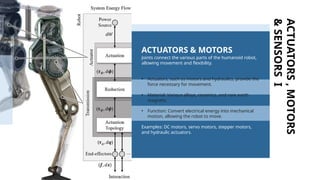
ACTUATORS & MOTORS
Joints connect the various parts of the humanoid robot,
allowing movement and flexibility.
• Actuators, such as motors and hydraulics, provide the
force necessary for movement.
• Material: Various alloys, ceramics, and rare earth
magnets.
• Function: Convert electrical energy into mechanical
motion, allowing the robot to move.
Examples: DC motors, servo motors, stepper motors,
and hydraulic actuators.
ACTUATORS
,
MOTORS
&
SENSORS
II
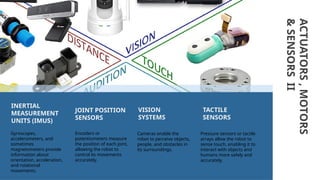
Gyroscopes,
accelerometers, and
sometimes
magnetometers provide
information about
orientation, acceleration,
and rotational
movements.
INERTIAL
MEASUREMENT
UNITS (IMUS)
JOINT POSITION
SENSORS
Encoders or
potentiometers measure
the position of each joint,
allowing the robot to
control its movements
accurately.
VISION
SYSTEMS
Cameras enable the
robot to perceive objects,
people, and obstacles in
its surroundings.
TACTILE
SENSORS
Pressure sensors or tactile
arrays allow the robot to
sense touch, enabling it to
interact with objects and
humans more safely and
accurately.
POWER AND
ENERGY STORAGE
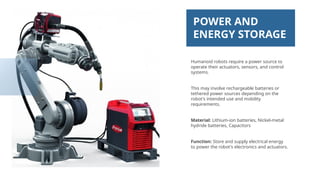
Humanoid robots require a power source to
operate their actuators, sensors, and control
systems.
This may involve rechargeable batteries or
tethered power sources depending on the
robot's intended use and mobility
requirements.
Material: Lithium-ion batteries, Nickel-metal
hydride batteries, Capacitors
Function: Store and supply electrical energy
to power the robot's electronics and actuators.
COVERS
AND
EXTERIORS
I
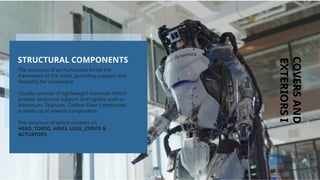
The structure of an Humanoid forms the
framework of the robot, providing support and
flexibility for movement.
Usually consists of lightweight materials Which
provide structural support and rigidity such as
Aluminum, Titanium, Carbon Fiber Composites
is made up 0f several components.
The structure of which consists of:
HEAD, TORSO, ARMS, LEGS, JOINTS &
ACTUATORS.
STRUCTURAL COMPONENTS
COVERS
AND
EXTERIORS
II
Most Often materials like Plastic, Polymers , Rubber and
Metals are utilized as suitable covers and exteriors for
features of the humanoid robots
The importance of these are to protect the internal
components from dust , moisture and physical damage
while keeping aesthetics in mind.
Examples: ABS, Polycarbonate, Aluminium panels,
Rubber gaskets.
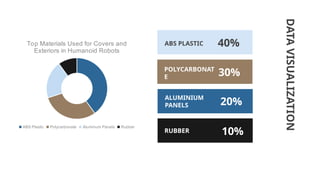
DATA
VISUALIZATION
ABS PLASTIC
POLYCARBONAT
E
ALUMINIUM
PANELS
40%
30%
20%
Top Materials Used for Covers and
Exteriors in Humanoid Robots
ABS Plastic Polycarbonate Aluminum Panels Rubber
RUBBER 10%
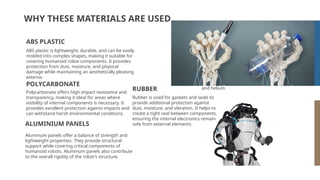
WHY THESE MATERIALS ARE USED
ABS plastic is lightweight, durable, and can be easily
molded into complex shapes, making it suitable for
covering humanoid robot components. It provides
protection from dust, moisture, and physical
damage while maintaining an aesthetically pleasing
exterior.
Yes, this is the ringed
one. It’s a gas giant,
composed of hydrogen
and helium
SATURN
ABS PLASTIC
Polycarbonate offers high impact resistance and
transparency, making it ideal for areas where
visibility of internal components is necessary. It
provides excellent protection against impacts and
can withstand harsh environmental conditions.
POLYCARBONATE
Aluminum panels offer a balance of strength and
lightweight properties. They provide structural
support while covering critical components of
humanoid robots. Aluminum panels also contribute
to the overall rigidity of the robot's structure.
ALUMINIUM PANELS
Rubber is used for gaskets and seals to
provide additional protection against
dust, moisture, and vibration. It helps to
create a tight seal between components,
ensuring the internal electronics remain
safe from external elements.
RUBBER
Some Materials used in the wiring and connecting
process includes: Copper, Aluminum, Insulating
materials (e.g., PVC, Teflon)
These connectors are used to Transmit electrical signals
and power between components while ensuring
electrical safety and reliability.
WIRES
AND
CONNECTORS
CHALLENGES AND FUTURE
DEVELOPMENTS
Challenges: Balancing strength with weight,
optimizing energy efficiency, ensuring
durability and reliability.
Future Developments: Advancements in
materials science, such as self-healing
materials, nanotechnology, and biodegradable
materials, may revolutionize humanoid robot
construction.
CASE
STUDY
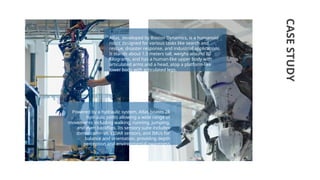
Atlas, developed by Boston Dynamics, is a humanoid
robot designed for various tasks like search and
rescue, disaster response, and industrial applications.
It stands about 1.5 meters tall, weighs around 80
kilograms, and has a human-like upper body with
articulated arms and a head, atop a platform-like
lower body with articulated legs.
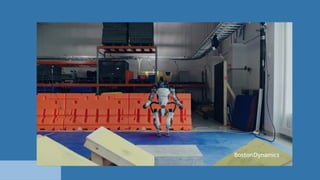
Powered by a hydraulic system, Atlas boasts 28
hydraulic joints allowing a wide range of
movements including walking, running, jumping,
and even backflips. Its sensory suite includes
stereo cameras, LIDAR sensors, and IMUs for
balance and orientation, providing depth
perception and environmental awareness
CASE
STUDY
-
ATLAS
Recent versions feature battery
power, enhancing mobility and
versatility by eliminating the
need for a tether.
Atlas's applications span from
disaster response to industrial
tasks like inspection,
maintenance, and assembly,
making it a cutting-edge
advancement in robotics
technology, seamlessly
integrating mechanical design,
sensory perception, and artificial
intelligence.
Key specifications included:
- Height: 150 cm
- Weight: 80 kg
- Maximum Speed: 5.4 km/h
- Sensors: Lidar and stereo vision
- Actuators: Hydraulic actuation with
custom servo-valves
- Degrees of Freedom (DOF): 28
- Materials: 3D-printed parts with
embedded actuators and hydraulic
lines in leg structures
- Compute: Custom control and
computing system
- Software: Custom software
- Power: Battery powered
THANK YOU!
ANY QUESTIONS?

Humanoid robots standard components_ Final..pptx

  • 1.
  • 2.
    TABLE OF CONTENTS Power, energy, wiringand connectors POWER & ENERGY 03 HUMANOID ROBOTS & ENGINEERING MATERIALS Intro to what humanoid robots are plus the importance of engineering materials. 01 ACTUATORS , MOTORS & SENSORS Learn more about the standard actuators, motors and sensor 02 COVERS AND EXTERIORS Learn the materials and top set used in the exterior of humanoid robots 04 CASE STUDY : BOSTON DYNAMICS (ATLAS) Little capsule look on the ATLAS robot at Boston Dynamics.. 05 06 CHALLENGES AND FUTURE DEVELOPMENTS Future modifications and additions. Facing the challenges
  • 3.
  • 4.
    HUMANOID ROBOTS & ENGINEERING MATERIALS Humanoid robots aremachines designed to resemble and mimic human behavior, with applications ranging from industrial automation to healthcare and beyond. Humanoid robots typically consist of several standard components, each serving specific functions to enable the robot to perform various tasks and mimic human movements to some extent. Engineering materials play a vital role in the design and functionality of humanoid robots. They determine the robot's strength, durability, weight, flexibility, and other mechanical properties. Understanding the materials used in humanoid robot construction is crucial for their design, functionality, and performance IMPORTANCE OF ENGINEERING MATERIALS WHAT ARE HUMANOID ROBOTS? Selecting the appropriate materials is essential to ensure the robot meets performance requirements and safety standards.
  • 5.
    ACTUATORS , MOTORS & SENSORS I ACTUATORS & MOTORS Jointsconnect the various parts of the humanoid robot, allowing movement and flexibility. • Actuators, such as motors and hydraulics, provide the force necessary for movement. • Material: Various alloys, ceramics, and rare earth magnets. • Function: Convert electrical energy into mechanical motion, allowing the robot to move. Examples: DC motors, servo motors, stepper motors, and hydraulic actuators.
  • 6.
    ACTUATORS , MOTORS & SENSORS II Gyroscopes, accelerometers, and sometimes magnetometers provide informationabout orientation, acceleration, and rotational movements. INERTIAL MEASUREMENT UNITS (IMUS) JOINT POSITION SENSORS Encoders or potentiometers measure the position of each joint, allowing the robot to control its movements accurately. VISION SYSTEMS Cameras enable the robot to perceive objects, people, and obstacles in its surroundings. TACTILE SENSORS Pressure sensors or tactile arrays allow the robot to sense touch, enabling it to interact with objects and humans more safely and accurately.
  • 7.
    POWER AND ENERGY STORAGE Humanoidrobots require a power source to operate their actuators, sensors, and control systems. This may involve rechargeable batteries or tethered power sources depending on the robot's intended use and mobility requirements. Material: Lithium-ion batteries, Nickel-metal hydride batteries, Capacitors Function: Store and supply electrical energy to power the robot's electronics and actuators.
  • 8.
    COVERS AND EXTERIORS I The structure ofan Humanoid forms the framework of the robot, providing support and flexibility for movement. Usually consists of lightweight materials Which provide structural support and rigidity such as Aluminum, Titanium, Carbon Fiber Composites is made up 0f several components. The structure of which consists of: HEAD, TORSO, ARMS, LEGS, JOINTS & ACTUATORS. STRUCTURAL COMPONENTS
  • 9.
    COVERS AND EXTERIORS II Most Often materialslike Plastic, Polymers , Rubber and Metals are utilized as suitable covers and exteriors for features of the humanoid robots The importance of these are to protect the internal components from dust , moisture and physical damage while keeping aesthetics in mind. Examples: ABS, Polycarbonate, Aluminium panels, Rubber gaskets.
  • 10.
    DATA VISUALIZATION ABS PLASTIC POLYCARBONAT E ALUMINIUM PANELS 40% 30% 20% Top MaterialsUsed for Covers and Exteriors in Humanoid Robots ABS Plastic Polycarbonate Aluminum Panels Rubber RUBBER 10%
  • 11.
    WHY THESE MATERIALSARE USED ABS plastic is lightweight, durable, and can be easily molded into complex shapes, making it suitable for covering humanoid robot components. It provides protection from dust, moisture, and physical damage while maintaining an aesthetically pleasing exterior. Yes, this is the ringed one. It’s a gas giant, composed of hydrogen and helium SATURN ABS PLASTIC Polycarbonate offers high impact resistance and transparency, making it ideal for areas where visibility of internal components is necessary. It provides excellent protection against impacts and can withstand harsh environmental conditions. POLYCARBONATE Aluminum panels offer a balance of strength and lightweight properties. They provide structural support while covering critical components of humanoid robots. Aluminum panels also contribute to the overall rigidity of the robot's structure. ALUMINIUM PANELS Rubber is used for gaskets and seals to provide additional protection against dust, moisture, and vibration. It helps to create a tight seal between components, ensuring the internal electronics remain safe from external elements. RUBBER
  • 12.
    Some Materials usedin the wiring and connecting process includes: Copper, Aluminum, Insulating materials (e.g., PVC, Teflon) These connectors are used to Transmit electrical signals and power between components while ensuring electrical safety and reliability. WIRES AND CONNECTORS
  • 13.
    CHALLENGES AND FUTURE DEVELOPMENTS Challenges:Balancing strength with weight, optimizing energy efficiency, ensuring durability and reliability. Future Developments: Advancements in materials science, such as self-healing materials, nanotechnology, and biodegradable materials, may revolutionize humanoid robot construction.
  • 14.
    CASE STUDY Atlas, developed byBoston Dynamics, is a humanoid robot designed for various tasks like search and rescue, disaster response, and industrial applications. It stands about 1.5 meters tall, weighs around 80 kilograms, and has a human-like upper body with articulated arms and a head, atop a platform-like lower body with articulated legs. Powered by a hydraulic system, Atlas boasts 28 hydraulic joints allowing a wide range of movements including walking, running, jumping, and even backflips. Its sensory suite includes stereo cameras, LIDAR sensors, and IMUs for balance and orientation, providing depth perception and environmental awareness
  • 15.
    CASE STUDY - ATLAS Recent versions featurebattery power, enhancing mobility and versatility by eliminating the need for a tether. Atlas's applications span from disaster response to industrial tasks like inspection, maintenance, and assembly, making it a cutting-edge advancement in robotics technology, seamlessly integrating mechanical design, sensory perception, and artificial intelligence. Key specifications included: - Height: 150 cm - Weight: 80 kg - Maximum Speed: 5.4 km/h - Sensors: Lidar and stereo vision - Actuators: Hydraulic actuation with custom servo-valves - Degrees of Freedom (DOF): 28 - Materials: 3D-printed parts with embedded actuators and hydraulic lines in leg structures - Compute: Custom control and computing system - Software: Custom software - Power: Battery powered
  • 17.