

The Wilderness Foundation www.wildernessfoundation.org.uk Social, Cultural and Health Benefits to Humanity  through  WILDERNESS Preservation
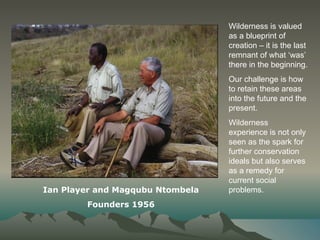
Ian Player and Magqubu Ntombela Founders 1956 Wilderness is valued as a blueprint of creation – it is the last remnant of what ‘was’ there in the beginning.  Our challenge is how to retain these areas into the future and the present. Wilderness experience is not only seen as the spark for further conservation ideals but also serves as a remedy for current social problems.
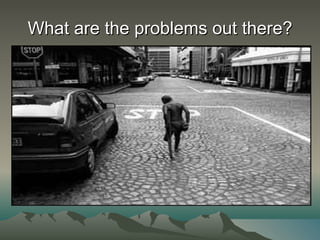
What are the problems out there?
 
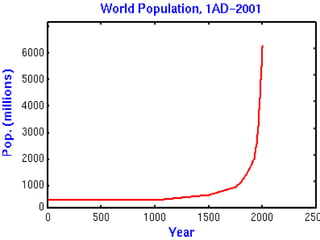
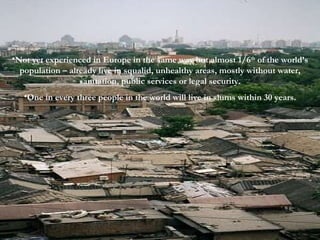
Not yet experienced in Europe in the same way but almost 1/6 th  of the world’s population – already live in squalid, unhealthy areas, mostly without water, sanitation, public services or legal security. One in every three people in the world will live in slums within 30 years.
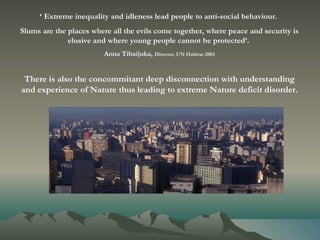
‘  Extreme inequality and idleness lead people to anti-social behaviour.  Slums are the places where all the evils come together, where peace and security is elusive and where young people cannot be protected’.  Anna Tibaijuka,   Director, UN Habitat 2003 There is also the concommitant deep disconnection with understanding and experience of Nature thus leading to extreme Nature deficit disorder.
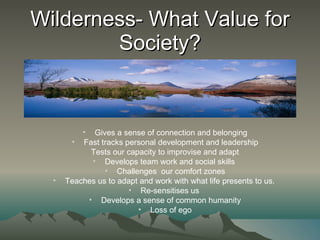
Wilderness- What Value for Society? Gives a sense of connection and belonging Fast tracks personal development and leadership Tests our capacity to improvise and adapt Develops team work and social skills  Challenges  our comfort zones Teaches us to adapt and work with what life presents to us.  Re-sensitises us  Develops a sense of common humanity Loss of ego
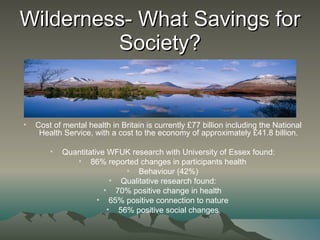
Wilderness- What Savings for Society? Cost of mental health in Britain is currently £77 billion including the National Health Service, with a cost to the economy of approximately £41.8 billion. Quantitative WFUK research with University of Essex found: 86% reported changes in participants health Behaviour (42%) Qualitative research found: 70% positive change in health 65% positive connection to nature 56% positive social changes
Examples of  SOCIAL  HEALTH   PROGRAMMES BASED IN WILDERNESS   TURNAROUND SUSTAINABLE PEACE NETWORK
 
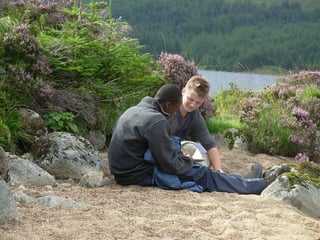
Working with Youth at Risk
 
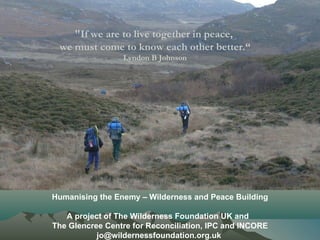
"If we are to live together in peace,  we must come to know each other better.“ Lyndon B Johnson   Humanising the Enemy – Wilderness and Peace Building A project of The Wilderness Foundation UK and  The Glencree Centre for Reconciliation, IPC and INCORE jo@wildernessfoundation.org.uk
 
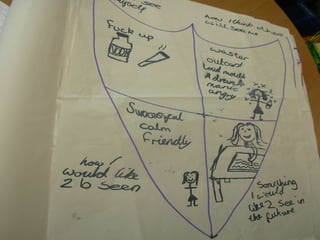
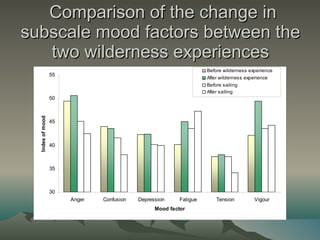
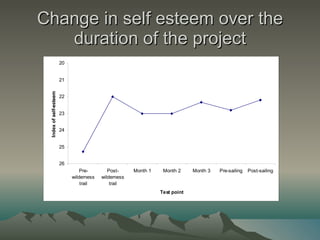
Why TurnAround? TurnAround had an 80% success rate in getting young people back into education or work on completion. 89% of young offenders are re-offending within one year of being released from YOI…etc Each year 70,000 school age offenders enter the Youth Justice System. Nearly 2/3 s  of young offenders are unemployed at time of arrest.  Cost of sending one youth to a YOI was £47,000 in 2002. We know through research with University of Essex that youth on our programmes show a significant increase in self esteem, mood changes and behaviour change linked to a positive connection with Nature…
Comparison of the change in subscale mood factors between the two wilderness experiences
Change in self esteem over the duration of the project
 
INLA, BRITISH ARMY, POLICE The Sustainable Peace Network
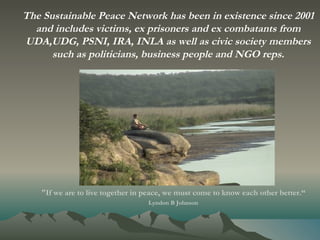
"If we are to live together in peace, we must come to know each other better.“ Lyndon B Johnson   The Sustainable Peace Network has been in existence since 2001 and includes victims, ex prisoners and ex combatants from UDA,UDG, PSNI, IRA, INLA as well as civic society members such as politicians, business people and NGO reps.
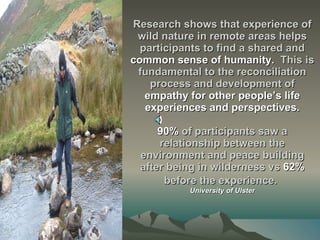
Research shows that experience of wild nature in remote areas helps participants to find a shared and  common sense of humanity.   This is fundamental to the reconciliation process and development of  empathy for other people’s life experiences and perspectives. 90%  of participants saw a relationship between the environment and peace building after being in wilderness vs  62%  before the experience.   University of Ulster
Conclusions Good evidence exists to show positive social and health benefits from wilderness experience. Conflict resolution and reconciliation processes are fast tracked in wilderness settings. Too much focus has been placed on qualitative evidence. There is an absolute need for more research to be done that is peer reviewed and robust.  We need hard facts to back what we already know.
Treat the earth well: it was not given to you by your parents, it was loaned to you by your children.  We do not inherit the Earth from our Ancestors, we borrow it from our Children."  Ancient Indian Proverb

Humanizing the Enemy: Wilderness and Peace Building

  • 1.
    The Wilderness Foundationwww.wildernessfoundation.org.uk Social, Cultural and Health Benefits to Humanity through WILDERNESS Preservation
  • 2.
    Ian Player andMagqubu Ntombela Founders 1956 Wilderness is valued as a blueprint of creation – it is the last remnant of what ‘was’ there in the beginning. Our challenge is how to retain these areas into the future and the present. Wilderness experience is not only seen as the spark for further conservation ideals but also serves as a remedy for current social problems.
  • 3.
    What are theproblems out there?
  • 4.
  • 5.
    Not yet experiencedin Europe in the same way but almost 1/6 th of the world’s population – already live in squalid, unhealthy areas, mostly without water, sanitation, public services or legal security. One in every three people in the world will live in slums within 30 years.
  • 6.
    ‘ Extremeinequality and idleness lead people to anti-social behaviour. Slums are the places where all the evils come together, where peace and security is elusive and where young people cannot be protected’. Anna Tibaijuka, Director, UN Habitat 2003 There is also the concommitant deep disconnection with understanding and experience of Nature thus leading to extreme Nature deficit disorder.
  • 7.
    Wilderness- What Valuefor Society? Gives a sense of connection and belonging Fast tracks personal development and leadership Tests our capacity to improvise and adapt Develops team work and social skills Challenges our comfort zones Teaches us to adapt and work with what life presents to us. Re-sensitises us Develops a sense of common humanity Loss of ego
  • 8.
    Wilderness- What Savingsfor Society? Cost of mental health in Britain is currently £77 billion including the National Health Service, with a cost to the economy of approximately £41.8 billion. Quantitative WFUK research with University of Essex found: 86% reported changes in participants health Behaviour (42%) Qualitative research found: 70% positive change in health 65% positive connection to nature 56% positive social changes
  • 9.
    Examples of SOCIAL HEALTH PROGRAMMES BASED IN WILDERNESS TURNAROUND SUSTAINABLE PEACE NETWORK
  • 10.
  • 11.
  • 12.
  • 13.
    "If we areto live together in peace, we must come to know each other better.“ Lyndon B Johnson Humanising the Enemy – Wilderness and Peace Building A project of The Wilderness Foundation UK and The Glencree Centre for Reconciliation, IPC and INCORE jo@wildernessfoundation.org.uk
  • 14.
  • 15.
    Why TurnAround? TurnAroundhad an 80% success rate in getting young people back into education or work on completion. 89% of young offenders are re-offending within one year of being released from YOI…etc Each year 70,000 school age offenders enter the Youth Justice System. Nearly 2/3 s of young offenders are unemployed at time of arrest. Cost of sending one youth to a YOI was £47,000 in 2002. We know through research with University of Essex that youth on our programmes show a significant increase in self esteem, mood changes and behaviour change linked to a positive connection with Nature…
  • 16.
    Comparison of thechange in subscale mood factors between the two wilderness experiences
  • 17.
    Change in selfesteem over the duration of the project
  • 18.
  • 19.
    INLA, BRITISH ARMY,POLICE The Sustainable Peace Network
  • 20.
    "If we areto live together in peace, we must come to know each other better.“ Lyndon B Johnson The Sustainable Peace Network has been in existence since 2001 and includes victims, ex prisoners and ex combatants from UDA,UDG, PSNI, IRA, INLA as well as civic society members such as politicians, business people and NGO reps.
  • 21.
    Research shows thatexperience of wild nature in remote areas helps participants to find a shared and common sense of humanity. This is fundamental to the reconciliation process and development of empathy for other people’s life experiences and perspectives. 90% of participants saw a relationship between the environment and peace building after being in wilderness vs 62% before the experience. University of Ulster
  • 22.
    Conclusions Good evidenceexists to show positive social and health benefits from wilderness experience. Conflict resolution and reconciliation processes are fast tracked in wilderness settings. Too much focus has been placed on qualitative evidence. There is an absolute need for more research to be done that is peer reviewed and robust. We need hard facts to back what we already know.
  • 23.
    Treat the earthwell: it was not given to you by your parents, it was loaned to you by your children. We do not inherit the Earth from our Ancestors, we borrow it from our Children." Ancient Indian Proverb