RACHEL SANDERS 
PYCON UK
people -> systems
unhappy 
mediocre 
stagnant
is this inevitable?
¯_(ツ)_/¯ 
it depends
large 
scalable 
fault-tolerant 
systems of people
Lessons from Strangers: 
Better Engineering 
through 
Not Doing Engineering
what makes people happy at work?
people are happiest when they 
can get work done
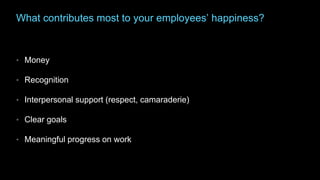
What contributes most to your employees’ happiness? 
• Money 
• Recognition 
• Interpersonal support (respect, camaraderie) 
• Clear goals 
• Meaningful progress on work
5%
you can be trained 
out of seeing the obvious
we are makers 
people use our work to do theirs
code performance 
latency 
O(n)
what’s the human time complexity?
what you can’t see, you can’t fix
ENGINEERING UI /UX
there’s no magic 
to design
Nobody wants to use your stuff. 
They want to HAVE used it.
the 2 steps of user evaluation 
1. What is this? 
2. What can it do?
Make these answers 
as obvious as possible to find
duh. documentation.
“If you have to refer to the documentation 
every time you use a module, 
find (or build) a new module.” 
- Kenneth Reitz
get the API right, 
and the rest will follow
Your users have better things to do. 
Let them.
“I want to make software that’s tolerated” 
- nobody, ever
You ask, and you listen
why don’t we use this?
like we got time for that
how do you change a culture?
“safety culture”
2 
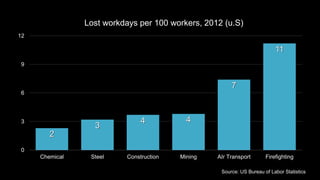
Lost workdays per 100 workers, 2012 (u.S) 
3 
4 4 
7 
11 
12 
9 
6 
3 
0 
Chemical Steel Construction Mining AIr Transport Firefighting 
Source: US Bureau of Labor Statistics
happens
Problem: 
sometimes happens
Attempt #1
Problem: People
people 
make mistakes 
push the envelope 
don’t follow the rules
Attempt #2 
Industry used More Bureaucracy!
It wasn’t very effective.
“Management systems are primarily rational inventions, 
defined on paper in offices and capable of 
objective evaluation in audits.” 
-Patrick Hudson
Attempt #3 
Acceptance
People are going to screw up 
People have free will and opinions 
Nobody wants to read the damn manual
…but most people want to do the right thing
Solution: change the culture
“We believe that to influence culture 
you need more than management.”
leaders drive culture, not management
each team responsible for safety 
address root cause for accidents 
plan for mistakes
88% decline in lost work days 
Zero incidents in 2013
10 
LOST WORKDAYS FOR AIR TRANSPORT PER 100 Workers 
8 9 
8 
7 7 
11 
10 
9 
8 
7 
6 
2007 2008 2009 2010 2011 2012 
Source: US Bureau of Labor Statistics
Culture can be changed
Let’s make this a thing
human design patterns
we’re all (potential) leaders
make stuff that’s loved, not tolerated 
(and not explodey )
Thank you! 
@trustrachel
BIBI LOGRAPHY 
• Teresa Amabile, The Power of Small Wins 
http://www.hbs.edu/faculty/Pages/item.aspx?num=40244 
• Teresa Amabile, The Progress Principle 
• Don Norman, The Design of Everyday Things 
• Patrick Hudson, Safety Management and Safety Culture: The Hard and 
Winding Road, 
https://dl.dropboxusercontent.com/u/105439/PyConUK/Hudson%20Long% 
20Hard%20Winding%20Road.pdf
BIBI LOGRAPHY 
• Target Zero: A Culture of Safety, Defence Aviation Safety Centre Journal 
2008, p22 
https://dl.dropboxusercontent.com/u/105439/PyConUK/DASCJournal2008. 
pdf 
• Patrick Hudson, Achieving a Safety Culture in Aviation, 
http://www.atec.or.jp/sympo2010/ATEC_Sympo10_Presentation_1.pdf
AT TRIBUT IONS 
• RAF Helicopter - https://www.flickr.com/photos/defenceimages/7502339574 
• Horizon Fire 2 https://www.flickr.com/photos/visionshare/4578360732/ 
• Patrick Hudson: Screenshot from 
https://www.youtube.com/watch?v=DZDxV_6sNUQ
AT TRIBUT IONS 
• Oops! https://www.flickr.com/photos/terry_wha/426980617/ 
• See no evil https://www.flickr.com/photos/tim_ellis/482381094 
• The Pink Nightmare 
https://www.flickr.com/photos/lessapathymorecake/4209375193 
• D3 Line Chart http://bl.ocks.org/mbostock/3883245

PyCon UK 2014 Keynote

Editor's Notes

  • #62 I want to see human design patterns for this. I want to see books and blogs posts about it. I want to start hearing buzzwords that random people can endorse you for on your Linkedin profiles
  • #63 Most of us don’t run companies or do anything like that, but we have leadership over teams or products or maybe even just features.