TURKEY FARMERS OF ONTARIO
ONTARIO MINISTRY OF AGRICULTURE, FOOD AND RURAL AFFAIRS
Outline:
 Definitions
 Why is Training Needed
 Why Treat Turkeys Humanely
 Bird Behaviour and Handling
 Prevention of Piling and Lighting
 Catching
 Sick & Injured Birds
 Stuffing
 Loading Densities
 Catching Report
Definition of Welfare
 A good definition of welfare is problematic – welfare is multifactorial,
involves information about the start of the animal plus value
judgements from a human viewpoint.
 There are numerous perspectives on bird welfare that are influenced by
a person’s values and experiences.
The World Organization for Animal Health (OIE)’s guiding principles for
animal welfare include:
1. A critical relationship between animal health and animal welfare.
2. Improvements in farm animal welfare can often improve productivity
and food safety, and hence lead to economic benefits.
3. The “five freedoms” provide valuable guidance of animal welfare.
Definition of Welfare
 Five Freedoms:
1. FREEDOM FROM HUNGER AND THIRST – by ready access to fresh
water and a diet to maintain full health and vigour.
2. FREEDOM FROM DISCOMFORT – by providing an appropriate
environment including shelter and a comfortable resting area.
3. FREEDOM FROM PAIN, INJURY OR DISEASE – by prevention or rapid
diagnosis and treatment.
4. FREEDOM TO EXPRESS NORMAL BEHAVIOUR – by providing sufficient
space, proper facilities and company of the animal’s own kind.
5. FREEDOM FROM FEAR AND DISTRESS – by ensuring conditions and
treatment which avoid mental suffering.
(Brambell,1965)
Definition of Welfare
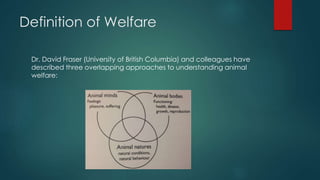
Dr. David Fraser (University of British Columbia) and colleagues have
described three overlapping approaches to understanding animal
welfare:
The Process
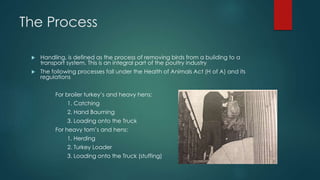
 Handling, is defined as the process of removing birds from a building to a
transport system. This is an integral part of the poultry industry
 The following processes fall under the Health of Animals Act (H of A) and its
regulations
For broiler turkey’s and heavy hens:
1. Catching
2. Hand Bauming
3. Loading onto the Truck
For heavy tom’s and hens:
1. Herding
2. Turkey Loader
3. Loading onto the Truck (stuffing)
Why is Training Needed?
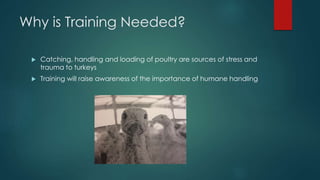
 Catching, handling and loading of poultry are sources of stress and
trauma to turkeys
 Training will raise awareness of the importance of humane handling
Employee Attitude Makes the
Difference!
 Dr. Temple Grandin has found that the most important aspect which
influences how animals are treated is management attitude (Grandin,
1994)
 The quality of employees and their proper supervision largely
determines how many birds are injured (Kettlewell & Turner, 1985)
 If catchers are careful, conscientious and properly supervised then
manual catching can result in low levels of injuries (Ekstrand, 1998)
Why Treat Turkeys Humanely?
 Prevent pain and fear in the birds
 Possible outcomes of inappropriate treatment:
 Death, metabolic exhaustion, bruising, broken bones, emotional stress, torn
skin & thermal stress, piling and scratching
 Dislocation and broken legs, dislocated and broken wing bones
Why Treat Turkeys Humanely?
 Physical injuries (i.e. bruising, fractures, dislocation of bones etc.)
have huge economic implications (Elrom, 2001)
 4-6% birds are injured during catching processes (Poultry International, 1998)
 Approximately 32/200 birds had leg bruising during catching (Lacy and
Czarick, 1998)
 Approximately 120 million birds die between farm and slaughter (Week,
C. and Nicol, C. 2000)
 It is estimated that downgrading losses are in the range of 8-25% (Elson,
1986)
 A large proportion of downgrading is due to physical damage and
about 90% occurs in the 12 hours before slaughter (Elson, 1986)
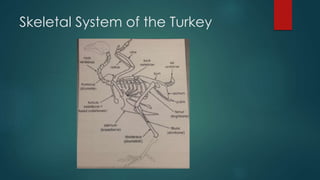
Skeletal System of the Turkey
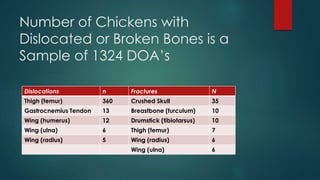
Number of Chickens with
Dislocated or Broken Bones is a
Sample of 1324 DOA’s
Dislocations n Fractures N
Thigh (femur) 360 Crushed Skull 35
Gastrocnemius Tendon 13 Breastbone (furculum) 10
Wing (humerus) 12 Drumstick (tibiotarsus) 10
Wing (ulna) 6 Thigh (femur) 7
Wing (radius) 5 Wing (radius) 6
Wing (ulna) 6
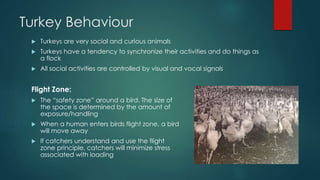
Turkey Behaviour
 Turkeys are very social and curious animals
 Turkeys have a tendency to synchronize their activities and do things as
a flock
 All social activities are controlled by visual and vocal signals
Flight Zone:
 The “safety zone” around a bird. The size of
the space is determined by the amount of
exposure/handling
 When a human enters birds flight zone, a bird
will move away
 If catchers understand and use the flight
zone principle, catchers will minimize stress
associated with loading
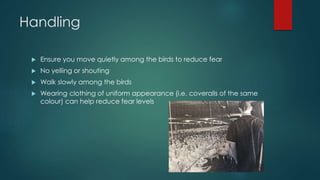
Handling
 Ensure you move quietly among the birds to reduce fear
 No yelling or shouting
 Walk slowly among the birds
 Wearing clothing of uniform appearance (i.e. coveralls of the same
colour) can help reduce fear levels
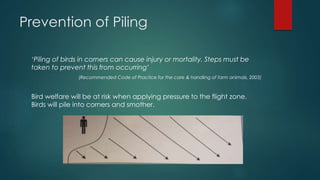
Prevention of Piling
‘Piling of birds in corners can cause injury or mortality. Steps must be
taken to prevent this from occurring’
(Recommended Code of Practice for the care & handling of farm animals, 2003)
Bird welfare will be at risk when applying pressure to the flight zone.
Birds will pile into corners and smother.
Lighting
 It is best to catch birds under blue light because this reduces their
ability to see (Proudfoot, F.G., et al., 1991)
 Lowering light intensity or using blue light provides enough light for
humans, but not for poultry (Recommened Code of Practice for the care & handling of farm
animals, 2003)
Do Not Load Compromised Birds
Compromised Animals – an animal with reduced capacity to
withstand the stress of transportation, due to injury, fatigue, infirmity,
poor health, distress, very young or old age, impending birth, or any
other cause. (H of A)
Compromised Birds
Down or Off its Legs
Obviously Sick (hunched, head drawn in, feathers ruffled)
Not Alert
Birds that are Exceptionally Light
Sick & Injured Birds
What do I do with an unfit bird?
 Producers must humanely euthanize birds
“Every animal that is to be killed must be killed by a method that is
humane and minimizes the pain and distress to the animal; and
animal’s pain and distress are deemed to be minimized if it is killed by a
method that produces rapid, irreversible unconsciousness and prompt
subsequent death”
(Standard of Care Regulation, OSPCA ACT)
Catching – Broiler Turkeys (5.29 kg
or 11.6 lbs)
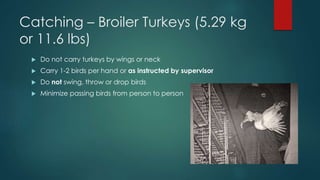
 Do not carry turkeys by wings or neck
 Carry 1-2 birds per hand or as instructed by supervisor
 Do not swing, throw or drop birds
 Minimize passing birds from person to person
Herding of Turkeys
 Keep Calm
 Move turkeys in small groups, using screens (Recommended Code of Practice for the
care & handling of farm animals, 2003)
 Use garbage bags to encourage turkeys to move
Placing Birds in Truck Liner
 Ensure liners are properly maintained before loading (doors)
 Place gently into the liner to prevent damage to the bird
 Ensure birds are in an upright position in the liner – if a bird is left
upside down in the liner it will not right itself and will probably die
during transit
 Ensure no part of the bird is protruding from the liner before closing
the door
Loading Densities
 Health of Animals Act prohibits overcrowding
 Loading densities are determined prior to the start of the loading
process by dispatch – follow the instructions given
 If more birds are present than reported to dispatch, contact
dispatch immediately
 Loading densities depend on available floor space in the liner, body
size and weight of birds and environmental conditions
 Maximum density should allow all birds to rest on the floor if they are
evenly distributed
 Birds should be able to freely move their heads when resting on the
floor
Special Considerations
Cold & Wet Conditions:
 In extreme cold weather, turkeys can be loaded at the maximum
densities
(Recommended Code of Practice for the care & handling of farm animals, 2003)
Hot Conditions:
 Reduce the number of birds per bin by 15-20% to keep the load
temperature within an acceptable range
(Recommended Code of Practice for the care & handling of farm animals, 2003)
Catching Report
What is it?
 Checklist for the foreperson to evaluate the bird and barn
conditions and review the catching procedures
Why do we have it?
 “We manage what we measure”
 To evaluate the working environment
 To ensure that birds are being treated humanely through

Humane turkey loading

  • 1.
    TURKEY FARMERS OFONTARIO ONTARIO MINISTRY OF AGRICULTURE, FOOD AND RURAL AFFAIRS
  • 2.
    Outline:  Definitions  Whyis Training Needed  Why Treat Turkeys Humanely  Bird Behaviour and Handling  Prevention of Piling and Lighting  Catching  Sick & Injured Birds  Stuffing  Loading Densities  Catching Report
  • 3.
    Definition of Welfare A good definition of welfare is problematic – welfare is multifactorial, involves information about the start of the animal plus value judgements from a human viewpoint.  There are numerous perspectives on bird welfare that are influenced by a person’s values and experiences. The World Organization for Animal Health (OIE)’s guiding principles for animal welfare include: 1. A critical relationship between animal health and animal welfare. 2. Improvements in farm animal welfare can often improve productivity and food safety, and hence lead to economic benefits. 3. The “five freedoms” provide valuable guidance of animal welfare.
  • 4.
    Definition of Welfare Five Freedoms: 1. FREEDOM FROM HUNGER AND THIRST – by ready access to fresh water and a diet to maintain full health and vigour. 2. FREEDOM FROM DISCOMFORT – by providing an appropriate environment including shelter and a comfortable resting area. 3. FREEDOM FROM PAIN, INJURY OR DISEASE – by prevention or rapid diagnosis and treatment. 4. FREEDOM TO EXPRESS NORMAL BEHAVIOUR – by providing sufficient space, proper facilities and company of the animal’s own kind. 5. FREEDOM FROM FEAR AND DISTRESS – by ensuring conditions and treatment which avoid mental suffering. (Brambell,1965)
  • 5.
    Definition of Welfare Dr.David Fraser (University of British Columbia) and colleagues have described three overlapping approaches to understanding animal welfare:
  • 6.
    The Process  Handling,is defined as the process of removing birds from a building to a transport system. This is an integral part of the poultry industry  The following processes fall under the Health of Animals Act (H of A) and its regulations For broiler turkey’s and heavy hens: 1. Catching 2. Hand Bauming 3. Loading onto the Truck For heavy tom’s and hens: 1. Herding 2. Turkey Loader 3. Loading onto the Truck (stuffing)
  • 7.
    Why is TrainingNeeded?  Catching, handling and loading of poultry are sources of stress and trauma to turkeys  Training will raise awareness of the importance of humane handling
  • 8.
    Employee Attitude Makesthe Difference!  Dr. Temple Grandin has found that the most important aspect which influences how animals are treated is management attitude (Grandin, 1994)  The quality of employees and their proper supervision largely determines how many birds are injured (Kettlewell & Turner, 1985)  If catchers are careful, conscientious and properly supervised then manual catching can result in low levels of injuries (Ekstrand, 1998)
  • 9.
    Why Treat TurkeysHumanely?  Prevent pain and fear in the birds  Possible outcomes of inappropriate treatment:  Death, metabolic exhaustion, bruising, broken bones, emotional stress, torn skin & thermal stress, piling and scratching  Dislocation and broken legs, dislocated and broken wing bones
  • 10.
    Why Treat TurkeysHumanely?  Physical injuries (i.e. bruising, fractures, dislocation of bones etc.) have huge economic implications (Elrom, 2001)  4-6% birds are injured during catching processes (Poultry International, 1998)  Approximately 32/200 birds had leg bruising during catching (Lacy and Czarick, 1998)  Approximately 120 million birds die between farm and slaughter (Week, C. and Nicol, C. 2000)  It is estimated that downgrading losses are in the range of 8-25% (Elson, 1986)  A large proportion of downgrading is due to physical damage and about 90% occurs in the 12 hours before slaughter (Elson, 1986)
  • 11.
  • 12.
    Number of Chickenswith Dislocated or Broken Bones is a Sample of 1324 DOA’s Dislocations n Fractures N Thigh (femur) 360 Crushed Skull 35 Gastrocnemius Tendon 13 Breastbone (furculum) 10 Wing (humerus) 12 Drumstick (tibiotarsus) 10 Wing (ulna) 6 Thigh (femur) 7 Wing (radius) 5 Wing (radius) 6 Wing (ulna) 6
  • 13.
    Turkey Behaviour  Turkeysare very social and curious animals  Turkeys have a tendency to synchronize their activities and do things as a flock  All social activities are controlled by visual and vocal signals Flight Zone:  The “safety zone” around a bird. The size of the space is determined by the amount of exposure/handling  When a human enters birds flight zone, a bird will move away  If catchers understand and use the flight zone principle, catchers will minimize stress associated with loading
  • 14.
    Handling  Ensure youmove quietly among the birds to reduce fear  No yelling or shouting  Walk slowly among the birds  Wearing clothing of uniform appearance (i.e. coveralls of the same colour) can help reduce fear levels
  • 15.
    Prevention of Piling ‘Pilingof birds in corners can cause injury or mortality. Steps must be taken to prevent this from occurring’ (Recommended Code of Practice for the care & handling of farm animals, 2003) Bird welfare will be at risk when applying pressure to the flight zone. Birds will pile into corners and smother.
  • 16.
    Lighting  It isbest to catch birds under blue light because this reduces their ability to see (Proudfoot, F.G., et al., 1991)  Lowering light intensity or using blue light provides enough light for humans, but not for poultry (Recommened Code of Practice for the care & handling of farm animals, 2003)
  • 17.
    Do Not LoadCompromised Birds Compromised Animals – an animal with reduced capacity to withstand the stress of transportation, due to injury, fatigue, infirmity, poor health, distress, very young or old age, impending birth, or any other cause. (H of A) Compromised Birds Down or Off its Legs Obviously Sick (hunched, head drawn in, feathers ruffled) Not Alert Birds that are Exceptionally Light
  • 18.
    Sick & InjuredBirds What do I do with an unfit bird?  Producers must humanely euthanize birds “Every animal that is to be killed must be killed by a method that is humane and minimizes the pain and distress to the animal; and animal’s pain and distress are deemed to be minimized if it is killed by a method that produces rapid, irreversible unconsciousness and prompt subsequent death” (Standard of Care Regulation, OSPCA ACT)
  • 19.
    Catching – BroilerTurkeys (5.29 kg or 11.6 lbs)  Do not carry turkeys by wings or neck  Carry 1-2 birds per hand or as instructed by supervisor  Do not swing, throw or drop birds  Minimize passing birds from person to person
  • 20.
    Herding of Turkeys Keep Calm  Move turkeys in small groups, using screens (Recommended Code of Practice for the care & handling of farm animals, 2003)  Use garbage bags to encourage turkeys to move
  • 21.
    Placing Birds inTruck Liner  Ensure liners are properly maintained before loading (doors)  Place gently into the liner to prevent damage to the bird  Ensure birds are in an upright position in the liner – if a bird is left upside down in the liner it will not right itself and will probably die during transit  Ensure no part of the bird is protruding from the liner before closing the door
  • 22.
    Loading Densities  Healthof Animals Act prohibits overcrowding  Loading densities are determined prior to the start of the loading process by dispatch – follow the instructions given  If more birds are present than reported to dispatch, contact dispatch immediately  Loading densities depend on available floor space in the liner, body size and weight of birds and environmental conditions  Maximum density should allow all birds to rest on the floor if they are evenly distributed  Birds should be able to freely move their heads when resting on the floor
  • 23.
    Special Considerations Cold &Wet Conditions:  In extreme cold weather, turkeys can be loaded at the maximum densities (Recommended Code of Practice for the care & handling of farm animals, 2003) Hot Conditions:  Reduce the number of birds per bin by 15-20% to keep the load temperature within an acceptable range (Recommended Code of Practice for the care & handling of farm animals, 2003)
  • 24.
    Catching Report What isit?  Checklist for the foreperson to evaluate the bird and barn conditions and review the catching procedures Why do we have it?  “We manage what we measure”  To evaluate the working environment  To ensure that birds are being treated humanely through