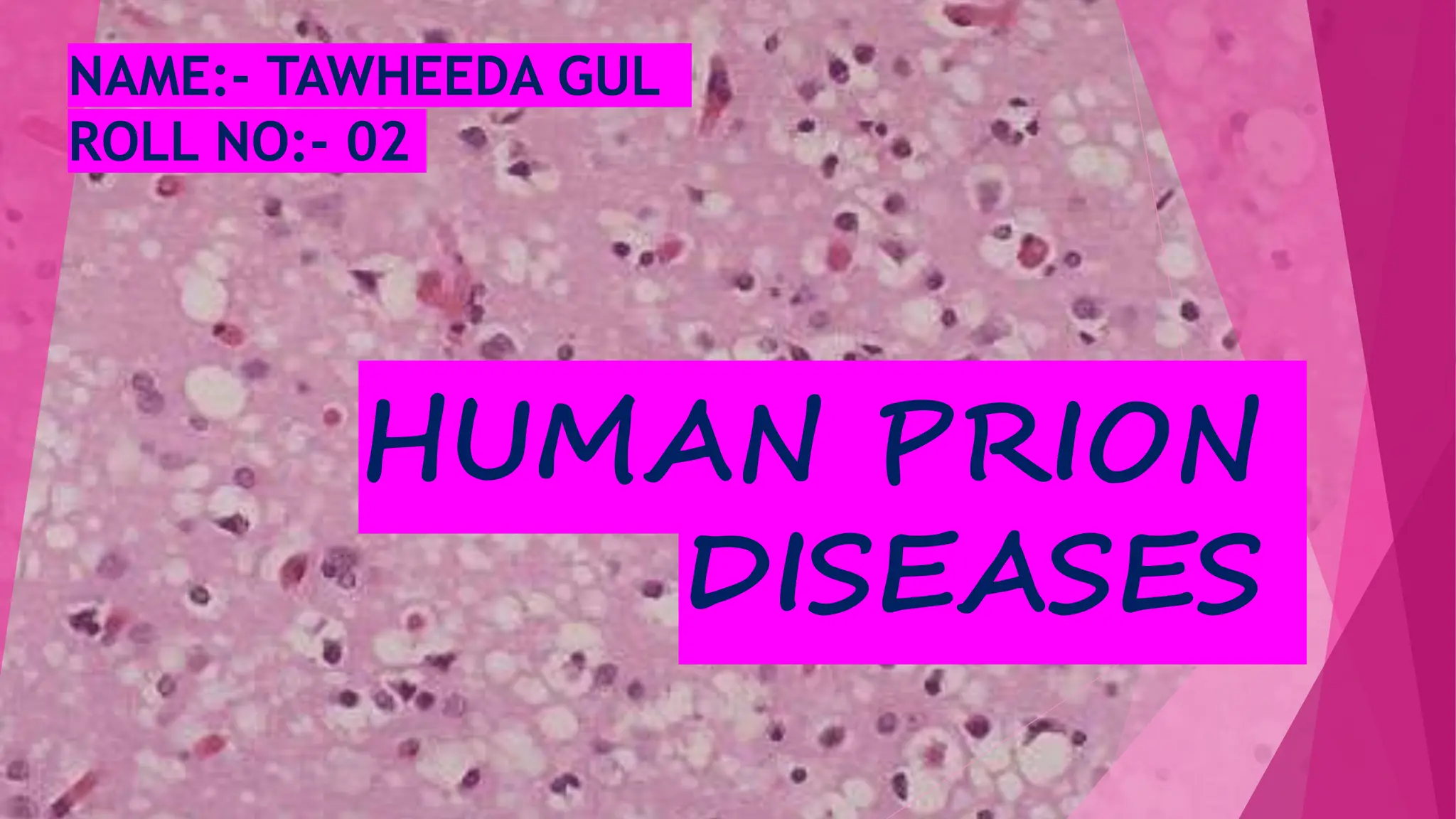
HUMAN PRION
DISEASES
NAME:- TAWHEEDA GUL
ROLL NO:- 02
Prion disease is an umbrella term used to refer to a rare group of brain disorders that
affect both humans and animals. This makes it possible for the disease to spread from
animal to people and, in some instances, from human to human.
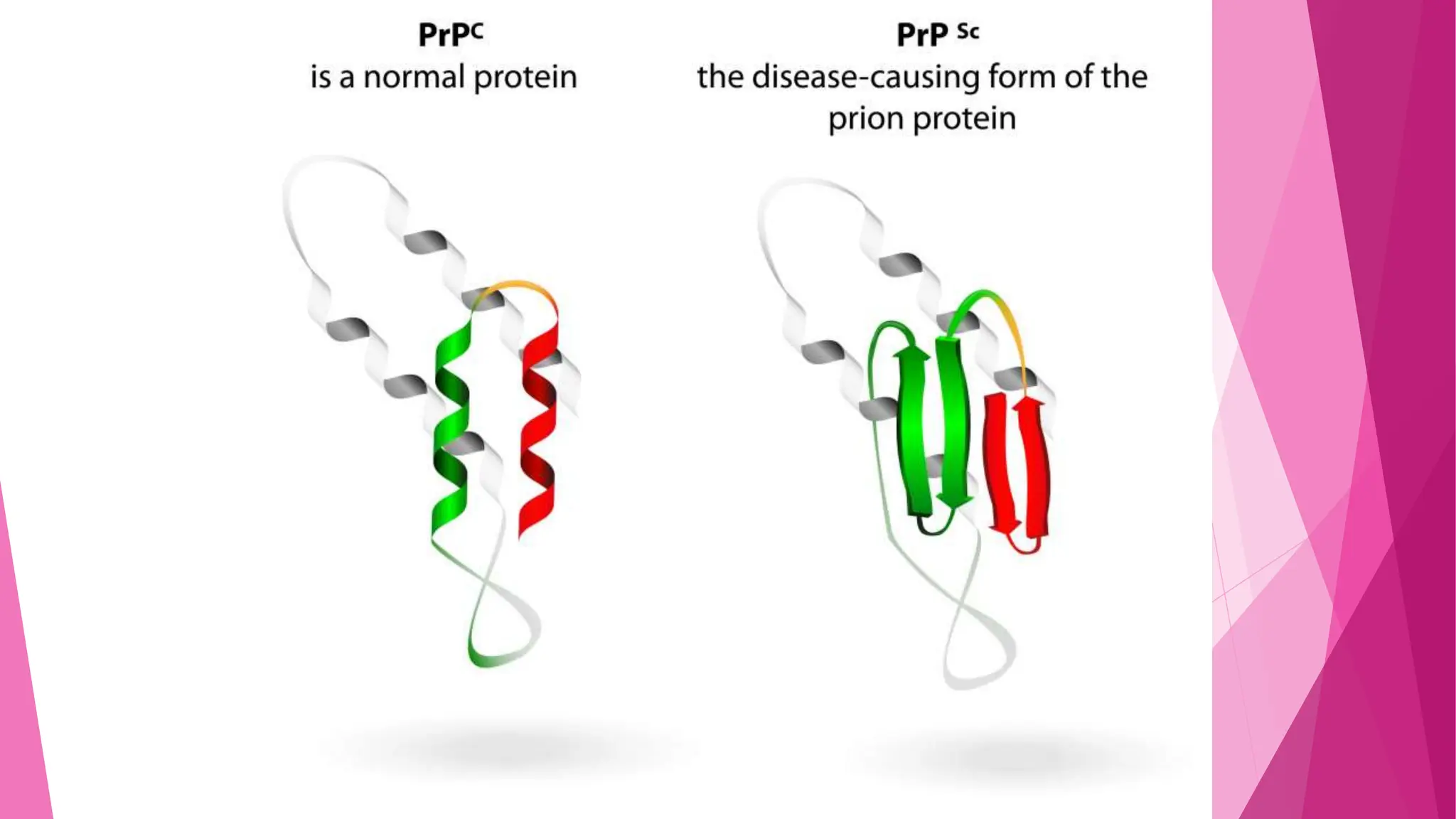
These diseases are caused by the prion protein, which can be found in your tissues and
brain. Some researchers believe that normal prion proteins protect the brain from
damage. Abnormally shaped prion proteins, however, are infectious and can cause
diseases.
Researchers don’t completely understand why abnormal prion proteins form. Prion
diseases are also known as transmissible spongiform encephalopathies (TSEs). These
diseases are incredibly rare, and only about 300 cases are diagnosed in the United
States every year. Abnormal prion proteins are capable of infecting normal prion
proteins—this can turn them into defective proteins that cause disease
INTRODUCTION
Identifying Prion Diseases
More research needs to be done into prion diseases to fully understand how they affect humans. These
diseases are notoriously hard to diagnose and can be incredibly deadly. The most common way to
confirm if a person has prion disease is by doing a biopsy after death.
Doctors and healthcare providers typically run several tests to rule out any other conditions in suspected
cases of prion diseases. When people suddenly develop dementia, and it progresses rapidly (sometimes
over the course of days or weeks), prion diseases are typically considered a likely culprit. Some of the
tests done to help identify if you have a prion disease include:
•Blood tests
•An electroencephalogram (EEG): This is a test that records the electrical activities in your brain.
Abnormal activities could point to problems like prion diseases.
•An MRI: An MRI is done to look at your brain for any changes in structure that prion diseases could have
caused.
•A spinal tap: This is when a doctor takes a sample of cerebrospinal fluid (CSF), which surrounds the
brain and spinal cord, and tests it for diseases or signs of disease.
Causes of Prion Diseases
• Prion diseases are caused by abnormal prion proteins forming in clumps on the
brain. This, in turn, causes brain damage and results in neurodegenerative
conditions. However, it’s unclear what causes these proteins to become
abnormal. Abnormal prion proteins cause prion diseases by either self-
replicating or being transmissible. This can then cause cells in the brain to die.
Certain factors put people at a higher risk of developing prion diseases than
others. They include:
•Eating meats that have been affected by a prion disease like “mad cow disease”
•Being infected by medical equipment
•Having a family history of prion diseases
Types of Prion Diseases
Prion diseases affect both humans and animals. In some cases, prion diseases that affect animals
could be transmitted to humans too.
Human Prion Diseases
The two most common forms of human prion diseases include:
•Creutzfeldt-Jakob Disease (CJD): CJD is a fatal neurodegenerative condition. It progresses
rapidly and is thought to lead to death within a year after infection occurs. It typically develops
around age 60. It can either be inherited from a parent or develop on its own. It affects one in one
million people across the globe yearly. CJD could either be genetic, acquired, or sporadic.
•Variant Creutzfeldt-Jakob Disease (vCJD): This variant of CJD appears to affect younger
people. Symptoms of the disease include muscle spasms, confusion, and poor muscle
coordination. Some research shows that people with this variant could die around 13 months after
exhibiting symptoms. This condition is related to a condition called “mad cow disease.” You can
potentially get this condition by eating meat that has been infected.
Other rare human prion diseases are:
•Kuru
•Gerstmann-Straussler-Schneiker Syndrome
•Fatal Familial Insomnia (FFI)
•Variably protease-sensitive prionopathy (VPSPr)
Treatment for Prion Diseases
There’s currently no cure for prion diseases. However, there is ongoing research into
developing effective treatments for the diseases. The focus of treatment is to make a
person who has the condition as comfortable as possible as they live with the
disease’s debilitating symptoms.
Slowing Disease Progression and Alleviating Symptoms
Treatment also aims to slow the rate at which the disease progresses. In specific
scenarios, opiate drugs might be prescribed to relieve pain. A medication like Klonopin
(clonazepam) may also be prescribed to help with symptoms like involuntary muscle
spasms
Preventing Prion Diseases
It’s also possible to prevent prion diseases. Making sure medical pieces of
equipment are properly cleaned and sterilized is an excellent first step.
Also, being careful of the kinds of animal meat you consume and where you get it
from is essential. Regulatory bodies are also closely monitoring how cows are fed to
ensure that they don't get infected with prion diseases that can be spread to
humans
Thank You
For Your Attention

HUMAN_PRION_DISEASES[ A component in virology1].pptx

  • 1.
  • 2.
    Prion disease isan umbrella term used to refer to a rare group of brain disorders that affect both humans and animals. This makes it possible for the disease to spread from animal to people and, in some instances, from human to human. These diseases are caused by the prion protein, which can be found in your tissues and brain. Some researchers believe that normal prion proteins protect the brain from damage. Abnormally shaped prion proteins, however, are infectious and can cause diseases. Researchers don’t completely understand why abnormal prion proteins form. Prion diseases are also known as transmissible spongiform encephalopathies (TSEs). These diseases are incredibly rare, and only about 300 cases are diagnosed in the United States every year. Abnormal prion proteins are capable of infecting normal prion proteins—this can turn them into defective proteins that cause disease INTRODUCTION
  • 4.
    Identifying Prion Diseases Moreresearch needs to be done into prion diseases to fully understand how they affect humans. These diseases are notoriously hard to diagnose and can be incredibly deadly. The most common way to confirm if a person has prion disease is by doing a biopsy after death. Doctors and healthcare providers typically run several tests to rule out any other conditions in suspected cases of prion diseases. When people suddenly develop dementia, and it progresses rapidly (sometimes over the course of days or weeks), prion diseases are typically considered a likely culprit. Some of the tests done to help identify if you have a prion disease include: •Blood tests •An electroencephalogram (EEG): This is a test that records the electrical activities in your brain. Abnormal activities could point to problems like prion diseases. •An MRI: An MRI is done to look at your brain for any changes in structure that prion diseases could have caused. •A spinal tap: This is when a doctor takes a sample of cerebrospinal fluid (CSF), which surrounds the brain and spinal cord, and tests it for diseases or signs of disease.
  • 5.
    Causes of PrionDiseases • Prion diseases are caused by abnormal prion proteins forming in clumps on the brain. This, in turn, causes brain damage and results in neurodegenerative conditions. However, it’s unclear what causes these proteins to become abnormal. Abnormal prion proteins cause prion diseases by either self- replicating or being transmissible. This can then cause cells in the brain to die. Certain factors put people at a higher risk of developing prion diseases than others. They include: •Eating meats that have been affected by a prion disease like “mad cow disease” •Being infected by medical equipment •Having a family history of prion diseases
  • 6.
    Types of PrionDiseases Prion diseases affect both humans and animals. In some cases, prion diseases that affect animals could be transmitted to humans too. Human Prion Diseases The two most common forms of human prion diseases include: •Creutzfeldt-Jakob Disease (CJD): CJD is a fatal neurodegenerative condition. It progresses rapidly and is thought to lead to death within a year after infection occurs. It typically develops around age 60. It can either be inherited from a parent or develop on its own. It affects one in one million people across the globe yearly. CJD could either be genetic, acquired, or sporadic. •Variant Creutzfeldt-Jakob Disease (vCJD): This variant of CJD appears to affect younger people. Symptoms of the disease include muscle spasms, confusion, and poor muscle coordination. Some research shows that people with this variant could die around 13 months after exhibiting symptoms. This condition is related to a condition called “mad cow disease.” You can potentially get this condition by eating meat that has been infected.
  • 7.
    Other rare humanprion diseases are: •Kuru •Gerstmann-Straussler-Schneiker Syndrome •Fatal Familial Insomnia (FFI) •Variably protease-sensitive prionopathy (VPSPr)
  • 9.
    Treatment for PrionDiseases There’s currently no cure for prion diseases. However, there is ongoing research into developing effective treatments for the diseases. The focus of treatment is to make a person who has the condition as comfortable as possible as they live with the disease’s debilitating symptoms. Slowing Disease Progression and Alleviating Symptoms Treatment also aims to slow the rate at which the disease progresses. In specific scenarios, opiate drugs might be prescribed to relieve pain. A medication like Klonopin (clonazepam) may also be prescribed to help with symptoms like involuntary muscle spasms
  • 10.
    Preventing Prion Diseases It’salso possible to prevent prion diseases. Making sure medical pieces of equipment are properly cleaned and sterilized is an excellent first step. Also, being careful of the kinds of animal meat you consume and where you get it from is essential. Regulatory bodies are also closely monitoring how cows are fed to ensure that they don't get infected with prion diseases that can be spread to humans
  • 11.