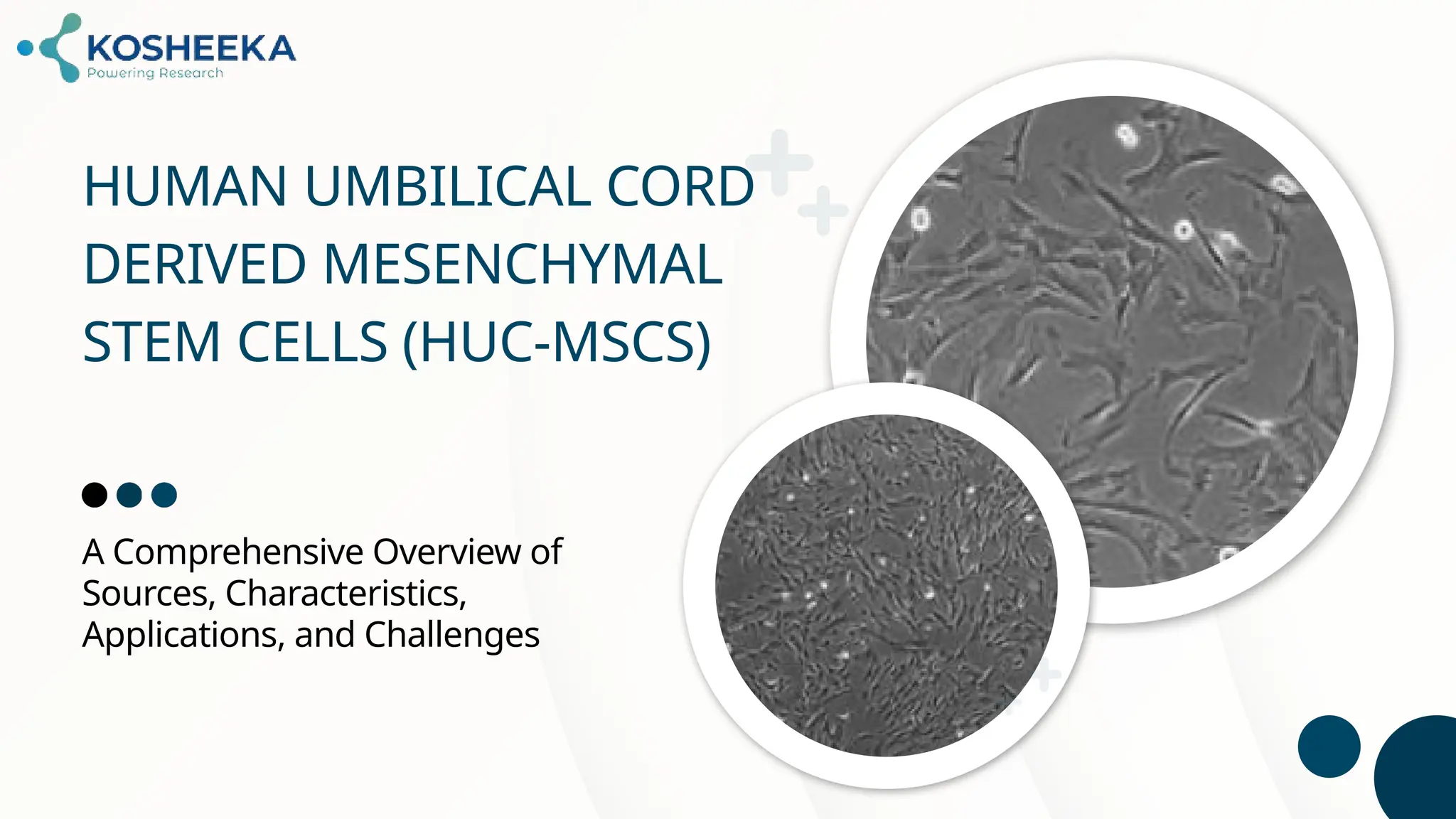
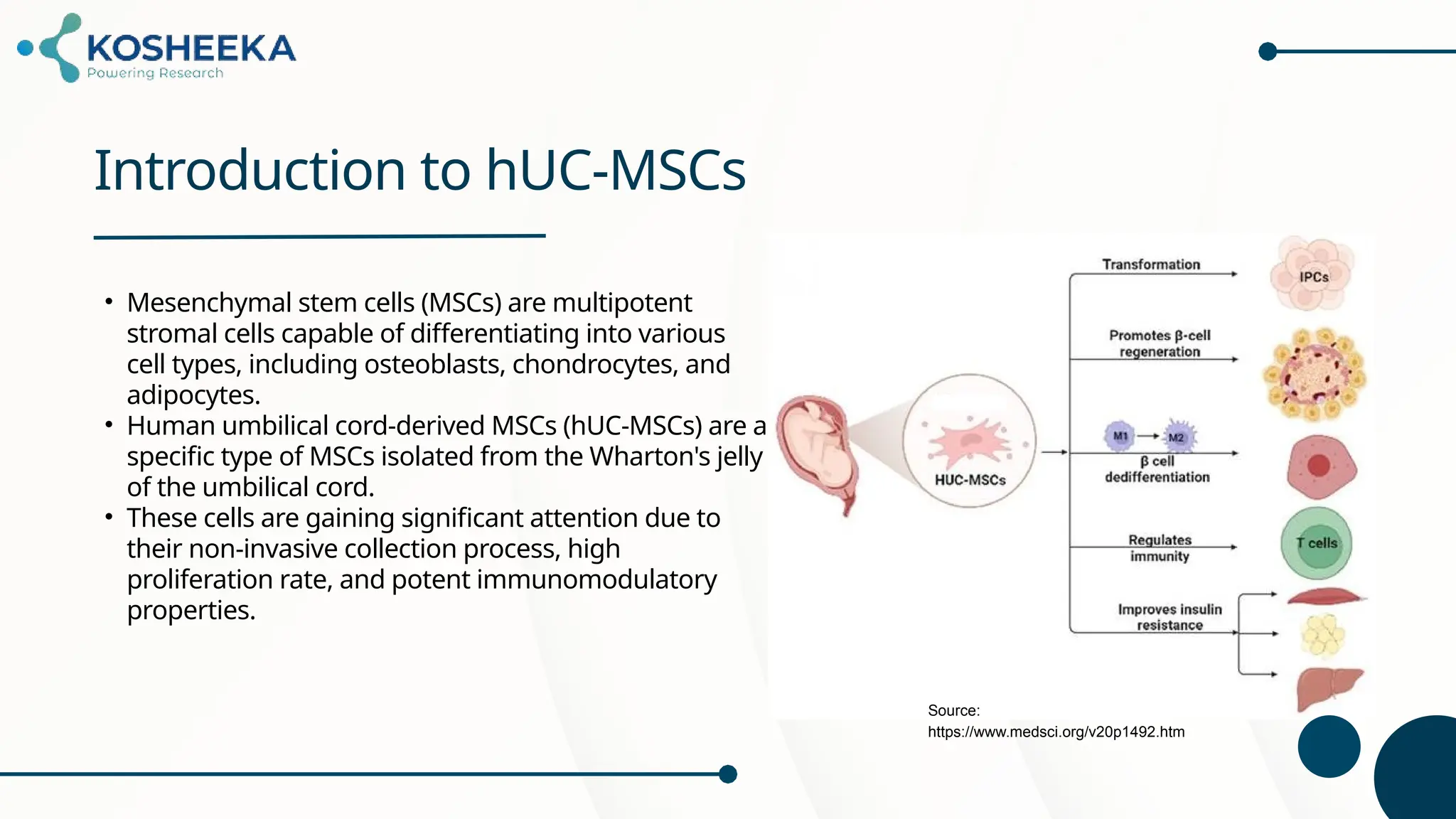
HUMAN UMBILICAL CORD
DERIVED MESENCHYMAL
STEM CELLS (HUC-MSCS)
A Comprehensive Overview of
Sources, Characteristics,
Applications, and Challenges
Introduction to hUC-MSCs
• Mesenchymal stem cells (MSCs) are multipotent
stromal cells capable of differentiating into various
cell types, including osteoblasts, chondrocytes, and
adipocytes.
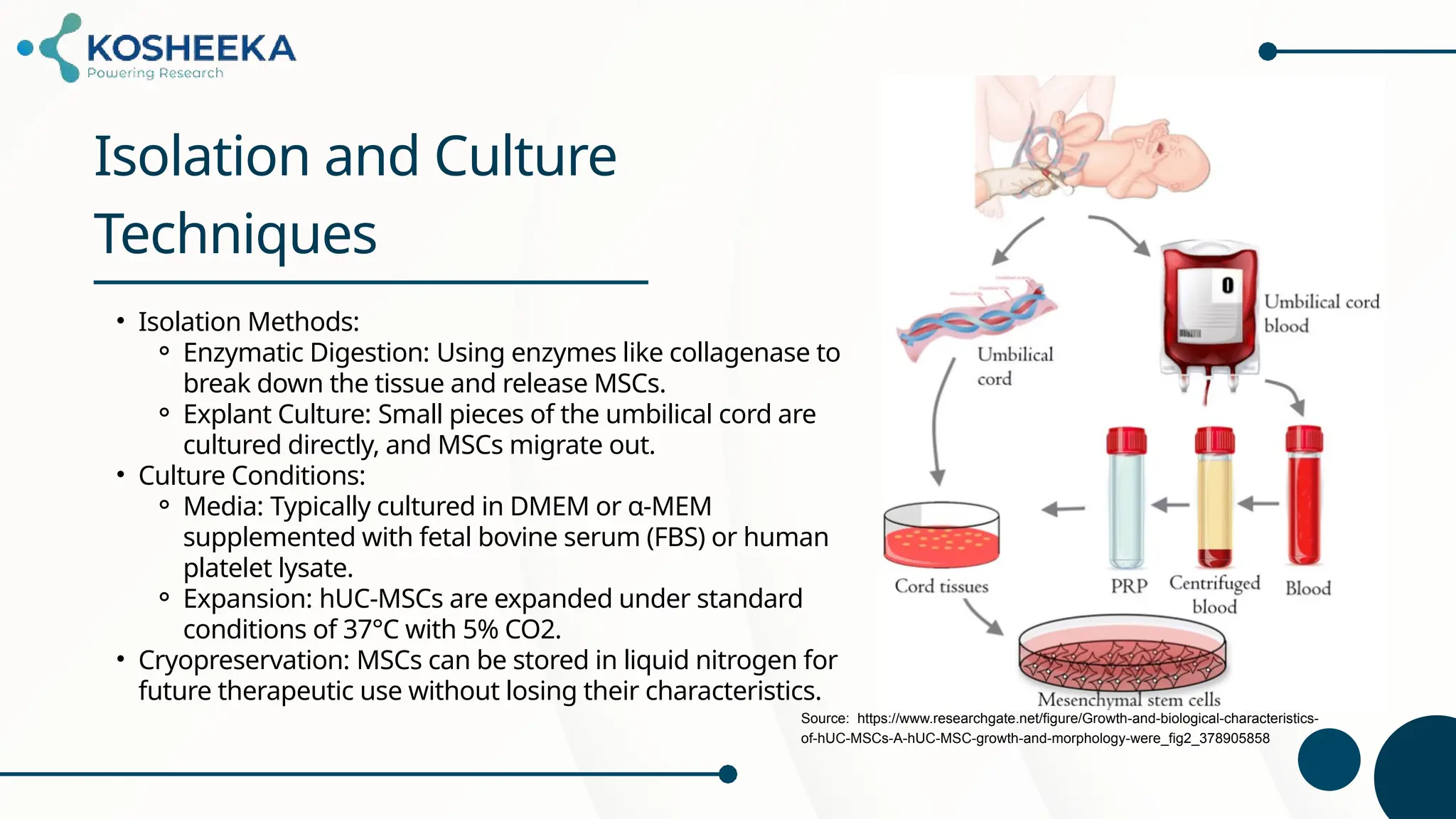
• Human umbilical cord-derived MSCs (hUC-MSCs) are a
specific type of MSCs isolated from the Wharton's jelly
of the umbilical cord.
• These cells are gaining significant attention due to
their non-invasive collection process, high
proliferation rate, and potent immunomodulatory
properties.
Source:
https://www.medsci.org/v20p1492.htm
Sources of hUC-MSCs
Wharton’s Jelly: The most common source, a
gelatinous substance within the umbilical cord
that provides a rich supply of MSCs.
Umbilical Cord Vein: Less commonly used but
also a viable source of MSCs.
Umbilical Cord Artery: Similar to the vein, it
provides another source, though less rich than
Wharton's jelly.
Advantages: The use of the umbilical cord as a
source of MSCs is non-controversial and avoids
the ethical issues associated with embryonic
stem cells.
Source: https://link.springer.com/article/10.1007/s12015-022-10493-y
Characteristics of hUC-MSCs
Immunophenotype: hUC-MSCs express typical MSC
markers such as CD73, CD90, and CD105 while lacking
hematopoietic markers like CD34 and CD45.
Differentiation Potential: These cells can differentiate
into mesodermal lineages including osteocytes,
adipocytes, and chondrocytes.
Immunomodulation: hUC-MSCs can modulate
immune responses, reducing inflammation and
promoting tissue repair.
Proliferation Rate: hUC-MSCs exhibit a higher
proliferation rate compared to bone marrow-derived
MSCs (BM-MSCs).
Source: https://www.researchgate.net/figure/Growth-and-biological-characteristics-
of-hUC-MSCs-A-hUC-MSC-growth-and-morphology-were_fig2_378905858
Isolation and Culture
Techniques
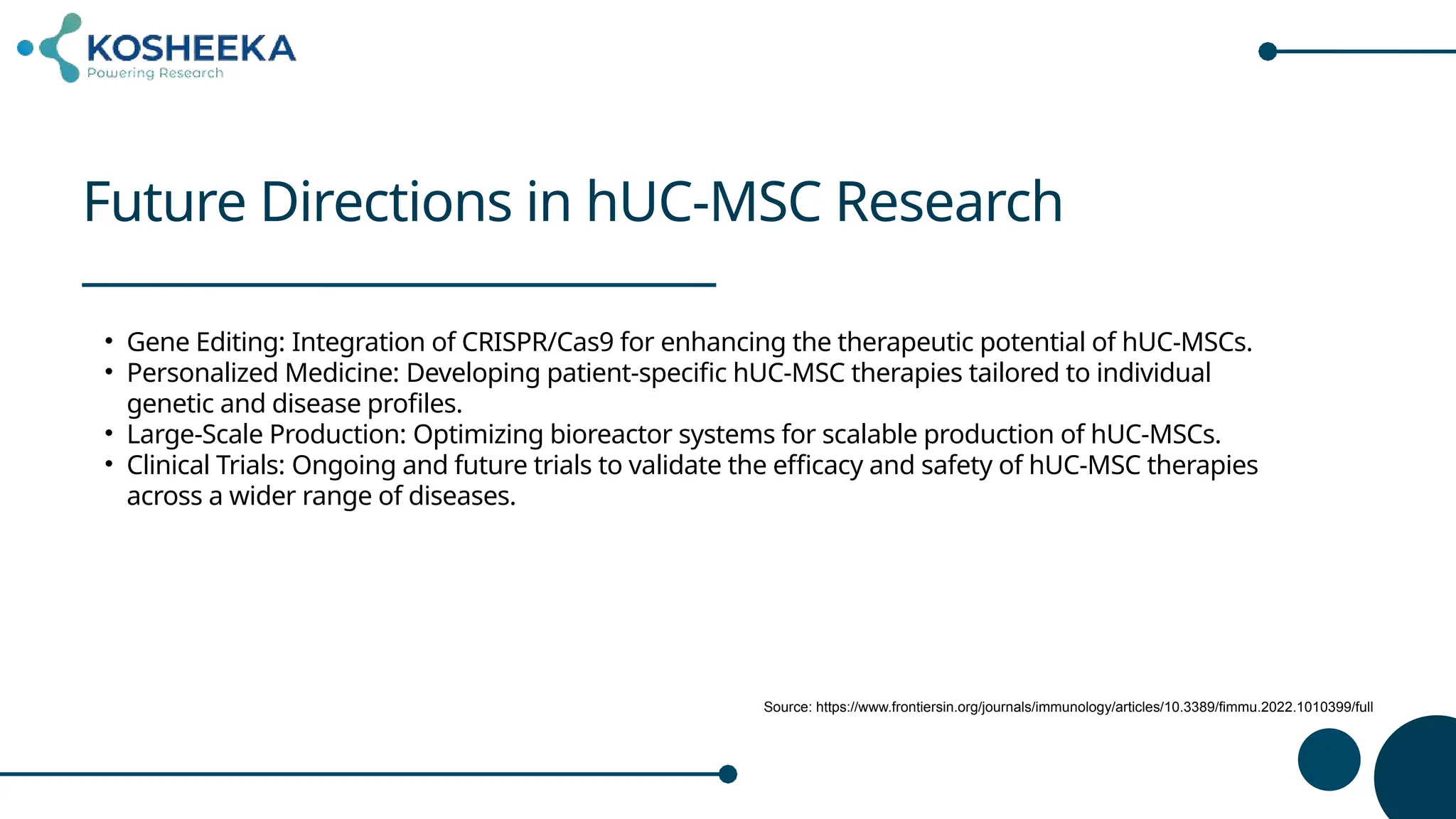
• Isolation Methods:
⚬ Enzymatic Digestion: Using enzymes like collagenase to
break down the tissue and release MSCs.
⚬ Explant Culture: Small pieces of the umbilical cord are
cultured directly, and MSCs migrate out.
• Culture Conditions:
⚬ Media: Typically cultured in DMEM or α-MEM
supplemented with fetal bovine serum (FBS) or human
platelet lysate.
⚬ Expansion: hUC-MSCs are expanded under standard
conditions of 37°C with 5% CO2.
• Cryopreservation: MSCs can be stored in liquid nitrogen for
future therapeutic use without losing their characteristics.
Source: https://www.researchgate.net/figure/Growth-and-biological-characteristics-
of-hUC-MSCs-A-hUC-MSC-growth-and-morphology-were_fig2_378905858
Therapeutic Applications of
hUC-MSCs
• Regenerative Medicine: Used in tissue engineering
for cartilage, bone, and skin repair.
• Autoimmune Diseases: hUC-MSCs are explored for
treating conditions like multiple sclerosis,
rheumatoid arthritis, and Crohn's disease due to
their immunosuppressive capabilities.
• Neurological Disorders: Promising results in treating
conditions such as spinal cord injuries, stroke, and
neurodegenerative diseases like Parkinson’s.
• Cardiovascular Diseases: Potential in treating heart
failure and myocardial infarction by promoting
angiogenesis and reducing fibrosis.
Source: https://www.researchgate.net/figure/Growth-and-biological-characteristics-
of-hUC-MSCs-A-hUC-MSC-growth-and-morphology-were_fig2_378905858
Advantages of hUC-MSCs
• Non-invasive Collection: Collection from the umbilical cord is non-invasive, painless, and poses no risk
to the donor.
• Higher Proliferation: hUC-MSCs proliferate faster than MSCs derived from bone marrow or adipose
tissue.
• Low Immunogenicity: These cells have a lower risk of immune rejection when used in allogeneic
transplantation.
• Ethical Considerations: Use of hUC-MSCs avoids the ethical issues related to embryonic stem cells.
Challenges and Limitations
• Standardization: Lack of standardized protocols for isolation, culture, and application poses
challenges for consistent therapeutic outcomes.
• Tumorigenicity: Concerns about the potential for hUC-MSCs to promote tumor growth in certain
contexts.
• Long-term Effects: Limited understanding of the long-term effects of hUC-MSC-based therapies.
• Regulatory Hurdles: Variability in regulatory approvals and guidelines across different countries.
Future Directions in hUC-MSC Research
• Gene Editing: Integration of CRISPR/Cas9 for enhancing the therapeutic potential of hUC-MSCs.
• Personalized Medicine: Developing patient-specific hUC-MSC therapies tailored to individual
genetic and disease profiles.
• Large-Scale Production: Optimizing bioreactor systems for scalable production of hUC-MSCs.
• Clinical Trials: Ongoing and future trials to validate the efficacy and safety of hUC-MSC therapies
across a wider range of diseases.
Source: https://www.frontiersin.org/journals/immunology/articles/10.3389/fimmu.2022.1010399/full
THANK YOU!
+91-9654321400
www.kosheeka.com
A-102, Sector-5 Noida-201301, India

Human Umbilical Cord Derived Mesenchymal Stem Cells (hUC-MSCs).pptx

  • 1.
    HUMAN UMBILICAL CORD DERIVEDMESENCHYMAL STEM CELLS (HUC-MSCS) A Comprehensive Overview of Sources, Characteristics, Applications, and Challenges
  • 2.
    Introduction to hUC-MSCs •Mesenchymal stem cells (MSCs) are multipotent stromal cells capable of differentiating into various cell types, including osteoblasts, chondrocytes, and adipocytes. • Human umbilical cord-derived MSCs (hUC-MSCs) are a specific type of MSCs isolated from the Wharton's jelly of the umbilical cord. • These cells are gaining significant attention due to their non-invasive collection process, high proliferation rate, and potent immunomodulatory properties. Source: https://www.medsci.org/v20p1492.htm
  • 3.
    Sources of hUC-MSCs Wharton’sJelly: The most common source, a gelatinous substance within the umbilical cord that provides a rich supply of MSCs. Umbilical Cord Vein: Less commonly used but also a viable source of MSCs. Umbilical Cord Artery: Similar to the vein, it provides another source, though less rich than Wharton's jelly. Advantages: The use of the umbilical cord as a source of MSCs is non-controversial and avoids the ethical issues associated with embryonic stem cells. Source: https://link.springer.com/article/10.1007/s12015-022-10493-y
  • 4.
    Characteristics of hUC-MSCs Immunophenotype:hUC-MSCs express typical MSC markers such as CD73, CD90, and CD105 while lacking hematopoietic markers like CD34 and CD45. Differentiation Potential: These cells can differentiate into mesodermal lineages including osteocytes, adipocytes, and chondrocytes. Immunomodulation: hUC-MSCs can modulate immune responses, reducing inflammation and promoting tissue repair. Proliferation Rate: hUC-MSCs exhibit a higher proliferation rate compared to bone marrow-derived MSCs (BM-MSCs). Source: https://www.researchgate.net/figure/Growth-and-biological-characteristics- of-hUC-MSCs-A-hUC-MSC-growth-and-morphology-were_fig2_378905858
  • 5.
    Isolation and Culture Techniques •Isolation Methods: ⚬ Enzymatic Digestion: Using enzymes like collagenase to break down the tissue and release MSCs. ⚬ Explant Culture: Small pieces of the umbilical cord are cultured directly, and MSCs migrate out. • Culture Conditions: ⚬ Media: Typically cultured in DMEM or α-MEM supplemented with fetal bovine serum (FBS) or human platelet lysate. ⚬ Expansion: hUC-MSCs are expanded under standard conditions of 37°C with 5% CO2. • Cryopreservation: MSCs can be stored in liquid nitrogen for future therapeutic use without losing their characteristics. Source: https://www.researchgate.net/figure/Growth-and-biological-characteristics- of-hUC-MSCs-A-hUC-MSC-growth-and-morphology-were_fig2_378905858
  • 6.
    Therapeutic Applications of hUC-MSCs •Regenerative Medicine: Used in tissue engineering for cartilage, bone, and skin repair. • Autoimmune Diseases: hUC-MSCs are explored for treating conditions like multiple sclerosis, rheumatoid arthritis, and Crohn's disease due to their immunosuppressive capabilities. • Neurological Disorders: Promising results in treating conditions such as spinal cord injuries, stroke, and neurodegenerative diseases like Parkinson’s. • Cardiovascular Diseases: Potential in treating heart failure and myocardial infarction by promoting angiogenesis and reducing fibrosis. Source: https://www.researchgate.net/figure/Growth-and-biological-characteristics- of-hUC-MSCs-A-hUC-MSC-growth-and-morphology-were_fig2_378905858
  • 7.
    Advantages of hUC-MSCs •Non-invasive Collection: Collection from the umbilical cord is non-invasive, painless, and poses no risk to the donor. • Higher Proliferation: hUC-MSCs proliferate faster than MSCs derived from bone marrow or adipose tissue. • Low Immunogenicity: These cells have a lower risk of immune rejection when used in allogeneic transplantation. • Ethical Considerations: Use of hUC-MSCs avoids the ethical issues related to embryonic stem cells.
  • 8.
    Challenges and Limitations •Standardization: Lack of standardized protocols for isolation, culture, and application poses challenges for consistent therapeutic outcomes. • Tumorigenicity: Concerns about the potential for hUC-MSCs to promote tumor growth in certain contexts. • Long-term Effects: Limited understanding of the long-term effects of hUC-MSC-based therapies. • Regulatory Hurdles: Variability in regulatory approvals and guidelines across different countries.
  • 9.
    Future Directions inhUC-MSC Research • Gene Editing: Integration of CRISPR/Cas9 for enhancing the therapeutic potential of hUC-MSCs. • Personalized Medicine: Developing patient-specific hUC-MSC therapies tailored to individual genetic and disease profiles. • Large-Scale Production: Optimizing bioreactor systems for scalable production of hUC-MSCs. • Clinical Trials: Ongoing and future trials to validate the efficacy and safety of hUC-MSC therapies across a wider range of diseases. Source: https://www.frontiersin.org/journals/immunology/articles/10.3389/fimmu.2022.1010399/full
  • 10.