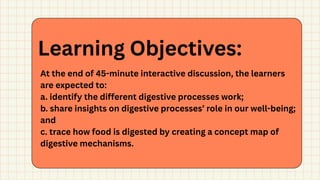
At the endof 45-minute interactive discussion, the learners
are expected to:
a. identify the different digestive processes work;
b. share insights on digestive processes’ role in our well-being;
and
c. trace how food is digested by creating a concept map of
digestive mechanisms.
Learning Objectives:
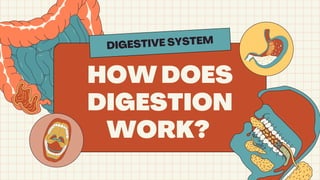
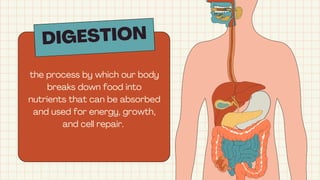
DIGESTION
the process bywhich our body
breaks down food into
nutrients that can be absorbed
and used for energy, growth,
and cell repair.
27.
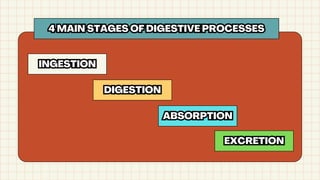
4MAIN STAGES OFDIGESTIVE PROCESSES
4 MAIN STAGES OF DIGESTIVE PROCESSES
INGESTION
INGESTION
DIGESTION
DIGESTION
ABSORPTION
ABSORPTION
EXCRETION
EXCRETION
28.
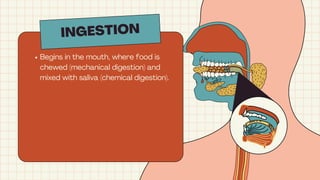
INGESTION
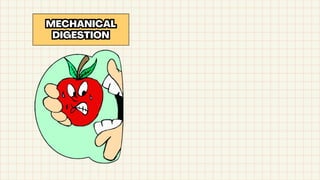
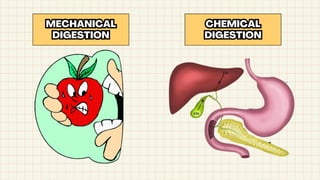
Begins in themouth, where food is
chewed (mechanical digestion) and
mixed with saliva (chemical digestion).
29.
INGESTION
Begins in themouth, where food is
chewed (mechanical digestion) and
mixed with saliva (chemical digestion).
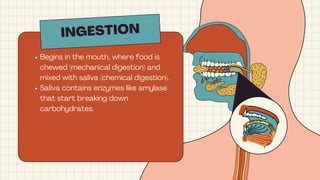
Saliva contains enzymes like amylase
that start breaking down
carbohydrates.
30.
INGESTION
Begins in themouth, where food is
chewed (mechanical digestion) and
mixed with saliva (chemical digestion).
Saliva contains enzymes like amylase
that start breaking down
carbohydrates.
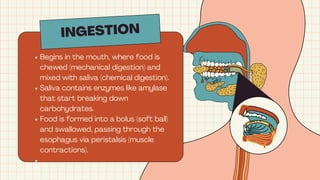
Food is formed into a bolus (soft ball)
and swallowed, passing through the
esophagus via peristalsis (muscle
contractions).
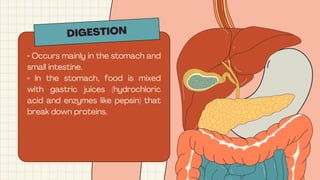
DIGESTION
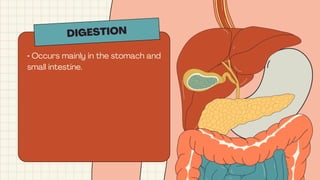
• Occurs mainlyin the stomach and
small intestine.
• In the stomach, food is mixed
with gastric juices (hydrochloric
acid and enzymes like pepsin) that
break down proteins.
33.
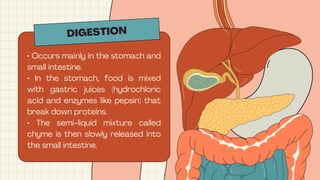
DIGESTION
• Occurs mainlyin the stomach and
small intestine.
• In the stomach, food is mixed
with gastric juices (hydrochloric
acid and enzymes like pepsin) that
break down proteins.
• The semi-liquid mixture called
chyme is then slowly released into
the small intestine.
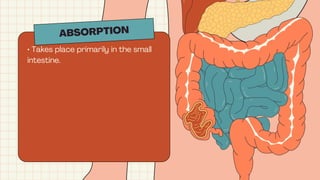
ABSORPTION
• Takes placeprimarily in the small
intestine.
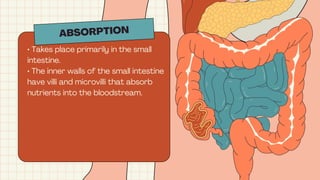
• The inner walls of the small intestine
have villi and microvilli that absorb
nutrients into the bloodstream.
38.
ABSORPTION
• Takes placeprimarily in the small
intestine.
• The inner walls of the small intestine
have villi and microvilli that absorb
nutrients into the bloodstream.
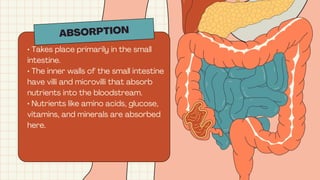
• Nutrients like amino acids, glucose,
vitamins, and minerals are absorbed
here.
39.
ABSORPTION
• Takes placeprimarily in the small
intestine.
• The inner walls of the small intestine
have villi and microvilli that absorb
nutrients into the bloodstream.
• Nutrients like amino acids, glucose,
vitamins, and minerals are absorbed
here.
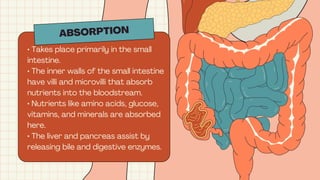
• The liver and pancreas assist by
releasing bile and digestive enzymes.
EXCRETION
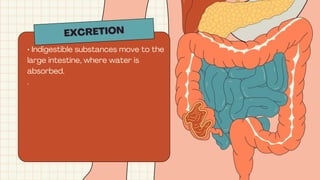
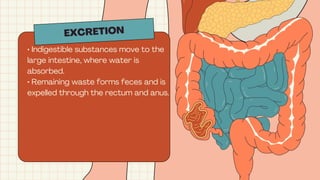
• Indigestible substancesmove to the
large intestine, where water is
absorbed.
• Remaining waste forms feces and is
expelled through the rectum and anus.
43.
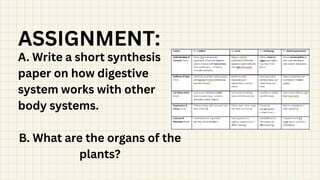
ASSIGNMENT:
A. Write ashort synthesis
paper on how digestive
system works with other
body systems.
B. What are the organs of the
plants?