By – Dipanshu Nagar
HUMAN EYE
The Key to Vision
INTRODUCTION
The human eye is one of the most
valuable and sensitive sense organs.
It is like a camera, it captures images,
accommodates them, and sends it to
the brain which interprets it.
INDEX
Structure
Functioning
Power of Accommodation
The need of two eyes
Defects of the eye
– Myopia and its correction
– Hypermetropia and its correction
– Presbyopia and its correction
Eye Donation
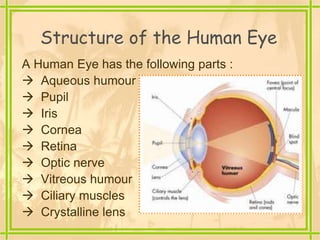
Structure of the Human Eye
A Human Eye has the following parts :
 Aqueous humour
 Pupil
 Iris
 Cornea
 Retina
 Optic nerve
 Vitreous humour
 Ciliary muscles
 Crystalline lens
How the eye works
We can only see things when light gets reflected
off the objects. This reflected light enters our
eyes, forms an image and sends messages to
the brain; the brain then interprets the image.
Probably the most important part of the eye is
the lens, it bends the light rays so that they can
be concentrated to form tiny, but clear and
perfect images of the large objects. We will talk
about the main parts of the eye in the next
slide…
How the eye works
• The Cornea - It is a round, transparent thin
membrane where light is refracted first.
• The Sclera - The white part of the eye, it is a
protective layer on the eyeball.
• Ciliary muscles - Helps to adjust the shape of
the lens.
• Iris – It dilates or contracts the pupil and thus
control the amount of light falling on the retina.
• The Lens – It is the elastic and transparent part
that refracts the light so that it falls on the retina.
How the eye works
• The Vitreous Humor –it is the jelly-like texture that
is contained within the interior chamber, behind the
lens
• The Retina - forms the entire curved inside of the
eyeball and is lined with two types of light-sensitive
cells, the rods (sensitive to light of low intensity but
not to colors) and cones (sensitive to colors).
• The Optic Nerve - all the rods and cones are
connected to the brain by a nerve and all these
nerves form a thick cable called the optic nerve.
This emerges from the back of the eye, moves
through the skull and ends up inside the skull
bone, beneath the brain near the pituitary gland.
Power of accommodation
The ability of the lens of the eye to adjust
its focal length is called accommodation.
However, the focal length of the lens
cannot be reduced to a certain minimum
limit. That is why we can see objects
placed more than 25 cm from our eyes.
The need for two eyes
A human being has a horizontal view of
150° to extend it we have two eyes which
give a combined view of 180°
Also, with only one eye, we can have
only a 2D view while two eyes give a 3D
view, providing the ability to detect faint
objects.
Defects of the eye
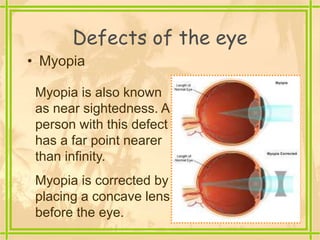
• Myopia
Myopia is also known
as near sightedness. A
person with this defect
has a far point nearer
than infinity.
Myopia is corrected by
placing a concave lens
before the eye.
Defects of the eye
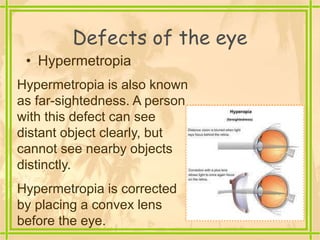
• Hypermetropia
Hypermetropia is also known
as far-sightedness. A person
with this defect can see
distant object clearly, but
cannot see nearby objects
distinctly.
Hypermetropia is corrected
by placing a convex lens
before the eye.
Defects of the eye
• Presbyopia
With the increasing age, the power of
accommodation of our eyes usually
decreases. As a result, some people suffer
both Myopia and Hypermetropia.
Presbyopia is corrected by placing a bi-focal
lens before the eyes. The upper part of this
lens is a concave lens (Myopia) while the
lower part is convex (Hypermetropia) lens.
Defects of the eye
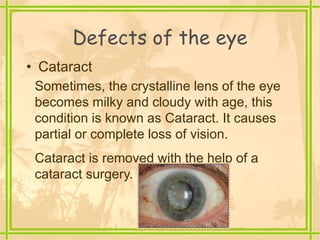
• Cataract
Sometimes, the crystalline lens of the eye
becomes milky and cloudy with age, this
condition is known as Cataract. It causes
partial or complete loss of vision.
Cataract is removed with the help of a
cataract surgery.
Eye donation
Do you know that our eyes can live even after
our death?
We can light up a blind person’s life by donating
our eyes after we die. About 35 million people in
the world are blind and most of them can be
cured with donated eyes.
ā€œ We are lucky to have this gift of god, so
why not pass it on to someone who doesn’t
have it !!ā€
THANK YOU !

94955904-HUMAN-EYE-PRESENTATION.pptx human eye

  • 1.
    By – DipanshuNagar HUMAN EYE The Key to Vision
  • 2.
    INTRODUCTION The human eyeis one of the most valuable and sensitive sense organs. It is like a camera, it captures images, accommodates them, and sends it to the brain which interprets it.
  • 3.
    INDEX Structure Functioning Power of Accommodation Theneed of two eyes Defects of the eye – Myopia and its correction – Hypermetropia and its correction – Presbyopia and its correction Eye Donation
  • 4.
    Structure of theHuman Eye A Human Eye has the following parts :  Aqueous humour  Pupil  Iris  Cornea  Retina  Optic nerve  Vitreous humour  Ciliary muscles  Crystalline lens
  • 5.
    How the eyeworks We can only see things when light gets reflected off the objects. This reflected light enters our eyes, forms an image and sends messages to the brain; the brain then interprets the image. Probably the most important part of the eye is the lens, it bends the light rays so that they can be concentrated to form tiny, but clear and perfect images of the large objects. We will talk about the main parts of the eye in the next slide…
  • 6.
    How the eyeworks • The Cornea - It is a round, transparent thin membrane where light is refracted first. • The Sclera - The white part of the eye, it is a protective layer on the eyeball. • Ciliary muscles - Helps to adjust the shape of the lens. • Iris – It dilates or contracts the pupil and thus control the amount of light falling on the retina. • The Lens – It is the elastic and transparent part that refracts the light so that it falls on the retina.
  • 7.
    How the eyeworks • The Vitreous Humor –it is the jelly-like texture that is contained within the interior chamber, behind the lens • The Retina - forms the entire curved inside of the eyeball and is lined with two types of light-sensitive cells, the rods (sensitive to light of low intensity but not to colors) and cones (sensitive to colors). • The Optic Nerve - all the rods and cones are connected to the brain by a nerve and all these nerves form a thick cable called the optic nerve. This emerges from the back of the eye, moves through the skull and ends up inside the skull bone, beneath the brain near the pituitary gland.
  • 8.
    Power of accommodation Theability of the lens of the eye to adjust its focal length is called accommodation. However, the focal length of the lens cannot be reduced to a certain minimum limit. That is why we can see objects placed more than 25 cm from our eyes.
  • 9.
    The need fortwo eyes A human being has a horizontal view of 150° to extend it we have two eyes which give a combined view of 180° Also, with only one eye, we can have only a 2D view while two eyes give a 3D view, providing the ability to detect faint objects.
  • 10.
    Defects of theeye • Myopia Myopia is also known as near sightedness. A person with this defect has a far point nearer than infinity. Myopia is corrected by placing a concave lens before the eye.
  • 11.
    Defects of theeye • Hypermetropia Hypermetropia is also known as far-sightedness. A person with this defect can see distant object clearly, but cannot see nearby objects distinctly. Hypermetropia is corrected by placing a convex lens before the eye.
  • 12.
    Defects of theeye • Presbyopia With the increasing age, the power of accommodation of our eyes usually decreases. As a result, some people suffer both Myopia and Hypermetropia. Presbyopia is corrected by placing a bi-focal lens before the eyes. The upper part of this lens is a concave lens (Myopia) while the lower part is convex (Hypermetropia) lens.
  • 13.
    Defects of theeye • Cataract Sometimes, the crystalline lens of the eye becomes milky and cloudy with age, this condition is known as Cataract. It causes partial or complete loss of vision. Cataract is removed with the help of a cataract surgery.
  • 14.
    Eye donation Do youknow that our eyes can live even after our death? We can light up a blind person’s life by donating our eyes after we die. About 35 million people in the world are blind and most of them can be cured with donated eyes. ā€œ We are lucky to have this gift of god, so why not pass it on to someone who doesn’t have it !!ā€
  • 15.