We Need toTalk
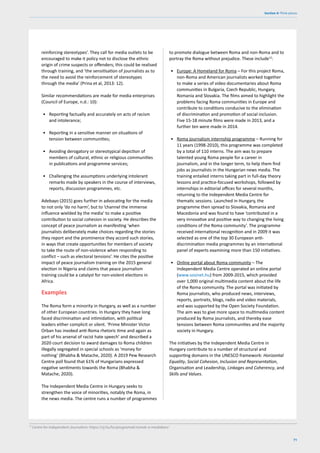
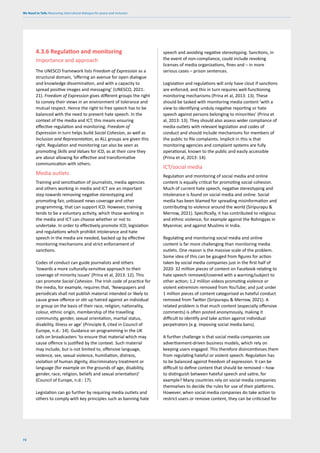
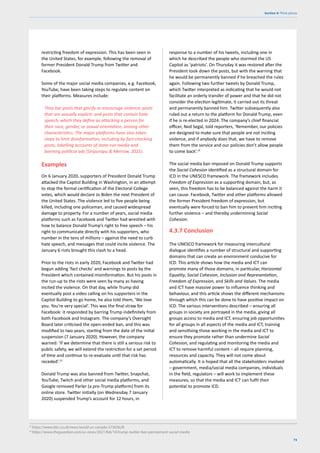
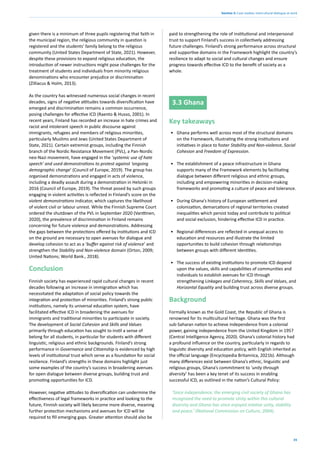
Measuring intercultural dialogue
for peace and inclusion
Institute for
Economics
& Peace
Published in 2022 by the United Nations Educational, Scientific and Cultural Organization, 7, place de Fontenoy, 75352
Paris 07 SP, France and the Institute for Economics and Peace, 205 Pacific Highway, St Leonards, Sydney, 2065 NSW,
Australia.
© UNESCO 2022
ISBN: 978-92-3-100544-2 (print/pdf)
EAN: 9789231005442 (print/pdf)
ISBN 978-0-6455610-0-5 (Institute for Economics and Peace)
This publication is available in Open Access under the Attribution-ShareAlike 3.0 IGO (CC-BY-SA 3.0 IGO) license (http://
creativecommons.org/licenses/by-sa/3.0/igo/). By using the content of this publication, the users accept to be bound by the
terms of use of the UNESCO Open Access Repository (http://www.unesco.org/open-access/terms-use-ccbysa-en).
The designations employed and the presentation of material throughout this publication do not imply the expression of
any opinion whatsoever on the part of UNESCO concerning the legal status of any country, territory, city or area or of its
authorities, or concerning the delimitation of its frontiers or boundaries.
The ideas and opinions expressed in this publication are those of the authors; they are not necessarily those of UNESCO and
do not commit the Organization.
Shutterstock images, UN Photos, and the images shown on pages 74, 81, and 84 of the publication do not fall under the CC-
BY-SA licence and may not be used or reproduced without the prior permission of the copyright holders.
Cover photo: Shutterstock
Graphic design: Institute for Economics and Peace
Cover design: Institute for Economics and Peace
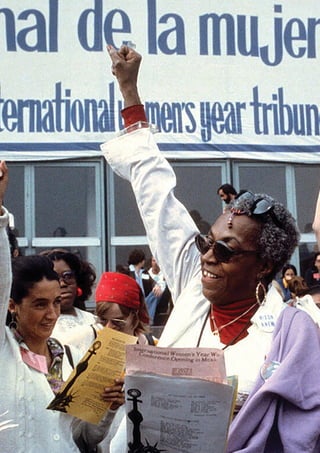
Photos: P8 – UN Photo/B.Lane; P.15 – UNESCO/J. Monteiro; P28 – UN Photo/Eskinder Debebe; P54 – UN Photo/Eskinder
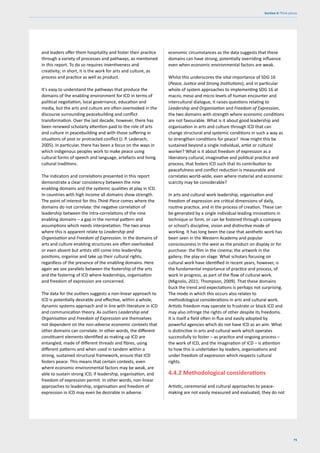
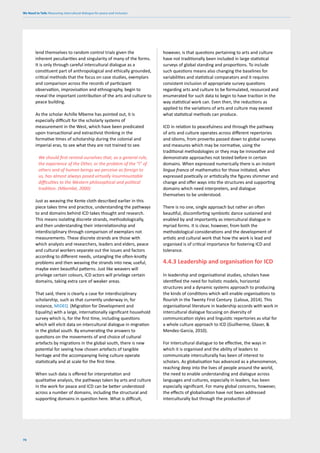
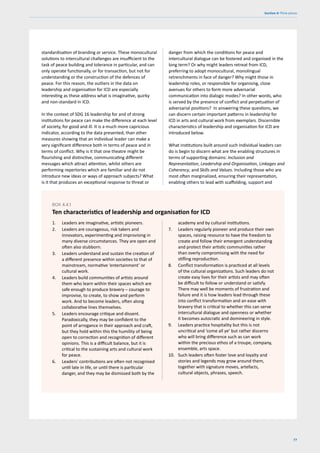
Debebe; P.74 – Gameli Tordzro/Naa Densua Rordzro; P. 81 – ArtLords of Afghanistan; P.84 (both images) - Wellington
Arpilleras Collective
Printed by: UNESCO
Printed in Paris
https://doi.org/10.54678/JKFI1098
1
As the world becomes increasingly interconnected, improved capacities to initiate and
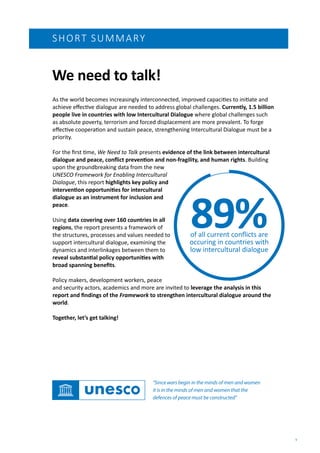
achieve effective dialogue are needed to address global challenges. Currently, 1.5 billion
people live in countries with low Intercultural Dialogue where global challenges such
as absolute poverty, terrorism and forced displacement are more prevalent. To forge
effective cooperation and sustain peace, strengthening Intercultural Dialogue must be a
priority.
For the first time, We Need to Talk presents evidence of the link between intercultural
dialogue and peace, conflict prevention and non-fragility, and human rights. Building
upon the groundbreaking data from the new
UNESCO Framework for Enabling Intercultural
Dialogue, this report highlights key policy and
intervention opportunities for intercultural
dialogue as an instrument for inclusion and
peace.
Using data covering over 160 countries in all
regions, the report presents a framework of
the structures, processes and values needed to
support intercultural dialogue, examining the
dynamics and interlinkages between them to
reveal substantial policy opportunities with
broad spanning benefits.
Policy makers, development workers, peace
and security actors, academics and more are invited to leverage the analysis in this
report and findings of the Framework to strengthen intercultural dialogue around the
world.
Together, let’s get talking!
We need to talk!
SHORT SUMMARY
“Since wars begin in the minds of men and women
it is in the minds of men and women that the
defences of peace must be constructed”
89%
of all current conflicts are
occuring in countries with
low intercultural dialogue
2
Institute for
Economics
& Peace
We Need toTalk
Measuring intercultural dialogue
for peace and inclusion
3
The world is at a crossroads. At a time where global challenges like climate change, COVID-19, conflict, and
economic precarity demand cooperative solutions, we are also seeing record levels of xenophobia, racism and
divisive political discourses tearing societies apart. Digital transformations with the power to bring us closer
together are instead pushing us further apart. Trust in institutions, in ‘others’, is falling as communities face
increasing inequality.
If we want to deliver on the Sustainable Development Goals and address these challenges, we need to come
together again. We need to build trust and understanding. We need to work together. We need to talk.
This is why UNESCO, with its mandate to promote peace and cultural understanding has developed the
Framework for Enabling Intercultural Dialogue. ICD is our path to collaboration. It is a means to understand
each other, cooperate and develop trust. It is a means to celebrate and leverage diversity. It is a tool for peace
and inclusion. It is a way forward to a better tomorrow. Today, 1.5 billion people live in countries with low
intercultural dialogue where global challenges like absolute poverty, terrorism and forced displacement are
more prevalent. To support sustainable change and leverage intercultural dialogue as a tool for peace, social
cohesion and human rights, we must first understand what is necessary for effective ICD and how we can
enable ICD. There is a need to expand our knowledge and develop data on what is required for successful
intercultural dialogue.
UNESCO launched an initiative with the Institute for Economics and Peace to fill this knowledge gap and
strengthen intercultural dialogue. Through this initiative, we have developed the groundbreaking UNESCO
Framework for Enabling Intercultural Dialogue paired with this report to highlight the key policy and
intervention opportunities for intercultural dialogue. For the first time, the connection between intercultural
dialogue and sustainable peace, conflict prevention and strong human rights standards is backed by facts.
The Framework has shown the significant difference that targeted efforts make, with countries with strong
intercultural dialogue also showing stronger human rights protection, conflict prevention and non-fragility,
and peacefulness. Through the Framework, we have been able to understand the enabling environment
behind intercultural dialogue and have targeted data at national, regional and global levels that can be used
by policymakers to inform policy and ultimately achieve greater impact for peace and development through
intercultural dialogue.
This initiative is just the beginning. UNESCO will work with countries to develop policies and strategies for
enabling intercultural dialogue using these findings and provide global leadership for data-based intercultural
dialogue.
The UNESCO Framework for Enabling Intercultural Dialogue and “We Need to Talk” report can provide
countries and organizations the guidance they need to transform dialogue. Let us take the first steps towards a
more peaceful and inclusive tomorrow, using this report to harness the transformative power of dialogue.
Foreword
Steve Killelea,
Founder and Executive Chairman,
Institute for Economics and Peace
Gabriela Ramos
Assistant Director-General for
Social and Human Sciences, UNESCO
4
This report was written by David Hammond (IEP), Nadia Sorensen (IEP) and Olivia Adams (IEP) under the
editorial and technical guidance of Euan Mackway-Jones (UNESCO), Marcel Smits (IEP) and Sylvana Lewin
(UNESCO). Ann-Belinda Preis (formerly of UNESCO) provided significant input to the early stages of the
project’s development. Strategic direction was provided by Gabriela Ramos, Assistant Director-General for the
Social and Human Sciences (UNESCO) and Anna Maria Majlöf (UNESCO).
Our sincere gratitude also goes to the contributors of the five think pieces, which add dynamic reflection
and richness to the report: Professor Alison Phipps (University of Glasgow), Dr. Bob W. White (University
of Montreal), Dr. Iffat Idris (University of Birmingham), Professor Tim Murithi (Institute for Justice and
Reconciliation), and Dr. Veronica Boix Mansilla (Harvard Graduate School of Education).
The report was shaped by the technical input and validation of a wide range of partner institutions who
generously shared their insights and feedback, including through the development of the previously published
Conceptual and Technical Architecture which guided the development of the framework: Alton Grizzle
(UNESCO), Andy Pratt (City University), Anthony Krause (UNESCO), Arnaud Drouet (UNESCO), Assel Ultegenova
(UNESCO), Atif Rizvi (CELL Foundation), Bandiougou Diawara (UNESCO), Brigitte Lapierre (Global Affairs
Canada), Clare Stark (UNESCO), Dov Lynch (UNESCO), Edison Carvalho (UNESCO), Eline Sigfusson (Nordic
Cultural Fund), Fethi Mansouri (Deakin University), Henk-Jan Brinkman (UN PBSO), Henrik Mungenast (UNDP),
Jannie Lilja (SIPRI), Jing Xu (UNESCO), José Pessoa (UNESCO Institute for Statistics), Linda Tinio (UNESCO),
Lydia Ruprecht (UNESCO), Maria Christina Bergmann (UNESCO), Marie Sautin (Council of Europe), Mimouna
Abderrahmane (UNESCO), Morgan Martinez (UNESCO), Paola Leocini Bartoli (UNESCO), Paula Drumond
(Pontifícia Universidade Católica do Rio de Janeiro), Prue Holmes (Durham University), Sara Batmanglich
(World Bank), Susanne Schuttgen (UNESCO), Vesna Dasovic-Markovic (UNDP).
Our thanks also goes out to those individuals who generously agreed to peer-review the working draft and
further improved the report with their pertinent feedback: Alton Grizzle (UNESCO), Daniel Hyslop (Interpeace),
Jose Pessoa (UNESCO), Karel Fracapane (UNESCO), Ke Leng (UNESCO), Lucy Turner (UNDP), Olivier Lavinal
(World Bank) and Samuel Rizk (UNDP).
Finally, we would like to acknowledge the support of UNESCO colleagues Mimouna Abderrahmane and Adele
Green, as well as IEP colleague Mohib Iqbal, at various stages of the publication process.
Acknowledgements
Funded by the Government of Canada
We Need to Talk: Measuring intercultural dialogue for peace and inclusion
5
Contents
Executive Summary 6
Section 1: Introducing and Measuring Intercultural Dialogue 9
1.1 Introduction 10
1.2 Framework Development 11
1.3 Measuring ICD - The UNESCO Framework for Enabling Intercultural Dialogue 12
Section 2: The Dynamics, Benefits and Trends of Intercultural Dialogue 16
2.1 The Dynamics of the UNESCO Framework for Enabling Intercultural Dialogue 17
2.2 How Enabling Intercultural Dialogue Provides Additional Peace, Security and Development Outcomes 22
2.3 Regional Trends 26
Section 3: Case Studies: Intercultural Dialogue at Work 29
3.1 Introduction 30
3.2 Finland - Suomi 31
3.3 Ghana 35
3.4 Jamaica - Xaymaca 40
3.5 New Zealand - Aotearoa 44
3.6 Oman 49
Section 4: Think Pieces 55
4.1 Introduction 56
4.2 The Pathway of Education: Nurturing Foundations for Sustainable Peace 56
4.3 The Pathway of Media and ICT 63
4.4 The Pathway of Culture and Arts 74
4.5 The Pathway of Urban Planning and Citiscapes 85
4.6 The Pathway of Political Negotiation 91
References 98
Annex 1 - UNESCO Framework for Enabling Intercultural Dialogue 104
Domains and Indicators 104
Data Availability and Imputation 106
Domain Calculations - Banding 106
Weighting the Indicators 107
Selecting the Case Studies 107
Contents
We Need to Talk: Measuring intercultural dialogue for peace and inclusion
6
Currently, 1.5 billion people live in countries with low
Intercultural Dialogue (ICD), or states with a lower capacity
to initiate and achieve effective dialogue, where global
challenges such as poverty, terrorism and forced
displacement are widespread. ICD, as defined by UNESCO,
is: 'a process undertaken to realize transformative
communication that requires space or opportunities for
engagement and a diverse group of participants
committed to values such as mutual respect, empathy and
a willingness to consider different perspectives.' (United
Nations Educational, Scientific and Cultural Organization
(UNESCO) & Institute for Economics & Peace (IEP), 2020).
Based on this definition, ICD has significance at both the
macro and micro level, and works across a multitude of
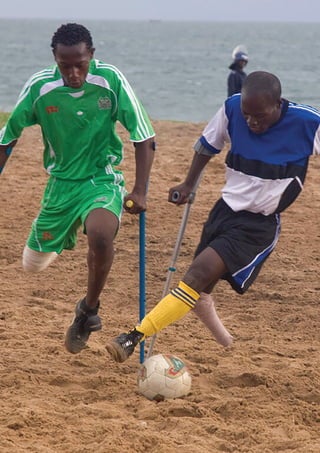
fields. For instance, a football team bringing together
former combatants, a media network promoting
indigenous voices, a school system fostering religious
tolerance, are all examples of ICD in practice.
As the world is becoming increasingly interconnected, the
challenges of responding to growing diversity have amply
demonstrated the importance of ICD in achieving key
development and security outcomes, including addressing
the root causes of conflict and sustaining peaceful societies
(Orton, 2009; United Nations; World Bank, -2018). For the
first time, this global report, “We Need to Talk”,
quantitatively connects ICD with these outcomes to
provide governments and decision-makers with actionable
insights to implement effective dialogue processes and
tackle pressing global issues.
“We Need to Talk” builds upon earlier work outlined in the
Conceptual and Technical Framework, published by
UNESCO and IEP in 2020. This work recognised that the
effectiveness of ICD as a tool for advancing peace and
inclusion is hampered by the lack of knowledge and
data-driven approaches to ICD, with limited evidence to
inform practice and challenges for long-term political and
financial support. The work also found that ICD does not
occur in a vacuum; instead, it requires specific structures,
skills and processes to support it. Consequently, this work
served as an important foundation in developing the
UNESCO Framework for Enabling Intercultural Dialogue, an
analytical tool that measures the enabling environment for
effective ICD across 160 countries. Countries were selected
in line with chosen secondary data sources. Using the data
from the Framework, this report analyses key trends and
provides deeper interrogation of insights, particularly the
effect of ICD on broader development and security
outcomes.
“We Need to Talk” also addresses the key objectives of the
United Nations International Decade for the
Rapprochement of Cultures, Sustainable Development
Executive Summary
Goal (SDG) 16 on Peace, Justice and Strong Institutions and
the United Nations Secretary General's prioritisation of
conflict prevention as a crosscutting objective of
development, humanitarian and peace initiatives.
Consequently, the global report highlights how ICD can be
a solution for advancing strategic priorities and seeks to
serve as an essential step in strengthening the evidence-
base on dialogue for peace and development and
facilitating the enhanced use of evidence by stakeholders.
INTRODUCING AND MEASURING
INTERCULTURAL DIALOGUE
Section One of the report highlights the complexity of
defining ICD and the need for the Framework, outlining the
key concepts and processes to measure it. The global
report is grounded in research using expert consultations,
a substantial literature review and a data scoping exercise.
This process exposed some of the key challenges to
constructing a technical framework to measure ICD, like
the Framework, emphasising the project's ambitious goal.
Given these challenges, one of the first priorities was
developing an operational working definition of ICD as
seen above.
These exercises also evaluated the conditions needed to
foster ICD, finding that ICD is present on the macro-level,
through institutions and policies that form the basis of
societal structures, and on the micro-level, where skills and
values are developed to ensure effective ICD. Hence, the
report outlines the nine domains and 21 indicators
selected to comprise the Framework and explains how
these indicators capture the elements in society which
promote effective ICD. The nine identified domains
comprise of four supporting domains, Leadership and
Organisation, Inclusion and Representation, Linkages and
Coherency, and Skills and Values, and five structural
domains, Horizontal Equality, Stability and Non-Violence,
Social Cohesion, Governance and Citizenship, and Freedom
of Expression.
THE DYNAMICS, BENEFITS AND TRENDS OF THE
FRAMEWORK
Section Two identifies the relationships between the
domains of the Framework, identifying strong positive
correlations across most domains. The findings highlight
the systemic nature of the Framework, meaning that
higher levels in one domain are typically associated with
higher levels in another domain – and that high scores in
these domains combined lead to even greater outcomes
such as positively managing diversity, actively preventing
conflict and creating the conditions for sustainable peace.
7
Executive Summary
Importantly, analysis on the relationship between ICD and
economic development finds that while having a strong
economy is helpful, it is not necessary to succeed in
strengthening ICD. For instance, lower-income countries
score 17.6 per cent higher, on average, on the Leadership
and Organisation domain than higher-income countries,
demonstrating that strong leadership and institutions that
champion ICD can counterbalance challenges faced by
countries with weaker economies.1
This indicates that
effective ICD is an achievable goal for all countries.
The section also explores the additional benefits of high
ICD, with a strong statistical correlation established
between a high Framework score and conflict prevention
and non-fragility (-0.941), peacefulness (-0.842), and
protection of human rights (-0.775). These close
relationships between the Framework and other peace and
security outcomes mean that governments, decision-
makers, and members of civil society have a wide variety
of areas in which improvements can be made. In particular,
three Framework domains - Skills and Values, Inclusion and
Representation, and Social Cohesion - show strong
correlations with state fragility, meaning improvements in
these ICD domains may be a key first step in the
stabilisation process.
The global report is innovative in its analysis of ICD at the
global, regional, and national levels. By calculating regional
averages, it becomes evident which areas of the
Framework the global regions perform well in, and which
areas would benefit from further development. Analysis at
the regional level also exposes the differences and
similarities between regions. The results find that all
regions perform better in the structural domains than the
supporting domains on average. Nevertheless, the
differences between average regional scores are greater
for the structural domains than the supporting domains.
While the Framework can be thought of as systemic, with
strong correlations between different domains, there is a
large variety in the different combinations of strengths and
challenges states face, particularly in the supporting
domains. The regional analysis is important for
policymaking, indicating that recommendations to improve
ICD will vary greatly between regions since each region has
different strengths and faces different challenges when it
comes to ICD.
INTERCULTURAL DIALOGUE AT WORK
Section Three closely examines five case studies - one
high-performing state from each of the regions. The five
selected countries are New Zealand from Asia and the
Pacific, Finland from Europe and North America, Ghana
from Africa, Jamaica from Latin America and the Caribbean
and Oman from the Arab States. Each case study provides
a historical background and detailed analysis of each
state's strengths in the ICD domains as well as areas for
further improvement, and outlines examples of successful
institutions, policy initiatives and good practices which
support effective ICD in practice. All five countries perform
higher in the structural domains compared to the
supporting domains. The five also score above the global
average on two structural domains - Governance and
Citizenship and Social Cohesion - illustrating the
importance of strong institutions, legal frameworks and
initiatives across different countries in facilitating effective
and inclusive ICD.
INTERCULTURAL DIALOGUE IN PRACTICE
Section Four presents five think pieces examining the
implications of the findings from the Framework for policy
and practice to support ICD through Education, Media and
ICT, Culture and the Arts, Local Governance and Urban
Planning, and Political Negotiation. Contributed by experts
from these various fields, each piece examines what the
data means for how policy and practice support ICD. The
pieces also offer a series of examples and
recommendations, providing further insight into the new
data from the UNESCO Framework for Enabling
Intercultural Dialogue. The pieces shine a light on the
diversity of actions possible for enabling ICD and the
potential for impact of these actions.
LOOKING FORWARD
Through the analysis of the Framework data, case studies
and think pieces, the core purpose of the global report is
to help governments, civil society stakeholders and other
practitioners see the value of ICD, understand it
conceptually, and know how to support it in practice.
Fundamentally, the report seeks to operationalise the use
of data-driven insights in order to identify areas to
improve the enabling environment for ICD and collaborate
with governments, decision makers and practitioners on
initiatives to achieve effective ICD in practice.
This report, however, is just one step of a process. The
data the Framework has provided, and will continue to
provide, will serve as a foundation for a reinforced
operational offering by UNESCO and its partners to better
support capacity building, technical assistance and
coordination efforts to enhance the effectiveness of
dialogue processes on the ground. Going forward, the data
will be used to organise pilot policy dialogues, establishing
roadmaps to more effectively mobilise ICD around specific
issues and testing approaches to building capacities to
interpret, use and respond to the data. Ultimately, it is our
hope that a Dialogue Support Facility can be established,
providing capacity building, funding and coordination for
ICD.
1
Refers to the average Leadership and Organisation domain score of 30 lower-income countries included in the framework, compared to the average for 43 higher-
income countries.
9
Section 1: Introducing and measuring intercultural dialogue
Introducing and
measuring
intercultural
dialogue
Section 1
We Need to Talk: Measuring intercultural dialogue for peace and inclusion
10
1.1 Introduction
In the face of persistent global challenges — such as inequality,
divisive political discourses, discrimination and intolerance,
internal displacement and violent extremism — innovative
approaches are necessary to harness to the power of our
diversity. As the world becomes increasingly interconnected, the
importance of reinforcing the values, institutions and skills that
promote dialogue as a means of building the trust and respect
needed to peacefully resolve inter-community conflict and
prevent victimisation has become more apparent. The success of
government systems, schools and economies depend heavily on
harnessing and maximising the benefit of the growing diversity
of backgrounds and perspectives in societies by improving
communication (Deloitte & Special Broadcasting Service (SBS),
2019). Therefore, there is growing recognition of the importance
of ICD as a vital instrument in achieving key development and
peace-related outcomes, including addressing the root causes of
conflict and sustaining peaceful societies (Orton, 2009; United
Nations; World Bank., 2018).
UNESCO Member States have acknowledged the need for better
data on ICD to effectively tackle pressing global issues. The
adoption of Decision 202 EX/12 at the 202nd
session of UNESCO’s
Executive Board in autumn 2017 reflects this promise to supply
more evidence-driven and responsive information to support the
Member States. This initiative is supported under the directive
of the UNESCO-led International Decade for the Rapprochement
of Cultures (2013-2022). One of the main challenges for
policymakers is the lack of relevant or timely data which directly
measures ICD. Without specific data to identify or measure
progress towards ICD, it is difficult to develop evidence-based
policies to address ICD’s shortfalls.
In response to these challenges, the UNESCO Framework for
Enabling Intercultural Dialogue has been developed to measure
the conditions that enable ICD. This framework ensures ICD is
mobilised effectively, as well as measuring its impact on
achieving key development and peace-related objectives. The
Framework is grounded on an operational definition of ICD that
was established through expert consultations and an extensive
literature review.
The Framework includes data and insights to help prioritise
interventions to support effective ICD processes. The tool can
help Member States better manage key development outcomes,
such as conflict prevention and reduced fragility, peacefulness
and human rights protection — three key outcomes that
Member States have identified as particularly important
(UNESCO, 2018).
'A process undertaken to realize transformative
communication that requires space or opportunities
for engagement and a diverse group of participants
committed to values such as mutual respect,
empathy and a willingness to consider different
perspectives.’ (United Nations Educational, Scientific
and Cultural Organization (UNESCO) & Institute for
Economics & Peace (IEP), 2020).
BOX 1.1
Intercultural dialogue operational
definition
The UNESCO Framework for Enabling Intercultural
Dialogue is an analytical tool for Member States that
measures the enabling environment that supports
effective ICD in 160 countries. It contains 9 domains
consisting of 21 indicators, which cover key macro-
and micro-level societal factors that create the space
and opportunity for successful ICD.
BOX 1.2
What is the UNESCO Framework for
Enabling Intercultural Dialogue?
This project responds to the UN International
Decade for the Rapprochement of Cultures, SDG 16,
and the UN Secretary General’s prioritisation of
conflict prevention as a crosscutting objective of the
UN’s development, humanitarian, and peace
activities. It highlights how ICD can be a solution for
advancing strategic priorities.
BOX 1.3
Connecting global agendas
Using the Framework’s data, Member States can identify barriers
to ICD and prioritise investments that can enhance its
effectiveness. The report can assist national and/or local actors
to better manage diversity by clarifying ICD data. The Framework
can be used by Member States, policymakers and practitioners to
prioritise interventions to achieve social cohesion, prevent
conflict and sustain peace, ultimately contributing to Sustainable
Development Goal (SDG) 16. SDG 16 – Peace, Justice and Strong
Institutions - aims to ‘promote peaceful and inclusive societies for
sustainable development, provide access to justice for all and
build effective, accountable and inclusive institutions at all levels’
(United Nations Statistics Division, 2021).
1.1.1 Report structure
Section 1 presents the core framework and the key concepts
used, including ICD, and the structural and supporting domains
comprising the Framework. The report section outlines expert
consultations, the literature review and the data scoping exercise
as tools for evaluating conditions to foster successful ICD. The
section also highlights why ICD is important to broader goals and
how it contributes to the pursuit of peace.
Section 2 investigates how the Framework domains work
together to support effective ICD. The section analyses which
domains are particularly important to ensure key outcomes, such
as conflict prevention and reduced fragility, peacefulness and
human rights protection. Regional trends are also investigated in
this section.
11
Section 1: Introducing and measuring intercultural dialogue
Section 3 closely examines five case studies featuring a state from
each global region. These case studies have been chosen based
on their exceptional performance within their respective region.
Each case study provides an analysis of each state’s strengths and
weaknesses in the ICD domains, and outlines examples of
successful institutions, policy initiatives and practices which
support effective ICD in practice.
Section 4 contains five Think Pieces contributed by Education,
Media and ICT, Culture and the Arts, Local Governance and Urban
Planning, and Political Negotiation experts. The pieces examine
the implications of the findings from the Framework for policy
and practice to support ICD through these various fields.
Finally, a comprehensive explanation of the framework’s
methodology can be found in Annex.
1.2 Framework development
To better understand the value of ICD, UNESCO-UIS surveyed
Member States’ views on the meaning and purpose of ICD in
2017 (UNESCO-UIS, 2018). The 17 qualitative and quantitative
questions were divided into three main sections: Definition, State
of Affairs and Operational Directions. The findings from the
Survey underscored that Member States place a high value on
ICD, but do not have a shared understanding of how to support
it, hampered by insufficient data to nourish a strong evidence
base. This further helped to establish the need for this initiative.
Building on this initial direction, an extensive research and
consultation process was launched to design the conceptual and
technical framework for the initiative. This included the
preparation of a scoping study, an expert meeting and expert
consultations.
1.2.1 Scoping study
As a first step in the process, UNESCO engaged the Institute for
Economics and Peace (IEP), a leading global research institute
working on peace and conflict data, to undertake a scoping study,
examining the conceptual and technical feasibility of generating
new data on ICD. The scoping study incorporated two key
components: a literature review and a data scoping exercise.
1.2.2 Literature review
IEP conducted a literature review to evaluate approaches to
measuring ICD. The Council of Europe’s White Paper on
Intercultural Dialogue: Living Together as Equals in Dignity (2008)
was an initial reference point. The Council of Europe defines ICD
as “an open and respectful exchange of views between
individuals, groups, with different ethnic, cultural, religious and
linguistic backgrounds and heritage” (Council of Europe, 2008:
10-11). It suggests that ICD operates at all levels (i.e. within and
amongst societies, and globally), and stipulates that mutual
understanding and respect must be foundational for effective ICD
( Council of Europe, 2008).
Based on this definition, the literature review sought to answer
the following questions:
• How is ICD defined across different research fields?
• What does the existing literature point to as effective?
• What frameworks exist in the literature for measuring ICD?
The key findings revealed:
1) The most common definition is that ICD is defined by its
purpose or goal. One example is to measure the
effectiveness of ICD as the ability to influence a change in
perception or to reach an agreement between culturally
distinct actors (Froude & Zanchelli, 2017; Orton, 2009).
Research within this area frequently uses a qualitative
methodology based on surveying perceptions before and
after ICD engagement. The literature also points to a dual
characteristic of ICD: principles and as a tool for change. This
distinction has been critical in developing the framework for
this report, which emphasises ICD as both a necessary
environment and an instrumental practice.
2) ICD is effective when the environment surrounding it is
supportive of inclusion, interaction and engagement of an
entire society. This is dependent on the abilities and
willingness of individuals to communicate effectively and
openly. An enabling environment can present itself as the
absence of violence and discrimination (Zachariassen et al.
2016, Phipps, 2014, Nimer & Smith 2016), and the presence
of civil freedoms, such as press freedom and the freedom to
express one’s culture and religious identity (Zachariason et al
2016, Orton 2009). In addition, openness, connectedness
and an understanding of others’ cultures are critical to
achieving ICD (Orton 2009). Educational institutions are also
relevant; they provide students with a setting to actively
engage with others but can also support the development of
skills and values needed for inclusive practices (Dervin 2015,
Kagitcibasi et al 2017).
3. The literature review revealed two methods to approaching
ICD: the co-existence model (also known as the harmony
model), and the confrontation model.
a. The co-existence model focuses on interpersonal contact,
aimed at promoting understanding and tolerance, as well
as reducing prejudices. It emphasises similarities and
shared experiences (Abu-Nimer et al., 2007; Mor et al.,
2016).
b. The confrontational model2
emphasises the conflict and
asymmetric power relations between groups and
individuals in society (Hammack & Pilecki, 2015; Mor et
al., 2016). It ultimately argues that historical-constructed
identity markers are essential to understand power
dynamics and inequalities.
The Framework is positioned between these two models, with
an emphasis on the confrontational model. For example, the
Framework captures opportunities for diverse groups to share
their experiences with others through a Freedom of Expression
measure. Yet, the Framework also investigates Horizontal
Equality and Inclusion and Representation to understand
2
This confrontational model is sometimes referred to as a liberation theology model by scholars such as Abu-Niber et al. (2007).
We Need to Talk: Measuring intercultural dialogue for peace and inclusion
12
asymmetric power relations.
1.2.3 Data scoping exercise
IEP conducted a data scoping exercise based on the theoretical
arguments and empirical evidence in the literature. The exercise
highlighted challenges in capturing ICD through quantitative data
sources, but also supported the idea that the technical
framework would benefit from focusing on macro- as well as
micro-level elements to better capture ICD.
While there is sufficient data to measure the broader structural
environment for ICD, there is a conceptual overlap with measures
of development and stability. Therefore, a framework approach
was chosen to capture the diverse aspects of the environment
that enables effective ICD. Different from constructing an index,
which combines various areas of a concept into a combined
score, the framework approach allows for UNESCO Member
States, policymakers and practitioners to better understand the
architecture for effective ICD relevant to their State. This is
because the Framework does not provide an ‘overall score,’ but
instead identifies one score for each of the areas – referred to as
domains – included in the Framework. An analysis of the
relationship between the Framework domains can be found in
Section 2.1.
1.2.4 Designing the architecture to measure
intercultural dialogue
This scoping study served as the basis for discussions at an expert
meeting in December 2018 which brought together
representatives from organisations working on related issues,
including the World Bank, UNDP, the OECD, the Council of
Europe, the Nordic Cultural Fund, Global Affairs Canada and
various academic institutions (including Deakin University
(Australia); Pontifica Universidade Catolica de Sao Paulo (Brazil);
Durham University (UK) and City University (UK)), as well as
UNESCO staff working across different programme sectors. Over
the course of the discussion, the experts offered insights and
reflections to refine the conceptual and technical architecture
preliminarily suggested within the scoping study. These were
consolidated and further elaborated in subsequent inputs
received from experts (from both within the UNESCO Secretariat
and beyond), gathered through in-depth discussions and
open-ended questionnaires. On the basis of this comprehensive
process of expert design, a consolidated conceptual and technical
framework was written up, explaining the concepts,
measurements and indicators planned to be used to collect and
analyse the data. This was published, following comprehensive
peer-review, in April 2020.
1.2.5 Member State engagement
Member States provided useful direction to the process of
developing the direction of the initiative was presented to
Member States at an Information Meeting, held in April 2018,
where there was an opportunity to interact with experts from the
Secretariat and IEP to understand both the results of the Member
State Survey and the planned direction for this new initiative. A
number of informal consultations were held across the process of
design and implementation with Member States who expressed
an interest in the initiative during the Information Meeting.
1.3 Measuring ICD – The
UNESCO Framework for Enabling
Intercultural Dialogue
The concept of ICD is multi-faceted, and various definitions are
used depending on the context, field and purpose. The
complexity of understanding ICD follows the complexity of
understanding cultural differences. Culture was recognized at the
1982 UNESCO World Conference - Mondiacult as the ‘set of
distinctive spiritual, material, intellectual and emotional features
of society or a social group, and that it encompasses, in addition
to art and literature, lifestyles, ways of living together, value
systems, traditions and beliefs’ (UNESCO, 2001). More simply
put, culture can be understood as the multiple identities that
people assume in different settings. Existing ICD literature often
focuses on ethnic, religious and linguistic diversity, but such a
narrow scope diminishes the importance of understanding social
and cultural dividers’ impact on ICD. Examples of these dividers
include age, income level, gender and marital status, which all
form part of an individual’s identity and culture.
ICD is understood as a process undertaken to realise
transformative communication across cultures and identities. It is
a value-driven process, as it requires participants’ commitment
to values such as mutual respect, empathy and a willingness to
change perspectives (Woodin et al., 2011, p. 122). Knowledge of
historical legacies is essential to understand and overcome
current power disparities and establish dialogue (Kent & Taylor,
2002).
These criteria align with the findings in the literature review,
which revealed that ICD is present on the macro-level through
institutions and policies that form the basis of societal structures,
and on the micro-level where skills and values are formed to
ensure effective ICD. Therefore, ICD must be “an objective of
holistic public policies. It should be defined as a transversal
objective across education, social, immigration, labour and
cultural policies” (Ratzmann, 2019, p. 53), as well as by the
day-to-day interaction between individuals with differing
identities and cultures.
The Framework provides UNESCO Member States with
enhanced, data-directed support that will improve capacity to
design and implement effective dialogue processes on an
international, national, and local level. By measuring macro- and
micro-level enabling conditions, Member States can better
understand (a) what is required to adequately support ICD, (b)
begin to identify potential blockages to effective ICD processes,
and (c) prioritise investments.
1.3.1 Two-level approach
The Framework architecture consists of two levels that are
crucial in establishing effective ICD:
a) Structural domains (macro-level): Reflect the systemic
elements of society at the social and institutional levels,
defined by policies and legal frameworks
b) Supporting domains (micro-level): The principles, values and
competencies that impact actions, policies and activities of
13
Section 1: Introducing and measuring intercultural dialogue
ICD based on individuals’ interaction and engagement, as well
as ICD working ‘on the ground’
Both structural and supporting domains possess systemic
qualities. They impact each other and work together – within and
across each layer – to enable effective ICD. There is a continuous
process of interaction and reinforcement between the domains,
ultimately impacting society’s ability to realise effective ICD. In
addition, these same domains have a strong relationship with
states’ ability to reconcile and prevent conflicts, as detailed in
Section 2.
Establishing the Framework requires questioning the systems and
routines that shape and define our societies, on both a macro-
and micro-level: Are our young people being taught the skills and
competencies necessary to engage with people from diverse
backgrounds and with different identities in schools? Are our
media and digital platforms providing inclusive and diverse
spaces for critical thinking and discussions on matters affecting
minorities as well as the majority? Are our cities being designed
so communities can unite to support each other?
The Framework answers these questions. It lays the foundation
for ICD to be woven into individuals’, groups’ and institutions’
daily interactions and policymaking activities. Governments, ICD
advocates and the public can enable the ICD environment by
strengthening the structural domains and/or developing the
supporting domains. These two layers are at the core of this
report’s analysis.
1.3.2 The UNESCO Framework for Enabling
Intercultural Dialogue domains
Based on the input from UNESCO’s Member States, ICD expert
consultations, literature review and data scoping exercise, the
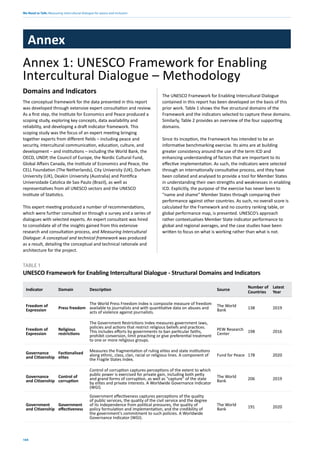
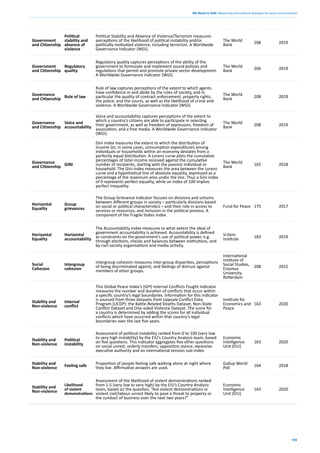
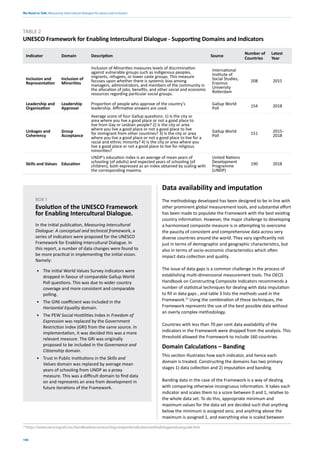
indicators presented in Table 2.1 were selected to capture the
Framework domains. Data limitations made it difficult to capture
all domains equally, but of the 21 indicators selected, 20 had
data for more than 150 countries, providing a strong
representation of countries.
Stability and Non-violence, Governance and Citizenship, Freedom
of Expression, Horizontal Equality and Social Cohesion are the
five domains selected to capture structural domains in the
Framework.
Four additional domains were selected to capture the supporting
domains. These are Inclusion and Representation, Leadership and
Organisation, Linkages and Coherency, and Skills and Values.
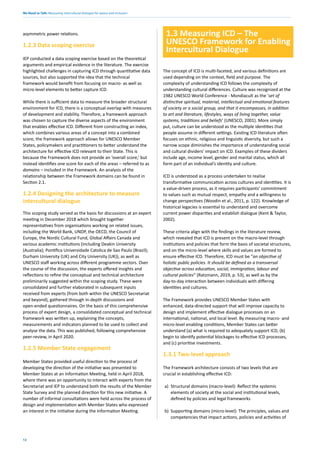
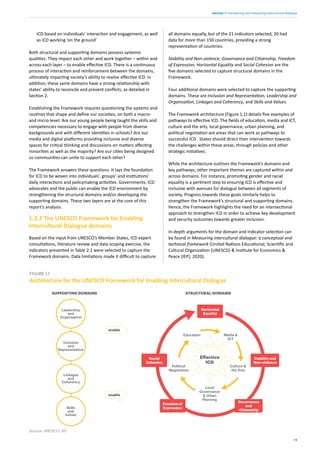
The Framework architecture (Figure 1.1) details five examples of
pathways to effective ICD. The fields of education, media and ICT,
culture and the arts, local governance, urban planning, and
political negotiation are areas that can work as pathways to
successful ICD. States should direct their intervention towards
the challenges within these areas, through policies and other
strategic initiatives.
While the architecture outlines the Framework’s domains and
key pathways, other important themes are captured within and
across domains. For instance, promoting gender and racial
equality is a pertinent step to ensuring ICD is effective and
inclusive with avenues for dialogue between all segments of
society. Progress towards these goals similarly helps to
strengthen the Framework’s structural and supporting domains.
Hence, the Framework highlights the need for an intersectional
approach to strengthen ICD in order to achieve key development
and security outcomes towards greater inclusion.
In-depth arguments for the domain and indicator selection can
be found in Measuring intercultural dialogue: a conceptual and
technical framework (United Nations Educational, Scientific and
Cultural Organization (UNESCO) & Institute for Economics &
Peace (IEP), 2020).
Source: UNESCO; IEP
Architecture for the UNESCO Framework for Enabling Intercultural Dialogue
FIGURE 1.1
SUPPORTING DOMAINS STRUCTURAL DOMAINS
Leadership
and
Organisation
Inclusion
and
Representation
Linkages
and
Coherency
Skills
and
Values
Horizontal
Equality
Social
Cohesion
Freedom of
Expression
Governance
and
Citizenship
Stability and
Non-violence
enable
enable
Political
Negotiation
Education Media &
ICT
Culture &
the Arts
Local
Governance
& Urban
Planning
Effective
ICD
We Need to Talk: Measuring intercultural dialogue for peace and inclusion
14
Throughout the development of the Framework, it was
widely acknowledged that supporting effective ICD
requires attention in multiple areas and across the two
layers. It is more than the sum of a set of domains, but
rather it is how these domains interact with each other.
Other measurement approaches, such as composite
indices, rank countries on aggregate scores. This approach
BOX 1.4
Why a Framework for Enabling Intercultural Dialogue?
would give the impression that ICD is a linear process
when the path to developing effective ICD is non-linear.
This means, there is no calculated ‘overall score’ for the
Framework. Instead, the Framework is intended as a tool
for researchers, practitioners, and policymakers to assess
the strengths of the elements that are required to achieve
effective ICD, as well as clarity on where to prioritise
interventions.
15
Section 1: Introducing and measuring intercultural dialogue
We Need to Talk: Measuring intercultural dialogue for peace and inclusion
16
The dynamics,
benefits and trends
of intercultural
dialogue
Section 2
17
Section 2: The dynamics, benefits and trends of intercultural dialogue
Key Takeaways:
• The domains of the UNESCO Framework for Enabling Intercultural Dialogue show strong
statistical correlations with each other, with the exception of Leadership and Organisation.
This highlights that higher levels in one domain are typically associated with higher levels
in another domain – and that high scores in the domains combined lead to even greater
outcomes.
• The close relationship between the domains means that policy-makers, advocates and
members of civil society have a wide variety of areas in which improvements can be made
and that improving one domain could lead to substantial improvement of other areas of the
Framework, thereby increasing the broader societal benefits.
• A strong Framework score is strongly linked with conflict prevention and reduced fragility,
peacefulness and human rights protection. The strong negative correlation between measures
of conflict prevention and non-fragility and the Framework combined score, in particular,
highlights that strength across all domains provides a greater outcome than strength in any
individual domain alone.
• Three Framework domains - Skills and Values, Inclusion and Representation and Social
Cohesion - show strong correlations with conflict prevention and reduced fragility, meaning
improvements in these ICD domains may be a key first step in the stabilisation process.
• On average, all regions perform better on the structural domains than on the supporting
domains. However, the variation between average regional scores is greater for the structural
domains than the supporting domains.
• Social Cohesion is the highest-performing domain across all regions, while the greatest regional
variation is on the Skills and Values domain.
2.1 The dynamics of the UNESCO
Framework for Enabling Intercultural
Dialogue
As mentioned in Section 1 of this report, the structural and
supporting domains in the Framework work together to support
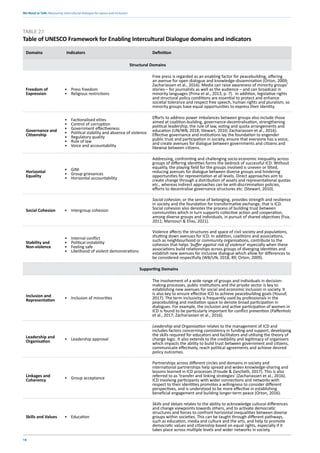
effective ICD. Table 2.1 provides an overview of the domains and
indicator included in the Framework.
To better understand how the different parts of the Framework
function and interact, a statistical analysis in the form of a
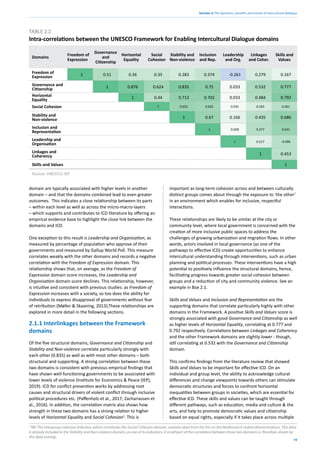
correlation matrix has been constructed. Correlation indicates
how closely two parts of the Framework are linked. A high
correlation reflects that, on average, countries scoring high in one
domain also tend to score high on the other domain. These
correlations are referred to as positive correlations because
results globally tend to fall in the same direction. Positive
correlations are marked with a green colour in Table 2.2. Negative
correlations, on the other hand, are correlations where countries
tend to score highly on one domain but low on the other. These
are marked as blue in the table. The darker the colour, the
stronger the correlation, hence, a white or pale colour indicates
that the link between the two domains is non-existent or weak.
The Framework domains show strong positive correlations to
each other suggesting systemic patterns of the framework: that
higher levels in one domain are typically associated with higher
levels in another domain – and that the domains combined lead
to even greater outcomes. Lower and higher levels of the
domains also tell us about a state’s capacity for dialogue. As the
domains work as a system, a country’s focus on improving
weaker domains through specific programmes or policy-changes
can have a positive effect on others, thereby, increasing the
broader societal benefits. While most domains show strong
positive relationships across all countries, the Leadership and
Organisation and Freedom of Expression domains, however,
show more regional nuances in their relationships to the other
domains.
The strong positive correlations across most domains point to
systemic patterns in the Framework: that higher levels in one
We Need to Talk: Measuring intercultural dialogue for peace and inclusion
18
Domains Indicators Definition
Structural Domains
Freedom of
Expression
• Press freedom
• Religious restrictions
Free press is regarded as an enabling factor for peacebuilding, offering
an avenue for open dialogue and knowledge-dissemination (Orton, 2009;
Zachariassen et al., 2016). Media can raise awareness of minority groups’
stories – for journalists as well as the audience – and can broadcast in
minority languages (Prina et al., 2013, p. 7). In addition, legislative rights
and structural policy conditions are essential to protect and enhance
societal tolerance and respect free speech, human rights and pluralism, so
minority groups have equal opportunities to express their identity.
Governance and
Citizenship
• Factionalised elites
• Control of corruption
• Government effectiveness
• Political stability and absence of violence
• Regulatory quality
• Rule of law
• Voice and accountability
Efforts to address power imbalances between groups also include those
aimed at coalition-building, governance-decentralisation, strengthening
political leadership, the rule of law, voting and quota arrangements and
education (UN/WB, 2018; Stewart, 2010; Zachariassen et al., 2016).
Effective governance and institutions lay the foundation to engender
public trust and participation in society, ensure that everyone has a voice,
and create avenues for dialogue between governments and citizens and
likewise between citizens.
Horizontal
Equality
• GINI
• Group grievances
• Horizontal accountability
Addressing, confronting and challenging socio-economic inequality across
groups of differing identities forms the bedrock of successful ICD. Without
equality, the playing field for the groups involved is uneven or tilted,
reducing avenues for dialogue between diverse groups and hindering
opportunities for representation at all levels. Direct approaches aim to
create change through a distribution of assets and representational quotas
etc., whereas indirect approaches can be anti-discrimination policies,
efforts to decentralise governance structures etc. (Stewart, 2010).
Social Cohesion • Intergroup cohesion
Social cohesion, or the sense of belonging, provides strength and resilience
in society and the foundation for transformative exchange, that is ICD.
Social cohesion also denotes the process of building trust between
communities which in turn supports collective action and cooperation,
among diverse groups and individuals, in pursuit of shared objectives (Foa,
2011; Mansouri & Elias, 2021).
Stability and
Non-violence
• Internal conflict
• Political instability
• Feeling safe
• Likelihood of violent demonstrations
Violence affects the structures and space of civil society and populations,
shutting down avenues for ICD. In addition, coalitions and associations,
such as neighbourhood or community organisations, contribute to the
cohesion that helps ‘buffer against risk of violence’ especially when these
associations build relationships across groups of diverging identities and
establish new avenues for inclusive dialogue which allow for differences to
be considered respectfully (WB/UN, 2018, 89; Orton, 2009).
Supporting Domains
Inclusion and
Representation • Inclusion of minorities
The involvement of a wide range of groups and individuals in decision-
making processes, public institutions and the private sector is key to
establishing new avenues for social and economic inclusion in society. It
is also key to ensure effective ICD to achieve peacebuilding goals (Yousuf,
2017). The term inclusivity is frequently used by professionals in the
peacebuilding and mediation space to denote broad participation in
dialogues. For example, the inclusion and active participation of women in
ICD is found to be particularly important for conflict prevention (Paffenholz
et al., 2017; Zachariassen et al., 2016).
Leadership and
Organisation • Leadership approval
Leadership and Organisation relates to the management of ICD and
includes factors concerning consistency in funding and support, developing
the skills required for educators and facilitators and utilising the theory of
change logic. It also extends to the credibility and legitimacy of organisers
which impacts the ability to build trust between government and citizens,
communicate effectively, reach political agreements and achieve desired
policy outcomes.
Linkages and
Coherency • Group acceptance
Partnerships across different circles and domains in society and
international partnerships help spread and widen knowledge-sharing and
lessons learned in ICD processes (Froude & Zanchelli, 2017). This is also
referred to as ‘transfer and linking strategies’ (Zachariassen et al., 2016).
ICD involving participants with wider connections and networks with
respect to their identities promotes a willingness to consider different
perspectives, and is understood to be more effective in establishing
beneficial engagement and building longer-term peace (Orton, 2016).
Skills and Values • Education
Skills and Values relates to the ability to acknowledge cultural differences
and change viewpoints towards others, and to activate democratic
structures and forces to confront horizontal inequalities between diverse
groups within societies. This can be taught through different pathways,
such as education, media and culture and the arts, and help to promote
democratic values and citizenship based on equal rights, especially if it
takes place across multiple levels and wider networks in society.
TABLE 2.1
Table of UNESCO Framework for Enabling Intercultural Dialogue domains and indicators
19
Section 2: The dynamics, benefits and trends of intercultural dialogue
Domains
Freedom of
Expression
Governance
and
Citizenship
Horizontal
Equality
Social
Cohesion
Stability and
Non-violence
Inclusion
and Rep.
Leadership
and Org.
Linkages
and Coher.
Skills and
Values
Freedom of
Expression 1 0.51 0.36 0.35 0.283 0.374 -0.261 0.279 0.167
Governance and
Citizenship 1 0.876 0.624 0.835 0.75 0.033 0.532 0.777
Horizontal
Equality 1 0.44 0.713 0.702 0.033 0.484 0.792
Social Cohesion 1 0.652 0.602 0.035 0.265 0.461
Stability and
Non-violence 1 0.67 0.166 0.435 0.686
Inclusion and
Representation
1 0.028 0.477 0.641
Leadership and
Organisation
1 0.217 -0.096
Linkages and
Coherency 1 0.453
Skills and Values 1
Source: UNESCO; IEP
TABLE 2.2
Intra-correlations between the UNESCO Framework for Enabling Intercultural Dialogue domains
domain are typically associated with higher levels in another
domain – and that the domains combined lead to even greater
outcomes. This indicates a close relationship between its parts
– within each level as well as across the micro-macro-layers
– which supports and contributes to ICD literature by offering an
empirical evidence base to highlight the close link between the
domains and ICD.
One exception to this result is Leadership and Organisation, as
measured by percentage of population who approve of their
governments and measured by Gallup World Poll. This measure
correlates weakly with the other domains and records a negative
correlation with the Freedom of Expression domain. This
relationship shows that, on average, as the Freedom of
Expression domain score increases, the Leadership and
Organisation domain score declines. This relationship, however,
is intuitive and consistent with previous studies: as Freedom of
Expression increases with a society, so too does the ability for
individuals to express disapproval of governments without fear
of retribution (Møller & Skaaning, 2013).These relationships are
explored in more detail in the following sections.
2.1.1 Interlinkages between the Framework
domains
Of the five structural domains, Governance and Citizenship and
Stability and Non-violence correlate particularly strongly with
each other (0.835) as well as with most other domains – both
structural and supporting. A strong correlation between these
two domains is consistent with previous empirical findings that
have shown well-functioning governments to be associated with
lower levels of violence (Institute for Economics & Peace (IEP),
2019). ICD for conflict prevention works by addressing root
causes and structural drivers of violent conflict through inclusive
political procedures etc. (Paffenholz et al., 2017; Zachariassen et
al., 2016). In addition, the correlation matrix also shows how
strength in these two domains has a strong relation to higher
levels of Horizontal Equality and Social Cohesion3
. This is
important as long-term cohesion across and between culturally
distinct groups comes about through the exposure to ‘the other’
in an environment which enables for inclusive, respectful
interactions.
These relationships are likely to be similar at the city or
community level, where local government is concerned with the
creation of more inclusive public spaces to address the
challenges of growing urbanization and migration flows. In other
words, actors involved in local governance (as one of the
pathways to effective ICD) create opportunities to enhance
intercultural understanding through interventions, such as urban
planning and political processes. These interventions have a high
potential to positively influence the structural domains, hence,
facilitating progress towards greater social cohesion between
groups and a reduction of city and community violence. See an
example in Box 2.1.
Skills and Values and Inclusion and Representation are the
supporting domains that correlate particularly highly with other
domains in the Framework. A positive Skills and Values score is
strongly associated with good Governance and Citizenship as well
as higher levels of Horizontal Equality, correlating at 0.777 and
0.792 respectively. Correlations between Linkages and Coherency
and the other Framework domains are slightly lower - though,
still correlating at 0.532 with the Governance and Citizenship
domain.
This confirms findings from the literature review that showed
Skills and Values to be important for effective ICD. On an
individual and group level, the ability to acknowledge cultural
differences and change viewpoints towards others can stimulate
democratic structures and forces to confront horizontal
inequalities between groups in societies, which are essential for
effective ICD. These skills and values can be taught through
different pathways, such as education, media and culture & the
arts, and help to promote democratic values and citizenship
based on equal rights, especially if it takes place across multiple
3
NB: The intergroup cohesion indicator, which constitutes the Social Cohesion domain, contains data from the EIU on the likelihood of violent demonstrations. This data
is already included in the Stability and Non-violence domain, as one of its indicators. A small part of the correlation between these two domains is, therefore, driven by
this data overlap.
We Need to Talk: Measuring intercultural dialogue for peace and inclusion
20
City mayors in Cali, Bogotá and Medellín in Colombia have been
inspired by data-based, research-driven methods that treated
violence as a public health problem. Medellín, Colombia’s
second-largest city, had one of the highest violent crime rates in
the world during the early 1990s. Over the last 15 years, a string
of city mayors used available data on crime rates and social
exclusion to pioneer a so-called “urban acupuncture” tactic using
urban design to solve social problems. Today, Medellín is
renowned as a socially cohesive, business-friendly and people-
centric city with a high quality of life.
To tackle social inequality, violence and crime, the City Mayor’s
administration developed a series of multi-neighbourhood
projects. These were small-scale urban projects but with
high-impact - designed to decrease illegal activities, strengthen
government legitimacy and rebuild social and economic
institutions. Medellín’s civic leadership realised early on that
sustainable urban development could only be achieved by
ensuring all the city’s stakeholders became active participants in
discussions on violence and social urbanism (Maclean K. (2015)).
Hence, the projects were successful because the city facilitated a
constant multilevel dialogue between many parties that brought
leftist community leaders, social organisations and activists
together with the city’s elites (Maclean K. (2015) p.78)
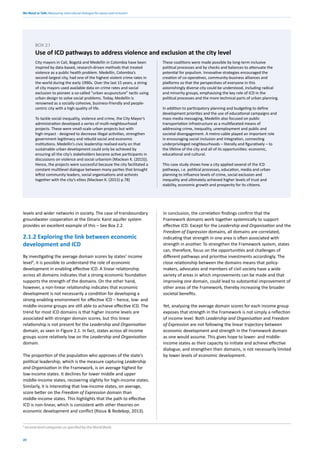
BOX 2.1
Use of ICD pathways to address violence and exclusion at the city level
These coalitions were made possible by long-term inclusive
political processes and by checks and balances to attenuate the
potential for populism. Innovative strategies encouraged the
creation of co-operatives, community-business alliances and
platforms so that the perspectives of everyone in this
astonishingly diverse city could be understood, including radical
and minority groups, emphasising the key role of ICD in the
political processes and the more technical parts of urban planning.
In addition to participatory planning and budgeting to define
development priorities and the use of educational campaigns and
mass media messaging, Medellín also focused on public
transportation infrastructure as a multifaceted means of
addressing crime, inequality, unemployment and public and
societal disengagement. A metro-cable played an important role
in encouraging social inclusion and integration, connecting
underprivileged neighbourhoods – literally and figuratively – to
the lifeline of the city and all of its opportunities: economic,
educational and cultural.
This case study shows how a city applied several of the ICD
pathways, i.e. political processes, education, media and urban
planning to influence levels of crime, social exclusion and
inequality and ultimately achieved higher levels of trust and
stability, economic growth and prosperity for its citizens.
levels and wider networks in society. The case of transboundary
groundwater cooperation at the Dinaric Karst aquifer system
provides an excellent example of this – See Box 2.2.
2.1.2 Exploring the link between economic
development and ICD
By investigating the average domain scores by states’ income
level4
, it is possible to understand the role of economic
development in enabling effective ICD. A linear relationship
across all domains indicates that a strong economic foundation
supports the strength of the domains. On the other hand,
however, a non-linear relationship indicates that economic
development is not necessarily a condition for developing a
strong enabling environment for effective ICD – hence, low- and
middle-income groups are still able to achieve effective ICD. The
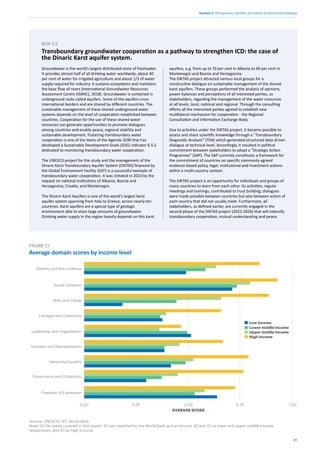
trend for most ICD domains is that higher income levels are
associated with stronger domain scores, but this linear
relationship is not present for the Leadership and Organisation
domain, as seen in Figure 2.1. In fact, states across all income
groups score relatively low on the Leadership and Organisation
domain.
The proportion of the population who approves of the state’s
political leadership, which is the measure capturing Leadership
and Organisation in the Framework, is on average highest for
low-income states. It declines for lower middle and upper
middle-income states, recovering slightly for high-income states.
Similarly, it is interesting that low-income states, on average,
score better on the Freedom of Expression domain than
middle-income states. This highlights that the path to effective
ICD is non-linear, which is consistent with other theories on
economic development and conflict (Rioux & Redekop, 2013).
In conclusion, the correlation findings confirm that the
Framework domains work together systemically to support
effective ICD. Except for the Leadership and Organisation and the
Freedom of Expression domains, all domains are correlated,
indicating that strength in one area is often associated with
strength in another. To strengthen the Framework system, states
can, therefore, focus on the opportunities and challenges of
different pathways and prioritise investments accordingly. The
close relationship between the domains means that policy-
makers, advocates and members of civil society have a wide
variety of areas in which improvements can be made and that
improving one domain, could lead to substantial improvement of
other areas of the Framework, thereby increasing the broader
societal benefits.
Yet, analysing the average domain scores for each income group
exposes that strength in the Framework is not simply a reflection
of income level. Both Leadership and Organisation and Freedom
of Expression are not following the linear trajectory between
economic development and strength in the Framework domain
as one would assume. This gives hope to lower- and middle-
income states as their capacity to initiate and achieve effective
dialogue, and strengthen their domains, is not necessarily limited
by lower levels of economic development.
4
Income level categories as specified by the World Bank.
21
Section 2: The dynamics, benefits and trends of intercultural dialogue
Groundwater is the world’s largest distributed store of freshwater.
It provides almost half of all drinking water worldwide, about 40
per cent of water for irrigated agriculture and about 1/3 of water
supply required for industry. It sustains ecosystems and maintains
the base flow of rivers (International Groundwater Resources
Assessment Centre (IGRAC), 2018). Groundwater is contained in
underground rocks called aquifers. Some of the aquifers cross
international borders and are shared by different countries. The
sustainable management of these shared underground water
systems depends on the level of cooperation established between
countries. Cooperation for the use of these shared water
resources can generate opportunities to promote dialogues
among countries and enable peace, regional stability and
sustainable development. Fostering transboundary water
cooperation is one of the items of the Agenda 2030 that has
developed a Sustainable Development Goals (SDG) indicator 6.5.2
dedicated to monitoring transboundary water cooperation.
The UNESCO project for the study and the management of the
Dinaric Karst Transboundary Aquifer System (DIKTAS) financed by
the Global Environment Facility (GEF) is a successful example of
transboundary water cooperation. It was initiated in 2010 by the
request on national institutions of Albania, Bosnia and
Herzegovina, Croatia, and Montenegro.
The Dinaric Karst Aquifers is one of the world’s largest karst
aquifer system spanning from Italy to Greece, across nearly ten
countries. Karst aquifers are a special type of geologic
environment able to store large amounts of groundwater.
Drinking water supply in the region heavily depends on this karst
BOX 2.2
Transboundary groundwater cooperation as a pathway to strengthen ICD: the case of
the Dinaric Karst aquifer system.
aquifers, e.g. from up to 70 per cent in Albania to 90 per cent in
Montenegro and Bosnia and Herzegovina.
The DIKTAS project attracted various local groups for a
constructive dialogue on sustainable management of the shared
karst aquifers. These groups performed the analysis of opinions,
power balances and perceptions of all interested parties, as
stakeholders, regarding the management of the water resources
at all levels, local, national and regional. Through the consulting
efforts all the interested parties agreed to establish new
multilateral mechanism for cooperation - the Regional
Consultation and Information Exchange Body.
Due to activities under the DIKTAS project, it became possible to
assess and share scientific knowledge through a “Transboundary
Diagnostic Analysis” (TDA) which generated structured data-driven
dialogue at technical level. Accordingly, it resulted in political
commitment between stakeholders to adopt a “Strategic Action
Programme” (SAP). The SAP currently constitutes a framework for
the commitment of countries on specific commonly-agreed
evidence-based policy, legal, institutional and investment actions
within a multi-country context.
The DIKTAS project is an opportunity for individuals and groups of
many countries to learn from each other. Its activities, regular
meetings and trainings, contributed to trust building; dialogues
were made possible between countries but also between actors of
each country that did not usually meet. Furthermore, all
stakeholders, as defined earlier, are currently engaged in the
second phase of the DIKTAS project (2022-2026) that will intensify
transboundary cooperation, mutual understanding and peace.
Average domain scores by income level
FIGURE 2.1
0.00 0.25 0.50 0.75 1.00
Stability and Non-violence
Social Cohesion
Skills and Values
Linkages and Coherency
Leadership and Organisation
Inclusion and Representation
Horizontal Equality
Governance and Citizenship
Freedom of Expression
Source: UNESCO; IEP; World Bank
Note: Of the states covered in this report, 30 are classified by the World Bank as low income, 45 and 42 as lower and upper middle income,
respectively, and 43 as high income.
Low income
Lower middle income
Upper middle income
High income
AVERAGE SCORE
We Need to Talk: Measuring intercultural dialogue for peace and inclusion
22
2.2 How enabling intercultural dialogue
provides additional peace, security and
development outcomes
While the Framework measures the enabling environment for
ICD, there is empirical evidence that strength in the Framework
domains also supports a range of outcomes related to peace,
security and development. Based on the 2017 survey, UNESCO’s
Member States highlighted three key outcomes as particularly
important: conflict prevention and reduced fragility, human
rights protection and peacefulness (UNESCO, 2018).
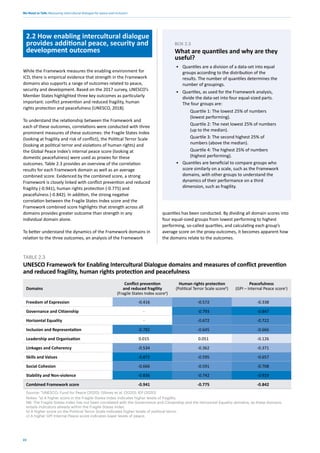
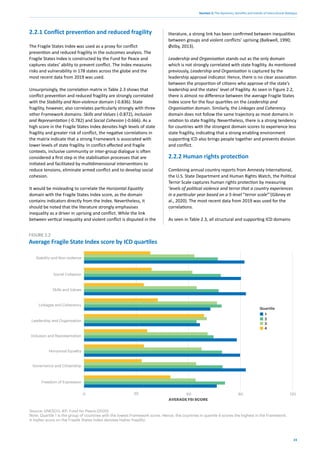
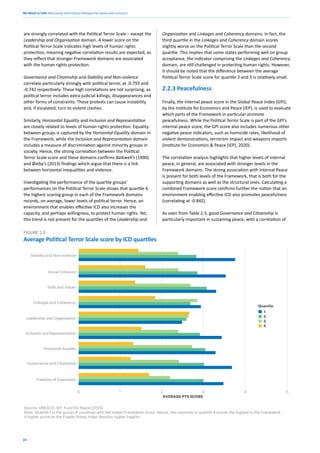
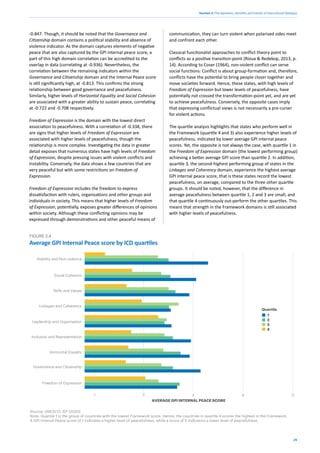
To understand the relationship between the Framework and
each of these outcomes, correlations were conducted with three
prominent measures of these outcomes: the Fragile States Index
(looking at fragility and risk of conflict), the Political Terror Scale
(looking at political terror and violations of human rights) and
the Global Peace Index’s internal peace score (looking at
domestic peacefulness) were used as proxies for these
outcomes. Table 2.3 provides an overview of the correlation
results for each Framework domain as well as an average
combined score. Evidenced by the combined score, a strong
Framework is closely linked with conflict prevention and reduced
fragility (-0.941), human rights protection (-0.775) and
peacefulness (-0.842). In addition, the strong negative
correlation between the Fragile States Index score and the
Framework combined score highlights that strength across all
domains provides greater outcome than strength in any
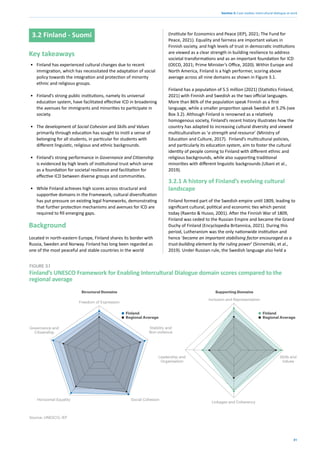
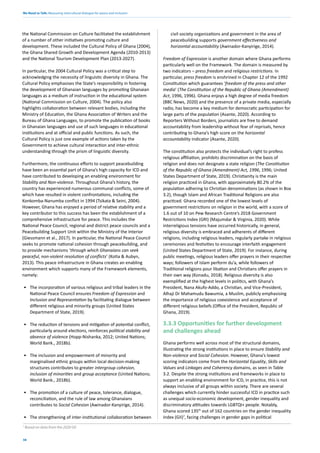
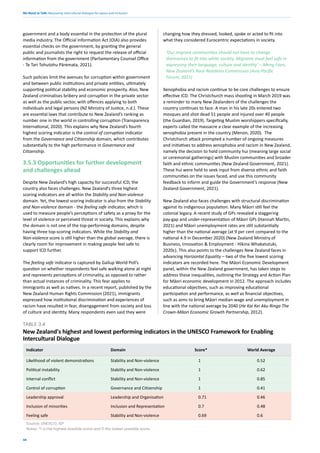
individual domain alone.
To better understand the dynamics of the Framework domains in
relation to the three outcomes, an analysis of the Framework
Domains
Conflict prevention
and reduced fragility
(Fragile States Index scorea
)
Human rights protection
(Political Terror Scale scoreb
)
Peacefulness
(GPI – Internal Peace scorec
)
Freedom of Expression -0.416 -0.572 -0.338
Governance and Citizenship - -0.793 -0.847
Horizontal Equality - -0.672 -0.722
Inclusion and Representation -0.782 -0.645 -0.666
Leadership and Organisation 0.015 0.051 -0.126
Linkages and Coherency -0.534 -0.362 -0.371
Skills and Values -0.872 -0.595 -0.657
Social Cohesion -0.666 -0.591 -0.708
Stability and Non-violence -0.836 -0.742 -0.919
Combined Framework score -0.941 -0.775 -0.842
Source: "UNESCO; Fund for Peace (2020); Gibney et al. (2020); IEP (2020)
Notes: "a) A higher score in the Fragile States Index indicates higher levels of fragility.
NB: The Fragile States Index has not been correlated with the Governance and Citizenship and the Horizontal Equality domains, as these domains
entails indicators already within the Fragile States index.
b) A higher score on the Political Terror Scale indicates higher levels of political terror.
c) A higher GPI Internal Peace score indicates lower levels of peace.
TABLE 2.3
UNESCO Framework for Enabling Intercultural Dialogue domains and measures of conflict prevention
and reduced fragility, human rights protection and peacefulness
• Quantiles are a division of a data-set into equal
groups according to the distribution of the
results. The number of quantiles determines the
number of groupings.
• Quartiles, as used for the Framework analysis,
divide the data-set into four equal-sized parts.
The four groups are:
Quartile 1: The lowest 25% of numbers
(lowest performing).
Quartile 2: The next lowest 25% of numbers
(up to the median).
Quartile 3: The second highest 25% of
numbers (above the median).
Quartile 4: The highest 25% of numbers
(highest performing).
• Quantiles are beneficial to compare groups who
score similarly on a scale, such as the Framework
domains, with other groups to understand the
dynamics of their performance on a third
dimension, such as fragility.
BOX 2.3
What are quantiles and why are they
useful?
quantiles has been conducted. By dividing all domain scores into
four equal-sized groups from lowest performing to highest
performing, so-called quartiles, and calculating each group’s
average score on the proxy-outcomes, it becomes apparent how
the domains relate to the outcomes.
23
Section 2: The dynamics, benefits and trends of intercultural dialogue
2.2.1 Conflict prevention and reduced fragility
The Fragile States Index was used as a proxy for conflict
prevention and reduced fragility in the outcomes analysis. The
Fragile States Index is constructed by the Fund for Peace and
captures states’ ability to prevent conflict. The Index measures
risks and vulnerability in 178 states across the globe and the
most recent data from 2019 was used.
Unsurprisingly, the correlation matrix in Table 2.3 shows that
conflict prevention and reduced fragility are strongly correlated
with the Stability and Non-violence domain (-0.836). State
fragility, however, also correlates particularly strongly with three
other Framework domains: Skills and Values (-0.872), Inclusion
and Representation (-0.782) and Social Cohesion (-0.666). As a
high score in the Fragile States Index denotes high levels of state
fragility and greater risk of conflict, the negative correlations in
the matrix indicate that a strong Framework is associated with
lower levels of state fragility. In conflict-affected and fragile
contexts, inclusive community or inter-group dialogue is often
considered a first step in the stabilisation processes that are
initiated and facilitated by multidimensional interventions to
reduce tensions, eliminate armed conflict and to develop social
cohesion.
It would be misleading to correlate the Horizontal Equality
domain with the Fragile States Index score, as the domain
contains indicators directly from the Index. Nevertheless, it
should be noted that the literature strongly emphasises
inequality as a driver in uprising and conflict. While the link
between vertical inequality and violent conflict is disputed in the
Average Fragile State Index score by ICD quartiles
FIGURE 2.2
0 30 60 90 120
Stability and Non-violence
Social Cohesion
Skills and Values
Linkages and Coherency
Leadership and Organisation
Inclusion and Representation
Horizontal Equality
Governance and Citizenship
Source: UNESCO; IEP; Fund for Peace (2020)
Note: Quartile 1 is the group of countries with the lowest Framework score. Hence, the countries in quartile 4 scores the highest in the Framework.
A higher score on the Fragile States Index denotes higher fragility.
Freedom of Expression
AVERAGE FSI SCORE
1
2
3
4
Quartile
literature, a strong link has been confirmed between inequalities
between groups and violent conflicts’ uprising (Balkwell, 1990;
Østby, 2013).
Leadership and Organisation stands out as the only domain
which is not strongly correlated with state fragility. As mentioned
previously, Leadership and Organisation is captured by the
leadership approval indicator. Hence, there is no clear association
between the proportion of citizens who approve of the state’s
leadership and the states’ level of fragility. As seen in Figure 2.2,
there is almost no difference between the average Fragile States
Index score for the four quartiles on the Leadership and
Organisation domain. Similarly, the Linkages and Coherency
domain does not follow the same trajectory as most domains in
relation to state fragility. Nevertheless, there is a strong tendency
for countries with the strongest domain scores to experience less
state fragility, indicating that a strong enabling environment
supporting ICD also brings people together and prevents division
and conflict.
2.2.2 Human rights protection
Combining annual country reports from Amnesty International,
the U.S. State Department and Human Rights Watch, the Political
Terror Scale captures human rights protection by measuring
‘levels of political violence and terror that a country experiences
in a particular year based on a 5-level “terror scale”’(Gibney et
al., 2020). The most recent data from 2019 was used for the
correlations.
As seen in Table 2.3, all structural and supporting ICD domains
We Need to Talk: Measuring intercultural dialogue for peace and inclusion
24
are strongly correlated with the Political Terror Scale – except the
Leadership and Organisation domain. A lower score on the
Political Terror Scale indicates high levels of human rights
protection, meaning negative correlation results are expected, as
they reflect that stronger Framework domains are associated
with the human rights protection.
Governance and Citizenship and Stability and Non-violence
correlate particularly strongly with political terror, at -0.793 and
-0.742 respectively. These high correlations are not surprising, as
political terror includes extra-judicial killings, disappearances and
other forms of constraints. These protests can cause instability
and, if escalated, turn to violent clashes.
Similarly, Horizontal Equality and Inclusion and Representation
are closely related to levels of human rights protection. Equality
between groups is captured by the Horizontal Equality domain in
the Framework, while the Inclusion and Representation domain
includes a measure of discrimination against minority groups in
society. Hence, the strong correlation between the Political
Terror Scale score and these domains confirms Balkwell’s (1990)
and Østby’s (2013) findings which argue that there is a link
between horizontal inequalities and violence.
Investigating the performance of the quartile groups’
performances on the Political Terror Scale shows that quartile 4,
the highest scoring group in each of the Framework domains
records, on average, lower levels of political terror. Hence, an
environment that enables effective ICD also increases the
capacity, and perhaps willingness, to protect human rights. Yet,
this trend is not present for the quartiles of the Leadership and
Organisation and Linkages and Coherency domains. In fact, the
third quartile in the Linkages and Coherency domain scores
slightly worse on the Political Terror Scale than the second
quartile. This implies that some states performing well on group
acceptance, the indicator comprising the Linkages and Coherency
domain, are still challenged in protecting human rights. However,
it should be noted that the difference between the average
Political Terror Scale score for quartile 2 and 3 is relatively small.
2.2.3 Peacefulness
Finally, the internal peace score in the Global Peace Index (GPI),
by the Institute for Economics and Peace (IEP), is used to evaluate
which parts of the Framework in particular promote
peacefulness. While the Political Terror Scale is part of the GPI’s
internal peace score, the GPI score also includes numerous other
negative peace indicators, such as homicide rates, likelihood of
violent demonstrations, terrorism impact and weapons imports
(Institute for Economics & Peace (IEP), 2020).
The correlation analysis highlights that higher levels of internal
peace, in general, are associated with stronger levels in the
Framework domains. The strong association with Internal Peace
is present for both levels of the Framework, that is both for the
supporting domains as well as the structural ones. Calculating a
combined Framework score confirms further the notion that an
environment enabling effective ICD also promotes peacefulness
(correlating at -0.842).
As seen from Table 2.3, good Governance and Citizenship is
particularly important in sustaining peace, with a correlation of
Average Political Terror Scale score by ICD quartiles
FIGURE 2.3
0 1 2 3 4 5
Stability and Non-violence
Social Cohesion
Skills and Values
Linkages and Coherency
Leadership and Organisation
Inclusion and Representation
Horizontal Equality
Governance and Citizenship
Freedom of Expression
Source: UNESCO; IEP; Fund for Peace (2020)
Note: Quartile 1 is the group of countries with the lowest Framework score. Hence, the countries in quartile 4 scores the highest in the Framework.
A higher score on the Fragile States Index denotes higher fragility.
AVERAGE PTS SCORE
1
2
3
4
Quartile
25
Section 2: The dynamics, benefits and trends of intercultural dialogue
-0.847. Though, it should be noted that the Governance and
Citizenship domain contains a political stability and absence of
violence indicator. As the domain captures elements of negative
peace that are also captured by the GPI internal peace score, a
part of this high domain correlation can be accredited to the
overlap in data (correlating at -0.936). Nevertheless, the
correlation between the remaining indicators within the
Governance and Citizenship domain and the Internal Peace score
is still significantly high, at -0.813. This confirms the strong
relationship between good governance and peacefulness.
Similarly, higher levels of Horizontal Equality and Social Cohesion
are associated with a greater ability to sustain peace, correlating
at -0.722 and -0.708 respectively.
Freedom of Expression is the domain with the lowest direct
association to peacefulness. With a correlation of -0.338, there
are signs that higher levels of Freedom of Expression are
associated with higher levels of peacefulness, though the
relationship is more complex. Investigating the data in greater
detail exposes that numerous states have high levels of Freedom
of Expression, despite pressing issues with violent conflicts and
instability. Conversely, the data shows a few countries that are
very peaceful but with some restrictions on Freedom of
Expression.
Freedom of Expression includes the freedom to express
dissatisfaction with rulers, organisations and other groups and
individuals in society. This means that higher levels of Freedom
of Expression, potentially, exposes greater differences of opinions
within society. Although these conflicting opinions may be
expressed through demonstrations and other peaceful means of
communication, they can turn violent when polarised sides meet
and confront each other.
Classical functionalist approaches to conflict theory point to
conflicts as a positive transition-point (Rioux & Redekop, 2013, p.
14). According to Coser (1964), non-violent conflict can serve
social functions: Conflict is about group-formation and, therefore,
conflicts have the potential to bring people closer together and
move societies forward. Hence, these states, with high levels of
Freedom of Expression but lower levels of peacefulness, have
potentially not crossed the transformation-point yet, and are yet
to achieve peacefulness. Conversely, the opposite cases imply
that expressing conflictual views is not necessarily a pre-curser
for violent actions.
The quartile analysis highlights that states who perform well in
the Framework (quartile 4 and 3) also experience higher levels of
peacefulness, indicated by lower average GPI internal peace
scores. Yet, the opposite is not always the case, with quartile 1 in
the Freedom of Expression domain (the lowest performing group)
achieving a better average GPI score than quartile 2. In addition,
quartile 3, the second-highest performing group of states in the
Linkages and Coherency domain, experience the highest average
GPI internal peace score, that is these states record the lowest
peacefulness, on average, compared to the three other quartile
groups. It should be noted, however, that the difference in
average peacefulness between quartile 1, 2 and 3 are small, and
that quartile 4 continuously out-perform the other quartiles. This
means that strength in the Framework domains is still associated
with higher levels of peacefulness.
Average GPI Internal Peace score by ICD quartiles
FIGURE 2.4
2 3
1 4 5
Stability and Non-violence
Social Cohesion
Skills and Values
Linkages and Coherency
Leadership and Organisation
Inclusion and Representation
Source: UNESCO; IEP (2020)
Note: Quartile 1 is the group of countries with the lowest Framework score. Hence, the countries in quartile 4 scores the highest in the Framework.
A GPI Internal Peace score of 1 indicates a higher level of peacefulness, while a score of 5 indicators a lower level of peacefulness.
Horizontal Equality
Governance and Citizenship
Freedom of Expression
AVERAGE GPI INTERNAL PEACE SCORE
1
2
3
4
Quartile
We Need to Talk: Measuring intercultural dialogue for peace and inclusion
26
2.3 Regional Trends
By calculating regional averages, it becomes evident which areas
of the Framework the world regions perform well in, and which
areas would benefit from further development. It also exposes
any global trends that may exist across all regions5
.
Figure 2.5 shows the regional average scores in the structural and
supporting domains of the Framework. It appears that all regions
perform better in the structural domains, on average, compared
to the supporting domains. Nevertheless, the differences
between average regional scores are greater for the structural
domains than the supporting domains. While the Framework can
be thought of as a system, there is a great variety in the different
combinations of strengths and challenges states face, particularly
in the supporting domains.
2.3.1 The trends in five world regions
In the African region, two of the structural domains in the
Framework - Social Cohesion and Freedom of Expression
– perform higher compared to the region’s performance in the
seven other domains. Of the supporting domains, Africa records
its highest score on the Leadership and Organisation domain.
Areas in need of extra attention in the African region are
Governance and Citizenship of the structural domains and Skills
and Values of the supporting domains. On average, the region
would benefit from investing further in these areas to advance
ICD and other outcomes. Ghana provides a good example of a
country with strong Social Cohesion and Freedom of Expression,
facing challenges in the Skills and values domain in the region.
Read more about how Ghana has achieved strong Social
Cohesion despite linguistic and ethnic diversity in the country
and how the government is working to address unequal
socio-economic development in order to improve ICD in Section
3.3 of this report.
Based on the average domain scores for the region, the Inclusion
and Representation, Governance and Citizenship and Freedom of
FIGURE 2.5
0.00 0.25 0.50 0.75 1.00
Latin America and
the Caribbean
Europe and
North America
Asia and the Pacific
Arab States
Africa
Source: UNESCO; IEP
Structural Domains
Supporting Domains
AVERAGE REGIONAL SCORE
Average structural and supporting domain
scores by region
Average domain scores: Africa
FIGURE 2.6
0.00 0.25 0.50 0.75 1.00
Social Cohesion
Source: UNESCO; IEP
Structural Domains
Supporting Domains
AVERAGE REGIONAL SCORE
Stability and
Non-violence
Skills and Values
Linkages and
Coherency
Leadership and
Organisation
Inclusion and
Representation
Horizontal Equality
Governance and
Citizenship
Freedom of
Expression
Expression domains require attention across the Arab states.
‘Across the region, citizens —regardless of ethnicity, faith,
wealth, education or status— continue to demand basic
elements of governance that states are often unable or unwilling
to provide’ (Fakir & Yerkes, 2018). Yet, the Arab states perform
strongly in Social Cohesion and Skills and Values, which, in part,
explains the economic development many countries in the
region have experienced over the last decades. Oman
exemplifies this well and the inclusion of women in education
and the labour market has supported its progress towards ICD.
Reflecting the regional average, however, Oman is challenged in
supporting Freedom of Expression as well as Linkages and
Coherency. Read more about Oman’s strengths and challenges in
supporting effective ICD in Section 3.6.
Average domain scores: Arab states
FIGURE 2.7
0.00 0.25 0.50 0.75 1.00
Social Cohesion
Source: UNESCO; IEP
Structural Domains
Supporting Domains
AVERAGE REGIONAL SCORE
Stability and
Non-violence
Skills and Values
Linkages and
Coherency
Leadership and
Organisation
Inclusion and
Representation
Horizontal Equality
Governance and
Citizenship
Freedom of
Expression
5
An overview of which states are included in each of the world regions can be found in the methodology section of this report.
27
Section 2: The dynamics, benefits and trends of intercultural dialogue
Asia and the Pacific achieves its highest scores in the Social
Cohesion and Stability and Non-violence domains. Despite
substantial economic, cultural and social differences to Europe
and North America, the Asia and the Pacific region faces similar
challenges according to the Framework with Inclusion and
Representation and Linkages and Coherency being the lowest
scoring domains. Section 3.5 takes a closer look at how ICD is
supported in multicultural New Zealand. Political institutions,
legal frameworks and allocated funding to media celebrating and
supporting the indigenous Māori language and culture have
supported Inclusion and Representation and Social Cohesion in
the country. Yet, the Christchurch attack in 2019 highlighted the
challenges with racism and discrimination that New Zealand
continues to face.
In contrast, Europe and North America is doing particularly well
in developing citizens’ Skills and Values to support effective ICD
on the ground. In fact, on average, this is the highest performing
supporting domain in the region, but, overall, the region tends to
perform better in the structural domains compared to its average
supporting domain scores. Social Cohesion and Skills and Values
are the two highest-performing domains in Europe and North
America, while the region would benefit from initiatives aiming
to improve its Linkages and Coherency and Leadership and
Organisation scores. As an exemplary case, Finland provides
insights into how even one of the highest-performing countries in
the Framework faces challenges – particularly in the Leadership
and Organisation domain - in ensuring public mistrust does not
hinder the efficacy of institutions or avenues which facilitate ICD
in practice. Read more on the case of Finland in Section 3.2.
Latin America and the Caribbean also performs well in Social
Cohesion but unlike the Arab states, the Freedom of Expression
domain is among the highest scoring domains in the region. On
the other hand, the region faces particular challenges in the
Leadership and Organisation domain, as well as Governance and
Citizenship and Inclusion and Representation. The average
leadership approval in the region (the indicator comprising the
Leadership and Organisation domain) is particularly low,
confirming ‘a clear rise in anti-incumbency sentiment … and
Average domain scores: Asia and the Pacific
FIGURE 2.8
0.00 0.25 0.50 0.75 1.00
Social Cohesion
Source: UNESCO; IEP
Structural Domains
Supporting Domains
AVERAGE REGIONAL SCORE
Stability and
Non-violence
Skills and Values
Linkages and
Coherency
Leadership and
Organisation
Inclusion and
Representation
Horizontal Equality
Governance and
Citizenship
Freedom of
Expression
Average domain scores: Europe and
North America
FIGURE 2.9
0.00 0.25 0.50 0.75 1.00
Social Cohesion
Source: UNESCO; IEP
Structural Domains
Supporting Domains
AVERAGE REGIONAL SCORE
Stability and
Non-violence
Skills and Values
Linkages and
Coherency
Leadership and
Organisation
Inclusion and
Representation
Horizontal Equality
Governance and
Citizenship
Freedom of
Expression
Average domain scores: Latin America and the
Caribbean
FIGURE 2.10
0.00 0.25 0.50 0.75 1.00
Social Cohesion
Source: UNESCO; IEP
Structural Domains
Supporting Domains
AVERAGE REGIONAL SCORE
Stability and
Non-violence
Skills and Values
Linkages and
Coherency
Leadership and
Organisation
Inclusion and
Representation
Horizontal Equality
Governance and
Citizenship
Freedom of
Expression
increasing preference for populist policy solutions among a
growing proportion of the population’ (The Economist, 2021).
This regional trend of low levels of leadership approval is also
present in Jamaica, which has been chosen as the region’s
case-study for its relatively high performance in the Framework.
The historical legacies of multiculturalism in Jamaica continues to
play a key role in ICD in the country, with celebrations of its
diverse range of colourful African heritage. Hence, reflecting the
regional average, Jamaica performs particularly well in Freedom
of Expression. Nevertheless, challenges in Horizontal Equality and
Inclusion and Representation prevails. Section 3.3 highlights how
Jamaica is circumventing these challenges.
29
Section 3: Case studies: intercultural dialogue at work
Case studies:
intercultural
dialogue at work
Section 3
We Need to Talk: Measuring intercultural dialogue for peace and inclusion
30
3.1 Introduction
The following section provides five case studies featuring one
high performing state from each of the global regions. The five
selected countries are Finland from Europe and North America,
Ghana from Africa, Jamaica from Latin America and the
Caribbean, New Zealand from Asia and the Pacific and Oman
from the Arab States. Each case study provides a detailed analysis
of each state’s strengths and weaknesses in the ICD domains, and
outlines examples of successful institutions, policy initiatives and
practices which support effective ICD in practice.
The selection of case studies highlights a great variety in the
different strengths and challenges states face. All five states
perform higher in the structural domains compared to the
supporting domains. In particular, all five countries score above
the global average on two structural domains - Governance and
Citizenship and Social Cohesion - illustrating the importance of
strong institutions, legal frameworks and initiatives across
different countries in facilitating effective and inclusive ICD. In
contrast, the greatest variation between the five countries is seen
in the Linkages and Coherency and Skills and Values domains,
indicating areas for further development in some states.
In order to select the five countries for the case studies, a
principal component analysis (PCA) of the nine domains was
conducted. The countries with the largest value in their region for
the first principal component were selected. Future iterations of
the Framework will seek to include case studies of different
countries as part of a dynamic and evolving process.
The compilation of case studies is intended to provide exemplary
examples of how different states, in different regions of the
world, can develop high capacity for ICD through many diverse
avenues, despite different histories, cultural landscapes and
identities.
The first case study looks at Finland where changes in its cultural
landscape due to recent immigration have necessitated progress
towards the integration of minority ethnic and religious groups.
Finland’s strengths in Social Cohesion and Skills and Values are
reflective of its strong institutions to support cultural diversity,
particularly its universal education system, which has created
avenues for ICD for students with different linguistic, religious
and ethnic backgrounds. Section 3.2 also assesses some of the
challenges facing Finland, such as negative attitudes to
diversification, and how these issues can undermine the
effectiveness of current institutions to facilitate ICD.
Ghana provides a good example of a country with strong Social
Cohesion and Freedom of Expression, facing challenges in the
Skills and Values. Ghana has achieved strong Social Cohesion
despite linguistic and ethnic diversity in the country. Section 3.3
discusses the country’s extensive framework for the protection
and promotion of national culture and cultural diversity, while
also assessing various initiatives to address unequal socio-
economic development in order to further improve capacity for
ICD.
The case of Jamaica illustrates how historical legacies of
multiculturalism continue to play a key role in ICD in the country,
with celebrations of the country’s diverse range of colourful
African heritage a key feature. As with many other states in Latin
America and the Caribbean, Jamaica performs particularly well in
Freedom of Expression. However, the country faces challenges in
Horizontal Equality and Inclusion and Representation, and current
efforts to strengthen these aspects of ICD are outlined in Section
3.4.
The New Zealand case study explores the history of European
and Maori legacies which continue to influence the cultural
landscape of the country today. The country’s high capacity for
ICD is facilitated by institutions and practices which are inclusive
of minority communities and indigenous Māori. Section 3.5
discusses the importance of addressing xenophobia and racism in
the country, in the wake of the Christchurch attack in 2019, and
initiatives to address these issues which pose challenges to the
existing foundation of effective ICD in the country.
Finally, the case study of Oman discusses the significance of
recent modernisation in the country and specifically female
empowerment in education and the labour market which has
supported the country’s development of Skills and Values. Like
many other Arab States, however, Oman is challenged in
supporting Freedom of Expression as well as Linkages and
Coherency. Section 3.6 also provides a discussion on how Oman
might build upon its current strengths to further develop and
navigate future challenges.
31
Section 3: Case studies: intercultural dialogue at work
3.2 Finland - Suomi
Key takeaways
• Finland has experienced cultural changes due to recent
immigration, which has necessitated the adaptation of social
policy towards the integration and protection of minority
ethnic and religious groups.
• Finland’s strong public institutions, namely its universal
education system, have facilitated effective ICD in broadening
the avenues for immigrants and minorities to participate in
society.
• The development of Social Cohesion and Skills and Values
primarily through education has sought to instil a sense of
belonging for all students, in particular for students with
different linguistic, religious and ethnic backgrounds.
• Finland’s strong performance in Governance and Citizenship
is evidenced by high levels of institutional trust which serve
as a foundation for societal resilience and facilitation for
effective ICD between diverse groups and communities.
• While Finland achieves high scores across structural and
supportive domains in the Framework, cultural diversification
has put pressure on existing legal frameworks, demonstrating
that further protection mechanisms and avenues for ICD are
required to fill emerging gaps.
Background
Located in north-eastern Europe, Finland shares its border with
Russia, Sweden and Norway. Finland has long been regarded as
one of the most peaceful and stable countries in the world
(Institute for Economics and Peace (IEP), 2021; The Fund for
Peace, 2021). Equality and fairness are important values in
Finnish society, and high levels of trust in democratic institutions
are viewed as a clear strength in building resilience to address
societal transformations and as an important foundation for ICD
(OECD, 2021; Prime Minister’s Office, 2020). Within Europe and
North America, Finland is a high performer, scoring above
average across all nine domains as shown in Figure 3.1.
Finland has a population of 5.5 million (2021) (Statistics Finland,
2021) with Finnish and Swedish as the two official languages.
More than 86% of the population speak Finnish as a first
language, while a smaller proportion speak Swedish at 5.2% (see
Box 3.2). Although Finland is renowned as a relatively
homogenous society, Finland’s recent history illustrates how the
country has adapted to increasing cultural diversity and viewed
multiculturalism as ‘a strength and resource’ (Ministry of
Education and Culture, 2017). Finland’s multicultural policies,
and particularly its education system, aim to foster the cultural
identity of people coming to Finland with different ethnic and
religious backgrounds, while also supporting traditional
minorities with different linguistic backgrounds (Ubani et al.,
2019).
3.2.1 A history of Finland’s evolving cultural
landscape
Finland formed part of the Swedish empire until 1809, leading to
significant cultural, political and economic ties which persist
today (Raento & Husso, 2001). After the Finnish War of 1809,
Finland was ceded to the Russian Empire and became the Grand
Duchy of Finland (Encyclopedia Britannica, 2021). During this
period, Lutheranism was the only nationwide institution and
hence ‘became an important stabilising factor encouraged as a
trust-building element by the ruling power’ (Sinnemäki, et al.,
2019). Under Russian rule, the Swedish language also held a
Finland’s UNESCO Framework for Enabling Intercultural Dialogue domain scores compared to the
regional average
FIGURE 3.1
Source: UNESCO; IEP
Finland
Regional Average
Finland
Regional Average
Freedom of Expression
Governance and
Citizenship
Stability and
Non-violence
Social Cohesion
Horizontal Equality
Inclusion and Representation
Leadership and
Organisation
Skills and
Values
Linkages and Coherency
Structural Domains Supporting Domains
We Need to Talk: Measuring intercultural dialogue for peace and inclusion
32
Ethnicities*
• Finn, Swede, Russian, Estonian, Romani, Sámi
Languages*
• Finnish (official) 86.9%, Swedish (official) 5.2%,
Russian 1.5%, other 6.4% (2020 est.)
• Religious diversity*
• Lutheran 67.8%, Greek Orthodox 1.1%, other 1.7%,
unspecified 29.4% (2020 est.)
Urbanization
• Urban population: 85.6% of total population (2021)
• Rate of urbanization: 0.42% annual rate of change
(2020-25 est.)
Source: CIA World Factbook (2020)
BOX 3.1
Ethnicities, languages and religious
diversity in Finland
dominant position in society, as one of the main languages of
administration and education (Encyclopedia Britannica, 2021).
In 1917, Finland declared independence from Russia and all
population groups became Finnish citizens (Ministry of Social
Affairs and Health, 2004). The 1919 Constitution and 1922
Language Act provided constitutional equality to Finnish and
Swedish, which were deemed the country’s ‘national languages’
(Raento & Husso, 2001; Saukkonen, 2012). The key principles of
the legislation determined that public authorities would ‘provide
for the cultural societal needs of both language groups on an
equal basis’, guaranteeing the cultural and linguistic rights of the
Swedish speaking minority (Ministry of Social Affairs and Health,
2004; Saukkonen, 2012). Industrialization and urbanization after
World War II led to an increasing number of Finnish-speakers
moving into primarily Swedish-speaking areas, challenging the
existing linguistic structure (Raento & Husso, 2001). These
changes led to local tensions as residents of rural, and
predominantly Swedish-speaking, coastal areas found their
language and traditional forms of livelihood threatened, and
consequently led to Swedish emigration in the latter half of the
20th century (Raento & Husso, 2001).
Meanwhile, Finland sought to improve the position of previously
marginalised minorities such as the Sámi and the Roma. The Sámi
people are internationally recognised as the ‘first people’
(Laverty, 2006), inhabiting the Sámi territory, which spans the
northern parts of Norway, Sweden and Finland, and the Russian
Kola Peninusla (Árnadóttir, 2017). From as early as the 17th
century, the Sámi people had been discouraged from speaking
their native languages, in favour of Finnish (Minority Rights
Group, 2021). In 1973, the Sámi parliament was established in
Finland, marking the first elected body of Sámi people in the
Nordic Region (Minority Rights Group, 2021). Later, in 1995, the
Finnish constitution was amended to acknowledge the status of
the Sámi as indigenous people and their right, as well as the
Roma and other groups, ‘to maintain and develop their own
language and culture’ (Encyclopedia Britannica, 2021). The Sámi
Language Act of 2003 reified this, setting forth the linguistic
rights of the Sámi people, and the status of Sámi languages as
regional minority languages (Minority Rights Group, 2021).
Furthermore, the Roma people also benefitted from
improvements in minority rights. The Roma people are a
linguistic and cultural minority who first arrived in Finland from
Central Europe sometime during the 16th
and 17th
centuries
(Ministry of Social Affairs and Health, 2004; Raento & Husso,
2001). The initial policy of assimilation was abandoned in the
1970s, and instead the policy shifted to focus on the integration
of Roma people into Finnish society, while respecting their desire
to maintain a distinct identity (Minority Rights Group, 2015). In
1989, the National Advisory Board on Romani Affairs was
founded in conjunction with the Ministry of Social Affairs and
Health, and four regional advisory boards were also established
to work with local authorities in order to improve the
participation of the Roma in decision-making (Arrhenius &
Friman-Korpela, 2009). Despite their equal legal status, the
Finnish Roma continue to encounter problems in employment,
education and access to public services, and face discrimination
in their everyday lives (Granqvist, 2021; Ministry of Social Affairs
and Health, 2004).
Following World War II and up until the early 1970s, Finnish
society was characterised by high rates of emigration, primarily
to North America and neighbouring Sweden, and strict
immigration laws which attracted few immigrants (Koivukangas,
2003; Laverty, 2006). The first refugees to arrive in Finland at the
request of the UN High Commissioner for Refugees arrived from
Chile and Vietnam in the 1970s and 1980s (Kanerva & Mitchell,
2017). In 1988, a quota system for refugees was adopted, and
the first Somali refugees arrived in Finland in 1992 (Kanerva &
Mitchell, 2017). Immigration expanded in the 1990s as Finnish
policy became more receptive, with refugees from Southeast
Europe, Eastern Europe, Iraq and Turkey as well as migrants from
Asia. The expansion of immigration coincided with several
changes in the international political and economic environment,
including the collapse of the Soviet Union, Finland’s membership
of the European Union (1995) and increasing globalisation
(Kanerva & Mitchell, 2017; Koivukangas, 2003). In response to
increasing immigration and cultural diversity, the Office of the
Ombudsman for Minorities was founded in 2002 ‘to promote
good ethnic relations and monitor the situation and rights of
foreigners and ethnic minorities’ (Ministry of Social Affairs and
Health, 2004).
The cultural geography of Finland has shifted considerably in
recent decades, and the increasing cultural and demographic
exchange has led to a recognition of Finland’s cultural
heterogeneity (Ubani et al., 2019). There has been a marked
increase in new policies towards both old and new minorities at
the national, regional and local levels. In particular, efforts have
focused on the cultural and linguistic rights of previously
neglected minority groups, immigration and refugee policy as
well as housing, education, employment and cultural
accommodations that apply to all minorities (Ubani et al., 2019).
As Ubani et. al (2019) determine:
‘…there has been a need to come to terms with growing
social, cultural and religious diversity in Finland and to
develop social policies addressing issues arising from this
diversity.’
33
Section 3: Case studies: intercultural dialogue at work
3.2.2 Finland’s high capacity for successful ICD
Finland records high scores across all nine Framework domains.
In particular, the country’s highest performing domains are Social
Cohesion, Skills and Values and Governance and Citizenship.
Finland’s high performance on the Social Cohesion domain is
reflective of its strong institutions to support cultural diversity. In
the Strategy for Cultural Policy for 2020 (published in 2009), the
Ministry of Education outlined the central role of the nation's
strategy:
‘…to promote the preservation and development of cultural
heritage and cultural environments; to enhance equal access
to, accessibility of and diverse use of culture… and to reinforce
the cultural foundation of society.’ (Ministry of Education,
2009)
Given the country’s recent history of migration and advancement
of minority rights, the 2025 Cultural Policy recognises the value
of multiculturalism in Finland and acknowledges the benefits of
building trust among increasingly diverse groups. Initiatives to
enhance the rights of immigrants, refugees and minority groups
have led to progress toward economic and social integration into
Finnish society (Kanerva & Mitchell, 2017). For instance, the Act
on the Promotion of Immigrant Integration (2011) aims to
support immigrations by providing basic information on Finnish
society, the labour market and services which promote
integration (Ministry of Economic Affairs and Employment of
Finland, 2011).
One of the key avenues to facilitate Social Cohesion is through
education and the development of Skills and Values, which seek
to instil a sense of belonging and contribute to greater trust in
institutions and between communities (Martela et al., 2020). In
the 1970s, the Finnish government implemented a
comprehensive school system, offering free education for all
citizens (Ubani et al., 2019). One of the main principles of Finnish
education is that ‘the same educational opportunities should be
available to all citizens irrespective of their ethnic origin, age,
wealth or where they live’ (Ministry of Education and Culture &
Finnish National Agency of Education, 2018). As such, the model
for religious education evidences this belief in allowing students
the right to study the student’s own religion or ethics in basic
and upper secondary education. According to Zilliacus and Holm
(2013) the ‘system aims at promoting equality and integration
with respect to religion and one’s worldview’ by acknowledging
the pupil’s background as a basis for instruction. This model is
also exemplified in Helsinki’s local curriculum, which aims to
integrate student’s religious traditions and rituals in the school,
where possible, and consider these aspects in music and sports
education as well as integrate them within school festivities
(Zilliacus & Holm, 2013).
Developments in Social Cohesion and Skills and Values have been
the result of efforts to enhance linguistic diversity, with
investments in developing language proficiency seen as an asset
for the individual and society as a whole (Ministry of Education
and Culture, 2017). As Finland has witnessed increasing
multiculturalism, policies have been aimed at fostering the
cultural identity of immigrants with different ethnic and linguistic
backgrounds (Ubani et al., 2019). These have expanded the
opportunities for linguistic diversity, with students from different
linguistic backgrounds able to learn their native tongue as part
of the curriculum, in addition to Finnish and Swedish languages
(Ubani et al., 2019). Other initiatives which have focused on
developing Social Cohesion, Skills and Values and many of the
other Framework domains, include:
• The establishment of teacher training programs by the
Ministry of Education and Culture aimed at immigrants in
order to train better-qualified immigrant teachers
(Nishimura-Sahi et al., 2017), expanding the potential for
knowledge-sharing and thereby enhancing Linkages and
Coherency and Inclusion and Representation.
• The Sámi Language Act of 2003 permits the right to use Sámi
as an official language in the Sámi homeland area and
receive primary and lower secondary education in their
native language (Kanerva & Mitchell, 2017; Sámi Language
Act, 2003), acknowledging the linguistic rights of the Sámi
people and hence contributing to intergroup cohesion and
reducing group grievances.
• The implementation of a ‘gender sensitive approach to
teaching’ to promote gender equality and an ‘understanding
of gender diversity’ (Zilliacus & Holm, 2013), hence
promoting Horizontal Equality.
• The expansion of religious education to include different
religious denominations, or a choice to study ethics, seeks to
encourage students to ‘build their own identity and
worldview’ and facilitates Inclusion and Representation of
diverse religious communities (Zilliacus & Holm, 2013).
• The establishment of a Roma Education Unit in 1994 to
develop education for Roma people and promote the
Romani language illustrates initiatives to ensure inclusivity in
education and the preservation of cultural heritage, thereby
facilitating progress towards Inclusion and Representation in
the national curriculum (Granqvist, 2021).
Governance and Citizenship is another domain where Finland
performs particularly well on the Framework. Finland’s strong
performance in Governance and Citizenship is underpinned by
high levels of institutional trust which serve as a foundation for
societal resilience. High levels of public trust in institutions can
also influence trust between diverse groups and communities
and establish broader avenues for dialogue which is essential for
facilitating effective ICD. Trust in government and public
institutions also ensures that everyone has a voice, the
government is held accountable and institutions are transparent.
Two of Finland’s highest scoring indicators (see Table 3.2) come
from the Governance and Citizenship domain: control of
corruption and rule of law. Finland’s high score on the control of
corruption indicator illustrate that instances of corruption in
Finland are rare, and the policies and processes in place ensure
transparency and provide avenues for reporting corruption. A
survey carried out by Transparency International (2021) revealed
that the majority of Finns believed they could report corruption
without fear of retaliation and thought the government does a
‘good job’ at fighting corruption (Transparency International,
2021).
Likewise, the high score in the rule of law indicator reflects high
We Need to Talk: Measuring intercultural dialogue for peace and inclusion
34
Indicator Domain Score* World Average
GCI 4.0: Freedom of the press Freedom of Expression 1 0.63
Control of Corruption: Estimate Governance and Citizenship 1 0.41
Rule of Law: Estimate Governance and Citizenship 1 0.5
Group Grievance Horizontal Equality 1 0.48
Internal Conflicts Fought Banded Stability and Non-violence 1 0.85
Political Instability Banded Stability and Non-violence 1 0.62
Violent Demonstrations Banded Stability and Non-violence 0.75 0.52
Government Restrictions Index Freedom of Expression 0.74 0.61
Approval of Country's Leadership - Approve Leadership and Organisation 0.56 0.46
Source: UNESCO; IEP
Notes: *1 is the highest possible score and 0 the lowest possible score.
TABLE 3.1
Finland’s highest and lowest performing indicators in the UNESCO Framework for Enabling
Intercultural Dialogue
confidence in public institutions and the low likelihood of crime
and violence. Public trust in government is linked to the
transparency and openness of public institutions, the capacity of
the government to innovate and initiatives taken by the
government towards equality and non-discrimination (OECD,
2021). Examples include the ability to submit a citizen’s initiative
to be considered by Parliament if it amasses enough support. In
2014, the Finnish Parliament approved a bill legalising same-sex
marriage after the initiative received 170,000 online signatures
(Good Governance - Finnish Society Is Based on Trust, 2020).
3.2.3 Opportunities for further development
and challenges ahead
Finland’s high capacity for successful ICD is evidenced by its
strong performance across the nine domains on the Framework.
Finland scores above the global average on all indicators;
however, its three lowest indicators point to areas for
improvement. The country faces challenges in ensuring
institutions to protect minorities and enhance rights facilitate
successful ICD in practice.
The lowest scoring indicator – approval of country’s leadership
- is from the Leadership and Organisation domain. The indicator
captures the level of trust in the country’s leader and the
capacity to communicate effectively. Throughout the COVID-19
pandemic, the leadership of Finland’s current Prime Minister,
Sanna Marin, was praised and she was deemed largely popular in
guiding the country’s response to the crisis (Yle Poll, 2020).
However, government polling illustrates lower levels of trust for
rural residents, lower income households and people with lower
levels of education, meaning Finland faces challenges in ensuring
‘pockets of distrust’ do not fracture the efficacy of national-level
dialogue, and therefore hinder progress for ICD (OECD, 2021).
Institutional trust in government has served as a foundation for
building resilience to collectively address societal
transformations in Finland, including an ageing population,
climate change and increasing cultural diversity (OECD, 2021).
The government restrictions index score is higher than the global
average and freedom of religion is enshrined in Finland’s
Finland’s UNESCO Framework for Enabling
Intercultural Dialogue domain scores
FIGURE 3.2
0.00 0.25 0.50 0.75 1.00
Social Cohesion
Skills and Values
Government and
Citizenship
Horizontal Equality
Stability and
Non-violence
Freedom of
Expression
Inclusion and
Representation
Linkages and
Coherency
Leadership and
Organisation
Source: UNESCO; IEP
BANDED SCORE
DOMAIN SCORE FINLAND
constitution which stipulates the right to profess and practice a
religion and be a member, or decline to be a member, of a
religious community (The Constitution of Finland, 2000).
However, there is clearly progress to be made to ensure minority
religious groups are able to express their identity and preference
is not given to any one religion. The vast majority of the
population follow the Lutheran Church of Finland (see Box 3.1)
and the church has historically held a different legal and
economic position to other churches and religious communities
in Finland (Kotiranta, 2010; Laverty, 2006). This is also evident in
education with the model for religious education stemming from
‘a strong tradition of Lutheran instruction’, and most students
taking the Lutheran instruction (Zilliacus & Holm, 2013). As the
religious landscape of Finland has evolved, schools must provide
religious instructions in religions other than the Lutheran faith
35
Section 3: Case studies: intercultural dialogue at work
given there is a minimum of three pupils registering that faith in
the municipal region, the religious community in question is
registered and the students’ family belong to the religious
community (United States Department of State, 2021). However,
despite these provisions to expand religious education, the
introduction of newer instructions might pose challenges for the
treatment of students and individuals from minority religious
denominations who encounter prejudice or discrimination
(Zilliacus & Holm, 2013).
As the country has witnessed numerous social changes in recent
decades, signs of negative attitudes towards diversification have
emerged and discrimination remains a common occurrence,
posing challenges for effective ICD (Raento & Husso, 2001). In
recent years, Finland has recorded an increase in hate crimes and
racist and intolerant speech in public discourse against
immigrants, refugees and members of religious minorities,
particularly Muslims and Jews (United States Department of
State, 2021). Certain extremist groups, including the Finnish
branch of the Nordic Resistance Movement (PVL), a Pan-Nordic
neo-Nazi movement, have engaged in the ‘systemic use of hate
speech’ and used demonstrations to protest against ‘ongoing
demographic change’ (Council of Europe, 2019). The group has
organised demonstrations and engaged in acts of violence,
including a deadly assault during a demonstration in Helsinki in
2016 (Council of Europe, 2019). The threat posed by such groups
engaging in violent activities is reflected in Finland’s score on the
violent demonstrations indicator, which captures the likelihood
of violent civil or labour unrest. While the Finnish Supreme Court
ordered the shutdown of the PVL in September 2020 (Vanttinen,
2020), the prevalence of discrimination in Finland remains
concerning for future violence and demonstrations. Addressing
the gaps between the protections offered by institutions and ICD
on the ground are necessary to open avenues for dialogue and
develop cohesion to act as a ‘buffer against risk of violence’ and
strengthen the Stability and Non-violence domain (Orton, 2009;
United Nations; World Bank., 2018).
Conclusion
Finnish society has experienced rapid cultural changes in recent
decades following an increase in immigration which has
necessitated the adaptation of social policy towards the
integration and protection of minorities. Finland’s strong public
institutions, namely its universal education system, have
facilitated effective ICD in broadening the avenues for
immigrants and traditional minorities to participate in society.
The development of Social Cohesion and Skills and Values
primarily through education has sought to instil a sense of
belong for all students, in particular for students with different
linguistic, religious and ethnic backgrounds. Finland’s strong
performance in Governance and Citizenship is evidenced by high
levels of institutional trust which serve as a foundation for social
resilience. Finland’s strengths in these domains highlight just
some examples of the country’s success in broadening avenues
for open dialogue between diverse groups, building trust and
promoting opportunities for ICD.
However, negative attitudes to diversification can undermine the
effectiveness of legal frameworks in practice and looking to the
future, Finnish society will likely become more diverse, meaning
further protection mechanisms and avenues for ICD will be
required to fill emerging gaps. Greater attention should also be
paid to strengthening the role of institutional and interpersonal
trust to support Finland’s success in collectively addressing
future challenges. Finland’s strong performance across structural
and supportive domains in the Framework highlight the country’s
resilience to adapt to social and cultural changes and ensure
progress towards effective ICD to the benefit of society as a
whole.
3.3 Ghana
Key takeaways
• Ghana performs well across most of the structural domains
on the Framework, illustrating the strong institutions and
initiatives in place to foster Stability and Non-violence, Social
Cohesion and Freedom of Expression.
• The establishment of a peace infrastructure in Ghana
supports many of the Framework elements by facilitating
dialogue between different religious and ethnic groups,
including and empowering minorities in decision-making
frameworks and promoting a culture of peace and tolerance.
• During Ghana’s history of European settlement and
colonization, demarcations of regional territories created
inequalities which persist today and contribute to political
and social exclusion, hindering effective ICD in practice.
• Regional differences are reflected in unequal access to
education and resources and illustrate the limited
opportunities to build cohesion through relationships
between groups with different identities.
• The success of existing institutions to promote ICD depend
upon the values, skills and capabilities of communities and
individuals to establish avenues for ICD through
strengthening Linkages and Coherency, Skills and Values, and
Horizontal Equality and building trust across diverse groups.
Background
Formally known as the Gold Coast, the Republic of Ghana is
renowned for its multicultural heritage. Ghana was the first
sub-Saharan nation to achieve independence from a colonial
power, gaining independence from the United Kingdom in 1957
(Central Intelligence Agency, 2020). Ghana’s colonial history had
a profound influence on the country, particularly in regards to
linguistic diversity and education policy, with English inherited as
the official language (Encyclopedia Britannica, 2021b). Although
many differences exist between Ghana’s ethnic, linguistic and
religious groups, Ghana’s commitment to ‘unity through
diversity’ has been a key tenet of its success in enabling
successful ICD, as outlined in the nation’s Cultural Policy:
‘Since independence, the emerging civil society of Ghana has
recognized the need to promote Unity within this cultural
diversity and Ghana has since enjoyed relative unity, stability
and peace.’ (National Commission on Culture, 2004).
We Need to Talk: Measuring intercultural dialogue for peace and inclusion
36
Ghana is home to a variety of ethnic, linguistic and religious
groups, as seen in Box 3.3. While English is the official language,
Ghana has a long history of linguistic diversity and, according to
the Bureau of Ghana Languages (BGL), approximately 81 different
languages are spoken (Appiah & Ardila, 2020; Bergen, 2019). The
BGL actively promotes the development of local Ghanaian
languages and publishes resources in 11 Ghanaian languages,
including Asante, Ewe and Ga (BGL - The Bureau of Ghana
Languages, 2021).
Ghana’s population was estimated to be 31.1 million as of 2020
(World Population Prospects 2019, Online Edition, 2019). Ghana
has more than eight major ethnic groups, each with their own
distinct language (Encyclopedia Britannica, 2021b). The largest of
these ethnic groups are the Akan, which comprise approximately
50% of the population. The majority of Ghana’s population follow
a denomination of Christianity, at 71.2%, while 17.6% follow
Islam. A smaller percentage of the population adheres to
traditional indigenous religions, at 5.2%.
3.3.1 A history of colonial legacy in Ghana
Ghana’s history of European settlement and colonization changed
the socio-economic development of the country and had
important implications for education, and consequently for ICD.
Prior to European settlement, and the introduction of formal
education in Ghana, traditional education was conducted in the
native Ghanaian languages6
(Ansah, 2014). The first European
explorers to arrive in the territory now known as Ghana were the
Portuguese in 1471, soon followed by other European powers
who established posts to trade gold and engage in the slave trade
(Encyclopedia Britannica, 2021b; “Ghana Profile - Timeline,”
2018).
The first instances of formal education in Ghana were believed to
have begun in the late 15th
Century with the establishment of
Ghana’s UNESCO Framework for Enabling Intercultural Dialogue domain scores compared to the
regional average
FIGURE 3.3
Source: UNESCO; IEP
Ghana
Regional Average
Ghana
Regional Average
Freedom of Expression
Governance and
Citizenship
Stability and
Non-violence
Social Cohesion
Horizontal Equality
Inclusion and Representation
Leadership and
Organisation
Skills and
Values
Linkages and Coherency
Structural Domains Supporting Domains
Ethnicities*
• Ethnic groups: Akan 47.5%, Mole-Dagbani
16.6%, Ewe 13.9%, Ga-Dangme 7.4%, Gurma
5.7%, Guan 3.7%, Grusi 2.5%, Mande 1.1%,
Other 1.4% (2010 est.)
Languages*
• English (official), Asante 16%, Ewe 14%, Fante
11.6%, Boron (Brong) 4.9%, Dagomba 4.4%,
Dangme 4.2%, Dagarte (Dagaba) 3.9%, Kokomba
3.5%, Akyem 3.2%, Ga 3.1%, other 31.2% (2010
est.)
Religious diversity*
• Christian 71.2% (Pentecostal/Charismatic 28.3%,
Protestant 18.4%, Catholic 3.1%, Other 11.4%),
Muslim 17.6%, Traditional/Spiritualist 5.2%,
Other 0.8%, None 5.2% (2010 est.)
Urbanization
• Urban population: 58% of total population
(2021)
• Rate of urbanization: 3.06% annual rate of
change (2020-25 est.)
Source: Central Intelligence Agency (2021); (Ghana
Statistical Service - GSS, Ghana Health Service - GHS, and
ICF International, 2015)
BOX 3.2
Ethnicities, languages and religious
diversity in Ghana
6
In this context, a Ghanaian language refers to a language of the locality which includes one of the following: Akan (Fante and Twi), Nzema, Ga, Ga-Adangbe, Ewe,
Gonja, Kasem, Dagbani, and Dagaare (Owu-Ewie, 2006).
37
Section 3: Case studies: intercultural dialogue at work
Castle Schools (Agbedor, 1994). These schools were established
by European settlers in order to educate the children and
relatives of African merchants and important chiefs (Ansah,
2014). Throughout this era there was no official language of
instruction for education in the Castle Schools and the medium
of instruction evolved from one European language to another,
including Portuguese, Dutch, Danish and English, depending on
which group was in control at the time (Ansah, 2014).
In 1874, the British declared the Gold Coast (the territory
comprising present-day Ghana) a crown colony (BBC News,
2018). Colonisation had a profound impact on the social fabric of
Ghana, with the introduction of a European model of
organisation replacing the indigenous nature of statehood
(Edu-Buandoh, 2016). The British demarcated the country into
the three territories of the Gold Coast – the Colony (the coastal
regions), Asante and the Northern Territories. While the colonial
administrators invested heavily in the Coastal and Ashanti
territories, the Northern territories were neglected due to the
lack of exploitable and exportable resources (Osei-Assibey,
2014). As Osei-Assibey (2014) claims, these demarcations
‘reflected the necessity to maintain major ethnic or tribal groups
as homogenous and unified entities for the administration and
effective governance of the country’.
Throughout the colonial era, underinvestment in the Northern
regions was reflected in the large inequalities in access to
education. The Northern regions had fewer schools than the
Southern regions, and total enrolment and educational
attainment was lower (Aboagye, 2021). There were also
significant gender gaps in education, and girls were initially
exempt from attending school while the Colonial administrators
chose to train males, as opposed to females, in order to provide
labour required to support newly established institutions (Abass,
2017; Aboagye, 2021). By the time girls were allowed to enrol in
education, the educational gender gap was pronounced;
different subjects were offered according to gender and girls
typically studied subjects related to domestic duties (Abass,
2017). This had repercussions for the role of women in the
labour market, with the majority of top professional and
administrative posts being held by men (Abass, 2017). As such,
these cultural changes during the colonial period served to
undermine the traditional gender dynamics, and resulted in the
marginalisation and subordination of women within education
and the labour force (Abass, 2017).
After Ghana gained independence from the British in 1957,
education was a high priority on the government’s agenda, albeit
subject to intermittent changes in the search for an appropriate
model ‘which would fit the needs of the country and the
expectations of its citizens’ (MacBeath, 2010). The post-
independence period saw the gradual inclusion of Ghanaian
languages in education (Owu-Ewie, 2006). The government
declared in 2002 that a Ghanaian language could be studied as a
compulsory subject until the senior grades of Secondary School,
while English was the main medium of instruction (Owu-Ewie,
2006). While many were critical of this new approach, others
viewed this bilingual approach as transitional, with education in
Ghanaian languages ‘used as a bridge to English literacy’ and
serving to promote the use of local languages as a valuable
component of Ghanaian culture (Berson et al., 2020)
Today, English is the official language of Ghana, while a further
eleven languages have the status of government-sponsored
languages: four Akan languages (Asante Twi, Akuapem Twi, Fante
and Nzema), two Mole-Dagbani ethnic languages (Dagaare and
Dagbanli), Ga, Ewe, Dangme, Guan and Kasem (BGL - The Bureau
of Ghana Languages, 2021). English is a consistent feature in
Ghanaian media, in television, radio broadcasts, newspapers and
magazines, and in the majority of legal documents published
within the country (Guerini, 2008). Because of this, and due to its
importance within the education system, English is viewed as
central to social mobility in Ghana (Dako & Quarcoo, 2017).
Hence, in the post-colonial era, the role of language in education
has had important implications for Social Cohesion and ICD in
Ghana:
‘Ghanaians who have had formal education and thus can read
and write in English mostly see themselves as belonging to a
positive social group with positive social identity and are
entitled to positive social representation.’ (Edu-Buandoh,
2016).
3.3.2 Ghana’s High Capacity for Successful ICD
Ghana performs higher than the regional average across all nine
Framework domains. The country performs particularly well in
Social Cohesion, Stability and Non-violence and Freedom of
Expression.
In Ghana, the positive trend in Social Cohesion is measured by
one of Ghana’s highest performing indicators, intergroup
cohesion (see Table 3.2). Ghana has developed an extensive
framework for the protection and promotion of national culture
and cultural diversity, which contributes to successful ICD. In
1990, the National Commission on Culture was established under
the Ministry of Tourism, Arts and Culture with the aim ‘to
respect, preserve, harness and use cultural heritage and
resources to develop a united, vibrant and a prosperous national
community with a distinctive African identity and personality’
(National Commission on Culture, 2004). The establishment of
Ghana’s UNESCO Framework for Enabling
Intercultural Dialogue domain scores
FIGURE 3.4
0.00 0.25 0.50 0.75 1.00
Social Cohesion
Skills and Values
Government and
Citizenship
Horizontal Equality
Stability and
Non-violence
Freedom of
Expression
Inclusion and
Representation
Linkages and
Coherency
Leadership and
Organisation
Source: UNESCO; IEP
BANDED SCORE
DOMAIN SCORE GHANA
We Need to Talk: Measuring intercultural dialogue for peace and inclusion
38
the National Commission on Culture facilitated the establishment
of a number of other initiatives promoting culture and
development. These included the Cultural Policy of Ghana (2004),
the Ghana Shared Growth and Development Agenda (2010-2013)
and the National Tourism Development Plan (2013-2027).
In particular, the 2004 Cultural Policy was a critical step to
acknowledging the necessity of linguistic diversity in Ghana. The
Cultural Policy emphasises the State’s responsibility in fostering
the development of Ghanaian languages by promoting Ghanaian
languages as a medium of instruction in the educational system
(National Commission on Culture, 2004). The policy also
highlights collaboration between relevant bodies, including the
Ministry of Education, the Ghana Association of Writers and the
Bureau of Ghana Languages, to promote the publication of books
in Ghanaian languages and use of such languages in educational
institutions and at official and public functions. As such, the
Cultural Policy is just one example of actions taken by the
Government to achieve cultural interaction and inter-ethnic
understanding through the prism of linguistic diversity.
Furthermore, the continuous efforts to support peacebuilding
have been an essential part of Ghana’s high capacity for ICD and
have contributed to developing an enabling environment for
Stability and Non-violence. Throughout Ghana’s history, the
country has experienced numerous communal conflicts, some of
which have resulted in violent confrontations, including the
Konkomba-Nanumba conflict in 1994 (Tsikata & Seini, 2004).
However, Ghana has enjoyed a period of relative stability and a
key contributor to this success has been the establishment of a
comprehensive infrastructure for peace. This includes the
National Peace Council, regional and district peace councils and a
Peacebuilding Support Unit within the Ministry of the Interior
(Giessmann et al., 2017). In particular, the National Peace Council
seeks to promote national cohesion through peacebuilding, and
to provide mechanisms ‘through which Ghanaians can seek
peaceful, non-violent resolution of conflicts’ (Kotia & Aubyn,
2013). This peace infrastructure in Ghana creates an enabling
environment which supports many of the Framework elements,
namely:
• The incorporation of various religious and tribal leaders in the
National Peace Council ensures Freedom of Expression and
Inclusion and Representation by facilitating dialogue between
different religious and minority groups (United States
Department of State, 2019).
• The reduction of tensions and mitigation of potential conflict,
particularly around elections, reinforces political stability and
absence of violence (Hopp-Nishanka, 2012; United Nations;
World Bank., 2018b).
• The inclusion and empowerment of minority and
marginalised ethnic groups within local decision-making
structures contributes to greater intergroup cohesion,
inclusion of minorities and group acceptance (United Nations;
World Bank., 2018b).
• The promotion of a culture of peace, tolerance, dialogue,
reconciliation, and the rule of law among Ghanaians
contributes to Social Cohesion (Awinador-Kanyirige, 2014).
• The strengthening of inter-institutional collaboration between
civil society organizations and government in the area of
peacebuilding supports government effectiveness and
horizontal accountability (Awinador-Kanyirige, 2014).
Freedom of Expression is another domain where Ghana performs
particularly well on the Framework. The domain is measured by
two indicators – press freedom and religious restrictions. In
particular, press freedom is enshrined in Chapter 12 of the 1992
Constitution which guarantees ‘freedom of the press and other
media’ (The Constitution of the Republic of Ghana (Amendment)
Act, 1996, 1996). Ghana enjoys a high degree of media freedom
(BBC News, 2020) and the presence of a private media, especially
radio, has become a key medium for democratic participation for
large parts of the population (Asante, 2020). According to
Reporters Without Borders, journalists are free to demand
accountability from leadership without fear of reprisals, hence
contributing to Ghana’s high score on the horizontal
accountability indicator (Asante, 2020).
The constitution also protects the individual’s right to profess
religious affiliation, prohibits discrimination on the basis of
religion and does not designate a state religion (The Constitution
of the Republic of Ghana (Amendment) Act, 1996, 1996; United
States Department of State, 2019). Christianity is the main
religion practiced in Ghana, with approximately 80.2% of the
population adhering to Christian denominations (as shown in Box
3.2), though Islam and African Traditional Religions are also
practiced. Ghana recorded one of the lowest levels of
government restrictions on religion in the world, with a score of
1.6 out of 10 on Pew Research Centre’s 2018 Government
Restrictions Index (GRI) (Majumdar & Virginia, 2020). While
interreligious tensions have occurred historically, in general,
religious diversity is embraced and adherents of different
religions, including religious leaders, regularly partake in religious
ceremonies and festivities to encourage interfaith engagement
(United States Department of State, 2019). For instance, during
public meetings, religious leaders offer prayers in their respective
ways; followers of Islam perform du’a, while followers of
Traditional religions pour libation and Christians offer prayers in
their own way (Konadu, 2018). Religious diversity is also
exemplified at the highest levels in politics, with Ghana’s
President, Nana Akufo-Addo, a Christian, and Vice-President,
Alhaji Dr Mahamudu Bawumia, a Muslim, publicly emphasising
the importance of religious coexistence and acceptance of
different religious beliefs (Office of the President, Republic of
Ghana, 2019).
3.3.3 Opportunities for further development
and challenges ahead
Ghana performs well across most of the structural domains,
illustrating the strong institutions in place to ensure Stability and
Non-violence and Social Cohesion. However, Ghana’s lowest
scoring indicators come from the Horizontal Equality, Skills and
Values and Linkages and Coherency domains, as seen in Table
3.2. Despite the strong institutions and frameworks in place to
support an enabling environment for ICD, in practice, this is not
always inclusive of all groups within society. There are several
challenges which currently hinder successful ICD in practice such
as unequal socio-economic development, gender inequality and
discriminatory attitudes towards LGBTQI+ people. Notably,
Ghana scored 135th
out of 162 countries on the gender inequality
index (GII)7
, facing challenges in gender gaps in political
7
Based on data from the 2020 GII
39
Section 3: Case studies: intercultural dialogue at work
participation, education and the labour force (United Nations
Development Programme, 2020).
The lowest scoring indicator, group grievance, comes from the
Fragile States Index. The indicator measures the divisions and
schisms between different groups in society, particularly those
based on social or political characteristics, and their role in access
to services or resources, and inclusion in the political process.
While Ghana’s Constitution designates equal access to
opportunities and resources, in practice, large inequalities persist
between ethnic and religious groups, as well as between men
and women. In particular, the politicisation of ethnic loyalties
remains a concerning feature of Ghanaian politics (Bertelsmann
Stiftung, 2020). Discrimination can sometimes occur within state
institutions, despite frameworks in place which prohibit
discrimination (Bertelsmann Stiftung, 2020).
Poverty also remains a significant challenge in Ghana and has
been a key driver of social or political exclusion since the colonial
era. Poverty is more concentrated in the country’s Northern
three regions (Northern, Upper East and Upper West) and the
Volta Region, where most people are employed in the agricultural
sector, while the Southern regions record relatively lower poverty
rates (World Bank, 2020). These divisions largely coincide with
geographic separation of religious groups which has persisted
since the colonial era (Langer & Stewart, 2015). While much of
Ghana’s Muslim population resides in the three northern regions,
the majority of inhabitants in the South are Christian. The
Ghanaian government has proposed steps to address these
inequalities and adopted a 40-year development plan with the
aim to achieve a ‘just, free and prosperous society by 2057’
(Abubakari et al., 2018). Central to the Plan is the structural
economic and social transformation of Ghana, with specific
objectives to create an inclusive and equitable economy and
society which would facilitate ICD inclusive of all groups (Graham,
2016).
Regional differences are also reflected in unequal access to
education, which remains a challenge to effective ICD in Ghana.
Ghana scores below the global average on the education index
indicator, which measures the average adult years of schooling
and expected years of schooling for students under the age of 25.
Urban areas have a 74% primary school attendance ratio,
compared to 66% for rural areas (Ghana Statistical Service - GSS
et al., 2015). Attendance is much lower for secondary education,
Indicator Domain Score* World Average
Internal Conflicts Fought Banded Stability and Non-violence 1 0.85
Political Instability Banded Stability and Non-violence 0.94 0.62
Intergroup Cohesion Social Cohesion 0.89 0.8
Group Acceptance Linkages and Coherency 0.39 0.46
Education Index Skills and Values 0.38 0.57
Group Grievance Horizontal Equality 0.37 0.48
Source: UNESCO; IEP
Notes: *1 is the highest possible score and 0 the lowest possible score.
TABLE 3.2
Ghana’s highest and lowest performing indicators in the UNESCO Framework for Enabling Intercultural
Dialogue
and the World Bank estimates that students from rural areas
were 5 to 6 times less likely to access secondary education
(World Bank, 2021b). Ghana’s low score in Skills and Values
reflects the lack of opportunities for transformative dialogue
between diverse groups and poses challenges for the
development of intercultural skills, religious tolerance and
acknowledgement of cultural differences. The government of
Ghana has sought to improve access by offering universal free
secondary education, in addition to technical and vocational
training (World Bank, 2021b). Progress in expanding education
access and quality will be essential to facilitating increased
opportunities for youth in Ghana, and foster capabilities to
promote Horizontal Equality.
The low score in the group acceptance indicator reflects
discriminatory attitudes towards certain groups in Ghanaian
society, namely women and LGBTQI+ people. While attitudes
towards women in Ghana have evolved in recent decades,
women still face social and political exclusion. Females account
for just 14.5% of seats in national parliament (Inter-
Parliamentary Union, 2021). The lack of political participation for
women in Ghana is attributed to the patriarchal structure of
society, which determines unequal power, social values,
entitlements and roles for women (Sikweyiya et al., 2020). As
such, these cultural attitudes, and especially the perception that
men are the primary decision-makers, mean women face
discrimination if they do become involved in politics (Bukari et
al., 2017; Sikweyiya et al., 2020). Ghana’s constitution guarantees
equal rights for men and women, however, in practice,
inequalities persist in terms of access to education, employment
and health, while gender-based violence also remains a serious
issue and is linked to the subordination of women within society
(Freedom House, 2021; Sikweyiya et al., 2020).
In addition, LGBTQI+ people also face legal and societal
discrimination. Ghana does not recognize same-sex marriage or
same-sex civil unions, and same-sex relationships between males
are criminalized in the Ghanaian Criminal Code of 1960.
Although many cases are not prosecuted, persecution is
widespread (Human Dignity Trust, 2015). High-profile statements
against homosexuality have also increased tensions for LGBTQI+
people and led to calls to further criminalize same-sex activity
(Human Rights Watch, 2018).
We Need to Talk: Measuring intercultural dialogue for peace and inclusion
40
Conclusion
Ghana’s colonial history has had a significant impact on socio-
economic development, designating inequalities which persist
today. Ghana’s strong institutional frameworks, namely
infrastructure aimed at preserving cultural diversity and
mitigating conflict, demonstrate the country’s high capacity for
ICD and underpin its position as a high peace country (Institute
for Economics and Peace (IEP), 2021). However, the success of
these institutions to promote ICD depend upon the values, skills
and capabilities of communities and individuals to establish
avenues for ICD and build trust across diverse groups. As such,
efforts to develop Linkages and Coherency, Skills and Values and
Horizontal Equality are crucial to developing Ghana’s capacity for
ICD and ensuring sustainable peace.
3.4 Jamaica - Xaymaca
Key takeaways
• Jamaica’s colonial history has shaped the country greatly
with political institutions resembling the British system and
the diverse cultural heritage originating, in particular, from
Africa. After the emancipation of African slaves, celebrating
African culture became essential to Jamaica’s national
identity.
• The historical legacy of multiculturalism in Jamaica continues
to play a key role in ICD in the country, with Jamaica’s high
performance in Social Cohesion reflective of the public
institutions and vibrant civil society which embrace the
country’s diverse cultural heritage.
• The development of Freedom of Expression has created an
enabling environment for ICD by providing avenues to raise
awareness of minority issues, allowing diverse religious
groups to engage and facilitating easy access to information
to bridge knowledge gaps between different communities.
• Jamaica faces challenges with high levels of organised crime
and corruption remaining barriers to successful ICD,
particularly for minority groups and lower socio-economic
groups, who continue to be excluded from decision-making
processes.
• While Jamaica’s strong political institutions and legal
frameworks supports political and civic rights, a greater focus
on addressing Horizontal Equality and Inclusion and
Representation is necessary to provide opportunities for all
to engage in fruitful ICD interactions in the future.
Background
An island nation situated in the Caribbean Sea, Jamaica is known
for its Reggae music, Rastafarianism and pride in African
heritage. The national motto, represented on the Coat of Arms,
highlights the country’s aim to unify its people and celebrate
diversity:
“Out of Many, One People” (The Office of the Prime Minister,
Jamaica, 2021).
This need for national pride has been particularly important
since Jamaica’s independence from the United Kingdom in 1962.
Within Latin America and the Caribbean, Jamaica scores above
average on 8 of the 9 domains (Figure 3.5), with the exception of
Leadership and Organisation.
Jamaica’s colonial history has shaped the country greatly with
political institutions resembling the British system and the
Jamaica’s UNESCO Framework for Enabling Intercultural Dialogue domain scores compared to the
regional average
FIGURE 3.5
Source: UNESCO; IEP
Jamaica
Regional Average
Jamaica
Regional Average
Freedom of Expression
Governance and
Citizenship
Stability and
Non-violence
Social Cohesion
Horizontal Equality
Inclusion and Representation
Leadership and
Organisation
Skills and
Values
Linkages and Coherency
Structural Domains Supporting Domains
41
Section 3: Case studies: intercultural dialogue at work
diverse cultural heritage originating, in particular, from Africa.
After the emancipation of African slaves, celebrating African
culture became essential to Jamaica’s national identity and
according to the 2011 census, 92.1% of Jamaicans today
self-identify as black (see Box 3.3).
‘African continuities are present in religious life, Jamaican
Creole language, cuisine, proverbs, drumming, the rhythms of
Jamaican music and dance, traditional medicine (linked to
herbal and spiritual healing), and tales of Anansi, the
spider-trickster” (Encyclopedia Britannica, Inc, 2020).
Therefore, it is essential to bring together its different
communities to celebrate the country’s diverse heritage and
support ICD processes in Jamaica, now and in the future.
3.4.1 A History of diverse and proud African
heritage
The Tainos, part of the Arawak tribes, arrived from South
America approximately 2,500 years ago and named the island
Xaymaca, meaning ‘the land of wood and water’ (Jamaica
Information Service, n.d.). The Tainos are considered the original
inhabitants of the island and some of their words have been
incorporated into Spanish and English and are still used today,
e.g. barbacoa (barbecue), tabaco (tobacco) and hamaca
(hammock) (BIM Editorial Team, 2020).
When the European explorer Christopher Columbus first sighted
the island in 1494, he referred to it as Santiago (St. James) but
the indigenous name, Jamaica or Xaymaca, persists
(Encyclopedia Britannica, Inc, 2020). Yet, the colonial history is
still present in the diverse place-names in Spanish, French and
English found across the island. Particularly Spanish Town, near
the South coast, is a lasting reminder that the Spanish settlers
built this town to administer the colony (Bryan, 1992).
Ethnicities*
• Black 92.1 %, mixed 6.1 %, East Indian 0.8 %, other
0.4 %, unspecified (2011 est.)
Languages*
• English, English patois
Religious diversity*
• Protestant 64.8 %, Roman Catholic 2.2 %,
Jehovah’s Witness 1.9 %, Rastafarian 1.1 %, other
6.5 %, none 21.3 %, unspecified 2.3 % (2011 est.)
Urbanization
• Urban population: 88.7% of total population
(2020)
• Rate of urbanization: 0.82% annual rate of change
(2015-20 est.)
Source: : Central Intelligence Agency (2020)
BOX 3.3
Ethnicities, languages and religious
diversity in Jamaica
By the time the British invaded the island in 1655, the native
Taino population had been exterminated through overwork from
enslavement or by diseases brought over by the Spanish
colonisers (Poole, 2011). The Spanish colonisers, therefore,
traded and brought over African slaves – a practice the British
colonisers continued when conquering the island. As the British
took over the rulership of the land, the Spanish fled the island
and to ensure the growth of the sugar estates, the number of
African slaves increased (Encyclopedia Britannica, Inc, 2020).
Therefore, 70 per cent of Jamaica’s population today is of African
descent and a small proportion of mixed ethnicity, that is African
and European (Encyclopedia Britannica, Inc, 2020).
Some of the original Spanish slaves managed to escape the
British coastal plantations and established independent
communities farther inland. These communities were referred to
as maroons, derived from the Spanish cimarron meaning ‘wild’
or ‘untamed’ (Encyclopedia Britannica, Inc, 2020). The Maroon’s
resistance against the British settlers led to the Maroon Wars and
the Baptist War, which are accredited to have accelerated the
process of emancipation of Black people in the country (BIM
Editorial Team, 2020). Despite the abolition of slave trade in 1808
and slavery in 18348
, political rights remained a point of conflict
between the plantocracy and parts of the Colonial Office (BIM
Editorial Team, 2020). While the Black community achieved
political and economic rights, such as voting, suppression and
societal exclusion persisted. Jamaica was also unsuccessful in
converting ex-slaves into a sharecropping tenant class, making
many ex-slaves economically vulnerable and excluded from the
economy. At the same time, demands for labour were high,
leading to higher rates of immigrants, particularly from India,
China and Sierra Leone (BIM Editorial Team, 2020).
Almost 100 years later, following the coronation of Ras Tafari as
Ethiopian Emperor Haile Selassie I in 1930, Rastafarianism took
root in Jamaica (Encyclopedia Britannica, Inc, 2020). The
coronation was predicted by the spiritual leader and activist
Jamaica’s UNESCO Framework for Enabling
Intercultural Dialogue domain scores
FIGURE 3.6
0.00 0.25 0.50 0.75 1.00
Social Cohesion
Skills and Values
Government and
Citizenship
Horizontal Equality
Stability and
Non-violence
Freedom of
Expression
DOMAIN SCORE JAMAICA
Inclusion and
Representation
Linkages and
Coherency
Leadership and
Organisation
Source: UNESCO; IEP
BANDED SCORE
8
Emancipation came into effect in 1834 but full freedom was not granted until 1838 (Jamaica Information Service, n.d.).
We Need to Talk: Measuring intercultural dialogue for peace and inclusion
42
Marcus Garvey to be a sign and call to African slaves to return to
Sion, the promised land. Selassie was considered the
embodiment of God and African pride was, and is, at the heart of
the movement (Art Network TV, 2018). As a plea to a society
unjust and violent, Bob Marley and the Wailers’ reggae music
became famous internationally, for preaching unity and
redemption – a core message for Rastafarians.
Independence from the United Kingdom (UK) was established in
1962 with the Jamaica (Constitution) Order in Council, but the
country remained a member of the Commonwealth (Jamaica
(Constitution) Order in Council, 1962). Emigration, particularly
from the United States and Canada, increased at the end of the
20th
century and early 21st
century and the country experienced
substantial development, primarily in metropolitan areas.
The historical legacy of colonization can still be seen today from
political institutions to dominant cultures, with Christianity being
the dominant religion in the country (see Box 3.3) and the
political institutions mirroring those in the UK – bicameralism and
a Governor-General representing the British Crown. Given
Jamaica’s history of diverse and proud African heritage, it has
also been necessary for the state to establish institutions and
practices which embrace cultural diversity and enable individuals
and groups with differing identities to engage in ICD on equal
foot.
3.4.2 Jamaica’s high capacity for successful ICD
Jamaica performs higher than the regional average in seven of
the nine Framework domains – Skills and Values and Inclusion
and Representation being the exceptions. The scores for Freedom
of Expression, Social Cohesion and Stability and Non-violence are
particularly high.
Freedom of expression and ‘the right to freedom from
discrimination on the ground of (i) being male or female (ii) race,
place of origin, class, colour, religion [and] political opinions‘ were
confirmed by the Constitutional Amendment Act in 2011 (The
Charter of Fundamental Rights and Freedoms (Constitutional
Amendment) Act, 2011, 2011). With this, Jamaica has a relatively
low level of government restrictions on religion, with a score in
2018 of 1.4 out of 10 on Pew Research Centre’s Government
Restrictions Index (GRI) (Christ Baronavski et al., 2020). The
Charter of Fundamental Rights and Freedoms not only manifests
the individual’s right to express convictions and personal identity,
but also protects Jamaicans against any form of discrimination,
ultimately providing a solid political framework supporting Social
Cohesion in the country.
In addition, Jamaica continues to rank as one of the world’s safest
and most supportive environments for press freedom. Reporters
Without Borders (2020) ranks Jamaica as having the 7th
best
environment for press freedom in the world. The Press
Association of Jamaica, formed in 1943, continues to uphold the
high standards of journalism through scholarships for education
and awards recognising meritorious work in the industry (Press
Association of Jamaica, 2010). The association’s motto ‘A Free
Press Oxygen of Democracy’ further underpins the association’s
goal to support the media in delivering not only information to
the general public, but what it considers ‘public welfare’ (Press
Association of Jamaica, 2010).
Jamaica’s strong performance in Freedom of Expression creates
an enabling environment in support of many of the Framework
domains, in a variety of ways including the following:
• Numerous free-to-air TV stations and radio stations have
shaped the Jamaican electronic media landscape and the
easy access to information has the potential to bridge
knowledge gaps between different communities as well as
develop and shape Jamaican’s Skills and Values, even outside
the traditional education channels (Broadcasting
Commission, 2017).
• Free press provides a space for diverse views to be heard
from different civil society organizations and therefore
contributes to horizontal accountability. For instance, the
Women’s Media Watch, a not-for-profit organization, works
with journalists to develop ‘gender-aware media practices’,
influence broadcast policy and legislation, and improve the
images of men and women in the media as a means to
reduce violence (Women’s Media Watch – Do Good Jamaica,
2018).
• The Jamaica Council for Interfaith Fellowship coordinates
regular events with representatives from many different
religious organizations to promote religious tolerance and
diversity, which underpin legal frameworks to guarantee
freedom of religion and work to develop Social Cohesion,
Inclusion and Representation and Linkages and Coherency
(United States Department of State, 2020).
• Local media outlets provide extensive coverage and open
dialogue on religious matters, including topics such as
interfaith harmony, LGBTQI+ rights and religion, and religion’s
role in government. Local media outlets provide avenues to
raise awareness of minority groups’ stories and a forum for
discussion, allowing diverse groups to engage in ICD and
therefore contributing to Inclusion and Representation
(United States Department of State, 2020).
Furthermore, Jamaica’s strong performance in Social Cohesion is
reflective of the public institutions in place to embrace national
identity and the country’s diverse cultural heritage. The
government is currently in the process of revising the National
Cultural Policy of Jamaica, to be called the National Policy on
Culture and Creative Economy 2020-2030. Integral to the policy,
which was first established in 2003, is the acknowledgement of
‘the historical realities’ Jamaica has faced and the measures
needed to advance cultural and economic development (Ministry
of Education, Youth and Culture, 2003). In particular, the policy
seeks to provide a framework which recognises, promotes and
protects ‘all cultural expressions and products developed by the
Jamaican people in the course of our history’ including African
retentions, European based traditions and Rastafarianism
(Ministry of Education, Youth and Culture, 2003). This includes
promoting cultural and linguistic diversity within education,
namely encouraging programmes to increase foreign language
education in the school system and strengthening Skills and
Values and Linkages and Coherency also (Ministry of Education,
Youth and Culture, 2003).
Social Cohesion is also developed at the community level in
Jamaica, through collaboration between groups to address
particular community challenges and issues. Jamaica has a large
43
Section 3: Case studies: intercultural dialogue at work
number of civil society organisations and their work ranges from
poverty alleviation to acting as anti-corruption watchdogs
(Watson and Less, 2015). In particular, collaboration between
different interest groups tends to occur around specific issues
such as the environment, corruption and violence against women
and children (Bertelsmann Stiftung, 2020). While some
organisations face financial constraints, their work has been
impactful in holding public institutions and the government
accountable and providing critical services, such as sports
activities, homework centres and health care (Bertelsmann
Stiftung, 2020). Cooperation between various organisations
contributes to building trust at the local level, thereby creating
societal resilience and strengthening Social Cohesion.
Jamaica also achieves relatively high scores in Stability and
Non-violence – above-average levels for the Latin America and
the Caribbean region. Similarly to Freedom of Expression, this is
supported by the Charter of Fundamental Rights and Freedoms,
enshrined by ‘the right to life, liberty and security of the person
and the right not to be deprived thereof except in the execution of
the sentence of a court in respect of a criminal offence of which
the person has been convicted’; (The Charter of Fundamental
Rights and Freedoms (Constitutional Amendment) Act, 2011,
2011, p. 3). By this, capital punishment is, therefore, a legal
penalty in Jamaica. Though, it has not been carried out since
1988 (Sangiorgio, 2018).
The positive trend in the Stability and Non-violence domain is
driven by two of Jamaica’s three highest performing indicators,
political instability and internal conflicts (see Table 3.3). While
social, ethnic and class divisions exist in Jamaica, widespread
internal conflicts are rare, extremist actors have had little success
in mobilising these tensions and the political system is considered
to be stable (Bertelsmann Stiftung, 2020). However, non-political
violence remains an issue in Jamaica and the domain does not
directly capture the high levels of organized crime, and its related
violence, present in the country (due to limited data availability
in developing the Framework). The challenges of organized crime
are closely related to historical political divisions and socio-
economic challenges in the country and will be discussed further
in Section 3.4.3.
3.4.3 Opportunities for further development
and challenges ahead
Despite Jamaica’s high performance in most of the structural
Indicator Domain Score* World Average
Internal conflicts Stability and Non-violence 1 0.85
Press freedom Freedom of Expression 0.95 0.63
Political instability Stability and Non-violence 0.94 0.62
GINI Horizontal Equality 0.45 0.65
Control of corruption Governance and Citizenship 0.44 0.41
Leadership approval Leadership and Organisation 0.33 0.46
Source: UNESCO; IEP
Notes: *1 is the highest possible score and 0 the lowest possible score.
TABLE 3.3
Jamaica's highest and lowest performing indicators in the UNESCO Framework for Enabling
Intercultural Dialogue
domains, with strong political institutions and a legal framework
that supports political and civic rights, the country faces
challenges ensuring ICD on the ground. The two lowest
performing domains are on the micro supporting level
(Leadership and Organisation and Inclusion and Representation),
and the implementation of effective ICD is further challenged by
the country’s high levels of organised crime. These challenges
are evident in Jamaica’s Framework scores, particularly in control
of corruption and high levels of economic inequality (GINI), as
seen in Table 3.3.
Jamaica’s score in leadership approval is much lower than the
global average and voters appear discouraged to take part in
political processes, with a voter turnout of only 37% at the 2020
general election9
(Electoral Commission of Jamaica, 2020). The
two main parties in the 63-member House of Representatives
(lower house) are the Jamaican Labour Party (JLP) and the
People’s National Party (PNP), with long-standing tensions
between the two main political parties. Voter turnout has
declined in recent decades in both local and national elections,
signalling low trust in politicians and the bipartisan political
system (Bertelsmann Stiftung, 2020). As such, weaknesses in
Leadership and Organisation can be linked to weaknesses in the
Governance and Citizenship domain, particularly control of
corruption.
Corruption continues to be a core challenge to inclusive practises
in Jamaica’s political institutions as well as socio-economic
equality in the country. The two main political parties are
well-established and clientelism, corruption and political
patronage are ingrained in the political culture, meaning other
political parties have been unable to gain widespread support
(Bertelsmann Stiftung, 2020). The exchange of services and cash
from corruption is historically linked to the ‘garrison
communities’ in the country. Garrison community is a term used
to describe geographically homogenous voting, or an area where
at least 90% of the eligible votes are cast for either the PNP or
JLP (King, 2008).
Today, numerous low-income communities continue to be led by
dons, whose organisations act like miniature states; they allocate
benefits, defend borders and extract taxes (Schwartz, 2011).
Though, in contrast to the typical citizen-state contract, the
garrison communities benefit from the extensive economic
inequality the country faces. The lack of employment
9
It should be noted that the last September 2020 election happened during the COVID-19 pandemic, hence, some voters may have refrained from voting for health
reasons. Nevertheless, voter turnout in 2016 was almost 50 %, so it is assumed that at least parts of the decline are accredited to other factors.
We Need to Talk: Measuring intercultural dialogue for peace and inclusion
44
opportunities and, in some instances, education opportunities
make individuals from the lower socio-economic classes more
prone to joining the gangs and/or turning to criminal actions
(Extraditing Coke | Latin America News, 2010).
The latest numbers from the World Bank confirm Jamaica’s
challenges with economic inequality, with a GINI coefficient of
45.50 in 200410
(World Bank, 2021), compared to the world
average of 35.45. As seen in Table 3.3, the GINI indicator is
Jamaica’s third lowest-performing indicator and scores
substantially lower than the global average. In Jamaica, organised
crime is concentrated in known areas and typically occurs in
areas that are vulnerable to criminogenic risk factors such as
drugs, guns, gangs and high rates of youth unemployment
(Harriot & Jones, 2016). Recent violence is characterised by
clashes between gangs for control over turf or domestic conflict
reasons, rather than for ethnic, religious or political reasons as it
was in the 1970s and 1980s (Bertelsmann Stiftung, 2020). The
presence of organised crime networks has profound implications
for ICD as violence undermines traditional community leaders
and structures and damages social trust which underpins
community leadership and civil society traditions (Bertelsmann
Stiftung, 2020).
Certain groups in Jamaica are at higher risk of facing hardship
than others. Women, the LGBTQI+ community and Rastafarians
are examples of such groups. In particular, Rastafarians have
faced social and political exclusion, because of their ‘radical
critique of Euro-American imperialism’ and many refusing to
cooperate with the established political parties (Art Network TV,
2018). Discrimination against women and gender-based violence
remains a critical issue in the country and, while some progress
has been made, women are still underrepresented in most
aspects of society with conservative gender stereotypes
remaining a barrier to social inclusion (UN General Assembly,
2006). Inclusion and Representation, therefore, needs greater
attention in Jamaica to ensure the equal participation of all
groups in public matters as well as ICD.
Horizontal Equality should also be promoted to increase security
and provide opportunities to engage in fruitful ICD interactions in
the future. In 2009, the government of Jamaica announced
‘Vision 2030 Jamaica’, the country’s first long-term development
plan which was developed in collaboration with the private
sector and civil society groups (Vision 2030 Jamaica: National
Development Plan, 2009). The plan acknowledges the role of
crime and violence in hindering prospects for development, but
also recognises the key drivers of such violence, including
socio-economic inequality. The plan also promotes the role of
effective governance in ensuring Jamaican society is secure and
cohesive. While Jamaica faces many challenges in reducing crime
and addressing corruption and socio-economic inequality,
frameworks such as Vision 2030 provide a framework for steps
that can be taken towards better outcomes for the community
and hold the government accountable for this progress.
Conclusion
Jamaica’s colonial history has shaped the country greatly with
political institutions resembling the British system and the
diverse cultural heritage originating, in particular, from Africa.
The country’s history of diverse and proud African heritage has
necessitated institutions and practices which enable individuals
and groups with differing identities to engage in ICD on equal
foot. Jamaica has shown high capacity in developing an enabling
environment for ICD through Freedom of Expression, which
provide spaces for open dialogue between diverse groups. The
country’s cultural frameworks and vibrant civil society
organizations also work to strengthen Social Cohesion and build
community trust. Despite the strong political institutions and
legal frameworks, Jamaica faces challenges in ensuring ICD in
practice. High levels of organised crime are underpinned by
corruption and socio-economic inequality, and historical
discrimination against minority groups also remains a barrier to
effective ICD. Looking to the future, approaches to development
should focus on addressing key drivers of crime and violence and
enable diverse social groups to meaningfully participate in a
dialogue, in order to facilitate inclusive and sustainable
development to the benefit of all in society.
3.5 New Zealand - Aotearoa
Key takeaways
• Despite a history of colonisation and segregation against the
native Māori, New Zealand has developed a societal sense of
belonging by fostering a national culture that embraces and
celebrates diversity.
• While New Zealand’s cultural influences are predominantly
European and Māori due to historical multicultural legacies,
more recent immigration from Asia, Africa and neighbouring
Pacific States is reflected in the diverse makeup of the
country. The continuous efforts to support inclusive practices
of Māori are an essential part of New Zealand’s success in
ICD. In particular, political institutions, legal frameworks and
allocated funding to media celebrating and supporting the
indigenous Māori language and culture have fostered
Inclusion and Representation and Social Cohesion.
• The country’s multicultural makeup necessitates that
structures, as well as practices, are inclusive of immigrant
minority communities and indigenous Māori, and initiatives
continue to address weaknesses in Horizontal Equality and
Stability and Non-violence.
Background
New Zealand is known for its biodiversity and its ethnically and
culturally diverse communities, who live together across its two
islands – the North Island (Te Ika-a-Māui) and the South Island
(Te Waipounamu). As seen in Box 3.4, New Zealand is home to
multicultural communities and peoples, including its indigenous
Polynesian Māori population. ICD is, therefore, of particular
importance to New Zealand.
10
A GINI coefficient of 0 indicates that the distribution of income is perfectly equal between all households, whereas a GINI coefficient of 100 implies perfect inequality,
that is that all income is in the hands of one household. A higher value, therefore, indicates that Jamaica is facing higher levels of inequality.
45
Section 3: Case studies: intercultural dialogue at work
New Zealand’s UNESCO Framework for Enabling Intercultural Dialogue domain scores compared to
the regional average
FIGURE 3.7
Source: UNESCO; IEP
New Zealand
Regional Average
New Zealand
Regional Average
Freedom of Expression
Governance and
Citizenship Stability and
Non-violence
Social Cohesion
Horizontal Equality
Inclusion and Representation
Leadership and
Organisation
Skills and
Values
Linkages and Coherency
Structural Domains Supporting Domains
Ethnicities*
• European 70.17 %, Māori 16.51 %, Asian 15.06 %,
Pacific Peoples 8.12 %, Middle Eastern/Latin
American/African 1.5 %, Other 1.24 %.
Languages*
• English (de facto official) 95.4%, Māori (de jure
official) 4%, Samoan 2.2%, Northern Chinese 2%,
Hindi 1.5%, French 1.2%, Yue 1.1%, New Zealand
Sign Language (de jure official) .5%, other or not
stated 17.2% (2018 est.)
Religious diversity*
• Christian 37.3%, Hindu 2.7%, Maori 1.3%,
Muslim, 1.3%, Buddhist 1.1%, other religion 1.6%,
no religion 48.6%, objected to answering 6.7%
(2018 est.)
Urbanization
• Urban population: 86.7% of total population
(2020)
• Rate of urbanization: 1.01% annual rate of change
(2015-20 est.)
*based on the 2018 census of the usually resident
population; percentages add up to more than 100%, as
respondents are allowed to identify with more than one
group.
Source: Statistics New Zealand - Tatauranga Aotearoa
(2019), Central Intelligence Agency (2021).
BOX 3.4
Ethnicities, languages and religious
diversity in New Zealand
New Zealand performs higher than the regional average across all
nine Framework domains, as seen in Figure 3.7. Spoonley et al.
(2005) highlight that behind New Zealand’s success in developing
an enabling environment for dialogue between diverse
communities is its ability to provide an experience where people
feel a sense of belonging and that their contribution is
recognised, celebrated and valued:
‘A sense of belonging derives from being part of the wider
community, trusting in other people and having a common
respect for the rule of law and for civil and human rights – New
Zealand is home to many peoples, and is built on the bicultural
foundation of the Treaty of Waitangi.’ (Spoonley et al., 2005, p.
103)
Despite a history of colonization and segregation against the
native Māori, New Zealand has developed a sense of belonging by
fostering a national culture that embraces and celebrates
diversity. New Zealand, therefore, provides numerous examples
on policies other states may consider replicating to be inclusive of
diversity and build trust between communities, despite historical
legacies of tensions and conflict.
3.5.1 A history with multicultural legacies
Eastern Polynesians began to settle in the islands of New Zealand
between approximately 1280 and 1350. At the time, the islands
of New Zealand were the last sizeable habitable landmass to be
settled by humans, and the Polynesians developed a distinctive
culture here – known as Māori today (New Zealand Ministry for
Culture and Heritage - Manatú Taonga, 2019).
According to traditional Māori story-telling, Kupe was the first
Polynesian explorer to discover the islands of New Zealand.
Limited fishing opportunities in his homeland Hawaiki led him to
We Need to Talk: Measuring intercultural dialogue for peace and inclusion
46
travel the Pacific ocean in his canoe, ultimately discovering New
Zealand (New Zealand Ministry for Culture and Heritage -
Manatú Taonga, 2019). Today, many Māori iwi (tribes) assign
great importance to Kupe, and his wife Kuramārōtini is said to
have named the north island of New Zealand – Ao-tearoa (Land
of the Long White Cloud) (Te Ahukaramú Charles Royal, 2005).
Aotearoa is still the Māori name for New Zealand today.
The Dutch explorer Abel Tasman was the first European to
discover New Zealand in 1642. On this first encounter, tensions
between the Dutch and the Māori quickly turned violent and 127
years passed before the next meeting between Europeans and
Māori was recorded – with English James Cook arriving in 1769
(New Zealand Ministry for Culture and Heritage - Manatúū
Taonga, 2020b). Soon after, European whalers, sealers and
eventually traders began to arrive with greater frequency and
the Māori population, who had no name for themselves at the
time, adopted their ‘Māori’ name - meaning normal or ordinary
- to distinguish themselves from the Europeans (Encyclopedia
Britannica, Inc, n.d.-a). To this day, ‘Māori’ is in contrast to
‘Pãkehã’, which refers to a person of European descent or a
non-Māori New Zealander.
With the arrival of European settlers, newly acquired firearms led
to intertribal warfare, warfare between settlers and Māori and
the introduction of an array of new diseases - to which the Māori
had no resistance. These events led to a rapid decline in the
Māori population (Encyclopedia Britannica, Inc, n.d.-a).
Nevertheless, some Māori iwi (tribes) were open to interactions
with the Pākehāand developed strong trade networks, assisting
in bridging the cultural gap. Literacy, introduced by Christian
missionaries, also became an increasingly important feature of
Māori culture from the 1830s (Encyclopedia Britannica, Inc,
n.d.-a).
With pressure from the Christian missionaries to ‘reduce
lawlessness in the country’, the British Colonial Office sent
William Hobson to New Zealand with ‘the instructions to obtain
sovereignty over all or part of the country with the consent of
chiefs’ (New Zealand Ministry for Culture and Heritage - Manatú
Taonga, 2020a; New Zealand Ministry of Business, Innovation &
Employment - Híkina Whakatutuki, 2020a). Hobson engaged
Māori chiefs from across the North Island to sign the Treaty of
Waitangi on February 6 1840 – a treaty between the Māori and
the British Crown, which, in European eyes, gave British
immigrants legal rights as citizens (Jock Phillips, 2015). However,
while the English version guaranteed ‘undisturbed possession’ of
Māori properties, the Māori version guaranteed ‘tino
rangatiratanga’ over ‘taonga’, i.e. full authority over treasures
(New Zealand Ministry for Culture and Heritage - Manatú Taonga,
2017). This highlights an essential challenge in ICD: the
translation of meaning.
Today, it is common to refer to the spirit or principles of the
treaty, instead of its original wording, which is still subject to
debate. According to the present government, the treaty is:
• accepting that Māori iwi (tribes) have the right to organise
themselves, protect their way of life and to control the
resources they own;
• requiring the Government to act reasonably and in good faith
towards Māori;
• making the Government responsible for helping to address
grievances;
• establishing equality and the principle that all New
Zealanders are equal under the law (New Zealand Ministry of
Business, Innovation & Employment - Híkina Whakatutuki,
2020b).
Following the signing of the treaty, Britain annexed New Zealand
in May 1840. The treaty contained a vital land-selling article to
protect Māori from disruptive large-scale private land purchase.
However, in practice, the article fell short. Struggling to afford
much land-purchase from the Māori, the colonial government
still re-sold the land to Europeans at a substantial profit. This
angered both Māori and immigrants and ultimately led to
warfare in the late 1840s.
By the late 1850s, settlers had outnumbered Māori, and it is
estimated that in 1900, New Zealand was home to 772,000
Europeans, with most of them New Zealand-born (Encyclopedia
Britannica, Inc, n.d.-a). Along with an increasing population, the
settlers demanded more land, but many Māori became reluctant
to sell more. Resistance movements grew and so did the
pressure on land-sellers. Tensions escalated and over a decade of
violent conflicts began (Encyclopedia Britannica, Inc, n.d.-b).
Following the New Zealand Wars, the government supported the
settlement of thousands of British people in New Zealand.
Infrastructure was in progression and the export-economy
developed (New Zealand Ministry of Business, Innovation &
Employment - Híkina Whakatutuki, 2020a).
In support of inclusive governance and citizenship practices, New
Zealand became the first country in the world to grant all women
the right to vote in 1893 (New Zealand Ministry of Business,
Innovation & Employment - Híkina Whakatutuki, 2020a).
Concerned about the low fertility rates and population growth,
the government re-introduced assisted immigration schemes,
with most arriving from Britain and Europe (New Zealand
FIGURE 3.8
0.00 0.25 0.50 0.75 1.00
Social Cohesion
Skills and Values
Government and
Citizenship
Horizontal Equality
Stability and
Non-violence
Freedom of
Expression
Inclusion and
Representation
Linkages and
Coherency
Leadership and
Organisation
Source: UNESCO; IEP
BANDED SCORE
DOMAIN SCORE NEW ZEALAND
New Zealand’s UNESCO Framework for Enabling
Intercultural Dialogue domain scores
47
Section 3: Case studies: intercultural dialogue at work
Ministry for Culture and Heritage - Manatú Taonga, 2014). This
has led to New Zealand’s cultural influences being predominantly
European and Māori today. Furthermore, immigration policies
were changed in the mid-1970s to focus more on labour-
demands and less on ethnicity, which led to an increase in Asian
and African immigrants. Free access was also granted to people
born in the Cook Islands, Niue and Tokelau, ultimately a historical
legacy of diverse ethnicities, languages and cultures residing in
New Zealand, as seen in Box 3.4 (New Zealand Ministry of
Business, Innovation & Employment - Hīkina Whakatutuki,
2020a).
3.5.2 New Zealand’s high capacity for successful
ICD
New Zealand records high scores across all nine Framework
domains. However, the country performs particularly well in
Social Cohesion, Freedom of Expression and Governance and
Citizenship.
Spoonley et al. (2005) explore how Social Cohesion as a social
policy goal operates in New Zealand. Through their policies, the
government aims to reinforce trust and confidence that the
country is a ‘diverse, tolerant and supportive place to live’ for all
citizens (Spoonley et al., 2005). For instance, the National
Immigration Settlement Strategy aims to accommodate migrants,
refugees and their families and recognise their contributions to
society. An essential part of ensuring opportunities for migrants
to contribute is the requirement of a basic understanding of the
English language - one of the three official languages (New
Zealand Human Right Commission, n.d.). Education, therefore,
works as an essential pathway for the inclusion of minorities and
immigrants in New Zealand.
While New Zealand has three official languages – English, te reo
(Māori) and NZ Sign Language - English is the de facto dominant
language in society. Te reo and NZ Sign Language are not
universally available in schools – in part because of a low supply
of teachers who are able to teach the languages. Evidently, the
historical legacy of the British annexation still plays a vital role in
the way its education system and school curricula are structured.
However, the government has acknowledged the value of
learning te reo and has expressed a wish to make it a “core
subject” in primary schools by 2025:
‘I have an aspiration that my generation will be the last
generation to regret not having the chance to learn te reo
Māori in our learning and education journey,’ - Prime Minister
Jacinda Ardern (SBSNews, 2019).
The continuous efforts to support inclusive practices of Māori,
their language, culture and arts are, therefore, an essential part
of New Zealand’s success in ICD, and in particular explain the
country’s high performance on the Social Cohesion domain.
Initiatives span across multiple pathways, such as political
negotiation, education, media and ICT, and culture and arts.
Examples of initiatives New Zealand has carried out to support
the Framework domains include:
• Guaranteed parliamentarian representation with seven Māori
electorates ensures Inclusion and Representation of the
Māori minority (New Zealand Ministry of Business,
Innovation & Employment - Híkina Whakatutuki, 2020b).
• The Waitangi Tribunal, which researches and makes legal
decisions on cases where Māori land and other resources
were seized illegally or unfairly in the past, promotes
Horizontal Equality. The Tribunal has exclusive rights to
determine the meaning of the Treaty of Waitangi (New
Zealand Ministry for Culture and Heritage - Manatú Taonga,
2017).
• Legally recognising the Māori te reo language as well as New
Zealand Sign Language as official languages alongside
English, thereby embracing linguistic diversity and
contributing to Skills and Values and Linkages and
Coherency.
• Te Mãngai Pãho, which promotes Māori language and
culture through the provision of funding for Māori initiatives
in music, radio, TV and news media initiatives, underpinning
minority platforms and contributing to Linkages and
Coherency and Inclusion and Representation (Te Māngai
Pāho, n.d.).
• The famous haka performances by New Zealand rugby-
teams, the All Blacks and the Black Ferns, before each
match. The Haka is a traditional ceremonial Māori dance or
challenge showing the opponent(s) the tribe’s pride,
strength and unity (New Zealand Tourism, n.d.; Tamaki Māori
Village, 2017) and is an example of knowledge sharing and
intercultural awareness, which are crucial for supporting
Linkages and Coherency.
Freedom of Expression, which is measured through indicators
covering religious restrictions and press freedom, is another
domain where New Zealand performs particularly well in the
Framework. These freedoms are typically guaranteed in a
country’s constitution, but New Zealand is one of the few
countries in the world without a singular codified constitutional
document. The New Zealand Bill of Rights Act 1990, however,
enshrines ‘Freedom of expression’, ‘Rights of minorities’ and
‘Manifestation of religion and belief’ as tenets of society
(Parliamentary Counsel Office - Te Tari Tohutohu Pāremata, n.d.).
‘[E]veryone has the right of freedom of expression, including the
freedom to seek, receive and impact information and opinions of
any kind’ (Buchanan, 2019).
Furthermore, New Zealand has some of the world’s lowest levels
of government restrictions on religion, with a score in 2016 of
just 0.48 out of 10 on Pew Research Centre’s Government
Restrictions Index (GRI) (Kishi et al., 2019). Its legal framework,
protecting the individual’s right to express religious affiliation, is
further underpinned by liberal inclusive values. Data from the
World Values Survey confirms the general public’s openness to
‘the other’, with less than five per cent indicating that they do
not want immigrants or foreign workers as their neighbour and
less than 2 per cent indicating that they do not want people with
a different religion as neighbours (Haerpfer et al., 2020). New
Zealand also has one of the lowest levels of social hostilities
involving religion in the world (Kishi et al., 2019).
In addition, Reporters Without Borders (2020) ranks New
Zealand as having the 9th
best environment for press freedom in
the world. This is partly driven by the Media Freedom
Committee, which is considered the national watchdog to the
We Need to Talk: Measuring intercultural dialogue for peace and inclusion
48
government and a body essential in the protection of the plural
media industry. The Official Information Act (OIA) also provides
essential checks on the government, by granting the general
public and journalists the right to request the release of official
information from the government (Parliamentary Counsel Office
- Te Tari Tohutohu Pāremata, 2021).
Such policies limit the avenues for corruption within government
and between public institutions and private entities, ultimately
supporting political stability and economic prosperity. Also, New
Zealand criminalises bribery and corruption in the private sector
as well as the public sector, with offences applying to both
individuals and legal persons (NZ Ministry of Justice, n.d.). These
are essential laws that contribute to New Zealand’s ranking as
number one in the world in controlling corruption (Transparency
International, 2020). This explains why New Zealand’s fourth
highest scoring indicator is the control of corruption indicator
from the Governance and Citizenship domain, which contributes
substantially to the high performance in Governance and
Citizenship.
3.5.3 Opportunities for further development
and challenges ahead
Despite New Zealand’s high capacity for successful ICD, the
country also faces challenges. New Zealand’s three highest
scoring indicators are all within the Stability and Non-violence
domain. Yet, the lowest scoring indicator is also from the Stability
and Non-violence domain - the feeling safe indicator, which is
used to measure people’s perceptions of safety as a proxy for the
level of violence or perceived threat in society. This explains why
the domain is not one of the top-performing domains, despite
having three top-scoring indicators. While the Stability and
Non-violence score is still higher than the global average, there is
clearly room for improvement in making people feel safe to
support ICD further.
The feeling safe indicator is captured by Gallup World Poll’s
question on whether respondents feel safe walking alone at night
and represents perceptions of criminality, as opposed to rather
than actual instances of criminality. This fear applies to
immigrants as well as natives. In a recent report, published by the
New Zealand Human Rights Commission (2021), immigrants
expressed how institutional discrimination and experiences of
racism have resulted in fear, disengagement from society and loss
of culture and identity. Many respondents even said they were
Indicator Domain Score* World Average
Likelihood of violent demonstrations Stability and Non-violence 1 0.52
Political instability Stability and Non-violence 1 0.62
Internal conflict Stability and Non-violence 1 0.85
Control of corruption Governance and Citizenship 1 0.41
Leadership approval Leadership and Organisation 0.71 0.46
Inclusion of minorities Inclusion and Representation 0.7 0.48
Feeling safe Stability and Non-violence 0.69 0.6
Source: UNESCO; IEP
Notes: *1 is the highest possible score and 0 the lowest possible score.
TABLE 3.4
New Zealand's highest and lowest performing indicators in the UNESCO Framework for Enabling
Intercultural Dialogue
changing how they dressed, looked, spoke or acted to fit into
what they considered Eurocentric expectations in society.
‘Our migrant communities should not have to change
themselves to fit into white society. Migrants must feel safe in
expressing their language, culture and identity’ – Meng Foon,
New Zealand’s Race Relations Commission (Asia Pacific
Forum, 2021)
Xenophobia and racism continue to be core challenges to ensure
effective ICD. The Christchurch mass shooting in March 2019 was
a reminder to many New Zealanders of the challenges the
country continues to face. A man in his late 20s entered two
mosques and shot dead 51 people and injured over 40 people
(the Guardian, 2019). Targeting Muslim worshippers specifically,
experts called the massacre a clear example of the increasing
xenophobia present in the country (Menon, 2020). The
Christchurch attack prompted a number of ongoing measures
and initiatives to address xenophobia and racism in New Zealand,
namely the decision to hold community hui (meaning large social
or ceremonial gatherings) with Muslim communities and broader
faith and ethnic communities (New Zealand Government, 2021).
These hui were held to seek input from diverse ethnic and faith
communities on the issues faced, and use this community
feedback to inform and guide the Government’s response (New
Zealand Government, 2021).
New Zealand also faces challenges with structural discrimination
against its indigenous population. Many Māori still feel the
colonial legacy. A recent study of GPs revealed a staggering
pay-gap and under-representation of Māori GPs (Hannah Martin,
2021) and Māori unemployment rates are still substantially
higher than the national average (at 9 per cent compared to the
national 4.9 in December 2020) (New Zealand Ministry of
Business, Innovation & Employment - Hīkina Whakatutuki,
2020c). This also points to the challenges New Zealand faces in
advancing Horizontal Equality – two of the five lowest scoring
indicators are recorded here. The Māori Economic Development
panel, within the New Zealand government, has taken steps to
address these inequalities, outlining the Strategy and Action Plan
for Māori economic development in 2012. The approach includes
educational objectives, such as improving educational
participation and performance, as well as financial objectives,
such as aims to bring Māori median wage and unemployment in
line with the national average by 2040 (He Kai Kei Aku Ringa The
Crown-Māori Economic Growth Partnership, 2012).
49
Section 3: Case studies: intercultural dialogue at work
Conclusion
In conclusion, like many other countries, New Zealand’s
challenges arise because of the country’s history and subsequent
development of institutions around these experiences. Its
multicultural makeup necessitates that structures, as well as
practices, are inclusive of its indigenous Māori population and
immigrant minority communities. Initiatives such as the
guaranteed parliamentarian representation of Māori, the
adoption of te reo as an official language and the establishment
of freedom to express one’s individual culture exemplifies how
the government is actively promoting inclusive practises, seeking
to further Social Cohesion in the country. Furthermore, the
allocated funding through Te Māngai Pāho provides platforms for
ICD across the media landscape.
Other states can learn from these initiatives, but should also
recognise that essential to successful ICD are the values,
principles and competencies that underpin the implementation of
legal frameworks on the ground. New Zealand achieves high
scores across structural as well as supportive domains in the
Framework, but increasing xenophobia challenges the existing
foundation for effective ICD. To ensure New Zealand keeps its high
ranking in peacefulness – the second-highest in the world in 2020
(Institute for Economics & Peace (IEP), 2020) - these issues should
be addressed, so ICD can be effective in developing Social
Cohesion between all communities and individuals. As the recent
anti-racism campaign from New Zealand’s Human Rights
Commission states, it is not simply a matter of political will but
the will of the people to stop xenophobia, create a sense of
belonging and build trust among diverse communities:
‘We live in one of the most ethnically diverse as well as one of
the most peaceful places on earth: whether it stays that way is
up to us. … How we treat other people will define what kind of
country we become and what kind of person a New Zealander
is. Give Nothing To Racism: That's Us.’ (NZ Human Rights
Commission - Te Kāhui Tika Tangata, n.d.)
3.6 Oman
Key takeaways
• Oman’s high capacity in ICD follows decades of development
which have modernised the country and created a sense of
belonging based on intercultural understanding, religious
tolerance and mutual respect.
• In the last five decades, state-building initiatives to improve
infrastructure, healthcare and the educational system have
created an enabling environment which supports many of the
Framework domains, namely Linkages and Coherency,
Inclusion and Representation, and Skills and Values.
• Education has been at the forefront of Oman’s progress and
has been one of the primary pathways facilitating the
empowerment of Omani women, a previously marginalised
group, by establishing new avenues for social and economic
inclusion in society.
Oman’s UNESCO Framework for Enabling Intercultural Dialogue domain scores compared to the
regional average
FIGURE 3.9
Source: UNESCO; IEP
Freedom of Expression
Governance and
Citizenship
Stability and
Non-violence
Social Cohesion
Horizontal Equality
Inclusion and Representation
Leadership and
Organisation
Skills and
Values
Linkages and Coherency
Structural Domains Supporting Domains
Oman
Regional Average
Oman
Regional Average
We Need to Talk: Measuring intercultural dialogue for peace and inclusion
50
• Future demographic challenges have the potential to create
barriers for open dialogue and pose issues for public trust for
young people, while discrimination against minorities
excludes their participation in ICD.
• Oman’s continued success in ICD will depend upon
expanding opportunities for knowledge-sharing, partnerships
and transformative dialogue between diverse groups and
ensuring the collective efforts of society to navigate the
challenges of the future.
Background
The Sultanate of Oman is the oldest independent state in the
Arab World and shares borders with Saudi Arabia, the United
Arab Emirates (UAE) and Yemen. Compared to neighbouring Arab
States, Oman scores highly across all Framework domains, with
the exception of Linkages and Coherency, as seen in Figure 3.9.
As a member of the Gulf Cooperation Council States (GCC),
Oman shares a number of common features like language,
religion and culture with these countries (Al Barwani & Albeely,
2007). Oman stands out for its success in fostering ICD in many
ways:
‘Oman’s strategic location, combined with a sustained history
of interaction with peoples of distant lands, robust trade
relations, and extensive imperial exploits, contributed
significantly to its rich cultural mosaic, including the relative
ease with which its citizens interact with people from distant
lands and various cultures.’ (Funsch, 2015)
Oman has a population of 4.5 million (2021), with foreign
expatriates accounting for nearly 39% of the population (Times
of Oman, 2021). As seen in Box 3.5, the majority of Oman’s
population is Arab. However, Oman’s history of multiculturalism
is reflected in its ethnic composition, with Indian, Pakistani, Sri
Lankan and Bengali and African ethnic groups. Arabic is the
official language in Oman, although several other languages such
as English, Baluchi, Swahili, Urdu and Indian dialects are also
spoken (Encyclopedia Britannica, 2021c).
Islam is the state religion of Oman and Sharia forms the basis for
legislation (Bertelsmann Stiftung, 2020). Ibadhi Islam is the
predominant religion in Oman, and although the government
does not publish statistics on religious affiliation, estimates
suggest that 75% of Omanis are Ibadhi Muslims, while the
remaining Muslim population is divided between Shia and Sunni
denominations (Oxford Business Group, 2017). Although the
Ibadhi sect has fewer followers than Sunni or Shia Islam, it is
generally considered to be the third Islamic tradition and
followers of Ibadism place an emphasis on moderation and
dialogue, often referring to themselves as ‘the people of
consultation’ (Funsch, 2015). In contrast to both Sunni and Shia
Muslims, Ibadhis believe that the leader of the Muslim
community (Imam) is selected by tribal leaders and religious
scholars and then elected by the people in the community
(Funsch, 2015). The majority of non-Muslims in Oman are
migrants, primarily from South Asia, who practice a variety of
faiths, including Buddhism, Sikhism, Christianity and Hinduism
(Oxford Business Group, 2017).
3.6.1 A History of female empowerment
Following the ascension of a new ruler in 1970, Sultan Qaboos
bin Said, Oman embarked on a process of economic liberalisation
and modernisation (Funsch, 2015). Upon his ascension to the
throne, Sultan Qaboos inherited an ‘impoverished country’ which
was isolated from much of the world and devoid of modern
infrastructure (Abouzzohour, 2020; Funsch, 2020). Sultan
Qaboos’ national development strategy was largely funded by
the discovery of oil and led to investment in the country’s
infrastructure, healthcare, educational and social protection
systems, with the construction of public schools and
establishment of adult literacy programs and vocational training
programs (Funsch, 2015).
This period of modernisation has played a crucial role in
strengthening ICD in Oman and leading to greater inclusion,
particularly for Omani women (Das & Gokhale, 2010). The
inclusion of women, particularly women from different ethnic
and religious groups, in education, the workforce and in the
political sphere has challenged existing socio-economic
inequalities and been vital to building inclusive environments and
establishing new avenues for dialogue, participation and
cooperation, thereby facilitating effective ICD.
Education has been one of the primary pathways towards greater
social and economic inclusion for women in Oman. Prior to the
reforms made by Sultan Qaboos, there were only three formal
schools in Oman, which educated 900 boys and primarily focused
on reciting the Quran and elementary math and writing skills
(Al-Lamki, 2002). In 1970, Sultan Qaboos introduced a universal
education policy, granting women access to education for the
first time (Al Riyami et al., 2004). Female enrolment in secondary
education has increased rapidly from 68.1% in 2000 to 93.1% in
2018 (UNESCO Institute for Statistics, 2020). As a result, many
women in Oman have received an education and been able to
pursue professional goals despite traditional cultural and social
barriers (Al-Wahaibi, 2020).
Ethnicities*
• Ethnic groups: Arab, Baluchi, South Asian (Indian,
Pakistani, Sri Lankan, Bangladeshi), African
Languages*
• Arabic (official), English, Baluchi, Swahili, Urdu,
Indian dialects
Religious diversity*
• Muslim 85.9%, Christian 6.5%, Hindu 5.5%, Buddhist
0.8%, Jewish <0.1%, other 1%, unaffiliated 0.2%
(2010 est.)
Urbanization
• Urban population: 87% of total population (2021)
• Rate of urbanization: 2.32% annual rate of change
(2020-25 est.)
Source: Central Intelligence Agency (2021).
BOX 3.5
Ethnicities, languages and religious
diversity in Oman
51
Section 3: Case studies: intercultural dialogue at work
Since the initial period of nation-building, during the 1970s,
women have held jobs in most professions and have been
actively engaged in the armed forces, the police force, civil
service and education (Chatty, 2000). The inclusion of Omani
women in the workforce was also facilitated by the policy of
‘Omanisation’, first introduced in the 1980s (Encyclopedia
Britannica, 2021c). The policy sought to reduce dependence on
foreign labour and tackle unemployment through the
nationalisation of the labour force (al-Talei, 2010). A key
characteristic of the strategy was to encourage women to join the
labour force and work alongside male colleagues to ‘efficiently
contribute to social and economic welfare’ (Goveas and Aslam,
2011). In particular, this had a positive impact on women from
poorer backgrounds, who were better able to attain employment
as cleaners, hospital and kitchen staff (al-Talei, 2010). In terms of
ICD, gaining employment allowed women who were previously
marginalised to support themselves and provide a new role
within their communities, ensuring inclusivity in dialogue
(al-Talei, 2010).
The advancement of Omani women is not only reflected in the
increase of participation in the workforce, but also in the variety
of fields of employment, including in the political sphere. In
recent decades, women have served in both houses of Oman’s
parliament as cabinet ministers, and within the foreign service as
diplomats (Funsch, 2015). At the highest level in politics, two
women currently serve on the Consultative Council (Majlis
al-Shura), while 15 women were appointed to the Council of the
State (Majlis ad-Dawla) in November 2019 (Freedom House,
2020). These appointments reflect progress towards
strengthening Leadership and Organisation, Horizontal Equality,
and Inclusion and Representation in expanding access to the
political process for women and offering an avenue for more
inclusive decision-making.
Legislative changes have also led to greater social inclusion and
representation for women. In 2003, universal suffrage was
granted, allowing all Omani women over the age of 21 the right
Oman’s UNESCO Framework for Enabling
Intercultural Dialogue domain scores
FIGURE 3.10
0.00 0.25 0.50 0.75 1.00
Social Cohesion
Skills and Values
Government and
Citizenship
Horizontal Equality
Stability and
Non-violence
Freedom of
Expression
Inclusion and
Representation
Linkages and
Coherency
Leadership and
Organisation
Source: UNESCO; IEP
BANDED SCORE
DOMAIN SCORE OMAN
to vote and stand for election to the Consultative Council (Majlis
al-Shura) (UNICEF, 2011). Legislative changes stipulating that
women’s legal testimonies would be considered equal to men’s,
and giving women the equal right to own land as held by their
male counterparts, signified important changes in female
representation in the legal system (Bertelsmann Stiftung, 2020;
Funsch, 2015). As new legislation was passed, more women
began to advocate for greater awareness of laws and policies that
women could use to empower themselves (Freedom House,
2010).
Over the past five decades, modernisation has led to a shift in
attitudes towards women in Omani society. As Funsch (2015)
acknowledges, most changes in attitudes towards women have
been ‘accommodated and absorbed into existing traditional
social patterns’ and gained acceptance through their grounding in
religious doctrine. The inclusion of women, a group that was
previously marginalised, has brought greater benefits for society,
by establishing avenues for ICD and knowledge-dissemination. In
particular, women are now at the forefront of educating and
training younger generations, with around 39.7% of the female
workforce employed in education (Funsch, 2015; Padmaraj,
2020). In 2004, Sultan Qaboos appointed the first female Minister
of Higher Education, Rawya bint Sa‘ud al-Busaidia, highlighting
the crucial role of women in developing Skills and Values in Oman
(Funsch, 2015). The national recognition of women in Oman was
formalized in 2009, when Sultan Qaboos declared that each year
on October 17 the nation would celebrate Omani Women’s Day
(Oman News Agency, 2021). The day celebrates the crucial
contribution of women in society, with representatives across the
country coming together to honour women for their
achievements and role in Oman’s recent development (Funsch,
2015).
3.6.2 Oman’s high capacity for successful ICD
Oman performs particularly well in the Social Cohesion, Skills and
Values, and Horizontal Equality domains.
The positive trend in Social Cohesion is measured by one of
Oman’s highest performing indicators, intergroup cohesion (see
Table 3.5). One such example is the inclusion of the traditional
tribal structure in modern Oman. Historically, the tribal structure
was central to the state of Oman, with the country divided into
various tribes of different sizes and cohesiveness, which
‘regulated social, territorial, economic and political relationships’
(Al Barwani & Albeely, 2007). According to Plekhanov (2004),
respect for Oman’s tribal structure and tradition was
incorporated into Sultan Qaboos’ strategy for modernisation
because:
‘It was his opinion that everything valuable from the past
ought to be brought forward into the future.’
Instead of excluding tribal leaders, the Sultan invited them to
participate in the evolving political discourse, reflecting the
enduring respect for Oman’s traditions throughout the
modernisation period (Funsch, 2015).
Within the region, Oman stands out as a ‘bastion of coexistence’
due to the tolerance of different sects of Islam (France 24, 2017).
Oman is the only country with a majority Ibadhi Muslim
population and the Ibadhi faith has a long history in Oman dating
We Need to Talk: Measuring intercultural dialogue for peace and inclusion
52
back thirteen centuries. Ibadhi beliefs have evolved over time to
embrace modernisation and inclusivity, especially in regards to
other Muslim sects (Funsch, 2015; Singhal, 2012). Funsch (2015)
explains how this has fostered an environment in Modern Oman
where Ibadhi Muslims, Sunnis and Shias pray together and focus
more on their similarities than differences. Conciliation and
peaceful resolution of disputes are central to the Ibadhi narrative
and the Ibadhi-based method of mediation has long been applied
to disputes between tribes, domestic grievances and even
external diplomacy (Leonard, 2017). This religious pluralism is
also evidenced in Oman’s government with representatives from
each Muslim sect holding positions of power and authority,
including in the country’s parliament (Funsch, 2015).
In addition, Oman has been described as a ‘polyglot nation’
(Funsch, 2015); a nation home to many different languages and
ethnicities. Arabic is the official language in Oman, and modern
standard Arabic is taught in schools (Encyclopedia Britannica,
2021c); however, a number of other languages are spoken
throughout Oman, as seen in Box 3.5. This diversity is a product
of centuries of migration to Oman, which have contributed to the
foundation of the Omani state (Al-Ismaili, 2018). The languages
of South Asia are common in Oman with dedicated pages
included in national newspapers on current events, popular
culture and sporting fixtures in India and Pakistan (Funsch, 2015).
Skills and Values, measured by UNDP’s education index, is
another domain where Oman performs particularly well in the
Framework. The role of education is enshrined in Article 13 of
Oman’s Basic Law – The Cultural Principles - which posits
education as ‘a cornerstone for the progress of the Society which
the State fosters and endeavours to disseminate and make
accessible to all’ (Ministry of Technology and Communications,
2019). In the last five decades, initiatives to improve education
prospects have created an enabling environment which supports
many of the Framework elements, namely:
• The first public university, Sultan Qaboos University, was
founded in 1986, vastly expanding the opportunities for
students who previously travelled to neighbouring countries
for higher education (Chatty, 2000), thereby developing Skills
and Values in Oman.
• The expansion of education has been a crucial pathway
towards the greater inclusion of women in Oman (Chatty,
2000), particularly in higher education, and contributed to
promoting Horizontal Equality and providing greater
opportunities for improved Inclusion and Representation.
• The establishment of international schools has attracted
expatriates from many countries, including the United
Kingdom, the United States, India and Pakistan, thereby
fostering Linkages and Coherency, Inclusion and
Representation, and Social Cohesion by establishing new
avenues for transformative communication with diverse
groups and willingness to consider different perspectives.
• Likewise, government-funded scholarships have encouraged
students to study abroad (Funsch, 2015) and contributed to
strengthening Linkages and Coherency through the formation
of international partnerships and engagement with wider
connections and networks (Funsch, 2015).
• Linguistic diversity is embraced in Omani schools to help
students ‘develop a more outward-looking stance’ by making
the study of foreign languages compulsory for all students
beginning in Grade 1 (Al-Maamari, 2016), hence contributing
to Skills and Values and Linkages and Coherency.
Horizontal Equality, is another domain where Oman performs
particularly well in the Framework. This positive trend is largely
driven by relatively high scores in two indicators within the
domain: GINI and group grievance. Oman’s success in reducing
income inequality and ensuring access to services and resources
can be linked to sustainable development initiatives, such as
‘Oman 2020’ which was first announced in 1995 and sought to
use oil revenues to fund investments in health, education and
social services in order to improve living standards (Wrapping up
Vision 2020, Solidifying Vision 2040, 2019). Consequently,
Oman’s rapid economic development has significantly reduced
the number of people suffering from extreme hunger and
diversification has improved opportunities for education and
employment, especially in rural areas (Cavins, 2017).
Indicator Domain Score* World Average
Internal conflicts Stability and Non-violence 1 0.85
Intergroup cohesion Social Cohesion 0.95 0.8
GINI Horizontal Equality 0.91 0.65
Factionalized elites Governance and Citizenship 0.38 0.38
Horizontal accountability Horizontal Equality 0.38 0.57
Voice and accountability Governance and Citizenship 0.27 0.52
Group acceptance Linkages and Coherency 0.26 0.46
Source: UNESCO; IEP
Notes: *1 is the highest possible score and 0 the lowest possible score.
TABLE 3.5
Oman's highest and lowest performing indicators in the UNESCO Framework for Enabling Intercultural
Dialogue
53
Section 3: Case studies: intercultural dialogue at work
3.6.3 Opportunities for further development
and challenges ahead
Oman has high capacity for ICD; however, challenges remain,
particularly in the lowest scoring indicators which come from
two structural domains - Governance and Citizenship and
Horizontal Equality - and one supporting domain - Linkages and
Coherency. Notably, Oman scores below the world average on
the horizontal accountability indicator which poses challenges to
its overall strong performance in the Horizontal Equality domain.
As shown in Table 3.5, the lowest scoring indicator is from the
Linkages and Coherency domain: the group acceptance indicator.
Group acceptance is measured by Gallup World Poll’s question
on whether respondents feel their area is a good place for Gay or
Lesbian people, immigrants, and religious or ethnic minorities. In
particular, discrimination against LGBTQI+ people continues to be
a challenge to inclusive dialogue in Omani society and is
underpinned by legislation which denies the social and economic
rights of LGBTQI+ people. Some of this legislation has become
increasingly discriminatory in recent years and same-sex
relations can be punished by up to three years in prison under
the new penal code (The Penal Law Promulgated by Royal Decree
7/2018, 2018).
Similarly, migrant workers have faced discrimination in the
workforce and legal system. Through the ‘kafala’ system, private
citizens and companies maintain control over migrant workers’
employment and immigration status (Robinson, 2021). In recent
years, calls for reform have increased due to reports of
widespread exploitation, inadequate living and working
conditions, inequitable access to medical care and health
insurance, and abuse, especially for female migrant workers
(Amnesty International, 2021; McQue, 2021; Robinson, 2021). In
2020, the state announced amendments to the existing
provisions of the ‘kafala’ system that would come into effect in
2021, allowing expatriate workers to change sponsors without
permission after completing a two-year contract (Business &
Human Rights Resource Centre, 2020). These amendments aim
to enhance the competitiveness of the labour market and
address current issues (Arabian Daily, 2021). Although there has
been some recent progress, Oman’s ability to improve Linkages
and Coherency and strengthen ICD depends upon the
implementation of frameworks and legislation to ensure the
protection of and equal treatment of diverse groups in society,
including LGBTQI+ people and migrant workers.
Furthermore, gender-based violence remains a significant issue
in Oman and specific legislation criminalising gender-based
violence is lacking. For instance, Omani law does not specifically
address domestic violence or sexual harassment, and spousal
rape is not criminalised (Freedom House 2020). Various female-
led civil society organisations in Oman have raised concerns
about gender-based violence, however, due to restrictions on
freedom of speech, many have been silenced (Padmaraj, 2020).
One of Oman’s lowest scoring indicators is horizontal
accountability, from the Horizontal Equality domain, which is
below the global average and captures the extent to which the
ideal of government accountability is achieved. This also captures
the extent to which the government’s power is held accountable
by civil society organisations. In Oman, weaknesses in group
acceptance and horizontal accountability interact and this
demonstrates how restriction of freedoms, and the silencing of
civil society organisations, can exacerbate gender discrimination
and, therefore, exclude women from engaging in ICD.
The voice and accountability indicator measures citizens’
perceptions of the extent to which they are able to participate in
selecting their government, as well as freedom of expression,
freedom of association and a free media. The 1996 Basic Law
guarantees freedom of the press and opinion provided that it
does not ‘lead to public discord or harm the security of the state’
(Bertelsmann Stiftung, 2020). However, in practice, the media
face many restrictions and authorities began to crackdown on
media organisations in the wake of the Arab Spring (BBC News,
2013). Journalists have also reported harassment for publishing
stories that are perceived as critical of government ministries
(United States Department of State, 2020). The lack of free media
in Oman hinders ICD by prohibiting the delivery of essential
information to the general public, thereby reducing opportunities
for horizontal accountability. Looking to the future, Oman faces a
demographic challenge, with nearly half of its citizens aged under
19 (Valeri, 2020). According to the World Bank, Oman’s youth
unemployment rate was 11.5% in 2019 (International Labour
Organization, n.d.). In 2018 and 2019, the government faced
protests with unemployed youths and recent graduates taking to
the streets to protest against high unemployment rates and
austerity measures, and to demand economic reform, including
more public sector jobs (Abouzzohour, 2021). This example
highlights the challenges Oman may face in the future in
ensuring its high capacity for ICD is sustainable and inclusive of
the growing youth population. Hence, finding ways to engage the
country’s youthful population will be an enduring challenge in
Oman to ensure that future development challenges do not lead
to increased social and political tensions.
Conclusion
Oman is diverse in terms of linguistics, ethnicity and religion and
the country has been successful in facilitating ICD largely by
‘imposing the idea of an Omani nation as the collective
framework of belonging’(Bertelsmann Stiftung, 2020). Oman’s
high capacity in ICD follows decades of development which have
modernised the country and created a sense of belonging based
on intercultural understanding, religious tolerance and mutual
respect. In particular, the development of Skills and Values has
been at the forefront of Oman’s progress, facilitating the
empowerment of women and establishing new avenues for ICD.
However, Oman faces several challenges in ensuring the
participation of all communities and individuals in ICD.
Discrimination against certain groups in society excludes their
participation in ICD, denying the potential for knowledge-sharing,
partnerships or transformative dialogue between diverse groups.
Future demographic challenges have the potential to establish
barriers to ICD for young people, and lead to increased tensions,
while limited avenues to ensure government accountability
hinder open dialogue and pose issues for public trust. These
aspects should be addressed in order benefit from Oman’s high
capacity for ICD and ensure the collective efforts of society to
navigate the challenges of the future.
55
Think Pieces
Section 4
We Need to Talk: Measuring intercultural dialogue for peace and inclusion
56
4.1 Introduction
The following section provides five think pieces examining
the implications of the findings from the Framework for
policy and practice to support ICD through five pathways
(areas where ICD is often supported or practices) -
Education, Media and ICT, Culture and the Arts, Local
Governance and Urban Planning, and Political Negotiation.
Contributed by experts from these various fields, each
piece examines what the data means for how policy and
practice to support ICD, as well as offering a series of
examples and recommendations, providing further insight
into the new data from the UNESCO Framework for
Enabling Intercultural Dialogue. The pieces shine a light on
the diversity of actions possible for enabling ICD and the
potential for impact of these actions.
Contributed by Dr. Veronica Boix Mansilla of the Harvard
Graduate School of Education, the Education think piece
looks to the education implications for the UNESCO
Framework for Enabling Intercultural Dialogue. Boix
Mansilla examines how the Framework can be used to
rethink two foundational pillars of educational practice,
the idea of the child and the kind of learning environments
we seek, and, ultimately, to prepare all our young people
for a world of increasing complexity, diversity and mobility.
She proposes a move to a situated ecological view of the
child as well as a learning environment that nurtures ICD
dispositions providing illustrations of successful
pedagogical practice to highlight the opportunities.
The Media and ICT think piece explores the potential of
Media and ICT to positively contribute to ICD, looking at
what needs to be done in practice and how to avoid
negative effects. Contributed by Dr. Iffat Idris of the
University of Birmingham, the piece focuses on the
aspects of portrayal, access and participation as well as
sensitisation and training and regulatory and monitoring
mechanisms.
Written by Professor Alison Phipps of the University of
Glasgow, the Culture and the Arts think piece focuses on
the anomalies within the Framework when it comes to
certain correlations. Phipps offers considerations of why
these anomalies may be occurring and gives examples of
what this means in practice for arts and cultural work in
humanitarian situations and for peace building. Delving
into the domains of Leadership and Organisation and
Freedom of Expression, Phipps provides analysis into key
characteristics of these domains in relation to Culture and
the Arts as well as illustrates how they can be leveraged
for ICD with real world examples.
Providing analysis on the Framework results from the
perspective of Local Governance and Urban Planning, Dr.
Bob W. White of the University of Montreal highlights key
policy lessons within his think piece. The Local Governance
and Urban Planning think piece provides a window into
current intercultural practices and policies in cities with a
particular focus on inclusion networks. Looking at the
findings of the Framework, White analyses how trends and
correlations could impact local governance and urban
planning as well as how promotion of ICD is already being
leveraged within the pathway. Ultimately, White details the
lessons for municipal policy and practice as well as
presents tips for future research and policy design.
Contributed by Dr. Tim Murithi of the University of Cape
Town, the Political Negotiation think piece analyses the
benefits of integrating ICD into political negotiation
processes. Using the case studies of South Africa and
Northern Ireland, the piece underlines how ICD can
contribute towards enhancing political negotiations and
provides key insights for policymakers.
4.2 The Pathway of Education:
Nurturing Foundations for
Sustainable Peace
Contributed by Dr. Veronica Boix Mansilla
Project Zero Principal Investigator
Harvard Graduate School of Education
United States
We live in remarkable times. For over three decades the
world has witnessed a rapid and uneven process of
globalisation, able to connect societies as never before and
giving rise to new forms of global interaction, intercultural
understanding, cooperation, movement and innovation.
Global mobility, digital connectivity and trade have
accelerated cultural encounters and mutual influences
(Suarez-Orozco 2019). Today’s 281 million international
migrants are at once transforming and being transformed
by societies the world over (United Nations, 2019). They
enrich cultural repertoires, languages and resources in
their new land, while contributing to the development of
the societies they left behind. They are crafting dynamic
forms of transnational identity, weaving our humanity
together in their daily interactions with others (Bokova
2019).
At the same time, we are witnessing the rise of global
inequities, political polarisation and environmental
disruptions. From cyberbullying to fake news, we see the
misuse of the very digital networks meant to connect us.
Ethno-cultural conflicts have become the most common
source of political violence in the world since the end of
the Cold War (Kymlicka 1995, Sen 2007). Feeble
institutions, conflict and violence, continue to lead women,
57
Section 4: Think pieces
men and children to leave their homes, stepping into the
largest humanitarian crisis we have seen since World War
II. Xenophobic nationalisms and nativist platforms are on
the rise, rooted in the rejection of diversity as a value, and
disregard for the human dignity of those construed as
“other.” These forms of “othering” militate against the
healthy development of individual human potential and
societal wellbeing. They place children -- especially those
of immigrant-origin and ethnic minorities -- in particularly
vulnerable situations, calling upon states as well as
educational institutions to fulfil their obligation to protect
and nurture all children respectively (Bhabha, 2014 2016).
Whether we succeed in leveraging our global
interconnectedness to construct more just, inclusive and
sustainable societies, or we fail to do so, opening room for
hatred, violence and dehumanisation depends, in great
measure, on our capacity to engage in transformative
intercultural dialogue. In turn, whether intercultural
dialogue is sustained in the future, depends on our
determination to nurture such capacity among rising
generations. Education cannot bear the sole responsibility
for challenging ethnocentrism and xenophobia, but it can
teach our young to recognise cultural biases, challenge
stereotypes and seek connections across difference.
Indeed, schools and cultural institutions are uniquely
positioned to advance this work. They are the gathering
places for diverse children and families. They are tasked
with selecting the content and skills that matter most for
children to master as well as with crafting the
environments and experiences that will support such
learning.
Against this backdrop, I here examine the educational
implications of the UNESCO Framework for Enabling
Intercultural Dialogue and study [herein referred to as
UNESCO Framework], advanced by UNESCO and the
Institute for Economics and Peace (IEP). Specifically, I posit
that, to prepare all our young for a world of increasing
complexity, diversity and mobility, the conceptualization of
ICD and empirical results presented here invite
professionals in education to re-think two foundational
pillars of educational practice: (1) the idea of the child, (2)
the kind of learning environments we seek. In describing
each pillar, I revisit the UNESCO Framework findings and
illustrate key points with promising ICD pedagogies. I
conclude with recommendations for policy and practice.
4.2.1 Intercultural Dialogue in education
today
In the world of educational policy, interest in fostering
intercultural dialogue [ICD] is fast-growing. Governments
and international organisations are focusing on ICD’s
potential value to prepare learners to live together
harmoniously in diverse societies, build more equitable
and inclusive communities, participate in the protection of
democratic values, cooperate with others in the
advancement of sustainable development goals, and
ultimately, to ensure personal and collective wellbeing
(Barrett et al. 2014, Council of Europe 2018, Deardorff
2020, Elias and Mansouri 2020, OECD 2018, UNESCO
2020). For example, the Council of Europe articulated
competencies that learners need to acquire to participate
effectively in a culture of democracy and live peacefully
together in diverse democratic societies, signalling ICD’s
relevance for policy and practice. The model features ICD
as dialogue that takes place between individuals or groups
who perceive themselves as having different cultural
affiliations from each other. Similarly, the 2018 cycle of the
Programme for International Student Assessment (PISA),
which looks at 15-year-old students, gathered data from
66 countries and economies regarding the global
competences needed to live in our interconnected and
changing world. This framework considered the capacity
to "engage in open, appropriate and effective interactions
across cultures” as one of four dimensions of global
competence. Across frameworks and assessments, reports
highlight the importance and challenge such dialogues
present.
Practitioners in schools and cultural institutions recognize
the importance and urgency of nurturing ICD capacities
among children and youth, too. About 26% of the
school-aged population across post-industrial societies
consists of children who have at least one parent born in a
country other than the one in which they live. Changing
classroom demographics are making diversity,
multilingualism, hybrid identities and cultural straddling a
new normal. They are also making exclusion, bullying and
discrimination a more pervasive threat. Many practitioners
find themselves unprepared to respond to this new
scenario. The 2018 OECD global competence assessment
shows that only a modest percentage of students attended
schools where teachers reported having received training
in culturally responsive teaching (37%), intercultural
communication (34%) or teaching in multicultural contexts
(30%). Confronted with changing demographics in their
classrooms, educators wish that they too could count on a
modicum of intercultural competence to facilitate difficult
conversations and understand the children in their care.
Against this backdrop, how might we translate broader
policy aspirations into actionable principles for practice
and viable pedagogical designs? Furthermore, how might
we do so in ways that are informed by the UNESCO
Framework and results?
The UNESCO Framework captures forces that create
enabling environments for effective ICD within a society
and have the potential to contribute to positive outcomes
such as conflict prevention, peace promotion and human
We Need to Talk: Measuring intercultural dialogue for peace and inclusion
58
rights protection. Forces include macro social and/or
institutional elements that either enable or hinder ICD, i.e.,
Stability and Non-violence, Governance and Citizenship,
Freedom of Expression, Horizontal Equality and Social
Cohesion, as well and supporting domains such as Inclusion
and Representation, Leadership and Organisation, Linkages
and Coherency and Skills and Values. Peered through the
lens of education, the data and analysis from the
framework proposes two timely invitations to re-think
educational practice: recasting our idea of the child and
that of learning environments.
4.2.2 Invitation 1: Re-casting our idea of
the child: toward a situated ecological view
In their analysis, UNESCO and IEP demonstrate that factors
enabling ICD show system-like qualities. That is, taken as a
whole, the macro societal structural domains such as a
country’s Stability and Non-violence, Governance and
Citizenship, Freedom of Expression and Horizontal Equality,
at once impact and are impacted by micro-level domains
such as dialogue participants’ Skills and Values, Inclusion
and Representation, Leadership and Organisation, and
Linkages and Coherency. The significant role attributed to
context and institutions in which ICD education takes place
is of special significance in the context of schooling
practices that centre on curriculum, pedagogy, assessment
and teacher education and all too often sees the world
surrounding classrooms and schools as an
epiphenomenon, or as graduates’ future labour markets
and civic participation destinations. Instead, the system-
like quality of conditions documented by the UNESCO
Framework invites us to reframe the relationship between
world and educational practice as mutually constitutive
— the world walks into our classrooms with our students
(and ourselves). Of special interest to educational practices
in increasingly dynamic, multi- and intercultural societies is
that we come to understand children and youth through an
ecological lens—i.e., understanding that children’s
formative experiences and sense of self are shaped by their
ongoing reciprocal interactions with their
microenvironments such as the ones we create in schools
and macro environments of cultural, political, economic
and historical forces amidst which they live.
A situated and ecological view (Bronfenbrenner 1994 2006,
Lave, 1991) invites us to re-cast the idea of the child that
drives daily practice in Education. It involves moving
beyond seeing children solely as “this second-grade
student” or “that student in my maths class” – that is,
beyond descriptors that foreground their role and
knowledge acquisition expectations in our current
educational institutions. Instead, peered through a situated
and ecological lens, children become social and cultural
agents, whose learning and development is informed by
and informs the contexts in which they grow. Through this
ecological view, educators continue to attend to individual
characteristics of the child, i.e. age, gender, nationality and
identities as they design instruction. They also attend to
children’s micro-worlds: family cultural traditions, peers
and communities, school, and neighbourhood climate. Yet
they further consider external influences such as the
messages the child receives through the media, local
politics and policies, legal status and rights, and macro
contexts including factors such as social cohesion,
governance, historical context, geopolitical location, and or
cultural/political climate vis a vis diversity and the
possibility of dialogue across difference. In sum, a situated
and ecological approach to our educational practice sheds
light on the fact that micro and macro dynamics with
system-like properties sets the conditions of possibility for
ICD and child development simultaneously.
Consider the micro-level contexts learners inhabit.
Educators working in increasingly diverse classrooms,
recognize that engaging children whose cultures,
languages and beliefs differ from their own demands
seeking to understand these children and their contexts
more fully and create space for children’s home languages,
cultural practices and beliefs in the classroom. Yet, too
many schools around the world exhibit a monocultural and
monolingual habitus that interrupts the possibility of ICD
exhibiting Inclusion and Representation. Such a worldview
privileges linguistic and cultural uniformity and views
diversity as a problem (Gogolin, 2002; Ruíz, 1984). At
school, many students are assessed as “deficient” in the
dominant language and cultural norms of society (English
in the U.S.). Meanwhile, their multilingual and
multicultural assets are rendered invisible, and their
personal stories and journeys find no place in classroom
conversations. Conversely, when educators value children’s
home cultures and languages, and when they honour
children’s capacity to straddle across cultures and
discursive communities, they are more likely to create
fertile learning environments for intercultural
understanding and dialogue. When such interactions are
made visible and become part of the fabric or ethos of a
classroom and are sustained over time, educators create
real opportunities to transform youngsters’ disposition to
ICD in and out of school. The UNESCO Framework results
suggest that creating such conditions might benefit from
skilful leadership, proactive inclusion and representation of
diverse cultural groups in schools and classrooms and from
proactive linkage with diverse cultural groups to enrich the
child’s experience.
Macro level forces matter. They involve issues of power
and influence. Children are not immune to the dominant
exclusionary narratives that permeate our societies. They
internalise these messages, often with devastating mental
health consequences. Awareness of such influences can
prepare educators to mitigate their impact on children
59
Section 4: Think pieces
(Rogers, 2019). Educators can nurture values of human
dignity and an appreciation for diversity from early in life.
They can invite young people to address exclusionary
forces critically across the curriculum, through their
teaching of literacies, history, literature, science or the
arts. They might prepare students to value and protect
Freedom of Expression. Furthermore, considering the child
in macro societal contexts, might invite educators to
respond proactively to power differentials among student
populations. Inequities take multiple forms. They come
into play in the micro interactions of a classroom when, for
example, language barriers impede equal expression of
ideas. Yet, they also play out in geopolitical dynamics
inherited from colonialisms or differential impact of
climate change, for example. If nurturing ICD capacities
among the young is to deliver more just, inclusive and
sustainable societies, educators may need to take broad
structural power differences into account, helping children
understand their own place along multiple axes of
inequality along with helping them recognize and act in
their spheres of influence (Boix Mansilla 2020).
Here, too, the UNESCO Framework results enable
educators to intervene at various levels in the child’s
ecosystem with informed precision. For instance, analyses
point to the high correlation of structural domains
An ecological view of the child and the structural and supporting factors enabling
(or impeding) the nurturing of ICD dispositions.
FIGURE 4.1
THE CHILD Her age, gender, health, ability, identities, funds of kowledge,
intellectual and socio emotional dispositions, communicative repertoires.
ICD factor: Fostering child’s capacity for open, respectful, and effective ICD
and intercultural competence, including an understanding of own and other’s
complex identities.
MICROSYSTEM: family, peers, friend, advisors, mentors in direct contact with
child at home, school, church, shaping identities, habits, knowledge and skills,
providing opportunities to interact with people from other cultures.
ICD leveraging factors: inclusion and representation of diverse groups,
leadership, organisational commitment, and effectiveness in ICD, linkage with
a variety of cultural groups enriching the child’s experience in ICD.
EXOSYSTEM: Local policies, neighborhoods, parental work-places, local mass
media, and institutions that influence children indirectly conveying messages
about identity, cultures, dialog, inclusion, (or exclusion)
ICD conditions: Democratic community governance and citizenship, freedom
of expression, local horizontal equality and social cohesion.
MACROSYSTEM: Broader attitudes, ideologies, political and socio-economic
conditions at a given historical time in societies and the world (e.g. rapid
migratory flows, rising nationalisms)
ICD conditions: Stability and non-violence, governance and citizenship, freedom
of expression, horizontal equality, social cohesion at a broader societal level.
CHRONO-SYSTEM: Social developments, circumstances, attitudes, political
climate and socio-economic conditions and prevailing narratives about culture,
dialog that belonging at a given historical time in societies and the world (e.g.
rapid migratory flows, rising nationalisms)
ICD conditions: Present stability and non-violence, governance and citizenship,
freedom of expresison, horizontal equality, social cohesion at a broader societal
level and a given historical time.
enabling ICD and peace-related outcomes. Children benefit
from growing up in contexts of Stability and Non-violence,
where trusted governing institutions are able to ensure
citizens’ right, including for example quality education for
all children amidst changing demographics and
intercultural teacher professional development services to
meet the demand. Children and their families are likely to
benefit from a broader culture of Freedom of Expression
and open knowledge dissemination that fosters respect for
human rights and pluralism. Attention to structural and
supporting domains for ICD is especially relevant when
missing or weakened. For example, when violence,
instability, lack of freedom of speech and exclusion
become institutional they impede healthy ICD among
adults and directly impacting youth. Figure 1 below
outlines the proposed ecological view of the child and the
leveraging forces that might foster or impede the
development of ICD among individual, micro and macro
systems in which a child’s life unfolds.
Turning to practice
What might pedagogies rooted in an ecological view of the
child and the shift in mind-sets here proposed look like?
Consider the following pictures of practice:
We Need to Talk: Measuring intercultural dialogue for peace and inclusion
60
From English grammar to children’s portraits.
Hamdi is in second grade. The child of a Somali refugee
family in a public school in the northern United States, he
writes about settling into the long winters and his
grandmother’s desperate insistence to go back home to
bring those left behind. Feeling unprepared for a
conversation about Hamdi’s experience back home, his
well-meaning teacher limits her feedback to English
spelling and punctuation. After all, she explains visibly
conflictedly, she is primarily responsible for Hamdi’s
English mastery. The truth is, she adds, she worries about
not knowing enough about Somalia and saying something
that would offend Hamdi or re-trigger a family trauma.
Hamdi’s story marked the beginning of a signature
pedagogy centred on portraiture. His teacher took on the
challenge of seeking to understand this child’s life in
context and through multiple points of view. She took time
to converse with him, talk with his family, hear about the
beautiful oral traditions and poetry that binds people
together and the tragic family departure. This gave this
teacher, Hamdi and, eventually, the classroom community
the opportunity to begin to build intercultural bridges that
would ultimately transform the teachers’ pedagogy. The
bridge they created was not one rooted in the efficient
exchange of fixed information about Somalia and the US.
The point was not to create a cultural brief about Somalia.
Rather, they established a process in which trust and
mutual discovery grew through the back and forth of
genuine interactions. This process took place in the context
of an educational institution seeking to embrace pluralistic
mind-sets, where teachers had an opportunity to learn
about culturally responsive teaching methods and learned
to remain open to interactions whether the personal and
intimate life of a child stood in dialogue with the macro
forces shaping his life even is still invisible to him. Hamdi,
his family and his teacher created opportunities for ICD as
a form of engagement with a commitment to mutual
respect, empathy and willingness to understand each
other’s perspectives and experiences. Her interactions with
Hamdi stood in this teacher’s mind as an ongoing reminder
of the transformative power of dialogue. It resulted in her
commitment to prioritise relationships, empathic
perspective-taking and intercultural competence in her
increasingly diverse classroom ever since.
Preparing for ICD in geo-political terrains
A popular English language learning programme for
children ages 8 to 11 in Brazil a few decades ago illustrates
the importance of a globally situated preparation for ICD.
Anthropologists involved in creating it, understood Brazil
as part of the developing Global South and appreciated the
country’s marked historical racial, cultural and religious
syncretism. Mindful of context and the global power
relations surrounding it, the programme’s stated purpose
became that children learn to appreciate the richness of
Select a child in your institution and explore
how an ecological view of such child might
contribute to the development of his or her
ICD capacities and dispositions.
1. What do you know or would need to learn
about the qualities of this child bring to
learning to participate in ICD?
2. What Micro level influences in this child’s
life might foster or impede her capacity to
engage in dialogue across cultures? What
are a few actions you might take to
respond to such influences given the
leveraging forces outlined by the UNESCO
Framework?
3. What Exo, Macro and Chrono-system level
seem to enable or impede this child’s
development as an agent of ICD. What are
two or three opportunities for
intervention you now see?
An ecological view: A moment to
reflect
their country’s natural and cultural diversity and learned
to use the English language to share their stories with the
world and collaborate with others to preserve it. In this
programme children and educators alike prepared for ICD
by developing an appreciation of the human dignity of
their people and the diversity of culture in Brazil – from
traditional practices of the inhabitants of the Amazons to
Afro-Brazilian rituals honouring the Goddess of the seas to
mixed-race skateboarding of urban youth in megacities.
Preparing to voice stories that are all too often invisible,
exoticized or essentialised in the global sphere, the
children’s understanding of Brazil’s natural and cultural
diversity was essential to advance Horizontal Equality and
Representation and Inclusion in ICD. The programme
interrupted established power narratives in North-South
dynamics (Appiah 2006, Andreotti, 2006). It created a
novel set of conditions for engagement between Brazilian
English learners and their native peers in the North to
interact on a basis of mutual respect and desire to
consider multiple perspectives in equally high regard.
The example illustrates how interventions at the level of
institutional and in this case curricular leadership able to
situate the practice of schooling in the Southern
Hemisphere prompted the preparation of generations of
English language learners disposed to view the world in
more horizontally equal terms against general trend by
which higher income countries show stronger scores
among conditions for ICD. Further, informed by the
UNESCO Framework outcomes policy initiatives can be
61
Section 4: Think pieces
designed to strengthen conditions for ICD in Brazil.
Examples include promoting Stability and Non-violence in
multicultural communities while creating spaces for
dialogue and exchange.
4.2.3 Invitation 2: Re-casting our idea of
learning: from teaching skills to nurturing
ICD dispositions
In the analysis of UNESCO and IEP, the ICD supporting
domain of Skills and Values relates to the “ability to
acknowledge cultural differences, change viewpoints
towards others and to activate democratic structures and
forces to confront horizontal inequalities between diverse
groups within societies”. The importance of teaching Skills
and Values for ICD is underscored by its high correlation
with macro structural domains such as Horizontal Equality,
Governance and Citizenship, Stability, and Non-violence
(Cederman, Weidmann, & Gleditsch 2011). Greater efforts
to teach Skills and Values also seem necessary in light of
the significant differences in average “scores” between
high- and low-income countries, where Skills and Values
are the most unequally distributed ICD associated domain.
Teaching content, skills and values is what schools do the
world over, rendering Skills and Values a particularly
permeable entry point for educators approaching the
UNESCO Framework architecture. However, developing
the skills and values for ICD, in order to participate in
increasingly heterogeneous societies, calls for deliberate
attention to the specific capacities to be targeted (e.g.,
acknowledging cultural differences, changing viewpoints
towards others, confronting inequalities, activating
democratic processes) and the kinds of pedagogies that
will deliver them. In recent years governments and
international organisations have proposed a series of
frameworks mapping the knowledge, skills, values and
attitudes associated with intercultural competence,
dialogue and democratic values (Council of Europe 2016.).
These range from values such as human dignity and rights,
to attitudes of openness to cultural otherness, skills like
autonomous learning and empathy, and knowledge and
critical understanding of world politics and human rights,
to name a few.
Results from the OECD PISA 2018 assessment of Global
Competence suggest that students are generally aware of
skills needed to communicate across cultural and linguistic
difference. These include listening attentively, speaking
slowly and clearly, checking for understanding and
explaining themselves with simple language. Yet,
intercultural dialogue is more than verbal exchange. Much
like the ICD Framework results, the OECD report suggests
that dialogue builds on genuine interest, respect, curiosity
and is typically enhanced by contact with people of other
cultures, and multilingualism stands as a window to the
world and to others.
But what constitutes quality learning of skills and values of
this kind? How can learning to engage in ICD be cultivated
in ways that increase the likelihood that its effects will live
beyond the confines of a test, a classroom or a school?
Most importantly, how might nurturing ICD capacities
among our youth enable them to contribute to advancing
a culture of ICD in their communities and society at large?
The second invitation the ICD framework and study
proposes involves re-casting the kind of learning we seek
and, concomitantly, the learning environments that will
nurture it. To fulfil the promise of promoting peace,
democratic values and citizenship based on equal rights,
our educational institutions will need to focus on learning
that is far-reaching. Conceptions of learning rooted in the
mastery of isolated skills, memorisation of knowledge and
occasional lessons on values and attitudes will most likely
not suffice, nor will activities designed with the sole
purpose of meeting schooling requirements. ICD calls upon
us to bring our diverse world into the classroom and
learning into the world. Needed are new qualities of
learning: learning that is relevant — vis a vis the world of
the child and our increasingly heterogeneous societies,
deep — inviting young people to develop critical inquiry
capacities across the disciplines, and fundamentally,
long-lasting — that is, the kind of learning that will remain
with youth after they leave their classrooms and schools,
as they go about their lives, grow and participate to create
more peaceful, inclusive and sustainable societies. It is this
last characteristic of learning to which we turn next (Boix
Mansilla & Chua 2017).
Enter a view or learning centred in “dispositions”. From
this standpoint, when learning to engage in ICD, students
may develop the ability to take perspective empathically,
and do so upon request in a school assignment or class
discussion. However, not uncommonly, these same
students fail to apply such ability in the world outside
school when unprompted. Needed is the development of a
sensitivity to opportunities to put their ability into play,
and an inclination to doing so over time (Perkins et al.,
2000, Boix Mansilla, 2018). Seen through the lens of
dispositions, learning is not only about mastering a skill
such as perspective taking or holding a value such as
human dignity. It is about becoming the kind of person who
takes perspective and embodies these values in multiple
contexts, unprompted and habitually. When educators
focus their attention in nurturing ICD dispositions, they
seek learning that is transformative and long-lasting.
Pedagogically speaking, dispositions develop through
enculturation (Lave, 1991). That is, students do not
develop ICD dispositions through occasional lessons on
perspective-taking, a unit on migration or an annual school
event, but through ongoing participation in classroom
cultures in which ICD is visibly valued and extensively
We Need to Talk: Measuring intercultural dialogue for peace and inclusion
62
practiced. In other words, to cultivate such ICD dispositions
educators must make ICD a routine and integral part of
everyday life in the classroom—i.e., “the way we engage
with each other in this classroom/school.” In fact, creating
a culture of ICD in a classroom or school involves attending
to the multiple messages explicit and tacit that children
receive when entering educational institutions. For
example: What does the space of a school say about
whose work and ideas matter (e.g. children’s) and how
diverse cultures are to be viewed? Considering time, how
much time is allocated for ICD through a students’ day?
What are formal and informal opportunities for students to
participate in ICD across their curriculum, in and out of
school to become better at identifying opportunities to
apply what they learned? Is the language used in class one
that models ICD for students setting expectations and the
habit for students to do the same? It is through ongoing
participation in a whole classroom or school culture where
ICD is routine, that students internalise target ICD
capacities in long-lasting ways? Eventually and over time,
they come to view such capacities as part of who they are
(Ritchhart, 2015).
Turning to practice
What might pedagogies and programs rooted in nurturing
ICD dispositions the shift in mind-sets here proposed look
like? Consider the following pictures of practice:
Creating a whole school culture of ICD
Over the last few years, a local public primary school in a
city settling refugee families from Northern Africa, Asia and
the Middle East has been running “Rise and Shine.” Every
morning, the programme brings children and adults
together for an early arrival in school. Teachers, parents
and community members teach beadwork, yoga, cooking,
art, writing, knitting, international dances and math games.
Multiple languages are spoken, and friendships made
across these 40-minute morning classes, which the
children take by choice and across grades. The programme
strengthens the sense of community and prepares
students for learning with joy. A room in the school is
reserved for immigrant-origin mothers, mostly from
Somalia and South Sudan, to gather and sew together over
coffee and conversation. Programmes like “Rise and Shine”
contribute to creating a whole school culture in which
celebrating diversity in the larger community, perspective-
taking and human dignity is part of the air children and
adults breathe.
Making ICD part of the fabric of learning every
day
For years, teachers around the world have utilized
“thinking routines” as pedagogical tools to develop
“thinking dispositions” across ages and disciplines.
Thinking routines contribute to the creation of a culture of
ICD by offering micro instructional interventions that
include the systematic and ubiquitous use of carefully
crafted open-ended questions or series of questions
designed to nurture specific habits of mind. For example,
when questions like “What makes you say so?” or “How
else might you say this, and why?” are asked routinely in a
child’s educational journey, they become internalised
expectations and capacities for reasoning with evidence
and meta communicative awareness (Boix Mansilla 2016,
Ritchhart, 2011). Thinking routines designed to cultivate
perspective taking, for example, include “circle of
view-points” where children are invited to see an issue
under study taking on various perspectives and then
reflect about the insights gained through the exchange. A
“step-in, step-out, step-back” routine invites children to
imagine the perspective of another person, ponder what
else they would need to know to understand this
perspective better, and reflect on what they learn about
themselves, their preferences and their biases as they
observe their own effort toward perspective taking.
Perhaps most illustrative in terms of conflict prevention,
dignity affirmation and peace is a routine called “seek to
see” whereby young people are invited to examine a
photograph or painting depicting a person, who is likely to
remain invisible or the target of discrimination in their
societies, and after a moment of close observation learn
to orient their gaze toward recognising this persons’
dignity through a four step invitation:
1.“I seek to see the many emotions this person might be
feeling in this context”
2.“I seek to see his/her strengths, cultural assets and
powers”
3.“I seek to see human connections between this person
and myself”
4.“I seek to see the words that describe this person’s
human dignity”
Through the use of this particular routine — employed
frequently with portraits or provocations in literature,
history, art, the news or scenes from the school’s
playground, young people have an opportunity to create a
disposition toward perspective taking, egalitarianism and
value of human dignity that are essential conditions for
ICD. (Boix Mansilla, Suarez Orozco, Wilson 2021). If
successful, children will have internalised a disposition to
“seek to see”, finding multiple opportunities to orient their
gaze deliberately toward dignity, toward a justice of
recognition. If successful, they will “seek to see” un-
prompted and over time, becoming “the kind of person”
that interrupts dominant discriminatory narratives.
63
Section 4: Think pieces
4.2.4 Moving forward
In sum, if the education of rising generations is to fulfil its
promise of contributing to more peaceful and sustainable
societies, educating for ICD is not a luxury but a necessity,
indeed an urgent necessity. The UNESCO Framework
architecture sheds a useful light on the promise of
educating for ICD and its relationship with peace
outcomes. The accompanying empirical findings
foreground the opportunity of a systemic approach to
doing so. By identifying structural and supporting domains
such as Social Cohesion, Freedom of Expression, and
Leadership and Organisation, among others, as conditions
able to enhance ICD, and by showing their mutual
interrelation, the UNESCO Framework offers productive
entry points for action. The framework and results help us
anticipate, for example, that broader policies of inclusive
growth veering toward horizontal equality can create
better conditions for ICD, as can local institutional
arrangements fostering ICD-oriented micro interpersonal
dynamics of leadership and skill development.
I have proposed that in the field of education the ICD
Framework invites us to reconsider our image of the child,
to favour an ecological view that situates her and his
developing ICD capacities in broader context. I have
claimed that it also invites us to re-consider the nature of
learning, to favour “transformative dispositions” over
“isolated skills” and opt for “enculturation into habits of
ICD” over “transmission-based pedagogies” or “stand
alone skills-based curricula” as approaches for relevant,
deep and long-lasting learning. The implication of these
mind-set shifts for practitioners, policy makers and leaders
are noticeable.
Parents and teachers need to realize that children and
youth are highly permeable to macro conditions that
enable or impede ICD and that they have choices regarding
how to manage such influences - from shielding the very
young from toxic public messages, to creating safe and
courageous spaces at home and at school for youth to
examine such messages critically and contesting
discriminatory or exclusionary language openly. Children
and youth will benefit from growing up in spaces where
they themselves are respected as participants in
intercultural dialogue, able to consider different
perspectives and express and calibrate their own.
Curriculum experts are invited to bring greater
understanding of diverse cultures, local and global issues,
contemporary dilemmas, and perspectives into the
classroom and infuse the curriculum with examples of
intercultural dialogue, past, present and future. Examples
of successful and failed ICDs will help children consider the
multiple conditions, supporting factors and personal
dispositions that make success possible, as well as the
human and environmental costs of when dialogues
collapse.
4.3 The Pathway of Media and ICT
Contributed by Dr. Iffat Idris
Research Fellow
University of Birmingham
United Kingdom
4.3.1 Introduction
Importance of media and ICT in promoting ICD
The recent furore over allegations of racism experienced
by former Yorkshire cricketer Azeem Rafiq, and the vast
attention this has received in the news and on social
media, is already bringing about a sea change in attitudes
and practices in cricket.11
Clubs at all levels, and the sport’s
governing bodies, are being forced to acknowledge and
address the problem. Other players of colour have been
enabled to come forward and share their experiences. The
England and Wales Cricket Board (ECB) has set up a hotline
for people to contact. Rafiq himself believes he lost his
Relatedly, Educators can opt for transformative pedagogies
such as those described above, which make ICD, and the
cognitive and emotional capacities it demands, part of the
fabric of the daily experience in classrooms, schools or
museums. School communities can collaborate to create
spaces that embody a culture of respect for diverse life
trajectories fostering cooperation, collective problem-
solving and conflict resolution. Educators and communities
can welcome demographic changes in their classrooms
that enhance the opportunities youth have of connecting
with, understanding, and deliberating with people from
other cultures. Here, too, attention to free speech and
cultural expression in educational institutions, together
with forms of leadership that model ICD and the values of
empathy, respect and democracy it embodies are of the
essence. Policy makers can support ICD in education
directly through legislation that advocates for relevant and
systemic professional development and school-community
interactions.
To be successful, efforts to nurture ICD dispositions among
our young will need to puncture our deeply engrained
human proclivity to construct (and polarise) binary
dynamics of “us and them,” as well as the profoundly
unequal conditions in which global ICDs unfold. We know
that when discrimination becomes part of an institution’s
culture, students may develop discriminatory attitudes
towards those who are different from them. Yet, we also
know that the opposite is true. The promise of quality ICD
education lies exactly in its deliberate commitment to open
minds and creating more just and equitable conditions for
learning and dialogue for all.
11
https://www.theguardian.com/sport/2021/nov/17/azeem-rafiq-cricket-racism-revelations
We Need to Talk: Measuring intercultural dialogue for peace and inclusion
64
promising cricket career because of racism but is hopeful
that his speaking out will lead to reform and make it easier
for those of minority heritage coming after him to do well
in the sport.
This example shows the positive impact media and
information and communications technology (ICT) can
have on promoting intercultural dialogue (ICD). Underlying
this is the power of the media and ICT to influence thinking
and behaviour. The argument that ‘racism is not innate but
learnt through discourse and communication’ (Council of
Europe, n.d.: 11) applies to all forms of intolerance
towards other groups (whether based on race, ethnicity,
religion, sexual orientation, etc.). The media and ICT are
especially relevant in this regard. A recent report by
McKinsey & Company (Dunn et al, 2021: 2) notes that
movies and television ’can play an outsize role in shaping
and reinforcing cultural beliefs and attitudes about race,
both in the United States and internationally’ – a comment
that, again, applies to all forms of ‘the other’.
This disproportionate influence stems in large part from
the significant amount of time people spend on different
forms of media and ICT. In 2015 the average US resident
consumed traditional and digital media for an average of
approximately 15.5 hours per day; children (8-12 year olds)
consumed an average of six hours per day and teens nine
hours (Yuen, 2015). Yuen (2015) stresses that, ‘This
mindboggling amount of media consumption shapes how
we see the world which we live in. Though they are largely
fictional, on-screen images can shape our views of reality’.
The media and ICT are especially influential in the context
of diverse, multicultural societies in which direct
engagement between different groups is limited.
(A) lack of contact between racial groups can lead to
greater reliance on media stereotypes when
formulating ideas about people outside of one’s race.
Studies show that audiences substitute stereotypes
they see on screen for reality when they have not had
any direct interactions with particular social groups.
The Council of Europe formally recognised as far back as
1997 that ‘the media can make a positive contribution to
the fight against intolerance, especially where they foster a
culture of understanding between different ethnic, cultural
and religious groups in society’ (Council of Europe, n.d.: 9).
However, the media can also play a negative role and
undermine intercultural understanding and tolerance, and
it is important to ensure this does not happen.
Outline
The UNESCO Framework for Enabling Intercultural
Dialogue points to two key ways in which the media and
ICT can contribute to intercultural dialogue (UNESCO,
2021: 14):
• Through the representation of cultures and groups in
their content;
• As platforms for public debate and engagement across
different peoples, cultures and groups.
As explained earlier in this report, the framework focuses
on the enabling environment for ICD, and identifies two
layers of this:
a) Structural domains - Stability and Non-violence;
Governance and Citizenship; Freedom of Expression;
Horizontal Equality; and Social Cohesion;
b) Supporting domains - Organisation and Leadership;
Inclusion and Representation; Linkages and Coherency;
and Skills and Values.
This article takes these as the starting point and describes
the different mechanisms through which these domains
can be promoted with regard to the media and ICT. The
aim is to show how the potential of the media and ICT to
positively contribute to ICD can be realised – i.e. what
needs to be done in practice – and how to avoid negative
effects.
While there are many other measures that can be
implemented in relation to the media and ICT to promote
the structural and supporting domains needed for ICD, this
article focuses on the following:
• Ensuring portrayal of all groups, and avoiding negative
stereotypes;
• Ensuring access of all groups to media and ICT,
including through use of multiple broadcast languages
and support for digital literacy;
• Ensuring participation of all groups in media and ICT,
and ensuring this happens in all roles (on-screen and
off-screen, executive and lower levels);
• Training/sensitising journalists and others working in
media and ICT to ensure they promote, and do not
undermine, tolerance, intercultural dialogue and
understanding;
• Establishing regulatory and monitoring mechanisms to
see what role the media and ICT are playing, what
impact they are having on ICD, and to enforce
compliance with codes of conduct.
Finally, the article illustrates the different mechanisms with
examples drawn from across the world.
65
Section 4: Think pieces
4.3.2 Portrayal of minorities/others in
media
Importance and approach
The UNESCO framework identifies Horizontal Equality and
Social Cohesion as two important structural domains.
‘Without equality, the playing field for the groups involved
is uneven or tilted, affecting their ability to communicate
openly’ (UNESCO, 2021: 21). The framework also identifies
Inclusion and Representation as an important supporting
domain for ICD. ‘For genuine ICD….it is imperative to
involve individuals and groups who represent ‘the other’
both inside and outside of the represented cultures’
(UNESCO, 2021: 22).
In the context of the media, this means ensuring portrayal
of minorities/other groups such that:
• one, the full range of societal (population) diversity is
reflected in media content, so minorities/other groups
are actually seen;
• two, negative stereotypes are avoided.
With regard to the former, people of colour and other
minorities are often missing altogether (Horizontal (in)
Equality). And when they are seen, unfortunately, negative
portrayals are highly prevalent. According to Washington
(2019), ‘Media depicts stereotypical representations for
people of colour and women, whether through Hollywood
or on the news, as violent criminals, the help, terrorists,
submissive characters, highly sexualised beings,
unintelligent people and more’. Castaneda (2018: 7)
echoes this, noting that while racial minority stereotypes
in the media vary across ethnic/racial groups, at their core
there are similarities that cut across all of them: ‘Meaning,
these racial/ethnic groups are consistently represented in
the media as hypersexual, violent, unintelligent, dishonest
and consistently poor’.
Positive portrayal of minorities and excluded groups is
important for the promotion of Horizontal Equality, and
Inclusion and Representation for a number of reasons:
• Inclusion of such groups reflects societies which are
multicultural and multi-ethnic; exclusion sends the
signal that they are unimportant or not valued.
Thomas (2018, cited in Washington, 2019) asserts, ‘the
lack of inclusion sends a hostile message, whether
intended or not, that other voices are not valued or
welcome to join the conversation’. Washington (2019)
stresses that, ‘Seeing oneself on screen is crucial…
people feel validated and a sense of worth by seeing
themselves reflected on screen’.
• Negative stereotypes in the media and ICT are taken
up by people in society, and influence how they
perceive and interact with members of those groups,
and how such groups are treated. Writing in the
context of the United States, Castaneda (2018: 7-8)
explains that by representing racial minorities through
negative stereotypes ‘it raises the question as to
whether “these people” have a right to the societal
resources available to those who hare part of a
productive populace…these populations are then
granted limited privileges in civil society’. She adds that
the negative impact is not only experienced by
individuals ‘but also in the kinds of biased policies and
practices that are instituted by educational, economic
or political institutions’. Such portrayals thus lead to
inequality and lack of representation as well as
undermine social cohesion.
• Negative stereotypes undermine the confidence of
members of those groups. Conversely, inclusion of such
groups in positive images builds confidence and
empowers members of these groups. According to
Yuen (2019), ‘the erasure and negative portrayals of
people of colour can adversely affect how people of
colour see themselves. Prolonged television exposure
predicts a decrease in self-esteem for all girls and for
black boys, and an increase in self-esteem for white
boys. These differences correlate with the racial and
gender biases in Hollywood, which casts only white
men as heroes, while erasing or subordinating other
groups as villains, sidekicks and sexual objects’. Horton,
Price and Brown (cited in Washington, 2019) explain
the long-term effects: ‘when images and ideas
presented at a young age take hold, and are reinforced
over years of viewing, these images become reality and
once these stereotypes and misconceptions become
ingrained in the psyche of…children, they become
self-perpetuating’.
Horizontal Equality and Inclusion and Representation, in
turn promote Social Cohesion: ‘the sense of belonging,
trust and community’ (UNESCO, 2021: 22). Whether and
the ways in which the media portray diverse groups in
society directly impacts intercultural tolerance and
understanding in society. Castaneda (2018: 9) notes in
relation to the US: ‘Media images create meaning, and as
the demographics in the US and across the Americas,
continue to shift towards more people of colour, those
images will mean the difference between intersectional
inclusion and violent exclusion’. Social Cohesion is
promoted as different groups develop greater familiarity
and understanding of each other – by seeing societal
diversity in the media – and this helps change perceptions
of ‘us vs. them’ and ‘the other’ into feelings of ‘we’, i.e.
belonging to a single community.
We Need to Talk: Measuring intercultural dialogue for peace and inclusion
66
Examples
The 2018 film Black Panther was a global hit – indeed, a
global phenomenon - netting over US$ 900 million
(Washington, 2019). The film’s significance lay in its
portrayal of black people: as well as the superhero and the
vast majority of the cast being black, the fictional African
nation featured in the movie was portrayed as
technologically far superior to the West. In addition, the
film’s director was black, as were many of the off-screen
staff (costume designers, hairstylists, musicians, etc.)
(Washington, 2019). Johnson (2018) describes it as a
‘cultural phenomenon’:
It [Black Panther] acknowledges and celebrates
everything from traditional African society to African-
American political debates, from the power and beauty
of black women to the preservation of identity…The film
is a crucial stamp of validation for black people hungry
for the opportunity to celebrate everything from
Afrofuturism to the natural hair movement that’s often
been derided in mainstream spaces.
These features of the film – the highly positive portrayal of
black people, the fact that the majority of cast and
off-screen personnel were people of colour – massively
helped promote Horizontal Equality and Inclusion and
Representation. By breaking out of the ‘traditional’ ways in
which black people are shown on screen, the film not only
empowered them, but also showed white people a
different – far more positive – image of black people,
thereby helping promote understanding, acceptance and
social cohesion.
Another example is Noughts and Crosses on the BBC, a
dramatization of the novel of the same name by Malorie
Blackman. This series reversed the typical power
relationship by placing black people at the top of the social
hierarchy, and whites at the bottom. It showed black
people in positions of power and wealth, making decisions,
leading, being subservient to no one. As with Black
Panther, for audiences more accustomed to seeing black
people in lowly, subservient or criminal roles, this portrayal
was an eye-opener. Critically, it ‘makes the lasting impact
of daily, subtle racism glaringly obvious’ for all viewers
(Pometsey, 2020):
By putting the shoes on the other feet, Noughts +
Crosses elegantly gives people from all backgrounds the
opportunity to empathise with those who are too often
accused of playing the race card, forging a much-
needed bridge of understanding between the polarised
fractions of our society.
As with Black Panther, this series helped promote
Horizontal Equality and Inclusion and Representation.
Moreover, because it not only showed black people in
positions of power, but also highlighted the negative
impact of racism on those affected, it helped generate
empathy and understanding among white viewers for
black people who are subjected to racism in their everyday
lives. These are critical to building Social Cohesion – the
sense of belonging to one community.
4.3.3 Access: languages and media and
information literacy
Importance and approach
There are other aspects to Horizontal Equality in relation
to media and ICT. Lack of access by some groups to the
media and ICT because of language barriers and/or
because of lack of digital literacy represents a form of
inequality and keeps them out of ‘mainstream’ media
content, limiting their opportunities and participation.
Horizontal Equality is promoted when all citizens and all
groups have access to and can make full use of media and
ICT. This also promotes Inclusion and Representation. By
giving different groups in society a shared experience of
programming (as in the ability to watch the same
programmes/see the same online content), media access/
digital literacy help promote Social Cohesion.
To successfully leverage media and ICT as a pathway for
ICD, access is key. An important mechanism for media
access is multilingualism, identified in the UNESCO
framework as important within the Skills and Values
domain. The framework also calls for Freedom of
Expression. Digital literacy enables people to share their
views/interact with others online, and thus supports
Freedom of Expression for such otherwise excluded
groups.
This article focuses on two aspects of access: one,
multilingual programming and two, digital literacy.
Multilingual programming
In multicultural societies it is important that media
programmes be in minority languages as well/subtitled so
that they are readily accessible to all people.
There are two possible scenarios for mono-lingual
programming in such societies: one, majority and minority
languages are mutually intelligible so programmes can be
followed by different linguistic groups; and two, there is a
language barrier (either the language(s) of minorities are
not generally understood by the majority, or when some
people in minority groups do not know the state/majority
language) (Prina et al, 2013: 8). While the former scenario
can support intercultural understanding and dialogue, the
latter can undermine it.
A further risk is that minority groups – unable to access
mainstream media programming – turn to foreign
67
Section 4: Think pieces
channels, e.g. Russian minorities in Eastern European
countries following Russian language programmes
broadcast in Russia, rather than programmes in their own
countries. This clearly will not advance ICD. Ensuring access
to national news rather than that of foreign media outlets
‘is all the more important during periods of tension and
conflict, when news takes on a particular importance and
can play a role in maintaining and promoting of social
cohesion’ (Prina et al, 2013: 9).
However, the solution is not to create parallel minority
language media broadcasting systems, as these can
cement rather than overcome divisions in society. With
separate programmes, members of different groups can
remain unaware of issues relating to other groups, or their
interests and concerns, and ICD can be very limited or
non-existent (Prina et al, 2013).
By contrast, a common media space can facilitate
interaction. One key measure to create such a common
space is through provision of subtitles. The big advantage
of these is that different groups can follow the same
programme simultaneously, and they facilitate learning of
other groups’ languages. Prina et al (2013: 8) note that
‘translations can be important in preventing minority
groups from becoming excessively insular, and in
facilitating interaction with other groups’. Another useful
measure could be to re-broadcast programmes in another
language at a different time. Media in minority languages
can have the additional benefit of facilitating preservation
and development of such languages, e.g. it was found that
Romani-language media in the Slovak Republic served the
dual purpose of facilitating the integration of Roma into
the wider society, and of promoting Romani language
(Prina et al, 2013: 9).
It is worth noting that multilingualism in the media should
form part of a wider drive to promote multilingualism in
society. In a past report, UNESCO (2009: 80 & 85) stresses
that ‘social cohesion and citizenship require shared forms
of communication and comprehension, not
monolingualism’ and describes multilingualism as ‘a
fundamental means of receptiveness to others and a
constituent of intercultural skills’. The report calls for
language policies to promote multilingualism, e.g. through
translation provision, in education, administration, the
media, cyberspace, as well as for efforts to ‘preserve and
enrich global linguistic diversity as a prerequisite for
cultural diversity’ (UNESCO, 2009: 81).
Digital literacy
In an increasingly digital world, media and information
literacy (MIL) – which encompasses both access to tools
such as smartphones and the internet, and the capacity to
make effective use of these – is vital. Key elements of MIL
include the ability to: define and articulate information
needs; locate and access information; assess information;
critically analyse and evaluate media content; and produce
user-generated content.
Just as digital technology (e.g. social media) is a key
transmitter of ideas, so MIL for all is essential for ICD.
Digital media can be especially useful in offering a chance
for otherwise unheard voices to find an outlet (Anna Lindh
Foundation, 2021: 6). ‘The digital world has brought some
equilibrium with the participation and representation of
diverse groups and people, showing that not just one type
of people exists’ (French journalist cited in ibid.). Pathak-
Shelat (2014: 58) echoes this, noting that ‘Internet and
social media are immensely valuable in their civic
partnership and that intercultural dialogue online has great
potential, albeit with some challenges, in furthering the
experience of global citizenship’. Hence, she asserts that
MIL programmes can play a significant role in facilitating
ICD online (Pathak-Shelat, 2014).
However, not everyone has equal access to digital
technologies: women, for example, have less access to
media and communication technology, and this invariably
constrains their participation in cultural exchange (Grizzle,
2014: 19). MIL could thus be a potent tool to foster gender
equality, including in intercultural dialogue. Other digital
literacy gaps are seen between rich and poor, and between
old and young people. There is a need to ensure access to
digital equipment and build the environment required to
cultivate digital literacy (Anna Lindh Foundation, 2021: 7).
Pathak-Shelat (2014: 67) stresses the need to ensure not
just physical access to technology and capacity to use it,
but also the requisite ‘soft skills’ to avoid negative effects.
She suggests three distinct areas in which MIL programmes
could play a significant role: a) in developing reflective and
critical thinking skills; b) in developing communication
competencies, civility and open-mindedness to other
cultures; and c) ensuring that managed spaces remain safe
and democratic.
Related to this is the need to ensure Freedom of
Expression. UNESCO (cited in Grizzle, 2014: 20) stresses:
‘Cultural diversity…dictates a balanced representation of
the different communities living together in a particular
country, in accordance with the principles of the freedom
of expression and the free flow of ideas’. This point is
explored further in the section below on regulation of
media and ICT.
Examples
Sakamoto (2015) describes the experience of using MIL
(exchanging video letters) to overcome mutual negative
perceptions between Chinese and Japanese students. He
argues that MIL is a powerful tool to enable ICD, tolerance
We Need to Talk: Measuring intercultural dialogue for peace and inclusion
68
and cultural understanding. Hate speech directed at
Chinese in Japan is an especially big problem, fuelled by
right-wing groups holding demonstrations with hate
speech, and spreading this through the internet. A 2014
survey of public opinion in Japan and China found that
93.0% of Japanese respondents had an unfavourable
impression of China, and 86.8% of Chinese respondents
had an unfavourable impression of Japan (Genron NPO,
cited in Sakamoto, 2015: 240). Moreover, the survey found
that only 3.5% of Japanese got information about China
from direct communication with Chinese people: 96.5%
got it from Japanese media (TV, newspapers, internet).
Similarly, only 1.0% of Chinese got information about
Japan from direct communications: 91.4% got it from
Chinese news media.
Sakamoto’s approach to tackling this involved working with
school children in both countries. They were taught MIL
skills and encouraged to prepare video messages –
comprising of images and videos, as well as narration and
subtitles so that students didn’t need foreign language
skills - about their country and their lives, to send to their
counterparts in China (and vice versa). Over the course of
a three-day workshop, students were first asked to think of
topics on which their video letter should focus (Sakamoto,
2015: 242). Most of the themes were an introduction to
their city or school, or other cultural aspects of their lives.
They were then taught to create a storyboard, how to use
an iPad mini and how to shoot images. On day two, the
students began shooting, recording narration and editing
their footage. On the last day, they edited and presented
their video messages.
The video messages from the Japanese students were then
sent to be shown to students in the Chinese school, and
vice versa. The Chinese students involved in the workshop
were already taking Japanese classes in their school, so
Sakamoto acknowledges that they might have already
been positively predisposed to Japan. Nonetheless, they
made positive comments after watching the Japanese
video messages: the Japanese school was clean, school life
seemed interesting, Japanese students seemed to be
courteous (Sakamoto, 2015: 243). But the biggest change
was seen among the Japanese students: they commended
the fact that the Chinese students spoke good Japanese,
and the high quality of the Chinese video messages; they
said Chinese culture looked appealing; and commented
that the Chinese seemed to have fun at karaoke, or the
night food stalls (Sakamoto, 2015: 243). The overall impact
on the Japanese students was summed up by Sakamoto
(2015: 244):
There are no negative comments on China or Chinese
culture. The following comments represent the voice of
the Japanese students, “I want to visit China”, “The
image that I had before has changed”. Just one
exchange of video letters changed the Japanese
students’ attitudes.
The example of using video messages to promote ICD
between Japanese and Chinese students illustrates the
impact of building Skills and Values, as called for in the
UNESCO framework. They also show how MIL can promote
Social Cohesion.
4.3.4 Participation of minorities/others
Importance and approach
Horizontal Equality, and Inclusion and Representation, are
also important in relation to those working in the media.
The diversity seen in society needs to be reflected in the
media profession. By putting otherwise excluded/
marginalised groups in positions (on-screen and off-screen,
high to low levels) throughout the sector, they can
contribute to content, ensure positive portrayal of
minorities, and fully engage in mainstream content – in
turn, helping promote Social Cohesion. The UNESCO
framework identifies a number of skills and values (e.g.
tolerance, empathy, effective communication) as necessary
for ICD. Since equal participation in media jobs entails
people from different groups collaborating on media
content, programming, etc. it helps builds those skills and
values. Participation and representation of all in media and
ICT can also be seen as supporting Freedom of Expression,
in that this helps everyone to have their voice heard. It is
also relevant to the supporting domain in the UNESCO
framework, Organisation and Leadership, in that media/ICT
managers, editors, etc. have to take steps to promote
diversity.
Prina et al (2013: 11) identify a number of forms of
participation of minorities in the media: consultation in
decision-making on the media; involvement in producing
programmes (both ad hoc through commissioning, and
actual recruitment of people with minority backgrounds in
media outlets); and feature of minorities themselves in
programmes, e.g. television debates. Positive portrayal of
all groups in society depends on having people of all
backgrounds in decision-making roles, as well as in the
plethora of off-screen positions – directors, producers,
journalists, editors, writers, artists and so on. Washington
(2019) stresses: ‘If there are not more diverse individuals
who are included in the structures of power that
disseminate the ideals through television and movies to
the world, then nothing can change’.
The report by McKinsey & Co. (Dunn et al, 2021: 2)
identifies some of the problems facing black people trying
to work in film and TV: fewer black-led stories get told, and
are consistently underfunded and undervalued; the
handful of black people who are in prominent off-screen
positions (i.e. creator, producer, writer or director) tend to
be responsible for providing off-screen opportunities for
other black people; emerging black actors have far fewer
chances early in their careers compared with white actors;
69
Section 4: Think pieces
and both film and TV have very little minority
representation among top management and boards. It
concludes that, while a certain amount of progress has
been made with on-screen talent in recent years, ‘inequity
persists and is deeply entrenched across the film and TV
ecosystem’ (Dunn et al, 2021: 2). It makes the following
recommendations to improve diversity in the industry
(Dunn et al, 2021: 21):
• Ensure diverse representation, especially among
off-screen talent and executives;
• Increase transparency and accountability;
• Seek and financially support a wide range of Black
stories;
• Create an independent organization to promote
diversity.
However, the report warns that the unique characteristics
of the film and TV industry, with tight-knit, interdependent
networks dominating the landscape, mean that a single
company’s efforts to change ‘can do only so much for the
entire ecosystem…real and lasting change in film and TV
will require concerted action and the joint commitment of
stakeholders across the industry ecosystem’ (Dunn et al,
2021: 3).
A Council of Europe (n.d.: 22-23) report on media and
diversity makes a number of recommendations for media
organisations to actively combat discrimination in
employment:
• Publish all job vacancies online, make appointments
on a fair and non-discriminatory basis and have the
results publicly available, as a very first step for
providing fair and equal access to jobs within the
sector for candidates from every background;
• Explore how to widen the recruitment base;
• Publish employment and recruitment policies openly;
• Establish and communicate clear and quantifiable
goals, such as minimum targets in diversity
recruitment, minimum annual training hours for the
workforce, and concrete targets for representation.
These targets for recruitment should mirror the
make-up of the population;
• Enable journalists from minority communities to
report on all aspects of the news agenda and not
simply community issues;
• Modernise the casting and portrayal of minorities and
minority issues in mainstream broadcast
programming.
It is also important to ensure minority participation in
‘mainstream’ programming – to not restrict them to
minority issues (Council of Europe, n.d. 11). A report by
the Advisory Committee on the Framework Convention for
the Protection of National Minorities, a legally binding
instrument in force in 39 European states, found that
representatives of linguistic minorities in the UK (including
Welsh, Gaelic and Irish speakers) were only invited to
participate in programmes in the national media to discuss
issues specifically related to their own communities, and
were excluded from programmes treating mainstream
news (Prina et al, 2013: 11). Related to this is the need to
provide training for journalists from minority backgrounds
to increase their participation in the production of media
outputs (Prina et al, 2013: 23).
Examples
Steve McQueen is a black British director, writer and artist
whose film Twelve Years a Slave, an adaptation of a slave
memoir, won international recognition (including an Oscar
for Best Picture). McQueen has been able to use his high
profile to push for other programmes in which black
stories and/or people are at the forefront. In November
2020, the BBC released Small Axe, a series of made-for-TV
movies directed by McQueen. Set in Britain between the
1960s and 1980s, the five films tell distinct stories about
the West Indian community in London and cover the topic
of race from different angles: a young black man joining
the police force and experiencing racism at the hands of
his colleagues; a black female activist living in 1970s
Notting Hill; a teenage girl experiencing her first all-night
West Indian house party in London, and so on. The
Guardian writes, ‘Moving between the political and the
personal, the dramatic and the ordinary, they are undercut
by a desire to illuminate a part of recent British history and
experience that remains relatively untold and thus
undervalued’ (Sean O’Hagan, 2020). McQueen was also
able to use his position to have a cast of both established
(e.g. John Boyega, Letitia Wright) and up-and-coming black
British actors (e.g. Amarah-Jae St. Aubyn, Michael Ward).
Also in 2020, Tate Modern hosted a major retrospective of
Steve McQueen’s work, while Tate Britain simultaneously
exhibited his project, Year 3, in which he invited every Year
3 class in London to have a photo taken. The Guardian
notes, ‘Filling the walls of the Duveen Galleries, the class
portraits reflected the extraordinary diversity of
multicultural London’ (Sean O’Hagan, 2020). In January
2021, it was announced that McQueen would be working
on two documentaries for the BBC: one on the rise of the
black power movement in Britain, and the second on the
scandal of racism in Britain’s education system – reflected
in disproportionate numbers of black children being sent
to ‘educationally sub-normal’ schools (ESNs) (Bakare,
2021).
We Need to Talk: Measuring intercultural dialogue for peace and inclusion
70
The career of Steve McQueen shows the difference that
can be made through Horizontal Equality and Inclusion and
Representation – in this case of black people at the highest
levels in the media profession. McQueen has been able to
use his position not just to give opportunities to other
black creatives, but also to shine a light on issues of race
that have previously been neglected.
4.3.5 Sensitisation and training
Importance and approach
The UNESCO framework lists Governance and Citizenship
as a structural domain; this includes local, community-
based efforts feeding into governmental policy-making and
practice. In relation to the media and ICT, training and
sensitisation at the level of media outlets/social media
companies, etc. can feed into higher level government
policy-making to build capacity for ICD and to promote
inclusion. Horizontal Equality is promoted as those trained
will include people from often marginalised/excluded
groups. Interaction between different groups, as well as
sensitisation to promote understanding of other groups,
will help promote Social Cohesion. The UNESCO framework
includes Skills and Values. Capacity building by definition
builds Skills and Values: those especially relevant for ICD
include awareness of the impact of words/stories (esp.
negative stereotypes), empathy and better knowledge
about others.
Training and sensitisation of those working in the media
(journalists, editors, programme makers, etc.) on minority
and diversity issues are a further important element
alongside those discussed in previous sections (portraying
all groups in society in the media, avoiding negative
stereotypes, ensuring participation by all groups and
access to media and ICT).
It is of paramount importance that journalists display
sensitivity in their reporting of matters concerning
minorities: there can be particular sensitivities in
relation to specific past events, such as instances of
sustained discrimination or violence affecting particular
groups. In extreme cases, they can relate to full-blown
inter-ethnic conflicts…Such cases often result in different
narratives and interpretation of events. Journalists need
to use special care in handling these subjects, so as to
avoid an escalation of societal tensions (Prina et al,
2013: 11).
As noted above, negative stereotypes are especially
prevalent – and potentially most damaging – in reporting
of the news. One measure that could help in this regard is
integrating courses on minority and diversity issues in basic
journalist training programmes. The Council of Europe
(n.d.: 9) urges schools of journalism and media training
institutes to ‘introduce specialist courses in their core
curricula with a view to developing a sense of
professionalism which is attentive to the involvement of
the media in multi-ethnic and multicultural societies; and
the contribution which the media can make to a better
understanding between different ethnic, cultural and
religious communities’.
The goal should be to ensure that reporting is based on
principles of journalistic ethics, which require journalists to
provide objective information to the public (Prina et al,
2013: 11-12). The International Federation of Journalists
(IFJ) elaborates these principles (Council of Europe, n.d.:
19):
• Truth Telling ‑ an addiction to factual accuracy,
checking and rechecking; the skill of anticipating the
possibility of error; establishing authenticity through
questioning; being ready to admit and correct
mistakes; recognising that underlying truths can only
be revealed by rigorous research, in-depth interviews
and good understanding of the issues.
• Independent and Fair – stories that are complete,
without suppression of significant facts; strive to avoid
bias; reject pejorative terms; allow space for valid and
reasonable disagreement; give those attacked space to
have their say; do not surrender to the seductive
influence of commercial or political interests.
• Humanity and Solidarity – doing no direct, intentional
damage to others; minimising harm; being open-
minded and thoughtful; having due regard for the
rights of the public and the moral quality of journalism
itself.
The Council of Europe (n.d.: 24) makes further
recommendations for journalists:
• Widen their range of contacts and sources to include
people from a diverse range of backgrounds who are
asked to comment on every aspect of life in society
and not just ethnic or minority issues;
• Take personal responsibility to challenge racist
attitudes and assumptions within the newsroom and
take care in what and how they report in the light of
the guidelines mentioned above;
• Secure balanced and accurate representation of
Europe’s diversity with a view to supporting greater
social cohesion and building greater public trust in the
media.
Prina et al (2013: 12) highlight a common practice of the
media of disclosing the ethnic background of suspects or
offenders in the coverage of crime, noting that ‘this
information is often added gratuitously when suspects or
offenders belong to minorities, and contributes to
71
Section 4: Think pieces
reinforcing stereotypes’. They call for media outlets to be
encouraged to make it policy not to disclose the ethnic
origin of crime suspects or offenders; this could be realised
through training, and ‘the sensitisation of journalists as to
the need to avoid the reinforcement of stereotypes
through the media’ (Prina et al, 2013: 12).
Similar recommendations are made for media enterprises
(Council of Europe, n.d.: 10):
• Reporting factually and accurately on acts of racism
and intolerance;
• Reporting in a sensitive manner on situations of
tension between communities;
• Avoiding derogatory or stereotypical depiction of
members of cultural, ethnic or religious communities
in publications and programme services;
• Challenging the assumptions underlying intolerant
remarks made by speakers in the course of interviews,
reports, discussion programmes, etc.
Adebayo (2015) goes further in advocating for the media
to not only ‘do no harm’, but to ‘channel the immense
influence wielded by the media’ to make a positive
contribution to social cohesion in society. He describes the
concept of peace journalism as manifesting ‘when
journalists deliberately make choices regarding the stories
they report and the prominence they accord such stories,
in ways that create opportunities for members of society
to take the route of non-violence when responding to
conflict – such as electoral tensions’. He cites the positive
impact of peace journalism training on the 2015 general
election in Nigeria and claims that peace journalism
training could be a catalyst for non-violent elections in
Africa.
Examples
The Roma form a minority in Hungary, as well as a number
of other European countries. In Hungary they have long
faced discrimination and intimidation, with political
leaders either complicit or silent. ‘Prime Minister Victor
Orban has invoked anti-Roma rhetoric time and again as
part of his arsenal of racist hate speech’ and described a
2020 court decision to award damages to Roma children
illegally segregated in special schools as ‘money for
nothing’ (Bhabha & Matache, 2020). A 2019 Pew Research
Centre poll found that 61% of Hungarians expressed
negative sentiments towards the Roma (Bhabha &
Matache, 2020).
The Independent Media Centre in Hungary seeks to
strengthen the voice of minorities, notably the Roma, in
the news media. The centre runs a number of programmes
12
Centre for Independent Journalism: https://cij.hu/hu/programok/romak-a-mediaban/
to promote dialogue between Roma and non-Roma and to
portray the Roma without prejudice. These include12
:
• Europe: A Homeland for Roma – For this project Roma,
non-Roma and American journalists worked together
to make a series of video documentaries about Roma
communities in Bulgaria, Czech Republic, Hungary,
Romania and Slovakia. The films aimed to highlight the
problems facing Roma communities in Europe and
contribute to conditions conducive to the elimination
of discrimination and promotion of social inclusion.
Five 15-18 minute films were made in 2013, and a
further ten were made in 2014.
• Roma journalism internship programme – Running for
11 years (1998-2010), this programme was completed
by a total of 110 interns. The aim was to prepare
talented young Roma people for a career in
journalism, and in the longer term, to help them find
jobs as journalists in the Hungarian news media. The
training entailed interns taking part in full-day theory
lessons and practice-focused workshops, followed by
internships in editorial offices for several months,
returning to the Independent Media Centre for
thematic sessions. Launched in Hungary, the
programme then spread to Slovakia, Romania and
Macedonia and was found to have ‘contributed in a
very innovative and positive way to changing the living
conditions of the Roma community’. The programme
received international recognition and in 2009 it was
selected as one of the top 30 European anti-
discrimination media programmes by an international
panel of experts examining more than 150 initiatives.
• Online portal about Roma community – The
Independent Media Centre operated an online portal
(www.sosinet.hu) from 2009-2015, which provided
over 1,000 original multimedia content about the life
of the Roma community. The portal was initiated by
Roma journalists, who produced news, interviews,
reports, portraits, blogs, radio and video materials,
and was supported by the Open Society Foundation.
The aim was to give more space to multimedia content
produced by Roma journalists, and thereby ease
tensions between Roma communities and the majority
society in Hungary.
The initiatives by the Independent Media Centre in
Hungary contribute to a number of structural and
supporting domains in the UNESCO framework: Horizontal
Equality, Social Cohesion, Inclusion and Representation,
Organisation and Leadership, Linkages and Coherency, and
Skills and Values.
We Need to Talk: Measuring intercultural dialogue for peace and inclusion
72
4.3.6 Regulation and monitoring
Importance and approach
The UNESCO framework lists Freedom of Expression as a
structural domain, ‘offering an avenue for open dialogue
and knowledge dissemination, and with a capacity to
spread positive images and messaging’ (UNESCO, 2021:
21). Freedom of Expression gives different groups the right
to convey their views in an environment of tolerance and
mutual respect. Hence the right to free speech has to be
balanced with the need to prevent hate speech. In the
context of the media and ICT, this means ensuring
effective regulation and monitoring. Freedom of
Expression in turn helps build Social Cohesion, as well as
Inclusion and Representation, as ALL groups are given this
right. Regulation and monitoring can also be seen as
promoting Skills and Values for ICD, as at their core they
are about allowing for effective and transformative
communication with others.
Media outlets
Training and sensitisation of journalists, media agencies
and others working in media and ICT are an important
step towards removing negative stereotyping and
promoting fair, unbiased news coverage and other
programming, that can support ICD. However, training
tends to be a voluntary activity, which those working in
the media and ICT can choose whether or not to
undertake. In order to effectively promote ICD, legislation
and regulations which prohibit intolerance and hate
speech in the media are needed, backed up by effective
monitoring mechanisms and strict enforcement of
sanctions.
Codes of conduct can guide journalists and others
‘towards a more culturally-sensitive approach to their
coverage of minority issues’ (Prina et al, 2013: 12). This
can promote Social Cohesion. The Irish code of practice for
the media, for example, requires that, ‘Newspapers and
periodicals shall not publish material intended or likely to
cause grave offence or stir up hatred against an individual
or group on the basis of their race, religion, nationality,
colour, ethnic origin, membership of the travelling
community, gender, sexual orientation, marital status,
disability, illness or age’ (Principle 8, cited in Council of
Europe, n.d.: 14). Guidance on programming in the UK
calls on broadcasters ‘to ensure that material which may
cause offence is justified by the context. Such material
may include, but is not limited to, offensive language,
violence, sex, sexual violence, humiliation, distress,
violation of human dignity, discriminatory treatment or
language (for example on the grounds of age, disability,
gender, race, religion, beliefs and sexual orientation)’
(Council of Europe, n.d.: 17).
Legislation can go further by requiring media outlets and
others to comply with key principles such as banning hate
speech and avoiding negative stereotyping. Sanctions, in
the event of non-compliance, could include revoking
licenses of media organizations, fines and – in more
serious cases – prison sentences.
Legislation and regulations will only have clout if sanctions
are enforced, and this in turn requires well-functioning
monitoring mechanisms (Prina et al, 2013: 13). These
should be tasked with monitoring media content ‘with a
view to identifying unduly negative reporting or hate
speech against persons belonging to minorities’ (Prina et
al, 2013: 13). They should also assess wider compliance of
media outlets with relevant legislation and codes of
conduct and should include mechanisms for members of
the public to file complaints. Implicit in this is that
monitoring agencies and complaint systems are fully
operational, known to the public and easily accessible
(Prina et al, 2013: 14).
ICT/social media
Regulation and monitoring of social media and online
content is equally critical for promoting social cohesion.
Much of current hate speech, negative stereotyping and
intolerance is found on social media and online. Social
media has been blamed for spreading misinformation and
contributing to violence around the world (Siripurapu &
Merrow, 2021). Specifically, it has contributed to religious
and ethnic violence, for example against the Rohingyas in
Myanmar, and against Muslims in India.
Regulating and monitoring social media and online
content is far more challenging than monitoring media
outlets. One reason is the massive scale of the problem.
Some idea of this can be gauged from figures for action
taken by social media companies just in the first half of
2020: 32 million pieces of content on Facebook relating to
hate speech removed/covered with a warning/subject to
other action; 1.2 million videos promoting violence or
violent extremism removed from YouTube; and just under
1 million pieces of content categorised as hateful conduct
removed from Twitter (Siripurapu & Merrow, 2021). A
related problem is that much content (especially offensive
comments) is often posted anonymously, making it
difficult to identify and take action against individual
perpetrators (e.g. imposing social media bans).
A further challenge is that social media companies use
advertisement-driven business models, which rely on
keeping users engaged. This therefore disincentivises them
from regulating hateful or violent speech. Regulation has
to be balanced against freedom of expression. It can be
difficult to define content that should be removed – how
to distinguish between hateful speech and satire, for
example? Many countries rely on social media companies
themselves to decide the rules for use of their platforms.
However, when social media companies do take action to
restrict users or remove content, they can be criticised for
73
Section 4: Think pieces
13
https://www.bbc.co.uk/news/world-us-canada-57365628
14
https://www.theguardian.com/us-news/2021/feb/10/trump-twitter-ban-permament-social-media
restricting freedom of expression. This has been seen in
the United States, for example, following the removal of
former President Donald Trump from Twitter and
Facebook.
Some of the major social media companies, e.g. Facebook,
YouTube, have been taking steps to regulate content on
their platforms. Measures include:
They bar posts that glorify or encourage violence; posts
that are sexually explicit; and posts that contain hate
speech, which they define as attacking a person for
their race, gender, or sexual orientation, among other
characteristics. The major platforms have also taken
steps to limit disinformation, including by fact-checking
posts, labelling accounts of state-run media and
banning political ads (Siripurapu & Merrow, 2021).
Examples
On 6 January 2020, supporters of President Donald Trump
attacked the Capitol Building in Washington, in an attempt
to stop the formal certification of the Electoral College
votes, which would declare Jo Biden the next President of
the United States. The violence led to five people being
killed, including one policeman, and caused widespread
damage to property. For a number of years, social media
platforms such as Facebook and Twitter had wrestled with
how to balance Donald Trump’s right to free speech – his
right to communicate directly with his supporters, who
number in the tens of millions – against the need to curb
hate speech, and messages that could incite violence. The
January 6 riots brought this clash to a head.
Prior to the riots in early 2020, Facebook and Twitter had
begun adding ‘fact checks’ and warnings to posts by the
President which contained misinformation. But his posts in
the run-up to the riots were seen by many as having
incited the violence. On that day, while Trump did
eventually post a video calling on his supporters in the
Capitol Building to go home, he also told them, ‘We love
you. You’re very special’. This was the final straw for
Facebook: it responded by barring Trump indefinitely from
both Facebook and Instagram. The company’s Oversight
Board later criticised the open-ended ban, and this was
modified to two years, starting from the date of the initial
suspension (7 January 2020). However, the company
warned: ‘If we determine that there is still a serious risk to
public safety, we will extend the restriction for a set period
of time and continue to re-evaluate until that risk has
receded’.13
Donald Trump was also banned from Twitter, Snapchat,
YouTube, Twitch and other social media platforms, and
Google removed Parler (a pro-Trump platform) from its
online store. Twitter initially (on Wednesday 7 January
2020) suspended Trump’s account for 12 hours, in
response to a number of his tweets, including one in
which he described the people who stormed the US
Capitol as ‘patriots’. On Thursday it was restored after the
President took down the posts, but with the warning that
he would be permanently banned if he breached the rules
again. Following two further tweets by Donald Trump,
which Twitter interpreted as indicating that he would not
facilitate an orderly transfer of power and that he did not
consider the election legitimate, it carried out its threat
and permanently banned him. Twitter subsequently also
ruled out a return to the platform for Donald Trump, even
if he is re-elected in 2024. The company’s chief financial
officer, Ned Segal, told reporters, ‘Remember, our policies
are designed to make sure that people are not inciting
violence, and if anybody does that, we have to remove
them from the service and our policies don’t allow people
to come back’.14
The social media ban imposed on Donald Trump supports
the Social Cohesion identified as a structural domain for
ICD in the UNESCO framework. The framework includes
Freedom of Expression as a supporting domain, but, as
seen, this freedom has to be balanced against the harm it
can cause. Facebook, Twitter and other platforms allowed
the former President freedom of expression, but
eventually were forced to ban him to prevent him inciting
further violence – and thereby undermining Social
Cohesion.
4.3.7 Conclusion
The UNESCO framework for measuring intercultural
dialogue identifies a number of structural and supporting
domains that can create an environment conducive for
ICD. This article shows how the media and ICT can
promote many of those domains, in particular, Horizontal
Equality, Social Cohesion, Inclusion and Representation,
Freedom of Expression, and Skills and Values. The media
and ICT have massive power to influence thinking and
behaviour, and this article shows the different mechanisms
through which this can be done to have positive impact on
ICD. The various interventions described – ensuring all
groups in society are portrayed in the media, giving all
groups access to media and ICT, ensuring job opportunities
for all groups in all aspects of the media and ICT, training
and sensitising those working in the media and ICT to
ensure they promote rather than undermine Social
Cohesion, and regulating and monitoring the media and
ICT to remove harmful content – all require planning,
resources and capacity. They will not come about
automatically. It is hoped that all the stakeholders involved
– government, media/social media companies, individuals
in the field, regulators – will work to implement these
measures, so that the media and ICT can fulfil their
potential to promote ICD.
We Need to Talk: Measuring intercultural dialogue for peace and inclusion
74
4.4 The Pathway of Culture and Arts
Contributed by Professor Alison Phipps
UNESCO Chair of Refugee Integration through Languages
and the Arts
University of Glasgow
United Kingdom
Picture the scene. Centuries ago, when trade in people for
slavery was a present threat, the leaders of an ethnic
group arrive in a village at a time of great tension and
danger for people. The leaders can be seen approaching
and wearing a cloth with a striking design. The patterns
are zigzags, and they offer an insight into the intentions of
the leaders. The way the cloth is worn shows the patterns
pointing downwards, in the manner of a sheathed sword.
It means the people come in peace. Seeing this pattern
and style of wear, the community knows what protocols to
follow and how to prepare for hospitality not for conflict.
- KENTE Cloth from Bonwire, Ghana: Niata, meaning double
edged sword. Sheathed to bring peace, drawn to bring war.
How the cloth is worn and seen is its own ICD between
leaders and communities.15
(A. S. Phipps, Tawona, 2018)
In this opening example, Kente cloth with the Niata pattern
is used as a form of intercultural dialogue between leaders
and communities. The cloth can be the difference between
war and peace. Tracing the designs of cloth from West
Africa back into the roots of the slave trade, this example
offers a symbol for the focus of this think piece.
This ‘Think Piece’ will outline some of the important issues
emerging from the UNESCO Framework for Enabling
Intercultural Dialogue. It will focus in particular on some of
the anomalies where correlations are not in evidence and
consider why this might be the case, and offer examples of
what this means in practice for arts and cultural work in
humanitarian situations and for peace-building. The
anomalies which form the focus of the piece are:
i) Leadership and Organisation for ICD
ii) Freedom of Expression
The examples offered are taken from the work of the
UNESCO Chair in Refugee Integration through Languages
and the Arts and represent peer-reviewed examples of
work funded for the purpose of understanding and
enhancing arts and cultural work for peace building and
intercultural dialogue. Some of the examples selected
come from situations of enduring conflict; others represent
the work of women in peace building and intercultural
dialogue world-wide; some represent an enduring history
through many different conflicts. Included also are
examples which represent different approaches to
leadership in arts and culture, through collective work
under situations of duress, and as part of what Hyab
Yohannes, UNESCO RILA scholar, has termed ‘Restorative
Integration’. Each example is indicative of an aspect of arts
and cultural work in intercultural dialogue (ICD) coming
from around the world. A taxonomy of such work can be
found in Why Cultural Work with Refugees? (A. Phipps,
2017).
First, the think piece examines the context of structural
and enabling support for ICD in measuring sustainable
peace, focusing on the specific role of creativity and
inventiveness in in the processes of fostership. Fostership
refers here to the process of deepening relationships of
care for artistic processes and those caught in conflict, over
the medium to long term. Second, it reflects on
methodological issues which are raised by the data and
also on the practice-led approaches to peace building and
intercultural dialogue through arts and cultural work.
Third, it considers the aspect of leadership and
organisation for ICD; fourth, it considers Freedom of
Expression; and fifth, it offers reflection on Thinking with
Ancient Practices and ICD in Arts and Cultural Work before
drawing conclusions. Throughout it offers tangible
examples from around the world and clearly articulate the
characteristics present which are important and of note for
the work of ICD and sustainable peace.
4.4.1 Measuring intercultural dialogue:
processes of fostership in arts and culture
Peace work is both process and practice. In this respect it
parallels the work of artistic and cultural work. Both
sticking with the process of peace and with the practice of
making something new to speak into a context of ICD is
fostership. Fostership refers to the day to day work of
nurture and the opening up of often entirely new vistas. To
think peace, we need to be imaginative and consequential
in a certain pursuit of freedom, and liberation. To
encounter and sustain living with difference, peculiarity,
change and transformation such as is required for
intercultural dialogue to foster peacefulness, we need
structural and enabling supports, or the structural and
supporting the UNESCO Framework domains mentioned in
this report. These domains can only flourish and combine
to enable ICD if member states, institutions, communities
15
I am indebted to the work of Gameli Tordzro and Naa Densua Tordzro for their introduction to and research the patterns and symbols of West Africa and especially for
this insight and the image of the Kente Cloth.
75
Section 4: Think pieces
and leaders offer them hospitality and foster their practice
through a variety of processes and pathways, as mentioned
in this report. To do so requires inventiveness and
creativity; in short, it is the work for arts and culture, as
process and practice as well as product.
It's easy to understand the pathways that produce the
domains of the enabling environment for ICD in terms of
political negotiation, local governance, education and
media, but the arts and culture are often overlooked in the
discourse surrounding peacebuilding and conflict
transformation. Over the last decade, however, there has
been renewed scholarly attention paid to the role of arts
and culture in peacebuilding and with those suffering in
situations of post or protracted conflict (J. P. Lederach,
2005). In particular, there has been a focus on the ways in
which indigenous peoples work to make peace using
cultural forms of speech and language, artefacts and living
cultural traditions.
The indicators and correlations presented in this report
demonstrate a clear consistency between the nine
enabling domains and the systemic qualities at play in ICD.
In countries with high income all domains show strength.
The point of interest for this Think Piece comes where the
domains do not correlate: the negative correlation of
leadership between the intra-correlations of the nine
enabling domains – a gap in the normal pattern and
assumptions which needs interpretation. The two areas
where this is apparent relate to Leadership and
Organisation and Freedom of Expression. In the domains of
arts and culture enabling structures are often overlooked
or even absent but artists still come into leadership
positions, organise and take up their cultural rights,
regardless of the presence of the enabling domains. Here
again we see parallels between the fostership of the arts
and the fostering of ICD where leaderships, organisation
and freedom of expression are concerned.
The data for the outliers suggests a non-linear approach to
ICD is potentially desirable and effective, within a whole,
dynamic systems approach and in line with literature in ICD
and communication theory. As outliers Leadership and
Organisation and Freedom of Expression are themselves
not dependent on the non-adverse economic contexts that
other domains can correlate. In other words, the different
constituent elements identified as making up ICD are
entangled, made of different threads and fibres, using
different patterns and when used in tandem within a
strong, sustained structural framework, ensure that ICD
fosters peace. This means that certain contexts, even
where economic environmental factors may be weak, are
able to sustain strong ICD, if leadership, organisation, and
freedom of expression permit. In other words, non-linear
approaches to leadership, organisation and freedom of
expression in ICD may even be desirable in adverse
economic circumstances as the data suggests that these
domains can have strong, potentially overriding influence
even when economic environmental factors are weak.
Whilst this underscores the vital importance of SDG 16
(Peace, Justice and Strong Institutions), and in particular
whole of system approaches to implementing SDG 16 at
macro, meso and micro levels of human encounter and
intercultural dialogue, it raises questions relating to
Leadership and Organisation and Freedom of Expression,
the two domains with strength where economic conditions
are not favourable. What is it about good leadership and
organisation in arts and culture through ICD that can
change structural and systemic conditions in such a way as
to strengthen conditions for peace? How might this be
sustained beyond a single individual, artist or cultural
worker? What is it about freedom of expression as a
liberatory cultural, imaginative and political practice and
process, that fosters ICD such that its contribution to
peacefulness and conflict reduction is measurable and
correlates world-wide, even where material and economic
scarcity may be considerable?
In arts and cultural work leadership, organisation and
freedom of expression are critical dimensions of daily,
routine practice, and in the process of creation. These can
be generated by a single individual leading innovations in
technique or form, or can be fostered through a company
or school’s discipline, vision and distinctive mode of
working. It has long been the case that aesthetic work has
been seen in the Western Academy and popular
consciousness in the west as the product on display or for
purchase: the film in the cinema; the artwork in the
gallery; the play on stage. What scholars focusing on
cultural work have identified in recent years, however, is
the fundamental importance of practice and process, of
work in progress, as part of the flow of cultural work.
(Mignolo, 2021; Thompson, 2009). That these domains
buck the trend and expectations is perhaps not surprising.
The mode in which this occurs also relates to
methodological considerations in arts and cultural work.
Artistic freedom may operate to frustrate or block ICD and
may also infringe the rights of other despite its freedoms.
It is itself a field often in flux and easily adopted by
powerful agencies which do not have ICD as an aim. What
is distinctive in arts and cultural work which operates
successfully to foster – as practice and ongoing process –
the work of ICD, and the imagination of ICD – is attention
to how this is undertaken by leaders, organisations and
under freedom of expression which respects cultural
rights.
4.4.2 Methodological considerations
Artistic, ceremonial and cultural approaches to peace-
making are not easily measured and evaluated, they do not
We Need to Talk: Measuring intercultural dialogue for peace and inclusion
76
lend themselves to random control trials given the
inherent peculiarities and singularity of many of the forms.
It is only through careful intercultural dialogue as a
constituent part of anthropological and ethically grounded,
critical methods that the focus on case studies, exemplars
and comparison across the records of participant
observation, improvisation and ethnography, begin to
reveal the important contribution of the arts and culture to
peace building.
As the scholar Achille Mbeme has pointed out, it is
especially difficult for the scholarly systems of
measurement in the West, which have been predicated
upon transactional and extractivist thinking in the
formative times of scholarship during the colonial and
imperial eras, to see what they are not trained to see.
We should first remind ourselves that, as a general rule,
the experience of the Other, or the problem of the “I” of
others and of human beings we perceive as foreign to
us, has almost always posed virtually insurmountable
difficulties to the Western philosophical and political
tradition. (Mbembé, 2000)
Just as weaving the Kente cloth described earlier in this
piece takes time and practice, understanding the pathways
to and domains behind ICD takes thought and research.
This means isolating discrete strands, methodologically,
and then understanding their interrelationship and
interdisciplinary through comparison of exemplars not
measurements. These discrete strands are those with
which analysts and researchers, leaders and elders, peace
and cultural workers separate out the issues and factors
according to different needs, untangling the often-knotty
problems and then weaving the strands into new, useful,
maybe even beautiful patterns. Just like weavers will
privilege certain colours, ICD actors will privilege certain
domains, taking extra care of weaker areas.
That said, there is clearly a case for interdisciplinary
scholarship, such as that currently underway in, for
instance, MIDEQ (Migration for Development and
Equality) with a large, internationally significant household
survey which is, for the first time, including questions
which will elicit data on intercultural dialogue in migration
in the global south. By enumerating the answers to
questions on the movements of and choice of cultural
artefacts by migrations in the global south, there is new
potential for seeing how chosen artefacts of tangible
heritage and the accompanying living culture operate
statistically and at scale for the first time.
When such data is offered for interpretation and
qualitative analysis, the pathways taken by arts and culture
in the work for peace and ICD can be better understood
across a number of domains, including the structural and
supporting domains in question here. What is difficult,
however, is that questions pertaining to arts and culture
have not traditionally been included in large statistical
surveys of global standing and proportions. To include
such questions means also changing the baselines for
variabilities and statistical comparators and it requires
consistent inclusion of appropriate survey questions
regarding arts and culture to be formulated, resourced and
enumerated for such data to begin to have traction in the
way statistical work can. Even then, the reductions as
applied to the variations of arts and culture may exceed
what statistical methods can produce.
ICD in relation to peacefulness and through the pathway
of arts and culture operates across different repertories
and idioms, from proverbs passed down to global surveys
and measures which may be normative, using the
traditional methodologies or they may be innovative and
demonstrate approaches not tested before in certain
domains. When expressed numerically there is an instant
lingua franca of mathematics for those initiated, when
expressed poetically or artistically the figures shimmer and
change and offer ways into the structures and supporting
domains which need interpreters, and dialogue
themselves to be understood.
There is no one, single approach but rather an often
beautiful, discomforting symbiotic dance sustained and
enabled by and importantly as intercultural dialogue in
myriad forms. It is clear, however, from both the
methodological considerations and the development of
artistic and cultural work that how the work is lead and
organised is of critical importance for fostering ICD and
tolerance.
4.4.3 Leadership and organisation for ICD
In leadership and organisational studies, scholars have
identified the need for holistic models, horizontal
structures and a dynamic systems approach to producing
the kinds of conditions which will enable organisations to
flourish in the Twenty First Century (Laloux, 2014). This
organisational literature in leadership accords with work in
intercultural dialogue focusing on diversity of
communication styles and linguistic repertories as vital for
a whole culture approach to ICD (Guilherme, Glaser, &
Mendez-Garcia, 2010).
For intercultural dialogue to be effective, the ways in
which it is organised and the ability of leaders to
communicate interculturally has been of interest to
scholars. As globalisation has advanced as a phenomenon,
reaching deep into the lives of people around the world,
the need to enable understanding and dialogue across
languages and cultures, especially in leaders, has been
especially significant. For many global concerns, however,
the effects of globalisation have not been addressed
interculturally but through the production of
77
Section 4: Think pieces
standardisation of branding or service. These monocultural
solutions to intercultural challenges are insufficient to the
task of peace building and tolerance in particular, and can
only operate functionally, or for transaction, but not for
understanding or the construction of the defences of
peace. For this reason, the outliers in the data on
leadership and organisation for ICD are especially
interesting as these address what is imaginative, quirky
and non-standard in ICD.
In the context of SDG 16 leadership for and of strong
institutions for peace can make the difference at each level
of society, for good and ill. It is a much more capricious
indicator, according to the data presented, than other
measures showing that an individual leader can make a
very significant difference both in terms of peace and in
terms of conflict. Why is it that one theatre might be
flourishing and distinctive, communicating different
messages which attract attention, whilst others are
performing repertories which are familiar and do not
introduce new ideas or ways of approach subjects? What
is it that produces an exceptional response to threat or
danger from which the conditions for peace and
intercultural dialogue can be fostered and organised in the
long term? Or why might leaders retreat from ICD,
preferring to adopt monocultural, monolingual
retrenchments in face of danger? Why might those in
leadership roles, or responsible for organising, close
avenues for others to form more adversarial
communication into dialogic modes? In other words, who
is served by the presence of conflict and perpetuation of
adversarial positions? In answering these questions, we
can discern certain important patterns in leadership for
ICD in arts and cultural work from exemplars. Discernible
characteristics of leadership and organisation for ICD are
introduced below.
What institutions built around such individual leaders can
do is begin to discern what are the enabling structures in
terms of supporting domains: Inclusion and
Representation, Leadership and Organisation, Linkages and
Coherency, and Skills and Values. Including those who are
most often marginalized, ensuring their representation,
enabling others to lead with scaffolding, support and
1. Leaders are imaginative, artistic pioneers.
2. Leaders are courageous, risk takers and
innovators, experimenting and improvising in
many diverse circumstances. They are open and
often also stubborn.
3. Leaders understand and sustain the creation of
a different presence within societies to that of
mainstream, normative ‘entertainment’ or
cultural work.
4. Leaders build communities of artists around
them who learn within their spaces which are
safe enough to produce bravery – courage to
improvise, to create, to show and perform
work. And to become leaders, often along
collaborative lines themselves.
5. Leaders encourage critique and dissent.
Paradoxically, they may be confident to the
point of arrogance in their approach and craft,
but they hold within this the humility of being
open to correction and recognition of different
opinions. This is a difficult balance, but it is
critical to the sustaining arts and cultural work
for peace.
6. Leaders' contributions are often not recognised
until late in life, or until there is particular
danger, and they may be dismissed both by the
BOX 4.4.1
Ten characteristics of leadership and organisation for ICD
academy and by cultural institutions.
7. Leaders regularly pioneer and produce their own
spaces, raising resource to have the freedom to
create and follow their emergent understanding
and protect their artistic communities rather
than overly compromising with the need for
stifling reproduction.
8. Conflict transformation is practiced at all levels
of the cultural organizations. Such leaders do not
create easy lives for their artists and may often
be difficult to follow or understand or satisfy.
There may well be moments of frustration and
failure and it is how leaders lead through these
into conflict transformation and an ease with
bravery that is critical to whether this can serve
intercultural dialogue and openness or whether
it becomes autocratic and domineering in style.
9. Leaders practice hospitality but this is not
uncritical and ‘come all ye’ but rather discerns
who will bring difference such as can work
within the precious ethos of a troupe, company,
ensemble, arts space.
10. Such leaders often foster love and loyalty and
stories and legends may grow around them,
together with signature moves, artefacts,
cultural objects, phrases, speech.
We Need to Talk: Measuring intercultural dialogue for peace and inclusion
78
Founded after the Second World War in a tiny
village in Upper Swabia, southern Germany, as
an open-air community theatre, Hayingen’s
annual summer productions are now both
ritual and institution. People travel from across
the region to attend and audiences are packed,
with up to 2,000 at a time watching the dialect
performances of politically inspired theatre. At
the heart of the foundation of the open-air
theatre was a family of playwrights and actors,
Martin Schleker senior and Martin Schleker
junior. The latter came to be known
affectionately as ‘Brecht’ of the Alb, of the
region, for his very different brand of theatre,
that looked at issues of justice and peace
through the medium of dialect theatre and
song performed by villagers from a range of
families which have come together into the
institution. Many other villages and small town
across south-west Germany have theatres
themselves performing dialect theatre and
musicals from the mainstream of theatrical
repertories in the western entertainment
canon: My Fair Lady, A Midsummer Night’s
Dream, The Three Musketeers etc. Each has
leadership which follows the standard
templates for theatre management in a
charitable context and a vivid community of
interest gathers annually around the creation
of these performances. The theatres have their
differences, but do not stand out in the way
that the Hayingen theatre has done, with the
performances and creativity creating hallmark
styles and innovations, under the direction first
of Martin Schleker senior, then junior and then
the community of players formed under his
leadership and training. The performances, in
breaking with the mainstream offered
something very different and yet popular as
their own form of intercultural dialogue. A way
of seeing the world that was different and
needed time, discussion, both comedy and
tragedy, were offered for enjoyment. And
audiences continue to visit in great numbers as
the leadership is now shared into the third and
fourth generations.
BOX 4.4.2
Naturtheater Hayingen
coworking also accords with the principles laid down by
Freire (Freire, 1998). Below, two examples seek to make
tangible the abstract concepts of Leadership and
Organisation:
In Ghana the Noyam Institute for African
Dance, was founded by the late Prof Nii Yartey
to offer young people in a township an
opportunity to develop the skills of dance to a
high level and grow as artists. To do this he did
not, however, stay within the mould of
traditional African dance, but rather set out
with an intercultural vision and a way of
developing dance from everyday actions which
build a home and sustain an environment.
“‘Noyam’ means, Development or Moving- on,
in the Ga-Dangbe language of Ghana. The
Institute’s main focus is the training of dancers
and the continuing development of Traditional
and Contemporary African dance in Ghana. Our
educational approach is based on the
philosophy that dance as a social phenomenon
should not be limited only to its artistic and
cultural offerings but also must be embraced
for its ability to engender change and cut
across cultural and other barriers.” (Noyam
African Dance Institute: https://noyam.weebly.
com/about.html)
The Noyam Dance style stands out and is the
subject of research into cultural change, dance
and performance. It has worked as a
communication and story-telling medium
internationally, with productions to UN
designations at conferences and on
international platforms. Connecting with work
on the African Continent and with other
innovative youth theatre leaders, including the
late Stephen Chifunyso, former Culture
Minister and UNESCO delegate for Zimbabwe,
it has been an important dimension to ICD in
African performance. Stephen Chifunyso was
the founder of a sister theatre for young
people, CHIPAWO, now under the leadership of
Chipo Basopo, the first woman to take up the
leadership and development.
Unlike the mainstream theatres, and those
funded to offer work within the National
Theatre of Ghana where the repertoire is
focused, as in the German example above, on
what can attract steady audiences of fee-paying
strangers, according to norms and business
management, these theatres are shaped in the
image of the leaders’ distinctive vision,
especially linked to intercultural dialogue
BOX 4.4.3
The Noyam Institute for African
Dance
79
Section 4: Think pieces
The untimely deaths of both these cultural leaders also
highlights that for such innovations to live beyond the
leaders’ own lifetime or resourcing governance structures,
administrative acumen, international networks and new
leaders, formed within the learning environment of the
cultural work itself, is required. Leadership often needs to
be sustained indigenously, from within the ecological and
cultural context, for it to set the new direction and then
meet in intercultural dialogue. Otherwise, the work
becomes a one off, or a festival or a single performance,
rather than allow a new institution to take shape and be
strengthened. To this end the leadership capacity is also
critical to consideration of the role of ICD and cultural
pathways in SDG16. What the example of Hayingen shows
is that when institutional structures and new leadership
can grow organically, and allow for the repetition of cycles
of performance, leadership can be sustained for ICD over
70 years, without ossifying.
It is clear that as new leaders who are skilled in
intercultural dialogue emerge in their communities, it is
important that they are sustained and encouraged to
rehearse and repeat rather than always expecting further
innovation. This runs contrary to much of the funding and
resource opportunities available to cultural institutions,
which continually prioritise the “new”. What can produce
steadiness in innovative leadership is the opportunity for
that emergent leadership to solidify and grow in
confidence. Where there is an ever-present fear for the
very survival of nascent work, it is important to support
institutions as they form new appropriate structures and
not to impose template governance or accountability
structures. In short, what serves a monocultural
mainstream will not serve ICD leadership formation or
nascent innovations in institutionalisation, in arts and
cultural work.
Such leadership can take communities in new directions,
can be agile and nimble, later reporting that governance
and institutions cannot do this easily or quickly. Such
leadership and organisation is also critically connected to
freedom of expression, upon which arts and cultural work
both rely for their audience and resonance, but also may
need to respond to inventively where censorship is
imposed in varying degrees. We now turn to the question
of Freedom of Expression in measuring ICD.
4.4.4 Freedom of expression
Artistic and cultural freedom, within human rights norms,
is a further area where the correlations in the data are
inconclusive or do not provide strong correlations between
the presence of freedom of expression and the production
of ICD. This again is interesting for ICD and for peace
building as it suggests Freedom of Expression can both
influence ICD negatively and positively. It is also worth
further examination as Freedom of Expression in contexts
which are economically favourable or adverse does not
bring strong correlations to ICD. As with the domain of
Leadership and Organisation this is an interesting outlier
and a focus on this outlier allows us to consider what
might be done across all contexts to ensure Freedom of
Expression fosters ICD and initiatives which might sustain
and strengthen peace, not promote violence or conflict. In
high income, favourable conditions or in low income,
unfavourable conditions, Freedom of Expression may or
may not produce ICD. The whole system cannot be seen as
a determining factor for freedom of expression.
Again, we might consider the literary and cultural record
on Freedom of Expression and work of many organisations
including International PEN, who document and advocate
for those whose freedom of expression is curtailed,
world-wide, but who are compelled – through political
conviction, ideological persuasion, religious belief or
artistic drive – to pursue Freedom of Expression despite
through dance and theatre, and to
peacebuilding.
The UNESCO Chair for Refugee Integration
through Languages and Arts conducted an
experiment with both Noyam and Chipawo to
see if intercultural dialogue was sustainable,
by working in all of the mother languages of an
international dance-piece, rather than
adopting English as a Lingua Franca. The
results are shown in these documentaries
(Tordzro, 2017) and productions. The
experiment demonstrated that if leadership
from within a dance organisation is already
distinctive and ground-breaking, it might be
transferred to young people through
workshops and activities which sustain their
love of dance, and also enable them to
become leaders themselves over time.
Dialogue through languages and through
dance, through sharing and taking time to
enable leaders to emerge amongst young
people meant that the kinds of results seen for
the role intercultural dialogue can play in
peace building and conflict transformation
could be embedded and made sustainable,
with new leaders. (A. S. Phipps, Tawona;
Tordzro, Gameli; Tordzro, Naa Densua, 2020)
When a new cultural direction is taken in the
arts both these, and other examples,
demonstrate that they need strong, bold and
innovative leaders, who are steeped in their
art, such that they can also critique it in act
through new approaches.
We Need to Talk: Measuring intercultural dialogue for peace and inclusion
80
dangers. This may pertain to cultural organisations, or it
may pertain to individuals.
Here too, we can discern certain important patterns where
Freedom of Expression sustains ICD in arts and cultural
work from exemplars. There are parallels here with the ten
characteristics discerned for leadership and organisation.
What these dimensions to arts and cultural pathways in
ICD demonstrate is that there is an awareness of pressure,
need or threat that prompts new forms of expression,
where expression is curtailed. Where expression is not
curtailed other means exist for producing the kinds of
pressure which produce artistic and cultural work – the
discipline of rehearsal, technique and critical revision, as
well as the opportunity to perform or exhibit work, even in
competition, for example – which may be denied in spaces
where expression is curtailed, but which nonetheless
produce a certain energy which can result in ICD, not least
in dialogue in the public square about the work. Two
additional examples considering leadership and
organisation in cultural work in contexts of the curtailment
of Freedom of Expression illustrate this concept further.
1. Expression is outward looking and may be
international in orientation
2. Expression uses many artistic devices to
attract attention
3. Expression produces a multiplicity of
often divergent responses
4. Expression may attract conflict and be
tested, often harshly
5. Expression may be subject to violent or
administrative repression
6. Those seeking freedom to express may be
marginalized or excluded and may need to
‘turn up the volume’ of their work to be
heard or use devices which draw attention
to their silencing.
7. Where freedom of artistic expression is
curtailed its value for ICD in human rights
may be increased through inter-artistic
dialogue, through connection and sharing
and through visual manifestations in new
forms e.g. the growth of Pride marches
when freedom of expression was
curtailed for Gay rights, led to the use of
costume and carnival as ways of
expressing what this domain of human
right meant in ways which did not rely on
speech but made use of theatricality.
8. Expression may use tragedy or comedy to
gain attention, seeking certain human
affective responses.
9. Expression may use traditional cultural
forms in new or incongruent ways.
10. Expression may draw attention to
silencing devices in society by using
‘silent’ arts which can been seen or by
availing themselves of intercultural
connections which might speak for/on
behalf of – with permission and
understanding.
BOX 4.4.4
Ten characteristics of freedom of
expression for ICD
Arguably the most important global leadership
of the Twenty First century has been shown by
an artist and cultural worker in the field of
refugee rights, Behrouz Boochani, an Iranian
writer and journalist. Boochani was imprisoned
on Manus Island under the Australian policy of
detention of those seeking asylum arriving in
Australia by boat. A thought leader and artistic
innovator, Boochani sent illicit text messages
documenting life in the camp to the translator
Omid Torfighian during his time in detention
on Manus Island, before being granted asylum
by Aotearoa New Zealand. Published under the
title No Friend But the Mountains: Writing
from Manus Prison, the work is a highly
acclaimed literary genre in and of itself,
blending highly astute intellectual and critical
observations about life in the prison, alongside
often lyrical elegiac passages of poetic prose.
In addition, Boochani recorded and co-directed
a documentary, with Arash Kamali Sarvestani,
also using illicit camera work from a phone, of
life in the Manus Island prison, finding ways of
blending the visuals with the agony of waiting,
violence and boredom, alongside care and
conflict. Chauka, Please Tell us the Time is
structured around the Manusian bird, Chauka,
a symbol of freedom and beauty to the
Manusians, but it is also the name of the
solitary confinement cells where torture
occurred in the detention camp and the
double meaning of the bird’s name is held in
exquisite tension throughout the film.
BOX 4.4.5
Chauka, Please Tell Us the Time:
Behrouz Boochani (2017)
81
Section 4: Think pieces
Boochani continues to work through
translators and the medium of film and poetry
to consider and to advocate for the rights and
dignity of those seeking asylum and to expose
the violence. His work falls outside the
mainstream of genres of advocacy used by
International Non-Governmental and
Intergovernmental Organisations.
The acclaim and literary sensation
accompanying Boochani’s book No Friend but
the Mountains, (2018) and his many public
speaking engagements are examples of both
thought-leadership and freedom of expression
wrought under extreme circumstances. From
his escape as a journalist threatened for his
work to the use of his intellect and training,
Boochani has changed the nature of
intercultural dialogue in the public space, and
with advocacy and governmental
organisations, adding greatly to the pressure to
close outsourced detention centres worldwide.
It is notable that it is when the literary and
documentary film was given freedom of
expression through publication and film
distribution that intercultural dialogue could
centre on Manus Island and change direction.
The ArtLords of Afghanistan began their work
of painting public murals as a grassroots
movement of freedom of expression in 2014.
Their aim was to “transform the aggressive
face of Kabul, spoiled by blast walls, into a
pleasant visual experience”. As a group of
volunteers, they worked with the ‘soft power’
of art to turn Kabul, Afghanistan into the street
art capital of the world. By joining with
ordinary people over the years to paint issues
which affect the lives of ordinary Afghans,
issues of love, education, loss and
expressiveness, the ArtLords promoted
messages of peace in both Afghanistan and
across the world. They were commissioned to
produce a mural for the UN in 2021. The
Painting – “The Unseen Afghanistan” is the first
gift presented by Afghanistan to the United
Nations since 1963 and is the only one on
display.
BOX 4.4.6
ArtLords of Afghanistan
The ArtLords see public art and its co-creation
opening up dialogue, including ICD, around
issues such as corruption, violence, loss, and
representation. For example, this image was
painted by the ArtLords team and passers-by
as a tribute to the 90 female students killed in
a bomb blast in their school in Kabul. It says: “I
see you and I will not forget”.
The work under the leadership of ArtLords
director Omaid Sharifi is both an example of
leadership for ICD but also one which sits on
the knife-edge of Freedom of Expression. Using
art for ICD intentionally, and with leadership
focused on transformation change for peace,
ArtP0rds succeeded in enabling an
environment in Kabul where, despite dangers,
Freedom of Expression was possible for many
artists and ordinary citizens together. The Fall
of Kabul to the Taliban in August 2021 saw the
ArtLords painting murals as the city fell. The
work of the ArtLords is now continuing from
exile, with a focus on ensuring Freedom of
Expression in refugee camps, and on the
trauma healing potential of Freedom of
Expression.
“But some space like ArtLords was a blessing
for the city. It provided that shelter from
hatred, anger and rumours, it provided the
place to heal, relax and take a moment for
yourself and enjoy. Despite all of this, we loved
our work. We never-ever dreamed of giving up.
We had consciously decided to do this work.
We knew that we have to do our part. It was
our country and our responsibility. We felt the
pain and suffering our people and we aimed to
help where we can with our art gallery, art
therapy sessions, music concerts and our joint
public murals. But with Taliban in control in
Kabul, they have taken away my freedom of
expression. They are taking away my voice.
We Need to Talk: Measuring intercultural dialogue for peace and inclusion
82
It is clear from the preceding four examples and the
consideration of the characteristics, that the ways in which
arts and cultural work articulate ICD for sustainable peace
pre-dates industrialisation, automation and the generation
of numerical data. Art and cultural practices are as ancient
as humanity itself, and still evade numerical
conceptualisation and quantification.
Arts and cultural work have powerful and often emotive
resonance, connecting strongly to ancient and indigenous
practices which hold lessons for contextualising ICD in the
current day. It is to these that I now turn.
4.4.5 Thinking with ancient practices and
ICD in arts and cultural work
In contexts which do not possess the resources to conduct
large-scale quantitative surveys or programmes of dialogic
and economic measures, communities rely on forms of
knowledge and dialogic practices which belong within the
domains of intangible cultural heritage and living culture.
In such contexts ICD is accompanied by understanding not
as a three-letter acronym but as practices, which are, as
I can go through anything, but I will not
surrender my voice.” Omaid Sharifi September
1st
2021
[https://twitter.com/OmaidSharifi
status/1426412215658291201?s=20]
On September 3rd
2021 the new regime began
painting over the murals produced by the
ArtLords in Afghanistan. This offers a stark
example of the ways in which Freedom of
Expression producing ICD is contested and
other forms of expression which seek to lead
away from Freedom of Expression through
violent means will also produce the converse.
this report states, ancient human practices, which are
practiced universally.
1. Hospitality – the giving and receiving of shelter, food,
drink, entertainment, a safe place for a while; this requires
protocols and leadership in households, communities,
institutions and states. Those practicing hospitality well,
communicating safety and conviviality with confidence
and resonance are those leaders and institutions where
ICD flourishes.
2. Fostership – the enabling of a more permanent stay
amongst people who are not of your kith and kin but may
be strangers, dialogue in ways which are strange, even
opaque, possibly frightening or seemingly hostile but
which can, piece by piece, strand by strand, become part
of a new way of going on and living life, amongst people
who live differently. Those who ensure legacy and
accountability in the way in which hospitality becomes a
whole societal praxis, malleable to the breaking of some
fibres, or relationships but with a strong enough twist in
the threads for the vessel to be sustained.
The first is the focus on what, in ICD, occurs in the times of
intercultural encounter and mitigates culture shock,
xenophobia; creates enabling environments for what is
hard to encounter, difficult to digest or painful to hear to
be encountered in peace, digested slowly and heard
amongst witnesses.
The work of such adaptation over the short term focuses
in the literature on what happens in new encounters
between people who do not speak the same language. It
focuses on health care interactions (Lu & Corbett, 2012; T.
Piacentini, 2014; T. O. D. Piacentini, Catherine; Phipps,
Alison’ Jackson, Ima; Stack, Niamh 2019) education
(Arizpe, Bagelman, Devlin, Farrell, & McAdam, 2014;
Byram, 2008; Ladegaard & Cheng, 2014) language learning
in international and humanitarian settings (Footitt, 2017)
and ICD in the workplace (Guilherme et al., 2010).
The second is what occurs when time is taken to ensure
living heritage is sustained and passed on despite conflict
or political threat; when a cultural institution is developed
to house artefacts, when mother languages are taught in
schools, when leaders are able to enact visions for peace,
and are not threated by freedom of cultural expression.
3. Weaving
Finally, the ‘warp’ and the ‘weft’ – the vertical and
horizontal threads in weaving - are ways many cultures
conceptualise the structural and supporting domains
which have been found to enable measures of
intercultural dialogue for peace.
83
Section 4: Think pieces
In culture, arts and indigenous philosophies the use of
indirect metaphorical language is sustaining and
unremarkable of work for peace. In the domains of
international non-governmental organisations and
framework documents for upscaling good practice in ICD
measures are required for comparability and accuracy.
There is a tension present throughout evaluative
interdisciplinary discussions of arts and culture, which
often sets statistical measures as a gold standard, rather
than as a way of weaving a dialogue.
Lederach & Lederach (J. P. L. Lederach, Angela Jill, 2010)
have shown the extent to which peacebuilding practices
and ICD, together with work for conflict transformation
depend on the arts and culture, but also tends to produce
circular forms as structures which contain the difficult
work, work which needs to hold tension, much as weaving
practices do to produce cloth or basketry. Their
conclusions also point to ancient, shared practices of
hospitality and fostership within ICD settings: “As a family
we have hosted and been hosted by people from all those
locations, sat together around tables, listened to people,
shared experiences, felt the trauma and seen resilient
hope.” (J. P. L. Lederach, Angela Jill, 2010) (p.2). This
element of sharing in, passing round, holding taught,
finding the warp and the weave with the right tension for
sustaining dialogue points to the inconclusive role of
leadership and organisation, but not of leaders with
certain key characteristics and ways of organising. It also
points to the importance of settings where tensions can be
held such that freedom of expression is possible, healing
and safe. These inconclusive dimensions of the
quantitative data come together in arts and culture
pathways for ICD to suggest also that there may be a
strong relationship when Freedom of Expression,
Leadership and Organisation can combine with a sustained
focus on ICD and peacebuilding.
Commonly in the past, and practiced still today in some
indigenous cultures, a weaver would be present in
ceremonies where elders or leaders met to discuss serious
matters of concern, peace and conflict in a community.
The weaver would be there to hold the sonic space, to
listen and to produce a cloth from the tension. In
particular, it was common for women to weave textiles or
vessels which represented in abstract or design terms
what was deliberated in society and where hope was
expressed for peace. This is because weaving as a practice,
mirrors the report’s working definition of intercultural
dialogue. It, too, is a process undertaken to realize
transformative communication that requires space or
opportunities for engagement. A new cloth, design or
vessel can only be fashioned from a diverse group of
participants committed to values such as mutual respect,
empathy and a willingness to consider different
perspectives.
The activity of weaving – for clothing, shelter, cooking,
storing, gathering – is an activity which supports the
day-to-day practices of peace. In cultures world-wide we
find tangible signs of woven heritage and intangible
cultural practices, such as song and dance, accompanying
these peaceful arts, and arts often, though not always,
undertaken traditionally by women. ICD in practice across
continents, languages and experiences of indigeneity,
oppression and exile, can be illustrated by the example of
the women’s Arpilleras group in Wellington, Aotearoa New
Zealand. This is an indicative example of many other such
women’s artistic collections connecting ancient practices,
with both Leadership and Organisation and Freedom of
Expression in contexts of curtailment of cultural rights.
Originating in Chile, Arpilleras are appliquéd
hessian or jute sack cloth, often used for
potato storage, which were used by women to
sew designs from rural, peaceful and domestic
life in Isla Negra. (Kindon, 2021). Over time the
craft spread to urban areas, including Santiago
under the violence of the Pinochet
dictatorship. It was during this period of the
1970s that women began to use Arpilleras to
document what they were witnessing, the
rural idyll gave way to violent scenes and the
craft became a means of Freedom of
Expression, including state brutality, popular
protest, and a way of providing women with a
means of grieving the ‘disappeared.’ As Kindon
et al 2021 note, women’s activities often go
unnoticed, and the practice did not come to
wider attention until church groups began to
smuggle out examples of the political protest
sewn into the Arpilleras. Women became
Arpillerists and church organisations began
supplying materials to support the freedom of
BOX 4.4.7
Arpilleras Wellington
“Oh, wait, we use birch
not sisal. Could we
combine them?”
“What happens if you
use this thread here?”
We Need to Talk: Measuring intercultural dialogue for peace and inclusion
84
4.4.6 Conclusions
The non-linear relationship between the domains within a
whole systems approach to measuring intercultural
dialogue for sustainable peace stand out and are
particularly interesting and worthy of extended thought for
arts and culture.
Freedom of Expression and Leadership and Organisation
have a bearing on forms of governance worldwide, not
least democracy, as well as liberalism. That both of these
domains do not produce ICD in liberal, favourably
resourced, democratic contexts alone indicates that there
are vessels for human social and cultural organisation
which may foster ICD without being only dependent on
democratic values. In a world where the pursuit of
democracy and liberalisation sits uneasily with the pursuit
of peace and conflict transformation this finding alone may
shine a light on how to navigate the limits of democracy
and sustain intercultural dialogue for a sustainable peace.
In his work on dialogue Martin Buber, the philosopher,
identified an ineffability, called “das Zwischenmencshliche”
(Buber, 1986) – or in English – the ‘quick of relationships’
that could be part of producing sufficient threads in an
encounter with which to weave something sustainable.
The image is helpful, but not easily quantifiable. It doesn’t
‘line out’ on charts or proceed steadily but it comes in fits
and starts, or pulses, confounding the systems which
privilege milestones. That Freedom of Expression and
Leadership and Organisation might be the two areas
where the enabling environments and domains show little
correlation is illuminated by attention to the arts and
cultural pathways.
expression of the women. As a practice at this
time the work was not focused on ICD, but the
work has gained international audiences over
the last four decades, inspiring the use of the
craft of Arpillera making for collectives of
women in different settings world-wide.
One such example is the Wellington Arpilleras
Collective in Aoteara New Zealand. This group
was founded out of an initiative to bring 24
historic Arpilleras, through curator Roberta
Bacic, to the church of St Andrew’s at The
Terrace, Wellington, to be exhibited. This was
the first exhibition of Arpilleras in New Zealand
in 2013. Academics at Victoria University,
Wellington researched the effects of bringing
the Arpilleras to the city, and on those
involved, not least the creation of a group of
residents, including those in the Latin American
community, many of refugee-background, in
Wellington.
“I had my home here, but I think the arpilleras ...
made me feel ... there is a space here for
my history, now a space we carved together.”
A group of Wellington based Arpilleristas was
created that held its own exhibition of their
work. The often fraught experiences and
personal stories involved in creating such
expressions which could join the historic
Arpilleras as a continuing thread of resistance,
and memory connecting women around the
world, from Northern Ireland, to Chile, to Tibet
and Wellington in a collective, crafted Freedom
of Expression. This again presents an
asynchronous, non-linear example of Freedom
of Expression being enabled interculturally by
enabling institutions wishing to foster
intercultural dialogue for peace, but also
individual leaders and curators, or academics
prepared to support such endeavours as part
of working with arts and culture for ICD.
85
Section 4: Think pieces
What is clear is that for ICD to be sustainable within arts
and cultural pathways it needs a diversity of forms and
each system will be context specific. Where Leadership
and Organisation is poor but Freedom of Expression
strong the arts and culture produced to sustain ICD will
look very different to the forms produced under a strong,
possibly stubborn, maybe charismatic, risk-taking leader
with an inclusive outlook, with what may even seem a
reckless belief and ability to work with symbols when
history requires their presence.
In short, within arts and culture, in order to sustain a
multiplicity of forms for engagement within public space,
attentiveness to diversity is a prerequisite.
4.5 The Pathway of Urban Planning
and Cityscapes
Contributed by Dr. Bob W. White
Tenured Faculty and Director of LABRRI
Montreal University
Canada
Throughout its long semantic career, the concept of
dialogue has befuddled more than philosophers,
politicians and priests. This vestige of classical Greek
philosophy (“dia” meaning ‘across’ and “logos” meaning
‘discourse’ or ‘talk’) has stood the test of time as a tool for
arriving at some common view of what we mean as
human beings when we reflect upon the idea of “the good
life”. Over time it has evolved into a broad field of
humanist-inspired research on social dynamics, geopolitics
and policy design. But it has also been used as a way of
trying to imagine concrete lasting solutions to ongoing
conflict and inter-group warfare.16
The general idea of
dialogue—simply put, the exchange of ideas from different
points of view—is not unique to Western traditions of
thought, but as it becomes increasingly operationalised
across borders and domains, its potential as a concept that
is good to think with has become increasingly clear.
Enter UNESCO, ostensibly the organisation that has done
more for intercultural dialogue than any other
organisation on the global stage. Following the horrors of
World War II and in the interest of rehabilitating
economies, but also healing social wounds, UNESCO set
out to develop a series of reconstructive logics that would
eventually put intercultural dialogue at the centre of
debates in academic and public policy circles on an
international scale.17
While UNESCO and other UN
organisations have been criticized for the eurocentrism
implicit in their mission and vision, the impact of
programmes that set out to promote the principles of
intercultural dialogue would be felt far beyond the limits
of Europe (Anctil 2014). In the research programme set
out in this project, UNESCO (2021) takes on dialogue from
1. A diversity of forms of leadership,
organisation and expression are required
2. Artistic and Cultural work will require
context specific analysis and response
3. Analysis must be iterative and respond to
often rapidly shifting contextual situations
4. The presence of a connection to ancient
cultural practices of hospitality, fostership
and the weaving together of different, often
diverse pathways are important markers
indicating the presence of ICD for
sustainable peace.
5. Attention to the many different ways in
which ICD is ‘languaged’ – the indigenous
concepts and modes of protocol and
expression of leadership and freedom is
critical
6. Where leadership is poor or curtailed or
interrupted by conflict, collective cultural
work of solidarity is a manifestation which
promotes peace building and operates
through ICD
7. Where freedom of expression is poor or
cultural rights are curtailed, collective or
individual leadership can index change
towards intercultural responsibility and
cultural movements.
8. Collective artistic and cultural work is a key
factor in enabling ICD. Whilst individual arts
may articulate a critical failure of ICD with
clarity cultural change is not possible
without collective work amplifying and
trans-creating the work expressed.
BOX 4.4.8
Principles for arts and cultural
pathways in ICD for sustainable peace
9. Women play a distinctive role as cultural
tradition bearers and preservers enabling
ICD through imparting knowledge and
sharing knowledge of languages and the arts
of hospitality and fostership.
10. Creativity in conceptualization and in
offering hospitality is often present in work
for ICD. It is not directly measurable but is a
sign of the processes of ICD being underway.
16
In this report, UNESCO defines intercultural dialogue as: “…a process undertaken to realize transformative communication that requires space or
opportunities for engagement and a diverse group of participants committed to values such as mutual respect, empathy and a willingness to consider different
perspectives”.
We Need to Talk: Measuring intercultural dialogue for peace and inclusion
86
a different angle than has generally been the case in the
past, ostensibly asking the question: how do we know if
dialogue works?
For decades, the question of evaluating the impact of
intercultural dialogue has been a nagging concern for
researchers and policymakers, but very little research has
been done to develop a systematic approach or framework
for the comparative analysis of intercultural dialogue in
cities. Phil Wood and Charles Landry (2008), in a ground-
breaking monograph on intercultural practice and policy in
cities explain how the intercultural paradigm requires
cities to go beyond conventional wisdom about “diversity”
by focusing on the ways that cities facilitate meaningful
interactions between citizens. Indeed, much work needs
to be done to determine exactly what we mean by the
intercultural cities paradigm and how cities can make
sense of what the Council of Europe refers to as the
“intercultural lens” (COE 2008). Contributors to a recent
volume on intercultural cities have explored how
intercultural policy and practice in cities can help us better
understand social cohesion (White 2018), especially by
examining how policy frameworks are created and
implemented. Taking inspiration from the Council of
Europe’s Intercultural Cities program, this research sets
out to understand how municipal administrations in
various parts of the world use the principles of
interculturalism as a way of making cities more inclusive.
It also shows why cities are uniquely positioned to
promote social cohesion through the principles of
intercultural dialogue.
4.5.1 Methodological considerations
In response to its commitment to mobilizing knowledge on
intercultural dialogue (ICD), the research proposed by
UNESCO attempts to help policymakers understand what
measures are effective in terms of supporting an
environment conducive to ICD, but also to develop
measures for understanding the impact of these
measures. Going beyond the statement of general ideals
or principles, the UNESCO project proposes a data-driven
framework that sets out to understand the relationship
between ICD and the overarching goals that comprise
UNESCO’s global mission: the protection of human rights,
the prevention of conflict and reduction of fragility, and
the promotion of peace.
One of the strengths of this proposed framework is its
grounding in systemic theory.18
The methodology of the
UNESCO study, which looks at different levels of analysis,
but also the interactions between levels, sets out to
understand what factors enable or inhibit change, often
considered a hallmark of systemic theory. The framework
proposed in this study reflects several important aspects
of systemic thinking. First, there is a recognition of the fact
17
In this text I will not take on specifically the question of how to define the “intercultural” in intercultural dialogue (Emongo and White 2014). For the purposes of this
analysis, it is probably sufficient to say that “intercultural” refers to contact between people or groups of diverse origins and that this qualifier may or may not refer to the
phenomenon of inter-ethnic relations.
that public institutions (a particular type of social
structure) are not likely to change rapidly. Systemic change
occurs at different levels, either by surprising large-scale
events that destabilize pre-existing patterns of equilibrium
(such as the death of George Floyd) or by small
incremental changes (for example the implementation of
Equity, Diversity and Inclusion programmes) in response to
this crisis. Second—and this is extremely important for
policymakers—proposed modifications to systems can be
introduced from multiple points of entry and different
points in time, considering available resources, expertise
and stated objectives. This principle of systemic thinking
means that the sequencing of policies and programmes
may be less rigid than previously believed, an observation
which comes out clearly in the study conducted by
UNESCO.
It is also important to remember that comparative analysis
comes with certain challenges, beginning with the
question of comparative equivalency. Data from certain
national or regional contexts could not be included in this
analysis, not only because some countries are not covered
in the secondary data sets used, but also because of the
conceptual challenges in finding equivalency in the
different domains. Thus, the UNESCO Framework for
Enabling Intercultural Dialogue developed from the
framework is just that, a framework that makes it possible
to explore relationships between domains at the largest
level of analysis possible. While this summary table may
lead to more questions about local context and regional or
national specificities, systemic thinking requires us to
compare levels of analysis that are functionally equivalent,
accepting that internal variation and local context must be
studied using different tools. In other words, the questions
we ask and the tools we use to answer those questions
depend on the level of analysis and the object of study
(Genest 2017).
4.5.2 Intercultural practice and policy in
cities
By focusing on various aspects of intercultural policy at the
municipal level (for example how cities create intercultural
policy frameworks or how they strike a balance between
different pluralist orientations), it is possible to make some
initial observations, even though from a comparative
perspective these results are somewhat limited.
While research on interculturalism in cities is still relatively
new, there have been some interesting developments in
recent years, not only in terms of multi-level governance
and what is referred to as the “local turn” (Zapata et al
2017), but also in terms of policy design and
implementation (White 2018). At least three important
ideas have resulted from this research. First, it is easier to
create a sense of belonging to a city than it is to a country.
18
Beginning with the early work by Gregory Bateson (1972) and the Palo Alto School in the 1950s, systemic thinking has evolved considerably and has proven to be useful
in a wide variety of academic and applied fields, including but not limited to psychology, design, planning, health sciences, philosophy, environmental studies, and more
recently intercultural relations.
87
Section 4: Think pieces
In the case of cities, the barriers to entry are relatively low
and in general belonging is defined by residency. In the
case of countries, belonging can be dependent on
ancestry, ethnicity and legal status, and thus represents
more obstacles. Second, while intercultural cities may have
certain commonalities with cities that promote the ideals
of multiculturalism, they also display certain differences,
namely that intercultural cities place greater emphasis on
meaningful interactions. Finally, municipal inclusion
policies must be attentive to three underlying principles of
pluralism: 1) recognition of diversity, 2) fight against
discrimination and 3) rapprochement through dialogue.19
This model has been applied as a preliminary framework
for policy analysis in community organizations and
municipalities throughout Québec and internationally, with
promising results for policymakers and for locally based
citizens’ groups.20
When municipal governments commit to making their city
more inclusive, they make decisions based on the existing
models at their disposal, taking into consideration the local
landscape of intercultural dynamics but also institutional
objectives which can sometimes represent competing
interests. With the explosion in municipal integration
networks in the last ten years (Lacroix 2021), cities have
multiple options in terms of how to orient municipal
programmes and policy. Participation in these networks is
a good example of how supporting domains may
contribute to structural change, as discussed in this
UNESCO report. Cities that are active in national and
international networks leverage influence from this
participation both locally and globally, and in many cases
this influence has led to changes in regional or national
policy frameworks, what may be referred to as “trickle-up”
intercultural policy (White 2021):
• The city of Barcelona’s intercultural plan has been a
source of inspiration for policy initiatives and
programmes at regional level, making Catalonia one of
the first intercultural regions to be recognized by the
Council of Europe.
• The City of Mexico, which has a particular status in
relation to the states that make up the country of
Mexico, enacted intercultural legislation which has
been picked up by regional and national authorities in
the defence of migrants and indigenous communities,
but also to reassert mobility as a basic human right.
• Local initiatives promoting intercultural cities in Japan
have led to nation-wide programmes targeting the
recognition of migrant communities and the provision
of services pertaining to education and second
language learning, especially use of “plain Japanese”.
Below are some of the most well-known city-based
19
This model is very similar to the “policy triangle” proposed by the Council of Europe which refers to diversity, equality and interactions: https://www.coe.int/en/web/
interculturalcities/about.
inclusion networks that compete for the attention and
participation of cities:
• Welcoming America: promoting openness to
newcomers and settlement services
• Integrating Cities: improving economic and political
integration of migrants
• Cities of Migration: making cities more inclusive for
immigrants and minorities
• International Coalition of Inclusive and Sustainable
Cities: assisting local governments in the fight against
racism and discrimination
• Intercultural Cities: promoting social cohesion through
the principles of intercultural integration
Some networks focus more on elected officials and others
on civil servants or municipal employees. Some are more
generalist in nature and others are focused on specific
groups or issues. While all the networks listed above are
committed to the pluralist principles of recognizing
diversity and fighting against discrimination, the same
cannot be said with regards to the principle of dialogue.
Except for the Intercultural Cities (ICC) programme, these
city-based inclusion networks tend to focus primarily on
the situation of migrants and refugees, and not on the
dynamics between host societies and newcomers. ICC,
which is the only city-based network to focus specifically
on intercultural principles and practice, looks at cities as
places where diversity is an intrinsic part of communities
and as units of government that must focus on how to
create the conditions for meaningful, positive interactions
between communities. In this sense, the ICC network is a
good example of how to nurture a culture of dialogue in
cities and neighbourhoods.
This image of the city as the local face of government
(what is referred to in French as “la gouvernance de
proximité”, Leblanc 2019) is significant in terms of how
local communities perceive their relationship to the state,
but also with regards to how they think about and manage
their relationships to each other. Obviously, cities are not
only public institutions that provide services, but they also
play a significant role as employers. Thus, cities and
city-based networks are increasingly investing in the
development of training programs aimed at improving
intercultural competencies. In some cases, these
approaches are drawing from relatively well-established
models based on equity, diversity and inclusion (EDI), but
increasingly cities are attempting to integrate critical
approaches to training, such as anti-racism and de-
colonialism.
20
For a detailed explanation of this methodology, see the 2019 UNESCO report in collaboration with the International Coalition of Inclusive and Sustainable Cities and the
International Observatory of Mayors on Living Together: City Policies on Living Together.
We Need to Talk: Measuring intercultural dialogue for peace and inclusion
88
With regards to this UNESCO study, which is focused on
how to evaluate the impact of a culture of dialogue on
local policy, two aspects stand out in particular. First it is
striking how little attention has been paid to the question
of local governance and how cities play a role in promoting
intercultural dialogue and social cohesion. Second, and of
even greater relevance for our purposes here, is the fact
that research in the social sciences is behind in terms of
defining ICD or evaluating its impact in terms of local
governance. In the following section I will discuss some of
the specific findings from the UNESCO study in order to
explore its potential for contributing to intercultural policy
and practice in cities.
4.5.3 Discussion of preliminary findings
Given that the UNESCO study presents a new
methodology, and especially since it sets out to compare
different contexts using domains that are both systemic
and transversal, it is somewhat difficult to compare the
findings of the study with the academic literature on ICD in
cities. This can be considered a weakness since the
UNESCO study does not engage directly with debates in
the academic literature. But we can also consider this as a
strength, as the methodology proposed by UNESCO would
seem to be the first to provide concrete analysis of ICD
from a policy perspective.
To begin with, UNESCO argues rather convincingly that we
may need to question the commonly held assumption that
structural domains precede or take precedence over
supporting domains, an idea that is very common in the
existing literature on the subject. Structural and
supporting domains are interrelated, but the exact nature
of this relationship is not pre-determined. The UNESCO
study also suggests that certain domains are more likely to
have an impact on the promotion of ICD than others, an
observation that may have influence significantly the way
that we evaluate public policy in cities. While public policy
is often designed without reliable data and public
resources are allocated on this basis, the framework
proposed in this project has the potential to help
policymakers make more well-informed decisions about 1)
what type of policies to implement and where, 2) how to
compare their progress in relation to themselves and to
organizations elsewhere, and 3) how to evaluate their
progress over time.
The UNESCO study shows that ICD has strong systemic
qualities—a striking observation that has rarely been
discussed in the voluminous literature on intercultural
dialogue and one that merits more attention. This
observation is especially significant given that the notion
of dialogue is most often associated with inter-personal or
inter-group dynamics at the local level. By talking about
ICD from a systemic point of view, and not just as a series
of micro-level interactions, the analysis of dialogue can
make it possible to see links between the structures and
processes that inhibit or enable positive change. The
analysis of ICD cannot be reduced to interpersonal
communication, but it also cannot ignore the importance
of patterns in interactions. The UNESCO study shows that
certain correlations are stronger and presumably more
significant than others. This is an important observation,
and if valid it may help local governments decide how and
where to invest valuable public resources in their efforts to
create the conditions for more inclusive institutions and
communities.
The results from the study make it possible to explore
these linkages at various levels. To begin with, the analysis
of the enabling environment shows strong correlations
between the domain of Governance and Citizenship and
several other domains. The two highest correlations in the
framework are both associated with this domain—
Horizontal Equality (.876) and Stability and Non-Violence
(.835), a correlation which is perhaps not surprising given
what we know about the relationship between inequality
and stability. There is also a strong correlation between
Governance and Citizenship and two other domains: 1)
Skills and Values (.777), which reflects the recent trend to
increase investments in the development of professional
and organizational competencies, and 2) Inclusion and
Representation (.750), an area of increasing interest to
municipal administrations who are increasingly under
pressure to maintain a municipal work force that is
representative of diversity in the local community. It is
important to focus on correlations that touch on
governance, not only because the correlations associated
with this domain are strong, but also because the literature
on social cohesion in cities has increasingly been interested
with municipal policy and multi-level analysis (White
2021).
The significant correlation between Horizontal Equality and
Skills and Values (.792) would seem to support the idea
that the elimination of structural inequality—probably the
most often-cited obstacle to social cohesion—is a strong
enabler for the development of intercultural values and
competencies. Indeed, critiques of ICD often argue that the
focus on dialogue obscures larger structural issues, such as
economic inequality and systemic racism.21
Several
important developments have begun to occur in terms of
how cities view the relationship between inequality and
intercultural competencies.
• First, many cities have begun to go beyond the first
level of “cultural competency” or awareness raising
that has become commonplace in the North American
context.
21
In recent research, we have begun to explore the intersections between interculturalism and anti-racism, two well-established fields of research and practice that are
often at odds with each other with regards to how to explain and respond to the question of systemic discrimination. For more information on this project, visit this link:
http://labrri.net/dialogues-sur-la-discrimination/
89
Section 4: Think pieces
• Second, there is increasing attention to the importance
of developing organizational, and not just individual,
competencies.
• Third, municipal organizations are searching for more
effective means of evaluating the long-term impact of
training programmes.
• Finally, there are interesting developments around
internal organizational change. For example, many
cities in North America have created full-time
permanent positions for experts who can advise the
organization on how to promote inclusion in the
workplace. In some cases, cities have created
committees or task forces to serve as a source of
expertise, but also to facilitate the circulation of
information among employees and their different
services.
It is difficult to imagine how the promotion of ICD can have
an impact on structural forms of inequality (horizontal or
vertical), such as wealth differentials or access to quality
healthcare. There are, however, examples of how local
governments and community-based organizations have
used the principles of ICD as a way of responding to
various forms of structural inequality. In each of the cases
discussed below, we can see how the use of what ICC calls
“intercultural integration” policy at the municipal level
attempts to address structural forms of inequality:
• Recent research from Québec has shown how
municipal leisure programmes that use an
intercultural approach can have a significant impact on
the social and economic integration of migrants,
especially with regards to employment (Roult et al,
2021). This research is interesting because it goes
against conventional wisdom about how full-time
employment is necessary for the integration of
immigrants and newcomers. In this research,
participation in leisure programmes and different types
of volunteer work makes it easier to find gainful
long-term employment because newcomers can use
these experiences for networking and to better
understand the codes and norms of their new host
society.
• The Intercultural Cities (ICC) programme launched a
series of videos and tools to show how the promotion
of entrepreneurship among migrant communities can
contribute to economic development at the local and
national levels. Programmes of this type have become
very popular in cities, in part because they also
facilitate the economic and social integration of
migrants, who very often have personal experience
with small and medium-sized businesses.
• One of the most interesting developments in urban
integration policy has to do with the provision of
municipal services. Undocumented migrants and other
marginalized groups are not always aware of the
availability of basic services. In some cases, they are
reluctant to seek services out of fear for being jailed or
deported (which explains the emergence of the
sanctuary cities movement in the United States). To
respond to this situation, many cities have developed
municipal ID cards which can facilitate access to
libraries, hospitals, and public transport. The cities of
New Haven, Connecticut and New York City have been
leaders in this area.
These findings seem to be consistent with UNESCO’s
observation that leadership supportive of ICD can flourish
even in sub-optimal economic conditions, perhaps because
the values and principles of ICD have been shown to
contribute to perceptions about dynamics between
communities and about the policy orientations of local
governments (for more on this see the recent report by the
International Association of Francophone Mayors,
reprinted by UNESCO 2019).
4.5.4 Lessons for municipal policy and
practice
Recent research in social sciences has shown that
municipal governments are playing an increasingly
important role in making communities more inclusive. If
these observations are true, then the framework and
findings presented in this study should be of interest to
professionals and policymakers, especially in cities. As local
governments attempt to make sense of the rapidly
diversifying urban environment, especially with regards to
how they view their role in the process, how can these
findings support or be supported by local municipal
practice?
First and foremost, municipal administrations are
inextricably linked to other levels of government, not only
in terms of governance and accountability, but also in
terms of funding. This relationship to regional and national
governments requires cities to invest energy and resources
into the justification of policy decisions and orientations.
Thus, for local governments that decide to invest in ICD as
a means of making cities more inclusive, there is an urgent
need to evaluate the efficacy and the impact of these
public policy interventions, especially in fields such as ICD
which is often associated with indicators that are difficult
to measure. City officials that are designing and
implementing intercultural policy are deeply concerned
with their ability to show why ICD matters and how it can
not only improve the lives of everyday citizens, but also
public institutions. Unfortunately, they do not have very
many tools at their disposal. There have been a number of
We Need to Talk: Measuring intercultural dialogue for peace and inclusion
90
initiatives that attempt to address this gap in intercultural
policy and practice:
• The ICC Index (the primary tool used by the Council of
Europe’s intercultural cities’ program) is a good
example of the use of indicators based on intercultural
principles. While the Index is based primarily on policy
outputs and is not designed to measure the impact of
these outputs, a study produced by the Migration
Policy Group provides good evidence that cities with
intercultural policies create a stronger sense of security
and belonging among residents (Migration Policy
Group). Cities of Migration has developed an auto-
diagnostic tool which enables cities to evaluate the
degree to which their cities are inclusive. One possible
avenue of future research and policy design is to
explore how the UNESCO project can contribute to
these attempts to measure impact at the local level, or
even how the UNESCO project can work in tandem
with these initiatives and strengthen them.
• Cities are increasingly becoming active in terms of
producing data about diversity and inclusion. The City
of Montreal designed and administered a
comprehensive citizen-based survey to collect data
about the experience and perceptions of immigrants
and visible minorities. This survey involved the
participation of several municipal services and a team
of experts from universities and surveying firms. The
Écho-Baromètre project provides detailed information
about specific neighbourhoods and sectors, and it also
compares data from immigrant and non-immigrant
communities. It might be worthwhile to seek
institutional linkages or bridges between municipal
policy mechanisms such as this one and the model
being developed in the context of the UNESCO project.
• Cities are also becoming active in developing tools that
make it possible to measure abstract or subjective
features of ICD, which may suggest some correlations
with the variables identified in the context of the
UNESCO project. For example, Québec City developed
a series of objective indicators that will make it
possible to evaluate the characteristics and quality of
cohabitation in the city (vivre-ensemble). In Sweden,
the City of Botkyrka (with support from the Council of
Europe) has been working with independent
researchers from Canada to develop a “social trust
barometer” that will enable cities to evaluate levels of
trust and perceptions of belonging in increasingly
diverse ethnic settings.
The notion of dialogue is generally upheld as a utopian
ideal in most liberal democracies, but there is very little
consensus about how to define it and even less consensus
with regards to how to evaluate it or measure its impact.
While the idea of measuring ICD may seem counter-
intuitive, if done in a way that responds to the needs of
local communities and government, this process could
have a significant impact on diversity and inclusion policy
in the future. Not only do policymakers and city officials
have a limited understanding of ICD, but also academics.
Without a clear vision of what ICD entails and why it is
important, local actors and institutions are very likely to
ask: Why measure dialogue? What are we setting out to
measure? To what end? These are all legitimate questions,
and the UNESCO project may provide some initial answers.
The UNESCO study does not set out to measure dialogue
per se, but more so the environment or domains that
facilitate dialogue, presumably because of its potential to
have a positive impact on larger structures and processes.
From this point of view, what is needed is a “culture of
dialogue”, not just at the individual or even the
organizational level, but through the support of systems
and networks at the societal level. Since public institutions
are often charged with the mission of social
transformation, local governments have a great deal to
gain from investing resources in this area.
• One of the most innovative programmes in municipal
integration policy comes out of Spain, where the
municipal administration worked with local and
international experts to develop a large-scale
campaign to fight against the stereotypes and
prejudice that contribute to hostility in the public
sphere. The Anti-Rumours Strategy goes beyond the
logic of communications campaigns to build local
action networks that are supported by municipal
governments and whose primary goal is to train and
support the work of anti-rumours agents or
multipliers.
4.5.5 Suggestions for future research and
policy design
The methodological and conceptual framework set out in
the UNESCO project raises important issues that should be
taken into consideration when trying to explain the
relationship between intercultural dialogue and municipal
policy. Below is a series of pointers or tips that decision
makers and policymakers may want to keep in mind:
• Frameworks matter: Organisations and institutions
invest a great deal of energy into developing policy
frameworks that enable them to set goals and achieve
aspirations. This principle should also apply to ICD,
especially given the way that the notion of dialogue is
instrumentalized for political or ideological purposes.
Organisations need a clear set of criteria for promoting
and evaluating dialogue and they need to ensure that
this model is understood internally as well as
communicated to partners and citizens.
91
Section 4: Think pieces
• Get behind systemic thinking: Thinking about complex
systems requires complex tools. Given their knowledge
of local dynamics and infrastructure, cities have the
know-how to seek solutions to local problems using
the tools and concepts of systemic thinking (multi-
level analysis, feedback patterns, modelling etc.).
Several findings from this study show that ICD has
strong systemic qualities and can have an impact on
the structures and processes that facilitate inclusion in
increasingly diverse urban environments.
• Rethink conventional wisdom about change: The
analysis presented in this study supports many of the
findings in the literature on municipal integration
policy. Not only are cities often at the forefront of
innovation in terms of promoting inclusion through
dialogue, but they are also aware that urban systems
are only as strong as the relationship between their
parts. This means that change may come from above
or from below and that paying attention to processes
as well as structures can have a positive impact on
change over time.
• Support the work of connectors: ICD asks
fundamental questions about how to capture and
support the work of mediators, connectors and bridge
builders. The preliminary results from this study
suggest that supporting the work of connectors (not
only individuals, but also organisations and networks)
may in fact be a weak link in the promotion of peace
and stability. The work of connecting requires
resources, expertise and political commitment and
cities have been skilled at mobilising in this domain.
• Understand intercultural dynamics at the local level:
While the comparison of trends at the national and
international level can provide insight about problems
looming on the horizon, it is important to understand
how local histories and dynamics influence outcomes
and underlying assumptions. In order develop policies
and programmes that respond to local needs, city
governments need to document the situations that
characterise intercultural dynamics at the local level
and use this information as a regular feature of
consultation and policy design.
• Go beyond dialogue as a moral imperative:
Intercultural dialogue is not just an abstract
philosophical concept or a political tool. It is also a
worldview and a methodology that has systemic
qualities with real implications for the development of
policy. To make the most of ICD as a source of social
transformation, we need to think about dialogue not
just as a talking point, but as a framework or a point of
leverage for making societies more just and more
inclusive. By creating and promoting a culture of
dialogue, local governments can have an impact on
the structures and processes that lead to lasting peace
and prosperity.
4.6 The Pathway of Political
Negotiation
Contributed by Dr. Tim Murithi
Head of Programme
Institute for Justice and Reconciliation
South Africa
4.6.1 Introduction
The world is witnessing a reversal of some of the
democratic gains that were achieved in the 1990’s and
2000’s, with an alarming rise authoritarian tendencies and
the undermining of the rule of law, both of which are
drivers of violent conflict across all continents. The
prevalence of transnational violent extremism, for
example in the form of the Islamic State in Iraq and Syria
(ISIS), which has now spread to North Africa and the Lake
Chad Basin, is a persistent threat to the future of global
peace and security. The tensions within nation-states have
also contributed towards exacerbating xenophobia,
sectarian violence and gender-based violence, which
undermines regional integration and international
cooperation, and has provided some governments with
the rationale to impose security measures which threaten
democratic consolidation around the world. The need for
effective political negotiation processes, which can
accommodate cultural differences, is now more urgent
than ever.
Examining the insights and perspectives contained within
the UNESCO Framework for Enabling Intercultural
Dialogue, as developed by UNESCO and IEP, this piece will
assess the prospects for integrating intercultural dialogue
(ICD) into political negotiation processes, in order to
address the prevalence of growing intolerance,
discrimination and social polarization. The analysis will
contextualise the nexus between the domains of ICD and
the elements of political negotiation. To provide an
evidentiary basis to assess how ICD can contribute towards
enhancing political negotiation, the piece will undertake
an assessment of case studies relating to South Africa and
Northern Ireland. It will also analyse how the key findings
can provide insights to policymakers to enable them to
strengthen the enabling environment for intercultural
dialogue to enhance political negotiation processes.
The UNESCO-IEP initiative developed a working definition
of ICD to mean “a process undertaken to realize
transformative communication that requires space or
opportunities for engagement and a diverse group of
participants committed to values such as mutual respect,
empathy and a willingness to consider different
perspectives” (UNESCO-IEP, 2020). This piece argues that
in order to enrich efforts to pursue political negotiation,
We Need to Talk: Measuring intercultural dialogue for peace and inclusion
92
the utility of ICD can contribute towards re-thinking:
i. the transactional nature of political negotiation
processes, and;
ii. how the low-context and high-context communication
approaches to negotiation can be anchored through an
intercultural dialogue framework.
The UNESCO Framework for Enabling Intercultural
Dialogue findings will be utilised to illustrate key insights
that can enhance efforts to pursue political negotiation. In
particular, the analysis will re-think how the transactional
nature of political negotiation, which also assumes a
universal paradigm of communication approaches, can be
challenged and transformed by nurturing and transmitting
ICD capacities among the negotiating actors. The analysis
will argue that the presumption of a mono-cultural
approach to political negotiation undermines the
possibility of ICD. Furthermore, it will illustrate that the
low-context and high-context communication approaches
to political negotiation can be more appropriately
understood, and engaged with, by adopting a culturally
sensitive frame of reference. Ultimately, these insights can
contribute towards rendering political negotiation more
effective and in developing and producing more durable
peace agreements for stabilize societies. The piece will
conclude by outlining some key recommendations for
informing policy development and improving negotiation
practice.
4.6.2 Contextualising the nexus between
intercultural dialogue and political
negotiation
Contextualizing political negotiation
Article 33 of Chapter VI of the UN Charter of 1945 states
that: “the parties to any dispute, the continuance of which
is likely to endanger the maintenance of international
peace and security, shall, first of all, seek a solution by
negotiation, enquiry, mediation, conciliation, arbitration,
judicial settlement.” Negotiation is defined as a process
that seeks to enable two or more parties, with divergent
views, to come together and reach an agreement on a
contested issue (Cohen, 1991). The key elements of
political negotiation include relationship building, issue
identification, option deliberation and terms agreement.
Mediation, also known as assisted negotiation, is a form of
third-party intervention that facilitates a process where
two or more disputing parties find a mutually acceptable
agreement. In the political context, negotiation and
mediation processes strive to pursue an agreement on
issues relating to governance, constitutionalism, the rule of
law, distribution of resources and the management of
power. In this regard, political negotiation is therefore a
complex process that involves the use of communication
to persuade the other party to reach an agreement on a
particular set of interests.
The UNESCO Framework for Enabling Intercultural
Dialogue identifies “a collection of forces that create the
potential for intercultural dialogue to work effectively in
contributing to positive outcomes such as conflict
prevention, promoting peace and the protection of human
rights” (UNESCO-IEP, 2020). Furthermore, the Framework
results illustrate that there is a strong correlation between
the macro-structural domain of Stability and Non-Violence,
which is partly achieved through political negotiation, and
three supporting domains, notably Governance and
Citizenship (0.835), Horizontal Equality (0.713); and Social
Cohesion (0.652). This suggests that creating an enabling
environment for enhancing ICD capacities to pursue
effective political negotiation, which strengthens the
Stability and Non-Violence domain is likely to have a
cascading effect on strengthening other domains. In
addition, the Framework results also illustrate that there is
a strong correlation between the domain of Stability and
Non-Violence and the three proxy outcome measures for
conflict prevention, human rights protection and
peacefulness: Fragile States Index (-0.836); Political Terror
(-0.742) and Global Peace Index Internal Peace (-0.919).
This indicates that strengthening the enabling environment
for ICD, within the context of political negotiation, can lead
also to a strengthening of conflict prevention, peacefulness
and human rights protection.
The transactional nature of political negotiation
Despite the objective of pursuing an agreement,
contemporary political negotiation persists in being
primarily transactional and adversarial in nature in terms
of the use of demands, threats and bluffs (Fisher and Ury,
1991, p.xviii). Regrettably, this form of negotiation is
informed by the tenets of political realism, which have
dominated politics, and driven primarily by the pursuit of
national self-interest (Binnendijk, 1987). In adopting such
an approach, the negotiator “sees any situation as a
contest of will in which the side that takes the more
extreme positions and holds out longer fares better”
(Fisher and Ury, 1991, p.xviii). This casts the political
negotiation process in a very narrow frame of reference
and can, in effect, undermine efforts to pursue a mutually
acceptable outcome and agreement, which is necessary in
order to maintain the relationship between the negotiating
parties. As Fisher and Ury note in this form of negotiation,
“the task of jointly devising an acceptable solution tends to
become a battle” and “each side tries through sheer will
power to force the other to change its position” (Fisher
and Ury, 1991, p.6). A transactional and adversarial
approach to political negotiation renders one side the
effective winner and fails to address the concerns of the
other party. Subsequently, “anger and resentment often
result as one side sees itself bending to the rigid will of the
other while its own legitimate concerns go unaddressed”
(Fisher and Ury, 1991, p.6). This is a myopic view of the
objective of the negotiation process which results in an
outcome that is exclusionary and one that undermines the
93
Section 4: Think pieces
trust and relationship between the parties. In addition,
this transactional and adversarial approach, which still
permeates the majority of political processes, results in
one side feeling threatened by the process, which
undermines any efforts to address the deep rooted and
even cultural dimensions of a particular conflict. In effect,
negotiating teams may not respond constructively to the
power asymmetries that permeate the transactional
political negotiation processes.
Low-context and high-context negotiation
processes
An additional challenge that confronts political negotiation
is the unspoken “the assumption that there is a single,
universal paradigm of negotiation” (Cohen, 1991, p.153).
In particular, the universal paradigm of negotiation which
emerged from Western and Euro-centric assumptions
about the nature of communication “is associated with
the predominantly verbal and explicit, or low-context,
communicatory style” (Cohen, 1991, p.153). According to
Hall (1976) “a high-context communication is one in which
most of the information is either in the physical context or
internalized in the person, which very little is in the coded,
explicit, transmitted part of the message” (Hall, 1976,
p.91). By contrast, “a low-context communication is just
the opposite…the mass of the information is vested in the
explicit code” (Hall, 1976, p.91). The presumed universal
paradigm of negotiation which is drawn from an
internalization of low-context communication “is infused
with the can-do, problem-solving spirit, assumes a process
of give-and-take, and is strongly influenced by Anglo-
Saxon legal habit” (Cohen, 1991, p.154). Cohen observes
that:
“when theorists posit a universal paradigm of
negotiation (usually involving such features as the ‘joint
search for a solution’, ‘isolating the people from the
problem’, and the ‘maximization of joint gains’) they
are in effect proposing an idealized version of the
low-context, problem-solving model” (Cohen, 1991,
p.154).
This paradigm of political negotiation presumes that there
is an underlying rationality that views people as part of
the problem and not part of the solution, and in particular
“goals are defined in terms of material, not psychic,
satisfactions” (Cohen, 1991, p.154). According to Kimmel
(2000, p.460) “the low-context approach is likely to be
used in situations where social relationships are not so
important.” This low-context approach to negotiation
reveals a privileging of an individualistic ethos. By contrast,
“high-context communication is often used in a situation
in which social relations are important” (Kimmel, 2000,
p.460). The high-context approach to negotiation is
“associated with a non-verbal, implicit … style of
communication…” and it is more prevalent “in
interdependent societies that display a collectivist, rather
than individualistic ethos” (Cohen, 1991, p.154).
Specifically, “it declines to view the immediate issue in
isolation; lays particular stress on long-term and affective
aspects of the relationship between the parties” (Cohen,
1991, p.154).
The existence of these two paradigms of negotiation
suggests that there is a need to find a way to bridge the
“cultural dissonance” that could emerge between
negotiators and mediators who are utilising either the
low-context or high-context form of communication. For
example, low-context communication “negotiators tend to
be surprised by their interlocutors’ preoccupation with
history and hierarchy, preference for principle over
nitty-gritty detail, personalized and repetitive style of
argument, lack of enthusiasm for explicit and formal
agreement, and willingness to sacrifice substance to form”
(Cohen, 1991, p.154). In response, high-context
communication “negotiators tend to be surprised by their
interlocutors’ ignorance of history, preoccupation with
individual rights, obsession with the immediate problem
while neglecting the overall relationship, excessive
bluntness, impatience, disinterest in establishing a
philosophical basis for agreement, extraordinary
willingness to make soft concessions, constant generation
of new proposals, and an inability to leave a problem
pending” (Cohen, 1991, p.154). The encounter between
the low-context/high-context communication negotiators
is bound to generate cultural tension and ultimately
contribute towards the failure of negotiations. As Cohen
(1991, p.154) notes, “the most frequent consequence of
intercultural misunderstanding…” is “…a spill over effect
spreading beyond the immediate negotiation and causing
a loss of credibility and damage to the wider relationship.”
The failure to effectively understand one’s negotiating
partners distorts “the ability of the parties to foresee
future moves and hence to take the necessary preventive
or remedial action” (Cohen, 1991, p.157).
The nexus between political negotiation and
intercultural dialogue
The Framework results illustrate the importance of
utilising the architecture of ICD to provide guidance for
political negotiators. In particular, the analysis and results
point to the causal links between the structural domains
enabling ICD and effective political negotiation processes.
Cohen (1991, p.157) observes that “if cross-cultural
dissonance can harm a relationship, the converse should
be equally true: that cross-cultural harmony, based on a
careful attention to the other side’s psychological needs,
should prove beneficial.” He further argues that “unless
there are shared interests in an agreement, no amount of
cross-cultural sensitivity will help” (Cohen, 1991, p.157).
As noted in the previously published Conceptual and
Technical Framework, “ICD is a cross-cutting theme that
We Need to Talk: Measuring intercultural dialogue for peace and inclusion
94
applies to all areas or domains that require reaching an
agreement” (UNESCO, 2020, p.15). Political negotiation
requires creating platforms for a culturally diverse range of
participants to engage in transformative dialogue and
communication to achieve shared and mutually agreed
outcomes (UNESCO, 2020, p.15).
However, it is worthwhile to note that in the sphere of
political negotiation, the utility of integrating ICD as a
foundational aspect of the process remains a contested
issue and a work-in-progress, due to the dominant
transactional approach to negotiation, and universalising
paradigm of low-context communication discussed above.
This is evident in the absence of a deliberate framing of
political negotiation as a variant of ICD. Therefore, it is
necessary to assess how ICD can enhance political
negotiation processes, prior to identifying and proposing
key policy recommendations on how to strengthen the
synergy in terms of reframing political negotiation as a
variant of ICD.
ICD seeks to pursue transformative communication
through the creation of spaces where diverse communities
can interact and exchange on the basis of mutual respect,
empathy and consideration of different perspectives. The
structural and supporting domains of ICD are oriented
towards creating an enabling environment for
transformative communication which can contribute
towards preventing conflict and promoting peacefulness.
In this regard, Cohen notes that where “communication is
easy and unencumbered, it may not be possible to brush
aside unsurmountable differences but misunderstanding
of the other’s intentions and gratuitous complications can
be avoided” (1991, p.158). In addition, “without open
channels of communication, opportunities to explore
common interests may be missed” (Cohen, 1991, p.158).
There is an educational aspect to the conduct of political
negotiation and mediation, in terms of providing all the
parties with an understanding of the purpose and
objectives of ICD. Furthermore, there are situations that
arise in which the negotiating partners or mediators have
to educate all of the parties involved as to how the
interlocutors are communicating. For example, for the
transactional and low-context negotiator “it seems natural
for the parties to a negotiation to commence the contest
by setting out their opening positions as clearly as
possible…” which “…is rooted in the adversarial style”
(Cohen, 1991, p.64). In contrast, the high-context
negotiator “may prescribe a rather different procedure,
namely, to postpone showing one’s hand for as long as
possible” (Cohen, 1991, p.64). In such a context, the
low-context negotiator would find themselves at a tactical
disadvantage having already placed their cards on the
table. If the negotiating partners or mediators have an
awareness of these cultural practices, they would be more
effectively prepared to engage with them and to also
manage expectations on all sides. In a historical study of
American and Japanese negotiating styles, Leo Moser, a
former diplomat, observed that:
“When the Americans state their position, the Japanese
tendency is to listen quite carefully, to ask for additional
details and to say nothing at all committal. This lack of
response is likely to frustrate the American side, which
wants a counterproposal put on the table ‘so that
give-and-take can begin.’ To the Japanese, this
approach may appear overly aggressive, embarrassing,
even impolite. They may also consider it unwise to
expect the two delegation leaders to make initial, clear
statements of their negotiating position: would it not be
wiser to let them speak only after the two sides had
worked out a mutually acceptable position at the
working level? To the American the Japanese response
is liable to seem standoffish, dilatory, even inscrutable”
(Moser, 1986, p.43).
In effect, political negotiation, in the majority of situations,
requires cross-cultural accommodation in order to be
effective in reaching an inclusive agreement. The inter-
cultural negotiator must understand their partners’ culture
and history, and also be able to develop a personal
relationship.
In the following section, the examples of South African and
Northern Ireland will be used to illustrate the potential for
ICD to enhance political negotiation. The efforts to achieve
a negotiated political solution in South Africa and in
Northern Ireland required creating the conditions for the
opposing negotiators to embrace a cross-cultural
perspective which included an appreciation of each other’s
history and identity. Each example has much to teach on
the potential of ICD.
4.6.3 South Africa’s negotiated political
settlement as a model for implementing
intercultural dialogue
South Africa’s negotiated political settlement remains a
model for adopting an intercultural approach and
enshrining such an approach into constitution. The
approach enabled the country to transition from an
authoritarian civil war context towards governance based
on inclusive constitutional democratic principles The
European settlements in what is today known as modern
day South Africa, initiated a process that led to the gradual
colonization of the territory by Dutch and British colonial
interests. This process of land dispossession culminated in
the 1913 Native Land Act, which prohibited Natives and
Africans, in particular, from owning productive land that
could be utilised to generate wealth. In 1948, the formal
adoption of the system of apartheid created an order of
institutionalized racism that privileged “white people” and
excluded people of colour from accessing adequate
95
Section 4: Think pieces
housing, health care, education and infrastructure through
the creation of segregated communities and the forced
removal of people of colour to socially devastating
“townships” and “shanty towns” which continue to exist in
contemporary South Africa.
Due to this increased disenfranchisement and
discrimination, there were increased resistance
movements both within and outside South Africa, which
included the armed resistance militia groups activated by
political formations. The increasing apartheid repression
resulted in a catalogue of state-sanctioned murders,
disappearances, torture, forced removals, racial terror and
human rights violations, including the socio-economic
deprivation of people of colour, and the denial of their
access to adequate housing, healthcare, education and
infrastructure. These issues would need to be addressed in
any transition from apartheid to a more democratic order.
In the 1980’s and 1990’s internal and external pressure
increased on the apartheid government to negotiate a
political settlement to the South African conflict. In
parallel, a range of confidence building measures and
track-two behind the scenes negotiation processes were
undertaken by the pro-democratic liberation movements
as well as the apartheid state. In particular, in the
mid-1980’s, Nelson Mandela began his secretive political
negotiations with the apartheid South African state. He
found his interlocutors to be highly transactional and
adversarial in their low-context approach, in particular, the
South African apartheid state “expected to be able to
outsmart the African National Congress (ANC) in
negotiations, and intimidate them with the power of the
Afrikaner state” (Waldmeir, 1997, p.103). However, in
adopting an ICD approach, Mandela disoriented his
interlocutors who “were surprised to find that Mandela
recognised the fears of while people … and emphasised
the importance of minority groups being given a real sense
of security” (Waldmeir, 1997, p.97).
The subsequent political negotiations between the
apartheid Government of South Africa and the political
formation made up of a diversity of organisations and led
by the ANC drew upon the five structural domains of ICD,
notably Stability and Non-violence, Governance and
Citizenship, Freedom of Expression, Horizontal Equality,
and Social Cohesion. The South African Constitution
enshrines a continuous process of ICD, by privileging the
protection and inclusion of the cultural rights of all groups
within the state. Specifically, Article 185, of the South
African Constitution mandates a Commission for the
Promotion and Protection of the Rights of Cultural,
Religious and Linguistic Communities that seeks “to
promote and develop peace, friendship, humanity,
tolerance and national unity among cultural, religious and
linguistic communities, on the basis of equality, non-
discrimination and free association” (Republic of South
Africa, 1996, Article 185). In effect, South Africa has
embedded an enabling environment for ICD within its
constitutional and institutional provisions, which was
achieved through political negotiation. This provision
enables the country to continue to sustain a national
inter-cultural dialogue process in order to address the
persistent political divisions and tensions of the past,
which regularly re-emerge and fuel instability, for example,
the July 2021 social unrest, are addressed in an ongoing
manner to prevent conflict, pursue peacefulness and
protect human rights.
4.6.4 Shifting the cultural frame of
reference to address conflict: the case of
Northern Ireland
A key challenge that confronts political negotiation is how
to enable the interlocutors to shift their cultural frame of
reference or mind-set in order to appreciate and
understand the position of their negotiating partners.
Kimmel notes that “mutual problems faced by parties in
international conflict and permanent negotiations are
more amenable when seen from a wide perspective with
many alternatives” (2000, p.467). In particular, “problem
solving is facilitated if participants have the ability to
intentionally shift the cultural frame of reference (mind-
set)” through training in ICD which “enables them to
understand each other and the issues more fully” (Kimmel,
2000, p.461). Furthermore, ICD “can avert and clarify
cultural misunderstanding and misperception and
ameliorate destructive conflict by creating new meanings
and relationships” (Kimmel, 2000, p.467).
The case of the Northern Ireland crisis is instructive in this
regard due to the underlying cultural dimension of the
political conflict, which can be historically situated to the
tensions that have existed on the island for the last three
centuries (Bloomfield, 1997). The political negotiation
between the British government and the political actors in
Northern Ireland, following the tension and crisis that
fuelled violence between 1969 and 1999, that led to the
death of more than 3,500 people. The contemporary
tensions in Northern Ireland have an extensive history as
noted above, but its contemporary dynamics can be dated
to 1921, following the division of Ireland, which unleashed
a struggle between different cultures and identities on the
island. Specifically, in the case of Northern Ireland, the
competing cultural claims of the Catholics and Protestants
in the province followed the path of a long and arduous
journey of convening culturally sensitive and responsive
negotiation processes, which was ultimately mediated by
the former US Senator George Mitchell, and which led to
the signing of the Good Friday Agreement, on 10th April
1998. The demands by both the Catholic and Protestant
communities to ensure that their own cultural practices
and sensibilities were respected and honoured was at the
core of the crisis in the province.
We Need to Talk: Measuring intercultural dialogue for peace and inclusion
96
The Good Friday Agreement required the negotiators to
shift their cultural frames of reference and mind-sets in
order to appreciate and understand the position of their
negotiating partners. The Agreement outlined a process
“through which the people of Northern Ireland would
decide the future of the region based on the principle of
consent and the inclusive and equal participation of all
parties and communities” (Murithi, 2009, p.174), which
addressed any cultural misunderstandings and deliberately
sought to create new meanings and relationships. In
particular, a new framework of political governance, in the
form of the Northern Ireland Assembly, constituted
through an electoral system of proportional
representation, was created, altering the nature of the
relationship between the Catholic and Protestant
communities. In addition, a British-Irish Council was
established to assuage the concerns of the Protestant
unionists. In effect, the new constitutional arrangement in
Northern Ireland represented a reframing of the political
and cultural identity of the people of the province as well
as creating a new relationship with the British and Irish
nation-states. As noted in my previous work “if this
peacebuilding processes continues to prevail into the
future, it will represent the emergence and consolidation
of the belief among the parties affected that they can
depend on the reconstituted entity of Northern Ireland to
safeguard and respect the plurality of their socio-cultural
traditions” (Murithi, 2009, p.174). This case highlights key
insights on how an ICD process can inform political
negotiations on challenging issues such as sovereignty,
identity and belonging.
4.6.5 Enhancing the supporting domain
of Skills and Values through training for
intercultural negotiation and mediation
The UNESCO-IEP initiative highlights the importance of
supporting domains which influence ICD structures and
processes. These supporting domains are drawn from the
principles, values and competencies that impact upon the
actions, policies and activities of ICD. In the context of
political negotiation, the supporting domain of Skills and
Values stands out as an important element in enabling
effective ICD and, in particular, in supporting the structural
domain of Stability and Non-Violence. This does not
preclude the influence of other supporting domains such
as Inclusion and Representation, Leadership and
Organisation, or Linkages and Coherency. Indeed, all
structural and supporting domains impact each other and
work together to enable effective ICD. For the purposes of
this analysis, the supporting domain of Skills and Values
provides an important entry point for enhancing political
negotiation by integrating ICD into its processes.
There are a range of skills and values that underpin
effective ICD. In particular, intercultural competences are
integral to the range of skills that political negotiators need
to develop including principles, such as reciprocity, and
abilities, such as perspective-taking and active listening,
which are necessary for promoting and sustaining
culturally transformative communication (UNESCO, 2020,
p.23). Key elements of negotiation also include the ability
to listen actively, to reframe issues and positions, and
design a broad range of options which can be utilised to
craft a mutually acceptable solution. In this regard,
negotiation also requires a certain degree of perspective-
taking, however, there are situations in which there is a
lack of awareness about how any assumptions relating to
the meaning of the message that is being communicated
and how it is being communicated, notably through
indirect formulations and non-verbal gestures.
The skills and values that inform effective political
negotiation can be developed and enhanced through
culturally informed capacity building and training
programmes. In effect, there is an educational, skills,
capacity building and values development dimension that
interlocutors in political negotiation processes need to
engage in, notably negotiators need to adopt perspectives
that are reflexive and demonstrate an awareness of their
own subjective cultural outlook in order to avoid
misperception and misunderstanding (Kimmel, 2000,
p.461). It is necessary to provide skills and values training
to enable negotiators and mediators to understand and
explicate their own positions, in order to engender a
reciprocal understanding by their interlocutors who may
not share a similar cultural approach to perceiving,
reasoning and communicating (Kimmel, 2000, p.461).
Concretely, capacity building and values training processes
targeted at negotiators and mediators should encourage a
disposition towards embracing cultural self-learning as the
processes unfold (Kimmel, 2000, p.461). Through this
introspective process of internalizing cultural self-learning
negotiators and mediators can also acquire a much more
nuanced understanding of how their own culture is
perceived by their interlocutors (Stewart,1995, p.56). This
encourages the negotiating actors to adopt a principled
and value-informed approach to their engagement which
further reinforces the enabling environment that they
create for effective ICD.
4.6.6 Analysing the interface between
intercultural dialogue and political
negotiation
There is a need to identify how to more effectively
articulate and prioritize the interface between ICD and
political negotiation. Negotiation and mediation processes
are in effect seeking to transform and rebuild relationships
and re-establish trust, as illustrated by the cases of South
Africa and Northern Ireland, and therefore there is a
natural synergy with ICD processes, in terms of their
efforts to realize transformative communication.
Therefore, there is a clear interface between ICD and
97
Section 4: Think pieces
political negotiation, and it is necessary to inculcate the
necessary skills and values for ICD among negotiators and
mediators. This requires transforming negotiators and
mediators into agents of ICD, and empowering them with
a degree of intercultural competence, so that they can
engage in culturally responsive transformative dialogue.
It is necessary for ICD to become an integral aspect of the
way individuals, groups and institutions interact on a
regular basis. In order to achieve this, policymaking
processes need to prioritize promoting culturally informed
interactions (UNESCO, 2020, p.12). In practical terms, this
suggests that policymakers and practitioners should
prioritize political negotiation as an entry point to advance
action, given its ability to function as an amplifier of the
strengthening of other domains. Concretely, this requires
preparing negotiators and mediators for ICD through skills
and values training interventions, so that they can conduct
and participate in culturally responsive negotiation
processes.
4.6.7 Key policy recommendations and
conclusion
The analysis above suggests that policy initiatives can be
designed to strengthen the integration of ICD into political
negotiation processes. The presuppositions of mainstream
political negotiation approaches are ill-defined to address
the myriad of challenges that confront our globalized
world. The need to infuse a culturally informed dimension
to political negotiation processes cannot be understated.
This would require problematizing and jettisoning an
over-emphasis on a transactional approach to negotiation
which is predicated on a presumed universalist paradigm
to negotiation, and inculcating a cultural turn among
practitioners, premised on an acknowledge of the
extensive diversity of societies around the world.
If the efficacy of political negotiation is to contribute
towards forging and crafting more peaceful and
sustainable societies, then the urgency of internalising this
cultural turn is of utmost importance. The Framework is
instructive on the utility and effectiveness of integrating
ICD into political negotiation processes in a key enabler in
enhancing the likelihood of the durability and
sustainability of peace agreements. Integrating ICD into
the policies and practices of negotiators and mediators
around the world can be leveraged upon and
instrumentalized through the vehicle of knowledge and
skills transfer processes. On this basis, policy makers can
incorporate the requirements of ICD in political
negotiation directly into legislative frameworks that
activate peace-making interventions, which will provide
guidelines to ensure the systemic inculcation of culturally
informed into mainstream practice.
Policymakers should make targeted investments to
support the integration of ICD into political negotiation
processes, due to their ability to amplify their impact
upon the majority of structural domains. To inform
practical interventions relating to the utilization of ICD to
enhance processes of political negotiation, policymakers
and practitioners should:
• Prioritize resources to actively integrate ICD principles
in political negotiation and mediation processes;
• Provide skills and values training to negotiators and
mediators, to empower them with intercultural
competencies;
• Ensure that governmental and inter-governmental
policy frameworks that guide political negotiation are
anchored and informed by the utility of ICD.
Policymakers and practitioners should prioritize resources
to actively integrate ICD principles into governmental and
intergovernmental policy frameworks in order to provide
guidance to political negotiation and mediation processes.
More specifically, governments and regional organisations
should proactively engage in professionalising their
negotiation and mediation capacities utilising a cultural
lens. In addition, governments and regional organisations
can provide access to knowledge transfer as well as skills
and values training to negotiators and mediators, to
empower them with intercultural competencies.
Concretely, capacity building interventions can be
carefully designed and targeted to enhance the cultural
proficiency of governmental and intergovernmental
negotiators and mediators.
Ultimately, given the culturally diverse settings that
accompany most political negotiation processes, ICD is not
only an optional add-on, but a key and foundational
aspect that needs to be internalised by negotiators and
mediators.
We Need to Talk: Measuring intercultural dialogue for peace and inclusion
98
EXECUTIVE SUMMARY
1 Orton, A. (2009). What Works in Enabling Cross-Community Interactions?
Perspectives on good policy and practice. Communities and Local
Government. http://www.communities.gov.uk/documents/communities/
pdf/1165960.pdf
2 United Nations; World Bank. (2018). Pathways for Peace: Inclusive
Approaches to Preventing Violent Conflict. World Bank. https://
openknowledge.worldbank.org/handle/10986/28337
SECTION 1
3 Abu-Nimer, M., Khoury, A., & Welty, E. (2007). Unity in Diversity: Interfaith
Dialogue in the Middle East.
4 Deloitte & Special Broadcasting Service (SBS). (2019). The economic benefits
of improving social inclusion. https://www2.deloitte.com/au/en/pages/
economics/articles/economic-benefits-improving-social-inclusion.html#
5 Froude, J., & Zanchelli, M. (2017). What Works in Facilitated Dialogue
Projects. United States Institute of Peace. https://www.usip.org/sites/
default/files/2017-07/sr407-what-works-in-facilitated-dialogue-projects.pdf
6 Hammack, P., & Pilecki, A. (2015). Power in History: Contrasting Theoretical
Approaches to Intergroup Dialogue. Journal of Social Issues, 71, 371–385.
https://doi.org/10.1111/josi.12116
7 Kent, M., & Taylor, M. (2002). Toward a Dialogic Theory of Public Relations.
Public Relations Review, 21–37. https://doi.org/10.1016/S0363-
8111(02)00108-X
8 Mansouri, F., & Elias, A. (2021). The Intercultural Dialogue Index (ICDI): An
Index for Assessing Intercultural Relations. Social Indicators Research. https://
doi.org/10.1007/s11205-021-02616-8
9 Mor, Y., Ron, Y., & Maoz, I. (2016). “Likes” for Peace: Can Facebook Promote
Dialogue in the Israeli-Palestinian Conflict? Media and Communication, 3.
https://doi.org/10.17645/mac.v3i4.298
10 Orton, A. (2009). What Works in Enabling Cross-Community Interactions?
Perspectives on good policy and practice. Communities and Local
Government. http://www.communities.gov.uk/documents/communities/
pdf/1165960.pdf
11 Ratzmann, N. (2019). Intercultural dialogue: A review of conceptual and
empirical issues relating to social transformation—UNESCO Digital Library.
https://unesdoc.unesco.org/ark:/48223/pf0000366825
12 the Council of Europe. (2008). White Paper on Intercultural Dialogue—Living
Together as Equals in Dignity. https://www.coe.int/t/dg4/intercultural/
source/white%20paper_final_revised_en.pdf
13 United Nations Educational, Scientific and Cultural Organization (UNESCO-
UIS). (2018). UNESCO Survey on intercultural dialogue 2017—Analysis of
findings. http://uis.unesco.org/en/files/unesco-survey-intercultural-dialogue-
2017-analysis-findings-2018-en-pdf
14 United Nations Educational, Scientific and Cultural Organization (UNESCO) &
Institute for Economics & Peace (IEP). (2020). Measuring intercultural
dialogue: A conceptual and technical framework. https://unesdoc.unesco.
org/ark:/48223/pf0000373442?posInSet=1&queryId=5c83dffb-d4fc-4124-
b3f9-32b3b5c29c87&fbclid=IwAR02lBgpn2RpwKzkA7OILJguY24ge0nEca9eNx
iVHGcUCcpq13RyDIxxWsQ
15 United Nations Statistics Division. (2021). SDG Indicators. https://unstats.un.
org/sdgs/report/2021/goal-16/
16 United Nations; World Bank. (2018). Pathways for Peace: Inclusive
Approaches to Preventing Violent Conflict. World Bank. https://
openknowledge.worldbank.org/handle/10986/28337
17 Woodin, J., Lundgren, U., & Castro, P. (2011). Tracking the traces of
intercultural dialogue in internationalization policies of three EU universities:
Towards a framework. European Journal of Higher Education, 1, 119–134.
https://doi.org/10.1080/21568235.2011.629038
SECTION 2
18 Balkwell, J. W. (1990). Ethnic Inequality and the Rate of Homicide. Social
Forces, 69(1), 53–70. https://doi.org/10.2307/2579607
19 Coser, L. A. (1964). The Functions of Social Conflict (1st ed.). The Free Press.
20 Fakir, I., & Yerkes, S. (2018, October 16). Governance and the Future of the
Arab World. Carnegie Endowment for International Peace. https://
carnegieendowment.org/2018/10/16/governance-and-future-of-arab-world-
pub-77501
21 Foa, R. (2011). The Economic Rationale for Social Cohesion –The Cross-
Country Evidence (p. 38). OECD. https://www.oecd.org/development/
pgd/46908575.pdf
22 Froude, J., & Zanchelli, M. (2017). What Works in Facilitated Dialogue
Projects. United States Institute of Peace. https://www.usip.org/sites/
default/files/2017-07/sr407-what-works-in-facilitated-dialogue-projects.pdf
23 Gibney, M., Cornett, L., Wood, R., Haschke, P., Arnon, D., Pisano, A., Barret,
G., & Park, B. (2020). The Political Terror Scale 1976-2019. http://www.
politicalterrorscale.org/
24 Institute for Economics & Peace (IEP). (2019). Positive Peace Report 2019:
Analysing the Factors that Sustain Peace. https://www.visionofhumanity.org/
resources/
25 Institute for Economics & Peace (IEP). (2020). Global Peace Index 2020:
Measuring Peace in a Complex World. https://www.visionofhumanity.org/
wp-content/uploads/2020/10/GPI_2020_web.pdf
26 International Groundwater Resources Assessment Centre (IGRAC). (2018).
Groundwater overview: Making the invisible visible. https://www.un-igrac.
org/sites/default/files/resources/files/Groundwater%20overview%20-%20
Making%20the%20invisible%20visible_Print.pdf
27 Mansouri, F., & Elias, A. (2021). The Intercultural Dialogue Index (ICDI): An
Index for Assessing Intercultural Relations. Social Indicators Research. https://
doi.org/10.1007/s11205-021-02616-8
28 Møller, J., & Skaaning, S.-E. (2013). Democracy and Democratization in
Comparative Perspective: Conceptions, Conjunctures, Causes, and
Consequences. Democracy and Democratization in Comparative Perspective:
Conceptions, Conjunctures, Causes, and Consequences, 1–242. https://doi.
org/10.4324/9780203083994
29 Orton, A. (2009). What Works in Enabling Cross-Community Interactions?
Perspectives on good policy and practice. Communities and Local
Government. http://www.communities.gov.uk/documents/communities/
pdf/1165960.pdf
30 Orton, A. (2016). Interfaith dialogue: Seven key questions for theory, policy
and practice. Religion, State & Society, 44(4), 349–365. https://doi.org/10.10
80/09637494.2016.1242886
31 Østby, G. (2013). Inequality and political violence: A review of the literature.
International Area Studies Review, 16(2), 206–231. https://doi.
org/10.1177/2233865913490937
32 Paffenholz, T., Hirblinger, A., Landau, D., Fritsch, F., & Dijkstra, C. (2017).
Preventing Violence through Inclusion: From Building Political Momentum to
Sustaining Peace. https://www.inclusivepeace.org/sites/default/files/
IPTI-Report-Preventing-Violence-through-Inclusion.pdf
33 Prina, F., Zavakou, A., Ghirardi, F., & Colobo, S. (2013). Minorities, Media and
Intercultural Dialogue (No. 71).
34 Rioux, J.-F., & Redekop, V. N. (2013). Introduction to Conflict Studies:
Empirical, Theoretical and Ethical Dimensions (1st ed.). Oxford University
Press. https://www.amazon.com.au/Introduction-Conflict-Studies-
Theoretical-Dimensions/dp/0195446542
35 Stewart, F. (2010). Horizontal Inequalities as a Cause of Conflict—A Reviews
of Crise Findings, World Development Report 2011 Background Paper (p. 10).
Centre for Research on Inequality, Human Security and Ethnicity (CRISE),
Oxford University.
36 The Economist. (2021, March 17). Politics, populism and policy risk in Latin
America. Economist Intelligence Unit. https://onesite.eiu.com/politics-
populism-and-policy-risk-in-latin-america/
37 United Nations Educational, Scientific and Cultural Organization (UNESCO).
(2018). UNESCO Survey on intercultural dialogue 2017—Analysis of findings.
http://uis.unesco.org/en/files/unesco-survey-intercultural-dialogue-2017-
analysis-findings-2018-en-pdf
38 Zachariassen, A., Ross, N., Paffenholz, T., & Hawana, F. (2016). Dialogues in
peace and mediation processes: Definitions, types, goals, and success factors
for sustainability, Inclusive Peace and Transition Initiative (IPTI). http://www.
inclusivepeace.org/content/dialogues-peace-and-mediation-processes-
definitions-types-goals-and-success-factors
SECTION 3
New Zealand
1 Asia Pacific Forum (2021) Migrants in New Zealand experience fear, loss of
identity due to racism | Asia Pacific Forum, Asia Pacific Forum of National
Human Rights Institutions. Available at: https://www.asiapacificforum.net/
news/new-zealand-migrants-experience-fear-loss-culture-and-identity-due-
racism/ (Accessed: 1 April 2021).
2 Buchanan, K. (2019) Limits on Freedom of Expression, Library of Congress.
Available at: https://www.loc.gov/law/help/freedom-expression/
newzealand.php (Accessed: 26 March 2021).
3 Central Intelligence Agency (2021) New Zealand, CIA Factbook. Available at:
https://www.cia.gov/the-world-factbook/static/
ef5bdd392b200974a51693e748b2d303/NZ-summary.pdf (Accessed: 8 March
2021).
4 Encyclopedia Britannica, Inc (no date a) New Zealand - People, Encyclopedia
Britannica. Available at: https://www.britannica.com/place/New-Zealand
(Accessed: 29 March 2021).
5 Encyclopedia Britannica, Inc (no date b) New Zealand - Responsible
government, Encyclopedia Britannica. Available at: https://www.britannica.
com/place/New-Zealand/Responsible-government (Accessed: 30 March
2021).
6 Haerpfer, C. et al. (2020) World Values Survey: Round Seven - Country-Pooled
Datafile. Madrid, Spain & Vienna, Austria: JD Systems Institute & WVSA
Secretariat.
7 Hannah Martin (2021) ‘Unacceptable’ under-representation of Māori and
Pacific GPs, ‘staggering’ gender pay gap, Stuff. Available at: https://www.stuff.
co.nz/national/health/300265813/unacceptable-underrepresentation-of-
mori-and-pacific-gps-staggering-gender-pay-gap (Accessed: 1 April 2021).
8 He kai kei aku ringa The Crown-Māori Economic Growth Partnership (2012).
Māori Economic Development Panel.
9 Institute for Economics & Peace (IEP) (2020) Global Peace Index 2020:
Measuring Peace in a Complex World. Sydney. Available at: https://www.
visionofhumanity.org/wp-content/uploads/2020/10/GPI_2020_web.pdf
(Accessed: 3 January 2021).
10 Jock Phillips (2015) History of immigration - British immigration and the New
Zealand Company, Te Ara - the Encyclopedia of New Zealand. Ministry for
References
99
References
Culture and Heritage Te Manatu Taonga. Available at: https://teara.govt.nz/
en/history-of-immigration/page-3 (Accessed: 29 March 2021).
11 Kishi, K. et al. (2019) ‘4 facts about religion in New Zealand’, Fact Tank - News
In Numbers, Pew Research Center, 21 March. Available at: https://www.
pewresearch.org/fact-tank/2019/03/21/4-facts-about-religion-in-new-
zealand/ (Accessed: 4 March 2021).
12 Menon, P. (2020) ‘One year after mosque massacre, New Zealand is fighting
rising hate’, Reuters, 11 March. Available at: https://www.reuters.com/
article/us-newzealand-shooting-hatecrime-idUSKBN20Y0JZ (Accessed: 1 April
2021).
13 New Zealand Government (2021) Report on community hui held in response
to the Royal Commission into the Terrorist Attack on Christchurch Mosques
on 15 March 2019.
14 New Zealand Human Right Commission (no date) Human Rights Commission :
New Zealands official languages, NZ Human Rights. Available at: https://www.
hrc.co.nz/enquiries-and-complaints/faqs/new-zealands-official-languages/
(Accessed: 25 March 2021).
15 New Zealand Ministry for Culture and Heritage - Manatū Taonga (2014)
Assisted immigration to New Zealand 1947-1975, NZ History. Available at:
https://nzhistory.govt.nz/culture/assisted-immigration-to-nz-from-the-uk
(Accessed: 30 March 2021).
16 New Zealand Ministry for Culture and Heritage - Manatū Taonga (2017) The
Treaty in brief. Available at: https://nzhistory.govt.nz/politics/treaty/
the-treaty-in-brief (Accessed: 2 March 2021).
17 New Zealand Ministry for Culture and Heritage - Manatū Taonga (2019)
Pacific voyaging and discovery, NZ History. Available at: https://nzhistory.govt.
nz/culture/encounters/polynesian-voyaging (Accessed: 29 March 2021).
18 New Zealand Ministry for Culture and Heritage - Manatū Taonga (2020a) First
known encounter between Māori and Europeans - 18 December 1642, NZ
History. Available at: https://nzhistory.govt.nz/page/first-contact-between-
maori-and-europeans (Accessed: 29 March 2021).
19 New Zealand Ministry for Culture and Heritage - Manatū Taonga (2020b)
History of New Zealand, 1769-1914, NZ History. Available at: https://
nzhistory.govt.nz/culture/history-of-new-zealand-1769-1914 (Accessed: 29
March 2021).
20 New Zealand Ministry of Business, Innovation & Employment - Hīkina
Whakatutuki (2020a) A Brief History of New Zealand | New Zealand Now,
New Zealand Immigration. Available at: https://www.newzealandnow.govt.
nz/living-in-nz/history-government/a-brief-history (Accessed: 29 March
2021).
21 New Zealand Ministry of Business, Innovation & Employment - Hīkina
Whakatutuki (2020b) ‘Māori in the Labour Market - December 2020 Quarter
(unadjusted)’, p. 2.
22 New Zealand Ministry of Business, Innovation & Employment - Hīkina
Whakatutuki (2020c) The Treaty of Waitangi | New Zealand Now, Live in New
Zealand. Available at: https://www.newzealandnow.govt.nz/living-in-nz/
history-government/the-treaty-of-waitangi (Accessed: 25 March 2021).
23 New Zealand Tourism (no date) The Haka, 100% Pure New Zealand. Available
at: https://www.newzealand.com/au/feature/haka/ (Accessed: 31 March
2021).
24 NZ Human Rights Commission - Te Kāhui Tika Tangata (no date) Stand up to
racism. That’s Us, Stand up to racism. That’s Us. Available at: https://www.
thatsus.co.nz/ (Accessed: 1 April 2021).
25 NZ Human Rights Commission - Te Kāhui Tika Tangata and Malatest
International (2021) Ngā take o nga wheako o te kaikiri ki ngā manene o
Aotearoa - Drivers of migrant New Zealanders’ experiences of racism.
Available at: https://www.hrc.co.nz/files/5716/1656/1276/Drivers_of_
Migrant_New_Zealanders_experiences_of_racism.pdf (Accessed: 1 April
2021).
26 NZ Ministry of Justice (no date) ‘Saying No to Bribery and Corruption – A
Guide for New Zealand Businesses’. Available at: https://www.justice.govt.nz/
assets/Documents/Publications/Ministry-of-Justice-Anti-Corruption-Guide.
pdf (Accessed: 26 March 2021).
27 Parliamentary Counsel Office - Te Tari Tohutohu Pāremata (2021) Official
Information Act 1982 No 156 (as at 09 February 2021), Public Act Contents –
New Zealand Legislation, New Zealand Legislation. Available at: https://www.
legislation.govt.nz/act/public/1982/0156/latest/DLM64785.html (Accessed:
26 March 2021).
28 Parliamentary Counsel Office - Te Tari Tohutohu Pāremata (no date) New
Zealand Bill of Rights Act 1990 No 109 (as at 01 July 2013), Public Act – New
Zealand Legislation, New Zealand Legislation. Available at: https://www.
legislation.govt.nz/act/public/1990/0109/latest/whole.html#DLM225513
(Accessed: 26 March 2021).
29 Reporters Without Borders (RSF) (2020) 2020 World Press Freedom Index |
Reporters Without Borders, RSF. Available at: https://rsf.org/en/ranking
(Accessed: 26 March 2021).
30 SBSNews (2019) NZ government pushes for Maori language in all schools by
2025, SBS News. Available at: https://www.sbs.com.au/news/nz-government-
pushes-for-maori-language-in-all-schools-by-2025 (Accessed: 31 March
2021).
31 Spoonley, P. et al. (2005) ‘Social cohesion: A policy and indicator framework
for assessing immigrant and host outcomes’, Social Policy Journal of New
Zealand, Te Puna Whakaaro, (24), pp. 85–110.
32 Statistics New Zealand - Tatauranga Aotearoa (2019) New Zealand’s
population reflects growing diversity | Stats NZ. Available at: https://www.
stats.govt.nz/news/new-zealands-population-reflects-growing-diversity
(Accessed: 4 March 2021).
33 Tamaki Māori Village (2017) Five Surprising Facts About the Haka, Tamaki
Māori Village. Available at: https://www.tamakimaorivillage.co.nz/blog/
five-surprising-facts-haka (Accessed: 31 March 2021).
34 Te Ahukaramū Charles Royal (2005) First peoples in Māori tradition - Kupe, Te
Ara - the Encyclopedia of New Zealand. Ministry for Culture and Heritage Te
Manatu Taonga. Available at: https://teara.govt.nz/en/first-peoples-in-
maori-tradition/page-6 (Accessed: 29 March 2021).
35 Te Māngai Pāho (no date) Funding innovative Māori language content, Te
Māngai Pāho. Available at: https://www.tmp.govt.nz/ (Accessed: 25 March
2021).
36 the Guardian (2019) 49 shot dead in attack on two Christchurch mosques,
the Guardian. Available at: http://www.theguardian.com/world/2019/
mar/15/multiple-fatalities-gunman-christchurch-mosque-shooting
(Accessed: 1 April 2021).
37 Transparency International (2020) Corruption Perceptions Index - New
Zealand, Transparency.org. Available at: https://www.transparency.org/en/
countries/new-zealand (Accessed: 4 March 2021).
Finland
38 Árnadóttir, G. R. (2017). Who Is Sami? A Case Study on the Implementation
of Indigenous Rights in Sweden. In H. Devere, K. Te Maihāroa, & P. Synott,
Peacebuilding and the Rights of Indigenous Peoples: Experiences and
Strategies for the 21st Century (pp. 143–154). Springer International
Publishing.
39 Arrhenius, V., & Friman-Korpela, S. (2009). General and actual information
on Roma issues in Finland. Ministry of Social Affairs and Health.
40 Central Intelligence Agency. (2020, April). Finland. CIA Factbook. https://
www.cia.gov/the-world-factbook/
static/1fbb1e66c555ebcf6d73a4c4a119151a/FI-summary.pdf
41 Council of Europe. (2019). ECRI Report on Finland (fifth monitoring cycle).
ECRI Secretariat.
42 Encyclopedia Britannica. (2021). Finland. Encyclopedia Britannica. https://
www.britannica.com/place/Finland
43 Good Governance—Finnish society is based on trust. (2020, November 9).
Finland Toolbox. https://toolbox.finland.fi/life-society/good-governance-
finnish-society-is-based-on-trust/
44 Granqvist, K. (2021). Critical evaluation of Romani inclusion strategies in
Finland and Sweden. Journal of Contemporary European Studies, 29(1),
33–44.
45 Institute for Economics and Peace (IEP). (2021). Global Peace Index 2021:
Measuring Peace in a Complex World. https://www.visionofhumanity.org/
resources/
46 Kanerva, A., & Mitchell, R. (2017). Compendium of Cultural Policies and
Trends in Europe: Finland. Council of Europe/ERICarts. https://www.
culturalpolicies.net/wp-content/uploads/pdf_full/finland/finland_032017.
pdf
47 Koivukangas, O. (2003). European Immigration and Integration: Finland
(National Europe Centre Paper No. 63).
48 Kotiranta, M. (2010). Religion and the Secular State in Finland. In W. Cole
Durham, Jr & J. Martinez-Torrón, Religion and The Secular State / La Religion
et l’État laïque: Interim Reports.
49 Laverty, J. E. (2006). The History of Finland. Greenwood Publishing Group.
50 Martela, F., Greve, B., Rothstein, B., & Saari, J. (2020). The Nordic
Exceptionalism: What Explains Why the Nordic Countries Are Constantly
Among the Happiest in the World. In World Happiness Report 2020. https://
worldhappiness.report/ed/2020/the-nordic-exceptionalism-what-explains-
why-the-nordic-countries-are-constantly-among-the-happiest-in-the-world/
51 Ministry of Economic Affairs and Employment of Finland. (2011). The Act on
the Promotion of Immigrant Integration. Kotouttaminen. https://
kotouttaminen.fi/en/the-act-on-the-promotion-of-immigrant-integration-
guides-integration-work
52 Ministry of Education. (2009). Strategy for Cultural Policy 2020. Department
for Cultural, Sport and Youth Policy.
53 Ministry of Education and Culture. (2017). Procedural recommendations for
developing Finland’s national language reserve. Ministry of Education and
Culture.
54 Ministry of Education and Culture & Finnish National Agency of Education.
(2018). Finnish education in a nutshell. https://www.oph.fi/en/statistics-
and-publications/publications/finnish-education-nutshell
55 The Constitution of Finland, (2000).
56 Sámi Language Act, (2003). https://www.finlex.fi/en/laki/kaannokset/2003/
en20031086.pdf
57 Ministry of Social Affairs and Health. (2004). Finland´s Romani People (No. 2;
Brochures of the Ministry of Social Affairs and Health). Ministry of Social
Affairs and Health.
58 Minority Rights Group. (2015, June 19). Roma. Minority Rights Group.
https://minorityrights.org/minorities/roma-6/
59 Minority Rights Group. (2021). Sami. https://minorityrights.org/minorities/
sami/
60 Nishimura-Sahi, O., Wallin, A., & Eskola, J. (2017). Perceptions of
intercultural education and the concept of culture among immigrant
teachers in Finland. In J. Eskola, T. Mäenpää, & A. Wallin (Eds.),
Eläytymismenetelmä 2017: Perusteema ja 11 muunnelmaa. Tampere
University Press.
61 OECD. (2021). Drivers of Trust in Public Institutions in Finland. https://www.
oecd-ilibrary.org/sites/52600c9e-en/../gov-2021-84-en/index.html
62 Orton, A. (2009). What Works in Enabling Cross-Community Interactions?
Perspectives on good policy and practice. Communities and Local
Government. http://www.communities.gov.uk/documents/communities/
pdf/1165960.pdf
63 Prime Minister’s Office. (2020). Voluntary National Review 2020 Finland:
Report on the Implementation of the 2030 Agenda for Sustainable
Development.
64 Raento, P., & Husso, K. (2001). Cultural diversity in Finland. Fennia, 180(1–2),
We Need to Talk: Measuring intercultural dialogue for peace and inclusion
100
151–164.
65 Saukkonen, P. (2012). The Finnish Paradox: Language and Politics in Finland
(Online Working Paper No. 05; Recode Working Paper Series). RECODE.
https://www.recode.info/wp-content/uploads/2013/02/Saukkonen-Pasi-
2012-RECODE.pdf
66 Sinnemäki, K., Portman, A., Tilli, J., & Nelson, R. H. (2019). On the Legacy of
Lutheranism in Finland. Finnish Literature Society.
67 Statistics Finland. (2021). Statistics Finland—Preliminary population statistics.
Statistics Finland. https://www.stat.fi/til/vamuu/2021/05/
vamuu_2021_05_2021-06-22_tie_001_en.html
68 The Fund for Peace. (2021). Fragile States Index Annual Report 2021.
69 Transparency International. (2021). Global Corruption Barometer European
Union 2021: Citizens’ views and experience of corruption. Transparency
International. https://images.transparencycdn.org/images/TI_GCB_
EU_2021_web.pdf
70 Ubani, M., Rissanen, I., & Poulter, S. (2019). Contextualising dialogue,
secularisation and pluralism: Religion in Finnish public education. Waxmann
Verlag.
71 United Nations; World Bank. (2018). Pathways for Peace: Inclusive
Approaches to Preventing Violent Conflict. World Bank. https://
openknowledge.worldbank.org/handle/10986/28337
72 United States Department of State. (2021). Finland 2020 International
Religious Freedom Report. Office of International Religious Freedom.
73 Vanttinen, P. (2020, October 16). Populist Finns Party most popular among
young people. Www.Euractiv.Com. https://www.euractiv.com/section/
politics/short_news/helsinki-populist-finns-party-most-popular-among-
young-people/
74 Yle poll: Strong public support for government and officials’ handling of
corona crisis. (2020). Yle Uutiset. https://yle.fi/uutiset/osasto/news/yle_poll_
strong_public_support_for_government_and_officials_handling_of_corona_
crisis/11682766
75 Zilliacus, H., & Holm, G. (2013). ‘We have our own religion’: A pupil
perspective on minority religion and ethics instruction in Finland. British
Journal of Religious Education, 35(2), 282–296.
Jamaica
76 Art Network TV (2018) ‘History of the Rastafari Movement’. Available at:
https://www.youtube.com/watch?v=haApIX9rqts.
77 Bertelsmann Stiftung (2020) BTI 2020 Country Report - Jamaica. Gütersloh:
Bertelsmann Stiftung. Available at: https://www.bti-project.org/content/en/
downloads/reports/country_report_2020_JAM.pdf.
78 BIM Editorial Team (2020) History of Jamaica, Black History Month 2021.
Available at: https://www.blackhistorymonth.org.uk/article/section/jamaica/
history-of-jamaica/ (Accessed: 12 May 2021).
79 Broadcasting Commission (2017) ‘Jamaica: Digital Television Switchover’.
Commonwealth Digital Broadcasting Caribbean Forum 2017. Available at:
https://www.broadcastingcommission.org/images/digital-switchover/
FINAL_Discussion_paper_-_Digital_Switchover.pdf.
80 Bryan, P. (1992) ‘Spanish Jamaica’, Caribbean Quarterly, 38(2/3), pp. 21–31.
81 Central Intelligence Agency (2020) Jamaica, CIA Factbook. Available at:
https://www.cia.gov/the-world-factbook/
static/6daef5438eb8f07cb376fc79efad47be/JM-summary.pdf (Accessed: 20
April 2021).
82 Christ Baronavski et al. (2020) ‘Religious restrictions around the world’, Pew
Research Center’s Religion & Public Life Project, 12 November. Available at:
https://www.pewforum.org/essay/religious-restrictions-around-the-world/
(Accessed: 14 May 2021).
83 Electoral Commission of Jamaica (2020) ‘General Election 2020 - Preliminary
Results’, Electoral Commission of Jamaica, 4 September. Available at: https://
ecj.com.jm/general-election-2020-preliminary-results/ (Accessed: 17 May
2021).
84 Encyclopedia Britannica, Inc (2020) Jamaica. Available at: https://www.
britannica.com/place/Jamaica (Accessed: 22 April 2021).
85 ‘Extraditing Coke | Latin America News’ (2010). Al Jazeera English. Available
at: https://www.aljazeera.com/videos/2010/7/1/extraditing-coke.
86 Harriot, A. D. and Jones, M. (2016) Crime and Violence in Jamaica.
Inter-American Development Bank. Available at: https://publications.iadb.
org/publications/english/document/Crime-and-Violence-in-Jamaica-IDB-
Series-on-Crime-and-Violence-in-the-Caribbean.pdf.
87 Jamaica (Constitution) Order in Council (1962). Available at: https://moj.gov.
jm/sites/default/files/laws/Ja%20(Constitution)%20Order%20in%20
Council%201962.pdf (Accessed: 27 April 2021).
88 Jamaica Information Service (no date) The History of Jamaica – Jamaica
Information Service, Jamaica Information Service. Available at: https://jis.gov.
jm/information/jamaican-history/ (Accessed: 28 April 2021).
89 Johnson, H. N. and Soeters, J. L. (2008) ‘Jamaican Dons, Italian Godfathers
and the Chances of a “Reversible Destiny”’, Political Studies, 56(1), pp.
166–191. doi: 10.1111/j.1467-9248.2007.00682.x.
90 King, C. (2008) How to successfully dismantle political garrisons, Jamaica
Magazine. Available at: http://jamaicans.com/garrisondismantle/ (Accessed:
17 May 2021).
91 Ministry of Education, Youth and Culture (2003) NATIONAL CULTURAL POLICY
OF JAMAICA TOWARDS JAMAICA THE CULTURAL SUPERSTATE. Culture
Division: Ministry of Education, Youth and Culture.
92 Poole (2011) ‘What Became of the Taíno?’, Smithsonian Magazine, October.
Available at: https://www.smithsonianmag.com/travel/what-became-of-the-
taino-73824867/ (Accessed: 29 July 2021).
93 Press Association of Jamaica (2010) ‘The PAJ: Who We Are’, 22 January.
Available at: http://pressassociationjamaica.org/ (Accessed: 14 May 2021).
94 Reporters Without Borders (RSF) (2020) 2020 World Press Freedom Index |
Reporters Without Borders, RSF. Available at: https://rsf.org/en/ranking
(Accessed: 26 March 2021).
95 Sangiorgio, C. (2018) ‘English-speaking Caribbean: Time to make the death
penalty history’, Amnesty International Public Statement. Available at:
https://www.amnesty.org/download/Documents/ACT5095852018ENGLISH.
pdf.
96 Schwartz, M. (2011) A Massacre in Jamaica, The New Yorker. Available at:
https://www.newyorker.com/magazine/2011/12/12/a-massacre-in-jamaica
(Accessed: 11 May 2021).
97 The Charter of Fundamental Rights and Freedoms (Constitutional
Amendment) Act, 2011 (2011). Available at: https://www.japarliament.gov.
jm/attachments/341_The%20Charter%20of%20Fundamental%20Rights%20
and%20Freedoms%20(Constitutional%20Amendment)%20Act,%202011.pdf
(Accessed: 22 April 2021).
98 The Office of the Prime Minister, Jamaica (2021) Coat of Arms – Office of the
Prime Minister, Jamaica’s National Symbols. Available at: https://opm.gov.jm/
symbols/coat-of-arms/ (Accessed: 18 May 2021).
99 UN General Assembly (2006) ‘Significant progress made, but gender
stereotyping still major obstacle to equality in Jamaica, Women’s
Anti-Discrimination Committee told’. Available at: https://www.un.org/press/
en/2006/wom1577.doc.htm (Accessed: 17 May 2021).
100 United States Department of State (2020) ‘JAMAICA 2020 INTERNATIONAL
RELIGIOUS FREEDOM REPORT’, p. 7.
101 Vision 2030 Jamaica: National Development Plan (2009). Kingston, Jamaica:
Planning Institute of Jamaica.
102 ‘Women’s Media Watch – Do Good Jamaica’ (2018). Available at: https://
dogoodjamaica.org/organization-search/item/women_s_media_watch/
(Accessed: 4 August 2021).
103 World Bank (2021) GINI index (World Bank estimate). Available at: https://
data.worldbank.org/indicator/SI.POV.GINI (Accessed: 17 May 2021).
Ghana
104 Abass, U. (2017) ‘The Position of Women in the Social and Political History of
Ghana’, Journal of Turkish World Studies, 17(2), pp. 141–161.
105 Aboagye, P. Y. (2021) ‘Inequality of education in colonial Ghana: Europaen
influences and African responses’, Economic History of Developing Regions.
doi: 10.1080/20780389.2021.1921571.
106 Abubakari, M., Asamoah, P. and Agyemang, F. O. (2018) ‘Ghana and
Sustainable Development: The 40-Year National Development Plan in
Retrospective’, Journal of Human Resource and Sustainability Studies.
107 Agbedor, P. K. (1994) Language planning for national development: the case
of Ghana. University of Victoria.
108 Ansah, G. N. (2014) ‘Re-examining the fluctuations in language in-education
policies in post-independence Ghana’, Multilingual Education, 4(12). doi:
10.1186/s13616-014-0012-3.
109 Appiah, S. O. and Ardila, A. (2020) ‘The question of school language in
multilingual societies: the example of Ghana’, RUDN Journal of Psychology
and Pedagogics, 17(2), pp. 263–272. doi: 10.22363/2313-1683-2020-17-2-
263-272.
110 Asante, N. A. A. (2020) How free is Ghana’s media?, Reuters Institute for the
Study of Journalism. Available at: https://reutersinstitute.politics.ox.ac.uk/
how-free-ghanas-media (Accessed: 15 June 2021).
111 Awinador-Kanyirige, W. A. (2014) Ghana’s National Peace Council. New York,
NY: Global Centre for the Responsibility to Protect.
112 BBC News (2018) ‘Ghana profile - Timeline’, 1 May. Available at: https://
www.bbc.com/news/world-africa-13434226 (Accessed: 28 June 2021).
113 Bergen, R. (2019) Language Imperialism in Post-Colonial Ghana: Linguistic
Recovery and Change. Western University.
114 Berson, I., Bronteng, J. E. and Berson, M. J. (2020) Why Ghana is struggling to
get its language policy right in schools, The Conversation. Available at: http://
theconversation.com/why-ghana-is-struggling-to-get-its-language-policy-
right-in-schools-120814 (Accessed: 27 May 2021).
115 Bertelsmann Stiftung (2020) BTI 2020 Country Report - Ghana. Gütersloh:
Bertelsmann Stiftung. Available at: https://www.bti-project.org/en/reports/
country-report-GHA-2020.html.
116 BGL - The Bureau of Ghana Languages (2021). Available at: https://www.bgl.
gov.gh/history (Accessed: 9 June 2021).
117 Bukari, F. I. M., Apusigah, A. A. and Abagre, C. I. (2017) ‘Affirmative Action as
a Strategy for Promoting Women’s Participation in Politics in the Frafra
Traditional Area of Ghana’, Ghana Journal of Development Studies, 14(2).
118 Central Intelligence Agency (2020) Ghana, CIA Factbook. Available at: https://
www.cia.gov/the-world-factbook/static/
db919eae88b4fe7d464850724edb5dd1/GH-summary.pdf (Accessed: 20 April
2021).
119 Central Intelligence Agency (2021) New Zealand, CIA Factbook. Available at:
https://www.cia.gov/the-world-factbook/static/
ef5bdd392b200974a51693e748b2d303/NZ-summary.pdf (Accessed: 8 March
2021).
120 Dako, K. and Quarcoo, M. A. (2017) ‘Attitudes towards English in Ghana’,
Legon Journal of the Humanities, 28(1), pp. 20–30. doi: https://dx.doi.
org/10.4314/ljh.v28i1.3.
121 Edu-Buandoh, D. F. (2016) ‘Identity and Representation through Language in
Ghana: The Postcolonial Self and the Other’, International Journal of Society,
Culture & Language, 4(1).
122 Encyclopedia Britannica (2021) Ghana | History, Flag, Map, Population,
Language, Currency, & Facts, Encyclopedia Britannica. Available at: https://
www.britannica.com/place/Ghana (Accessed: 27 May 2021).
123 Freedom House (2021) Ghana: Freedom in the World 2021 Country Report,
Freedom House. Available at: https://freedomhouse.org/country/ghana/
freedom-world/2021 (Accessed: 27 May 2021).
124 Ghana Statistical Service - GSS, Ghana Health Service - GHS, and ICF
101
References
International (2015) Ghana Demographic and Health Survey 2014. Rockville,
Maryland. Available at: https://dhsprogram.com/publications/publication-
FR307-DHS-Final-Reports.cfm.
125 Giessmann, H. J., Galvanek, J. and Seifert, C. (2017) Curbing Violence:
Development, Application, and the Sustaining of National Capacities for
Conflict Prevention. Washington, DC: World Bank.
126 Graham, Y. (2016) ‘GHANA’S SOCIO-ECONOMIC TRANSFORMATION AND THE
IMPERATIVE FOR EQUITABLE AND INCLUSIVE DEVELOPMENT’, in SPOTLIGHT
ON SUSTAINABLE DEVELOPMENT 2016.
127 Guerini, F. (2008) ‘Multilingualism and language attitudes in Ghana: a
preliminary survey’, Ethnorêma, 4, pp. 1–33.
128 Hopp-Nishanka, U. (2012) Giving Peace an Address? Reflections on the
Potential and Challenges of Creating Peace Infrastructures. Berghof
Foundation.
129 Human Dignity Trust (2015) Criminalisation of Homosexuality: Ghana.
Available at: http://www.humandignitytrust.org/uploaded/Map/Country_
Reports/Ghana.pdf.
130 Human Rights Watch (2018) “No Choice but to Deny Who I Am”: Violence
and Discrimination against LGBT People in Ghana, Human Rights Watch.
Available at: https://www.hrw.org/report/2018/01/08/no-choice-deny-who-
i-am/violence-and-discrimination-against-lgbt-people-ghana (Accessed: 27
May 2021).
131 Institute for Economics and Peace (IEP) (2021) Global Peace Index 2021:
Measuring Peace in a Complex World. Sydney, Australia. Available at: https://
www.visionofhumanity.org/resources/.
132 Inter-Parliamentary Union (2021) Ghana | Inter-Parliamentary Union.
Available at: https://www.ipu.org/parliament/GH (Accessed: 28 June 2021).
133 Konadu, A. (2018) Religious pluralism and it’s effects on Ghanaian society.
Kwame Nkrumah University of Science and Technology.
134 Kotia, E. W. and Aubyn, F. K. (2013) Building National Infrastructures for
Peace in Africa: Understanding the Role of the National Peace Council in
Ghana. Kennesaw State University.
135 Langer, A. and Stewart, F. (2015) Regional Imbalances, Horizontal Inequalities,
and Violent Conflicts: Insights from Four West African Countries. World Bank.
Available at: https://documents1.worldbank.org/curated/
en/768071468191326719/pdf/98900-WP-AFR-P148420-Box-393185B-
PUBLIC-Regional-Imbalances-FINAL.pdf.
136 MacBeath, J. (2010) LIVING WITH THE COLONIAL LEGACY: The Ghana story.
The Centre for Commonwealth Education.
137 Majumdar, S. and Virginia, V. (2020) In 2018, Government Restrictions on
Religion Reach Highest Level Globally in More Than a Decade. Pew Research
Centre.
138 National Commission on Culture (2004) The Cultural Policy of Ghana.
Available at: http://www.ghanaiandiaspora.com/wp/wp-content/
uploads/2014/09/CULTURAL.-POLICY-FINAL.pdf.
139 Office of the President, Republic of Ghana (2019) Islam, Christianity Have
More Similarities Than Differences – VP Bawumia. Available at: https://
presidency.gov.gh/index.php/briefing-room/news-style-2/1161-islam-
christianity-have-more-similarities-than-differences-vp-bawumia (Accessed:
16 June 2021).
140 Osei-Assibey, E. (2014) ‘Nature and Dynamics of Inequalities in Ghana’,
Development, 57(3–4), pp. 521–530. doi: 10.1057/dev.2015.25.
141 Owu-Ewie, C. (2006) The Language Policy of Education in Ghana: A Critical
Look at the English-Only Language Policy of Education. Selected Proceedings
of the 35th Annual Conference on African Linguistics. Somerville, MA.
142 Parliament of the Republic of Ghana (1996) THE CONSTITUTION OF THE
REPUBLIC OF GHANA (AMENDMENT) ACT, 1996. Available at: https://www.
ilo.org/dyn/natlex/docs/ELECTRONIC/31976/101268/F-1229887249/
GHA31976.pdf.
143 Sikweyiya, Y. et al. (2020) ‘Patriarchy and gender-inequitable attitudes as
drivers of intimate partner violence against women in the central region of
Ghana’, BMC Public Health, 20(682).
144 Tsikata, D. and Seini, W. (2004) Identities, Inequalities and Conflicts in Ghana.
University of Oxford: Centre for Research on Inequality, Human Security and
Ethnicity.
145 United Nations; World Bank. (2018) Pathways for Peace : Inclusive
Approaches to Preventing Violent Conflict. Washington, DC: World Bank.
Available at: https://openknowledge.worldbank.org/handle/10986/28337.
146 United States Department of State (2019) GHANA 2019 INTERNATIONAL
RELIGIOUS FREEDOM REPORT, p. 7.
147 World Bank (2020) Ghana Poverty Assessment. Washington, D.C.: World
Bank.
148 World Bank (2021) Increasing Access to Quality Secondary Education to the
Poorest Districts: Ghana’s Experience with Results Based Financing in
Education. Text/HTML. Available at: https://www.worldbank.org/en/
results/2021/01/05/increasing-access-to-quality-secondary-education-to-
the-poorest-districts-ghanas-experience-with-results-based-financing-in-
education (Accessed: 28 June 2021).
149 World Population Prospects 2019, Online Edition (2019). United Nations,
Department of Economic and Social Affairs, Population Division.
Oman
150 Abouzzohour, Y. (2020, January 15). As Oman enters a new era, economic and
political challenges persist. Brookings. https://www.brookings.edu/blog/
order-from-chaos/2020/01/15/as-oman-enters-a-new-era-economic-and-
political-challenges-persist/
151 Abouzzohour, Y. (2021). Oman, Ten Years After the Arab Spring: The Evolution
of State-Society Relations. Arab Reform Initiative. https://www.arab-reform.
net/publication/oman-ten-years-after-the-arab-spring-the-evolution-of-state-
society-relations/
152 Al Barwani, T. A., & Albeely, T. S. (2007). The Omani Family: Strengths and
Challenges. Marriage & Family Review, 41(1–2), 119–142. https://doi.
org/10.1300/J002v41n01_07
153 Al Riyami, A., Afifi, M. M., & Mabry, R. M. (2004). Women’s Autonomy,
Education and Employment in Oman and Their Influence on Contraceptive
Use. Reproductive Health Matters, 12(23), 144–154.
154 al-Talei, R. (2010). Oman. In Women’s Rights in the Middle East and North
Africa: Progress Amid Resistance. Freedom House / Rowman & Littlefield.
155 Al-Ismaili, A. (2018). Ethnic, Linguistic, and Religious Pluralism in Oman: The
Link with Political Stability. Arab Center for Research & Policy Studies, 1(3),
58–73.
156 Al-Lamki, S. (2002). Higher Education in the Sultanate of Oman: The
challenge of access, equity and privatization. Journal of Higher Education
Policy and Management, 24(1). https://doi.
org/10.1080/13600800220130770
157 Al-Maamari, S. (2016). Education for connecting Omani students with other
cultures in the world: The role of social studies. International Review of
Education, 62, 439–457. https://link.springer.com/
article/10.1007%2Fs11159-016-9577-2
158 Amnesty International. (2021). Oman 2020. Amnesty International. https://
www.amnesty.org/en/countries/middle-east-and-north-africa/oman/
report-oman/
159 Arabian Daily. (2021, April 8). NOC canceled in Oman: Public Prosecutor.
Arabian Daily News. https://arabiandaily.com/noc-removed-in-oman-public-
prosecutor/
160 BBC News. (2013, December 16). Arab uprising: Country by country. BBC
News. //www.bbc.co.uk/news/world-12598273
161 Bertelsmann Stiftung. (2020). BTI 2020 Country Report—Oman. Bertelsmann
Stiftung. https://www.bti-project.org/content/en/downloads/reports/
country_report_2020_OMN.pdf
162 Business & Human Rights Resource Centre. (2020, August 6). Oman: Reforms
to labour law allow migrants to switch employment and sponsorship more
easily. Business & Human Rights Resource Centre. https://www.business-
humanrights.org/en/latest-news/oman-reforms-to-labour-law-allow-
migrants-to-switch-employment-and-sponsorship-more-easily/
163 Cavins, D. (2017, September 28). Oman Poverty Rate: Good News from the
Middle East. The Borgen Project. https://borgenproject.org/oman-poverty-
rate/
164 Central Intelligence Agency. (2021, February 25). New Zealand. CIA Factbook.
https://www.cia.gov/the-world-factbook/static/
ef5bdd392b200974a51693e748b2d303/NZ-summary.pdf
165 Chatty, D. (2000). Women working in Oman: Individual choice and cultural
constraints. International Journal of Middle East Studies, 32(2), 241–254.
https://www.cambridge.org/core/journals/international-journal-of-middle-
east-studies/article/abs/women-working-in-oman-individual-choice-and-
cultural-constraints/865D5E3624136253E643CA569BDCB970
166 Das, K. C., & Gokhale, N. (2010). Omanization Policy and International
Migration in Oman. Middle East Institute. https://www.mei.edu/publications/
omanization-policy-and-international-migration-oman
167 Encyclopedia Britannica. (2021). Oman. Encyclopedia Britannica. https://
www.britannica.com/place/Oman
168 France 24. (2017, November 24). Oman enforces tolerance, keeping sectarian
divide at bay. France 24. https://www.france24.com/en/20171124-oman-
enforces-tolerance-keeping-sectarian-divide-bay
169 Freedom House. (2010). Refworld | Women’s Rights in the Middle East and
North Africa 2010—Oman. Refworld. https://www.refworld.org/
docid/4b99011f86.html
170 Freedom House. (2020). Oman: Freedom in the World 2020 Country Report.
Freedom House. https://freedomhouse.org/country/oman/freedom-
world/2020
171 Funsch, L. P. (2015). Oman Reborn. Palgrave Macmillan.
172 Funsch, L. P. (2020). Oman’s Renaissance—And What Will Follow. Foreign
Policy. https://foreignpolicy.com/2020/01/14/sultan-qaboos-legacy-oman-
confront-challenges-middle-east/
173 International Labour Organization. (n.d.). ILOSTAT Database.
174 Leonard, D. (2017). Oman’s Unique Approach to Mediation: A Solution for
Sunni-Shia Conflicts? https://isnblog.ethz.ch/diplomacy/omans-unique-
approach-to-mediation-a-solution-for-sunni-shia-conflicts
175 McQue, K. (2021, March 23). Alone in Oman: Covid worsens abuse for
trafficked women. The Guardian. http://www.theguardian.com/global-
development/2021/mar/23/alone-oman-covid-worsens-abuse-trafficked-
women-africa
176 The Penal Law Promulgated by Royal Decree 7/2018, § Article 262 (2018).
https://www.mjla.gov.om/
177 Ministry of Technology and Communications. (2019). Basic Law of State—
Omanuna Portal. Omanuna. https://omanportal.gov.om/wps/portal/index/
gov/omangov/BasicLawofState/!ut/p/a1/
178 Oman News Agency. (2021). Oman Marks International Women’s Day.
https://omannews.gov.om/NewsDescription/ArtMID/392/ArticleID/28679/
Oman-Marks-International-Women’s-Day
179 Oxford Business Group. (2017, February 13). With its rich history, Oman
continues to evolve. Oxford Business Group. https://oxfordbusinessgroup.
com/overview/ongoing-prosperity-rich-history-leads-unified-sultanate-
continues-evolve
180 Padmaraj, A. (2020, July 2). Gender Discrimination in Oman: Women’s Rights.
BORGEN. https://www.borgenmagazine.com/gender-discrimination-in-
oman/
181 Robinson, K. (2021). What Is the Kafala System? Council on Foreign Relations.
https://www.cfr.org/backgrounder/what-kafala-system
182 Singhal, R. (2012, December 21). THE RELIGION OF OMAN — IBADISM.
Lesser-Known Religions. https://lesserknownreligions.wordpress.
We Need to Talk: Measuring intercultural dialogue for peace and inclusion
102
com/2012/12/21/ibadism-the-religion-of-oman/
183 Times of Oman. (2021, May 16). Oman’s population crosses over 4.5 million.
Times of Oman. https://timesofoman.com/article/101291-omans-
population-crosses-over-45-million
184 UNESCO Institute for Statistics. (2020). School enrollment, secondary, female
(% net)—Oman | Data. uis.unesco.org
185 UNICEF. (2011). OMAN: MENA Gender Equality Profile Status of Girls and
Women in the Middle East and North Africa. https://www.unicef.org/
gender/files/Oman-Gender-Eqaulity-Profile-2011.pdf
186 United States Department of State. (2020). OMAN 2020 HUMAN RIGHTS
REPORT. https://www.state.gov/reports/2019-country-reports-on-human-
rights-practices/
187 Valeri, M. (2020, January 21). Oman’s new sultan faces mammoth
challenges. BBC News. https://www.bbc.com/news/world-middle-
east-51112191
188 Wrapping up Vision 2020, solidifying Vision 2040. (2019). The Business Year.
https://www.thebusinessyear.com/oman-2019/wrapping-up-vision-2020-
solidifying-vision-2040/focus
SECTION 4
Education
1 Aman, R. (2017). Colonial differences in intercultural education: On
interculturality in the Andes and the decolonization of intercultural dialogue.
Contesting Coloniality.
2 Andreotti, V. (2006). Soft Versus Critical Global Citizenship Education. Policy
& Practice (Centre for Global Education), 3, 40-51.
3 Appiah, A. (2006). Cosmopolitanism: Ethics in a world of strangers (1.st ed.,
Issues of our time (W.W. Norton & Company)). New York: W.W. Norton &
Company.
4 Barrett, M. et al. (2014). Developing intercultural competence through
education. Strasbourg: Council of Europe Publishing.
5 Bhabha, J. (2014). Child migration and human rights in a global age.
Princeton: Princeton University Press.
6 Bhabha, J. (2016). When Water is Safer that Land: Addressing Distress
Migration.
7 Bokova, I (2020). Empowering Global Citizens for a Just and Peaceful World.
In Humanitarianism and Mass Migration: Confronting the world’s crisis.
Suarez-Orozco, Marcelo Editor. Oakland, CA: University of California Press,
Ross Institute.
8 Boix Mansilla, V. (2016). How to be a global thinker. Educational Leadership
74(4), 10-16.
9 Boix Mansilla V. (2018). Re-imagining Migration: Toward a New Educational
Framework for a World on the Move. Project Zero, Harvard Graduate School
of Education.
10 Boix Mansilla, V. and H. Gardner (2007), “From teaching globalization to
nurturing global consciousness” in Suárez-Orozco, M. (ed.) In Learning in the
global era; International perspectives on globalization and education (pp.
47-66). California: University of California Press.
11 Boix Mansilla, V. & Chua, F. (2017). Signature Pedagogies in Global
Competence Education: Understanding Quality Teaching Practice. In: Choo
S., Sawch D., Villanueva A., Vinz R. (eds) Educating for the 21st Century.
Singapore: Springer.
12 Boix Mansilla, V., Suárez-Orozco, C., Wilson, D. (2021). Socio emotional
thinking routines for teaching in a diverse, complex and moving world –
Educator’s guide. Project Zero and Reimagining Migration.
13 Bronfenbrenner, U. (1994). Ecological models of human development.
International Encyclopedia of Education 2(3).
14 Bronfenbrenner, U. Morris, P. (2006). Bioecological model of human
development. In Lerner, R. and Damon, W., Handbook of Child Psychology.
New York: Wiley.
15 Broome, B. et al. (2019). Building an inclusive climate for intercultural
dialogue: A participant-generated framework. Negotiation and conflict
management research.
16 Cederman, L., Weidmann, N., & Gleditsch, K. (2011). Horizontal Inequalities
and Ethnonationalist Civil War: A Global Comparison. The American Political
Science Review, 105(3), 478–495. https://doi.org/10.1017/
S0003055411000207
17 Christina Suciu, M. & Trocmaer Ana Maria, N. (2014). A Perspective on
intercultural dialogue in education. SEA – Practical Application of Science.
18 Council of Europe. (2018). Reference framework of competences for
democratic culture, volume 1: Context, concepts and model. Strasbourg:
Council of Europe Publishing.
19 Deardorff, D.K. (2020). Manual for developing intercultural competences:
Story circles. UNESCO/Routledge.
20 Dulabaum, N. (2011). A pedagogy for global understanding – Intercultural
dialogue: From theory to practice. Policy Futures in Education.
21 Elias, A., & Mansouri, F. (2020). A Systematic Review of Studies on
Interculturalism and Intercultural Dialogue. Journal of Intercultural Studies,
41(4), 490–523. https://doi.org/10.1080/07256868.2020.1782861
22 Kymlicka, W. (1995). Multicultural citizenship: A liberal theory of minority
rights. Oxford: Oxford University Press.
23 Lähdesmäki, T., Aino-Kaisa, K., Susanne, Y. (2020). Intercultural dialogue in
the European education policies – A conceptual approach. Palgrave
Macmillan
24 Lave, J. & Wenger, E. (1991). Situated learning: Legitimate peripheral
participation. Cambridge: Cambridge University Press.
25 OECD. (2018). Preparing our Youth for an Inclusive and Sustainable World
– The OECD PISA global competence framework. OECD Publishing.
26 Perkins, D. N., Tishman, S., Ritchhart, R., Donis, K., & Andrade, A. (2000).
Intelligence in the wild: A dispositional view of educational traits. Educational
Psychology Review, 12(3), 269–293.
27 Reimers F. Chung C (2018). Preparing Teachers to Educate Whole Students.
Cambridge: Harvard Education Press.
28 Ritchhart, R., Morrison, K., & Church, M. (2011). Making Thinking Visible :
How to Promote Engagement, Understanding, and Independence for All
Learners (First ed.). San Francisco, CA: Jossey-Bass.
29 Ritchhart, R. (2015). Creating cultures of thinking: The 8 forces we must
master to truly transform our schools. San Francisco: Jossey-Bass & Pfeiffer
Imprints, Wiley.
30 Rogers, J. (2019). School and society in the age of Trump. UCLA-IDEA
Publications.
31 Sen, A. (2007). Identity and Violence: The Illusion of Destiny. India: Penguin
Books.
32 Suárez-Orozco, M. (2019). Humanitarianism and mass migration: Confronting
the world crisis. Oakland, California: University of California Press.
33 UNESCO (2014), Teaching Respect for All. Paris: UNESCO.
34 United Nations. (2019). Population Facts. Retrieved from: https://www.
un.org/en/development/desa/population/migration/publications/
populationfacts/docs/MigrationStock2019_PopFacts_2019-04.pdf
35 UNESCO. (2020). Measuring intercultural dialogue: A conceptual and
technical framework. Retrieved from: https://unesdoc.unesco.org/
ark:/48223/pf0000373442?posInSet=1&queryId=0405715e-c7b2-4691-8def-
5e44816906e7
36 Villalobos-Buehner, M. (2020). Fostering cultural competence awareness and
dispositions to reach thirdness or decentering by engaging in intercultural
dialogue. The Eurocall Review.
Media and ICT
37 Adebayo, J. (2015). ‘Toward a peace journalism approach to reporting African
elections’. Accord, 23 December 2015. https://www.accord.org.za/
conflict-trends/towards-a-peace-journalism-approach-to-reporting-african-
elections/
38 Anna Lindh Foundation (2021). Digital Threats and Opportunities for
Intercultural Dialogue. 26 May 2021. https://www.annalindhfoundation.org/
sites/default/files/documents/page/Policy%20Report%20-%20Dialogue%20
2%20Final.pdf
39 Bakare, L. (2021). ‘Steve McQueen to produce BBC films on black power and
UK schools scandal’. The Guardian, 29 January 2021. https://www.
theguardian.com/culture/2021/jan/29/steve-mcqueen-to-produce-bbc-
films-on-black-power-and-uk-schools-scandal
40 Bhabha, J. & Matache, M. (2020). ‘Anti-Roma hatred on streets of Budapest’.
EU Observer, 3 June 2020. https://euobserver.com/opinion/148532
41 Castaneda, M. (2018). ‘The power of (mis)representation: Why racial and
ethnic stereotypes in the media matter’. Challenging Inequalities: Readings in
Race, Ethnicity and Immigration. https://scholarworks.umass.edu/cgi/
viewcontent.cgi?article=1059&context=communication_faculty_pubs
42 Council of Europe (n.d.). Media & Diversity: The next steps to promote
minority access to the Media. https://www.coe.int/t/dg4/anti-discrimination-
campaign/ressources/Training_toolbox/Media_Diversity_next_steps_en.pdf
43 Dunn, J. et al (2021). Black representation in film and TV : The challenges and
impact of increasing diversity. McKinsey & Company. https://www.mckinsey.
com/featured-insights/diversity-and-inclusion/black-representation-in-film-
and-tv-the-challenges-and-impact-of-increasing-diversity#
44 Grizzle, A. (2014). ‘MIL, Intercultural Dialogue and Global Citizenship’ in
Culver, S. & Kerr, P. (eds.) (2014), Global Citizenship in a Digital World.
NORDICOM, University of Gothenburg. https://milunesco.unaoc.org/
wp-content/uploads/2015/03/global_citizenship_in_a_digital_world.pdf
45 Johnson, T. (2018). ‘Black Panther is a gorgeous, ground-breaking celebration
of black culture’. Vox, 23 February 2018. https://www.vox.com/
culture/2018/2/23/17028826/black-panther-wakanda-culture-marvel
46 O’Hagan, S. (2020). ‘Steve McQueen: “Black people are weirdly missing from
the narrative”’. The Guardian, 15 November 2020. https://www.theguardian.
com/tv-and-radio/2020/nov/15/steve-mcqueen-black-people-are-weirdly-
missing-from-the-narrative-small-axe-mangrove-viola-davis-idris-elba-
bernardine-evaristo
47 Pathak-Shelat, M. (2014), ‘Constructing online spaces for intercultural
dialogue: Media literacy initiatives for global citizenship’, in Culver, S. & Kerr,
P. (eds) (2014), Global citizenship in a digital world. NORDICOM, University of
Gothenburg. http://norden.diva-portal.org/smash/get/diva2:769160/
FULLTEXT01.pdf
48 Sakamoto, J. (2015). ‘Intercultural dialogue and the practice of making video
letters between Japanese and Chinese schools’, in Singh, J. et al (eds.) (2015),
Media and Information Literacy for the Sustainable Development Goals.
NORDICOM, University of Gothenburg. https://www.nordicom.gu.se/sites/
default/files/publikationer-hela-pdf/milid_yearbook_2015.pdf
49 Siripurapu, A. & Merrow, W. (2021). ‘Social media and online speech: How
should countries regulate tech giants?’ Council on Foreign Relations, 19
February 2021. https://www.cfr.org/in-brief/social-media-and-online-
speech-how-should-countries-regulate-tech-giants
50 Sui, M. et al (2018). ‘The Role of Minority Journalists, Candidates and
Audiences in Shaping Race-Related Campaign News Coverage’. Journalism &
Mass Communication Quarterly, Vol. 95(4). https://journals.sagepub.com/
doi/pdf/10.1177/1077699018762078
51 UNESCO (2009). Investing in cultural diversity and intercultural dialogue.
https://www.un.org/en/events/culturaldiversityday/pdf/Investing_in_
cultural_diversity.pdf
52 UNESCO (2021). Measuring Intercultural Dialogue: A conceptual and
technical framework.
53 Washington, L. (2019). ‘The importance of representation in film and media’.
103
References
https://medium.com/@Laurenwash/the-importance-of-representation-in-
film-and-media-2d006149cac9
54 Yuen, N. (2019). ‘Why is equal representation in media important?’ Quora,
22 May 2019. https://www.forbes.com/sites/quora/2019/05/22/
why-is-equal-representation-in-media-important/
Culture and the Arts
1 Arizpe, E., Bagelman, C., Devlin, A. M., Farrell, M., & McAdam, J. E. (2014).
Visualizing intercultural literacy: engaging critically with diversity and
migration in the classroom through an image-based approach. Language and
Intercultural Communication, 14(3), 304-321. doi:10.1080/14708477.2014.9
03056
2 Buber, M. (1986). Das dialogische Prinzip. Gütersloh: Gütersloher
Verlagshaus.
3 Byram, M. (2008). From Foreign Language Education to Education for
Intercultural Citizenship: Essays and Reflections. Bristol: Multilingual Matters.
4 Footitt, H. (2017). International aid and development: hearing
multilingualism, learning from intercultural encounters in the history of
OxfamGB. Language and Intercultural Communication, 14(4). doi:https://doi.
org/10.1080/14708477.2017.1368207
5 Freire, P. (1998). Pedagogy of Freedom: Ethics, Demoncracy and Civic
Courage. Lanham: Rowman & Littlefield.
6 Guilherme, M., Glaser, E., & Mendez-Garcia, M. d. C. (2010). The
Intercultrual Dynamics of Multicultural Working. Bristol: Multilingual
Matters.
7 Kindon, S. e. a. (2021). Arpilleras as Participatory Research. In The SAGE
Handbook of Particpatory Research and Inquiry. (pp. 713-929). London:
Sage.
8 Ladegaard, H. J., & Cheng, H. F. (2014). Constructing the cultural ‘other’:
prejudice and intergroup conflict in university students' discourses about
‘the other’. Language and Intercultural Communication, 14(2), 156-175. doi:
10.1080/14708477.2013.849718
9 Laloux, F. (2014). Reinventing Organisations: A Guide to Greating
Organizations Inspried by the Next State in Human Development Nelson
Parker.
10 Lederach, J. P. (2005). The Moral Imagination: The Art and Soul of Peace
Building. Oxford: Oxford University Press.
11 Lederach, J. P. L., Angela Jill. (2010). When Blood and Bones Cry Out:
Journeys through the soundscape of healing and reconciliation. Oxford:
Oxford University Press.
12 Lu, P.-Y., & Corbett, J. (2012). English in medical Education. Bristol:
Multilingual Matters.
13 Mbembé, J.-A. (2000). De la postcolonie: essai sur l'imagination politique
dans l'Afrique contemporaine: KARTHALA Editions.
14 Mignolo, W. D. (2021). The Politics of Decolonial Investigations. Durham and
London: Duke.
15 Phipps, A. (2017). Why Cultural Work with Refugees? Brussels: European
Union Retrieved from http://www.europarl.europa.eu/RegData/etudes/
IDAN/2017/602004/IPOL_IDA(2017)602004_EN.pdf
16 Phipps, A. S., Tawona. (2018). The Warriors who do not Fight. Glasgow: Wild
Goose Publications.
17 Phipps, A. S., Tawona; Tordzro, Gameli; Tordzro, Naa Densua. (2020). English
last: displaced publics and communicating multilingually as social act and
art. . In E. Scandrett (Ed.), Public Sociology As Educational Practice:
Challenges, Dialogues and Counter-Publics. Bristol: Bristol University Press.
18 Piacentini, T. (2014). Missing from the picture? Migrant and Refugee
Community Organizations' responses to poverty and destitution in Glasgow.
Community Development Journal, bsu047.
19 Piacentini, T. O. D., Catherine; Phipps, Alison’ Jackson, Ima; Stack, Niamh
(2019). Moving beyond the ‘language problem’: developing an
understanding of the intersections of health, language and immigration
status in interpreter-mediated health encounters. Language and Intercultural
Communication, 9(3). doi:doi: 10.1080/14708477.2018.1486409
20 Thompson, J. (2009). Performance Affects: Applied Theatre and the End of
Effect. London: Palgrave Macmillan.
21 Tordzro, G. (2017). Broken World, Broken Word: The Documentary.
University of Glasgow: RM Borders.
Urban Planning and Cityscapes
22 Anctil, Pierre, Le Congrès juif canadien et la promotion de l’éducation
interculturelle (1947-1975) in Lomomba Emongo and Bob W. White (eds.),
L’interculturel au Québec. 2014.
23 Adjizian, Jean-Marc, Romain Roult, Bob W. White, Denis Auger and Dong Qi
Zheng, Le loisir comme facteur d’intégration sociale pour les nouveaux
arrivants : étude de cas centrée sur certains arrondissements de Montréal,
Enjeux et société, vol. 8(1), winter 2021, pp. 220-248
24 Bateson, Gregory. Steps to an Ecology of the Mind. 1972.
25 COUNCIL OF EUROPE. 2008. White Paper on Intercultural Dialogue.
Strasbourg. June. 61 pages.
26 Emongo, Lomomba and Bob W. White (eds.). L’interculturel au Québec :
Rencontres historiques et enjeux politiques. Presses de l’Université de
Montréal. 2014.
27 GENEST, S. 2017. Constructivismes en études ethniques au Québec : Retour
à la notion de frontières de Barth, Anthropologie et sociétés, 41 (3).
28 Thomas Lacroix (2021) Migration-related city networks: a global overview,
Local Government Studies, DOI: 10.1080/03003930.2021.1938553
29 Larouche-Leblanc, Stéphanie. 2019. La gouvernance de proximité en
contexte interculturel : villes et intégration des immigrants au Québec.
Département d’anthropologie, Université de Montréal.
30 Panikkar, Raymond. Cultural Disarmament: The Way to Peace. Westminster
John Knox Press. 1995é
31 UNESCO, Measuring intercultural dialogue: a conceptual and technical
framework. 2021.
32 Overview Document to Help Guide the Development of Think Pieces. 2021b.
33 City Policies on Living Together.https://unesdoc.unesco.org/ark:/48223/
pf0000368169. 2019
34 White, Bob W. What is an Intercultural City and How Does it Work? In
Intercultural Cities: Policy and Practice for a New Era. Palgrave. 2018.
35 Bob W. White (2021) City-based inclusion networks in a post-multicultural
world: the Intercultural Cities programme of the council of Europe, Local
Government Studies, DOI: 10.1080/03003930.2021.2005030
36 WOOD, P. et C LANDRY. 2008. The Intercultural City: Planning for Diversity
Advantage. Earthscan.
37 ZAPATA-BARRERO, R., T. CAPONIO, P. SCHOLTEN. 2017. Theorizing the ‘local
turn’ in a multi-level governance framework of analysis: a case study in
immigrant policies. International Review of Administrative Sciences, Vol.
83(2) 241–246.
Political Negotiation
38 Bloomfield, D. 1997. Peacemaking Strategies in Northern Ireland: Building
Complementarity in Conflict Management Theory. London, MacMillan.
39 Binnendijk, H. 1987. National Negotiating Styles. Washington, DC, Foreign
Service Institute.
40 Cohen, R. 1991. Negotiating Across Cultures: Communication Obstacles in
International Diplomacy. Washington, DC, United States Institute for Peace.
41 Fisher, R. and Ury, W. 1991. Getting to Yes: Negotiating Agreement without
Giving in. New York, Penguin.
42 Hall, E.T. 1976. Beyond Culture. New York, Anchor Doubleday.
43 Kimmel, P.R. 2000. ‘Culture and Conflict’, in Morton Deutsch and Peter
Coleman, (eds), The Handbook of Conflict Resolution: Theory and Practice.
San Francisco: Jossey-Bass.
44 Moser, L. 1986. ‘Negotiating Style: Americans and Japanese,’ in Diane
Bendahmane and Leo Moser, (eds) Towards a Better Understanding:
U.S.-Japan Relations. Washington, DC, Foreign Service Institute.
45 Murithi, T. 2009. The Ethics of Peacebuilding. Edinburgh, Edinburgh
University Press.
46 Republic of South Africa. 1996. The Constitution of the Republic of South
Africa. Pretoria, Government of South Africa.
47 Stewart, E.C. 1995. ‘Contrast-Culture Training’, in S.M. Fowler and M.
Mumford (eds). Intercultural Sourcebook: Cross-Cultural Training
Methodologies. Vol.1. Yarmouth, ME, Intercultural Press.
48 Waldmeir, P. 1997. Anatomy of a Miracle: The End of Apartheid and the Birth
of a New South Africa. London, Penguin.
49 UNESCO. 2017. Overview Document: Measuring Intercultural Dialogue.
Paris, UNESCO.
50 UNESCO. 2020. Measuring Intercultural Dialogue: A Conceptual and
Technical Framework. Paris, UNESCO & Institute for Economics and Peace.
We Need to Talk: Measuring intercultural dialogue for peace and inclusion
104
Domains and Indicators
The conceptual framework for the data presented in this report
was developed through extensive expert consultation and review.
As a first step, the Institute for Economics and Peace produced a
scoping study, exploring key concepts, data availability and
reliability, and developing a draft indicator framework. This
scoping study was the focus of an expert meeting bringing
together experts from different fields – including peace and
security, intercultural communication, education, culture, and
development – and institutions – including the World Bank, the
OECD, UNDP, the Council of Europe, the Nordic Cultural Fund,
Global Affairs Canada, the Institute of Economics and Peace, the
CELL Foundation (The Netherlands), City University (UK), Durham
University (UK), Deakin University (Australia) and Pontifica
Universidade Catolica de Sao Paulo (Brazil), as well as
representatives from all UNESCO sectors and the UNESCO
Institute of Statistics.
This expert meeting produced a number of recommendations,
which were further consulted on through a survey and a series of
dialogues with selected experts. An expert consultant was hired
to consolidate all of the insights gained from this extensive
research and consultation process, and Measuring Intercultural
Dialogue: A conceptual and technical framework was produced
as a result, detailing the conceptual and technical rationale and
architecture for the project.
The UNESCO Framework for Enabling Intercultural Dialogue
contained in this report has been developed on the basis of this
prior work. Table 1 shows the five structural domains of the
Framework and the indicators selected to capture these domains.
Similarly, Table 2 provides an overview of the four supporting
domains.
Since its inception, the Framework has intended to be an
informative benchmarking exercise. Its aims are at building
greater consistency around the use of the term ICD and
enhancing understanding of factors that are important to its
effective implementation. As such, the indicators were selected
through an internationally consultative process, and they have
been collated and analysed to provide a tool for Member States
in understanding their own strengths and weaknesses in enabling
ICD. Explicitly, the purpose of the exercise has never been to
“name and shame” Member States through comparing their
performance against other countries. As such, no overall score is
calculated for the Framework and no country ranking table, or
global performance map, is presented. UNESCO’s approach
rather contextualises Member State indicator performance to
global and regional averages, and the case studies have been
written to focus on what is working rather than what is not.
Annex
Annex 1: UNESCO Framework for Enabling
Intercultural Dialogue – Methodology
Indicator Domain Description Source
Number of
Countries
Latest
Year
Freedom of
Expression Press freedom
The World Press Freedom Index is composite measure of freedom
available to journalists and with quantitative data on abuses and
acts of violence against journalists.
The World
Bank 138 2019
Freedom of
Expression
Religious
restrictions
The Government Restrictions Index measures government laws,
policies and actions that restrict religious beliefs and practices.
This includes efforts by governments to ban particular faiths,
prohibit conversion, limit preaching or give preferential treatment
to one or more religious groups.
PEW Research
Center 198 2016
Governance
and Citizenship
Factionalised
elites
Measures the fragmentation of ruling elites and state institutions
along ethnic, class, clan, racial or religious lines. A component of
the Fragile States Index.
Fund for Peace 178 2020
Governance
and Citizenship
Control of
corruption
Control of corruption captures perceptions of the extent to which
public power is exercised for private gain, including both petty
and grand forms of corruption, as well as "capture" of the state
by elites and private interests. A Worldwide Governance Indicator
(WGI).
The World
Bank 206 2019
Government
and Citizenship
Government
effectiveness
Government effectiveness captures perceptions of the quality
of public services, the quality of the civil service and the degree
of its independence from political pressures, the quality of
policy formulation and implementation, and the credibility of
the government's commitment to such policies. A Worldwide
Governance Indicator (WGI).
The World
Bank 191 2020
TABLE 1
UNESCO Framework for Enabling Intercultural Dialogue - Structural Domains and Indicators
We Need to Talk: Measuring intercultural dialogue for peace and inclusion
105
Government
and Citizenship
Political
stability and
absence of
violence
Political Stability and Absence of Violence/Terrorism measures
perceptions of the likelihood of political instability and/or
politically motivated violence, including terrorism. A Worldwide
Governance Indicator (WGI).
The World
Bank 208 2019
Government
and Citizenship
Regulatory
quality
Regulatory quality captures perceptions of the ability of the
government to formulate and implement sound policies and
regulations that permit and promote private sector development.
A Worldwide Governance Indicator (WGI).
The World
Bank 206 2019
Governance
and Citizenship Rule of law
Rule of law captures perceptions of the extent to which agents
have confidence in and abide by the rules of society, and in
particular the quality of contract enforcement, property rights,
the police, and the courts, as well as the likelihood of crime and
violence. A Worldwide Governance Indicator (WGI).
The World
Bank 208 2019
Governance
and Citizenship
Voice and
accountability
Voice and accountability captures perceptions of the extent to
which a country's citizens are able to participate in selecting
their government, as well as freedom of expression, freedom of
association, and a free media. A Worldwide Governance Indicator
(WGI).
The World
Bank 208 2019
Governance
and Citizenship GINI
Gini index measures the extent to which the distribution of
income (or, in some cases, consumption expenditure) among
individuals or households within an economy deviates from a
perfectly equal distribution. A Lorenz curve plots the cumulative
percentages of total income received against the cumulative
number of recipients, starting with the poorest individual or
household. The Gini index measures the area between the Lorenz
curve and a hypothetical line of absolute equality, expressed as a
percentage of the maximum area under the line. Thus a Gini index
of 0 represents perfect equality, while an index of 100 implies
perfect inequality.
The World
Bank 165 2018
Horizontal
Equality
Group
grievances
The Group Grievance Indicator focuses on divisions and schisms
between different groups in society – particularly divisions based
on social or political characteristics – and their role in access to
services or resources, and inclusion in the political process. A
component of the Fragile States Index.
Fund for Peace 175 2017
Horizontal
Equality
Horizontal
accountability
The Accountability Index measures to what extent the ideal of
government accountability is achieved. Accountability is defined
as constraints on the government’s use of political power, e.g.
through elections, checks and balances between institutions, and
by civil society organisations and media activity.
V-Dem
Institute 183 2019
Social
Cohesion
Intergroup
cohesion
Intergroup cohesion measures inter-group disparities, perceptions
of being discriminated against, and feelings of distrust against
members of other groups.
International
Institute of
Social Studies,
Erasmus
University
Rotterdam
208 2015
Stability and
Non-violence
Internal
conflict
This Global Peace Index’s (GPI) Internal Conflicts Fought indicator
measures the number and duration of conflicts that occur within
a specific country’s legal boundaries. Information for this indicator
is sourced from three datasets from Uppsala Conflict Data
Program (UCDP): the Battle-Related Deaths Dataset, Non-State
Conflict Dataset and One-sided Violence Dataset. The score for
a country is determined by adding the scores for all individual
conflicts which have occurred within that country’s legal
boundaries over the last five years.
Institute for
Economics and
Peace
163 2020
Stability and
Non-violence
Potitical
instability
Assessment of political instability ranked from 0 to 100 (very low
to very high instability) by the EIU’s Country Analysis team, based
on five questions. This indicator aggregates five other questions
on social unrest, orderly transfers, opposition stance, excessive
executive authority and an international tension sub-index.
Economic
Intelligence
Unit (EIU)
163 2020
Stability and
Non-violence Feeling safe Proportion of people feeling safe walking alone at night where
they live. Affirmative answers are used.
Gallup World
Poll 164 2018
Stability and
Non-violence
Likelihood
of violent
demonstrations
Assessment of the likelihood of violent demonstrations ranked
from 1-5 (very low to very high) by the EIU’s Country Analysis
team, based on the question, “Are violent demonstrations or
violent civil/labour unrest likely to pose a threat to property or
the conduct of business over the next two years?”
Economic
Intelligence
Unit (EIU)
163 2020
We Need to Talk: Measuring intercultural dialogue for peace and inclusion
106
Indicator Domain Description Source
Number of
Countries
Latest
Year
Inclusion and
Representation
Inclusion of
Minorities
Inclusion of Minorities measures levels of discrimination
against vulnerable groups such as indigenous peoples,
migrants, refugees, or lower caste groups. This measure
focuses upon whether there is systemic bias among
managers, administrators, and members of the community in
the allocation of jobs, benefits, and other social and economic
resources regarding particular social groups.
International
Institute of
Social Studies,
Erasmus
University
Rotterdam
208 2015
Leadership and
Organisation
Leadership
Approval
Proportion of people who approve of the country's
leadership. Affirmative answers are used.
Gallup World
Poll 154 2018
Linkages and
Coherency
Group
Acceptance
Average score of four Gallup questions: 1) Is the city or
area where you live a good place or not a good place to
live from Gay or Lesbian people? 2) Is the city or area
where you live a good place or not a good place to live
for immigrant from other countries? 3) Is the city or area
where you live a good place or not a good place to live for a
racial and ethnic minority? 4) Is the city or area where you
live a good place or not a good place to live for religious
minorities?
Gallup World
Poll 151 2015-
2018
Skills and Values Education
UNDP's education index is an average of mean years of
schooling (of adults) and expected years of schooling (of
children), both expressed as an index obtained by scaling with
the corresponding maxima.
United Nations
Development
Programme
(UNDP)
190 2018
TABLE 2
UNESCO Framework for Enabling Intercultural Dialogue - Supporting Domains and Indicators
In the initial publication, Measuring Intercultural
Dialogue: A conceptual and technical framework, a
series of indicators were proposed for the UNESCO
Framework for Enabling Intercultural Dialogue. In
this report, a number of data changes were found to
be more practical in implementing the initial vision.
Namely:
• The initial World Values Survey indicators were
dropped in favour of comparable Gallup World
Poll questions. This was due to wider country
coverage and more consistent and comparable
polling.
• The GINI coefficient was included in the
Horizontal Equality domain.
• The PEW Social Hostilities Index in Freedom of
Expression was replaced by the Government
Restriction Index (GRI) from the same source. In
implementation, it was decided this was a more
relevant measure. The GRI was originally
proposed to be included in the Governance and
Citizenship domain.
• Trust in Public Institutions in the Skills and
Values domain was replaced by average mean
years of schooling from UNDP as a proxy
measure. This was a difficult domain to find data
on and represents an area from development in
future iterations of the Framework.
BOX 1
Evolution of the UNESCO Framework
for Enabling Intercultural Dialogue.
Data availability and imputation
The methodology developed has been designed to be in line with
other prominent global measurement tools, and substantial effort
has been made to populate the Framework with the best existing
country information. However, the major challenge to developing
a harmonised composite measure is in attempting to overcome
the paucity of consistent and comprehensive data across very
diverse countries around the world. They vary significantly not
just in terms of demographic and geographic characteristics, but
also in terms of socio-economic characteristics which often
impact data collection and quality.
The issue of data gaps is a common challenge in the process of
establishing multi-dimensional measurement tools. The OECD
Handbook on Constructing Composite Indicators recommends a
number of statistical techniques for dealing with data imputation
to fill in data gaps , and table 3 lists the methods used in the
Framework.22
Using the combination of these techniques, the
Framework represents the use of the best possible data without
an overly complex methodology.
Countries with less than 70 per cent data availability of the
indicators in the Framework were dropped from the analysis. This
threshold allowed the Framework to include 160 countries.
Domain Calculations – Banding
This section illustrates how each indicator, and hence each
domain is treated. Constructing the domains has two primary
stages 1) data collection and 2) imputation and banding.
Banding data in the case of the Framework is a way of dealing
with comparing otherwise incongruous information. It takes each
indicator and scales them to a score between 0 and 1, relative to
the whole data set. To do this, appropriate minimum and
maximum values for the data set are decided such that anything
below the minimum is assigned zero, and anything above the
maximum is assigned 1, and everything else is scaled between
22
https://www.oecd.org/els/soc/handbookonconstructingcompositeindicatorsmethodologyanduserguide.htm
We Need to Talk: Measuring intercultural dialogue for peace and inclusion
107
Method Description
Application in the UNESCO Framework for
Enabling Intercultural Dialogue
Cold Deck
Imputation Replacing the missing value with a value from another source.
The Framework uses this either when it uses the
most recent data point in a series as the current
data point, or uses additional country statistics
to fill in gaps.
Hot Deck
Imputation
Replacing the missing value with a KNN imputation. KNN is an algorithm
that is useful for matching a point with its closest k neighbours in a multi-
dimensional space. It can be used for data that are continuous, discrete,
ordinal and categorical which makes it particularly useful for dealing with
missing data. The Framework fills in data gaps using the 5 most similar
countries to impute a value.
The Framework uses hot deck imputation for
data that is not available for all countries.
TABLE 3
Data imputation methods
the two. Therefore, in year y, after data imputation, the banded
score is calculated for indicator i by Equation 1.
Equation 1: Banding Equation
Banding this way indicates the implicit assumption that higher
levels of the indicator are better. However, higher levels of some
indicators, such as the political instability indicator, represent a
less desirable case for countries. In such cases, the banded score
is reversed and is calculated by Equation 2.
Equation 2: Reverse banding equation
An integral part of the banding process is to set appropriate
minimum and maximum cut off values for the banded scores.
There are empirical and normative methods available for doing
this. While some data may be distributed normally and,
therefore, lend itself well to standard mathematical techniques,
such as defining outliers as those greater than three standard
deviations from the mean, other data sets do not follow
well-behaved trends. The choice of which technique to use
depends on a number of considerations: the nature of the data,
the distribution, the purpose of the index, what information is
being conveyed, etc. Upon investigation of the global datasets
used in the Framework, very few of the distributions can be
classified as normal. The presence of outliers affects not only the
average, but the variance, skewing both the min and max.
To account for this, IEP have, in some instances, set statistically
derived minimums and maximums to ensure results are not too
heavily influenced by outliers. In cases with extreme outliers, the
lower bound is set as the lowest data point that is within 1.5
times the interquartile range below the first quartile (where the
interquartile range is defined as the distance between the first
and third quartiles). Similarly, the upper bound is set as the
largest data point that is within 1.5 times the interquartile range
above the third quartile.
Weighting the Indicators
As the purpose of the Framework has not been to rank
countries, but rather have a standardised score across all
domains, equal weighting was used for each indicator in each
domain. For example, there are seven indicators in the
Governance and Citizenship domain, so each are weighted at 1/7
= 0.143 when aggregated to a domain score. Similarly, the
Freedom of Expression domain has two indicators weighted at
0.5. As there was not the intention of combining these separate
domains into one aggregate score, equal weighting in the case of
the Framework was seen as a justifiable approach. Not
aggregating into one overall composite measure avoids
inadvertently weighting some indicators more heavily simply
because they form part of a domain with less indicators.
Selecting the Case Studies
To select the case studies, a Principal Components Analysis (PCA)
was conducted using all the indicators in the Framework. PCA is a
quantitative technique that reduces the 21 indicators in the
Framework to a set of statistical principal components. It is a
useful tool to create statistically derived metrics that separate
countries as much as they can be on a standard measure given
the input information. Further information can be found in the
OECD Handbook on Constructing Composite Indicators.23
The countries that received the highest score in their region in
the first principal component was selected as a case study.
Once identified, the following steps were taken to agree to the
case studies:
1) Selecting one case study from each of UNESCO’s five
regions;24
2) Only selecting countries from those contexts which have
strong enabling environments for ICD, confirmed by
undertaking a principal components analysis;
3) Selecting the countries on the basis of existing case studies
developed in the relevant literature (to be identified by using
our existing research and the results of a systematic literature
search, looking for relevant qualitative research which
explores the connection between the enabling/supportive
environment for ICD and specific dialogue processes);
4) Approval from the concerned delegations on the basis of the
selection made via the above mentioned criteria.
Points to consider in selection
Whilst justifiable, it’s worth recalling the methodological
limitations of the approach taken: 1) the pool of literature used
wasn’t selected through systematic criteria (it is the literature
reviewed for the scoping study for the project) and therefore
could inadvertently represent the biases of the researchers; 2)
the tallying of the frequency of how often each country is
mentioned doesn’t allow for an understanding of what is being
discussed in the literature, positive or negative.
23
Further information can be found in the OECD Handbook on Constructing Composite Indicators.
https://www.oecd.org/els/soc/handbookonconstructingcompositeindicatorsmethodologyanduserguide.htm
Bandedi
=
CountryIndicatorValue Є Yearyi
-〖mininumcutof fi
maximumcutof fi
- mininumcutof fi
ReverseBandedi
= 1–
CountryIndicatorValue Є Yearyi
– mininumcutof fi
maximumcutof fi
– mininumcutof fi
24
The five UNESCO regions were defined in: the 2022 edition of the UNESCO Basic Texts (p141 - 143)
An analysis into the power of intercultural dialogue and the new
UNESCO Framework for Enabling Intercultural Dialogue, We Need
to Talk presents the first evidence of the link between intercultural
dialogue and peace, conflict prevention and non-fragility, and human
rights. Using data covering over 160 countries in all regions, the
report presents a framework of the structures, processes and values
needed to support intercultural dialogue, examining the dynamics and
interlinkages between them to reveal substantial policy opportunities
with broad spanning benefits. Providing policy support and guidance,
the report also includes information on regional trends as well as deep
diving case studies.
The data, case studies, and think pieces contained in this report
highlight key policy and intervention opportunities for intercultural
dialogue as an instrument for inclusion, peace and wider societal
benefits. Policy makers, development workers, peace and security
actors, academics and more are invited to leverage the analysis in
this report and findings of the Framework to strengthen intercultural
dialogue around the world.
We Need to Talk: Measuring intercultural
dialogue for peace and inclusion
Institute for
Economics
& Peace
9 789231 005442

We need to talk.

  • 1.
    We Need toTalk Measuringintercultural dialogue for peace and inclusion Institute for Economics & Peace
  • 2.
    Published in 2022by the United Nations Educational, Scientific and Cultural Organization, 7, place de Fontenoy, 75352 Paris 07 SP, France and the Institute for Economics and Peace, 205 Pacific Highway, St Leonards, Sydney, 2065 NSW, Australia. © UNESCO 2022 ISBN: 978-92-3-100544-2 (print/pdf) EAN: 9789231005442 (print/pdf) ISBN 978-0-6455610-0-5 (Institute for Economics and Peace) This publication is available in Open Access under the Attribution-ShareAlike 3.0 IGO (CC-BY-SA 3.0 IGO) license (http:// creativecommons.org/licenses/by-sa/3.0/igo/). By using the content of this publication, the users accept to be bound by the terms of use of the UNESCO Open Access Repository (http://www.unesco.org/open-access/terms-use-ccbysa-en). The designations employed and the presentation of material throughout this publication do not imply the expression of any opinion whatsoever on the part of UNESCO concerning the legal status of any country, territory, city or area or of its authorities, or concerning the delimitation of its frontiers or boundaries. The ideas and opinions expressed in this publication are those of the authors; they are not necessarily those of UNESCO and do not commit the Organization. Shutterstock images, UN Photos, and the images shown on pages 74, 81, and 84 of the publication do not fall under the CC- BY-SA licence and may not be used or reproduced without the prior permission of the copyright holders. Cover photo: Shutterstock Graphic design: Institute for Economics and Peace Cover design: Institute for Economics and Peace Photos: P8 – UN Photo/B.Lane; P.15 – UNESCO/J. Monteiro; P28 – UN Photo/Eskinder Debebe; P54 – UN Photo/Eskinder Debebe; P.74 – Gameli Tordzro/Naa Densua Rordzro; P. 81 – ArtLords of Afghanistan; P.84 (both images) - Wellington Arpilleras Collective Printed by: UNESCO Printed in Paris https://doi.org/10.54678/JKFI1098
  • 3.
    1 As the worldbecomes increasingly interconnected, improved capacities to initiate and achieve effective dialogue are needed to address global challenges. Currently, 1.5 billion people live in countries with low Intercultural Dialogue where global challenges such as absolute poverty, terrorism and forced displacement are more prevalent. To forge effective cooperation and sustain peace, strengthening Intercultural Dialogue must be a priority. For the first time, We Need to Talk presents evidence of the link between intercultural dialogue and peace, conflict prevention and non-fragility, and human rights. Building upon the groundbreaking data from the new UNESCO Framework for Enabling Intercultural Dialogue, this report highlights key policy and intervention opportunities for intercultural dialogue as an instrument for inclusion and peace. Using data covering over 160 countries in all regions, the report presents a framework of the structures, processes and values needed to support intercultural dialogue, examining the dynamics and interlinkages between them to reveal substantial policy opportunities with broad spanning benefits. Policy makers, development workers, peace and security actors, academics and more are invited to leverage the analysis in this report and findings of the Framework to strengthen intercultural dialogue around the world. Together, let’s get talking! We need to talk! SHORT SUMMARY “Since wars begin in the minds of men and women it is in the minds of men and women that the defences of peace must be constructed” 89% of all current conflicts are occuring in countries with low intercultural dialogue
  • 4.
    2 Institute for Economics & Peace WeNeed toTalk Measuring intercultural dialogue for peace and inclusion
  • 5.
    3 The world isat a crossroads. At a time where global challenges like climate change, COVID-19, conflict, and economic precarity demand cooperative solutions, we are also seeing record levels of xenophobia, racism and divisive political discourses tearing societies apart. Digital transformations with the power to bring us closer together are instead pushing us further apart. Trust in institutions, in ‘others’, is falling as communities face increasing inequality. If we want to deliver on the Sustainable Development Goals and address these challenges, we need to come together again. We need to build trust and understanding. We need to work together. We need to talk. This is why UNESCO, with its mandate to promote peace and cultural understanding has developed the Framework for Enabling Intercultural Dialogue. ICD is our path to collaboration. It is a means to understand each other, cooperate and develop trust. It is a means to celebrate and leverage diversity. It is a tool for peace and inclusion. It is a way forward to a better tomorrow. Today, 1.5 billion people live in countries with low intercultural dialogue where global challenges like absolute poverty, terrorism and forced displacement are more prevalent. To support sustainable change and leverage intercultural dialogue as a tool for peace, social cohesion and human rights, we must first understand what is necessary for effective ICD and how we can enable ICD. There is a need to expand our knowledge and develop data on what is required for successful intercultural dialogue. UNESCO launched an initiative with the Institute for Economics and Peace to fill this knowledge gap and strengthen intercultural dialogue. Through this initiative, we have developed the groundbreaking UNESCO Framework for Enabling Intercultural Dialogue paired with this report to highlight the key policy and intervention opportunities for intercultural dialogue. For the first time, the connection between intercultural dialogue and sustainable peace, conflict prevention and strong human rights standards is backed by facts. The Framework has shown the significant difference that targeted efforts make, with countries with strong intercultural dialogue also showing stronger human rights protection, conflict prevention and non-fragility, and peacefulness. Through the Framework, we have been able to understand the enabling environment behind intercultural dialogue and have targeted data at national, regional and global levels that can be used by policymakers to inform policy and ultimately achieve greater impact for peace and development through intercultural dialogue. This initiative is just the beginning. UNESCO will work with countries to develop policies and strategies for enabling intercultural dialogue using these findings and provide global leadership for data-based intercultural dialogue. The UNESCO Framework for Enabling Intercultural Dialogue and “We Need to Talk” report can provide countries and organizations the guidance they need to transform dialogue. Let us take the first steps towards a more peaceful and inclusive tomorrow, using this report to harness the transformative power of dialogue. Foreword Steve Killelea, Founder and Executive Chairman, Institute for Economics and Peace Gabriela Ramos Assistant Director-General for Social and Human Sciences, UNESCO
  • 6.
    4 This report waswritten by David Hammond (IEP), Nadia Sorensen (IEP) and Olivia Adams (IEP) under the editorial and technical guidance of Euan Mackway-Jones (UNESCO), Marcel Smits (IEP) and Sylvana Lewin (UNESCO). Ann-Belinda Preis (formerly of UNESCO) provided significant input to the early stages of the project’s development. Strategic direction was provided by Gabriela Ramos, Assistant Director-General for the Social and Human Sciences (UNESCO) and Anna Maria Majlöf (UNESCO). Our sincere gratitude also goes to the contributors of the five think pieces, which add dynamic reflection and richness to the report: Professor Alison Phipps (University of Glasgow), Dr. Bob W. White (University of Montreal), Dr. Iffat Idris (University of Birmingham), Professor Tim Murithi (Institute for Justice and Reconciliation), and Dr. Veronica Boix Mansilla (Harvard Graduate School of Education). The report was shaped by the technical input and validation of a wide range of partner institutions who generously shared their insights and feedback, including through the development of the previously published Conceptual and Technical Architecture which guided the development of the framework: Alton Grizzle (UNESCO), Andy Pratt (City University), Anthony Krause (UNESCO), Arnaud Drouet (UNESCO), Assel Ultegenova (UNESCO), Atif Rizvi (CELL Foundation), Bandiougou Diawara (UNESCO), Brigitte Lapierre (Global Affairs Canada), Clare Stark (UNESCO), Dov Lynch (UNESCO), Edison Carvalho (UNESCO), Eline Sigfusson (Nordic Cultural Fund), Fethi Mansouri (Deakin University), Henk-Jan Brinkman (UN PBSO), Henrik Mungenast (UNDP), Jannie Lilja (SIPRI), Jing Xu (UNESCO), José Pessoa (UNESCO Institute for Statistics), Linda Tinio (UNESCO), Lydia Ruprecht (UNESCO), Maria Christina Bergmann (UNESCO), Marie Sautin (Council of Europe), Mimouna Abderrahmane (UNESCO), Morgan Martinez (UNESCO), Paola Leocini Bartoli (UNESCO), Paula Drumond (Pontifícia Universidade Católica do Rio de Janeiro), Prue Holmes (Durham University), Sara Batmanglich (World Bank), Susanne Schuttgen (UNESCO), Vesna Dasovic-Markovic (UNDP). Our thanks also goes out to those individuals who generously agreed to peer-review the working draft and further improved the report with their pertinent feedback: Alton Grizzle (UNESCO), Daniel Hyslop (Interpeace), Jose Pessoa (UNESCO), Karel Fracapane (UNESCO), Ke Leng (UNESCO), Lucy Turner (UNDP), Olivier Lavinal (World Bank) and Samuel Rizk (UNDP). Finally, we would like to acknowledge the support of UNESCO colleagues Mimouna Abderrahmane and Adele Green, as well as IEP colleague Mohib Iqbal, at various stages of the publication process. Acknowledgements Funded by the Government of Canada
  • 7.
    We Need toTalk: Measuring intercultural dialogue for peace and inclusion 5 Contents Executive Summary 6 Section 1: Introducing and Measuring Intercultural Dialogue 9 1.1 Introduction 10 1.2 Framework Development 11 1.3 Measuring ICD - The UNESCO Framework for Enabling Intercultural Dialogue 12 Section 2: The Dynamics, Benefits and Trends of Intercultural Dialogue 16 2.1 The Dynamics of the UNESCO Framework for Enabling Intercultural Dialogue 17 2.2 How Enabling Intercultural Dialogue Provides Additional Peace, Security and Development Outcomes 22 2.3 Regional Trends 26 Section 3: Case Studies: Intercultural Dialogue at Work 29 3.1 Introduction 30 3.2 Finland - Suomi 31 3.3 Ghana 35 3.4 Jamaica - Xaymaca 40 3.5 New Zealand - Aotearoa 44 3.6 Oman 49 Section 4: Think Pieces 55 4.1 Introduction 56 4.2 The Pathway of Education: Nurturing Foundations for Sustainable Peace 56 4.3 The Pathway of Media and ICT 63 4.4 The Pathway of Culture and Arts 74 4.5 The Pathway of Urban Planning and Citiscapes 85 4.6 The Pathway of Political Negotiation 91 References 98 Annex 1 - UNESCO Framework for Enabling Intercultural Dialogue 104 Domains and Indicators 104 Data Availability and Imputation 106 Domain Calculations - Banding 106 Weighting the Indicators 107 Selecting the Case Studies 107 Contents
  • 8.
    We Need toTalk: Measuring intercultural dialogue for peace and inclusion 6 Currently, 1.5 billion people live in countries with low Intercultural Dialogue (ICD), or states with a lower capacity to initiate and achieve effective dialogue, where global challenges such as poverty, terrorism and forced displacement are widespread. ICD, as defined by UNESCO, is: 'a process undertaken to realize transformative communication that requires space or opportunities for engagement and a diverse group of participants committed to values such as mutual respect, empathy and a willingness to consider different perspectives.' (United Nations Educational, Scientific and Cultural Organization (UNESCO) & Institute for Economics & Peace (IEP), 2020). Based on this definition, ICD has significance at both the macro and micro level, and works across a multitude of fields. For instance, a football team bringing together former combatants, a media network promoting indigenous voices, a school system fostering religious tolerance, are all examples of ICD in practice. As the world is becoming increasingly interconnected, the challenges of responding to growing diversity have amply demonstrated the importance of ICD in achieving key development and security outcomes, including addressing the root causes of conflict and sustaining peaceful societies (Orton, 2009; United Nations; World Bank, -2018). For the first time, this global report, “We Need to Talk”, quantitatively connects ICD with these outcomes to provide governments and decision-makers with actionable insights to implement effective dialogue processes and tackle pressing global issues. “We Need to Talk” builds upon earlier work outlined in the Conceptual and Technical Framework, published by UNESCO and IEP in 2020. This work recognised that the effectiveness of ICD as a tool for advancing peace and inclusion is hampered by the lack of knowledge and data-driven approaches to ICD, with limited evidence to inform practice and challenges for long-term political and financial support. The work also found that ICD does not occur in a vacuum; instead, it requires specific structures, skills and processes to support it. Consequently, this work served as an important foundation in developing the UNESCO Framework for Enabling Intercultural Dialogue, an analytical tool that measures the enabling environment for effective ICD across 160 countries. Countries were selected in line with chosen secondary data sources. Using the data from the Framework, this report analyses key trends and provides deeper interrogation of insights, particularly the effect of ICD on broader development and security outcomes. “We Need to Talk” also addresses the key objectives of the United Nations International Decade for the Rapprochement of Cultures, Sustainable Development Executive Summary Goal (SDG) 16 on Peace, Justice and Strong Institutions and the United Nations Secretary General's prioritisation of conflict prevention as a crosscutting objective of development, humanitarian and peace initiatives. Consequently, the global report highlights how ICD can be a solution for advancing strategic priorities and seeks to serve as an essential step in strengthening the evidence- base on dialogue for peace and development and facilitating the enhanced use of evidence by stakeholders. INTRODUCING AND MEASURING INTERCULTURAL DIALOGUE Section One of the report highlights the complexity of defining ICD and the need for the Framework, outlining the key concepts and processes to measure it. The global report is grounded in research using expert consultations, a substantial literature review and a data scoping exercise. This process exposed some of the key challenges to constructing a technical framework to measure ICD, like the Framework, emphasising the project's ambitious goal. Given these challenges, one of the first priorities was developing an operational working definition of ICD as seen above. These exercises also evaluated the conditions needed to foster ICD, finding that ICD is present on the macro-level, through institutions and policies that form the basis of societal structures, and on the micro-level, where skills and values are developed to ensure effective ICD. Hence, the report outlines the nine domains and 21 indicators selected to comprise the Framework and explains how these indicators capture the elements in society which promote effective ICD. The nine identified domains comprise of four supporting domains, Leadership and Organisation, Inclusion and Representation, Linkages and Coherency, and Skills and Values, and five structural domains, Horizontal Equality, Stability and Non-Violence, Social Cohesion, Governance and Citizenship, and Freedom of Expression. THE DYNAMICS, BENEFITS AND TRENDS OF THE FRAMEWORK Section Two identifies the relationships between the domains of the Framework, identifying strong positive correlations across most domains. The findings highlight the systemic nature of the Framework, meaning that higher levels in one domain are typically associated with higher levels in another domain – and that high scores in these domains combined lead to even greater outcomes such as positively managing diversity, actively preventing conflict and creating the conditions for sustainable peace.
  • 9.
    7 Executive Summary Importantly, analysison the relationship between ICD and economic development finds that while having a strong economy is helpful, it is not necessary to succeed in strengthening ICD. For instance, lower-income countries score 17.6 per cent higher, on average, on the Leadership and Organisation domain than higher-income countries, demonstrating that strong leadership and institutions that champion ICD can counterbalance challenges faced by countries with weaker economies.1 This indicates that effective ICD is an achievable goal for all countries. The section also explores the additional benefits of high ICD, with a strong statistical correlation established between a high Framework score and conflict prevention and non-fragility (-0.941), peacefulness (-0.842), and protection of human rights (-0.775). These close relationships between the Framework and other peace and security outcomes mean that governments, decision- makers, and members of civil society have a wide variety of areas in which improvements can be made. In particular, three Framework domains - Skills and Values, Inclusion and Representation, and Social Cohesion - show strong correlations with state fragility, meaning improvements in these ICD domains may be a key first step in the stabilisation process. The global report is innovative in its analysis of ICD at the global, regional, and national levels. By calculating regional averages, it becomes evident which areas of the Framework the global regions perform well in, and which areas would benefit from further development. Analysis at the regional level also exposes the differences and similarities between regions. The results find that all regions perform better in the structural domains than the supporting domains on average. Nevertheless, the differences between average regional scores are greater for the structural domains than the supporting domains. While the Framework can be thought of as systemic, with strong correlations between different domains, there is a large variety in the different combinations of strengths and challenges states face, particularly in the supporting domains. The regional analysis is important for policymaking, indicating that recommendations to improve ICD will vary greatly between regions since each region has different strengths and faces different challenges when it comes to ICD. INTERCULTURAL DIALOGUE AT WORK Section Three closely examines five case studies - one high-performing state from each of the regions. The five selected countries are New Zealand from Asia and the Pacific, Finland from Europe and North America, Ghana from Africa, Jamaica from Latin America and the Caribbean and Oman from the Arab States. Each case study provides a historical background and detailed analysis of each state's strengths in the ICD domains as well as areas for further improvement, and outlines examples of successful institutions, policy initiatives and good practices which support effective ICD in practice. All five countries perform higher in the structural domains compared to the supporting domains. The five also score above the global average on two structural domains - Governance and Citizenship and Social Cohesion - illustrating the importance of strong institutions, legal frameworks and initiatives across different countries in facilitating effective and inclusive ICD. INTERCULTURAL DIALOGUE IN PRACTICE Section Four presents five think pieces examining the implications of the findings from the Framework for policy and practice to support ICD through Education, Media and ICT, Culture and the Arts, Local Governance and Urban Planning, and Political Negotiation. Contributed by experts from these various fields, each piece examines what the data means for how policy and practice support ICD. The pieces also offer a series of examples and recommendations, providing further insight into the new data from the UNESCO Framework for Enabling Intercultural Dialogue. The pieces shine a light on the diversity of actions possible for enabling ICD and the potential for impact of these actions. LOOKING FORWARD Through the analysis of the Framework data, case studies and think pieces, the core purpose of the global report is to help governments, civil society stakeholders and other practitioners see the value of ICD, understand it conceptually, and know how to support it in practice. Fundamentally, the report seeks to operationalise the use of data-driven insights in order to identify areas to improve the enabling environment for ICD and collaborate with governments, decision makers and practitioners on initiatives to achieve effective ICD in practice. This report, however, is just one step of a process. The data the Framework has provided, and will continue to provide, will serve as a foundation for a reinforced operational offering by UNESCO and its partners to better support capacity building, technical assistance and coordination efforts to enhance the effectiveness of dialogue processes on the ground. Going forward, the data will be used to organise pilot policy dialogues, establishing roadmaps to more effectively mobilise ICD around specific issues and testing approaches to building capacities to interpret, use and respond to the data. Ultimately, it is our hope that a Dialogue Support Facility can be established, providing capacity building, funding and coordination for ICD. 1 Refers to the average Leadership and Organisation domain score of 30 lower-income countries included in the framework, compared to the average for 43 higher- income countries.
  • 11.
    9 Section 1: Introducingand measuring intercultural dialogue Introducing and measuring intercultural dialogue Section 1
  • 12.
    We Need toTalk: Measuring intercultural dialogue for peace and inclusion 10 1.1 Introduction In the face of persistent global challenges — such as inequality, divisive political discourses, discrimination and intolerance, internal displacement and violent extremism — innovative approaches are necessary to harness to the power of our diversity. As the world becomes increasingly interconnected, the importance of reinforcing the values, institutions and skills that promote dialogue as a means of building the trust and respect needed to peacefully resolve inter-community conflict and prevent victimisation has become more apparent. The success of government systems, schools and economies depend heavily on harnessing and maximising the benefit of the growing diversity of backgrounds and perspectives in societies by improving communication (Deloitte & Special Broadcasting Service (SBS), 2019). Therefore, there is growing recognition of the importance of ICD as a vital instrument in achieving key development and peace-related outcomes, including addressing the root causes of conflict and sustaining peaceful societies (Orton, 2009; United Nations; World Bank., 2018). UNESCO Member States have acknowledged the need for better data on ICD to effectively tackle pressing global issues. The adoption of Decision 202 EX/12 at the 202nd session of UNESCO’s Executive Board in autumn 2017 reflects this promise to supply more evidence-driven and responsive information to support the Member States. This initiative is supported under the directive of the UNESCO-led International Decade for the Rapprochement of Cultures (2013-2022). One of the main challenges for policymakers is the lack of relevant or timely data which directly measures ICD. Without specific data to identify or measure progress towards ICD, it is difficult to develop evidence-based policies to address ICD’s shortfalls. In response to these challenges, the UNESCO Framework for Enabling Intercultural Dialogue has been developed to measure the conditions that enable ICD. This framework ensures ICD is mobilised effectively, as well as measuring its impact on achieving key development and peace-related objectives. The Framework is grounded on an operational definition of ICD that was established through expert consultations and an extensive literature review. The Framework includes data and insights to help prioritise interventions to support effective ICD processes. The tool can help Member States better manage key development outcomes, such as conflict prevention and reduced fragility, peacefulness and human rights protection — three key outcomes that Member States have identified as particularly important (UNESCO, 2018). 'A process undertaken to realize transformative communication that requires space or opportunities for engagement and a diverse group of participants committed to values such as mutual respect, empathy and a willingness to consider different perspectives.’ (United Nations Educational, Scientific and Cultural Organization (UNESCO) & Institute for Economics & Peace (IEP), 2020). BOX 1.1 Intercultural dialogue operational definition The UNESCO Framework for Enabling Intercultural Dialogue is an analytical tool for Member States that measures the enabling environment that supports effective ICD in 160 countries. It contains 9 domains consisting of 21 indicators, which cover key macro- and micro-level societal factors that create the space and opportunity for successful ICD. BOX 1.2 What is the UNESCO Framework for Enabling Intercultural Dialogue? This project responds to the UN International Decade for the Rapprochement of Cultures, SDG 16, and the UN Secretary General’s prioritisation of conflict prevention as a crosscutting objective of the UN’s development, humanitarian, and peace activities. It highlights how ICD can be a solution for advancing strategic priorities. BOX 1.3 Connecting global agendas Using the Framework’s data, Member States can identify barriers to ICD and prioritise investments that can enhance its effectiveness. The report can assist national and/or local actors to better manage diversity by clarifying ICD data. The Framework can be used by Member States, policymakers and practitioners to prioritise interventions to achieve social cohesion, prevent conflict and sustain peace, ultimately contributing to Sustainable Development Goal (SDG) 16. SDG 16 – Peace, Justice and Strong Institutions - aims to ‘promote peaceful and inclusive societies for sustainable development, provide access to justice for all and build effective, accountable and inclusive institutions at all levels’ (United Nations Statistics Division, 2021). 1.1.1 Report structure Section 1 presents the core framework and the key concepts used, including ICD, and the structural and supporting domains comprising the Framework. The report section outlines expert consultations, the literature review and the data scoping exercise as tools for evaluating conditions to foster successful ICD. The section also highlights why ICD is important to broader goals and how it contributes to the pursuit of peace. Section 2 investigates how the Framework domains work together to support effective ICD. The section analyses which domains are particularly important to ensure key outcomes, such as conflict prevention and reduced fragility, peacefulness and human rights protection. Regional trends are also investigated in this section.
  • 13.
    11 Section 1: Introducingand measuring intercultural dialogue Section 3 closely examines five case studies featuring a state from each global region. These case studies have been chosen based on their exceptional performance within their respective region. Each case study provides an analysis of each state’s strengths and weaknesses in the ICD domains, and outlines examples of successful institutions, policy initiatives and practices which support effective ICD in practice. Section 4 contains five Think Pieces contributed by Education, Media and ICT, Culture and the Arts, Local Governance and Urban Planning, and Political Negotiation experts. The pieces examine the implications of the findings from the Framework for policy and practice to support ICD through these various fields. Finally, a comprehensive explanation of the framework’s methodology can be found in Annex. 1.2 Framework development To better understand the value of ICD, UNESCO-UIS surveyed Member States’ views on the meaning and purpose of ICD in 2017 (UNESCO-UIS, 2018). The 17 qualitative and quantitative questions were divided into three main sections: Definition, State of Affairs and Operational Directions. The findings from the Survey underscored that Member States place a high value on ICD, but do not have a shared understanding of how to support it, hampered by insufficient data to nourish a strong evidence base. This further helped to establish the need for this initiative. Building on this initial direction, an extensive research and consultation process was launched to design the conceptual and technical framework for the initiative. This included the preparation of a scoping study, an expert meeting and expert consultations. 1.2.1 Scoping study As a first step in the process, UNESCO engaged the Institute for Economics and Peace (IEP), a leading global research institute working on peace and conflict data, to undertake a scoping study, examining the conceptual and technical feasibility of generating new data on ICD. The scoping study incorporated two key components: a literature review and a data scoping exercise. 1.2.2 Literature review IEP conducted a literature review to evaluate approaches to measuring ICD. The Council of Europe’s White Paper on Intercultural Dialogue: Living Together as Equals in Dignity (2008) was an initial reference point. The Council of Europe defines ICD as “an open and respectful exchange of views between individuals, groups, with different ethnic, cultural, religious and linguistic backgrounds and heritage” (Council of Europe, 2008: 10-11). It suggests that ICD operates at all levels (i.e. within and amongst societies, and globally), and stipulates that mutual understanding and respect must be foundational for effective ICD ( Council of Europe, 2008). Based on this definition, the literature review sought to answer the following questions: • How is ICD defined across different research fields? • What does the existing literature point to as effective? • What frameworks exist in the literature for measuring ICD? The key findings revealed: 1) The most common definition is that ICD is defined by its purpose or goal. One example is to measure the effectiveness of ICD as the ability to influence a change in perception or to reach an agreement between culturally distinct actors (Froude & Zanchelli, 2017; Orton, 2009). Research within this area frequently uses a qualitative methodology based on surveying perceptions before and after ICD engagement. The literature also points to a dual characteristic of ICD: principles and as a tool for change. This distinction has been critical in developing the framework for this report, which emphasises ICD as both a necessary environment and an instrumental practice. 2) ICD is effective when the environment surrounding it is supportive of inclusion, interaction and engagement of an entire society. This is dependent on the abilities and willingness of individuals to communicate effectively and openly. An enabling environment can present itself as the absence of violence and discrimination (Zachariassen et al. 2016, Phipps, 2014, Nimer & Smith 2016), and the presence of civil freedoms, such as press freedom and the freedom to express one’s culture and religious identity (Zachariason et al 2016, Orton 2009). In addition, openness, connectedness and an understanding of others’ cultures are critical to achieving ICD (Orton 2009). Educational institutions are also relevant; they provide students with a setting to actively engage with others but can also support the development of skills and values needed for inclusive practices (Dervin 2015, Kagitcibasi et al 2017). 3. The literature review revealed two methods to approaching ICD: the co-existence model (also known as the harmony model), and the confrontation model. a. The co-existence model focuses on interpersonal contact, aimed at promoting understanding and tolerance, as well as reducing prejudices. It emphasises similarities and shared experiences (Abu-Nimer et al., 2007; Mor et al., 2016). b. The confrontational model2 emphasises the conflict and asymmetric power relations between groups and individuals in society (Hammack & Pilecki, 2015; Mor et al., 2016). It ultimately argues that historical-constructed identity markers are essential to understand power dynamics and inequalities. The Framework is positioned between these two models, with an emphasis on the confrontational model. For example, the Framework captures opportunities for diverse groups to share their experiences with others through a Freedom of Expression measure. Yet, the Framework also investigates Horizontal Equality and Inclusion and Representation to understand 2 This confrontational model is sometimes referred to as a liberation theology model by scholars such as Abu-Niber et al. (2007).
  • 14.
    We Need toTalk: Measuring intercultural dialogue for peace and inclusion 12 asymmetric power relations. 1.2.3 Data scoping exercise IEP conducted a data scoping exercise based on the theoretical arguments and empirical evidence in the literature. The exercise highlighted challenges in capturing ICD through quantitative data sources, but also supported the idea that the technical framework would benefit from focusing on macro- as well as micro-level elements to better capture ICD. While there is sufficient data to measure the broader structural environment for ICD, there is a conceptual overlap with measures of development and stability. Therefore, a framework approach was chosen to capture the diverse aspects of the environment that enables effective ICD. Different from constructing an index, which combines various areas of a concept into a combined score, the framework approach allows for UNESCO Member States, policymakers and practitioners to better understand the architecture for effective ICD relevant to their State. This is because the Framework does not provide an ‘overall score,’ but instead identifies one score for each of the areas – referred to as domains – included in the Framework. An analysis of the relationship between the Framework domains can be found in Section 2.1. 1.2.4 Designing the architecture to measure intercultural dialogue This scoping study served as the basis for discussions at an expert meeting in December 2018 which brought together representatives from organisations working on related issues, including the World Bank, UNDP, the OECD, the Council of Europe, the Nordic Cultural Fund, Global Affairs Canada and various academic institutions (including Deakin University (Australia); Pontifica Universidade Catolica de Sao Paulo (Brazil); Durham University (UK) and City University (UK)), as well as UNESCO staff working across different programme sectors. Over the course of the discussion, the experts offered insights and reflections to refine the conceptual and technical architecture preliminarily suggested within the scoping study. These were consolidated and further elaborated in subsequent inputs received from experts (from both within the UNESCO Secretariat and beyond), gathered through in-depth discussions and open-ended questionnaires. On the basis of this comprehensive process of expert design, a consolidated conceptual and technical framework was written up, explaining the concepts, measurements and indicators planned to be used to collect and analyse the data. This was published, following comprehensive peer-review, in April 2020. 1.2.5 Member State engagement Member States provided useful direction to the process of developing the direction of the initiative was presented to Member States at an Information Meeting, held in April 2018, where there was an opportunity to interact with experts from the Secretariat and IEP to understand both the results of the Member State Survey and the planned direction for this new initiative. A number of informal consultations were held across the process of design and implementation with Member States who expressed an interest in the initiative during the Information Meeting. 1.3 Measuring ICD – The UNESCO Framework for Enabling Intercultural Dialogue The concept of ICD is multi-faceted, and various definitions are used depending on the context, field and purpose. The complexity of understanding ICD follows the complexity of understanding cultural differences. Culture was recognized at the 1982 UNESCO World Conference - Mondiacult as the ‘set of distinctive spiritual, material, intellectual and emotional features of society or a social group, and that it encompasses, in addition to art and literature, lifestyles, ways of living together, value systems, traditions and beliefs’ (UNESCO, 2001). More simply put, culture can be understood as the multiple identities that people assume in different settings. Existing ICD literature often focuses on ethnic, religious and linguistic diversity, but such a narrow scope diminishes the importance of understanding social and cultural dividers’ impact on ICD. Examples of these dividers include age, income level, gender and marital status, which all form part of an individual’s identity and culture. ICD is understood as a process undertaken to realise transformative communication across cultures and identities. It is a value-driven process, as it requires participants’ commitment to values such as mutual respect, empathy and a willingness to change perspectives (Woodin et al., 2011, p. 122). Knowledge of historical legacies is essential to understand and overcome current power disparities and establish dialogue (Kent & Taylor, 2002). These criteria align with the findings in the literature review, which revealed that ICD is present on the macro-level through institutions and policies that form the basis of societal structures, and on the micro-level where skills and values are formed to ensure effective ICD. Therefore, ICD must be “an objective of holistic public policies. It should be defined as a transversal objective across education, social, immigration, labour and cultural policies” (Ratzmann, 2019, p. 53), as well as by the day-to-day interaction between individuals with differing identities and cultures. The Framework provides UNESCO Member States with enhanced, data-directed support that will improve capacity to design and implement effective dialogue processes on an international, national, and local level. By measuring macro- and micro-level enabling conditions, Member States can better understand (a) what is required to adequately support ICD, (b) begin to identify potential blockages to effective ICD processes, and (c) prioritise investments. 1.3.1 Two-level approach The Framework architecture consists of two levels that are crucial in establishing effective ICD: a) Structural domains (macro-level): Reflect the systemic elements of society at the social and institutional levels, defined by policies and legal frameworks b) Supporting domains (micro-level): The principles, values and competencies that impact actions, policies and activities of
  • 15.
    13 Section 1: Introducingand measuring intercultural dialogue ICD based on individuals’ interaction and engagement, as well as ICD working ‘on the ground’ Both structural and supporting domains possess systemic qualities. They impact each other and work together – within and across each layer – to enable effective ICD. There is a continuous process of interaction and reinforcement between the domains, ultimately impacting society’s ability to realise effective ICD. In addition, these same domains have a strong relationship with states’ ability to reconcile and prevent conflicts, as detailed in Section 2. Establishing the Framework requires questioning the systems and routines that shape and define our societies, on both a macro- and micro-level: Are our young people being taught the skills and competencies necessary to engage with people from diverse backgrounds and with different identities in schools? Are our media and digital platforms providing inclusive and diverse spaces for critical thinking and discussions on matters affecting minorities as well as the majority? Are our cities being designed so communities can unite to support each other? The Framework answers these questions. It lays the foundation for ICD to be woven into individuals’, groups’ and institutions’ daily interactions and policymaking activities. Governments, ICD advocates and the public can enable the ICD environment by strengthening the structural domains and/or developing the supporting domains. These two layers are at the core of this report’s analysis. 1.3.2 The UNESCO Framework for Enabling Intercultural Dialogue domains Based on the input from UNESCO’s Member States, ICD expert consultations, literature review and data scoping exercise, the indicators presented in Table 2.1 were selected to capture the Framework domains. Data limitations made it difficult to capture all domains equally, but of the 21 indicators selected, 20 had data for more than 150 countries, providing a strong representation of countries. Stability and Non-violence, Governance and Citizenship, Freedom of Expression, Horizontal Equality and Social Cohesion are the five domains selected to capture structural domains in the Framework. Four additional domains were selected to capture the supporting domains. These are Inclusion and Representation, Leadership and Organisation, Linkages and Coherency, and Skills and Values. The Framework architecture (Figure 1.1) details five examples of pathways to effective ICD. The fields of education, media and ICT, culture and the arts, local governance, urban planning, and political negotiation are areas that can work as pathways to successful ICD. States should direct their intervention towards the challenges within these areas, through policies and other strategic initiatives. While the architecture outlines the Framework’s domains and key pathways, other important themes are captured within and across domains. For instance, promoting gender and racial equality is a pertinent step to ensuring ICD is effective and inclusive with avenues for dialogue between all segments of society. Progress towards these goals similarly helps to strengthen the Framework’s structural and supporting domains. Hence, the Framework highlights the need for an intersectional approach to strengthen ICD in order to achieve key development and security outcomes towards greater inclusion. In-depth arguments for the domain and indicator selection can be found in Measuring intercultural dialogue: a conceptual and technical framework (United Nations Educational, Scientific and Cultural Organization (UNESCO) & Institute for Economics & Peace (IEP), 2020). Source: UNESCO; IEP Architecture for the UNESCO Framework for Enabling Intercultural Dialogue FIGURE 1.1 SUPPORTING DOMAINS STRUCTURAL DOMAINS Leadership and Organisation Inclusion and Representation Linkages and Coherency Skills and Values Horizontal Equality Social Cohesion Freedom of Expression Governance and Citizenship Stability and Non-violence enable enable Political Negotiation Education Media & ICT Culture & the Arts Local Governance & Urban Planning Effective ICD
  • 16.
    We Need toTalk: Measuring intercultural dialogue for peace and inclusion 14 Throughout the development of the Framework, it was widely acknowledged that supporting effective ICD requires attention in multiple areas and across the two layers. It is more than the sum of a set of domains, but rather it is how these domains interact with each other. Other measurement approaches, such as composite indices, rank countries on aggregate scores. This approach BOX 1.4 Why a Framework for Enabling Intercultural Dialogue? would give the impression that ICD is a linear process when the path to developing effective ICD is non-linear. This means, there is no calculated ‘overall score’ for the Framework. Instead, the Framework is intended as a tool for researchers, practitioners, and policymakers to assess the strengths of the elements that are required to achieve effective ICD, as well as clarity on where to prioritise interventions.
  • 17.
    15 Section 1: Introducingand measuring intercultural dialogue
  • 18.
    We Need toTalk: Measuring intercultural dialogue for peace and inclusion 16 The dynamics, benefits and trends of intercultural dialogue Section 2
  • 19.
    17 Section 2: Thedynamics, benefits and trends of intercultural dialogue Key Takeaways: • The domains of the UNESCO Framework for Enabling Intercultural Dialogue show strong statistical correlations with each other, with the exception of Leadership and Organisation. This highlights that higher levels in one domain are typically associated with higher levels in another domain – and that high scores in the domains combined lead to even greater outcomes. • The close relationship between the domains means that policy-makers, advocates and members of civil society have a wide variety of areas in which improvements can be made and that improving one domain could lead to substantial improvement of other areas of the Framework, thereby increasing the broader societal benefits. • A strong Framework score is strongly linked with conflict prevention and reduced fragility, peacefulness and human rights protection. The strong negative correlation between measures of conflict prevention and non-fragility and the Framework combined score, in particular, highlights that strength across all domains provides a greater outcome than strength in any individual domain alone. • Three Framework domains - Skills and Values, Inclusion and Representation and Social Cohesion - show strong correlations with conflict prevention and reduced fragility, meaning improvements in these ICD domains may be a key first step in the stabilisation process. • On average, all regions perform better on the structural domains than on the supporting domains. However, the variation between average regional scores is greater for the structural domains than the supporting domains. • Social Cohesion is the highest-performing domain across all regions, while the greatest regional variation is on the Skills and Values domain. 2.1 The dynamics of the UNESCO Framework for Enabling Intercultural Dialogue As mentioned in Section 1 of this report, the structural and supporting domains in the Framework work together to support effective ICD. Table 2.1 provides an overview of the domains and indicator included in the Framework. To better understand how the different parts of the Framework function and interact, a statistical analysis in the form of a correlation matrix has been constructed. Correlation indicates how closely two parts of the Framework are linked. A high correlation reflects that, on average, countries scoring high in one domain also tend to score high on the other domain. These correlations are referred to as positive correlations because results globally tend to fall in the same direction. Positive correlations are marked with a green colour in Table 2.2. Negative correlations, on the other hand, are correlations where countries tend to score highly on one domain but low on the other. These are marked as blue in the table. The darker the colour, the stronger the correlation, hence, a white or pale colour indicates that the link between the two domains is non-existent or weak. The Framework domains show strong positive correlations to each other suggesting systemic patterns of the framework: that higher levels in one domain are typically associated with higher levels in another domain – and that the domains combined lead to even greater outcomes. Lower and higher levels of the domains also tell us about a state’s capacity for dialogue. As the domains work as a system, a country’s focus on improving weaker domains through specific programmes or policy-changes can have a positive effect on others, thereby, increasing the broader societal benefits. While most domains show strong positive relationships across all countries, the Leadership and Organisation and Freedom of Expression domains, however, show more regional nuances in their relationships to the other domains. The strong positive correlations across most domains point to systemic patterns in the Framework: that higher levels in one
  • 20.
    We Need toTalk: Measuring intercultural dialogue for peace and inclusion 18 Domains Indicators Definition Structural Domains Freedom of Expression • Press freedom • Religious restrictions Free press is regarded as an enabling factor for peacebuilding, offering an avenue for open dialogue and knowledge-dissemination (Orton, 2009; Zachariassen et al., 2016). Media can raise awareness of minority groups’ stories – for journalists as well as the audience – and can broadcast in minority languages (Prina et al., 2013, p. 7). In addition, legislative rights and structural policy conditions are essential to protect and enhance societal tolerance and respect free speech, human rights and pluralism, so minority groups have equal opportunities to express their identity. Governance and Citizenship • Factionalised elites • Control of corruption • Government effectiveness • Political stability and absence of violence • Regulatory quality • Rule of law • Voice and accountability Efforts to address power imbalances between groups also include those aimed at coalition-building, governance-decentralisation, strengthening political leadership, the rule of law, voting and quota arrangements and education (UN/WB, 2018; Stewart, 2010; Zachariassen et al., 2016). Effective governance and institutions lay the foundation to engender public trust and participation in society, ensure that everyone has a voice, and create avenues for dialogue between governments and citizens and likewise between citizens. Horizontal Equality • GINI • Group grievances • Horizontal accountability Addressing, confronting and challenging socio-economic inequality across groups of differing identities forms the bedrock of successful ICD. Without equality, the playing field for the groups involved is uneven or tilted, reducing avenues for dialogue between diverse groups and hindering opportunities for representation at all levels. Direct approaches aim to create change through a distribution of assets and representational quotas etc., whereas indirect approaches can be anti-discrimination policies, efforts to decentralise governance structures etc. (Stewart, 2010). Social Cohesion • Intergroup cohesion Social cohesion, or the sense of belonging, provides strength and resilience in society and the foundation for transformative exchange, that is ICD. Social cohesion also denotes the process of building trust between communities which in turn supports collective action and cooperation, among diverse groups and individuals, in pursuit of shared objectives (Foa, 2011; Mansouri & Elias, 2021). Stability and Non-violence • Internal conflict • Political instability • Feeling safe • Likelihood of violent demonstrations Violence affects the structures and space of civil society and populations, shutting down avenues for ICD. In addition, coalitions and associations, such as neighbourhood or community organisations, contribute to the cohesion that helps ‘buffer against risk of violence’ especially when these associations build relationships across groups of diverging identities and establish new avenues for inclusive dialogue which allow for differences to be considered respectfully (WB/UN, 2018, 89; Orton, 2009). Supporting Domains Inclusion and Representation • Inclusion of minorities The involvement of a wide range of groups and individuals in decision- making processes, public institutions and the private sector is key to establishing new avenues for social and economic inclusion in society. It is also key to ensure effective ICD to achieve peacebuilding goals (Yousuf, 2017). The term inclusivity is frequently used by professionals in the peacebuilding and mediation space to denote broad participation in dialogues. For example, the inclusion and active participation of women in ICD is found to be particularly important for conflict prevention (Paffenholz et al., 2017; Zachariassen et al., 2016). Leadership and Organisation • Leadership approval Leadership and Organisation relates to the management of ICD and includes factors concerning consistency in funding and support, developing the skills required for educators and facilitators and utilising the theory of change logic. It also extends to the credibility and legitimacy of organisers which impacts the ability to build trust between government and citizens, communicate effectively, reach political agreements and achieve desired policy outcomes. Linkages and Coherency • Group acceptance Partnerships across different circles and domains in society and international partnerships help spread and widen knowledge-sharing and lessons learned in ICD processes (Froude & Zanchelli, 2017). This is also referred to as ‘transfer and linking strategies’ (Zachariassen et al., 2016). ICD involving participants with wider connections and networks with respect to their identities promotes a willingness to consider different perspectives, and is understood to be more effective in establishing beneficial engagement and building longer-term peace (Orton, 2016). Skills and Values • Education Skills and Values relates to the ability to acknowledge cultural differences and change viewpoints towards others, and to activate democratic structures and forces to confront horizontal inequalities between diverse groups within societies. This can be taught through different pathways, such as education, media and culture and the arts, and help to promote democratic values and citizenship based on equal rights, especially if it takes place across multiple levels and wider networks in society. TABLE 2.1 Table of UNESCO Framework for Enabling Intercultural Dialogue domains and indicators
  • 21.
    19 Section 2: Thedynamics, benefits and trends of intercultural dialogue Domains Freedom of Expression Governance and Citizenship Horizontal Equality Social Cohesion Stability and Non-violence Inclusion and Rep. Leadership and Org. Linkages and Coher. Skills and Values Freedom of Expression 1 0.51 0.36 0.35 0.283 0.374 -0.261 0.279 0.167 Governance and Citizenship 1 0.876 0.624 0.835 0.75 0.033 0.532 0.777 Horizontal Equality 1 0.44 0.713 0.702 0.033 0.484 0.792 Social Cohesion 1 0.652 0.602 0.035 0.265 0.461 Stability and Non-violence 1 0.67 0.166 0.435 0.686 Inclusion and Representation 1 0.028 0.477 0.641 Leadership and Organisation 1 0.217 -0.096 Linkages and Coherency 1 0.453 Skills and Values 1 Source: UNESCO; IEP TABLE 2.2 Intra-correlations between the UNESCO Framework for Enabling Intercultural Dialogue domains domain are typically associated with higher levels in another domain – and that the domains combined lead to even greater outcomes. This indicates a close relationship between its parts – within each level as well as across the micro-macro-layers – which supports and contributes to ICD literature by offering an empirical evidence base to highlight the close link between the domains and ICD. One exception to this result is Leadership and Organisation, as measured by percentage of population who approve of their governments and measured by Gallup World Poll. This measure correlates weakly with the other domains and records a negative correlation with the Freedom of Expression domain. This relationship shows that, on average, as the Freedom of Expression domain score increases, the Leadership and Organisation domain score declines. This relationship, however, is intuitive and consistent with previous studies: as Freedom of Expression increases with a society, so too does the ability for individuals to express disapproval of governments without fear of retribution (Møller & Skaaning, 2013).These relationships are explored in more detail in the following sections. 2.1.1 Interlinkages between the Framework domains Of the five structural domains, Governance and Citizenship and Stability and Non-violence correlate particularly strongly with each other (0.835) as well as with most other domains – both structural and supporting. A strong correlation between these two domains is consistent with previous empirical findings that have shown well-functioning governments to be associated with lower levels of violence (Institute for Economics & Peace (IEP), 2019). ICD for conflict prevention works by addressing root causes and structural drivers of violent conflict through inclusive political procedures etc. (Paffenholz et al., 2017; Zachariassen et al., 2016). In addition, the correlation matrix also shows how strength in these two domains has a strong relation to higher levels of Horizontal Equality and Social Cohesion3 . This is important as long-term cohesion across and between culturally distinct groups comes about through the exposure to ‘the other’ in an environment which enables for inclusive, respectful interactions. These relationships are likely to be similar at the city or community level, where local government is concerned with the creation of more inclusive public spaces to address the challenges of growing urbanization and migration flows. In other words, actors involved in local governance (as one of the pathways to effective ICD) create opportunities to enhance intercultural understanding through interventions, such as urban planning and political processes. These interventions have a high potential to positively influence the structural domains, hence, facilitating progress towards greater social cohesion between groups and a reduction of city and community violence. See an example in Box 2.1. Skills and Values and Inclusion and Representation are the supporting domains that correlate particularly highly with other domains in the Framework. A positive Skills and Values score is strongly associated with good Governance and Citizenship as well as higher levels of Horizontal Equality, correlating at 0.777 and 0.792 respectively. Correlations between Linkages and Coherency and the other Framework domains are slightly lower - though, still correlating at 0.532 with the Governance and Citizenship domain. This confirms findings from the literature review that showed Skills and Values to be important for effective ICD. On an individual and group level, the ability to acknowledge cultural differences and change viewpoints towards others can stimulate democratic structures and forces to confront horizontal inequalities between groups in societies, which are essential for effective ICD. These skills and values can be taught through different pathways, such as education, media and culture & the arts, and help to promote democratic values and citizenship based on equal rights, especially if it takes place across multiple 3 NB: The intergroup cohesion indicator, which constitutes the Social Cohesion domain, contains data from the EIU on the likelihood of violent demonstrations. This data is already included in the Stability and Non-violence domain, as one of its indicators. A small part of the correlation between these two domains is, therefore, driven by this data overlap.
  • 22.
    We Need toTalk: Measuring intercultural dialogue for peace and inclusion 20 City mayors in Cali, Bogotá and Medellín in Colombia have been inspired by data-based, research-driven methods that treated violence as a public health problem. Medellín, Colombia’s second-largest city, had one of the highest violent crime rates in the world during the early 1990s. Over the last 15 years, a string of city mayors used available data on crime rates and social exclusion to pioneer a so-called “urban acupuncture” tactic using urban design to solve social problems. Today, Medellín is renowned as a socially cohesive, business-friendly and people- centric city with a high quality of life. To tackle social inequality, violence and crime, the City Mayor’s administration developed a series of multi-neighbourhood projects. These were small-scale urban projects but with high-impact - designed to decrease illegal activities, strengthen government legitimacy and rebuild social and economic institutions. Medellín’s civic leadership realised early on that sustainable urban development could only be achieved by ensuring all the city’s stakeholders became active participants in discussions on violence and social urbanism (Maclean K. (2015)). Hence, the projects were successful because the city facilitated a constant multilevel dialogue between many parties that brought leftist community leaders, social organisations and activists together with the city’s elites (Maclean K. (2015) p.78) BOX 2.1 Use of ICD pathways to address violence and exclusion at the city level These coalitions were made possible by long-term inclusive political processes and by checks and balances to attenuate the potential for populism. Innovative strategies encouraged the creation of co-operatives, community-business alliances and platforms so that the perspectives of everyone in this astonishingly diverse city could be understood, including radical and minority groups, emphasising the key role of ICD in the political processes and the more technical parts of urban planning. In addition to participatory planning and budgeting to define development priorities and the use of educational campaigns and mass media messaging, Medellín also focused on public transportation infrastructure as a multifaceted means of addressing crime, inequality, unemployment and public and societal disengagement. A metro-cable played an important role in encouraging social inclusion and integration, connecting underprivileged neighbourhoods – literally and figuratively – to the lifeline of the city and all of its opportunities: economic, educational and cultural. This case study shows how a city applied several of the ICD pathways, i.e. political processes, education, media and urban planning to influence levels of crime, social exclusion and inequality and ultimately achieved higher levels of trust and stability, economic growth and prosperity for its citizens. levels and wider networks in society. The case of transboundary groundwater cooperation at the Dinaric Karst aquifer system provides an excellent example of this – See Box 2.2. 2.1.2 Exploring the link between economic development and ICD By investigating the average domain scores by states’ income level4 , it is possible to understand the role of economic development in enabling effective ICD. A linear relationship across all domains indicates that a strong economic foundation supports the strength of the domains. On the other hand, however, a non-linear relationship indicates that economic development is not necessarily a condition for developing a strong enabling environment for effective ICD – hence, low- and middle-income groups are still able to achieve effective ICD. The trend for most ICD domains is that higher income levels are associated with stronger domain scores, but this linear relationship is not present for the Leadership and Organisation domain, as seen in Figure 2.1. In fact, states across all income groups score relatively low on the Leadership and Organisation domain. The proportion of the population who approves of the state’s political leadership, which is the measure capturing Leadership and Organisation in the Framework, is on average highest for low-income states. It declines for lower middle and upper middle-income states, recovering slightly for high-income states. Similarly, it is interesting that low-income states, on average, score better on the Freedom of Expression domain than middle-income states. This highlights that the path to effective ICD is non-linear, which is consistent with other theories on economic development and conflict (Rioux & Redekop, 2013). In conclusion, the correlation findings confirm that the Framework domains work together systemically to support effective ICD. Except for the Leadership and Organisation and the Freedom of Expression domains, all domains are correlated, indicating that strength in one area is often associated with strength in another. To strengthen the Framework system, states can, therefore, focus on the opportunities and challenges of different pathways and prioritise investments accordingly. The close relationship between the domains means that policy- makers, advocates and members of civil society have a wide variety of areas in which improvements can be made and that improving one domain, could lead to substantial improvement of other areas of the Framework, thereby increasing the broader societal benefits. Yet, analysing the average domain scores for each income group exposes that strength in the Framework is not simply a reflection of income level. Both Leadership and Organisation and Freedom of Expression are not following the linear trajectory between economic development and strength in the Framework domain as one would assume. This gives hope to lower- and middle- income states as their capacity to initiate and achieve effective dialogue, and strengthen their domains, is not necessarily limited by lower levels of economic development. 4 Income level categories as specified by the World Bank.
  • 23.
    21 Section 2: Thedynamics, benefits and trends of intercultural dialogue Groundwater is the world’s largest distributed store of freshwater. It provides almost half of all drinking water worldwide, about 40 per cent of water for irrigated agriculture and about 1/3 of water supply required for industry. It sustains ecosystems and maintains the base flow of rivers (International Groundwater Resources Assessment Centre (IGRAC), 2018). Groundwater is contained in underground rocks called aquifers. Some of the aquifers cross international borders and are shared by different countries. The sustainable management of these shared underground water systems depends on the level of cooperation established between countries. Cooperation for the use of these shared water resources can generate opportunities to promote dialogues among countries and enable peace, regional stability and sustainable development. Fostering transboundary water cooperation is one of the items of the Agenda 2030 that has developed a Sustainable Development Goals (SDG) indicator 6.5.2 dedicated to monitoring transboundary water cooperation. The UNESCO project for the study and the management of the Dinaric Karst Transboundary Aquifer System (DIKTAS) financed by the Global Environment Facility (GEF) is a successful example of transboundary water cooperation. It was initiated in 2010 by the request on national institutions of Albania, Bosnia and Herzegovina, Croatia, and Montenegro. The Dinaric Karst Aquifers is one of the world’s largest karst aquifer system spanning from Italy to Greece, across nearly ten countries. Karst aquifers are a special type of geologic environment able to store large amounts of groundwater. Drinking water supply in the region heavily depends on this karst BOX 2.2 Transboundary groundwater cooperation as a pathway to strengthen ICD: the case of the Dinaric Karst aquifer system. aquifers, e.g. from up to 70 per cent in Albania to 90 per cent in Montenegro and Bosnia and Herzegovina. The DIKTAS project attracted various local groups for a constructive dialogue on sustainable management of the shared karst aquifers. These groups performed the analysis of opinions, power balances and perceptions of all interested parties, as stakeholders, regarding the management of the water resources at all levels, local, national and regional. Through the consulting efforts all the interested parties agreed to establish new multilateral mechanism for cooperation - the Regional Consultation and Information Exchange Body. Due to activities under the DIKTAS project, it became possible to assess and share scientific knowledge through a “Transboundary Diagnostic Analysis” (TDA) which generated structured data-driven dialogue at technical level. Accordingly, it resulted in political commitment between stakeholders to adopt a “Strategic Action Programme” (SAP). The SAP currently constitutes a framework for the commitment of countries on specific commonly-agreed evidence-based policy, legal, institutional and investment actions within a multi-country context. The DIKTAS project is an opportunity for individuals and groups of many countries to learn from each other. Its activities, regular meetings and trainings, contributed to trust building; dialogues were made possible between countries but also between actors of each country that did not usually meet. Furthermore, all stakeholders, as defined earlier, are currently engaged in the second phase of the DIKTAS project (2022-2026) that will intensify transboundary cooperation, mutual understanding and peace. Average domain scores by income level FIGURE 2.1 0.00 0.25 0.50 0.75 1.00 Stability and Non-violence Social Cohesion Skills and Values Linkages and Coherency Leadership and Organisation Inclusion and Representation Horizontal Equality Governance and Citizenship Freedom of Expression Source: UNESCO; IEP; World Bank Note: Of the states covered in this report, 30 are classified by the World Bank as low income, 45 and 42 as lower and upper middle income, respectively, and 43 as high income. Low income Lower middle income Upper middle income High income AVERAGE SCORE
  • 24.
    We Need toTalk: Measuring intercultural dialogue for peace and inclusion 22 2.2 How enabling intercultural dialogue provides additional peace, security and development outcomes While the Framework measures the enabling environment for ICD, there is empirical evidence that strength in the Framework domains also supports a range of outcomes related to peace, security and development. Based on the 2017 survey, UNESCO’s Member States highlighted three key outcomes as particularly important: conflict prevention and reduced fragility, human rights protection and peacefulness (UNESCO, 2018). To understand the relationship between the Framework and each of these outcomes, correlations were conducted with three prominent measures of these outcomes: the Fragile States Index (looking at fragility and risk of conflict), the Political Terror Scale (looking at political terror and violations of human rights) and the Global Peace Index’s internal peace score (looking at domestic peacefulness) were used as proxies for these outcomes. Table 2.3 provides an overview of the correlation results for each Framework domain as well as an average combined score. Evidenced by the combined score, a strong Framework is closely linked with conflict prevention and reduced fragility (-0.941), human rights protection (-0.775) and peacefulness (-0.842). In addition, the strong negative correlation between the Fragile States Index score and the Framework combined score highlights that strength across all domains provides greater outcome than strength in any individual domain alone. To better understand the dynamics of the Framework domains in relation to the three outcomes, an analysis of the Framework Domains Conflict prevention and reduced fragility (Fragile States Index scorea ) Human rights protection (Political Terror Scale scoreb ) Peacefulness (GPI – Internal Peace scorec ) Freedom of Expression -0.416 -0.572 -0.338 Governance and Citizenship - -0.793 -0.847 Horizontal Equality - -0.672 -0.722 Inclusion and Representation -0.782 -0.645 -0.666 Leadership and Organisation 0.015 0.051 -0.126 Linkages and Coherency -0.534 -0.362 -0.371 Skills and Values -0.872 -0.595 -0.657 Social Cohesion -0.666 -0.591 -0.708 Stability and Non-violence -0.836 -0.742 -0.919 Combined Framework score -0.941 -0.775 -0.842 Source: "UNESCO; Fund for Peace (2020); Gibney et al. (2020); IEP (2020) Notes: "a) A higher score in the Fragile States Index indicates higher levels of fragility. NB: The Fragile States Index has not been correlated with the Governance and Citizenship and the Horizontal Equality domains, as these domains entails indicators already within the Fragile States index. b) A higher score on the Political Terror Scale indicates higher levels of political terror. c) A higher GPI Internal Peace score indicates lower levels of peace. TABLE 2.3 UNESCO Framework for Enabling Intercultural Dialogue domains and measures of conflict prevention and reduced fragility, human rights protection and peacefulness • Quantiles are a division of a data-set into equal groups according to the distribution of the results. The number of quantiles determines the number of groupings. • Quartiles, as used for the Framework analysis, divide the data-set into four equal-sized parts. The four groups are: Quartile 1: The lowest 25% of numbers (lowest performing). Quartile 2: The next lowest 25% of numbers (up to the median). Quartile 3: The second highest 25% of numbers (above the median). Quartile 4: The highest 25% of numbers (highest performing). • Quantiles are beneficial to compare groups who score similarly on a scale, such as the Framework domains, with other groups to understand the dynamics of their performance on a third dimension, such as fragility. BOX 2.3 What are quantiles and why are they useful? quantiles has been conducted. By dividing all domain scores into four equal-sized groups from lowest performing to highest performing, so-called quartiles, and calculating each group’s average score on the proxy-outcomes, it becomes apparent how the domains relate to the outcomes.
  • 25.
    23 Section 2: Thedynamics, benefits and trends of intercultural dialogue 2.2.1 Conflict prevention and reduced fragility The Fragile States Index was used as a proxy for conflict prevention and reduced fragility in the outcomes analysis. The Fragile States Index is constructed by the Fund for Peace and captures states’ ability to prevent conflict. The Index measures risks and vulnerability in 178 states across the globe and the most recent data from 2019 was used. Unsurprisingly, the correlation matrix in Table 2.3 shows that conflict prevention and reduced fragility are strongly correlated with the Stability and Non-violence domain (-0.836). State fragility, however, also correlates particularly strongly with three other Framework domains: Skills and Values (-0.872), Inclusion and Representation (-0.782) and Social Cohesion (-0.666). As a high score in the Fragile States Index denotes high levels of state fragility and greater risk of conflict, the negative correlations in the matrix indicate that a strong Framework is associated with lower levels of state fragility. In conflict-affected and fragile contexts, inclusive community or inter-group dialogue is often considered a first step in the stabilisation processes that are initiated and facilitated by multidimensional interventions to reduce tensions, eliminate armed conflict and to develop social cohesion. It would be misleading to correlate the Horizontal Equality domain with the Fragile States Index score, as the domain contains indicators directly from the Index. Nevertheless, it should be noted that the literature strongly emphasises inequality as a driver in uprising and conflict. While the link between vertical inequality and violent conflict is disputed in the Average Fragile State Index score by ICD quartiles FIGURE 2.2 0 30 60 90 120 Stability and Non-violence Social Cohesion Skills and Values Linkages and Coherency Leadership and Organisation Inclusion and Representation Horizontal Equality Governance and Citizenship Source: UNESCO; IEP; Fund for Peace (2020) Note: Quartile 1 is the group of countries with the lowest Framework score. Hence, the countries in quartile 4 scores the highest in the Framework. A higher score on the Fragile States Index denotes higher fragility. Freedom of Expression AVERAGE FSI SCORE 1 2 3 4 Quartile literature, a strong link has been confirmed between inequalities between groups and violent conflicts’ uprising (Balkwell, 1990; Østby, 2013). Leadership and Organisation stands out as the only domain which is not strongly correlated with state fragility. As mentioned previously, Leadership and Organisation is captured by the leadership approval indicator. Hence, there is no clear association between the proportion of citizens who approve of the state’s leadership and the states’ level of fragility. As seen in Figure 2.2, there is almost no difference between the average Fragile States Index score for the four quartiles on the Leadership and Organisation domain. Similarly, the Linkages and Coherency domain does not follow the same trajectory as most domains in relation to state fragility. Nevertheless, there is a strong tendency for countries with the strongest domain scores to experience less state fragility, indicating that a strong enabling environment supporting ICD also brings people together and prevents division and conflict. 2.2.2 Human rights protection Combining annual country reports from Amnesty International, the U.S. State Department and Human Rights Watch, the Political Terror Scale captures human rights protection by measuring ‘levels of political violence and terror that a country experiences in a particular year based on a 5-level “terror scale”’(Gibney et al., 2020). The most recent data from 2019 was used for the correlations. As seen in Table 2.3, all structural and supporting ICD domains
  • 26.
    We Need toTalk: Measuring intercultural dialogue for peace and inclusion 24 are strongly correlated with the Political Terror Scale – except the Leadership and Organisation domain. A lower score on the Political Terror Scale indicates high levels of human rights protection, meaning negative correlation results are expected, as they reflect that stronger Framework domains are associated with the human rights protection. Governance and Citizenship and Stability and Non-violence correlate particularly strongly with political terror, at -0.793 and -0.742 respectively. These high correlations are not surprising, as political terror includes extra-judicial killings, disappearances and other forms of constraints. These protests can cause instability and, if escalated, turn to violent clashes. Similarly, Horizontal Equality and Inclusion and Representation are closely related to levels of human rights protection. Equality between groups is captured by the Horizontal Equality domain in the Framework, while the Inclusion and Representation domain includes a measure of discrimination against minority groups in society. Hence, the strong correlation between the Political Terror Scale score and these domains confirms Balkwell’s (1990) and Østby’s (2013) findings which argue that there is a link between horizontal inequalities and violence. Investigating the performance of the quartile groups’ performances on the Political Terror Scale shows that quartile 4, the highest scoring group in each of the Framework domains records, on average, lower levels of political terror. Hence, an environment that enables effective ICD also increases the capacity, and perhaps willingness, to protect human rights. Yet, this trend is not present for the quartiles of the Leadership and Organisation and Linkages and Coherency domains. In fact, the third quartile in the Linkages and Coherency domain scores slightly worse on the Political Terror Scale than the second quartile. This implies that some states performing well on group acceptance, the indicator comprising the Linkages and Coherency domain, are still challenged in protecting human rights. However, it should be noted that the difference between the average Political Terror Scale score for quartile 2 and 3 is relatively small. 2.2.3 Peacefulness Finally, the internal peace score in the Global Peace Index (GPI), by the Institute for Economics and Peace (IEP), is used to evaluate which parts of the Framework in particular promote peacefulness. While the Political Terror Scale is part of the GPI’s internal peace score, the GPI score also includes numerous other negative peace indicators, such as homicide rates, likelihood of violent demonstrations, terrorism impact and weapons imports (Institute for Economics & Peace (IEP), 2020). The correlation analysis highlights that higher levels of internal peace, in general, are associated with stronger levels in the Framework domains. The strong association with Internal Peace is present for both levels of the Framework, that is both for the supporting domains as well as the structural ones. Calculating a combined Framework score confirms further the notion that an environment enabling effective ICD also promotes peacefulness (correlating at -0.842). As seen from Table 2.3, good Governance and Citizenship is particularly important in sustaining peace, with a correlation of Average Political Terror Scale score by ICD quartiles FIGURE 2.3 0 1 2 3 4 5 Stability and Non-violence Social Cohesion Skills and Values Linkages and Coherency Leadership and Organisation Inclusion and Representation Horizontal Equality Governance and Citizenship Freedom of Expression Source: UNESCO; IEP; Fund for Peace (2020) Note: Quartile 1 is the group of countries with the lowest Framework score. Hence, the countries in quartile 4 scores the highest in the Framework. A higher score on the Fragile States Index denotes higher fragility. AVERAGE PTS SCORE 1 2 3 4 Quartile
  • 27.
    25 Section 2: Thedynamics, benefits and trends of intercultural dialogue -0.847. Though, it should be noted that the Governance and Citizenship domain contains a political stability and absence of violence indicator. As the domain captures elements of negative peace that are also captured by the GPI internal peace score, a part of this high domain correlation can be accredited to the overlap in data (correlating at -0.936). Nevertheless, the correlation between the remaining indicators within the Governance and Citizenship domain and the Internal Peace score is still significantly high, at -0.813. This confirms the strong relationship between good governance and peacefulness. Similarly, higher levels of Horizontal Equality and Social Cohesion are associated with a greater ability to sustain peace, correlating at -0.722 and -0.708 respectively. Freedom of Expression is the domain with the lowest direct association to peacefulness. With a correlation of -0.338, there are signs that higher levels of Freedom of Expression are associated with higher levels of peacefulness, though the relationship is more complex. Investigating the data in greater detail exposes that numerous states have high levels of Freedom of Expression, despite pressing issues with violent conflicts and instability. Conversely, the data shows a few countries that are very peaceful but with some restrictions on Freedom of Expression. Freedom of Expression includes the freedom to express dissatisfaction with rulers, organisations and other groups and individuals in society. This means that higher levels of Freedom of Expression, potentially, exposes greater differences of opinions within society. Although these conflicting opinions may be expressed through demonstrations and other peaceful means of communication, they can turn violent when polarised sides meet and confront each other. Classical functionalist approaches to conflict theory point to conflicts as a positive transition-point (Rioux & Redekop, 2013, p. 14). According to Coser (1964), non-violent conflict can serve social functions: Conflict is about group-formation and, therefore, conflicts have the potential to bring people closer together and move societies forward. Hence, these states, with high levels of Freedom of Expression but lower levels of peacefulness, have potentially not crossed the transformation-point yet, and are yet to achieve peacefulness. Conversely, the opposite cases imply that expressing conflictual views is not necessarily a pre-curser for violent actions. The quartile analysis highlights that states who perform well in the Framework (quartile 4 and 3) also experience higher levels of peacefulness, indicated by lower average GPI internal peace scores. Yet, the opposite is not always the case, with quartile 1 in the Freedom of Expression domain (the lowest performing group) achieving a better average GPI score than quartile 2. In addition, quartile 3, the second-highest performing group of states in the Linkages and Coherency domain, experience the highest average GPI internal peace score, that is these states record the lowest peacefulness, on average, compared to the three other quartile groups. It should be noted, however, that the difference in average peacefulness between quartile 1, 2 and 3 are small, and that quartile 4 continuously out-perform the other quartiles. This means that strength in the Framework domains is still associated with higher levels of peacefulness. Average GPI Internal Peace score by ICD quartiles FIGURE 2.4 2 3 1 4 5 Stability and Non-violence Social Cohesion Skills and Values Linkages and Coherency Leadership and Organisation Inclusion and Representation Source: UNESCO; IEP (2020) Note: Quartile 1 is the group of countries with the lowest Framework score. Hence, the countries in quartile 4 scores the highest in the Framework. A GPI Internal Peace score of 1 indicates a higher level of peacefulness, while a score of 5 indicators a lower level of peacefulness. Horizontal Equality Governance and Citizenship Freedom of Expression AVERAGE GPI INTERNAL PEACE SCORE 1 2 3 4 Quartile
  • 28.
    We Need toTalk: Measuring intercultural dialogue for peace and inclusion 26 2.3 Regional Trends By calculating regional averages, it becomes evident which areas of the Framework the world regions perform well in, and which areas would benefit from further development. It also exposes any global trends that may exist across all regions5 . Figure 2.5 shows the regional average scores in the structural and supporting domains of the Framework. It appears that all regions perform better in the structural domains, on average, compared to the supporting domains. Nevertheless, the differences between average regional scores are greater for the structural domains than the supporting domains. While the Framework can be thought of as a system, there is a great variety in the different combinations of strengths and challenges states face, particularly in the supporting domains. 2.3.1 The trends in five world regions In the African region, two of the structural domains in the Framework - Social Cohesion and Freedom of Expression – perform higher compared to the region’s performance in the seven other domains. Of the supporting domains, Africa records its highest score on the Leadership and Organisation domain. Areas in need of extra attention in the African region are Governance and Citizenship of the structural domains and Skills and Values of the supporting domains. On average, the region would benefit from investing further in these areas to advance ICD and other outcomes. Ghana provides a good example of a country with strong Social Cohesion and Freedom of Expression, facing challenges in the Skills and values domain in the region. Read more about how Ghana has achieved strong Social Cohesion despite linguistic and ethnic diversity in the country and how the government is working to address unequal socio-economic development in order to improve ICD in Section 3.3 of this report. Based on the average domain scores for the region, the Inclusion and Representation, Governance and Citizenship and Freedom of FIGURE 2.5 0.00 0.25 0.50 0.75 1.00 Latin America and the Caribbean Europe and North America Asia and the Pacific Arab States Africa Source: UNESCO; IEP Structural Domains Supporting Domains AVERAGE REGIONAL SCORE Average structural and supporting domain scores by region Average domain scores: Africa FIGURE 2.6 0.00 0.25 0.50 0.75 1.00 Social Cohesion Source: UNESCO; IEP Structural Domains Supporting Domains AVERAGE REGIONAL SCORE Stability and Non-violence Skills and Values Linkages and Coherency Leadership and Organisation Inclusion and Representation Horizontal Equality Governance and Citizenship Freedom of Expression Expression domains require attention across the Arab states. ‘Across the region, citizens —regardless of ethnicity, faith, wealth, education or status— continue to demand basic elements of governance that states are often unable or unwilling to provide’ (Fakir & Yerkes, 2018). Yet, the Arab states perform strongly in Social Cohesion and Skills and Values, which, in part, explains the economic development many countries in the region have experienced over the last decades. Oman exemplifies this well and the inclusion of women in education and the labour market has supported its progress towards ICD. Reflecting the regional average, however, Oman is challenged in supporting Freedom of Expression as well as Linkages and Coherency. Read more about Oman’s strengths and challenges in supporting effective ICD in Section 3.6. Average domain scores: Arab states FIGURE 2.7 0.00 0.25 0.50 0.75 1.00 Social Cohesion Source: UNESCO; IEP Structural Domains Supporting Domains AVERAGE REGIONAL SCORE Stability and Non-violence Skills and Values Linkages and Coherency Leadership and Organisation Inclusion and Representation Horizontal Equality Governance and Citizenship Freedom of Expression 5 An overview of which states are included in each of the world regions can be found in the methodology section of this report.
  • 29.
    27 Section 2: Thedynamics, benefits and trends of intercultural dialogue Asia and the Pacific achieves its highest scores in the Social Cohesion and Stability and Non-violence domains. Despite substantial economic, cultural and social differences to Europe and North America, the Asia and the Pacific region faces similar challenges according to the Framework with Inclusion and Representation and Linkages and Coherency being the lowest scoring domains. Section 3.5 takes a closer look at how ICD is supported in multicultural New Zealand. Political institutions, legal frameworks and allocated funding to media celebrating and supporting the indigenous Māori language and culture have supported Inclusion and Representation and Social Cohesion in the country. Yet, the Christchurch attack in 2019 highlighted the challenges with racism and discrimination that New Zealand continues to face. In contrast, Europe and North America is doing particularly well in developing citizens’ Skills and Values to support effective ICD on the ground. In fact, on average, this is the highest performing supporting domain in the region, but, overall, the region tends to perform better in the structural domains compared to its average supporting domain scores. Social Cohesion and Skills and Values are the two highest-performing domains in Europe and North America, while the region would benefit from initiatives aiming to improve its Linkages and Coherency and Leadership and Organisation scores. As an exemplary case, Finland provides insights into how even one of the highest-performing countries in the Framework faces challenges – particularly in the Leadership and Organisation domain - in ensuring public mistrust does not hinder the efficacy of institutions or avenues which facilitate ICD in practice. Read more on the case of Finland in Section 3.2. Latin America and the Caribbean also performs well in Social Cohesion but unlike the Arab states, the Freedom of Expression domain is among the highest scoring domains in the region. On the other hand, the region faces particular challenges in the Leadership and Organisation domain, as well as Governance and Citizenship and Inclusion and Representation. The average leadership approval in the region (the indicator comprising the Leadership and Organisation domain) is particularly low, confirming ‘a clear rise in anti-incumbency sentiment … and Average domain scores: Asia and the Pacific FIGURE 2.8 0.00 0.25 0.50 0.75 1.00 Social Cohesion Source: UNESCO; IEP Structural Domains Supporting Domains AVERAGE REGIONAL SCORE Stability and Non-violence Skills and Values Linkages and Coherency Leadership and Organisation Inclusion and Representation Horizontal Equality Governance and Citizenship Freedom of Expression Average domain scores: Europe and North America FIGURE 2.9 0.00 0.25 0.50 0.75 1.00 Social Cohesion Source: UNESCO; IEP Structural Domains Supporting Domains AVERAGE REGIONAL SCORE Stability and Non-violence Skills and Values Linkages and Coherency Leadership and Organisation Inclusion and Representation Horizontal Equality Governance and Citizenship Freedom of Expression Average domain scores: Latin America and the Caribbean FIGURE 2.10 0.00 0.25 0.50 0.75 1.00 Social Cohesion Source: UNESCO; IEP Structural Domains Supporting Domains AVERAGE REGIONAL SCORE Stability and Non-violence Skills and Values Linkages and Coherency Leadership and Organisation Inclusion and Representation Horizontal Equality Governance and Citizenship Freedom of Expression increasing preference for populist policy solutions among a growing proportion of the population’ (The Economist, 2021). This regional trend of low levels of leadership approval is also present in Jamaica, which has been chosen as the region’s case-study for its relatively high performance in the Framework. The historical legacies of multiculturalism in Jamaica continues to play a key role in ICD in the country, with celebrations of its diverse range of colourful African heritage. Hence, reflecting the regional average, Jamaica performs particularly well in Freedom of Expression. Nevertheless, challenges in Horizontal Equality and Inclusion and Representation prevails. Section 3.3 highlights how Jamaica is circumventing these challenges.
  • 31.
    29 Section 3: Casestudies: intercultural dialogue at work Case studies: intercultural dialogue at work Section 3
  • 32.
    We Need toTalk: Measuring intercultural dialogue for peace and inclusion 30 3.1 Introduction The following section provides five case studies featuring one high performing state from each of the global regions. The five selected countries are Finland from Europe and North America, Ghana from Africa, Jamaica from Latin America and the Caribbean, New Zealand from Asia and the Pacific and Oman from the Arab States. Each case study provides a detailed analysis of each state’s strengths and weaknesses in the ICD domains, and outlines examples of successful institutions, policy initiatives and practices which support effective ICD in practice. The selection of case studies highlights a great variety in the different strengths and challenges states face. All five states perform higher in the structural domains compared to the supporting domains. In particular, all five countries score above the global average on two structural domains - Governance and Citizenship and Social Cohesion - illustrating the importance of strong institutions, legal frameworks and initiatives across different countries in facilitating effective and inclusive ICD. In contrast, the greatest variation between the five countries is seen in the Linkages and Coherency and Skills and Values domains, indicating areas for further development in some states. In order to select the five countries for the case studies, a principal component analysis (PCA) of the nine domains was conducted. The countries with the largest value in their region for the first principal component were selected. Future iterations of the Framework will seek to include case studies of different countries as part of a dynamic and evolving process. The compilation of case studies is intended to provide exemplary examples of how different states, in different regions of the world, can develop high capacity for ICD through many diverse avenues, despite different histories, cultural landscapes and identities. The first case study looks at Finland where changes in its cultural landscape due to recent immigration have necessitated progress towards the integration of minority ethnic and religious groups. Finland’s strengths in Social Cohesion and Skills and Values are reflective of its strong institutions to support cultural diversity, particularly its universal education system, which has created avenues for ICD for students with different linguistic, religious and ethnic backgrounds. Section 3.2 also assesses some of the challenges facing Finland, such as negative attitudes to diversification, and how these issues can undermine the effectiveness of current institutions to facilitate ICD. Ghana provides a good example of a country with strong Social Cohesion and Freedom of Expression, facing challenges in the Skills and Values. Ghana has achieved strong Social Cohesion despite linguistic and ethnic diversity in the country. Section 3.3 discusses the country’s extensive framework for the protection and promotion of national culture and cultural diversity, while also assessing various initiatives to address unequal socio- economic development in order to further improve capacity for ICD. The case of Jamaica illustrates how historical legacies of multiculturalism continue to play a key role in ICD in the country, with celebrations of the country’s diverse range of colourful African heritage a key feature. As with many other states in Latin America and the Caribbean, Jamaica performs particularly well in Freedom of Expression. However, the country faces challenges in Horizontal Equality and Inclusion and Representation, and current efforts to strengthen these aspects of ICD are outlined in Section 3.4. The New Zealand case study explores the history of European and Maori legacies which continue to influence the cultural landscape of the country today. The country’s high capacity for ICD is facilitated by institutions and practices which are inclusive of minority communities and indigenous Māori. Section 3.5 discusses the importance of addressing xenophobia and racism in the country, in the wake of the Christchurch attack in 2019, and initiatives to address these issues which pose challenges to the existing foundation of effective ICD in the country. Finally, the case study of Oman discusses the significance of recent modernisation in the country and specifically female empowerment in education and the labour market which has supported the country’s development of Skills and Values. Like many other Arab States, however, Oman is challenged in supporting Freedom of Expression as well as Linkages and Coherency. Section 3.6 also provides a discussion on how Oman might build upon its current strengths to further develop and navigate future challenges.
  • 33.
    31 Section 3: Casestudies: intercultural dialogue at work 3.2 Finland - Suomi Key takeaways • Finland has experienced cultural changes due to recent immigration, which has necessitated the adaptation of social policy towards the integration and protection of minority ethnic and religious groups. • Finland’s strong public institutions, namely its universal education system, have facilitated effective ICD in broadening the avenues for immigrants and minorities to participate in society. • The development of Social Cohesion and Skills and Values primarily through education has sought to instil a sense of belonging for all students, in particular for students with different linguistic, religious and ethnic backgrounds. • Finland’s strong performance in Governance and Citizenship is evidenced by high levels of institutional trust which serve as a foundation for societal resilience and facilitation for effective ICD between diverse groups and communities. • While Finland achieves high scores across structural and supportive domains in the Framework, cultural diversification has put pressure on existing legal frameworks, demonstrating that further protection mechanisms and avenues for ICD are required to fill emerging gaps. Background Located in north-eastern Europe, Finland shares its border with Russia, Sweden and Norway. Finland has long been regarded as one of the most peaceful and stable countries in the world (Institute for Economics and Peace (IEP), 2021; The Fund for Peace, 2021). Equality and fairness are important values in Finnish society, and high levels of trust in democratic institutions are viewed as a clear strength in building resilience to address societal transformations and as an important foundation for ICD (OECD, 2021; Prime Minister’s Office, 2020). Within Europe and North America, Finland is a high performer, scoring above average across all nine domains as shown in Figure 3.1. Finland has a population of 5.5 million (2021) (Statistics Finland, 2021) with Finnish and Swedish as the two official languages. More than 86% of the population speak Finnish as a first language, while a smaller proportion speak Swedish at 5.2% (see Box 3.2). Although Finland is renowned as a relatively homogenous society, Finland’s recent history illustrates how the country has adapted to increasing cultural diversity and viewed multiculturalism as ‘a strength and resource’ (Ministry of Education and Culture, 2017). Finland’s multicultural policies, and particularly its education system, aim to foster the cultural identity of people coming to Finland with different ethnic and religious backgrounds, while also supporting traditional minorities with different linguistic backgrounds (Ubani et al., 2019). 3.2.1 A history of Finland’s evolving cultural landscape Finland formed part of the Swedish empire until 1809, leading to significant cultural, political and economic ties which persist today (Raento & Husso, 2001). After the Finnish War of 1809, Finland was ceded to the Russian Empire and became the Grand Duchy of Finland (Encyclopedia Britannica, 2021). During this period, Lutheranism was the only nationwide institution and hence ‘became an important stabilising factor encouraged as a trust-building element by the ruling power’ (Sinnemäki, et al., 2019). Under Russian rule, the Swedish language also held a Finland’s UNESCO Framework for Enabling Intercultural Dialogue domain scores compared to the regional average FIGURE 3.1 Source: UNESCO; IEP Finland Regional Average Finland Regional Average Freedom of Expression Governance and Citizenship Stability and Non-violence Social Cohesion Horizontal Equality Inclusion and Representation Leadership and Organisation Skills and Values Linkages and Coherency Structural Domains Supporting Domains
  • 34.
    We Need toTalk: Measuring intercultural dialogue for peace and inclusion 32 Ethnicities* • Finn, Swede, Russian, Estonian, Romani, Sámi Languages* • Finnish (official) 86.9%, Swedish (official) 5.2%, Russian 1.5%, other 6.4% (2020 est.) • Religious diversity* • Lutheran 67.8%, Greek Orthodox 1.1%, other 1.7%, unspecified 29.4% (2020 est.) Urbanization • Urban population: 85.6% of total population (2021) • Rate of urbanization: 0.42% annual rate of change (2020-25 est.) Source: CIA World Factbook (2020) BOX 3.1 Ethnicities, languages and religious diversity in Finland dominant position in society, as one of the main languages of administration and education (Encyclopedia Britannica, 2021). In 1917, Finland declared independence from Russia and all population groups became Finnish citizens (Ministry of Social Affairs and Health, 2004). The 1919 Constitution and 1922 Language Act provided constitutional equality to Finnish and Swedish, which were deemed the country’s ‘national languages’ (Raento & Husso, 2001; Saukkonen, 2012). The key principles of the legislation determined that public authorities would ‘provide for the cultural societal needs of both language groups on an equal basis’, guaranteeing the cultural and linguistic rights of the Swedish speaking minority (Ministry of Social Affairs and Health, 2004; Saukkonen, 2012). Industrialization and urbanization after World War II led to an increasing number of Finnish-speakers moving into primarily Swedish-speaking areas, challenging the existing linguistic structure (Raento & Husso, 2001). These changes led to local tensions as residents of rural, and predominantly Swedish-speaking, coastal areas found their language and traditional forms of livelihood threatened, and consequently led to Swedish emigration in the latter half of the 20th century (Raento & Husso, 2001). Meanwhile, Finland sought to improve the position of previously marginalised minorities such as the Sámi and the Roma. The Sámi people are internationally recognised as the ‘first people’ (Laverty, 2006), inhabiting the Sámi territory, which spans the northern parts of Norway, Sweden and Finland, and the Russian Kola Peninusla (Árnadóttir, 2017). From as early as the 17th century, the Sámi people had been discouraged from speaking their native languages, in favour of Finnish (Minority Rights Group, 2021). In 1973, the Sámi parliament was established in Finland, marking the first elected body of Sámi people in the Nordic Region (Minority Rights Group, 2021). Later, in 1995, the Finnish constitution was amended to acknowledge the status of the Sámi as indigenous people and their right, as well as the Roma and other groups, ‘to maintain and develop their own language and culture’ (Encyclopedia Britannica, 2021). The Sámi Language Act of 2003 reified this, setting forth the linguistic rights of the Sámi people, and the status of Sámi languages as regional minority languages (Minority Rights Group, 2021). Furthermore, the Roma people also benefitted from improvements in minority rights. The Roma people are a linguistic and cultural minority who first arrived in Finland from Central Europe sometime during the 16th and 17th centuries (Ministry of Social Affairs and Health, 2004; Raento & Husso, 2001). The initial policy of assimilation was abandoned in the 1970s, and instead the policy shifted to focus on the integration of Roma people into Finnish society, while respecting their desire to maintain a distinct identity (Minority Rights Group, 2015). In 1989, the National Advisory Board on Romani Affairs was founded in conjunction with the Ministry of Social Affairs and Health, and four regional advisory boards were also established to work with local authorities in order to improve the participation of the Roma in decision-making (Arrhenius & Friman-Korpela, 2009). Despite their equal legal status, the Finnish Roma continue to encounter problems in employment, education and access to public services, and face discrimination in their everyday lives (Granqvist, 2021; Ministry of Social Affairs and Health, 2004). Following World War II and up until the early 1970s, Finnish society was characterised by high rates of emigration, primarily to North America and neighbouring Sweden, and strict immigration laws which attracted few immigrants (Koivukangas, 2003; Laverty, 2006). The first refugees to arrive in Finland at the request of the UN High Commissioner for Refugees arrived from Chile and Vietnam in the 1970s and 1980s (Kanerva & Mitchell, 2017). In 1988, a quota system for refugees was adopted, and the first Somali refugees arrived in Finland in 1992 (Kanerva & Mitchell, 2017). Immigration expanded in the 1990s as Finnish policy became more receptive, with refugees from Southeast Europe, Eastern Europe, Iraq and Turkey as well as migrants from Asia. The expansion of immigration coincided with several changes in the international political and economic environment, including the collapse of the Soviet Union, Finland’s membership of the European Union (1995) and increasing globalisation (Kanerva & Mitchell, 2017; Koivukangas, 2003). In response to increasing immigration and cultural diversity, the Office of the Ombudsman for Minorities was founded in 2002 ‘to promote good ethnic relations and monitor the situation and rights of foreigners and ethnic minorities’ (Ministry of Social Affairs and Health, 2004). The cultural geography of Finland has shifted considerably in recent decades, and the increasing cultural and demographic exchange has led to a recognition of Finland’s cultural heterogeneity (Ubani et al., 2019). There has been a marked increase in new policies towards both old and new minorities at the national, regional and local levels. In particular, efforts have focused on the cultural and linguistic rights of previously neglected minority groups, immigration and refugee policy as well as housing, education, employment and cultural accommodations that apply to all minorities (Ubani et al., 2019). As Ubani et. al (2019) determine: ‘…there has been a need to come to terms with growing social, cultural and religious diversity in Finland and to develop social policies addressing issues arising from this diversity.’
  • 35.
    33 Section 3: Casestudies: intercultural dialogue at work 3.2.2 Finland’s high capacity for successful ICD Finland records high scores across all nine Framework domains. In particular, the country’s highest performing domains are Social Cohesion, Skills and Values and Governance and Citizenship. Finland’s high performance on the Social Cohesion domain is reflective of its strong institutions to support cultural diversity. In the Strategy for Cultural Policy for 2020 (published in 2009), the Ministry of Education outlined the central role of the nation's strategy: ‘…to promote the preservation and development of cultural heritage and cultural environments; to enhance equal access to, accessibility of and diverse use of culture… and to reinforce the cultural foundation of society.’ (Ministry of Education, 2009) Given the country’s recent history of migration and advancement of minority rights, the 2025 Cultural Policy recognises the value of multiculturalism in Finland and acknowledges the benefits of building trust among increasingly diverse groups. Initiatives to enhance the rights of immigrants, refugees and minority groups have led to progress toward economic and social integration into Finnish society (Kanerva & Mitchell, 2017). For instance, the Act on the Promotion of Immigrant Integration (2011) aims to support immigrations by providing basic information on Finnish society, the labour market and services which promote integration (Ministry of Economic Affairs and Employment of Finland, 2011). One of the key avenues to facilitate Social Cohesion is through education and the development of Skills and Values, which seek to instil a sense of belonging and contribute to greater trust in institutions and between communities (Martela et al., 2020). In the 1970s, the Finnish government implemented a comprehensive school system, offering free education for all citizens (Ubani et al., 2019). One of the main principles of Finnish education is that ‘the same educational opportunities should be available to all citizens irrespective of their ethnic origin, age, wealth or where they live’ (Ministry of Education and Culture & Finnish National Agency of Education, 2018). As such, the model for religious education evidences this belief in allowing students the right to study the student’s own religion or ethics in basic and upper secondary education. According to Zilliacus and Holm (2013) the ‘system aims at promoting equality and integration with respect to religion and one’s worldview’ by acknowledging the pupil’s background as a basis for instruction. This model is also exemplified in Helsinki’s local curriculum, which aims to integrate student’s religious traditions and rituals in the school, where possible, and consider these aspects in music and sports education as well as integrate them within school festivities (Zilliacus & Holm, 2013). Developments in Social Cohesion and Skills and Values have been the result of efforts to enhance linguistic diversity, with investments in developing language proficiency seen as an asset for the individual and society as a whole (Ministry of Education and Culture, 2017). As Finland has witnessed increasing multiculturalism, policies have been aimed at fostering the cultural identity of immigrants with different ethnic and linguistic backgrounds (Ubani et al., 2019). These have expanded the opportunities for linguistic diversity, with students from different linguistic backgrounds able to learn their native tongue as part of the curriculum, in addition to Finnish and Swedish languages (Ubani et al., 2019). Other initiatives which have focused on developing Social Cohesion, Skills and Values and many of the other Framework domains, include: • The establishment of teacher training programs by the Ministry of Education and Culture aimed at immigrants in order to train better-qualified immigrant teachers (Nishimura-Sahi et al., 2017), expanding the potential for knowledge-sharing and thereby enhancing Linkages and Coherency and Inclusion and Representation. • The Sámi Language Act of 2003 permits the right to use Sámi as an official language in the Sámi homeland area and receive primary and lower secondary education in their native language (Kanerva & Mitchell, 2017; Sámi Language Act, 2003), acknowledging the linguistic rights of the Sámi people and hence contributing to intergroup cohesion and reducing group grievances. • The implementation of a ‘gender sensitive approach to teaching’ to promote gender equality and an ‘understanding of gender diversity’ (Zilliacus & Holm, 2013), hence promoting Horizontal Equality. • The expansion of religious education to include different religious denominations, or a choice to study ethics, seeks to encourage students to ‘build their own identity and worldview’ and facilitates Inclusion and Representation of diverse religious communities (Zilliacus & Holm, 2013). • The establishment of a Roma Education Unit in 1994 to develop education for Roma people and promote the Romani language illustrates initiatives to ensure inclusivity in education and the preservation of cultural heritage, thereby facilitating progress towards Inclusion and Representation in the national curriculum (Granqvist, 2021). Governance and Citizenship is another domain where Finland performs particularly well on the Framework. Finland’s strong performance in Governance and Citizenship is underpinned by high levels of institutional trust which serve as a foundation for societal resilience. High levels of public trust in institutions can also influence trust between diverse groups and communities and establish broader avenues for dialogue which is essential for facilitating effective ICD. Trust in government and public institutions also ensures that everyone has a voice, the government is held accountable and institutions are transparent. Two of Finland’s highest scoring indicators (see Table 3.2) come from the Governance and Citizenship domain: control of corruption and rule of law. Finland’s high score on the control of corruption indicator illustrate that instances of corruption in Finland are rare, and the policies and processes in place ensure transparency and provide avenues for reporting corruption. A survey carried out by Transparency International (2021) revealed that the majority of Finns believed they could report corruption without fear of retaliation and thought the government does a ‘good job’ at fighting corruption (Transparency International, 2021). Likewise, the high score in the rule of law indicator reflects high
  • 36.
    We Need toTalk: Measuring intercultural dialogue for peace and inclusion 34 Indicator Domain Score* World Average GCI 4.0: Freedom of the press Freedom of Expression 1 0.63 Control of Corruption: Estimate Governance and Citizenship 1 0.41 Rule of Law: Estimate Governance and Citizenship 1 0.5 Group Grievance Horizontal Equality 1 0.48 Internal Conflicts Fought Banded Stability and Non-violence 1 0.85 Political Instability Banded Stability and Non-violence 1 0.62 Violent Demonstrations Banded Stability and Non-violence 0.75 0.52 Government Restrictions Index Freedom of Expression 0.74 0.61 Approval of Country's Leadership - Approve Leadership and Organisation 0.56 0.46 Source: UNESCO; IEP Notes: *1 is the highest possible score and 0 the lowest possible score. TABLE 3.1 Finland’s highest and lowest performing indicators in the UNESCO Framework for Enabling Intercultural Dialogue confidence in public institutions and the low likelihood of crime and violence. Public trust in government is linked to the transparency and openness of public institutions, the capacity of the government to innovate and initiatives taken by the government towards equality and non-discrimination (OECD, 2021). Examples include the ability to submit a citizen’s initiative to be considered by Parliament if it amasses enough support. In 2014, the Finnish Parliament approved a bill legalising same-sex marriage after the initiative received 170,000 online signatures (Good Governance - Finnish Society Is Based on Trust, 2020). 3.2.3 Opportunities for further development and challenges ahead Finland’s high capacity for successful ICD is evidenced by its strong performance across the nine domains on the Framework. Finland scores above the global average on all indicators; however, its three lowest indicators point to areas for improvement. The country faces challenges in ensuring institutions to protect minorities and enhance rights facilitate successful ICD in practice. The lowest scoring indicator – approval of country’s leadership - is from the Leadership and Organisation domain. The indicator captures the level of trust in the country’s leader and the capacity to communicate effectively. Throughout the COVID-19 pandemic, the leadership of Finland’s current Prime Minister, Sanna Marin, was praised and she was deemed largely popular in guiding the country’s response to the crisis (Yle Poll, 2020). However, government polling illustrates lower levels of trust for rural residents, lower income households and people with lower levels of education, meaning Finland faces challenges in ensuring ‘pockets of distrust’ do not fracture the efficacy of national-level dialogue, and therefore hinder progress for ICD (OECD, 2021). Institutional trust in government has served as a foundation for building resilience to collectively address societal transformations in Finland, including an ageing population, climate change and increasing cultural diversity (OECD, 2021). The government restrictions index score is higher than the global average and freedom of religion is enshrined in Finland’s Finland’s UNESCO Framework for Enabling Intercultural Dialogue domain scores FIGURE 3.2 0.00 0.25 0.50 0.75 1.00 Social Cohesion Skills and Values Government and Citizenship Horizontal Equality Stability and Non-violence Freedom of Expression Inclusion and Representation Linkages and Coherency Leadership and Organisation Source: UNESCO; IEP BANDED SCORE DOMAIN SCORE FINLAND constitution which stipulates the right to profess and practice a religion and be a member, or decline to be a member, of a religious community (The Constitution of Finland, 2000). However, there is clearly progress to be made to ensure minority religious groups are able to express their identity and preference is not given to any one religion. The vast majority of the population follow the Lutheran Church of Finland (see Box 3.1) and the church has historically held a different legal and economic position to other churches and religious communities in Finland (Kotiranta, 2010; Laverty, 2006). This is also evident in education with the model for religious education stemming from ‘a strong tradition of Lutheran instruction’, and most students taking the Lutheran instruction (Zilliacus & Holm, 2013). As the religious landscape of Finland has evolved, schools must provide religious instructions in religions other than the Lutheran faith
  • 37.
    35 Section 3: Casestudies: intercultural dialogue at work given there is a minimum of three pupils registering that faith in the municipal region, the religious community in question is registered and the students’ family belong to the religious community (United States Department of State, 2021). However, despite these provisions to expand religious education, the introduction of newer instructions might pose challenges for the treatment of students and individuals from minority religious denominations who encounter prejudice or discrimination (Zilliacus & Holm, 2013). As the country has witnessed numerous social changes in recent decades, signs of negative attitudes towards diversification have emerged and discrimination remains a common occurrence, posing challenges for effective ICD (Raento & Husso, 2001). In recent years, Finland has recorded an increase in hate crimes and racist and intolerant speech in public discourse against immigrants, refugees and members of religious minorities, particularly Muslims and Jews (United States Department of State, 2021). Certain extremist groups, including the Finnish branch of the Nordic Resistance Movement (PVL), a Pan-Nordic neo-Nazi movement, have engaged in the ‘systemic use of hate speech’ and used demonstrations to protest against ‘ongoing demographic change’ (Council of Europe, 2019). The group has organised demonstrations and engaged in acts of violence, including a deadly assault during a demonstration in Helsinki in 2016 (Council of Europe, 2019). The threat posed by such groups engaging in violent activities is reflected in Finland’s score on the violent demonstrations indicator, which captures the likelihood of violent civil or labour unrest. While the Finnish Supreme Court ordered the shutdown of the PVL in September 2020 (Vanttinen, 2020), the prevalence of discrimination in Finland remains concerning for future violence and demonstrations. Addressing the gaps between the protections offered by institutions and ICD on the ground are necessary to open avenues for dialogue and develop cohesion to act as a ‘buffer against risk of violence’ and strengthen the Stability and Non-violence domain (Orton, 2009; United Nations; World Bank., 2018). Conclusion Finnish society has experienced rapid cultural changes in recent decades following an increase in immigration which has necessitated the adaptation of social policy towards the integration and protection of minorities. Finland’s strong public institutions, namely its universal education system, have facilitated effective ICD in broadening the avenues for immigrants and traditional minorities to participate in society. The development of Social Cohesion and Skills and Values primarily through education has sought to instil a sense of belong for all students, in particular for students with different linguistic, religious and ethnic backgrounds. Finland’s strong performance in Governance and Citizenship is evidenced by high levels of institutional trust which serve as a foundation for social resilience. Finland’s strengths in these domains highlight just some examples of the country’s success in broadening avenues for open dialogue between diverse groups, building trust and promoting opportunities for ICD. However, negative attitudes to diversification can undermine the effectiveness of legal frameworks in practice and looking to the future, Finnish society will likely become more diverse, meaning further protection mechanisms and avenues for ICD will be required to fill emerging gaps. Greater attention should also be paid to strengthening the role of institutional and interpersonal trust to support Finland’s success in collectively addressing future challenges. Finland’s strong performance across structural and supportive domains in the Framework highlight the country’s resilience to adapt to social and cultural changes and ensure progress towards effective ICD to the benefit of society as a whole. 3.3 Ghana Key takeaways • Ghana performs well across most of the structural domains on the Framework, illustrating the strong institutions and initiatives in place to foster Stability and Non-violence, Social Cohesion and Freedom of Expression. • The establishment of a peace infrastructure in Ghana supports many of the Framework elements by facilitating dialogue between different religious and ethnic groups, including and empowering minorities in decision-making frameworks and promoting a culture of peace and tolerance. • During Ghana’s history of European settlement and colonization, demarcations of regional territories created inequalities which persist today and contribute to political and social exclusion, hindering effective ICD in practice. • Regional differences are reflected in unequal access to education and resources and illustrate the limited opportunities to build cohesion through relationships between groups with different identities. • The success of existing institutions to promote ICD depend upon the values, skills and capabilities of communities and individuals to establish avenues for ICD through strengthening Linkages and Coherency, Skills and Values, and Horizontal Equality and building trust across diverse groups. Background Formally known as the Gold Coast, the Republic of Ghana is renowned for its multicultural heritage. Ghana was the first sub-Saharan nation to achieve independence from a colonial power, gaining independence from the United Kingdom in 1957 (Central Intelligence Agency, 2020). Ghana’s colonial history had a profound influence on the country, particularly in regards to linguistic diversity and education policy, with English inherited as the official language (Encyclopedia Britannica, 2021b). Although many differences exist between Ghana’s ethnic, linguistic and religious groups, Ghana’s commitment to ‘unity through diversity’ has been a key tenet of its success in enabling successful ICD, as outlined in the nation’s Cultural Policy: ‘Since independence, the emerging civil society of Ghana has recognized the need to promote Unity within this cultural diversity and Ghana has since enjoyed relative unity, stability and peace.’ (National Commission on Culture, 2004).
  • 38.
    We Need toTalk: Measuring intercultural dialogue for peace and inclusion 36 Ghana is home to a variety of ethnic, linguistic and religious groups, as seen in Box 3.3. While English is the official language, Ghana has a long history of linguistic diversity and, according to the Bureau of Ghana Languages (BGL), approximately 81 different languages are spoken (Appiah & Ardila, 2020; Bergen, 2019). The BGL actively promotes the development of local Ghanaian languages and publishes resources in 11 Ghanaian languages, including Asante, Ewe and Ga (BGL - The Bureau of Ghana Languages, 2021). Ghana’s population was estimated to be 31.1 million as of 2020 (World Population Prospects 2019, Online Edition, 2019). Ghana has more than eight major ethnic groups, each with their own distinct language (Encyclopedia Britannica, 2021b). The largest of these ethnic groups are the Akan, which comprise approximately 50% of the population. The majority of Ghana’s population follow a denomination of Christianity, at 71.2%, while 17.6% follow Islam. A smaller percentage of the population adheres to traditional indigenous religions, at 5.2%. 3.3.1 A history of colonial legacy in Ghana Ghana’s history of European settlement and colonization changed the socio-economic development of the country and had important implications for education, and consequently for ICD. Prior to European settlement, and the introduction of formal education in Ghana, traditional education was conducted in the native Ghanaian languages6 (Ansah, 2014). The first European explorers to arrive in the territory now known as Ghana were the Portuguese in 1471, soon followed by other European powers who established posts to trade gold and engage in the slave trade (Encyclopedia Britannica, 2021b; “Ghana Profile - Timeline,” 2018). The first instances of formal education in Ghana were believed to have begun in the late 15th Century with the establishment of Ghana’s UNESCO Framework for Enabling Intercultural Dialogue domain scores compared to the regional average FIGURE 3.3 Source: UNESCO; IEP Ghana Regional Average Ghana Regional Average Freedom of Expression Governance and Citizenship Stability and Non-violence Social Cohesion Horizontal Equality Inclusion and Representation Leadership and Organisation Skills and Values Linkages and Coherency Structural Domains Supporting Domains Ethnicities* • Ethnic groups: Akan 47.5%, Mole-Dagbani 16.6%, Ewe 13.9%, Ga-Dangme 7.4%, Gurma 5.7%, Guan 3.7%, Grusi 2.5%, Mande 1.1%, Other 1.4% (2010 est.) Languages* • English (official), Asante 16%, Ewe 14%, Fante 11.6%, Boron (Brong) 4.9%, Dagomba 4.4%, Dangme 4.2%, Dagarte (Dagaba) 3.9%, Kokomba 3.5%, Akyem 3.2%, Ga 3.1%, other 31.2% (2010 est.) Religious diversity* • Christian 71.2% (Pentecostal/Charismatic 28.3%, Protestant 18.4%, Catholic 3.1%, Other 11.4%), Muslim 17.6%, Traditional/Spiritualist 5.2%, Other 0.8%, None 5.2% (2010 est.) Urbanization • Urban population: 58% of total population (2021) • Rate of urbanization: 3.06% annual rate of change (2020-25 est.) Source: Central Intelligence Agency (2021); (Ghana Statistical Service - GSS, Ghana Health Service - GHS, and ICF International, 2015) BOX 3.2 Ethnicities, languages and religious diversity in Ghana 6 In this context, a Ghanaian language refers to a language of the locality which includes one of the following: Akan (Fante and Twi), Nzema, Ga, Ga-Adangbe, Ewe, Gonja, Kasem, Dagbani, and Dagaare (Owu-Ewie, 2006).
  • 39.
    37 Section 3: Casestudies: intercultural dialogue at work Castle Schools (Agbedor, 1994). These schools were established by European settlers in order to educate the children and relatives of African merchants and important chiefs (Ansah, 2014). Throughout this era there was no official language of instruction for education in the Castle Schools and the medium of instruction evolved from one European language to another, including Portuguese, Dutch, Danish and English, depending on which group was in control at the time (Ansah, 2014). In 1874, the British declared the Gold Coast (the territory comprising present-day Ghana) a crown colony (BBC News, 2018). Colonisation had a profound impact on the social fabric of Ghana, with the introduction of a European model of organisation replacing the indigenous nature of statehood (Edu-Buandoh, 2016). The British demarcated the country into the three territories of the Gold Coast – the Colony (the coastal regions), Asante and the Northern Territories. While the colonial administrators invested heavily in the Coastal and Ashanti territories, the Northern territories were neglected due to the lack of exploitable and exportable resources (Osei-Assibey, 2014). As Osei-Assibey (2014) claims, these demarcations ‘reflected the necessity to maintain major ethnic or tribal groups as homogenous and unified entities for the administration and effective governance of the country’. Throughout the colonial era, underinvestment in the Northern regions was reflected in the large inequalities in access to education. The Northern regions had fewer schools than the Southern regions, and total enrolment and educational attainment was lower (Aboagye, 2021). There were also significant gender gaps in education, and girls were initially exempt from attending school while the Colonial administrators chose to train males, as opposed to females, in order to provide labour required to support newly established institutions (Abass, 2017; Aboagye, 2021). By the time girls were allowed to enrol in education, the educational gender gap was pronounced; different subjects were offered according to gender and girls typically studied subjects related to domestic duties (Abass, 2017). This had repercussions for the role of women in the labour market, with the majority of top professional and administrative posts being held by men (Abass, 2017). As such, these cultural changes during the colonial period served to undermine the traditional gender dynamics, and resulted in the marginalisation and subordination of women within education and the labour force (Abass, 2017). After Ghana gained independence from the British in 1957, education was a high priority on the government’s agenda, albeit subject to intermittent changes in the search for an appropriate model ‘which would fit the needs of the country and the expectations of its citizens’ (MacBeath, 2010). The post- independence period saw the gradual inclusion of Ghanaian languages in education (Owu-Ewie, 2006). The government declared in 2002 that a Ghanaian language could be studied as a compulsory subject until the senior grades of Secondary School, while English was the main medium of instruction (Owu-Ewie, 2006). While many were critical of this new approach, others viewed this bilingual approach as transitional, with education in Ghanaian languages ‘used as a bridge to English literacy’ and serving to promote the use of local languages as a valuable component of Ghanaian culture (Berson et al., 2020) Today, English is the official language of Ghana, while a further eleven languages have the status of government-sponsored languages: four Akan languages (Asante Twi, Akuapem Twi, Fante and Nzema), two Mole-Dagbani ethnic languages (Dagaare and Dagbanli), Ga, Ewe, Dangme, Guan and Kasem (BGL - The Bureau of Ghana Languages, 2021). English is a consistent feature in Ghanaian media, in television, radio broadcasts, newspapers and magazines, and in the majority of legal documents published within the country (Guerini, 2008). Because of this, and due to its importance within the education system, English is viewed as central to social mobility in Ghana (Dako & Quarcoo, 2017). Hence, in the post-colonial era, the role of language in education has had important implications for Social Cohesion and ICD in Ghana: ‘Ghanaians who have had formal education and thus can read and write in English mostly see themselves as belonging to a positive social group with positive social identity and are entitled to positive social representation.’ (Edu-Buandoh, 2016). 3.3.2 Ghana’s High Capacity for Successful ICD Ghana performs higher than the regional average across all nine Framework domains. The country performs particularly well in Social Cohesion, Stability and Non-violence and Freedom of Expression. In Ghana, the positive trend in Social Cohesion is measured by one of Ghana’s highest performing indicators, intergroup cohesion (see Table 3.2). Ghana has developed an extensive framework for the protection and promotion of national culture and cultural diversity, which contributes to successful ICD. In 1990, the National Commission on Culture was established under the Ministry of Tourism, Arts and Culture with the aim ‘to respect, preserve, harness and use cultural heritage and resources to develop a united, vibrant and a prosperous national community with a distinctive African identity and personality’ (National Commission on Culture, 2004). The establishment of Ghana’s UNESCO Framework for Enabling Intercultural Dialogue domain scores FIGURE 3.4 0.00 0.25 0.50 0.75 1.00 Social Cohesion Skills and Values Government and Citizenship Horizontal Equality Stability and Non-violence Freedom of Expression Inclusion and Representation Linkages and Coherency Leadership and Organisation Source: UNESCO; IEP BANDED SCORE DOMAIN SCORE GHANA
  • 40.
    We Need toTalk: Measuring intercultural dialogue for peace and inclusion 38 the National Commission on Culture facilitated the establishment of a number of other initiatives promoting culture and development. These included the Cultural Policy of Ghana (2004), the Ghana Shared Growth and Development Agenda (2010-2013) and the National Tourism Development Plan (2013-2027). In particular, the 2004 Cultural Policy was a critical step to acknowledging the necessity of linguistic diversity in Ghana. The Cultural Policy emphasises the State’s responsibility in fostering the development of Ghanaian languages by promoting Ghanaian languages as a medium of instruction in the educational system (National Commission on Culture, 2004). The policy also highlights collaboration between relevant bodies, including the Ministry of Education, the Ghana Association of Writers and the Bureau of Ghana Languages, to promote the publication of books in Ghanaian languages and use of such languages in educational institutions and at official and public functions. As such, the Cultural Policy is just one example of actions taken by the Government to achieve cultural interaction and inter-ethnic understanding through the prism of linguistic diversity. Furthermore, the continuous efforts to support peacebuilding have been an essential part of Ghana’s high capacity for ICD and have contributed to developing an enabling environment for Stability and Non-violence. Throughout Ghana’s history, the country has experienced numerous communal conflicts, some of which have resulted in violent confrontations, including the Konkomba-Nanumba conflict in 1994 (Tsikata & Seini, 2004). However, Ghana has enjoyed a period of relative stability and a key contributor to this success has been the establishment of a comprehensive infrastructure for peace. This includes the National Peace Council, regional and district peace councils and a Peacebuilding Support Unit within the Ministry of the Interior (Giessmann et al., 2017). In particular, the National Peace Council seeks to promote national cohesion through peacebuilding, and to provide mechanisms ‘through which Ghanaians can seek peaceful, non-violent resolution of conflicts’ (Kotia & Aubyn, 2013). This peace infrastructure in Ghana creates an enabling environment which supports many of the Framework elements, namely: • The incorporation of various religious and tribal leaders in the National Peace Council ensures Freedom of Expression and Inclusion and Representation by facilitating dialogue between different religious and minority groups (United States Department of State, 2019). • The reduction of tensions and mitigation of potential conflict, particularly around elections, reinforces political stability and absence of violence (Hopp-Nishanka, 2012; United Nations; World Bank., 2018b). • The inclusion and empowerment of minority and marginalised ethnic groups within local decision-making structures contributes to greater intergroup cohesion, inclusion of minorities and group acceptance (United Nations; World Bank., 2018b). • The promotion of a culture of peace, tolerance, dialogue, reconciliation, and the rule of law among Ghanaians contributes to Social Cohesion (Awinador-Kanyirige, 2014). • The strengthening of inter-institutional collaboration between civil society organizations and government in the area of peacebuilding supports government effectiveness and horizontal accountability (Awinador-Kanyirige, 2014). Freedom of Expression is another domain where Ghana performs particularly well on the Framework. The domain is measured by two indicators – press freedom and religious restrictions. In particular, press freedom is enshrined in Chapter 12 of the 1992 Constitution which guarantees ‘freedom of the press and other media’ (The Constitution of the Republic of Ghana (Amendment) Act, 1996, 1996). Ghana enjoys a high degree of media freedom (BBC News, 2020) and the presence of a private media, especially radio, has become a key medium for democratic participation for large parts of the population (Asante, 2020). According to Reporters Without Borders, journalists are free to demand accountability from leadership without fear of reprisals, hence contributing to Ghana’s high score on the horizontal accountability indicator (Asante, 2020). The constitution also protects the individual’s right to profess religious affiliation, prohibits discrimination on the basis of religion and does not designate a state religion (The Constitution of the Republic of Ghana (Amendment) Act, 1996, 1996; United States Department of State, 2019). Christianity is the main religion practiced in Ghana, with approximately 80.2% of the population adhering to Christian denominations (as shown in Box 3.2), though Islam and African Traditional Religions are also practiced. Ghana recorded one of the lowest levels of government restrictions on religion in the world, with a score of 1.6 out of 10 on Pew Research Centre’s 2018 Government Restrictions Index (GRI) (Majumdar & Virginia, 2020). While interreligious tensions have occurred historically, in general, religious diversity is embraced and adherents of different religions, including religious leaders, regularly partake in religious ceremonies and festivities to encourage interfaith engagement (United States Department of State, 2019). For instance, during public meetings, religious leaders offer prayers in their respective ways; followers of Islam perform du’a, while followers of Traditional religions pour libation and Christians offer prayers in their own way (Konadu, 2018). Religious diversity is also exemplified at the highest levels in politics, with Ghana’s President, Nana Akufo-Addo, a Christian, and Vice-President, Alhaji Dr Mahamudu Bawumia, a Muslim, publicly emphasising the importance of religious coexistence and acceptance of different religious beliefs (Office of the President, Republic of Ghana, 2019). 3.3.3 Opportunities for further development and challenges ahead Ghana performs well across most of the structural domains, illustrating the strong institutions in place to ensure Stability and Non-violence and Social Cohesion. However, Ghana’s lowest scoring indicators come from the Horizontal Equality, Skills and Values and Linkages and Coherency domains, as seen in Table 3.2. Despite the strong institutions and frameworks in place to support an enabling environment for ICD, in practice, this is not always inclusive of all groups within society. There are several challenges which currently hinder successful ICD in practice such as unequal socio-economic development, gender inequality and discriminatory attitudes towards LGBTQI+ people. Notably, Ghana scored 135th out of 162 countries on the gender inequality index (GII)7 , facing challenges in gender gaps in political 7 Based on data from the 2020 GII
  • 41.
    39 Section 3: Casestudies: intercultural dialogue at work participation, education and the labour force (United Nations Development Programme, 2020). The lowest scoring indicator, group grievance, comes from the Fragile States Index. The indicator measures the divisions and schisms between different groups in society, particularly those based on social or political characteristics, and their role in access to services or resources, and inclusion in the political process. While Ghana’s Constitution designates equal access to opportunities and resources, in practice, large inequalities persist between ethnic and religious groups, as well as between men and women. In particular, the politicisation of ethnic loyalties remains a concerning feature of Ghanaian politics (Bertelsmann Stiftung, 2020). Discrimination can sometimes occur within state institutions, despite frameworks in place which prohibit discrimination (Bertelsmann Stiftung, 2020). Poverty also remains a significant challenge in Ghana and has been a key driver of social or political exclusion since the colonial era. Poverty is more concentrated in the country’s Northern three regions (Northern, Upper East and Upper West) and the Volta Region, where most people are employed in the agricultural sector, while the Southern regions record relatively lower poverty rates (World Bank, 2020). These divisions largely coincide with geographic separation of religious groups which has persisted since the colonial era (Langer & Stewart, 2015). While much of Ghana’s Muslim population resides in the three northern regions, the majority of inhabitants in the South are Christian. The Ghanaian government has proposed steps to address these inequalities and adopted a 40-year development plan with the aim to achieve a ‘just, free and prosperous society by 2057’ (Abubakari et al., 2018). Central to the Plan is the structural economic and social transformation of Ghana, with specific objectives to create an inclusive and equitable economy and society which would facilitate ICD inclusive of all groups (Graham, 2016). Regional differences are also reflected in unequal access to education, which remains a challenge to effective ICD in Ghana. Ghana scores below the global average on the education index indicator, which measures the average adult years of schooling and expected years of schooling for students under the age of 25. Urban areas have a 74% primary school attendance ratio, compared to 66% for rural areas (Ghana Statistical Service - GSS et al., 2015). Attendance is much lower for secondary education, Indicator Domain Score* World Average Internal Conflicts Fought Banded Stability and Non-violence 1 0.85 Political Instability Banded Stability and Non-violence 0.94 0.62 Intergroup Cohesion Social Cohesion 0.89 0.8 Group Acceptance Linkages and Coherency 0.39 0.46 Education Index Skills and Values 0.38 0.57 Group Grievance Horizontal Equality 0.37 0.48 Source: UNESCO; IEP Notes: *1 is the highest possible score and 0 the lowest possible score. TABLE 3.2 Ghana’s highest and lowest performing indicators in the UNESCO Framework for Enabling Intercultural Dialogue and the World Bank estimates that students from rural areas were 5 to 6 times less likely to access secondary education (World Bank, 2021b). Ghana’s low score in Skills and Values reflects the lack of opportunities for transformative dialogue between diverse groups and poses challenges for the development of intercultural skills, religious tolerance and acknowledgement of cultural differences. The government of Ghana has sought to improve access by offering universal free secondary education, in addition to technical and vocational training (World Bank, 2021b). Progress in expanding education access and quality will be essential to facilitating increased opportunities for youth in Ghana, and foster capabilities to promote Horizontal Equality. The low score in the group acceptance indicator reflects discriminatory attitudes towards certain groups in Ghanaian society, namely women and LGBTQI+ people. While attitudes towards women in Ghana have evolved in recent decades, women still face social and political exclusion. Females account for just 14.5% of seats in national parliament (Inter- Parliamentary Union, 2021). The lack of political participation for women in Ghana is attributed to the patriarchal structure of society, which determines unequal power, social values, entitlements and roles for women (Sikweyiya et al., 2020). As such, these cultural attitudes, and especially the perception that men are the primary decision-makers, mean women face discrimination if they do become involved in politics (Bukari et al., 2017; Sikweyiya et al., 2020). Ghana’s constitution guarantees equal rights for men and women, however, in practice, inequalities persist in terms of access to education, employment and health, while gender-based violence also remains a serious issue and is linked to the subordination of women within society (Freedom House, 2021; Sikweyiya et al., 2020). In addition, LGBTQI+ people also face legal and societal discrimination. Ghana does not recognize same-sex marriage or same-sex civil unions, and same-sex relationships between males are criminalized in the Ghanaian Criminal Code of 1960. Although many cases are not prosecuted, persecution is widespread (Human Dignity Trust, 2015). High-profile statements against homosexuality have also increased tensions for LGBTQI+ people and led to calls to further criminalize same-sex activity (Human Rights Watch, 2018).
  • 42.
    We Need toTalk: Measuring intercultural dialogue for peace and inclusion 40 Conclusion Ghana’s colonial history has had a significant impact on socio- economic development, designating inequalities which persist today. Ghana’s strong institutional frameworks, namely infrastructure aimed at preserving cultural diversity and mitigating conflict, demonstrate the country’s high capacity for ICD and underpin its position as a high peace country (Institute for Economics and Peace (IEP), 2021). However, the success of these institutions to promote ICD depend upon the values, skills and capabilities of communities and individuals to establish avenues for ICD and build trust across diverse groups. As such, efforts to develop Linkages and Coherency, Skills and Values and Horizontal Equality are crucial to developing Ghana’s capacity for ICD and ensuring sustainable peace. 3.4 Jamaica - Xaymaca Key takeaways • Jamaica’s colonial history has shaped the country greatly with political institutions resembling the British system and the diverse cultural heritage originating, in particular, from Africa. After the emancipation of African slaves, celebrating African culture became essential to Jamaica’s national identity. • The historical legacy of multiculturalism in Jamaica continues to play a key role in ICD in the country, with Jamaica’s high performance in Social Cohesion reflective of the public institutions and vibrant civil society which embrace the country’s diverse cultural heritage. • The development of Freedom of Expression has created an enabling environment for ICD by providing avenues to raise awareness of minority issues, allowing diverse religious groups to engage and facilitating easy access to information to bridge knowledge gaps between different communities. • Jamaica faces challenges with high levels of organised crime and corruption remaining barriers to successful ICD, particularly for minority groups and lower socio-economic groups, who continue to be excluded from decision-making processes. • While Jamaica’s strong political institutions and legal frameworks supports political and civic rights, a greater focus on addressing Horizontal Equality and Inclusion and Representation is necessary to provide opportunities for all to engage in fruitful ICD interactions in the future. Background An island nation situated in the Caribbean Sea, Jamaica is known for its Reggae music, Rastafarianism and pride in African heritage. The national motto, represented on the Coat of Arms, highlights the country’s aim to unify its people and celebrate diversity: “Out of Many, One People” (The Office of the Prime Minister, Jamaica, 2021). This need for national pride has been particularly important since Jamaica’s independence from the United Kingdom in 1962. Within Latin America and the Caribbean, Jamaica scores above average on 8 of the 9 domains (Figure 3.5), with the exception of Leadership and Organisation. Jamaica’s colonial history has shaped the country greatly with political institutions resembling the British system and the Jamaica’s UNESCO Framework for Enabling Intercultural Dialogue domain scores compared to the regional average FIGURE 3.5 Source: UNESCO; IEP Jamaica Regional Average Jamaica Regional Average Freedom of Expression Governance and Citizenship Stability and Non-violence Social Cohesion Horizontal Equality Inclusion and Representation Leadership and Organisation Skills and Values Linkages and Coherency Structural Domains Supporting Domains
  • 43.
    41 Section 3: Casestudies: intercultural dialogue at work diverse cultural heritage originating, in particular, from Africa. After the emancipation of African slaves, celebrating African culture became essential to Jamaica’s national identity and according to the 2011 census, 92.1% of Jamaicans today self-identify as black (see Box 3.3). ‘African continuities are present in religious life, Jamaican Creole language, cuisine, proverbs, drumming, the rhythms of Jamaican music and dance, traditional medicine (linked to herbal and spiritual healing), and tales of Anansi, the spider-trickster” (Encyclopedia Britannica, Inc, 2020). Therefore, it is essential to bring together its different communities to celebrate the country’s diverse heritage and support ICD processes in Jamaica, now and in the future. 3.4.1 A History of diverse and proud African heritage The Tainos, part of the Arawak tribes, arrived from South America approximately 2,500 years ago and named the island Xaymaca, meaning ‘the land of wood and water’ (Jamaica Information Service, n.d.). The Tainos are considered the original inhabitants of the island and some of their words have been incorporated into Spanish and English and are still used today, e.g. barbacoa (barbecue), tabaco (tobacco) and hamaca (hammock) (BIM Editorial Team, 2020). When the European explorer Christopher Columbus first sighted the island in 1494, he referred to it as Santiago (St. James) but the indigenous name, Jamaica or Xaymaca, persists (Encyclopedia Britannica, Inc, 2020). Yet, the colonial history is still present in the diverse place-names in Spanish, French and English found across the island. Particularly Spanish Town, near the South coast, is a lasting reminder that the Spanish settlers built this town to administer the colony (Bryan, 1992). Ethnicities* • Black 92.1 %, mixed 6.1 %, East Indian 0.8 %, other 0.4 %, unspecified (2011 est.) Languages* • English, English patois Religious diversity* • Protestant 64.8 %, Roman Catholic 2.2 %, Jehovah’s Witness 1.9 %, Rastafarian 1.1 %, other 6.5 %, none 21.3 %, unspecified 2.3 % (2011 est.) Urbanization • Urban population: 88.7% of total population (2020) • Rate of urbanization: 0.82% annual rate of change (2015-20 est.) Source: : Central Intelligence Agency (2020) BOX 3.3 Ethnicities, languages and religious diversity in Jamaica By the time the British invaded the island in 1655, the native Taino population had been exterminated through overwork from enslavement or by diseases brought over by the Spanish colonisers (Poole, 2011). The Spanish colonisers, therefore, traded and brought over African slaves – a practice the British colonisers continued when conquering the island. As the British took over the rulership of the land, the Spanish fled the island and to ensure the growth of the sugar estates, the number of African slaves increased (Encyclopedia Britannica, Inc, 2020). Therefore, 70 per cent of Jamaica’s population today is of African descent and a small proportion of mixed ethnicity, that is African and European (Encyclopedia Britannica, Inc, 2020). Some of the original Spanish slaves managed to escape the British coastal plantations and established independent communities farther inland. These communities were referred to as maroons, derived from the Spanish cimarron meaning ‘wild’ or ‘untamed’ (Encyclopedia Britannica, Inc, 2020). The Maroon’s resistance against the British settlers led to the Maroon Wars and the Baptist War, which are accredited to have accelerated the process of emancipation of Black people in the country (BIM Editorial Team, 2020). Despite the abolition of slave trade in 1808 and slavery in 18348 , political rights remained a point of conflict between the plantocracy and parts of the Colonial Office (BIM Editorial Team, 2020). While the Black community achieved political and economic rights, such as voting, suppression and societal exclusion persisted. Jamaica was also unsuccessful in converting ex-slaves into a sharecropping tenant class, making many ex-slaves economically vulnerable and excluded from the economy. At the same time, demands for labour were high, leading to higher rates of immigrants, particularly from India, China and Sierra Leone (BIM Editorial Team, 2020). Almost 100 years later, following the coronation of Ras Tafari as Ethiopian Emperor Haile Selassie I in 1930, Rastafarianism took root in Jamaica (Encyclopedia Britannica, Inc, 2020). The coronation was predicted by the spiritual leader and activist Jamaica’s UNESCO Framework for Enabling Intercultural Dialogue domain scores FIGURE 3.6 0.00 0.25 0.50 0.75 1.00 Social Cohesion Skills and Values Government and Citizenship Horizontal Equality Stability and Non-violence Freedom of Expression DOMAIN SCORE JAMAICA Inclusion and Representation Linkages and Coherency Leadership and Organisation Source: UNESCO; IEP BANDED SCORE 8 Emancipation came into effect in 1834 but full freedom was not granted until 1838 (Jamaica Information Service, n.d.).
  • 44.
    We Need toTalk: Measuring intercultural dialogue for peace and inclusion 42 Marcus Garvey to be a sign and call to African slaves to return to Sion, the promised land. Selassie was considered the embodiment of God and African pride was, and is, at the heart of the movement (Art Network TV, 2018). As a plea to a society unjust and violent, Bob Marley and the Wailers’ reggae music became famous internationally, for preaching unity and redemption – a core message for Rastafarians. Independence from the United Kingdom (UK) was established in 1962 with the Jamaica (Constitution) Order in Council, but the country remained a member of the Commonwealth (Jamaica (Constitution) Order in Council, 1962). Emigration, particularly from the United States and Canada, increased at the end of the 20th century and early 21st century and the country experienced substantial development, primarily in metropolitan areas. The historical legacy of colonization can still be seen today from political institutions to dominant cultures, with Christianity being the dominant religion in the country (see Box 3.3) and the political institutions mirroring those in the UK – bicameralism and a Governor-General representing the British Crown. Given Jamaica’s history of diverse and proud African heritage, it has also been necessary for the state to establish institutions and practices which embrace cultural diversity and enable individuals and groups with differing identities to engage in ICD on equal foot. 3.4.2 Jamaica’s high capacity for successful ICD Jamaica performs higher than the regional average in seven of the nine Framework domains – Skills and Values and Inclusion and Representation being the exceptions. The scores for Freedom of Expression, Social Cohesion and Stability and Non-violence are particularly high. Freedom of expression and ‘the right to freedom from discrimination on the ground of (i) being male or female (ii) race, place of origin, class, colour, religion [and] political opinions‘ were confirmed by the Constitutional Amendment Act in 2011 (The Charter of Fundamental Rights and Freedoms (Constitutional Amendment) Act, 2011, 2011). With this, Jamaica has a relatively low level of government restrictions on religion, with a score in 2018 of 1.4 out of 10 on Pew Research Centre’s Government Restrictions Index (GRI) (Christ Baronavski et al., 2020). The Charter of Fundamental Rights and Freedoms not only manifests the individual’s right to express convictions and personal identity, but also protects Jamaicans against any form of discrimination, ultimately providing a solid political framework supporting Social Cohesion in the country. In addition, Jamaica continues to rank as one of the world’s safest and most supportive environments for press freedom. Reporters Without Borders (2020) ranks Jamaica as having the 7th best environment for press freedom in the world. The Press Association of Jamaica, formed in 1943, continues to uphold the high standards of journalism through scholarships for education and awards recognising meritorious work in the industry (Press Association of Jamaica, 2010). The association’s motto ‘A Free Press Oxygen of Democracy’ further underpins the association’s goal to support the media in delivering not only information to the general public, but what it considers ‘public welfare’ (Press Association of Jamaica, 2010). Jamaica’s strong performance in Freedom of Expression creates an enabling environment in support of many of the Framework domains, in a variety of ways including the following: • Numerous free-to-air TV stations and radio stations have shaped the Jamaican electronic media landscape and the easy access to information has the potential to bridge knowledge gaps between different communities as well as develop and shape Jamaican’s Skills and Values, even outside the traditional education channels (Broadcasting Commission, 2017). • Free press provides a space for diverse views to be heard from different civil society organizations and therefore contributes to horizontal accountability. For instance, the Women’s Media Watch, a not-for-profit organization, works with journalists to develop ‘gender-aware media practices’, influence broadcast policy and legislation, and improve the images of men and women in the media as a means to reduce violence (Women’s Media Watch – Do Good Jamaica, 2018). • The Jamaica Council for Interfaith Fellowship coordinates regular events with representatives from many different religious organizations to promote religious tolerance and diversity, which underpin legal frameworks to guarantee freedom of religion and work to develop Social Cohesion, Inclusion and Representation and Linkages and Coherency (United States Department of State, 2020). • Local media outlets provide extensive coverage and open dialogue on religious matters, including topics such as interfaith harmony, LGBTQI+ rights and religion, and religion’s role in government. Local media outlets provide avenues to raise awareness of minority groups’ stories and a forum for discussion, allowing diverse groups to engage in ICD and therefore contributing to Inclusion and Representation (United States Department of State, 2020). Furthermore, Jamaica’s strong performance in Social Cohesion is reflective of the public institutions in place to embrace national identity and the country’s diverse cultural heritage. The government is currently in the process of revising the National Cultural Policy of Jamaica, to be called the National Policy on Culture and Creative Economy 2020-2030. Integral to the policy, which was first established in 2003, is the acknowledgement of ‘the historical realities’ Jamaica has faced and the measures needed to advance cultural and economic development (Ministry of Education, Youth and Culture, 2003). In particular, the policy seeks to provide a framework which recognises, promotes and protects ‘all cultural expressions and products developed by the Jamaican people in the course of our history’ including African retentions, European based traditions and Rastafarianism (Ministry of Education, Youth and Culture, 2003). This includes promoting cultural and linguistic diversity within education, namely encouraging programmes to increase foreign language education in the school system and strengthening Skills and Values and Linkages and Coherency also (Ministry of Education, Youth and Culture, 2003). Social Cohesion is also developed at the community level in Jamaica, through collaboration between groups to address particular community challenges and issues. Jamaica has a large
  • 45.
    43 Section 3: Casestudies: intercultural dialogue at work number of civil society organisations and their work ranges from poverty alleviation to acting as anti-corruption watchdogs (Watson and Less, 2015). In particular, collaboration between different interest groups tends to occur around specific issues such as the environment, corruption and violence against women and children (Bertelsmann Stiftung, 2020). While some organisations face financial constraints, their work has been impactful in holding public institutions and the government accountable and providing critical services, such as sports activities, homework centres and health care (Bertelsmann Stiftung, 2020). Cooperation between various organisations contributes to building trust at the local level, thereby creating societal resilience and strengthening Social Cohesion. Jamaica also achieves relatively high scores in Stability and Non-violence – above-average levels for the Latin America and the Caribbean region. Similarly to Freedom of Expression, this is supported by the Charter of Fundamental Rights and Freedoms, enshrined by ‘the right to life, liberty and security of the person and the right not to be deprived thereof except in the execution of the sentence of a court in respect of a criminal offence of which the person has been convicted’; (The Charter of Fundamental Rights and Freedoms (Constitutional Amendment) Act, 2011, 2011, p. 3). By this, capital punishment is, therefore, a legal penalty in Jamaica. Though, it has not been carried out since 1988 (Sangiorgio, 2018). The positive trend in the Stability and Non-violence domain is driven by two of Jamaica’s three highest performing indicators, political instability and internal conflicts (see Table 3.3). While social, ethnic and class divisions exist in Jamaica, widespread internal conflicts are rare, extremist actors have had little success in mobilising these tensions and the political system is considered to be stable (Bertelsmann Stiftung, 2020). However, non-political violence remains an issue in Jamaica and the domain does not directly capture the high levels of organized crime, and its related violence, present in the country (due to limited data availability in developing the Framework). The challenges of organized crime are closely related to historical political divisions and socio- economic challenges in the country and will be discussed further in Section 3.4.3. 3.4.3 Opportunities for further development and challenges ahead Despite Jamaica’s high performance in most of the structural Indicator Domain Score* World Average Internal conflicts Stability and Non-violence 1 0.85 Press freedom Freedom of Expression 0.95 0.63 Political instability Stability and Non-violence 0.94 0.62 GINI Horizontal Equality 0.45 0.65 Control of corruption Governance and Citizenship 0.44 0.41 Leadership approval Leadership and Organisation 0.33 0.46 Source: UNESCO; IEP Notes: *1 is the highest possible score and 0 the lowest possible score. TABLE 3.3 Jamaica's highest and lowest performing indicators in the UNESCO Framework for Enabling Intercultural Dialogue domains, with strong political institutions and a legal framework that supports political and civic rights, the country faces challenges ensuring ICD on the ground. The two lowest performing domains are on the micro supporting level (Leadership and Organisation and Inclusion and Representation), and the implementation of effective ICD is further challenged by the country’s high levels of organised crime. These challenges are evident in Jamaica’s Framework scores, particularly in control of corruption and high levels of economic inequality (GINI), as seen in Table 3.3. Jamaica’s score in leadership approval is much lower than the global average and voters appear discouraged to take part in political processes, with a voter turnout of only 37% at the 2020 general election9 (Electoral Commission of Jamaica, 2020). The two main parties in the 63-member House of Representatives (lower house) are the Jamaican Labour Party (JLP) and the People’s National Party (PNP), with long-standing tensions between the two main political parties. Voter turnout has declined in recent decades in both local and national elections, signalling low trust in politicians and the bipartisan political system (Bertelsmann Stiftung, 2020). As such, weaknesses in Leadership and Organisation can be linked to weaknesses in the Governance and Citizenship domain, particularly control of corruption. Corruption continues to be a core challenge to inclusive practises in Jamaica’s political institutions as well as socio-economic equality in the country. The two main political parties are well-established and clientelism, corruption and political patronage are ingrained in the political culture, meaning other political parties have been unable to gain widespread support (Bertelsmann Stiftung, 2020). The exchange of services and cash from corruption is historically linked to the ‘garrison communities’ in the country. Garrison community is a term used to describe geographically homogenous voting, or an area where at least 90% of the eligible votes are cast for either the PNP or JLP (King, 2008). Today, numerous low-income communities continue to be led by dons, whose organisations act like miniature states; they allocate benefits, defend borders and extract taxes (Schwartz, 2011). Though, in contrast to the typical citizen-state contract, the garrison communities benefit from the extensive economic inequality the country faces. The lack of employment 9 It should be noted that the last September 2020 election happened during the COVID-19 pandemic, hence, some voters may have refrained from voting for health reasons. Nevertheless, voter turnout in 2016 was almost 50 %, so it is assumed that at least parts of the decline are accredited to other factors.
  • 46.
    We Need toTalk: Measuring intercultural dialogue for peace and inclusion 44 opportunities and, in some instances, education opportunities make individuals from the lower socio-economic classes more prone to joining the gangs and/or turning to criminal actions (Extraditing Coke | Latin America News, 2010). The latest numbers from the World Bank confirm Jamaica’s challenges with economic inequality, with a GINI coefficient of 45.50 in 200410 (World Bank, 2021), compared to the world average of 35.45. As seen in Table 3.3, the GINI indicator is Jamaica’s third lowest-performing indicator and scores substantially lower than the global average. In Jamaica, organised crime is concentrated in known areas and typically occurs in areas that are vulnerable to criminogenic risk factors such as drugs, guns, gangs and high rates of youth unemployment (Harriot & Jones, 2016). Recent violence is characterised by clashes between gangs for control over turf or domestic conflict reasons, rather than for ethnic, religious or political reasons as it was in the 1970s and 1980s (Bertelsmann Stiftung, 2020). The presence of organised crime networks has profound implications for ICD as violence undermines traditional community leaders and structures and damages social trust which underpins community leadership and civil society traditions (Bertelsmann Stiftung, 2020). Certain groups in Jamaica are at higher risk of facing hardship than others. Women, the LGBTQI+ community and Rastafarians are examples of such groups. In particular, Rastafarians have faced social and political exclusion, because of their ‘radical critique of Euro-American imperialism’ and many refusing to cooperate with the established political parties (Art Network TV, 2018). Discrimination against women and gender-based violence remains a critical issue in the country and, while some progress has been made, women are still underrepresented in most aspects of society with conservative gender stereotypes remaining a barrier to social inclusion (UN General Assembly, 2006). Inclusion and Representation, therefore, needs greater attention in Jamaica to ensure the equal participation of all groups in public matters as well as ICD. Horizontal Equality should also be promoted to increase security and provide opportunities to engage in fruitful ICD interactions in the future. In 2009, the government of Jamaica announced ‘Vision 2030 Jamaica’, the country’s first long-term development plan which was developed in collaboration with the private sector and civil society groups (Vision 2030 Jamaica: National Development Plan, 2009). The plan acknowledges the role of crime and violence in hindering prospects for development, but also recognises the key drivers of such violence, including socio-economic inequality. The plan also promotes the role of effective governance in ensuring Jamaican society is secure and cohesive. While Jamaica faces many challenges in reducing crime and addressing corruption and socio-economic inequality, frameworks such as Vision 2030 provide a framework for steps that can be taken towards better outcomes for the community and hold the government accountable for this progress. Conclusion Jamaica’s colonial history has shaped the country greatly with political institutions resembling the British system and the diverse cultural heritage originating, in particular, from Africa. The country’s history of diverse and proud African heritage has necessitated institutions and practices which enable individuals and groups with differing identities to engage in ICD on equal foot. Jamaica has shown high capacity in developing an enabling environment for ICD through Freedom of Expression, which provide spaces for open dialogue between diverse groups. The country’s cultural frameworks and vibrant civil society organizations also work to strengthen Social Cohesion and build community trust. Despite the strong political institutions and legal frameworks, Jamaica faces challenges in ensuring ICD in practice. High levels of organised crime are underpinned by corruption and socio-economic inequality, and historical discrimination against minority groups also remains a barrier to effective ICD. Looking to the future, approaches to development should focus on addressing key drivers of crime and violence and enable diverse social groups to meaningfully participate in a dialogue, in order to facilitate inclusive and sustainable development to the benefit of all in society. 3.5 New Zealand - Aotearoa Key takeaways • Despite a history of colonisation and segregation against the native Māori, New Zealand has developed a societal sense of belonging by fostering a national culture that embraces and celebrates diversity. • While New Zealand’s cultural influences are predominantly European and Māori due to historical multicultural legacies, more recent immigration from Asia, Africa and neighbouring Pacific States is reflected in the diverse makeup of the country. The continuous efforts to support inclusive practices of Māori are an essential part of New Zealand’s success in ICD. In particular, political institutions, legal frameworks and allocated funding to media celebrating and supporting the indigenous Māori language and culture have fostered Inclusion and Representation and Social Cohesion. • The country’s multicultural makeup necessitates that structures, as well as practices, are inclusive of immigrant minority communities and indigenous Māori, and initiatives continue to address weaknesses in Horizontal Equality and Stability and Non-violence. Background New Zealand is known for its biodiversity and its ethnically and culturally diverse communities, who live together across its two islands – the North Island (Te Ika-a-Māui) and the South Island (Te Waipounamu). As seen in Box 3.4, New Zealand is home to multicultural communities and peoples, including its indigenous Polynesian Māori population. ICD is, therefore, of particular importance to New Zealand. 10 A GINI coefficient of 0 indicates that the distribution of income is perfectly equal between all households, whereas a GINI coefficient of 100 implies perfect inequality, that is that all income is in the hands of one household. A higher value, therefore, indicates that Jamaica is facing higher levels of inequality.
  • 47.
    45 Section 3: Casestudies: intercultural dialogue at work New Zealand’s UNESCO Framework for Enabling Intercultural Dialogue domain scores compared to the regional average FIGURE 3.7 Source: UNESCO; IEP New Zealand Regional Average New Zealand Regional Average Freedom of Expression Governance and Citizenship Stability and Non-violence Social Cohesion Horizontal Equality Inclusion and Representation Leadership and Organisation Skills and Values Linkages and Coherency Structural Domains Supporting Domains Ethnicities* • European 70.17 %, Māori 16.51 %, Asian 15.06 %, Pacific Peoples 8.12 %, Middle Eastern/Latin American/African 1.5 %, Other 1.24 %. Languages* • English (de facto official) 95.4%, Māori (de jure official) 4%, Samoan 2.2%, Northern Chinese 2%, Hindi 1.5%, French 1.2%, Yue 1.1%, New Zealand Sign Language (de jure official) .5%, other or not stated 17.2% (2018 est.) Religious diversity* • Christian 37.3%, Hindu 2.7%, Maori 1.3%, Muslim, 1.3%, Buddhist 1.1%, other religion 1.6%, no religion 48.6%, objected to answering 6.7% (2018 est.) Urbanization • Urban population: 86.7% of total population (2020) • Rate of urbanization: 1.01% annual rate of change (2015-20 est.) *based on the 2018 census of the usually resident population; percentages add up to more than 100%, as respondents are allowed to identify with more than one group. Source: Statistics New Zealand - Tatauranga Aotearoa (2019), Central Intelligence Agency (2021). BOX 3.4 Ethnicities, languages and religious diversity in New Zealand New Zealand performs higher than the regional average across all nine Framework domains, as seen in Figure 3.7. Spoonley et al. (2005) highlight that behind New Zealand’s success in developing an enabling environment for dialogue between diverse communities is its ability to provide an experience where people feel a sense of belonging and that their contribution is recognised, celebrated and valued: ‘A sense of belonging derives from being part of the wider community, trusting in other people and having a common respect for the rule of law and for civil and human rights – New Zealand is home to many peoples, and is built on the bicultural foundation of the Treaty of Waitangi.’ (Spoonley et al., 2005, p. 103) Despite a history of colonization and segregation against the native Māori, New Zealand has developed a sense of belonging by fostering a national culture that embraces and celebrates diversity. New Zealand, therefore, provides numerous examples on policies other states may consider replicating to be inclusive of diversity and build trust between communities, despite historical legacies of tensions and conflict. 3.5.1 A history with multicultural legacies Eastern Polynesians began to settle in the islands of New Zealand between approximately 1280 and 1350. At the time, the islands of New Zealand were the last sizeable habitable landmass to be settled by humans, and the Polynesians developed a distinctive culture here – known as Māori today (New Zealand Ministry for Culture and Heritage - Manatú Taonga, 2019). According to traditional Māori story-telling, Kupe was the first Polynesian explorer to discover the islands of New Zealand. Limited fishing opportunities in his homeland Hawaiki led him to
  • 48.
    We Need toTalk: Measuring intercultural dialogue for peace and inclusion 46 travel the Pacific ocean in his canoe, ultimately discovering New Zealand (New Zealand Ministry for Culture and Heritage - Manatú Taonga, 2019). Today, many Māori iwi (tribes) assign great importance to Kupe, and his wife Kuramārōtini is said to have named the north island of New Zealand – Ao-tearoa (Land of the Long White Cloud) (Te Ahukaramú Charles Royal, 2005). Aotearoa is still the Māori name for New Zealand today. The Dutch explorer Abel Tasman was the first European to discover New Zealand in 1642. On this first encounter, tensions between the Dutch and the Māori quickly turned violent and 127 years passed before the next meeting between Europeans and Māori was recorded – with English James Cook arriving in 1769 (New Zealand Ministry for Culture and Heritage - Manatúū Taonga, 2020b). Soon after, European whalers, sealers and eventually traders began to arrive with greater frequency and the Māori population, who had no name for themselves at the time, adopted their ‘Māori’ name - meaning normal or ordinary - to distinguish themselves from the Europeans (Encyclopedia Britannica, Inc, n.d.-a). To this day, ‘Māori’ is in contrast to ‘Pãkehã’, which refers to a person of European descent or a non-Māori New Zealander. With the arrival of European settlers, newly acquired firearms led to intertribal warfare, warfare between settlers and Māori and the introduction of an array of new diseases - to which the Māori had no resistance. These events led to a rapid decline in the Māori population (Encyclopedia Britannica, Inc, n.d.-a). Nevertheless, some Māori iwi (tribes) were open to interactions with the Pākehāand developed strong trade networks, assisting in bridging the cultural gap. Literacy, introduced by Christian missionaries, also became an increasingly important feature of Māori culture from the 1830s (Encyclopedia Britannica, Inc, n.d.-a). With pressure from the Christian missionaries to ‘reduce lawlessness in the country’, the British Colonial Office sent William Hobson to New Zealand with ‘the instructions to obtain sovereignty over all or part of the country with the consent of chiefs’ (New Zealand Ministry for Culture and Heritage - Manatú Taonga, 2020a; New Zealand Ministry of Business, Innovation & Employment - Híkina Whakatutuki, 2020a). Hobson engaged Māori chiefs from across the North Island to sign the Treaty of Waitangi on February 6 1840 – a treaty between the Māori and the British Crown, which, in European eyes, gave British immigrants legal rights as citizens (Jock Phillips, 2015). However, while the English version guaranteed ‘undisturbed possession’ of Māori properties, the Māori version guaranteed ‘tino rangatiratanga’ over ‘taonga’, i.e. full authority over treasures (New Zealand Ministry for Culture and Heritage - Manatú Taonga, 2017). This highlights an essential challenge in ICD: the translation of meaning. Today, it is common to refer to the spirit or principles of the treaty, instead of its original wording, which is still subject to debate. According to the present government, the treaty is: • accepting that Māori iwi (tribes) have the right to organise themselves, protect their way of life and to control the resources they own; • requiring the Government to act reasonably and in good faith towards Māori; • making the Government responsible for helping to address grievances; • establishing equality and the principle that all New Zealanders are equal under the law (New Zealand Ministry of Business, Innovation & Employment - Híkina Whakatutuki, 2020b). Following the signing of the treaty, Britain annexed New Zealand in May 1840. The treaty contained a vital land-selling article to protect Māori from disruptive large-scale private land purchase. However, in practice, the article fell short. Struggling to afford much land-purchase from the Māori, the colonial government still re-sold the land to Europeans at a substantial profit. This angered both Māori and immigrants and ultimately led to warfare in the late 1840s. By the late 1850s, settlers had outnumbered Māori, and it is estimated that in 1900, New Zealand was home to 772,000 Europeans, with most of them New Zealand-born (Encyclopedia Britannica, Inc, n.d.-a). Along with an increasing population, the settlers demanded more land, but many Māori became reluctant to sell more. Resistance movements grew and so did the pressure on land-sellers. Tensions escalated and over a decade of violent conflicts began (Encyclopedia Britannica, Inc, n.d.-b). Following the New Zealand Wars, the government supported the settlement of thousands of British people in New Zealand. Infrastructure was in progression and the export-economy developed (New Zealand Ministry of Business, Innovation & Employment - Híkina Whakatutuki, 2020a). In support of inclusive governance and citizenship practices, New Zealand became the first country in the world to grant all women the right to vote in 1893 (New Zealand Ministry of Business, Innovation & Employment - Híkina Whakatutuki, 2020a). Concerned about the low fertility rates and population growth, the government re-introduced assisted immigration schemes, with most arriving from Britain and Europe (New Zealand FIGURE 3.8 0.00 0.25 0.50 0.75 1.00 Social Cohesion Skills and Values Government and Citizenship Horizontal Equality Stability and Non-violence Freedom of Expression Inclusion and Representation Linkages and Coherency Leadership and Organisation Source: UNESCO; IEP BANDED SCORE DOMAIN SCORE NEW ZEALAND New Zealand’s UNESCO Framework for Enabling Intercultural Dialogue domain scores
  • 49.
    47 Section 3: Casestudies: intercultural dialogue at work Ministry for Culture and Heritage - Manatú Taonga, 2014). This has led to New Zealand’s cultural influences being predominantly European and Māori today. Furthermore, immigration policies were changed in the mid-1970s to focus more on labour- demands and less on ethnicity, which led to an increase in Asian and African immigrants. Free access was also granted to people born in the Cook Islands, Niue and Tokelau, ultimately a historical legacy of diverse ethnicities, languages and cultures residing in New Zealand, as seen in Box 3.4 (New Zealand Ministry of Business, Innovation & Employment - Hīkina Whakatutuki, 2020a). 3.5.2 New Zealand’s high capacity for successful ICD New Zealand records high scores across all nine Framework domains. However, the country performs particularly well in Social Cohesion, Freedom of Expression and Governance and Citizenship. Spoonley et al. (2005) explore how Social Cohesion as a social policy goal operates in New Zealand. Through their policies, the government aims to reinforce trust and confidence that the country is a ‘diverse, tolerant and supportive place to live’ for all citizens (Spoonley et al., 2005). For instance, the National Immigration Settlement Strategy aims to accommodate migrants, refugees and their families and recognise their contributions to society. An essential part of ensuring opportunities for migrants to contribute is the requirement of a basic understanding of the English language - one of the three official languages (New Zealand Human Right Commission, n.d.). Education, therefore, works as an essential pathway for the inclusion of minorities and immigrants in New Zealand. While New Zealand has three official languages – English, te reo (Māori) and NZ Sign Language - English is the de facto dominant language in society. Te reo and NZ Sign Language are not universally available in schools – in part because of a low supply of teachers who are able to teach the languages. Evidently, the historical legacy of the British annexation still plays a vital role in the way its education system and school curricula are structured. However, the government has acknowledged the value of learning te reo and has expressed a wish to make it a “core subject” in primary schools by 2025: ‘I have an aspiration that my generation will be the last generation to regret not having the chance to learn te reo Māori in our learning and education journey,’ - Prime Minister Jacinda Ardern (SBSNews, 2019). The continuous efforts to support inclusive practices of Māori, their language, culture and arts are, therefore, an essential part of New Zealand’s success in ICD, and in particular explain the country’s high performance on the Social Cohesion domain. Initiatives span across multiple pathways, such as political negotiation, education, media and ICT, and culture and arts. Examples of initiatives New Zealand has carried out to support the Framework domains include: • Guaranteed parliamentarian representation with seven Māori electorates ensures Inclusion and Representation of the Māori minority (New Zealand Ministry of Business, Innovation & Employment - Híkina Whakatutuki, 2020b). • The Waitangi Tribunal, which researches and makes legal decisions on cases where Māori land and other resources were seized illegally or unfairly in the past, promotes Horizontal Equality. The Tribunal has exclusive rights to determine the meaning of the Treaty of Waitangi (New Zealand Ministry for Culture and Heritage - Manatú Taonga, 2017). • Legally recognising the Māori te reo language as well as New Zealand Sign Language as official languages alongside English, thereby embracing linguistic diversity and contributing to Skills and Values and Linkages and Coherency. • Te Mãngai Pãho, which promotes Māori language and culture through the provision of funding for Māori initiatives in music, radio, TV and news media initiatives, underpinning minority platforms and contributing to Linkages and Coherency and Inclusion and Representation (Te Māngai Pāho, n.d.). • The famous haka performances by New Zealand rugby- teams, the All Blacks and the Black Ferns, before each match. The Haka is a traditional ceremonial Māori dance or challenge showing the opponent(s) the tribe’s pride, strength and unity (New Zealand Tourism, n.d.; Tamaki Māori Village, 2017) and is an example of knowledge sharing and intercultural awareness, which are crucial for supporting Linkages and Coherency. Freedom of Expression, which is measured through indicators covering religious restrictions and press freedom, is another domain where New Zealand performs particularly well in the Framework. These freedoms are typically guaranteed in a country’s constitution, but New Zealand is one of the few countries in the world without a singular codified constitutional document. The New Zealand Bill of Rights Act 1990, however, enshrines ‘Freedom of expression’, ‘Rights of minorities’ and ‘Manifestation of religion and belief’ as tenets of society (Parliamentary Counsel Office - Te Tari Tohutohu Pāremata, n.d.). ‘[E]veryone has the right of freedom of expression, including the freedom to seek, receive and impact information and opinions of any kind’ (Buchanan, 2019). Furthermore, New Zealand has some of the world’s lowest levels of government restrictions on religion, with a score in 2016 of just 0.48 out of 10 on Pew Research Centre’s Government Restrictions Index (GRI) (Kishi et al., 2019). Its legal framework, protecting the individual’s right to express religious affiliation, is further underpinned by liberal inclusive values. Data from the World Values Survey confirms the general public’s openness to ‘the other’, with less than five per cent indicating that they do not want immigrants or foreign workers as their neighbour and less than 2 per cent indicating that they do not want people with a different religion as neighbours (Haerpfer et al., 2020). New Zealand also has one of the lowest levels of social hostilities involving religion in the world (Kishi et al., 2019). In addition, Reporters Without Borders (2020) ranks New Zealand as having the 9th best environment for press freedom in the world. This is partly driven by the Media Freedom Committee, which is considered the national watchdog to the
  • 50.
    We Need toTalk: Measuring intercultural dialogue for peace and inclusion 48 government and a body essential in the protection of the plural media industry. The Official Information Act (OIA) also provides essential checks on the government, by granting the general public and journalists the right to request the release of official information from the government (Parliamentary Counsel Office - Te Tari Tohutohu Pāremata, 2021). Such policies limit the avenues for corruption within government and between public institutions and private entities, ultimately supporting political stability and economic prosperity. Also, New Zealand criminalises bribery and corruption in the private sector as well as the public sector, with offences applying to both individuals and legal persons (NZ Ministry of Justice, n.d.). These are essential laws that contribute to New Zealand’s ranking as number one in the world in controlling corruption (Transparency International, 2020). This explains why New Zealand’s fourth highest scoring indicator is the control of corruption indicator from the Governance and Citizenship domain, which contributes substantially to the high performance in Governance and Citizenship. 3.5.3 Opportunities for further development and challenges ahead Despite New Zealand’s high capacity for successful ICD, the country also faces challenges. New Zealand’s three highest scoring indicators are all within the Stability and Non-violence domain. Yet, the lowest scoring indicator is also from the Stability and Non-violence domain - the feeling safe indicator, which is used to measure people’s perceptions of safety as a proxy for the level of violence or perceived threat in society. This explains why the domain is not one of the top-performing domains, despite having three top-scoring indicators. While the Stability and Non-violence score is still higher than the global average, there is clearly room for improvement in making people feel safe to support ICD further. The feeling safe indicator is captured by Gallup World Poll’s question on whether respondents feel safe walking alone at night and represents perceptions of criminality, as opposed to rather than actual instances of criminality. This fear applies to immigrants as well as natives. In a recent report, published by the New Zealand Human Rights Commission (2021), immigrants expressed how institutional discrimination and experiences of racism have resulted in fear, disengagement from society and loss of culture and identity. Many respondents even said they were Indicator Domain Score* World Average Likelihood of violent demonstrations Stability and Non-violence 1 0.52 Political instability Stability and Non-violence 1 0.62 Internal conflict Stability and Non-violence 1 0.85 Control of corruption Governance and Citizenship 1 0.41 Leadership approval Leadership and Organisation 0.71 0.46 Inclusion of minorities Inclusion and Representation 0.7 0.48 Feeling safe Stability and Non-violence 0.69 0.6 Source: UNESCO; IEP Notes: *1 is the highest possible score and 0 the lowest possible score. TABLE 3.4 New Zealand's highest and lowest performing indicators in the UNESCO Framework for Enabling Intercultural Dialogue changing how they dressed, looked, spoke or acted to fit into what they considered Eurocentric expectations in society. ‘Our migrant communities should not have to change themselves to fit into white society. Migrants must feel safe in expressing their language, culture and identity’ – Meng Foon, New Zealand’s Race Relations Commission (Asia Pacific Forum, 2021) Xenophobia and racism continue to be core challenges to ensure effective ICD. The Christchurch mass shooting in March 2019 was a reminder to many New Zealanders of the challenges the country continues to face. A man in his late 20s entered two mosques and shot dead 51 people and injured over 40 people (the Guardian, 2019). Targeting Muslim worshippers specifically, experts called the massacre a clear example of the increasing xenophobia present in the country (Menon, 2020). The Christchurch attack prompted a number of ongoing measures and initiatives to address xenophobia and racism in New Zealand, namely the decision to hold community hui (meaning large social or ceremonial gatherings) with Muslim communities and broader faith and ethnic communities (New Zealand Government, 2021). These hui were held to seek input from diverse ethnic and faith communities on the issues faced, and use this community feedback to inform and guide the Government’s response (New Zealand Government, 2021). New Zealand also faces challenges with structural discrimination against its indigenous population. Many Māori still feel the colonial legacy. A recent study of GPs revealed a staggering pay-gap and under-representation of Māori GPs (Hannah Martin, 2021) and Māori unemployment rates are still substantially higher than the national average (at 9 per cent compared to the national 4.9 in December 2020) (New Zealand Ministry of Business, Innovation & Employment - Hīkina Whakatutuki, 2020c). This also points to the challenges New Zealand faces in advancing Horizontal Equality – two of the five lowest scoring indicators are recorded here. The Māori Economic Development panel, within the New Zealand government, has taken steps to address these inequalities, outlining the Strategy and Action Plan for Māori economic development in 2012. The approach includes educational objectives, such as improving educational participation and performance, as well as financial objectives, such as aims to bring Māori median wage and unemployment in line with the national average by 2040 (He Kai Kei Aku Ringa The Crown-Māori Economic Growth Partnership, 2012).
  • 51.
    49 Section 3: Casestudies: intercultural dialogue at work Conclusion In conclusion, like many other countries, New Zealand’s challenges arise because of the country’s history and subsequent development of institutions around these experiences. Its multicultural makeup necessitates that structures, as well as practices, are inclusive of its indigenous Māori population and immigrant minority communities. Initiatives such as the guaranteed parliamentarian representation of Māori, the adoption of te reo as an official language and the establishment of freedom to express one’s individual culture exemplifies how the government is actively promoting inclusive practises, seeking to further Social Cohesion in the country. Furthermore, the allocated funding through Te Māngai Pāho provides platforms for ICD across the media landscape. Other states can learn from these initiatives, but should also recognise that essential to successful ICD are the values, principles and competencies that underpin the implementation of legal frameworks on the ground. New Zealand achieves high scores across structural as well as supportive domains in the Framework, but increasing xenophobia challenges the existing foundation for effective ICD. To ensure New Zealand keeps its high ranking in peacefulness – the second-highest in the world in 2020 (Institute for Economics & Peace (IEP), 2020) - these issues should be addressed, so ICD can be effective in developing Social Cohesion between all communities and individuals. As the recent anti-racism campaign from New Zealand’s Human Rights Commission states, it is not simply a matter of political will but the will of the people to stop xenophobia, create a sense of belonging and build trust among diverse communities: ‘We live in one of the most ethnically diverse as well as one of the most peaceful places on earth: whether it stays that way is up to us. … How we treat other people will define what kind of country we become and what kind of person a New Zealander is. Give Nothing To Racism: That's Us.’ (NZ Human Rights Commission - Te Kāhui Tika Tangata, n.d.) 3.6 Oman Key takeaways • Oman’s high capacity in ICD follows decades of development which have modernised the country and created a sense of belonging based on intercultural understanding, religious tolerance and mutual respect. • In the last five decades, state-building initiatives to improve infrastructure, healthcare and the educational system have created an enabling environment which supports many of the Framework domains, namely Linkages and Coherency, Inclusion and Representation, and Skills and Values. • Education has been at the forefront of Oman’s progress and has been one of the primary pathways facilitating the empowerment of Omani women, a previously marginalised group, by establishing new avenues for social and economic inclusion in society. Oman’s UNESCO Framework for Enabling Intercultural Dialogue domain scores compared to the regional average FIGURE 3.9 Source: UNESCO; IEP Freedom of Expression Governance and Citizenship Stability and Non-violence Social Cohesion Horizontal Equality Inclusion and Representation Leadership and Organisation Skills and Values Linkages and Coherency Structural Domains Supporting Domains Oman Regional Average Oman Regional Average
  • 52.
    We Need toTalk: Measuring intercultural dialogue for peace and inclusion 50 • Future demographic challenges have the potential to create barriers for open dialogue and pose issues for public trust for young people, while discrimination against minorities excludes their participation in ICD. • Oman’s continued success in ICD will depend upon expanding opportunities for knowledge-sharing, partnerships and transformative dialogue between diverse groups and ensuring the collective efforts of society to navigate the challenges of the future. Background The Sultanate of Oman is the oldest independent state in the Arab World and shares borders with Saudi Arabia, the United Arab Emirates (UAE) and Yemen. Compared to neighbouring Arab States, Oman scores highly across all Framework domains, with the exception of Linkages and Coherency, as seen in Figure 3.9. As a member of the Gulf Cooperation Council States (GCC), Oman shares a number of common features like language, religion and culture with these countries (Al Barwani & Albeely, 2007). Oman stands out for its success in fostering ICD in many ways: ‘Oman’s strategic location, combined with a sustained history of interaction with peoples of distant lands, robust trade relations, and extensive imperial exploits, contributed significantly to its rich cultural mosaic, including the relative ease with which its citizens interact with people from distant lands and various cultures.’ (Funsch, 2015) Oman has a population of 4.5 million (2021), with foreign expatriates accounting for nearly 39% of the population (Times of Oman, 2021). As seen in Box 3.5, the majority of Oman’s population is Arab. However, Oman’s history of multiculturalism is reflected in its ethnic composition, with Indian, Pakistani, Sri Lankan and Bengali and African ethnic groups. Arabic is the official language in Oman, although several other languages such as English, Baluchi, Swahili, Urdu and Indian dialects are also spoken (Encyclopedia Britannica, 2021c). Islam is the state religion of Oman and Sharia forms the basis for legislation (Bertelsmann Stiftung, 2020). Ibadhi Islam is the predominant religion in Oman, and although the government does not publish statistics on religious affiliation, estimates suggest that 75% of Omanis are Ibadhi Muslims, while the remaining Muslim population is divided between Shia and Sunni denominations (Oxford Business Group, 2017). Although the Ibadhi sect has fewer followers than Sunni or Shia Islam, it is generally considered to be the third Islamic tradition and followers of Ibadism place an emphasis on moderation and dialogue, often referring to themselves as ‘the people of consultation’ (Funsch, 2015). In contrast to both Sunni and Shia Muslims, Ibadhis believe that the leader of the Muslim community (Imam) is selected by tribal leaders and religious scholars and then elected by the people in the community (Funsch, 2015). The majority of non-Muslims in Oman are migrants, primarily from South Asia, who practice a variety of faiths, including Buddhism, Sikhism, Christianity and Hinduism (Oxford Business Group, 2017). 3.6.1 A History of female empowerment Following the ascension of a new ruler in 1970, Sultan Qaboos bin Said, Oman embarked on a process of economic liberalisation and modernisation (Funsch, 2015). Upon his ascension to the throne, Sultan Qaboos inherited an ‘impoverished country’ which was isolated from much of the world and devoid of modern infrastructure (Abouzzohour, 2020; Funsch, 2020). Sultan Qaboos’ national development strategy was largely funded by the discovery of oil and led to investment in the country’s infrastructure, healthcare, educational and social protection systems, with the construction of public schools and establishment of adult literacy programs and vocational training programs (Funsch, 2015). This period of modernisation has played a crucial role in strengthening ICD in Oman and leading to greater inclusion, particularly for Omani women (Das & Gokhale, 2010). The inclusion of women, particularly women from different ethnic and religious groups, in education, the workforce and in the political sphere has challenged existing socio-economic inequalities and been vital to building inclusive environments and establishing new avenues for dialogue, participation and cooperation, thereby facilitating effective ICD. Education has been one of the primary pathways towards greater social and economic inclusion for women in Oman. Prior to the reforms made by Sultan Qaboos, there were only three formal schools in Oman, which educated 900 boys and primarily focused on reciting the Quran and elementary math and writing skills (Al-Lamki, 2002). In 1970, Sultan Qaboos introduced a universal education policy, granting women access to education for the first time (Al Riyami et al., 2004). Female enrolment in secondary education has increased rapidly from 68.1% in 2000 to 93.1% in 2018 (UNESCO Institute for Statistics, 2020). As a result, many women in Oman have received an education and been able to pursue professional goals despite traditional cultural and social barriers (Al-Wahaibi, 2020). Ethnicities* • Ethnic groups: Arab, Baluchi, South Asian (Indian, Pakistani, Sri Lankan, Bangladeshi), African Languages* • Arabic (official), English, Baluchi, Swahili, Urdu, Indian dialects Religious diversity* • Muslim 85.9%, Christian 6.5%, Hindu 5.5%, Buddhist 0.8%, Jewish <0.1%, other 1%, unaffiliated 0.2% (2010 est.) Urbanization • Urban population: 87% of total population (2021) • Rate of urbanization: 2.32% annual rate of change (2020-25 est.) Source: Central Intelligence Agency (2021). BOX 3.5 Ethnicities, languages and religious diversity in Oman
  • 53.
    51 Section 3: Casestudies: intercultural dialogue at work Since the initial period of nation-building, during the 1970s, women have held jobs in most professions and have been actively engaged in the armed forces, the police force, civil service and education (Chatty, 2000). The inclusion of Omani women in the workforce was also facilitated by the policy of ‘Omanisation’, first introduced in the 1980s (Encyclopedia Britannica, 2021c). The policy sought to reduce dependence on foreign labour and tackle unemployment through the nationalisation of the labour force (al-Talei, 2010). A key characteristic of the strategy was to encourage women to join the labour force and work alongside male colleagues to ‘efficiently contribute to social and economic welfare’ (Goveas and Aslam, 2011). In particular, this had a positive impact on women from poorer backgrounds, who were better able to attain employment as cleaners, hospital and kitchen staff (al-Talei, 2010). In terms of ICD, gaining employment allowed women who were previously marginalised to support themselves and provide a new role within their communities, ensuring inclusivity in dialogue (al-Talei, 2010). The advancement of Omani women is not only reflected in the increase of participation in the workforce, but also in the variety of fields of employment, including in the political sphere. In recent decades, women have served in both houses of Oman’s parliament as cabinet ministers, and within the foreign service as diplomats (Funsch, 2015). At the highest level in politics, two women currently serve on the Consultative Council (Majlis al-Shura), while 15 women were appointed to the Council of the State (Majlis ad-Dawla) in November 2019 (Freedom House, 2020). These appointments reflect progress towards strengthening Leadership and Organisation, Horizontal Equality, and Inclusion and Representation in expanding access to the political process for women and offering an avenue for more inclusive decision-making. Legislative changes have also led to greater social inclusion and representation for women. In 2003, universal suffrage was granted, allowing all Omani women over the age of 21 the right Oman’s UNESCO Framework for Enabling Intercultural Dialogue domain scores FIGURE 3.10 0.00 0.25 0.50 0.75 1.00 Social Cohesion Skills and Values Government and Citizenship Horizontal Equality Stability and Non-violence Freedom of Expression Inclusion and Representation Linkages and Coherency Leadership and Organisation Source: UNESCO; IEP BANDED SCORE DOMAIN SCORE OMAN to vote and stand for election to the Consultative Council (Majlis al-Shura) (UNICEF, 2011). Legislative changes stipulating that women’s legal testimonies would be considered equal to men’s, and giving women the equal right to own land as held by their male counterparts, signified important changes in female representation in the legal system (Bertelsmann Stiftung, 2020; Funsch, 2015). As new legislation was passed, more women began to advocate for greater awareness of laws and policies that women could use to empower themselves (Freedom House, 2010). Over the past five decades, modernisation has led to a shift in attitudes towards women in Omani society. As Funsch (2015) acknowledges, most changes in attitudes towards women have been ‘accommodated and absorbed into existing traditional social patterns’ and gained acceptance through their grounding in religious doctrine. The inclusion of women, a group that was previously marginalised, has brought greater benefits for society, by establishing avenues for ICD and knowledge-dissemination. In particular, women are now at the forefront of educating and training younger generations, with around 39.7% of the female workforce employed in education (Funsch, 2015; Padmaraj, 2020). In 2004, Sultan Qaboos appointed the first female Minister of Higher Education, Rawya bint Sa‘ud al-Busaidia, highlighting the crucial role of women in developing Skills and Values in Oman (Funsch, 2015). The national recognition of women in Oman was formalized in 2009, when Sultan Qaboos declared that each year on October 17 the nation would celebrate Omani Women’s Day (Oman News Agency, 2021). The day celebrates the crucial contribution of women in society, with representatives across the country coming together to honour women for their achievements and role in Oman’s recent development (Funsch, 2015). 3.6.2 Oman’s high capacity for successful ICD Oman performs particularly well in the Social Cohesion, Skills and Values, and Horizontal Equality domains. The positive trend in Social Cohesion is measured by one of Oman’s highest performing indicators, intergroup cohesion (see Table 3.5). One such example is the inclusion of the traditional tribal structure in modern Oman. Historically, the tribal structure was central to the state of Oman, with the country divided into various tribes of different sizes and cohesiveness, which ‘regulated social, territorial, economic and political relationships’ (Al Barwani & Albeely, 2007). According to Plekhanov (2004), respect for Oman’s tribal structure and tradition was incorporated into Sultan Qaboos’ strategy for modernisation because: ‘It was his opinion that everything valuable from the past ought to be brought forward into the future.’ Instead of excluding tribal leaders, the Sultan invited them to participate in the evolving political discourse, reflecting the enduring respect for Oman’s traditions throughout the modernisation period (Funsch, 2015). Within the region, Oman stands out as a ‘bastion of coexistence’ due to the tolerance of different sects of Islam (France 24, 2017). Oman is the only country with a majority Ibadhi Muslim population and the Ibadhi faith has a long history in Oman dating
  • 54.
    We Need toTalk: Measuring intercultural dialogue for peace and inclusion 52 back thirteen centuries. Ibadhi beliefs have evolved over time to embrace modernisation and inclusivity, especially in regards to other Muslim sects (Funsch, 2015; Singhal, 2012). Funsch (2015) explains how this has fostered an environment in Modern Oman where Ibadhi Muslims, Sunnis and Shias pray together and focus more on their similarities than differences. Conciliation and peaceful resolution of disputes are central to the Ibadhi narrative and the Ibadhi-based method of mediation has long been applied to disputes between tribes, domestic grievances and even external diplomacy (Leonard, 2017). This religious pluralism is also evidenced in Oman’s government with representatives from each Muslim sect holding positions of power and authority, including in the country’s parliament (Funsch, 2015). In addition, Oman has been described as a ‘polyglot nation’ (Funsch, 2015); a nation home to many different languages and ethnicities. Arabic is the official language in Oman, and modern standard Arabic is taught in schools (Encyclopedia Britannica, 2021c); however, a number of other languages are spoken throughout Oman, as seen in Box 3.5. This diversity is a product of centuries of migration to Oman, which have contributed to the foundation of the Omani state (Al-Ismaili, 2018). The languages of South Asia are common in Oman with dedicated pages included in national newspapers on current events, popular culture and sporting fixtures in India and Pakistan (Funsch, 2015). Skills and Values, measured by UNDP’s education index, is another domain where Oman performs particularly well in the Framework. The role of education is enshrined in Article 13 of Oman’s Basic Law – The Cultural Principles - which posits education as ‘a cornerstone for the progress of the Society which the State fosters and endeavours to disseminate and make accessible to all’ (Ministry of Technology and Communications, 2019). In the last five decades, initiatives to improve education prospects have created an enabling environment which supports many of the Framework elements, namely: • The first public university, Sultan Qaboos University, was founded in 1986, vastly expanding the opportunities for students who previously travelled to neighbouring countries for higher education (Chatty, 2000), thereby developing Skills and Values in Oman. • The expansion of education has been a crucial pathway towards the greater inclusion of women in Oman (Chatty, 2000), particularly in higher education, and contributed to promoting Horizontal Equality and providing greater opportunities for improved Inclusion and Representation. • The establishment of international schools has attracted expatriates from many countries, including the United Kingdom, the United States, India and Pakistan, thereby fostering Linkages and Coherency, Inclusion and Representation, and Social Cohesion by establishing new avenues for transformative communication with diverse groups and willingness to consider different perspectives. • Likewise, government-funded scholarships have encouraged students to study abroad (Funsch, 2015) and contributed to strengthening Linkages and Coherency through the formation of international partnerships and engagement with wider connections and networks (Funsch, 2015). • Linguistic diversity is embraced in Omani schools to help students ‘develop a more outward-looking stance’ by making the study of foreign languages compulsory for all students beginning in Grade 1 (Al-Maamari, 2016), hence contributing to Skills and Values and Linkages and Coherency. Horizontal Equality, is another domain where Oman performs particularly well in the Framework. This positive trend is largely driven by relatively high scores in two indicators within the domain: GINI and group grievance. Oman’s success in reducing income inequality and ensuring access to services and resources can be linked to sustainable development initiatives, such as ‘Oman 2020’ which was first announced in 1995 and sought to use oil revenues to fund investments in health, education and social services in order to improve living standards (Wrapping up Vision 2020, Solidifying Vision 2040, 2019). Consequently, Oman’s rapid economic development has significantly reduced the number of people suffering from extreme hunger and diversification has improved opportunities for education and employment, especially in rural areas (Cavins, 2017). Indicator Domain Score* World Average Internal conflicts Stability and Non-violence 1 0.85 Intergroup cohesion Social Cohesion 0.95 0.8 GINI Horizontal Equality 0.91 0.65 Factionalized elites Governance and Citizenship 0.38 0.38 Horizontal accountability Horizontal Equality 0.38 0.57 Voice and accountability Governance and Citizenship 0.27 0.52 Group acceptance Linkages and Coherency 0.26 0.46 Source: UNESCO; IEP Notes: *1 is the highest possible score and 0 the lowest possible score. TABLE 3.5 Oman's highest and lowest performing indicators in the UNESCO Framework for Enabling Intercultural Dialogue
  • 55.
    53 Section 3: Casestudies: intercultural dialogue at work 3.6.3 Opportunities for further development and challenges ahead Oman has high capacity for ICD; however, challenges remain, particularly in the lowest scoring indicators which come from two structural domains - Governance and Citizenship and Horizontal Equality - and one supporting domain - Linkages and Coherency. Notably, Oman scores below the world average on the horizontal accountability indicator which poses challenges to its overall strong performance in the Horizontal Equality domain. As shown in Table 3.5, the lowest scoring indicator is from the Linkages and Coherency domain: the group acceptance indicator. Group acceptance is measured by Gallup World Poll’s question on whether respondents feel their area is a good place for Gay or Lesbian people, immigrants, and religious or ethnic minorities. In particular, discrimination against LGBTQI+ people continues to be a challenge to inclusive dialogue in Omani society and is underpinned by legislation which denies the social and economic rights of LGBTQI+ people. Some of this legislation has become increasingly discriminatory in recent years and same-sex relations can be punished by up to three years in prison under the new penal code (The Penal Law Promulgated by Royal Decree 7/2018, 2018). Similarly, migrant workers have faced discrimination in the workforce and legal system. Through the ‘kafala’ system, private citizens and companies maintain control over migrant workers’ employment and immigration status (Robinson, 2021). In recent years, calls for reform have increased due to reports of widespread exploitation, inadequate living and working conditions, inequitable access to medical care and health insurance, and abuse, especially for female migrant workers (Amnesty International, 2021; McQue, 2021; Robinson, 2021). In 2020, the state announced amendments to the existing provisions of the ‘kafala’ system that would come into effect in 2021, allowing expatriate workers to change sponsors without permission after completing a two-year contract (Business & Human Rights Resource Centre, 2020). These amendments aim to enhance the competitiveness of the labour market and address current issues (Arabian Daily, 2021). Although there has been some recent progress, Oman’s ability to improve Linkages and Coherency and strengthen ICD depends upon the implementation of frameworks and legislation to ensure the protection of and equal treatment of diverse groups in society, including LGBTQI+ people and migrant workers. Furthermore, gender-based violence remains a significant issue in Oman and specific legislation criminalising gender-based violence is lacking. For instance, Omani law does not specifically address domestic violence or sexual harassment, and spousal rape is not criminalised (Freedom House 2020). Various female- led civil society organisations in Oman have raised concerns about gender-based violence, however, due to restrictions on freedom of speech, many have been silenced (Padmaraj, 2020). One of Oman’s lowest scoring indicators is horizontal accountability, from the Horizontal Equality domain, which is below the global average and captures the extent to which the ideal of government accountability is achieved. This also captures the extent to which the government’s power is held accountable by civil society organisations. In Oman, weaknesses in group acceptance and horizontal accountability interact and this demonstrates how restriction of freedoms, and the silencing of civil society organisations, can exacerbate gender discrimination and, therefore, exclude women from engaging in ICD. The voice and accountability indicator measures citizens’ perceptions of the extent to which they are able to participate in selecting their government, as well as freedom of expression, freedom of association and a free media. The 1996 Basic Law guarantees freedom of the press and opinion provided that it does not ‘lead to public discord or harm the security of the state’ (Bertelsmann Stiftung, 2020). However, in practice, the media face many restrictions and authorities began to crackdown on media organisations in the wake of the Arab Spring (BBC News, 2013). Journalists have also reported harassment for publishing stories that are perceived as critical of government ministries (United States Department of State, 2020). The lack of free media in Oman hinders ICD by prohibiting the delivery of essential information to the general public, thereby reducing opportunities for horizontal accountability. Looking to the future, Oman faces a demographic challenge, with nearly half of its citizens aged under 19 (Valeri, 2020). According to the World Bank, Oman’s youth unemployment rate was 11.5% in 2019 (International Labour Organization, n.d.). In 2018 and 2019, the government faced protests with unemployed youths and recent graduates taking to the streets to protest against high unemployment rates and austerity measures, and to demand economic reform, including more public sector jobs (Abouzzohour, 2021). This example highlights the challenges Oman may face in the future in ensuring its high capacity for ICD is sustainable and inclusive of the growing youth population. Hence, finding ways to engage the country’s youthful population will be an enduring challenge in Oman to ensure that future development challenges do not lead to increased social and political tensions. Conclusion Oman is diverse in terms of linguistics, ethnicity and religion and the country has been successful in facilitating ICD largely by ‘imposing the idea of an Omani nation as the collective framework of belonging’(Bertelsmann Stiftung, 2020). Oman’s high capacity in ICD follows decades of development which have modernised the country and created a sense of belonging based on intercultural understanding, religious tolerance and mutual respect. In particular, the development of Skills and Values has been at the forefront of Oman’s progress, facilitating the empowerment of women and establishing new avenues for ICD. However, Oman faces several challenges in ensuring the participation of all communities and individuals in ICD. Discrimination against certain groups in society excludes their participation in ICD, denying the potential for knowledge-sharing, partnerships or transformative dialogue between diverse groups. Future demographic challenges have the potential to establish barriers to ICD for young people, and lead to increased tensions, while limited avenues to ensure government accountability hinder open dialogue and pose issues for public trust. These aspects should be addressed in order benefit from Oman’s high capacity for ICD and ensure the collective efforts of society to navigate the challenges of the future.
  • 57.
  • 58.
    We Need toTalk: Measuring intercultural dialogue for peace and inclusion 56 4.1 Introduction The following section provides five think pieces examining the implications of the findings from the Framework for policy and practice to support ICD through five pathways (areas where ICD is often supported or practices) - Education, Media and ICT, Culture and the Arts, Local Governance and Urban Planning, and Political Negotiation. Contributed by experts from these various fields, each piece examines what the data means for how policy and practice to support ICD, as well as offering a series of examples and recommendations, providing further insight into the new data from the UNESCO Framework for Enabling Intercultural Dialogue. The pieces shine a light on the diversity of actions possible for enabling ICD and the potential for impact of these actions. Contributed by Dr. Veronica Boix Mansilla of the Harvard Graduate School of Education, the Education think piece looks to the education implications for the UNESCO Framework for Enabling Intercultural Dialogue. Boix Mansilla examines how the Framework can be used to rethink two foundational pillars of educational practice, the idea of the child and the kind of learning environments we seek, and, ultimately, to prepare all our young people for a world of increasing complexity, diversity and mobility. She proposes a move to a situated ecological view of the child as well as a learning environment that nurtures ICD dispositions providing illustrations of successful pedagogical practice to highlight the opportunities. The Media and ICT think piece explores the potential of Media and ICT to positively contribute to ICD, looking at what needs to be done in practice and how to avoid negative effects. Contributed by Dr. Iffat Idris of the University of Birmingham, the piece focuses on the aspects of portrayal, access and participation as well as sensitisation and training and regulatory and monitoring mechanisms. Written by Professor Alison Phipps of the University of Glasgow, the Culture and the Arts think piece focuses on the anomalies within the Framework when it comes to certain correlations. Phipps offers considerations of why these anomalies may be occurring and gives examples of what this means in practice for arts and cultural work in humanitarian situations and for peace building. Delving into the domains of Leadership and Organisation and Freedom of Expression, Phipps provides analysis into key characteristics of these domains in relation to Culture and the Arts as well as illustrates how they can be leveraged for ICD with real world examples. Providing analysis on the Framework results from the perspective of Local Governance and Urban Planning, Dr. Bob W. White of the University of Montreal highlights key policy lessons within his think piece. The Local Governance and Urban Planning think piece provides a window into current intercultural practices and policies in cities with a particular focus on inclusion networks. Looking at the findings of the Framework, White analyses how trends and correlations could impact local governance and urban planning as well as how promotion of ICD is already being leveraged within the pathway. Ultimately, White details the lessons for municipal policy and practice as well as presents tips for future research and policy design. Contributed by Dr. Tim Murithi of the University of Cape Town, the Political Negotiation think piece analyses the benefits of integrating ICD into political negotiation processes. Using the case studies of South Africa and Northern Ireland, the piece underlines how ICD can contribute towards enhancing political negotiations and provides key insights for policymakers. 4.2 The Pathway of Education: Nurturing Foundations for Sustainable Peace Contributed by Dr. Veronica Boix Mansilla Project Zero Principal Investigator Harvard Graduate School of Education United States We live in remarkable times. For over three decades the world has witnessed a rapid and uneven process of globalisation, able to connect societies as never before and giving rise to new forms of global interaction, intercultural understanding, cooperation, movement and innovation. Global mobility, digital connectivity and trade have accelerated cultural encounters and mutual influences (Suarez-Orozco 2019). Today’s 281 million international migrants are at once transforming and being transformed by societies the world over (United Nations, 2019). They enrich cultural repertoires, languages and resources in their new land, while contributing to the development of the societies they left behind. They are crafting dynamic forms of transnational identity, weaving our humanity together in their daily interactions with others (Bokova 2019). At the same time, we are witnessing the rise of global inequities, political polarisation and environmental disruptions. From cyberbullying to fake news, we see the misuse of the very digital networks meant to connect us. Ethno-cultural conflicts have become the most common source of political violence in the world since the end of the Cold War (Kymlicka 1995, Sen 2007). Feeble institutions, conflict and violence, continue to lead women,
  • 59.
    57 Section 4: Thinkpieces men and children to leave their homes, stepping into the largest humanitarian crisis we have seen since World War II. Xenophobic nationalisms and nativist platforms are on the rise, rooted in the rejection of diversity as a value, and disregard for the human dignity of those construed as “other.” These forms of “othering” militate against the healthy development of individual human potential and societal wellbeing. They place children -- especially those of immigrant-origin and ethnic minorities -- in particularly vulnerable situations, calling upon states as well as educational institutions to fulfil their obligation to protect and nurture all children respectively (Bhabha, 2014 2016). Whether we succeed in leveraging our global interconnectedness to construct more just, inclusive and sustainable societies, or we fail to do so, opening room for hatred, violence and dehumanisation depends, in great measure, on our capacity to engage in transformative intercultural dialogue. In turn, whether intercultural dialogue is sustained in the future, depends on our determination to nurture such capacity among rising generations. Education cannot bear the sole responsibility for challenging ethnocentrism and xenophobia, but it can teach our young to recognise cultural biases, challenge stereotypes and seek connections across difference. Indeed, schools and cultural institutions are uniquely positioned to advance this work. They are the gathering places for diverse children and families. They are tasked with selecting the content and skills that matter most for children to master as well as with crafting the environments and experiences that will support such learning. Against this backdrop, I here examine the educational implications of the UNESCO Framework for Enabling Intercultural Dialogue and study [herein referred to as UNESCO Framework], advanced by UNESCO and the Institute for Economics and Peace (IEP). Specifically, I posit that, to prepare all our young for a world of increasing complexity, diversity and mobility, the conceptualization of ICD and empirical results presented here invite professionals in education to re-think two foundational pillars of educational practice: (1) the idea of the child, (2) the kind of learning environments we seek. In describing each pillar, I revisit the UNESCO Framework findings and illustrate key points with promising ICD pedagogies. I conclude with recommendations for policy and practice. 4.2.1 Intercultural Dialogue in education today In the world of educational policy, interest in fostering intercultural dialogue [ICD] is fast-growing. Governments and international organisations are focusing on ICD’s potential value to prepare learners to live together harmoniously in diverse societies, build more equitable and inclusive communities, participate in the protection of democratic values, cooperate with others in the advancement of sustainable development goals, and ultimately, to ensure personal and collective wellbeing (Barrett et al. 2014, Council of Europe 2018, Deardorff 2020, Elias and Mansouri 2020, OECD 2018, UNESCO 2020). For example, the Council of Europe articulated competencies that learners need to acquire to participate effectively in a culture of democracy and live peacefully together in diverse democratic societies, signalling ICD’s relevance for policy and practice. The model features ICD as dialogue that takes place between individuals or groups who perceive themselves as having different cultural affiliations from each other. Similarly, the 2018 cycle of the Programme for International Student Assessment (PISA), which looks at 15-year-old students, gathered data from 66 countries and economies regarding the global competences needed to live in our interconnected and changing world. This framework considered the capacity to "engage in open, appropriate and effective interactions across cultures” as one of four dimensions of global competence. Across frameworks and assessments, reports highlight the importance and challenge such dialogues present. Practitioners in schools and cultural institutions recognize the importance and urgency of nurturing ICD capacities among children and youth, too. About 26% of the school-aged population across post-industrial societies consists of children who have at least one parent born in a country other than the one in which they live. Changing classroom demographics are making diversity, multilingualism, hybrid identities and cultural straddling a new normal. They are also making exclusion, bullying and discrimination a more pervasive threat. Many practitioners find themselves unprepared to respond to this new scenario. The 2018 OECD global competence assessment shows that only a modest percentage of students attended schools where teachers reported having received training in culturally responsive teaching (37%), intercultural communication (34%) or teaching in multicultural contexts (30%). Confronted with changing demographics in their classrooms, educators wish that they too could count on a modicum of intercultural competence to facilitate difficult conversations and understand the children in their care. Against this backdrop, how might we translate broader policy aspirations into actionable principles for practice and viable pedagogical designs? Furthermore, how might we do so in ways that are informed by the UNESCO Framework and results? The UNESCO Framework captures forces that create enabling environments for effective ICD within a society and have the potential to contribute to positive outcomes such as conflict prevention, peace promotion and human
  • 60.
    We Need toTalk: Measuring intercultural dialogue for peace and inclusion 58 rights protection. Forces include macro social and/or institutional elements that either enable or hinder ICD, i.e., Stability and Non-violence, Governance and Citizenship, Freedom of Expression, Horizontal Equality and Social Cohesion, as well and supporting domains such as Inclusion and Representation, Leadership and Organisation, Linkages and Coherency and Skills and Values. Peered through the lens of education, the data and analysis from the framework proposes two timely invitations to re-think educational practice: recasting our idea of the child and that of learning environments. 4.2.2 Invitation 1: Re-casting our idea of the child: toward a situated ecological view In their analysis, UNESCO and IEP demonstrate that factors enabling ICD show system-like qualities. That is, taken as a whole, the macro societal structural domains such as a country’s Stability and Non-violence, Governance and Citizenship, Freedom of Expression and Horizontal Equality, at once impact and are impacted by micro-level domains such as dialogue participants’ Skills and Values, Inclusion and Representation, Leadership and Organisation, and Linkages and Coherency. The significant role attributed to context and institutions in which ICD education takes place is of special significance in the context of schooling practices that centre on curriculum, pedagogy, assessment and teacher education and all too often sees the world surrounding classrooms and schools as an epiphenomenon, or as graduates’ future labour markets and civic participation destinations. Instead, the system- like quality of conditions documented by the UNESCO Framework invites us to reframe the relationship between world and educational practice as mutually constitutive — the world walks into our classrooms with our students (and ourselves). Of special interest to educational practices in increasingly dynamic, multi- and intercultural societies is that we come to understand children and youth through an ecological lens—i.e., understanding that children’s formative experiences and sense of self are shaped by their ongoing reciprocal interactions with their microenvironments such as the ones we create in schools and macro environments of cultural, political, economic and historical forces amidst which they live. A situated and ecological view (Bronfenbrenner 1994 2006, Lave, 1991) invites us to re-cast the idea of the child that drives daily practice in Education. It involves moving beyond seeing children solely as “this second-grade student” or “that student in my maths class” – that is, beyond descriptors that foreground their role and knowledge acquisition expectations in our current educational institutions. Instead, peered through a situated and ecological lens, children become social and cultural agents, whose learning and development is informed by and informs the contexts in which they grow. Through this ecological view, educators continue to attend to individual characteristics of the child, i.e. age, gender, nationality and identities as they design instruction. They also attend to children’s micro-worlds: family cultural traditions, peers and communities, school, and neighbourhood climate. Yet they further consider external influences such as the messages the child receives through the media, local politics and policies, legal status and rights, and macro contexts including factors such as social cohesion, governance, historical context, geopolitical location, and or cultural/political climate vis a vis diversity and the possibility of dialogue across difference. In sum, a situated and ecological approach to our educational practice sheds light on the fact that micro and macro dynamics with system-like properties sets the conditions of possibility for ICD and child development simultaneously. Consider the micro-level contexts learners inhabit. Educators working in increasingly diverse classrooms, recognize that engaging children whose cultures, languages and beliefs differ from their own demands seeking to understand these children and their contexts more fully and create space for children’s home languages, cultural practices and beliefs in the classroom. Yet, too many schools around the world exhibit a monocultural and monolingual habitus that interrupts the possibility of ICD exhibiting Inclusion and Representation. Such a worldview privileges linguistic and cultural uniformity and views diversity as a problem (Gogolin, 2002; Ruíz, 1984). At school, many students are assessed as “deficient” in the dominant language and cultural norms of society (English in the U.S.). Meanwhile, their multilingual and multicultural assets are rendered invisible, and their personal stories and journeys find no place in classroom conversations. Conversely, when educators value children’s home cultures and languages, and when they honour children’s capacity to straddle across cultures and discursive communities, they are more likely to create fertile learning environments for intercultural understanding and dialogue. When such interactions are made visible and become part of the fabric or ethos of a classroom and are sustained over time, educators create real opportunities to transform youngsters’ disposition to ICD in and out of school. The UNESCO Framework results suggest that creating such conditions might benefit from skilful leadership, proactive inclusion and representation of diverse cultural groups in schools and classrooms and from proactive linkage with diverse cultural groups to enrich the child’s experience. Macro level forces matter. They involve issues of power and influence. Children are not immune to the dominant exclusionary narratives that permeate our societies. They internalise these messages, often with devastating mental health consequences. Awareness of such influences can prepare educators to mitigate their impact on children
  • 61.
    59 Section 4: Thinkpieces (Rogers, 2019). Educators can nurture values of human dignity and an appreciation for diversity from early in life. They can invite young people to address exclusionary forces critically across the curriculum, through their teaching of literacies, history, literature, science or the arts. They might prepare students to value and protect Freedom of Expression. Furthermore, considering the child in macro societal contexts, might invite educators to respond proactively to power differentials among student populations. Inequities take multiple forms. They come into play in the micro interactions of a classroom when, for example, language barriers impede equal expression of ideas. Yet, they also play out in geopolitical dynamics inherited from colonialisms or differential impact of climate change, for example. If nurturing ICD capacities among the young is to deliver more just, inclusive and sustainable societies, educators may need to take broad structural power differences into account, helping children understand their own place along multiple axes of inequality along with helping them recognize and act in their spheres of influence (Boix Mansilla 2020). Here, too, the UNESCO Framework results enable educators to intervene at various levels in the child’s ecosystem with informed precision. For instance, analyses point to the high correlation of structural domains An ecological view of the child and the structural and supporting factors enabling (or impeding) the nurturing of ICD dispositions. FIGURE 4.1 THE CHILD Her age, gender, health, ability, identities, funds of kowledge, intellectual and socio emotional dispositions, communicative repertoires. ICD factor: Fostering child’s capacity for open, respectful, and effective ICD and intercultural competence, including an understanding of own and other’s complex identities. MICROSYSTEM: family, peers, friend, advisors, mentors in direct contact with child at home, school, church, shaping identities, habits, knowledge and skills, providing opportunities to interact with people from other cultures. ICD leveraging factors: inclusion and representation of diverse groups, leadership, organisational commitment, and effectiveness in ICD, linkage with a variety of cultural groups enriching the child’s experience in ICD. EXOSYSTEM: Local policies, neighborhoods, parental work-places, local mass media, and institutions that influence children indirectly conveying messages about identity, cultures, dialog, inclusion, (or exclusion) ICD conditions: Democratic community governance and citizenship, freedom of expression, local horizontal equality and social cohesion. MACROSYSTEM: Broader attitudes, ideologies, political and socio-economic conditions at a given historical time in societies and the world (e.g. rapid migratory flows, rising nationalisms) ICD conditions: Stability and non-violence, governance and citizenship, freedom of expression, horizontal equality, social cohesion at a broader societal level. CHRONO-SYSTEM: Social developments, circumstances, attitudes, political climate and socio-economic conditions and prevailing narratives about culture, dialog that belonging at a given historical time in societies and the world (e.g. rapid migratory flows, rising nationalisms) ICD conditions: Present stability and non-violence, governance and citizenship, freedom of expresison, horizontal equality, social cohesion at a broader societal level and a given historical time. enabling ICD and peace-related outcomes. Children benefit from growing up in contexts of Stability and Non-violence, where trusted governing institutions are able to ensure citizens’ right, including for example quality education for all children amidst changing demographics and intercultural teacher professional development services to meet the demand. Children and their families are likely to benefit from a broader culture of Freedom of Expression and open knowledge dissemination that fosters respect for human rights and pluralism. Attention to structural and supporting domains for ICD is especially relevant when missing or weakened. For example, when violence, instability, lack of freedom of speech and exclusion become institutional they impede healthy ICD among adults and directly impacting youth. Figure 1 below outlines the proposed ecological view of the child and the leveraging forces that might foster or impede the development of ICD among individual, micro and macro systems in which a child’s life unfolds. Turning to practice What might pedagogies rooted in an ecological view of the child and the shift in mind-sets here proposed look like? Consider the following pictures of practice:
  • 62.
    We Need toTalk: Measuring intercultural dialogue for peace and inclusion 60 From English grammar to children’s portraits. Hamdi is in second grade. The child of a Somali refugee family in a public school in the northern United States, he writes about settling into the long winters and his grandmother’s desperate insistence to go back home to bring those left behind. Feeling unprepared for a conversation about Hamdi’s experience back home, his well-meaning teacher limits her feedback to English spelling and punctuation. After all, she explains visibly conflictedly, she is primarily responsible for Hamdi’s English mastery. The truth is, she adds, she worries about not knowing enough about Somalia and saying something that would offend Hamdi or re-trigger a family trauma. Hamdi’s story marked the beginning of a signature pedagogy centred on portraiture. His teacher took on the challenge of seeking to understand this child’s life in context and through multiple points of view. She took time to converse with him, talk with his family, hear about the beautiful oral traditions and poetry that binds people together and the tragic family departure. This gave this teacher, Hamdi and, eventually, the classroom community the opportunity to begin to build intercultural bridges that would ultimately transform the teachers’ pedagogy. The bridge they created was not one rooted in the efficient exchange of fixed information about Somalia and the US. The point was not to create a cultural brief about Somalia. Rather, they established a process in which trust and mutual discovery grew through the back and forth of genuine interactions. This process took place in the context of an educational institution seeking to embrace pluralistic mind-sets, where teachers had an opportunity to learn about culturally responsive teaching methods and learned to remain open to interactions whether the personal and intimate life of a child stood in dialogue with the macro forces shaping his life even is still invisible to him. Hamdi, his family and his teacher created opportunities for ICD as a form of engagement with a commitment to mutual respect, empathy and willingness to understand each other’s perspectives and experiences. Her interactions with Hamdi stood in this teacher’s mind as an ongoing reminder of the transformative power of dialogue. It resulted in her commitment to prioritise relationships, empathic perspective-taking and intercultural competence in her increasingly diverse classroom ever since. Preparing for ICD in geo-political terrains A popular English language learning programme for children ages 8 to 11 in Brazil a few decades ago illustrates the importance of a globally situated preparation for ICD. Anthropologists involved in creating it, understood Brazil as part of the developing Global South and appreciated the country’s marked historical racial, cultural and religious syncretism. Mindful of context and the global power relations surrounding it, the programme’s stated purpose became that children learn to appreciate the richness of Select a child in your institution and explore how an ecological view of such child might contribute to the development of his or her ICD capacities and dispositions. 1. What do you know or would need to learn about the qualities of this child bring to learning to participate in ICD? 2. What Micro level influences in this child’s life might foster or impede her capacity to engage in dialogue across cultures? What are a few actions you might take to respond to such influences given the leveraging forces outlined by the UNESCO Framework? 3. What Exo, Macro and Chrono-system level seem to enable or impede this child’s development as an agent of ICD. What are two or three opportunities for intervention you now see? An ecological view: A moment to reflect their country’s natural and cultural diversity and learned to use the English language to share their stories with the world and collaborate with others to preserve it. In this programme children and educators alike prepared for ICD by developing an appreciation of the human dignity of their people and the diversity of culture in Brazil – from traditional practices of the inhabitants of the Amazons to Afro-Brazilian rituals honouring the Goddess of the seas to mixed-race skateboarding of urban youth in megacities. Preparing to voice stories that are all too often invisible, exoticized or essentialised in the global sphere, the children’s understanding of Brazil’s natural and cultural diversity was essential to advance Horizontal Equality and Representation and Inclusion in ICD. The programme interrupted established power narratives in North-South dynamics (Appiah 2006, Andreotti, 2006). It created a novel set of conditions for engagement between Brazilian English learners and their native peers in the North to interact on a basis of mutual respect and desire to consider multiple perspectives in equally high regard. The example illustrates how interventions at the level of institutional and in this case curricular leadership able to situate the practice of schooling in the Southern Hemisphere prompted the preparation of generations of English language learners disposed to view the world in more horizontally equal terms against general trend by which higher income countries show stronger scores among conditions for ICD. Further, informed by the UNESCO Framework outcomes policy initiatives can be
  • 63.
    61 Section 4: Thinkpieces designed to strengthen conditions for ICD in Brazil. Examples include promoting Stability and Non-violence in multicultural communities while creating spaces for dialogue and exchange. 4.2.3 Invitation 2: Re-casting our idea of learning: from teaching skills to nurturing ICD dispositions In the analysis of UNESCO and IEP, the ICD supporting domain of Skills and Values relates to the “ability to acknowledge cultural differences, change viewpoints towards others and to activate democratic structures and forces to confront horizontal inequalities between diverse groups within societies”. The importance of teaching Skills and Values for ICD is underscored by its high correlation with macro structural domains such as Horizontal Equality, Governance and Citizenship, Stability, and Non-violence (Cederman, Weidmann, & Gleditsch 2011). Greater efforts to teach Skills and Values also seem necessary in light of the significant differences in average “scores” between high- and low-income countries, where Skills and Values are the most unequally distributed ICD associated domain. Teaching content, skills and values is what schools do the world over, rendering Skills and Values a particularly permeable entry point for educators approaching the UNESCO Framework architecture. However, developing the skills and values for ICD, in order to participate in increasingly heterogeneous societies, calls for deliberate attention to the specific capacities to be targeted (e.g., acknowledging cultural differences, changing viewpoints towards others, confronting inequalities, activating democratic processes) and the kinds of pedagogies that will deliver them. In recent years governments and international organisations have proposed a series of frameworks mapping the knowledge, skills, values and attitudes associated with intercultural competence, dialogue and democratic values (Council of Europe 2016.). These range from values such as human dignity and rights, to attitudes of openness to cultural otherness, skills like autonomous learning and empathy, and knowledge and critical understanding of world politics and human rights, to name a few. Results from the OECD PISA 2018 assessment of Global Competence suggest that students are generally aware of skills needed to communicate across cultural and linguistic difference. These include listening attentively, speaking slowly and clearly, checking for understanding and explaining themselves with simple language. Yet, intercultural dialogue is more than verbal exchange. Much like the ICD Framework results, the OECD report suggests that dialogue builds on genuine interest, respect, curiosity and is typically enhanced by contact with people of other cultures, and multilingualism stands as a window to the world and to others. But what constitutes quality learning of skills and values of this kind? How can learning to engage in ICD be cultivated in ways that increase the likelihood that its effects will live beyond the confines of a test, a classroom or a school? Most importantly, how might nurturing ICD capacities among our youth enable them to contribute to advancing a culture of ICD in their communities and society at large? The second invitation the ICD framework and study proposes involves re-casting the kind of learning we seek and, concomitantly, the learning environments that will nurture it. To fulfil the promise of promoting peace, democratic values and citizenship based on equal rights, our educational institutions will need to focus on learning that is far-reaching. Conceptions of learning rooted in the mastery of isolated skills, memorisation of knowledge and occasional lessons on values and attitudes will most likely not suffice, nor will activities designed with the sole purpose of meeting schooling requirements. ICD calls upon us to bring our diverse world into the classroom and learning into the world. Needed are new qualities of learning: learning that is relevant — vis a vis the world of the child and our increasingly heterogeneous societies, deep — inviting young people to develop critical inquiry capacities across the disciplines, and fundamentally, long-lasting — that is, the kind of learning that will remain with youth after they leave their classrooms and schools, as they go about their lives, grow and participate to create more peaceful, inclusive and sustainable societies. It is this last characteristic of learning to which we turn next (Boix Mansilla & Chua 2017). Enter a view or learning centred in “dispositions”. From this standpoint, when learning to engage in ICD, students may develop the ability to take perspective empathically, and do so upon request in a school assignment or class discussion. However, not uncommonly, these same students fail to apply such ability in the world outside school when unprompted. Needed is the development of a sensitivity to opportunities to put their ability into play, and an inclination to doing so over time (Perkins et al., 2000, Boix Mansilla, 2018). Seen through the lens of dispositions, learning is not only about mastering a skill such as perspective taking or holding a value such as human dignity. It is about becoming the kind of person who takes perspective and embodies these values in multiple contexts, unprompted and habitually. When educators focus their attention in nurturing ICD dispositions, they seek learning that is transformative and long-lasting. Pedagogically speaking, dispositions develop through enculturation (Lave, 1991). That is, students do not develop ICD dispositions through occasional lessons on perspective-taking, a unit on migration or an annual school event, but through ongoing participation in classroom cultures in which ICD is visibly valued and extensively
  • 64.
    We Need toTalk: Measuring intercultural dialogue for peace and inclusion 62 practiced. In other words, to cultivate such ICD dispositions educators must make ICD a routine and integral part of everyday life in the classroom—i.e., “the way we engage with each other in this classroom/school.” In fact, creating a culture of ICD in a classroom or school involves attending to the multiple messages explicit and tacit that children receive when entering educational institutions. For example: What does the space of a school say about whose work and ideas matter (e.g. children’s) and how diverse cultures are to be viewed? Considering time, how much time is allocated for ICD through a students’ day? What are formal and informal opportunities for students to participate in ICD across their curriculum, in and out of school to become better at identifying opportunities to apply what they learned? Is the language used in class one that models ICD for students setting expectations and the habit for students to do the same? It is through ongoing participation in a whole classroom or school culture where ICD is routine, that students internalise target ICD capacities in long-lasting ways? Eventually and over time, they come to view such capacities as part of who they are (Ritchhart, 2015). Turning to practice What might pedagogies and programs rooted in nurturing ICD dispositions the shift in mind-sets here proposed look like? Consider the following pictures of practice: Creating a whole school culture of ICD Over the last few years, a local public primary school in a city settling refugee families from Northern Africa, Asia and the Middle East has been running “Rise and Shine.” Every morning, the programme brings children and adults together for an early arrival in school. Teachers, parents and community members teach beadwork, yoga, cooking, art, writing, knitting, international dances and math games. Multiple languages are spoken, and friendships made across these 40-minute morning classes, which the children take by choice and across grades. The programme strengthens the sense of community and prepares students for learning with joy. A room in the school is reserved for immigrant-origin mothers, mostly from Somalia and South Sudan, to gather and sew together over coffee and conversation. Programmes like “Rise and Shine” contribute to creating a whole school culture in which celebrating diversity in the larger community, perspective- taking and human dignity is part of the air children and adults breathe. Making ICD part of the fabric of learning every day For years, teachers around the world have utilized “thinking routines” as pedagogical tools to develop “thinking dispositions” across ages and disciplines. Thinking routines contribute to the creation of a culture of ICD by offering micro instructional interventions that include the systematic and ubiquitous use of carefully crafted open-ended questions or series of questions designed to nurture specific habits of mind. For example, when questions like “What makes you say so?” or “How else might you say this, and why?” are asked routinely in a child’s educational journey, they become internalised expectations and capacities for reasoning with evidence and meta communicative awareness (Boix Mansilla 2016, Ritchhart, 2011). Thinking routines designed to cultivate perspective taking, for example, include “circle of view-points” where children are invited to see an issue under study taking on various perspectives and then reflect about the insights gained through the exchange. A “step-in, step-out, step-back” routine invites children to imagine the perspective of another person, ponder what else they would need to know to understand this perspective better, and reflect on what they learn about themselves, their preferences and their biases as they observe their own effort toward perspective taking. Perhaps most illustrative in terms of conflict prevention, dignity affirmation and peace is a routine called “seek to see” whereby young people are invited to examine a photograph or painting depicting a person, who is likely to remain invisible or the target of discrimination in their societies, and after a moment of close observation learn to orient their gaze toward recognising this persons’ dignity through a four step invitation: 1.“I seek to see the many emotions this person might be feeling in this context” 2.“I seek to see his/her strengths, cultural assets and powers” 3.“I seek to see human connections between this person and myself” 4.“I seek to see the words that describe this person’s human dignity” Through the use of this particular routine — employed frequently with portraits or provocations in literature, history, art, the news or scenes from the school’s playground, young people have an opportunity to create a disposition toward perspective taking, egalitarianism and value of human dignity that are essential conditions for ICD. (Boix Mansilla, Suarez Orozco, Wilson 2021). If successful, children will have internalised a disposition to “seek to see”, finding multiple opportunities to orient their gaze deliberately toward dignity, toward a justice of recognition. If successful, they will “seek to see” un- prompted and over time, becoming “the kind of person” that interrupts dominant discriminatory narratives.
  • 65.
    63 Section 4: Thinkpieces 4.2.4 Moving forward In sum, if the education of rising generations is to fulfil its promise of contributing to more peaceful and sustainable societies, educating for ICD is not a luxury but a necessity, indeed an urgent necessity. The UNESCO Framework architecture sheds a useful light on the promise of educating for ICD and its relationship with peace outcomes. The accompanying empirical findings foreground the opportunity of a systemic approach to doing so. By identifying structural and supporting domains such as Social Cohesion, Freedom of Expression, and Leadership and Organisation, among others, as conditions able to enhance ICD, and by showing their mutual interrelation, the UNESCO Framework offers productive entry points for action. The framework and results help us anticipate, for example, that broader policies of inclusive growth veering toward horizontal equality can create better conditions for ICD, as can local institutional arrangements fostering ICD-oriented micro interpersonal dynamics of leadership and skill development. I have proposed that in the field of education the ICD Framework invites us to reconsider our image of the child, to favour an ecological view that situates her and his developing ICD capacities in broader context. I have claimed that it also invites us to re-consider the nature of learning, to favour “transformative dispositions” over “isolated skills” and opt for “enculturation into habits of ICD” over “transmission-based pedagogies” or “stand alone skills-based curricula” as approaches for relevant, deep and long-lasting learning. The implication of these mind-set shifts for practitioners, policy makers and leaders are noticeable. Parents and teachers need to realize that children and youth are highly permeable to macro conditions that enable or impede ICD and that they have choices regarding how to manage such influences - from shielding the very young from toxic public messages, to creating safe and courageous spaces at home and at school for youth to examine such messages critically and contesting discriminatory or exclusionary language openly. Children and youth will benefit from growing up in spaces where they themselves are respected as participants in intercultural dialogue, able to consider different perspectives and express and calibrate their own. Curriculum experts are invited to bring greater understanding of diverse cultures, local and global issues, contemporary dilemmas, and perspectives into the classroom and infuse the curriculum with examples of intercultural dialogue, past, present and future. Examples of successful and failed ICDs will help children consider the multiple conditions, supporting factors and personal dispositions that make success possible, as well as the human and environmental costs of when dialogues collapse. 4.3 The Pathway of Media and ICT Contributed by Dr. Iffat Idris Research Fellow University of Birmingham United Kingdom 4.3.1 Introduction Importance of media and ICT in promoting ICD The recent furore over allegations of racism experienced by former Yorkshire cricketer Azeem Rafiq, and the vast attention this has received in the news and on social media, is already bringing about a sea change in attitudes and practices in cricket.11 Clubs at all levels, and the sport’s governing bodies, are being forced to acknowledge and address the problem. Other players of colour have been enabled to come forward and share their experiences. The England and Wales Cricket Board (ECB) has set up a hotline for people to contact. Rafiq himself believes he lost his Relatedly, Educators can opt for transformative pedagogies such as those described above, which make ICD, and the cognitive and emotional capacities it demands, part of the fabric of the daily experience in classrooms, schools or museums. School communities can collaborate to create spaces that embody a culture of respect for diverse life trajectories fostering cooperation, collective problem- solving and conflict resolution. Educators and communities can welcome demographic changes in their classrooms that enhance the opportunities youth have of connecting with, understanding, and deliberating with people from other cultures. Here, too, attention to free speech and cultural expression in educational institutions, together with forms of leadership that model ICD and the values of empathy, respect and democracy it embodies are of the essence. Policy makers can support ICD in education directly through legislation that advocates for relevant and systemic professional development and school-community interactions. To be successful, efforts to nurture ICD dispositions among our young will need to puncture our deeply engrained human proclivity to construct (and polarise) binary dynamics of “us and them,” as well as the profoundly unequal conditions in which global ICDs unfold. We know that when discrimination becomes part of an institution’s culture, students may develop discriminatory attitudes towards those who are different from them. Yet, we also know that the opposite is true. The promise of quality ICD education lies exactly in its deliberate commitment to open minds and creating more just and equitable conditions for learning and dialogue for all. 11 https://www.theguardian.com/sport/2021/nov/17/azeem-rafiq-cricket-racism-revelations
  • 66.
    We Need toTalk: Measuring intercultural dialogue for peace and inclusion 64 promising cricket career because of racism but is hopeful that his speaking out will lead to reform and make it easier for those of minority heritage coming after him to do well in the sport. This example shows the positive impact media and information and communications technology (ICT) can have on promoting intercultural dialogue (ICD). Underlying this is the power of the media and ICT to influence thinking and behaviour. The argument that ‘racism is not innate but learnt through discourse and communication’ (Council of Europe, n.d.: 11) applies to all forms of intolerance towards other groups (whether based on race, ethnicity, religion, sexual orientation, etc.). The media and ICT are especially relevant in this regard. A recent report by McKinsey & Company (Dunn et al, 2021: 2) notes that movies and television ’can play an outsize role in shaping and reinforcing cultural beliefs and attitudes about race, both in the United States and internationally’ – a comment that, again, applies to all forms of ‘the other’. This disproportionate influence stems in large part from the significant amount of time people spend on different forms of media and ICT. In 2015 the average US resident consumed traditional and digital media for an average of approximately 15.5 hours per day; children (8-12 year olds) consumed an average of six hours per day and teens nine hours (Yuen, 2015). Yuen (2015) stresses that, ‘This mindboggling amount of media consumption shapes how we see the world which we live in. Though they are largely fictional, on-screen images can shape our views of reality’. The media and ICT are especially influential in the context of diverse, multicultural societies in which direct engagement between different groups is limited. (A) lack of contact between racial groups can lead to greater reliance on media stereotypes when formulating ideas about people outside of one’s race. Studies show that audiences substitute stereotypes they see on screen for reality when they have not had any direct interactions with particular social groups. The Council of Europe formally recognised as far back as 1997 that ‘the media can make a positive contribution to the fight against intolerance, especially where they foster a culture of understanding between different ethnic, cultural and religious groups in society’ (Council of Europe, n.d.: 9). However, the media can also play a negative role and undermine intercultural understanding and tolerance, and it is important to ensure this does not happen. Outline The UNESCO Framework for Enabling Intercultural Dialogue points to two key ways in which the media and ICT can contribute to intercultural dialogue (UNESCO, 2021: 14): • Through the representation of cultures and groups in their content; • As platforms for public debate and engagement across different peoples, cultures and groups. As explained earlier in this report, the framework focuses on the enabling environment for ICD, and identifies two layers of this: a) Structural domains - Stability and Non-violence; Governance and Citizenship; Freedom of Expression; Horizontal Equality; and Social Cohesion; b) Supporting domains - Organisation and Leadership; Inclusion and Representation; Linkages and Coherency; and Skills and Values. This article takes these as the starting point and describes the different mechanisms through which these domains can be promoted with regard to the media and ICT. The aim is to show how the potential of the media and ICT to positively contribute to ICD can be realised – i.e. what needs to be done in practice – and how to avoid negative effects. While there are many other measures that can be implemented in relation to the media and ICT to promote the structural and supporting domains needed for ICD, this article focuses on the following: • Ensuring portrayal of all groups, and avoiding negative stereotypes; • Ensuring access of all groups to media and ICT, including through use of multiple broadcast languages and support for digital literacy; • Ensuring participation of all groups in media and ICT, and ensuring this happens in all roles (on-screen and off-screen, executive and lower levels); • Training/sensitising journalists and others working in media and ICT to ensure they promote, and do not undermine, tolerance, intercultural dialogue and understanding; • Establishing regulatory and monitoring mechanisms to see what role the media and ICT are playing, what impact they are having on ICD, and to enforce compliance with codes of conduct. Finally, the article illustrates the different mechanisms with examples drawn from across the world.
  • 67.
    65 Section 4: Thinkpieces 4.3.2 Portrayal of minorities/others in media Importance and approach The UNESCO framework identifies Horizontal Equality and Social Cohesion as two important structural domains. ‘Without equality, the playing field for the groups involved is uneven or tilted, affecting their ability to communicate openly’ (UNESCO, 2021: 21). The framework also identifies Inclusion and Representation as an important supporting domain for ICD. ‘For genuine ICD….it is imperative to involve individuals and groups who represent ‘the other’ both inside and outside of the represented cultures’ (UNESCO, 2021: 22). In the context of the media, this means ensuring portrayal of minorities/other groups such that: • one, the full range of societal (population) diversity is reflected in media content, so minorities/other groups are actually seen; • two, negative stereotypes are avoided. With regard to the former, people of colour and other minorities are often missing altogether (Horizontal (in) Equality). And when they are seen, unfortunately, negative portrayals are highly prevalent. According to Washington (2019), ‘Media depicts stereotypical representations for people of colour and women, whether through Hollywood or on the news, as violent criminals, the help, terrorists, submissive characters, highly sexualised beings, unintelligent people and more’. Castaneda (2018: 7) echoes this, noting that while racial minority stereotypes in the media vary across ethnic/racial groups, at their core there are similarities that cut across all of them: ‘Meaning, these racial/ethnic groups are consistently represented in the media as hypersexual, violent, unintelligent, dishonest and consistently poor’. Positive portrayal of minorities and excluded groups is important for the promotion of Horizontal Equality, and Inclusion and Representation for a number of reasons: • Inclusion of such groups reflects societies which are multicultural and multi-ethnic; exclusion sends the signal that they are unimportant or not valued. Thomas (2018, cited in Washington, 2019) asserts, ‘the lack of inclusion sends a hostile message, whether intended or not, that other voices are not valued or welcome to join the conversation’. Washington (2019) stresses that, ‘Seeing oneself on screen is crucial… people feel validated and a sense of worth by seeing themselves reflected on screen’. • Negative stereotypes in the media and ICT are taken up by people in society, and influence how they perceive and interact with members of those groups, and how such groups are treated. Writing in the context of the United States, Castaneda (2018: 7-8) explains that by representing racial minorities through negative stereotypes ‘it raises the question as to whether “these people” have a right to the societal resources available to those who hare part of a productive populace…these populations are then granted limited privileges in civil society’. She adds that the negative impact is not only experienced by individuals ‘but also in the kinds of biased policies and practices that are instituted by educational, economic or political institutions’. Such portrayals thus lead to inequality and lack of representation as well as undermine social cohesion. • Negative stereotypes undermine the confidence of members of those groups. Conversely, inclusion of such groups in positive images builds confidence and empowers members of these groups. According to Yuen (2019), ‘the erasure and negative portrayals of people of colour can adversely affect how people of colour see themselves. Prolonged television exposure predicts a decrease in self-esteem for all girls and for black boys, and an increase in self-esteem for white boys. These differences correlate with the racial and gender biases in Hollywood, which casts only white men as heroes, while erasing or subordinating other groups as villains, sidekicks and sexual objects’. Horton, Price and Brown (cited in Washington, 2019) explain the long-term effects: ‘when images and ideas presented at a young age take hold, and are reinforced over years of viewing, these images become reality and once these stereotypes and misconceptions become ingrained in the psyche of…children, they become self-perpetuating’. Horizontal Equality and Inclusion and Representation, in turn promote Social Cohesion: ‘the sense of belonging, trust and community’ (UNESCO, 2021: 22). Whether and the ways in which the media portray diverse groups in society directly impacts intercultural tolerance and understanding in society. Castaneda (2018: 9) notes in relation to the US: ‘Media images create meaning, and as the demographics in the US and across the Americas, continue to shift towards more people of colour, those images will mean the difference between intersectional inclusion and violent exclusion’. Social Cohesion is promoted as different groups develop greater familiarity and understanding of each other – by seeing societal diversity in the media – and this helps change perceptions of ‘us vs. them’ and ‘the other’ into feelings of ‘we’, i.e. belonging to a single community.
  • 68.
    We Need toTalk: Measuring intercultural dialogue for peace and inclusion 66 Examples The 2018 film Black Panther was a global hit – indeed, a global phenomenon - netting over US$ 900 million (Washington, 2019). The film’s significance lay in its portrayal of black people: as well as the superhero and the vast majority of the cast being black, the fictional African nation featured in the movie was portrayed as technologically far superior to the West. In addition, the film’s director was black, as were many of the off-screen staff (costume designers, hairstylists, musicians, etc.) (Washington, 2019). Johnson (2018) describes it as a ‘cultural phenomenon’: It [Black Panther] acknowledges and celebrates everything from traditional African society to African- American political debates, from the power and beauty of black women to the preservation of identity…The film is a crucial stamp of validation for black people hungry for the opportunity to celebrate everything from Afrofuturism to the natural hair movement that’s often been derided in mainstream spaces. These features of the film – the highly positive portrayal of black people, the fact that the majority of cast and off-screen personnel were people of colour – massively helped promote Horizontal Equality and Inclusion and Representation. By breaking out of the ‘traditional’ ways in which black people are shown on screen, the film not only empowered them, but also showed white people a different – far more positive – image of black people, thereby helping promote understanding, acceptance and social cohesion. Another example is Noughts and Crosses on the BBC, a dramatization of the novel of the same name by Malorie Blackman. This series reversed the typical power relationship by placing black people at the top of the social hierarchy, and whites at the bottom. It showed black people in positions of power and wealth, making decisions, leading, being subservient to no one. As with Black Panther, for audiences more accustomed to seeing black people in lowly, subservient or criminal roles, this portrayal was an eye-opener. Critically, it ‘makes the lasting impact of daily, subtle racism glaringly obvious’ for all viewers (Pometsey, 2020): By putting the shoes on the other feet, Noughts + Crosses elegantly gives people from all backgrounds the opportunity to empathise with those who are too often accused of playing the race card, forging a much- needed bridge of understanding between the polarised fractions of our society. As with Black Panther, this series helped promote Horizontal Equality and Inclusion and Representation. Moreover, because it not only showed black people in positions of power, but also highlighted the negative impact of racism on those affected, it helped generate empathy and understanding among white viewers for black people who are subjected to racism in their everyday lives. These are critical to building Social Cohesion – the sense of belonging to one community. 4.3.3 Access: languages and media and information literacy Importance and approach There are other aspects to Horizontal Equality in relation to media and ICT. Lack of access by some groups to the media and ICT because of language barriers and/or because of lack of digital literacy represents a form of inequality and keeps them out of ‘mainstream’ media content, limiting their opportunities and participation. Horizontal Equality is promoted when all citizens and all groups have access to and can make full use of media and ICT. This also promotes Inclusion and Representation. By giving different groups in society a shared experience of programming (as in the ability to watch the same programmes/see the same online content), media access/ digital literacy help promote Social Cohesion. To successfully leverage media and ICT as a pathway for ICD, access is key. An important mechanism for media access is multilingualism, identified in the UNESCO framework as important within the Skills and Values domain. The framework also calls for Freedom of Expression. Digital literacy enables people to share their views/interact with others online, and thus supports Freedom of Expression for such otherwise excluded groups. This article focuses on two aspects of access: one, multilingual programming and two, digital literacy. Multilingual programming In multicultural societies it is important that media programmes be in minority languages as well/subtitled so that they are readily accessible to all people. There are two possible scenarios for mono-lingual programming in such societies: one, majority and minority languages are mutually intelligible so programmes can be followed by different linguistic groups; and two, there is a language barrier (either the language(s) of minorities are not generally understood by the majority, or when some people in minority groups do not know the state/majority language) (Prina et al, 2013: 8). While the former scenario can support intercultural understanding and dialogue, the latter can undermine it. A further risk is that minority groups – unable to access mainstream media programming – turn to foreign
  • 69.
    67 Section 4: Thinkpieces channels, e.g. Russian minorities in Eastern European countries following Russian language programmes broadcast in Russia, rather than programmes in their own countries. This clearly will not advance ICD. Ensuring access to national news rather than that of foreign media outlets ‘is all the more important during periods of tension and conflict, when news takes on a particular importance and can play a role in maintaining and promoting of social cohesion’ (Prina et al, 2013: 9). However, the solution is not to create parallel minority language media broadcasting systems, as these can cement rather than overcome divisions in society. With separate programmes, members of different groups can remain unaware of issues relating to other groups, or their interests and concerns, and ICD can be very limited or non-existent (Prina et al, 2013). By contrast, a common media space can facilitate interaction. One key measure to create such a common space is through provision of subtitles. The big advantage of these is that different groups can follow the same programme simultaneously, and they facilitate learning of other groups’ languages. Prina et al (2013: 8) note that ‘translations can be important in preventing minority groups from becoming excessively insular, and in facilitating interaction with other groups’. Another useful measure could be to re-broadcast programmes in another language at a different time. Media in minority languages can have the additional benefit of facilitating preservation and development of such languages, e.g. it was found that Romani-language media in the Slovak Republic served the dual purpose of facilitating the integration of Roma into the wider society, and of promoting Romani language (Prina et al, 2013: 9). It is worth noting that multilingualism in the media should form part of a wider drive to promote multilingualism in society. In a past report, UNESCO (2009: 80 & 85) stresses that ‘social cohesion and citizenship require shared forms of communication and comprehension, not monolingualism’ and describes multilingualism as ‘a fundamental means of receptiveness to others and a constituent of intercultural skills’. The report calls for language policies to promote multilingualism, e.g. through translation provision, in education, administration, the media, cyberspace, as well as for efforts to ‘preserve and enrich global linguistic diversity as a prerequisite for cultural diversity’ (UNESCO, 2009: 81). Digital literacy In an increasingly digital world, media and information literacy (MIL) – which encompasses both access to tools such as smartphones and the internet, and the capacity to make effective use of these – is vital. Key elements of MIL include the ability to: define and articulate information needs; locate and access information; assess information; critically analyse and evaluate media content; and produce user-generated content. Just as digital technology (e.g. social media) is a key transmitter of ideas, so MIL for all is essential for ICD. Digital media can be especially useful in offering a chance for otherwise unheard voices to find an outlet (Anna Lindh Foundation, 2021: 6). ‘The digital world has brought some equilibrium with the participation and representation of diverse groups and people, showing that not just one type of people exists’ (French journalist cited in ibid.). Pathak- Shelat (2014: 58) echoes this, noting that ‘Internet and social media are immensely valuable in their civic partnership and that intercultural dialogue online has great potential, albeit with some challenges, in furthering the experience of global citizenship’. Hence, she asserts that MIL programmes can play a significant role in facilitating ICD online (Pathak-Shelat, 2014). However, not everyone has equal access to digital technologies: women, for example, have less access to media and communication technology, and this invariably constrains their participation in cultural exchange (Grizzle, 2014: 19). MIL could thus be a potent tool to foster gender equality, including in intercultural dialogue. Other digital literacy gaps are seen between rich and poor, and between old and young people. There is a need to ensure access to digital equipment and build the environment required to cultivate digital literacy (Anna Lindh Foundation, 2021: 7). Pathak-Shelat (2014: 67) stresses the need to ensure not just physical access to technology and capacity to use it, but also the requisite ‘soft skills’ to avoid negative effects. She suggests three distinct areas in which MIL programmes could play a significant role: a) in developing reflective and critical thinking skills; b) in developing communication competencies, civility and open-mindedness to other cultures; and c) ensuring that managed spaces remain safe and democratic. Related to this is the need to ensure Freedom of Expression. UNESCO (cited in Grizzle, 2014: 20) stresses: ‘Cultural diversity…dictates a balanced representation of the different communities living together in a particular country, in accordance with the principles of the freedom of expression and the free flow of ideas’. This point is explored further in the section below on regulation of media and ICT. Examples Sakamoto (2015) describes the experience of using MIL (exchanging video letters) to overcome mutual negative perceptions between Chinese and Japanese students. He argues that MIL is a powerful tool to enable ICD, tolerance
  • 70.
    We Need toTalk: Measuring intercultural dialogue for peace and inclusion 68 and cultural understanding. Hate speech directed at Chinese in Japan is an especially big problem, fuelled by right-wing groups holding demonstrations with hate speech, and spreading this through the internet. A 2014 survey of public opinion in Japan and China found that 93.0% of Japanese respondents had an unfavourable impression of China, and 86.8% of Chinese respondents had an unfavourable impression of Japan (Genron NPO, cited in Sakamoto, 2015: 240). Moreover, the survey found that only 3.5% of Japanese got information about China from direct communication with Chinese people: 96.5% got it from Japanese media (TV, newspapers, internet). Similarly, only 1.0% of Chinese got information about Japan from direct communications: 91.4% got it from Chinese news media. Sakamoto’s approach to tackling this involved working with school children in both countries. They were taught MIL skills and encouraged to prepare video messages – comprising of images and videos, as well as narration and subtitles so that students didn’t need foreign language skills - about their country and their lives, to send to their counterparts in China (and vice versa). Over the course of a three-day workshop, students were first asked to think of topics on which their video letter should focus (Sakamoto, 2015: 242). Most of the themes were an introduction to their city or school, or other cultural aspects of their lives. They were then taught to create a storyboard, how to use an iPad mini and how to shoot images. On day two, the students began shooting, recording narration and editing their footage. On the last day, they edited and presented their video messages. The video messages from the Japanese students were then sent to be shown to students in the Chinese school, and vice versa. The Chinese students involved in the workshop were already taking Japanese classes in their school, so Sakamoto acknowledges that they might have already been positively predisposed to Japan. Nonetheless, they made positive comments after watching the Japanese video messages: the Japanese school was clean, school life seemed interesting, Japanese students seemed to be courteous (Sakamoto, 2015: 243). But the biggest change was seen among the Japanese students: they commended the fact that the Chinese students spoke good Japanese, and the high quality of the Chinese video messages; they said Chinese culture looked appealing; and commented that the Chinese seemed to have fun at karaoke, or the night food stalls (Sakamoto, 2015: 243). The overall impact on the Japanese students was summed up by Sakamoto (2015: 244): There are no negative comments on China or Chinese culture. The following comments represent the voice of the Japanese students, “I want to visit China”, “The image that I had before has changed”. Just one exchange of video letters changed the Japanese students’ attitudes. The example of using video messages to promote ICD between Japanese and Chinese students illustrates the impact of building Skills and Values, as called for in the UNESCO framework. They also show how MIL can promote Social Cohesion. 4.3.4 Participation of minorities/others Importance and approach Horizontal Equality, and Inclusion and Representation, are also important in relation to those working in the media. The diversity seen in society needs to be reflected in the media profession. By putting otherwise excluded/ marginalised groups in positions (on-screen and off-screen, high to low levels) throughout the sector, they can contribute to content, ensure positive portrayal of minorities, and fully engage in mainstream content – in turn, helping promote Social Cohesion. The UNESCO framework identifies a number of skills and values (e.g. tolerance, empathy, effective communication) as necessary for ICD. Since equal participation in media jobs entails people from different groups collaborating on media content, programming, etc. it helps builds those skills and values. Participation and representation of all in media and ICT can also be seen as supporting Freedom of Expression, in that this helps everyone to have their voice heard. It is also relevant to the supporting domain in the UNESCO framework, Organisation and Leadership, in that media/ICT managers, editors, etc. have to take steps to promote diversity. Prina et al (2013: 11) identify a number of forms of participation of minorities in the media: consultation in decision-making on the media; involvement in producing programmes (both ad hoc through commissioning, and actual recruitment of people with minority backgrounds in media outlets); and feature of minorities themselves in programmes, e.g. television debates. Positive portrayal of all groups in society depends on having people of all backgrounds in decision-making roles, as well as in the plethora of off-screen positions – directors, producers, journalists, editors, writers, artists and so on. Washington (2019) stresses: ‘If there are not more diverse individuals who are included in the structures of power that disseminate the ideals through television and movies to the world, then nothing can change’. The report by McKinsey & Co. (Dunn et al, 2021: 2) identifies some of the problems facing black people trying to work in film and TV: fewer black-led stories get told, and are consistently underfunded and undervalued; the handful of black people who are in prominent off-screen positions (i.e. creator, producer, writer or director) tend to be responsible for providing off-screen opportunities for other black people; emerging black actors have far fewer chances early in their careers compared with white actors;
  • 71.
    69 Section 4: Thinkpieces and both film and TV have very little minority representation among top management and boards. It concludes that, while a certain amount of progress has been made with on-screen talent in recent years, ‘inequity persists and is deeply entrenched across the film and TV ecosystem’ (Dunn et al, 2021: 2). It makes the following recommendations to improve diversity in the industry (Dunn et al, 2021: 21): • Ensure diverse representation, especially among off-screen talent and executives; • Increase transparency and accountability; • Seek and financially support a wide range of Black stories; • Create an independent organization to promote diversity. However, the report warns that the unique characteristics of the film and TV industry, with tight-knit, interdependent networks dominating the landscape, mean that a single company’s efforts to change ‘can do only so much for the entire ecosystem…real and lasting change in film and TV will require concerted action and the joint commitment of stakeholders across the industry ecosystem’ (Dunn et al, 2021: 3). A Council of Europe (n.d.: 22-23) report on media and diversity makes a number of recommendations for media organisations to actively combat discrimination in employment: • Publish all job vacancies online, make appointments on a fair and non-discriminatory basis and have the results publicly available, as a very first step for providing fair and equal access to jobs within the sector for candidates from every background; • Explore how to widen the recruitment base; • Publish employment and recruitment policies openly; • Establish and communicate clear and quantifiable goals, such as minimum targets in diversity recruitment, minimum annual training hours for the workforce, and concrete targets for representation. These targets for recruitment should mirror the make-up of the population; • Enable journalists from minority communities to report on all aspects of the news agenda and not simply community issues; • Modernise the casting and portrayal of minorities and minority issues in mainstream broadcast programming. It is also important to ensure minority participation in ‘mainstream’ programming – to not restrict them to minority issues (Council of Europe, n.d. 11). A report by the Advisory Committee on the Framework Convention for the Protection of National Minorities, a legally binding instrument in force in 39 European states, found that representatives of linguistic minorities in the UK (including Welsh, Gaelic and Irish speakers) were only invited to participate in programmes in the national media to discuss issues specifically related to their own communities, and were excluded from programmes treating mainstream news (Prina et al, 2013: 11). Related to this is the need to provide training for journalists from minority backgrounds to increase their participation in the production of media outputs (Prina et al, 2013: 23). Examples Steve McQueen is a black British director, writer and artist whose film Twelve Years a Slave, an adaptation of a slave memoir, won international recognition (including an Oscar for Best Picture). McQueen has been able to use his high profile to push for other programmes in which black stories and/or people are at the forefront. In November 2020, the BBC released Small Axe, a series of made-for-TV movies directed by McQueen. Set in Britain between the 1960s and 1980s, the five films tell distinct stories about the West Indian community in London and cover the topic of race from different angles: a young black man joining the police force and experiencing racism at the hands of his colleagues; a black female activist living in 1970s Notting Hill; a teenage girl experiencing her first all-night West Indian house party in London, and so on. The Guardian writes, ‘Moving between the political and the personal, the dramatic and the ordinary, they are undercut by a desire to illuminate a part of recent British history and experience that remains relatively untold and thus undervalued’ (Sean O’Hagan, 2020). McQueen was also able to use his position to have a cast of both established (e.g. John Boyega, Letitia Wright) and up-and-coming black British actors (e.g. Amarah-Jae St. Aubyn, Michael Ward). Also in 2020, Tate Modern hosted a major retrospective of Steve McQueen’s work, while Tate Britain simultaneously exhibited his project, Year 3, in which he invited every Year 3 class in London to have a photo taken. The Guardian notes, ‘Filling the walls of the Duveen Galleries, the class portraits reflected the extraordinary diversity of multicultural London’ (Sean O’Hagan, 2020). In January 2021, it was announced that McQueen would be working on two documentaries for the BBC: one on the rise of the black power movement in Britain, and the second on the scandal of racism in Britain’s education system – reflected in disproportionate numbers of black children being sent to ‘educationally sub-normal’ schools (ESNs) (Bakare, 2021).
  • 72.
    We Need toTalk: Measuring intercultural dialogue for peace and inclusion 70 The career of Steve McQueen shows the difference that can be made through Horizontal Equality and Inclusion and Representation – in this case of black people at the highest levels in the media profession. McQueen has been able to use his position not just to give opportunities to other black creatives, but also to shine a light on issues of race that have previously been neglected. 4.3.5 Sensitisation and training Importance and approach The UNESCO framework lists Governance and Citizenship as a structural domain; this includes local, community- based efforts feeding into governmental policy-making and practice. In relation to the media and ICT, training and sensitisation at the level of media outlets/social media companies, etc. can feed into higher level government policy-making to build capacity for ICD and to promote inclusion. Horizontal Equality is promoted as those trained will include people from often marginalised/excluded groups. Interaction between different groups, as well as sensitisation to promote understanding of other groups, will help promote Social Cohesion. The UNESCO framework includes Skills and Values. Capacity building by definition builds Skills and Values: those especially relevant for ICD include awareness of the impact of words/stories (esp. negative stereotypes), empathy and better knowledge about others. Training and sensitisation of those working in the media (journalists, editors, programme makers, etc.) on minority and diversity issues are a further important element alongside those discussed in previous sections (portraying all groups in society in the media, avoiding negative stereotypes, ensuring participation by all groups and access to media and ICT). It is of paramount importance that journalists display sensitivity in their reporting of matters concerning minorities: there can be particular sensitivities in relation to specific past events, such as instances of sustained discrimination or violence affecting particular groups. In extreme cases, they can relate to full-blown inter-ethnic conflicts…Such cases often result in different narratives and interpretation of events. Journalists need to use special care in handling these subjects, so as to avoid an escalation of societal tensions (Prina et al, 2013: 11). As noted above, negative stereotypes are especially prevalent – and potentially most damaging – in reporting of the news. One measure that could help in this regard is integrating courses on minority and diversity issues in basic journalist training programmes. The Council of Europe (n.d.: 9) urges schools of journalism and media training institutes to ‘introduce specialist courses in their core curricula with a view to developing a sense of professionalism which is attentive to the involvement of the media in multi-ethnic and multicultural societies; and the contribution which the media can make to a better understanding between different ethnic, cultural and religious communities’. The goal should be to ensure that reporting is based on principles of journalistic ethics, which require journalists to provide objective information to the public (Prina et al, 2013: 11-12). The International Federation of Journalists (IFJ) elaborates these principles (Council of Europe, n.d.: 19): • Truth Telling ‑ an addiction to factual accuracy, checking and rechecking; the skill of anticipating the possibility of error; establishing authenticity through questioning; being ready to admit and correct mistakes; recognising that underlying truths can only be revealed by rigorous research, in-depth interviews and good understanding of the issues. • Independent and Fair – stories that are complete, without suppression of significant facts; strive to avoid bias; reject pejorative terms; allow space for valid and reasonable disagreement; give those attacked space to have their say; do not surrender to the seductive influence of commercial or political interests. • Humanity and Solidarity – doing no direct, intentional damage to others; minimising harm; being open- minded and thoughtful; having due regard for the rights of the public and the moral quality of journalism itself. The Council of Europe (n.d.: 24) makes further recommendations for journalists: • Widen their range of contacts and sources to include people from a diverse range of backgrounds who are asked to comment on every aspect of life in society and not just ethnic or minority issues; • Take personal responsibility to challenge racist attitudes and assumptions within the newsroom and take care in what and how they report in the light of the guidelines mentioned above; • Secure balanced and accurate representation of Europe’s diversity with a view to supporting greater social cohesion and building greater public trust in the media. Prina et al (2013: 12) highlight a common practice of the media of disclosing the ethnic background of suspects or offenders in the coverage of crime, noting that ‘this information is often added gratuitously when suspects or offenders belong to minorities, and contributes to
  • 73.
    71 Section 4: Thinkpieces reinforcing stereotypes’. They call for media outlets to be encouraged to make it policy not to disclose the ethnic origin of crime suspects or offenders; this could be realised through training, and ‘the sensitisation of journalists as to the need to avoid the reinforcement of stereotypes through the media’ (Prina et al, 2013: 12). Similar recommendations are made for media enterprises (Council of Europe, n.d.: 10): • Reporting factually and accurately on acts of racism and intolerance; • Reporting in a sensitive manner on situations of tension between communities; • Avoiding derogatory or stereotypical depiction of members of cultural, ethnic or religious communities in publications and programme services; • Challenging the assumptions underlying intolerant remarks made by speakers in the course of interviews, reports, discussion programmes, etc. Adebayo (2015) goes further in advocating for the media to not only ‘do no harm’, but to ‘channel the immense influence wielded by the media’ to make a positive contribution to social cohesion in society. He describes the concept of peace journalism as manifesting ‘when journalists deliberately make choices regarding the stories they report and the prominence they accord such stories, in ways that create opportunities for members of society to take the route of non-violence when responding to conflict – such as electoral tensions’. He cites the positive impact of peace journalism training on the 2015 general election in Nigeria and claims that peace journalism training could be a catalyst for non-violent elections in Africa. Examples The Roma form a minority in Hungary, as well as a number of other European countries. In Hungary they have long faced discrimination and intimidation, with political leaders either complicit or silent. ‘Prime Minister Victor Orban has invoked anti-Roma rhetoric time and again as part of his arsenal of racist hate speech’ and described a 2020 court decision to award damages to Roma children illegally segregated in special schools as ‘money for nothing’ (Bhabha & Matache, 2020). A 2019 Pew Research Centre poll found that 61% of Hungarians expressed negative sentiments towards the Roma (Bhabha & Matache, 2020). The Independent Media Centre in Hungary seeks to strengthen the voice of minorities, notably the Roma, in the news media. The centre runs a number of programmes 12 Centre for Independent Journalism: https://cij.hu/hu/programok/romak-a-mediaban/ to promote dialogue between Roma and non-Roma and to portray the Roma without prejudice. These include12 : • Europe: A Homeland for Roma – For this project Roma, non-Roma and American journalists worked together to make a series of video documentaries about Roma communities in Bulgaria, Czech Republic, Hungary, Romania and Slovakia. The films aimed to highlight the problems facing Roma communities in Europe and contribute to conditions conducive to the elimination of discrimination and promotion of social inclusion. Five 15-18 minute films were made in 2013, and a further ten were made in 2014. • Roma journalism internship programme – Running for 11 years (1998-2010), this programme was completed by a total of 110 interns. The aim was to prepare talented young Roma people for a career in journalism, and in the longer term, to help them find jobs as journalists in the Hungarian news media. The training entailed interns taking part in full-day theory lessons and practice-focused workshops, followed by internships in editorial offices for several months, returning to the Independent Media Centre for thematic sessions. Launched in Hungary, the programme then spread to Slovakia, Romania and Macedonia and was found to have ‘contributed in a very innovative and positive way to changing the living conditions of the Roma community’. The programme received international recognition and in 2009 it was selected as one of the top 30 European anti- discrimination media programmes by an international panel of experts examining more than 150 initiatives. • Online portal about Roma community – The Independent Media Centre operated an online portal (www.sosinet.hu) from 2009-2015, which provided over 1,000 original multimedia content about the life of the Roma community. The portal was initiated by Roma journalists, who produced news, interviews, reports, portraits, blogs, radio and video materials, and was supported by the Open Society Foundation. The aim was to give more space to multimedia content produced by Roma journalists, and thereby ease tensions between Roma communities and the majority society in Hungary. The initiatives by the Independent Media Centre in Hungary contribute to a number of structural and supporting domains in the UNESCO framework: Horizontal Equality, Social Cohesion, Inclusion and Representation, Organisation and Leadership, Linkages and Coherency, and Skills and Values.
  • 74.
    We Need toTalk: Measuring intercultural dialogue for peace and inclusion 72 4.3.6 Regulation and monitoring Importance and approach The UNESCO framework lists Freedom of Expression as a structural domain, ‘offering an avenue for open dialogue and knowledge dissemination, and with a capacity to spread positive images and messaging’ (UNESCO, 2021: 21). Freedom of Expression gives different groups the right to convey their views in an environment of tolerance and mutual respect. Hence the right to free speech has to be balanced with the need to prevent hate speech. In the context of the media and ICT, this means ensuring effective regulation and monitoring. Freedom of Expression in turn helps build Social Cohesion, as well as Inclusion and Representation, as ALL groups are given this right. Regulation and monitoring can also be seen as promoting Skills and Values for ICD, as at their core they are about allowing for effective and transformative communication with others. Media outlets Training and sensitisation of journalists, media agencies and others working in media and ICT are an important step towards removing negative stereotyping and promoting fair, unbiased news coverage and other programming, that can support ICD. However, training tends to be a voluntary activity, which those working in the media and ICT can choose whether or not to undertake. In order to effectively promote ICD, legislation and regulations which prohibit intolerance and hate speech in the media are needed, backed up by effective monitoring mechanisms and strict enforcement of sanctions. Codes of conduct can guide journalists and others ‘towards a more culturally-sensitive approach to their coverage of minority issues’ (Prina et al, 2013: 12). This can promote Social Cohesion. The Irish code of practice for the media, for example, requires that, ‘Newspapers and periodicals shall not publish material intended or likely to cause grave offence or stir up hatred against an individual or group on the basis of their race, religion, nationality, colour, ethnic origin, membership of the travelling community, gender, sexual orientation, marital status, disability, illness or age’ (Principle 8, cited in Council of Europe, n.d.: 14). Guidance on programming in the UK calls on broadcasters ‘to ensure that material which may cause offence is justified by the context. Such material may include, but is not limited to, offensive language, violence, sex, sexual violence, humiliation, distress, violation of human dignity, discriminatory treatment or language (for example on the grounds of age, disability, gender, race, religion, beliefs and sexual orientation)’ (Council of Europe, n.d.: 17). Legislation can go further by requiring media outlets and others to comply with key principles such as banning hate speech and avoiding negative stereotyping. Sanctions, in the event of non-compliance, could include revoking licenses of media organizations, fines and – in more serious cases – prison sentences. Legislation and regulations will only have clout if sanctions are enforced, and this in turn requires well-functioning monitoring mechanisms (Prina et al, 2013: 13). These should be tasked with monitoring media content ‘with a view to identifying unduly negative reporting or hate speech against persons belonging to minorities’ (Prina et al, 2013: 13). They should also assess wider compliance of media outlets with relevant legislation and codes of conduct and should include mechanisms for members of the public to file complaints. Implicit in this is that monitoring agencies and complaint systems are fully operational, known to the public and easily accessible (Prina et al, 2013: 14). ICT/social media Regulation and monitoring of social media and online content is equally critical for promoting social cohesion. Much of current hate speech, negative stereotyping and intolerance is found on social media and online. Social media has been blamed for spreading misinformation and contributing to violence around the world (Siripurapu & Merrow, 2021). Specifically, it has contributed to religious and ethnic violence, for example against the Rohingyas in Myanmar, and against Muslims in India. Regulating and monitoring social media and online content is far more challenging than monitoring media outlets. One reason is the massive scale of the problem. Some idea of this can be gauged from figures for action taken by social media companies just in the first half of 2020: 32 million pieces of content on Facebook relating to hate speech removed/covered with a warning/subject to other action; 1.2 million videos promoting violence or violent extremism removed from YouTube; and just under 1 million pieces of content categorised as hateful conduct removed from Twitter (Siripurapu & Merrow, 2021). A related problem is that much content (especially offensive comments) is often posted anonymously, making it difficult to identify and take action against individual perpetrators (e.g. imposing social media bans). A further challenge is that social media companies use advertisement-driven business models, which rely on keeping users engaged. This therefore disincentivises them from regulating hateful or violent speech. Regulation has to be balanced against freedom of expression. It can be difficult to define content that should be removed – how to distinguish between hateful speech and satire, for example? Many countries rely on social media companies themselves to decide the rules for use of their platforms. However, when social media companies do take action to restrict users or remove content, they can be criticised for
  • 75.
    73 Section 4: Thinkpieces 13 https://www.bbc.co.uk/news/world-us-canada-57365628 14 https://www.theguardian.com/us-news/2021/feb/10/trump-twitter-ban-permament-social-media restricting freedom of expression. This has been seen in the United States, for example, following the removal of former President Donald Trump from Twitter and Facebook. Some of the major social media companies, e.g. Facebook, YouTube, have been taking steps to regulate content on their platforms. Measures include: They bar posts that glorify or encourage violence; posts that are sexually explicit; and posts that contain hate speech, which they define as attacking a person for their race, gender, or sexual orientation, among other characteristics. The major platforms have also taken steps to limit disinformation, including by fact-checking posts, labelling accounts of state-run media and banning political ads (Siripurapu & Merrow, 2021). Examples On 6 January 2020, supporters of President Donald Trump attacked the Capitol Building in Washington, in an attempt to stop the formal certification of the Electoral College votes, which would declare Jo Biden the next President of the United States. The violence led to five people being killed, including one policeman, and caused widespread damage to property. For a number of years, social media platforms such as Facebook and Twitter had wrestled with how to balance Donald Trump’s right to free speech – his right to communicate directly with his supporters, who number in the tens of millions – against the need to curb hate speech, and messages that could incite violence. The January 6 riots brought this clash to a head. Prior to the riots in early 2020, Facebook and Twitter had begun adding ‘fact checks’ and warnings to posts by the President which contained misinformation. But his posts in the run-up to the riots were seen by many as having incited the violence. On that day, while Trump did eventually post a video calling on his supporters in the Capitol Building to go home, he also told them, ‘We love you. You’re very special’. This was the final straw for Facebook: it responded by barring Trump indefinitely from both Facebook and Instagram. The company’s Oversight Board later criticised the open-ended ban, and this was modified to two years, starting from the date of the initial suspension (7 January 2020). However, the company warned: ‘If we determine that there is still a serious risk to public safety, we will extend the restriction for a set period of time and continue to re-evaluate until that risk has receded’.13 Donald Trump was also banned from Twitter, Snapchat, YouTube, Twitch and other social media platforms, and Google removed Parler (a pro-Trump platform) from its online store. Twitter initially (on Wednesday 7 January 2020) suspended Trump’s account for 12 hours, in response to a number of his tweets, including one in which he described the people who stormed the US Capitol as ‘patriots’. On Thursday it was restored after the President took down the posts, but with the warning that he would be permanently banned if he breached the rules again. Following two further tweets by Donald Trump, which Twitter interpreted as indicating that he would not facilitate an orderly transfer of power and that he did not consider the election legitimate, it carried out its threat and permanently banned him. Twitter subsequently also ruled out a return to the platform for Donald Trump, even if he is re-elected in 2024. The company’s chief financial officer, Ned Segal, told reporters, ‘Remember, our policies are designed to make sure that people are not inciting violence, and if anybody does that, we have to remove them from the service and our policies don’t allow people to come back’.14 The social media ban imposed on Donald Trump supports the Social Cohesion identified as a structural domain for ICD in the UNESCO framework. The framework includes Freedom of Expression as a supporting domain, but, as seen, this freedom has to be balanced against the harm it can cause. Facebook, Twitter and other platforms allowed the former President freedom of expression, but eventually were forced to ban him to prevent him inciting further violence – and thereby undermining Social Cohesion. 4.3.7 Conclusion The UNESCO framework for measuring intercultural dialogue identifies a number of structural and supporting domains that can create an environment conducive for ICD. This article shows how the media and ICT can promote many of those domains, in particular, Horizontal Equality, Social Cohesion, Inclusion and Representation, Freedom of Expression, and Skills and Values. The media and ICT have massive power to influence thinking and behaviour, and this article shows the different mechanisms through which this can be done to have positive impact on ICD. The various interventions described – ensuring all groups in society are portrayed in the media, giving all groups access to media and ICT, ensuring job opportunities for all groups in all aspects of the media and ICT, training and sensitising those working in the media and ICT to ensure they promote rather than undermine Social Cohesion, and regulating and monitoring the media and ICT to remove harmful content – all require planning, resources and capacity. They will not come about automatically. It is hoped that all the stakeholders involved – government, media/social media companies, individuals in the field, regulators – will work to implement these measures, so that the media and ICT can fulfil their potential to promote ICD.
  • 76.
    We Need toTalk: Measuring intercultural dialogue for peace and inclusion 74 4.4 The Pathway of Culture and Arts Contributed by Professor Alison Phipps UNESCO Chair of Refugee Integration through Languages and the Arts University of Glasgow United Kingdom Picture the scene. Centuries ago, when trade in people for slavery was a present threat, the leaders of an ethnic group arrive in a village at a time of great tension and danger for people. The leaders can be seen approaching and wearing a cloth with a striking design. The patterns are zigzags, and they offer an insight into the intentions of the leaders. The way the cloth is worn shows the patterns pointing downwards, in the manner of a sheathed sword. It means the people come in peace. Seeing this pattern and style of wear, the community knows what protocols to follow and how to prepare for hospitality not for conflict. - KENTE Cloth from Bonwire, Ghana: Niata, meaning double edged sword. Sheathed to bring peace, drawn to bring war. How the cloth is worn and seen is its own ICD between leaders and communities.15 (A. S. Phipps, Tawona, 2018) In this opening example, Kente cloth with the Niata pattern is used as a form of intercultural dialogue between leaders and communities. The cloth can be the difference between war and peace. Tracing the designs of cloth from West Africa back into the roots of the slave trade, this example offers a symbol for the focus of this think piece. This ‘Think Piece’ will outline some of the important issues emerging from the UNESCO Framework for Enabling Intercultural Dialogue. It will focus in particular on some of the anomalies where correlations are not in evidence and consider why this might be the case, and offer examples of what this means in practice for arts and cultural work in humanitarian situations and for peace-building. The anomalies which form the focus of the piece are: i) Leadership and Organisation for ICD ii) Freedom of Expression The examples offered are taken from the work of the UNESCO Chair in Refugee Integration through Languages and the Arts and represent peer-reviewed examples of work funded for the purpose of understanding and enhancing arts and cultural work for peace building and intercultural dialogue. Some of the examples selected come from situations of enduring conflict; others represent the work of women in peace building and intercultural dialogue world-wide; some represent an enduring history through many different conflicts. Included also are examples which represent different approaches to leadership in arts and culture, through collective work under situations of duress, and as part of what Hyab Yohannes, UNESCO RILA scholar, has termed ‘Restorative Integration’. Each example is indicative of an aspect of arts and cultural work in intercultural dialogue (ICD) coming from around the world. A taxonomy of such work can be found in Why Cultural Work with Refugees? (A. Phipps, 2017). First, the think piece examines the context of structural and enabling support for ICD in measuring sustainable peace, focusing on the specific role of creativity and inventiveness in in the processes of fostership. Fostership refers here to the process of deepening relationships of care for artistic processes and those caught in conflict, over the medium to long term. Second, it reflects on methodological issues which are raised by the data and also on the practice-led approaches to peace building and intercultural dialogue through arts and cultural work. Third, it considers the aspect of leadership and organisation for ICD; fourth, it considers Freedom of Expression; and fifth, it offers reflection on Thinking with Ancient Practices and ICD in Arts and Cultural Work before drawing conclusions. Throughout it offers tangible examples from around the world and clearly articulate the characteristics present which are important and of note for the work of ICD and sustainable peace. 4.4.1 Measuring intercultural dialogue: processes of fostership in arts and culture Peace work is both process and practice. In this respect it parallels the work of artistic and cultural work. Both sticking with the process of peace and with the practice of making something new to speak into a context of ICD is fostership. Fostership refers to the day to day work of nurture and the opening up of often entirely new vistas. To think peace, we need to be imaginative and consequential in a certain pursuit of freedom, and liberation. To encounter and sustain living with difference, peculiarity, change and transformation such as is required for intercultural dialogue to foster peacefulness, we need structural and enabling supports, or the structural and supporting the UNESCO Framework domains mentioned in this report. These domains can only flourish and combine to enable ICD if member states, institutions, communities 15 I am indebted to the work of Gameli Tordzro and Naa Densua Tordzro for their introduction to and research the patterns and symbols of West Africa and especially for this insight and the image of the Kente Cloth.
  • 77.
    75 Section 4: Thinkpieces and leaders offer them hospitality and foster their practice through a variety of processes and pathways, as mentioned in this report. To do so requires inventiveness and creativity; in short, it is the work for arts and culture, as process and practice as well as product. It's easy to understand the pathways that produce the domains of the enabling environment for ICD in terms of political negotiation, local governance, education and media, but the arts and culture are often overlooked in the discourse surrounding peacebuilding and conflict transformation. Over the last decade, however, there has been renewed scholarly attention paid to the role of arts and culture in peacebuilding and with those suffering in situations of post or protracted conflict (J. P. Lederach, 2005). In particular, there has been a focus on the ways in which indigenous peoples work to make peace using cultural forms of speech and language, artefacts and living cultural traditions. The indicators and correlations presented in this report demonstrate a clear consistency between the nine enabling domains and the systemic qualities at play in ICD. In countries with high income all domains show strength. The point of interest for this Think Piece comes where the domains do not correlate: the negative correlation of leadership between the intra-correlations of the nine enabling domains – a gap in the normal pattern and assumptions which needs interpretation. The two areas where this is apparent relate to Leadership and Organisation and Freedom of Expression. In the domains of arts and culture enabling structures are often overlooked or even absent but artists still come into leadership positions, organise and take up their cultural rights, regardless of the presence of the enabling domains. Here again we see parallels between the fostership of the arts and the fostering of ICD where leaderships, organisation and freedom of expression are concerned. The data for the outliers suggests a non-linear approach to ICD is potentially desirable and effective, within a whole, dynamic systems approach and in line with literature in ICD and communication theory. As outliers Leadership and Organisation and Freedom of Expression are themselves not dependent on the non-adverse economic contexts that other domains can correlate. In other words, the different constituent elements identified as making up ICD are entangled, made of different threads and fibres, using different patterns and when used in tandem within a strong, sustained structural framework, ensure that ICD fosters peace. This means that certain contexts, even where economic environmental factors may be weak, are able to sustain strong ICD, if leadership, organisation, and freedom of expression permit. In other words, non-linear approaches to leadership, organisation and freedom of expression in ICD may even be desirable in adverse economic circumstances as the data suggests that these domains can have strong, potentially overriding influence even when economic environmental factors are weak. Whilst this underscores the vital importance of SDG 16 (Peace, Justice and Strong Institutions), and in particular whole of system approaches to implementing SDG 16 at macro, meso and micro levels of human encounter and intercultural dialogue, it raises questions relating to Leadership and Organisation and Freedom of Expression, the two domains with strength where economic conditions are not favourable. What is it about good leadership and organisation in arts and culture through ICD that can change structural and systemic conditions in such a way as to strengthen conditions for peace? How might this be sustained beyond a single individual, artist or cultural worker? What is it about freedom of expression as a liberatory cultural, imaginative and political practice and process, that fosters ICD such that its contribution to peacefulness and conflict reduction is measurable and correlates world-wide, even where material and economic scarcity may be considerable? In arts and cultural work leadership, organisation and freedom of expression are critical dimensions of daily, routine practice, and in the process of creation. These can be generated by a single individual leading innovations in technique or form, or can be fostered through a company or school’s discipline, vision and distinctive mode of working. It has long been the case that aesthetic work has been seen in the Western Academy and popular consciousness in the west as the product on display or for purchase: the film in the cinema; the artwork in the gallery; the play on stage. What scholars focusing on cultural work have identified in recent years, however, is the fundamental importance of practice and process, of work in progress, as part of the flow of cultural work. (Mignolo, 2021; Thompson, 2009). That these domains buck the trend and expectations is perhaps not surprising. The mode in which this occurs also relates to methodological considerations in arts and cultural work. Artistic freedom may operate to frustrate or block ICD and may also infringe the rights of other despite its freedoms. It is itself a field often in flux and easily adopted by powerful agencies which do not have ICD as an aim. What is distinctive in arts and cultural work which operates successfully to foster – as practice and ongoing process – the work of ICD, and the imagination of ICD – is attention to how this is undertaken by leaders, organisations and under freedom of expression which respects cultural rights. 4.4.2 Methodological considerations Artistic, ceremonial and cultural approaches to peace- making are not easily measured and evaluated, they do not
  • 78.
    We Need toTalk: Measuring intercultural dialogue for peace and inclusion 76 lend themselves to random control trials given the inherent peculiarities and singularity of many of the forms. It is only through careful intercultural dialogue as a constituent part of anthropological and ethically grounded, critical methods that the focus on case studies, exemplars and comparison across the records of participant observation, improvisation and ethnography, begin to reveal the important contribution of the arts and culture to peace building. As the scholar Achille Mbeme has pointed out, it is especially difficult for the scholarly systems of measurement in the West, which have been predicated upon transactional and extractivist thinking in the formative times of scholarship during the colonial and imperial eras, to see what they are not trained to see. We should first remind ourselves that, as a general rule, the experience of the Other, or the problem of the “I” of others and of human beings we perceive as foreign to us, has almost always posed virtually insurmountable difficulties to the Western philosophical and political tradition. (Mbembé, 2000) Just as weaving the Kente cloth described earlier in this piece takes time and practice, understanding the pathways to and domains behind ICD takes thought and research. This means isolating discrete strands, methodologically, and then understanding their interrelationship and interdisciplinary through comparison of exemplars not measurements. These discrete strands are those with which analysts and researchers, leaders and elders, peace and cultural workers separate out the issues and factors according to different needs, untangling the often-knotty problems and then weaving the strands into new, useful, maybe even beautiful patterns. Just like weavers will privilege certain colours, ICD actors will privilege certain domains, taking extra care of weaker areas. That said, there is clearly a case for interdisciplinary scholarship, such as that currently underway in, for instance, MIDEQ (Migration for Development and Equality) with a large, internationally significant household survey which is, for the first time, including questions which will elicit data on intercultural dialogue in migration in the global south. By enumerating the answers to questions on the movements of and choice of cultural artefacts by migrations in the global south, there is new potential for seeing how chosen artefacts of tangible heritage and the accompanying living culture operate statistically and at scale for the first time. When such data is offered for interpretation and qualitative analysis, the pathways taken by arts and culture in the work for peace and ICD can be better understood across a number of domains, including the structural and supporting domains in question here. What is difficult, however, is that questions pertaining to arts and culture have not traditionally been included in large statistical surveys of global standing and proportions. To include such questions means also changing the baselines for variabilities and statistical comparators and it requires consistent inclusion of appropriate survey questions regarding arts and culture to be formulated, resourced and enumerated for such data to begin to have traction in the way statistical work can. Even then, the reductions as applied to the variations of arts and culture may exceed what statistical methods can produce. ICD in relation to peacefulness and through the pathway of arts and culture operates across different repertories and idioms, from proverbs passed down to global surveys and measures which may be normative, using the traditional methodologies or they may be innovative and demonstrate approaches not tested before in certain domains. When expressed numerically there is an instant lingua franca of mathematics for those initiated, when expressed poetically or artistically the figures shimmer and change and offer ways into the structures and supporting domains which need interpreters, and dialogue themselves to be understood. There is no one, single approach but rather an often beautiful, discomforting symbiotic dance sustained and enabled by and importantly as intercultural dialogue in myriad forms. It is clear, however, from both the methodological considerations and the development of artistic and cultural work that how the work is lead and organised is of critical importance for fostering ICD and tolerance. 4.4.3 Leadership and organisation for ICD In leadership and organisational studies, scholars have identified the need for holistic models, horizontal structures and a dynamic systems approach to producing the kinds of conditions which will enable organisations to flourish in the Twenty First Century (Laloux, 2014). This organisational literature in leadership accords with work in intercultural dialogue focusing on diversity of communication styles and linguistic repertories as vital for a whole culture approach to ICD (Guilherme, Glaser, & Mendez-Garcia, 2010). For intercultural dialogue to be effective, the ways in which it is organised and the ability of leaders to communicate interculturally has been of interest to scholars. As globalisation has advanced as a phenomenon, reaching deep into the lives of people around the world, the need to enable understanding and dialogue across languages and cultures, especially in leaders, has been especially significant. For many global concerns, however, the effects of globalisation have not been addressed interculturally but through the production of
  • 79.
    77 Section 4: Thinkpieces standardisation of branding or service. These monocultural solutions to intercultural challenges are insufficient to the task of peace building and tolerance in particular, and can only operate functionally, or for transaction, but not for understanding or the construction of the defences of peace. For this reason, the outliers in the data on leadership and organisation for ICD are especially interesting as these address what is imaginative, quirky and non-standard in ICD. In the context of SDG 16 leadership for and of strong institutions for peace can make the difference at each level of society, for good and ill. It is a much more capricious indicator, according to the data presented, than other measures showing that an individual leader can make a very significant difference both in terms of peace and in terms of conflict. Why is it that one theatre might be flourishing and distinctive, communicating different messages which attract attention, whilst others are performing repertories which are familiar and do not introduce new ideas or ways of approach subjects? What is it that produces an exceptional response to threat or danger from which the conditions for peace and intercultural dialogue can be fostered and organised in the long term? Or why might leaders retreat from ICD, preferring to adopt monocultural, monolingual retrenchments in face of danger? Why might those in leadership roles, or responsible for organising, close avenues for others to form more adversarial communication into dialogic modes? In other words, who is served by the presence of conflict and perpetuation of adversarial positions? In answering these questions, we can discern certain important patterns in leadership for ICD in arts and cultural work from exemplars. Discernible characteristics of leadership and organisation for ICD are introduced below. What institutions built around such individual leaders can do is begin to discern what are the enabling structures in terms of supporting domains: Inclusion and Representation, Leadership and Organisation, Linkages and Coherency, and Skills and Values. Including those who are most often marginalized, ensuring their representation, enabling others to lead with scaffolding, support and 1. Leaders are imaginative, artistic pioneers. 2. Leaders are courageous, risk takers and innovators, experimenting and improvising in many diverse circumstances. They are open and often also stubborn. 3. Leaders understand and sustain the creation of a different presence within societies to that of mainstream, normative ‘entertainment’ or cultural work. 4. Leaders build communities of artists around them who learn within their spaces which are safe enough to produce bravery – courage to improvise, to create, to show and perform work. And to become leaders, often along collaborative lines themselves. 5. Leaders encourage critique and dissent. Paradoxically, they may be confident to the point of arrogance in their approach and craft, but they hold within this the humility of being open to correction and recognition of different opinions. This is a difficult balance, but it is critical to the sustaining arts and cultural work for peace. 6. Leaders' contributions are often not recognised until late in life, or until there is particular danger, and they may be dismissed both by the BOX 4.4.1 Ten characteristics of leadership and organisation for ICD academy and by cultural institutions. 7. Leaders regularly pioneer and produce their own spaces, raising resource to have the freedom to create and follow their emergent understanding and protect their artistic communities rather than overly compromising with the need for stifling reproduction. 8. Conflict transformation is practiced at all levels of the cultural organizations. Such leaders do not create easy lives for their artists and may often be difficult to follow or understand or satisfy. There may well be moments of frustration and failure and it is how leaders lead through these into conflict transformation and an ease with bravery that is critical to whether this can serve intercultural dialogue and openness or whether it becomes autocratic and domineering in style. 9. Leaders practice hospitality but this is not uncritical and ‘come all ye’ but rather discerns who will bring difference such as can work within the precious ethos of a troupe, company, ensemble, arts space. 10. Such leaders often foster love and loyalty and stories and legends may grow around them, together with signature moves, artefacts, cultural objects, phrases, speech.
  • 80.
    We Need toTalk: Measuring intercultural dialogue for peace and inclusion 78 Founded after the Second World War in a tiny village in Upper Swabia, southern Germany, as an open-air community theatre, Hayingen’s annual summer productions are now both ritual and institution. People travel from across the region to attend and audiences are packed, with up to 2,000 at a time watching the dialect performances of politically inspired theatre. At the heart of the foundation of the open-air theatre was a family of playwrights and actors, Martin Schleker senior and Martin Schleker junior. The latter came to be known affectionately as ‘Brecht’ of the Alb, of the region, for his very different brand of theatre, that looked at issues of justice and peace through the medium of dialect theatre and song performed by villagers from a range of families which have come together into the institution. Many other villages and small town across south-west Germany have theatres themselves performing dialect theatre and musicals from the mainstream of theatrical repertories in the western entertainment canon: My Fair Lady, A Midsummer Night’s Dream, The Three Musketeers etc. Each has leadership which follows the standard templates for theatre management in a charitable context and a vivid community of interest gathers annually around the creation of these performances. The theatres have their differences, but do not stand out in the way that the Hayingen theatre has done, with the performances and creativity creating hallmark styles and innovations, under the direction first of Martin Schleker senior, then junior and then the community of players formed under his leadership and training. The performances, in breaking with the mainstream offered something very different and yet popular as their own form of intercultural dialogue. A way of seeing the world that was different and needed time, discussion, both comedy and tragedy, were offered for enjoyment. And audiences continue to visit in great numbers as the leadership is now shared into the third and fourth generations. BOX 4.4.2 Naturtheater Hayingen coworking also accords with the principles laid down by Freire (Freire, 1998). Below, two examples seek to make tangible the abstract concepts of Leadership and Organisation: In Ghana the Noyam Institute for African Dance, was founded by the late Prof Nii Yartey to offer young people in a township an opportunity to develop the skills of dance to a high level and grow as artists. To do this he did not, however, stay within the mould of traditional African dance, but rather set out with an intercultural vision and a way of developing dance from everyday actions which build a home and sustain an environment. “‘Noyam’ means, Development or Moving- on, in the Ga-Dangbe language of Ghana. The Institute’s main focus is the training of dancers and the continuing development of Traditional and Contemporary African dance in Ghana. Our educational approach is based on the philosophy that dance as a social phenomenon should not be limited only to its artistic and cultural offerings but also must be embraced for its ability to engender change and cut across cultural and other barriers.” (Noyam African Dance Institute: https://noyam.weebly. com/about.html) The Noyam Dance style stands out and is the subject of research into cultural change, dance and performance. It has worked as a communication and story-telling medium internationally, with productions to UN designations at conferences and on international platforms. Connecting with work on the African Continent and with other innovative youth theatre leaders, including the late Stephen Chifunyso, former Culture Minister and UNESCO delegate for Zimbabwe, it has been an important dimension to ICD in African performance. Stephen Chifunyso was the founder of a sister theatre for young people, CHIPAWO, now under the leadership of Chipo Basopo, the first woman to take up the leadership and development. Unlike the mainstream theatres, and those funded to offer work within the National Theatre of Ghana where the repertoire is focused, as in the German example above, on what can attract steady audiences of fee-paying strangers, according to norms and business management, these theatres are shaped in the image of the leaders’ distinctive vision, especially linked to intercultural dialogue BOX 4.4.3 The Noyam Institute for African Dance
  • 81.
    79 Section 4: Thinkpieces The untimely deaths of both these cultural leaders also highlights that for such innovations to live beyond the leaders’ own lifetime or resourcing governance structures, administrative acumen, international networks and new leaders, formed within the learning environment of the cultural work itself, is required. Leadership often needs to be sustained indigenously, from within the ecological and cultural context, for it to set the new direction and then meet in intercultural dialogue. Otherwise, the work becomes a one off, or a festival or a single performance, rather than allow a new institution to take shape and be strengthened. To this end the leadership capacity is also critical to consideration of the role of ICD and cultural pathways in SDG16. What the example of Hayingen shows is that when institutional structures and new leadership can grow organically, and allow for the repetition of cycles of performance, leadership can be sustained for ICD over 70 years, without ossifying. It is clear that as new leaders who are skilled in intercultural dialogue emerge in their communities, it is important that they are sustained and encouraged to rehearse and repeat rather than always expecting further innovation. This runs contrary to much of the funding and resource opportunities available to cultural institutions, which continually prioritise the “new”. What can produce steadiness in innovative leadership is the opportunity for that emergent leadership to solidify and grow in confidence. Where there is an ever-present fear for the very survival of nascent work, it is important to support institutions as they form new appropriate structures and not to impose template governance or accountability structures. In short, what serves a monocultural mainstream will not serve ICD leadership formation or nascent innovations in institutionalisation, in arts and cultural work. Such leadership can take communities in new directions, can be agile and nimble, later reporting that governance and institutions cannot do this easily or quickly. Such leadership and organisation is also critically connected to freedom of expression, upon which arts and cultural work both rely for their audience and resonance, but also may need to respond to inventively where censorship is imposed in varying degrees. We now turn to the question of Freedom of Expression in measuring ICD. 4.4.4 Freedom of expression Artistic and cultural freedom, within human rights norms, is a further area where the correlations in the data are inconclusive or do not provide strong correlations between the presence of freedom of expression and the production of ICD. This again is interesting for ICD and for peace building as it suggests Freedom of Expression can both influence ICD negatively and positively. It is also worth further examination as Freedom of Expression in contexts which are economically favourable or adverse does not bring strong correlations to ICD. As with the domain of Leadership and Organisation this is an interesting outlier and a focus on this outlier allows us to consider what might be done across all contexts to ensure Freedom of Expression fosters ICD and initiatives which might sustain and strengthen peace, not promote violence or conflict. In high income, favourable conditions or in low income, unfavourable conditions, Freedom of Expression may or may not produce ICD. The whole system cannot be seen as a determining factor for freedom of expression. Again, we might consider the literary and cultural record on Freedom of Expression and work of many organisations including International PEN, who document and advocate for those whose freedom of expression is curtailed, world-wide, but who are compelled – through political conviction, ideological persuasion, religious belief or artistic drive – to pursue Freedom of Expression despite through dance and theatre, and to peacebuilding. The UNESCO Chair for Refugee Integration through Languages and Arts conducted an experiment with both Noyam and Chipawo to see if intercultural dialogue was sustainable, by working in all of the mother languages of an international dance-piece, rather than adopting English as a Lingua Franca. The results are shown in these documentaries (Tordzro, 2017) and productions. The experiment demonstrated that if leadership from within a dance organisation is already distinctive and ground-breaking, it might be transferred to young people through workshops and activities which sustain their love of dance, and also enable them to become leaders themselves over time. Dialogue through languages and through dance, through sharing and taking time to enable leaders to emerge amongst young people meant that the kinds of results seen for the role intercultural dialogue can play in peace building and conflict transformation could be embedded and made sustainable, with new leaders. (A. S. Phipps, Tawona; Tordzro, Gameli; Tordzro, Naa Densua, 2020) When a new cultural direction is taken in the arts both these, and other examples, demonstrate that they need strong, bold and innovative leaders, who are steeped in their art, such that they can also critique it in act through new approaches.
  • 82.
    We Need toTalk: Measuring intercultural dialogue for peace and inclusion 80 dangers. This may pertain to cultural organisations, or it may pertain to individuals. Here too, we can discern certain important patterns where Freedom of Expression sustains ICD in arts and cultural work from exemplars. There are parallels here with the ten characteristics discerned for leadership and organisation. What these dimensions to arts and cultural pathways in ICD demonstrate is that there is an awareness of pressure, need or threat that prompts new forms of expression, where expression is curtailed. Where expression is not curtailed other means exist for producing the kinds of pressure which produce artistic and cultural work – the discipline of rehearsal, technique and critical revision, as well as the opportunity to perform or exhibit work, even in competition, for example – which may be denied in spaces where expression is curtailed, but which nonetheless produce a certain energy which can result in ICD, not least in dialogue in the public square about the work. Two additional examples considering leadership and organisation in cultural work in contexts of the curtailment of Freedom of Expression illustrate this concept further. 1. Expression is outward looking and may be international in orientation 2. Expression uses many artistic devices to attract attention 3. Expression produces a multiplicity of often divergent responses 4. Expression may attract conflict and be tested, often harshly 5. Expression may be subject to violent or administrative repression 6. Those seeking freedom to express may be marginalized or excluded and may need to ‘turn up the volume’ of their work to be heard or use devices which draw attention to their silencing. 7. Where freedom of artistic expression is curtailed its value for ICD in human rights may be increased through inter-artistic dialogue, through connection and sharing and through visual manifestations in new forms e.g. the growth of Pride marches when freedom of expression was curtailed for Gay rights, led to the use of costume and carnival as ways of expressing what this domain of human right meant in ways which did not rely on speech but made use of theatricality. 8. Expression may use tragedy or comedy to gain attention, seeking certain human affective responses. 9. Expression may use traditional cultural forms in new or incongruent ways. 10. Expression may draw attention to silencing devices in society by using ‘silent’ arts which can been seen or by availing themselves of intercultural connections which might speak for/on behalf of – with permission and understanding. BOX 4.4.4 Ten characteristics of freedom of expression for ICD Arguably the most important global leadership of the Twenty First century has been shown by an artist and cultural worker in the field of refugee rights, Behrouz Boochani, an Iranian writer and journalist. Boochani was imprisoned on Manus Island under the Australian policy of detention of those seeking asylum arriving in Australia by boat. A thought leader and artistic innovator, Boochani sent illicit text messages documenting life in the camp to the translator Omid Torfighian during his time in detention on Manus Island, before being granted asylum by Aotearoa New Zealand. Published under the title No Friend But the Mountains: Writing from Manus Prison, the work is a highly acclaimed literary genre in and of itself, blending highly astute intellectual and critical observations about life in the prison, alongside often lyrical elegiac passages of poetic prose. In addition, Boochani recorded and co-directed a documentary, with Arash Kamali Sarvestani, also using illicit camera work from a phone, of life in the Manus Island prison, finding ways of blending the visuals with the agony of waiting, violence and boredom, alongside care and conflict. Chauka, Please Tell us the Time is structured around the Manusian bird, Chauka, a symbol of freedom and beauty to the Manusians, but it is also the name of the solitary confinement cells where torture occurred in the detention camp and the double meaning of the bird’s name is held in exquisite tension throughout the film. BOX 4.4.5 Chauka, Please Tell Us the Time: Behrouz Boochani (2017)
  • 83.
    81 Section 4: Thinkpieces Boochani continues to work through translators and the medium of film and poetry to consider and to advocate for the rights and dignity of those seeking asylum and to expose the violence. His work falls outside the mainstream of genres of advocacy used by International Non-Governmental and Intergovernmental Organisations. The acclaim and literary sensation accompanying Boochani’s book No Friend but the Mountains, (2018) and his many public speaking engagements are examples of both thought-leadership and freedom of expression wrought under extreme circumstances. From his escape as a journalist threatened for his work to the use of his intellect and training, Boochani has changed the nature of intercultural dialogue in the public space, and with advocacy and governmental organisations, adding greatly to the pressure to close outsourced detention centres worldwide. It is notable that it is when the literary and documentary film was given freedom of expression through publication and film distribution that intercultural dialogue could centre on Manus Island and change direction. The ArtLords of Afghanistan began their work of painting public murals as a grassroots movement of freedom of expression in 2014. Their aim was to “transform the aggressive face of Kabul, spoiled by blast walls, into a pleasant visual experience”. As a group of volunteers, they worked with the ‘soft power’ of art to turn Kabul, Afghanistan into the street art capital of the world. By joining with ordinary people over the years to paint issues which affect the lives of ordinary Afghans, issues of love, education, loss and expressiveness, the ArtLords promoted messages of peace in both Afghanistan and across the world. They were commissioned to produce a mural for the UN in 2021. The Painting – “The Unseen Afghanistan” is the first gift presented by Afghanistan to the United Nations since 1963 and is the only one on display. BOX 4.4.6 ArtLords of Afghanistan The ArtLords see public art and its co-creation opening up dialogue, including ICD, around issues such as corruption, violence, loss, and representation. For example, this image was painted by the ArtLords team and passers-by as a tribute to the 90 female students killed in a bomb blast in their school in Kabul. It says: “I see you and I will not forget”. The work under the leadership of ArtLords director Omaid Sharifi is both an example of leadership for ICD but also one which sits on the knife-edge of Freedom of Expression. Using art for ICD intentionally, and with leadership focused on transformation change for peace, ArtP0rds succeeded in enabling an environment in Kabul where, despite dangers, Freedom of Expression was possible for many artists and ordinary citizens together. The Fall of Kabul to the Taliban in August 2021 saw the ArtLords painting murals as the city fell. The work of the ArtLords is now continuing from exile, with a focus on ensuring Freedom of Expression in refugee camps, and on the trauma healing potential of Freedom of Expression. “But some space like ArtLords was a blessing for the city. It provided that shelter from hatred, anger and rumours, it provided the place to heal, relax and take a moment for yourself and enjoy. Despite all of this, we loved our work. We never-ever dreamed of giving up. We had consciously decided to do this work. We knew that we have to do our part. It was our country and our responsibility. We felt the pain and suffering our people and we aimed to help where we can with our art gallery, art therapy sessions, music concerts and our joint public murals. But with Taliban in control in Kabul, they have taken away my freedom of expression. They are taking away my voice.
  • 84.
    We Need toTalk: Measuring intercultural dialogue for peace and inclusion 82 It is clear from the preceding four examples and the consideration of the characteristics, that the ways in which arts and cultural work articulate ICD for sustainable peace pre-dates industrialisation, automation and the generation of numerical data. Art and cultural practices are as ancient as humanity itself, and still evade numerical conceptualisation and quantification. Arts and cultural work have powerful and often emotive resonance, connecting strongly to ancient and indigenous practices which hold lessons for contextualising ICD in the current day. It is to these that I now turn. 4.4.5 Thinking with ancient practices and ICD in arts and cultural work In contexts which do not possess the resources to conduct large-scale quantitative surveys or programmes of dialogic and economic measures, communities rely on forms of knowledge and dialogic practices which belong within the domains of intangible cultural heritage and living culture. In such contexts ICD is accompanied by understanding not as a three-letter acronym but as practices, which are, as I can go through anything, but I will not surrender my voice.” Omaid Sharifi September 1st 2021 [https://twitter.com/OmaidSharifi status/1426412215658291201?s=20] On September 3rd 2021 the new regime began painting over the murals produced by the ArtLords in Afghanistan. This offers a stark example of the ways in which Freedom of Expression producing ICD is contested and other forms of expression which seek to lead away from Freedom of Expression through violent means will also produce the converse. this report states, ancient human practices, which are practiced universally. 1. Hospitality – the giving and receiving of shelter, food, drink, entertainment, a safe place for a while; this requires protocols and leadership in households, communities, institutions and states. Those practicing hospitality well, communicating safety and conviviality with confidence and resonance are those leaders and institutions where ICD flourishes. 2. Fostership – the enabling of a more permanent stay amongst people who are not of your kith and kin but may be strangers, dialogue in ways which are strange, even opaque, possibly frightening or seemingly hostile but which can, piece by piece, strand by strand, become part of a new way of going on and living life, amongst people who live differently. Those who ensure legacy and accountability in the way in which hospitality becomes a whole societal praxis, malleable to the breaking of some fibres, or relationships but with a strong enough twist in the threads for the vessel to be sustained. The first is the focus on what, in ICD, occurs in the times of intercultural encounter and mitigates culture shock, xenophobia; creates enabling environments for what is hard to encounter, difficult to digest or painful to hear to be encountered in peace, digested slowly and heard amongst witnesses. The work of such adaptation over the short term focuses in the literature on what happens in new encounters between people who do not speak the same language. It focuses on health care interactions (Lu & Corbett, 2012; T. Piacentini, 2014; T. O. D. Piacentini, Catherine; Phipps, Alison’ Jackson, Ima; Stack, Niamh 2019) education (Arizpe, Bagelman, Devlin, Farrell, & McAdam, 2014; Byram, 2008; Ladegaard & Cheng, 2014) language learning in international and humanitarian settings (Footitt, 2017) and ICD in the workplace (Guilherme et al., 2010). The second is what occurs when time is taken to ensure living heritage is sustained and passed on despite conflict or political threat; when a cultural institution is developed to house artefacts, when mother languages are taught in schools, when leaders are able to enact visions for peace, and are not threated by freedom of cultural expression. 3. Weaving Finally, the ‘warp’ and the ‘weft’ – the vertical and horizontal threads in weaving - are ways many cultures conceptualise the structural and supporting domains which have been found to enable measures of intercultural dialogue for peace.
  • 85.
    83 Section 4: Thinkpieces In culture, arts and indigenous philosophies the use of indirect metaphorical language is sustaining and unremarkable of work for peace. In the domains of international non-governmental organisations and framework documents for upscaling good practice in ICD measures are required for comparability and accuracy. There is a tension present throughout evaluative interdisciplinary discussions of arts and culture, which often sets statistical measures as a gold standard, rather than as a way of weaving a dialogue. Lederach & Lederach (J. P. L. Lederach, Angela Jill, 2010) have shown the extent to which peacebuilding practices and ICD, together with work for conflict transformation depend on the arts and culture, but also tends to produce circular forms as structures which contain the difficult work, work which needs to hold tension, much as weaving practices do to produce cloth or basketry. Their conclusions also point to ancient, shared practices of hospitality and fostership within ICD settings: “As a family we have hosted and been hosted by people from all those locations, sat together around tables, listened to people, shared experiences, felt the trauma and seen resilient hope.” (J. P. L. Lederach, Angela Jill, 2010) (p.2). This element of sharing in, passing round, holding taught, finding the warp and the weave with the right tension for sustaining dialogue points to the inconclusive role of leadership and organisation, but not of leaders with certain key characteristics and ways of organising. It also points to the importance of settings where tensions can be held such that freedom of expression is possible, healing and safe. These inconclusive dimensions of the quantitative data come together in arts and culture pathways for ICD to suggest also that there may be a strong relationship when Freedom of Expression, Leadership and Organisation can combine with a sustained focus on ICD and peacebuilding. Commonly in the past, and practiced still today in some indigenous cultures, a weaver would be present in ceremonies where elders or leaders met to discuss serious matters of concern, peace and conflict in a community. The weaver would be there to hold the sonic space, to listen and to produce a cloth from the tension. In particular, it was common for women to weave textiles or vessels which represented in abstract or design terms what was deliberated in society and where hope was expressed for peace. This is because weaving as a practice, mirrors the report’s working definition of intercultural dialogue. It, too, is a process undertaken to realize transformative communication that requires space or opportunities for engagement. A new cloth, design or vessel can only be fashioned from a diverse group of participants committed to values such as mutual respect, empathy and a willingness to consider different perspectives. The activity of weaving – for clothing, shelter, cooking, storing, gathering – is an activity which supports the day-to-day practices of peace. In cultures world-wide we find tangible signs of woven heritage and intangible cultural practices, such as song and dance, accompanying these peaceful arts, and arts often, though not always, undertaken traditionally by women. ICD in practice across continents, languages and experiences of indigeneity, oppression and exile, can be illustrated by the example of the women’s Arpilleras group in Wellington, Aotearoa New Zealand. This is an indicative example of many other such women’s artistic collections connecting ancient practices, with both Leadership and Organisation and Freedom of Expression in contexts of curtailment of cultural rights. Originating in Chile, Arpilleras are appliquéd hessian or jute sack cloth, often used for potato storage, which were used by women to sew designs from rural, peaceful and domestic life in Isla Negra. (Kindon, 2021). Over time the craft spread to urban areas, including Santiago under the violence of the Pinochet dictatorship. It was during this period of the 1970s that women began to use Arpilleras to document what they were witnessing, the rural idyll gave way to violent scenes and the craft became a means of Freedom of Expression, including state brutality, popular protest, and a way of providing women with a means of grieving the ‘disappeared.’ As Kindon et al 2021 note, women’s activities often go unnoticed, and the practice did not come to wider attention until church groups began to smuggle out examples of the political protest sewn into the Arpilleras. Women became Arpillerists and church organisations began supplying materials to support the freedom of BOX 4.4.7 Arpilleras Wellington “Oh, wait, we use birch not sisal. Could we combine them?” “What happens if you use this thread here?”
  • 86.
    We Need toTalk: Measuring intercultural dialogue for peace and inclusion 84 4.4.6 Conclusions The non-linear relationship between the domains within a whole systems approach to measuring intercultural dialogue for sustainable peace stand out and are particularly interesting and worthy of extended thought for arts and culture. Freedom of Expression and Leadership and Organisation have a bearing on forms of governance worldwide, not least democracy, as well as liberalism. That both of these domains do not produce ICD in liberal, favourably resourced, democratic contexts alone indicates that there are vessels for human social and cultural organisation which may foster ICD without being only dependent on democratic values. In a world where the pursuit of democracy and liberalisation sits uneasily with the pursuit of peace and conflict transformation this finding alone may shine a light on how to navigate the limits of democracy and sustain intercultural dialogue for a sustainable peace. In his work on dialogue Martin Buber, the philosopher, identified an ineffability, called “das Zwischenmencshliche” (Buber, 1986) – or in English – the ‘quick of relationships’ that could be part of producing sufficient threads in an encounter with which to weave something sustainable. The image is helpful, but not easily quantifiable. It doesn’t ‘line out’ on charts or proceed steadily but it comes in fits and starts, or pulses, confounding the systems which privilege milestones. That Freedom of Expression and Leadership and Organisation might be the two areas where the enabling environments and domains show little correlation is illuminated by attention to the arts and cultural pathways. expression of the women. As a practice at this time the work was not focused on ICD, but the work has gained international audiences over the last four decades, inspiring the use of the craft of Arpillera making for collectives of women in different settings world-wide. One such example is the Wellington Arpilleras Collective in Aoteara New Zealand. This group was founded out of an initiative to bring 24 historic Arpilleras, through curator Roberta Bacic, to the church of St Andrew’s at The Terrace, Wellington, to be exhibited. This was the first exhibition of Arpilleras in New Zealand in 2013. Academics at Victoria University, Wellington researched the effects of bringing the Arpilleras to the city, and on those involved, not least the creation of a group of residents, including those in the Latin American community, many of refugee-background, in Wellington. “I had my home here, but I think the arpilleras ... made me feel ... there is a space here for my history, now a space we carved together.” A group of Wellington based Arpilleristas was created that held its own exhibition of their work. The often fraught experiences and personal stories involved in creating such expressions which could join the historic Arpilleras as a continuing thread of resistance, and memory connecting women around the world, from Northern Ireland, to Chile, to Tibet and Wellington in a collective, crafted Freedom of Expression. This again presents an asynchronous, non-linear example of Freedom of Expression being enabled interculturally by enabling institutions wishing to foster intercultural dialogue for peace, but also individual leaders and curators, or academics prepared to support such endeavours as part of working with arts and culture for ICD.
  • 87.
    85 Section 4: Thinkpieces What is clear is that for ICD to be sustainable within arts and cultural pathways it needs a diversity of forms and each system will be context specific. Where Leadership and Organisation is poor but Freedom of Expression strong the arts and culture produced to sustain ICD will look very different to the forms produced under a strong, possibly stubborn, maybe charismatic, risk-taking leader with an inclusive outlook, with what may even seem a reckless belief and ability to work with symbols when history requires their presence. In short, within arts and culture, in order to sustain a multiplicity of forms for engagement within public space, attentiveness to diversity is a prerequisite. 4.5 The Pathway of Urban Planning and Cityscapes Contributed by Dr. Bob W. White Tenured Faculty and Director of LABRRI Montreal University Canada Throughout its long semantic career, the concept of dialogue has befuddled more than philosophers, politicians and priests. This vestige of classical Greek philosophy (“dia” meaning ‘across’ and “logos” meaning ‘discourse’ or ‘talk’) has stood the test of time as a tool for arriving at some common view of what we mean as human beings when we reflect upon the idea of “the good life”. Over time it has evolved into a broad field of humanist-inspired research on social dynamics, geopolitics and policy design. But it has also been used as a way of trying to imagine concrete lasting solutions to ongoing conflict and inter-group warfare.16 The general idea of dialogue—simply put, the exchange of ideas from different points of view—is not unique to Western traditions of thought, but as it becomes increasingly operationalised across borders and domains, its potential as a concept that is good to think with has become increasingly clear. Enter UNESCO, ostensibly the organisation that has done more for intercultural dialogue than any other organisation on the global stage. Following the horrors of World War II and in the interest of rehabilitating economies, but also healing social wounds, UNESCO set out to develop a series of reconstructive logics that would eventually put intercultural dialogue at the centre of debates in academic and public policy circles on an international scale.17 While UNESCO and other UN organisations have been criticized for the eurocentrism implicit in their mission and vision, the impact of programmes that set out to promote the principles of intercultural dialogue would be felt far beyond the limits of Europe (Anctil 2014). In the research programme set out in this project, UNESCO (2021) takes on dialogue from 1. A diversity of forms of leadership, organisation and expression are required 2. Artistic and Cultural work will require context specific analysis and response 3. Analysis must be iterative and respond to often rapidly shifting contextual situations 4. The presence of a connection to ancient cultural practices of hospitality, fostership and the weaving together of different, often diverse pathways are important markers indicating the presence of ICD for sustainable peace. 5. Attention to the many different ways in which ICD is ‘languaged’ – the indigenous concepts and modes of protocol and expression of leadership and freedom is critical 6. Where leadership is poor or curtailed or interrupted by conflict, collective cultural work of solidarity is a manifestation which promotes peace building and operates through ICD 7. Where freedom of expression is poor or cultural rights are curtailed, collective or individual leadership can index change towards intercultural responsibility and cultural movements. 8. Collective artistic and cultural work is a key factor in enabling ICD. Whilst individual arts may articulate a critical failure of ICD with clarity cultural change is not possible without collective work amplifying and trans-creating the work expressed. BOX 4.4.8 Principles for arts and cultural pathways in ICD for sustainable peace 9. Women play a distinctive role as cultural tradition bearers and preservers enabling ICD through imparting knowledge and sharing knowledge of languages and the arts of hospitality and fostership. 10. Creativity in conceptualization and in offering hospitality is often present in work for ICD. It is not directly measurable but is a sign of the processes of ICD being underway. 16 In this report, UNESCO defines intercultural dialogue as: “…a process undertaken to realize transformative communication that requires space or opportunities for engagement and a diverse group of participants committed to values such as mutual respect, empathy and a willingness to consider different perspectives”.
  • 88.
    We Need toTalk: Measuring intercultural dialogue for peace and inclusion 86 a different angle than has generally been the case in the past, ostensibly asking the question: how do we know if dialogue works? For decades, the question of evaluating the impact of intercultural dialogue has been a nagging concern for researchers and policymakers, but very little research has been done to develop a systematic approach or framework for the comparative analysis of intercultural dialogue in cities. Phil Wood and Charles Landry (2008), in a ground- breaking monograph on intercultural practice and policy in cities explain how the intercultural paradigm requires cities to go beyond conventional wisdom about “diversity” by focusing on the ways that cities facilitate meaningful interactions between citizens. Indeed, much work needs to be done to determine exactly what we mean by the intercultural cities paradigm and how cities can make sense of what the Council of Europe refers to as the “intercultural lens” (COE 2008). Contributors to a recent volume on intercultural cities have explored how intercultural policy and practice in cities can help us better understand social cohesion (White 2018), especially by examining how policy frameworks are created and implemented. Taking inspiration from the Council of Europe’s Intercultural Cities program, this research sets out to understand how municipal administrations in various parts of the world use the principles of interculturalism as a way of making cities more inclusive. It also shows why cities are uniquely positioned to promote social cohesion through the principles of intercultural dialogue. 4.5.1 Methodological considerations In response to its commitment to mobilizing knowledge on intercultural dialogue (ICD), the research proposed by UNESCO attempts to help policymakers understand what measures are effective in terms of supporting an environment conducive to ICD, but also to develop measures for understanding the impact of these measures. Going beyond the statement of general ideals or principles, the UNESCO project proposes a data-driven framework that sets out to understand the relationship between ICD and the overarching goals that comprise UNESCO’s global mission: the protection of human rights, the prevention of conflict and reduction of fragility, and the promotion of peace. One of the strengths of this proposed framework is its grounding in systemic theory.18 The methodology of the UNESCO study, which looks at different levels of analysis, but also the interactions between levels, sets out to understand what factors enable or inhibit change, often considered a hallmark of systemic theory. The framework proposed in this study reflects several important aspects of systemic thinking. First, there is a recognition of the fact 17 In this text I will not take on specifically the question of how to define the “intercultural” in intercultural dialogue (Emongo and White 2014). For the purposes of this analysis, it is probably sufficient to say that “intercultural” refers to contact between people or groups of diverse origins and that this qualifier may or may not refer to the phenomenon of inter-ethnic relations. that public institutions (a particular type of social structure) are not likely to change rapidly. Systemic change occurs at different levels, either by surprising large-scale events that destabilize pre-existing patterns of equilibrium (such as the death of George Floyd) or by small incremental changes (for example the implementation of Equity, Diversity and Inclusion programmes) in response to this crisis. Second—and this is extremely important for policymakers—proposed modifications to systems can be introduced from multiple points of entry and different points in time, considering available resources, expertise and stated objectives. This principle of systemic thinking means that the sequencing of policies and programmes may be less rigid than previously believed, an observation which comes out clearly in the study conducted by UNESCO. It is also important to remember that comparative analysis comes with certain challenges, beginning with the question of comparative equivalency. Data from certain national or regional contexts could not be included in this analysis, not only because some countries are not covered in the secondary data sets used, but also because of the conceptual challenges in finding equivalency in the different domains. Thus, the UNESCO Framework for Enabling Intercultural Dialogue developed from the framework is just that, a framework that makes it possible to explore relationships between domains at the largest level of analysis possible. While this summary table may lead to more questions about local context and regional or national specificities, systemic thinking requires us to compare levels of analysis that are functionally equivalent, accepting that internal variation and local context must be studied using different tools. In other words, the questions we ask and the tools we use to answer those questions depend on the level of analysis and the object of study (Genest 2017). 4.5.2 Intercultural practice and policy in cities By focusing on various aspects of intercultural policy at the municipal level (for example how cities create intercultural policy frameworks or how they strike a balance between different pluralist orientations), it is possible to make some initial observations, even though from a comparative perspective these results are somewhat limited. While research on interculturalism in cities is still relatively new, there have been some interesting developments in recent years, not only in terms of multi-level governance and what is referred to as the “local turn” (Zapata et al 2017), but also in terms of policy design and implementation (White 2018). At least three important ideas have resulted from this research. First, it is easier to create a sense of belonging to a city than it is to a country. 18 Beginning with the early work by Gregory Bateson (1972) and the Palo Alto School in the 1950s, systemic thinking has evolved considerably and has proven to be useful in a wide variety of academic and applied fields, including but not limited to psychology, design, planning, health sciences, philosophy, environmental studies, and more recently intercultural relations.
  • 89.
    87 Section 4: Thinkpieces In the case of cities, the barriers to entry are relatively low and in general belonging is defined by residency. In the case of countries, belonging can be dependent on ancestry, ethnicity and legal status, and thus represents more obstacles. Second, while intercultural cities may have certain commonalities with cities that promote the ideals of multiculturalism, they also display certain differences, namely that intercultural cities place greater emphasis on meaningful interactions. Finally, municipal inclusion policies must be attentive to three underlying principles of pluralism: 1) recognition of diversity, 2) fight against discrimination and 3) rapprochement through dialogue.19 This model has been applied as a preliminary framework for policy analysis in community organizations and municipalities throughout Québec and internationally, with promising results for policymakers and for locally based citizens’ groups.20 When municipal governments commit to making their city more inclusive, they make decisions based on the existing models at their disposal, taking into consideration the local landscape of intercultural dynamics but also institutional objectives which can sometimes represent competing interests. With the explosion in municipal integration networks in the last ten years (Lacroix 2021), cities have multiple options in terms of how to orient municipal programmes and policy. Participation in these networks is a good example of how supporting domains may contribute to structural change, as discussed in this UNESCO report. Cities that are active in national and international networks leverage influence from this participation both locally and globally, and in many cases this influence has led to changes in regional or national policy frameworks, what may be referred to as “trickle-up” intercultural policy (White 2021): • The city of Barcelona’s intercultural plan has been a source of inspiration for policy initiatives and programmes at regional level, making Catalonia one of the first intercultural regions to be recognized by the Council of Europe. • The City of Mexico, which has a particular status in relation to the states that make up the country of Mexico, enacted intercultural legislation which has been picked up by regional and national authorities in the defence of migrants and indigenous communities, but also to reassert mobility as a basic human right. • Local initiatives promoting intercultural cities in Japan have led to nation-wide programmes targeting the recognition of migrant communities and the provision of services pertaining to education and second language learning, especially use of “plain Japanese”. Below are some of the most well-known city-based 19 This model is very similar to the “policy triangle” proposed by the Council of Europe which refers to diversity, equality and interactions: https://www.coe.int/en/web/ interculturalcities/about. inclusion networks that compete for the attention and participation of cities: • Welcoming America: promoting openness to newcomers and settlement services • Integrating Cities: improving economic and political integration of migrants • Cities of Migration: making cities more inclusive for immigrants and minorities • International Coalition of Inclusive and Sustainable Cities: assisting local governments in the fight against racism and discrimination • Intercultural Cities: promoting social cohesion through the principles of intercultural integration Some networks focus more on elected officials and others on civil servants or municipal employees. Some are more generalist in nature and others are focused on specific groups or issues. While all the networks listed above are committed to the pluralist principles of recognizing diversity and fighting against discrimination, the same cannot be said with regards to the principle of dialogue. Except for the Intercultural Cities (ICC) programme, these city-based inclusion networks tend to focus primarily on the situation of migrants and refugees, and not on the dynamics between host societies and newcomers. ICC, which is the only city-based network to focus specifically on intercultural principles and practice, looks at cities as places where diversity is an intrinsic part of communities and as units of government that must focus on how to create the conditions for meaningful, positive interactions between communities. In this sense, the ICC network is a good example of how to nurture a culture of dialogue in cities and neighbourhoods. This image of the city as the local face of government (what is referred to in French as “la gouvernance de proximité”, Leblanc 2019) is significant in terms of how local communities perceive their relationship to the state, but also with regards to how they think about and manage their relationships to each other. Obviously, cities are not only public institutions that provide services, but they also play a significant role as employers. Thus, cities and city-based networks are increasingly investing in the development of training programs aimed at improving intercultural competencies. In some cases, these approaches are drawing from relatively well-established models based on equity, diversity and inclusion (EDI), but increasingly cities are attempting to integrate critical approaches to training, such as anti-racism and de- colonialism. 20 For a detailed explanation of this methodology, see the 2019 UNESCO report in collaboration with the International Coalition of Inclusive and Sustainable Cities and the International Observatory of Mayors on Living Together: City Policies on Living Together.
  • 90.
    We Need toTalk: Measuring intercultural dialogue for peace and inclusion 88 With regards to this UNESCO study, which is focused on how to evaluate the impact of a culture of dialogue on local policy, two aspects stand out in particular. First it is striking how little attention has been paid to the question of local governance and how cities play a role in promoting intercultural dialogue and social cohesion. Second, and of even greater relevance for our purposes here, is the fact that research in the social sciences is behind in terms of defining ICD or evaluating its impact in terms of local governance. In the following section I will discuss some of the specific findings from the UNESCO study in order to explore its potential for contributing to intercultural policy and practice in cities. 4.5.3 Discussion of preliminary findings Given that the UNESCO study presents a new methodology, and especially since it sets out to compare different contexts using domains that are both systemic and transversal, it is somewhat difficult to compare the findings of the study with the academic literature on ICD in cities. This can be considered a weakness since the UNESCO study does not engage directly with debates in the academic literature. But we can also consider this as a strength, as the methodology proposed by UNESCO would seem to be the first to provide concrete analysis of ICD from a policy perspective. To begin with, UNESCO argues rather convincingly that we may need to question the commonly held assumption that structural domains precede or take precedence over supporting domains, an idea that is very common in the existing literature on the subject. Structural and supporting domains are interrelated, but the exact nature of this relationship is not pre-determined. The UNESCO study also suggests that certain domains are more likely to have an impact on the promotion of ICD than others, an observation that may have influence significantly the way that we evaluate public policy in cities. While public policy is often designed without reliable data and public resources are allocated on this basis, the framework proposed in this project has the potential to help policymakers make more well-informed decisions about 1) what type of policies to implement and where, 2) how to compare their progress in relation to themselves and to organizations elsewhere, and 3) how to evaluate their progress over time. The UNESCO study shows that ICD has strong systemic qualities—a striking observation that has rarely been discussed in the voluminous literature on intercultural dialogue and one that merits more attention. This observation is especially significant given that the notion of dialogue is most often associated with inter-personal or inter-group dynamics at the local level. By talking about ICD from a systemic point of view, and not just as a series of micro-level interactions, the analysis of dialogue can make it possible to see links between the structures and processes that inhibit or enable positive change. The analysis of ICD cannot be reduced to interpersonal communication, but it also cannot ignore the importance of patterns in interactions. The UNESCO study shows that certain correlations are stronger and presumably more significant than others. This is an important observation, and if valid it may help local governments decide how and where to invest valuable public resources in their efforts to create the conditions for more inclusive institutions and communities. The results from the study make it possible to explore these linkages at various levels. To begin with, the analysis of the enabling environment shows strong correlations between the domain of Governance and Citizenship and several other domains. The two highest correlations in the framework are both associated with this domain— Horizontal Equality (.876) and Stability and Non-Violence (.835), a correlation which is perhaps not surprising given what we know about the relationship between inequality and stability. There is also a strong correlation between Governance and Citizenship and two other domains: 1) Skills and Values (.777), which reflects the recent trend to increase investments in the development of professional and organizational competencies, and 2) Inclusion and Representation (.750), an area of increasing interest to municipal administrations who are increasingly under pressure to maintain a municipal work force that is representative of diversity in the local community. It is important to focus on correlations that touch on governance, not only because the correlations associated with this domain are strong, but also because the literature on social cohesion in cities has increasingly been interested with municipal policy and multi-level analysis (White 2021). The significant correlation between Horizontal Equality and Skills and Values (.792) would seem to support the idea that the elimination of structural inequality—probably the most often-cited obstacle to social cohesion—is a strong enabler for the development of intercultural values and competencies. Indeed, critiques of ICD often argue that the focus on dialogue obscures larger structural issues, such as economic inequality and systemic racism.21 Several important developments have begun to occur in terms of how cities view the relationship between inequality and intercultural competencies. • First, many cities have begun to go beyond the first level of “cultural competency” or awareness raising that has become commonplace in the North American context. 21 In recent research, we have begun to explore the intersections between interculturalism and anti-racism, two well-established fields of research and practice that are often at odds with each other with regards to how to explain and respond to the question of systemic discrimination. For more information on this project, visit this link: http://labrri.net/dialogues-sur-la-discrimination/
  • 91.
    89 Section 4: Thinkpieces • Second, there is increasing attention to the importance of developing organizational, and not just individual, competencies. • Third, municipal organizations are searching for more effective means of evaluating the long-term impact of training programmes. • Finally, there are interesting developments around internal organizational change. For example, many cities in North America have created full-time permanent positions for experts who can advise the organization on how to promote inclusion in the workplace. In some cases, cities have created committees or task forces to serve as a source of expertise, but also to facilitate the circulation of information among employees and their different services. It is difficult to imagine how the promotion of ICD can have an impact on structural forms of inequality (horizontal or vertical), such as wealth differentials or access to quality healthcare. There are, however, examples of how local governments and community-based organizations have used the principles of ICD as a way of responding to various forms of structural inequality. In each of the cases discussed below, we can see how the use of what ICC calls “intercultural integration” policy at the municipal level attempts to address structural forms of inequality: • Recent research from Québec has shown how municipal leisure programmes that use an intercultural approach can have a significant impact on the social and economic integration of migrants, especially with regards to employment (Roult et al, 2021). This research is interesting because it goes against conventional wisdom about how full-time employment is necessary for the integration of immigrants and newcomers. In this research, participation in leisure programmes and different types of volunteer work makes it easier to find gainful long-term employment because newcomers can use these experiences for networking and to better understand the codes and norms of their new host society. • The Intercultural Cities (ICC) programme launched a series of videos and tools to show how the promotion of entrepreneurship among migrant communities can contribute to economic development at the local and national levels. Programmes of this type have become very popular in cities, in part because they also facilitate the economic and social integration of migrants, who very often have personal experience with small and medium-sized businesses. • One of the most interesting developments in urban integration policy has to do with the provision of municipal services. Undocumented migrants and other marginalized groups are not always aware of the availability of basic services. In some cases, they are reluctant to seek services out of fear for being jailed or deported (which explains the emergence of the sanctuary cities movement in the United States). To respond to this situation, many cities have developed municipal ID cards which can facilitate access to libraries, hospitals, and public transport. The cities of New Haven, Connecticut and New York City have been leaders in this area. These findings seem to be consistent with UNESCO’s observation that leadership supportive of ICD can flourish even in sub-optimal economic conditions, perhaps because the values and principles of ICD have been shown to contribute to perceptions about dynamics between communities and about the policy orientations of local governments (for more on this see the recent report by the International Association of Francophone Mayors, reprinted by UNESCO 2019). 4.5.4 Lessons for municipal policy and practice Recent research in social sciences has shown that municipal governments are playing an increasingly important role in making communities more inclusive. If these observations are true, then the framework and findings presented in this study should be of interest to professionals and policymakers, especially in cities. As local governments attempt to make sense of the rapidly diversifying urban environment, especially with regards to how they view their role in the process, how can these findings support or be supported by local municipal practice? First and foremost, municipal administrations are inextricably linked to other levels of government, not only in terms of governance and accountability, but also in terms of funding. This relationship to regional and national governments requires cities to invest energy and resources into the justification of policy decisions and orientations. Thus, for local governments that decide to invest in ICD as a means of making cities more inclusive, there is an urgent need to evaluate the efficacy and the impact of these public policy interventions, especially in fields such as ICD which is often associated with indicators that are difficult to measure. City officials that are designing and implementing intercultural policy are deeply concerned with their ability to show why ICD matters and how it can not only improve the lives of everyday citizens, but also public institutions. Unfortunately, they do not have very many tools at their disposal. There have been a number of
  • 92.
    We Need toTalk: Measuring intercultural dialogue for peace and inclusion 90 initiatives that attempt to address this gap in intercultural policy and practice: • The ICC Index (the primary tool used by the Council of Europe’s intercultural cities’ program) is a good example of the use of indicators based on intercultural principles. While the Index is based primarily on policy outputs and is not designed to measure the impact of these outputs, a study produced by the Migration Policy Group provides good evidence that cities with intercultural policies create a stronger sense of security and belonging among residents (Migration Policy Group). Cities of Migration has developed an auto- diagnostic tool which enables cities to evaluate the degree to which their cities are inclusive. One possible avenue of future research and policy design is to explore how the UNESCO project can contribute to these attempts to measure impact at the local level, or even how the UNESCO project can work in tandem with these initiatives and strengthen them. • Cities are increasingly becoming active in terms of producing data about diversity and inclusion. The City of Montreal designed and administered a comprehensive citizen-based survey to collect data about the experience and perceptions of immigrants and visible minorities. This survey involved the participation of several municipal services and a team of experts from universities and surveying firms. The Écho-Baromètre project provides detailed information about specific neighbourhoods and sectors, and it also compares data from immigrant and non-immigrant communities. It might be worthwhile to seek institutional linkages or bridges between municipal policy mechanisms such as this one and the model being developed in the context of the UNESCO project. • Cities are also becoming active in developing tools that make it possible to measure abstract or subjective features of ICD, which may suggest some correlations with the variables identified in the context of the UNESCO project. For example, Québec City developed a series of objective indicators that will make it possible to evaluate the characteristics and quality of cohabitation in the city (vivre-ensemble). In Sweden, the City of Botkyrka (with support from the Council of Europe) has been working with independent researchers from Canada to develop a “social trust barometer” that will enable cities to evaluate levels of trust and perceptions of belonging in increasingly diverse ethnic settings. The notion of dialogue is generally upheld as a utopian ideal in most liberal democracies, but there is very little consensus about how to define it and even less consensus with regards to how to evaluate it or measure its impact. While the idea of measuring ICD may seem counter- intuitive, if done in a way that responds to the needs of local communities and government, this process could have a significant impact on diversity and inclusion policy in the future. Not only do policymakers and city officials have a limited understanding of ICD, but also academics. Without a clear vision of what ICD entails and why it is important, local actors and institutions are very likely to ask: Why measure dialogue? What are we setting out to measure? To what end? These are all legitimate questions, and the UNESCO project may provide some initial answers. The UNESCO study does not set out to measure dialogue per se, but more so the environment or domains that facilitate dialogue, presumably because of its potential to have a positive impact on larger structures and processes. From this point of view, what is needed is a “culture of dialogue”, not just at the individual or even the organizational level, but through the support of systems and networks at the societal level. Since public institutions are often charged with the mission of social transformation, local governments have a great deal to gain from investing resources in this area. • One of the most innovative programmes in municipal integration policy comes out of Spain, where the municipal administration worked with local and international experts to develop a large-scale campaign to fight against the stereotypes and prejudice that contribute to hostility in the public sphere. The Anti-Rumours Strategy goes beyond the logic of communications campaigns to build local action networks that are supported by municipal governments and whose primary goal is to train and support the work of anti-rumours agents or multipliers. 4.5.5 Suggestions for future research and policy design The methodological and conceptual framework set out in the UNESCO project raises important issues that should be taken into consideration when trying to explain the relationship between intercultural dialogue and municipal policy. Below is a series of pointers or tips that decision makers and policymakers may want to keep in mind: • Frameworks matter: Organisations and institutions invest a great deal of energy into developing policy frameworks that enable them to set goals and achieve aspirations. This principle should also apply to ICD, especially given the way that the notion of dialogue is instrumentalized for political or ideological purposes. Organisations need a clear set of criteria for promoting and evaluating dialogue and they need to ensure that this model is understood internally as well as communicated to partners and citizens.
  • 93.
    91 Section 4: Thinkpieces • Get behind systemic thinking: Thinking about complex systems requires complex tools. Given their knowledge of local dynamics and infrastructure, cities have the know-how to seek solutions to local problems using the tools and concepts of systemic thinking (multi- level analysis, feedback patterns, modelling etc.). Several findings from this study show that ICD has strong systemic qualities and can have an impact on the structures and processes that facilitate inclusion in increasingly diverse urban environments. • Rethink conventional wisdom about change: The analysis presented in this study supports many of the findings in the literature on municipal integration policy. Not only are cities often at the forefront of innovation in terms of promoting inclusion through dialogue, but they are also aware that urban systems are only as strong as the relationship between their parts. This means that change may come from above or from below and that paying attention to processes as well as structures can have a positive impact on change over time. • Support the work of connectors: ICD asks fundamental questions about how to capture and support the work of mediators, connectors and bridge builders. The preliminary results from this study suggest that supporting the work of connectors (not only individuals, but also organisations and networks) may in fact be a weak link in the promotion of peace and stability. The work of connecting requires resources, expertise and political commitment and cities have been skilled at mobilising in this domain. • Understand intercultural dynamics at the local level: While the comparison of trends at the national and international level can provide insight about problems looming on the horizon, it is important to understand how local histories and dynamics influence outcomes and underlying assumptions. In order develop policies and programmes that respond to local needs, city governments need to document the situations that characterise intercultural dynamics at the local level and use this information as a regular feature of consultation and policy design. • Go beyond dialogue as a moral imperative: Intercultural dialogue is not just an abstract philosophical concept or a political tool. It is also a worldview and a methodology that has systemic qualities with real implications for the development of policy. To make the most of ICD as a source of social transformation, we need to think about dialogue not just as a talking point, but as a framework or a point of leverage for making societies more just and more inclusive. By creating and promoting a culture of dialogue, local governments can have an impact on the structures and processes that lead to lasting peace and prosperity. 4.6 The Pathway of Political Negotiation Contributed by Dr. Tim Murithi Head of Programme Institute for Justice and Reconciliation South Africa 4.6.1 Introduction The world is witnessing a reversal of some of the democratic gains that were achieved in the 1990’s and 2000’s, with an alarming rise authoritarian tendencies and the undermining of the rule of law, both of which are drivers of violent conflict across all continents. The prevalence of transnational violent extremism, for example in the form of the Islamic State in Iraq and Syria (ISIS), which has now spread to North Africa and the Lake Chad Basin, is a persistent threat to the future of global peace and security. The tensions within nation-states have also contributed towards exacerbating xenophobia, sectarian violence and gender-based violence, which undermines regional integration and international cooperation, and has provided some governments with the rationale to impose security measures which threaten democratic consolidation around the world. The need for effective political negotiation processes, which can accommodate cultural differences, is now more urgent than ever. Examining the insights and perspectives contained within the UNESCO Framework for Enabling Intercultural Dialogue, as developed by UNESCO and IEP, this piece will assess the prospects for integrating intercultural dialogue (ICD) into political negotiation processes, in order to address the prevalence of growing intolerance, discrimination and social polarization. The analysis will contextualise the nexus between the domains of ICD and the elements of political negotiation. To provide an evidentiary basis to assess how ICD can contribute towards enhancing political negotiation, the piece will undertake an assessment of case studies relating to South Africa and Northern Ireland. It will also analyse how the key findings can provide insights to policymakers to enable them to strengthen the enabling environment for intercultural dialogue to enhance political negotiation processes. The UNESCO-IEP initiative developed a working definition of ICD to mean “a process undertaken to realize transformative communication that requires space or opportunities for engagement and a diverse group of participants committed to values such as mutual respect, empathy and a willingness to consider different perspectives” (UNESCO-IEP, 2020). This piece argues that in order to enrich efforts to pursue political negotiation,
  • 94.
    We Need toTalk: Measuring intercultural dialogue for peace and inclusion 92 the utility of ICD can contribute towards re-thinking: i. the transactional nature of political negotiation processes, and; ii. how the low-context and high-context communication approaches to negotiation can be anchored through an intercultural dialogue framework. The UNESCO Framework for Enabling Intercultural Dialogue findings will be utilised to illustrate key insights that can enhance efforts to pursue political negotiation. In particular, the analysis will re-think how the transactional nature of political negotiation, which also assumes a universal paradigm of communication approaches, can be challenged and transformed by nurturing and transmitting ICD capacities among the negotiating actors. The analysis will argue that the presumption of a mono-cultural approach to political negotiation undermines the possibility of ICD. Furthermore, it will illustrate that the low-context and high-context communication approaches to political negotiation can be more appropriately understood, and engaged with, by adopting a culturally sensitive frame of reference. Ultimately, these insights can contribute towards rendering political negotiation more effective and in developing and producing more durable peace agreements for stabilize societies. The piece will conclude by outlining some key recommendations for informing policy development and improving negotiation practice. 4.6.2 Contextualising the nexus between intercultural dialogue and political negotiation Contextualizing political negotiation Article 33 of Chapter VI of the UN Charter of 1945 states that: “the parties to any dispute, the continuance of which is likely to endanger the maintenance of international peace and security, shall, first of all, seek a solution by negotiation, enquiry, mediation, conciliation, arbitration, judicial settlement.” Negotiation is defined as a process that seeks to enable two or more parties, with divergent views, to come together and reach an agreement on a contested issue (Cohen, 1991). The key elements of political negotiation include relationship building, issue identification, option deliberation and terms agreement. Mediation, also known as assisted negotiation, is a form of third-party intervention that facilitates a process where two or more disputing parties find a mutually acceptable agreement. In the political context, negotiation and mediation processes strive to pursue an agreement on issues relating to governance, constitutionalism, the rule of law, distribution of resources and the management of power. In this regard, political negotiation is therefore a complex process that involves the use of communication to persuade the other party to reach an agreement on a particular set of interests. The UNESCO Framework for Enabling Intercultural Dialogue identifies “a collection of forces that create the potential for intercultural dialogue to work effectively in contributing to positive outcomes such as conflict prevention, promoting peace and the protection of human rights” (UNESCO-IEP, 2020). Furthermore, the Framework results illustrate that there is a strong correlation between the macro-structural domain of Stability and Non-Violence, which is partly achieved through political negotiation, and three supporting domains, notably Governance and Citizenship (0.835), Horizontal Equality (0.713); and Social Cohesion (0.652). This suggests that creating an enabling environment for enhancing ICD capacities to pursue effective political negotiation, which strengthens the Stability and Non-Violence domain is likely to have a cascading effect on strengthening other domains. In addition, the Framework results also illustrate that there is a strong correlation between the domain of Stability and Non-Violence and the three proxy outcome measures for conflict prevention, human rights protection and peacefulness: Fragile States Index (-0.836); Political Terror (-0.742) and Global Peace Index Internal Peace (-0.919). This indicates that strengthening the enabling environment for ICD, within the context of political negotiation, can lead also to a strengthening of conflict prevention, peacefulness and human rights protection. The transactional nature of political negotiation Despite the objective of pursuing an agreement, contemporary political negotiation persists in being primarily transactional and adversarial in nature in terms of the use of demands, threats and bluffs (Fisher and Ury, 1991, p.xviii). Regrettably, this form of negotiation is informed by the tenets of political realism, which have dominated politics, and driven primarily by the pursuit of national self-interest (Binnendijk, 1987). In adopting such an approach, the negotiator “sees any situation as a contest of will in which the side that takes the more extreme positions and holds out longer fares better” (Fisher and Ury, 1991, p.xviii). This casts the political negotiation process in a very narrow frame of reference and can, in effect, undermine efforts to pursue a mutually acceptable outcome and agreement, which is necessary in order to maintain the relationship between the negotiating parties. As Fisher and Ury note in this form of negotiation, “the task of jointly devising an acceptable solution tends to become a battle” and “each side tries through sheer will power to force the other to change its position” (Fisher and Ury, 1991, p.6). A transactional and adversarial approach to political negotiation renders one side the effective winner and fails to address the concerns of the other party. Subsequently, “anger and resentment often result as one side sees itself bending to the rigid will of the other while its own legitimate concerns go unaddressed” (Fisher and Ury, 1991, p.6). This is a myopic view of the objective of the negotiation process which results in an outcome that is exclusionary and one that undermines the
  • 95.
    93 Section 4: Thinkpieces trust and relationship between the parties. In addition, this transactional and adversarial approach, which still permeates the majority of political processes, results in one side feeling threatened by the process, which undermines any efforts to address the deep rooted and even cultural dimensions of a particular conflict. In effect, negotiating teams may not respond constructively to the power asymmetries that permeate the transactional political negotiation processes. Low-context and high-context negotiation processes An additional challenge that confronts political negotiation is the unspoken “the assumption that there is a single, universal paradigm of negotiation” (Cohen, 1991, p.153). In particular, the universal paradigm of negotiation which emerged from Western and Euro-centric assumptions about the nature of communication “is associated with the predominantly verbal and explicit, or low-context, communicatory style” (Cohen, 1991, p.153). According to Hall (1976) “a high-context communication is one in which most of the information is either in the physical context or internalized in the person, which very little is in the coded, explicit, transmitted part of the message” (Hall, 1976, p.91). By contrast, “a low-context communication is just the opposite…the mass of the information is vested in the explicit code” (Hall, 1976, p.91). The presumed universal paradigm of negotiation which is drawn from an internalization of low-context communication “is infused with the can-do, problem-solving spirit, assumes a process of give-and-take, and is strongly influenced by Anglo- Saxon legal habit” (Cohen, 1991, p.154). Cohen observes that: “when theorists posit a universal paradigm of negotiation (usually involving such features as the ‘joint search for a solution’, ‘isolating the people from the problem’, and the ‘maximization of joint gains’) they are in effect proposing an idealized version of the low-context, problem-solving model” (Cohen, 1991, p.154). This paradigm of political negotiation presumes that there is an underlying rationality that views people as part of the problem and not part of the solution, and in particular “goals are defined in terms of material, not psychic, satisfactions” (Cohen, 1991, p.154). According to Kimmel (2000, p.460) “the low-context approach is likely to be used in situations where social relationships are not so important.” This low-context approach to negotiation reveals a privileging of an individualistic ethos. By contrast, “high-context communication is often used in a situation in which social relations are important” (Kimmel, 2000, p.460). The high-context approach to negotiation is “associated with a non-verbal, implicit … style of communication…” and it is more prevalent “in interdependent societies that display a collectivist, rather than individualistic ethos” (Cohen, 1991, p.154). Specifically, “it declines to view the immediate issue in isolation; lays particular stress on long-term and affective aspects of the relationship between the parties” (Cohen, 1991, p.154). The existence of these two paradigms of negotiation suggests that there is a need to find a way to bridge the “cultural dissonance” that could emerge between negotiators and mediators who are utilising either the low-context or high-context form of communication. For example, low-context communication “negotiators tend to be surprised by their interlocutors’ preoccupation with history and hierarchy, preference for principle over nitty-gritty detail, personalized and repetitive style of argument, lack of enthusiasm for explicit and formal agreement, and willingness to sacrifice substance to form” (Cohen, 1991, p.154). In response, high-context communication “negotiators tend to be surprised by their interlocutors’ ignorance of history, preoccupation with individual rights, obsession with the immediate problem while neglecting the overall relationship, excessive bluntness, impatience, disinterest in establishing a philosophical basis for agreement, extraordinary willingness to make soft concessions, constant generation of new proposals, and an inability to leave a problem pending” (Cohen, 1991, p.154). The encounter between the low-context/high-context communication negotiators is bound to generate cultural tension and ultimately contribute towards the failure of negotiations. As Cohen (1991, p.154) notes, “the most frequent consequence of intercultural misunderstanding…” is “…a spill over effect spreading beyond the immediate negotiation and causing a loss of credibility and damage to the wider relationship.” The failure to effectively understand one’s negotiating partners distorts “the ability of the parties to foresee future moves and hence to take the necessary preventive or remedial action” (Cohen, 1991, p.157). The nexus between political negotiation and intercultural dialogue The Framework results illustrate the importance of utilising the architecture of ICD to provide guidance for political negotiators. In particular, the analysis and results point to the causal links between the structural domains enabling ICD and effective political negotiation processes. Cohen (1991, p.157) observes that “if cross-cultural dissonance can harm a relationship, the converse should be equally true: that cross-cultural harmony, based on a careful attention to the other side’s psychological needs, should prove beneficial.” He further argues that “unless there are shared interests in an agreement, no amount of cross-cultural sensitivity will help” (Cohen, 1991, p.157). As noted in the previously published Conceptual and Technical Framework, “ICD is a cross-cutting theme that
  • 96.
    We Need toTalk: Measuring intercultural dialogue for peace and inclusion 94 applies to all areas or domains that require reaching an agreement” (UNESCO, 2020, p.15). Political negotiation requires creating platforms for a culturally diverse range of participants to engage in transformative dialogue and communication to achieve shared and mutually agreed outcomes (UNESCO, 2020, p.15). However, it is worthwhile to note that in the sphere of political negotiation, the utility of integrating ICD as a foundational aspect of the process remains a contested issue and a work-in-progress, due to the dominant transactional approach to negotiation, and universalising paradigm of low-context communication discussed above. This is evident in the absence of a deliberate framing of political negotiation as a variant of ICD. Therefore, it is necessary to assess how ICD can enhance political negotiation processes, prior to identifying and proposing key policy recommendations on how to strengthen the synergy in terms of reframing political negotiation as a variant of ICD. ICD seeks to pursue transformative communication through the creation of spaces where diverse communities can interact and exchange on the basis of mutual respect, empathy and consideration of different perspectives. The structural and supporting domains of ICD are oriented towards creating an enabling environment for transformative communication which can contribute towards preventing conflict and promoting peacefulness. In this regard, Cohen notes that where “communication is easy and unencumbered, it may not be possible to brush aside unsurmountable differences but misunderstanding of the other’s intentions and gratuitous complications can be avoided” (1991, p.158). In addition, “without open channels of communication, opportunities to explore common interests may be missed” (Cohen, 1991, p.158). There is an educational aspect to the conduct of political negotiation and mediation, in terms of providing all the parties with an understanding of the purpose and objectives of ICD. Furthermore, there are situations that arise in which the negotiating partners or mediators have to educate all of the parties involved as to how the interlocutors are communicating. For example, for the transactional and low-context negotiator “it seems natural for the parties to a negotiation to commence the contest by setting out their opening positions as clearly as possible…” which “…is rooted in the adversarial style” (Cohen, 1991, p.64). In contrast, the high-context negotiator “may prescribe a rather different procedure, namely, to postpone showing one’s hand for as long as possible” (Cohen, 1991, p.64). In such a context, the low-context negotiator would find themselves at a tactical disadvantage having already placed their cards on the table. If the negotiating partners or mediators have an awareness of these cultural practices, they would be more effectively prepared to engage with them and to also manage expectations on all sides. In a historical study of American and Japanese negotiating styles, Leo Moser, a former diplomat, observed that: “When the Americans state their position, the Japanese tendency is to listen quite carefully, to ask for additional details and to say nothing at all committal. This lack of response is likely to frustrate the American side, which wants a counterproposal put on the table ‘so that give-and-take can begin.’ To the Japanese, this approach may appear overly aggressive, embarrassing, even impolite. They may also consider it unwise to expect the two delegation leaders to make initial, clear statements of their negotiating position: would it not be wiser to let them speak only after the two sides had worked out a mutually acceptable position at the working level? To the American the Japanese response is liable to seem standoffish, dilatory, even inscrutable” (Moser, 1986, p.43). In effect, political negotiation, in the majority of situations, requires cross-cultural accommodation in order to be effective in reaching an inclusive agreement. The inter- cultural negotiator must understand their partners’ culture and history, and also be able to develop a personal relationship. In the following section, the examples of South African and Northern Ireland will be used to illustrate the potential for ICD to enhance political negotiation. The efforts to achieve a negotiated political solution in South Africa and in Northern Ireland required creating the conditions for the opposing negotiators to embrace a cross-cultural perspective which included an appreciation of each other’s history and identity. Each example has much to teach on the potential of ICD. 4.6.3 South Africa’s negotiated political settlement as a model for implementing intercultural dialogue South Africa’s negotiated political settlement remains a model for adopting an intercultural approach and enshrining such an approach into constitution. The approach enabled the country to transition from an authoritarian civil war context towards governance based on inclusive constitutional democratic principles The European settlements in what is today known as modern day South Africa, initiated a process that led to the gradual colonization of the territory by Dutch and British colonial interests. This process of land dispossession culminated in the 1913 Native Land Act, which prohibited Natives and Africans, in particular, from owning productive land that could be utilised to generate wealth. In 1948, the formal adoption of the system of apartheid created an order of institutionalized racism that privileged “white people” and excluded people of colour from accessing adequate
  • 97.
    95 Section 4: Thinkpieces housing, health care, education and infrastructure through the creation of segregated communities and the forced removal of people of colour to socially devastating “townships” and “shanty towns” which continue to exist in contemporary South Africa. Due to this increased disenfranchisement and discrimination, there were increased resistance movements both within and outside South Africa, which included the armed resistance militia groups activated by political formations. The increasing apartheid repression resulted in a catalogue of state-sanctioned murders, disappearances, torture, forced removals, racial terror and human rights violations, including the socio-economic deprivation of people of colour, and the denial of their access to adequate housing, healthcare, education and infrastructure. These issues would need to be addressed in any transition from apartheid to a more democratic order. In the 1980’s and 1990’s internal and external pressure increased on the apartheid government to negotiate a political settlement to the South African conflict. In parallel, a range of confidence building measures and track-two behind the scenes negotiation processes were undertaken by the pro-democratic liberation movements as well as the apartheid state. In particular, in the mid-1980’s, Nelson Mandela began his secretive political negotiations with the apartheid South African state. He found his interlocutors to be highly transactional and adversarial in their low-context approach, in particular, the South African apartheid state “expected to be able to outsmart the African National Congress (ANC) in negotiations, and intimidate them with the power of the Afrikaner state” (Waldmeir, 1997, p.103). However, in adopting an ICD approach, Mandela disoriented his interlocutors who “were surprised to find that Mandela recognised the fears of while people … and emphasised the importance of minority groups being given a real sense of security” (Waldmeir, 1997, p.97). The subsequent political negotiations between the apartheid Government of South Africa and the political formation made up of a diversity of organisations and led by the ANC drew upon the five structural domains of ICD, notably Stability and Non-violence, Governance and Citizenship, Freedom of Expression, Horizontal Equality, and Social Cohesion. The South African Constitution enshrines a continuous process of ICD, by privileging the protection and inclusion of the cultural rights of all groups within the state. Specifically, Article 185, of the South African Constitution mandates a Commission for the Promotion and Protection of the Rights of Cultural, Religious and Linguistic Communities that seeks “to promote and develop peace, friendship, humanity, tolerance and national unity among cultural, religious and linguistic communities, on the basis of equality, non- discrimination and free association” (Republic of South Africa, 1996, Article 185). In effect, South Africa has embedded an enabling environment for ICD within its constitutional and institutional provisions, which was achieved through political negotiation. This provision enables the country to continue to sustain a national inter-cultural dialogue process in order to address the persistent political divisions and tensions of the past, which regularly re-emerge and fuel instability, for example, the July 2021 social unrest, are addressed in an ongoing manner to prevent conflict, pursue peacefulness and protect human rights. 4.6.4 Shifting the cultural frame of reference to address conflict: the case of Northern Ireland A key challenge that confronts political negotiation is how to enable the interlocutors to shift their cultural frame of reference or mind-set in order to appreciate and understand the position of their negotiating partners. Kimmel notes that “mutual problems faced by parties in international conflict and permanent negotiations are more amenable when seen from a wide perspective with many alternatives” (2000, p.467). In particular, “problem solving is facilitated if participants have the ability to intentionally shift the cultural frame of reference (mind- set)” through training in ICD which “enables them to understand each other and the issues more fully” (Kimmel, 2000, p.461). Furthermore, ICD “can avert and clarify cultural misunderstanding and misperception and ameliorate destructive conflict by creating new meanings and relationships” (Kimmel, 2000, p.467). The case of the Northern Ireland crisis is instructive in this regard due to the underlying cultural dimension of the political conflict, which can be historically situated to the tensions that have existed on the island for the last three centuries (Bloomfield, 1997). The political negotiation between the British government and the political actors in Northern Ireland, following the tension and crisis that fuelled violence between 1969 and 1999, that led to the death of more than 3,500 people. The contemporary tensions in Northern Ireland have an extensive history as noted above, but its contemporary dynamics can be dated to 1921, following the division of Ireland, which unleashed a struggle between different cultures and identities on the island. Specifically, in the case of Northern Ireland, the competing cultural claims of the Catholics and Protestants in the province followed the path of a long and arduous journey of convening culturally sensitive and responsive negotiation processes, which was ultimately mediated by the former US Senator George Mitchell, and which led to the signing of the Good Friday Agreement, on 10th April 1998. The demands by both the Catholic and Protestant communities to ensure that their own cultural practices and sensibilities were respected and honoured was at the core of the crisis in the province.
  • 98.
    We Need toTalk: Measuring intercultural dialogue for peace and inclusion 96 The Good Friday Agreement required the negotiators to shift their cultural frames of reference and mind-sets in order to appreciate and understand the position of their negotiating partners. The Agreement outlined a process “through which the people of Northern Ireland would decide the future of the region based on the principle of consent and the inclusive and equal participation of all parties and communities” (Murithi, 2009, p.174), which addressed any cultural misunderstandings and deliberately sought to create new meanings and relationships. In particular, a new framework of political governance, in the form of the Northern Ireland Assembly, constituted through an electoral system of proportional representation, was created, altering the nature of the relationship between the Catholic and Protestant communities. In addition, a British-Irish Council was established to assuage the concerns of the Protestant unionists. In effect, the new constitutional arrangement in Northern Ireland represented a reframing of the political and cultural identity of the people of the province as well as creating a new relationship with the British and Irish nation-states. As noted in my previous work “if this peacebuilding processes continues to prevail into the future, it will represent the emergence and consolidation of the belief among the parties affected that they can depend on the reconstituted entity of Northern Ireland to safeguard and respect the plurality of their socio-cultural traditions” (Murithi, 2009, p.174). This case highlights key insights on how an ICD process can inform political negotiations on challenging issues such as sovereignty, identity and belonging. 4.6.5 Enhancing the supporting domain of Skills and Values through training for intercultural negotiation and mediation The UNESCO-IEP initiative highlights the importance of supporting domains which influence ICD structures and processes. These supporting domains are drawn from the principles, values and competencies that impact upon the actions, policies and activities of ICD. In the context of political negotiation, the supporting domain of Skills and Values stands out as an important element in enabling effective ICD and, in particular, in supporting the structural domain of Stability and Non-Violence. This does not preclude the influence of other supporting domains such as Inclusion and Representation, Leadership and Organisation, or Linkages and Coherency. Indeed, all structural and supporting domains impact each other and work together to enable effective ICD. For the purposes of this analysis, the supporting domain of Skills and Values provides an important entry point for enhancing political negotiation by integrating ICD into its processes. There are a range of skills and values that underpin effective ICD. In particular, intercultural competences are integral to the range of skills that political negotiators need to develop including principles, such as reciprocity, and abilities, such as perspective-taking and active listening, which are necessary for promoting and sustaining culturally transformative communication (UNESCO, 2020, p.23). Key elements of negotiation also include the ability to listen actively, to reframe issues and positions, and design a broad range of options which can be utilised to craft a mutually acceptable solution. In this regard, negotiation also requires a certain degree of perspective- taking, however, there are situations in which there is a lack of awareness about how any assumptions relating to the meaning of the message that is being communicated and how it is being communicated, notably through indirect formulations and non-verbal gestures. The skills and values that inform effective political negotiation can be developed and enhanced through culturally informed capacity building and training programmes. In effect, there is an educational, skills, capacity building and values development dimension that interlocutors in political negotiation processes need to engage in, notably negotiators need to adopt perspectives that are reflexive and demonstrate an awareness of their own subjective cultural outlook in order to avoid misperception and misunderstanding (Kimmel, 2000, p.461). It is necessary to provide skills and values training to enable negotiators and mediators to understand and explicate their own positions, in order to engender a reciprocal understanding by their interlocutors who may not share a similar cultural approach to perceiving, reasoning and communicating (Kimmel, 2000, p.461). Concretely, capacity building and values training processes targeted at negotiators and mediators should encourage a disposition towards embracing cultural self-learning as the processes unfold (Kimmel, 2000, p.461). Through this introspective process of internalizing cultural self-learning negotiators and mediators can also acquire a much more nuanced understanding of how their own culture is perceived by their interlocutors (Stewart,1995, p.56). This encourages the negotiating actors to adopt a principled and value-informed approach to their engagement which further reinforces the enabling environment that they create for effective ICD. 4.6.6 Analysing the interface between intercultural dialogue and political negotiation There is a need to identify how to more effectively articulate and prioritize the interface between ICD and political negotiation. Negotiation and mediation processes are in effect seeking to transform and rebuild relationships and re-establish trust, as illustrated by the cases of South Africa and Northern Ireland, and therefore there is a natural synergy with ICD processes, in terms of their efforts to realize transformative communication. Therefore, there is a clear interface between ICD and
  • 99.
    97 Section 4: Thinkpieces political negotiation, and it is necessary to inculcate the necessary skills and values for ICD among negotiators and mediators. This requires transforming negotiators and mediators into agents of ICD, and empowering them with a degree of intercultural competence, so that they can engage in culturally responsive transformative dialogue. It is necessary for ICD to become an integral aspect of the way individuals, groups and institutions interact on a regular basis. In order to achieve this, policymaking processes need to prioritize promoting culturally informed interactions (UNESCO, 2020, p.12). In practical terms, this suggests that policymakers and practitioners should prioritize political negotiation as an entry point to advance action, given its ability to function as an amplifier of the strengthening of other domains. Concretely, this requires preparing negotiators and mediators for ICD through skills and values training interventions, so that they can conduct and participate in culturally responsive negotiation processes. 4.6.7 Key policy recommendations and conclusion The analysis above suggests that policy initiatives can be designed to strengthen the integration of ICD into political negotiation processes. The presuppositions of mainstream political negotiation approaches are ill-defined to address the myriad of challenges that confront our globalized world. The need to infuse a culturally informed dimension to political negotiation processes cannot be understated. This would require problematizing and jettisoning an over-emphasis on a transactional approach to negotiation which is predicated on a presumed universalist paradigm to negotiation, and inculcating a cultural turn among practitioners, premised on an acknowledge of the extensive diversity of societies around the world. If the efficacy of political negotiation is to contribute towards forging and crafting more peaceful and sustainable societies, then the urgency of internalising this cultural turn is of utmost importance. The Framework is instructive on the utility and effectiveness of integrating ICD into political negotiation processes in a key enabler in enhancing the likelihood of the durability and sustainability of peace agreements. Integrating ICD into the policies and practices of negotiators and mediators around the world can be leveraged upon and instrumentalized through the vehicle of knowledge and skills transfer processes. On this basis, policy makers can incorporate the requirements of ICD in political negotiation directly into legislative frameworks that activate peace-making interventions, which will provide guidelines to ensure the systemic inculcation of culturally informed into mainstream practice. Policymakers should make targeted investments to support the integration of ICD into political negotiation processes, due to their ability to amplify their impact upon the majority of structural domains. To inform practical interventions relating to the utilization of ICD to enhance processes of political negotiation, policymakers and practitioners should: • Prioritize resources to actively integrate ICD principles in political negotiation and mediation processes; • Provide skills and values training to negotiators and mediators, to empower them with intercultural competencies; • Ensure that governmental and inter-governmental policy frameworks that guide political negotiation are anchored and informed by the utility of ICD. Policymakers and practitioners should prioritize resources to actively integrate ICD principles into governmental and intergovernmental policy frameworks in order to provide guidance to political negotiation and mediation processes. More specifically, governments and regional organisations should proactively engage in professionalising their negotiation and mediation capacities utilising a cultural lens. In addition, governments and regional organisations can provide access to knowledge transfer as well as skills and values training to negotiators and mediators, to empower them with intercultural competencies. Concretely, capacity building interventions can be carefully designed and targeted to enhance the cultural proficiency of governmental and intergovernmental negotiators and mediators. Ultimately, given the culturally diverse settings that accompany most political negotiation processes, ICD is not only an optional add-on, but a key and foundational aspect that needs to be internalised by negotiators and mediators.
  • 100.
    We Need toTalk: Measuring intercultural dialogue for peace and inclusion 98 EXECUTIVE SUMMARY 1 Orton, A. (2009). What Works in Enabling Cross-Community Interactions? Perspectives on good policy and practice. Communities and Local Government. http://www.communities.gov.uk/documents/communities/ pdf/1165960.pdf 2 United Nations; World Bank. (2018). Pathways for Peace: Inclusive Approaches to Preventing Violent Conflict. World Bank. https:// openknowledge.worldbank.org/handle/10986/28337 SECTION 1 3 Abu-Nimer, M., Khoury, A., & Welty, E. (2007). Unity in Diversity: Interfaith Dialogue in the Middle East. 4 Deloitte & Special Broadcasting Service (SBS). (2019). The economic benefits of improving social inclusion. https://www2.deloitte.com/au/en/pages/ economics/articles/economic-benefits-improving-social-inclusion.html# 5 Froude, J., & Zanchelli, M. (2017). What Works in Facilitated Dialogue Projects. United States Institute of Peace. https://www.usip.org/sites/ default/files/2017-07/sr407-what-works-in-facilitated-dialogue-projects.pdf 6 Hammack, P., & Pilecki, A. (2015). Power in History: Contrasting Theoretical Approaches to Intergroup Dialogue. Journal of Social Issues, 71, 371–385. https://doi.org/10.1111/josi.12116 7 Kent, M., & Taylor, M. (2002). Toward a Dialogic Theory of Public Relations. Public Relations Review, 21–37. https://doi.org/10.1016/S0363- 8111(02)00108-X 8 Mansouri, F., & Elias, A. (2021). The Intercultural Dialogue Index (ICDI): An Index for Assessing Intercultural Relations. Social Indicators Research. https:// doi.org/10.1007/s11205-021-02616-8 9 Mor, Y., Ron, Y., & Maoz, I. (2016). “Likes” for Peace: Can Facebook Promote Dialogue in the Israeli-Palestinian Conflict? Media and Communication, 3. https://doi.org/10.17645/mac.v3i4.298 10 Orton, A. (2009). What Works in Enabling Cross-Community Interactions? Perspectives on good policy and practice. Communities and Local Government. http://www.communities.gov.uk/documents/communities/ pdf/1165960.pdf 11 Ratzmann, N. (2019). Intercultural dialogue: A review of conceptual and empirical issues relating to social transformation—UNESCO Digital Library. https://unesdoc.unesco.org/ark:/48223/pf0000366825 12 the Council of Europe. (2008). White Paper on Intercultural Dialogue—Living Together as Equals in Dignity. https://www.coe.int/t/dg4/intercultural/ source/white%20paper_final_revised_en.pdf 13 United Nations Educational, Scientific and Cultural Organization (UNESCO- UIS). (2018). UNESCO Survey on intercultural dialogue 2017—Analysis of findings. http://uis.unesco.org/en/files/unesco-survey-intercultural-dialogue- 2017-analysis-findings-2018-en-pdf 14 United Nations Educational, Scientific and Cultural Organization (UNESCO) & Institute for Economics & Peace (IEP). (2020). Measuring intercultural dialogue: A conceptual and technical framework. https://unesdoc.unesco. org/ark:/48223/pf0000373442?posInSet=1&queryId=5c83dffb-d4fc-4124- b3f9-32b3b5c29c87&fbclid=IwAR02lBgpn2RpwKzkA7OILJguY24ge0nEca9eNx iVHGcUCcpq13RyDIxxWsQ 15 United Nations Statistics Division. (2021). SDG Indicators. https://unstats.un. org/sdgs/report/2021/goal-16/ 16 United Nations; World Bank. (2018). Pathways for Peace: Inclusive Approaches to Preventing Violent Conflict. World Bank. https:// openknowledge.worldbank.org/handle/10986/28337 17 Woodin, J., Lundgren, U., & Castro, P. (2011). Tracking the traces of intercultural dialogue in internationalization policies of three EU universities: Towards a framework. European Journal of Higher Education, 1, 119–134. https://doi.org/10.1080/21568235.2011.629038 SECTION 2 18 Balkwell, J. W. (1990). Ethnic Inequality and the Rate of Homicide. Social Forces, 69(1), 53–70. https://doi.org/10.2307/2579607 19 Coser, L. A. (1964). The Functions of Social Conflict (1st ed.). The Free Press. 20 Fakir, I., & Yerkes, S. (2018, October 16). Governance and the Future of the Arab World. Carnegie Endowment for International Peace. https:// carnegieendowment.org/2018/10/16/governance-and-future-of-arab-world- pub-77501 21 Foa, R. (2011). The Economic Rationale for Social Cohesion –The Cross- Country Evidence (p. 38). OECD. https://www.oecd.org/development/ pgd/46908575.pdf 22 Froude, J., & Zanchelli, M. (2017). What Works in Facilitated Dialogue Projects. United States Institute of Peace. https://www.usip.org/sites/ default/files/2017-07/sr407-what-works-in-facilitated-dialogue-projects.pdf 23 Gibney, M., Cornett, L., Wood, R., Haschke, P., Arnon, D., Pisano, A., Barret, G., & Park, B. (2020). The Political Terror Scale 1976-2019. http://www. politicalterrorscale.org/ 24 Institute for Economics & Peace (IEP). (2019). Positive Peace Report 2019: Analysing the Factors that Sustain Peace. https://www.visionofhumanity.org/ resources/ 25 Institute for Economics & Peace (IEP). (2020). Global Peace Index 2020: Measuring Peace in a Complex World. https://www.visionofhumanity.org/ wp-content/uploads/2020/10/GPI_2020_web.pdf 26 International Groundwater Resources Assessment Centre (IGRAC). (2018). Groundwater overview: Making the invisible visible. https://www.un-igrac. org/sites/default/files/resources/files/Groundwater%20overview%20-%20 Making%20the%20invisible%20visible_Print.pdf 27 Mansouri, F., & Elias, A. (2021). The Intercultural Dialogue Index (ICDI): An Index for Assessing Intercultural Relations. Social Indicators Research. https:// doi.org/10.1007/s11205-021-02616-8 28 Møller, J., & Skaaning, S.-E. (2013). Democracy and Democratization in Comparative Perspective: Conceptions, Conjunctures, Causes, and Consequences. Democracy and Democratization in Comparative Perspective: Conceptions, Conjunctures, Causes, and Consequences, 1–242. https://doi. org/10.4324/9780203083994 29 Orton, A. (2009). What Works in Enabling Cross-Community Interactions? Perspectives on good policy and practice. Communities and Local Government. http://www.communities.gov.uk/documents/communities/ pdf/1165960.pdf 30 Orton, A. (2016). Interfaith dialogue: Seven key questions for theory, policy and practice. Religion, State & Society, 44(4), 349–365. https://doi.org/10.10 80/09637494.2016.1242886 31 Østby, G. (2013). Inequality and political violence: A review of the literature. International Area Studies Review, 16(2), 206–231. https://doi. org/10.1177/2233865913490937 32 Paffenholz, T., Hirblinger, A., Landau, D., Fritsch, F., & Dijkstra, C. (2017). Preventing Violence through Inclusion: From Building Political Momentum to Sustaining Peace. https://www.inclusivepeace.org/sites/default/files/ IPTI-Report-Preventing-Violence-through-Inclusion.pdf 33 Prina, F., Zavakou, A., Ghirardi, F., & Colobo, S. (2013). Minorities, Media and Intercultural Dialogue (No. 71). 34 Rioux, J.-F., & Redekop, V. N. (2013). Introduction to Conflict Studies: Empirical, Theoretical and Ethical Dimensions (1st ed.). Oxford University Press. https://www.amazon.com.au/Introduction-Conflict-Studies- Theoretical-Dimensions/dp/0195446542 35 Stewart, F. (2010). Horizontal Inequalities as a Cause of Conflict—A Reviews of Crise Findings, World Development Report 2011 Background Paper (p. 10). Centre for Research on Inequality, Human Security and Ethnicity (CRISE), Oxford University. 36 The Economist. (2021, March 17). Politics, populism and policy risk in Latin America. Economist Intelligence Unit. https://onesite.eiu.com/politics- populism-and-policy-risk-in-latin-america/ 37 United Nations Educational, Scientific and Cultural Organization (UNESCO). (2018). UNESCO Survey on intercultural dialogue 2017—Analysis of findings. http://uis.unesco.org/en/files/unesco-survey-intercultural-dialogue-2017- analysis-findings-2018-en-pdf 38 Zachariassen, A., Ross, N., Paffenholz, T., & Hawana, F. (2016). Dialogues in peace and mediation processes: Definitions, types, goals, and success factors for sustainability, Inclusive Peace and Transition Initiative (IPTI). http://www. inclusivepeace.org/content/dialogues-peace-and-mediation-processes- definitions-types-goals-and-success-factors SECTION 3 New Zealand 1 Asia Pacific Forum (2021) Migrants in New Zealand experience fear, loss of identity due to racism | Asia Pacific Forum, Asia Pacific Forum of National Human Rights Institutions. Available at: https://www.asiapacificforum.net/ news/new-zealand-migrants-experience-fear-loss-culture-and-identity-due- racism/ (Accessed: 1 April 2021). 2 Buchanan, K. (2019) Limits on Freedom of Expression, Library of Congress. Available at: https://www.loc.gov/law/help/freedom-expression/ newzealand.php (Accessed: 26 March 2021). 3 Central Intelligence Agency (2021) New Zealand, CIA Factbook. Available at: https://www.cia.gov/the-world-factbook/static/ ef5bdd392b200974a51693e748b2d303/NZ-summary.pdf (Accessed: 8 March 2021). 4 Encyclopedia Britannica, Inc (no date a) New Zealand - People, Encyclopedia Britannica. Available at: https://www.britannica.com/place/New-Zealand (Accessed: 29 March 2021). 5 Encyclopedia Britannica, Inc (no date b) New Zealand - Responsible government, Encyclopedia Britannica. Available at: https://www.britannica. com/place/New-Zealand/Responsible-government (Accessed: 30 March 2021). 6 Haerpfer, C. et al. (2020) World Values Survey: Round Seven - Country-Pooled Datafile. Madrid, Spain & Vienna, Austria: JD Systems Institute & WVSA Secretariat. 7 Hannah Martin (2021) ‘Unacceptable’ under-representation of Māori and Pacific GPs, ‘staggering’ gender pay gap, Stuff. Available at: https://www.stuff. co.nz/national/health/300265813/unacceptable-underrepresentation-of- mori-and-pacific-gps-staggering-gender-pay-gap (Accessed: 1 April 2021). 8 He kai kei aku ringa The Crown-Māori Economic Growth Partnership (2012). Māori Economic Development Panel. 9 Institute for Economics & Peace (IEP) (2020) Global Peace Index 2020: Measuring Peace in a Complex World. Sydney. Available at: https://www. visionofhumanity.org/wp-content/uploads/2020/10/GPI_2020_web.pdf (Accessed: 3 January 2021). 10 Jock Phillips (2015) History of immigration - British immigration and the New Zealand Company, Te Ara - the Encyclopedia of New Zealand. Ministry for References
  • 101.
    99 References Culture and HeritageTe Manatu Taonga. Available at: https://teara.govt.nz/ en/history-of-immigration/page-3 (Accessed: 29 March 2021). 11 Kishi, K. et al. (2019) ‘4 facts about religion in New Zealand’, Fact Tank - News In Numbers, Pew Research Center, 21 March. Available at: https://www. pewresearch.org/fact-tank/2019/03/21/4-facts-about-religion-in-new- zealand/ (Accessed: 4 March 2021). 12 Menon, P. (2020) ‘One year after mosque massacre, New Zealand is fighting rising hate’, Reuters, 11 March. Available at: https://www.reuters.com/ article/us-newzealand-shooting-hatecrime-idUSKBN20Y0JZ (Accessed: 1 April 2021). 13 New Zealand Government (2021) Report on community hui held in response to the Royal Commission into the Terrorist Attack on Christchurch Mosques on 15 March 2019. 14 New Zealand Human Right Commission (no date) Human Rights Commission : New Zealands official languages, NZ Human Rights. Available at: https://www. hrc.co.nz/enquiries-and-complaints/faqs/new-zealands-official-languages/ (Accessed: 25 March 2021). 15 New Zealand Ministry for Culture and Heritage - Manatū Taonga (2014) Assisted immigration to New Zealand 1947-1975, NZ History. Available at: https://nzhistory.govt.nz/culture/assisted-immigration-to-nz-from-the-uk (Accessed: 30 March 2021). 16 New Zealand Ministry for Culture and Heritage - Manatū Taonga (2017) The Treaty in brief. Available at: https://nzhistory.govt.nz/politics/treaty/ the-treaty-in-brief (Accessed: 2 March 2021). 17 New Zealand Ministry for Culture and Heritage - Manatū Taonga (2019) Pacific voyaging and discovery, NZ History. Available at: https://nzhistory.govt. nz/culture/encounters/polynesian-voyaging (Accessed: 29 March 2021). 18 New Zealand Ministry for Culture and Heritage - Manatū Taonga (2020a) First known encounter between Māori and Europeans - 18 December 1642, NZ History. Available at: https://nzhistory.govt.nz/page/first-contact-between- maori-and-europeans (Accessed: 29 March 2021). 19 New Zealand Ministry for Culture and Heritage - Manatū Taonga (2020b) History of New Zealand, 1769-1914, NZ History. Available at: https:// nzhistory.govt.nz/culture/history-of-new-zealand-1769-1914 (Accessed: 29 March 2021). 20 New Zealand Ministry of Business, Innovation & Employment - Hīkina Whakatutuki (2020a) A Brief History of New Zealand | New Zealand Now, New Zealand Immigration. Available at: https://www.newzealandnow.govt. nz/living-in-nz/history-government/a-brief-history (Accessed: 29 March 2021). 21 New Zealand Ministry of Business, Innovation & Employment - Hīkina Whakatutuki (2020b) ‘Māori in the Labour Market - December 2020 Quarter (unadjusted)’, p. 2. 22 New Zealand Ministry of Business, Innovation & Employment - Hīkina Whakatutuki (2020c) The Treaty of Waitangi | New Zealand Now, Live in New Zealand. Available at: https://www.newzealandnow.govt.nz/living-in-nz/ history-government/the-treaty-of-waitangi (Accessed: 25 March 2021). 23 New Zealand Tourism (no date) The Haka, 100% Pure New Zealand. Available at: https://www.newzealand.com/au/feature/haka/ (Accessed: 31 March 2021). 24 NZ Human Rights Commission - Te Kāhui Tika Tangata (no date) Stand up to racism. That’s Us, Stand up to racism. That’s Us. Available at: https://www. thatsus.co.nz/ (Accessed: 1 April 2021). 25 NZ Human Rights Commission - Te Kāhui Tika Tangata and Malatest International (2021) Ngā take o nga wheako o te kaikiri ki ngā manene o Aotearoa - Drivers of migrant New Zealanders’ experiences of racism. Available at: https://www.hrc.co.nz/files/5716/1656/1276/Drivers_of_ Migrant_New_Zealanders_experiences_of_racism.pdf (Accessed: 1 April 2021). 26 NZ Ministry of Justice (no date) ‘Saying No to Bribery and Corruption – A Guide for New Zealand Businesses’. Available at: https://www.justice.govt.nz/ assets/Documents/Publications/Ministry-of-Justice-Anti-Corruption-Guide. pdf (Accessed: 26 March 2021). 27 Parliamentary Counsel Office - Te Tari Tohutohu Pāremata (2021) Official Information Act 1982 No 156 (as at 09 February 2021), Public Act Contents – New Zealand Legislation, New Zealand Legislation. Available at: https://www. legislation.govt.nz/act/public/1982/0156/latest/DLM64785.html (Accessed: 26 March 2021). 28 Parliamentary Counsel Office - Te Tari Tohutohu Pāremata (no date) New Zealand Bill of Rights Act 1990 No 109 (as at 01 July 2013), Public Act – New Zealand Legislation, New Zealand Legislation. Available at: https://www. legislation.govt.nz/act/public/1990/0109/latest/whole.html#DLM225513 (Accessed: 26 March 2021). 29 Reporters Without Borders (RSF) (2020) 2020 World Press Freedom Index | Reporters Without Borders, RSF. Available at: https://rsf.org/en/ranking (Accessed: 26 March 2021). 30 SBSNews (2019) NZ government pushes for Maori language in all schools by 2025, SBS News. Available at: https://www.sbs.com.au/news/nz-government- pushes-for-maori-language-in-all-schools-by-2025 (Accessed: 31 March 2021). 31 Spoonley, P. et al. (2005) ‘Social cohesion: A policy and indicator framework for assessing immigrant and host outcomes’, Social Policy Journal of New Zealand, Te Puna Whakaaro, (24), pp. 85–110. 32 Statistics New Zealand - Tatauranga Aotearoa (2019) New Zealand’s population reflects growing diversity | Stats NZ. Available at: https://www. stats.govt.nz/news/new-zealands-population-reflects-growing-diversity (Accessed: 4 March 2021). 33 Tamaki Māori Village (2017) Five Surprising Facts About the Haka, Tamaki Māori Village. Available at: https://www.tamakimaorivillage.co.nz/blog/ five-surprising-facts-haka (Accessed: 31 March 2021). 34 Te Ahukaramū Charles Royal (2005) First peoples in Māori tradition - Kupe, Te Ara - the Encyclopedia of New Zealand. Ministry for Culture and Heritage Te Manatu Taonga. Available at: https://teara.govt.nz/en/first-peoples-in- maori-tradition/page-6 (Accessed: 29 March 2021). 35 Te Māngai Pāho (no date) Funding innovative Māori language content, Te Māngai Pāho. Available at: https://www.tmp.govt.nz/ (Accessed: 25 March 2021). 36 the Guardian (2019) 49 shot dead in attack on two Christchurch mosques, the Guardian. Available at: http://www.theguardian.com/world/2019/ mar/15/multiple-fatalities-gunman-christchurch-mosque-shooting (Accessed: 1 April 2021). 37 Transparency International (2020) Corruption Perceptions Index - New Zealand, Transparency.org. Available at: https://www.transparency.org/en/ countries/new-zealand (Accessed: 4 March 2021). Finland 38 Árnadóttir, G. R. (2017). Who Is Sami? A Case Study on the Implementation of Indigenous Rights in Sweden. In H. Devere, K. Te Maihāroa, & P. Synott, Peacebuilding and the Rights of Indigenous Peoples: Experiences and Strategies for the 21st Century (pp. 143–154). Springer International Publishing. 39 Arrhenius, V., & Friman-Korpela, S. (2009). General and actual information on Roma issues in Finland. Ministry of Social Affairs and Health. 40 Central Intelligence Agency. (2020, April). Finland. CIA Factbook. https:// www.cia.gov/the-world-factbook/ static/1fbb1e66c555ebcf6d73a4c4a119151a/FI-summary.pdf 41 Council of Europe. (2019). ECRI Report on Finland (fifth monitoring cycle). ECRI Secretariat. 42 Encyclopedia Britannica. (2021). Finland. Encyclopedia Britannica. https:// www.britannica.com/place/Finland 43 Good Governance—Finnish society is based on trust. (2020, November 9). Finland Toolbox. https://toolbox.finland.fi/life-society/good-governance- finnish-society-is-based-on-trust/ 44 Granqvist, K. (2021). Critical evaluation of Romani inclusion strategies in Finland and Sweden. Journal of Contemporary European Studies, 29(1), 33–44. 45 Institute for Economics and Peace (IEP). (2021). Global Peace Index 2021: Measuring Peace in a Complex World. https://www.visionofhumanity.org/ resources/ 46 Kanerva, A., & Mitchell, R. (2017). Compendium of Cultural Policies and Trends in Europe: Finland. Council of Europe/ERICarts. https://www. culturalpolicies.net/wp-content/uploads/pdf_full/finland/finland_032017. pdf 47 Koivukangas, O. (2003). European Immigration and Integration: Finland (National Europe Centre Paper No. 63). 48 Kotiranta, M. (2010). Religion and the Secular State in Finland. In W. Cole Durham, Jr & J. Martinez-Torrón, Religion and The Secular State / La Religion et l’État laïque: Interim Reports. 49 Laverty, J. E. (2006). The History of Finland. Greenwood Publishing Group. 50 Martela, F., Greve, B., Rothstein, B., & Saari, J. (2020). The Nordic Exceptionalism: What Explains Why the Nordic Countries Are Constantly Among the Happiest in the World. In World Happiness Report 2020. https:// worldhappiness.report/ed/2020/the-nordic-exceptionalism-what-explains- why-the-nordic-countries-are-constantly-among-the-happiest-in-the-world/ 51 Ministry of Economic Affairs and Employment of Finland. (2011). The Act on the Promotion of Immigrant Integration. Kotouttaminen. https:// kotouttaminen.fi/en/the-act-on-the-promotion-of-immigrant-integration- guides-integration-work 52 Ministry of Education. (2009). Strategy for Cultural Policy 2020. Department for Cultural, Sport and Youth Policy. 53 Ministry of Education and Culture. (2017). Procedural recommendations for developing Finland’s national language reserve. Ministry of Education and Culture. 54 Ministry of Education and Culture & Finnish National Agency of Education. (2018). Finnish education in a nutshell. https://www.oph.fi/en/statistics- and-publications/publications/finnish-education-nutshell 55 The Constitution of Finland, (2000). 56 Sámi Language Act, (2003). https://www.finlex.fi/en/laki/kaannokset/2003/ en20031086.pdf 57 Ministry of Social Affairs and Health. (2004). Finland´s Romani People (No. 2; Brochures of the Ministry of Social Affairs and Health). Ministry of Social Affairs and Health. 58 Minority Rights Group. (2015, June 19). Roma. Minority Rights Group. https://minorityrights.org/minorities/roma-6/ 59 Minority Rights Group. (2021). Sami. https://minorityrights.org/minorities/ sami/ 60 Nishimura-Sahi, O., Wallin, A., & Eskola, J. (2017). Perceptions of intercultural education and the concept of culture among immigrant teachers in Finland. In J. Eskola, T. Mäenpää, & A. Wallin (Eds.), Eläytymismenetelmä 2017: Perusteema ja 11 muunnelmaa. Tampere University Press. 61 OECD. (2021). Drivers of Trust in Public Institutions in Finland. https://www. oecd-ilibrary.org/sites/52600c9e-en/../gov-2021-84-en/index.html 62 Orton, A. (2009). What Works in Enabling Cross-Community Interactions? Perspectives on good policy and practice. Communities and Local Government. http://www.communities.gov.uk/documents/communities/ pdf/1165960.pdf 63 Prime Minister’s Office. (2020). Voluntary National Review 2020 Finland: Report on the Implementation of the 2030 Agenda for Sustainable Development. 64 Raento, P., & Husso, K. (2001). Cultural diversity in Finland. Fennia, 180(1–2),
  • 102.
    We Need toTalk: Measuring intercultural dialogue for peace and inclusion 100 151–164. 65 Saukkonen, P. (2012). The Finnish Paradox: Language and Politics in Finland (Online Working Paper No. 05; Recode Working Paper Series). RECODE. https://www.recode.info/wp-content/uploads/2013/02/Saukkonen-Pasi- 2012-RECODE.pdf 66 Sinnemäki, K., Portman, A., Tilli, J., & Nelson, R. H. (2019). On the Legacy of Lutheranism in Finland. Finnish Literature Society. 67 Statistics Finland. (2021). Statistics Finland—Preliminary population statistics. Statistics Finland. https://www.stat.fi/til/vamuu/2021/05/ vamuu_2021_05_2021-06-22_tie_001_en.html 68 The Fund for Peace. (2021). Fragile States Index Annual Report 2021. 69 Transparency International. (2021). Global Corruption Barometer European Union 2021: Citizens’ views and experience of corruption. Transparency International. https://images.transparencycdn.org/images/TI_GCB_ EU_2021_web.pdf 70 Ubani, M., Rissanen, I., & Poulter, S. (2019). Contextualising dialogue, secularisation and pluralism: Religion in Finnish public education. Waxmann Verlag. 71 United Nations; World Bank. (2018). Pathways for Peace: Inclusive Approaches to Preventing Violent Conflict. World Bank. https:// openknowledge.worldbank.org/handle/10986/28337 72 United States Department of State. (2021). Finland 2020 International Religious Freedom Report. Office of International Religious Freedom. 73 Vanttinen, P. (2020, October 16). Populist Finns Party most popular among young people. Www.Euractiv.Com. https://www.euractiv.com/section/ politics/short_news/helsinki-populist-finns-party-most-popular-among- young-people/ 74 Yle poll: Strong public support for government and officials’ handling of corona crisis. (2020). Yle Uutiset. https://yle.fi/uutiset/osasto/news/yle_poll_ strong_public_support_for_government_and_officials_handling_of_corona_ crisis/11682766 75 Zilliacus, H., & Holm, G. (2013). ‘We have our own religion’: A pupil perspective on minority religion and ethics instruction in Finland. British Journal of Religious Education, 35(2), 282–296. Jamaica 76 Art Network TV (2018) ‘History of the Rastafari Movement’. Available at: https://www.youtube.com/watch?v=haApIX9rqts. 77 Bertelsmann Stiftung (2020) BTI 2020 Country Report - Jamaica. Gütersloh: Bertelsmann Stiftung. Available at: https://www.bti-project.org/content/en/ downloads/reports/country_report_2020_JAM.pdf. 78 BIM Editorial Team (2020) History of Jamaica, Black History Month 2021. Available at: https://www.blackhistorymonth.org.uk/article/section/jamaica/ history-of-jamaica/ (Accessed: 12 May 2021). 79 Broadcasting Commission (2017) ‘Jamaica: Digital Television Switchover’. Commonwealth Digital Broadcasting Caribbean Forum 2017. Available at: https://www.broadcastingcommission.org/images/digital-switchover/ FINAL_Discussion_paper_-_Digital_Switchover.pdf. 80 Bryan, P. (1992) ‘Spanish Jamaica’, Caribbean Quarterly, 38(2/3), pp. 21–31. 81 Central Intelligence Agency (2020) Jamaica, CIA Factbook. Available at: https://www.cia.gov/the-world-factbook/ static/6daef5438eb8f07cb376fc79efad47be/JM-summary.pdf (Accessed: 20 April 2021). 82 Christ Baronavski et al. (2020) ‘Religious restrictions around the world’, Pew Research Center’s Religion & Public Life Project, 12 November. Available at: https://www.pewforum.org/essay/religious-restrictions-around-the-world/ (Accessed: 14 May 2021). 83 Electoral Commission of Jamaica (2020) ‘General Election 2020 - Preliminary Results’, Electoral Commission of Jamaica, 4 September. Available at: https:// ecj.com.jm/general-election-2020-preliminary-results/ (Accessed: 17 May 2021). 84 Encyclopedia Britannica, Inc (2020) Jamaica. Available at: https://www. britannica.com/place/Jamaica (Accessed: 22 April 2021). 85 ‘Extraditing Coke | Latin America News’ (2010). Al Jazeera English. Available at: https://www.aljazeera.com/videos/2010/7/1/extraditing-coke. 86 Harriot, A. D. and Jones, M. (2016) Crime and Violence in Jamaica. Inter-American Development Bank. Available at: https://publications.iadb. org/publications/english/document/Crime-and-Violence-in-Jamaica-IDB- Series-on-Crime-and-Violence-in-the-Caribbean.pdf. 87 Jamaica (Constitution) Order in Council (1962). Available at: https://moj.gov. jm/sites/default/files/laws/Ja%20(Constitution)%20Order%20in%20 Council%201962.pdf (Accessed: 27 April 2021). 88 Jamaica Information Service (no date) The History of Jamaica – Jamaica Information Service, Jamaica Information Service. Available at: https://jis.gov. jm/information/jamaican-history/ (Accessed: 28 April 2021). 89 Johnson, H. N. and Soeters, J. L. (2008) ‘Jamaican Dons, Italian Godfathers and the Chances of a “Reversible Destiny”’, Political Studies, 56(1), pp. 166–191. doi: 10.1111/j.1467-9248.2007.00682.x. 90 King, C. (2008) How to successfully dismantle political garrisons, Jamaica Magazine. Available at: http://jamaicans.com/garrisondismantle/ (Accessed: 17 May 2021). 91 Ministry of Education, Youth and Culture (2003) NATIONAL CULTURAL POLICY OF JAMAICA TOWARDS JAMAICA THE CULTURAL SUPERSTATE. Culture Division: Ministry of Education, Youth and Culture. 92 Poole (2011) ‘What Became of the Taíno?’, Smithsonian Magazine, October. Available at: https://www.smithsonianmag.com/travel/what-became-of-the- taino-73824867/ (Accessed: 29 July 2021). 93 Press Association of Jamaica (2010) ‘The PAJ: Who We Are’, 22 January. Available at: http://pressassociationjamaica.org/ (Accessed: 14 May 2021). 94 Reporters Without Borders (RSF) (2020) 2020 World Press Freedom Index | Reporters Without Borders, RSF. Available at: https://rsf.org/en/ranking (Accessed: 26 March 2021). 95 Sangiorgio, C. (2018) ‘English-speaking Caribbean: Time to make the death penalty history’, Amnesty International Public Statement. Available at: https://www.amnesty.org/download/Documents/ACT5095852018ENGLISH. pdf. 96 Schwartz, M. (2011) A Massacre in Jamaica, The New Yorker. Available at: https://www.newyorker.com/magazine/2011/12/12/a-massacre-in-jamaica (Accessed: 11 May 2021). 97 The Charter of Fundamental Rights and Freedoms (Constitutional Amendment) Act, 2011 (2011). Available at: https://www.japarliament.gov. jm/attachments/341_The%20Charter%20of%20Fundamental%20Rights%20 and%20Freedoms%20(Constitutional%20Amendment)%20Act,%202011.pdf (Accessed: 22 April 2021). 98 The Office of the Prime Minister, Jamaica (2021) Coat of Arms – Office of the Prime Minister, Jamaica’s National Symbols. Available at: https://opm.gov.jm/ symbols/coat-of-arms/ (Accessed: 18 May 2021). 99 UN General Assembly (2006) ‘Significant progress made, but gender stereotyping still major obstacle to equality in Jamaica, Women’s Anti-Discrimination Committee told’. Available at: https://www.un.org/press/ en/2006/wom1577.doc.htm (Accessed: 17 May 2021). 100 United States Department of State (2020) ‘JAMAICA 2020 INTERNATIONAL RELIGIOUS FREEDOM REPORT’, p. 7. 101 Vision 2030 Jamaica: National Development Plan (2009). Kingston, Jamaica: Planning Institute of Jamaica. 102 ‘Women’s Media Watch – Do Good Jamaica’ (2018). Available at: https:// dogoodjamaica.org/organization-search/item/women_s_media_watch/ (Accessed: 4 August 2021). 103 World Bank (2021) GINI index (World Bank estimate). Available at: https:// data.worldbank.org/indicator/SI.POV.GINI (Accessed: 17 May 2021). Ghana 104 Abass, U. (2017) ‘The Position of Women in the Social and Political History of Ghana’, Journal of Turkish World Studies, 17(2), pp. 141–161. 105 Aboagye, P. Y. (2021) ‘Inequality of education in colonial Ghana: Europaen influences and African responses’, Economic History of Developing Regions. doi: 10.1080/20780389.2021.1921571. 106 Abubakari, M., Asamoah, P. and Agyemang, F. O. (2018) ‘Ghana and Sustainable Development: The 40-Year National Development Plan in Retrospective’, Journal of Human Resource and Sustainability Studies. 107 Agbedor, P. K. (1994) Language planning for national development: the case of Ghana. University of Victoria. 108 Ansah, G. N. (2014) ‘Re-examining the fluctuations in language in-education policies in post-independence Ghana’, Multilingual Education, 4(12). doi: 10.1186/s13616-014-0012-3. 109 Appiah, S. O. and Ardila, A. (2020) ‘The question of school language in multilingual societies: the example of Ghana’, RUDN Journal of Psychology and Pedagogics, 17(2), pp. 263–272. doi: 10.22363/2313-1683-2020-17-2- 263-272. 110 Asante, N. A. A. (2020) How free is Ghana’s media?, Reuters Institute for the Study of Journalism. Available at: https://reutersinstitute.politics.ox.ac.uk/ how-free-ghanas-media (Accessed: 15 June 2021). 111 Awinador-Kanyirige, W. A. (2014) Ghana’s National Peace Council. New York, NY: Global Centre for the Responsibility to Protect. 112 BBC News (2018) ‘Ghana profile - Timeline’, 1 May. Available at: https:// www.bbc.com/news/world-africa-13434226 (Accessed: 28 June 2021). 113 Bergen, R. (2019) Language Imperialism in Post-Colonial Ghana: Linguistic Recovery and Change. Western University. 114 Berson, I., Bronteng, J. E. and Berson, M. J. (2020) Why Ghana is struggling to get its language policy right in schools, The Conversation. Available at: http:// theconversation.com/why-ghana-is-struggling-to-get-its-language-policy- right-in-schools-120814 (Accessed: 27 May 2021). 115 Bertelsmann Stiftung (2020) BTI 2020 Country Report - Ghana. Gütersloh: Bertelsmann Stiftung. Available at: https://www.bti-project.org/en/reports/ country-report-GHA-2020.html. 116 BGL - The Bureau of Ghana Languages (2021). Available at: https://www.bgl. gov.gh/history (Accessed: 9 June 2021). 117 Bukari, F. I. M., Apusigah, A. A. and Abagre, C. I. (2017) ‘Affirmative Action as a Strategy for Promoting Women’s Participation in Politics in the Frafra Traditional Area of Ghana’, Ghana Journal of Development Studies, 14(2). 118 Central Intelligence Agency (2020) Ghana, CIA Factbook. Available at: https:// www.cia.gov/the-world-factbook/static/ db919eae88b4fe7d464850724edb5dd1/GH-summary.pdf (Accessed: 20 April 2021). 119 Central Intelligence Agency (2021) New Zealand, CIA Factbook. Available at: https://www.cia.gov/the-world-factbook/static/ ef5bdd392b200974a51693e748b2d303/NZ-summary.pdf (Accessed: 8 March 2021). 120 Dako, K. and Quarcoo, M. A. (2017) ‘Attitudes towards English in Ghana’, Legon Journal of the Humanities, 28(1), pp. 20–30. doi: https://dx.doi. org/10.4314/ljh.v28i1.3. 121 Edu-Buandoh, D. F. (2016) ‘Identity and Representation through Language in Ghana: The Postcolonial Self and the Other’, International Journal of Society, Culture & Language, 4(1). 122 Encyclopedia Britannica (2021) Ghana | History, Flag, Map, Population, Language, Currency, & Facts, Encyclopedia Britannica. Available at: https:// www.britannica.com/place/Ghana (Accessed: 27 May 2021). 123 Freedom House (2021) Ghana: Freedom in the World 2021 Country Report, Freedom House. Available at: https://freedomhouse.org/country/ghana/ freedom-world/2021 (Accessed: 27 May 2021). 124 Ghana Statistical Service - GSS, Ghana Health Service - GHS, and ICF
  • 103.
    101 References International (2015) GhanaDemographic and Health Survey 2014. Rockville, Maryland. Available at: https://dhsprogram.com/publications/publication- FR307-DHS-Final-Reports.cfm. 125 Giessmann, H. J., Galvanek, J. and Seifert, C. (2017) Curbing Violence: Development, Application, and the Sustaining of National Capacities for Conflict Prevention. Washington, DC: World Bank. 126 Graham, Y. (2016) ‘GHANA’S SOCIO-ECONOMIC TRANSFORMATION AND THE IMPERATIVE FOR EQUITABLE AND INCLUSIVE DEVELOPMENT’, in SPOTLIGHT ON SUSTAINABLE DEVELOPMENT 2016. 127 Guerini, F. (2008) ‘Multilingualism and language attitudes in Ghana: a preliminary survey’, Ethnorêma, 4, pp. 1–33. 128 Hopp-Nishanka, U. (2012) Giving Peace an Address? Reflections on the Potential and Challenges of Creating Peace Infrastructures. Berghof Foundation. 129 Human Dignity Trust (2015) Criminalisation of Homosexuality: Ghana. Available at: http://www.humandignitytrust.org/uploaded/Map/Country_ Reports/Ghana.pdf. 130 Human Rights Watch (2018) “No Choice but to Deny Who I Am”: Violence and Discrimination against LGBT People in Ghana, Human Rights Watch. Available at: https://www.hrw.org/report/2018/01/08/no-choice-deny-who- i-am/violence-and-discrimination-against-lgbt-people-ghana (Accessed: 27 May 2021). 131 Institute for Economics and Peace (IEP) (2021) Global Peace Index 2021: Measuring Peace in a Complex World. Sydney, Australia. Available at: https:// www.visionofhumanity.org/resources/. 132 Inter-Parliamentary Union (2021) Ghana | Inter-Parliamentary Union. Available at: https://www.ipu.org/parliament/GH (Accessed: 28 June 2021). 133 Konadu, A. (2018) Religious pluralism and it’s effects on Ghanaian society. Kwame Nkrumah University of Science and Technology. 134 Kotia, E. W. and Aubyn, F. K. (2013) Building National Infrastructures for Peace in Africa: Understanding the Role of the National Peace Council in Ghana. Kennesaw State University. 135 Langer, A. and Stewart, F. (2015) Regional Imbalances, Horizontal Inequalities, and Violent Conflicts: Insights from Four West African Countries. World Bank. Available at: https://documents1.worldbank.org/curated/ en/768071468191326719/pdf/98900-WP-AFR-P148420-Box-393185B- PUBLIC-Regional-Imbalances-FINAL.pdf. 136 MacBeath, J. (2010) LIVING WITH THE COLONIAL LEGACY: The Ghana story. The Centre for Commonwealth Education. 137 Majumdar, S. and Virginia, V. (2020) In 2018, Government Restrictions on Religion Reach Highest Level Globally in More Than a Decade. Pew Research Centre. 138 National Commission on Culture (2004) The Cultural Policy of Ghana. Available at: http://www.ghanaiandiaspora.com/wp/wp-content/ uploads/2014/09/CULTURAL.-POLICY-FINAL.pdf. 139 Office of the President, Republic of Ghana (2019) Islam, Christianity Have More Similarities Than Differences – VP Bawumia. Available at: https:// presidency.gov.gh/index.php/briefing-room/news-style-2/1161-islam- christianity-have-more-similarities-than-differences-vp-bawumia (Accessed: 16 June 2021). 140 Osei-Assibey, E. (2014) ‘Nature and Dynamics of Inequalities in Ghana’, Development, 57(3–4), pp. 521–530. doi: 10.1057/dev.2015.25. 141 Owu-Ewie, C. (2006) The Language Policy of Education in Ghana: A Critical Look at the English-Only Language Policy of Education. Selected Proceedings of the 35th Annual Conference on African Linguistics. Somerville, MA. 142 Parliament of the Republic of Ghana (1996) THE CONSTITUTION OF THE REPUBLIC OF GHANA (AMENDMENT) ACT, 1996. Available at: https://www. ilo.org/dyn/natlex/docs/ELECTRONIC/31976/101268/F-1229887249/ GHA31976.pdf. 143 Sikweyiya, Y. et al. (2020) ‘Patriarchy and gender-inequitable attitudes as drivers of intimate partner violence against women in the central region of Ghana’, BMC Public Health, 20(682). 144 Tsikata, D. and Seini, W. (2004) Identities, Inequalities and Conflicts in Ghana. University of Oxford: Centre for Research on Inequality, Human Security and Ethnicity. 145 United Nations; World Bank. (2018) Pathways for Peace : Inclusive Approaches to Preventing Violent Conflict. Washington, DC: World Bank. Available at: https://openknowledge.worldbank.org/handle/10986/28337. 146 United States Department of State (2019) GHANA 2019 INTERNATIONAL RELIGIOUS FREEDOM REPORT, p. 7. 147 World Bank (2020) Ghana Poverty Assessment. Washington, D.C.: World Bank. 148 World Bank (2021) Increasing Access to Quality Secondary Education to the Poorest Districts: Ghana’s Experience with Results Based Financing in Education. Text/HTML. Available at: https://www.worldbank.org/en/ results/2021/01/05/increasing-access-to-quality-secondary-education-to- the-poorest-districts-ghanas-experience-with-results-based-financing-in- education (Accessed: 28 June 2021). 149 World Population Prospects 2019, Online Edition (2019). United Nations, Department of Economic and Social Affairs, Population Division. Oman 150 Abouzzohour, Y. (2020, January 15). As Oman enters a new era, economic and political challenges persist. Brookings. https://www.brookings.edu/blog/ order-from-chaos/2020/01/15/as-oman-enters-a-new-era-economic-and- political-challenges-persist/ 151 Abouzzohour, Y. (2021). Oman, Ten Years After the Arab Spring: The Evolution of State-Society Relations. Arab Reform Initiative. https://www.arab-reform. net/publication/oman-ten-years-after-the-arab-spring-the-evolution-of-state- society-relations/ 152 Al Barwani, T. A., & Albeely, T. S. (2007). The Omani Family: Strengths and Challenges. Marriage & Family Review, 41(1–2), 119–142. https://doi. org/10.1300/J002v41n01_07 153 Al Riyami, A., Afifi, M. M., & Mabry, R. M. (2004). Women’s Autonomy, Education and Employment in Oman and Their Influence on Contraceptive Use. Reproductive Health Matters, 12(23), 144–154. 154 al-Talei, R. (2010). Oman. In Women’s Rights in the Middle East and North Africa: Progress Amid Resistance. Freedom House / Rowman & Littlefield. 155 Al-Ismaili, A. (2018). Ethnic, Linguistic, and Religious Pluralism in Oman: The Link with Political Stability. Arab Center for Research & Policy Studies, 1(3), 58–73. 156 Al-Lamki, S. (2002). Higher Education in the Sultanate of Oman: The challenge of access, equity and privatization. Journal of Higher Education Policy and Management, 24(1). https://doi. org/10.1080/13600800220130770 157 Al-Maamari, S. (2016). Education for connecting Omani students with other cultures in the world: The role of social studies. International Review of Education, 62, 439–457. https://link.springer.com/ article/10.1007%2Fs11159-016-9577-2 158 Amnesty International. (2021). Oman 2020. Amnesty International. https:// www.amnesty.org/en/countries/middle-east-and-north-africa/oman/ report-oman/ 159 Arabian Daily. (2021, April 8). NOC canceled in Oman: Public Prosecutor. Arabian Daily News. https://arabiandaily.com/noc-removed-in-oman-public- prosecutor/ 160 BBC News. (2013, December 16). Arab uprising: Country by country. BBC News. //www.bbc.co.uk/news/world-12598273 161 Bertelsmann Stiftung. (2020). BTI 2020 Country Report—Oman. Bertelsmann Stiftung. https://www.bti-project.org/content/en/downloads/reports/ country_report_2020_OMN.pdf 162 Business & Human Rights Resource Centre. (2020, August 6). Oman: Reforms to labour law allow migrants to switch employment and sponsorship more easily. Business & Human Rights Resource Centre. https://www.business- humanrights.org/en/latest-news/oman-reforms-to-labour-law-allow- migrants-to-switch-employment-and-sponsorship-more-easily/ 163 Cavins, D. (2017, September 28). Oman Poverty Rate: Good News from the Middle East. The Borgen Project. https://borgenproject.org/oman-poverty- rate/ 164 Central Intelligence Agency. (2021, February 25). New Zealand. CIA Factbook. https://www.cia.gov/the-world-factbook/static/ ef5bdd392b200974a51693e748b2d303/NZ-summary.pdf 165 Chatty, D. (2000). Women working in Oman: Individual choice and cultural constraints. International Journal of Middle East Studies, 32(2), 241–254. https://www.cambridge.org/core/journals/international-journal-of-middle- east-studies/article/abs/women-working-in-oman-individual-choice-and- cultural-constraints/865D5E3624136253E643CA569BDCB970 166 Das, K. C., & Gokhale, N. (2010). Omanization Policy and International Migration in Oman. Middle East Institute. https://www.mei.edu/publications/ omanization-policy-and-international-migration-oman 167 Encyclopedia Britannica. (2021). Oman. Encyclopedia Britannica. https:// www.britannica.com/place/Oman 168 France 24. (2017, November 24). Oman enforces tolerance, keeping sectarian divide at bay. France 24. https://www.france24.com/en/20171124-oman- enforces-tolerance-keeping-sectarian-divide-bay 169 Freedom House. (2010). Refworld | Women’s Rights in the Middle East and North Africa 2010—Oman. Refworld. https://www.refworld.org/ docid/4b99011f86.html 170 Freedom House. (2020). Oman: Freedom in the World 2020 Country Report. Freedom House. https://freedomhouse.org/country/oman/freedom- world/2020 171 Funsch, L. P. (2015). Oman Reborn. Palgrave Macmillan. 172 Funsch, L. P. (2020). Oman’s Renaissance—And What Will Follow. Foreign Policy. https://foreignpolicy.com/2020/01/14/sultan-qaboos-legacy-oman- confront-challenges-middle-east/ 173 International Labour Organization. (n.d.). ILOSTAT Database. 174 Leonard, D. (2017). Oman’s Unique Approach to Mediation: A Solution for Sunni-Shia Conflicts? https://isnblog.ethz.ch/diplomacy/omans-unique- approach-to-mediation-a-solution-for-sunni-shia-conflicts 175 McQue, K. (2021, March 23). Alone in Oman: Covid worsens abuse for trafficked women. The Guardian. http://www.theguardian.com/global- development/2021/mar/23/alone-oman-covid-worsens-abuse-trafficked- women-africa 176 The Penal Law Promulgated by Royal Decree 7/2018, § Article 262 (2018). https://www.mjla.gov.om/ 177 Ministry of Technology and Communications. (2019). Basic Law of State— Omanuna Portal. Omanuna. https://omanportal.gov.om/wps/portal/index/ gov/omangov/BasicLawofState/!ut/p/a1/ 178 Oman News Agency. (2021). Oman Marks International Women’s Day. https://omannews.gov.om/NewsDescription/ArtMID/392/ArticleID/28679/ Oman-Marks-International-Women’s-Day 179 Oxford Business Group. (2017, February 13). With its rich history, Oman continues to evolve. Oxford Business Group. https://oxfordbusinessgroup. com/overview/ongoing-prosperity-rich-history-leads-unified-sultanate- continues-evolve 180 Padmaraj, A. (2020, July 2). Gender Discrimination in Oman: Women’s Rights. BORGEN. https://www.borgenmagazine.com/gender-discrimination-in- oman/ 181 Robinson, K. (2021). What Is the Kafala System? Council on Foreign Relations. https://www.cfr.org/backgrounder/what-kafala-system 182 Singhal, R. (2012, December 21). THE RELIGION OF OMAN — IBADISM. Lesser-Known Religions. https://lesserknownreligions.wordpress.
  • 104.
    We Need toTalk: Measuring intercultural dialogue for peace and inclusion 102 com/2012/12/21/ibadism-the-religion-of-oman/ 183 Times of Oman. (2021, May 16). Oman’s population crosses over 4.5 million. Times of Oman. https://timesofoman.com/article/101291-omans- population-crosses-over-45-million 184 UNESCO Institute for Statistics. (2020). School enrollment, secondary, female (% net)—Oman | Data. uis.unesco.org 185 UNICEF. (2011). OMAN: MENA Gender Equality Profile Status of Girls and Women in the Middle East and North Africa. https://www.unicef.org/ gender/files/Oman-Gender-Eqaulity-Profile-2011.pdf 186 United States Department of State. (2020). OMAN 2020 HUMAN RIGHTS REPORT. https://www.state.gov/reports/2019-country-reports-on-human- rights-practices/ 187 Valeri, M. (2020, January 21). Oman’s new sultan faces mammoth challenges. BBC News. https://www.bbc.com/news/world-middle- east-51112191 188 Wrapping up Vision 2020, solidifying Vision 2040. (2019). The Business Year. https://www.thebusinessyear.com/oman-2019/wrapping-up-vision-2020- solidifying-vision-2040/focus SECTION 4 Education 1 Aman, R. (2017). Colonial differences in intercultural education: On interculturality in the Andes and the decolonization of intercultural dialogue. Contesting Coloniality. 2 Andreotti, V. (2006). Soft Versus Critical Global Citizenship Education. Policy & Practice (Centre for Global Education), 3, 40-51. 3 Appiah, A. (2006). Cosmopolitanism: Ethics in a world of strangers (1.st ed., Issues of our time (W.W. Norton & Company)). New York: W.W. Norton & Company. 4 Barrett, M. et al. (2014). Developing intercultural competence through education. Strasbourg: Council of Europe Publishing. 5 Bhabha, J. (2014). Child migration and human rights in a global age. Princeton: Princeton University Press. 6 Bhabha, J. (2016). When Water is Safer that Land: Addressing Distress Migration. 7 Bokova, I (2020). Empowering Global Citizens for a Just and Peaceful World. In Humanitarianism and Mass Migration: Confronting the world’s crisis. Suarez-Orozco, Marcelo Editor. Oakland, CA: University of California Press, Ross Institute. 8 Boix Mansilla, V. (2016). How to be a global thinker. Educational Leadership 74(4), 10-16. 9 Boix Mansilla V. (2018). Re-imagining Migration: Toward a New Educational Framework for a World on the Move. Project Zero, Harvard Graduate School of Education. 10 Boix Mansilla, V. and H. Gardner (2007), “From teaching globalization to nurturing global consciousness” in Suárez-Orozco, M. (ed.) In Learning in the global era; International perspectives on globalization and education (pp. 47-66). California: University of California Press. 11 Boix Mansilla, V. & Chua, F. (2017). Signature Pedagogies in Global Competence Education: Understanding Quality Teaching Practice. In: Choo S., Sawch D., Villanueva A., Vinz R. (eds) Educating for the 21st Century. Singapore: Springer. 12 Boix Mansilla, V., Suárez-Orozco, C., Wilson, D. (2021). Socio emotional thinking routines for teaching in a diverse, complex and moving world – Educator’s guide. Project Zero and Reimagining Migration. 13 Bronfenbrenner, U. (1994). Ecological models of human development. International Encyclopedia of Education 2(3). 14 Bronfenbrenner, U. Morris, P. (2006). Bioecological model of human development. In Lerner, R. and Damon, W., Handbook of Child Psychology. New York: Wiley. 15 Broome, B. et al. (2019). Building an inclusive climate for intercultural dialogue: A participant-generated framework. Negotiation and conflict management research. 16 Cederman, L., Weidmann, N., & Gleditsch, K. (2011). Horizontal Inequalities and Ethnonationalist Civil War: A Global Comparison. The American Political Science Review, 105(3), 478–495. https://doi.org/10.1017/ S0003055411000207 17 Christina Suciu, M. & Trocmaer Ana Maria, N. (2014). A Perspective on intercultural dialogue in education. SEA – Practical Application of Science. 18 Council of Europe. (2018). Reference framework of competences for democratic culture, volume 1: Context, concepts and model. Strasbourg: Council of Europe Publishing. 19 Deardorff, D.K. (2020). Manual for developing intercultural competences: Story circles. UNESCO/Routledge. 20 Dulabaum, N. (2011). A pedagogy for global understanding – Intercultural dialogue: From theory to practice. Policy Futures in Education. 21 Elias, A., & Mansouri, F. (2020). A Systematic Review of Studies on Interculturalism and Intercultural Dialogue. Journal of Intercultural Studies, 41(4), 490–523. https://doi.org/10.1080/07256868.2020.1782861 22 Kymlicka, W. (1995). Multicultural citizenship: A liberal theory of minority rights. Oxford: Oxford University Press. 23 Lähdesmäki, T., Aino-Kaisa, K., Susanne, Y. (2020). Intercultural dialogue in the European education policies – A conceptual approach. Palgrave Macmillan 24 Lave, J. & Wenger, E. (1991). Situated learning: Legitimate peripheral participation. Cambridge: Cambridge University Press. 25 OECD. (2018). Preparing our Youth for an Inclusive and Sustainable World – The OECD PISA global competence framework. OECD Publishing. 26 Perkins, D. N., Tishman, S., Ritchhart, R., Donis, K., & Andrade, A. (2000). Intelligence in the wild: A dispositional view of educational traits. Educational Psychology Review, 12(3), 269–293. 27 Reimers F. Chung C (2018). Preparing Teachers to Educate Whole Students. Cambridge: Harvard Education Press. 28 Ritchhart, R., Morrison, K., & Church, M. (2011). Making Thinking Visible : How to Promote Engagement, Understanding, and Independence for All Learners (First ed.). San Francisco, CA: Jossey-Bass. 29 Ritchhart, R. (2015). Creating cultures of thinking: The 8 forces we must master to truly transform our schools. San Francisco: Jossey-Bass & Pfeiffer Imprints, Wiley. 30 Rogers, J. (2019). School and society in the age of Trump. UCLA-IDEA Publications. 31 Sen, A. (2007). Identity and Violence: The Illusion of Destiny. India: Penguin Books. 32 Suárez-Orozco, M. (2019). Humanitarianism and mass migration: Confronting the world crisis. Oakland, California: University of California Press. 33 UNESCO (2014), Teaching Respect for All. Paris: UNESCO. 34 United Nations. (2019). Population Facts. Retrieved from: https://www. un.org/en/development/desa/population/migration/publications/ populationfacts/docs/MigrationStock2019_PopFacts_2019-04.pdf 35 UNESCO. (2020). Measuring intercultural dialogue: A conceptual and technical framework. Retrieved from: https://unesdoc.unesco.org/ ark:/48223/pf0000373442?posInSet=1&queryId=0405715e-c7b2-4691-8def- 5e44816906e7 36 Villalobos-Buehner, M. (2020). Fostering cultural competence awareness and dispositions to reach thirdness or decentering by engaging in intercultural dialogue. The Eurocall Review. Media and ICT 37 Adebayo, J. (2015). ‘Toward a peace journalism approach to reporting African elections’. Accord, 23 December 2015. https://www.accord.org.za/ conflict-trends/towards-a-peace-journalism-approach-to-reporting-african- elections/ 38 Anna Lindh Foundation (2021). Digital Threats and Opportunities for Intercultural Dialogue. 26 May 2021. https://www.annalindhfoundation.org/ sites/default/files/documents/page/Policy%20Report%20-%20Dialogue%20 2%20Final.pdf 39 Bakare, L. (2021). ‘Steve McQueen to produce BBC films on black power and UK schools scandal’. The Guardian, 29 January 2021. https://www. theguardian.com/culture/2021/jan/29/steve-mcqueen-to-produce-bbc- films-on-black-power-and-uk-schools-scandal 40 Bhabha, J. & Matache, M. (2020). ‘Anti-Roma hatred on streets of Budapest’. EU Observer, 3 June 2020. https://euobserver.com/opinion/148532 41 Castaneda, M. (2018). ‘The power of (mis)representation: Why racial and ethnic stereotypes in the media matter’. Challenging Inequalities: Readings in Race, Ethnicity and Immigration. https://scholarworks.umass.edu/cgi/ viewcontent.cgi?article=1059&context=communication_faculty_pubs 42 Council of Europe (n.d.). Media & Diversity: The next steps to promote minority access to the Media. https://www.coe.int/t/dg4/anti-discrimination- campaign/ressources/Training_toolbox/Media_Diversity_next_steps_en.pdf 43 Dunn, J. et al (2021). Black representation in film and TV : The challenges and impact of increasing diversity. McKinsey & Company. https://www.mckinsey. com/featured-insights/diversity-and-inclusion/black-representation-in-film- and-tv-the-challenges-and-impact-of-increasing-diversity# 44 Grizzle, A. (2014). ‘MIL, Intercultural Dialogue and Global Citizenship’ in Culver, S. & Kerr, P. (eds.) (2014), Global Citizenship in a Digital World. NORDICOM, University of Gothenburg. https://milunesco.unaoc.org/ wp-content/uploads/2015/03/global_citizenship_in_a_digital_world.pdf 45 Johnson, T. (2018). ‘Black Panther is a gorgeous, ground-breaking celebration of black culture’. Vox, 23 February 2018. https://www.vox.com/ culture/2018/2/23/17028826/black-panther-wakanda-culture-marvel 46 O’Hagan, S. (2020). ‘Steve McQueen: “Black people are weirdly missing from the narrative”’. The Guardian, 15 November 2020. https://www.theguardian. com/tv-and-radio/2020/nov/15/steve-mcqueen-black-people-are-weirdly- missing-from-the-narrative-small-axe-mangrove-viola-davis-idris-elba- bernardine-evaristo 47 Pathak-Shelat, M. (2014), ‘Constructing online spaces for intercultural dialogue: Media literacy initiatives for global citizenship’, in Culver, S. & Kerr, P. (eds) (2014), Global citizenship in a digital world. NORDICOM, University of Gothenburg. http://norden.diva-portal.org/smash/get/diva2:769160/ FULLTEXT01.pdf 48 Sakamoto, J. (2015). ‘Intercultural dialogue and the practice of making video letters between Japanese and Chinese schools’, in Singh, J. et al (eds.) (2015), Media and Information Literacy for the Sustainable Development Goals. NORDICOM, University of Gothenburg. https://www.nordicom.gu.se/sites/ default/files/publikationer-hela-pdf/milid_yearbook_2015.pdf 49 Siripurapu, A. & Merrow, W. (2021). ‘Social media and online speech: How should countries regulate tech giants?’ Council on Foreign Relations, 19 February 2021. https://www.cfr.org/in-brief/social-media-and-online- speech-how-should-countries-regulate-tech-giants 50 Sui, M. et al (2018). ‘The Role of Minority Journalists, Candidates and Audiences in Shaping Race-Related Campaign News Coverage’. Journalism & Mass Communication Quarterly, Vol. 95(4). https://journals.sagepub.com/ doi/pdf/10.1177/1077699018762078 51 UNESCO (2009). Investing in cultural diversity and intercultural dialogue. https://www.un.org/en/events/culturaldiversityday/pdf/Investing_in_ cultural_diversity.pdf 52 UNESCO (2021). Measuring Intercultural Dialogue: A conceptual and technical framework. 53 Washington, L. (2019). ‘The importance of representation in film and media’.
  • 105.
    103 References https://medium.com/@Laurenwash/the-importance-of-representation-in- film-and-media-2d006149cac9 54 Yuen, N.(2019). ‘Why is equal representation in media important?’ Quora, 22 May 2019. https://www.forbes.com/sites/quora/2019/05/22/ why-is-equal-representation-in-media-important/ Culture and the Arts 1 Arizpe, E., Bagelman, C., Devlin, A. M., Farrell, M., & McAdam, J. E. (2014). Visualizing intercultural literacy: engaging critically with diversity and migration in the classroom through an image-based approach. Language and Intercultural Communication, 14(3), 304-321. doi:10.1080/14708477.2014.9 03056 2 Buber, M. (1986). Das dialogische Prinzip. Gütersloh: Gütersloher Verlagshaus. 3 Byram, M. (2008). From Foreign Language Education to Education for Intercultural Citizenship: Essays and Reflections. Bristol: Multilingual Matters. 4 Footitt, H. (2017). International aid and development: hearing multilingualism, learning from intercultural encounters in the history of OxfamGB. Language and Intercultural Communication, 14(4). doi:https://doi. org/10.1080/14708477.2017.1368207 5 Freire, P. (1998). Pedagogy of Freedom: Ethics, Demoncracy and Civic Courage. Lanham: Rowman & Littlefield. 6 Guilherme, M., Glaser, E., & Mendez-Garcia, M. d. C. (2010). The Intercultrual Dynamics of Multicultural Working. Bristol: Multilingual Matters. 7 Kindon, S. e. a. (2021). Arpilleras as Participatory Research. In The SAGE Handbook of Particpatory Research and Inquiry. (pp. 713-929). London: Sage. 8 Ladegaard, H. J., & Cheng, H. F. (2014). Constructing the cultural ‘other’: prejudice and intergroup conflict in university students' discourses about ‘the other’. Language and Intercultural Communication, 14(2), 156-175. doi: 10.1080/14708477.2013.849718 9 Laloux, F. (2014). Reinventing Organisations: A Guide to Greating Organizations Inspried by the Next State in Human Development Nelson Parker. 10 Lederach, J. P. (2005). The Moral Imagination: The Art and Soul of Peace Building. Oxford: Oxford University Press. 11 Lederach, J. P. L., Angela Jill. (2010). When Blood and Bones Cry Out: Journeys through the soundscape of healing and reconciliation. Oxford: Oxford University Press. 12 Lu, P.-Y., & Corbett, J. (2012). English in medical Education. Bristol: Multilingual Matters. 13 Mbembé, J.-A. (2000). De la postcolonie: essai sur l'imagination politique dans l'Afrique contemporaine: KARTHALA Editions. 14 Mignolo, W. D. (2021). The Politics of Decolonial Investigations. Durham and London: Duke. 15 Phipps, A. (2017). Why Cultural Work with Refugees? Brussels: European Union Retrieved from http://www.europarl.europa.eu/RegData/etudes/ IDAN/2017/602004/IPOL_IDA(2017)602004_EN.pdf 16 Phipps, A. S., Tawona. (2018). The Warriors who do not Fight. Glasgow: Wild Goose Publications. 17 Phipps, A. S., Tawona; Tordzro, Gameli; Tordzro, Naa Densua. (2020). English last: displaced publics and communicating multilingually as social act and art. . In E. Scandrett (Ed.), Public Sociology As Educational Practice: Challenges, Dialogues and Counter-Publics. Bristol: Bristol University Press. 18 Piacentini, T. (2014). Missing from the picture? Migrant and Refugee Community Organizations' responses to poverty and destitution in Glasgow. Community Development Journal, bsu047. 19 Piacentini, T. O. D., Catherine; Phipps, Alison’ Jackson, Ima; Stack, Niamh (2019). Moving beyond the ‘language problem’: developing an understanding of the intersections of health, language and immigration status in interpreter-mediated health encounters. Language and Intercultural Communication, 9(3). doi:doi: 10.1080/14708477.2018.1486409 20 Thompson, J. (2009). Performance Affects: Applied Theatre and the End of Effect. London: Palgrave Macmillan. 21 Tordzro, G. (2017). Broken World, Broken Word: The Documentary. University of Glasgow: RM Borders. Urban Planning and Cityscapes 22 Anctil, Pierre, Le Congrès juif canadien et la promotion de l’éducation interculturelle (1947-1975) in Lomomba Emongo and Bob W. White (eds.), L’interculturel au Québec. 2014. 23 Adjizian, Jean-Marc, Romain Roult, Bob W. White, Denis Auger and Dong Qi Zheng, Le loisir comme facteur d’intégration sociale pour les nouveaux arrivants : étude de cas centrée sur certains arrondissements de Montréal, Enjeux et société, vol. 8(1), winter 2021, pp. 220-248 24 Bateson, Gregory. Steps to an Ecology of the Mind. 1972. 25 COUNCIL OF EUROPE. 2008. White Paper on Intercultural Dialogue. Strasbourg. June. 61 pages. 26 Emongo, Lomomba and Bob W. White (eds.). L’interculturel au Québec : Rencontres historiques et enjeux politiques. Presses de l’Université de Montréal. 2014. 27 GENEST, S. 2017. Constructivismes en études ethniques au Québec : Retour à la notion de frontières de Barth, Anthropologie et sociétés, 41 (3). 28 Thomas Lacroix (2021) Migration-related city networks: a global overview, Local Government Studies, DOI: 10.1080/03003930.2021.1938553 29 Larouche-Leblanc, Stéphanie. 2019. La gouvernance de proximité en contexte interculturel : villes et intégration des immigrants au Québec. Département d’anthropologie, Université de Montréal. 30 Panikkar, Raymond. Cultural Disarmament: The Way to Peace. Westminster John Knox Press. 1995é 31 UNESCO, Measuring intercultural dialogue: a conceptual and technical framework. 2021. 32 Overview Document to Help Guide the Development of Think Pieces. 2021b. 33 City Policies on Living Together.https://unesdoc.unesco.org/ark:/48223/ pf0000368169. 2019 34 White, Bob W. What is an Intercultural City and How Does it Work? In Intercultural Cities: Policy and Practice for a New Era. Palgrave. 2018. 35 Bob W. White (2021) City-based inclusion networks in a post-multicultural world: the Intercultural Cities programme of the council of Europe, Local Government Studies, DOI: 10.1080/03003930.2021.2005030 36 WOOD, P. et C LANDRY. 2008. The Intercultural City: Planning for Diversity Advantage. Earthscan. 37 ZAPATA-BARRERO, R., T. CAPONIO, P. SCHOLTEN. 2017. Theorizing the ‘local turn’ in a multi-level governance framework of analysis: a case study in immigrant policies. International Review of Administrative Sciences, Vol. 83(2) 241–246. Political Negotiation 38 Bloomfield, D. 1997. Peacemaking Strategies in Northern Ireland: Building Complementarity in Conflict Management Theory. London, MacMillan. 39 Binnendijk, H. 1987. National Negotiating Styles. Washington, DC, Foreign Service Institute. 40 Cohen, R. 1991. Negotiating Across Cultures: Communication Obstacles in International Diplomacy. Washington, DC, United States Institute for Peace. 41 Fisher, R. and Ury, W. 1991. Getting to Yes: Negotiating Agreement without Giving in. New York, Penguin. 42 Hall, E.T. 1976. Beyond Culture. New York, Anchor Doubleday. 43 Kimmel, P.R. 2000. ‘Culture and Conflict’, in Morton Deutsch and Peter Coleman, (eds), The Handbook of Conflict Resolution: Theory and Practice. San Francisco: Jossey-Bass. 44 Moser, L. 1986. ‘Negotiating Style: Americans and Japanese,’ in Diane Bendahmane and Leo Moser, (eds) Towards a Better Understanding: U.S.-Japan Relations. Washington, DC, Foreign Service Institute. 45 Murithi, T. 2009. The Ethics of Peacebuilding. Edinburgh, Edinburgh University Press. 46 Republic of South Africa. 1996. The Constitution of the Republic of South Africa. Pretoria, Government of South Africa. 47 Stewart, E.C. 1995. ‘Contrast-Culture Training’, in S.M. Fowler and M. Mumford (eds). Intercultural Sourcebook: Cross-Cultural Training Methodologies. Vol.1. Yarmouth, ME, Intercultural Press. 48 Waldmeir, P. 1997. Anatomy of a Miracle: The End of Apartheid and the Birth of a New South Africa. London, Penguin. 49 UNESCO. 2017. Overview Document: Measuring Intercultural Dialogue. Paris, UNESCO. 50 UNESCO. 2020. Measuring Intercultural Dialogue: A Conceptual and Technical Framework. Paris, UNESCO & Institute for Economics and Peace.
  • 106.
    We Need toTalk: Measuring intercultural dialogue for peace and inclusion 104 Domains and Indicators The conceptual framework for the data presented in this report was developed through extensive expert consultation and review. As a first step, the Institute for Economics and Peace produced a scoping study, exploring key concepts, data availability and reliability, and developing a draft indicator framework. This scoping study was the focus of an expert meeting bringing together experts from different fields – including peace and security, intercultural communication, education, culture, and development – and institutions – including the World Bank, the OECD, UNDP, the Council of Europe, the Nordic Cultural Fund, Global Affairs Canada, the Institute of Economics and Peace, the CELL Foundation (The Netherlands), City University (UK), Durham University (UK), Deakin University (Australia) and Pontifica Universidade Catolica de Sao Paulo (Brazil), as well as representatives from all UNESCO sectors and the UNESCO Institute of Statistics. This expert meeting produced a number of recommendations, which were further consulted on through a survey and a series of dialogues with selected experts. An expert consultant was hired to consolidate all of the insights gained from this extensive research and consultation process, and Measuring Intercultural Dialogue: A conceptual and technical framework was produced as a result, detailing the conceptual and technical rationale and architecture for the project. The UNESCO Framework for Enabling Intercultural Dialogue contained in this report has been developed on the basis of this prior work. Table 1 shows the five structural domains of the Framework and the indicators selected to capture these domains. Similarly, Table 2 provides an overview of the four supporting domains. Since its inception, the Framework has intended to be an informative benchmarking exercise. Its aims are at building greater consistency around the use of the term ICD and enhancing understanding of factors that are important to its effective implementation. As such, the indicators were selected through an internationally consultative process, and they have been collated and analysed to provide a tool for Member States in understanding their own strengths and weaknesses in enabling ICD. Explicitly, the purpose of the exercise has never been to “name and shame” Member States through comparing their performance against other countries. As such, no overall score is calculated for the Framework and no country ranking table, or global performance map, is presented. UNESCO’s approach rather contextualises Member State indicator performance to global and regional averages, and the case studies have been written to focus on what is working rather than what is not. Annex Annex 1: UNESCO Framework for Enabling Intercultural Dialogue – Methodology Indicator Domain Description Source Number of Countries Latest Year Freedom of Expression Press freedom The World Press Freedom Index is composite measure of freedom available to journalists and with quantitative data on abuses and acts of violence against journalists. The World Bank 138 2019 Freedom of Expression Religious restrictions The Government Restrictions Index measures government laws, policies and actions that restrict religious beliefs and practices. This includes efforts by governments to ban particular faiths, prohibit conversion, limit preaching or give preferential treatment to one or more religious groups. PEW Research Center 198 2016 Governance and Citizenship Factionalised elites Measures the fragmentation of ruling elites and state institutions along ethnic, class, clan, racial or religious lines. A component of the Fragile States Index. Fund for Peace 178 2020 Governance and Citizenship Control of corruption Control of corruption captures perceptions of the extent to which public power is exercised for private gain, including both petty and grand forms of corruption, as well as "capture" of the state by elites and private interests. A Worldwide Governance Indicator (WGI). The World Bank 206 2019 Government and Citizenship Government effectiveness Government effectiveness captures perceptions of the quality of public services, the quality of the civil service and the degree of its independence from political pressures, the quality of policy formulation and implementation, and the credibility of the government's commitment to such policies. A Worldwide Governance Indicator (WGI). The World Bank 191 2020 TABLE 1 UNESCO Framework for Enabling Intercultural Dialogue - Structural Domains and Indicators
  • 107.
    We Need toTalk: Measuring intercultural dialogue for peace and inclusion 105 Government and Citizenship Political stability and absence of violence Political Stability and Absence of Violence/Terrorism measures perceptions of the likelihood of political instability and/or politically motivated violence, including terrorism. A Worldwide Governance Indicator (WGI). The World Bank 208 2019 Government and Citizenship Regulatory quality Regulatory quality captures perceptions of the ability of the government to formulate and implement sound policies and regulations that permit and promote private sector development. A Worldwide Governance Indicator (WGI). The World Bank 206 2019 Governance and Citizenship Rule of law Rule of law captures perceptions of the extent to which agents have confidence in and abide by the rules of society, and in particular the quality of contract enforcement, property rights, the police, and the courts, as well as the likelihood of crime and violence. A Worldwide Governance Indicator (WGI). The World Bank 208 2019 Governance and Citizenship Voice and accountability Voice and accountability captures perceptions of the extent to which a country's citizens are able to participate in selecting their government, as well as freedom of expression, freedom of association, and a free media. A Worldwide Governance Indicator (WGI). The World Bank 208 2019 Governance and Citizenship GINI Gini index measures the extent to which the distribution of income (or, in some cases, consumption expenditure) among individuals or households within an economy deviates from a perfectly equal distribution. A Lorenz curve plots the cumulative percentages of total income received against the cumulative number of recipients, starting with the poorest individual or household. The Gini index measures the area between the Lorenz curve and a hypothetical line of absolute equality, expressed as a percentage of the maximum area under the line. Thus a Gini index of 0 represents perfect equality, while an index of 100 implies perfect inequality. The World Bank 165 2018 Horizontal Equality Group grievances The Group Grievance Indicator focuses on divisions and schisms between different groups in society – particularly divisions based on social or political characteristics – and their role in access to services or resources, and inclusion in the political process. A component of the Fragile States Index. Fund for Peace 175 2017 Horizontal Equality Horizontal accountability The Accountability Index measures to what extent the ideal of government accountability is achieved. Accountability is defined as constraints on the government’s use of political power, e.g. through elections, checks and balances between institutions, and by civil society organisations and media activity. V-Dem Institute 183 2019 Social Cohesion Intergroup cohesion Intergroup cohesion measures inter-group disparities, perceptions of being discriminated against, and feelings of distrust against members of other groups. International Institute of Social Studies, Erasmus University Rotterdam 208 2015 Stability and Non-violence Internal conflict This Global Peace Index’s (GPI) Internal Conflicts Fought indicator measures the number and duration of conflicts that occur within a specific country’s legal boundaries. Information for this indicator is sourced from three datasets from Uppsala Conflict Data Program (UCDP): the Battle-Related Deaths Dataset, Non-State Conflict Dataset and One-sided Violence Dataset. The score for a country is determined by adding the scores for all individual conflicts which have occurred within that country’s legal boundaries over the last five years. Institute for Economics and Peace 163 2020 Stability and Non-violence Potitical instability Assessment of political instability ranked from 0 to 100 (very low to very high instability) by the EIU’s Country Analysis team, based on five questions. This indicator aggregates five other questions on social unrest, orderly transfers, opposition stance, excessive executive authority and an international tension sub-index. Economic Intelligence Unit (EIU) 163 2020 Stability and Non-violence Feeling safe Proportion of people feeling safe walking alone at night where they live. Affirmative answers are used. Gallup World Poll 164 2018 Stability and Non-violence Likelihood of violent demonstrations Assessment of the likelihood of violent demonstrations ranked from 1-5 (very low to very high) by the EIU’s Country Analysis team, based on the question, “Are violent demonstrations or violent civil/labour unrest likely to pose a threat to property or the conduct of business over the next two years?” Economic Intelligence Unit (EIU) 163 2020
  • 108.
    We Need toTalk: Measuring intercultural dialogue for peace and inclusion 106 Indicator Domain Description Source Number of Countries Latest Year Inclusion and Representation Inclusion of Minorities Inclusion of Minorities measures levels of discrimination against vulnerable groups such as indigenous peoples, migrants, refugees, or lower caste groups. This measure focuses upon whether there is systemic bias among managers, administrators, and members of the community in the allocation of jobs, benefits, and other social and economic resources regarding particular social groups. International Institute of Social Studies, Erasmus University Rotterdam 208 2015 Leadership and Organisation Leadership Approval Proportion of people who approve of the country's leadership. Affirmative answers are used. Gallup World Poll 154 2018 Linkages and Coherency Group Acceptance Average score of four Gallup questions: 1) Is the city or area where you live a good place or not a good place to live from Gay or Lesbian people? 2) Is the city or area where you live a good place or not a good place to live for immigrant from other countries? 3) Is the city or area where you live a good place or not a good place to live for a racial and ethnic minority? 4) Is the city or area where you live a good place or not a good place to live for religious minorities? Gallup World Poll 151 2015- 2018 Skills and Values Education UNDP's education index is an average of mean years of schooling (of adults) and expected years of schooling (of children), both expressed as an index obtained by scaling with the corresponding maxima. United Nations Development Programme (UNDP) 190 2018 TABLE 2 UNESCO Framework for Enabling Intercultural Dialogue - Supporting Domains and Indicators In the initial publication, Measuring Intercultural Dialogue: A conceptual and technical framework, a series of indicators were proposed for the UNESCO Framework for Enabling Intercultural Dialogue. In this report, a number of data changes were found to be more practical in implementing the initial vision. Namely: • The initial World Values Survey indicators were dropped in favour of comparable Gallup World Poll questions. This was due to wider country coverage and more consistent and comparable polling. • The GINI coefficient was included in the Horizontal Equality domain. • The PEW Social Hostilities Index in Freedom of Expression was replaced by the Government Restriction Index (GRI) from the same source. In implementation, it was decided this was a more relevant measure. The GRI was originally proposed to be included in the Governance and Citizenship domain. • Trust in Public Institutions in the Skills and Values domain was replaced by average mean years of schooling from UNDP as a proxy measure. This was a difficult domain to find data on and represents an area from development in future iterations of the Framework. BOX 1 Evolution of the UNESCO Framework for Enabling Intercultural Dialogue. Data availability and imputation The methodology developed has been designed to be in line with other prominent global measurement tools, and substantial effort has been made to populate the Framework with the best existing country information. However, the major challenge to developing a harmonised composite measure is in attempting to overcome the paucity of consistent and comprehensive data across very diverse countries around the world. They vary significantly not just in terms of demographic and geographic characteristics, but also in terms of socio-economic characteristics which often impact data collection and quality. The issue of data gaps is a common challenge in the process of establishing multi-dimensional measurement tools. The OECD Handbook on Constructing Composite Indicators recommends a number of statistical techniques for dealing with data imputation to fill in data gaps , and table 3 lists the methods used in the Framework.22 Using the combination of these techniques, the Framework represents the use of the best possible data without an overly complex methodology. Countries with less than 70 per cent data availability of the indicators in the Framework were dropped from the analysis. This threshold allowed the Framework to include 160 countries. Domain Calculations – Banding This section illustrates how each indicator, and hence each domain is treated. Constructing the domains has two primary stages 1) data collection and 2) imputation and banding. Banding data in the case of the Framework is a way of dealing with comparing otherwise incongruous information. It takes each indicator and scales them to a score between 0 and 1, relative to the whole data set. To do this, appropriate minimum and maximum values for the data set are decided such that anything below the minimum is assigned zero, and anything above the maximum is assigned 1, and everything else is scaled between 22 https://www.oecd.org/els/soc/handbookonconstructingcompositeindicatorsmethodologyanduserguide.htm
  • 109.
    We Need toTalk: Measuring intercultural dialogue for peace and inclusion 107 Method Description Application in the UNESCO Framework for Enabling Intercultural Dialogue Cold Deck Imputation Replacing the missing value with a value from another source. The Framework uses this either when it uses the most recent data point in a series as the current data point, or uses additional country statistics to fill in gaps. Hot Deck Imputation Replacing the missing value with a KNN imputation. KNN is an algorithm that is useful for matching a point with its closest k neighbours in a multi- dimensional space. It can be used for data that are continuous, discrete, ordinal and categorical which makes it particularly useful for dealing with missing data. The Framework fills in data gaps using the 5 most similar countries to impute a value. The Framework uses hot deck imputation for data that is not available for all countries. TABLE 3 Data imputation methods the two. Therefore, in year y, after data imputation, the banded score is calculated for indicator i by Equation 1. Equation 1: Banding Equation Banding this way indicates the implicit assumption that higher levels of the indicator are better. However, higher levels of some indicators, such as the political instability indicator, represent a less desirable case for countries. In such cases, the banded score is reversed and is calculated by Equation 2. Equation 2: Reverse banding equation An integral part of the banding process is to set appropriate minimum and maximum cut off values for the banded scores. There are empirical and normative methods available for doing this. While some data may be distributed normally and, therefore, lend itself well to standard mathematical techniques, such as defining outliers as those greater than three standard deviations from the mean, other data sets do not follow well-behaved trends. The choice of which technique to use depends on a number of considerations: the nature of the data, the distribution, the purpose of the index, what information is being conveyed, etc. Upon investigation of the global datasets used in the Framework, very few of the distributions can be classified as normal. The presence of outliers affects not only the average, but the variance, skewing both the min and max. To account for this, IEP have, in some instances, set statistically derived minimums and maximums to ensure results are not too heavily influenced by outliers. In cases with extreme outliers, the lower bound is set as the lowest data point that is within 1.5 times the interquartile range below the first quartile (where the interquartile range is defined as the distance between the first and third quartiles). Similarly, the upper bound is set as the largest data point that is within 1.5 times the interquartile range above the third quartile. Weighting the Indicators As the purpose of the Framework has not been to rank countries, but rather have a standardised score across all domains, equal weighting was used for each indicator in each domain. For example, there are seven indicators in the Governance and Citizenship domain, so each are weighted at 1/7 = 0.143 when aggregated to a domain score. Similarly, the Freedom of Expression domain has two indicators weighted at 0.5. As there was not the intention of combining these separate domains into one aggregate score, equal weighting in the case of the Framework was seen as a justifiable approach. Not aggregating into one overall composite measure avoids inadvertently weighting some indicators more heavily simply because they form part of a domain with less indicators. Selecting the Case Studies To select the case studies, a Principal Components Analysis (PCA) was conducted using all the indicators in the Framework. PCA is a quantitative technique that reduces the 21 indicators in the Framework to a set of statistical principal components. It is a useful tool to create statistically derived metrics that separate countries as much as they can be on a standard measure given the input information. Further information can be found in the OECD Handbook on Constructing Composite Indicators.23 The countries that received the highest score in their region in the first principal component was selected as a case study. Once identified, the following steps were taken to agree to the case studies: 1) Selecting one case study from each of UNESCO’s five regions;24 2) Only selecting countries from those contexts which have strong enabling environments for ICD, confirmed by undertaking a principal components analysis; 3) Selecting the countries on the basis of existing case studies developed in the relevant literature (to be identified by using our existing research and the results of a systematic literature search, looking for relevant qualitative research which explores the connection between the enabling/supportive environment for ICD and specific dialogue processes); 4) Approval from the concerned delegations on the basis of the selection made via the above mentioned criteria. Points to consider in selection Whilst justifiable, it’s worth recalling the methodological limitations of the approach taken: 1) the pool of literature used wasn’t selected through systematic criteria (it is the literature reviewed for the scoping study for the project) and therefore could inadvertently represent the biases of the researchers; 2) the tallying of the frequency of how often each country is mentioned doesn’t allow for an understanding of what is being discussed in the literature, positive or negative. 23 Further information can be found in the OECD Handbook on Constructing Composite Indicators. https://www.oecd.org/els/soc/handbookonconstructingcompositeindicatorsmethodologyanduserguide.htm Bandedi = CountryIndicatorValue Є Yearyi -〖mininumcutof fi maximumcutof fi - mininumcutof fi ReverseBandedi = 1– CountryIndicatorValue Є Yearyi – mininumcutof fi maximumcutof fi – mininumcutof fi 24 The five UNESCO regions were defined in: the 2022 edition of the UNESCO Basic Texts (p141 - 143)
  • 110.
    An analysis intothe power of intercultural dialogue and the new UNESCO Framework for Enabling Intercultural Dialogue, We Need to Talk presents the first evidence of the link between intercultural dialogue and peace, conflict prevention and non-fragility, and human rights. Using data covering over 160 countries in all regions, the report presents a framework of the structures, processes and values needed to support intercultural dialogue, examining the dynamics and interlinkages between them to reveal substantial policy opportunities with broad spanning benefits. Providing policy support and guidance, the report also includes information on regional trends as well as deep diving case studies. The data, case studies, and think pieces contained in this report highlight key policy and intervention opportunities for intercultural dialogue as an instrument for inclusion, peace and wider societal benefits. Policy makers, development workers, peace and security actors, academics and more are invited to leverage the analysis in this report and findings of the Framework to strengthen intercultural dialogue around the world. We Need to Talk: Measuring intercultural dialogue for peace and inclusion Institute for Economics & Peace 9 789231 005442