Excess SMAD signaling contributes to heart and
muscle dysfunction in muscular dystrophy
Jeffery A. Goldstein1, Sasha Bogdanovich1, Anastasia Beiriger2, Lisa M. Wren1, Ann E. Rossi1,
Quan Q. Gao2, Brandon B. Gardner1, Judy U. Earley1, Jeffery D. Molkentin4
and Elizabeth M. McNally1,3,∗
1
Department of Medicine, 2
Committee on Development, Regeneration, and Stem Cell Biology, 3
Department of Human
Genetics,The University ofChicago, Chicago, IL,USAand 4
Cincinnati Children’sHospital MedicalCenter, Department of
Pediatrics, and Howard Hughes Medical Institutes, University of Cincinnati, Cincinnati, 240 Albert Sabin Way, Cincinnati,
OH 45229, USA
Received June 24, 2014; Revised and Accepted July 23, 2014
Disruption of the dystrophin complex causes muscle injury, dysfunction, cell death and fibrosis. Excess trans-
forming growth factor (TGF) b signaling has been described in human muscular dystrophy and animal models,
where it is thought to relate to the progressive fibrosis that characterizes dystrophic muscle. We now found that
canonical TGFb signaling acutely increases when dystrophic muscle is stimulated to contract. Muscle lacking
the dystrophin-associated protein g-sarcoglycan (Sgcg null) was subjected to a lengthening protocol to pro-
duce maximal muscle injury, which produced rapid accumulation of nuclear phosphorylated SMAD2/3. To
test whether reducing SMAD signaling improves muscular dystrophy in mice, we introduced a heterozygous
mutation of SMAD4 (S4) into Sgcg mice to reduce but not ablate SMAD4. Sgcg/S4 mice had improved body
mass compared with Sgcg mice, which normally show a wasting phenotype similar to human muscular
dystrophy patients. Sgcg/S4 mice had improved cardiac function as well as improved twitch and tetanic force
in skeletal muscle. Functional enhancement in Sgcg/S4 muscle occurred without a reduction in fibrosis, sug-
gesting that intracellular SMAD4 targets may be important. An assessment of genes differentially expressed
in Sgcg muscle focused on those encoding calcium-handling proteins and responsive to TGFb since this
pathway is a target for mediating improvement in muscular dystrophy. These data demonstrate that excessive
TGFb signaling alters cardiac and muscle performance through the intracellular SMAD pathway.
INTRODUCTION
Transforming growth factor-b (TGFb) is a cytokine with broad
effects in tissue growth and repair. Modulation of TGFb is
known to exert its effects through fibrosis, and increased
TGFbsignalinghasbeendemonstratedindiseasescharacterized
byexcessivefibrosissuchasMarfansyndrome,renalfibrosisand
chronic obstructive pulmonary disease (1–3). Muscular dys-
trophy is a progressive degenerative disorder with fibrotic
replacement of muscle and increased TGFb signaling. TGFb1
levels are increased in Duchenne muscular dystrophy (DMD),
an X-linked recessive disorder that arises from mutations in
the DMD gene (4,5). DMD is the most common X-linked form
of muscular dystrophy and shares similar features with other
forms of muscular dystrophy, particularly the autosomal reces-
sive muscular dystrophies arising from loss-of-function muta-
tions in the dystrophin-associated proteins the sarcoglycans.
Elevated TGFb has been described in many forms of muscular
dystrophy (6).
The DMD gene encodes dystrophin, a protein that participates
with dystroglycan, sarcoglycans and laminin to form a mechan-
ical link between actin within the myocytes and the extracellular
matrix without (7). Recessive mutations in Sgcg encoding the
dystrophin-associated protein, g-sarcoglycan,resultinmuscular
dystrophy in humans that is clinically indistinguishable from
DMD (8). An engineered mutation in mouse Sgcg recapitulates
the phenotype of human limb girdle muscular dystrophy (9) in-
cludingmuscleweaknessandcardiomyopathy.Disruptionofthe
∗
To whom correspondence should be addressed at: The University of Chicago, 5841 S. Maryland MC6088, Chicago, IL 60637, USA. Tel: +1 7737022672;
Fax: +1 7737022681; Email: emcnally@uchicago.edu
# The Author 2014. Published by Oxford University Press. All rights reserved.
For Permissions, please email: journals.permissions@oup.com
Human Molecular Genetics, 2014 1–10
doi:10.1093/hmg/ddu390
HMG Advance Access published August 11, 2014
atGalterHealthSciencesLibraryonNovember12,2014http://hmg.oxfordjournals.org/Downloadedfrom
dystrophin complex is associated with abnormal muscle mem-
brane permeability, muscle cell death and fibrosis. It was previ-
ously shown that TGFb neutralizing antibodies afford some
level of protection, albeit incomplete, in the mouse model of
DMD, the mdx mouse (10,11). Treatment of the mdx mouse
model of DMD using an anti-TGFb antibody improves regener-
ation, reduces fibrosis and improves pulmonary function
(10,11). The anti-TGFb antibody used in these studies, 1D11,
targets multiple TGFb forms with high affinity (12).
TGFb binds to a heteromeric complex of TGFb receptor I and
II on the plasma membrane (13). These receptors phosphorylate
an intracellular receptor SMAD, either SMAD2 or SMAD3,
which then complexes with the co-SMAD, SMAD4, before
entering the nucleus and acting to change gene transcription.
While there are over 30 TGFb superfamily members, there
are only five receptor SMADs (1, 2, 3, 5 and 8), and SMAD4 is
the only co-SMAD. SMADs can also be acted upon by a variety
of other signaling, including extracellular-regulated kinase
(ERK), Jun N-terminal kinase and cyclin-dependent kinase
signaling (13). Notably, TGFb itself can act in noncanonical
pathways through TGFb-activated kinase-1 that in turn cross-
talks with multiple signaling pathways (14). The mechanisms
by which TGFb blockade exerts its effect on multiple aspects
of muscular dystrophy have not been delineated.
To test the role of intracellular TGFb signaling as a mediator
of muscle damage, we now used a genetic method to reduce
TGFbsignalinginamurinemodelofmusculardystrophy.Ahet-
erozygous SMAD4 (S4) allele was bred into mice lacking
g-sarcoglycan, Sgcg, a model for muscular dystrophy. Reduc-
tion of the co-SMAD, SMAD4, takes advantage of the broad
effect of SMAD4 in the canonical TGFb intracellular signaling
cascade. Sgcg mice were used in these studies because they
display a more profound cardiac phenotype than the commonly
used mdx mouse (9).We found that genetic reductionof SMAD4
in Sgcg mice (referred to as Sgcg/S4) resulted in improved
cardiac function and muscle function. Improved function was
not accompanied by a reduction in fibrosis, as may be expected
for the TGFb signaling reduction. Instead, a reduction in
membrane damage was noted. We hypothesized that SMAD4
may act by altering gene expression in muscle and identified
the gene encoding the calcium-handling protein sorcin as a
TGFb responsive gene that is positioned to mediate muscle
and heart dysfunction.
RESULTS
Muscle injury induces SMAD signaling
Muscle with dystrophin or sarcoglycan gene mutations has a
plasma membrane that is highly susceptible to disruption and
injury. We examined whether eccentric contraction was suffi-
cient to induce SMAD signaling in muscle from mice lacking
g-sarcoglycan (Sgcg mice) (9). In this study Sgcg mice were
from a mixed genetic background that was .85% DBA2J; im-
portantly, all mice carried the homozygous deletion allele of
Ltbp4, which confers a more severe phenotype (15). During
eccentric contraction, muscle is contracted and lengthened simul-
taneouslytoinducestrainonthemusclemembrane(16).Contracted
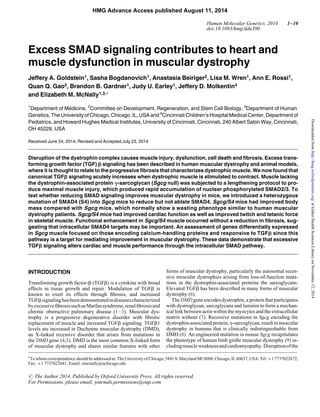
Sgcg muscle showed extensive nuclear pSMAD3, and uncon-
tracted control myofibers showed many fewer pSMAD-positive
nuclei (Fig. 1). An increase in total fibers with pSMAD-positive
nuclei was induced by contraction as well as an increase in the
total number of pSMAD-positive nuclei per section was seen.
TheincreaseinpSMAD-positivenucleiwasmostevidentincen-
trally positioned nuclei.
In muscular dystrophy, the increase in pSMAD is likely a con-
sequence of the repetitive and ongoing muscle damage that
arises from the weakened sarcolemma. Increased TGFb is
seen in response to injury in many tissues. To compare the
amount of TGFb signaling induced in muscular dystrophy
versus a more general injury process, wild-type mice with an
SMAD reporter allele were studied (17). The SMAD reporter
alleledrivesluciferase activityinresponsetoincreasedintranuc-
lear pSMAD (17). Cardiotoxin injection produced a measurable
increase in luciferase (Supplementary Material, Fig. S1).
However, Sgcg mice with the luciferase reporter allele did not
show an increase in luciferase activity. This is likely due to the
insensitivity of the luciferase reporter to detect the lower levels
of increased SMAD activity produced in muscular dystrophy.
Cardiotoxin injury produces agreater acute injury than muscular
dystrophy, but muscular dystrophy is associated with a persist-
ent, lower level injury.
Genetic reduction in SMAD signaling prevents wasting
in muscular dystrophy
To study the role of SMAD signaling in muscular dystrophy,
mice with a deletion of exon 2 in SMAD4 (18) were bred to
Sgcg mice. SMAD4 encodes the co-SMAD, which is required
for all canonical SMAD signaling. In the homozygous state,
this SMAD4 deletion is lethal, but heterozygotes are viable
Figure 1. SMAD signaling is increased by contraction in dystrophic muscle.
Musclesfrommicelackingg-sarcoglycan,Sgcgamodelformusculardystrophy,
were studied ex vivo. Muscle was subject to acute lengthening contraction, a
process that is known to induce damage to muscle with dystrophin and sarcogly-
can mutations. Phosphorylated SMAD (pSMAD, red) was increased in Sgcg
muscle after contraction compared with control Sgcg muscle (rest) (scale bar:
30 mm, and ∗∗
P , 0.05).
2 Human Molecular Genetics, 2014
atGalterHealthSciencesLibraryonNovember12,2014http://hmg.oxfordjournals.org/Downloadedfrom
and fertile. In heterozygous skeletal and cardiac muscle,
immunoblotting showed a decrease in SMAD4 protein and the
presence of a smaller form (Supplementary Material, Fig. S2).
This smaller form is predicted to derive from an amino-terminal
truncation and use of an internal ATG residue; amino-terminal
truncation of SMAD4 does not disrupt SMAD heterodimers
(19). Sgcg/S4 refers to Sgcg null mice with the heterozygous
SMAD4 allele. Mice were examined at 12 and 24 weeks and
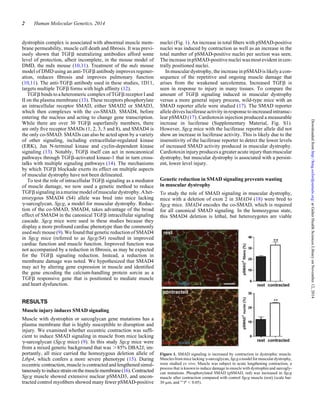
compared with littermate Sgcg mice. Failure to gain mass is a
feature of Sgcg mice (20). We found that Sgcg/S4 males weigh
more than Sgcg males, and that overall, Sgcg/S4 mice weigh
more when the mass is normalized for tibia length (Fig. 2).
Reduction in SMAD signaling leads to larger myofibers
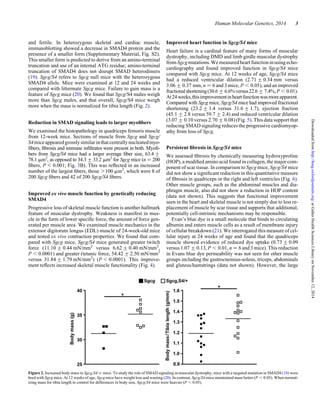
We examined the histopathology in quadriceps femoris muscle
from 12-week mice. Sections of muscle from Sgcg and Sgcg/
S4miceappearedgrosslysimilarinthatcentrallynucleatedmyo-
fibers, fibrosis and immune infiltrates were present in both. Myofi-
bers from Sgcg/S4 mice had a larger average fiber size, 63.4+
78.1 mm2
, as opposed to 34.3+33.2 mm2
for Sgcg mice (n ¼ 200
fibers, P , 0.001; Fig. 3B). This was reflected in an increased
number of the largest fibers, those .100 mm2
, which were 8 of
200 Sgcg fibers and 42 of 200 Sgcg/S4 fibers.
Improved ex vivo muscle function by genetically reducing
SMAD4
Progressive loss of skeletal muscle function is another hallmark
feature of muscular dystrophy. Weakness is manifest in mus-
cle in the form of lower specific force, the amount of force gen-
erated per muscle area. We examined muscle mechanics in the
extensor digitorum longus (EDL) muscle of 24-week-old mice
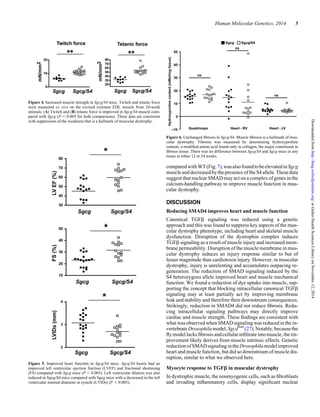
and tested ex vivo contraction properties. We found that com-
pared with Sgcg mice, Sgcg/S4 mice generated greater twitch
force (11.10+ 0.44 mN/mm2
versus 6.62 + 0.40 mN/mm2
,
P , 0.0001) and greater (tetanic force, 54.42 + 2.50 mN/mm2
versus 31.84 + 1.79 mN/mm2
) (P , 0.0001). This improve-
ment reflects increased skeletal muscle functionality (Fig. 4).
Improved heart function in Sgcg/S4 mice
Heart failure is a cardinal feature of many forms of muscular
dystrophy, including DMD and limb girdle muscular dystrophy
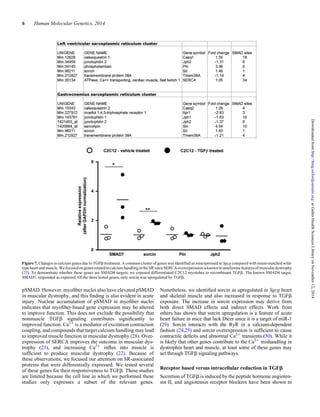
from Sgcgmutations. Wemeasured heartfunction inusingecho-
cardiography and found improved function in Sgcg/S4 mice
compared with Sgcg mice. At 12 weeks of age, Sgcg/S4 mice
had a reduced ventricular dilation (2.71+ 0.34 mm versus
3.06 + 0.37 mm, n ¼ 6 and 3 mice, P , 0.05), and an improved
fractionalshortening(30.6+6.6%versus22.6+7.4%,P , 0.01).
At24weeks,thisimprovementinheartfunctionwasmoreapparent.
Compared with Sgcg mice, Sgcg/S4 mice had improved fractional
shortening (23.2 + 1.4 versus 31.6 + 1.7), ejection fraction
(45.1 + 2.8 versus 59.7+ 2.4) and reduced ventricular dilation
(3.07 + 0.10 versus 2.70 + 0.08) (Fig. 5). This data support that
reducing SMAD signaling reduces the progressive cardiomyop-
athy from loss of Sgcg.
Persistent fibrosis in Sgcg/S4 mice
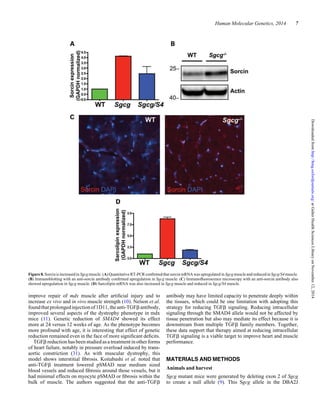
We assessed fibrosis by chemically measuring hydroxyproline
(HOP), a modified amino acid found in collagen, the major com-
ponent of scar tissue. In comparison to Sgcg mice, Sgcg/S4 mice
did not show a significant reduction in this quantitative measure
of fibrosis in quadriceps or the right and left ventricles (Fig. 6).
Other muscle groups, such as the abdominal muscles and dia-
phragm muscle, also did not show a reduction in HOP content
(data not shown). This suggests that functional improvement
seen in the heart and skeletal muscle is not simply due to less re-
placement of muscle by scar tissue and supports that additional,
potentially cell-intrinsic mechanisms may be responsible.
Evan’s blue dye is a small molecule that binds to circulating
albumin and enters muscle cells as a result of membrane injury
of cellular breakdown (21). We interrogated this measure of cel-
lular injury at 24 weeks of age and found that the quadriceps
muscle showed evidence of reduced dye uptake (0.73+ 0.09
versus 1.07 + 0.13, P , 0.01, n ¼ 6 and 3 mice). This reduction
in Evans blue dye permeability was not seen for other muscle
groups including the gastrocnemius-soleus, triceps, abdominals
and gluteus/hamstrings (data not shown). However, the large
Figure 2. Increased body mass in Sgcg,S4/+ mice. To study the role of SMAD signaling in muscular dystrophy, mice with a targeted mutation in SMAD4 (18) were
bred with Sgcg mice. At 12 weeks of age, Sgcg mice have weight loss and wasting (20). In contrast, Sgcg/S4 mice maintained mass better (P , 0.05). When normal-
izing mass for tibia length to control for differences in body size, Sgcg/S4 mice were heavier (P , 0.05).
Human Molecular Genetics, 2014 3
atGalterHealthSciencesLibraryonNovember12,2014http://hmg.oxfordjournals.org/Downloadedfrom
size and exercise demands on the quadriceps muscles may make
this a better muscle group to analyze. The decrease in membrane
leaksuggestedthatintracellular musclepathwaysmaybealtered
by SMAD signaling.
Alteration in calcium-handling genes in Sgcg muscle
We queried gene expression data to identify genes important for
calcium regulation that were differentially expressed in Sgcg
heart and muscle. We focused on calcium-handling proteins in
the sarcoplasmic reticulum (SR) since it was previously shown
that calcium overload is sufficient to produce a muscular dys-
trophy phenotype and that SERCA overexpression can amelior-
ate features of muscular dystrophy (22,23). We hypothesized
that some of these transcriptional changes were a direct result
of stimulation by TGFb and focused our attention on genes
that have predicted SMAD-binding elements upstream. This
analysis, although not exhaustive, identified several candidate
genes that were tested by assessing whether TGFb exposure
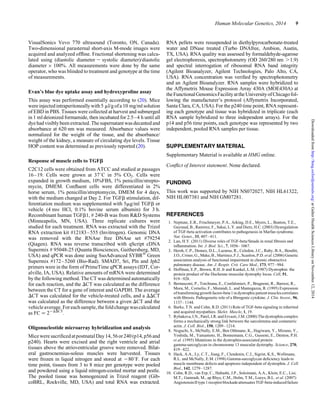
increased their expression. Differentiated C2C12 myotubes
were treated with TGFb and quantitative RT-PCR was con-
ducted.Asapositivecontrol,TGFbproducedtheexpected upre-
gulation of SMAD7 (3.42 + 1.53-fold above unstimulated, P ,
0.05; Fig. 7). Although several calcium-handling genes were
tested, only sorcin mRNA increased in response to TGFb.
Sorcin mRNA was upregulated by TGFb exposure (1.86 +
0.06-fold, P , 0.01; Fig. 7). Sorcin interacts with both the rya-
nodine receptor and the sodium calcium exchanger (24–26),
and therefore is positioned to alter intracellular calcium and
muscle function.
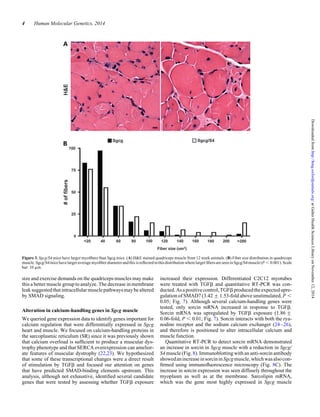
Quantitative RT-PCR to detect sorcin mRNA demonstrated
an increase in sorcin in Sgcg muscle with a reduction in Sgcg/
S4 muscle (Fig. 8). Immunoblotting with an anti-sorcin antibody
showedanincreaseinsorcininSgcgmuscle,whichwasalsocon-
firmed using immunofluorescence microscopy (Fig. 8C). The
increase in sorcin expression was seen diffusely throughout the
myoplasm as well as at the membrane. Sarcolipin mRNA,
which was the gene most highly expressed in Sgcg muscle
Figure 3. Sgcg/S4 mice have larger myofibers than Sgcg mice. (A) H&E stained quadriceps muscle from 12 week animals. (B) Fiber size distribution in quadriceps
muscle.Sgcg/S4micehavelargeraveragemyofiberdiameterandthis isreflectedinthisdistributionwherelarger fibersare seeninSgcg/S4muscle(P , 0.001).Scale
bar: 10 mm.
4 Human Molecular Genetics, 2014
atGalterHealthSciencesLibraryonNovember12,2014http://hmg.oxfordjournals.org/Downloadedfrom
comparedwithWT(Fig.7),wasalsofoundtobeelevatedinSgcg
muscleanddecreased bythepresence oftheS4allele.Thesedata
suggest that nuclear SMAD may act on a complex of genes in the
calcium-handling pathway to improve muscle function in mus-
cular dystrophy.
DISCUSSION
Reducing SMAD4 improves heart and muscle function
Canonical TGFb signaling was reduced using a genetic
approach and this was found to suppress key aspects of the mus-
cular dystrophy phenotype, including heart and skeletal muscle
dysfunction. Disruption of the dystrophin complex induces
TGFb signaling as a result of muscle injury and increased mem-
brane permeability. Disruption of the muscle membrane in mus-
cular dystrophy induces an injury response similar to but of
lesser magnitude than cardiotoxin injury. However, in muscular
dystrophy, injury is unrelenting and accumulates outpacing re-
generation. The reduction of SMAD signaling induced by the
S4 heterozygous allele improved heart and muscle mechanical
function. We found a reduction of dye uptake into muscle, sup-
porting the concept that blocking intracellular canonical TGFb
signaling may at least partially act by improving membrane
leak and stability and therefore their downstream consequences.
Strikingly, reduction in SMAD4 did not reduce fibrosis. Redu-
cing intracellular signaling pathways may directly improve
cardiac and muscle strength. These findings are consistent with
what was observed when SMAD signaling was reduced inthein-
vertebrateDrosophilamodel,Sgcd840
(27).Notably,becausethe
flymodellacksfibrosis andcellular infiltrateinto muscle, theim-
provement likely derives from muscle intrinsic effects. Genetic
reductionofSMADsignalingintheDrosophilamodelimproved
heart and muscle function, but did so downstream of muscle dis-
ruption, similar to what we observed here.
Myocyte response to TGFb in muscular dystrophy
In dystrophic muscle, the nonmyogenic cells, such as fibroblasts
and invading inflammatory cells, display significant nuclear
Figure 6. Unchanged fibrosis in Sgcg/S4. Muscle fibrosis is a hallmark of mus-
cular dystrophy. Fibrosis was measured by determining hydroxyproline
content, a modified amino acid found only in collagen, the major constituent in
fibrous tissue. There was no difference between Sgcg/S4 and Sgcg mice in any
tissue at either 12 or 24 weeks.
Figure 5. Improved heart function in Sgcg/S4 mice. Sgcg/S4 hearts had an
improved left ventricular ejection fraction (LVEF) and fractional shortening
(FS) compared with Sgcg mice (P , 0.005). Left ventricular dilation was also
reduced in Sgcg/S4 mice compared with Sgcg mice with a decreased in the left
ventricular internal diameter in systole (LVIDs) (P , 0.005).
Figure 4. Increased muscle strength in Sgcg/S4 mice. Twitch and tetanic force
were measured ex vivo on the excised extensor EDL muscle from 24-week
animals. (A) Twitch and (B) tetanic force is improved in Sgcg/S4 muscle com-
pared with Sgcg (P , 0.005 for both comparisons). These data are consistent
with suppression of the weakness that is a hallmark of muscular dystrophy.
Human Molecular Genetics, 2014 5
atGalterHealthSciencesLibraryonNovember12,2014http://hmg.oxfordjournals.org/Downloadedfrom
pSMAD. However, myofiber nuclei also have elevated pSMAD
in muscular dystrophy, and this finding is also evident in acute
injury. Nuclear accumulation of pSMAD in myofiber nuclei
indicates that myofiber-based gene expression may be altered
to improve function. This does not exclude the possibility that
nonmuscle TGFb signaling contributes significantly to
improved function. Ca2+
is a mediator of excitation contraction
coupling, and compounds that target calcium handling may lead
to improved muscle function in muscular dystrophy (28). Over-
expression of SERCA improves the outcome in muscular dys-
trophy (23), and increasing Ca2+
influx into muscle is
sufficient to produce muscular dystrophy (22). Because of
these observations, we focused our attention on SR-associated
proteins that were differentially expressed. We tested several
of these genes for their responsiveness to TGFb. These studies
are limited because the cell line in which we performed these
studies only expresses a subset of the relevant genes.
Nonetheless, we identified sorcin as upregulated in Sgcg heart
and skeletal muscle and also increased in response to TGFb
exposure. The increase in sorcin expression may derive from
both direct SMAD effects and indirect effects. Work from
others has shown that sorcin upregulation is a feature of acute
heart failure in mice that lack Dicer since it is a target of miR-1
(29). Sorcin interacts with the RyR in a calcium-dependent
fashion (24,25) and sorcin overexpression is sufficient to cause
contractile deficits and abnormal Ca2+
transients (30). While it
is likely that other genes contribute to the Ca2+
mishandling in
dystrophin heart and muscle, at least some of these genes may
act through TGFb signaling pathways.
Receptor based versus intracellular reduction in TGFb
Secretion of TGFb is induced by the peptide hormone angioten-
sin II, and angiotensin receptor blockers have been shown to
Figure 7. Changes in calcium genes due to TGFb treatment. A common cluster of genes was identified as misexpressed in Sgcg compared with strain-matched wild-
typeheartandmuscle.WefocusedongenesrelatedtocalciumhandlingintheSRsinceSERCAoverexpressionisknowntoamelioratefeaturesof musculardystrophy
(23). To demonstrate whether these genes are SMAD4 targets, we exposed differentiated C2C12 myotubes to recombinant TGFb. The known SMAD4 target,
SMAD7, responded as expected. Of the three tested genes, only sorcin was upregulated by TGFb.
6 Human Molecular Genetics, 2014
atGalterHealthSciencesLibraryonNovember12,2014http://hmg.oxfordjournals.org/Downloadedfrom
improve repair of mdx muscle after artificial injury and to
increase ex vivo and in vivo muscle strength (10). Nelson et al.
foundthatprolongedinjectionof1D11,theanti-TGFbantibody,
improved several aspects of the dystrophy phenotype in mdx
mice (11). Genetic reduction of SMAD4 showed its effect
more at 24 versus 12 weeks of age. As the phenotype becomes
more profound with age, it is interesting that effect of genetic
reduction remained even in the face of more significant deficits.
TGFb reduction has been studied asa treatment inother forms
of heart failure, notably in pressure overload induced by trans-
aortic constriction (31). As with muscular dystrophy, this
model shows interstitial fibrosis. Koitabashi et al. noted that
anti-TGFb treatment lowered pSMAD near medium sized
blood vessels and reduced fibrosis around those vessels, but it
had minimal effects on myocyte pSMAD or fibrosis within the
bulk of muscle. The authors suggested that the anti-TGFb
antibody may have limited capacity to penetrate deeply within
the tissues, which could be one limitation with adopting this
strategy for reducing TGFb signaling. Reducing intracellular
signaling through the SMAD4 allele would not be affected by
tissue penetration but also may mediate its effect because it is
downstream from multiple TGFb family members. Together,
these data support that therapy aimed at reducing intracellular
TGFb signaling is a viable target to improve heart and muscle
performance.
MATERIALS AND METHODS
Animals and harvest
Sgcg mutant mice were generated by deleting exon 2 of Sgcg
to create a null allele (9). This Sgcg allele in the DBA2J
Figure8. Sorcin is increased in Sgcg muscle. (A) Quantitative RT-PCR confirmedthat sorcin mRNA was upregulated in Sgcg muscle and reduced in Sgcg/S4 muscle.
(B) Immunoblotting with an anti-sorcin antibody confirmed upregulation in Sgcg muscle. (C) Immunofluorescence microscopy with an anti-sorcin antibody also
showed upregulation in Sgcg muscle. (D) Sarcolipin mRNA was also increased in Sgcg muscle and reduced in Sgcg/S4 muscle.
Human Molecular Genetics, 2014 7
atGalterHealthSciencesLibraryonNovember12,2014http://hmg.oxfordjournals.org/Downloadedfrom
background were used (20). Mice were selected to be homozy-
gous for the Ltbp4 deletion (15) to avoid the modifier effect
of the insertion/deletion in the Ltbp4. SBE-luc mice, formally
B6.Cg-Tg(SBE/TK-luc)7Twc/J (17) (Jackson Laboratory strain
005999), were used to detect SMAD activity. The SMAD4f
allele used in these studies flanked exon 2 of SMAD4 with loxP
sites (18). These mice were bred with Mox2-cre mice, which
express Cre recombinase in the germline (32) (Jackson Labora-
tory strain 003755). The resulting SMADN/+
mice were out-
crossed to remove the Mox2-cre transgene, bred with Sgcg
mice, and then bred to additional Sgcg null mice to generate
appropriate genotypes (Sgcg and Sgcg/S4 indicating SMAD4
heterozygous mice).
Mice were analyzed at 8,12or24weeksasindicatedand com-
pared with littermate controls. Mice were housed under the aus-
pices of the Animal Care and Use Committee and Animal
Resources Center at the University of Chicago. The order of
harvest was chosen to minimize interference of one assay with
the next. Two days prior to harvest, mice were weighed and
injected Evan’s blue. On the subsequent day, grip strength meas-
urement and echocardiography were performed. On the day of
harvest, serum was collected immediately prior to sacrifice,
and collection of the muscles for ex vivo measurement occurred
immediately after. Tissues were weighed at the time of collec-
tion and the tibia length was measured using a millimeter ruler
after being stripped of muscle.
Antibodies
Goat anti-phosphorylated SMAD2/3 (pSMAD2/3), # sc11769
was from Santa Cruz Biotechnology or from Abcam to
pSMAD3 (ab51451). The sorcin antibody was a generous gift
from Hector Valdivia (33). Rabbit anti-laminin # L9393 was
from Sigma. Goat anti-rabbit IgG # 111-035-003 was from
Jackson Immunoresearch. Donkey anti-rabbit IgG Alexa 488
conjugate (DaR-488), # A-21208 and Donkey anti-goat IgG
Alexa 594 conjugate (DaG-594), # A-11058 were from Invitro-
gen. Anti-TGFb antibody (1D11) (12) and control 13C4 were
obtained from Genzyme Corporation (Framingham, MA, USA).
Ex vivo muscle contraction
Intact extensor EDL muscles were excised in regular rodent
Ringer’s solution (in mM: 146 NaCl, 5 KCl, 2 CaCl2, 1 MgCl2
and 10 HEPES, pH 7.4) essentially according to the
TREAT-NMD standard operating procedure (34). Muscles
were suspended in a vertical tissue bath containing oxygenated
Kreb’s solution (in mM: 121 NaCl, 5 KCl, 1.8 CaCl2, 0.5
MgCl2, 0.1 EDTA, 0.4 NaH2PO4, 24 NaHCO3 and 5 glucose,
pH 7.4, with continuous bubbling 95% O2/5% CO2). The distal
tendon was attached to a fixed support with 6-0 silk suture,
while the proximal tendon was tied to the lever arm of a force
transducer (Aurora Scientific, 300C-LR). The isolated muscles
were stimulated with 0.5 ms pulses at 1 A via two parallel plat-
inum electrodes flaking the muscle. The length of each EDL
was adjusted to that which produced the maximal twitch force
(L0), which was measured using fine calipers. Maximal twitch
and tetanic force were elicited with a series of 3 trains, 3 min
apart. The data were combined from three separate animals of
each genotype. Males were used for these studies since there
were baseline differences between sexes in Sgcg mice. Subse-
quently, each EDL was subjected to an eccentric contraction
protocol, which consisted of five 700 ms, 80 Hz tetani with a
lengthening by 10% of L0 during the last 200 ms of each
tetanus. At the conclusion of each experiment, each muscle
was blotted and immediately weighed. All data were analyzed
offline following data import into Clampfit software (Molecular
Devices, Clampfit v10.2.0.14). All force measurements (P0)
were normalized to cross-sectional area and expressed as specif-
ic force (sP0; mN/mm2
), which was calculated according to the
following equation:
sP0 =
P0
{muscle mass/[(L0 × 0.44) × 1.06 g/m2]}
,
where 0.44 is the muscle length to fiber length ratio for EDL, and
1.06 is the density of muscle (34).
Immunofluorescence microscopy
After eccentric contraction, EDL muscles were maintained in
oxygenated nutrient back for 1 h to allow for signaling, then
snap frozen in liquid nitrogen-chilled isopentane. Samples
were processed similarly to a previously published method
(35). Ten micrometers sections were cut and sections were
fixed for 10 min in ethanol on ice. Sections were blocked for
1 h at 48C in 10% fetal bovine serum (FBS), 0.03% Triton X-
100 in phosphate-buffered saline (PBS). Samples were incu-
bated overnight at 48C in 1% FBS, 0.03% Triton X-100, PBS
with 1 : 100 dilution of anti-pSMAD2/3 and 1:200 anti-laminin.
Sampleswerewashedthreetimeswith0.03%TritonX-100,PBS
on ice for 15 min. DaG-594 and DaR-488 were applied for 3 h at
48C in 1% FBS 0.03% Triton X-100, PBS. Slides were again
washed, and mounted using Vectashield with DAPI (Vector
Laboratories). Images werecollected at ×40 originalmagnifica-
tion using an Axiophot microscope with iVision software and
manipulated within NIH guidelines using Adobe Photoshop
CS4 and ImageJ.
Histology
A cross-sectional disc of muscle was harvested from the
mid-belly of the quadriceps muscle. The disc was fixed in forma-
lin, dehydrated, paraffin embedded, sectioned at 6 mm thickness
and stained using hematoxylin and eosin (H&E). For analysis of
central nuclei, five random fields each were collected from five
mice of each genotype (total 25 sections). The number of
fibers and number of fibers with at least one non-peripheral
nucleus were counted and the ratio calculated. For fiber size,
fibers were outlined using Adobe Photoshop CS4 or the GNU
Image Manipulation Program 2.0.2. Fiber size was determined
using ImageJ. Two hundred fibers were counted for each
genotype.
Echocardiography
Mice were depilated, anesthetized with isoflurane and placed
on a 378C warming pad. Anesthesia was titrated to produce a
heart rate of 350–450 beats/min. Left ventricular dimensions
were quantified by transthoracic echocardiography using a
8 Human Molecular Genetics, 2014
atGalterHealthSciencesLibraryonNovember12,2014http://hmg.oxfordjournals.org/Downloadedfrom
VisualSonics Vevo 770 ultrasound (Toronto, ON, Canada).
Two-dimensional parasternal short-axis M-mode images were
acquired and analyzed offline. Fractional shortening was calcu-
lated using (diastolic diameter 2 systolic diameter)/diastolic
diameter × 100%. All measurements were done by the same
operator, who was blinded to treatment and genotype at the time
of measurements.
Evan’s blue dye uptake assay and hydroxyproline assay
This assay was performed essentially according to (20). Mice
wereinjected intraperitoneally with5 ml/g ofa 10 mg/ml solution
of EBD in PBS. Tissues were collected at harvest and submerged
in 1 ml deionized formamide, then incubated for 2.5–4 h until all
dyehad visiblybeen extracted. The supernatantwas decanted and
absorbance at 620 nm was measured. Absorbance values were
normalized for the weight of the tissue, and the absorbance/
weight of the kidney, a measure of circulating dye levels. Tissue
HOP content was determined as previously reported (20).
Response of muscle cells to TGFb
C2C12 cells were obtained from ATCC and studied at passages
16–19. Cells were grown at 378C in 5% CO2. Cells were
expanded in growth medium, 10%FBS, 1% penicillin/strepto-
mycin, DMEM. Confluent cells were differentiated in 2%
horse serum, 1% penicillin/streptomycin, DMEM for 4 days,
with the medium changed at Day 2. For TGFb stimulation, dif-
ferentiation medium was supplemented with 5mg/ml TGFb or
vehicle (4 mM HCl, 0.1% bovine serum albumin) for 3 h.
Recombinant human TGFb1, # 240-B was from R&D Systems
(Minneapolis, MN, USA). Three replicate cultures were
studied for each treatment. RNA was extracted with the Trizol
RNA extraction kit #12183–555 (Invitrogen). Genomic DNA
was removed with the RNAse free DNAse set #79254
(Qiagen). RNA was reverse transcribed with qScript cDNA
Supermix # 95048-25 (Quanta Biosciences, Gaithersberg, MD,
USA) and qPCR was done using SsoAdvanced SYBRw
Green
Supermix #172–5260 (Bio-Rad). SMAD7, Sri, Pln and Jph2
primers were in the form of PrimeTime qPCR assays (IDT, Cor-
alville, IA, USA). Relative amounts of mRNA were determined
by the following method. The CT was determined automatically
for each reaction, and the DCT was calculated as the difference
between the CT for a gene of interest and GAPDH. The average
DCT was calculated for the vehicle-treated cells, and a DDCT
was calculated as the difference between a given DCT and the
vehicleaverage.Foreachsample,thefoldchangewascalculated
as FC ¼ 22DDCT
.
Oligonucleotide microarray hybridization and analysis
MiceweresacrificedatpostnatalDay14,56or240(p14,p56and
p240). Hearts were excised and the right ventricle and atrial
tissues above the atrioventricular groove were removed. Bilat-
eral gastrocnemius-soleus muscles were harvested. Tissues
were frozen in liquid nitrogen and stored at 2808F. For each
time point, tissues from 3 to 8 mice per genotype were pooled
and powdered using a liquid nitrogen-cooled mortar and pestle.
The pooled tissue was homogenized in Trizol reagent (Gib-
coBRL, Rockville, MD, USA) and total RNA was extracted.
RNA pellets were resuspended in diethylpyrocarbonate-treated
water and DNase treated (Turbo DNAfree, Ambion, Austin,
TX, USA). RNA quality was assessed by formaldehyde-agarose
gel electrophoresis, spectrophotometry (OD 260/280 nm .1.9)
and spectral interrogation of ribosomal RNA band integrity
(Agilent Bioanalyzer, Agilent Technologies, Palo Alto, CA,
USA). RNA concentration was verified by spectrophotometry
and an Agilent Bioanalyzer. RNA samples were hybridized to
the Affymetrix Mouse Expression Array 430A (MOE430A) at
theFunctionalGenomicsFacilityattheUniversityofChicagofol-
lowing the manufacturer’s protocol (Affymetrix Incorporated,
Santa Clara, CA, USA). For the p240 time point, RNA represent-
ing each genotype and tissue was hybridized in triplicate (each
RNA sample hybridized to three independent arrays). For the
p14 and p56 time points, each genotype was represented by two
independent, pooled RNA samples per tissue.
SUPPLEMENTARY MATERIAL
Supplementary Material is available at HMG online.
Conflict of Interest statement. None declared.
FUNDING
This work was supported by NIH NS072027, NIH HL61322,
NIH HL007381 and NIH GM07281.
REFERENCES
1. Neptune, E.R., Frischmeyer, P.A., Arking, D.E., Myers, L., Bunton, T.E.,
Gayraud, B., Ramirez, F., Sakai, L.Y. and Dietz, H.C. (2003) Dysregulation
of TGF-beta activation contributes to pathogenesis in Marfan syndrome.
Nat. Genet., 33, 407–411.
2. Lan, H.Y. (2011) Diverse roles of TGF-beta/Smads in renal fibrosis and
inflammation. Int. J. Biol. Sci., 7, 1056–1067.
3. Hersh, C.P., Demeo, D.L., Lazarus, R., Celedon, J.C., Raby, B.A., Benditt,
J.O., Criner, G., Make,B., Martinez,F.J., Scanlon, P.D. et al. (2006) Genetic
association analysis of functional impairment in chronic obstructive
pulmonary disease. Am. J. Respir. Crit. Care Med., 173, 977–984.
4. Hoffman, E.P., Brown, R.H. Jr and Kunkel, L.M. (1987) Dystrophin: the
protein product of the Duchenne muscular dystrophy locus. Cell, 51,
919–928.
5. Bernasconi, P., Torchiana, E., Confalonieri, P., Brugnoni, R., Barresi, R.,
Mora, M., Cornelio, F., Morandi, L. and Mantegazza, R. (1995) Expression
oftransforminggrowthfactor-beta1indystrophicpatientmusclescorrelates
with fibrosis. Pathogenetic role of a fibrogenic cytokine. J. Clin. Invest., 96,
1137–1144.
6. Burks, T.N. and Cohn, R.D. (2011) Role of TGF-beta signaling in inherited
and acquired myopathies. Skelet. Muscle, 1, 19.
7. Rybakova, I.N., Patel, J.R. and Ervasti, J.M. (2000) The dystrophin complex
forms a mechanically strong link between the sarcolemma and costameric
actin. J. Cell. Biol., 150, 1209–1214.
8. Noguchi, S., McNally, E.M., Ben Othmane, K., Hagiwara, Y., Mizuno, Y.,
Yoshida, M., Yamamoto, H., Bonnemann, C.G., Gussoni, E., Denton, P.H.
et al. (1995) Mutations in the dystrophin-associated protein
gamma-sarcoglycan in chromosome 13 muscular dystrophy. Science, 270,
819–822.
9. Hack, A.A., Ly, C.T., Jiang, F., Clendenin, C.J., Sigrist, K.S., Wollmann,
R.L. and McNally, E.M. (1998) Gamma-sarcoglycan deficiency leads to
muscle membrane defects and apoptosis independent of dystrophin. J. Cell
Biol., 142, 1279–1287.
10. Cohn, R.D., van Erp, C., Habashi, J.P., Soleimani, A.A., Klein, E.C., Lisi,
M.T., Gamradt, M., ap Rhys, C.M., Holm, T.M., Loeys, B.L. et al. (2007)
AngiotensinIItype1receptorblockadeattenuatesTGF-beta-inducedfailure
Human Molecular Genetics, 2014 9
atGalterHealthSciencesLibraryonNovember12,2014http://hmg.oxfordjournals.org/Downloadedfrom
of muscle regeneration in multiple myopathic states. Nat. Med., 13,
204–210.
11. Nelson, C.A., Hunter, R.B., Quigley, L.A., Girgenrath, S., Weber, W.D.,
McCullough, J.A., Dinardo, C.J., Keefe, K.A., Ceci, L., Clayton, N.P. et al.
(2011) Inhibiting TGF-beta activity improves respiratory function in mdx
mice. Am. J. Pathol., 178, 2611–2621.
12. Dasch, J.R., Pace, D.R., Waegell, W., Inenaga, D. and Ellingsworth, L.
(1989)Monoclonalantibodiesrecognizingtransforminggrowthfactor-beta.
Bioactivity neutralization and transforming growth factor beta 2 affinity
purification. J. Immunol., 142, 1536–1541.
13. Feng, X.H. and Derynck, R. (2005) Specificity and versatility in tgf-beta
signaling through Smads. Annu. Rev. Cell Dev. Biol., 21, 659–693.
14. Delaney, J.R. and Mlodzik, M. (2006) TGF-beta activated kinase-1: new
insights into the diverse roles of TAK1 in development and immunity. Cell
Cycle, 5, 2852–2855.
15. Heydemann, A., Ceco, E., Lim, J.E., Hadhazy, M., Ryder, P., Moran, J.L.,
Beier, D.R., Palmer, A.A. and McNally, E.M. (2009) Latent
TGF-beta-binding protein 4 modifies muscular dystrophy in mice. J. Clin.
Invest., 119, 3703–3712.
16. Petrof, B.J., Shrager, J.B., Stedman, H.H., Kelly, A.M. and Sweeney, H.L.
(1993) Dystrophin protects the sarcolemma from stresses developed during
muscle contraction. Proc. Natl. Acad. Sci. USA, 90, 3710–3714.
17. Lin, A.H., Luo, J., Mondshein, L.H., ten Dijke, P., Vivien, D., Contag, C.H.
and Wyss-Coray, T. (2005) Global analysis of Smad2/3-dependent
TGF-beta signaling in living mice reveals prominent tissue-specific
responses to injury. J. Immunol., 175, 547–554.
18. Chu, G.C., Dunn, N.R., Anderson, D.C., Oxburgh, L. and Robertson, E.J.
(2004) Differential requirements for Smad4 in TGFbeta-dependent
patterning of the early mouse embryo. Development, 131, 3501–3512.
19. Wu, R.Y., Zhang, Y., Feng, X.H. and Derynck, R. (1997) Heteromeric and
homomeric interactions correlate with signaling activity and functional
cooperativity of Smad3 and Smad4/DPC4. Mol. Cell. Biol., 17, 2521–2528.
20. Heydemann, A., Huber, J.M., Demonbreun, A., Hadhazy, M. and McNally,
E.M. (2005) Genetic background influences muscular dystrophy.
Neuromuscu. Disord., 15, 601–609.
21. Matsuda, R., Nishikawa, A. and Tanaka, H. (1995) Visualization of
dystrophic muscle fibers in mdx mouse by vital staining with Evans blue:
evidence of apoptosis in dystrophin-deficient muscle. J. Biochem., 118,
959–964.
22. Millay, D.P., Goonasekera, S.A., Sargent, M.A., Maillet, M., Aronow, B.J.
and Molkentin, J.D. (2009) Calcium influx is sufficient to induce muscular
dystrophy through a TRPC-dependent mechanism. Proc. Natl. Acad. Sci.
USA, 106, 19023–19028.
23. Goonasekera, S.A., Lam, C.K., Millay, D.P., Sargent, M.A., Hajjar, R.J.,
Kranias, E.G. and Molkentin, J.D. (2011) Mitigation of muscular dystrophy
in mice by SERCA overexpression in skeletal muscle. J. Clin. Invest., 121,
1044–1052.
24. Meyers, M.B., Pickel, V.M., Sheu, S.S., Sharma, V.K., Scotto, K.W. and
Fishman, G.I. (1995) Association of sorcin with the cardiac ryanodine
receptor. J. Biol. Chem., 270, 26411–26418.
25. Lokuta, A.J., Meyers, M.B., Sander, P.R., Fishman, G.I. and Valdivia, H.H.
(1997) Modulation of cardiac ryanodine receptors by sorcin. J. Biol. Chem.,
272, 25333–25338.
26. Zamparelli, C., Macquaide, N., Colotti, G., Verzili, D., Seidler, T., Smith,
G.L. and Chiancone, E. (2010) Activation of the cardiac Na(+)-Ca(2+)
exchanger by sorcin via the interaction of the respective Ca(2+)-binding
domains. J. Mol. Cell. Cardiol., 49, 132–141.
27. Goldstein, J.A., Kelly, S.M., LoPresti, P.P., Heydemann, A., Earley, J.U.,
Ferguson, E.L., Wolf, M.J. and McNally, E.M. (2011) SMAD signaling
drives heart and muscle dysfunction in a Drosophila model of muscular
dystrophy. Hum. Mol. Genet., 20, 894–904.
28. Bellinger,A.M.,Reiken,S.,Carlson,C.,Mongillo,M.,Liu,X.,Rothman,L.,
Matecki, S., Lacampagne, A. and Marks, A.R. (2009) Hypernitrosylated
ryanodine receptor calcium release channels are leaky in dystrophic muscle.
Nat. Med., 15, 325–330.
29. Ali, R., Huang, Y., Maher, S.E., Kim, R.W., Giordano, F.J., Tellides, G. and
Geirsson, A. (2012) miR-1 mediated suppression of Sorcin regulates
myocardial contractility through modulation of Ca(2+) signaling. J. Mol.
Cell. Cardiol., 52, 1027–1037.
30. Meyers, M.B., Fischer, A., Sun, Y.J., Lopes, C.M., Rohacs, T., Nakamura,
T.Y., Zhou, Y.Y., Lee, P.C., Altschuld, R.A., McCune, S.A. et al. (2003)
Sorcin regulates excitation-contraction coupling in the heart. J. Biol. Chem.,
278, 28865–28871.
31. Koitabashi, N., Danner, T., Zaiman, A.L., Pinto, Y.M., Rowell, J.,
Mankowski, J., Zhang, D., Nakamura, T., Takimoto, E. and Kass, D.A.
(2011) Pivotal role of cardiomyocyte TGF-beta signaling in the murine
pathological response to sustained pressure overload. J. Clin. Invest., 121,
2301–2312.
32. Tallquist, M.D. and Soriano, P. (2000) Epiblast-restricted Cre expression in
MORE mice: a tool to distinguish embryonic versus extra-embryonic gene
function. Genesis, 26, 113–115.
33. Rueda, A., Song, M., Toro, L., Stefani, E. and Valdivia, H.H. (2006) Sorcin
modulation of Ca2+ sparks in rat vascular smooth muscle cells. J. Physiol.,
576, 887–901.
34. Barton,E.R.,Lynch,G. andKhurana,T.S.(2008)Measuringisometricforce
of isolated mouse muscles in vitro. In Willmann, R. (ed), Experimental
Protocols for DMD Animal Models. Treat-NMD Neuromuscular Network,
Vol. DMD_M.1.2.002, p. 14.
35. Arimura, T., Helbling-Leclerc, A., Massart, C., Varnous, S., Niel, F.,
Lacene, E., Fromes, Y., Toussaint, M., Mura, A.M., Keller, D.I. et al. (2005)
MousemodelcarryingH222P-Lmnamutationdevelopsmusculardystrophy
anddilatedcardiomyopathysimilartohumanstriatedmusclelaminopathies.
Hum. Mol. Genet., 14, 155–169.
10 Human Molecular Genetics, 2014
atGalterHealthSciencesLibraryonNovember12,2014http://hmg.oxfordjournals.org/Downloadedfrom

Hum. Mol. Genet.-2014-Goldstein-hmg-ddu390

  • 1.
    Excess SMAD signalingcontributes to heart and muscle dysfunction in muscular dystrophy Jeffery A. Goldstein1, Sasha Bogdanovich1, Anastasia Beiriger2, Lisa M. Wren1, Ann E. Rossi1, Quan Q. Gao2, Brandon B. Gardner1, Judy U. Earley1, Jeffery D. Molkentin4 and Elizabeth M. McNally1,3,∗ 1 Department of Medicine, 2 Committee on Development, Regeneration, and Stem Cell Biology, 3 Department of Human Genetics,The University ofChicago, Chicago, IL,USAand 4 Cincinnati Children’sHospital MedicalCenter, Department of Pediatrics, and Howard Hughes Medical Institutes, University of Cincinnati, Cincinnati, 240 Albert Sabin Way, Cincinnati, OH 45229, USA Received June 24, 2014; Revised and Accepted July 23, 2014 Disruption of the dystrophin complex causes muscle injury, dysfunction, cell death and fibrosis. Excess trans- forming growth factor (TGF) b signaling has been described in human muscular dystrophy and animal models, where it is thought to relate to the progressive fibrosis that characterizes dystrophic muscle. We now found that canonical TGFb signaling acutely increases when dystrophic muscle is stimulated to contract. Muscle lacking the dystrophin-associated protein g-sarcoglycan (Sgcg null) was subjected to a lengthening protocol to pro- duce maximal muscle injury, which produced rapid accumulation of nuclear phosphorylated SMAD2/3. To test whether reducing SMAD signaling improves muscular dystrophy in mice, we introduced a heterozygous mutation of SMAD4 (S4) into Sgcg mice to reduce but not ablate SMAD4. Sgcg/S4 mice had improved body mass compared with Sgcg mice, which normally show a wasting phenotype similar to human muscular dystrophy patients. Sgcg/S4 mice had improved cardiac function as well as improved twitch and tetanic force in skeletal muscle. Functional enhancement in Sgcg/S4 muscle occurred without a reduction in fibrosis, sug- gesting that intracellular SMAD4 targets may be important. An assessment of genes differentially expressed in Sgcg muscle focused on those encoding calcium-handling proteins and responsive to TGFb since this pathway is a target for mediating improvement in muscular dystrophy. These data demonstrate that excessive TGFb signaling alters cardiac and muscle performance through the intracellular SMAD pathway. INTRODUCTION Transforming growth factor-b (TGFb) is a cytokine with broad effects in tissue growth and repair. Modulation of TGFb is known to exert its effects through fibrosis, and increased TGFbsignalinghasbeendemonstratedindiseasescharacterized byexcessivefibrosissuchasMarfansyndrome,renalfibrosisand chronic obstructive pulmonary disease (1–3). Muscular dys- trophy is a progressive degenerative disorder with fibrotic replacement of muscle and increased TGFb signaling. TGFb1 levels are increased in Duchenne muscular dystrophy (DMD), an X-linked recessive disorder that arises from mutations in the DMD gene (4,5). DMD is the most common X-linked form of muscular dystrophy and shares similar features with other forms of muscular dystrophy, particularly the autosomal reces- sive muscular dystrophies arising from loss-of-function muta- tions in the dystrophin-associated proteins the sarcoglycans. Elevated TGFb has been described in many forms of muscular dystrophy (6). The DMD gene encodes dystrophin, a protein that participates with dystroglycan, sarcoglycans and laminin to form a mechan- ical link between actin within the myocytes and the extracellular matrix without (7). Recessive mutations in Sgcg encoding the dystrophin-associated protein, g-sarcoglycan,resultinmuscular dystrophy in humans that is clinically indistinguishable from DMD (8). An engineered mutation in mouse Sgcg recapitulates the phenotype of human limb girdle muscular dystrophy (9) in- cludingmuscleweaknessandcardiomyopathy.Disruptionofthe ∗ To whom correspondence should be addressed at: The University of Chicago, 5841 S. Maryland MC6088, Chicago, IL 60637, USA. Tel: +1 7737022672; Fax: +1 7737022681; Email: emcnally@uchicago.edu # The Author 2014. Published by Oxford University Press. All rights reserved. For Permissions, please email: journals.permissions@oup.com Human Molecular Genetics, 2014 1–10 doi:10.1093/hmg/ddu390 HMG Advance Access published August 11, 2014 atGalterHealthSciencesLibraryonNovember12,2014http://hmg.oxfordjournals.org/Downloadedfrom
  • 2.
    dystrophin complex isassociated with abnormal muscle mem- brane permeability, muscle cell death and fibrosis. It was previ- ously shown that TGFb neutralizing antibodies afford some level of protection, albeit incomplete, in the mouse model of DMD, the mdx mouse (10,11). Treatment of the mdx mouse model of DMD using an anti-TGFb antibody improves regener- ation, reduces fibrosis and improves pulmonary function (10,11). The anti-TGFb antibody used in these studies, 1D11, targets multiple TGFb forms with high affinity (12). TGFb binds to a heteromeric complex of TGFb receptor I and II on the plasma membrane (13). These receptors phosphorylate an intracellular receptor SMAD, either SMAD2 or SMAD3, which then complexes with the co-SMAD, SMAD4, before entering the nucleus and acting to change gene transcription. While there are over 30 TGFb superfamily members, there are only five receptor SMADs (1, 2, 3, 5 and 8), and SMAD4 is the only co-SMAD. SMADs can also be acted upon by a variety of other signaling, including extracellular-regulated kinase (ERK), Jun N-terminal kinase and cyclin-dependent kinase signaling (13). Notably, TGFb itself can act in noncanonical pathways through TGFb-activated kinase-1 that in turn cross- talks with multiple signaling pathways (14). The mechanisms by which TGFb blockade exerts its effect on multiple aspects of muscular dystrophy have not been delineated. To test the role of intracellular TGFb signaling as a mediator of muscle damage, we now used a genetic method to reduce TGFbsignalinginamurinemodelofmusculardystrophy.Ahet- erozygous SMAD4 (S4) allele was bred into mice lacking g-sarcoglycan, Sgcg, a model for muscular dystrophy. Reduc- tion of the co-SMAD, SMAD4, takes advantage of the broad effect of SMAD4 in the canonical TGFb intracellular signaling cascade. Sgcg mice were used in these studies because they display a more profound cardiac phenotype than the commonly used mdx mouse (9).We found that genetic reductionof SMAD4 in Sgcg mice (referred to as Sgcg/S4) resulted in improved cardiac function and muscle function. Improved function was not accompanied by a reduction in fibrosis, as may be expected for the TGFb signaling reduction. Instead, a reduction in membrane damage was noted. We hypothesized that SMAD4 may act by altering gene expression in muscle and identified the gene encoding the calcium-handling protein sorcin as a TGFb responsive gene that is positioned to mediate muscle and heart dysfunction. RESULTS Muscle injury induces SMAD signaling Muscle with dystrophin or sarcoglycan gene mutations has a plasma membrane that is highly susceptible to disruption and injury. We examined whether eccentric contraction was suffi- cient to induce SMAD signaling in muscle from mice lacking g-sarcoglycan (Sgcg mice) (9). In this study Sgcg mice were from a mixed genetic background that was .85% DBA2J; im- portantly, all mice carried the homozygous deletion allele of Ltbp4, which confers a more severe phenotype (15). During eccentric contraction, muscle is contracted and lengthened simul- taneouslytoinducestrainonthemusclemembrane(16).Contracted Sgcg muscle showed extensive nuclear pSMAD3, and uncon- tracted control myofibers showed many fewer pSMAD-positive nuclei (Fig. 1). An increase in total fibers with pSMAD-positive nuclei was induced by contraction as well as an increase in the total number of pSMAD-positive nuclei per section was seen. TheincreaseinpSMAD-positivenucleiwasmostevidentincen- trally positioned nuclei. In muscular dystrophy, the increase in pSMAD is likely a con- sequence of the repetitive and ongoing muscle damage that arises from the weakened sarcolemma. Increased TGFb is seen in response to injury in many tissues. To compare the amount of TGFb signaling induced in muscular dystrophy versus a more general injury process, wild-type mice with an SMAD reporter allele were studied (17). The SMAD reporter alleledrivesluciferase activityinresponsetoincreasedintranuc- lear pSMAD (17). Cardiotoxin injection produced a measurable increase in luciferase (Supplementary Material, Fig. S1). However, Sgcg mice with the luciferase reporter allele did not show an increase in luciferase activity. This is likely due to the insensitivity of the luciferase reporter to detect the lower levels of increased SMAD activity produced in muscular dystrophy. Cardiotoxin injury produces agreater acute injury than muscular dystrophy, but muscular dystrophy is associated with a persist- ent, lower level injury. Genetic reduction in SMAD signaling prevents wasting in muscular dystrophy To study the role of SMAD signaling in muscular dystrophy, mice with a deletion of exon 2 in SMAD4 (18) were bred to Sgcg mice. SMAD4 encodes the co-SMAD, which is required for all canonical SMAD signaling. In the homozygous state, this SMAD4 deletion is lethal, but heterozygotes are viable Figure 1. SMAD signaling is increased by contraction in dystrophic muscle. Musclesfrommicelackingg-sarcoglycan,Sgcgamodelformusculardystrophy, were studied ex vivo. Muscle was subject to acute lengthening contraction, a process that is known to induce damage to muscle with dystrophin and sarcogly- can mutations. Phosphorylated SMAD (pSMAD, red) was increased in Sgcg muscle after contraction compared with control Sgcg muscle (rest) (scale bar: 30 mm, and ∗∗ P , 0.05). 2 Human Molecular Genetics, 2014 atGalterHealthSciencesLibraryonNovember12,2014http://hmg.oxfordjournals.org/Downloadedfrom
  • 3.
    and fertile. Inheterozygous skeletal and cardiac muscle, immunoblotting showed a decrease in SMAD4 protein and the presence of a smaller form (Supplementary Material, Fig. S2). This smaller form is predicted to derive from an amino-terminal truncation and use of an internal ATG residue; amino-terminal truncation of SMAD4 does not disrupt SMAD heterodimers (19). Sgcg/S4 refers to Sgcg null mice with the heterozygous SMAD4 allele. Mice were examined at 12 and 24 weeks and compared with littermate Sgcg mice. Failure to gain mass is a feature of Sgcg mice (20). We found that Sgcg/S4 males weigh more than Sgcg males, and that overall, Sgcg/S4 mice weigh more when the mass is normalized for tibia length (Fig. 2). Reduction in SMAD signaling leads to larger myofibers We examined the histopathology in quadriceps femoris muscle from 12-week mice. Sections of muscle from Sgcg and Sgcg/ S4miceappearedgrosslysimilarinthatcentrallynucleatedmyo- fibers, fibrosis and immune infiltrates were present in both. Myofi- bers from Sgcg/S4 mice had a larger average fiber size, 63.4+ 78.1 mm2 , as opposed to 34.3+33.2 mm2 for Sgcg mice (n ¼ 200 fibers, P , 0.001; Fig. 3B). This was reflected in an increased number of the largest fibers, those .100 mm2 , which were 8 of 200 Sgcg fibers and 42 of 200 Sgcg/S4 fibers. Improved ex vivo muscle function by genetically reducing SMAD4 Progressive loss of skeletal muscle function is another hallmark feature of muscular dystrophy. Weakness is manifest in mus- cle in the form of lower specific force, the amount of force gen- erated per muscle area. We examined muscle mechanics in the extensor digitorum longus (EDL) muscle of 24-week-old mice and tested ex vivo contraction properties. We found that com- pared with Sgcg mice, Sgcg/S4 mice generated greater twitch force (11.10+ 0.44 mN/mm2 versus 6.62 + 0.40 mN/mm2 , P , 0.0001) and greater (tetanic force, 54.42 + 2.50 mN/mm2 versus 31.84 + 1.79 mN/mm2 ) (P , 0.0001). This improve- ment reflects increased skeletal muscle functionality (Fig. 4). Improved heart function in Sgcg/S4 mice Heart failure is a cardinal feature of many forms of muscular dystrophy, including DMD and limb girdle muscular dystrophy from Sgcgmutations. Wemeasured heartfunction inusingecho- cardiography and found improved function in Sgcg/S4 mice compared with Sgcg mice. At 12 weeks of age, Sgcg/S4 mice had a reduced ventricular dilation (2.71+ 0.34 mm versus 3.06 + 0.37 mm, n ¼ 6 and 3 mice, P , 0.05), and an improved fractionalshortening(30.6+6.6%versus22.6+7.4%,P , 0.01). At24weeks,thisimprovementinheartfunctionwasmoreapparent. Compared with Sgcg mice, Sgcg/S4 mice had improved fractional shortening (23.2 + 1.4 versus 31.6 + 1.7), ejection fraction (45.1 + 2.8 versus 59.7+ 2.4) and reduced ventricular dilation (3.07 + 0.10 versus 2.70 + 0.08) (Fig. 5). This data support that reducing SMAD signaling reduces the progressive cardiomyop- athy from loss of Sgcg. Persistent fibrosis in Sgcg/S4 mice We assessed fibrosis by chemically measuring hydroxyproline (HOP), a modified amino acid found in collagen, the major com- ponent of scar tissue. In comparison to Sgcg mice, Sgcg/S4 mice did not show a significant reduction in this quantitative measure of fibrosis in quadriceps or the right and left ventricles (Fig. 6). Other muscle groups, such as the abdominal muscles and dia- phragm muscle, also did not show a reduction in HOP content (data not shown). This suggests that functional improvement seen in the heart and skeletal muscle is not simply due to less re- placement of muscle by scar tissue and supports that additional, potentially cell-intrinsic mechanisms may be responsible. Evan’s blue dye is a small molecule that binds to circulating albumin and enters muscle cells as a result of membrane injury of cellular breakdown (21). We interrogated this measure of cel- lular injury at 24 weeks of age and found that the quadriceps muscle showed evidence of reduced dye uptake (0.73+ 0.09 versus 1.07 + 0.13, P , 0.01, n ¼ 6 and 3 mice). This reduction in Evans blue dye permeability was not seen for other muscle groups including the gastrocnemius-soleus, triceps, abdominals and gluteus/hamstrings (data not shown). However, the large Figure 2. Increased body mass in Sgcg,S4/+ mice. To study the role of SMAD signaling in muscular dystrophy, mice with a targeted mutation in SMAD4 (18) were bred with Sgcg mice. At 12 weeks of age, Sgcg mice have weight loss and wasting (20). In contrast, Sgcg/S4 mice maintained mass better (P , 0.05). When normal- izing mass for tibia length to control for differences in body size, Sgcg/S4 mice were heavier (P , 0.05). Human Molecular Genetics, 2014 3 atGalterHealthSciencesLibraryonNovember12,2014http://hmg.oxfordjournals.org/Downloadedfrom
  • 4.
    size and exercisedemands on the quadriceps muscles may make this a better muscle group to analyze. The decrease in membrane leaksuggestedthatintracellular musclepathwaysmaybealtered by SMAD signaling. Alteration in calcium-handling genes in Sgcg muscle We queried gene expression data to identify genes important for calcium regulation that were differentially expressed in Sgcg heart and muscle. We focused on calcium-handling proteins in the sarcoplasmic reticulum (SR) since it was previously shown that calcium overload is sufficient to produce a muscular dys- trophy phenotype and that SERCA overexpression can amelior- ate features of muscular dystrophy (22,23). We hypothesized that some of these transcriptional changes were a direct result of stimulation by TGFb and focused our attention on genes that have predicted SMAD-binding elements upstream. This analysis, although not exhaustive, identified several candidate genes that were tested by assessing whether TGFb exposure increased their expression. Differentiated C2C12 myotubes were treated with TGFb and quantitative RT-PCR was con- ducted.Asapositivecontrol,TGFbproducedtheexpected upre- gulation of SMAD7 (3.42 + 1.53-fold above unstimulated, P , 0.05; Fig. 7). Although several calcium-handling genes were tested, only sorcin mRNA increased in response to TGFb. Sorcin mRNA was upregulated by TGFb exposure (1.86 + 0.06-fold, P , 0.01; Fig. 7). Sorcin interacts with both the rya- nodine receptor and the sodium calcium exchanger (24–26), and therefore is positioned to alter intracellular calcium and muscle function. Quantitative RT-PCR to detect sorcin mRNA demonstrated an increase in sorcin in Sgcg muscle with a reduction in Sgcg/ S4 muscle (Fig. 8). Immunoblotting with an anti-sorcin antibody showedanincreaseinsorcininSgcgmuscle,whichwasalsocon- firmed using immunofluorescence microscopy (Fig. 8C). The increase in sorcin expression was seen diffusely throughout the myoplasm as well as at the membrane. Sarcolipin mRNA, which was the gene most highly expressed in Sgcg muscle Figure 3. Sgcg/S4 mice have larger myofibers than Sgcg mice. (A) H&E stained quadriceps muscle from 12 week animals. (B) Fiber size distribution in quadriceps muscle.Sgcg/S4micehavelargeraveragemyofiberdiameterandthis isreflectedinthisdistributionwherelarger fibersare seeninSgcg/S4muscle(P , 0.001).Scale bar: 10 mm. 4 Human Molecular Genetics, 2014 atGalterHealthSciencesLibraryonNovember12,2014http://hmg.oxfordjournals.org/Downloadedfrom
  • 5.
    comparedwithWT(Fig.7),wasalsofoundtobeelevatedinSgcg muscleanddecreased bythepresence oftheS4allele.Thesedata suggestthat nuclear SMAD may act on a complex of genes in the calcium-handling pathway to improve muscle function in mus- cular dystrophy. DISCUSSION Reducing SMAD4 improves heart and muscle function Canonical TGFb signaling was reduced using a genetic approach and this was found to suppress key aspects of the mus- cular dystrophy phenotype, including heart and skeletal muscle dysfunction. Disruption of the dystrophin complex induces TGFb signaling as a result of muscle injury and increased mem- brane permeability. Disruption of the muscle membrane in mus- cular dystrophy induces an injury response similar to but of lesser magnitude than cardiotoxin injury. However, in muscular dystrophy, injury is unrelenting and accumulates outpacing re- generation. The reduction of SMAD signaling induced by the S4 heterozygous allele improved heart and muscle mechanical function. We found a reduction of dye uptake into muscle, sup- porting the concept that blocking intracellular canonical TGFb signaling may at least partially act by improving membrane leak and stability and therefore their downstream consequences. Strikingly, reduction in SMAD4 did not reduce fibrosis. Redu- cing intracellular signaling pathways may directly improve cardiac and muscle strength. These findings are consistent with what was observed when SMAD signaling was reduced inthein- vertebrateDrosophilamodel,Sgcd840 (27).Notably,becausethe flymodellacksfibrosis andcellular infiltrateinto muscle, theim- provement likely derives from muscle intrinsic effects. Genetic reductionofSMADsignalingintheDrosophilamodelimproved heart and muscle function, but did so downstream of muscle dis- ruption, similar to what we observed here. Myocyte response to TGFb in muscular dystrophy In dystrophic muscle, the nonmyogenic cells, such as fibroblasts and invading inflammatory cells, display significant nuclear Figure 6. Unchanged fibrosis in Sgcg/S4. Muscle fibrosis is a hallmark of mus- cular dystrophy. Fibrosis was measured by determining hydroxyproline content, a modified amino acid found only in collagen, the major constituent in fibrous tissue. There was no difference between Sgcg/S4 and Sgcg mice in any tissue at either 12 or 24 weeks. Figure 5. Improved heart function in Sgcg/S4 mice. Sgcg/S4 hearts had an improved left ventricular ejection fraction (LVEF) and fractional shortening (FS) compared with Sgcg mice (P , 0.005). Left ventricular dilation was also reduced in Sgcg/S4 mice compared with Sgcg mice with a decreased in the left ventricular internal diameter in systole (LVIDs) (P , 0.005). Figure 4. Increased muscle strength in Sgcg/S4 mice. Twitch and tetanic force were measured ex vivo on the excised extensor EDL muscle from 24-week animals. (A) Twitch and (B) tetanic force is improved in Sgcg/S4 muscle com- pared with Sgcg (P , 0.005 for both comparisons). These data are consistent with suppression of the weakness that is a hallmark of muscular dystrophy. Human Molecular Genetics, 2014 5 atGalterHealthSciencesLibraryonNovember12,2014http://hmg.oxfordjournals.org/Downloadedfrom
  • 6.
    pSMAD. However, myofibernuclei also have elevated pSMAD in muscular dystrophy, and this finding is also evident in acute injury. Nuclear accumulation of pSMAD in myofiber nuclei indicates that myofiber-based gene expression may be altered to improve function. This does not exclude the possibility that nonmuscle TGFb signaling contributes significantly to improved function. Ca2+ is a mediator of excitation contraction coupling, and compounds that target calcium handling may lead to improved muscle function in muscular dystrophy (28). Over- expression of SERCA improves the outcome in muscular dys- trophy (23), and increasing Ca2+ influx into muscle is sufficient to produce muscular dystrophy (22). Because of these observations, we focused our attention on SR-associated proteins that were differentially expressed. We tested several of these genes for their responsiveness to TGFb. These studies are limited because the cell line in which we performed these studies only expresses a subset of the relevant genes. Nonetheless, we identified sorcin as upregulated in Sgcg heart and skeletal muscle and also increased in response to TGFb exposure. The increase in sorcin expression may derive from both direct SMAD effects and indirect effects. Work from others has shown that sorcin upregulation is a feature of acute heart failure in mice that lack Dicer since it is a target of miR-1 (29). Sorcin interacts with the RyR in a calcium-dependent fashion (24,25) and sorcin overexpression is sufficient to cause contractile deficits and abnormal Ca2+ transients (30). While it is likely that other genes contribute to the Ca2+ mishandling in dystrophin heart and muscle, at least some of these genes may act through TGFb signaling pathways. Receptor based versus intracellular reduction in TGFb Secretion of TGFb is induced by the peptide hormone angioten- sin II, and angiotensin receptor blockers have been shown to Figure 7. Changes in calcium genes due to TGFb treatment. A common cluster of genes was identified as misexpressed in Sgcg compared with strain-matched wild- typeheartandmuscle.WefocusedongenesrelatedtocalciumhandlingintheSRsinceSERCAoverexpressionisknowntoamelioratefeaturesof musculardystrophy (23). To demonstrate whether these genes are SMAD4 targets, we exposed differentiated C2C12 myotubes to recombinant TGFb. The known SMAD4 target, SMAD7, responded as expected. Of the three tested genes, only sorcin was upregulated by TGFb. 6 Human Molecular Genetics, 2014 atGalterHealthSciencesLibraryonNovember12,2014http://hmg.oxfordjournals.org/Downloadedfrom
  • 7.
    improve repair ofmdx muscle after artificial injury and to increase ex vivo and in vivo muscle strength (10). Nelson et al. foundthatprolongedinjectionof1D11,theanti-TGFbantibody, improved several aspects of the dystrophy phenotype in mdx mice (11). Genetic reduction of SMAD4 showed its effect more at 24 versus 12 weeks of age. As the phenotype becomes more profound with age, it is interesting that effect of genetic reduction remained even in the face of more significant deficits. TGFb reduction has been studied asa treatment inother forms of heart failure, notably in pressure overload induced by trans- aortic constriction (31). As with muscular dystrophy, this model shows interstitial fibrosis. Koitabashi et al. noted that anti-TGFb treatment lowered pSMAD near medium sized blood vessels and reduced fibrosis around those vessels, but it had minimal effects on myocyte pSMAD or fibrosis within the bulk of muscle. The authors suggested that the anti-TGFb antibody may have limited capacity to penetrate deeply within the tissues, which could be one limitation with adopting this strategy for reducing TGFb signaling. Reducing intracellular signaling through the SMAD4 allele would not be affected by tissue penetration but also may mediate its effect because it is downstream from multiple TGFb family members. Together, these data support that therapy aimed at reducing intracellular TGFb signaling is a viable target to improve heart and muscle performance. MATERIALS AND METHODS Animals and harvest Sgcg mutant mice were generated by deleting exon 2 of Sgcg to create a null allele (9). This Sgcg allele in the DBA2J Figure8. Sorcin is increased in Sgcg muscle. (A) Quantitative RT-PCR confirmedthat sorcin mRNA was upregulated in Sgcg muscle and reduced in Sgcg/S4 muscle. (B) Immunoblotting with an anti-sorcin antibody confirmed upregulation in Sgcg muscle. (C) Immunofluorescence microscopy with an anti-sorcin antibody also showed upregulation in Sgcg muscle. (D) Sarcolipin mRNA was also increased in Sgcg muscle and reduced in Sgcg/S4 muscle. Human Molecular Genetics, 2014 7 atGalterHealthSciencesLibraryonNovember12,2014http://hmg.oxfordjournals.org/Downloadedfrom
  • 8.
    background were used(20). Mice were selected to be homozy- gous for the Ltbp4 deletion (15) to avoid the modifier effect of the insertion/deletion in the Ltbp4. SBE-luc mice, formally B6.Cg-Tg(SBE/TK-luc)7Twc/J (17) (Jackson Laboratory strain 005999), were used to detect SMAD activity. The SMAD4f allele used in these studies flanked exon 2 of SMAD4 with loxP sites (18). These mice were bred with Mox2-cre mice, which express Cre recombinase in the germline (32) (Jackson Labora- tory strain 003755). The resulting SMADN/+ mice were out- crossed to remove the Mox2-cre transgene, bred with Sgcg mice, and then bred to additional Sgcg null mice to generate appropriate genotypes (Sgcg and Sgcg/S4 indicating SMAD4 heterozygous mice). Mice were analyzed at 8,12or24weeksasindicatedand com- pared with littermate controls. Mice were housed under the aus- pices of the Animal Care and Use Committee and Animal Resources Center at the University of Chicago. The order of harvest was chosen to minimize interference of one assay with the next. Two days prior to harvest, mice were weighed and injected Evan’s blue. On the subsequent day, grip strength meas- urement and echocardiography were performed. On the day of harvest, serum was collected immediately prior to sacrifice, and collection of the muscles for ex vivo measurement occurred immediately after. Tissues were weighed at the time of collec- tion and the tibia length was measured using a millimeter ruler after being stripped of muscle. Antibodies Goat anti-phosphorylated SMAD2/3 (pSMAD2/3), # sc11769 was from Santa Cruz Biotechnology or from Abcam to pSMAD3 (ab51451). The sorcin antibody was a generous gift from Hector Valdivia (33). Rabbit anti-laminin # L9393 was from Sigma. Goat anti-rabbit IgG # 111-035-003 was from Jackson Immunoresearch. Donkey anti-rabbit IgG Alexa 488 conjugate (DaR-488), # A-21208 and Donkey anti-goat IgG Alexa 594 conjugate (DaG-594), # A-11058 were from Invitro- gen. Anti-TGFb antibody (1D11) (12) and control 13C4 were obtained from Genzyme Corporation (Framingham, MA, USA). Ex vivo muscle contraction Intact extensor EDL muscles were excised in regular rodent Ringer’s solution (in mM: 146 NaCl, 5 KCl, 2 CaCl2, 1 MgCl2 and 10 HEPES, pH 7.4) essentially according to the TREAT-NMD standard operating procedure (34). Muscles were suspended in a vertical tissue bath containing oxygenated Kreb’s solution (in mM: 121 NaCl, 5 KCl, 1.8 CaCl2, 0.5 MgCl2, 0.1 EDTA, 0.4 NaH2PO4, 24 NaHCO3 and 5 glucose, pH 7.4, with continuous bubbling 95% O2/5% CO2). The distal tendon was attached to a fixed support with 6-0 silk suture, while the proximal tendon was tied to the lever arm of a force transducer (Aurora Scientific, 300C-LR). The isolated muscles were stimulated with 0.5 ms pulses at 1 A via two parallel plat- inum electrodes flaking the muscle. The length of each EDL was adjusted to that which produced the maximal twitch force (L0), which was measured using fine calipers. Maximal twitch and tetanic force were elicited with a series of 3 trains, 3 min apart. The data were combined from three separate animals of each genotype. Males were used for these studies since there were baseline differences between sexes in Sgcg mice. Subse- quently, each EDL was subjected to an eccentric contraction protocol, which consisted of five 700 ms, 80 Hz tetani with a lengthening by 10% of L0 during the last 200 ms of each tetanus. At the conclusion of each experiment, each muscle was blotted and immediately weighed. All data were analyzed offline following data import into Clampfit software (Molecular Devices, Clampfit v10.2.0.14). All force measurements (P0) were normalized to cross-sectional area and expressed as specif- ic force (sP0; mN/mm2 ), which was calculated according to the following equation: sP0 = P0 {muscle mass/[(L0 × 0.44) × 1.06 g/m2]} , where 0.44 is the muscle length to fiber length ratio for EDL, and 1.06 is the density of muscle (34). Immunofluorescence microscopy After eccentric contraction, EDL muscles were maintained in oxygenated nutrient back for 1 h to allow for signaling, then snap frozen in liquid nitrogen-chilled isopentane. Samples were processed similarly to a previously published method (35). Ten micrometers sections were cut and sections were fixed for 10 min in ethanol on ice. Sections were blocked for 1 h at 48C in 10% fetal bovine serum (FBS), 0.03% Triton X- 100 in phosphate-buffered saline (PBS). Samples were incu- bated overnight at 48C in 1% FBS, 0.03% Triton X-100, PBS with 1 : 100 dilution of anti-pSMAD2/3 and 1:200 anti-laminin. Sampleswerewashedthreetimeswith0.03%TritonX-100,PBS on ice for 15 min. DaG-594 and DaR-488 were applied for 3 h at 48C in 1% FBS 0.03% Triton X-100, PBS. Slides were again washed, and mounted using Vectashield with DAPI (Vector Laboratories). Images werecollected at ×40 originalmagnifica- tion using an Axiophot microscope with iVision software and manipulated within NIH guidelines using Adobe Photoshop CS4 and ImageJ. Histology A cross-sectional disc of muscle was harvested from the mid-belly of the quadriceps muscle. The disc was fixed in forma- lin, dehydrated, paraffin embedded, sectioned at 6 mm thickness and stained using hematoxylin and eosin (H&E). For analysis of central nuclei, five random fields each were collected from five mice of each genotype (total 25 sections). The number of fibers and number of fibers with at least one non-peripheral nucleus were counted and the ratio calculated. For fiber size, fibers were outlined using Adobe Photoshop CS4 or the GNU Image Manipulation Program 2.0.2. Fiber size was determined using ImageJ. Two hundred fibers were counted for each genotype. Echocardiography Mice were depilated, anesthetized with isoflurane and placed on a 378C warming pad. Anesthesia was titrated to produce a heart rate of 350–450 beats/min. Left ventricular dimensions were quantified by transthoracic echocardiography using a 8 Human Molecular Genetics, 2014 atGalterHealthSciencesLibraryonNovember12,2014http://hmg.oxfordjournals.org/Downloadedfrom
  • 9.
    VisualSonics Vevo 770ultrasound (Toronto, ON, Canada). Two-dimensional parasternal short-axis M-mode images were acquired and analyzed offline. Fractional shortening was calcu- lated using (diastolic diameter 2 systolic diameter)/diastolic diameter × 100%. All measurements were done by the same operator, who was blinded to treatment and genotype at the time of measurements. Evan’s blue dye uptake assay and hydroxyproline assay This assay was performed essentially according to (20). Mice wereinjected intraperitoneally with5 ml/g ofa 10 mg/ml solution of EBD in PBS. Tissues were collected at harvest and submerged in 1 ml deionized formamide, then incubated for 2.5–4 h until all dyehad visiblybeen extracted. The supernatantwas decanted and absorbance at 620 nm was measured. Absorbance values were normalized for the weight of the tissue, and the absorbance/ weight of the kidney, a measure of circulating dye levels. Tissue HOP content was determined as previously reported (20). Response of muscle cells to TGFb C2C12 cells were obtained from ATCC and studied at passages 16–19. Cells were grown at 378C in 5% CO2. Cells were expanded in growth medium, 10%FBS, 1% penicillin/strepto- mycin, DMEM. Confluent cells were differentiated in 2% horse serum, 1% penicillin/streptomycin, DMEM for 4 days, with the medium changed at Day 2. For TGFb stimulation, dif- ferentiation medium was supplemented with 5mg/ml TGFb or vehicle (4 mM HCl, 0.1% bovine serum albumin) for 3 h. Recombinant human TGFb1, # 240-B was from R&D Systems (Minneapolis, MN, USA). Three replicate cultures were studied for each treatment. RNA was extracted with the Trizol RNA extraction kit #12183–555 (Invitrogen). Genomic DNA was removed with the RNAse free DNAse set #79254 (Qiagen). RNA was reverse transcribed with qScript cDNA Supermix # 95048-25 (Quanta Biosciences, Gaithersberg, MD, USA) and qPCR was done using SsoAdvanced SYBRw Green Supermix #172–5260 (Bio-Rad). SMAD7, Sri, Pln and Jph2 primers were in the form of PrimeTime qPCR assays (IDT, Cor- alville, IA, USA). Relative amounts of mRNA were determined by the following method. The CT was determined automatically for each reaction, and the DCT was calculated as the difference between the CT for a gene of interest and GAPDH. The average DCT was calculated for the vehicle-treated cells, and a DDCT was calculated as the difference between a given DCT and the vehicleaverage.Foreachsample,thefoldchangewascalculated as FC ¼ 22DDCT . Oligonucleotide microarray hybridization and analysis MiceweresacrificedatpostnatalDay14,56or240(p14,p56and p240). Hearts were excised and the right ventricle and atrial tissues above the atrioventricular groove were removed. Bilat- eral gastrocnemius-soleus muscles were harvested. Tissues were frozen in liquid nitrogen and stored at 2808F. For each time point, tissues from 3 to 8 mice per genotype were pooled and powdered using a liquid nitrogen-cooled mortar and pestle. The pooled tissue was homogenized in Trizol reagent (Gib- coBRL, Rockville, MD, USA) and total RNA was extracted. RNA pellets were resuspended in diethylpyrocarbonate-treated water and DNase treated (Turbo DNAfree, Ambion, Austin, TX, USA). RNA quality was assessed by formaldehyde-agarose gel electrophoresis, spectrophotometry (OD 260/280 nm .1.9) and spectral interrogation of ribosomal RNA band integrity (Agilent Bioanalyzer, Agilent Technologies, Palo Alto, CA, USA). RNA concentration was verified by spectrophotometry and an Agilent Bioanalyzer. RNA samples were hybridized to the Affymetrix Mouse Expression Array 430A (MOE430A) at theFunctionalGenomicsFacilityattheUniversityofChicagofol- lowing the manufacturer’s protocol (Affymetrix Incorporated, Santa Clara, CA, USA). For the p240 time point, RNA represent- ing each genotype and tissue was hybridized in triplicate (each RNA sample hybridized to three independent arrays). For the p14 and p56 time points, each genotype was represented by two independent, pooled RNA samples per tissue. SUPPLEMENTARY MATERIAL Supplementary Material is available at HMG online. Conflict of Interest statement. None declared. FUNDING This work was supported by NIH NS072027, NIH HL61322, NIH HL007381 and NIH GM07281. REFERENCES 1. Neptune, E.R., Frischmeyer, P.A., Arking, D.E., Myers, L., Bunton, T.E., Gayraud, B., Ramirez, F., Sakai, L.Y. and Dietz, H.C. (2003) Dysregulation of TGF-beta activation contributes to pathogenesis in Marfan syndrome. Nat. Genet., 33, 407–411. 2. Lan, H.Y. (2011) Diverse roles of TGF-beta/Smads in renal fibrosis and inflammation. Int. J. Biol. Sci., 7, 1056–1067. 3. Hersh, C.P., Demeo, D.L., Lazarus, R., Celedon, J.C., Raby, B.A., Benditt, J.O., Criner, G., Make,B., Martinez,F.J., Scanlon, P.D. et al. (2006) Genetic association analysis of functional impairment in chronic obstructive pulmonary disease. Am. J. Respir. Crit. Care Med., 173, 977–984. 4. Hoffman, E.P., Brown, R.H. Jr and Kunkel, L.M. (1987) Dystrophin: the protein product of the Duchenne muscular dystrophy locus. Cell, 51, 919–928. 5. Bernasconi, P., Torchiana, E., Confalonieri, P., Brugnoni, R., Barresi, R., Mora, M., Cornelio, F., Morandi, L. and Mantegazza, R. (1995) Expression oftransforminggrowthfactor-beta1indystrophicpatientmusclescorrelates with fibrosis. Pathogenetic role of a fibrogenic cytokine. J. Clin. Invest., 96, 1137–1144. 6. Burks, T.N. and Cohn, R.D. (2011) Role of TGF-beta signaling in inherited and acquired myopathies. Skelet. Muscle, 1, 19. 7. Rybakova, I.N., Patel, J.R. and Ervasti, J.M. (2000) The dystrophin complex forms a mechanically strong link between the sarcolemma and costameric actin. J. Cell. Biol., 150, 1209–1214. 8. Noguchi, S., McNally, E.M., Ben Othmane, K., Hagiwara, Y., Mizuno, Y., Yoshida, M., Yamamoto, H., Bonnemann, C.G., Gussoni, E., Denton, P.H. et al. (1995) Mutations in the dystrophin-associated protein gamma-sarcoglycan in chromosome 13 muscular dystrophy. Science, 270, 819–822. 9. Hack, A.A., Ly, C.T., Jiang, F., Clendenin, C.J., Sigrist, K.S., Wollmann, R.L. and McNally, E.M. (1998) Gamma-sarcoglycan deficiency leads to muscle membrane defects and apoptosis independent of dystrophin. J. Cell Biol., 142, 1279–1287. 10. Cohn, R.D., van Erp, C., Habashi, J.P., Soleimani, A.A., Klein, E.C., Lisi, M.T., Gamradt, M., ap Rhys, C.M., Holm, T.M., Loeys, B.L. et al. (2007) AngiotensinIItype1receptorblockadeattenuatesTGF-beta-inducedfailure Human Molecular Genetics, 2014 9 atGalterHealthSciencesLibraryonNovember12,2014http://hmg.oxfordjournals.org/Downloadedfrom
  • 10.
    of muscle regenerationin multiple myopathic states. Nat. Med., 13, 204–210. 11. Nelson, C.A., Hunter, R.B., Quigley, L.A., Girgenrath, S., Weber, W.D., McCullough, J.A., Dinardo, C.J., Keefe, K.A., Ceci, L., Clayton, N.P. et al. (2011) Inhibiting TGF-beta activity improves respiratory function in mdx mice. Am. J. Pathol., 178, 2611–2621. 12. Dasch, J.R., Pace, D.R., Waegell, W., Inenaga, D. and Ellingsworth, L. (1989)Monoclonalantibodiesrecognizingtransforminggrowthfactor-beta. Bioactivity neutralization and transforming growth factor beta 2 affinity purification. J. Immunol., 142, 1536–1541. 13. Feng, X.H. and Derynck, R. (2005) Specificity and versatility in tgf-beta signaling through Smads. Annu. Rev. Cell Dev. Biol., 21, 659–693. 14. Delaney, J.R. and Mlodzik, M. (2006) TGF-beta activated kinase-1: new insights into the diverse roles of TAK1 in development and immunity. Cell Cycle, 5, 2852–2855. 15. Heydemann, A., Ceco, E., Lim, J.E., Hadhazy, M., Ryder, P., Moran, J.L., Beier, D.R., Palmer, A.A. and McNally, E.M. (2009) Latent TGF-beta-binding protein 4 modifies muscular dystrophy in mice. J. Clin. Invest., 119, 3703–3712. 16. Petrof, B.J., Shrager, J.B., Stedman, H.H., Kelly, A.M. and Sweeney, H.L. (1993) Dystrophin protects the sarcolemma from stresses developed during muscle contraction. Proc. Natl. Acad. Sci. USA, 90, 3710–3714. 17. Lin, A.H., Luo, J., Mondshein, L.H., ten Dijke, P., Vivien, D., Contag, C.H. and Wyss-Coray, T. (2005) Global analysis of Smad2/3-dependent TGF-beta signaling in living mice reveals prominent tissue-specific responses to injury. J. Immunol., 175, 547–554. 18. Chu, G.C., Dunn, N.R., Anderson, D.C., Oxburgh, L. and Robertson, E.J. (2004) Differential requirements for Smad4 in TGFbeta-dependent patterning of the early mouse embryo. Development, 131, 3501–3512. 19. Wu, R.Y., Zhang, Y., Feng, X.H. and Derynck, R. (1997) Heteromeric and homomeric interactions correlate with signaling activity and functional cooperativity of Smad3 and Smad4/DPC4. Mol. Cell. Biol., 17, 2521–2528. 20. Heydemann, A., Huber, J.M., Demonbreun, A., Hadhazy, M. and McNally, E.M. (2005) Genetic background influences muscular dystrophy. Neuromuscu. Disord., 15, 601–609. 21. Matsuda, R., Nishikawa, A. and Tanaka, H. (1995) Visualization of dystrophic muscle fibers in mdx mouse by vital staining with Evans blue: evidence of apoptosis in dystrophin-deficient muscle. J. Biochem., 118, 959–964. 22. Millay, D.P., Goonasekera, S.A., Sargent, M.A., Maillet, M., Aronow, B.J. and Molkentin, J.D. (2009) Calcium influx is sufficient to induce muscular dystrophy through a TRPC-dependent mechanism. Proc. Natl. Acad. Sci. USA, 106, 19023–19028. 23. Goonasekera, S.A., Lam, C.K., Millay, D.P., Sargent, M.A., Hajjar, R.J., Kranias, E.G. and Molkentin, J.D. (2011) Mitigation of muscular dystrophy in mice by SERCA overexpression in skeletal muscle. J. Clin. Invest., 121, 1044–1052. 24. Meyers, M.B., Pickel, V.M., Sheu, S.S., Sharma, V.K., Scotto, K.W. and Fishman, G.I. (1995) Association of sorcin with the cardiac ryanodine receptor. J. Biol. Chem., 270, 26411–26418. 25. Lokuta, A.J., Meyers, M.B., Sander, P.R., Fishman, G.I. and Valdivia, H.H. (1997) Modulation of cardiac ryanodine receptors by sorcin. J. Biol. Chem., 272, 25333–25338. 26. Zamparelli, C., Macquaide, N., Colotti, G., Verzili, D., Seidler, T., Smith, G.L. and Chiancone, E. (2010) Activation of the cardiac Na(+)-Ca(2+) exchanger by sorcin via the interaction of the respective Ca(2+)-binding domains. J. Mol. Cell. Cardiol., 49, 132–141. 27. Goldstein, J.A., Kelly, S.M., LoPresti, P.P., Heydemann, A., Earley, J.U., Ferguson, E.L., Wolf, M.J. and McNally, E.M. (2011) SMAD signaling drives heart and muscle dysfunction in a Drosophila model of muscular dystrophy. Hum. Mol. Genet., 20, 894–904. 28. Bellinger,A.M.,Reiken,S.,Carlson,C.,Mongillo,M.,Liu,X.,Rothman,L., Matecki, S., Lacampagne, A. and Marks, A.R. (2009) Hypernitrosylated ryanodine receptor calcium release channels are leaky in dystrophic muscle. Nat. Med., 15, 325–330. 29. Ali, R., Huang, Y., Maher, S.E., Kim, R.W., Giordano, F.J., Tellides, G. and Geirsson, A. (2012) miR-1 mediated suppression of Sorcin regulates myocardial contractility through modulation of Ca(2+) signaling. J. Mol. Cell. Cardiol., 52, 1027–1037. 30. Meyers, M.B., Fischer, A., Sun, Y.J., Lopes, C.M., Rohacs, T., Nakamura, T.Y., Zhou, Y.Y., Lee, P.C., Altschuld, R.A., McCune, S.A. et al. (2003) Sorcin regulates excitation-contraction coupling in the heart. J. Biol. Chem., 278, 28865–28871. 31. Koitabashi, N., Danner, T., Zaiman, A.L., Pinto, Y.M., Rowell, J., Mankowski, J., Zhang, D., Nakamura, T., Takimoto, E. and Kass, D.A. (2011) Pivotal role of cardiomyocyte TGF-beta signaling in the murine pathological response to sustained pressure overload. J. Clin. Invest., 121, 2301–2312. 32. Tallquist, M.D. and Soriano, P. (2000) Epiblast-restricted Cre expression in MORE mice: a tool to distinguish embryonic versus extra-embryonic gene function. Genesis, 26, 113–115. 33. Rueda, A., Song, M., Toro, L., Stefani, E. and Valdivia, H.H. (2006) Sorcin modulation of Ca2+ sparks in rat vascular smooth muscle cells. J. Physiol., 576, 887–901. 34. Barton,E.R.,Lynch,G. andKhurana,T.S.(2008)Measuringisometricforce of isolated mouse muscles in vitro. In Willmann, R. (ed), Experimental Protocols for DMD Animal Models. Treat-NMD Neuromuscular Network, Vol. DMD_M.1.2.002, p. 14. 35. Arimura, T., Helbling-Leclerc, A., Massart, C., Varnous, S., Niel, F., Lacene, E., Fromes, Y., Toussaint, M., Mura, A.M., Keller, D.I. et al. (2005) MousemodelcarryingH222P-Lmnamutationdevelopsmusculardystrophy anddilatedcardiomyopathysimilartohumanstriatedmusclelaminopathies. Hum. Mol. Genet., 14, 155–169. 10 Human Molecular Genetics, 2014 atGalterHealthSciencesLibraryonNovember12,2014http://hmg.oxfordjournals.org/Downloadedfrom