Open Source vs
Closed Source LLMs.
Pros and Cons
Introduction to Generative AI
Development
-Generative AI development, especially Large Language Model
(LLM) engineering, has gained significant traction in the IT industry.
Notable LLMs include OpenAI GPT-4, Google Bard,
LLaMA, OPT, T5, Bloom, Cohere, and Palm.
The market size for LLMs is projected to reach $40.8
billion USD by 2029, growing at a CAGR of 21.4%.
Open Source LLMs
- Open-source LLMs form a significant
part of the LLM landscape.
- Notable open-source LLMs include
LLaMA, OTP-IML, GLM, UL2, TP, and
Galactica.
- These models offer advantages such as
accessibility, customization, and
community support.
LLaMA: A Leading Open-Source LLM
LLaMA (Large Language Model Meta AI) is a popular
open-source LLM released by Meta.
LLaMA 2, a significant improvement over its predecessor,
offers enhanced performance and AI chatbot capabilities.
Meta prioritizes AI security and safety, achieving
violation scores below 10%.
Wizard Language Model
WizardLM, developed by engineers
from Microsoft and Peking University, is
a powerful conversational language
model.
It utilizes the Evol-Instruct method for training and excels
in generating high-quality instructions.
WizardLM is based on LLaMA 1, offering significant
advantages in instruction generation and scalability.
Vicuna: An Innovative Open-Source LLM
Vicuna provides a free online demo for
testing but may have limitations in tasks
involving reasoning or mathematics.
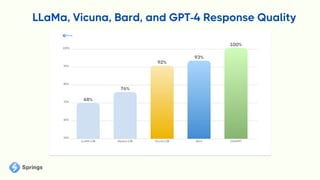
Vicuna-13B achieves more than 90% quality compared to
leading LLMs like ChatGPT and Google Bard.
Vicuna, trained by fine-tuning LLaMA, offers competitive
performance with minimal training budget.
LLaMa, Vicuna, Bard, and GPT-4 Response Quality
Closed Source LLMs Overview
- Closed-source LLMs, including OpenAI
GPT-4, Google Bard, Claude, Cohere, and
Jurassic, dominate the LLM landscape.
- These models offer advanced features
and comprehensive support but lack
transparency compared to open-source
counterparts.
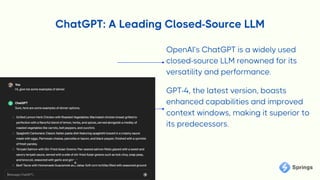
ChatGPT: A Leading Closed-Source LLM
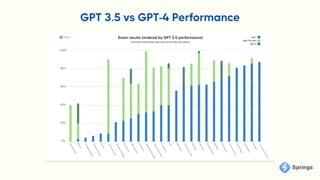
GPT-4, the latest version, boasts
enhanced capabilities and improved
context windows, making it superior to
its predecessors.
OpenAI’s ChatGPT is a widely used
closed-source LLM renowned for its
versatility and performance.
GPT 3.5 vs GPT-4 Performance
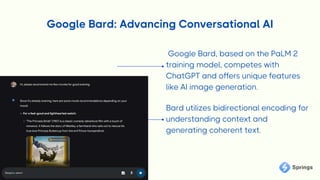
Google Bard: Advancing Conversational AI
Bard utilizes bidirectional encoding for
understanding context and
generating coherent text.
Google Bard, based on the PaLM 2
training model, competes with
ChatGPT and offers unique features
like AI image generation.
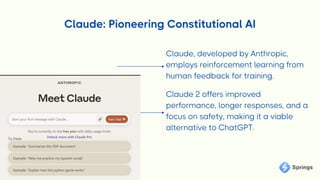
Claude: Pioneering Constitutional AI
Claude 2 offers improved
performance, longer responses, and a
focus on safety, making it a viable
alternative to ChatGPT.
Claude, developed by Anthropic,
employs reinforcement learning from
human feedback for training.
Pros & Cons
-Open-source LLMs offer benefits such as free usage,
customization, transparency, community support, and control
over data, but they also have limitations like resource
constraints, security vulnerabilities, integration issues, and
intellectual property concerns.
-Closed-source LLMs provide advantages such as legal
protection, scalability, data security, regular updates, support,
and detailed documentation, yet they come with drawbacks
such as vendor dependency, limited flexibility, licensing costs,
and transparency issues.
Barcelona, Spain
contact@springsapps.com
https://springsapps.com
+34 666845262
Contact Us
We will do everything possible to unlock all possibilities of
LLMs for your clients and business. Feel free to contact with
our AI & ML experts:

Open Source vs Closed Source LLMs. Pros and Cons

  • 1.
    Open Source vs ClosedSource LLMs. Pros and Cons
  • 2.
    Introduction to GenerativeAI Development -Generative AI development, especially Large Language Model (LLM) engineering, has gained significant traction in the IT industry. Notable LLMs include OpenAI GPT-4, Google Bard, LLaMA, OPT, T5, Bloom, Cohere, and Palm. The market size for LLMs is projected to reach $40.8 billion USD by 2029, growing at a CAGR of 21.4%.
  • 3.
    Open Source LLMs -Open-source LLMs form a significant part of the LLM landscape. - Notable open-source LLMs include LLaMA, OTP-IML, GLM, UL2, TP, and Galactica. - These models offer advantages such as accessibility, customization, and community support.
  • 4.
    LLaMA: A LeadingOpen-Source LLM LLaMA (Large Language Model Meta AI) is a popular open-source LLM released by Meta. LLaMA 2, a significant improvement over its predecessor, offers enhanced performance and AI chatbot capabilities. Meta prioritizes AI security and safety, achieving violation scores below 10%.
  • 5.
    Wizard Language Model WizardLM,developed by engineers from Microsoft and Peking University, is a powerful conversational language model. It utilizes the Evol-Instruct method for training and excels in generating high-quality instructions. WizardLM is based on LLaMA 1, offering significant advantages in instruction generation and scalability.
  • 6.
    Vicuna: An InnovativeOpen-Source LLM Vicuna provides a free online demo for testing but may have limitations in tasks involving reasoning or mathematics. Vicuna-13B achieves more than 90% quality compared to leading LLMs like ChatGPT and Google Bard. Vicuna, trained by fine-tuning LLaMA, offers competitive performance with minimal training budget.
  • 7.
    LLaMa, Vicuna, Bard,and GPT-4 Response Quality
  • 8.
    Closed Source LLMsOverview - Closed-source LLMs, including OpenAI GPT-4, Google Bard, Claude, Cohere, and Jurassic, dominate the LLM landscape. - These models offer advanced features and comprehensive support but lack transparency compared to open-source counterparts.
  • 9.
    ChatGPT: A LeadingClosed-Source LLM GPT-4, the latest version, boasts enhanced capabilities and improved context windows, making it superior to its predecessors. OpenAI’s ChatGPT is a widely used closed-source LLM renowned for its versatility and performance.
  • 10.
    GPT 3.5 vsGPT-4 Performance
  • 11.
    Google Bard: AdvancingConversational AI Bard utilizes bidirectional encoding for understanding context and generating coherent text. Google Bard, based on the PaLM 2 training model, competes with ChatGPT and offers unique features like AI image generation.
  • 12.
    Claude: Pioneering ConstitutionalAI Claude 2 offers improved performance, longer responses, and a focus on safety, making it a viable alternative to ChatGPT. Claude, developed by Anthropic, employs reinforcement learning from human feedback for training.
  • 13.
    Pros & Cons -Open-sourceLLMs offer benefits such as free usage, customization, transparency, community support, and control over data, but they also have limitations like resource constraints, security vulnerabilities, integration issues, and intellectual property concerns. -Closed-source LLMs provide advantages such as legal protection, scalability, data security, regular updates, support, and detailed documentation, yet they come with drawbacks such as vendor dependency, limited flexibility, licensing costs, and transparency issues.
  • 14.
    Barcelona, Spain contact@springsapps.com https://springsapps.com +34 666845262 ContactUs We will do everything possible to unlock all possibilities of LLMs for your clients and business. Feel free to contact with our AI & ML experts: