FHA Programs: Session 3
Thank you for joining the Webinar!

•   We will begin at 9:30 a.m.

•   Your phone will be muted, as
    there are hundreds of Members
    on the call. Don’t forget to turn on
    your computer speakers or call in
    to hear the audio.

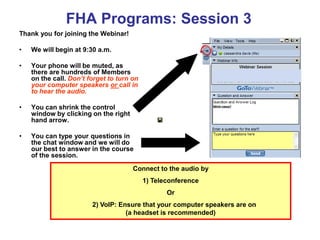
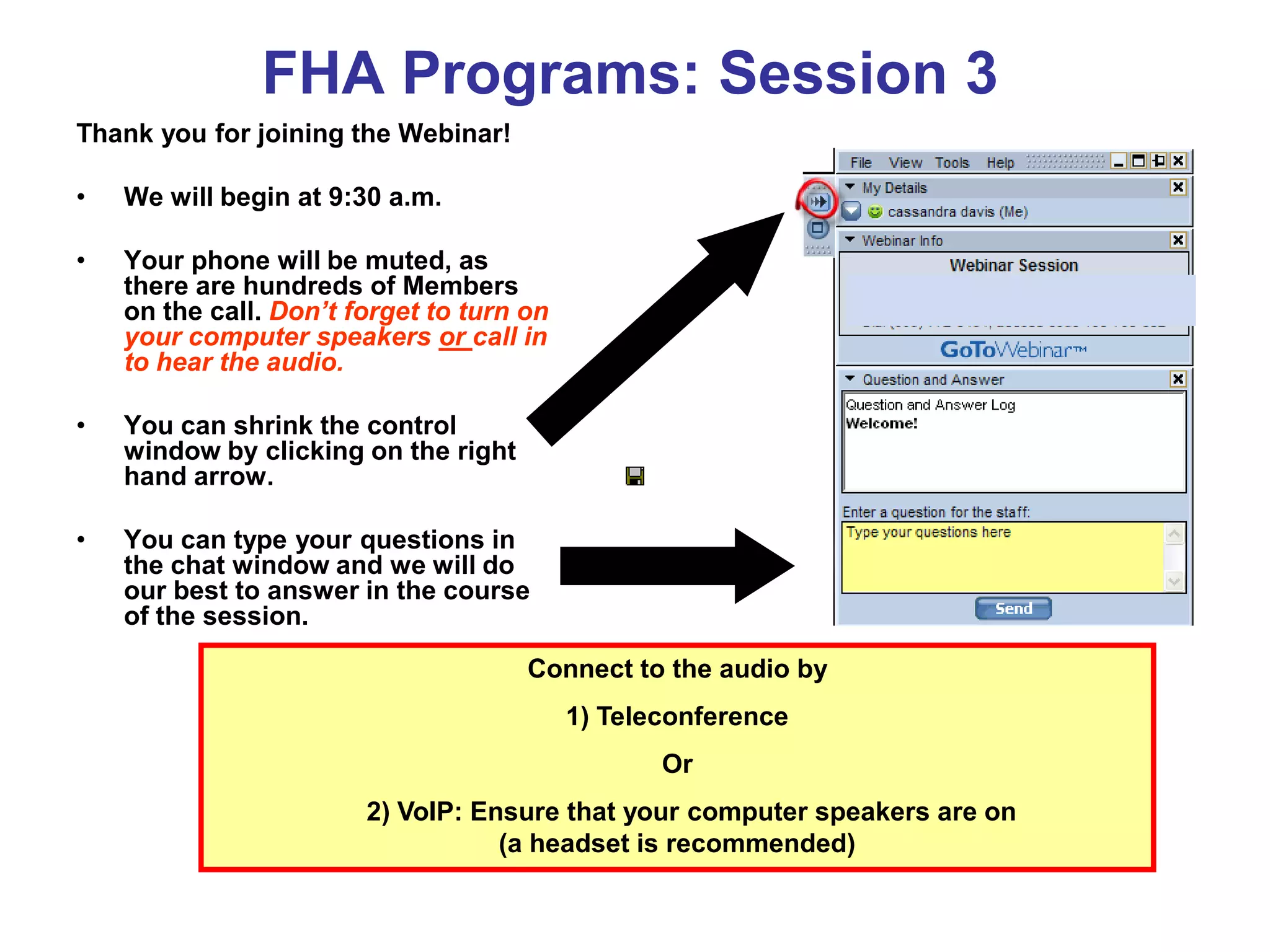
•   You can shrink the control
    window by clicking on the right
    hand arrow.

•   You can type your questions in
    the chat window and we will do
    our best to answer in the course
    of the session.

                                      Connect to the audio by
                                           1) Teleconference
                                                  Or
                        2) VoIP: Ensure that your computer speakers are on
                                   (a headset is recommended)
FHA TODAY
U.S. Department of Housing And
      Urban Development
        November 2010

           Company
           LOGO
Today’s Agenda
 Previous changes affecting industry partners
 HERA changes affecting industry partners
 Reverse mortgage program
 Manufactured housing
 Disaster relief
 Hope for Homeowners
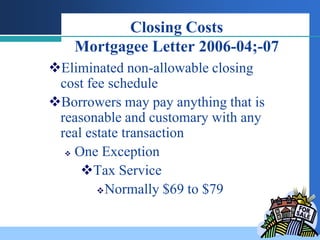
Closing Costs
    Mortgagee Letter 2006-04;-07
Eliminated non-allowable closing
 cost fee schedule
Borrowers may pay anything that is
 reasonable and customary with any
 real estate transaction
   One Exception

     Tax Service
         Normally $69 to $79
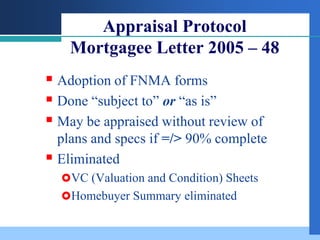
Appraisal Protocol
    Mortgagee Letter 2005 – 48
 Adoption of FNMA forms
 Done “subject to” or “as is”
 May be appraised without review of
  plans and specs if =/> 90% complete
 Eliminated
  VC (Valuation and Condition) Sheets
  Homebuyer Summary eliminated
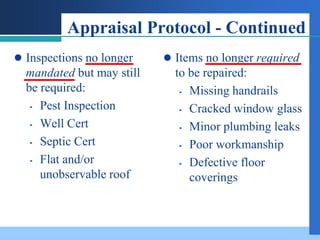
Appraisal Protocol - Continued
 Inspections no longer     Items no longer required
  mandated but may still     to be repaired:
  be required:                 Missing handrails

    Pest Inspection           Cracked window glass

    Well Cert                 Minor plumbing leaks

    Septic Cert               Poor workmanship

    Flat and/or               Defective floor
     unobservable roof          coverings
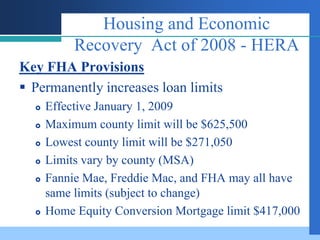
Housing and Economic
           Recovery Act of 2008 - HERA
Key FHA Provisions
 Permanently increases loan limits
     Effective January 1, 2009
     Maximum county limit will be $625,500
     Lowest county limit will be $271,050
     Limits vary by county (MSA)
     Fannie Mae, Freddie Mac, and FHA may all have
      same limits (subject to change)
     Home Equity Conversion Mortgage limit $417,000
Housing and Economic
              Recovery Act of 2008
Key FHA Provisions
 Revised downpayment and maximum
  mortgage calculation
     Effective January 1, 2009
 Bans Seller-Assisted Downpayment
  Assistance Programs
     Effective October 1, 2008
American Recovery and
              Reinvestment Act of 2009
Temporary Mortgage Limit Increase – Mortgagee
  Letter 2009 – 07
 Temporary increase in ceiling/limit
    175% of GSE ($417,000 x 1.75%)

       $729,750
    Determined by county MSA’s

       Possibly higher in Alaska, Hawaii, Guam, and U.S. Virgin
        Islands
 Home Equity Conversion Mortgage nationwide limit
    $625,500

 Expires December 31, 2010 (reverts to HERA limits)
    Loan must be fully approved by 12/31/10
Housing and Economic
                   Recovery Act of 2008
Minimum Required Investment - Purchase
 Effective January 1, 2009
 Minimum cash investment
    3.5% of appraised value or sales price
     (whichever is less)
 Secretary of HUD has authority to amend
     Can set higher, but not lower required borrower
      investment
Revised Downpayment and
        Maximum Mortgage Requirements
Mortgagee Letter 2008 – 23 September 2008
  Maximum loan-to-value (LTV) simplified
     96.5% on purchase

  Maximum LTV not to exceed 100 percent of
   appraised value or sales price (whichever is less)
     Including Upfront Mortgage Insurance Premium


    Example:
    96.5% loan-to-value + 1% Up Front Mortgage
      Insurance Premium = 97.5% (okay)
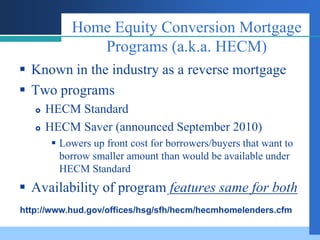
Home Equity Conversion Mortgage
               Programs (a.k.a. HECM)
 Known in the industry as a reverse mortgage
 Two programs
      HECM Standard
      HECM Saver (announced September 2010)
         Lowers up front cost for borrowers/buyers that want to
          borrow smaller amount than would be available under
          HECM Standard
 Availability of program features same for both
http://www.hud.gov/offices/hsg/sfh/hecm/hecmhomelenders.cfm
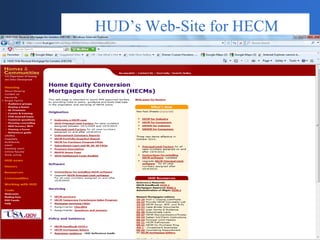
HUD’s Web-Site for HECM
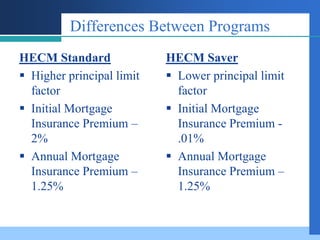
Differences Between Programs
HECM Standard              HECM Saver
 Higher principal limit    Lower principal limit
  factor                     factor
 Initial Mortgage          Initial Mortgage
  Insurance Premium –        Insurance Premium -
  2%                         .01%
 Annual Mortgage           Annual Mortgage
  Insurance Premium –        Insurance Premium –
  1.25%                      1.25%
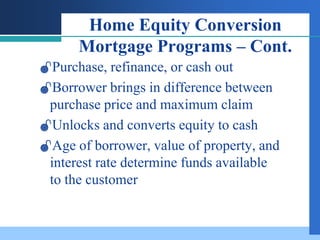
Home Equity Conversion
      Mortgage Programs – Cont.
Purchase, refinance, or cash out
Borrower brings in difference between
 purchase price and maximum claim
Unlocks and converts equity to cash
Age of borrower, value of property, and
 interest rate determine funds available
 to the customer
HECM - Continued

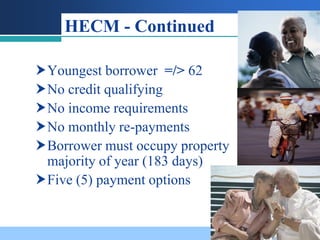
Youngest borrower =/> 62
No credit qualifying
No income requirements
No monthly re-payments
Borrower must occupy property
 majority of year (183 days)
Five (5) payment options
HECM Payment Options = 5
$ Line of Credit = money when needed
   $ Similar to bank withdraw
$ Tenure = Fixed monthly payment
$ Term = Fixed payment defined in years or
  months
$ Modified Tenure = Line of credit & fixed
  monthly payment
$ Modified Term = Line of credit & fixed
  monthly payment for months/years
NOTE: Payment option may be changed at
 any time for a max. $20.00 service fee
Manufactured Housing
   Must have HUD I.D. Tag(s)
   Must have been manufactured on or after
    June 15, 1976
   Must be affixed to permanent foundation
    –   Per FHA guidelines
   Can only have been moved from factory
    to subject home site once; or factory to
    dealership lot to home site once
       Cannot be moved from one home site to
        another home site
Manufactured Homes - Continued
   Must be taxed as real property
   Must have engineer’s certification
    that permanent foundation meets
    FHA guidelines
   Can purchase land and home with
    one loan
   If borrower already owns land, may
    be used for minimum required
    investment
Disaster Relief – 203(h)
Available to homeowners and renters
100% financing
  3.5% minimum investment   not
  required
 Must pay closing costs and pre-paids
New home can be anywhere in the U.S.
Must apply within one (1) year
 When President declared disaster area
Must document residence and condition
Hope for Homeowners (H4H)

   Temporary program approved by Congress
      Expires December 2010
   Refinance from non-FHA insured mortgage to FHA
   Current or in default on existing mortgage
   Have not intentionally defaulted on mortgage
   Have made minimum of 6 full payments during life
    of existing senior mortgage
   Must reside in property
H4H Eligibility - Continued
 Mortgage must have originated on or before
  1/1/2008
 Must be borrower’s primary residence
 May not have any other ownership interest in
  any other property
     Non-occupant co-borrowers will need to quit claim
      interest prior to occupants applying for mortgage
 1 – 4 unit properties eligible
     Maximum mortgage amount $550,440
Where to Get More Information
 1 – 800 – CALL – FHA (1 – 800 – 225 – 5342)
      A source for all FHA questions
        Industry partners and Consumers
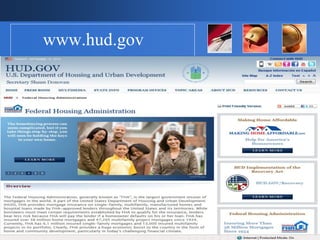
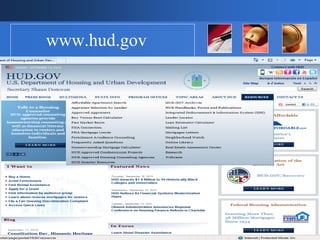
 www.hud.gov
     On-line resource for info about FHA and FHA
      programs
     On-line source for all other HUD programs, grants,
      forms, press releases, etc.
     User friendly
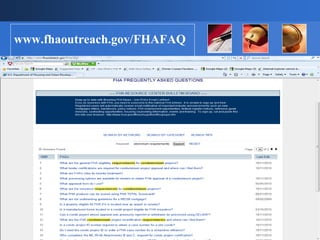
 www.fhaoutreach.gov/FHAFAQ
     On-line resource to frequently asked questions
www.hud.gov
www.hud.gov
www.fhaoutreach.gov/FHAFAQ
Agenda For Webinar Dec. 14th
 FHA Rehabilitation Loan Programs (203k’s)
     Regular Rehabilitation Loan
        203(k)
     Streamline Rehabilitation Loan
        Streamlined 203(k)
 Energy Efficient Mortgage
     EEM
 Other Repairs
 Solar and Weatherization Programs
The U.S. Department of Housing and Urban
                   Development
             would like to thank the
California Association of Mortgage Professionals
                      And
 Oregon Association of Mortgage Professionals
               for your interest in
            FHA and FHA programs

Hud slides webinar nov 30 2010

  • 1.
    FHA Programs: Session3 Thank you for joining the Webinar! • We will begin at 9:30 a.m. • Your phone will be muted, as there are hundreds of Members on the call. Don’t forget to turn on your computer speakers or call in to hear the audio. • You can shrink the control window by clicking on the right hand arrow. • You can type your questions in the chat window and we will do our best to answer in the course of the session. Connect to the audio by 1) Teleconference Or 2) VoIP: Ensure that your computer speakers are on (a headset is recommended)
  • 2.
    FHA TODAY U.S. Departmentof Housing And Urban Development November 2010 Company LOGO
  • 3.
    Today’s Agenda  Previouschanges affecting industry partners  HERA changes affecting industry partners  Reverse mortgage program  Manufactured housing  Disaster relief  Hope for Homeowners
  • 4.
    Closing Costs Mortgagee Letter 2006-04;-07 Eliminated non-allowable closing cost fee schedule Borrowers may pay anything that is reasonable and customary with any real estate transaction  One Exception Tax Service  Normally $69 to $79
  • 5.
    Appraisal Protocol Mortgagee Letter 2005 – 48  Adoption of FNMA forms  Done “subject to” or “as is”  May be appraised without review of plans and specs if =/> 90% complete  Eliminated VC (Valuation and Condition) Sheets Homebuyer Summary eliminated
  • 6.
    Appraisal Protocol -Continued  Inspections no longer  Items no longer required mandated but may still to be repaired: be required:  Missing handrails  Pest Inspection  Cracked window glass  Well Cert  Minor plumbing leaks  Septic Cert  Poor workmanship  Flat and/or  Defective floor unobservable roof coverings
  • 7.
    Housing and Economic Recovery Act of 2008 - HERA Key FHA Provisions  Permanently increases loan limits  Effective January 1, 2009  Maximum county limit will be $625,500  Lowest county limit will be $271,050  Limits vary by county (MSA)  Fannie Mae, Freddie Mac, and FHA may all have same limits (subject to change)  Home Equity Conversion Mortgage limit $417,000
  • 8.
    Housing and Economic Recovery Act of 2008 Key FHA Provisions  Revised downpayment and maximum mortgage calculation  Effective January 1, 2009  Bans Seller-Assisted Downpayment Assistance Programs  Effective October 1, 2008
  • 9.
    American Recovery and Reinvestment Act of 2009 Temporary Mortgage Limit Increase – Mortgagee Letter 2009 – 07  Temporary increase in ceiling/limit  175% of GSE ($417,000 x 1.75%)  $729,750  Determined by county MSA’s  Possibly higher in Alaska, Hawaii, Guam, and U.S. Virgin Islands  Home Equity Conversion Mortgage nationwide limit  $625,500  Expires December 31, 2010 (reverts to HERA limits)  Loan must be fully approved by 12/31/10
  • 10.
    Housing and Economic Recovery Act of 2008 Minimum Required Investment - Purchase  Effective January 1, 2009  Minimum cash investment  3.5% of appraised value or sales price (whichever is less)  Secretary of HUD has authority to amend  Can set higher, but not lower required borrower investment
  • 11.
    Revised Downpayment and Maximum Mortgage Requirements Mortgagee Letter 2008 – 23 September 2008  Maximum loan-to-value (LTV) simplified  96.5% on purchase  Maximum LTV not to exceed 100 percent of appraised value or sales price (whichever is less)  Including Upfront Mortgage Insurance Premium Example: 96.5% loan-to-value + 1% Up Front Mortgage Insurance Premium = 97.5% (okay)
  • 12.
    Home Equity ConversionMortgage Programs (a.k.a. HECM)  Known in the industry as a reverse mortgage  Two programs  HECM Standard  HECM Saver (announced September 2010)  Lowers up front cost for borrowers/buyers that want to borrow smaller amount than would be available under HECM Standard  Availability of program features same for both http://www.hud.gov/offices/hsg/sfh/hecm/hecmhomelenders.cfm
  • 13.
  • 14.
    Differences Between Programs HECMStandard HECM Saver  Higher principal limit  Lower principal limit factor factor  Initial Mortgage  Initial Mortgage Insurance Premium – Insurance Premium - 2% .01%  Annual Mortgage  Annual Mortgage Insurance Premium – Insurance Premium – 1.25% 1.25%
  • 15.
    Home Equity Conversion Mortgage Programs – Cont. Purchase, refinance, or cash out Borrower brings in difference between purchase price and maximum claim Unlocks and converts equity to cash Age of borrower, value of property, and interest rate determine funds available to the customer
  • 16.
    HECM - Continued Youngestborrower =/> 62 No credit qualifying No income requirements No monthly re-payments Borrower must occupy property majority of year (183 days) Five (5) payment options
  • 17.
    HECM Payment Options= 5 $ Line of Credit = money when needed $ Similar to bank withdraw $ Tenure = Fixed monthly payment $ Term = Fixed payment defined in years or months $ Modified Tenure = Line of credit & fixed monthly payment $ Modified Term = Line of credit & fixed monthly payment for months/years NOTE: Payment option may be changed at any time for a max. $20.00 service fee
  • 18.
    Manufactured Housing  Must have HUD I.D. Tag(s)  Must have been manufactured on or after June 15, 1976  Must be affixed to permanent foundation – Per FHA guidelines  Can only have been moved from factory to subject home site once; or factory to dealership lot to home site once  Cannot be moved from one home site to another home site
  • 19.
    Manufactured Homes -Continued  Must be taxed as real property  Must have engineer’s certification that permanent foundation meets FHA guidelines  Can purchase land and home with one loan  If borrower already owns land, may be used for minimum required investment
  • 20.
    Disaster Relief –203(h) Available to homeowners and renters 100% financing 3.5% minimum investment not required Must pay closing costs and pre-paids New home can be anywhere in the U.S. Must apply within one (1) year When President declared disaster area Must document residence and condition
  • 21.
    Hope for Homeowners(H4H)  Temporary program approved by Congress  Expires December 2010  Refinance from non-FHA insured mortgage to FHA  Current or in default on existing mortgage  Have not intentionally defaulted on mortgage  Have made minimum of 6 full payments during life of existing senior mortgage  Must reside in property
  • 22.
    H4H Eligibility -Continued  Mortgage must have originated on or before 1/1/2008  Must be borrower’s primary residence  May not have any other ownership interest in any other property  Non-occupant co-borrowers will need to quit claim interest prior to occupants applying for mortgage  1 – 4 unit properties eligible  Maximum mortgage amount $550,440
  • 23.
    Where to GetMore Information  1 – 800 – CALL – FHA (1 – 800 – 225 – 5342)  A source for all FHA questions  Industry partners and Consumers  www.hud.gov  On-line resource for info about FHA and FHA programs  On-line source for all other HUD programs, grants, forms, press releases, etc.  User friendly  www.fhaoutreach.gov/FHAFAQ  On-line resource to frequently asked questions
  • 24.
  • 25.
  • 26.
  • 27.
    Agenda For WebinarDec. 14th  FHA Rehabilitation Loan Programs (203k’s)  Regular Rehabilitation Loan  203(k)  Streamline Rehabilitation Loan  Streamlined 203(k)  Energy Efficient Mortgage  EEM  Other Repairs  Solar and Weatherization Programs
  • 28.
    The U.S. Departmentof Housing and Urban Development would like to thank the California Association of Mortgage Professionals And Oregon Association of Mortgage Professionals for your interest in FHA and FHA programs