Page 1
INBOUND CERTIFICATION
STUDY GUIDE
Your Exam Study Guide
The following guide walks through key lessons from each of
the twelve certification classes. Use this as a guide as you
prepare for your Inbound Certification test.
INBOUND FUNDAMENTALS
Essentials of an Effective Inbound Strategy
I. Why inbound?
- What’s the difference between traditional marketing and inbound marketing?
- What is inbound?
- What is the Inbound Methodology?
- What are the different stages that comprise the Inbound Methodology?
- How does analyze fit into the Inbound Methodology?
II. What are the fundamentals of inbound success?
- What are the inbound best practices?
- What is a buyer persona and how do you create a buyer persona?
- What three things should be kept in mind when creating a buyer persona?
- How do you go about researching buyer personas?
- What are the components of a persona profile story?
- What is the Buyer’s Journey?
- What are the stages that make up the Buyer’s Journey? How are they defined?
- What part does content play in inbound marketing and sales?
- In terms of inbound, what is context?
- What are the different ways to leverage content?
III. What does inbound look like?
- What is considered a shift from traditional to inbound marketing?
- What makes up a good persona profile story?
- What makes content the right for buyer personas?
Page 2
INBOUND CERTIFICATION
STUDY GUIDE
ATTRACT
Optimizing Your Website for Search Engines
I. What is Search Engine Optimization?
- In what ways does SEO help your inbound marketing?
- How do search engines find, understand and rank pages to show in
search results?
- What is the difference between paid results and organic results?
II. What are the SEO best practices?
- What are keywords and how should you go about picking the right ones for
your business?
- How do your buyer personas and the Buyer’s factor into your keyword
research?
- In what ways can you expand your list of keywords?
- How can you determine which keywords people are using to find your site?
- What is the difference between short and long-tail keywords?
- In what ways should you optimize your pages for search engines?
- How should you properly optimize a website page?
- What types of links should you include in your content and why?
- Why is promoting a good user experience important for SEO?
- Why should you optimize for mobile?
- Why is promoting your content important for SEO?
- What’s the relationship between links and SEO?
- What are inbound links?
- What strategies can you implement to earn links, and why does each help?
- What are online directories and why are they important for SEO?
- How can you optimize for getting found in local searches?
III. What does a successfully optimized website page look like?
- How can you tell if a business has picked the right primary keyword for a page?
- How can you tell if they’ve optimized the page around the keyword?
- How can you tell if they’re linking to other sources?
- How can you tell if they’re offering a good user experience?
- How can you tell if they’re promoting their content?
- How can you tell if they’re earning links?
Page 3
INBOUND CERTIFICATION
STUDY GUIDE
Creating Content with a Purpose
I. Why is content important to inbound?
- What is content?
- Where does content fit into the Inbound Methodology?
- 60% of the sales cycle is in the marketer’s hands
- Can influence the sales cycle with content
II. How can you create remarkable content?
- How does content different between pre and post-internet eras?
- What are the different steps to the Content Process?
- What is content defined by?
- How do you determine the purpose of a piece of content?
- What are different formats of content? What’s the difference between
these formats?
- How do you pick the best format for a piece of content?
- What should you consider when determining the topic?
- What’s the Buyer’s Journey?
- What different content formats are used in the different Buyer’s Journey stages?
- What are the best practices for content creation?
- How does distribution fit into the Content Process?
- What are the different ways to leverage content with distribution?
- Why is it important to analyze content?
- What are the different metrics that can be used to measure content efficacy?
- What’s the value in repeating the Content Process?
III. What does remarkable content look like?
- How do you determine where a content offer fits into the Buyer’s Journey?
- Are different types of content offers distributed differently?
Page 4
INBOUND CERTIFICATION
STUDY GUIDE
The Fundamentals of Blogging
I. Why does blogging help your inbound marketing?
- How does blogging help to attract new visitors?
- How does blogging help to convert new leads?
- How can your blog help you to build trust with your prospects? Why is this
important?
II. How do you create a successful blog?
- How do you pick an appropriate blog topic?
- Why should you write about educational content? Should you write about your
business?
- What are ways to brainstorm different topics to blog about?
- Why is it important to do keyword research around your blog topics?
- How many topics should you focus on per post, and why?
- What is a working title and how is it different from your topic?
- Why should you include a long-tail keyword in the title?
- How long should your blog title be, on average?
- Why is it important to format your blog post properly?
- What is whitespace and how does it affect your blog post?
- Why are images important to include in blog posts, and where should they be
placed?
- Why is it important to optimize a blog post for search engines?
- Where should you place your long-tail keyword and why?
- Where and why should you include links within the content of your blog post?
- Why should you use your blog to promote your other offers?
- What are the different ways you could promote your blog posts?
- Which metrics should you analyze to track the performance of your blog? What
does each metric tell you, and how can you use that knowledge to improve
performance?
- How frequently should you blog? Why?
III. What does a successful blog post look like?
- How can you tell if a business picked a good topic to blog about?
- How can you tell if they picked a compelling title?
- How can you tell if the blog has been formatted properly?
- How can you tell if the blog has been optimized for search engines?
- How can you tell if the blog is promoting other offers, and if the CTAs are
appropriate?
- How can you tell if they are promoting their blog posts?
Page 5
INBOUND CERTIFICATION
STUDY GUIDE
Amplifying Your Content with Social Media
I. Why is social media essential to inbound?
- In which stages of the inbound methodology can social media be used? How?
II. How can you use social media effectively?
- How are buyer personas critical to social media?
- How does social media help you keep up with industry trends?
- How can social media help you with your content strategy?
- How can social media reporting help you analyze your marketing efforts?
- How can social media monitoring be used to develop a social media strategy?
- What is a social media monitoring stream?
- How are keywords used in social media monitoring?
- What is the first step marketers should take when developing their social media
strategy?
- Why are personalized responses important to your social media audience?
- What are two ways marketers can segment their social media audience?
- What are the elements of an optimized social media profile?
- How can social media style guides enhance a social media strategy?
- In what ways can you customize your content for Twitter? Facebook? LinkedIn?
- How can your company establish thought leadership on social media?
- What is one method to help manage your social publishing efforts?
- How are benchmarks used for social media reporting?
- What is a metric that measures content consumption?
- What is a metric that measures lead generation?
- How often should marketers check their social media results?
III. What does awesome social content look like?
- How can you tell if a business has followed social publishing best practices?
- How can you tell if a business has followed social monitoring best practices?
Page 6
INBOUND CERTIFICATION
STUDY GUIDE
CONVERT
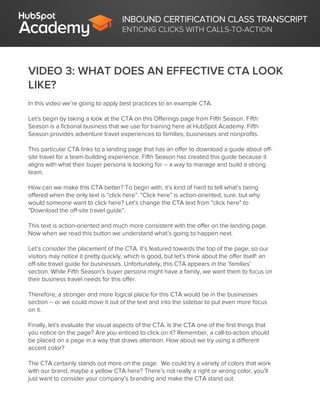
Enticing Clicks with Calls-to-Action
I. How do you use a call-to-action (CTA)?
- What is a CTA?
- How does a CTA help to convert visitors into leads?
- What role does a CTA play in a conversion process?
- Where do you use a CTA?
II. How do you create successful CTAs?
- What kind of words can you use on a CTA to get visitors to take action?
- How do the keywords of your offer and landing page impact the CTA?
- How can the visual aspects of a CTA, such as the size or color, help to grab
your visitors’ attention?
- Where should you place a CTA in an email? In a blog? On a website page?
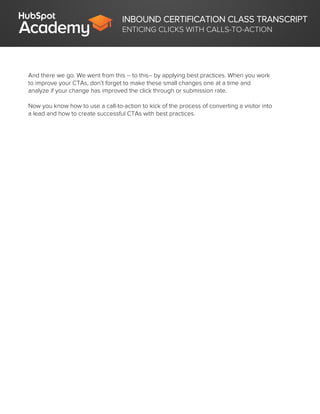
III. What does an effective CTA look like?
- How do you measure the effectiveness of a CTA?
- What is a good click-through rate goal to aim for with a CTA?
- What is a good clicks-to-submissions goal to aim for with a CTA?
The Anatomy of a Landing Page
I. How do you use a landing page?
- What is a landing page?
- How does a landing page generate information about your website visitors?
- Where does a landing page fit into a conversion process?
- In which stage of the Inbound Methodology is the landing page?
- Where does the conversion process occur during the buyer’s journey?
II. How do you create successful landing pages?
- What is a landing page?
- How does a landing page generate information about your website visitors?
- Where does a landing page fit into a conversion process?
- In which stage of the Inbound Methodology is the landing page?
Page 7
INBOUND CERTIFICATION
STUDY GUIDE
- Where does the conversion process occur during the buyer’s journey?
III. What does an effective landing page look like?
- How do you measure the effectiveness of a landing page?
- What is a good conversion rate goal for a landing page?
- What is a blink test?
- What is the purpose behind performing a blink test?
Guiding the Next Step with Thank You Pages
I. How do you use a thank you page?
- What is a thank you page?
- Where does a thank you page fit into a conversion process?
- How does a thank you page differ from an inline thank you message?
II. How do you create successful thank you pages?
- What is a thank you page?
- Where does a thank you page fit into a conversion process?
- How does a thank you page differ from an inline thank you message?
III. What does an effective thank you page look like?
- What is a thank you page?
- Where does a thank you page fit into a conversion process?
- How does a thank you page differ from an inline thank you message?
Page 8
INBOUND CERTIFICATION
STUDY GUIDE
CLOSE
Sending the Right Email to the Right Person
I. Why is email marketing still important?
- How can email help you close leads into customers?
- How can marketers use email to delight customers?
II. How do you send the right email to the right person?
- How are buyer personas and the Buyer’s Journey important to sending great
emails?
- What different types of data can you use to segment your email sending recipients?
- The average email list decays at 25% a year. What are some reasons that this
happens?
- How can you avoid having your emails marked as spam? What is the impact of your
emails being marked as spam?
- What type of content is appropriate to email leads during the awareness stage of
the Buyer’s Journey? The consideration stage? The decision stage?
- How is the success of your email marketing tied to the rest of your inbound
strategy?
- What is lead nurturing?
- What are some examples of effective goals for an email send?
- How does email personalization impact the success of your email sends?
- What is actionable language, and where can it be used in your emails?
- What does delivery rate measure?
- What does open rate measure?
- What does click rate measure?
- Why is it important to A/B test your emails?
- What is the difference between a hard bounce and a soft bounce?
- How can you optimize your emails to look good on mobile devices?
III. What does a great email look like?
- Where are some appropriate places to put a CTA in an email?
- Is it ever appropriate to have more than 1 CTA in an email?
- What are some different ways you can you expand the reach of your emails?
- What different components can you add to an email to maximize the real-estate of
your content?
- What are the components of a good email signature?
Page 9
INBOUND CERTIFICATION
STUDY GUIDE
The Power of Smarketing
I. Why is smarketing critical to the success of an inbound company?
- What is smarketing?
- Where does smarketing fit into the inbound methodology?
- How does smarketing increase bottom line revenue results for organizations?
II. How does smarketing result in alignment?
- Why is it important for both teams to have the same or interdependent goals?
- What are the benefits of tying the marketing pipeline to sales quotas?
- How does visibility into each other’s goals create better alignment and bottom line
revenue results?
- How is compensation around goals related to smarketing alignment?
- Why are personas important for successful smarketing alignment?
- At what size company does smarketing work best?
III. What steps are necessary to integrate smarketing into your organization?
- What are the 6 names of the stages in the funnel and why is the funnel a good
place to start when working to get both teams to use the same language?
- Why does it not matter if you change the names or definitions of the stages in the
funnel as long as both teams agree on the names and definitions?
- What does it mean when someone says “the marketing and sales funnel is not
always linear?”
- Why is a service level agreement (SLA) critical to integrating smarketing into your
organization?
- What are some things marketing and sales should be held accountable to for their
piece of the SLA?
- What are some changes in your assumptions when developing your numbers that
can affect your SLA and might require you to update the SLA?
- What are some questions to ask yourself to identify your organizations needs for
closed-loop reporting?
- What are some benefits of closed-loop reporting for marketing and for sales?
- Why is it beneficial for marketing and sales to close the loop between their teams?
- Why is it important to rely on data not emotions when integrating and running
smarketing?
- Why are dashboards a great way to display data?
- Why pull marketing and sales away from the activities they are working on to hit
their SLA to have a weekly smarketing meeting?
- What should take place in a monthly management meeting regarding smarketing
that is different from the weekly smarketing meeting?
Page 10
INBOUND CERTIFICATION
STUDY GUIDE
Taking Your Sales Process Inbound
I. What is inbound sales?
- Why have buying habits changed?
- What is inbound sales?
- What’s the difference between traditional and inbound sales?
II. How can you transform the way you sell?
- What are the best practices for effectively transforming the way you sell?
- How can you transform the way you target accounts?
- How can you transform the way you prospect accounts?
- What things about your lead should you thoroughly research?
- How is the goal of a call determined?
- How can you transform the way you connect with accounts?
- What are the guidelines for transforming the way you connect?
- How can you transform the way your prospects perceive you as a salesperson?
III. What does a day in the life of an inbound sales rep look like?
- If you needed to research a lead, where would you start? What information can you
gather?
- What is a positioning statement?
DELIGHT
Cultivating Happy Customers
I. Why should every organization be delighting people?
- Customer In which stages of the inbound methodology can delight be used?
- When should you be focused on delighting people?
- Why do people stop doing business with a business?
II. How can you delight people?
- What are the three pillars of delight?
- Which interactions will build or destroy trust?
Page 11
INBOUND CERTIFICATION
STUDY GUIDE
- What are the components to the customer delight checklist?
- What tool can help you solve customer issues quickly and exceed customer
expectations?
III. What should you do to embrace and execute the pillars of delight?
- Who is responsible for delighting customers?
- Why do you need to build a repeatable, consistent hiring process so you hire for
character, train for skill?
- Why do you need to make sure you properly train your team so they understand
why developing trust is key to delighting people?
- Why should you be measuring and tracking as many of your customer's interactions
as you can?
- How can you exceed people’s expectations during more interactions?
- Why is following-up so important to delight?
- What steps should you take when trying to solve a person’s problem as fast as
possible?
- What’s an effective way to empower your team while not micro-managing them?
INBOUND CERTIFICATION CLASS TRANSCRIPT
ESSENTIALS OF A SUCCESSFUL INBOUND STRATEGY
VIDEO 1: WHY INBOUND?
Hi there! I’m Lindsay with HubSpot Academy.
Welcome to the Essentials of Inbound. This class will introduce you to the world of inbound and
provide you with a big picture view of everything you need for a successful inbound strategy.
Are you ready?
Let’s start with the biggest question of them all - why inbound?
Before understanding why inbound is transforming the way the world does business, let’s take a
moment to think about traditional marketing.
In traditional marketing, companies focus on finding customers. Generally, they use techniques
that are interruptive. These techniques could be anything from cold-calling and print advertising
to TV commercials and junk mail.
But technology is making these techniques less effective and more expensive. Caller ID blocks
cold calls, DVR makes TV advertising less effective, and spam filters block mass emails. It's still
possible to get a message out using these channels, but it costs a lot more.
Traditional marketing is interruptive and marketer-centric. The traditional way of doing things is
convenient for the marketer, because they can push content in people’s faces whenever they
want – even when those potential customers don’t want it. But it’s not such a great experience for
the user – the potential customer.
Inbound Marketers flip this model on its head.
So what is inbound all about?
Well, inbound is a fundamental shift in the way we do business. Instead of that old, interruption-
based message where the marketer or salesperson had all the control, Inbound is about
EMPOWERING potential customers.
Instead of interrupting people with television ads, they might create videos that potential
customers want to see. Instead of buying display ads in print publications, they could create a
business blog that people would look forward to reading. And instead of cold calling, they create
useful content so that prospects can contact them when they want more information.
INBOUND CERTIFICATION CLASS TRANSCRIPT
ESSENTIALS OF A SUCCESSFUL INBOUND STRATEGY
Inbound Marketing is marketing focused on getting found by customers. It’s customer-focused.
It’s helpful. Wouldn’t you prefer to deal with a business that is focused on your needs instead of
their own?
You’ve probably come across some of your favorite brands actively practicing inbound marketing.
It’s that problem-solving blog post that shows up near the top of the search engine. It’s the new
solution that was discovered on LinkedIn or the product review that was found on Facebook.
Inbound is about being a part of the conversation.
Being a part of that conversation means sharing helpful, relevant content with the world. It’s about
drawing people in -- that’s why it’s called Inbound, after all.
And most of all, it’s about creating marketing that people love.
In today’s world, buyers have all the power. Think about the process you went through the last
time you made a purchase. Did you call up a salesperson, asking to buy? Or did you hop online
and do some research? I’d be willing to bet you did the latter.
It’s time for you to support that buying process. It’s time for you to join in and empower your
potential customers to make the right decisions for themselves.
So how do you actually do inbound? Well, the best way to start is by understanding the Inbound
Methodology.
This is the inbound methodology. It illustrates the four stages that make up the inbound
marketing and sales process. These stages are Attract, Convert, Close, and Delight.
Listed along the bottom of the methodology are the tools companies typically use to accomplish
these actions. The tools are listed under the stage where they first come into play, but that’s not
the only stage where they’re applicable! Some tools, like email, can be essential to multiple
stages of the methodology.
Starting at the beginning, on the left, you’ll need to attract strangers to your site, turning them into
visitors. Some of the most important tools to attract new users are blogging, optimizing your
website, and social media.
But it doesn’t end there. Once you’ve attracted new visitors, the next step is to convert some of
them into leads by gathering their contact information. At the very least, you’ll need their email
addresses. Contact information is the world of inbound’s currency. In order for your visitors to
offer up that currency, willingly, you’ll need to offer them something in return.
INBOUND CERTIFICATION CLASS TRANSCRIPT
ESSENTIALS OF A SUCCESSFUL INBOUND STRATEGY
That ‘payment’ comes in the form of offers, like eBooks, whitepapers, or tip sheets - whatever
information would be interesting and valuable to your prospects. You can convert visitors into
leads by using what’s called, as you might have guessed, the conversion process. Website
components like calls-to-action and landing pages can entice these visitors and help you get
information about them.
Moving along, now that you’ve attracted the right visitors and converted the right leads, it’s time
to transform those leads into customers. In the Close stage, tools like email and a CRM can be
used to help sell to the right leads at the right time.
Inbound is all about providing remarkable content to your users, whether they’re visitors, leads, or
existing customers. Just because someone is already a customer doesn’t mean that you can
forget about them! Inbound companies continue to delight and engage their customer base,
turning them into happy promoters of the products and services they love.
Then, the whole methodology starts back at the beginning, when promoters talk to their networks
– more strangers -- and spread the word about your products and services.
What you don’t see written in the methodology is “Analyze.” Why?
Because analysis is part of every single thing you do with your inbound strategy. Anything you do
-- any piece of content you create, any campaign you launch, or any marketing action you
undertake -- should be analyzed.
To be a true inbound marketer (and a truly successful one) you need to know what’s working,
what isn’t, and how to implement new solutions and improve your efforts as efficiently as
possible. And again, the only way to do this is by taking the time to analyze your work.
And that, folks, is why inbound is changing the way the world does marketing and sales.
Next up, learn the necessary best practices that make up a strong inbound strategy.
INBOUND CERTIFICATION CLASS TRANSCRIPT
ESSENTIALS OF A SUCCESSFUL INBOUND STRATEGY
VIDEO 2: WHAT ARE THE FUNDAMENTALS OF
INBOUND SUCCESS?
Before practicing inbound marketing, it’s important to understand the fundamentals of inbound
success. Remember, consumers don’t want to be sold to, they want to be educated, and inbound
tactics can deliver the kind of information your prospects need to help them make smart, well-
informed decisions.
You can begin to do this by keeping these best practices in mind. First, by using buyer personas,
second, by using the buyer’s journey, then by creating remarkable content, and knowing how to
leverage it.
Let’s start by taking a look at how to use buyer personas.
Since inbound marketing and sales are customer-centric, you need to know who you’re trying to
reach.
You don’t want just any traffic to your site, you want the right traffic. You want the people who are
most likely to become leads, and, ultimately, happy customers. Who are the “right” people? The
right people are your ideal customers, what we call your buyer personas.
Buyer personas are semi-fictional representations of an ideal customer, based on real data and
some educated speculation about demographics, behaviors, motivations, and goals.
Personas are created through research, analysis, and taking a close look at who’s already buying
from you. They can help you get into the mindset of your potential buyers and create the right
content. When you create the right content, you’ll effectively attract your ideal visitors, convert
them into leads, and close them into customers.
They’re the glue that holds every aspect of inbound marketing together.
So, you could say that they’re a pretty big deal, but how do you create buyer personas?
There are three things to keep in mind - research, identifying trends, and creating persona profile
stories.
First, do your research. Buyer personas must be based off of actual research, not assumptions.
Yes, research takes time, but if any of those assumptions are inaccurate, your personas will be,
too.
INBOUND CERTIFICATION CLASS TRANSCRIPT
ESSENTIALS OF A SUCCESSFUL INBOUND STRATEGY
When conducting research, there are a few questions that you can ask to develop your buyer
personas. One way to start is by asking your current customers different questions that touch
upon their demographics, goals, and challenges. Ask questions like:
 What is your job role? Your title?
 What industry or industries does your company work/is your role in?
 What are you working to accomplish?
 What are your biggest challenges?
 How do you learn about new information for your role?
 Do you use the internet to research vendors or products?
You don’t have to ask these questions word-for-word. Make the questions specific to your
industry, so you’re getting specific answers in return.
And always focus on the ‘Why’ or the motives of your buyer personas, not their actions. The
follow-up question to pretty much every question should be, "Why?" Through these interviews,
you're trying to understand your persona’s goals, behaviors, and motivations. What really drives
them? People aren’t always good at describing this for themselves, so it’s important to dig deep.
Uncovering their motives can lead to a truly powerful content strategy.
So, how do you do research?
Start by interviewing your current customers, former customers, prospects and even your co-
workers. Your existing customer base is the perfect place to start with your interviews, because
they've already purchased your product and engaged with your company. At least some of them
are likely to exemplify your target persona. Reach out to both "good" and "bad" customers.
Once you’ve spoken to a few people, it’s time to start looking for trends. Patterns and similarities
in answers to persona research questions indicate who your personas really are.
How much research does it take to create personas? As much as it takes to identify trends. Be on
the lookout for commonalities and similarities between the types of answers you're getting.
By now you may be thinking, how many personas should I have? As many as needed, as long as
you start noticing trends that will help you build out your buyer personas.
Alright, you’ve done your persona research and identified those trends. The final step is to
compile this research and create persona profile stories. You want these stories to contain
information about who your persona is, using information about their background, their
demographics, and their goals and challenges. You’ll also want to include your plan to help them.
Include common objections that they might have to your product or service and use real quotes
INBOUND CERTIFICATION CLASS TRANSCRIPT
ESSENTIALS OF A SUCCESSFUL INBOUND STRATEGY
from your interviews. After all, what better way to represent your persona than to use their own
words? This will make it easier for employees to relate to and understand them.
Let’s look at an example of what a complete buyer persona profile might actually look like.
In this example we’re looking at a persona named Sample Sally. Sample Sally is an example
created by an HR database software company, let’s call them HR Blast. And they clearly did their
research and identified some trends.
Here’s what they put together: Sally tends to be the head of HR. She's married, has 2 children
and has been at the same company for many years. She tends to be female and around the age
of 40-45. She has a very calm demeanor and typically has an assistant screening her calls. Her
goals are to keep employees happy and turnover low. She also has to support the legal and
finance teams. Some common challenges she runs into are getting everything done with a small
staff and rolling out big changes to the entire company.
So what about solutions? Well, this HR Blast can best help Sample Sally by making it easy for her
to manage all of the employee data in one place and integrate with her current legal and finance
systems. The company should be prepared for the common objections that she typically has,
such as worrying about losing data when moving over to a new system. And she doesn’t want to
have to train the entire company on how to use it.
After interviewing a few current customers they were able to pull real quotes to use for Sample
Sally, like “It’s been difficult getting company-wide adoption of new technologies in the past.” and
“I’ve had to deal with so many painful integrations with other departments’ databases and
software.”
These quotes can make it easier for one of the company's employees to identify if they might be
on the speaking or emailing with a Sample Sally.
These personas give you a really clear idea of exactly who these potential customers might be,
what they are interested in, what they are dealing with, and what they are working towards.
But when it comes to creating a great inbound strategy, it’s not enough to know just who you’re
trying to reach, you also have to know what they want to see.
And who are buyer persona’s right for? Is it B2B, B2C, or nonprofit? Buyer personas are
necessary for any type of business.
That brings us to the buyer’s journey. Every interaction your persona has with your organization
should be tailored to where they are in the buyer’s journey.
INBOUND CERTIFICATION CLASS TRANSCRIPT
ESSENTIALS OF A SUCCESSFUL INBOUND STRATEGY
The buyer’s journey is the active research process someone goes through leading up to a
purchase. Knowing the buyer’s journey for your persona will be key to creating the best content
possible.
Instead of talking about top, middle, or bottom of the funnel, the buyer’s journey is made up of 3
stages: the awareness stage, the consideration stage, and the decision stage that portray the
experiences your potential customers go through.
Every single one of you has gone through the buyer’s journey. It’s the path you take when you
have a problem to solve, from researching potential solutions to purchasing one.
The awareness stage is when your prospect is experiencing and expressing symptoms of a
problem or opportunity. They’re doing education research to more clearly understand, frame, and
give a name to their problem.
The consideration stage is when a prospect has now clearly defined and given a name to their
problem or opportunity. They are committed to researching and understanding all of the available
approaches and/or methods to solving the defined problem or opportunity.
The decision stage is when a prospect has now decided on their solution strategy, method, or
approach. They are compiling a long list of all available vendors and products in their given
solution strategy. They could also be researching to whittle the long list down to a short list and
ultimately making a final purchase decision.
Here’s a real life example of the buyer’s journey. Ever been sick before? Yes, I’m sure you have.
Remember that feeling of feeling ill but you’re not really sure what you might have. In the
awareness stage you’re experiencing symptoms or having a problem. In this case, you feel like
you have a sore throat, fever, and are achy all over. You ask “what’s wrong with me?”
In the consideration stage, that’s when you’ve given a name to your problem and now needing to
figure out your options. You realize - a-ha! I have strep throat, but what are my options for
relieving or curing my symptoms?
That’s where the decision stage comes in, this is when you decide on your approach to solve the
problem. If you have strep throat you could see a primary care physician, go to the ER, or go to a
clinic. You might decide that the ER costs a lot, but you insured and you go with that option.
That’s how one could go through the buyer’s journey - it’s from the buyer’s perspective.
But imagine you as the marketer, or in this case - the doctor. Doctor’s will typically listen to your
symptoms, provide options for you to get better, and prescribe you your solution. But what if you
INBOUND CERTIFICATION CLASS TRANSCRIPT
ESSENTIALS OF A SUCCESSFUL INBOUND STRATEGY
went into a doctor’s office and they paid no attention to your symptoms and just gave you some
sort of medicine immediately. Not a pleasant experience.
That’s what can often happen with website content. Rather than creating content that covers your
buyer persona’s problems and potential solutions, we jump to explaining our products or our
services and why they’re the best option.
Website visitors might come to your website for the first time in any of the different buyer’s
journey stages, but you need to have content prepared for each and every stage.
Feel good about the buyer’s journey? Let’s test your knowledge because the buyer’s journey
comes up a lot when it comes to inbound.
If you were to create a blog post about your product or service, where would it fall into the
buyer’s journey?
A. Awareness stage
B. Consideration stage
C. Decision stage
Your product or service will most likely help solve your persona’s problems, but that doesn’t
make this blog post awareness stage.
Your product and service will be some form of solution, but in this case, your blog post is talking
all about you. So this would be a decision stage piece of content.
But here’s the thing - blog posts aren’t really for the decision stage. A bit of a trick question!
When you’re creating content, specifically blog posts, keep it educational. Not educating them on
who you are and what you do, but educating them on their problems and solutions. It’s the
inbound way. A way to build trust.
Once you understand your buyer personas and their buying journey, it’s time to start doing
inbound marketing. Inbound marketing can’t exist without content, and that’s why the third best
practice is to create remarkable, tailored content.
Inbound Marketing is Content plus Context.
Your content is your marketing toolkit. Things like blogs, interactive tools, photos/infographics,
videos, and eBooks/presentations work to attract, convert, close, and delight.
INBOUND CERTIFICATION CLASS TRANSCRIPT
ESSENTIALS OF A SUCCESSFUL INBOUND STRATEGY
Context is who you’re creating it for: you can’t just write any blog posts, you have to write the
right ones, tailored to who you’re trying to reach and what they’re interested in.
The best content – the stuff that’s really going to fuel your entire inbound strategy – has to be
grounded in the correct context. It’s not enough to just write a blog post or send out an
email. The content in that blog post and that email need to be tailored to who you’re trying to
reach (your persona) and what they’re most interested in seeing (which depends on where they
are in the buyer’s journey).
The last best practice is to leverage your content.
Make that content available for your buyer personas to find: content distribution is what provides
the context to your content. It’s not enough to just have great content. You need to have a way to
get that content out into the world. Distribution makes content relevant.
There are a few different tools you can use to leverage content by distribution. The right
distribution technique gets the right content in front of the right person at the right time. You can
use your website pages, business blog, social media, landing pages, calls-to-action, and
marketing emails. Just make sure you’re using tactics that help your content reach your buyer
personas where they’re spending their time. If they aren’t spending their time on Twitter, Twitter
shouldn’t be a major part of your distribution plan.
And that brings us to the end of the inbound best practices. Remember: research, develop, and
use your buyer personas. Then combine that new knowledge with the buyer’s journey to help
you create and leverage remarkable content.
VIDEO 3: WHAT DOES INBOUND LOOK LIKE?
Inbound has been taking the world by storm. Let’s look at what one company has done with
inbound marketing and what effective inbound strategies look like in action.
CFO On-Call is a financial services advisory group. The company is a smart pro-active team of
Chief Financial Officers, Financial Controllers and Business Advisors, with over 20 years
experience that help business owners in Australia and New Zealand. The management team at
CFO On-Call realized that the company had to improve their marketing strategy if they were to
remain successful, as traditional methods were no longer working like they used to.
The marketing team at CFO On-Call once relied heavily on telemarketing and cold calling to
generate leads for sales. Over time, they saw a decline and no longer had enough leads to
support their new customer or partner channels.
INBOUND CERTIFICATION CLASS TRANSCRIPT
ESSENTIALS OF A SUCCESSFUL INBOUND STRATEGY
Lacking a strong digital presence and search engine authority, their website and blog articles
weren’t performing well enough for lead generation. When they did generate leads, they
struggled to educate their prospective clients on services that they and their partners could
provide.
Fortunately, they understood the value of inbound marketing and began to expand their online
presence, focused on generating more leads to support their revenue goals.
The marketing team began working on developing their buyer personas and created a detailed
profile representative of their target audience, Gary the Business Owner. By understanding their
main customer’s demographics, role, and business problems, the team could create better
targeted content, emails and offers for that audience.
After conducting research, here is the buyer persona that they created.
Gary the Business Owner is typically in his mid-40s. He runs a small business that he started after
a career in the industry. He’s married with a couple of children and drives a modest vehicle. He’s
been running his own business for about 3 years and it’s growing due to his energy and contacts
in the industry. He has a secondary school education with either a trade or professional
qualifications.
Gary’s an achiever, a determined individual and a natural leader. He has an entrepreneurial flair.
He has high ambitions for his business and can see great opportunities in his marketplace for
growth. Cash flow can limit growth potential and lenders aren’t too helpful about borrowing funds
to grow.
His income can be a little erratic at times due to business cash flow. He occasionally has to
borrow money and the can cause him stress at times. He occasionally speak with his accountant
but he doesn’t feel they are on the same wavelength as he doesn’t always understand what they
are talking about.
Gary also feels a little stretched at times due to having to be everything in the business but
enjoys being his own boss.
Imagine yourself as being on the marketing team for CFO On-Call, do you have a better picture of
who you are trying to market and sell to? Do you have an idea of some different types of content
you could create to help this buyer persona solve their problems and address their challenges?
That’s the idea of having a buyer persona story! You can get in the mindset of your buyer and
understand them that much more.
INBOUND CERTIFICATION CLASS TRANSCRIPT
ESSENTIALS OF A SUCCESSFUL INBOUND STRATEGY
Next, the team at CFO On-Call worked on expanding the content offerings on their website by
creating whitepapers, eBooks and blog posts sharing financial advice to small business owners
who were looking to grow.
Look at the different titles of these blog posts -
 22 Warning Signs of a Business in Trouble
 9 Keys to Small Business Growth for 2014
 8 Ways to Improve Profit in a Business
Do you think these are blog posts that their buyer persona would be interested in? Yes!
Remember in Gary’s buyer persona story, his income is a little erratic, cash flow has been limiting
growth, and he has high ambitions for his business. All of these blog posts speak directly to CFO
On-Call’s buyer persona.
As a result of adopting an inbound marketing strategy, CFO On-Call was able to increase web
traffic by 200% in a six-month period. They have the tools in place to easily capture more leads
from their site and have seen a 9.6X increase in leads. With lead management and nurturing,
they’ve improved sales-ready leads by 153% and have a 1:3 success rate as compared to the 1:20
close rate prior to doing inbound marketing. Sounds like it worked well, doesn’t it?
Every industry is different. This mix of inbound marketing is what worked best for CFO On-Call,
but your inbound strategy will be your own.
Congratulations! You finished the first class of the Inbound Certification, but there’s still lots to
learn. So keep it up, and good luck!
INBOUND CERTIFICATION CLASS TRANSCRIPT
OPTIMIZING YOUR WEBSITE FOR SEARCH ENGINES
VIDEO 1: WHAT IS SEARCH ENGINE
OPTIMIZATION?
Hi there, I’m Dee Dee from HubSpot Academy. Welcome to the class on optimizing your website.
In this training, we’ll cover the basics necessary to help you get up to speed. By the end of this
class, you’ll be able to pick the right keywords for your site, ensure that search engines
understand the content on your pages, and start earning links from outside sources.
To start, let’s define what search engine optimization is.
Search engine optimization, or SEO, is the process of improving your website so that it attracts
more visitors from search engines.
SEO is an essential part of the first stage of the Inbound Methodology. It helps you attract
strangers from search engines and turn them into new visitors on your website.
So to understand SEO, let’s think about how people find information today.
Let’s say someone moves into an old house and needs to replace all of the electrical outlets
themselves. What would they do to figure this out on their own? Odds are, they’re probably going
to head online and enter their question into a search engine. And they’ll be specific in that
search. They might type in “how to install a 3 prong electrical outlet”.
Google gets over 3 billion searches every day, from people who have questions and problems
that they’re looking to solve.
So search engines need to provide the most relevant, useful, and trustworthy answers. To find
them, they send what are known as “spiders” to crawl through all of the pages on the web,
searching for that content. Those spiders try to figure out what each page is about.
From that data, they create a list of results that are relevant and useful to searches. Then, they
rank those results based on the popularity and authority of those websites. The more visits a
website gets, the higher it will rank.
This ranking is what you see when you look at a search engine results page. The first few results
and the ones listed on the side are ads - websites that have paid to show up at the top. But below
that, you’re looking at the top 1-10 unpaid, or “organic”, results that contain the most popular,
relevant answers.
INBOUND CERTIFICATION CLASS TRANSCRIPT
OPTIMIZING YOUR WEBSITE FOR SEARCH ENGINES
As marketers and business owners, your goal is to be listed in the top organic results because,
let’s be honest, most searchers only click on the first few results that they see. In fact, 60% of all
organic clicks go to the organic top 3 search results. So how do you get up there?
That is where inbound marketing and SEO come in. You need to figure out what your prospects
are searching for, so that you can make sure that they find your website.
In the next video, we’re going to focus on how to do the essentials of SEO, so that you can start
increasing traffic to your website.
VIDEO 2: SEO STRATEGY AND BEST PRACTICES
There are many factors that search engines take into account when crawling your pages and
trying to understand them, so let’s dive into some SEO strategy and best practices.
One top factor, and the first element of SEO to focus on, is your use of keywords. This is a part of
what’s called on-page SEO - optimizing the pages of your site.
Keywords are the words typed into search engines. Basically, they’re the topics that searchers
are trying to learn more about.
In order to attract those strangers to your content, you need to do research to figure out which
keywords relate to your business and your industry.
Your research should always begin with your buyer personas. Your personas represent the
searchers who will become your visitors, leads, and ultimately, customers & promoters. You need
to determine who they are, what their goals are, and what problems they face, so you can begin
to understand what they’re searching for.
So put yourself in their shoes and make a list of keywords that they would search for.
Let’s say your business makes smart phone accessories, including a waterproof phone case
called the “Smart Phone Preserver”. And let’s say that one of your buyer personas is a teenager -
let’s call him Lanky Luke.
If Luke drops his phone in a puddle, he has a problem. So what are the common industry
questions he might ask? He might start by searching for “drying out a smart phone” - looking for
general industry knowledge.
Next, what questions might Luke have that your company provides solutions to? He may not
know to search for your exact product yet, but he might start by searching for "waterproof smart
phone cases".
INBOUND CERTIFICATION CLASS TRANSCRIPT
OPTIMIZING YOUR WEBSITE FOR SEARCH ENGINES
Finally, what questions might Luke have when deciding to buy your waterproof case? He might
be searching for phrases like “Smart Phone Preserver case reviews”. This is a great opportunity
to gather information from your sales team - what are the most common questions they get?
By going through Lanky Luke’s thought process, you can come up with a list of keywords. Like
“drying out a smart phone”, “waterproof smart phone cases”, and “Smart Phone Preserver case
reviews”.
As you make this list, categorize the keywords by the stages of the buyer’s journey. Industry
problem-based keywords are part of the awareness stage. Keywords that your company provides
solutions to are part of the consideration stage. And keywords around deciding to buy are part of
the decision stage.
Now, while you’re brainstorming, make sure to try and mimic the language that your buyer
personas would actually use in their searches.
Keep in mind that language may vary in different parts of the world. What is "soda" in one part
might be "pop" or "cola" in another.
Alright, time for a quiz! Let's test our knowledge on buyer persona language. Which language
would Luke be most likely to use in a search? Is it:
A) Where is the iPhone liquid exposure device indicator?
B) Is there an iPhone water damage indicator?
C) How to tell if iPhone is water damaged?
D) How to detect iPhone water damage
You've got 10 seconds to figure it out. Ready? Go! Alright - let’s see which is the right answer!
It’s not A - even though that’s what Apple actually calls this feature, Luke probably doesn’t know
that and wouldn’t call it that.
You can then also assume that it’s not B - indicator doesn’t seem like the type of word Luke
would use.
The last two options are fairly similar - so would Luke search for “how to tell if iPhone has water
The correct answer is C - Luke is much more likely to use more casual language like “how to tell if
iPhone has water damage”
INBOUND CERTIFICATION CLASS TRANSCRIPT
OPTIMIZING YOUR WEBSITE FOR SEARCH ENGINES
You can see that there are many keyword phrases that you could include in your list - but you’ll
only attract your buyer personas with the ones that speak their language.
Now, if you’re feeling stumped and can’t think of any other keywords to add to your list, expand
your keyword list by searching the web for alternatives.
Try typing one of your keywords into a search engine and see what the results are.
In this example, you’re looking at the keyword “boat names”. When you type it into Google, it
autocompletes for other popular keyword phrases, like “boat name generator”, “boat name
lettering”, and “boat name ideas.”
You can also look for alternatives under the different search options in Google, like image search
or video.
In this example, you can see that by looking under video search, “applying a new boat name” is a
related keyword phrase, as is “funny names” and “hand-lettering”.
You can also use a tool like keywords.io or the Google webmaster tools to get suggestions.
Add all of the alternatives that relate to your business and buyer persona to your keyword list.
Next, determine which keywords people are already using to find your site. Some search
engines, like Google, have encrypted their organic search data so that those keywords are
hidden, which make this trickier to do. But you can use an analytics tool, like Google Webmaster
or HubSpot Sources, to get some insights.
And finally, decide which keywords you have the best opportunity to rank for. Remember - lots of
other websites are trying to rank for any given keyword, and only 10 can make it to the first page
of search results. Some keywords are just going to be harder than others.
Think about it, what would happen if you searched for the keyword “shoes”? Well, you’d end up
with results for all different kinds of shoes - men’s, women’s, sneakers, sandals, and only the
biggest companies would be on the top of the results.
A keyword like “shoes” is referred to as a short or broad keyword, because that’s exactly what it
is - short and broad in scope.
If a small store specialized in sneakers, it would be harder for them to rank for “shoes”. There’s
lots of competition around it, and some very popular, trustworthy sites filling up the top spots.
The keyword is also very general - the small store wouldn’t get any qualified visitors from it.
INBOUND CERTIFICATION CLASS TRANSCRIPT
OPTIMIZING YOUR WEBSITE FOR SEARCH ENGINES
But let’s say you searched for something more specific, like “best women’s running shoes for flat
feet”. You’d get more specific results that would better answer your question.
This more specific keyword phrase is called a long-tail keyword - because it’s a string of related
words that look like a long tail! It’s significantly easier to rank for because it’s more specific and
targeted. Not to mention, the people searching for that long-tail keyword know what they’re
looking for, meaning they’re qualified visitors who are more likely to turn into leads and
customers.
But just because you’re selecting a long-tail keyword doesn’t mean that ranking high will be easy.
It’s important to understand how difficult it is to rank for each keyword, regardless of length.
For this, you’ll need to drill down into your keyword analytics, researching your current ranking for
that long-tail keyword and how often people are searching for it. If you’re using a tool like
Google Analytics or HubSpot’s Keywords tool, you can also see what the level of competition is
like for that keyword. Ultimately, you want to aim for keywords that have a higher search volume
with low competition.
Once you’ve identified keywords to target, start creating content around them.
Now, search engines are getting smarter and smarter. In addition to understanding keywords,
they also trying to understand a searcher’s intent. If you search for “boston soccer team”, your
intention is probably to find information about Boston’s soccer team, the New England Revolution.
Google tries to understand what you’re actually looking for, looks at all related pages, and then
shows you the results that it deems the most helpful. It’s not just going to show you exact
matches to the keyword that you searched for.
As a marketer, this means that you can create content using natural language and variations of
your keyword, like "dog treats", "doggy treats", and "treats for dogs". You don’t have to use the
same exact phrase over and over. And don’t shy away from mentioning related keywords in your
content, like “dog food nutrition”.
Anyway, once you’ve written this great content, it’s time to optimize the page where it will be
featured.
First, optimize the page around a primary keyword. Be sure that the keyword fits as a description
of what the page is all about. You’re optimizing for the visitor first, but it's also how a search
engine can understand the purpose of the page to know how to best index it.
Add the keyword to the page title. The page title shows both on the browser tab for the page,
and also as the link to the page in search results. If optimizing a website page, include your
company name as well. Use the vertical bar, otherwise known as a pipe, to separate the two.
INBOUND CERTIFICATION CLASS TRANSCRIPT
OPTIMIZING YOUR WEBSITE FOR SEARCH ENGINES
Next, add your primary keyword to the URL. This can also be seen on the page and within
search results. If using a long-tail keyword, use dashes to separate words
(companyname.com/long-tail-keyword-phrase). If editing a live page, any change that you make
to the URL will create a new page. So make sure to set up a 301 Redirect that will direct the old
URL to the new one, sending people seamlessly to the right page. This will save all of your SEO
credit and ensures that you don't break any links to the old page.
Next, add the keyword to the page headers and content. Use the keyword naturally throughout
the page.
If there are any images on the page, add the keyword to the image alt-text. Search engines can't
read images, so alt-text allows a search engine to understand what that image is about. This also
allows that image to get found in image searches.
Next, add the keyword to the meta description. This is the short summary below the link (or title)
to your page in a search engine results... Each page should have a unique meta description, no
longer than 140 characters. Though it doesn’t directly affect SEO, its optimization can improve the
rate of people clicking through to your page.
Another way to improve your SEO is to include relevant links within the content. Linking to
relevant, reliable sources helps build the trustworthiness of your site. Don’t go overboard - link to
one or two sources per paragraph at the very most. You don’t want your page to look spammy!
Link to relevant internal pages from your website, in order to drive traffic to them. And while it
may sound counterproductive, also make sure to link to outside resources. Google Webmasters
encourage this - it shows that you’ve done your research, helps you build connections, and it
gives your readers more helpful resources. For those reasons, outside links work best in blog
posts. When you do link, make sure to hyperlink text that contains relevant keywords that you'd
like to rank for. For example, this blog post contains a link at the bottom to another sources about
“improving your mobile experience”, with all of those important keywords acting as the hyperlink.
Edit your page to promote a good user experience. Search engines are also looking at the
experience that people have on your site when determining how to rank you.
Make sure your website is intuitive and easy to browse. Don’t make people hunt for what they
need. Show them the next step they can take with your business, and you’ll convert those visitors
into leads, and -- eventually -- customers.
Finally, optimize your website for mobile. 80% of internet users own a smartphone. That’s
astounding!
INBOUND CERTIFICATION CLASS TRANSCRIPT
OPTIMIZING YOUR WEBSITE FOR SEARCH ENGINES
And as more and more people use mobile devices to access the internet, search engines are
trying to make it easier for people to find mobile-friendly websites. So make sure that your
website pages can be easily viewed on any screen size. If your page isn’t mobile-friendly, you
may be missing out!
Once you’ve created and optimized your content, don’t forget to promote it through social media
and email. The more that people see, share and link to your content, the more popular your site
will grow and the more trust you’ll gain with search engines.
We’ve talked quite a bit about getting search engines to understand our pages, but how can you
get them to see you as a trustworthy and authoritative site? Well, much of this will come from
your great optimized content, but some of it also comes from the number of links that are pointing
to you. This is a part of what’s called off-page SEO.
Search engines follow links between pages to see how they’re related to each other. Links
coming into your website – called inbound links - help search engines analyze how authoritative
your website is. If a trusted site is linking to you, your website becomes more trustworthy.
But not all links are created equal. Make sure that you're earning high-quality links, and not
focusing on quantity. High-quality links come from existing authoritative websites that are
relevant to your business or industry.
To figure out which websites are authoritative, use a tool like the Moz Open Site Explorer or
HubSpot Links to see all of the websites who are linking to you and their authority.
While it definitely takes some time, building relationships with authoritative sites and industry
thought leaders is one of the most effective ways to keep your company top-of-mind for people
who might be interested in linking to you. Use social media, send friendly emails or comment on
blog posts. Or try good-old conversation: make connections at local meetups, conferences and
in your day-to-day.
A good way to build those relationships and earn those links is to create content with input from
those industry thought leaders. Not only will these thought leaders help you write your content,
but they'll also share it, giving you new visitors and a new link.
Create a "best-of" list or a resources list, and give credit to the sources or authors. Interview an
industry thought leader and publish it as a blog post. Write crowdsourced content - solicit
information, answers or opinions on a particular topic from industry thought leaders. Or ask an
industry thought leader to write the foreword or give a quote for an eBook.
Now, for some quicker wins.
INBOUND CERTIFICATION CLASS TRANSCRIPT
OPTIMIZING YOUR WEBSITE FOR SEARCH ENGINES
Set up a page for your business on the top online directories. Directories are websites like Yelp,
Yellow Pages, and local chambers of commerce. Having a page on a directory will increase the
number of links and citations to your website. Citations are mentions of your business name and
address online, even if the website doesn’t directly link to you. Both will help with your off-page
SEO.
Finally, if your business is location-specific, create a Google+ Local Listing Page. This will help tie
your website to a specific location, which Google will use in its search results. If your business is
in a single location, link to your homepage. If your business has multiple locations, link to
dedicated location page for each.
So there you have it - the fundamental SEO strategy and best practices that you need to start
improving the rank of your pages and getting new visitors to your site. Remember to consider
both on-page and off-page when creating your SEO strategy.
In the next video, we’ll cover some real life examples of companies that that have optimized their
website pages.
VIDEO 3: WHAT DOES A SUCCESFULLY
OPTIMIZED WEBSITE PAGE LOOK LIKE?
Are you ready to see some examples of how companies have applied their SEO strategy? Let’s
dive in.
Take a look at a company called AnswerDash to see what a successfully optimized page looks
like.
AnswerDash is a venture-backed company that provides instant answers to common questions,
right on a company’s website. In effect, this cuts down on the number of customer support calls..
Visitors can click on anything they have questions about, and AnswerDash will display the
frequently asked questions and answers for them. And if visitors can't find the answers they
need, they can ask a new question.
As a startup, AnswerDash wanted to achieve two important goals: to develop a website
optimized for generating leads and to acquire 100 customers within their first six months.
INBOUND CERTIFICATION CLASS TRANSCRIPT
OPTIMIZING YOUR WEBSITE FOR SEARCH ENGINES
By creating an optimized website, they saw a:
 60% increase in monthly leads
 55% increase in social media traffic
 and a 10% increase in website traffic
All within the first 2 months. Let’s take a look at two of their pages to see how they did it.
First, let’s look at the site page about live chat integrations. Did they pick the right keyword?
They’re addressing a common topic that their buyer personas might want to learn about: how
their software integrates with live chat. They’re directly speaking to the possible concerns of their
personas.
Second, they’re mimicking the language that their buyer personas would actually use in their
searches: “Customers appreciate the speed and convenience of self-service, but when they run
into difficulty, it’s important to allow them to seamlessly connect to you for more personalized
assisted service.”
And finally, they’ve created content that uses natural language and variations on the long-tail
keyword, instead of using the same exact phrase over and over.
Next, have they optimized this page?
You can see that they have their primary long-tail keyword in the page title, URL, and body, and
though you can’t see it, behind the image in the alt-text.
Next, are they linking to other sources?
They are- both internal and external sources, in fact. And their hyperlinked text that contains
relevant keywords that they’d like to rank for.
Finally- are they offering a good user experience?
Their website is intuitive and easy to browse - the navigation is clear. And they’re providing clear
next steps, providing visitors a free account, which will help to convert those visitors into leads,
and logging in, which will help their customers get to where they need to be.
Next, let’s look at a blog post that they’ve written.
INBOUND CERTIFICATION CLASS TRANSCRIPT
OPTIMIZING YOUR WEBSITE FOR SEARCH ENGINES
They’re addressing a common topic that their buyer personas might want to learn about: what to
figure out before hiring another customer support agent.
Second, they’re mimicking the language that their buyer personas would use, like “figuring out”.
Third, their blog post focuses on a long-tail keyword - “hiring another customer support agent” -
which is easier to rank for because it’s more niche, more specific, and more targeted.
And finally, they’ve used natural language and variations on the long-tail keyword.
Next, have they optimized this page?
Again, they have their primary long-tail keyword in the page title, URL, and body, and though you
can’t see it, behind the image in the alt-text.
Next, are they linking to other sources?
Again, they are- both internal and external sources, with keywords in the hyperlink.
Next, are they promoting their content?
You can see that they have prominent social sharing buttons, which means that visitors can share
the article themselves. They’ve also promoted this content on their Twitter, LinkedIn, and
Facebook profiles.
Finally, how well has AnswerDash built outside relationships and gotten other people and
websites linking to them?
Look at related articles from outside sources in a Google search of company name. It looks like
they’ve got VentureBeat and Geekwire writing about them.
Looks like AnswerDash is doing pretty well for themselves and is on the right track to improve
their rank for this keyword and get some quality visitors to their site.
So there you have it - we’ve covered the most important fundamentals of optimizing your website
for search engines. Now, get started optimizing your pages and building those relationships so
that you can see the same results!
INBOUND CERTIFICATION CLASS TRANSCRIPT
CREATING CONTENT WITH A PURPOSE
VIDEO 1: WHY IS CONTENT IMPORTANT TO
INBOUND?
Hi there, I’m Lindsay with HubSpot Academy.
Are you ready to learn about creating content with a purpose? Fantastic. There’s a lot that goes
into a high-performing piece of content, so let’s dive in.
So why is content important to the world of inbound?
Well first, what exactly is content?
Content is the message your inbound strategy delivers. It’s what you’re trying to deliver to your
visitors, leads, customers, and promoters. There are lots of different ways you can deliver that
message: blogs, emails, landing pages, social media, and beyond. But without content, there’s
nothing to deliver.
In fact, without content, the internet would be empty. Think about how you use the internet. You
go to a search engine, type in a question, and what you find is content.
Content has the very important job of pulling people from one stage of the inbound methodology
to another. It plays an integral part in each and every stage.
Your content attracts the right visitors to your site, converts them into leads, nurtures them and
helps close them into customers. It’s also a big part of what delights them into promoters.
Content is the fuel that that powers a successful inbound strategy.
In the attract stage, content is what your blog posts are made of. You optimize it using keywords
and you share it using social media.
Content is also integral in the Convert stage. Content is what your website forms lead people to,
and what your calls-to-action entice visitors to download. Content is what drives those visitors to
convert into leads in the first place, because it’s what they receive in exchange for their email
addresses.
In the close stage, content is what builds the emails that your leads are opening.
And of course, content is what eventually delights customers into promoters. Personalized
content not only educates them, it helps offer that outstanding customer service and outreach
that creates promoters.
INBOUND CERTIFICATION CLASS TRANSCRIPT
CREATING CONTENT WITH A PURPOSE
As you can see, content really is the fuel that keeps the inbound methodology running.
If you’re convinced that you need content to successfully conquer the inbound world, jump into
the next video where we’ll discuss how to create content that will perform well.
VIDEO 2: HOW DO YOU CREATE REMARKABLE
CONTENT?
Content is a critical part to your inbound strategy, but how do you create remarkable content?
Remarkable content is content that makes people want to read, share, and come back for more.
So, what makes a piece of content remarkable?
In those pre-internet days, the main factor that limited marketers was physical space. How big is
my magazine ad? How big is my billboard? There was a limited amount of space. But now, thanks
to the internet, space is basically unlimited. You can have an infinite number of pages, blog posts,
and content offers.
But you might find that, even with all this content, it's much harder to capture the ATTENTION of
your prospect. There’s already a ton of content out there, whose will get the most attention?
Which websites will people visit, and which offers will they download?
Now, instead of fighting for space, you're fighting for attention.
That’s where having good content comes in, the kind that will capture your prospects’ attention.
A lot of people are creating content, but few feel like they’re doing it right. If you want to do it
right, you’ll need to start with a plan.
Here’s an interesting stat - ONLY 44% of B2B marketers have a documented content strategy and
ONLY 39% of B2C marketers have a documented content strategy. Surprised? That’s a really
small percentage of marketers that are putting together a documented content strategy. So, why
not get ahead and start building out your own content plan and content process?
You can start by creating a series of processes to follow on a regular basis, focused on turning
your organization into a content creation machine. The more content you create, the better -- with
each piece of content, the process becomes easier and more effective.
Now keep in mind: building out a plan for your content creation machine does take a little more
time than just jumping right in, but it will pay off in the end through the momentum you’ll gain over
time.
INBOUND CERTIFICATION CLASS TRANSCRIPT
CREATING CONTENT WITH A PURPOSE
Typically a content process has 4 steps. Those steps are plan, create, distribute, and analyze.
Then, take what you learned in your analysis and repeat it all over again.
Let’s go through what each of those steps actually entails, starting with planning portion.
So you have your definition of content — simply put, content is information. But content is best
defined by three things: its purpose, its format, and its topic.
First, what is the purpose of this content? Is the purpose to get more people to your site, or to get
them to convert to leads? That’s the big difference between these two. Content offers are a form
of content that are typically gated by a landing page or behind a form. The purpose of a content
offer is to convert visits to leads. Whereas your blog posts and website content is open access to
anyone on the internet. The purpose of these pieces of content is to attract strangers to your
website.
What are your goals and how will you use content to help reach those goals? Determine the
purpose.
Once you have an idea about the purpose, think about the format of that piece of content.
Content itself actually comes in many different flavors. It can include things like case studies, a
video, infographics, a whitepaper, a calculator or worksheet, an eBook, a template, research
reports, checklists, webinars, slideshare decks, or whatever else you can come up with.
But what’s the difference between all these formats? Well, not much. You could tell the same
story with almost each and every one. How you choose a format to use depends on who you’re
creating content for, how much time you have to create it, and how much information you actually
have to present.
Picking the best format for your content is all about your personas. The information contained in
the content is what helps people achieve their goals, and the design is what makes it easily
digestible or accessible by your personas.
Think for a moment. Is your persona a visual learner? Then maybe consider using an infographic.
If you know they read blogs on a regular basis, maybe a blog post would work. If you have a
particularly valuable piece of content, maybe it belongs behind a form.
The final element of a piece of content is the content topic. What are you writing about? Figuring
out a topic for your content is one of the most important parts of content creation, and sometimes
it be the hardest part - but it doesn’t have to be.
INBOUND CERTIFICATION CLASS TRANSCRIPT
CREATING CONTENT WITH A PURPOSE
To easily come up with the best topics for every piece of content you create, there are just 2
things you need to know. These two things are the keys to creating remarkable content. They are
- your buyer personas (who you’re trying to reach) and the buyer’s journey (what content will be
most interesting or helpful for them).
Knowing who your personas are and where they are in the buyer’s journey are the keys to
developing a killer content strategy. In order to create remarkable content, you have to tailor it
both to your personas and where they are in the buyer’s journey.
The best content is the kind that your buyer personas want to read, share, and come back for.
If you do these 2 things, you’ll be perfectly poised to create remarkable content that will
transform your inbound efforts from passable to outstanding.
Buyer personas are who you’re trying to attract, convert, close, and delight—this is your ideal
customer. Your persona is who you’re creating content for.
Great content is educational. Your ultimate content goal is to solve your persona’s problems, and
you can do this through education.
You can identify topics that matter through keyword research - what you want to rank for, internet
forums, popular industry news, sales and support frequently asked questions, your personas’
goals and your personas’ challenges. The first step to creating content that resonates with
readers is gaining a better understanding of who your readers are, especially the ones you want
to convert into leads and customers. When you know who they are, you can create the right
content that perfectly suits their needs.
And what about the buyer’s journey? How does that play into remarkable content?
Well, how you should define remarkable content is that remarkable content is solution-based, not
product-based. Remarkable content isn’t about YOUR business or YOUR product, it’s about your
potential customers; the problems they’re having, and the answers they’re searching for.
In order to provide a solution, you have to understand the problem. The buyer’s journey will help
you do this.
The buyer’s journey is the active research process that people go through leading up to making a
purchase. It’s like the buying process or marketing funnel you may be familiar with, but it’s from
the buyer’s perspective.
The buyer’s journey is made up of 3 stages – awareness, consideration and decision – and they
depict the buying research process. First they identify a problem or opportunity, then they
investigate solutions, and finally, they decide on a way to solve their problem.
INBOUND CERTIFICATION CLASS TRANSCRIPT
CREATING CONTENT WITH A PURPOSE
So why should this matter to you, as a content creator?
Well, when creating content, the buyer’s journey is important because it can help you refine what
your content is about while helping you create content that is relevant to their place in the buyer’s
journey.
What content is appropriate in each stage of the buyer’s journey?
It all comes down to what your content is about and how it’s positioned. Is your content focused
on the problem your buyer persona is experiencing? That would be an awareness stage piece of
content. If your content is more about the solution to a problem, than it would be consideration
stage content. As for the decision stage, that’s when you begin to create content about your
product or service.
As you can see, you want to be creating content for all of the different stages of the buyer’s
journey.
There are specific formats of content that tend to perform better in different stages.
For example, in the awareness stage when a prospect is experiencing and expressing symptoms
of a problem or opportunity, the content assets listed are appropriate for the awareness stage
because this content helps educate your buyer persona -- not on your solution, but on your buyer
persona’s need or problem. Analyst reports, research reports, eBooks, editorial content, expert
content, whitepapers, and educational content are all great content formats for an awareness
stage piece of content.
In the Consideration Stage, the prospect has clearly defined and given a name to their problem
or opportunity. The content assets in this stage should speak directly to the solutions that can
help solve their needs, bridging the gap between educational assets and product or service
information without involving your brand. That’s why expert guides, live interactions, webcasts,
podcasts, videos, and comparison whitepapers work so well for this stage.
Finally, in the decision stage, the prospect has decided on their solution strategy, method, or
approach and is making a decision. The assets in this stage require more direct action from the
lead. They are ready to make a purchase (now that they know about their problem and have
determined an ideal solution), so it’s time to show why you’re the best of the best. Content in the
decision stage will be focused on your own product and service and you can do that using
formats like vendor or product comparisons, case studies, trial download, product literature, and
live demos.
There are so many opportunities with the different types of content that you can create! Now
keep in mind, an eBook won’t always be an awareness stage piece of content. You can
INBOUND CERTIFICATION CLASS TRANSCRIPT
CREATING CONTENT WITH A PURPOSE
determine where your piece of content fits into the buyer’s journey based on the topic not the
format.
Let’s look at an example of how a company created content for each stage of the buyer’s
journey.
This example is from a HubSpot partner agency. The ultimate goal this agency is hoping to
accomplish is to get people to purchase their website design services. But they can’t just go in for
the kill right away.
First, need to have content that’s addressing a problem their buyer persona might be facing. This
is where they should provide educational content to help prospects educate themselves about
the overarching issues, root problem, or potential opportunity at hand.
In this case they recognized that their buyer persona has problems with website conversion
rates, so they created this blog post to educate them on the topic.
Now that people understand a little bit more about website conversion rates, how it they can see
improvements, and what some benefits of optimizing your website might be, they’re ready to start
learning some more of the specifics of a solution. In this case the solution is redesigning a
website. This happens to be a service that the agency provides, but you’ll see that this eBook is
about themselves. It’s about 9 steps to redesign your website. That’s what this consideration
stage content does. It provides educational content to help prospects learn more about the
solution to their problem, opportunity, or issue.
It’s not until the decision stage that prospects are ready to hear about the actual service offerings.
Think about it like this – in the awareness stage, they may not have even known that website
redesign was a possibility. In the consideration stage, they probably didn’t know if a redesign was
right for them, let alone what they might need. It’s only when they’re educated about the issue as
a whole that they’re ready to hear about actual services for purchase. The decision stage is
where you provide content and resources that help prospects learn more about and chose your
best solution for their problem.
Now, keep in mind, you’re still in the planning process. Like I said, there’s a lot that goes into the
planning portion of the content process.
To tie this all together, try using a worksheet like this one here. This is a concepting worksheet
that you can use to tie all of the components of planning - purpose, format, and topic together.
Fill this out so your piece of content will be created for a specific persona, topic (or keyword),
buyer’s journey stage, format and content structure, and start developing a working title for the
piece of content. One area that was skipped over, “How will this help your buyer persona?” Take
the time to always address this question when you’re creating a piece of content. If you can’t
INBOUND CERTIFICATION CLASS TRANSCRIPT
CREATING CONTENT WITH A PURPOSE
answer this question, than you might not be planning a remarkable piece of content. Remember,
you want to create content that will help your buyer persona. Every time you want to produce a
piece of content, start by asking yourself: who does this help? If the answer is anyone OTHER
than your persona, go back and really think through why you’re creating this content, on this
topic, in this way.
Here’s an example of how the HubSpot agency partner could have filled out this worksheet for
the different content they’re creating. Let’s pretend that Business Beth is their buyer persona and
something that interests Business Beth is redesigning websites. That will be the topic for this
piece of content. We’ll skip the buyer’s journey for now. How will this help Business Beth? Well,
business Beth needs help with knowing what a redesign of a website looks like, how it will
benefit him/her, and what type of a commitment a redesign will be. Since they could answer that
question and that they know this will help the buyer persona, they’re on their way to building out
a remarkable piece of content.
In this case the content will be an eBook and will be structured as a How-To. By knowing all of
this, 9 Steps to Redesigning Your Website will be the start to this piece of content.
But what about the buyer’s journey? Do you remember where this fit in the buyer’s journey? Give
it a second.
Right! It was consideration stage, because it was focused on a solution not the problem of
improving conversion rates.
Now that you have an idea for what you’re going to create, the next step is to actually produce
that content, transforming those ideas into reality. Your content doesn’t have to be lengthy or
elaborate, you just have to set a plan and follow it.
It all comes down to transforming your ideas, your plans, into real content assets to attract,
convert, close, and delight. But don’t forget, you’re not just trying to create content, you’re trying
to create remarkable content.
There are a few best practices to keep in mind as you begin creating a piece of content. And
most of these are good news! Especially if you’re wearing many hats in your role.
Always focus on mapping content to your personas AND where they are in the Buyer’s Journey.
This part is covered in the planning process, but be sure to create a piece of content with a buyer
persona and buyer’s journey stage in mind. The more specific your content, the better. Yes,
broad content can cast a wider net, but specific content is going to attract qualified visitors and
leads - those more likely to become customers.
Second, less is more: your personas are probably just as busy as you are—make it easy for them
to consume your content. This is GREAT news! Don’t go creating that 50 page eBook or 2 hour
INBOUND CERTIFICATION CLASS TRANSCRIPT
CREATING CONTENT WITH A PURPOSE
webinar. Remember, this content is for your buyer personas. Focus more on covering the topic in
full than creating a lengthy piece of content. You’ll buyer personas will thank you.
Next, keep it educational, not promotional. Remember, it’s not until the decision stage of the
Buyer’s Journey that your product should be mentioned. Your website pages are pieces of
content that are great for the decision stage. It’s those content offers and blog posts that should
be focused on education and the beginning part of the buyer’s journey.
Finally, focus on the informational part of the content first, worry about design second. Prioritize
writing great content over making that content look nice. Yes, content like infographics rely
heavily on design, but if it wasn’t for the content that infographic wouldn’t exist.
And there you have it! The content creation best practices. Always focus on your persona and the
buyer’s journey, keep it short, keep it educational, and worry about design last.
At this point, you’ll be giving yourself a pat on the back. Not only would you have planned out
your piece of content, you would have also created it.
Not so fast, this step is extremely important to the content process and is, actually, often
overlooked. The third step in the content process is distribution. Your content is only as good as
your content delivery. Delivery makes content relevant. You can’t just create content—you also
need to be sure it gets out into the world.
There’s a huge misconception with content creation. Most think that after you create a piece of
content (whether it’s a blog post or a content offer), that you just hit the publish button and all
these visits and leads will just start coming in. If you’re lucky, that might be the case. You can’t just
assume that people you find your content, you’ll need to promote, or distribute, that content.
Think of it this way...
Spend as much time on content promotion as you did with creating a piece of content.
You’ve worked really hard and spent a lot of time building out that remarkable piece of content.
Make sure to spend the time to give it the love and distribution that it deserves.
You might find that even with all this content it's much harder to capture the ATTENTION of your
prospect. Remember, it’s the issue of fighting for attention rather than space. People have limited
attention spans, so you need remarkable content to reel them in. That content needs to be
shared with the world in a way that helps you achieve your business goals.
How do we make distribution more effective? There’s a certain way you want to leverage your
content through distribution. The right distribution technique gets the right content in front of the
right person at the right time.
INBOUND CERTIFICATION CLASS TRANSCRIPT
CREATING CONTENT WITH A PURPOSE
Your content can be a powerful tool to attract visitors, convert leads, and so on, but you have to
distribute it to help it actually achieve those feats.
Use your website pages and business blogs for not only content, but to also host the different
content offers that you’ve created. Landing pages will act as that gatekeeper for your content
offers.
Social media is a fantastic tool to use when promoting your content. There are many different
social channels you can use, so keep your buyer persona in mind and think about where they
might be spending their time. Use a social media scheduling tool to help you save time.
Calls-to-action can be placed on your website to entice your website visitors to download or
request your different offers.
And use email to let your prospects know about the exciting new pieces of content you’ve
created.
All of these methods work, you just have to be promoting continuously. If that eBook is still
relevant 6 months after you created it, promote it again!
Think of content distribution as a way to maximize the shelf life of your content. Amplify that
content. Don’t make the mistake of getting a lot less engagement than you should for the amount
of time you’re spending on creating content.
The next step in the content process is analysis.
Just like every other aspect of an effective inbound strategy, you need to analyze your content’s
efficacy in order to get the most out of it. Are you creating content on the right topics? Is it in the
correct formats? Is it being distributed in the right ways?
Knowing the answers to these questions can help you be more effective moving forward. Before
washing and repeating, make sure what you’re doing is working. Why did it work? Why didn’t it?
Use that insight to create better content moving forward.
 What are the metrics to consider when analyzing content?
 Number of visits - how many views did your content have
 Leads generated - did your content offer convert leads? How many? Did it reach your
goal?
 Social proof, share-ability - did anyone share your content on social media? How many? Is
it getting re-tweeted or re-posted?
 Inbound links - are there any outside web sites linking to your content? This could help
build authority to your website and your content.
INBOUND CERTIFICATION CLASS TRANSCRIPT
CREATING CONTENT WITH A PURPOSE
 Content performance by author - Is on content author performing better than another?
Should they be creating the majority of content in the future? Or are there certain tips they
follow that’s worth sharing with your other content creators?
 Content performance by topic - Do your buyer personas prefer a certain topic that you’re
covering? Continue writing about that content!
 Content performance by format - Is there a certain format that is performing better than
another? This can also give you insights on your persona. If they don’t seem to be coming
to your webinars, maybe that’s not the right content for your persona and you should test
something else out.
Last but not least, don’t forget to repeat! Repeat what’s working well for you and stop doing
things that just don’t seem to be clicking. One important thing to remember about inbound
marketing is that it’s all about testing things out and seeing what works well for you. Every
industry is different! Take what you learned from each piece of content help create more effective
down the road.
Continue repeating this content process and learning more about the content your buyer
personas consider remarkable.
Quite the content process, right? Remember, building out a plan for content creation does take
time, but it will pay off in the end through the momentum you’ll gain over time.
In the next video, we’ll go over a examples of some remarkable content and how they fit into the
buyer’s journey. See you there!
VIDEO 3: WHAT DOES REMARKABLE CONTENT
LOOK LIKE?
Let’s take a look at a real life example of a company that created a content plan to improve brand
awareness.
National Fatherhood Initiative (or NFI) is a nonprofit organization that aims to improve the well-
being of children through the promotion of responsible fatherhood. Their mission is threefold; to
educate society on the important role dads play, equip organizations with resources and training
to help them serve fathers, and engage in partnerships across all sectors to promote responsible
fatherhood.
As the nation's largest provider of fatherhood resources and programs, the marketing and
development team at NFI wanted to find a scalable solution that would allow them to efficiently
reach their unique target audiences of military, corrections, and community-based organizations.
INBOUND CERTIFICATION CLASS TRANSCRIPT
CREATING CONTENT WITH A PURPOSE
Let’s look at a few pieces of content that NFI has created for their buyer persona. Then test your
knowledge on where this piece of content would fit into the buyer’s journey.
Here’s an eBook that they created The Ultimate Guide to Connecting with Your Child. The eBook
is designed to help the buyer persona connect with their child so they can become closer and
more connected.
But where would this content offer fit into the buyer’s journey? Would it be?
 Awareness Stage
 Consideration Stage
 Decision Stage
Well it’s not decision stage. You can tell that because this isn’t promoting National Fatherhood
Initiative. Yes, it’s a content offer they created but it isn’t specifically promoting their services.
The tricky part is now deciding between Awareness and Consideration. Think back to the buyer’s
journey, awareness is focused on problem and consideration in more focused on a solution.
What do you think - is “connecting with your child” problem or solution based?
If you’re thinking A - Awareness, you’re correct. This is a great content offer for the awareness
stage. Connecting with your child is most likely a challenge that NFI’s buyer persona is facing, so
this is a fantastic educational content offer.
If you’re curious about distribution, NFI uses social media, websites pages, their blog, and email
to continuously promote this offer.
They use these types of distribution for all of their different content offers, so let’s look at another
one that they created.
This is a different format for their content. It’s important to have variety in the different content
formats you provide, so you can test out what your buyer personas prefer. In NFI case, this is their
DoctorDad® Workshops and they’re only providing a sample. The sample file contains the
Workshop Guide and Fathering Handbook samples for four different workshops.
INBOUND CERTIFICATION CLASS TRANSCRIPT
CREATING CONTENT WITH A PURPOSE
Organizations can use the workshop content that they are providing to implement in their own
practice and build out their parenting programs. Keeping this in mind, where do you think this
would fit into the buyer’s journey? Would it be?
 Awareness Stage
 Consideration Stage
 Decision Stage
This one’s tricky. It’s not awareness stage because it’s not focused on a problem. But is it
Consideration Stage or Decision stage? In this case, it’s decision stage, since DoctorDad
workshops since this is a product that NFI provides.
Remember, with inbound, it’s not that marketing budget that’s going make a difference in the
success you’re seeing with inbound. Use content as your currency, and create content that your
prospects are looking for.
INBOUND CERTIFICATION CLASS TRANSCRIPT
THE FUNDAMENTALS OF BLOGGING
VIDEO 1: WHY DOES BLOGGING HELP YOUR
INBOUND MARKETING?
Hi, I’m Dee Dee with HubSpot Academy
Let’s start with the big picture here – why does blogging help your inbound marketing?
When people first started blogging, they mostly wrote personal accounts sharing their lives or
their travels. Today, that’s all changed.
Blogging is now a way to regularly publish and promote new content related to your business
and industry.
And it helps your inbound marketing in two ways. It helps you attract new visitors, and it helps
you convert those visitors into leads.
So how does it attract new visitors?
Think about a stranger searching for information online. They have questions or problems that
they’re looking to solve. If your blog posts provide those answers, those strangers will find your
posts, and will want to click through and read them, turning them into visitors. This is the attract
stage of the Inbound Methodology.
In addition, every time you publish a blog post, you’re creating a new, unique page online. This
means that you’re increasing your chances of ranking in search results, having other websites link
to you, and being shared on social media. And all of this results in new traffic to your site.
Now, how can your blog help to convert those new visitors into leads?
Once people visit your site, you’ve opened the door to them. Think about it -- if they’re interested
in your content, they’re more likely to be interested in your offers and convert into leads.
So your blog can strategically promote offers from your business – anything from your latest
eBook to a free consultation. If your visitor wants to learn more, you can provide them with that
next step.
Finally, your blog can help you stand out as an expert in your industry. The more you blog, the
more that people will start to look to you as a reliable, trustworthy source of information. And
building that trust with your prospects will help them turn into customers down the line.
INBOUND CERTIFICATION CLASS TRANSCRIPT
THE FUNDAMENTALS OF BLOGGING
So, now what? Well, in the next video, you’ll learn how to create the most effective blog posts for
hitting your goals. See you there!
VIDEO 2: HOW DO YOU CREATE A SUCCESSFUL
BLOG?
Okay, so now that you know how blogging can help your inbound marketing, how do you create
a blog that successfully gets those results?
Let’s dive into some blogging strategy and best practices.
The first step is to pick a topic and a title.
At a high level, write educational content.
Remember those people searching for information online? Well, in order to attract them to your
blog, you need to answer the questions and problems that they’re searching for answers to. Put
yourself in the shoes of your buyer personas. What are they going to be searching for?
Now make sure to write about your industry, not yourself.
Remember, you’re trying to attract strangers to your blog who have never heard of your company
before – so they’re not going to find you through search engines if you’re just blogging about
yourself.
Next, brainstorm a list of specific topics that you could blog about.
Ask your sales and marketing teams - what are the most frequently asked questions? What do
your buyer personas need help with? What do you wish people knew about your industry? What
are industry bloggers, social media, and even your competitors talking about?
Perhaps most importantly, when picking a topic, do keyword research. Keywords are the words
and phrases typed into search engines. They’re the topics that people are trying to learn more
about. So which keywords do your buyer personas use? Which are associated with your
industry? Write about those topics to get found and start ranking higher in search results.
Lastly, pick one topic to focus on per post. Don’t try to solve every problem in one fell swoop.
This will make each post clearer for your readers and for search engines. It will also make sure
that your post gets more qualified traffic, because you’ll know that the people clicking through are
looking for information about that specific topic.
INBOUND CERTIFICATION CLASS TRANSCRIPT
THE FUNDAMENTALS OF BLOGGING
Now, let’s talk about picking a title.
Think about how you read things online. You probably scan the content first, before you commit,
to see if it catches your interest.
And the title is one of the first things that you see.
Start by with a working title for your blog post.
A working title is something to "work" off of as you begin to write your post. Start here to narrow
your topic down and focus on one single angle. A topic, like “choosing paint colors” could breed
multiple different blog posts. A working title, like “The best colors to paint your kitchen” is
specific to one single blog post.
Next, include a long-tail keyword in the title.
A long-tail keyword is a specific phrase that people are searching for. It should be based on the
topic that you’ve chosen for that post. If you’re blogging about how to produce an internet radio
show, then your long-tail keyword would be “produce internet radio show”.
Also, make the value of the post clear in the title. Your title should help readers and search
engines understand what your post is about. Set the right expectations - what is the reader going
to get out of it? What information is covered? What format is the blog post going to take?
In this example, the blog post title explicitly tells you that you’ll be reading about 3 tools to help
you prepare for google’s next algorithm update. You know exactly what you’re going to get from
this blog post - how it’s valuable to you, and how much information it contains.
Then, make that title pop! Just because you need to be accurate doesn’t mean that you can’t
have fun. Use alliteration, like the phrase Dynamic Dinosaurs or Terrific T-Rex’s. Or, use
provocative language, like 57 Dinosaurs that Would Have Eaten You.
Lastly, shorten the title. This is vital for search engine optimization, because Google only shows
the first 50-60 characters of a title in search results. Avoid having your awesome title get cut off.
In this example, the title, 11 Ways to Make Your Content Appealing to International Audiences” is
65 characters. You can figure the character count out by typing the title into a word processing
program or by using an online character count tool. As you can see, this title is a little too long -
the last word of the title gets cut off in the search results page.
INBOUND CERTIFICATION CLASS TRANSCRIPT
THE FUNDAMENTALS OF BLOGGING
Alright, time for a quiz! Let's test our knowledge. Which title follows best practices? Is it
A) The Key to a Good Meeting?
B) How to Have a Team Meeting Where People Pay Attention and Don’t Fall Asleep at the
Table Instead?
C) Meeting Leadership Skills?
D) How to Stop Holding Boring Team Meeting?
You've got 10 seconds to figure it out. Ready? Go!
Let’s see which the right answer is!
It’s not C - because you don’t know what the value of the post is. What format does it take? What
kind of skills will you learn? What kind of a meeting is this?
It’s not A - because the keyword isn’t long-tail or specific enough. What kind of a meeting are we
talking about? A 1:1 or a team meeting? What does good mean?
So is it B or D?
It’s not B - while it’s much more specific - it’s way too long.
The correct answer is D - the title has a long-tail keyword “holding boring team meetings”, it’s
short, it has a clear value, and it pops! Wouldn’t you want to read this blog post?
Moving on to the body of your blog post, format and optimize the post so that both people and
search engines can easily read and understand it.
When you blog, whitespace is your friend.
Whitespace is the empty space on the page. It allows the visitor to focus on the content, not the
clutter. Don’t write long paragraphs that form into huge blocks of text - this will make your
information look dense and hard to read.
As you can see in this example, there’s plenty of whitespace on the side margins of the post,
around the title and first image, and between the paragraphs of text within the post. The space
makes the post more easily digestible - nothing is crammed together, and though the post is
long, it doesn’t feel overwhelming or hard to read.
You can also break up the text in your blog post by using section headers, and bullets or
numbered lists to highlight your points.
Within this same blog post, you have a section header - “The Advantages of Geo-Targeting” -
which lets the readers know what they’re about to read. You have a numbered list as a sub-
INBOUND CERTIFICATION CLASS TRANSCRIPT
THE FUNDAMENTALS OF BLOGGING
header right below that, which adds some clarity - you know how the post will be structured, and
it’s easy to understand. And you even have another numbered list within the first section, which
makes the information in the paragraphs of text easier to digest.
Bolding important text can also help readers quickly understand the key takeaways from the post.
The numbered list in this post has a bolder font, making it stand out - but even more importantly,
your eye catches the line, “Always focus on the wants and needs of your user.” This is the key
takeaway from this section, so even if you skimmed, you’d still get that valuable nugget of
information.
And include images to visually break up your text. Images grab attention and help your readers
understand the post at a glance. Place one at the top of every blog post to entice your visitors to
read further. Your photos don't need to directly illustrate what your post is about, but they should
be loosely related to your content.
Next, you want to optimize the blog post for search engines. When search engines crawl your
blog, they don’t read every word. Instead, they scan certain parts of your post to understand what
you’re writing about and how trustworthy the content is.
Optimize the page around your long-tail keyword, placing it in the page title and the post title,
which are typically the same thing; in the URL, the image alt-text, the body and the headers.
In this example, the primary long-tail keyword would be “calculate value sales incentive”. You
can see it in the page title and post title, and in the URL for the post. And though you can’t see it
here, that long-tail keyword is in the alt-text behind the image. Alt-text allows a search engine to
understand the image and have it show up in image search results. Moving down to the body,
the first paragraph reads “There is a definite connection between sales incentives and a
profitable return on investment (ROI)” - so you have the keywords “sales incentives” right off the
bat.
Moving down, the paragraph reads “Many times, there are intangible benefits that are difficult to
measure but just as valuable” - you’ve got the keyword “value” in there. In the next sentence,
“First and foremost, there is an equation you can use to calculate your ROI”, which has the
keyword “calculate” in it. And in the header, you’ve got “Sort out your incentives”. As you can
see, the post doesn’t repeat the long-tail keyword over and over - so don’t be afraid of breaking
up your long-tail keyword, or using synonyms or variations of the words. Search engines are
pretty smart, and will still understand what your post is about.
And include relevant internal and external links within the post. Link to related blog posts or your
site pages when appropriate. And while it may sound counterproductive, link to outside
resources. Google Webmasters encourage this - it shows that you’ve done your research. Don’t
go overboard - link to one or two sources per paragraph at the very most.
INBOUND CERTIFICATION CLASS TRANSCRIPT
THE FUNDAMENTALS OF BLOGGING
The next step is all about lead generation - promoting your offers on your blog.
As you attract more and more visitors to your blog, that increased traffic means an increased
opportunity to generate leads.
Use your blog to strategically promote your current offers. If your visitor wants to learn or do
more, provide them with that next step.
Feature calls-to-action on the blog sidebar. A call-to-action is a button that promotes your offer.
These will appear on every post, so they should target a large segment of your visitors. Include a
call-to-action that catches people at the beginning of the buyer’s journey, when they’re still
looking around for more information, and one for the end, when they’re ready to buy. And don’t
forget to ask people to subscribe to your blog.
In this example, SpinWeb has short subscribe form on top of the sidebar, making it easy for
people to subscribe to blog post updates. And right below, they’re featuring a call-to-action that
reads “Frustrated that your website is not helping you reach your marketing goals? Get a
comprehensive plan for success. Work with us.” This call-to-action would fall at the end of the
buyer’s journey, when someone is making a decision about whether or not to work with SpinWeb.
This will capture any visitors looking to take that next step with them.
Most importantly, include a call-to-action at the end of each post. This offer should be relevant to
the content that a visitor has just read. Your visitor is there to learn something from your blog
post, so provide an offer that gives them more educational content, like an eBook.
This is a call-to-action at the end of the same post. The title of the post was “4 Ways to A/B Test
your Email Subject Line”, and the CTA is for an Email Marketing eBook. The offer is about the
same topic as the post, so a reader who wants to learn more would be interested in clicking
through.
Alright. Now that you have some great blog posts, how do you promote them?
As helpful as it is for search engine optimization, it’s also helpful to link internally to your blog
posts for their promotion.
If you have blog posts that are about related topics, include a link to them within other posts.
In this blog post, there are links to related articles - one about mobile phone usage statistics, one
about prior Google algorithm changes, and one about how to improve your mobile experience.
So readers who are interested in learning more about those topics can click through, increasing
the traffic to those other older posts.
INBOUND CERTIFICATION CLASS TRANSCRIPT
THE FUNDAMENTALS OF BLOGGING
You can also leverage your website.
You can use your blog sidebar to promote your recent or most popular posts, and add your blog
to your primary website navigation. And, if your blogging platform provides the option, add a
blog feed to relevant pages.
You can see here in this example that there’s a link to the blog at the end of the main website
navigation, which makes it easy for visitors on other parts of the website to notice the blog. And
on the blog’s sidebar, there are links to the most recent marketing posts, encouraging readers to
browse.
Then, share those posts on social media.
Promote them when you publish - but don’t stop there! The content that you published two
months ago can always be shared again, as long as it’s still relevant.
Also, make it easy for your readers to share your posts, themselves. Include social sharing
buttons at the top of your blog posts, so that people can share your content without reading the
whole thing.
You can see here on the left-hand side that this same post was shared on HubSpot’s Twitter
account, and on the right-hand side, you can see the conveniently placed social sharing buttons.
In fact, you can see that 1,427 people have shared the post on their own personal Twitter
accounts! This is great social proof that people have found this content interesting and valuable.
Lastly, promote posts through email. Send your leads relevant content about their interests or
pain points, based on their buyer persona. Include blog posts in your email newsletters. And
create a daily, weekly or monthly blog digest for your subscribers.
Finally, analyze the performance of your blog posts to see how you’re doing and where you can
improve.
First, look at the number of views for each blog post. This is a great way to figure out which blog
content is performing the best. Knowing what content is popular can help you decide what types
of posts to write next.
Also filter your most popular posts by topic, author, or even the channel that you promoted it on.
Learn what topics you should continue to write about, reward the popular authors, and determine
the best way to promote your blog posts.
And look at the number of clicks on the Call-to-Action at the end of an individual post. Are you
converting any qualified leads? Are certain offers performing better than others?
INBOUND CERTIFICATION CLASS TRANSCRIPT
THE FUNDAMENTALS OF BLOGGING
At the end of the day, it’s important to write consistently and frequently.
Commit yourself to a blogging schedule. The more often you blog, the more likely you are to get
found. After all, each new blog post is an opportunity to attract new visitors. The more often you
post quality content, the more you will see your blog grow and influence your business.
And there you have it - the fundamental strategy and best practices for getting your blog up and
running, so that you can begin to attract new visitors and convert them into leads.
VIDEO 3: WHAT DOES A SUCCESSFUL BLOG
POST LOOK LIKE?
Let’s take a look at a company called Outdoor Elegance Patio Design Center to see what a
successful blog post looks like.
This company sells outdoor patio furniture, kitchens, fireplaces, and other accessories.
Let’s see how many best practices they’ve followed with their blog post, “The Ultimate Beginner’s
Guide to Charcoal Grills”.
First, did they pick a good topic?
They have an educational subject- it’s a guide to charcoal grills, which seems like it answers the
question “should I get a charcoal grill?” or “what should I know about my charcoal grill?”
And they’re writing about their industry, and not their company - looking at the first few
sentences, they’re not mentioning that they sell charcoal grills, but just focusing on helping their
reader learn more.
Finally, you can assume that this is a topic that their buyer personas want to hear about. The very
first line speaks right to that persona, asking “trying to find the right grill for your backyard?”
Next, did they pick a compelling title?
There is a long-tail keyword in the title- you can imagine a stranger searching for “charcoal grill
beginner guide”.
The value and structure of the blog post is clear - we’re getting a detailed, thorough ultimate
beginners guide.
The title pops too - the use of the word “ultimate” is exciting!
INBOUND CERTIFICATION CLASS TRANSCRIPT
THE FUNDAMENTALS OF BLOGGING
And it’s short enough - if you put this title into Microsoft Word, the character count is 48
characters, so it won’t get cut off in those search engine results pages.
Next, which formatting best practices do you see?
The post has good whitespace - there’s enough room to digest all of the content easily.
They also use section headers and bolding to make it easy to scan, which is great. But they’re
going a bit overboard on the bolding, so I’m not sure what to focus on. Remember - if everything
is bold, nothing is bold.
And they have a nice image of a grill - though they probably want to move it closer to the top of
the post to entice people to start reading right away.
Next, is the post optimized for search engines?
You’ve got the primary long-tail keyword - which is most likely “beginner’s guide charcoal grill” -
in the page title, URL, body, and though you can’t see it, it’s behind the image in the alt-text.
Next, are they promoting their offers?
They have a call-to-action that’s relevant to the topic at the bottom of the post - the BBQ buying
grill.
And they have a subscription form on the top of the sidebar. They could also be using the
sidebar to promote other offers. What if someone is ready to buy a grill?
Finally, are they promoting their post?
They have social sharing buttons at the top of the post, meaning that the reader can share this
post with their personal networks. And they have social following buttons on the sidebar,
meaning that the reader can follow the company Facebook, LinkedIn and Pinterest.
They also have links to their latest posts in their sidebar, in case their readers want to browse.
So there you have it - the fundamentals of blogging in action. Now, take this knowledge and get
writing!
INBOUND CERTIFICATION CLASS TRANSCRIPT
AMPLIFYING YOUR CONTENT WITH SOCIAL MEDIA
VIDEO 1: WHY IS SOCIAL MEDIA ESSENTIAL TO
INBOUND?
Hi there! I’m Markiesha from HubSpot Academy. In this video we are going to learn about
why social media is a key component in helping you grow your business
Now, you might be thinking, “This sounds great, but why should I use social media for my
business?”
Simple. It’s where your prospects are.
Did you know that 2 billion people from all over the world are active users on social
networks?
That’s almost 70% of the world’s internet population!
Every day, billions of active users are following brands and making purchase decisions
based on the information that businesses share on social media. So it’s time to get in on
the action and help them make the right decisions.
So why is social media essential to inbound?
Because it is a unique tool that can be helpful at every stage of the inbound methodology.
From attracting visitors to converting leads, closing sales and delighting your customers,
social media can help you do it all.
Let’s take a deeper look at the attract phase of the inbound methodology. Social media
can help you attract some of those billions of internet users to your website and increase
your exposure. Once you’ve exposed a new visitor to your site, social media can help you
convert these visitors into leads by promoting your content.
In 2014, the State of Inbound Report found that more than 80% of marketers and 60% of
sales professionals found qualified leads on social media sites. That’s huge! Just think,
your next sale could result from leveraging your social media channels.
But your job isn’t over when that lead becomes a customer. Post-sale, Social media can
help you delight your customers.
INBOUND CERTIFICATION CLASS TRANSCRIPT
AMPLIFYING YOUR CONTENT WITH SOCIAL MEDIA
Delighting your customers through social media is a bit like celebrating with a glass of your
favorite champagne. You’ll want to create those special moments with your customers so
they go on to promote your business and your wonderful customer service.
And that’s not all! According to Social Media Examiner, sixty-six percent of marketers saw
an increase in leads from social media after spending just six hours per week on their
social channels. That’s less time than it would take for you to binge watch a season of
most TV shows! To think how time flies.
Social media can also be used to build and maintain personal connections through real-
time, one-on-one interactions. These interactions provide a personalized service that is
visible to users and their social networks. So next time you respond to a customer on
social media be sure to keep this in mind.
By now, you understand why social media is a tool to help you grow your business and
why it’s important to the inbound methodology.
But don’t let the learning stop here! In the next videos, you can learn how to develop and
execute a successful social media strategy. Even see good and not so good examples of
how it’s done so that you can be a social media all-star in no time. So, let the learning
continue...
VIDEO 2: HOW CAN YOU USE SOCIAL MEDIA
EFFECTIVELY?
If you’re feeling comfortable with why social media is important and how it will help you
grow your business, let’s talk about steps you can take to make it work for you.
Think of social media like writing a research paper. First you conduct research, then you
write, and finally you get feedback that indicates how well you did. Social media is pretty
similar.
On one hand, there’s social monitoring, which should be used during the research stage
of developing a social media strategy.
On the other, there’s social publishing, where you post content across your social
platforms.
INBOUND CERTIFICATION CLASS TRANSCRIPT
AMPLIFYING YOUR CONTENT WITH SOCIAL MEDIA
Lastly, social reporting helps you to assess your efforts and make changes. Together,
these steps will help you create an effective inbound social media strategy worthy of an
A+!
Let’s talk a bit more about social monitoring -- specifically, the research component.
Social monitoring is a great way that marketers can gather information about their buyer
personas. As you know, buyer personas are critical to your inbound strategy. They allow
you to connect with the right audience and begin building relationships with people who
want to be members of your social network.
Not only can you monitor what your personas are saying about you, but you can listen for
industry trends that will help you attract more visitors and grow your business.
Social publishing is the next step in developing an effective inbound social media strategy.
Here, you’ll demonstrate your newfound knowledge by distributing the content you’ve
developed for your buyer personas. This is a major piece to your social strategy because
what you publish and how you publish will determine how your audience perceives your
brand.
Similar to receiving a grade on an essay, social reporting provides you with an
understanding of how well your efforts rank in comparison with your actual results.
Now, you may be wondering, how do I develop and execute my own social media
strategy? Well, don’t fret, there are a few best practices for each step that will get you up
and running in no time!
Let’s start with best practices for social monitoring.
Every good project starts with an end goal in mind, and a good social media strategy isn’t
any different.
This brings us to the first social monitoring best practice: Determine your inbound goals.
Before you do anything, it’s important to set SMART inbound goals. Whether you’re
looking to increase visitors, convert more leads, close more customers, or even make your
customers happy, setting a specific, measurable, attainable, relevant, and timely goal is the
best way to drive success.
Now, your social media goals may change as you start building out your strategy, and
that’s okay. Just be sure to update them as you continue through the process.
INBOUND CERTIFICATION CLASS TRANSCRIPT
AMPLIFYING YOUR CONTENT WITH SOCIAL MEDIA
Once you’ve had the opportunity to think through your goals, the next step is to set up
social media streams that monitor for the right terms.
Think of a social media stream like a school of fish swimming around on the web, just a
group of messages that are pulled together into one list based on something they all
share. And you can decide what term or terms these messages should have in common.
So how do you know if you’re monitoring for the right terms?
Well, you could start by focusing on the words that your buyer personas use to describe
your business. These terms can change over time as you learn more about your buyer
personas, so don’t be afraid to add or delete streams as you become a more skilled
inbound marketer.
Next, you’ll want to take time to segment your audience. Ways to consider segmenting are
by geographic location, lifecycle stage, or even by content your audience has engaged in.
If you’re active on Twitter or just getting started, an easy way to segment your audience is
to create a list of your followers who you can classify as leads, customers, or even
promoters.
Another example of this would be through the use of a Facebook or LinkedIn group.
Facebook groups are easy to set up. You can create an open group for anyone to join, or
a closed group that is subject to approval by the group’s administrator. You can get
customers to join a group on either of these networks is by sending them the link in an
email or sharing it during a customer-only webinar.
Creating groups on social platforms is also a great way for your company to start
conversations that are relevant to your business. You can also choose the content you
want to promote and watch as the engagement grows.
This brings us to the final best practice for social monitoring, which is to take the time to
use personalized responses.
That sounds simple enough. If you understand where your buyer personas are in their
buyer’s journey, this should make it easy, right?
A major financial institute (who shall remain nameless) once caused an uproar on Twitter
because their social media support team provided nearly identical responses to every
customer who tweeted at them. Take a look.
These two tweets are nearly identical. A big customer service no-no. It’s important for you
to remember that your audience wants to feel special. And it’s your job to make them feel
this way at every stage in their journey.
INBOUND CERTIFICATION CLASS TRANSCRIPT
AMPLIFYING YOUR CONTENT WITH SOCIAL MEDIA
Keep in mind, personalized responses aren’t all about solving customer service concerns,
they can also help you delight customers too.
Take a look at this example: Ashlynn tweeted, “Thumbs up to the cold brew Starbucks!”
and Starbucks replied, “Glad you’re enjoying it-- perfect for that warmer weather on the
horizon!”
Starbucks’ response was personal and appropriate. Give this approach a try the next time
you’re mentioned by a member in your social network.
Alright so there you have it, the research is done! Well, sort of. As you discover new
insights about your buyer personas you may decide to make adjustments to your
methods. Whether it’s setting new goals, changing your search terms, creating new ways
to monitor your audience, or even showcasing more of your personality in your responses,
it’s all an iterative process!
Now, let’s explore the best practices for social publishing.
Remember the research paper example from earlier on? Well social publishing is kind of
like writing the paper itself. And how does any good paper start? With your name and an
introduction of course!
Similarly, the first best practice of social publishing is optimizing your company’s profile. So
what does that mean?
Well there are 3 key components to an optimized profile. The first is your company logo.
You can set this as your profile picture, your header, or even your cover photo. You will
want this image to be recognizable to your audience so make sure it’s clear, high
resolution, and the appropriate proportions for each social platform.
The next component of an optimized profile is a clear and concise company description.
This is your opportunity to introduce yourself to future customers, so you’ll want to be sure
you are clear, concise, and creative. And don’t be afraid to use keywords in your profile
description. This will make it easy for prospects to find you.
So that leaves the third component: A link to your website.
A link to your website is an invitation for your audience members to learn more about what
you do, how your customers or clients feel about your business, and where they can
purchase your product or service. Check out this example of an optimized profile.
:
Care Dot Com is a company that helps families connect with caregivers, and this is their
optimized Facebook profile. You can see they have their company logo as the profile
INBOUND CERTIFICATION CLASS TRANSCRIPT
AMPLIFYING YOUR CONTENT WITH SOCIAL MEDIA
picture, a clear and concise company description of the services they provide, and a link
to their website in case visitors want to learn more about their business.
But, before you start publishing on social media, you have to ask yourself, “How can I unify
our social messaging?
Well one of the most common ways is to create a social media style guide.
A style guide is your social media rule book. These rules will help you establish a
consistent way to respond to customers, share content, create posts, and more.
This should answer questions like How many hashtags will you include in each tweet?
What will be the tone of your posts? Will all of your posts include images? And what are
the rules about attaching links to your posts? By answering these questions, you’ll have a
few plays to help take your social publishing to the next level.
So, are you ready to start publishing content to your audience? Then let’s get into it.
This next best practice will make social publishing fun for you and your audience. And
that’s to customize the content that you publish across platforms.
Let’s start with Twitter.
Now, if I had to characterize Twitter, it would be a tool for “microblogging,” or posting short
updates, comments, or thoughts to the internet.
And so this requires an essence of creativity in order to avoid becoming the elevator
music in the background, and be the song that everyone is talking about.
To do this, you want to be sure to use 140 characters or less, and I emphasize less. Twitter
limits tweets that include a link to just 117 characters, not including attached photos. So
challenge yourself to keep your tweets between 100-110 characters and use images to
better communicate your message.
These two examples use less than 140 characters but also include a link and an image.
The takeaway here is to get creative and use images or videos. Always include a link
when relevant, and keep it short. So go ahead, tweet your heart out.
Alright, let’s talk Facebook.
With 1.3 billion active users, Facebook is the most popular social media platform in the
world. This also means publishing content to Facebook is very different. Say goodbye to
INBOUND CERTIFICATION CLASS TRANSCRIPT
AMPLIFYING YOUR CONTENT WITH SOCIAL MEDIA
140 characters and hello 250! You want to keep posts to around 250 characters and do
your best to use 80 words or less. This can help you showcase more of your brand’s
personality and engage with a wider audience.
Take a look at these two examples. HubSpot on the left, and Care.com on the right. Both
use less than 250 characters but also ask the audience a question about their content.
This encourages engagement from the audience.
Also, like Twitter, you’ll want to use photos, videos, and links, but on Facebook you can
take it even further. Make it personal! Share company selfies if you want. No matter what,
be sure to have fun!
Now there’s a time and a place for fun, but when it’s time to get serious, there’s a network
for that too. Enter, LinkedIn.
LinkedIn takes the term “social network” to a whole new level. It’s a great place for
professionals to connect and a great network for your business to share rich, thought-
provoking, long form content. Go make announcements about your business or share an
article about the evolution of your industry. Just be sure to keep it professional.
Now this brings us to the next best practice: share relevant industry content. Not only does
this require you to think about the structure of your posts, but also the type of content you
publish and how you’ll remain relevant to your audience.
This content can mention the state of your industry or trends that your buyer personas
should pay attention to. As a result, this will help you establish thought leadership and
become a trusted source of information, not just to your audience, but to other industry
leaders as well.
The last and final best practice for social publishing is to publish on a consistent basis.
Publishing on a consistent basis across networks can be challenging and a lot to keep up
with, so the first thing you want to do is create a publishing schedule that details what
content will be published to what networks at what time.
Take a look at this example: You can see that there is a lot of social media posts that need
to be published - sometimes up to six times a day! Creating a schedule can help you stay
organized and keep your followers engaged.
So just, how many times a day should you publish to each social media platform? The
simple answer is, it depends.
INBOUND CERTIFICATION CLASS TRANSCRIPT
AMPLIFYING YOUR CONTENT WITH SOCIAL MEDIA
However, here are a few benchmarks for each channel:
If you’re just starting out on Twitter: 4-6 Times a Day is a good post frequency. If you would
like to leverage Facebook, it would be best to publish at least twice a day. LinkedIn and
Google+ require less attention and so posting two times a week to both networks is a
great start.
So there you are. The 5 Best practices for Social Publishing:
Remember to optimize your online profile in order to be found by prospects, and use a
social media style guide to establish consistency across social media platforms. Be sure to
customize your content for each network and set yourself apart from the pack by
publishing relevant industry content. And finally publish on a consistent basis.
So we’ve talked a lot about social media best practices and before you move on let’s take
a moment to do a quick self-check
Fill in the blank: Social media monitoring is used for all of the following except:
 Responding to messages
 Segmenting Audience Members
 Publishing New Content Offers
 Keeping Up With Industry trends
Take the next 5 seconds to come up with an answer. Ready? Go. Do you have an answer?
Let’s see how you did.
Well it isn’t A, because Social media monitoring can be used for responding to messages.
Remember social media keyword streams? Well when an audience member matches
these streams, it’s your job to craft a personalized response.
Social monitoring can also be used to segment your audience, so choice B is incorrect.
Lastly, social monitoring should be used to keep up with industry trends that your buyer
personas may be interested in.
So that leaves us with C. social monitoring is not used for publishing new content offers. In
fact, content offers should be distributed through social publishing.
So how’d you do? If you had any trouble, now would be a good time to review the
previous content.
INBOUND CERTIFICATION CLASS TRANSCRIPT
AMPLIFYING YOUR CONTENT WITH SOCIAL MEDIA
Alright, so let’s move onto social media reporting. Do you recall that research paper you
were so diligently writing? Well the actual writing is done, and now it’s time to get your
results.
With this in mind let’s answer the question, “How do I Measure my social media efforts?”
Earlier on you set some SMART goals. Maybe your goals were focused on attracting more
visitors, or increasing your social media reach.
No matter the case it’s time to see how you did.
But, before you start looking at metrics and pulling together graphs you’ll need to establish
some benchmarks.
Benchmarks are performance metrics that allow you to compare your business results to
other businesses in the industry. Now you can scour the web in search of industry
benchmark data, but my advice is to rely on historical company data and allow those to
serve as benchmarks. If you’re a new company who doesn’t have any historical data, no
worries. There is no time like the present, so use those freshly minted results as your first
piece of benchmark data.
So, now that you’ve determined some benchmarks, it’s time to jump into the next best
practice and calculate your return on investment, or ROI.
When measuring your ROI it is important to make an assessment of how your time was
spent as well as what the numbers reflect.
For example:
If one of your goals is to attract 50% more visitors to your website from social media this
month than last month, you’ll need to spend time distributing content across your social
media platforms. At the end of the month you’ll ask, did it work? Calculating your ROI can
help answer this question.
If you are looking to attract visitors, you will be interested in metrics related to Content
Consumption. These metrics will help you answer the question: How many people viewed
or clicked on this piece of content? This is an easy metric to track on social media
because every network with analytics shares information about clicks, likes, or views.
INBOUND CERTIFICATION CLASS TRANSCRIPT
AMPLIFYING YOUR CONTENT WITH SOCIAL MEDIA
If you’re trying to increase your visitors, pay attention to your social sharing metrics. These
will help you understand if your content is engaging and if it resonates with your audience.
The metrics you want to pay attention to here are engagement rate, shares, and retweets.
If you’re striving to increase your conversion rate, you may be interested in how your
social media efforts are helping to drive lead generation. This can be a tricky metric to
measure, but never fear. A key indicator of how well your content is converting on social is
to calculate the conversion rate using tools like google analytics or buffer, heck why not
HubSpot? The conversion rate will tell you how often people become leads after first
seeing your content.
Now if you’re using social media as a sales tool then you’re going to be interested in
tracking what content led to closing a customer and generating revenue. There are a
handful of tools out there to help you track any of these metrics. HubSpot has a user
friendly reporting dashboard that makes measuring your ROI easy, but you could also use
simply measured, Google analytics, or Hootsuite if you’re looking to get started right away.
After you’ve pulled all the numbers and have reviewed your results calculating your ROI
should be relatively easy.
The last step of analyzing your social media results is to check them often.
Now you shouldn’t obsess over this stuff or check it every hour, but you should be sure to
check at least once a week. Make this step easy by setting a weekly reminder to check in
on how you’re doing. I would suggest adding this to your calendar for Thursday or Friday
since you can use the results to inform your marketing in the week ahead.
Let’s review:
Setting benchmarks is important for you to understand how you measure up against those
in your industry, or your former self.
Remember, social media requires time and effort, which is why the results are not only
about the numbers. So be sure to keep this in mind when you’re calculating ROI. And don’t
forget to check your results often. This is critical to future success.
Join me in the next video where we’ll walk through some social media examples that
follow these best practices.
INBOUND CERTIFICATION CLASS TRANSCRIPT
AMPLIFYING YOUR CONTENT WITH SOCIAL MEDIA
VIDEO 3: WHAT DOES AN INBOUND MEDIA
STRATEGY LOOK LIKE?
It’s time to take a look at how fellow inbound marketers are applying, or not applying best
practices to their own social media strategy.
Let’s take a look at the first example: Care Dot Com.
Earlier I showed an example of Care Dot Com’s optimized Facebook profile.
Here are two additional examples from their social media profiles: On the left, a
screenshot of their twitter feed, and on the right, an example of their Facebook feed. Do
you notice any social media best practices being applied?
It seems to me they have done lots of things right! But let’s focus in on their publishing
strategy.
From what you can see, this example highlights the importance of customizing your
content for each social media platform. In this example, Care.com uses Twitter to tell
followers to tune in for the question of the day every Tuesday, which takes place on
Facebook. They are sure to keep the tweet under 140 characters including an image and a
link to drive traffic to their Facebook page.
When a visitor arrives on their Facebook page they are encouraged to engage with other
care.com community members by answering the question of the week.
The Facebook post has less than 250 characters, and instead, uses an image to display
the question. The image is optimized for Facebook, which makes the text easy to read.
This approach appears to be more attractive to audience members. If i had to take a
guess, I would say they’ve included these publishing practices in their social media style
guide, and it seems to be working (Wink, wink).
So let’s review the social publishing best practices.
First, be sure to optimize your social media profiles. Also. Create a style guide for a unified
approach on social media. Next, is to customize content across platforms, which is a best
practice Care Dot Com has done so well and, don’t be afraid to share relevant industry
content. Lastly, publish on a consistent basis.
Alright, now let’s take a look at another example:
INBOUND CERTIFICATION CLASS TRANSCRIPT
AMPLIFYING YOUR CONTENT WITH SOCIAL MEDIA
Fifth Season is a fictional business that HubSpot Academy uses for training. They provide
off site employee team building exercises and great family vacation packages. Their
business goal is to delight their customers by sharing relevant content with those who
match their twitter social monitoring stream.
This is an example pulled from their twitter feed. Take a look. Do you notice any social
media best practices being applied?
Here you see they did exercise a social monitoring best practice by personalizing the
response.
They also mention a TripAdvisor travel guide, which would be a great social publishing
best practice because not only is the content relevant to the travel industry, but the travel
guide is also relevant to this buyer. Unfortunately they didn’t attach a link to the guide
when responding which could’ve been really helpful.
Which is why this example is not in line with social media best practices.
Here’s another example.
Yale Appliance is a local home appliance store in Boston, Massachusetts. Their business
goal is to convert more leads, so they’ve set up monitoring streams to help them achieve
this.
Here you see an audience member tweeted, “My oven died, FINALLY, and I’m debating
between a GE and Electrolux induction range. Anyone have any experience with either
brand?
From what you gather? Are there any best practices being applied?
Well do you recall when Gary pointed out the importance of joining the conversation,
rather than butting into the conversation? Here, you can see that Yale Appliance did just
that by joining the conversation with a personalized response and a piece of relevant
content. Another social media best practice Yale appliance has done well is segment their
audience.
Here they chose to filter their streams to include only people in their geographic location,
which in this case is Boston. These are some great first steps towards converting this lead
into a delighted customer.
INBOUND CERTIFICATION CLASS TRANSCRIPT
AMPLIFYING YOUR CONTENT WITH SOCIAL MEDIA
These were just a few examples of how social media monitoring can help your business.
So let’s review these best practices. For starters, be sure to set your inbound goals. Then,
with these in mind, you’ll be ready to set up your social monitoring streams and start
monitoring for the right terms. Yale appliance proved that segmenting your audience is a
best practice that can help you achieve your inbound goals, and that personalized
responses are a great way to delight future customers.
There you have it. Everything you need to know about social media to make it an effective
component of your inbound strategy.
INBOUND CERTIFICATION CLASS TRANSCRIPT
ENTICING CLICKS WITH CALLS-TO-ACTION
VIDEO 1: HOW DO YOU USE A CALL-TO-ACTION
(CTA)?
Welcome to the calls-to-action class. I’m Angela from HubSpot Academy.
In this class, we’re going to discuss how to use Calls-to-Action or CTAs, in the conversion
process. After this class you’ll understand how CTAs fit into a successful conversion
process, recognize what an effective call-to-action looks like and how to apply best
practices to your own CTAs.
We’re going to focus primarily on the convert stage of the inbound methodology, where
we convert visitors into leads. Let's discuss why the conversion process is so critical.
Put simply, you can’t get leads without a conversion process. And some of those leads will
eventually become paying customers.
You might be thinking, “Yeah, I’d love to get some leads! What do I need to do to make
that happen?”
Well, a conversion process typically begins with a CTA. When a visitor clicks on it, they’re
brought to a landing page where they fill out a form with their contact information – turning
them into a lead! After that, the lead is directed to a Thank-You page where they receive
the offered content.
So what is a CTA, exactly? A CTA is a button that promotes an offer and links to a landing
page.
CTAs can be placed on your website pages, your blog and in your emails. Since they kick
off the conversion process, they’re a critical first step.
We’ve discussed what a CTA is and the conversion process as a whole. You should be
able to recognize a CTA and understand its role in the conversion process. Now, are you
ready to learn how to create great calls-to-action? Perfect. In the next video, we’ll be doing
just that. See you there!
INBOUND CERTIFICATION CLASS TRANSCRIPT
ENTICING CLICKS WITH CALLS-TO-ACTION
VIDEO 2: HOW DO YOU CREATE SUCCESSFUL
CTAS?
In the last video, we discussed what a call-to-action is and how it relates to the conversion
process. Before we get into how to create successful CTAs, let’s review.
Which sequence makes up a complete conversion process?
 Call-to-Action > Blog Post > Landing Page
 Landing Page > Call-to-Action > Thank You Page
 Blog Post > Call-to-Action > Landing Page
 Call-to-Action > Landing Page > Thank You Page
So option A moves from call-to-action to blog post to landing page.
That’s not right because you place CTAs in a blog post. In fact, a blog post isn’t a part of
the conversion process. Option C isn’t right either.
Between option B and D, do you remember the correct order?
That’s right. A complete conversion process moves from a call-to-action to a landing page
and then a thank you page.
CTAs are big business assets, so it’s important to follow best practices when creating
them. Let's talk about what makes for a successful call-to-action.
Our call-to-action should be action-oriented. Its purpose, after all, is to get our visitors to
take a certain next action – to download an eBook, or watch a video, or request a free
trial.
Don’t make your visitors think too hard about what they need to do next –just tell them!
Clear, direct action verbs make for a great call-to-action. In this example, it says “Download
the free adventure travel guide”. The word “download” makes it pretty obvious what will
happen next. Also, keep your message brief. Your CTA won’t take up too much room on a
page or in an email. It’s always going to be secondary to the rest of the content.
When choosing the action-oriented words, consider the offer and your buyer persona and
try out different action verbs like request, sign up, download or receive.
While we’re on the subject of CTA text, remember to use keywords that are consistent
with your offer and landing page.
INBOUND CERTIFICATION CLASS TRANSCRIPT
ENTICING CLICKS WITH CALLS-TO-ACTION
Now without keywords, would you know what this offer is about? This doesn’t describe the
guide at all.
Using the same keywords and phrasing for the entire conversion process helps your
visitors understand what they are going to get as they navigate from CTA to landing page
to thank you page.
Next, it's important to grab someone’s attention. Truth be told – there are a lot of
misconceptions about best practices for making a call-to-action attention grabbing. Some
people think they must be a certain color or size, or that they must use images.
However you choose to design your call-to-action, it needs to stand out so that visitors will
know to click on it. Visitors recognize clickable elements like buttons and links. Consider
your buyer persona’s tastes when designing a call-to-action. Your buyer persona might
prefer something flashy and bright or they might like a simple, minimal button.
Think about what would be appealing to them and how they typically navigate through
websites. If you’re not sure, that’s okay. You can always conduct research or test things
out.
Use highly-contrasting colors or an accent color that aligns with your company’s branding.
This will help your CTAs stand out, visually.
You’ll also want to use strong and appropriate on-page placement for your CTAs.
On some pages, this may mean featuring a call-to-action above the fold --in other words,
before a visitor has to scroll. This way, your CTA will be one of the first things they see
when they land on a page. Wherever you decide to place them, CTAs should seem like
they belong on the page. There’s not necessarily a right or wrong place to put them, just
remember that they should be easy to notice, attention grabbing and should fit logically
with everything else on the page. For example, it doesn’t make sense to offer an eBook
on your pricing page. In this scenario, the visitor might already have the information
contained within the eBook. A visitor on your pricing page is gathering information about
your pricing structure and approaching the decision to buy.
When it comes to your blog, it’s logical to place a call-to-action at the end of a blog post.
This example CTA is closely related to the blog post topic. You've put in a lot of time into
your blog posts. Rather than interrupting the content, have your CTA at the bottom of the
post to provide that next step.
Additionally, you could place a CTA in the sidebar of your blog to promote your latest
offers or an upcoming event.
INBOUND CERTIFICATION CLASS TRANSCRIPT
ENTICING CLICKS WITH CALLS-TO-ACTION
The sidebar is a good place to grab someone’s attention and give someone an
opportunity to take the next step, like joining our next live webinar in the example shown
here.
Typically, CTAs in your sidebar should be general offers so that they are applicable to the
widest variety of people reading your blog.
When it comes to CTAs in an email, those can be placed at the end of the email,
paragraph, sentence, or really anywhere that grabs attention without being distracting.
Remember, driving lead conversion is your goal, not our reader’s goal, so make sure that
they can easily read your content, first, and only convert if they choose to do so.
The last suggestion is to test changes and analyze their results.
When analyzing the effectiveness of a CTA, a good goal to aim for is a 1-to-2 percent click-
through rate. This means that out of all who viewed the CTA, 1 to 2 percent clicked on the
button. So a successful CTA would result in 1 or 2 visitors clicking on the CTA out of 100
people.
When comparing clicks to submissions, ten percent is a great goal.
For those that clicked on the CTA and made it to the landing page, how many of those
people submitted the form and became a lead?
If we had 50 people that made it to the landing page from the CTA, and if 5 of them filled
out the form on the landing page, we’d have a 10% click-to-submission rate and in turn, a
successful CTA.
Whenever you experiment with your CTA designs, make one small change and see how it
performs. If I change the CTA text and its color, it won’t be clear which change made it
more or less successful. Start with a small change, like the color, and see if it gets more
clicks.
Testing and analyzing will not only help you create more effective CTAs, but it will also
give you a better idea of what your buyer persona likes.
To finish up, here are all of those best practices once more. CTAs should be action-
oriented. They should include keywords that are consistent with the offer you are
marketing on the landing page. A CTA should grab attention and stand out as a clickable
button. Also, they should use strong and appropriate on-page placement. And finally, after
you’ve created a CTA, test out new changes one at a time, analyze the results, and repeat.
Keep these best practices in mind for the next time you create or change a CTA and
analyze the results.
INBOUND CERTIFICATION CLASS TRANSCRIPT
ENTICING CLICKS WITH CALLS-TO-ACTION
VIDEO 3: WHAT DOES AN EFFECTIVE CTA LOOK
LIKE?
In this video we’re going to apply best practices to an example CTA.
Let’s begin by taking a look at the CTA on this Offerings page from Fifth Season. Fifth
Season is a fictional business that we use for training here at HubSpot Academy. Fifth
Season provides adventure travel experiences to families, businesses and nonprofits.
This particular CTA links to a landing page that has an offer to download a guide about off-
site travel for a team-building experience. Fifth Season has created this guide because it
aligns with what their buyer persona is looking for -- a way to manage and build a strong
team.
How can we make this CTA better? To begin with, it’s kind of hard to tell what’s being
offered when the only text is “click here”. “Click here” is action-oriented, sure, but why
would someone want to click here? Let’s change the CTA text from “click here” to
“Download the off-site travel guide”.
This text is action-oriented and much more consistent with the offer on the landing page.
Now when we read this button we understand what’s going to happen next.
Let’s consider the placement of the CTA. It’s featured towards the top of the page, so our
visitors may notice it pretty quickly, which is good, but let’s think about the offer itself: an
off-site travel guide for businesses. Unfortunately, this CTA appears in the ‘families’
section. While Fifth Season’s buyer persona might have a family, we want them to focus on
their business travel needs for this offer.
Therefore, a stronger and more logical place for this CTA would be in the businesses
section -- or we could move it out of the text and into the sidebar to put even more focus
on it.
Finally, let’s evaluate the visual aspects of the CTA. Is the CTA one of the first things that
you notice on the page? Are you enticed to click on it? Remember, a call-to-action should
be placed on a page in a way that draws attention. How about we try using a different
accent color?
The CTA certainly stands out more on the page. We could try a variety of colors that work
with our brand, maybe a yellow CTA here? There’s not really a right or wrong color, you’ll
just want to consider your company’s branding and make the CTA stand out.
INBOUND CERTIFICATION CLASS TRANSCRIPT
ENTICING CLICKS WITH CALLS-TO-ACTION
And there we go. We went from this -- to this-- by applying best practices. When you work
to improve your CTAs, don’t forget to make these small changes one at a time and
analyze if your change has improved the click through or submission rate.
Now you know how to use a call-to-action to kick of the process of converting a visitor into
a lead and how to create successful CTAs with best practices.
INBOUND CERTIFICATION CLASS TRANSCRIPT
THE ANATOMY OF A LANDING PAGE
VIDEO 1: HOW DO YOU USE A LANDING PAGE?
Hi there! I’m Angela with HubSpot Academy.
In this class, we will be discussing how to use landing pages to convert unknown website visitors
into known leads.
Let’s start by discussing how the conversion process can generate leads.
First, a visitor clicks on a call-to-action or a CTA in order to be taken to a landing page. On the
landing page, they fill out a form with their contact information and become a lead. Afterwards,
they are directed to a thank you page where the offer is delivered.
Landing pages are essentially website pages that are designed to convert visitors into leads.
Think of your landing pages as digital sales reps who are gathering information about potential
customers. The great thing about these digital sales reps is that they work 24 hours a day, seven
days a week.
Gathering information about your website visitors allows you to build relationships with your
leads, so that your real sales reps can focus on the most qualified contacts.
So at this point you might ask yourself, how do I turn visitors into leads? How does a landing page
gather information about my site visitors?
By definition, all landing pages use a form to gather information. Without a form, the process of
converting a website visitor into lead simply can’t happen. Using the information you gather from
those forms, you’ll be able to build and nurture relationships with your leads.
This is why landing pages are really at the heart of the convert stage of the inbound
methodology.
In essence, the more quality landing pages you have on your website, the more opportunities
you have to convert. In fact, HubSpot research has found that companies with 30 or more landing
pages generate seven times more leads than companies that have less than 10 landing pages.
To get started with lead generation, aim to create 15 landing pages and you'll be in great shape.
In the next video, you’ll figure out how to build high-performing landing pages based on some
key best practices.
INBOUND CERTIFICATION CLASS TRANSCRIPT
THE ANATOMY OF A LANDING PAGE
VIDEO 2: HOW DO YOU CREATE A SUCCESSFUL
LANDING PAGES?
Now that you’ve learned what a landing page is, let’s discuss how to create the best possible
landing pages.
In terms of a conversion rate, a good goal to aim for is 20%. That means that 20% of the total
people who get to the landing page eventually fill out the corresponding form. It’s important to
note that the buyer’s journey factors in here. The conversion process can occur during any stage
of the buyer’s journey. It’s expected that a landing page promoting a consultation would have a
less traffic than an eBook offer that’s more geared towards the awareness stage of the buyer’s
journey. Even though the landing page might have less traffic, you should still aim for a high
conversion rate of 20%.
Let’s take a look at a landing page. What we’re going to do is run what’s known as a ‘blink test’.
At a quick glance, a visitor should be able to understand the nature of the offer and why it’s
valuable to them. A blink test is a great way to simulate your visitor’s experience. Because
realistically, a visitor is going to make a decision about your offer in just a couple of seconds.
So get ready. I’m going to give you ten seconds to evaluate a landing page. See if you can
understand what the offer is and the benefits of that offer. It’s going to be quick, so pay close
attention. It’ll be tempting to hit that pause button, but try your best to leave it alone. Here we go!
Time’s up. Do you remember what the landing page was about? I bet you remember that the
offer was for an eBook and maybe some of the benefits that were outlined, like how you’ll learn
how to better engage members.
The reason this landing page was so easy to understand and digest was because it was built
using recommended best practices.
Let’s discuss what those are now.
First write a clear, concise, action-oriented headline.
You’re trying to communicate how your offer will help your website visitors solve a problem or
benefit from an opportunity. Tell your visitors what they’re getting and how they are going to
access it. Will they need to download it? Use the word “download” in the header. Will they be
watching a video? Use the word “watch”. Also be sure to include the type of offer in the header,
like eBook or Template, so that search engines understand the offer, too. An easy formula to
follow when drafting a headline is to use an action verb, explain what the offer is and explain the
offer’s benefit to the lead.
INBOUND CERTIFICATION CLASS TRANSCRIPT
THE ANATOMY OF A LANDING PAGE
Next, you’ll want to explain the value and importance of the offer to your personas, but don’t tell
them about your company just yet. There will be plenty of opportunities to tell them about
yourself after they become leads.
In 1-3 sentences, explain what the offer is. Then, write another 1-3 sentences that detail how
someone would benefit from the offer. Visitors make up their mind about the offer in just a couple
of seconds, which is why we performed a blink test earlier. You’ll want to keep this page as
concise as possible. If you can, try to get all of your content above the fold, meaning that your
visitor doesn’t have to scroll down in order to read it. If you can’t keep above the fold, just try
keep the content short.
Also, you’ll want to use numbers, bullets and bolding to create easily digestible bites of
information. With too much text on a page, your visitor might lose focus, or worse, lose interest.
Help your visitor focus on what’s important with visual emphasis. If you choose bullets for
emphasis, use 3-5 of them.
Another way to keep visitors focused on filling out your form is to remove all of the website’s
navigation menu and links.
Remember - the primary goal of your landing page is to generate leads, so get rid of any
distractions. In the example here, the form is a strong focal point on the page and the next step
that the lead should take.
You’ll want to reduce any sort of friction that would prevent a visitor from filling out your form and
becoming a lead. Make sure that the submit button is highly visible and easy to click.
The form on the landing page should mirror the value of the offer, both in the information that you
ask for in the form fields and in the length of the form. In other words, the more valuable the offer,
the more information you can ask for. Ask yourself- How much is my visitor willing to share with
me in order to get this offer?
Let’s see if you can answer the following question:
The conversion process can occur during which of the following Buyer’s Journey stages? Is it the
awareness stage? The Consideration Stage? The Decision stage? Or all of the above? Take a
few seconds to come up with an answer.
The conversion process can occur during which of the following Buyer’s Journey stages:
 Awareness Stage
 Consideration Stage
 Decision Stage
 All of the above
INBOUND CERTIFICATION CLASS TRANSCRIPT
THE ANATOMY OF A LANDING PAGE
The conversion process can occur during any stage of the buyer’s journey. During the awareness
stage, consideration stage or decision stage, all of these can convert visitors into leads.
Getting back to best practices, include a relevant image, animation or short video.
Including any of these assets can help visually communicate the value of the offer to your visitors.
A visual representation can communicate the offer much quicker than a visitor can read about the
offer.
Lastly, your great offer should be shared!
Add social media sharing icons to allow your visitor to spread the word with others in their social
networks. If the lead finds the content relevant and useful, chances are there’s someone in their
social network that would also be interested in the offer. Give the lead the ability to share the
offer if they’d like.
And that’s all of the best practices for creating great landing pages. To recap, write a clear
headline. Explain the value of your offer. Use bullets, bolding or numbers to emphasize the value.
Remove the menu navigation and links. The form length should mirror the perceived value of the
offer. Include an image, animation or video. And add social sharing icons. Keep these in mind
when you create your landing pages and you’ll have more success with converting visitors into
leads.
VIDEO 3: WHAT DOES AN EFFECTIVE LANDING
PAGE LOOK LIKE?
Now let’s take a look at an example see how many best practices you can identify. Grab a pen
and write down the best practices you can see being used in this example landing page. You’ll
have a few seconds to jot these down. Good luck!
Question: Can you list the best practices that are being implemented on the landing page?
How did you do with your list?
There were a few, so see how many you were able to identify!
This is a great example of how a high performing landing page doesn't necessarily use all of the
best practices. Use the best practices as a guideline. When in doubt, use more not less.
After two weeks, if your landing page isn’t converting at a rate of 20% or higher, take some time
to analyze the landing page, and see if there are any best practices you can add.
INBOUND CERTIFICATION CLASS TRANSCRIPT
THE ANATOMY OF A LANDING PAGE
If your landing page isn’t performing as well as you’d like, consider making changes based on the
best practices that are recommended for landing pages. How is your persona interpreting the
offer? Does the language resonate with them or is it confusing or unappealing? Is the form asking
the right questions of your persona or are the form questions and length preventing the visitor
from converting? Make small changes so that you can evaluate the effectiveness. For example, if
you change the layout, leave the copy as is to see how the layout impacts the conversion rate.
Go ahead and get started with creating landing pages and be sure to analyze the results and
utilize some recommended best practices on each page.
INBOUND CERTIFICATION CLASS TRANSCRIPT
GUIDING THE NEXT STEP WITH THANK YOU PAGES
VIDEO 1: HOW DO YOU USE A THANK YOU
PAGE?
Hi there! I’m Angela from HubSpot Academy.
In this video, we'll discuss what a thank you page is and why you'll want to utilize one in your
conversion process. After this class you will know how to create your own thank you page using
best practices and what role a thank you page plays in a successful conversion process.
A thank you page allows you to present the next step to the newly converting lead, moving them
even closer to becoming a customer.
To review, the conversion process begins when a visitor clicks on a call-to-action or CTA. Then,
the visitor learns about your offer, fills out a form on your landing page and becomes a lead.
Finally, the converted lead is taken to a thank you page where the offer is delivered.
A thank you page, as the name implies, allows you to thank the new lead for signing up to get the
offer, but also provides some additional direction on what the new lead might want to look at
next. A thank you page is important because it gives the lead the information they hoped for.
While this is the end of the conversion process, the thank you page can be used to help
someone continue through the buyer's journey.
Now, some of you may already have some landing pages set up to display an inline thank you
message after a visitor fills out a form.
While this is a good start, we’d encourage you to redirect your visitor to a thank you page instead,
so that you can thank them while providing additional information.
By simply thanking a lead with an inline message, you’d be missing out on a huge opportunity for
additional engagement with the lead.
Thank You pages are a great way to thank your leads for their interest in your offer and give them
a little more information, which hopefully moves the leads just a little bit closer to becoming a
customer.
INBOUND CERTIFICATION CLASS TRANSCRIPT
GUIDING THE NEXT STEP WITH THANK YOU PAGES
VIDEO 2: HOW DO YOU CREATE SUCCESSFUL
THANK YOU PAGES?
Let’s go over some best practices that can ensure successful thank you pages.
But before we look at best practices, let’s see if you can answer this question:
Question: Why is a thank you page more helpful to a marketer than an inline thank you message?
A thank you page is more helpful
A thank you page allows a marketer to provide additional content, move leads further into the
buyer’s journey and extend their social media reach.
Let’s discuss some Thank You Page best practices now. The first one is pretty straightforward.
Deliver the offer or set some expectations about when your lead will receive the offer. Your lead
gave you their information in exchange for the offer, so now you’ll need to hold up your end of
the bargain. Make sure it's easy to get the offer they’re expecting. What was the offer? Was it an
eBook, whitepaper, free trial or a demo? Your Thank You page should either include a link for
them to access the offer or, in some cases, set proper expectations on what happens next.
If you can’t deliver the promised offer right away, you’ll need to let the lead know what to expect.
The example reads, “Thanks! We will give you a call in 2-3 business days to schedule a demo.”
The expectation is specific, with little room for misinterpretation.
Describing the timeframe as “soon” or “shortly” could mean different amounts of time to different
people, so try using a specific timeline when possible.
Additionally, your thank you page should display the site’s navigation menu.
Unlike the landing page, where you kept the focus on the offer and minimized navigational
options, you’ll want to give your leads every opportunity to look around after they’ve converted
and reached your thank you page. If they want to read more about your company and explore
your website after converting, make it easy for them to do so!
A lead that makes it to your thank you page has demonstrated that they are interested in your
offer. The lead will receive your offer, but might think, “Now what?” You should use the thank you
page to provide additional next steps for your new lead.
This might mean linking to a case study, key pages on your website or some blog posts. Just
make sure that these content options are closely related to the offer that the lead just received
INBOUND CERTIFICATION CLASS TRANSCRIPT
GUIDING THE NEXT STEP WITH THANK YOU PAGES
from you. When you provide additional content links remember to clearly explain where you’re
sending them, next.
Aside from providing additional content, why not use your thank you page to guide your leads
even further into the buyer's journey? Your leads are pretty excited about your content and your
company -- after all, they just filled out a form to get your offer.
Use this opportunity to show them another offer that might be of interest and grab their attention
with…?
That’s right! Another call-to-action. The cycle continues onward, kicking off another conversion
process.
When considering which offer you’ll present on the thank you page, you’re aiming to move your
new leads one step further into the buyer’s journey.
If they’ve just downloaded an educational whitepaper, they’re just gathering information, so
they’re probably not quite ready for a free trial.
Choose your CTA very carefully and if you feel like the call-to-action might be too aggressive or
unnecessary for your new lead, then you don’t have to include it.
And finally, there’s another opportunity for engagement on the thank you page when you include
social options.
There are different ways to approach this. You can allow the leads to connect with you on social
media by linking to your company profiles, or allow them to share the original offer across their
own networks. The choice is yours. Either way, the thank you page can be a great place to
extend your reach on social networks and generate more leads.
That’s all of the best practices for a thank you page. To recap: Deliver the offer or set
expectations on when and how it will be delivered. Display the site navigation menu. Provide
additional content. Suggest another offer that moves leads further into the buyer’s journey. And
include social options.
Apply these best practices to your thank you pages and you’ll be able to present content to your
leads that could move them one step closer to being a customer.
INBOUND CERTIFICATION CLASS TRANSCRIPT
GUIDING THE NEXT STEP WITH THANK YOU PAGES
VIDEO 3: WHAT DOES AN EFFECTIVE THANK
YOU PAGE LOOK LIKE?
We’re going to apply best practices to an example and transform it into an effective thank you
page.
Our example is a Fifth Season thank you page. Fifth Season is a fictional business that we use for
training at HubSpot. As a business, Fifth Season provides adventure travel experiences to
families, businesses and nonprofits.
The thank you page example is the result of signing up for a free family vacation planning
consultation.
How can we improve upon this thank you page? Let’s start with the text on the page. It says
thanks for signing up! We’ll be in touch.
As I mentioned, this offer is for a family vacation planning consultation. It’s hard to tell what
happens next. A lead has signed up, but when will Fifth Season get in touch and how? Let’s set
some expectations and change the headline to say:
Thanks for signing up! We’ll call you in 2-3 business days. Since Fifth season is promising a
phone call, they’ll want to make sure that they asked for a phone number on the landing page.
Don’t forget about the conversion process of call-to-action to landing page to thank you page
and how all of these assets work together.
If someone wanted to learn a little more about Fifth Season before getting that phone call, there
aren’t too many options to do so. Let’s add the navigation menu onto this page --
Great. Now the lead can easily navigate through the rest of Fifth Season’s site. On the right side,
there are links to our offerings and contact us pages. It’s a good idea to offer additional content,
but these links aren’t really providing additional information to the lead.
Let’s change these links to a page that describes Family Lodging and Hotels, which is a subpage
of Fifth Season’s Our Offerings page and we’ll add a link to a blog post titled “The Best Hiking
Trails for the Entire Family”.
Also, let’s add a CTA here so the lead can move a little further into the buyer’s journey and get a
little closer to becoming a customer.
And now we’ve added a packing checklist for a family adventure trip.
That might be helpful to the lead that’s getting ready for a trip consultation with Fifth Season.
INBOUND CERTIFICATION CLASS TRANSCRIPT
GUIDING THE NEXT STEP WITH THANK YOU PAGES
By applying some best practices to this thank you page, we’ve been able to give the lead
opportunities to learn more about Fifth Season.
Now you know why a thank you page is important, how to effectively use it at the end of the
conversion process and how to apply some best practices when creating a thank you page.
INBOUND CERTIFICATION CLASS TRANSCRIPT
SENDING THE RIGHT EMAIL TO THE RIGHT PERSON
VIDEO 1: WHY IS EMAIL MARKETING STILL
IMPORTANT?
Hi! I’m Isaac, with HubSpot Academy.
I want to start our session by answering a very important question, “Why is email marketing still
important?”
With new technology coming out every day, it can seem like email is on its way out.
So, I want to make one thing abundantly clear: email is still an important part of marketing.
All the way back in 2004, PC Magazine ran a piece titled “The Death of Email.” It started by
asking the reader, “Has email peaked and become more useless?”. As marketers, you want to be
as effective and efficient as possible, so it’s only fair that you ask yourself, “is email really worth it?
Can it deliver the goods?”
As we get started, I think it would be helpful to clear up some of the misconceptions people have
about email
First of all, many people believe that Email marketing means SPAM. Now, to be fair, 70% of all
emails sent are categorized as spam. And some of that is sent by marketers, who purchase lists
and send endless email blasts to people who don't want to hear from them.
People also believe that email marketing is old school. Email has been around forever, and
people have started to wonder if email is still valuable. Isn’t email like banner ads? Haven’t
people learned to tune email out?
That brings us to the question, is email still effective?
I would answer that with a loud and resounding, “Yes!” Here are 6 reasons why:
1) There are more than 4.3 billion email accounts today – that’s a LOT of people using
email. No other marketing channel has been adopted as universally.
2) 95% of online consumers use email, and 91% report that they check their email at least
once a day. If people are checking their email every day, it’s probably still a viable
marketing channel, right? And since emails stay in your inbox unless you delete them, it
has a longer lifespan than other marketing channels like social media.
3) Email is a channel that you own. While Google and Facebook can change the way they
index search results and display content, you’ll always have a 1:1 relationship with the
people that open your emails.
INBOUND CERTIFICATION CLASS TRANSCRIPT
SENDING THE RIGHT EMAIL TO THE RIGHT PERSON
4) 77% of consumers prefer email for marketing communications. Take advantage of that
by connecting with people where they want to be reached
5) Email lets you be highly personal. You can create a highly targeted, contextual message
that’s unique to each person who receives it.
6) And lastly, we still use email because it has an ROI of 4300%. For every $1 you spend,
you get $43 of returns. That’s a pretty sweet deal.
In fact, email is growing. According to the Direct Marketing Association, 76% of marketers say
they use email more than they did three years ago.
At this point, you’re probably thinking, “I get it. I’m in. How can email help me?”
The best part about email is its versatility. When considering the inbound methodology, email is
primarily used to close leads into customers, it can also be used to delight your customers as
well.
When it comes down to it, the primary function of email is to nurture your leads into customers.
Nurturing is all about sending the right email to the right audience at the right time.
Nurturing is exactly what it sounds like – helping someone grow.
Send your leads content that helps them do their job better, and they’ll be more open to
speaking to your sales team down the road.
Providing your leads with helpful, relevant content helps you build a relationships with them. It
allows you to position yourself as a consultant, ready to help them with their challenges. Inbound
is all about that combination of context and content. If you do that well, your leads will be more
likely to interact with you.
As I mentioned before, you can continue to use email after someone has become a customer.
Inbound businesses recognize that the point of purchase is only the beginning of their
relationship with a customer. They use emails to consistently delight people who have already
bought their product or service.
It can be as simple as the occasional check in, or perhaps sending helpful resources and special
customer-only extras. Attention is key to delight – and a happy customer can be your biggest
advocate!
It’s also a cost-effective way to delight your customers. You can strengthen relationships, upsell
new products, and reduce churn – meaning, customers are less likely to stop using your products
or services.
INBOUND CERTIFICATION CLASS TRANSCRIPT
SENDING THE RIGHT EMAIL TO THE RIGHT PERSON
At the beginning of this session we asked, “is email still effective?” By now the answer should be
clear - email can play an important role in helping you reach your customer and promoter goals.
In the next video, we’ll walk through different best practices you should follow so you are sending
the right email to the right person.
VIDEO 2: HOW DO YOU SEND THE RIGHT EMAIL
TO THE RIGHT PERSON?
Since email has an important place in your inbound strategy, let’s learn how to send the right
email to the right person.
Here are four best practices that, together, will help you succeed with email.
When I think about the best practices to writing a great email, I use a simple formula.
1) Determine who your audience is
2) Segment your contacts database to match that audience
3) Send the right content at the right time to that audience
4) And use it to nurture that lead into becoming a customer
The question we are trying to answer with these best practices is: Who is getting your email, and
why?
First up is determining your audience.
Email is all about CATS. No, not the cute, furry kind that power the internet. I’m talking about this
cold, hard, scientific fact: The right content, served to right audience, delivered at the right time
equals success.
Remember, inbound marketing is all about this marriage of context and content. When you divide
your contacts into smaller groups based on similarities, it lets you use context to make your
content more relevant and engaging.
So what do you segment by? An internet high-five if you saw this coming...You segment by our
Buyer Personas.
Buyer Personas are so, so important to our inbound strategy, so it’s no surprise that they’ve
popped up again. But how does this foundational idea help you write better emails?
INBOUND CERTIFICATION CLASS TRANSCRIPT
SENDING THE RIGHT EMAIL TO THE RIGHT PERSON
Here’s an example. Let’s say I’m selling washing machines. My ideal customers are middle-aged
homeowners who live in the suburbs. They’re interested in energy efficiency, but their pain-point
is the higher cost of efficient washing machines. They tend to compare options online before
making big purchases, since they want to be confident in their decision to buy such a big-ticket
item.
A clear definition of your Buyer Persona helps you define your audience. I have a crystal clear
picture of WHO will be on the other side of this email send, reading my message. Now you have
to consider another question:
Where is your audience in the buyer’s journey? Sending a great email to the right buyer persona
at the WRONG time can be a HUGE problem.
Say, for example, our homeowners are still researching whether to even purchase a washing
machine at all – never mind what type. The old machine works just fine, so right now they are just
looking to learn more, not necessarily make a purchase.
If I start sending them emails for coupons, rebates or offers to trade in their old machine, it would
be extremely pushy and may cause the lead to unsubscribe. And when someone unsubscribes,
you’ve essentially lost them for good.
An email that is perfectly positioned for someone in the decision stage could be pretty jarring to
someone who’s not looking to buy anything right now. But an email with the right information that
hits a prospect’s inbox at just the right time, well, that could be a breath of fresh air!
Use Buyer Personas and the Buyer’s Journey to guide you in slicing and dicing your contacts into
the right segments. See how those two ideas play together? They’re a great foundation to an
effective segmentation strategy.
I can hear some of you saying, “Hold up Isaac, what’s all this talk about segmentation. Do I really
need to do more work beyond identifying my Buyer Personas? Do I need to segment more than
where they are on their path to purchase?”
Don’t worry, I don’t expect your blind allegiance, so I came armed with a simple fact. Did you
know that sending targeted content dramatically increases open rates and click through rates. In
fact, emails sent to segmented lists receive 62% more clicks than email sent to non-segmented
lists.
We’re talking about concrete improvements to your email sends.
If there’s one thing inbound businesses love, its data. That’s what this whole revolution is all
about! Buckle up, because we’re about to take a whirlwind tour through the different ways you
can use data to improve your segmentation.
INBOUND CERTIFICATION CLASS TRANSCRIPT
SENDING THE RIGHT EMAIL TO THE RIGHT PERSON
You can segment people by geography using criteria such as IP country, time zone, area code,
and address.
You can use data about a person’s company – such as its size, the nature of their business --
B2B, B2C, Non-profit, etc. -- and their industry.
You can also segment your leads by their role, seniority, what department they belong to, or their
specific function within a department.
If you use a CMS that has the ability to track a lead’s behavior on your website, you can use that
to gauge how interested leads are and what they’re interested in. For example, you can use
conversion events (like downloading an eBook about Twitter), email opens, and page views.
If you have marketing intelligence software, you can go one step further and actually incorporate
information about your lead and their company into your segments – how many followers and
fans do they have on twitter or Facebook? What search terms do they use to find your website?
These are just some examples of different ways to segment your contacts, and it doesn’t mean
you have to segment by one criteria or another – the real fun happens when you combine some
of these elements to really address a persona. For example you can target a lead who has a
specific role in a specific industry by their location and how many times they’ve visited your
website.
Now, one of the main reasons you segment is to preserve the health of your contact database.
Consider this:
25% of your email list will decay, each year. By that logic, a list with 10,000 contacts will be
reduced to just 5,625 viable contacts in 3 years.
You also need to watch out for SPAM.
Unfortunately, that’s what email marketing is often associated with, due to bad practices like
buying lists and emailing people who didn’t opt in. This is not only annoying to the people getting
your unwanted emails, it actually decreases the value of your brand and can get you flagged for
SPAM. That hurts your deliverability and credibility.
You spend a ton of time building, cleaning, and nurturing a solid list of prospects, but that list is
becoming less valuable by the second. As people change jobs, change emails, or hit the
unsubscribe button, your list quickly loses its punch.
INBOUND CERTIFICATION CLASS TRANSCRIPT
SENDING THE RIGHT EMAIL TO THE RIGHT PERSON
That’s why you need to supplement your email marketing with blog posts and content to make
sure your lists stay healthy and grow over time – following the inbound methodology means your
marketing is interconnected.
How do you decide what type of content to send to your prospects and customers? Remember
the equation folks, Content plus Context equals success. Here’s a couple quick suggestions on
different types of content you might send, and how it syncs up with the Buyers Journey.
In the awareness stage, keep your content easily consumable. Videos, blog posts, slideshares,
free tools, and high level guides are great at capturing interest and educating prospects, which
helps move them further down the buyer’s journey.
In the consideration stage, you’re answering the unasked questions that you anticipate are
running through your lead’s head. Some suggestions of content to email during this stage are
webinars, case studies, FAQ sheets, product whitepapers, and third-party reviews.
And how about the decision stage? This is the time to send those free trials, ROI reports, product
demos, consultations, and estimates or quotes, depending on your industry. You want to be
upfront with what you can offer, and it’s time to let the lead get up close and personal to your
product.
But how likely is someone to buy based on just one great email? Not very likely. It often takes a
series of emails to build trust and earn business. That’s where lead nurturing comes in.
Lead nurturing is the process of building relationships with prospects with the goal of earning
their business when they’re ready.
You can’t force your leads to buy from you. But you also can’t afford to lose a lead because their
lack of readiness doesn’t match your desire to sell.
In fact, 73% of all B2B leads are not sales-ready. This means there are perfectly good leads in
your database that are not ready to buy yet. It’s up to you as a marketer to send them a series of
helpful and relevant content to earn their business.
Any time you write an email, I want you to ask yourself one question before you hit send: Would I
be excited to read this if it showed up in my inbox?
That’s the golden rule: Emails should add value, not ask for it.
This is something I can’t stress enough. Inbound is all about lovable marketing strategy – leads
engage with you because they want to. Sending content that is valuable to your intended
recipient is going to make your company more valuable to them. A world-class email, above all,
does not ask a lead for anything – it provides them with something of value.
INBOUND CERTIFICATION CLASS TRANSCRIPT
SENDING THE RIGHT EMAIL TO THE RIGHT PERSON
Before we dive into the details, I would like to suggest something simple: Emails that look bad
and don’t work aren’t lovable.
That’s right, we need to talk about mobile. According to the HubSpot’s Science of Email 2014
Marketing Report, a massive 47% of all emails are opened on mobile.
Why take all that time writing an email if it’s going to look terrible for half of the people who read
it? I want to provide some quick tips and tricks to ensure that every reader sees your email in all
its proper, responsive glory.
First, use responsive templates. This will ensure your emails look sleek and well-designed across
multiple platforms: desktop, tablet, and yes, their phones.
Next, bigger is better. Be aware that some people will be reading your emails on smaller screens.
If you are using a CTA or a button, make sure there is plenty of surrounding space and it is big
enough to tap with a finger.
Also, don’t forget to use clear and concise messaging. People are more and more inclined to
scan your email, regardless of which device they read it on. Make it really easy for people to scan
and comprehend your email.
Lastly, avoid using tiny fonts. At a minimum, use a 12pt font.
If you design your emails with those simple tips in mind, your readers will see a great email, on
whichever device they decide to use.
Let’s get into the details of how to make your emails rock. I call it the 4 step guide to email
perfection. Here’s an overview – these best practices fall into several buckets: goal-setting,
personalization, optimizing for engagement, and making sure everything in your email looks
great.
Best Practice 1: Defining a clear goal for your email
Let’s start with tip #1: Defining a clear goal. Why are you sending this email?
It’s awfully hard to write a great email if you don’t have a clear idea why it’s being sent.
Admittedly, it can be hard to pick an appropriate goal for your email send. Let’s do an exercise to
make sure you are feeling comfortable with the process.
Consider this question: Which of these is an appropriate goal for an email send?
INBOUND CERTIFICATION CLASS TRANSCRIPT
SENDING THE RIGHT EMAIL TO THE RIGHT PERSON
You can definitely cross “Stay top of mind” off your list of potential answers. Nobody ever got
promoted for the way they stayed on top of everyone’s mind last quarter. How would you
measure it? How would you really know? You want to stay away from goals that are not
actionable or quantifiable.
“Promote your company” can go too. Why? Because it fails the golden rule of email. Remember,
emails should add value, not ask for it. Would you be excited, and carve out time to read an email
about how awesome another company was, with no clear benefit to you, the reader?
Increasing your click rate won’t work as a goal, either. It’s an empty metric. Who’s to say that
people didn’t click on the email, only to bounce right off the page on the other side. You should
care about conversions, leads - actionable things that drive value for your business.
Which leaves us with “Get people to register for a webinar.” This is an example of a great starting
goal for an email. It’s a clear, actionable goal that you can quantify. Plus, you’re either creating
net-new leads or qualifying existing ones.
This goes beyond clicks and opens - You need to consider what action you want your recipient
to take. You want to get really specific here. So something like “stay top of mind” won’t cut it.
A couple examples of clear and effective email goals would be generating leads, collecting
feedback, educating customers and nurturing existing leads.
Best Practice 2: Personalize Where Appropriate
Your second best practice is to personalize where appropriate.
Just because your email is going out to 100, 1,000 or even a million contacts, doesn’t mean it has
to feel impersonal.
You want to create the impression that you are speaking directly to your lead. You don’t want
them to feel like you’re sending the same thing to hundreds or thousands of people – address
them personally so it feels like a one-to-one conversation.
Here are a couple tricks to give that email a contextualized, personal feel.
First, consider sending your email from a real person, not the name of your company. Why?
Because people like doing business with other people.
During several A/B tests we ran on over 50,000 recipients, we found that personalizing the
sender’s name and email address increased the open rate an average of 3%. Consider doing
something like this: (show image)
INBOUND CERTIFICATION CLASS TRANSCRIPT
SENDING THE RIGHT EMAIL TO THE RIGHT PERSON
Our tests showed that personalization works, but we've also found that using a person's name
and a company name together as the sender works well too. You've just got to A/B test what
works best for your particular company, brand, and industry as well as what's ideal based on to
whom you're sending emails.
Any marketing software worth buying should allow you to personalize your emails based on
information you know about your prospects. You can personalize any contact property - first
name, last name, email, company name. Whatever helps you better target your contact database,
use it!
Personalization can have a huge impact on your engagement. But don’t listen to me, check out
some of these stats:
 Leads who are nurtured with targeted content produce a 20% increase in sales
opportunities.
 40% of consumers buy more from retailers who personalize the shopping experience
across channels.
 Personalized emails improve click through rates by 14% and conversion rates by 10%.
Best Practice 3: Focus on Engagement
Remember that first best practice where we discussed having a clearly defined goal for your
email send? Having that clear goal in mind allows you to optimize for engagement. This is why
you send emails after all, right? You want people to read them and act on the information.
So let’s learn how you can optimize your emails so contacts actually take desired action.
Always keep this in mind when writing emails: Time is money, so get to the point! You need to be
clear and compelling. Clear enough to understand and compelling enough that people will act.
That goes for both your email copy and your subject lines.
You do NOT want to be misleading here. Tricking people into opening your emails is good for
nobody.
A great way to be clear and compelling is to use actionable language. A question for you English
majors in the crowd: What part of speech do I mean when I say actionable language? I’m talking
about VERBS!!
People have short attention spans –Ask yourself: how many emails have you opened, scanned
for two seconds, and then closed? I know I’ve done it. This isn’t the time for fluff. Use actionable
language to grab attention and convince leads to complete an action. Use verbs in your CTAs,
such as “get”, “start”, or “reserve”. You can also let your lead know what they can do by clicking
your email’s in-text-CTAs or buttons – they can save time, or generate more leads, or increase
efficiency by x%.
INBOUND CERTIFICATION CLASS TRANSCRIPT
SENDING THE RIGHT EMAIL TO THE RIGHT PERSON
Here’s another reality of email marketing: You only get so much real-estate in an email – you
want it to be short and sweet. This is especially important with the increase of mobile readers.
You’ll want to make use of every component of your email and use them all to achieve your goal
by turning them into a CTA. Take that image you added and link it to your offer. Consider adding
a P.S. to your signature that contains an enticing CTA.
Another way to increase engagement with your emails is to boost your reach! This can be as
simple as allowing your recipients to share the content in your emails. Most email marketing tools
allow you to enable social sharing buttons right in the editor.
In addition, you can encourage sharing in the text of your email, too. You might consider asking
readers to forward the message to a colleague as well.
My final reminder for engaging your readers is to remember the details. Remember, not
everyone sees emails in the beautiful HTML versions you created. Make sure you clean up the
plain-text so it doesn’t end up looking like…
See all those ridiculously long links and random sentences? Those are components of the email
that got pulled into the main copy because there wasn’t a separate area for it to exist in the email.
Best Practice 4: Test and Analyze
As is important to every stage in the Inbound Methodology, you want to be sure you test and
analyze your emails.
Here are some things that are worth measuring:
Delivery Rate: This will answer the question: Did you even stand a chance at success. Is your
email even getting to your contacts? If you dig in here, there are some specific metrics that will
clue you in to the health of your email list. Both hard and soft bounces are good indicators of the
shape of your contact database. Lots of hard bounces means fake or out-of-service email
addresses, while soft bounces means your email is making it into the inbox but getting caught in
a spam filter.
Open Rate: Yes, it’s nice to track the open rate. But note that this metric only tells you the
effectiveness of your subject line, not your offer.
Click Rate: Simply put, this metric will track people engaging with your emails? Remember that
clicks aren’t valuable just because someone clicked. It’s what lies on the other side of the click
that matters.
Also keep an eye on contact churn – these are people who unsubscribed after receiving an
email.
INBOUND CERTIFICATION CLASS TRANSCRIPT
SENDING THE RIGHT EMAIL TO THE RIGHT PERSON
It’s also useful to see what links people are clicking on – are you doing a good job of driving
people to click on the CTA that helps you achieve your goal, or are people getting distracted?
Check URL click popularity, unsubscribe link clicks, social shares, and the CTA click rate.
The last best practice is all about results. Make the most of your emails by setting an A/B test.
Use it to learn more about your emails/audience. You can improve your total clicks, too, by
testing the email and then sending the winning version.
Take a deep breath and let that all sink in. Just remember, defining the goal of your email,
personalizing, focusing on driving engagement and testing and analyzing your emails are all
critical to your inbound success.
But what does a world-class email look like when you’ve put all of it together? In the next video,
we’ll go over a few examples of some real life example emails.
VIDEO 3: WHAT DOES A GREAT EMAIL LOOK
LIKE?
Let’s examine the best practices we discussed in our last video in the context of some real
emails.
Here’s an email HubSpot recently sent out. I’ve purposely picked one that’s nice and simple. Not
too much design needed here, is there?
From top to bottom, let’s see how this email combined best practices to achieve a 43% open rate
and 18% click rate. As a benchmark, the average email sees a 2-7% open rate, so this one did
pretty well!
Right from the top, the email uses personalization - there’s a contact token with their first name in
the greeting. You’re now having a 1:1 conversation.
As you head down the copy you’ll notice that there are 3 CTA’s to download the offer. Yes,
there’s a traditional CTA, but the copy as well as the image have been linked to the offer’s
landing page. Talk about maximizing real estate!
To expand the reach, HubSpot added two CTA’s prompting the reader to share this email with a
colleague.
INBOUND CERTIFICATION CLASS TRANSCRIPT
SENDING THE RIGHT EMAIL TO THE RIGHT PERSON
The email signature has yet another CTA to drive further engagement, but notice that it doesn’t
obscure the original goal of the email. The sender also included a link to her twitter handle to
facilitate 1:1 conversation.
Add in the action-oriented language, a clear and compelling subject line, and a highly-targeted
list and you’ve got a great example of email success.
Now let’s take a look at another email. This one is from HubSpot customer Hyrell, a company that
makes recruiting software. Notice how different it is from the first email.
Hyrell used a personalization token at the top and a simple template that mirrors a 1:1 plain text
email to create a more personal conversation. There’s no frills or extra design here, so the reader
can get right to the point.
They lead right off by stating the reason for sending the email: “to remind [readers] of the survey
and ask that [they] help out by answering a few short questions.”
Notice that they took extra care to explain how taking the survey would help THEM, by allowing
Hyrell to better understand the issues people face in their hiring process and how Hyrell can
help.
A personalized sender at the bottom also makes the interaction more human. They’ve added
their position to lend authority to the email, and also provided a direct line of communication.
It’s no surprise that this email performed extremely well, achieving a 58% open rate and 15% click
rate.
Now, 58% is an extremely good open rate - industry averages hover around 20-30%. Remember,
open rates are in large part a result of effective subject lines, and this email is no exception. Its
subject line was “Reminder: Take Hyrell's Short Franchise Hiring Survey.” Clear and concise. It
doesn’t sound like they are trying to pitch or sell anything either.
Well, there you have it. A comprehensive guide to sending effective emails that will help you hit
your business goals.
INBOUND CERTIFICATION CLASS TRANSCRIPT
THE POWER OF SMARKETING
VIDEO 1: WHY IS SMARKETING CRITICAL TO
INBOUND SUCCESS?
Hi there, I’m Chris from HubSpot Academy.
Welcome to the power of Smarketing. In this class we’ll talk about how to align your marketing
and sales teams to achieve results.
In other words, we’ll discuss how the marketing team and sales team can come together to be
one team, known as smarketing.
There is no dipping your feet in on this one, so let’s dive right in.
So why is smarketing critical to inbound success?
Smarketing is a key component of inbound success because of its location in the close stage of
the methodology. Specifically, the point in the close phase where marketing can most effectively
hand-off qualified leads to sales, so that they can be closed into customers. Without smarketing, a
significant number of your leads will likely wither away and never become customers.
What is smarketing? Smarketing is the process of aligning the marketing and sales teams around
common goals within a business or organization, with the goal of improving revenue.
Now, traditionally, marketing and sales have acted as two opposing teams. In fact 87% of the
terms that marketing and sales use to describe each other are negative, according to this
corporate executive board study.
Unfortunately, Marketing and Sales don’t always get along. Marketing uses terms for Sales like
‘simple-minded’, ‘incompetent’ or ‘lazy’. In turn, Sales refers to ‘marketing’ using terms like ‘arts
and crafts’ or ‘Academics’; in other words, irrelevant. But of course, none of this is actually true.
The reality is that marketing and sales are really just two halves of the same team: Team
Revenue.
Realizing this will allow you to create a productive relationship between these two traditionally
opposing teams, putting you in a better position to hit your organization’s revenue goals.
And this really works: According to a study by the Aberdeen Group, it turns out that companies
with strong marketing and sales alignment hit twenty percent annual revenue growth. Compare
that to companies with poor smarketing alignment. They actually saw revenues decline by four
percent.
INBOUND CERTIFICATION CLASS TRANSCRIPT
THE POWER OF SMARKETING
That is why smarketing is key to inbound. It’s a world in which marketing and sales work so
closely together that they never skip a beat. Think about how powerful it would be to have those
two teams helping each other to reach the same goal.
Now that we’ve addressed the importance of Smarketing to your inbound success, next up, we’ll
discuss the recurring themes of companies with strong marketing and sales alignment. See you
there!
VIDEO 2: HOW DOES SMARKETING RESULT IN
ALIGNMENT?
Let's talk about the best practices each team must execute on to align and reap the benefits of
smarketing.
At its core, smarketing is all about goals.
There are 5 critical best practices for successfully aligning marketing and sales
First off, both teams must have the same organizational goals.
To get on the same team you must align both marketing and sales around the same goal. In a
business setting this goal is typically focused on revenue. A shared goal for an EDU could be the
number of enrolled students. A nonprofit’s goal might be focused on donations or gifts.
Second, the visitors and leads goals should be tied to the sales quotas.
If Sales can’t rely on marketing to deliver leads, the teams aren’t working together and the level
of success (or lack thereof) will show in the bottom line results.
Third, marketing and sales must have visibility into each other’s goals and progress.
This way, each team is clear about how everyone is doing and can make adjustments in real time
accordingly.
The fourth is to base compensation on shared marketing and sales goals.
Money can be a valuable lever for jumpstarting organizational alignment.
Fifth, don’t forget about your personas.
INBOUND CERTIFICATION CLASS TRANSCRIPT
THE POWER OF SMARKETING
Your marketing and sales teams are communicating with your target customer on a regular basis,
so expect details about your personas to be uncovered and discussed regularly. Be sure to
keep everyone up to date on these developments at all times.
Let’s take a look at these best practices in action with an example that exemplifies smarketing
alignment.
In this example we’ll break down how the leaders of a marketing and sales team aligned around
goals and how it enabled both teams to achieve the business goals set by the executive team.
On the left is the leader of the marketing team. In the middle is the leader of the sales team.
These two leaders met together and built a compensation structure for their teams based around
the same thing: the revenue target for the sales team.
This forced both teams to focus on solving for their ultimate revenue goal and helped them
become hyper-aware of their progress towards their goals.
Additionally, it allowed them to celebrate their achievements together when they hit those goals.
This shared celebration of success reinforces the concept that these two teams are really just two
halves of the same team, team smarketing.
Alright, time for a quiz! Let's test your knowledge.
Both teams must share the same ____ for smarketing to be effective? Is it:
A) The same Manager?
B) The same organizational goals?
C) The same office?
D) the same commission check?
You've got 10 seconds to figure it out. Ready? Go! Let’s see which is the right answer!
It’s not C - While having your marketing and sales team sit in close proximity to each other is
ideal, many organizations have multiple offices and are still effective at executing smarketing.
It’s not A - because marketing and sales do not have to share the same manager. In many cases
this could be detrimental as marketing and sales managers may have different yet
complementary expertise.
So is it B or D?
INBOUND CERTIFICATION CLASS TRANSCRIPT
THE POWER OF SMARKETING
It’s not D - good luck finding anyone who would be willing to share their commission check and
be motivated to continue to sell the leads marketing is providing!
The correct answer is B - at the core marketing and sales must be aligned around the same
organizational goals, so both teams are working towards the same outcome.
Smarketing can happen at any scale. In a small business it can center around the marketing and
sales VPs, but as the company grows you can pick leaders in the marketing and sales divisions to
scale the alignment.
And there you have it, the 5 best practices of smarketing. Remember, both teams should have
the same organizational goals and the marketing pipeline should be tied to sale quotas. There
should be visibility into each other’s goals, compensation based on shared marketing and sales
goals, and be sure to have continual communication and education around your personas.
In the third and final video we will cover how you can use the best practices to guide the
integration of your marketing and sales teams.
VIDEO 3: HOW DO YOU INTEGRATE SMARKETING
INTO YOUR ORGANIZATION?
The benefits of aligning marketing and sales are clear, the best practices are a helpful guide, but
without a playbook to integrate smarketing into your organization they are just simply facts that
exist.
1. Speak the same language
2. Implement a service level agreement
3. Set up Closed loop reporting
4. Rely on Data
5. Maintain open communication
Speaking the same words and speaking the same language are two very different things. You’d
be surprised how easily people can misinterpret what you’re saying if you’re not speaking the
same language.
To lay the foundation for a shared language you’re going to use the marketing and sales funnel
since its typically well-understood by both teams.
The funnel is typically divided into three sections.
INBOUND CERTIFICATION CLASS TRANSCRIPT
THE POWER OF SMARKETING
Marketing is responsible for the top of the funnel and sales is responsible for the bottom of the
funnel.
The responsibility for the middle of the funnel which is typically shared is why speaking the same
language is so important.
Within each of the three sections of the funnel there are more specific lifecycle stages that must
be defined. While you may inevitably change these definitions to meet your organization’s needs,
both marketing and sales need to agree upon them.
Make sure you’re speaking the same language for the remainder of the class by covering the
basic definitions of each stage.
The most generic term for anyone in a marketing and sales funnel is a contact. The term contact
doesn’t indicate which stage of the funnel a person is in, just simply that they exist in the funnel.
Prospects are website visitors who you’ve gathered minimal data on or who have signed up for a
blog or an email newsletter.
When you use the term ‘lead’ you’re referring to a contact who has submitted a form in return for
a content offer like an ebook, white paper, etc. Remember, it’s important for your organization to
define, agree and commit to using these definitions.
In the middle of the funnel you have Marketing Qualified Leads and Sales Qualified Leads.
Marketing qualified leads, commonly known as MQLs, are contacts who have raised their hands
(metaphorically speaking) and identified themselves as more deeply engaged, sales-ready leads.
Ideally, you only allow specific forms or form fields, such as company size, to trigger the
promotion of a lead to an MQL. Offers like demo requests, buying guides, and other high-interest-
level offers are typically defined as MQLs.
Once a lead has been promoted to an MQL it’s time to pass it on to sales to be reviewed more
thoroughly.
Sales Qualified Leads, or SQLs, are MQLs that your sales team has determined to be worthy of a
direct follow up after thorough examination. Using this stage will help your marketing and sales
teams remain on the same page in terms of the quality and volume of MQLs that marketing is
handing over.
The final two stages are referred to as the bottom of the funnel.
INBOUND CERTIFICATION CLASS TRANSCRIPT
THE POWER OF SMARKETING
Once sales has marked an MQL as an SQL their goal is to move them along to an opportunity. An
Opportunity is an SQL that a sales rep has communicated with and logged as a legitimate
potential customer.
The final step is closing the sale and marking the opportunity as a customer.
Now that you have defined each stage of the funnel, let's take a moment to discuss a framework
you can use within your organization to identify MQLs for Sales to focus on.
In order to define an MQL you must have enough information about the contact to assess their fit
for your product or service as well as their level of interest.
You’ll want to avoid passing contacts onto sales if they aren’t a great fit or aren’t interested. It’s a
waste of the sales team’s time.
Now if a lead is a great fit for your product or service but doesn't yet show a lot interest,
marketing should hang on to the lead and nurture their interest. For example, this can be
achieved through targeted content emails. Now, some may decide to pass these leads off to
sales, anyway, and that’s okay! Just be sure sales is aware that their goal is to stimulate interest
rather than trying to jump right into closing the deal.
Now if they're not a great fit but show a lot of interest you’ll have to make a tough business
decision. Should you mark the lead as an MQL and have the salesperson process the order?
Depending on your organization, bringing on a bad-fit customer may be more detrimental to your
profits than not closing the customer at all.
Now, as for the leads who are a great fit and show interest in your business, you’ll want to mark
them as MQLs and be sure that your sales team follows up with them within 24 hours.
Why 24 hours? A Harvard Business Review study tracked 1.25 million sales leads received by 29
B2C and 13 B2B companies in the U.S.
Sales reps that tried to contact potential customers within an hour of receiving a query were
nearly seven times as likely to qualify the lead (which the study defined as having a meaningful
conversation with a key decision maker) as those that tried to contact the lead even an hour
later—and more than 60 times as likely as companies that waited 24 hours or longer.
https://hbr.org/2011/03/the-short-life-of-online-sales-leads
Let's look at a few examples of marketing qualified leads that a sales team would want to follow-
up with within 24 hours.
INBOUND CERTIFICATION CLASS TRANSCRIPT
THE POWER OF SMARKETING
1. A contact from a 200,000 person company located in North America who downloaded an
ebook on a lead generation topic. Demographically, this contact is a good fit, and has shown
some interest by downloading an ebook on a high-quality topic.
2. Or how about a contact at a company whose role makes her some type of decision maker. A
VP or director perhaps. If your company is trying to reach decision-makers at specific types of
companies then this could be an MQL worth passing off to sales.
Now, the marketing and sales funnel isn't always linear. For example, imagine that a lead requests
a demo and is thus marked as an MQL and passed to sales. But after sales accepts the lead as
an MQL they find out the contact isn't ready to buy. In this case, it's probably best for sales to
mark the contact as a lead, again, so marketing can continue to nurture their interests."
The key here is to understand which contacts are owned by marketing for nurturing and which
contacts are owned by sales to take it to the finish line. You want the teams to be on the same
page so they understand which contacts they're responsible for communicating with.
Once marketing and sales are speaking the same language it’s time to make a commitment to
each other. In Smarketing it’s referred to as Service Level Agreement, SLA for short.
A marketing and sales SLA defines what each team will commit to accomplishing in order to
support the other in reaching the shared revenue goal.
An SLA is great because it crystallizes that alignment around goals. Whether you're a one-person
team that owns both marketing and sales or a ten thousand-person company, SLAs formalize the
marketing and sales goals to ensure the company is set up to reach its revenue goal.
As with all things smarketing, an SLA always goes both ways. It's all about a commitment from
marketing to sales in terms of the number and quality of MQLs and it's all about what sales
commits to marketing in terms of the speed and depth of MQL follow-up.
Let’s start with the marketing SLA to sales. This part is all about how many marketing qualified
leads the marketing team must provide the sales team in order for them to reach the revenue
goal.
The sales SLA to marketing requires the sales team to commit to a specific number of MQL
follow-ups. Depending on the number of sales reps and their individual quotas, they’ll only have a
certain amount of time to commit to calling and emailing MQLs. You’ll want to address the
number of customers that they need, the number of leads that they need to get there, and the
quality of those leads. All of those things factor into what marketing commits to sales.
INBOUND CERTIFICATION CLASS TRANSCRIPT
THE POWER OF SMARKETING
Let’s walk through an example of how you can determine the marketing and sales numbers
necessary for developing an SLA. You can use the following assumptions throughout this
example to keep the math simple.
For this example, the timeframe is 1 year, the average deal size, historically, is $1,000, and the
conversion rates between each stage in the funnel will be 50%. In other words 1 out of every two
contacts progress onto the next stage.
When writing this SLA, you’ll want to start with the shared goal, Revenue.
Say your revenue goal is $100,000 for this year. Take your historical average deal size ($1,000)
and divide it by your revenue goal to identify the number of customer needed this year.
In this example you will need 100 new customers to hit your revenue goal of $100,000.
Next take your current customers and multiply by two to help identify how many opportunities
your sales team will need in order to close 100 customers. Here you see that the sales team
needs 200 opportunities.
Next you repeat the process again and multiply the number of opportunities by two to identify
how many SQL the sales team must work to create them. Here you can see that 400 SQL’s are
necessary.
We’ll repeat this process three more times to identify that marketing must generate 800 MQLs,
1,600 leads and 3,200 prospects to be a team player and assist sales in hitting the shared
revenue goal.
Now that you’ve identified the necessary number of contacts needed to hit your revenue goal,
you’ll have to take into consideration the number of sales reps necessary to work those qualified
leads. Let’s use the numbers from the example funnel you just built to develop the sales SLA to
marketing.
To develop the sales SLA let’s assume the following. There are 48 working weeks in a year. A
sales rep has the capacity to review 8 MQLs and call the 4 they identify as an SQL 2 times and
follow-up via email three times in a given week. All additional sales time goes to working SQLs
they have connected with and closing SQLs that they have identified as opportunities into
customers.
Using these assumptions you can take the 800 MQLs that need to be generated in a year and
divide by 48 working weeks. This results in approximately 16 MQL per week. Based on the
assumptions above to hit the yearly revenue target of $100,000 you would need 2 sales reps
each reviewing 8 MQLs a week, identifying and working 4 SQL’s and closing 1 of 2 opportunities
into customers.
INBOUND CERTIFICATION CLASS TRANSCRIPT
THE POWER OF SMARKETING
Looking at our plan, you can see that multiple factors can significantly change the number of
sales reps necessary to hit organizational goals. What if the average conversion rate between
stages changes from 50%or the average number of follow ups necessary to close a sale
increases or decreases? Having a carefully-built SLA can help solve for these problems before
they arise.
Now that you are speaking the same language and there is a clear understanding of the numbers
and activities marketing and sales is responsible for it’s time to set-up closed loop reporting.
Closed-loop reporting completes the feedback loop between marketing and sales. At its core
closed-loop reporting allows you to pass more lead intelligence and data over to the sales team
and get more feedback from sales to marketing about which marketing efforts are translating into
customers.
Here are a few questions to ask yourself to identify if your organization needs to set up closed-
loop reporting.
Do you send leads to sales and never hear about them again? Do you end up creating and trying
to manage duplicate leads? Do you send leads to sales with the basic contact information, but
without intelligence about what content those leads consumed? Or are you unsure of the impact
your marketing efforts are having on revenue?
If you answered yes to any of these questions, closed-loop reporting will be key for your SLA to
be effective. For example, if every MQL passed to sales is no good, but sales never notifies
marketing, marketing will continue to produce low quality MQLs that sales never identifies as
sales-qualified.
Closed-loop reporting enables marketing and sales to improve conversion rates over time,
between each stage in the funnel.
The major benefits for marketing are: Getting up to date contact info and status updates, learning
which marketing programs are working and which aren’t, and gaining visibility into ways to
increase Marketing ROI.
The major benefits to sales are de-duplicated contacts, the prioritization of contacts, more
educated contacts, and an increase in close rate and Sales ROI.
Specifically, closed-loop reporting allows you to:
1. Analyze which marketing sources (organic, social, referral, etc.) are producing the most
customers.
INBOUND CERTIFICATION CLASS TRANSCRIPT
THE POWER OF SMARKETING
2. Allows you to use conversion assists to help you understand how each individual piece
of content you create contributes to closing customers. This will provide you insights as to
which content to surface to contacts to turn more of your contacts into customers.
3. Provide a timeline of all of the interactions a contact took prior to becoming an MQL or
a customer such as the content they download, the emails they click, and other changes
4. Pass information to sales that can help aid them in connecting and engaging with
contacts within the first 24 hours
5. Send automatic updates to your sales team when their leads revisit the website or take
other key actions, to make sure to follow up at the best time.
Now that you are gathering data from closed loop reporting, as well as typical marketing and
sales activities, it’s time to start relying on data to make decisions.
Marketing and sales dashboards can be a great way to surface the data that helps align teams
around your revenue goals.
Dashboards are great because they provide frequent, public, and transparent updates as to how
marketing and sales are performing. This allows the team to quickly change course when
problems arise, instead of waiting until the end of the month or quarter..
Here are a few must-have Smarketing dashboards.
First off, some marketing-specific dashboards. Start off with that SLA; it’s key to communicate the
progress towards your primary MQL goals on a daily, monthly, and quarterly basis. This is an
opportunity to measure both the volume and the types of marketing qualified leads you are
generating for the sales team.
You can also dive into the other key metrics for the marketing team. Perhaps the volume of visits,
leads, customers, against a monthly goal or compared to a previous months so you can
understand how your efforts are performing and quickly adjust if need be.
You can track your leads by their source. You might even want to set specific goals for each of
your marketing sources, so that you can measure your progress for your email marketing
contacts or your organic search contacts.
You can do this on a micro level as well. For each individual campaign you can analyze the
results to understand which efforts are successfully driving visits, leads, and customers.
Track the volume of MQLs generated that marketing is passing off to sales on a daily basis
In addition to the daily reports, a monthly marketing report provides the necessary time to
analyze why you did or did not hit your targets and what to improve on for next month.
INBOUND CERTIFICATION CLASS TRANSCRIPT
THE POWER OF SMARKETING
In addition to the marking dashboard, you can also create a whole set of sales dashboards. A fan
favorite for smarketing teams is the ‘sales by day’ dashboard, which allows you to measure
progress towards your sales goals. It can also compare that progress against sales metrics from
previous months.
In addition to actual revenue, you can also look at sales activity reports. Such reports provide
analytics in terms of the number of leads contacted or how many attempts are made on a given
contact. This helps visually illustrate how a team or individual sales rep, is following up with the
MQLs and if they are meeting the sales side of the SLA.
When things are going well everybody is happy, but what you do when things go wrong? When
you're behind on your goal, when you haven't hit it at the end of the month or at the end of a
quarter, what do you do?
Easy: rely on data to figure out where you can improve. Separate reality from perception. You put
in all of the hard work to gather the data, now use it. Don’t allow your emotions and ego get in the
way of the facts the data provides.
Finger pointing doesn’t solve problems, collaboration does.
Remember, you’re in the same boat, use data to figure out what’s wrong and how to fix it.
Most of what we’ve discussed, so far, has relied on technology. But when it comes to the last
point, maintaining open communication, it’s all about human to human interaction.
First off, hold a weekly smarketing meeting. This is your opportunity to get the entire marketing
and sales teams on the same page. The idea is to get your entire team in a room on a weekly
basis. This meeting is the perfect time to highlight smarketing wins and share relevant updates
about products or services that you're selling. Be sure to include a weekly update on the
dashboards you’ve created, and provide visibility on how each team is delivering the service
level agreement.
"Once a month, meet with your management team to discuss the data you've gathered from your
dashboards." This meeting is a great way to resolve issues and to discuss new opportunities.
Remember to rely on data as much as possible to drive the discussion and don’t let feelings get
in the way.
In addition to meetings you can use emails to communicate important information across teams.
For example, campaign communication. This is your opportunity to market your campaigns to the
sales team. You almost want to treat your sales team like an audience for marketing. In order to
do that effectively you need to understand their persona. Remember that they are under a lot of
time-based pressure and the main question that they're asking themselves is, “how does this help
INBOUND CERTIFICATION CLASS TRANSCRIPT
THE POWER OF SMARKETING
me right now?” Therefore, you’ll want to give them the right content, rather than overwhelm them
with too much. You want to give them something easy to skim, so use things like bullet points and
links.
You also want to provide them with good sound bites. They're going to be following up with the
contacts that are engaging in your marketing campaigns, so you’ll want them to be armed with
the right information necessary to follow up with each contact effectively.
Another incredibly valuable type of email communication is product updates. You’ll want to
provide them with the key details as well as an understanding of why contacts should care about
these updates.
Bullet point email communication only works so well. As all good marketers know, stories are
much more memorable than a list of information or dashboards. Be sure to tell stories. Tell stories
about sales rep success, marketing team success, or customer success. These types of stories
are incredibly powerful and really stick in people's minds. This is a great opportunity to get your
point across in a different format.
So there you have it, Speak the same language, Implement a service level agreement, Set up
Closed loop reporting, Rely on Data, and Maintain open communication and you will be well on
your way to 20% annual revenue growth.
Wow that was a lot. If you’re thinking to yourself “there is no way I can integrate smarketing into
my organization for 20% annual revenue growth” you’re right. You can’t. This is a team effort and
you must get the appropriate stakeholders involved. The road ahead won’t be easy, but stick
with, integrating smarketing at an organization can be a career defining project.
Remember, I’m here to help! I look forward to hearing about your smarketing success or
answering any questions that arise on your journey to integrating smarketing into your
organization or at a future organization you work for.
INBOUND CERTIFICATION CLASS TRANSCRIPT
THE POWER OF SMARKETING
VIDEO 1: WHAT IS INBOUND SALES?
Hi there, this is Dave with HubSpot.
Welcome to the Inbound Sales class. In this class, we’ll be covering how the sales process has
transformed and how you can keep up with your customer’s buying habits.
This class is a little different than the others. You might be thinking, “Inbound sales? Why? I’m not
in sales!” And that’s okay! To understand the world of Inbound, you should not only understand
how inbound marketing works but also inbound sales. If you are a marketer, don’t you want to
know what happens to all of those leads that you’ve been converting?
Let’s dive in and talk about what inbound sales means.
As you might have guessed, inbound sales fits into the Close section of the Inbound
Methodology.
So how do inbound marketing and sales fit together? First, let’s take a step back.
You’re interested in inbound marketing because you are interested in transforming the way you
market to your potential customers, right? And by transforming the way you market – you can
transform the way you sell! But what does ‘transform the way you sell’ really mean?
Well, the sales process has changed quite dramatically and there’s a good reason for that:
consumer buying habits have changed.
The sales process needs to adjust in order to support the ever-changing buying process.
So what does that change look like?
Traditionally, a sales team used to do cold-calling day-in and day-out using a static pitch, no
matter who they were talking to. Sales reps acted like information gatekeepers, holding power
over the entire process. This method of sales is referred to as seller-centric.
Fortunately, inbound has transformed selling. You no longer need to spend your days cold-calling
everyone. These days, the buyer has the power to research, so acting as an information
gatekeeper doesn’t help you win more sales.
Instead of that static pitch, you can tailor one based upon the buyer’s situation. The inbound
approach is very buyer-centric. Often times, the more information you share, the more credibility
you earn with your prospects.
INBOUND CERTIFICATION CLASS TRANSCRIPT
THE POWER OF SMARKETING
So, an even more relevant question is – what defines inbound sales?
Well, HubSpot’s Co-Founder and CEO, Brian Halligan says: “Buyers have more information
available to them and higher expectations for a relevant, personal experience when making a
purchase. Giving them a relevant, personal, “delightful” experience, driven by their needs, on
their timeline is what an inbound approach to sales is all about.”
In fact – buyers have so much information available to them that they typically have already made
60% of their purchase decision before even talking to a sales rep.
This makes it even more important to evolve your selling in order to keep up with your customers
buying habits.
Now that you understand what inbound sales is, you’ll want to know you can transform the way
you sell.
VIDEO 2: HOW CAN YOU TRANSFORM THE WAY
YOU SELL?
So where do you start? How do you transform the way you sell?
There are 4 best practices that you need to keep in mind. These best practices will allow you to
transform your sales process to support the way people are buying.
What should the sales team do when a new lead comes in, in an inbound company? Let’s
pretend you’re the sales rep, for a moment. And if you are a sales rep, well, you’re in the right
place.
Let’s start with transforming the way you target accounts.
It all comes back to staying focused on your buyer personas. You want to make sure you are
targeting the right people. Content has been published, and it’s content that your buyer
personas are looking for – bringing in the right traffic. By transforming the way prospects find out
about your brand, you ensure that the only people entering your sales process are the ones who
are most qualified.
Something to keep in mind – not all leads are a good fit and not all leads will be ready to buy.
Ideally, leads will be filtered before they get passed on to sales. This is why it’s extremely
important to understand your prospect’s lifecycle stage, and where they fall in the buyer’s
journey.
INBOUND CERTIFICATION CLASS TRANSCRIPT
THE POWER OF SMARKETING
Next, think about transforming the way you prospect accounts. Inbound leads and traditional cold
leads are not created equal. In order to be effective at prospecting inbound leads, you need to
understand more about who your prospects are. These days, calling your leads without any
context is a waste of time.
The first thing you need to do is thoroughly research your leads, starting with company
information.
Here you can see a list of things to look for as you begin researching your prospects. Look for
company information, read about their industry, check social media, or even look at lead
intelligence that you’ve collected. Understanding these key elements about your prospect will
help you start preparing to give a personalized sales experience.
For example: if you’re part of a B2B company, you’ll want to gather as much information as you
can about your contact’s company, as well as their industry.
You should also consider their
•Company size
•Annual revenue
•What they sell
•Who they sell to
•Their role in the company
•And if there any other key players that may be involved
Understand what’s going on in the company from a news perspective. Did they recently have
any press releases? Did they just receive a series of funding, do they have any big upcoming
events? All of this information will help you as you begin to understand your prospect. These
pieces of information will allow you to build rapport and establish credibility.
Or check social media. In fact – studies have shown that 73% of salespeople using social media
actually outperformed their colleagues who weren’t using it. You can gather valuable intelligence
by observing how your prospects post and interact on social media. Is your lead actively talking
with other companies? Is your lead researching other needs? You can observe all of this on
social media.
Lastly – lead intelligence.
You will want to monitor the lead’s engagement with your company. What did they download?
What pages are they looking at? What is really resonating with them? This information allows you
to tailor each conversation for your different leads based on what their pain points are and how
they have been engaging with your company.
INBOUND CERTIFICATION CLASS TRANSCRIPT
THE POWER OF SMARKETING
This brings up another great tip. You’ll want to determine the goal of the call before getting on
the phone. Based on the information you’ve gathered in your research: what is the goal of the
call? Is it pretty introductory in nature? Are you trying to get an internal or external referral, or are
you trying to sell something to a decision maker?
The third best practice is to transform the way you connect with accounts. Now that we are ready
to pick up the phone and connect with our leads, there are 4 guidelines we want to follow.
Our first guideline is to build rapport with our leads.
Right off the bat you want to establish trust by using the research you’ve done. Allow yourself to
get on the same page with your prospect, be completely unbiased and try to put the education of
your prospect before your own personal initiatives. They will really notice when you are trying to
genuinely understand their goals and challenges through their eyes. Try to understand what
keeps them up at night, what do they worry about? Eventually, this will allow them to build trust
with you.
The few minutes you spend building rapport will pay off throughout the sales process and
beyond. Keep this in mind, the tone of your call should always be about educating and providing
help, not about making the sale. People don’t remember the sales process – they remember the
experience!
Which brings us to our second guideline - know your audience. Put your research into action.
Most salespeople are trained to call C-level execs with an elevator pitch around what the C-suite
cares about. When it comes to inbound, the point of contact is rarely the decision maker.
The decision maker has probably delegated the research to someone on their team. You’ll want
to tailor all of your conversations to who you’re talking to and what they care about.
Next guideline is speaking the prospect’s language.
From the moment you start speaking, the way you articulate information needs to resonate with
your prospect. Make sure to weave in industry terms and relatable company names. As someone
who talks to a lot of people in their industry, you bring an incredibly valuable perspective to the
conversation. This is a perfect opportunity to teach your prospects and build credibility.
Lastly, be helpful.
Once you know your audience, put together some information that can educate them. Have a
tip, educational offer, or other content to give to the prospect. This also helps build trust and
credibility.
INBOUND CERTIFICATION CLASS TRANSCRIPT
THE POWER OF SMARKETING
The last best practice for effectively transforming the way you sell is to transform the way your
prospects perceive you as a salesperson.
The first thing we want to do is be known as a sales educator, not a sales bully. In order to put
yourself in the position to educate your prospects, you need to become the ultimate listening
machine and truly understand your prospect’s pain points. Traditionally, salespeople have
interrupted prospects, pitched their product, and closed hard. But that clearly doesn’t work
anymore.
Next, you’ll want focus on making your sales organization human again. People buy from people.
You don’t want to come off as a static sales robot, no matter who you’re talking to. Think about it
this way: Do you think a doctor gives the same diagnosis to each of their patients? Of course not!
They listen, take the time to understand what each of their patients are feeling and then they
prescribe solutions, helping them in a way that is tailored to their specific case. That’s how I want
you to start thinking about your interactions with your prospects. The best way to ensure that the
prospect is open and comfortable is to help them remember that you're just another normal
human being on the other end of the line. Take that first step in making your sales organization
human again.
As a salesperson, you need to become a trusted advisor. By putting yourself in your prospect’s
shoes, you can better understand their perspective. This will help you connect with the prospect
when you eventually get in touch with them. Remember, people buy from people that they trust,
and the only way to build that trust is through mutual understanding.
VIDEO 3: WHAT DOES A DAY IN THE LIFE OF AN
INBOUND SALES REP LOOK LIKE?
Alright – now to the really fun part! Let’s see what a day in the life of an inbound sales rep actually
looks like.
Imagine you work for a software development company and this new inbound lead appears in
your inbox.
Let’s begin putting some inbound sales best practices into action. You have this new lead, now
what do you do? Do you immediately pick up the phone? Absolutely not. First, you need to do
some research.
As you pull up the company’s website (and in this instance, it’s HubSpot) what do you notice?
Well, you see an “About” area in the main navigation, which includes a dropdown of several
different options. You find company news and press releases, past or upcoming events, and
INBOUND CERTIFICATION CLASS TRANSCRIPT
THE POWER OF SMARKETING
access to the names of not only their management team but their directors and advisors! This is
great information you can collect just from HubSpot’s website to help you make every
conversation personalized.
Next, check out their case studies page. What kind of information might this page provide you?
Well you can see who they’re working with. Who do they typically sell to? Do you share any
common customers? This would make a great talking point to help build credibility.
The last place you look on HubSpot’s website is way down in the footer, where you can navigate
the entire website. You can see other locations they have, jobs they have posted, their industry,
you can even read the entire company story! Not only does this research allow you to
personalize your conversations but it also helps you narrow down whether or not this lead is a
good fit for your company. The information is practically never ending as long as you know where
to look.
Moving forward, google the company in the news. This allows you to stay up to date with the
industry and see who else might be talking about them. In order to be interesting to talk to, you
need to be interested in who you’re talking to. If something jumps out at you – write it down and
use it when you’re engaging with your lead. Let your contact know that you’re interested in them,
individually, and in their company.
Now pull up HubSpot’s LinkedIn profile where you can gather information like their company size,
recent updates, jobs they’ve posted, and more. You can also see how you’re personally
connected to the company. Maybe you know one of their employees, or perhaps you have a
great connection that you can leverage to find commonality.
You also want to take a look at the lead’s individual Linkedin profile. You get to see what their
exact title is, where they used to work, any recommendations they may have received, their
hobbies, all sorts of stuff. This gives you a great idea of what kind of person he or she is before
you even speak with them.
Going further, you want to check out both the lead’s and the company’s Twitter accounts. Do you
have any of the same followers? Are you following any of the same people who might make for
great talking points? What kind of content are they writing, sharing, and reading? As sales people,
you want to learn to read what your buyers are reading. Put yourself in the buyer’s shoes. These
are all things to keep in mind as you continue to do your research!
On-camera
Now that you’ve got all of this information on your lead, you’re ready to pick up the phone and
call them. Let’s go over a few soundbites you can use when beginning your connect call.
INBOUND CERTIFICATION CLASS TRANSCRIPT
THE POWER OF SMARKETING
Always start with the lead’s first name. You really want the person on the other end of the phone
to be pushed back on their heels by your enthusiasm. When your lead, let’s call them Andy,
answers simply say,
“Andy, It's Dave... at Inbound Corporation. I saw that you recently downloaded our ebook on how
to generate more business on Facebook. I actually had a chance to take a look at your Facebook
page and website and I have a few suggestions on how you can get more business, but was
there anything in particular that you were looking for help with?”
But what if they answer, "I haven't had a chance to look at it yet, so no."
Then you can take one of two paths. You can follow up your intro with a simple, “What are you
looking for help with?” Or you can use what we call a positioning statement and say something
like, “Ok. Well I have been talking a number of marketing agencies recently and I keep running
across two issues that they are facing right now. First off, they are trying to figure out what is the
best messaging to use on Social Media, and secondly, they are struggling to prove an ROI with
Social Media to their clients. Have you and your team ever dealt with these issues?”
Either way you do it, the goal is to uncover their pain points and determine how you might be
able to help them.
Let’s break down this intro and understand the theory behind it.
It’s very important to greet the prospect as if they are your best friend. Say "It's" to introduce
yourself. Pause before you say your company name
“I saw that you recently downloaded our ebook on how to generate more business on
Facebook.” This is called the root. It helps the prospect gain context to why you are calling. This
can't be overlooked.
Then you continue with “I actually had a chance to take a look at your Facebook page and
website and I have a few suggestions on how you can get more business.” This is the open loop.
It's an unfinished thought and gives you something you can always go back to if you get stuck
later in the call
“But was there anything in particular that you were looking for help with?” This question is a
throwaway question, meant to get the prospect to say no. Expect a no. And it is a set up for the
next section: the thematic (in this case, social media/Facebook) positioning statement.
As mentioned, that second part is the positioning statement. This is the definition of a positioning
statement. It’s an expression of how a given product, service, or brand fills a particular consumer
need in a way that its competitors don’t. Focus on using a positioning statement when you want
to create value around your phone call.
INBOUND CERTIFICATION CLASS TRANSCRIPT
THE POWER OF SMARKETING
There are three parts to a positioning statement.
(1) The root which must contain a reference to talking to a bunch of people just like them... this
adds 'social proof' to the statement.
(2) You need to separate 'positions' so that you have twice the chance that what you say will
resonate with the prospect. You should pick to very widely appealing issues that your prospects
have and that your company can help with.
(3) A question that asks them to elaborate on their experience with step (2).
If this goes well, you will continue to ask questions until you uncover some level of need and then
suggest a more formal call.
So, now you might be wondering, what happens if they don’t pick up the phone?
Well, when you leave a voicemail with a prospect you’re connecting with for the first time, it’s vital
that you follow up with a corresponding email, every time. Let’s go over what those first few
contact sequences might look like.
Here you can see Voicemail and Email 1. This sequence is for you to introduce yourself and your
company. You’ll want to explain why you’re reaching out while offering a general value statement.
Remember: leave the voicemail first, then follow up with the email.
So Voicemail 1 will sound like this:
Hi Andy, You recently downloaded information on blogging for your business. I’ve researched
your company and have suggestions on how blogging can actually help drive more traffic to your
website. Please let me know when you have a few minutes to speak. My name is Dave, and I’m
calling from Inbound Corporation
The email to follow will read something like this:
Subject Line: Blogging Ideas for Driving More Traffic to your website Hi Andy, per my message
today – You recently downloaded information on blogging for your business. I’ve researched
your company and have suggestions on how your blogging can actually help drive more traffic to
your website. When do you have a few minutes to connect? Best, Dave
One thing to remember when writing emails: always include “per my message today” that way if
they read your email first they’ll have an understanding that you left them a voicemail earlier.
Alright, let’s flash forward in time a little bit. At this point you haven’t received a call back from
your lead nor did you receive an email response from them. And that happens! Let’s try giving
them another call. Suppose they don’t pick up this time, either. Naturally, you’ll want to leave
another voicemail followed up by another email. This time, however, you’ll want to add some
value and offer to set up a meeting in your preferred format.
INBOUND CERTIFICATION CLASS TRANSCRIPT
THE POWER OF SMARKETING
For example, the voicemail will sound something like this…
Hi Andy, You’ve been to our website and utilized our resources. I’ve researched your company
and have a couple of suggestions on how blogging can drive more traffic to your website. For
example, you can help increase traffic to your website by including relevant keywords on your
blogs that you want to get ranked for on search engines. I thought you might enjoy a 20 minute
free assessment of your website where we can review more tips and suggestions that you can
implement today. Please let me know when you have a few minutes to speak. My name is Dave,
and I’m calling from Inbound Corporation
Following it up with an email that sounds like this…
Subject Line: Inbound Corporation Free Assessment
Hi Andy, per my message today – You’ve been to our website and utilized our resources. I’ve
researched your company and have suggestions on how blogging can drive more traffic to your
website. For example, you can help increase traffic to your website by including relevant
keywords on your blogs that you want to get ranked for on search engines. Inbound Corporation
offers a 20 minute assessment where we can review more tips and suggestions that you can
implement today. When is the best time to connect? Best, Dave
Notice that both the voicemail and email get the same point across: delivering value in a helpful
tip as well as offering to set up a meeting. You’re still leaving the power in the buyer’s hands.
Recognize that chasing your lead is never the solution. Let’s say you’ve called for a fifth time and
there’s still no answer. At this point, it’s probably time to break up with your prospect. Don’t be
afraid of this step. If they really want to engage with you, they won’t let you break up with them!
Leave it open-ended so that your prospect can always reach back out.
Your break up voicemail should sound something like this.
Hi Andy, I wanted to reach out to you one last time as I have suggestions on how your site can
work harder for you. If I do not hear back from you, I’ll assume the timing isn’t right. Give me a call
if you would like to speak further. It’s Dave, from Inbound Corporation.
And the follow-up email should express that you’re going to stop reaching out to them. The email
also leaves the power in the buyer’s hands, letting your lead know that he can always reach back
out to you if he has any questions.
We call these voicemail/email sequences an ‘attempt series’. What we just covered was a 6
attempt series: 3 voicemails, 3 emails. Now, this example can work well for you but there is a wide
range of ways that might work for you and your industry, so understand that there isn’t a one-size-
fits-all solution.
INBOUND CERTIFICATION CLASS TRANSCRIPT
THE POWER OF SMARKETING
Break up research - How many times do you reach out?
Always remember Brian Halligan’s quote on Inbound Selling. You want to provide a relevant,
personal, and delightful experience for each of your prospects from start to finish.
By following the 4 best practices and putting them into action – you’ll be well on your way to
taking your sales process inbound.
INBOUND CERTIFICATION CLASS TRANSCRIPT
THE PILLARS OF DELIGHT
VIDEO 1: WHY IS CUSTOMER DELIGHT SO
IMPORTANT?
Welcome to Inbound Certification class number twelve - The Pillars of Delight. My name is Mark
and I lead the HubSpot Academy team.
This is the final class in the Inbound Certification. Today we will be discussing why delight is so
important to creating lasting relationships with your customers. Let’s begin by discussing why
delight is so important for any type of business.
Take a look at the inbound methodology. The inbound methodology shows us that customers
who are delighted will become promoters of your business, and can help you attract more
strangers to your business.
Why would you tell a friend about a product or business? Why do you promote a business or
product? Take a moment to think about that.
I bet it’s because of trust. If you establish trust with people, chances are good that they will
recommend your product or service to their friends and family.
The great thing about trust is you can build it at every phase of the Inbound Methodology. In fact,
you can start to build trust from the very first moment someone interacts with your business.
Most businesses spend the majority of their money and time on acquiring customers, rather than
serving their customers. As a result, customers sometimes feel left out or unappreciated. You
know the feeling: when a business thinks of you as a number, doesn’t want to spend time helping
you solve your problem or answer your question. It breaks my heart.
What's crazy about this is that it costs far more money to attract a new customer than it does to
retain an existing customer. Let me share a story with you…
My wife and I live in a town about 45 minutes North of Boston. About two years ago, we had a
reservation at one of our favorite restaurants, Brine, at 8:30 on a Friday night. Unfortunately when
we arrived our table wasn’t quite ready for us. Now, nobody likes being in this situation -- it’s
disappointing because A, you made a reservation for this very reason, and B, you’re probably
pretty hungry and just want to sit down to enjoy a nice meal.
When we arrived, we were greeted by the general manager, Bryanna. The restaurant was packed
and she said our table wasn’t quite ready and we’d have to wait about 20 minutes longer than
expected. However, having thought ahead, she saved us two seats at the bar.
INBOUND CERTIFICATION CLASS TRANSCRIPT
THE PILLARS OF DELIGHT
Once we sat at the bar, we were greeted by Neil, the bartender. Neil began to educate us about
Brine’s new drink specials and how they were made. We placed a drink order, got a few oysters
and ordered two appetizers to tide us over.
Bryanna came back over at about 8:40 and mentioned that the table was still finishing their
dessert. Naturally, she was very apologetic and asked if we needed anything. We let her know
that everything was fine and that Neil was taking great care of us.
Around 8:45, Brine’s executive chef, Corey, came out of the kitchen. Remember, it’s 8:45 on a
Friday night and the restaurant is packed. Despite this, he spent close to five minutes with us,
discussing where his favorite ingredients were grown and educating us about his new menu.
He went back into the kitchen at around 8:50, just as our two appetizers were brought out. Much
to our surprise, there was a third appetizer as well. Neil mentioned that the chef had heard about
the wait and decided to prepare a custom appetizer that wasn’t even on the menu.
Bryanna came back right after we started sampling our appetizers, made sure we were enjoying
the food and gave us an update: the couple was finally paying their bill. She asked if we needed
anything else. At this point we had basically forgotten about the wait, and were having a fantastic
time with Corey and Neil.
We finished the apps around 9:05 and Bryanna approached us one more time. To compensate
for the long wait, she offered us a champagne toast. We graciously accepted and at 9:10, a whole
40 minutes after our original reservation, we were seated at our table.
But it wasn’t the table we reserved. No, it was an even better table -- a very spacious one with
great views of downtown Newburyport.
So why was this experience so powerful and relevant to delight? Well, Brine solved our primary
goal of eating a delicious meal and then exceeded our expectations by solving a problem that
could have ended up with us deciding to eat elsewhere.
In this situation, they followed the three pillars of delight flawlessly. They helped us achieve our
goal, solve our problem, and then exceeded our expectations by providing additional
recommendations, education, and world-class service. Everyone at the restaurant was working to
create a delightful experience for us.
Now the sad thing is that only 8% of companies surveyed said that they currently provide a ‘very
integrated’ customer experience. In a perfect world, everyone would work to create delightful
experiences for their audiences, whether they’re customers or not.
Tony Hsieh, the CEO of Zappos, says, "Customer service shouldn't just be a department, it should
be the entire company." And he's 100% right. Every one of your team members needs to
INBOUND CERTIFICATION CLASS TRANSCRIPT
THE PILLARS OF DELIGHT
understand this. It doesn’t matter if you're in product, marketing, sales, customer support or
anywhere else, building trust and creating delight is everyone’s job. It needs to be a team effort
and it should be in the fabric of your organization's culture.
But it’s not all bad news. More businesses today are recognizing that customer delight is a
strategy that they need to focus on. In a recent survey, 58% of companies said that they are just
now developing a strategy for delivering an integrated customer experience.
What does this mean for you and your organization?
It means that you have a huge opportunity in front of you. An opportunity to get everyone at your
organization properly trained and focused on delighting customers. There's a massive
competitive advantage to be had. So, why is that?
65% of consumers surveyed said that they’ve cut ties with a brand over a single poor customer
service experience. In this case, that’s 650 out of a thousand people! Spend a moment thinking
about that. We’ve all been there before.
Here’s a quote that really encapsulates why your organization should be focused on customer
delight.
Steve Cannon, President & CEO of Mercedes-Benz USA says, “Customer Experience is the new
marketing. If you don’t have a passionate, committed executive leadership team … you won’t get
out of the gate. It’s the most important thing we do. We have the most demanding customers on
the planet. Customer Experience better be at the top of your list when it comes to priorities in
your organization.”
That is why delight is key to the world of inbound. Focus on building trust and building out that
customer experience.
In the next video, using Steve’s advice, you’ll learn how to create great customer experiences
using the three pillars of delight. Stay tuned.
VIDEO 2: HOW TO DELIGHT YOUR CUSTOMERS.
Delighting your customers is a critical stage of inbound because it’s a way for you to take those
customers and transition them into promoters.
But how do you delight your customers? It all starts with the three pillars of delight.
Why do you promote a product or service? It all boils down to you trusting that product or service.
Therefore, step one is to build trust through every interaction you have with people.
INBOUND CERTIFICATION CLASS TRANSCRIPT
THE PILLARS OF DELIGHT
Trust is what will help you retain your customers, build loyalty, and create long-lasting
relationships.
We think of customer delight as being something that only happens post-sale. That’s false. Sure,
it’s true that it becomes even more important after someone becomes a customer. At that point,
there’s more risk or reward to be had.
Ideally, you should be focused on building trust during every interaction you have with a person.
Are you focused on building trust pre-sale and post-sale? How are you going to establish and
build trust throughout the entire Inbound Methodology? You need to embrace and follow the
three pillars of delight.
The three pillars are: innovation, communication, and education. Your entire organization should
embrace and follow the pillars to create and sustain delight.
Let's start with first pillar: Innovation. Change is better than the status quo. You should be
innovating to serve people with the products or services that they need to achieve their goals
and solve their problems. Innovation is applicable to everything from your products or services, to
the experiences and the interactions that create your customer’s perception.
Innovation doesn’t necessarily mean huge breakthroughs. You just need to be focused on
improving all of the aspects that make up a customer’s experience. From the marketing or sales
experiences to the product and support experiences. Inspire and teach your team why it’s always
their job to innovate, no matter what their role is. Everyone should be challenging their job’s
status quo.
Take a moment and think about how you’re currently innovating to better serve your customers
with the best possible experiences and products.
The second pillar that you need to embrace and follow is communication. Personal
communication is always better than impersonal. You should be thinking about how to foster
personal communication throughout a person’s experience, whether they’re a customer or not.
Personal communication is critical in helping you build trust with people.. Think of yourself as a
teacher, facilitator, and advisor. You play all of those roles and more when trying to help
someone understand why they should buy your product or how to use your product.
And finally the third pillar of delight: education. Empowering people is better than ignoring
people. You should be educating people to grow their knowledge. Maybe it’s education about
your industry or product.
INBOUND CERTIFICATION CLASS TRANSCRIPT
THE PILLARS OF DELIGHT
Use content as one of your primary educational tools. Think about how you currently educate
people. Do you provide enough education? Does the education you provide add value to their
lives? Is everyone at your organization helping educate your customers in some way?
Remember, it’s everyone’s job to delight customers.
Developing education that helps people grow should be part of everyone’s job at your
organization. Managers should take time to talk to their team members about how they can be
better at educating people.
Education is going to help you serve people with the right information to solve their problems,
answer their questions, and help them reach their goals.
To further cement this point let’s look at a quote from General John E Michel who is a Brigadier
General serving the United States Air Force. He says, “If we all have a shared and beneficial
outcome in serving our customer, we have a unified place where all our interests converge.
Success is not defined by our own personal and business line goals; success is in the eyes of the
customer.”
The key, here, is, “success lies in the eyes of the customer.”
Everyone at your organization should follow and understand how they can apply the pillars of
delight, because a customer's experience and their long-term success is formed by every
interaction.
An interaction could be a tweet, a phone call, the use of your product or service, or an email. If
you think about it, there are probably tons of ways that people interact with you.. All of these
interactions can help you build trust with people. These interactions could also be detrimental to
your organization if your employees aren’t focused on building trust. After all, it’s much easier to
lose trust than it is to build it.
According to this study, 82% of consumers say the number one factor that leads to a great
customer service experience is having their issues resolved quickly.
How can you build trust during those interactions? By following this customer delight checklist.
Using this checklist will help you resolve people's problems quickly and ultimately exceed their
expectations.
Follow the customer delight checklist to ensure you solve all the person’s problems quickly.
Provide additional recommendations to exceed their expectations and, most importantly, don’t
forget to be yourself.
INBOUND CERTIFICATION CLASS TRANSCRIPT
THE PILLARS OF DELIGHT
For example, a lawn care company received a call from a customer about their lawn being too
long. A lot of rain fell that week, so they came over and cut the grass. The lawn looked
phenomenal. But, the person who mowed the grass noticed that the customer also had an insect
problem. In turn, they recommended an additional pesticide to prevent the grass from dying.
Boom, now that's serving your customer. Pretty simple, right?
But that's all it takes. That's how you build trust and exceed people’s expectations. Team
members should be problem solvers.
Take a moment to think about the last time you had a problem and the person solving your
problem effectively followed the points on the customer delight checklist. What did they do well,
what did they do poorly?
Then think about when someone completely failed at following the checklist. Think about how
much trust you lost with that business as a result of that interaction.
Add (at least) one self-assessment question within the how portion:
 Why are the three pillars of delight so important to embrace and follow?
 The pillars will help you understand how to best serve your customers
 The pillars will help your business build trust with people from the first to the very last
interaction
 The pillars will teach you how to delight your customers
 They’re not that important. You can delight people by just being friendly.
Start practicing and implementing the three pillars of delight and start changing the way that
customers view you.
Next up, learn how to use the pillars and the checklist in more specific, tactical ways.
VIDEO 3: THE SEVEN CUSTOMER DELIGHT
GUIDELINES.
Now there are seven guidelines to achieving customer delight. Let’s go through each guideline
one by one.
You might have noticed that the first three are about your team members. Why do you think that
is?
INBOUND CERTIFICATION CLASS TRANSCRIPT
THE PILLARS OF DELIGHT
Well, Simon Sinek states, "Customers will never love a company until the employees love it first."
In other words, happy team members will create happy customers. It will be much easier to build
genuine trust with people if your team is happy.
Let’s dive right in to the first customer delight guideline - delighting your team members. Step one
is to build trust with your team so that they can build trust with your customers.
It all starts with hiring - your hiring methodology is critical to delighting your customers. Will this
potential new team member fit into your organization’s culture?
Your hiring methodology should test for these five things. The person's skills, their culture fit, their
beliefs, their past experiences, and their ideas.
Take a moment to think about this right now. Do you have a strong set of interview questions that
test for those five things?
Take time to create a set of interview questions that can gauge a candidate’s fit for your
organization's culture. Ask if they currently use your product or service. Ask why they want to join
the company. Ask about their own personal values. Have the candidate meet with multiple
people at your organization. Create a workplace culture immersion experience for them..
If possible, get the candidate to experience part of the role before you actually hire them. Have
them do a task with a group of current team members. Have them write some code or do a mini-
project related to the role they're applying for. Have them take a customer service call while you
oversee them. The idea here is to get them to experience what it’s like working at your
organization.
Culture shapes and creates all of the interactions that happen inside and outside of your
organization.
Your hiring methodology is going to help you create happy team members from the start and will
develop them into even happier team members. Hiring could have severe negative effects for
your organization if you’re not focused on hiring the right people.
You need to build a repeatable, consistent hiring process. Hire for character, train for skill.
The second customer delight guideline you should follow is: educating team members.
It doesn’t matter if you're in product, marketing, sales, or customer support. It's everyone's job to
build trust with people. You need to make sure you properly train your team so they understand
why trust is key.
INBOUND CERTIFICATION CLASS TRANSCRIPT
THE PILLARS OF DELIGHT
Remember, every small interaction can make a difference. Over time, all of the small interactions
will create the larger experience for a customer, and every interaction can either build or destroy
trust.
You need to train your team so they’re able to build trust with people with a good amount of
autonomy. You really shouldn’t micromanage a team of any size, let alone a team of 20, 200 or
2,000 people. Trust that you hired your team correctly, and then get out of their way.
HubSpot uses many other tools to educate our team members. If I had to pick the most important
item on this list, I’d pick the last one. Everyone at your business should be educating everyone
else.
Recently, car manufacturer Mercedes took a step to do just that. They determined that their team
was lacking in education, about the cars, the brand, and history. To fix this, they gave team
members the ability to drive a Mercedes for a period of time, attend Immersion Sessions to learn
about the company and its rich history, and more. As a result, team member engagement has
gotten much better and team members are looking at the business through a different set of
eyes.
Let’s move on to the third guideline, empowering team members.
One of the most effective ways to empower your team is by developing a set of defined
principles that will help them operate autonomously.
Develop principles that your team members live by. Principles create autonomy and empower
people to make decisions on their own. You should constantly reinforce your organization’s
principles to your team to help reinforce the fact that team members should always try and solve
for the customer first.
Do you have a set of principles that your team believes and follows?
I want to share with you the HubSpot Academy team principles as an example. The Academy
team has seven principles that we all believe in and understand. We regularly take time to
discuss the principles and how they apply to our work. We even use them to give feedback when
one of us might not be doing our best.. By following the principles, we can easily ensure that
we’re creating the best possible interactions with our customers.
If you don't have a set of principles for your organization or team, I’d recommend you work with
them to develop some. They key to successful principles is regularly reinforcing them through
conversation and action, so that everyone is using them in their day-to-day.
INBOUND CERTIFICATION CLASS TRANSCRIPT
THE PILLARS OF DELIGHT
The last part of the customer delight checklist is to just be yourself. Your team members are the
faces of the business so let their personalities shine through. You hired them correctly so set
them free. Trust your team and, in turn, they’ll build trust with your leads and customers. If you
don’t trust your team, you’ll end up micro-managing them and they’ll be unhappy and they’ll
create unhappy customers.
They interact with most people day in and day out. They are the ones building trust with people
at every interaction. Make sure they are empowered to solve for the customer and understand
how to make them happy.
By understanding how to delight people, your team will be able to create magic moments for
customers. So, what’s a magic moment? Well, a magic moment is when a team member exceeds
a person’s expectations by doing something above and beyond a typical recommendation.
Let’s look at an example. In November 2014 video hosting company Wistia ran a campaign called
GoProWeek, dedicated to teaching people how to use the GoPro camera to create video.
Stephen, seen here, tweeted at Wista expressing that he wished he owned a GoPro. What did
Wistia do in response?
Well, they bought him a GoPro, made a video with it, and then shipped it to him as a gift. Now I
know what you’re probably thinking: Wistia did this all for the Twitter publicity. Well, you’d be
wrong: Steven only had a couple hundred followers. So was this about publicity, or delight?
For almost nothing, Wistia created a customer evangelist for life. That’s all it takes. Wistia listened
to their audience, took action, and delighted a customer. Easy, right?
Let’s move on to the fourth customer delight guideline: listening.
To create lasting relationships and to build trust you have to listen to people; it’s the best way to
learn how to provide the best, personalized experience.
Use the 80/20 rule. Spend 80% of the time listening and spend 20% of the time talking.
The second step of good listening is acknowledging. Repeat back what the person just said to
make sure you’re both on the same page. By doing this, you’ll confirm that you understand their
needs. At this point you should also display some genuine empathy. The best way you can show
this is by using the product yourself and really understanding and feeling the experience.
Social media monitoring is a great for listening to your leads and customers in a scalable, efficient
way. You can listen for when people mention specific, key phrases or when people mention your
organization or product.
INBOUND CERTIFICATION CLASS TRANSCRIPT
THE PILLARS OF DELIGHT
Try to listen for things that will help you build trust. For example, imagine if someone were to
Tweet, “Any tips to turn my lawn greener?.” A landscaper who is monitoring social media could
respond to the person’s statement with some great suggestions. By doing this, the landscaper
instantly builds some trust by answering the person’s question.
You should be measuring and tracking as many of these interactions as you can. Collect
qualitative and quantitative data, pre- and post-sale, using manual and automatic methods.
Then, use that data to better understand how your organization can serve your customers
through communication, education, or innovative product changes.
There are many ways you can listen, but why listen and collect data? Data improves how you
execute the pillars of delight and ensures you’re always challenging the status quo.
I’d recommend you take a look at either Hively.co or Temper.io. They’re great tools that will help
you collect data in an automated way and they’re fairly inexpensive. Use them to learn about your
content, your website experiences, customer problems or any short answer question you'd like to
ask people who engage with your content.
The fifth customer delight guideline is asking.
Go exploring with your customers. Ask questions to learn more about their problem or goal.
Maybe you need to learn more about why they’re having trouble using your product, or maybe
it’s because you want to know why they’re interested in purchasing from you.
As you further explore their situation I’d recommend you use open-ended questions, typically
starting with who, what, where, when, why, and how. Asking open-ended questions will help you
learn more about their problem or goal. And remember to ask follow-up questions to dig even
deeper. Peel back that onion.
Take a moment to think about how much exploring you do when you sell or service your
customers. Is it enough? Are you learning about their whole experience, or just getting to the
quickest solution?
As you explore, pay close attention to verbal and nonverbal communication. Look for facial
expressions, vocal rhythm, and body language. This will help you better understand the person's
problem or question. Remember to try and document all of these interactions, throughout the
process.
These interactions can teach you a lot about your buyer personas, and will help you learn how to
serve those people even better.
INBOUND CERTIFICATION CLASS TRANSCRIPT
THE PILLARS OF DELIGHT
So you’ve spent time listening to the person you're trying to delight. You've asked them more
questions to better understand their problem or goal. Now it’s time to serve them.
Your business's number one priority should be to serve people. Serve everyone, from your
website visitors to your team members. Serve people to help them reach their goal, overcome a
problem or to just help them in the day-to-day. If you lead by serving others, they will serve you
back.
As you’ve learned in previous classes, personas are incredibly important. Everyone at your
business should be able to identify a lead or customer by persona.
Understanding your personas will make it even easier to delight people. Personas can help
ensure that your solutions and recommendations are relevant and useful to your customers.
Spend a moment to think about whether or not you exceed your customers’ expectations during
most interactions.
Finally, the businesses who are the best educators will be the most successful.
Take some time to think about the businesses you love. Think about how much education those
businesses provide. I bet the businesses that you love are inspiring you and empowering you
with new, relevant, interesting information. The others, well, not so much.
Another great tool you should use to serve and delight people is content.
I’d highly recommend you explore how these five companies create content for their customers.
I’d like to highlight a couple of these businesses, starting with Williams-Sonoma.
Williams-Sonoma does a great job of creating useful content about the different products they
sell. They have cooking guides, resources for all ages, and even featured executive chefs, and
are clearly focused on educating and inspiring people.
Let’s take a look at what Home Depot does to create content for their customers. Take a look at
all of their fantastic educational videos, articles and ideas that help their customers maintain or
improve their homes. They even have a site for professionals with content specific to their other
buyer persona, contractors.
Both businesses are using content to build trust with the people that use or consume their
products. They clearly embrace one of the pillars of delight: education.
INBOUND CERTIFICATION CLASS TRANSCRIPT
THE PILLARS OF DELIGHT
One more content idea I’ll share is to create customer stories. We do this on the Academy team
and they’re some of the most valuable pieces of content for our customers, but also for people
interested in purchasing HubSpot.
HubSpot Academy customers stories are written by the customer directly, which makes them
even more powerful and impactful when people read them. I suggest you try to take the same
approach if you decide to publish customer stories. Try and get your customers to write them with
you. We do some minor editing before the story gets published, but the customer typically does
80% of the work.
And finally, the seventh and final customer delight guideline, following up.
When was the last time a business failed to properly follow-up with you? How did that make you
feel?
They might do everything right during the sales process, but when a business fails to follow-up
with a customer, they risk losing the trust they’ve developed.
It’s important to be sure that your organization focuses on resolving all of your customers’
problems and supports the goals they’re aiming to achieve. Also, be sure that your team
understands why it’s so important to follow-up and how they can use the second pillar of delight,
communication, to ensure the person leaves each interaction with the right expectations.
Make sure you’re on time, or better yet, early. Over deliver and get back to that customer the
same day instead of the next business day. Expectation setting is very important to ensuring
you’re on-time. It’s such a simple thing that can really help you build trust with each person
interacting with your organization.
Sometimes you can use reciprocity to help you build even more trust during an interaction or
right after an interaction. In this case, when we say ‘reciprocity’ we mean responding to one
positive action with another. It’s another tool to use to help you over deliver and create magic
moments.
For example, when our customers write stories about their success with our product, we send
them packages of fun stuff, like sunglasses, headphones, and leather-bound journals.
One of the most critical times to be on-time is right after someone becomes a customer. I
recommend you create some sort of interaction that takes place after they purchase your product
or service. One way to do this is with email workflows, where customers automatically receive a
personalized email after they purchase. Or, you could set up a process where they receive some
type of check-in by phone. You can imagine how that might help build more trust and lasting
relationships with your customers.
INBOUND CERTIFICATION CLASS TRANSCRIPT
THE PILLARS OF DELIGHT
One final way to follow-up with people and to collect data is to use surveys. As an example,
HubSpot has a great integration with SurveyMonkey. It provides us with the ability to collect
customer data and learn how we could improve our communication and customer education.
Surveys also teach us about how we can innovate our customer experience processes and our
products to ensure we’re focused on delight.
Your entire organization needs to understand that you have the opportunity to build trust during
every small interaction you have with people. People won’t remember every interaction they had
with your organization or product, but they will remember the overall feeling it imprints on them.
It's not what you say, but how you make them feel that creates a lasting relationship.
And with that, we’ve come to the end of this class. It’s time to start practicing and teaching others
the seven guidelines for customer delight.
Use the guidelines, along with the pillars of delight, to stay focused on creating remarkable
experiences that your customers will love.
As a result, people will trust that you’re going to solve their problems and help them reach their
goals.
Remember every single interaction, no matter how big or how small, is important. These are the
interactions that will create and sustain long-lasting, memorable relationships with people.
Relationships that people will remember and share.

Hubspot Academy Inbound Course Videos Transcripts

  • 1.
    Page 1 INBOUND CERTIFICATION STUDYGUIDE Your Exam Study Guide The following guide walks through key lessons from each of the twelve certification classes. Use this as a guide as you prepare for your Inbound Certification test. INBOUND FUNDAMENTALS Essentials of an Effective Inbound Strategy I. Why inbound? - What’s the difference between traditional marketing and inbound marketing? - What is inbound? - What is the Inbound Methodology? - What are the different stages that comprise the Inbound Methodology? - How does analyze fit into the Inbound Methodology? II. What are the fundamentals of inbound success? - What are the inbound best practices? - What is a buyer persona and how do you create a buyer persona? - What three things should be kept in mind when creating a buyer persona? - How do you go about researching buyer personas? - What are the components of a persona profile story? - What is the Buyer’s Journey? - What are the stages that make up the Buyer’s Journey? How are they defined? - What part does content play in inbound marketing and sales? - In terms of inbound, what is context? - What are the different ways to leverage content? III. What does inbound look like? - What is considered a shift from traditional to inbound marketing? - What makes up a good persona profile story? - What makes content the right for buyer personas?
  • 2.
    Page 2 INBOUND CERTIFICATION STUDYGUIDE ATTRACT Optimizing Your Website for Search Engines I. What is Search Engine Optimization? - In what ways does SEO help your inbound marketing? - How do search engines find, understand and rank pages to show in search results? - What is the difference between paid results and organic results? II. What are the SEO best practices? - What are keywords and how should you go about picking the right ones for your business? - How do your buyer personas and the Buyer’s factor into your keyword research? - In what ways can you expand your list of keywords? - How can you determine which keywords people are using to find your site? - What is the difference between short and long-tail keywords? - In what ways should you optimize your pages for search engines? - How should you properly optimize a website page? - What types of links should you include in your content and why? - Why is promoting a good user experience important for SEO? - Why should you optimize for mobile? - Why is promoting your content important for SEO? - What’s the relationship between links and SEO? - What are inbound links? - What strategies can you implement to earn links, and why does each help? - What are online directories and why are they important for SEO? - How can you optimize for getting found in local searches? III. What does a successfully optimized website page look like? - How can you tell if a business has picked the right primary keyword for a page? - How can you tell if they’ve optimized the page around the keyword? - How can you tell if they’re linking to other sources? - How can you tell if they’re offering a good user experience? - How can you tell if they’re promoting their content? - How can you tell if they’re earning links?
  • 3.
    Page 3 INBOUND CERTIFICATION STUDYGUIDE Creating Content with a Purpose I. Why is content important to inbound? - What is content? - Where does content fit into the Inbound Methodology? - 60% of the sales cycle is in the marketer’s hands - Can influence the sales cycle with content II. How can you create remarkable content? - How does content different between pre and post-internet eras? - What are the different steps to the Content Process? - What is content defined by? - How do you determine the purpose of a piece of content? - What are different formats of content? What’s the difference between these formats? - How do you pick the best format for a piece of content? - What should you consider when determining the topic? - What’s the Buyer’s Journey? - What different content formats are used in the different Buyer’s Journey stages? - What are the best practices for content creation? - How does distribution fit into the Content Process? - What are the different ways to leverage content with distribution? - Why is it important to analyze content? - What are the different metrics that can be used to measure content efficacy? - What’s the value in repeating the Content Process? III. What does remarkable content look like? - How do you determine where a content offer fits into the Buyer’s Journey? - Are different types of content offers distributed differently?
  • 4.
    Page 4 INBOUND CERTIFICATION STUDYGUIDE The Fundamentals of Blogging I. Why does blogging help your inbound marketing? - How does blogging help to attract new visitors? - How does blogging help to convert new leads? - How can your blog help you to build trust with your prospects? Why is this important? II. How do you create a successful blog? - How do you pick an appropriate blog topic? - Why should you write about educational content? Should you write about your business? - What are ways to brainstorm different topics to blog about? - Why is it important to do keyword research around your blog topics? - How many topics should you focus on per post, and why? - What is a working title and how is it different from your topic? - Why should you include a long-tail keyword in the title? - How long should your blog title be, on average? - Why is it important to format your blog post properly? - What is whitespace and how does it affect your blog post? - Why are images important to include in blog posts, and where should they be placed? - Why is it important to optimize a blog post for search engines? - Where should you place your long-tail keyword and why? - Where and why should you include links within the content of your blog post? - Why should you use your blog to promote your other offers? - What are the different ways you could promote your blog posts? - Which metrics should you analyze to track the performance of your blog? What does each metric tell you, and how can you use that knowledge to improve performance? - How frequently should you blog? Why? III. What does a successful blog post look like? - How can you tell if a business picked a good topic to blog about? - How can you tell if they picked a compelling title? - How can you tell if the blog has been formatted properly? - How can you tell if the blog has been optimized for search engines? - How can you tell if the blog is promoting other offers, and if the CTAs are appropriate? - How can you tell if they are promoting their blog posts?
  • 5.
    Page 5 INBOUND CERTIFICATION STUDYGUIDE Amplifying Your Content with Social Media I. Why is social media essential to inbound? - In which stages of the inbound methodology can social media be used? How? II. How can you use social media effectively? - How are buyer personas critical to social media? - How does social media help you keep up with industry trends? - How can social media help you with your content strategy? - How can social media reporting help you analyze your marketing efforts? - How can social media monitoring be used to develop a social media strategy? - What is a social media monitoring stream? - How are keywords used in social media monitoring? - What is the first step marketers should take when developing their social media strategy? - Why are personalized responses important to your social media audience? - What are two ways marketers can segment their social media audience? - What are the elements of an optimized social media profile? - How can social media style guides enhance a social media strategy? - In what ways can you customize your content for Twitter? Facebook? LinkedIn? - How can your company establish thought leadership on social media? - What is one method to help manage your social publishing efforts? - How are benchmarks used for social media reporting? - What is a metric that measures content consumption? - What is a metric that measures lead generation? - How often should marketers check their social media results? III. What does awesome social content look like? - How can you tell if a business has followed social publishing best practices? - How can you tell if a business has followed social monitoring best practices?
  • 6.
    Page 6 INBOUND CERTIFICATION STUDYGUIDE CONVERT Enticing Clicks with Calls-to-Action I. How do you use a call-to-action (CTA)? - What is a CTA? - How does a CTA help to convert visitors into leads? - What role does a CTA play in a conversion process? - Where do you use a CTA? II. How do you create successful CTAs? - What kind of words can you use on a CTA to get visitors to take action? - How do the keywords of your offer and landing page impact the CTA? - How can the visual aspects of a CTA, such as the size or color, help to grab your visitors’ attention? - Where should you place a CTA in an email? In a blog? On a website page? III. What does an effective CTA look like? - How do you measure the effectiveness of a CTA? - What is a good click-through rate goal to aim for with a CTA? - What is a good clicks-to-submissions goal to aim for with a CTA? The Anatomy of a Landing Page I. How do you use a landing page? - What is a landing page? - How does a landing page generate information about your website visitors? - Where does a landing page fit into a conversion process? - In which stage of the Inbound Methodology is the landing page? - Where does the conversion process occur during the buyer’s journey? II. How do you create successful landing pages? - What is a landing page? - How does a landing page generate information about your website visitors? - Where does a landing page fit into a conversion process? - In which stage of the Inbound Methodology is the landing page?
  • 7.
    Page 7 INBOUND CERTIFICATION STUDYGUIDE - Where does the conversion process occur during the buyer’s journey? III. What does an effective landing page look like? - How do you measure the effectiveness of a landing page? - What is a good conversion rate goal for a landing page? - What is a blink test? - What is the purpose behind performing a blink test? Guiding the Next Step with Thank You Pages I. How do you use a thank you page? - What is a thank you page? - Where does a thank you page fit into a conversion process? - How does a thank you page differ from an inline thank you message? II. How do you create successful thank you pages? - What is a thank you page? - Where does a thank you page fit into a conversion process? - How does a thank you page differ from an inline thank you message? III. What does an effective thank you page look like? - What is a thank you page? - Where does a thank you page fit into a conversion process? - How does a thank you page differ from an inline thank you message?
  • 8.
    Page 8 INBOUND CERTIFICATION STUDYGUIDE CLOSE Sending the Right Email to the Right Person I. Why is email marketing still important? - How can email help you close leads into customers? - How can marketers use email to delight customers? II. How do you send the right email to the right person? - How are buyer personas and the Buyer’s Journey important to sending great emails? - What different types of data can you use to segment your email sending recipients? - The average email list decays at 25% a year. What are some reasons that this happens? - How can you avoid having your emails marked as spam? What is the impact of your emails being marked as spam? - What type of content is appropriate to email leads during the awareness stage of the Buyer’s Journey? The consideration stage? The decision stage? - How is the success of your email marketing tied to the rest of your inbound strategy? - What is lead nurturing? - What are some examples of effective goals for an email send? - How does email personalization impact the success of your email sends? - What is actionable language, and where can it be used in your emails? - What does delivery rate measure? - What does open rate measure? - What does click rate measure? - Why is it important to A/B test your emails? - What is the difference between a hard bounce and a soft bounce? - How can you optimize your emails to look good on mobile devices? III. What does a great email look like? - Where are some appropriate places to put a CTA in an email? - Is it ever appropriate to have more than 1 CTA in an email? - What are some different ways you can you expand the reach of your emails? - What different components can you add to an email to maximize the real-estate of your content? - What are the components of a good email signature?
  • 9.
    Page 9 INBOUND CERTIFICATION STUDYGUIDE The Power of Smarketing I. Why is smarketing critical to the success of an inbound company? - What is smarketing? - Where does smarketing fit into the inbound methodology? - How does smarketing increase bottom line revenue results for organizations? II. How does smarketing result in alignment? - Why is it important for both teams to have the same or interdependent goals? - What are the benefits of tying the marketing pipeline to sales quotas? - How does visibility into each other’s goals create better alignment and bottom line revenue results? - How is compensation around goals related to smarketing alignment? - Why are personas important for successful smarketing alignment? - At what size company does smarketing work best? III. What steps are necessary to integrate smarketing into your organization? - What are the 6 names of the stages in the funnel and why is the funnel a good place to start when working to get both teams to use the same language? - Why does it not matter if you change the names or definitions of the stages in the funnel as long as both teams agree on the names and definitions? - What does it mean when someone says “the marketing and sales funnel is not always linear?” - Why is a service level agreement (SLA) critical to integrating smarketing into your organization? - What are some things marketing and sales should be held accountable to for their piece of the SLA? - What are some changes in your assumptions when developing your numbers that can affect your SLA and might require you to update the SLA? - What are some questions to ask yourself to identify your organizations needs for closed-loop reporting? - What are some benefits of closed-loop reporting for marketing and for sales? - Why is it beneficial for marketing and sales to close the loop between their teams? - Why is it important to rely on data not emotions when integrating and running smarketing? - Why are dashboards a great way to display data? - Why pull marketing and sales away from the activities they are working on to hit their SLA to have a weekly smarketing meeting? - What should take place in a monthly management meeting regarding smarketing that is different from the weekly smarketing meeting?
  • 10.
    Page 10 INBOUND CERTIFICATION STUDYGUIDE Taking Your Sales Process Inbound I. What is inbound sales? - Why have buying habits changed? - What is inbound sales? - What’s the difference between traditional and inbound sales? II. How can you transform the way you sell? - What are the best practices for effectively transforming the way you sell? - How can you transform the way you target accounts? - How can you transform the way you prospect accounts? - What things about your lead should you thoroughly research? - How is the goal of a call determined? - How can you transform the way you connect with accounts? - What are the guidelines for transforming the way you connect? - How can you transform the way your prospects perceive you as a salesperson? III. What does a day in the life of an inbound sales rep look like? - If you needed to research a lead, where would you start? What information can you gather? - What is a positioning statement? DELIGHT Cultivating Happy Customers I. Why should every organization be delighting people? - Customer In which stages of the inbound methodology can delight be used? - When should you be focused on delighting people? - Why do people stop doing business with a business? II. How can you delight people? - What are the three pillars of delight? - Which interactions will build or destroy trust?
  • 11.
    Page 11 INBOUND CERTIFICATION STUDYGUIDE - What are the components to the customer delight checklist? - What tool can help you solve customer issues quickly and exceed customer expectations? III. What should you do to embrace and execute the pillars of delight? - Who is responsible for delighting customers? - Why do you need to build a repeatable, consistent hiring process so you hire for character, train for skill? - Why do you need to make sure you properly train your team so they understand why developing trust is key to delighting people? - Why should you be measuring and tracking as many of your customer's interactions as you can? - How can you exceed people’s expectations during more interactions? - Why is following-up so important to delight? - What steps should you take when trying to solve a person’s problem as fast as possible? - What’s an effective way to empower your team while not micro-managing them?
  • 12.
    INBOUND CERTIFICATION CLASSTRANSCRIPT ESSENTIALS OF A SUCCESSFUL INBOUND STRATEGY VIDEO 1: WHY INBOUND? Hi there! I’m Lindsay with HubSpot Academy. Welcome to the Essentials of Inbound. This class will introduce you to the world of inbound and provide you with a big picture view of everything you need for a successful inbound strategy. Are you ready? Let’s start with the biggest question of them all - why inbound? Before understanding why inbound is transforming the way the world does business, let’s take a moment to think about traditional marketing. In traditional marketing, companies focus on finding customers. Generally, they use techniques that are interruptive. These techniques could be anything from cold-calling and print advertising to TV commercials and junk mail. But technology is making these techniques less effective and more expensive. Caller ID blocks cold calls, DVR makes TV advertising less effective, and spam filters block mass emails. It's still possible to get a message out using these channels, but it costs a lot more. Traditional marketing is interruptive and marketer-centric. The traditional way of doing things is convenient for the marketer, because they can push content in people’s faces whenever they want – even when those potential customers don’t want it. But it’s not such a great experience for the user – the potential customer. Inbound Marketers flip this model on its head. So what is inbound all about? Well, inbound is a fundamental shift in the way we do business. Instead of that old, interruption- based message where the marketer or salesperson had all the control, Inbound is about EMPOWERING potential customers. Instead of interrupting people with television ads, they might create videos that potential customers want to see. Instead of buying display ads in print publications, they could create a business blog that people would look forward to reading. And instead of cold calling, they create useful content so that prospects can contact them when they want more information.
  • 13.
    INBOUND CERTIFICATION CLASSTRANSCRIPT ESSENTIALS OF A SUCCESSFUL INBOUND STRATEGY Inbound Marketing is marketing focused on getting found by customers. It’s customer-focused. It’s helpful. Wouldn’t you prefer to deal with a business that is focused on your needs instead of their own? You’ve probably come across some of your favorite brands actively practicing inbound marketing. It’s that problem-solving blog post that shows up near the top of the search engine. It’s the new solution that was discovered on LinkedIn or the product review that was found on Facebook. Inbound is about being a part of the conversation. Being a part of that conversation means sharing helpful, relevant content with the world. It’s about drawing people in -- that’s why it’s called Inbound, after all. And most of all, it’s about creating marketing that people love. In today’s world, buyers have all the power. Think about the process you went through the last time you made a purchase. Did you call up a salesperson, asking to buy? Or did you hop online and do some research? I’d be willing to bet you did the latter. It’s time for you to support that buying process. It’s time for you to join in and empower your potential customers to make the right decisions for themselves. So how do you actually do inbound? Well, the best way to start is by understanding the Inbound Methodology. This is the inbound methodology. It illustrates the four stages that make up the inbound marketing and sales process. These stages are Attract, Convert, Close, and Delight. Listed along the bottom of the methodology are the tools companies typically use to accomplish these actions. The tools are listed under the stage where they first come into play, but that’s not the only stage where they’re applicable! Some tools, like email, can be essential to multiple stages of the methodology. Starting at the beginning, on the left, you’ll need to attract strangers to your site, turning them into visitors. Some of the most important tools to attract new users are blogging, optimizing your website, and social media. But it doesn’t end there. Once you’ve attracted new visitors, the next step is to convert some of them into leads by gathering their contact information. At the very least, you’ll need their email addresses. Contact information is the world of inbound’s currency. In order for your visitors to offer up that currency, willingly, you’ll need to offer them something in return.
  • 14.
    INBOUND CERTIFICATION CLASSTRANSCRIPT ESSENTIALS OF A SUCCESSFUL INBOUND STRATEGY That ‘payment’ comes in the form of offers, like eBooks, whitepapers, or tip sheets - whatever information would be interesting and valuable to your prospects. You can convert visitors into leads by using what’s called, as you might have guessed, the conversion process. Website components like calls-to-action and landing pages can entice these visitors and help you get information about them. Moving along, now that you’ve attracted the right visitors and converted the right leads, it’s time to transform those leads into customers. In the Close stage, tools like email and a CRM can be used to help sell to the right leads at the right time. Inbound is all about providing remarkable content to your users, whether they’re visitors, leads, or existing customers. Just because someone is already a customer doesn’t mean that you can forget about them! Inbound companies continue to delight and engage their customer base, turning them into happy promoters of the products and services they love. Then, the whole methodology starts back at the beginning, when promoters talk to their networks – more strangers -- and spread the word about your products and services. What you don’t see written in the methodology is “Analyze.” Why? Because analysis is part of every single thing you do with your inbound strategy. Anything you do -- any piece of content you create, any campaign you launch, or any marketing action you undertake -- should be analyzed. To be a true inbound marketer (and a truly successful one) you need to know what’s working, what isn’t, and how to implement new solutions and improve your efforts as efficiently as possible. And again, the only way to do this is by taking the time to analyze your work. And that, folks, is why inbound is changing the way the world does marketing and sales. Next up, learn the necessary best practices that make up a strong inbound strategy.
  • 15.
    INBOUND CERTIFICATION CLASSTRANSCRIPT ESSENTIALS OF A SUCCESSFUL INBOUND STRATEGY VIDEO 2: WHAT ARE THE FUNDAMENTALS OF INBOUND SUCCESS? Before practicing inbound marketing, it’s important to understand the fundamentals of inbound success. Remember, consumers don’t want to be sold to, they want to be educated, and inbound tactics can deliver the kind of information your prospects need to help them make smart, well- informed decisions. You can begin to do this by keeping these best practices in mind. First, by using buyer personas, second, by using the buyer’s journey, then by creating remarkable content, and knowing how to leverage it. Let’s start by taking a look at how to use buyer personas. Since inbound marketing and sales are customer-centric, you need to know who you’re trying to reach. You don’t want just any traffic to your site, you want the right traffic. You want the people who are most likely to become leads, and, ultimately, happy customers. Who are the “right” people? The right people are your ideal customers, what we call your buyer personas. Buyer personas are semi-fictional representations of an ideal customer, based on real data and some educated speculation about demographics, behaviors, motivations, and goals. Personas are created through research, analysis, and taking a close look at who’s already buying from you. They can help you get into the mindset of your potential buyers and create the right content. When you create the right content, you’ll effectively attract your ideal visitors, convert them into leads, and close them into customers. They’re the glue that holds every aspect of inbound marketing together. So, you could say that they’re a pretty big deal, but how do you create buyer personas? There are three things to keep in mind - research, identifying trends, and creating persona profile stories. First, do your research. Buyer personas must be based off of actual research, not assumptions. Yes, research takes time, but if any of those assumptions are inaccurate, your personas will be, too.
  • 16.
    INBOUND CERTIFICATION CLASSTRANSCRIPT ESSENTIALS OF A SUCCESSFUL INBOUND STRATEGY When conducting research, there are a few questions that you can ask to develop your buyer personas. One way to start is by asking your current customers different questions that touch upon their demographics, goals, and challenges. Ask questions like:  What is your job role? Your title?  What industry or industries does your company work/is your role in?  What are you working to accomplish?  What are your biggest challenges?  How do you learn about new information for your role?  Do you use the internet to research vendors or products? You don’t have to ask these questions word-for-word. Make the questions specific to your industry, so you’re getting specific answers in return. And always focus on the ‘Why’ or the motives of your buyer personas, not their actions. The follow-up question to pretty much every question should be, "Why?" Through these interviews, you're trying to understand your persona’s goals, behaviors, and motivations. What really drives them? People aren’t always good at describing this for themselves, so it’s important to dig deep. Uncovering their motives can lead to a truly powerful content strategy. So, how do you do research? Start by interviewing your current customers, former customers, prospects and even your co- workers. Your existing customer base is the perfect place to start with your interviews, because they've already purchased your product and engaged with your company. At least some of them are likely to exemplify your target persona. Reach out to both "good" and "bad" customers. Once you’ve spoken to a few people, it’s time to start looking for trends. Patterns and similarities in answers to persona research questions indicate who your personas really are. How much research does it take to create personas? As much as it takes to identify trends. Be on the lookout for commonalities and similarities between the types of answers you're getting. By now you may be thinking, how many personas should I have? As many as needed, as long as you start noticing trends that will help you build out your buyer personas. Alright, you’ve done your persona research and identified those trends. The final step is to compile this research and create persona profile stories. You want these stories to contain information about who your persona is, using information about their background, their demographics, and their goals and challenges. You’ll also want to include your plan to help them. Include common objections that they might have to your product or service and use real quotes
  • 17.
    INBOUND CERTIFICATION CLASSTRANSCRIPT ESSENTIALS OF A SUCCESSFUL INBOUND STRATEGY from your interviews. After all, what better way to represent your persona than to use their own words? This will make it easier for employees to relate to and understand them. Let’s look at an example of what a complete buyer persona profile might actually look like. In this example we’re looking at a persona named Sample Sally. Sample Sally is an example created by an HR database software company, let’s call them HR Blast. And they clearly did their research and identified some trends. Here’s what they put together: Sally tends to be the head of HR. She's married, has 2 children and has been at the same company for many years. She tends to be female and around the age of 40-45. She has a very calm demeanor and typically has an assistant screening her calls. Her goals are to keep employees happy and turnover low. She also has to support the legal and finance teams. Some common challenges she runs into are getting everything done with a small staff and rolling out big changes to the entire company. So what about solutions? Well, this HR Blast can best help Sample Sally by making it easy for her to manage all of the employee data in one place and integrate with her current legal and finance systems. The company should be prepared for the common objections that she typically has, such as worrying about losing data when moving over to a new system. And she doesn’t want to have to train the entire company on how to use it. After interviewing a few current customers they were able to pull real quotes to use for Sample Sally, like “It’s been difficult getting company-wide adoption of new technologies in the past.” and “I’ve had to deal with so many painful integrations with other departments’ databases and software.” These quotes can make it easier for one of the company's employees to identify if they might be on the speaking or emailing with a Sample Sally. These personas give you a really clear idea of exactly who these potential customers might be, what they are interested in, what they are dealing with, and what they are working towards. But when it comes to creating a great inbound strategy, it’s not enough to know just who you’re trying to reach, you also have to know what they want to see. And who are buyer persona’s right for? Is it B2B, B2C, or nonprofit? Buyer personas are necessary for any type of business. That brings us to the buyer’s journey. Every interaction your persona has with your organization should be tailored to where they are in the buyer’s journey.
  • 18.
    INBOUND CERTIFICATION CLASSTRANSCRIPT ESSENTIALS OF A SUCCESSFUL INBOUND STRATEGY The buyer’s journey is the active research process someone goes through leading up to a purchase. Knowing the buyer’s journey for your persona will be key to creating the best content possible. Instead of talking about top, middle, or bottom of the funnel, the buyer’s journey is made up of 3 stages: the awareness stage, the consideration stage, and the decision stage that portray the experiences your potential customers go through. Every single one of you has gone through the buyer’s journey. It’s the path you take when you have a problem to solve, from researching potential solutions to purchasing one. The awareness stage is when your prospect is experiencing and expressing symptoms of a problem or opportunity. They’re doing education research to more clearly understand, frame, and give a name to their problem. The consideration stage is when a prospect has now clearly defined and given a name to their problem or opportunity. They are committed to researching and understanding all of the available approaches and/or methods to solving the defined problem or opportunity. The decision stage is when a prospect has now decided on their solution strategy, method, or approach. They are compiling a long list of all available vendors and products in their given solution strategy. They could also be researching to whittle the long list down to a short list and ultimately making a final purchase decision. Here’s a real life example of the buyer’s journey. Ever been sick before? Yes, I’m sure you have. Remember that feeling of feeling ill but you’re not really sure what you might have. In the awareness stage you’re experiencing symptoms or having a problem. In this case, you feel like you have a sore throat, fever, and are achy all over. You ask “what’s wrong with me?” In the consideration stage, that’s when you’ve given a name to your problem and now needing to figure out your options. You realize - a-ha! I have strep throat, but what are my options for relieving or curing my symptoms? That’s where the decision stage comes in, this is when you decide on your approach to solve the problem. If you have strep throat you could see a primary care physician, go to the ER, or go to a clinic. You might decide that the ER costs a lot, but you insured and you go with that option. That’s how one could go through the buyer’s journey - it’s from the buyer’s perspective. But imagine you as the marketer, or in this case - the doctor. Doctor’s will typically listen to your symptoms, provide options for you to get better, and prescribe you your solution. But what if you
  • 19.
    INBOUND CERTIFICATION CLASSTRANSCRIPT ESSENTIALS OF A SUCCESSFUL INBOUND STRATEGY went into a doctor’s office and they paid no attention to your symptoms and just gave you some sort of medicine immediately. Not a pleasant experience. That’s what can often happen with website content. Rather than creating content that covers your buyer persona’s problems and potential solutions, we jump to explaining our products or our services and why they’re the best option. Website visitors might come to your website for the first time in any of the different buyer’s journey stages, but you need to have content prepared for each and every stage. Feel good about the buyer’s journey? Let’s test your knowledge because the buyer’s journey comes up a lot when it comes to inbound. If you were to create a blog post about your product or service, where would it fall into the buyer’s journey? A. Awareness stage B. Consideration stage C. Decision stage Your product or service will most likely help solve your persona’s problems, but that doesn’t make this blog post awareness stage. Your product and service will be some form of solution, but in this case, your blog post is talking all about you. So this would be a decision stage piece of content. But here’s the thing - blog posts aren’t really for the decision stage. A bit of a trick question! When you’re creating content, specifically blog posts, keep it educational. Not educating them on who you are and what you do, but educating them on their problems and solutions. It’s the inbound way. A way to build trust. Once you understand your buyer personas and their buying journey, it’s time to start doing inbound marketing. Inbound marketing can’t exist without content, and that’s why the third best practice is to create remarkable, tailored content. Inbound Marketing is Content plus Context. Your content is your marketing toolkit. Things like blogs, interactive tools, photos/infographics, videos, and eBooks/presentations work to attract, convert, close, and delight.
  • 20.
    INBOUND CERTIFICATION CLASSTRANSCRIPT ESSENTIALS OF A SUCCESSFUL INBOUND STRATEGY Context is who you’re creating it for: you can’t just write any blog posts, you have to write the right ones, tailored to who you’re trying to reach and what they’re interested in. The best content – the stuff that’s really going to fuel your entire inbound strategy – has to be grounded in the correct context. It’s not enough to just write a blog post or send out an email. The content in that blog post and that email need to be tailored to who you’re trying to reach (your persona) and what they’re most interested in seeing (which depends on where they are in the buyer’s journey). The last best practice is to leverage your content. Make that content available for your buyer personas to find: content distribution is what provides the context to your content. It’s not enough to just have great content. You need to have a way to get that content out into the world. Distribution makes content relevant. There are a few different tools you can use to leverage content by distribution. The right distribution technique gets the right content in front of the right person at the right time. You can use your website pages, business blog, social media, landing pages, calls-to-action, and marketing emails. Just make sure you’re using tactics that help your content reach your buyer personas where they’re spending their time. If they aren’t spending their time on Twitter, Twitter shouldn’t be a major part of your distribution plan. And that brings us to the end of the inbound best practices. Remember: research, develop, and use your buyer personas. Then combine that new knowledge with the buyer’s journey to help you create and leverage remarkable content. VIDEO 3: WHAT DOES INBOUND LOOK LIKE? Inbound has been taking the world by storm. Let’s look at what one company has done with inbound marketing and what effective inbound strategies look like in action. CFO On-Call is a financial services advisory group. The company is a smart pro-active team of Chief Financial Officers, Financial Controllers and Business Advisors, with over 20 years experience that help business owners in Australia and New Zealand. The management team at CFO On-Call realized that the company had to improve their marketing strategy if they were to remain successful, as traditional methods were no longer working like they used to. The marketing team at CFO On-Call once relied heavily on telemarketing and cold calling to generate leads for sales. Over time, they saw a decline and no longer had enough leads to support their new customer or partner channels.
  • 21.
    INBOUND CERTIFICATION CLASSTRANSCRIPT ESSENTIALS OF A SUCCESSFUL INBOUND STRATEGY Lacking a strong digital presence and search engine authority, their website and blog articles weren’t performing well enough for lead generation. When they did generate leads, they struggled to educate their prospective clients on services that they and their partners could provide. Fortunately, they understood the value of inbound marketing and began to expand their online presence, focused on generating more leads to support their revenue goals. The marketing team began working on developing their buyer personas and created a detailed profile representative of their target audience, Gary the Business Owner. By understanding their main customer’s demographics, role, and business problems, the team could create better targeted content, emails and offers for that audience. After conducting research, here is the buyer persona that they created. Gary the Business Owner is typically in his mid-40s. He runs a small business that he started after a career in the industry. He’s married with a couple of children and drives a modest vehicle. He’s been running his own business for about 3 years and it’s growing due to his energy and contacts in the industry. He has a secondary school education with either a trade or professional qualifications. Gary’s an achiever, a determined individual and a natural leader. He has an entrepreneurial flair. He has high ambitions for his business and can see great opportunities in his marketplace for growth. Cash flow can limit growth potential and lenders aren’t too helpful about borrowing funds to grow. His income can be a little erratic at times due to business cash flow. He occasionally has to borrow money and the can cause him stress at times. He occasionally speak with his accountant but he doesn’t feel they are on the same wavelength as he doesn’t always understand what they are talking about. Gary also feels a little stretched at times due to having to be everything in the business but enjoys being his own boss. Imagine yourself as being on the marketing team for CFO On-Call, do you have a better picture of who you are trying to market and sell to? Do you have an idea of some different types of content you could create to help this buyer persona solve their problems and address their challenges? That’s the idea of having a buyer persona story! You can get in the mindset of your buyer and understand them that much more.
  • 22.
    INBOUND CERTIFICATION CLASSTRANSCRIPT ESSENTIALS OF A SUCCESSFUL INBOUND STRATEGY Next, the team at CFO On-Call worked on expanding the content offerings on their website by creating whitepapers, eBooks and blog posts sharing financial advice to small business owners who were looking to grow. Look at the different titles of these blog posts -  22 Warning Signs of a Business in Trouble  9 Keys to Small Business Growth for 2014  8 Ways to Improve Profit in a Business Do you think these are blog posts that their buyer persona would be interested in? Yes! Remember in Gary’s buyer persona story, his income is a little erratic, cash flow has been limiting growth, and he has high ambitions for his business. All of these blog posts speak directly to CFO On-Call’s buyer persona. As a result of adopting an inbound marketing strategy, CFO On-Call was able to increase web traffic by 200% in a six-month period. They have the tools in place to easily capture more leads from their site and have seen a 9.6X increase in leads. With lead management and nurturing, they’ve improved sales-ready leads by 153% and have a 1:3 success rate as compared to the 1:20 close rate prior to doing inbound marketing. Sounds like it worked well, doesn’t it? Every industry is different. This mix of inbound marketing is what worked best for CFO On-Call, but your inbound strategy will be your own. Congratulations! You finished the first class of the Inbound Certification, but there’s still lots to learn. So keep it up, and good luck!
  • 23.
    INBOUND CERTIFICATION CLASSTRANSCRIPT OPTIMIZING YOUR WEBSITE FOR SEARCH ENGINES VIDEO 1: WHAT IS SEARCH ENGINE OPTIMIZATION? Hi there, I’m Dee Dee from HubSpot Academy. Welcome to the class on optimizing your website. In this training, we’ll cover the basics necessary to help you get up to speed. By the end of this class, you’ll be able to pick the right keywords for your site, ensure that search engines understand the content on your pages, and start earning links from outside sources. To start, let’s define what search engine optimization is. Search engine optimization, or SEO, is the process of improving your website so that it attracts more visitors from search engines. SEO is an essential part of the first stage of the Inbound Methodology. It helps you attract strangers from search engines and turn them into new visitors on your website. So to understand SEO, let’s think about how people find information today. Let’s say someone moves into an old house and needs to replace all of the electrical outlets themselves. What would they do to figure this out on their own? Odds are, they’re probably going to head online and enter their question into a search engine. And they’ll be specific in that search. They might type in “how to install a 3 prong electrical outlet”. Google gets over 3 billion searches every day, from people who have questions and problems that they’re looking to solve. So search engines need to provide the most relevant, useful, and trustworthy answers. To find them, they send what are known as “spiders” to crawl through all of the pages on the web, searching for that content. Those spiders try to figure out what each page is about. From that data, they create a list of results that are relevant and useful to searches. Then, they rank those results based on the popularity and authority of those websites. The more visits a website gets, the higher it will rank. This ranking is what you see when you look at a search engine results page. The first few results and the ones listed on the side are ads - websites that have paid to show up at the top. But below that, you’re looking at the top 1-10 unpaid, or “organic”, results that contain the most popular, relevant answers.
  • 24.
    INBOUND CERTIFICATION CLASSTRANSCRIPT OPTIMIZING YOUR WEBSITE FOR SEARCH ENGINES As marketers and business owners, your goal is to be listed in the top organic results because, let’s be honest, most searchers only click on the first few results that they see. In fact, 60% of all organic clicks go to the organic top 3 search results. So how do you get up there? That is where inbound marketing and SEO come in. You need to figure out what your prospects are searching for, so that you can make sure that they find your website. In the next video, we’re going to focus on how to do the essentials of SEO, so that you can start increasing traffic to your website. VIDEO 2: SEO STRATEGY AND BEST PRACTICES There are many factors that search engines take into account when crawling your pages and trying to understand them, so let’s dive into some SEO strategy and best practices. One top factor, and the first element of SEO to focus on, is your use of keywords. This is a part of what’s called on-page SEO - optimizing the pages of your site. Keywords are the words typed into search engines. Basically, they’re the topics that searchers are trying to learn more about. In order to attract those strangers to your content, you need to do research to figure out which keywords relate to your business and your industry. Your research should always begin with your buyer personas. Your personas represent the searchers who will become your visitors, leads, and ultimately, customers & promoters. You need to determine who they are, what their goals are, and what problems they face, so you can begin to understand what they’re searching for. So put yourself in their shoes and make a list of keywords that they would search for. Let’s say your business makes smart phone accessories, including a waterproof phone case called the “Smart Phone Preserver”. And let’s say that one of your buyer personas is a teenager - let’s call him Lanky Luke. If Luke drops his phone in a puddle, he has a problem. So what are the common industry questions he might ask? He might start by searching for “drying out a smart phone” - looking for general industry knowledge. Next, what questions might Luke have that your company provides solutions to? He may not know to search for your exact product yet, but he might start by searching for "waterproof smart phone cases".
  • 25.
    INBOUND CERTIFICATION CLASSTRANSCRIPT OPTIMIZING YOUR WEBSITE FOR SEARCH ENGINES Finally, what questions might Luke have when deciding to buy your waterproof case? He might be searching for phrases like “Smart Phone Preserver case reviews”. This is a great opportunity to gather information from your sales team - what are the most common questions they get? By going through Lanky Luke’s thought process, you can come up with a list of keywords. Like “drying out a smart phone”, “waterproof smart phone cases”, and “Smart Phone Preserver case reviews”. As you make this list, categorize the keywords by the stages of the buyer’s journey. Industry problem-based keywords are part of the awareness stage. Keywords that your company provides solutions to are part of the consideration stage. And keywords around deciding to buy are part of the decision stage. Now, while you’re brainstorming, make sure to try and mimic the language that your buyer personas would actually use in their searches. Keep in mind that language may vary in different parts of the world. What is "soda" in one part might be "pop" or "cola" in another. Alright, time for a quiz! Let's test our knowledge on buyer persona language. Which language would Luke be most likely to use in a search? Is it: A) Where is the iPhone liquid exposure device indicator? B) Is there an iPhone water damage indicator? C) How to tell if iPhone is water damaged? D) How to detect iPhone water damage You've got 10 seconds to figure it out. Ready? Go! Alright - let’s see which is the right answer! It’s not A - even though that’s what Apple actually calls this feature, Luke probably doesn’t know that and wouldn’t call it that. You can then also assume that it’s not B - indicator doesn’t seem like the type of word Luke would use. The last two options are fairly similar - so would Luke search for “how to tell if iPhone has water The correct answer is C - Luke is much more likely to use more casual language like “how to tell if iPhone has water damage”
  • 26.
    INBOUND CERTIFICATION CLASSTRANSCRIPT OPTIMIZING YOUR WEBSITE FOR SEARCH ENGINES You can see that there are many keyword phrases that you could include in your list - but you’ll only attract your buyer personas with the ones that speak their language. Now, if you’re feeling stumped and can’t think of any other keywords to add to your list, expand your keyword list by searching the web for alternatives. Try typing one of your keywords into a search engine and see what the results are. In this example, you’re looking at the keyword “boat names”. When you type it into Google, it autocompletes for other popular keyword phrases, like “boat name generator”, “boat name lettering”, and “boat name ideas.” You can also look for alternatives under the different search options in Google, like image search or video. In this example, you can see that by looking under video search, “applying a new boat name” is a related keyword phrase, as is “funny names” and “hand-lettering”. You can also use a tool like keywords.io or the Google webmaster tools to get suggestions. Add all of the alternatives that relate to your business and buyer persona to your keyword list. Next, determine which keywords people are already using to find your site. Some search engines, like Google, have encrypted their organic search data so that those keywords are hidden, which make this trickier to do. But you can use an analytics tool, like Google Webmaster or HubSpot Sources, to get some insights. And finally, decide which keywords you have the best opportunity to rank for. Remember - lots of other websites are trying to rank for any given keyword, and only 10 can make it to the first page of search results. Some keywords are just going to be harder than others. Think about it, what would happen if you searched for the keyword “shoes”? Well, you’d end up with results for all different kinds of shoes - men’s, women’s, sneakers, sandals, and only the biggest companies would be on the top of the results. A keyword like “shoes” is referred to as a short or broad keyword, because that’s exactly what it is - short and broad in scope. If a small store specialized in sneakers, it would be harder for them to rank for “shoes”. There’s lots of competition around it, and some very popular, trustworthy sites filling up the top spots. The keyword is also very general - the small store wouldn’t get any qualified visitors from it.
  • 27.
    INBOUND CERTIFICATION CLASSTRANSCRIPT OPTIMIZING YOUR WEBSITE FOR SEARCH ENGINES But let’s say you searched for something more specific, like “best women’s running shoes for flat feet”. You’d get more specific results that would better answer your question. This more specific keyword phrase is called a long-tail keyword - because it’s a string of related words that look like a long tail! It’s significantly easier to rank for because it’s more specific and targeted. Not to mention, the people searching for that long-tail keyword know what they’re looking for, meaning they’re qualified visitors who are more likely to turn into leads and customers. But just because you’re selecting a long-tail keyword doesn’t mean that ranking high will be easy. It’s important to understand how difficult it is to rank for each keyword, regardless of length. For this, you’ll need to drill down into your keyword analytics, researching your current ranking for that long-tail keyword and how often people are searching for it. If you’re using a tool like Google Analytics or HubSpot’s Keywords tool, you can also see what the level of competition is like for that keyword. Ultimately, you want to aim for keywords that have a higher search volume with low competition. Once you’ve identified keywords to target, start creating content around them. Now, search engines are getting smarter and smarter. In addition to understanding keywords, they also trying to understand a searcher’s intent. If you search for “boston soccer team”, your intention is probably to find information about Boston’s soccer team, the New England Revolution. Google tries to understand what you’re actually looking for, looks at all related pages, and then shows you the results that it deems the most helpful. It’s not just going to show you exact matches to the keyword that you searched for. As a marketer, this means that you can create content using natural language and variations of your keyword, like "dog treats", "doggy treats", and "treats for dogs". You don’t have to use the same exact phrase over and over. And don’t shy away from mentioning related keywords in your content, like “dog food nutrition”. Anyway, once you’ve written this great content, it’s time to optimize the page where it will be featured. First, optimize the page around a primary keyword. Be sure that the keyword fits as a description of what the page is all about. You’re optimizing for the visitor first, but it's also how a search engine can understand the purpose of the page to know how to best index it. Add the keyword to the page title. The page title shows both on the browser tab for the page, and also as the link to the page in search results. If optimizing a website page, include your company name as well. Use the vertical bar, otherwise known as a pipe, to separate the two.
  • 28.
    INBOUND CERTIFICATION CLASSTRANSCRIPT OPTIMIZING YOUR WEBSITE FOR SEARCH ENGINES Next, add your primary keyword to the URL. This can also be seen on the page and within search results. If using a long-tail keyword, use dashes to separate words (companyname.com/long-tail-keyword-phrase). If editing a live page, any change that you make to the URL will create a new page. So make sure to set up a 301 Redirect that will direct the old URL to the new one, sending people seamlessly to the right page. This will save all of your SEO credit and ensures that you don't break any links to the old page. Next, add the keyword to the page headers and content. Use the keyword naturally throughout the page. If there are any images on the page, add the keyword to the image alt-text. Search engines can't read images, so alt-text allows a search engine to understand what that image is about. This also allows that image to get found in image searches. Next, add the keyword to the meta description. This is the short summary below the link (or title) to your page in a search engine results... Each page should have a unique meta description, no longer than 140 characters. Though it doesn’t directly affect SEO, its optimization can improve the rate of people clicking through to your page. Another way to improve your SEO is to include relevant links within the content. Linking to relevant, reliable sources helps build the trustworthiness of your site. Don’t go overboard - link to one or two sources per paragraph at the very most. You don’t want your page to look spammy! Link to relevant internal pages from your website, in order to drive traffic to them. And while it may sound counterproductive, also make sure to link to outside resources. Google Webmasters encourage this - it shows that you’ve done your research, helps you build connections, and it gives your readers more helpful resources. For those reasons, outside links work best in blog posts. When you do link, make sure to hyperlink text that contains relevant keywords that you'd like to rank for. For example, this blog post contains a link at the bottom to another sources about “improving your mobile experience”, with all of those important keywords acting as the hyperlink. Edit your page to promote a good user experience. Search engines are also looking at the experience that people have on your site when determining how to rank you. Make sure your website is intuitive and easy to browse. Don’t make people hunt for what they need. Show them the next step they can take with your business, and you’ll convert those visitors into leads, and -- eventually -- customers. Finally, optimize your website for mobile. 80% of internet users own a smartphone. That’s astounding!
  • 29.
    INBOUND CERTIFICATION CLASSTRANSCRIPT OPTIMIZING YOUR WEBSITE FOR SEARCH ENGINES And as more and more people use mobile devices to access the internet, search engines are trying to make it easier for people to find mobile-friendly websites. So make sure that your website pages can be easily viewed on any screen size. If your page isn’t mobile-friendly, you may be missing out! Once you’ve created and optimized your content, don’t forget to promote it through social media and email. The more that people see, share and link to your content, the more popular your site will grow and the more trust you’ll gain with search engines. We’ve talked quite a bit about getting search engines to understand our pages, but how can you get them to see you as a trustworthy and authoritative site? Well, much of this will come from your great optimized content, but some of it also comes from the number of links that are pointing to you. This is a part of what’s called off-page SEO. Search engines follow links between pages to see how they’re related to each other. Links coming into your website – called inbound links - help search engines analyze how authoritative your website is. If a trusted site is linking to you, your website becomes more trustworthy. But not all links are created equal. Make sure that you're earning high-quality links, and not focusing on quantity. High-quality links come from existing authoritative websites that are relevant to your business or industry. To figure out which websites are authoritative, use a tool like the Moz Open Site Explorer or HubSpot Links to see all of the websites who are linking to you and their authority. While it definitely takes some time, building relationships with authoritative sites and industry thought leaders is one of the most effective ways to keep your company top-of-mind for people who might be interested in linking to you. Use social media, send friendly emails or comment on blog posts. Or try good-old conversation: make connections at local meetups, conferences and in your day-to-day. A good way to build those relationships and earn those links is to create content with input from those industry thought leaders. Not only will these thought leaders help you write your content, but they'll also share it, giving you new visitors and a new link. Create a "best-of" list or a resources list, and give credit to the sources or authors. Interview an industry thought leader and publish it as a blog post. Write crowdsourced content - solicit information, answers or opinions on a particular topic from industry thought leaders. Or ask an industry thought leader to write the foreword or give a quote for an eBook. Now, for some quicker wins.
  • 30.
    INBOUND CERTIFICATION CLASSTRANSCRIPT OPTIMIZING YOUR WEBSITE FOR SEARCH ENGINES Set up a page for your business on the top online directories. Directories are websites like Yelp, Yellow Pages, and local chambers of commerce. Having a page on a directory will increase the number of links and citations to your website. Citations are mentions of your business name and address online, even if the website doesn’t directly link to you. Both will help with your off-page SEO. Finally, if your business is location-specific, create a Google+ Local Listing Page. This will help tie your website to a specific location, which Google will use in its search results. If your business is in a single location, link to your homepage. If your business has multiple locations, link to dedicated location page for each. So there you have it - the fundamental SEO strategy and best practices that you need to start improving the rank of your pages and getting new visitors to your site. Remember to consider both on-page and off-page when creating your SEO strategy. In the next video, we’ll cover some real life examples of companies that that have optimized their website pages. VIDEO 3: WHAT DOES A SUCCESFULLY OPTIMIZED WEBSITE PAGE LOOK LIKE? Are you ready to see some examples of how companies have applied their SEO strategy? Let’s dive in. Take a look at a company called AnswerDash to see what a successfully optimized page looks like. AnswerDash is a venture-backed company that provides instant answers to common questions, right on a company’s website. In effect, this cuts down on the number of customer support calls.. Visitors can click on anything they have questions about, and AnswerDash will display the frequently asked questions and answers for them. And if visitors can't find the answers they need, they can ask a new question. As a startup, AnswerDash wanted to achieve two important goals: to develop a website optimized for generating leads and to acquire 100 customers within their first six months.
  • 31.
    INBOUND CERTIFICATION CLASSTRANSCRIPT OPTIMIZING YOUR WEBSITE FOR SEARCH ENGINES By creating an optimized website, they saw a:  60% increase in monthly leads  55% increase in social media traffic  and a 10% increase in website traffic All within the first 2 months. Let’s take a look at two of their pages to see how they did it. First, let’s look at the site page about live chat integrations. Did they pick the right keyword? They’re addressing a common topic that their buyer personas might want to learn about: how their software integrates with live chat. They’re directly speaking to the possible concerns of their personas. Second, they’re mimicking the language that their buyer personas would actually use in their searches: “Customers appreciate the speed and convenience of self-service, but when they run into difficulty, it’s important to allow them to seamlessly connect to you for more personalized assisted service.” And finally, they’ve created content that uses natural language and variations on the long-tail keyword, instead of using the same exact phrase over and over. Next, have they optimized this page? You can see that they have their primary long-tail keyword in the page title, URL, and body, and though you can’t see it, behind the image in the alt-text. Next, are they linking to other sources? They are- both internal and external sources, in fact. And their hyperlinked text that contains relevant keywords that they’d like to rank for. Finally- are they offering a good user experience? Their website is intuitive and easy to browse - the navigation is clear. And they’re providing clear next steps, providing visitors a free account, which will help to convert those visitors into leads, and logging in, which will help their customers get to where they need to be. Next, let’s look at a blog post that they’ve written.
  • 32.
    INBOUND CERTIFICATION CLASSTRANSCRIPT OPTIMIZING YOUR WEBSITE FOR SEARCH ENGINES They’re addressing a common topic that their buyer personas might want to learn about: what to figure out before hiring another customer support agent. Second, they’re mimicking the language that their buyer personas would use, like “figuring out”. Third, their blog post focuses on a long-tail keyword - “hiring another customer support agent” - which is easier to rank for because it’s more niche, more specific, and more targeted. And finally, they’ve used natural language and variations on the long-tail keyword. Next, have they optimized this page? Again, they have their primary long-tail keyword in the page title, URL, and body, and though you can’t see it, behind the image in the alt-text. Next, are they linking to other sources? Again, they are- both internal and external sources, with keywords in the hyperlink. Next, are they promoting their content? You can see that they have prominent social sharing buttons, which means that visitors can share the article themselves. They’ve also promoted this content on their Twitter, LinkedIn, and Facebook profiles. Finally, how well has AnswerDash built outside relationships and gotten other people and websites linking to them? Look at related articles from outside sources in a Google search of company name. It looks like they’ve got VentureBeat and Geekwire writing about them. Looks like AnswerDash is doing pretty well for themselves and is on the right track to improve their rank for this keyword and get some quality visitors to their site. So there you have it - we’ve covered the most important fundamentals of optimizing your website for search engines. Now, get started optimizing your pages and building those relationships so that you can see the same results!
  • 33.
    INBOUND CERTIFICATION CLASSTRANSCRIPT CREATING CONTENT WITH A PURPOSE VIDEO 1: WHY IS CONTENT IMPORTANT TO INBOUND? Hi there, I’m Lindsay with HubSpot Academy. Are you ready to learn about creating content with a purpose? Fantastic. There’s a lot that goes into a high-performing piece of content, so let’s dive in. So why is content important to the world of inbound? Well first, what exactly is content? Content is the message your inbound strategy delivers. It’s what you’re trying to deliver to your visitors, leads, customers, and promoters. There are lots of different ways you can deliver that message: blogs, emails, landing pages, social media, and beyond. But without content, there’s nothing to deliver. In fact, without content, the internet would be empty. Think about how you use the internet. You go to a search engine, type in a question, and what you find is content. Content has the very important job of pulling people from one stage of the inbound methodology to another. It plays an integral part in each and every stage. Your content attracts the right visitors to your site, converts them into leads, nurtures them and helps close them into customers. It’s also a big part of what delights them into promoters. Content is the fuel that that powers a successful inbound strategy. In the attract stage, content is what your blog posts are made of. You optimize it using keywords and you share it using social media. Content is also integral in the Convert stage. Content is what your website forms lead people to, and what your calls-to-action entice visitors to download. Content is what drives those visitors to convert into leads in the first place, because it’s what they receive in exchange for their email addresses. In the close stage, content is what builds the emails that your leads are opening. And of course, content is what eventually delights customers into promoters. Personalized content not only educates them, it helps offer that outstanding customer service and outreach that creates promoters.
  • 34.
    INBOUND CERTIFICATION CLASSTRANSCRIPT CREATING CONTENT WITH A PURPOSE As you can see, content really is the fuel that keeps the inbound methodology running. If you’re convinced that you need content to successfully conquer the inbound world, jump into the next video where we’ll discuss how to create content that will perform well. VIDEO 2: HOW DO YOU CREATE REMARKABLE CONTENT? Content is a critical part to your inbound strategy, but how do you create remarkable content? Remarkable content is content that makes people want to read, share, and come back for more. So, what makes a piece of content remarkable? In those pre-internet days, the main factor that limited marketers was physical space. How big is my magazine ad? How big is my billboard? There was a limited amount of space. But now, thanks to the internet, space is basically unlimited. You can have an infinite number of pages, blog posts, and content offers. But you might find that, even with all this content, it's much harder to capture the ATTENTION of your prospect. There’s already a ton of content out there, whose will get the most attention? Which websites will people visit, and which offers will they download? Now, instead of fighting for space, you're fighting for attention. That’s where having good content comes in, the kind that will capture your prospects’ attention. A lot of people are creating content, but few feel like they’re doing it right. If you want to do it right, you’ll need to start with a plan. Here’s an interesting stat - ONLY 44% of B2B marketers have a documented content strategy and ONLY 39% of B2C marketers have a documented content strategy. Surprised? That’s a really small percentage of marketers that are putting together a documented content strategy. So, why not get ahead and start building out your own content plan and content process? You can start by creating a series of processes to follow on a regular basis, focused on turning your organization into a content creation machine. The more content you create, the better -- with each piece of content, the process becomes easier and more effective. Now keep in mind: building out a plan for your content creation machine does take a little more time than just jumping right in, but it will pay off in the end through the momentum you’ll gain over time.
  • 35.
    INBOUND CERTIFICATION CLASSTRANSCRIPT CREATING CONTENT WITH A PURPOSE Typically a content process has 4 steps. Those steps are plan, create, distribute, and analyze. Then, take what you learned in your analysis and repeat it all over again. Let’s go through what each of those steps actually entails, starting with planning portion. So you have your definition of content — simply put, content is information. But content is best defined by three things: its purpose, its format, and its topic. First, what is the purpose of this content? Is the purpose to get more people to your site, or to get them to convert to leads? That’s the big difference between these two. Content offers are a form of content that are typically gated by a landing page or behind a form. The purpose of a content offer is to convert visits to leads. Whereas your blog posts and website content is open access to anyone on the internet. The purpose of these pieces of content is to attract strangers to your website. What are your goals and how will you use content to help reach those goals? Determine the purpose. Once you have an idea about the purpose, think about the format of that piece of content. Content itself actually comes in many different flavors. It can include things like case studies, a video, infographics, a whitepaper, a calculator or worksheet, an eBook, a template, research reports, checklists, webinars, slideshare decks, or whatever else you can come up with. But what’s the difference between all these formats? Well, not much. You could tell the same story with almost each and every one. How you choose a format to use depends on who you’re creating content for, how much time you have to create it, and how much information you actually have to present. Picking the best format for your content is all about your personas. The information contained in the content is what helps people achieve their goals, and the design is what makes it easily digestible or accessible by your personas. Think for a moment. Is your persona a visual learner? Then maybe consider using an infographic. If you know they read blogs on a regular basis, maybe a blog post would work. If you have a particularly valuable piece of content, maybe it belongs behind a form. The final element of a piece of content is the content topic. What are you writing about? Figuring out a topic for your content is one of the most important parts of content creation, and sometimes it be the hardest part - but it doesn’t have to be.
  • 36.
    INBOUND CERTIFICATION CLASSTRANSCRIPT CREATING CONTENT WITH A PURPOSE To easily come up with the best topics for every piece of content you create, there are just 2 things you need to know. These two things are the keys to creating remarkable content. They are - your buyer personas (who you’re trying to reach) and the buyer’s journey (what content will be most interesting or helpful for them). Knowing who your personas are and where they are in the buyer’s journey are the keys to developing a killer content strategy. In order to create remarkable content, you have to tailor it both to your personas and where they are in the buyer’s journey. The best content is the kind that your buyer personas want to read, share, and come back for. If you do these 2 things, you’ll be perfectly poised to create remarkable content that will transform your inbound efforts from passable to outstanding. Buyer personas are who you’re trying to attract, convert, close, and delight—this is your ideal customer. Your persona is who you’re creating content for. Great content is educational. Your ultimate content goal is to solve your persona’s problems, and you can do this through education. You can identify topics that matter through keyword research - what you want to rank for, internet forums, popular industry news, sales and support frequently asked questions, your personas’ goals and your personas’ challenges. The first step to creating content that resonates with readers is gaining a better understanding of who your readers are, especially the ones you want to convert into leads and customers. When you know who they are, you can create the right content that perfectly suits their needs. And what about the buyer’s journey? How does that play into remarkable content? Well, how you should define remarkable content is that remarkable content is solution-based, not product-based. Remarkable content isn’t about YOUR business or YOUR product, it’s about your potential customers; the problems they’re having, and the answers they’re searching for. In order to provide a solution, you have to understand the problem. The buyer’s journey will help you do this. The buyer’s journey is the active research process that people go through leading up to making a purchase. It’s like the buying process or marketing funnel you may be familiar with, but it’s from the buyer’s perspective. The buyer’s journey is made up of 3 stages – awareness, consideration and decision – and they depict the buying research process. First they identify a problem or opportunity, then they investigate solutions, and finally, they decide on a way to solve their problem.
  • 37.
    INBOUND CERTIFICATION CLASSTRANSCRIPT CREATING CONTENT WITH A PURPOSE So why should this matter to you, as a content creator? Well, when creating content, the buyer’s journey is important because it can help you refine what your content is about while helping you create content that is relevant to their place in the buyer’s journey. What content is appropriate in each stage of the buyer’s journey? It all comes down to what your content is about and how it’s positioned. Is your content focused on the problem your buyer persona is experiencing? That would be an awareness stage piece of content. If your content is more about the solution to a problem, than it would be consideration stage content. As for the decision stage, that’s when you begin to create content about your product or service. As you can see, you want to be creating content for all of the different stages of the buyer’s journey. There are specific formats of content that tend to perform better in different stages. For example, in the awareness stage when a prospect is experiencing and expressing symptoms of a problem or opportunity, the content assets listed are appropriate for the awareness stage because this content helps educate your buyer persona -- not on your solution, but on your buyer persona’s need or problem. Analyst reports, research reports, eBooks, editorial content, expert content, whitepapers, and educational content are all great content formats for an awareness stage piece of content. In the Consideration Stage, the prospect has clearly defined and given a name to their problem or opportunity. The content assets in this stage should speak directly to the solutions that can help solve their needs, bridging the gap between educational assets and product or service information without involving your brand. That’s why expert guides, live interactions, webcasts, podcasts, videos, and comparison whitepapers work so well for this stage. Finally, in the decision stage, the prospect has decided on their solution strategy, method, or approach and is making a decision. The assets in this stage require more direct action from the lead. They are ready to make a purchase (now that they know about their problem and have determined an ideal solution), so it’s time to show why you’re the best of the best. Content in the decision stage will be focused on your own product and service and you can do that using formats like vendor or product comparisons, case studies, trial download, product literature, and live demos. There are so many opportunities with the different types of content that you can create! Now keep in mind, an eBook won’t always be an awareness stage piece of content. You can
  • 38.
    INBOUND CERTIFICATION CLASSTRANSCRIPT CREATING CONTENT WITH A PURPOSE determine where your piece of content fits into the buyer’s journey based on the topic not the format. Let’s look at an example of how a company created content for each stage of the buyer’s journey. This example is from a HubSpot partner agency. The ultimate goal this agency is hoping to accomplish is to get people to purchase their website design services. But they can’t just go in for the kill right away. First, need to have content that’s addressing a problem their buyer persona might be facing. This is where they should provide educational content to help prospects educate themselves about the overarching issues, root problem, or potential opportunity at hand. In this case they recognized that their buyer persona has problems with website conversion rates, so they created this blog post to educate them on the topic. Now that people understand a little bit more about website conversion rates, how it they can see improvements, and what some benefits of optimizing your website might be, they’re ready to start learning some more of the specifics of a solution. In this case the solution is redesigning a website. This happens to be a service that the agency provides, but you’ll see that this eBook is about themselves. It’s about 9 steps to redesign your website. That’s what this consideration stage content does. It provides educational content to help prospects learn more about the solution to their problem, opportunity, or issue. It’s not until the decision stage that prospects are ready to hear about the actual service offerings. Think about it like this – in the awareness stage, they may not have even known that website redesign was a possibility. In the consideration stage, they probably didn’t know if a redesign was right for them, let alone what they might need. It’s only when they’re educated about the issue as a whole that they’re ready to hear about actual services for purchase. The decision stage is where you provide content and resources that help prospects learn more about and chose your best solution for their problem. Now, keep in mind, you’re still in the planning process. Like I said, there’s a lot that goes into the planning portion of the content process. To tie this all together, try using a worksheet like this one here. This is a concepting worksheet that you can use to tie all of the components of planning - purpose, format, and topic together. Fill this out so your piece of content will be created for a specific persona, topic (or keyword), buyer’s journey stage, format and content structure, and start developing a working title for the piece of content. One area that was skipped over, “How will this help your buyer persona?” Take the time to always address this question when you’re creating a piece of content. If you can’t
  • 39.
    INBOUND CERTIFICATION CLASSTRANSCRIPT CREATING CONTENT WITH A PURPOSE answer this question, than you might not be planning a remarkable piece of content. Remember, you want to create content that will help your buyer persona. Every time you want to produce a piece of content, start by asking yourself: who does this help? If the answer is anyone OTHER than your persona, go back and really think through why you’re creating this content, on this topic, in this way. Here’s an example of how the HubSpot agency partner could have filled out this worksheet for the different content they’re creating. Let’s pretend that Business Beth is their buyer persona and something that interests Business Beth is redesigning websites. That will be the topic for this piece of content. We’ll skip the buyer’s journey for now. How will this help Business Beth? Well, business Beth needs help with knowing what a redesign of a website looks like, how it will benefit him/her, and what type of a commitment a redesign will be. Since they could answer that question and that they know this will help the buyer persona, they’re on their way to building out a remarkable piece of content. In this case the content will be an eBook and will be structured as a How-To. By knowing all of this, 9 Steps to Redesigning Your Website will be the start to this piece of content. But what about the buyer’s journey? Do you remember where this fit in the buyer’s journey? Give it a second. Right! It was consideration stage, because it was focused on a solution not the problem of improving conversion rates. Now that you have an idea for what you’re going to create, the next step is to actually produce that content, transforming those ideas into reality. Your content doesn’t have to be lengthy or elaborate, you just have to set a plan and follow it. It all comes down to transforming your ideas, your plans, into real content assets to attract, convert, close, and delight. But don’t forget, you’re not just trying to create content, you’re trying to create remarkable content. There are a few best practices to keep in mind as you begin creating a piece of content. And most of these are good news! Especially if you’re wearing many hats in your role. Always focus on mapping content to your personas AND where they are in the Buyer’s Journey. This part is covered in the planning process, but be sure to create a piece of content with a buyer persona and buyer’s journey stage in mind. The more specific your content, the better. Yes, broad content can cast a wider net, but specific content is going to attract qualified visitors and leads - those more likely to become customers. Second, less is more: your personas are probably just as busy as you are—make it easy for them to consume your content. This is GREAT news! Don’t go creating that 50 page eBook or 2 hour
  • 40.
    INBOUND CERTIFICATION CLASSTRANSCRIPT CREATING CONTENT WITH A PURPOSE webinar. Remember, this content is for your buyer personas. Focus more on covering the topic in full than creating a lengthy piece of content. You’ll buyer personas will thank you. Next, keep it educational, not promotional. Remember, it’s not until the decision stage of the Buyer’s Journey that your product should be mentioned. Your website pages are pieces of content that are great for the decision stage. It’s those content offers and blog posts that should be focused on education and the beginning part of the buyer’s journey. Finally, focus on the informational part of the content first, worry about design second. Prioritize writing great content over making that content look nice. Yes, content like infographics rely heavily on design, but if it wasn’t for the content that infographic wouldn’t exist. And there you have it! The content creation best practices. Always focus on your persona and the buyer’s journey, keep it short, keep it educational, and worry about design last. At this point, you’ll be giving yourself a pat on the back. Not only would you have planned out your piece of content, you would have also created it. Not so fast, this step is extremely important to the content process and is, actually, often overlooked. The third step in the content process is distribution. Your content is only as good as your content delivery. Delivery makes content relevant. You can’t just create content—you also need to be sure it gets out into the world. There’s a huge misconception with content creation. Most think that after you create a piece of content (whether it’s a blog post or a content offer), that you just hit the publish button and all these visits and leads will just start coming in. If you’re lucky, that might be the case. You can’t just assume that people you find your content, you’ll need to promote, or distribute, that content. Think of it this way... Spend as much time on content promotion as you did with creating a piece of content. You’ve worked really hard and spent a lot of time building out that remarkable piece of content. Make sure to spend the time to give it the love and distribution that it deserves. You might find that even with all this content it's much harder to capture the ATTENTION of your prospect. Remember, it’s the issue of fighting for attention rather than space. People have limited attention spans, so you need remarkable content to reel them in. That content needs to be shared with the world in a way that helps you achieve your business goals. How do we make distribution more effective? There’s a certain way you want to leverage your content through distribution. The right distribution technique gets the right content in front of the right person at the right time.
  • 41.
    INBOUND CERTIFICATION CLASSTRANSCRIPT CREATING CONTENT WITH A PURPOSE Your content can be a powerful tool to attract visitors, convert leads, and so on, but you have to distribute it to help it actually achieve those feats. Use your website pages and business blogs for not only content, but to also host the different content offers that you’ve created. Landing pages will act as that gatekeeper for your content offers. Social media is a fantastic tool to use when promoting your content. There are many different social channels you can use, so keep your buyer persona in mind and think about where they might be spending their time. Use a social media scheduling tool to help you save time. Calls-to-action can be placed on your website to entice your website visitors to download or request your different offers. And use email to let your prospects know about the exciting new pieces of content you’ve created. All of these methods work, you just have to be promoting continuously. If that eBook is still relevant 6 months after you created it, promote it again! Think of content distribution as a way to maximize the shelf life of your content. Amplify that content. Don’t make the mistake of getting a lot less engagement than you should for the amount of time you’re spending on creating content. The next step in the content process is analysis. Just like every other aspect of an effective inbound strategy, you need to analyze your content’s efficacy in order to get the most out of it. Are you creating content on the right topics? Is it in the correct formats? Is it being distributed in the right ways? Knowing the answers to these questions can help you be more effective moving forward. Before washing and repeating, make sure what you’re doing is working. Why did it work? Why didn’t it? Use that insight to create better content moving forward.  What are the metrics to consider when analyzing content?  Number of visits - how many views did your content have  Leads generated - did your content offer convert leads? How many? Did it reach your goal?  Social proof, share-ability - did anyone share your content on social media? How many? Is it getting re-tweeted or re-posted?  Inbound links - are there any outside web sites linking to your content? This could help build authority to your website and your content.
  • 42.
    INBOUND CERTIFICATION CLASSTRANSCRIPT CREATING CONTENT WITH A PURPOSE  Content performance by author - Is on content author performing better than another? Should they be creating the majority of content in the future? Or are there certain tips they follow that’s worth sharing with your other content creators?  Content performance by topic - Do your buyer personas prefer a certain topic that you’re covering? Continue writing about that content!  Content performance by format - Is there a certain format that is performing better than another? This can also give you insights on your persona. If they don’t seem to be coming to your webinars, maybe that’s not the right content for your persona and you should test something else out. Last but not least, don’t forget to repeat! Repeat what’s working well for you and stop doing things that just don’t seem to be clicking. One important thing to remember about inbound marketing is that it’s all about testing things out and seeing what works well for you. Every industry is different! Take what you learned from each piece of content help create more effective down the road. Continue repeating this content process and learning more about the content your buyer personas consider remarkable. Quite the content process, right? Remember, building out a plan for content creation does take time, but it will pay off in the end through the momentum you’ll gain over time. In the next video, we’ll go over a examples of some remarkable content and how they fit into the buyer’s journey. See you there! VIDEO 3: WHAT DOES REMARKABLE CONTENT LOOK LIKE? Let’s take a look at a real life example of a company that created a content plan to improve brand awareness. National Fatherhood Initiative (or NFI) is a nonprofit organization that aims to improve the well- being of children through the promotion of responsible fatherhood. Their mission is threefold; to educate society on the important role dads play, equip organizations with resources and training to help them serve fathers, and engage in partnerships across all sectors to promote responsible fatherhood. As the nation's largest provider of fatherhood resources and programs, the marketing and development team at NFI wanted to find a scalable solution that would allow them to efficiently reach their unique target audiences of military, corrections, and community-based organizations.
  • 43.
    INBOUND CERTIFICATION CLASSTRANSCRIPT CREATING CONTENT WITH A PURPOSE Let’s look at a few pieces of content that NFI has created for their buyer persona. Then test your knowledge on where this piece of content would fit into the buyer’s journey. Here’s an eBook that they created The Ultimate Guide to Connecting with Your Child. The eBook is designed to help the buyer persona connect with their child so they can become closer and more connected. But where would this content offer fit into the buyer’s journey? Would it be?  Awareness Stage  Consideration Stage  Decision Stage Well it’s not decision stage. You can tell that because this isn’t promoting National Fatherhood Initiative. Yes, it’s a content offer they created but it isn’t specifically promoting their services. The tricky part is now deciding between Awareness and Consideration. Think back to the buyer’s journey, awareness is focused on problem and consideration in more focused on a solution. What do you think - is “connecting with your child” problem or solution based? If you’re thinking A - Awareness, you’re correct. This is a great content offer for the awareness stage. Connecting with your child is most likely a challenge that NFI’s buyer persona is facing, so this is a fantastic educational content offer. If you’re curious about distribution, NFI uses social media, websites pages, their blog, and email to continuously promote this offer. They use these types of distribution for all of their different content offers, so let’s look at another one that they created. This is a different format for their content. It’s important to have variety in the different content formats you provide, so you can test out what your buyer personas prefer. In NFI case, this is their DoctorDad® Workshops and they’re only providing a sample. The sample file contains the Workshop Guide and Fathering Handbook samples for four different workshops.
  • 44.
    INBOUND CERTIFICATION CLASSTRANSCRIPT CREATING CONTENT WITH A PURPOSE Organizations can use the workshop content that they are providing to implement in their own practice and build out their parenting programs. Keeping this in mind, where do you think this would fit into the buyer’s journey? Would it be?  Awareness Stage  Consideration Stage  Decision Stage This one’s tricky. It’s not awareness stage because it’s not focused on a problem. But is it Consideration Stage or Decision stage? In this case, it’s decision stage, since DoctorDad workshops since this is a product that NFI provides. Remember, with inbound, it’s not that marketing budget that’s going make a difference in the success you’re seeing with inbound. Use content as your currency, and create content that your prospects are looking for.
  • 45.
    INBOUND CERTIFICATION CLASSTRANSCRIPT THE FUNDAMENTALS OF BLOGGING VIDEO 1: WHY DOES BLOGGING HELP YOUR INBOUND MARKETING? Hi, I’m Dee Dee with HubSpot Academy Let’s start with the big picture here – why does blogging help your inbound marketing? When people first started blogging, they mostly wrote personal accounts sharing their lives or their travels. Today, that’s all changed. Blogging is now a way to regularly publish and promote new content related to your business and industry. And it helps your inbound marketing in two ways. It helps you attract new visitors, and it helps you convert those visitors into leads. So how does it attract new visitors? Think about a stranger searching for information online. They have questions or problems that they’re looking to solve. If your blog posts provide those answers, those strangers will find your posts, and will want to click through and read them, turning them into visitors. This is the attract stage of the Inbound Methodology. In addition, every time you publish a blog post, you’re creating a new, unique page online. This means that you’re increasing your chances of ranking in search results, having other websites link to you, and being shared on social media. And all of this results in new traffic to your site. Now, how can your blog help to convert those new visitors into leads? Once people visit your site, you’ve opened the door to them. Think about it -- if they’re interested in your content, they’re more likely to be interested in your offers and convert into leads. So your blog can strategically promote offers from your business – anything from your latest eBook to a free consultation. If your visitor wants to learn more, you can provide them with that next step. Finally, your blog can help you stand out as an expert in your industry. The more you blog, the more that people will start to look to you as a reliable, trustworthy source of information. And building that trust with your prospects will help them turn into customers down the line.
  • 46.
    INBOUND CERTIFICATION CLASSTRANSCRIPT THE FUNDAMENTALS OF BLOGGING So, now what? Well, in the next video, you’ll learn how to create the most effective blog posts for hitting your goals. See you there! VIDEO 2: HOW DO YOU CREATE A SUCCESSFUL BLOG? Okay, so now that you know how blogging can help your inbound marketing, how do you create a blog that successfully gets those results? Let’s dive into some blogging strategy and best practices. The first step is to pick a topic and a title. At a high level, write educational content. Remember those people searching for information online? Well, in order to attract them to your blog, you need to answer the questions and problems that they’re searching for answers to. Put yourself in the shoes of your buyer personas. What are they going to be searching for? Now make sure to write about your industry, not yourself. Remember, you’re trying to attract strangers to your blog who have never heard of your company before – so they’re not going to find you through search engines if you’re just blogging about yourself. Next, brainstorm a list of specific topics that you could blog about. Ask your sales and marketing teams - what are the most frequently asked questions? What do your buyer personas need help with? What do you wish people knew about your industry? What are industry bloggers, social media, and even your competitors talking about? Perhaps most importantly, when picking a topic, do keyword research. Keywords are the words and phrases typed into search engines. They’re the topics that people are trying to learn more about. So which keywords do your buyer personas use? Which are associated with your industry? Write about those topics to get found and start ranking higher in search results. Lastly, pick one topic to focus on per post. Don’t try to solve every problem in one fell swoop. This will make each post clearer for your readers and for search engines. It will also make sure that your post gets more qualified traffic, because you’ll know that the people clicking through are looking for information about that specific topic.
  • 47.
    INBOUND CERTIFICATION CLASSTRANSCRIPT THE FUNDAMENTALS OF BLOGGING Now, let’s talk about picking a title. Think about how you read things online. You probably scan the content first, before you commit, to see if it catches your interest. And the title is one of the first things that you see. Start by with a working title for your blog post. A working title is something to "work" off of as you begin to write your post. Start here to narrow your topic down and focus on one single angle. A topic, like “choosing paint colors” could breed multiple different blog posts. A working title, like “The best colors to paint your kitchen” is specific to one single blog post. Next, include a long-tail keyword in the title. A long-tail keyword is a specific phrase that people are searching for. It should be based on the topic that you’ve chosen for that post. If you’re blogging about how to produce an internet radio show, then your long-tail keyword would be “produce internet radio show”. Also, make the value of the post clear in the title. Your title should help readers and search engines understand what your post is about. Set the right expectations - what is the reader going to get out of it? What information is covered? What format is the blog post going to take? In this example, the blog post title explicitly tells you that you’ll be reading about 3 tools to help you prepare for google’s next algorithm update. You know exactly what you’re going to get from this blog post - how it’s valuable to you, and how much information it contains. Then, make that title pop! Just because you need to be accurate doesn’t mean that you can’t have fun. Use alliteration, like the phrase Dynamic Dinosaurs or Terrific T-Rex’s. Or, use provocative language, like 57 Dinosaurs that Would Have Eaten You. Lastly, shorten the title. This is vital for search engine optimization, because Google only shows the first 50-60 characters of a title in search results. Avoid having your awesome title get cut off. In this example, the title, 11 Ways to Make Your Content Appealing to International Audiences” is 65 characters. You can figure the character count out by typing the title into a word processing program or by using an online character count tool. As you can see, this title is a little too long - the last word of the title gets cut off in the search results page.
  • 48.
    INBOUND CERTIFICATION CLASSTRANSCRIPT THE FUNDAMENTALS OF BLOGGING Alright, time for a quiz! Let's test our knowledge. Which title follows best practices? Is it A) The Key to a Good Meeting? B) How to Have a Team Meeting Where People Pay Attention and Don’t Fall Asleep at the Table Instead? C) Meeting Leadership Skills? D) How to Stop Holding Boring Team Meeting? You've got 10 seconds to figure it out. Ready? Go! Let’s see which the right answer is! It’s not C - because you don’t know what the value of the post is. What format does it take? What kind of skills will you learn? What kind of a meeting is this? It’s not A - because the keyword isn’t long-tail or specific enough. What kind of a meeting are we talking about? A 1:1 or a team meeting? What does good mean? So is it B or D? It’s not B - while it’s much more specific - it’s way too long. The correct answer is D - the title has a long-tail keyword “holding boring team meetings”, it’s short, it has a clear value, and it pops! Wouldn’t you want to read this blog post? Moving on to the body of your blog post, format and optimize the post so that both people and search engines can easily read and understand it. When you blog, whitespace is your friend. Whitespace is the empty space on the page. It allows the visitor to focus on the content, not the clutter. Don’t write long paragraphs that form into huge blocks of text - this will make your information look dense and hard to read. As you can see in this example, there’s plenty of whitespace on the side margins of the post, around the title and first image, and between the paragraphs of text within the post. The space makes the post more easily digestible - nothing is crammed together, and though the post is long, it doesn’t feel overwhelming or hard to read. You can also break up the text in your blog post by using section headers, and bullets or numbered lists to highlight your points. Within this same blog post, you have a section header - “The Advantages of Geo-Targeting” - which lets the readers know what they’re about to read. You have a numbered list as a sub-
  • 49.
    INBOUND CERTIFICATION CLASSTRANSCRIPT THE FUNDAMENTALS OF BLOGGING header right below that, which adds some clarity - you know how the post will be structured, and it’s easy to understand. And you even have another numbered list within the first section, which makes the information in the paragraphs of text easier to digest. Bolding important text can also help readers quickly understand the key takeaways from the post. The numbered list in this post has a bolder font, making it stand out - but even more importantly, your eye catches the line, “Always focus on the wants and needs of your user.” This is the key takeaway from this section, so even if you skimmed, you’d still get that valuable nugget of information. And include images to visually break up your text. Images grab attention and help your readers understand the post at a glance. Place one at the top of every blog post to entice your visitors to read further. Your photos don't need to directly illustrate what your post is about, but they should be loosely related to your content. Next, you want to optimize the blog post for search engines. When search engines crawl your blog, they don’t read every word. Instead, they scan certain parts of your post to understand what you’re writing about and how trustworthy the content is. Optimize the page around your long-tail keyword, placing it in the page title and the post title, which are typically the same thing; in the URL, the image alt-text, the body and the headers. In this example, the primary long-tail keyword would be “calculate value sales incentive”. You can see it in the page title and post title, and in the URL for the post. And though you can’t see it here, that long-tail keyword is in the alt-text behind the image. Alt-text allows a search engine to understand the image and have it show up in image search results. Moving down to the body, the first paragraph reads “There is a definite connection between sales incentives and a profitable return on investment (ROI)” - so you have the keywords “sales incentives” right off the bat. Moving down, the paragraph reads “Many times, there are intangible benefits that are difficult to measure but just as valuable” - you’ve got the keyword “value” in there. In the next sentence, “First and foremost, there is an equation you can use to calculate your ROI”, which has the keyword “calculate” in it. And in the header, you’ve got “Sort out your incentives”. As you can see, the post doesn’t repeat the long-tail keyword over and over - so don’t be afraid of breaking up your long-tail keyword, or using synonyms or variations of the words. Search engines are pretty smart, and will still understand what your post is about. And include relevant internal and external links within the post. Link to related blog posts or your site pages when appropriate. And while it may sound counterproductive, link to outside resources. Google Webmasters encourage this - it shows that you’ve done your research. Don’t go overboard - link to one or two sources per paragraph at the very most.
  • 50.
    INBOUND CERTIFICATION CLASSTRANSCRIPT THE FUNDAMENTALS OF BLOGGING The next step is all about lead generation - promoting your offers on your blog. As you attract more and more visitors to your blog, that increased traffic means an increased opportunity to generate leads. Use your blog to strategically promote your current offers. If your visitor wants to learn or do more, provide them with that next step. Feature calls-to-action on the blog sidebar. A call-to-action is a button that promotes your offer. These will appear on every post, so they should target a large segment of your visitors. Include a call-to-action that catches people at the beginning of the buyer’s journey, when they’re still looking around for more information, and one for the end, when they’re ready to buy. And don’t forget to ask people to subscribe to your blog. In this example, SpinWeb has short subscribe form on top of the sidebar, making it easy for people to subscribe to blog post updates. And right below, they’re featuring a call-to-action that reads “Frustrated that your website is not helping you reach your marketing goals? Get a comprehensive plan for success. Work with us.” This call-to-action would fall at the end of the buyer’s journey, when someone is making a decision about whether or not to work with SpinWeb. This will capture any visitors looking to take that next step with them. Most importantly, include a call-to-action at the end of each post. This offer should be relevant to the content that a visitor has just read. Your visitor is there to learn something from your blog post, so provide an offer that gives them more educational content, like an eBook. This is a call-to-action at the end of the same post. The title of the post was “4 Ways to A/B Test your Email Subject Line”, and the CTA is for an Email Marketing eBook. The offer is about the same topic as the post, so a reader who wants to learn more would be interested in clicking through. Alright. Now that you have some great blog posts, how do you promote them? As helpful as it is for search engine optimization, it’s also helpful to link internally to your blog posts for their promotion. If you have blog posts that are about related topics, include a link to them within other posts. In this blog post, there are links to related articles - one about mobile phone usage statistics, one about prior Google algorithm changes, and one about how to improve your mobile experience. So readers who are interested in learning more about those topics can click through, increasing the traffic to those other older posts.
  • 51.
    INBOUND CERTIFICATION CLASSTRANSCRIPT THE FUNDAMENTALS OF BLOGGING You can also leverage your website. You can use your blog sidebar to promote your recent or most popular posts, and add your blog to your primary website navigation. And, if your blogging platform provides the option, add a blog feed to relevant pages. You can see here in this example that there’s a link to the blog at the end of the main website navigation, which makes it easy for visitors on other parts of the website to notice the blog. And on the blog’s sidebar, there are links to the most recent marketing posts, encouraging readers to browse. Then, share those posts on social media. Promote them when you publish - but don’t stop there! The content that you published two months ago can always be shared again, as long as it’s still relevant. Also, make it easy for your readers to share your posts, themselves. Include social sharing buttons at the top of your blog posts, so that people can share your content without reading the whole thing. You can see here on the left-hand side that this same post was shared on HubSpot’s Twitter account, and on the right-hand side, you can see the conveniently placed social sharing buttons. In fact, you can see that 1,427 people have shared the post on their own personal Twitter accounts! This is great social proof that people have found this content interesting and valuable. Lastly, promote posts through email. Send your leads relevant content about their interests or pain points, based on their buyer persona. Include blog posts in your email newsletters. And create a daily, weekly or monthly blog digest for your subscribers. Finally, analyze the performance of your blog posts to see how you’re doing and where you can improve. First, look at the number of views for each blog post. This is a great way to figure out which blog content is performing the best. Knowing what content is popular can help you decide what types of posts to write next. Also filter your most popular posts by topic, author, or even the channel that you promoted it on. Learn what topics you should continue to write about, reward the popular authors, and determine the best way to promote your blog posts. And look at the number of clicks on the Call-to-Action at the end of an individual post. Are you converting any qualified leads? Are certain offers performing better than others?
  • 52.
    INBOUND CERTIFICATION CLASSTRANSCRIPT THE FUNDAMENTALS OF BLOGGING At the end of the day, it’s important to write consistently and frequently. Commit yourself to a blogging schedule. The more often you blog, the more likely you are to get found. After all, each new blog post is an opportunity to attract new visitors. The more often you post quality content, the more you will see your blog grow and influence your business. And there you have it - the fundamental strategy and best practices for getting your blog up and running, so that you can begin to attract new visitors and convert them into leads. VIDEO 3: WHAT DOES A SUCCESSFUL BLOG POST LOOK LIKE? Let’s take a look at a company called Outdoor Elegance Patio Design Center to see what a successful blog post looks like. This company sells outdoor patio furniture, kitchens, fireplaces, and other accessories. Let’s see how many best practices they’ve followed with their blog post, “The Ultimate Beginner’s Guide to Charcoal Grills”. First, did they pick a good topic? They have an educational subject- it’s a guide to charcoal grills, which seems like it answers the question “should I get a charcoal grill?” or “what should I know about my charcoal grill?” And they’re writing about their industry, and not their company - looking at the first few sentences, they’re not mentioning that they sell charcoal grills, but just focusing on helping their reader learn more. Finally, you can assume that this is a topic that their buyer personas want to hear about. The very first line speaks right to that persona, asking “trying to find the right grill for your backyard?” Next, did they pick a compelling title? There is a long-tail keyword in the title- you can imagine a stranger searching for “charcoal grill beginner guide”. The value and structure of the blog post is clear - we’re getting a detailed, thorough ultimate beginners guide. The title pops too - the use of the word “ultimate” is exciting!
  • 53.
    INBOUND CERTIFICATION CLASSTRANSCRIPT THE FUNDAMENTALS OF BLOGGING And it’s short enough - if you put this title into Microsoft Word, the character count is 48 characters, so it won’t get cut off in those search engine results pages. Next, which formatting best practices do you see? The post has good whitespace - there’s enough room to digest all of the content easily. They also use section headers and bolding to make it easy to scan, which is great. But they’re going a bit overboard on the bolding, so I’m not sure what to focus on. Remember - if everything is bold, nothing is bold. And they have a nice image of a grill - though they probably want to move it closer to the top of the post to entice people to start reading right away. Next, is the post optimized for search engines? You’ve got the primary long-tail keyword - which is most likely “beginner’s guide charcoal grill” - in the page title, URL, body, and though you can’t see it, it’s behind the image in the alt-text. Next, are they promoting their offers? They have a call-to-action that’s relevant to the topic at the bottom of the post - the BBQ buying grill. And they have a subscription form on the top of the sidebar. They could also be using the sidebar to promote other offers. What if someone is ready to buy a grill? Finally, are they promoting their post? They have social sharing buttons at the top of the post, meaning that the reader can share this post with their personal networks. And they have social following buttons on the sidebar, meaning that the reader can follow the company Facebook, LinkedIn and Pinterest. They also have links to their latest posts in their sidebar, in case their readers want to browse. So there you have it - the fundamentals of blogging in action. Now, take this knowledge and get writing!
  • 54.
    INBOUND CERTIFICATION CLASSTRANSCRIPT AMPLIFYING YOUR CONTENT WITH SOCIAL MEDIA VIDEO 1: WHY IS SOCIAL MEDIA ESSENTIAL TO INBOUND? Hi there! I’m Markiesha from HubSpot Academy. In this video we are going to learn about why social media is a key component in helping you grow your business Now, you might be thinking, “This sounds great, but why should I use social media for my business?” Simple. It’s where your prospects are. Did you know that 2 billion people from all over the world are active users on social networks? That’s almost 70% of the world’s internet population! Every day, billions of active users are following brands and making purchase decisions based on the information that businesses share on social media. So it’s time to get in on the action and help them make the right decisions. So why is social media essential to inbound? Because it is a unique tool that can be helpful at every stage of the inbound methodology. From attracting visitors to converting leads, closing sales and delighting your customers, social media can help you do it all. Let’s take a deeper look at the attract phase of the inbound methodology. Social media can help you attract some of those billions of internet users to your website and increase your exposure. Once you’ve exposed a new visitor to your site, social media can help you convert these visitors into leads by promoting your content. In 2014, the State of Inbound Report found that more than 80% of marketers and 60% of sales professionals found qualified leads on social media sites. That’s huge! Just think, your next sale could result from leveraging your social media channels. But your job isn’t over when that lead becomes a customer. Post-sale, Social media can help you delight your customers.
  • 55.
    INBOUND CERTIFICATION CLASSTRANSCRIPT AMPLIFYING YOUR CONTENT WITH SOCIAL MEDIA Delighting your customers through social media is a bit like celebrating with a glass of your favorite champagne. You’ll want to create those special moments with your customers so they go on to promote your business and your wonderful customer service. And that’s not all! According to Social Media Examiner, sixty-six percent of marketers saw an increase in leads from social media after spending just six hours per week on their social channels. That’s less time than it would take for you to binge watch a season of most TV shows! To think how time flies. Social media can also be used to build and maintain personal connections through real- time, one-on-one interactions. These interactions provide a personalized service that is visible to users and their social networks. So next time you respond to a customer on social media be sure to keep this in mind. By now, you understand why social media is a tool to help you grow your business and why it’s important to the inbound methodology. But don’t let the learning stop here! In the next videos, you can learn how to develop and execute a successful social media strategy. Even see good and not so good examples of how it’s done so that you can be a social media all-star in no time. So, let the learning continue... VIDEO 2: HOW CAN YOU USE SOCIAL MEDIA EFFECTIVELY? If you’re feeling comfortable with why social media is important and how it will help you grow your business, let’s talk about steps you can take to make it work for you. Think of social media like writing a research paper. First you conduct research, then you write, and finally you get feedback that indicates how well you did. Social media is pretty similar. On one hand, there’s social monitoring, which should be used during the research stage of developing a social media strategy. On the other, there’s social publishing, where you post content across your social platforms.
  • 56.
    INBOUND CERTIFICATION CLASSTRANSCRIPT AMPLIFYING YOUR CONTENT WITH SOCIAL MEDIA Lastly, social reporting helps you to assess your efforts and make changes. Together, these steps will help you create an effective inbound social media strategy worthy of an A+! Let’s talk a bit more about social monitoring -- specifically, the research component. Social monitoring is a great way that marketers can gather information about their buyer personas. As you know, buyer personas are critical to your inbound strategy. They allow you to connect with the right audience and begin building relationships with people who want to be members of your social network. Not only can you monitor what your personas are saying about you, but you can listen for industry trends that will help you attract more visitors and grow your business. Social publishing is the next step in developing an effective inbound social media strategy. Here, you’ll demonstrate your newfound knowledge by distributing the content you’ve developed for your buyer personas. This is a major piece to your social strategy because what you publish and how you publish will determine how your audience perceives your brand. Similar to receiving a grade on an essay, social reporting provides you with an understanding of how well your efforts rank in comparison with your actual results. Now, you may be wondering, how do I develop and execute my own social media strategy? Well, don’t fret, there are a few best practices for each step that will get you up and running in no time! Let’s start with best practices for social monitoring. Every good project starts with an end goal in mind, and a good social media strategy isn’t any different. This brings us to the first social monitoring best practice: Determine your inbound goals. Before you do anything, it’s important to set SMART inbound goals. Whether you’re looking to increase visitors, convert more leads, close more customers, or even make your customers happy, setting a specific, measurable, attainable, relevant, and timely goal is the best way to drive success. Now, your social media goals may change as you start building out your strategy, and that’s okay. Just be sure to update them as you continue through the process.
  • 57.
    INBOUND CERTIFICATION CLASSTRANSCRIPT AMPLIFYING YOUR CONTENT WITH SOCIAL MEDIA Once you’ve had the opportunity to think through your goals, the next step is to set up social media streams that monitor for the right terms. Think of a social media stream like a school of fish swimming around on the web, just a group of messages that are pulled together into one list based on something they all share. And you can decide what term or terms these messages should have in common. So how do you know if you’re monitoring for the right terms? Well, you could start by focusing on the words that your buyer personas use to describe your business. These terms can change over time as you learn more about your buyer personas, so don’t be afraid to add or delete streams as you become a more skilled inbound marketer. Next, you’ll want to take time to segment your audience. Ways to consider segmenting are by geographic location, lifecycle stage, or even by content your audience has engaged in. If you’re active on Twitter or just getting started, an easy way to segment your audience is to create a list of your followers who you can classify as leads, customers, or even promoters. Another example of this would be through the use of a Facebook or LinkedIn group. Facebook groups are easy to set up. You can create an open group for anyone to join, or a closed group that is subject to approval by the group’s administrator. You can get customers to join a group on either of these networks is by sending them the link in an email or sharing it during a customer-only webinar. Creating groups on social platforms is also a great way for your company to start conversations that are relevant to your business. You can also choose the content you want to promote and watch as the engagement grows. This brings us to the final best practice for social monitoring, which is to take the time to use personalized responses. That sounds simple enough. If you understand where your buyer personas are in their buyer’s journey, this should make it easy, right? A major financial institute (who shall remain nameless) once caused an uproar on Twitter because their social media support team provided nearly identical responses to every customer who tweeted at them. Take a look. These two tweets are nearly identical. A big customer service no-no. It’s important for you to remember that your audience wants to feel special. And it’s your job to make them feel this way at every stage in their journey.
  • 58.
    INBOUND CERTIFICATION CLASSTRANSCRIPT AMPLIFYING YOUR CONTENT WITH SOCIAL MEDIA Keep in mind, personalized responses aren’t all about solving customer service concerns, they can also help you delight customers too. Take a look at this example: Ashlynn tweeted, “Thumbs up to the cold brew Starbucks!” and Starbucks replied, “Glad you’re enjoying it-- perfect for that warmer weather on the horizon!” Starbucks’ response was personal and appropriate. Give this approach a try the next time you’re mentioned by a member in your social network. Alright so there you have it, the research is done! Well, sort of. As you discover new insights about your buyer personas you may decide to make adjustments to your methods. Whether it’s setting new goals, changing your search terms, creating new ways to monitor your audience, or even showcasing more of your personality in your responses, it’s all an iterative process! Now, let’s explore the best practices for social publishing. Remember the research paper example from earlier on? Well social publishing is kind of like writing the paper itself. And how does any good paper start? With your name and an introduction of course! Similarly, the first best practice of social publishing is optimizing your company’s profile. So what does that mean? Well there are 3 key components to an optimized profile. The first is your company logo. You can set this as your profile picture, your header, or even your cover photo. You will want this image to be recognizable to your audience so make sure it’s clear, high resolution, and the appropriate proportions for each social platform. The next component of an optimized profile is a clear and concise company description. This is your opportunity to introduce yourself to future customers, so you’ll want to be sure you are clear, concise, and creative. And don’t be afraid to use keywords in your profile description. This will make it easy for prospects to find you. So that leaves the third component: A link to your website. A link to your website is an invitation for your audience members to learn more about what you do, how your customers or clients feel about your business, and where they can purchase your product or service. Check out this example of an optimized profile. : Care Dot Com is a company that helps families connect with caregivers, and this is their optimized Facebook profile. You can see they have their company logo as the profile
  • 59.
    INBOUND CERTIFICATION CLASSTRANSCRIPT AMPLIFYING YOUR CONTENT WITH SOCIAL MEDIA picture, a clear and concise company description of the services they provide, and a link to their website in case visitors want to learn more about their business. But, before you start publishing on social media, you have to ask yourself, “How can I unify our social messaging? Well one of the most common ways is to create a social media style guide. A style guide is your social media rule book. These rules will help you establish a consistent way to respond to customers, share content, create posts, and more. This should answer questions like How many hashtags will you include in each tweet? What will be the tone of your posts? Will all of your posts include images? And what are the rules about attaching links to your posts? By answering these questions, you’ll have a few plays to help take your social publishing to the next level. So, are you ready to start publishing content to your audience? Then let’s get into it. This next best practice will make social publishing fun for you and your audience. And that’s to customize the content that you publish across platforms. Let’s start with Twitter. Now, if I had to characterize Twitter, it would be a tool for “microblogging,” or posting short updates, comments, or thoughts to the internet. And so this requires an essence of creativity in order to avoid becoming the elevator music in the background, and be the song that everyone is talking about. To do this, you want to be sure to use 140 characters or less, and I emphasize less. Twitter limits tweets that include a link to just 117 characters, not including attached photos. So challenge yourself to keep your tweets between 100-110 characters and use images to better communicate your message. These two examples use less than 140 characters but also include a link and an image. The takeaway here is to get creative and use images or videos. Always include a link when relevant, and keep it short. So go ahead, tweet your heart out. Alright, let’s talk Facebook. With 1.3 billion active users, Facebook is the most popular social media platform in the world. This also means publishing content to Facebook is very different. Say goodbye to
  • 60.
    INBOUND CERTIFICATION CLASSTRANSCRIPT AMPLIFYING YOUR CONTENT WITH SOCIAL MEDIA 140 characters and hello 250! You want to keep posts to around 250 characters and do your best to use 80 words or less. This can help you showcase more of your brand’s personality and engage with a wider audience. Take a look at these two examples. HubSpot on the left, and Care.com on the right. Both use less than 250 characters but also ask the audience a question about their content. This encourages engagement from the audience. Also, like Twitter, you’ll want to use photos, videos, and links, but on Facebook you can take it even further. Make it personal! Share company selfies if you want. No matter what, be sure to have fun! Now there’s a time and a place for fun, but when it’s time to get serious, there’s a network for that too. Enter, LinkedIn. LinkedIn takes the term “social network” to a whole new level. It’s a great place for professionals to connect and a great network for your business to share rich, thought- provoking, long form content. Go make announcements about your business or share an article about the evolution of your industry. Just be sure to keep it professional. Now this brings us to the next best practice: share relevant industry content. Not only does this require you to think about the structure of your posts, but also the type of content you publish and how you’ll remain relevant to your audience. This content can mention the state of your industry or trends that your buyer personas should pay attention to. As a result, this will help you establish thought leadership and become a trusted source of information, not just to your audience, but to other industry leaders as well. The last and final best practice for social publishing is to publish on a consistent basis. Publishing on a consistent basis across networks can be challenging and a lot to keep up with, so the first thing you want to do is create a publishing schedule that details what content will be published to what networks at what time. Take a look at this example: You can see that there is a lot of social media posts that need to be published - sometimes up to six times a day! Creating a schedule can help you stay organized and keep your followers engaged. So just, how many times a day should you publish to each social media platform? The simple answer is, it depends.
  • 61.
    INBOUND CERTIFICATION CLASSTRANSCRIPT AMPLIFYING YOUR CONTENT WITH SOCIAL MEDIA However, here are a few benchmarks for each channel: If you’re just starting out on Twitter: 4-6 Times a Day is a good post frequency. If you would like to leverage Facebook, it would be best to publish at least twice a day. LinkedIn and Google+ require less attention and so posting two times a week to both networks is a great start. So there you are. The 5 Best practices for Social Publishing: Remember to optimize your online profile in order to be found by prospects, and use a social media style guide to establish consistency across social media platforms. Be sure to customize your content for each network and set yourself apart from the pack by publishing relevant industry content. And finally publish on a consistent basis. So we’ve talked a lot about social media best practices and before you move on let’s take a moment to do a quick self-check Fill in the blank: Social media monitoring is used for all of the following except:  Responding to messages  Segmenting Audience Members  Publishing New Content Offers  Keeping Up With Industry trends Take the next 5 seconds to come up with an answer. Ready? Go. Do you have an answer? Let’s see how you did. Well it isn’t A, because Social media monitoring can be used for responding to messages. Remember social media keyword streams? Well when an audience member matches these streams, it’s your job to craft a personalized response. Social monitoring can also be used to segment your audience, so choice B is incorrect. Lastly, social monitoring should be used to keep up with industry trends that your buyer personas may be interested in. So that leaves us with C. social monitoring is not used for publishing new content offers. In fact, content offers should be distributed through social publishing. So how’d you do? If you had any trouble, now would be a good time to review the previous content.
  • 62.
    INBOUND CERTIFICATION CLASSTRANSCRIPT AMPLIFYING YOUR CONTENT WITH SOCIAL MEDIA Alright, so let’s move onto social media reporting. Do you recall that research paper you were so diligently writing? Well the actual writing is done, and now it’s time to get your results. With this in mind let’s answer the question, “How do I Measure my social media efforts?” Earlier on you set some SMART goals. Maybe your goals were focused on attracting more visitors, or increasing your social media reach. No matter the case it’s time to see how you did. But, before you start looking at metrics and pulling together graphs you’ll need to establish some benchmarks. Benchmarks are performance metrics that allow you to compare your business results to other businesses in the industry. Now you can scour the web in search of industry benchmark data, but my advice is to rely on historical company data and allow those to serve as benchmarks. If you’re a new company who doesn’t have any historical data, no worries. There is no time like the present, so use those freshly minted results as your first piece of benchmark data. So, now that you’ve determined some benchmarks, it’s time to jump into the next best practice and calculate your return on investment, or ROI. When measuring your ROI it is important to make an assessment of how your time was spent as well as what the numbers reflect. For example: If one of your goals is to attract 50% more visitors to your website from social media this month than last month, you’ll need to spend time distributing content across your social media platforms. At the end of the month you’ll ask, did it work? Calculating your ROI can help answer this question. If you are looking to attract visitors, you will be interested in metrics related to Content Consumption. These metrics will help you answer the question: How many people viewed or clicked on this piece of content? This is an easy metric to track on social media because every network with analytics shares information about clicks, likes, or views.
  • 63.
    INBOUND CERTIFICATION CLASSTRANSCRIPT AMPLIFYING YOUR CONTENT WITH SOCIAL MEDIA If you’re trying to increase your visitors, pay attention to your social sharing metrics. These will help you understand if your content is engaging and if it resonates with your audience. The metrics you want to pay attention to here are engagement rate, shares, and retweets. If you’re striving to increase your conversion rate, you may be interested in how your social media efforts are helping to drive lead generation. This can be a tricky metric to measure, but never fear. A key indicator of how well your content is converting on social is to calculate the conversion rate using tools like google analytics or buffer, heck why not HubSpot? The conversion rate will tell you how often people become leads after first seeing your content. Now if you’re using social media as a sales tool then you’re going to be interested in tracking what content led to closing a customer and generating revenue. There are a handful of tools out there to help you track any of these metrics. HubSpot has a user friendly reporting dashboard that makes measuring your ROI easy, but you could also use simply measured, Google analytics, or Hootsuite if you’re looking to get started right away. After you’ve pulled all the numbers and have reviewed your results calculating your ROI should be relatively easy. The last step of analyzing your social media results is to check them often. Now you shouldn’t obsess over this stuff or check it every hour, but you should be sure to check at least once a week. Make this step easy by setting a weekly reminder to check in on how you’re doing. I would suggest adding this to your calendar for Thursday or Friday since you can use the results to inform your marketing in the week ahead. Let’s review: Setting benchmarks is important for you to understand how you measure up against those in your industry, or your former self. Remember, social media requires time and effort, which is why the results are not only about the numbers. So be sure to keep this in mind when you’re calculating ROI. And don’t forget to check your results often. This is critical to future success. Join me in the next video where we’ll walk through some social media examples that follow these best practices.
  • 64.
    INBOUND CERTIFICATION CLASSTRANSCRIPT AMPLIFYING YOUR CONTENT WITH SOCIAL MEDIA VIDEO 3: WHAT DOES AN INBOUND MEDIA STRATEGY LOOK LIKE? It’s time to take a look at how fellow inbound marketers are applying, or not applying best practices to their own social media strategy. Let’s take a look at the first example: Care Dot Com. Earlier I showed an example of Care Dot Com’s optimized Facebook profile. Here are two additional examples from their social media profiles: On the left, a screenshot of their twitter feed, and on the right, an example of their Facebook feed. Do you notice any social media best practices being applied? It seems to me they have done lots of things right! But let’s focus in on their publishing strategy. From what you can see, this example highlights the importance of customizing your content for each social media platform. In this example, Care.com uses Twitter to tell followers to tune in for the question of the day every Tuesday, which takes place on Facebook. They are sure to keep the tweet under 140 characters including an image and a link to drive traffic to their Facebook page. When a visitor arrives on their Facebook page they are encouraged to engage with other care.com community members by answering the question of the week. The Facebook post has less than 250 characters, and instead, uses an image to display the question. The image is optimized for Facebook, which makes the text easy to read. This approach appears to be more attractive to audience members. If i had to take a guess, I would say they’ve included these publishing practices in their social media style guide, and it seems to be working (Wink, wink). So let’s review the social publishing best practices. First, be sure to optimize your social media profiles. Also. Create a style guide for a unified approach on social media. Next, is to customize content across platforms, which is a best practice Care Dot Com has done so well and, don’t be afraid to share relevant industry content. Lastly, publish on a consistent basis. Alright, now let’s take a look at another example:
  • 65.
    INBOUND CERTIFICATION CLASSTRANSCRIPT AMPLIFYING YOUR CONTENT WITH SOCIAL MEDIA Fifth Season is a fictional business that HubSpot Academy uses for training. They provide off site employee team building exercises and great family vacation packages. Their business goal is to delight their customers by sharing relevant content with those who match their twitter social monitoring stream. This is an example pulled from their twitter feed. Take a look. Do you notice any social media best practices being applied? Here you see they did exercise a social monitoring best practice by personalizing the response. They also mention a TripAdvisor travel guide, which would be a great social publishing best practice because not only is the content relevant to the travel industry, but the travel guide is also relevant to this buyer. Unfortunately they didn’t attach a link to the guide when responding which could’ve been really helpful. Which is why this example is not in line with social media best practices. Here’s another example. Yale Appliance is a local home appliance store in Boston, Massachusetts. Their business goal is to convert more leads, so they’ve set up monitoring streams to help them achieve this. Here you see an audience member tweeted, “My oven died, FINALLY, and I’m debating between a GE and Electrolux induction range. Anyone have any experience with either brand? From what you gather? Are there any best practices being applied? Well do you recall when Gary pointed out the importance of joining the conversation, rather than butting into the conversation? Here, you can see that Yale Appliance did just that by joining the conversation with a personalized response and a piece of relevant content. Another social media best practice Yale appliance has done well is segment their audience. Here they chose to filter their streams to include only people in their geographic location, which in this case is Boston. These are some great first steps towards converting this lead into a delighted customer.
  • 66.
    INBOUND CERTIFICATION CLASSTRANSCRIPT AMPLIFYING YOUR CONTENT WITH SOCIAL MEDIA These were just a few examples of how social media monitoring can help your business. So let’s review these best practices. For starters, be sure to set your inbound goals. Then, with these in mind, you’ll be ready to set up your social monitoring streams and start monitoring for the right terms. Yale appliance proved that segmenting your audience is a best practice that can help you achieve your inbound goals, and that personalized responses are a great way to delight future customers. There you have it. Everything you need to know about social media to make it an effective component of your inbound strategy.
  • 67.
    INBOUND CERTIFICATION CLASSTRANSCRIPT ENTICING CLICKS WITH CALLS-TO-ACTION VIDEO 1: HOW DO YOU USE A CALL-TO-ACTION (CTA)? Welcome to the calls-to-action class. I’m Angela from HubSpot Academy. In this class, we’re going to discuss how to use Calls-to-Action or CTAs, in the conversion process. After this class you’ll understand how CTAs fit into a successful conversion process, recognize what an effective call-to-action looks like and how to apply best practices to your own CTAs. We’re going to focus primarily on the convert stage of the inbound methodology, where we convert visitors into leads. Let's discuss why the conversion process is so critical. Put simply, you can’t get leads without a conversion process. And some of those leads will eventually become paying customers. You might be thinking, “Yeah, I’d love to get some leads! What do I need to do to make that happen?” Well, a conversion process typically begins with a CTA. When a visitor clicks on it, they’re brought to a landing page where they fill out a form with their contact information – turning them into a lead! After that, the lead is directed to a Thank-You page where they receive the offered content. So what is a CTA, exactly? A CTA is a button that promotes an offer and links to a landing page. CTAs can be placed on your website pages, your blog and in your emails. Since they kick off the conversion process, they’re a critical first step. We’ve discussed what a CTA is and the conversion process as a whole. You should be able to recognize a CTA and understand its role in the conversion process. Now, are you ready to learn how to create great calls-to-action? Perfect. In the next video, we’ll be doing just that. See you there!
  • 68.
    INBOUND CERTIFICATION CLASSTRANSCRIPT ENTICING CLICKS WITH CALLS-TO-ACTION VIDEO 2: HOW DO YOU CREATE SUCCESSFUL CTAS? In the last video, we discussed what a call-to-action is and how it relates to the conversion process. Before we get into how to create successful CTAs, let’s review. Which sequence makes up a complete conversion process?  Call-to-Action > Blog Post > Landing Page  Landing Page > Call-to-Action > Thank You Page  Blog Post > Call-to-Action > Landing Page  Call-to-Action > Landing Page > Thank You Page So option A moves from call-to-action to blog post to landing page. That’s not right because you place CTAs in a blog post. In fact, a blog post isn’t a part of the conversion process. Option C isn’t right either. Between option B and D, do you remember the correct order? That’s right. A complete conversion process moves from a call-to-action to a landing page and then a thank you page. CTAs are big business assets, so it’s important to follow best practices when creating them. Let's talk about what makes for a successful call-to-action. Our call-to-action should be action-oriented. Its purpose, after all, is to get our visitors to take a certain next action – to download an eBook, or watch a video, or request a free trial. Don’t make your visitors think too hard about what they need to do next –just tell them! Clear, direct action verbs make for a great call-to-action. In this example, it says “Download the free adventure travel guide”. The word “download” makes it pretty obvious what will happen next. Also, keep your message brief. Your CTA won’t take up too much room on a page or in an email. It’s always going to be secondary to the rest of the content. When choosing the action-oriented words, consider the offer and your buyer persona and try out different action verbs like request, sign up, download or receive. While we’re on the subject of CTA text, remember to use keywords that are consistent with your offer and landing page.
  • 69.
    INBOUND CERTIFICATION CLASSTRANSCRIPT ENTICING CLICKS WITH CALLS-TO-ACTION Now without keywords, would you know what this offer is about? This doesn’t describe the guide at all. Using the same keywords and phrasing for the entire conversion process helps your visitors understand what they are going to get as they navigate from CTA to landing page to thank you page. Next, it's important to grab someone’s attention. Truth be told – there are a lot of misconceptions about best practices for making a call-to-action attention grabbing. Some people think they must be a certain color or size, or that they must use images. However you choose to design your call-to-action, it needs to stand out so that visitors will know to click on it. Visitors recognize clickable elements like buttons and links. Consider your buyer persona’s tastes when designing a call-to-action. Your buyer persona might prefer something flashy and bright or they might like a simple, minimal button. Think about what would be appealing to them and how they typically navigate through websites. If you’re not sure, that’s okay. You can always conduct research or test things out. Use highly-contrasting colors or an accent color that aligns with your company’s branding. This will help your CTAs stand out, visually. You’ll also want to use strong and appropriate on-page placement for your CTAs. On some pages, this may mean featuring a call-to-action above the fold --in other words, before a visitor has to scroll. This way, your CTA will be one of the first things they see when they land on a page. Wherever you decide to place them, CTAs should seem like they belong on the page. There’s not necessarily a right or wrong place to put them, just remember that they should be easy to notice, attention grabbing and should fit logically with everything else on the page. For example, it doesn’t make sense to offer an eBook on your pricing page. In this scenario, the visitor might already have the information contained within the eBook. A visitor on your pricing page is gathering information about your pricing structure and approaching the decision to buy. When it comes to your blog, it’s logical to place a call-to-action at the end of a blog post. This example CTA is closely related to the blog post topic. You've put in a lot of time into your blog posts. Rather than interrupting the content, have your CTA at the bottom of the post to provide that next step. Additionally, you could place a CTA in the sidebar of your blog to promote your latest offers or an upcoming event.
  • 70.
    INBOUND CERTIFICATION CLASSTRANSCRIPT ENTICING CLICKS WITH CALLS-TO-ACTION The sidebar is a good place to grab someone’s attention and give someone an opportunity to take the next step, like joining our next live webinar in the example shown here. Typically, CTAs in your sidebar should be general offers so that they are applicable to the widest variety of people reading your blog. When it comes to CTAs in an email, those can be placed at the end of the email, paragraph, sentence, or really anywhere that grabs attention without being distracting. Remember, driving lead conversion is your goal, not our reader’s goal, so make sure that they can easily read your content, first, and only convert if they choose to do so. The last suggestion is to test changes and analyze their results. When analyzing the effectiveness of a CTA, a good goal to aim for is a 1-to-2 percent click- through rate. This means that out of all who viewed the CTA, 1 to 2 percent clicked on the button. So a successful CTA would result in 1 or 2 visitors clicking on the CTA out of 100 people. When comparing clicks to submissions, ten percent is a great goal. For those that clicked on the CTA and made it to the landing page, how many of those people submitted the form and became a lead? If we had 50 people that made it to the landing page from the CTA, and if 5 of them filled out the form on the landing page, we’d have a 10% click-to-submission rate and in turn, a successful CTA. Whenever you experiment with your CTA designs, make one small change and see how it performs. If I change the CTA text and its color, it won’t be clear which change made it more or less successful. Start with a small change, like the color, and see if it gets more clicks. Testing and analyzing will not only help you create more effective CTAs, but it will also give you a better idea of what your buyer persona likes. To finish up, here are all of those best practices once more. CTAs should be action- oriented. They should include keywords that are consistent with the offer you are marketing on the landing page. A CTA should grab attention and stand out as a clickable button. Also, they should use strong and appropriate on-page placement. And finally, after you’ve created a CTA, test out new changes one at a time, analyze the results, and repeat. Keep these best practices in mind for the next time you create or change a CTA and analyze the results.
  • 71.
    INBOUND CERTIFICATION CLASSTRANSCRIPT ENTICING CLICKS WITH CALLS-TO-ACTION VIDEO 3: WHAT DOES AN EFFECTIVE CTA LOOK LIKE? In this video we’re going to apply best practices to an example CTA. Let’s begin by taking a look at the CTA on this Offerings page from Fifth Season. Fifth Season is a fictional business that we use for training here at HubSpot Academy. Fifth Season provides adventure travel experiences to families, businesses and nonprofits. This particular CTA links to a landing page that has an offer to download a guide about off- site travel for a team-building experience. Fifth Season has created this guide because it aligns with what their buyer persona is looking for -- a way to manage and build a strong team. How can we make this CTA better? To begin with, it’s kind of hard to tell what’s being offered when the only text is “click here”. “Click here” is action-oriented, sure, but why would someone want to click here? Let’s change the CTA text from “click here” to “Download the off-site travel guide”. This text is action-oriented and much more consistent with the offer on the landing page. Now when we read this button we understand what’s going to happen next. Let’s consider the placement of the CTA. It’s featured towards the top of the page, so our visitors may notice it pretty quickly, which is good, but let’s think about the offer itself: an off-site travel guide for businesses. Unfortunately, this CTA appears in the ‘families’ section. While Fifth Season’s buyer persona might have a family, we want them to focus on their business travel needs for this offer. Therefore, a stronger and more logical place for this CTA would be in the businesses section -- or we could move it out of the text and into the sidebar to put even more focus on it. Finally, let’s evaluate the visual aspects of the CTA. Is the CTA one of the first things that you notice on the page? Are you enticed to click on it? Remember, a call-to-action should be placed on a page in a way that draws attention. How about we try using a different accent color? The CTA certainly stands out more on the page. We could try a variety of colors that work with our brand, maybe a yellow CTA here? There’s not really a right or wrong color, you’ll just want to consider your company’s branding and make the CTA stand out.
  • 72.
    INBOUND CERTIFICATION CLASSTRANSCRIPT ENTICING CLICKS WITH CALLS-TO-ACTION And there we go. We went from this -- to this-- by applying best practices. When you work to improve your CTAs, don’t forget to make these small changes one at a time and analyze if your change has improved the click through or submission rate. Now you know how to use a call-to-action to kick of the process of converting a visitor into a lead and how to create successful CTAs with best practices.
  • 73.
    INBOUND CERTIFICATION CLASSTRANSCRIPT THE ANATOMY OF A LANDING PAGE VIDEO 1: HOW DO YOU USE A LANDING PAGE? Hi there! I’m Angela with HubSpot Academy. In this class, we will be discussing how to use landing pages to convert unknown website visitors into known leads. Let’s start by discussing how the conversion process can generate leads. First, a visitor clicks on a call-to-action or a CTA in order to be taken to a landing page. On the landing page, they fill out a form with their contact information and become a lead. Afterwards, they are directed to a thank you page where the offer is delivered. Landing pages are essentially website pages that are designed to convert visitors into leads. Think of your landing pages as digital sales reps who are gathering information about potential customers. The great thing about these digital sales reps is that they work 24 hours a day, seven days a week. Gathering information about your website visitors allows you to build relationships with your leads, so that your real sales reps can focus on the most qualified contacts. So at this point you might ask yourself, how do I turn visitors into leads? How does a landing page gather information about my site visitors? By definition, all landing pages use a form to gather information. Without a form, the process of converting a website visitor into lead simply can’t happen. Using the information you gather from those forms, you’ll be able to build and nurture relationships with your leads. This is why landing pages are really at the heart of the convert stage of the inbound methodology. In essence, the more quality landing pages you have on your website, the more opportunities you have to convert. In fact, HubSpot research has found that companies with 30 or more landing pages generate seven times more leads than companies that have less than 10 landing pages. To get started with lead generation, aim to create 15 landing pages and you'll be in great shape. In the next video, you’ll figure out how to build high-performing landing pages based on some key best practices.
  • 74.
    INBOUND CERTIFICATION CLASSTRANSCRIPT THE ANATOMY OF A LANDING PAGE VIDEO 2: HOW DO YOU CREATE A SUCCESSFUL LANDING PAGES? Now that you’ve learned what a landing page is, let’s discuss how to create the best possible landing pages. In terms of a conversion rate, a good goal to aim for is 20%. That means that 20% of the total people who get to the landing page eventually fill out the corresponding form. It’s important to note that the buyer’s journey factors in here. The conversion process can occur during any stage of the buyer’s journey. It’s expected that a landing page promoting a consultation would have a less traffic than an eBook offer that’s more geared towards the awareness stage of the buyer’s journey. Even though the landing page might have less traffic, you should still aim for a high conversion rate of 20%. Let’s take a look at a landing page. What we’re going to do is run what’s known as a ‘blink test’. At a quick glance, a visitor should be able to understand the nature of the offer and why it’s valuable to them. A blink test is a great way to simulate your visitor’s experience. Because realistically, a visitor is going to make a decision about your offer in just a couple of seconds. So get ready. I’m going to give you ten seconds to evaluate a landing page. See if you can understand what the offer is and the benefits of that offer. It’s going to be quick, so pay close attention. It’ll be tempting to hit that pause button, but try your best to leave it alone. Here we go! Time’s up. Do you remember what the landing page was about? I bet you remember that the offer was for an eBook and maybe some of the benefits that were outlined, like how you’ll learn how to better engage members. The reason this landing page was so easy to understand and digest was because it was built using recommended best practices. Let’s discuss what those are now. First write a clear, concise, action-oriented headline. You’re trying to communicate how your offer will help your website visitors solve a problem or benefit from an opportunity. Tell your visitors what they’re getting and how they are going to access it. Will they need to download it? Use the word “download” in the header. Will they be watching a video? Use the word “watch”. Also be sure to include the type of offer in the header, like eBook or Template, so that search engines understand the offer, too. An easy formula to follow when drafting a headline is to use an action verb, explain what the offer is and explain the offer’s benefit to the lead.
  • 75.
    INBOUND CERTIFICATION CLASSTRANSCRIPT THE ANATOMY OF A LANDING PAGE Next, you’ll want to explain the value and importance of the offer to your personas, but don’t tell them about your company just yet. There will be plenty of opportunities to tell them about yourself after they become leads. In 1-3 sentences, explain what the offer is. Then, write another 1-3 sentences that detail how someone would benefit from the offer. Visitors make up their mind about the offer in just a couple of seconds, which is why we performed a blink test earlier. You’ll want to keep this page as concise as possible. If you can, try to get all of your content above the fold, meaning that your visitor doesn’t have to scroll down in order to read it. If you can’t keep above the fold, just try keep the content short. Also, you’ll want to use numbers, bullets and bolding to create easily digestible bites of information. With too much text on a page, your visitor might lose focus, or worse, lose interest. Help your visitor focus on what’s important with visual emphasis. If you choose bullets for emphasis, use 3-5 of them. Another way to keep visitors focused on filling out your form is to remove all of the website’s navigation menu and links. Remember - the primary goal of your landing page is to generate leads, so get rid of any distractions. In the example here, the form is a strong focal point on the page and the next step that the lead should take. You’ll want to reduce any sort of friction that would prevent a visitor from filling out your form and becoming a lead. Make sure that the submit button is highly visible and easy to click. The form on the landing page should mirror the value of the offer, both in the information that you ask for in the form fields and in the length of the form. In other words, the more valuable the offer, the more information you can ask for. Ask yourself- How much is my visitor willing to share with me in order to get this offer? Let’s see if you can answer the following question: The conversion process can occur during which of the following Buyer’s Journey stages? Is it the awareness stage? The Consideration Stage? The Decision stage? Or all of the above? Take a few seconds to come up with an answer. The conversion process can occur during which of the following Buyer’s Journey stages:  Awareness Stage  Consideration Stage  Decision Stage  All of the above
  • 76.
    INBOUND CERTIFICATION CLASSTRANSCRIPT THE ANATOMY OF A LANDING PAGE The conversion process can occur during any stage of the buyer’s journey. During the awareness stage, consideration stage or decision stage, all of these can convert visitors into leads. Getting back to best practices, include a relevant image, animation or short video. Including any of these assets can help visually communicate the value of the offer to your visitors. A visual representation can communicate the offer much quicker than a visitor can read about the offer. Lastly, your great offer should be shared! Add social media sharing icons to allow your visitor to spread the word with others in their social networks. If the lead finds the content relevant and useful, chances are there’s someone in their social network that would also be interested in the offer. Give the lead the ability to share the offer if they’d like. And that’s all of the best practices for creating great landing pages. To recap, write a clear headline. Explain the value of your offer. Use bullets, bolding or numbers to emphasize the value. Remove the menu navigation and links. The form length should mirror the perceived value of the offer. Include an image, animation or video. And add social sharing icons. Keep these in mind when you create your landing pages and you’ll have more success with converting visitors into leads. VIDEO 3: WHAT DOES AN EFFECTIVE LANDING PAGE LOOK LIKE? Now let’s take a look at an example see how many best practices you can identify. Grab a pen and write down the best practices you can see being used in this example landing page. You’ll have a few seconds to jot these down. Good luck! Question: Can you list the best practices that are being implemented on the landing page? How did you do with your list? There were a few, so see how many you were able to identify! This is a great example of how a high performing landing page doesn't necessarily use all of the best practices. Use the best practices as a guideline. When in doubt, use more not less. After two weeks, if your landing page isn’t converting at a rate of 20% or higher, take some time to analyze the landing page, and see if there are any best practices you can add.
  • 77.
    INBOUND CERTIFICATION CLASSTRANSCRIPT THE ANATOMY OF A LANDING PAGE If your landing page isn’t performing as well as you’d like, consider making changes based on the best practices that are recommended for landing pages. How is your persona interpreting the offer? Does the language resonate with them or is it confusing or unappealing? Is the form asking the right questions of your persona or are the form questions and length preventing the visitor from converting? Make small changes so that you can evaluate the effectiveness. For example, if you change the layout, leave the copy as is to see how the layout impacts the conversion rate. Go ahead and get started with creating landing pages and be sure to analyze the results and utilize some recommended best practices on each page.
  • 78.
    INBOUND CERTIFICATION CLASSTRANSCRIPT GUIDING THE NEXT STEP WITH THANK YOU PAGES VIDEO 1: HOW DO YOU USE A THANK YOU PAGE? Hi there! I’m Angela from HubSpot Academy. In this video, we'll discuss what a thank you page is and why you'll want to utilize one in your conversion process. After this class you will know how to create your own thank you page using best practices and what role a thank you page plays in a successful conversion process. A thank you page allows you to present the next step to the newly converting lead, moving them even closer to becoming a customer. To review, the conversion process begins when a visitor clicks on a call-to-action or CTA. Then, the visitor learns about your offer, fills out a form on your landing page and becomes a lead. Finally, the converted lead is taken to a thank you page where the offer is delivered. A thank you page, as the name implies, allows you to thank the new lead for signing up to get the offer, but also provides some additional direction on what the new lead might want to look at next. A thank you page is important because it gives the lead the information they hoped for. While this is the end of the conversion process, the thank you page can be used to help someone continue through the buyer's journey. Now, some of you may already have some landing pages set up to display an inline thank you message after a visitor fills out a form. While this is a good start, we’d encourage you to redirect your visitor to a thank you page instead, so that you can thank them while providing additional information. By simply thanking a lead with an inline message, you’d be missing out on a huge opportunity for additional engagement with the lead. Thank You pages are a great way to thank your leads for their interest in your offer and give them a little more information, which hopefully moves the leads just a little bit closer to becoming a customer.
  • 79.
    INBOUND CERTIFICATION CLASSTRANSCRIPT GUIDING THE NEXT STEP WITH THANK YOU PAGES VIDEO 2: HOW DO YOU CREATE SUCCESSFUL THANK YOU PAGES? Let’s go over some best practices that can ensure successful thank you pages. But before we look at best practices, let’s see if you can answer this question: Question: Why is a thank you page more helpful to a marketer than an inline thank you message? A thank you page is more helpful A thank you page allows a marketer to provide additional content, move leads further into the buyer’s journey and extend their social media reach. Let’s discuss some Thank You Page best practices now. The first one is pretty straightforward. Deliver the offer or set some expectations about when your lead will receive the offer. Your lead gave you their information in exchange for the offer, so now you’ll need to hold up your end of the bargain. Make sure it's easy to get the offer they’re expecting. What was the offer? Was it an eBook, whitepaper, free trial or a demo? Your Thank You page should either include a link for them to access the offer or, in some cases, set proper expectations on what happens next. If you can’t deliver the promised offer right away, you’ll need to let the lead know what to expect. The example reads, “Thanks! We will give you a call in 2-3 business days to schedule a demo.” The expectation is specific, with little room for misinterpretation. Describing the timeframe as “soon” or “shortly” could mean different amounts of time to different people, so try using a specific timeline when possible. Additionally, your thank you page should display the site’s navigation menu. Unlike the landing page, where you kept the focus on the offer and minimized navigational options, you’ll want to give your leads every opportunity to look around after they’ve converted and reached your thank you page. If they want to read more about your company and explore your website after converting, make it easy for them to do so! A lead that makes it to your thank you page has demonstrated that they are interested in your offer. The lead will receive your offer, but might think, “Now what?” You should use the thank you page to provide additional next steps for your new lead. This might mean linking to a case study, key pages on your website or some blog posts. Just make sure that these content options are closely related to the offer that the lead just received
  • 80.
    INBOUND CERTIFICATION CLASSTRANSCRIPT GUIDING THE NEXT STEP WITH THANK YOU PAGES from you. When you provide additional content links remember to clearly explain where you’re sending them, next. Aside from providing additional content, why not use your thank you page to guide your leads even further into the buyer's journey? Your leads are pretty excited about your content and your company -- after all, they just filled out a form to get your offer. Use this opportunity to show them another offer that might be of interest and grab their attention with…? That’s right! Another call-to-action. The cycle continues onward, kicking off another conversion process. When considering which offer you’ll present on the thank you page, you’re aiming to move your new leads one step further into the buyer’s journey. If they’ve just downloaded an educational whitepaper, they’re just gathering information, so they’re probably not quite ready for a free trial. Choose your CTA very carefully and if you feel like the call-to-action might be too aggressive or unnecessary for your new lead, then you don’t have to include it. And finally, there’s another opportunity for engagement on the thank you page when you include social options. There are different ways to approach this. You can allow the leads to connect with you on social media by linking to your company profiles, or allow them to share the original offer across their own networks. The choice is yours. Either way, the thank you page can be a great place to extend your reach on social networks and generate more leads. That’s all of the best practices for a thank you page. To recap: Deliver the offer or set expectations on when and how it will be delivered. Display the site navigation menu. Provide additional content. Suggest another offer that moves leads further into the buyer’s journey. And include social options. Apply these best practices to your thank you pages and you’ll be able to present content to your leads that could move them one step closer to being a customer.
  • 81.
    INBOUND CERTIFICATION CLASSTRANSCRIPT GUIDING THE NEXT STEP WITH THANK YOU PAGES VIDEO 3: WHAT DOES AN EFFECTIVE THANK YOU PAGE LOOK LIKE? We’re going to apply best practices to an example and transform it into an effective thank you page. Our example is a Fifth Season thank you page. Fifth Season is a fictional business that we use for training at HubSpot. As a business, Fifth Season provides adventure travel experiences to families, businesses and nonprofits. The thank you page example is the result of signing up for a free family vacation planning consultation. How can we improve upon this thank you page? Let’s start with the text on the page. It says thanks for signing up! We’ll be in touch. As I mentioned, this offer is for a family vacation planning consultation. It’s hard to tell what happens next. A lead has signed up, but when will Fifth Season get in touch and how? Let’s set some expectations and change the headline to say: Thanks for signing up! We’ll call you in 2-3 business days. Since Fifth season is promising a phone call, they’ll want to make sure that they asked for a phone number on the landing page. Don’t forget about the conversion process of call-to-action to landing page to thank you page and how all of these assets work together. If someone wanted to learn a little more about Fifth Season before getting that phone call, there aren’t too many options to do so. Let’s add the navigation menu onto this page -- Great. Now the lead can easily navigate through the rest of Fifth Season’s site. On the right side, there are links to our offerings and contact us pages. It’s a good idea to offer additional content, but these links aren’t really providing additional information to the lead. Let’s change these links to a page that describes Family Lodging and Hotels, which is a subpage of Fifth Season’s Our Offerings page and we’ll add a link to a blog post titled “The Best Hiking Trails for the Entire Family”. Also, let’s add a CTA here so the lead can move a little further into the buyer’s journey and get a little closer to becoming a customer. And now we’ve added a packing checklist for a family adventure trip. That might be helpful to the lead that’s getting ready for a trip consultation with Fifth Season.
  • 82.
    INBOUND CERTIFICATION CLASSTRANSCRIPT GUIDING THE NEXT STEP WITH THANK YOU PAGES By applying some best practices to this thank you page, we’ve been able to give the lead opportunities to learn more about Fifth Season. Now you know why a thank you page is important, how to effectively use it at the end of the conversion process and how to apply some best practices when creating a thank you page.
  • 83.
    INBOUND CERTIFICATION CLASSTRANSCRIPT SENDING THE RIGHT EMAIL TO THE RIGHT PERSON VIDEO 1: WHY IS EMAIL MARKETING STILL IMPORTANT? Hi! I’m Isaac, with HubSpot Academy. I want to start our session by answering a very important question, “Why is email marketing still important?” With new technology coming out every day, it can seem like email is on its way out. So, I want to make one thing abundantly clear: email is still an important part of marketing. All the way back in 2004, PC Magazine ran a piece titled “The Death of Email.” It started by asking the reader, “Has email peaked and become more useless?”. As marketers, you want to be as effective and efficient as possible, so it’s only fair that you ask yourself, “is email really worth it? Can it deliver the goods?” As we get started, I think it would be helpful to clear up some of the misconceptions people have about email First of all, many people believe that Email marketing means SPAM. Now, to be fair, 70% of all emails sent are categorized as spam. And some of that is sent by marketers, who purchase lists and send endless email blasts to people who don't want to hear from them. People also believe that email marketing is old school. Email has been around forever, and people have started to wonder if email is still valuable. Isn’t email like banner ads? Haven’t people learned to tune email out? That brings us to the question, is email still effective? I would answer that with a loud and resounding, “Yes!” Here are 6 reasons why: 1) There are more than 4.3 billion email accounts today – that’s a LOT of people using email. No other marketing channel has been adopted as universally. 2) 95% of online consumers use email, and 91% report that they check their email at least once a day. If people are checking their email every day, it’s probably still a viable marketing channel, right? And since emails stay in your inbox unless you delete them, it has a longer lifespan than other marketing channels like social media. 3) Email is a channel that you own. While Google and Facebook can change the way they index search results and display content, you’ll always have a 1:1 relationship with the people that open your emails.
  • 84.
    INBOUND CERTIFICATION CLASSTRANSCRIPT SENDING THE RIGHT EMAIL TO THE RIGHT PERSON 4) 77% of consumers prefer email for marketing communications. Take advantage of that by connecting with people where they want to be reached 5) Email lets you be highly personal. You can create a highly targeted, contextual message that’s unique to each person who receives it. 6) And lastly, we still use email because it has an ROI of 4300%. For every $1 you spend, you get $43 of returns. That’s a pretty sweet deal. In fact, email is growing. According to the Direct Marketing Association, 76% of marketers say they use email more than they did three years ago. At this point, you’re probably thinking, “I get it. I’m in. How can email help me?” The best part about email is its versatility. When considering the inbound methodology, email is primarily used to close leads into customers, it can also be used to delight your customers as well. When it comes down to it, the primary function of email is to nurture your leads into customers. Nurturing is all about sending the right email to the right audience at the right time. Nurturing is exactly what it sounds like – helping someone grow. Send your leads content that helps them do their job better, and they’ll be more open to speaking to your sales team down the road. Providing your leads with helpful, relevant content helps you build a relationships with them. It allows you to position yourself as a consultant, ready to help them with their challenges. Inbound is all about that combination of context and content. If you do that well, your leads will be more likely to interact with you. As I mentioned before, you can continue to use email after someone has become a customer. Inbound businesses recognize that the point of purchase is only the beginning of their relationship with a customer. They use emails to consistently delight people who have already bought their product or service. It can be as simple as the occasional check in, or perhaps sending helpful resources and special customer-only extras. Attention is key to delight – and a happy customer can be your biggest advocate! It’s also a cost-effective way to delight your customers. You can strengthen relationships, upsell new products, and reduce churn – meaning, customers are less likely to stop using your products or services.
  • 85.
    INBOUND CERTIFICATION CLASSTRANSCRIPT SENDING THE RIGHT EMAIL TO THE RIGHT PERSON At the beginning of this session we asked, “is email still effective?” By now the answer should be clear - email can play an important role in helping you reach your customer and promoter goals. In the next video, we’ll walk through different best practices you should follow so you are sending the right email to the right person. VIDEO 2: HOW DO YOU SEND THE RIGHT EMAIL TO THE RIGHT PERSON? Since email has an important place in your inbound strategy, let’s learn how to send the right email to the right person. Here are four best practices that, together, will help you succeed with email. When I think about the best practices to writing a great email, I use a simple formula. 1) Determine who your audience is 2) Segment your contacts database to match that audience 3) Send the right content at the right time to that audience 4) And use it to nurture that lead into becoming a customer The question we are trying to answer with these best practices is: Who is getting your email, and why? First up is determining your audience. Email is all about CATS. No, not the cute, furry kind that power the internet. I’m talking about this cold, hard, scientific fact: The right content, served to right audience, delivered at the right time equals success. Remember, inbound marketing is all about this marriage of context and content. When you divide your contacts into smaller groups based on similarities, it lets you use context to make your content more relevant and engaging. So what do you segment by? An internet high-five if you saw this coming...You segment by our Buyer Personas. Buyer Personas are so, so important to our inbound strategy, so it’s no surprise that they’ve popped up again. But how does this foundational idea help you write better emails?
  • 86.
    INBOUND CERTIFICATION CLASSTRANSCRIPT SENDING THE RIGHT EMAIL TO THE RIGHT PERSON Here’s an example. Let’s say I’m selling washing machines. My ideal customers are middle-aged homeowners who live in the suburbs. They’re interested in energy efficiency, but their pain-point is the higher cost of efficient washing machines. They tend to compare options online before making big purchases, since they want to be confident in their decision to buy such a big-ticket item. A clear definition of your Buyer Persona helps you define your audience. I have a crystal clear picture of WHO will be on the other side of this email send, reading my message. Now you have to consider another question: Where is your audience in the buyer’s journey? Sending a great email to the right buyer persona at the WRONG time can be a HUGE problem. Say, for example, our homeowners are still researching whether to even purchase a washing machine at all – never mind what type. The old machine works just fine, so right now they are just looking to learn more, not necessarily make a purchase. If I start sending them emails for coupons, rebates or offers to trade in their old machine, it would be extremely pushy and may cause the lead to unsubscribe. And when someone unsubscribes, you’ve essentially lost them for good. An email that is perfectly positioned for someone in the decision stage could be pretty jarring to someone who’s not looking to buy anything right now. But an email with the right information that hits a prospect’s inbox at just the right time, well, that could be a breath of fresh air! Use Buyer Personas and the Buyer’s Journey to guide you in slicing and dicing your contacts into the right segments. See how those two ideas play together? They’re a great foundation to an effective segmentation strategy. I can hear some of you saying, “Hold up Isaac, what’s all this talk about segmentation. Do I really need to do more work beyond identifying my Buyer Personas? Do I need to segment more than where they are on their path to purchase?” Don’t worry, I don’t expect your blind allegiance, so I came armed with a simple fact. Did you know that sending targeted content dramatically increases open rates and click through rates. In fact, emails sent to segmented lists receive 62% more clicks than email sent to non-segmented lists. We’re talking about concrete improvements to your email sends. If there’s one thing inbound businesses love, its data. That’s what this whole revolution is all about! Buckle up, because we’re about to take a whirlwind tour through the different ways you can use data to improve your segmentation.
  • 87.
    INBOUND CERTIFICATION CLASSTRANSCRIPT SENDING THE RIGHT EMAIL TO THE RIGHT PERSON You can segment people by geography using criteria such as IP country, time zone, area code, and address. You can use data about a person’s company – such as its size, the nature of their business -- B2B, B2C, Non-profit, etc. -- and their industry. You can also segment your leads by their role, seniority, what department they belong to, or their specific function within a department. If you use a CMS that has the ability to track a lead’s behavior on your website, you can use that to gauge how interested leads are and what they’re interested in. For example, you can use conversion events (like downloading an eBook about Twitter), email opens, and page views. If you have marketing intelligence software, you can go one step further and actually incorporate information about your lead and their company into your segments – how many followers and fans do they have on twitter or Facebook? What search terms do they use to find your website? These are just some examples of different ways to segment your contacts, and it doesn’t mean you have to segment by one criteria or another – the real fun happens when you combine some of these elements to really address a persona. For example you can target a lead who has a specific role in a specific industry by their location and how many times they’ve visited your website. Now, one of the main reasons you segment is to preserve the health of your contact database. Consider this: 25% of your email list will decay, each year. By that logic, a list with 10,000 contacts will be reduced to just 5,625 viable contacts in 3 years. You also need to watch out for SPAM. Unfortunately, that’s what email marketing is often associated with, due to bad practices like buying lists and emailing people who didn’t opt in. This is not only annoying to the people getting your unwanted emails, it actually decreases the value of your brand and can get you flagged for SPAM. That hurts your deliverability and credibility. You spend a ton of time building, cleaning, and nurturing a solid list of prospects, but that list is becoming less valuable by the second. As people change jobs, change emails, or hit the unsubscribe button, your list quickly loses its punch.
  • 88.
    INBOUND CERTIFICATION CLASSTRANSCRIPT SENDING THE RIGHT EMAIL TO THE RIGHT PERSON That’s why you need to supplement your email marketing with blog posts and content to make sure your lists stay healthy and grow over time – following the inbound methodology means your marketing is interconnected. How do you decide what type of content to send to your prospects and customers? Remember the equation folks, Content plus Context equals success. Here’s a couple quick suggestions on different types of content you might send, and how it syncs up with the Buyers Journey. In the awareness stage, keep your content easily consumable. Videos, blog posts, slideshares, free tools, and high level guides are great at capturing interest and educating prospects, which helps move them further down the buyer’s journey. In the consideration stage, you’re answering the unasked questions that you anticipate are running through your lead’s head. Some suggestions of content to email during this stage are webinars, case studies, FAQ sheets, product whitepapers, and third-party reviews. And how about the decision stage? This is the time to send those free trials, ROI reports, product demos, consultations, and estimates or quotes, depending on your industry. You want to be upfront with what you can offer, and it’s time to let the lead get up close and personal to your product. But how likely is someone to buy based on just one great email? Not very likely. It often takes a series of emails to build trust and earn business. That’s where lead nurturing comes in. Lead nurturing is the process of building relationships with prospects with the goal of earning their business when they’re ready. You can’t force your leads to buy from you. But you also can’t afford to lose a lead because their lack of readiness doesn’t match your desire to sell. In fact, 73% of all B2B leads are not sales-ready. This means there are perfectly good leads in your database that are not ready to buy yet. It’s up to you as a marketer to send them a series of helpful and relevant content to earn their business. Any time you write an email, I want you to ask yourself one question before you hit send: Would I be excited to read this if it showed up in my inbox? That’s the golden rule: Emails should add value, not ask for it. This is something I can’t stress enough. Inbound is all about lovable marketing strategy – leads engage with you because they want to. Sending content that is valuable to your intended recipient is going to make your company more valuable to them. A world-class email, above all, does not ask a lead for anything – it provides them with something of value.
  • 89.
    INBOUND CERTIFICATION CLASSTRANSCRIPT SENDING THE RIGHT EMAIL TO THE RIGHT PERSON Before we dive into the details, I would like to suggest something simple: Emails that look bad and don’t work aren’t lovable. That’s right, we need to talk about mobile. According to the HubSpot’s Science of Email 2014 Marketing Report, a massive 47% of all emails are opened on mobile. Why take all that time writing an email if it’s going to look terrible for half of the people who read it? I want to provide some quick tips and tricks to ensure that every reader sees your email in all its proper, responsive glory. First, use responsive templates. This will ensure your emails look sleek and well-designed across multiple platforms: desktop, tablet, and yes, their phones. Next, bigger is better. Be aware that some people will be reading your emails on smaller screens. If you are using a CTA or a button, make sure there is plenty of surrounding space and it is big enough to tap with a finger. Also, don’t forget to use clear and concise messaging. People are more and more inclined to scan your email, regardless of which device they read it on. Make it really easy for people to scan and comprehend your email. Lastly, avoid using tiny fonts. At a minimum, use a 12pt font. If you design your emails with those simple tips in mind, your readers will see a great email, on whichever device they decide to use. Let’s get into the details of how to make your emails rock. I call it the 4 step guide to email perfection. Here’s an overview – these best practices fall into several buckets: goal-setting, personalization, optimizing for engagement, and making sure everything in your email looks great. Best Practice 1: Defining a clear goal for your email Let’s start with tip #1: Defining a clear goal. Why are you sending this email? It’s awfully hard to write a great email if you don’t have a clear idea why it’s being sent. Admittedly, it can be hard to pick an appropriate goal for your email send. Let’s do an exercise to make sure you are feeling comfortable with the process. Consider this question: Which of these is an appropriate goal for an email send?
  • 90.
    INBOUND CERTIFICATION CLASSTRANSCRIPT SENDING THE RIGHT EMAIL TO THE RIGHT PERSON You can definitely cross “Stay top of mind” off your list of potential answers. Nobody ever got promoted for the way they stayed on top of everyone’s mind last quarter. How would you measure it? How would you really know? You want to stay away from goals that are not actionable or quantifiable. “Promote your company” can go too. Why? Because it fails the golden rule of email. Remember, emails should add value, not ask for it. Would you be excited, and carve out time to read an email about how awesome another company was, with no clear benefit to you, the reader? Increasing your click rate won’t work as a goal, either. It’s an empty metric. Who’s to say that people didn’t click on the email, only to bounce right off the page on the other side. You should care about conversions, leads - actionable things that drive value for your business. Which leaves us with “Get people to register for a webinar.” This is an example of a great starting goal for an email. It’s a clear, actionable goal that you can quantify. Plus, you’re either creating net-new leads or qualifying existing ones. This goes beyond clicks and opens - You need to consider what action you want your recipient to take. You want to get really specific here. So something like “stay top of mind” won’t cut it. A couple examples of clear and effective email goals would be generating leads, collecting feedback, educating customers and nurturing existing leads. Best Practice 2: Personalize Where Appropriate Your second best practice is to personalize where appropriate. Just because your email is going out to 100, 1,000 or even a million contacts, doesn’t mean it has to feel impersonal. You want to create the impression that you are speaking directly to your lead. You don’t want them to feel like you’re sending the same thing to hundreds or thousands of people – address them personally so it feels like a one-to-one conversation. Here are a couple tricks to give that email a contextualized, personal feel. First, consider sending your email from a real person, not the name of your company. Why? Because people like doing business with other people. During several A/B tests we ran on over 50,000 recipients, we found that personalizing the sender’s name and email address increased the open rate an average of 3%. Consider doing something like this: (show image)
  • 91.
    INBOUND CERTIFICATION CLASSTRANSCRIPT SENDING THE RIGHT EMAIL TO THE RIGHT PERSON Our tests showed that personalization works, but we've also found that using a person's name and a company name together as the sender works well too. You've just got to A/B test what works best for your particular company, brand, and industry as well as what's ideal based on to whom you're sending emails. Any marketing software worth buying should allow you to personalize your emails based on information you know about your prospects. You can personalize any contact property - first name, last name, email, company name. Whatever helps you better target your contact database, use it! Personalization can have a huge impact on your engagement. But don’t listen to me, check out some of these stats:  Leads who are nurtured with targeted content produce a 20% increase in sales opportunities.  40% of consumers buy more from retailers who personalize the shopping experience across channels.  Personalized emails improve click through rates by 14% and conversion rates by 10%. Best Practice 3: Focus on Engagement Remember that first best practice where we discussed having a clearly defined goal for your email send? Having that clear goal in mind allows you to optimize for engagement. This is why you send emails after all, right? You want people to read them and act on the information. So let’s learn how you can optimize your emails so contacts actually take desired action. Always keep this in mind when writing emails: Time is money, so get to the point! You need to be clear and compelling. Clear enough to understand and compelling enough that people will act. That goes for both your email copy and your subject lines. You do NOT want to be misleading here. Tricking people into opening your emails is good for nobody. A great way to be clear and compelling is to use actionable language. A question for you English majors in the crowd: What part of speech do I mean when I say actionable language? I’m talking about VERBS!! People have short attention spans –Ask yourself: how many emails have you opened, scanned for two seconds, and then closed? I know I’ve done it. This isn’t the time for fluff. Use actionable language to grab attention and convince leads to complete an action. Use verbs in your CTAs, such as “get”, “start”, or “reserve”. You can also let your lead know what they can do by clicking your email’s in-text-CTAs or buttons – they can save time, or generate more leads, or increase efficiency by x%.
  • 92.
    INBOUND CERTIFICATION CLASSTRANSCRIPT SENDING THE RIGHT EMAIL TO THE RIGHT PERSON Here’s another reality of email marketing: You only get so much real-estate in an email – you want it to be short and sweet. This is especially important with the increase of mobile readers. You’ll want to make use of every component of your email and use them all to achieve your goal by turning them into a CTA. Take that image you added and link it to your offer. Consider adding a P.S. to your signature that contains an enticing CTA. Another way to increase engagement with your emails is to boost your reach! This can be as simple as allowing your recipients to share the content in your emails. Most email marketing tools allow you to enable social sharing buttons right in the editor. In addition, you can encourage sharing in the text of your email, too. You might consider asking readers to forward the message to a colleague as well. My final reminder for engaging your readers is to remember the details. Remember, not everyone sees emails in the beautiful HTML versions you created. Make sure you clean up the plain-text so it doesn’t end up looking like… See all those ridiculously long links and random sentences? Those are components of the email that got pulled into the main copy because there wasn’t a separate area for it to exist in the email. Best Practice 4: Test and Analyze As is important to every stage in the Inbound Methodology, you want to be sure you test and analyze your emails. Here are some things that are worth measuring: Delivery Rate: This will answer the question: Did you even stand a chance at success. Is your email even getting to your contacts? If you dig in here, there are some specific metrics that will clue you in to the health of your email list. Both hard and soft bounces are good indicators of the shape of your contact database. Lots of hard bounces means fake or out-of-service email addresses, while soft bounces means your email is making it into the inbox but getting caught in a spam filter. Open Rate: Yes, it’s nice to track the open rate. But note that this metric only tells you the effectiveness of your subject line, not your offer. Click Rate: Simply put, this metric will track people engaging with your emails? Remember that clicks aren’t valuable just because someone clicked. It’s what lies on the other side of the click that matters. Also keep an eye on contact churn – these are people who unsubscribed after receiving an email.
  • 93.
    INBOUND CERTIFICATION CLASSTRANSCRIPT SENDING THE RIGHT EMAIL TO THE RIGHT PERSON It’s also useful to see what links people are clicking on – are you doing a good job of driving people to click on the CTA that helps you achieve your goal, or are people getting distracted? Check URL click popularity, unsubscribe link clicks, social shares, and the CTA click rate. The last best practice is all about results. Make the most of your emails by setting an A/B test. Use it to learn more about your emails/audience. You can improve your total clicks, too, by testing the email and then sending the winning version. Take a deep breath and let that all sink in. Just remember, defining the goal of your email, personalizing, focusing on driving engagement and testing and analyzing your emails are all critical to your inbound success. But what does a world-class email look like when you’ve put all of it together? In the next video, we’ll go over a few examples of some real life example emails. VIDEO 3: WHAT DOES A GREAT EMAIL LOOK LIKE? Let’s examine the best practices we discussed in our last video in the context of some real emails. Here’s an email HubSpot recently sent out. I’ve purposely picked one that’s nice and simple. Not too much design needed here, is there? From top to bottom, let’s see how this email combined best practices to achieve a 43% open rate and 18% click rate. As a benchmark, the average email sees a 2-7% open rate, so this one did pretty well! Right from the top, the email uses personalization - there’s a contact token with their first name in the greeting. You’re now having a 1:1 conversation. As you head down the copy you’ll notice that there are 3 CTA’s to download the offer. Yes, there’s a traditional CTA, but the copy as well as the image have been linked to the offer’s landing page. Talk about maximizing real estate! To expand the reach, HubSpot added two CTA’s prompting the reader to share this email with a colleague.
  • 94.
    INBOUND CERTIFICATION CLASSTRANSCRIPT SENDING THE RIGHT EMAIL TO THE RIGHT PERSON The email signature has yet another CTA to drive further engagement, but notice that it doesn’t obscure the original goal of the email. The sender also included a link to her twitter handle to facilitate 1:1 conversation. Add in the action-oriented language, a clear and compelling subject line, and a highly-targeted list and you’ve got a great example of email success. Now let’s take a look at another email. This one is from HubSpot customer Hyrell, a company that makes recruiting software. Notice how different it is from the first email. Hyrell used a personalization token at the top and a simple template that mirrors a 1:1 plain text email to create a more personal conversation. There’s no frills or extra design here, so the reader can get right to the point. They lead right off by stating the reason for sending the email: “to remind [readers] of the survey and ask that [they] help out by answering a few short questions.” Notice that they took extra care to explain how taking the survey would help THEM, by allowing Hyrell to better understand the issues people face in their hiring process and how Hyrell can help. A personalized sender at the bottom also makes the interaction more human. They’ve added their position to lend authority to the email, and also provided a direct line of communication. It’s no surprise that this email performed extremely well, achieving a 58% open rate and 15% click rate. Now, 58% is an extremely good open rate - industry averages hover around 20-30%. Remember, open rates are in large part a result of effective subject lines, and this email is no exception. Its subject line was “Reminder: Take Hyrell's Short Franchise Hiring Survey.” Clear and concise. It doesn’t sound like they are trying to pitch or sell anything either. Well, there you have it. A comprehensive guide to sending effective emails that will help you hit your business goals.
  • 95.
    INBOUND CERTIFICATION CLASSTRANSCRIPT THE POWER OF SMARKETING VIDEO 1: WHY IS SMARKETING CRITICAL TO INBOUND SUCCESS? Hi there, I’m Chris from HubSpot Academy. Welcome to the power of Smarketing. In this class we’ll talk about how to align your marketing and sales teams to achieve results. In other words, we’ll discuss how the marketing team and sales team can come together to be one team, known as smarketing. There is no dipping your feet in on this one, so let’s dive right in. So why is smarketing critical to inbound success? Smarketing is a key component of inbound success because of its location in the close stage of the methodology. Specifically, the point in the close phase where marketing can most effectively hand-off qualified leads to sales, so that they can be closed into customers. Without smarketing, a significant number of your leads will likely wither away and never become customers. What is smarketing? Smarketing is the process of aligning the marketing and sales teams around common goals within a business or organization, with the goal of improving revenue. Now, traditionally, marketing and sales have acted as two opposing teams. In fact 87% of the terms that marketing and sales use to describe each other are negative, according to this corporate executive board study. Unfortunately, Marketing and Sales don’t always get along. Marketing uses terms for Sales like ‘simple-minded’, ‘incompetent’ or ‘lazy’. In turn, Sales refers to ‘marketing’ using terms like ‘arts and crafts’ or ‘Academics’; in other words, irrelevant. But of course, none of this is actually true. The reality is that marketing and sales are really just two halves of the same team: Team Revenue. Realizing this will allow you to create a productive relationship between these two traditionally opposing teams, putting you in a better position to hit your organization’s revenue goals. And this really works: According to a study by the Aberdeen Group, it turns out that companies with strong marketing and sales alignment hit twenty percent annual revenue growth. Compare that to companies with poor smarketing alignment. They actually saw revenues decline by four percent.
  • 96.
    INBOUND CERTIFICATION CLASSTRANSCRIPT THE POWER OF SMARKETING That is why smarketing is key to inbound. It’s a world in which marketing and sales work so closely together that they never skip a beat. Think about how powerful it would be to have those two teams helping each other to reach the same goal. Now that we’ve addressed the importance of Smarketing to your inbound success, next up, we’ll discuss the recurring themes of companies with strong marketing and sales alignment. See you there! VIDEO 2: HOW DOES SMARKETING RESULT IN ALIGNMENT? Let's talk about the best practices each team must execute on to align and reap the benefits of smarketing. At its core, smarketing is all about goals. There are 5 critical best practices for successfully aligning marketing and sales First off, both teams must have the same organizational goals. To get on the same team you must align both marketing and sales around the same goal. In a business setting this goal is typically focused on revenue. A shared goal for an EDU could be the number of enrolled students. A nonprofit’s goal might be focused on donations or gifts. Second, the visitors and leads goals should be tied to the sales quotas. If Sales can’t rely on marketing to deliver leads, the teams aren’t working together and the level of success (or lack thereof) will show in the bottom line results. Third, marketing and sales must have visibility into each other’s goals and progress. This way, each team is clear about how everyone is doing and can make adjustments in real time accordingly. The fourth is to base compensation on shared marketing and sales goals. Money can be a valuable lever for jumpstarting organizational alignment. Fifth, don’t forget about your personas.
  • 97.
    INBOUND CERTIFICATION CLASSTRANSCRIPT THE POWER OF SMARKETING Your marketing and sales teams are communicating with your target customer on a regular basis, so expect details about your personas to be uncovered and discussed regularly. Be sure to keep everyone up to date on these developments at all times. Let’s take a look at these best practices in action with an example that exemplifies smarketing alignment. In this example we’ll break down how the leaders of a marketing and sales team aligned around goals and how it enabled both teams to achieve the business goals set by the executive team. On the left is the leader of the marketing team. In the middle is the leader of the sales team. These two leaders met together and built a compensation structure for their teams based around the same thing: the revenue target for the sales team. This forced both teams to focus on solving for their ultimate revenue goal and helped them become hyper-aware of their progress towards their goals. Additionally, it allowed them to celebrate their achievements together when they hit those goals. This shared celebration of success reinforces the concept that these two teams are really just two halves of the same team, team smarketing. Alright, time for a quiz! Let's test your knowledge. Both teams must share the same ____ for smarketing to be effective? Is it: A) The same Manager? B) The same organizational goals? C) The same office? D) the same commission check? You've got 10 seconds to figure it out. Ready? Go! Let’s see which is the right answer! It’s not C - While having your marketing and sales team sit in close proximity to each other is ideal, many organizations have multiple offices and are still effective at executing smarketing. It’s not A - because marketing and sales do not have to share the same manager. In many cases this could be detrimental as marketing and sales managers may have different yet complementary expertise. So is it B or D?
  • 98.
    INBOUND CERTIFICATION CLASSTRANSCRIPT THE POWER OF SMARKETING It’s not D - good luck finding anyone who would be willing to share their commission check and be motivated to continue to sell the leads marketing is providing! The correct answer is B - at the core marketing and sales must be aligned around the same organizational goals, so both teams are working towards the same outcome. Smarketing can happen at any scale. In a small business it can center around the marketing and sales VPs, but as the company grows you can pick leaders in the marketing and sales divisions to scale the alignment. And there you have it, the 5 best practices of smarketing. Remember, both teams should have the same organizational goals and the marketing pipeline should be tied to sale quotas. There should be visibility into each other’s goals, compensation based on shared marketing and sales goals, and be sure to have continual communication and education around your personas. In the third and final video we will cover how you can use the best practices to guide the integration of your marketing and sales teams. VIDEO 3: HOW DO YOU INTEGRATE SMARKETING INTO YOUR ORGANIZATION? The benefits of aligning marketing and sales are clear, the best practices are a helpful guide, but without a playbook to integrate smarketing into your organization they are just simply facts that exist. 1. Speak the same language 2. Implement a service level agreement 3. Set up Closed loop reporting 4. Rely on Data 5. Maintain open communication Speaking the same words and speaking the same language are two very different things. You’d be surprised how easily people can misinterpret what you’re saying if you’re not speaking the same language. To lay the foundation for a shared language you’re going to use the marketing and sales funnel since its typically well-understood by both teams. The funnel is typically divided into three sections.
  • 99.
    INBOUND CERTIFICATION CLASSTRANSCRIPT THE POWER OF SMARKETING Marketing is responsible for the top of the funnel and sales is responsible for the bottom of the funnel. The responsibility for the middle of the funnel which is typically shared is why speaking the same language is so important. Within each of the three sections of the funnel there are more specific lifecycle stages that must be defined. While you may inevitably change these definitions to meet your organization’s needs, both marketing and sales need to agree upon them. Make sure you’re speaking the same language for the remainder of the class by covering the basic definitions of each stage. The most generic term for anyone in a marketing and sales funnel is a contact. The term contact doesn’t indicate which stage of the funnel a person is in, just simply that they exist in the funnel. Prospects are website visitors who you’ve gathered minimal data on or who have signed up for a blog or an email newsletter. When you use the term ‘lead’ you’re referring to a contact who has submitted a form in return for a content offer like an ebook, white paper, etc. Remember, it’s important for your organization to define, agree and commit to using these definitions. In the middle of the funnel you have Marketing Qualified Leads and Sales Qualified Leads. Marketing qualified leads, commonly known as MQLs, are contacts who have raised their hands (metaphorically speaking) and identified themselves as more deeply engaged, sales-ready leads. Ideally, you only allow specific forms or form fields, such as company size, to trigger the promotion of a lead to an MQL. Offers like demo requests, buying guides, and other high-interest- level offers are typically defined as MQLs. Once a lead has been promoted to an MQL it’s time to pass it on to sales to be reviewed more thoroughly. Sales Qualified Leads, or SQLs, are MQLs that your sales team has determined to be worthy of a direct follow up after thorough examination. Using this stage will help your marketing and sales teams remain on the same page in terms of the quality and volume of MQLs that marketing is handing over. The final two stages are referred to as the bottom of the funnel.
  • 100.
    INBOUND CERTIFICATION CLASSTRANSCRIPT THE POWER OF SMARKETING Once sales has marked an MQL as an SQL their goal is to move them along to an opportunity. An Opportunity is an SQL that a sales rep has communicated with and logged as a legitimate potential customer. The final step is closing the sale and marking the opportunity as a customer. Now that you have defined each stage of the funnel, let's take a moment to discuss a framework you can use within your organization to identify MQLs for Sales to focus on. In order to define an MQL you must have enough information about the contact to assess their fit for your product or service as well as their level of interest. You’ll want to avoid passing contacts onto sales if they aren’t a great fit or aren’t interested. It’s a waste of the sales team’s time. Now if a lead is a great fit for your product or service but doesn't yet show a lot interest, marketing should hang on to the lead and nurture their interest. For example, this can be achieved through targeted content emails. Now, some may decide to pass these leads off to sales, anyway, and that’s okay! Just be sure sales is aware that their goal is to stimulate interest rather than trying to jump right into closing the deal. Now if they're not a great fit but show a lot of interest you’ll have to make a tough business decision. Should you mark the lead as an MQL and have the salesperson process the order? Depending on your organization, bringing on a bad-fit customer may be more detrimental to your profits than not closing the customer at all. Now, as for the leads who are a great fit and show interest in your business, you’ll want to mark them as MQLs and be sure that your sales team follows up with them within 24 hours. Why 24 hours? A Harvard Business Review study tracked 1.25 million sales leads received by 29 B2C and 13 B2B companies in the U.S. Sales reps that tried to contact potential customers within an hour of receiving a query were nearly seven times as likely to qualify the lead (which the study defined as having a meaningful conversation with a key decision maker) as those that tried to contact the lead even an hour later—and more than 60 times as likely as companies that waited 24 hours or longer. https://hbr.org/2011/03/the-short-life-of-online-sales-leads Let's look at a few examples of marketing qualified leads that a sales team would want to follow- up with within 24 hours.
  • 101.
    INBOUND CERTIFICATION CLASSTRANSCRIPT THE POWER OF SMARKETING 1. A contact from a 200,000 person company located in North America who downloaded an ebook on a lead generation topic. Demographically, this contact is a good fit, and has shown some interest by downloading an ebook on a high-quality topic. 2. Or how about a contact at a company whose role makes her some type of decision maker. A VP or director perhaps. If your company is trying to reach decision-makers at specific types of companies then this could be an MQL worth passing off to sales. Now, the marketing and sales funnel isn't always linear. For example, imagine that a lead requests a demo and is thus marked as an MQL and passed to sales. But after sales accepts the lead as an MQL they find out the contact isn't ready to buy. In this case, it's probably best for sales to mark the contact as a lead, again, so marketing can continue to nurture their interests." The key here is to understand which contacts are owned by marketing for nurturing and which contacts are owned by sales to take it to the finish line. You want the teams to be on the same page so they understand which contacts they're responsible for communicating with. Once marketing and sales are speaking the same language it’s time to make a commitment to each other. In Smarketing it’s referred to as Service Level Agreement, SLA for short. A marketing and sales SLA defines what each team will commit to accomplishing in order to support the other in reaching the shared revenue goal. An SLA is great because it crystallizes that alignment around goals. Whether you're a one-person team that owns both marketing and sales or a ten thousand-person company, SLAs formalize the marketing and sales goals to ensure the company is set up to reach its revenue goal. As with all things smarketing, an SLA always goes both ways. It's all about a commitment from marketing to sales in terms of the number and quality of MQLs and it's all about what sales commits to marketing in terms of the speed and depth of MQL follow-up. Let’s start with the marketing SLA to sales. This part is all about how many marketing qualified leads the marketing team must provide the sales team in order for them to reach the revenue goal. The sales SLA to marketing requires the sales team to commit to a specific number of MQL follow-ups. Depending on the number of sales reps and their individual quotas, they’ll only have a certain amount of time to commit to calling and emailing MQLs. You’ll want to address the number of customers that they need, the number of leads that they need to get there, and the quality of those leads. All of those things factor into what marketing commits to sales.
  • 102.
    INBOUND CERTIFICATION CLASSTRANSCRIPT THE POWER OF SMARKETING Let’s walk through an example of how you can determine the marketing and sales numbers necessary for developing an SLA. You can use the following assumptions throughout this example to keep the math simple. For this example, the timeframe is 1 year, the average deal size, historically, is $1,000, and the conversion rates between each stage in the funnel will be 50%. In other words 1 out of every two contacts progress onto the next stage. When writing this SLA, you’ll want to start with the shared goal, Revenue. Say your revenue goal is $100,000 for this year. Take your historical average deal size ($1,000) and divide it by your revenue goal to identify the number of customer needed this year. In this example you will need 100 new customers to hit your revenue goal of $100,000. Next take your current customers and multiply by two to help identify how many opportunities your sales team will need in order to close 100 customers. Here you see that the sales team needs 200 opportunities. Next you repeat the process again and multiply the number of opportunities by two to identify how many SQL the sales team must work to create them. Here you can see that 400 SQL’s are necessary. We’ll repeat this process three more times to identify that marketing must generate 800 MQLs, 1,600 leads and 3,200 prospects to be a team player and assist sales in hitting the shared revenue goal. Now that you’ve identified the necessary number of contacts needed to hit your revenue goal, you’ll have to take into consideration the number of sales reps necessary to work those qualified leads. Let’s use the numbers from the example funnel you just built to develop the sales SLA to marketing. To develop the sales SLA let’s assume the following. There are 48 working weeks in a year. A sales rep has the capacity to review 8 MQLs and call the 4 they identify as an SQL 2 times and follow-up via email three times in a given week. All additional sales time goes to working SQLs they have connected with and closing SQLs that they have identified as opportunities into customers. Using these assumptions you can take the 800 MQLs that need to be generated in a year and divide by 48 working weeks. This results in approximately 16 MQL per week. Based on the assumptions above to hit the yearly revenue target of $100,000 you would need 2 sales reps each reviewing 8 MQLs a week, identifying and working 4 SQL’s and closing 1 of 2 opportunities into customers.
  • 103.
    INBOUND CERTIFICATION CLASSTRANSCRIPT THE POWER OF SMARKETING Looking at our plan, you can see that multiple factors can significantly change the number of sales reps necessary to hit organizational goals. What if the average conversion rate between stages changes from 50%or the average number of follow ups necessary to close a sale increases or decreases? Having a carefully-built SLA can help solve for these problems before they arise. Now that you are speaking the same language and there is a clear understanding of the numbers and activities marketing and sales is responsible for it’s time to set-up closed loop reporting. Closed-loop reporting completes the feedback loop between marketing and sales. At its core closed-loop reporting allows you to pass more lead intelligence and data over to the sales team and get more feedback from sales to marketing about which marketing efforts are translating into customers. Here are a few questions to ask yourself to identify if your organization needs to set up closed- loop reporting. Do you send leads to sales and never hear about them again? Do you end up creating and trying to manage duplicate leads? Do you send leads to sales with the basic contact information, but without intelligence about what content those leads consumed? Or are you unsure of the impact your marketing efforts are having on revenue? If you answered yes to any of these questions, closed-loop reporting will be key for your SLA to be effective. For example, if every MQL passed to sales is no good, but sales never notifies marketing, marketing will continue to produce low quality MQLs that sales never identifies as sales-qualified. Closed-loop reporting enables marketing and sales to improve conversion rates over time, between each stage in the funnel. The major benefits for marketing are: Getting up to date contact info and status updates, learning which marketing programs are working and which aren’t, and gaining visibility into ways to increase Marketing ROI. The major benefits to sales are de-duplicated contacts, the prioritization of contacts, more educated contacts, and an increase in close rate and Sales ROI. Specifically, closed-loop reporting allows you to: 1. Analyze which marketing sources (organic, social, referral, etc.) are producing the most customers.
  • 104.
    INBOUND CERTIFICATION CLASSTRANSCRIPT THE POWER OF SMARKETING 2. Allows you to use conversion assists to help you understand how each individual piece of content you create contributes to closing customers. This will provide you insights as to which content to surface to contacts to turn more of your contacts into customers. 3. Provide a timeline of all of the interactions a contact took prior to becoming an MQL or a customer such as the content they download, the emails they click, and other changes 4. Pass information to sales that can help aid them in connecting and engaging with contacts within the first 24 hours 5. Send automatic updates to your sales team when their leads revisit the website or take other key actions, to make sure to follow up at the best time. Now that you are gathering data from closed loop reporting, as well as typical marketing and sales activities, it’s time to start relying on data to make decisions. Marketing and sales dashboards can be a great way to surface the data that helps align teams around your revenue goals. Dashboards are great because they provide frequent, public, and transparent updates as to how marketing and sales are performing. This allows the team to quickly change course when problems arise, instead of waiting until the end of the month or quarter.. Here are a few must-have Smarketing dashboards. First off, some marketing-specific dashboards. Start off with that SLA; it’s key to communicate the progress towards your primary MQL goals on a daily, monthly, and quarterly basis. This is an opportunity to measure both the volume and the types of marketing qualified leads you are generating for the sales team. You can also dive into the other key metrics for the marketing team. Perhaps the volume of visits, leads, customers, against a monthly goal or compared to a previous months so you can understand how your efforts are performing and quickly adjust if need be. You can track your leads by their source. You might even want to set specific goals for each of your marketing sources, so that you can measure your progress for your email marketing contacts or your organic search contacts. You can do this on a micro level as well. For each individual campaign you can analyze the results to understand which efforts are successfully driving visits, leads, and customers. Track the volume of MQLs generated that marketing is passing off to sales on a daily basis In addition to the daily reports, a monthly marketing report provides the necessary time to analyze why you did or did not hit your targets and what to improve on for next month.
  • 105.
    INBOUND CERTIFICATION CLASSTRANSCRIPT THE POWER OF SMARKETING In addition to the marking dashboard, you can also create a whole set of sales dashboards. A fan favorite for smarketing teams is the ‘sales by day’ dashboard, which allows you to measure progress towards your sales goals. It can also compare that progress against sales metrics from previous months. In addition to actual revenue, you can also look at sales activity reports. Such reports provide analytics in terms of the number of leads contacted or how many attempts are made on a given contact. This helps visually illustrate how a team or individual sales rep, is following up with the MQLs and if they are meeting the sales side of the SLA. When things are going well everybody is happy, but what you do when things go wrong? When you're behind on your goal, when you haven't hit it at the end of the month or at the end of a quarter, what do you do? Easy: rely on data to figure out where you can improve. Separate reality from perception. You put in all of the hard work to gather the data, now use it. Don’t allow your emotions and ego get in the way of the facts the data provides. Finger pointing doesn’t solve problems, collaboration does. Remember, you’re in the same boat, use data to figure out what’s wrong and how to fix it. Most of what we’ve discussed, so far, has relied on technology. But when it comes to the last point, maintaining open communication, it’s all about human to human interaction. First off, hold a weekly smarketing meeting. This is your opportunity to get the entire marketing and sales teams on the same page. The idea is to get your entire team in a room on a weekly basis. This meeting is the perfect time to highlight smarketing wins and share relevant updates about products or services that you're selling. Be sure to include a weekly update on the dashboards you’ve created, and provide visibility on how each team is delivering the service level agreement. "Once a month, meet with your management team to discuss the data you've gathered from your dashboards." This meeting is a great way to resolve issues and to discuss new opportunities. Remember to rely on data as much as possible to drive the discussion and don’t let feelings get in the way. In addition to meetings you can use emails to communicate important information across teams. For example, campaign communication. This is your opportunity to market your campaigns to the sales team. You almost want to treat your sales team like an audience for marketing. In order to do that effectively you need to understand their persona. Remember that they are under a lot of time-based pressure and the main question that they're asking themselves is, “how does this help
  • 106.
    INBOUND CERTIFICATION CLASSTRANSCRIPT THE POWER OF SMARKETING me right now?” Therefore, you’ll want to give them the right content, rather than overwhelm them with too much. You want to give them something easy to skim, so use things like bullet points and links. You also want to provide them with good sound bites. They're going to be following up with the contacts that are engaging in your marketing campaigns, so you’ll want them to be armed with the right information necessary to follow up with each contact effectively. Another incredibly valuable type of email communication is product updates. You’ll want to provide them with the key details as well as an understanding of why contacts should care about these updates. Bullet point email communication only works so well. As all good marketers know, stories are much more memorable than a list of information or dashboards. Be sure to tell stories. Tell stories about sales rep success, marketing team success, or customer success. These types of stories are incredibly powerful and really stick in people's minds. This is a great opportunity to get your point across in a different format. So there you have it, Speak the same language, Implement a service level agreement, Set up Closed loop reporting, Rely on Data, and Maintain open communication and you will be well on your way to 20% annual revenue growth. Wow that was a lot. If you’re thinking to yourself “there is no way I can integrate smarketing into my organization for 20% annual revenue growth” you’re right. You can’t. This is a team effort and you must get the appropriate stakeholders involved. The road ahead won’t be easy, but stick with, integrating smarketing at an organization can be a career defining project. Remember, I’m here to help! I look forward to hearing about your smarketing success or answering any questions that arise on your journey to integrating smarketing into your organization or at a future organization you work for.
  • 107.
    INBOUND CERTIFICATION CLASSTRANSCRIPT THE POWER OF SMARKETING VIDEO 1: WHAT IS INBOUND SALES? Hi there, this is Dave with HubSpot. Welcome to the Inbound Sales class. In this class, we’ll be covering how the sales process has transformed and how you can keep up with your customer’s buying habits. This class is a little different than the others. You might be thinking, “Inbound sales? Why? I’m not in sales!” And that’s okay! To understand the world of Inbound, you should not only understand how inbound marketing works but also inbound sales. If you are a marketer, don’t you want to know what happens to all of those leads that you’ve been converting? Let’s dive in and talk about what inbound sales means. As you might have guessed, inbound sales fits into the Close section of the Inbound Methodology. So how do inbound marketing and sales fit together? First, let’s take a step back. You’re interested in inbound marketing because you are interested in transforming the way you market to your potential customers, right? And by transforming the way you market – you can transform the way you sell! But what does ‘transform the way you sell’ really mean? Well, the sales process has changed quite dramatically and there’s a good reason for that: consumer buying habits have changed. The sales process needs to adjust in order to support the ever-changing buying process. So what does that change look like? Traditionally, a sales team used to do cold-calling day-in and day-out using a static pitch, no matter who they were talking to. Sales reps acted like information gatekeepers, holding power over the entire process. This method of sales is referred to as seller-centric. Fortunately, inbound has transformed selling. You no longer need to spend your days cold-calling everyone. These days, the buyer has the power to research, so acting as an information gatekeeper doesn’t help you win more sales. Instead of that static pitch, you can tailor one based upon the buyer’s situation. The inbound approach is very buyer-centric. Often times, the more information you share, the more credibility you earn with your prospects.
  • 108.
    INBOUND CERTIFICATION CLASSTRANSCRIPT THE POWER OF SMARKETING So, an even more relevant question is – what defines inbound sales? Well, HubSpot’s Co-Founder and CEO, Brian Halligan says: “Buyers have more information available to them and higher expectations for a relevant, personal experience when making a purchase. Giving them a relevant, personal, “delightful” experience, driven by their needs, on their timeline is what an inbound approach to sales is all about.” In fact – buyers have so much information available to them that they typically have already made 60% of their purchase decision before even talking to a sales rep. This makes it even more important to evolve your selling in order to keep up with your customers buying habits. Now that you understand what inbound sales is, you’ll want to know you can transform the way you sell. VIDEO 2: HOW CAN YOU TRANSFORM THE WAY YOU SELL? So where do you start? How do you transform the way you sell? There are 4 best practices that you need to keep in mind. These best practices will allow you to transform your sales process to support the way people are buying. What should the sales team do when a new lead comes in, in an inbound company? Let’s pretend you’re the sales rep, for a moment. And if you are a sales rep, well, you’re in the right place. Let’s start with transforming the way you target accounts. It all comes back to staying focused on your buyer personas. You want to make sure you are targeting the right people. Content has been published, and it’s content that your buyer personas are looking for – bringing in the right traffic. By transforming the way prospects find out about your brand, you ensure that the only people entering your sales process are the ones who are most qualified. Something to keep in mind – not all leads are a good fit and not all leads will be ready to buy. Ideally, leads will be filtered before they get passed on to sales. This is why it’s extremely important to understand your prospect’s lifecycle stage, and where they fall in the buyer’s journey.
  • 109.
    INBOUND CERTIFICATION CLASSTRANSCRIPT THE POWER OF SMARKETING Next, think about transforming the way you prospect accounts. Inbound leads and traditional cold leads are not created equal. In order to be effective at prospecting inbound leads, you need to understand more about who your prospects are. These days, calling your leads without any context is a waste of time. The first thing you need to do is thoroughly research your leads, starting with company information. Here you can see a list of things to look for as you begin researching your prospects. Look for company information, read about their industry, check social media, or even look at lead intelligence that you’ve collected. Understanding these key elements about your prospect will help you start preparing to give a personalized sales experience. For example: if you’re part of a B2B company, you’ll want to gather as much information as you can about your contact’s company, as well as their industry. You should also consider their •Company size •Annual revenue •What they sell •Who they sell to •Their role in the company •And if there any other key players that may be involved Understand what’s going on in the company from a news perspective. Did they recently have any press releases? Did they just receive a series of funding, do they have any big upcoming events? All of this information will help you as you begin to understand your prospect. These pieces of information will allow you to build rapport and establish credibility. Or check social media. In fact – studies have shown that 73% of salespeople using social media actually outperformed their colleagues who weren’t using it. You can gather valuable intelligence by observing how your prospects post and interact on social media. Is your lead actively talking with other companies? Is your lead researching other needs? You can observe all of this on social media. Lastly – lead intelligence. You will want to monitor the lead’s engagement with your company. What did they download? What pages are they looking at? What is really resonating with them? This information allows you to tailor each conversation for your different leads based on what their pain points are and how they have been engaging with your company.
  • 110.
    INBOUND CERTIFICATION CLASSTRANSCRIPT THE POWER OF SMARKETING This brings up another great tip. You’ll want to determine the goal of the call before getting on the phone. Based on the information you’ve gathered in your research: what is the goal of the call? Is it pretty introductory in nature? Are you trying to get an internal or external referral, or are you trying to sell something to a decision maker? The third best practice is to transform the way you connect with accounts. Now that we are ready to pick up the phone and connect with our leads, there are 4 guidelines we want to follow. Our first guideline is to build rapport with our leads. Right off the bat you want to establish trust by using the research you’ve done. Allow yourself to get on the same page with your prospect, be completely unbiased and try to put the education of your prospect before your own personal initiatives. They will really notice when you are trying to genuinely understand their goals and challenges through their eyes. Try to understand what keeps them up at night, what do they worry about? Eventually, this will allow them to build trust with you. The few minutes you spend building rapport will pay off throughout the sales process and beyond. Keep this in mind, the tone of your call should always be about educating and providing help, not about making the sale. People don’t remember the sales process – they remember the experience! Which brings us to our second guideline - know your audience. Put your research into action. Most salespeople are trained to call C-level execs with an elevator pitch around what the C-suite cares about. When it comes to inbound, the point of contact is rarely the decision maker. The decision maker has probably delegated the research to someone on their team. You’ll want to tailor all of your conversations to who you’re talking to and what they care about. Next guideline is speaking the prospect’s language. From the moment you start speaking, the way you articulate information needs to resonate with your prospect. Make sure to weave in industry terms and relatable company names. As someone who talks to a lot of people in their industry, you bring an incredibly valuable perspective to the conversation. This is a perfect opportunity to teach your prospects and build credibility. Lastly, be helpful. Once you know your audience, put together some information that can educate them. Have a tip, educational offer, or other content to give to the prospect. This also helps build trust and credibility.
  • 111.
    INBOUND CERTIFICATION CLASSTRANSCRIPT THE POWER OF SMARKETING The last best practice for effectively transforming the way you sell is to transform the way your prospects perceive you as a salesperson. The first thing we want to do is be known as a sales educator, not a sales bully. In order to put yourself in the position to educate your prospects, you need to become the ultimate listening machine and truly understand your prospect’s pain points. Traditionally, salespeople have interrupted prospects, pitched their product, and closed hard. But that clearly doesn’t work anymore. Next, you’ll want focus on making your sales organization human again. People buy from people. You don’t want to come off as a static sales robot, no matter who you’re talking to. Think about it this way: Do you think a doctor gives the same diagnosis to each of their patients? Of course not! They listen, take the time to understand what each of their patients are feeling and then they prescribe solutions, helping them in a way that is tailored to their specific case. That’s how I want you to start thinking about your interactions with your prospects. The best way to ensure that the prospect is open and comfortable is to help them remember that you're just another normal human being on the other end of the line. Take that first step in making your sales organization human again. As a salesperson, you need to become a trusted advisor. By putting yourself in your prospect’s shoes, you can better understand their perspective. This will help you connect with the prospect when you eventually get in touch with them. Remember, people buy from people that they trust, and the only way to build that trust is through mutual understanding. VIDEO 3: WHAT DOES A DAY IN THE LIFE OF AN INBOUND SALES REP LOOK LIKE? Alright – now to the really fun part! Let’s see what a day in the life of an inbound sales rep actually looks like. Imagine you work for a software development company and this new inbound lead appears in your inbox. Let’s begin putting some inbound sales best practices into action. You have this new lead, now what do you do? Do you immediately pick up the phone? Absolutely not. First, you need to do some research. As you pull up the company’s website (and in this instance, it’s HubSpot) what do you notice? Well, you see an “About” area in the main navigation, which includes a dropdown of several different options. You find company news and press releases, past or upcoming events, and
  • 112.
    INBOUND CERTIFICATION CLASSTRANSCRIPT THE POWER OF SMARKETING access to the names of not only their management team but their directors and advisors! This is great information you can collect just from HubSpot’s website to help you make every conversation personalized. Next, check out their case studies page. What kind of information might this page provide you? Well you can see who they’re working with. Who do they typically sell to? Do you share any common customers? This would make a great talking point to help build credibility. The last place you look on HubSpot’s website is way down in the footer, where you can navigate the entire website. You can see other locations they have, jobs they have posted, their industry, you can even read the entire company story! Not only does this research allow you to personalize your conversations but it also helps you narrow down whether or not this lead is a good fit for your company. The information is practically never ending as long as you know where to look. Moving forward, google the company in the news. This allows you to stay up to date with the industry and see who else might be talking about them. In order to be interesting to talk to, you need to be interested in who you’re talking to. If something jumps out at you – write it down and use it when you’re engaging with your lead. Let your contact know that you’re interested in them, individually, and in their company. Now pull up HubSpot’s LinkedIn profile where you can gather information like their company size, recent updates, jobs they’ve posted, and more. You can also see how you’re personally connected to the company. Maybe you know one of their employees, or perhaps you have a great connection that you can leverage to find commonality. You also want to take a look at the lead’s individual Linkedin profile. You get to see what their exact title is, where they used to work, any recommendations they may have received, their hobbies, all sorts of stuff. This gives you a great idea of what kind of person he or she is before you even speak with them. Going further, you want to check out both the lead’s and the company’s Twitter accounts. Do you have any of the same followers? Are you following any of the same people who might make for great talking points? What kind of content are they writing, sharing, and reading? As sales people, you want to learn to read what your buyers are reading. Put yourself in the buyer’s shoes. These are all things to keep in mind as you continue to do your research! On-camera Now that you’ve got all of this information on your lead, you’re ready to pick up the phone and call them. Let’s go over a few soundbites you can use when beginning your connect call.
  • 113.
    INBOUND CERTIFICATION CLASSTRANSCRIPT THE POWER OF SMARKETING Always start with the lead’s first name. You really want the person on the other end of the phone to be pushed back on their heels by your enthusiasm. When your lead, let’s call them Andy, answers simply say, “Andy, It's Dave... at Inbound Corporation. I saw that you recently downloaded our ebook on how to generate more business on Facebook. I actually had a chance to take a look at your Facebook page and website and I have a few suggestions on how you can get more business, but was there anything in particular that you were looking for help with?” But what if they answer, "I haven't had a chance to look at it yet, so no." Then you can take one of two paths. You can follow up your intro with a simple, “What are you looking for help with?” Or you can use what we call a positioning statement and say something like, “Ok. Well I have been talking a number of marketing agencies recently and I keep running across two issues that they are facing right now. First off, they are trying to figure out what is the best messaging to use on Social Media, and secondly, they are struggling to prove an ROI with Social Media to their clients. Have you and your team ever dealt with these issues?” Either way you do it, the goal is to uncover their pain points and determine how you might be able to help them. Let’s break down this intro and understand the theory behind it. It’s very important to greet the prospect as if they are your best friend. Say "It's" to introduce yourself. Pause before you say your company name “I saw that you recently downloaded our ebook on how to generate more business on Facebook.” This is called the root. It helps the prospect gain context to why you are calling. This can't be overlooked. Then you continue with “I actually had a chance to take a look at your Facebook page and website and I have a few suggestions on how you can get more business.” This is the open loop. It's an unfinished thought and gives you something you can always go back to if you get stuck later in the call “But was there anything in particular that you were looking for help with?” This question is a throwaway question, meant to get the prospect to say no. Expect a no. And it is a set up for the next section: the thematic (in this case, social media/Facebook) positioning statement. As mentioned, that second part is the positioning statement. This is the definition of a positioning statement. It’s an expression of how a given product, service, or brand fills a particular consumer need in a way that its competitors don’t. Focus on using a positioning statement when you want to create value around your phone call.
  • 114.
    INBOUND CERTIFICATION CLASSTRANSCRIPT THE POWER OF SMARKETING There are three parts to a positioning statement. (1) The root which must contain a reference to talking to a bunch of people just like them... this adds 'social proof' to the statement. (2) You need to separate 'positions' so that you have twice the chance that what you say will resonate with the prospect. You should pick to very widely appealing issues that your prospects have and that your company can help with. (3) A question that asks them to elaborate on their experience with step (2). If this goes well, you will continue to ask questions until you uncover some level of need and then suggest a more formal call. So, now you might be wondering, what happens if they don’t pick up the phone? Well, when you leave a voicemail with a prospect you’re connecting with for the first time, it’s vital that you follow up with a corresponding email, every time. Let’s go over what those first few contact sequences might look like. Here you can see Voicemail and Email 1. This sequence is for you to introduce yourself and your company. You’ll want to explain why you’re reaching out while offering a general value statement. Remember: leave the voicemail first, then follow up with the email. So Voicemail 1 will sound like this: Hi Andy, You recently downloaded information on blogging for your business. I’ve researched your company and have suggestions on how blogging can actually help drive more traffic to your website. Please let me know when you have a few minutes to speak. My name is Dave, and I’m calling from Inbound Corporation The email to follow will read something like this: Subject Line: Blogging Ideas for Driving More Traffic to your website Hi Andy, per my message today – You recently downloaded information on blogging for your business. I’ve researched your company and have suggestions on how your blogging can actually help drive more traffic to your website. When do you have a few minutes to connect? Best, Dave One thing to remember when writing emails: always include “per my message today” that way if they read your email first they’ll have an understanding that you left them a voicemail earlier. Alright, let’s flash forward in time a little bit. At this point you haven’t received a call back from your lead nor did you receive an email response from them. And that happens! Let’s try giving them another call. Suppose they don’t pick up this time, either. Naturally, you’ll want to leave another voicemail followed up by another email. This time, however, you’ll want to add some value and offer to set up a meeting in your preferred format.
  • 115.
    INBOUND CERTIFICATION CLASSTRANSCRIPT THE POWER OF SMARKETING For example, the voicemail will sound something like this… Hi Andy, You’ve been to our website and utilized our resources. I’ve researched your company and have a couple of suggestions on how blogging can drive more traffic to your website. For example, you can help increase traffic to your website by including relevant keywords on your blogs that you want to get ranked for on search engines. I thought you might enjoy a 20 minute free assessment of your website where we can review more tips and suggestions that you can implement today. Please let me know when you have a few minutes to speak. My name is Dave, and I’m calling from Inbound Corporation Following it up with an email that sounds like this… Subject Line: Inbound Corporation Free Assessment Hi Andy, per my message today – You’ve been to our website and utilized our resources. I’ve researched your company and have suggestions on how blogging can drive more traffic to your website. For example, you can help increase traffic to your website by including relevant keywords on your blogs that you want to get ranked for on search engines. Inbound Corporation offers a 20 minute assessment where we can review more tips and suggestions that you can implement today. When is the best time to connect? Best, Dave Notice that both the voicemail and email get the same point across: delivering value in a helpful tip as well as offering to set up a meeting. You’re still leaving the power in the buyer’s hands. Recognize that chasing your lead is never the solution. Let’s say you’ve called for a fifth time and there’s still no answer. At this point, it’s probably time to break up with your prospect. Don’t be afraid of this step. If they really want to engage with you, they won’t let you break up with them! Leave it open-ended so that your prospect can always reach back out. Your break up voicemail should sound something like this. Hi Andy, I wanted to reach out to you one last time as I have suggestions on how your site can work harder for you. If I do not hear back from you, I’ll assume the timing isn’t right. Give me a call if you would like to speak further. It’s Dave, from Inbound Corporation. And the follow-up email should express that you’re going to stop reaching out to them. The email also leaves the power in the buyer’s hands, letting your lead know that he can always reach back out to you if he has any questions. We call these voicemail/email sequences an ‘attempt series’. What we just covered was a 6 attempt series: 3 voicemails, 3 emails. Now, this example can work well for you but there is a wide range of ways that might work for you and your industry, so understand that there isn’t a one-size- fits-all solution.
  • 116.
    INBOUND CERTIFICATION CLASSTRANSCRIPT THE POWER OF SMARKETING Break up research - How many times do you reach out? Always remember Brian Halligan’s quote on Inbound Selling. You want to provide a relevant, personal, and delightful experience for each of your prospects from start to finish. By following the 4 best practices and putting them into action – you’ll be well on your way to taking your sales process inbound.
  • 117.
    INBOUND CERTIFICATION CLASSTRANSCRIPT THE PILLARS OF DELIGHT VIDEO 1: WHY IS CUSTOMER DELIGHT SO IMPORTANT? Welcome to Inbound Certification class number twelve - The Pillars of Delight. My name is Mark and I lead the HubSpot Academy team. This is the final class in the Inbound Certification. Today we will be discussing why delight is so important to creating lasting relationships with your customers. Let’s begin by discussing why delight is so important for any type of business. Take a look at the inbound methodology. The inbound methodology shows us that customers who are delighted will become promoters of your business, and can help you attract more strangers to your business. Why would you tell a friend about a product or business? Why do you promote a business or product? Take a moment to think about that. I bet it’s because of trust. If you establish trust with people, chances are good that they will recommend your product or service to their friends and family. The great thing about trust is you can build it at every phase of the Inbound Methodology. In fact, you can start to build trust from the very first moment someone interacts with your business. Most businesses spend the majority of their money and time on acquiring customers, rather than serving their customers. As a result, customers sometimes feel left out or unappreciated. You know the feeling: when a business thinks of you as a number, doesn’t want to spend time helping you solve your problem or answer your question. It breaks my heart. What's crazy about this is that it costs far more money to attract a new customer than it does to retain an existing customer. Let me share a story with you… My wife and I live in a town about 45 minutes North of Boston. About two years ago, we had a reservation at one of our favorite restaurants, Brine, at 8:30 on a Friday night. Unfortunately when we arrived our table wasn’t quite ready for us. Now, nobody likes being in this situation -- it’s disappointing because A, you made a reservation for this very reason, and B, you’re probably pretty hungry and just want to sit down to enjoy a nice meal. When we arrived, we were greeted by the general manager, Bryanna. The restaurant was packed and she said our table wasn’t quite ready and we’d have to wait about 20 minutes longer than expected. However, having thought ahead, she saved us two seats at the bar.
  • 118.
    INBOUND CERTIFICATION CLASSTRANSCRIPT THE PILLARS OF DELIGHT Once we sat at the bar, we were greeted by Neil, the bartender. Neil began to educate us about Brine’s new drink specials and how they were made. We placed a drink order, got a few oysters and ordered two appetizers to tide us over. Bryanna came back over at about 8:40 and mentioned that the table was still finishing their dessert. Naturally, she was very apologetic and asked if we needed anything. We let her know that everything was fine and that Neil was taking great care of us. Around 8:45, Brine’s executive chef, Corey, came out of the kitchen. Remember, it’s 8:45 on a Friday night and the restaurant is packed. Despite this, he spent close to five minutes with us, discussing where his favorite ingredients were grown and educating us about his new menu. He went back into the kitchen at around 8:50, just as our two appetizers were brought out. Much to our surprise, there was a third appetizer as well. Neil mentioned that the chef had heard about the wait and decided to prepare a custom appetizer that wasn’t even on the menu. Bryanna came back right after we started sampling our appetizers, made sure we were enjoying the food and gave us an update: the couple was finally paying their bill. She asked if we needed anything else. At this point we had basically forgotten about the wait, and were having a fantastic time with Corey and Neil. We finished the apps around 9:05 and Bryanna approached us one more time. To compensate for the long wait, she offered us a champagne toast. We graciously accepted and at 9:10, a whole 40 minutes after our original reservation, we were seated at our table. But it wasn’t the table we reserved. No, it was an even better table -- a very spacious one with great views of downtown Newburyport. So why was this experience so powerful and relevant to delight? Well, Brine solved our primary goal of eating a delicious meal and then exceeded our expectations by solving a problem that could have ended up with us deciding to eat elsewhere. In this situation, they followed the three pillars of delight flawlessly. They helped us achieve our goal, solve our problem, and then exceeded our expectations by providing additional recommendations, education, and world-class service. Everyone at the restaurant was working to create a delightful experience for us. Now the sad thing is that only 8% of companies surveyed said that they currently provide a ‘very integrated’ customer experience. In a perfect world, everyone would work to create delightful experiences for their audiences, whether they’re customers or not. Tony Hsieh, the CEO of Zappos, says, "Customer service shouldn't just be a department, it should be the entire company." And he's 100% right. Every one of your team members needs to
  • 119.
    INBOUND CERTIFICATION CLASSTRANSCRIPT THE PILLARS OF DELIGHT understand this. It doesn’t matter if you're in product, marketing, sales, customer support or anywhere else, building trust and creating delight is everyone’s job. It needs to be a team effort and it should be in the fabric of your organization's culture. But it’s not all bad news. More businesses today are recognizing that customer delight is a strategy that they need to focus on. In a recent survey, 58% of companies said that they are just now developing a strategy for delivering an integrated customer experience. What does this mean for you and your organization? It means that you have a huge opportunity in front of you. An opportunity to get everyone at your organization properly trained and focused on delighting customers. There's a massive competitive advantage to be had. So, why is that? 65% of consumers surveyed said that they’ve cut ties with a brand over a single poor customer service experience. In this case, that’s 650 out of a thousand people! Spend a moment thinking about that. We’ve all been there before. Here’s a quote that really encapsulates why your organization should be focused on customer delight. Steve Cannon, President & CEO of Mercedes-Benz USA says, “Customer Experience is the new marketing. If you don’t have a passionate, committed executive leadership team … you won’t get out of the gate. It’s the most important thing we do. We have the most demanding customers on the planet. Customer Experience better be at the top of your list when it comes to priorities in your organization.” That is why delight is key to the world of inbound. Focus on building trust and building out that customer experience. In the next video, using Steve’s advice, you’ll learn how to create great customer experiences using the three pillars of delight. Stay tuned. VIDEO 2: HOW TO DELIGHT YOUR CUSTOMERS. Delighting your customers is a critical stage of inbound because it’s a way for you to take those customers and transition them into promoters. But how do you delight your customers? It all starts with the three pillars of delight. Why do you promote a product or service? It all boils down to you trusting that product or service. Therefore, step one is to build trust through every interaction you have with people.
  • 120.
    INBOUND CERTIFICATION CLASSTRANSCRIPT THE PILLARS OF DELIGHT Trust is what will help you retain your customers, build loyalty, and create long-lasting relationships. We think of customer delight as being something that only happens post-sale. That’s false. Sure, it’s true that it becomes even more important after someone becomes a customer. At that point, there’s more risk or reward to be had. Ideally, you should be focused on building trust during every interaction you have with a person. Are you focused on building trust pre-sale and post-sale? How are you going to establish and build trust throughout the entire Inbound Methodology? You need to embrace and follow the three pillars of delight. The three pillars are: innovation, communication, and education. Your entire organization should embrace and follow the pillars to create and sustain delight. Let's start with first pillar: Innovation. Change is better than the status quo. You should be innovating to serve people with the products or services that they need to achieve their goals and solve their problems. Innovation is applicable to everything from your products or services, to the experiences and the interactions that create your customer’s perception. Innovation doesn’t necessarily mean huge breakthroughs. You just need to be focused on improving all of the aspects that make up a customer’s experience. From the marketing or sales experiences to the product and support experiences. Inspire and teach your team why it’s always their job to innovate, no matter what their role is. Everyone should be challenging their job’s status quo. Take a moment and think about how you’re currently innovating to better serve your customers with the best possible experiences and products. The second pillar that you need to embrace and follow is communication. Personal communication is always better than impersonal. You should be thinking about how to foster personal communication throughout a person’s experience, whether they’re a customer or not. Personal communication is critical in helping you build trust with people.. Think of yourself as a teacher, facilitator, and advisor. You play all of those roles and more when trying to help someone understand why they should buy your product or how to use your product. And finally the third pillar of delight: education. Empowering people is better than ignoring people. You should be educating people to grow their knowledge. Maybe it’s education about your industry or product.
  • 121.
    INBOUND CERTIFICATION CLASSTRANSCRIPT THE PILLARS OF DELIGHT Use content as one of your primary educational tools. Think about how you currently educate people. Do you provide enough education? Does the education you provide add value to their lives? Is everyone at your organization helping educate your customers in some way? Remember, it’s everyone’s job to delight customers. Developing education that helps people grow should be part of everyone’s job at your organization. Managers should take time to talk to their team members about how they can be better at educating people. Education is going to help you serve people with the right information to solve their problems, answer their questions, and help them reach their goals. To further cement this point let’s look at a quote from General John E Michel who is a Brigadier General serving the United States Air Force. He says, “If we all have a shared and beneficial outcome in serving our customer, we have a unified place where all our interests converge. Success is not defined by our own personal and business line goals; success is in the eyes of the customer.” The key, here, is, “success lies in the eyes of the customer.” Everyone at your organization should follow and understand how they can apply the pillars of delight, because a customer's experience and their long-term success is formed by every interaction. An interaction could be a tweet, a phone call, the use of your product or service, or an email. If you think about it, there are probably tons of ways that people interact with you.. All of these interactions can help you build trust with people. These interactions could also be detrimental to your organization if your employees aren’t focused on building trust. After all, it’s much easier to lose trust than it is to build it. According to this study, 82% of consumers say the number one factor that leads to a great customer service experience is having their issues resolved quickly. How can you build trust during those interactions? By following this customer delight checklist. Using this checklist will help you resolve people's problems quickly and ultimately exceed their expectations. Follow the customer delight checklist to ensure you solve all the person’s problems quickly. Provide additional recommendations to exceed their expectations and, most importantly, don’t forget to be yourself.
  • 122.
    INBOUND CERTIFICATION CLASSTRANSCRIPT THE PILLARS OF DELIGHT For example, a lawn care company received a call from a customer about their lawn being too long. A lot of rain fell that week, so they came over and cut the grass. The lawn looked phenomenal. But, the person who mowed the grass noticed that the customer also had an insect problem. In turn, they recommended an additional pesticide to prevent the grass from dying. Boom, now that's serving your customer. Pretty simple, right? But that's all it takes. That's how you build trust and exceed people’s expectations. Team members should be problem solvers. Take a moment to think about the last time you had a problem and the person solving your problem effectively followed the points on the customer delight checklist. What did they do well, what did they do poorly? Then think about when someone completely failed at following the checklist. Think about how much trust you lost with that business as a result of that interaction. Add (at least) one self-assessment question within the how portion:  Why are the three pillars of delight so important to embrace and follow?  The pillars will help you understand how to best serve your customers  The pillars will help your business build trust with people from the first to the very last interaction  The pillars will teach you how to delight your customers  They’re not that important. You can delight people by just being friendly. Start practicing and implementing the three pillars of delight and start changing the way that customers view you. Next up, learn how to use the pillars and the checklist in more specific, tactical ways. VIDEO 3: THE SEVEN CUSTOMER DELIGHT GUIDELINES. Now there are seven guidelines to achieving customer delight. Let’s go through each guideline one by one. You might have noticed that the first three are about your team members. Why do you think that is?
  • 123.
    INBOUND CERTIFICATION CLASSTRANSCRIPT THE PILLARS OF DELIGHT Well, Simon Sinek states, "Customers will never love a company until the employees love it first." In other words, happy team members will create happy customers. It will be much easier to build genuine trust with people if your team is happy. Let’s dive right in to the first customer delight guideline - delighting your team members. Step one is to build trust with your team so that they can build trust with your customers. It all starts with hiring - your hiring methodology is critical to delighting your customers. Will this potential new team member fit into your organization’s culture? Your hiring methodology should test for these five things. The person's skills, their culture fit, their beliefs, their past experiences, and their ideas. Take a moment to think about this right now. Do you have a strong set of interview questions that test for those five things? Take time to create a set of interview questions that can gauge a candidate’s fit for your organization's culture. Ask if they currently use your product or service. Ask why they want to join the company. Ask about their own personal values. Have the candidate meet with multiple people at your organization. Create a workplace culture immersion experience for them.. If possible, get the candidate to experience part of the role before you actually hire them. Have them do a task with a group of current team members. Have them write some code or do a mini- project related to the role they're applying for. Have them take a customer service call while you oversee them. The idea here is to get them to experience what it’s like working at your organization. Culture shapes and creates all of the interactions that happen inside and outside of your organization. Your hiring methodology is going to help you create happy team members from the start and will develop them into even happier team members. Hiring could have severe negative effects for your organization if you’re not focused on hiring the right people. You need to build a repeatable, consistent hiring process. Hire for character, train for skill. The second customer delight guideline you should follow is: educating team members. It doesn’t matter if you're in product, marketing, sales, or customer support. It's everyone's job to build trust with people. You need to make sure you properly train your team so they understand why trust is key.
  • 124.
    INBOUND CERTIFICATION CLASSTRANSCRIPT THE PILLARS OF DELIGHT Remember, every small interaction can make a difference. Over time, all of the small interactions will create the larger experience for a customer, and every interaction can either build or destroy trust. You need to train your team so they’re able to build trust with people with a good amount of autonomy. You really shouldn’t micromanage a team of any size, let alone a team of 20, 200 or 2,000 people. Trust that you hired your team correctly, and then get out of their way. HubSpot uses many other tools to educate our team members. If I had to pick the most important item on this list, I’d pick the last one. Everyone at your business should be educating everyone else. Recently, car manufacturer Mercedes took a step to do just that. They determined that their team was lacking in education, about the cars, the brand, and history. To fix this, they gave team members the ability to drive a Mercedes for a period of time, attend Immersion Sessions to learn about the company and its rich history, and more. As a result, team member engagement has gotten much better and team members are looking at the business through a different set of eyes. Let’s move on to the third guideline, empowering team members. One of the most effective ways to empower your team is by developing a set of defined principles that will help them operate autonomously. Develop principles that your team members live by. Principles create autonomy and empower people to make decisions on their own. You should constantly reinforce your organization’s principles to your team to help reinforce the fact that team members should always try and solve for the customer first. Do you have a set of principles that your team believes and follows? I want to share with you the HubSpot Academy team principles as an example. The Academy team has seven principles that we all believe in and understand. We regularly take time to discuss the principles and how they apply to our work. We even use them to give feedback when one of us might not be doing our best.. By following the principles, we can easily ensure that we’re creating the best possible interactions with our customers. If you don't have a set of principles for your organization or team, I’d recommend you work with them to develop some. They key to successful principles is regularly reinforcing them through conversation and action, so that everyone is using them in their day-to-day.
  • 125.
    INBOUND CERTIFICATION CLASSTRANSCRIPT THE PILLARS OF DELIGHT The last part of the customer delight checklist is to just be yourself. Your team members are the faces of the business so let their personalities shine through. You hired them correctly so set them free. Trust your team and, in turn, they’ll build trust with your leads and customers. If you don’t trust your team, you’ll end up micro-managing them and they’ll be unhappy and they’ll create unhappy customers. They interact with most people day in and day out. They are the ones building trust with people at every interaction. Make sure they are empowered to solve for the customer and understand how to make them happy. By understanding how to delight people, your team will be able to create magic moments for customers. So, what’s a magic moment? Well, a magic moment is when a team member exceeds a person’s expectations by doing something above and beyond a typical recommendation. Let’s look at an example. In November 2014 video hosting company Wistia ran a campaign called GoProWeek, dedicated to teaching people how to use the GoPro camera to create video. Stephen, seen here, tweeted at Wista expressing that he wished he owned a GoPro. What did Wistia do in response? Well, they bought him a GoPro, made a video with it, and then shipped it to him as a gift. Now I know what you’re probably thinking: Wistia did this all for the Twitter publicity. Well, you’d be wrong: Steven only had a couple hundred followers. So was this about publicity, or delight? For almost nothing, Wistia created a customer evangelist for life. That’s all it takes. Wistia listened to their audience, took action, and delighted a customer. Easy, right? Let’s move on to the fourth customer delight guideline: listening. To create lasting relationships and to build trust you have to listen to people; it’s the best way to learn how to provide the best, personalized experience. Use the 80/20 rule. Spend 80% of the time listening and spend 20% of the time talking. The second step of good listening is acknowledging. Repeat back what the person just said to make sure you’re both on the same page. By doing this, you’ll confirm that you understand their needs. At this point you should also display some genuine empathy. The best way you can show this is by using the product yourself and really understanding and feeling the experience. Social media monitoring is a great for listening to your leads and customers in a scalable, efficient way. You can listen for when people mention specific, key phrases or when people mention your organization or product.
  • 126.
    INBOUND CERTIFICATION CLASSTRANSCRIPT THE PILLARS OF DELIGHT Try to listen for things that will help you build trust. For example, imagine if someone were to Tweet, “Any tips to turn my lawn greener?.” A landscaper who is monitoring social media could respond to the person’s statement with some great suggestions. By doing this, the landscaper instantly builds some trust by answering the person’s question. You should be measuring and tracking as many of these interactions as you can. Collect qualitative and quantitative data, pre- and post-sale, using manual and automatic methods. Then, use that data to better understand how your organization can serve your customers through communication, education, or innovative product changes. There are many ways you can listen, but why listen and collect data? Data improves how you execute the pillars of delight and ensures you’re always challenging the status quo. I’d recommend you take a look at either Hively.co or Temper.io. They’re great tools that will help you collect data in an automated way and they’re fairly inexpensive. Use them to learn about your content, your website experiences, customer problems or any short answer question you'd like to ask people who engage with your content. The fifth customer delight guideline is asking. Go exploring with your customers. Ask questions to learn more about their problem or goal. Maybe you need to learn more about why they’re having trouble using your product, or maybe it’s because you want to know why they’re interested in purchasing from you. As you further explore their situation I’d recommend you use open-ended questions, typically starting with who, what, where, when, why, and how. Asking open-ended questions will help you learn more about their problem or goal. And remember to ask follow-up questions to dig even deeper. Peel back that onion. Take a moment to think about how much exploring you do when you sell or service your customers. Is it enough? Are you learning about their whole experience, or just getting to the quickest solution? As you explore, pay close attention to verbal and nonverbal communication. Look for facial expressions, vocal rhythm, and body language. This will help you better understand the person's problem or question. Remember to try and document all of these interactions, throughout the process. These interactions can teach you a lot about your buyer personas, and will help you learn how to serve those people even better.
  • 127.
    INBOUND CERTIFICATION CLASSTRANSCRIPT THE PILLARS OF DELIGHT So you’ve spent time listening to the person you're trying to delight. You've asked them more questions to better understand their problem or goal. Now it’s time to serve them. Your business's number one priority should be to serve people. Serve everyone, from your website visitors to your team members. Serve people to help them reach their goal, overcome a problem or to just help them in the day-to-day. If you lead by serving others, they will serve you back. As you’ve learned in previous classes, personas are incredibly important. Everyone at your business should be able to identify a lead or customer by persona. Understanding your personas will make it even easier to delight people. Personas can help ensure that your solutions and recommendations are relevant and useful to your customers. Spend a moment to think about whether or not you exceed your customers’ expectations during most interactions. Finally, the businesses who are the best educators will be the most successful. Take some time to think about the businesses you love. Think about how much education those businesses provide. I bet the businesses that you love are inspiring you and empowering you with new, relevant, interesting information. The others, well, not so much. Another great tool you should use to serve and delight people is content. I’d highly recommend you explore how these five companies create content for their customers. I’d like to highlight a couple of these businesses, starting with Williams-Sonoma. Williams-Sonoma does a great job of creating useful content about the different products they sell. They have cooking guides, resources for all ages, and even featured executive chefs, and are clearly focused on educating and inspiring people. Let’s take a look at what Home Depot does to create content for their customers. Take a look at all of their fantastic educational videos, articles and ideas that help their customers maintain or improve their homes. They even have a site for professionals with content specific to their other buyer persona, contractors. Both businesses are using content to build trust with the people that use or consume their products. They clearly embrace one of the pillars of delight: education.
  • 128.
    INBOUND CERTIFICATION CLASSTRANSCRIPT THE PILLARS OF DELIGHT One more content idea I’ll share is to create customer stories. We do this on the Academy team and they’re some of the most valuable pieces of content for our customers, but also for people interested in purchasing HubSpot. HubSpot Academy customers stories are written by the customer directly, which makes them even more powerful and impactful when people read them. I suggest you try to take the same approach if you decide to publish customer stories. Try and get your customers to write them with you. We do some minor editing before the story gets published, but the customer typically does 80% of the work. And finally, the seventh and final customer delight guideline, following up. When was the last time a business failed to properly follow-up with you? How did that make you feel? They might do everything right during the sales process, but when a business fails to follow-up with a customer, they risk losing the trust they’ve developed. It’s important to be sure that your organization focuses on resolving all of your customers’ problems and supports the goals they’re aiming to achieve. Also, be sure that your team understands why it’s so important to follow-up and how they can use the second pillar of delight, communication, to ensure the person leaves each interaction with the right expectations. Make sure you’re on time, or better yet, early. Over deliver and get back to that customer the same day instead of the next business day. Expectation setting is very important to ensuring you’re on-time. It’s such a simple thing that can really help you build trust with each person interacting with your organization. Sometimes you can use reciprocity to help you build even more trust during an interaction or right after an interaction. In this case, when we say ‘reciprocity’ we mean responding to one positive action with another. It’s another tool to use to help you over deliver and create magic moments. For example, when our customers write stories about their success with our product, we send them packages of fun stuff, like sunglasses, headphones, and leather-bound journals. One of the most critical times to be on-time is right after someone becomes a customer. I recommend you create some sort of interaction that takes place after they purchase your product or service. One way to do this is with email workflows, where customers automatically receive a personalized email after they purchase. Or, you could set up a process where they receive some type of check-in by phone. You can imagine how that might help build more trust and lasting relationships with your customers.
  • 129.
    INBOUND CERTIFICATION CLASSTRANSCRIPT THE PILLARS OF DELIGHT One final way to follow-up with people and to collect data is to use surveys. As an example, HubSpot has a great integration with SurveyMonkey. It provides us with the ability to collect customer data and learn how we could improve our communication and customer education. Surveys also teach us about how we can innovate our customer experience processes and our products to ensure we’re focused on delight. Your entire organization needs to understand that you have the opportunity to build trust during every small interaction you have with people. People won’t remember every interaction they had with your organization or product, but they will remember the overall feeling it imprints on them. It's not what you say, but how you make them feel that creates a lasting relationship. And with that, we’ve come to the end of this class. It’s time to start practicing and teaching others the seven guidelines for customer delight. Use the guidelines, along with the pillars of delight, to stay focused on creating remarkable experiences that your customers will love. As a result, people will trust that you’re going to solve their problems and help them reach their goals. Remember every single interaction, no matter how big or how small, is important. These are the interactions that will create and sustain long-lasting, memorable relationships with people. Relationships that people will remember and share.