Subject: Web Design and Programming Lecturer: Ahmed Ali Saihood
Thi-Qar University, Collage of Computer sciences and Mathematics,
Chapter 2
Part II
HTML
Topics
a) Tables
b) Linking Documents
c) Frames
d) Iframes
*****************************************************************
I. Tables
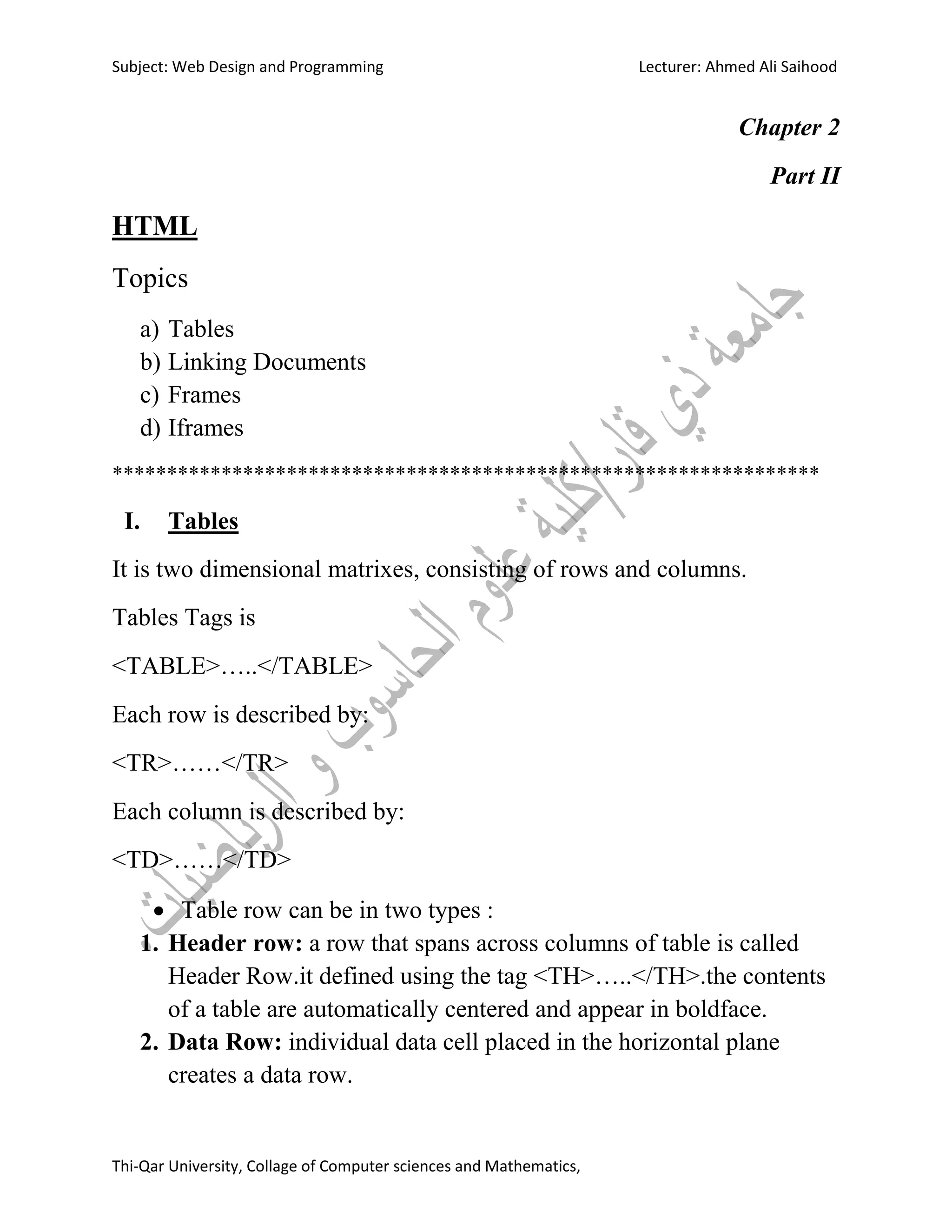
It is two dimensional matrixes, consisting of rows and columns.
Tables Tags is
<TABLE>…..</TABLE>
Each row is described by:
<TR>……</TR>
Each column is described by:
<TD>……</TD>
 Table row can be in two types :
1. Header row: a row that spans across columns of table is called
Header Row.it defined using the tag <TH>…..</TH>.the contents
of a table are automatically centered and appear in boldface.
2. Data Row: individual data cell placed in the horizontal plane
creates a data row.
Subject: Web Design and Programming Lecturer: Ahmed Ali Saihood
Thi-Qar University, Collage of Computer sciences and Mathematics,
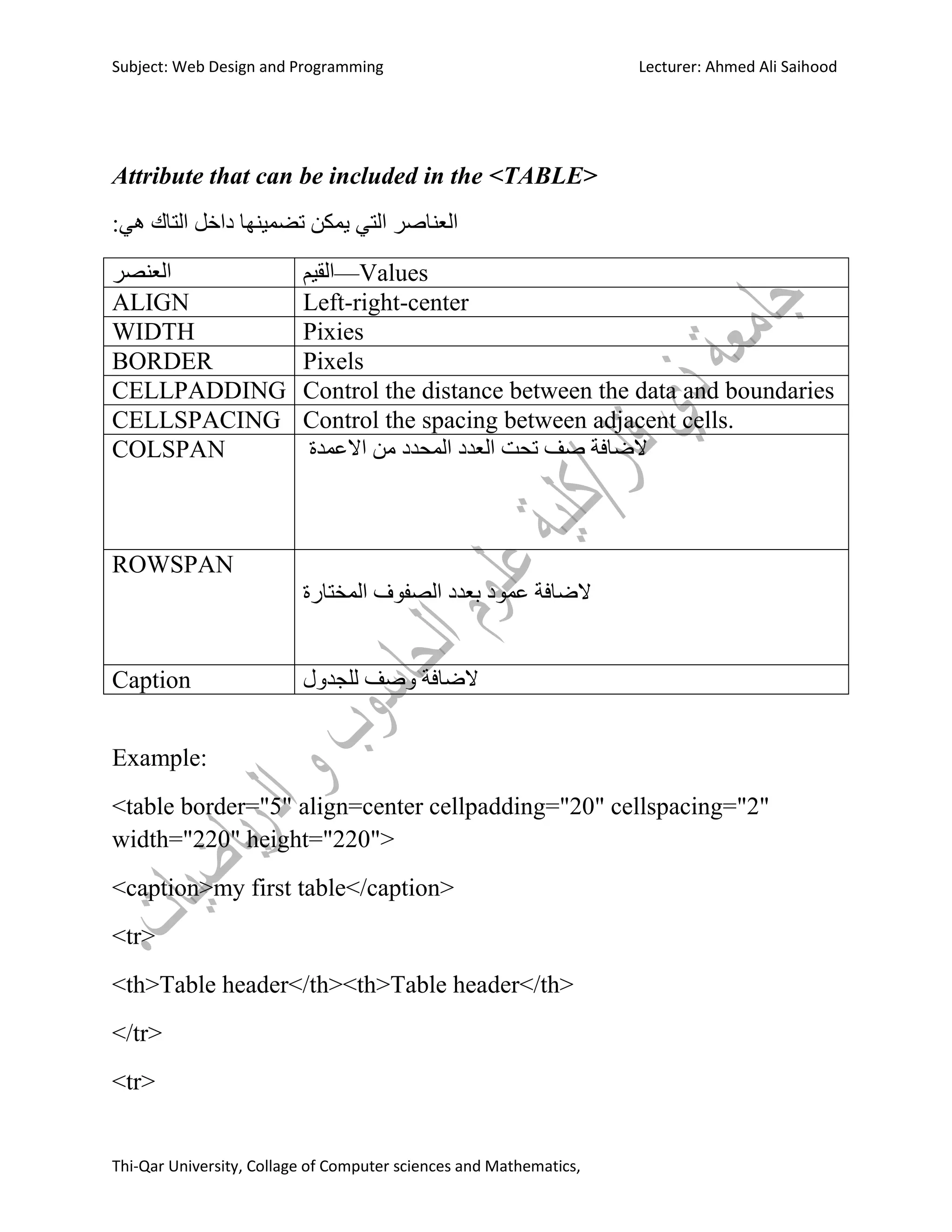
Attribute that can be included in the <TABLE>
:‫هي‬ ‫انتاك‬ ‫داخم‬ ‫تضميىها‬ ‫يمكه‬ ‫انتي‬ ‫انعىاصش‬
‫انعىصش‬ ‫—انقيم‬Values
ALIGN Left-right-center
WIDTH Pixies
BORDER Pixels
CELLPADDING Control the distance between the data and boundaries
CELLSPACING Control the spacing between adjacent cells.
COLSPAN ‫االعمذة‬ ‫مه‬ ‫انمحذد‬ ‫انعذد‬ ‫تحت‬ ‫صف‬ ‫الضافت‬
ROWSPAN
‫انمختاسة‬ ‫انصفىف‬ ‫بعذد‬ ‫عمىد‬ ‫الضافت‬
Caption ‫نهجذول‬ ‫وصف‬ ‫الضافت‬
Example:
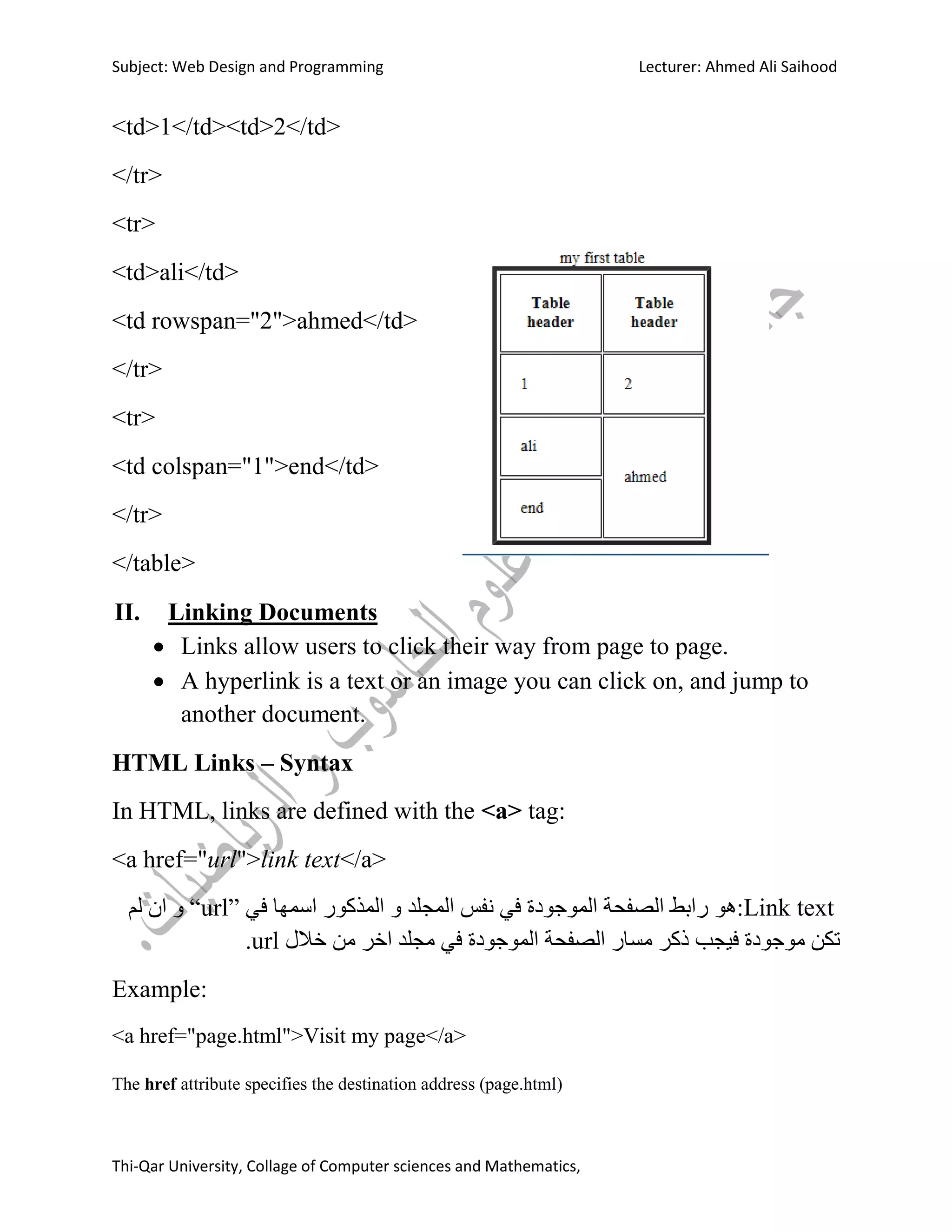
<table border="5" align=center cellpadding="20" cellspacing="2"
width="220" height="220">
<caption>my first table</caption>
<tr>
<th>Table header</th><th>Table header</th>
</tr>
<tr>
Subject: Web Design and Programming Lecturer: Ahmed Ali Saihood
Thi-Qar University, Collage of Computer sciences and Mathematics,
<td>1</td><td>2</td>
</tr>
<tr>
<td>ali</td>
<td rowspan="2">ahmed</td>
</tr>
<tr>
<td colspan="1">end</td>
</tr>
</table>
II. Linking Documents
 Links allow users to click their way from page to page.
 A hyperlink is a text or an image you can click on, and jump to
another document.
HTML Links – Syntax
In HTML, links are defined with the <a> tag:
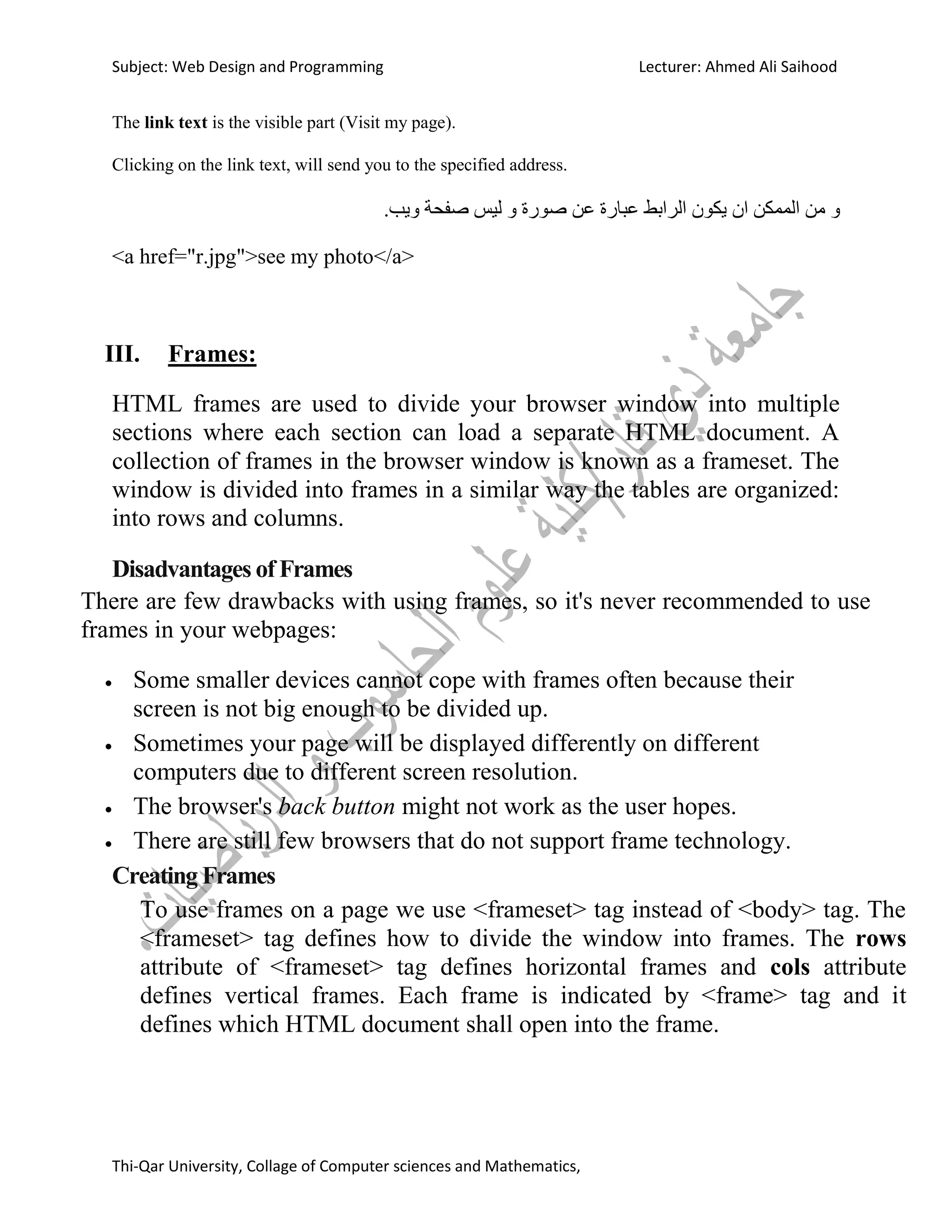
<a href="url">link text</a>
Link text‫:هى‬‫في‬ ‫اسمها‬ ‫انمزكىس‬ ‫و‬ ‫انمجهذ‬ ‫وفس‬ ‫في‬ ‫انمىجىدة‬ ‫انصفحت‬ ‫سابط‬“url”‫نم‬ ‫ان‬ ‫و‬
‫خالل‬ ‫مه‬ ‫اخش‬ ‫مجهذ‬ ‫في‬ ‫انمىجىدة‬ ‫انصفحت‬ ‫مساس‬ ‫ركش‬ ‫فيجب‬ ‫مىجىدة‬ ‫تكه‬url.
Example:
<a href="page.html">Visit my page</a>
The href attribute specifies the destination address (page.html)
Subject: Web Design and Programming Lecturer: Ahmed Ali Saihood
Thi-Qar University, Collage of Computer sciences and Mathematics,
The link text is the visible part (Visit my page).
Clicking on the link text, will send you to the specified address.
.‫ويب‬ ‫صفحت‬ ‫نيس‬ ‫و‬ ‫صىسة‬ ‫عه‬ ‫عباسة‬ ‫انشابط‬ ‫يكىن‬ ‫ان‬ ‫انممكه‬ ‫مه‬ ‫و‬
<a href="r.jpg">see my photo</a>
III. Frames:
HTML frames are used to divide your browser window into multiple
sections where each section can load a separate HTML document. A
collection of frames in the browser window is known as a frameset. The
window is divided into frames in a similar way the tables are organized:
into rows and columns.
Disadvantages of Frames
There are few drawbacks with using frames, so it's never recommended to use
frames in your webpages:
 Some smaller devices cannot cope with frames often because their
screen is not big enough to be divided up.
 Sometimes your page will be displayed differently on different
computers due to different screen resolution.
 The browser's back button might not work as the user hopes.
 There are still few browsers that do not support frame technology.
Creating Frames
To use frames on a page we use <frameset> tag instead of <body> tag. The
<frameset> tag defines how to divide the window into frames. The rows
attribute of <frameset> tag defines horizontal frames and cols attribute
defines vertical frames. Each frame is indicated by <frame> tag and it
defines which HTML document shall open into the frame.
Subject: Web Design and Programming Lecturer: Ahmed Ali Saihood
Thi-Qar University, Collage of Computer sciences and Mathematics,
Example
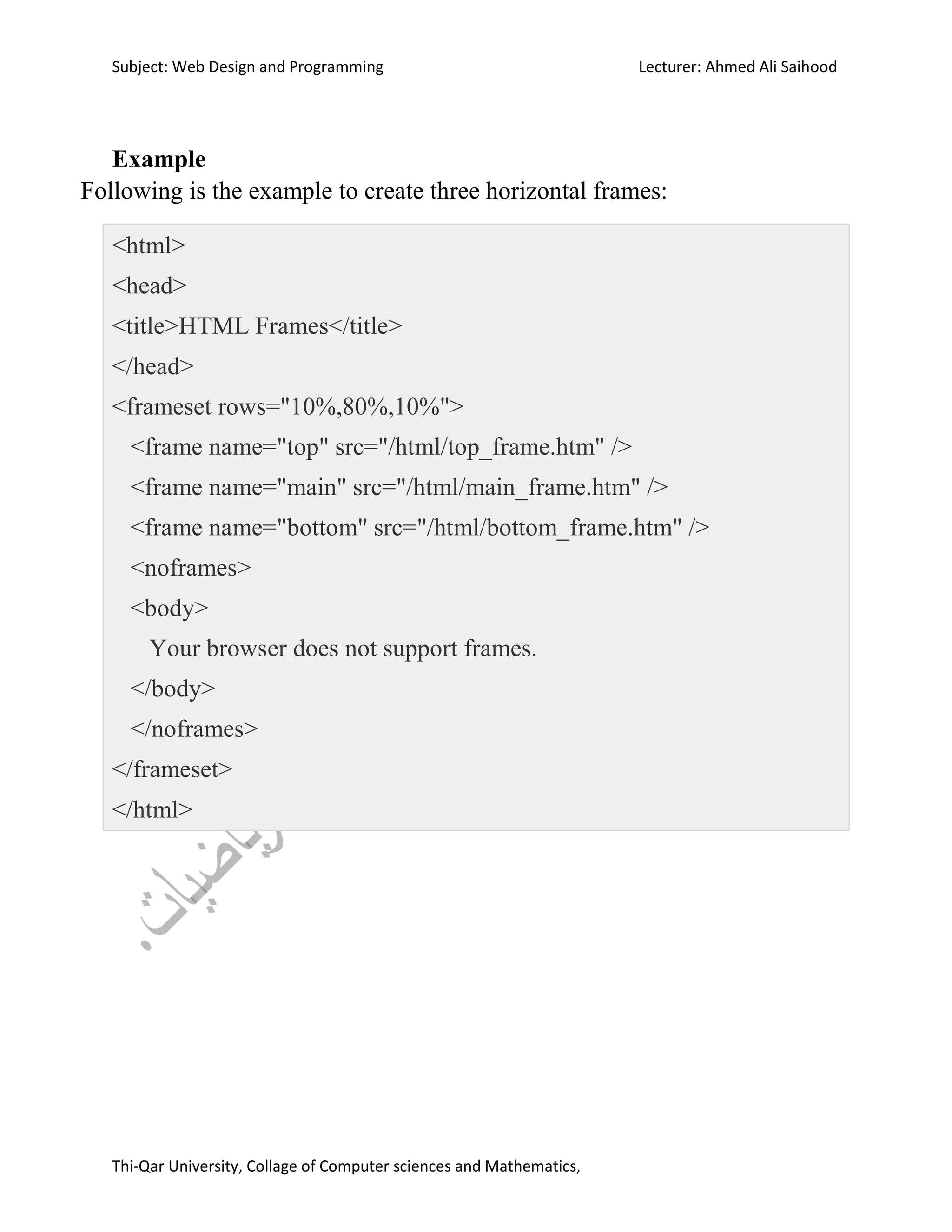
Following is the example to create three horizontal frames:
<html>
<head>
<title>HTML Frames</title>
</head>
<frameset rows="10%,80%,10%">
<frame name="top" src="/html/top_frame.htm" />
<frame name="main" src="/html/main_frame.htm" />
<frame name="bottom" src="/html/bottom_frame.htm" />
<noframes>
<body>
Your browser does not support frames.
</body>
</noframes>
</frameset>
</html>
Subject: Web Design and Programming Lecturer: Ahmed Ali Saihood
Thi-Qar University, Collage of Computer sciences and Mathematics,
Example
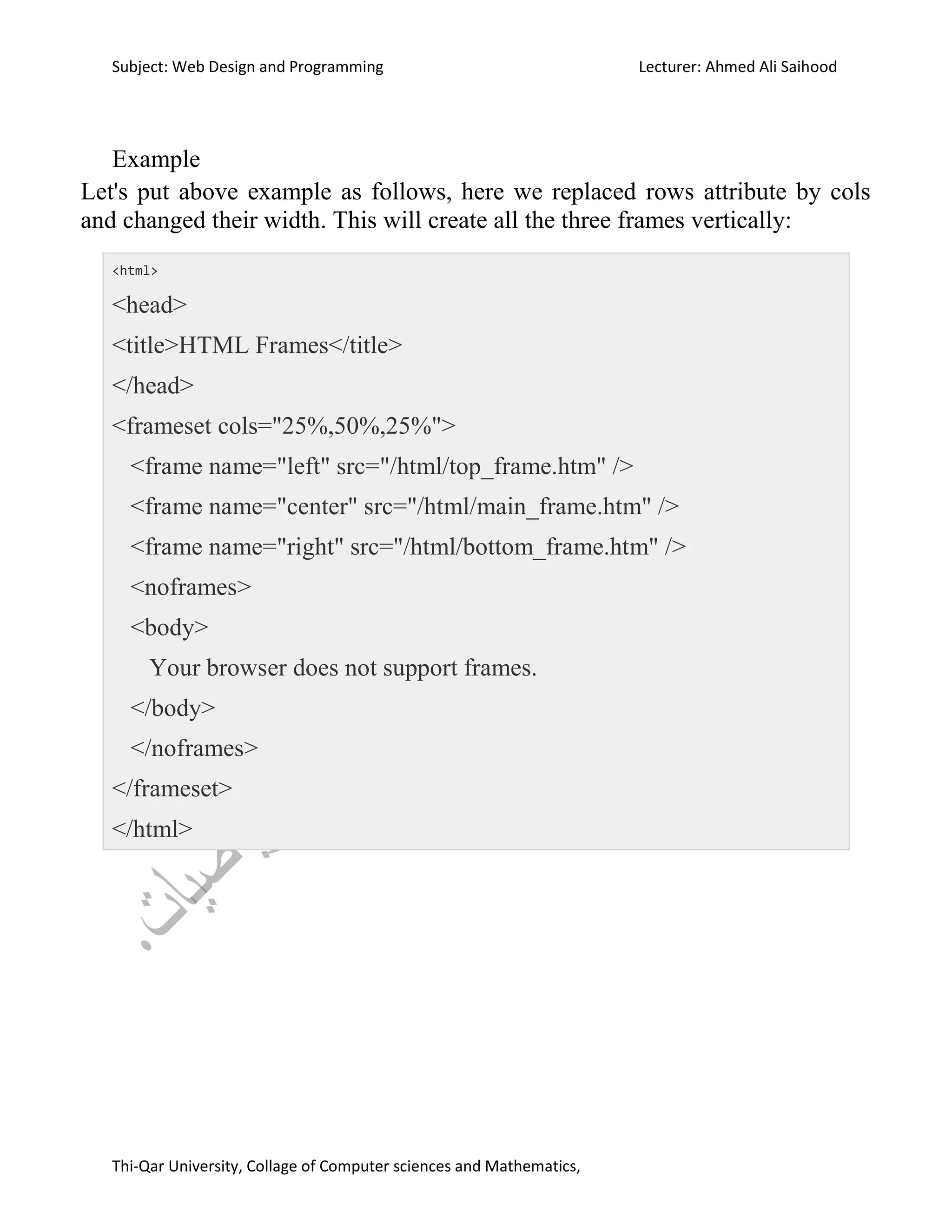
Let's put above example as follows, here we replaced rows attribute by cols
and changed their width. This will create all the three frames vertically:
<html>
<head>
<title>HTML Frames</title>
</head>
<frameset cols="25%,50%,25%">
<frame name="left" src="/html/top_frame.htm" />
<frame name="center" src="/html/main_frame.htm" />
<frame name="right" src="/html/bottom_frame.htm" />
<noframes>
<body>
Your browser does not support frames.
</body>
</noframes>
</frameset>
</html>
Subject: Web Design and Programming Lecturer: Ahmed Ali Saihood
Thi-Qar University, Collage of Computer sciences and Mathematics,
The <frameset> Tag Attributes
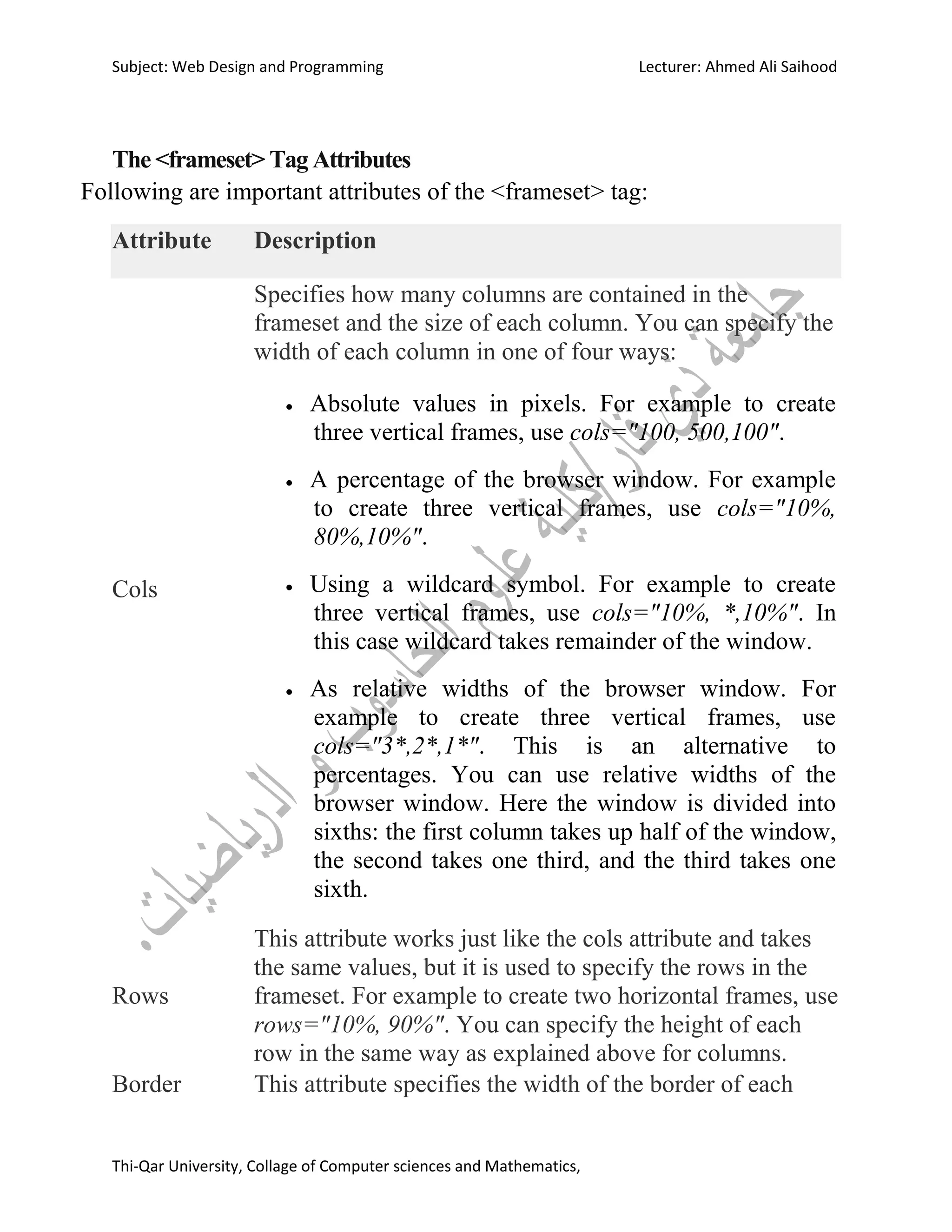
Following are important attributes of the <frameset> tag:
Attribute Description
Cols
Specifies how many columns are contained in the
frameset and the size of each column. You can specify the
width of each column in one of four ways:
 Absolute values in pixels. For example to create
three vertical frames, use cols="100, 500,100".
 A percentage of the browser window. For example
to create three vertical frames, use cols="10%,
80%,10%".
 Using a wildcard symbol. For example to create
three vertical frames, use cols="10%, *,10%". In
this case wildcard takes remainder of the window.
 As relative widths of the browser window. For
example to create three vertical frames, use
cols="3*,2*,1*". This is an alternative to
percentages. You can use relative widths of the
browser window. Here the window is divided into
sixths: the first column takes up half of the window,
the second takes one third, and the third takes one
sixth.
Rows
This attribute works just like the cols attribute and takes
the same values, but it is used to specify the rows in the
frameset. For example to create two horizontal frames, use
rows="10%, 90%". You can specify the height of each
row in the same way as explained above for columns.
Border This attribute specifies the width of the border of each
Subject: Web Design and Programming Lecturer: Ahmed Ali Saihood
Thi-Qar University, Collage of Computer sciences and Mathematics,
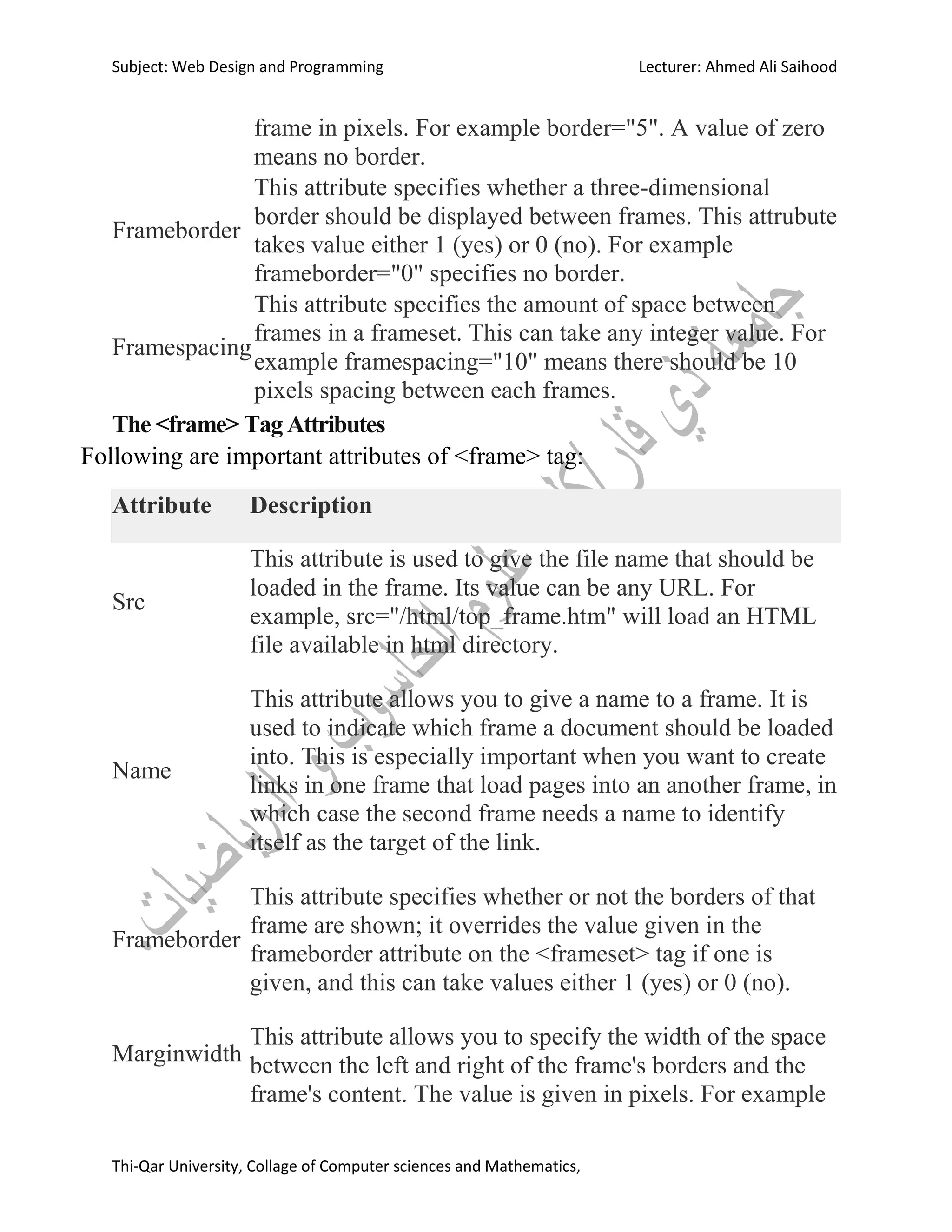
frame in pixels. For example border="5". A value of zero
means no border.
Frameborder
This attribute specifies whether a three-dimensional
border should be displayed between frames. This attrubute
takes value either 1 (yes) or 0 (no). For example
frameborder="0" specifies no border.
Framespacing
This attribute specifies the amount of space between
frames in a frameset. This can take any integer value. For
example framespacing="10" means there should be 10
pixels spacing between each frames.
The <frame> Tag Attributes
Following are important attributes of <frame> tag:
Attribute Description
Src
This attribute is used to give the file name that should be
loaded in the frame. Its value can be any URL. For
example, src="/html/top_frame.htm" will load an HTML
file available in html directory.
Name
This attribute allows you to give a name to a frame. It is
used to indicate which frame a document should be loaded
into. This is especially important when you want to create
links in one frame that load pages into an another frame, in
which case the second frame needs a name to identify
itself as the target of the link.
Frameborder
This attribute specifies whether or not the borders of that
frame are shown; it overrides the value given in the
frameborder attribute on the <frameset> tag if one is
given, and this can take values either 1 (yes) or 0 (no).
Marginwidth
This attribute allows you to specify the width of the space
between the left and right of the frame's borders and the
frame's content. The value is given in pixels. For example
Subject: Web Design and Programming Lecturer: Ahmed Ali Saihood
Thi-Qar University, Collage of Computer sciences and Mathematics,
marginwidth="10".
Marginheight
This attribute allows you to specify the height of the space
between the top and bottom of the frame's borders and its
contents. The value is given in pixels. For example
marginheight="10".
Noresize
By default you can resize any frame by clicking and
dragging on the borders of a frame. The noresize attribute
prevents a user from being able to resize the frame. For
example noresize="noresize".
Scrolling
This attribute controls the appearance of the scrollbars that
appear on the frame. This takes values either "yes", "no" or
"auto". For example scrolling="no" means it should not
have scroll bars.
Longdesc
This attribute allows you to provide a link to another page
containing a long description of the contents of the frame.
For example longdesc="framedescription.html
IV. Iframe:
The <iframe> tag is not somehow related to <frameset> tag, instead, it can
appear anywhere in your document. The <iframe> tag defines a rectangular
region within the document in which the browser can display a separate
document, including scrollbars and borders.
The src attribute is used to specify the URL of the document that occupies
the inline frame.
Subject: Web Design and Programming Lecturer: Ahmed Ali Saihood
Thi-Qar University, Collage of Computer sciences and Mathematics,
Example
Following is the example to show how to use the <iframe>:
<html>
<head>
<title>HTML Iframes</title>
</head>
<body>
<p>Document content goes here...</p>
<iframe src="/html/menu.htm" width="555" height="200">
</iframe>
<p>Document content also go here...</p>
</body>
</html>
The <Iframe> Tag Attributes
Most of the attributes of the <iframe> tag, including name, class, frameborder,
id, longdesc, marginheight, marginwidth, name, scrolling, style, and title
behave exactly like the corresponding attributes for the <frame> tag.
Attribute Description
Src
This attribute is used to give the file name that should be
loaded in the frame. Its value can be any URL. For
example, src="/html/top_frame.htm" will load an HTML
file avalaible in html directory.
Name
This attribute allows you to give a name to a frame. It is
used to indicate which frame a document should be loaded
into. This is especially important when you want to create
Subject: Web Design and Programming Lecturer: Ahmed Ali Saihood
Thi-Qar University, Collage of Computer sciences and Mathematics,
links in one frame that load pages into an another frame, in
which case the second frame needs a name to identify
itself as the target of the link.
Frameborder
This attribute specifies whether or not the borders of that
frame are shown; it overrides the value given in the
frameborder attribute on the <frameset> tag if one is
given, and this can take values either 1 (yes) or 0 (no).
Marginwidth
This attribute allows you to specify the width of the space
between the left and right of the frame's borders and the
frame's content. The value is given in pixels. For example
marginwidth="10".
Marginheight
This attribute allows you to specify the height of the space
between the top and bottom of the frame's borders and its
contents. The value is given in pixels. For example
marginheight="10".
Scrolling
This attribute controls the appearance of the scrollbars that
appear on the frame. This takes values either "yes", "no" or
"auto". For example scrolling="no" means it should not
have scroll bars.
Targeting
Target=frame mane
Example:
<a href=”index.html” target=”frame name”> Visit Us</a>
.‫انهذف‬ ‫في‬ ‫اسمه‬ ‫انمزكىس‬ ‫انمكان‬ ‫في‬ ‫سيظهش‬ ‫هىا‬ ‫و‬ ‫انشابط‬ ‫به‬ ‫سيظهش‬ ‫انزي‬ ‫انمكان‬ ‫هى‬ ‫انهذف‬

HTML-Part2

  • 1.
    Subject: Web Designand Programming Lecturer: Ahmed Ali Saihood Thi-Qar University, Collage of Computer sciences and Mathematics, Chapter 2 Part II HTML Topics a) Tables b) Linking Documents c) Frames d) Iframes ***************************************************************** I. Tables It is two dimensional matrixes, consisting of rows and columns. Tables Tags is <TABLE>…..</TABLE> Each row is described by: <TR>……</TR> Each column is described by: <TD>……</TD>  Table row can be in two types : 1. Header row: a row that spans across columns of table is called Header Row.it defined using the tag <TH>…..</TH>.the contents of a table are automatically centered and appear in boldface. 2. Data Row: individual data cell placed in the horizontal plane creates a data row.
  • 2.
    Subject: Web Designand Programming Lecturer: Ahmed Ali Saihood Thi-Qar University, Collage of Computer sciences and Mathematics, Attribute that can be included in the <TABLE> :‫هي‬ ‫انتاك‬ ‫داخم‬ ‫تضميىها‬ ‫يمكه‬ ‫انتي‬ ‫انعىاصش‬ ‫انعىصش‬ ‫—انقيم‬Values ALIGN Left-right-center WIDTH Pixies BORDER Pixels CELLPADDING Control the distance between the data and boundaries CELLSPACING Control the spacing between adjacent cells. COLSPAN ‫االعمذة‬ ‫مه‬ ‫انمحذد‬ ‫انعذد‬ ‫تحت‬ ‫صف‬ ‫الضافت‬ ROWSPAN ‫انمختاسة‬ ‫انصفىف‬ ‫بعذد‬ ‫عمىد‬ ‫الضافت‬ Caption ‫نهجذول‬ ‫وصف‬ ‫الضافت‬ Example: <table border="5" align=center cellpadding="20" cellspacing="2" width="220" height="220"> <caption>my first table</caption> <tr> <th>Table header</th><th>Table header</th> </tr> <tr>
  • 3.
    Subject: Web Designand Programming Lecturer: Ahmed Ali Saihood Thi-Qar University, Collage of Computer sciences and Mathematics, <td>1</td><td>2</td> </tr> <tr> <td>ali</td> <td rowspan="2">ahmed</td> </tr> <tr> <td colspan="1">end</td> </tr> </table> II. Linking Documents  Links allow users to click their way from page to page.  A hyperlink is a text or an image you can click on, and jump to another document. HTML Links – Syntax In HTML, links are defined with the <a> tag: <a href="url">link text</a> Link text‫:هى‬‫في‬ ‫اسمها‬ ‫انمزكىس‬ ‫و‬ ‫انمجهذ‬ ‫وفس‬ ‫في‬ ‫انمىجىدة‬ ‫انصفحت‬ ‫سابط‬“url”‫نم‬ ‫ان‬ ‫و‬ ‫خالل‬ ‫مه‬ ‫اخش‬ ‫مجهذ‬ ‫في‬ ‫انمىجىدة‬ ‫انصفحت‬ ‫مساس‬ ‫ركش‬ ‫فيجب‬ ‫مىجىدة‬ ‫تكه‬url. Example: <a href="page.html">Visit my page</a> The href attribute specifies the destination address (page.html)
  • 4.
    Subject: Web Designand Programming Lecturer: Ahmed Ali Saihood Thi-Qar University, Collage of Computer sciences and Mathematics, The link text is the visible part (Visit my page). Clicking on the link text, will send you to the specified address. .‫ويب‬ ‫صفحت‬ ‫نيس‬ ‫و‬ ‫صىسة‬ ‫عه‬ ‫عباسة‬ ‫انشابط‬ ‫يكىن‬ ‫ان‬ ‫انممكه‬ ‫مه‬ ‫و‬ <a href="r.jpg">see my photo</a> III. Frames: HTML frames are used to divide your browser window into multiple sections where each section can load a separate HTML document. A collection of frames in the browser window is known as a frameset. The window is divided into frames in a similar way the tables are organized: into rows and columns. Disadvantages of Frames There are few drawbacks with using frames, so it's never recommended to use frames in your webpages:  Some smaller devices cannot cope with frames often because their screen is not big enough to be divided up.  Sometimes your page will be displayed differently on different computers due to different screen resolution.  The browser's back button might not work as the user hopes.  There are still few browsers that do not support frame technology. Creating Frames To use frames on a page we use <frameset> tag instead of <body> tag. The <frameset> tag defines how to divide the window into frames. The rows attribute of <frameset> tag defines horizontal frames and cols attribute defines vertical frames. Each frame is indicated by <frame> tag and it defines which HTML document shall open into the frame.
  • 5.
    Subject: Web Designand Programming Lecturer: Ahmed Ali Saihood Thi-Qar University, Collage of Computer sciences and Mathematics, Example Following is the example to create three horizontal frames: <html> <head> <title>HTML Frames</title> </head> <frameset rows="10%,80%,10%"> <frame name="top" src="/html/top_frame.htm" /> <frame name="main" src="/html/main_frame.htm" /> <frame name="bottom" src="/html/bottom_frame.htm" /> <noframes> <body> Your browser does not support frames. </body> </noframes> </frameset> </html>
  • 6.
    Subject: Web Designand Programming Lecturer: Ahmed Ali Saihood Thi-Qar University, Collage of Computer sciences and Mathematics, Example Let's put above example as follows, here we replaced rows attribute by cols and changed their width. This will create all the three frames vertically: <html> <head> <title>HTML Frames</title> </head> <frameset cols="25%,50%,25%"> <frame name="left" src="/html/top_frame.htm" /> <frame name="center" src="/html/main_frame.htm" /> <frame name="right" src="/html/bottom_frame.htm" /> <noframes> <body> Your browser does not support frames. </body> </noframes> </frameset> </html>
  • 7.
    Subject: Web Designand Programming Lecturer: Ahmed Ali Saihood Thi-Qar University, Collage of Computer sciences and Mathematics, The <frameset> Tag Attributes Following are important attributes of the <frameset> tag: Attribute Description Cols Specifies how many columns are contained in the frameset and the size of each column. You can specify the width of each column in one of four ways:  Absolute values in pixels. For example to create three vertical frames, use cols="100, 500,100".  A percentage of the browser window. For example to create three vertical frames, use cols="10%, 80%,10%".  Using a wildcard symbol. For example to create three vertical frames, use cols="10%, *,10%". In this case wildcard takes remainder of the window.  As relative widths of the browser window. For example to create three vertical frames, use cols="3*,2*,1*". This is an alternative to percentages. You can use relative widths of the browser window. Here the window is divided into sixths: the first column takes up half of the window, the second takes one third, and the third takes one sixth. Rows This attribute works just like the cols attribute and takes the same values, but it is used to specify the rows in the frameset. For example to create two horizontal frames, use rows="10%, 90%". You can specify the height of each row in the same way as explained above for columns. Border This attribute specifies the width of the border of each
  • 8.
    Subject: Web Designand Programming Lecturer: Ahmed Ali Saihood Thi-Qar University, Collage of Computer sciences and Mathematics, frame in pixels. For example border="5". A value of zero means no border. Frameborder This attribute specifies whether a three-dimensional border should be displayed between frames. This attrubute takes value either 1 (yes) or 0 (no). For example frameborder="0" specifies no border. Framespacing This attribute specifies the amount of space between frames in a frameset. This can take any integer value. For example framespacing="10" means there should be 10 pixels spacing between each frames. The <frame> Tag Attributes Following are important attributes of <frame> tag: Attribute Description Src This attribute is used to give the file name that should be loaded in the frame. Its value can be any URL. For example, src="/html/top_frame.htm" will load an HTML file available in html directory. Name This attribute allows you to give a name to a frame. It is used to indicate which frame a document should be loaded into. This is especially important when you want to create links in one frame that load pages into an another frame, in which case the second frame needs a name to identify itself as the target of the link. Frameborder This attribute specifies whether or not the borders of that frame are shown; it overrides the value given in the frameborder attribute on the <frameset> tag if one is given, and this can take values either 1 (yes) or 0 (no). Marginwidth This attribute allows you to specify the width of the space between the left and right of the frame's borders and the frame's content. The value is given in pixels. For example
  • 9.
    Subject: Web Designand Programming Lecturer: Ahmed Ali Saihood Thi-Qar University, Collage of Computer sciences and Mathematics, marginwidth="10". Marginheight This attribute allows you to specify the height of the space between the top and bottom of the frame's borders and its contents. The value is given in pixels. For example marginheight="10". Noresize By default you can resize any frame by clicking and dragging on the borders of a frame. The noresize attribute prevents a user from being able to resize the frame. For example noresize="noresize". Scrolling This attribute controls the appearance of the scrollbars that appear on the frame. This takes values either "yes", "no" or "auto". For example scrolling="no" means it should not have scroll bars. Longdesc This attribute allows you to provide a link to another page containing a long description of the contents of the frame. For example longdesc="framedescription.html IV. Iframe: The <iframe> tag is not somehow related to <frameset> tag, instead, it can appear anywhere in your document. The <iframe> tag defines a rectangular region within the document in which the browser can display a separate document, including scrollbars and borders. The src attribute is used to specify the URL of the document that occupies the inline frame.
  • 10.
    Subject: Web Designand Programming Lecturer: Ahmed Ali Saihood Thi-Qar University, Collage of Computer sciences and Mathematics, Example Following is the example to show how to use the <iframe>: <html> <head> <title>HTML Iframes</title> </head> <body> <p>Document content goes here...</p> <iframe src="/html/menu.htm" width="555" height="200"> </iframe> <p>Document content also go here...</p> </body> </html> The <Iframe> Tag Attributes Most of the attributes of the <iframe> tag, including name, class, frameborder, id, longdesc, marginheight, marginwidth, name, scrolling, style, and title behave exactly like the corresponding attributes for the <frame> tag. Attribute Description Src This attribute is used to give the file name that should be loaded in the frame. Its value can be any URL. For example, src="/html/top_frame.htm" will load an HTML file avalaible in html directory. Name This attribute allows you to give a name to a frame. It is used to indicate which frame a document should be loaded into. This is especially important when you want to create
  • 11.
    Subject: Web Designand Programming Lecturer: Ahmed Ali Saihood Thi-Qar University, Collage of Computer sciences and Mathematics, links in one frame that load pages into an another frame, in which case the second frame needs a name to identify itself as the target of the link. Frameborder This attribute specifies whether or not the borders of that frame are shown; it overrides the value given in the frameborder attribute on the <frameset> tag if one is given, and this can take values either 1 (yes) or 0 (no). Marginwidth This attribute allows you to specify the width of the space between the left and right of the frame's borders and the frame's content. The value is given in pixels. For example marginwidth="10". Marginheight This attribute allows you to specify the height of the space between the top and bottom of the frame's borders and its contents. The value is given in pixels. For example marginheight="10". Scrolling This attribute controls the appearance of the scrollbars that appear on the frame. This takes values either "yes", "no" or "auto". For example scrolling="no" means it should not have scroll bars. Targeting Target=frame mane Example: <a href=”index.html” target=”frame name”> Visit Us</a> .‫انهذف‬ ‫في‬ ‫اسمه‬ ‫انمزكىس‬ ‫انمكان‬ ‫في‬ ‫سيظهش‬ ‫هىا‬ ‫و‬ ‫انشابط‬ ‫به‬ ‫سيظهش‬ ‫انزي‬ ‫انمكان‬ ‫هى‬ ‫انهذف‬