Session on 
HTML, CSS & UI/UX 
Design 
By Karthikeyan 10-31-2014
• Quick revision on HTML & CSS 
• Few Standards & Practices on HTML & CSS 
• Introduction to HTML 5 
• HTML 5 Best Practices on Semantics Elements 
& 
• What is UI/UX 
• Why UX is important 
• Few UI Principles to follow… 
Agenda for next 2 hrs 
2
Lets get started with the quick revision of 
HTML & CSS 3
• What is HTML? 
• HTML is a language for describing webpages 
• HTML Stands for Hyper Text Markup Language 
• When it is started and how it is growing up? 
• HTML 1.0 - 1993 
• HTML 2.0 -1995 
• HTML 3.2 - 1997 
• HTML 4.0 - 1998 
• HTML 4.01 - 1999 
• XHTML – Combination of XML & HTML ( Very Strict) 2000 
• HTML 5 – 2004 – its still growing 
HTML ? ! 
4
• USE of HTML & CSS 
• Website is a way to present your content to the world, using HTML & 
CSS to present that content & make it look neat. 
• Your content 
• HTML: Structure + 
• CSS: Presentation = Website 
Use of HTML 
5
• A paragraph is your content. 
• Putting your content into an html tag to make it look 
like a paragraph is a structure. 
<p>I am a Paragraph </p> 
Make the font of your paragraph “blue” and “18px” is presentation which 
you will be using CSS 
Content - Example 
6
• Element 
• An individual component of HTML is 
• Paragraph, Table & Lists 
• Tag 
• Markers that signal the beginning and end of an element. 
• Opening tag and Closing Tag 
<p> this is my sample text </p> 
Structures of an HTML 
7
• Container Element 
• An element that can contain other elements or content 
• A paragraph <p> contains text 
• Standalone Element 
• An element that cnnot contain anything else 
• <hr/> 
• <img/> 
Structures of an HTML 8
• Attribute 
• Each elements can have a variety of attributes 
• For Ex;- Language, style, identity, source, input 
• Value 
• Value is the value assigned to a given attribute ( For Ex:- 
• For Ex:- <p lang=“fr”> C’est ;a vie </p> 
• <img src=“my.picture.jpg”/> 
Structures of an HTML 9
• CSS = Cascading Style Sheets 
• CSS used to style the elements on your page. 
• CSS is works in conjunction with HTML, but is not HTML 
itself. 
Review CSS 
10
① Inline Styles 
② Internal Style 
③ External Style ( Recommended way to use ) 
3 Types of StyleSheets 
11
Selector { 
Property:value; 
} 
• A block of css is Rule Block 
• The rule starts with a selector. 
• And It has sets of properties & Values 
CSS Rule 
12
• Property and value of style you plan to use on HTML 
element. 
• Value ends with a semicolon ; 
• So these declaration can be grouped and surrounded by 
curly brackets. 
Selector{ 
Property:value; 
Property:value; 
} 
CSS Syntax 
13
P{ 
Property:value; 
} 
Selects all paragraph elements. 
Img{ 
Property: value; 
} 
Selects all image elements 
Selector Element 
14
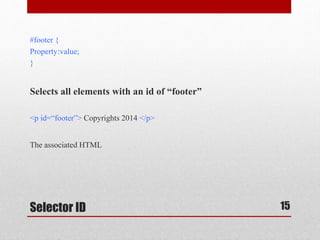
#footer { 
Property:value; 
} 
Selects all elements with an id of “footer” 
<p id=“footer”> Copyrights 2014 </p> 
The associated HTML 
Selector ID 
15
.warning { 
color: red; 
} 
Selects all elements with a class of “warning” 
<p class=“ warning”> run away </p> 
The associated HTML 
Selector Class 
16
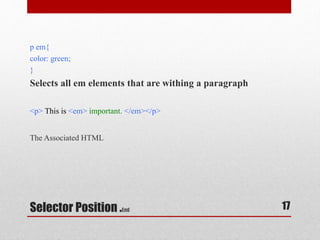
p em{ 
color: green; 
} 
Selects all em elements that are withing a paragraph 
<p> This is <em> important. </em></p> 
The Associated HTML 
Selector Position .End 
17
Standard Practices 18
• Reset CSS Files 
• Standard widths and sizes 
• Wrappers 
Standard Practices 
19
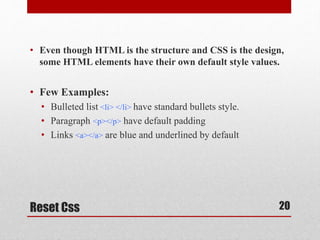
• Even though HTML is the structure and CSS is the design, 
some HTML elements have their own default style values. 
• Few Examples: 
• Bulleted list <li> </li> have standard bullets style. 
• Paragraph <p></p> have default padding 
• Links <a></a> are blue and underlined by default 
Reset Css 
20
• Most Elements: 
Margin:0; 
Padding:0; 
Border:0; 
Font-size:100%; 
Font:inherit; 
Vertical Align:baseline; 
• Lists 
List-style:none; 
Reset Css 
21
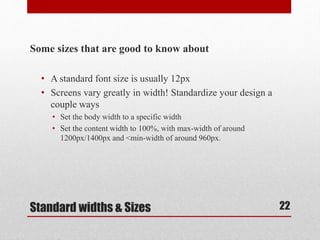
Some sizes that are good to know about 
• A standard font size is usually 12px 
• Screens vary greatly in width! Standardize your design a 
couple ways 
• Set the body width to a specific width 
• Set the content width to 100%, with max-width of around 
1200px/1400px and <min-width of around 960px. 
Standard widths & Sizes 
22
• Wrappers are a good way to center content if the screen 
width is wider than your content. 
.wrapper{ 
Width:100%; 
Max-width:1400px; 
Margin: 0 auto; 
} 
Wrappers .End 
23
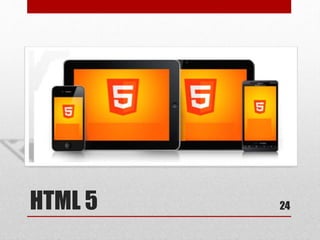
HTML 5 24
• Formally HTML5 is the W3c specification for the next 
version of html 
• Informally people use HTML5 to refer to whole set of 
new web standards and abilities 
• HTML5, CSS3 & Javascript 
HTML5 What is it 
25
HTML Specifications 
• 2004 – started 
• 2008- first public working draft 
• 2011 – last call 
• 2012 working draft 
• 2014 – planned for stable recommendation 
Finally HTML5 became the W3C Standards on ( October 29 2014 
) 
HTML Specification 
26
• Chrome 
• Firefox 
• IE ( After Ver-8 few features )  
• Safari 
• Opera 
Supported Broswers 
27
What's so cool about it? 
Few old elements have been obsolete 
• Frame, Frameset, no frames 
• Presentational elements and attributes replaced by CSS 
e.g.font, big,center) 
New in Html5 & CSS3 
28
• Redefines a few things 
• It gives semantic meaning to few old elements and 
separates them from presentation ( eg. B, I, strong, em) 
New in Html5 & CSS3 29
Semantics: Html5 now includes new tags that describe parts of a document. 
Not there are dedicated tags for navigations elements, articles, sections, headers 
& footers. 
New Form Elements: Forms have some major updates. There are several new 
versions of the <input> elements, allowing user to pick colors, numbers, e-mail 
addresses & dates with easy –to use elements. Made it more user friendly ( 
even you don’t need to add a JavaScript to validations forms) if you use a 
proper input types. 
Media Elements: At long last, they have native support for audio & video with 
tags similar to the <img>tags. 
Canvas tag: It allows the developer to build graphics interactively. This 
capability will allow for very intriguing capabilities like custom gaming and 
interface elements. 
HTML 4 to HTML5 
30
• Embedded Font support: with this you can include a font with a webpage, 
and it will render even if the user doesn’t have the font installed on her 
operating system. 
• New selectors : Selectors are used to describe a chunk of code to be 
modified. CSS3 now supports new selectors that let choose every other 
element, as well as specific sub elements ( different types of input tags) 
• Columns: Html has never had decent support columns and all kinds of hacks 
have been used to overcome this shortcoming. Finally , CSS includes the 
ability to break an element into any number of columns easily. 
• Visual Enhancements: CSS has a number of interesting new capabilities : 
Transparency, shadows, rounded corners animation, gradients & 
transformations. These provide a profound new level of control over the 
appearance of a page. 
CSS and HTML5 
31
• Local Storage Mechanism: HTML 5 now allows the developer to store data 
on the client. There is even a built in database manager that accepts SQL 
Commands. 
• Geo-location: This interesting features uses a variety of mechanism to 
determine where the user is located. 
• And lot more.. …. 
JAVASCRIPT & HTML5 
32
<!doctype html> 
Minimum information required to ensure that a broser 
renders using a standards mode 
Old doctypes 
<!doctype htmll public “-w3c … 4.01 bla bla blaa 
> 
HTML5 Doctype 
33
The use of HTML markup to re-inforce the semantics or 
meaning of the information in webpages rather than merely 
to define its presentation (look) 
Semantics 
Give meaning to structure 
Semantic HTML 
34
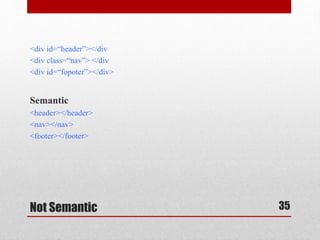
<div id=“header”></div 
<div class=“nav”> </div 
<div id=“fopoter”></div> 
Semantic 
<header></header> 
<nav></nav> 
<footer></footer> 
Not Semantic 
35
<Section> 
Group together thematically related to content 
Similar to prior use of the div, but div has no semantic 
meaning 
New Structural Elements 
36
<Header> 
Container for group of a introductory or navigational aids 
Document can have multiple header elements 
• E.g One for the page, one for each section 
New Structural Elements 37
<Footer> 
Contains information about its containing element 
• E.g who wrote it.. copyright links to related content 
Document can have multiple footer elements 
• Eg one for the page one for the each section. 
New Structural Elements 38
<aside> 
Tangentially related content 
• E.g sidebar, pull quotes 
<nav> 
Contains major navigational information 
Usually a list of links 
Often lives in the header 
• E.g site navigation 
New Structural Elements 39
<Article> 
Self- contained related content 
• E.g blog posts, news stories, comments , reviews, forum posts 
New Structural Elements 
40
Not Semantic 41
Semantic 42
• Accessibility 
• Searchability 
• Internationalization 
It also helps treat the plague of div-itis 
What is the use Semantics Markups and 
advantages 
43
• HTML5SHIV 
• HTML5shiv IE enabling script 
• <!– if it ie 9!? 
• <script src=“html5shjiv.js></script. 
• <!9endig) 
• Polyfill (n) javascripts shim that replicated the standard api for 
older broswers 
Hack for old browsers END.. 
44
UI/UX ? 45
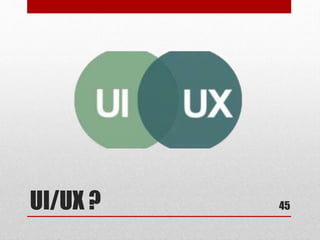
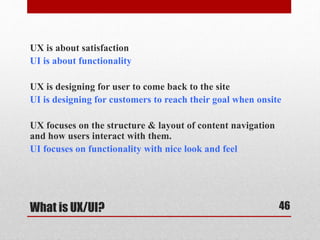
UX is about satisfaction 
UI is about functionality 
UX is designing for user to come back to the site 
UI is designing for customers to reach their goal when onsite 
UX focuses on the structure & layout of content navigation 
and how users interact with them. 
UI focuses on functionality with nice look and feel 
What is UX/UI? 
46
UX measures the ROI of usability to look for 
• More frequent visits to your website/product 
• Increased return visits to your site 
• User staying longer on your site 
• Increased sales 
• Decreases user errors 
• Decreased customer support costs 
• Reduced word of mouth complaints 
Why UX 
47
Few UI Principles need to be followed 48
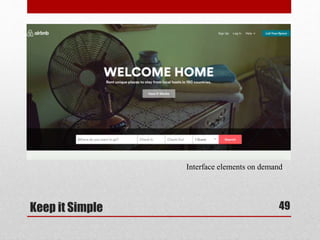
Keep it Simple 
Interface elements on demand 
49
Make it Straight forward.. 
IN-page editing, drage & drop 
50
Stay on Context 51
Guide User 
For First time user! Tell them what to do next 
52
Always keep informed the users. What's happening! 
Always Provide Feedback 
53
Don’t forget Aesthetics 54
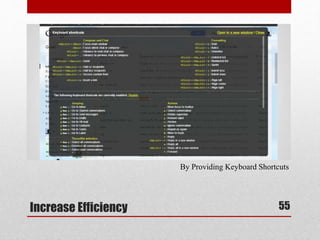
Increase Efficiency 
By Providing Keyboard Shortcuts 
55
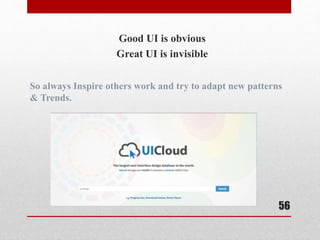
Good UI is obvious 
Great UI is invisible 
So always Inspire others work and try to adapt new patterns 
& Trends. 
56
Think for the user, don't make them think! 
Completing todays session with my favorite 
Quote 
57

Html,CSS & UI/UX design

  • 1.
    Session on HTML,CSS & UI/UX Design By Karthikeyan 10-31-2014
  • 2.
    • Quick revisionon HTML & CSS • Few Standards & Practices on HTML & CSS • Introduction to HTML 5 • HTML 5 Best Practices on Semantics Elements & • What is UI/UX • Why UX is important • Few UI Principles to follow… Agenda for next 2 hrs 2
  • 3.
    Lets get startedwith the quick revision of HTML & CSS 3
  • 4.
    • What isHTML? • HTML is a language for describing webpages • HTML Stands for Hyper Text Markup Language • When it is started and how it is growing up? • HTML 1.0 - 1993 • HTML 2.0 -1995 • HTML 3.2 - 1997 • HTML 4.0 - 1998 • HTML 4.01 - 1999 • XHTML – Combination of XML & HTML ( Very Strict) 2000 • HTML 5 – 2004 – its still growing HTML ? ! 4
  • 5.
    • USE ofHTML & CSS • Website is a way to present your content to the world, using HTML & CSS to present that content & make it look neat. • Your content • HTML: Structure + • CSS: Presentation = Website Use of HTML 5
  • 6.
    • A paragraphis your content. • Putting your content into an html tag to make it look like a paragraph is a structure. <p>I am a Paragraph </p> Make the font of your paragraph “blue” and “18px” is presentation which you will be using CSS Content - Example 6
  • 7.
    • Element •An individual component of HTML is • Paragraph, Table & Lists • Tag • Markers that signal the beginning and end of an element. • Opening tag and Closing Tag <p> this is my sample text </p> Structures of an HTML 7
  • 8.
    • Container Element • An element that can contain other elements or content • A paragraph <p> contains text • Standalone Element • An element that cnnot contain anything else • <hr/> • <img/> Structures of an HTML 8
  • 9.
    • Attribute •Each elements can have a variety of attributes • For Ex;- Language, style, identity, source, input • Value • Value is the value assigned to a given attribute ( For Ex:- • For Ex:- <p lang=“fr”> C’est ;a vie </p> • <img src=“my.picture.jpg”/> Structures of an HTML 9
  • 10.
    • CSS =Cascading Style Sheets • CSS used to style the elements on your page. • CSS is works in conjunction with HTML, but is not HTML itself. Review CSS 10
  • 11.
    ① Inline Styles ② Internal Style ③ External Style ( Recommended way to use ) 3 Types of StyleSheets 11
  • 12.
    Selector { Property:value; } • A block of css is Rule Block • The rule starts with a selector. • And It has sets of properties & Values CSS Rule 12
  • 13.
    • Property andvalue of style you plan to use on HTML element. • Value ends with a semicolon ; • So these declaration can be grouped and surrounded by curly brackets. Selector{ Property:value; Property:value; } CSS Syntax 13
  • 14.
    P{ Property:value; } Selects all paragraph elements. Img{ Property: value; } Selects all image elements Selector Element 14
  • 15.
    #footer { Property:value; } Selects all elements with an id of “footer” <p id=“footer”> Copyrights 2014 </p> The associated HTML Selector ID 15
  • 16.
    .warning { color:red; } Selects all elements with a class of “warning” <p class=“ warning”> run away </p> The associated HTML Selector Class 16
  • 17.
    p em{ color:green; } Selects all em elements that are withing a paragraph <p> This is <em> important. </em></p> The Associated HTML Selector Position .End 17
  • 18.
  • 19.
    • Reset CSSFiles • Standard widths and sizes • Wrappers Standard Practices 19
  • 20.
    • Even thoughHTML is the structure and CSS is the design, some HTML elements have their own default style values. • Few Examples: • Bulleted list <li> </li> have standard bullets style. • Paragraph <p></p> have default padding • Links <a></a> are blue and underlined by default Reset Css 20
  • 21.
    • Most Elements: Margin:0; Padding:0; Border:0; Font-size:100%; Font:inherit; Vertical Align:baseline; • Lists List-style:none; Reset Css 21
  • 22.
    Some sizes thatare good to know about • A standard font size is usually 12px • Screens vary greatly in width! Standardize your design a couple ways • Set the body width to a specific width • Set the content width to 100%, with max-width of around 1200px/1400px and <min-width of around 960px. Standard widths & Sizes 22
  • 23.
    • Wrappers area good way to center content if the screen width is wider than your content. .wrapper{ Width:100%; Max-width:1400px; Margin: 0 auto; } Wrappers .End 23
  • 24.
  • 25.
    • Formally HTML5is the W3c specification for the next version of html • Informally people use HTML5 to refer to whole set of new web standards and abilities • HTML5, CSS3 & Javascript HTML5 What is it 25
  • 26.
    HTML Specifications •2004 – started • 2008- first public working draft • 2011 – last call • 2012 working draft • 2014 – planned for stable recommendation Finally HTML5 became the W3C Standards on ( October 29 2014 ) HTML Specification 26
  • 27.
    • Chrome •Firefox • IE ( After Ver-8 few features )  • Safari • Opera Supported Broswers 27
  • 28.
    What's so coolabout it? Few old elements have been obsolete • Frame, Frameset, no frames • Presentational elements and attributes replaced by CSS e.g.font, big,center) New in Html5 & CSS3 28
  • 29.
    • Redefines afew things • It gives semantic meaning to few old elements and separates them from presentation ( eg. B, I, strong, em) New in Html5 & CSS3 29
  • 30.
    Semantics: Html5 nowincludes new tags that describe parts of a document. Not there are dedicated tags for navigations elements, articles, sections, headers & footers. New Form Elements: Forms have some major updates. There are several new versions of the <input> elements, allowing user to pick colors, numbers, e-mail addresses & dates with easy –to use elements. Made it more user friendly ( even you don’t need to add a JavaScript to validations forms) if you use a proper input types. Media Elements: At long last, they have native support for audio & video with tags similar to the <img>tags. Canvas tag: It allows the developer to build graphics interactively. This capability will allow for very intriguing capabilities like custom gaming and interface elements. HTML 4 to HTML5 30
  • 31.
    • Embedded Fontsupport: with this you can include a font with a webpage, and it will render even if the user doesn’t have the font installed on her operating system. • New selectors : Selectors are used to describe a chunk of code to be modified. CSS3 now supports new selectors that let choose every other element, as well as specific sub elements ( different types of input tags) • Columns: Html has never had decent support columns and all kinds of hacks have been used to overcome this shortcoming. Finally , CSS includes the ability to break an element into any number of columns easily. • Visual Enhancements: CSS has a number of interesting new capabilities : Transparency, shadows, rounded corners animation, gradients & transformations. These provide a profound new level of control over the appearance of a page. CSS and HTML5 31
  • 32.
    • Local StorageMechanism: HTML 5 now allows the developer to store data on the client. There is even a built in database manager that accepts SQL Commands. • Geo-location: This interesting features uses a variety of mechanism to determine where the user is located. • And lot more.. …. JAVASCRIPT & HTML5 32
  • 33.
    <!doctype html> Minimuminformation required to ensure that a broser renders using a standards mode Old doctypes <!doctype htmll public “-w3c … 4.01 bla bla blaa > HTML5 Doctype 33
  • 34.
    The use ofHTML markup to re-inforce the semantics or meaning of the information in webpages rather than merely to define its presentation (look) Semantics Give meaning to structure Semantic HTML 34
  • 35.
    <div id=“header”></div <divclass=“nav”> </div <div id=“fopoter”></div> Semantic <header></header> <nav></nav> <footer></footer> Not Semantic 35
  • 36.
    <Section> Group togetherthematically related to content Similar to prior use of the div, but div has no semantic meaning New Structural Elements 36
  • 37.
    <Header> Container forgroup of a introductory or navigational aids Document can have multiple header elements • E.g One for the page, one for each section New Structural Elements 37
  • 38.
    <Footer> Contains informationabout its containing element • E.g who wrote it.. copyright links to related content Document can have multiple footer elements • Eg one for the page one for the each section. New Structural Elements 38
  • 39.
    <aside> Tangentially relatedcontent • E.g sidebar, pull quotes <nav> Contains major navigational information Usually a list of links Often lives in the header • E.g site navigation New Structural Elements 39
  • 40.
    <Article> Self- containedrelated content • E.g blog posts, news stories, comments , reviews, forum posts New Structural Elements 40
  • 41.
  • 42.
  • 43.
    • Accessibility •Searchability • Internationalization It also helps treat the plague of div-itis What is the use Semantics Markups and advantages 43
  • 44.
    • HTML5SHIV •HTML5shiv IE enabling script • <!– if it ie 9!? • <script src=“html5shjiv.js></script. • <!9endig) • Polyfill (n) javascripts shim that replicated the standard api for older broswers Hack for old browsers END.. 44
  • 45.
  • 46.
    UX is aboutsatisfaction UI is about functionality UX is designing for user to come back to the site UI is designing for customers to reach their goal when onsite UX focuses on the structure & layout of content navigation and how users interact with them. UI focuses on functionality with nice look and feel What is UX/UI? 46
  • 47.
    UX measures theROI of usability to look for • More frequent visits to your website/product • Increased return visits to your site • User staying longer on your site • Increased sales • Decreases user errors • Decreased customer support costs • Reduced word of mouth complaints Why UX 47
  • 48.
    Few UI Principlesneed to be followed 48
  • 49.
    Keep it Simple Interface elements on demand 49
  • 50.
    Make it Straightforward.. IN-page editing, drage & drop 50
  • 51.
  • 52.
    Guide User ForFirst time user! Tell them what to do next 52
  • 53.
    Always keep informedthe users. What's happening! Always Provide Feedback 53
  • 54.
  • 55.
    Increase Efficiency ByProviding Keyboard Shortcuts 55
  • 56.
    Good UI isobvious Great UI is invisible So always Inspire others work and try to adapt new patterns & Trends. 56
  • 57.
    Think for theuser, don't make them think! Completing todays session with my favorite Quote 57