Valuing Mental Health
Geraldine Strathdee, National Clinical Director of Mental Health, NHS England

October 16th 2013
Geraldine.strathdee@nhs.net
Valuing mental health in the NHS
Why does the NHS need to value mental health
 The impact of mental health on outcomes & costs
Parity between mental health & physical health
 what would it mean in practice
Fast tracking Value in the NHS

 what role can the FT network have in delivering it?
Asking for your narrative, brains, expertise, insights & leadership for England
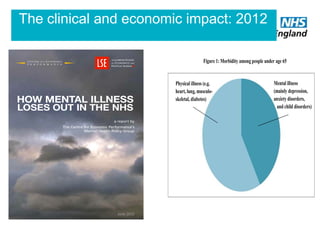
The clinical and economic impact: 2012
Figure 1: Morbidity among people under age 65

Physical illness (e.g.
heart, lung, musculoskeletal, diabetes)

Mental illness
(mainly depression,
anxiety disorders,
and child disorders)
Why does the NHS need to value mental health
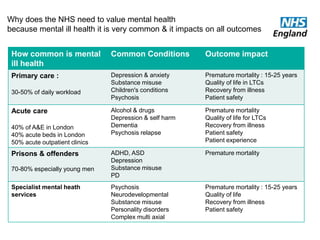
because mental ill health it is very common & it impacts on all outcomes
How common is mental
ill health

Common Conditions

Outcome impact

Primary care :

Depression & anxiety
Substance misuse
Children's conditions
Psychosis

Premature mortality : 15-25 years
Quality of life in LTCs
Recovery from illness
Patient safety

Alcohol & drugs
Depression & self harm
Dementia
Psychosis relapse

Premature mortality
Quality of life for LTCs
Recovery from illness
Patient safety
Patient experience

ADHD, ASD
Depression
Substance misuse
PD

Premature mortality

Psychosis
Neurodevelopmental
Substance misuse
Personality disorders
Complex multi axial

Premature mortality : 15-25 years
Quality of life
Recovery from illness
Patient safety

30-50% of daily workload

Acute care
40% of A&E in London
40% acute beds in London
50% acute outpatient clinics

Prisons & offenders
70-80% especially young men
Specialist mental heath
services
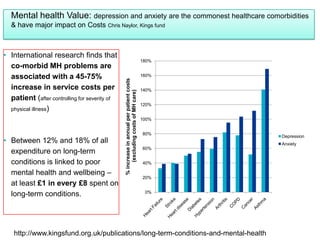
Mental health Value: depression and anxiety are the commonest healthcare comorbidities
& have major impact on Costs Chris Naylor, Kings fund

• Between 12% and 18% of all
expenditure on long-term
conditions is linked to poor
mental health and wellbeing –
at least £1 in every £8 spent on
long-term conditions.

180%
160%

% increase in annual per patient costs
(excluding costs of MH care)

• International research finds that
co-morbid MH problems are
associated with a 45-75%
increase in service costs per
patient (after controlling for severity of
physical illness)

140%
120%

100%
80%

Depression
Anxiety

60%
40%
20%
0%

http://www.kingsfund.org.uk/publications/long-term-conditions-and-mental-health
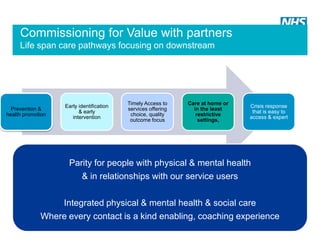
Commissioning for Value with partners
Life span care pathways focusing on downstream

Prevention &
health promotion

Early identification
& early
intervention

Timely Access to
services offering
choice, quality
outcome focus

Care at home or
in the least
restrictive
settings,

Crisis response
that is easy to
access & expert

Parity for people with physical & mental health
& in relationships with our service users
Integrated physical & mental health & social care
Where every contact is a kind enabling, coaching experience
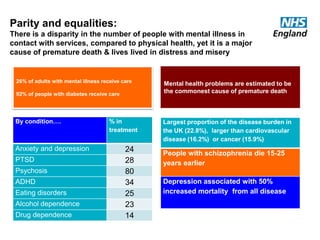
Parity and equalities:
There is a disparity in the number of people with mental illness in
contact with services, compared to physical health, yet it is a major
cause of premature death & lives lived in distress and misery

26% of adults with mental illness receive care
92% of people with diabetes receive care

By condition….

Anxiety and depression
PTSD
Psychosis
ADHD
Eating disorders

Alcohol dependence
Drug dependence

% in
treatment

24
28
80
34
25
23
14

Mental health problems are estimated to be
the commonest cause of premature death

Largest proportion of the disease burden in
the UK (22.8%), larger than cardiovascular
disease (16.2%) or cancer (15.9%)

People with schizophrenia die 15-25
years earlier
Depression associated with 50%
increased mortality from all disease
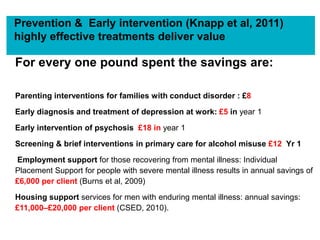
Prevention & Early intervention (Knapp et al, 2011)
highly effective treatments deliver value

For every one pound spent the savings are:
Parenting interventions for families with conduct disorder : £8
Early diagnosis and treatment of depression at work: £5 in year 1
Early intervention of psychosis £18 in year 1
Screening & brief interventions in primary care for alcohol misuse £12 Yr 1
Employment support for those recovering from mental illness: Individual
Placement Support for people with severe mental illness results in annual savings of
£6,000 per client (Burns et al, 2009)
Housing support services for men with enduring mental illness: annual savings:
£11,000–£20,000 per client (CSED, 2010).
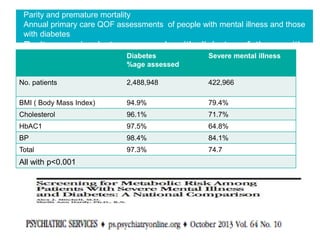
Parity and premature mortality
Annual primary care QOF assessments of people with mental illness and those
with diabetes

Parity mapping between people with diabetes cf those with
Diabetes
Severe mental illness
SMI
%age assessed
No. patients

2,488,948

422,966

BMI ( Body Mass Index)

94.9%

79.4%

Cholesterol

96.1%

71.7%

HbAC1

97.5%

64.8%

BP

98.4%

84.1%

Total

97.3%

74.7

All with p<0.001
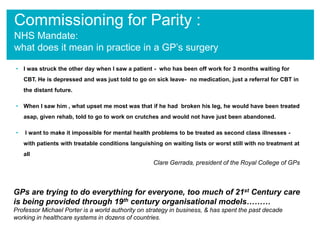
Commissioning for Parity :
what it means in reality

NHS Mandate:
what does it mean in practice in a GP’s surgery
• I was struck the other day when I saw a patient - who has been off work for 3 months waiting for
CBT. He is depressed and was just told to go on sick leave- no medication, just a referral for CBT in
the distant future.
• When I saw him , what upset me most was that if he had broken his leg, he would have been treated
asap, given rehab, told to go to work on crutches and would not have just been abandoned.
•

I want to make it impossible for mental health problems to be treated as second class illnesses with patients with treatable conditions languishing on waiting lists or worst still with no treatment at
all

Clare Gerrada, president of the Royal College of GPs

GPs are trying to do everything for everyone, too much of 21st Century care
is being provided through 19th century organisational models………
Professor Michael Porter is a world authority on strategy in business, & has spent the past decade
working in healthcare systems in dozens of countries.
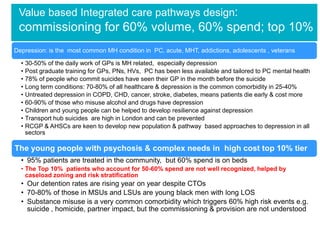
Value based Integrated care pathways design:

commissioning for 60% volume, 60% spend; top 10%
Depression: is the most common MH condition in PC, acute, MHT, addictions, adolescents , veterans
• 30-50% of the daily work of GPs is MH related, especially depression
• Post graduate training for GPs, PNs, HVs, PC has been less available and tailored to PC mental health
• 78% of people who commit suicides have seen their GP in the month before the suicide
• Long term conditions: 70-80% of all healthcare & depression is the common comorbidity in 25-40%
• Untreated depression in COPD, CHD, cancer, stroke, diabetes, means patients die early & cost more
• 60-90% of those who misuse alcohol and drugs have depression
• Children and young people can be helped to develop resilience against depression
• Transport hub suicides are high in London and can be prevented
• RCGP & AHSCs are keen to develop new population & pathway based approaches to depression in all
sectors

The young people with psychosis & complex needs in high cost top 10% tier
• 95% patients are treated in the community, but 60% spend is on beds
• The Top 10% patients who account for 50-60% spend are not well recognized, helped by
caseload zoning and risk stratification

• Our detention rates are rising year on year despite CTOs
• 70-80% of those in MSUs and LSUs are young black men with long LOS
• Substance misuse is a very common comorbidity which triggers 60% high risk events e.g.
suicide , homicide, partner impact, but the commissioning & provision are not understood
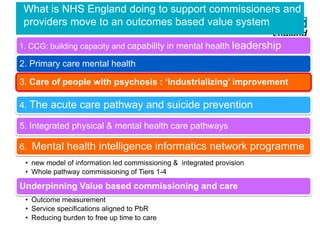
What is NHS England doing to support commissioners and
providers move to an outcomes based value system
1. CCG: building capacity and capability in mental health

leadership

2. Primary care mental health
3. Care of people with psychosis : „industrializing‟ improvement
4. The acute care pathway and suicide prevention
5. Integrated physical & mental health care pathways
6. Mental health intelligence informatics network programme
• new model of information led commissioning & integrated provision
• Whole pathway commissioning of Tiers 1-4

Underpinning Value based commissioning and care
• Outcome measurement
• Service specifications aligned to PbR
• Reducing burden to free up time to care
“Crossing the Quality Chasm”
Ohio State Psychiatry Grand Rounds

12.05.2012

13
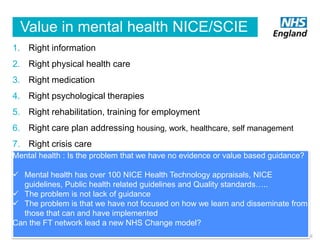
Value in mental health NICE/SCIE
1. Right information
2. Right physical health care
3. Right medication
4. Right psychological therapies

5. Right rehabilitation, training for employment
6. Right care plan addressing housing, work, healthcare, self management
7. Right crisis care
Mental health : Is the problem that we have no evidence or value based guidance?
 Mental health has over 100 NICE Health Technology appraisals, NICE
guidelines, Public health related guidelines and Quality standards…..
 The problem is not lack of guidance
 The problem is that we have not focused on how we learn and disseminate from
those that can and have implemented
Can the FT network lead a new NHS Change model?
14
To FT leaders
• Can you help build a very different comms. platform
• Narrative stories of recovery and success
• Narrative stories of how mental health has led the health services in the world in
our deinstitutionalisation & community care……..
• Can you put on all your websites service specifications of your services to
prepare NOW for choice and PbR
Can you lead for transformation to make England's services the best in the
world for our wonderful service users:
• Can you plan for one point of access for all crisis response streamlining from
current 12 access points
• You have brilliant services, but we have wide variation : to upscale and
industrialize improvement PLEASE can you share good practice & have fun
We have enough brains, energy & track record in collaboration….let’s use it
15

Strathdee MH Parity FT

  • 1.
    Valuing Mental Health GeraldineStrathdee, National Clinical Director of Mental Health, NHS England October 16th 2013 Geraldine.strathdee@nhs.net
  • 2.
    Valuing mental healthin the NHS Why does the NHS need to value mental health  The impact of mental health on outcomes & costs Parity between mental health & physical health  what would it mean in practice Fast tracking Value in the NHS  what role can the FT network have in delivering it? Asking for your narrative, brains, expertise, insights & leadership for England
  • 3.
    The clinical andeconomic impact: 2012 Figure 1: Morbidity among people under age 65 Physical illness (e.g. heart, lung, musculoskeletal, diabetes) Mental illness (mainly depression, anxiety disorders, and child disorders)
  • 4.
    Why does theNHS need to value mental health because mental ill health it is very common & it impacts on all outcomes How common is mental ill health Common Conditions Outcome impact Primary care : Depression & anxiety Substance misuse Children's conditions Psychosis Premature mortality : 15-25 years Quality of life in LTCs Recovery from illness Patient safety Alcohol & drugs Depression & self harm Dementia Psychosis relapse Premature mortality Quality of life for LTCs Recovery from illness Patient safety Patient experience ADHD, ASD Depression Substance misuse PD Premature mortality Psychosis Neurodevelopmental Substance misuse Personality disorders Complex multi axial Premature mortality : 15-25 years Quality of life Recovery from illness Patient safety 30-50% of daily workload Acute care 40% of A&E in London 40% acute beds in London 50% acute outpatient clinics Prisons & offenders 70-80% especially young men Specialist mental heath services
  • 5.
    Mental health Value:depression and anxiety are the commonest healthcare comorbidities & have major impact on Costs Chris Naylor, Kings fund • Between 12% and 18% of all expenditure on long-term conditions is linked to poor mental health and wellbeing – at least £1 in every £8 spent on long-term conditions. 180% 160% % increase in annual per patient costs (excluding costs of MH care) • International research finds that co-morbid MH problems are associated with a 45-75% increase in service costs per patient (after controlling for severity of physical illness) 140% 120% 100% 80% Depression Anxiety 60% 40% 20% 0% http://www.kingsfund.org.uk/publications/long-term-conditions-and-mental-health
  • 6.
    Commissioning for Valuewith partners Life span care pathways focusing on downstream Prevention & health promotion Early identification & early intervention Timely Access to services offering choice, quality outcome focus Care at home or in the least restrictive settings, Crisis response that is easy to access & expert Parity for people with physical & mental health & in relationships with our service users Integrated physical & mental health & social care Where every contact is a kind enabling, coaching experience
  • 7.
    Parity and equalities: Thereis a disparity in the number of people with mental illness in contact with services, compared to physical health, yet it is a major cause of premature death & lives lived in distress and misery 26% of adults with mental illness receive care 92% of people with diabetes receive care By condition…. Anxiety and depression PTSD Psychosis ADHD Eating disorders Alcohol dependence Drug dependence % in treatment 24 28 80 34 25 23 14 Mental health problems are estimated to be the commonest cause of premature death Largest proportion of the disease burden in the UK (22.8%), larger than cardiovascular disease (16.2%) or cancer (15.9%) People with schizophrenia die 15-25 years earlier Depression associated with 50% increased mortality from all disease
  • 8.
    Prevention & Earlyintervention (Knapp et al, 2011) highly effective treatments deliver value For every one pound spent the savings are: Parenting interventions for families with conduct disorder : £8 Early diagnosis and treatment of depression at work: £5 in year 1 Early intervention of psychosis £18 in year 1 Screening & brief interventions in primary care for alcohol misuse £12 Yr 1 Employment support for those recovering from mental illness: Individual Placement Support for people with severe mental illness results in annual savings of £6,000 per client (Burns et al, 2009) Housing support services for men with enduring mental illness: annual savings: £11,000–£20,000 per client (CSED, 2010).
  • 9.
    Parity and prematuremortality Annual primary care QOF assessments of people with mental illness and those with diabetes Parity mapping between people with diabetes cf those with Diabetes Severe mental illness SMI %age assessed No. patients 2,488,948 422,966 BMI ( Body Mass Index) 94.9% 79.4% Cholesterol 96.1% 71.7% HbAC1 97.5% 64.8% BP 98.4% 84.1% Total 97.3% 74.7 All with p<0.001
  • 10.
    Commissioning for Parity: what it means in reality NHS Mandate: what does it mean in practice in a GP’s surgery • I was struck the other day when I saw a patient - who has been off work for 3 months waiting for CBT. He is depressed and was just told to go on sick leave- no medication, just a referral for CBT in the distant future. • When I saw him , what upset me most was that if he had broken his leg, he would have been treated asap, given rehab, told to go to work on crutches and would not have just been abandoned. • I want to make it impossible for mental health problems to be treated as second class illnesses with patients with treatable conditions languishing on waiting lists or worst still with no treatment at all Clare Gerrada, president of the Royal College of GPs GPs are trying to do everything for everyone, too much of 21st Century care is being provided through 19th century organisational models……… Professor Michael Porter is a world authority on strategy in business, & has spent the past decade working in healthcare systems in dozens of countries.
  • 11.
    Value based Integratedcare pathways design: commissioning for 60% volume, 60% spend; top 10% Depression: is the most common MH condition in PC, acute, MHT, addictions, adolescents , veterans • 30-50% of the daily work of GPs is MH related, especially depression • Post graduate training for GPs, PNs, HVs, PC has been less available and tailored to PC mental health • 78% of people who commit suicides have seen their GP in the month before the suicide • Long term conditions: 70-80% of all healthcare & depression is the common comorbidity in 25-40% • Untreated depression in COPD, CHD, cancer, stroke, diabetes, means patients die early & cost more • 60-90% of those who misuse alcohol and drugs have depression • Children and young people can be helped to develop resilience against depression • Transport hub suicides are high in London and can be prevented • RCGP & AHSCs are keen to develop new population & pathway based approaches to depression in all sectors The young people with psychosis & complex needs in high cost top 10% tier • 95% patients are treated in the community, but 60% spend is on beds • The Top 10% patients who account for 50-60% spend are not well recognized, helped by caseload zoning and risk stratification • Our detention rates are rising year on year despite CTOs • 70-80% of those in MSUs and LSUs are young black men with long LOS • Substance misuse is a very common comorbidity which triggers 60% high risk events e.g. suicide , homicide, partner impact, but the commissioning & provision are not understood
  • 12.
    What is NHSEngland doing to support commissioners and providers move to an outcomes based value system 1. CCG: building capacity and capability in mental health leadership 2. Primary care mental health 3. Care of people with psychosis : „industrializing‟ improvement 4. The acute care pathway and suicide prevention 5. Integrated physical & mental health care pathways 6. Mental health intelligence informatics network programme • new model of information led commissioning & integrated provision • Whole pathway commissioning of Tiers 1-4 Underpinning Value based commissioning and care • Outcome measurement • Service specifications aligned to PbR • Reducing burden to free up time to care
  • 13.
    “Crossing the QualityChasm” Ohio State Psychiatry Grand Rounds 12.05.2012 13
  • 14.
    Value in mentalhealth NICE/SCIE 1. Right information 2. Right physical health care 3. Right medication 4. Right psychological therapies 5. Right rehabilitation, training for employment 6. Right care plan addressing housing, work, healthcare, self management 7. Right crisis care Mental health : Is the problem that we have no evidence or value based guidance?  Mental health has over 100 NICE Health Technology appraisals, NICE guidelines, Public health related guidelines and Quality standards…..  The problem is not lack of guidance  The problem is that we have not focused on how we learn and disseminate from those that can and have implemented Can the FT network lead a new NHS Change model? 14
  • 15.
    To FT leaders •Can you help build a very different comms. platform • Narrative stories of recovery and success • Narrative stories of how mental health has led the health services in the world in our deinstitutionalisation & community care…….. • Can you put on all your websites service specifications of your services to prepare NOW for choice and PbR Can you lead for transformation to make England's services the best in the world for our wonderful service users: • Can you plan for one point of access for all crisis response streamlining from current 12 access points • You have brilliant services, but we have wide variation : to upscale and industrialize improvement PLEASE can you share good practice & have fun We have enough brains, energy & track record in collaboration….let’s use it 15

Editor's Notes

  • #4 THERE IS SOMETIMES A view that we do not have a scientific evidence base for what we do in MH……but we do and this 15 page concise summary is worth a read..
  • #6 Read the Kings fund report
  • #7 If we really want value we need to commission to prevent, promote health and FOR early intervention.Mental health is no different to cancer or diabetes, the sooner we identify and treat, the better the outcomes and the less the long term economic cost
  • #9 It is a Value ‘No brainer’ to commission for prevention and early intervention, but the commissioning question is ‘ who put the money up front as the saving may not be in one sector.Is this a case for PSAs ie public sector agreements or what incentives can we use e.g. does the aligned public health outcomes framework, social care outcomes framework or health outcomes framework offer a sufficient focus for local partnership to build resilient communities?
  • #10 Hot off the press……..we have a way to go to achieve parity in the physical health care of those who die 25 years early from untreated physical health morbidity so common in people with psychosis Until, as PHE and health care professionals we understand that it is the most vulnerable, the poorest, the ‘English is not a first language’ the homeless, the cognitively impaired that are the least likely to get parity, and until we use modern smart forms of efficient outreach e.g. like my hairdresser, text reminder, like my family phone reminders 91), like they do in poorer countries that have no community mental heath teams ie identify with the service user, x 10 close social network friends or family members who can bring that person to the GP annual check, to the path lab, to the diagnostic services, or use peer support workers, or 3rd sector support workers as part of a personal health budget or send out the care coordinator, we are just posturing about parity .
  • #15 Every single one of our very envied English NICE/SCIE guidelines has 7 simple key components………Every single one of you has a superlative serviceBUT what industry or what sector ? Airline industry, ? Food industry can we learn how to make best practice , routine practice
  • #16 I know that senior manager are so busy that its hard to find the time to look outside your large and impressive organizationsBUT we live in a democracy and unless our best brains and best skilled managers stand up and help ………we cannot progress at the pace our most courageous and most admirable patients need us to ….