HROD TALK:
Building Engagement through Long-term Incentive
June 6, 2013
212 November 2015
Contents
 Concept and Trend
 Case Study: “Breaking the Limitation”
Objectives
• To understand how to pay for long-term performance
• To understand the issues and overall trends in long-term performance
pay plans
412 November 2015
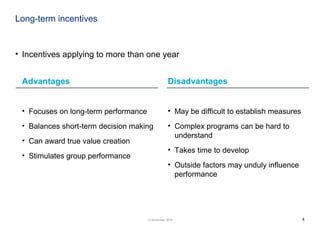
Long-term incentives
• Incentives applying to more than one year
Advantages
• Focuses on long-term performance
• Balances short-term decision making
• Can award true value creation
• Stimulates group performance
Disadvantages
• May be difficult to establish measures
• Complex programs can be hard to
understand
• Takes time to develop
• Outside factors may unduly influence
performance
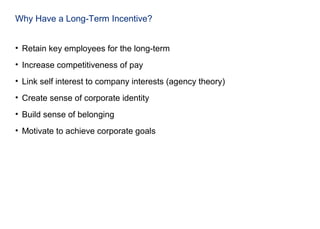
Why Have a Long-Term Incentive?
• Retain key employees for the long-term
• Increase competitiveness of pay
• Link self interest to company interests (agency theory)
• Create sense of corporate identity
• Build sense of belonging
• Motivate to achieve corporate goals
12/11/15
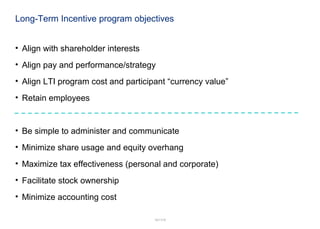
Long-Term Incentive program objectives
• Align with shareholder interests
• Align pay and performance/strategy
• Align LTI program cost and participant “currency value”
• Retain employees
• Be simple to administer and communicate
• Minimize share usage and equity overhang
• Maximize tax effectiveness (personal and corporate)
• Facilitate stock ownership
• Minimize accounting cost
712 November 2015
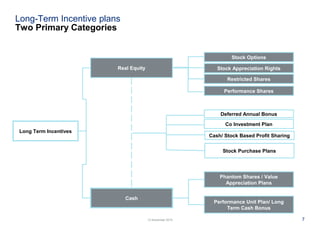
Long Term Incentives
Real Equity
Cash
Stock Appreciation Rights
Restricted Shares
Performance Unit Plan/ Long
Term Cash Bonus
Phantom Shares / Value
Appreciation Plans
Stock Options
Performance Shares
Deferred Annual Bonus
Co Investment Plan
Stock Purchase Plans
Cash/ Stock Based Profit Sharing
Long-Term Incentive plans
Two Primary Categories
812 November 2015
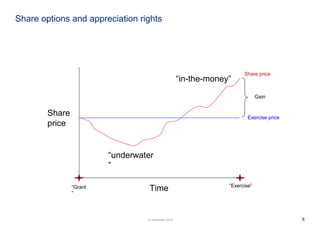
“underwater
”
“in-the-money”
Exercise price
Share price
Time
Share
price
Gain
“Exercise”“Grant
”
Share options and appreciation rights
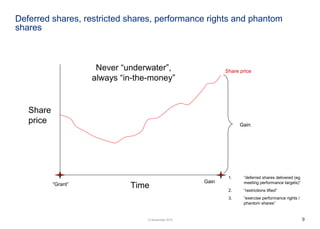
912 November 2015
Share price
Time
Share
price Gain
1. “deferred shares delivered (eg
meeting performance targets)”
2. “restrictions lifted”
3. “exercise performance rights /
phantom shares”
“Grant”
Never “underwater”,
always “in-the-money”
Gain
Deferred shares, restricted shares, performance rights and phantom
shares
Snapshot on Global Compensation Practices
Early 1990s
• Quick hit compensation
• Over-emphasis on
options
• Shorter vesting periods
• Cash-less exercises
• Lower ownership
Early 1990s
• Quick hit compensation
• Over-emphasis on
options
• Shorter vesting periods
• Cash-less exercises
• Lower ownership
1980s
• Career-based
compensation
• Less emphasis on
variable pay
• Options a minor pay
component
• Pay increase linked to
performance appraisals
1980s
• Career-based
compensation
• Less emphasis on
variable pay
• Options a minor pay
component
• Pay increase linked to
performance appraisals
• Wealth accumulation
• Short-, Mid- and Long-
Term Plans
• Layered retention
“hooks”
• Ownership culture
• Less dependence on
option plans
• Need to reestablish
career-based
compensation
• Wealth accumulation
• Short-, Mid- and Long-
Term Plans
• Layered retention
“hooks”
• Ownership culture
• Less dependence on
option plans
• Need to reestablish
career-based
compensation
Late 1990s-Today
CEO’s LTI Compensation Mix
Source: Mercer 350 Report, Mercer/Wall Street Journal Studies
2002 2005
12%
12%
76%
52%
27%
21%
2002 2005
12%
12%
76%
52%
27%
21%
Stock Options
Restricted Stock/Cash
Performance Awards
CEO average mix of long-term incentives*
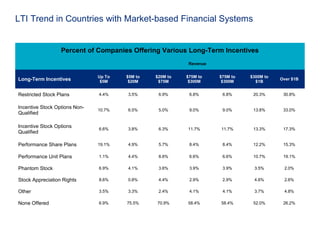
LTI Trend in Countries with Market-based Financial Systems
Percent of Companies Offering Various Long-Term Incentives
Revenue
Long-Term Incentives
Up To
$5M
$5M to
$20M
$20M to
$75M
$75M to
$300M
$75M to
$300M
$300M to
$1B
Over $1B
Restricted Stock Plans 4.4% 3.5% 6.9% 6.8% 6.8% 20.3% 30.8%
Incentive Stock Options Non-
Qualified
10.7% 6.5% 5.0% 9.0% 9.0% 13.8% 33.0%
Incentive Stock Options
Qualified
6.6% 3.8% 6.3% 11.7% 11.7% 13.3% 17.3%
Performance Share Plans 19.1% 4.9% 5.7% 8.4% 8.4% 12.2% 15.3%
Performance Unit Plans 1.1% 4.4% 8.6% 6.6% 6.6% 10.7% 19.1%
Phantom Stock 6.9% 4.1% 3.6% 3.9% 3.9% 3.5% 2.0%
Stock Appreciation Rights 8.6% 0.8% 4.4% 2.9% 2.9% 4.6% 2.6%
Other 3.5% 3.3% 2.4% 4.1% 4.1% 3.7% 4.8%
None Offered 6.9% 75.5% 70.9% 58.4% 58.4% 52.0% 26.2%
1312 November 2015
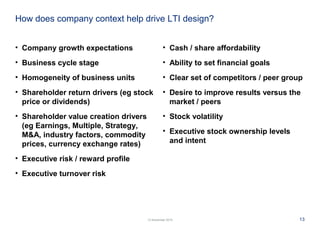
How does company context help drive LTI design?
• Cash / share affordability
• Ability to set financial goals
• Clear set of competitors / peer group
• Desire to improve results versus the
market / peers
• Stock volatility
• Executive stock ownership levels
and intent
• Company growth expectations
• Business cycle stage
• Homogeneity of business units
• Shareholder return drivers (eg stock
price or dividends)
• Shareholder value creation drivers
(eg Earnings, Multiple, Strategy,
M&A, industry factors, commodity
prices, currency exchange rates)
• Executive risk / reward profile
• Executive turnover risk
Common Restrictions
• Continued employment
• Time limit before exercised
• Financial performance required
– Increase in share price
– Return on asset / equity
1512 November 2015
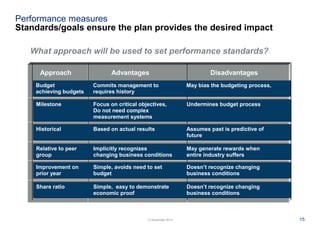
What approach will be used to set performance standards?
DisadvantagesAdvantagesApproach
Budget Commits management to May bias the budgeting process,
achieving budgets requires history
Budget Commits management to May bias the budgeting process,
achieving budgets requires history
Milestone Focus on critical objectives, Undermines budget process
Do not need complex
measurement systems
Milestone Focus on critical objectives, Undermines budget process
Do not need complex
measurement systems
Historical Based on actual results Assumes past is predictive of
future
Historical Based on actual results Assumes past is predictive of
future
Relative to peer Implicitly recognizes May generate rewards when
group changing business conditions entire industry suffers
Relative to peer Implicitly recognizes May generate rewards when
group changing business conditions entire industry suffers
Improvement on Simple, avoids need to set Doesn’t recognize changing
prior year budget business conditions
Improvement on Simple, avoids need to set Doesn’t recognize changing
prior year budget business conditions
Share ratio Simple, easy to demonstrate Doesn’t recognize changing
economic proof business conditions
Share ratio Simple, easy to demonstrate Doesn’t recognize changing
economic proof business conditions
Performance measures
Standards/goals ensure the plan provides the desired impact
1612 November 2015
Key Considerations
• Tensions created by company share price decreases and exchange rate
fluctuations
• Competitor groups
– Being competitive to comparable MNCs’ practices in the market
– Being competitive to local company practice
• Pay mix
– Is the global pay mix able to drive the desired behaviours in Asia given the
cultural difference?
• Availability of reliable market Pay and LTI data
– Peer group
– Valuation issues
• Governance, administration and communication issues
– Centralised vs. Decentralised
• Internal relativities
1712 November 2015
Emerging Trends
• Reduction in stock option plans
• Replacement of share option plans with performance based share and
restricted stock plans
• Increased use of concrete performance measures
• More emphasis on cash plans but with deferred terms (long term) linking
to performance
• Narrowing eligibility
• Replacement of all-employee option plans
• Increased interest in tax-effective vehicles
• Greater pressure for disclosure
• Executives to share down-side risk
• Consider when a potential payment will be “too much”
1812 November 2015
Communication and Administration
• Incentive plans are only as good as the participants’ level of
understanding
• Progressive organizations are involving several key executives in the
design of incentive plans
– Fosters awareness and buy-in early in the process
• Plan administration is closely tied to communication
– Simplicity is key
1912 November 2015
Contents
 Concept and Trend
 Case Study: “Breaking the Limitation”

HROD Talk

  • 1.
    HROD TALK: Building Engagementthrough Long-term Incentive June 6, 2013
  • 2.
    212 November 2015 Contents Concept and Trend  Case Study: “Breaking the Limitation”
  • 3.
    Objectives • To understandhow to pay for long-term performance • To understand the issues and overall trends in long-term performance pay plans
  • 4.
    412 November 2015 Long-termincentives • Incentives applying to more than one year Advantages • Focuses on long-term performance • Balances short-term decision making • Can award true value creation • Stimulates group performance Disadvantages • May be difficult to establish measures • Complex programs can be hard to understand • Takes time to develop • Outside factors may unduly influence performance
  • 5.
    Why Have aLong-Term Incentive? • Retain key employees for the long-term • Increase competitiveness of pay • Link self interest to company interests (agency theory) • Create sense of corporate identity • Build sense of belonging • Motivate to achieve corporate goals
  • 6.
    12/11/15 Long-Term Incentive programobjectives • Align with shareholder interests • Align pay and performance/strategy • Align LTI program cost and participant “currency value” • Retain employees • Be simple to administer and communicate • Minimize share usage and equity overhang • Maximize tax effectiveness (personal and corporate) • Facilitate stock ownership • Minimize accounting cost
  • 7.
    712 November 2015 LongTerm Incentives Real Equity Cash Stock Appreciation Rights Restricted Shares Performance Unit Plan/ Long Term Cash Bonus Phantom Shares / Value Appreciation Plans Stock Options Performance Shares Deferred Annual Bonus Co Investment Plan Stock Purchase Plans Cash/ Stock Based Profit Sharing Long-Term Incentive plans Two Primary Categories
  • 8.
    812 November 2015 “underwater ” “in-the-money” Exerciseprice Share price Time Share price Gain “Exercise”“Grant ” Share options and appreciation rights
  • 9.
    912 November 2015 Shareprice Time Share price Gain 1. “deferred shares delivered (eg meeting performance targets)” 2. “restrictions lifted” 3. “exercise performance rights / phantom shares” “Grant” Never “underwater”, always “in-the-money” Gain Deferred shares, restricted shares, performance rights and phantom shares
  • 10.
    Snapshot on GlobalCompensation Practices Early 1990s • Quick hit compensation • Over-emphasis on options • Shorter vesting periods • Cash-less exercises • Lower ownership Early 1990s • Quick hit compensation • Over-emphasis on options • Shorter vesting periods • Cash-less exercises • Lower ownership 1980s • Career-based compensation • Less emphasis on variable pay • Options a minor pay component • Pay increase linked to performance appraisals 1980s • Career-based compensation • Less emphasis on variable pay • Options a minor pay component • Pay increase linked to performance appraisals • Wealth accumulation • Short-, Mid- and Long- Term Plans • Layered retention “hooks” • Ownership culture • Less dependence on option plans • Need to reestablish career-based compensation • Wealth accumulation • Short-, Mid- and Long- Term Plans • Layered retention “hooks” • Ownership culture • Less dependence on option plans • Need to reestablish career-based compensation Late 1990s-Today
  • 11.
    CEO’s LTI CompensationMix Source: Mercer 350 Report, Mercer/Wall Street Journal Studies 2002 2005 12% 12% 76% 52% 27% 21% 2002 2005 12% 12% 76% 52% 27% 21% Stock Options Restricted Stock/Cash Performance Awards CEO average mix of long-term incentives*
  • 12.
    LTI Trend inCountries with Market-based Financial Systems Percent of Companies Offering Various Long-Term Incentives Revenue Long-Term Incentives Up To $5M $5M to $20M $20M to $75M $75M to $300M $75M to $300M $300M to $1B Over $1B Restricted Stock Plans 4.4% 3.5% 6.9% 6.8% 6.8% 20.3% 30.8% Incentive Stock Options Non- Qualified 10.7% 6.5% 5.0% 9.0% 9.0% 13.8% 33.0% Incentive Stock Options Qualified 6.6% 3.8% 6.3% 11.7% 11.7% 13.3% 17.3% Performance Share Plans 19.1% 4.9% 5.7% 8.4% 8.4% 12.2% 15.3% Performance Unit Plans 1.1% 4.4% 8.6% 6.6% 6.6% 10.7% 19.1% Phantom Stock 6.9% 4.1% 3.6% 3.9% 3.9% 3.5% 2.0% Stock Appreciation Rights 8.6% 0.8% 4.4% 2.9% 2.9% 4.6% 2.6% Other 3.5% 3.3% 2.4% 4.1% 4.1% 3.7% 4.8% None Offered 6.9% 75.5% 70.9% 58.4% 58.4% 52.0% 26.2%
  • 13.
    1312 November 2015 Howdoes company context help drive LTI design? • Cash / share affordability • Ability to set financial goals • Clear set of competitors / peer group • Desire to improve results versus the market / peers • Stock volatility • Executive stock ownership levels and intent • Company growth expectations • Business cycle stage • Homogeneity of business units • Shareholder return drivers (eg stock price or dividends) • Shareholder value creation drivers (eg Earnings, Multiple, Strategy, M&A, industry factors, commodity prices, currency exchange rates) • Executive risk / reward profile • Executive turnover risk
  • 14.
    Common Restrictions • Continuedemployment • Time limit before exercised • Financial performance required – Increase in share price – Return on asset / equity
  • 15.
    1512 November 2015 Whatapproach will be used to set performance standards? DisadvantagesAdvantagesApproach Budget Commits management to May bias the budgeting process, achieving budgets requires history Budget Commits management to May bias the budgeting process, achieving budgets requires history Milestone Focus on critical objectives, Undermines budget process Do not need complex measurement systems Milestone Focus on critical objectives, Undermines budget process Do not need complex measurement systems Historical Based on actual results Assumes past is predictive of future Historical Based on actual results Assumes past is predictive of future Relative to peer Implicitly recognizes May generate rewards when group changing business conditions entire industry suffers Relative to peer Implicitly recognizes May generate rewards when group changing business conditions entire industry suffers Improvement on Simple, avoids need to set Doesn’t recognize changing prior year budget business conditions Improvement on Simple, avoids need to set Doesn’t recognize changing prior year budget business conditions Share ratio Simple, easy to demonstrate Doesn’t recognize changing economic proof business conditions Share ratio Simple, easy to demonstrate Doesn’t recognize changing economic proof business conditions Performance measures Standards/goals ensure the plan provides the desired impact
  • 16.
    1612 November 2015 KeyConsiderations • Tensions created by company share price decreases and exchange rate fluctuations • Competitor groups – Being competitive to comparable MNCs’ practices in the market – Being competitive to local company practice • Pay mix – Is the global pay mix able to drive the desired behaviours in Asia given the cultural difference? • Availability of reliable market Pay and LTI data – Peer group – Valuation issues • Governance, administration and communication issues – Centralised vs. Decentralised • Internal relativities
  • 17.
    1712 November 2015 EmergingTrends • Reduction in stock option plans • Replacement of share option plans with performance based share and restricted stock plans • Increased use of concrete performance measures • More emphasis on cash plans but with deferred terms (long term) linking to performance • Narrowing eligibility • Replacement of all-employee option plans • Increased interest in tax-effective vehicles • Greater pressure for disclosure • Executives to share down-side risk • Consider when a potential payment will be “too much”
  • 18.
    1812 November 2015 Communicationand Administration • Incentive plans are only as good as the participants’ level of understanding • Progressive organizations are involving several key executives in the design of incentive plans – Fosters awareness and buy-in early in the process • Plan administration is closely tied to communication – Simplicity is key
  • 19.
    1912 November 2015 Contents Concept and Trend  Case Study: “Breaking the Limitation”