Training & Development
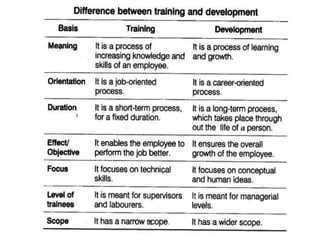
• Training refers to the process of imparting specific skills.
• Development refers to the learning opportunities designed to help
employees grow.
… More clearly, training and development may be understood as any
attempt to improve through learning, usually by changing the employee’s
attitude or increasing his or her skills and knowledge. The need for training
and development is determined by the employee’s performance deficiency,
computed as follows:
Training and Development Need = Standard Performance – Actual Performance
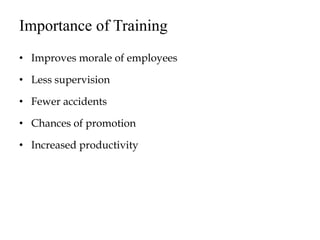
Importance of Training
• Improves morale of employees
• Less supervision
• Fewer accidents
• Chances of promotion
• Increased productivity
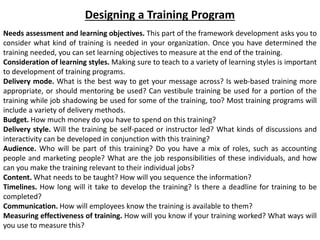
Designing a Training Program
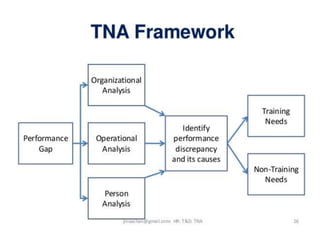
Needs assessment and learning objectives. This part of the framework development asks you to
consider what kind of training is needed in your organization. Once you have determined the
training needed, you can set learning objectives to measure at the end of the training.
Consideration of learning styles. Making sure to teach to a variety of learning styles is important
to development of training programs.
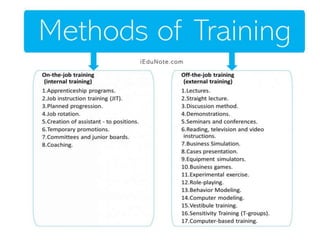
Delivery mode. What is the best way to get your message across? Is web-based training more
appropriate, or should mentoring be used? Can vestibule training be used for a portion of the
training while job shadowing be used for some of the training, too? Most training programs will
include a variety of delivery methods.
Budget. How much money do you have to spend on this training?
Delivery style. Will the training be self-paced or instructor led? What kinds of discussions and
interactivity can be developed in conjunction with this training?
Audience. Who will be part of this training? Do you have a mix of roles, such as accounting
people and marketing people? What are the job responsibilities of these individuals, and how
can you make the training relevant to their individual jobs?
Content. What needs to be taught? How will you sequence the information?
Timelines. How long will it take to develop the training? Is there a deadline for training to be
completed?
Communication. How will employees know the training is available to them?
Measuring effectiveness of training. How will you know if your training worked? What ways will
you use to measure this?

HRM_Module_3.pptx

  • 1.
    Training & Development •Training refers to the process of imparting specific skills. • Development refers to the learning opportunities designed to help employees grow. … More clearly, training and development may be understood as any attempt to improve through learning, usually by changing the employee’s attitude or increasing his or her skills and knowledge. The need for training and development is determined by the employee’s performance deficiency, computed as follows: Training and Development Need = Standard Performance – Actual Performance
  • 2.
    Importance of Training •Improves morale of employees • Less supervision • Fewer accidents • Chances of promotion • Increased productivity
  • 6.
  • 7.
    Designing a TrainingProgram Needs assessment and learning objectives. This part of the framework development asks you to consider what kind of training is needed in your organization. Once you have determined the training needed, you can set learning objectives to measure at the end of the training. Consideration of learning styles. Making sure to teach to a variety of learning styles is important to development of training programs. Delivery mode. What is the best way to get your message across? Is web-based training more appropriate, or should mentoring be used? Can vestibule training be used for a portion of the training while job shadowing be used for some of the training, too? Most training programs will include a variety of delivery methods. Budget. How much money do you have to spend on this training? Delivery style. Will the training be self-paced or instructor led? What kinds of discussions and interactivity can be developed in conjunction with this training? Audience. Who will be part of this training? Do you have a mix of roles, such as accounting people and marketing people? What are the job responsibilities of these individuals, and how can you make the training relevant to their individual jobs? Content. What needs to be taught? How will you sequence the information? Timelines. How long will it take to develop the training? Is there a deadline for training to be completed? Communication. How will employees know the training is available to them? Measuring effectiveness of training. How will you know if your training worked? What ways will you use to measure this?