HUMAN RESOURCE MANAGEMENT
UL22BB241B
Prof Viraja Kanawally
MBA,M.phil, MA( Economics
Member WICCI
Faculty of Commerce & Management
PRINCIPLES OF HUMAN RESOURCE MANAGEMENT
Employee Hiring: Recruitment
Unit 2: Recruitment
Recruitment process
Internal v/s External recruitment
Recruitment diverse workforce
Challenges in effective Recruitment
Evaluating & benchmarking Recruitment
Case Analysis/ Class Presentation
Selection; Selection process
Selection; Tests; Interview
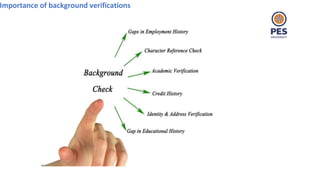
Significance of background verification
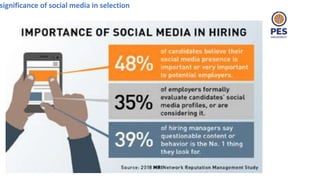
Impact of social media in selection
Work samples and simulations
Reliability & validity in selection tests
Training & Development
Training v/s Development
Training need analysis
Designing training programs
Methods of training and developing employees
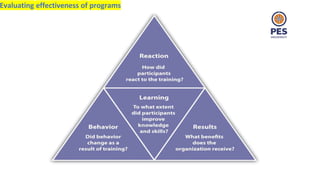
Evaluating effectiveness of programs
Importance of background verifications
significance of social media in selection
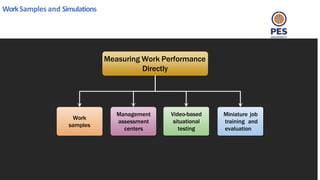
WorkSamples and Simulations
Work
samples
Management
assessment
centers
Video-based
situational
testing
Measuring Work Performance
Directly
Miniature job
training and
evaluation
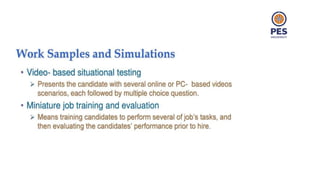
work samples and simulations
Work samples and simulations are types of tests that measure an
individual's ability to perform specific tasks or skills that are required for a
particular job. These tests are often used in pre-employment testing and
performance evaluations.
Work samples are real-world tasks or activities that are representative of
the job for which an individual is applying.
For example, a typing test may be used as a work sample for a data
entry job, or a mock sales call may be used as a work sample for a sales
position.
Simulations
Simulations are computer-based or role-playing exercises
that simulate real-world situations and tasks that an
individual is likely to encounter in a particular job.
For example, a simulation may be used to test an
individual's ability to make decisions or solve problems in
a high-stress, time-sensitive environment.
Benifits of worksampling and simulation:
2. Improved reliability: Work samples and simulations are often standardized and controlled,
which can increase the reliability of test results.
3. Better predictiveness: Work samples and simulations can be used to predict an individual's
future performance on the job, which can help organizations make informed hiring decisions.
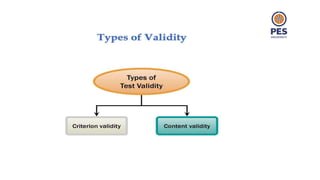
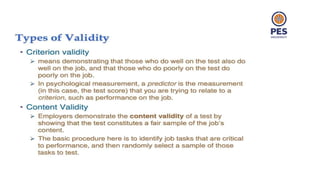
Realiability and validity
Reliability
Describes the consistency of scores obtained by the same person
when retested with the identical or alternate forms of the same test.
Are test results stable over time?
Validity
Indicates whether a test is measuring what it is supposed to be
measuring.
Does the test actually measure what it is intended to measure?
A test is, basically, a sample of a person’s behavior. Using a test
(or any selection tool) assumes the tool is both reliable and valid.
Few things illustrate evidence-based HR—the deliberate use of
the best-available evidence in making decisions about the human
resource management practices you are focusing on—as do
checking for reliability and validity.
Source:Copyright © 2011 Pearson Education, Inc. publishing as
Prentice Hall
Training & Development
1. Introduction
2. Differences between Training, Education & Development
3. Role Of Training & Development
4. Identifying Training Needs
5. Training & Development Process
6. Establishing Training and Development Objectives
7. Methods
8. Importance of Training & Development
9. Advantages
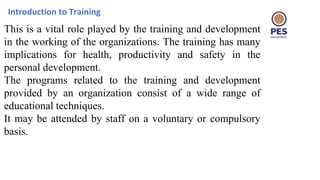
Introduction to Training
This is a vital role played by the training and development
in the working of the organizations. The training has many
implications for health, productivity and safety in the
personal development.
The programs related to the training and development
provided by an organization consist of a wide range of
educational techniques.
It may be attended by staff on a voluntary or compulsory
basis.
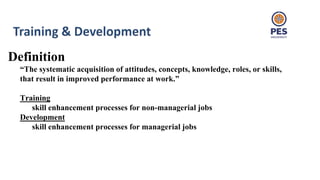
Definition
“The systematic acquisition of attitudes, concepts, knowledge, roles, or skills,
that result in improved performance at work.”
Training
skill enhancement processes for non-managerial jobs
Development
skill enhancement processes for managerial jobs
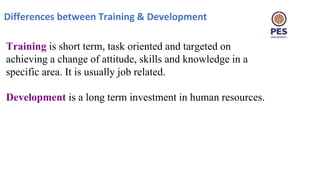
Differences between Training & Development
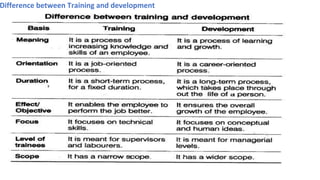
Training is short term, task oriented and targeted on
achieving a change of attitude, skills and knowledge in a
specific area. It is usually job related.
Development is a long term investment in human resources.
Difference between Training and development
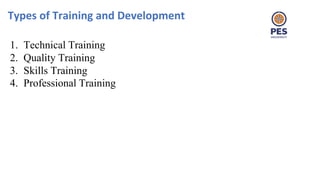
Types of Training and Development
1. Technical Training
2. Quality Training
3. Skills Training
4. Professional Training
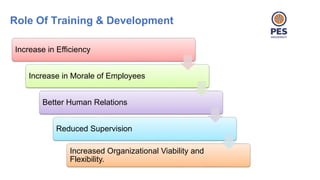
Role Of Training & Development
Increase in Efficiency
Increase in Morale of Employees
Better Human Relations
Reduced Supervision
Increased Organizational Viability and
Flexibility.
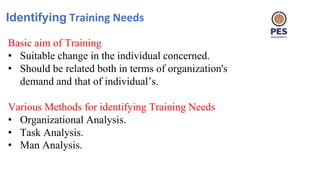
Identifying Training Needs
Basic aim of Training
• Suitable change in the individual concerned.
• Should be related both in terms of organization's
demand and that of individual’s.
Various Methods for identifying Training Needs
• Organizational Analysis.
• Task Analysis.
• Man Analysis.
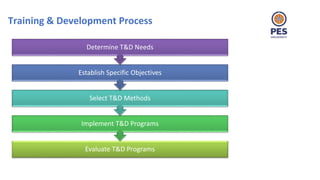
Training & Development Process
Evaluate T&D Programs
Implement T&D Programs
Select T&D Methods
Establish Specific Objectives
Determine T&D Needs
Establishing Training and Development Objectives
Desired end results
Clear and summarize objectives must be
formulated
Select T&D Methods
On the job training
Job Rotation
Coaching
Job Instructions or Mentoring
Internships
Off the job training
Distance Learning and Videoconferencing
Classroom programs
Simulations
Role Playing
Inbasket method
Importance of Training
• Maintains qualified products / services
• Achieves high service standards
• Provides information for new comers
• Refreshes memory of old employees
• Achieves learning about new things; technology,
products / service delivery
• Reduces mistakes - minimizing costs
• Opportunity for staff to feedback / suggest
improvements
• Improves communication & relationships - better
teamwork
Importance of Training
• Helps remove performance deficiencies in employees
• Greater stability, flexibility and capacity for growth in
an organization
• Accidents, scraps and damages to machinery can be
avoided
• Serves as effective source of recruitment
• It is an investment in HR with a promise of better
returns in future
• Reduces dissatisfaction, absenteeism, complaints and
turnover of employees
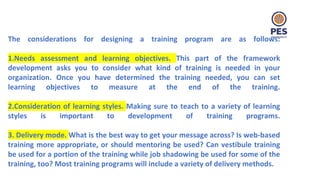
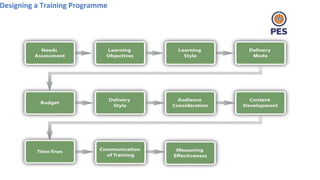
The considerations for designing a training program are as follows:
1.Needs assessment and learning objectives. This part of the framework
development asks you to consider what kind of training is needed in your
organization. Once you have determined the training needed, you can set
learning objectives to measure at the end of the training.
2.Consideration of learning styles. Making sure to teach to a variety of learning
styles is important to development of training programs.
3. Delivery mode. What is the best way to get your message across? Is web-based
training more appropriate, or should mentoring be used? Can vestibule training
be used for a portion of the training while job shadowing be used for some of the
training, too? Most training programs will include a variety of delivery methods.
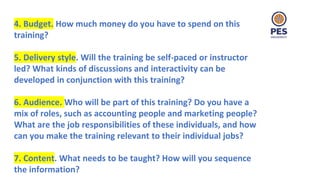
4. Budget. How much money do you have to spend on this
training?
5. Delivery style. Will the training be self-paced or instructor
led? What kinds of discussions and interactivity can be
developed in conjunction with this training?
6. Audience. Who will be part of this training? Do you have a
mix of roles, such as accounting people and marketing people?
What are the job responsibilities of these individuals, and how
can you make the training relevant to their individual jobs?
7. Content. What needs to be taught? How will you sequence
the information?
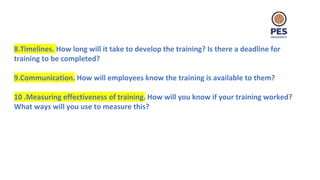
8.Timelines. How long will it take to develop the training? Is there a deadline for
training to be completed?
9.Communication. How will employees know the training is available to them?
10 .Measuring effectiveness of training. How will you know if your training worked?
What ways will you use to measure this?
Designing a Training Programme
Evaluating effectiveness of programs
THANK YOU
Prof.Viraja Kanawallu
MBA, MPhil,MA Economics
Assistant Professor,
Faculty of Commerce & Management

PPT HRM.pptx ppt on human resource management

  • 1.
    HUMAN RESOURCE MANAGEMENT UL22BB241B ProfViraja Kanawally MBA,M.phil, MA( Economics Member WICCI Faculty of Commerce & Management
  • 2.
    PRINCIPLES OF HUMANRESOURCE MANAGEMENT Employee Hiring: Recruitment Unit 2: Recruitment Recruitment process Internal v/s External recruitment Recruitment diverse workforce Challenges in effective Recruitment Evaluating & benchmarking Recruitment Case Analysis/ Class Presentation Selection; Selection process Selection; Tests; Interview Significance of background verification Impact of social media in selection Work samples and simulations Reliability & validity in selection tests Training & Development Training v/s Development Training need analysis Designing training programs Methods of training and developing employees Evaluating effectiveness of programs
  • 3.
  • 4.
    significance of socialmedia in selection
  • 5.
  • 8.
    work samples andsimulations Work samples and simulations are types of tests that measure an individual's ability to perform specific tasks or skills that are required for a particular job. These tests are often used in pre-employment testing and performance evaluations. Work samples are real-world tasks or activities that are representative of the job for which an individual is applying. For example, a typing test may be used as a work sample for a data entry job, or a mock sales call may be used as a work sample for a sales position.
  • 9.
    Simulations Simulations are computer-basedor role-playing exercises that simulate real-world situations and tasks that an individual is likely to encounter in a particular job. For example, a simulation may be used to test an individual's ability to make decisions or solve problems in a high-stress, time-sensitive environment.
  • 10.
    Benifits of worksamplingand simulation: 2. Improved reliability: Work samples and simulations are often standardized and controlled, which can increase the reliability of test results. 3. Better predictiveness: Work samples and simulations can be used to predict an individual's future performance on the job, which can help organizations make informed hiring decisions.
  • 11.
    Realiability and validity Reliability Describesthe consistency of scores obtained by the same person when retested with the identical or alternate forms of the same test. Are test results stable over time? Validity Indicates whether a test is measuring what it is supposed to be measuring. Does the test actually measure what it is intended to measure?
  • 12.
    A test is,basically, a sample of a person’s behavior. Using a test (or any selection tool) assumes the tool is both reliable and valid. Few things illustrate evidence-based HR—the deliberate use of the best-available evidence in making decisions about the human resource management practices you are focusing on—as do checking for reliability and validity. Source:Copyright © 2011 Pearson Education, Inc. publishing as Prentice Hall
  • 15.
    Training & Development 1.Introduction 2. Differences between Training, Education & Development 3. Role Of Training & Development 4. Identifying Training Needs 5. Training & Development Process 6. Establishing Training and Development Objectives 7. Methods 8. Importance of Training & Development 9. Advantages
  • 16.
    Introduction to Training Thisis a vital role played by the training and development in the working of the organizations. The training has many implications for health, productivity and safety in the personal development. The programs related to the training and development provided by an organization consist of a wide range of educational techniques. It may be attended by staff on a voluntary or compulsory basis.
  • 17.
    Definition “The systematic acquisitionof attitudes, concepts, knowledge, roles, or skills, that result in improved performance at work.” Training skill enhancement processes for non-managerial jobs Development skill enhancement processes for managerial jobs
  • 18.
    Differences between Training& Development Training is short term, task oriented and targeted on achieving a change of attitude, skills and knowledge in a specific area. It is usually job related. Development is a long term investment in human resources.
  • 19.
  • 20.
    Types of Trainingand Development 1. Technical Training 2. Quality Training 3. Skills Training 4. Professional Training
  • 21.
    Role Of Training& Development Increase in Efficiency Increase in Morale of Employees Better Human Relations Reduced Supervision Increased Organizational Viability and Flexibility.
  • 22.
    Identifying Training Needs Basicaim of Training • Suitable change in the individual concerned. • Should be related both in terms of organization's demand and that of individual’s. Various Methods for identifying Training Needs • Organizational Analysis. • Task Analysis. • Man Analysis.
  • 23.
    Training & DevelopmentProcess Evaluate T&D Programs Implement T&D Programs Select T&D Methods Establish Specific Objectives Determine T&D Needs
  • 24.
    Establishing Training andDevelopment Objectives Desired end results Clear and summarize objectives must be formulated
  • 25.
    Select T&D Methods Onthe job training Job Rotation Coaching Job Instructions or Mentoring Internships Off the job training Distance Learning and Videoconferencing Classroom programs Simulations Role Playing Inbasket method
  • 26.
    Importance of Training •Maintains qualified products / services • Achieves high service standards • Provides information for new comers • Refreshes memory of old employees • Achieves learning about new things; technology, products / service delivery • Reduces mistakes - minimizing costs • Opportunity for staff to feedback / suggest improvements • Improves communication & relationships - better teamwork
  • 27.
    Importance of Training •Helps remove performance deficiencies in employees • Greater stability, flexibility and capacity for growth in an organization • Accidents, scraps and damages to machinery can be avoided • Serves as effective source of recruitment • It is an investment in HR with a promise of better returns in future • Reduces dissatisfaction, absenteeism, complaints and turnover of employees
  • 28.
    The considerations fordesigning a training program are as follows: 1.Needs assessment and learning objectives. This part of the framework development asks you to consider what kind of training is needed in your organization. Once you have determined the training needed, you can set learning objectives to measure at the end of the training. 2.Consideration of learning styles. Making sure to teach to a variety of learning styles is important to development of training programs. 3. Delivery mode. What is the best way to get your message across? Is web-based training more appropriate, or should mentoring be used? Can vestibule training be used for a portion of the training while job shadowing be used for some of the training, too? Most training programs will include a variety of delivery methods.
  • 29.
    4. Budget. Howmuch money do you have to spend on this training? 5. Delivery style. Will the training be self-paced or instructor led? What kinds of discussions and interactivity can be developed in conjunction with this training? 6. Audience. Who will be part of this training? Do you have a mix of roles, such as accounting people and marketing people? What are the job responsibilities of these individuals, and how can you make the training relevant to their individual jobs? 7. Content. What needs to be taught? How will you sequence the information?
  • 30.
    8.Timelines. How longwill it take to develop the training? Is there a deadline for training to be completed? 9.Communication. How will employees know the training is available to them? 10 .Measuring effectiveness of training. How will you know if your training worked? What ways will you use to measure this?
  • 31.
  • 32.
  • 33.
    THANK YOU Prof.Viraja Kanawallu MBA,MPhil,MA Economics Assistant Professor, Faculty of Commerce & Management