bschool.cms.ac.in
Subject : Human Resource Management
Course code: 21MBACC205
Semester - II
bschool.cms.ac.in
MODULE - 1
INTRODUCTION TO HRM
1–2
bschool.cms.ac.in
Contents
Module-1–Introduction to HRM
9 Hours
Introduction to Human Resource Management, Evolution of
HRM, Importance, HRM functions, Forces changing HRM,
Human Resource Planning - Meaning, Process, HRP Models*,
Human Resource Forecasting methods, Challenges and
relationship with other Human resource functions, Job
analysis, Job Description, Job evaluation.
bschool.cms.ac.in
Course Objective
Describe the foundational concepts of human resource
management functions.
bschool.cms.ac.in
Relevant Information
• Introductory activity – Boosting Customer Service (Gary Dessler, 15th edition, Pg 9)
• https://www.aihr.com/blog/human-resources-functions/
• https://cplg.sog.unc.edu/wp-content/uploads/sites/16800/2019/03/Preparing-for-Tomorrow.pdf
• https://www.youtube.com/watch?v=Liz9mJzbQtI
• https://www.youtube.com/watch?v=Kxc8KceOb14
• https://www.youtube.com/watch?v=ukmC6F0JvQw
• LinkedIn course – https://www.linkedin.com/learning/understanding-
organisations-and-the-role-of-hr/the-role-of-hr-in-
workplaces?autoAdvance=true&autoSkip=false&autoplay=true&re
sume=true&u=92695330 (58 Min)
bschool.cms.ac.in
Introductory activity – Boosting Customer Service (Gary Dessler, 15th edition,
Pg 9)
https://ibfbzu.edu.pk/wp-content/uploads/2020/08/Human-Resource-
Management-by-Gary-Dessler-15th-ed.pdf
Interview Questions
What is the role of “HR” in an organization?
What Do Human Resources Professionals Do?
bschool.cms.ac.in
Understanding Your HR Career Path Options
Two key terms in the human resource management sector are
"generalist" and "specialist.“
HR generalists are less focused and handle a number of areas and
tasks simultaneously.
HR specialists focus their efforts in a single area, such as recruiting or
training.
bschool.cms.ac.in
HR generalists:
Recruitment coordinator
Employee engagement activity
Content writer
Performance management
L & D
Compensation & benefits
HR specialists
Talent Acquisition
Talent Management
HR & legal
HR Analysts
HR startegy
Compensation & benefits associate
bschool.cms.ac.in
Introduction to HRM
https://www.youtube.com/watch?v=8ciAnHfIiFA
https://www.youtube.com/watch?v=Liz9mJzbQtI
bschool.cms.ac.in
Human Resource Management at Work
– The policies and practices involved in carrying out the “people”
or human resource aspects of a management position,
including recruiting, screening, training, rewarding, and
appraising.
bschool.cms.ac.in
Human Resource Management at Work
Acquisition
Training
Appraisal
Compensating
Labor Relations
Health and Safety
Fairness
Human
Resource
Management
(HRM)
bschool.cms.ac.in
Evolution of HRM
https://www.youtube.com/watch?v=Kxc8KceOb14
https://101hrm.com/evolution-of-human-resource-management/
• Transition of HR Labour relations,
• Personnel management
• Human resources management
• Human capital management
• Strategic HRM
bschool.cms.ac.in
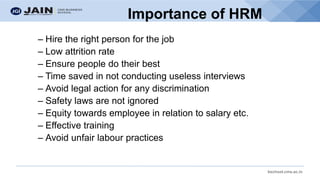
Importance of HRM
– Hire the right person for the job
– Low attrition rate
– Ensure people do their best
– Time saved in not conducting useless interviews
– Avoid legal action for any discrimination
– Safety laws are not ignored
– Equity towards employee in relation to salary etc.
– Effective training
– Avoid unfair labour practices
bschool.cms.ac.in
HR Functions
Functions of
HR Managers
Line Function
Line Authority
Implied Authority
Staff Functions
Staff Authority
Innovator
Employee Advocacy
Coordinative Function
Functional Authority
bschool.cms.ac.in
HR Functions
Recruiters Human
Resource
Development
Specialists
Employment/
Industrial
Relations
Specialist
Training
Specialists
Job Analysts
Compensation
Managers
Human
Resource
Specialties
Employee
Welfare Officers
bschool.cms.ac.in
Case Study
Improving Performance : HR as a Profit
Center
(Discussion in Class)
bschool.cms.ac.in
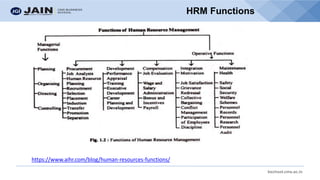
HRM Functions
https://www.aihr.com/blog/human-resources-functions/
bschool.cms.ac.in
Forces Changing HRM
Speed of
expansion
Changing
perception
of HRM
Desire for
consisten
cy
Cultures and
Communicat
ion
Labor
Markets
Professio
nal bodies
Employee
Organizati
on
https://www.youtube.com/watch?v=ukmC6F0JvQw
bschool.cms.ac.in
Human Resource Planning
• Estimation of how many qualified people
are necessary to carry out the assigned
activities,
• How many people will be available, and
• What, if anything, must be done to ensure
that personnel supply equals personnel
demand at the appropriate point in the
future
bschool.cms.ac.in
Conditions that necessitate HRP
• Organizational
Productivity/Plans/Strategies
• Expansion/Growth/Diversification
• Economic Development
• Promotions of employees
• Organizational change
bschool.cms.ac.in
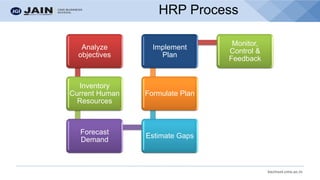
HRP Process
Analyze
objectives
Inventory
Current Human
Resources
Forecast
Demand
Estimate Gaps
Formulate Plan
Implement
Plan
Monitor,
Control &
Feedback
bschool.cms.ac.in
Factors affecting HRP
HRP
Outsourcing
Organisation
al Growth
Cycle and
Planning
Time
Horizons
Nature of
Jobs being
Filled
Environmental
Uncertainties
Forecasting
Information
bschool.cms.ac.in
bschool.cms.ac.in
bschool.cms.ac.in
Relevant Information
• Introductory activity – Boosting Customer Service (Gary Dessler, 15th edition, Pg 9)
• https://www.aihr.com/blog/human-resources-functions/
• https://cplg.sog.unc.edu/wp-content/uploads/sites/16800/2019/03/Preparing-for-Tomorrow.pdf
• https://www.youtube.com/watch?v=Liz9mJzbQtI
• https://www.youtube.com/watch?v=Kxc8KceOb14
• https://www.youtube.com/watch?v=ukmC6F0JvQw
• LinkedIn course – https://www.linkedin.com/learning/understanding-
organisations-and-the-role-of-hr/the-role-of-hr-in-
workplaces?autoAdvance=true&autoSkip=false&autoplay=true&re
sume=true&u=92695330 (58 Min)
bschool.cms.ac.in
Understanding Organisations and the Role of HR –
LinkedIn Course
bschool.cms.ac.in
Glossary
• Human Resource
Management
• Line Authority
• Staff Responsibility
• HR Specialist
• HR Generalist
• Line Function
• Staff Function
• Coordinative Function
• Managerial Functions
• Operational Functions
• Organizational
Productivity/plan/strategy
• HRP
• Forecasting
• Outsourcing
bschool.cms.ac.in
Subject : Human Resource Management
Course code: 21MBACC205
Semester - II
bschool.cms.ac.in
MODULE - 1
INTRODUCTION TO HRM
1–2
bschool.cms.ac.in
Contents
Module-1–Introduction to HRM
9 Hours
Introduction to Human Resource Management, Evolution of
HRM, Importance, HRM functions, Forces changing HRM,
Human Resource Planning - Meaning, Process, HRP Models*,
Human Resource Forecasting methods, Challenges and
relationship with other Human resource functions, Job
analysis, Job Description, Job evaluation.
bschool.cms.ac.in
Course Objective
Describe the foundational concepts of human resource
management functions.
bschool.cms.ac.in
Relevant Information
• https://altametrics.com/en/demand-forecasting.html
• https://courses.lumenlearning.com/wmopen-humanresourcesmgmt/chapter/global-human-resources-
management/
• https://www.youtube.com/watch?v=C3ZucdY_ifI
• https://www.youtube.com/watch?v=D2_U_vsfr6I
• https://www.aihr.com/blog/job-evaluation/
• LinkedIn course – https://www.linkedin.com/learning/understanding-
organisations-and-the-role-of-hr/the-role-of-hr-in-
workplaces?autoAdvance=true&autoSkip=false&autoplay=true&re
sume=true&u=92695330 (58 Min)
bschool.cms.ac.in
Interview Questions
What are the methods used in forecasting the demands for HR?
What does job evaluation determines?
bschool.cms.ac.in
Linking Employer’s Strategy to Plans
bschool.cms.ac.in
HR Forecasting Methods
• Quantitative Techniques
• Qualitative Techniques
bschool.cms.ac.in
Quantitative Techniques
• Estimation
• Ratio Analysis
• Trend analysis &
projection
• Computerized Forecast
• Regression Analysis
• H R Budget and
Planning Analysis
• Scenario Forecasting
• Work Study Analysis
• Simple averaging
• Markov analysis
• Indexation
• Extrapolation
bschool.cms.ac.in
Qualitative Techniques
• Managerial Judgment
• Estimation
• Expert Advice
• Delphi technique
• Nominal Group Technique
• Job Analysis
• Group brainstorming
• Simulation models
bschool.cms.ac.in
Challenges in HRM
• Now a days HR duties & responsibility has become a challenge
for HRM to compete with global competitors & sustain in the
diversified economy.
bschool.cms.ac.in
Challenges in HRM
• Globalization
• Handling Multicultural / Diverse Workforce
• Employee Selection
• Training & Development
• Balance with Work Life
• Retaining Talents
• Conflict Managing
bschool.cms.ac.in
bschool.cms.ac.in
Job Analysis
• Job analysis is the process of gathering information about
a job
• A systematic investigation of the tasks, duties and
responsibilities necessary to do a job
bschool.cms.ac.in
bschool.cms.ac.in
Process of Job Analysis
Organizational
Analysis
Selection of
jobs to be
analyzed
Data
Collection
Job
Description
Job
Specification
bschool.cms.ac.in
Job Description
• Document that clearly states the essential job
requirements, job duties, job responsibilities, and skills
required to perform a specific role
• A more detailed job description will cover how success is
measured in the role so it can be used during
performance evaluations
bschool.cms.ac.in
JD Example – HR Generalist
• Short introductory paragraph
• In two to three sentences, give candidates some
information about your company and the work
environment for the position being advertised
bschool.cms.ac.in
Education and Experience Requirements
• Master’s degree in human resources, business
administration, or a related field
• 3-5 years human resources experience
• Experience with HRMS/HRIS systems
• Proficiency with Microsoft Office (Microsoft Excel,
Microsoft Outlook)
• PHR or SPHR certification preferred
• Bilingual English/Spanish a plus
bschool.cms.ac.in
• Provide personnel policy and procedure guidance to
employees and management.
• Maintain up-to-date knowledge of federal and state
employment law and compliance requirements.
• Coordinate open enrollments, changes, and training
for employee benefits programs.
• Respond to human resources-related inquiries.
• Assist with payroll processing.
• Create and distribute internal communications
regarding status changes, benefits, or company
policies.
• Administer new employee on-boarding and orientation.
Education and Experience Requirements
bschool.cms.ac.in
• Develop and maintain talent management processes.
• Monitor employee morale and company culture.
• Collaborate with the human resources team to develop effective
recruitment strategies.
• Identify future staffing needs.
• Process complaints regarding sexual harassment, discrimination, or
other instances of workplace harassment and assist in any
necessary investigations and disciplinary actions.
• Maintain employee personnel records.
• Conduct exit interviews and recommend corrective action if
necessary.
Education and Experience Requirements
bschool.cms.ac.in
HR Generalist - Skills
• Demonstrated knowledge of the human resources field
• Understanding of state and federal employment regulations
• Awareness of OSHA regulations and compliance
• Understanding of personnel and compliance records
management
• Strong analytical and problem solving skills
• Excellent written, verbal, and interpersonal communication
abilities
• Ability to maintain confidentiality
bschool.cms.ac.in
Job Specification
• Covers aspects like education, work-experience,
managerial experience etc which can help accomplish the
goals related to the job
• Helps in the recruitment & selection process, evaluating
the performance of employees and in their appraisal &
promotion
bschool.cms.ac.in
Components of JS
• Educational Qualification
• Experience
• Skills & Knowledge
• Personality traits and characteristics
bschool.cms.ac.in
Example of JS
Education Must be an engineer and MBA in marketing for a reputed MBA institute
Work experience Must have prior work experience in marketing & sales (preferably telecom
or FMCG)
Skills & Knowledge 1. Must be a good communicator and must be able to lead a team.
2. Prior experience in handling ATL-BTL activities and managing
promotional events.
3. Must be able to handle social media like Facebook, Twitter and help
build online brand
4. Experience in managing PR and media
5. Strong analytical skills and problem solving skills
6. Must understand business, come up with innovative products and launch
them
Personality Traits &
Characteristics
1. Must be presentable and a good orator
2. Should be calm in complex situations and show leadership skills in
managing multiple teams
3. Should be emotionally strong and should give timely deliverables
bschool.cms.ac.in
JD & JS - Activity
• Job Title]
• Formal position title.
• Reports To: The [job title] will report to [positions title or titles this position
reports to].
• Job Overview: Provide a brief, 4-sentence description of the role, what success in
the position looks like, and how it fits into the company or organization overall.
• Responsibilities and Duties:
• List the essential duties required to carry out this job.
• List them in order of importance.
• Use complete sentences.
• Start sentences with verbs.
• Use the present tense.
• Use gender-neutral language.
bschool.cms.ac.in
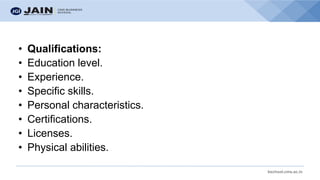
• Qualifications:
• Education level.
• Experience.
• Specific skills.
• Personal characteristics.
• Certifications.
• Licenses.
• Physical abilities.
bschool.cms.ac.in
Job Evaluation
• Job evaluation is the process of comparing a job against
other jobs within the organization to determine the
appropriate pay rate
• An assessment of the relative worth of various jobs on the
basis of a consistent set of job and personal factors, such
as qualifications and skills required
bschool.cms.ac.in
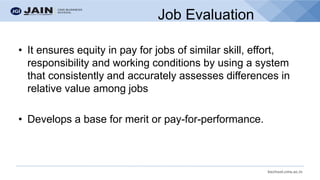
• It ensures equity in pay for jobs of similar skill, effort,
responsibility and working conditions by using a system
that consistently and accurately assesses differences in
relative value among jobs
• Develops a base for merit or pay-for-performance.
Job Evaluation
bschool.cms.ac.in
Preparing for the Job Evaluation
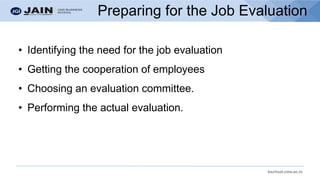
• Identifying the need for the job evaluation
• Getting the cooperation of employees
• Choosing an evaluation committee.
• Performing the actual evaluation.
bschool.cms.ac.in
Job Evaluation Methods: Ranking
• Ranking each job relative to all other jobs, usually based
on some overall factor.
• Steps in job ranking:
– Obtain job information.
– Select and group jobs.
– Select compensable factors.
– Rank jobs.
– Combine ratings.
bschool.cms.ac.in
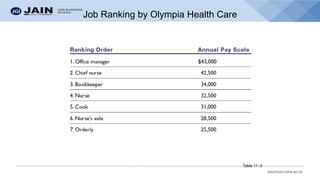
Job Ranking by Olympia Health Care
Table 11–3
bschool.cms.ac.in
Job Evaluation Methods:
Job Classification
• Raters categorize jobs into groups or
classes of jobs that are of roughly the
same value for pay purposes.
– Classes contain similar jobs.
– Grades are jobs that are similar in difficulty
but otherwise different.
– Jobs are classed by the amount or level of
compensable factors they contain.
bschool.cms.ac.in
Job Evaluation Methods:
Point Method
• A quantitative technique that involves:
– Identifying the degree to which each compensable factors are
present in the job.
– Awarding points for each degree of each factor.
– Calculating a total point value for the job by adding up the
corresponding points for each factor.
bschool.cms.ac.in
Job Evaluation Methods:
Factor Comparison
• Each job is ranked several times—once
for each of several compensable
factors.
• The rankings for each job are combined
into an overall numerical rating for the
job.
bschool.cms.ac.in
Computerized Job Evaluations
• A computerized system that uses a structured
questionnaire and statistical models to streamline the job
evaluation process.
– Advantages of computer-aided job evaluation (CAJE)
• Simplify job analysis
• Help keep job descriptions up to date
• Increase evaluation objectivity
• Reduce the time spent in committee meetings
• Ease the burden of system maintenance
bschool.cms.ac.in
Relevant Information
• https://altametrics.com/en/demand-forecasting.html
• https://courses.lumenlearning.com/wmopen-humanresourcesmgmt/chapter/global-human-resources-
management/
• https://www.youtube.com/watch?v=C3ZucdY_ifI
• https://www.youtube.com/watch?v=D2_U_vsfr6I
• https://www.aihr.com/blog/job-evaluation/
• LinkedIn course – https://www.linkedin.com/learning/understanding-
organisations-and-the-role-of-hr/the-role-of-hr-in-
workplaces?autoAdvance=true&autoSkip=false&autoplay=true&re
sume=true&u=92695330 (58 Min)
bschool.cms.ac.in
Understanding Organisations and the Role of HR –
LinkedIn Course
bschool.cms.ac.in
Glossary
• job analysis
• job description
• job specifications
• organization chart
• process chart
• diary/log
• Workplace Planning
• Scheduling
• Resource capacity planning
• Agile resource planning
• Resourcing cost
• job enlargement
• job rotation
• job enrichment
• dejobbing
• boundaryless organization
• reengineering
• competencies
• competency-based job
analysis
• performance management
• job evaluation
bschool.cms.ac.in
Subject : Human Resource Management
Course code: 21MBACC205
Semester - II
bschool.cms.ac.in
MODULE - 2
Recruitment and Selection
1–2
bschool.cms.ac.in
Contents
Module 2 – Recruitment and Selection
10 Hours
Recruitment - meaning and process, Purpose of
Recruitment, Types of Recruitment - Internal - Job
posting, Virtual Job Fairs, Executive Search Firms,
Recruitment advertising. Factors affecting Recruitment,
Selection- meaning, selection procedure, Types of tests
used in Selection*, Consequences of selection
decisions, Interview and Types of interviews.
bschool.cms.ac.in
Course Objective
Identify the different steps involved in the process of
recruitment and selection of employees.
bschool.cms.ac.in
Relevant Information
• https://ibfbzu.edu.pk/wp-content/uploads/2020/08/Human-Resource-Management-by-Gary-Dessler-
15th-ed.pdf
• https://harver.com/blog/recruitment-plan
• https://www.sumhr.com/blog/top-14-executive-search-firms-in-india
• https://en.wikipedia.org/wiki/Job_fair
• https://core.ac.uk/download/pdf/234625193.pdf
• LinkedIn course – https://www.linkedin.com/learning/social-
recruiting-for-
recruiters/welcome?autoAdvance=true&autoSkip=false&autoplay
=true&resume=true&u=92695330(55 Min)
bschool.cms.ac.in
Interview Questions
• What is a Strategic recruitment?
• List top 10 staffing companies you know in India.
bschool.cms.ac.in
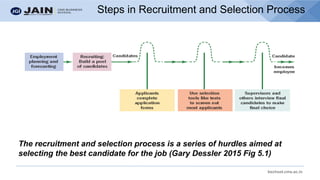
Steps in Recruitment and Selection Process
The recruitment and selection process is a series of hurdles aimed at
selecting the best candidate for the job (Gary Dessler 2015 Fig 5.1)
bschool.cms.ac.in
Introduction Case - Four Seasons
Four Seasons builds its strategy around offering superior customer service, and that requires
highly motivated and high-morale employees. How can Four Seasons use its recruitment practices
to encourage such motivation and morale? One way Four Seasons does this is by filling hotel
positions around the world with internal transfers. In one recent year, for instance, about 280
employees relocated from hotels in one country to another within the Four Seasons chain.
Employees love it. It gives them a chance for adventure and to see the world, while building a
career with a great hotel chain. And it’s great for Four Seasons too, because the resulting high
morale and motivation supports Four Seasons’ strategic goal of superior customer service. In
other words, Four Seasons uses recruitment practices that produce the excellent service the chain
needs to achieve its strategic goals.
• Can you think of any other benefits Four Seasons may derive from its policy of transferring employees
among its hotels? What are they?
Source:HRM by Gary Dessler 2015 Page no - 129
bschool.cms.ac.in
MEANING OF RECRUITMENT
“… process of searching for prospective employees and stimulating them to
apply for jobs in the organizations” (Edwin B. Flippo, 1984)
 getting right kind of people for vacancies
 finding and/or attracting applicants for the employer’s open position getting
right kind of people for vacancies (Dessler & Varkkey, 2016)
bschool.cms.ac.in
RECRUITMENT PROCESS
• Logical steps
New hires
Offers made
Candidates interviewed
Candidate interviewed
Leads generated
https://harver.com/blog/recruitment-plan/
bschool.cms.ac.in
RECRUITMENT PROCESS
Success of a recruitment process can be judged based on,
• Number of successful placements
• Number of hirings
• Number of offers made
• Number of applicants
• Cost involved
• Time taken for filing up the position
bschool.cms.ac.in
Recruiting Yield Pyramid
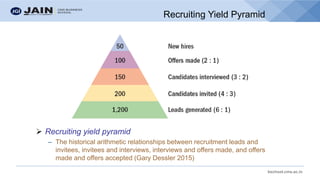
➢ Recruiting yield pyramid
– The historical arithmetic relationships between recruitment leads and
invitees, invitees and interviews, interviews and offers made, and offers
made and offers accepted (Gary Dessler 2015)
bschool.cms.ac.in
PURPOSE OF RECRUITMENT
bschool.cms.ac.in
bschool.cms.ac.in
Internal Search
Advantages:
– good employee relation
– Boost morale of employees
– Encourage competent and ambitious individuals
– info. on individual's performance is available
– Minimal cost of recruitment
– Time saved
– Return on investment increases
Disadvantages:
– Miss out talent available in market
– Talent pool may stagnate
– No flow of new ideas and opinion from outside
bschool.cms.ac.in
Finding Internal Candidates
• Job postings via portals, circulars and notice borads
– Publicizing an open job to employees (often by literally posting it on
bulletin boards) and listing its attributes.
• Rehiring former employees - HRIS
– Advantages:
• They are known quantities.
• They know the firm and its culture.
– Disadvantages:
• They may have less-than positive attitudes.
• Rehiring may sent the wrong message to current employees about how to get ahead.
bschool.cms.ac.in
Finding Internal Candidates (cont’d)
• Succession planning - HRIS
– The process of ensuring a suitable supply of successors for
current and future senior or key jobs.
• Succession planning steps:
– Identifying and analyzing key jobs.
– Creating and assessing candidates.
– Selecting those who will fill the key positions.
bschool.cms.ac.in
Outside Sources of Candidates
• Advertising
– The Media: selection of the best medium depends on the
positions for which the firm is recruiting.
• Newspapers (local and specific labor markets)
• Trade and professional journals
• Internet job sites
• Marketing programs
• Constructing an effective ad
– Wording related to job interest factors should evoke the
applicant’s attention, interest, desire, and action (AIDA) and
create a positive impression of the firm.
bschool.cms.ac.in
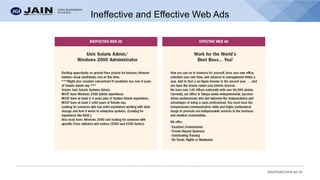
Ineffective and Effective Web Ads
bschool.cms.ac.in
Effective Web Ads - Guess the company names
bschool.cms.ac.in
Outside Sources of Candidates
• Executive recruiters (headhunters)
– Special employment agencies retained by employers to seek
out top-management talent for their clients.
• Contingent-based recruiters collect a fee for their services when a
successful hire is completed.
• Retained executive searchers are paid regardless of the outcome of
the recruitment process.
– Internet technology and specialization trends are changing how
candidates are attracted and how searches are conducted.
https://www.sumhr.com/blog/top-14-executive-search-firms-in-india
bschool.cms.ac.in
• College recruiting
– On-site visits
• Invitation letters
• Assigned hosts
• Information package
• Planned interviews
• Timely employment offer
• Follow-up
– Internships
Outside Sources of Candidates
bschool.cms.ac.in
Outside Sources of Candidates
• Employee referrals
– Applicants who are referred to the organization by current
employees
• Referring employees become stakeholders.
• Referral is a cost-effective recruitment program.
• Referral can speed up diversifying the workforce
• Walk-ins
– Direct applicants who seek employment with or without
encouragement from other sources.
– Courteous treatment of any applicant is a good business
practice.
bschool.cms.ac.in
• Recruiting via the Internet
– More firms and applicants are utilizing the Internet in the job
search process.
• Advantages of Internet recruiting
– Cost-effective way to publicize job openings
– More applicants attracted over a longer period
– Immediate applicant responses
– Online prescreening of applicants
– Links to other job search sites
– Automation of applicant tracking and evaluation
Outside Sources of Candidates
bschool.cms.ac.in
Selected Recruitment Web Sites
Source: HR Magazine, November 2003.
bschool.cms.ac.in
Virtual Job Fairs
• A job fair, also referred commonly as a job expo or career fair or career expo
• Is an event in which employers, recruiters, and schools give information to potential
employees.
• Job seekers attend these while trying to make a good impression to potential coworkers by
– speaking face-to-face with one another
– filling out résumés
– asking questions in attempt to get a good feel on the work needed
https://en.wikipedia.org/wiki/Job_fair
bschool.cms.ac.in
Post -Class Activity – Recruitment
advertisement
• Summary Experience: 6 - 8 Years Location: Delhi
• Compensation: Rupees 10,00,000 - 14,00,000 Education: UG / PG - MBA/PGDM
• Industry Type: NGO/Social Services Role: Mktg Mgr
• Functional Area: Marketing, Advertising, MR, PR Posted Date: 22 Oct
• Desired Candidate Profile : Candidate should have following attributes
1. Post Graduation in Marketing/PR from a recognised institute
2. 7 years of relevant experience in a competitive market environment
• Job Description : Candidate will be responsible for following.
Analyse, formulate and articulate a communication strategy in line with the vision, mission and strategy of the organization.
To develop creative approaches based on the positioning and ensure standardization of designs, formats, audiovisuals,
templates themes communication and publicity material etc
Identify and retain external agencies to manage PR, Advertising and website activities - ensure that these agencies adhere
to service level agreements
Supervise the process of media buying and ensure that content is of a high quality.
Manage the communications budget and ensure that controls are in place to monitor and report on expenditure on returns
on investments.
bschool.cms.ac.in
FACTORS AFFECTING RECRUITMENT
• Organizational / internal factors
• Reputation of the org.= size, profitability, management
• Organizational culture & the attitude of the management towards
employees= employee friendly/ orthodox
• Geographical location of the vacant position
• Amount of resources allocated towards recruitment drive
• Channels & methods used to advertise the vacancy
• Emoluments the company offers
https://core.ac.uk/do
wnload/pdf/23462519
3.pdf
bschool.cms.ac.in
• Environmental / external factors
• Situation in the labour market
• Stage of development of the industry
• Culture, social attitudes and beliefs
• Law of the land
FACTORS AFFECTING RECRUITMENT…
bschool.cms.ac.in
Relevant Information
• https://ibfbzu.edu.pk/wp-content/uploads/2020/08/Human-Resource-Management-by-Gary-Dessler-
15th-ed.pdf
• https://harver.com/blog/recruitment-plan
• https://www.sumhr.com/blog/top-14-executive-search-firms-in-india
• https://en.wikipedia.org/wiki/Job_fair
• https://core.ac.uk/download/pdf/234625193.pdf
• LinkedIn course – https://www.linkedin.com/learning/social-
recruiting-for-
recruiters/welcome?autoAdvance=true&autoSkip=false&autoplay
=true&resume=true&u=92695330(55 Min)
bschool.cms.ac.in
Social Recruiting for Recruiters– LinkedIn Course
bschool.cms.ac.in
Glossary
workforce (or employment or
personnel) planning
trend analysis
ratio analysis
scatter plot
personnel replacement
charts
position replacement
card
succession planning
employee recruiting
recruiting yield pyramid
job posting
applicant tracking systems
(ATS)
alternative staffing
on-demand recruiting services
(ODRS)
college recruiting
application form
bschool.cms.ac.in
Subject : Human Resource Management
Course code: 21MBACC205
Semester - II
bschool.cms.ac.in
MODULE - 2
Recruitment and Selection
1–2
bschool.cms.ac.in
Contents
Module 2 – Recruitment and Selection
10 Hours
Recruitment - meaning and process, Purpose of
Recruitment, Types of Recruitment - Internal - Job
posting, Virtual Job Fairs, Executive Search Firms,
Recruitment advertising. Factors affecting Recruitment,
Selection- meaning, selection procedure, Types of tests
used in Selection*, Consequences of selection
decisions, Interview and Types of interviews.
bschool.cms.ac.in
Course Objective
Identify the different steps involved in the process of
recruitment and selection of employees.
bschool.cms.ac.in
Relevant Information
• https://www.businessmanagementideas.com/human-resource-management-2/selection-
tests/types-of-selection-tests/20658
• https://ibfbzu.edu.pk/wp-content/uploads/2020/08/Human-Resource-Management-by-Gary-
Dessler-15th-ed.pdf
• https://www.lebow.drexel.edu/academics/undergraduate/current-students/career-
services/interviewing/interview-types
• https://www.linkedin.com/learning/remote-interviewing-techniques-for-creative-jobs/nailing-
your-online-job-
interview?autoAdvance=true&autoSkip=false&autoplay=true&resume=true&u=92695330
• LinkedIn course – https://www.linkedin.com/learning/social-
recruiting-for-
recruiters/welcome?autoAdvance=true&autoSkip=false&autoplay
=true&resume=true&u=92695330(55 Min)
bschool.cms.ac.in
Interview Questions
• Does Selection process follow the recruitment process?
• What is base and success rate in selection?
• What is selection utility?
bschool.cms.ac.in
SELECTION: MEANING & CONCEPT
• “…process of choosing the most suitable candidate for a job from
among the available applicants”.
– Based on a pre-defined set of qualification, experience
https://www.youtube.com/watch?v=RZHJr-Tm14A
bschool.cms.ac.in
Introduction Case –
bschool.cms.ac.in
Introduction Case
Do you think it would really go counter to the sort of culture Google is trying to
nurture to have a central HR department simply test candidates and assign
them to work teams with just an interview with the team supervisor? Why?
https://ibfbzu.edu.pk/wp-content/uploads/2020/08/Human-Resource-Management-
by-Gary-Dessler-15th-ed.pdf Pg., 178
bschool.cms.ac.in
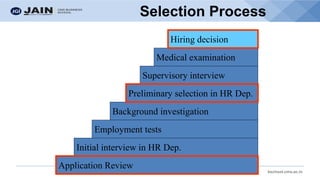
Initial interview in HR Dep.
Employment tests
Background investigation
Supervisory interview
Medical examination
Preliminary selection in HR Dep.
Application Review
Hiring decision
Note: an applicant may be
rejected after any step in the
process
By Gary Dessler 2015
Selection Process
bschool.cms.ac.in
Application Review
Selection is the process by which a firm uses specific
instruments to choose from a pool of applicants a person
or persons most likely to succeed in the job(s), given
management goals and legal requirements.
• Review of applications and resumes
• Put candidates in order of best qualified
• Select the most appropriate applicants
bschool.cms.ac.in
Application Review
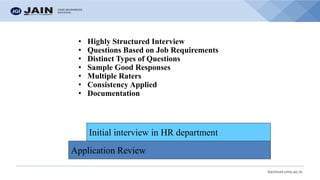
Initial interview in HR department
• Highly Structured Interview
• Questions Based on Job Requirements
• Distinct Types of Questions
• Sample Good Responses
• Multiple Raters
• Consistency Applied
• Documentation
bschool.cms.ac.in
Application Review
Initial interview in HR Dep.
Employment tests
• Perform psychological and honesty tests
• Teamwork ability tests
• Good predictor of job performance
bschool.cms.ac.in
Application Review
Initial interview in HR Dep.
Employment tests
Background investigation
• Check references and work history
• Good citizen (criminal record)
• Reliability of applicant
• Information will be obtained from:
✓ former employers
✓ school, college, university officials
✓ credit bureaus
✓ individuals named as references
bschool.cms.ac.in
Application Review
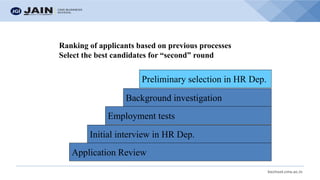
Initial interview in HR Dep.
Employment tests
Background investigation
Preliminary selection in HR Dep.
Ranking of applicants based on previous processes
Select the best candidates for “second” round
bschool.cms.ac.in
Application Review
Initial interview in HR Dep.
Employment tests
Background investigation
Preliminary selection in HR Dep.
Supervisory interview
bschool.cms.ac.in
Supervisory Interview
▪ In depth panel interview, behavioral type questions
(conducted by closest supervisor, consultant and
representative of HR department )
▪ Multiple opinions
▪ In depth knowledge about applicants behavior and
decision making capabilities
bschool.cms.ac.in
Application Review
Initial interview in HR Dep.
Employment tests
Background investigation
Preliminary selection in HR Dep.
Supervisory interview
Medical examination
bschool.cms.ac.in
Medical examination
➢Given to ensure that the health of an applicant is
adequate to meet the job requirements
➢Test held by professional medical institution
➢Protection against possible later law suits
➢Can be costly
bschool.cms.ac.in
Selection Process
Initial interview in HR Dep.
Employment tests
Background investigation
Supervisory interview
Medical examination
Preliminary selection in HR Dep.
Application Review
Hiring decision
Goal of the whole application
process (most important step)
Final decision based on all
steps of the selection process
bschool.cms.ac.in
Selection Process Tasks:
Functional, Country and Regional
Managers - Example
Positions
Outsourced
Outsourced
Outsourced
Outsourced
Outsourced
HQ
Outsourced
HQ
Application Screening
Initial Interview
Employment Tests
Background Investigation
Preliminary Selection
Supervisory Interview
Medical Examination
Hiring Decision
bschool.cms.ac.in
Interviewing skills
• Establishing rapport (good relationship)
• Listening
• Maintaining continuity
• Keeping control (politely)
• Note talking
bschool.cms.ac.in
STANDARDS IN SELECTION PROCEDURE
• Reliability
– A selection method is considered reliable, if it
produces consistent results across different
situations and times.
– Reliability can be measured by using:
– The repeat or test-retest approach
– The alternate-form or parallel-form method
– The split-halves procedure
bschool.cms.ac.in
Validity
– It is the degree to which the test reflects success in the job.
– Three general methods are used to test validity:
• Criterion validity= good correlation bet. selection method scores and job
performance scores
• Content validity= extent of representative-ness of content of selection
procedure with imp. aspects of job performance
• Construct validity= extent the selection method can identify the
characteristics of candidate for good performance
Generalizability
– ..defined as the degree to which its validity, established in one
context, can be extended to other “primary contexts” such as diff.
jobs, people, time, org. etc.
– That means the degree of replicability.
bschool.cms.ac.in
Utility
– … degree to which the value provided by the selection method
enhances the effectiveness of an organization.
– More the reliability, validity and generalizability→ more the utility
– However, some ext. factors like job market, env. etc. may also
affect the effectiveness other than 3 RVG factors
Legality
– …the basic standard that any selection method should satisfy.
– Must comply with existing law of land
– more imp. For MNCS
bschool.cms.ac.in
SELECTION TESTS
• Intelligence tests
– It measures several factors of intelligence such as
logical reasoning, analytical skills and general
knowledge.
• Aptitude tests
– These tests measure an individual's ability to learn a
given job, when given adequate training.
• Achievement tests
– Also termed as proficiency or knowledge tests.
– These tests measure the job-related proficiency and
knowledge of the applicants.
bschool.cms.ac.in
• Situational tests
– Used in middle and senior level management selection.
– Candidates are exposed to simulated business situations,
their responses are recorded and evaluated.
– It also includes group discussions, in basket exercises and
simulated business games.
• Interest tests
– These tests help the companies identify and understand the
degree of interest a candidate has in a job.
bschool.cms.ac.in
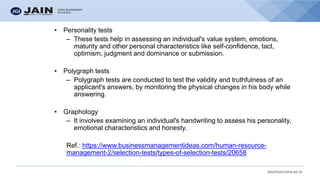
• Personality tests
– These tests help in assessing an individual's value system, emotions,
maturity and other personal characteristics like self-confidence, tact,
optimism, judgment and dominance or submission.
• Polygraph tests
– Polygraph tests are conducted to test the validity and truthfulness of an
applicant's answers, by monitoring the physical changes in his body while
answering.
• Graphology
– It involves examining an individual's handwriting to assess his personality,
emotional characteristics and honesty.
Ref.: https://www.businessmanagementideas.com/human-resource-
management-2/selection-tests/types-of-selection-tests/20658
bschool.cms.ac.in
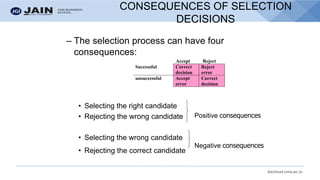
– The selection process can have four
consequences:
• Selecting the right candidate
• Rejecting the wrong candidate
• Selecting the wrong candidate
• Rejecting the correct candidate
Positive consequences
Negative consequences
Accept Reject
Successful Correct
decision
Reject
error
unsuccessful Accept
error
Correct
decision
CONSEQUENCES OF SELECTION
DECISIONS
bschool.cms.ac.in
THE INTERVIEW PROCESS
Preparation
Setting
Conduct of Interview
Closing an Interview
Evaluation
Reference Checks
Medical Examination
https://www.linkedin.com/l
earning/remote-
interviewing-techniques-
for-creative-jobs/nailing-
your-online-job-
interview?autoAdvance=tr
ue&autoSkip=false&autopl
ay=true&resume=true&u=
92695330
bschool.cms.ac.in
TYPES OF INTERVIEWS
Interviews
Preliminary
Interview
Selection
Interview
Decision-making
Interview
Formal &
Structured
Interview
Unstructured
Interview
Stress
Interview
Group
Interview
Method
Panel
Interview
In-depth
Interview
https://www.lebow.drexel.edu/academ
ics/undergraduate/current-
students/career-
services/interviewing/interview-types
bschool.cms.ac.in
MODULE - 3
Talent Management
1–32
bschool.cms.ac.in
Contents
• Module 3 – Talent Management
9 Hours
Training- meaning, need and importance of training, Distinction
between training and development, methods of training – On
the Job & Off the Job, process of training, recent developments
in training, Succession Planning, Strategies for Accelerating
Development for succession, Performance appraisal, meaning,
importance, various performance appraisal methods*,
Drawbacks of Performance Management System.
bschool.cms.ac.in
Course Objective
Examine the suitable ways to train employees for
enhanced talent management.
bschool.cms.ac.in
TRAINING : DEFINITION
• Definition
– “The systematic acquisition of attitudes, concepts, knowledge,
roles, or skills, that result in improved performance at work.”
(Goldstein 1991)
– Training
• skill enhancement processes for non-managerial jobs
– Development
• skill enhancement processes for managerial jobs
• https://www.youtube.com/watch?v=qA-Vw8_Qbn4
bschool.cms.ac.in
IMPORTANCE OF TRAINING
• Meeting manpower needs
• Improves quality of products and services
• Versatility in operation
• Employee stability
• Efficient utilization of resources and elimination of
wastage
• Higher employee morale
bschool.cms.ac.in
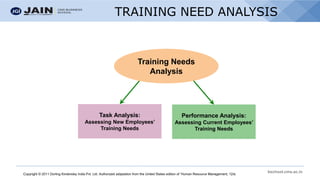
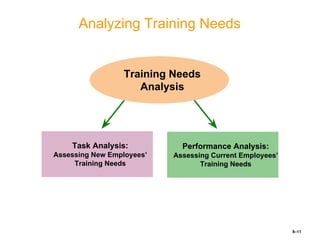
Task Analysis:
Assessing New Employees’
Training Needs
Performance Analysis:
Assessing Current Employees’
Training Needs
Training Needs
Analysis
TRAINING NEED ANALYSIS
Needs
Copyright © 2011 Dorling Kindersley India Pvt. Ltd. Authorized adaptation from the United States edition of ‘Human Resource Management, 12/e.
bschool.cms.ac.in
Training Development
Nature Tangible in nature Intangible in nature
Importance Technology oriented towards Training Important as Development is oriented
towards Technology
Skills Deals with non Human Skills Deals with Human Skills
Directed
towards
New recruits and technical
personnel
Managerial personnel to acquire
conceptual and human skills
Methodology Greater emphasis on Job Methods Greater emphasis on off the job
methods
Frequency &
Relevance
Less frequent…Employees at junior
level
Frequent and continuous…
Employees at mid level and high
level.
Who imparts Mostly the supervisor Mentors, external experts
TRAINING vs DEVELOPMENT
bschool.cms.ac.in
Relevant Information
• https://www.businessmanagementideas.com/human-resource-management-2/selection-tests/types-of-
selection-tests/20658
• https://ibfbzu.edu.pk/wp-content/uploads/2020/08/Human-Resource-Management-by-Gary-Dessler-
15th-ed.pdf
• https://www.lebow.drexel.edu/academics/undergraduate/current-students/career-
services/interviewing/interview-types
• https://www.linkedin.com/learning/remote-interviewing-techniques-for-creative-jobs/nailing-your-online-
job-interview?autoAdvance=true&autoSkip=false&autoplay=true&resume=true&u=92695330
• https://www.youtube.com/watch?v=qA-Vw8_Qbn4
• LinkedIn course – https://www.linkedin.com/learning/social-
recruiting-for-
recruiters/welcome?autoAdvance=true&autoSkip=false&autoplay
=true&resume=true&u=92695330(55 Min)
bschool.cms.ac.in
Social Recruiting for Recruiters– LinkedIn Course
bschool.cms.ac.in
Glossary
Negligent Hiring
Reliability
Test Validity
Criterion Validity
Content Validity
Construct Validity
Expectancy Chart
Interest Inventory
Work Samples
Work Sampling Technique
Management Assessment
Center
Situational Test
Video-based Simulation
Miniature Job Training And
Evaluation
bschool.cms.ac.in
Subject : Human Resource Management
Course code: 21MBACC205
Semester - II
bschool.cms.ac.in
MODULE - 3
Talent Management
1–2
bschool.cms.ac.in
Contents
• Module 3 – Talent Management
9 Hours
Training- meaning, need and importance of training, Distinction
between training and development, methods of training – On
the Job & Off the Job, process of training, recent developments
in training, Succession Planning, Strategies for Accelerating
Development for succession, Performance appraisal, meaning,
importance, various performance appraisal methods*,
Drawbacks of Performance Management System.
bschool.cms.ac.in
Course Objective
Examine the suitable ways to train employees for
enhanced talent management.
bschool.cms.ac.in
Relevant Information
• https://ibfbzu.edu.pk/wp-content/uploads/2020/08/Human-Resource-Management-by-Gary-
Dessler-15th-ed.pdf
• https://www.referenceforbusiness.com/management/Str-Ti/Succession-
Planning.html#ixzz7JccRMitx
• https://www.hrexchangenetwork.com/hr-talent-management/articles/succession-planning-in-
the-new-normal-preparing-for-a-changing-workforce
• https://www.youtube.com/watch?v=ij4IwMs8N_w&t=4s
• LinkedIn course – https://www.linkedin.com/learning/how-to-design-
and-deliver-training-
programs/welcome?autoAdvance=true&autoSkip=false&autoplay
=true&resume=true&u=92695330 1h 29 m
bschool.cms.ac.in
Interview Questions
• How does L&D contribute to employee engagement?
• Do you think, the continued organizational learning give better ROI
than traditional employee training?
bschool.cms.ac.in
Discussion Case
bschool.cms.ac.in
Discussion Case
Discuss examples of how multi-national companies use job rotation
and other job training means to develop employees?
Page no – HRM by Gary Dessler page no 254
bschool.cms.ac.in
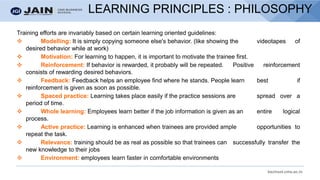
LEARNING PRINCIPLES : PHILOSOPHY
Training efforts are invariably based on certain learning oriented guidelines:
❖ Modelling: It is simply copying someone else's behavior. (like showing the videotapes of
desired behavior while at work)
❖ Motivation: For learning to happen, it is important to motivate the trainee first.
❖ Reinforcement: If behavior is rewarded, it probably will be repeated. Positive reinforcement
consists of rewarding desired behaviors.
❖ Feedback: Feedback helps an employee find where he stands. People learn best if
reinforcement is given as soon as possible.
❖ Spaced practice: Learning takes place easily if the practice sessions are spread over a
period of time.
❖ Whole learning: Employees learn better if the job information is given as an entire logical
process.
❖ Active practice: Learning is enhanced when trainees are provided ample opportunities to
repeat the task.
❖ Relevance: training should be as real as possible so that trainees can successfully transfer the
new knowledge to their jobs
❖ Environment: employees learn faster in comfortable environments
bschool.cms.ac.in
FEATURES OF TRAINING
❖Increases knowledge and skills for doing a
particular job
❖ Focuses attention on the individual job.
❖ Concentrates on individual employees
❖ Gives importance to short term performance
bschool.cms.ac.in
AREAS OF TRAINING
❖ Knowledge
❖ Technical skills
❖ Social skills
❖ Techniques
bschool.cms.ac.in
TYPES OF TRAINING
❖ Skills training: here certain basic skills like reading, writing, computing, speaking, listening,
problem solving etc are taught
❖ Refresher training: here the focus is on short term courses that would help employees learn
about latest developments in their respective fields
❖ Cross functional training: this helps employees perform operations in areas other than their
assigned job.
❖ Team training: this is concerned with how team members should communicate with each
other, how they should cooperate to get ahead, how they should handle conflicting situations, how
to find their way using collective wisdom etc.
❖ Creativity training: this helps employees to think unconventionally, break the rules, take
risks, go out of the box and develop unexpected solutions.
❖ Diversity training: it aims to create better cross cultural sensitivity with the aim of
fostering more harmonious and fruitful working relationships among a firm's employees
❖ Literacy training: this is generally offered to those employees with weak reading, writing
or arithmetic skills.
bschool.cms.ac.in
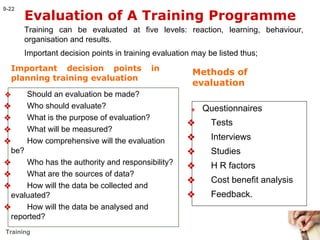
Training can be evaluated at five levels: reaction, learning,
behavior, organization and results.
Evaluation
Levels Questions being asked Measures
Result
Behaviour
Learning
Reaction
Accidents
Quality
Productivity
Turnover
Morale
Costs
Profits
Performance
Appraisal by
superior, peer,
client,
subordinate
Written tests
Performance
tests
Graded
simulations
Questionnaires
Is the
organisation or
unit better because
of the training?
Are trainees behaving differently
on the job after training? Are they
using the skills and knowledge
they learnt in training?
To what extent do trainees have greater
knowledge or skill after the training
programme than they did before?
Did the trainees like the programme, the trainers, the
facilities? Do they think the course was useful? What
improvement can they suggest?
Copyright © 2011 Dorling Kindersley India Pvt. Ltd. Authorized adaptation from the United States edition of ‘Human Resource Management, 12/e.
bschool.cms.ac.in
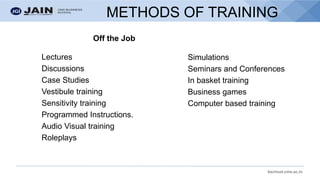
METHODS OF TRAINING
On the Job
Job rotation
Coaching
Understudy
Job Instruction
Committee assignment.
bschool.cms.ac.in
METHODS OF TRAINING
Simulations
Seminars and Conferences
In basket training
Business games
Computer based training
Lectures
Discussions
Case Studies
Vestibule training
Sensitivity training
Programmed Instructions.
Audio Visual training
Roleplays
Off the Job
bschool.cms.ac.in
Job Rotation
• Job Rotation : Involves movement of trainee from one
job to another.
• Trainee equips himself with job knowledge.
• Gains experience from supervisors / trainees in different
job assignments.
• Gives an opportunity for the employee to become
versatile and ready handle varied jobs in future
bschool.cms.ac.in
Coaching
• Coaching : Supervisor coaches and guide his
subordinates to acquire knowledge and skill.
• Here the supervisor explains things and answers
questions; throws light on why things are done the way
they are; offers a model for trainees to copy, conducts lot
of decision making meetings, and allows trainees freedom
to commit mistakes and learn .
• Coaching requires lot of teaching skills.
bschool.cms.ac.in
Understudy
• Understudy : Subordinate learns through
experience and observation, also known as
Shadowing seniors.
• Trainee works as an assistant to supervisor
• The understudy will assume full responsibility of
his trainer
bschool.cms.ac.in
Job Instruction
• Job instruction : This is training directly received
on the job. Here the trainee receives an overview
of the job.
• The trainer actually demonstrates the hob and the
trainee is asked to copy the trainer’s way.
• The trainee, finally, tries to perform the job
independently.
bschool.cms.ac.in
Committee Assignment
• Committee assignment : Similar to project
assignment
• A group of trainees are asked to solve a live
problem of the organization
• Trainees solve the problem together
• It develops teamwork
bschool.cms.ac.in
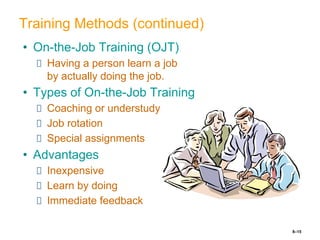
On the Job Training
Advantages
• Economical
• Learning is permanent
• Relatively shorter learning
period
• Unskilled and semi skilled jobs
• Best for jobs that can be learnt
by mere observation
Disadvantages
• Poor learning conditions
• Lack of standardization
• Trainer’s quality
• May cause wastage and
damage to the machinery
bschool.cms.ac.in
Off the Job Training
• Lectures : Verbal presentation of information by an
instructor to a large audience
• Discussion : Two way communication that combines
lectures
• Case study : Actual / hypothetical problem is presented
to a training group for discussion
bschool.cms.ac.in
• Vestibule Training : Actual work conditions are
simulated in the classroom
• Sensitivity training : Trainees are pooled together
under the guidance of an experienced facilitator who
moderates the discussion
• Committees : Serve purpose of developing good social
relations
Off the Job Training (Contd)
bschool.cms.ac.in
Off the Job Training (Contd)
• Programmed Instructions : Step by step series
of knowledge and mechanism for presenting and
checking on the trainee’s knowledge
• Audio- visual training : Can be used to provide
realistic examples of job conditions and situations
in a short time
bschool.cms.ac.in
• Role plays : Human interaction that involves
realistic behavior in imaginary situations
• Conferences : Various issues along with problem
solving techniques are discussed
• Simulation : Attempt to create a realistic decision
making environment fro the trainee
Off the Job Training (Contd)
bschool.cms.ac.in
• In-basket : To handle files coming in and to finish his
work ; take decisions within a specified time limit. Used
to improve procedural knowledge, decision making skills,
strategic knowledge and communication
• Business games : Providing market situation to the
trainee by asking him to provide solutions
• Computer based training : MOOCs (Massive open
online courses)
Off the Job Training (Contd)
bschool.cms.ac.in
Process of Training
• Organizational/Business/Personnel.
• Training objectives/ Training Readiness/ Learning
Principles/ Trainer quality.
• On the job/Off the Job/ Management Development.
• Learning Transfer of Behaviour/ Trainee Reactions/
Results.
bschool.cms.ac.in
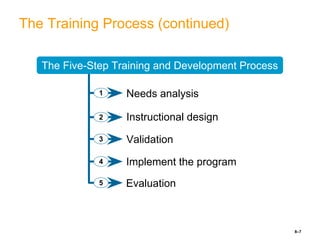
Steps involved in Training.
• Assessment of training needs (OOM)
• Chalking out training objectives
• Designing training policy
• Designing training programs
• Fixing the responsibility of training
• Selection of trainees
• Preparation for training
• Selection of training methods
• Designing training course
• Rules for conducting the training
• Presentation
• Evaluation of the training program
bschool.cms.ac.in
Succession Planning
1. Succession planning is the systematic process of defining future management
requirements and identifying candidates who best meet those requirements.
2. Succession planning involves using the supply of labor within the organization
for future staffing needs.
3. With succession planning, the skills and abilities of current employees are
assessed to see which future positions they may take within the organization
when other employees leave their positions.
4. Succession planning is typically used in higher-level organizational positions,
such as executive-level positions
Read more: https://www.referenceforbusiness.com/management/Str-Ti/Succession-Planning.html#ixzz7JccRMitx
bschool.cms.ac.in
Succession Planning - Example
For instance, if a company
predicts that its Chief Executive
Officer will retire in the near
future, the organization may
begin looking months or even
years in advance to determine
which current employee might
be capable of taking over the
position of the CEO.
bschool.cms.ac.in
Steps in Succession Planning
1. Human resources planning,
2. Assessing needs
3. Developing managers
4. Developing replacement
charts
5. Identifying career paths.
bschool.cms.ac.in
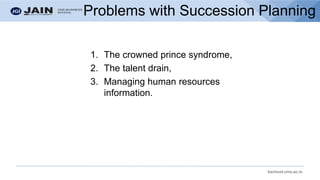
Problems with Succession Planning
1. The crowned prince syndrome,
2. The talent drain,
3. Managing human resources
information.
bschool.cms.ac.in
Strategies for Accelerating and
developing Successors
https://www.hrexchangenetwork.com/hr-talent-
management/articles/succession-planning-in-the-new-normal-preparing-for-a-
changing-workforce
https://www.youtube.com/watch?v=ij4IwMs8N_w&t=4s
bschool.cms.ac.in
Performance appraisal
bschool.cms.ac.in
Meaning - Definition
• Performance appraisal is the step where the
management finds out how effective it has been
at hiring and placing employees .
• A “Performance appraisal” is a process of
evaluating an employee’s performance of a job in
terms of its requirements.(NATIONAL ACADEMIC
PRESS)
bschool.cms.ac.in
Objectives of Performance
Appraisal
Employees
❑ concrete and tangible particulars
about their work
❑ assessment of
performance
Organizations
❑ measuring the efficiency
❑ maintaining organizational
control.
bschool.cms.ac.in
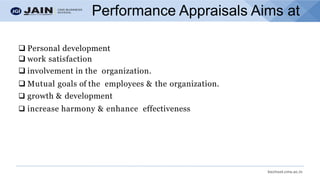
Performance Appraisals Aims at
❑ Personal development
❑ work satisfaction
❑ involvement in the organization.
❑ Mutual goals of the employees & the organization.
❑ growth & development
❑ increase harmony & enhance effectiveness
bschool.cms.ac.in
Importance of Performance Appraisals
• Employee recognition and rewards
• New challenges and clear objectives
• Continued progression and development
• Culture of trust and openness
• within appraisal systems will help employees to feel more able to
approach and discuss any ideas or issues outside of these meetings as
well.
• Support and training
• Prevention of long-term dissatisfaction
• Supporting staff to deliver an effective appraisal system
bschool.cms.ac.in
Process of PA
• Setting Performance
Standards
• Communicating Standards
• Measuring Standards
• Comparing Standards
• Discussing Results
• Taking Corrective
Standards.
bschool.cms.ac.in
Methods of Performance Appraisals
Traditional Methods
1. 1. Paired comparison
2. Graphic Rating scales
3. Forced choice Description method
4. Forced Distribution Method
5. Checks lists
6. Free essay method
7. Critical Incidents
8. Group Appraisal
9. Field Review Method
10. Confidential Report
11. Ranking
• Note – Self-learning topic (Slides
34-50)
Modern Methods
1. Assessment Center
2. Appraisal by Results
3. Management by Objectives
4. Human Asset Accounting
5. Behaviorally Anchored
6. Rating scales
bschool.cms.ac.in
Traditional Appraisal Methods
1) Rating Scales Method
It is a popular traditional method of performance appraisal. In this method, a rating
scale is created to evaluate the performance of employee against certain
parameters. These parameters usually include his attitude, attendance, punctuality
and interpersonal skills. The rating scale used in this method ranges from 1 to 10.
Low score indicates negative feedback and high score indicates positive feedback.
bschool.cms.ac.in
Traditional Appraisal Methods
2) Checklist Method
In this method, a checklist is prepared. It is comprised of descriptive
statements related to behavior of the employee. Each statement has two
options, Yes & No or True or False. The rater can choose one out of two
options which he thinks correctly describes the behavior of the employee.
bschool.cms.ac.in
Traditional Appraisal Methods
3) Forced Distribution Method
This method was popular in big organizations. It is based on the fact that
the performance of employees varies greatly in an organization, some
would be more productive and some would be less productive. So in this
method, the manager is forced to distribute employees on the basis of
their performance on all points of the bell shaped scale. Some fall into
outstanding zone, some into average and some into the bottom region of
the curved scale.
bschool.cms.ac.in
Traditional Appraisal Methods
4) Critical Incident Method
Critical incident method gives emphasis on critical
behaviors of employees such as the reaction of employee
to a certain situation. So in this method, the performance is
evaluated against a list of critical behaviors. For example,
On July 22 the manager efficiently handled an annoyed
customer. He was very prompt and polite in solving the
issue ? It is a positive critical incident.
On July 22, the manager was very rude in handling an
annoyed customer ? it is a negative critical incident.
bschool.cms.ac.in
Traditional Appraisal Methods
5) Essay Method
In this method, the rater writes a description about the behavior and
performance of the employee. The description includes all relevant information
like employee?s attitude, job knowledge, current performance and potential for
growth.
bschool.cms.ac.in
Traditional Appraisal Methods
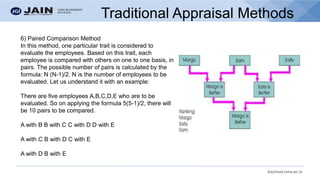
6) Paired Comparison Method
In this method, one particular trait is considered to
evaluate the employees. Based on this trait, each
employee is compared with others on one to one basis, in
pairs. The possible number of pairs is calculated by the
formula: N (N-1)/2. N is the number of employees to be
evaluated. Let us understand it with an example:
There are five employees A,B,C,D,E who are to be
evaluated. So on applying the formula 5(5-1)/2, there will
be 10 pairs to be compared.
A with B B with C C with D D with E
A with C B with D C with E
A with D B with E
bschool.cms.ac.in
Traditional Appraisal Methods
7) Field Review Method
This method is based on superiors' opinion on the performance, behavior and
skills of the employee. The HR specialist asks seniors to answer questions
related to employee's employment and appraises the employee on the basis
of feedback received from the superiors.
bschool.cms.ac.in
Traditional Appraisal Methods
8) Confidential Appraisal Method
This method is mostly used in government organizations to make decisions
regarding promotion and transfer of the employees. The senior prepares the
confidential report on the performance, behavior and other traits of the
employee. The report is supposed not to be revealed to anyone. It is sent in a
sealed cover to the concerned officials who appraise the employee on the
basis of this report and take decisions accordingly.
bschool.cms.ac.in
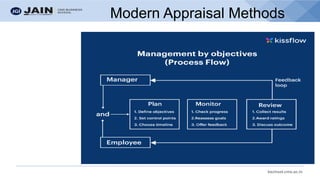
Modern Appraisal Methods
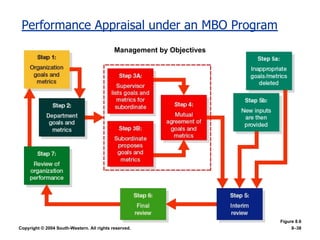
1. Management by Objectives (MBO):
The term Management by Objectives was first termed by management guru Peter
Drucker in his 1954 book, The Practice of Management.
This method focuses on improving the organization’s performances by defining clear
objectives both agreed upon by the employees and the managers. The objectives set
should be challenging yet achievable. Both managers and employees should review
past performance and pinpoint the problems. The information acquired then should
be used to address organizational goals and needs.
bschool.cms.ac.in
Modern Appraisal Methods
Steps in MBO (Also called MBO Process Cycle)
1. MBO emphasizes measurable, tangible, and achievable goals in the first step,
keeping the organizational mission in mind.
2. The second step is to translate these objectives into the employees.
3. In the third step, the employees are allowed to plan their objectives.
4. In the fourth step, the progress of the employees is monitored.
5. The fifth step is to evaluate and reward employees. Honest feedback is given,
and also new strategies for goals not achieved are established.
bschool.cms.ac.in
Modern Appraisal Methods
2. Psychological Appraisals
A psychological appraisal is one of the most exciting and intuitive
appraisal methods. This method assesses the employees' potential for
future performance rather than their past one. It focuses on employees'
emotional, intellectual, and other personal characteristics affecting their
performance.
3. 360 Degree Feedback
360-degree feedback is a systematic collection and feedback of
performance data for employees collected from all his/her peers,
supervisors, and even customers.
This is one of the most widely used appraisal methods. Since the
participation of the managers, peers, customers are involved, this
method gives an overview of the performance reviews collectively. This
helps in the performance appraisal process to have a diverse outlook.
bschool.cms.ac.in
Modern Appraisal Methods
4.Assessment Centre Method
In this method, employees are assessed to participate in activities like in-basket
exercises, role-playing, discussions, computer simulations, etc. They are evaluated in
terms of their persuasive ability, communication skills, confidence, sensitivity to others’
feelings, mental alertness, administrative ability, etc.
This entire exercise is done under the trainer, who observes the employee behavior and
then discusses it with the rater, which evaluates the employee's performance.
bschool.cms.ac.in
Modern Appraisal Methods
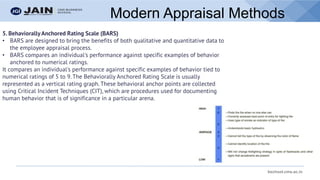
5. Behaviorally Anchored Rating Scale (BARS)
• BARS are designed to bring the benefits of both qualitative and quantitative data to
the employee appraisal process.
• BARS compares an individual's performance against specific examples of behavior
anchored to numerical ratings.
It compares an individual's performance against specific examples of behavior tied to
numerical ratings of 5 to 9. The Behaviorally Anchored Rating Scale is usually
represented as a vertical rating graph. These behavioral anchor points are collected
using Critical Incident Techniques (CIT), which are procedures used for documenting
human behavior that is of significance in a particular arena.
bschool.cms.ac.in
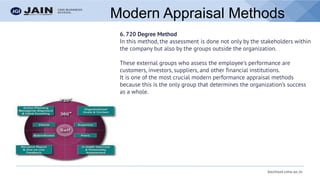
6. 720 Degree Method
In this method, the assessment is done not only by the stakeholders within
the company but also by the groups outside the organization.
These external groups who assess the employee's performance are
customers, investors, suppliers, and other financial institutions.
It is one of the most crucial modern performance appraisal methods
because this is the only group that determines the organization’s success
as a whole.
Modern Appraisal Methods
bschool.cms.ac.in
7. Cost Accounting Method
Some may find this method a little harsh, which may be a convenient appraisal method
for others.
This method evaluates the employees' performance from the economic output an
organization yields from their input. This is ascertained by analyzing the cost involved in
retaining the employees with the benefits an organization yields from their inputs.
Modern Appraisal Methods
bschool.cms.ac.in
Modern Appraisal Methods
bschool.cms.ac.in
Traditional Vs Modern
bschool.cms.ac.in
Advantages of Performance Appraisals
bschool.cms.ac.in
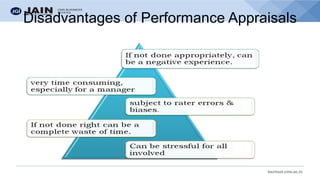
Disadvantages of Performance Appraisals
bschool.cms.ac.in
Difference between performance appraisal and performance
management
• A performance appraisal looks at all of the past actions of the employee within a set
amount of time, and rates how well they performed in their role and how many goals
they met.
• Performance management looks at the present and future of the employee, and
what can be done to help future performance and meet future goals. Performance
management is focused on the development and training of an employee, and how
that can benefit both the employee and the company.
Performance Management Performance Appraisal
• Proactive Reactive
• Forward looking Backwards looking
• Led by supervisors and management Led by HR with some management
input
Flexible Rigid
• Strategic Operational
• Ongoing Once a year
• Does not use ratings or rankings Uses ratings and rankings
bschool.cms.ac.in
How to design and deliver training programs?
bschool.cms.ac.in
Relevant Information
• https://ibfbzu.edu.pk/wp-content/uploads/2020/08/Human-Resource-Management-by-Gary-
Dessler-15th-ed.pdf
• https://www.referenceforbusiness.com/management/Str-Ti/Succession-
Planning.html#ixzz7JccRMitx
• https://www.hrexchangenetwork.com/hr-talent-management/articles/succession-planning-in-
the-new-normal-preparing-for-a-changing-workforce
• https://www.youtube.com/watch?v=ij4IwMs8N_w&t=4s
• LinkedIn course – https://www.linkedin.com/learning/how-to-design-
and-deliver-training-
programs/welcome?autoAdvance=true&autoSkip=false&autoplay
=true&resume=true&u=92695330 1h 29 m
bschool.cms.ac.in
Glossary
Employee Orientation
Training
Negligent Training
Task Analysis
Competency Model
Performance Analysis
On-the-job Training (Ojt)
Apprenticeship Training
Job Instruction Training
(Jit)
Programmed Learning
Behavior Modeling
Electronic Performance Support Systems (EPSS)
Job Aid
Lifelong Learning
Cross Training
Virtual Classroom
Web 2.0 Learning
Management Development
Job Rotation
Action Learning
Case Study Method
Management Game
Role-playing
In-house Development Center
Executive Coach
Organizational Development
Controlled Experimentation
bschool.cms.ac.in
Subject : Human Resource Management
Course code: 21MBACC205
Semester - II
bschool.cms.ac.in
MODULE - 4
Employee Rewards
1–2
bschool.cms.ac.in
Contents
Module – 4 – Employee Rewards
9 Hours
Employee Rewards -meaning, concepts and definitions,
Objectives of giving compensation to employees,
Components of remuneration, types of employee
benefits*, financial and non-financial benefits, factors
affecting wage and salary, salary components,
employee welfare, safety issues in organizations.
bschool.cms.ac.in
Course Objective
Propose an appropriate employee reward system in
organizations.
bschool.cms.ac.in
Relevant Information
• https://ibfbzu.edu.pk/wp-content/uploads/2020/08/Human-Resource-Management-by-Gary-
Dessler-15th-ed.pdf
• https://www.springworks.in/blog/employee-rewards-and-recognition-ideas/
• http://www.msrblog.com/business/human-resource-management/reward-strategy.html
• Video on Employee rewards - https://www.youtube.com/watch?v=fLTtHkUxmrM
• Working paper series on understanding compensation
https://www.iimcal.ac.in/sites/all/files/pdfs/wps_742.pdf
• Video on work place safety : https://www.youtube.com/watch?v=3C6js5JtCIQ
• https://www.linkedin.com/pulse/understanding-salary-breakup-structure-components-
abhishek-majumdar/
• LinkedIn course – https://www.linkedin.com/learning/human-
resources-compensation-and-
benefits/welcome?autoAdvance=true&autoSkip=false&autoplay=true&r
esume=true&u=92695330 (1hr 21 min)
bschool.cms.ac.in
Interview Questions
• How does the company recognize outstanding accomplishment of its employee?
• What type of rewards motivate the maximum to employees?
bschool.cms.ac.in
Discussion Case
bschool.cms.ac.in
Discussion Case
If Wegmans does so well with a high-pay policy, why don’t more
employers do this as well?
Page no – HRM by Gary Dessler page no 353
bschool.cms.ac.in
Meaning of Employee Rewards
• Reward is an incentive plan to reinforce the
desirable behavior of workers or employers and
in return for their service to the organization.
• Rewards can be monetary in the form of salary
or non monetary in the form of awards for some
special services to the company or simply giving
an employee a work which he enjoys doing.
bschool.cms.ac.in
Objectives of Employee Rewards
• To recruit & retain qualified employees
• To increase or maintain morale
• To determine basic wage & salary
• To reward for job performance
bschool.cms.ac.in
Importance of Employee Rewards
An organization incorporates reward management strategies for
• Motivating employees
• Supporting the organization’s strategy
• Ensuring internal & external equity
• Recruiting & retaining
• Strengthening psychological contract
• Ensuring financial sustainability
• Complying with legislation
• Channelizing efficient and productive administration
https://www.springworks.in/blog/employe
e-rewards-and-recognition-ideas/
bschool.cms.ac.in
bschool.cms.ac.in
bschool.cms.ac.in
bschool.cms.ac.in
Elements of Total Rewards
• Compensation (fix-pay, variable pay and short-term
incentive pay)
• Benefits (Social insurance, group insurance, pay for time
not worked,
• Work-Life (paid and unpaid time off, health and well-
being, caring for dependents, financial support)
• Performance and Recognition
• Development and Career Opportunities
bschool.cms.ac.in
bschool.cms.ac.in
Types of Employee Rewards
• Extrinsic
• Intrinsic
• Financial
• Non-financial
• Performance based
• Membership based
Shrivastava S., Kapoor S. (2019)
bschool.cms.ac.in
Direct & Indirect
• Direct Compensation - Base Pay, Bonus , Long term incentives, Perks or perquisites
• Indirect Compensation – Insurance , Leave & holiday, Clothes, Company parties,
Phones/laptop, Retirement benefits
Video on Employee rewards
https://www.youtube.com/watch?v=fLTtHkUxmrM
•
bschool.cms.ac.in
Employee Remuneration
• Employee Remuneration refers to the reward or compensation given to the
employees for their work performances
• Remuneration provides basic attraction to a employee to perform job efficiently
and effectively
• Remuneration leads to employee motivation
• Salaries constitutes an important source of income for employees and
determine their standard of living
• Salaries affect the employees productivity and work performance
Working paper series on understanding compensation
https://www.iimcal.ac.in/sites/all/files/pdfs/wps_742.pdf
bschool.cms.ac.in
Methods of Employee
Remuneration
* Time Rate Method: Remuneration is directly linked with the time
spent or devoted by an employee on the job
* Piece Rate Method: Remuneration is paid on the basis of units or
pieces produced by an employee. In this system emphasis is more on
quantity output rather than quality output
bschool.cms.ac.in
Components of Remuneration
 An average employee in the organized sector is entitled to several benefits
 Both financial as well as non-financial
 Typical remuneration of an employee comprises
❖ Wages and salary
❖ Incentives
❖ Fringe benefits
❖ Perquisites
❖ Non-monetary benefits
https://www.linkedin.com/pulse/understanding-salary-
breakup-structure-components-abhishek-majumdar/
bschool.cms.ac.in
Employee Benefits
•Provision of benefits and services are important in maintaining the
employees
• Purpose of such benefits is to retain people in the organization
and stimulate them to greater effort and higher performance
• They foster loyalty and act as a security base for the employee
bschool.cms.ac.in
Fringe benefits
•Benefits that the employee receives in addition to direct remuneration
•Fringes embrace a broad range of benefits and services that employees
receive as part of their total package
•Benefits and services however are indirect compensation because they are
usually extended as a condition of employment and are not directly related to
performance
• Fringe benefits are also called welfare expenses, wage supplements sub
wages or social charges, etc
bschool.cms.ac.in
Need for Employee Benefits
Employee demand: To meet rising prices and increased cost of living
employees demand various types of benefits Example: Variable dearness
allowance, Enhanced HRA
Trade union demands: The growth and strength of trade unions has
substantial influence on the benefits and services a company offers
Employer’s preferences: Employers prefer to give benefits to employees as it
enhances employee’s morale and works as an effective motivational tool
provided it is within the accepted norms and limits
bschool.cms.ac.in
Factors affecting wages & salary
• Main objective is to have a scientific, rational and balanced wage &
salary structure
• In salary administration, the employer should not feel employees are
getting more money than they deserve and employees should not feel
they getting lower money than they deserve
• Wage and salary administration includes allowances, leave facilities,
housing, travel, etc. and non-cost rewards such as recognition, privileges
and symbols of status
bschool.cms.ac.in
Wages
Minimum wage : Compulsory wage paid to employees irrespective of the
financial status of the organization. It should be calculated based on the
minimum food requirements, cloth requirements, rent to live in a particular
area, standard of a working class family and fuel, lighting and other needs
Fair wage : Wage above minimum and below living wage. It is decided based
on productivity of labor, prevailing rates of wages, level of national income and
the capacity of employer to pay
Living wage : It provides basic needs of life. It should meet medical,
education and retirement needs and it is paid according to the efficiency of
worker
bschool.cms.ac.in
Factors
• Wage policy of the company
• Job needs
• Ability to pay
• Cost of living
• Prevailing wage rates
• Unions
• State regulations
• Demand and supply of labor
• Economic conditions of the nation
bschool.cms.ac.in
Definition of Employee welfare
• Employee welfare refers to the effort taken by the
management to make life worth living for workmen
• According to Todd “employee welfare means anything
done for the comfort and improvement, intellectual or
social, of the employees over and above the wages paid
which is not a necessity of the industry
bschool.cms.ac.in
Features of Employee Welfare
• Employee welfare is a comprehensive term including various services,
facilities and amenities provided to employees for their betterment
• Employee welfare is a dynamic concept
• Employee welfare measures are also known as fringe benefits and services
• Welfare measures may be both voluntary and statutory
• It improves the loyalty and morale of the employees
• It reduces labor turnover and absenteeism
• Welfare measures help to improve the goodwill and public image of the
enterprise
• It helps to improve industrial relations and industrial peace
• It helps to improve employee productivity
bschool.cms.ac.in
Agencies of Employee Welfare
•Central government - has made elaborate provisions for the
health, safety and welfare as legally enforceable
•State government - Government in different states and Union
Territories provide welfare facilities to workers
•Employers - looked upon welfare work as fruitless and barren
though some of them indeed had done pioneering work
• Trade unions - have influenced the Govt & Management to
provide sound welfare measures
bschool.cms.ac.in
Types of Employee Welfare
•Intramural - These are provided within the organization like
Canteen, Rest rooms, Crèches, Uniform etc.
• Extramural - These are provided outside the organization
like Housing, Education, Child welfare, Leave travel facilities,
Interest free loans, Workers cooperative stores, Vocational
guidance etc. Source -Havelock (1973)
bschool.cms.ac.in
Types of Employee Welfare
• Statutory welfare work –
• Voluntary welfare work –
Different ways of Social Security Provision in India
• Social Insurance- common fund is established with periodical
contribution from workers out of which all benefits in terms of cash or
kind are
• Benifits such as PF, Group Insurance etc are offered
• Social Assistance- Benefits are offered to persons of small means by
govt out of its general revenues. Eg- Old age pension
Case study:http://euroasiapub.org/wp-content/uploads/2016/09/14ESSJune-2295.pdf
bschool.cms.ac.in
Employee Safety issues
Video on work place safety : https://www.youtube.com/watch?v=3C6js5JtCIQ
bschool.cms.ac.in
Prevention of Accidents
• Design a safe work environment
• Ergonomics
• Health and Safety Committees
• Behavior Modification
• Assessing Intervention Effectiveness
bschool.cms.ac.in
Safe Working Environment
bschool.cms.ac.in
Human Resources Compensation and Benefits
bschool.cms.ac.in
Relevant Information
• https://ibfbzu.edu.pk/wp-content/uploads/2020/08/Human-Resource-Management-by-Gary-
Dessler-15th-ed.pdf
• https://www.springworks.in/blog/employee-rewards-and-recognition-ideas/
• http://www.msrblog.com/business/human-resource-management/reward-strategy.html
• Video on Employee rewards - https://www.youtube.com/watch?v=fLTtHkUxmrM
• Working paper series on understanding compensation
https://www.iimcal.ac.in/sites/all/files/pdfs/wps_742.pdf
• Video on work place safety : https://www.youtube.com/watch?v=3C6js5JtCIQ
• LinkedIn course – https://www.linkedin.com/learning/human-
resources-compensation-and-
benefits/welcome?autoAdvance=true&autoSkip=false&autoplay=true&r
esume=true&u=92695330 (1hr 21 min)
bschool.cms.ac.in
Glossary
Employee Compensation
Direct Financial Payments
Indirect Financial Payments
Job Evaluation
Market-competitive Pay Plan
Compensable Factor
Benchmark Job
Ranking Method
Job Classification (Or Job
Grading)
Job Classes
Job Grades
Grade Definition
Point Method
Market-competitive Pay System
Wage Curve
Salary Survey
Pay (Or Wage) Grade
Pay (Or Rate) Ranges
Compa Ratio
Competency-based Pay
Broadbanding
Comparable Worth
bschool.cms.ac.in
Subject : Human Resource Management
Course code: 21MBACC205
Semester - II
bschool.cms.ac.in
MODULE - 5
Basics of Industrial Relation
1–2
bschool.cms.ac.in
Contents
Module 5 – Basics of Industrial Relation
8 Hours
Basics of Industrial Relations – meaning and
importance, trade unions, workers participation in
management, Collective Bargaining*
bschool.cms.ac.in
Course Objective
Describe the concepts of industrial relations for a particular
industry.
bschool.cms.ac.in
Relevant Information
• https://theconversation.com/global/topics/industrial-relations-702
• https://www.youtube.com/watch?v=lTjYFxwprf4
• https://journals.sagepub.com/home/jir
• https://www.youtube.com/watch?v=L9Wj414Ftog
• www.researchgate.net/publication/338679820_Employee_Participation_in_Management
• https://www.nishithdesai.com/fileadmin/user_upload/pdfs/Research%20Papers/India-Trade-
Unions-and-Collective-Bargaining.pdf
• https://www.linkedin.com/learning/introduction-to-employee-
relations/the-meaning-of-employee-
relations?autoAdvance=true&autoSkip=false&autoplay=true&resume=t
rue&u=92695330 – 55Min
bschool.cms.ac.in
Interview Questions
• Can there be a strike or lock-out during the term of the collective agreement?
• Who selects the arbitrator or members of an arbitration board?
bschool.cms.ac.in
Discussion Case
Wistron violence: Lessons for Indian manufacturing –
https://www.hindustantimes.com/business-news/wistron-violence-lessons-for-
indian-manufacturing/story-
bschool.cms.ac.in
Basics of Industrial Relations –
meaning and importance,
bschool.cms.ac.in
Basics of Industrial Relations –
meaning and importance,
Definitions of Industrial Relations:
• “industrial relations” is used to denote the collective
relationships between management and the workers.
• labour-management relations and employer-employee relations
are synonymously used.
Bethel and associates defined “Industrial relations is that
part of management which is concerned with the manpower
of the enterprise”.
J. Henry Richardson “industrial relations is an art, the art of
living together for purposes of production”.
bschool.cms.ac.in
Governme
nt
Trade
Unions
Employers
Basics of Industrial Relations –
meaning and importance,
bschool.cms.ac.in
Trade Union:
Trade unions try to protect interest of workers, they insist upon the
development of cultural and educational qualities of there members.
Employers & their organizations:
They try to protect the interest of employers, to create healthy
industrial atmosphere, so that the objectives of the organization may be
achieved. They try to get full co-operation of workers for achieving this
objective.
Government:
The government plays an important role in establishing better
industrial relations. Government passes various laws to protect the
interest of both employers and employees.
Three Partners of Industrial Relations
bschool.cms.ac.in
Importance of Industrial Relations
Features of Industrial Relations are explained below:
1. The concept of industrial relations is complex and multi-
dimensional. It is also a dynamic and developing concept.
2. In the olden days, industrial relations were cordial and
peaceful. However, at present, they are not so due to increase
in the number of industrial workers, growth of trade unions,
growing demands of workers etc.
3. Industrial relations do not function in a vacuum. The attitude
and approaches of employers, employees and trade unions
are directly related ‘to, industrial relations.
bschool.cms.ac.in
Importance of Industrial Relations
4. Industrial relations lead to “industrial peace” or “industrial
unrest”. Both terms are used in relation to industrial relations.
Cordial industrial , relations bring industrial peace i.e. a period
when industrial disputes, strikes, lock-outs, etc. are absent and
production activity is being conducted in a regular and continuous
manner.
5. Cordial industrial relations are always beneficial to all
concerned parties whereas absences of such relations are
harmful to all parties and even to the national economy.
bschool.cms.ac.in
THE TRADE UNION ACT 1926
DEFINITION:
Section 2 (h) of the Trade Union Act 1926 defines the term „Trade
Union‟ as-
• “ any combination, whether temporary or permanent,
• formed primarily for the purpose of regulating the relation
o between workmen and employers,
o between workmen and workmen, or
o between employers and employers or
• for imposing restrictive conditions on the conduct of
o any trade or business, and
• includes any federation of two or more Trade Unions”.
bschool.cms.ac.in
FUNCTIONS & ROLE OF TRADE UNIONS.
• To improve working and living conditions.
• To secure for workers fair wages.
• To enlarge opportunities for promotion and training. v To
promote individual and collective welfare.
• To provide for educational, cultural and recreational facilities.
• To safeguard security of tenure and improve conditions of
service.
• To promote identity of interests of the workers with their
industry .
bschool.cms.ac.in
Central Trade Union Organizations in India
• All India Trade Union Congress (AITUC)
• Centre of Indian Trade Unions (CITU)
• Hind Mazdoor Kisan Panchayat (HMKP)
• Hind Mazdoor Sabha (HMS)
• Indian Federation of Free Trade Unions (IFFTU)
• Indian National Trade Union Congress (INTUC)
• National Front of Indian Trade Unions (NFITU)
• National Labor Organization (NLO)
• Trade Unions Co-ordination Centre (TUCC)
• National Mazdoor Union (NMU)
bschool.cms.ac.in
Worker’s participation in management
Worker’s participation is a system where workers and
management share important information with each other and
participate in decision taking.
According to Keith Davis, “Workers’ participation refers to –
• the mental and emotional involvement of a person
• in a group situation
• which encourages him to contribute to group goals and share in
responsibility of achieving them”.
bschool.cms.ac.in
Features of WPM
• Participation means mental and emotional involvement rather
than mere physical presence.
• Workers participate in management not as individuals but
collectively as a group through their representatives.
• Workers’ participation in management may be formal or
informal. In both the cases it is a system of communication and
consultation whereby employees express their opinions and
contribute to managerial decisions.
bschool.cms.ac.in
Levels of Management Participation or WPM
Information participation:
• ensures that employees are able to receive information and
• express their views pertaining to the matters.
Consultative importance:
• workers are consulted on the matters of employee welfare such as work,
safety and health.
• However, final decision always rests with the top-level management.
Associative participation:
• an extension of consultative participation as management here is under the
moral obligation to accept and implement the unanimous decisions of the
employees.
• managers and workers jointly take decisions.
bschool.cms.ac.in
Levels of Management Participation or WPM
Administrative participation:
• ensures greater share of workers’ participation in discharge of
managerial functions.
• decisions already taken by the management come to
employees, preferably with alternatives for administration and
employees have to select the best from those for
implementation.
Decisive participation:
• Highest level of participation where decisions are jointly taken
on the matters relating to production, welfare etc.
bschool.cms.ac.in
Achieving WPM
bschool.cms.ac.in
In India workers participation has been introduced in these forms :
1. The Workers Committees
2. Joint Management Councils
3. Shop Councils
4. Joint Councils
FORMS OF WPM
bschool.cms.ac.in
• First labor management association started in 1947
• with the passing Industrial Disputes Act.
• The Act provides that in the case of any industrial establishment in
which
o 100 or more workers are employed on any day in the preceding
twelve months.
• The employees to constitute in the prescribed manner a Works
Committee in the establishment.
• The committee was expected to discuss matters of common
interest and to maintain cordial relations between workers and
employees.
• The response to works committees was encouraging in the beginning.
But , in spite of their large number the experience of these committees
was not very fruitful.
Workers Committees
bschool.cms.ac.in
Joint Management Councils
• Joint Management council was a voluntary body.
• Its introduction was left solely to the discretion of employers
and employees.
• These councils will consist of equal number of representation of
workers and management will not exceed twelve.
• The councils functions were divided as:-
o Information sharing.
o Consultative.
o Administrative.
• The council has the right to receive information , discuss and
give suggestions on general economic situation, market
production, general running of the unit,etc.
bschool.cms.ac.in
• A new scheme for workers participation in management was adopted in
October 1975.
• The scheme was voluntary in nature.
• It covered all manufacturing and mining industries employing 500 or
more persons.
• The scheme provided for setting up of shops councils at the plant level.
Shop Councils
• There will be a shop for each department or one council for more
departments considering the number of workers employed there.
• The representatives of employees will be nominated by the management
and must be from the unit concerned.
• The number of members in the council may be decided by management
in Consultation with recognised unions.
Shop Councils
bschool.cms.ac.in
Joint Councils
• The development of skill of workmen and adequate
facilities for training.
• Preparation of schedules of working hours and of
holidays.
• Awarding of rewards for valuables and creative
suggestions received from workers.
• Optimum use of raw materials and quality of finished
products.
bschool.cms.ac.in
Meaning of Collective Bargaining
Collective bargaining is that –
• arrangement
• whereby the wages components of remuneration and
conditions of employment of workman are settled
• through a bargain between
o the employer and
o the workman collectively
• whether represented through their union or by some of them on
behalf of all of them.
collective bargaining
bschool.cms.ac.in
Need of Collective Bargaining
• It helps in solving the industrial disputes.
• Secure a prompt and fair redressal of grievances.
• Establish uniform conditions of employment with a view to avoid
industrial disputes and maintaining stable peace in the industry.
• Helps redress worker grievances promptly and fairly.
• Avoid interruptions in work which follow strikes, go slow tactics
and similar coercive activities.
• Lay down fair rates of wages and norms of working conditions.
• Achieve an efficient operation of the plant and
• Promote the stability and prosperity of the industry.
bschool.cms.ac.in
Collective Bargaining Process
In many companies, agreements have a fixed time scale and a
collective bargaining process will review the procedural
agreement when negotiations take place on pay and conditions of
employment.
bschool.cms.ac.in
Levels of collective bargaining
bschool.cms.ac.in
Introduction to Employee Relations
bschool.cms.ac.in
Relevant Information
• https://theconversation.com/global/topics/industrial-relations-702
• https://www.youtube.com/watch?v=lTjYFxwprf4
• https://journals.sagepub.com/home/jir
• https://www.youtube.com/watch?v=L9Wj414Ftog
• www.researchgate.net/publication/338679820_Employee_Participation_in_Management
• https://www.nishithdesai.com/fileadmin/user_upload/pdfs/Research%20Papers/India-Trade-
Unions-and-Collective-Bargaining.pdf
• https://www.linkedin.com/learning/introduction-to-employee-
relations/the-meaning-of-employee-
relations?autoAdvance=true&autoSkip=false&autoplay=true&resume=t
rue&u=92695330 – 55Min
bschool.cms.ac.in
Glossary
Occupational Safety and Health
occupational illness
unsafe conditions
job hazard analysis
operational safety reviews
behavior-based safety
safety awareness program
burnout
PERFORMANCE
MANAGEMENT
8–1
Copyright © 2004 South-Western. All rights reserved. 8–2
Objectives
After studying this chapter, you should be able to:
1. Explain the purposes of performance appraisals and
the reasons they can sometimes fail.
2. Identify the characteristics of an effective appraisal
program.
3. Describe the different sources of appraisal
information.
4. Explain the various methods used for performance
evaluation.
5. Outline the characteristics of an effective
performance appraisal interview.
Copyright © 2004 South-Western. All rights reserved. 8–3
Performance Appraisal and Other HRM Functions
Performance appraisal
validates selection function
Selection
Selection should produce
workers best able to meet
job requirements
Performance appraisal
determines training needs
Training and
Development
Training and development
aids achievement of
performance standards
Performance appraisal is a
factor in determining pay
Compensation
Management
Compensation can affect
appraisal of performance
Presentation Slide 8–1
Performance appraisal judges
effectiveness of recruitment
efforts
Recruitment
Quality of applicants
determines feasible
performance standards
Performance appraisal justifies
personnel actions
Labor Relations
Appraisal standards and
methods may be subject to
negotiation
Copyright © 2004 South-Western. All rights reserved. 8–4
Performance Appraisal
Appraisal Programs
Administrative Developmental
Compensation Ind. Evaluation
Job Evaluation
EEO/AA Support
Training
Career Planning
Copyright © 2004 South-Western. All rights reserved. 8–5
Purposes for Performance Appraisal
Figure 8.1
Copyright © 2004 South-Western. All rights reserved. 8–6
Reasons Appraisal Programs Fail
•Lack of top-management
information and support
•Unclear performance
standards
•Rater bias
•Too many forms to
complete
•Use of the appraisal
program for conflicting
purposes.
Copyright © 2004 South-Western. All rights reserved. 8–7
Managerial Issues Concerning Appraisals
•Managers feel that little or no benefit will be
derived from the time and energy spent in the
process.
•Managers dislike the face-to-face confrontation
of appraisal interviews.
•Managers are not sufficiently adept in providing
appraisal feedback.
•The judgmental role of appraisal conflicts with
the helping role of developing employees.
Copyright © 2004 South-Western. All rights reserved. 8–8
Common Appraisal Problems
• Inadequate preparation on
the part of the manager.
• Employee is not given
clear objectives at the
beginning of performance
period.
• Manager may not be able
to observe performance or
have all the information.
• Inconsistency in ratings
among supervisors or
other raters.
• Performance standards
may not be clear.
• Rating personality rather
than performance.
• The halo effect, contrast
effect, or some other
perceptual bias.
Copyright © 2004 South-Western. All rights reserved. 8–9
Common Appraisal Problems (cont’d)
• Inappropriate time span
(either too short or too
long).
• Overemphasis on
uncharacteristic
performance.
• Inflated ratings because
managers do not want to
deal with “bad news.”
• Subjective or vague
language in written
appraisals.
• Organizational politics or
personal relationships
cloud judgments.
• No thorough discussion of
causes of performance
problems.
• Manager may not be
trained at evaluation or
giving feedback.
• No follow-up and
coaching after the
evaluation.
Copyright © 2004 South-Western. All rights reserved. 8–10
Let me
count the
ways…
Insufficient
reward for
performance
Manager
lacks
information
Lack of
appraisal
skills
Manager not
taking
appraisal
seriously
Manager not
prepared
Manager not
being honest
or sincere
Employee not
receiving
ongoing
feedback
Ineffective
discussion of
employee
development
Unclear
language
Performance
appraisals fail
because…
Presentation Slide 8–2
Copyright © 2004 South-Western. All rights reserved. 8–11
Why Appraisal Systems Are Ineffective
•Inadequate preparation on the part of the
manager.
•Employee is not given clear objectives at the
beginning of performance period.
•Manager may not be able to observe
performance or have all the information.
•Performance standards may not be clear.
•Inconsistency in ratings among supervisors or
other raters.
Figure 8.2a
Sources: Patricia Evres, “Problems to Avoid during Performance Evaluations,” Air Conditioning, Heating & Refrigeration News 216, no. 16
(August 19, 2002): 24–26; Clinton Longnecker and Dennis Gioia, “The Politics of Executive Appraisals,” Journal of Compensation and
Benefits 10, no. 2 (1994): 5–11; “Seven Deadly Sins of Performance Appraisals,” Supervisory Management 39, no. 1 (1994): 7–8.
Copyright © 2004 South-Western. All rights reserved. 8–12
Why Appraisal Systems Are Ineffective
(cont’d)
•Rating personality rather than performance.
•The halo effect, contrast effect, or some other
perceptual bias.
•Inappropriate time span (too short or too long).
•Overemphasis on uncharacteristic performance.
•Inflated ratings because managers do not want
to deal with “bad news.”
•Subjective or vague language in written
appraisals.
Figure 8.2b
Sources: Patricia Evres, “Problems to Avoid during Performance Evaluations,” Air Conditioning, Heating & Refrigeration News 216, no. 16
(August 19, 2002): 24–26; Clinton Longnecker and Dennis Gioia, “The Politics of Executive Appraisals,” Journal of Compensation and
Benefits 10, no. 2 (1994): 5–11; “Seven Deadly Sins of Performance Appraisals,” Supervisory Management 39, no. 1 (1994): 7–8.
Copyright © 2004 South-Western. All rights reserved. 8–13
Why Appraisal Systems Are Ineffective
(cont’d)
•Organizational politics or personal relationships
cloud judgments.
•No thorough discussion of causes of
performance problems.
•Manager may not be trained at evaluation or
giving feedback.
•No follow-up and coaching after the evaluation.
Figure 8.2c
Sources: Patricia Evres, “Problems to Avoid during Performance Evaluations,” Air Conditioning, Heating & Refrigeration News 216, no. 16
(August 19, 2002): 24–26; Clinton Longnecker and Dennis Gioia, “The Politics of Executive Appraisals,” Journal of Compensation and
Benefits 10, no. 2 (1994): 5–11; “Seven Deadly Sins of Performance Appraisals,” Supervisory Management 39, no. 1 (1994): 7–8.
Copyright © 2004 South-Western. All rights reserved. 8–14
Establishing Performance Standards
Figure 8.3
Presentation Slide 8–3
Actual
performance
Performance
measures
Zone of valid
assessment
Criterion contamination:
Elements that affect the
appraisal measures that
are not part of the actual
performance
Strategic relevance:
Performance standards
linked to organizational
goals and competencies
Criterion deficiency:
Aspects of actual performance
that are not measured
Reliability:
Measures that are
consistent across
raters and over time
Copyright © 2004 South-Western. All rights reserved. 8–15
Strategic
Relevance
Individual standards directly
relate to strategic goals.
Criterion
Deficiency
Standards capture all of an
individual’s contributions.
Criterion
Contamination
Performance capability is not
reduced by external factors.
Reliability
(Consistency)
Standards are quantifiable,
measurable, and stable.
Performance Standards Characteristics
Copyright © 2004 South-Western. All rights reserved. 8–16
Compliance with the Law
•Brito v Zia
The Supreme Court ruled that performance
appraisals were subject to the same validity
criteria as selection procedures.
•Albemarle Paper Company v Moody
The Supreme Court found that employees had
been ranked, against a vague standard, open to
each supervisor’s own interpretation.
Copyright © 2004 South-Western. All rights reserved. 8–17
Legal Guidelines for Appraisals
• Performance ratings must be job-related.
• Employees must be given a written copy of their job
standards in advance of appraisals.
• Managers who conduct the appraisal must be able to
observe the behavior they are rating.
• Supervisors must be trained to use the appraisal form
correctly.
• Appraisals should be discussed openly with employees
and counseling or corrective guidance offered.
• An appeals procedure should be established to enable
employees to express disagreement with the appraisal.
Copyright © 2004 South-Western. All rights reserved. 8–18
Alternative Sources of Appraisal
Figure 8.4
Copyright © 2004 South-Western. All rights reserved. 8–19
Sources of Performance Appraisal
•Manager and/or Supervisor
Appraisal done by an employee’s manager and
reviewed by a manager one level higher.
•Self-Appraisal Performance
By the employee being evaluated, generally on an
appraisal form completed by the employee prior
to the performance interview.
•Subordinate Appraisal
Appraisal of a superior by an employee, which is
more appropriate for developmental than for
administrative purposes.
Copyright © 2004 South-Western. All rights reserved. 8–20
Sources of Performance Appraisal
•Peer Appraisal
Appraisal by fellow employees, compiled into a
single profile for use in an interview conducted by
the employee’s manager.
•Team Appraisal
Appraisal, based on TQM concepts, recognizing
team accomplishment rather than individual
performance.
•Customer Appraisal
Appraisal that seeks evaluation from both
external and internal customers.
Copyright © 2004 South-Western. All rights reserved. 8–21
Alternative Sources of
Performance Appraisal
Supervisor
Subordinates
Peers
Team
Customers
Self
Presentation Slide 8–4
Copyright © 2004 South-Western. All rights reserved. 8–22
Pros and Cons of 360-Degree Appraisal
• PROS
The system is more comprehensive in that responses are
gathered from multiple perspectives.
Quality of information is better. (Quality of respondents is
more important than quantity.)
It complements TQM initiatives by emphasizing
internal/external customers and teams.
It may lessen bias/prejudice since feedback comes from
more people, not one individual.
Feedback from peers and others may increase employee
self-development.
Figure 8.5a
Sources: Compiled from David A. Waldman, Leanne E. Atwater, and David Antonioni, “Has 360-Degree Feedback Gone Amok?” Academy of Management
Executive 12, no. 2 (May 1998): 86–94; Bruce Pfau, Ira Kay, Kenneth Nowak, and Jai Ghorpade, “Does 360-Degree Feedback Negatively Affect Company
Performance?” HRMagazine 47, no. 6 (June 2002): 54–59; Maury Peiperl, “Getting 360-Degree Feedback Right,” Harvard Business Review 79, no. 1 (January
2001): 142–47; Jack Kondrasuk, Mary Riley, and Wang Hua, “If We Want to Pay for Performance, How Do We Judge Performance?” Journal of Compensation
and Benefits 15, no. 2 (September/October 1999): 35–40; Mary Graybill, “From Paper to Computer,” The Human Resource Professional 13, no. 6 (November/
December 2000): 18–19; David W. Bracken, Lynn Summers, and John Fleenor, “High-Tech 360,” Training and Development 52, no. 8 (August 1988): 42–45; Gary
Meyer, “Performance Reviews Made Easy, Paperless,” HRMagazine 45, no. 10 (October 2000): 181–84.
Copyright © 2004 South-Western. All rights reserved. 8–23
Pros and Cons of 360-Degree Appraisal
• CONS
The system is complex in combining all the responses.
Feedback can be intimidating and cause resentment if
employee feels the respondents have “ganged up.”
There may be conflicting opinions, though they may all be
accurate from the respective standpoints.
The system requires training to work effectively.
Employees may collude or “game” the system by giving
invalid evaluations to one another.
Appraisers may not be accountable if their evaluations are
anonymous.
Figure 8.5b
Sources: Compiled from David A. Waldman, Leanne E. Atwater, and David Antonioni, “Has 360-Degree Feedback Gone Amok?” Academy of Management
Executive 12, no. 2 (May 1998): 86–94; Bruce Pfau, Ira Kay, Kenneth Nowak, and Jai Ghorpade, “Does 360-Degree Feedback Negatively Affect Company
Performance?” HRMagazine 47, no. 6 (June 2002): 54–59; Maury Peiperl, “Getting 360-Degree Feedback Right,” Harvard Business Review 79, no. 1 (January
2001): 142–47; Jack Kondrasuk, Mary Riley, and Wang Hua, “If We Want to Pay for Performance, How Do We Judge Performance?” Journal of Compensation
and Benefits 15, no. 2 (September/October 1999): 35–40; Mary Graybill, “From Paper to Computer,” The Human Resource Professional 13, no. 6 (November/
December 2000): 18–19; David W. Bracken, Lynn Summers, and John Fleenor, “High-Tech 360,” Training and Development 52, no. 8 (August 1988): 42–45; Gary
Meyer, “Performance Reviews Made Easy, Paperless,” HRMagazine 45, no. 10 (October 2000): 181–84.
Copyright © 2004 South-Western. All rights reserved. 8–24
360-Degree Performance Appraisal System
Integrity Safeguards
•Assure anonymity.
•Make respondents accountable.
•Prevent “gaming” of the system.
•Use statistical procedures.
•Identify and quantify biases.
Copyright © 2004 South-Western. All rights reserved. 8–25
Training Performance Appraisers
Recency errors
Leniency or strictness errors
Common rater-related errors
Error of central tendency
Similar-to-me errors
Contrast and halo errors
Copyright © 2004 South-Western. All rights reserved. 8–26
Rater Errors
•Error of Central Tendency
A rating error in which all employees are rated
about average.
•Leniency or Strictness Error
A rating error in which the appraiser tends to give
all employees either unusually high or unusually
low ratings.
•Recency Error
A rating error in which appraisal is based largely
on an employee’s most recent behavior rather
than on behavior throughout the appraisal period.
Copyright © 2004 South-Western. All rights reserved. 8–27
Rater Errors
•Contrast Error
A rating error in which an employee’s evaluation
is biased either upward or downward because of
comparison with another employee just
previously evaluated.
•Similar-to-Me Error
An error in which an appraiser inflates the
evaluation of an employee because of a mutual
personal connection.
Copyright © 2004 South-Western. All rights reserved. 8–28
Trait Methods
Trait
Methods
Graphic Rating
Scale
Mixed Standard
Scale
Forced-Choice
Essay
Copyright © 2004 South-Western. All rights reserved. 8–29
Trait Methods
•Graphic Rating-Scale Method
A trait approach to performance appraisal
whereby each employee is rated according to a
scale of individual characteristics.
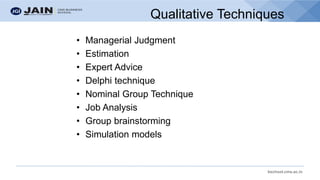
•Mixed-Standard Scale Method
An approach to performance appraisal similar to
other scale methods but based on comparison
with (better than, equal to, or worse than) a
standard.
Copyright © 2004 South-Western. All rights reserved. 8–30
Graphic Rating
Scale With
Provision For
Comments
HRM 2
Copyright © 2004 South-Western. All rights reserved. 8–31
Trait Methods
•Forced-Choice Method
Requires the rater to choose from statements
designed to distinguish between successful and
unsuccessful performance.
•Essay Method
Requires the rater to compose a statement
describing employee behavior.
Copyright © 2004 South-Western. All rights reserved. 8–32
Example Of A Mixed-standard Scale
HRM 3
Copyright © 2004 South-Western. All rights reserved. 8–33
Behavioral Methods
Behavioral
Methods
Critical Incident
Behavioral Checklist
Behaviorally Anchored
Rating Scale (BARS)
Behavior Observation
Scale (BOS)
Copyright © 2004 South-Western. All rights reserved. 8–34
Behavioral Methods
• Critical Incident
An unusual event denoting superior or inferior
employee performance in some part of the job.
• Behaviorally Anchored Rating Scale (BARS)
A performance appraisal that consists of a series
of vertical scales, one for each dimension of job
performance.
• Behavior Observation Scale (BOS)
A performance appraisal that measures the
frequency of observed behavior.
Copyright © 2004 South-Western. All rights reserved. 8–35
Examples Of A Bars For Municipal Fire Companies
HRM 4
Source: Adapted from Landy, Jacobs, and Associates. Reprinted with permission.
FIREFIGHTING STRATEGY: Knowledge of Fire Characteristics.
Copyright © 2004 South-Western. All rights reserved. 8–36
Sample Items From Behavior Observation Scales
HRM 0
Copyright © 2004 South-Western. All rights reserved. 8–37
Results Methods
•Management by Objectives (MBO)
A philosophy of management that rates
performance on the basis of employee
achievement of goals set by mutual agreement of
employee and manager.
Copyright © 2004 South-Western. All rights reserved. 8–38
Performance Appraisal under an MBO Program
Figure 8.6
Management by Objectives
Copyright © 2004 South-Western. All rights reserved. 8–39
Summary of Appraisal Methods
ADVANTAGES DISADVANTAGES
TRAIT
S
Inexpensiv
e
Meaningful
Easy to
use
Potential for error
Poor for
counseling
Poor for allocating rewards
Poor for promotional decisions
BEHAVIO
R
Specific dimensions
Accepted by
employees
Useful for feedback
OK for reward/promotion
Time consuming
Costly
Some rating error
RESULT
S
Less subjectivity bias
Accepted by
employees
Performance-reward link
Encourages goal setting
Good for promotion
decisions
Time consuming
Focus on short term
Criterion contamination
Criterion deficiency
Presentation Slide 8–5
Copyright © 2004 South-Western. All rights reserved. 8–40
Summary of Appraisal Methods
•Trait Methods
Advantages
❖ Are inexpensive to develop
❖ Use meaningful dimensions
❖ Are easy to use
Disadvantages
❖ Have high potential for rating errors
❖ Are not useful for employee counseling
❖ Are not useful for allocating rewards
❖ Are not useful for promotion decisions
Figure 8.7a
Copyright © 2004 South-Western. All rights reserved. 8–41
Summary of Appraisal Methods (cont’d)
•Behavioral Methods
Advantages
❖ Use specific performance dimensions
❖ Are acceptable to employees and superiors
❖ Are useful for providing feedback
❖ Are fair for reward and promotion decisions
Disadvantages
❖ Can be time-consuming to develop/use
❖ Can be costly to develop
❖ Have some potential for rating error
Figure 8.7b
Copyright © 2004 South-Western. All rights reserved. 8–42
Summary of Appraisal Methods (cont’d)
•Results Methods
Advantages
❖ Have less subjectivity bias
❖ Are acceptable to employees and superiors
❖ Link individual to organizational performance
❖ Encourage mutual goal setting
❖ Are good for reward and promotion decisions
Disadvantages
❖ Are time-consuming to develop/use
❖ May encourage short-term perspective
❖ May use contaminated criteria
❖ May use deficient criteria
Figure 8.7c
Copyright © 2004 South-Western. All rights reserved. 8–43
Types of Appraisal Interviews
Tell and Listen - nondirective
Appraisal Interview Formats
Tell and Sell - persuasion
Problem solving- focusing the
interview on problem resolution
and employee development
Copyright © 2004 South-Western. All rights reserved. 8–44
Ask for Self-Assessment
Express Appreciation
Appraisal Interview Guidelines
Be Supportive
Follow Up Day by Day
Establish Goals
Problem Solving Focus
Minimize Criticism
Invite Participation
Change Behavior
Presentation Slide 8–6
Copyright © 2004 South-Western. All rights reserved. 8–45
Factors That Influence Performance
Figure 8.8
Copyright © 2004 South-Western. All rights reserved. 8–46
Performance Diagnosis
HRM 8
Source: Scott Snell, Cornell University.
Training and Developing Employees
8–2
Objectives of the chapter:
1. Summarize the purpose and process of employee orientation.
2. List and briefly explain each of the four steps in he training process.
3. Discuss how you would motivate trainees.
4. Describe and illustrate how you would identify training requirements.
5. Explain how to distinguish between problems you can fix with training,
and those you can’t.
6. Explain how to use five training techniques.
7. List and briefly discuss the importance of the eight steps in leading
organizational change.
8. Answer the question, “What is organizational development and how does
it differ from traditional approaches to organizational change?”
8–3
Purpose of Orientation
Feel
Welcome and
At Ease
Begin the
Socialization
Process
Understand
the
Organization
Know What
Is Expected
in Work and
Behavior
Orientation Helps
New Employees
8–4
The Orientation Process
Company
Organization and
Operations
Safety Measures
and Regulations
Facilities
Tour
Employee
Orientation
Employee Benefit
Information
Personnel
Policies
Daily
Routine
8–5
New Employee
Departmental
Orientation
Checklist
Source: Used
with permission
of UC San Diego
Medical Center.
8–6
The Training Process
• Training
The process of teaching new employees the basic
skills they need to perform their jobs.
• Training’s Strategic Context
The firm’s training programs must make sense in
terms of the company’s strategic goals.
• Performance Management
Taking an integrated, goal-oriented approach to
assigning, training, assessing, and rewarding
employees’ performance.
8–7
The Training Process (continued)
1
2
3
4
5
The Five-Step Training and Development Process
Instructional design
Needs analysis
Validation
Implement the program
Evaluation
8–8
Training, Learning, and Motivation
Make the Learning Meaningful
1. At the start of training, provide a bird’s-eye view of
the material to be presented to facilitate learning.
2. Use a variety of familiar examples.
3. Organize the information so you can present it
logically, and in meaningful units.
4. Use terms and concepts that are already familiar
to trainees.
5. Use as many visual aids as possible.
6. Create a perceived need for training in the minds of
the trainees.
8–9
Training, Learning, and Motivation
(continued)
Make Skills Transfer Easy
1. Maximize the similarity between the training situation and the
work situation.
2. Provide adequate practice.
3. Label or identify each feature of the machine and/or step in the
process.
4. Direct the trainees’ attention to important aspects of the job.
5. Provide “heads-up,” preparatory information that lets trainees
know what might happen back on the job.
6. Trainees learn best at their own pace. If possible, let them pace
themselves.
8–10
Training, Learning, and Motivation
• Trainees learn best when the trainers
immediately reinforce correct responses.
• Trainees learn best at their own pace.
• The schedule is important—the learning curve
goes down late in the day; less than full day
training is most effective.
8–11
Analyzing Training Needs
Task Analysis:
Assessing New Employees’
Training Needs
Performance Analysis:
Assessing Current Employees’
Training Needs
Training Needs
Analysis
8–12
Task
Analysis
Record
Form
Note: Task analysis
record form showing
some of the tasks and
subtasks performed by
a printing press
operator.
8–13
Assessing Current Employees’ Training Needs
Performance Appraisals
Job-Related
Performance Data
Observations
Interviews
Assessment Center
Results
Individual Diaries
Attitude Surveys
Tests
Methods for
Identifying
Training
Needs
8–14
Training Methods
• On-the-Job Training
• Apprenticeship Training
• Informal Learning
• Job Instruction Training
• Lectures
• Programmed Learning
• Audiovisual Training
• Simulated Training (also Vestibule Training)
• Computer-Based Training (CBT)
• Electronic Performance Support Systems (EPSS)
• Distance and Internet-Based Training
8–15
Training Methods (continued)
• On-the-Job Training (OJT)
Having a person learn a job
by actually doing the job.
• Types of On-the-Job Training
Coaching or understudy
Job rotation
Special assignments
• Advantages
Inexpensive
Learn by doing
Immediate feedback
8–16
On-the-Job Training
1
Follow Up
Present the Operation
Steps to Help Ensure OJT Success
Prepare the Learner
Do a Tryout
2
3
4
8–17
Training Methods (continued)
• Effective Lectures
Don’t start out on the wrong foot.
Give listeners signals.
Be alert to your audience.
Maintain eye contact with audience.
Make sure everyone in the room can hear.
Control your hands.
Talk from notes rather than from a script.
Break a long talk into a series of five-minute talks.
Practice and rehearse your presentation.
8–18
Programmed Learning
• Advantages
Reduced training time
Self-paced learning
Immediate feedback
Reduced risk of error for learner
Presenting
questions, facts,
or problems to
the learner
Allowing the
person to
respond
Providing
feedback on the
accuracy of
answers
8–19
Names of Various Computer-Based Training Techniques
PI Computer-based programmed instruction
CBT Computer-based training
CMI Computer-managed instruction
ICAI Intelligent computer-assisted instruction
ITS Intelligent tutoring systems
Simulation Computer simulation
Virtual Reality Advanced form of computer simulation
Source: P. Nick Blanchard and James Thacker, Effective Training: Systems, Strategies,
and Practices (Upper Saddle River, NJ: Pearson, 2003), p. 144.
8–20
Computer-Based Training (CBT)
• Advantages
Reduced learning time
Cost-effectiveness
Instructional consistency
• Types of CBT
Interactive multimedia training
Virtual reality training
8–21
Distance and Internet-Based Training
Teletraining
Videoconferencing
Internet-Based Training
E-Learning and
Learning Portals
Distance Learning
Methods
8–22
Management Development
Assessing the
company’s
strategic
needs
Developing the
managers and
future
managers
Long-Term Focus
of Management
Development
Appraising
managers’
current
performance
8–23
Management Development (continued)
Job
Rotation
Action
Learning
Managerial
On-the-Job
Training
Coaching/
Understudy
Approach
8–24
Management Development (continued)
University-Related Programs
Management Games
Off-the-Job Management Training
and Development Techniques
The Case Study Method
Outside Seminars
Executive Coaches
Behavior Modeling
Role Playing
Corporate Universities
8–25
Managing Organizational Change
and Development
Strategy Technologies
Culture
What to Change
Structure Employees
8–26
Managing Organizational Change
and Development (continued)
Overcoming
resistance to
change
Effectively
using
organizational
development
practices
The Human
Resource Manager’s
Role
Organizing
and leading
organizational
change
8–27
Managing Organizational Change
and Development (continued)
1
Moving
Overcoming Resistance to Change:
Lewin’s Change Process
Unfreezing
Refreezing
2
3
8–28
How to Lead the Change
• Unfreezing Phase
Establish a sense of urgency (need for change).
Mobilize commitment to solving problems.
• Moving Phase
Create a guiding coalition.
Develop and communicate a shared vision.
Help employees to make the change.
Consolidate gains and produce more change.
• Refreezing Phase
Reinforce new ways of doing things.
Monitor and assess progress.
8–29
Using Organizational Development
1
Applies behavioral science knowledge.
Organizational Development (OD)
Usually involves action research.
Changes the organization in a particular direction.
2
3
8–30
TABLE 8–3 Examples of OD Interventions
Human Process Applications
T-groups (Sensitivity Training)
Process consultation
Third-party intervention
Team building
Organizational confrontation meeting
Survey research
Technostructural Interventions
Formal structural change
Differentiation and integration
Cooperative union–management
projects
Quality circles
Total quality management
Work design
HRM Applications
Goal setting
Performance appraisal
Reward systems
Career planning and development
Managing workforce diversity
Employee wellness
Strategic OD Applications
Integrated strategic management
Culture change
Strategic change
Self-designing organizations
9-22
Training
Evaluation of A Training Programme
Training can be evaluated at five levels: reaction, learning, behaviour,
organisation and results.
Important decision points in training evaluation may be listed thus;
Important decision points in
planning training evaluation
❖ Should an evaluation be made?
❖ Who should evaluate?
❖ What is the purpose of evaluation?
❖ What will be measured?
❖ How comprehensive will the evaluation
be?
❖ Who has the authority and responsibility?
❖ What are the sources of data?
❖ How will the data be collected and
evaluated?
❖ How will the data be analysed and
reported?
❖ Questionnaires
❖ Tests
❖ Interviews
❖ Studies
❖ H R factors
❖ Cost benefit analysis
❖ Feedback.
Methods of
evaluation
Phase 4: Evaluating the Training Program
Criterion 4: Results assessment
Criterion 2: Extent of learning
Measuring program effectiveness
Criterion 1: Trainee reactions
Criterion 3: Learning transfer to job
8–33
Evaluating the Training Effort
• Designing the Study
Time series design
Controlled experimentation
• Training Effects to Measure
Reaction of trainees to the program
Learning that actually took place
Behavior that changed on the job
Results achieved as a result of the training
Evaluation Of MD program
• A cost –benefit analysis measures the benefits
from the development program, against
monetary costs of development.
• The extent to which the objectives of the
program met.
D.L. kirkpatrick system has four levels
• Participants reaction, participants learning,
change in participants behavior & impact of the
program.( Response, Learning, performance,
Results, Workplace evaluation.)
Levels of Training Evaluation
Levels Questions being asked Measures
Result
Behaviour
Learning
Reaction
Accidents
Quality
Productivity
Turnover
Morale
Costs
Profits
Performance
Appraisal by
superior, peer,
client,
subordinate
Written tests
Performance
tests
Graded
simulations
Questionnaires
Is the
organisation or
unit better because
of the training?
Are trainees behaving differently
on the job after training? Are they
using the skills and knowledge
they learnt in training?
To what extent do trainees have greater
knowledge or skill after the training
programme than they did before?
Did the trainees like the programme, the trainers, the
facilities? Do they think the course was useful? What
improvement can they suggest?
Criteria for Evaluating Training
8–37
Using a
Time Series
Graph to
Assess a
Training
Program’s
Effects
8–38
A Sample
Training
Evaluation
Form
Source:
www.opm.gov/empl
oyment_and_benefit
s/worklife/.
8–39
K E Y T E R M S
employee orientation
training
performance management
negligent training
task analysis
performance analysis
on-the-job training
apprenticeship training
job instruction training (JIT)
programmed learning
simulated training
electronic performance support
systems (EPSS)
job aid
management development
job rotation
action learning
case study method
management game
role playing
outsourced learning
behavior modeling
in-house development center
organizational development
controlled experimentation

HRM All in One Modules.pdf

  • 1.
    bschool.cms.ac.in Subject : HumanResource Management Course code: 21MBACC205 Semester - II
  • 2.
  • 3.
    bschool.cms.ac.in Contents Module-1–Introduction to HRM 9Hours Introduction to Human Resource Management, Evolution of HRM, Importance, HRM functions, Forces changing HRM, Human Resource Planning - Meaning, Process, HRP Models*, Human Resource Forecasting methods, Challenges and relationship with other Human resource functions, Job analysis, Job Description, Job evaluation.
  • 4.
    bschool.cms.ac.in Course Objective Describe thefoundational concepts of human resource management functions.
  • 5.
    bschool.cms.ac.in Relevant Information • Introductoryactivity – Boosting Customer Service (Gary Dessler, 15th edition, Pg 9) • https://www.aihr.com/blog/human-resources-functions/ • https://cplg.sog.unc.edu/wp-content/uploads/sites/16800/2019/03/Preparing-for-Tomorrow.pdf • https://www.youtube.com/watch?v=Liz9mJzbQtI • https://www.youtube.com/watch?v=Kxc8KceOb14 • https://www.youtube.com/watch?v=ukmC6F0JvQw • LinkedIn course – https://www.linkedin.com/learning/understanding- organisations-and-the-role-of-hr/the-role-of-hr-in- workplaces?autoAdvance=true&autoSkip=false&autoplay=true&re sume=true&u=92695330 (58 Min)
  • 6.
    bschool.cms.ac.in Introductory activity –Boosting Customer Service (Gary Dessler, 15th edition, Pg 9) https://ibfbzu.edu.pk/wp-content/uploads/2020/08/Human-Resource- Management-by-Gary-Dessler-15th-ed.pdf Interview Questions What is the role of “HR” in an organization? What Do Human Resources Professionals Do?
  • 7.
    bschool.cms.ac.in Understanding Your HRCareer Path Options Two key terms in the human resource management sector are "generalist" and "specialist.“ HR generalists are less focused and handle a number of areas and tasks simultaneously. HR specialists focus their efforts in a single area, such as recruiting or training.
  • 8.
    bschool.cms.ac.in HR generalists: Recruitment coordinator Employeeengagement activity Content writer Performance management L & D Compensation & benefits HR specialists Talent Acquisition Talent Management HR & legal HR Analysts HR startegy Compensation & benefits associate
  • 9.
  • 10.
    bschool.cms.ac.in Human Resource Managementat Work – The policies and practices involved in carrying out the “people” or human resource aspects of a management position, including recruiting, screening, training, rewarding, and appraising.
  • 11.
    bschool.cms.ac.in Human Resource Managementat Work Acquisition Training Appraisal Compensating Labor Relations Health and Safety Fairness Human Resource Management (HRM)
  • 12.
    bschool.cms.ac.in Evolution of HRM https://www.youtube.com/watch?v=Kxc8KceOb14 https://101hrm.com/evolution-of-human-resource-management/ •Transition of HR Labour relations, • Personnel management • Human resources management • Human capital management • Strategic HRM
  • 13.
    bschool.cms.ac.in Importance of HRM –Hire the right person for the job – Low attrition rate – Ensure people do their best – Time saved in not conducting useless interviews – Avoid legal action for any discrimination – Safety laws are not ignored – Equity towards employee in relation to salary etc. – Effective training – Avoid unfair labour practices
  • 14.
    bschool.cms.ac.in HR Functions Functions of HRManagers Line Function Line Authority Implied Authority Staff Functions Staff Authority Innovator Employee Advocacy Coordinative Function Functional Authority
  • 15.
  • 16.
    bschool.cms.ac.in Case Study Improving Performance: HR as a Profit Center (Discussion in Class)
  • 17.
  • 18.
    bschool.cms.ac.in Forces Changing HRM Speedof expansion Changing perception of HRM Desire for consisten cy Cultures and Communicat ion Labor Markets Professio nal bodies Employee Organizati on https://www.youtube.com/watch?v=ukmC6F0JvQw
  • 19.
    bschool.cms.ac.in Human Resource Planning •Estimation of how many qualified people are necessary to carry out the assigned activities, • How many people will be available, and • What, if anything, must be done to ensure that personnel supply equals personnel demand at the appropriate point in the future
  • 20.
    bschool.cms.ac.in Conditions that necessitateHRP • Organizational Productivity/Plans/Strategies • Expansion/Growth/Diversification • Economic Development • Promotions of employees • Organizational change
  • 21.
  • 22.
    bschool.cms.ac.in Factors affecting HRP HRP Outsourcing Organisation alGrowth Cycle and Planning Time Horizons Nature of Jobs being Filled Environmental Uncertainties Forecasting Information
  • 23.
  • 24.
  • 25.
    bschool.cms.ac.in Relevant Information • Introductoryactivity – Boosting Customer Service (Gary Dessler, 15th edition, Pg 9) • https://www.aihr.com/blog/human-resources-functions/ • https://cplg.sog.unc.edu/wp-content/uploads/sites/16800/2019/03/Preparing-for-Tomorrow.pdf • https://www.youtube.com/watch?v=Liz9mJzbQtI • https://www.youtube.com/watch?v=Kxc8KceOb14 • https://www.youtube.com/watch?v=ukmC6F0JvQw • LinkedIn course – https://www.linkedin.com/learning/understanding- organisations-and-the-role-of-hr/the-role-of-hr-in- workplaces?autoAdvance=true&autoSkip=false&autoplay=true&re sume=true&u=92695330 (58 Min)
  • 26.
    bschool.cms.ac.in Understanding Organisations andthe Role of HR – LinkedIn Course
  • 27.
    bschool.cms.ac.in Glossary • Human Resource Management •Line Authority • Staff Responsibility • HR Specialist • HR Generalist • Line Function • Staff Function • Coordinative Function • Managerial Functions • Operational Functions • Organizational Productivity/plan/strategy • HRP • Forecasting • Outsourcing
  • 28.
    bschool.cms.ac.in Subject : HumanResource Management Course code: 21MBACC205 Semester - II
  • 29.
  • 30.
    bschool.cms.ac.in Contents Module-1–Introduction to HRM 9Hours Introduction to Human Resource Management, Evolution of HRM, Importance, HRM functions, Forces changing HRM, Human Resource Planning - Meaning, Process, HRP Models*, Human Resource Forecasting methods, Challenges and relationship with other Human resource functions, Job analysis, Job Description, Job evaluation.
  • 31.
    bschool.cms.ac.in Course Objective Describe thefoundational concepts of human resource management functions.
  • 32.
    bschool.cms.ac.in Relevant Information • https://altametrics.com/en/demand-forecasting.html •https://courses.lumenlearning.com/wmopen-humanresourcesmgmt/chapter/global-human-resources- management/ • https://www.youtube.com/watch?v=C3ZucdY_ifI • https://www.youtube.com/watch?v=D2_U_vsfr6I • https://www.aihr.com/blog/job-evaluation/ • LinkedIn course – https://www.linkedin.com/learning/understanding- organisations-and-the-role-of-hr/the-role-of-hr-in- workplaces?autoAdvance=true&autoSkip=false&autoplay=true&re sume=true&u=92695330 (58 Min)
  • 33.
    bschool.cms.ac.in Interview Questions What arethe methods used in forecasting the demands for HR? What does job evaluation determines?
  • 34.
  • 35.
    bschool.cms.ac.in HR Forecasting Methods •Quantitative Techniques • Qualitative Techniques
  • 36.
    bschool.cms.ac.in Quantitative Techniques • Estimation •Ratio Analysis • Trend analysis & projection • Computerized Forecast • Regression Analysis • H R Budget and Planning Analysis • Scenario Forecasting • Work Study Analysis • Simple averaging • Markov analysis • Indexation • Extrapolation
  • 37.
    bschool.cms.ac.in Qualitative Techniques • ManagerialJudgment • Estimation • Expert Advice • Delphi technique • Nominal Group Technique • Job Analysis • Group brainstorming • Simulation models
  • 38.
    bschool.cms.ac.in Challenges in HRM •Now a days HR duties & responsibility has become a challenge for HRM to compete with global competitors & sustain in the diversified economy.
  • 39.
    bschool.cms.ac.in Challenges in HRM •Globalization • Handling Multicultural / Diverse Workforce • Employee Selection • Training & Development • Balance with Work Life • Retaining Talents • Conflict Managing
  • 40.
  • 41.
    bschool.cms.ac.in Job Analysis • Jobanalysis is the process of gathering information about a job • A systematic investigation of the tasks, duties and responsibilities necessary to do a job
  • 42.
  • 43.
    bschool.cms.ac.in Process of JobAnalysis Organizational Analysis Selection of jobs to be analyzed Data Collection Job Description Job Specification
  • 44.
    bschool.cms.ac.in Job Description • Documentthat clearly states the essential job requirements, job duties, job responsibilities, and skills required to perform a specific role • A more detailed job description will cover how success is measured in the role so it can be used during performance evaluations
  • 45.
    bschool.cms.ac.in JD Example –HR Generalist • Short introductory paragraph • In two to three sentences, give candidates some information about your company and the work environment for the position being advertised
  • 46.
    bschool.cms.ac.in Education and ExperienceRequirements • Master’s degree in human resources, business administration, or a related field • 3-5 years human resources experience • Experience with HRMS/HRIS systems • Proficiency with Microsoft Office (Microsoft Excel, Microsoft Outlook) • PHR or SPHR certification preferred • Bilingual English/Spanish a plus
  • 47.
    bschool.cms.ac.in • Provide personnelpolicy and procedure guidance to employees and management. • Maintain up-to-date knowledge of federal and state employment law and compliance requirements. • Coordinate open enrollments, changes, and training for employee benefits programs. • Respond to human resources-related inquiries. • Assist with payroll processing. • Create and distribute internal communications regarding status changes, benefits, or company policies. • Administer new employee on-boarding and orientation. Education and Experience Requirements
  • 48.
    bschool.cms.ac.in • Develop andmaintain talent management processes. • Monitor employee morale and company culture. • Collaborate with the human resources team to develop effective recruitment strategies. • Identify future staffing needs. • Process complaints regarding sexual harassment, discrimination, or other instances of workplace harassment and assist in any necessary investigations and disciplinary actions. • Maintain employee personnel records. • Conduct exit interviews and recommend corrective action if necessary. Education and Experience Requirements
  • 49.
    bschool.cms.ac.in HR Generalist -Skills • Demonstrated knowledge of the human resources field • Understanding of state and federal employment regulations • Awareness of OSHA regulations and compliance • Understanding of personnel and compliance records management • Strong analytical and problem solving skills • Excellent written, verbal, and interpersonal communication abilities • Ability to maintain confidentiality
  • 50.
    bschool.cms.ac.in Job Specification • Coversaspects like education, work-experience, managerial experience etc which can help accomplish the goals related to the job • Helps in the recruitment & selection process, evaluating the performance of employees and in their appraisal & promotion
  • 51.
    bschool.cms.ac.in Components of JS •Educational Qualification • Experience • Skills & Knowledge • Personality traits and characteristics
  • 52.
    bschool.cms.ac.in Example of JS EducationMust be an engineer and MBA in marketing for a reputed MBA institute Work experience Must have prior work experience in marketing & sales (preferably telecom or FMCG) Skills & Knowledge 1. Must be a good communicator and must be able to lead a team. 2. Prior experience in handling ATL-BTL activities and managing promotional events. 3. Must be able to handle social media like Facebook, Twitter and help build online brand 4. Experience in managing PR and media 5. Strong analytical skills and problem solving skills 6. Must understand business, come up with innovative products and launch them Personality Traits & Characteristics 1. Must be presentable and a good orator 2. Should be calm in complex situations and show leadership skills in managing multiple teams 3. Should be emotionally strong and should give timely deliverables
  • 53.
    bschool.cms.ac.in JD & JS- Activity • Job Title] • Formal position title. • Reports To: The [job title] will report to [positions title or titles this position reports to]. • Job Overview: Provide a brief, 4-sentence description of the role, what success in the position looks like, and how it fits into the company or organization overall. • Responsibilities and Duties: • List the essential duties required to carry out this job. • List them in order of importance. • Use complete sentences. • Start sentences with verbs. • Use the present tense. • Use gender-neutral language.
  • 54.
    bschool.cms.ac.in • Qualifications: • Educationlevel. • Experience. • Specific skills. • Personal characteristics. • Certifications. • Licenses. • Physical abilities.
  • 55.
    bschool.cms.ac.in Job Evaluation • Jobevaluation is the process of comparing a job against other jobs within the organization to determine the appropriate pay rate • An assessment of the relative worth of various jobs on the basis of a consistent set of job and personal factors, such as qualifications and skills required
  • 56.
    bschool.cms.ac.in • It ensuresequity in pay for jobs of similar skill, effort, responsibility and working conditions by using a system that consistently and accurately assesses differences in relative value among jobs • Develops a base for merit or pay-for-performance. Job Evaluation
  • 57.
    bschool.cms.ac.in Preparing for theJob Evaluation • Identifying the need for the job evaluation • Getting the cooperation of employees • Choosing an evaluation committee. • Performing the actual evaluation.
  • 58.
    bschool.cms.ac.in Job Evaluation Methods:Ranking • Ranking each job relative to all other jobs, usually based on some overall factor. • Steps in job ranking: – Obtain job information. – Select and group jobs. – Select compensable factors. – Rank jobs. – Combine ratings.
  • 59.
    bschool.cms.ac.in Job Ranking byOlympia Health Care Table 11–3
  • 60.
    bschool.cms.ac.in Job Evaluation Methods: JobClassification • Raters categorize jobs into groups or classes of jobs that are of roughly the same value for pay purposes. – Classes contain similar jobs. – Grades are jobs that are similar in difficulty but otherwise different. – Jobs are classed by the amount or level of compensable factors they contain.
  • 61.
    bschool.cms.ac.in Job Evaluation Methods: PointMethod • A quantitative technique that involves: – Identifying the degree to which each compensable factors are present in the job. – Awarding points for each degree of each factor. – Calculating a total point value for the job by adding up the corresponding points for each factor.
  • 62.
    bschool.cms.ac.in Job Evaluation Methods: FactorComparison • Each job is ranked several times—once for each of several compensable factors. • The rankings for each job are combined into an overall numerical rating for the job.
  • 63.
    bschool.cms.ac.in Computerized Job Evaluations •A computerized system that uses a structured questionnaire and statistical models to streamline the job evaluation process. – Advantages of computer-aided job evaluation (CAJE) • Simplify job analysis • Help keep job descriptions up to date • Increase evaluation objectivity • Reduce the time spent in committee meetings • Ease the burden of system maintenance
  • 64.
    bschool.cms.ac.in Relevant Information • https://altametrics.com/en/demand-forecasting.html •https://courses.lumenlearning.com/wmopen-humanresourcesmgmt/chapter/global-human-resources- management/ • https://www.youtube.com/watch?v=C3ZucdY_ifI • https://www.youtube.com/watch?v=D2_U_vsfr6I • https://www.aihr.com/blog/job-evaluation/ • LinkedIn course – https://www.linkedin.com/learning/understanding- organisations-and-the-role-of-hr/the-role-of-hr-in- workplaces?autoAdvance=true&autoSkip=false&autoplay=true&re sume=true&u=92695330 (58 Min)
  • 65.
    bschool.cms.ac.in Understanding Organisations andthe Role of HR – LinkedIn Course
  • 66.
    bschool.cms.ac.in Glossary • job analysis •job description • job specifications • organization chart • process chart • diary/log • Workplace Planning • Scheduling • Resource capacity planning • Agile resource planning • Resourcing cost • job enlargement • job rotation • job enrichment • dejobbing • boundaryless organization • reengineering • competencies • competency-based job analysis • performance management • job evaluation
  • 67.
    bschool.cms.ac.in Subject : HumanResource Management Course code: 21MBACC205 Semester - II
  • 68.
  • 69.
    bschool.cms.ac.in Contents Module 2 –Recruitment and Selection 10 Hours Recruitment - meaning and process, Purpose of Recruitment, Types of Recruitment - Internal - Job posting, Virtual Job Fairs, Executive Search Firms, Recruitment advertising. Factors affecting Recruitment, Selection- meaning, selection procedure, Types of tests used in Selection*, Consequences of selection decisions, Interview and Types of interviews.
  • 70.
    bschool.cms.ac.in Course Objective Identify thedifferent steps involved in the process of recruitment and selection of employees.
  • 71.
    bschool.cms.ac.in Relevant Information • https://ibfbzu.edu.pk/wp-content/uploads/2020/08/Human-Resource-Management-by-Gary-Dessler- 15th-ed.pdf •https://harver.com/blog/recruitment-plan • https://www.sumhr.com/blog/top-14-executive-search-firms-in-india • https://en.wikipedia.org/wiki/Job_fair • https://core.ac.uk/download/pdf/234625193.pdf • LinkedIn course – https://www.linkedin.com/learning/social- recruiting-for- recruiters/welcome?autoAdvance=true&autoSkip=false&autoplay =true&resume=true&u=92695330(55 Min)
  • 72.
    bschool.cms.ac.in Interview Questions • Whatis a Strategic recruitment? • List top 10 staffing companies you know in India.
  • 73.
    bschool.cms.ac.in Steps in Recruitmentand Selection Process The recruitment and selection process is a series of hurdles aimed at selecting the best candidate for the job (Gary Dessler 2015 Fig 5.1)
  • 74.
    bschool.cms.ac.in Introduction Case -Four Seasons Four Seasons builds its strategy around offering superior customer service, and that requires highly motivated and high-morale employees. How can Four Seasons use its recruitment practices to encourage such motivation and morale? One way Four Seasons does this is by filling hotel positions around the world with internal transfers. In one recent year, for instance, about 280 employees relocated from hotels in one country to another within the Four Seasons chain. Employees love it. It gives them a chance for adventure and to see the world, while building a career with a great hotel chain. And it’s great for Four Seasons too, because the resulting high morale and motivation supports Four Seasons’ strategic goal of superior customer service. In other words, Four Seasons uses recruitment practices that produce the excellent service the chain needs to achieve its strategic goals. • Can you think of any other benefits Four Seasons may derive from its policy of transferring employees among its hotels? What are they? Source:HRM by Gary Dessler 2015 Page no - 129
  • 75.
    bschool.cms.ac.in MEANING OF RECRUITMENT “…process of searching for prospective employees and stimulating them to apply for jobs in the organizations” (Edwin B. Flippo, 1984)  getting right kind of people for vacancies  finding and/or attracting applicants for the employer’s open position getting right kind of people for vacancies (Dessler & Varkkey, 2016)
  • 76.
    bschool.cms.ac.in RECRUITMENT PROCESS • Logicalsteps New hires Offers made Candidates interviewed Candidate interviewed Leads generated https://harver.com/blog/recruitment-plan/
  • 77.
    bschool.cms.ac.in RECRUITMENT PROCESS Success ofa recruitment process can be judged based on, • Number of successful placements • Number of hirings • Number of offers made • Number of applicants • Cost involved • Time taken for filing up the position
  • 78.
    bschool.cms.ac.in Recruiting Yield Pyramid ➢Recruiting yield pyramid – The historical arithmetic relationships between recruitment leads and invitees, invitees and interviews, interviews and offers made, and offers made and offers accepted (Gary Dessler 2015)
  • 79.
  • 80.
  • 81.
    bschool.cms.ac.in Internal Search Advantages: – goodemployee relation – Boost morale of employees – Encourage competent and ambitious individuals – info. on individual's performance is available – Minimal cost of recruitment – Time saved – Return on investment increases Disadvantages: – Miss out talent available in market – Talent pool may stagnate – No flow of new ideas and opinion from outside
  • 82.
    bschool.cms.ac.in Finding Internal Candidates •Job postings via portals, circulars and notice borads – Publicizing an open job to employees (often by literally posting it on bulletin boards) and listing its attributes. • Rehiring former employees - HRIS – Advantages: • They are known quantities. • They know the firm and its culture. – Disadvantages: • They may have less-than positive attitudes. • Rehiring may sent the wrong message to current employees about how to get ahead.
  • 83.
    bschool.cms.ac.in Finding Internal Candidates(cont’d) • Succession planning - HRIS – The process of ensuring a suitable supply of successors for current and future senior or key jobs. • Succession planning steps: – Identifying and analyzing key jobs. – Creating and assessing candidates. – Selecting those who will fill the key positions.
  • 84.
    bschool.cms.ac.in Outside Sources ofCandidates • Advertising – The Media: selection of the best medium depends on the positions for which the firm is recruiting. • Newspapers (local and specific labor markets) • Trade and professional journals • Internet job sites • Marketing programs • Constructing an effective ad – Wording related to job interest factors should evoke the applicant’s attention, interest, desire, and action (AIDA) and create a positive impression of the firm.
  • 85.
  • 86.
    bschool.cms.ac.in Effective Web Ads- Guess the company names
  • 87.
    bschool.cms.ac.in Outside Sources ofCandidates • Executive recruiters (headhunters) – Special employment agencies retained by employers to seek out top-management talent for their clients. • Contingent-based recruiters collect a fee for their services when a successful hire is completed. • Retained executive searchers are paid regardless of the outcome of the recruitment process. – Internet technology and specialization trends are changing how candidates are attracted and how searches are conducted. https://www.sumhr.com/blog/top-14-executive-search-firms-in-india
  • 88.
    bschool.cms.ac.in • College recruiting –On-site visits • Invitation letters • Assigned hosts • Information package • Planned interviews • Timely employment offer • Follow-up – Internships Outside Sources of Candidates
  • 89.
    bschool.cms.ac.in Outside Sources ofCandidates • Employee referrals – Applicants who are referred to the organization by current employees • Referring employees become stakeholders. • Referral is a cost-effective recruitment program. • Referral can speed up diversifying the workforce • Walk-ins – Direct applicants who seek employment with or without encouragement from other sources. – Courteous treatment of any applicant is a good business practice.
  • 90.
    bschool.cms.ac.in • Recruiting viathe Internet – More firms and applicants are utilizing the Internet in the job search process. • Advantages of Internet recruiting – Cost-effective way to publicize job openings – More applicants attracted over a longer period – Immediate applicant responses – Online prescreening of applicants – Links to other job search sites – Automation of applicant tracking and evaluation Outside Sources of Candidates
  • 91.
    bschool.cms.ac.in Selected Recruitment WebSites Source: HR Magazine, November 2003.
  • 92.
    bschool.cms.ac.in Virtual Job Fairs •A job fair, also referred commonly as a job expo or career fair or career expo • Is an event in which employers, recruiters, and schools give information to potential employees. • Job seekers attend these while trying to make a good impression to potential coworkers by – speaking face-to-face with one another – filling out résumés – asking questions in attempt to get a good feel on the work needed https://en.wikipedia.org/wiki/Job_fair
  • 93.
    bschool.cms.ac.in Post -Class Activity– Recruitment advertisement • Summary Experience: 6 - 8 Years Location: Delhi • Compensation: Rupees 10,00,000 - 14,00,000 Education: UG / PG - MBA/PGDM • Industry Type: NGO/Social Services Role: Mktg Mgr • Functional Area: Marketing, Advertising, MR, PR Posted Date: 22 Oct • Desired Candidate Profile : Candidate should have following attributes 1. Post Graduation in Marketing/PR from a recognised institute 2. 7 years of relevant experience in a competitive market environment • Job Description : Candidate will be responsible for following. Analyse, formulate and articulate a communication strategy in line with the vision, mission and strategy of the organization. To develop creative approaches based on the positioning and ensure standardization of designs, formats, audiovisuals, templates themes communication and publicity material etc Identify and retain external agencies to manage PR, Advertising and website activities - ensure that these agencies adhere to service level agreements Supervise the process of media buying and ensure that content is of a high quality. Manage the communications budget and ensure that controls are in place to monitor and report on expenditure on returns on investments.
  • 94.
    bschool.cms.ac.in FACTORS AFFECTING RECRUITMENT •Organizational / internal factors • Reputation of the org.= size, profitability, management • Organizational culture & the attitude of the management towards employees= employee friendly/ orthodox • Geographical location of the vacant position • Amount of resources allocated towards recruitment drive • Channels & methods used to advertise the vacancy • Emoluments the company offers https://core.ac.uk/do wnload/pdf/23462519 3.pdf
  • 95.
    bschool.cms.ac.in • Environmental /external factors • Situation in the labour market • Stage of development of the industry • Culture, social attitudes and beliefs • Law of the land FACTORS AFFECTING RECRUITMENT…
  • 96.
    bschool.cms.ac.in Relevant Information • https://ibfbzu.edu.pk/wp-content/uploads/2020/08/Human-Resource-Management-by-Gary-Dessler- 15th-ed.pdf •https://harver.com/blog/recruitment-plan • https://www.sumhr.com/blog/top-14-executive-search-firms-in-india • https://en.wikipedia.org/wiki/Job_fair • https://core.ac.uk/download/pdf/234625193.pdf • LinkedIn course – https://www.linkedin.com/learning/social- recruiting-for- recruiters/welcome?autoAdvance=true&autoSkip=false&autoplay =true&resume=true&u=92695330(55 Min)
  • 97.
    bschool.cms.ac.in Social Recruiting forRecruiters– LinkedIn Course
  • 98.
    bschool.cms.ac.in Glossary workforce (or employmentor personnel) planning trend analysis ratio analysis scatter plot personnel replacement charts position replacement card succession planning employee recruiting recruiting yield pyramid job posting applicant tracking systems (ATS) alternative staffing on-demand recruiting services (ODRS) college recruiting application form
  • 99.
    bschool.cms.ac.in Subject : HumanResource Management Course code: 21MBACC205 Semester - II
  • 100.
  • 101.
    bschool.cms.ac.in Contents Module 2 –Recruitment and Selection 10 Hours Recruitment - meaning and process, Purpose of Recruitment, Types of Recruitment - Internal - Job posting, Virtual Job Fairs, Executive Search Firms, Recruitment advertising. Factors affecting Recruitment, Selection- meaning, selection procedure, Types of tests used in Selection*, Consequences of selection decisions, Interview and Types of interviews.
  • 102.
    bschool.cms.ac.in Course Objective Identify thedifferent steps involved in the process of recruitment and selection of employees.
  • 103.
    bschool.cms.ac.in Relevant Information • https://www.businessmanagementideas.com/human-resource-management-2/selection- tests/types-of-selection-tests/20658 •https://ibfbzu.edu.pk/wp-content/uploads/2020/08/Human-Resource-Management-by-Gary- Dessler-15th-ed.pdf • https://www.lebow.drexel.edu/academics/undergraduate/current-students/career- services/interviewing/interview-types • https://www.linkedin.com/learning/remote-interviewing-techniques-for-creative-jobs/nailing- your-online-job- interview?autoAdvance=true&autoSkip=false&autoplay=true&resume=true&u=92695330 • LinkedIn course – https://www.linkedin.com/learning/social- recruiting-for- recruiters/welcome?autoAdvance=true&autoSkip=false&autoplay =true&resume=true&u=92695330(55 Min)
  • 104.
    bschool.cms.ac.in Interview Questions • DoesSelection process follow the recruitment process? • What is base and success rate in selection? • What is selection utility?
  • 105.
    bschool.cms.ac.in SELECTION: MEANING &CONCEPT • “…process of choosing the most suitable candidate for a job from among the available applicants”. – Based on a pre-defined set of qualification, experience https://www.youtube.com/watch?v=RZHJr-Tm14A
  • 106.
  • 107.
    bschool.cms.ac.in Introduction Case Do youthink it would really go counter to the sort of culture Google is trying to nurture to have a central HR department simply test candidates and assign them to work teams with just an interview with the team supervisor? Why? https://ibfbzu.edu.pk/wp-content/uploads/2020/08/Human-Resource-Management- by-Gary-Dessler-15th-ed.pdf Pg., 178
  • 108.
    bschool.cms.ac.in Initial interview inHR Dep. Employment tests Background investigation Supervisory interview Medical examination Preliminary selection in HR Dep. Application Review Hiring decision Note: an applicant may be rejected after any step in the process By Gary Dessler 2015 Selection Process
  • 109.
    bschool.cms.ac.in Application Review Selection isthe process by which a firm uses specific instruments to choose from a pool of applicants a person or persons most likely to succeed in the job(s), given management goals and legal requirements. • Review of applications and resumes • Put candidates in order of best qualified • Select the most appropriate applicants
  • 110.
    bschool.cms.ac.in Application Review Initial interviewin HR department • Highly Structured Interview • Questions Based on Job Requirements • Distinct Types of Questions • Sample Good Responses • Multiple Raters • Consistency Applied • Documentation
  • 111.
    bschool.cms.ac.in Application Review Initial interviewin HR Dep. Employment tests • Perform psychological and honesty tests • Teamwork ability tests • Good predictor of job performance
  • 112.
    bschool.cms.ac.in Application Review Initial interviewin HR Dep. Employment tests Background investigation • Check references and work history • Good citizen (criminal record) • Reliability of applicant • Information will be obtained from: ✓ former employers ✓ school, college, university officials ✓ credit bureaus ✓ individuals named as references
  • 113.
    bschool.cms.ac.in Application Review Initial interviewin HR Dep. Employment tests Background investigation Preliminary selection in HR Dep. Ranking of applicants based on previous processes Select the best candidates for “second” round
  • 114.
    bschool.cms.ac.in Application Review Initial interviewin HR Dep. Employment tests Background investigation Preliminary selection in HR Dep. Supervisory interview
  • 115.
    bschool.cms.ac.in Supervisory Interview ▪ Indepth panel interview, behavioral type questions (conducted by closest supervisor, consultant and representative of HR department ) ▪ Multiple opinions ▪ In depth knowledge about applicants behavior and decision making capabilities
  • 116.
    bschool.cms.ac.in Application Review Initial interviewin HR Dep. Employment tests Background investigation Preliminary selection in HR Dep. Supervisory interview Medical examination
  • 117.
    bschool.cms.ac.in Medical examination ➢Given toensure that the health of an applicant is adequate to meet the job requirements ➢Test held by professional medical institution ➢Protection against possible later law suits ➢Can be costly
  • 118.
    bschool.cms.ac.in Selection Process Initial interviewin HR Dep. Employment tests Background investigation Supervisory interview Medical examination Preliminary selection in HR Dep. Application Review Hiring decision Goal of the whole application process (most important step) Final decision based on all steps of the selection process
  • 119.
    bschool.cms.ac.in Selection Process Tasks: Functional,Country and Regional Managers - Example Positions Outsourced Outsourced Outsourced Outsourced Outsourced HQ Outsourced HQ Application Screening Initial Interview Employment Tests Background Investigation Preliminary Selection Supervisory Interview Medical Examination Hiring Decision
  • 120.
    bschool.cms.ac.in Interviewing skills • Establishingrapport (good relationship) • Listening • Maintaining continuity • Keeping control (politely) • Note talking
  • 121.
    bschool.cms.ac.in STANDARDS IN SELECTIONPROCEDURE • Reliability – A selection method is considered reliable, if it produces consistent results across different situations and times. – Reliability can be measured by using: – The repeat or test-retest approach – The alternate-form or parallel-form method – The split-halves procedure
  • 122.
    bschool.cms.ac.in Validity – It isthe degree to which the test reflects success in the job. – Three general methods are used to test validity: • Criterion validity= good correlation bet. selection method scores and job performance scores • Content validity= extent of representative-ness of content of selection procedure with imp. aspects of job performance • Construct validity= extent the selection method can identify the characteristics of candidate for good performance Generalizability – ..defined as the degree to which its validity, established in one context, can be extended to other “primary contexts” such as diff. jobs, people, time, org. etc. – That means the degree of replicability.
  • 123.
    bschool.cms.ac.in Utility – … degreeto which the value provided by the selection method enhances the effectiveness of an organization. – More the reliability, validity and generalizability→ more the utility – However, some ext. factors like job market, env. etc. may also affect the effectiveness other than 3 RVG factors Legality – …the basic standard that any selection method should satisfy. – Must comply with existing law of land – more imp. For MNCS
  • 124.
    bschool.cms.ac.in SELECTION TESTS • Intelligencetests – It measures several factors of intelligence such as logical reasoning, analytical skills and general knowledge. • Aptitude tests – These tests measure an individual's ability to learn a given job, when given adequate training. • Achievement tests – Also termed as proficiency or knowledge tests. – These tests measure the job-related proficiency and knowledge of the applicants.
  • 125.
    bschool.cms.ac.in • Situational tests –Used in middle and senior level management selection. – Candidates are exposed to simulated business situations, their responses are recorded and evaluated. – It also includes group discussions, in basket exercises and simulated business games. • Interest tests – These tests help the companies identify and understand the degree of interest a candidate has in a job.
  • 126.
    bschool.cms.ac.in • Personality tests –These tests help in assessing an individual's value system, emotions, maturity and other personal characteristics like self-confidence, tact, optimism, judgment and dominance or submission. • Polygraph tests – Polygraph tests are conducted to test the validity and truthfulness of an applicant's answers, by monitoring the physical changes in his body while answering. • Graphology – It involves examining an individual's handwriting to assess his personality, emotional characteristics and honesty. Ref.: https://www.businessmanagementideas.com/human-resource- management-2/selection-tests/types-of-selection-tests/20658
  • 127.
    bschool.cms.ac.in – The selectionprocess can have four consequences: • Selecting the right candidate • Rejecting the wrong candidate • Selecting the wrong candidate • Rejecting the correct candidate Positive consequences Negative consequences Accept Reject Successful Correct decision Reject error unsuccessful Accept error Correct decision CONSEQUENCES OF SELECTION DECISIONS
  • 128.
    bschool.cms.ac.in THE INTERVIEW PROCESS Preparation Setting Conductof Interview Closing an Interview Evaluation Reference Checks Medical Examination https://www.linkedin.com/l earning/remote- interviewing-techniques- for-creative-jobs/nailing- your-online-job- interview?autoAdvance=tr ue&autoSkip=false&autopl ay=true&resume=true&u= 92695330
  • 129.
    bschool.cms.ac.in TYPES OF INTERVIEWS Interviews Preliminary Interview Selection Interview Decision-making Interview Formal& Structured Interview Unstructured Interview Stress Interview Group Interview Method Panel Interview In-depth Interview https://www.lebow.drexel.edu/academ ics/undergraduate/current- students/career- services/interviewing/interview-types
  • 130.
  • 131.
    bschool.cms.ac.in Contents • Module 3– Talent Management 9 Hours Training- meaning, need and importance of training, Distinction between training and development, methods of training – On the Job & Off the Job, process of training, recent developments in training, Succession Planning, Strategies for Accelerating Development for succession, Performance appraisal, meaning, importance, various performance appraisal methods*, Drawbacks of Performance Management System.
  • 132.
    bschool.cms.ac.in Course Objective Examine thesuitable ways to train employees for enhanced talent management.
  • 133.
    bschool.cms.ac.in TRAINING : DEFINITION •Definition – “The systematic acquisition of attitudes, concepts, knowledge, roles, or skills, that result in improved performance at work.” (Goldstein 1991) – Training • skill enhancement processes for non-managerial jobs – Development • skill enhancement processes for managerial jobs • https://www.youtube.com/watch?v=qA-Vw8_Qbn4
  • 134.
    bschool.cms.ac.in IMPORTANCE OF TRAINING •Meeting manpower needs • Improves quality of products and services • Versatility in operation • Employee stability • Efficient utilization of resources and elimination of wastage • Higher employee morale
  • 135.
    bschool.cms.ac.in Task Analysis: Assessing NewEmployees’ Training Needs Performance Analysis: Assessing Current Employees’ Training Needs Training Needs Analysis TRAINING NEED ANALYSIS Needs Copyright © 2011 Dorling Kindersley India Pvt. Ltd. Authorized adaptation from the United States edition of ‘Human Resource Management, 12/e.
  • 136.
    bschool.cms.ac.in Training Development Nature Tangiblein nature Intangible in nature Importance Technology oriented towards Training Important as Development is oriented towards Technology Skills Deals with non Human Skills Deals with Human Skills Directed towards New recruits and technical personnel Managerial personnel to acquire conceptual and human skills Methodology Greater emphasis on Job Methods Greater emphasis on off the job methods Frequency & Relevance Less frequent…Employees at junior level Frequent and continuous… Employees at mid level and high level. Who imparts Mostly the supervisor Mentors, external experts TRAINING vs DEVELOPMENT
  • 137.
    bschool.cms.ac.in Relevant Information • https://www.businessmanagementideas.com/human-resource-management-2/selection-tests/types-of- selection-tests/20658 •https://ibfbzu.edu.pk/wp-content/uploads/2020/08/Human-Resource-Management-by-Gary-Dessler- 15th-ed.pdf • https://www.lebow.drexel.edu/academics/undergraduate/current-students/career- services/interviewing/interview-types • https://www.linkedin.com/learning/remote-interviewing-techniques-for-creative-jobs/nailing-your-online- job-interview?autoAdvance=true&autoSkip=false&autoplay=true&resume=true&u=92695330 • https://www.youtube.com/watch?v=qA-Vw8_Qbn4 • LinkedIn course – https://www.linkedin.com/learning/social- recruiting-for- recruiters/welcome?autoAdvance=true&autoSkip=false&autoplay =true&resume=true&u=92695330(55 Min)
  • 138.
    bschool.cms.ac.in Social Recruiting forRecruiters– LinkedIn Course
  • 139.
    bschool.cms.ac.in Glossary Negligent Hiring Reliability Test Validity CriterionValidity Content Validity Construct Validity Expectancy Chart Interest Inventory Work Samples Work Sampling Technique Management Assessment Center Situational Test Video-based Simulation Miniature Job Training And Evaluation
  • 140.
    bschool.cms.ac.in Subject : HumanResource Management Course code: 21MBACC205 Semester - II
  • 141.
  • 142.
    bschool.cms.ac.in Contents • Module 3– Talent Management 9 Hours Training- meaning, need and importance of training, Distinction between training and development, methods of training – On the Job & Off the Job, process of training, recent developments in training, Succession Planning, Strategies for Accelerating Development for succession, Performance appraisal, meaning, importance, various performance appraisal methods*, Drawbacks of Performance Management System.
  • 143.
    bschool.cms.ac.in Course Objective Examine thesuitable ways to train employees for enhanced talent management.
  • 144.
    bschool.cms.ac.in Relevant Information • https://ibfbzu.edu.pk/wp-content/uploads/2020/08/Human-Resource-Management-by-Gary- Dessler-15th-ed.pdf •https://www.referenceforbusiness.com/management/Str-Ti/Succession- Planning.html#ixzz7JccRMitx • https://www.hrexchangenetwork.com/hr-talent-management/articles/succession-planning-in- the-new-normal-preparing-for-a-changing-workforce • https://www.youtube.com/watch?v=ij4IwMs8N_w&t=4s • LinkedIn course – https://www.linkedin.com/learning/how-to-design- and-deliver-training- programs/welcome?autoAdvance=true&autoSkip=false&autoplay =true&resume=true&u=92695330 1h 29 m
  • 145.
    bschool.cms.ac.in Interview Questions • Howdoes L&D contribute to employee engagement? • Do you think, the continued organizational learning give better ROI than traditional employee training?
  • 146.
  • 147.
    bschool.cms.ac.in Discussion Case Discuss examplesof how multi-national companies use job rotation and other job training means to develop employees? Page no – HRM by Gary Dessler page no 254
  • 148.
    bschool.cms.ac.in LEARNING PRINCIPLES :PHILOSOPHY Training efforts are invariably based on certain learning oriented guidelines: ❖ Modelling: It is simply copying someone else's behavior. (like showing the videotapes of desired behavior while at work) ❖ Motivation: For learning to happen, it is important to motivate the trainee first. ❖ Reinforcement: If behavior is rewarded, it probably will be repeated. Positive reinforcement consists of rewarding desired behaviors. ❖ Feedback: Feedback helps an employee find where he stands. People learn best if reinforcement is given as soon as possible. ❖ Spaced practice: Learning takes place easily if the practice sessions are spread over a period of time. ❖ Whole learning: Employees learn better if the job information is given as an entire logical process. ❖ Active practice: Learning is enhanced when trainees are provided ample opportunities to repeat the task. ❖ Relevance: training should be as real as possible so that trainees can successfully transfer the new knowledge to their jobs ❖ Environment: employees learn faster in comfortable environments
  • 149.
    bschool.cms.ac.in FEATURES OF TRAINING ❖Increasesknowledge and skills for doing a particular job ❖ Focuses attention on the individual job. ❖ Concentrates on individual employees ❖ Gives importance to short term performance
  • 150.
    bschool.cms.ac.in AREAS OF TRAINING ❖Knowledge ❖ Technical skills ❖ Social skills ❖ Techniques
  • 151.
    bschool.cms.ac.in TYPES OF TRAINING ❖Skills training: here certain basic skills like reading, writing, computing, speaking, listening, problem solving etc are taught ❖ Refresher training: here the focus is on short term courses that would help employees learn about latest developments in their respective fields ❖ Cross functional training: this helps employees perform operations in areas other than their assigned job. ❖ Team training: this is concerned with how team members should communicate with each other, how they should cooperate to get ahead, how they should handle conflicting situations, how to find their way using collective wisdom etc. ❖ Creativity training: this helps employees to think unconventionally, break the rules, take risks, go out of the box and develop unexpected solutions. ❖ Diversity training: it aims to create better cross cultural sensitivity with the aim of fostering more harmonious and fruitful working relationships among a firm's employees ❖ Literacy training: this is generally offered to those employees with weak reading, writing or arithmetic skills.
  • 152.
    bschool.cms.ac.in Training can beevaluated at five levels: reaction, learning, behavior, organization and results. Evaluation Levels Questions being asked Measures Result Behaviour Learning Reaction Accidents Quality Productivity Turnover Morale Costs Profits Performance Appraisal by superior, peer, client, subordinate Written tests Performance tests Graded simulations Questionnaires Is the organisation or unit better because of the training? Are trainees behaving differently on the job after training? Are they using the skills and knowledge they learnt in training? To what extent do trainees have greater knowledge or skill after the training programme than they did before? Did the trainees like the programme, the trainers, the facilities? Do they think the course was useful? What improvement can they suggest? Copyright © 2011 Dorling Kindersley India Pvt. Ltd. Authorized adaptation from the United States edition of ‘Human Resource Management, 12/e.
  • 153.
    bschool.cms.ac.in METHODS OF TRAINING Onthe Job Job rotation Coaching Understudy Job Instruction Committee assignment.
  • 154.
    bschool.cms.ac.in METHODS OF TRAINING Simulations Seminarsand Conferences In basket training Business games Computer based training Lectures Discussions Case Studies Vestibule training Sensitivity training Programmed Instructions. Audio Visual training Roleplays Off the Job
  • 155.
    bschool.cms.ac.in Job Rotation • JobRotation : Involves movement of trainee from one job to another. • Trainee equips himself with job knowledge. • Gains experience from supervisors / trainees in different job assignments. • Gives an opportunity for the employee to become versatile and ready handle varied jobs in future
  • 156.
    bschool.cms.ac.in Coaching • Coaching :Supervisor coaches and guide his subordinates to acquire knowledge and skill. • Here the supervisor explains things and answers questions; throws light on why things are done the way they are; offers a model for trainees to copy, conducts lot of decision making meetings, and allows trainees freedom to commit mistakes and learn . • Coaching requires lot of teaching skills.
  • 157.
    bschool.cms.ac.in Understudy • Understudy :Subordinate learns through experience and observation, also known as Shadowing seniors. • Trainee works as an assistant to supervisor • The understudy will assume full responsibility of his trainer
  • 158.
    bschool.cms.ac.in Job Instruction • Jobinstruction : This is training directly received on the job. Here the trainee receives an overview of the job. • The trainer actually demonstrates the hob and the trainee is asked to copy the trainer’s way. • The trainee, finally, tries to perform the job independently.
  • 159.
    bschool.cms.ac.in Committee Assignment • Committeeassignment : Similar to project assignment • A group of trainees are asked to solve a live problem of the organization • Trainees solve the problem together • It develops teamwork
  • 160.
    bschool.cms.ac.in On the JobTraining Advantages • Economical • Learning is permanent • Relatively shorter learning period • Unskilled and semi skilled jobs • Best for jobs that can be learnt by mere observation Disadvantages • Poor learning conditions • Lack of standardization • Trainer’s quality • May cause wastage and damage to the machinery
  • 161.
    bschool.cms.ac.in Off the JobTraining • Lectures : Verbal presentation of information by an instructor to a large audience • Discussion : Two way communication that combines lectures • Case study : Actual / hypothetical problem is presented to a training group for discussion
  • 162.
    bschool.cms.ac.in • Vestibule Training: Actual work conditions are simulated in the classroom • Sensitivity training : Trainees are pooled together under the guidance of an experienced facilitator who moderates the discussion • Committees : Serve purpose of developing good social relations Off the Job Training (Contd)
  • 163.
    bschool.cms.ac.in Off the JobTraining (Contd) • Programmed Instructions : Step by step series of knowledge and mechanism for presenting and checking on the trainee’s knowledge • Audio- visual training : Can be used to provide realistic examples of job conditions and situations in a short time
  • 164.
    bschool.cms.ac.in • Role plays: Human interaction that involves realistic behavior in imaginary situations • Conferences : Various issues along with problem solving techniques are discussed • Simulation : Attempt to create a realistic decision making environment fro the trainee Off the Job Training (Contd)
  • 165.
    bschool.cms.ac.in • In-basket :To handle files coming in and to finish his work ; take decisions within a specified time limit. Used to improve procedural knowledge, decision making skills, strategic knowledge and communication • Business games : Providing market situation to the trainee by asking him to provide solutions • Computer based training : MOOCs (Massive open online courses) Off the Job Training (Contd)
  • 166.
    bschool.cms.ac.in Process of Training •Organizational/Business/Personnel. • Training objectives/ Training Readiness/ Learning Principles/ Trainer quality. • On the job/Off the Job/ Management Development. • Learning Transfer of Behaviour/ Trainee Reactions/ Results.
  • 167.
    bschool.cms.ac.in Steps involved inTraining. • Assessment of training needs (OOM) • Chalking out training objectives • Designing training policy • Designing training programs • Fixing the responsibility of training • Selection of trainees • Preparation for training • Selection of training methods • Designing training course • Rules for conducting the training • Presentation • Evaluation of the training program
  • 168.
    bschool.cms.ac.in Succession Planning 1. Successionplanning is the systematic process of defining future management requirements and identifying candidates who best meet those requirements. 2. Succession planning involves using the supply of labor within the organization for future staffing needs. 3. With succession planning, the skills and abilities of current employees are assessed to see which future positions they may take within the organization when other employees leave their positions. 4. Succession planning is typically used in higher-level organizational positions, such as executive-level positions Read more: https://www.referenceforbusiness.com/management/Str-Ti/Succession-Planning.html#ixzz7JccRMitx
  • 169.
    bschool.cms.ac.in Succession Planning -Example For instance, if a company predicts that its Chief Executive Officer will retire in the near future, the organization may begin looking months or even years in advance to determine which current employee might be capable of taking over the position of the CEO.
  • 170.
    bschool.cms.ac.in Steps in SuccessionPlanning 1. Human resources planning, 2. Assessing needs 3. Developing managers 4. Developing replacement charts 5. Identifying career paths.
  • 171.
    bschool.cms.ac.in Problems with SuccessionPlanning 1. The crowned prince syndrome, 2. The talent drain, 3. Managing human resources information.
  • 172.
    bschool.cms.ac.in Strategies for Acceleratingand developing Successors https://www.hrexchangenetwork.com/hr-talent- management/articles/succession-planning-in-the-new-normal-preparing-for-a- changing-workforce https://www.youtube.com/watch?v=ij4IwMs8N_w&t=4s
  • 173.
  • 174.
    bschool.cms.ac.in Meaning - Definition •Performance appraisal is the step where the management finds out how effective it has been at hiring and placing employees . • A “Performance appraisal” is a process of evaluating an employee’s performance of a job in terms of its requirements.(NATIONAL ACADEMIC PRESS)
  • 175.
    bschool.cms.ac.in Objectives of Performance Appraisal Employees ❑concrete and tangible particulars about their work ❑ assessment of performance Organizations ❑ measuring the efficiency ❑ maintaining organizational control.
  • 176.
    bschool.cms.ac.in Performance Appraisals Aimsat ❑ Personal development ❑ work satisfaction ❑ involvement in the organization. ❑ Mutual goals of the employees & the organization. ❑ growth & development ❑ increase harmony & enhance effectiveness
  • 177.
    bschool.cms.ac.in Importance of PerformanceAppraisals • Employee recognition and rewards • New challenges and clear objectives • Continued progression and development • Culture of trust and openness • within appraisal systems will help employees to feel more able to approach and discuss any ideas or issues outside of these meetings as well. • Support and training • Prevention of long-term dissatisfaction • Supporting staff to deliver an effective appraisal system
  • 178.
    bschool.cms.ac.in Process of PA •Setting Performance Standards • Communicating Standards • Measuring Standards • Comparing Standards • Discussing Results • Taking Corrective Standards.
  • 179.
    bschool.cms.ac.in Methods of PerformanceAppraisals Traditional Methods 1. 1. Paired comparison 2. Graphic Rating scales 3. Forced choice Description method 4. Forced Distribution Method 5. Checks lists 6. Free essay method 7. Critical Incidents 8. Group Appraisal 9. Field Review Method 10. Confidential Report 11. Ranking • Note – Self-learning topic (Slides 34-50) Modern Methods 1. Assessment Center 2. Appraisal by Results 3. Management by Objectives 4. Human Asset Accounting 5. Behaviorally Anchored 6. Rating scales
  • 180.
    bschool.cms.ac.in Traditional Appraisal Methods 1)Rating Scales Method It is a popular traditional method of performance appraisal. In this method, a rating scale is created to evaluate the performance of employee against certain parameters. These parameters usually include his attitude, attendance, punctuality and interpersonal skills. The rating scale used in this method ranges from 1 to 10. Low score indicates negative feedback and high score indicates positive feedback.
  • 181.
    bschool.cms.ac.in Traditional Appraisal Methods 2)Checklist Method In this method, a checklist is prepared. It is comprised of descriptive statements related to behavior of the employee. Each statement has two options, Yes & No or True or False. The rater can choose one out of two options which he thinks correctly describes the behavior of the employee.
  • 182.
    bschool.cms.ac.in Traditional Appraisal Methods 3)Forced Distribution Method This method was popular in big organizations. It is based on the fact that the performance of employees varies greatly in an organization, some would be more productive and some would be less productive. So in this method, the manager is forced to distribute employees on the basis of their performance on all points of the bell shaped scale. Some fall into outstanding zone, some into average and some into the bottom region of the curved scale.
  • 183.
    bschool.cms.ac.in Traditional Appraisal Methods 4)Critical Incident Method Critical incident method gives emphasis on critical behaviors of employees such as the reaction of employee to a certain situation. So in this method, the performance is evaluated against a list of critical behaviors. For example, On July 22 the manager efficiently handled an annoyed customer. He was very prompt and polite in solving the issue ? It is a positive critical incident. On July 22, the manager was very rude in handling an annoyed customer ? it is a negative critical incident.
  • 184.
    bschool.cms.ac.in Traditional Appraisal Methods 5)Essay Method In this method, the rater writes a description about the behavior and performance of the employee. The description includes all relevant information like employee?s attitude, job knowledge, current performance and potential for growth.
  • 185.
    bschool.cms.ac.in Traditional Appraisal Methods 6)Paired Comparison Method In this method, one particular trait is considered to evaluate the employees. Based on this trait, each employee is compared with others on one to one basis, in pairs. The possible number of pairs is calculated by the formula: N (N-1)/2. N is the number of employees to be evaluated. Let us understand it with an example: There are five employees A,B,C,D,E who are to be evaluated. So on applying the formula 5(5-1)/2, there will be 10 pairs to be compared. A with B B with C C with D D with E A with C B with D C with E A with D B with E
  • 186.
    bschool.cms.ac.in Traditional Appraisal Methods 7)Field Review Method This method is based on superiors' opinion on the performance, behavior and skills of the employee. The HR specialist asks seniors to answer questions related to employee's employment and appraises the employee on the basis of feedback received from the superiors.
  • 187.
    bschool.cms.ac.in Traditional Appraisal Methods 8)Confidential Appraisal Method This method is mostly used in government organizations to make decisions regarding promotion and transfer of the employees. The senior prepares the confidential report on the performance, behavior and other traits of the employee. The report is supposed not to be revealed to anyone. It is sent in a sealed cover to the concerned officials who appraise the employee on the basis of this report and take decisions accordingly.
  • 188.
    bschool.cms.ac.in Modern Appraisal Methods 1.Management by Objectives (MBO): The term Management by Objectives was first termed by management guru Peter Drucker in his 1954 book, The Practice of Management. This method focuses on improving the organization’s performances by defining clear objectives both agreed upon by the employees and the managers. The objectives set should be challenging yet achievable. Both managers and employees should review past performance and pinpoint the problems. The information acquired then should be used to address organizational goals and needs.
  • 189.
    bschool.cms.ac.in Modern Appraisal Methods Stepsin MBO (Also called MBO Process Cycle) 1. MBO emphasizes measurable, tangible, and achievable goals in the first step, keeping the organizational mission in mind. 2. The second step is to translate these objectives into the employees. 3. In the third step, the employees are allowed to plan their objectives. 4. In the fourth step, the progress of the employees is monitored. 5. The fifth step is to evaluate and reward employees. Honest feedback is given, and also new strategies for goals not achieved are established.
  • 190.
    bschool.cms.ac.in Modern Appraisal Methods 2.Psychological Appraisals A psychological appraisal is one of the most exciting and intuitive appraisal methods. This method assesses the employees' potential for future performance rather than their past one. It focuses on employees' emotional, intellectual, and other personal characteristics affecting their performance. 3. 360 Degree Feedback 360-degree feedback is a systematic collection and feedback of performance data for employees collected from all his/her peers, supervisors, and even customers. This is one of the most widely used appraisal methods. Since the participation of the managers, peers, customers are involved, this method gives an overview of the performance reviews collectively. This helps in the performance appraisal process to have a diverse outlook.
  • 191.
    bschool.cms.ac.in Modern Appraisal Methods 4.AssessmentCentre Method In this method, employees are assessed to participate in activities like in-basket exercises, role-playing, discussions, computer simulations, etc. They are evaluated in terms of their persuasive ability, communication skills, confidence, sensitivity to others’ feelings, mental alertness, administrative ability, etc. This entire exercise is done under the trainer, who observes the employee behavior and then discusses it with the rater, which evaluates the employee's performance.
  • 192.
    bschool.cms.ac.in Modern Appraisal Methods 5.Behaviorally Anchored Rating Scale (BARS) • BARS are designed to bring the benefits of both qualitative and quantitative data to the employee appraisal process. • BARS compares an individual's performance against specific examples of behavior anchored to numerical ratings. It compares an individual's performance against specific examples of behavior tied to numerical ratings of 5 to 9. The Behaviorally Anchored Rating Scale is usually represented as a vertical rating graph. These behavioral anchor points are collected using Critical Incident Techniques (CIT), which are procedures used for documenting human behavior that is of significance in a particular arena.
  • 193.
    bschool.cms.ac.in 6. 720 DegreeMethod In this method, the assessment is done not only by the stakeholders within the company but also by the groups outside the organization. These external groups who assess the employee's performance are customers, investors, suppliers, and other financial institutions. It is one of the most crucial modern performance appraisal methods because this is the only group that determines the organization’s success as a whole. Modern Appraisal Methods
  • 194.
    bschool.cms.ac.in 7. Cost AccountingMethod Some may find this method a little harsh, which may be a convenient appraisal method for others. This method evaluates the employees' performance from the economic output an organization yields from their input. This is ascertained by analyzing the cost involved in retaining the employees with the benefits an organization yields from their inputs. Modern Appraisal Methods
  • 195.
  • 196.
  • 197.
  • 198.
  • 199.
    bschool.cms.ac.in Difference between performanceappraisal and performance management • A performance appraisal looks at all of the past actions of the employee within a set amount of time, and rates how well they performed in their role and how many goals they met. • Performance management looks at the present and future of the employee, and what can be done to help future performance and meet future goals. Performance management is focused on the development and training of an employee, and how that can benefit both the employee and the company. Performance Management Performance Appraisal • Proactive Reactive • Forward looking Backwards looking • Led by supervisors and management Led by HR with some management input Flexible Rigid • Strategic Operational • Ongoing Once a year • Does not use ratings or rankings Uses ratings and rankings
  • 200.
    bschool.cms.ac.in How to designand deliver training programs?
  • 201.
    bschool.cms.ac.in Relevant Information • https://ibfbzu.edu.pk/wp-content/uploads/2020/08/Human-Resource-Management-by-Gary- Dessler-15th-ed.pdf •https://www.referenceforbusiness.com/management/Str-Ti/Succession- Planning.html#ixzz7JccRMitx • https://www.hrexchangenetwork.com/hr-talent-management/articles/succession-planning-in- the-new-normal-preparing-for-a-changing-workforce • https://www.youtube.com/watch?v=ij4IwMs8N_w&t=4s • LinkedIn course – https://www.linkedin.com/learning/how-to-design- and-deliver-training- programs/welcome?autoAdvance=true&autoSkip=false&autoplay =true&resume=true&u=92695330 1h 29 m
  • 202.
    bschool.cms.ac.in Glossary Employee Orientation Training Negligent Training TaskAnalysis Competency Model Performance Analysis On-the-job Training (Ojt) Apprenticeship Training Job Instruction Training (Jit) Programmed Learning Behavior Modeling Electronic Performance Support Systems (EPSS) Job Aid Lifelong Learning Cross Training Virtual Classroom Web 2.0 Learning Management Development Job Rotation Action Learning Case Study Method Management Game Role-playing In-house Development Center Executive Coach Organizational Development Controlled Experimentation
  • 203.
    bschool.cms.ac.in Subject : HumanResource Management Course code: 21MBACC205 Semester - II
  • 204.
  • 205.
    bschool.cms.ac.in Contents Module – 4– Employee Rewards 9 Hours Employee Rewards -meaning, concepts and definitions, Objectives of giving compensation to employees, Components of remuneration, types of employee benefits*, financial and non-financial benefits, factors affecting wage and salary, salary components, employee welfare, safety issues in organizations.
  • 206.
    bschool.cms.ac.in Course Objective Propose anappropriate employee reward system in organizations.
  • 207.
    bschool.cms.ac.in Relevant Information • https://ibfbzu.edu.pk/wp-content/uploads/2020/08/Human-Resource-Management-by-Gary- Dessler-15th-ed.pdf •https://www.springworks.in/blog/employee-rewards-and-recognition-ideas/ • http://www.msrblog.com/business/human-resource-management/reward-strategy.html • Video on Employee rewards - https://www.youtube.com/watch?v=fLTtHkUxmrM • Working paper series on understanding compensation https://www.iimcal.ac.in/sites/all/files/pdfs/wps_742.pdf • Video on work place safety : https://www.youtube.com/watch?v=3C6js5JtCIQ • https://www.linkedin.com/pulse/understanding-salary-breakup-structure-components- abhishek-majumdar/ • LinkedIn course – https://www.linkedin.com/learning/human- resources-compensation-and- benefits/welcome?autoAdvance=true&autoSkip=false&autoplay=true&r esume=true&u=92695330 (1hr 21 min)
  • 208.
    bschool.cms.ac.in Interview Questions • Howdoes the company recognize outstanding accomplishment of its employee? • What type of rewards motivate the maximum to employees?
  • 209.
  • 210.
    bschool.cms.ac.in Discussion Case If Wegmansdoes so well with a high-pay policy, why don’t more employers do this as well? Page no – HRM by Gary Dessler page no 353
  • 211.
    bschool.cms.ac.in Meaning of EmployeeRewards • Reward is an incentive plan to reinforce the desirable behavior of workers or employers and in return for their service to the organization. • Rewards can be monetary in the form of salary or non monetary in the form of awards for some special services to the company or simply giving an employee a work which he enjoys doing.
  • 212.
    bschool.cms.ac.in Objectives of EmployeeRewards • To recruit & retain qualified employees • To increase or maintain morale • To determine basic wage & salary • To reward for job performance
  • 213.
    bschool.cms.ac.in Importance of EmployeeRewards An organization incorporates reward management strategies for • Motivating employees • Supporting the organization’s strategy • Ensuring internal & external equity • Recruiting & retaining • Strengthening psychological contract • Ensuring financial sustainability • Complying with legislation • Channelizing efficient and productive administration https://www.springworks.in/blog/employe e-rewards-and-recognition-ideas/
  • 214.
  • 215.
  • 216.
  • 217.
    bschool.cms.ac.in Elements of TotalRewards • Compensation (fix-pay, variable pay and short-term incentive pay) • Benefits (Social insurance, group insurance, pay for time not worked, • Work-Life (paid and unpaid time off, health and well- being, caring for dependents, financial support) • Performance and Recognition • Development and Career Opportunities
  • 218.
  • 219.
    bschool.cms.ac.in Types of EmployeeRewards • Extrinsic • Intrinsic • Financial • Non-financial • Performance based • Membership based Shrivastava S., Kapoor S. (2019)
  • 220.
    bschool.cms.ac.in Direct & Indirect •Direct Compensation - Base Pay, Bonus , Long term incentives, Perks or perquisites • Indirect Compensation – Insurance , Leave & holiday, Clothes, Company parties, Phones/laptop, Retirement benefits Video on Employee rewards https://www.youtube.com/watch?v=fLTtHkUxmrM •
  • 221.
    bschool.cms.ac.in Employee Remuneration • EmployeeRemuneration refers to the reward or compensation given to the employees for their work performances • Remuneration provides basic attraction to a employee to perform job efficiently and effectively • Remuneration leads to employee motivation • Salaries constitutes an important source of income for employees and determine their standard of living • Salaries affect the employees productivity and work performance Working paper series on understanding compensation https://www.iimcal.ac.in/sites/all/files/pdfs/wps_742.pdf
  • 222.
    bschool.cms.ac.in Methods of Employee Remuneration *Time Rate Method: Remuneration is directly linked with the time spent or devoted by an employee on the job * Piece Rate Method: Remuneration is paid on the basis of units or pieces produced by an employee. In this system emphasis is more on quantity output rather than quality output
  • 223.
    bschool.cms.ac.in Components of Remuneration An average employee in the organized sector is entitled to several benefits  Both financial as well as non-financial  Typical remuneration of an employee comprises ❖ Wages and salary ❖ Incentives ❖ Fringe benefits ❖ Perquisites ❖ Non-monetary benefits https://www.linkedin.com/pulse/understanding-salary- breakup-structure-components-abhishek-majumdar/
  • 224.
    bschool.cms.ac.in Employee Benefits •Provision ofbenefits and services are important in maintaining the employees • Purpose of such benefits is to retain people in the organization and stimulate them to greater effort and higher performance • They foster loyalty and act as a security base for the employee
  • 225.
    bschool.cms.ac.in Fringe benefits •Benefits thatthe employee receives in addition to direct remuneration •Fringes embrace a broad range of benefits and services that employees receive as part of their total package •Benefits and services however are indirect compensation because they are usually extended as a condition of employment and are not directly related to performance • Fringe benefits are also called welfare expenses, wage supplements sub wages or social charges, etc
  • 226.
    bschool.cms.ac.in Need for EmployeeBenefits Employee demand: To meet rising prices and increased cost of living employees demand various types of benefits Example: Variable dearness allowance, Enhanced HRA Trade union demands: The growth and strength of trade unions has substantial influence on the benefits and services a company offers Employer’s preferences: Employers prefer to give benefits to employees as it enhances employee’s morale and works as an effective motivational tool provided it is within the accepted norms and limits
  • 227.
    bschool.cms.ac.in Factors affecting wages& salary • Main objective is to have a scientific, rational and balanced wage & salary structure • In salary administration, the employer should not feel employees are getting more money than they deserve and employees should not feel they getting lower money than they deserve • Wage and salary administration includes allowances, leave facilities, housing, travel, etc. and non-cost rewards such as recognition, privileges and symbols of status
  • 228.
    bschool.cms.ac.in Wages Minimum wage :Compulsory wage paid to employees irrespective of the financial status of the organization. It should be calculated based on the minimum food requirements, cloth requirements, rent to live in a particular area, standard of a working class family and fuel, lighting and other needs Fair wage : Wage above minimum and below living wage. It is decided based on productivity of labor, prevailing rates of wages, level of national income and the capacity of employer to pay Living wage : It provides basic needs of life. It should meet medical, education and retirement needs and it is paid according to the efficiency of worker
  • 229.
    bschool.cms.ac.in Factors • Wage policyof the company • Job needs • Ability to pay • Cost of living • Prevailing wage rates • Unions • State regulations • Demand and supply of labor • Economic conditions of the nation
  • 230.
    bschool.cms.ac.in Definition of Employeewelfare • Employee welfare refers to the effort taken by the management to make life worth living for workmen • According to Todd “employee welfare means anything done for the comfort and improvement, intellectual or social, of the employees over and above the wages paid which is not a necessity of the industry
  • 231.
    bschool.cms.ac.in Features of EmployeeWelfare • Employee welfare is a comprehensive term including various services, facilities and amenities provided to employees for their betterment • Employee welfare is a dynamic concept • Employee welfare measures are also known as fringe benefits and services • Welfare measures may be both voluntary and statutory • It improves the loyalty and morale of the employees • It reduces labor turnover and absenteeism • Welfare measures help to improve the goodwill and public image of the enterprise • It helps to improve industrial relations and industrial peace • It helps to improve employee productivity
  • 232.
    bschool.cms.ac.in Agencies of EmployeeWelfare •Central government - has made elaborate provisions for the health, safety and welfare as legally enforceable •State government - Government in different states and Union Territories provide welfare facilities to workers •Employers - looked upon welfare work as fruitless and barren though some of them indeed had done pioneering work • Trade unions - have influenced the Govt & Management to provide sound welfare measures
  • 233.
    bschool.cms.ac.in Types of EmployeeWelfare •Intramural - These are provided within the organization like Canteen, Rest rooms, Crèches, Uniform etc. • Extramural - These are provided outside the organization like Housing, Education, Child welfare, Leave travel facilities, Interest free loans, Workers cooperative stores, Vocational guidance etc. Source -Havelock (1973)
  • 234.
    bschool.cms.ac.in Types of EmployeeWelfare • Statutory welfare work – • Voluntary welfare work – Different ways of Social Security Provision in India • Social Insurance- common fund is established with periodical contribution from workers out of which all benefits in terms of cash or kind are • Benifits such as PF, Group Insurance etc are offered • Social Assistance- Benefits are offered to persons of small means by govt out of its general revenues. Eg- Old age pension Case study:http://euroasiapub.org/wp-content/uploads/2016/09/14ESSJune-2295.pdf
  • 235.
    bschool.cms.ac.in Employee Safety issues Videoon work place safety : https://www.youtube.com/watch?v=3C6js5JtCIQ
  • 236.
    bschool.cms.ac.in Prevention of Accidents •Design a safe work environment • Ergonomics • Health and Safety Committees • Behavior Modification • Assessing Intervention Effectiveness
  • 237.
  • 238.
  • 239.
    bschool.cms.ac.in Relevant Information • https://ibfbzu.edu.pk/wp-content/uploads/2020/08/Human-Resource-Management-by-Gary- Dessler-15th-ed.pdf •https://www.springworks.in/blog/employee-rewards-and-recognition-ideas/ • http://www.msrblog.com/business/human-resource-management/reward-strategy.html • Video on Employee rewards - https://www.youtube.com/watch?v=fLTtHkUxmrM • Working paper series on understanding compensation https://www.iimcal.ac.in/sites/all/files/pdfs/wps_742.pdf • Video on work place safety : https://www.youtube.com/watch?v=3C6js5JtCIQ • LinkedIn course – https://www.linkedin.com/learning/human- resources-compensation-and- benefits/welcome?autoAdvance=true&autoSkip=false&autoplay=true&r esume=true&u=92695330 (1hr 21 min)
  • 240.
    bschool.cms.ac.in Glossary Employee Compensation Direct FinancialPayments Indirect Financial Payments Job Evaluation Market-competitive Pay Plan Compensable Factor Benchmark Job Ranking Method Job Classification (Or Job Grading) Job Classes Job Grades Grade Definition Point Method Market-competitive Pay System Wage Curve Salary Survey Pay (Or Wage) Grade Pay (Or Rate) Ranges Compa Ratio Competency-based Pay Broadbanding Comparable Worth
  • 241.
    bschool.cms.ac.in Subject : HumanResource Management Course code: 21MBACC205 Semester - II
  • 242.
    bschool.cms.ac.in MODULE - 5 Basicsof Industrial Relation 1–2
  • 243.
    bschool.cms.ac.in Contents Module 5 –Basics of Industrial Relation 8 Hours Basics of Industrial Relations – meaning and importance, trade unions, workers participation in management, Collective Bargaining*
  • 244.
    bschool.cms.ac.in Course Objective Describe theconcepts of industrial relations for a particular industry.
  • 245.
    bschool.cms.ac.in Relevant Information • https://theconversation.com/global/topics/industrial-relations-702 •https://www.youtube.com/watch?v=lTjYFxwprf4 • https://journals.sagepub.com/home/jir • https://www.youtube.com/watch?v=L9Wj414Ftog • www.researchgate.net/publication/338679820_Employee_Participation_in_Management • https://www.nishithdesai.com/fileadmin/user_upload/pdfs/Research%20Papers/India-Trade- Unions-and-Collective-Bargaining.pdf • https://www.linkedin.com/learning/introduction-to-employee- relations/the-meaning-of-employee- relations?autoAdvance=true&autoSkip=false&autoplay=true&resume=t rue&u=92695330 – 55Min
  • 246.
    bschool.cms.ac.in Interview Questions • Canthere be a strike or lock-out during the term of the collective agreement? • Who selects the arbitrator or members of an arbitration board?
  • 247.
    bschool.cms.ac.in Discussion Case Wistron violence:Lessons for Indian manufacturing – https://www.hindustantimes.com/business-news/wistron-violence-lessons-for- indian-manufacturing/story-
  • 248.
    bschool.cms.ac.in Basics of IndustrialRelations – meaning and importance,
  • 249.
    bschool.cms.ac.in Basics of IndustrialRelations – meaning and importance, Definitions of Industrial Relations: • “industrial relations” is used to denote the collective relationships between management and the workers. • labour-management relations and employer-employee relations are synonymously used. Bethel and associates defined “Industrial relations is that part of management which is concerned with the manpower of the enterprise”. J. Henry Richardson “industrial relations is an art, the art of living together for purposes of production”.
  • 250.
  • 251.
    bschool.cms.ac.in Trade Union: Trade unionstry to protect interest of workers, they insist upon the development of cultural and educational qualities of there members. Employers & their organizations: They try to protect the interest of employers, to create healthy industrial atmosphere, so that the objectives of the organization may be achieved. They try to get full co-operation of workers for achieving this objective. Government: The government plays an important role in establishing better industrial relations. Government passes various laws to protect the interest of both employers and employees. Three Partners of Industrial Relations
  • 252.
    bschool.cms.ac.in Importance of IndustrialRelations Features of Industrial Relations are explained below: 1. The concept of industrial relations is complex and multi- dimensional. It is also a dynamic and developing concept. 2. In the olden days, industrial relations were cordial and peaceful. However, at present, they are not so due to increase in the number of industrial workers, growth of trade unions, growing demands of workers etc. 3. Industrial relations do not function in a vacuum. The attitude and approaches of employers, employees and trade unions are directly related ‘to, industrial relations.
  • 253.
    bschool.cms.ac.in Importance of IndustrialRelations 4. Industrial relations lead to “industrial peace” or “industrial unrest”. Both terms are used in relation to industrial relations. Cordial industrial , relations bring industrial peace i.e. a period when industrial disputes, strikes, lock-outs, etc. are absent and production activity is being conducted in a regular and continuous manner. 5. Cordial industrial relations are always beneficial to all concerned parties whereas absences of such relations are harmful to all parties and even to the national economy.
  • 254.
    bschool.cms.ac.in THE TRADE UNIONACT 1926 DEFINITION: Section 2 (h) of the Trade Union Act 1926 defines the term „Trade Union‟ as- • “ any combination, whether temporary or permanent, • formed primarily for the purpose of regulating the relation o between workmen and employers, o between workmen and workmen, or o between employers and employers or • for imposing restrictive conditions on the conduct of o any trade or business, and • includes any federation of two or more Trade Unions”.
  • 255.
    bschool.cms.ac.in FUNCTIONS & ROLEOF TRADE UNIONS. • To improve working and living conditions. • To secure for workers fair wages. • To enlarge opportunities for promotion and training. v To promote individual and collective welfare. • To provide for educational, cultural and recreational facilities. • To safeguard security of tenure and improve conditions of service. • To promote identity of interests of the workers with their industry .
  • 256.
    bschool.cms.ac.in Central Trade UnionOrganizations in India • All India Trade Union Congress (AITUC) • Centre of Indian Trade Unions (CITU) • Hind Mazdoor Kisan Panchayat (HMKP) • Hind Mazdoor Sabha (HMS) • Indian Federation of Free Trade Unions (IFFTU) • Indian National Trade Union Congress (INTUC) • National Front of Indian Trade Unions (NFITU) • National Labor Organization (NLO) • Trade Unions Co-ordination Centre (TUCC) • National Mazdoor Union (NMU)
  • 257.
    bschool.cms.ac.in Worker’s participation inmanagement Worker’s participation is a system where workers and management share important information with each other and participate in decision taking. According to Keith Davis, “Workers’ participation refers to – • the mental and emotional involvement of a person • in a group situation • which encourages him to contribute to group goals and share in responsibility of achieving them”.
  • 258.
    bschool.cms.ac.in Features of WPM •Participation means mental and emotional involvement rather than mere physical presence. • Workers participate in management not as individuals but collectively as a group through their representatives. • Workers’ participation in management may be formal or informal. In both the cases it is a system of communication and consultation whereby employees express their opinions and contribute to managerial decisions.
  • 259.
    bschool.cms.ac.in Levels of ManagementParticipation or WPM Information participation: • ensures that employees are able to receive information and • express their views pertaining to the matters. Consultative importance: • workers are consulted on the matters of employee welfare such as work, safety and health. • However, final decision always rests with the top-level management. Associative participation: • an extension of consultative participation as management here is under the moral obligation to accept and implement the unanimous decisions of the employees. • managers and workers jointly take decisions.
  • 260.
    bschool.cms.ac.in Levels of ManagementParticipation or WPM Administrative participation: • ensures greater share of workers’ participation in discharge of managerial functions. • decisions already taken by the management come to employees, preferably with alternatives for administration and employees have to select the best from those for implementation. Decisive participation: • Highest level of participation where decisions are jointly taken on the matters relating to production, welfare etc.
  • 261.
  • 262.
    bschool.cms.ac.in In India workersparticipation has been introduced in these forms : 1. The Workers Committees 2. Joint Management Councils 3. Shop Councils 4. Joint Councils FORMS OF WPM
  • 263.
    bschool.cms.ac.in • First labormanagement association started in 1947 • with the passing Industrial Disputes Act. • The Act provides that in the case of any industrial establishment in which o 100 or more workers are employed on any day in the preceding twelve months. • The employees to constitute in the prescribed manner a Works Committee in the establishment. • The committee was expected to discuss matters of common interest and to maintain cordial relations between workers and employees. • The response to works committees was encouraging in the beginning. But , in spite of their large number the experience of these committees was not very fruitful. Workers Committees
  • 264.
    bschool.cms.ac.in Joint Management Councils •Joint Management council was a voluntary body. • Its introduction was left solely to the discretion of employers and employees. • These councils will consist of equal number of representation of workers and management will not exceed twelve. • The councils functions were divided as:- o Information sharing. o Consultative. o Administrative. • The council has the right to receive information , discuss and give suggestions on general economic situation, market production, general running of the unit,etc.
  • 265.
    bschool.cms.ac.in • A newscheme for workers participation in management was adopted in October 1975. • The scheme was voluntary in nature. • It covered all manufacturing and mining industries employing 500 or more persons. • The scheme provided for setting up of shops councils at the plant level. Shop Councils • There will be a shop for each department or one council for more departments considering the number of workers employed there. • The representatives of employees will be nominated by the management and must be from the unit concerned. • The number of members in the council may be decided by management in Consultation with recognised unions. Shop Councils
  • 266.
    bschool.cms.ac.in Joint Councils • Thedevelopment of skill of workmen and adequate facilities for training. • Preparation of schedules of working hours and of holidays. • Awarding of rewards for valuables and creative suggestions received from workers. • Optimum use of raw materials and quality of finished products.
  • 267.
    bschool.cms.ac.in Meaning of CollectiveBargaining Collective bargaining is that – • arrangement • whereby the wages components of remuneration and conditions of employment of workman are settled • through a bargain between o the employer and o the workman collectively • whether represented through their union or by some of them on behalf of all of them. collective bargaining
  • 268.
    bschool.cms.ac.in Need of CollectiveBargaining • It helps in solving the industrial disputes. • Secure a prompt and fair redressal of grievances. • Establish uniform conditions of employment with a view to avoid industrial disputes and maintaining stable peace in the industry. • Helps redress worker grievances promptly and fairly. • Avoid interruptions in work which follow strikes, go slow tactics and similar coercive activities. • Lay down fair rates of wages and norms of working conditions. • Achieve an efficient operation of the plant and • Promote the stability and prosperity of the industry.
  • 269.
    bschool.cms.ac.in Collective Bargaining Process Inmany companies, agreements have a fixed time scale and a collective bargaining process will review the procedural agreement when negotiations take place on pay and conditions of employment.
  • 270.
  • 271.
  • 272.
    bschool.cms.ac.in Relevant Information • https://theconversation.com/global/topics/industrial-relations-702 •https://www.youtube.com/watch?v=lTjYFxwprf4 • https://journals.sagepub.com/home/jir • https://www.youtube.com/watch?v=L9Wj414Ftog • www.researchgate.net/publication/338679820_Employee_Participation_in_Management • https://www.nishithdesai.com/fileadmin/user_upload/pdfs/Research%20Papers/India-Trade- Unions-and-Collective-Bargaining.pdf • https://www.linkedin.com/learning/introduction-to-employee- relations/the-meaning-of-employee- relations?autoAdvance=true&autoSkip=false&autoplay=true&resume=t rue&u=92695330 – 55Min
  • 273.
    bschool.cms.ac.in Glossary Occupational Safety andHealth occupational illness unsafe conditions job hazard analysis operational safety reviews behavior-based safety safety awareness program burnout
  • 274.
  • 275.
    Copyright © 2004South-Western. All rights reserved. 8–2 Objectives After studying this chapter, you should be able to: 1. Explain the purposes of performance appraisals and the reasons they can sometimes fail. 2. Identify the characteristics of an effective appraisal program. 3. Describe the different sources of appraisal information. 4. Explain the various methods used for performance evaluation. 5. Outline the characteristics of an effective performance appraisal interview.
  • 276.
    Copyright © 2004South-Western. All rights reserved. 8–3 Performance Appraisal and Other HRM Functions Performance appraisal validates selection function Selection Selection should produce workers best able to meet job requirements Performance appraisal determines training needs Training and Development Training and development aids achievement of performance standards Performance appraisal is a factor in determining pay Compensation Management Compensation can affect appraisal of performance Presentation Slide 8–1 Performance appraisal judges effectiveness of recruitment efforts Recruitment Quality of applicants determines feasible performance standards Performance appraisal justifies personnel actions Labor Relations Appraisal standards and methods may be subject to negotiation
  • 277.
    Copyright © 2004South-Western. All rights reserved. 8–4 Performance Appraisal Appraisal Programs Administrative Developmental Compensation Ind. Evaluation Job Evaluation EEO/AA Support Training Career Planning
  • 278.
    Copyright © 2004South-Western. All rights reserved. 8–5 Purposes for Performance Appraisal Figure 8.1
  • 279.
    Copyright © 2004South-Western. All rights reserved. 8–6 Reasons Appraisal Programs Fail •Lack of top-management information and support •Unclear performance standards •Rater bias •Too many forms to complete •Use of the appraisal program for conflicting purposes.
  • 280.
    Copyright © 2004South-Western. All rights reserved. 8–7 Managerial Issues Concerning Appraisals •Managers feel that little or no benefit will be derived from the time and energy spent in the process. •Managers dislike the face-to-face confrontation of appraisal interviews. •Managers are not sufficiently adept in providing appraisal feedback. •The judgmental role of appraisal conflicts with the helping role of developing employees.
  • 281.
    Copyright © 2004South-Western. All rights reserved. 8–8 Common Appraisal Problems • Inadequate preparation on the part of the manager. • Employee is not given clear objectives at the beginning of performance period. • Manager may not be able to observe performance or have all the information. • Inconsistency in ratings among supervisors or other raters. • Performance standards may not be clear. • Rating personality rather than performance. • The halo effect, contrast effect, or some other perceptual bias.
  • 282.
    Copyright © 2004South-Western. All rights reserved. 8–9 Common Appraisal Problems (cont’d) • Inappropriate time span (either too short or too long). • Overemphasis on uncharacteristic performance. • Inflated ratings because managers do not want to deal with “bad news.” • Subjective or vague language in written appraisals. • Organizational politics or personal relationships cloud judgments. • No thorough discussion of causes of performance problems. • Manager may not be trained at evaluation or giving feedback. • No follow-up and coaching after the evaluation.
  • 283.
    Copyright © 2004South-Western. All rights reserved. 8–10 Let me count the ways… Insufficient reward for performance Manager lacks information Lack of appraisal skills Manager not taking appraisal seriously Manager not prepared Manager not being honest or sincere Employee not receiving ongoing feedback Ineffective discussion of employee development Unclear language Performance appraisals fail because… Presentation Slide 8–2
  • 284.
    Copyright © 2004South-Western. All rights reserved. 8–11 Why Appraisal Systems Are Ineffective •Inadequate preparation on the part of the manager. •Employee is not given clear objectives at the beginning of performance period. •Manager may not be able to observe performance or have all the information. •Performance standards may not be clear. •Inconsistency in ratings among supervisors or other raters. Figure 8.2a Sources: Patricia Evres, “Problems to Avoid during Performance Evaluations,” Air Conditioning, Heating & Refrigeration News 216, no. 16 (August 19, 2002): 24–26; Clinton Longnecker and Dennis Gioia, “The Politics of Executive Appraisals,” Journal of Compensation and Benefits 10, no. 2 (1994): 5–11; “Seven Deadly Sins of Performance Appraisals,” Supervisory Management 39, no. 1 (1994): 7–8.
  • 285.
    Copyright © 2004South-Western. All rights reserved. 8–12 Why Appraisal Systems Are Ineffective (cont’d) •Rating personality rather than performance. •The halo effect, contrast effect, or some other perceptual bias. •Inappropriate time span (too short or too long). •Overemphasis on uncharacteristic performance. •Inflated ratings because managers do not want to deal with “bad news.” •Subjective or vague language in written appraisals. Figure 8.2b Sources: Patricia Evres, “Problems to Avoid during Performance Evaluations,” Air Conditioning, Heating & Refrigeration News 216, no. 16 (August 19, 2002): 24–26; Clinton Longnecker and Dennis Gioia, “The Politics of Executive Appraisals,” Journal of Compensation and Benefits 10, no. 2 (1994): 5–11; “Seven Deadly Sins of Performance Appraisals,” Supervisory Management 39, no. 1 (1994): 7–8.
  • 286.
    Copyright © 2004South-Western. All rights reserved. 8–13 Why Appraisal Systems Are Ineffective (cont’d) •Organizational politics or personal relationships cloud judgments. •No thorough discussion of causes of performance problems. •Manager may not be trained at evaluation or giving feedback. •No follow-up and coaching after the evaluation. Figure 8.2c Sources: Patricia Evres, “Problems to Avoid during Performance Evaluations,” Air Conditioning, Heating & Refrigeration News 216, no. 16 (August 19, 2002): 24–26; Clinton Longnecker and Dennis Gioia, “The Politics of Executive Appraisals,” Journal of Compensation and Benefits 10, no. 2 (1994): 5–11; “Seven Deadly Sins of Performance Appraisals,” Supervisory Management 39, no. 1 (1994): 7–8.
  • 287.
    Copyright © 2004South-Western. All rights reserved. 8–14 Establishing Performance Standards Figure 8.3 Presentation Slide 8–3 Actual performance Performance measures Zone of valid assessment Criterion contamination: Elements that affect the appraisal measures that are not part of the actual performance Strategic relevance: Performance standards linked to organizational goals and competencies Criterion deficiency: Aspects of actual performance that are not measured Reliability: Measures that are consistent across raters and over time
  • 288.
    Copyright © 2004South-Western. All rights reserved. 8–15 Strategic Relevance Individual standards directly relate to strategic goals. Criterion Deficiency Standards capture all of an individual’s contributions. Criterion Contamination Performance capability is not reduced by external factors. Reliability (Consistency) Standards are quantifiable, measurable, and stable. Performance Standards Characteristics
  • 289.
    Copyright © 2004South-Western. All rights reserved. 8–16 Compliance with the Law •Brito v Zia The Supreme Court ruled that performance appraisals were subject to the same validity criteria as selection procedures. •Albemarle Paper Company v Moody The Supreme Court found that employees had been ranked, against a vague standard, open to each supervisor’s own interpretation.
  • 290.
    Copyright © 2004South-Western. All rights reserved. 8–17 Legal Guidelines for Appraisals • Performance ratings must be job-related. • Employees must be given a written copy of their job standards in advance of appraisals. • Managers who conduct the appraisal must be able to observe the behavior they are rating. • Supervisors must be trained to use the appraisal form correctly. • Appraisals should be discussed openly with employees and counseling or corrective guidance offered. • An appeals procedure should be established to enable employees to express disagreement with the appraisal.
  • 291.
    Copyright © 2004South-Western. All rights reserved. 8–18 Alternative Sources of Appraisal Figure 8.4
  • 292.
    Copyright © 2004South-Western. All rights reserved. 8–19 Sources of Performance Appraisal •Manager and/or Supervisor Appraisal done by an employee’s manager and reviewed by a manager one level higher. •Self-Appraisal Performance By the employee being evaluated, generally on an appraisal form completed by the employee prior to the performance interview. •Subordinate Appraisal Appraisal of a superior by an employee, which is more appropriate for developmental than for administrative purposes.
  • 293.
    Copyright © 2004South-Western. All rights reserved. 8–20 Sources of Performance Appraisal •Peer Appraisal Appraisal by fellow employees, compiled into a single profile for use in an interview conducted by the employee’s manager. •Team Appraisal Appraisal, based on TQM concepts, recognizing team accomplishment rather than individual performance. •Customer Appraisal Appraisal that seeks evaluation from both external and internal customers.
  • 294.
    Copyright © 2004South-Western. All rights reserved. 8–21 Alternative Sources of Performance Appraisal Supervisor Subordinates Peers Team Customers Self Presentation Slide 8–4
  • 295.
    Copyright © 2004South-Western. All rights reserved. 8–22 Pros and Cons of 360-Degree Appraisal • PROS The system is more comprehensive in that responses are gathered from multiple perspectives. Quality of information is better. (Quality of respondents is more important than quantity.) It complements TQM initiatives by emphasizing internal/external customers and teams. It may lessen bias/prejudice since feedback comes from more people, not one individual. Feedback from peers and others may increase employee self-development. Figure 8.5a Sources: Compiled from David A. Waldman, Leanne E. Atwater, and David Antonioni, “Has 360-Degree Feedback Gone Amok?” Academy of Management Executive 12, no. 2 (May 1998): 86–94; Bruce Pfau, Ira Kay, Kenneth Nowak, and Jai Ghorpade, “Does 360-Degree Feedback Negatively Affect Company Performance?” HRMagazine 47, no. 6 (June 2002): 54–59; Maury Peiperl, “Getting 360-Degree Feedback Right,” Harvard Business Review 79, no. 1 (January 2001): 142–47; Jack Kondrasuk, Mary Riley, and Wang Hua, “If We Want to Pay for Performance, How Do We Judge Performance?” Journal of Compensation and Benefits 15, no. 2 (September/October 1999): 35–40; Mary Graybill, “From Paper to Computer,” The Human Resource Professional 13, no. 6 (November/ December 2000): 18–19; David W. Bracken, Lynn Summers, and John Fleenor, “High-Tech 360,” Training and Development 52, no. 8 (August 1988): 42–45; Gary Meyer, “Performance Reviews Made Easy, Paperless,” HRMagazine 45, no. 10 (October 2000): 181–84.
  • 296.
    Copyright © 2004South-Western. All rights reserved. 8–23 Pros and Cons of 360-Degree Appraisal • CONS The system is complex in combining all the responses. Feedback can be intimidating and cause resentment if employee feels the respondents have “ganged up.” There may be conflicting opinions, though they may all be accurate from the respective standpoints. The system requires training to work effectively. Employees may collude or “game” the system by giving invalid evaluations to one another. Appraisers may not be accountable if their evaluations are anonymous. Figure 8.5b Sources: Compiled from David A. Waldman, Leanne E. Atwater, and David Antonioni, “Has 360-Degree Feedback Gone Amok?” Academy of Management Executive 12, no. 2 (May 1998): 86–94; Bruce Pfau, Ira Kay, Kenneth Nowak, and Jai Ghorpade, “Does 360-Degree Feedback Negatively Affect Company Performance?” HRMagazine 47, no. 6 (June 2002): 54–59; Maury Peiperl, “Getting 360-Degree Feedback Right,” Harvard Business Review 79, no. 1 (January 2001): 142–47; Jack Kondrasuk, Mary Riley, and Wang Hua, “If We Want to Pay for Performance, How Do We Judge Performance?” Journal of Compensation and Benefits 15, no. 2 (September/October 1999): 35–40; Mary Graybill, “From Paper to Computer,” The Human Resource Professional 13, no. 6 (November/ December 2000): 18–19; David W. Bracken, Lynn Summers, and John Fleenor, “High-Tech 360,” Training and Development 52, no. 8 (August 1988): 42–45; Gary Meyer, “Performance Reviews Made Easy, Paperless,” HRMagazine 45, no. 10 (October 2000): 181–84.
  • 297.
    Copyright © 2004South-Western. All rights reserved. 8–24 360-Degree Performance Appraisal System Integrity Safeguards •Assure anonymity. •Make respondents accountable. •Prevent “gaming” of the system. •Use statistical procedures. •Identify and quantify biases.
  • 298.
    Copyright © 2004South-Western. All rights reserved. 8–25 Training Performance Appraisers Recency errors Leniency or strictness errors Common rater-related errors Error of central tendency Similar-to-me errors Contrast and halo errors
  • 299.
    Copyright © 2004South-Western. All rights reserved. 8–26 Rater Errors •Error of Central Tendency A rating error in which all employees are rated about average. •Leniency or Strictness Error A rating error in which the appraiser tends to give all employees either unusually high or unusually low ratings. •Recency Error A rating error in which appraisal is based largely on an employee’s most recent behavior rather than on behavior throughout the appraisal period.
  • 300.
    Copyright © 2004South-Western. All rights reserved. 8–27 Rater Errors •Contrast Error A rating error in which an employee’s evaluation is biased either upward or downward because of comparison with another employee just previously evaluated. •Similar-to-Me Error An error in which an appraiser inflates the evaluation of an employee because of a mutual personal connection.
  • 301.
    Copyright © 2004South-Western. All rights reserved. 8–28 Trait Methods Trait Methods Graphic Rating Scale Mixed Standard Scale Forced-Choice Essay
  • 302.
    Copyright © 2004South-Western. All rights reserved. 8–29 Trait Methods •Graphic Rating-Scale Method A trait approach to performance appraisal whereby each employee is rated according to a scale of individual characteristics. •Mixed-Standard Scale Method An approach to performance appraisal similar to other scale methods but based on comparison with (better than, equal to, or worse than) a standard.
  • 303.
    Copyright © 2004South-Western. All rights reserved. 8–30 Graphic Rating Scale With Provision For Comments HRM 2
  • 304.
    Copyright © 2004South-Western. All rights reserved. 8–31 Trait Methods •Forced-Choice Method Requires the rater to choose from statements designed to distinguish between successful and unsuccessful performance. •Essay Method Requires the rater to compose a statement describing employee behavior.
  • 305.
    Copyright © 2004South-Western. All rights reserved. 8–32 Example Of A Mixed-standard Scale HRM 3
  • 306.
    Copyright © 2004South-Western. All rights reserved. 8–33 Behavioral Methods Behavioral Methods Critical Incident Behavioral Checklist Behaviorally Anchored Rating Scale (BARS) Behavior Observation Scale (BOS)
  • 307.
    Copyright © 2004South-Western. All rights reserved. 8–34 Behavioral Methods • Critical Incident An unusual event denoting superior or inferior employee performance in some part of the job. • Behaviorally Anchored Rating Scale (BARS) A performance appraisal that consists of a series of vertical scales, one for each dimension of job performance. • Behavior Observation Scale (BOS) A performance appraisal that measures the frequency of observed behavior.
  • 308.
    Copyright © 2004South-Western. All rights reserved. 8–35 Examples Of A Bars For Municipal Fire Companies HRM 4 Source: Adapted from Landy, Jacobs, and Associates. Reprinted with permission. FIREFIGHTING STRATEGY: Knowledge of Fire Characteristics.
  • 309.
    Copyright © 2004South-Western. All rights reserved. 8–36 Sample Items From Behavior Observation Scales HRM 0
  • 310.
    Copyright © 2004South-Western. All rights reserved. 8–37 Results Methods •Management by Objectives (MBO) A philosophy of management that rates performance on the basis of employee achievement of goals set by mutual agreement of employee and manager.
  • 311.
    Copyright © 2004South-Western. All rights reserved. 8–38 Performance Appraisal under an MBO Program Figure 8.6 Management by Objectives
  • 312.
    Copyright © 2004South-Western. All rights reserved. 8–39 Summary of Appraisal Methods ADVANTAGES DISADVANTAGES TRAIT S Inexpensiv e Meaningful Easy to use Potential for error Poor for counseling Poor for allocating rewards Poor for promotional decisions BEHAVIO R Specific dimensions Accepted by employees Useful for feedback OK for reward/promotion Time consuming Costly Some rating error RESULT S Less subjectivity bias Accepted by employees Performance-reward link Encourages goal setting Good for promotion decisions Time consuming Focus on short term Criterion contamination Criterion deficiency Presentation Slide 8–5
  • 313.
    Copyright © 2004South-Western. All rights reserved. 8–40 Summary of Appraisal Methods •Trait Methods Advantages ❖ Are inexpensive to develop ❖ Use meaningful dimensions ❖ Are easy to use Disadvantages ❖ Have high potential for rating errors ❖ Are not useful for employee counseling ❖ Are not useful for allocating rewards ❖ Are not useful for promotion decisions Figure 8.7a
  • 314.
    Copyright © 2004South-Western. All rights reserved. 8–41 Summary of Appraisal Methods (cont’d) •Behavioral Methods Advantages ❖ Use specific performance dimensions ❖ Are acceptable to employees and superiors ❖ Are useful for providing feedback ❖ Are fair for reward and promotion decisions Disadvantages ❖ Can be time-consuming to develop/use ❖ Can be costly to develop ❖ Have some potential for rating error Figure 8.7b
  • 315.
    Copyright © 2004South-Western. All rights reserved. 8–42 Summary of Appraisal Methods (cont’d) •Results Methods Advantages ❖ Have less subjectivity bias ❖ Are acceptable to employees and superiors ❖ Link individual to organizational performance ❖ Encourage mutual goal setting ❖ Are good for reward and promotion decisions Disadvantages ❖ Are time-consuming to develop/use ❖ May encourage short-term perspective ❖ May use contaminated criteria ❖ May use deficient criteria Figure 8.7c
  • 316.
    Copyright © 2004South-Western. All rights reserved. 8–43 Types of Appraisal Interviews Tell and Listen - nondirective Appraisal Interview Formats Tell and Sell - persuasion Problem solving- focusing the interview on problem resolution and employee development
  • 317.
    Copyright © 2004South-Western. All rights reserved. 8–44 Ask for Self-Assessment Express Appreciation Appraisal Interview Guidelines Be Supportive Follow Up Day by Day Establish Goals Problem Solving Focus Minimize Criticism Invite Participation Change Behavior Presentation Slide 8–6
  • 318.
    Copyright © 2004South-Western. All rights reserved. 8–45 Factors That Influence Performance Figure 8.8
  • 319.
    Copyright © 2004South-Western. All rights reserved. 8–46 Performance Diagnosis HRM 8 Source: Scott Snell, Cornell University.
  • 320.
  • 321.
    8–2 Objectives of thechapter: 1. Summarize the purpose and process of employee orientation. 2. List and briefly explain each of the four steps in he training process. 3. Discuss how you would motivate trainees. 4. Describe and illustrate how you would identify training requirements. 5. Explain how to distinguish between problems you can fix with training, and those you can’t. 6. Explain how to use five training techniques. 7. List and briefly discuss the importance of the eight steps in leading organizational change. 8. Answer the question, “What is organizational development and how does it differ from traditional approaches to organizational change?”
  • 322.
    8–3 Purpose of Orientation Feel Welcomeand At Ease Begin the Socialization Process Understand the Organization Know What Is Expected in Work and Behavior Orientation Helps New Employees
  • 323.
    8–4 The Orientation Process Company Organizationand Operations Safety Measures and Regulations Facilities Tour Employee Orientation Employee Benefit Information Personnel Policies Daily Routine
  • 324.
  • 325.
    8–6 The Training Process •Training The process of teaching new employees the basic skills they need to perform their jobs. • Training’s Strategic Context The firm’s training programs must make sense in terms of the company’s strategic goals. • Performance Management Taking an integrated, goal-oriented approach to assigning, training, assessing, and rewarding employees’ performance.
  • 326.
    8–7 The Training Process(continued) 1 2 3 4 5 The Five-Step Training and Development Process Instructional design Needs analysis Validation Implement the program Evaluation
  • 327.
    8–8 Training, Learning, andMotivation Make the Learning Meaningful 1. At the start of training, provide a bird’s-eye view of the material to be presented to facilitate learning. 2. Use a variety of familiar examples. 3. Organize the information so you can present it logically, and in meaningful units. 4. Use terms and concepts that are already familiar to trainees. 5. Use as many visual aids as possible. 6. Create a perceived need for training in the minds of the trainees.
  • 328.
    8–9 Training, Learning, andMotivation (continued) Make Skills Transfer Easy 1. Maximize the similarity between the training situation and the work situation. 2. Provide adequate practice. 3. Label or identify each feature of the machine and/or step in the process. 4. Direct the trainees’ attention to important aspects of the job. 5. Provide “heads-up,” preparatory information that lets trainees know what might happen back on the job. 6. Trainees learn best at their own pace. If possible, let them pace themselves.
  • 329.
    8–10 Training, Learning, andMotivation • Trainees learn best when the trainers immediately reinforce correct responses. • Trainees learn best at their own pace. • The schedule is important—the learning curve goes down late in the day; less than full day training is most effective.
  • 330.
    8–11 Analyzing Training Needs TaskAnalysis: Assessing New Employees’ Training Needs Performance Analysis: Assessing Current Employees’ Training Needs Training Needs Analysis
  • 331.
    8–12 Task Analysis Record Form Note: Task analysis recordform showing some of the tasks and subtasks performed by a printing press operator.
  • 332.
    8–13 Assessing Current Employees’Training Needs Performance Appraisals Job-Related Performance Data Observations Interviews Assessment Center Results Individual Diaries Attitude Surveys Tests Methods for Identifying Training Needs
  • 333.
    8–14 Training Methods • On-the-JobTraining • Apprenticeship Training • Informal Learning • Job Instruction Training • Lectures • Programmed Learning • Audiovisual Training • Simulated Training (also Vestibule Training) • Computer-Based Training (CBT) • Electronic Performance Support Systems (EPSS) • Distance and Internet-Based Training
  • 334.
    8–15 Training Methods (continued) •On-the-Job Training (OJT) Having a person learn a job by actually doing the job. • Types of On-the-Job Training Coaching or understudy Job rotation Special assignments • Advantages Inexpensive Learn by doing Immediate feedback
  • 335.
    8–16 On-the-Job Training 1 Follow Up Presentthe Operation Steps to Help Ensure OJT Success Prepare the Learner Do a Tryout 2 3 4
  • 336.
    8–17 Training Methods (continued) •Effective Lectures Don’t start out on the wrong foot. Give listeners signals. Be alert to your audience. Maintain eye contact with audience. Make sure everyone in the room can hear. Control your hands. Talk from notes rather than from a script. Break a long talk into a series of five-minute talks. Practice and rehearse your presentation.
  • 337.
    8–18 Programmed Learning • Advantages Reducedtraining time Self-paced learning Immediate feedback Reduced risk of error for learner Presenting questions, facts, or problems to the learner Allowing the person to respond Providing feedback on the accuracy of answers
  • 338.
    8–19 Names of VariousComputer-Based Training Techniques PI Computer-based programmed instruction CBT Computer-based training CMI Computer-managed instruction ICAI Intelligent computer-assisted instruction ITS Intelligent tutoring systems Simulation Computer simulation Virtual Reality Advanced form of computer simulation Source: P. Nick Blanchard and James Thacker, Effective Training: Systems, Strategies, and Practices (Upper Saddle River, NJ: Pearson, 2003), p. 144.
  • 339.
    8–20 Computer-Based Training (CBT) •Advantages Reduced learning time Cost-effectiveness Instructional consistency • Types of CBT Interactive multimedia training Virtual reality training
  • 340.
    8–21 Distance and Internet-BasedTraining Teletraining Videoconferencing Internet-Based Training E-Learning and Learning Portals Distance Learning Methods
  • 341.
    8–22 Management Development Assessing the company’s strategic needs Developingthe managers and future managers Long-Term Focus of Management Development Appraising managers’ current performance
  • 342.
  • 343.
    8–24 Management Development (continued) University-RelatedPrograms Management Games Off-the-Job Management Training and Development Techniques The Case Study Method Outside Seminars Executive Coaches Behavior Modeling Role Playing Corporate Universities
  • 344.
    8–25 Managing Organizational Change andDevelopment Strategy Technologies Culture What to Change Structure Employees
  • 345.
    8–26 Managing Organizational Change andDevelopment (continued) Overcoming resistance to change Effectively using organizational development practices The Human Resource Manager’s Role Organizing and leading organizational change
  • 346.
    8–27 Managing Organizational Change andDevelopment (continued) 1 Moving Overcoming Resistance to Change: Lewin’s Change Process Unfreezing Refreezing 2 3
  • 347.
    8–28 How to Leadthe Change • Unfreezing Phase Establish a sense of urgency (need for change). Mobilize commitment to solving problems. • Moving Phase Create a guiding coalition. Develop and communicate a shared vision. Help employees to make the change. Consolidate gains and produce more change. • Refreezing Phase Reinforce new ways of doing things. Monitor and assess progress.
  • 348.
    8–29 Using Organizational Development 1 Appliesbehavioral science knowledge. Organizational Development (OD) Usually involves action research. Changes the organization in a particular direction. 2 3
  • 349.
    8–30 TABLE 8–3 Examplesof OD Interventions Human Process Applications T-groups (Sensitivity Training) Process consultation Third-party intervention Team building Organizational confrontation meeting Survey research Technostructural Interventions Formal structural change Differentiation and integration Cooperative union–management projects Quality circles Total quality management Work design HRM Applications Goal setting Performance appraisal Reward systems Career planning and development Managing workforce diversity Employee wellness Strategic OD Applications Integrated strategic management Culture change Strategic change Self-designing organizations
  • 350.
    9-22 Training Evaluation of ATraining Programme Training can be evaluated at five levels: reaction, learning, behaviour, organisation and results. Important decision points in training evaluation may be listed thus; Important decision points in planning training evaluation ❖ Should an evaluation be made? ❖ Who should evaluate? ❖ What is the purpose of evaluation? ❖ What will be measured? ❖ How comprehensive will the evaluation be? ❖ Who has the authority and responsibility? ❖ What are the sources of data? ❖ How will the data be collected and evaluated? ❖ How will the data be analysed and reported? ❖ Questionnaires ❖ Tests ❖ Interviews ❖ Studies ❖ H R factors ❖ Cost benefit analysis ❖ Feedback. Methods of evaluation
  • 351.
    Phase 4: Evaluatingthe Training Program Criterion 4: Results assessment Criterion 2: Extent of learning Measuring program effectiveness Criterion 1: Trainee reactions Criterion 3: Learning transfer to job
  • 352.
    8–33 Evaluating the TrainingEffort • Designing the Study Time series design Controlled experimentation • Training Effects to Measure Reaction of trainees to the program Learning that actually took place Behavior that changed on the job Results achieved as a result of the training
  • 353.
    Evaluation Of MDprogram • A cost –benefit analysis measures the benefits from the development program, against monetary costs of development. • The extent to which the objectives of the program met. D.L. kirkpatrick system has four levels • Participants reaction, participants learning, change in participants behavior & impact of the program.( Response, Learning, performance, Results, Workplace evaluation.)
  • 354.
    Levels of TrainingEvaluation Levels Questions being asked Measures Result Behaviour Learning Reaction Accidents Quality Productivity Turnover Morale Costs Profits Performance Appraisal by superior, peer, client, subordinate Written tests Performance tests Graded simulations Questionnaires Is the organisation or unit better because of the training? Are trainees behaving differently on the job after training? Are they using the skills and knowledge they learnt in training? To what extent do trainees have greater knowledge or skill after the training programme than they did before? Did the trainees like the programme, the trainers, the facilities? Do they think the course was useful? What improvement can they suggest?
  • 355.
  • 356.
    8–37 Using a Time Series Graphto Assess a Training Program’s Effects
  • 357.
  • 358.
    8–39 K E YT E R M S employee orientation training performance management negligent training task analysis performance analysis on-the-job training apprenticeship training job instruction training (JIT) programmed learning simulated training electronic performance support systems (EPSS) job aid management development job rotation action learning case study method management game role playing outsourced learning behavior modeling in-house development center organizational development controlled experimentation