1
Human Rights,
Democracy,
and the Rule of Law
Assurance Framework
for AI Systems:
A proposal prepared for the
Council of Europe’s Ad hoc
Committee on Artificial
Intelligence
David Leslie, Christopher Burr,
Mhairi Aitken, Michael Katell,
Morgan Briggs, and Cami Rincon
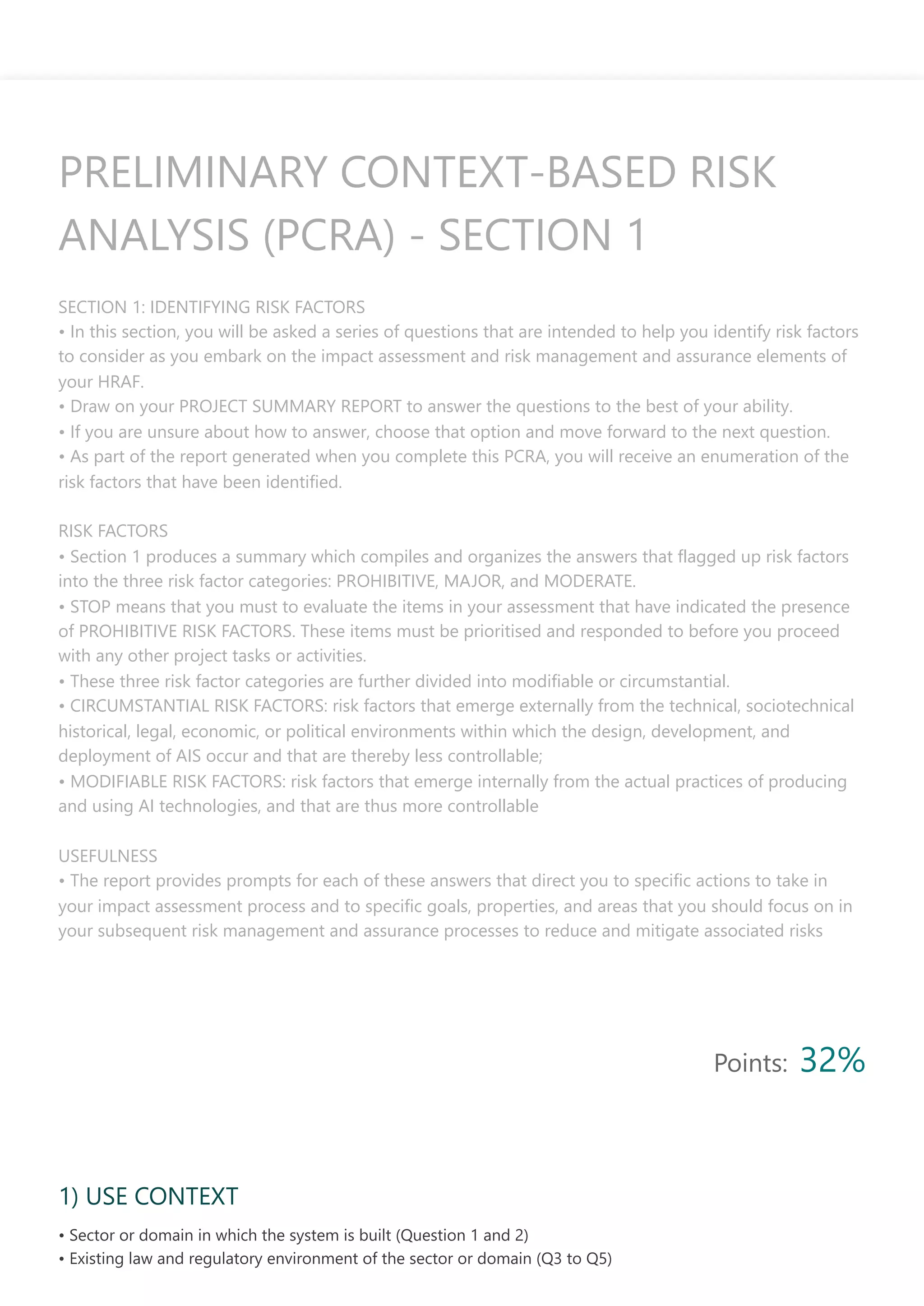
Points: 32%
PRELIMINARY CONTEXT-BASED RISK
ANALYSIS (PCRA) - SECTION 1
SECTION 1: IDENTIFYING RISK FACTORS

• In this section, you will be asked a series of questions that are intended to help you identify risk factors
to consider as you embark on the impact assessment and risk management and assurance elements of
your HRAF. 

• Draw on your PROJECT SUMMARY REPORT to answer the questions to the best of your ability. 

• If you are unsure about how to answer, choose that option and move forward to the next question. 

• As part of the report generated when you complete this PCRA, you will receive an enumeration of the
risk factors that have been identified. 

RISK FACTORS

• Section 1 produces a summary which compiles and organizes the answers that flagged up risk factors
into the three risk factor categories: PROHIBITIVE, MAJOR, and MODERATE. 
• STOP means that you must to evaluate the items in your assessment that have indicated the presence
of PROHIBITIVE RISK FACTORS. These items must be prioritised and responded to before you proceed
with any other project tasks or activities.

• These three risk factor categories are further divided into modifiable or circumstantial. 

• CIRCUMSTANTIAL RISK FACTORS: risk factors that emerge externally from the technical, sociotechnical
historical, legal, economic, or political environments within which the design, development, and
deployment of AIS occur and that are thereby less controllable;

• MODIFIABLE RISK FACTORS: risk factors that emerge internally from the actual practices of producing
and using AI technologies, and that are thus more controllable

USEFULNESS

• The report provides prompts for each of these answers that direct you to specific actions to take in
your impact assessment process and to specific goals, properties, and areas that you should focus on in
your subsequent risk management and assurance processes to reduce and mitigate associated risks
1) USE CONTEXT
• Sector or domain in which the system is built (Question 1 and 2)

• Existing law and regulatory environment of the sector or domain (Q3 to Q5)
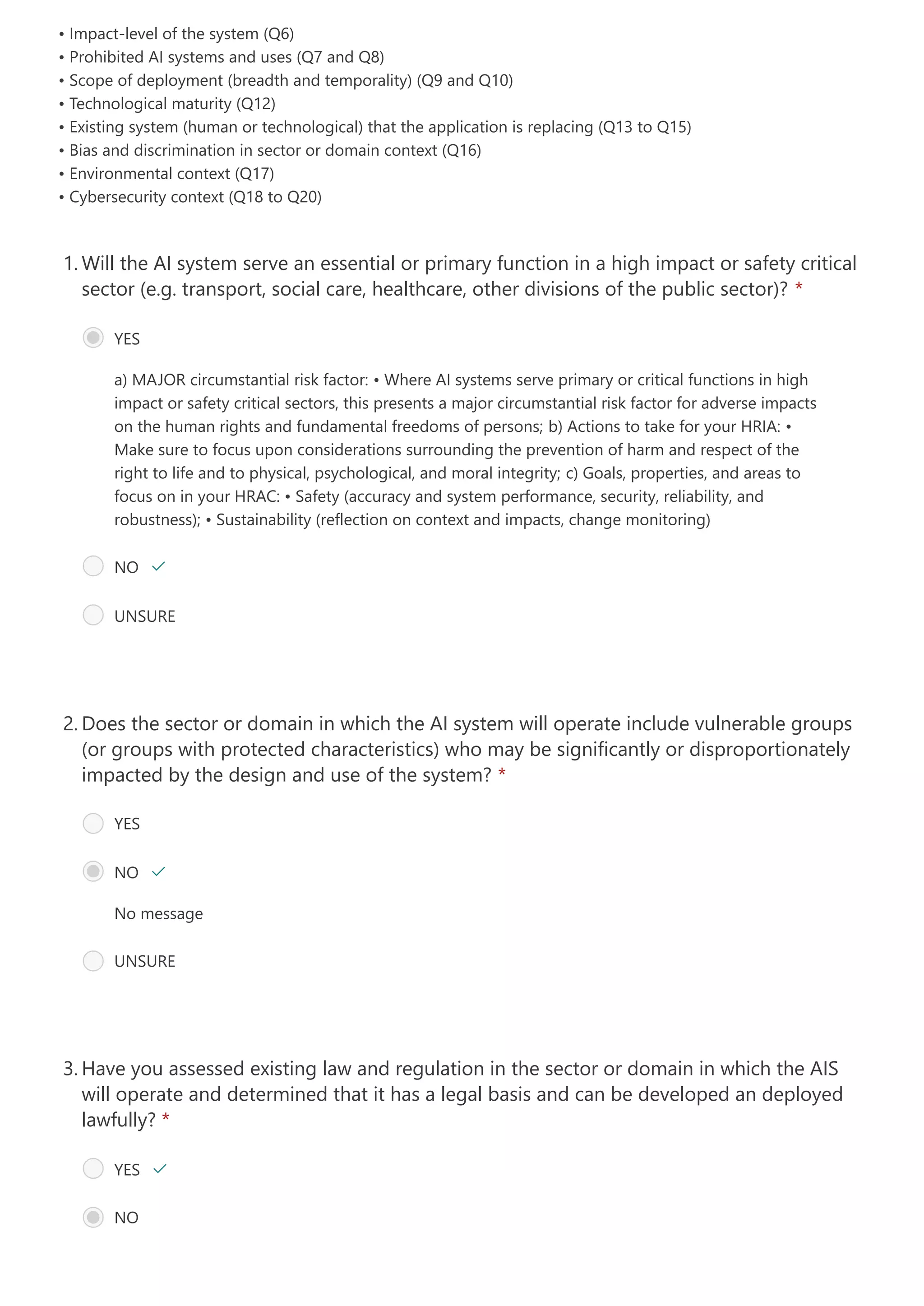
• Impact-level of the system (Q6)

• Prohibited AI systems and uses (Q7 and Q8)

• Scope of deployment (breadth and temporality) (Q9 and Q10)

• Technological maturity (Q12)

• Existing system (human or technological) that the application is replacing (Q13 to Q15)

• Bias and discrimination in sector or domain context (Q16)

• Environmental context (Q17)

• Cybersecurity context (Q18 to Q20)

a) MAJOR circumstantial risk factor: • Where AI systems serve primary or critical functions in high
impact or safety critical sectors, this presents a major circumstantial risk factor for adverse impacts
on the human rights and fundamental freedoms of persons; b) Actions to take for your HRIA:
•
Make sure to focus upon considerations surrounding the prevention of harm and respect of the
right to life and to physical, psychological, and moral integrity; c) Goals, properties, and areas to
focus on in your HRAC:
• Safety (accuracy and system performance, security, reliability, and
robustness);
• Sustainability (reflection on context and impacts, change monitoring)
Will the AI system serve an essential or primary function in a high impact or safety critical
sector (e.g. transport, social care, healthcare, other divisions of the public sector)? *
1.
YES
NO 
UNSURE
No message
Does the sector or domain in which the AI system will operate include vulnerable groups
(or groups with protected characteristics) who may be significantly or disproportionately
impacted by the design and use of the system? *
2.
YES
NO 
UNSURE
Have you assessed existing law and regulation in the sector or domain in which the AIS
will operate and determined that it has a legal basis and can be developed an deployed
lawfully? *
3.
YES 
NO 
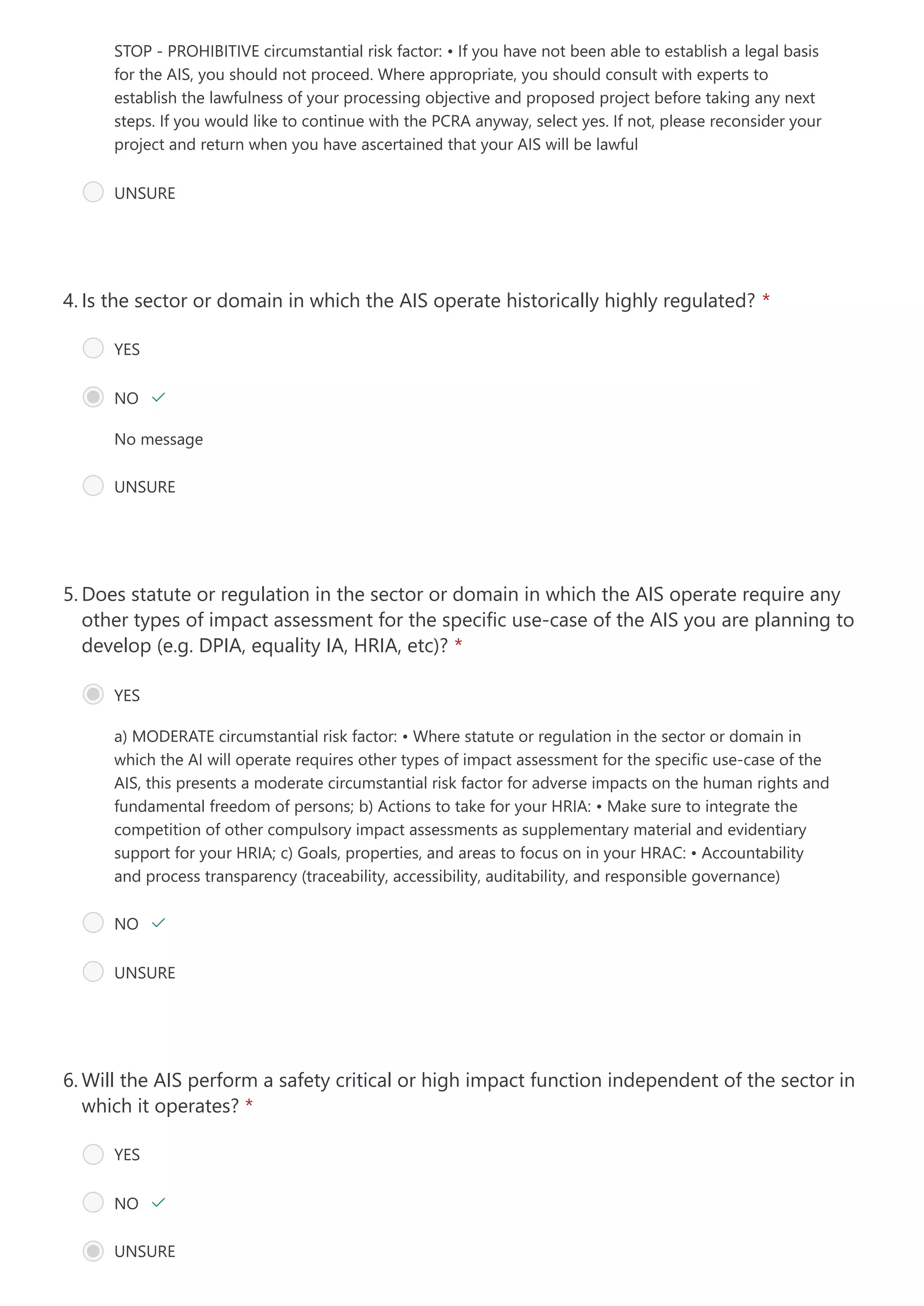
STOP - PROHIBITIVE circumstantial risk factor:
• If you have not been able to establish a legal basis
for the AIS, you should not proceed. Where appropriate, you should consult with experts to
establish the lawfulness of your processing objective and proposed project before taking any next
steps. If you would like to continue with the PCRA anyway, select yes. If not, please reconsider your
project and return when you have ascertained that your AIS will be lawful
UNSURE
No message
Is the sector or domain in which the AIS operate historically highly regulated? *
4.
YES
NO 
UNSURE
a) MODERATE circumstantial risk factor:
• Where statute or regulation in the sector or domain in
which the AI will operate requires other types of impact assessment for the specific use-case of the
AIS, this presents a moderate circumstantial risk factor for adverse impacts on the human rights and
fundamental freedom of persons;
b) Actions to take for your HRIA:
• Make sure to integrate the
competition of other compulsory impact assessments as supplementary material and evidentiary
support for your HRIA;
c) Goals, properties, and areas to focus on in your HRAC:
• Accountability
and process transparency (traceability, accessibility, auditability, and responsible governance)
Does statute or regulation in the sector or domain in which the AIS operate require any
other types of impact assessment for the specific use-case of the AIS you are planning to
develop (e.g. DPIA, equality IA, HRIA, etc)? *
5.
YES
NO 
UNSURE
Will the AIS perform a safety critical or high impact function independent of the sector in
which it operates? *
6.
YES
NO 
UNSURE
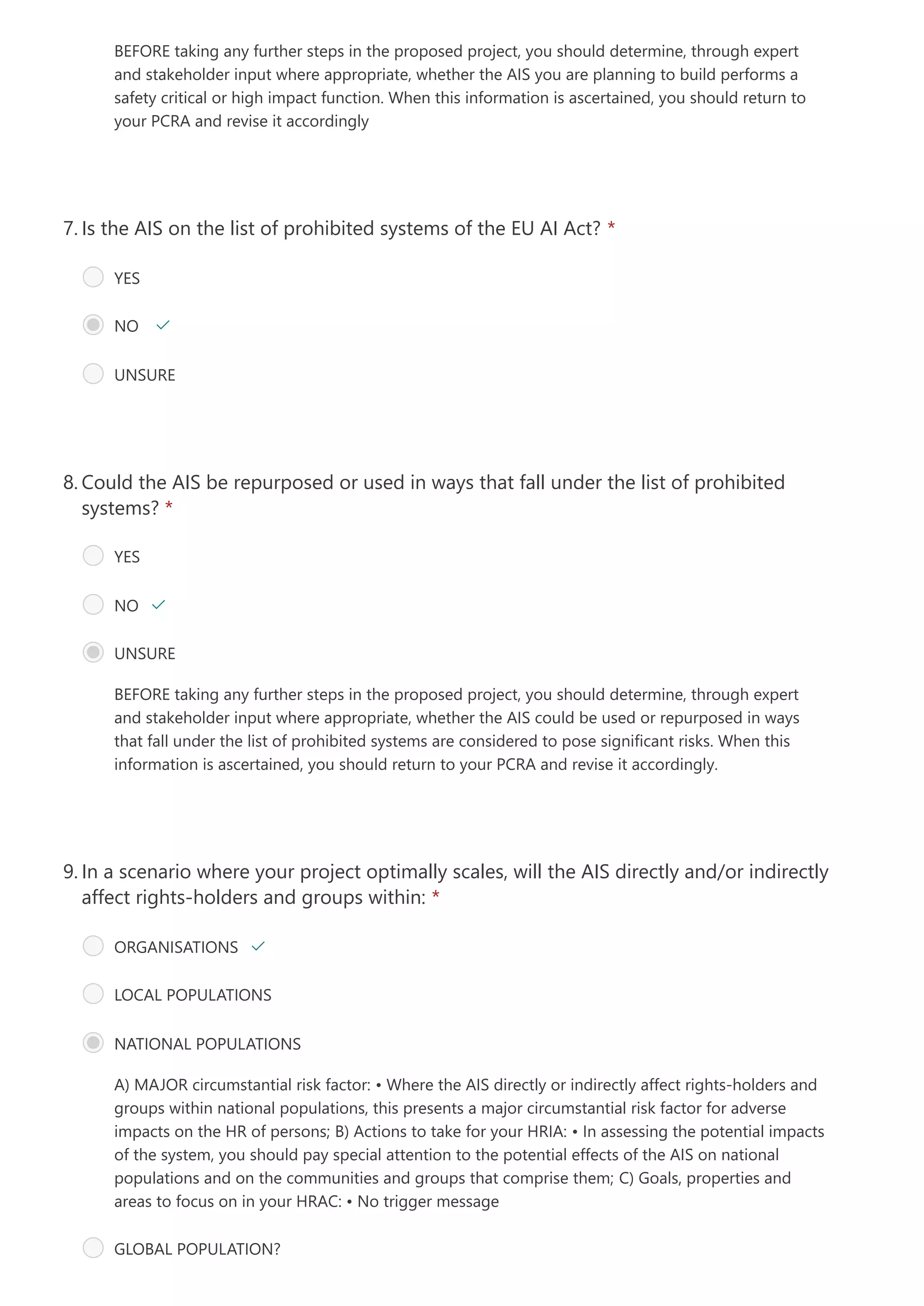
BEFORE taking any further steps in the proposed project, you should determine, through expert
and stakeholder input where appropriate, whether the AIS you are planning to build performs a
safety critical or high impact function. When this information is ascertained, you should return to
your PCRA and revise it accordingly
Is the AIS on the list of prohibited systems of the EU AI Act? *
7.
YES 
NO  
UNSURE
BEFORE taking any further steps in the proposed project, you should determine, through expert
and stakeholder input where appropriate, whether the AIS could be used or repurposed in ways
that fall under the list of prohibited systems are considered to pose significant risks. When this
information is ascertained, you should return to your PCRA and revise it accordingly.
Could the AIS be repurposed or used in ways that fall under the list of prohibited
systems? *
8.
YES
NO 
UNSURE
A) MAJOR circumstantial risk factor:
• Where the AIS directly or indirectly affect rights-holders and
groups within national populations, this presents a major circumstantial risk factor for adverse
impacts on the HR of persons;
B) Actions to take for your HRIA:
• In assessing the potential impacts
of the system, you should pay special attention to the potential effects of the AIS on national
populations and on the communities and groups that comprise them;
C) Goals, properties and
areas to focus on in your HRAC:
• No trigger message
In a scenario where your project optimally scales, will the AIS directly and/or indirectly
affect rights-holders and groups within: *
9.
ORGANISATIONS 
LOCAL POPULATIONS
NATIONAL POPULATIONS
GLOBAL POPULATION?
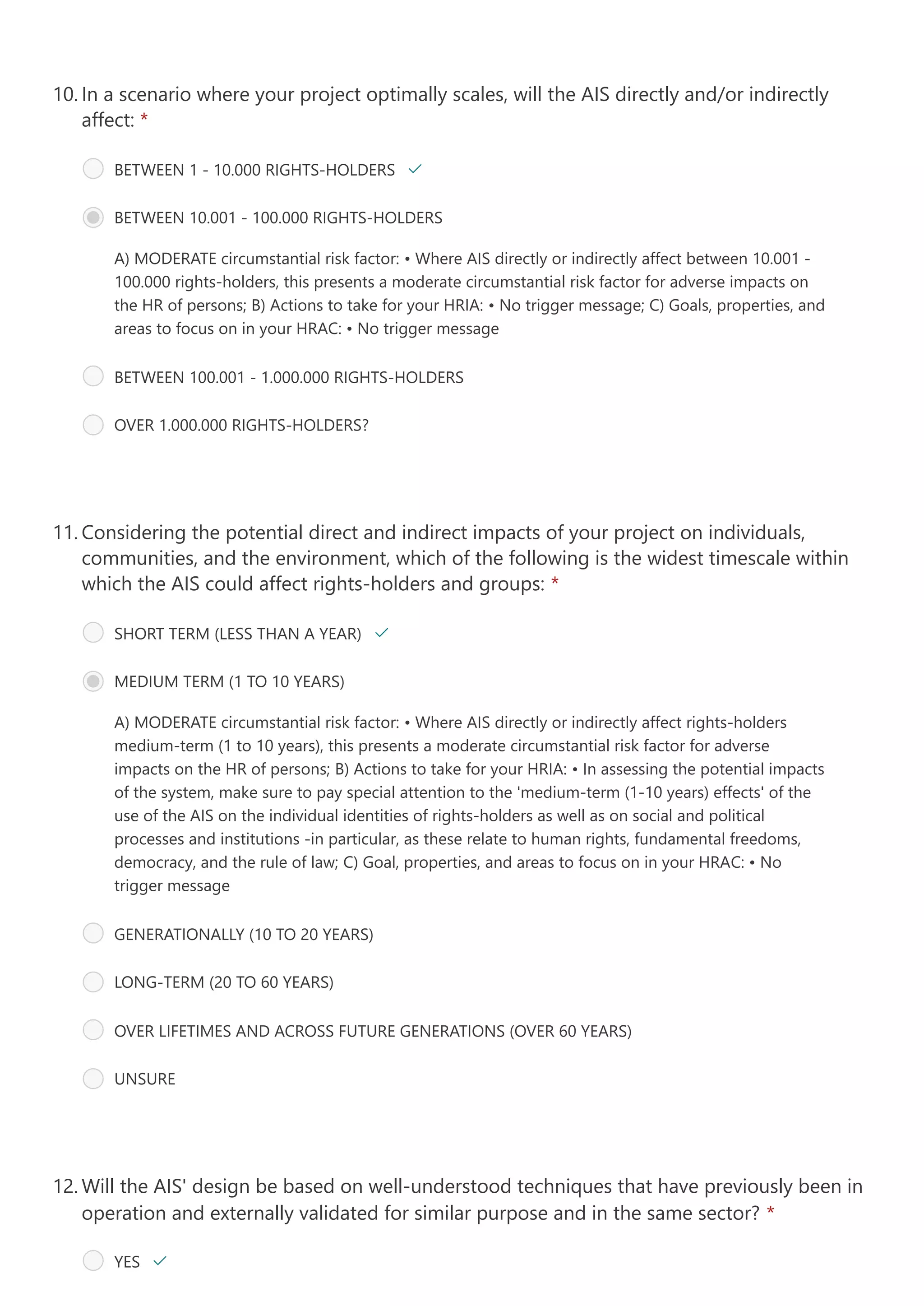
A) MODERATE circumstantial risk factor:
• Where AIS directly or indirectly affect between 10.001 -
100.000 rights-holders, this presents a moderate circumstantial risk factor for adverse impacts on
the HR of persons;
B) Actions to take for your HRIA:
• No trigger message;
C) Goals, properties, and
areas to focus on in your HRAC:
• No trigger message
In a scenario where your project optimally scales, will the AIS directly and/or indirectly
affect: *
10.
BETWEEN 1 - 10.000 RIGHTS-HOLDERS 
BETWEEN 10.001 - 100.000 RIGHTS-HOLDERS
BETWEEN 100.001 - 1.000.000 RIGHTS-HOLDERS
OVER 1.000.000 RIGHTS-HOLDERS?
A) MODERATE circumstantial risk factor:
• Where AIS directly or indirectly affect rights-holders
medium-term (1 to 10 years), this presents a moderate circumstantial risk factor for adverse
impacts on the HR of persons;
B) Actions to take for your HRIA: • In assessing the potential impacts
of the system, make sure to pay special attention to the 'medium-term (1-10 years) effects' of the
use of the AIS on the individual identities of rights-holders as well as on social and political
processes and institutions -in particular, as these relate to human rights, fundamental freedoms,
democracy, and the rule of law;
C) Goal, properties, and areas to focus on in your HRAC:
• No
trigger message
Considering the potential direct and indirect impacts of your project on individuals,
communities, and the environment, which of the following is the widest timescale within
which the AIS could affect rights-holders and groups: *
11.
SHORT TERM (LESS THAN A YEAR) 
MEDIUM TERM (1 TO 10 YEARS)
GENERATIONALLY (10 TO 20 YEARS)
LONG-TERM (20 TO 60 YEARS)
OVER LIFETIMES AND ACROSS FUTURE GENERATIONS (OVER 60 YEARS) 
UNSURE
Will the AIS' design be based on well-understood techniques that have previously been in
operation and externally validated for similar purpose and in the same sector? *
12.
YES 
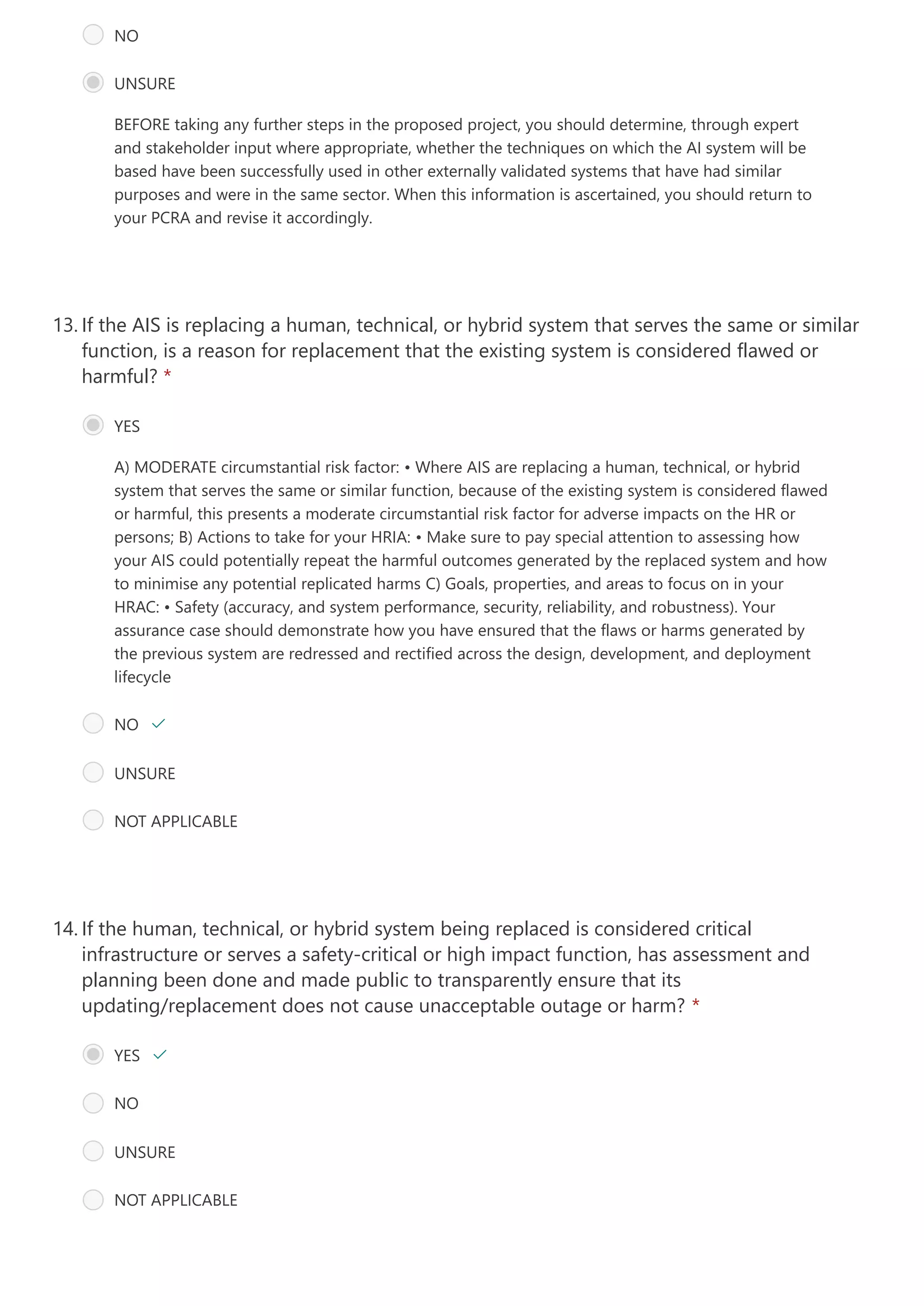
BEFORE taking any further steps in the proposed project, you should determine, through expert
and stakeholder input where appropriate, whether the techniques on which the AI system will be
based have been successfully used in other externally validated systems that have had similar
purposes and were in the same sector. When this information is ascertained, you should return to
your PCRA and revise it accordingly.
NO 
UNSURE
A) MODERATE circumstantial risk factor: • Where AIS are replacing a human, technical, or hybrid
system that serves the same or similar function, because of the existing system is considered flawed
or harmful, this presents a moderate circumstantial risk factor for adverse impacts on the HR or
persons; B) Actions to take for your HRIA: • Make sure to pay special attention to assessing how
your AIS could potentially repeat the harmful outcomes generated by the replaced system and how
to minimise any potential replicated harms
C) Goals, properties, and areas to focus on in your
HRAC:
• Safety (accuracy, and system performance, security, reliability, and robustness). Your
assurance case should demonstrate how you have ensured that the flaws or harms generated by
the previous system are redressed and rectified across the design, development, and deployment
lifecycle
If the AIS is replacing a human, technical, or hybrid system that serves the same or similar
function, is a reason for replacement that the existing system is considered flawed or
harmful? *
13.
YES
NO 
UNSURE
NOT APPLICABLE
If the human, technical, or hybrid system being replaced is considered critical
infrastructure or serves a safety-critical or high impact function, has assessment and
planning been done and made public to transparently ensure that its
updating/replacement does not cause unacceptable outage or harm? *
14.
YES 
NO
UNSURE
NOT APPLICABLE
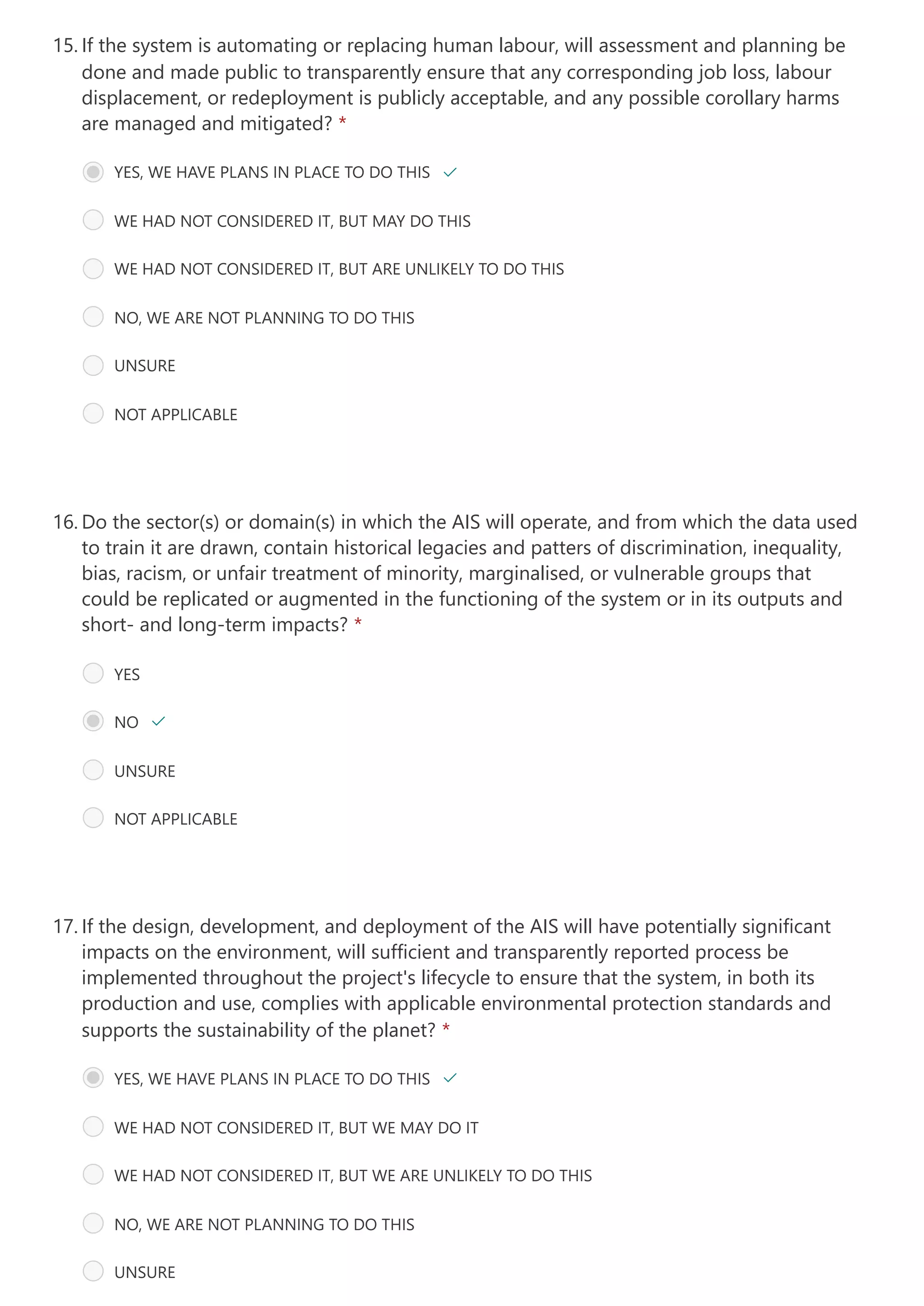
If the system is automating or replacing human labour, will assessment and planning be
done and made public to transparently ensure that any corresponding job loss, labour
displacement, or redeployment is publicly acceptable, and any possible corollary harms
are managed and mitigated? *
15.
YES, WE HAVE PLANS IN PLACE TO DO THIS 
WE HAD NOT CONSIDERED IT, BUT MAY DO THIS
WE HAD NOT CONSIDERED IT, BUT ARE UNLIKELY TO DO THIS
NO, WE ARE NOT PLANNING TO DO THIS
UNSURE
NOT APPLICABLE
Do the sector(s) or domain(s) in which the AIS will operate, and from which the data used
to train it are drawn, contain historical legacies and patters of discrimination, inequality,
bias, racism, or unfair treatment of minority, marginalised, or vulnerable groups that
could be replicated or augmented in the functioning of the system or in its outputs and
short- and long-term impacts? *
16.
YES
NO 
UNSURE
NOT APPLICABLE
If the design, development, and deployment of the AIS will have potentially significant
impacts on the environment, will sufficient and transparently reported process be
implemented throughout the project's lifecycle to ensure that the system, in both its
production and use, complies with applicable environmental protection standards and
supports the sustainability of the planet? *
17.
YES, WE HAVE PLANS IN PLACE TO DO THIS 
WE HAD NOT CONSIDERED IT, BUT WE MAY DO IT
WE HAD NOT CONSIDERED IT, BUT WE ARE UNLIKELY TO DO THIS
NO, WE ARE NOT PLANNING TO DO THIS
UNSURE

HRIA and tool example.pdf

  • 1.
    1 Human Rights, Democracy, and theRule of Law Assurance Framework for AI Systems: A proposal prepared for the Council of Europe’s Ad hoc Committee on Artificial Intelligence David Leslie, Christopher Burr, Mhairi Aitken, Michael Katell, Morgan Briggs, and Cami Rincon
  • 2.
    Points: 32% PRELIMINARY CONTEXT-BASEDRISK ANALYSIS (PCRA) - SECTION 1 SECTION 1: IDENTIFYING RISK FACTORS • In this section, you will be asked a series of questions that are intended to help you identify risk factors to consider as you embark on the impact assessment and risk management and assurance elements of your HRAF.  • Draw on your PROJECT SUMMARY REPORT to answer the questions to the best of your ability.  • If you are unsure about how to answer, choose that option and move forward to the next question.  • As part of the report generated when you complete this PCRA, you will receive an enumeration of the risk factors that have been identified.  RISK FACTORS • Section 1 produces a summary which compiles and organizes the answers that flagged up risk factors into the three risk factor categories: PROHIBITIVE, MAJOR, and MODERATE.  • STOP means that you must to evaluate the items in your assessment that have indicated the presence of PROHIBITIVE RISK FACTORS. These items must be prioritised and responded to before you proceed with any other project tasks or activities. • These three risk factor categories are further divided into modifiable or circumstantial.  • CIRCUMSTANTIAL RISK FACTORS: risk factors that emerge externally from the technical, sociotechnical historical, legal, economic, or political environments within which the design, development, and deployment of AIS occur and that are thereby less controllable; • MODIFIABLE RISK FACTORS: risk factors that emerge internally from the actual practices of producing and using AI technologies, and that are thus more controllable USEFULNESS • The report provides prompts for each of these answers that direct you to specific actions to take in your impact assessment process and to specific goals, properties, and areas that you should focus on in your subsequent risk management and assurance processes to reduce and mitigate associated risks 1) USE CONTEXT • Sector or domain in which the system is built (Question 1 and 2) • Existing law and regulatory environment of the sector or domain (Q3 to Q5)
  • 3.
    • Impact-level ofthe system (Q6) • Prohibited AI systems and uses (Q7 and Q8) • Scope of deployment (breadth and temporality) (Q9 and Q10) • Technological maturity (Q12) • Existing system (human or technological) that the application is replacing (Q13 to Q15) • Bias and discrimination in sector or domain context (Q16) • Environmental context (Q17) • Cybersecurity context (Q18 to Q20) a) MAJOR circumstantial risk factor: • Where AI systems serve primary or critical functions in high impact or safety critical sectors, this presents a major circumstantial risk factor for adverse impacts on the human rights and fundamental freedoms of persons; b) Actions to take for your HRIA: • Make sure to focus upon considerations surrounding the prevention of harm and respect of the right to life and to physical, psychological, and moral integrity; c) Goals, properties, and areas to focus on in your HRAC: • Safety (accuracy and system performance, security, reliability, and robustness); • Sustainability (reflection on context and impacts, change monitoring) Will the AI system serve an essential or primary function in a high impact or safety critical sector (e.g. transport, social care, healthcare, other divisions of the public sector)? * 1. YES NO  UNSURE No message Does the sector or domain in which the AI system will operate include vulnerable groups (or groups with protected characteristics) who may be significantly or disproportionately impacted by the design and use of the system? * 2. YES NO  UNSURE Have you assessed existing law and regulation in the sector or domain in which the AIS will operate and determined that it has a legal basis and can be developed an deployed lawfully? * 3. YES  NO 
  • 4.
    STOP - PROHIBITIVEcircumstantial risk factor: • If you have not been able to establish a legal basis for the AIS, you should not proceed. Where appropriate, you should consult with experts to establish the lawfulness of your processing objective and proposed project before taking any next steps. If you would like to continue with the PCRA anyway, select yes. If not, please reconsider your project and return when you have ascertained that your AIS will be lawful UNSURE No message Is the sector or domain in which the AIS operate historically highly regulated? * 4. YES NO  UNSURE a) MODERATE circumstantial risk factor: • Where statute or regulation in the sector or domain in which the AI will operate requires other types of impact assessment for the specific use-case of the AIS, this presents a moderate circumstantial risk factor for adverse impacts on the human rights and fundamental freedom of persons; b) Actions to take for your HRIA: • Make sure to integrate the competition of other compulsory impact assessments as supplementary material and evidentiary support for your HRIA; c) Goals, properties, and areas to focus on in your HRAC: • Accountability and process transparency (traceability, accessibility, auditability, and responsible governance) Does statute or regulation in the sector or domain in which the AIS operate require any other types of impact assessment for the specific use-case of the AIS you are planning to develop (e.g. DPIA, equality IA, HRIA, etc)? * 5. YES NO  UNSURE Will the AIS perform a safety critical or high impact function independent of the sector in which it operates? * 6. YES NO  UNSURE
  • 5.
    BEFORE taking anyfurther steps in the proposed project, you should determine, through expert and stakeholder input where appropriate, whether the AIS you are planning to build performs a safety critical or high impact function. When this information is ascertained, you should return to your PCRA and revise it accordingly Is the AIS on the list of prohibited systems of the EU AI Act? * 7. YES  NO   UNSURE BEFORE taking any further steps in the proposed project, you should determine, through expert and stakeholder input where appropriate, whether the AIS could be used or repurposed in ways that fall under the list of prohibited systems are considered to pose significant risks. When this information is ascertained, you should return to your PCRA and revise it accordingly. Could the AIS be repurposed or used in ways that fall under the list of prohibited systems? * 8. YES NO  UNSURE A) MAJOR circumstantial risk factor: • Where the AIS directly or indirectly affect rights-holders and groups within national populations, this presents a major circumstantial risk factor for adverse impacts on the HR of persons; B) Actions to take for your HRIA: • In assessing the potential impacts of the system, you should pay special attention to the potential effects of the AIS on national populations and on the communities and groups that comprise them; C) Goals, properties and areas to focus on in your HRAC: • No trigger message In a scenario where your project optimally scales, will the AIS directly and/or indirectly affect rights-holders and groups within: * 9. ORGANISATIONS  LOCAL POPULATIONS NATIONAL POPULATIONS GLOBAL POPULATION?
  • 6.
    A) MODERATE circumstantialrisk factor: • Where AIS directly or indirectly affect between 10.001 - 100.000 rights-holders, this presents a moderate circumstantial risk factor for adverse impacts on the HR of persons; B) Actions to take for your HRIA: • No trigger message; C) Goals, properties, and areas to focus on in your HRAC: • No trigger message In a scenario where your project optimally scales, will the AIS directly and/or indirectly affect: * 10. BETWEEN 1 - 10.000 RIGHTS-HOLDERS  BETWEEN 10.001 - 100.000 RIGHTS-HOLDERS BETWEEN 100.001 - 1.000.000 RIGHTS-HOLDERS OVER 1.000.000 RIGHTS-HOLDERS? A) MODERATE circumstantial risk factor: • Where AIS directly or indirectly affect rights-holders medium-term (1 to 10 years), this presents a moderate circumstantial risk factor for adverse impacts on the HR of persons; B) Actions to take for your HRIA: • In assessing the potential impacts of the system, make sure to pay special attention to the 'medium-term (1-10 years) effects' of the use of the AIS on the individual identities of rights-holders as well as on social and political processes and institutions -in particular, as these relate to human rights, fundamental freedoms, democracy, and the rule of law; C) Goal, properties, and areas to focus on in your HRAC: • No trigger message Considering the potential direct and indirect impacts of your project on individuals, communities, and the environment, which of the following is the widest timescale within which the AIS could affect rights-holders and groups: * 11. SHORT TERM (LESS THAN A YEAR)  MEDIUM TERM (1 TO 10 YEARS) GENERATIONALLY (10 TO 20 YEARS) LONG-TERM (20 TO 60 YEARS) OVER LIFETIMES AND ACROSS FUTURE GENERATIONS (OVER 60 YEARS)  UNSURE Will the AIS' design be based on well-understood techniques that have previously been in operation and externally validated for similar purpose and in the same sector? * 12. YES 
  • 7.
    BEFORE taking anyfurther steps in the proposed project, you should determine, through expert and stakeholder input where appropriate, whether the techniques on which the AI system will be based have been successfully used in other externally validated systems that have had similar purposes and were in the same sector. When this information is ascertained, you should return to your PCRA and revise it accordingly. NO  UNSURE A) MODERATE circumstantial risk factor: • Where AIS are replacing a human, technical, or hybrid system that serves the same or similar function, because of the existing system is considered flawed or harmful, this presents a moderate circumstantial risk factor for adverse impacts on the HR or persons; B) Actions to take for your HRIA: • Make sure to pay special attention to assessing how your AIS could potentially repeat the harmful outcomes generated by the replaced system and how to minimise any potential replicated harms C) Goals, properties, and areas to focus on in your HRAC: • Safety (accuracy, and system performance, security, reliability, and robustness). Your assurance case should demonstrate how you have ensured that the flaws or harms generated by the previous system are redressed and rectified across the design, development, and deployment lifecycle If the AIS is replacing a human, technical, or hybrid system that serves the same or similar function, is a reason for replacement that the existing system is considered flawed or harmful? * 13. YES NO  UNSURE NOT APPLICABLE If the human, technical, or hybrid system being replaced is considered critical infrastructure or serves a safety-critical or high impact function, has assessment and planning been done and made public to transparently ensure that its updating/replacement does not cause unacceptable outage or harm? * 14. YES  NO UNSURE NOT APPLICABLE
  • 8.
    If the systemis automating or replacing human labour, will assessment and planning be done and made public to transparently ensure that any corresponding job loss, labour displacement, or redeployment is publicly acceptable, and any possible corollary harms are managed and mitigated? * 15. YES, WE HAVE PLANS IN PLACE TO DO THIS  WE HAD NOT CONSIDERED IT, BUT MAY DO THIS WE HAD NOT CONSIDERED IT, BUT ARE UNLIKELY TO DO THIS NO, WE ARE NOT PLANNING TO DO THIS UNSURE NOT APPLICABLE Do the sector(s) or domain(s) in which the AIS will operate, and from which the data used to train it are drawn, contain historical legacies and patters of discrimination, inequality, bias, racism, or unfair treatment of minority, marginalised, or vulnerable groups that could be replicated or augmented in the functioning of the system or in its outputs and short- and long-term impacts? * 16. YES NO  UNSURE NOT APPLICABLE If the design, development, and deployment of the AIS will have potentially significant impacts on the environment, will sufficient and transparently reported process be implemented throughout the project's lifecycle to ensure that the system, in both its production and use, complies with applicable environmental protection standards and supports the sustainability of the planet? * 17. YES, WE HAVE PLANS IN PLACE TO DO THIS  WE HAD NOT CONSIDERED IT, BUT WE MAY DO IT WE HAD NOT CONSIDERED IT, BUT WE ARE UNLIKELY TO DO THIS NO, WE ARE NOT PLANNING TO DO THIS UNSURE