1
Clause
no.
Control
name
Control
Description
Audit questionnaire Evidence
required
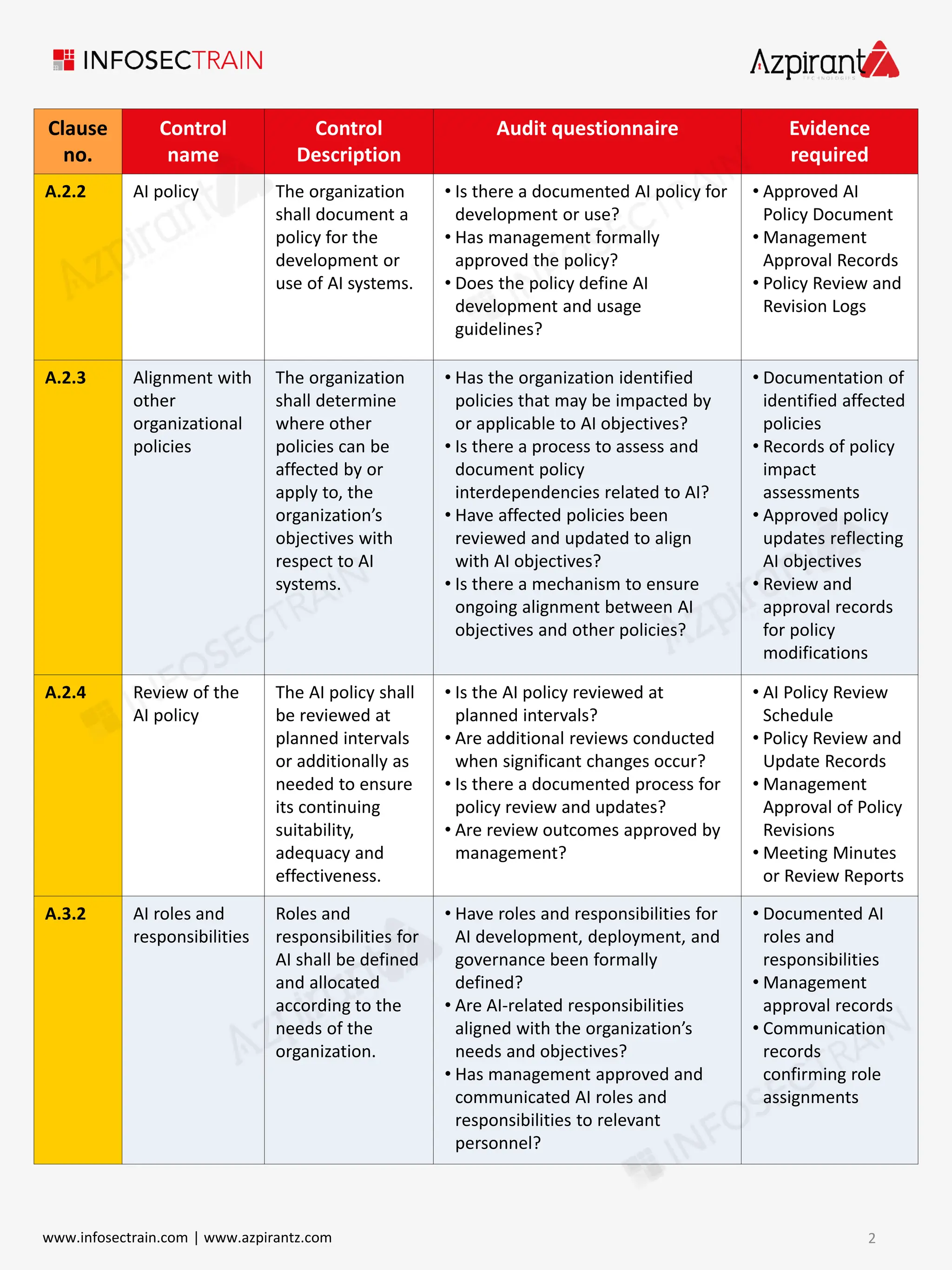
A.2.2 AI policy The organization
shall document a
policy for the
development or
use of AI systems.
• Is there a documented AI policy for
development or use?
• Has management formally
approved the policy?
• Does the policy define AI
development and usage
guidelines?
• Approved AI
Policy Document
• Management
Approval Records
• Policy Review and
Revision Logs
A.2.3 Alignment with
other
organizational
policies
The organization
shall determine
where other
policies can be
affected by or
apply to, the
organization’s
objectives with
respect to AI
systems.
• Has the organization identified
policies that may be impacted by
or applicable to AI objectives?
• Is there a process to assess and
document policy
interdependencies related to AI?
• Have affected policies been
reviewed and updated to align
with AI objectives?
• Is there a mechanism to ensure
ongoing alignment between AI
objectives and other policies?
• Documentation of
identified affected
policies
• Records of policy
impact
assessments
• Approved policy
updates reflecting
AI objectives
• Review and
approval records
for policy
modifications
A.2.4 Review of the
AI policy
The AI policy shall
be reviewed at
planned intervals
or additionally as
needed to ensure
its continuing
suitability,
adequacy and
effectiveness.
• Is the AI policy reviewed at
planned intervals?
• Are additional reviews conducted
when significant changes occur?
• Is there a documented process for
policy review and updates?
• Are review outcomes approved by
management?
• AI Policy Review
Schedule
• Policy Review and
Update Records
• Management
Approval of Policy
Revisions
• Meeting Minutes
or Review Reports
A.3.2 AI roles and
responsibilities
Roles and
responsibilities for
AI shall be defined
and allocated
according to the
needs of the
organization.
• Have roles and responsibilities for
AI development, deployment, and
governance been formally
defined?
• Are AI-related responsibilities
aligned with the organization’s
needs and objectives?
• Has management approved and
communicated AI roles and
responsibilities to relevant
personnel?
• Documented AI
roles and
responsibilities
• Management
approval records
• Communication
records
confirming role
assignments
www.infosectrain.com | www.azpirantz.com 2
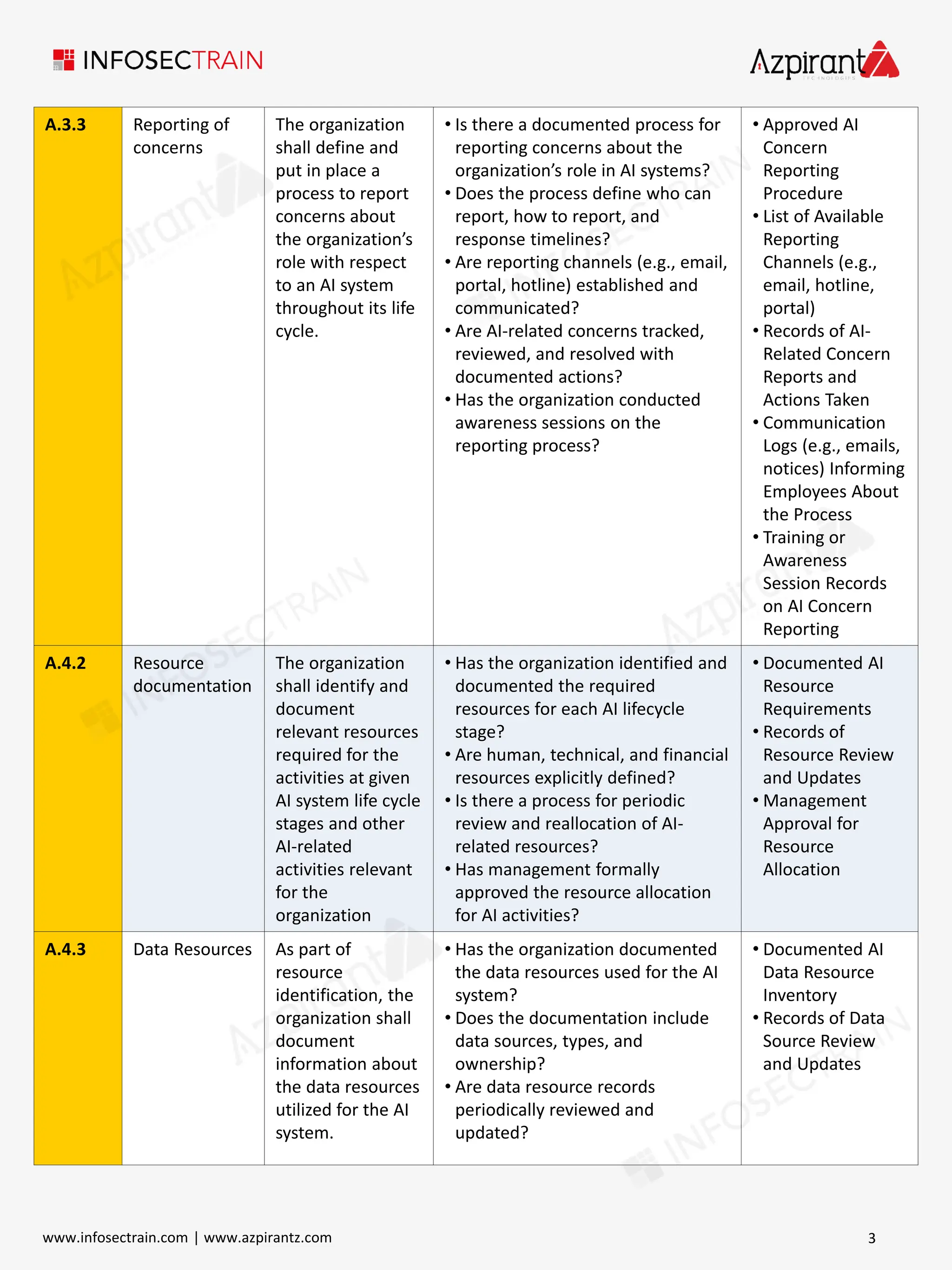
A.3.3 Reporting of
concerns
The organization
shall define and
put in place a
process to report
concerns about
the organization’s
role with respect
to an AI system
throughout its life
cycle.
• Is there a documented process for
reporting concerns about the
organization’s role in AI systems?
• Does the process define who can
report, how to report, and
response timelines?
• Are reporting channels (e.g., email,
portal, hotline) established and
communicated?
• Are AI-related concerns tracked,
reviewed, and resolved with
documented actions?
• Has the organization conducted
awareness sessions on the
reporting process?
• Approved AI
Concern
Reporting
Procedure
• List of Available
Reporting
Channels (e.g.,
email, hotline,
portal)
• Records of AI-
Related Concern
Reports and
Actions Taken
• Communication
Logs (e.g., emails,
notices) Informing
Employees About
the Process
• Training or
Awareness
Session Records
on AI Concern
Reporting
A.4.2 Resource
documentation
The organization
shall identify and
document
relevant resources
required for the
activities at given
AI system life cycle
stages and other
AI-related
activities relevant
for the
organization
• Has the organization identified and
documented the required
resources for each AI lifecycle
stage?
• Are human, technical, and financial
resources explicitly defined?
• Is there a process for periodic
review and reallocation of AI-
related resources?
• Has management formally
approved the resource allocation
for AI activities?
• Documented AI
Resource
Requirements
• Records of
Resource Review
and Updates
• Management
Approval for
Resource
Allocation
A.4.3 Data Resources As part of
resource
identification, the
organization shall
document
information about
the data resources
utilized for the AI
system.
• Has the organization documented
the data resources used for the AI
system?
• Does the documentation include
data sources, types, and
ownership?
• Are data resource records
periodically reviewed and
updated?
• Documented AI
Data Resource
Inventory
• Records of Data
Source Review
and Updates
3
www.infosectrain.com | www.azpirantz.com
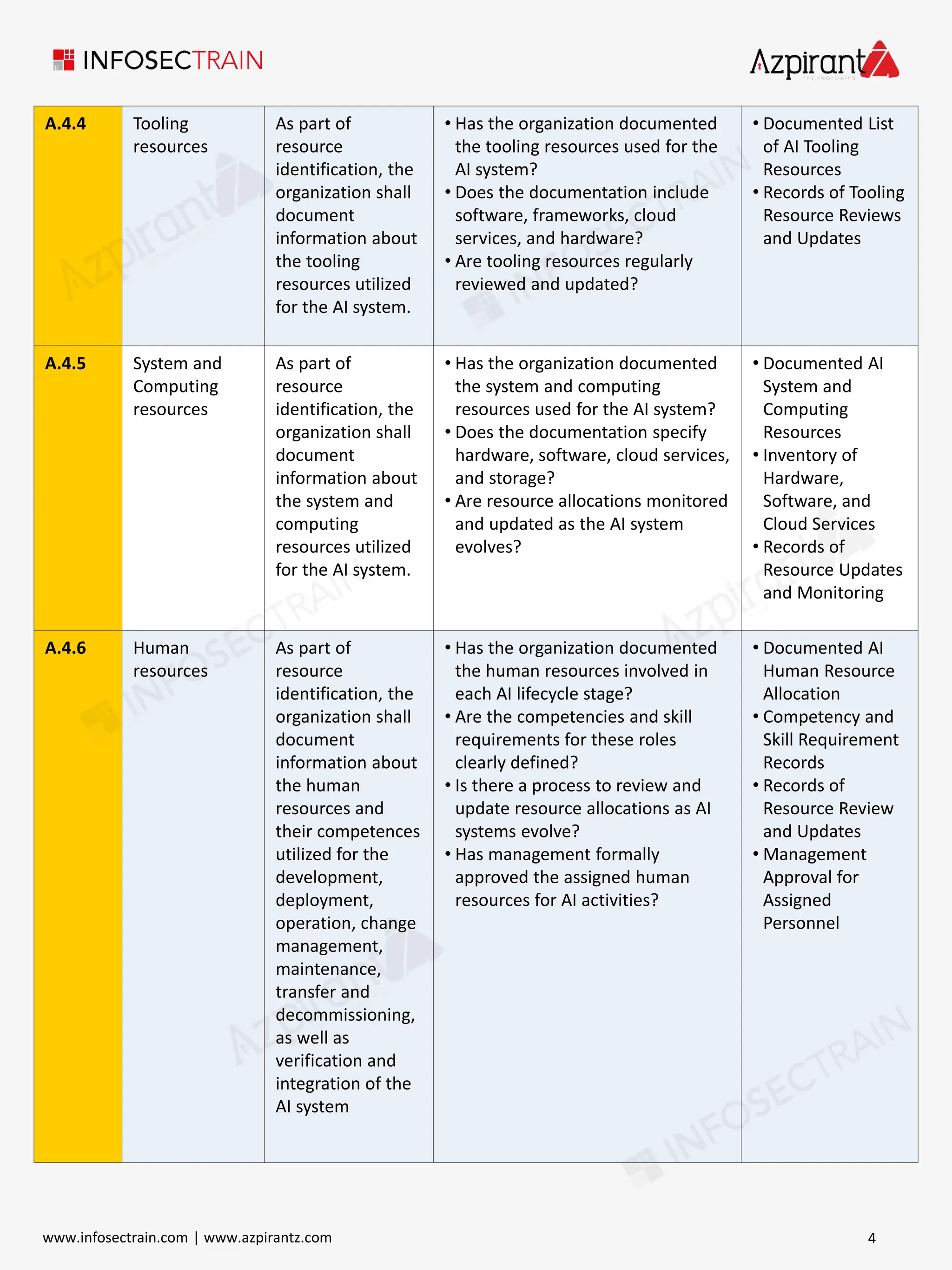
A.4.4 Tooling
resources
As part of
resource
identification, the
organization shall
document
information about
the tooling
resources utilized
for the AI system.
• Has the organization documented
the tooling resources used for the
AI system?
• Does the documentation include
software, frameworks, cloud
services, and hardware?
• Are tooling resources regularly
reviewed and updated?
• Documented List
of AI Tooling
Resources
• Records of Tooling
Resource Reviews
and Updates
A.4.5 System and
Computing
resources
As part of
resource
identification, the
organization shall
document
information about
the system and
computing
resources utilized
for the AI system.
• Has the organization documented
the system and computing
resources used for the AI system?
• Does the documentation specify
hardware, software, cloud services,
and storage?
• Are resource allocations monitored
and updated as the AI system
evolves?
• Documented AI
System and
Computing
Resources
• Inventory of
Hardware,
Software, and
Cloud Services
• Records of
Resource Updates
and Monitoring
A.4.6 Human
resources
As part of
resource
identification, the
organization shall
document
information about
the human
resources and
their competences
utilized for the
development,
deployment,
operation, change
management,
maintenance,
transfer and
decommissioning,
as well as
verification and
integration of the
AI system
• Has the organization documented
the human resources involved in
each AI lifecycle stage?
• Are the competencies and skill
requirements for these roles
clearly defined?
• Is there a process to review and
update resource allocations as AI
systems evolve?
• Has management formally
approved the assigned human
resources for AI activities?
• Documented AI
Human Resource
Allocation
• Competency and
Skill Requirement
Records
• Records of
Resource Review
and Updates
• Management
Approval for
Assigned
Personnel
4
www.infosectrain.com | www.azpirantz.com
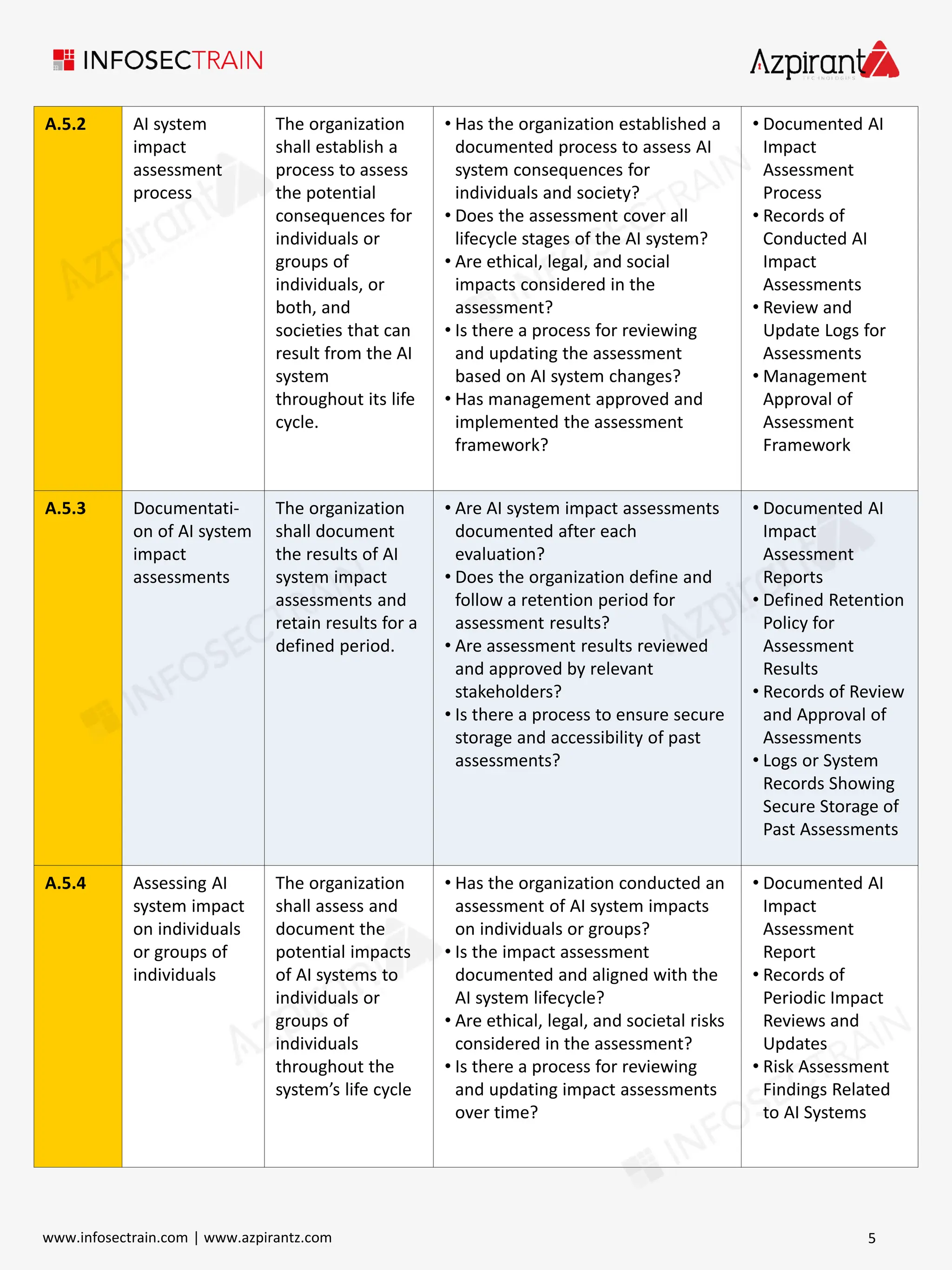
A.5.2 AI system
impact
assessment
process
The organization
shall establish a
process to assess
the potential
consequences for
individuals or
groups of
individuals, or
both, and
societies that can
result from the AI
system
throughout its life
cycle.
• Has the organization established a
documented process to assess AI
system consequences for
individuals and society?
• Does the assessment cover all
lifecycle stages of the AI system?
• Are ethical, legal, and social
impacts considered in the
assessment?
• Is there a process for reviewing
and updating the assessment
based on AI system changes?
• Has management approved and
implemented the assessment
framework?
• Documented AI
Impact
Assessment
Process
• Records of
Conducted AI
Impact
Assessments
• Review and
Update Logs for
Assessments
• Management
Approval of
Assessment
Framework
A.5.3 Documentati-
on of AI system
impact
assessments
The organization
shall document
the results of AI
system impact
assessments and
retain results for a
defined period.
• Are AI system impact assessments
documented after each
evaluation?
• Does the organization define and
follow a retention period for
assessment results?
• Are assessment results reviewed
and approved by relevant
stakeholders?
• Is there a process to ensure secure
storage and accessibility of past
assessments?
• Documented AI
Impact
Assessment
Reports
• Defined Retention
Policy for
Assessment
Results
• Records of Review
and Approval of
Assessments
• Logs or System
Records Showing
Secure Storage of
Past Assessments
A.5.4 Assessing AI
system impact
on individuals
or groups of
individuals
The organization
shall assess and
document the
potential impacts
of AI systems to
individuals or
groups of
individuals
throughout the
system’s life cycle
• Has the organization conducted an
assessment of AI system impacts
on individuals or groups?
• Is the impact assessment
documented and aligned with the
AI system lifecycle?
• Are ethical, legal, and societal risks
considered in the assessment?
• Is there a process for reviewing
and updating impact assessments
over time?
• Documented AI
Impact
Assessment
Report
• Records of
Periodic Impact
Reviews and
Updates
• Risk Assessment
Findings Related
to AI Systems
5
www.infosectrain.com | www.azpirantz.com
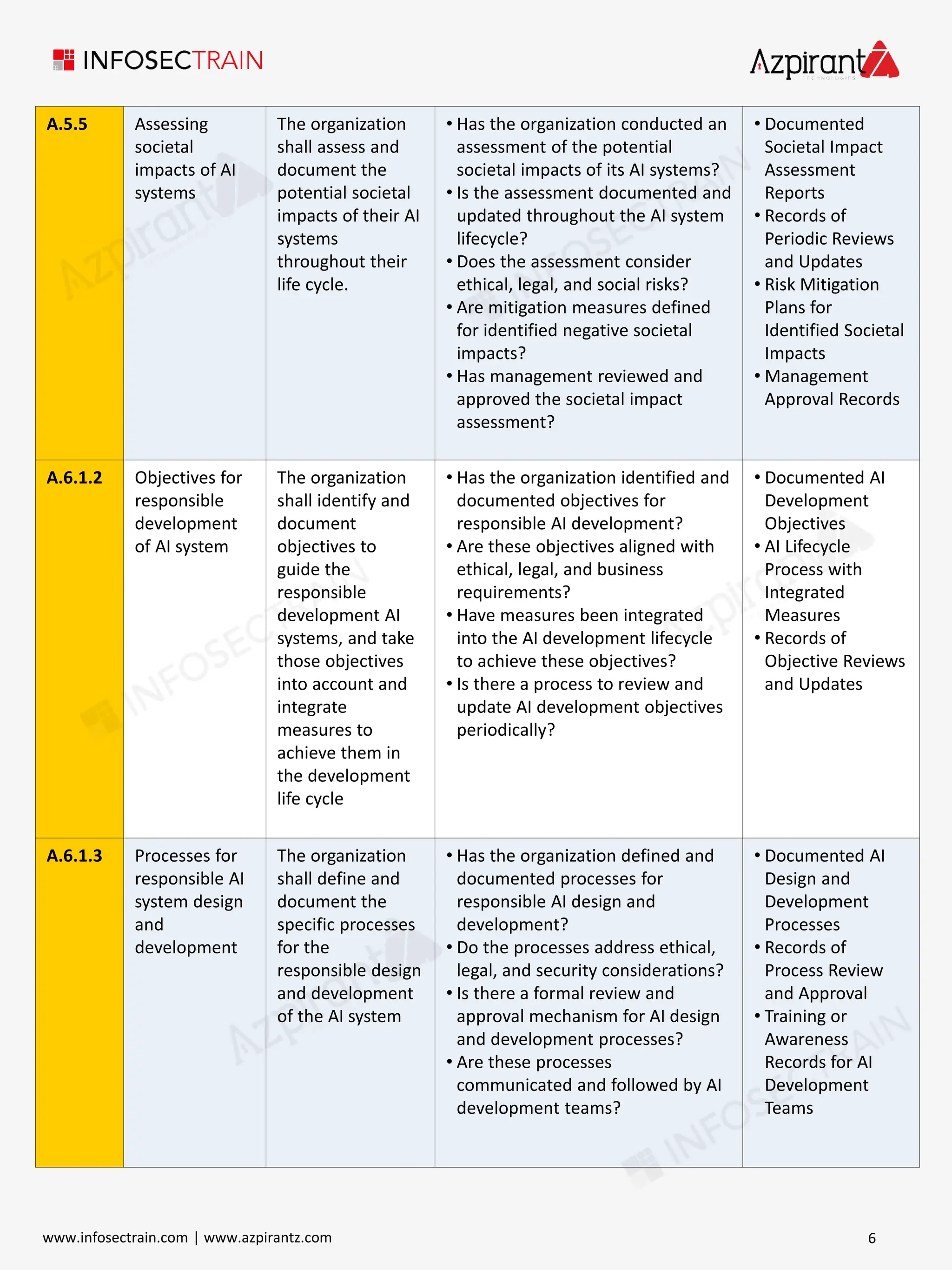
A.5.5 Assessing
societal
impacts of AI
systems
The organization
shall assess and
document the
potential societal
impacts of their AI
systems
throughout their
life cycle.
• Has the organization conducted an
assessment of the potential
societal impacts of its AI systems?
• Is the assessment documented and
updated throughout the AI system
lifecycle?
• Does the assessment consider
ethical, legal, and social risks?
• Are mitigation measures defined
for identified negative societal
impacts?
• Has management reviewed and
approved the societal impact
assessment?
• Documented
Societal Impact
Assessment
Reports
• Records of
Periodic Reviews
and Updates
• Risk Mitigation
Plans for
Identified Societal
Impacts
• Management
Approval Records
A.6.1.2 Objectives for
responsible
development
of AI system
The organization
shall identify and
document
objectives to
guide the
responsible
development AI
systems, and take
those objectives
into account and
integrate
measures to
achieve them in
the development
life cycle
• Has the organization identified and
documented objectives for
responsible AI development?
• Are these objectives aligned with
ethical, legal, and business
requirements?
• Have measures been integrated
into the AI development lifecycle
to achieve these objectives?
• Is there a process to review and
update AI development objectives
periodically?
• Documented AI
Development
Objectives
• AI Lifecycle
Process with
Integrated
Measures
• Records of
Objective Reviews
and Updates
A.6.1.3 Processes for
responsible AI
system design
and
development
The organization
shall define and
document the
specific processes
for the
responsible design
and development
of the AI system
• Has the organization defined and
documented processes for
responsible AI design and
development?
• Do the processes address ethical,
legal, and security considerations?
• Is there a formal review and
approval mechanism for AI design
and development processes?
• Are these processes
communicated and followed by AI
development teams?
• Documented AI
Design and
Development
Processes
• Records of
Process Review
and Approval
• Training or
Awareness
Records for AI
Development
Teams
6
www.infosectrain.com | www.azpirantz.com
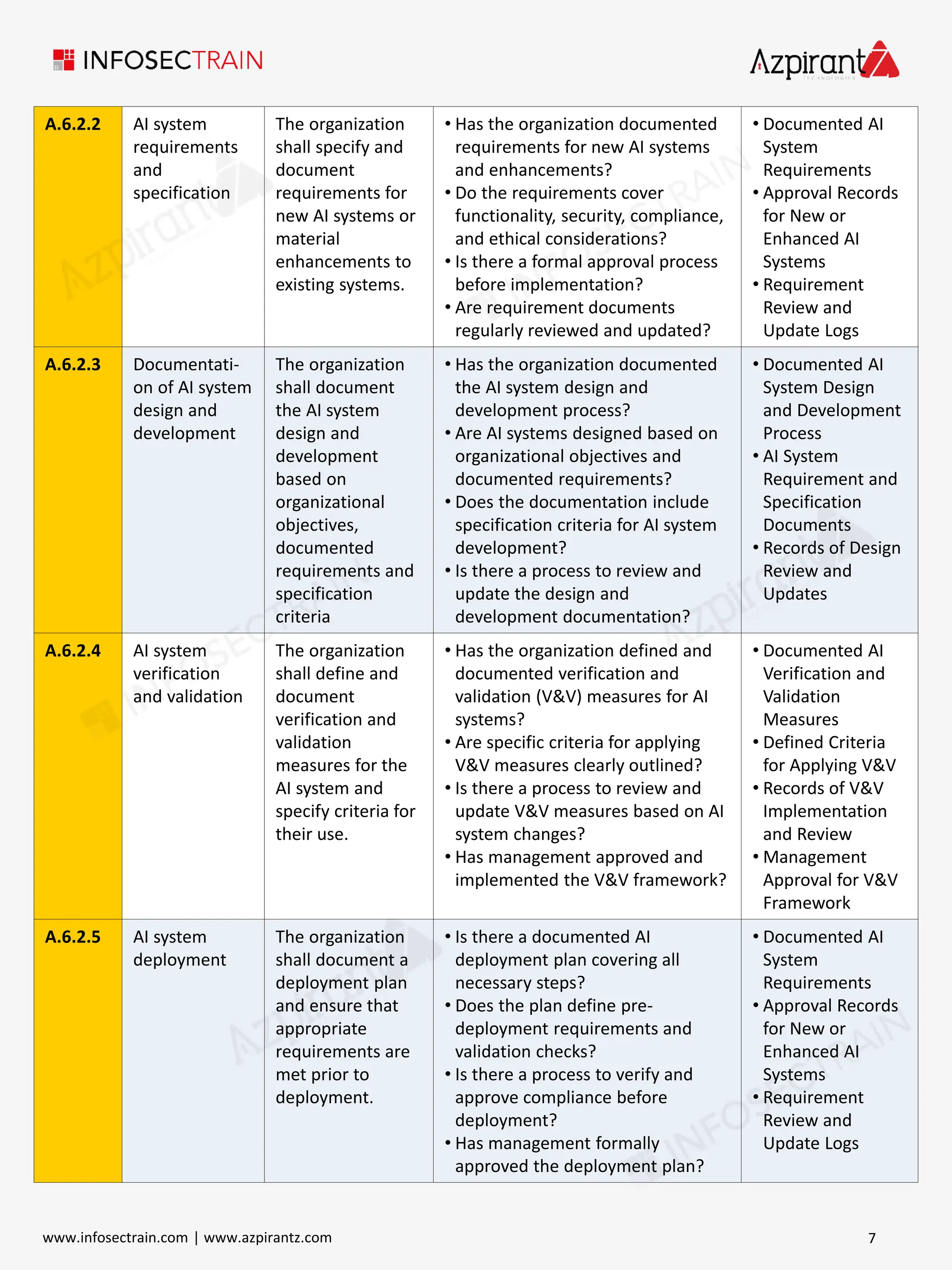
A.6.2.2 AI system
requirements
and
specification
The organization
shall specify and
document
requirements for
new AI systems or
material
enhancements to
existing systems.
• Has the organization documented
requirements for new AI systems
and enhancements?
• Do the requirements cover
functionality, security, compliance,
and ethical considerations?
• Is there a formal approval process
before implementation?
• Are requirement documents
regularly reviewed and updated?
• Documented AI
System
Requirements
• Approval Records
for New or
Enhanced AI
Systems
• Requirement
Review and
Update Logs
A.6.2.3 Documentati-
on of AI system
design and
development
The organization
shall document
the AI system
design and
development
based on
organizational
objectives,
documented
requirements and
specification
criteria
• Has the organization documented
the AI system design and
development process?
• Are AI systems designed based on
organizational objectives and
documented requirements?
• Does the documentation include
specification criteria for AI system
development?
• Is there a process to review and
update the design and
development documentation?
• Documented AI
System Design
and Development
Process
• AI System
Requirement and
Specification
Documents
• Records of Design
Review and
Updates
A.6.2.4 AI system
verification
and validation
The organization
shall define and
document
verification and
validation
measures for the
AI system and
specify criteria for
their use.
• Has the organization defined and
documented verification and
validation (V&V) measures for AI
systems?
• Are specific criteria for applying
V&V measures clearly outlined?
• Is there a process to review and
update V&V measures based on AI
system changes?
• Has management approved and
implemented the V&V framework?
• Documented AI
Verification and
Validation
Measures
• Defined Criteria
for Applying V&V
• Records of V&V
Implementation
and Review
• Management
Approval for V&V
Framework
A.6.2.5 AI system
deployment
The organization
shall document a
deployment plan
and ensure that
appropriate
requirements are
met prior to
deployment.
• Is there a documented AI
deployment plan covering all
necessary steps?
• Does the plan define pre-
deployment requirements and
validation checks?
• Is there a process to verify and
approve compliance before
deployment?
• Has management formally
approved the deployment plan?
• Documented AI
System
Requirements
• Approval Records
for New or
Enhanced AI
Systems
• Requirement
Review and
Update Logs
7
www.infosectrain.com | www.azpirantz.com
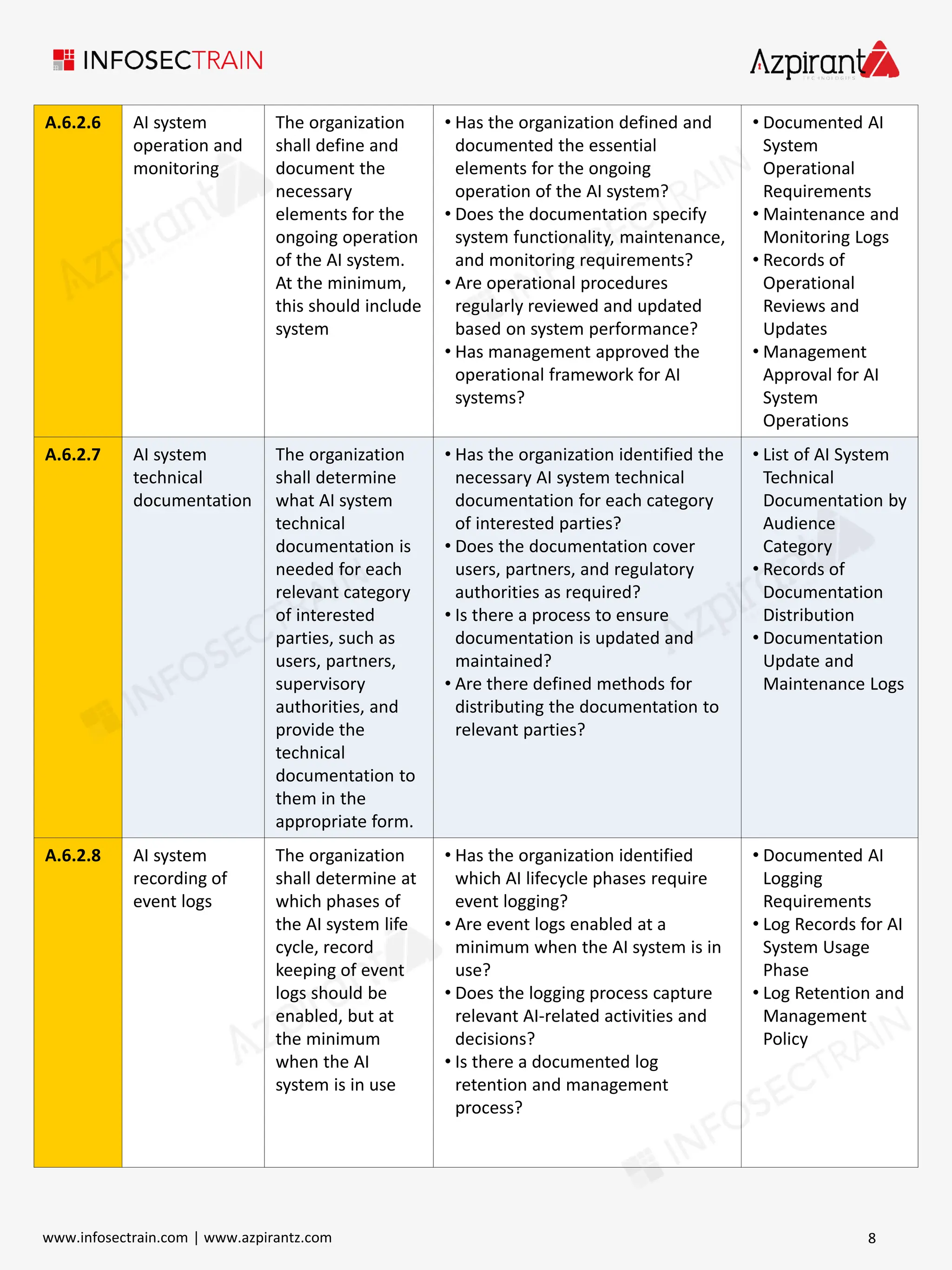
A.6.2.6 AI system
operation and
monitoring
The organization
shall define and
document the
necessary
elements for the
ongoing operation
of the AI system.
At the minimum,
this should include
system
• Has the organization defined and
documented the essential
elements for the ongoing
operation of the AI system?
• Does the documentation specify
system functionality, maintenance,
and monitoring requirements?
• Are operational procedures
regularly reviewed and updated
based on system performance?
• Has management approved the
operational framework for AI
systems?
• Documented AI
System
Operational
Requirements
• Maintenance and
Monitoring Logs
• Records of
Operational
Reviews and
Updates
• Management
Approval for AI
System
Operations
A.6.2.7 AI system
technical
documentation
The organization
shall determine
what AI system
technical
documentation is
needed for each
relevant category
of interested
parties, such as
users, partners,
supervisory
authorities, and
provide the
technical
documentation to
them in the
appropriate form.
• Has the organization identified the
necessary AI system technical
documentation for each category
of interested parties?
• Does the documentation cover
users, partners, and regulatory
authorities as required?
• Is there a process to ensure
documentation is updated and
maintained?
• Are there defined methods for
distributing the documentation to
relevant parties?
• List of AI System
Technical
Documentation by
Audience
Category
• Records of
Documentation
Distribution
• Documentation
Update and
Maintenance Logs
A.6.2.8 AI system
recording of
event logs
The organization
shall determine at
which phases of
the AI system life
cycle, record
keeping of event
logs should be
enabled, but at
the minimum
when the AI
system is in use
• Has the organization identified
which AI lifecycle phases require
event logging?
• Are event logs enabled at a
minimum when the AI system is in
use?
• Does the logging process capture
relevant AI-related activities and
decisions?
• Is there a documented log
retention and management
process?
• Documented AI
Logging
Requirements
• Log Records for AI
System Usage
Phase
• Log Retention and
Management
Policy
8
www.infosectrain.com | www.azpirantz.com
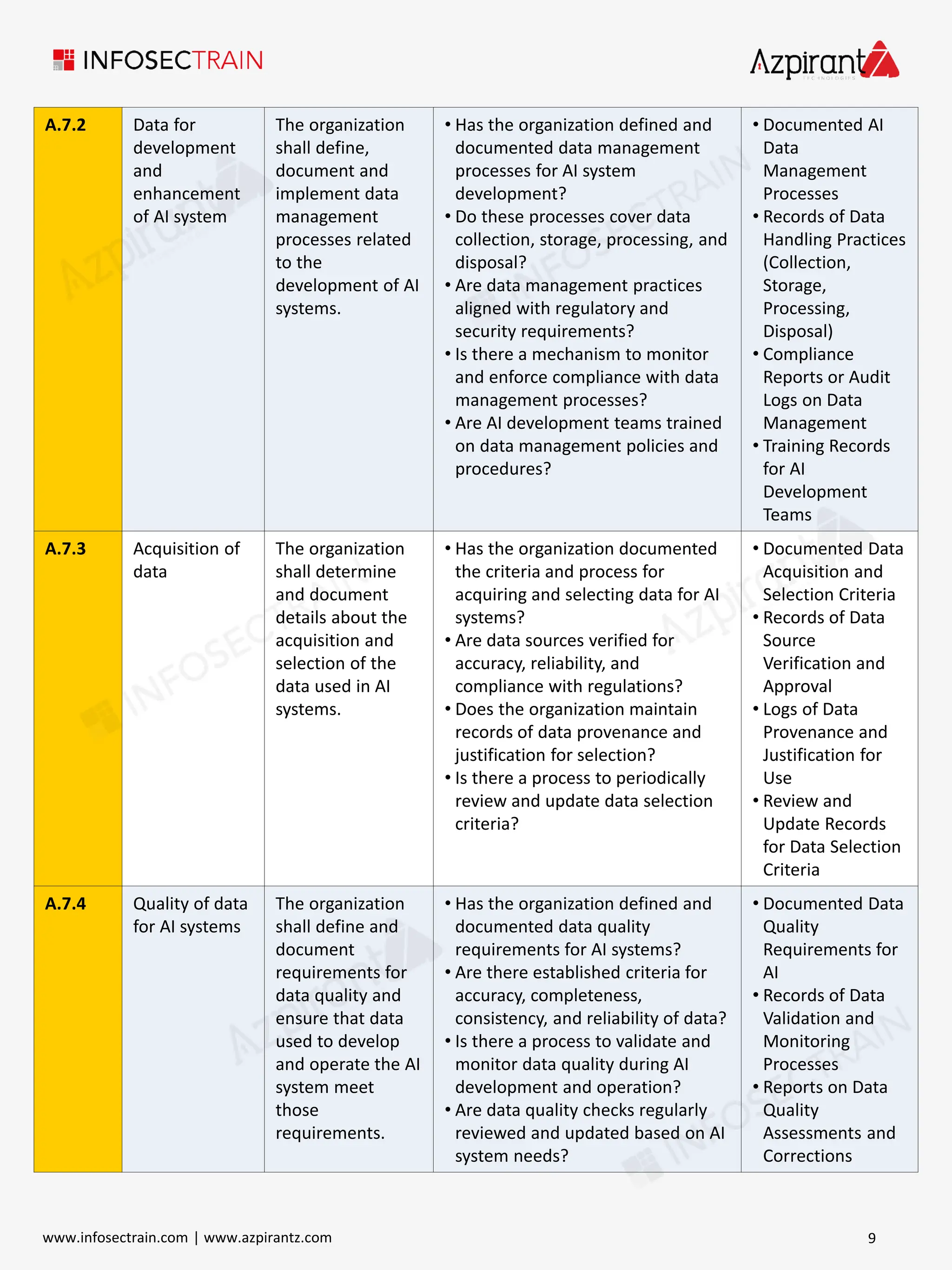
A.7.2 Data for
development
and
enhancement
of AI system
The organization
shall define,
document and
implement data
management
processes related
to the
development of AI
systems.
• Has the organization defined and
documented data management
processes for AI system
development?
• Do these processes cover data
collection, storage, processing, and
disposal?
• Are data management practices
aligned with regulatory and
security requirements?
• Is there a mechanism to monitor
and enforce compliance with data
management processes?
• Are AI development teams trained
on data management policies and
procedures?
• Documented AI
Data
Management
Processes
• Records of Data
Handling Practices
(Collection,
Storage,
Processing,
Disposal)
• Compliance
Reports or Audit
Logs on Data
Management
• Training Records
for AI
Development
Teams
A.7.3 Acquisition of
data
The organization
shall determine
and document
details about the
acquisition and
selection of the
data used in AI
systems.
• Has the organization documented
the criteria and process for
acquiring and selecting data for AI
systems?
• Are data sources verified for
accuracy, reliability, and
compliance with regulations?
• Does the organization maintain
records of data provenance and
justification for selection?
• Is there a process to periodically
review and update data selection
criteria?
• Documented Data
Acquisition and
Selection Criteria
• Records of Data
Source
Verification and
Approval
• Logs of Data
Provenance and
Justification for
Use
• Review and
Update Records
for Data Selection
Criteria
A.7.4 Quality of data
for AI systems
The organization
shall define and
document
requirements for
data quality and
ensure that data
used to develop
and operate the AI
system meet
those
requirements.
• Has the organization defined and
documented data quality
requirements for AI systems?
• Are there established criteria for
accuracy, completeness,
consistency, and reliability of data?
• Is there a process to validate and
monitor data quality during AI
development and operation?
• Are data quality checks regularly
reviewed and updated based on AI
system needs?
• Documented Data
Quality
Requirements for
AI
• Records of Data
Validation and
Monitoring
Processes
• Reports on Data
Quality
Assessments and
Corrections
9
www.infosectrain.com | www.azpirantz.com
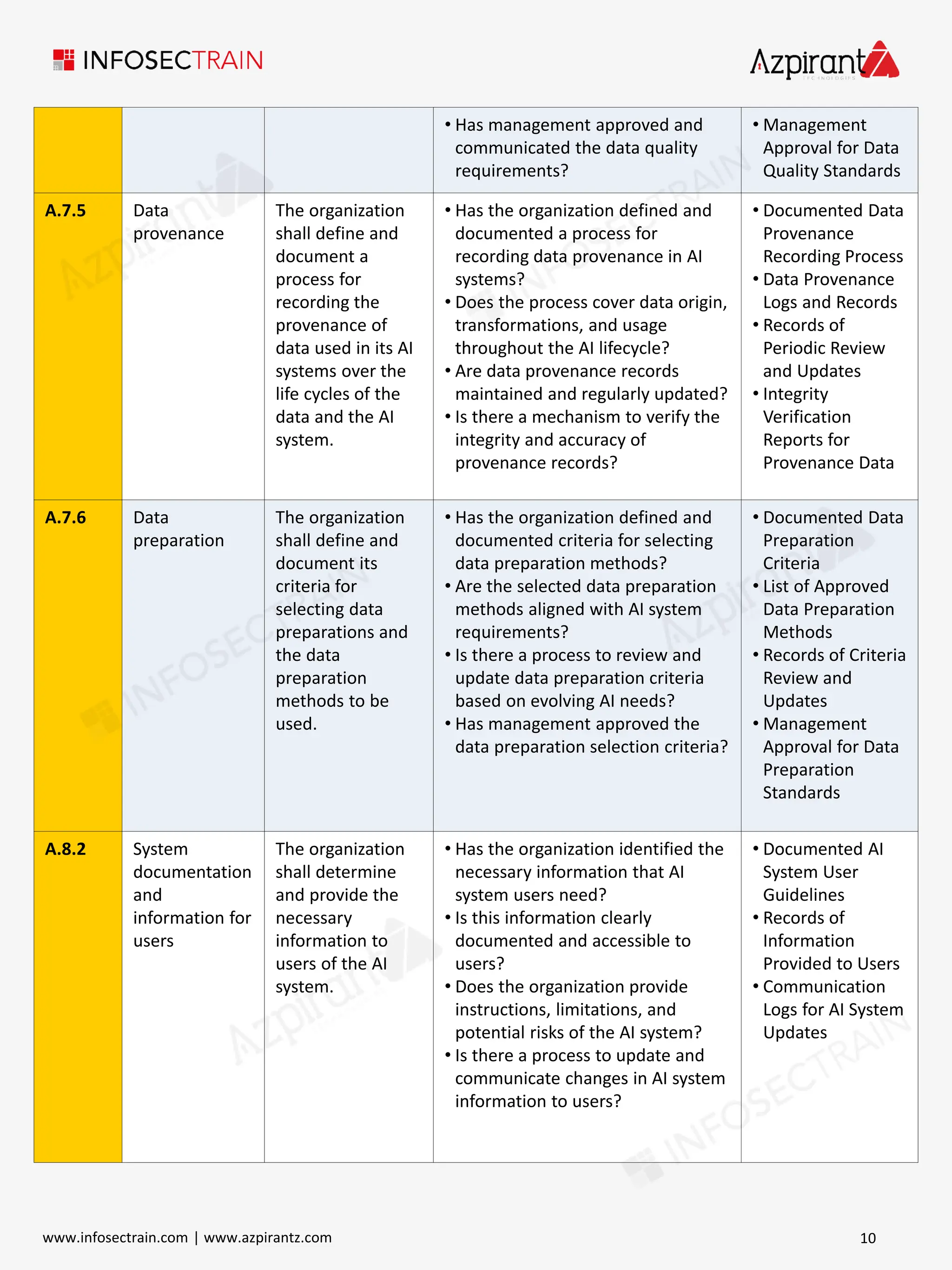
• Has management approved and
communicated the data quality
requirements?
• Management
Approval for Data
Quality Standards
A.7.5 Data
provenance
The organization
shall define and
document a
process for
recording the
provenance of
data used in its AI
systems over the
life cycles of the
data and the AI
system.
• Has the organization defined and
documented a process for
recording data provenance in AI
systems?
• Does the process cover data origin,
transformations, and usage
throughout the AI lifecycle?
• Are data provenance records
maintained and regularly updated?
• Is there a mechanism to verify the
integrity and accuracy of
provenance records?
• Documented Data
Provenance
Recording Process
• Data Provenance
Logs and Records
• Records of
Periodic Review
and Updates
• Integrity
Verification
Reports for
Provenance Data
A.7.6 Data
preparation
The organization
shall define and
document its
criteria for
selecting data
preparations and
the data
preparation
methods to be
used.
• Has the organization defined and
documented criteria for selecting
data preparation methods?
• Are the selected data preparation
methods aligned with AI system
requirements?
• Is there a process to review and
update data preparation criteria
based on evolving AI needs?
• Has management approved the
data preparation selection criteria?
• Documented Data
Preparation
Criteria
• List of Approved
Data Preparation
Methods
• Records of Criteria
Review and
Updates
• Management
Approval for Data
Preparation
Standards
A.8.2 System
documentation
and
information for
users
The organization
shall determine
and provide the
necessary
information to
users of the AI
system.
• Has the organization identified the
necessary information that AI
system users need?
• Is this information clearly
documented and accessible to
users?
• Does the organization provide
instructions, limitations, and
potential risks of the AI system?
• Is there a process to update and
communicate changes in AI system
information to users?
• Documented AI
System User
Guidelines
• Records of
Information
Provided to Users
• Communication
Logs for AI System
Updates
10
www.infosectrain.com | www.azpirantz.com
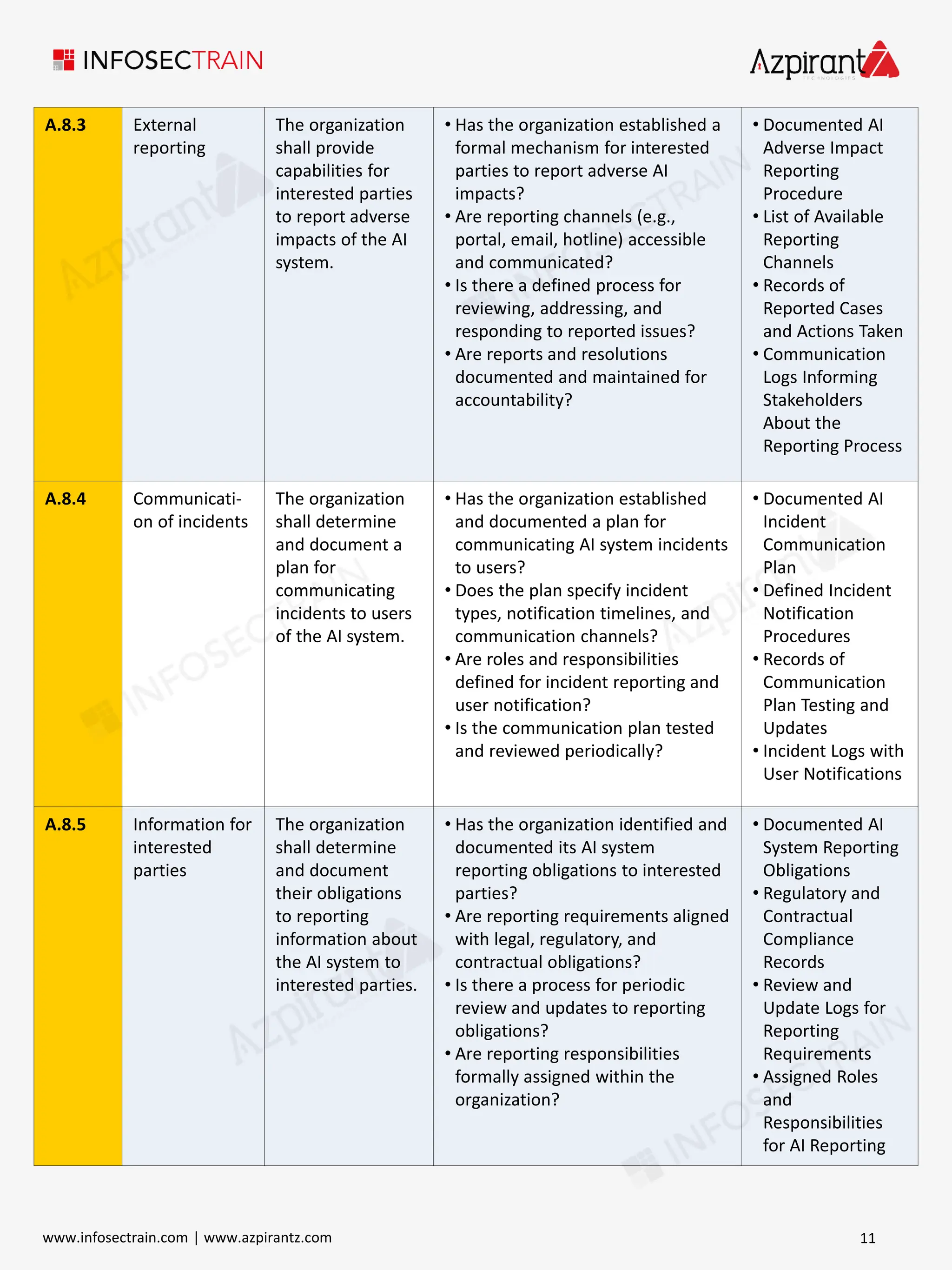
A.8.3 External
reporting
The organization
shall provide
capabilities for
interested parties
to report adverse
impacts of the AI
system.
• Has the organization established a
formal mechanism for interested
parties to report adverse AI
impacts?
• Are reporting channels (e.g.,
portal, email, hotline) accessible
and communicated?
• Is there a defined process for
reviewing, addressing, and
responding to reported issues?
• Are reports and resolutions
documented and maintained for
accountability?
• Documented AI
Adverse Impact
Reporting
Procedure
• List of Available
Reporting
Channels
• Records of
Reported Cases
and Actions Taken
• Communication
Logs Informing
Stakeholders
About the
Reporting Process
A.8.4 Communicati-
on of incidents
The organization
shall determine
and document a
plan for
communicating
incidents to users
of the AI system.
• Has the organization established
and documented a plan for
communicating AI system incidents
to users?
• Does the plan specify incident
types, notification timelines, and
communication channels?
• Are roles and responsibilities
defined for incident reporting and
user notification?
• Is the communication plan tested
and reviewed periodically?
• Documented AI
Incident
Communication
Plan
• Defined Incident
Notification
Procedures
• Records of
Communication
Plan Testing and
Updates
• Incident Logs with
User Notifications
A.8.5 Information for
interested
parties
The organization
shall determine
and document
their obligations
to reporting
information about
the AI system to
interested parties.
• Has the organization identified and
documented its AI system
reporting obligations to interested
parties?
• Are reporting requirements aligned
with legal, regulatory, and
contractual obligations?
• Is there a process for periodic
review and updates to reporting
obligations?
• Are reporting responsibilities
formally assigned within the
organization?
• Documented AI
System Reporting
Obligations
• Regulatory and
Contractual
Compliance
Records
• Review and
Update Logs for
Reporting
Requirements
• Assigned Roles
and
Responsibilities
for AI Reporting
11
www.infosectrain.com | www.azpirantz.com
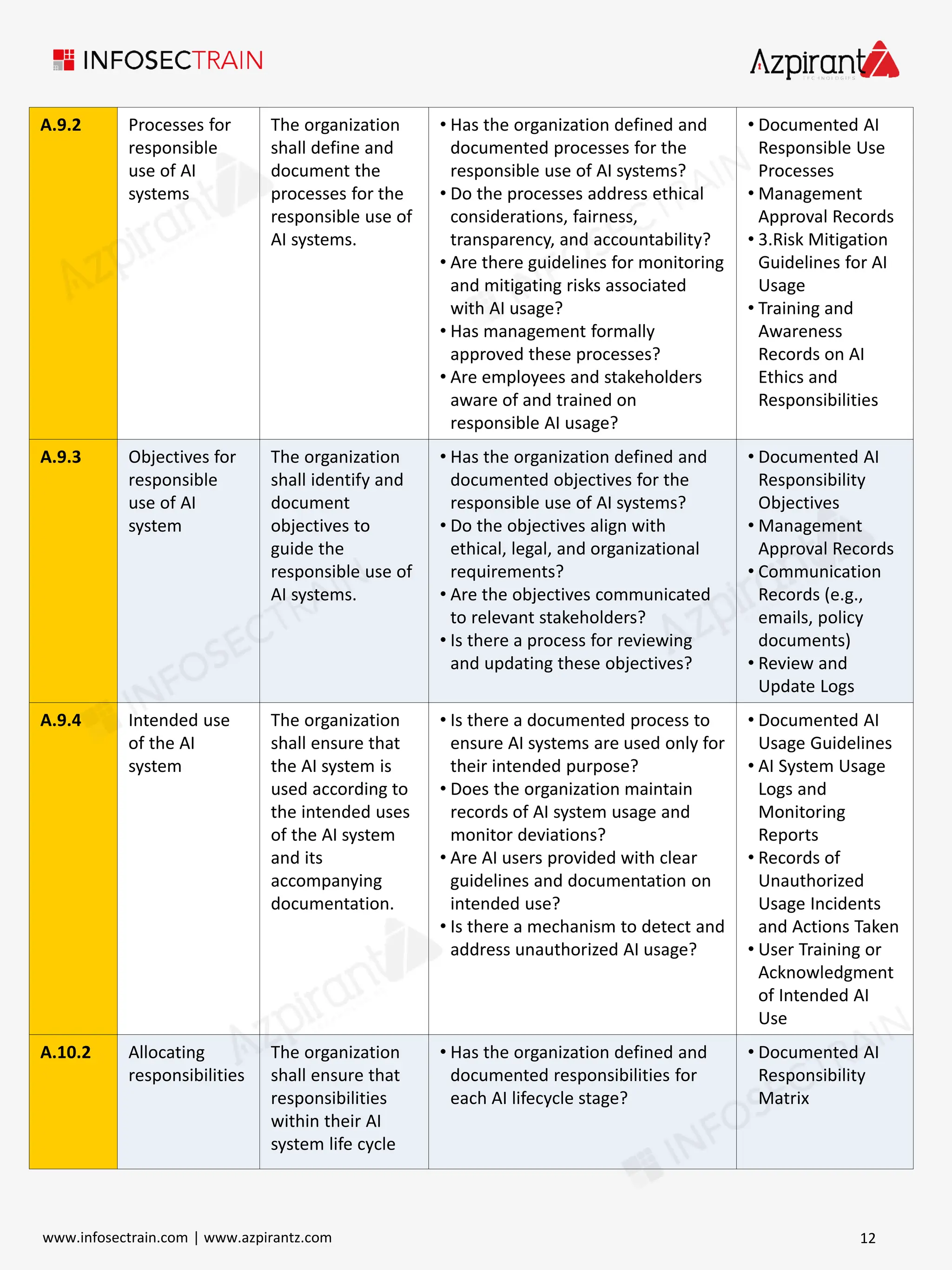
A.9.2 Processes for
responsible
use of AI
systems
The organization
shall define and
document the
processes for the
responsible use of
AI systems.
• Has the organization defined and
documented processes for the
responsible use of AI systems?
• Do the processes address ethical
considerations, fairness,
transparency, and accountability?
• Are there guidelines for monitoring
and mitigating risks associated
with AI usage?
• Has management formally
approved these processes?
• Are employees and stakeholders
aware of and trained on
responsible AI usage?
• Documented AI
Responsible Use
Processes
• Management
Approval Records
• 3.Risk Mitigation
Guidelines for AI
Usage
• Training and
Awareness
Records on AI
Ethics and
Responsibilities
A.9.3 Objectives for
responsible
use of AI
system
The organization
shall identify and
document
objectives to
guide the
responsible use of
AI systems.
• Has the organization defined and
documented objectives for the
responsible use of AI systems?
• Do the objectives align with
ethical, legal, and organizational
requirements?
• Are the objectives communicated
to relevant stakeholders?
• Is there a process for reviewing
and updating these objectives?
• Documented AI
Responsibility
Objectives
• Management
Approval Records
• Communication
Records (e.g.,
emails, policy
documents)
• Review and
Update Logs
A.9.4 Intended use
of the AI
system
The organization
shall ensure that
the AI system is
used according to
the intended uses
of the AI system
and its
accompanying
documentation.
• Is there a documented process to
ensure AI systems are used only for
their intended purpose?
• Does the organization maintain
records of AI system usage and
monitor deviations?
• Are AI users provided with clear
guidelines and documentation on
intended use?
• Is there a mechanism to detect and
address unauthorized AI usage?
• Documented AI
Usage Guidelines
• AI System Usage
Logs and
Monitoring
Reports
• Records of
Unauthorized
Usage Incidents
and Actions Taken
• User Training or
Acknowledgment
of Intended AI
Use
A.10.2 Allocating
responsibilities
The organization
shall ensure that
responsibilities
within their AI
system life cycle
• Has the organization defined and
documented responsibilities for
each AI lifecycle stage?
• Documented AI
Responsibility
Matrix
12
www.infosectrain.com | www.azpirantz.com
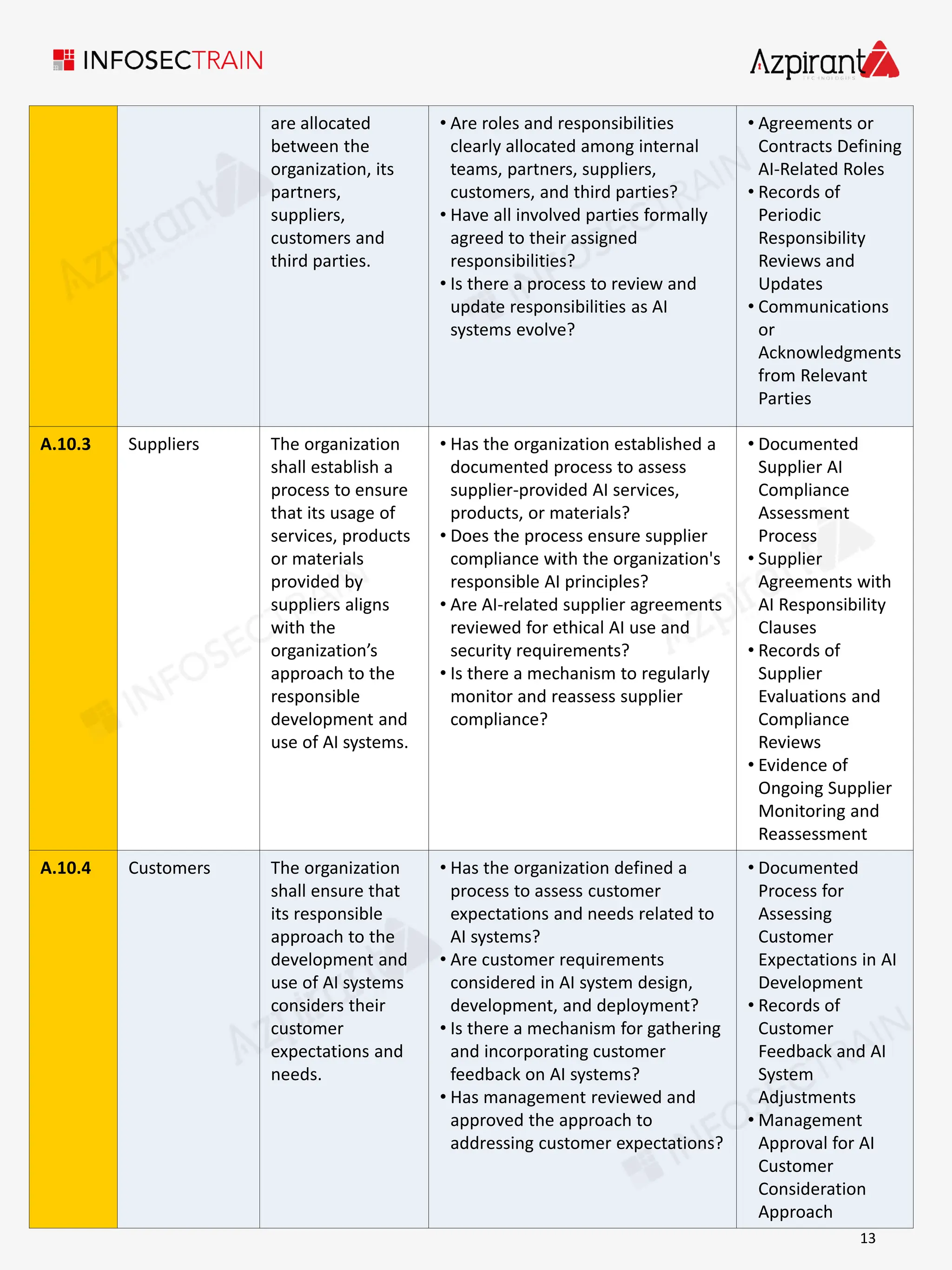
are allocated
between the
organization, its
partners,
suppliers,
customers and
third parties.
• Are roles and responsibilities
clearly allocated among internal
teams, partners, suppliers,
customers, and third parties?
• Have all involved parties formally
agreed to their assigned
responsibilities?
• Is there a process to review and
update responsibilities as AI
systems evolve?
• Agreements or
Contracts Defining
AI-Related Roles
• Records of
Periodic
Responsibility
Reviews and
Updates
• Communications
or
Acknowledgments
from Relevant
Parties
A.10.3 Suppliers The organization
shall establish a
process to ensure
that its usage of
services, products
or materials
provided by
suppliers aligns
with the
organization’s
approach to the
responsible
development and
use of AI systems.
• Has the organization established a
documented process to assess
supplier-provided AI services,
products, or materials?
• Does the process ensure supplier
compliance with the organization's
responsible AI principles?
• Are AI-related supplier agreements
reviewed for ethical AI use and
security requirements?
• Is there a mechanism to regularly
monitor and reassess supplier
compliance?
• Documented
Supplier AI
Compliance
Assessment
Process
• Supplier
Agreements with
AI Responsibility
Clauses
• Records of
Supplier
Evaluations and
Compliance
Reviews
• Evidence of
Ongoing Supplier
Monitoring and
Reassessment
A.10.4 Customers The organization
shall ensure that
its responsible
approach to the
development and
use of AI systems
considers their
customer
expectations and
needs.
• Has the organization defined a
process to assess customer
expectations and needs related to
AI systems?
• Are customer requirements
considered in AI system design,
development, and deployment?
• Is there a mechanism for gathering
and incorporating customer
feedback on AI systems?
• Has management reviewed and
approved the approach to
addressing customer expectations?
• Documented
Process for
Assessing
Customer
Expectations in AI
Development
• Records of
Customer
Feedback and AI
System
Adjustments
• Management
Approval for AI
Customer
Consideration
Approach
13

ISO 42001 2023 Audit and Control Checklist

  • 1.
  • 2.
    Clause no. Control name Control Description Audit questionnaire Evidence required A.2.2AI policy The organization shall document a policy for the development or use of AI systems. • Is there a documented AI policy for development or use? • Has management formally approved the policy? • Does the policy define AI development and usage guidelines? • Approved AI Policy Document • Management Approval Records • Policy Review and Revision Logs A.2.3 Alignment with other organizational policies The organization shall determine where other policies can be affected by or apply to, the organization’s objectives with respect to AI systems. • Has the organization identified policies that may be impacted by or applicable to AI objectives? • Is there a process to assess and document policy interdependencies related to AI? • Have affected policies been reviewed and updated to align with AI objectives? • Is there a mechanism to ensure ongoing alignment between AI objectives and other policies? • Documentation of identified affected policies • Records of policy impact assessments • Approved policy updates reflecting AI objectives • Review and approval records for policy modifications A.2.4 Review of the AI policy The AI policy shall be reviewed at planned intervals or additionally as needed to ensure its continuing suitability, adequacy and effectiveness. • Is the AI policy reviewed at planned intervals? • Are additional reviews conducted when significant changes occur? • Is there a documented process for policy review and updates? • Are review outcomes approved by management? • AI Policy Review Schedule • Policy Review and Update Records • Management Approval of Policy Revisions • Meeting Minutes or Review Reports A.3.2 AI roles and responsibilities Roles and responsibilities for AI shall be defined and allocated according to the needs of the organization. • Have roles and responsibilities for AI development, deployment, and governance been formally defined? • Are AI-related responsibilities aligned with the organization’s needs and objectives? • Has management approved and communicated AI roles and responsibilities to relevant personnel? • Documented AI roles and responsibilities • Management approval records • Communication records confirming role assignments www.infosectrain.com | www.azpirantz.com 2
  • 3.
    A.3.3 Reporting of concerns Theorganization shall define and put in place a process to report concerns about the organization’s role with respect to an AI system throughout its life cycle. • Is there a documented process for reporting concerns about the organization’s role in AI systems? • Does the process define who can report, how to report, and response timelines? • Are reporting channels (e.g., email, portal, hotline) established and communicated? • Are AI-related concerns tracked, reviewed, and resolved with documented actions? • Has the organization conducted awareness sessions on the reporting process? • Approved AI Concern Reporting Procedure • List of Available Reporting Channels (e.g., email, hotline, portal) • Records of AI- Related Concern Reports and Actions Taken • Communication Logs (e.g., emails, notices) Informing Employees About the Process • Training or Awareness Session Records on AI Concern Reporting A.4.2 Resource documentation The organization shall identify and document relevant resources required for the activities at given AI system life cycle stages and other AI-related activities relevant for the organization • Has the organization identified and documented the required resources for each AI lifecycle stage? • Are human, technical, and financial resources explicitly defined? • Is there a process for periodic review and reallocation of AI- related resources? • Has management formally approved the resource allocation for AI activities? • Documented AI Resource Requirements • Records of Resource Review and Updates • Management Approval for Resource Allocation A.4.3 Data Resources As part of resource identification, the organization shall document information about the data resources utilized for the AI system. • Has the organization documented the data resources used for the AI system? • Does the documentation include data sources, types, and ownership? • Are data resource records periodically reviewed and updated? • Documented AI Data Resource Inventory • Records of Data Source Review and Updates 3 www.infosectrain.com | www.azpirantz.com
  • 4.
    A.4.4 Tooling resources As partof resource identification, the organization shall document information about the tooling resources utilized for the AI system. • Has the organization documented the tooling resources used for the AI system? • Does the documentation include software, frameworks, cloud services, and hardware? • Are tooling resources regularly reviewed and updated? • Documented List of AI Tooling Resources • Records of Tooling Resource Reviews and Updates A.4.5 System and Computing resources As part of resource identification, the organization shall document information about the system and computing resources utilized for the AI system. • Has the organization documented the system and computing resources used for the AI system? • Does the documentation specify hardware, software, cloud services, and storage? • Are resource allocations monitored and updated as the AI system evolves? • Documented AI System and Computing Resources • Inventory of Hardware, Software, and Cloud Services • Records of Resource Updates and Monitoring A.4.6 Human resources As part of resource identification, the organization shall document information about the human resources and their competences utilized for the development, deployment, operation, change management, maintenance, transfer and decommissioning, as well as verification and integration of the AI system • Has the organization documented the human resources involved in each AI lifecycle stage? • Are the competencies and skill requirements for these roles clearly defined? • Is there a process to review and update resource allocations as AI systems evolve? • Has management formally approved the assigned human resources for AI activities? • Documented AI Human Resource Allocation • Competency and Skill Requirement Records • Records of Resource Review and Updates • Management Approval for Assigned Personnel 4 www.infosectrain.com | www.azpirantz.com
  • 5.
    A.5.2 AI system impact assessment process Theorganization shall establish a process to assess the potential consequences for individuals or groups of individuals, or both, and societies that can result from the AI system throughout its life cycle. • Has the organization established a documented process to assess AI system consequences for individuals and society? • Does the assessment cover all lifecycle stages of the AI system? • Are ethical, legal, and social impacts considered in the assessment? • Is there a process for reviewing and updating the assessment based on AI system changes? • Has management approved and implemented the assessment framework? • Documented AI Impact Assessment Process • Records of Conducted AI Impact Assessments • Review and Update Logs for Assessments • Management Approval of Assessment Framework A.5.3 Documentati- on of AI system impact assessments The organization shall document the results of AI system impact assessments and retain results for a defined period. • Are AI system impact assessments documented after each evaluation? • Does the organization define and follow a retention period for assessment results? • Are assessment results reviewed and approved by relevant stakeholders? • Is there a process to ensure secure storage and accessibility of past assessments? • Documented AI Impact Assessment Reports • Defined Retention Policy for Assessment Results • Records of Review and Approval of Assessments • Logs or System Records Showing Secure Storage of Past Assessments A.5.4 Assessing AI system impact on individuals or groups of individuals The organization shall assess and document the potential impacts of AI systems to individuals or groups of individuals throughout the system’s life cycle • Has the organization conducted an assessment of AI system impacts on individuals or groups? • Is the impact assessment documented and aligned with the AI system lifecycle? • Are ethical, legal, and societal risks considered in the assessment? • Is there a process for reviewing and updating impact assessments over time? • Documented AI Impact Assessment Report • Records of Periodic Impact Reviews and Updates • Risk Assessment Findings Related to AI Systems 5 www.infosectrain.com | www.azpirantz.com
  • 6.
    A.5.5 Assessing societal impacts ofAI systems The organization shall assess and document the potential societal impacts of their AI systems throughout their life cycle. • Has the organization conducted an assessment of the potential societal impacts of its AI systems? • Is the assessment documented and updated throughout the AI system lifecycle? • Does the assessment consider ethical, legal, and social risks? • Are mitigation measures defined for identified negative societal impacts? • Has management reviewed and approved the societal impact assessment? • Documented Societal Impact Assessment Reports • Records of Periodic Reviews and Updates • Risk Mitigation Plans for Identified Societal Impacts • Management Approval Records A.6.1.2 Objectives for responsible development of AI system The organization shall identify and document objectives to guide the responsible development AI systems, and take those objectives into account and integrate measures to achieve them in the development life cycle • Has the organization identified and documented objectives for responsible AI development? • Are these objectives aligned with ethical, legal, and business requirements? • Have measures been integrated into the AI development lifecycle to achieve these objectives? • Is there a process to review and update AI development objectives periodically? • Documented AI Development Objectives • AI Lifecycle Process with Integrated Measures • Records of Objective Reviews and Updates A.6.1.3 Processes for responsible AI system design and development The organization shall define and document the specific processes for the responsible design and development of the AI system • Has the organization defined and documented processes for responsible AI design and development? • Do the processes address ethical, legal, and security considerations? • Is there a formal review and approval mechanism for AI design and development processes? • Are these processes communicated and followed by AI development teams? • Documented AI Design and Development Processes • Records of Process Review and Approval • Training or Awareness Records for AI Development Teams 6 www.infosectrain.com | www.azpirantz.com
  • 7.
    A.6.2.2 AI system requirements and specification Theorganization shall specify and document requirements for new AI systems or material enhancements to existing systems. • Has the organization documented requirements for new AI systems and enhancements? • Do the requirements cover functionality, security, compliance, and ethical considerations? • Is there a formal approval process before implementation? • Are requirement documents regularly reviewed and updated? • Documented AI System Requirements • Approval Records for New or Enhanced AI Systems • Requirement Review and Update Logs A.6.2.3 Documentati- on of AI system design and development The organization shall document the AI system design and development based on organizational objectives, documented requirements and specification criteria • Has the organization documented the AI system design and development process? • Are AI systems designed based on organizational objectives and documented requirements? • Does the documentation include specification criteria for AI system development? • Is there a process to review and update the design and development documentation? • Documented AI System Design and Development Process • AI System Requirement and Specification Documents • Records of Design Review and Updates A.6.2.4 AI system verification and validation The organization shall define and document verification and validation measures for the AI system and specify criteria for their use. • Has the organization defined and documented verification and validation (V&V) measures for AI systems? • Are specific criteria for applying V&V measures clearly outlined? • Is there a process to review and update V&V measures based on AI system changes? • Has management approved and implemented the V&V framework? • Documented AI Verification and Validation Measures • Defined Criteria for Applying V&V • Records of V&V Implementation and Review • Management Approval for V&V Framework A.6.2.5 AI system deployment The organization shall document a deployment plan and ensure that appropriate requirements are met prior to deployment. • Is there a documented AI deployment plan covering all necessary steps? • Does the plan define pre- deployment requirements and validation checks? • Is there a process to verify and approve compliance before deployment? • Has management formally approved the deployment plan? • Documented AI System Requirements • Approval Records for New or Enhanced AI Systems • Requirement Review and Update Logs 7 www.infosectrain.com | www.azpirantz.com
  • 8.
    A.6.2.6 AI system operationand monitoring The organization shall define and document the necessary elements for the ongoing operation of the AI system. At the minimum, this should include system • Has the organization defined and documented the essential elements for the ongoing operation of the AI system? • Does the documentation specify system functionality, maintenance, and monitoring requirements? • Are operational procedures regularly reviewed and updated based on system performance? • Has management approved the operational framework for AI systems? • Documented AI System Operational Requirements • Maintenance and Monitoring Logs • Records of Operational Reviews and Updates • Management Approval for AI System Operations A.6.2.7 AI system technical documentation The organization shall determine what AI system technical documentation is needed for each relevant category of interested parties, such as users, partners, supervisory authorities, and provide the technical documentation to them in the appropriate form. • Has the organization identified the necessary AI system technical documentation for each category of interested parties? • Does the documentation cover users, partners, and regulatory authorities as required? • Is there a process to ensure documentation is updated and maintained? • Are there defined methods for distributing the documentation to relevant parties? • List of AI System Technical Documentation by Audience Category • Records of Documentation Distribution • Documentation Update and Maintenance Logs A.6.2.8 AI system recording of event logs The organization shall determine at which phases of the AI system life cycle, record keeping of event logs should be enabled, but at the minimum when the AI system is in use • Has the organization identified which AI lifecycle phases require event logging? • Are event logs enabled at a minimum when the AI system is in use? • Does the logging process capture relevant AI-related activities and decisions? • Is there a documented log retention and management process? • Documented AI Logging Requirements • Log Records for AI System Usage Phase • Log Retention and Management Policy 8 www.infosectrain.com | www.azpirantz.com
  • 9.
    A.7.2 Data for development and enhancement ofAI system The organization shall define, document and implement data management processes related to the development of AI systems. • Has the organization defined and documented data management processes for AI system development? • Do these processes cover data collection, storage, processing, and disposal? • Are data management practices aligned with regulatory and security requirements? • Is there a mechanism to monitor and enforce compliance with data management processes? • Are AI development teams trained on data management policies and procedures? • Documented AI Data Management Processes • Records of Data Handling Practices (Collection, Storage, Processing, Disposal) • Compliance Reports or Audit Logs on Data Management • Training Records for AI Development Teams A.7.3 Acquisition of data The organization shall determine and document details about the acquisition and selection of the data used in AI systems. • Has the organization documented the criteria and process for acquiring and selecting data for AI systems? • Are data sources verified for accuracy, reliability, and compliance with regulations? • Does the organization maintain records of data provenance and justification for selection? • Is there a process to periodically review and update data selection criteria? • Documented Data Acquisition and Selection Criteria • Records of Data Source Verification and Approval • Logs of Data Provenance and Justification for Use • Review and Update Records for Data Selection Criteria A.7.4 Quality of data for AI systems The organization shall define and document requirements for data quality and ensure that data used to develop and operate the AI system meet those requirements. • Has the organization defined and documented data quality requirements for AI systems? • Are there established criteria for accuracy, completeness, consistency, and reliability of data? • Is there a process to validate and monitor data quality during AI development and operation? • Are data quality checks regularly reviewed and updated based on AI system needs? • Documented Data Quality Requirements for AI • Records of Data Validation and Monitoring Processes • Reports on Data Quality Assessments and Corrections 9 www.infosectrain.com | www.azpirantz.com
  • 10.
    • Has managementapproved and communicated the data quality requirements? • Management Approval for Data Quality Standards A.7.5 Data provenance The organization shall define and document a process for recording the provenance of data used in its AI systems over the life cycles of the data and the AI system. • Has the organization defined and documented a process for recording data provenance in AI systems? • Does the process cover data origin, transformations, and usage throughout the AI lifecycle? • Are data provenance records maintained and regularly updated? • Is there a mechanism to verify the integrity and accuracy of provenance records? • Documented Data Provenance Recording Process • Data Provenance Logs and Records • Records of Periodic Review and Updates • Integrity Verification Reports for Provenance Data A.7.6 Data preparation The organization shall define and document its criteria for selecting data preparations and the data preparation methods to be used. • Has the organization defined and documented criteria for selecting data preparation methods? • Are the selected data preparation methods aligned with AI system requirements? • Is there a process to review and update data preparation criteria based on evolving AI needs? • Has management approved the data preparation selection criteria? • Documented Data Preparation Criteria • List of Approved Data Preparation Methods • Records of Criteria Review and Updates • Management Approval for Data Preparation Standards A.8.2 System documentation and information for users The organization shall determine and provide the necessary information to users of the AI system. • Has the organization identified the necessary information that AI system users need? • Is this information clearly documented and accessible to users? • Does the organization provide instructions, limitations, and potential risks of the AI system? • Is there a process to update and communicate changes in AI system information to users? • Documented AI System User Guidelines • Records of Information Provided to Users • Communication Logs for AI System Updates 10 www.infosectrain.com | www.azpirantz.com
  • 11.
    A.8.3 External reporting The organization shallprovide capabilities for interested parties to report adverse impacts of the AI system. • Has the organization established a formal mechanism for interested parties to report adverse AI impacts? • Are reporting channels (e.g., portal, email, hotline) accessible and communicated? • Is there a defined process for reviewing, addressing, and responding to reported issues? • Are reports and resolutions documented and maintained for accountability? • Documented AI Adverse Impact Reporting Procedure • List of Available Reporting Channels • Records of Reported Cases and Actions Taken • Communication Logs Informing Stakeholders About the Reporting Process A.8.4 Communicati- on of incidents The organization shall determine and document a plan for communicating incidents to users of the AI system. • Has the organization established and documented a plan for communicating AI system incidents to users? • Does the plan specify incident types, notification timelines, and communication channels? • Are roles and responsibilities defined for incident reporting and user notification? • Is the communication plan tested and reviewed periodically? • Documented AI Incident Communication Plan • Defined Incident Notification Procedures • Records of Communication Plan Testing and Updates • Incident Logs with User Notifications A.8.5 Information for interested parties The organization shall determine and document their obligations to reporting information about the AI system to interested parties. • Has the organization identified and documented its AI system reporting obligations to interested parties? • Are reporting requirements aligned with legal, regulatory, and contractual obligations? • Is there a process for periodic review and updates to reporting obligations? • Are reporting responsibilities formally assigned within the organization? • Documented AI System Reporting Obligations • Regulatory and Contractual Compliance Records • Review and Update Logs for Reporting Requirements • Assigned Roles and Responsibilities for AI Reporting 11 www.infosectrain.com | www.azpirantz.com
  • 12.
    A.9.2 Processes for responsible useof AI systems The organization shall define and document the processes for the responsible use of AI systems. • Has the organization defined and documented processes for the responsible use of AI systems? • Do the processes address ethical considerations, fairness, transparency, and accountability? • Are there guidelines for monitoring and mitigating risks associated with AI usage? • Has management formally approved these processes? • Are employees and stakeholders aware of and trained on responsible AI usage? • Documented AI Responsible Use Processes • Management Approval Records • 3.Risk Mitigation Guidelines for AI Usage • Training and Awareness Records on AI Ethics and Responsibilities A.9.3 Objectives for responsible use of AI system The organization shall identify and document objectives to guide the responsible use of AI systems. • Has the organization defined and documented objectives for the responsible use of AI systems? • Do the objectives align with ethical, legal, and organizational requirements? • Are the objectives communicated to relevant stakeholders? • Is there a process for reviewing and updating these objectives? • Documented AI Responsibility Objectives • Management Approval Records • Communication Records (e.g., emails, policy documents) • Review and Update Logs A.9.4 Intended use of the AI system The organization shall ensure that the AI system is used according to the intended uses of the AI system and its accompanying documentation. • Is there a documented process to ensure AI systems are used only for their intended purpose? • Does the organization maintain records of AI system usage and monitor deviations? • Are AI users provided with clear guidelines and documentation on intended use? • Is there a mechanism to detect and address unauthorized AI usage? • Documented AI Usage Guidelines • AI System Usage Logs and Monitoring Reports • Records of Unauthorized Usage Incidents and Actions Taken • User Training or Acknowledgment of Intended AI Use A.10.2 Allocating responsibilities The organization shall ensure that responsibilities within their AI system life cycle • Has the organization defined and documented responsibilities for each AI lifecycle stage? • Documented AI Responsibility Matrix 12 www.infosectrain.com | www.azpirantz.com
  • 13.
    are allocated between the organization,its partners, suppliers, customers and third parties. • Are roles and responsibilities clearly allocated among internal teams, partners, suppliers, customers, and third parties? • Have all involved parties formally agreed to their assigned responsibilities? • Is there a process to review and update responsibilities as AI systems evolve? • Agreements or Contracts Defining AI-Related Roles • Records of Periodic Responsibility Reviews and Updates • Communications or Acknowledgments from Relevant Parties A.10.3 Suppliers The organization shall establish a process to ensure that its usage of services, products or materials provided by suppliers aligns with the organization’s approach to the responsible development and use of AI systems. • Has the organization established a documented process to assess supplier-provided AI services, products, or materials? • Does the process ensure supplier compliance with the organization's responsible AI principles? • Are AI-related supplier agreements reviewed for ethical AI use and security requirements? • Is there a mechanism to regularly monitor and reassess supplier compliance? • Documented Supplier AI Compliance Assessment Process • Supplier Agreements with AI Responsibility Clauses • Records of Supplier Evaluations and Compliance Reviews • Evidence of Ongoing Supplier Monitoring and Reassessment A.10.4 Customers The organization shall ensure that its responsible approach to the development and use of AI systems considers their customer expectations and needs. • Has the organization defined a process to assess customer expectations and needs related to AI systems? • Are customer requirements considered in AI system design, development, and deployment? • Is there a mechanism for gathering and incorporating customer feedback on AI systems? • Has management reviewed and approved the approach to addressing customer expectations? • Documented Process for Assessing Customer Expectations in AI Development • Records of Customer Feedback and AI System Adjustments • Management Approval for AI Customer Consideration Approach 13