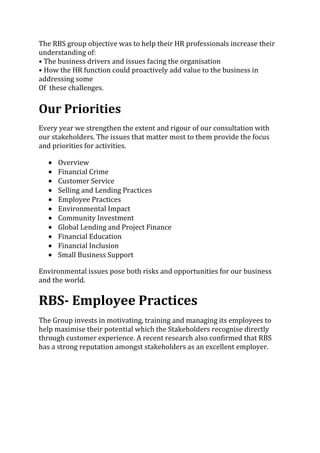
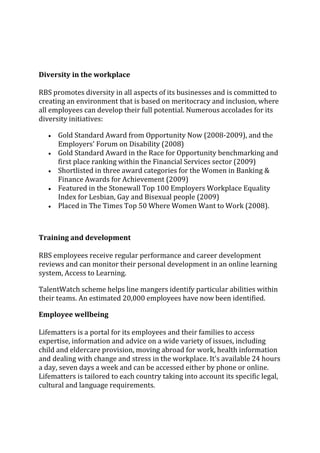
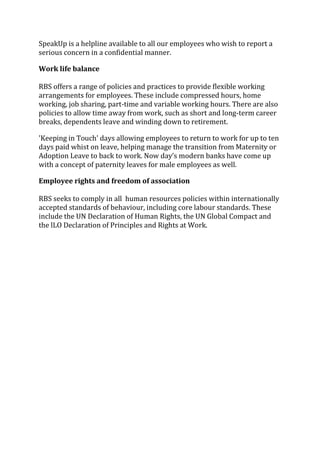
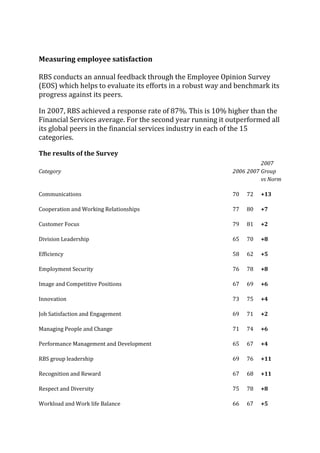
Contemporary HR practices in Banking SectorSubmitted By-Manisha SachdevRoll no. 06PGD RB & S- 09Source- www.rbs.comContemporary HR Practices in Banking SectorHUMAN RESOURCES IN A NUTSHELL:โ€œHuman Resource Management is the planning, organizing, directing and controlling of the procurement , development, compensation, integration, maintenance, and separation of human resources to the end that individual, organisational and social objectives are accomplishedโ€Human Resource management therefore, is a set of programmes, functions, and activities designed and carried out in order to maximize both employee as well organisational effectiveness.In its transition from Labour management to staffing, human capital to asset management, Personnel management to where it is today. Human Resource Management has surely come off age, and so have the HRM practices. In such contemporary times where employees are being referred to as Internal Customers, the HRM surely plays a vital role in the growth of an organization. In the coming pages, we will discuss :HR Practices at The Royal Bank Of ScotlandTheir Employee PracticesCorporate Social ResponsibilitiesGroup mission and combined goalHR in Banking-HR in banking is not a once and for all matter of selecting an โ€˜appropriate fitโ€™ from a โ€˜menuโ€™ of HR strategies. It is more a continual process of shifting priorities and policies as the organisation adjusts to the stormy waves of the market environment.Changes in the nature of banking clearly have a knock-on effect on employee relations (defined broadly to include industrial relations, communications, training, remuneration policy, etc.) as banks move towards being more market driven organisations with a culture consistent with that, and with staff being regarded more as a resource than a cost.  "HR is a business, just like any other part of the RBS group. We provide products and services to the Group and our people, and we have to deliver them professionally and efficiently. Broadening the HR professionalโ€™s understanding of business drivers and external markets is key to adding shareholder value, and to the success of todayโ€™s HR function."Tony WilliamsHead of HR shared services, The Royal Bank of Scotland Group              RBS- The Group:The Royal Bank of Scotland, founded in 1727- has 280 years of financial services experience. The Group has over 40 million customers worldwide, over half of which (25 million) are in the UK. It owns more than 40 well known consumer brands including RBS, NatWest, Direct Line, Churchill, Coutts, Ulster Bank and Citizens. Group SayWhat HR means to The Royal Bank of Scotland Group:The human resources function of The Royal Bank of Scotland Group (RBS) plays a valuable role in contributing to the Groupโ€™s ongoing business success, including the highly successful acquisition and integration of NatWest. However, the RBS group recognised that their HR team needed to maintain, enhance and grow their credibility and influence and therefore they needed to equip their HR professionals to be โ€˜Business people first, HR people second.โ€™The RBS group objective was to help their HR professionals increase their understanding of:โ€ข The business drivers and issues facing the organisationโ€ข How the HR function could proactively add value to the business in addressing someOf  these challenges.Our PrioritiesEvery year we strengthen the extent and rigour of our consultation with our stakeholders. The issues that matter most to them provide the focus and priorities for activities.Overview Financial Crime Customer Service Selling and Lending Practices Employee Practices Environmental Impact Community Investment Global Lending and Project Finance Financial Education Financial Inclusion Small Business Support Environmental issues pose both risks and opportunities for our business and the world. RBS- Employee PracticesThe Group invests in motivating, training and managing its employees to help maximise their potential which the Stakeholders recognise directly through customer experience. A recent research also confirmed that RBS has a strong reputation amongst stakeholders as an excellent employer.Diversity in the workplaceRBS promotes diversity in all aspects of its businesses and is committed to creating an environment that is based on meritocracy and inclusion, where all employees can develop their full potential. Numerous accolades for its diversity initiatives:Gold Standard Award from Opportunity Now (2008-2009), and the Employers' Forum on Disability (2008) Gold Standard Award in the Race for Opportunity benchmarking and first place ranking within the Financial Services sector (2009) Shortlisted in three award categories for the Women in Banking & Finance Awards for Achievement (2009) Featured in the Stonewall Top 100 Employers Workplace Equality Index for Lesbian, Gay and Bisexual people (2009) Placed in The Times Top 50 Where Women Want to Work (2008). Training and developmentRBS employees receive regular performance and career development reviews and can monitor their personal development in an online learning system, Access to Learning.TalentWatch scheme helps line mangers identify particular abilities within their teams. An estimated 20,000 employees have now been identified. Employee wellbeingLifematters is a portal for its employees and their families to access expertise, information and advice on a wide variety of issues, including child and eldercare provision, moving abroad for work, health information and dealing with change and stress in the workplace. It's available 24 hours a day, seven days a week and can be accessed either by phone or online. Lifematters is tailored to each country taking into account its specific legal, cultural and language requirements.SpeakUp is a helpline available to all our employees who wish to report a serious concern in a confidential manner.Work life balanceRBS offers a range of policies and practices to provide flexible working arrangements for employees. These include compressed hours, home working, job sharing, part-time and variable working hours. There are also policies to allow time away from work, such as short and long-term career breaks, dependents leave and winding down to retirement. 'Keeping in Touch' days allowing employees to return to work for up to ten days paid whist on leave, helping manage the transition from Maternity or Adoption Leave to back to work. Now dayโ€™s modern banks have come up with a concept of paternity leaves for male employees as well.Employee rights and freedom of associationRBS seeks to comply in all  human resources policies within internationally accepted standards of behaviour, including core labour standards. These include the UN Declaration of Human Rights, the UN Global Compact and the lLO Declaration of Principles and Rights at Work.Measuring employee satisfactionRBS conducts an annual feedback through the Employee Opinion Survey (EOS) which helps to evaluate its efforts in a robust way and benchmark its progress against its peers.In 2007, RBS achieved a response rate of 87%. This is 10% higher than the Financial Services average. For the second year running it outperformed all its global peers in the financial services industry in each of the 15 categories.The results of the SurveyCategory200620072007 Group vs NormCommunications7072+13Cooperation and Working Relationships7780+7Customer Focus7981+2Division Leadership6570+8Efficiency5862+5Employment Security7678+8Image and Competitive Positions6769+6Innovation7375+4Job Satisfaction and Engagement6971+2Managing People and Change7174+6Performance Management and Development6567+4RBS group leadership6976+11Recognition and Reward6768+11Respect and Diversity7578+8Workload and Work life Balance6667+5Direct environmental impactRBS is:Investing over ยฃ40 million in property portfolio to improve energy and water efficiencyConstantly experimenting with new technologies such as solar panels and ground source heat pumps to identify ways of reducing our impact still furtherContinuing to install videoconferencing facilities to provide employees with alternatives to flyingActively encouraging cycling and bus travel to workEngaging employeesIn 2007 RBS launched YourWorld - a dedicated environmental website for its employees. The site features:Advice on how to reduce their own environmental impactAn innovative carbon calculatorMoney saving offers on greener products and servicesInformation about what we're doing around environmental issuesEnvironmental products and servicesRBS committed over $1.5 billion in lending to renewable energy projects in the first half of 2008, equivalent to 10.5% of the global total. No other UK bank is among the top 20 providers of finance for renewable energyIn 2007:Over 1 million online customers signed up to receive e-statements rather than paper statementsCitizens Bank in America launched the GreenSense account, which rewards customers financially for saving paperUlster Bank introduced the Solar Mortgage and a Carbon Offset productDeveloped a number of successful green savings products that invest customers' money in green technology and renewable energy companiesRecognition of performanceIn 2007, RBS was:Upgraded to AAA by the ratings agency Innovest for managing social and environmental risks and opportunitiesIncluded in the Dow Jones and FTSE4GOOD sustainability indicesIncluded among the world's 100 most sustainable companies at the World Economic Forum in Davos for the first timeFinancial education for children and young peopleIn 2007, 550 employees delivered MoneySense lessons to 635,000 pupils. Delivered MoneySense lessons to over 635,000 pupils, in 1,400 secondary schools across the UKPut the lessons online increasing accessibilityOpened a further 200 new school savings banks in the UKDeveloped the Coutts Assets and Responsibility Course to help young people best manage a large amount of moneyRBS also focuses on financial education for adults through its MoneySense panel scheme:Our research: The Money Sense panelThe panel will focus on 10,000 secondary school pupils aged 11-18. The five year study will examine their attitudes and behaviours to money and how these change over time. It will give us robust evidence for how different levels of financial education affect attitudes and aspirations.Group Say- Being TransparentWhat We DoWe regard every day as a new chance to earn your trust. It demands hard work, integrity and transparency, but that's what we do.Corporate Social responsibility-Issues that matter the most-Financial crimeCustomer serviceSelling and lending practicesEmployee practicesEnvironmental impactCommunity investmentGlobal lending and project financeFinancial educationFinancial inclusionSmall business supportThe Difference-Although few organizations take such a comprehensive approach to attrition analysis, Royal Bank of Scotland, the world's fifth largest bank, has investigated the issue in depth and come up with a novel model. Its analysis factors in a wide range of recruitment costs, spanning the point where an employee resigns to the time they're replaced with someone of similar competency levels. This includes the time spent by HR and line managers on finding new staff, and an allowance for reductions in productivity as the employee works out their notice. Having established the full extent of the costs involved, RBS was able to define a break-even point for a typical employee, representing the moment in time when they start to add net value to the organization rather than being a net cost. From a financial perspective, its research demonstrated that this point typically arises after around one year's salary has been spent.Putting motivation in context -where breadth of metrics matters RBS is also at the forefront of HR strategy in the way that it analyzes employee 'engagement' and sets it in the context of critical HR issues. The model incorporates eight major research categories, such as work/life balance, total rewards and leadership. This kind of analysis provides key strategic information which the HR department can pass onto the board and line managers. As the HR profession looks to build a role for itself beyond its core administrative roots, these kinds of initiatives provide practical, real-life examples of how value can truly be generated.Other RBS Unique HR features include-Career Paths (Graduate Training programmes at RBS)When you join the RBS group as a graduate, one of our main aims, whichever area of the business you join, is to give you the broadest possible understanding of our organisation. We think this is the best way of preparing you for your future career and of helping you to develop your skills into the areas that are best suited to you. Uniteย - The union for Royal Bank of Scotland staff Unite, the union for Royal Bank of Scotland Group in Britain, exists to protect your interests and get you a better deal at work. We offer a wide range of services and benefits to members, includingRBS also has โ€œInsiteโ€ an HR portal where in one can put forward their grievances, or contact their Jointly Accredited Representative (JAR) where issues with Performance appraisal, encashment of leaves etc. are taken care of.  In case an employee is not satisfied with his/her performance rating, he has full rights to challenge his line managerOn a broader look, we find that all major Banks and MNCโ€™s now follow an appraisal system which is more executive centric ie which focuses on the overall assessment of employees and their unbiased assessment, from the grass root  level to the top management. For example Standard Chartered has Gallop (a third party company) , which assesses employees & managers through an elaborate Q 12  cycle of assessment so that So that the ratings are not influenced and  remain  unbiased.HR Approach- 2009A purposeful management style. \"
Making it happen\"
 for our customers and then for our shareholders. A strategic understanding of our businesses and a focus on long-term quality profitability. A business mix more biased than before to stable customer businesses. Aiming to rely less on volatile, unsecured wholesale funding.
Hr Final
Hr Final
Hr Final
Hr Final
Hr Final
Hr Final
Hr Final
Hr Final
Hr Final
Hr Final
Hr Final

Hr Final

  • 1.
    Contemporary HR practicesin Banking SectorSubmitted By-Manisha SachdevRoll no. 06PGD RB & S- 09Source- www.rbs.comContemporary HR Practices in Banking SectorHUMAN RESOURCES IN A NUTSHELL:โ€œHuman Resource Management is the planning, organizing, directing and controlling of the procurement , development, compensation, integration, maintenance, and separation of human resources to the end that individual, organisational and social objectives are accomplishedโ€Human Resource management therefore, is a set of programmes, functions, and activities designed and carried out in order to maximize both employee as well organisational effectiveness.In its transition from Labour management to staffing, human capital to asset management, Personnel management to where it is today. Human Resource Management has surely come off age, and so have the HRM practices. In such contemporary times where employees are being referred to as Internal Customers, the HRM surely plays a vital role in the growth of an organization. In the coming pages, we will discuss :HR Practices at The Royal Bank Of ScotlandTheir Employee PracticesCorporate Social ResponsibilitiesGroup mission and combined goalHR in Banking-HR in banking is not a once and for all matter of selecting an โ€˜appropriate fitโ€™ from a โ€˜menuโ€™ of HR strategies. It is more a continual process of shifting priorities and policies as the organisation adjusts to the stormy waves of the market environment.Changes in the nature of banking clearly have a knock-on effect on employee relations (defined broadly to include industrial relations, communications, training, remuneration policy, etc.) as banks move towards being more market driven organisations with a culture consistent with that, and with staff being regarded more as a resource than a cost. "HR is a business, just like any other part of the RBS group. We provide products and services to the Group and our people, and we have to deliver them professionally and efficiently. Broadening the HR professionalโ€™s understanding of business drivers and external markets is key to adding shareholder value, and to the success of todayโ€™s HR function."Tony WilliamsHead of HR shared services, The Royal Bank of Scotland Group RBS- The Group:The Royal Bank of Scotland, founded in 1727- has 280 years of financial services experience. The Group has over 40 million customers worldwide, over half of which (25 million) are in the UK. It owns more than 40 well known consumer brands including RBS, NatWest, Direct Line, Churchill, Coutts, Ulster Bank and Citizens. Group SayWhat HR means to The Royal Bank of Scotland Group:The human resources function of The Royal Bank of Scotland Group (RBS) plays a valuable role in contributing to the Groupโ€™s ongoing business success, including the highly successful acquisition and integration of NatWest. However, the RBS group recognised that their HR team needed to maintain, enhance and grow their credibility and influence and therefore they needed to equip their HR professionals to be โ€˜Business people first, HR people second.โ€™The RBS group objective was to help their HR professionals increase their understanding of:โ€ข The business drivers and issues facing the organisationโ€ข How the HR function could proactively add value to the business in addressing someOf these challenges.Our PrioritiesEvery year we strengthen the extent and rigour of our consultation with our stakeholders. The issues that matter most to them provide the focus and priorities for activities.Overview Financial Crime Customer Service Selling and Lending Practices Employee Practices Environmental Impact Community Investment Global Lending and Project Finance Financial Education Financial Inclusion Small Business Support Environmental issues pose both risks and opportunities for our business and the world. RBS- Employee PracticesThe Group invests in motivating, training and managing its employees to help maximise their potential which the Stakeholders recognise directly through customer experience. A recent research also confirmed that RBS has a strong reputation amongst stakeholders as an excellent employer.Diversity in the workplaceRBS promotes diversity in all aspects of its businesses and is committed to creating an environment that is based on meritocracy and inclusion, where all employees can develop their full potential. Numerous accolades for its diversity initiatives:Gold Standard Award from Opportunity Now (2008-2009), and the Employers' Forum on Disability (2008) Gold Standard Award in the Race for Opportunity benchmarking and first place ranking within the Financial Services sector (2009) Shortlisted in three award categories for the Women in Banking & Finance Awards for Achievement (2009) Featured in the Stonewall Top 100 Employers Workplace Equality Index for Lesbian, Gay and Bisexual people (2009) Placed in The Times Top 50 Where Women Want to Work (2008). Training and developmentRBS employees receive regular performance and career development reviews and can monitor their personal development in an online learning system, Access to Learning.TalentWatch scheme helps line mangers identify particular abilities within their teams. An estimated 20,000 employees have now been identified. Employee wellbeingLifematters is a portal for its employees and their families to access expertise, information and advice on a wide variety of issues, including child and eldercare provision, moving abroad for work, health information and dealing with change and stress in the workplace. It's available 24 hours a day, seven days a week and can be accessed either by phone or online. Lifematters is tailored to each country taking into account its specific legal, cultural and language requirements.SpeakUp is a helpline available to all our employees who wish to report a serious concern in a confidential manner.Work life balanceRBS offers a range of policies and practices to provide flexible working arrangements for employees. These include compressed hours, home working, job sharing, part-time and variable working hours. There are also policies to allow time away from work, such as short and long-term career breaks, dependents leave and winding down to retirement. 'Keeping in Touch' days allowing employees to return to work for up to ten days paid whist on leave, helping manage the transition from Maternity or Adoption Leave to back to work. Now dayโ€™s modern banks have come up with a concept of paternity leaves for male employees as well.Employee rights and freedom of associationRBS seeks to comply in all human resources policies within internationally accepted standards of behaviour, including core labour standards. These include the UN Declaration of Human Rights, the UN Global Compact and the lLO Declaration of Principles and Rights at Work.Measuring employee satisfactionRBS conducts an annual feedback through the Employee Opinion Survey (EOS) which helps to evaluate its efforts in a robust way and benchmark its progress against its peers.In 2007, RBS achieved a response rate of 87%. This is 10% higher than the Financial Services average. For the second year running it outperformed all its global peers in the financial services industry in each of the 15 categories.The results of the SurveyCategory200620072007 Group vs NormCommunications7072+13Cooperation and Working Relationships7780+7Customer Focus7981+2Division Leadership6570+8Efficiency5862+5Employment Security7678+8Image and Competitive Positions6769+6Innovation7375+4Job Satisfaction and Engagement6971+2Managing People and Change7174+6Performance Management and Development6567+4RBS group leadership6976+11Recognition and Reward6768+11Respect and Diversity7578+8Workload and Work life Balance6667+5Direct environmental impactRBS is:Investing over ยฃ40 million in property portfolio to improve energy and water efficiencyConstantly experimenting with new technologies such as solar panels and ground source heat pumps to identify ways of reducing our impact still furtherContinuing to install videoconferencing facilities to provide employees with alternatives to flyingActively encouraging cycling and bus travel to workEngaging employeesIn 2007 RBS launched YourWorld - a dedicated environmental website for its employees. The site features:Advice on how to reduce their own environmental impactAn innovative carbon calculatorMoney saving offers on greener products and servicesInformation about what we're doing around environmental issuesEnvironmental products and servicesRBS committed over $1.5 billion in lending to renewable energy projects in the first half of 2008, equivalent to 10.5% of the global total. No other UK bank is among the top 20 providers of finance for renewable energyIn 2007:Over 1 million online customers signed up to receive e-statements rather than paper statementsCitizens Bank in America launched the GreenSense account, which rewards customers financially for saving paperUlster Bank introduced the Solar Mortgage and a Carbon Offset productDeveloped a number of successful green savings products that invest customers' money in green technology and renewable energy companiesRecognition of performanceIn 2007, RBS was:Upgraded to AAA by the ratings agency Innovest for managing social and environmental risks and opportunitiesIncluded in the Dow Jones and FTSE4GOOD sustainability indicesIncluded among the world's 100 most sustainable companies at the World Economic Forum in Davos for the first timeFinancial education for children and young peopleIn 2007, 550 employees delivered MoneySense lessons to 635,000 pupils. Delivered MoneySense lessons to over 635,000 pupils, in 1,400 secondary schools across the UKPut the lessons online increasing accessibilityOpened a further 200 new school savings banks in the UKDeveloped the Coutts Assets and Responsibility Course to help young people best manage a large amount of moneyRBS also focuses on financial education for adults through its MoneySense panel scheme:Our research: The Money Sense panelThe panel will focus on 10,000 secondary school pupils aged 11-18. The five year study will examine their attitudes and behaviours to money and how these change over time. It will give us robust evidence for how different levels of financial education affect attitudes and aspirations.Group Say- Being TransparentWhat We DoWe regard every day as a new chance to earn your trust. It demands hard work, integrity and transparency, but that's what we do.Corporate Social responsibility-Issues that matter the most-Financial crimeCustomer serviceSelling and lending practicesEmployee practicesEnvironmental impactCommunity investmentGlobal lending and project financeFinancial educationFinancial inclusionSmall business supportThe Difference-Although few organizations take such a comprehensive approach to attrition analysis, Royal Bank of Scotland, the world's fifth largest bank, has investigated the issue in depth and come up with a novel model. Its analysis factors in a wide range of recruitment costs, spanning the point where an employee resigns to the time they're replaced with someone of similar competency levels. This includes the time spent by HR and line managers on finding new staff, and an allowance for reductions in productivity as the employee works out their notice. Having established the full extent of the costs involved, RBS was able to define a break-even point for a typical employee, representing the moment in time when they start to add net value to the organization rather than being a net cost. From a financial perspective, its research demonstrated that this point typically arises after around one year's salary has been spent.Putting motivation in context -where breadth of metrics matters RBS is also at the forefront of HR strategy in the way that it analyzes employee 'engagement' and sets it in the context of critical HR issues. The model incorporates eight major research categories, such as work/life balance, total rewards and leadership. This kind of analysis provides key strategic information which the HR department can pass onto the board and line managers. As the HR profession looks to build a role for itself beyond its core administrative roots, these kinds of initiatives provide practical, real-life examples of how value can truly be generated.Other RBS Unique HR features include-Career Paths (Graduate Training programmes at RBS)When you join the RBS group as a graduate, one of our main aims, whichever area of the business you join, is to give you the broadest possible understanding of our organisation. We think this is the best way of preparing you for your future career and of helping you to develop your skills into the areas that are best suited to you. Uniteย - The union for Royal Bank of Scotland staff Unite, the union for Royal Bank of Scotland Group in Britain, exists to protect your interests and get you a better deal at work. We offer a wide range of services and benefits to members, includingRBS also has โ€œInsiteโ€ an HR portal where in one can put forward their grievances, or contact their Jointly Accredited Representative (JAR) where issues with Performance appraisal, encashment of leaves etc. are taken care of. In case an employee is not satisfied with his/her performance rating, he has full rights to challenge his line managerOn a broader look, we find that all major Banks and MNCโ€™s now follow an appraisal system which is more executive centric ie which focuses on the overall assessment of employees and their unbiased assessment, from the grass root level to the top management. For example Standard Chartered has Gallop (a third party company) , which assesses employees & managers through an elaborate Q 12 cycle of assessment so that So that the ratings are not influenced and remain unbiased.HR Approach- 2009A purposeful management style. \" Making it happen\" for our customers and then for our shareholders. A strategic understanding of our businesses and a focus on long-term quality profitability. A business mix more biased than before to stable customer businesses. Aiming to rely less on volatile, unsecured wholesale funding.