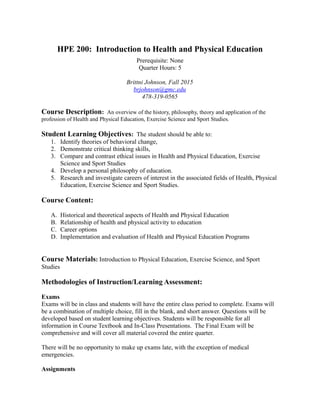
HPE 200: Introduction to Health and Physical Education
Prerequisite: None
Quarter Hours: 5
Brittni Johnson, Fall 2015
brjohnson@gmc.edu
478-319-0565
Course Description: An overview of the history, philosophy, theory and application of the
profession of Health and Physical Education, Exercise Science and Sport Studies.
Student Learning Objectives: The student should be able to:
1. Identify theories of behavioral change,
2. Demonstrate critical thinking skills,
3. Compare and contrast ethical issues in Health and Physical Education, Exercise
Science and Sport Studies
4. Develop a personal philosophy of education.
5. Research and investigate careers of interest in the associated fields of Health, Physical
Education, Exercise Science and Sport Studies.
Course Content:
A. Historical and theoretical aspects of Health and Physical Education
B. Relationship of health and physical activity to education
C. Career options
D. Implementation and evaluation of Health and Physical Education Programs
Course Materials: Introduction to Physical Education, Exercise Science, and Sport
Studies
Methodologies of Instruction/Learning Assessment:
Exams
Exams will be in class and students will have the entire class period to complete. Exams will
be a combination of multiple choice, fill in the blank, and short answer. Questions will be
developed based on student learning objectives. Students will be responsible for all
information in Course Textbook and In-Class Presentations. The Final Exam will be
comprehensive and will cover all material covered the entire quarter.
There will be no opportunity to make up exams late, with the exception of medical
emergencies.
Assignments
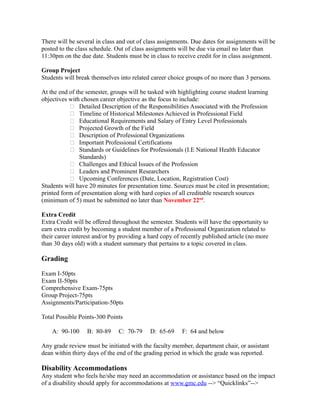
There will be several in class and out of class assignments. Due dates for assignments will be
posted to the class schedule. Out of class assignments will be due via email no later than
11:30pm on the due date. Students must be in class to receive credit for in class assignment.
Group Project
Students will break themselves into related career choice groups of no more than 3 persons.
At the end of the semester, groups will be tasked with highlighting course student learning
objectives with chosen career objective as the focus to include:
 Detailed Description of the Responsibilities Associated with the Profession
 Timeline of Historical Milestones Achieved in Professional Field
 Educational Requirements and Salary of Entry Level Professionals
 Projected Growth of the Field
 Description of Professional Organizations
 Important Professional Certifications
 Standards or Guidelines for Professionals (I.E National Health Educator
Standards)
 Challenges and Ethical Issues of the Profession
 Leaders and Prominent Researchers
 Upcoming Conferences (Date, Location, Registration Cost)
Students will have 20 minutes for presentation time. Sources must be cited in presentation;
printed form of presentation along with hard copies of all creditable research sources
(minimum of 5) must be submitted no later than November 22nd
.
Extra Credit
Extra Credit will be offered throughout the semester. Students will have the opportunity to
earn extra credit by becoming a student member of a Professional Organization related to
their career interest and/or by providing a hard copy of recently published article (no more
than 30 days old) with a student summary that pertains to a topic covered in class.
Grading
Exam I-50pts
Exam II-50pts
Comprehensive Exam-75pts
Group Project-75pts
Assignments/Participation-50pts
Total Possible Points-300 Points
A: 90-100 B: 80-89 C: 70-79 D: 65-69 F: 64 and below
Any grade review must be initiated with the faculty member, department chair, or assistant
dean within thirty days of the end of the grading period in which the grade was reported.
Disability Accommodations
Any student who feels he/she may need an accommodation or assistance based on the impact
of a disability should apply for accommodations at www.gmc.edu --> “Quicklinks”-->
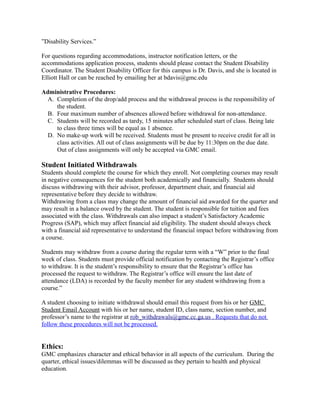
”Disability Services.”
For questions regarding accommodations, instructor notification letters, or the
accommodations application process, students should please contact the Student Disability
Coordinator. The Student Disability Officer for this campus is Dr. Davis, and she is located in
Elliott Hall or can be reached by emailing her at bdavis@gmc.edu
Administrative Procedures:
A. Completion of the drop/add process and the withdrawal process is the responsibility of
the student.
B. Four maximum number of absences allowed before withdrawal for non-attendance.
C. Students will be recorded as tardy, 15 minutes after scheduled start of class. Being late
to class three times will be equal as 1 absence.
D. No make-up work will be received. Students must be present to receive credit for all in
class activities. All out of class assignments will be due by 11:30pm on the due date.
Out of class assignments will only be accepted via GMC email.
Student Initiated Withdrawals
Students should complete the course for which they enroll. Not completing courses may result
in negative consequences for the student both academically and financially. Students should
discuss withdrawing with their advisor, professor, department chair, and financial aid
representative before they decide to withdraw.
Withdrawing from a class may change the amount of financial aid awarded for the quarter and
may result in a balance owed by the student. The student is responsible for tuition and fees
associated with the class. Withdrawals can also impact a student’s Satisfactory Academic
Progress (SAP), which may affect financial aid eligibility. The student should always check
with a financial aid representative to understand the financial impact before withdrawing from
a course.
Students may withdraw from a course during the regular term with a “W” prior to the final
week of class. Students must provide official notification by contacting the Registrar’s office
to withdraw. It is the student’s responsibility to ensure that the Registrar’s office has
processed the request to withdraw. The Registrar’s office will ensure the last date of
attendance (LDA) is recorded by the faculty member for any student withdrawing from a
course.”
A student choosing to initiate withdrawal should email this request from his or her GMC
Student Email Account with his or her name, student ID, class name, section number, and
professor’s name to the registrar at rob_withdrawals@gmc.cc.ga.us . Requests that do not
follow these procedures will not be processed.
Ethics:
GMC emphasizes character and ethical behavior in all aspects of the curriculum. During the
quarter, ethical issues/dilemmas will be discussed as they pertain to health and physical
education.
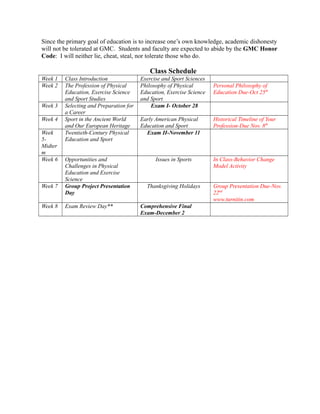
Since the primary goal of education is to increase one’s own knowledge, academic dishonesty
will not be tolerated at GMC. Students and faculty are expected to abide by the GMC Honor
Code: I will neither lie, cheat, steal, nor tolerate those who do.
Class Schedule
Week 1 Class Introduction Exercise and Sport Sciences
Week 2 The Profession of Physical
Education, Exercise Science
and Sport Studies
Philosophy of Physical
Education, Exercise Science
and Sport
Personal Philosophy of
Education Due-Oct 25th
Week 3 Selecting and Preparation for
a Career
Exam I- October 28
Week 4 Sport in the Ancient World
and Our European Heritage
Early American Physical
Education and Sport
Historical Timeline of Your
Profession-Due Nov. 8th
Week
5-
Midter
m
Twentieth-Century Physical
Education and Sport
Exam II-November 11
Week 6 Opportunities and
Challenges in Physical
Education and Exercise
Science
Issues in Sports In Class-Behavior Change
Model Activity
Week 7 Group Project Presentation
Day
Thanksgiving Holidays Group Presentation Due-Nov.
22nd
www.turnitin.com
Week 8 Exam Review Day** Comprehensive Final
Exam-December 2

HPE200SYL syllabus BJohnson

  • 1.
    HPE 200: Introductionto Health and Physical Education Prerequisite: None Quarter Hours: 5 Brittni Johnson, Fall 2015 brjohnson@gmc.edu 478-319-0565 Course Description: An overview of the history, philosophy, theory and application of the profession of Health and Physical Education, Exercise Science and Sport Studies. Student Learning Objectives: The student should be able to: 1. Identify theories of behavioral change, 2. Demonstrate critical thinking skills, 3. Compare and contrast ethical issues in Health and Physical Education, Exercise Science and Sport Studies 4. Develop a personal philosophy of education. 5. Research and investigate careers of interest in the associated fields of Health, Physical Education, Exercise Science and Sport Studies. Course Content: A. Historical and theoretical aspects of Health and Physical Education B. Relationship of health and physical activity to education C. Career options D. Implementation and evaluation of Health and Physical Education Programs Course Materials: Introduction to Physical Education, Exercise Science, and Sport Studies Methodologies of Instruction/Learning Assessment: Exams Exams will be in class and students will have the entire class period to complete. Exams will be a combination of multiple choice, fill in the blank, and short answer. Questions will be developed based on student learning objectives. Students will be responsible for all information in Course Textbook and In-Class Presentations. The Final Exam will be comprehensive and will cover all material covered the entire quarter. There will be no opportunity to make up exams late, with the exception of medical emergencies. Assignments
  • 2.
    There will beseveral in class and out of class assignments. Due dates for assignments will be posted to the class schedule. Out of class assignments will be due via email no later than 11:30pm on the due date. Students must be in class to receive credit for in class assignment. Group Project Students will break themselves into related career choice groups of no more than 3 persons. At the end of the semester, groups will be tasked with highlighting course student learning objectives with chosen career objective as the focus to include:  Detailed Description of the Responsibilities Associated with the Profession  Timeline of Historical Milestones Achieved in Professional Field  Educational Requirements and Salary of Entry Level Professionals  Projected Growth of the Field  Description of Professional Organizations  Important Professional Certifications  Standards or Guidelines for Professionals (I.E National Health Educator Standards)  Challenges and Ethical Issues of the Profession  Leaders and Prominent Researchers  Upcoming Conferences (Date, Location, Registration Cost) Students will have 20 minutes for presentation time. Sources must be cited in presentation; printed form of presentation along with hard copies of all creditable research sources (minimum of 5) must be submitted no later than November 22nd . Extra Credit Extra Credit will be offered throughout the semester. Students will have the opportunity to earn extra credit by becoming a student member of a Professional Organization related to their career interest and/or by providing a hard copy of recently published article (no more than 30 days old) with a student summary that pertains to a topic covered in class. Grading Exam I-50pts Exam II-50pts Comprehensive Exam-75pts Group Project-75pts Assignments/Participation-50pts Total Possible Points-300 Points A: 90-100 B: 80-89 C: 70-79 D: 65-69 F: 64 and below Any grade review must be initiated with the faculty member, department chair, or assistant dean within thirty days of the end of the grading period in which the grade was reported. Disability Accommodations Any student who feels he/she may need an accommodation or assistance based on the impact of a disability should apply for accommodations at www.gmc.edu --> “Quicklinks”-->
  • 3.
    ”Disability Services.” For questionsregarding accommodations, instructor notification letters, or the accommodations application process, students should please contact the Student Disability Coordinator. The Student Disability Officer for this campus is Dr. Davis, and she is located in Elliott Hall or can be reached by emailing her at bdavis@gmc.edu Administrative Procedures: A. Completion of the drop/add process and the withdrawal process is the responsibility of the student. B. Four maximum number of absences allowed before withdrawal for non-attendance. C. Students will be recorded as tardy, 15 minutes after scheduled start of class. Being late to class three times will be equal as 1 absence. D. No make-up work will be received. Students must be present to receive credit for all in class activities. All out of class assignments will be due by 11:30pm on the due date. Out of class assignments will only be accepted via GMC email. Student Initiated Withdrawals Students should complete the course for which they enroll. Not completing courses may result in negative consequences for the student both academically and financially. Students should discuss withdrawing with their advisor, professor, department chair, and financial aid representative before they decide to withdraw. Withdrawing from a class may change the amount of financial aid awarded for the quarter and may result in a balance owed by the student. The student is responsible for tuition and fees associated with the class. Withdrawals can also impact a student’s Satisfactory Academic Progress (SAP), which may affect financial aid eligibility. The student should always check with a financial aid representative to understand the financial impact before withdrawing from a course. Students may withdraw from a course during the regular term with a “W” prior to the final week of class. Students must provide official notification by contacting the Registrar’s office to withdraw. It is the student’s responsibility to ensure that the Registrar’s office has processed the request to withdraw. The Registrar’s office will ensure the last date of attendance (LDA) is recorded by the faculty member for any student withdrawing from a course.” A student choosing to initiate withdrawal should email this request from his or her GMC Student Email Account with his or her name, student ID, class name, section number, and professor’s name to the registrar at rob_withdrawals@gmc.cc.ga.us . Requests that do not follow these procedures will not be processed. Ethics: GMC emphasizes character and ethical behavior in all aspects of the curriculum. During the quarter, ethical issues/dilemmas will be discussed as they pertain to health and physical education.
  • 4.
    Since the primarygoal of education is to increase one’s own knowledge, academic dishonesty will not be tolerated at GMC. Students and faculty are expected to abide by the GMC Honor Code: I will neither lie, cheat, steal, nor tolerate those who do. Class Schedule Week 1 Class Introduction Exercise and Sport Sciences Week 2 The Profession of Physical Education, Exercise Science and Sport Studies Philosophy of Physical Education, Exercise Science and Sport Personal Philosophy of Education Due-Oct 25th Week 3 Selecting and Preparation for a Career Exam I- October 28 Week 4 Sport in the Ancient World and Our European Heritage Early American Physical Education and Sport Historical Timeline of Your Profession-Due Nov. 8th Week 5- Midter m Twentieth-Century Physical Education and Sport Exam II-November 11 Week 6 Opportunities and Challenges in Physical Education and Exercise Science Issues in Sports In Class-Behavior Change Model Activity Week 7 Group Project Presentation Day Thanksgiving Holidays Group Presentation Due-Nov. 22nd www.turnitin.com Week 8 Exam Review Day** Comprehensive Final Exam-December 2