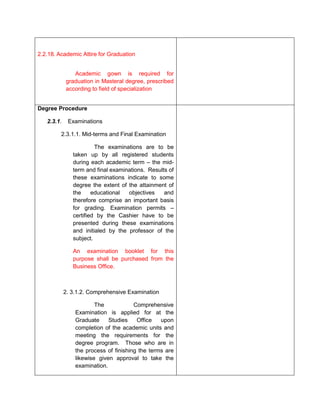
2.0 ACADEMIC AND ADMISSION POLICIES<br />PROVISIONS IN THE UNIVERSITY  CODE (Existing)Suggested RevisionsAdmission Policies and Degree RequirementsThe eligibility for admission should be determined by the Admission and Registration Committee to be approved by the Dean of the Graduate Studies, subject to the following conditions:The applicant must be a graduate of any baccalaureate degree program with a grade point average (GPA) of not lower than 2.50 or its equivalent in the academic course.2.1.2 An admission test shall determine the admission to the master’s degree program especially for those who do not meet grade requirements.An applicant who does not meet the first two conditions can still be considered for enrolment provided that he/she gets a GPA of not lower than 2.0 during the semester and that he will take and pass another aptitude test within that semester.The applicant to the Graduate Studies shall present a Transcript of Records (TOR) from the school last attended with any of the following remarks:Granted Honorable DismissalValid for TransferFor Further StudiesHowever, the applicants’ subjects taken five years back shall be considered frozen and not be credited in the graduate school.A foreign student must meet all the prescribed admission requirements of the university and the course applied for including the following:2.1.5.1. University Admission Test2.1.5.2.Original Transcript of Records2.1.5.3.Personal Data            2.1.5.4.Affidavit of Support2.1.5.5. Alien CertificateResult of TOEFLStudent VisaSecurity Clearance from his/her EmbassyResident guarantor of his/her Embassy.Academic InformationResponsibility of the StudentsStudents are expected to be informed concerning regulations governing Academic Matters.  Specific problems are referred to the appropriate person of the department for consideration.Registration InformationThe Dean’s Office guides the enrolment for all students.  Accreditation of units/courses taken outside of the university is also done at the Office of the Graduate Studies.  Issuances and validations of Registration Form will be done at the Registrar’s OfficeRegistration is official only when all the requirements have been completed and fees have been paid.Late RegistrationStudents who register within the period starting the day after the official registration date until the day designated as the “last day to enter classes” are considered late registration and are assessed a “late registration fee”.Credit UnitOne unit of graduate credit is equivalent to 18 hours of instruction in the form of lectures, lecture-discussion or seminar, or a combination of these forms within one Academic term.FeesThe type of school fees for graduate students shall be as follows:Registration fee(  50.00)Tuition fee per unit(250.00)Library fee(100.00)Medical/Dental fee(80.00)Publication Fee(50.00)ID(100.00)Student Handbook(100.00)Laboratory fee(500.00) (pls specify) Shop Fee(300.00)2.2.5.1. It is the policy of the Graduate Studies to open a class only if the number of enrollees is at least 10 students. If the minimum number of students is not met, the students enrolled shall pay extra tuition fee to complete the amount equivalent to the tuition fee of the number of students needed to open the class, or the school may adopt a scheme applicable to their case. 2.2.5.2. The maximum number of students per class is limited to 20.  Beyond this number, the class will be divided into two.2.2.5.3. Special fees payable upon application for the following (Please see Approved BOR Resolution)Comprehensive ExaminationOral ExaminationCertificate of Completion of Academic RequirementTranscript of RecordsDiplomaStudy LoadA working/part-time student is allowed a maximum load of nine (9) units; a full-time student, a maximum of nine (9) units. Students may be allowed to enroll 12 units during summer term/ or if he/she is graduating in the current term.AttendanceGraduate students are expected to attend lectures and laboratory work regularly.  When absences of a student reach 20% of the total number of hours required for the course, he shall be automatically dropped from the subject.  Time lost by the late enrolment shall be considered as time of absence.Programming of Courses/Course WorkGraduate students start with at least one (1) foundation course and two (2) specialization/major courses.  Admission to the different fields of specialization will need the approval of the Dean. Students are encouraged to use the prescribed list of courses in their field of specialization to program their course work with the help of the Dean.All requirements for the Certificate of Completion of Academic Requirements/Diploma shall be completed in not more than five calendar years including leaves.Residence RequirementThe residence requirement for graduation from the master’s program, excluding units for thesis, shall be the equivalent to 15 units.  Cross Enrolment No student may enroll simultaneously in two schools without the prior approval of the Registrar.  The Dean’s recommendation is required before the permit is issued by the Registrar.Transfer of Credits Credit units taken in other colleges and universities shall be evaluated and appropriately credited, provided the number of units to be credited shall not exceed 50% of the total units required for the degree sought; and provided further, that the subjects are substantially the same in content reflected in the SLSU graduate curriculum and the grades obtained for each subject to be credited are 2.0 or better.Accreditation of subjects shall be approved by the Dean based on the recommendation of the professors teaching the subjects to be accredited. Rejoining Students SLSU Graduate students who did not enroll for a year, or more with a maximum of 5-year absence, should first write a formal letter to the Office of the Graduate Studies expressing their intentions to resume their graduate studies.  Said letter must indicate the reasons of their absence and the specific period when they were last enrolled.Tuition Fee PrivilegeCooperating Teachers from outside Southern Leyte State University are entitled to free tuition fees for a term immediately succeeding the actual rendition of service as cooperating teachers. However, the graduate student must present certificate of recognition as cooperating teacher duly signed by the authorized University Officials and with school seal.  Addition or Change of Subjects and Withdrawal of EnrollmentAfter the official enrollment, students may add or change subjects in their registration certificates, keeping in mind the maximum study load.  They may attend classes in the meantime but must officially notify the Registrar about these changes at the end of the second week of classes during the school year and at the end of the first week of classes during the summer term.Students who wish to withdraw their enrollment should officially notify the Registrar and their instructor.  They will have to pay the school fees, however, according to the following schedule:Within one week from the opening of classeswhether or not they have attended classes- 30% of the feesWithin the second week- 50% of the feesWithin the third week- 70% of the feesAfter the third week- Full paymentRetentionGraduate students must maintain a GPA of 2.0 in every term.  If they failed to maintain the specified cut-off rating they are advised to drop the program.A graduate student shall finish the degree within 5 years.  In case student fails to finish within the required length of time, he has to refresh the academic subject but only those not covered within 5 years. 2.2.16.  Grading System/Academic CertificationAt the end of the term, students are rated as follows:Grade Indication 1.0 – 1.2Excellent1.3 – 1.4Very Good1.5 – 1.7Good1.8 – 2.0Fair/passedBelow 2.0FailureAs basis for grades, the following weights are generally assigned:Mid-Term-  50%Final Term-  50%Total100%Professors are given academic freedom to assign weights for grades in course requirements.Students who lack requirements will be graded incomplete (INC). INC not completed in a year will be considered failure. Once the student is ready to submit the lacking requirements, the students shall secure and accomplish an application form for completion of grades from the Office of the Registrar/Office of the Dean of Graduate Studies to be given to the professor concerned.  The latter shall sign and submit the form with the assigned rating to the Office of the Registrar in a sealed envelope.  Dropped (DR) mark is given to students who withdraw from the subject and/or have incurred absences of at least 20% of the total number of class hours (54 hours) in a semester.Auditing a Class/Penalty CourseA student who desires to take a refresher course before taking the comprehensive examination may be allowed to audit a class upon payment of 50% of the tuition.  In this case, however, no grade will be assigned to the person attending the class.Students who passed the comprehensive examinations but have gone beyond two years shall be required to enroll a penalty course equivalent to 3 units to be determined by the student in consultation with the Dean.Two years after completing the academic requirements will subject the student  to take 3 units refresher course before taking comprehensive examination. Courses taken will be determined by the dean.Academic Attire for Graduation Academic gown is required for graduation in Masteral degree, prescribed according to field of specializationDegree Procedure2.3.1.    Examinations2.3.1.1. Mid-terms and Final Examination7The examinations are to be taken up by all registered students during each academic term – the mid-term and final examinations.  Results of these examinations indicate to some degree the extent of the attainment of the educational objectives and therefore comprise an important basis for grading. Examination permits – certified by the Cashier have to be presented during these examinations and initialed by the professor of the subject.  An examination booklet for this purpose shall be purchased from the Business Office.                2. 3.1.2. Comprehensive ExaminationThe Comprehensive Examination is applied for at the Graduate Studies Office upon completion of the academic units and meeting the requirements for the degree program.  Those who are in the process of finishing the terms are likewise given approval to take the examination.The two-day written examination determines the student’s ability to organize, integrate and synthesize all major knowledge and skills he/she has acquired in his/her coursework.  Any teacher assigned to teach a particular subject is enforced to submit questions for that subject.  Test questions should be deposited in the databank of the Graduate Studies.  During the comprehensive examination, the Dean of the Graduate Studies chooses which test questions submitted are to be administered in that subject.  Then a particular teacher teaching that subject will correct and grade the test papers without names but only number code.  A student who fails the examination is given a second chance to pass it otherwise the student is required to retake the subject.  The examination is given once every term. Answers will be graded by graduate faculty on a pass/fail basis.Oral Examination for students taking non-thesis program.An Oral Comprehensive Examination, designed to provide further evidence of mastery of the program of study, is required for students Taking non-thesis Program The schedule is announced at the Graduate Studies Office after the written comprehensive examination.  Only those who passed the written comprehensive examination are qualified for the oral comprehensive examination the schedule of which is posted two weeks after the written comprehensive examination.2.3.2.    Guidelines for Thesis Writing8Upon successful completion of program requirements including the comprehensive examination, the student enrolls in agendum thesis writing consecutive Academic Terms (Agendum- I unit in the ist semester; thesis writing – 6 units in the second term).  These subjects require numeral ratings.  For non-completion, the student registers “Continuing Matriculation” until that term in which he completes the thesis requirements under the guidance of an adviser assigned by the Dean.   2.3.2.1   Requirements for AdvisersThe adviser should be a faculty member of the SLSU Graduate Studies.  Where this is not possible, due to (Overloaded faculty, non-availability of expertise) the service of an outsider with the appropriate expertise may e tapped to serve not as a major adviser but a panel member. However, the candidate has to take care of the traveling and accommodation expenses during the external member’s attendance for the proposal hearing and Oral Examination.The adviser should be competent in the field of specialization called for by the topic of the thesis prepared. He/She should have expertise not only in the content of the thesis proposal but also in the technicalities of thesis writing and have communicative competence in oral and written English, particularly the latter.The advisee should comply with consultation requirements (see consultation form) set by the Office of Graduate Studies.For continuity of research efforts, the adviser for Research Agendum (Thesis Proposal) should also be the adviser for Thesis B (Thesis Writing).  In cases like adviser”s change to assignment, transfer, resignation, and other valid reasons, the advisee shall apply for a change of adviser through writing.   2.3.2.2   Responsibilities of AdvisersTo acquaint the advisee on the requirements of the course;To arrange with the advisee the consultation hour in terms of time availability, frequency and duration;To guide the advisee on the content of the proposed paper and technicalities of thesis writing;To recommend for design hearing and oral defense; and To require the advisee to submit the comments/suggestions of the evaluators and to guide the advisee in making the suggested revisions.2.3.2.3 Requirements for Thesis A (Research Agendum)Must have passed the Written Comprehensive Examinations in his/her particular discipline.2.3.2.4  Responsibilities of the AdviseeTo submit a written request for a preferred thesis adviser (at least three faculty in the area of specialization) to the Office of the Graduate Studies;To draw up in consultation with the assigned (by the dean) thesis adviser a schedule of consultation hours, specifying time availability, frequency, duration and place;To submit six copies of the thesis proposal or design to the Office of the Graduate Studies one week in advance.To make the needed corrections/revisions of the proposed thesis.To present himself/herself on formal attire during the design hearing/final oral defense.To take documentation of the proceedings.To ensure the availability of panel members two days before the design hearing/ oral defense.  2.3.2.5. Thesis Proposal2.3.2.5.1   Assignment of AdviserAfter passing the Written Comprehensive Examination, the student enrolls in Thesis A (Research Agendum).  He is then required to submit to the Office of the Graduate Studies at least 3 preferred topics or titles for thesis proposal.  From the three recommended faculty members, the Dean assigns a thesis adviser whose field of specialization related to the topic submitted and to the major filed of the thesis writer.  He adviser will guide the student in the preparation and completion of the written proposal to the Dean of the Graduate Studies, who will approve the requested schedule of proposal hearing.The graduate student who recommends the schedule of the hearing will distribute copies of the proposal to the members of evaluation committee one week in advance.         2.3.2.5.2. Writing the Thesis ProposalAll research proposals should include the following chapters and sections:  2.3.2.5.4. The Proposal Evaluation CommitteeThis is a committee  designated by the Office of the Graduate Studies.   It is composed of the Dean who acts as chairperson, statistician, censor, member. The Committee members are expected to be knowledgeable of and conversant with the subject of the proposed research, as reflected in the list of graduate professors indicating their expertise and willingness to evaluate the thesis proposal or serve as advisers.  They must also be knowledgeable of the technicalities in thesis writing.  Copies of the proposal are distributed to the evaluators by the student two weeks before the date of the proposal hearing.   2.3.2.5.5. The Proposal HearingDuring the proposal hearing, the candidate shall:1.  On a backdrop, present the title, date of the hearing, name of the candidate, and panel members.2.  On a powerpoint presentation (good for ten minutes) the candidate shall present the title, statement of the problem, methodology, and instrument.The proposal hearing is conducted for the purpose of having the proposed research design officially approved by the Proposal Evaluation Committee.  If major changes of the proposal are considered necessary by the Committee, the signing of the approval sheet is held in abeyance, pending upon submission of the revised proposal to the satisfaction of all members of the Committee.  The signing of the approval sheet will only be done after necessary corrections/comments are already incorporated in the revised copy of the proposal.    2.3.2.5.6. Writing the ThesisThis section provides information on the parts and organization of the thesis, the role of the thesis adviser, the scheduling of the oral defense, the role of the panel members, the oral defense procedure and what to do after the oral defense.                             2. 3.2.5.6.1.The Parts of a Thesis                   2.3.2.5.6.2. The Role of the AdviserGenerally, the thesis adviser helps the student develop his/her thesis proposal.  He/She therefore is familiar with the study.The adviser makes himself/herself available to the advisee and encourages, motivates, and maintains a harmonious relationship with him/her.  Furthermore, the adviser guides the student to work promptly the suggestions and recommendations of the panel members.The adviser makes concrete suggestions not merely underline or write “improve” or place question marks on the manuscript submitted to him/her by the advisee.As soon as the adviser decides that the thesis is ready for defense, he/she recommends the paper for oral defense, and signs the necessary form for this purpose.  The adviser should exert effort to check the preparedness of the Candidate for oral defense; otherwise he should not recommend for a defense.The adviser sits near his advisee during the oral defense but does not answer for the candidate or contradict any view of the panel member.  He/She may clarify questions for the candidate and takes down notes on suggestions, comments, and revision.                   2.3.2.5.6.3. Scheduling of the Thesis Oral DefenseUpon completion of the thesis, the adviser certifies that the advisee is ready for the oral defense.  The student then submits the certification to the Dean and is given a checklist of requirements he/she has to comply with before the oral defense is scheduled.Copies of the thesis will be distributed to the Dean of the Graduate Studies, panel members, and adviser(s).The candidate must enroll in Thesis B (Thesis Writing) during the semester he/she is expected to defend his/her paper.The Oral Defense is scheduled one week after meeting all the requirements.  The student then distributes copies of the thesis to the designated panel members.     2. 3.2.5.6.4.  Deferment of the Thesis Oral DefenseIf any member of the Panel of Examiners finds any major defect(s) in the thesis, he should notify the Dean at least three days before the oral defense.  The Dean will get the consensus of the Panel on whether or not the defense should be postponed.  If majority of the members decide to proceed with the scheduled examination, this will go on as scheduled.Reasons for Deferment of Thesis Oral DefenseSpecific requirements for the scheduling of the oral defense is not complied.Steps in the development of the thesis are different from that outlined in the proposal.There is evidence of plagiarism.Chapters 4 & 5 of thesis are not substantial.          2.3.2.5.6.5. The Role of the Panel of ExaminersThe oral defense is conducted in a dignified academic atmosphere.  Each panel member is expected to have read the manuscript well to enable him/her to participate actively and engage in scholarly exchange of ideas, thus contributing to the improvement of the manuscript.Basically, a panel member’s activity is to ask carefully prepared questions before the oral defense.Panel members should formulate their queries carefully before the oral defense to avoid questions that “go around the bush.”  They must be able to give specific suggestions in regard to the questions they asked.  A professor who has accepted the Dean’s appointment as member of the Panel of Examiners at a designated schedule is, by all means, committed to that assignment and should therefore refrain from announcing his/her unavailability just a few days before the oral defense.Members of the Panel of Examiners are chosen on the basis of their professional competence and qualifications.  It is, therefore, unacceptable for designated examiners to send representatives in their stead.  A professor who accepts to sit for an examination has the obligation to make himself/herself available at the appointed time. The censor certifies the overall readiness of the thesis for design hearing/oral defense.  He/she shall likewise ensure for the correctness of the organization and grammar of the thesis. 15   2.3.2.5.6.6.The Oral Defense ProcedureThe entire proceedings of the defense for the master’ degree shall not e more than two hours.The Chairperson signals the start of the examination and asks the Candidate to lead the prayer.The three important aspects and their respective percentage ratings are:  Content (40%), Presentation (30%), and Defense (30%).  Percentage rating is converted to number grade.  Two point zero (2.0) or 85% is the passing grade in the Master’s Degree.Content refers to the thesis itself.  The panel members will decide whether the investigation is comprehensive enough and the examinee has answered the problems raised in the study satisfactorily.  Focus should be on the “substance”, and not the “format” or “style. Presentation refers to the way the candidate presents and elaborates on the content of the paper in an organized logical manner without missing vital points of the thesis.Defense, shows the ability of the candidate to justify his research design, findings and conclusions.  He/She can readily locate the table and page to support his/her answers.The Chairperson allows the candidate to briefly present the thesis in no more than 10 minutes covering the main points of the problem, its significance, methodology, findings, conclusions and recommendations.            2.3.2.5.6.7.   Grading In order to pass in the final oral examination, the student should get at least 85% overall rating.When the Chairperson declares the defense over, he/she requests the candidate and the audience to leave the room, while the panel deliberates on the candidate’s grade.The Chairperson then fills out the Oral Examination Form, signs this and asks the rest of the panel members also to sign.  In case there is no change to be made in the manuscript, the Approval Sheet (Appendix H) will be signed by the Adviser, the Chairperson and the panel members.  The Chairperson announces the results consolidated by the statistician.When there are revisions to be made, the adviser takes the responsibility of supervising the revisions.  When the revision is completed, the adviser signs the Approval Sheet and the candidate requests all the panel members to sign on it.  All copies of the thesis must be returned to the candidate to make the suggested revisions therein.After the oral examination, the adviser confers with the student to review the comments and suggestions of the panel.To maintain the academic atmosphere of the oral examinations, food should not be served to the panel members while the oral defense is going on.Post-Defense RequirementsAfter the successful defense of his paper, the student revises the manuscript according to   comments and suggestions of the Examiners.  He/She gets the Approval Sheet and asks the Adviser to sign it.  The Dean signs the Approval Sheet only after the Chairperson and the panel members have signed the already bound thesis.  Six copies of the revised thesis, using the prescribed paper (including an abstract in each) and one soft copy in CD will be submitted.  The distribution of these should be:  2 copies for the University Library; 2 copies for the Office of the Graduate Studies, 1 copy for the adviser, and a copy for the CHED.Graduation RequirementsTo graduate with a degree, a student must complete all the academic requirements on or before the deadline set by the University.  The candidate must apply for graduation.If some requirements for graduation are completed beyond the deadline, the student must enroll for residency during the succeeding term and re-apply for graduation in order to be considered for graduation at the end of that term.Honorable DismissalClearance must be secured from the Office and all indebtedness settled by the student before a statement of honorable dismissal can be issued.2.3.2.5.6.11.   Transcript of RecordsApplication for transcript of academic records shall be submitted to the Registrar’s Office and accompanied by a duly accomplished clearance form.2.3.2.5.6.12  Clearance All graduate students are required to file clearance at the end of every term.  This should be signed by all professors of the student concerned.  Likewise, all other needed signatures indicated therein must be fully accomplished.  Fully accomplished clearance (in three copies) must be submitted to the Registrar and office of the graduate studies.  The remaining copy shall be kept by the student.3.  STUDENT ORGANIZATION AND ACTIVITIES3.1. Graduate School OrganizationThere shall be Graduate School Organization or its equivalent with the following functions:To develop school spirit among the students and promote their general welfare;To organize and direct student activities;To inform the President of the institution thru the Office of Student Services or its equivalent on student matters, affairs and activities; andTo adopt its own constitution and by-laws for the governance of their organization.3.2. The composition of the Graduate Student Organization and the manner of electing its members and officers shall be in accordance with the constitution and by-laws promulgated by the organization.  3.3.The organization shall be directly under the general supervision of the Dean of Student Services or its equivalent officials who shall work in close cooperation and consultation with the Vice President for Academic Affairs.3.4.  The organization shall have one or more faculty advisers chosen by them and approved by the President of the University on the recommendation of the Dean of Student Services.
Academic polcies
Academic polcies
Academic polcies
Academic polcies
Academic polcies
Academic polcies
Academic polcies
Academic polcies
Academic polcies
Academic polcies
Academic polcies
Academic polcies
Academic polcies
Academic polcies
Academic polcies
Academic polcies
Academic polcies
Academic polcies
Academic polcies
Academic polcies
Academic polcies
Academic polcies

Academic polcies

  • 1.
    2.0 ACADEMIC ANDADMISSION POLICIES<br />PROVISIONS IN THE UNIVERSITY CODE (Existing)Suggested RevisionsAdmission Policies and Degree RequirementsThe eligibility for admission should be determined by the Admission and Registration Committee to be approved by the Dean of the Graduate Studies, subject to the following conditions:The applicant must be a graduate of any baccalaureate degree program with a grade point average (GPA) of not lower than 2.50 or its equivalent in the academic course.2.1.2 An admission test shall determine the admission to the master’s degree program especially for those who do not meet grade requirements.An applicant who does not meet the first two conditions can still be considered for enrolment provided that he/she gets a GPA of not lower than 2.0 during the semester and that he will take and pass another aptitude test within that semester.The applicant to the Graduate Studies shall present a Transcript of Records (TOR) from the school last attended with any of the following remarks:Granted Honorable DismissalValid for TransferFor Further StudiesHowever, the applicants’ subjects taken five years back shall be considered frozen and not be credited in the graduate school.A foreign student must meet all the prescribed admission requirements of the university and the course applied for including the following:2.1.5.1. University Admission Test2.1.5.2.Original Transcript of Records2.1.5.3.Personal Data 2.1.5.4.Affidavit of Support2.1.5.5. Alien CertificateResult of TOEFLStudent VisaSecurity Clearance from his/her EmbassyResident guarantor of his/her Embassy.Academic InformationResponsibility of the StudentsStudents are expected to be informed concerning regulations governing Academic Matters. Specific problems are referred to the appropriate person of the department for consideration.Registration InformationThe Dean’s Office guides the enrolment for all students. Accreditation of units/courses taken outside of the university is also done at the Office of the Graduate Studies. Issuances and validations of Registration Form will be done at the Registrar’s OfficeRegistration is official only when all the requirements have been completed and fees have been paid.Late RegistrationStudents who register within the period starting the day after the official registration date until the day designated as the “last day to enter classes” are considered late registration and are assessed a “late registration fee”.Credit UnitOne unit of graduate credit is equivalent to 18 hours of instruction in the form of lectures, lecture-discussion or seminar, or a combination of these forms within one Academic term.FeesThe type of school fees for graduate students shall be as follows:Registration fee( 50.00)Tuition fee per unit(250.00)Library fee(100.00)Medical/Dental fee(80.00)Publication Fee(50.00)ID(100.00)Student Handbook(100.00)Laboratory fee(500.00) (pls specify) Shop Fee(300.00)2.2.5.1. It is the policy of the Graduate Studies to open a class only if the number of enrollees is at least 10 students. If the minimum number of students is not met, the students enrolled shall pay extra tuition fee to complete the amount equivalent to the tuition fee of the number of students needed to open the class, or the school may adopt a scheme applicable to their case. 2.2.5.2. The maximum number of students per class is limited to 20. Beyond this number, the class will be divided into two.2.2.5.3. Special fees payable upon application for the following (Please see Approved BOR Resolution)Comprehensive ExaminationOral ExaminationCertificate of Completion of Academic RequirementTranscript of RecordsDiplomaStudy LoadA working/part-time student is allowed a maximum load of nine (9) units; a full-time student, a maximum of nine (9) units. Students may be allowed to enroll 12 units during summer term/ or if he/she is graduating in the current term.AttendanceGraduate students are expected to attend lectures and laboratory work regularly. When absences of a student reach 20% of the total number of hours required for the course, he shall be automatically dropped from the subject. Time lost by the late enrolment shall be considered as time of absence.Programming of Courses/Course WorkGraduate students start with at least one (1) foundation course and two (2) specialization/major courses. Admission to the different fields of specialization will need the approval of the Dean. Students are encouraged to use the prescribed list of courses in their field of specialization to program their course work with the help of the Dean.All requirements for the Certificate of Completion of Academic Requirements/Diploma shall be completed in not more than five calendar years including leaves.Residence RequirementThe residence requirement for graduation from the master’s program, excluding units for thesis, shall be the equivalent to 15 units. Cross Enrolment No student may enroll simultaneously in two schools without the prior approval of the Registrar. The Dean’s recommendation is required before the permit is issued by the Registrar.Transfer of Credits Credit units taken in other colleges and universities shall be evaluated and appropriately credited, provided the number of units to be credited shall not exceed 50% of the total units required for the degree sought; and provided further, that the subjects are substantially the same in content reflected in the SLSU graduate curriculum and the grades obtained for each subject to be credited are 2.0 or better.Accreditation of subjects shall be approved by the Dean based on the recommendation of the professors teaching the subjects to be accredited. Rejoining Students SLSU Graduate students who did not enroll for a year, or more with a maximum of 5-year absence, should first write a formal letter to the Office of the Graduate Studies expressing their intentions to resume their graduate studies. Said letter must indicate the reasons of their absence and the specific period when they were last enrolled.Tuition Fee PrivilegeCooperating Teachers from outside Southern Leyte State University are entitled to free tuition fees for a term immediately succeeding the actual rendition of service as cooperating teachers. However, the graduate student must present certificate of recognition as cooperating teacher duly signed by the authorized University Officials and with school seal. Addition or Change of Subjects and Withdrawal of EnrollmentAfter the official enrollment, students may add or change subjects in their registration certificates, keeping in mind the maximum study load. They may attend classes in the meantime but must officially notify the Registrar about these changes at the end of the second week of classes during the school year and at the end of the first week of classes during the summer term.Students who wish to withdraw their enrollment should officially notify the Registrar and their instructor. They will have to pay the school fees, however, according to the following schedule:Within one week from the opening of classeswhether or not they have attended classes- 30% of the feesWithin the second week- 50% of the feesWithin the third week- 70% of the feesAfter the third week- Full paymentRetentionGraduate students must maintain a GPA of 2.0 in every term. If they failed to maintain the specified cut-off rating they are advised to drop the program.A graduate student shall finish the degree within 5 years. In case student fails to finish within the required length of time, he has to refresh the academic subject but only those not covered within 5 years. 2.2.16. Grading System/Academic CertificationAt the end of the term, students are rated as follows:Grade Indication 1.0 – 1.2Excellent1.3 – 1.4Very Good1.5 – 1.7Good1.8 – 2.0Fair/passedBelow 2.0FailureAs basis for grades, the following weights are generally assigned:Mid-Term- 50%Final Term- 50%Total100%Professors are given academic freedom to assign weights for grades in course requirements.Students who lack requirements will be graded incomplete (INC). INC not completed in a year will be considered failure. Once the student is ready to submit the lacking requirements, the students shall secure and accomplish an application form for completion of grades from the Office of the Registrar/Office of the Dean of Graduate Studies to be given to the professor concerned. The latter shall sign and submit the form with the assigned rating to the Office of the Registrar in a sealed envelope. Dropped (DR) mark is given to students who withdraw from the subject and/or have incurred absences of at least 20% of the total number of class hours (54 hours) in a semester.Auditing a Class/Penalty CourseA student who desires to take a refresher course before taking the comprehensive examination may be allowed to audit a class upon payment of 50% of the tuition. In this case, however, no grade will be assigned to the person attending the class.Students who passed the comprehensive examinations but have gone beyond two years shall be required to enroll a penalty course equivalent to 3 units to be determined by the student in consultation with the Dean.Two years after completing the academic requirements will subject the student to take 3 units refresher course before taking comprehensive examination. Courses taken will be determined by the dean.Academic Attire for Graduation Academic gown is required for graduation in Masteral degree, prescribed according to field of specializationDegree Procedure2.3.1. Examinations2.3.1.1. Mid-terms and Final Examination7The examinations are to be taken up by all registered students during each academic term – the mid-term and final examinations. Results of these examinations indicate to some degree the extent of the attainment of the educational objectives and therefore comprise an important basis for grading. Examination permits – certified by the Cashier have to be presented during these examinations and initialed by the professor of the subject. An examination booklet for this purpose shall be purchased from the Business Office. 2. 3.1.2. Comprehensive ExaminationThe Comprehensive Examination is applied for at the Graduate Studies Office upon completion of the academic units and meeting the requirements for the degree program. Those who are in the process of finishing the terms are likewise given approval to take the examination.The two-day written examination determines the student’s ability to organize, integrate and synthesize all major knowledge and skills he/she has acquired in his/her coursework. Any teacher assigned to teach a particular subject is enforced to submit questions for that subject. Test questions should be deposited in the databank of the Graduate Studies. During the comprehensive examination, the Dean of the Graduate Studies chooses which test questions submitted are to be administered in that subject. Then a particular teacher teaching that subject will correct and grade the test papers without names but only number code. A student who fails the examination is given a second chance to pass it otherwise the student is required to retake the subject. The examination is given once every term. Answers will be graded by graduate faculty on a pass/fail basis.Oral Examination for students taking non-thesis program.An Oral Comprehensive Examination, designed to provide further evidence of mastery of the program of study, is required for students Taking non-thesis Program The schedule is announced at the Graduate Studies Office after the written comprehensive examination. Only those who passed the written comprehensive examination are qualified for the oral comprehensive examination the schedule of which is posted two weeks after the written comprehensive examination.2.3.2. Guidelines for Thesis Writing8Upon successful completion of program requirements including the comprehensive examination, the student enrolls in agendum thesis writing consecutive Academic Terms (Agendum- I unit in the ist semester; thesis writing – 6 units in the second term). These subjects require numeral ratings. For non-completion, the student registers “Continuing Matriculation” until that term in which he completes the thesis requirements under the guidance of an adviser assigned by the Dean. 2.3.2.1 Requirements for AdvisersThe adviser should be a faculty member of the SLSU Graduate Studies. Where this is not possible, due to (Overloaded faculty, non-availability of expertise) the service of an outsider with the appropriate expertise may e tapped to serve not as a major adviser but a panel member. However, the candidate has to take care of the traveling and accommodation expenses during the external member’s attendance for the proposal hearing and Oral Examination.The adviser should be competent in the field of specialization called for by the topic of the thesis prepared. He/She should have expertise not only in the content of the thesis proposal but also in the technicalities of thesis writing and have communicative competence in oral and written English, particularly the latter.The advisee should comply with consultation requirements (see consultation form) set by the Office of Graduate Studies.For continuity of research efforts, the adviser for Research Agendum (Thesis Proposal) should also be the adviser for Thesis B (Thesis Writing). In cases like adviser”s change to assignment, transfer, resignation, and other valid reasons, the advisee shall apply for a change of adviser through writing. 2.3.2.2 Responsibilities of AdvisersTo acquaint the advisee on the requirements of the course;To arrange with the advisee the consultation hour in terms of time availability, frequency and duration;To guide the advisee on the content of the proposed paper and technicalities of thesis writing;To recommend for design hearing and oral defense; and To require the advisee to submit the comments/suggestions of the evaluators and to guide the advisee in making the suggested revisions.2.3.2.3 Requirements for Thesis A (Research Agendum)Must have passed the Written Comprehensive Examinations in his/her particular discipline.2.3.2.4 Responsibilities of the AdviseeTo submit a written request for a preferred thesis adviser (at least three faculty in the area of specialization) to the Office of the Graduate Studies;To draw up in consultation with the assigned (by the dean) thesis adviser a schedule of consultation hours, specifying time availability, frequency, duration and place;To submit six copies of the thesis proposal or design to the Office of the Graduate Studies one week in advance.To make the needed corrections/revisions of the proposed thesis.To present himself/herself on formal attire during the design hearing/final oral defense.To take documentation of the proceedings.To ensure the availability of panel members two days before the design hearing/ oral defense. 2.3.2.5. Thesis Proposal2.3.2.5.1 Assignment of AdviserAfter passing the Written Comprehensive Examination, the student enrolls in Thesis A (Research Agendum). He is then required to submit to the Office of the Graduate Studies at least 3 preferred topics or titles for thesis proposal. From the three recommended faculty members, the Dean assigns a thesis adviser whose field of specialization related to the topic submitted and to the major filed of the thesis writer. He adviser will guide the student in the preparation and completion of the written proposal to the Dean of the Graduate Studies, who will approve the requested schedule of proposal hearing.The graduate student who recommends the schedule of the hearing will distribute copies of the proposal to the members of evaluation committee one week in advance. 2.3.2.5.2. Writing the Thesis ProposalAll research proposals should include the following chapters and sections: 2.3.2.5.4. The Proposal Evaluation CommitteeThis is a committee designated by the Office of the Graduate Studies. It is composed of the Dean who acts as chairperson, statistician, censor, member. The Committee members are expected to be knowledgeable of and conversant with the subject of the proposed research, as reflected in the list of graduate professors indicating their expertise and willingness to evaluate the thesis proposal or serve as advisers. They must also be knowledgeable of the technicalities in thesis writing. Copies of the proposal are distributed to the evaluators by the student two weeks before the date of the proposal hearing. 2.3.2.5.5. The Proposal HearingDuring the proposal hearing, the candidate shall:1. On a backdrop, present the title, date of the hearing, name of the candidate, and panel members.2. On a powerpoint presentation (good for ten minutes) the candidate shall present the title, statement of the problem, methodology, and instrument.The proposal hearing is conducted for the purpose of having the proposed research design officially approved by the Proposal Evaluation Committee. If major changes of the proposal are considered necessary by the Committee, the signing of the approval sheet is held in abeyance, pending upon submission of the revised proposal to the satisfaction of all members of the Committee. The signing of the approval sheet will only be done after necessary corrections/comments are already incorporated in the revised copy of the proposal. 2.3.2.5.6. Writing the ThesisThis section provides information on the parts and organization of the thesis, the role of the thesis adviser, the scheduling of the oral defense, the role of the panel members, the oral defense procedure and what to do after the oral defense. 2. 3.2.5.6.1.The Parts of a Thesis 2.3.2.5.6.2. The Role of the AdviserGenerally, the thesis adviser helps the student develop his/her thesis proposal. He/She therefore is familiar with the study.The adviser makes himself/herself available to the advisee and encourages, motivates, and maintains a harmonious relationship with him/her. Furthermore, the adviser guides the student to work promptly the suggestions and recommendations of the panel members.The adviser makes concrete suggestions not merely underline or write “improve” or place question marks on the manuscript submitted to him/her by the advisee.As soon as the adviser decides that the thesis is ready for defense, he/she recommends the paper for oral defense, and signs the necessary form for this purpose. The adviser should exert effort to check the preparedness of the Candidate for oral defense; otherwise he should not recommend for a defense.The adviser sits near his advisee during the oral defense but does not answer for the candidate or contradict any view of the panel member. He/She may clarify questions for the candidate and takes down notes on suggestions, comments, and revision. 2.3.2.5.6.3. Scheduling of the Thesis Oral DefenseUpon completion of the thesis, the adviser certifies that the advisee is ready for the oral defense. The student then submits the certification to the Dean and is given a checklist of requirements he/she has to comply with before the oral defense is scheduled.Copies of the thesis will be distributed to the Dean of the Graduate Studies, panel members, and adviser(s).The candidate must enroll in Thesis B (Thesis Writing) during the semester he/she is expected to defend his/her paper.The Oral Defense is scheduled one week after meeting all the requirements. The student then distributes copies of the thesis to the designated panel members. 2. 3.2.5.6.4. Deferment of the Thesis Oral DefenseIf any member of the Panel of Examiners finds any major defect(s) in the thesis, he should notify the Dean at least three days before the oral defense. The Dean will get the consensus of the Panel on whether or not the defense should be postponed. If majority of the members decide to proceed with the scheduled examination, this will go on as scheduled.Reasons for Deferment of Thesis Oral DefenseSpecific requirements for the scheduling of the oral defense is not complied.Steps in the development of the thesis are different from that outlined in the proposal.There is evidence of plagiarism.Chapters 4 & 5 of thesis are not substantial. 2.3.2.5.6.5. The Role of the Panel of ExaminersThe oral defense is conducted in a dignified academic atmosphere. Each panel member is expected to have read the manuscript well to enable him/her to participate actively and engage in scholarly exchange of ideas, thus contributing to the improvement of the manuscript.Basically, a panel member’s activity is to ask carefully prepared questions before the oral defense.Panel members should formulate their queries carefully before the oral defense to avoid questions that “go around the bush.” They must be able to give specific suggestions in regard to the questions they asked. A professor who has accepted the Dean’s appointment as member of the Panel of Examiners at a designated schedule is, by all means, committed to that assignment and should therefore refrain from announcing his/her unavailability just a few days before the oral defense.Members of the Panel of Examiners are chosen on the basis of their professional competence and qualifications. It is, therefore, unacceptable for designated examiners to send representatives in their stead. A professor who accepts to sit for an examination has the obligation to make himself/herself available at the appointed time. The censor certifies the overall readiness of the thesis for design hearing/oral defense. He/she shall likewise ensure for the correctness of the organization and grammar of the thesis. 15 2.3.2.5.6.6.The Oral Defense ProcedureThe entire proceedings of the defense for the master’ degree shall not e more than two hours.The Chairperson signals the start of the examination and asks the Candidate to lead the prayer.The three important aspects and their respective percentage ratings are: Content (40%), Presentation (30%), and Defense (30%). Percentage rating is converted to number grade. Two point zero (2.0) or 85% is the passing grade in the Master’s Degree.Content refers to the thesis itself. The panel members will decide whether the investigation is comprehensive enough and the examinee has answered the problems raised in the study satisfactorily. Focus should be on the “substance”, and not the “format” or “style. Presentation refers to the way the candidate presents and elaborates on the content of the paper in an organized logical manner without missing vital points of the thesis.Defense, shows the ability of the candidate to justify his research design, findings and conclusions. He/She can readily locate the table and page to support his/her answers.The Chairperson allows the candidate to briefly present the thesis in no more than 10 minutes covering the main points of the problem, its significance, methodology, findings, conclusions and recommendations. 2.3.2.5.6.7. Grading In order to pass in the final oral examination, the student should get at least 85% overall rating.When the Chairperson declares the defense over, he/she requests the candidate and the audience to leave the room, while the panel deliberates on the candidate’s grade.The Chairperson then fills out the Oral Examination Form, signs this and asks the rest of the panel members also to sign. In case there is no change to be made in the manuscript, the Approval Sheet (Appendix H) will be signed by the Adviser, the Chairperson and the panel members. The Chairperson announces the results consolidated by the statistician.When there are revisions to be made, the adviser takes the responsibility of supervising the revisions. When the revision is completed, the adviser signs the Approval Sheet and the candidate requests all the panel members to sign on it. All copies of the thesis must be returned to the candidate to make the suggested revisions therein.After the oral examination, the adviser confers with the student to review the comments and suggestions of the panel.To maintain the academic atmosphere of the oral examinations, food should not be served to the panel members while the oral defense is going on.Post-Defense RequirementsAfter the successful defense of his paper, the student revises the manuscript according to comments and suggestions of the Examiners. He/She gets the Approval Sheet and asks the Adviser to sign it. The Dean signs the Approval Sheet only after the Chairperson and the panel members have signed the already bound thesis. Six copies of the revised thesis, using the prescribed paper (including an abstract in each) and one soft copy in CD will be submitted. The distribution of these should be: 2 copies for the University Library; 2 copies for the Office of the Graduate Studies, 1 copy for the adviser, and a copy for the CHED.Graduation RequirementsTo graduate with a degree, a student must complete all the academic requirements on or before the deadline set by the University. The candidate must apply for graduation.If some requirements for graduation are completed beyond the deadline, the student must enroll for residency during the succeeding term and re-apply for graduation in order to be considered for graduation at the end of that term.Honorable DismissalClearance must be secured from the Office and all indebtedness settled by the student before a statement of honorable dismissal can be issued.2.3.2.5.6.11. Transcript of RecordsApplication for transcript of academic records shall be submitted to the Registrar’s Office and accompanied by a duly accomplished clearance form.2.3.2.5.6.12 Clearance All graduate students are required to file clearance at the end of every term. This should be signed by all professors of the student concerned. Likewise, all other needed signatures indicated therein must be fully accomplished. Fully accomplished clearance (in three copies) must be submitted to the Registrar and office of the graduate studies. The remaining copy shall be kept by the student.3. STUDENT ORGANIZATION AND ACTIVITIES3.1. Graduate School OrganizationThere shall be Graduate School Organization or its equivalent with the following functions:To develop school spirit among the students and promote their general welfare;To organize and direct student activities;To inform the President of the institution thru the Office of Student Services or its equivalent on student matters, affairs and activities; andTo adopt its own constitution and by-laws for the governance of their organization.3.2. The composition of the Graduate Student Organization and the manner of electing its members and officers shall be in accordance with the constitution and by-laws promulgated by the organization. 3.3.The organization shall be directly under the general supervision of the Dean of Student Services or its equivalent officials who shall work in close cooperation and consultation with the Vice President for Academic Affairs.3.4. The organization shall have one or more faculty advisers chosen by them and approved by the President of the University on the recommendation of the Dean of Student Services.